A P U B L I C AT I O N O F T H E S A LVAT I O N A R M Y S O U T H ER N T ER R I TO R Y
N OV E M B ER 2 0 2 3
VO L 3 9
I S S U E 11
TEAM CITRUS
An Experimental Approach to Corps Leadership B Y LT. C O L O N E L A L L E N S AT T E R L E E Things were running smoothly, the officers fully meeting the expectations of their people, but the pressing needs of The Salvation Army beyond the boundaries of their own corps engendered an urgency in three retired officers—Colonel Dennis Strissel, Lt. Colonel John Roy Jones and Lt. Colonel Gary Haupt—who between them had logged over a century of service in its soul-saving mission. Some would argue they had served their time; they had done enough. A calling, however, has no time limit. So, they met and discussed the need and formulated a plan. Having a plan was one thing. Getting others to buy into it was another. Fortunately, Lt. Colonel Kent Davis, divisional commander of the Florida Division, was interested. “Having retired officers fill in at corps where we had breakdowns or unexpected vacancies was one thing, but this was something different. They made it clear that they were very happy with the current leadership of the Citrus County Corps, but they knew that someday their officers would be sent to another appointment. This was for whenever that occurred. And if it worked in Citrus County, it might be something for other locations.” A few months later Davis called. “Are you guys still serious about your plan?” When the reply was affirmative, Davis told them to work on the specifics. It was time for the next move. “I presented it to the territorial administration. They were interested and told me to work out the details,” Davis recalls.
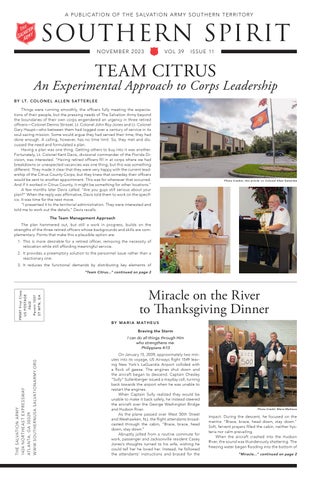
Photo Credits, this article: Lt. Colonel Allen Satterlee
The Team Management Approach The plan hammered out, but still a work in progress, builds on the strengths of the three retired officers whose backgrounds and skills are complementary. Points that make this a plausible option are: 1. This is more desirable for a retired officer, removing the necessity of relocation while still affording meaningful service. 2. It provides a preemptory solution to the personnel issue rather than a reactionary one. 3. It reduces the functional demands by distributing key elements of “Team Citrus...” continued on page 2
Miracle on the River to Thanksgiving Dinner B Y M A R I A M AT H E U S Braving the Storm
T H E S A LVAT I O N A R M Y 1424 N O R T H E A S T E X PR E S S WAY AT L A N TA , G A 3 0 3 2 9 W W W. SO U T H ER N US A . S A LVAT I O N A R M Y.O RG
I can do all things through Him who strengthens me. Philippians 4:13 On January 15, 2009, approximately two minutes into its voyage, US Airways flight 1549 leaving New York’s LaGuardia Airport collided with a flock of geese. The engines shut down and the aircraft began to descend. Captain Chesley “Sully” Sullenberger issued a mayday call, turning back towards the airport when he was unable to restart the engines. When Captain Sully realized they would be unable to make it back safely, he instead steered the aircraft over the George Washington Bridge and Hudson River. As the plane passed over West 50th Street and Weehawken, NJ, the flight attendants broadcasted through the cabin, “Brace, brace, head down, stay down.” Abruptly jolted from a routine commute for work, passenger and Jacksonville resident Casey Jones’s thoughts turned to his wife, wishing he could tell her he loved her. Instead, he followed the attendants’ instructions and braced for the
Photo Credit: Maria Matheus
impact. During the descent, he focused on the mantra: “Brace, brace, head down, stay down.” Soft, fervent prayers filled the cabin, neither hysteria nor calm prevailing. When the aircraft crashed into the Hudson River, the sound was thunderously shattering. The freezing water began flooding into the bottom of “Miracle...” continued on page 2
“Team Citrus...” continued from page 1
responsibility to team members. 4. It can reduce at least some open appointments by freeing up active officers needed elsewhere. The approach outlined in Citrus County divides the responsibilities as follows: Corps Officer for Administration (Colonel Dennis Strissel): The team leader makes the final decision should there be an impasse. He is the contact person with divisional headquarters (DHQ) and assumes the routine functions of the corps officer. Included in his purview are employee relations, community and social services, community relations and point person for media, advisory board management and development, contact person for other service and community organizations, and overseeing general fund raising such as direct mail and seasonal efforts in cooperation with the Corps Officer for Finance and Development. Corps Officer for Finance and Development (Lt. Colonel Gary Haupt): Responsible for financial accountability, policy administration and compliance, and financial operations including budgets, statistical data, and monitoring fixed assets. This includes working with and supervising accounting staff, monitoring income and expense, assisting with fund development, financial reports and requisitions to DHQ, participation in audits, researching foundations and other prospective funding sources, working with development team from DHQ, and promotion of corps stewardship. Corps Officer for Program (Lt. Colonel John Roy Jones): In charge of handling internal programming for the corps, management of staff, maintaining and growing current programs, overseeing and preparing Sunday program planning and implementation, overseeing outreach to the community, promotion of special events, and coordinating a preaching rotation. He is also to share and promote divisional and territorial events. Implementation As preparations were made on a territorial level for officer moves in July 2023, it was recognized that the current corps officers, Majors Hank and Eunice Harwell, would be needed elsewhere. With the team plan approved, it was time to implement it. There was some confusion when farewell orders went out announcing the Harwells were leaving but not who was coming to Citrus County. The
Colonel Dennis Strissel, Lt. Colonel Gary Haupt, and Lt. Colonel John Roy Jones
people in Citrus County were concerned. The Corps Sergeant-Major (CSM), Major Stan Carr along with his wife Debi, prayed about it and then offered to fill in as corps officers. “The divisional commander thanked us for our offer but said he had something in mind that would be announced soon,” Carr remembers. When the team was announced a few days later, it raised eyebrows around the territory. While a team approach is common in other churches, it has not been a feature of Salvation Army leadership at the corps level. At least not like this. The team determined that they needed to augment their group with one more person: Major Stan Carr, who as the CSM represents the corps congregation. Engagement The experience of these officers in every level of Salvation Army leadership provides a distinct advantage. “Knowing all the processes allows us to negotiate for the corps’ advantage. We go in meetings thanking God for the little advances because we believe that they will pile up and make a real change,” commented Colonel Strissel. Coming from their perspective of serving as soldiers for several years before taking this leadership role, the team feels that the voice of soldiers is essential for long-term success. The Corps Council was retooled and has been engaged in all that has happened. Not only is the Corps Council involved, but all decisions and items discussed are shared with the soldiers of the corps. “I remind them that that Corps Council is there for them, and if they have feedback, to bring it to me so that I can move it along,” said Carr. Jones commented, “We take the Corps Council seriously. We have to be unafraid to receive criticism. When we met with them, we challenged them immediately: where did they want to see the corps in five years?”
“Miracle...” continued from page 1
the plane, and the passengers quickly followed safety instructions, lining up and climbing onto the wings of the doomed craft. Reaching the Needy Commissioner Kelly Igleheart, Territorial Commander Colonel Deborah Sedlar, Chief Secretary Lt. Colonel Mark Israel, Publisher Bernie Dake, Communications Director Kristin Mudge, Editor Brad Rowland, Staff Writer Stewart Art & Design, Layout and Design Wallace Graphics, Printing and Shipping Published by The Salvation Army USA Southern Territory 1424 Northeast Expressway Atlanta, GA 30329 USA Phone: (404) 728-1300 Email: kristin.mudge@uss.salvationarmy.org http://southernspiritonline.org All materials are copyright of The Salvation Army USA Southern Territory and cannot be reproduced without permission. For further information or to donate, please visit: www.uss.salvationarmy.org Subscriptions are available at a rate of $10 per year. Submit check and particulars to the editor-in-chief.
2
S O U T H E R N S PI R I T • N OV E M B E R 2 0 2 3
The righteous care about justice for the poor. Proverbs 29:7 In the impact of the crash, Casey suffered a small laceration on his head. As frigid water rose inside the aircraft, he waited his turn as all other passengers evacuated from the plane wings. As the last passenger to step off the aircraft, Jones fell into the Hudson River. Thoughts of his family motivated him to escape the icy water. Reaching dry land and wearing borrowed, oversized clothing, Jones looked into his hotel mirror to see his shockingly disheveled appearance. He recalls, “I saw an image of a homeless individual after falling in the water, causing my hair to flow in all directions.” He continues that this was not a negative image. With that image in his mind, after returning home Jones sought out ways to contribute to humanity’s well-being. Hearing a radio broadcast on Jacksonville’s WOKV 104.5 FM, he learned that The Salvation Army raises money for Thanksgiving
Consultation extends to the team as well. The three corps officers meet weekly to discuss items of common interest as well as the things they are working on individually. In January there will be a review of how this model is working. “If those guys are still talking to each other after Christmas, we’ll see if they are okay to go at least another year. Otherwise, we will have to look at appointing active officers in the 2024 moves,” shared Lt. Colonel Davis, “But it is our hope and expectation that this team will be functioning for at least two years, maybe longer.” Key Elements for Consideration When asked what they felt were important elements to keep in mind for implementing a plan like this in other corps, each had an observation. CSM Major Carr said, “Choosing the leadership team carefully is vital. If they can’t work together or are not able to each hold up their end, it will not work.” Lt. Colonel Jones shared, “People need to be aware of how The Army changes in a short time, particularly technology. I was surprised at how things have changed at the simplest level, like how a voucher is prepared and handled. The other thing is there is a temptation to slip over into someone else’s area. You have to stay in your lane.” Colonel Strissel remarked, “We’ve got to remember that the call of God is for life. This thing keeps evolving from what we originally proposed. It keeps pulling you in, and that can be draining.” Lt. Colonel Haupt said, “We believe God called us into this and it will work. But we have some obstacles. Our corps has still not fully recovered from COVID. Also, we are in a rural area where people are scattered far apart from each other which makes how we approach things a bit tricky. I have to come up with new ideas and strategies because of our situation in Citrus County.” As they further discussed it, they projected their thoughts about how a similar model might work elsewhere or under other circumstances. How would it work with two people or four? How about in a large corps versus a smaller corps? Could a team approach be helpful for a single officer to have one or two retired officers working alongside them? Why limit it to only retired officers? Might dedicated soldiers who have specific skills also be included in a leadership team? Asked if there was anything else, Lt. Colonel Haupt joked, “If we didn’t kill each other this week, we’re good.”
turkeys to help families in need. The knowledge of this program coupled with his experience on the Hudson River engendered a deep compassion within him for the homeless and those in need. Feast of Thanksgiving But remember the Lord your God, for it is He who gives you the ability to produce wealth. Deuteronomy 8:18 In two days, Jones raised enough money to purchase more than 140 turkeys through only a few contacts. The following year, Jones doubled his contact list resulting in increased donations. In his third year, he enhanced the drive through social media and news coverage, raising enough funds for 244 turkeys. The Miracle on the Hudson Turkey Drive was established to benefit The Salvation Army of Northeast Florida in Jacksonville. Adding a GoFundMe page, Jones worked to raise almost $10,000 dollars for the ninth annual turkey drive. In 2022, Casey Jones held his 13th Miracle on the Hudson Turkey Drive, raising $15,111, exceeding his goal of fifteen thousand dollars. “I am thrilled to be a part of the event that has taken on a life of its own,” Jones says. “I just organized it, but it is the donors who make all the difference.”
Restoring Hope and Community One Meal at a Time
Photo Credit: Josslyn Littles
B Y L AT O N YA G R I F F I N As I stand in the bustling kitchen at The Salvation Army, surrounded by the clatter of pots and pans and the aroma of simmering dishes, I can’t help but marvel at the purpose behind every action. It’s a place where compassion and sustenance blend seamlessly, and a smile and a kind word can change a life. My journey with The Salvation Army began unexpectedly. I stumbled into this role just over a year ago, starting as a volunteer during Angel Tree around Christmas. From there, I found myself drawn into the heart of the organization–the kitchen! The Salvation Army has been ministering through meal service for over 150 years, and we excel at it. When one of the leaders approached me about the job, I had doubts. Could I truly make a difference? Was cooking enough to create change? However, talking with my family and hearing my mother’s encouraging words solidified my decision. The kitchen coordinator role would be far more than a job for me; it would be a ministry. The kitchen is a connection point of hope and healing, not just through the food we serve but through the relationships we form with our guests. My responsibilities range from cooking and meal planning to sitting with our clients while they eat, listening, and speaking words of hope over their often desperate situations. One of the most fulfilling aspects of my role is witnessing the impact a warm meal can have on someone’s life. Often, I witness the transformation in their demeanor as they sit with others and enjoy good food and conversation. Something as simple as sharing a meal creates a sense of normalcy in their lives and rekindles hope for the future.
Latonya Griffin fulfills her calling to ministry through her position as kitchen coordinator.
The clients we serve come from all different walks of life, and their tastes are as diverse as their stories. Elderly visitors often request classic comfort foods like beans and cornbread, while the younger folks love Italian dishes. Each dish we create reflects the sense of home and community we strive to provide. As I navigate the challenges of limited resources and changing donations, I have learned to adapt and make the most of what we have. Sometimes, we have to wait until we have enough of a particular ingredient to create a full meal for everyone. And then, on rare occasions, we may receive a special donation, like filet mignon from a local restaurant! It’s a celebration for both the
Dolly Parton to Perform at Red Kettle Kickoff Halftime Show Global icon, singer-songwriter, actor, New York Times best-selling author, businesswoman, philanthropist, and Rock & Roll Hall of Fame inductee Dolly Parton will perform live at AT&T Stadium for The Salvation Army’s Red Kettle Kickoff Halftime Show during the Dallas Cowboys Thanksgiving Day game against the Washington Commanders. “Wow! What an honor to get to kick off The Salvation Army’s Red Kettle Campaign with the halftime show during the Dallas Cowboys game this Thanksgiving,” said Parton. “Those Red Kettles have long been a symbol of hope for our friends and neighbors who are facing hard times. My goal is to encourage everyone who can to donate and support their neighbors in need. Every small act of generosity helps, and together, we can all love our neighbors this holiday season and beyond.” Tune in to CBS Sports November 23 at 3:30 PM CST, 4:30 PM EST for a performance you won’t want to miss!
clients and our team! But the impact of The Salvation Army extends far beyond the walls of the kitchen. It’s a ministry of hope, reaching out to those in need, providing a meal, a word of encouragement, and a sense of belonging. Our work is not just about feeding empty stomachs; it’s about nurturing souls and fostering a community of care and compassion. I never imagined that I would find myself in the role of a kitchen coordinator, yet here I am, loving the ministry of serving meals and sharing hope with our community. My hope for the future is simple: to continue making a difference, one meal at a time, and to be a beacon of light for those who need it most.
NEWS BRIEFS • The Salvation Army of Roanoke, Virginia joined with the Roanoke Valley Prevention Council for the 16th annual “A Walk In Their Shoes” domestic violence awareness event on Friday, October 20. The event featured a walk in solidarity with survivors, advocates, and victims’ families, with a remembrance ceremony including names read of women, men, and children who lost their lives as a result of senseless violence. In addition to the walk, a resource fair was held geared toward helping participants learn about the available services in the Roanoke community. • Three-time Olympic athlete Lolo Jones served as the featured speaker for The Salvation Army’s annual dinner in Oklahoma City, with the event held at the National Cowboy and Western Heritage Museum. Jones recounted her journey from a childhood marked by instability and nights spent at The Salvation Army to her success in both track and field and bobsledding during her address. Jones also shared that she “lived and breathed The Salvation Army” as a young person and benefited greatly from Salvation Army programs including Angel Tree to support her family during the Christmas season. • The Salvation Army’s Hampton Roads Kroc Center is partnering with the Norfolk State University women’s basketball team. The Kroc Center has become the team’s “home away from home” for practice sessions in advance of the 2023-24 season, with the state-of-the-art facility’s newly refinished hardwood court providing a quality experience for the team and its players. The Kroc Center’s basketball court now has a banner celebrating the Norfolk State team and its Mid-Eastern Athletic Conference championships.
S O U T H E R N S PI R I T • N OV E M B E R 2 0 2 3
3
Safe From Harm Training and Curriculum Updated BY BR AD ROWL AND Since 2009, Salvation Army personnel, including officers, employees, and volunteers, have been trained extensively in child and vulnerable adult abuse prevention. This training program, titled Safe From Harm, is designed to help units of The Salvation Army reduce the risk of abuse or injury to infants, children, teens, and vulnerable adults who participate in their programs and services. Each person is carefully screened before working with children and/or vulnerable adults, with the overall goal of implementing proven safety techniques to protect the people in The Salvation Army’s care from all forms of abuse and neglect. Under the direction of Emma Edelman, territorial child and adult safety coordinator, the Safe From Harm program has undergone a two-phase overhaul over a two-year period, punctuated by changes implemented in 2023. “The Safe From Harm curriculum hadn’t been updated in many years, which led to a closer look at every aspect of the program,” Edelman said. “With the approval of Lt. Colonel Janice Riefer and the territorial administration, Safe From Harm has been given a complete, and much needed, update which includes new and updated content within the curriculum and supporting documents.” In April, updated curriculum was released in the form of a digital, interactive manual which includes a comprehensive reference for policy, procedure, guidelines, and training documents. Accompanying materials included a video detailing the launch, a new resource video outlining incident response steps, updated training presentations and materials, new and expanded training levels, and a new rapid-response poster, which displays QR codes to find step-by-step instructions in the event of or in response to an emergency situation or incident. The centerpiece of the first phase was the implementation of an online incident reporting form, augmenting the existing process previously based on paper files. This new web-based system allows Salvation Army personnel to quickly and efficiently report major incidents and share accurate information in real time, with each report filtered to the appropriate divisional Safe From Harm coordinator for timely follow-up. Because the system is now web-based, access is available remotely at SafeFromHarm.org, and the new form allows for more comprehensive data collection. Following the April release, part two of the revamp included the October 2023 transition to an online training platform. This announcement was made in conjunction with each of the eight divisional headquarters in the USA Southern Territory. The training platform allows for one training course per level, specifically developed for The Salvation Army’s Safe From Harm program and incorporating Salvation Army mission and policy. Beyond curriculum changes, individuals are now able to take initial Level 1 and Level 2 trainings online, as well as the Emergency Disaster Services Safe From Harm training. In the previous iteration, trainees were only able to renew online, but this expansion allows for more seamless integration and higher-level classes that will allow for full and immediate compliance across the territory. The Level 4 leadership training can also be renewed online after in-person implementation for the first-time trainee. These major alterations stemmed from a collaborative effort between Safe From Harm coordinators from across the territory, drawing on established best practices and referencing onthe-ground experience from subject matter experts. In addition to dedicated Safe From Harm personnel, the cooperation extended to addi-
4
S O U T H E R N S PI R I T • N OV E M B E R 2 0 2 3
tional departments, including risk management, emergency disaster services, legal, communications, social services, youth, and information technology. “The past two years have been a collaboration with many people and departments,” said Edelman. “The divisional Safe From Harm coordinators have helped guide this process and provided valuable insight from the field, as well as sharing their extensive experience in working with Safe From Harm. There have also been many meetings and consultations with various departments at THQ to ensure that the program meets our minimum standards and cohesively works with all aspects of The Salvation Army’s mission so that we can ultimately continue to keep those we serve safe.” Additional training classes are planned for execution on the online platform in the coming months, including focuses on vulnerable adults, Adult Rehabilitation Centers (ARCs), shelters, and minors as volunteers. In an overarching sense, the new applications and methods used by the Safe
From Harm program should streamline The Salvation Army’s efforts, though the overall mission remains resolute. “Having materials that are current, as well as providing instant access to training online, helps us to ensure we are keeping the purpose of the Safe From Harm program in the forefront and prioritizing the safety of children and vulnerable adults,” Edelman said. “When we are not compliant with our policies and procedures, the outcome can be devastating. However, when we do make safety a priority, the impact can be tremendous as we create safe spaces and relationships for people to thrive and, most importantly, grow in their relationship with Christ.” For questions regarding the Safe From Harm program or to seek additional information, visit SafeFromHarm.org or contact your divisional Safe From Harm coordinator.
DISCIPLE
Resources for Spiritual Growth B Y M A J O R S C H R I S A N D LY N D A T H O R N H I L L In a recent study conducted by Grey Matter Research and Consulting, it was determined that nearly 47% of Christians are stuck in the “newborn” phase of their spiritual walk. The study further shares that in most churches only 6% of Christians ever reach spiritual maturity. This type of spiritual growth, from the initial act of being saved through the development process to spiritual maturity, is what is meant by being discipled. Our founder, William Booth, recognized this when he said, “…more attention should be given to the development of the work of the Divine Spirit in our soldiers. Many of our people, I fear, have not progressed very far beyond the ABC of spiritual experience” (adapted from “William Booth, Talks with Officers—The General, 1921”). What is happening in your corps, in your community, that is transforming lives? How are you being stretched to grow in your faith and walk outside of your comfort zone? The Mission, Evangelism and Cultural Ministries Department of the Southern Territorial Headquarters would like to share a few resources with you that will ensure you are confidently able to answer these questions. One of the most important elements of spiritual growth is accountability. No one accepts Christ as their Savior one day and wakes up the next fully spiritually mature. This process takes effort and discipline. In the same way, a musician starting on their first day by picking up an instrument will not be a professional on their first try. The musician must find an instructor, someone they meet with regularly, who teaches, encourages, and comes alongside to assist the musician in the art of making music. An accountability partner in our spiritual walk will do the same. It is imperative to have someone in your life that is going to read the Bible with you, someone who allows you to share your struggles, who rejoices in your victories, and, most importantly, someone who will love you through the times where the hard things must be said. Only God has the ability to transform you, but the gift of living in community with someone in this way will challenge, encourage, and most importantly strengthen your faith. If you don’t have that person or people in your life, we encourage you to pray that God will lead you to this relationship. RightNow Media is an online resource crafted to multiply disciples, create thriving communities, and transform lives. On this website you’ll find an unlimited number of Bible studies and devotionals for men, women, families, children, teens, and young adults, with resources also available in Spanish. This resource is available to your corps at no cost. Corps leaders can visit app.rightnowmedia.org/join/0 to register your corps and begin using this resource today. As the Mission, Evangelism and Cultural Ministries Department continues to grow, more resources will be available for discipleship along with elements to help in evangelism and making a difference in the communities we serve. The key is knowing that you don’t have to do it all by yourself. There are teams of people working to empower you in this most important work. The goal in moving our discipleship efforts with our people is encouraged by our founder, General William Booth, when he says, “Faith and works should travel side by side, step answering to step, like the legs of men walking. First faith, and then works; and then faith again, and then works again—until they can scarcely distinguish which is the one and which is the other.” May that be all of us!
Photo Credit: Joseph Chang
“Discipleship is the process of transformation that changes us to be increasingly more like Christ through the Word, the Spirit and circumstance.” -Pastor Rick Warren
Photo Credit: Laura Dake
LOVE – SERVE – DISCIPLE M O N T H LY P O D C A S T
Join us monthly on the LOVE – SERVE – DISCIPLE podcast, a show highlighting the work of The Salvation Army around the Southern Territory. We’ll discuss available resources and creative programs happening around the Southern Territory and how you can utilize them in your own corps to make a bigger impact on your community.
To listen, visit linktr.ee/loveservedisciple
Find additional resources and more about each month’s guests at allforjesus.salvationarmysouth.org
S O U T H E R N S PI R I T • N OV E M B E R 2 0 2 3
5
“Regardless, We Will Worship God” Jeff & Vanessa’s Journey of Faith
BY KRISTIN MUDGE Jeff and Vanessa Crabtree are a talented and passionate Christian couple who found The Salvation Army while looking for creative faith-based ways to make an impact in their community. They jumped in with both feet, getting enrolled as soldiers, starting music programs and band camps at the corps and regional levels, and then Jeff became a divisional music specialist in the Texas Division for several years, providing vision and creative solutions through programs and the use of technology in instruction. Feeling called to new challenges and horizons, Jeff and Vanessa moved to Arizona to see what God had in store for them next. Neither of them could have imagined what was coming. On December 5, 2022, Vanessa was involved in a car accident while loading her car. She was airlifted to a hospital in Tucson having sustained 12 broken or fractured ribs and paralysis below the waist. A couple of days later Vanessa underwent surgery where the doctor removed a fragment of bone that was piercing her spinal cord. They repaired the area and secured her spine with metal plates and screws. The doctor informed them that there was a hematoma on the spinal cord that would take time to heal and slow down the process of regaining function, saying that healing would take many months and even up to a year. A week after the accident Vanessa was able to have her first full physical therapy session: learning to get out of bed. She says being upright and sitting on the edge of the bed for the first time in a week (with help) was, “wonderful, scary, and exhausting.” They were finally able to transfer from the hospital to Barrow Neuro-Rehab for inpatient physical therapy just before Christmas. Vanessa
6
S O U T H E R N S PI R I T • N OV E M B E R 2 0 2 3
Photo Credits, all this article: Jeff Crabtree
wrote on December 26, “I had therapy Christmas Eve, and again today, the day after Christmas. I’m able to balance a lot better already and am feeling more comfortable in a sitting position. In therapy I played catch—a surprising core workout when you don’t have use of your legs. There may even be some tingling sensations just a little lower than there were before.” Those tinglings led to a tiny hope for the future and what that could mean for physical recovery. “Hope is a tricky thing,” Vanessa continued. “Now, hope feels more real, and sometimes offensive. I do hold hope that I may walk again, in one way shape or form. But hope is also different than expectation—I don’t EXPECT that I will walk again. Moments after my accident, realizing I couldn’t feel my legs, I knew it likely meant I’d be in a wheelchair the rest of my life.” Vanessa explains that her injury is defined as a level T12 incomplete. Everything is normal until just under her bellybutton, where things begin to feel abnormal. “Eventually in my thighs and my knee depending—it’s a little lower on my right side—that’s when I start to have no sensation at all.” She says that at the top of her thighs where she doesn’t necessarily feel her muscles the sensation is like, “your foot fell asleep but is also sunburned at the same time.” She continues on to say that this nerve pain will be just a part of life moving forward. Vanessa spent just over a month in inpatient rehab, learning new skills ranging from getting out of bed, putting on clothing, and even standing in an assisting frame. She of course learned to
pop her first wheelie early on in the process. If you’ve ever met Vanessa, you are fully aware of her sense of determination in all aspects of her life. Physical therapy was no exception. She was bound and determined to work as hard as she could to become independent and return to “normal” life as soon as possible. All that hard work came with plenty of pain and frustration, Vanessa says. “[The physical therapists] all reiterated how normal it is for me to have the feelings I’m having, and that it is okay to have those feelings—feelings of being overwhelmed, frustration, grief, anger, sadness, loss. The difficult feelings are there, alongside my excitement when I’m accomplishing more than I thought I would in therapy.” Upon her release from inpatient rehab, Vanessa reflected, “As I was experiencing my accident, I thought I was going to die. In that moment, I asked God, ‘Please let me stay.’ I remember taking the first breath after that, being surprised I could breathe. In some ways, now I feel more alive than I ever have—thankful and surprised to be taking part in breathing with all of you. I told a friend that my days sort of feel like bonus days, now. Days I didn’t expect to get. Days that will be very different than I expected before the accident, but days none the less. Can’t wait to see what each bonus day brings.” And the Crabtrees are fully embracing their new life together, celebrating all of Vanessa’s “bonus days.” Prior to the accident they were both avid hikers and adventurers, planning to soon do mountain summit and Grand Canyon trips. Now their adventures look a bit different,
but no less challenging. Jeff says, “One of our new favorite things to do is check out all the creative ways that others facing similar situations with spinal cord injuries have learned to adapt. Oddly, we have even had fun thinking about how to make seemingly easy tasks doable in the new normal. Simple, daily tasks need a fresh set of eyes to accomplish, like helping Vanessa transfer into our car or into a shower, or even seeing Vanessa’s mind work to figure out how to pedal the piano without the use of her legs. It is refreshing amid our frustration to pause, breathe, and think about the situation differently.” The couple are not without their share of struggling through understandable pain and doubt. “Advice my friend gave me was to write down everything in my life that is new over the past months… It took me only a little bit of time to fill up three pages of changes,” Jeff shares. “Change is hard and adds more stress to our lives than we can imagine.” Just a few of those changes include moving to be closer to medical
care, struggling to find affordable accommodations with accessibility, relearning how to interact physically, and working to find a new place in ministry. “My way of connecting to God in church and community cannot look the same as it did before the accident. Praise God, we can still sing, play music, and lead people in lifting their voices to God, but I need to take time and redefine what being with God means.” Jeff admits that he has many times felt frustration with God for not restoring Vanessa’s ability to walk. “I have been good at reframing my anger with God for this unanswered prayer with what I believe deep within my soul is the truth; God is sovereign and knows best.” He says, “We’re not placing our hope in walking, we place our hope in Christ and His love for us regardless.” Always the nature-loving adventurers, the couple spent the summer embracing recreational therapy, connecting with Ability 360 and several other adaptive agencies to go on challenging hikes, mountain bike treks, and kayaking (Vanes-
sa’s favorite). Jeff utilizes his skills and talents to record and edit their adventures, posting them on social media to encourage others who may be going through similar challenges. The Crabtrees just celebrated their 10-year anniversary this summer, both saying it was extra special because Vanessa was here to celebrate it. Vanessa is also excited to start back up with physical therapy. “The biggest goal right now for that and why I wanted to get back into it is getting leg braces.” Jeff adds, “With the leg braces, not only can Vanessa stand for periods of time, she’ll be able to walk adaptively potentially.” Vanessa declares, “If I AM able to walk, fantastic! If I do not, regardless, we will worship God. Life is different, and full of change. Sometimes we celebrate, and sometimes we are weary. But if this experience has taught me anything, it’s that life is worth it.” You can follow Jeff and Vanessa’s journey and adventures on YouTube at Crabtree Adventures.
S O U T H E R N S PI R I T • N OV E M B E R 2 0 2 3
7
FROM THE EDITOR
B AT T L E L I N E S
Gratitude in Darkness
A New Name
BY KRISTIN MUDGE Some days life is a party; the dominoes fall into place, the blessings keep on coming, and you just can’t help praising God for His amazing work in your life. But if we’re honest, that’s not most days. Most days are hard. Most days we’re busy, tired, and stretched too thin. We’re overwhelmed by the everyday and underwhelmed by the mundane. We can quickly lose sight of the grace we’re granted to simply exist in God’s world. And some days are harder still. We grieve, we struggle just to breathe, it’s a battle to even get out of bed. How can we remember God’s goodness when all we see is the dark? Several years ago, my husband and I joined his family on a Caribbean cruise. At one of our stops, we went on an excursion that included exploring an underground river. We donned wetsuits and thick-soled water shoes, hiking down
into a cave system that contained miles and miles of underground river. The only illumination of the ethereal passages came from our meager headlamps as we trekked, paddled, or floated through the dark chambers of water and rock. About an hour into our journey, our guide had us stop and turn off our headlamps. Never before or since have I experienced such deep darkness. A dark so intense you begin to question reality itself. After a moment he turned on his flashlight, the world flaring back into existence, the weak beam of light suddenly seeming as bright as the sun after such darkness. When you are surrounded by deep darkness in your life, even the smallest flicker of light makes a difference. A kind word from someone, a scripture read, a memory reframed for healing—our eyes automatically seek that light. The first chapter of the Gospel of John speaks poetically of Jesus, referring to Him as the Word, as life, and of that life being the light of all humanity. John goes on to say in verse 5, “The light shines in the darkness, and the darkness has not overcome it.” He’s there. He’s light in the darkness, and your darkness cannot overcome Him. Even on days when it hurts to breathe, if you just open your eyes, He is there. As we take time during this month to reflect on our lives and what we have to be thankful for, remember: you don’t have to have grand moments or mountaintop experiences, God is also in the tiny parts that make up life. Let’s find gratitude wherever the light shines.
B Y LT. C O L O N E L A L L E N S AT T E R L E E “I will also give that person a white stone with a new name written on it, known only to the one who receives it” (Revelation 2:17). When I was researching this Scripture for a Sunday school class, one of the commentators suggested the new name we would be given might be one that perfectly described who we are. From the time I was a child I have been trying to answer the question, “Why did you do that?” Usually, it was not under good circumstances. As a husband I have been asked that many times in the same tone of voice. And to be honest, I have asked myself that far more than anyone else. I really don’t like that question. The answers don’t make me look very good. Another question that I have tried to answer is, “Why does this matter?” This one speaks to the essence of who I am in Christ and how priorities line up with respect to this one life I have to live. My choices matter, whether anyone ever knows it or not. How I love my wife matters. How I am as a father and a grandfather matters. How I have lived as a believer and as a Salvation Army officer matters. What I do with my money matters. What I am in the secret place matters where only God can see and know. So, if the commentator is right, it is like all these things—our victories, our failures, our joys and our sorrows, our impure motives and pure ones, our many weaknesses and our too few strengths—are the consonants and vowels that compose the new name that will be given to us when we meet the Lord on that day. He will speak it, and when we hear it, we will know that it perfectly describes who we are. We will say, “Yes. That is it. That is me.”
WE ARE AN ARMY! A column exploring how the principles, practices and culture of our military services might apply to The Salvation Army
Fighting the Last War BY DR. STEVE KELLNER It was the World War I era French Prime Minister, George Clemenceau, who complained that “generals always prepare to fight the last war, especially if they won it”. While his point is well taken, we shouldn’t be too hard on WWI generals, who struggled to adapt their organizations, strategies, and tactics to the incredible technological advances in weaponry brought about by the industrial revolution. These advances included long range artillery, fighter and bomber aircraft, poison gas, and the deadliest of all WWI weapons, the machine gun. For thousands of years, up until just a couple of centuries ago, land warfare didn’t change much. Battles were conducted as they had been fought by Alexander the Great or the Roman Legions, or by Joshua and the Israelites for that matter. And certain aspects of war preparation have remained necessary and effective in all eras, including organizational traits like good commu-
8
S O U T H E R N S PI R I T • N OV E M B E R 2 0 2 3
nication and logistics and classic tactics like “getting there first with the most” and “outflanking” the enemy. But fighting the traditional way had disastrous results during WWI, as Clemenceau lamented. Against the new weapons, neither side gained or could hold much ground, and both sides spent most of the war hunkering down in the trenches. The number of casualties exceeded anything ever known in the history of warfare, the two sides spending much blood and treasure while accomplishing little. The Salvation Army has had great spiritual impact around the world over a long period of time using methods that it pioneered, like taking the church to the streets, and “soup, soap, and salvation,” and these are evergreens, effective in every era of spiritual warfare. But Satan, the master deceiver, has developed new weapons and tactics, if you will, that have changed the spiritual environment in which Salvationists are working. This means The Army will have to change some of its organization, strategies, and tactics as well, if it is to be effective in the current spiritual war instead of the last one. For example, there was a time when we could
assume that most non-believers we evangelized had been somewhat churched, probably believed there was a God, and had some respect for the Bible even if they didn’t live by its tenets. That time is long gone, so the days of quoting Scripture cold turkey to non-believers are gone as well. This isn’t to say that Scripture has lost any of its convicting power, but that we will have to do a good bit of preparatory “gardening” work to get non-believers to the point where they will consider the claims of the Bible. At the strategic level, some Army programs that were well-supported and spiritually effective bulwarks of nearly every corps 50 years ago have largely disappeared or have been altered or combined into truncated forms. New programs, like Angel Tree and music and arts conservatories, have risen in their place, and new program ideas are popping up all the time. But not every traditional program needs to go, so this pruning and renewing process is difficult and sometimes painful, as it was for the generals of WWI. But continue it must, or, like those generals, we will spend our blood and treasure fighting ineffectively and end up hunkered down in the trenches.
Covered By Prayer – Literally BY BY MA JOR FR ANK DUR ACHER For nearly 10 years, prayer warriors and skilled crafters of the Houston Northwest Corps in Texas have been employing a ministry begun by another denomination, with the motto: “It’s not about the quilt; it’s all about the prayers.” “Prayers & Squares” was started in 1992 at the Hope United Methodist Church in San Diego, CA. In the 30 years since its inception, chapters have emerged all around the world. An impressive number of quilters at the Houston Northwest Corps excitedly took up the ministry there about a decade ago. The purpose of Prayers & Squares is to promote prayer and provide comfort through the construction and distribution of handmade quilts. The comforters are literally that: tangible gifts to people in need of prayer, combining intercession to God with the loving presentation of a hand-tied quilt. “Each finished quilt goes to that person as a silent testimony to our belief in the power of prayer,” explains Patricia Swift, who unofficially co-leads the group along with Mary Carpenter. “These quilts truly can be called ‘comforters!’” “This ministry has made a lasting impact on the lives of their recipients and their loved ones,” adds Captain Nick Hutchinson, corps officer. The way the ministry works is simple, yet profound. Prayer requests are submitted, then a quilt is prepared with dozens of loose stings left across the stitching. One at a time, each quilt is placed on display in the corps foyer until it is deemed completed. On Sundays, the corps family has the opportunity to learn about these prayer requests and then come and add a knot to the quilt. “As each knot is tied, a prayer is offered for the
Co-leader Patricia Swift displays the current quilt under construction in the Houston Northwest Corps foyer.
person in need—someone who has asked us to pray for them,” Patricia explains. The result is a beautiful quilt with many tiny knots, each symbolizing a prayer said for the recipient. Scores of quilts have been given out as a source of hope for many going through cancer treatments, grieving the loss of a loved one, or those facing difficult circumstances. “I have seen firsthand [the impact] these quilts have when my best friend of 40 years received a
prayer quilt during a difficult hospital stay prior to his passing,” Captain Hutchinson says. “Even after he was Promoted to Glory, the quilt became a source of hope and comfort to his mother.” The group hosted a crafting weekend in June 2023 with about 50 women from the corps and community in attendance. Many learned about Prayers & Squares for the first time and several asked to receive sewing lessons so that they could also take part in this ministry.
WORTH A LOOK : BOOK REVIEW
The Christmas Story by Captain Julie Chamberlain
Color your way through the Christmas season with Captain Julie Chamberlain as she combines Bible study, journaling, and an adult coloring book to present the Christmas story with a fresh, new style. Created for doodlers, daydreamers, and those looking for a new approach to Bible study, this book will meet the reader in a creative and insightful way. If you are seeking a new perspective on the Christmas story for your own devotions or if you are looking for something fun and insightful for your small group Bible study, this book will allow you to utilize your creativity while digging into God’s Word. This book is available in English and Spanish and can be purchased at mytradesouth.com or on Amazon.com. Don’t forget your colored pencils! Captain Julie Chamberlain is a Salvation Army officer who currently serves with her husband, Captain Mike Chamberlain, in Clay County, Florida.
S O U T H E R N S PI R I T • N OV E M B E R 2 0 2 3
9
“Doing the Next Right Thing” John’s Story of Transformation
BY KRISTIN MUDGE John Romaka was dropped off at The Salvation Army’s Adult Rehabilitation Center in Houston, TX, when the local hospital refused to treat him after his third attempt to drink himself to death. The Salvation Army’s Adult Rehabilitation Centers (ARCs) provide a non-clinical, faith-based rehabilitation program to individuals with a variety of social and spiritual needs who have lost the ability to cope with their problems and provide for themselves. In John’s case, his problems led to alcohol and substance abuse. John had his first drink of alcohol in high school. He flunked out of college his sophomore year and entered his first rehab at age 21. Staying sober long enough to finish college, he moved to Houston and began a career in financial services. During this period of his life, he went through five different rehabs and two marriages, but couldn’t remain sober. In the last few months of what he calls his “drinking career” John attempted to drink himself to death three times. He tells us he went to a grocery store, filled a shopping cart with alcohol, drank it all, and passed out in the parking lot. He was taken to the hospital, where he checked himself out against advisement. He then went to another store and did the exact same thing, was taken back to the same hospital, and again left the facility against doctor’s orders. In the third grocery store, he passed out in the home and garden section. “When they picked me up, the hospital would not allow me to go in, so my wife at that time dropped me off at The Salvation Army. So, to say that my life was a disaster would be an understatement.” He was hooked on painkillers, drinking every day, and spent some time in jail for stealing to support his drug habit. “I was lying to the people I loved the most. My parents had disowned me, my brother hadn’t talked to me, and I wasn’t allowed to see my kids.” “My life was just broken. I think at the very end I, for the first time in my life, really would have rather been dead than alive. And looking back on that now, what a terrible place to be.” “Since coming to the [ARC] I have seen God’s grace and mercy and restoration power at its most awesome scale. He has restored my family, my life, and my career. I was fortunate enough to come through the program and be offered a job … And they told me in here to trust the process, and I did. And I worked, and I turned everything over to God. And slowly but surely, on my second sober anniversary, my brother called me and said, ‘John I’m proud of you.’ I hadn’t spoken to him in almost five years.” His wife and son began to visit him, and after about three years of sobriety, his parents welcomed him back into the family. He now has an active role in the lives of his children, even coaching his son’s soccer team. His daughter composed her college entrance essay on his journey and recovery. She wrote that watching him rebuild his life was inspirIn a school art project John’s son writes that ing to witness and that his experience changed what she perceived success he wants to be like his dad when he grows up. to be. “I used to think success was having a good job and living the ‘American Dream’,” He tells us the men coming into the proshe writes, “but after watching someone go gram have a choice: “Either God is everyfrom rock bottom to helping others who are thing, or He’s nothing. And if He’s everything, struggling just like he was shows that success then everything in your life is exactly the way is doing something that makes a difference it’s supposed to be right now.” He tells us his and brings you happiness.” philosophy is, “If I can just focus on doing the When John’s father received a diagnonext right thing, especially after I do the first sis of Alzheimer’s and Dementia, his family wrong thing, it’s impossible for my life to get rejoiced that he could still remember that worse. It can only get better. And that’s how John was sober, and they were glad to have I’ve grown. I focus on putting God first. I trust John back during that difficult time. His father the process. And I know that if I just focus on passed away on April 27, John’s five-year andoing the next right thing, my life’s going to niversary of sobriety. “I’ll never dishonor that get better. day,” John declares. “It was his final lesson to “And it has. I’m a great dad today. I love me to just continue to trust the process, and my kids. I’m a good son. I’m a good brother. I it was God’s way of saying, ‘It’s okay, you were hope I’m a really good employee, and I think here when you needed to be. You were there I am. And that’s all because I turned my will when your family needed you the most.’” and my life over to Christ, and He changed my John says the different roles he’s held life forever.” during his involvement with The Salvation When considering his past, John says he Army have affected his growth and inspired doesn’t think he would change a lot. One of him. “The mission is to carry God’s restoration his favorite Old Testament stories is that of Jopower to every end of the earth, and I’m super seph going through terrible trials but eventuhappy to be a part of that.” Now working as ally being brought to a position of leadership the store supervisor at the Houston ARC Famright when his family needed him the most. ily Store, John says he gets to see miracles ev“I think I had to go through what I had to go ery day. Men come into the ARC broken, and through to be the man that I am today and the God restores them. He tells us he remembers service work that I do. Yeah, I’ve got a lot of his first day in the program, going through the regrets. And I wish I could’ve changed things. lunch line wondering what had happened to But I’m really happy with where I ended up.” his life. “I tried to get sober so many other “God has transformed my life in some times at 30-day programs going right back amazing ways. He’s restored it. And that’s His into the real world. And it never worked. This promise to us. He’s always on time. He’s made place, God’s house, offered me everything me the man that I am today… He has transI needed to change my life with His help… I John’s daughter says that watching his transformation know I couldn’t have done it on my own.” has changed her view of success. formed my life completely and perfectly.”
10
S O U T H E R N S PI R I T • N OV E M B E R 2 0 2 3
Phoenix Fest Celebrates Ministry and Success in Cleveland, Tennessee BY ERIC SHORT In a grand celebration of faith, music, and community, The Salvation Army of Cleveland, TN marked a triumphant 12th annual Phoenix Fest on Saturday, October 7. This year’s Phoenix Fest, which is dedicated to celebrating the ministry’s successes, particularly those that have stemmed from their unique Inman Coffee ministry, proved to be the biggest one yet. The event, which typically takes place on Inman Street in Cleveland, found a new home at The Greenway this year, drawing an even larger crowd of attendees. The heart of the festival was the music, and the lineup did not disappoint. Headlined by the renowned Christian superband Sanctus Real, the event featured a diverse array of talent, including Jordan Smith, winner of The Voice Season 9, the dynamic duo Social Club Misfits, and the exceptionally talented American Idol runner-up Clark Beckham. The stage also welcomed local favorites Rob Alderman & The Unfortunate Return and the Dove-award winning singer/songwriter Gary Chapman. At the core of Phoenix Fest and The Salvation Army’s mission in Cleveland lies Inman Coffee. This unique ministry serves a dual purpose – it offers a space where young adults and youth from the community can come together, hang out, be mentored, ask questions, and feel God’s love in a safe and welcoming environment. Additionally, Inman Coffee has been a stalwart supporter of the live music scene in Cleveland for over a decade, serving as a launching pad for many talented artists who took the stage on Saturday. Kari Ray, who leads the band Kari and The Grey Papers, shared her personal testimony during the event, shedding light on the transformative power of Inman Coffee and The Salvation Army. “I was in a really dark spot at one point,” Kari reflected. “I was able to come to Inman and have emotions and feel safe, and Inman is that place for so many people. I’m very thankful for Inman Coffee and The Salvation Army.” Sergeant Ruth Forgey, The Salvation Army’s corps administrator in Cleveland, emphasized the spiritual significance of Phoenix Fest: “Phoenix Fest is a big demonstration of our praise to the Lord today. Everything was done with prayer and intention.” She further noted, “One of our mottos at Inman Coffee is ‘Drink Coffee, Change Lives,’ and today we are celebrating the lives changed by this ministry.” Major Doug McClure, Area Commander for The Salvation Army of Greater Chattanooga, remarked, “Phoenix Fest is a shining example of the incredible work our community can achieve when we come together in faith and support one another. The power of music and ministry was on full display today, and it’s a testament to the positive impact we can have when we unite for a greater purpose.” The anticipation is already building for what the next Phoenix Fest will bring, as it continues
Photo Credit, above and below: Eric Short
Commissioner Kelly Igleheart and Majors Zach & Shelley Bell from KT DHQ celebrate God’s work in Cleveland
to serve as a beacon of faith, music, coffee, and community in Cleveland. As the sun set over The Greenway on that Saturday evening and the bands played on, the spirit of Phoenix Fest burned bright, leaving attendees inspired, uplifted, and eager for what the future holds for The Salvation Army’s mission in Cleveland. In a world often marked by division and discord, events like Phoenix Fest remind us of the power of faith, music, and community to bring people together and create positive change in the world.
Camp Keystone Dining Hall, Starke, FL Salvation Army Family Store, San Antonio, TX
Camp Keystone Holiness Center Starke, FL
Camp Keystone Cabins, Starke, FL
Is it time for a new building, expansion, or renovation? Scherer Construction can help!
Camp Keystone Multipurpose, Starke, FL
We are ready to become your project partner by helping you understand the process and methods to achieving your mission through the facilities you use. From your initial need to moving in, we will walk you through the steps, costs, schedule, and impact of your project.
DESIGN/BUILD • CONSTRUCTION MANAGEMENT • NEW CONSTRUCTION • DEMOLITION REMODELING/RENOVATIONS • TENANT BUILDOUT • CONSULTING • SERVICE/MAINTENANCE St. Hagop Armenian Church Pinellas Park, FL
Salvation Army District Headquarters Lutz, FL
Florida Suncoast ARC Chapel St. Petersburg, FL North Florida Office (352) 371-1417
Northeast Florida Office (904) 288-6060
West Florida Office (727) 321-8111
www.schererconstruction.com Photo Credit: Eric Short
S O U T H E R N S PI R I T • N OV E M B E R 2 0 2 3
11
Love Knows No Borders
Territorial and Divisional Leaders Continue to Build Relationships with Mexico Territory BY ASHLE Y ESCOBAR 75 years of partnership and the bond between The Salvation Army’s USA Southern Territory and Mexico Territory only grows stronger. In early October, 25 territorial and divisional leaders from the Southern Territory travelled to Acapulco for Mexico’s Territorial Women’s Retreat. Amidst the celebration of our longstanding support for Mexico’s 16 children’s homes, an incredibly rare and beautiful moment took place: our officer women met their counterparts appointed to the children’s homes, creating a tangible bridge through names and faces. This profound connection illuminated the genuine ties our leaders have to their respective assignments. “As the week went on it was evident how God was moving through this experience. It was so very moving and beautiful to watch it all unfold,” Commissioner Donna Igleheart, territorial president of women’s ministries for the Southern Territory, recalls. “We witnessed God’s faithfulness and provision at every turn, and I saw beautiful officers and staff become beloved sisters, and we saw each other in profound ways.” Following the time spent with the 450 beautiful delegates at the women’s retreat, the group of US officers had the deeply impactful opportunity
Photo Credits, all this page: Jon Avery
to visit the Acapulco Children’s Home. Meeting the 13 vibrant children who reside there and witnessing the aftermath of a past earthquake provided clarity on how we can further amplify our support. While the environment radiated love and joy, we also recognized areas of need. As we reflect on this journey, we feel a deep appreciation for the home leagues of the past and their unwavering commitment to supporting this vital ministry. We cherish our relationship with the Mexico Territory and look forward to many more
12
S O U T H E R N S PI R I T • N OV E M B E R 2 0 2 3
years of wholehearted support for the children in The Salvation Army’s loving care in Mexico, as well as a newly crafted bond with the incredible women of the territory. “Those beautiful women with their perfect smiles, those precious children! The joy they expressed through their singing, dancing, and fervent prayers; how blessed we were by their presence,” Commissioner Donna continued. “The tent pegs of our hearts have been moved, and our lives will never be the same.”