Amplify 2026 10 years of Aspire Times of refreshing Embracing authenticity Birds of a feather Salvation
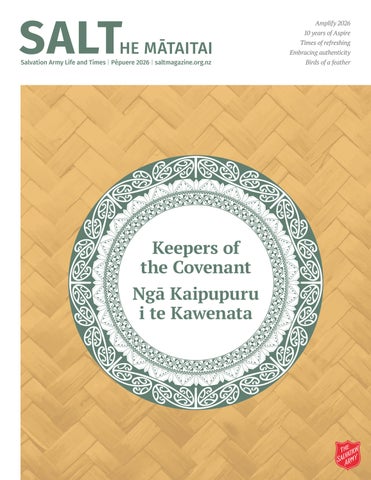
8 Keepers of the Covenant
We celebrate the ordination and commissioning of the Keepers of the Covenant, Ngā Kaipupuru i te Kawenata session in Aotearoa New Zealand.
12 Amplify 2026
Young people from around the territory gather for fun, food, fellowship and faith.
18 Free to Grow
The support Captain Lashana Dale received throughout her roles gave her clarity on her purpose—helping others grow. Read how she navigates tough times, using God as her anchor.
20 Embracing Authenticity
Discover how Major Christine De Maine reclaimed her identity by embracing her whakapapa (lineage) and how this influences her ministry.
26 Moses in the Wilderness— living a life with constant change
Change is inevitable. Editor Vivienne Hill contemplates how the volatile circumstances around us should lead us to lean on God’s truth.
SALT Magazine
The Salvation Army New Zealand, Fiji, Tonga and Samoa Territory
Territorial Commander
Commissioner Janine Donaldson
General
Lyndon Buckingham
Founders Catherine and William Booth
Editor Vivienne Hill
Graphic design
Sam Coates, Nicole Gesmundo, Lauren Millington
Staff writers
Jules Badger, Kelly Cooper, Captain Rachel Montgomery
Proof reading Colleen Marshall, Major Glenys Fairhurst
Connect with us saltmagazine.org.nz SaltMagazineNZ @SaltMagazineNZ salvationarmynzfts Territorial Headquarters, 204 Cuba Street, PO Box 6015, Marion Square, Wellington 6141 p: (04) 384 5649
e: salt@salvationarmy.org.nz
Subscriptions mailorder@salvationarmy.org.nz Print Management MakeReady Publishing for 141 years Volume 3, Issue 32
All Bible references from the Holy Bible, New International Version, unless otherwise stated.
Views and opinions expressed do not necessarily represent those of The Salvation Army. Articles are copyrighted to The Salvation Army, except where indicated, and may be reprinted only with permission.
My Resolutions and God’s Covenants
t the start of the New Year, I am hopeful: This will be the year I stick to my resolutions. And yet, somewhere between the optimism of the New Year and the grind of everyday life, those well‑intentioned commitments begin to slip. The gym shoes gather dust. The overindulgence of Christmas food continues. The habits I was determined to break re‑establish themselves.
It’s not that my resolutions are insincere, it’s that they are human. They are made with hope, but also with limitations. I’m forgetful. I’m inconsistent. I get tired, distracted, overwhelmed. Come February and my intentions are falling short.
But that’s why the idea of covenant hits me so deeply. Covenant is not a resolution. A resolution is something I try to keep. A covenant is something God Himself keeps. The Bible verse on the back cover assures us that God is faithful and ‘keeps His covenant of love to a thousand generations’. While my resolutions depend on my discipline, His covenant depends on His character. Where my resolve is fragile, His faithfulness is unshakeable.
In this edition, we feature the graduation and commissioning ceremonies of the Keepers of the Covenant, Ngā Kaipupuru i te Kawenata session (see page 8). These newly commissioned officers of The Salvation Army have been entrusted with a sessional name that calls them to be guardians and keepers of the covenant they have made
with God. Throughout the celebrations over Commissioning weekend, those graduating and covenanting were encouraged to lean on God, to trust Him and to keep the faith, no matter the circumstances.
Their commitment will require reliance on the covenant keeping God they have promised to serve. Their human inability will be underpinned with His reliability. Just like my failed resolutions remind me that I cannot transform myself by willpower alone, every covenant God makes is a declaration that He will do what I cannot. He keeps His word when I fail mine. He holds steady when I waver. He completes the work that I only just begin.
And, beautifully, the covenant is not based on our perfection but on His steadfast love. Perhaps the real invitation, for the graduates and for me, is to rest more deeply in what God has already promised, already secured and already begun.
My prayer for the graduates this year—and every year they serve—is that God’s unbroken covenant will shape every step they take. Because while we may struggle to keep our resolutions, God always keeps His covenant.
Vivienne Hill Editor
Individually, we are one drop. Together, we are an ocean . RYUNOSUKE SATORO
SALVATION ARMY PRAYER
INTRIGUING INDEX
Outdoor Adventures
1 Simply Sand
The first public playground, called a ‘sand garden’, opened in Germany in 1885. These early play spaces featured simple sand areas in public parks to encourage children’s recreation and social development. They were inspired by the educational philosophy of Friedrich Froebel, founder of the kindergarten movement.
2 Safe Spaces
In the early 20th century, playgrounds gained popularity in Britain and the United States as a safe alternative to children playing on busy streets. This shift marked the beginning of dedicated spaces designed to promote safe, structured play for children.
3 Well-Built Basics
Early playgrounds were typically constructed from wood, metal and rope and included the ‘four Ss’ of early playground design: swings, slide, see-saw and sandbox. If you ever braved those metal slides on a sunny day, you will remember the unmistakable burn!
4 21st Century Fun
State of the Nation
2026 Launch
11 February
At Loaves and Fishes Hall, 2 Hill St, Wellington. Breakfast from 7am. For more information: salvationarmy.org.nz/SOTN2026
Nelson Tasman Bays Corps; New Lynn Corps; New Plymouth Corps; Newtown Centre; Nuku’alofa Corps; Oamaru Corps; Ōtāhuhu Corps; Overseas Serving Officers; Angola, Congo (Brazzaville) and Democratic Republic of Congo Territories.
Modern playgrounds are designed to ensure all children can play, explore and connect in a safe and inclusive environment. These spaces often feature sensory play elements, adaptive swings, collaborative play equipment and quiet zones. Accessible playgrounds not only provide inclusive play opportunities but also strengthen neighbourhood connections and increase community engagement.
5 Gargantuan Glee
Lilidorei, at The Alnwick Garden in England, opened in 2023 and is the largest playground in the world. This enchanted fantasy-themed playground features towering wooden buildings, rope bridges, slides and hidden hideouts designed for both children and adults. This play space aims to promote screen-free play, creative expression and adventurous exploration.
Summer Slaw
Bright, crunchy and full of flavour, this Summer Slaw is perfect for picnics, barbeques, or as a flavourful side dish. It’s light, refreshing and easy to make. | 30 mins | Serves 5-6
Ingredients
• 6 cups of a mix of red and green cabbage, finely sliced
• 3 large carrots, grated
• 1 cup roasted and salted peanuts (could also use cashews or sunflower seeds)
• ½ red or yellow capsicum, finely sliced
• ½ cup fresh herbs (eg, parsley, basil)
• ¼ cup toasted sesame seeds
Dressing
• 4 Tbsp olive oil
• 2 tsp sesame oil
• 1 clove garlic, crushed
• juice of 1 lemon
• 1 cm ginger, finely grated (optional)
Method
Finely dice cabbage and place in a large bowl.
Add grated carrot, herbs, peanuts and capsicum—toss to combine.
In a jar, add dressing ingredients and shake until blended.
Pour over cabbage mix and toss.
Just before serving, garnish with toasted sesame seeds.
WORD OF THE MONTH feso‘ota‘i (Samoan, verb) Connect.
Source: wordhippo.com
Marching for Meals
Support Major Gavin Baxter as he walks Te Araroa Trail to raise money and awareness for Salvation Army foodbanks across Aotearoa.
To find out more or donate, visit tinyurl.com/MarchingForMeals
Do You Know These People?
If you recognise the people in this photo, we’d love to hear from you. Email: archives@ salvationarmy.org.nz
INTERNATIONAL PRAYER
• Uzbekistan—Christians make up only two percent of the Uzbekistan population. The Government enforces strict control over religious life, requiring all churches to register. Unregistered congregations risk raids, fines and harassment. Distributing Christian literature is illegal and publicly sharing faith can lead to penalties. New converts are often disowned by their families and shamed in their communities. While Russian Orthodox churches enjoy limited freedom, Protestant believers who worship in the Uzbek language are viewed with suspicion and monitored closely. Pray for Uzbek Christians to find safe ways to worship and share the gospel despite Government restrictions and family opposition.
• Mexico—Following Christ in Mexico is becoming increasingly costly. Although the nation is predominantly Christian, believers face growing threats from organised crime and risk of social exclusion and harassment for leaving traditional cultural practices. Pastors and church leaders are targeted for extortion, intimidation and even violence. New converts to Christianity often lose their jobs, inheritances and land, and many are marginalised within their communities. Pray for courage and protection for pastors, and for strength and unity among new believers.
Prayer Focus: Northern Mozambique
Mozambique, located in southeastern Africa, has a robust constitution that guarantees freedom of worship. Of the country’s estimated 35.6 million people, more than 66 percent identify as Christian and 18 percent identify as Muslim. Christians and Muslims coexisted peacefully until 2017, when militants aligned with the Islamic State Mozambique Province (ISMP) began targeted attacks on Christians living in the northern provinces of Cabo Delgado and Nampula.
Late last year, violence surged with many deliberate attacks against Christian communities. Over 30 Christians were beheaded, churches were torched and homes were burned to the ground. Reports confirm rape, abduction of women and forced marriages of teenage girls during these raids. Over 6000 lives have been lost and more than 1.3 million people have been displaced since the insurgency began.
Mozambique now ranks among the most dangerous places to follow Christ. Entire villages have been wiped out, hundreds of churches destroyed and believers live under constant threat. Despite this, local pastors continue to minister in conflict zones and followers of Jesus gather for worship.
• Pray for God’s protection over Christians in Cabo Delgado and Nampula, and comfort for families grieving loved ones lost in recent attacks.
• Pray for women and children kidnapped by militants, asking for their safe return and healing from trauma.
• Pray for pastors and believers serving in dangerous areas, that they remain steadfast in their faith and be strengthened by God’s presence.
• Ask God to bring an end to violence, wisdom to Mozambique’s leaders and lasting peace for this nation.
Saving Elli
Biography, historical | Doug Gold | Allen and Unwin publishers
Saving Elli is a true story that follows the intertwined lives of two families trying to survive the harrowing circumstances of World War II in Amsterdam. It feels like a distant cousin of The Tattooist of Auschwitz and The Nightingale, blending stories of suffering and survival among Dutch Jews, and the brave Dutch citizens who risked everything by harbouring Jews—in this case a Jewish child (Elli). The epilogue offers a glimpse into the future, bringing the characters closer to home—to Paekākāriki, Kāpiti Coast. Gold’s attention to research carries this story that was written in collaboration with descendants of the Frakken family, who harboured baby Elli. Saving Elli serves as a profound reminder of the courage and compassion that exists even in the darkest times. (Reviewed by Jenna Martin)
QUICK QUIZ
1 Which celebrity couple announced their engagement in August 2025?
The Nine Design Podcast Spirituality, Personal Growth | Available on Spotify
and Apple Podcasts
Now in its final season, The Nine Design is a must-listen podcast for anyone curious about how the Enneagram can deepen self-understanding and strengthen relationships through a Christian lens. Hosts Sarina Sherring, an Enneagram coach and soul-care practitioner, and Seth Emery, a creative with a passion for spiritual formation, offer thoughtful conversations, engaging interviews and practical examples that help listeners better understand and honour their unique design. With its distinctly Australasian flavour, this show provides clear explanations of the Enneagram and rich insights, along with actionable wisdom. Well worth a listen for Enneagram beginners and seasoned explorers. (Reviewed by Kelly Cooper)
2 Which legendary New Zealand rowing sisters won Olympic medals and championships?
3 In the Bible, who was David’s close and loyal friend?
4 Who co-founded Microsoft in 1975 alongside Bill Gates?
5 Which songwriting partnership wrote ‘Hey Jude’ and ‘Let it Be’? Answers page 32
I picked up this book curious for my preschoolers and found practical tools and mindsets to apply. As a digital literacy educator, Graber doesn’t just look at technology, she also emphasises non-digital values and skills that shape strong ‘digital citizenship’ and how building these key concepts into our children’s lives is important as they grow and spend more time online. Although it was written in 2018 before the rise of AI, the principles and tools it shares remain relevant and can be applied no matter what new technologies emerge. I found it a clear, readable and helpful resource. (Reviewed by Rachelle de Laat)
Graduation and Commissioning of the Keepers of the Covenant, Ngā Kaipupuru i te Kawenata session
WORDS Jules Badger and Kelly Cooper PHOTOS Sam Coates and Major Paul Gardner
ommissioning weekend began on Friday 12 December with a graduation ceremony held at Hutt City Corps. Hosted by Booth College of Mission (BCM), friends and whānau came together to celebrate the academic achievement of thirteen graduands.
As the graduands entered the auditorium, their joy was plain to see as they danced down the aisle toward the stage, accompanied by the thunderous applause and loud cheering of friends and family.
From the Keepers of the Covenant, Ngā Kaipupuru i te Kawenata session of Salvation Army officers in training, Cadets ‘Elina and Sateki Palu and Cadet Rose Hotene received the New Zealand (NZ) Diploma in Christian Studies (Theology, Level 5), NZ Diploma in Christian Studies (Leadership, Level 6) and the Certificate of Salvation Army Officer Training.
Graduating alongside the cadets were three students from the School of Bible and Mission (SBM)—Anna
Christensen (BCM), Sara Eglington (Wellington South Corps) and Ben Edwards (Gateway Baptist)—who each received the Diploma in Christian Studies.
Receiving the Certificate in Youth Worker Training were Salvation Army Youth Work LAB (Living and Breathing) apprentices Molly Sheriden (Palmerston North Corps), Palu Meni and Sentila Tokelau (Roskill South Youth Development Team).
Further education awards were received by Major Helen Knowles (Post graduate Diploma in
Opposite page (clockwise from top left): The graduates and BCM staff representatives at graduation; the graduating group of 2025 with BCM staff and Territorial Commander Commissioner Janine Donaldson; Sentila Tokelau, addressing the audience at graduation; Cadets Sateki and ‘Elina Palu and Rose Hotene singing to mark their ordination as lieutenants in The Salvation Army; soldier Derek Stubbings, flag bearer for Ngāmotu Corps (New Plymouth).
Chaplaincy), Major Katherine Sonntag (Diploma in Adult Education and Teaching), Captain Lynda Pitcher (Master of Social Work) and Greg Jennings (Master of Information Studies).
In absentia were Captain Emma Frunt, Captain Ted Kim, Lieutenant Barry Kirby (Bachelor of Theology) and Bryan Thomson (New Zealand Certificate in Adult and Tertiary Teaching).
Seen and heard
BCM Education Officer and SBM Dean of Studies
Susan Howan introduced the cadet speaker for the evening, Rose Hotene, who took great care to thank friends and family—as well as BCM staff and tutors— for their support.
‘Each of you holds a significant place in our hearts. You are the people who are our encouragers, our prayer warriors, our grace growers, our safe spaces, the rest for our hearts, and we truly thank each and every one of you,’ she said.
Pondering what academic success looks like, Rose asked, ‘I can’t help but wonder what success really is. And what is our measurement of such a thing? We have come to learn that two years of training not only
shapes the mind, but, more importantly, our hearts. Perhaps the true measure of success is that we would behold Him—the King of kings. The One who whispers, “I see you. And there is a seat at my table if you will come.” In the end, it’s not actually about us. It’s all about Him and what He can do with the fragments of our lives if we lay it all at His feet. Our brokenness is His canvas and our surrender is His masterpiece.’
SBM student speaker for the evening was Ben Edwards, who serves as children, families and youth pastor at Gateway Baptist Church. Ben had been studying online but needed the personal interaction of other students for his third year of study. Ben spoke highly of the BCM team and fondly of the Salvationists he had studied with.
Representing the LAB students was Sentila Tokelau from the Roskill South Youth Development Team, who shared the life changing influence of a youth worker who saw the potential she hadn’t recognised in herself.
‘For the first time, I felt truly seen, heard and that I belonged,’ explains Tila. ‘That sense of belonging became the foundation for my growth, both personally and professionally.’
Keep it simple
Guest speaker for the evening was Major David Noakes—beloved for both his pastoral heart and learned mind. Over the past 20 years, David has served as adjunct tutor, senior tutor, dean of studies, education officer, assistant principal and principal of BCM.
‘David is somewhat of an institution at BCM, having spent numerous years and multiple appointments there,’ explains current BCM principal, Major Chris Collings. ‘It would be fair to say that very few officers in the territory haven’t been influenced by David’s leadership and tutorship in some way.’
In his keynote address, David drew from the biblical story of Job, the teaching of Jesus and the message of Ecclesiastes, to remind the graduates to keep it simple.
‘While learning is good, there are some things that are meant to be beyond us,’ he said. ‘God is great and beyond our comprehension and understanding— except for what has been revealed to us in Christ. We are invited to know Him, not just about Him. We are to fear Him, serve Him and love Him. And Jesus, I would like to propose, never meant this to be complicated. Tough? Yes. Hard? Yes. Challenging? Absolutely! But never complicated.’
David concluded by affirming the need for balance, ‘Celebrate your academic achievements—you deserve it. Apply the knowledge, the skills, the spirit and the character you have learned and absorbed. Build on and develop what you have learnt. In this secular world that is placing so many demands and questions upon Christians and the Church, you also need to be innovative in your ministries. But always, always remember to keep it simple.’
A new dawn
On Saturday 13 December, also at Hutt City Corps, the Keepers of the Covenant, Ngā Kaipupuru i te Kawenata session of cadets, were ordained and commissioned. Joy and celebration filled the room as the cadets were welcomed to the stage, accompanied by the Territorial Youth Band.
Major Bryant Richards opened the service with a mihi whakatau, acknowledging the many friends and
family gathered for the special occasion, as well as those watching online. Bryant shared an appropriate whakatauki (proverb), ‘He ata anō tō muri i te pō roa— There is a new day after a long night’, acknowledging the dedication and effort cadets had invested in their training, encouraging them to embrace the promise of a new dawn.
Major Chris Collings congratulated and encouraged the soon to be ordained cadets on completing two years of officer training. He acknowledged that all three cadets had faced significant personal loss during their time at BCM and commended the way they had deepened their resilience and reliance on God through these challenges. He thanked them for their wisdom and humility and urged them to remain mindful of their sessional name and the profound significance of the covenant they were making as officers in The Salvation Army.
Territorial Commander Commissioner Janine Donaldson ordained and commissioned the three cadets as lieutenants, alongside Envoys Collette and Stew Irwin who were also ordained and commissioned, with the rank of captain.
Imitating God
Rose, ‘Elina and Sateki’s children joined them on stage as the new lieutenants formally received their appointments. Rose was appointed mission officer, Flat Bush Plant and chaplain, Flat Bush Kaitiakitanga, Auckland Social Housing; and ‘Elina and Sateki were appointed as the corps officers of Ashburton Corps.
As Commissioner Janine dedicated the newly appointed officers, she prayed for strength and wisdom as they took their place as leaders within The Salvation Army. Sateki then shared his testimony, reflecting on his 26 year journey to officership and proclaiming God’s goodness that empowered him to serve. With a broad smile, he declared, ‘God is good, all the time, big time—hoo ha!’
As part of the service, Commissioner Janine officially installed Colonel Jennifer Groves as the new chief secretary, affirming, ‘You don’t carry this responsibility
Top: Recipients of long service recognition awards (from left)—Lt-Colonel Liz Gainsford, Lt-Colonels Allan and Debbie Clark, Major Alister Irwin, Major Brenda Luscombe, Major Joanne Wardle, Majors Julie and Robert Cope.
Bottom: The Salvation Army haka to mark the end of the official proceedings, led by Lieutenant Sateki Palu.
alone. You carry it with God and with us.’ In response, Jennifer expressed her gratitude, sharing a passage from Ephesians 5:1–2, stating her desire to imitate God in everything she does and be a pleasing aroma to God.
Janine preached an inspiring message, reminding the newly commissioned officers that, ‘covenant is not abstract, it is lived—it makes the gospel visible’, adding her encouragement to be covenant keepers for generations to come.
Family and friends gathered around the new commissioned officers for a Spirit filled time of prayer, with celebrations aptly concluding with the soul stirring Salvation Army haka, Te Haka Ate Pōti; a demonstration of pride, strength and unity.
Long service awards
During the commissioning and ordination service, 12 officers received their long service awards. Recipients of 25 years of service awards were Lt Colonel Liz Gainsford and Lt Colonels Allan and Debbie Clark (all from the Forward 2000 session). Those receiving awards for 30 years of service were Major Alister Irwin, Majors Brenda and Nigel Luscombe, Lt Colonel Russell
Malcolm, Major Joanne Wardle and Major Asinate (Litiana) Cola (all from the Messengers of Hope session). Majors Julie and Robert Cope and Lt Colonel Garth Stevenson from the Witnesses for Jesus session received awards for 35 years of service.
Major Pauleen Richards presented the awards, recognising the officers as exemplary role models and thanking them for, ‘the many lives impacted by your service and your legacy’. A celebration dinner for the award recipients and their families was held the same evening.
Silver Star family service
On Sunday 14 December, BCM hosted a special in Sunday for the new lieutenants’ extended families. Silver Stars and certificates were presented to parents and spiritual mentors during a fun, interactive, family friendly service.
Admittance to the Fellowship of the Silver Star honours the support of parents and spiritual mentors. Each new officer presented their chosen recipient with a Silver Star badge in acknowledgement of their contribution.
Major Kylie Tong spoke about the importance of being open to those who offer support and remembering that we are always stronger together. Kylie’s own grandmother, Mrs Cresswell, has three Silver Stars, symbolising three generations of officers within her family.
On behalf of the session, ‘Elina expressed heartfelt gratitude for the influence, input and prayers given over the past two years and throughout their lives. Sateki paid tribute to his sister, who had travelled from Tonga to be with him, acknowledging her as a major influence in his life. Rose chose to honour her children, Tane and Maia, presenting them with special certificates that recognised their shared journey to officership.
‘It was a relaxed and emotional celebration,’ says Lt Colonel Margaret Bateman, secretary for retired officers, with responsibility for Silver Star. ‘It was a privilege to be present and to witness families being honoured in such a special way.’
Amplify 2026!
Young people from around the territory recently gathered at Silverstream in Wellington, to share creativity and laughter and, most importantly, encounter God in meaningful and memorable ways. Brianna Richards , Lieutenant Alana LePine and Sarah Bridle sum it all up.
For the 17th time, Next Gen and Creative Ministries banded together to host the best camp of the year— Amplify Creative Arts Camp! The camp is open to anyone connected to The Salvation Army, from school Year 11 through to age 25. Amplify is more than just a creative arts camp; it is a place where faith is explored, creativity is stretched and community is formed.
Across the week, participants immersed themselves in creative streams designed to develop skills and confidence, like Music and Worship Leading, Dance, Art, DIY, Sports, How to Share Stories from Scripture and How to Encounter Jesus.
The planning team decided to be more intentional this year by balancing streams into two paths— one path designed for the more obvious creative spaces and the other for intimacy with God.
Fun, food and faith
From the joy and chaos of our barn dance, hosted by Lieutenants Ben and Jesse Willis and Cowboy Tex (Captain Karl Foreman), to the reverence of night church, with powerful messages from Lieutenant Ben Cola, Dan Buttar, Lieutenant Alana LePine and a collaborative preach by our Social Justice Youth Ambassadors (Grace Satherley, Vanessa Opie, Zemirah Foua and Henry Gower), Amplify held both celebration and stillness, offering multiple ways to worship, connect and belong.
Outrageous Hospitality hosted a banquet dinner to begin our Festival Night—showing the beauty of hosting and serving those in our community.
Amplify continues to be a place where young people don’t just attend a camp but find themselves in a space where they can discover who they are, what they carry and how God might be inviting them to use their gifts in the world.
Campers included 16 delegates from Fiji Division, Tonga Region and Samoa Region, with a total of 160 campers, 41 staff and 19 kids.
Delegates favourite moments from camp
• Barn dance
• Connecting with others
• Performing at acoustic night
• KFC
• Punk rock show
• Festival
• Small groups
• Meeting new people and making new friends
• Dance performance
Where have you seen God move this week?
• Thursday night church
• Night church after Dan spoke
• In my peers
• Everywhere
• Church
• Saturday night worship
Why Amplify?
Amplify is significant because it intentionally invests in young people at a formative stage of their lives. It creates space for them to discover who God is, who they are and how their gifts can be used for His mission. For The Salvation Army, Amplify is not just a camp; it is part of our ongoing commitment to raise up rangatahi (young people) who are grounded in faith, confident in their calling and connected to community.
Through creativity, worship and shared life, Amplify offers a context where young people can encounter God in ways that feel authentic— creative expression becomes a language of worship, discipleship happens naturally and faith is formed through both big and small moments. These experiences shape disciples who don’t just consume faith but actively let it be seen.
Amplify strengthens the wider Salvation Army movement by connecting people across corps (churches), areas, countries and generations. It is at Amplify where future youth workers, worship leaders, creatives and mission-minded disciples are nurtured and affirmed. Ultimately, we believe Amplify matters because it creates fertile ground for God to move among those
we consider Tino Taonga—Precious Treasures in God’s heart. When young people are given space to be treasured, known, challenged and encouraged, we see lives shaped by hope, purpose and faith. That is vital for the future of The Salvation Army and the wider Church!
Encouraging your young people
As the rangatahi from your churches return home from camp, we encourage you to ask them: What has this week meant for you? How did you see God move? What was sparked in your heart? How might I support your continuing journey of faith?
A summary video of Amplify 2026 can be seen at www.amplifycamp.nz
Opportunities of Welcome
It is a privilege for me to greet you each as we settle into a new year. As I reflect over the past three months, it has been a time of learning, discovery, enrichment and blessing. One word has stood out for me in this journey—welcome!
My welcome to Territorial Headquarters (THQ) in November was a special moment for me. To stand before my family, colleagues and the wider THQ family and share my pepeha, was significant. In that moment, there was a sense that I had arrived, I belonged and I was welcome.
In December, there were further opportunities of welcome. I was formally welcomed into my appointment as chief secretary. As a territory, we also welcomed new officers into leadership and ministry. All have now been welcomed into their new appointments, and we are excited to see how God will bless and use them.
This month, I will have the privilege of attending the Waitangi celebrations and will be formally welcomed as a church leader on to the Te Tiriti o Waitangi Marae. What a privilege. Truly I am blessed to be welcomed so warmly in my homeland.
In Scripture, there are stories of welcome. Children were welcome to approach Jesus. Mary and Martha welcomed Jesus into their home. Jesus was welcomed into the homes of tax collectors and other significant people. Yet His welcomes were not always as appropriate as they could have been. There were times when these were burdensome.
Jesus welcomes us to come to Him and to allow Him to refresh, renew and refill us. In Matthew 11:28 we read, ‘Are you weary, carrying a heavy burden? Come to me. I will refresh your life, for I am your oasis’ (The Passion Translation).
Whenever we come to Jesus, He welcomes us with open arms and shares with us His love, grace and peace. We are always welcome in His presence and that’s where I want to be found. May you too know this experience throughout this year.
Colonel Jennifer Groves Chief Secretary
Matthew 11:28
‘Are you weary, carrying a heavy burden? Come to me. I will refresh your life, for I am your oasis.’ (TPT)
Haere mai ki ahau, e koutou katoa e māuiui ana, e taimaha ana, ā, māku koutou e whakaokioki. (PT)
Dou lako mai vei au, oi kemudou kecega sa oca ena kauta voli na i colacola bibi, ka’u na vakacegui kemudou. (FOV)
Hē sab thakē-māndē aur bōjh sē dabē huē lōgō ! mērē pās āō. Main tumhēn viśhrām dūngā. (FRHNT)
Ha‘u kiate au, ‘a kimoutolu kotoa pe ‘oku fakamālōlō kimoutolu. (TWB)
Ia outou o mai ia te au, o outou uma o e tigaina ma mafatia i avega, o a‘u foi e malolo ai outou. (SOV)
It’s a Wrap!
Last year was a productive and interesting year for The Salvation Army Rūnanga and Te Tai Hono. Tracey Cooper gives us an overview of the highlights and achievements for 2025 and plans for 2026.
Ko te pae tawhiti whāia kia tata, ko te pae tata whakamaua kia tina Seek out the distant horizons, while cherishing those achievements at hand.
In 2026, our Te Tai Hono team (previously Māori Ministry) once again travelled north to welcome friends and whānau (family) at Waitangi who joined us in commemorating the founding document of our nation. Waitangi is more than just a day, with the entire Waitangi week holding a special place for Te Ope Whakaora, The Salvation Army, as our leaders played important roles in events being held up and down the motu (land).
In 2025, we were honoured to support Rūnanga co-chair Bishop Te Kītohi Pikaahu (Ngāpuhi, Ngāti Kahu, Te Aupōuri, Te Rarawa, Te Roroa and Ngāti Whātua iwi), Captain Hana Seddon (Ngāpuhi,
Te Rawawa) and our newly appointed territorial commander, Commissioner Janine Donaldson, as they stood on the mahau of Te Whare Rūnanga with other faith leaders and delivered their kōrero (speeches) to the gathered crowds, with thousands watching the livestream in Aotearoa New Zealand and around the world.
In May, Hana completed her mission with Te Ope Whakaora, and along with the departures of Captains Peter Koia and Jenny Ratana-Koia.
However, in December we welcomed our newest Māori officer, Lieutenant Rose Hotene, who graduated from Booth College of Mission
(BCM) as part of the Keepers of the Covenant—Ngā Kaipupuru i te Kawenata session (see page 8). Te Tai Hono supported Rose through her training and we look forward to seeing her impact on the community she now serves, as mission officer, Flat Bush Plant, and social housing chaplain. Being in South Auckland means Rose has ample support from her fellow Māori officers, Captain Faye Molen, Manurewa Corps and Captain Maree O’Brien, Manukau Central Corps.
Strengthening ties
At our inaugural Māori Officers’ Hui, held in October, eight officers gathered to connect, worship, wānanga (shared knowledge) and look ahead to the collective challenges we face.
The Hui was held at our whare (meeting house) at BCM. The whare provides an important base for Māori and others within Te Ope Whakaora and further plans are underway for a dedicated National Whare Rūnanga to physically represent a place for Māori within Te Ope Whakaora and to contribute to a sense of tūrangawaewae (a place to stand) and a place where Te Ope Whakaora tikanga (protocol) is observed as a regular part of daily life.
Te Tai Hono also held wānanga with Manurewa and Ngāmotu (New Plymouth) Corps to build
Waitangi is more than just a day, with the entire Waitangi week holding a special place for Te Ope Whakaora, The Salvation Army...
relationships and offer support, while the Rūnanga held a successful hui (gathering) with Manukau Central Corps.
Gathering at Congress
Like the rest of Te Ope Whakaora, Congress 2025 was a huge event for Te Tai Hono. Tumu Whakarae (Principal Leader) Richard Kerr-Bell delivered an important workshop at Congress, highlighting the personal and organisational change the Kawenata (Covenant) calls for in Aotearoa to fully live the Gospel of Christ; while the Te Tai Hono stand created a visible and popular presence for Māori.
Many of our whānau attending Congress were accommodated at Tauhei Marae, providing another example of manaakitanga (hospitality) and tikanga in action.
Incoming leaders
Hana, Jenny and Peter’s departures, along with the retirement of Chief Secretary Colonel Gerry Walker, created vacancies on our Rūnanga and we welcomed Dr Vanessa Caldwell (Kāi Tahu, Kāti Māmoe, Te Rapuwai, Waitaha, Ngati Huirapa) and newly appointed Chief Secretary Colonel Jennifer Groves to their roles.
A pōwhiri (welcome) was held for Jennifer at Cuba Street in November as she began her new role. Attending the pōwhiri was former officer Wayne Moses who joined Te Tai Hono as kaumātua (elder) after being endorsed for the role by Bishop Kito. We are immensely grateful to Wayne for the mana, institutional knowledge and giftings he brings to the role. Also in 2025, we saw the appointment of three major roles within the team. Charm Skinner (Ngāti Wairere) is
a lawyer and an expert on human rights, indigenous rights, diversity and inclusion. In 2019, she was the first indigenous scholar to win a scholarship to join the United Nations’ Indigenous Fellowship Programme and is a former Youth MP in the New Zealand Parliament. Charm works as the te ao Māori policy analyst in the Social Policy and Parliamentary Unit but also has a role with Te Tai Hono. Charm has been engaged in the annual State of the Nation Report, being launched this month, and has been instrumental in ensuring that for the first time the report will be presented within a te ao Māori (Māori worldview) framework. Charm has also made a significant contribution to several Te Tai Hono wānanga and hui held around the motu.
Many of these wānanga have been led by Jonas Hare-Taoho (Tuhoe), who began his role as te kaea— cultural activations lead—early in 2025. Jonas is a highly regarded educationalist and has been immersed in tikanga Māori all his life. He has hosted wānanga in several corps, including Manurewa, Glenfield and West Auckland, alongside having an increased profile and influence at BCM.
Pipiwharauroa Campbell (Ngāi Te Rangi, Ngāti He, Ngāti Pūkenga) previously served as pou ahurea national Māori lead for Addictions, Supportive Housing and Reintegration Services and joined Te Tai Hono as tai rere, responsible for policy and growing iwi relationships. He has been instrumental in achieving significant gains in policy areas, with his draft Cultural Safety Policy accepted by Te Ope Whakaora.
Alongside this mahi, Pipiwharauroa
These scholarships fulfil one of our key aims: to foster Māori leadership within Te Ope Whakaora...
has completed the background work for our scholarships package, which was launched early in 2025. These scholarships fulfil one of our key aims: to foster Māori leadership within Te Ope Whakaora, and with many of our whānau not being in a position to fund further education, we see this is a significant step to growing leadership within the organisation.
The scholarships, with a total value of $50,000, encourage innovation in developing Māori within our workforce and non-Māori in areas that support the revitalisation of the Māori language.
Three scholarships are available: the Pou Tuarongo, Te Ao Māori Advancement Scholarship is for all Te Ope Whakaora learners whose study will promote, advance or strengthen te ao Māori; the Pou Tāhū, Social Services Pathway Scholarship supports Māori pursuing studies in social services, community work or related fields; the Pou Tokomanawa, Pathways of Excellence Scholarship, supports Māori to walk boldly in the direction of their aspirations, whatever shape they may take.
The scholarships are a significant development for Te Tai Hono and the benefits will be seen in our corps, whānau and communities as Te Tai Hono continues fulfilling its mission of ensuring Māori engaging with Te Ope Whakaora can thrive and realise the fullness of life as God intended.
Free to Grow
Captain Lashana Dale is passionate about journeying alongside people and encouraging them to step out and try new things. With new appointments in officer recruitment and training in The Salvation Army, she’s clearly the right person for the job!
I love noticing something in a person that they haven’t yet seen in themselves. Journeying with people and encouraging them to take small steps out of their comfort zone—into who God has made them and what He’s calling them to—is something I’m deeply passionate about.
That passion probably stems from my own experience in The Salvation Army. As a volunteer and later in an employed ministry role, I was given the freedom to experiment, fail, learn and grow. From that freedom came the realisation that I do have skills and gifts to offer—everyone does! Sometimes we just need someone alongside us to support and believe in us.
As a volunteer and later in an employed ministry role, I was given the freedom to experiment, fail, learn and grow.
That’s it in a nutshell for me: I love seeing people grow!
I’m part Māori, with my dad being Pākehā. On Mum’s side, I whakapapa from my grandmother to the Wairarapa, and our marae is in Pahiatua. I also whakapapa to Ngāpuhi through Mum’s dad.
I grew up on a farm in Whitford with Mum, Dad and my brother—which I loved—and did all my schooling in East Auckland. I’m married to Blair, and we have three children: Zac (19), Grace (18) and Josh (14), who’s the only one still at home with us.
A warm welcome
I didn’t grow up in a Christian home and wasn’t interested in church. When I started dating Blair and our relationship became serious, we agreed that if we ever had kids, we’d take them to church—just in case Heaven and Hell were real. We wanted them to go to heaven!
Funnily enough, the very next day at work a colleague invited me to church, so we started going along and got quite involved. But over time, that church fell apart and we stopped attending.
I was pregnant with Grace, our second child, when we began searching for a new church. Living in Howick, we tried a bunch of different places, but nothing felt right. Then one morning, Blair was out walking with Grace in the pram and cut across the car park at The Salvation Army East City Corps (church). He heard the worship team practising and suggested we give it a try.
So we went along the following weekend—and that was pretty much it! We stayed because the people were so warm and welcoming. I often jokingly blame Majors John and Karen Fitness for where we are now because they were just so lovely to us!
As I look back on my faith journey, I realise that my early experience of church was centred on rules and religion. But when I came to The Salvation Army, I began to hear about a loving God who wanted a relationship with me. It felt like starting my faith journey all over again.
...we agreed that if we ever had kids, we’d take them to church—just in case Heaven and Hell were real.
I became a soldier in 2010—not in a big, dramatic moment, but simply because I loved God and I loved East City Corps. Saying yes to God’s calling felt like the next natural step.
A decade later, the call to officership slowly became clear. I remember standing in front of the mirror and saying to myself—and to God—‘Yes, I want to be an officer’. In that moment, peace washed over me and everything began to move forward from there.
God’s loving care
God has brought me through some tough times—one of the hardest being the sudden infant death of my little nephew, Leroy. The grief we went through as a family was overwhelming, but I was so grateful to know he was safe with God.
God has been my anchor in moments like that, and also when I was diagnosed with a rare autoimmune disease last year. Life sucked, honestly, as I grappled with worsening symptoms. Medical professionals speculated, but nothing could be done until I had a biopsy, which turned into a stressful waiting game. When the results came back, the diagnosis was a shock and really threw me.
I struggled to cope and couldn’t engage in any normal spiritual practices. I remember coming before God and saying, ‘I know You love me. I know You care for me. I know this wasn’t Your plan, and this is not Your fault.’ Every morning, I repeated that to myself: ‘God loves me and God cares for me’. That was literally all I could manage—and it was enough. God held me together with that truth.
I never blamed God or asked, Why me? because, really—why not me?
As I journeyed through this with God, I became deeply grateful because I experienced a closeness with Him that I hadn’t known before. That simple truth— God loves me and cares for me—was enough to carry me through. God stayed close, and today I’m in remission. I’m so thankful for what I’ve been through—for the wrestling with God and for the love
that anchors me. It’s given me a deeper empathy and compassion for people walking through significant health challenges.
I’m also a contemplative person. I love being with God in the quiet—whether in the dark with a candle or out in nature. These are the spaces where I feel closest to Him. Regular spiritual direction is an important practice for me; without it life feels chaotic. This is who I am and how I’m wired.
And now I’m really excited about my new appointments and can’t wait to see how God shows up in this next season!
Embracing Authenticity
Major Christine De Maine’s search for identity was marked by pain, courage and resolve. It led to her embracing her whakapapa (lineage) and her identity as a wahine Māori and how this influences her calling as a Salvation Army officer.
WORDS Tracey Cooper
t’s very much a game of two halves when it comes to considering the trajectory Major Christine De Maine’s life has taken. In the first half, as she says, ‘sometimes it was just easier to be Pākehā’. But now, ‘I’ll be Māori every day. That’s just who I am. I don’t care any more,’ she says.
That attitude would have got her into trouble when her journey to officership in Te Ope Whakaora (The Salvation Army) began. ‘When I was a cadet just over 20 years ago, we weren’t even allowed to wear our pounamu with our uniform.’ Today that pounamu is worn as proudly as the tā moko on her arms, the wairua (spirit) in her heart and her whakapapa, which takes her from her home in Te Waipounamu (the South Island) back to her tūrangawaewae (place where one has the right to stand) of Ngāti Rangitihi and the east coast of Te Ika a Maui (the North Island) at Matatā.
Showing up
While she now fully embraces her culture, what has remained constant for Christine (Ngāpuhi, Te Arawa) throughout her 27 years as a soldier, and 20 since she became an officer, is that she keeps showing up.
Showing up for her family, for the Lord, for Te Ope Whakaora, but mostly for the whānau she walks with and helps steer towards a better life.
Through the bad times and the good, Christine’s energy and enthusiasm have become an integral part
of Te Ope Whakaora ki Ōtautahi (Christchurch) and she’s a familiar face at the different corps, Bridge, kapa haka practice, Recovery Church, Te Ataarangi (system to learn Māori language) lessons, Family Stores, social and transitional housing and just about anywhere she can connect with whānau Māori.
Showing up for her family, for the Lord, for Te Ope Whakaora, but mostly for the whānau she walks with and helps steer towards a better life.
But while the changes within Christine over more than two decades have been profound, there’s some disappointment that she hasn’t seen equally significant changes within Te Ope Whakaora. ‘I have to remind myself that even though I feel like the change has been slow, we have made some progress,’ she says.
Search for identity
Until a few years ago, and for much of her younger life, Christine hadn’t fully embraced her culture. Having grown up predominantly in te ao Pākehā, she
Until a few years ago, and for much of her younger life, Christine hadn’t fully embraced her culture.
didn’t know much about her whakapapa and often felt whakamā (ashamed) about being Māori. ‘I was in the space of my life where it was just easier to be Pākehā,’ she says.
She’s the daughter of a Māori mother and Pākehā father and grew up in Te Whanganui a Tara (Wellington). Her parents separated when she was young, with Christine remaining with her father and being largely brought up by her Pākehā grandparents. ‘They pretty much raised me from the age of five through to when I left home at about 18. They were like my mum and dad, so I mihi to them. They’ve both passed away now.’
She says both her parents battled addiction. ‘My lived experience is having seen addiction on both sides. My dad was a gambler, and I went nearly 10 years without
Above: Major Christine De Maine (left) with Shieldy, The Salvation Army’s mascot.
having much to do with my mum because it was just in the too hard basket,’ she says.
Things began to change for Christine when she was 17 and on a student exchange to Iowa, in the Midwest Bible Belt of the United States. ‘From Breaker Bay, Wellington, to a cornfield in Iowa, it was a massive culture shock.’
While she shared stories of the sun, the beaches and cricket, her hosts talked about ‘this thing called Jesus and the church. It’s kind of where I started my journey of faith,’ she says. ‘I came home and went to Elim in Wellington. Six months later, I gave my heart to the Lord, and I’ve been a Christian ever since.’
Sometimes change happens fast.
Answering the call
Just a year later, she met her husband Nigel and three years later they married. ‘We got married when I was 21 and we’ve been married for 26 years. My husband and I are from two different worlds. I met the Lord and became a Christian when I was 18, whereas my tāne
(husband), he’s a generational Salvationist, he’s like fourth generation Salvation Army.’
She didn’t think much of her first experience at a Salvation Army church service. ‘I was like, your church is really weird.’
The newlyweds moved to Ōtautahi and became involved with Te Ope Whakaora there. Over time, Christine was encouraged to consider becoming a soldier. ‘I did soldiership classes and was like, maybe I could join this weird church. So in October 1998, I enrolled as a senior soldier of Christchurch City Corps.’
From Ōtautahi, it was back to Te Whanganui a Tara and the Wellington City Corps.
Their corps officers at the time, then Majors Lyndon and Bronwyn Buckingham, encouraged them to consider officership. During a holiday in Queenstown, God showed them the way. The Buckinghams are now world leaders of The Salvation Army: General Lyndon Buckingham is the head of the International Army and Commissioner Bronwyn is world leader of Women’s Ministries.
‘My husband and I entered college together; 2004–2005 was our session.’
Their first 10 years as officers were in multicultural Tāmaki Makaurau (Auckland)—where their children Joseph and Eli were born—before they moved to Rangiora, a much more mono cultural community.
‘I kind of look back at that period and think that it was easier to be Pākehā. We were the corps officers in Rangiora and at that point I didn’t have strong connections with my whānau,’ she says.
Embracing
identity
That all changed with the death of an uncle in 2017.
‘I went home for his tangi, and that was probably the beginning of reconnecting with my whānau—my brothers and my cousins and my aunties and my uncles. My journey of pushing back into being Māori,
of decolonising my brain, and to learn more about what it means for me really started in 2017, and it’s just kind of grown since then.’
Almost by design, the very next year The Salvation Army began appointing kaimahi (workers) to Māori Ministry and she was offered—and accepted—the part time role of Māori Ministry divisional secretary for Te Waipounamu.
‘It was the first time The Salvation Army had appointed more than just one person to be in Māori Ministry. Hana (Seddon) had been pretty much the single one for a few years and I just kind of sat on the fringes.’
But two years into the role, Covid 19 took its considerable toll, seeing Christine returning to her tūrangawaewae to consider her calling. ‘I remember sitting in the urupā (cemetery) at Matatā and I remember clearly God saying to me “it’s time to step into it full time”.’
She was able to give up her officership in Rangiora and dedicate herself to understanding and growing her new role.
‘It was really to whakamana (empower) and to bring some cultural competency to our officers and our hāhi (church), because we didn’t have much of anything. We don’t have that many Māori officers, and in our hāhi we have an even smaller number of Māori,’ she says.
‘They’re not coming in the doors of our church, they’re coming in the doors of our Community Ministries, of our Family Stores. They’re coming in the door of our Bridge or they’re coming in the doors of Addington (drug and alcohol centre). So I just started to invite myself into those spaces.’
She found valuable mentors in Whaea (respected older Māori woman) Cathy Nalder, who continues to inspire her, and the late Dame Aroha Reriti Crofts, who helped her understand the unique kawa (protocol) and tikanga (correct procedure) of Kai Tahu (Ngāi Tahu), ‘because I want to be honouring of that’.
‘I went home for his tangi, and that was probably the beginning of reconnecting with my whānau...’
And while Ōtautahi sits on Kai Tahu whenua (land), around 80 to 90 percent of the whānau she works with whakapapa back to the North Island. ‘They’ve moved down here for various reasons: whānau, drugs, change of lifestyle, needing to have a fresh start. They’re looking for a place to belong and that’s what we create in this space, it’s beautiful.’
Landing right
Over the years, Christine has started various initiatives, including waiata (singing) groups, karakia (prayer) sessions and wānanga (knowledge sharing), but was often a lone Māori voice. ‘Those first few years were really lonely and some of them were really hard because some of our soldiers and our corps were like, there shouldn’t even be an appointment. I’ve heard it all so, you know, I’ve persevered through some of this stuff.
‘I lament over some of the things in The Salvation Army that are not quite right, but then there are certain parts of the Army which they’re so honouring in that space.’
The Māori Ministry has faced its own challenges and Christine has always supported the kaupapa (platform).
‘I was around when we had a couple of reiterations of the Rūnanga (council), and I was a part of the external review that happened in Māori Ministry and part of the group to support that kaupapa,’ she says.
‘We’ve always struggled in Māori Ministry and The Salvation Army. We just can’t seem to land right. But then we have managed to make some big steps forward and I need to just rejoice in that.’
And she rejoices in the fact she is no longer the lone Māori voice, with Lloyd Manukau, in particular, providing great support after graduating from Bridge and becoming a chaplain. ‘There were days it was just me and Lloyd showing up with the rakuraku (guitar).
‘With Lloyd, I take great delight that he is now one of our kaimahi. He had a real desire to serve the Lord and now he is.’
More recently, other wāhine (women)—including pou arahi (leadership support) and Rūnanga member Dr Gina Colvin and mission officer Lieutenant Tammy
Mohi—have bolstered the number of Māori in the region, providing further support for Christine’s mission.
‘All of a sudden it was like, we have people! I’m sitting there thinking it’s not just me any more. Collectively, we support each other because we all bring our unique gifts and strengths and we’re better together than individually.’
But she’s pretty good on her own, and while there’s been some change, there’s more to do.
Supporting the future
‘I hope I have managed to further The Salvation Army to embrace te ao Māori, and that will benefit my sister Tammy and Lieutenant Rose (Hotene) and the ones who are on the journey of officership, and those who are navigating being Māori, being in The Salvation Army and being Christian.‘
There’s a tension there, she says. ‘How do we hold the mana of being Māori and the mana of being in Christ, and hold them together? Some things weave beautifully and some things don’t. People are navigating, they’re struggling, they’re grappling with what this means.’
And for those people, Christine will keep showing up.
‘It’s that whanaungatanga (connections), which is really important, and the manaakitanga (hospitality). Just to make them feel they’re welcome in our whare (meeting house), being with our whānau and seeing them grow. Doing life with them, it’s incredibly satisfying.
‘To be able to be a part of someone’s journey, it’s a privilege. So when I see whānau who click over a day, or 30 days or three years or five years of sobriety, I rejoice in that.’
Birds of a Feather
WORDS Jules Badger | ART Sam Coates
As though cased in a glass dome
I’m seated within a summer globe of beauty
Enveloped by a canopy of trees
Completely surrounded
Sheltered
Covered
Protected
I tilt my face toward the sun
Soaking up its goodness and warmth
Awash with vitamins and vitality
Under a sapphire sky strung with pearls
Stretching out over the wild west of Waitakere
Fingers of greenery reach out to touch me
Swaying and sighing in the breeze
A symphony of shadow and light and leaf
Pohutukawa, pine and gum
A commonwealth of trees
Stand tall having marched to the drums
Of a colonial invitation to stitch
Yet another English quilt of whenua fabric
I sit atop Te Maunga Owairaka
Solid and dependable
Tested by time
And pain and war
A nation of peace
But still under siege
As history knocks on the door of the present
The past speaks
Am I listening?
What was once a whisper
Has become a prayer
For Pākehā and tangata whenua, Who flock together
Birds of a feather
Under the wings of Ihu Karaiti who holds Aotearoa forever
With ties so much stronger than lies
I wrote this poem while enjoying time with God up on the summit of Te Maunga Owairaka (Mt Albert) in Auckland. Inspired by the trees and their different origins—some native, some not—I couldn’t help but ponder our nation’s history and pray. Having recently read Huia Come Home by Jay Ruka, the metaphor of the extinct native huia bird and the prolific colonial chicken seemed to reside in nature itself. If you haven’t read this book, I highly recommend it—a challenging and important read for all who call Aotearoa New Zealand home, but especially those who follow Ihu Karaiti.
Moses in the wilderness—living a life with constant change
We live in a world where change feels constant and relentless. In the past, change often came with time to prepare and plan, but today external forces push us into rapid transitions, leaving many anxious and uncertain. How should Christians respond in such times? Vivienne Hill looks to the life of Moses—who led the children of Israel through decades of upheaval in the wilderness.
As we step into the second month of 2026, global and political shifts already signal another year of uncertainty and circumstances beyond our control. A quick scroll through social media seems to confirm the narrative of impending doom. Yet, during constant change, the Bible reminds us of this unshakable truth: ‘Jesus Christ is the same yesterday and today and forever’ (Hebrews 13:8). This reality assures us that even though change is inevitable and often outside our control, it doesn’t have to be chaos. It can be God’s classroom. He remains the one stabilising presence in our daily lives and in all our seasons of change.
The wilderness leadership laboratory
Picture the scene: a nation newly freed from slavery, standing at the edge of the desert. They expected a quick march to the Promised Land. Little did they know at the time, they faced 40 years of wandering. What looked like detours and delays were, in God’s hands, a training ground—shaping a people, forming a community, teaching trust and anchoring them in God’s presence and Word (Deuteronomy 8:2–5).
In this context of constant change, shifting terrain, daily dependence
Moses understood that progress without God was not progress at all.
and unexpected crises, Moses’ leadership offers enduring principles for us today.
God’s presence over progress
Moses understood that progress without God was not progress at all. At the burning bush, God reassured him, ‘I will be with you’ (Exodus 3:12). Later, Moses refused to move without God’s presence: ‘If your Presence does not go with us, do not send us up from here’ (Exodus 33:15). Israel moved only when the cloud lifted (Numbers 9:15–23).
Moses had a restless people behind him and a promised land ahead, yet he would rather wait in the wilderness than move without God. That is leadership anchored in trust. In our rush to fix, to plan, to move forward, do we pause long enough to ask, ‘God, are You with me in this?’ Success is not speed, it’s faithfulness. What would it look like for us to wait for God’s leading before acting?
Strength through community and shared leadership
Leading a nation through the wilderness was beyond one person’s
capacity. But Jethro (Moses’ fatherin-law) saw this before Moses did: ‘What you are doing is not good. You will wear yourself out’ (Exodus 18:17–18). His advice was to share the load and appoint leaders over thousands, hundreds, fifties and tens. Later, God confirmed this principle by instructing Moses to gather seventy elders (Numbers 11:16–17).
Change can be heavy and it can crush us if we carry it alone. Moses learned that structure is a gift in times of transition. Shared leadership prevents burnout, multiplies wisdom and strengthens resilience. In our day-to-day responsibilities, can we invite those into the load bearing? Who needs to be empowered, trusted and encouraged with this responsibility? If people are working to their strengths, responsibility should not be burdensome. Healthy leadership distributes weight, it doesn’t hoard it.
Daily provision and dependence
Every morning, manna appeared for the Israelites like dew on the ground (Exodus 16:4–5), enough for the day—no more, no less. They were not to hoard it, as their security was in
God’s faithfulness, not stockpiles. This daily rhythm formed humility and dependence on God’s provision. Change often exposes how much we lean on our own control. We want guarantees, not just daily bread. But Jesus still teaches us to pray, ‘Give us today our daily bread’ (Matthew 6:11). Gratitude and generosity are powerful antidotes to fear. This should shift us in our hearts and move us to a posture of trusting God for today instead of worrying about tomorrow.
Building habits of Bible reading and reflection allows His promises to steady our souls.
Anchored in God’s Word and worship
In the fluidity of wilderness life, God’s Word was the fixed point. Moses repeated it, taught it and told parents to impress it on their children (Deuteronomy 6:6–7). When everything else was uncertain, God’s truth was certain. What anchors us when everything shifts? News cycles change by the hour, but God’s Word lights the path (Psalm 119:105). In times of confusion, that light matters most. Building habits of Bible reading and reflection allows His promises to steady our souls.
Alongside this, worship and gratitude reframed the journey. After crossing the Red Sea, Moses led the people in praise (Exodus 15:1–2). Worship wasn’t reserved for victory; it was woven through the journey. Worship tells the truth about God’s character and presence,
turning anxiety into trust. Make it a rhythm, not a reaction.
Humility, obedience and intercession
Moses faced grumbling, idolatry and fear. In each crisis, he called the people back to obedience, interceded for them and sought God’s mercy (Exodus 32; Numbers 14). He held firm to God’s holiness and compassion, refusing to minimise sin while pleading for grace.
Moses is described as ‘very humble’ (Numbers 12:3). His leadership flowed from dependence on God, not self-promotion. He listened to wise counsel, corrected course when needed and carried the people on his heart before the Lord. Humility stabilises leadership in turbulent times. It makes space for feedback, invites collaboration and keeps the
focus on God’s agenda. Change will reveal cracks—is it blame or intercession? Healthy communities confess quickly, return to obedience and pray for one another. Leaders model repentance and advocacy and this posture keeps hearts soft and communities resilient.
The wilderness was more than a place on a map; it was a classroom where God formed faith. In our own ‘wildernesses’—the headlines, the volatility, the personal unknowns— God is still the teacher, still the provider, still the presence that goes before us and rests among us. So as change comes—and it will—let us be a people who move when God moves, rest when He commands rest and trust Him for every step in between. In every season, He remains the same. Will we remain faithful?
Ten Years of Youth Aspire
Aspire is a high-quality, evidence-based programme for young people, delivered by qualified and experienced Salvation Army youth development practitioners since 2015. A decade on, Aspire is now well-respected, well-funded and making a tangible difference in the lives of young people across Aotearoa New Zealand. Jules Badger reports on this significant milestone.
On Wednesday 19 November 2025, the Aspire Kiwi Youth Development team presented the latest Aspire Evaluation Report to The Salvation Army’s Chief Secretary Colonel Jennifer Groves, at Territorial Headquarters in Wellington.
At an earlier event in Auckland, the report was officially launched alongside key funding partners, with The Warehouse Group receiving special recognition. The annual report highlights the contributions of everyone involved in Aspire— programme facilitators, funders, supporters, and the schools and young people who take part.
Home and history
‘Handing this document over to Jennifer is a symbolic acknowledgement of The Salvation Army’s backing and all the people who have put in many hours of work, prayer and support for Aspire over the past 10 years. The Salvation Army is the home of Aspire. It wouldn’t exist without it and couldn’t continue to exist without the many people within The Salvation Army who support it,’ explained James Adams, youth development programme coordinator.
Nolan Hill, children and youth development advisor, expressed his gratitude to The Salvation Army for enabling the birth of the initiative and honoured those instrumental in Aspire’s early development.
‘We celebrate the 10 year history of Aspire and are grateful to Salvation
Army youth work pioneers Jono Bell and Michael Smith for the huge personal investment they put into getting Aspire off the ground. Their individual skills, talents and connections brought earlier school programmes and youth development initiatives together under one umbrella. Over the years, Aspire has adapted to address the challenges which rangatahi (young people) face. What they are learning in these groups are kingdom values and help to discover who they are and how God sees them.’
Programme partners
When Jennifer received the report, she made a point to acknowledge that what she held was far more than mere sheets of paper—it was a story, a vision, a testament to effort.
‘This document represents the partnership between the facilitators and the young people themselves. Overarching all of that is the partnership we have with God and His influence in making all of this happen.
Above (from left): Chief Secretary Colonel Jennifer Groves is handed the 2025 Aspire Evaluation Report by James Adams, youth development programme coordinator.
This document is about transformation, growth, hope and light for our nation. It also represents a partnership with funders who back this work and with the schools who so willingly participate. We must never underestimate the difference this programme makes in the lives of young people.’
Authored by James and Nolan, the report explains that Aspire partners with intermediate and secondary schools across Aotearoa New Zealand. Building strong relationships with school principals and staff is essential, as Aspire must align with each school’s educational and social priorities while fitting within policies, procedures and values.
The programme runs throughout the school year and is facilitated by qualified youth workers. It is based on the ‘Circle of Mana’ framework, with weekly 90 minute sessions across four modules: belonging and identity, achievement and competence, influence and responsibility, and generosity. These sessions provide a supportive environment that nurtures the strengths, potential and leadership of rangatahi through a holistic, experiential approach.
Another key partner is The Salvation Army’s Blue Mountain Adventure Centre, where rangatahi participate in a three to four day adventure experience. The programme also includes two whānau engagement events, a community project and a graduation celebration. Young people and their whānau, where appropriate, have access to additional Salvation Army services, including welfare support, social work, housing assistance, counselling, youth groups and faith communities.
Report results
‘When we were preparing the report, it was encouraging to read feedback from rangatahi themselves,’ says Nolan. ‘We have rangatahi who struggled to engage in their families, who couldn’t function in the classroom and struggled to find a friend at school. But in the safe environment of their weekly
Aspire group, they found tools that helped them grasp that they have a contribution to make.’
The report highlights that Aspire’s current focus encompasses new realities directly impacting rangatahi and their whānau, such as rising cost of living pressures, increasing social media influence and the heightened public visibility of youth related issues. The report affirms that despite these challenges the past year has been one of ‘pride and progress’.
The Aspire report states: ‘The year stands as a powerful reminder of what is possible when we invest in our young people and believe in their potential. As we mark 10 years of Aspire, we stand in gratitude and with anticipation, thankful for the journey so far, and excited about what lies ahead.’
Above, the Aspire crew. Standing: Michael Smith, Sarah Bridle, Lieutenant Alana LePine, James Adams, Sarah Opie, Lieutenant Ben Cola and Jono Bell; kneeling: Josh Morris, Captain Collette Irwin, Lieutenant Naomi Tong, Captain Michal Baken, Sally Mackenzie and Nolan Hill.
Cello and The Salvation Army Bring Football Joy
A day of football turned into a day of celebration as Cello partnered with The Salvation Army to gift Wellington Phoenix tickets to clients from our Newtown Centre. For many of us, a Saturday at the football is a simple pleasure, a chance to cheer, laugh and escape the everyday. But for some, those moments feel out of reach. On 29 November that changed for a group of our clients from the Newtown Centre, who were gifted an unforgettable experience at the Wellington Phoenix vs Adelaide United match. Sky Stadium was alive with colour and sound. Fans in yellow and black lined the stands, chanting for the Phoenix as anticipation built for kick off. For our special VIP guests, many of whom are navigating tough times, this wasn’t just a football match, it was a rare chance to relax, smile and feel part of something bigger.
For the full story, go to saltmagazine.org.nz
Building Brighter Futures in Sri Lanka
The Salvation Army Sri Lanka Territory is taking bold steps to combat the growing threat of drug and alcohol misuse among young people. Between July and September 2025, the Army delivered a series of prevention and awareness programmes across schools and communities, including Harward School, the Gunasinghapura community, the Thotalagala community and Moratuwa Janajaya School. These initiatives aim to educate youth and families about the dangers of substance abuse and promote healthier lifestyles. The Salvation Army New Zealand, Fiji, Tonga and Samoa Territory is proud to support these efforts.
For the full story, go to saltmagazine.org.nz
A match made in a Family Store
A Christchurch Family Store in Shirley celebrated a heartwarming milestone in November when two of its team members, Rachel Bell and Tim Brown, tied the knot. The couple first met as colleagues at the Family Store, where their friendship blossomed into romance. Anne Tihore, Family Store area manager for Christchurch, recalls, ‘Colleagues played Cupid, dropping hints to Rachel that Tim liked her. Within months they had their first date, and the rest is history.’ Both Rachel and Tim began as volunteers and have worked in Family Stores within Christchurch for a number of years. Tim previously worked at Papanui Family Store before transferring to the Shirley store as an employee. For the full story, go to saltmagazine.org.nz
Enveloped by Aroha
On Wednesday 12 November, Envoy Anihera Carroll, pou ārahi ahurea for Booth College of Mission (BCM), was presented with a beautiful kākahu. Surrounded by her BCM whānau, Anihera was honoured for the encouragement, guidance and support she provides for both staff and students. The presentation of the kūkahu was a surprise for Anihera, who says that she wept due to the ‘profound beauty of the occasion’ and that she feels ‘enveloped by aroha’ when wearing it. Not to be confused with a korowai, which is woven with flax, Anihera’s gift is a kākahu, woven with cotton. Weaver Cairine Barton (Tainui) created the kākahu saying, ‘I was privileged to be the weaver of the kākahu, but the gifting of it was an expression of collective aroha from many people who hold immense respect for Anihera and the work she does.’
For the full story, go to saltmagazine.org.nz
Victory for Greymouth!
In December, Greymouth Corps celebrated the enrolment of three new soldiers, Leonora and Grahame Freeman, and Ollie Witton—following closely after adherent member Dave Carew in November. Keri Ann McIlwraith was enrolled as a soldier in October, having first become an adherent in March, soon after Anne Louise Savage became an adherent in February. August also saw the re enrolment of Rosie Searle as a soldier. It’s been a big year with much to celebrate for the small but vibrant corps! These much needed reinforcements have brought great encouragement during a challenging season, which included four promotions to Glory and some significant health scares among members. ‘But with God,’ explains Major Bev Baxter, ‘we knew we would overcome and have the victory!’
For the full story, go to saltmagazine.org.nz
Above, standing (l–r): Adherents Anne-Louise Savage, Dave Carew, Kerri-Ann McIlwraith, Soldiers Ollie Witton, Rosie Searle, Flag Sgt Margaret Ellis, Leonora and Grahame Freeman; seated (l–r): Major Gavin Baxter, Captains Sharryn and Michael McAuliffe.
Above: Cairine Barton displaying the kākahu she created.
9–11 Feb: Leaders Retreat, Booth College of Mission, Upper Hutt 25 Feb: Spiritual Day, Booth College of Mission, Upper Hutt
Colonel Jennifer Groves (Chief Secretary)
5–7 Feb: Waitangi Celebrations, Waitangi
9–11 Feb: Leaders Retreat, Booth College of Mission, Upper Hutt 11 Feb: State of the Nation release, Loaves and Fishes Hall, Wellington
Lt-Colonel Liz Gainsford (Territorial Secretary for Spiritual Life Development)
5–7 Feb: Waitangi Celebrations, Waitangi
9–11 Feb: Leaders Retreat, Booth College of Mission, Upper Hutt 11 Feb: State of the Nation release, Loaves and Fishes Hall, Wellington
Gazette Summary
To read the full Gazette notices, visit saltmagazine.org.nz/gazette
Promotion to Glory: Major Gary Ashton was promoted to Glory on 23 November 2025, from Hāwera, aged 81 years. Gary and his wife Maureen entered training college from Gisborne Corps in 1978, as cadets in the Joyful Evangelists session. Please uphold in prayer Major Gary’s wife Major Maureen, and their children Vicky and Jodi and extended family members at this time of grief and loss. Lt-Colonel Lorna Hennessey was promoted to Glory on 13 December 2025, from Levin, aged 87 years. Lorna entered training college from Mosgiel Corps in 1961, as a cadet in the Soldiers of Christ session. Please uphold in prayer Lt-Colonel Lorna’s family; Lt-Colonel Don Hennessey, children Major Janette Waugh, Lynne Ferris, John Hennessey, Peter Hennessey ; her brother Lt-Colonel Ron Brinsdon, and extended family at this time of grief and loss.
Auxiliary Captain Richard Price was promoted to Glory on 14 December 2025, from Feilding, aged 90 years. Richard and his wife Thelma were warranted as territorial envoys on 1 November 1990, completing Salvation Army Leadership Training courses and warranted as auxiliary captains on 18 December 1992. Please uphold in prayer Richard’s wife Auxiliary Captain Thelma, children Catherine Willers, John Price and Sherene Campbell, and their families, at this time of grief and loss.
Appointment: Effective 15 January 2026: Major Stuart Tong has been appointed territorial secretary for mission (designate), Territorial Headquarters.
Lieutenant Blair Dale has been appointed assistant territorial secretary for personnel, Territorial Headquarters. Lieutenants Meleseini and Peter Otainao are appointed as RHQ officers, Tonga Regional Headquarters.
Captains ‘Eliesa and Selalina Prescott will continue in their appointment as corps officers, Vava’u Corps.
Effective 1 March 2026: Major Stuart Tong has been appointed territorial secretary for mission, Territorial Headquarters.
Additional Appointment: Effective immediately: Major Alister Irwin has been given the additional appointment as THQ chaplain, Mission Section, Territorial Headquarters.
Effective 15 January 2026: Major Denise Daly has been given the additional appointment as Connected Support Network facilitator— Royal Oak, Territorial Headquarters.
Effective 15 January: Captain Christina McEwan has been given the additional appointment as emergency services coordinator, Hastings. Effective 15 January 2026: Major Dale McFarlane has been given the additional appointment as support officer, Bridge Recovery Church Auckland.
Effective 2 March 2026: Major Rebekah Herring will be given the additional appointment as residential chaplaincy coordinator, Territorial Headquarters.
Conclusion of Appointment : Effective 15 January 2026: Major Robert Cope will conclude his additional appointment as Connected Support Network facilitator—Royal Oak.
Retirement: Effective 30 November 2025: Major Andrew Hay has retired. Major Andrew has completed 37 years, 10 months and 15 days of active service. Andrew entered training college from Sydenham Corps as a cadet in the Messengers of Peace session in 1986. We pray God’s blessing upon Major Andrew Hay as he enters retirement and supports his wife Major Sue Hay in her appointment. Effective 31 January 2026: Major Kesoni Qoriniasi has retired. Kesoni has completed 29 years and 2 months of active service. Kesoni and his wife, Merewalesi, entered training college from Suva Central Corps as cadets in the Messengers of Peace session in 1986. We pray God’s richest blessing upon Major Kesoni as he enters retirement and on Major Merewalesi as she continues in active service.
Effective 31 January 2026: Major Gavin Baxter has retired. Gavin completed 31 years, 5 months and 23 days of active service. Gavin entered training college from Kilbirnie Corps as a cadet in the God’s Soldiers session in 1980, having been enrolled as a soldier along with his parents at Carterton Corps some 16 months prior. It is with sincere thanks and appreciation that we honour Major Gavin Baxter for his sincere and prayerful service to God through The Salvation Army in New Zealand and South Africa. We pray God’s blessing on Majors Gavin and Bev Baxter as they enjoy retirement together. Effective 31 January 2026: Major Kevin Waugh has retired. Kevin has completed 18 years, 1 month and 24 days of active service. Kevin entered training college from Gisborne Corps as a cadet of the God’s Fellow Workers session and following his commissioning on 8 December 2007, was appointed alongside his wife Janette as corps officer, Kapiti Corps. We honour Major Kevin Waugh and thank God for his years of faithful and dedicated service as an officer of The Salvation Army. We pray God’s blessing on Major Kevin as he enters retirement and supports Major Janette as she continues in active service.
Bereavement: Dorothy Savage, the sister of Major Elaine Vyle, was promoted to Glory on Tuesday 16 December 2025. We ask you to uphold Dorothy’s husband Mike and their daughters and Majors Elaine and Bruce Vyle, along with other family members, in your prayers during this time of grief and loss.
Lyall Cope, the father of Major Robert Cope, passed away on Saturday 3 January, peacefully from Invercargill. We ask you to uphold Majors Robert and Julie Cope, along with other family members, in your prayers at this time of grief and loss.
Keith Goldsack, the father of Major Deane Goldsack, and lifelong Salvationist and soldier of Palmerston North Corps, was promoted to Glory on Friday 2 January 2026. We ask you to uphold Majors Deane and Susan Goldsack, along with other family members, in your prayers at this time of grief and loss.
Quiz Answers: 1. Taylor Swift and Travis Kelce, 2. Caroline and Georgina Evers-Swindell, 3. Jonathan, 4. Paul Allen, 5. John Lennon and Paul McCartney. 32 Pēpuere 2026
SALVATIONISTS IN HISTORY
Forgive, for Jesus’ Sake!
When The Salvation Army ‘opened fire’ in the streets of Gisborne on Sunday 31 October 1886, 41-year-old Maraea Moana Mahaki Morris listened at the edge of the crowd. Hesitating at first, she found her courage and followed Captain Holdaway into Whineray’s Hall. As he read from the Bible, hope began to stir within her.
Twenty-three years earlier, Maraea had married Pera Taihuka, but just five years later the couple were tragically caught up in the Matawhero massacre. Maraea was subjected to the shocking trauma of her husband’s execution at the hands of the dissident warlord Te Kooti Arikirangi. Held captive, Maraea witnessed further atrocities upon both settlers and Māori, and was even chosen by lot as a human sacrifice herself before escaping.
Plagued by a ‘terrible blackness’ and intent on revenge, Maraea searched far and wide for Te Kooti over the next 18 years, but he eluded her. Returning to Gisborne in 1885, Maraea was dejected and in desperate need of hope and light. When the ‘not-somad’ Salvation Army arrived the following year, she was one of the first converts.
‘Twenty-six days after the Army begun in Gisborne, I came forward and knelt at the front. They all prayed for me, but it was no good; my heart was stubborn. I went home and prayed. What a miserable week I had! Then the captain came and talked with me, and I told him some of my story about my husband’s death. He saw that I was still so angry. “Could you, can you, forgive Te Kooti for Jesus’ sake?” he asked. “No!” I almost shouted. “No!” But he went ahead and prayed for me. I pardoned Te Kooti, and I felt my own sins were forgiven from that moment and I knew I was saved. After this, I began to understand my Bible, read the hymns and I prayed constantly. I was so happy.’
Maraea was completely transformed, with God calling her to share the gospel with her own people. By this
time, many Māori had succumbed to various European diseases while others were falling prey not only to the musket but to waipiro (stinking water).
Traditionally abstinent, alcohol was having a highly detrimental impact on Māori. Furthermore, the land wars had weakened Māori trust in Christian missionaries, with many becoming disillusioned in their faith. But radically saved Maraea wore both her traditional moko and Salvation Army uniform with pride.
Described as both ‘radiant’ and a ‘veritable terror to evildoers’, Maraea boldly carried the Gisborne Salvation Army flag and became highly respected. She testified repeatedly at the barracks, on the streets of Gisborne and then right across the country. In 1890, she travelled to Melbourne and shared her story at Congress, concluding with, ‘The God who saved me yonder in New Zealand is able to save you’.
Maraea died seven years later in 1907, spending the last days of her life on tribal land at Ruangarehu, Te Karaka.
Source: As for Me and My House: A Salute to Early Gisborne Salvation Army Families 1886 to 1952—Joan Hutson
Picking a Path
Every child walks a unique path, and as parents and caregivers, we can sometimes wonder if they’re heading in the right direction. Psalm 25 reminds us that the best guide for their journey is God Himself. We can encourage our children to listen for God’s voice and trust His leading in their lives.
Children’s individual paths may look different—one child might be bold and adventurous, another cautious and reflective—but each can walk faithfully. When we pray, ‘show me your ways’, we teach our children that life isn’t about finding the fastest route, or even searching for the one ‘perfect’ path, but rather learning how we can seek God in any situation and ask Him to show us which path to take.
One of the most powerful ways we can guide our children is by example. When they see us pausing to pray before making decisions, admitting when we’ve made mistakes and trusting God with our next steps, they learn that following His path is a lifelong journey. Our actions speak louder than words. Our faith in everyday moments shows them to God’s guidance is real and practical.
Creating space for conversations about choices and values helps children grow. You could ask, ‘What do you think God’s path looks like in your friendships, at home or at school?’
(See the Pathfinder Cards below/on the opposite page). Remind them that mistakes are part of being human. God always has grace for us and points us back towards Him when we ask. When we nurture curiosity about God’s ways, we model how to discern our next steps and keep walking the path God has for us.
The way…
‘Show me your ways, Lord, teach me your paths.’—Psalm 25:4
Read: This verse is from a prayer written by King David, asking God to help him make good choices and to show him the path forwards.
Think: God has a special path for each of us. What do you think it means to walk on God’s path for us?
Pray: Dear God, thank You that You have a wonderful path for my life. I pray that You would guide my steps today and teach me to walk the path You have for me.
Do: Making choices can feel like finding your way through a big maze! Sometimes we’re not sure which way to go. If we think about what’s right for us before we feel lost, it is easier to make good choices. Try these fun activities to help you learn how to choose the path that God has for you.
Pathfinders
With an adult, read the scenarios at the top of the next page. Talk about what you could do. How could you ask God to help you choose a wise path?
You notice a new student sitting alone at lunchtime, but you already have plans to play with your friends.
What could you do?
You feel angry because someone took your spot in line. What could you do?
You see someone at school struggling to carry their belongings, but you’re in a hurry.
What could you do?
Your friends are laughing at a joke that makes fun of someone else. They want you to join in. What could you do?
You forgot to do your homework, and a friend offers to let you copy theirs. What could you do?
Someone said something that really hurt your feelings. You want to say something mean back to them. What could you do?
IN: ‘Show me Your ways, Lord.’
OUT: ‘Teach me Your paths.’
AGod Mazing
Can you find a path through the maze?
Nā, kia mōhio koe ki a Ihowā, ki tōu
Atua, ko te Atua ia, ko te Atua pono, e
pupuri ana i te kawenata, i te atawhai
mō te hunga e aroha ana ki a ia, e pupuri ana i āna whakahau ā mano noa ngā whakatupuranga.
Tiuteronomi 7:9
Know that the Lord your God is God— faithful and trustworthy—who keeps his covenant of love with those who love him and follow His commands, lasting for a thousand generations.