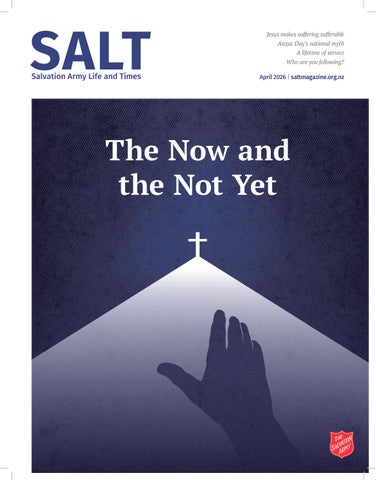
SALT April 2026, NZFTS

Page 1


5 Creamy Chicken Pasta

This quick and simple recipe will be sure to be a crowd pleaser at any family dinner table, with leftovers for you to enjoy.

8 Only Jesus Makes Suffering Sufferable

In seasons of despair, the big question that follows is ‘Why God?’ Jules Badger looks at the suffering Jesus endured, showing us that God doesn’t leave us alone in the darkness. He shares it with us.

20 Waiting in the Now and Not Yet

Waiting in our high-paced world can feel impossible, yet as Christians it sits at the heart of our faith. Exploring the tension between the now and the not yet, Kelly Cooper offers wisdom on how we can practise hope and trust while we wait for God’s promises.

28 A Fresh Start in Flat Bush

The Salvation Army celebrates the opening of Stage 2 of the Flat Bush social housing development, welcoming 41 new homes and fresh starts for local whānau (family).

SALT Magazine

The Salvation Army New Zealand, Fiji, Tonga and Samoa Territory

Territorial Commander

Commissioner Janine Donaldson

General

Lyndon Buckingham

Founders

Catherine and William Booth

Editor

Vivienne Hill

Graphic design

Sam Coates, Nicole Gesmundo, Lauren Millington

Staff writers

Kelly Cooper,

Captain Rachel Montgomery

Proof reading Colleen Marshall, Major Glenys Fairhurst

Connect with us saltmagazine.org.nz SaltMagazineNZ @SaltMagazineNZ salvationarmynzfts Territorial Headquarters, 204 Cuba Street, PO Box 6015, Marion Square, Wellington 6141 p: (04) 384 5649 e: salt@salvationarmy.org.nz

Subscriptions mailorder@salvationarmy.org.nz Print Management MakeReady

Publishing for 141 years Volume 3, Issue 34 ISSN 2816-1351 (Print) ISSN 2816-136X (Online)

All Bible references from the Holy Bible, New International Version, unless otherwise stated. Views and opinions expressed do not necessarily represent those of The Salvation Army.

Articles are copyrighted to The Salvation Army, except where indicated, and may be reprinted only with permission.

In His service

his is the last time I will have the privilege of writing to you as editor of SALT. I am stepping into new ministry opportunities and preparing to leave this role—one that has shaped me, stretched me and blessed me deeply.

As editor, I have had the joy of working alongside an extraordinary team of creatives. Every edition of SALT is planned intentionally, prayed over earnestly and crafted with you— our readers—at the heart of it. Behind the pages is an unseen but faithful group of writers, designers, administrators, proofers and digital storytellers who labour with dedication. They pour their gifts into this work because they know they are contributing to the kingdom of God and serving the mission of The Salvation Army. Their creativity is an act of worship; their commitment an expression of service.

To those who have taken the time to write, email or interact with me about SALT, thank you. Your encouragement, insights and even your challenges have helped shape the magazine into what it is today. Not everyone has agreed with every choice we’ve made—and that’s okay. In a rapidly shifting communication landscape, navigating change requires courage, adaptability and a willingness to evolve as we move more fully into a digital age. Your engagement has reminded us why this work matters.

In this Easter edition, you’ll find reflections that speak into these themes of tension, waiting and hope. On page 20, Kelly Cooper explores the ‘now and not yet’ at the heart of Christian faith, reflecting on how seasons of waiting are often uncomfortable and uncertain.

On page 8, Jules Badger considers how human suffering—often the place where God feels most absent—is actually where we most deeply encounter Jesus, the One who fully enters our pain.

Easter’s power is found at the cross and at the empty tomb, but also in the hush between them—the tender space where death and new life touch. In that sacred pause, we meet Jesus as both the suffering Servant who bears our pain and the conquering King who breaks its hold.

Easter invites us into a victory that outshines sorrow and outlives death—a triumph found only in the One who entered our human story, carried every wound and every grief and rose again so that even our darkest waiting will see light dawn. This is the hope we celebrate. His invitation is given to you—will you come to Him?

‘Here I am! I stand at the door and knock. If anyone hears my voice and opens the door, I will come in and eat with that person, and they with me’. REVELATION 3:20

It Takes an Army

Every day, across Aotearoa, people turn to The Salvation Army for support, compassion and practical help. Our Red Shield Appeal—running 4–10 May—shines a spotlight on the breadth of this mahi (work) and the incredible frontline teams who walk alongside whānau (families) facing hardship. Their work is only possible because it truly takes an Army.

The nationwide Salvation Army Week bucket collection invites New Zealanders to stand with that Army. By volunteering or donating, you join thousands of people across the motu (land) working together to raise vital funds for those navigating the high cost of living, financial stress, homelessness, or emotional challenges. Your presence, time and generosity show our communities that we are here, unwavering, ready to bring hope where it’s needed most. When we stand together, lives are changed. Because ultimately… it takes an Army.

QUICK QUIZ

1 Which prophecy from the Book of Zechariah is quoted in the gospels during the events leading up to Jesus’ arrest?

2 What was the name of the man forced to carry Jesus’ cross?

3 Which disciple ran with Peter to the empty tomb?

4 Who asked Pilate for Jesus’ body after the crucifixion?

5 In Matthew’s account of the Resurrection, what unusual event happened at the moment Jesus died on the cross that is not described in the other gospels?

Answers page 32

SALVATION ARMY PRAYER

Pukekohe Corps; Queenstown Corps; Raiwai Corps; Rakiraki Corps Plant; Rangiora Corps; Reintegration Services; Regional Headquarters Samoa; Regional Headquarters Tonga; Liberia, Sierra Leone and Guinea Territory; Malawi Territory and Mali and Burkina Faso Region.

Creamy Chicken Pasta

This recipe is a family favourite. It’s quick and easy to make and goes a long way. | 30 mins | Serves 5–6

Ingredients

• 1 packet bow tie (farfalle) pasta

• 1 cooked rotisserie chicken, shredded

• 1 Tbsp olive oil

• 1 brown onion, finely diced

• 2–3 cloves garlic, minced

Method

• ½ tin sweetcorn, drained

• 2 Tbsp Maggi chicken stock powder

• 1 tsp dried Italian herbs

• 300ml cream

• Fresh parsley, chopped

• Salt and pepper

Cook bow ties in well-salted water until al dente and keep over a small amount of cooking water.

Heat olive oil in a large pan over medium heat. Add onion and cook until softened (5–6 mins). Add garlic (cook 2 mins). Add the chicken and Italian herbs and stock powder, toss to coat. Add the sweetcorn and gently fold through. Reduce heat to low.

Add cream and a splash of pasta water to create a silky, slightly thinner sauce that won’t dry out. Add drained pasta to the pan and toss to coat thoroughly. Let the mixture simmer for 1–2 minutes so the flavours blend.

Pour into a large serving dish and garnish with fresh parsley and pepper. Serve with a crisp green salad and garlic bread.

INTRIGUING INDEX A World of Easter Wonders

1 High Flyers

A beautiful tradition rooted in faith takes place on Good Friday in Bermuda. Originating in the 19th century, Christians fly handmade kites to symbolise Christ’s ascension to heaven. The kites are colourful, geometric and often decorated with Bible verses.

2 Holy Floats

During Holy Week in Spain, processions called cofradías take place in every town and city. Elaborate floats known as pasos depict scenes from the Passion of Christ. Carried through the streets, these pasos are a testament not only to faith but also to the artistic expression deeply woven into Spanish culture.

3 Break-Up

In Greece, egg tapping—known as tsougrisma—celebrates Christ’s victory over death and the triumph of the Resurrection. Hard-boiled eggs are dyed red, and participants try to crack their opponent’s egg without breaking their own. The act symbolises the opening of Christ’s tomb.

4 Crack-Up

In the small town of Bessières in southwestern France, a giant omelette is cooked on Easter Monday to feed the entire community. Locals gather in the town square, crack 15,000 eggs into a custom-made pan, and prepare one enormous communal dish over an open fire. What began in 1973 as a tourism initiative has since become a cherished annual tradition that fosters togetherness and celebration.

5 Rise-Up

Originating in the Eastern Orthodox Church, the Paschal Greeting is a familiar practice in The Salvation Army and across the wider evangelical tradition. Worshippers greet one another with the call-and-response: ‘Christ is risen!’ ‘He is risen indeed!’

Pray for Iran

According to International Christian Concern and Union of Orthodox Christians, Iran has the fastest growing church globally.

Christianity in Iran has undergone a quiet yet remarkable expansion over the past several decades, despite operating under one of the most restrictive religious environments in the world. Recent estimates suggest that the number of Christians has risen from roughly 370,000 in 2014 to around 800,000 by 2025, making it one of the fastest growing Christian populations globally. This growth is often attributed to a growing disillusionment among segments of Iranian society— particularly younger generations—who perceive the state’s strict interpretation of Shia Islam as harsh and oppressive. In contrast, evangelical Christianity’s emphasis on personal faith, community and spiritual openness has drawn increasing interest.

The Centre for Human Rights in Iran states that this expansion has unfolded under significant danger. As a theocratic nation enforcing Twelver Shia Islam as its official ideology, Iran tightly polices religious expression. While Christianity is technically recognised, converts from Islam face the harshest treatment, including arrest, surveillance and the possibility of capital punishment under

apostasy provisions. Government crackdowns have intensified in recent years, with 2024 seeing at least 96 Christians collectively sentenced to more than 260 years in prison—six times the total from the previous year. Authorities frequently justify these prosecutions through national security charges and laws criminalising ‘deviant’ religious activity.

The outcome for the church is therefore paradoxical. Persecution has fragmented congregations, driven many believers underground and forced some to flee. At the same time, the resilience and quiet growth of Iran’s Christian community demonstrate a movement that continues to expand— even thrive—despite systemic pressure.

Prayers for Christians in Iran:

• Pray for strength for those who face pressure, discrimination and danger because they follow Christ. Fill them

with courage, peace and the deep assurance that they are never alone.

• Uphold leaders of the church in Iran who minister quietly and faithfully. Pray for discernment, protection and joy in their calling.

• Pray for stability, unity and healing for Iran. Calm tensions, end violence and guide the nation toward peace. Bless families, communities and leaders with wisdom and compassion during these difficult times.

• Pray God draws near to those in Iran who are questioning, hurting or longing for hope. That He would speak to them through dreams, Scripture and the love of Christians around them. Pray God’s truth will be a light that brings healing and transformation.

Wherever we turn in the church of God, there is Jesus. He is the beginning, middle and end of everything to us.

Unalterable: Reclaiming The Salvation Army’s Unalterable Legacy of Women Who Lead Christian, educational, inspirational | USA Southern Territory, Canada Bermuda Territory and Women’s Ministries at International Headquarters | Available wherever you listen to podcasts

This podcast explores The Salvation Army’s long-standing commitment to women’s leadership. Across four episodes, diverse voices reflect on the Army’s origins and its evolving views and hopes for the future. The podcast highlights the co-founders’ belief that ‘women … can hold any position of authority’, while acknowledging later cultural shifts that limited women’s roles. Unalterable prompted me to consider why Women’s Ministries emerged, the tensions that remain today and the importance of continuing to equip women—and men—for shared mission. (Reviewed by Gina Marshall) In-depth review available at saltmagazine.org.nz

Do You Know This Person?

If you recognise the person in this photo, we’d love to hear from you. Email: archives@ salvationarmy.org.nz

Verified: How to Think Straight, Get Duped Less, and Make Better Decisions About What to Believe Online

Educational | Available at BCM Library

A highly practical resource for sharpening our online alertness and digital literacy, no matter what we encounter. The authors update traditional media literacy concepts for today’s online environment, making them easy to understand and apply. The book is an accessible read, built around a single practical framework, with tools you can use in everyday online situations and real world examples to guide you through. It’s packed with stories showing how the authors applied their steps in real-life scenarios and what outcomes they achieved—insights I found genuinely fascinating. (Reviewed by Rachelle de Laat)

This compelling documentary explores the life of Hungarian chess legend Susan Polgar, one of the world’s top players. It traces her journey from a childhood shaped by her father’s bold training experiment—designed to turn her and her sisters into chess champions—to breaking barriers on the international stage. The film highlights the intense work, pressure and obstacles she faced in a sport long dominated by men. Honest and inspiring, it reveals the sacrifices and determination behind Polgar’s rise to the top, leaving viewers with a deeper appreciation of her lasting impact on the game. (Reviewed by Janlyn Robertson)

(Tongan, noun)

Source: pasefika.com

Queen of Chess
WORD OF THE MONT H Maama
light.

Only Jesus Makes Suffering Sufferable

In this life, none of us are immune from suffering. For many of us, it is during seasons of deep despair that we search hardest for God—yet it is often then that God feels most difficult to find. And still, it’s also during these seasons that we are invited to connect with the strong and unbroken thread of suffering throughout the Bible, and where we are most likely to discover the comfort and hope found only in the Suffering Servant.

n the Western evangelical church, we often hold an underdeveloped theology of suffering. We prefer the God of victory, the conquering warrior, the healer and restorer, the King of kings. But thankfully our God is found both on the mountaintop and in the darkest valley. We often don’t discover this side of God—the One who suffers with us—until we ourselves face unexpected, unwanted pain.

When we’re hit with the shock of sudden loss, the devastation of unfaithfulness, another miscarriage, the disbelief of a terminal diagnosis, a left-field redundancy, or the wounds of failure, abuse, injustice—when we find ourselves suffering under grief, pain and despair—the questions come thick and fast. Why God? Why is this happening? How can an all-knowing, all-powerful and perfectly loving God allow this? How is this even possible?

No stranger to suffering

This Easter we’re not shying away from the great paradoxes of mortal life—joy and sorrow, laughter and weeping, life and death. Among Jesus’ last words on the cross were, ‘My God, my God, why have You forsaken Me?’ (Matthew 27:46b). At the end of his earthly life, when heaven’s stony silence threatened to overwhelm, Jesus articulated perfectly humanity’s

universal question: why does God allow suffering? This Easter we’re looking to Jesus’ whole life for guidance, because Jesus didn’t just suffer for us on the cross—Jesus’ entire life was marked by suffering.

This Easter we’re not shying away from the great paradoxes of mortal life—joy and sorrow, laughter and weeping, life and death.

Jesus was born to oppressed peasant parents who lived under the religious shame of a scandalous pregnancy. Jesus lived His childhood at the mercy of political tyrants, as His parents fled an infant genocide to live as refugees in a foreign land. Even when it was safe to return home, it meant living under Roman occupation and an unjust system. As a young man, Jesus worked hard alongside other tradesmen to make ends meet in a poor, rural village.

Before beginning His ministry, Jesus spent 40 days fasting in the desert, overcoming Satan’s temptations:

a kingdom without service, bread without toil, power without responsibility—such shortcuts would remove not only His present suffering but the pain that lay ahead.

Throughout His ministry, Jesus moved among and ministered to human suffering, choosing the life of a homeless nomad dependent on the hospitality and kindness of strangers. And after He was arrested, Jesus suffered horrendous and terrifying torture. And then He was nailed to a criminal’s cross between two thieves, naked and exposed, humiliated and taunted, until He breathed His last. Jesus is no stranger to suffering.

I have overcome the world

The night before Jesus died, He said, ‘In this world you will have trouble’ (John 16:33). Of all Jesus’ promises this is far from our favourite. We don’t want trouble. We don’t want hard conversations. We don’t want darkness. We don’t want terminal illness. And we certainly don’t want to feel as vulnerable as we often

do when the answers we so desperately seek remain elusive. When God, it seems, is silent and far off.

But Jesus doesn’t leave us alone in the darkness. Yes, trouble will come, ‘but’, says Jesus, ‘take heart, I have overcome the world’. The original Greek word for overcome is in the imperfect tense, meaning Jesus has overcome the world both now and in the future. Jesus is the resurrection and the life—the great victory of Easter—and has won a decisive victory over sin and death. We can know peace even in the darkest valley because He promises to be with us (Psalm 23:4).

‘Our only hope in suffering is a God who suffers with us and promises that pain will be brought to an end and not have the final word,’ says pastor and author Tyler Staton.

We know that the biblical narrative begins with goodness. God did not create a world where pain and suffering existed. In the Garden of Eden there was only life and love. God’s perfect world was corrupted by the

evil one, who persuaded Adam and Eve that God was keeping something from them.

‘God told one story and the serpent told another and humanity believed the serpent. The world as we know it today is the product of believing that lie,’ explains Tyler. ‘The source of suffering? It’s not God. It’s sin. Our trouble is the product of a curse that infected every aspect of the world that God made good and only good. God doesn’t will suffering, but the consequence of sin is in the very dirt we walk on. We experience hurricanes, disease, floods, wars, racism, abuse— not because it’s God’s will, but because nothing is untouched by sin. Suffering in every variety is the consequence of sin—not the punishment for sin, but the natural consequence of sin.’

Suffering is a symptom of sin; this is suffering’s origin story. And this is the story that Jesus—fully God and fully man—willingly enters.

‘God chose to become a storyteller from within,’ continues Tyler. ‘God did not sit at a distance and write a happy ending to a story filled with conflict and suffering. He entered into His own cursed and corrupted creation, became a part of His own story and redeemed that conflict through grief, pain and suffering … Jesus and only Jesus makes suffering sufferable. And when we connect our own suffering to the larger biblical story of suffering, even our pain can become redemptive.’

The God who feels

Often the question we don’t readily ask when darkness descends is how God feels about human suffering.

‘God is not immune to human suffering,’ explains author, pastor and spiritual director Adele Calhoun.

‘Just six chapters into the Bible—and before we see evidence of any human tears—we find a grieving Creator. “God saw that human evil was out of control … God was sorry that He made the human race in the first place; it broke His heart”’ (Genesis 6:6, TM).

We are not shielded from God’s expression of emotion or the vulnerability He feels when the kind of relationship He had hoped to have with His creation falls prey to the enemy’s schemes.

‘Human freedom had ushered in acres of pain, betrayal, deceit, murder, polygamy and other ills. And God responded with grief (Ephesians 4:30). This divine sorrow is not the result of a self-indulgent temper. God doesn’t have tantrums, mood swings or fits of despair. God’s grief is ‘clean’, an aching with unchanging and steadfast love for those He loved the dearest,’ explains Calhoun.

We know that God began again with Noah and his family. But the freedom God would not withhold out of love for His creation and born from His desire that we would freely choose Him, had the same outcome.

‘Again and again and again the Holy One, vulnerable to the grief and sorrows of His beloved tribe, reaches down to repair and restore,’ continues Calhoun. ‘When reaching down doesn’t solve human brokenness, God comes down in human flesh. God moves into the neighbourhood and walks in our shoes. God incarnate was in solidarity with human sin and misery. Jesus was wounded for our transgressions and crushed for our iniquities (Isaiah 53:4–5).’

When darkness descends, the need to make sense of our suffering is visceral.

The God of both suffering and victory

When darkness descends, the need to make sense of our suffering is visceral. The need to understand, to explain and to find meaning in it all can become paramount.

Psychologist David Benner suggests that, ‘We need a meaning strong enough to make suffering sufferable. This is the crucial test of any life meaning. It has to help us live life. For it to do that it has to help us cope with suffering.’

The biblical narrative and the life of Christ hold victory and suffering together. The underground church in China and persecuted Christians throughout

the world know the God of the valley well, but we tend to build our churches largely on mountaintop theology. After all, God is a miracle-working God who heals and transforms us. But that’s not the whole story of who God is. Finding meaning in our suffering means to come to the One who co-suffers with us.

As Tyler reminds us, ‘The God of the Bible is both a heartbroken parent grieving loss but also a warrior who will stop at nothing to defeat the enemy and redeem every trace of the cost along the way. And that is good news!’

And God shall wipe away all tears from their eyes; and there shall be no more death, neither sorrow, nor crying, neither shall there be any more pain: for the former things are passed away. And He that sat upon the throne said, “Behold, I make all things new” (Revelation 21:3–5, KJV).

In the end, God sees us through suffering to the ultimate victory—from death to life. As God’s people we are invited to hold the paradox of suffering and death alongside the goodness and love of God (2 Corinthians 4:10). Following Jesus calls us to inhabit the contradiction of choosing to rejoice in suffering (2 Corinthians 6:9–10) and to live into the truth that while tears may endure for the night, joy comes in the morning (Psalm 30:5).

‘If you want to know the power of His resurrection, you will need to stand in solidarity with Jesus and this hurting world,’ warns Calhoun. ‘So lament, give your pain to Jesus, allow others into your pain just as Jesus did, weep with those who weep, let compassion be formed in you, grieve your own sin and receive transformation.’

In the end, God sees us through suffering to the ultimate victory—from death to life.

I am the resurrection and the life

It was a good Saturday. Or was it? Truthfully, it could have been disastrous. It certainly did not look good in the beginning.

I suffered a heart attack. Seems it was quite a significant episode; frightening for Bronwyn and, yes, deeply troubling for me. Was this it? Had my time come? Is this how the Lord was calling me home? What about the kids and the grandkids? What about Bronny? What about my ministry? I still had things that needed to be done. This was not a good Saturday. It was awful, frightening, dark and scary.

And yet, yes, as it happens, it was a good Saturday. As I reflect on that day last October, I celebrate the miracles of that scary day. The right people intervening at the right time. Christian concern that led to action.

A beautiful Salvationist nurse whose friend was a Christian cardiologist. A life-saving intervention and even a promise from God himself that all will be well. God’s timing was perfect. His providence abundant. So, as I reflect and look deeper into the events that transpired, I have come to the conclusion that it was a good Saturday after all.

I remember as a young junior soldier being perplexed by the use of the word ‘good’ in the Easter story. Good Friday—the day they crucified Jesus. How can that possibly be described as good? I mean, let’s not sugar-coat it. It was a horrible day. A day of unjust conviction, brutal torture, of unrelenting pain and suffering. The

cross, a weapon of the devil, used against the Lamb of God. Horrifying, ugly and unforgivable. But if, without excusing the events of the day, we look deeper, we actually witness God Himself in action. God meets the manifestation of pure evil represented by a physical cross, with all its brutality, with the redeeming love that conquers evil, sin and, yes, death itself. He turns an ugly Friday into an exceptionally ‘Good Friday’ indeed.

Understand this: whatever else was going on, Jesus himself was motivated by love.

Understand this: whatever else was going on, Jesus himself was motivated by love. He went to the Cross out of love for all humanity; out of love for you and for me. In his Letter to the Romans, Paul wrote: ‘But God demonstrates His own love for us in this: while we were still sinners, Christ died for us’ (Romans 5:8). Christ demonstrated the extent of God’s love for all of us by taking upon Himself the sin of the world. On this Friday, Jesus was motivated by love. The truth is, God loves us and Jesus is the proof.

The writer to the Hebrews asks the question: ‘...how shall we escape if

we ignore so great a salvation?’ (Hebrews 2:3). The prophet Isaiah wrote: ‘...by His wounds we are healed’ (Isaiah 53:5). It is a mystery for sure. In some mysterious and divine way, the events of Good Friday hold the key to our own healing, our forgiveness, our salvation and our adoption. The atonement makes possible our being embraced by Almighty God himself. Jesus, motivated by love, makes possible our restoration, redemption and reconciliation. We are healed; we are saved. We are loved.

It can be difficult to see the events of Good Friday as triumphant, but that is exactly what it is. First, it is a triumph for Jesus. He was faithful and obedient, even to death on the Cross.

‘It is finished,’ He declared (John 19:30). I have completed my mission. It is done. The power of sin and death is defeated.

In Jesus’ victory over sin and evil, His ‘triumph’ becomes our triumph as well.

Second, the triumph of Calvary is the defeat of evil. In Jesus’ victory over sin and evil, His ‘triumph’ becomes our triumph as well. Because we live on this side of the Resurrection, we are able to celebrate our Lord’s vindication. He conquered death and lives forever more. His victory becomes ours. It was Jesus himself

who said: ‘I am the resurrection and the life. The one who believes in Me will live, even though they die; and whoever lives by believing in me will never die’ (John 11:25–26).

Jesus acknowledges the reality of physical death, but goes on to declare that death does not have the final word over those who, by faith, belong to Him. This means death is no longer a wall, but a doorway. It has lost its ultimate power and its terror, and it cannot sever a person from the life Jesus gives. Eternal life is not only duration, but also dimension. It is a life infused with the presence of God and it begins the moment we place our trust in Jesus.

Turns out, it was a very ‘Good Friday’ indeed!

Jesus acknowledges the reality of physical death, but goes on to declare that death does not have the final word…

My prayer for each of you is that you will be captivated by, and experience for yourselves, the reality of God’s love for you, revealed in the person of Jesus Christ, the Son of God and Saviour of the world.

God bless you.

General Lyndon Buckingham

Living the Hope of Easter

As Easter approaches, I find myself reflecting on the angel’s words at the empty tomb: ‘He is not here. He was raised, just as He said’ (Matthew 28:6, MSG).

That simple announcement continues to reshape everything we believe and everything we do. It reminds us that God keeps His promises, and that resurrection is not only a moment in history—it is the power that fuels our mission today.

Easter calls us back to the heart of why we serve. Jesus entered the depths of human suffering, carrying the weight of our brokenness. Isaiah describes Him as the One who ‘took the punishment, and that made us whole’ (Isaiah 53:5, MSG). That wholeness is what we long to see in the lives of those we walk alongside. It compels us to stand with the vulnerable, encourage the discouraged and bring practical love into places where hope feels thin.

This year, I’ve been especially drawn to Romans 8:11 (see right). That reminder anchors me: our mission is not carried out in our own strength. The same Spirit who raised Jesus empowers us to keep showing compassion, to keep believing in transformation and to keep stepping toward people with open hands and open hearts.

Easter also renews our commitment to perseverance. Paul’s words in Galatians 6:9 (MSG) guide us: ‘Let’s not allow ourselves to get fatigued doing good’. The needs around us can feel overwhelming, but the resurrection assures us that God is already at work ahead of us. We join Him; we do not carry the mission alone.

As a movement, we live out Easter in practical ways—feeding the hungry, welcoming the lonely, advocating for justice and pointing people to the One who brings life out of lifeless places. Every act of kindness becomes part of the ongoing story of resurrection.

My prayer this Easter is that the risen Christ will renew your strength, steady your heart with His peace and fill your steps with His courage.

Grace and blessings to you and your whānau (family) this Easter.

Commissioner Janine Donaldson Territorial Commander

Romans 8:11

‘If the alive and present God who raised Jesus from the dead moves into your life, He’ll do the same thing in you.’ (MSG)

Ki te noho ia i roto i a koutou te Wairua o te kaiwhakaara o Īhu i te hunga mate, māna, mā te kaiwhakaara o Karaiti Īhu i roto i te hunga mate, e whakaora ake anō ō koutou tinana mate ki tōna Wairua e noho nā i roto i a koutou. (PT)

Ia kevaka sa tiko e lomamuni na Yalo ni Kalou, o koya sa vakaturi Jisu cake tale mai na mate, ena qai vakabula talega na yagomuni sa mate rawa o koya sa vakaturi Karisito mai na mate ena vuku ni nona Yalo Tabu sa tiko e lomamuni. (FOV)

Jisnē Yēśu kō mṛutakōn mēn sē jilāyā, yadi uskā ātmā āp lōgōn mēn nivās kartā hai, tō jisanē Yēsu Masīh kō mṛutakon mēn sē jilāyā, vah apnē ātmā dvārā, jō āp mēn nivās kartā hai, āpkē naśvar śarīr kō bhī jīvan pradān karēgā. (FRHNT)

‘Io, kapau ‘oku fale ‘iate kimoutolu ‘a e Laumalie ‘o ia na‘a ne fokotu‘u ‘a Sisu mei he pekia, pea ta ko ia na‘a ne fokotu‘u ‘a Kalaisi mei he pekia, te ne ‘ai ke mo‘ui ‘a e koto mate na ko homou sino, koe‘uhi ko hono Laumalie ‘oku nofo‘ia kimoutolu. (TWB)

A e afai e nofo i totonu ia te outou le Agaga o le na toe faatu mai ia Iesu nai e ua oti, e faaola mai foi o outou tino auga vale e le na toe faatu mai ia Keriso nai e ua oti, e Iona Agaga o loo nofo i totonu ia te outou. (SOV)

Anzac Day—Sustaining a National Myth

In towns and cities all around Aotearoa New Zealand, Anzac Day is commemorated on 25 April. The numbers attending continue to grow, with people of all ages gathering—many with little or no family connection to those who fell in conflict. Lt-Colonel Ian Hutson reflects on nation-building myths.

The size of the response and the almost sacred atmosphere that permeates these commemorations point to something deeply spiritual taking place.

The chosen date focuses heavily on the landing of troops on Suvla Bay as part of the Allied invasion of the Gallipoli Peninsula, with the wider First World War—and later the Second—providing the backdrop.

In his book National Memory Myth, Steve Vizard explores the reverence

surrounding Anzac Day, writing from an Australian perspective but offering insights that help us understand why this day unites our own nation too. He suggests that many facets of our ideas around Anzac Day fit the description of a national myth.

Some might protest, worrying that calling Anzac a ‘myth’ diminishes its truth. After all, Gallipoli was a real place, a real battle, a real loss. Yet in the Western imagination ‘myth’

is often misunderstood. Myths are not falsehoods—they are stories we tell to make sense of who we are. Historians may rightly challenge inaccuracies sometimes repeated in Anzac commemorations, such as:

Myths are not falsehoods—they are stories we tell to make sense of who we are.

• The ANZACs landing on the wrong beach under a hail of gunfire— the truth is that they landed on the correct beach, lightly defended with no machine guns and only a single company of Ottoman soldiers.

• The idea that ANZAC soldiers were inherently superior warriors—the ‘natural soldier’ is now understood as a romanticised stereotype.

• Belief that British commanders alone bungled the campaign— when in fact ANZAC generals shared responsibility for strategic errors.

• The assumption that Gallipoli was primarily an ANZAC battle— it was a vast international campaign involving British, French, Indian and Pacific troops,

with ANZACs making up roughly 12 percent.

As a blend of history and myth, Vizard sees the Anzac story as a foundation myth—a cultural narrative that shapes our shared identity. This is as true for New Zealand as for Australia. National myths help explain where we have come from, articulate our hopes and aspirations and give voice to the values we believe matter. They provide shared meaning and nurture belonging, binding citizen and nation together both logically and emotionally.

The Anzac story communicates enduring ideas of who we are as New Zealanders, what we value, and how we hope to behave. We hear this captured in the phrase ‘the Anzac spirit’. Its qualities might include:

• Loyalty and perseverance, a willingness to have a go.

• Fidelity, trustworthiness and generosity.

• Egalitarianism, democracy and self-reliance.

• Sacrifice, courage and tenacity of purpose.

There are clear echoes here of Christ’s own sacrificial love— reflected every Easter—and Anzac services often draw on this connection. On Anzac Day many of these values are not simply remembered but held up as aspirations for shaping a better shared future.

Of course, national stories evolve. For some New Zealanders the traditional narrative of Anzac mateship—overwhelmingly male and Pākehā—did not always offer a place to stand. Yet our national story has

expanded. Increasing emphasis is placed on the contribution of women in wartime, and on units such as the Pioneer Battalion in WWI and the Māori Battalion in WWII. In doing so, our understanding of courage, service and belonging grows richer and more inclusive.

Anzac Day calls us not only to honour those who gave their lives but also to commit ourselves to peace…

Anzac Day calls us not only to honour those who gave their lives but also to commit ourselves to peace—especially in a world where conflict feels ever closer and division seems to grow both between and within nations. Here in Aotearoa New Zealand we face challenges of poverty, homelessness, inequality and polarisation. Yet the very values we commemorate— sacrifice, generosity, loyalty and egalitarianism—offer a hopeful pathway forward.

If we embody the best of the Anzac spirit, we can strengthen the social cohesion that allows families to thrive, communities to flourish and every person—whatever creed, gender, ethnicity or social position— to feel truly at home.

As Paul writes: ‘There is neither Jew nor Gentile, neither slave nor free, nor is there male and female, for you are all one in Christ Jesus’ (Galatians 3:28).

A lifetime of service

In January 2024, Defence Force serviceman Major David Ackroyd, DSD, completed 50 years of continuous service with the New Zealand Army. A year later, he received the United Fire Brigade’s 50-Year Service Medal for five decades as a volunteer firefighter. David also serves on the Upper Hutt Salvation Army’s leadership team, having been part of the corps for more than 25 years. Service to others is the foundation of his life’s work.

I was born and raised on farms around rural Canterbury, with my family eventually settling in Rolleston. I’m the oldest of four, and as children we all went to Sunday school at the local Anglican church with Mum.

When I started high school, I had to catch the New Zealand Army bus from Rolleston. One day the bus driver asked me what I wanted to do with my life. I told him I wanted to be a chef. ‘Okay,’ he said, ‘I’ll take you to the recruiting office and you can have a look at some pamphlets.’ Next thing I knew, I was applying for the military! I was just shy of 16 years old. I went straight from a Hagley High School uniform into a New Zealand Army uniform. I remember Dad saying, ‘Son, if you join the Army you’ll have a job for life’. I don’t think either of us imagined that would actually happen—but here I am. I’ve served in catering and logistics and even served the Queen. I’ve been deployed to Antarctica, East Timor and Singapore. Service has been my life and it’s been good.

While there was certainly peer pressure and stigma, I remember being among a group of about 20 or 30 cadets—out of roughly 170—who stepped forward for church. When I went into the regular forces, I was on shift work and church became pretty hit and miss for the next 10 years. But then I deployed to East Timor.

Faith rekindled

Timor was a very Catholic country, and as we travelled around there was extensive damage to government buildings and homes, but the churches were generally left untouched. The Indonesians were Muslim, but they rarely damaged the churches, and

the Timorese maintained their religious practice. On Sundays you’d see people walking to church dressed in their finest clothes. Their faith gave them a different perspective on what was happening—it got them through. That really impacted me. Since then, whenever I’ve been in a tough predicament, I find myself praying and thinking back to the Timorese. If they could get through what they faced, then so can I. Faith makes a real difference.

When I returned to New Zealand, I discovered that my wife, Margaret, had started attending Upper Hutt Salvation Army. She’d been invited to home league and then to church. That’s when I met Majors Darrell and Lorraine LePine—22 years ago!

Serving is simply part of who I am… I enjoy helping others and I don’t like seeing people suffer.

I’m now on the leadership team and I cook for the monthly men’s breakfast. Serving is simply part of who I am and that’s why I’m in the Army, the volunteer fire brigade and now The Salvation Army. I enjoy helping others and I don’t like seeing people suffer.

The cost of service

I love the saying, ‘We’re at our best when you’re at your worst’. When I went to Timor, the people were at their worst and we did our very best to support them. As a firefighter, when you arrive at someone’s home and it’s on fire, they’re at their worst—and again, we work hard to do our best. It’s the same with The Salvation Army: serving people in practical

ways as best we can. But helping people can become a challenge, because when I know I can help, I just put my hand up. And the truth is, there are a lot of people who don’t. There’s a cost when you choose to serve. Families suffer when someone chooses to do wrong—but they also sacrifice when someone chooses to do good.

There’s a cost when you choose to serve. Families suffer when someone chooses to do wrong— but they also sacrifice when someone chooses to do good.

When my youngest son Michael turned 18, he said, ‘Dad, do you realise you’ve been away for half my life?’ I sat there quietly, thinking that couldn’t be right. But as I reflected, it dawned on me that he was right. There really is a cost to doing the work no one else puts their hand up to do. I don’t think the wider public fully appreciates that. Across the helping and caring professions, sacrifice is constant and it’s not easy fi nding the balance.

Prayer when under pressure

When I was in Timor, there were some really challenging moments, including one situation where I prayed, God, I really need Your help here. As a logistics specialist, I was working with a group of Timorese contractors. It fell to me to communicate that they were no longer needed. They hadn’t been paid yet, so they took some of the trucks we needed to transport people. I had to try to resolve the situation with men who were armed with machetes. I was quietly praying and trusting God that nothing would escalate. I sat with them for 20 minutes until they calmed down and agreed to return the trucks. Afterwards, they sought me out to help resolve their pay issues—and I was able to help.

Looking back, while something good was achieved that day, I certainly didn’t achieve it alone. God was with me—He had my back.

Looking back… I certainly didn’t achieve it alone. God was with me—He had my back.

Waiting in the Now and Not Yet

Easter invites us into the same holy tension the disciples lived in over 2000 years ago—the waiting space between now and not yet. As Christ followers today, we too must navigate the ache of delay, the hope of resurrection and the everyday practice of trusting God in our own waiting places.

rish poet, philosopher and priest John O’Donohue writes, ‘At any time, you can ask yourself: At which threshold am I now standing? At this time in my life, what am I leaving? Where am I about to enter?’ This threshold he refers to is familiar to many of us—the space that exists between two points— between now and not yet.

An expectant mother counts down the months—and then days—until her newborn arrives. A job seeker holds their breath for a longed-for position. A patient awaits test results that may change everything and a newly engaged couple eagerly anticipate their wedding day. If you’ve stepped out of what was, but haven’t yet arrived at what might be, you’ll know what it feels like to stand in this waiting place.

As humans, we don’t much like waiting. Waiting for traffic to move. Waiting for our coffee. Waiting for a reply to an email. In our optimised, speed focused, productivity driven world, we’ve grown out of practice with waiting. If it’s not immediate, we assume something’s wrong. Waiting feels uncomfortable, inefficient and incredibly frustrating. And yet, as Christians, waiting sits at the very centre of our faith.

The unhurried way of Jesus

They may not always have been good at it, but it’s easy to imagine Jesus’ disciples becoming well acquainted

with waiting. Jesus did not move in a hurry— He lingered, He stopped, He often took the long way. By the world’s standards, He was anything but productive. He took his own sweet time.

But nothing could have prepared them for the waiting place they found themselves in on Easter Saturday. Their Messiah—the One they hoped would restore God’s kingdom—now lay in a sealed tomb following His torture and crucifixion. Their shock, confusion and grief would have been beyond comprehension. A threshold had been crossed: there was no going back and yet there was no clear way forward either.

Even if they remembered Jesus’ teachings that ‘the kingdom is already here’ (Luke 17:20) and ‘coming in fullness’ (Matt 6:10), it’s reasonable to assume they had a few questions. Where was this kingdom Jesus had promised and taught them to pray for? How

Waiting feels uncomfortable, inefficient and incredibly frustrating. And yet, as Christians, waiting sits at the very centre of our faith.

can the kingdom be both present and still coming, especially now that Jesus was no longer with them? And the question that many of us continue to grapple with today: if His kingdom is coming one day, how do we wait well?

When an angel told the women at Jesus’ empty tomb on Sunday morning that He had risen, they ran to tell the disciples. It’s possible that when they encountered Jesus on the way, they wondered whether He had come to complete God’s kingdom on earth. Was the waiting over?

Over the next forty days, Jesus met with many of His followers face to face, speaking with them about the kingdom of God. When the disciples gathered around Jesus and asked, ‘Lord, are You at this time going to restore the kingdom to Israel?’, they were essentially asking the same question: Is the waiting over?

But, as Luke records in the book of Acts, the fullness of God’s kingdom had not yet arrived. Jesus told them that the timing belonged to the Father alone—they would need to continue to wait. Yet He also promised that they would receive the power of the Holy Spirit, and He commissioned them to be his witnesses to the ends of the earth.

Jesus’ resurrection on Easter Sunday was good news— it confirmed that God’s reign had already begun, even though it was not yet complete. It also invited His followers to participate actively in the now, while waiting for the not yet

How do we wait well?

As people with dreams, desires and deep longings, it can be genuinely difficult to be stuck in the in-between. When we’re recovering from poor health, when a long-hoped-for opportunity is slow to unfold, or when our understandings of our identities, relationships, vocations and callings begin to shift, it can feel as if we are suspended in time.

Waiting stirs the full spectrum of emotions, including fear, confusion, excitement, sadness, anticipation, uncertainty—and hope. Paul tells us in Romans that as humans we are not alone with our feelings; even creation is subjected to the frustration of waiting like the woman experiencing birth pangs.

‘When we’re in-between and suffering, Jesus gets it and He gets us. Jesus isn’t just the one who rose again, He’s also the one who suffered,’ explains Anglican priest Reverend Scottie Reeve. ‘When we are in the

not yet it can be tempting to question what we have done wrong. Did I not pray the right prayer? Is this my fault? We blame ourselves and try to find an answer for the discomfort we feel.

‘But when we remember that we can expect to live in this tension because it’s the not yet part of the kingdom, we understand that we didn’t make a mistake, but rather that we suffer in the company of a God who also suffers. In the same way He was present with the criminals on the crosses beside Him, sometimes the answer Jesus gives us in our waiting is Himself present with us.’

‘In the same way He was present with the criminals on the crosses beside Him, sometimes the answer Jesus gives us in our waiting is Himself present with us.’

Assistant corps officer at Johnsonville Corps, Captain Janet Green acknowledges that the space between now and not yet can be enormously challenging. ‘I see people who are supporting loved ones through longterm illnesses, those who have been made redundant and are waiting for a job and many who are praying for healing,’ shares Janet.

‘It helps me to recognise that this waiting place is often where God invites me to be more like Jesus. God is okay with my wrestling and questioning. In fact, wrestling has the potential to draw me closer to Him and bring a deeper revelation of who God is.

‘I’ve learned to have honest conversations with God and to listen to the way He speaks to me. Admitting to God that I am frustrated, overwhelmed and scared has shown me that God is big enough to handle my feelings. The Psalms and breath prayers can provide us with language that capture the experiences of longing and waiting when we don’t have our own.’

Above: At the Foot of the Cross, Currier & Ives (1834–1907). Image courtesy of the Springfield Museums (Mass, USA).
Above, from left: Captain Janet Green, Johnsonville Corps, Reverend Scottie Reeve, St Matthew’s Church, Brooklyn, Wellington.

Spiritual director Bruce Hulme agrees that for many of us the ache of not yet can almost feel unbearable. He supports his directees to recognise and name their in-between spaces. ‘Identifying that we’re in this space helps our brains begin to process it. It also reminds us that periods of waiting are a common human experience,’ he explains.

Waiting together

Janet recognises that our needs in seasons of waiting vary from person to person. ‘Some of us want a listening ear and support discerning where God might be in our situation, or where else God might be showing up in our lives. Others want someone to walk alongside them and to say and do nothing.

‘When Jesus walked the earth, He also lived in the inbetween—the tension of the kingdom that was present with and through Him, but also not in its fullness and completion. As Christ followers we can expect to live with this same tension today. A church community can come alongside those who are suffering as they wait, pray for them and share different ways they navigate the practical realities of living in a now and not yet world.’

Scottie adds, ‘In our communities we will always have some people living with the burden of unanswered prayers and prolonged periods of living in-between. That’s the beautiful thing about the Body of Christ. We will all be different people at different times, with seasons of waiting and seasons of growth. We can come alongside those who are waiting, knowing that they will do the same for us.

‘I don’t think it’s good for this tension to stay in our heads. Taking action and doing something enables us to participate in the kingdom that is here now can be

When we live in the now part of the now and not yet, we begin to live as resurrection people.

important for our sense of engagement and purpose. If you experience climate anxiety, what can you do in Christ today for the climate? If your heart breaks for the homeless, what can you do right now to make a difference? When we live in the now part of the now and not yet, we begin to live as resurrection people.’

Not the end of the story

The story of Jesus didn’t end with Jesus’ earthly ministry—it continues now in the lives of those who follow Him.

‘As Christians we live in the very real hope of a big story that God will make it all right in the end, but the stories we consume are often not yet stories, with no hope of resurrection. I think it’s important for us to make sure that we are reading and believing the right stories about the world. Are we dwelling in the Scriptures more than our newsfeed? Resurrection storylines are always going to be more hidden than the death storylines in this world—they are our mustard seeds,’ shares Scottie.

In the midst of waiting, it’s easy to forget that the things we long for are often good. Our attention can shift from the promise to the delay, from the hopedfor future to the discomfort of the in-between. We can begin to live in stories that shrink our imagination to what is visible, forgetting the quiet work of resurrection that begins in hidden places.

Perhaps the challenge for Christians waiting today is no different than it was for Jesus’ followers 2000 years ago. To accept the power of the Holy Spirit, to come alongside one another in community to take action now, and to bear witness to a weary world longing for the not yet

Who are you following?

‘How’s a kid meant to find their way back to the car if they don’t have their mum to follow?’ he asked with a grin.

It was a good question. Just before Christmas, my son—freshly in possession of his restricted licence and even fresher possession of my car— had been enjoying the freedom of a solo trip to the mall. After successfully navigating the festive chaos and securing a car park, he wandered into the mall, only to emerge an hour later perplexed.

Looking around, not entirely convinced he was on the right level and with no one to follow, he began his quest to find my car. If you’ve had a similar experience, you will know how frustrating it can be.

Maybe you’ve relied on someone else to get back to the car, or you’ve blindly followed a crowd, or perhaps you’ve scrolled your way through an evening without even realising. When we’re not paying attention, we end up following whatever—or whoever—is right in front of us.

In Matthew 4:19, Jesus extends a life-changing invitation to two fishermen with three simple words, ‘Come, follow me’. I’ve always marvelled at how Simon Peter and Andrew responded. We’re told they immediately left their nets and followed. Not that they paused to consider their options, got temporarily distracted, or checked what everyone else was doing. They shifted their attention from their ordinary lives to Jesus and chose to follow Him.

I’m not sure I would have been so receptive or responsive to Jesus’ request.

At Easter, we stand once again before the story of Jesus, who gave His life for us—a story full of weight and wonder that can be difficult to grasp. And yet, in the middle of our crowded and distracted lives, His invitation remains unchanged, ‘Come, watch what I’m doing and follow Me.’

What we give our attention to doesn’t just help us navigate a busy car park, it also shapes who we become.

Who are you following?

Our Co-Suffering Christ

Major Mat Badger invites readers to look beyond the familiar imagery of Easter and confront the deeper, often uncomfortable reality of a Messiah who enters fully into human suffering.

I love the work of surrealist artist Salvador Dalí. I have a number of copies of his works hanging in my office—one of them being, Christ of Saint John of the Cross. It depicts Jesus Christ on the cross, suspended in the darkened sky and hovering over a body of water, and if you look closely, you can see a fisherman in the boat below. It is a stunning piece of artwork, and it is an image that The Guardian newspaper’s art critic Jonathan Jones described as, ‘…probably the most enduring vision of the crucifixion painted in the 20th century’.

The sanitised Messiah

However, as a theologian, I like this masterpiece for reasons beyond its aesthetic cleverness. It is a reminder to me that if we are not careful, we can sanitise both the events and meaning of Easter. Although Dalí depicts the crucifixion, there are no nails or thorns. There is no blood and we can’t see the face of Christ. The cross itself is removed from creation, and we get the impression that the ascension is happening with Christ still on the cross. As clever as the artwork is geometrically, it unfortunately sanitises the brutality of what Jesus endured on the cross. To me, Christ of Saint John of the Cross is a reminder that Passion Week is a good time for us to re-examine our expectations of who God is and why the cross was necessary.

Dr Jordan Petersen says that, ‘Our expectations are the strong beliefs we all hold for what should happen. And when we have expectations, we

We tell ourselves that God doesn’t care, but this couldn’t be further from the truth.

place a high degree of certainty that something will take place within the framework we create in our minds.’ This principle applies to the way in which we think about God, in that whether we realise it or not, everyone either has cognisant or subconscious expectations of Him. We see this play out in the actions of people during the Passion Week.

On the day we now celebrate as Palm Sunday, Luke 19 describes Jesus riding on the back of a donkey while the people wave palm branches, sing and proclaim Him as King. But the same people waving palm branches at the beginning of the week would be yelling ‘Crucify Him!’ at the end of the week. Why? The reason for this was their unrealistic—and unmet— expectations they had of their longawaited messiah. Who they thought Jesus was, and who He would turn out to be, was totally different—at least in that moment in time.

The misunderstood Messiah

Many were expecting a Messiah who would be a great military and political leader—someone who would turn up and put the Roman bully boys in their place. It’s easy to welcome that kind of leader, especially when you are oppressed. But this Jesus, by the end of the week, would not be leading an uprising. Rather, He would be hanging on a cross in agony. And people would be angry and disappointed.

If we are not careful, we too can fall into the same trap. Especially if we let our experiences define our truth without looking through the lens of Scripture. Maybe because of a sickness we have, or pain that we carry, or because of some kind of injustice we have endured. We tell ourselves that God doesn’t care, but this couldn’t be further from the truth.

The compassionate Messiah

In Exodus 34:5–7, God describes Himself to Moses as One who is compassionate, merciful, faithful and over-abounding in steadfast love and kindness. He is also One who forgives. Notice that the first word He uses to describe Himself is ‘compassionate’. The word ‘compassion’ in English comes from two Latin words. The first word is con which means with. The second word is passio which means suffering. So, when God describes Himself to Moses, He starts by saying that He is One who is a co-sufferer.

One of the things that is unique about the Christian worldview is that the God of the Bible stepped off His throne in eternity into humanity and experienced brokenness, abandonment, pain, abuse and suffering firsthand. Ultimately, He experienced being murdered in the most brutal and agonising way possible. It is because of this that the God of the Bible is not distanced or aloof to the pain and suffering that

we experience. He can relate to it— He’s been there. As the second person of the Trinity entering into humanity, He understands what depravity is because He can relate to the pain, suffering, hurt and turmoil that we experience in this world every day. He’s a co-sufferer. So, we can expect Him to relate to anything we are going through.

He experienced being murdered in the most brutal and agonising way possible.

Our expectations of the Messiah

As we come into Easter, the time in which we recall the events surrounding His unjust suffering and death, it is a good time for each of us to re-examine our expectations of God. Romans 8:28 says, ‘And we know that God causes everything to work together for the good of those who love God and are called according to His purpose for them’. This text makes it clear that if we love God then we have a calling on our lives. And everything, including sickness, pain and every injustice that we face, will work together for our good. While the things we go through won’t necessarily be good, God will use them for our long-term good, as He holds both the long term and eternal view. One day, we will be able to look back and, if we are faithful, it will all make sense.

But in the meantime, as we head into Easter, remember that for those who are in Christ, God is not removed from us in some kind of Salvador Dalí-sanitised way; He is with us every day as a co-sufferer. If we hold this reality at the core of our expectations of God, then we can have the most abundant hope.

A Fresh Start in Flat Bush

Under bright skies in the late summer Auckland sun, the official opening of Stage 2 of The Salvation Army’s social housing development in Flat Bush drew a crowd of eager spectators. Kai Sanders was there to take it all in.

Residents, Salvation Army leaders, staff, community members, developers and partners arrived in high spirits to catch a glimpse of the special guest for the ribbon-cutting ceremony: Rt Hon Prime Minister Christopher Luxon.

The ceremony opened with traditional Māori karakia (prayer), acknowledging mana whenua (people of the land) and setting a tone of gratitude and unity for the kaupapa (purpose). Voices lifted in waiata (songs) of praise, with guests and staff joining in—a gentle, grounding start that honoured tikanga (custom) and the whānau (families) who now call this place home.

Prime Minister acknowledges work

The morning’s proceedings were guided by Jasmine Herewini, national tenancies manager, who served as MC. Much loved across Salvation Army Social Housing (SASH) communities, Jasmine welcomed everyone warmly with her jovial style, while acknowledging residents who now call this estate home.

Territorial Commander Commissioner Janine Donaldson spoke first sharing The Salvation Army’s mission to offer more than shelter, ‘…to provide

communities a chance to thrive in all walks of life’.

Her message was echoed by the Prime Minister, who praised the project as an example of what can be achieved when commitment meets compassion, emphasising the value of partnerships between government and community housing providers.

The Salvation Army’s Director of Social Housing Greg Foster also delivered a stirring address. His remarks reflected not only pride in the completion of

Above (from left): Greg Foster, director of Social Housing, Rt Hon Prime Minister Christopher Luxon, Territorial Commander Commissioner Janine Donaldson, Fiona Matthews National Housing operations manager. Photos by Ida White Lynx Photography.

His remarks reflected not only pride in the completion of Stage 2, but determination to continue building across the country.

Stage 2, but determination to continue building across the country. ‘We can always do more,’ he said, noting that community housing providers collectively took up last year’s funding allocation for 2000 homes, though far more are still needed.

Families at the heart of the celebration

As residents socialised after the formalities, sharing food, stories and introductions with their new neighbours, the heart of the day became clear: the people and families who will benefit from such a substantial investment. Stage 2 adds 41 new homes, ranging from one-bedroom apartments to five-bedroom houses—designed to meet the needs of multigenerational whānau with children.

Among those now living in this community is Jonathan Tuiletufuga, who, with his wife Tauline and four sons, has experienced hardship no family should face. They had lived with friends and relatives until space ran out—and then spent a month sleeping in their van, often parked near playgrounds at night. With two of their sons on the autism spectrum, the cramped conditions were especially difficult.

Reflecting on finally having their own home, Jonathan shared moving words that resonated with many in attendance: ‘Words cannot describe the relief of having a stable roof over our heads.

We’ve got room now to put down roots and try to start again.’

It has been only weeks since the family moved into their four-bedroom Flat Bush home, but already Jonathan says the difference is immeasurable.

‘Now we’ve got a place we can start fresh. It’s onwards and upwards from here.’

His story is not unique. More than half of the residents across the combined Stage 1 and 2 developments are children, and many families have endured years of housing insecurity. The opening event offered a powerful visual: children of all ages playing freely, neighbours chatting on footpaths, a sense of belonging that is precisely what this community aims to build.

With two of their sons on the autism spectrum, the cramped conditions were especially difficult.

A community taking shape

The design of the Flat Bush development reflects the broader vision for social housing: environmentally efficient homes, shared spaces such as a basketball court to encourage play and on site

support from Salvation Army staff. The new homes join the existing 46 units built five years ago, bringing the total community to more than 200 people.

Janine reminded guests that housing alone is not the end goal. ‘These are not just buildings—they are beginnings,’ she said. ‘Beginnings of stability, whānau strength and opportunities for futures that were once out of reach.’

The presence of so many residents at the opening—toddlers on the new playground, elders sharing warmth and kai (food)—reinforced that message.

A bright future ahead

As the ceremony concluded and the crowd continued to mingle in the sunshine, it was clear that Flat Bush is more than a development—it is a living, breathing community.

For families like Jonathan’s, it means a chance to rebuild. For the Army, it represents continued commitment to creating safe, stable homes where people can flourish.

As I left the event, watching families return to their new homes, I was struck by the sense of optimism in the air— something that felt as warm and welcome as the sunshine in South Auckland.

The interior of one of the Flat Bush units.

Tribute: Major Brenton Millar

Major Brenton Millar, promoted to Glory on 3 February, will be remembered for his unwavering faith in his Lord, devotion to his wife and family, consistency of character, heart for worship, true humility, constant smile, encouragement of others, faithfulness to his calling and his mischievous and fun-loving nature.

Brenton served for 20 years as a Salvation Army officer, but his desire for others to know Jesus began long before his commissioning. Brenton’s life was underscored by his passion to share Jesus with everyone who came across his path. ‘Be kind, be brave and look after the lonely ones’, became their family moto—spoken by Brenton and Sammy to their children as they left for school and quoted at his funeral—a challenge to us all.

Brenton was a loving and devoted husband to Major Sammy Millar for 18 years and a loving and dedicated father to their four children, Zac, Evy, Josh and Hope. He was the beloved son of Majors Bill and Alison Millar, and cherished by his three sisters Lynnaire, Kelly, Sonya and their families.

Brenton’s love, friendship and influence extended to many friends, officer colleagues and Salvationists across the territory. Brenton will be missed by many and for many years to come. Well done, good and faithful servant.

Renewal and Refreshing at Tonga Officers Councils

Officers Councils was held in the Tonga Region from 1–5 March at the Kupesi Tonga Hotel. The gathering was marked by divine encounters, heartfelt fellowship and spiritual renewal. As officers stepped away from the busyness of life and ministry, they were refreshed, renewed and refilled— ready to embrace the journey God has set before them in 2026. The time together began with a devotion centred on the truth that God knows every detail of our lives. Just as He sees the sparrow fall, He sees us in both our struggles and our triumphs. This reminder set the tone for the days ahead, encouraging officers to trust deeply in God’s care and guidance. The theme was Hearing God’s Voice, and officers were challenged to cultivate attentiveness and obedience, recognising that true leadership flows from listening to the One who calls and equips. These sessions inspired a renewed commitment to walk in step with God’s direction. For the full story, go to saltmagazine.org.nz

Open Day at Rotoroa Island

Around 150 people travelled by boat from Auckland Harbour to attend Celebrate Rotoroa Island. Among them were former clients, staff, officers or family members connected with The Salvation Army’s Addiction Treatment Centre, which operated on the island for nearly 100 years. The theme of the day was restoration. For many, it was an emotional return— rekindling memories of their time on the island, the people they knew, stories of recovery and loss, daily life there and the unique wairua (spirit) that has always characterised Rotoroa. The island cast its spell—now, as it did then. Under clear skies, visitors explored the island to see the remarkable ecological restoration led by the Rotoroa Island Trust, with flourishing native plants and wildlife, including the rare takahē wandering freely. Others listened to talks reflecting on both human and environmental restoration. People left tired but deeply enriched.

For the full story, go to saltmagazine.org.nz

Looking for more news?

Read the latest news online at saltmagazine.org.nz

New Enrolments at Aranui Corps

On Sunday 1 March, Aranui Corps, Christchurch, saw friends and families gather to witness the enrolment of five new soldiers: Lecia McCallum, Karen McFadden, Trevor Cracknell, Kylee Daly and Aimee Henery. The common theme during the testimonies was how God had worked in their lives and how the corps had become family to them. Lecia has been part of of the Aranui fellowship for a number of years. Kylee, Karen and Aimee became part of the fellowship 18 months ago after the local Family Store was invited to a corps mid-year Christmas dinner. Trevor came after delivering firewood to a soldier.

Reducing Meth Harm in Motueka

A new methamphetamine harm reduction programme is being launched in Motueka, with The Salvation Army set to deliver a three year pilot aimed at reducing drug related harm for individuals, whānau (family) and the wider community. The programme is backed by Proceeds of Crime funding, secured by the Ministry of Social Development. While methamphetamine affects communities across the country, Motueka was selected because its size and location mean the funding can make a measurable difference, while also demonstrating what effective, community based harm reduction can achieve. The services delivered will include clinical addiction support, peer support from workers with lived experience, tailored assistance for families, and a community education campaign focused on methamphetamine’s impacts and where to get help.

For the full story, go to saltmagazine.org.nz

Above (from left): Kylee Daly, Lecia McCallum, Karen McFadden, Aimee Henery and Trevor Cracknell (front).

Official Engagements

Commissioner Janine Donaldson (Territorial Commander)

3–5 April: Cuba St, Wellington, Easter services

14 April: Royal Oak visit, Auckland

15 April: Rotoroa Island AGM, Auckland

25 April: Anzac Day commemorations, Wellington

29 April–4 May: Fiji Division visit

Colonel Jennifer Groves (Chief Secretary)

7 April: Territorial Online Praying Together (winter edition)

9 April: Recovery Church, Wellington Bridge

25 April: Anzac Day commemorations, Wellington

Gazette Summary

To read the full version of Gazette notices, visit saltmagazine.org.nz/gazette

Appointments: Effective 1 May 2026, Lieutenant Karen Krishnan will be appointed as assistant officer, Hamilton City Corps. She will conclude her appointment as manager and women’s advocate, East Suva Family Care Centre.

Effective immediately, Captain Emma Frunt has been appointed as corps officer and community mission officer, Palmerston North. To be advised, Major Samantha Millar will be appointed territorial modern slavery and human trafficking response coordinator, Territorial Headquarters.

Effective immediately, Major Samantha Millar will conclude her appointment as corps officer and community ministry officer, Palmerston North.

Additional Appointments:

Effective 24 February 2026, Captain Bevan Reddish has been appointed candidates officer, Wellington.

Conclusion of Appointment:

Effective 24 February 2026, Major Juanita Buckingham has concluded her appointment as candidate officer, she will continue her appointment as mission officer, Cuba Street Corps.

Appointment in Retirement:

Effective 8 April 2026, Majors John and Karen Fitness will be appointed as corps officers and community mission officers, Palmerston North, alongside Captain Emma Frunt. Majors John and Karen will continue their current appointment in retirement as retired officer secretaries.

Quiz Answers: 1. ‘I will strike the shepherd, and the sheep of the flock will be scattered’ (Zechariah 13:7), 2. Simon of Cyrene, 3. John, 4. Joseph of Arimathea, 5. An earthquake.

SALVATIONISTS IN HISTORY

Set Free!

Close to 120 years have passed since The Salvation Army fi rst began alcohol treatment work in New Zealand, and fewer than 50 years since Fiji, Tonga and, most recently, Samoa, also took up this important work, expanding beyond alcohol alone to include treatment for a range of drug and other addictions.

The story of The Salvation Army’s compassionate response to the plight of those afflicted with alcohol addiction began in the East End of London in the late 19th century. The Army proclaimed that ‘the most enslaved drunkard could be set free— redeemed and transformed!’

In 2013, Set Free was published by The Salvation Army’s FLAG Publications, written by Majors Don and Joan Hutson, who were both outstanding leaders within The Salvation Army’s alcohol treatment field. Set Free is a comprehensive history of The Salvation Army’s work with, and commitment to, caring for people with addictions, from 1907–2006.

The work began when The Salvation Army accepted responsibility for a unique rehabilitation opportunity—a specialist treatment programme on Rotoroa Island in Auckland’s Hauraki Gulf. This led to community-based treatment options across the country, beginning with the first Bridge Programme for alcohol and other drug addictions in Wellington in 1959. The Auckland and Christchurch Bridge Programmes followed in the early 1970s. Part One of Set Free recounts the history of Rotoroa Island as an addiction treatment centre, while Part Two documents the establishment of programmes on the mainland—from Invercargill to Kaitaia.

In the Foreword of Set Free, Doug Sellman (Professor of Psychiatry and Addiction Medicine) affirms what remains true to this day: ‘The Salvation Army has never abandoned its special focus on people other services tend to shy away from or simply exclude’.

Sellman explains that Set Free also illustrates how The Salvation Army’s addiction treatment work is interwoven with New Zealand history.

‘The description of twenty pubs and thirty-two illegal “grog shops” in “the little town of Oamaru” in 1881, reminds us that an imported heavy drinking culture has dominated the social life of New Zealand since Pākehā arrived, now turbo-charged by trans-national alcohol corporations.’

Sellman goes on to summarise not only the book’s content, but the essence of The Salvation Army’s approach to addiction work and the role God so often plays in it.

‘Set Free is an excellent title for this book. Severe addiction produces a pitiful dehumanised state of enslavement, from which being set free is central to recovery. Christian redemption is the key to being set free here ... I suspect Salvation Army colleagues see more than their fair share of this type of transformation because of the potent mix of Christianity and secular science brought to bear on the people they serve.’

Today, The Salvation Army remains a leader in the field of addiction treatment. And while practitioners understand fully that recovery is a journey and relapse is not uncommon, The Salvation Army holds unwaveringly to its belief in transformation because it has borne witness to the experience of so many individuals being ‘set free’.

Source: Set Free by Majors Don and Joan Hutson

Building Faith

If you want your children to have faith, it helps to imagine the metaphor of house building. It starts with the foundation, and in the Bible, the foundation is the rock on which we build: Jesus. Praying for and with your children helps introduce them to Jesus Christ and shows them that talking to God is natural, safe and part of everyday life. This foundation is where faith begins—but it’s only the first step.

Building a house doesn’t stop at the foundation and neither does building faith. Children also need a framework that helps them understand who God is. As parents, we can offer this through simple, everyday rhythms: reading a Bible story at bedtime, pointing out moments of kindness, or sharing something we’re grateful for. These small practices help shape their understanding of God’s goodness in real time.

Next come the walls and roof—the parts that make a home feel secure. In faith terms, these are the experiences that teach children they can trust God: answered prayers, encouragement after a hard day, or seeing how love and forgiveness restore relationships. These real life moments show them that God is present and active.

Finally, just like any house, their faith needs ongoing care. We strengthen it by encouraging questions, making space for their worries and celebrating glimpses of God’s goodness in ordinary moments. Over time, their ‘faith house’ becomes a place where they feel safe, loved and connected to God.

As parents, we don’t have to build our children’s faith houses alone—or perfectly. What matters most is being present, planting small seeds of faith and modelling trust in God throughout everyday life.

Believing what you can’t see

‘To have faith is to be sure of the things we hope for, to be certain of the things we cannot see.’ Hebrews 11:1 (GNT)

Read: This verse is about believing in things you cannot see. When you pray to God, you are believing He hears you, even though you cannot see Him. This is called faith.

Think: This is not so hard when you think about all the things you have faith for in your life. You cannot see gravity, but when you jump off a swing, you land on your feet. You cannot see electricity, but when you flick a switch, you receive light. You cannot see the wind, but when it blows, the trees sway and you can feel it on your skin.

Pray: Thank You, Lord, help me to trust You, even when I cannot see what You’re doing. Thank You for giving me hope and always being with me. Amen.

Do: There is a secret message that is waiting to be discovered. Match each number under the small lines with the number on our key code, for example, the number 8’s letter is H, so print H on the line above the number 8.

‘He will wipe every tear from their eyes. There will be no more death’ or mourning or crying or pain, for the old order of things has passed away.

Revelation 21:4

Turn static files into dynamic content formats.

Create a flipbook
SALT April 2026, NZFTS by The Salvation Army SALT Magazine (NZ, Fiji, Tonga and Samoa) - Issuu