Outlook The Eye Institute & Pennsylvania Ear Institute Newsletter From The Eye Institute & Pennsylvania Ear Institute <communications@salus.edu> Date Thu 12/11/2025 4:44 PM To
communications@salus.edu <communications@salus.edu>
External.
EYESIGHT NEWSLETTER Winter 2025 - Volume XVI, Issue II
What to Expect at Your First Eye Exam
Preliminary Visual Tests and Measurements At the beginning of your eye exam, the technician or the doctor will take many measurements assessing how well you can see, how well your pupils react to light, how well your eyes move, and the general resting position of your eyes.
Eye Pressure Assessment At this point, the doctor will check your eye pressures.
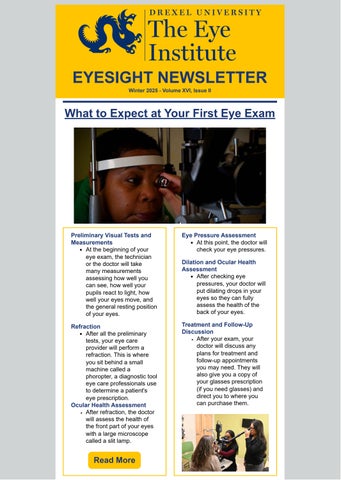
Refraction After all the preliminary tests, your eye care provider will perform a refraction. This is where you sit behind a small machine called a phoropter, a diagnostic tool eye care professionals use to determine a patient's eye prescription. Ocular Health Assessment After refraction, the doctor will assess the health of the front part of your eyes with a large microscope called a slit lamp.
Treatment and Follow-Up Discussion After your exam, your doctor will discuss any plans for treatment and follow-up appointments you may need. They will also give you a copy of your glasses prescription (if you need glasses) and direct you to where you can purchase them.
Read More
Dilation and Ocular Health Assessment After checking eye pressures, your doctor will put dilating drops in your eyes so they can fully assess the health of the back of your eyes.