EDITORIAL
3
LETTERS & NOTICES
4
THE PEOPLE
5
NEWS News Party Line Tweets Of The Week
6 13 16
FEATURES Body with Olie Body Inside Pain Astral Rejection An Overdue Lesson in Anatomy
16 18 22 26
CENTREFOLD
24
COLUMNS Shit Chat Talking With My Dad About Sex Fashion and Haute Tea In Our Environment Ngāi Tauira UniQ SWAT From the Archives
28 30 31 32 33 34
POEM
36
35
REVIEWS Fashion Food Televsion Book
38 39 40 41
ENTERTAINMENT Distractions Horoscopes
44 46
sponsored by
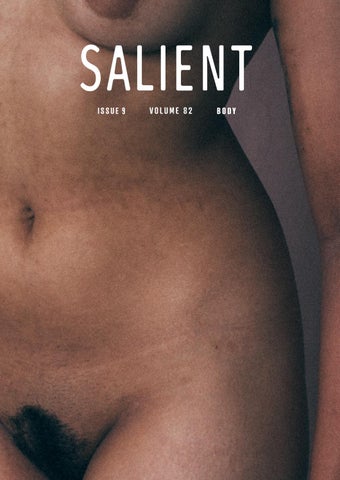
THE BODY ISSUE When we decided on a “body” themed issue, we weren’t sure where to begin. After all, the body is a large vessel of the soul. All parts of our body have endless connotations—humankind has been trying to make sense of them for millennia.
this is because womens’ bodies continue to be undervalued. Which is bizarre, given how fucking amazing they are. Time’s up, right?
It wasn’t always this way. It is wild to imagine that 40,000 years ago, people were a bit further along than us regarding the representation of the human We like to differentiate the body from mind and form. Some of the oldest forms of art portrayed soul. We compare bodies to other bodies. We were women. The Venus of Hohle Fels, a woman are forced to learn carved out of ivory, is about the body, the oldest undisputed but not necessarily example of a our bodies.We’ll depiction of a human ground ourselves being (Germany; in our physicalities. 35, 0 0 0 – 4 0 , 0 0 0 The body brings years ago). And the us pleasure, and oldest recorded wall the body brings art includes carvings us pain. It heals of VULVA (France; itself, and it fails 37,000 years ago). us. It brings life. It brings death. Societal values E m b a r ra s s m e n t ebb and flow a n d from generation to empowerment. generation, culture to culture. We don’t know about you, but we want to live in a society where every Salient brings you an assortment of columns and body is celebrated in art, where reproductive rights features about the bod: Shanti sheds light on the and trans rights are a given. Where the government very real torments of endometriosis. Kii interviews honours and supports those rights. Where bodies the founder of Wā Collective, and educates are bodies, and not seen as inherently sexual. himself on the financial disadvantages often faced by young women. Taylor gives us a crash We want to remind you that the body is more than course in the anatomy of the vulva, while Maya a jelly pack filled with blood and bones. Throughout encourages us to do whatever we want with our time, your body will change. Whether it darkens, bodies, societal expectations be damned. lightens, expands or loses bits, the uniqueness is ubiquitous and familiarity can be the only comfort As you can see, these features gravitate towards you can find in the darkest places. traditionally female issues. We can only assume
Kii Small & Taylor Galmiche
Letters must be received before Tuesday 5 p.m. for publication the following week. They must be 200 words or less. Letters will not be corrected for spelling or grammar. Salient reserves the right to edit, abridge, or decline any letter without explanation.
Send your letters to editor@salient.org.nz
To Salient,
Your feedback and opinions matter!
You're all doing great. Keep up the hard work.
Each week we’ll award our favourite letter with two tickets to Zealandia.
Anonymous
Hi Salient team,
Kia Ora Lara,
I have noticed that colour has taken over the Salient. I have appreciated the white space maintained for the reviews section, but was saddened this week when I opened the reviews to double spread colour. I wonder how much you are spending on ink each week... Don’t get me wrong, the illustrations are great, but a white page here or there or even articles on white with a colour border would save the planet and my eyes.
Thank you for your email. We pay the same amount for printing, whether its greyscale or full colours. - Salient
Best wishes, Lara van der Raaij
MARCH TOGETHER AGAINST RACISM. HOSTED BY WELLINGTON AGAINST RACISM AND FASCISM. SATURDAY, MAY 18, 1–3 p.m. STARTING IN CIVIC SQUARE.
Send your notices to designer@salient.org.nz
SWAT PRESENTS UNI MENTAL HEALTH DAY Head along to the Hub where the Student Wellbeing Awareness Team (SWAT) want to talk to you about what you can do to use your voice to improve the wellbeing of you and your fellow students. SOCIAL EQUALITY
SWAT is also re-launching their ‘Minds Like Ours’ project with new stories to share on their Facebook page.
The International Youth and Students for Social Equality (IYSSE) is holding a meeting on Assange on the May 15 at 5:15 in SU220. If you’d like to know more about the campaign to free Assange, it’d be great to see you there.
sponsored by
4
What is your favourite part about your body? Send your replies to our Instagram stories @salientgram
My tallness - can make me feel awkward and cumbersome but I'm working hard on loving it! REPLY
My belly! It's chock full of goodness and it's the source of all my power
It isn't allergic to anything!
REPLY
REPLY REPLY
My voice, allowing me to sing & speak my poetry/personal experiences
It works hard for me even when I don't appreciate it. Thanks for being a trooper, body!
REPLY
REPLY
All the parts that are used for pleasuring other people (all of them)
My eyes, but like I need glasses so they're kinda not top dogs but still my favourite part
REPLY
REPLY
The little scar on my abdomen I got REPLY when I was a baby because it's petite and cute
Breather stache REPLY
REPLY
5
ISSUE 8
SALIENT
News. MONDAY, 13 MAY 2019
Name Change Horse Finally Gets A Funeral* FINN BLACKWELL Victoria University of Wellington announced that there will be no change to its legal name, although the university’s branding and Māori name will change.
VUW’s new visual identity will “be seen on the University’s website, in external communications and marketing material,” as mentioned in a university press release.
VUW will change the Māori name from ‘Te Whare Wānanga o Te Ūpoko Te Ika a Māui’ to ‘Te Herenga Waka’, after the Kelburn campus marae.
The Chancellor and Vice-Chancellor said they were not concerned that the failure to legally change the university’s name has affected their image.
In addition, the word ‘Wellington’ will be emphasised to highlight the university’s location, as part of the branding “refresh”.
In a statement to Salient, the Stick with Vic campaign remarked they were “very glad that the University Council has decided not to mount a legal challenge to the Minister’s decision”.
The VUW crest and shield will be modified to feature patterns and images from the tukutuku and kōwhaiwhai panels inside Te Herenga Waka marae.
“As to the rest of the announcement, we are waiting with interest for further details of the proposed rebranding, and the research on which it is said to be based.”
“We can achieve what we need with a [image] refresh,” commented Vice-Chancellor Grant Guilford.
The “refresh” will cost $700,000 and is scheduled to come into effect early next year.
VUW aims at “building an international identity” while also maximising international recognition.
This is in addition to the $160,533.18 that has already been spent on the name change.
No legal procedure will follow this decision, as all changes to visual identity are controlled by university management.
*Editor's note: This is the best thing that’s ever happened to me.
Restorative Justice Policies Proposed For VUW FINN BLACKWELL (again) The proposed system works by analysing the conflict that has occurred (past), what is currently happening (present), how those conflicts can be resolved (repair), and what needs to be done later to ensure that all parties involved are happy (future).
At the most recent Victoria University Council meeting on May 6, members met in anticipation for the name change media announcement scheduled that afternoon. However, there was another debated topic on the table—a proposal to integrate restorative practices into the university’s current policies.
There were, however, council members that showed some hesitance towards this system.
Guest speaker Chris Marshall discussed the practical effects of implementing restorative systems of conflict resolution “in response to harmful episodes”.
One council member enquired whether Marshall was suggesting that a restorative justice system could be used to replace the punitive system established in New Zealand.
These policies were to be used “whenever applicable”, remarked ViceChancellor Grant Guilford.
“It comes back to accountability,” responded Marshall, “a raw period is required if proper healing is to be done”.
This process looks at facilitating dialogues with people involved in conflicts, in order to address and resolve them.
Another council member questioned if the proposed name change could be resolved through restorative process.
The aspiration of the policy is to “repair harm, restore mana”. This was one of Marshall’s driving points throughout his presentation, he added that, “like rust, resentment never rests, and like rust, it takes professional care to get rid of it”.
Marshall remarked that there would be “too many people” to undertake one-on-one or even two-on-two discussions, however, broad groups were suggested as a solution.
Marshall stated that current systems were too slow and too impersonal.
The session closed with Marshall commenting on how we often underestimate “people’s willingness to be vulnerable with each other”.
6
News.
Zero Carbon? Zero Problems? TAYLOR GALMICHE Spokespeople from organisations like Federated Farmers and Beef + Lamb New Zealand are calling the methane goals unfair and unreasonable.
Last Wednesday, the government set a global precedent with its Climate Change Response Bill, also referred to as the Zero Carbon bill, which aims to help limit the global average temperature increase to 1.5° Celsius over the next 30 years.
Frame agrees that the farmers have a good point, “We haven’t really had a public burden-sharing conversation, so farmers will be asked not just to stop their warming from methane, [...] they’re going to be asked to mask everyone else's' warming, while everyone else is still driving cars and flying airplanes.”
This goal, set out in the bill, seeks to “strike a balance between flexibility and prescription in New Zealand’s long-term transition”. Its “split gases approach” treats long-lived gases (such as carbon dioxide and nitrous oxide) differently to short-lived gases (e.g. methane).
Jason Young, Political Science and International Relations Professor, said that it’s important for advocates of the bill to continue pressuring these sanctions on individual industries.
All greenhouse gas emissions, aside from methane, will need to be reduced to net zero by January 1, 2050. The reduction target for methane, which primarily comes from the agricultural industry, is 10% by 2030. Climate change professor David Frame said that New Zealand is worldleading in its split gases approach.
“If the regulatory framework is robust and has teeth, New Zealand business will adapt and seize the domestic and international opportunities sustainable business presents.”
“Carbon dioxide and nitrous oxide continue to warm as long as you’re omitting any of them, but if methane emissions decline then they’re cooling the climate. So they’re undoing previous warming.”
“There is a legitimate conversation to be had about what the sea of balance is between sectoral efforts to combat climate change,” said Frame.
Announced Welfare Reform Leaves Beneficiaries Short-Changed KAT BUISSINK The Government has announced three changes to New Zealand’s welfare system, following the release of the Welfare Expert Advisory Group (WEAG) report.
WEAG report, the government’s staged implementation was met with a mixed response. One significant criticism was that the only new policy announced by the Minister was the staffing increase. Both other announced policies were proposed during the 2017 elections by Labour and the Greens.
Minister of Social Development Carmel Sepuloni only announced three recommendations from the report to be addressed this year. They were the ending of sanctions on solo mothers, raising the amount a beneficiary can earn before their benefit is reduced, and increasing the amount of staff dedicated to getting beneficiaries into paid work.
In a statement, Northland Urban Rural Mission spokesperson Tim Howard questioned the delayed implementation, saying, “maybe it was held back for release [now] because there was nothing else of substance to release.”
The report’s other 40 recommendations range from measures to improve the welfare system’s engagement with Māori, increase housing subsidies, and raising base benefit levels by up to 47%.
Auckland Action Against Poverty expressed similar disappointment in the announcement, saying “the point of commissioning a panel of experts to come with further recommendations was so that the Government could do a wider overhaul.”
Sepuloni defended the Government’s decision to prioritise only three recommendations, saying the changes will “represent good first steps to improving the system, but major change will take years”.
Children’s Commissioner Judge Andrew Becroft said on Twitter that “WEAG’s recommendations were powerful and constructive” and he was “terribly disappointed” by the government’s “remarkably timid” response.
Most services specific to students, such as the Student Allowance, were not addressed by the WEAG report. The report did recommend a raise to the Accommodation Supplement and Jobseeker Support Student Hardship, as well as lowering access conditions.
In an appearance on The Nation, Sepuloni refused to comment whether any further increase in welfare funding will be announced as part of the 2019 Budget at the end of this month.
While community and beneficiary advocacy groups welcomed the
7
ISSUE 9
SALIENT
Piki Officially Launched At Wellington Universities KATE ASCHOFF CW: Mental Illness On May 6, Minister for Health David Clark and Associate Minister for Health Julie Anne Genter launched the Wellington pilot of the government's mental health initiative, Piki.
Genter pointed out the pilot puts a focus on vulnerable groups, with the provider “very committed to delivering [...] for Māori, Pacific, and Rainbow communities”.
The face-to-face therapy programme is aimed at supporting 18 to 25-year-olds in the Wellington and Kapiti region, who are experiencing mild to moderate mental distress. The programme has an app for young people to use, and a peer support programme is being developed alongside it.
However, she did note that while the peer support element of Piki was “great”, there was an expectation that people would be still be using traditional counselling if they needed it. Information on the efficacy of Piki will be used in a “cycle of evaluation”. In Clark’s words, this makes Piki “a good programme becoming a better programme”.
Five mental health professionals have also begun work as part of the programme at Victoria University and Massey student health services.
In the meantime, Clark identified accessibility of the service as an important indicator of how effective Piki is.
Pam Thorburn, Director of Student Academic Services, said in a public statement that the university is “confident that this will have an immediate, positive impact on our students—with the ability to provide a wider range of support both on and off campus.” “It’s not a silver bullet, but it’s a good structural pou or grounding for us to work around,” said VUWSA President Tamatha Paul.
So far, access appears to be good according to the Minister, with “an additional 600 people that received support over 1300 counselling sessions” in the first eight weeks.
“It’s not a silver bullet, but it’s a good structural pou or grounding for us to work around.” – VUWSA President Tamatha Paul.
She, with the VUWSA executive and many students, lobbied for government funding at the end of the 2018 school year, with on-campus mental health hui and The Wait is Over campaign.
For students, the program can now either be accessed through their university, or through their local DHB. Students can sign up for the program via their GP, Student Health, by calling 1737, or on the Piki website.
Support services for mental health issues can be found below:
“We got what we wanted essentially […] I’m fucking happy and it just reiterates in my mind the power of student activism, the power of speaking up,” Paul said.
Visit www.victoria.ac.nz/student-health or www.piki.org.nz
“We wanted to keep going with the essence of The Wait is Over by bringing in students to be able to shape what we’re doing this year with the kaupapa of mental health,” said Paul.
Mauri Ora Student Health - 04 463 5308 Help line - Text or call 1737 to talk with a trained mental health professional
Genter and Clark talked with Salient following the launch.
Wellington Accident & Urgent Medical Centre 04 384 4944
Both described Piki as a “horses for courses” programme; filling a gap in the mental health system with “a more on the ground understanding of what this generation has largely gone through,” as described by Chlöe Swarbrick, who was also at the launch.
Call 111 in an emergency
8
News.
Minister for Health David Clark speaking at the launch, Kelburn Campus. Photos by Taylor Galmiche.
NgÄ i Tauira opens the launch, Kelburn Campus. Photos by Taylor Galmiche.
9
ISSUE 9
SALIENT
New Sustainability Committee “Sussing For Students” SHANTI MATHIAS VUWSA’s new Sustainability Committee met for the second time ever this year. This “supergroup” of clubs on campus, formed to work together for a more sustainable university, met on May 6.
At the meeting, it was confirmed that the committee would meet at 5 p.m. on the first Monday of each month. The committee discussed several initiatives they want to promote more.
VUWSA Wellbeing and Sustainability Officer Michael Turnbull told Salient, “the idea behind this is not so much to have VUWSA control the little stuff, but to facilitate the clubs’ [initiatives].”
Several events are being planned, including Forest and Bird Youth’s ocean clean-up and the Sustainability Office’s Growing Graduates tree-planting programme with Vic Plus and the Wellington City Council.
The Sustainability Committee is made up of representatives from various environmental groups on campus. One of them, OpSoc, is a new social club for promoting op shopping and countering fast fashion.
Turnbull suggested the committee could share an Instagram account, to take advantage of shared publicity. There was a lot of planning for Sustainability Week (aka “SusWeek”), which will be on the week of September 9.
OpSoc exec member Elliot said that the Sustainability Committee works because “we have common goals, can share resources and marketing”.
Sustainability Week ideas include careers stalls, meat-free days in halls, a zero-waste dinner, and themed days.
Abby, the president of Plastic Diet, says that the Sustainability Committee is “all about collaboration”.
The committee also discussed the next climate strike, on May 24, and how to encourage uni students to get involved.
She is especially excited about the opportunity that shared marketing with the various groups can provide, and hopes to utilise this for Plastic Diet’s WasteWatchers dishwashing initiative.
The meeting finished with action points and a discussion of upcoming club social events to strengthen the group’s network.
Sustainability Committee members clean up Oriental Bay. Photo provided by Michael Turnbull.
10
News.
Activists Say SAS Raid Inquiry Lacks Transparency SHANTI MATHIAS Three public hearings are an insufficient response to allegations that the New Zealand SAS killed Afghan civilians, members of the Hit and Run inquiry campaign say.
The public can enter and observe at the hearings. There have also been several opportunities for public submissions on the hearings.
The inquiry in question is investigating the claims that the New Zealand Special Air Service (SAS) killed civilians during the Operation Burnham raid in Afghanistan in August 2010. The allegations are found in the 2017 book Hit and Run, written by journalists Nicky Hager and Jon Stephenson.
However, the Inquiry has been slow to confirm dates and locations of the public modules, which has made it hard for the public to attend.
Hager and Stephenson allege that during the raid, the SAS killed six unarmed Afghan civilians and injured 15 others, in addition to damaging houses and personal property. The SAS say that the operation succeeded in killing 12 armed insurgents. The Hit and Run campaign group was formed to push for government investigation into the events of the operation. An inquiry into the events surrounding Operation Burnham was ordered in April 2018, but no details were announced until December 2018, after a public hearing.
The location of the April 4 module, at Meetings on the Terrace, was only confirmed a week before it took place, and locations and times for the second and third hearings are not yet confirmed on the inquiry website. The Hit and Run Campaign group is seeking to “challenge the nature of the ongoing inquiry” to give the alleged victims more of a voice, according to Sarah Atkinson, a spokesperson for the group.
“They can’t handle having their name look bad...they’re dragging their feet, they’re wasting time and resources.” – Sarah Atkinson
The Defence Force then said in a media release that it is “likely to be the most complex inquiry ever conducted in New Zealand in procedural terms” and that due to the “volume of top secret information”, most of the inquiry would not be open to the public. However, they said they are endeavouring to make the inquiry “as transparent as possible.”
She said that the modules disadvantage the representation for the villagers by focussing on background details rather than the event itself, and do not reckon with the “culture of cover-up” within the New Zealand Defence Force. “They can’t handle having their name look bad... They’re dragging their feet, they’re wasting time and resources,” she said. The Hit and Run Campaign would like to see acknowledgment of blame, an official apology, and reparations to the alleged victims. Those interested can visit hitandrunnz.com for more information.
Three ‘module’ hearings of the inquiry are open to the public. They cover the background of New Zealand’s involvement in the Afghanistan war and the location of the Operation Burnham, the effects of the conflict on Afghan people, and the laws applicable in the case, respectively.
Public Inquiry Modules: April 4: New Zealand’s involvement in the Afghanistan war and the location of the Operation Burnham.
The first module was held on April 4, and the next modules will take place on May 22–23 of May and 29–30 July of this year.
May 22–23: The effects of the conflict on the Afghan people. July 29–30: Relevant and applicable laws.
11
ISSUE 9
SALIENT
Probing The Punters GETTING TO KNOW THE STUDENT POPULATION
1
Favourite body part?
2
Why?
4
Why?
5
If you were to get a Salient tattoo, where would it be?
3
Least favourite body part?
BRAD, 20, OWNS CATS
JOSH, 20, BCOM
1. Ass.
1. Face.
2. They’re fun to touch… and eat.
2. First thing you see.
3. Nose.
3. Feet 4. They're gross
4. Some people’s noses are just ugly, even if the rest of their face is fine.
5. On my foot.
5. Inner thigh.
FINN, 20, BA
HENRY, 20, DOESN’T EVEN GO HERE 1. Feet.
1. Eyes
2. Mine’s a joke, but I don’t wanna say why it’s a joke.
2. Read a lot about someone through them. 3. Back of the neck.
3. Calves.
4. Can’t see it so people don’t take care of it properly.
4. Really unappealing.
5. Where my undies cover.
5. Down my armpit, side of torso.
ZARA, 20, BCOM/BDI
MOLLY, 20, BCOM/BA 1. Eyes.
1. Hands. 2. There’s nothing wrong with hands. They do nothing but good.
2. Because they’re pretty. 3. Knees.
3. Elbows
4. Scabby. 5. On my bum.
4. Too dry. 5. Knuckles.
12
News.
The Party Line Victoria University of Wellington announced last week that it will not be changing its legal name, they will be changing the Māori name to "Te Herenga Waka". Do you think this was the right decision? Young New Zealand First
Act on Campus Wellington
VicLabour
VicNats
“The new Māori name for the University is Te Herenga Waka, subject to further discussion with mana whenua.” - VUW website.If we chose to stick with vic, we should also choose to retain the name Te Whare Wananga o Te Upoko o Te Ika a Māui also. Te Herenga waka works to denigrate the status of the University from a whare wananga to a mooring place of waka (a daily reminder that there are literally no car parks on campus). This is a fait acompli that is another kick in the shins to all Maori. It is strange that the philosophy behind the marae that bears the name is a reflection of New Zealand bi-cultural heritage in other words Maori having to live with changes made to them, as opposed to changes made with them.
From the very beginning, the university changing names was fiscal irresponsibility on a grand scale. Until we fix our student services, including our critically underfunded mental health facilities, we cannot be wasting a grotesque amount of money on a vanity project with no clearly defined economic benefit. We were proud to join hand-in-hand with every other youth wing in standing against the idea from the very beginning and we will continue to advocate for our council to be better economic managers of Victoria University.
VicLabour is pleased the University has dropped their campaign to change our University's name after so much opposition from student submissions, that our our branch took part in. Te Herenga Waka assumably named after Te Tumu Herenga Waka, the University’s Marae, actually means something to our Māori faculty and students. The place of uniting paths. It is more than just a translation of the University’s English name. If they value it equally to the white name, at least something good came out of this. Congratulations campaigners.
The VicNats were proud to support National MP, Nicola Willis, in the campaign against the name change and were ecstatic when the University Council decided to end their push to change the legal name. We are concerned however that the University's proposal to change the Māori name is a last grasp at success. We should have seen wider consultation with iwi and Māori groups, alongside further consultation with stakeholders, prior to this decision. All names of the University must reflect the wishes of its students, stakeholders and its kaupapa. A task the university council needs to uphold.
- Jackson Graham
The Future Of Party Line Kia ora, Salient News’ Party Line section is an attempt to engage students in politics, and help keep them informed about the political goings-on in the capital city’s main university. Unfortunately, Party Line has been consistently failing to meet those goals for a number of reasons. A common issue, which has become increasingly obvious recently, is that the section has suffered from a lack of replies. However, there are other problems; answer often don’t match the question, are frequently just uncritical repetitions of party positions, and otherwise fail to be informative or engaging. These problems are a result of a range of factors, many of them unavoidable. With this in mind, Salient News is considering removing the Party Line section entirely. No final decision has been made yet, but it is likely. If you would like to see Party Line stay on, as is or with changes, please contact us. Similarly, get in touch if you have ideas about how the space Party Line currently occupies could be used. Please let us know your thoughts by this Sunday. Either email news@salient.org.nz or leave us a message on any of our various social media platforms. Regardless of whether Party Line continues, Salient News will continue to take steps to provide youth wings the opportunity to make statements on important issues. Johnny O’Hagan Brebner Salient News Editor 2019
13
vaccine, if unvaccinated, and “seeking professional help when ill or considering becoming an anti-vaxxer”.
*
Karen now resides in the afterlife, and enjoys making longdistance phone calls. She still thinks vaccines cause autism.
HOW TO: SAVE MONEY, AND YOUR LIFE, UNDER CAPITALISM M AD AM E M OISTUR E
Last week, USA Today released an article titled “You don’t need that: Average American spends almost $18,000 a year on nonessentials”.According to the article, Americans splurge roughly $18,000 a year on things “we can all do without”, such as coffee, buying lunch, gym memberships, and personal grooming.
LOCAL ANTI-VAXXER “SHOCKED” AFTER DYING OF MEASLES
Considering the towering inability of our government to at least soften the blows of the decades-long neo-liberal beating our country has taken, we here at Salient have compiled the following list of luxury items that you, too, should cut back on—if you ever hope to afford a home with windows that shut properly and nursing home staff that don’t treat you like cattle:
EM M A M AGUIRE
A prominent Auckland-based anti-vaxxer has died of measles, after contracting it from her unvaccinated child.
• Underwear: With the ability to patch holes and turn them inside-out when the pH levels in your puss have destroyed the lining, there’s no excuse to ever buy new ones.
Karen Smith, 42, had been an anti-vaxxer for the entirety of her life. Talking to Salient through a ouija board, Smith said, “I took my son James to a measles party in my leafy suburb. He got measles, and wasn’t very happy about it, but recovered after three weeks. I wasn’t so lucky.”
• Toothbrushes and toothpaste: Our ancestors used sticks—why do we think we’re superior to those who came before us?
Karen found herself getting a rash mere days after her child got the disease.
• Cleaning products: We buy 2-in-1 shampoo and bodywash. Simply extend this diverse functionality to cleaning your shower, fridge, and oven.
“I thought it was just an unintended side effect of my kale and rose quartz cleanse, but the spots wouldn’t go away. I tried everything.”
• Tampons: Taxed as a luxury item, so who needs ‘em?
She even approached local Facebook groups about the topic, who suggested a variety of ways to make the rash disappear, including detox diets, bezoars and urine therapy.
• Shoes: Duct tape makes a cost-effective alternative to buying new. • Cars: Instead, invest in a horse. Carrots are cheaper than petrol. Added bonus: “Old Town Road” clout.
A colleague, who sat near Karen at her workplace, said that she kept on coming into work, even when, “she’d broken out into bright red spots,” and appeared more delirious than usual.
• Kidneys: You only need one of them—sell the other one and invest the profits in a long-term savings account. Remember, penny makes the pound.
“I tried to talk to her about it, to get her to go and see a doctor or something, but she just wouldn’t listen. I worked at home for the rest of the week because I was afraid of catching it myself.”
• Walls: Wind can only come from one direction at a time, so cut down on rent and maintenance by removing all but one wall. Bones: improves indoor–outdoor flow.
The local District Health Board (DHB) is tracking a spate of measles-related cases around Remuera and Meadowbank. A spokesman stresses the importance of getting the measles
• Your humanity: The only way to save money is to make money. And the most reliable way to make money is to be a cold, socially isolated corporate robot. Why spend your money enjoying time with loved ones, when you could be working your third minimum-wage job?
14
The fact that there was a Starbucks cup in tonight’s Game of Thrones that no producers or editors noticed throughout multiple cuts merely 1 week after the DP yelled that the show’s not too dark to see is truly *chef’s kiss*” - @jenlikespizza
“You fools. You utter buffoons. You brainless apes. Obviously the Starbucks Cup™ will play a HUGE role in episode 5” - @jacksfilms
THE ONLY W I NNE R HE R E I S C A P I TA L I SM
“I don't actually watch Game of Thrones, so I've no idea what happened, but it sounds like this Daenerys person has had a really difficult couple of weeks, so if she wants a cappuccino, then it's really nobody else's business.” - @ManyATrueNerd
COL L AT ED BY EM M A M AGUIRE
@em_ma_maguire “i know we just cashed in the fastest 2 billion dollars ever but fuck it here’s another spider-man” - @DeanDobbs “They should wait to announce the Met Gala theme until like noon the day of. Get some real school project style outfits” - @pattymo
“White men really do say "fuck it, I'll run for President" in the same way women say "fuck it, I'll get bangs."” - @AskAQueerChick “You can only call it a Le Snak if it’s from the Le Snak region in France.” - @patbcaruana
“Excited to run across a picture of this Met Gala about fourteen years from now, and think to myself: "huh, you know these outfits remind me a lot of the horsemen raider clan that's roaming worryingly close to the river and eyeing our generator"” - @raaleh
“Ocean's Nine should be about them sneaking into the Met Gala and and taking out straight men who think [that a normal suit and tie] is appropriate” - @EliMatthewson
“[John Oliver on his show] Our next story is about New Zealand [New Zealand leans in to screen, heartbeat quickening, breathy whisper] Yes I’ve been naughty daddy, daddy tell me how I’ve been naughty” - @mr_orgue
“the met gala is the super bowl for the girls n gays” - @vulgardarlinng
“I’ve never listened to Vampire Weekend, what with their name always reminding me of the worst vacation I ever went on” - @2tonbug
[Replying to a ‘not all millennials' tweet] “Kia ora. It’s a meme.” - @_chloeswarbrick
“Simon Bridges has fully been told he's stepping down at the end of the month and is just trying to rack up meme clout until then” - @johaganbrebner
15
Salient Staff
At the age of 15, Olie Body stared out from her bedroom window in Methven. She watched as trees were ripped from the land and burned in order to supply clean water to her family’s house, destroying the majority of the local ecosystem. It became a turning point in the life of this young woman, who would reflect on this event for the rest of her life. Olie became irritated and fascinated at this use of insular problemsolving. Clean water is a basic human right—one that most New Zealanders take for granted, and it was necessary to provide it. But did it have to come at the expense of the wildlife and habitat around them? The local council had fixed one issue and left a host of others in its wake. Fast forward to a 19-year-old Olie Body. Carrying nothing but a toothbrush, toiletries, and the broad idea of sustainable solutions, she got on a flight to India. While in West Bengal, Olie noticed that a large number of young women there were living without proper menstrual products. Olie knew that young women’s access to sanitary products in this community was as much of a basic human right as her right to clean water in Methven. So she teamed up with a local nurse to deliver menstrual kits to girls around the age of 13. This age was chosen because if a young woman in this community does not have proper access to menstrual products when they first get their period, there is a large chance that they will drop out of school. This is true globally; race, gender, and sexual orientation often play a large part in someone’s exclusion from school—whether it be their choice or not. She told me all of this as we sat in a cafe. The hot chocolate I had ordered went cold and the marshmallows re-solidified as I struggled to get my head around this barrier the body had created. “You shouldn’t be held back because you’ve been born with a mighty pair of ovaries.” Olie corrected me—the body had not created a barrier; rather, it is our society that creates barriers around the body. Period poverty is a perfect example. Defined as the inability or difficulty in purchasing menstrual products, it is a barrier that most young women (and others who menstruate) in secondary school and university are currently living with. As someone who had not heard of the word prior to 2017, I was shocked to find just how many in Aotearoa are affected—a survey put out by Wā Collective a few
16
years ago revealed that out of 1000 menstruating students, one third had skipped class because of a lack of access to menstrual products Seeing the tears and joy on the young Bengali women’s faces when provided with this basic necessity, Olie was determined to find a sustainable solution. Upon her arrival back to New Zealand, Olie enrolled at Massey University, and channeled her resources to form the Wā Collective. “I saw the big old bowl of condoms, but thought, why isn’t there a bowl of tampons or pads in a bowl next to it?” Combatting period poverty is the Wā Collective’s mission for women around the world. Starting here in Wellington, they came out with a menstrual cup and partnered with student associations like VUWSA and MAWSA to make them more accessible. The ‘Wā cup’ is made out of a sustainable silicone, and packaged in a compostable and recyclable cotton box. It’s environmentally friendly and lasts up to ten years, which is longer than any condom’s expiry date. Best of all, each cup sold subsidises a Wā cup for another student in need. Many things can change in the space of ten years, but knowing that your menstrual cup will be a reliable constant is a relief for anyone experiencing period poverty. The menstrual cup can save you a fuck load of money, because you don’t have to do midnight runs to the local Night ’n Day, or text your flatmate to ask if you can borrow a tampon. Imagine not having to deal with that for ten years. To go back to the condom comparison, a ten-pack costs me around $12. The only similarity I see between condoms and menstrual products are the taboo culture that surrounds the purchasing of these products. The difference, however, is that menstrual products are a necessity, and the price of a tampon or pad is a genuine financial barrier for women around the world. We continued talking long after my hot chocolate had turned stone cold. Olie shed more light on the Wā Collective, the period poverty women face daily, and her plans for the next year. From Methven to Bengal, I can’t put Olie Body or her social enterprise into words that would do her mission justice. Go check out @wa.collective on Instagram—changing the world one menstrual cup at a time.
18
Features
“It felt like spaghetti and meatballs—as if my insides were be definitively diagnosed without laparoscopic surgery— spaghetti and meatballs—and someone was eating it up.” which in itself can make symptoms worse. The number of wayward cells doesn’t necessarily correlate with the severity Cara Adler was experiencing this level of pain almost of symptoms: Many people with severe endo symptoms will constantly throughout last year. She has endometriosis, a not have huge amounts of endometriosis growth in their pelvis condition of the uterus which causes huge amounts of pain, if investigated surgically, while others may have few or no amongst other symptoms. I barely knew what endometriosis symptoms, but if investigated via a surgical laparoscopy, was until last year at Cara’s flat (she’s one of my best friends), endometriosis would be found. In fact, many people only when she toppled off the couch mid-conversation. She had receive a diagnosis when trying to conceive, as endometriosis fainted. can cause significant issues with fertility. She pulled herself up, friends assisting and offering her One of the many difficulties with diagnosing endometriosis is water. Someone asked her what had happened. “My period that the uterus is located close to the bowel and bladder. As started,” she said, almost blasé. the organs are close, pelvic pain is not always immediately linked to periods; so when endometrial cells accumulate Endometriosis, often nicknamed ‘endo’ by its sufferers, is a on the bladder or bowels, the pain can be misattributed to condition experienced by millions of people with wombs irritable bowel syndrome or bladder problems. around the world. It is caused by endometrial cells “seeding […] anywhere in the pelvis,” says Dr Cathy Stephenson, who The level of pain endometriosis causes is staggering, though it works at Student Health. Endometrial tissue lines the womb, is not obvious to the average observer. Phoebe Murphy, who and is part of what gets shed during a period. These cells also has the condition (although she has not been diagnosed can accumulate on the fallopian tubes and the ovaries (where officially with surgery), passes it off as a migraine when she they can interfere with fertility), on the bowel, and on the doesn’t feel like explaining her pain and justifying the reality bladder. During each menstrual cycle, they can cause pain, of her condition. inflammation, and internal scarring. “People know what [a migraine] is,” she told me. “Somehow Stephenson has treated many patients with endometriosis. She we’ve managed to be all right about headaches.” She would “suspects” that it is underdiagnosed; there are no hard statistics like endometriosis to have the same level of recognition and on endo, because the condition is under-studied and cannot acceptance as migraines.
19 19
Inside Pain
Indigo Niah, who has had endo since they were very young, thought that the level of period pain they were experiencing was normal. They only started to question the level of pain after a conversation with a PE teacher, who told them that it wasn’t normal to be experiencing period pain so intense that they couldn’t stand up.
She got to the point where she was taking “Ponstan, ibuprofen, and Panadol” for months, even though you’re not supposed to take ibuprofen in combination with other anti-inflammatories. This litany of painkillers is common in any conversation about endometriosis; on “pain days”, Phoebe takes the “maximum dose of paracetamol, maximum dose of ibuprofen, maximum dose of codeine, every four hours” for at least two days, then Endo is wildly unpredictable, and treatment even more so. reduces the dose to see if she still needs it. Indigo now takes Cara, Phoebe, and Indigo all reference “luck”—Phoebe tells a daily medication for treating chronic pain, but they still use me that she was lucky to be diagnosed within five years of codeine several times a week. symptom onset (when the average is ten), lucky to have a GP who knew what the condition was, lucky to have a partner Cara was also laughed at in the emergency room, where she who is supportive. Indigo tells me that they were lucky to have had to go several times in 2018 because her period pain was a paediatrician who referred them to a gynaecologist quickly, so excruciating. In fact, the doctor told her to “just chill out. after their pain had been brushed off with over-the-counter It’s not like you have endometriosis.” She went to a doctor prescriptions by GPs. Cara tells me that she was lucky to have at Student Health about once a fortnight for a few months, health insurance that could pay for a $20,000 surgery via who put her on various hormonal treatments with “awful side private healthcare earlier this year, instead of an interminable effects”, and didn’t listen to her when she told them they weren’t wait on a public list. working. When I asked Cara, Indigo, and Phoebe to tell me how they had been diagnosed with endo, I heard three stories of the medical profession’s disbelief. Even though Indigo and Phoebe had doctors who treated them for endo relatively promptly, Indigo and their mother had to go to the GP five times, and were offered pills for period pain, rather than further examination of the causes of pain. Phoebe’s GP put her on birth control to control endometriosis, but didn’t say that she suspected Phoebe had endometriosis; Phoebe only discovered that this treatment was linked to endometriosis when she talked to someone else with endo at a party in high school.
When she got a new doctor, she was immediately taken seriously, and referred to a gynaecologist. When she arrived at the gynecologist appointment, Cara started on her passionate tirade—explaining the symptoms, the pain, how it was limiting her ability to go about her daily life. The gynaecologist laughed, and Cara was momentarily choked by dread—but when he said, “You’ve already convinced me [that this is serious]. I believe you,” it felt “amazing”. Six months later, she was able to have laparoscopic surgery, and although recovery has been slow, the pain is reduced for now.
These experiences are hopefully not representative. Dr Stephenson is quick to assure me that “any doctor at Student Health would know how to Cara’s route to diagnosis, meanwhile, was a horror story: Her diagnose and manage [endometriosis]; it doesn’t usually period pain got worse throughout 2017, to the point where she require specialist input.” was regularly skipping four or five days of work a month. She looked on the internet “and it all said all women get different Even though endometriosis is a negative presence, Indigo, levels of pain and that was how it was, and I thought that Cara, and Phoebe say it is still part of them, and has its maybe I was just fainting and vomiting from being burned upsides. Phoebe says that endo has taught her to advocate out.” She went to a GP, who laughed at her. He said that it for herself, to make her pain real to other people. “I’m very was bad luck, and she should try taking deeper breaths before good at articulating my pain... I can be specific,” she says; this she stood up. is particularly useful when dealing with medical professionals when she has other health concerns. Endo forces her to pay After this, she thought she “was just making it up,” and attention to her body, to monitor her mood, and to know when continued to live with the pain. Crippling pain meant she she’s ovulating—she uses a tracking app to help with this. “had a heatpack all the time,” and was taking ibuprofen and paracetamol constantly, although “they weren’t doing Indigo says that even though endo can “make things harder,” anything.” Even though friends urged her to go to the doctor, it’s still “just part of me, it’s not a part that I like, it’s just there.” she didn’t want to, after that first horrible experience. “I just They talk about endo because endo is a piece of their lives, generalised, they’re not going to take me seriously, there’s even if not everyone is used to talking openly about periods no point.” and wombs and the intricacies of the reproductive system.
20
Shanti Mathias
Even if you don’t have a womb, or do but have very normal periods, you probably know someone with endometriosis— even if they haven’t told you about it. This may mean that they haven’t been going to social events because of pain, that they have spent far too much time huddled up in a doctor’s office, that they know more about painkillers than the average person. Cara, Phoebe, and Indigo all told me that it would help if there were more education about what endometriosis was, and how to ask about it. “I talk about endo because it’s my life,” Phoebe says, and Indigo and Cara echo this. Through endo, and specifically conversations about endo, they have found other sufferers, and received support and understanding. The moments when they are listened to and supported make endo bearable. Explaining can get exhausting, Phoebe says. “If I’m experiencing a lot of pain I feel quite emotional [explaining endo]—that because I am in pain, I feel, like vulnerable, quite tired and fatigued.” But if more people know about her endo, then they will usually be supportive. “I wish more people would start the conversation,” Indigo enunciates quietly. “I would love to be asked more questions about how weird my body is.” Endometriosis is a reminder of the many peculiarities that nest within the human body. We pass people every day, and do not know what is within them. Cara, Indigo, and Phoebe want to be asked about their condition, to talk about this piece of their identity. Their stories are a reminder that words can open skin, and reveal the pain and hope inside.
21
· Caused by the cells from endometrium (the lining of the uterus) growing outside the womb · Can only be definitively diagnosed via laparoscopic or open surgery, as it doesn’t usually show up on ultrasounds or other scans. However, many people live with suspected endometriosis, and can receive treatment without surgery. · Not everyone with proven endometriosis will have symptoms, and if people do experience symptoms they can range from very mild to very severe and impacting · Symptoms can include pain during and before periods, nausea, fainting, painful sex, bowel and bladder symptoms, and infertility. Not all sufferers of endometriosis will have all these asymptoms. · There is no cure to endometriosis; even after surgery, endo will come back after time. However, symptoms can usually be successfully managed with hormonal treatment (to ‘dampen down’ the endo), pain relief, and (as a last resort) surgery. · There are no clear causes of endometriosis, although there are tenuous genetic links; much about it is still a mystery.
Maya Neupane
We occupy a strange place in the world today. Our bodies occupy a strange place in the world today. We do and do not occupy the bodies that we were born into. When you look into the mirror—is that you looking back at you? Is it still the temple that you were born into? Or have you changed it—hung up posters and boiled the kettle to make it a home? Barbara Kruger tells you Your Body is a Battleground. John Mayer croons that "Your Body is a Wonderland". Your! body! is! a! vehicle! screams every blaring gym billboard. But is your body yours? To me, bad tattoos, radical haircuts, and unemployable piercings are the physical equivalent of having tea in the cupboard and fruit in the bowl. They bring belonging to a form. With the constant pressure put upon us to be thin, white, gender-conforming, and conventionally attractive, I find ugly to be a great escape. I always find myself feeling more comfortable in my body when I make decisions that go completely against social expectations set to us. “Ugly” decisions. “Regrettable” decisions. “Why-did-you-haveto-go-and-ruin-yourself-you-looked-so-good-before” decisions. Sometimes when I leave for university, I’m aware that I’m dressing for everyone but myself. Wouldn’t want anyone to be attacked with the visual assault of a mismatching outfit—or, god forbid—a bad haircut and acne. But one day it hit me that not everyone worries about the state of their skin more than the questions they might need to answer when preparing for a job interview, and that realisation was huge. Despite being described often as a very confident person, it has always been ingrained in me that physical appearance is of utmost importance. It’s disorienting to imagine not having complete control of how people perceive me. For me, selfappreciation came in the form of self-destruction. The one part of Coraline that didn’t scare me was this quote: “Being brave doesn't mean you aren't scared. Being brave means you are scared, really scared, badly scared, and you do the right thing anyway.” Shaving my head for the first time made me initially feel very uncomfortable. More so than before, because by traditional patriarchal, Eurocentric beauty standards, I was not attractive— and it was my own fault too! I began to worry. Would I be too ugly for my partner of the time to want to be seen with me? Would I be cramping my friends’ style with my alien exterior? Would I be seen
22
as less intelligent due to the “Britney moment” associations of such a haircut? I worried so much that I stopped worrying. Life began to feel a whole lot easier when I didn’t have to think about trying to be attractive because I knew that I couldn’t be. This all sounds self-pitying, but believe me, it is anything but. Being intentionally “ugly” is freeing. It’s a decision that is for yourself and no one else. Some might hate this aspect of you, but who cares! It’s not their body. Allowing my body to be overgrown and wild allowed me time to work on aspects of myself that were not physical. It allowed me to realise who approached me for my body, and who approached me for my mind. It taught me to be less judgemental— knowing that people were probably seeing me as falsely as I was seeing them. Since then, I’ve been on a bodily rampage. Piercings? Fifteen of them. Eyebrows? Shaved off both of them. Stick-poke tattoos? Eight of them (or zero, if you’re my mum reading this). And here’s the thing: Maybe all of these are meaningless actions. Maybe they are nothing more than a toe warily dipped in the pool of selfdestruction... but also, why the hell not. Applying meaning and the idea of growth to the decisions made in the lows of your life isn’t ever a bad thing. There’s still a small hole going straight through the bridge of my nose where a piercing once sat. My eyebrows are still struggling to return to their former 70’s bush glory. The Georgia O'Keeffe Ladder to the Moon stick-poke on my ankle has been lovingly renamed “Ladder to the D(ick)”, due to the fact that I can’t draw a realistic half-moon. My head remains cold this winter. But I’m not worrying so much about whether I’m looking socially acceptable. Or conventionally attractive. Or white-passing enough to be cast in a yoghurt commercial. Andy Warhol once said that if he sees someone who thinks they are a beauty, he thinks they’re a beauty, too. He accepts people on the basis of their self-images, because their self-images have more to do with the way they think than their objective-images do. If they don't care, he doesn’t. So that’s that. Ruin yourself if you want to. Preserve yourself if you want to. Whether you’re feeling like Jenny or feeling like Mitski, remember that your body is a temple. But it’s not just a temple—it’s your temple. Go wild with it.
Features
“RUIN YOUR FUCKING SELF BEFORE THEY DO. OTHERWISE THEY'LL SCREW YOU BECAUSE YOU'RE A NOBODY. THEY'LL KEEP YOU ALIVE BUT YOU'LL HAVE TO CRAWL AND SAY "THANK-YOU" FOR EVERY BONE THEY THROW. YOU MIGHT AS WELL STAY DRUNK OR SHOOT JUNK AND BE A CRAZY FUCKER. IF THE RICH GUYS WANT TO PLAY WITH YOU, MAKE THEM GET THEIR HANDS DIRTY. SEND THEM AWAY GAGGING, OR SOBBING IF THEY'RE SOFTHEARTED. YOU'LL BE LEFT ALONE IF YOU'RE FRIGHTENING, AND DEAD YOU'RE FREE!” YOU CAN CHANGE THE RADIANT CHILD IN YOU TO A REFLECTION OF THE SHIT YOU WERE MEANT TO SERVE - Jenny Holzer “I used to rebel by destroying myself, but realized that’s awfully convenient to the world. For some of us our best revolt is self-preservation.” - Mitski “Do you not know that your bodies are temples of the Holy Spirit, who is in you, whom you have received from God? You are not your own; you were bought at a price. Therefore honor God with your bodies.” - 1 Corinthians 6:20
23
Alice Fenessy, Birth of Venus, Penci
il Illustration, 297 x 420 mm, 2019
Taylor Galmiche
B C D I E
F G
A
H
26
Features
I don’t know about you, but my sex education was garbage. In my backwards, patriarchal education, I didn’t learn about basic health and safety measures. And I definitely didn’t learn about female anatomy.
gods’ names knew how to draw a vulva? Porn was made for men, and the society we grew up in expected and encouraged male masturbation, while leaving female wanking in a lock-box labelled “taboo”. How was this stigma supposed to make women, both young and old, see and feel about their bodies?
A UK study from February of this year found that 52% of people couldn’t locate the vagina. Of the women in the study, only 49% knew where to find it. People are wildly confused about which hole does what.
I, for one, felt ashamed, embarrassed, and actively deterred. I didn’t want to talk or think about my tara.
A kōrero with a few of my friends revealed that this lack of education extends to NZ.
And that is a tragedy, my friend.These bits are just as precious as the feet we walk on—each one unique. Bearers of life, for many, but also channels for pleasure. We’re mostly taught about the former. We're taught to value functionality over fun, when the two attributes should go hand-in-hand.
One of my friends went to a Catholic school. Many others had one or two lessons on sex education as part of PE or health courses. No one seemed confident in their secondary school sex education.
The goal of this feature is to create a space for insightful vulva glory. Put it on your wall. Create a vulva shrine. Leave it in some poorly misinformed student’s letterbox— the important thing is that you do what you want with this piece, like you should with your own body.
We had to take it upon ourselves to learn about our fannies and fiddles. One friend said he learned about female anatomy via the band Parenthetical Girls. Another friend learned from Tumblr. A lot of people learned from various avenues of the internet.
Now, your destiny calls. However you define (or don’t define) your gender, be the educated vulva-rine you were meant to be.
This seemed all too easy for cisgender males—after all, dicks were drawn all over the school... but who in the
A. VULVA Commonly confused for the vagina, the vulva is the outer part of your genitals. It consists of the clitoris, the labia, the vagina, and the opening to your urethra. B. MONS PUBIS An inverted triangular area of fatty tissue, lying on top of the pubic bone. She protect. She bear pubic hair. For some reason, the song “Let It Grow” from The Lorax comes to mind. You can judge me for it—just don’t judge women about the choices they make regarding their pubes. C. CLITORAL HOOD Right below the mons pubis, connecting the inner labia, the clitoral hood serves to protect the some 8000 nerve endings in the clit (twice as many as the penis!!). D. CLIT The greek word for “key” for obvious reasons (maybe because it opens that aforementioned locked box). The gods created the clitoris for pleasure and pleasure alone. Only a quarter of the clitoris shows—the rest extends back into the body making a wishbone shape. The majority of women need clitoral stimulation to reach orgasm.
27
E. LABIA MAJORA The outer lips, and also a protective layer. No labia is the same. They’re like snowflakes in that way—varying in colour, length, and texture. Quite often, the labia majora is the same size, if not smaller, than the labia minora. F. LABIA MINORA The thin folds of skin within the labia majora, a.k.a. the inner lips. The clit gets a lot of attention, and labia minora are hanging around the bend, like, “Heyyyy, I’ve got something to offer” (Similar to a woman in a maledominated conversation). G. VAGINAL OPENING Most of the vagina’s nerve endings are 1/3 of an inch from the opening. Length isn’t necessary for success, though the vagina will grow twice in length when aroused. H. PERINEUM Or, the "dam". This bridge between the vulva and the anus is also full of nerve endings. I. URETHRA Located right under the clit, the urethra is the tube connected to the bladder. A.k.a. where pee comes from. The urethra is between the vagina and the clit. Say it with me: “The urethra is in between the vagina and the clit.” Very good.
SASHA BEATTIE
The internet is an extraordinary place. Porn, puppy rescue videos, and the Excel expertise you boasted in your CV are all but a click away. Being a woman on the internet, however, is a little like Victoria University open days being annually scheduled during “Stress Free Study Week”: Hell on earth. 10 MEN YOU’LL FIND IN THE COMMENTS SECTION: THE MASTER DEBATER Craig, 27, graduated in 2013 but still lurks in universitycentric Facebook groups. Champions “free speech”. Demands you “engage in discourse”. Wants you to expend emotional labour explaining easily Google-able concepts—not to respond, but to react and undermine you personally, rather than rebut your argument. Known for lengthy paragraphs copy-pasted from the notes app on his phone, like: “I’m from the point of logical reasoning and deduction, in combination with critical thought and analysis. And so far, I see no intellectual discussion nor critical thought applied, only emotionally-based responses and societal conditioning. Please come again with a fact-based or logically reasoned argument.”
THE INTELLECTUAL Rob, 19, first-year Law student. Deifies Jordan Peterson. Googled “the paradox of tolerance” once, and wants you to know he’s an expert. Ran for the Politics Society Executive; was denied by a vote of no confidence, due to his widely acknowledged fascist tendencies. Has thesaurus. com bookmarked on his home screen; uses big words rather than coherent arguments to prove his superior intellect. Mixes up “your” and “you’re”. Known for sitting in the front row of lectures, raising his hand with “not really a question, more of an observation really”. THE ALLY Gus, 23, “Brocialist”. Working as a barista while he waits for his funk-punk-jazz band to get the recognition it deserves. Hair down to his waist, has never heard of shampoo, wears a lot of bandanas. Notorious reply-guy. Communicates exclusively in emojis. Needs to be awarded cookies for showing basic levels of human decency. Known for replying publically in support of anything feminist or progressive, to make sure everyone knows he’s ~one of the good ones~.
THE MANSPLAINER
THE BUZZWORD KING
David, 34, hasn’t washed his dick since 2001 but chokes back vomit when a pack of tampons is left on the bathroom counter. Stopped even pretending to listen to anything his girlfriend has said since their second date. Has the astonishing levels of confidence particular to mediocre white men. Known for telling women how many tampons they use per period (seven, apparently, and “ten for those ladies with an extra juicy uterine lining”).
Luke, 22, CompSci student, “Involuntarily Celibate”. Hasn’t cut his nails since he moved out of his parents’ place. Thinks the shower in his flat is self-cleaning; is completely oblivious to his femme flatmate’s frustration that he never does his fucking dishes. Doesn’t know what misogyny means, but continues to misuse the term frequently. Puts “Reddit admin” on his CV. Known for decrying “public moral preening and virtue-signalling” by “leftist agitators”.
28
THE DAD
THE STUFF AFICIONADO
Chris, 58, literally my dad. Has his own fly fishing Youtube channel. Instagram bio reads “Gidday - I’m just a keen fly fisherman from the Central North Island of New Zealand who loves messing around with a camera. Welcome to LooseLoops!” Known for well-meaning but slightly offbase comments like “that’s my girl!” and “go Sash!” on my friends’ posts designed to celebrate their own success.
Jeremy, 45, forces his office to gather around his desk at 3 p.m. everyday to do the Stuff quiz. Does his best to bring the most pungent meals possible into work for lunch. Clearly didn’t read the article he just shared, but provides his opinion nonetheless. Known for starting replies with “now I don’t normally comment on Facebook, but…” THE MANS WHO HAS NEVER VENTURED BEYOND HIS DAIRY FARM IN PALMERSTON NORTH
THE “PICK ME” WOMAN Ashley, 20, not a man but desperately seeks their approval. Joined a meninist group at the behest of her 32yo boyfriend, gets wheeled out whenever they need to prove they’re not sexist. Prefers friendship with men over women, because there’s “less drama”. Champion of reverse-racism and reverse-sexism. Leading light for those poor things oppressed by skinny-shaming. Known for actively upholding the patriarchy, because she’s not like other girls—she’s quirky.
John, 28, has never met a human woman. Drops the n-bomb on the regular, despite having to generously apply aloe vera after standing in front of the fridge light for too long. Owns one (1) dress shirt, and four (4) pairs of Dirty Dogs. Tinder profile includes three pictures of his truck, one low-angle selfie, and a picture of a dead boar. Dismisses anything that does not directly impact his cows. Doesn't believe in climate change. Known for hot takes to the effect of “how does bisexuality exist, if I myself am straight?”
THE POLITICAL COMMENTATOR
Probably with the exception of your dad, men who needlessly pipe up in the comments section of social media content are absolute wastes of gravity and oxygen, and are not worth your time or energy. I highly recommend utilising the spoon attached to your keyring (you know, the one for stirring shit), hitting ‘em with a “your pussy’s way too dry to be riding my dick like this”, then promptly turning off notifications for the post.
Albert, 82, listens to a lot of talkback radio. Doesn’t really know how social media works, is on Facebook primarily to connect with lost relatives so as to pen his memoir. Has a photo with Mike Hosking with the HOPE filter as his profile picture. Will answer “What’s on your mind?” in earnest, and accidentally make statuses that were meant to be Google searches. Blames every bad thing in the world on socialism and the “loony left”. Known for writing Facebook comments like emails—signing off each one with his full name.
LUV U, XOXO
29
Hi I’m Lena. My dad is a sex therapist and I’m studying to be a sex educator—we’re here to talk relationships and sex, so send your queries and worries our way (sex@salient.org.nz) CW: SEXUAL ASSAULT, PTSD
I was sexually assaulted by my last boyfriend. Recently, I’ve been having sex dreams about him and I wake up really upset (panic attack-type shit). Can you explain why my brain is being a little bitch? Lena:
Dad:
Firstly, I’m so fucking sorry that you had to go through that. It’s really important to know that this is completely normal after sexual assault, especially by someone you trusted and knew intimately. Your brain has processed the assault as a trauma so it’s encoded differently from other memories. In replaying these memories with full sensory and emotional recall (just like a flashback when you’re awake), your brain is trying its awkward best to protect you from future harm. So though it’s annoying and horrible, your brain is doing its best to handle and process a traumatic event.
Talking about it with someone who will care but won’t try to “fix” it is a good idea. Hugs and other safe touch can be good, too. When waking up after this kind of nightmare, try to “ground” yourself in the present.
I’m not sure how long ago the assault happened, but I’d encourage you not to get completely frustrated. It will take time for your brain to not send your body into panic mode when you think or dream about your ex. I find that the subconscious alarm bells that our bodies send out can also be a helpful reminder to give ourselves time and space to heal. I think many of us can be very quick to try and be ‘okay’ after negative events. This instinct to move on or go back to normal is natural, however we can often deny the real extent of pain we may be feeling in order to get there.
Because these kinds of nightmares seem so real, it can help to ground yourself in the present via your senses. If you want to ease back into sleep, you could: · Focus on recalling, in as much detail as you can, a time when you felt safe and comfortable, or were having fun · Have a soothing object (maybe a soft toy or a smooth stone) you can reach out and touch in the dark · Put on music and really pay attention to it (e.g. pick out the bass line)
One pragmatic thing I would recommend is finding a support person in the event of the dreams and/or panic attacks. By a support person, I mean organising a friend who is willing and able to keep their phone on loud overnight during this tough time, in case you need to connect with someone following one of these dreams. Having someone you can call anytime may reassure your brain that you are safe, while normalising conversations around your assault and the effect it is having on your life.
30
There are lots of different ways to do this. One is kind and reassuring self-talk: “I’m safe, that was just a dream of my trauma. It’s normal to be upset, but it’s not happening now. I’m here in my own room and I’m OK.” This might be what you want to hear from your friend, too.
However, often after a nightmare, we want to fully wake up. In that case, here are further ways to ground yourself: · Notice (name) the objects or different shades of colours in your room · Make yourself a strongly scented drink, like peppermint tea, and really notice the smell and the taste · Have a shower and really take in the sensation of warm water on your skin There are also techniques for training yourself out of having these dreams that work for some people. Have a look online for “stopping recurring nightmares” and “Imagery Rehearsal Therapy”, or talk to a therapist who is skilled in working with PTSD.
TE PAEA HOORI
I sat in Auckland’s Spark Arena, sipping Red Bull from a paper cup. Somewhere between Billie Eilish’s performance of “xanny” and “bellyache” I had a transcendental moment to my first-ever concert experience. As I watched moody video illustrations cross the screens, and listened to wry, macabre lyrical content—I felt a sudden sense of déjà vu. The distinctly youthful pitch of screaming was familiar, too, as was the look of mild disinterest on parents’ faces as they led their tweens to their assigned seating.Over a decade earlier, my dad had worn a similar expression.
caffeine content to kick in, I sure felt like I identified more with the parents than the tweens seated by me. I racked my brain for high schoolers to DM on the matter. Truth be told, I’m about 3 weeks away from attending my last 21st celebration.
The year was 2008, and he was chaperoning my friends and my 13-year-old self to Panic! at the Disco’s second New Zealand concert. My outfit was an assemblage of Supré and Jay Jays finds, and I had recently learned of the power of straightened hair. I had not yet learnt to smile in photographs, and I was developing a tentative relationship with eyeliner. MSN was still my primary means of communication. Most importantly: Emo-culture and pop-punk was alive and well—in all its MySpace and hairspray-filled glory.
Metal music will always be off inventing new musical genre-diffusions, of course. But normalising self-expression, individuality, and self-autonomy is basically the collective generational MO. Tattoos, piercings, queer culture, collars, and a shared sense of self-loathing is no longer exclusive to the fringes of society. Anyway, it’s pretty hard to give a fuck about conservative dress codes and conventions when the planet’s doomsday clock is getting frightfully a là Watchmen.
It is well-known within the fashion industry that trends come back around. Familiar looks are spliced with new concepts— typically to the proportion of 80% borrowed, 20% new. The recent slew of early-2000s midriff tops and butterfly clips serves as a jarring reminder. I’m fairly certain I saw an image of Instagram influencer Tammy Hembrow wearing an exact replica of my Bratz doll’s S/S 2004 look. While I live in fear of a widespread return to low-rise jeans, I will always have time for the many faces of teen angst and counter-culture. The somewhat vague umbrella of “alternative” has been used to cover scene kids, emo, goth, grunge—and punk, before that. But Google as I did, I couldn’t for the life of me find any leads on its latest iteration. Perhaps this is an indication of being out of touch with the “youth”. As I waited for my beverage’s guarana and
It’s absolutely plausible that there is a vibrant antiestablishment subculture thriving I have no clue about. Sitting there listening to morbid electro-pop ballads, however, it occurred to me: Maybe alternative culture has just been absorbed into the Gen Z mainstream.
This has all given rise to a new class of pop anti-heroes. And rate her or hate her, as far as generational zeitgeists go, you could do worse than Billie and her decidedly non-gendered, almost satirically branded styling decisions. And what of us? The twenty-somethings with archived Hotmail accounts, fading band tees and— for many—longretired scene names. Are we all just at home rewatching American Horror Story on Netflix? After all: when we all stop using Tumblr, where do we go? Sincerely,
31
DANICA SOICH
HOW SMART IS AN OCTOPUS? Someone is watching you—intently—but you can’t see them. Down here in the reef, little phantom fish dart between clumps of orange coral and everything is very, very quiet. Then you see it—the creature watching you, hidden between oscillating fronds of blue-green seaweed. The creature is the size of a cat, and seems to be both everywhere and nowhere. The creature’s skin blends perfectly into the seaweed around it, except the small peaks of flesh that rise into coral-coloured towers. The creature keeps its distance as it circles you, staring from bulbous orbs. You reach a tentative hand towards it. Suddenly—gathering form—the eldritch creatures billows like a slippery grey sheet, then propels away in an inky spell of water. Octopuses (yeah, not octopi) belong to the family of invertebrates—animals without a spine. Specifically, they belong to the cephalopod class. Peter Godfrey-Smith, who wrote the book on octopus consciousness, says they are “probably the closest we will come to meeting an intelligent alien”—one with three hearts, blue blood, no bones, and a unique consciousness. The evolutionary pathways of octopuses and humans branched off eons ago, with our most recent common ancestor being more than twice as old as the first dinosaurs. So if we in some way resonate with the intelligence of octopuses, it is not because of kinship with humans. Instead, it's because evolution built intelligent minds twice over. Octopuses have complex nervous systems. Octopuses have half a billion neurons, putting them close to the range of cats, and their brains are large relative to their size—both facts offer biologists a rough guide to brainpower. It’s not clear, however, where an octopus’s brain begins and ends, as the majority of the neurons are spread out across their eight arms. Considering this layout, we can hypothesise that each arm possesses a somewhat independent consciousness. Not only can all of their suckers be moved independently; each one
is covered with taste receptors—imagine your body covered with hundreds of taste buds. Furthermore, their skin is embedded with pixel-like cells that sense light, which allows them to replicate the terrain around or below—not just in colour, but in texture, too. This ability isn’t limited to survival; cephalopods also flood their bodies with colour according to their moods. But are octopuses smart? It’s a tricky question, ‘cause you can’t judge an octopus on how it climbs a tree. Unlike fish, octopuses demonstrate an awareness—and dislike—of captivity. They employ problem-solving skills to stage notorious escapes. Recently, an octopus named Inky escaped from our National Aquarium, exiting his enclosure,slithering into a floor drain—and, apparently, out to sea. At the University of Otago, the resident octopus learnt to turn off the lights by squirting jets of water at the bulbs and short-circuiting the power supply. Octopuses also use tools. A video shows an octopus pulling two halves of a coconut shell together to hide inside. Later, the animal stacks the shells together like nesting bowls—and carts them away, understanding that they will serve a purpose in the future. The creatures are also known to recognise human keepers, and seemingly form opinions of them. In the same Otago lab, a temperamental octopus took a dislike to one member of staff, shooting water on her neck each time she walked past. What this sort of behaviour shows is that octopuses carve up their image of the world into objects that can be identified and remembered over time. Like all aliens, these strange, beautiful creatures are more like us than our hubris allows. Octopuses show us that intelligence isn’t confined to our human experiences.
32 32
NĀ TE AOREWA ARETA
MAURIORA Our tīnana, our bodies—they are more than just figures and anatomy; they are instruments with which, as human beings, we are able to carry out the most profound things. For a while now, I have been fascinated and transfixed by the power and ability that our bodies hold to enable us all to live, breathe, and operate within the world. There are some processes that seem so meaningless in physicality, but in fact hold an immense amount of value and sentiment. As a wahine, I am constantly moved by the realisation that one day, my own body will carry the life of someone else’s, and it is realisations like this that can encourage all women to consider how important our tīnana really are. As we carry out our university journey, it can sometimes be incredibly difficult to maintain a clear sense of thought and purpose, in relation to how we act with our tīnana and the way we convey ourselves. There are so many new and foreign experiences that we are exposed to—and thus want to explore. The visual imagery of Papatūānuku, our earth mother, somehow has always had the ability to guide and redirect my sense of thinking when it comes to how I value and utilise my body. Within the world of Te Ao Māori, there is the belief that from the tīnana of Papatūānuku, we have been gifted the whenua we exist upon today— as it is her silhouette which houses the soil, the trees, and our surrounding environment. The magnificent character of Papatūānuku as the maternal protector of all life, for women especially, carries a significant amount of influence, as we are able to understand more deeply the value of our tīnana as vessels for creation and transformation.
I feel like an appreciation for our tīnana and its capabilities is drawn from understanding that, although there may be some aspects of our body that we would like to change or take away—when all the wants are erased, we are left realising that what we possess already is all we need. There are processes carried out by our wāhine—such as our menstruation cycle, pregnancy, and giving birth—which continue to remind me day-to-day how captivating our tīnana truly are. You see, the connection we have with our bodies is based not only on the physical abilities, but also the spiritual. Allowing our gratitude and awareness for our tīnana to transcend means that, as tāngata, we can grasp precisely the extensive potential that our bodies represent. I find that I am moved most by this idea when stepping onto a marae, because women, supported by their tīnana, are able to conduct practices such as the karanga, which for Māori represent an intertwining of the two realms of taha tīnana and taha wairua. It is within spaces like marae that the female body contains an unimaginable value and is capable of dispersing a sense of peace—or rangimārie, in domains which are recognised as being quite heavy and intense. I hope to one day have my own children and for them to explore our world, understanding completely the tangible and intangible value of our body. For human beings, our tīnana are instruments we are given for the span of our lifetime, and the meaningful experiences and memories we can make with them are endless. Following this lifetime, there is a belief in Te Ao Māori that when we move on, our souls—our taha wairua, will travel to the tip of Aotearoa at Cape Rēinga, and then journey back to where they began. Our tīnana, however, are left behind with Papatūānuku—the figure who gifted her body to us all~ how fitting.
33
UN I Q
SWAT
MIIA VAN BEUSEKOM
ANONYMOUS
Maybe it’s a bit cliché for a trans person with a queeroriented column and the nebulous prompt of ‘Body’ to write about gender dysphoria—but, frankly, I don’t care. Experiences of gender dysphoria tend to vary widely. It’s pretty common to hear people talk about “being a man trapped in a woman’s body” or “a woman trapped in a man’s body,” a theme which cis-media (in my limited experiences with it) likes to reinforce about trans people.
As a kid, I started worrying about being “fat” ever since a friend teased me about it while we were getting changed to go swimming. It started a real downward spiral of unhealthiness, filled with constant weight checks, anxiety at the beach, and the avoidance of mirrors. The world around me wasn’t much help, either. Images of what my body was “supposed to look like” were plastered everywhere. It made me feel subhuman. And after my friend teased me, I turned down invitations to go swimming or hang out in a spa. I was so scared and disgusted. The worst part was that I didn’t tell anyone about my fears because I never, ever wanted attention drawn to my body.
That made it quite difficult to label my own dysphoria once I began to work out that my gender wasn’t as it had been assigned. In my experience, gender isn’t really attached to the body, but rather, to the way we are treated and the way we act. As such, I often feel less like a woman trapped in a man’s body, but more so as a woman who is inconsistently and incorrectly viewed as a man (oh, the joys of not being entirely out of the closet).
When we don’t love our bodies, we extrapolate that to our entire selves. I didn’t think I had a good body, so I didn’t think I was a good person.
My body is my own. I don’t really like it. There are definitely things I would leap at the chance to change, to make them more stereotypically feminine—but it is not a man’s body. In fact, as previously stated, it’s definitely mine. It just so happens that my body is interpreted as being a man’s.
This is bullshit.
So, while I can see how some people can find the narrative of being a “man/woman trapped in a woman’s/man’s body” to be useful for trans people, it doesn’t necessarily work for me. It doesn’t reflect my own experiences and has had the adverse effect of slowing down the process of me working out my own gender identity.
For some, loving your body means going to the gym and working out. For others, it means realising that your body is beautiful the way it is. Every body tells its own story—and stories are beautiful.
Slowly, I grew to love my body, and now that I’m on the other end, I can tell you this: It’s life-changing. I can look in the mirror and smile. I can go to the beach and actually enjoy an Aotearoa summer.
Learning to love my body has opened up so many doors. I LOVE the water, and I might never have realised it. Swimming brings me so much joy.
By looking at my body through this different lens, it has been it easier to accept the aspects of my body that I’d rather change. And, sometimes, I can even be positive about them.
For those out there who struggle with your body and self-image, know this: I’m with you and I believe in you. You’re a beautiful person—let nobody tell you different.
34
MAX NICHOL
What’s going to happen to you when you die? Not in an abstract, philosophical sense, but you, your body specifically? Do you want to be buried? Cremated? Embalmed? Some people want to be shot into space, which I think is a bit much. But it’s an intensely personal decision, informed by your personal beliefs, your culture, and the wishes of your friends and family.
Over the years, there have been suggestions for the cemetery to be built over and its prime real estate made useful to an institution which has long been starved for space. In 1958, Salient reports T.J.K. pondering using the space for accommodation: This suggestion didn’t really go anywhere, but a more serious proposal for a building on the cemetery land came in 1977. Salient obtained leaked copies of a rough sketch showing the possible location of a chapel about halfway up Mount Street—and were furious at what the proposal suggested about the university’s priorities, writing that it was “little short of scandalous that such a scheme should even be considered […] on a site that is very popular and widely used […] at a time when the amount spent on student facilities, and in particular student accommodation, is small.” (Sound familiar?)
An estimated 1150 people chose to be buried in the Mount Street Cemetery. The site was consecrated by Jean-Baptiste Pompallier, New Zealand’s first Roman Catholic Bishop, and saw use until 1954, when the final family burial plots (which had been reserved prior to the cemetery’s closure in 1891) were filled. Since then, the Mount Street Cemetery has become inextricably connected to Victoria University. Students have made it their own. It’s right next to the Student Union Building—which, before the existence of the Hub, was the centre of student leisure life and culture. Mount Street is also the main thoroughfare for students making the gruelling trek up from the city on foot, so thousands pass the cemetery every single day.
Obviously, nothing substantial has been done with the land, despite these suggestions. The Friends of Mount Street Cemetery, a loose organisation of interested local residents, have in recent years taken it upon themselves to advocate for the maintenance of the cemetery. It’s an interesting case study in how the uses and meanings of spaces change over time.
Only about 320 of the original burial plots still have headstones; the larger and blockier of these often act as seats for students to eat their lunch or punch a quick durry during the summer. It has an incredible view of Wellington and functions as one of the few green, leafy spaces on Vic’s uniquely cramped hillside campus.
Originally the final resting place for the bodies of early Catholic settlers in Wellington, the Mount Street Cemetery has become part of student life at Victoria University.
35
Edith Amituanai Double Take
Curated by Ane Tonga 11.05.19 – 14.07.19 Edith Amituanai Snow White battles for Siren King, 2018 pigment inkjet print Courtesy of the artist
FREE ENTRY Tuesday–Sunday, 11am–5pm Victoria University of Wellington The gallery is located beside the Student Union Building on Kelburn campus adamartgallery.org.nz
There is no e after the i in Jami, as in: I am conscious to what separates me I am kind, compassionate and vulnerable susceptible to the feeling of guilt I love (words, creating an ebb a sensuous flow of vocabulary) to entice togetherness, understanding I am habitual, I am habitual, I am fearful of exploring my womanhood weakness binding and hiding my strength in the process I am s w o l le n a chest beating loud I am the perfect candidate for all the disorder engraved in my right thigh I have a fear of opinion I am (not) a waste of physical space, a criminal for stealing sodden air, an undeserving mind. I am bright red voluptuous in spirit rotund with cocoa undertones harvested from the soil of Fiji I am (not) too much. Jami K
Send your limericks, elegies, and odes to poetry@salient.org.nz
R EVIEW: NIN A W IER
FASHI ON
Reviews
B RAS & B ODI E S
The tension between fashion and bodies goes back even further than the length of time your flatmates have left their dishes in the sink. But as a skinny, white, cis girl, there’s not much my opinion can add to the discourse. There are so many great articles on body positivity, that if you haven’t educated yourself by this point (like seriously, just go back a couple editions of this very magazine), it’s a deliberate choice. So I decided to narrow it down to an area that could be classed as unbelievably superficial; my favourite corner of the entire internet: the Lonely Lingerie Instagram page. By writing that sentence alone, I know I’ve caused some secondwave feminist socialist to wake up in a cold sweat. Promoting capitalism and the objectification of women wrapped up in strands of lace and elastic isn’t the aim of this article, though—and I dare you to search @lonelylingerie, look me in the eyes, and tell me that’s the message you got. Lonely has been showcasing their goods on a variety of women, well before some marketing director googled “how to be woke and make money” and it became a trendy way for companies to up their Insta follows. Fat girls, elderly girls, girls of colour, bald girls, girls with tattoos, breastfeeding girls, girls in wheelchairs… The list goes on, and so does the gram. They feature in the colourful 3 x 3 grids— smiling or staring, posing or reclined, made up or bare faced— and it is beautiful. All of this exists through a flagrant could-not-give-a-singlefuck non-compliance with the Instagram community guidelines, (which, fun fact, were actually written by Oliver Cromwell, Dolores Umbridge, and your sexist great-uncle Gary). Found another page with 350,000+ followers that shows an elderly woman’s pubic hair? Didn’t think so.
38
The Lonely Instagram is an oasis from overly commercial “feminist” brands. The fuckery in these “pro-women” advertisements is insane; these girls are airbrushed, with absent nipples and bodies as hairless as a $20 Countdown rotisserie chicken. While I believe that fashion is an art form, and designers should have creative license to display their products however they please (I would sooner drunk-text an ex than have people ever think I’m advocating that clothes should be presented on a wire hanger in some sad warehouse)—women’s bodies are beautiful and are art, and this is displayed by Lonely, who presents them as such on a commercial scale. The blasé display of areas typically hidden by lingerie, desensitises the viewers and reminds them that it is, after all, just a body, with bits that most people have. So while this desensitisation may have almost killed a mature student who looked over my shoulder while I was browsing the website at the Kelburn library, I honestly believe and hope that it has also resulted in young girls scrolling through these images, and internalising some of that who-gives-a-fuck energy radiating off the page. Maybe you don’t wear a bra. Maybe you think lace is uncomfortable. Maybe you just think dropping over $100 on underwear is some privileged lunacy. I’m not going to fight you on that, but at the same time, picture this: some Californian influencer (size 6, blonde, and tan—duh) with a name like Juniper Jade Saltspray logs onto the website to buy a Lonely set. Juniper Jade must scroll through a website stocked full of images of body hair, fat rolls, and unconventional beauty. Her money is now going towards a business which hires models who would be turned away by other fashion retailers, and which circulates images that challenge western beauty ideals. Call me superficial and naïve, but I consider that a win.
R EVIEW: GEOR GE YOUNG AND S ALLY WA RD
FOOD A TALE OF TW O C H I C K E N S
I wanted to know what K Fry is doing differently. There are no recycling bins—apparently “customers weren’t using them correctly” at other stores. And so materialises a responsibility stalemate: Drunken, grease-seeking patrons can’t see the recycle through the rubbish, and KFC won’t promote sustainability if they don’t have to. (If you’re a big corporation generating recyclables, you have a duty to try harder than that, thanks. Especially in the current climate.) I was pleased to see a vegetarian burger on the menu. It’s got a hash brown for a patty, nestled on top of the usual fillings (lettuce, tomato, red onion). Nothing to write home about, though; potato is not protein. What KFC understands is that we have an emotional connection to their food—even if we don’t necessarily like the brand. Comfort food exists outside the realms of health and consumer values. The Courtenay Place flagship is fitted out with selfservice kiosks, power plugs, and wifi. Can confirm that extra seasoning is available on the tables. You could study there. But it is more likely that you will traipse there at 1 a.m., and bumble
39
through an order in an attempt to mitigate tomorrow’s hangover. I sampled the ‘Colonel’s Lunch’ (2 pieces of chicken with regular chips, $6). Tasted like KFC. Meanwhile on Leeds Street, sandwiched between Wellington Chocolate Factory and Golding’s, is Soul Shack. Originally flipping waffles in the streets of Porirua, Soul Shack soon found that fried chicken was where the demand lies. Just like KFC, Soul Shack sought brighter lights and later nights, and they found this in Reading’s ‘Courtyard’. Like every good David Fincher drama, though, they were hit with adversity when an engineering report spontaneously forced the building’s closure. Lucky for us, the credits were yet to roll. Within the month, Mr Golding from Golding’s offered up a personal parking space, as he couldn’t bear to see the chicken cluck off. Soul Shack serves Nashville-style chicken, with burgers, wings, and chips. You can select from four levels of spiciness. If you want to hold your own ‘First We Feast, Hot Wings”, you’ll find the Carolina Reaper chilli seasoning on the fourth and final level. Be warned—your nose won’t be the only thing running. Their lack of fridge space often means they’re sold out before the 8 o’clock close. But this won’t be a problem much longer; reinforcement fridges are arriving in a new store opening at the end of May. I asked them for an official statement on the new KFC: “We don’t have any beef, just chicken.” – Sam and Craig. In summary, a haiku: Spicy little hen Next to a big fat chicken Plenty room to roost
Reviews
KFC has been around since your grandparents lived through the Great Depression. The new flagship store that opened on Courtenay Place last week is a long way from the Colonel’s original roadside restaurant. In Japan, Colonel Sanders is Father Christmas; people queue up for buckets of original recipe, it’s known as “Kentucky for Christmas”. I’d argue that in New Zealand, Colonel Sanders is our favourite greasy uncle— mostly because I don’t know if Ronald McD was ever a real person. Salient was invited to attend the store opening and I went along. I don’t want to talk about the food, because the only people who haven’t tried KFC are those actively avoiding it. You know, to make a point. “I’ve never had KFC and I’ve never seen Game of Thrones.”
REVIEW: EMMA MAGU IR E
T ELEVI SI O N TR ASH TV FOR SWAM P G O BLI N S
Winter is coming (heh) and I want nothing more than to stay in bed, wrap myself in duvets, and languish in my own disarray like the swamp goblin I am. Although life does often get in the way of that desire, here’s a bunch of (fairly) trashy television shows you mightn’t have heard of, for when you just wanna stay indoors and hang out in bed. SHADOWHUNTERS Based off the Mortal Instruments novels, Shadowhunters follows Clary Fray, a normal human (or so she thinks) who gets thrown into a world of magic, demons, and super hot people, after her mother gets abducted. Look, I’m not gonna lie, the main drawcard of this show is the stunning people and their UNBELIEVABLE amounts of unresolved sexual tension as they stumble about within a supernatural narrative, but it’s bingeable and fun for when you wanna watch hot people do bad fight choreography. Available via Netflix.
Reviews
ARE YOU BEING SERVED? This show is old, okay? It first aired in black-and-white in the mid-70’s in Britain, and I’ve loved it for many, many years. Set in a London department store, Are You Being Served? is the innuendo-laden adventures of the staff of Grace Brothers. From anecdotes about Mrs Slocombe's pussy (it is almost exactly what you think it is), to German Week, this sitcom is utterly ridiculous and beautifully camp. Yes, it might be old, and the sexual politics within are certainly very seventies, but it’s a whole lot of fun. As it is a short-form narrative with no overarching plot, the episodes are digestible and completely available on Youtube. RIVERDALE What can I say—if you’ve not heard of Riverdale, you must be living under a rock. Based off (and I use the phrase ‘based off’ very lightly) Archie Comics, this show is a wild ride into high school life—if high school life involved a ridiculous amount of musical numbers, people in their 30s pretending they're at high school, and a lot of neon. Look, it's not a great show. It's not even a good show, but it is a show, and sometimes you need more hot gals and vague homoeroticism in your life. Vanity Fair describes it as “pricelessly deranged”, and they’re not wrong. Also available on Netflix. WET HOT AMERICAN SUMMER: FIRST DAY OF CAMP This article might be trash, but this is certainly not a trash show. WHAS: First Day of Camp is a prequel to the film Wet Hot American Summer (from the early 2000s), except the cast is in their 40s–50s now and playing teen camp counselors. With great flourish. This show is totally bonkers. A nuclear waste leak is discovered outside the camp and the camp leader gets turned into a can of soup, the head chef is a secret governmental assassin, and President Ronald Reagan invades the place with a tank. Chris Pine plays a tall, dark, and handsome musician; the entire camp puts on a musical; and everyone’s trying to hook up with everyone else. It’s a glorious parody of teen sex comedies (think American Pie and the like), but First Day of Camp takes the satire to a whole new level of insane esoterica, and features many of America’s best-known comedic talents having a damn good time. The whole show is on Netflix, and I definitely recommend watching it, the original movie, and the follow-up season.
40
R EVIEW: HANNAH PAT T E RSO N
BOOK MEN WITHOUT WOMEN
I went into this book with a sense of both apprehension and anticipation. I have always thoroughly enjoyed Murakami’s novels for their slow and careful pacing—he takes his time laying down the strands of the story before starting to weave it all together. I wondered if this would feel lost or fragmented when spread across seven different short stories. But this was not the case, because really, Men Without Women is telling one story. Although each tale is distinct and could stand alone, they blur into each other, the narrative voice is notably similar across them all. The characters change—and with them, the details of their occupations, their families, their lives—but the momentum is never lost. Rather, it builds steadily; with each short story forming a part of the bigger story that Murakami is telling—one of loneliness, of male fragility, isolation, and fear, told against the backdrop of mundanity. Men Without Women gives us a glimpse into the lives of seven different men who are all, in many ways, completely unremarkable. This is one of my favourite features of Murakami’s work; his desire to tell stories through characters who are almost striking for their ordinariness. It is difficult to explain what exactly happens in the stories, because it could easily be described as nothing. The first, “Drive My Car”, explores
the thoughts and conversations a man has with his driver as she drops him to work each day. The second, “Yesterday”, is a nostalgia-heavy recollection of a brief friendship between two men. The premise of these stories sound boring, yet reading them I found myself deeply engaged; Murakami makes the most objectively ordinary events glitter with surrealism. The heart of these tales is not in their plot, but in the exploration of the characters’ minds. Murakami makes you privy to all of a character’s thoughts—the aimless, the mundane, right down to the gross, prejudiced and bizarre thoughts that populate all human brains. Yet at the same time, there is so much about the characters that you are not told. It is so introspective, so intimate, that as a reader you grasp to understand who this person really is and how they exist and are understood in the world around them. Like looking through a magnifying glass, Men Without Women pushes you deep into the psyche of the male ‘protagonists’. These are men who are all a little broken in their own way, who are crippled by loneliness but lack the words or capability to even understand their situation, let alone get themselves out of it. I’m honestly not sure if this is the desired takeaway, but to me this book feels like a testament to how much harm the patriarchy does to men. It feels like a cry for help (and a really beautifully written one, too). So it follows that this book may not be a desirable or worthwhile read for everyone. But if you’re in the mood to think a little too hard about yourself, life, and how fucked up the patriarchy is, I would recommend this book.
41
Reviews
So it turns out that today is the fateful day I come clean: just like the other lanky tall bois with tiny hats, wire-rimmed glasses, low black Docs and a superiority complex, I am a fan of Haruki Murakami. To be more specific, I am a fan of Men Without Women, his recent collection of short stories.
Bachelor of Communication (BC)
Study what you love BC Majors at Wellington & via Distance Study: • • • • • • •
Communication Management Expressive Arts (theatre, creative writing, making films) Journalism Linguistics Marketing Media Studies Public Relations.
These offer you choices in practice-based and creative studies in media and communication.
Find out more: http://www.massey.ac.nz/communication Enquire now: contact@massey.ac.nz
Join a communication degree with an excellent full-time employment record For a comprehensive report on Massey BC graduates’ employment, salaries, etc., email F.Sligo@massey.ac.nz Massey University’s communication degree is recognised internationally
Massey has Asia-Pacific’s only communication degree accredited by the US-based ACEJMC
Study Media in a degree with high full-time employment rates
Be the student voice. Be heard. Let’s come together and oppose Wellington City Council’s proposal for an alcohol ban in Kelburn Park.
Make a submission at vuwsa.org.nz/save-fountown
40% OFF
FLIGHTS, TOURS, HOTELS AND MORE
STA TRAVEL VIC UNI KELBURN PARADE
victoriauni@statravel,com 04 499 5032
CROSSWORD PUZZLES FRO M PUC K
CROSSWORD: EXCUSE ME
GOOD NEWS QUIZ
1. Which New Zealand politician recently announced their engagement? 2. How long did it take for a Nepali teenager to set the new world record for "Longest Dancing Marathon by an Individual"? 3. After completing their CPR training, how long did it take for two New Zealand physiotherapists to save someone’s life? 4. Was Meghan Markle and Prince Harry’s new baby announced to be a boy or a girl? 5. What modern item was spotted in a Game of Thrones scene?
DOWN
1. Part of a circle, or the path of a story (3) 3. Multiple-choice Cosmo feature that might be about positions (3,4) * 7. Place for a jam? (3) 9. Author whose 'Silmarillion' isn't a trilogy yet (7) 10. Still on the market, as a house (7) 11. "Have you stopped beating your wife - yes or no?" is a famous one (7,8) * 16. Less moist (5) 18. Harry formerly of 1D (6) 20. Luke and Leia's dad (6) 22. It's what's up (3) 23. Hotspot that might require a password (4) 26. Word that can follow side, scissor or karate (4) 27. Perfectly and intricately designed (9) * 28. Just; equal; carnival (4) 29. Sweet potatoes (4) 30. Likely result of the 'desperado' chess gambit (9)
1. Two or three weekly Salient features (8) 2. One of many weekly Salient features (6) 3. Stir a liquid (5) 4. Palindromic antidepressant (5) 5. Other name for what Europeans called 'Ayers Rock' (5) 6. Speeds, like my cat at 1 a.m. (5) 7. Drug user in the title of a James K. Baxter ballad (6) 8. Vegetable that inspired some Communist Russian architecture? (3,5) 12. Concludes (4) 13. Multimedia plugin developed by Apple (9) 14. Actor Miller who plays The Flash in the DCU (4) 15. Mediterranean capital with the Notre Dame d'Afrique (7) 17. Renner's role in 'Endgame' (7) 19. Asian republic that is the world's most populous non-EU member (6) 21. It's the I in UBI (6) 24. 1990s hitmakers whose first two album titles were eight-letter words that started with the band's name (4) 25. Simpson voiced by Yeardley Smith (4)
44
Jacinda Ardern, 126 hours straight, Just two days, A boy, A Starbucks coffee cup
ACROSS
WHAT'S THE WORD? TE REO MĀORI
tinana NEW ZEALAND SIGN LANGUAGE
PICK YOUR POISON, SUDOKU LOVERS F*CK YA LIFE UP
EASY PEASY Puzzle 1 (Very hard, difficulty rating 0.83)
6
4 7
3
4
9 8
3
4
7
1 3
4
3
8
7
7 9
4
5 1
2
5
1 5
2 5
2
7 1
Generated by http://www.opensky.ca/sudoku on Tue May 7 22:31:21 2019 GMT. Enjoy!
BODY PART WORD SEARCH AN KL E AR M
B AL L S CAL F
CL I TO R I S EAR S EY ES FEET
H AMSTR I N G H AN D S H EAD
KN EES L EG
N O SE
PEN I S
QUAD S
SH O UL D ER S TO ES
TR I CEPS VAG I N A V ULVA
45
H IG H LY A CCURATE READIN GS FRO M T HE S TARS ABO V E
ARIES
LIBRA
You’re dehydrated and you need to exfoliate. Other than that, you’re doing great, sweetie. Your sign as a Gray’s Anatomy quote: “On deep palpitation of this fossa a somewhat indistinct resistance may be felt. This is due to the styloid process and its attached structures.”
Everything in the stars for you boring right now. If anything interesting happens to you this week please know you are special and important and rare. Your sign as a Gray’s Anatomy quote: “These matrix macromolecules interact with cell surface and transmembrane molecules and maintain the cellular environment of the dermis.”
TAURUS
SCORPIO
One year closer to death! Treat yourself to some expensive soap, you deserve it. Your sign as a Gray’s Anatomy quote: “The second to fourth tracheal cartilages are crossed by the isthmus of the thyroid gland, above which an anastomotic artery connects the
It’s time to experiment, Scorpio. Open up your relationship, shave your head, get into debt. Your sign as a Gray’s Anatomy quote: “This is an erectile structure and lies postero-inferior to the anterior commissure, partially enclosed by the anterior, bifurcated ends of the labia minora.”
SAGITTARIUS
GEMINI You may be feeling a little unbalanced and aimless, fuel your indecision into something worthwhile. Your sign as a Gray’s Anatomy quote: “The lateral corticospinal tract is mainly from the contralateral pyramid and the posterior spinocerebellar tract mostly leaves it to enter the inferior cerebellar peduncle.”
CANCER
Snakes are everywhere, be careful who you trust. Hold your real friends extra tight. Your sign as a Gray’s Anatomy quote: “Bathed by blood derived from the hepatic porta veins and hepatic arteries, and draining into the inferior vena cava through the hepatic veins.”
CAPRICORN
The stars may be causing your head to spin. Get your eyes checked. Your sign as a Gray’s Anatomy quote: “The breast lies upon the deep pectoral fascia, which in turn overlies the pectoralis major and serratus anterior, and below, obliquus externus abdominis and its aponeurosis.”
Tell your ex to get over you, you’ve been putting up with this long enough. Your sign as a Gray’s Anatomy quote: “The trabeculae of cancellous bone, though individually small, collectively provide powerful support to the thin surrounded shell of compact bone, a form of construction widespread in vertebrate skeletons.”
AQUARIUS
LEO
You do not need another shitty stick-and-poke. Wear more sparkles, the magpies mean more to you than you know. Your sign as a Gray’s Anatomy quote: “The endothelium is a monolayer of flattened polygonal cells which extend continuously over the luminal surface of the entire vascular tree.”
Things are looking up, be kinder to yourself, fix your sleeping pattern. Your sign as a Gray’s Anatomy quote: “Behind the manubrium of the sternum, the lowest parts of the sternohyoid muscles enter the thorax, and behind them are the sternothyroid muscles along with the vestiges of the thymus gland.”
PISCES
VIRGO
Your brain can’t function if you’re not fuelling your body, stop sacrificing your intellect to these a-diet-coke-and-two-cigarettes breakfasts. Your sign as a Gray’s Anatomy quote: “Inflammation of the popliteal nodes is often due to lateria lesions of the heel. Superficial inguinal nodes are frequently enlarged in disease or injury in their region of drainage.”
Wearing silk is good for the soul. So is letting people in. Water signs have your back. Your sign as a Gray’s Anatomy quote: “The left part of this surface is posterior to the left costal margin and in contact with the diaphragm which separates it from the left pleura.”
46
Editors Kii Small & Taylor Galmiche Design & Illustration Rachel Salazar News Editor Johnny O’Hagan Brebner Sub Editor Janne Song Distributor Danica Soich Chief News Reporter Emma Houpt Feature Writers Kii Small Shanti Mathias Maya Neupane Taylor Galmiche Centrefold Alice Fenessy @alicefenessy Sponsored by
News Section Finn Blackwell, Taylor Galmiche, Kat Buissink, Kate Ashcoff, Shanti Mathias, Kii Small, Emma Maguire Section Editors Maya Neupane (Art), Eva Lockhart (Film), Emma Maguire (TV), Nina Weir (Fashion), Sally Ward (Food), George Young (Food) Hannah Patterson (Book), Lisa Louw (Poetry), Sophia Katsoulis (Music), Sophie Dixon (Podcast), Kristin Crowe (Theatre) FM Station Managers Jazz Kane Navneeth Nair
Social Media Callum Turnbull Contact Us editor@salient.org.nz designer@salient.org.nz news@salient.org.nz socialmedia@salient.org.nz Follow Us fb.com/salientmagazine twitter.com/salientmagazine instagram.com/salientgram Printed By Matt’s mate, Aaron Advertising Josephine Dawson advertising@vuwsa.org.nz
TV Producers Joseph Coughlan Monique Thorp Contributors Te Paea Hoori, Danica Soich, Te Aorewa Areta, Miia Van Beausekom, Max Nichol
About Us Salient is published by—but remains editorially independant from—Victoria Univeristy of Wellington Students’ Association (VUWSA). Salient is a member of the Aotearoa Student Press Association (ASPA) and the New Zealand Press Council. Salient is funded in part by Victoria University of Wellington students through the Student Services Levy. The views expressed in Salient do not neceassarily reflect those of the Editor, VUWSA, or the University. Complaints People with complaints against the magazine should first complain in writing to the Editor and then, if not satisfied with the response, complain to the press Council. See presscouncil.org.nz/complain.php for more information.