


INTERVIEW WITH A TREE!












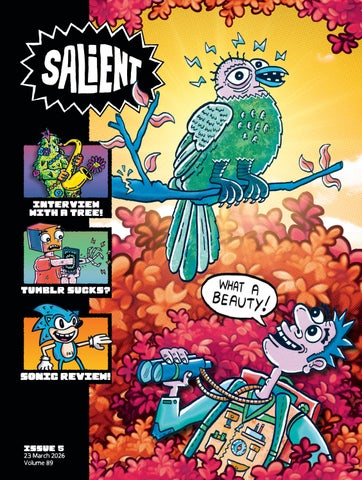
INTERVIEW WITH A TREE!
23 March 2026
Volume 89
Editor
Phoebe Robertson
Designer & Cartoonist
Jim Higgs
Sub-Editor
Holly Rowsell
News Writers
Dan Moskovitz
Martha Schenk
Ryan Cleland
Otis Whinney
Columnist
Guy van Egmond
Critic-at-large
Jackson McCarthy
Comic Artists
Grace Elzenheimer
Jack Graham
Contributing Writers
Tamanna Amin
Zia Ravenscroft
Christopher Curtis
Social Media Manager
Will Tickner
Photographer
Sophie Spencer
Distributer/Contributing Writer Ali Cook
Centrefold Artist
Victoria Jaramillo
Advertising advertising@vuwsa.org.nz
Read Online salient.org.nz issuu.com/salientmagazine
Follow Us @salientgram
Want to get published?
To contribute to Salient, you can submit poetry, creative writing, artwork, comics, puzzles, features, and other ideas. Feature articles
Artwork
to designer@salient.org.nz. Creative
Submissions

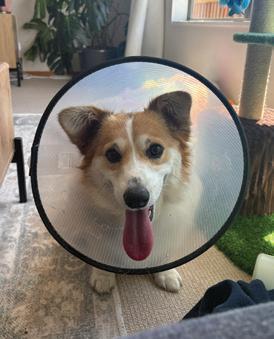
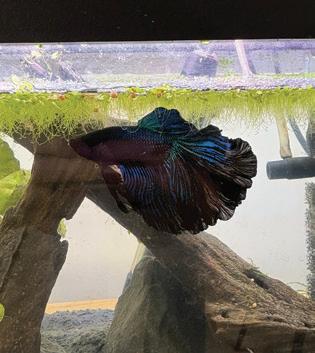
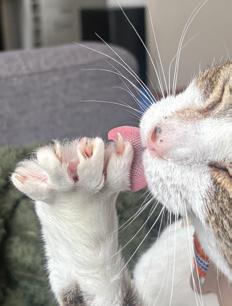
In times of illness, there’s one thing you can always turn to—and it’s not reality TV or takeaways. They're pets.
This week, your editor has COVID and has been stuck at home, spending plenty of time with her pets. So instead of the usual editorial, please enjoy a few of my favourite photos of Ducky, Megatron, and Beans.





Dear Editor,
What did you to this weeks Salient?
The dark outlines of the covers have stained my fingers with black ink and IT WILL NOT WASH OFF. I get the Salient team wants to make an impression on students, but this is a step too far. I expect full compensation for this tragic misstep.
Sincerely, the disappointed Logan Neis editor editor ! (said like a customer flagging down a waiter) more devastating poetry @r4tsrc00l

Happy birthday to Ash Buick, Ash has been contributing to Salient for the past three years, and this issue comes out on their birthday ! Everyone mentally say happy birthday Ash!
Kia ora Salient team,
We appreciate your recent coverage of postgraduate student representation matters. We wish to offer a brief clarification regarding the statement in the last issue by Dr. McKibben that the upcoming VUWSA Postgraduate Officer election would be “the first time in at least seven years there’s been a legitimate election for any postgraduate officer.”
The Postgraduate Students’ Association has held legitimate and contested presidential elections, including at our 2024 Annual General Meeting and our May 2025 by‑election, each of which had more than one candidate standing for President.
Ngā mihi nui, PGSA Executive
Uncontested elections, when they do occur, are a normal feature of many volunteer‑led student groups. These elections remain fully valid under both the Incorporated Societies Act and the PGSA constitution. Throughout this period, the PGSA has continued to meet all of its legal and constitutional requirements. It is heartening to see renewed postgraduate engagement across campus. The PGSA has recently reorganised its Executive Committee and welcomed a strong group of volunteers. We have also appointed postgraduate student representatives to University and Faculty Boards. These are all signs of a growing and vibrant postgraduate community at Te Herenga Waka. We value Salient’s commitment to reporting on postgraduate issues and look forward to supporting continued conversations around student representation and postgraduate life.
Shoutout to the absolute nerd who wrote about the caffeine pills. Great work !! Submit to the Letters page by emailing editor@salient.org.nz
Best letter each week will win a FREE PIZZA from the Hunter Lounge!
Iwouldsay[thisissueis] breathtakingbutmybreathwas taken so I can’t @this_might_be_ezra

is published by, but remains editorially independent from, the Victoria University of Wellington Students Association (VUWSA). Salient is funded in part by VUWSA through the Student Services Levy. Salient is a member of the Aotearoa Student Press Association (ASPA) and the New Zealand Media Council. first be brought to the VUWSA CEO in writing (ceo@vuwsa. org.nz). If not satisfied by the response, complaints should be directed to the Media Council (info@mediacouncil.org.nz).


TUESDAY
Moon Jam Nite
Venue: Moon Bar
Time: 7:30pm
Cost: Free
Every Tuesday at 7:30pm Moon hosts an open mic night with a fully equipped stage.


Week of March 23 - March 29, 2026
WEDNESDAY
Joe Coe
Venue: Moon Bar
Time: 6:30pm
Cost: Free
Free live music Wednesday at Moon Bar!
WEDNESDAY FRIDAY
Say The ThingMonthly Open Mic
Venue: Meow
Time: 7:30pm
Cost: Koha (goes to charity)
Open Mic last Wednesday of every month. Poems, short fiction, personal essays and more!
SATURDAY SUNDAY
Cuba Dupa - Day One
Venue: Cuba Street
Time: 12:00pm - 12:00am
Cost: Free
Check out the programme online and get amongst Cuba Street’s street festival!
Cuba Dupa - Day Two
Venue: Cuba Street
Time: 11:00am - 6:00pm Cost: Free
Check out the programme online and get amongst Cuba Street’s street festival!
Cumbia Blazera
Venue: Rogue and Vagabond
Time: 9:30pm
Cost: Free
Musicians from the Sunday Blazers Football Club put on a free gig at Rogue!
SATURDAY
A Month of Saturdays
Venue: Flying Nun Records Time: 1:00pm
Cost: Free
Live music in-store every Saturday in March. Featuring Homing & Sofia Machray.

Are you a Te Herenga Waka student with an upcoming gig or event? Scan the QR code to submit your details for potential inclusion on our gigs page. SHARE YOUR GIG!

About the centrefold artist - Victoria Jaramillo
I am a Mexico-born artist based in Wellington, currently completing a Master’s in Global Business at Victoria University of Wellington. Alongside my studies, I work primarily with painting, taking inspiration from everyday moments, local landscapes, and things I notice while moving through the city. My work explores memory, place and belonging, using a gentle, observant approach to capture small details and quiet connections between people and their environments.
Go to page 20 to see the centrefold, then rip it out and put it on your wall !

Dan Moskovitz
Over the past five years, bird flu has ravaged bird and mammal alike across the globe. Over 180 million poultry birds have died, as well as untold numbers of wildlife. Human infections, while rare, have a fatality rate over 50%.
Mainland Australia, New Zealand, and the Pacific remain the only flu-free regions. But with the Australian-owned subantarctic Heard Island now reporting the virus—an island which many of Aotearoa’s migratory birds visit— it’s a question of when, not if, bird flu arrives in the country. And given its persistence in wild birds, once it arrives, it’s here for good.
So right now the country is in prep mode. DoC is figuring out how to protect our native birds, MPI is preparing the poultry industry, and regional council’s job will be to protect us.
“One Health New Zealand—that's Health New Zealand, DoC, and MPI—are advocating for bird carcasses to be left in place to naturally decompose,” said Roger Uys, a senior ecologist at Greater Wellington Regional Council.
“This reduces the risk of human infections, and it doesn't spread the disease around. The reality, though, is if we have dead birds in a playground or along the beach, we risk exposing the public unnecessarily.
“If a dog goes and picks up a dead bird, it can get sick and make its owners sick. So this is where we'd remove and dispose of the carcasses.”
Regional council will divide its land into back and front country, based on the levels of foot traffic. In the back country, which has less visitors, dead birds will result in council erecting signage. In the front country, a carcass— even just a single one—will trigger removal.
Interestingly, there isn’t a firm number which divides the front from the back.
Birds do die naturally from other causes. But once bird flu is confirmed to be in Aotearoa, if there’s a rotting carcass anywhere in the front country, regional council will be removing it, whether we know how it died or not.
Council is currently anticipating lots of call-outs for a single corpse, rather than apocalyptic scenarios involving beaches covered in dead birds.
It’ll be expensive though, as council is currently guesstimating costs of around ten thousand per call out. Still, this is one funding crisis council isn’t worried about, for a change of pace.
“We do carry contingency for this sort of thing,” said Andy Brown, Greater Wellington’s Risk Management and Resilience lead. “And if we got into the worst-case scenario, we’d be looking at redistributing budgets to respond.”
“We'd also be expecting if we did end up in that worst case scenario, there’d be an all-of-government response to bird flu.”
“But we can certainly manage the smaller events within our current budgets.”
If you encounter a bird showing symptoms of avian influenza, please take a video and call the biosecurity hotline: 0800 80 99 66.
Symptoms include falling over, twisting their neck to look upwards, lethargy, and drooping heads. Finding three or more dead birds in one area is also a reason to contact Biosecurity.
Transmission of bird flu to humans is uncommon but

Martha Schenk
When your humble author awoke on Friday, 13 March with tonsils the size of Luxon’s bald head constricting her inflamed airway, some more superstitious readers might blame the unlucky date. I was certain, however, that a call to Student Health might provide some relief from the raw, burning pain I was experiencing with every breath and swallow.
How sorely mistaken I was.
Calling just before 10 a.m., I was quickly informed by the receptionist that urgent same-day GP appointments were already completely full. Anecdotally—via the two different receptionists I spoke to—the service had received a record number of calls that morning, akin to flu season.
My options were: wait and call again on Monday at 8:30 a.m. (70 hours away), call Healthline for advice, take myself to After Hours, or book a phone appointment with a nurse. When I asked whether the nurse could prescribe antibiotics or anything stronger than the paracetamol, ibuprofen, and lidocaine spray I was already taking, I was told that wasn’t possible.
Upon seeing me sweaty and slightly tearful for the second time that morning, the clerk at the University Unichem pulled his mask up a little higher and suggested that, yes—I probably needed something stronger. Feeling panicked, unable to afford a regular GP, overwhelmed and let down, I decided to push through the day on over-the-counter medicine alone. I diligently conducted a COVID test in the Salient office and attended my threehour mandatory tutorial that afternoon.
By evening, however, it became clear that the pain wasn’t going anywhere—it was getting worse. Spurred on by my friends, (“Dude, you need a Doctor”), I let my flatmate drive me to After Hours at 8:30 p.m., figuring a few hours wait would be better than nothing at all. Imagine my surprise, then, when we were told at the desk that After Hours was shutting for the night due to staff shortage. I was directed to the Emergency Department.
I arrived to a full waiting room, feeling slightly ridiculous— yes, I am here for a sore throat, but no, I don’t have anywhere else to go. The triage nurse was dubious, but

after shining a light down my throat (the first physical examination I had received all day), she told me that I should stay, on account of the tiny hole that was supposed to be my functioning airway.
Nine hours after my arrival, I finally left ED at 6 a.m. with a generous supply of prescription pain medicine. The following days were spent reflecting, in a codeinefuelled haze: what is going on with the New Zealand healthcare system?
The issue is broader than any individual experience. It rests not with the incredible doctors, nurses, and other medical staff that bend over backwards every day to ensure that as many people as possible receive high-quality care, but with a general lack of funding and infrastructure. Staff are burnt out, hospital beds are full, and appointments are in overwhelming demand. Workforce shortages place increasing pressure on the system as workers continue to head overseas for better wages, hours, and conditions—and who could blame them?
New Zealand’s healthcare system is primarily governmentfunded through taxation. It saw a budget increase of $5.5 billion for hospital and specialist services, primary care, and community and public health in 2025/26. There was a 6.43% increase in general practice capitation funding, alongside $180 million in new funding for general practice. While this sounds promising, it’s important to remember that healthcare funding must keep pace with population growth, meaning increases are expected every year.
Clearly, the current uptick isn’t enough.
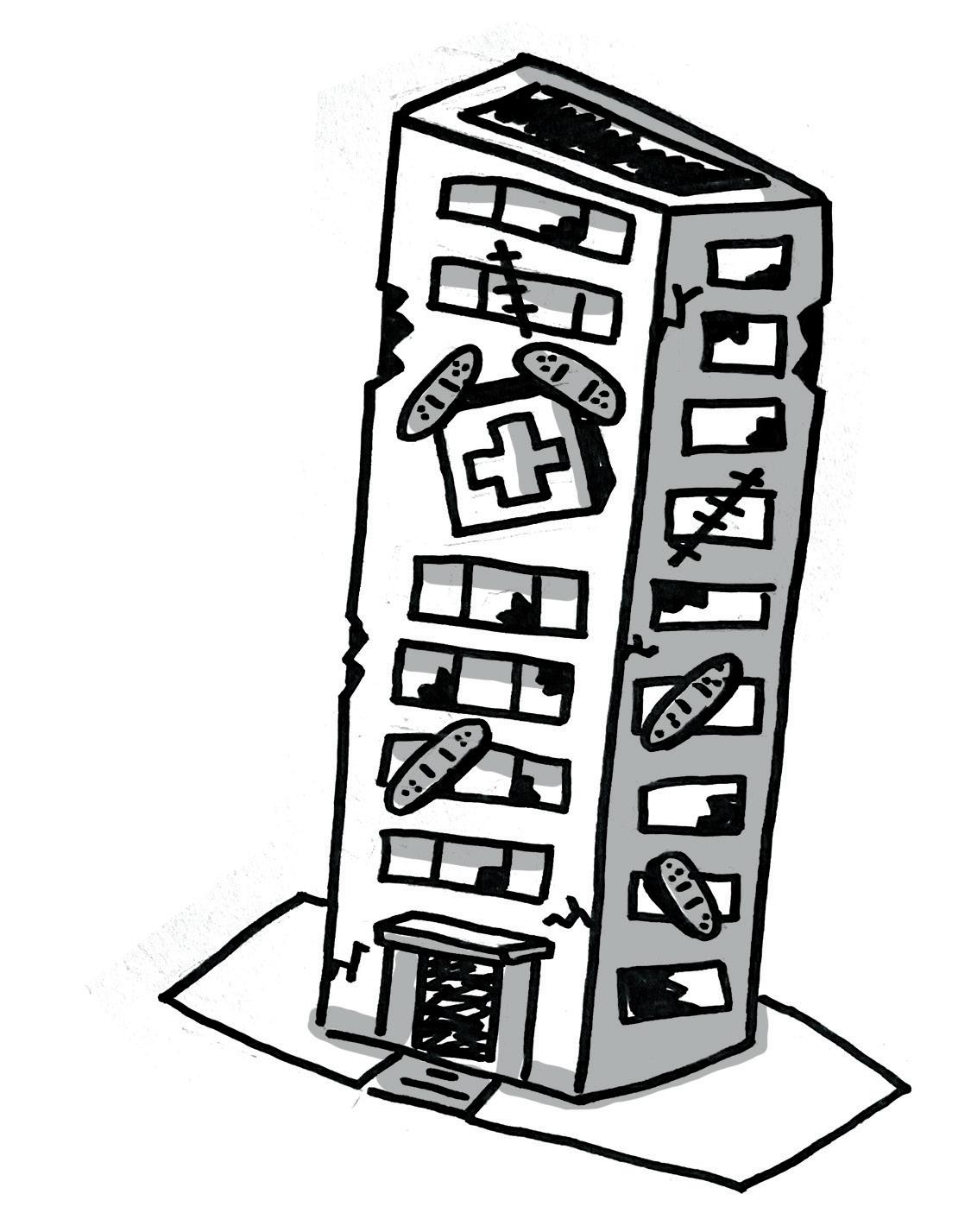
On Tuesday, 17 March, health minister Simeon Brown announced an additional $25 million investment to boost hospital capacity, increase staffing, and prepare for winter demand. Again, this sounds substantial—but when spread across the country, the impact is minimal: just 12 additional winter beds for Wellington and a 0.47% increase in staff nationwide. While a step in the right direction, it is, at best, incremental—like peeing on a house fire.
Or, as Salaried Medical Specialists executive director Sarah Dalton more eloquently told RNZ: “I wouldn’t call it an investment or a plan, I’d call it a band-aid.”

Fleur Fitzsimmons, National Secretary for the Public Service Association Te Pūkenga Here Tikanga Mahi, was similarly critical: “Minister Brown cannot claim to be preparing hospitals for winter while his Government has spent the past two years imposing cuts and job losses right across Health NZ. You cannot gut the workforce and then paper over the damage with a press release.”
And it’s true. The same minister also asked hospitals to cut back $510 million late last year in “efficiencies”, claiming that “back-office waste” could be “re-invested straight back into patient care.” That amount makes Tuesday’s bonus look hardly mollifying.
Brown has also begun decentralising Health NZ, with the aim of allowing regions and districts to recruit and deploy staff independently, while maintaining central oversight for strategy and standards. In 2025, it was revealed that Wellington hospitals were, in some cases, waiting up to six months for approval to begin recruiting frontline staff. While decentralisation may improve responsiveness, it also risks creating uneven capability and workforce gaps between regions.
Mauri Ora Student Health & Counselling specifically is funded largely by the student-paid Student Services Fee, with 59% allocated to health services, counselling, and pastoral care. Routine medical appointments are generally free for domestic students, though charges apply for international students and specialist services such as medicals, ECGs, minor surgeries, and some vaccinations. Here too, additional funding for staffing would ease pressure, freeing up additional appointments for distressed students.
Wait times for counselling and routine medical appointments in 2025 typically sat at six to seven weeks. March and April are traditionally busy months for the service, as new students must see a GP before prescriptions can be issued. Same-day urgent appointments typically fill by noon—though on my ill-fated day of March 13 they were all gone by 10 a.m. This is in part due to a reduction in same-day triage appointments from 22 at the end of last year to just 12 per day over the past two weeks, in an effort to prioritize continuity of care.
Mauri Ora now walks a tightrope between reactivity (same-day care, triage) and proactivity (ongoing care, scheduled counselling)—one that may be fraying under the strain.
Yes, my tonsillitis was not life-threatening, and I won’t pretend others haven’t endured far worse. But it was painful, prolonged, and—critically—difficult to treat affordably and accessibly.
Internationally, New Zealand is still seen as a safe, stable, and liveable country, with a healthcare system comparable to Canada, the UK, and many Nordic countries. Increasingly, however, it feels as though that reputation no longer reflects reality.
Funding, policy, and workforce strategy must change— and quickly—if Aotearoa wants to maintain a healthcare system that is truly accessible.
Part two of a three-part opinion series exploring affordable food options on campus at Te Herenga Waka.
Ryan Cleland
This week, I continued my search for affordable eats, heading into the world of stressed-out architecture students perpetually behind on an assignment. That's right, dear readers—I hit the streets. The street of Vivian, that is. The goal: to see what fuels Te Aro Campus and, more importantly, whether it’s actually affordable.
Te Aro is unique in one key way: it’s the only campus without any on-site cafés or food options. That being said, this hasn’t stopped a large number of students from spreading out across the lawn, armed with a myriad of nearby Cuba Street offerings.
What immediately stood out was the number of Scopa pizza boxes in circulation. For a moment, I wondered if they were being repurposed into first-year chair projects. When I asked, one student set me straight: “Scopa’s Margherita Tuesdays! Only $10!”
From 11:30 a.m. to 3 p.m. each Tuesday, Scopa offers $10 Margherita pizzas, and Te Aro students have clearly embraced the deal with open arms (and empty wallets).
Outside of Scopa, however, the sentiment echoed what I heard over at Pipitea—Cuba Street is expensive.
“It’s too expensive, so I just bring food from home,” one student told me.
Another admitted they simply “suck it up and eat before
Not exactly inspiring.
Still, there are a few relative bright spots. Students pointed to Subway across the road as a reliable option, with a $7.50 sub of day. St Pierre's Sushi also came up frequently as a go-to for something quick—if not always cheap. Best Ugly Bagels was mentioned as an occasional treat, though at $9 for a simple cream cheese bagel, it’s hardly a budget staple.
Following a tip-off from a kind third-year architecture student, I was told that the best value could be found at Babylon Kebabs—where I decided to have lunch. With snack kebabs coming in at $11 and regulars at $13, I wasn’t expecting much. But when my kebab arrived, it was easily twice the size of a Best Ugly Bagels order and far more filling, making it one of the better-value options I’d come across around Te Aro.
So what’s the verdict? Te Aro students are resourceful— but it comes at a cost. The lack of on-campus options pushes students into one of three camps: deal hunters, occasional spenders, or dedicated meal-preppers. Yes, there are more affordable food options here than at Pipitea—but once again, students are largely left to fend for themselves.



If you’ve got a news tip about what’s happening around Te Herenga Waka—or anything that affects students—we want to hear about it.
Scan our QR code or email editor@salient.org.nz. We’re always keen to know what’s going on in the halls (yes, including the menu), anything unfolding around campus, or any questions you’ve got about what’s happening here. If there’s something studentrelevant you think we should look into, let us know.

Phoebe Robertson
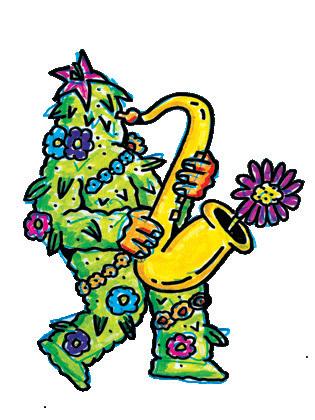
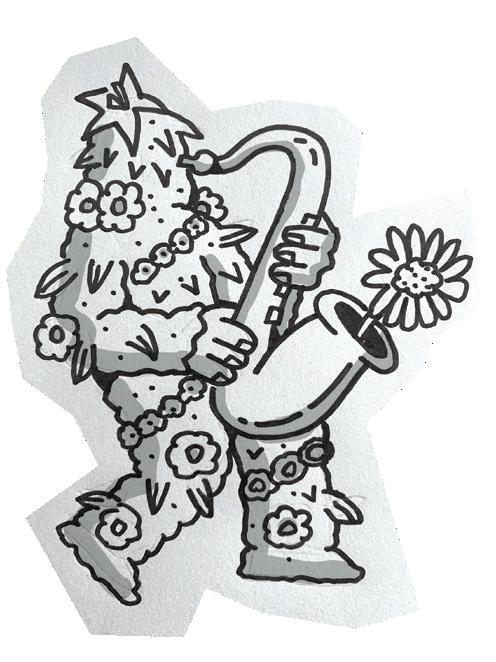
On a windy Wellington afternoon, the after-work crowd spills out onto Lambton Quay—suits, sneakers, tote bags, the hum of buses and the harbour wind. Somewhere in the middle of it all, a saxophone begins to play. And moving slowly through the rush of commuters… is a tree.
For nearly five years, Wellingtonians have encountered this character—known simply as Tree—busking across the CBD and waterfront. But recently, the performer behind the costume has found himself addressing an unexpected rumour: that there isn’t just one Tree.
“Hi this is the tree guy here,” he wrote in a Facebook post on March 3.
“I want to kindly request the people or person spreading the false rumours that there are multiple performers for Tree to please stop doing that as it’s having an adverse effect on my work.”
The performer says the speculation has been circulating for a couple of years, often raised casually by passers-by who are surprised to see Tree popping up across different parts of the city on the same day.
“When someone’s doing something that’s in the public eye, there’s always going to be rumours of some kind,” he said in an interview with Salient
“You can see me in Lambton Quay, Oriental Bay and the waterfront—and it is the same person,” he said during the interview. “I clocked how much I walked one day and I did 10 kilometres around the city.”
But the particular rumour that there are several people portraying Tree has begun to chip away at something he considers central to the performance.
“These rumours about multiple tree people have been going for about two years,” he said. “The thing that’s worrying me is that a lot of people have kind of developed a relationship with Tree over the five years.”
“More and more people are asking me, ‘Is it a different person?’” he said.
“The reason it’s a concern for me is it can remove a lot of the magic of what Tree is. That sort of connection people have with it can almost be broken immediately if they believe that kind of a rumor.”
For the performer, the magic lies in continuity—the sense that the same wandering figure is still there, months or years later, waiting around the corner of a familiar street.
“I have been having meaningful interactions with people in the city for nearly five years now,” he wrote online. “People are starting to believe that the tree they meet nowadays isn’t the person that was kind to them some
time back and so some of the most important magic of my work is getting destroyed to an extent by these rumours.”
The most memorable interactions often involve children, who accept the premise of a walking tree more readily than adults.
“A while back an eight year old girl came and told me happily that she has known me since she was four,” he said.
“At some point young ones like her may think that’s no longer true, when it in fact is true.”
The rumours are not the only misconception Tree has encountered.
“When I first started performing Tree five years ago I was playing the Indian and Chinese flute,” he said.
“But so many people claimed I was faking the performance, I had to stop playing them and play saxophone instead.”
Even then, disbelief sometimes lingers.
“I was playing saxophone to the best of my ability like two metres in front of this gentleman,” he recalled. “After I finished my song he came up to me and said, ‘Oh, is that a real saxophone?’”
The question surprised him.
“I’m a professional sax player since a long time, and I worked very hard at it,” he said. “I also studied Indian classical music in India for 14 years and was at the top level of musicians when I was performing there.”
Tree ended his social media post with “I think it’s best not to speak about other peoples work unless you actually know the person and can ask them about what they do yourself. Thank you for your kindness.”
And it is this kindness that Tree plans on continuing to bring to Wellington, for many years to come.

Otis Whinney
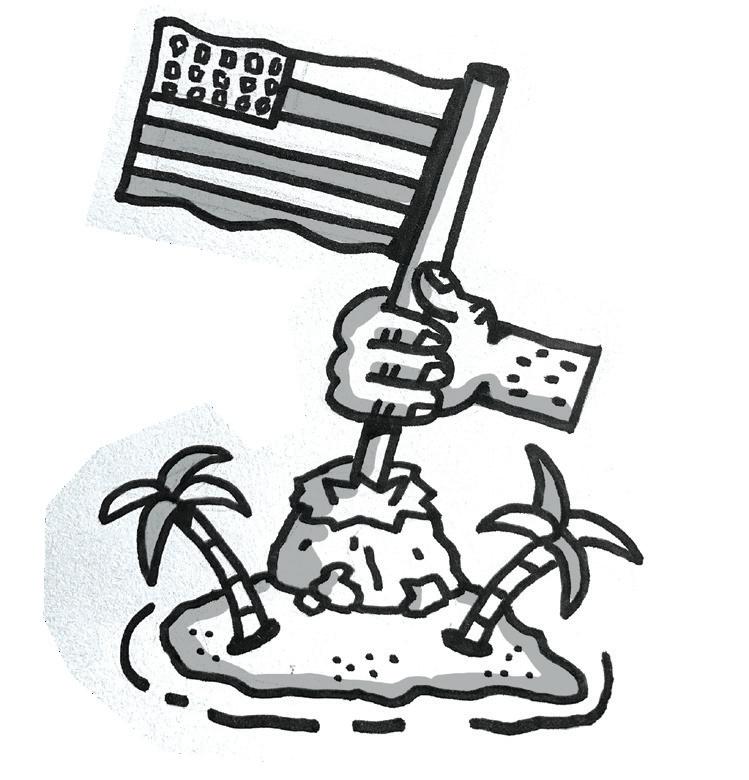
The United States has been making their presence known in the Pacific as of recent. Billionaire Jared Novelley has just been announced as the new American ambassador to New Zealand, and he has already made clear the goals to further deepen New Zealand and the USA’s defence ties and open us up for some more good ol’ fashioned resource extraction.
The USA's Deputy Secretary of State Christopher Landau has also been doing the rounds in the Pacific Ocean, going from state to state to take heart-warming photos shaking hands with our various political leaders. One of his goals in this mission is to reassure Pacific nations that whatever mess the USA has made in the Middle East, it “doesn't stop American diplomacy in the rest of the world” (according to a post on reputable news site, X). The United States has always considered the Pacific to be an incredibly valuable region, but why do they see themselves to be so essential to this place we live? And with the latest developments in the American-Israeli war on Iran, should this special relationship really be something we treasure with all our hearts?
This isn’t an article detailing the insane events happening in the Middle East, but for those who somehow missed it, here’s a brief summary. The United States and Israel have begun a war with Iran over the perceived threat Iran’s nuclear program presents to Israeli and American interests. The war began with the insane immediate assassination of Iran’s leader, Ayatollah Ali Khamenei, via Israeli bombing on February 28. This war is ongoing, constantly changing, and there is no consensus on where any of this is heading. That does mean that by the time this article is released some of this may be very out of date, so apologies just in case.
You might be thinking that, as horrifying as endless war in the Middle East may be, it can’t really be that connected to this ocean on the other side of the world. But that ignores our region's long-standing ties with the USA, our trade connections, and the implications for American foreign policy going forward.
Firstly, to properly frame this, let's quickly examine how much of the Pacific is straight-up a part of the United States. Hawai’i, once a sovereign kingdom, is now an official state of America thanks in part to a coup in 1893. They also have the eastern islands of Sāmoa, the island of Guam and the Commonwealth of the Northern Mariana Islands (CNMI) as unincorporated territories, as well as a series of uninhabited islands and atolls that pepper our region. The two most powerful countries in the region, Australia and New Zealand, are both key allies of the
United States, going all the way back to World War II when they helped expel Imperial Japan from this region and large parts of Asia.
This relationship is far from benign, and you don’t have to look that far to see how. After the initial strikes on Iran by the United States and Israel, alert levels across America’s Pacific territories were raised, and military build ups and reviews were kickstarted across the CNMI and Guam. Our good mate Landau who I mentioned up top was also recently in independent Sāmoa, where the two nations celebrated an ‘open skies’ agreement allowing for less restrictions on American vessels in Sāmoan airspace, while also further increasing their defence and policing ties. “Not just diplomatic, it’s personal” were the words Prime Minister of Sāmoa La’aulialemalietoa Leuatea Polāta’ivao Schmidt used to describe the relationship between the two countries.
While many Pacific politicians seemingly welcome all these developments with open arms, others have their doubts. The war in Iran will have ongoing effects on the global supply-chain of oil, with Pacific nations on high alert as to how rising prices and a lack of supply may hurt their peoples and economies for however long this war will take. Lawyer and CNMI Democratic Party member Michael White has predicted that these strikes will increase the “already-oppressive economic burden on our people” through the effects the war will have on gas prices in particular. This is a worry shared by many across the world, not just around here.
With this military buildup also comes the expectation of cooperation, and Trump has made it clear how he feels about those who would rather not get involved. He has brazenly threatened to cut off trade with Spain after they refused to let American vessels use their bases, and he’s publicly decried Keir Starmer for deciding to participate in too late a fashion. While Trump is famous for saying literally anything he wants at any moment with no follow through, these types of threats should not be taken lightly. His administration is currently weaponizing these types of diplomatic moves to blockade Cuba, with the increased economic isolation imposed by the USA leaving many Cubans without power and decent food. American diplomacy in full effect, everyone.
While yes, it is true that holding American planes may come in handy one day, I doubt the benefits outweigh the means. I mean, Donald Trump just pulled America out of several international agreements that commit those included to fighting against climate change, an issue of significant importance for the survival of the
Pacific region. This goes in tandem with Trump’s global agenda to find new sources of rare-earth minerals, which includes the mining of the seabed of the Pacific Ocean. Deals with Tonga, the Cook Islands, and others are in the works as we speak. They have also exited from the Secretariat of the Pacific Regional Environment Programme (SPREP) and the World Health Organisation (WHO), two organisations who provide opportunities for Pacific students to obtain scholarships, with China stepping in to fill this gap.
The United States has also been busy blocking a Vanuatuled U.N. resolution that would classify failing to protect people from the effects of climate change as violating international law. According to a message from the U.S. State Department obtained by the Associated Press through a cable, “President Trump has delivered a very clear message: that the U.N. and many nations of the world have gone wildly off track, exaggerating climate change into the world’s greatest threat.” Despite the push from Vanuatu, and pushback from U.N. experts, the Trump regime seems hell bent on draining our region for their own benefit.
Right-wing think tank ‘The Heritage Foundation’, most famous for ‘Project 2025’, an ideological platform that has influenced the Republican’s moves through the last election cycle, has now set its sights on influencing movements within the Pacific region. ‘A Charter of Pacific Values for a Prosperous Pacific Future’, released on the 5th of this month, outlines a proposed charter that, when read carefully, basically argues the Pacific needs to avoid China and stick with their bros in the Western world. A Trump-aligned think tank that helped give us the latest iteration of the Republican Party trying to influence the political decisions of Pacific leaders, around the same time a global quest for rare-natural resources has started among all of America’s allies, is surely cause for some alarm.
Their track record in the past is also in shambles, whether it be the legacy of nuclear testing near inhabited islands leaving generations with horrific medical issues, or the unlawful and oftentimes violent acquisition of their Pacific states and territories. Frankly, the history of American foreign policy in the Pacific is too large for a single article in a student newspaper, but hopefully I’ve painted a clear enough picture for you so far.
I have barely even mentioned the other partner in this war, Israel, who has also been doing its part in increasing its ties to the Pacific. Fiji and Sāmoa are opening/have opened new Embassies in Israel, and as the Israeli
government’s genocide of the Palestinian people has progressed, many Pacific states have voted alongside the USA and Israel in blocking U.N. action aimed at protecting civillians and holding Israel to account for their conduct. The influence of certain evangelical strains of Christianity on the politics of the Pacific contributes to this strange relationship, and the influence of the United States also plays a large part. While these political decisions may not reflect how the people of the Pacific feel about these global events, this is the message heading to the world stage from many of our leaders.
Our friends in the USA are not going anywhere anytime soon, but in the wake of all of this, there is no better time than now for all of us to collectively re-consider who we call our bros on the world stage, and whether our leaders are reflecting how we feel about this. Our collaboration, our support, and our resources may be on the list of America’s most wanted, but before we hand everything over on a silver platter, let's think about what we actually want.
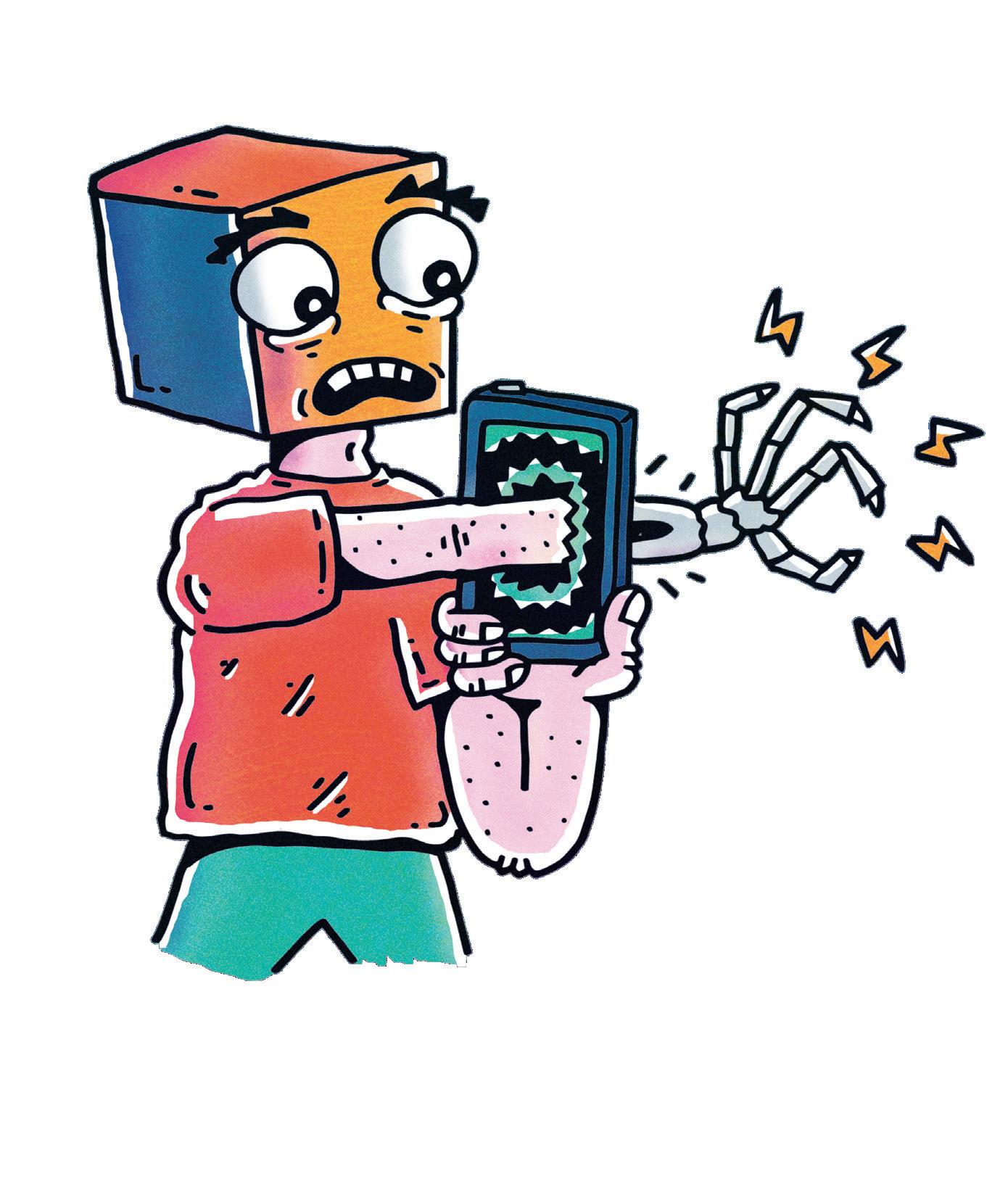




Just from reading the title of this article, you might be wondering: “Tumblr? That’s still a thing?” And yes, dear reader, I am proud to announce that I am one of the over 130 million active Tumblr users. The cultural icon of the 2010s is still alive and kicking. Johnlock even made it into the top 100 ships of 2025 (if you know, you know). Even though I only joined the site in 2019, my status as a survivor of 5 November 2020 means I feel comfortable calling myself a Tumblr veteran. (Yes, I’ll stop with the references now.)
You might also be asking: “Ash, why did you do this to yourself?”
The simple answer is that I’d just had my wisdom teeth removed and had nothing better to do. The real answer is more complicated.
Around September, I heard news that a prominent blog had been deleted from the platform. This was notable partly because the blog was run by a trans woman.
The blog’s name was isuggestforcefem.
At the time, I didn’t pay much attention to the news. It was well-known that trans women were sometimes banned from Tumblr for reasons that seemed to amount to little more than being openly trans. So I went on with my life.
Things got more interesting after my surgery.
One blog I followed started vague-posting about a group of trans men who, in their opinion, were behaving like “Men’s Rights Activists.” Around the same time, I began seeing unfamiliar acronyms appearing in posts and people’s bios: TMA and TME.
In the background, a number of blogs clearly modelling themselves after isuggestforcefem started popping up—and the things they had to say were... really something.
Many of them argued that transgender men were not oppressed to the same extent as transgender women. Some even claimed that trans men possessed male privilege.
As a transmasc nonbinary person who likes to believe they’re a little less chronically online than these people, I found myself wondering: how do you end up with these opinions?
And so I dove headfirst into the rabbit hole.
Immediately, there were some really clear parallels between whatever this was and the infamous “ace discourse” of the 2010s. The first similarity was the effort to remove a group—previously widely accepted—from the LGBTQ+ community. The second was the method: denying that this group experienced the same level of oppression as “the rest of us.” The third, and perhaps most egregious, was interpreting the group’s lack of visibility as evidence of privilege.
During the ace discourse, ‘critics’ focused heavily on asexual people’s presumed inherent lack of sexual relationships, arguing that this made them “harder to clock as queer.” But flying under the radar is not the same thing as privilege. Much of society—including significant parts of the medical
community—still treats asexuality as something broken or pathological, rather than simply another way of existing.
Eventually the discourse cycle burned itself out. The vast majority of people agreed that asexual people were, in fact, queer, and that the whole debate had been a waste of time. The gays of Tumblr collectively held hands and agreed that we wouldn’t let anything this asinine become a big thing ever again.
But of course, it happened again.
So… why?
While Tumblr has a large queer user base, only a relatively small number of people regularly post in queer-related tags. My own avoidance of searching those tags directly is reaffirmed whenever they trend: the preview images are often dominated by bots trying to lure users off-site. After a while the bots become part of the furniture. (That 130-millionactive-users figure is probably a little optimistic.)
Their prevalence is partly a symptom of Tumblr’s inconsistent approach to “mature content.” No, they didn’t un-ban porn— but “female-presenting nipples” quietly returned in 2022. We take the small wins.
Instead of focusing on the bots, the platform often seems more interested in cracking down on trans people talking about being trans. In its current state, Tumblr can be an oddly hostile environment for its queer users. If you wanted to publish a nuanced essay about queer theory, Tumblr probably wouldn’t be your first choice. You’d start a Substack.
The result is a fairly insular group of people trying—often very hard—to say something profound. In other words, perfect conditions for an echo chamber.
As the space becomes more insular, subtler forms of bigotry can slip through unchallenged. Eventually you end up with situations where a generation of queer youth believes misogyny is acceptable, provided you clarify that it’s directed at white women.
Tumblr also has an old inside joke: it’s the “piss on the poor” website. The phrase comes from a famous misreading of a post from 2012 saying the average Tumblr user has pisspoor reading comprehension. Someone reblogged the post saying “how dare you say we piss on the poor” and thus, new slang was invented.
Tumblr’s also a really good place to observe bean soup theory in action: you might post about how much you like pancakes, and someone will appear in your replies accusing you of hating waffles. More broadly, it’s a sense of “what about me?”-ism, where people feel compelled to make every post they encounter directly or indirectly related to them. They can’t just quietly reblog something, they need to at minimum add some commentary in the tags.
This tendency certainly distorts discourse—but it isn’t the whole story.
Story continues on next page.
Until around 2021, Tumblr didn’t have a robust recommendation algorithm. Users mostly discovered content by following specific tags, or by following the right people. Even now, many still use the platform in this “traditional” way. The result is that if a large blog posts a slightly questionable take, it can reach thousands of readers—while hundreds of thoughtful responses languish unseen in a niche tag.
So what was it actually like to doomscroll the transandrophobia tag for a month?
To be frank, it was bleak.
As you might expect from a tag centered on bigotry, most posts involved people venting about the discrimination they’ve encountered. This usually meant screenshots of other posts, accompanied by a bit of commentary. There were also trolls and bad-faith arguments—but that’s simply the internet.
Still, the experience wasn’t entirely negative. I learned more about systemic discrimination against the intersex community and the ways their experiences are often overlooked—even in mainstream discussions of sex and gender within the trans community.
I also began noticing a broader pattern: attempts within online trans spaces to create new, more “woke” versions of the gender binary. AMAB and AFAB, terms originally used by intersex people to describe being forcibly slotted into the sex and gender binary, had been diluted into shorthand for “non-binary boy” and “non-binary girl.” Transmasc and transfem became synonyms for trans man and trans woman.
This change in language makes it overall more difficult for queer people to talk about their experiences online. Some of these terms were specifically created so things wouldn’t get lost inside mainstream discourse. And now as they are folded back into the mainstream, people now have to look in more places to find the same things. Everybody loses.
In my view, though, the most troubling terms were TMA and TME, standing for transmisogyny-affected and transmisogyny-exempt. These categories lump cis women, cis men, and transmasculine people into the same group, with the curious caveat that if a cis person has been mistaken for a trans woman—they are now TMA. The framework therefore only has a few specific applications, and relies on a very narrow definition of transmisogyny as transfem-specific transphobia. Without that definition the whole structure begins to wobble.
With all this in mind, I looked back at my introduction to the discourse in a new light. The alleged groups of “trans men’s rights activists” were extremely small—if they existed at all. TME was often being used as a stand-in for trans men, effectively giving old TERF rhetoric a new coat of paint. Meanwhile, isuggestforcefem had been able to leverage Tumblr’s real mistreatment of trans women to win sympathy—even when she would have been cancelled for some of her takes under other circumstances.
Realising how much I’d initially missed felt strange.
But it reflects a broader problem on the internet: if something is easy to fact-check, most people won’t bother. Instead of looking directly at what was happening in the transandrophobia tag, users relied on second-hand accounts filtered through the biases of whoever was posting about it.
And thus, a game of telephone began.
“Hey, isn’t it weird that so much transandrophobia goes unchallenged in transfem-centric tags?” became “transmasc vs transfem infighting.”
“We should have a term to talk about our group’s specific collective experiences” became “transandrobros and their victim complex.”
“Hey, it’s weird that ‘kill all men’ including trans men is considered a normal thing to say” became “the TMEs are minimising the struggles of trans women.”
Not only were the original conversations being distorted— they were being pushed toward increasingly extreme directions.
Who benefits from that?
Tumblr, certainly. It can serve me plenty of ads while I scroll through my dashboard. But more broadly, politicians attempting to strip trans people of their rights benefit from a community too busy arguing with itself to organise protests or build solidarity.
The main thing I’ve learned from this month of doomscrolling is the importance of stepping back and looking at the bigger picture.
When I was talking about this discourse with a friend—who is also trans—she seemed puzzled that it was happening at all. To her, the question “Does transandrophobia matter?” had an obvious answer: of course it does. Intersectionality tells us that different aspects of our identities shape how we experience discrimination. Having language to describe those differences is useful.
But transphobes, ultimately, don’t care what specific sub-type of trans we are, they hate us all the same.
Which makes community infighting feel a little besides the point when we have bigger fish to fry.
Will I do something like this again?
Absolutely.
Do as I say, not as I do.
Put down your phone (which you’re hopefully doing right now) and go talk to some real people. You’ll have a much better time than arguing in a comment section, I promise.

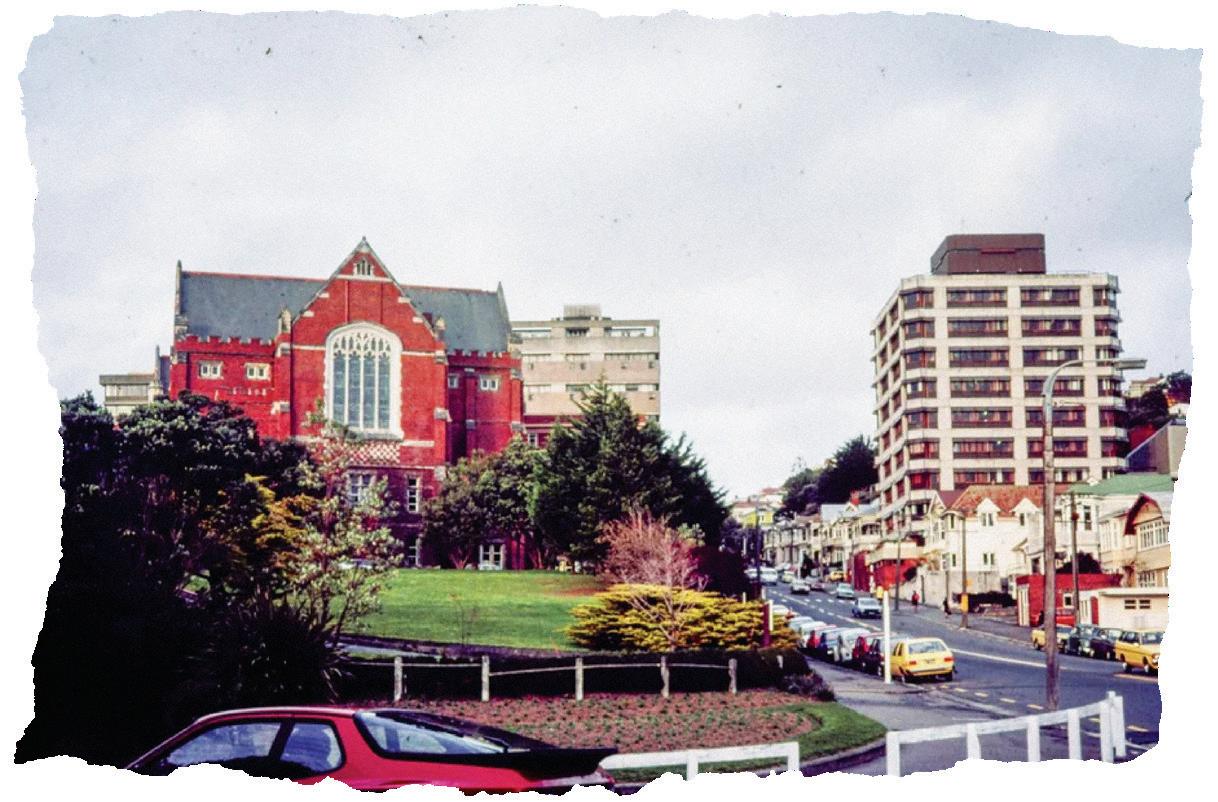
An account of a mature student returning to study after 30 years in the work force

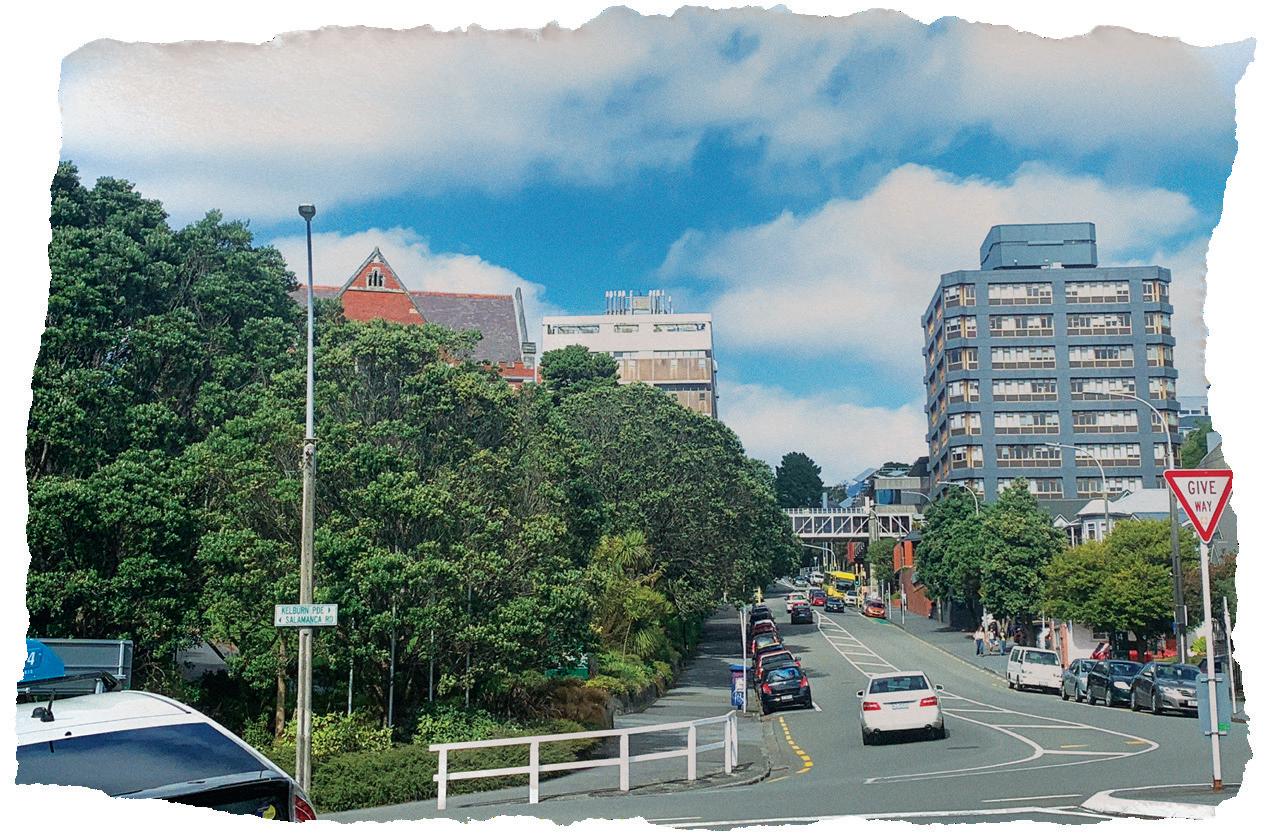








If you had said to me in 1996, when I graduated with a B.A., that one day I would return to Vic for postgraduate study, I would have told you where to go. As much as I loved my time here, I was on a mission: get my teaching diploma and become a mover and shaker in the classrooms of Aotearoa, New Zealand.
Now, at fifty, I find myself once again walking past the Hunter Building each morning, making my way to a lecture. What bought about my change in attitude—or rather, who—was my grandmother. At ninety, she began asking me to return to university. A great educator herself (and a Dame), she told me she had the perfect thesis waiting, along with all the material I would need, sitting neatly in her home office.
I was too respectful to tell her where to go, but managed to change the subject every time the topic arose. Why on earth would I forgo a stable salary to become a poor student again? No thank you.
Last year, at ninety-five, she passed away. I was overcome by a deep sense of regret. Why on earth had I not fulfilled her wish when she asked?
I returned to school and informed the principal that I would be going back to university. I was coming back to study, by hook or by crook. At the end of the year I resigned officially and spent Christmas packing boxes and moving furniture into storage. Then my pay stopped. I had a mild panic attack.
At the same time, I was trying to navigate a new way of applying for courses, loans, and allowances. In the nineties this was all done on paper—forms, envelopes stamped. No log-ins, no passwords, no mysterious links. They say the digital age is supposed to make things easier, not harder. I still prefer paper.
I arrived from Hawke’s Bay and set off to the train station for my first day back as a university student. Until recently I had been the Year 9 Dean at school. This, I realised, must be what my girls felt like on their first day. Then there was public transport. I needed lessons again. We used to buy ten-trip tickets that the conductor or bus driver would punch in with a little click.. Someone showed me how to buy a Snapper card, download the app, and load money onto it. Thankfully the automated message on the train reminds us that “if you are using a Snapper card, please remember to tap off.”
Māori Studies was a group of quaint villas in front of the Marae, where today stands the three-level, modern, art filled building known as Ngā Mokopuna.
One of the most obvious and beautiful changes I have noticed in my first weeks back is how safe and natural it is to be part of the rainbow community on campus. The self-expression and freedom to openly be yourself, without judgment, shows me how far we have come as a society.
When I was here for the first time, I used to mince around these hallways in sarongs, wrap-around skirts, and all sorts of eye-catching get-ups. But that came from personal confidence, not because I was seeing others like myself. In my day, no one had sent out the memo that it was okay.
In other ways Wellington has not changed at all. My favourite clothes store, World, is still open. So is Logan Brown. Slow Boat Records—an inner-city institution— still spins jazz records as you walk through the door. The colored buckets still tip water noisily along Cuba Street. Buskers still sing at the train station and on street corners. And the weather—this weather—will never change.
As I sit on the sixth floor of the library looking out to the harbour, there is a calm within. Who cares if I dropped from a $3,000-a-fortnight salary to $300 a week (that I have to pay back)? Who cares if I have my first assignment due next week and haven't started yet? Who cares if I’m surrounded by students who are the age of the Year 13s I was teaching just months ago?
All is well.
I am supposed to be here.
My course-related costs and living allowance appeared in my account today. Once I submit this annotated bibliography I’m going to head down to the Puffin Wine Bar and buy myself the most expensive cocktail they have. I’ll raise the glass and toast my grandmother.
Look Nan. I’m finally doing it.

Wellington has changed, so has Vic. The city is slower, quieter. The walk up Lambton Quay no longer feels so rushed. On Fridays, it almost feels like a Sunday, with so many people working from home.
At Vic in the nineties, there was no Hub, no docking stations, no monitors or vending machines on every floor. Only one place sold coffee, in the courtyard outside the library, and I recall there only being only two eateries on campus. Our readings came in a heavy booklet of photocopied chapters called a multilith. Te Kawa a Māui,



According to the most recent national census, the Muslim population of New Zealand exceeds 60,000 individuals. This figure reflects not a homogeneous constituency but a complex social formation shaped by successive migrations, refugee resettlement, conversion, and the maturation of locally born generations. Whilst first-generation migrants remain numerically prominent, refugee communities have introduced additional linguistic, ethnic, and theological diversity; converts to Islam (many of AngloEuropean or Polynesian heritage), together with their New Zealand-born descendants, have further contributed to the emergence of layered and hybrid identities. The resulting demographic configuration complicates reductive accounts of religious minorities and highlights the fluid interplay between faith, ancestry, and civic participation. As Muslim communities consolidate institutional and generational continuity, they increasingly participate in national debates concerning pluralism, integration, and the place of Islam within the country’s constitutional and cultural framework.
The origins of an enduring Muslim presence in New Zealand can be traced to April 1854, when Wuzerah and Mindia migrated from India to Canterbury with their children. They entered the employ of Sir John Cracroft Wilson (1808–1881), a retired Anglo-Indian administrator. Settling in Cashmere, near Christchurch, the family contributed labour to local infrastructure projects, including the transportation of stone for the Anglican cathedral. In 1862, one of their sons, Piro, drowned—an event widely regarded as marking the earliest known Muslim burial in the country. Wuzerah himself remained in Canterbury until his death in 1902 and is interred in Sydenham, signifying nearly five decades of continuous Muslim residence in the region.
Further migration from Punjab and Gujarat gathered pace in the late nineteenth century. Early arrivals were predominantly male sojourners engaged in trade and labour; from the 1930s onward, family reunification gradually reshaped these communities into more stable domestic units. Organised religious life followed demographic consolidation. In 1950, the New Zealand Muslim Association was established in Auckland, becoming the first enduring Islamic institution in the country. At that time, the Muslim population numbered only a few hundred. Post-war displacement also affected New Zealand: refugees from Eastern Europe arrived in 1951 aboard the MS Goya, among them Avdo Musovich (1919–2001), who later served for many years on the Association’s executive
committee. His son was the first identifiable Muslim to enter the New Zealand military, in the late 1960s. In 1959, premises in central Auckland were acquired as an Islamic centre, and in 1960 Maulana Ahmed Said Musa Patel (1937–2009), trained in Gujarat, became the country’s first formally educated mullah or imam.
Conversion to Islam formed another strand in the historical development of the community. Among the earliest recorded converts were the Marsack brothers of Remuera, educated at King’s School and King’s College in Auckland, who adopted the names Shemseddin and Boureddin. In 1965, the first interment in a designated Muslim section at Waikumete Cemetery was that of Victor Henderson, known as Abdullah Kassim. Subsequent burials included Ian Alvin Newman (Mohamed Musa Amin, 1941–1987) and William Pettingal Dyer (Mohamed Ali, 1928–1988), amongst others.
In 1969, a Second World War veteran, Neil Dougan, embraced Islam whilst abroad and assumed the title and name Sheikh Abdullah Isa. Later he led a Sufi (esoteric) study circle in Auckland numbering more than 200 participants and wrote the first account of a New Zealander performing the pilgrimage to Mecca, the Hajj, in 1974. One member of his group, Abdul Salam Drake, designed the first purpose-built mosque erected by the New Zealand Muslim Association in Ponsonby in 1979.
Māori engagement with Islam began to emerge more visibly in the late twentieth century when several individuals embraced Islam during the 1970s. In 1985 convert George Te Heuheu was interviewed in the newly built Christchurch Mosque on Deans Avenue. More formal interaction developed in 1990, when the Federation of Islamic Associations of New Zealand convened the first formal Muslim–Māori meeting at a Wellington marae. An informal Māori Muslim Association was established in Hamilton a decade later, with Te Amorangi Ishaq KirekaWhaanga appointed as president. In 2003 he and other recent Māori converts participated in a “Māori Muslim Day” organised by the Christchurch Mosque management and hosted in part at the national marae, Ngā Hau e Whā. Despite these initiatives, sustained institutional support from immigrant-led Muslim organisations remained limited. The Māori Muslim Association, maintaining an exclusively indigenous membership and orientation, did not receive the consistent backing required for significant development.


Public discourse has also posed challenges. Media commentary frequently conflated the Māori principle of political self-determination with reductive interpretations of jihad, reflecting broader misunderstandings of both Māori aspirations and Islamic conceptual terminology.
The 1960s and 1970s were marked by institutional proliferation. The International Muslim Association of New Zealand emerged in Wellington during the early 1960s, and the Muslim Association of Canterbury was formed in 1977. Migrants from Fiji, including Abbas Ali and Hajji Mohammed Hussain Sahib, played a pioneering role in introducing commercial halal slaughter processes within the meat industry, linking religious observance with export economics. Additional arrivals from South Asia, the Balkans, Fiji, and elsewhere broadened the social base of local associations. The first visit of the Tablighi Jama'at occurred in 1969, and annual national gatherings were convened from the mid-1970s, reflecting transnational religious networks.
By 1979, the Muslim population had reached approximately 2000. That year witnessed the creation of a national coordinating body, the Federation of Islamic Associations of New Zealand. Its inaugural president, Mazhar Krasniqi (1931–2019), a perspicuous Kosovar Albanian refugee and entrepreneur, was succeeded by Hajji Abdul Rahim Rasheed (1938–2006) of Fijian origin.
In 1982, Sheikh Khalid Kamal Abdul Hafiz (1938–1999), educated in Saudi Arabia, settled in Wellington and became a senior religious adviser to the Federation. From 1984 onward, the Federation administered halal certification for export meat, institutionalising a system that combined theological oversight with significant economic implications.
Immigration intensified during the late 1980s and subsequent decades, particularly from Asia, the Middle East, and Africa. Population growth stimulated the expansion of educational, charitable, and cultural institutions, especially in Auckland and presently there are over 30 Muslim agencies and mosques in the city. For instance, the Islamic Education and Dawah Trust, founded in 1990, established Al Madinah School and Al Zayed Girls College in Mangere, embedding Islamic schooling within the state-integrated sector. Sectarian diversity also became more visible; in 2008, Auckland’s Shia community, organised through the Fatima Zahra Charitable Association, publicly commemorated ʿAshura on an unprecedented scale.
Amongst the many Muslim refugees to arrive in the 1990s were the entire Kafedzic family from Sarajevo in Bosnia-Hercegovina, whose ordeal was detailed in the first book of its kind Goodbye Sarajevo (2011). Also hailing from Bosnia, Jusuf Dzilic arrived a few years later and carved out a career in New Zealand as a musician under the provocative moniker “Genocide”.
Regional consolidation continued beyond the main metropolitan centres. The Muslim Association of Canterbury constructed the South Island’s first mosque in the mid-1980s and later hosted a national conference for converts in 2004. The Otago Muslim Association was formally registered in 1995, followed by the Southland Muslim Association in 2008, demonstrating the geographic diffusion of Muslim settlement and organisation.
A watershed moment occurred in March 2019, when coordinated attacks during Friday congregational prayers at two mosques in Christchurch resulted in the deaths of more than fifty worshippers. The iniquitous perpetrator, an Australian national, was subsequently sentenced to life imprisonment. This atrocity, whilst exposing the precarity faced by visible minorities, also elicited widespread public solidarity and international attention. It situated the history of Muslims in New Zealand within broader global narratives of migration, minority citizenship, and the challenges confronting plural democracies.
Taken together, these developments, predilections, and proclivities together chart the transformation of a small, scattered population into a nationally organised and demographically diverse religious community. Through migration, institutional innovation, and generational succession, Muslims in New Zealand have become an established—though continually evolving—component of the country’s increasingly complex social fabric.
Hajji Abdullah Drury is a Hamilton Muslim and author of the book: A History of Christchurch Muslims – Integration and Harmony (2024).


She finds you outside, shivering on the pavement outside the bar. The wind is promising snow, but you are not dressed for it; just a denim jacket and hands jammed into pockets, breath turning to steam on your tongue. An outsider would never know that you don’t smoke, or that you’re not smoking right now.
'I’m waiting for a friend,' you tell her. She has not yet spoken; she knew you would say this already.
'A cold place to wait,' she says. She is dressed as white as the oncoming snow, a long flowing dress that seems to command the wind.
You shake your head, not seeming to register her. 'He’ll be here soon.'
The woman in white looks up and down the street. There are others waiting for her tonight, and she can stand to leave you shivering in the wait for your friend. 'A drink might warm you up.'
You shake your head, puffing out steam to heat your cheeks. She gives in then, offers you a nod and heads on her way.
You are standing in the same spot the next night, adorned with a snow-crusted beanie and fingerless gloves. Your fingers are so pink they’re almost blue.
She comes to stand next to you, taking stock of your shivering, your endless patience. You do not look at her. This gives her plenty of time to look at you.
She says, 'You have waited awfully long.'
You say, 'It’s nothing.'
'How long will you wait?'
'As long as it takes.' You fumble your numb fingers into too-tight pockets, fish out your phone and let it light up the clouds of your breath. There is nothing new; you jam it back into place, blow hot air on your fingertips.
She watches all of this with light and curious eyes.

'I’m getting rather cold,' she says. It is a lie; her breath is clear and invisible, her white arms without goosebumps as the wind flows around her. 'Would you join me inside for a drink?'
You shake your head. Your five o’clock shadow is darker than it was yesterday. 'I don’t drink.'
She looks you up and down again–how curious you are, how interesting, the frost lined edges of you and stone set stubbornness.
Again, you say, 'I’m waiting for my friend.'
She inclines her head in understanding, brushing past you with the breeze to make her way inside.
On the third night, your stubble is highlighted with a layer of frost and your cheeks are red and peeling. Your phone is dead in your pocket and your eyes are as cold as the rest of you. You don’t even see her as she makes her way to your side.
'Let’s go for a walk,' she says softly. You don’t nod, but when she leads, you follow.
The snow is too old to crunch under your feet, collapsing into mush at the touch of your boot. She is the whitest thing left in the city now, the snow muddied and blackened with tire tracks and cigarette butts. The footprints behind are yours alone, as she glides over the footpath in a glimmering pale spectre.
'I’m waiting for my friend,' you murmur, as if out of habit. She doesn’t say anything for a moment. Her hand might be holding yours; it’s hard to say.
'You don’t want to wait forever,' she whispers. 'Perhaps we should go find him.'
You shake yourself away, waking up from your trance, blinking at the form in front of you. You have made it almost half a block away from the bar.


'I can’t,' you say. 'He’s waiting for me. I have to get my friend.'
'Where is he?' she asks. 'Where is he, Tristan?'
You shake your head. 'He’s waiting for me.'
'Come with me,' she says. You take a step back from her. Your vision blurs; she starts to turn from white to red.
'He’s waiting for me,' you whisper. 'I’m sorry. He’s waiting for me.'
You turn around and run the short distance back to the bar, scuffing your own footsteps until the path disappears from memory.
She pities you on the fourth day. You are pink and blue from the cold, fingernails turning black at the edges, your watch stopped with the short hand trapped at 3. The second hand is the only one that keeps ticking.
'Still waiting?' she asks you. You don’t answer. You are a wretchedness; you don’t know what you wait for anymore. You can’t think of a reason to leave.
Her hand touches yours, or maybe it doesn’t. But she reaches for you, her eyes are sad and kind. She is bright where you are dull; she emits light where you leech it away.
'Let’s go for a drive,' she says. 'Let’s go home.'
The first car on the footpath is yours. You can’t get the keys out of your pocket, so you take the passenger seat. The woman in white slides into the driver's side without opening the door. You can’t look at her, can’t look at the road.
'Seatbelt,' she chides. Her side is buckled around nothing. You fumble to find yours with burning hands and numb fingertips.
The car starts, but it doesn’t go anywhere. Hot air bursts out of the heating vents and buffets you until your skin is full of needles. You know she is looking at you, and you refuse to look back.
Eventually, she says, 'Do you know the way?'
The answer tastes of blood, sitting uncooperatively on your tongue. You say, 'I’m waiting for my friend.'
'I know,' she whispers. The car pulls away from the curb. 'It won’t be long now.'
Your eyes stick to the view as you wind your way out of the city, looking without relief or ability to turn away. The movement blur of the smeared city lights tastes like alcohol you don’t drink in the back of your throat, the bumps of tires in potholes ringing like laughter in your ears. Your hands are white knuckled on the wheel; but hang on a minute, you aren’t driving.
The car takes a roundabout with ease, even if the screeching of brakes and icy wheels is loud in your eyes. The woman in white doesn’t hear it, doesn’t look away from the road. You can see the steering wheel through her hands.
'He’s waiting for me,' you whisper. 'Keagan. Wait for me.' 'Hold on,' says the woman in white.
The car turns a corner, and you see the bridge. The metal railing is dented and twisted around itself, tumbling halfway down the steep bank. Orange cones twirl in a garland where you still see the phantom flashes of blue and red. Snow covers the ground where the dirt was ripped up and sprayed across the road. The burning in your throat is bitter and metallic.
The road is open, cars passing by in solemn silence. Not like it was when you drove past here. All the traffic stopped, even the snow hung in the air. Your phone ringing unanswered, sirens wailing sorrow across the city. You can still hear them now, if you listen hard, but you know the woman beside you doesn’t hear a thing.
'He should have waited for me,' you say. The car bumps onto the bridge, leaving the tangle of metal railing behind.
'I know,' she whispers beside you. Or maybe it’s behind you. Maybe you’re in the driver’s seat after all. 'It’s time to go home.'
Hurry up please, it's time. Hurry up please, it's time. You smell the bar in your nose. You are still burned by frost. Your throat still hurts and now you know why. 'Okay,' you whisper. The car bumps off the end of the bridge and turns a corner, leaving it all behind.


Taine Knox
Cabin In the Sky was born after nearly a decade of hardship and struggle for hip-hop veterans De La Soul. After their 2016 album And the Anonymous Nobody… the trio continued their battle with Tommy Boy records to get their legendary catalogue cleared for release on streaming services.
In an age where new sounds were emerging each week, De La Soul struggled to maintain relevancy—and the fight to win back the rights to their music, to many, seemed impossible. But in late 2022, seemingly out of nowhere, the news emerged that the Long Island trio had won. Within weeks their music would be available on streaming services, elating fans across the world. 3 was once again the magic number, and 03/03/2023 was the date every D.A.I.S.Y. Age child marked on their calendar.
But, only weeks before the release, fans were blindsided by the death of founding member Dave “Trugoy the Dove” Jolicoeur after a long and troubled battle with congestive heart failure. Suddenly, the conversation around De La Soul changed—an undeniable, looming air of grief and sadness hung amongst the celebrations of their hard-fought victory. They slowly re-entered the mainstream throughout 2023 and 2024.
Then suddenly, last year, New York icon Nas’ label Mass Appeal announced a new series of releases titled “Legend Has It…” which was slated as 7 new albums from 7 iconic acts. Amongst legendary names like Big L, Ghostface Killah, and Slick Rick was De La Soul.
That November, they would release their most ambitious album yet.
Cabin In The Sky is an hour-long emotional rollercoaster strung together perfectly. It expertly builds on And the Anonymous Nobody…’s styles of live orchestra instrumentation to produce a lustrous sound that’s fitting of the rap veterans, who have now embraced the process of aging.
It becomes clear that Trugoy’s death caused both Mercer and Mason to reflect on their own mortality, with faith and life recurring as themes on the album. As Posdnuos says in “Cabin In The Sky”,
"But still in disbelief, lost my brother Dave / But what keeps me sane from the grief / Is to stay rooted in if the wind gets severe / Every line in the song holds love in the tears"
And though posthumous albums are very, very hard to do well, De La Soul manages to pull it off in a way that feels authentic, adding a depth that makes for a one-of-a-kind listening experience.
Their take on grief expressed on the album is refreshingly soulful, with the group stating in many interviews that through the process Dave was “right there with us, doing the songs.” And they’re not just saying it—they back it up, too. To maintain artistic truthfulness, every song that featured work from Dave were songs he had worked on before his death.
The end result is a wonderfully cohesive album, and a masterful evolution of the group’s iconic style.
“Cabin Talk (Intro)” - 7/10
Long, but rightfully so. Sets the tone and introduces the extensive talent with a hand in the creation of the project. Retains De La Soul’s classic sense of humour.
A beautiful recollection of De La’s legacy, amongst the mountainous task of dealing with the bitter and deafening toll of grief. Tearjerker #1.
“Sunny Storms” - 8/10
DJ Premier features on production, underscoring rhymes from Posdnuos. Though the first beat is better than the second, the messaging within the lyrics remains fervent and emblematic of the album’s message as a whole.

“Good Health” - 6.5/10
An okay song. Dave’s first appearance, but far from the strongest.
“Will Be” (Feat. Yummy Bingham) - 7.5
A return to De La’s classic skits. A light-hearted and upbeat effort from Posdnuos, Maseo, and returning collaborator Yummy Bingham.
“The Package” - 9/10
Took some time to grow on me. Can be an emotional listen if you read into it a lot (as I do). Tearjerker #1.5.
“A Quick 16 for Mama” (Feat. Killer Mike) - 8/10
Killer Mike in his element. An ode to motherhood and the strength and effort it requires. Gratitude and mindfulness. Luxurious production.
“Just How It Is (Sometimes)” (Feat. Jay Pharoah and Gareth Donkin) - 8/10
A tale of a cheatin’ ass man and modern relationship politics, including social media witch hunts and more.
Jay Pharoah’s outro is a highlight.
“Cruel Summers Bring FIRE LIFE!!” (Feat. Yukimi) – 9.5/10
A personal favourite—short and sweet.
“Day in the Sun (Gettin’ Wit U)” (Feat. Q-Tip and Yummy Bingham) - 10/10
Wonderfully summery and laid-back. Q-Tip, as per usual, nails his verse whilst Yummy expertly lends her talents to a beautiful chorus. Happy times.
“Run It Back!!” (Feat. Nas) - 8/10
For most, the album’s standout effort. Powerful and punchy.
“Different World” (Feat. Gina Loring) - 10/10
Tearjerker #2. An emotional message to their lost bandmate, friend, and brother. One of the darkest parts of being human, made a little lighter.
“Patty Cake” - 7.5/10
A very solid Dave appearance; few oldgeneration rappers can fit in seamlessly on a modern lo-fi-esque beat, yet both Dave and Pos do so effortlessly.
“The Silent Life Of A Truth” - 6/10
Not a bad song, but it just doesn’t feel necessary. Forgettable.
“EN EFF” (Feat. Black Thought) - 9.5/10
Black Thought from the legendary Roots crew. DJ Premier production. De La Soul. Nothing more to say.
“Believe (In Him)” (Feat. STOUT and K. Butler & The Collective) - 8/10
Soulful and innovative gospel-infused hip-hop.
“Yours” (Feat. Common and Slick Rick) - 8/10
A passing of the torch. A reminder that the future is in the hands of the next generation, which doesn’t feel like a patronising talking-to but rather a blessing. Common is welcome as always.
“Palm Of His Hands” (Feat. Bilal) - 8/10
The album can get a little tiring by now, but that doesn’t diminish the undeniable quality of the production and Bilal’s vocals.
“Cabin In the Sky” - 9/10
The title track tackles the most direct address of the loss of Dave, the ensuing grief, and the process of coping afterwards. An introspective reflection on the matter of mortality that arrives at a beautiful conclusion amidst the hurt and pain that death causes.
“Don’t Push Me” - 10/10
In context, one of my favourite songs of all time.
Dave only—produced, written, and rapped by Dave. Completes the concept that death is not the end. We get to continue doing what we love, unhindered, in a better place. And though the physical absence is noticed, our spirits will never truly cease to exist. Penultimate tearjerker.
OVERALL RATING - 10/10
A revelation on the concept of grief and mortality marked by outstanding orchestral work and thoughtprovoking lyricism.

This week's game:

Full disclaimer: I didn’t grow up with Sonic the Hedgehog, in either its 2D or 3D incarnations. The series' identity, then, isn't firmly established in my mind. But games within a long-running franchise don't need to remain stagnant, and while Sonic has often tripped and stumbled in an attempt to evolve, it hasn't been without success.
Sonic CD, which I see as a kind of mirror image to Sonic 2, perfectly exemplifies the many forms Sonic's core ideas of speed and spectacle can take without losing that identity. It’s a deeply underappreciated gem, particularly in its modern releases, which adds multiple playable characters, allows players to choose between the original soundtrack and a (for questionable reasons) altered one, and removes the lives system that once interfered with the games sprawling, explorative level design.
At first glance, the open levels—littered with branching paths, secrets, and signposts that allow Sonic to travel to the past or future—directly clash with the series’ emphasis on speed. In practice, though, these environments create opportunities for player-driven spectacle that feels far removed from the scripted sequences of later entries. The result is a sense of freedom that genuinely makes you feel like a heart-led, high-velocity freedom fighter. Players can gain speed quickly through mechanics like the updated Spin Dash or the Super Peel Out, but maintaining that momentum requires learning the layouts and demonstrating real platforming skill.
The reward for this mastery is partly selfsatisfaction, partly spectacle—but also time travel, which reveals more of the world of Little Planet. The mechanic is entirely optional, yet it weaves a quiet narrative about the planet’s fate. Freeing Little Planet from Eggman’s oppressive future becomes its own reward, even without the bonus ending attached.
Each area—called a “Round” in CD—contains three acts, with the final act always set in the future. If you travel to the past in Acts 1 and 2 and destroy the robot transporters—or collect the Time Stones in the bonus stages—you’ll arrive at Sonic’s “good future,” rendered in brighter colors and infused with a sense of life and freedom. Fail to do so, and Eggman’s bleak, totalitarian future takes hold instead.
Either way, you’ll likely find yourself jamming to some spectacular music—especially the original Japanese/European soundtrack, which draws heavily from underground 90's genres like house and techno.
Sonic CD occasionally struggles to communicate its ideas clearly to the player. But if you find yourself drawn to its open exploratory levels, its beautiful music, and underlying personal narrative, then you may discover an experiment more successful—and more deserving of recognition—than its reputation suggests.
Sonic the Hedgehog CD was originally released for the Sega CD and later for the Nintendo Gamecube. It is also available on PC, Xbox One and Series X/S, Playstation 4 and 5, and Nintendo Switch, including Switch 2 via Sonic Origins

Gameplay: 7/10

Writing: 7/10 Aesthetic: 9/10




The sex issue of the salient inspired me and a few buddies to experiment a bit with nipple play. It was the first time I had ever experienced something like this and, to be quite frank, it was incredible. Would recommend, thanks salient! submitted by anonmous
I lost my virginity with my (at the time) girlfriend, curled up in bed and watching reality tv on my laptop. What she didn't realise was that I only initiated sex because I couldn't stand Love Island, but didn't want to hurt her feelings, so I opted to take our minds off it instead. I didn't finish, and to this day, I can't hear Iain Stirling without feeling dryer than the Sahara. submitted by anonmous
Oh Yes, Oh No is where sex stories go to be judged. Was it hot? Was it a disaster? You decide. All stories are submitted by readers, published anonymously, and guaranteed to make you say 'oh yes' or 'oh no'. Scan the QR code to submit your own and see if it makes the cut.

My girlfriend of the time and i were in her bedroom making out and feeling up on one another before being called out to watch a movie with her mum. we sit down, still wound up and her mum puts on beauty and the beast - no complaints, i love that movie. my girlfriend and i are laid down on a couch beside another couch where her mum was sat, and as we start watching her dad comes in, sits down, 3 minutes later wow her brother is here, we are all sat down to watch beauty and the beast together. my girlfriend has her head in my lap and my arm is laying on her waist and we are under a blanket for context. we are about a quarter way into the movie and i’m still rock solid, and i begin to feel her hand running up my leg, and she leads my hand down to her vagina whilst she’s groping me, and i start touching her a single metre away from where her mum is sitting, and we proceed to do that for the next hour until the movie is done, basically edging her next to her mum, dad and brother! that amount of risk was so scary and yet so rewarding, but safe to say i can’t watch beauty and the beast the same submitted by anonmous
Had a playlist going while i was hooking up with someone from tinder and when it ran out, spotify started playing random songs but we were too deep to care. so while i while was going down on her TRUE BLUE BY BOYGENIUS comes on and i had to get up mid munch and walk to my desk to skip it before i had a mental breakdown or something.
submitted by anonmous




Continuing on from last week’s Munch, here are further variations on a theme of sandwich.
Where’s Charlie?
What: Bánh Mì
Price: $15.00
When: 11:00–2:00pm; Monday–Friday.
A golden-brown shell hiding limp lies and dissatisfaction.
Pōneke loves its Vietnamese food; between Kent Terrace and Lambton Quay one might pass (in no particular order) The Old Quarter, Apache, Pho Viet, Lemongrass Kitchen, Nam D, Go Vietnam, Go Vietnam (again), Saigon Taste, Saigon Delights, and the questionably-named Where’s Charlie? Take a walk through the Hub and you’ll find him once more, tucked under the stairs to the library. While their foreign policy leaves much to be desired, Vietnam’s cuisine is obviously a popular one.
So I thought a bánh mì from Where’s Charlie? would skyrocket to the top of my list, expecting it to be tempered only by its price tag. Instead, it was both expensive and disappointing.
A bánh mì thit is by design a dynamic recipe: French-style baguette spread with paté, butter and mayonnaise, then filled with Vietnamese pickled vegetables and marinated pork. It can be hearty and fresh at the same time; sweet, sour, salty, spicy, all in a convenient sandwich. This bánh mì was not that.
There was no zing to it apart from the vinegar in the mayonnaise, which was weak. Soft strips of carrot and sliced
cucumber disappeared in a white mush of mixed spreads, without any of the richness I’d expect from the liver paté. Not even the purported sriracha and jalapeños came through with any kick. I picked the ‘classic’ filling—Viet ham and BBQ pork—which was… aight. The two meats were hard to distinguish, without the smokey-sweet flavour that I’d hoped for from the pork. The ham was thick-cut, which was nice and lended the bánh mì more heft, but little else.
To add insult to injury, I was still hungry after. The sandwich was a couple inches longer than a sub of the day, but not even equally filling. There was something satisfying in crunching through the crust of a baguette, but this was short-lived and left me hankering for more as soon as it was gone.
Where’s Charlie? gives a slight discount to Vic students, selling their bánh mì for a dollar cheaper than on Lambton Quay. But at double the price of a sub, it’s not nearly worth the expenditure.
What: 2-for-1 Margherita Pizza. Price: $10.00 When: 3:00–7:00pm; Fridays.
****
Shut up. A pizza is a sandwich: spreads and toppings on bread—albeit open-faced. And for the taxonomic sticklers reading this, at the Hunter Lounge you can get two pizzas for the price of one and then put them
Everyone who’s ever attended a VUWSA quiz will have discovered that the Hunter Lounge does rather good pizza. Their menu offers some reasonable dinner options, ranging from a $10 Margherita to the $18 ‘The Graduate’ meatlovers. In fact, the medium Margherita makes an alright lunch too, but making the trek down through the Student Union to sit in the bar in between lectures just never seems to happen.
However, sweetening the deal twofold makes for a brilliant way to end a long week. On Friday evenings, one blue note gets you two Margheritas, which is a grand dinner that could even leave a few slices for a hungover Saturday lunch. The pizza sauce is sweet and a little tart, to cut through the chewy mozzarella and what I suspect are parmesan flakes. All of this comes on a fresh and got-to-be-hand-made base that’s rolled thin and baked until a little charred. A lot of the dough’s flavour comes through with their Margherita, because they are frugal with the basil. It is more plain than one might expect, but certainly still a tasty pizza made with high-quality ingredients.
If you’ve got any budget left over for a drink, their jugs of Abandoned lager are as cheap as Tui from JJ’s. I’ve had many great friday nights start with a couple of pizzas and a jug here. Dinner deal aside, however, I think the Hunter Lounge still makes for a solid, mid-tier lunch option. It’s not much further than Ramsey House









Jackson McCarthy is Salient's Critic-at-Large. His first book of poetry, Portrait, is forthcoming from Auckland University Press later this year.
The late, latest work from Aotearoa’s leading poet
When I shout from the rooftops, as I am wont to do, “More people should be reading Bill Manhire!”, I only mean that in the sense that Bill Manhire is a contemporary New Zealand poet. Not many people read contemporary New Zealand poetry. For those of us who do, though, Manhire is a major figure hardly in need of some pseudo-intellectual disc jockey like myself spinning his records. Oh my God, there are so many good Manhire poems: “Kevin”, “Love Poem”, “Erebus Voices”, “Milky Way Bar”, and more. Manhire was our inaugural Poet Laureate; he was a collaborator of Ralph Hotere’s; he headed up the country’s first creative writing programme, right here at Vic, in 1975; and he’s won the top award for New Zealand poetry a whopping six times. Whatever! Let me go ahead and tell you anyways that his new collection, Lyrical Ballads, which came out last month, is a beautiful, beautiful book well worth your time; a book in which a number of Manhire’s signature obsessions (disembodied voices, storytelling, mortality, light, the intersection of personal and social history) come once again into focus.
That feels like the wrong metaphor, though— or, at least, it feels like these poems, if they were photographs, would not be in particularly sharp focus. These are poems full of conditionals; full of “I guess” and “I think”. These too are poems spoken by a number of speakers, lending the book, taken as a whole, a lucid collage effect. Via his book’s title, Lyrical Ballads, Manhire is riffing on a very famous 1798 collection of poetry by Wordsworth and Coleridge of the same name. Wordsworth, in the introductory essay to the 1800 edition of this collection, talks about its aim as being “to ascertain how far the language of conversation in the middle and lower classes of society is adapted to the purpose of poetic pleasure.” And to some extent, this is Manhire’s project in his lyrical ballads, too. Manhire is one of the extraordinary poets of colloquial New Zealand English, throwing off “the whole caboodle” of political bothers in poem “Wonder” at one moment, and taking detours via the word “anyway” in poems like “Walter’s Fish” and “Looking Back” at the next.
That chattiness is certainly one interest of the book. The other interest is in the collapsed binary that a term like “lyrical ballads” implies—conventionally, lyrics are short poems that express personal, private feelings, whereas ballads are long poems that report on or memorialise public events and social histories. Earlier I said that these poems are not sharp in focus, but now I regret my use of that metaphor entirely, because it seems that
Manhire’s project is to refuse to distinguish between binaries like ‘sharp’ and ‘fuzzy’, ‘lyric’ and ‘ballad’, or ‘sincere’ and ‘ironic’. Let Manhire illustrate what I mean in this perfectly-formed miniature, “Stump Speech”, reproduced here in full, whose final line reads to me as alternately sincere and ironic until that divide collapses and no longer seems to describe the strangeness and dreaminess, the lightness, so characteristic of Manhire’s poetic address, and I’m returned instead only to the words themselves of this great poet, not their paraphrasable content.
“Stump Speech”, Bill Manhire
It’s a good day to be getting on a bus that’s going to a suburb you’ve never heard of. It’s a good day to be on the dark boat that never comes to shore. It’s a good day to want to deliver acceptable outcomes for the whole community. Bear with me please, I think there should be more of everything.
A puzzlingly beautiful turn in an iconic band’s career
Okay, I’m definitely overreacting, but I’m honestly a little scandalised by the mildlycondescending tone Pitchfork takes at the beginning of its review of this album. I mean, of course, by the review’s end that tone has dissolved into a more typical Pitchfork-ian analysis: the review’s actually quite fair and balanced. But those first few paragraphs... I dunno, I just got the sense that it was somehow funny or false or tourist-y of Gorillaz to take to the musical and spiritual landscape of India for their new album, The Mountain. To which I want
to say, Of course it is! A British musician doing bhangra-electropop-triphop fusion is a bit of a cultural faux pas? Fork found in kitchen!!
Just grant Gorillaz this, though, and The Mountain becomes a fascinating project: composed of a swath of features (a number from artists who have since passed) across a hodge-podge of instrumental samples, the rich mosaic of this record stands as kind of mesmerising aesthetic work designed to ensnare or entrap the grief that its bright dazzle holds at its centre. It’s spectacular, crude, banal, audacious, gorgeous, vacuous, intelligent, and foolish by turns. And it comes in the aftermath of personal grief for its two architects, musician Damon Albarn and illustrator Jamie Hewlett.
Despite the large array of collaborators, the periodically-appearing Albarn has the finest moments here, probably because his voice is this album's one constant. Now in his maturity as a songwriter, his melodies have really begun to lean into their musical-theatre sing-songy lilt in a way I find weirdly convincing. “You know the hardest thing / Is to say goodbye to someone you love”, he intones in a repeated motific cell— and you’ll be damned if you don’t agree. This isn’t a perfect album by any stretch of the imagination—but let’s keep our demands in check and appreciate it for the complex thing that it is. Honestly, three weeks on from its release, I still don’t quite know what to make of it. Help!
want to get in touch, tip me off, or rage at me electronically?
jackson@salient.org.nz
Within the span of a week, I’ll be trying to accomplish a long-term task just to see if it’s possible, and to see what I can get out of it. Life lessons? Skills? Resilience training? The stimulation alone should be enough motivation.
This week I set out on an adventure I’m proud of: trying a coffee from every store on Cuba Street. This has been on my bucket list since I moved to Welly, and as a caffeine fiend I usually have about 2-3 cups a day. I made the rules easy enough: have a medium flat white from every place on Cuba Street within seven days.
I began the first day by analysing Google Maps for every place I could get a flat white. As I started noting them, I realized… these aren't all the coffee places on Cuba street. I could name five extra places off the top of my head. I knew it was up to me to create Pōneke’s definitive list.
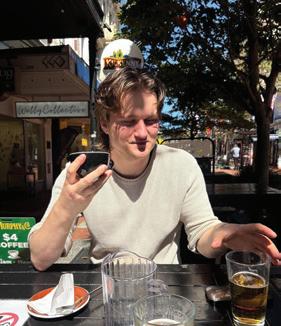
After an hour, I had a rough sheet of 20 supermarkets, tea shops, restaurants, and cafes where I could get a cup of coffee on Cuba. That meant that I should have between 3 to 4 cups a day until Saturday if I want to succeed. However, I’d soon find out that there are well more than 20 coffee spots on Cuba Street.
On the second day, I began my drinking right at the top of Cuba at Martha’s Pantry, the high tea shop. My first flat white of the challenge? Cheap and delicious. Only a million more to go. My next immediate stop was Orange Cafe, which was great not only because the drink was also cheap, but there was a dog named Ringo! I stopped at a couple restaurants whose coffee didn’t quite taste as good and aren’t worth mentioning.
At Nolita, I sat down to get a pizza as well to soak up the coffee. If they were trying to impress me, the long wait was definitely worth it because that flat white was one of the best. At this point, I was five cups in and getting a bit spacy. Even though I thought I was ahead of the curve, five cups would soon feel like light work in comparison.
Turns out, there's weird places you can get a flat white on Cuba Street—such as the “Do It Yourself” machine at Fresh Choice, the bar in Naumi Hotel, and COSMIC vape shop. I also discovered some staples of Cuba Street were closed the week of the challenge. To the many diehards of Fidel’s, Black Lion Bakery, and Stories Espresso—I tried. Sorry. But I’m kind of glad, because my list had jumped in size as I kept finding more and more restaurants to get a coffee. Like, The Flying Burrito Brothers, for some reason?

Three days into coffee chugging and my body started to feel the repercussions. My mind was constantly foggy and spaced out. While I had a lot of great drinks (Hamodava, Midnight Espresso, Samick) and some not-so-great ones (Kaffe Eis, Hei Restaurant, Santeria Pizza), the tastes started to fade into the same. Something I don’t recommend is getting both a pint and a flat white from JJ Murphy & Co. You’ll be tipsy and buzzing at the same time, which my undiagnosed ADHD took as a sign to talk non-stop for 20 minutes.
This was the day I discovered the best coffee on Cuba Street. After getting a great breakfast at The Oatery and having two coffee dates at Zelati & LEVEL UP, I found Miss Fox Hairdressing. They give a free coffee to customers who get their hair done, and they graciously offered me a free flat white to try. I sat myself in front of the mirror with a golden cup and saucer.
It was the best flat white all week. And it came from a place full of leopard print and cerulean wallpaper! Maybe it’s the espresso talking, but I highly recommend getting your hair done there if only to have the most frothy, delicious coffee in the CBD.
This was it; the final day. By now I had knocked off every cafe, teahouse, and sandwich shop, but there were still the big beasts—restaurants that open at 5 p.m. I now have beef with places like El Matador & Liberty Restaurant, because why are you guys only open for four hours? And you serve coffee yet can’t do takeaway?! I had to sit my ass at the bars with a flat white alone in the evening, looking like the most performative bachelor ever. I might as well have pulled out my Sally Rooney novel.
I powered through eight coffees that evening, and the very last place I had on my list was Mother of Coffee, the Ethiopian restaurant notorious for strong joe. I jittered my way inside with two takeaway cups in hand, and the lady behind the counter asked if I was alright. I begged her to make the weakest drink she possibly could.
I finally finished the weekly challenge, basically convulsing at the bus stop with a constant panging in my chest. Yes, I won. But I didn’t get to sleep until well past midnight.
This week I spent a whopping $152.70 on coffee alone. But I also discovered some great gems that made it totally worth it! I visited 29 places, yet every single service worker who took my order had a smile on their face and was beyond lovely. I know hospitality blows and doesn’t pay well, but part of the reason I’ll be coming back to some places is because there were great people to have a yarn with and who thought the challenge was hilarious. However, everyone should go to these places for me to enjoy a coffee on my behalf, as I’m currently on a detox and don’t feel well at all.


69 Informal term for the buttocks.
70 Moulded shapes or groups of performers.
72 Little tern, Tara ___.
73 Wee, to a Scot.
74 Fleur-de-___.
75 ___ Vegas.
78 Semicircular recesses in churches or large buildings.
79 Term in Indian aesthetics meaning “essence” or “emotional flavour.”
81 Regions or sections of space.
83 Provision of attention or assistance.
84 Island in New York City situated in the East River.
87 Italian word for “seven.”
88 The shakes, for short.
89 Ruby and Sandra ____.
90 Record of events or data entries.
91 Showing no sign of fatigue.
93 Plural of “sun,” or starlike bodies.
94 Plural of a word used in a Donald Trump post as a possible typo for the Italian word "bella," meaning "beautiful".
96 ___ Grey tea.
97 Dame Valerie Adams sport.
100 A feminine Japanese given name which can also be used as a surname.
101 Crossbreed dog: cocker spaniel × poodle.
105 Major river flowing through Switzerland.
106 Name of a bright star in the constellation Cygnus.
108 People showing exaggerated toughness; from the movie character.
110 London university specialising in Asia, Africa, and the Middle East.
111 People who are employed, collectively.
113 Act of telling a story.
115 Large quantities.
116 One of twelve in a Scrabble set.
117 German word for “three.”
118 Israeli national airline.
119 Tree-lined walkway.
120 Anatomical line or narrow band of tissue.
121 Granular mineral material from eroded rock.
122 Abbreviation for “secretary.”
123 Typeface styles with thickened strokes.
DOWN
1 Make ___ (do some business).
2 Small burrowing mammals.
3 "___ ease" (uncomfortable).
4 Phrase meaning someone required transport.
5 River in Scotland.
6 Acts of pretending to be someone else.
7 Sound made by a cat.
8 Crushed or pounded into soft form.
9 Reduction in strength, intensity, or signal.
10 Fuss or unnecessary activity.
11 Groups of nine musicians.
12 Surname of the American filmmaking brothers Joel and Ethan.
13 Frequencies at which mistakes occur.
14 Hospital professional who analyses medical samples.
15 Users of the early internet service AOL.
16 Surname of American novelist John Kennedy _____.
17 ___ Park, Colorado.
18 Plural of “yes.”
25 To sell goods, especially by travelling around.
28 "A diller, a dollar, a ___'clock scholar".
30 Blood-sucking annelid worm.

10 Suffix meaning “state orquality.”
14 Friendly or informal in tone.
19 Roman sandal.
20 Edible animal flesh.
21 Hinged or sliding barrier used as an entrance.
22 Not firmly fixed or restrained.
23 Narrow passageway between buildings.
24 One who delays an event or action.
26 Allocated time periods.
27 Heavy, soft metallic element with symbol Pb.
28 North American bird of the sparrow family.
29 Organic compound featuring a carbon–carbon double bond and an –OH group.
31 Variant spelling of “'elei,” a type of Samoan decorative pattern.
32 Large areas of land or property, often with buildings.
34 Finish by 36 To set right or remedy a wrong.
38 Loud or impassioned speech.
33 Weight of an empty container.
35 Extremely long periods of time.
37 Snack bars made primarily from dates.
41 Departments of motor vehicles, in the U.S.
42 Very wide shoe size.
43 Masses of floating vegetation and especially sargassums
44 ___ Juana Ines (Mexico's first poet)
46 "Sophie, ___ and Belle" (1996 musical)
47 To show a relationship or connection.
48 Variant spelling of “oré,” meaning shoreline or riverbank in old French.
49 Medieval tale of adventure.
52 the largest and most diverse group of fish, comprising about 96% of all living fish species.
53 Blare or blast of a trumpet.
54 Motor vehicles with four wheels.
56 Officers of the Indian Administrative Service.
60 Disordered or made incorrect.
62 International Space Station.
39 Informal term for
41 Having a strong wish for something.
45 Polynesian word meaning “presence”, "face", or “front.”
46 Sensitivity in dealing with others.
47 Gear tooth.
50 Surname of several historical military and political figures.
51 Phrase meaning completely or thoroughly bad.
55 Surname associated with an English noble family.
56 Middle words of a famous palindrome.
57 To satisfy fully.
58 Reveals or uncovers.
59 Short form of “segment.”
60 Plural of “ma,” an informal word for mother.
61 Abbreviation for “letter of intent.”
63 Serbian city where Constantine the Great was born
64 Stop on the French Métro?
65 Grieg's "___ Death"
67 Capable of feeling or perception.
66 Plural abbreviation for “saints.”
67 Marine mammals of the pinniped family.
68 Unites or merges into a single whole.
69 Grafton's "___ for Alibi".
70 King or queen.
71 Words before "of money" or "of gold".
72 Some purchases for Christmas displays.
74 Restricted to women.
76 Bachelor of ____.
77 Perceives with the eyes.
80 French word meaning ‘wings'.
82 Medical specialist for ear, nose, and throat.
83 Unaccompanied performance for the cello.
85 Second planet from the Sun.
86 Model name used by Toyota.
87 Prefix meaning “serum.”
92 Speaks rhythmically over beats.
93 Surname of British
essayist Joseph Addison’s collaborator, Richard ______.
94 Unable to produce offspring or vegetation.
95 Figure of speech comparing one thing with another.
97 Semi-arid region south of the Sahara.
98 On of the Caribbean nations on the island of Hispaniola.
99 Name borne by several American judges and politicians
102 Phrase meaning “perform every task.”
103 Loaded or filled with cargo.
104 Plural form of -ess.
107 Swimmer Torres with 12 Olympic medals.
109 Predecessor to British Airways.
112 Large body of salt water.
114 To remove or clear away.
115 Room or facility for scientific work.
cross marks the spot
1 Intense dust storms generated by strong winds from weather fronts or the downdrafts of thunderstorms
Ensnared
"The Bad Child's Book of Beasts"
a stiff bristle such as the
of some grasses and cereals
Wagering letters
by

drawn by horses, used in ancient racing and warfare
37 "Bottle-nosed" creature
39 Midday naps
on Italy's "heel"
21 Fam. tree member
23 New York's ___ Zee Bridge 26 Cowardly Lion portrayer
28 Longtime Disney C.E.O.
29 "That's my absolute limit!"
30 Provokes conflict
31 Exams requiring written answers
33 Abbr. under a dotted line
35 Grafton's "___ for Alibi"
36 Snorkeling site
38 Causes of scrambles on the badminton court
41 Mercedes ____, Argentine singer
45 Luxury boats
47 a glossy fabric resembling velvet, made of silk or rayon and having a flattened pile
48 Penn or Pitt
49 "Jaws" menace
51 Bic Clic ___ (pen brand)
52 Snack in a shell
53 Algeria's Gulf of ___
54 "Death in Venice" author
55 Zeno's birthplace
59 Permit
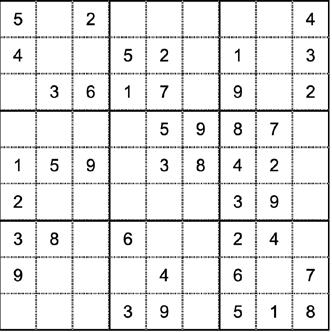
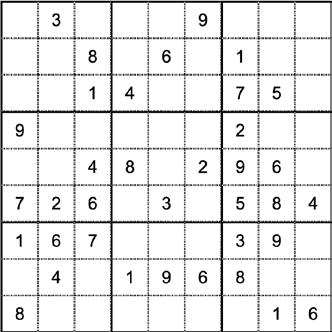
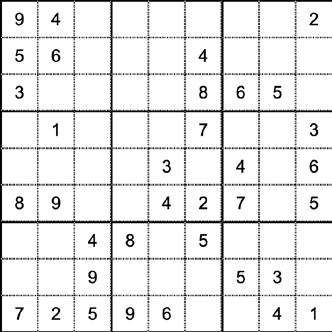
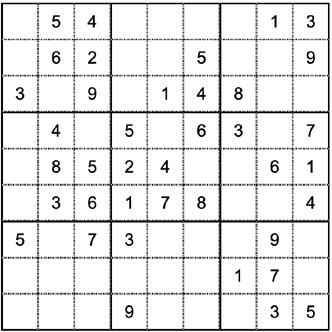
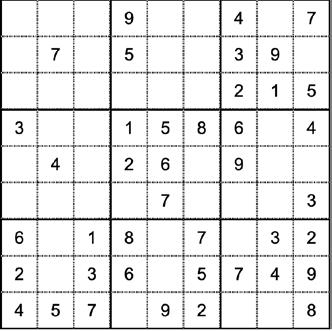
SPORTMANSHIP CHAMPIONSHIP COMPETITION SCOREBOARD TOURNAMENT TEAMSPIRIT ENDURANCE EQUIPMENT SPECTATOR TEAMWORK

MATCHDAY TRAINING PLAYBOOK GOALPOST SIDELINE STRENGTH PRACTICE OVERTIME PLAYOFFS ATHLETE
6325760$16+, 3 &+$03,216+,3 &203(7,7,21 6&25(%2$5' 63(&7$725 7($0:25. 0$7&+'$< 75$,1,1* 3/$<%22. 35$&7,&( 29(57,0( 3/$<2))6
$7+/(7( 5()(5(( .,&.2)) ),71(66 7$&7,&6
REFEREE KICKOFF FITNESS TACTICS UNIFORM VICTORY PENALTY WHISTLE STADIUM FANBASE
81,)250 9,&725< 3(1$/7< :+,67/( 67$',80 )$1%$6( 5,9$/5< '()($7


RIVALRY DEFEAT LEAGUE TROPHY WARMUP HUDDLE COACH SPEED MEDAL
/($*8( 7523+< :$5083 +8''/( &2$&+ 63((' 0('$/
If you have a story, confession, or experience you’d like to share—whether it’s an anonymous crush, workplace drama, or something else entirely—you may submit it using the QR code below.

the ex who dumped me 2 months ago because he was 'not ready for a relationship right now' has just started dating a girl with the same name as me. And the cherry of fucking top of this shitshow is that I know this girl. I did dance with her for like, two years from 10 12 and I swear on my mother's grave this girl took my brand new lululemon waterbottle from the dance cubby things when we were 11. She had been saying how much she liked it, and when I came back it was gone and she had this look on her face. This b*tch is still stealing my shit to this day. If your reading this, f*ck you h*e, get a job and a little bit of morality.

to the
These puzzles are provided to be fun and challenging. The Salient team and our contributors aim for accuracy, but occasional errors may occur. If you notice an error, you may write to editor@salient.org.nz. Please note that our puzzlers and contributors are doing their best, and none are professionals or working on these puzzles full time. For the word find, words may appear diagonally and backwards. To access solutions for the crosswords and connections puzzles, scan the QR code next to Puzzhead.

To solve a Set Square, use arithmetic and logical reasoning. You are given a grid containing six sums: three reading across and three reading down. The arithmetic operations (division, multiplication, addition, and subtraction) are shown between the grid spaces. Place each of the numbers 1 to 9 exactly once into the grid so that all six sums are correct. Note that calculations are carried out in left-to-right order, not according to BEDMAS.
To solve connections, group the sixteen words into four sets of four based on a shared connection. Each word belongs in only one group. Continue until all four groups are identified. On our website, the groupings are uploaded one at a time, so if you get stuck, you can view the answer for a single connection without revealing the full solution.

To solve Word Wheels, form words of four letters or more using the letters in the nine-letter wheel. Every word must include the central letter. Each letter may be used only as many times as it appears in the wheel. The aim is to find as many valid words as possible from the target word list, including the nineletter word that uses all the letters.
H I A T S T I P E



You’re doing too much. Most of it is fake urgency. Ignore some things on purpose this week and go outside. The world won’t end, I promise.

You need a treat. Go buy yourself something you’ve been looking at or enjoy Hunter Lounge’s two for one pizzas this week. Look after yourself.
You’ve been too available lately. It’s embarrassing. Disappear for a bit and let people miss you and think you’re mysterious and sexy.
Do: absence, allure, chandeliers
Don’t: overexposure, staplers, replying



You’re bored and about to make a bad decision. At least make it a fun one.
You’re overthinking something incredibly simple. Make a decision quickly and decisively and don’t over think it. It’ll be the right decision since it’s the one you made. Get over yourself and live with it.




You’re not a machine. Take a break before your body forces you to.

You said yes when you meant to say no and now you’re annoyed about it. That’s on you. Fix it.
Do: marmite, boundaries, honesty
Don’t: pointlessness, resentment, self-help podcasters
Your brain is loud and you’re too overwhelmed. Pick one thing and finish it. Then go flirt with someone for enrichment.
Do: focus, flirting, teapots
Don’t: tabs, elevators, Nuku





Strange travellers from distant constellations have beamed you up to the Mothership to deliver some good news and hard truths. Consider the gravity of their words. Current constellation ARIES
You’ve had a weird idea. Do it. Stop thinking, just commit to the bit.
Do: creation, impulse, play spoons
Don’t: logic, ladders, hesitate
There’s something you’re avoiding. Deal with it before it gets weird (it’s already getting weird).
Do: confrontation, volcano documentaries, clarity, Don’t: mannequins, tension, lurking
You’re one inconvenience away from a breakdown. Preempt it. Cry now, get it out of your system.
Do: tears, privacy, release
Don’t: traffic cones, escalation, snapping




You’re very close to making a sad playlist your personality again. Diversify.
Do: sunlight, variety, Carpenter Don’t: melancholy, reorganize your flat, rot
March 21April 19