ISSUE 23 28 September 2026 Volume 89
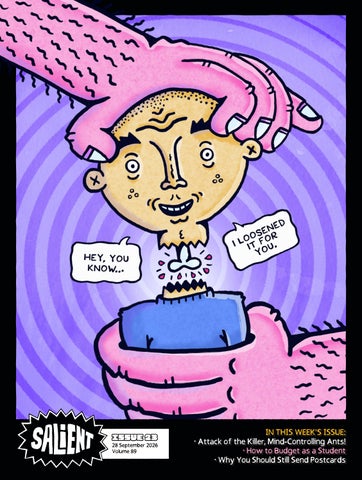
IN THIS WEEK’S ISSUE: . Attack of the Killer, Mind-Controlling Ants! . How to Budget as a Student . Why You Should Still Send Postcards
ISSUE #23 28 September 2026 Volume 89 Editor Phoebe Robertson Designer & Cartoonist Jim Higgs Sub-Editor Holly Rowsell News Writers Dan Moskovitz Martha Schenk Otis Whinney Ali Cook Columnist Guy van Egmond Critic-at-large Jackson McCarthy Comic Artists Grace Elzenheimer Jack Graham Contributing Writers Tamanna Amin Zia Ravenscroft Christopher Curtis Ryan Cleland Social Media Manager Will Tickner Photographer Sophie Spencer Centrefold Artist Alex Shirtcliffe Advertising advertising@vuwsa.org.nz Read Online salient.org.nz issuu.com/salientmagazine Follow Us @salientgram
Want to get published? To contribute to Salient, you can submit poetry, creative writing, artwork, comics, puzzles, features, and other ideas. Feature articles must be pitched to the Editor before writing; send pitches to editor@salient.org.nz. Artwork should be sent to designer@salient.org.nz. Creative writing submissions are accepted through the form on our website. All other contributions, including puzzles and general ideas, should be emailed to the Editor. Submissions are welcome from first-time and returning contributors.
scan here to find out more!
Phoebe Robertson Well team, this is our second-to-last Salient issue for the year, and getting it to print has been quite the nightmare. Jim Higgs, our award-winning designer (award-winning in the Phoebe Robertson Awards for Best Design), woke up on Monday so sick he thought he was going to die. Meanwhile, I (Phoebe Robertson) had my fish tank explode, two goldfish die, the carpet flood, and the downstairs neighbours’ power nearly suffer permanent damage. I no longer expect my landlords to offer me a lease renewal next year. Oh, and I now have industrial fans and dehumidifiers in my living room for the foreseeable future. Patrick Gower also came to Te Herenga Waka and led a political debate where every second word out of Tim Costley’s mouth seemed to be “Kāpiti.” I did wonder why anyone had even turned up when it felt like most of the room had already made up their minds to vote for Tamatha Paul—regardless of what Tamatha Paul herself had to say, or any of the other speakers for that matter. Oh, and our music video, Thank You Salient, has now been out for a week, and Eloise needs just 50 more likes on her comment to receive my mildly worn Lightning McQueen shirt. So, if you’re reading this, help her out and like her comment under the video. The prize will be delivered at the Salient Quiz this Friday, 2 October, at 6.30pm in the Hunter Lounge. We’ve also, as of writing this, still got a couple of team spots left for the quiz. So if you want to come along to the first-ever (as far as we can tell) Salient Quiz, go back to our Instagram then head to the Linktree in our bio and sign up. It will truly be unique. As for this issue, it’s jam-packed. We can finally stop talking about the VUWSA elections, with our new executive now announced. Pedro Hay has another funky animal piece, this time all about ants. Charlie Lehmkuhl teaches us how to budget (I made one as I edited it; highly recommend). Ryan Cleland accosts us with postcards. Medha Sharma has a personal essay about studying at Te Herenga Waka as an international student. And finally, Zara Boon has a love letter to keeping your whimsy and enjoying small, childish things. If you loved, hated, or were on the fence about Salient this year, please flick a letter to editor@salient.org.nz, as this issue is your final opportunity to do so. Good luck studying through that final trek to the end of the year, and I’ll see you next week for my final editorial ever.
About the centrefold artist - Alex Shirtcliffe As a Pōneke based photographer specialising in live concert, music & press photography, I focus on capturing more than just the artist on stage. I aim to represent each band authentically while bringing my own creativity and perspective to every image. As a Queer woman working in a traditionally male dominated industry, I bring a different perspective, capturing the energy, emotion, and atmosphere of a night from both the stage and the crowd. Ultimately, I’m here to capture what the night feels like, not just what it looked like. Go to the centrefold on page 20, rip it out and put it on your wall!
02
Editorial
03
Letters
04
Gig Guide
05
News
12
Strictly 4 The Islands
14
What Do Baby Snatching, BrainWashing & Violent Girlbossing All Have in Common?
16
Belonging, Nowhere and Everywhere
18
Are Students Really Poor?
20
Centrefold
22
Creative Writing
24
Comic Corner
Correction: Ox Matiu’s iwi affiliation was omitted from their piece, “Kia huritao mai - Ka paeārau i te ata tū” (Consider This—The Ship Crashes at Dawn), published in Issue 21. Ox is Ngāpuhi. Salient regrets this error and formally apologises to Ox for the oversight.
Sweet Axe Throwing Co is hiring!
26
Arts + Culture
30
We’re looking for casual bar, wait and axe-throwing staff, as well as a Duty Manager. Bartending experience is required for the Duty Manager role. For all other positions, if you’ve got the right attitude, we can train you on the job.
Ngā Hua te Taiao
Interested? Email your CV to hello@whiskyandwood.co.nz for more information—and tell them Salient sent you.
31
Critic-at-Large
32
Ciph's Cabinet
33
Oh Yes! Oh No!
34
Puzzles
38
Horoscopes
Last week to submit to the Letters page by emailing editor@salient.org.nz Best letter will win a FREE PIZZA from the Hunter Lounge!
Salient is published by, but remains editorially independent from, the Victoria University of Wellington Students Association (VUWSA). Salient is funded in part by VUWSA through the Student Services Levy. Salient is a member of the Aotearoa Student Press Association (ASPA) and the New Zealand Media Council. Complaints regarding the material published in Salient should first be brought to the VUWSA CEO in writing (ceo@vuwsa.org.nz). If not satisfied by the response, complaints should be directed to the Media Council (info@mediacouncil.org.nz).
Week of Sept 28 - Oct 4, 2026
This week features the artists who performed at the Jams for Julie Anne Genter fundraiser:
Mon 28/9 DAW De-Mystification - Audio and technology learn and share workshop for women and gender minorities
Emily Alice are an emerging New Zealand band based in Pōneke. Influenced by neo-soul and jazz-pop, they present a polished live show of deep pockets and soulful moments. Emily Alice has shared the stage with notable artists such as BROODS, Six60, Coterie, The Grogans, LADI6, and Muroki.
Wed 30/9 Dancing Apes: Humans must dance - Featuring Jandal, Luca Sol, and Hooly - 8pm @ Moon Wed 30/9 Eyegum Free Wednesday Featuring No Such Comfort, Salt, and Kvokil
Winners of the NZ Folk Alliance “Best Original Album” 2025 for Broken River, The Wooden Box Band blends rich harmonies, acoustic warmth, and electric flair. It’s heartfelt NZ storytelling, layered vocals, and dynamic live performance steeped in craft and connection.
Thurs 1/10 Serenna With Tragedies and Diplopoda 8pm @ Moon
Bella Cook, best known under the moniker Belladonna, has already earned critical praise for her first two EPs and in 2020 landed a Top 20 spot in the APRA Silver Scrolls for her single “Hands.” Belladonna has seen herself as a support act with some of New Zealand’s biggest indie exports.
Thurs 1/10 Awkwatch X Doggabarka With Laluna 7.30pm @ Valhalla Thurs 1/10 The Lineup - Featuring Dropper, Lipstick, and The Muscle 7pm @ Meow Saturday 3/10 Meow’s 18th Birthday Featuring Rhombus Sound System, Dj Martyn Pepperell, Wallace, Louis TM, and special guests - 8pm @ Meow Saturday 3/10 Adoneye, Dogmatic and Murky Depths - Grunge, Indie, Rock 7.30pm @ Miramar Tennis Club
Gig guide and photography by Sophie Spencer
4
Bri Louise’s velvet vocals, evocative lyrics, rich keys, deep basslines, vibrant guitar, fruity woodwinds, and warm, wandering grooves blend through jazz, R&B, and all sorts of soul. It comes together to create a harmonious rainbow of original sound.
Gig Guide
Charlotte Lawrence Elected VUWSA President for 2027 Phoebe Robertson Charlotte Lawrence has been elected VUWSA President for 2027, beating Ethan Rogacion and Skyla Ashford with a landslide 59.18 percent of the vote. The results were announced on Thursday 24 September at the VUWSA Annual General Meeting, following three and a half days of voting across Te Herenga Waka. During the campaign, Lawrence centred her pitch on helping students thrive, promising to make life cheaper for students, build student political power and create a greater sense of community at Te Herenga Waka. The President will be joined by Aría Lal, elected Academic Vice President; and Pyper Adams, elected Welfare Vice President. Elsewhere on the Executive, Cam Dickson was elected Treasurer-Secretary, Leonora Vejlebo was elected Campaigns Officer, Emily Robinson was elected Clubs & Activities Officer and Katie Townsend was elected Equity Officer. For the roles of Engagement Vice President, Sustainability Officer, Education Officer and Postgraduate Officer the result was more complicated. Sophie Guerin won the election for both Engagement Vice President and Sustainability Officer roles whereas Afra Ibnat was elected for both Education Officer and Postgraduate Officer.
As per the VUWSA Executive Election Policy, executive members may only hold one role. Therefore, Guerin and Ibnat both chose the role they wished to occupy and the second-highest polling candidate for the other position was considered elected to that position. For the final result, Sophie Guerin was formally appointed as Engagement Vice President, Afra Ibnat was elected as Postgraduate Officer. Which meant that second-highest polling candidates Frankie “the Lorax” Hutchance and James Noordermeer were appointed to the roles of Sustainability Officer and Education Officer respectively. A total of 2,291 students voted in this year’s election, equivalent to around 11 percent of the University’s student population. That is up from the 2,065 students who voted last year. The incoming Executive will take office on 1 January and serve through 2027. Its members will inherit ongoing debates over whether VUWSA is underfunded, whether control of clubs belongs with VUWSA or the University, and how to run a reception that’s actually open when students want to visit it.
Was Student Health Actually Going to Start Charging Students? Phoebe Robertson VUWSA 2027 President Charlotte Lawrence says she “will ensure VUW doesn’t start charging for Mauri Ora.” But was the University actually considering it?
A University spokesperson said initial consultation results showed students were split 50:50 on introducing a co-payment. Counselling was never proposed to attract a charge.
When asked what that concern was based on, Lawrence pointed to conversations between the University and students over the 2027 Student Services Fee. Lawrence was involved in part of that consultation in her 2026 role as VUWSA Engagement Vice President.
The University said the option had been considered as it looked to make Student Health financially sustainable while continuing to meet student demand.
Her concern had a basis. The University confirmed to Salient that students were asked whether they would support making a co-payment for GP and nurse appointments at Student Health.
So, Lawrence’s promise responds to a real option considered during consultation, rather than an announced policy. But, as of now, the University says it has since dropped the proposal.
However, the University says the proposal is no longer being explored. Kawepūrongo | News
5
Dan Moskovitz
election interviews
In the run-up to the 2026 election, Salient is interviewing all of the major parties to understand their responses to the issues students face. Here, Tamatha Paul, former VUWSA president and Wellington Central electorate MP, pitches the Greens.
Why Should You Vote Green? What is the biggest challenge facing students in New Zealand in 2026? Cost of living, hands down. But equally, there’s just the lack of hope for the future. The lack of job security, internships, and opportunities, especially here in Wellington. They’re related, but different.
So what are the Greens proposing to support students? I think probably the biggest ones in terms of cost of living are our policies for renters, our policies around public transport, and in terms of tertiary education, we have policies around free tertiary education and paid placements at a living wage. We have a government which goes on about how affordable it is to be a renter. But, rents are already way too expensive, even if they aren’t growing. So rent controls are needed. Rental warrant of fitness is another big one I’ve been pushing, because students having crappy flats is way too normalised and way too accepted as a rite of passage. So I think those would be the two primary policies we have for students. While for public transport, we support free public transport for tertiary students—always have—and while I was on VUWSA, we got the 25 percent tertiary discount for students in Wellington. We had nothing before.
Students are currently the only beneficiary group not eligible for the winter energy payment. Is this something the Greens would change? Yes. We have a member's bill in the ballot right now to make this happen, and we’re the only party campaigning on it. In 2023, a two-zone trip on Metlink cost a tertiary student $1.13 at peak time. Currently it costs $2.63, an increase of 132 percent. 50 percent of students get to Vic by public transport; how will the Greens reduce this financial burden? We know if we change the government we will be definitely getting a $20 fare cap on public transport, because it’s not only our bottom line but also what Labour have committed to. Still, we want to go further, and we’re committed to advocating for free public transport for tertiary students.
Between 2014 and 2024, the amount course fees could rise each year was between 2 and 2.8 percent. In 2025 and 2026, course fees were allowed to rise by 6 percent. If elected, what would your policy on course fees be?
6
News | Kawepūrongo
As a person who used to allocate some of those fees, that’s such a nerdy and important question! 6 percent is ridiculous; wages don’t keep up with that. Ultimately, we don’t have a policy this specific. But I think if the government invests more in universities, then the onus of covering said growth won’t fall on students and student fees. Ideally, education would be free. We won’t achieve that in government straight away but it’s our underlying philosophy.
So are you wanting to bring fees-free back? Yes. We’ve committed to bringing back at least a year’s worth of fees-free, and we’re the only party in parliament who has done so. But we want to keep building towards fully free education, which was the intention when Jacinda announced the policy back in 2017. Still, there are lots of spaces when it comes to tertiary education and fees and allowances and loans which are really important. One big one which we’ve been advocating for a long time is a postgraduate student allowance. They get nothing. Which is bullshit. They’re acquiring the skillset and experience to serve our community collectively, and we need highly skilled people in this country.
Most parties which I have talked to have been reticent to commit to many of these things we’ve just talked about because of the cost. So where does the money for these things come from? Our wealth tax, which taxes wealth above $10 million. Though we’re campaigning on a whole range of different changes to income tax and the like. For example, we want the first $10,000 you earn to be tax-free, which will put more money in the pockets of students, alongside the universal student income which we want.
Wellington’s unemployment rate is at 6.3 percent, but for those aged between 15 and 24 it is 8.4 percent. There are ten thousand fewer jobs in Wellington than there were last election, and the government is looking to remove 8700 public sector jobs, which would disproportionately affect Wellington. Right now, what incentive is there for a graduate to stay in Wellington? Right now I don’t blame anyone for leaving. But as the local MP, I want to turn it around. We need to, for so many reasons, and we do so by creating opportunities. One way is through investment and infrastructure projects. The construction industry has been one of the hardest hit in terms of job losses. We also need to change the government so we can prevent another 10,000 jobs from being cut from the public sector. And we need to restore some of the graduate
roles and internships which have been lost thanks to this widespread cutting across the public sector. But speaking as the Wellington Central MP, not as a Green MP, we need to stimulate Wellington to bring economic activity here. We can do so by making sure there are lots of gigs, festivals, sport games here, and that they all have good venues. One thing I did this term as Wellington Central MP was to open our medium-sized venue, Meow Nui, which has brought a lot of big acts which couldn’t play here previously. So there’s lots of stuff, and always having stuff going on in the city means restaurants, bars, and cafes which students work at will always be busy. People need to stay here. We’ll never get mass rapid transit or light rail if people keep leaving. Christchurch is going to get it before us because their population is growing and ours isn’t. I want people to stay here, to have careers here, to have families here.
Access to mental health addiction services for young people has declined-there are 5000 fewer people
receiving care than five years ago. How would the Green Party address the gap between demand for mental health care and the services available? I think this really relates to our paid placements policy because we need to be training the workforce who will work in the mental health space. We need more nurses, psychologists, and counsellors, being trained up and staying here, and that’s where our policy on ensuring paid placements comes in.
Thank you so much, Tam. No worries. Read all of our Why Should You Vote? articles at salient.org.nz
NEXT WEEK: Why should you vote Opportunity?
Bye Bye Pizza Oven Boulcott Martha Schenk Boulcott Hall has welcomed thousands of students through its doors since opening in 2013, but the University will stop operating it as student accommodation from the beginning of 2027.
In an email to current residents, Head of Hall Matt Mason assured said the decision would not affect them, and Boulcott would continue operating as normal for the remainder of the 2026 academic year.
A University spokesperson said the decision “reflects changing student preferences, with growing demand for more flexible, self-contained living options, and a reduced need for traditional ‘dorm-style’ accommodation.”
“We recognise this is a period of change and uncertainty, and we ask you to be respectful and supportive of our hall community over the coming months,” he wrote.
However, of the 142 responses to a Salient Instagram poll, 94 percent of students who stayed in a hall in their first year said that they lived in dorm-style accommodation, while just 6 percent lived in studios. That sample represents only a small fraction of the more than 2000 students living in University halls, so the poll offers an anecdotal snapshot of Salient readers rather than a representative picture of student preferences. The University said it has expanded its independent-living portfolio by more than 450 beds in recent years, including through the 222 Willis Apartments, Whānau Mārama Apartments, and the refurbished Waiteata Apartments.
“Boulcott Hall has played an important role in the lives of many students and staff, fostering a strong sense of community, and lasting relationships over the years.” Students responding to a call-out on Salient’s Instagram story had similarly fond—and occasionally less fond—memories. “Meeting all my lovely friends there last year #shoutoutfloor8,” said one. Another remembered “late night talks in the common room.” Several cited the kindness of staff, while others simply said “leaving.” “In all the hallways and common areas there are no windows, it is inhospitable. It feels like some sort of forced confinement,” said a student speaking anonymously to Salient.
“These investments ensure students continue to have access to a diverse range of accommodation options, styles, and price points that better meet their evolving needs,” the spokesperson said.
Some memories were novel. One student recalled: “Someone threw a plate at someone from a window storeys up.” Another offered: “my friend punched a sani dispenser off the wall and subsequently broke his hand.”
Permanent Boulcott staff will be supported through the transition, with the University providing opportunities for redeployment into equivalent roles elsewhere in its accommodation network.
A non-resident fondly recalled “being sent back to my own hall in shame at like 2am.” Article continues on next page.
Kawepūrongo | News
7
Most perplexing of all, a student nominated “how their dining hall looks like an Antarctic zoo enclosure to placate the beasts.” The University is considering ways to acknowledge and celebrate Boulcott Hall’s legacy and contribution over the past 14 years. And for anyone hoping to take home a piece of Boulcott history, there is bad news: when Salient asked what would become of the hall’s pizza oven, the University said it belongs to the caterers. It is, regrettably, off the market. Pictured: Pizza from the Boulcot Street Pizza Oven, dated 2024. Wondering why it looks like that? We were too. Turns out it’s actually Dairy Free Pizza from the Boulcot Street Pizza Oven. Thanks to @—haileeyyyi for providing it. At Salient, we sincerely hope your dairy free pizza options have gotten better after leaving the hall!
Vic Said the Cuts Were a One-Off. So Where Are the Academics? Finleigh Frost In 2023, Te Herenga Waka—Victoria University of Wellington cut staff to fix a forecast $33 million deficit. The cuts were presented as a one-off. Vice-Chancellor Nic Smith wrote in that year's annual report that the University had "completed the programme of work" and would "return to normal business in 2024." Three years on, the University still says the same thing. In a statement provided on behalf of Chief People Officer Kate Tibbitts, Te Herenga Waka said: "The lower academic staffing level was not intended to be an ongoing position. It was intended to be a one-off adjustment." So why hasn't staffing gone back up? The University offers part of an answer. It says the fall from 2023 into 2024 reflected a "delayed impact" from the restructure, because some staff affected by the 2023 process did not actually leave until 2024. That explains one year. It does not explain why the workforce is still below where the University says it wants it. Te Herenga Waka told me it currently has academic vacancies which "may be influencing these numbers." The cuts explain the initial fall. They do not, by themselves, explain why the combined academic workforce was still 62 FTE (Full-Time Equivalent) below its 2023 level two years later. One factor worth looking at sits in Te Herenga Waka’s own collective agreement. Te Herenga Waka publishes lower academic salary minima than the universities it competes with, while Wellington costs more to live in than most of their cities. That does not prove pay is why the workforce has not recovered. But it is the offer Te Herenga Waka is making while it tries to recruit, and the numbers students can see have barely moved: the University still has a smaller academic workforce than in 2023, vacancies are still being advertised, and there are more students per academic.
8
The gap widens as you go up. A professor's minimum at Te Herenga Waka is $161,980, against $190,294 at the University of Auckland, a difference of more than $28,000. These are published minimum rates in each university's collective agreement, so the comparison is between the published floors at each institution. It does not mean every Te Herenga Waka academic earns less than every academic elsewhere. Te Herenga Waka says care should be taken when comparing collective agreements, because its published scales are minimum rates and "the true pay rate may be higher." It also says it is limited in what it can say while bargaining is under way, and that it has recently changed how academics are promoted within faculties to create more opportunities for salary progression. Those are fair points. But the floor is the floor, and Te Herenga Waka’s is the lowest of the three. It is not just those three. The University Academics' Union, a new union set up by academics including two at Te Herenga Waka, compared salary scales across seven New Zealand universities earlier this year. I interviewed two of the people behind it. Professor Nicole Moreham, a media law specialist in Te Herenga Waka's Faculty of Law, told me the result surprised the people who produced it. "We thought that there was a problem in patches, but we didn't realise that we were going to come out seventh out of seven for everything but the most junior employees," said Moreham.
What Te Herenga Waka Pays
Professor Wayne Patrick, of Te Herenga Waka's School of Biological Sciences, said the comparison was deliberately conservative. Otago runs a separate, higher salary scale for medical and dental staff, which the union left out of its comparison.
A lecturer starting at Te Herenga Waka earns a minimum of $91,738. At the University of Auckland, the minimum for the same rank is $99,788. At the University of Otago, it is $97,377.
"We just chose to ignore it in order to try and compare like with like. Were you to add on all of the medically qualified academics at Otago, Otago would go up again,” said Patrick.
News | Kawepūrongo
Now put those salaries next to the rent. The union's analysis also compared living costs across the university cities, and Wellington sits above Dunedin, Hamilton, Palmerston North, and Christchurch. "It's an acknowledged concern that Wellington is an expensive place to live, and that we pay less than a place like Otago, which is much cheaper to live in and pays its academics more," said Moreham. Lower pay, higher costs. That is the offer.
What The Money Actually Did I asked Te Herenga Waka under the Official Information Act for separate academic and professional payroll figures from 2022 to 2024. Canterbury publishes this split in its annual report every year. Te Herenga Waka does not appear to publish the equivalent breakdown at all. The response showed academic payroll fell from $139.1 million in 2022 to $134.9 million in 2024. That is a drop of $4.2 million, about three percent, in nominal dollars, during two years when inflation was high. Professional staff payroll went the other way, from $125.1 million to $126.4 million. This is not an argument that Te Herenga Waka is drowning in administrators. It isn't, and most staff paid over $150,000 at Te Herenga Waka are academics, not professional staff. The point is narrower and harder to dodge: when the University tightened, the academic side carried more of it.
Fewer of Them, More of Us Te Herenga Waka's own figures show its combined academic workforce falling from 1084 full-time-equivalent staff in 2023 to 1022 in 2025. It went up by four FTE in the last year, which may be the start of a rebuild. It is still 62 FTE below where it was in 2023. Student numbers went the other way. Te Herenga Waka's statistics show total EFTS rising from 15,728 in 2023 to 16,332 in 2025. Put those figures together and there were roughly ten percent more students per academic in 2025 than in 2023. Te Herenga Waka told me in July that academic vacancies “may be influencing” its staffing numbers. But the vacancies currently being advertised are small compared with the gap. Wayne Patrick told me that, when he checked in September, Te Herenga Waka was advertising six academic positions, three of them researchonly. Filling the three advertised Lecturer or Senior Lecturer positions would barely move a combined academic workforce still 62 FTE below its 2023 level. Patrick described that level of recruitment as normal staff turnover, rather than recruitment on a scale that could close the wider staffing gap.
Why This Lands on Students None of this is a criticism of the people who teach here. It is not a claim about the quality of individual academics. It is a claim about capacity. When academic positions sit vacant, the work does not disappear. It gets delayed, redistributed, or left undone. Students feel that in the things they actually interact with: how long feedback takes, how large tutorials are, whether a supervisor has time, or whether the person teaching the course you want is still here next year. The University has acknowledged some of this itself. In the 2023 annual report, Chancellor John Allen thanked the staff who remained after the cuts, many of whom he said were "carrying heavy workloads to ensure student success."
Moreham put the link plainly: the conditions academics work in are the conditions students learn in. She gave one everyday example of how it shows up. "Trying to get feedback to you on your assignment in a timely fashion, whilst also juggling a million other things, that's something that manifests for the students," said Moreham.
Try Checking Any of This Yourself Here is the part that should bother students most, because it is about whether we can hold the University to account at all. While I was reporting this, the numbers moved. On 12 July, Te Herenga Waka's public staff-statistics page listed 732 academic teaching-and-research FTE for 2025. On 16 July, three days after I sent questions, the same page listed 796. Te Herenga Waka later explained that the original figure had been calculated on a different basis, and the update aligned the page with the method used in its annual reports and in data supplied to the Tertiary Education Commission. That explanation is reasonable, and this article uses the University's preferred figures. But as of 17 September, the page still does not add up on its own terms. The staff-by-role categories total 2237 FTE. The staff-total table on the same page says 2173. The academic gender categories total 959, against a combined academic figure of 1022. On 24 July, Te Herenga Waka told me its data team had confirmed that further work to align the page with its annual report and TEC methodology was underway. Nearly two months later, the tables still do not match. Compare that to Canterbury, which simply prints academic and general salaries as separate lines in its annual report. To get the equivalent payroll split out of Te Herenga Waka, I had to file an Official Information Act request and wait three weeks. To work out how many academics it employs, I had to compare a webpage with an annual report and then ask the University which one was right. Students should not have to do that to find out what their fees are paying for.
Where This Goes To be fair to Te Herenga Waka, the financial pressure in 2023 was real. Enrolments had dropped, government funding had not kept up with inflation. The University's financial position has since improved: Te Herenga Waka reported a $9.458 million surplus on $582.112 million of operating revenue in 2025, though it still describes its margins as thin. The pressure was real, even if what it chose to do about it is open to debate. That is exactly why the accounting matters. If you are going to ask staff to accept a lower published pay floor than the universities competing for the same academics, and ask students to accept a smaller teaching workforce, the least you can do is publish figures that add up. This is live right now. The Tertiary Education Union initiated bargaining at Te Herenga Waka earlier this year, and the University Academics' Union has since done the same for its members, so academic pay at this university is being negotiated as you read this. It is also the VUWSA election season. Academic staffing, workloads and what students get for their fees are squarely student-representation issues. How many people Te Herenga Waka employs to teach us is not just a staff issue. Students do not need Te Herenga Waka to be perfect. We need it to be checkable. On what this university spends on the people who teach us, it still isn't.
Kawepūrongo | News
9
Rage Against The (Vending) Machine Christopher Simpson
[OPINION]
This article is about a vending machine. While I love a nice V as much as the next student, there is one machine in particular that I do not like. In fact, I hate it. Ahab has Moby dick, Sherlock has Moriarty, and I have the refrigerated vending machine on floor six of the Kelburn Library. Let's unpack this together, shall we? Kia ora. Like many students at Te Herenga Waka, I would like to get a degree. And to get that degree, I am likely going to need to study… a lot. I have always enjoyed studying in the library, where I can get away from the noise. I have also always respected the bluezone/green-zone rules to the best of my ability. For those of you who need a reminder, in a blue zone you can expect “ a quiet place for individual study, others to respect your need for quiet, and library staff responsiveness to noise concerns.” Lots of emphasis on quiet, right? Well, if you ever happen to visit floor six of the Kelburn Library—which is a blue zone—you will notice a nearconstant droning sound, a bit like a steroid-fueled bumblebee flying around your head. The culprit is a refrigerated vending machine placed smack-bang in the centre of the floor, right next to a dedicated quiet booth. Now, this is not a piece about health or anything. I’m probably cracking open a nice cold Monster Mango Loco right now as you read this (unless I've been taken out by Big Vending). What this piece is about, dear reader, is not that students are expected to be able to take in massive amounts of information, read dozens—if not hundreds—of pages a week, and complete back-to-back assignments. It's a big ask, but we accepted this when we signed up. The problem is that we are starved of quiet spaces in which to complete this monumental task. Wellington is not a quiet city. She is bustling and loud, and we love her for it. But when quiet is what you need, you may soon realise that it is about as rare as a homophobe in Ivy Bar. The Kelburn Library is not just desks and a nice view. It’s a quiet space to work through the mountains of materials standing between you and the special piece of paper we are all so desperate to get. Floor six, in particular, is not just another workspace. It’s meant to be a haven of peace and quiet—something that, for some students, is more valuable than Rockstar, Monster, or even Blue V. Most first-years live in halls, where they already have to put up with the sounds of their neighbours above, below, and to either side getting up to activities that belong in the ‘oh no, oh yes’ section. When they make their way up to university in search of a bit of peace and quiet on floor six, that peace is instead interrupted by the droning hum of our vendingmachine overlord.
10 News | Kawepūrongo
As of the last time someone bothered to check—May of 2023, in case you were wondering—there were 33 vending machines at Kelburn campus. That number is probably higher now. Apparently, however, 33 was not enough. And the place another vending machine was needed most just happened to be one of the quietest places on campus. I am not suggesting this decision was made out of some malicious intent. I’m not a conspiracy theorist who can tell you the melting point of steel beams and the burning temperature of jet fuel. More likely, the machine's placement reflects a lack of planning, consultation, or student involvement. And it remains where it is because no one has made enough noise—figuratively, please—about it to the people responsible: Victoria University of Wellington’s Facilities Management team. Well, to bring that aforementioned attention forward, a proactive opinionist would be required… Enter stage from left: me. Crowd cheers. Roses are thrown. No, I’m kidding. I guess once you spend a few months as a politics student, it goes to your head. But what I am not kidding about is the lack of genuinely quiet spaces for students who need them. Sit in the Hub, there are even more vending machines making even more of a ruckus—but that’s fine. Students do not need a silent university. This isn't A Quiet Place (2018). There is, however, a world of difference between a space that's meant to be quiet and one that actually is quiet. Wellington has beautiful views, the noise of gigs spilling into the streets and flats above them, incredible tastes and smells coming from seemingly every restaurant (peep the three Michelin stars we just got). But quiet is a gift that many Te Herenga Waka students have a hard time finding. So do we reallyyyyy need a vending machine on a supposedly quiet floor of the library? Maybe we do. Maybe V and chips are more important than a quiet place where students can focus. Then again… maybe not.
Consider This Your Sign... to Enrol to Vote Charlotte Siriman
[OPINION]
The 2026 election is coming, whether you’re ready for it or not. Candidates are hitting the campaign trail, and your feeds are about to get a whole lot more political. But before you can have your say, there’s one slightly less exciting piece of admin to sort out: making sure you’re actually enrolled to vote. That’s where we come in. Generation Vote is a non-partisan, volunteer-run organisation delivering civics education across Aotearoa. We don’t tell you who to vote for; we care that young people have the information they need to participate. Decisions made in Parliament affect our education, rent, wages, public transport, healthcare and climate. You don’t need to be a political expert—you just need to get informed, get enrolled and vote.
What Students Need to Know: So, I get two votes? Under MMP, you get two votes. Your electorate vote is for the person you want to represent your local electorate. In 2026, there are 71 electorate seats across Aotearoa, with one MP elected from each. Your party vote is for the party you want represented in Parliament and largely determines each party’s overall share of seats. After electorate MPs are counted, remaining seats are filled by candidates from the party list to make Parliament broadly proportional to the party vote. And no, your two votes don't have to be for the same party.
But I don’t know who to vote for? Do I even like any of the options? Our website (shown below) has resources, including a map of the general electorates and explainers on how voting works. Party websites are also a great place for exploring their policies and positions in more depth. Independent election-information platforms can help you compare what parties and candidates are proposing. Realistically, it can be hard to find a party that aligns with your views 100 percent of the time—and that’s okay! Do some research, think about the issues that matter most to you, and decide which option best reflects your own priorities. You don’t have to agree with everything a party says to make an informed choice.
When does voting actually start? Aotearoa has nearly two weeks of advance voting, giving you plenty of time to make it to the polls. Advanced voting opens on 26 October and closes at 7pm on election day, 7 November. In the lead-up, chat with your mates, spread the word and make a plan to vote. You could head to the polls together or host an election-night watch party and watch the results roll in. For more information about the election, head to generationvote.nz and follow us on social media. You’ll find links to enrol to vote, information about the election and plenty more resources to help you feel prepared.
Are my details correct? Most importantly: are you enrolled to vote? The biggest change this year is that you must be registered to vote by midnight on 25 October—aka week two of the assessment period. Please don’t treat this like a final assignment. Do it now so you don’t forget. Already enrolled? Amazing. Now double-check that your information is up to date. This is especially important for students who may have moved cities, halls, or flats since they last enrolled. If you’re studying away from your family home, you can choose to remain enrolled there or enrol at the address where you’re currently living. Have a think about where you consider home and which electorate you want to have your say in, then make sure your enrolment details reflect that.
Pictured: Quinn, Tamsin, John, Matthew
If your details are sorted by 4 October, you’ll receive an EasyVote card from the Electoral Commission. You don’t need an EasyVote card to vote, but bringing it with you makes the process faster and easier.
Kawepūrongo | News
11
4 STRICTLY
THE ISLANDS Weekly Pacific Politics with Otis Whinney The Panguna Dillema The newest country in the world could be dropping very soon, thanks to some major progress in the independence process for the island of Bougainville. The island nation waged a war of secession against Papua New Guinea after the sabotage of a massive copper mine on the island led to a harsh response from the PNG Defence Force. The mine in question is the Panguna mine, which was a huge money maker for PNG and one they were not keen to see lost to the soonto-be independent people of Bougainville. In a somewhat ironic turn of events, the Autonomous Bougainville Government (ABG) has committed to the reopening of the mine as a means to generate the necessary revenue for independence. For many, the reopening of the mine signals the early steps into nationhood for the country as they build a financial base for their country, but for some this act betrays the very thing Bougainville was built on. The mine was incredibly disruptive for a number of reasons, including massive land acquisitions that were not fairly compensated for their original owners, leading to the outbreak of war in the late 80s that lasted until the late 90s. While many are keen to leave that in the past, it seems some have made it clear that not all of Bougainville wants Panguna back up and running. On 13 September, it is reported that several armed men entered the Panguna site and set fire to several pieces of large machinery. The President of the ABG, Ishmael Toroama, quickly condemned the attacks, stating that those who carried out the attacks “do not have the best interests of our government or our people at heart. This type of behaviour has no place in Bougainville and will not be tolerated.” Guava Chief Linus Miri, whose brother Francis Ona founded the Bougainville Revolutionary Army in the heat of the war, also publicly condemned the attacks alongside other relevant chiefs and landowners around Panguna; “My heartfelt apologies to Lloyds, you have invested so much, and our own people have done this.
12 News | Kawepūrongo
Shame on us. As a chief, I must defend my land, but what has happened has caused me great pain. Today I step down and give my full support to the government. No more games, let us move on and make things happen for Bougainville.” Lloyds Metals & Energies Limited was the company chosen by Toroama to lead the reopening of the mine. This choice has played a large part in the skepticism both in Bougainville and abroad concerning Panguna, with a report from the Organized Crime and Corruption Reporting Project (OCCRP) casting doubt on the decision making process. The OCCRP report claims Toroama bypassed the standard decision making process and selected Lloyds after a series of conversations with the managing director, Balasubramanian Prabhakaran. Prabhakaran is stated to have offered to have Toroama’s wife undergo an emergency kidney transplant in India at no cost, and after this offer was accepted Lloyds was chosen. This was despite pushback from Bougainville Copper Limited (BCL), who advised Toroama that Lloyds was far less experienced in the field than other large firms who had shown interests, namely the Chinese entity CMOC. Fears of the return of violence in Bougainville have dominated discussions around the reopening of Panguna, but Bougainville’s path to independence is reliant on reaching a level of economic self-sufficiency that would be hard to reach via other means. PNG’s Minister for International Trade and Investment, Richard Maru, made it clear that he “repeatedly advised the management of Lloyds Metals & Energy against investing in Panguna, knowing it was highly volatile due to numerous factions and the environment was not conducive for investment.” He also stated that many of the land disputes that ignited the conflict decades ago were never properly addressed, which contributed to the risk in investment. If we are to believe the OCCRP report, then Toroama’s alleged bypassing of the decision-making process may have complicated this already controversial investment ten-fold, leading to even more uncertainty on Bougainville’s future.
There’s another project in our region that is sparking conversation around how the Pacific exercises its sovereignty. The Cook Islands is receiving NZD $101 million from the governments of New Zealand and the United States to fund a major upgrade for a port on the island of Tongavera. The US Ambassador to the Cook Islands (and billionaire republican mega-donor) Jared Novelly spoke to RNZ Pacific regarding this development, which the US will provide the majority of the funding for, stating that the project is “not a military base.” He is, however, keen to leave that door open for further developments in that area should there be enough appetite amongst the relevant authorities in the Cook Islands. Our good mate Winston Peters described the deal as a “hugely significant development,” while Cook Island’s Prime Minister Mark Brown called it a “lifeline for Tongavera,” but some are raising concerns about the real intentions behind the USA and NZ’s decision to fund the project. Novelly has repeatedly denied that the port will become a US military base, but has made it clear that having a friendly port in the area would be very beneficial for those combatting illegal fishing and the illicit drug trade in the region; “The Pacific is so vast and to be able to police it from bad actors requires certain assets, and those assets need to be able to resupply, and that's something that a port can do in a way that maybe it's lacking right now.” The Cook Islands has also been in talks with the USA on opening up their seabed for mineral extraction, a top-priority for the Trump administration in their ongoing resource-dominance-competition with China. Novelly, who is also the US ambassador for New Zealand, pledged in March that he will “work tirelessly to advance President Trump and Senator [Marco] Rubio’s foreign policies,” and as the USA continues a military build up in their Pacific territories, the work people like Novelly and US Deputy Secretary of State Christopher Landau are doing will be unable to escape this wider context.
can very easily become dual-use if further foreign investment becomes necessary; “In theory, you want to keep them separate. But in reality, they often get merged because the countries need the money for the development and they’ll often turn a blind eye to its other purpose.” Gillespie sees this as an extension of the never-ending contest for dominance in the Pacific, with the USA and China being the primary combatants in the present day. China had also shown interest in developing the port in the past, and during the last Pacific Islands Forum stated they fully supported the exploration of the Cook Islands seabed for critical minerals. If Novelly and the like are as committed to Trump’s foreign policy vision as they claim to be, further Chinese investment in this area is the last thing they would like to see happen. Gillespie went on to say that “the goal, as I've always argued, is that we should be trying to demilitarize and make the Pacific neutral. It's in no one's benefit that it ends up being pieces on a chessboard.” How this port will end up contributing to the Cook Islands’ involvement in this international game remains to be seen, but Bougainville has shown us the possible consequences for politicians and corporations making decisions without the people, or the environment, in mind.
When speaking to Pacific Mornings, New Zealand legal academic Al Gillespie argued that civilian infrastructure such as this Kawepūrongo | News
13
What do baby snatching, brainwashing, and violent girlbossing all have in common? Pedro Hay If you’ve ever found yourself at a party, completely lost for something clever and interesting to say, perhaps you’ve tried sneaking in your incredible insect knowledge by mentioning that most ant species can lift ten times their own bodyweight with ease. Not only would this make you look really weird, but it’s also a lame fact. You should probably excuse yourself from the conversation at this point.
has less to do with ant racism than with the fact that finding a Formica nest is about as difficult as finding someone wearing Dr Martens in Wellington.
If you want to really be the life of the party, tell them about the ants that have instead mastered the ability of sitting on their lazy asses and making other ants do the heavy lifting for them.
The resulting army arrives at the target nest and rushes in, ignoring the defenders as much as possible and making a beeline—antline?—towards one part of the colony in particular.
One big thing that studying both biology and international relations has taught me is that, as horrific as nature can be, humans manage to achieve far worse every single time. Despite this, the animal kingdom does manage to rival some things we consider to be uniquely and terrifyingly human. Ants, for example, have been practising slavery for a lot longer—and far more effectively—than humans have.
They aren’t looking for a fight. They’re looking for babies to kidnap.
‘Slaver ants’—as I’ll refer to them in this article—comprise roughly 50 to 60 species found around the world, mostly across the USA, with others found in Mexico and parts of Asia. The genus Polyergus contains 14 species split into three groups: the Rufescens, Lucidius and Samurai groups. The last of which sounds incredibly badass, although it is limited to only two known species, so there’s not much for me to write about. To preface: I don’t know how fair it is to call these ants ‘evil.’ While they are incredibly smart, they are still just ants. As you’ll see, the way this slavery occurs is very different from anything in the human world. However, I think it’s funny to vilify insects, and they’re unable to write a formal letter calling me out for my bullshit, so I win. But enough ant ethics. Enough taxonomic classifications. Let me tell you how these little fuckers get down. Polyergus are ‘obligate parasites,’ meaning they cannot survive without a host species to exploit. These ants have spent so long evolving into the perfect slavers that they have essentially lost the ability to properly care for themselves. Many of your flatmates may also be this way, just with much more Uber Eats involved and, hopefully, without the slavery part. Slaver ants are reliant on enslaved workers to feed them, clean them, raise their young, build and expand their nest, and carry out just about every other task. The only thing they do know how to do is to raid other nests and capture workers. Fortunately for them, and unfortunately for everyone else, they are very good at it.
Once a scout finds a nest, it returns home and releases pheromones to excite its fellow ethics-ignorers and round them up for a raid.
It’s much easier to drag home defenceless larvae or pupae than a fully grown ant kicking and screaming. The defending ants, however, are no pushovers. Some Formica species have powerful cutting mandibles; some can spray acid from their butts; some can probably freestyle a mean diss track on the spot and destroy a slave-raider’s ego in seconds. The slavers have little reason to fight an actual battle. In fact, it is in their interests for as many defenders as possible to survive: those ants can keep the colony alive, allowing the slavers to raid it again later. To solve the tricky problem of avoiding a real fight when your sole objective is kidnapping babies, the slavers have developed a neat little trick. Chemical warfare. During a raid, they release pheromones that incite panic and confusion among the defending ants, disrupting any organised defence. The next time you have three essays all due on the same date and wish you could reincarnate into some kind of small bug that doesn't have to deal with that shit, be grateful that you’re not an ant having an army of child-snatchers break into your house, cart off your children, and spray everyone with fear chemicals like a tiny knock-off of the Scarecrow from Batman. After a jolly ol’ session of kidnapping and biochemical terror, the slaver ants deposit the captured young into their own nurseries—minus the few that are eaten as a post-raid snack. Then come MORE pheromones. As the captured larvae and pupae mature, they become chemically integrated into the slaver colony and come to recognise it as their own. Because apparently these ants love nothing more than spraying propaganda juice everywhere whenever they run into a problem.
Raids occur much like approaching a VUWSA free-food table in the Hub, with a three-step-process: Locate, Attack, Snatch.
Once fully grown, the enslaved ants get to work acquiring food, feeding their hosts, raising slaver larvae, expanding the nest and keeping the place clean.
Scouts venture out in search of nearby colonies. Polyergus almost exclusively target ants belonging to the genus Formica, which
Despite this apparently well-engineered system for producing obedience, loyalty is not always guaranteed.
14 Features | Ahuatanga
Researchers have observed enslaved ants killing slaver pupae after apparently learning to distinguish them from enslaved young of their own species. This does not directly improve the workers’ own chances of escape or survival. One explanation is that killing the slavers’ young indirectly benefits nearby colonies of their own species by reducing the number of future raiders. How dark and beautiful is that? Never let anybody tell you that bugs are boring ever again.
And not just your clothes. Think about your phone, food, jewellery and the countless other mass-produced things you use every day. Somewhere along their supply chains, many products can be linked to exploitative labour practices, including modern slavery. When you hear the word ‘slavery,’ your mind may first go to something historical: perhaps ancient societies or the transatlantic slave trade. But tens of millions of people are estimated to be living in modern slavery today. The institution has changed shape, but it has hardly disappeared.
If the uprisings weren't action-packed enough, the James Bondesque missions undertaken by young slaver queens to establish new colonies should give you enough adrenaline to tackle that assignment you’ve been putting off.
So what’s the move from here?
As you now know, slaver ants are useless at establishing and maintaining nests without workers. So what is a young queen—both literally and in a girlboss-like-my-girlfriend kinda way—supposed to do when it is time to leave home and start a colony of her own?
Afterwards, start thinking realistically about where you can reduce your reliance on goods connected to exploitative supply chains. I’m not about to tell you to simply stop buying clothes and food, because if that’s all I offered at the end of this article I’m pretty sure the editor would drag me out back and shoot me.
She ventures into the wild in search of a new Formica colony.
Challenge yourself to cut down on buying new clothes. Buy second-hand where you can—Oh really? Thrifting in Wellington?—and yes, I mean actual second-hand, rather than vintage stores that keep feeding the constant churn of clothing while pretending to be progressive and rebellious.
She can’t pick one too close to her original nest, because she risks being killed by her own soldiers as competition when they later come looking for new slaves. Even ants fall victim to tall poppy syndrome. Once she finds a suitable nest, the badassery begins. The queen charges into the nest and makes her way toward the colony’s queen, deep within the nest. She uses those same disruptive pheromones to bamboozle the defending soldiers, but only has a short window before she risks being torn apart. Once she finds the queen, the coolest part begins. Some of my flatmates have started binging Game of Thrones recently, and now all I hear about is royal smackdowns and how gory everything is. Clearly, they have not watched the far more entertaining series Hours Upon Hours of Ant Videos on Youtube Watched at 2am. As she bites into her rival, she repeatedly licks her opponent’s wounds, covering herself in her victims pheromones. And because apparently this wasn’t difficult enough, Formica colonies can have multiple queens, meaning the conqueror may need to repeat the process several times to complete her takeover. This ruthless succession—effectively the ant version of somebody killing the prime minister and then jumping into their skin as a disguise—is simply how these creepy-ass ants establish new colonies. The victorious queen begins laying eggs. Meanwhile, the original workers continue serving the colony until they die, unaware of what happened to their original rulers—who are also their mothers, because yeah, it wasn’t dark enough yet. Hooray!
Firstly, you can throw yourself into a depressive slump for a couple of minutes, which is fair.
At the supermarket, look for Fairtrade certification where it’s available, and consider weekend veggie markets or buying locally when you can. I understand these options can cost more than is practical for a broke uni student, but even paying attention to where things come from is a start. End Slavery Now is also worth checking out for information about modern slavery and ways to take action. This is also where the ant comparison reaches its limit. Polyergus ants are not moral actors. They do not choose a political or economic system, understand exploitation, or decide that the convenience of cheap labour outweighs someone else’s freedom. They evolved into a way of life they cannot step outside. Humans do not have that excuse. Modern slavery survives through choices made by governments, companies and consumers, but those choices are not equally powerful. A student deciding whether to buy a $12 T-shirt does not control a global supply chain in the same way as the company that designed it, the supplier that manufactured it or the state that regulates the market. Individual choices matter, but they are not a substitute for laws, enforcement and corporate accountability. Maybe that is the useful thing ants can teach us after all. Not that humans are uniquely evil, or that exploitation is somehow ‘natural,’ but that dependence can become embedded in a system until it looks ordinary to everyone inside it. Ants cannot question the system they inherited. We can.
To all of you freaks who have read this far: congratulations. You have made it through the dystopian ant hellscape, but unfortunately not the dystopian human hellscape. Everyone from Wellington can agree that clothing and fashion are a big part of this city's culture. Take a minute to look down at your meticulously crafted fit—or just whatever clean T-shirt and sweatpants you could find in five seconds of bleary, halfasleep rummaging—and ask yourself: how was this made?
Ahuatanga | Features
15
“You laugh a second too late.”
Belonging, Nowhere and Everywhere Medha Sharma
It happens so quickly that nobody notices. During my first week at Te Herenga Waka—Victoria University of Wellington, I slipped into a tutorial a few minutes early, hoping it would be easier to find somewhere to sit. A tutor made a joke. The room erupted in laughter almost instantly. I understood every word they had said, but not the cultural reference behind it. By the time I pieced it together, the conversation had already moved on. I smiled anyway, letting out a quiet laugh a second too late. It seemed insignificant, but studying abroad teaches you that belonging often reveals itself in moments so small that nobody else notices. People imagine homesickness as missing familiar streets, home-cooked food, or family celebrations. Sometimes it is. But what surprised me most about moving from India to Wellington wasn't how much I missed home. It was how much I missed the version of myself who never had to think before speaking. At Te Herenga Waka, international students make up almost one in five of the student population. We arrive carrying more than passports and suitcases. We bring languages, habits, family expectations, favourite foods, inside jokes, and versions of ourselves that have been shaped somewhere else. When we move, those versions don't disappear. They simply become harder to access. Sometimes, what you miss isn't a place. It's yourself: the version of you who never had to explain your name, who instinctively understood every joke, who never paused before speaking because every sentence came naturally. You don't realise how much of your identity is built around familiarity until familiarity disappears. When I left India, I knew I would miss my parents. I knew I would miss Diwali, street food, noisy family dinners, and hearing Hindi everywhere I went. What I didn't expect was how much thinking everyday life would require. Back home, conversations happened without effort. Here, I started rehearsing simple sentences before speaking. Would this phrase make sense? Did that joke land? Was I speaking too fast? Too softly? Was I saying “yaar” too often? People were kind; that was never the problem. The challenge wasn't unfriendliness. It was constantly translating not just language, but yourself. You begin explaining things you never thought needed explaining: how to pronounce your name, why your family calls every evening, why you still celebrate festivals that no one around you has heard of, why your lunch smells different, or why you instinctively compare every supermarket bill to what it would cost back home. None of those conversations are particularly difficult, but together they become exhausting. Not because people are asking too much, but because every explanation quietly reminds you that the ordinary parts of your life are no longer ordinary. Some of the hardest moments aren't dramatic. They're almost invisible. I remember walking into one of my first tutorials and noticing that people already seemed to know each other. Bags had been placed on chairs to save seats, and small
16 Features | Ahuatanga
conversations were already happening before class had even begun. I chose an empty chair near the back and opened my laptop immediately, pretending to read the course outline while everyone else kept talking. Nobody was unfriendly. But there's a particular loneliness in being surrounded by people and still feeling like you're arriving one conversation too late. The same feeling followed me outside the classroom. Learning Wellington meant learning everything again: which bus went where, which supermarket was cheapest, how to walk up Kelburn Hill without questioning every life decision that brought me there, where to buy vegetables that reminded me of home, and which café stayed open after evening classes. Little by little, routines replaced uncertainty. The city hadn't changed. I had. Independence also looked different from what I imagined. Before moving overseas, independence sounded exciting. It meant freedom, adventure, growing up. In reality, it often looked much quieter. It looked like buying groceries while I was sick because nobody else could do it for me, cooking dinner after a long day of classes even when takeaway sounded easier, and figuring out rent, electricity bills, and doctor's appointments without asking my parents to step in. Part-time work became another part of that independence. Financially, having a job helped, especially when every grocery run, bill, and unexpected expense seemed to add up. But there was another side to it that I hadn't expected. Balancing classes, assignments, and shifts could be exhausting, and some days I would leave home in the morning for university, head straight to work afterwards, and return late at night completely drained. There is something particularly difficult about coming home after a hectic day and opening the door to an empty house. No one asks how your day went. There is no dinner waiting, no familiar noise from another room, no one to complain to about the shift you just had. You put your bag down, make something to eat, and prepare to do it all again the next day. On those evenings, independence can feel less like freedom and a little more like loneliness. It also meant calling home and hearing the familiar question: “Have you eaten?” Sometimes the answer was yes. Sometimes dinner was just toast because I was too tired to cook. I rarely admitted that part, not because my parents wouldn't understand, but because I didn't want them to worry from thousands of kilometres away. Wellington has a strange way of becoming familiar. At first, the wind feels relentless. The hills feel endless. Google Maps becomes your closest friend. You hesitate before boarding buses because you're terrified of getting off at the wrong stop.
If you ask international students when they first felt they belonged, you'll probably hear different answers. For some, it's finding friends who understand both their silences and their stories. For others, it's hearing their own language unexpectedly in a supermarket aisle. Sometimes it's something as simple as someone remembering your coffee order. Belonging rarely arrives all at once. It accumulates quietly. A classmate saves you a seat. A neighbour smiles every morning. A lecturer remembers your name. One day, you realise you laughed at the joke immediately, not a second too late. There are still moments that catch me off guard. Family birthdays happen without me. Festivals continue. Photos appear online. Life back home moves forward while mine continues here. One evening, after looking through pictures from home, I caught myself saying something I had never quite managed to translate into English: “Kabhi kabhi lagta hai ki main yahan hoon bhi aur nahi bhi.” Sometimes it feels like I am here, and not here at the same time. That's what studying abroad teaches you. You don't simply leave one place and belong to another. You become someone who carries two homes at once. Returning to India no longer feels exactly the same. Neither does leaving New Zealand. You belong to both, and completely to neither. People often ask me when Wellington started feeling like home. I don't think that's the right question anymore. Home isn't something that replaces another home. It expands. India is still home. It's where my family is, where my childhood lives, and where the first version of me was shaped. Wellington is home too. It's where I learnt resilience, where I discovered that independence isn't a personality trait but something built through ordinary days, and where I became someone who could build a life from scratch. Studying abroad changes you in ways grades never measure. You become more adaptable, more patient, more empathetic. You also become someone who carries two versions of themselves: the one who left and the one who stayed. They're not competing with each other. They're simply learning to exist together. Maybe belonging was never about choosing between two places. Maybe it was always about making room for both. And somewhere between the late laughs, unfamiliar streets, phone calls home, windy walks through Kelburn, and ordinary evenings in a city that slowly became yours, you realise you are no longer trying quite so hard to belong. Belonging was never waiting at the end of the journey. It had been quietly growing beside you all along.
Months later, you realise you've stopped checking directions. You know the quickest walk from Kelburn to Lambton Quay. You recognise the musicians on Cuba Street. You recommend cafés to new students who have only just arrived. You know which supermarket usually has the cheapest fruit. Without noticing exactly when it happened, Wellington stopped feeling borrowed. It began feeling like mine.
Ahuatanga | Features
17
Are Students Really Poor? Charlie Lehmkuhl Realising I grew up poor was not something I expected to happen at uni.
Incomings
Outgoings
Before I moved to Wellington, everyone told me the same two things about becoming a university student. First, they warned me about the hills—which I was NOT prepared for. Secondly, they told me how poor I was going to be. So I assumed we would all be in roughly the same situation: super fit from climbing the hills and flat-out-broke from trying to afford rent and food. Instead, I am still stopping halfway up the hills to admire the view while I catch my breath, and I have also found myself wondering whether I am struggling as much as a student supposedly should be. On a late-night hot chocolate run from halls last year, I was ranting to a friend about this when they said something that has stuck with me. “Uni is a time when middle-class people feel broke.” It put things into perspective for me. There is, after all, a difference between having less disposable income than you are used to and being poor. If you grew up regularly getting takeaways, nice ice cream, new clothes, or other little luxuries, suddenly having to cut those things out might make you feel broke. If you grew up without them, your idea of what counts as the “minimum” can look quite different. I have gone back and forth over whether to write this article because budgeting is always a weird topic to talk about. But I feel like this should be an open conversation between everyone because I feel like it connects us, allowing us to help each other out when we need it most. It is probably the hardest part to get started with because everyone’s circumstances are different. But once you have a system that works for you, it can become a well-oiled machine.
For me, these are rent—because I am quite attached to having a roof over my head—my phone bill, food and flat expenses. I am lucky because power and Wi-Fi are included in my rent. I know that is not the case for most people. If you do pay those separately, and do not know exactly what they will cost yet, start with an estimate and adjust it once you have a few bills to work from. I would budget slightly above the average than below it, particularly because power bills can rise during winter. My essentials currently look like this: Incomings
Outgoings
StudyLink: $393.48
Rent: $324
Mum: $25
Phone: $10 Food: $25 Flat: $8
Total: $418.48
Total: $367
That leaves me with $51.48 If your essential expenses are higher than your income, look through them carefully. Are there any costs you can realistically reduce?
Before we start, I want to make one thing explicit: what works for me might work for you, or it might not. So I have included some other students’ budgets at the bottom to show how different the numbers can be.
The word realistically matters here. Rent is still rent. You still need to eat. If the essentials genuinely cost more than you have coming in, cutting out the occasional coffee is not going to magically solve that.
With that in mind, let's create a budget together. Almost every budget starts in the same place. So, with the pen I know you already have ready for the puzzles, write down what is coming in and what is going out.
In my case, my phone plan is relatively expensive, so that is one place I could look if I needed to cut costs. I also do not always use my entire food budget, so I could potentially adjust that too.
I start by writing how much money I get each week, because it’s always nice to look at the total and think, wow, I make sooo much money.
I have separate bank accounts for my main expenses. When I get paid, money is automatically transferred into each account the next day and sits there until the relevant bill needs to be paid.
Then, write down your essential expenses.
18 Features | Ahuatanga
Once the essentials are covered, you can decide what to do with whatever is left. You do not necessarily have to budget every remaining cent. I know people who would find that incredibly annoying. One friend leaves most of their remaining money alone but puts some into a separate account for unexpected expenses. That way, when something inevitably breaks, disappears, or starts making a noise it definitely did not make yesterday, there is at least some money there. I do have a non-essentials budget, and it looks like this: Social: $12.50
Keeps building
Clothes: $10
Keeps building
Bus: $5
Keeps building
Drinks: $10
Stops at $50
Needs: $13.98
Keeps building
Total: $51.48
You need to decide whether each category keeps accumulating or stops once it reaches a certain amount.
most joyless financial plan imaginable just so you can say you are good with money. Put a little aside each week. If you don’t spend it, let it build up. Then, when you have a horrible week and desperately need an emotional-support sweet treat, the money is already there. University has made me realise that “being broke” can mean very different things to different people. Sometimes it means being unable to afford what you need. Sometimes it means being unable to afford what you were previously used to having. Knowing which situation you are in matters. And if you are lucky enough to have enough coming in to cover the basics, learning where that money actually goes might make being a “poor student” slightly less painful. Other budgets: These are examples rather than prescriptions. Different rents, jobs, family support, transport costs and food expenses can completely change what a workable weekly budget looks like. Incomings
Outgoings
Other
Studylink: $333.48
Rent: $212.63
Spending: $25.85
Power+wifi: $25
I let most of mine build up because it means I don’t have to constantly think about them. My drinks account, however, stops at $50. Once it reaches that amount, the weekly $10 can go somewhere else until I spend some of it. Now it’s your turn:
Bus: $10 Food: $60 Total: $333.48
Total: $307.63
Total: $25.85
Incomings
Outgoings
Other
Studylink: $275
Rent: $225
Savings: $200
Work: $250
Power+wifi: $25
Social: $20
Flat meals: $25
Other: $10
Sweet-treat: $10 Total: $525
Total: $285
Total: $230
Incomings
Outgoings
Other
Studylink: $333.48
Rent: $250
Drinks: $20
Parents: $100
Power+wifi: $30
Social: $15
Bus: $15
Uber: $20
Food: $80
Free: $3.48
Total: $433.48
Total: $375
Total: $58.48
Incomings
Outgoings
Other
StudyLink: $393.48
Rent: $200
Spending: $40.04
Total: ____
Once you know roughly how you want to spend your money each week, you need a system for keeping track of it. For me, that means multiple bank accounts and automatic payments scheduled for the day after I get paid. I set them up once and, for the most part, forget about them. Other people keep a rough total in their heads. Some use notebooks or spreadsheets. It doesn’t really matter how you do it as long as it is a system you will actually stick to. I am way too ADHD to reliably keep the whole thing in my head, so automation works best for me. The final question is probably the most important: is this budget actually realistic for you?
Power+wifi: $23.44 Bus: $10
If it is not, change it. If getting yourself a treat occasionally gets you through the week, budget for the treat. You do not have to construct the
Food: $120 Total: $393.48
Total: $353.44
Total: $40.04
Ahuatanga | Features
19
Poems by NEZOLIKA
Motel Blues 8:30 rushed and still i took it, timed the chance to snatch some couple frames of you content for you not to notice my blatant staring or the vacancy whose neon light conveniently flicked on its proceeding NO pretty soon after your car came up i won’t be billing you but if you pop by the office you can take a mint and i’ll wave you off back you know it’s on the house (‘course it was on the house) check out’s 9 o’clock some degree of hospitality given for the folks in passing but you can dump your suitcase and clothes and leave your key to rot in your jean pocket by the lint till it nests in the fibres 8:30 cool out and dinner planned the chance to snatch some couple moments of you content for you to settle in the blue
22
Creative Writing
wisdom french kissing a liquorice butterscotch till it sticks at my tooth uproots so quick & tonguing at the rawness now sucking out I become a summer pest buzzing around my mother wearing my gums like a satin sash across my cheeks prom queen of my tweens and disaster-quake of mental health and wellbeing i learn you keep a little baggie of my teeth it’s only in passing i remember your uprooting your tearing. your ripping. your splitting of me into two distinct parts. your reluctance to be chewed free, no now you need forceps & general anaesthetic you keep a little baggie of my teeth and i was wondering if i could have it to check for trace amounts of bedazzled fly dung
Creative Writing
23
24 Comic Corner | Kōmeke
oking so we're lo ho's got w e n o e for som five years in at least dustry... the in
o, sorry br have to o t g in o you're g hours today! work 12 alled in sick! c bob just
this u said but yo level y r t n e was an ition? pos
sorry, we're not hiring.
this is a robbery!!!
! that's it nd a y r t t s one la e up! then i giv
onny, trust me se job h t this is for you...
Kōmeke | Comic Corner 25
A Love Letter to Childish Things Zara Boon "Act your age." While it might not be said to me explicitly very often, it's heavily implied. Look, I know I'm louder than most, and not just in decibels. I wear overly bright colours and have interests that a lot of teenagers would scoff at for being childish. I’m open about those interests, and love talking about them. I have little to no social anxiety anymore, and I throw compliments like confetti. At the end of each trimester, I give my lecturers tiny 3D-printed ducks as a thank-you for a nice class. I know I'm an oddball. I've heard enough shit-talk and received enough backhanded comments to know it's not always welcome. I love my bright accessories and jingling whenever I walk, but allow me to digress for a moment and explain why there's more to it than that. I aim to spread love and joy because we need more of both. The way I do it isn’t the only way. There is something resistant about loud joy. Misery is easy to impose; happiness can be harder to stamp out. Take it from Spider-Man, or Mabel Pines, or Pinkie Pie, or any other character who’s often brushed off as “silly.” Grin in the face of your enemy and they’ll get so confused you can hit them with a shiny rock and run towards your goal. But joy doesn’t have to conform to whatever is currently trending.
I won't pretend to be high and mighty, or above the allure of shiny consumerist objects. But here's the thing: the objects themselves aren't where the whimsy is located. It's in what you do with them, where they come from, and what they mean to you. Take my latest favorite accessory. It's a length of chain with a ton of keychains slapped onto it, looped through my belt loops so you can hear me coming a mile off. But I didn’t buy anything on it solely for the purpose of making it. I already had all of it lying around and tossed it together. Shit, I found some of those keychains on the ground. Some of them are earrings! Most of them are gifts. All this is to say: don't try to force whimsy by buying the first piece of brightly colored plastic you see. Whimsy comes in many forms, but at its core is finding the bright spark that other people might overlook; digging through the dirt because you think you caught a glimpse of a shiny rock. Whimsy is about hope. It’s seeing something most people would discard, taking it home, loving it, and proudly displaying it—making it into something better. It’s finding the silver lining, even if everyone else insists it’s cheap aluminium. I will blare my loud-ass Splatoon music while studying, I will wear a dragon onesie to bed, I will yap to strangers about books, and I will enjoy life, god damn it!
If you're not in the know—and I wasn't until, like, two days ago—there's a new “bedazzling” trend going around. By the time this is published, it'll probably be over. On the surface, it's super cute! You cover things in little colorful gems from a mass-produced sticker sheet. Easy, fun, and temporary. Perfectly temporary, just like any trend.
Be whimsical. Be loud. Be passionate. Be “cringe,” whatever the fuck that means. We are on a flying rock in the middle of a void, circling a ball of gas that will explode one day. Have a good time, and bring other people into it.
Listen, I hate to yuck someone's yum, but are you really partaking in whimsy if you buy a sheet of gems off TikTok shop for the sole purpose of bedazzling your hand cream? Babe, that's more plastic added to the environment. Where’s the joy in that?
Make it yourself.
This is fast-food whimsy—which is to say, it's not really whimsy at all.
26 Arts + Culture | Ahurea
You want hope?
Why I still send postcards and you should too! Ryan Cleland As Salient’s unofficial Canadian correspondent, I’ve been writing far and wide. I even managed to write an entire satire piece on my flight from Vancouver to Quebec City. But one habit I’ve picked up on my travels has nothing to do with writing for magazines. It’s postcards.
Whether the postcard is particularly beautiful or not, you get to imagine your friend opening their mailbox and finding something that isn't a bill, a flyer, or a suspiciously thin envelope from the government. Instead, there you are, smiling smugly from 3000 kilometres away, informing them that the weather is lovely and that you have eaten an unreasonable amount of food.
Yes, postcards: the outdated mode of communication used exclusively by old people, or left at the scene of a crime so the grizzled detective knows where to look next.
Postcards also make excellent souvenirs because they don't require you to find space in your suitcase for a miniature lighthouse, an aggressively ugly fridge magnet, or a T-shirt that says “I Heart Wellington.”
I have sent upwards of 15 postcards on my journey, and no letterbox has been safe. Friends, family, even our editor Phoebe Robertson have all fallen victim. And I am here to convince you that you should be sending them too.
You can collect them yourself, too. My wall is now lined with postcards that cost less than a dollar each. I've got a map dotted with landmarks and coastlines of everywhere I’ve been.
For starters, postcards are personal. Everyone likes discovering that a friend on the other side of the world has thought of them. Plus, you get to become the bane of their fridge, plastered there indefinitely beside a funeral programme and a Dominos discount code. The choice is practically infinite. Head down to your local Welly Collective and browse the racks. What will you send your grandma back home? An obvious tourist attraction? A photo of the Beehive? Perhaps a sweeping landscape or a thoughtfully painted watercolour? Sometimes, small-town museums even give out free postcards featuring the surrounding area. Shoutout to the unlucky soul who received a photo of the Whitman House Museum and Tourist Bureau of Canso, Nova Scotia, from me. You can also make your own postcards! All you need is card paper, an address, and a stamp to put on it. You can cut up a cereal box if you want to prove to your parents that you do, in fact, eat breakfast without them making it for you. Just check with the post office—larger sized ones will cost a little extra to post.
But you don’t even have to be travelling to enjoy postcards. They’re also excellent vehicles for lowbrow comedy. Imagine the look on your friend’s face when they receive a postcard from the exact town they currently live in. Send your mate a Wellington Cable Car postcard while they’re sitting at home in Wellington. Why not? Maybe include a terrible joke. My personal favourite is: “The weather is here, wish you were beautiful.” That one’s for free. So next time you're travelling, don't just take a photo of the postcard rack. Buy one. Find a stamp. Write something mildly embarrassing. Send it to someone you love. And if you're really committed, send one to me. I promise I'll put it on the fridge.
Ahurea | Arts + Culture 27
Critical times call for Critical Signals Emily Malcolm and Clay Joy Smith
If you are fed up with economic greed, the insane power of corporations, and the lack of local, face-to-face conversations— and believe the solution lies in learning, community-building and people power— welcome to Critical Signals. Critical Signals is a three-month programme running until the end of October. The idea is to bring together communities, technologists, artists, activists, and researchers to discuss collective changes we can make to our city and society. This looks like workshops on detangling ourselves from Big Tech, art installations, spaces for conversations about the future of Te Whanganui-a-Tara, and more. The future we want can feel far away, and it's scary as shit. The job market sucks, so what can we do about it as students? I know I'm not alone in feeling like the start of my career relies on the whim of some unnamed hiring manager—someone to pick me (please!) from a swathe of graduates. It can sound naive to talk about the power of people coming together in situations like these, but isn't that where change has always come from? To create a future with a wealth of impactful work to contribute to, don't we first need to come together and talk about what that future could look like? Let's build things together, workshop our own initiatives, and become stronger because of it.
28 Arts + Culture | Ahurea
Everyone has something to add: their own aspirations and their own vision to bring to the table. What solutions could we find, for example, to problems in housing, food systems and disaster response? These are some of the topics Critical Signals is exploring, but the programme is primarily about building community and purpose among Wellington residents. It brings together people from across Te Whanganui-a-Tara and beyond to find new ideas, bring their own, and start putting future-ready alternatives into practice. It was a chance discovery on Eventfinda that led me to these gatherings on Taranaki Street. At a time when LinkedIn tech-bro-style “networking” seemed to be the only option, I have loved every opportunity to meet people kanohi ki te kanohi. There is so much to learn from people who have spent years creating new community spaces and developing solutions to a wide range of issues. I knew that community-building and rich conversations could make global issues feel less daunting, and here is a space in our city that has been crafted for exactly that purpose. It's right here—and participation is an invaluable part of helping the initiative continue to flourish. @criticalsignals.nz
Good news stories (and more) for the planet Kia ora, Salient reader! Welcome to our fortnightly column on the environment, sustainable living, and the small, stubborn act of hope amongst a world on fire! Check in every second week for waste-free recipes, genuinely good news, and practical ways to lend a hand—nudging a happier, healthier earth a little closer into view.
Waste-free recipe of the week: Focaccia is surely the most fantastic bread of all time. It’s very simple to make and you can spice it up with fun toppings according to how you feel on the day; sea salt and fresh rosemary from the garden for a slice of Italian summer, cumin seeds and garlic for a rich and cosy bite. Dip it in olive oil at a dinner party or accompany it with your favourite hearty soup, this bread is number one when you’re in a not-sure-what-to-make kind of moment. Ingredients: • 500ml warm water • 1 ½ tbsp active yeast • 1 ½ tsp salt • 1 tsp sugar • 570g plain flour • olive oil • Sea salt and other toppings of your choice (eg. rosemary, garlic, cumin seeds, chilli flakes)
Directions: 1. Put the warm water, yeast, sugar, and 1 tbsp of the flour into a large mixing bowl. Stir together. Cover with a tea towel and leave for 10 minutes for the yeast to activate. 2. Add the remaining flour and mix until smooth. Cover with a damp tea towel and place in a warm place (an oven on the lowest temperature works if your flat is like the Antarctic) for at least 45 minutes to rise. 3. Preheat the oven to 220°C. Oil a shallow, medium sized roasting dish. 4. Scrape the risen dough into the dish. With oiled hands, spread it out evenly and dimple with your fingers. 5. Sprinkle with sea salt and other toppings of your choice. 6. Bake for 15 minutes until risen and golden brown. Enjoy!
A bird’s eye view As the branch I sit on tilts in the wind, I allow myself to fall with it, opening my wings to catch the air. The man on the bench flinches as I swoop past his head—I chuckle. Within seconds I am above the trees, gliding towards the leafless forest of grey ahead. I can see a lot from here. I swoop through the park. A mother and her child are laughing as they play. A late morning jogger putters along, a hint of a smile shining through her hard-working grimace. The park merges into houses as I glide above the world. Here, schoolchildren dawdle, kicking leaves and stomping in puddles. A dog tears around in a backyard, snapping at the daisies. The houses transform into high-rise buildings, like something from the future. Two men dressed bright as oranges catch my eye; leaning against a wall, steaming hot pies in hand. Suits and skirts are strutting back and forth, always going somewhere. The beat of my wings is outdone by the groan of the tired buses, dragging themselves along the streets. At last, the forest of grey and concrete makes way to the sea. Everyone seems to converge here; sitting, walking, talking, watching, eating, being. I see a lot from here. I go unnoticed here. Humans never fail to confuse me. As some of them plant trees, others cut them down. As some of them pick up their messes, others continue to carelessly discard. It seems obvious as I fly above it all, how small the home is that they share. I wonder, if they all looked at each other with the same smile they gave their running buddy, workmate, or friend on the bench, perhaps they’d find more unity, take more responsibility for looking after the little nest they share together. I am thankful for the new branches that people have planted, the predators they have removed, the precious species they have saved and protected. May they learn how to be thankful too.
Creative corner: For context look up ‘Orca with salmon hats’ for an interesting study break!
30 Columns | Tīwae
Jackson McCarthy is Salient's Criticat-Large. His first book of poetry, Portrait, is out now with Auckland University Press. want to get in touch, tip me off, or rage at me electronically? jackson@salient.org.nz
Carly Rae Jepsen: Day and Night Pop’s reigning princess returns with an inspired double album Sometimes the marketing copy gets it exactly right. “Carly Rae Jepsen’s pristine, prismatic pop has long been the blissful soundtrack for first kisses and swirling romances...”—so goes the Canadian singer’s Spotify bio. Pristine, prismatic pop—well, that’s absolutely it. (I guess somebody will hire the English majors after all!) But around the time of the release of her third album, Emotion, a number of critics made a significant mistake: Jepsen, these critics argued, was a pop star with no star; no personality. Alexis Petridis put it curtly for The Guardian: “Her voice is fine, rather than outstanding. She doesn’t do anything to stamp her identity on the songs: good as they are, you’re struck by the sense you could be listening to anyone.” And yet, for the rest of us, this became her defining virtue. Jepsen’s is a pop music of surface gleam, finely produced and intelligently written. It’s polished—yes, within an inch of its life—but polished until what you see in it is yourself, your own reflection. Jepsen, like Whitman, becomes no one so as to become everyone. It’s quite the traditional formula for lyric exchange, and it's the quiet distinction that defines her art in an era of self-mythologising superstars like Taylor Swift. Jepsen’s best lyrics seem to tumble out of her mouth, almost spontaneously—and they might tumble out of yours, too. This is the woman who gave us such quirky, off-kilter, flirty turnarounds as “Before you came into my life I missed you so bad” (“Call Me Maybe”), “Who gave you eyes like that / Said you could keep ‘em?” (“I Really Like You”), and “Every single minute / I’ll be your hero and win it” (“Run Away With Me”)—speaking before thinking; feeling raised into song. That latter track, by the way, is Emotion’s opener, and the single greatest pop song of the century thus far. Sorry ‘bout it! Its psychologically-shaded word setting has now become something of a Jepsen signature. Listen for how its verse melody holds out against chords it becomes increasingly distant from; and for how those chords themselves never resolve, only repeat. Jepsen sings of escaping with a lover—“I wanna go, get out of here / I’m sick of the party, party”—and the lyric desires to bring about a future in which this escape becomes possible, and consent is given. The lyric is full of charms and commands, yes, but the musical setting knows distance as much as it anticipates that distance’s collapse. That brief melancholy between the ask and the answer is Jepsen’s domain—and the blazing, sidechained sax line already wants to jump the
gun and know what this boy really thinks of her proposal, arriving at most of its downbeats a quaver early. I know I hyperbolise quite frequently in this column, but believe me when I say that this song is, like the album that follows it, a work of total formal perfection, total symbiosis between word and sound. On Day and Night, Jepsen’s latest release, some things have changed while some have stayed the same. The new mood is sun-tanned acceptance— reciprocal love—and the newspaper critics have been reciting facts of her biography as though that accounts for musical analysis. It’s true, Jepsen’s now a mum, married, and forty, but the relief is that she has not lost any of her energy, her angst, or her passion here in her new work. The double album has been a long time coming for Jepsen, who since 2015 has been releasing “B-side”-style projects in the afterglow of all her major releases, companion albums whose stylings loosen up and whose musical palettes become a touch larger. The fact that Day and Night reenvisions this tendency in her career, presenting itself as a double album upfront, feels like a statement in itself about the abundance that characterises this album’s mood and lyrics as Jepsen coasts into her middle period and finds stability in family life. Still, she retains her ear for idiom, as in the oddball hook “We go hard in this family” (“Motivation”), which she somehow pulls off. The music video’s clever to emphasise the gay resonance of the word “family,” too—since Emotion’s sales tanked (well, at least in comparison to her smash “Call Me Maybe”) at the same time as critical opinion skyrocketed, Jepsen’s developed an exceptionally strong queer fanbase. (Queers love an underdog.) And then it’s the lovely strummer “Burning Heart,” as it streaks into folksy “Wild Child” (please compare with 2022’s “Go Find Yourself or Whatever”) and then again into the posing “Good Fine Actually” that makes Day the double album’s stronger half, certainly. In an album of this length, there are bound to be a few question marks. I’m not sure that “Blue Skies,” with its needling flute line and psychedelic guitar, does much for the project—or just in general, really. And on the Night side of things, “No Labels, I Love You” probably misuses Jepsen’s gift for quirky coinages. Is this a casual, no labels affair? Or are you really falling for this guy? It’s a nightmare situationship recast as a come-on-to-me dancefloor bumper—although maybe that’s exactly its uneasy point. At another level, Jepsen will still come off (as she always has) to unfriendly ears as what I call a “second generation artist.” Her music is steeped in knowledge of popular forms and their histories, of course, but her disco groover “Near or Far,” for instance, sounds less like the originators of the genre—less like the elegant, muscular groove of a Donna Summer or a Schiele-like Nile Rodgers—and more like a Madonna. Similarly, the aforementioned “Motivation”—which I still think is excellent, by the way—will sound to some less Chicago house and more LesMills spin class, and Jepsen’s not
really the kind of artist with a sharp enough edge to convince you otherwise if you’ve already made up your mind on reading her that way. She just makes good songs. But for me, the real puzzle is one of Jepsen’s favourites, “Versailles.” It almost works, but it fumbles in a really awkward tempo change as it plummets for its chorus, and the trap hi-hat programming that comes in on said chorus’ second half feels misjudged—especially for how it plays off against a weird sleigh bell part. The lyrics picture Jepsen in a world of luxury, “Marie Antoinette but modern,” fantasising about long mornings “Staining cherries in the bedsheets”—so why interpolate a percussion line from trap music? There’s something a little touristy about the collision of worlds here, and while perhaps that’s to Jepsen’s point—her fantasy version of Versailles necessarily excludes the monarchy’s bloody history—it feels like one of the rare moments in her discography where just a touch of irony or self-reflection might be called for. But, hold on, isn’t there that strange mention of “losing our heads” in the first verse? It’s meant obviously as metaphor, not as decapitation, but it doubles (in that way metaphor does) as a strange puncture in the fantasy, the outside world leaking in. I can’t tell if this song is unadulterated brilliance for how it amorally lets fantasy persist in all fantasy’s messiness for its duration, or disturbing for how it indulges a range of musical and lyrical gestures that don’t belong together in any ethical world. And all the while what’s really terrifying about a pop stylist of Jepsen’s rank is that she’ll have you singing its earworm melody before you’ve thought any of this through. I surrender, Carly. You win. Jepsen’s at her best when she uses her powers for good, and there is plenty of good on this thing. Night leans quite clubby quite consistently, which is a sparkly, grand new look on Jepsen. “Don’t Leave Me on the Dance Floor” most effortlessly and most deliciously combines this new styling with the old Jepsen trickery. Its bittersweet, subjunctive tense is reflected in a gorgeously knotty 4-3 suspension leading into the chorus, right on the title phrase. Meanwhile, the verses, in which Jepsen tells us in her strength and confidence all she’s meant to this guy—“I’ve been all of your desires / Been a good and been a bad girl”—are set in the moody relative minor. Reversing expectations, it's the chorus—in which she all-but-begs—that’s set in a relative major. And after a decade of, um, “decentring men” or whatever, it’s a relief to hear a grown-up admit that she needs someone else in her life—but now this guy’s gotta show the hell up, and it’s gotta be on her terms. Jepsen’s great subject is love, of course, and she’s as deeply attuned to its complexities here on Day and Night as elsewhere in her discography. Her subject is love, her method is observation, and attunement to a world of other minds is her project. Beautiful things happen all the time—haven’t you noticed?
Tīwae | Columns
31
Christopher Curtis This is it. My ultimate study-break franchise, although it is so, SO much more. With its latest entry bringing the series officially out of Japan for the first time, and releasing on consoles as well, I am beyond excited to finally recommend Touhou Project to a wider audience with New Classic ~ The Embodiment of Scarlet Devil. New Classic is a fantastic entry point into Touhou Project as a remake of the sixth entry in the series—the first entry in the ongoing canon. It’s a relatively straightforward arcade-style shooter where you pick your character and shot type and tackle six progressively more difficult stages (five on easy mode) as you seek to solve the mystery of the scarlet mist blocking out the sun. The story is light-hearted and the writing is whimsical, downright silly sometimes, but so is the whole world of Gensokyo, the characters and interactions between them endearing me to even the smallest of characters. In order to see that story through however, you’ll have to get through waves of colourful projectiles of all shapes and sizes flying across the screen. This subgenre of shoot-em-up is commonly called ‘bullet hell’ in English, but some of these patterns—particularly the bosses spellcards—are so visually stunning, so well-choreographed that the Japanese name ‘danmaku’ meaning ‘curtain fire’ sounds much more accurate. Only further adding to this is the legendary soundtrack EoSD possesses. If you know ANYTHING about Touhou, it’s that each one is a masterpiece album attached to a great game. I have to cut myself off because otherwise the rest of this review is just going to be about the music. Go listen to Touhou, now. What do I mean by this being my ‘ultimate study-break’ game? Well, I struggle with ‘endless’ style games: Think Minecraft, Tetris, other popular pick-up-and-play games where you
keep going until you die or chip away at an infinite amount of tasks. I love being able to really sink into worlds; create my own goals, sure, but nevertheless be working towards something definitive. Touhou demands that you pay attention to patterns, navigating the bullet barrage while taking out foes or whittling down a boss’ HP bar, but it’s not so technically demanding that I need to be fully dextrous and warmed up. It’s muscle memory, more than anything, and as you get better at EoSD, or most Touhou games, you’ll realise it’s not nearly as random as at first glance. The average time to complete a single run is about 30-40 minutes too, giving me a substantial break and time to refresh. Even if you’re not at the level of completing a run—especially at first these games are BRUTAL—you can get a couple good attempts at earlier stages, building muscle memory for your eventual victory. New Classic also includes a couple features to help new players. Spell practice became a staple in later entries, allowing you to replay spellcards from each boss after you’ve successfully cleared them once. There’s also challenge mode, which gives you infinite lives, letting you experience the story even if you’re struggling to clear easy mode. As you get better, though—conquering each difficulty, going for a higher score, or trying your hand at the extra stage— there will always be something new to keep you occupied, and if you like this game, well, there’s a whole 30 years of history waiting for you to explore.
This week's game:
Touhou Koumakyou: New Classic ~ The Embodiment of Scarlet Devil
CHOOSE YOUR CHARACTER!
Best of luck for the future, gamers. Touhou Koumakyou: New Classic ~ The Embodiment of Scarlet Devil is available on PC, Playstation 5, Nintendo Switch, and Nintendo Switch 2.
Gameplay: 8/10 Writing: 9/10 Aesthetic: 10/10
Oh Yes, Oh No is where sex stories go to be judged. Was it hot? Was it a disaster? You decide. All stories are submitted by readers, published anonymously, and guaranteed to make you say 'oh yes' or 'oh no'. Scan the QR code to submit your own and see if it makes the cut.
SALIENT
A D V IS O RENYT EXPLICIT CONT
Last week I met this Canadian tourist and we hit it off instantly. I will not go into details but it was one of the best sex I’ve had in New Zealand (mind you I am an exchange student)!! after waking up in my place in the morning, they were dead ass on going to uni with me because it was Monday and I have class. We ended up getting freaky in one of the locker rooms instead of going to class but I won’t tell which :) I will never look at that place the same way ever again submitted by anonmous
Hey Salient, this one’s relatively fresh and will be cemented in my memory as a thing of absolute horror. Late at night I walk down my university hall to visit my friends and ask for tips on an assignment, like usual and to my f*cking shock horror I catch my homeboy (straight guy) wanking. Wait, that’s not too bad, right? well he was on the phone as he was doing it WITH MY OTHER HOMEBOY (also straight) ON THE PHONE in what was allegedly an entirely non-sexual call. If it makes matters worse he was facing his sleeping roommate as this all goes on. submitted by anonmous
Once upon a time… my friend and I went on a double date at the residence and with some older boys on a random Tuesday night. We accidentally got really drunk. at about 3am, we left the residence with said guys. We walked back to their flat and discovered there were four of us, and one bed, on the floor. One thing lead to another and we ended up having sex right next to each other. My friend accidentally slapped my bare ass, and ended up losing her undies in the flat. We ubered home in the morning and never spoke of it again… until the following weekend I saw my half of the two man in town and awkwardly waved. the end. submitted by anonmous
Tīwae | Columns
33
caterwaul ACROSS
DOWN
1 One who's probably no longer renting (9) 6 Third of Santa's reindeer, alphabetically (5) 9 Washing off (7) 10 Piece of fiction that is exactly 100 words, in fandom (7) 11 Finnish tech company famous for its indestructible phones (5) 12 "I'm having an awful time, bro" (4,5) 13 Shaken out of apathy, like reminding you that you should vote (7,2,6) 17 Duet between Tony and 18-Down in 'West Side Story' (9) 20 It keeps the sun out of your eyes (5) 21 Abbreviation made up of initials (7) 22 Scientist whose name is repeatedly mentioned in 'Bohemian Rhapsody' (7) 23 Big tests (5) 24 1966 album featuring 'Wouldn't It Be Nice' and 'God Only Knows', and a description of the words in the shaded squares (3,6)
1 Mohs, for example, where diamond is at the top (8,5) 2 Rainbow's End location (7) 3 Board with the alphabet, numbers, 'YES', 'NO' and 'GOODBYE' on it (5) 4 A pretty dark time? (5) 5 'You Seem Pretty Sad for a Girl So in Love' musician Olivia (7) 6 Old-school in a good way (7) 7 Word that can come before 'bone', 'hair' or 'wax' (5) 8 Places to try a new fit before you buy it (8,5) 14 Is kind, in old video store terms (7) 15 Imagine or devise (5,2) 16 Hormone whose production is disrupted in diabetics (7) 18 See 17-Across 19 Number of legs on Odin's horse Sleipnir (5) 20 Swedish carmaker which has committed to producing only EVs by 2030 (5)
“Caterwaul” Crossword and Crypto List author is Puck
crypto-list A Crypto-list is a list of ten members of a category, translated into a substitution code. Solve the puzzle by cracking the code. A letter will always be represented by the same substitution - for example, all the As in the answer might be represented by Qs. There are two ways of starting on a Crypto-list: either think of answers that might fit the category and see if any of them match the word lengths and letter patterns, or look for common letters or words and use them as a starting point.
Famous Paintings
Olympic Sports
Example: SKI MOUNTAINEERING SPN ALPINE ___ ______ HRON ____ TINHNCLK ________ FSGCAHLK ________ PRUHSKO _______
34 Puzzles | Panga
TXNNQ TIGCSKO _____ _______ TIS ZRJXSKO ___ _______ FLFTHNSOA _________ BUNNTCEHN TISSKO _________ ______ KLUQSP PLJFSKNQ ______ ________
T Hanks ACROSS
DOWN
1 With 4-Across, 2012 Tom Hanks film (5,5) 4 See 1-Across 7 "___ getting late..." (3) 8 2016 Tom Hanks film (7) 10 1994 Tom Hanks film (7,4) 13 2004 Tom Hanks film (3,8) 17 2017 Tom Hanks film (3,4) 20 Public transportation vehicle (3) 21 With 22-Across, 1992 Tom Hanks film (5,5) 22 See 21-Across
1 Shoreline landform, sometimes (5) 2 Watch without interfering (7) 3 Bic Runga classic that came in at #16 on Radio New Zealand's 'Waiata 100' this year (5) 4 1980s TV alien who lived with the Tanner family (3) 5 Item delivered by a postie (abbr.) (3) 6 Descend, like a hawk (5) 9 Food that can be coddled (3) 11 Title you might get after being knighted (3) 12 In a way that lacks appropriate dignity or chivalry (7) 13 One-on-one educator (5) 14 Shirt or cap (3) 15 Recurring symbol (5) 16 Word that can precede 'pointer' and 'printer' (5) 18 Conclude (3) 19 Yoko of 'The Ballad of John and Yoko' (3) “T Hanks” Crossword author is Puck
Panga | Puzzles
35
gridicus, revealio (
1 & + $ 1
7
0 (
1
7
*
9 $
7
6
(
6
%
9 0 '
+
(
/
,
1 * 0 $ *
,
&
7
+ : .
-
5
)
6
5
.
+
$ : ' 0 5
9 0 2 ' * 1 /
/
$
7
/
%
3 2
,
5 2 3
.
$
$ + &
,
(
5
8 &
/
,
*
,
6
2
/
$
,
2
/
1 : $ ' 9
(
1
7
8
5
(
3
=
4
,
,
6
8
/
/
,
-
(
$ 1 * 5 2 +
3 4
(
1 2
7
,
2 1
=
1 0
/
/
2 5
7
; 2
=
6
'
,
,
1 $
7
,
2 1
.
.
)
5
+ '
,
7
,
&
7
2 : (
5
-
7
5
,
,
7
1
$ : (
/
)
9
%
7
$
3
< 0 0 $ *
(
.
/
1 2 * $
5
'
<
.
1 ' 1
,
/
% 2 *
)
)
$
,
5 & 8
1 ' * 1 2
,
7
$ 0 5 2
)
6
1 $
5
7
9
7
1
,
/
/
$
%
/
$
7
6
<
5 & ;
)
$
,
< 2 5
)
(
.
(
/
7
6
$ & : * 1
,
-
. 2 2 %
/
/
(
3
6
1 9
3
5 2 3
+
(
&
<
.
' * 5
(
5
(
5
(
& 5 2
4 4 8
(
6
7
:
,
2 * 5 /
7
)LQG WKH IROORZLQJ ZRUGV LQ WKH SX]]OH :RUGV DUH KLGGHQ DQG 75$16)250$7, 6+$3(6+,)7 21 63(//%22. /,*+71,1*%2/7 $'9(1785( +($/,1*0$*,& 680021,1* (1&+$170(17 625&(5(5 ,1&$17$7,21 )$0,/,$5 &5<67$/%$// ),5(%$// 0$*,&72:(5 ,//86,21 ',9,1$7,21
0 (
8
5
1 2 0 0 8
1 *
6
7
2 $
%
3
+ 2
(
1
,
; & 2
< 0 (
+ &
/
$
;
-
1
/
6
5
8
1
(
6
1
=
5
$
,
7
& +
5
$
,
/
,
0 $
)
.
-
3
TRANSFORMATION LIGHTNINGBOLT HEALINGMAGIC ENCHANTMENT INCANTATION CRYSTALBALL MAGICTOWER DIVINATION SHAPESHIFT SPELLBOOK ADVENTURE SUMMMONING SORCERER FAMILIAR FIREBALL ILLUSION PROPHECY PHOENIX KINGDOM ALCHEMY WIZARD DRAGON GOBLIN POTION SIGILS CASTLE PORTAL WITCH FAIRY DWARF TROLL RUNES QUEST OGRE
mini tea time
3523+(&< 3+2(1,; .,1*'20 $/&+(0< :,=$5' '5$*21 *2%/,1 327,21
If you have a story, confession, or experience you’d like to share—whether it’s an anonymous crush, workplace drama, or something else entirely—you may submit it 6,*,/6 581(6 using the QR code below.
&$67/( 48(67 So 3257$/ what's the tea this&+$50 week? :,7&+ &856( today our ceiling in our rental fell down and we found out we have )$,5< 2*5( no insulation because of it:( ':$5) :$1' -752// anonymous (/) 67$9( i’m friends with this couple and found out that both of them are secretly cheating on each other every single time they go home from break, yet still stay together and praise to others how good their relationship is - anonymous
would&UHDWHG XVLQJ WKH :RUG 6HDUFK *HQHUDWRU RQ you rather? 6XSHU 7HDFKHU :RUNVKHHWV ZZZ VXSHUWHDFKHUZRUNVKHHWV FRPLast weeks results:
VOTE
rs? for three yea 1. Edit Salient
OR
president for 2. Be VUWSA three years?
36 Puzzles | Panga
NOW!
1. Have the Salient band make a song about your sex life? (performed to your parents)
44%
2. Have to sit through all the VUWSA candidate debates?
56%
sign of the week Welcome to the puzzle page from Puzzhead, your resident Puzzler. These puzzles are provided to be fun and challenging. The Salient team and our contributors aim for accuracy, but occasional errors may occur. If you notice an error, you may write to editor@salient.org.nz. Please note that our puzzlers and contributors are doing their best, and none are professionals or working on these puzzles full time. For the word find, words may appear diagonally and backwards. To access solutions for the crosswords and connections puzzles, scan the QR code next to Puzzhead.
set square = 42
R
x x +
8
= 10
+ +
= 79
N
= 4
+ x
Notes:
word wheel x
+
want · hiahia, pīrangi
E
= 5
To solve a Set Square, use arithmetic and logical reasoning. You are given a grid containing six sums: three reading across and three reading down. The arithmetic operations (division, multiplication, addition, and subtraction) are shown between the grid spaces. Place each of the numbers 1 to 9 exactly once into the grid so that all six sums are correct. Note that calculations are carried out in left-to-right order, not according to BEDMAS.
D
G
R = 46
E I N
To solve Word Wheels, form words of four letters or more using the letters in the nineletter wheel. Every word must include the central letter. Each letter may be used only as many times as it appears in the wheel. The aim is to find as many valid words as possible from the target word list, including the nine-letter word that uses all the letters.
32 possible words
connections To solve connections, group the sixteen words into four sets of four based on a shared connection. Each word belongs in only one group. Continue until all four groups are identified. On our website, the groupings are uploaded one at a time, so if you get stuck, you can view the answer for a single connection without revealing the full solution.
WICKET
PLANK
TUFF
OVER
JOIST
PUMICE
LEVEE
LAPILLI
SCORIA
BEAM
CREASE
INNINGS
DAM
RAFTER
DIKE
WEIR Panga | Puzzles
37
aries
taurus
Someone will mistake your confidence for availability. Correct them before they start making plans on your behalf. Do: apricot, receipt, menace Don’t: carpool, sincerity, clipboard
leo
virgo
You are entering a dangerous period of being both correct and unbearable about it. Pace yourself. Do: sunglasses, evidence, peach Don’t: humility, Teams, casserole
A problem can be solved this week by simply deciding it is beneath you. Revolutionary. Do: delete, pistachio, briskly Don’t: troubleshoot, khaki, committee
sagittarius Say yes before checking logistics. The logistics are tomorrowyou’s problem. Do: balcony, tequila, sprint Don’t: calendar, sensible shoes, deposit
38
Horoscopes
A purchase of Dirty Work will become your entire personality for fortyeight hours. This is fine. Do: ceramic, focaccia, loiter Don’t: budgeting, lanyard, gravel
capricorn Your calendar has become just another task. Abandon it and write your to-do list on the back of an envelope. Do: biro, soup, finish Don’t: Notion, metrics, laminate
Strange travellers from distant constellations have beamed you up to the Mothership to deliver some good news and hard truths. Consider the gravity of their words (or don't).
gemini
cancer
You will hear gossip so specific it will become a burden. Carry it responsibly. Do: whisper, lime, duplicate Don’t: forwarding, fleece, closure
Cancel something. You were never going to enjoy it and everyone knows it anyway. Do: duvet, dumpling, airplane mode Don’t: networking, drizzle, explanation
scorpio
libra
You will discover information you were absolutely not supposed to know. It is very important that you act surprised later. Do: archive, espresso, plausible Don’t: confront, Bluetooth, memoir
Someone attractive will say something incredibly stupid. The universe is testing your commitment to hot people. Do: observe, cherry, silence Don’t: correct, fleece, joint account
aquarius An opinion nobody requested is forming inside you. Unfortunately, it is excellent. Do: announce, radish, hyperlink Don’t: soften, beige, consensus
pisces You need one full evening in which nobody can locate you emotionally or geographically. Do: bath, mango, disappear Don’t: RSVP, fluorescent lighting, accountability
Current constellation
LIBRA September 23 October 22
Horoscopes
39