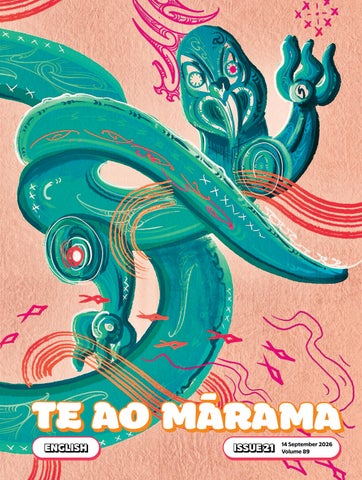
TE AO MĀRAMA ENGLISH
ISSUE 21
14 September 2026 Volume 89
EDITORIAL
Nau mai, pānui mai,
Welcome, reader, to our annual edition of Te Ao Mārama. Our theme is “ki te whai ao, ki te ao mārama—breaking another dawn.” This year, we have challenged our writers to centre their pieces on moving forward by growing from their past—like the rotation of day and night, where every ending provides a fresh start. Continuing with this metaphor, we hope this magazine gives you an opportunity to rest, perhaps even find closure, before moving into the new day with clearer intent and purpose. With that theme in mind, we thought it might be worthwhile to travel down memory lane—no Snapper card needed—to look back at some of the changes within the Māori student body and celebrate some of our triumphs during our time here at Te Herenga Waka (keeping in mind that we only started in 2023, lol). We also ponder what we think might come next.... First stop: We’ve grown Our first stop on our journey through our achievements must be our growth. Whether it’s more Māori entering higher education, turning up to events, or chucking themselves in the deep end to try something they’ve never done before, we’ve borne witness to growth in ways that once may have seemed unimaginable. The result? The Māori student community here at Te Herenga Waka has never felt more vibrant. Through a slightly different lens, we can also see that growth operationally. The komiti whakahaere of Ngāi Tauira have grown immensely over the past few years, expanding our paper trail, formalising our processes and, to cap it off, securing our remuneration for work equivalent to that of our VUWSA counterparts. The second stop: Whānau rōpū We’ll keep this section brief so as not to steal the proverbial thunder from the contributions of our whānau rōpū. But it’s fair to say that we have never been in a stronger position when it comes to representation and community-building. Only three years ago, we had just three functioning Māori Student Associations. Miraculously, we now have six! To paint a clearer picture, when we started university there were only three functioning rōpū—Ngāi Tauira (The General Māori Students Association), Ngā Rangahautira (Māori Law Students Association) and Te Hōhaieti o Te Reo Māori (The Māori Language Society). It is worth noting that while Ngā Taura Umanga (Māori Commerce Students Association)
Page 2 - Te Ao Mārama
was also around, they suffered from a lack of operational capacity following the Covid-19 pandemic. That is why it’s so pleasing to say that we now have six functioning and fully operational Māori student associations. In recent years, we have resurrected Ngā Taura Umanga, established Te Paepaeroa (Māori Architecture and Design Students Association) and, through a merger, created the Māori and Pasifika Psychology Students Association. Each whānau rōpū serves as a beacon of representation, advocacy, and whānaungatanga within its community. Third stop: Activism in the face of adversity The Māori student community has never shied away from activism. Victoria has been home to some of the most prominent moments in our modern activist history, including Te Petihana Reo Māori, which was delivered by students in 1972. If recent years are anything to go by, our activist days are far from over. From solidarity with Palestinians to honouring Te Tiriti, we have fronted up for causes that matter to us. Now, as we stand on the verge of another general election, we fully anticipate our people turning up to give the old men, CEOs, and mātua in government a piece of their minds. Next stop? So, where are we going next on our self-congratulatory road trip? The honest answer is that we have no idea. Will it be another technocratic advancement, the formalisation of our relationship, or the establishment of a new faculty-specific Māori student association? As every ‘90s cartoon seemed to end: you’ll have to stay tuned for the next episode. However, one thing is certain. The Māori student community we leave behind will not be the same one we walked into. Our numbers have grown, we've professionalised our organisation, tauira Māori representation and advocacy have never been stronger, and we’ve continued our long tradition of standing up for the things that matter. Perhaps that’s exactly what this theme is asking of us: ki te whai ao, ki te ao mārama. Every dawn is shaped by the night that precedes it. We pay homage to those whose labour we now benefit from and hope that, in our own way, we have done the same for future tauira Māori. On that note, we hope you thoroughly enjoy this edition of Te Ao Mārama as much as we do. Ngā mihi nui, and happy reading. Mairangi and Manaia, Tumuaki Takirua (Co-Presidents) of Ngāi Tauira
Issue #21 14 September 2026 Volume 89
In this issue: 02 Editorial 03 Contributor Credits Whakapapa o Ngā 04 TeRangahautira: Hei Tauira mō Āpōpō
Contributors: Kaituhi/Writers
Kaiwhakamāori/Translators
◊
◊
◊
05 Ngā Taura Umanga in Action
◊ ◊
and Pasifika Students’ 06 Māori Association
◊
07
Ngā Hua Hoahoa, Ngā Hua Tāngata
o Te Reo Māori 08 Te- TheHōhaieti Māori Language Society
◊ ◊ ◊
10 Te Mana o Te Pōti
◊
12
Consider This—The Ship Crashes at Dawn
◊
15
Ko koe tōku ariaritanga, ko koe tōku ruruhau.
16 Marino Floor 18 Centrefold
◊ ◊ ◊ ◊
Māori and Pasifika Psychology Students Association: Maddy (she/ her) - Te Rarawa, Ngāpuhi, Ngāti Kahu ki Whangaroa, Ariana (she/her) - Ngāti Kahungunu, Ngāti Porou Te Hōhaieti o te Reo Māori/The Māori Language Society Ngā Rangahautira: Sav and Phae Te Paepearoa: Manaia Barns (he/ him) - Tūwharetoa ki Kawerau, Ngāti Rangitihi, Te Arawa Whānui. Ngā Taura Umanga - Tayshon Yates (she/her) - Ngā iwi ō Muriwhenua, Ngāpuhi Temepara Reihana (she/her) Ngāpuhi nui tonu, Ngāti Kahu, Ngāti Kahungunu ki Wairoa Rebekah Tolhopf (she/her) - Ngāti Porou, Te Whānau-a-Apanui, Te Whakatōhea. Tommy Niha (he/him) - Ngāpuhi, Ngāti Whātua ki Kaipara Kaitlyn Mclean (she/her) - Ngāti Uenukukōpako, Ngāti Whakaue, Tūhoe, Ngāti Kahungunu ki Wairarapa, Kāi Tahu Shay McEwan (she/her) - Te Whānau a Kai, Ngāti Pāhauwera, Ngāti Porou Ciara-June Edwards (she/her) - Ngāti Kahu ki Whangaroa, Te Whakatōhea, Ngāti Porou. Mairangi (Ngāti Porou, Tūhoe) and Manaia (Ngāti Porou, Te Aitanga-a-Hauiti) Ox Matiu Bull Tamati
20 First Light
◊ ◊ ◊ ◊ ◊ ◊ ◊
Taipari Taua (she/her) Muriwhenua, Ngāpuhi, Ngāti Hine Ngāurupā Davis (any/all) - Ngāti Kōpaki, Ngāti Manu, Ngāti Whātua Ōrākei, China, Scotland, England Mairurangi Hakaraia - Raukawa ki uta, Raukawa ki tai, Ngāti Kuia, Ngāi Tahu, Ngāti Hauiti Angel Paniora - Te Roroa, Ngāti Raukawa, Ngāti Kuia, Ngāti Hauiti Manuhuia Bennett (he/him) - Ngāti Porou, Ngāti Kahungunu, Te Arawa, Ngāti Tūwharetoa Huia Whakapūmau Winiata (he/him) - Ngāti Raukawa ki te Tonga, Ngāti Toa Rangatira Ciara-June Edwards (she/her) - Ngāti Kahu ki Whangaroa, Te Whakatōhea, Ngāti Porou. Xanthe Banks (she/her) - Ngāti Rārua, Rangitāne ki Wairau, Ngāti Kuia, Ngāti Apa ki te Rā Tō
Ringatoi/Artists ◊ ◊ ◊
Nova Nepia (she/her) - Ngāti Rehua, Rongowhakaata, Ngāti Hine Jessica Rowe (she/her) - Ngai Tahu Ngati Whakaue Lyrical Tamati (she/her) - Ngāti Matepu raua ko Ngāti Whakaari, Ngāi Te Apatu o te rangi, Mahurehure, Ngī Tu Ngī Tama Ngī Tāwera, Ngāti Kahungunu, Ngāti Kahungunu ki Waiora, Ngāpuhi rātou ko Rongomaiwahine
Kaihanga panga/Puzzleist ◊
Ruby Stuart (she/her) - Te Whakatōhea, Tūhoe, Ngāti Porou
Read Online salient.org.nz issuu.com/salientmagazine
22 Blockbuster Reviews
Follow Us @salientgram
24 “Temeparā”—Too Long, Too Māori 28 New ties or an unravelling thread? 32 Puzzles 35 Iwi Reads: University Edition
Salient is published by, but remains editorially independent from, the Victoria University of Wellington Students Association (VUWSA). Salient is funded in part by VUWSA through the Student Services Levy. Salient is a member of the Aotearoa Student Press Association (ASPA) and the New Zealand Media Council.
Complaints regarding the material published in Salient should first be brought to the VUWSA CEO in writing (ceo@vuwsa.org.nz). If not satisfied by the response, complaints should be directed to the Media Council (info@mediacouncil.org.nz).
Te Ao Mārama - Page 3
Te Whakapapa o Ngā Rangahautira: Hei Tauira mō Āpōpō Phaedra Chin she/her Savannah Cowan she/her
Te Arawa, Te Aupōuri Ngāpuhi, Ngāruahine, Waikato-Tainui, Ngāti Kauwhata
Kō ngā tahu ā ō tapuwai inanahi, hei tauira mō āpōpō. The footsteps laid down by our ancestors create the paving stones upon which we stand today. This whakataukī prompts us to look back on the achievements and legacy of Ngā Rangahautira and the way our history continues to inspire Māori law students. As Ngā Rangahautira celebrates its 40th anniversary, we reflect not only on where we have come from, but on the whakapapa that continues to shape our rōpū today. Each generation has strengthened and added to the whakapapa of Ngā Rangahautira. To celebrate this year's milestone, we honour the rangatira who paved the way for current and future Māori law students to succeed. Because of Tā Justice Joe Williams and Ani Mikaere’s submission on the Fisheries Bill, Ngā Rangahautira continues to submit on Bills. Because of the gifting of Te Kauwae Parāoa—the study room for Māori and Pasifika—by David Jones (Rongowhakaata, Ngāti Kahungunu) and Tai Ahu (Waikato-Tainui, Ngāti Kahu), Māori law students have a designated space within the colonial walls of the Old Government Building law school. Because of so many rangatira who have fought to create spaces for, and uplift the voices of, tauira Māori, Ngā Rangahautira is thriving today. It is due to tauira Māori success at Te Herenga Waka law school that we have Māori Judges, Māori legal academics, and Māori lawyers to inspire and guide the next generation of Māori law students. Tā Joe reflected on his time in the 1980s, remembering that most Pākehā students had mothers and fathers who were lawyers and Judges. His cohort recognised that, for most Māori at the time, they were the first people in their whānau to even go to university, let alone have connections in the legal profession. Where we are today is the result of generations of tauira Māori responding to the changing needs of our people. This year, in May, we celebrated 39 Māori law students who graduated with their law degrees, the largest cohort of Māori
Page 4 - Te Ao Mārama
law graduates from Te Herenga Waka yet. Today, Ngā Rangahautira provides opportunities for tauira across all aspects of life, including weekly kapa haka practices, sports games, and our kawhe and kōrero kaupapa. Alongside our annual mooting and negotiation competitions and the launch of the Te Rangahuatau magazine, we run legal skills and networking workshops, panels, noho marae, Mana Māori keynote presentations, social events, and, naturally, study wā. One whakaaro that continues to guide many tauira comes from Dr Moana Jackson (Ngāti Kahungunu, Rongomaiwahine, Ngāti Porou), who challenged us to be “Māori who happen to be lawyers, not lawyers who happen to be Māori.” While we strive for academic excellence, our purpose has always been broader, which is to support tauira to carry their Māoritanga with confidence into the law and to strengthen the profession through it. Year after year, tauira seek refuge in Ngā Rangahautira, not only to receive academic support, but to connect with their Māoritanga. Perhaps the greatest lesson of the past 40 years is that Ngā Rangahautira has never been defined by any one kaupapa, executive komiti, or generation. It has endured because each generation has recognised what was needed in its own time, contributed what it could, and left a stronger foundation for those who followed. Whatever the next 40 years bring, we hope Ngā Rangahautira continues to respond in the same way it always has: by listening to the needs of tauira, creating opportunities where they are needed, and ensuring that those who come after us begin from a stronger position than we did. Nā, Phaedra Chin (Te Arawa, Te Aupōuri) Savannah Cowan (Ngāpuhi, Ngāruahine, Waikato-Tainui, Ngāti Kauwhata).
Ngā Taura Umanga in Action Tayshon Yates she/her
Ngā iwi ō Muriwhenua, Ngāpuhi
W
ith our kāhui of nine Ngā Taura Umanga tauira, we hitched our waka and made our way to Te Whare Wānanga o Waikato ki Tauranga Moana to attend Hui-ā-Tau—Mana Motuhaketia Te Ao Māori, hosted by Te Puna Tahua Toa. The kaupapa was centred around celebrating rangatira who bring a Te Ao Māori worldview into the modern worlds of business and finance. For us as tauira, this was more than simply attending a hui. It was an opportunity to step into a space where our tuakiritanga, whakapapa, mātauranga, and wawata for the future of the Māori economy were not only welcomed but valued. We heard from kaikōrero across pakihi (business), tōrangapū (politics), ahumoni (finance), arapāho (media), and iwi trusts/representatives, each bringing their own experiences, whakaaro, and lessons for what the future can look like. The hui created a wāhi for us to whakawhanaunga with like-minded tauira, while also connecting kanohi ki te kanohi with rangatira who share that same passion for Māori development and economic growth. These connections opened new kuaha for our tauira, creating ara hou ki te mahi ngātahi, ako, and imagine what is possible when we carry a Te Ao Māori worldview into wāhi that have traditionally been shaped by different perspectives.
motu. Their pūrākau became a reminder that our past does not hold us back; it provides tūāpapa from which we can move forward. One of our tauira stated that “it felt like an open wānanga, where different perspectives on the future of Māori business, finance, and development could be shared and challenged.” That whakaaro alone speaks to the reality and genuine aroha that was present throughout the hui. Just as night gives way to dawn, our akoranga, experiences, and hononga give us the mana to move forward with greater clarity and purpose. E ai ki te whakataukī, “ka mua, ka muri.” “Walking backwards into the future.” We are not leaving behind what came before us; we are gathering our kete of mātauranga, those kōrero hōhonu and akoranga of those who have paved the way, carrying the strength of our past into the strength of our future. For our kāhui, this hui was a step into that light. It reminded us of who we are, where we come from and, most importantly, what we are capable of creating for the future. The potential of our Māori economy is immense, and as tauira, we have a role in carrying our tikanga forward—into new spaces, new conversations, and new beginnings.
We witnessed first-hand the dedication, success, and mana of professionals and representatives of iwi from across the
Te Ao Mārama - Page 5
Māori and Pasifika Students’ Association Maddy Roberts she/her
Te Rarawa, Ngāpuhi, Ngāti Kahu ki Whangaroa
Ariana Roberts she/her
Ngāti Kahungunu, Ngāti Porou
F
or many psychology students, studying psychology means thinking about the communities we belong to and the people we hope to support one day. Māori and Pasifika continue to be disproportionately represented in adverse mental health outcomes while remaining just a small proportion of psychology students and registered psychologists. We, as the Māori and Pasifika Psychology Students’ Association, understand that there lies such importance in seeing psychologists whose experiences, values, and worldviews reflect those of the people they serve. This is why we are committed to encouraging and supporting our Māori and Pasifika psychology students throughout their journey here at Te Herenga Waka. By creating a space where tauira feel supported in their studies, connected to their peers, and encouraged to succeed, we hope to help them feel confident to pursue their aspirations within the psychology field. This year, we have hosted a number of study wā with a particular focus on upcoming tests and assignments for our first-year courses. These sessions are supported by tutors, past students, and executive members to provide dedicated and focused support. We have also worked closely alongside Ngāi Tauira and the Pacific Students’ Council. Ngāi Tauira has been a valuable source of support for us as a newer association, helping us build our profile and fill in gaps. Through our work with PSC, we have attended all Loto Aho and Ako Lelei study sessions as tutors for first-year students. This year was also our first time being involved in the festivities of their Pasifika Week, where we volunteered at events including the cultural launch, quiz night, and Pasifika market.
Page 6 - Te Ao Mārama
In other firsts, we are also one of the many STEM associations helping to organise the upcoming STEM ball. It has been a great opportunity to get involved in wider university events and connect with other student groups. In the last few weeks of the trimester, we will continue to hold our regular study wā, as well as an event in collaboration with PSC in Week 8. We are also currently fundraising for our annual scholarships through our raffle. The proceeds will go towards two $1000 scholarships—one for a Māori psychology student and one for a Pasifika psychology student. We hope these scholarships provide additional financial support for our tauira and recognise the effort they put into their studies. It has been a really fun and rewarding year for us so far, and we are grateful to everyone who has helped us along the way. We are looking forward to continuing to support our students and create opportunities to connect with one another. Keep an eye on our Instagram @vuw.mppsa for upcoming events, study wā, and other ways to get involved with MPPSA. Ngā mihi maioha ki a koutou!
Ngā Hua Hoahoa, Ngā Hua Tāngata Manaia Barns he/him Tūwharetoa ki Kawerau, Ngāti Rangitihi, Te Arawa Whānui
In September 2025, 50 people shuffled into a lecture theatre at Te Aro Campus. They had just come walking from a pōwhiri a few meters away to take their seats. Once everybody had settled in, the kōrero began, and with it, Te Whakaturanga— The Māori Architecture and Design Symposium. To be Māori in certain spaces is sometimes to make space for Māoritanga where there is none. This is the case in the architecture and design schools of Te Herenga Waka, who have a long history of brilliant Māori architects, designers, and building scientists that are too often left uncelebrated. Despite this, the sharing of mātauranga between tuākana and tēina, experienced and student, is a core part of Te Ao Māori and, therefore, was one of the main goals of Te Paepaeroa when it was first founded in early 2025. The evening proceeded as five kaikōrero took time to present their mātauranga. They shared their knowledge, life experience, and spoke to Te Ao Māori in their work. For many of the students, and even some staff, the kaupapa that they spoke to were brand new. What does it mean to be a kaitiaki? How can one design as Māori in a non-Māori firm? These were kaupapa that hadn't echoed in that lecture room before, but that were still just as important to be discussed. Afterwards, once the mihi had been given and Te Whakaturanga was closed, people streamed out into the atrium to enjoy kai and engage in whakawhanaungatanga. The usual connections began. Students and speakers found they were whānau, and suddenly, the community became a little more connected. From the fruits of their design work came the fruits of community. Ngā Hua Hoahoa, Ngā Hua Tāngata
Te Ao Mārama - Page 7
Te Hōhaieti o Te Reo Māori
The Māori Language Society Ngāurupā Davis any/all Ngāti Kōpaki, Ngāti Manu, Ngāti Whātua Ōrākei, China, Scotland, England
For many years, the student union building and the room which houses the Hunter Lounge have provided refuge for those who champion te reo Māori. And if you are thinking I’m referring to the refuge of waipiro and a fuzzy head, e kāo. On 14 September 1972, the Māori language petition was delivered to parliament. Over 30,000 people vowed that the government, and the nation, must promote and revitalise te reo Māori. This led to 14 September being denoted as Te Rā o Te Reo. The following year, the first official Rā o Te Reo was held in the student union building, in the same room that the Hunter Lounge now occupies. There were whaikōrero, waiata, speeches, and discussions.
Another year passed, and Te Rā o Te Reo grew into a full week in the year 1974. The first celebrations of Te Wiki o te Reo Māori were held in this very room once again. The understanding that te reo Māori is a taonga was growing in support and the room was full of students learning waiata reo Māori. As more time passed, the language stalwarts of Pōneke began to consider Māori language radio; Ngā Kaiwhakapūmau i Te Reo wanted the language to be heard across the nation. And so, during Te Wiki o te Reo Māori 1983, the first radio programme entirely in te reo Māori was launched, ‘Te Reo o Pōneke.’ For 12 hours a day for the entirety of Te Wiki, one could listen to te reo Māori live on air. This was a first for Aotearoa. And where was this
Te Rā o Te Reo, 1973.
Page 8 - Te Ao Mārama
Te Wiki o Te Reo, 1974.
Te Reo Irirangi o te Ūpoko o te Ika a Māui. From left: Mike Wills, Donald (Donny) King, Henare Kingi, Piripi Walker, Erana Hemmingsen (obscured), Mere Grant (standing), Lucy Te Moana (kneeling), Hirini Melbourne, Philip (Pip) Saffery, Henare Hetaraka (standing), Piripi Whaanga (kneeling), Murray Raihania, Kevin Hodges, Iris Te Ari Whaanga (sitting), Mahia Fuimaono (kneeling), and Huirangi Waikerepuru.
show broadcast from? You guessed it, the student union building. As time passed, this segment grew into the full-time radio station, Te Reo Irirangi O Te Upoko O Te Ika, in 1987. As time went by, the organising groups changed and their directions changed as well. Te Hōhaieti was put to rest and Te Tumu Herenga Waka had been built as the home-away-from-home for Māori students. However, when our marae was put to sleep in 2021, the need for a temporary shelter for Māori students arose once again. And so we returned to the student union building. We had the NT room, and just next door the Hunter Lounge hosted
our many larger kaupapa. AGMs, pub quizzes, and debates were all once again hosted in the Hunter Lounge. We are fortunate to have had the student union building be a nesting ground for so many efforts in the revitalisation of te reo, and the growth of so many kaupapa like Te Hōhaieti, Ngāi Tauira, Te Wiki o Te Reo Māori, and Māori language radio. Those who laid the foundations, and raised the walls, e kore e warewaretia. Nā koutou te reo i ora ai.
Te Ao Mārama - Page 9
Te Mana o Te Pōti Kaitlyn Mclean she/her Ngāti Uenukukōpako, Ngāti Whakaue, Tūhoe, Ngāti Kahungunu ki Wairarapa, Kāi Tahu
“We should vote because they expect you not to.”—Dr Ria Holmes
voting system was based around individual property ownership, despite Māori land being cared for collectively. Four Māori seats, which Unless you’re pushing 30 like Nanny Shay, eventually evolved into the seven we see this year might be your first or second chance today, were established in 1867, finally giving to participate in a general election. Māori a guaranteed place in Parliament to advocate for our people. And if you’re sitting there thinking—“Why should I care?”—fair enough. Politics can feel But Māori political participation has never like a bunch of people just arguing on reels just been about having a seat in Parliament. about things that have nothing to do with you. Our tīpuna organised, petitioned, marched, Except, they do. formed political movements, and established institutions like Te Kōtahitanga because they It’s not just about fixing potholes, higher knew that decisions made about Māori withtaxes, and all that other shit that your parents out Māori could have serious consequences might complain about around this time that for our whenua, whānau, and rangatiratanga. matters (although potholes are definitely a major issue if you’re a Swift driver like me). So when someone tells you your one vote won’t make a difference, remember that It’s your rent. Your student loan. Your course political power has never simply been handed fees. The scholarships on offer. Whether you to Māori. It has been fought for. Why would can afford to move out. Whether there’s a bus we willingly give it away? that actually gets you to class. How much that bus fare is subsidised. What happens Voting isn’t the only way we exercise mana or to the whenua, the environment, and the tino rangatiratanga. It isn’t even necessarily resources our communities depend on. What the most important way. But it is one of the support is available to your whānau. tools available to us. And if our tīpuna fought to make sure Māori had a political voice, we You might not be interested in politics, but can at least use the one we’ve got, while politics is interested in you. It expects you not continuing to fight for more. to care, and it expects you not to vote. And that’s exactly why we should vote. So enrol and find out who’s standing for your electorate. Have the tough kōrero with your For tauira Māori, for rangatahi Māori, there’s mates and whānau. Ask questions. Take your another reason to care. friends and kaumātua to vote. And when the time comes, get your ass to the polling booth. Our tīpuna fought for their voices to be heard in the Pākehā political system for generations, They expect you not to. and ka whawhai tonu tātou. Māori were largely excluded from the first Pākehā elecVote anyway. tions held on Aotearoa’s whenua because the
Page 10 - Te Ao Mārama
Start here!
Are you enrolled to vote?
NO
Enrol to vote! vote.nz
NO
Check them! vote.nz
YES Have you checked your details?
YES
IDK
Ask them!
NO
Send them to vote.nz
Are your friends enrolled to vote?
YES Know your electorate's candidates?
NO
Google it! google.com
NO
Do some research!
NO
Make one!
YES Know who you want to party vote for?
Congrats, you're ready to vote!
YES Have a plan for election day/ to vote early?
YES Te Ao Mārama - Page 11
Consider This—The Ship Crashes at Dawn Ox Matiu
Being takatāpui at Te Herenga Waka feels lonely. We are spread across different disciplines, different research, different whānau. Perhaps this is the institutional design: to keep us separate so we don’t organize too readily. I hadn’t realized this loneliness I felt until I attended my first postgrad class: a Māori-majority cohort and, most importantly, four other tauira takatāpui. There’s an old English proverb that you cannot lose something you never had. But in that moment, the puzzle pieces clicked into the missing spaces my heart had left just for them. I wasn’t a standout for being a gay Māori who loved to read. I was at home. Our big city is lucky enough to house our national archives for queer and takatāpui records. Once transliterated as Te Pūranga Takatāpui o Aotearoa, it was gifted a new name in 2023: Kawe Mahara Queer Archives Aotearoa. It was a place I had never visited but often heard about. Neither had my classmates. So I submitted a proposal to the Mana Motuhake fund, supported by Ngāi Tauira, to run the Haerenga ki te Kawa Mahara kaupapa. I rocked up bright and early on a cold winter Saturday morning. Roger Swanson, my KM liaison, swung around
Page 12 - Te Ao Mārama
the corner at Home Café to introduce himself. He had already started a tab for kai. As we nibbled at the pre-buttered scones, a few other students trickled in alongside several ‘sorry I can’t make it’ messages, until we numbered four. Roger welcomed us upstairs to Te Kupenga, an apt name for capturing all us taka in one place. Another KM board member, Dr Elizabeth Kerekere, was already waiting for us on Zoom. Across the four surrounding tables were carefully organised materials spanning the 1970s to today. There were pamphlets on AIDS, custommade waiata packets, and self-published zines. There were books from our kaumātua including Clive Aspin, Ngāhuia Te Awekōtuku, Witi Ihimaera, and Leonie Pihama. There were catalogues of hundreds, perhaps more than a thousand, different texts speaking to non-Pākehā ways of being gay. There were so many words, so much variety, to being takatāpui. And it had always been here, waiting for us. My dream was to bring together tauira takatāpui across these imaginary borders created by colonial systems, to break new waves in old seas. I am glad to say I succeeded, and I will succeed again.
Te Ao Mārama - Page 13
Art by Nova Nepia
Ko koe tōku ariaritanga, ko koe tōku ruruhau. Ciara-June Edwards she/her Ngāti Kahu ki Whangaroa, Te Whakatōhea, Ngāti Porou
S
ince the day I was born, my mum and dad have been my best friends—obviously. They have loved me, supported me, and believed in me through every chapter of my life, from Tauranga to Rarotonga, to London, and all the way back around the world again. They raised my siblings and me with everything we could have ever needed, but more importantly, they gave us everything they never had. They pushed us to take every opportunity, to dream bigger, to see the world, and to become people they could be proud of. They gave us a childhood filled with love, laughter, adventure, and memories I know I will spend the rest of my life being grateful for. No one will ever be as cool as my mum and dad. They spoiled us rotten, but somehow still left enough room to kick us up the arse when we needed it. And if I'm completely honest, I didn't want to move away from them at first. The thought of stepping into adulthood without my mum holding my hand and my dad there to lift me up seemed like an absolute nightmare. I don't think I would have made it through my first year in the capital if Mum hadn't called me every single night just to make sure I was okay. No matter how far away I was, hearing her voice reminded me that I was never really alone. I don't think I would have stayed here for this long without Dad picking up the phone whenever I called, especially when he was working nights, to listen to whatever crisis I had created that week and inevitably tell me off for my “reckless” spending. Somehow, even when he was giving me grief, he made everything feel a little less scary.
Because no matter how old I get, a part of me will always need my mum and dad. When I grow up, I want to be like my mum. I want to be as strong as her. As resilient. As intelligent. As kind. I want to have even a fraction of the strength she has carried so effortlessly throughout her life. I see you, Mum. When I grow up, I want to be like my dad. I want to be as driven as him, as confident, as hardworking, and most importantly, as funny. They have spent their entire lives making sure my siblings and I had the chance to build a life for us and making that happen. And I don't think I will ever be able to put into words just how much that means to me. My mum and dad aren't just my parents. They are my home. They are the people I call when I'm happy, when I'm sad, when I need advice, when I've fucked up, and when I simply need to hear a familiar voice. And if I could choose my parents in every single lifetime, in every possible universe, through every version of my life, I would choose them. Every. Single. Time. No one in the whole wide universe could ever replace my mum and dad. No one will ever be as cool as them. And no matter how far I go, how old I get, or how much of the world I see, I will always be their kid, and I will always, always come home to them.
And on rainy days, the really hard ones, when I'm overwhelmed and exhausted and want to quit everything, pack a bag, and come home, they are the ones who keep me going.
Te Ao Mārama - Page 15
Marino Floor Tommy Niha he/him
Ngāpuhi, Ngāti Whātua ki Kaipara
Mai i Te Kore ki Te Pō, mai i Te Pō ki Te Ao, mai i te pōuri ki te māramatanga, ka puta ko Tāne, ka puta ko Hineahuone, ka puta ko te ira tāngata, ka mauri ora ai tātou. Kei aku nui, kei aku rahi, kei aku whakataparahi ki te rangi tēnei e mihi atu nei. Ko Tommy Niha tōku ingoa, he uri tēnei nō ngā marae maha ō Te Tai Tokerau, hoinō, ko ōku iho pūmanawa ko Ngāti Hine, Ngati Whātua ki Kaipara, Te Parawhau me Ngāpuhi anō hoki. I tipu ake au ki te tāone o Whāngarei, otirā, he tauira tēnei e whai ana i ngā tapuwae kua kākahutia ai e ngā toki whakairo i te ao mātauranga ki tōna taumata. He tau tuatahi au ki Te Herenga Waka, ā, kei te whai au i te tohu paetahi. Ko te aronga matua o aku akoranga ko te Intercultural Communication me ngā Akoranga Māori anō hoki. Nō reira, tēnei au e mihi atu nei. Hei whakatakato i te tūāpapa o aku tuhinga, ka kapohia ake ko te auapapa o tēnei tuhinga: Te Papa o Marino ki te nohoanga akonga o Joans Stevens. Kua 5 tau te papa o Marino e tū ai ki waenganui i ngā nohoanga tauira, koinei te hōro tuatahi kia whai tētahi taumata pēnei. He āhuatanga rerekē ki ētahi atu, engari, mō ngā tauira Māori he āhuatanga motuhake te noho i waenga i mātou anō. Nō mātou te waimārie kia noho ki tēnei taumata nā te mana o ngā tauira Māori kei te hiahia ki te noho ki taua taumata. Heoi, 22 noa iho ngā rūma e wātea ana mō mātou, nō reira nā mātou te maringanui kia noho kotahi ai – he Māori mātou e noho māori nei ki tēnei ao Māori. “We are Māori, living as Māori within a Māori world.” This is the best way to describe how Marino can be perceived by our tauira or residents. The Marino floor is one of the only floors within all of the accommodation facilities dedicated to Māori students that are also scholarship recipients as well, which adds to the value of this floor.
Page 16 - Te Ao Mārama
On the 8th of February, I, alongside my other floor mates, were preparing for one of the most significant milestones within our lives, which was leaving what we had built and created back home to a whole new environment where we had to find new connections with others in a new city and get used to our new lives. It was intimidating and scary, to say the least. But as a first year moving from the small town of Whāngarei, I had thoughts of how my being and personality would be perceived by others, and it is intimidating knowing you are moving into an unfamiliar environment with people you don’t know. But also knowing that you will be seen by people who look, speak, and act like yourself provides comfort, and that's how I would describe Marino. Marino provides our students with comfort that others sometimes find hard to find. Although we are different beings and people, there is one common denominator that connects us as people, and that is our Māoritanga. Being able to share a connection with someone new solely based on our culture is something beautiful to experience and also to witness. This year, our Marino floor residents have so many different places they call home. Mai i Te Hiku o te Ika, ki Te Ūpoko o te Ika, whakawhiti atu ki te moana o Raukawa, tae atu ki Te Waipounamu, we are all representatives of our respected hometowns, but I also think that is an important aspect of our Marino floor whānau, as we are all from different areas of Aotearoa. An aspect of our floor is that it is a Māori scholarship floor. To me, this represents the strength, determination, and academic potential of Māori students. It challenges the stereotypes that Māori are less likely to succeed academically or attend university, and instead shows that Māori students can excel across a wide range of academic fields, leadership roles, and areas of study. For many of us, attending university is more than an individual achievement. For some, we are the first in our whānau to attend university, meaning that our journey represents something much bigger than ourselves. Our success is also a reflection of the
sacrifices, support, and aspirations of our parents, grandparents, and wider whānau. By being here, we are creating pathways that may not have been available to previous generations and showing those who come after us that university is a place where Māori belong. Beyond the academic setting, Marino represents one of the most meaningful senses of belonging it fosters amongst us, and knowing we get to add to the history of this floor is a profound sense of pride. With the support from whānau and staff, our floor continues to flourish into safe environments where Māori students feel seen and appreciated within the tertiary education journey. In Joan Stevens Hall, we like to say we are more than a hall; we are family, whānau, and aiga. We come from different backgrounds, iwi, hapū, and cultures, but we are brought together through the connections we build with one another. For us, Marino is not simply a place to live; it is a place where we belong, where we support one another, and where we create memories and a legacy for the tauira who will come after us. I would encourage other halls to consider making Māori floors or Pasifika Islander floors within their communities. These spaces provide more than accommodation; they create opportunities for students to strengthen their connection to their culture, build whanaungatanga, and feel a genuine sense of belonging while navigating tertiary studies. It is evident within the Marino domain that when students are given an environment where their identity is recognised and valued, they grow not just academically but also personally. Hei whakakapi ai i ngā kōrero kua tuku, kāhore a Mārino i tētahi wāhi noho noa, “Mate atu a kāinga tahi, ka ora ai a kāinga rua.” E hīkaka ana au kia kite i te puāwaitanga o Marino, tae atu ki ngā tauira hou ka riro i te maringanui kia noho ki tēnei taumata mō ngā tau ka heke mai. Ko tā mātou mahi he whakatenatena i ngā tātai whakapapa kua waiho e ngā tauira ō mua kia whakapūmau, kia tū tonu te papa o Marino hei āhuru mōwai mō te anamata.
Te Ao Mārama - Page 17
Art by Nova Nepia
First Light Shay McEwan she/her
Te Whānau a Kai, Ngāti Pāhauwera, Ngāti Porou
Content Warning: Suicide There’s a particular darkness that belongs only to the hour before morning. It’s not the darkness of midnight. Midnight is settled, complete; it asks nothing of you. The hour before morning is different. The sky is still dark, but somewhere beyond what you can see, something has already begun to change. I think there are moments in life like that. They rarely announce themselves. There’s no revelation, no clean line between before and after, and sometimes you are simply living inside the same darkness you have known for years, and then one ordinary morning you catch yourself laughing at something, or making plans, and you realise you are no longer the person who walked in. I have known darkness, more than I would’ve liked, and earlier than I should’ve. I have known what it is to lose people I loved, to learn things about grief at an age when I should have been learning something else entirely. I have known heartbreak, and disappointment, and the strange loneliness of losing your sense of direction and wondering whether everyone else was handed a map that never reached you. I have known what it is to sit with the parts of yourself you would rather not look at, and I have known the exhausting weight of trying to become more than what life seemed to expect of me. For a long time, I thought those were separate things, separate chapters, separate versions of myself, each one survived and left behind, but now I think they were all the same stories. Something strange happens when you have been through enough. People begin to describe you by your resilience and tell you that you’re strong. They tell you that you have Page 20 - Te Ao Mārama
been through so much, and they mean it kindly, so you smile, because what else is there to say? But there are days when I don’t want to be strong. I don’t want my suffering to be the most interesting thing about me. I don’t want everything I survived to be the reason someone decides I am worth listening to. I want to be more than what happened to me. That is where my idea of growth began to change. Growth is not always becoming stronger. Sometimes it’s becoming softer, admitting that something hurt, and letting it have hurt, without rushing to turn the wound into wisdom. Sometimes it’s simply being able to say: that was hard, and that changed me, which is why I’m still here. For years, I thought moving forward meant leaving things behind. I thought healing meant arriving one day as some untouched version of myself, clean of all of it. I don’t think she exists. We don’t get to become untouched. We become changed, and we learn to carry things differently. So I started carrying the younger versions of myself more gently than I used to. The little girl who didn’t understand why certain things hurt so much, the teenager who was certain heartbreak was the end of the world, and the young woman who felt lost and had no idea what came next, who had to learn how to keep going long before she understood why. I don’t look at her and wish she had been stronger.
I look at her and think: you did enough, you made it here. And here is not where I thought I would be. There was a time when I couldn’t picture my future at all. There was an assumption I had that I wouldn’t be alive right now, that my plans after my dad’s suicide would’ve worked and I followed in his footsteps. But now, I am studying again, leading, speaking in rooms where I once quietly wondered whether I belonged. Alongside that, I’m learning te reo Māori, slowly, imperfectly, my mouth still finding its way around words that have been waiting for me my whole life. I’m learning more of my whakapapa, and I am learning that reconnecting does not have to be perfect to be meaningful. I am learning to speak even when my voice shakes, and I am learning that I can take up space without apologising for standing in it. None of that erased what came before. It grew alongside it, and that is the part nobody warns you about: the good does not replace the hard. They live in the same person, at the same time, and perhaps that is what first light asks of us. Not to pretend the night never happened, not to be grateful for every painful thing we endured, not to force meaning onto what was simply painful, only to notice that the night is not the only thing that exists. There is something deeply comforting in that. The sun rises whether we are ready or not. It doesn’t wait for us to have everything figured out. And it doesn’t arrive all at once. First there is the faintest change in the sky, so slight you could talk yourself out of seeing it, then shapes, then colour, and then, suddenly, you can see much further than you could a few minutes before.
I don’t know exactly where I’m going, and I’m not sure I’m supposed to, and for the first time, I’m comfortable with becoming because there is freedom in not having to arrive as the finished version of yourself. I can still be learning, still uncertain, still healing, and still moving forward. I spent so long believing the darkness was something I had to conquer, and now I think I only ever needed to learn how to walk through it. There were nights I thought would never end, and there were versions of myself I thought I would never outgrow, and moments when I couldn’t imagine the person I would become. And yet, somehow, I became her, not perfectly, not without scars, and not without looking back. Because first light was never about becoming someone who has never known darkness. It’s about becoming someone who knows the darkness cannot have her forever. I’m not leaving my past behind. I’m taking it with me, the people I have loved, the lessons, the mistakes, the grief, the laughter, the parts of myself I once thought I had to hide. All of it comes. It just doesn’t get to choose the direction anymore. Because there is so much ahead, more to learn, more to become, more people to love, more places I have never seen, more words I haven’t yet learned to say, and more mornings I have not yet witnessed. Not to pretend the night never happened, not to be grateful for every painful thing we endured, not to force meaning onto what was simply painful, only to notice that the night is not the only thing that exists.
Nothing has really changed. The road is still the road, the mountains are still the mountains, your history is still your history, but you can see it differently, and maybe that is what healing is: not changing what happened but changing what you believe is possible afterwards.
Te Ao Mārama - Page 21
Blockbuster Reviews Bull Tamati
Spoilers ahead... read at your own
peril.
, where I give my Welcome to Blockbuster Reviews sters of 2026 kbu honest take on the biggest bloc hype and, the th wor ’re and assess whether they n. issio adm of e pric the more importantly,
Project Hail
Mary
2023 ucers of the From the prod comes its spirr Bea hit Cocaine Hail Mary. sor, Project itual succes ld suffer the is movie shou In theory, th s and purely ew vi re g in orks. middl mehow, it w same fate— so t Ye t. en ym jo en gag-driven dded lled as a shre I was enthra t and s, is ur nt ho ie o sc tw For over be a wimpy to ds rocks. en et of pr le g gside a pi Ryan Goslin humanity alon puts g ve lin sa os to G s ? pt attem can’t do hing this man reen with Is there anyt aring the sc sh to in y ss nu ya R le ho S. w K his WOR cks AND IT said pile of ro ional with the emot y, combined it, or to st in r’s g ei in W br Andy d Miller ctors Lord an eatrical expe th ve si er core co-dire m im , ly ts ib ec ed eff cr in matography, makes for an ise em eteering, cine pr pp e pu th e of Th rience. e absurdity ck all sell th l weight. and soundtra ine emotiona nu ge m fil e th ng vi gi while s’ brilliant Austin Hayne to highlight e ed towards lik ur at so fe al u, I’d ory ata Pō Atara ai w e th es on in the hist piece aynes exam H . ovie, m m fil e e th th nce within the end of d its significa an a at ai w e of th ncluding: beautifully co made of Kaihau have ima Maewa Er ic about ht ep ig i-fi m t sc “Wha aturing in a fe a at ai a musical w te s her famou orts to crea nguages, Given her eff la t? d ac an nt s co ld n or alie ks across w ea sp at th language eased.” e would be pl I imagine sh
Page 22 - Te Ao Mārama
The Odyssey Haven’t I seen thi
s before?
Man does terrible act. Man reckons with terrible act. Man realises his actions have changed bo th himself and the world for the worse. Yup. Christophe r Nolan just retold Oppenheimer in Greek apparel. Did I still love ev
ery minute of it?
Absolutely. Nolan retreads ma ny of the same the matic beats as Oppenheimer bu t wraps them aro und an adaptation of Odysseus’ jou rney and delivers them on an appropriately rid iculous scale.
Straight aura far
ming for three ho
urs. Worth the hype. Worth the price of admission. 8/10. Certainly an Osca r contender.
Toy Story 5 Oddly good,
Supergirl way: the Let’s get this out of the dirty. writers did Milly Alcock
ergirl for this rendition of Sup Alcock feels as perfect of se pha t firs the ing dur rk as RDJ was for Tony Sta around her fails vie mo the ely, nat ortu the MCU. Unf to capitalise on it.
to capture the character The first poster seemed eful “Look Up” tagline is perfectly. Superman’s hop o crosses out “Up” and wh irl, erg Sup by vandalised replaces it with “Out.”
petitive.
if not a little re
ed back by—and suck to be charmed ries probse e th le hi It’s hard not W of Toy Story. ovie, ld m or w ird e th th e — into ending with th ide enough ct rfe pe its ably had re here prov expanded lo ist. the plot and alment to ex st in th r a fif justification fo ter develssie’s charac is stunning, Je Buzzes n io w at ne im of an y The and the arm e, bl ya ts. It jo en en om is opment hilarious m gh to me genuinely ou so en r fo es es do ak it t m y Story, bu To in the nt rs ve te in re ac t ar doesn’ ved these ch lo u yo hy w remind you first place. Good movie.
.
y+ Wait for Disne
Look Out.
as the antithesis to her It perfectly established her ere Superman inspires Wh sin. goody-two-shoes cou ergirl promised rebellion, hope and grandeur, Sup ss. dne irite -sp caution and free irl barely appears in the
Unfortunately, that Superg actual movie.
dryline about a world-har Instead, we get a tired sto ble etta forg ly ing pris sur a ened mentor and child, s Momoa cameo that goe protagonist, and a Jason y little. abl ark rem s ieve ach on for far too long and rth the price of Disappointing and not wo gover on a Sunday admission. Watch it hun . ing am stre when it hits
Spider-M an: Bran
d New
Day Will Spid erwin an O Man: Brand Ne w Day scar? Ab solutely not. Should it ? Let me cook. The MC Uh Thunderb as finally hit its str o Day, prim lts, Fantastic Fo ide again. Comin ur, and n g off e Marve ow Bran lm Avengers dN : Dooms ight just be bac k in time ew day. for Director Destin D aniel Cre clock on tton has th turned b rendition e MCU’s quality ack a of our fa vourite b nd produced a b the #SorryA ug-them ntMan anger ed supe rhero. Cretton has while reta overhauled MC U’s Spid ining the er-Man iteration best ele s—Garfi ments o f his pre e ld the Play ’s s w vious in g Sta ing, Mag uir somethin tion games’ acti on—all w e’s heart, and g that fe els distin hile crea ctly its o ting wn. Spider-M an has n ever loo good. Th ked e when do camerawork alo , sounded, or fe lt this ne had m superhe ro ea dynamic shots ou movies care this sking: since tside the much ab action s out cenes? Dare I sa y it: one of ever rele ased. No the best comic-b multivers o al shena ok movies nigans n 8.5/10. eeded.
Te Ao Mārama - Page 23
“Temeparā”—Too Long, Too Māori Temepara Reihana she/her
Ngāpuhi nui tonu, Ngāti Kahu, Ngāti Kahungunu ki Wairoa
“Tem”—short enough, easy enough. And just like that, in a second, my beautiful name was silenced for 16 years—all to please the white man’s ears. But I never wanted it to be this way, But my mama said, “It's easier for them this way.” And I understood, because her mama had taught that to her too. To make yourself smaller and soften your reo was second nature for three generations. Every teacher, every friend, every Starbucks— that’s how they knew me. Every interview, every CV, every email— “Tem” was the name they’d see. My name erased for success, for ease— to keep the white man’s peace. Then I turned 16 and I realised who I wanted to be—fiercely and bravely me. In came the breaking of the new dawn, the breaking of the new me. “Tem” became “Temeparā.” Teachers struggled and friendships were lost. People groaned; knives were thrown and insults hurled. Their complaints, though? Not my burden. I made them learn, and I made them say it. But it didn't just stop there.
Page 24 - Te Ao Mārama
Every kapa haka rōpū, every uni association, every Māori space— they were going to know my name. I wanted it to be this way—my culture was going to be reclaimed. I picked up the poi and never put them down. With each spin, I felt more like myself. I picked up the patu and gripped it tight. With each step, I felt more alive. I picked up the reo and I never stopped. With each word, my mana came back to life. I liked it this way—my culture was mine. Three generations taught us to shrink, but that was going to end with me—my baby cousins were mine to teach. Mine to teach to say their names with pride, and to speak their reo with a smile. Mine to teach to swing the poi, and flick the patu. Mine to teach to be proud to be Māori. In came the breaking of the new dawn; the raising of the next generation.
Te Ao Mārama - Page 25
Art by Jessica Rowe
New ties or an unravelling thread? A collaboration of Matauranga and Science, could it mean a new future or a replaying of the past? Rebekah Tolhopf she/her
Ngāti Porou, Te Whānau-a-Apanui, Te Whakatōhea
Whāia te iti kahurangi, ki te tuohu koe, me he maunga teitei’ Seek the treasure you value most dearly; if you bow your head, let it be to a lofty mountain’ A classroom not made for us. A teacher praising the ways of the coloniser while standing on land whose stories they do not know. For generations, the curriculum has told us that Western science is the ‘real’ science, the only valid way of understanding the world. Anything outside of it, especially our own mātauranga, has been treated as lesser than, unscientific, or simply irrelevant. We grew up learning that knowledge from our ancestors belonged at home, at the marae, but not in educational or professional spaces. So now, why are there sudden efforts to bring the two together? Is this a genuine attempt at reconciliation, a recognition that the land needs Indigenous ways of knowing? Or is it another performance, another way to take our knowledge, repackage it, and present it as modern innovation without acknowledging where it really came from? These questions sit heavily in the space between hope and caution. As a science student, I was taught early on that Mātauranga and Western science were separate worlds. Mātauranga was cultural; science was academic. One belonged to my identity, the other to my grades. Assignments and rubrics encouraged us to conform, to learn in a way that fit the system rather than challenge it. For many of us with mixed heritage, this division felt Page 28 - Te Ao Mārama
like a disrespect, a separation between cultures. To succeed academically, it was expected to separate that part of myself. To honour the community that raised me, I had to question the very system that I relied on to succeed. This contradiction is not just personal; it is structural. Western science has long positioned itself as objective and universal, yet it was built within a colonial worldview that dismissed indigenous knowledge as simply storytelling. When Mātauranga and other ways of indigenous knowledge are finally invited into scientific spaces, we must ask: On whose terms? Who will benefit? Who leads? And who is still being asked to compromise? A New Dawn - or another cycle? We don’t want to be treated with tokenism or reduced to footnotes in someone else’s story. We don’t want our knowledge to be acknowledged only when it is convenient, only when it can be used to make institutions look progressive. Mātauranga is not a decorative border for science to frame itself with. It is a full, complex, intergenerational system of understanding the world, one that has guided our people and our environments long before Western science arrived here. If this moment is truly meant to signal a new dawn, then it must begin with more than just symbolic gestures. It requires honesty about the history of exclusion, about the ways our
knowledge has been dismissed, extracted, and repackaged. It requires acknowledging that collaboration cannot happen while one system still holds all the authority and the other is expected to fit in and conform. A new dawn means shifting power, not just shifting language. It means Māori leadership in research, policy, and environmental decision-making. It means classrooms where our stories are not side notes but foundations. It means scientific institutions recognising that mātauranga Māori does not need validation from Western science to be legitimate. Whether this collaboration becomes a genuine turning point or just another cycle of appropriation depends on what happens next. It depends on whether institutions are willing to listen, to step back, to share authority, and to let mātauranga Māori shape the future rather than simply decorate it.
Breaking a new dawn means breaking old habits. It means refusing to let collaboration become another colonial trend woven through our knowledge. It means demanding more than inclusion, demanding respect, autonomy, and real partnership. Because we are not footnotes. We are not tokens. We are storytellers, scientists, descendants, and future leaders.
Te Ao Mārama - Page 29
Art by Lyrical Tamati
S E L Z Z U P Word Wheel - English
Word Wheel - Te Reo Māori
Word Wheel Instructions: To solve Word Wheels, form words of four letters or more using the letters in the nine-letter wheel. Every word must include the central letter. Each letter may be used only as many times as it appears in the wheel. The aim is to find as many valid words as possible from the target word list, including the nine-letter word that uses all the letters.
Set Square
Set Square Instructions: To solve a Set Square, use arithmetic and logical reasoning. You are given a grid containing six sums: three reading across and three reading down. The arithmetic operations (division, multiplication, addition, and subtraction) are shown between the grid spaces. Place each of the numbers 1 to 9 exactly once into the grid so that all six sums are correct. Note that calculations are carried out in left-to-right order, not according to BEDMAS.
Page 32 - Te Ao Mārama
33 Sudoku Sudoku66
8
MEDIUM
Sudoku
5
3 5 7 1 9 6 4 5
6
9
6 1
88
22 88 55 11 77
55 33 88 77
77 77 99 11 44 33 77 66 88 55 55 99 88 55 11 99 33 55 88 44 77 11 99 22 44 33 55 99 44 88 44 66 88 33 88 33 66 11 44 99 77 44 11 77 55 55 33 11 66 11 66 22 99 66 44 33
3 8 7 9 1 55 66 44 7 6 8 5 55 44 66 77 22 11 5 1 9 44 2 4 3 33 55 77 4 6 77 22 33 11 8 3 6 1 4 33 99 22 77 7 5 88 44 33 77 66 1 6 99 44 9 6 4 3 77 11 44 55
33 88 77 99 11 5 6 4 77 66 88 55 5 4 6 7 2 1 55 11 99 4 22 44 33 3 5 7 44 66 7 2 3 1 88 33 66 11 44 3 9 2 7 77 55 8 4 3 7 6 11 66 9 4 99 66 44 33 7 1 4 5
55 66 44 44 66 88 99 55 44 66 77 22 11 55 33 66 44 33 99 66 44 55 33 55 77 77 77 22 33 11 66 55 77 99 33 99 22 77 88 99 44 88 44 33 77 66 11 77 99 88 99 44 66 44 22 77 11 44 55 33 55 99 66 11
4 5
44 55
55 88 88 11 66 22 66 77 66 44 11 55 22 44 99 99 77 33 66 33 99 66 55 11 88 44 33 88 99 66
66
MAZE
Start 1/1
99 77 44 11 3 2 8 5 55 33 11 66 6 8 1 7 22
66 99 33 7 33 55 4 3 7 55 99 44 11 88 5 9 8 33 66 3 5 8 4 7 1 9 22 99 5 9 4 8 22 99 55 33 8 3 11 44 9 7 4 1 33 22 88 55 5 3 1 6 66 88 11 77 2 5 44
88 99 5 8 33 66 8 1 6 33 99 66 44 55 2 6 7 77 6 4 1 66 55 77 99 5 2 4 9 88 99 44 9 7 3 6 11 77 99 88 3 9 6 5 1 66 44 22 8 4 3 33 55 99 66 11 8 9 6
9
4 8
88
11 44
JigsawMake.com
5 4
7 2 3 8 9 7
8 9 55 88 3 6 88 11 66 3 9 6 4 5 22 66 77 7 66 44 11 6 5 7 9 55 22 44 99 8 9 4 99 77 33 66 1 7 9 8 33 99 66 55 11 6 4 2 88 44 33 3 5 9 6 1 88 99 66
1/1 1/1
6
9 3
1/1
JigsawMake.com JigsawMake.com
Finish 1/1 1/1
5 3 2
JigsawMake.com JigsawMake.com
Te Ao Mārama - Page 33
8
TE OROKOHANGA
Sudoku
2
7 5 3 6
HARD
22
77 55 33 66
55
66 22 99
33
77 66 33
77 66 88 55 22 33 66 22 77 11
88 11 22 77
Page 34 - Te Ao Mārama
77
66
55
77
44 22
5
6 2 9
3
Sudoku Sudoku
88
8
99
22
77 88 44 55
99 55
11 99
88
44 77 22 99 99 11 66 44 22 33 11 44 66 77 88 66
55
44
77
7
7 6 3
7 6 8 5 2 3 6 2 7 1
8 1
3
6
2 7
5
7
2
5 9
4 2
1 6 8
2 1 5 6 7 5 8 3 1 5
4
9
8
6 5 1
1 8 4
2
3 8 2 9 2
2 8 1
ADN S I RSITE IW UNIVER Y EDITIO cal Science
rau—Politi
Te Tai Toke
– come from es. politicians n ll o lll a c ti a re e m Wh ost proble m er e th th o h lly especia f with eac nd more bee a , ve n a w h u ro o C Y e re do with th s you figu than you gree help e d is th es, or su is se e hopefully resolve th er at out how to st makes you bett a le ry . g ve uin at the ōhā at arg being a h
Taranaki W
hānui—La w
Personifie d their m aunga! Ju students, st like law you think they’re pe and nonc aceful halant un til you ac get to kno tually w them a nd realise they’re f*cking cra zy.
Ngāti Whātu a—A
rchitecture
At this point,
property deve lopment is part of the w hakapapa.
ri Studies
Tūhoe—Māo
Herenga aka? Nah. Te Te Herenga W catches se el ne everyo Tūhoe. While i, Tūhoe un , or the 4 to the 22, the 18 . up es rs ride their ho
Te Arawa—Māor i Performing Arts / Tourism
—Redacted Ngāti Tūwharetoa m at uni, but You’ll never see the m on stage the e somehow you’ll se at graduation.
We get it. You ar e te mātotorutan ga o Kapa Haka. Tour ism just fits beca use Rotorua has be en capitalsing th eir Māoritanga since way before Linke dIn was invented.
gy Psycholo
Ngāti Kahu n
— Te Tauihu
gunu—Toh
u Māoritan
One and d one… in however yo terpret that u want…
ga
tes, and taking no bserving, forget u o Y . s e Quietly o themselv to they’ve g e in p lis e ke til you rea n u re om. e ro th they’re e entire alysed th . h c psychoan tly ri Also quie
ce āori Resour Waikato—M t Managemen is atu, nobody After the raup source without re r he ot touching an nsultation ent plan, co ltural a managem ge 145-pa cu process and t. ssmen impact asse
Ngāti Ranginui
/ Ngāi Te Rang i —History
Just like Koro Mauao, you ge nuinely cannot catch a break. Desp ite this, not everything happ ening in 2026 is an omen from the past.
ey degree th Whatever ing out i— it h w ā pp Te Tair before dro enrolled in ld rses shou ment cou e g to a t n n a e m ent. W Anger e requirem the degree be a degre nly e d d u s d an R&V once ame optional. bec
Ngāi Tahu—Co
mmerce / Busin
ess The fairest and the richest—re spect. They’re not stud ying business be cause they need the degree, they’re studying it to find out wh ich one of you they’re acquiring next.
Te Ao Mārama - Page 35