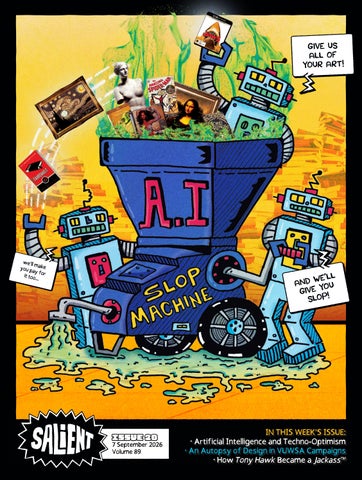
give us all of your art!
we’ll m you p ake ay fo r it too ...
e ll and wyo' u give p! slo
ISSUE 20 7 September 2026 Volume 89
IN THIS WEEK’S ISSUE: . Artificial Intelligence and Techno-Optimism
. An Autopsy of Design in VUWSA Campaigns . How Tony Hawk Became a JackassTM
ISSUE #20 7 September 2026 Volume 89 Editor Phoebe Robertson Designer & Cartoonist Jim Higgs Sub-Editor Holly Rowsell News Writers Dan Moskovitz Martha Schenk Otis Whinney Ali Cook Columnist Guy van Egmond Critic-at-large Jackson McCarthy Comic Artists Grace Elzenheimer Jack Graham Contributing Writers Tamanna Amin Zia Ravenscroft Christopher Curtis Ryan Cleland Social Media Manager Will Tickner Photographer Sophie Spencer Centrefold Artist Callan Kinsella Advertising advertising@vuwsa.org.nz Read Online salient.org.nz issuu.com/salientmagazine Follow Us @salientgram
Want to get published? To contribute to Salient, you can submit poetry, creative writing, artwork, comics, puzzles, features, and other ideas. Feature articles must be pitched to the Editor before writing; send pitches to editor@salient.org.nz. Artwork should be sent to designer@salient.org.nz. Creative writing submissions are accepted through the form on our website. All other contributions, including puzzles and general ideas, should be emailed to the Editor. Submissions are welcome from first-time and returning contributors.
scan here to find out more!
Phoebe Robertson Sul Sul! Before coming back to Salient in 2025, I worked as a VUWSA Advocate. As part of that role, I supported students through disciplinary processes at the university. Do you know what one of the most common causes was? Using AI to write assignments. Listen, I’m not here to get on my high horse—although, after reading this issue, you’ll hear plenty about the moral failures of AI—but I will say this: one of the easiest ways to get caught plagiarising at uni, short of copying a mate’s work, is to use AI for your assignments.
I could also give you a wider lecture about AI: the environmental cost, how frequent use of it literally causes atrophy in the neural pathways in your brain, how it writes with the prejudices of the people who designed it, and the horrible, terrible, no good ethics of the companies building these systems. But this is a very practical example, and one I saw frequently, of how using AI can seriously screw over students.
The further you get through university, the higher the stakes become. What might result in a failed assignment as an One of the biggest giveaways is something undergraduate can become a much more called a hallucinated reference. serious disciplinary matter in postgraduate study. If you’re doing a PhD, academic Generative AI is designed to produce the misconduct can put years of work down most probable response to what you ask the gutter. it. That does not mean it is producing a factually correct one. In very simple terms, So, dear reader: don’t be an idiot. Do the it is predicting what word is most likely to writing yourself. come next based on the words that came before it. Google Docs has tools that can help you manage citations and build an alphabetised So, if you ask AI to read your course material, reference list. Student Learning is a service write a 600-word essay about capitalism, you’re already paying for by being a student and give you a full APA reference list, it at this university. If you need help with can produce something that looks like the writing, referencing, or understanding what most probable version of an academic essay. the hell your lecturer is asking you to do, reach out to them. The result? A whole bunch of references that look right but, when you actually look You do not need to plug your assignment them up, don’t exist. Or the article exists into ChatGPT. but the page number doesn’t. Or the journal doesn’t exist. Or the author doesn’t exist. And you definitely don’t need to trust a system that can confidently invent a journal It can get even trickier. It might use the article and then hand you the rope to hang name of a real academic but invent a journal your academic career with. article for them to have supposedly written. This isn’t the AI deliberately narking to your lecturer that you cheated. It’s simply producing a plausible-looking answer without necessarily having any factual basis for it.
About the centrefold artist - Callan Kinsella Hi! I’m Callan, I’m a second-year Ecology student here at Te Herenga Waka. I was inspired to draw a Kākāpō because of the breeding season at the start of this year (and also because they’re super cute). 2026 was a historical year for Kākāpō, with over 100 chicks hatching, meaning the population has reached over 300 for the first time in potentially 75 years! I hope you enjoy this art :) Go to the centrefold on page 20, rip it out and put it on your wall!
02
Editorial
03
Letters
04
Gig Guide
05
News
14
Strictly 4 The Islands
15
White Supremacy in Academia
16
AI and the Cotton Gin
18
An Autopsy of Design in VUWSA Campaigns
Keegan Langeveld is of course entitled to try and pitch NZ First to students, but it's kind of hilarious that he thinks we'll just forget or ignore the party's long history of racism (Winnie's "go back to your own country" jab is just the latest in a long line), homophobia (every single NZF MP voted against marriage equality), transphobia (the gender definitions Bill, the attempted bathroom bill last election, repealing the RSE guidelines because of accusations of "ideology" and "wokeness" and "grooming" (according to former NZF candidate Lee Donoghue)), hate mongering (riling up death threats and abuse against Benjamin Doyle), wrecking our environment (to quote Shane Jones, "drill, baby, drill!), and one of Young NZ First's own execs, Nicholas Newport, having ties to Neo-Nazi groups like the Australian National Socialist Network. I'd be interested to hear what excuses Langeveld has for all of that, and to hear what his relationship to Newport is/was. Signed, a concerned citizen.
Kia ora Editor, I am concerned about bias in the conduct of both the Wellington Bays and Wellington North debates during democracy week. In both the top or near top question amongst the user submitted questions were in regards to supporting fees free, yet during neither debate did the moderators ask about it. Given it being a pertinent question related to students, that can be boiled down to yes or no answers, the exclusion seems odd? After the Bays debate I asked the moderators how the audience questions were chosen. They assured me that there was no bias on their part as they were sent a broader list of audience questions which they selected from and this question wasn't present. The broader list however was compiled by VUWSA President Aidan Donoghue, who openly campaigns for the Labour Party. Given that Labour has refused to state that they support a reinstatement of the policy, and the unpopularity of the position, Labour likely knows that admitting the lack of support in front of an VUW audience would be unpopular. One might suggest that Aidan filtered out questions which would make Labour look bad. I can't say this as fact, but there seems no legitimate explanation not to ask the question, given questions below it in the order were asked. This is one incident, but it adds to a string of examples where it looks like he has priortised the Labour Party over his responsibility to represent the students. -Caspar Levack
20
Centrefold Dear editor,
22
Creative Writing
24
Comic Corner
26
Tony Hawk's: Pro Jackass
29
Ngā Hua te Taiao
30
Munch
31
Critic-at-Large
32
Life, Love and Other Stuff
33
Oh Yes! Oh No!
34
Puzzles
38
Horoscopes
WINNER
If we needed something new to show our current cost of living crisis, the uni's transparency on toilet paper won't help. The Hub level 1 toilets have reached a new depth of shitty on the turd-ometer of places to comfortably poop. The whole role is wholly holey.
Missing Hunk Unc and his advice? To submit a question, scan the QR code below. If your problem needs a spotter, Hunk Unc might just get back to you.
See exhibit A:
Submit to the Letters page by emailing editor@salient.org.nz Best letter each week will win a FREE PIZZA from the Hunter Lounge!
Salient is published by, but remains editorially independent from, the Victoria University of Wellington Students Association (VUWSA). Salient is funded in part by VUWSA through the Student Services Levy. Salient is a member of the Aotearoa Student Press Association (ASPA) and the New Zealand Media Council. Complaints regarding the material published in Salient should first be brought to the VUWSA CEO in writing (ceo@vuwsa.org.nz). If not satisfied by the response, complaints should be directed to the Media Council (info@mediacouncil.org.nz).
Week of Sept 7 - Sept 13, 2026 Wed 9/9 Eyegum Free Wednesday Featuring Evie Bamford, Emily Alice, and Yendor - 8pm @ San Fran Fri 11/9 Bassdrops.co.nz Presents: Echoes Featuring Kiljoy, Ddog, Ethos, Indeks, Harry Max, Kstorm - 9pm @ Afters Sat 12/9 Fox Moss Album Release With Field Enhancement, Fiunary, and VJ Pixelotti - 8.30pm @ Pyramid Club Sat 12/9 Spring For Kaibosh Fundraiser Featuring Flatmate, Hexidecimal, Nam Chucks b2b Amira, Ché D, The Village Idiot, and DJ Danger - 7pm @ Moon Sat 12/9 Sam Fowles and the Experience Psychedelic, Soul, Blues 8.30pm @ Rogue and Vagabond Sat 12/9 Froth and Safehouse Presents: Samurai Breaks - With Ultraviolet, Whaea G, and Ohimesama - 11pm @ Meow Sat 12/9 Manawa: Ahiahi Featuring Queenie, Clydesdale, Releaf 9.30pm @ Afters
Gig guide and photography by Sophie Spencer
4
Gig Guide
The four piece alternative rock powerhouse Half/Angel emerged in late 2024 and have since been on an unstoppable trajectory. Electric guitars drive their sound, shimmering melodies decorate the highs, while the rhythm section dives up and down. Seamlessly dynamic instrumentals carry their audience through a range of captivating emotions.
Controversial Amendments Not Recommended by Anyone Martha Schenk The Electoral Amendment Act 2025 came into force on 20 December 2025 and was fully in place by 1 January 2026, making several changes to the Electoral Act of 1993 and therefore altering the way the general election will be run on Saturday 7 November, 2026. Among the changes is an amendment to electoral law that stipulates the last day to enrol to vote or update your enrolment details is 25 October, thirteen days before the Election Day.
to achieve at the next election.” Goldsmith also said that people had a year to get organised, and that he had “every confidence New Zealander’s can manage.” Public law professor Andrew Geddis expressed concerns that large-scale changes to voting practices make it difficult for voters to change their behaviour quickly enough, consequentially leaving them unable to participate in the democratic process due to changes made in administrative law.
Previously, any unenrolled person wishing to vote could turn up to any voting place on the day of election and enrol, placing a special vote. This special vote would allow an elector to cast a ballot if they were unregistered, and have this considered an application for registration. In 2023, 110,000 people cast their vote using this method, which made up 3.81 percent of total votes cast. Including those leading up to Election Day, 603,257 special votes were cast in total, making up 20.9 percent of final votes cast, with 16,633 of these votes disallowed.
“If those numbers are quite considerable and if we have a quite close election, then we do have this question as to whether the legitimacy of the election has been affected by people who wanted to take part being told that the law no longer allows them to do so,” he told Newsroom.
This year, the Electoral Commission expects that 55,000 such votes will be disallowed on the basis of un-enrolment, with an additional 72,000 disallowed because a voter has moved and not changed their enrolment details by the date of 25 October. The total is more than seven times the number of disallowed votes from the last election.
Geddis said that restricting same-day enrolment and voting can “be predicted to reduce the number of votes cast by groups that support left-of-centre parties.”
The government's rationale for the change was to improve the “timeliness, efficiency, integrity, and resilience of elections and their operations,” yet the commission has maintained that the changes will make no difference to the release timeline of election results. They still expect to receive around 700,000 special votes from those who update their enrolments between Writ day and 25 October, that will require processing after Election Day. This processing of enrolment transactions is normally completed on the fourth day after Election Day, but during the 2023 election it took twice that time to complete due to the increase in enrolments, and it took three weeks instead of the usual two to announce election results. The Ministry of Justice regulatory impact statement (RIS) prepared for the amendment act predicted that “an earlier enrolment deadline may merely shift enrolment demand in the run up to the election rather than reduce it,” and that for this reason the “option is not preferred.” In 2025 Chief Electoral Officer Karl Le Quesne said that if the changes weren’t made the commission would have had to “resource up in a much bigger scale than otherwise,” but was clear that the amendment was “not a change that we recommended.” The same year Justice Minister Paul Goldsmith told RNZ that allowing late enrolments placed “too much strain on the system,” and that “the 20-day timeframe will likely already be challenging
But not only could closing enrolments ahead of advance voting result in lower voter turnout, it is also likely to disenfranchise certain demographics and, as a result, the parties they tend to elect.
According to Aciale Consulting New Zealand Electorate Voter Demographic Visualisation, older electorates are more likely to vote National and NZ First, while younger Electorates trend toward Labour and the Green Party. The visualisation also shows that National has fewer votes from majority Māori and Pasifika electorates and moderate support from majority Asian electorates, while Labour has strong support from majority Pasifika electorates and moderate support from majority Asian and Māori electorates. Judith Collins’ Attorney-General report regarding the Electoral Amendment Act advised that “The Electoral Commission has data that indicates that special votes are more likely to come from areas with larger Māori, Asian, and Pasifika communities, and that younger people are more likely to cast special votes. This may indicate that these communities will be more affected.” For example, Electoral Commission data shows that in the 2023 election 48 percent of Māori voters aged 18 to 19 enrolled or updated their details during the voting period. Their votes would be disallowed this election. In the same report, Collins concluded that the elements of the Amendment Act presented inconsistencies with the ‘right to vote’ from New Zealand Bill of Rights Act 1990 (NZBORA). In response to this sentiment, Goldsmith said that “if people are making the argument that Māori are less capable of getting enrolled and participating, I just don’t agree with that.”
Article continues on next page. Kawepūrongo | News
5
Deputy Prime Minister and ACT Party leader David Seymour also notably referred to special voters as “dropkicks that can’t get themselves organised to follow the law,” in July of 2025. Others have drawn parallels with the SAVE America Act in the United States, an electoral amendment that if passed by the Senate will prevent mail balloting and require presentation of documentation that will disenfranchise an estimated 21 million Americans. "This is a significant, but necessary change, and New Zealanders have plenty of time to get organised and enrolled. Automatic enrolment updates will also now be allowed and postal requirements will be removed, helping to keep people contactable and participating in democracy,” Goldsmith said. But this change is not the only part of the Electoral Amendment Act 2025 that is being labelled as disenfranchisement. A further amendment to 1993’s Electoral Act reinstates a complete ban on prisoner voting, reversing a decision made by Labour in 2020 that allowed those serving sentences of less than three years to cast a vote. The change is not retrospective, meaning prisoners who were sentenced to less than three years before the bill came into effect will still be able to vote in this election, while those sentenced after 20 December no longer have the right to vote during their sentence. In her Attorney General report, Collins found further inconsistencies between the new laws regarding prison voting with the ‘right to vote,’ as well as the ‘right to benefit of lesser penalty’ from NZBORA. She refers to the Attorney General’s conclusion of the 2010 Bill, which states that “the irrational effects of the Bill also cause it to be disproportionate to its objective.” The Independent Electoral Review published in 2023 also recommended granting all prisoners the right to vote, concluding that “given the fundamental nature of the right to vote, disenfranchisement should not form part of someone’s punishment.” In April 2025, Goldsmith released a statement saying that “restoring prisoner voting was typical of the previous government's soft-on-crime approach,” and that “a total prison voting ban for all sentenced prisoners underlines the importance that New Zealanders afford to the rule of law, and the civic responsibility that goes hand-in-hand with the right to participate in our democracy through voting.” In 2015, previously incarcerated Arthur Taylor argued successfully at the High Court that the prisoner voting ban was a breach of human rights due to its discrepancies to NZBORA. This was the first time in New Zealand court history that a formal declaration of inconsistency had been recognised as an obtainable solution for statutory breaches of the Bill of Rights. Prime Minister Christopher Luxon was asked about the ruling by Stuff News in 2025, replying “I do not care what anyone else says about it.” “This country is built on rights and responsibilities. And if you choose to take the rights but not hold up responsibilities and find yourself in jail, we are temporarily removing your rights for voting. That’s completely reasonable,” Luxon said. Similarly to the changes made to enrolment cut off, the change is likely to affect certain demographics disproportionately, and therefore the vote count of their favoured parties. While Māori make up approximately 15 percent of New Zealand’s population, they account for 52 percent of people in prison, making the effect of the prison voting ban inordinate for Māori voting rights as a whole. In 2019, the Waitangi Tribunal released a report on Māori prisoners voting rights. It found that, due to a lack of informed
6
News | Kawepūrongo
decision making, “the Crown has failed in its duty to actively protect the right of Māori to equitably participate in the electoral process and exercise their tino rangatiratanga individually and collectively.” “Māori have been disproportionately affected … exacerbating a pre-existing and already disproportionate removal of Māori from the electoral roll,” the report read. The Tribunal recommended urgently that legislation be amended to remove the disqualification of all prisoners from voting, irrespective of sentence. An article published in 2025 by Te Herenga Waka professors Dr Hedwig Eisenbarth, Dr Yvette Tinsley, and lecturer Dr Ti Lamusse outlined that human rights breaches, social exclusion risk, and lack of Māori consultation on the Bill increased the likelihood of negative outcome for prisoners, and Māori prisoners in particular. “In our view—as experts spanning the areas of criminology, psychology, and law—imposing a voting ban is flawed on three counts: it ignores our human rights obligations, it risks undermining rehabilitation efforts, and it increases discrimination,” the article said. “The right to vote should not be seen as a privilege but a fundamental right that lasts throughout imprisonment. Upholding prisoners’ right to vote would affirm their citizenship, align with human rights standards, and strengthen New Zealand’s democracy.” Last week, Salient spoke with Justin Taua*, who is currently incarcerated, about the effect the voting ban would have for people in prison this election. Taua voted previously in the 2023 election while incarcerated, and says the experience was similar to that of outside. He says losing the right to vote sets a precedent that marginalises prisoners when in truth their situations are symptoms of “wider socioeconomic flaws, things like poverty, mental health, drug use.” “You might say you’re breaking the law, you’ve hurt society, your community. You deserve to be reprimanded in some way … it’s understandable,” he said of the intention behind the new laws. “As a citizen, we have the right to vote, and just because I’m in prison doesn’t mean I’ve lost my citizenship. So why have I lost my ability to act upon that?” Taua, who was unaware that the Amendment has passed into legislation, believes it to be a direct violation of human rights as guaranteed to incarcerated people by NZBORA. “You’re marginalising a group of citizens, regardless of the committing offences.” He says that in his experience, and for a lot of people growing up in poorer or marginalised electorates, the importance of voting was underemphasised. “The unfortunate reality of prison is that a lot of my peers are either still unaware of the power that they hold regarding citizenship, and the personal, ethical, moral, social kind of ability we have to engage.” “Now that I’ve come to understand the true power of having the ability to vote, I’m firmly of the opinion that I should vote,” he said. *pseudonym
Dan Moskovitz
election interviews
In the run-up to the 2026 election, Salient is interviewing all of the major parties to understand their responses to the issues students face. Here, Shanan Halbert, Labour list MP and Tertiary Education spokesperson pitches Labour.
Why Should You Vote Labour? What is the biggest challenge facing students in New Zealand in 2026? Students are paying more to live and more to study, which is making higher education less accessible. Labour stands by ensuring tertiary education is accessible to everyone in this country no matter where you live.
With that in mind, what is Labour proposing to support students? We’ll have a direct response to the cost-of-living challenges. A number of student surveys have come out saying transport costs are one of the main barriers in getting to class, so the first one is our public transport fare cap—$20 a week in Wellington, Auckland, and Christchurch. At the moment in Auckland, the fare cap is $50 and we’re coming in at $20. People are having to choose between a meal or going to university, and that’s not the tertiary education lifestyle we believe in.
Students are currently the only beneficiary group not eligible for the winter energy payment. Is this something Labour would change? Labour introduced the winter energy payment. What’s important to use in this election is that we are bringing down the cost of living for students. People are having to choose to not turn their heater on. This means people get sicker for longer which impacts our hospitals. We’ll be outlining a number of cost of living measures in our manifesto, which will be announced in a few weeks time.
Will including students in the winter energy payment be included in the manifesto? We’ll be looking at a range of measures which will save students money.
Are there student specific measures? Some, yes.
Can you give us any indication on what those might be? I’m not announcing our manifesto today, but I can give you an example of public transport fare caps. In Auckland, it’s largely students who access public transport, and we have significantly higher usage in Auckland. Last time we were in government, we made public transport half price, this time we’ve done better and capped it at $20.
Let’s attack this question from a different way: if you’re elected and making students eligible for the winter energy payment isn’t in the manifesto, is this something you will advocate for from within Labour? Well what we have put in the manifesto is our solar saving—
-I’m not asking about the manifesto, I’m asking if making students eligible for the winter energy payment is something you would advocate for from within Labour. Absolutely advocate. It’s important that students are living in warm, dry households. That’s why Labour enacted the healthy home standards last time we were in government, and it needs to be enforced further. I don’t think the winter energy payment as a one off solution is going to address the problem, which needs a range of responses, starting with enforcement of the healthy homes standard and continuing with other policies, like our Solar Saver policy. So the winter energy payment is one option, but there needs to be a range of responses to supporting students through the cost of living crisis.
Between 2014 and 2024, the amount course fees could rise each year was between 2 and 2.8 percent. In 2025 and 2026, course fees were allowed to rise by 6 percent. If elected, what would your policy on course fees be? This government has increased course fees by 19 percent across three years. Students are having to increase their loans, and the number of students accessing student loans and the number of students borrowing have both increased. On top of that, fees-free has been removed, which is an additional $12,000 of debt. We can’t just continue to load students up with debt, it’s not acceptable, and so we’re focused on reducing student debt.
So, are you saying you’d keep yearly course fees between 2 and 2.8 percent? I’m saying my focus will be on reducing student debt in the policies we announce for this election.
These course fee rises have come with the removal of final year fees-free. Is that something Labour wants to bring back? We won’t return fees-free. Our focus will be on restoring pay equity and reducing the debt burden this government has put on students. Article continues on next page. Kawepūrongo | News
7
Why not? There’s fiscal implications. Once it’s gone, it’s gone. The money has been reallocated elsewhere, and to bring it back we’d have to rebuild the system. We know students are finding it tough out there, and I don’t think it’s acceptable for student loans to be the size they are. The other important point in this is that a lot of the fees-free discussion is focused on university students, but the impact has largely been on Polytech, Wānanga, and work-based learners. University students, because of the qualification, have a higher earning potential and can therefore pay the loan back, but other training areas may not have the earning potential. So that’s why we need a broader focus around how we achieve pay equity in the system.
In 2017, Labour were elected on making all three years of university free. That eventually quietly went down to one year, and now Labour won’t bring it back. Why should students trust Labour again? Labour has always stood by students and always supported them to reduce the loan burden. I contrast that to a government which has increased student fees by 19 percent, removed fees-free, taking away $12,000 from eligible students, and provided no cost-of-living support through a costof-living crisis. That’s not the experience under a Labour-led government; we introduced fees-free, provided significant support through the pandemic, and youth unemployment was incredibly low.
Wellington’s unemployment rate is at 6.3 percent, but for those aged between 15 and 24 it is 8.4 percent. There are ten thousand fewer jobs in Wellington than there were last election, and the government is looking to remove 8700 public sector jobs, which would disproportionately affect Wellington. Right now, what incentive is there for a graduate to stay in Wellington? I’m hopeful that anyone training can see a life here in Wellington or New Zealand, but that requires a government committed to them being here, living here, and working here. We have to create more job opportunities for graduates, and we have to make sure the response to cost of living is a real one. Christopher Luxon promised to fix the cost of living—he hasn’t. Things have gotten more expensive and students have worn the brunt of it, whether it be petrol, food, rent, or power. And those are the priority areas you’ll see Labour focusing on this election.
So is there a good reason to stay in Wellington right now? There are lots of great reasons to stay in New Zealand. But the government has to give young people a reason to stay here. That starts with employment opportunities: if people can’t find part-time work while studying, let alone full time graduate opportunities, they have no other decision but to go off to Australia.
8
News | Kawepūrongo
The brain drain to Australia is a problem, but what about the brain drain from Wellington? It’s the only city in the country which is losing population. If we look at the public service, the job losses there definitely hurt Wellington significantly, but we feel those numbers right across the country. A lot of the public service works in Auckland, and that’s where a lot of those job losses will come from. But in small towns, if one office of MSD goes from ten FTEs to six, then four people in a small town are no longer employed.
Access to mental health addiction services for young people has declined-there are 5000 fewer people receiving care than five years ago. How would Labour address the gap between demand for mental health care and the services available? There are 100,000 young people currently not engaged in education, training, or employment. That’s the size of Palmerston North, and up from 60,000 when we left the government three years ago. Whether you look at this socially, economically, or otherwise, this is going to spin around to bite New Zealand because we don’t have pathways into training or employment to offer them. This group is largely underserved by our health system and unable to access mental health support. So they are a real focus for me. We’ve put significant investment into mental health and addiction services in the past and we want to do so again, but that's a manifesto commitment and will be announced in a few weeks time.
I understand you can’t talk about the manifesto until it’s released. But what can you tell me about Labour’s mental health plans? We’re committed to young people and to those who are most vulnerable. We look at the government which does punitive measures like move on orders. That’s not our style. Our homeless are a group which have suffered from poor mental health and addiction, and this government’s response has been to lock them up. We have far more empathy than this government, we believe we can rehabilitate them and take a health approach to addressing their needs.
Thank you for your time, Shanan. No worries.
Free Bogdan Syrotiuk, Ukrainian socialist sentenced to 15 years in prison! International Youth and Students for Social Equality
[OPINION]
On August 10, a 27-year-old socialist and anti-war activist in Ukraine, Bogdan Syrotiuk, was sentenced by a district court in the Nikolaev region to 15 years in prison. He was convicted of “high treason under martial law” for writing articles that called upon Russian and Ukrainian workers to unite to end the war. The International Youth and Students for Social Equality (IYSSE) at VUW is appealing to students and staff members to support the international campaign for Bogdan’s immediate release. This is a critical part of the fight to end the war in Ukraine, which threatens to engulf Europe, and is increasingly merging with the US war against Iran as part of a global conflagration. Bogdan has already spent two years in prison in atrocious conditions and has been denied urgently needed dental treatment. Given the widespread, well-documented torture in Ukrainian prisons, a 15-year sentence could well amount to a death sentence. This is an attack on fundamental human rights that completely undermines the claims that Ukraine is fighting a war to defend “democracy.” What was Bogdan’s crime? When he was initially arrested in April 2024 he was accused of being a Russian agent, but the prosecution did not produce any evidence of espionage, sabotage, or any collaboration with the Russian state. Bogdan is a leading member of the Young Guard of Bolshevik-Leninists (YGBL), a Trotskyist organisation active in the former Soviet Union, which opposes the Putin regime and its invasion of Ukraine. The YGBL also opposes the USand NATO-backed Zelensky regime, which is prolonging and relentlessly escalating the war against Russia. The court that sentenced Bogdan said its decision was based on six articles he wrote for the World Socialist Web Site, which was banned in Ukraine six weeks after Bogdan’s arrest. These writings called on workers in Russia and Ukraine to unite to end the mutual slaughter. In a speech on May Day 2023, Bogdan said: “This war was unleashed by US imperialism, NATO, and the Putin regime. It is an imperialist war, waged not in the interests of the proletariat of Russia, Ukraine and America but in the interests of capital in these countries.” In February 2024, shortly before his arrest, Bogdan wrote an article explaining that the 2014 NATO-backed coup d’état, which overthrew the pro-Russian regime of Viktor Yanukovych in Ukraine, had provoked the Russian annexation of Crimea and the civil war in the Donbass. The US and European powers then flooded Ukraine with weapons and prepared to use the country for a direct war against Russia, aimed at establishing unchallenged imperialist domination over the whole region of Eurasia.
Bogdan insisted that “Although Putin’s invasion was a desperate response to NATO expansion, this does neither justify the actions of the Putin regime nor change its reactionary character. Just as the Zelensky regime speaks for the interests of the Ukrainian oligarchy, the Putin regime speaks for the interests of the Russian oligarchy. Both emerged out of the Stalinist bureaucracy’s destruction of the Soviet Union and restoration of capitalism and are deeply hostile to the working class.” The verdict declared that Bogdan’s writings were “socially dangerous” because of they promoted “non-recognition of Ukraine’s legitimately elected political leadership and democratic processes,” “comparisons with fascists and Nazis,” “negative assessments of Ukraine’s Armed Forces,” and “reinterpretation of national heroes and historical figures.” As well as imprisoning Bogdan, the court demonstrated its commitment to “democratic processes” by ordering the physical destruction of Bogdan’s socialist and anti-war pamphlets and books—actions which in fact resemble those of fascist dictatorships. The fact is that Ukraine is not a democracy. On 23 August, Ukrainian President Volodymyr Zelensky delivered a tirade opposing calls for an election, which he said would “destroy the country.” Zelensky’s term expired more than two years ago and elections have been indefinitely postponed. The government fears that an election could reveal the depth of opposition to the Zelensky regime and the war. A Gallup poll on June 30 found that 66 percent of Ukrainians want a negotiated end to the war as soon as possible, while only 24 percent favour fighting on until victory. Hundreds of thousands of people have deserted the military and millions have fled the country to avoid being sent to the front and killed. Even if an election is held, it won’t be democratic. The regime has banned a dozen parties, including the Opposition Platform—For Life, which was the largest opposition party in parliament. Bogdan is accused of reinterpreting Ukraine’s history and making false comparisons with Nazis. In fact, it is the Zelensky regime that is rewriting history to glorify figures like Stepan Bandera, leader of the Organisation of Ukrainian Nationalists (OUN), which collaborated with the Nazi war of extermination against the Soviet Union and the Holocaust against the Jewish people. Communist symbols have been outlawed in Ukraine and monuments commemorating the defeat of the Nazis by the Soviet Union have been torn down. Statues of Bandera and other monuments to the OUN have been installed across the country. Article continues on next page. Kawepūrongo | News
9
One of Bogdan’s articles, published on 6 October 2023, outlined how the Nazis’ Waffen SS Galicia Division, formed in 1943 at the instigation of OUN leader Andriy Melnyk, was being glorified on Ukrainian television. In September 2023, a veteran of the Nazi division, Yaroslav Hunka, received a standing ovation in the Canadian parliament, where he was presented as a hero by Zelensky. Zelensky recently organised the repatriation and reinterment of Melnyk’s remains, as well as those of OUN founder Yehven Konovalets, as part of a campaign to re-brand these genocidal Nazi criminals as “national heroes.” The promotion of fascist ideology, the banning of strikes, suppression of socialist publications and parties, and the imprisonment of socialists and anti-war activists. This is the reality of life in Ukraine, which is completely buried by the corporate media in New Zealand and other western countries. Instead, the NZ media is encouraging young people to fight in the war. In July the New Zealand Herald published an article glorifying a 22-year-old Auckland man who was killed while fighting for Ukraine’s fascist Azov Battalion. TVNZ’s Q&A recently interviewed former Defence Minister Ron Mark (NZ First), who hailed New Zealanders fighting in Ukraine and wants greater NZ involvement. The last Labour government sent NZ troops to Britain in 2022 to train Ukrainian conscripts. The National-led government has kept them there. Both major parties are promising
to double New Zealand’s military budget as a share of GDP and boost recruitment dramatically, in order to further integrate NZ into US-led wars throughout the world. The world’s population faces enormous dangers. The wars in Ukraine and Iran, and the genocide in Gaza, demonstrate the utter ruthlessness of imperialist and capitalist powers, which seek to reconquer and plunder the world. Workers, young people, and students have the power to stop this madness. Students must join the fight to build an anti-war movement, based on the Trotskyist strategy advanced by Bogdan. In his May Day 2023 speech he said: “The working class and the revolutionary youth can stop the impending imperialist war only by their internationalism and unity. Only internationalism, not bourgeois and petty-bourgeois nationalism, can end poverty, human oppression and injustice.” We call on students and staff at VUW to support the fight for Bogdan’s immediate release. Sign and circulate the petition at wsws.org/freebogdan. Write to the Pervomaisk City District Court (inbox@pm.mk.court.gov.ua) and the Mykolaiv Court of Appeal (inbox@mka.court.gov.ua), copying freebogdan@ wsws.org. The IYSSE encourages students to attend our club meeting on 16 September at 4:10pm in SU219 to discuss this important campaign.
WHICH PARTY PARTY SHOULD I VOTE FOR? Your Guide to the 2026 Election Election campaigns are very good at telling you that this is the most important election of your lifetime. They are less good at telling you whether your bus fare will go down, whether your rent might be capped, or what happens to your student loan once you graduate. This guide tries to make that choice a little easier. It breaks down what each of the six parties currently represented in Parliament—National, Labour, the Greens, Te Pāti Māori, ACT, and New Zealand First—is actually offering in 2026, with a particular focus on the issues most likely to affect students: study costs, rent, transport, healthcare, work, tax, and climate. One warning before we begin: the election is not until 7 November, and many of the parties are still writing their policy books. Labour and the Greens have already released relatively comprehensive 2026 platforms; National has been steadily announcing individual election policies; Te Pāti Māori has published a broad manifesto and new tax plan; ACT and New Zealand First are still rolling out major proposals. This guide is therefore a snapshot, not the final word. Keep an eye out for new announcements as the campaign unfolds. For now, here is what the parties are offering students in 2026.
10 News | Kawepūrongo
Ali Cook
National - Economic Growth First National is likely to appeal most to students who prioritise economic growth, lower government spending, and keeping more of their income. Its broader argument is that the government should spend and borrow less, make it easier for businesses to invest and build, and rely on stronger economic growth to create jobs and lift wages. Its 2026 platform pairs that approach with a promise of no new taxes, alongside infrastructure, trade, energy, and building reforms. For students, National’s most direct proposal comes after graduation. From 1 April 2027, it would reduce the compulsory student-loan repayment rate for New Zealand-based borrowers from 12 percent to 10 percent of income above the repayment threshold. You would still owe the same amount, but repay it more slowly and keep more of each pay packet. National says someone earning $75,000 would retain roughly an extra $1000 a year. For graduates heading overseas, however, the party is proposing tougher enforcement and higher costs for borrowers who fall behind on their repayments. National would also make KiwiSaver compulsory for workers from July 2028, before gradually increasing default employee and employer contributions to 6 percent each by 2032. That would build larger retirement savings and eventually require employers to contribute more, but would also mean a greater share of your salary being put aside while you work.
On housing, National is focused primarily on building more homes rather than controlling rents. It wants to free up land, streamline planning and consenting, and finance the infrastructure needed for development, on the theory that greater housing supply will improve affordability over time. The basic trade-off is that National’s student offer is largely longterm rather than immediate. Its policies may leave graduates with more take-home pay and aim to make housing and employment more affordable through economic growth, but they offer fewer direct subsidies or price controls for students struggling with costs such as rent today.
Labour - Cheaper Everyday Essentials Labour is likely to appeal most to students who prioritise cheaper public services and more direct cost-of-living support. Its 2026 platform would have the state absorb more of the cost of things people regularly use—particularly healthcare and public transport. Labour’s headline tax proposal is a 28 percent capital gains tax on gains accruing after 1 July 2027 from residential investment and commercial property. The family home, farms, KiwiSaver, shares, businesses, and inheritances would be exempt. Labour says the revenue would be ring-fenced to help fund its healthcare promises. For students, one of the most immediate policies is public transport. From July 2027, Labour would cap eligible fares at $20 a week in Auckland, Wellington, and Christchurch, and $10 a week elsewhere. Once you reached the cap, further eligible trips that week would be free. Healthcare is another major part of the package. Labour would introduce a Medicard providing three free GP visits each year, restore universal free prescriptions, make cervical screening free for people aged 25–69, and eventually make referred maternity scans free. Labour would also expand Apprenticeship Boost, extending employer subsidies, introducing a $1000 toolbox grant, and adding five more eligible trades. It has also promised that eligible New Zealand-trained graduate nurses would be offered jobs in the public health system. The basic trade-off is that Labour is proposing more collective funding of everyday services in exchange for higher taxation of some property gains. For students regularly paying for buses, GP appointments, or prescriptions, the benefits could be immediate and easy to see. For those who use those services less often, the direct benefit may be smaller.
Green Party - Wealth Redistribution and Climate Action The Green Party is likely to appeal most to students who prioritise lower study and living costs, stronger renter protections, and more ambitious climate action. Its 2026 platform goes further than Labour in both redistribution and government intervention, arguing that problems such as student poverty, expensive housing, high power bills, and environmental degradation are connected to how wealth and essential resources are distributed. That approach is reflected in its tax policy. The Greens would make the first $10,000 of income tax-free, while introducing a 45 percent rate on income above $160,000. It would also introduce a 2.5 percent tax on net assets above $10 million, alongside taxes on large gifts and inheritances and higher taxes on some major corporations. The basic idea is to reduce income tax for most earners, while raising more revenue from wealth and those at the top of the income distribution. For tertiary students, the Greens currently have one of the most direct policy packages. They want to restore Fees Free, extend the Winter Energy Payment to tertiary students, improve accessibility for disabled students, and work towards what they describe as a fully debt-free tertiary education system.
Housing is another major part of the offer. Rather than relying mainly on private development to bring costs down, the Greens favour more public housing, stronger tenancy protections, and tighter regulation of rents. This would give renters greater protection against rising housing costs, while placing more restrictions on landlords than the approaches proposed by National or ACT. Energy and climate policy are similarly tied to household costs. The Greens would establish Kiwipower, a new publicly owned electricity company, alongside zero-interest loans for solar and batteries, stronger rights for renters to access solar power, and greater investment in community-owned renewable energy. The party also takes a different approach to criminal justice from the Coalition parties, placing greater emphasis on prevention, rehabilitation, and addressing the causes of offending, rather than primarily increasing sentences. The basic trade-off is that the Greens are proposing more direct support for students and renters alongside a substantially larger role for government in taxation, regulation and public ownership. Most students would receive an income-tax reduction and could benefit from expanded tertiary, housing, and energy support, while very wealthy households and some large businesses would pay considerably more tax. Whether that looks like a fairer distribution of costs or too much government intervention is one of the central choices behind the Green platform.
Te Pati Māori - Redistribution of Wealth and Power Te Pāti Māori is likely to appeal most to students who prioritise redistribution, stronger Māori-led public institutions, and a greater role for Te Tiriti in how government is structured. Its 2026 platform connects economic inequality with colonisation, ownership, and political power, arguing that improving material outcomes also requires changing who controls public institutions and resources. Its Kiwi Tax Plan could have a significant effect on students and other low-to-middle-income earners. Te Pāti Māori proposes making the first $30,000 of income tax-free, while introducing higher rates further up the income scale, including a 48 percent top rate on income above $300,000. It would also introduce a tiered wealth tax beginning on net wealth above $2 million. For many students working part-time, that could mean paying little or no income tax. Housing is another major part of the platform. Te Pāti Māori wants more public and affordable housing, easier development on Māori and ancestral land, and stronger measures against property speculation and land-banking. Its broader approach places greater emphasis on housing as a social need rather than primarily an investment asset. Its education policies focus less on direct tertiary subsidies than the Greens’ platform and more on who governs education and what it teaches. Te Pāti Māori proposes stronger Māori-led education institutions, greater recognition of mātauranga Māori, and measures aimed at removing barriers to training and participation. Its current 2026 platform is less specific on university fees, Student Allowance, and student-loan repayment settings. More broadly, the party supports Māori-led health, education, disability, and justice systems, stronger protection of whenua and wai, and constitutional reform aimed at strengthening hapū and iwi rangatiratanga under Te Tiriti. The basic trade-off is that Te Pāti Māori is proposing both economic redistribution and significant institutional change. Many ordinary earners could pay substantially less income tax, while higher incomes, wealth, and property would carry more of the tax burden. At the same time, the party would give Māori institutions and communities greater authority over areas currently controlled largely by the Crown.
Article continues on next page.
Kawepūrongo | News
11
For voters, the key question is therefore not only how resources should be distributed, but who should hold the power to make those decisions.
ACT - Smaller Government and More Individual Choice ACT is likely to appeal most to students who prioritise lower government spending, fewer regulations, and greater individual choice over how their money is spent. Its 2026 platform starts from the view that government has become too large and bureaucratic, and that individuals and businesses should have more freedom to make their own decisions. That philosophy is reflected in ACT’s proposal to dramatically restructure the public sector, including consolidating 43 government departments into 19 and reducing the number of ministers. The broader aim is to lower government spending and simplify regulation. For students, ACT has one of the election’s most direct tertiary policies: it would make compulsory Student Services Fees voluntary. Instead of automatically paying for a bundle of campus services, students would be able to choose which services they wanted to fund, with others available on a user-pays basis. ACT estimates this could keep up to around $4000 off a student’s loan over a threeyear degree. The trade-off is that Student Services Fees currently help fund services that rely on pooled contributions, including VUWSA student advocacy, University Recreation, and Salient. ACT argues students should not be forced to pay for services they may never use or support. Critics argue that making the fees voluntary could weaken services that depend on stable collective funding, and that students may only realise they need some forms of support after opting out. On housing, ACT favours increasing supply through deregulation, stronger property rights, and easier consenting, rather than measures such as rent controls. Its broader economic approach similarly places greater faith in private investment and competition than in direct government provision. ACT would also take a less interventionist approach to climate policy. It has proposed abolishing the Climate Change Commission, with necessary monitoring functions transferred elsewhere, arguing that the organisation adds unnecessary bureaucracy and cost. In criminal justice, meanwhile, ACT is proposing tougher sentencing, including a mandatory minimum sentence for a third burglary conviction. The basic trade-off is that ACT is offering more individual control and a smaller state, but with less guaranteed collective provision. Students could pay less for services they choose not to use, while government regulation and spending would be reduced more broadly. Whether that looks like greater freedom or fewer shared protections depends largely on how much responsibility you think should sit with individuals rather than the state.
New Zealand First - Putting New Zealanders and New Zealand Industries First New Zealand First is likely to appeal most to students who prioritise national sovereignty, protecting local jobs and industries, tighter immigration settings, and a more socially conservative political direction. Economically, the party is harder to place on a simple left–right spectrum: it supports significantly more government intervention in some markets than National or ACT, but generally directs that intervention towards protecting New Zealand ownership, employment, and strategic resources. That approach runs through much of its 2026 platform. NZ First argues that industries, energy resources, infrastructure, and employment policy should primarily serve New Zealanders rather
12 News | Kawepūrongo
than overseas investors or institutions. It favours protecting domestic manufacturing and jobs, while tying immigration more closely to genuine labour shortages and arguing that infrastructure should keep pace with population growth. For students, however, NZ First has so far announced comparatively little direct tertiary-finance policy for 2026. Unlike the Greens or ACT, student allowances, university fees, and student-loan reform have not been major parts of its campaign to date. Energy is one area where the party proposes much stronger state intervention. NZ First wants to separate the large electricity gentailers’ generation and retail businesses, reform electricity-market rules, and develop a national energy strategy. It has also proposed $1 billion for oil and gas exploration and says it would withdraw New Zealand from the Paris Agreement, putting energy security and domestic resource development ahead of existing international climate commitments. NZ First has also proposed a $5000-a-year Kiwi Kids Grant for each of a citizen parent’s first three children during their first three years, reflecting the party’s concern about New Zealand’s declining birth rate. Some of its most significant proposals are constitutional. NZ First wants voting in general and local elections restricted to New Zealand citizens, rather than also qualifying permanent residents, and supports a binding referendum on the future of the Māori electorates. The basic trade-off is that NZ First is proposing more active government intervention where it believes New Zealand’s national interests are at stake, alongside tighter rules around immigration, citizenship, and Māori representation. For students—particularly migrants and international students—those positions may matter at least as much as its tax or cost-of-living policies. The key question is therefore whether you think government should take a stronger role in protecting New Zealand jobs, resources, and political institutions from overseas influence—even where that means tighter immigration settings, greater market intervention, or stepping away from existing climate commitments.
Still not sure? Start with what you care about most You probably won’t agree with any party on everything. So instead of comparing six entire manifestos at once, it can help to start with the issue that matters most to you. Here’s how the parties differ on some of the questions students are most likely to care about.
...the cost of being a student right now? The parties are targeting very different parts of your weekly budget. •
• • • • •
The Greens currently have the most explicit programme aimed at tertiary-student support itself: restoring Fees Free, extending energy support, and moving towards debt-free tertiary education. Labour instead attacks expenses around studying: particularly public transport, GP visits and prescriptions. ACT would let students opt out of compulsory Student Services Fees, reducing the price of university for those who choose fewer services. Te Pāti Māori's $30,000 tax-free threshold could benefit students earning taxable income, although its current tertiary-finance policy is less detailed. National's major student-loan benefit arrives once you are earning enough after study to make compulsory repayments. NZ First has so far announced comparatively little in 2026 specifically about tertiary student finances.
...rent? There are basically two competing approaches. • • •
•
The Greens and Te Pāti Māori place more emphasis on public housing, renter protections, and direct intervention in the housing market. National and ACT place more emphasis on making it easier to build enough housing so competition and increased supply moderate prices. Labour sits between those approaches, supporting greater public involvement and renter security while also supporting new housing supply, although its 2026 student-facing headline policies so far are concentrated elsewhere. The disagreement is not really over whether rents are too expensive. It is over whether government should constrain prices and strengthen renters' bargaining power directly, or concentrate on increasing the number of homes available.
...public transport? • • • •
Labour currently has the clearest dollar figure: $20 maximum per week in Auckland, Wellington, and Christchurch and $10 elsewhere. The Greens put considerably more emphasis on public and low-emissions transport as part of their wider climate and urban policy. Te Pāti Māori explicitly includes transport affordability in its cost-of-living platform. For National, ACT, and NZ First, subsidising student public-transport fares is not currently a defining 2026 election promise.
...what happens when I graduate? • • • • •
National would lower your compulsory student-loan deduction to 10 percent, giving NZ-based graduates more take-home pay but extending the time it takes to clear the loan. Labour is focusing on creating and supporting employment through public investment, trades policy, and sector-specific measures such as its graduate-nurse guarantee. ACT argues deregulation, smaller government, and private-sector growth will produce better jobs and wages. NZ First puts more emphasis on protecting jobs and industries within New Zealand and limiting migration where it believes New Zealand workers can fill positions. The Greens and Te Pāti Māori place greater weight on public investment, higher wages/income support, and redistributing more economic resources towards ordinary households.
...climate change? • • • • • •
The Greens propose the most extensive climate and environmental intervention, including public renewable-energy investment and Kiwipower. Te Pāti Māori connects climate policy with protection of whenua and wai, and Māori environmental authority. Labour supports continued decarbonisation and policies such as SolarSaver, while generally working within existing market structures. National emphasises increasing renewable generation, alongside energy security and economic growth. ACT wants to reduce the climate-policy bureaucracy, including abolishing the Climate Change Commission. NZ First is proposing increased domestic fossil-fuel exploration and withdrawal from the Paris Agreement.
...Te Tiriti and Māori-Crown relations? • •
Te Pāti Māori proposes the most extensive change, explicitly advocating Te Tiriti-based constitutional transformation and increased rangatiratanga for hapū and iwi. The Greens also explicitly support stronger Te Tiriti partnership and Māori decision-making.
•
Labour occupies a more conventional Treaty-partnership position, without proposing constitutional transformation on the scale of Te Pāti Māori. At the other end, ACT emphasises uniform individual citizenship and “one law for all,” opposing political rights or public institutions differentiated on ethnicity. NZ First is similarly opposed to separate political representation and is campaigning for a referendum on the Māori seats. National generally sits between Labour and its Coalition partners ACT/NZ First on the intensity of this debate, while its current 2026 headline policy programme is more focused on the economy, public services, and law and order than constitutional reform.
• • •
So, how do I actually choose? Forget trying to find the party with which you agree on everything. It probably does not exist. Instead, pick the three issues you would be most annoyed at the next government for getting wrong. Then ask three things about each party: 1. 2.
3.
Would this actually affect me? A tax cut is irrelevant if you do not pay that tax. Free public transport is less useful if you drive everywhere. How is it being paid for? Every policy has an opportunity cost. Higher taxes, lower spending, borrowing, regulation, and user-pays systems all distribute costs differently. “Free” and “tax cut” are both incomplete descriptions unless you know what changes elsewhere. What kind of system does the policy create? Elections are not only about next year's bank balance. Do you want a smaller state or a larger one? More private provision or public ownership? Stronger renter regulation or fewer building rules? More rangatiratanga or uniform citizenship? Faster climate action or fewer environmental constraints on economic activity?
National is offering continuity, fiscal restraint, and private-sector growth. Labour is offering cheaper universal services and more active public investment. The Greens are offering redistribution, stronger student and renter support, and much more aggressive climate policy. Te Pāti Māori is offering economic redistribution alongside a fundamental expansion of rangatiratanga and Māori control. ACT is offering individual choice, deregulation, and a significantly smaller state. NZ First is offering economic nationalism, tighter immigration, and a more socially conservative conception of citizenship and national identity. None of those descriptions tells you which ballot box to tick, but hopefully they make it considerably clearer what you would be ticking it for.
Kawepūrongo | News
13
4 STRICTLY
THE ISLANDS Weekly Pacific Politics with Otis Whinney The Trouble in Palau That time of year I know you’ve all been waiting for with baited breath has finally arrived. I am, of course, talking about the Pacific Islands Forum, where the leaders of the Pacific congregate to hash out the big issues facing the region. Well, that’s what it’s supposed to be at least. This year, it is to take place in Palau, and by the time this article is released the conference will have concluded. But from where I'm seated, things will be very different this time around. This PIF has seen many leaders unable to make it, whether it be due to political turmoil at home or their allegiances abroad. Prime Minister of the Solomon Islands Matthew Wale, for example, had to pull out last-minute after a motion of no confidence was brought to the table by Home Affairs minister Manassaeh Maelanga. After enjoying a busy three months in the role, Wale will now have to face the music at home instead of making those key connections he no doubt sought to make at the PIF. Wale has been doing his best to mend ties with nations like Australia in the wake of his two predecessors moving the Solomon Islands closer in alignment with China. This no-confidence motion comes after accusations that Wale has been making consequential decisions for the government without proper consultation or oversight. Wale’s immediate moves to smooth over ties with Australia may be what they are referring to, but there are allegations Maelanga has pushed this through to take attention away from several ongoing independent investigations into the actions of previous administrations that could reflect quite badly on those involved. He denies this, and at the time of writing this it remains as speculation. What is on everyone’s minds in regards to this, however, is China. The Solomon Islands has been in a diplomatic back and forth for years, with China making grand investments and Australia attempting to counter that as it has done in places like Fiji and Papua New Guinea. Wale’s hard pivot towards stronger ties with the West could be seen as a motivator to oust him amongst politicians who see more benefits in a further shift closer to Beijing.
14 News | Kawepūrongo
Kiribati’s President will also be absent, and in his place will be David Teaabo, Director of the Foreign Service and the former ambassador to China. The leaders of Naero, Vanuatu, and Sāmoa will also be absent, although not all for reasons as dramatic as others. The region is facing several unprecedented crises, not limited to the increased presence of drug cartels, the ever-worsening state of our climate, and a series of health crises littered across our region, but our ability to work together on these issues is consistently hampered by our alliances with (and often reliance on) competing foreign powers. China and the USA will both be represented at the PIF, and if our inability to have a cohesive response to the Chinese missile test in the Pacific ocean is anything to go by, I cannot see a path where we find a productive framework for collaboration in these trying times. Christopher Luxon will also not be present, instead sending our actual Prime Minister, Winston Peters, to the conference. Winston was very much interested in a united condemnation of the missile test, but the motion was blocked by multiple Pacific countries with deeper ties to China, namely Kiribati and Naero. But given that the USA conducts plenty of their own missile tests in Pacific waters, holds political control over several Pacific island groups in the form of their American territories, and have an unrivalled military presence in the region because of that, it's not shocking that a country like China would want a piece of that pie. As they do everything they can to ensure their status as an alternative power to the USA, the Pacific seems to be getting tied up in a geopolitical struggle the likes of which we have not seen for decades. And while events like the PIF are supposed to allow us to smooth it all out, it seems like there’s quite a few actors involved who’d rather we keep bickering until someone comes out on top. And nothing bad in history has ever happened because of people like that, I’m sure.
White Supremacy in Academia:
The Killing of Jason Arday Orlando Bright Content Warning: Self Harm, Racism On 24 July, the first of a staggering 249 newspaper articles were written about Professor Jason Arday, surrounding accusations of plagiarism. On 14 August, just three weeks later, he was found dead in his home. This was not significant because he was an academic at a top ranked university, nor because he was autistic or young, but because he was Black. Jason’s death tells a story. A story about the ruthless business model of mainstream media, about the exploitation of BIPOC scholars to build social capital for academic institutions, and, most of all, about the white supremacy underpinning it all.
The media happily took up the accusations of a disgruntled white supremacist. No one seemed to stop and question the motives of a man who said openly in an interview with Rob Montz, a low-level, right-wing podcaster: “... after the revolution I'll be the Head of Eugenics & Race Science at Harvard.” Or better yet, why was it not Cofnas who became the scandal? Dr. Karen Kelsky wrote, sadly post-Jason’s death, a scathing Substack article about Cofnas in which she called him a poster child of academic incels and said: “the entire story he supposedly “broke” was nothing but the vendetta of a bad pseudo-scholar against an institution that had rejected him.” This would have been a far more worthy use of journalism.
The media obsession with Jason’s story and the viciousness with which his entire life was scrutinised was not in any way proportionate. Many have pointed out the number of high-profile academics who have similarly been accused of (and were even guilty of ) plagiarism, which led to little, if any, media attention. All of those academics were white. Even white professors who had been found guilty of sexually harassing students received vastly different treatment by the media. This follows a larger racialised reality Black scholars know all too well—the impunity white folk experience, treated as individuals, set against the vicious persecution of Black folk, where an example is used to cast aspersions across Blackness as a whole.
Jason was hired by Cambridge in 2023 and lauded as their youngest Black professor in history. They paraded him out to the masses for exultation, emphasising his late speech development, autism, and poverty—his triumphs over adversity. In marketing him as such, Cambridge was able to convert his visibility into something they truly valued: social capital. Hiring a brilliant, young Black professor with an interesting bio enhanced the Cambridge brand without requiring any transformation of its systemic issues. As soon as Jason posed a threat to that brand, Cambridge dropped him to preserve its reputation.
Major media outlets like The Times used paid advertisements to boost salacious articles about Jason’s life. All the while, this avalanche of articles about him was being published against the backdrop of war, climate disasters, and political upheaval—issues with materially higher stakes than alleged plagiarism and some embellishments in an academic autobiography. This says everything about the poor state of journalism in the UK (and in the West generally), the readiness of the racist populous—waiting in the wings to jump on the faltering steps of a Black man who stuck his head too far above the parapet—and of the British media, whose business model is centred around grabs for attention rather than the public interest. It was Nathan Cofnas—an ex Cambridge professor who was sacked for his racist views after over 1200 complaints were made by staff and students—who continued pushing the narrative of Jason as a plagiarist after he was cleared. Cofnas, now a researcher at Ghent University in Belgium, espouses the view that Black people “would disappear from all high profile positions outside of sport and entertainment” under a true meritocracy. Instead of being called out as a white supremacist and discredited for his lack of grasp on the basic concept of race being socially constructed (we learnt this in ANTH101), Cofnas was reported by mainstream media using his own self-identifier as a ‘race “realist”’ and his motives went largely uninterrogated.
“He was eagerly elevated as a symbol, ruthlessly scrutinized as an anomaly, and callously discarded as a liability. His rise and fall expose the moral bankruptcy of a system that wants the appearance of racial progress without the work of structural change” — Paul Tiyambe Zeleza, Substack, 5 August 2026 My heart aches for Jason, his two surviving children, his partner and mother, friends, colleagues, and students. His death has been described as a modern-day lynching. Jason’s death is yet another warning about lessons we have failed to learn—lessons about what happens when institutions use diversity to symbolise change so they can maintain the underlying structures that exclude people. No institution or person is immune to ideologies. As a student, I have definitely witnessed the influence of white supremacy in our classrooms here at Te Herenga Waka— Victoria University of Wellington. I have seen other cultures and traditions subjected to scrutiny that the dominant culture (whiteness) is placed above. I have seen professors unwittingly stoke the latent supremacy of students’ whiteness by failing to question vital underlying assumptions and cultural norms. This needs to be treated less as a scandal to be defended, and more as a piece of work to be focussed on. As we have seen with Jason and so many others, lives are literally at stake. As students, we can apply our knowledge now, and demand tangible transformation of ourselves and our institutions. It is not idealism. It is the work needed to build a future without fascism. Ahuatanga | Features
15
01001001 00100000 01100011 01100001 01101110 00100111 01110100 001000 01110101 00100000 01110100 01110010 01100001 01101110 0111001
AI and the Cotton Gin Kaleb Evans-Lao When I think about the new AI data centre planned for Makarewa, I think about how I would have responded ten years ago to the idea that a revolutionary new technology was being built in our own backyard—one that promised to completely change our way of life for the better. I would have been excited. I’ve always had this notion that new technology automatically meant progress, change, and better living standards. But in recent years, that optimism has waned. And I would argue it isn’t just my own attitude towards technology that has changed, but the broader cultural consensus as well. We seem far removed from the technological optimism of The Jetsons, Star Trek, or even that meme image frequently accompanied by captions about “the world with/ without _____.” Instead, we seem more in line with the technological portrayals of I Have No Mouth, and I Must Scream and Terminator—or, more recently, Oppenheimer. We’ll come back to techno-optimism shortly. First, I want to make a comparison between today’s rise of generative AI and the invention of the cotton gin. Both demonstrate that technological progress does not happen in a vacuum. A new device or method enters a world shaped by existing priorities and incentives, and people put it to use accordingly. In both cases, that has meant furthering wealth at the expense of others. Ultimately, we should be more critical of new technology. When something promises to boost productivity, we should ask: who does that increased productivity primarily benefit? First, the history of the cotton gin, short for “cotton engine.” Invented by Eli Whitney in America in 1794—though Whitney’s involvement in its invention is disputed, it is certain he was instrumental—the cotton gin revolutionised cotton production. Before the gin, processing cotton involved picking sticky seeds out of cotton fibres by hand.
16 Features | Ahuatanga
It was slow, arduous work performed by enslaved people on American plantations. One enslaved worker could de-seed roughly one pound, or half a kilogram, of cotton per day. With the gin, that increased to 50 pounds, or 22.6 kilograms, per day for two enslaved workers operating the machine. It was undoubtedly a substantial increase in productivity. The reaction from northern abolitionists, enslaved people, and Whitney himself was that the machine might help bring an end to slavery: theoretically, plantation owners would no longer need as many enslaved people to pick seeds from cotton. Unfortunately, the opposite occurred. Before the gin, cotton and other plantations reliant on slave labour were seen by some as a sunset industry, with the cost of keeping enslaved people gradually outscaling the revenue generated by the crops they produced. The idea that slavery might therefore be phased out economically has been disputed by Reconstruction historian Paul Finkleman, who wrote in 2013: “Slaves were a profitable investment before the cotton gin and an even more profitable investment after its invention.” Nonetheless, the belief that slavery might eventually become economically unviable was not an absurd one at the time. What is indisputable, however, is that the cotton gin made the cotton industry—and therefore slavery—significantly more profitable. More enslaved people were moved from other plantations to those producing cotton, irreparably separating families and communities. As cotton became increasingly profitable, mass cultivation also degraded soil quality on eastern plantations, and cotton plantations— along with the institution of slavery—expanded further west. The cotton gin helped drive that expansion.
01001001 00100000 01100011 01100001 01101110 00100111 01110100 00100000 01100010 011 00100000 01110100 01110010 01100001 01101110 01110011 01101100 01100001 01110100 01100
000 01100010 01100101 01101100 01101001 01100101 01110110 01100101 00100000 01111001 01101111 11 01101100 01100001 01110100 01100101 01100100 00100000 01110100 01101000 01101001 01110011 Now to generative AI. I don’t think I need to tell a Salient reader why AI is abhorrent. But I do want to point out an aspect of its harms that you may not have immediately considered. Large language models and generative AI have created job opportunities. But many of these jobs exploit vulnerable people who are desperate for work, offering little and inconsistent pay. Worse still is what some workers are required to do for that pay. AI companies often offer remote work to people desperate for any form of employment, or who cannot enter traditional workforces. The work can involve menial tasks such as sorting and labelling data to train and improve AI systems for companies like Meta, OpenAI, Microsoft, and Google. In particular, workers tasked with filtering content before it enters AI databases can be required to regularly view horrific material that I will not divulge here. These “human-in-the-loop” jobs have existed—and exploited people—since social media conglomerates first needed humans to filter their content. AI has only furthered this unethical practice. No matter how sophisticated generative models appear to become, there remains a constant demand for menial human input to keep them functional.
technology progresses far enough, the thinking goes, it will solve the climate crisis. Looking at you, solarpunk. Techno-optimism is a fundamentally capitalist idea. One of the longstanding defences of capitalism is that it breeds innovation; new methods and machines have been touted as one of capitalism’s great strengths since the Industrial Revolution. The validity of that claim aside, presenting technological innovation as inherently good relies on the assumption that innovation itself produces positive outcomes. I hope my spiel about the cotton gin has shown that technological gains in productivity can coexist with—and even enable— devastating social consequences. And techno-optimism is everywhere. If you’ve ever watched a glossy product-presentation video, you’ve seen it in action. Think NEOM and its idiotic “The Line” project in Saudi Arabia. Facebook’s “Metaverse.” Whatever Elon Musk has contributed to the transportation industry. And, of course, AI. Everywhere, tech giants push the idea that technology is the way forward, all the way towards transhumanism and the technological singularity—which is a whole other can of cyber-worms.
So, what do these two examples tell us about technology? In both cases, increased productivity came with a promise of broader social benefit. In reality, it further entrenched exploitative practices that were already in place. And who benefited? In the case of the cotton gin, it was American cotton barons and plantation owners. The United States eventually supplied three-quarters of the world’s cotton, while Britain’s industrial textile mills created enormous demand. Plantation owners grew incredibly rich. With AI, the parallels are easy to see. Figureheads such as Sam Altman have benefited from the massive allocation of funds towards the AI industry. Ultimately, he and the companies that rely on exploited workers to keep their supposedly “autonomous” machines functioning reap the rewards of other people’s gruelling labour. Now, techno-optimism. It’s a loosely defined term, although the idea has arguably existed for many years. Generally speaking, techno-optimism is the belief that technological “progress” is the best—or sometimes the only—way to solve existing problems. The term is sometimes applied to approaches to climate change in which environmental problems are imagined as solvable through emerging or even fictional technologies: if
My overall point is that we need to think about technological progress more critically. Not in the “I won’t vaccinate my children” sense—that isn’t critical, it’s ideological. Rather, when we encounter a technological breakthrough, we need to examine how it will actually operate within the society we already have. In the case of generative AI, it may be capable of doing good. But when it is placed within a system that prioritises profit over wellbeing, it is inevitably going to exacerbate problems within that system while creating new ones of its own. So, finally, if someone tells you to “just embrace the technology,” or offers some other phrase along those lines, tell them the history of the cotton gin. Then ask them: who did that new technology actually benefit? Further reading (and watching): • • •
“Seeds of a Lie,” a Youtube video by Extra History providing a well-produced breakdown of the history of the cotton gin. “The Artificial Intelligence Illusion: How Invisible Workers Fuel the ‘Automated’ Economy,” an ILO article highlighting how AI is not fully “autonomous.” “Kenyan Workers With AI Jobs Thought They Had Tickets to the Future Until the Grim Reality Set In,” a CBS article. There are many pieces on this topic, but this provides an extensive look at the harms associated with AI work.
100101 01101100 01101001 01100101 01110110 01100101 00100000 01111001 01101111 01110101 0101 01100100 00100000 01110100 01101000 01101001 01110011 01101000 01101001 01110011
Ahuatanga | Features
17
Once again, it’s that time of year.
An autopsy of design in VUWSA campaigns Reuben Smith
It’s the time of vaguely recognisable faces plastering the university noticeboards. It’s the time of randomly discovering an acquaintance of yours has a passing interest in student equity. It’s the time of having your desperate study session interrupted by a flurry of hub-based speeches. It is the time of the VUWSA elections. This annual tradition has always deeply interested me. For four weeks, we get to witness our hub of enlightenment and knowledge transformed into a carnival of campus regulars performing with Herculean stamina to prove to us why they are worthy of handling the financial accounts of our student association. Performance is a key component of being a VUWSA candidate because, like their real-world counterparts, a campaign can’t succeed solely on the quality of its promises. Frankly, university students—especially those on the precipice of exam season—aren’t particularly interested in how the financial accounts of our student association are handled. In fact, what’s really guiding their vote is who’s face and name they remember when it’s time to votefill out that online form. Thus, a core tenet of a VUWSA campaign is transforming one’s image into a university favourite. Achieving this requires a carefully coordinated outpouring of multi-media content, but the aspect I’m most interested in is the graphic element. This is not only because I’m a graphic design student, but also because I think a lot can be learnt from it. The graphic component of the campaign is where your personal brand comes alive. More specifically, your graphic identity is not about expressing yourself, but shaping yourself through aesthetic signifiers that make you seem likeable, friendly, and highly voteable. So, that begs the question: what aesthetics appeal to the sensibilities of the Victoria University Student? First of all, Victoria University is primarily an arts and humanities university. This is why works that express some ineffable notion of soulfulness or humanness are far more important than any notion of professionalism. A VUWSA rep should be someone unfailingly genuine. There are a number of ways to express this in your design language. Virtue-signalling is a good start. Evoking the ideas of other agreeable and popular figures in your campaign is a quick and effective way to make passing viewers associate what that figure stands for with what you will stand for. A fashionable figure to ape designs from is New York mayor Zohran Mamdani. Not only is Mamdani a popular figure in university consciousness due to his action-orientated approach to agreeable socialist politics, but he also had a highly recognisable political campaign. Write your name in a yellow serif with a red drop shadow and you’re already half way there. Another example of design virtue signalling is Liban Ali’s successful 2025 presidential campaign. Ali’s posters
18 Features | Ahuatanga
featured various drawings of himself, commissioned from Caleb Gonzalez, with clear textual and visual references to the late, great emcee MF DOOM. I always thought this campaign was a little silly because MF DOOM is not only an emcee who rarely touched on political topics, but one who branded himself as the illest villain of the hip-hop game—not really the kind of terminology you’d associate with a good student leader. However, this was all beside the point. Ali’s invocations of DOOM were not there to signal his political prowess, but his hipness and ‘ball knowledge,’ making himself seem relatable to young adults who eventually voted him into a position of VUWSA President. The campaign did that expertly. While these forms of virtue-signalling homage are effective campaign design tools, they also require enough skill to mimic the styles and techniques of genuine professionals. If that sounds like too much effort, an alternative option exists: ignore your ineptitude and just make the damn poster yourself. This kind of design, typified by aesthetic disregard in favour of sheer practically, forms the basis of my research as a design student. It’s a style with a long tradition dating back, arguably, to the beginning of human history, but one that wouldn’t really be considered a ‘style’ until technological advancements made it possible to design without an intimate knowledge of the printing press. It’s posters made in Word; A4 sheets stuck to dairy windows informing you how to open the door; A scanned photo of an exploded head advertising your mate’s hardcore gig. It’s a style and philosophy I’ve dubbed design brut. Throughout the last 100 years, this purely practical style has been the cornerstone of pretty much every alternative culture, from Californian punks to the avant-garde of Berlin. These design styles are effective in flaunting one’s independence. In effect, these works reject mainstream notions of perfectionism: by putting as little effort into the design as possible, you demonstrate confidence in the work itself. These works are a unique, self-aware form of design brut. They look unprofessional not out of an ignorance of good taste, but through an outright rejection of it. This idea can, and has, been applied to university campaigns before. Refusing to perform in the aforementioned carnival of marketing can be a defiant act of confidence. However, this relationship between effort and quality has been somewhat perverted over the past decade. With the development of tools such as Canva, PicsArt, and AI image generation, making a professional-looking work of design has, ironically, become much easier than making an ugly one. We’re therefore placed in a weird position where the old style of design brut has been robbed of its original meaning. A campaign that is ugly on purpose no longer reads as merely pragmatic, but ironic and countercultural. This is all to say that, while low-effort campaign branding is a similar act of signalling to the aforementioned referencing, it’s a much more difficult and pricklier
phenomenon to unpack. A large number of campaigns fall under this low-effort camp but, for this piece, we’re going to observe probably its most historically successful example: Aidan Donogbubu. Although it seems all evidence of the poster has been scrubbed from our nation—I wonder why— I’m sure those who were around campus remember it. It was for VUWSA presidential candidate Aidan Donoghue and presented him Photoshopped onto a Labubu with a prompt for the viewer to vote. It was a terrible poster but clearly an effective one, as Adian would go on to win that year’s election. The key to make Adian Donogbubu work as a poster was the fact it operated in the design brut style. The image quality was shoddy, the structure was non-existent, and the font was Helvetica. This low effort clearly signals the piece as ironic, and therefore as a cheeky indictment of both Labubus—widely mocked at the time—and the ridiculous VUWSA election cycle. Digging into university’s most evergreen virtue, irony, made Donoghue’s campaign unstoppable. When it comes to being genuine, personable and likeable, who can possibly beat the guy who makes fun of the establishment that everyone else is trying so hard to please? It’s barely design brut. There isn’t even a joke or any real semblance of countercultural messaging. The poster's message, beyond ‘vote for Aidan Donoghue,’ is essentially just: ‘all of this is stupid.’ It’s apathetic, disillusioned, and very of our time. Like all designs, VUWSA campaign posters reflect the time in which they were made. In their quest to appeal to the youth culture of the present, they give us a clear reflection of where that culture stands. Thus, between these forms of irony and earnest reference, we can glean the conflict of a culture beaten by the overwhelming aspect of late-stage capitalism. On one end, we have Ali’s Camusian attempt to appear earnest and connected within an increasingly disconnected world. On the other, Donoghue’s complete rejection of that disconnected world. Just vote for me. Aidan Donogbubu. Why the hell not? With each successful campaign, our cultural scale tips. Certainly, my haters will say that it’s not that deep. Maybe, to a degree, it isn’t. I’m certainly not saying that the quality of Ali and Donoghue’s campaigns were the sole reason they ended up in their positions. What I’m trying to prove here is how much can be learnt from the images plastered across our campus every election season. It’ll be interesting to see what appears this year. If you’re interested in more work cataloguing design brut, check me out at @wgtnbrut.
Ahuatanga | Features
19
Poems by Belle Garay
row. Blocking your number tomor Will still think of you anyway. After Lev St. Valentine
tty. Vibrant as sun. again. Farmer’s market pre The oranges are in season huh? It’s fine. you some? Probably not, Did you want me to save e. self to We used to make marmalad on my studies, treating my ing a therapist, focussing See . now ter bet I’m s, day se The ber. week and got a guy’s num d. I went to a concert last l have that brown stil you fresh fruit, you understan do , it’s winter where you are w kno I e? hom k bac What’s life like , six jacket? haven’t done that since like t, but I guess in fairness you firs you t tex n’t did I ry I’m sor counting. Or anything. months ago. Not that I'm I’m here wishing. ktails in a loud, trashy o. Or maybe some sour coc ont d hol to nch be bra a me ing, really. I just want to Wishing you'd give , low hanging fruit. Anyth ple sim ing eth som ybe r. Ma bar we’d ditch after an hou ing in this. try me t jus assured it wasn’t bangs. Thought of you. ped hair clips and blonde Saw a girl with zebra stri w me. That’s fine. Don’t think you ever kne n you know. I You frustrate me more tha secret ingredient is honey. In case I didn’t tell you, the de. ona lem for e juic ing I’m squeez e in a while, it’s true. . I’m fine. For the first tim should probably stop now
22
Creative Writing
Blocking your num ber tomorrow. Think I’ll try to mov e on but I’m not su After Lev St. Valen re that it’ll work. tine I sa
w a poster on th e noticeboard fo r a stolen car th take a picture an e other day. An d send it to you. older model. W One day, I won’t hite. I was going have that though These days, the to weight inside m t. y chest is lighter. stories as a side Got that cat I alw job, sleeping early ays wanted, editi , you get the idea met at the train ng short . I’m going on a station. date tomorrow w ith th is guy I Australia’s not to o far from here. You asked me if knew what you I could come w were doing. Do ith you. I wonde you still have m r if you y old books? My friend taught me how to chan ge a tire. Broke road trip just in a sweat but it w time. We blasted as worth it. We that song you an finished our mine. d I both loved th at I always imag in ed was just Saw a boy with a maroon buttonup and copper cu You knew me m rls. Thought of ore than I wante you. (I didn’t wan d you to. t to.) Yesterday I read about bonfires an d you didn’t ente things take time. r my mind. It’ll One day, I won’t be slow, but all think about it at good all. The white car w as eventually fo und, but it was Hope you know broken down. I’m always goin g to be lurking in you can’t erase m the first chapters e in the same w of your novel. At ay I can’t purge least you out. I think you care d about me mor e than you knew confirmation. you did. One da y, I won’t need th at
Creative Writing
23
24 Comic Corner | Kōmeke
od! oh my g t had us j s t o il the p attack! a heart
it 't wa i can ack at b e to b ersity! univ
over never fear! i have microsoft on s ur ho 0 00 10, !!! flight simulator
easy does it.
..
Kōmeke | Comic Corner 25
tony Ashton de Vos The Tony Hawk’s Pro Skater series is all about skateboarding. It’s about dropping in, grinding on rails, not giving a f**k. It serves as a love letter to skater culture. So, why, in later installments, do you play as the guy from Jackass riding a bull?
Oscar Lawrence
So, what happened? Why is Tony Hawk no longer the powerhouse it once was? I’ve got one word for it: Jackass.
Jumping the Shark: The Steve-O Problem The Golden Years Tony Hawk’s Pro Skater, developed by Neversoft Entertainment, was released in 1999 on the PS1, N64, and Sega Dreamcast. It met raving reviews, and a Metacritic score of 92. Tony Hawk brought skater counter-culture to the forefront and marked the beginning of skate culture getting the respect it deserved from the “serious” world. Its critical reception got the game into more than 100,000 households within only a couple months, exposing players to a new perspective and showing them a new way to approach life. This surge in popularity had seemingly every single corporation wanting a piece of the Tony Hawk pie, leading to collaborations with Marvel’s Spider-Man, Star Wars, and many other massive pop-culture icons. All that success and income allowed the developers to continue releasing new entries in the series annually, adding innovations such as a plethora of new tricks, more varied and unique environments, and even entirely new ways to play, like the BMX bike. At its peak, the Tony Hawk franchise was a certified cultural powerhouse. Skateboarders were getting into video games, nerds were trying out skateboarding, and Tony Hawk had cemented itself at the core of the skater persona.
26 Arts + Culture | Ahurea
In 2004, Neversoft released Tony Hawk’s Underground 2. For me, this game marked the beginning of the franchise’s decline, as the series took a turn for the worse. Underground 2 leaned heavily into the kind of shockvalue comedy associated with Jackass. While previous games told stories of skaters chasing glory and explored the essence of skate culture, the core of this game was doing as many outrageous things as possible, moral of the story be damned. Examples include farting on construction workers as a required part of the campaign, killing zombies with a tricycle, and skating a chainsaw. Sure, the Tony Hawk games have always had a flair for the dramatic—the plot of Underground 1 includes jumping over an airborne helicopter—but far too much of Underground 2 has very little to do with actual skateboarding. With how little substance there really is to this game, I’m left wondering why it’s even attached to the Tony Hawk franchise in the first place. Previous entries managed to pull off ridiculous scenarios because they remained tied to the skateboarding itself. In THUG 2, a lot of the tasks make you stop using a skateboard entirely and use some other vehicle to complete them. I recently just completed the game on normal difficulty and was left feeling deeply unsatisfied. Finishing it didn’t feel like I had achieved something; it felt like I had completed a checklist of random, annoying tasks.
bam margera
steve
-o
an wee-m
The campaign takes a step up in intensity from the first Tony Hawk’s Underground and turns it up another level with the “World Destruction Tour,” where players complete tasks largely centered around being a nuisance and breaking things. It was interesting for the first few minutes, and I was intrigued at the inclusion of the Jackass crew and what that might mean for the plot. Unfortunately, the plot itself is terrible. Nothing feels particularly engaging. The basic structure is: do X amount of tasks across X levels, then you’re done. There is no meaningful progression for your character other than an underwhelming stat system. Worse, the tasks themselves often feel like chores, and some are so mechanically frustrating that completing them feels more like praying to God than actually mastering the game. Even the following game—which was not especially well regarded—gave you a sense of progression over the course of its campaign by having you develop a skate ranch and gradually unlock more ways to skate in it, including new quarterpipes and other additions. That gave the experience a sense of growth that Underground 2 was missing. Taken together, I believe these factors explain why you simply don't hear about this franchise in the way you once did, and why it has fallen so far from grace.
How Would These Games Look If Recreated Today? If either of the Underground games were recreated today—as the gaming rumour mill so often suggests—a lot would have to be cut simply because of how stupid and offensive some of the original material is. For example, the first game features an Asian McDonald’s chef caricature, and it is about as bad as you would expect. It has not aged well at all. Contemporary audiences are far less accepting of overtly offensive and harmful material, and a lot of what appeared in the originals genuinely would not fly today. If some of it were included unchanged, the game would likely receive significant backlash.
Neversoft developers’ intentions are no longer being taken into consideration? So much could be lost that I would argue it might not even feel like the same game. That is especially true if Activision or Iron Galaxy took the same route as Tony Hawk’s Pro Skater 3 + 4, where 4’s story mode was removed in favour of the more arcade-like structure of 3. Unless they could somehow recapture the original feel of Tony Hawk’s Underground 1 and 2, I don’t think a remake would resemble the originals closely enough to warrant being made. Skateboarding culture has also shifted significantly since 2004. The most popular skateboarding franchise currently is skate™, which focuses heavily on realism rather than the pure chicanery that defined Tony Hawk.
How This Could Happen to Your Favourite Franchise It seems every day a big corporation makes another stupid decision, so it isn’t too far-fetched to believe something similar could happen to your favourite franchise. Bungie, for example, just put one of its greatest IPs, Destiny, to bed after making several foolish decisions in succession. It’s easy to imagine other franchises suffering from the same fate if their developers or publishers make enough wrong turns. If a cultural powerhouse such as the Tony Hawk franchise was erased so quickly, then it could happen to anything.
Conclusion The Tony Hawk franchise was a great one that has unfortunately fallen from grace and drifted into irrelevance. Its Jackass™-ification might not explain every mistake the series made, but it perfectly represents the larger problem: somewhere along the way, Tony Hawk stopped being primarily about skateboarding and started being about spectacle. And once it lost sight of what made it Tony Hawk, the franchise was never quite the same.
A remake could probably feel and play like the original, but is it really the same game if the original
Ahurea | Arts + Culture 27
28 Arts + Culture | Ahurea
Art by Sophia Cao
Good news stories (and more) for the planet Kia ora, Salient reader! Welcome to our fortnightly column on the environment, sustainable living, and the small, stubborn act of hope amongst a world on fire! Check in every second week for waste-free recipes, genuinely good news, and practical ways to lend a hand—nudging a happier, healthier earth a little closer into view.
How to get lost Jachin Brown Getting lost: to some, a problem and to others, a nightmare. But in its obscurity lies opportunity, an opportunity that there is more to life than this! For as it is true that at one time you knew nothing of what you now know, and it is also true that there is still much more of you to be found. So, can you remember it? What it felt like to be unsure yet curious, to be timid but not afraid, to be searching but not yet found. Do you remember what it felt like to be lost? But fear not, hope remains! You can reclaim this superpower; you can reclaim the ability to wander and to wonder, with these four simple steps: • • • •
Be Present—Choose our world over your devastating digital device Be Curious—Notice those alluring anonymous alleyways Be Bold—Explore that suspicious-sounding side street Be Kind—Chat to the heartwarming humans you find along the way
*Pro tip—avoid Google Maps at all costs!
Relationship with the Earth It is likely that you, as a reader of this column, already swoon over the beauty of our Earth, and relish a moment spent under the trees. Or maybe you’re quite happy indoors, content with the cleanliness and order of a mud-free life. Whicher way you fall, it can be easy to feel that—whilst perhaps enjoyable—a relationship to the natural world is not a need to have. ‘It won’t fix climate change.’ Currently solar power is booming, fortuitously working out both economically and environmentally. This is good, but it’s also fragile. If humanities ‘why’ is not because we care, but because prices are low, then we surely walk a dangerous road. How will we ever truly care, if we do not first know the Earth on which we live? Might a lack of relationship to the land which we inhabit be a contributing factor to the western world’s glacially slow progress towards ‘sustainability.’ Perhaps if our country's current leaders had grown up in a society where relationship to the land mattered, they’d be less likely to push for new mines, and delay the reduction of our emissions. Perhaps I am dreaming. Take this as an encouragement to hug a tree, climb a mountain (or a hill), stop and smell the flowers, and wonder at the birds flying overhead. It all matters. As a university student, you will be a future leader. So, for the sake of our Earth, build a relationship. Restoring land without restoring relationship is an empty exercise. It is relationship that will endure and relationship that will sustain the restored land. Therefore, reconnecting people and the landscape is as essential as reestablishing proper hydrology or cleaning up contaminants. It is medicine for the earth. - Robin Wall Kimmerer (in Braiding Sweetgrass)
Creative corner
Tīwae | Columns
29
Mughlai MerCury
munch rating:
What: Filled naan roll Price: $10.00 When: 6:00pm—2:00am, Mon—Sun
A FEED FOR F*CK ALL
Does everything it needs to. (4 stars)
guy van egmond
Mughlai MerCury has had its heyday. I’m not sure what came first, the decision to switch to takeaway order only or the dilapidation of their front of house; it was less restaurant and more forgotten storage unit. There was one black dining table left in the room, holding nothing but a box of tissues. Also in the small, shadowy room were a number of highbacked chairs in faded, dusty, maroon slipcovers. They were all at odd angles and many without a table to slide under, looking purposeless and lost, like an elderly man in his slippers shuffling down a back alley.
roll had simply turned into a platter. The naan was fresh and elastic, perfect for tearing into pieces and using to grab bites of filling. It was delicious on its own as well, with a soft, buttery, almost fruity, sweetness. The filling surprised me by being incredibly moreish too. The vegetable mix of green capsicum, cabbage, carrot, and brown and red onions was lightly sautéed, tender but with retaining some bite. The paneer was subtly creamy and soaked up a little of the simple but generous spiced tomato gravy that had compromised the bottom of my naan.
There was yet some evidence of character still hanging around here. The air was thick with old incense. On the walls were photographs of Indian port scenes and architecture, fading into the pale blue and sepia of old magazines. They were fixed to the fuchsia-painted wall with yellow push pins, next to a plastic clock that had stopped working. It was a far cry from the store’s shiny white website and the new AI-generated posters on their window that advertised their $10 chicken, paneer, or potato rolls. For that kind of deal, I wasn’t going to be easily deterred.
This meal was really solid. It was hot, heavy, satisfying, healthy, quick, cheap, tasty. It felt like a homecooked meal; the cooked vegetable mix reminded me of the quick and easy dinners my mum would throw together sometimes. You have got to go looking for this deal—it’s not on any of the delivery apps that Mughlai MerCury is on—but this also means that you’re never going to be waiting in line long. I wouldn’t, per se, call this diamond in the rough or a hidden gem, but it’s like a good lump of coal that’s actually going to serve a purpose and be dependable. I will absolutely be coming back for their chicken As I walked in, the chef in a black apron and potato rolls. poked his head out of the kitchen to take my order. I’d have to pay later, the Commun(ch)ity Notices: EFTPOS machine was still charging. He popped back a second later to say, ‘you Obituary: For personal reasons, Sri want mild.’ It bordered on a question, Penang has closed up their kitchen on not quite. But he presumed correctly. A The Terrace, and is moving to Levin. short ten minutes later, I was walking They will be missed, I regret never going out with a piping hot paneer roll in in for their kaya toast and kopi breakfast. hand. The thing was so warm I had to If there are any students who commute cradle it in my sleeve as I walked home, in from Levin, you lucky bastards… like a hot water bottle that smelled of coriander, cardamom and turmeric. Moving: Lemongrass Kitchen has moved within the Capital Market complex to be After unwrapping my paneer roll and next to One Sushi. They’re no longer on letting it cool down from bordering on the street side, but still easily accessible. volcanic, I picked up the springy naan for a first bite. The bottom of the naan Have you got a go-to meal deal that other split open like a pulled zipper, and an students should know about? Is there avalanche of paneer cubes and vegetables somewhere iconic that I’ve overlooked so fell back onto the tinfoil. No matter, my far? Send me something to chew on at: guy@salient.org.nz
30 Columns | Tīwae
Jackson McCarthy is Salient's Criticat-Large. His first book of poetry, Portrait, is out now with Auckland University Press. want to get in touch, tip me off, or rage at me electronically? jackson@salient.org.nz
Dance-Floor Romance Chris Tse’s laureate collection is a sweettalking triumph Chris Tse was Aotearoa New Zealand’s Poet Laureate from 2022 to 2025, and did the job so well that the National Library literally extended the term of its laureates by a year as a result. Dance-Floor Romance comes in the wake of this achievement, and in some ways is that achievement, distilled on the page: it’s Tse’s laureate collection, arranged into four years, one for each of his term. Romance is the leading notion, which is roughed up by the dancefloor—the real, messy world—as it overlays sexual, aesthetic, and economic drives: “Was it surrender or ecstasy? You tell me.” (“BRAT by Charli XCX...”) A number of great dance albums indeed dot the collection—brat, Erotica, Nightlife, Blackout, Fever—and standing alongside them is the work of great visual artists—Robert Mapplethorpe, Lubaina Himid, Marsden Hartley, Louise Bourgeois, and more. This ekphrastic tendency suits Tse well, as he’s always been, for me, a poet of nouns—of things—who can make parts of the world collide like a child playing with toys: “Time writes the song / in which the club is a landscape / I worship” (“Nightlife by Pet Shop Boys...”). Yet, as the poetry sings together disparate things, there’s continual reference to the world “back then” (“art versus the world”), a “time” when the poet “didn’t know what to do / with love” (“Your uncle’s story”). It’s an effective rhetorical stance for the more personal disclosures of the collection, and the wisened-up vantage point from which it looks back on such memories—but it also comes to head in a
lovely poem commemorating forty years of homosexuality’s decriminalisation in Aotearoa, “Happy; Happy.” That poem opens in a signature Tse burst of po-faced humor and sweet-talking sincerity—“I plead guilty to happiness by living against the law”—and (along with the earlier prose sequences “Speak its name” and “Long exposure”) turns the historicising tendency up a notch, as the poet surveys not just personal but social history. Implicitly, the latter refigures and redeems the former: the nightlife is not just a place of personal hedonism, lost in one’s own high. Rather, nightlife has been so important to queer resistance because it’s a space where we can act as though we were already free. The final suite of poems is the most outstanding, the most forthright and moving, of Tse’s career thus far. It’s struck through with remembrances of his travels around the globe—ones afforded to the poet by his laureateship—but punctures them with a glancing back home, to “the landscapes that held my absence” (“Lines composed less than a mile...”). Tse’s previous collection, Super-Model Minority, dealt with civic concerns—dispelling colonial concepts of nation-building; racism; queer resistance; utopia; sex; joy as a political action—but the new thrill that emerges here toward the end of Dance-Floor Romance is a restatement of the lyric within the civic. These are some of Tse’s more overtly autobiographical poems, full of the wilding enjambments that characterise his best verse, and yet their gaze turns outward—not inward—to us. In the extended monologue “Number 13” (Tse was our thirteenth laureate), the poet seeks both political vision and “easy life too—hands free to caress the world in its velvets, / not to obsess or fret about the sharp edges that catch my / wild tongue. A pattern must be broken. A heavy heart needs / emptying to make room for courage. So I listen to Robyn’s.” That heavy swing between the personal and the public, roused doubly into poetry and into popular song, is one of the big bids for complexity Tse makes convincing in this collection. Here is our poet, staring down the barrel of contemporary unrest unflinchingly, re-centring sensuality at the heart of public life, and re-centring poetry at the heart of public speech: “These days I wish for love more than ever, / now that I’m attuned to its give & take” (“The last poem”).
I Want Your Sex Gregg Araki’s new film barely coheres Mentions of sexual violence follows. Oh, deary me. The latest offering from Gregg Araki would bill itself as a black comedy—if only it weren’t so egregiously overlit! Araki’s visual style here is part SNL sketch and part YouTube Short; everything is stilted, the mise-en-scene looks ludicrously cheap, the cinematography leaves no pore unexfoliated, and our director struggles to block his scenes in any way other than a banal sequence of straight-to-Netflix shot-reverse-shot yawns. To accompany the release of this film, Araki has given an interview in the New Yorker in which he bemoans Gen Z’s supposed lack of sex life. But the film he made depicts exclusively sex scenes that crudely tow a blurry line between seduction and coercion. So much for an antidote! Of course, Araki knows something my generation risks forgetting: that people must retain their right to describe their own experiences. Rather than blanketing the events of his story with the diagnosis of “sexual assault,” Araki refuses to take a moralising stance on the film’s action in a way that is both deeply unsettling and deeply admirable—and, for me, the film’s most unexpectedly touching note is struck in
those moments when its protagonist, Elliot (Cooper Hoffmann), comes to realise, only months later and in a police station, the power imbalances exploited by his boss, Erika (Olivia Wilde), when she pursued a sexual relationship with him (the majority of the film is framed as his recollections). I Want Your Sex tells Elliot’s story, the story of a jobless art school graduate, as he works for and very quickly is seduced by the pop-art multi-media artist Erika Tracy, who employs him as an assistant. But, for a film full of kinky sex scenes, it contains between its two leads no nudity, no sensuality, no concept of the erotic. It takes a straight-talking French character, Yvette—who has all of one scene!—to skewer the film’s project when she intones in complete seriousness her idea of sexuality as a “dance between two people.” The Americans quickly make fun of her, but you get the nagging sense that this morality drama snarkily phrased as between two generations (with the repressed Gen Z Elliot on the one hand and the libertine Gen X Erika on the other) might better have been phrased as a drama between two conceptions of sexuality. Araki came to prominence as part of the Queer New Wave, largely a critical term that describes the rise of filmmakers, particularly in the US, whose films centred queer experiences through the early 90s. Riding this wave, he’s dealt with far more difficult subject matter in a far more subtle manner before, as in his 2004 masterpiece Mysterious Skin, which remembers a grooming and rape of a child from the perspective of it’s now-teenaged victim in very powerful visual language, well-rendered and imaginative but never sensational. And so part of the disappointment at this latest offering has to do with how poorly it stacks up against his legendary filmography. I’m not opposed to a critique of Gen Z prudishness—in fact, I encourage it. My issue with this film is not that it’s morally “irresponsible” but that it’s imprecise and formally sloppy: the comedy is often oddly-paced; the acting dry, slow, and under-rehearsed. Its jumbled script (not to mention its flinch-out triple ending—see it for yourself ) offers less a dissection of our sexual culture and more a mutilation; a mess. Sure, I’ll grant that I Want Your Sex is a funny and riotous watch—and in Araki’s bawdy, cock-swinging filmography, the comedown has always been worth the high. Until now.
Tīwae | Columns
31
On Dating Apps, Prospects and the Price of Oil Dear dating diary, It may shock you to discover that I have never downloaded a dating app. I got into a long-term relationship pretty young and haven’t needed one since we broke up a year ago. Not to sound too up myself, but I haven’t really needed to download one. I have had great success meeting people in real life! But recently, as things have quietened down a little, I have been reflecting on why I haven’t downloaded one yet. It is the norm to use one so what is holding me back? Firstly, I am someone who hates to text. My phone gives me immense anxiety, and I get overwhelmed by receiving a bunch of messages (which I know is so privileged of me to say as it is lovely that people are reaching out!). The thought of having to log onto another app to think of a witty response to someone’s flirty message is stressful. I already struggle to respond to friends, let alone random people on Hinge!!! Secondly, I would most definitely get addicted to the dopamine rush of finding a match. As I have shared in previous articles, I love attention. It is incredibly validating and I will talk to people I have no interest in just to get attention. The apps would most definitely take over my life, and I am a busy girl who can’t afford the time! Thirdly, I am afraid that dating apps sometimes don’t do justice at portraying who you really are as a person. For example, my friend has an ex boyfriend who is quite boring (sorry) and awkward to talk to. However, over text, he is the wittiest and funniest guy I have ever met. On the flip side, I am friends with a wonderful bachelor who I would be more than willing to set any of my friends up with. Yet he has one of the worst dating profiles with absolutely no solo photos apart from one of
him incredibly drunk. I am concerned that I will waste my time being fooled by someone I don’t click with or I might swipe past the future love of my life all because their profile sucks. However, the real reason I think I haven’t downloaded a dating app is because it brings me comfort knowing that there are still more options out there. Even if I run out of options in real life, at least I know I can still turn to dating apps! But what happens once the dating apps run barren? Where is there to go? I don’t quite know if I can handle a blow like that to my self-confidence. The illusion of prospects is enough to keep me going! Plus, it certainly gives me quite the ego being able to say I have never used an app. Which, frankly put, is quite stupid and I need to let go of the superiority complex. It’s not even like meeting people in real life has really been going that great for me. For example, one of my worst dating stories was with my first one-night stand. I went back to this guy's house only to find out that he works in finance for an oil company. Fuck it, I was already there and I thought I could ignore it for the evening. As things got down to business, he started to talk dirty to me... about oil prices... what the fuck. Imagine a “don’t you find it hot when I set the prices high” sort of vibe. I’m ashamed to say the sex was still good enough for me to see him again the next evening. It most definitely was not my finest moment, but a girl has got to get her fill too okay! I suppose the moral of the story is that dating can be bad no matter where you find these people. So perhaps I should get off my high horse and download an app. Or, well, download one when I have the time available to go on dates. It’ll probably be fun anyway and I do love to meet people! It’s just scary, okay?!?!?
It is easy to dismiss something out of fear
taking a chance. Lose the ego and give lesson: of it a go! Unless it is sleeping with a finance bro-in that case, take caution! 32 Columns | Tīwae
Oh Yes, Oh No is where sex stories go to be judged. Was it hot? Was it a disaster? You decide. All stories are submitted by readers, published anonymously, and guaranteed to make you say 'oh yes' or 'oh no'. Scan the QR code to submit your own and see if it makes the cut.
SALIENT
A D V IS O RENYT EXPLICIT CONT
In my first year of uni this boy from my hall and I hit it off and had a 3 day fling. On the first night (a Tuesday) we kissed and he admitted I was his first EVER kiss (he was a terrible kisser btw hella sloppy and wet) but whatever we ball. It was chill for the next two days and on the Thursday I spent the night in his room. During this night we were getting handsy and had our tops off and he asked to have sex so naturally I asked if he had protection and he said no, so I said no. Mind you two days earlier this man had his first kiss now he wants to have unprotected sex and potentially be a baby dad in his first year f*ck that. We continued the night no sex and the next day he was acting all weird and ignoring me. He asked to talk in the evening and decided he no longer wanted to see me because “if we got serious and broke up he would have to drop out” whatever that means. He then proceeded to never be around the hall so it all worked out in my favour.
I was giving head to my ex under the covers in bed while he was sitting up and his mum came into the room and was having a casual conversation with him while I was STILL under the covers doing it??!!! submitted by anonmous
submitted by anonmous
I was crushing on this girl for ages and kept looking for excuses to hang out with her, so I volunteered in a club she was apart of to get closer to her. We had chicken for dinner. I stayed late and helped clean up and so did she, we started chatting and ended up going back to her place for the night. The next morning we started making out and I found something in my mouth afterwards. It was chicken. It had been in her mouth since the night before. submitted by anonmous
me and my ex girlfriend both had our nipples pierced and one time we were having sex and our piercings got caught and we spent about 15 minutes boob to boob trying to extricate ourselves without hurting each other. submitted by anonmous
when i had braces i was eating a girl out and her pubes got stuck in my braces and we ended up attached for like five whole minutes trying to get untangled… submitted by anonmous
There were no "Oh Yes" stories submitted this week. Hope everyone's doing OK.
Tīwae | Columns
33
throwing shade ACROSS
DOWN
1 Lime or sage, perhaps (5,5) 5 Only U.S. state where the majority of citizens belong to one religion (4) 9 Plants that are the source of nopales (5) 10 'Minecraft' star (4,5) 11 Restaurant chardonnay, maybe (5,5) 12 Word that can be preceded by 'Dead', 'deep' or 'high' (3) 14 Immature stage of growth (6) 16 Put up tents and roasted marshmallows (6) 20 One found at Rivendell or the North Pole, maybe (3) 21 1600 Pennsylvania Avenue, commonly (5,5) 24 Game where you might ask to be hit (9) 25 Home country of La Scala (5) 26 Chess piece that starts in a corner (4) 27. 2017 Lorde hit (5,5)
1 It keeps a corset tight (4) 2 Native lizard (5) 3 In need of hydration (7) 4 Greek mathematician who wrote 'Elements' (6) 6 Shreds; is about to cry (5) 7 Northernmost of Japan's four main islands (8) 8 Word that is its own synonym if you add 'cap' to the beginning (4) 10 1975 blockbuster film that takes place on Amity Island (4) 13 Month in which Poe's 'The Raven' takes place (8) 15 Bison; New York city (7) 17 Introverted; avoiding company (7) 18 Like some refueling or collisions (3-3) 19 Search for; site for job listings (4) 21 Aware of the importance of intersectionality, perhaps (4) 22 Jargon (5) 23 Influential puzzlebased video game set “Throwing Shade” Crossword and Crypto List on an island devoid of people (4) author is Puck
crypto-list A Crypto-list is a list of ten members of a category, translated into a substitution code. Solve the puzzle by cracking the code. A letter will always be represented by the same substitution - for example, all the As in the answer might be represented by Qs. There are two ways of starting on a Crypto-list: either think of answers that might fit the category and see if any of them match the word lengths and letter patterns, or look for common letters or words and use them as a starting point.
Famous Paintings Famous Art Museums Example: UFFIZI THTTAZSAWK __________ KHXAA I'BLXOJ _____ _'_____ MOMA KBIALZ ____ ______ SALKWMOTA _________ FBHCLA ______
34 Puzzles | Panga
ELOIB _____ POEWMBFWZA __________ MA EOEO __ ____ LWURXKHXAHK ___________ RAFCWZTLBCA ___________
1
2
3
4
5
6
8 9 10 15
16
11
12
13
19
21
20
22 23
26
27
28
29
30 31
32
33
14
17 18
24
acid trip
7
25
ACROSS
DOWN
1 Cosmetic that shimmers (3, 5) 5 Teed up? (6) 8 Heroin, cocaine and others (5, 1, 5) 9 Weird Al's paradise (5) 10 "Good night!" (5, 6) 15 Rests 18 With 21A, substance found in this puzzle's circles (8, 4, 12) 21 See 18A 23 Dispatched (4) 26 What you might drop in a busker's hat (5, 6) 31 Nintendo character (or a hero for the working class?) (5) 32 Like many Vic Deals listings (11) 33 Paris hotel? 34 Jennifer of Shrek 2 (8)
1 Residents (6) 2 Very precise sort (6) 3 Scottish lakes (5) 4 Ferguson formerly on RNZ (5) 5 Protect (5) 6 Animal life (5) 7 Frisbees (5) 11 Wishy-_____ (5) 12 It's game (3) 13 Delights (6) 14 Initial, like for a voyage (6) 16 Deep blue (6) 17 Slow-moving tree dwellers (6) 19 Genetic messenger (3) 20 Cake topping (5) 22 "Well, ___-di-dah!" (3) 24 Pot brownie, e.g. (6) 25 Plot surprises (6) 26 Crack up (5) 27 Butcher's waste (5) 28 Camera and printer brand (5) 29 Donkeys (5) 30 '____ Ring' (5)
“Acid Trip” Crossword author is Nil Originally published in Salient, 2025
34
Panga | Puzzles
35
finders, travelers (
' $
(
+
/
,
$
5
7
& 0 2 8
3
6
%
+
(
.
&
3
,
-
* 4 : =
2
(
%
3
5
+ 2
(
/
$
5
5
,
9 $
/
$
6
8 & 2 0 3
$
;
)
*
)
%
$
5 0 &
(
,
(
'
,
8 * 5
8 2
7
3
(
/
/
%
7
&
/
,
' ' 0 .
$
6
+
7
$
;
,
1
3
=
6
1
7
6
=
(
5
,
,
1 9
,
3
3
7
(
2 ;
%
(
7
6
5
,
(
7
2 1
5 * $
7
* 2
(
1 2 $
%
6
7
<
5
5
6
(
7
(
2
8
<
8
7
'
,
<
(
5
%
9
(
7
=
=
' 1
(
1
1 ,
&
7
$
,
1
6
+
0 5 2 $ '
7
5
,
3
& * :
6
1
.
&
7
8
$ * <
6
6
2 5 2 0 0 (
7
1
+ & 1 *
6
&
(
+
(
2 <
$ 9
6
.
5
8
7
8
7
3
7
/
,
/
6
3 2 & & 5
5 &
. 4 0 5 &
3
/
8
$ & 5
7
3
,
=
& $
6
(
5
$
7
5 2 3
5
,
$ $ $
5
6
$ : ;
'
7
6 0 1
7
8
3
7
<
5
5
(
)
'
3
7
5
(
6
(
=
,
(
8
$
5 2
(
6
+
8
7
7
/
(
(
(
+
6
0 3
' 4
,
'
5
6 :
-
' '
(
* $ * * 8
/
<
5
$
5
1
,
7
,
$
;
-
.
$ 0 ' 1 $
6
7
2 2 % * 1
,
.
,
+
+
(
-
' 1
5
/
)LQG WKH IROORZLQJ ZRUGV LQ WKH SX]]OH :RUGV DUH KLGGHQ DQG %2$5',1*3$66 7285*8,'( +,.,1*%2276 $'9(1785( :$7(5%277/( '(3$5785( &28175<6,'( 75$,15,'( )/,*+73$7+ 02817$,16 &58,6(6+,3 75$,/+($' %,12&8/$56 6816&5((1 ,7,1(5$5< &,7<6&$3(
5 (
(
BOARDINGPASS HIKINGBOOTS WATERBOTTLE COUNTRYSIDE FLIGHTPATH CRUISESHIP BINOCULARS ITINERARY TOURGUIDE ADVENTURE DEPARTURE TRAINRIDE MOUNTAINS TRAILHEAD SUNSCREEN PASSPORT BACKPACK CAMPSITE ROADTRIP DISCOVER SEATBELT POSTCARD SOUVENIR LANDMARK AIRPORT LUGGAGE COMPASS JOURNEY EXPLORE SHUTTLE HOSTEL CAMERA TAXI MAP
mini tea time
3$663257 %$&.3$&. &$036,7( 52$'75,3 ',6&29(5 6($7%(/7 3267&$5' 6289(1,5
If you have a story, confession, or experience you’d like to share—whether it’s an anonymous crush, workplace drama, or something else entirely—you may submit it /$1'0$5. &$0(5$ using the QR code below.
$,53257 +27(/ So /8**$*( what's the tea this)(55< week? &203$66 7$;, I-2851(< was talking to a girl I met0$3 through hinge #lesbianism (as you do) and we got onto the topic of music taste. I found out she listens to (;3/25( Ed Sheeran and in my brain, I interpreted that as Ed Sheeren is her favourite artist ever. After that all I could associate with her was Ed 6+877/( Sheeran. Now sure, he’s an okay artist but his music is so incredibly +267(/ basic and nothing burger. So anyway, I decided to ghost her. And the last message she sent me was about her birthday being the next day or something like that. Anyway, I don’t regret my actions and I am now seeing someone who is so incredibly awesome!! - anonymous
would&UHDWHG XVLQJ WKH :RUG 6HDUFK *HQHUDWRU RQ you rather? 6XSHU 7HDFKHU :RUNVKHHWV ZZZ VXSHUWHDFKHUZRUNVKHHWV FRPLast weeks results:
VOTE
1. Have a Chris as the Prime Minister?
ral age? 1. Die at a natu
OR
converted into consciousness 2. Have your ny Hawks Pro To e trapped insid nity? an AI that is et e rest of er Skater 3 for th
36 Puzzles | Panga
2. Have anyone else as Prime Minister?
NOW!
8% 92%
sign of the week Welcome to the puzzle page from Puzzhead, your resident Puzzler. These puzzles are provided to be fun and challenging. The Salient team and our contributors aim for accuracy, but occasional errors may occur. If you notice an error, you may write to editor@salient.org.nz. Please note that our puzzlers and contributors are doing their best, and none are professionals or working on these puzzles full time. For the word find, words may appear diagonally and backwards. To access solutions for the crosswords and connections puzzles, scan the QR code next to Puzzhead.
set square
9 = 16
= 56
I
x x
+
M
= 23
+ x
+
= 21 x
+ x
Notes:
word wheel x
+
hear, listen · rongo, whakarongo
G
= 70
To solve a Set Square, use arithmetic and logical reasoning. You are given a grid containing six sums: three reading across and three reading down. The arithmetic operations (division, multiplication, addition, and subtraction) are shown between the grid spaces. Place each of the numbers 1 to 9 exactly once into the grid so that all six sums are correct. Note that calculations are carried out in left-to-right order, not according to BEDMAS.
O
L
P = 34
I N R
To solve Word Wheels, form words of four letters or more using the letters in the nineletter wheel. Every word must include the central letter. Each letter may be used only as many times as it appears in the wheel. The aim is to find as many valid words as possible from the target word list, including the nine-letter word that uses all the letters.
19 possible words
connections To solve connections, group the sixteen words into four sets of four based on a shared connection. Each word belongs in only one group. Continue until all four groups are identified. On our website, the groupings are uploaded one at a time, so if you get stuck, you can view the answer for a single connection without revealing the full solution.
WALL
SEAM
CEILING
RATE
MEASURE
CHANNEL
JOINT
RUT
HINGE
INDEX
SCALE
FLOOR
TRACK
ROOF
GROOVE
KNOT Panga | Puzzles
37
taurus
aries
This week is Sylvanian Families: tiny furniture, disproportionate investment. Cancel one obligation and spend forty minutes arranging something pointless. Do: cardigan, pesto, envelope Don’t: optimise, pavement, trumpet
Someone will treat you like a Labubu blind box: intensely desired until opened. Make them pay extra before revealing anything. Do: nectarine, screenshot, velcro Don’t: laminate, confess, forklift
38
Horoscopes
leo
virgo
Your Tamagotchi week has one rule: neglect something and it starts screaming. Unfortunately, the neglected thing is probably your inbox. Do: recharge, gossip, crouton Don’t: perish, Outlook, corduroy
Approach the week like a Bratz doll entering Farmers in platform boots: overdressed, confrontational, and over accessorised. Do: lipliner, invoice, pickle Don’t: apologise, fleece, seminar
sagittarius
capricorn
Polly Pocket rules apply: the plan sounds tiny until six people, three locations, and one missing key somehow become involved. Do: detour, keyring, margarita Don’t: itinerary, shoelace, supervise
Your Webkinz would be starving. Text the person back, wash your sheets, and stop putting off basic skin care. Do: login, toast, moisturise Don’t: ghost, gazebo, spreadsheet
Strange travellers from distant constellations have beamed you up to the Mothership to deliver some good news and hard truths. Consider the gravity of their words (or don't).
gemini
cancer
Your Littlest Pet Shop era demands selective bobbleheaded enthusiasm. Reply instantly to one person, then vanish from everyone else. Do: swivel, nectarine, screenshot Don’t: podcast, beige, Xerox
A Fortnite loot crate lands in your lap: useful, definitely ugly. Take the opportunity before someone else does. Do: reload, custard, receipt Don’t: crouch, voicemail, parsley
libra
scorpio
Someone is about to Furby their way into your week: cute voice, huge eyes, deeply alarming behaviour, be wary. Do: unplug, raspberry, speculate Don’t: translate, basement, reconcile
Treat romantic attention like a Beanie Baby valuation guide: most of it is worth less than someone paid in 1998. Do: scrutinise, plum, archive Don’t: bid, corduroy, breadcrumb
aquarius
pisces
It’s Beyblade week: choose one pointless dispute and absolutely launch yourself into it. Preferably not a Facebook Marketplace listing. Do: rotate, mandarins, instigate Don’t: comment, drywall, evidence
You are a Squishmallow in a flat inspection: soft, stressed, and being moved somewhere inconvenient so the room looks less childlike. Do: compress, Milo, horizontal Don’t: volunteer, landlord, quinoa
Current constellation
VIRGO August 23 September 22
Horoscopes
39