


Editor
Phoebe Robertson
Designer & Cartoonist
Jim Higgs
Sub-Editor
Holly Rowsell
News Writers
Dan Moskovitz
Martha Schenk
Ryan Cleland
Otis Whinney
Columnist
Guy van Egmond
Critic-at-large
Jackson McCarthy
Comic Artists
Grace Elzenheimer
Jack Graham
Contributing Writers
Tamanna Amin
Zia Ravenscroft
Social Media Manager
Will Tickner
Photographer
Sophie Spencer
Distributer/Contributing Writer
Ali Cook
Centrefold Artist
Jaymee Frater
Advertising advertising@vuwsa.org.nz
Read Online salient.org.nz issuu.com/salientmagazine
Follow Us @salientgram
Want to get published?
To contribute to Salient, you can submit poetry, creative writing, artwork, comics, puzzles, features, and other ideas. Feature articles must be pitched to the Editor before writing; send pitches to editor@salient.org.nz. Artwork should be sent to designer@salient.org.nz. Creative writing submissions are accepted through the form on our website. All other contributions, including puzzles and general ideas, should be emailed to the Editor. Submissions are welcome from first-time and returning contributors.

Great news for those who have complained about the increase in puzzles, and lack of news: this week, Salient is announcing that we’re bringing another news writer onto the team, Otis Whinney. Please send us lots of letters about how much you like him—because we like him too.
VUWSA, you’d better watch out: now we have another pair of eyes on you.
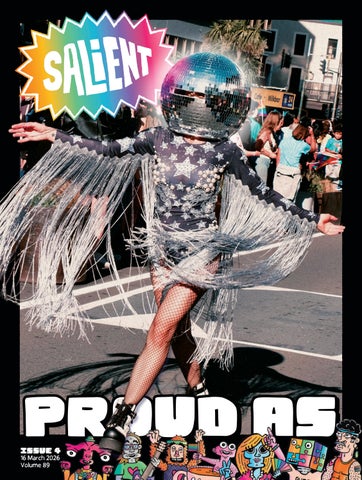
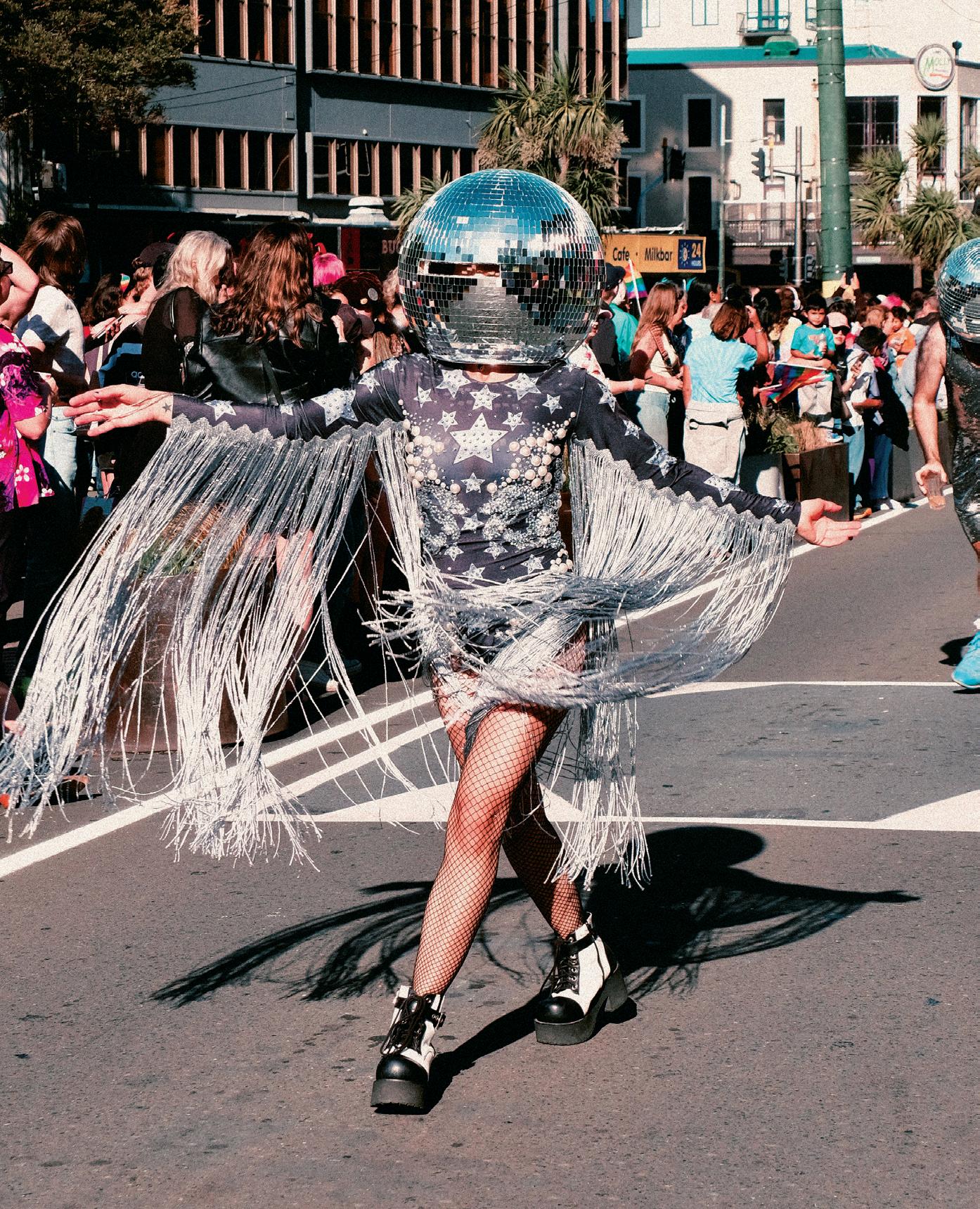
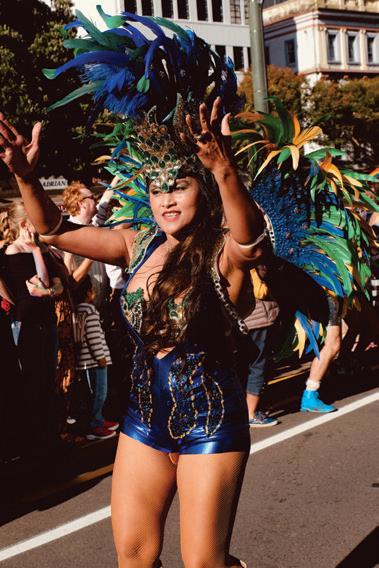
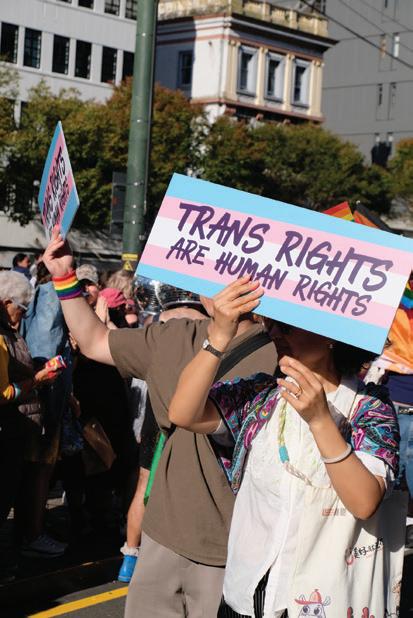
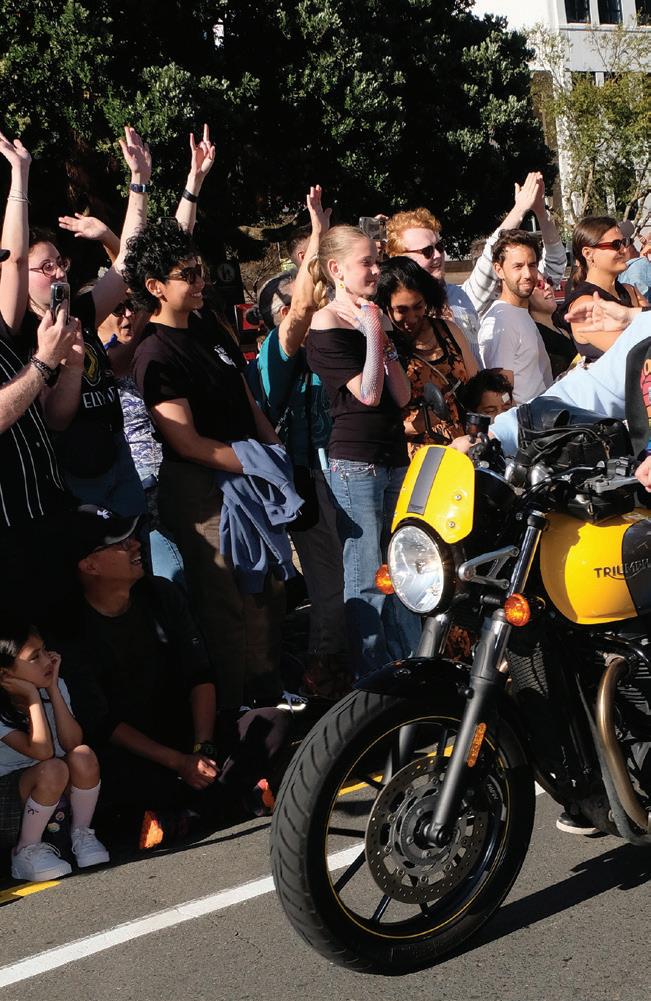
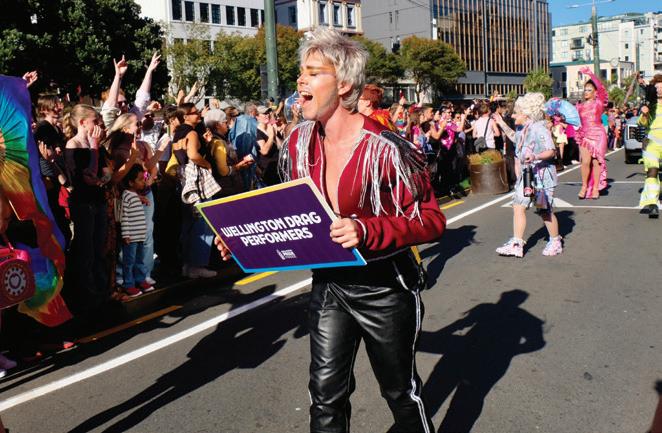
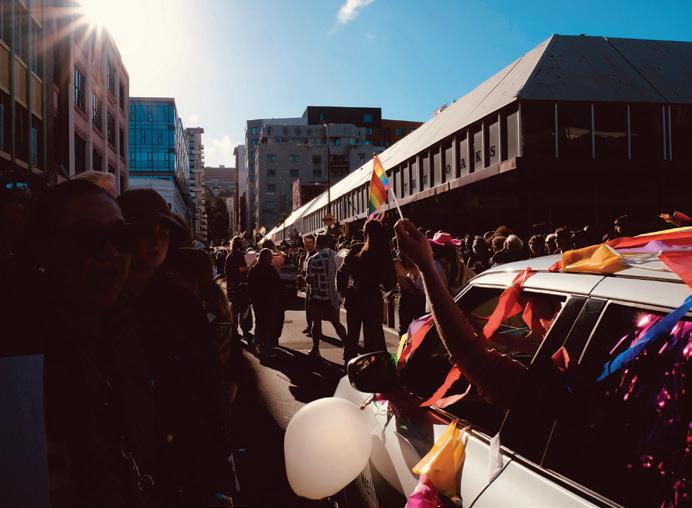
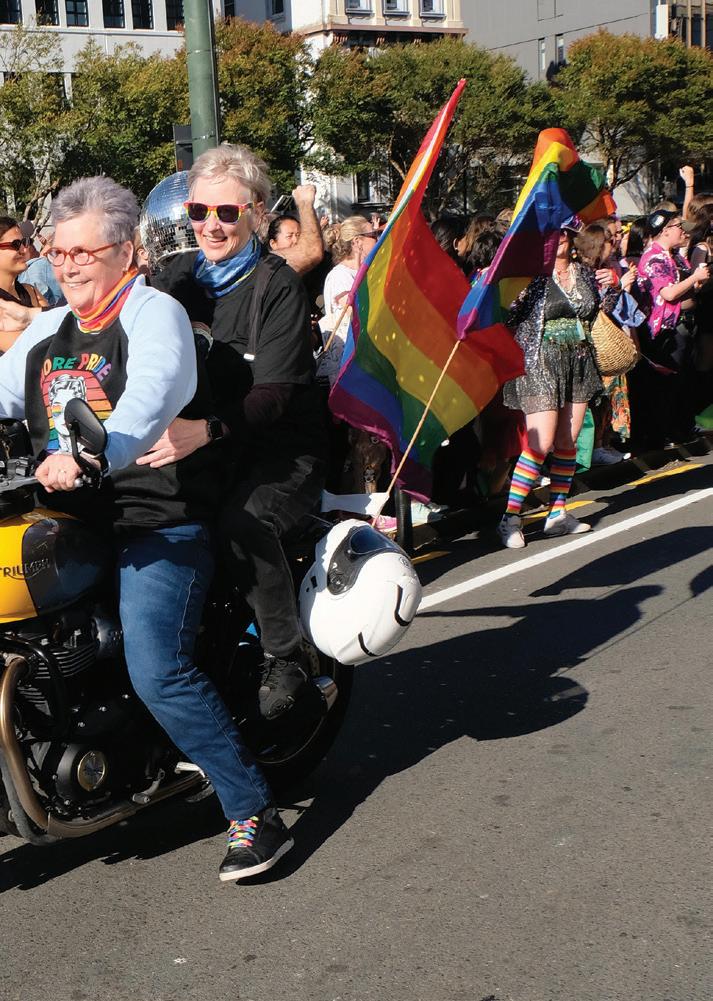
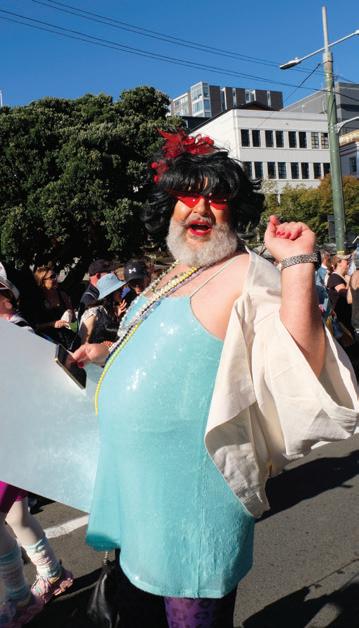
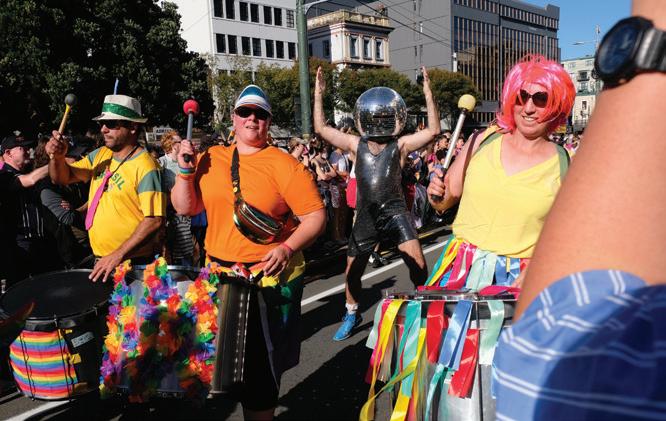
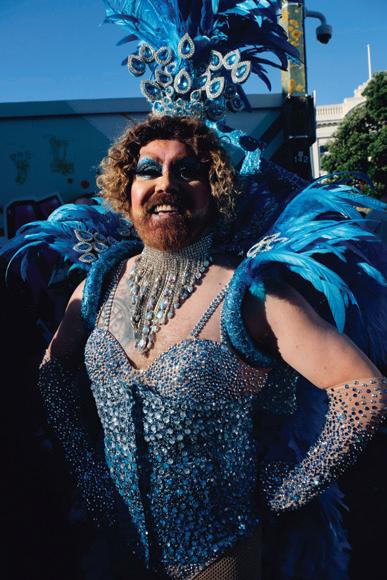
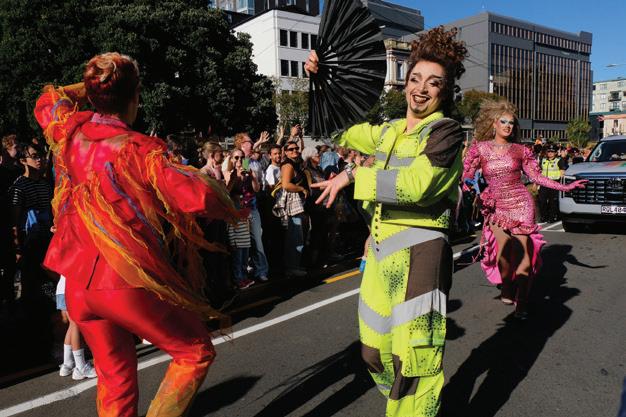
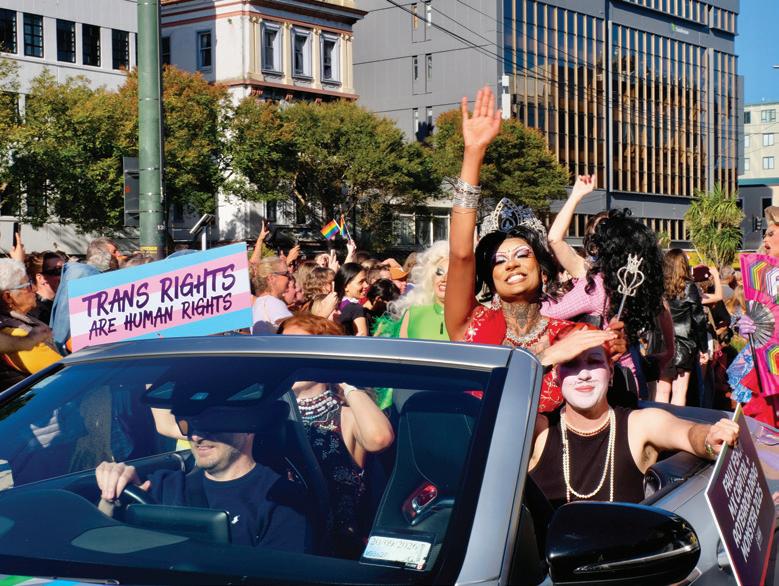
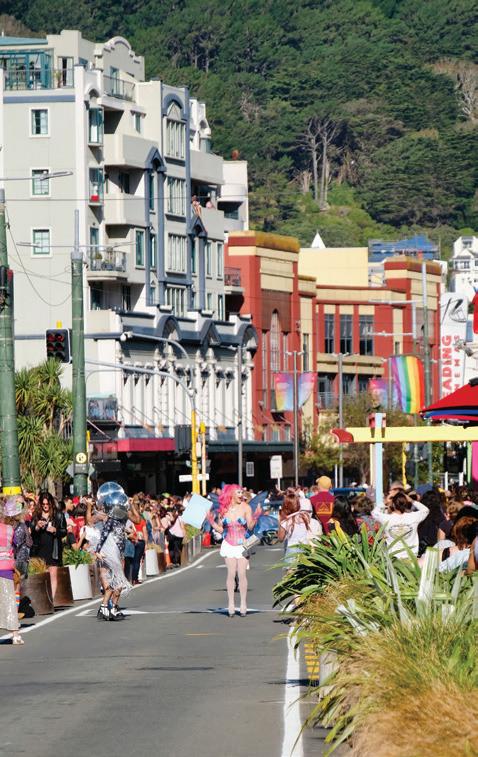
This issue comes off the back of Out in the City, Wellington’s Pride Parade and Hīkoi, among many other events. We wanted to capture the mood of the city at this time, and you’ll find numerous photographs from our resident photographer Sophie Spencer in this issue.
What Sophie captures best is the joy and energy that this city brings to celebrate Pride. As someone who attended the parade, it was beautiful to see the sheer number of people dressed up and taking part. The same (I assume) will go for Out in the City, which takes place two days after this issue goes to print.
In the formation of this issue, I was also thinking about what Chappell Roan said to the crowd at Laneway in Auckland last month. If you haven’t seen the clips, she said this—abbreviated:
“I’m so happy to be here.
It’s tough in my country right now… When I saw pride flags here, I was just like, ‘Fuck, I’m so scared [of the United States].’ But to be here and see so many businesses with pride flags—this is fucking awesome.
I’m just so grateful that this is a community that accepts and values queer people. I didn’t quite realise how scared I was until I got here and realised how calm I was. So thank you for that.”
I think this issue captures both the joy of Wellington Pride and the harder, more difficult moments that come with it.
Take your time reading, and take breaks when you need them. Sit and think about the features, poetry, and writing. Engage with the authors’ work. Let's show them the care and love they deserve—we could all do with a bit more of that.


Dear Editor,
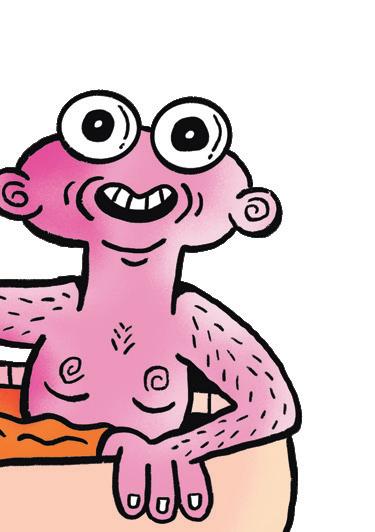
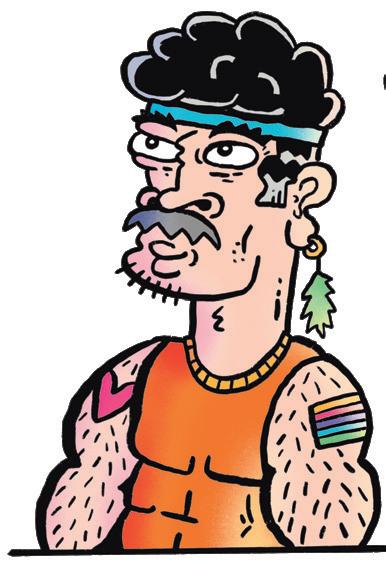
Why are this sasquatch's erect nipples staring at me from the front cover!? It's 10am on a Monday, I'm still hungover from a day of drinking at Newtown fest, It's already hard enough to stay focused. Now, I have to spend the rest of the day distracted by thoughts of big, juicy, muscly man nipples. There will be absolutely no chance I will be able to pay attention to my lecturer. Salient, please address this distracting issue that has overtaken me!!!
- Pedro Hay

Dear Editor, Sometimes I use the Salient to line my cat’s litter


Dear Editor,
This issue got me yearning which led to my pussy burning.
@indi_smindi
Dear Editor,

Dear Editor, I thought I knew what my biggest challenges would be at Uni. Friends and family warned me that I would feel like a teeny goldfish in a big pond. Teachers warned me that I would no longer be the smartest in the room. And it is true that my intellect has been challenged, not by my lectures but by THE FORMIDABLE SALIENT CROSSWORD. Am I secretly stupid? I've been doing crosswords all my life and I have never felt the pain that I do when I can't figure out that the answer is "The Cable Car" and not simply "Cable Car". Is this a secret challenge for first years? A hazing ritual I was not privy to? Is this simply a ME problem?


From a clearly intellectually insecure

Ispywithmylittleeyesomething

Salient is published by, but remains editorially independent from, the Victoria University of Wellington Students Association (VUWSA). Salient is funded in part by VUWSA through the Student Services Levy. Salient is a member of the Aotearoa Student Press Association (ASPA) and the New Zealand Media Council. Complaints regarding the material published in Salient should first be brought to the VUWSA CEO in writing (ceo@vuwsa. org.nz). If not satisfied by the response, complaints should be directed to the Media Council (info@mediacouncil.org.nz).
Dear Editor,
Upon reading the news article titled Students tired of pill promotion in the last issue of Salient I was stunned. Naturally, I agree with the general condemnation of VUWSA’s advertisement of so-called Nō Dōz tablets. What shocked me was the quotation from Matthew Tucker. Tucker reportedly states that he doesn’t see a distinction between Nō Dōz and Redbull. Anyone with a modicum of knowledge on psychoactive substances would immediately note multiple substantive differences between the two, and it’s rather irresponsible of him to make such unsupported claims. In the interest of student safety I would like to point these differences out, seeing as our VUWSA CEO clearly has little regard for such things. First of all, it’s important to note that whilst an energy drink like Redbull has a set amount of caffeine in a set quantity of liquid, Nō Dōz tablets are simply the pure form of caffeine. What this means is that there is a limit to how much caffeine you can take on board from a Redbull in a given amount of time. One could, however quite easily take 12 tablets of Nō Dōz within a minute. This immediately lends Nō Dōz a significantly more dangerous profile. Furthermore, the difference in form means that, while Redbull is consumed orally, one could theoretically insufflate (snort) the caffeine contained within a Nō Dōz. This poses a risk because the safe dosage for caffeine changes depending on the ROA (route of administration). While the ‘normal’ oral dose of caffeine listed on Psychonautwiki is 50-150mg, the corresponding dose for insufflation is 25-40mg. Let’s be honest, people don’t know that, but they’re still likely to try snorting the pills. ROA is an important and clearly often overlooked factor in drug harm. Upon further review there is one more major difference between energy drinks and caffeine: caffeine is a pure compound; energy drinks are polysubstance combinations. Redbull contains psychoactive substances other than caffeine that have been shown to exert a clear pharmacological effect, and not a healthy one. One study (Fletcher et al. 2017) demonstrated that caffeinated energy drinks cause a significant impact on subjects’ hearts. This effect was not observed with the same dose of caffeine in pure form. What this means is that there is something going on in energy drinks that renders them less safe than the caffeine in, say, a cup of coffee.

Dear Editor, The shower-shitter terrifies me. @cara.antoniaa
Dear Editor,
Not enough sex on the cover :( @chloeee079
To sum up: the information presented in Salient’s news article in the form of quotations from Matthew Tucker is demonstrably false, and I hope this has gone some way to correcting that.
Do with this what you will.
Ngā mihi, Cameron Hartley.
References: Fletcher, Emily A, Carolyn S. Lacey, Melenie Aaron, Mark Kolasa, Andrew Occiano, and Sachin A. Shah. 2017. “Randomized Controlled Trial of High‐Volume Energy Drink Versus Caffeine Consumption on ECG and Hemodynamic Parameters” Journal of the American Heart Association 6 (5) https://doi.org/10.1161/JAHA.116.004448
https://psychonautwiki.org/wiki/Caffeine

Dear Editor, missed opportunity for David @maxlj_CATtenborough
In Phoebe Robertson’s article “Opinion: Te Herenga Waka’s Next Top Vice-Chancellor,” it has come to Salient’s attention that Tamatha Paul has, in fact, been around VUWSA longer than Matthew Tucker. As such, the line “he has been around Te Herenga Waka for pretty much longer than anyone else on this list…” should note that Tamatha Paul is not one of those people.


Paul also wanted it mentioned that she has not only been inside the safe room, but ran it for three years. This is news to our editorial team, and all we have to say is: why did you put up with it for so long?

Moon Jam Nite
Venue: Moon Bar
Time: 7:30pm
Cost: Free
Every Tuesday at 7:30pm Moon hosts an open mic night with a fully equipped stage.


Neil Smoker
Venue: Moon Bar
Time: 6:30pm Cost: Free
Week of March 16 - March 22, 2026
TUESDAY THURSDAY SATURDAY FRIDAY WEDNESDAY SATURDAY
Bojack Funkman
Venue: Rogue and Vagabond
Time: 9:00pm Cost: Free
Hip hop/rnb, jazz, soul/funk, what's not to love? Free live music Wednesday at Moon Bar!
SATURDAY SUNDAY
A Month Of Saturdays
Venue: Flying Nun Records
Time: 1:00pm Cost: Free
Live music in-store every Saturday in March. Featuring Tessa De Lyon and Debt Club.
Sunday Jazz
Venue: Rogue and Vagabond
Time: 5:00pm Cost: Free
Sunday Jazz at the Rogue! Featuring Lockie Bennett and his band.
24 Hour Party People
Venue: San Fran
Time: 8:00pm Cost: $20
Wellington's longest running Indie night.
Open Decks and DJ Workshop
Venue: Moon Bar
Time: 5:00pm Cost: Free
Hosted by Intec (Third Eye Hifi). Open Deck from 6:00pm
Out In Brewtown
Venue: Brewtown
Time: 3:00pm Cost: $69

Are you a Te Herenga Waka student with an upcoming gig or event? Scan the QR code to submit your details for potential inclusion
About the centrefold artist - Jaymee Frater
Kia Ora, I'm Jaymee! I am a film, media studies and creative writing student in my final semester at VUW. This piece is about navigating the world in a way that feels authentic to me, something I consider a lot during Pride! I've hidden a bunch of pride flags in my piece, I wonder how many you can spot?
Go to page 20 to see the centrefold, then rip it out and put it on your wall !


Martha Schenk
In the first three months of the year, VUWSA and Te Herenga Waka’s co-run community pantry has seen an increase of 400% in the rate of pick-ups since 2024, raising concerns that their budget might be exhausted well before October.
The pantry, which is funded partially through VUWSA and partially by allocation of the student-contributed Student Hardship Fee, offers a free emergency food parcel service to students who are struggling with financial hardship.
The service can be accessed once every two months by filling out a community pantry form at the VUWSA Kelburn office or Te Aro Library, with regular use leading to a referral for Student Finance.
VUWSA receptionist Maia Moana, who oversees placing orders for the community pantry, told Salient in 2025 “we did double the amount of community pantry pickups than the year before.”
And it's only set to increase. Speaking about 2026, Moana said “we’re on track to do double of last year's and it’s only March.”
This uptick is putting pressure on the service—"we ran out of budget in October last year, and with us already having more [orders], I’m expecting the budget to run out even earlier.”
“Every time I’m ordering [for] community pantry, it’s getting picked up in the first two, three days.”

“I’m ordering once a week where before I was ordering like every three weeks,” she explained.
According to Moana it’s “awesome that students are accessing the service because that’s what it’s there for,” but that “it’s just been such a crazy uptick.”
The cost of living for the average New Zealand household has increased by 2.2% in the 12 months prior to December 2025, and inflation has risen by 3.1% over the same period, according to the New Zealand government.
“The impression that I’m getting is that people are struggling,” Moana told Salient. “I’m getting different demographics coming through… students I don’t usually see.”
“Lots of older students, lots of students with families.”
Last year the association was able to request an additional $2000 from Student Finance to tide the pantry over to the end of the year, but Moana says that this year, “it would probably be like six grand more.”
Moana emphasised that grocery parcels become even more essential as the year carries on and it gets colder. “Students need it,” she said.
But without increased funding or generous contribution from Student Finance, it’s unlikely that the community pantry will last until the end of the calendar year, let alone the academic one.
Gemma Bennion
Weirdly, this story begins with fibre.
No, not that fibre. I’m not a health TikToker selling magic beans. I’m talking fibre in the form of cables and highspeed internet: the unseen chords running underground, looping through neighbourhoods and connecting Wellington suburbs.
We begin with fibre, because a major provider of these cables is a company called Chorus. Last week, Chorus placed an ad at Kelburn Campus that made me stop dead in my tracks.
You might have seen it. The poster was about a meter and a half high and featured a student in a hoodie, beanie, and track pants lying on a couch with a laptop on her stomach. The text appeared in spongey white letters on a soft pink, almost innocent background.
“Your flat might be freezing, but your internet shouldn’t be.”
Ha. Right. Good one.
Although, she can’t be that cold, I remember thinking. Her hoodie’s unzipped.
I could have kept walking, but something held me there— the small, queasy part of me that felt cheated, knowing my hollow laugh was the intended reaction to this cavalier derision of poverty. So, I took a picture and emailed Chorus.
The gist of it?
This is not okay.
I lived in a “student flat” for a while. My partner called it a warehouse. It had high ceilings and gaps in the windows so wide you could stick a finger through them. Even on pleasant nights, the curtains ushered in a glacial breeze.
On a hot day you wore a jersey. On a cold day your dragon breath followed you up the stairs as you made your way to the small kitchen-dining-room-laundry—the one place you could reliably heat.
When we moved in, we levered up the floorboards and found a dead rat overdue eviction. I remember questioning the legality of our landlord’s ignorance as we were handed a list of insulated walls filled with hastily scribbled question marks.
This is the student experience. And Chorus knows it. Or at least, they think they do.
I doubt whoever approved the ad has truly felt “freezing” despite a beanie, two pairs of thick socks, and hot water bottle. I doubt they know the feeling of plugging gaps under doors, or developing that familiar, rattling, cough. The struggles of working while studying. Crying at the power bill. Panicking at the supermarket. Scavenging free food at Clubs’ Day.
And then seeing stupid ads about broadband that make you feel so fucking helpless for a reason you can’t quite articulate. Because the older generation bristles and claims it’s normal. The chill builds character. You know—back in my day…
But they’re wrong.
Enough children now live in poverty to fill Eden Park. The cost of bread has risen 50%. There’s a Gen Z joke that we should all have bought houses in the early 2000s. Instead, we were busy being born. As always, economic downturn hits the same groups the hardest: beneficiaries, those on New Zealand Super, people with disabilities, and students. Māori and Pasifika people make up an alarming proportion of those categories.
And while the process of normalisation is expedited by the government, boomers, and the media, the chill growing in our bones screams reality. Because our problems are real.
And most student flats aren’t merely “substandard”, by the way. Internationally? They would be considered criminal. I remember the shock of my flatmates—a Dane and a Brit— when I mucked in to scrub the chronic mold our landlord wouldn’t touch.
“Isn’t this illegal?”
“Do they at least provide PPE?”
Those are the protections afforded abroad. Because, you know, decency. But not in “wet” and “whiny” New Zealand. Instead, we’ll keep our Black Mirror-Esque advertisements, thank you very much. The dystopian headlines that normalise our reality. The jokes that are really cries for help.
Chorus responded to my inquiry saying all the right things. It was never their intention to offend. They promise to do better in future. Lovely, polite, and non-specific.
To be honest, I’m too tired to be angry. Maybe someone in marketing is getting a growling or losing a pay rise. But these worldviews become prevalent not out of spite, but its equally dangerous cousin: wilful ignorance. The kind that makes it socially permissible to make vulnerable rangatahi the butt of the joke without stopping to ask why—or how we got here in the first place.
But chin up, ākonga. I feel change in the air. Because whatever Chorus claims, in truth of Aotearoa—checking on our neighbours, supporting our communities. Our collective voices contribute to art, policy, and culture in our vibrant capital, banding together when the going gets tough.
It is my greatest pleasure to be a thread in that matrix. I only hope if you cringed at the Chorus advertisement, you know you are not alone. And most importantly— you are enough.


Ryan Cleland
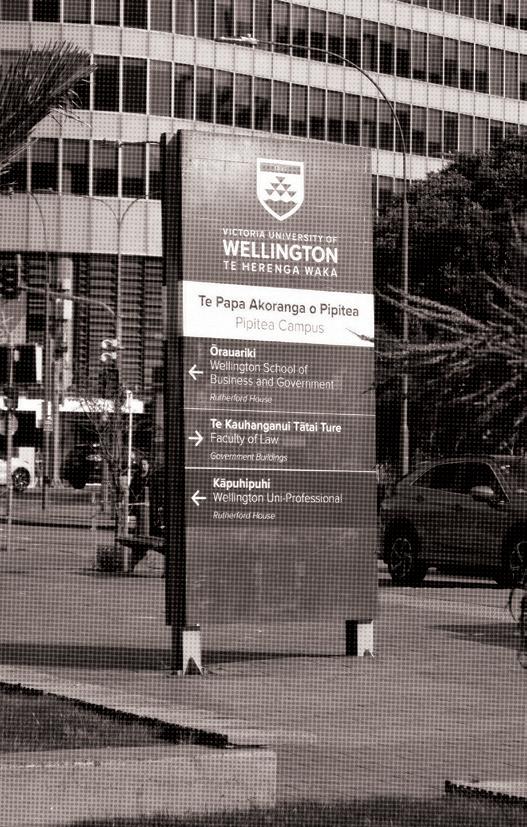
Pipitea—the quiet campus where law students lock in. But after their third ‘break’ walk around campus, somewhere between readings on tort law and Donoghue v Stevenson, where do they stop to grab a snack? And more importantly, where is the most affordable?
Admittedly, upon arrival there was very little on offer. There was, of course, the ever-looming presence on campus—The Lab—and the dysfunctional vending machines that our editor Phoebe loves so much. But that was about it. It seemed many students were seeking their eats elsewhere.
Speaking with students on campus, it quickly became clear that the lack of good, affordable food options was disappointing.
Many students I interviewed said they avoid buying food on campus. As one put it, “It’s just cheaper” to either bring food from home or head somewhere nearby. Several mentioned walking down to the Lambton Quay food court for more affordable options.
As one interviewee put it: “Honestly the best stop is Lambton Square eatery, there’s no good options closer.” Following it up with “We’re starved of the will to live and nutritious meals down here.”
Still, plenty of students do grab something quick between classes. I myself bought a $13 Lab chicken bap, standing in a line bustling with students getting their third coffee of the day. The Lab remains a campus favourite despite its somewhat overpriced menu. Its monopoly on Pipitea Campus largely stems from a simple fact: it’s the only option available.
Other students I talked to mentioned familiar fast options like McDonald’s or Subway when they want something quick and predictable. These offered more bang for your buck, although several students admitted to feeling morally torn about buying fast food over local options. Vending machines still seem to be the biggest fallback when hunger strikes on campus.
Food trucks appear regularly outside of campus and near the train station, though they’re not always the cheapest option. Paying $18 for a souvlaki hardly felt bearable, and the sushi stall next door didn’t offer any cheaper alternatives.
One law student adamantly disagreed with me here, stating that The Greek Food Truck was “the best meal you can get at any campus.” Though, they did admit to the steep price.
One outlier in the price conversation was Sakura Sushi, where students highlighted a $13.50 chicken katsu rice special as one of the better-value meals available. Situated just off of campus on Molesworth Street, students pointed to it as a rare example of something that felt reasonably priced. That reputation was evident in the number of Sakura bowls scattered around campus. When I visited, a large gaggle of students sat in the sun eating their Sakura bowls while soaking in the rays.
Overall, Pipitea’s affordable options were limited. On campus, the choice often came down to an overpriced matcha from The Lab or an array of vending machines slowly falling into disrepair. It’s no wonder students prefer to bring food from home or seek out fast food from the surrounding area. Unfortunately, Pipitea simply doesn’t have enough options to truly measure up—and as a result, in this author's opinion, it falls behind when Part one
Phoebe Robertson
For the first time, the VUWSA Postgraduate Officer position will be elected, and announced, at VUWSA’s upcoming AGM on Thursday 19 March. The role was created alongside the Postgraduate Voice Coordinator which commenced at the start of 2026.
This extension, of both an elected member on the VUWSA exec and the Postgraduate Voice Coordinator who is a contracted staff member at VUWSA, come at a time when the consensus (at least at VUWSA) is that postgraduate voice is more important than ever.
Speaking to Aría Lal, VUWSA’s current Education Officer, they explained to me that “Te Herenga Waka marketing itself as a research institute lends itself to needing more support for postgraduate students.”
According to Te Herenga Waka’s website, Victoria University is New Zealand’s top-ranked university for intensity of high-quality research. Te Herenga Waka also holds a Five Stars Plus rating in the QS Stars University Ratings system, being only one of 23 in the world to hold this ranking.
Salient sat down with Dr. Elizabeth McKibben, who is VUWSA’s Postgraduate Voice Coordinator, to learn more about the impacts of the role.
The first point McKibben wanted to make clear is that the election of the Postgraduate Officer will be “the first time in at least seven years there’s been a legitimate election for any postgraduate officer.” McKibben was the Postgraduate Students Representation Association President from 2021 to 2022 and ran uncontested for the role. The Presidents she can recall in recent history before her, and those after, also ran uncontested.
This election brings six confirmed candidates all vying for the role; Kiara Batten, Rue Parker, George Baker, Vladislav Ilin, Fangliang Ji, and Mafos Steve. Elections open Monday 16 March, and close at 11:30 a.m. on Thursday 19 March. All students will receive an email with the link to vote.
Ethan Rogacion, VUWSA’s Academic Vice President, is confident that the Postgraduate Officer role will “positively affect students.” In an interview with he discussed the gap in postgraduate representation at Te Herenga Waka in the past five years.
“VUWSA provides training, guidelines, and support to postgraduate representation. So [the Postgraduate Officer] is able to deliver high quality student voice at all levels of university representation regarding issues like resource allocation for postgraduate students, new programmes, and new policies which impact student success."
He closed by echoing Lal’s sentiment, that “it is more important than ever to ensure there is a strong postgraduate voice.”
For Joseph Habgood, VUWSA’s Student Representation Coordinator, this change marks a positive development in both postgraduate representation and his own workload. For more than seven years, Habgood has been solely responsible for supporting all class representatives across the University.
With the development of the Postgraduate Voice Coordinator, he is able to break up his workload. “There is so much VUWSA could achieve if VUWSA had the resources, having two people in the student voice space opens up opportunities we never had the time to do,” he tells Salient on Dr. Elizabeth McKibben’s appointment.
He’s confident that the election of the Postgraduate Officer position will continue to strengthen the work that he and McKibben already do.
Downstairs at VUWSA, Student Advocate Gilbert Ostini said that the creation of these two roles “moves the ambulance away from the bottom of the cliff” for postgraduate students. He explains that these roles help to create proactive relationships with both postgraduate students and faculty members, so everyone can be better equipped, and create further support systems, before they


Dan Moskovitz
One of Mayor Andrew Little’s key election promises was to cap weekly public transport fares. Problem is, that’s not something he has the power to do.
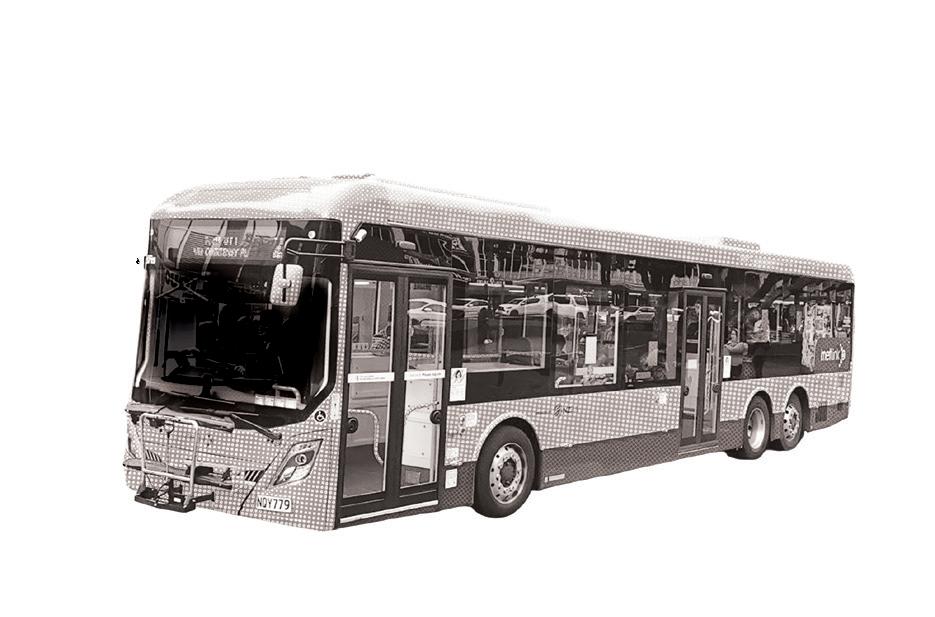
Little’s policy was to make all Metlink trips free after your eighth trip. So, if you take public transport to and from work every day, your Friday morning trip (trip nine) and any others are free.
However, Little only has jurisdiction over Wellington City Council. Public transport falls under the Greater Wellington Regional Council’s purview, who recently ran into a $5 million shortfall in Metlink’s budget thanks to lower-than-expected ridership.
Despite this, Metlink is fully onboard with the idea. Manager Tim Shackleton describes fare capping as something “we have to do.”
Metlink currently sells 30-day train or bus passes, which can cost hundreds of dollars. Shackleton's plan is for fare capping to replace those passes.
“We know a lot of people can't necessarily afford to pay for the whole month upfront, so from an equity standpoint I think fare capping is important to do,” said Shackleton.
Shackleton also hopes fare capping could drive behavioural change. Metlink almost always has free space on its weekend services, so if more people take public transport on the weekend, more people are using public transport for the same cost to run the service.
“I think there’s scope to negotiate something there to improve bus fares.”
A regional council spokesperson told Salient that 50% of Metlink’s funding went to buses compared to 45% to trains, though there are only four train routes compared to the ~100 bus routes.
There are obvious reasons why Little and Shackleton have different focuses. Little’s jurisdiction only includes Wellington City, which almost exclusively uses buses. Metlink has responsibility for the whole network, and rail patronage is 6% below what it was before the pandemic.
All of which raises the question—if both City and Regional Council want fare capping but for different reasons and with different funding strategies in mind, where will the agreement come from?
Regardless, it’s clear there’s demand for fare capping. 193 of 246 respondents to an (admittedly unscientific) Salient Instagram poll said they were struggling to pay for public transport.
Law and political science student Meg Lange said she was spending a fifth of her income on public transport fares, and further price hikes would mean deciding which lectures to go to. So unsurprisingly, she’s very keen on fare capping.
“After the eighth trip, then you're free to do stuff, especially on the weekends,” said Lange.
“I want to be able to come into town and do things
Otis Whinney
For many Kiwis, there is nothing more exciting than the annual ‘State of the Nation’ addresses delivered by our political parties to lay out their agenda. By many Kiwis, I actually mean none at all. But it does not change the fact that they did recently happen—and as we are in an election year, it could be somewhat important to see what these politicians have to say.
It may, however, be more pertinent to examine the actual state of our nation from the perspective of those who don’t spend their days yelling at each other in the Beehive. For the Pasifika community in Aotearoa, I would argue doing this is significantly more important. What Prime Minister Christpher Luxon says is good for all Kiwis may, in truth, only be good for some.
If you cast your mind back to the terrifying time that was the 2023 election season, you may recall a heavy emphasis on law and order. Images of young teens putting cars through the front of dairies, or the visual prominence of gang members in many people’s day-to-day lives made it an easy issue for National to campaign on—and it appears to have worked.
Three years on, and Luxon’s laser-guided focus-missiles have struck criminals fast and hard. Measures have included expanded powers to detain people publicly displaying gang insignia, prison expansion, and a clear ideological shift around prisoner-numbers—namely, that more prisoners is seen as a positive outcome.
Luxon recently fronted cameras to highlight what he says is success in reducing victims of violent crime. And the numbers don’t lie; according to the latest New Zealand Crimes and Victims Survey, violent crime victimisation has indeed fallen for the general population over this parliamentary term.
But numbers like these are never that simple. You don’t have to look further than the exact same survey to see that there has been a 42% increase in Pasifika victims of violent crime between October 2023 and October 2025, a number that paints these stats in a very different light. That represents around an increase of 5,000 victims is a pretty damning number— and one our glorious leader seems keen to leave by the wayside.
Obviously, law and order only matters for certain groups of Kiwis cough cough cough. Luxon seems less keen to promote the stats on children living in material hardship, as most ethnic groups have seen an increase in the past few years. Even then, Pacific people have still been hit quite hard, with an increase of 6500 children in this group occurring between 2019 and 2024 according to the Salvation Army’s 2026 State of the Nation’ report. Unemployment—the scourge of countless Wellingtonian students—has also been rising at disproportionately high rates for our Pacific community.
Taken together, these figures paint a rather grim picture of the state of the Pacific nation in Aotearoa.
You may be wondering what the point is in highlighting all of these depressing statistics. The answer is simple: the coalition has no interest in addressing them, and frankly neither do most politicians in this country.
To place all the blame on Luxon would be unfair. Many of these trends began under the previous Labour government. But even then, the solutions proposed by the Coalition have not produced better outcomes for many at-risk communities.
Pacific people are not alone in this. Many of the same negative indicators are mirrored among Māori communities. The lack of attention paid to the real impacts of policy on these groups allows governments of any stripe to continue largely unchecked.
Whatever strategies this government is implementing to make people safer—whether it be gang-patch laws, new move-on orders, or expanded policing powers—it’s clear that these are not designed to benefit everyone. If they were, the numbers would look different.
When Winston Peters—the man responsible for representing New Zealand on the global stage—goes on camera and declares his value for the “Pacific family” New Zealand sees itself as a part of, it's hard to take him seriously when the actual Pacific families in this country are doing it pretty bloody tough.
Combine that with incidents such as Peters’ blatant xenophobia towards Cook Islander MP Teanau Tuiono (who was born in Aotearoa) after Tuiono referred to this country as Aotearoa— something that is neither illegal nor against parliamentary rules. Incidents like this make talk of a “Pacific family” sound more like political pandering than genuine commitment.
New Zealand First has long had this anti-immigrant streak in their platform, although it has often been directed at warning Aucklanders that the city could one day become a new Chinese province in a few years time. These days I guess anyone can be subject to the rhetoric, even people born here.
It is also important not to forget how similar rhetoric has been used in the past in this country to justify terror campaigns by the Police and the proliferation of racist stereotypes by mainstream media. The most well-known examples came during the 1970s and 1980s under the Muldoon era, particularly during the Dawn Raids.
The risk of repeating aspects of that period threatens not only Pacific communities but other growing migrant groups as well, including those from South Asia. Many of these communities continue to face levels of xenophobia that sit uneasily with the idea of New Zealand as a progressive nation.
I say all of this to point out simply that this government can say whatever it wants about how much it values the people who live here—their safety, prosperity, and so on—but it doesn’t mean shit if it doesn't apply to everyone. If I could leave you with anything to take home and ponder, it's that these guys can say whatever they want in their ‘State of the Nation’ speech, but if you look around, the actual state of the nation doesn’t lie.

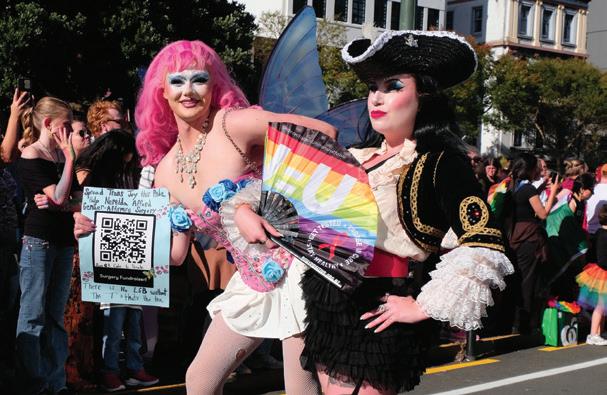



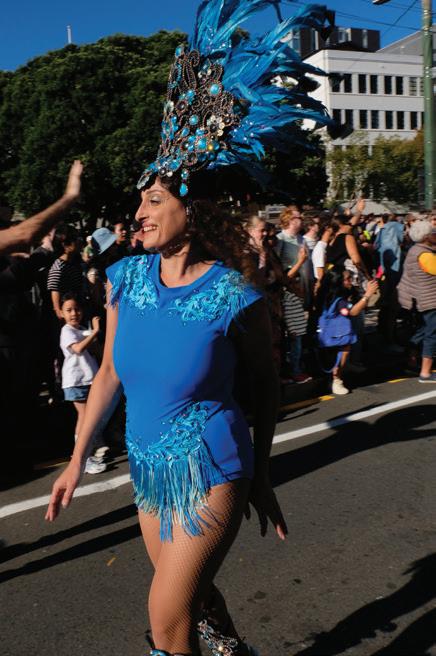
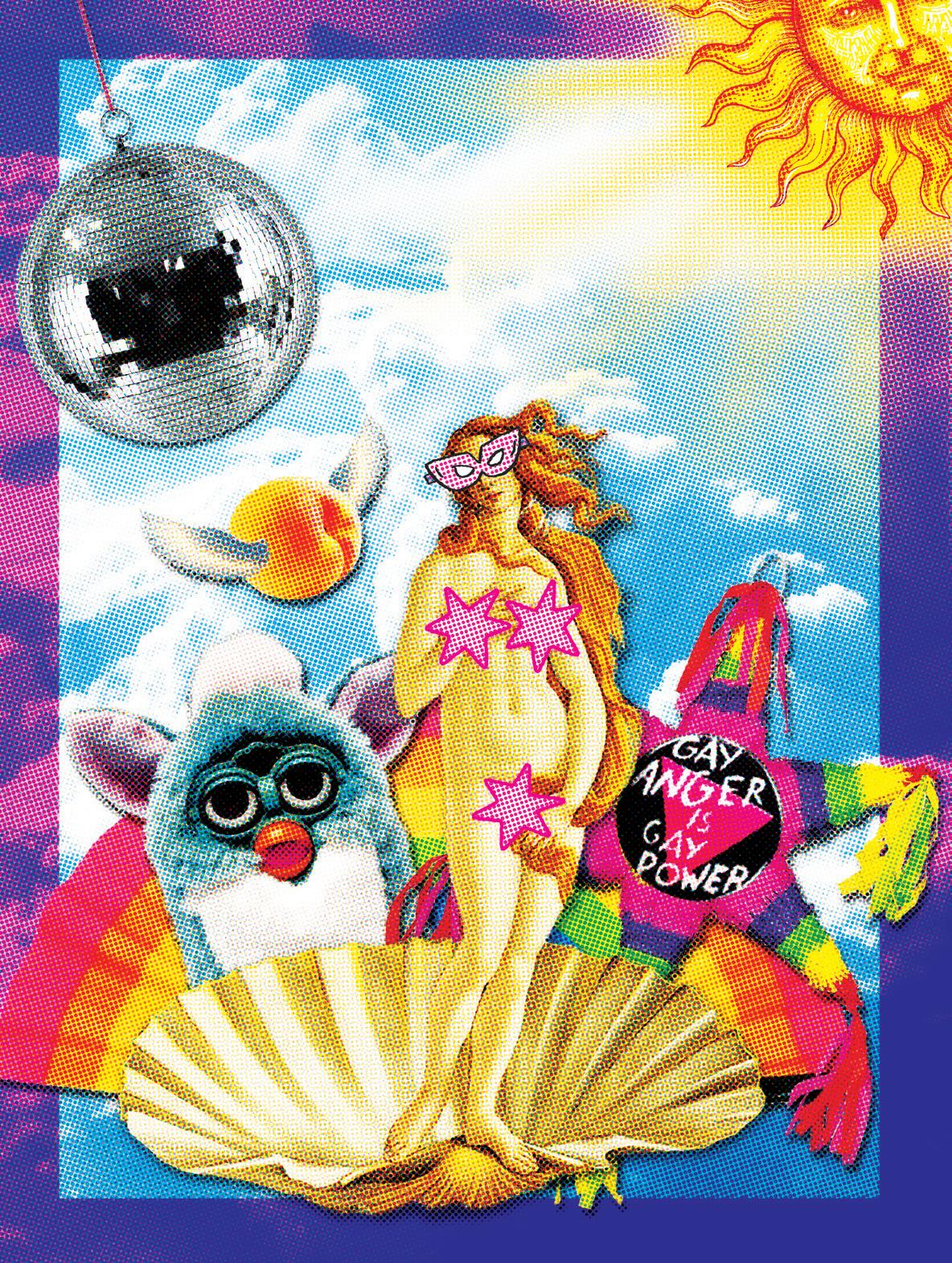

The first Latin Cuirs event I attended was an erotic poetry night last July. I had no idea what to expect. The poster advertised live performance and earthly delights—two of my favourite things— while also making it clear that the evening would be sex-work positive, queer and takatāpui only, and prioritised BIPOC. The dress code was “whatever makes you feel good”.
I arrived in jeans and a gay-guy skinny scarf. A friend of mine attended in green lingerie and was dubbed the “tangata whenua Tinkerbell” by at least three people. We watched a spellbinding performance by Misty Frequency, listened to sensual, queer poetry, and paid deliberate attention to our bodies and the power they held. I left feeling genuinely hopeful about my place in the world, despite the state of it—welcomed into a space unlike any I had known before.
Erotic poetry nights are a regular fixture for Latin Cuirs, alongside movie nights, sex-siren workshops, performances, protests, and workshops. The grassroots organisation supports and empowers Latino queer and wider migrant communities in Aotearoa through a blend of activism and art, always grounded in a Latin American focus.
For Pride this year, they are inviting us into their “Cuir Utopia”, a series of events and collaborations with other artists. I spoke with my friend and Latin Cuirs co-founder Lilith Del Mar about pleasure activism, migrant rights, and the shape of our own queer utopias.
Latin Cuirs was founded by Lilith and Belen Cupeiro, who met in Aotearoa and quickly bonded over social justice, sexual health, and queerness. Lilith told me that moving to Aotearoa was the first time she felt able to be fully open about her queer identity. Yet queer events here felt overwhelmingly white; it was obvious she was not the intended audience. At Latino gatherings, meanwhile, she would be met with homophobia and transphobia.
She and Belen found themselves repeatedly forced to choose between two essential parts of who they were. They were tired of queer culture being presumed synonymous with white culture. Drinking wine together one afternoon—as many consequential decisions are made—they realised there must be other queer Latinos navigating the same fracture. “That's how Latin Cuirs started,” Lilith said. “Two friends going, ‘I’m sick of this shit!”
The first official event was simply a movie night at Belen’s whare, an invitation extended to queer and Latino friends. Lilith had noticed that many minoritycentered events were framed with an unachievable standard of perfection. When everything is ‘excellent’ and ‘iconic’ there’s a belief that everything has to be very polished, which isn’t realistic. Showing up as yourself, in whatever makes you feel good, is a core part of Latin Cuirs’ kaupapa.
Since that initial movie night, Latin Cuirs has branched out, engaging in more social events as well as moving into activism. This intersection comes from seeing how disengaged people in Aotearoa can be with politics and the government. Latin Cuirs didn’t want to choose between having a good time or thinking about politics, they wanted to do both.
“Sometimes we do protests, sometimes we do parties, sometimes we do poetry,” Lilith said to me.
Her and Belen complement each other well. Belen is organised, practical, and better at networking. Lilith is more creative.
They’re “a very good match for building something,” Lilith explained.

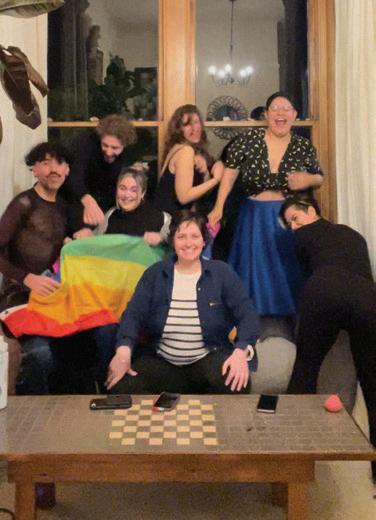
There’s also a need for different kinds of events for different kinds of audiences. The party gays might not be as interested in watching a documentary on campus, and the film nerds might not be as interested in watching a cabaret at Ivy. Lilith told me that she felt like if you want to protest here, it’s just about being angry. There is a place for anger in protests, but in Latin America “...there is also a lot of joy because we’re celebrating the way we’re all coming together…” in support of a cause and of each other.
The system wants us to feel bad, but not everything is suffering, Lillith explains. Imagination and art has a huge role to play in how we engage in politics and make it more accessible. When we live in a world (as we do) in which things are one sort of way (as Story continues on next page.
they are) it becomes hard to think of anything beyond that. The only way that we can build better worlds for ourselves is by imagining what these better worlds might look like and creating the steps to get there.
Latin Cuirs is heavily informed by pleasure activism, which as a term comes from writer and activist Adrienne Maree Brown.
“Us feeling like shit, us being exploited, is not inactive. It serves the system. How can we incorporate more pleasure or enjoy ourselves more when fighting for our rights? If we only come from a place of hurt, that’s not sustainable and you eventually do burn out,” Lilith explained.
Pleasure activism poses the radical question: what if we didn’t have to suffer more than we already fucking do? Latin Cuirs have had meetings at the beach. They try to cultivate a loving space where your basic needs as a human are met first before getting down to business.
For ANTIFA’z, one of the events in the Cuir Utopia series, Lilith said they’re trying to organise a dinner for their performers to cook for them and get to know each other better. If the performer-organiser relationship is more transactional and impersonal, it’s only replicating the same systems that have us oppressed. Performers are also paid above the average rate in Te Whanganui-a-Tara. There’s pleasure in being able to buy groceries and pay your rent without worrying, just as there’s pleasure in doing your artform and knowing you will be paid well for it. Using our imaginations and focusing on pleasure in this way makes the fight more sustainable and recognises that we are all human beings and all connected.
Cuir Utopia also draws from Afro-futurism, using imagination as a tool for survival. This is what Lilith and Belen already see already happening in Latin America. Lilith, through laughter, tells me that the British really fucked us over here as even our Pride events are more proper and sterile. She wants to “tell people they have agency, because when you realise you can do something you can actually make it happen.”
The first event of the Cuir Utopia series, ANTIFA’z, is a masquerade, cabaret, and party on the 14th of March co-produced with the performance artist and sex work activist Vixen Temple.
It draws heavily on activist and drag queen Carmen Rupe (Ngāti Maniapoto, Ngāti Hauā, Ngāti Heke-a-Wai), particularly her famous balcony and the discreet teacup code she used to signal information to sex work clients. When Rupe lived in Wellington in 1967, she opened a latenight café called Carmen’s International Coffee Lounge, which also functioned as a sex work venue.
In her system of signals, a cup placed upside down on a saucer signalled a client was looking for a cisgender woman, a cup on the side of the saucer indicated a transgender person, and a saucer set on top of a cup meant a desire for someone of the same gender.
Throughout history, queer people have always found ways to dress up and find community. Antifaz means a mask in Spanish and contains a double meaning of being antifascist. In the middle of the Cuir Utopia announcement poster, there’s an image of two people kissing, one of them wearing a mask. This image is from the first official pride parade in Argentina, where a lot of people wore masks for safety. Lilith tells me about attending Latin American festivals and carnivals where even though you might be wearing a mask or disguised, you feel like you can be transformed into someone more yourself.
On the 20th of March, Latin Cuirs are also hosting a poetry night with the takatāpui art collective Utu Ā Matimati. Like the one I first attended, it’s at a secret location, entry is by koha, and there are limited spaces with priority given to BIPOC. Teirangi Klever, the 2025 National Poetry Slam Champion, and Vixen Temple will both be featured performers.
The last event in the Cuir Utopia series is a film screening of the documentary El Laberinto de las Lunas, or The Labyrinth of the Moon. This will be held right here on campus on the 22nd of March in collaboration with the Latin American and Spanish Club. The film is about trans motherhood, trans childhood, and the labyrinths of identity. Lilith promises me I will cry as she describes it to me.
Lilith moved to Aotearoa seven years ago, when she was 24. She came to join her wife and remembers feeling like she “came from a completely different planet.”
She says that being a migrant from the Global South is a completely different experience to being one from

Europe, and it’s hard to fully understand without being one yourself. Migrating was an overwhelming and confusing process, as well as a confronting one for her growing awareness of migrant’s rights.
Initially, Lilith could only move here on a visitor’s visa. She had applied for a partner visa and had to submit extensive proof to Immigration that they had spent a required amount of time together in a committed relationship. Lilith and her wife had been together for five years, but were still denied this partner visa. Despite these initial challenges, Lilith says that she feels a lot safer here as a woman. What really shocked her was how relaxed people are here and she describes the way she walks in Te Whanganui-a-Tara as “so carefree.”
One of the flatmates in the first shitty flat she lived in was from Chile and friends with Belen, which is how Lilith first met her and other Latinos to form a community with. Her own less-than-ideal experiences with migration cemented migrant issues as an essential component of Latin Cuir’s activism.
“Migration is a many-headed monster,” Lilith tells me.
Looking into how migration is structured reveals a lot about the wider system. Immigration New Zealand is within the Ministry of Business, Innovation, and Employment instead of the Ministry of Foreign Affairs, which makes a lot of sense given the current government’s tendency to treat real humans like a business.
If you’re not a migrant, you’re not encouraged to learn about migrant rights and issues, but how those in power treat migrants is indicative of how they want to treat every other minority and eventually everyone. Applying for a visa is a very invasive process and puts the person applying for it in a vulnerable position where they can be exploited by employers or abused partners and have nowhere to go. Lilith discussed with me that Immigration often won’t do anything about this or support them getting onto another visa that removes them from an abusive situation, which is “a very inhumane way to treat people.”
A big project she has in mind for the future of Latin Cuirs is working on resources and information about tikanga Māori, te ao Māori, and the indigenous history of Aotearoa for when you get a visa.
Lilith recommends everyone learn more about activism in the Global South, “because we make things happen with not a lot of resources.” She says there’s a lot of theory and knowledge there that people in Aotearoa have never heard of.
My final question for Lilith is asking what her own personal Cuir Utopia would look like. She tells me that it would look like everyone being more comfortable with their sensuality and their body and being able to recognise the sensual power within themselves, something we bond over as disabled people. It looks like a world where the hierarchies of who gets to be desirable don’t exist. There would be a lot of cats everywhere, and a lot of empathy.
“Often we lose empathy, for many reasons,” Lilith says, citing loss of empathy and human connection as the source of a lot of troubles. A better world is possible— we just have to imagine it.

“When we arrive here we are encouraged to assimilate into the Pākehā world, and at no point in the migration process do we learn anything about Māori.”
Lilith also wants to do more political activism, more work to affect the system, and more work on migration rights and reforms. We talk about how up until very recently, your HIV status affected your visa, and currently people on visas aren’t allowed to do sex work under the Prositution Reform Act which only puts people at further risk for exploitation and trafficking.

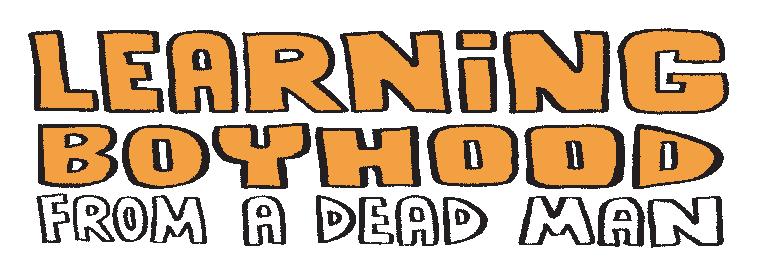
Ilearned what boyhood looked like from my brother. Not as a set of direct rules, but by paying attention to how he moved through the world—how he stood, how he treated people, how he existed in his body. He was older than me, not in an authoritative way, but it was obvious early on that he moved through things with a casualness I didn’t yet have.
My brother died in 2020. He was 23. When people say that, they usually mean to emphasise how young he was, which of course is true. But I also hear something else: how complete he already felt. He had already lived through his really cool teenager era—leaning over the kitchen counter like the house belonged to him, smelling faintly of cigarettes 24/7, the Pixies bleeding tinny and insistent from his bedroom—and that mattered.
I’m a trans masc lesbian, which means my relationship to boyhood has never been straightforward. It wasn’t something handed to me cleanly, or claimed without friction. Boyhood came to me sideways—filtered through observation and imitation, through watching someone I love move through masculinity without performing it too hard. My brother never seemed like he was trying to be a boy. He just was one (and man, was I jealous).
As a teenager, he was effortlessly cool in a way that can’t be replicated. He wasn’t polished or ironic, and he didn’t seem like he was trying to prove anything. He wore clothes into the ground. Sagged his jeans to my mother’s horror. He had bad haircuts and bad facial hair that somehow worked. He moved like his body belonged to him—like it wasn’t something to apologise for. He would roll his eyes at my mum in exaggerated teenage annoyance, then smile at her the second he thought she wasn’t looking. Watching him, I learned that boyhood could be soft and harsh and stupid and sincere all at once. That it didn’t require dominance. That it didn’t require cruelty.
He wasn’t macho. He wasn’t especially sentimental either. But he was loyal, he was curious, and he took up space without asking permission. That last part mattered to me more than I realised at the time. As a kid, I was already learning how to fold myself smaller. He was learning how to stretch out—on couches, in conversations, on his bedroom floor when he miraculously found his way home after drinking too much. He showed me that taking up space didn’t have to be violent. It could be casual. It could be natural.
When I think about boyhood now, I don’t think about rules or aesthetics or even gender. I think about how my brother laughed with his whole body. How he trusted the world enough to be a bit reckless—possibly too reckless, according to his car—the biggest casualty in his experiments in freedom. How he let
himself be known. Boyhood, as he lived it, was a practice in ease. After he died, people talked to me about grief as if it were singular. As if I had lost one person, one relationship. But what I lost was also a future reference point. I lost the chance to keep learning from him. I lost the adult version of the boy who taught me how to be one. The one who would have shaved his beard, grown into his laugh, maybe learned how to cook something properly.
Coming into my own masculinity without him has felt like learning a language from a speaker who is no longer alive. I have the accent. I have the rhythms. But sometimes I’m missing the words. I find myself wondering what he would have thought of the person I am now. I suspect he would have understood more easily than most.
Being a trans masc lesbian means I carry boyhood differently. I don’t want it to erase my softness, my queerness, my attachment to womanhood. I want it to sit alongside them. That’s another thing my brother taught me, without meaning to: masculinity doesn’t have to cancel anything out. It can coexist. It can be generous.
He grew up with me and our three other sisters. His boyhood was shaped in a house full of girls, which meant it was never entirely sealed off from softness, intimacy, or femininity. Being the only boy in the house didn’t make him distant or hardened. If anything, it made him attentive. At Christmas he bought my twin sister lip glosses, and me nail polishes—neon green and electric blue, the kind that stained the skin around your fingers. When the younger ones wanted to watch Paw Patrol, he sat down and watched it with them—the television too loud, the theme song repeating, no commentary, no complaints. He didn’t treat those things as beneath him. They were just part of growing up together.
He never knew he was teaching me these things. He never knew that I was watching him as closely as I was, collecting gestures and attitudes like survival tools. But that’s how it works sometimes. We learn who we are by loving people who are already living pieces of us out loud.
My brother was a really cool teenager. He grew into a young man who still carried that ease with him. And even now, even after his death, he remains one of my clearest guides. Not because he had answers, but because he showed me a way of being that felt possible.
Boyhood, for me, is not something I mourn as lost or inaccessible. It’s something I inherited. It lives in the way I move through the world, a little less afraid of myself. It lives in the space I let myself take up. It lives in memory, yes—but also in practice.
I am still learning. But I learned the most important part early, from my brother: that being a boy can mean being kind, empathetic, and free. That it can feel like home.

Rowan Sheffield
Content Warning: Religious Homophobia, Suicidal Ideation
Why does the world fall on my shoulders?
Shackles coil around my throat as I hear the ghosts of my past pass through my flaws. I find it easier to speak when I’m drunk, dragging words from my throat as I beg my mother’s God to save my soul.
I can’t tell who’s speaking anymore. Is it me?
Or is it my ancestors?
Have I disappointed the people before me?
Falling in love with so many fantasies that steal small pieces of my soul. Getting naked for new people, time and time again— more people have seen my body than have ever given me flowers. I know that I’m attractive, but am I only a body they can use?
Is it wrong to crave a love that is just out of reach?
Can I be loved in a body that doesn’t feel real?
As bile rises in my throat
I write these words as they fall from my bones. Etched in blood, I lick my wounds like the dog Mitski sings about— I am betting on losing dogs.
Pretending to be a saviour to those around me as if I’m not asking around where my saviour is. I like taking care of others, I tell myself.
I like taking care of others because it heals a part of me that was never cared for.
Why do I keep praying to a God I don’t believe in to fix me?
To stitch the holes in my body and make me kneel, to cower in fear?
I asked God to protect me from the hell on Earth He placed me in. Did He make me gay to punish me for living?
I crave the day I grow wings and escape this place. Rereading the last page of a book that’s already ended— setting it on fire never changed the story. God had already damned me in the Bible’s verses. Because I thought maybe I could change them.

He won’t let me change them. I can’t change them.
My God, please let me change them.
I pray you never hate yourself that much again— that you punish someone else for loving you.
Staring into the water, I hear a chorus of dead voices that sound too much like mine, and I want to go.
Bottle to my lips.
I close my eyes and let myself fall. The bass swells and everything tilts.
My chest syncs to it, rewriting my heartbeat.
Sweat drips from the ceiling, the walls, the bodies. Everything is too loud.
My mouth opens—something spilling out: gospels, hymns, prayers, panic. Screams drowned in holy water. Are you even listening?
The rosary tightens now.
Hands bound with beads that bite, like it's alive.
Like it wants me gone. Or saved. Or both.
I wake up choking on nothing, air thick like the incense in a church that never let me in. The rosary is still there, cutting circles into my skin— proof I belonged to something even if it never wanted me.
I’ve stopped asking for miracles. Stopped craving wings.
Some bodies were made to be altars.
But some were made to burn upon them.
Lying still, I let the silence press in, bones heavy with a prayer I never believed.
Tongue dry from begging. If God wanted me
He would have taken me already.
But I’m still here.
Still here.
Still.

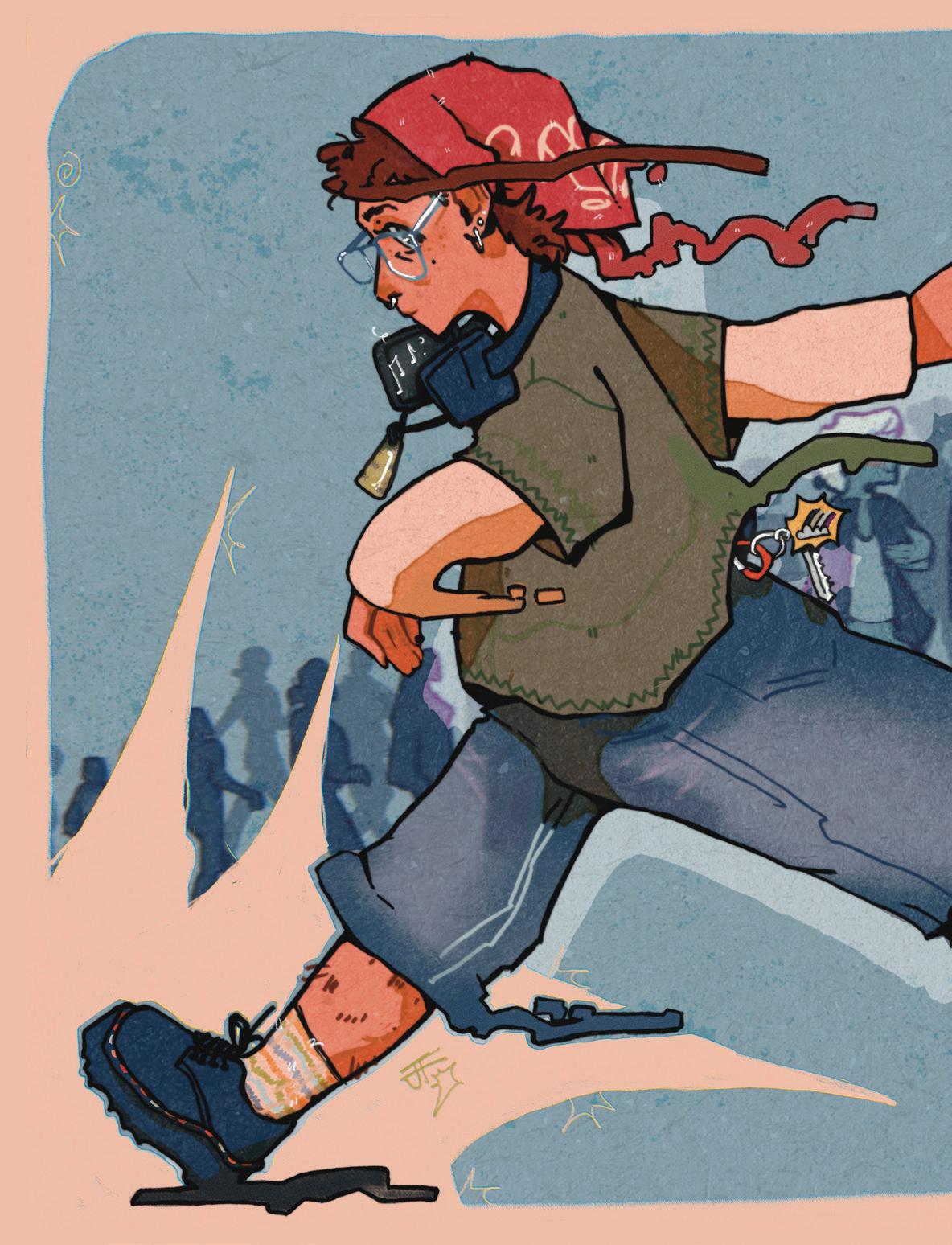
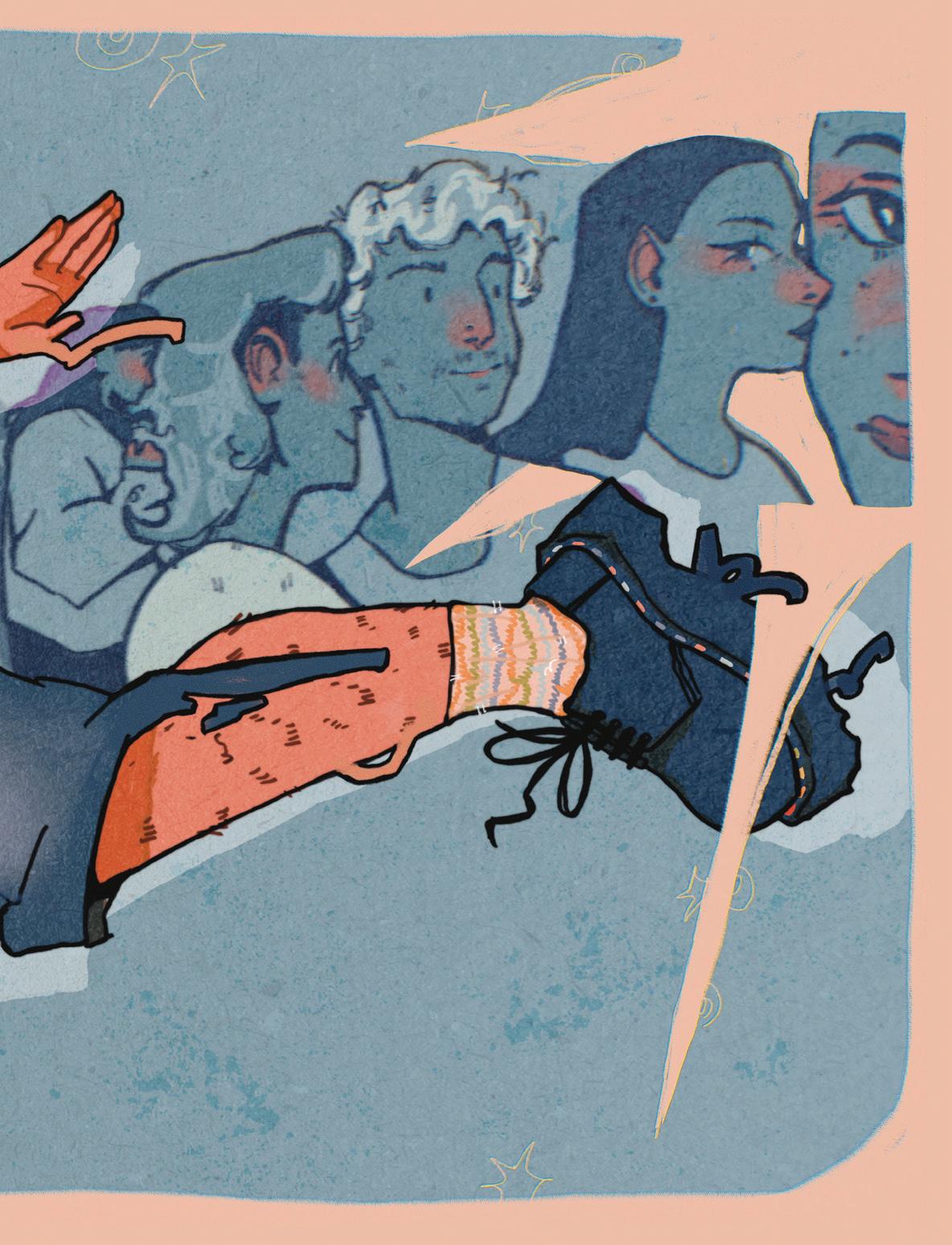






When I was a kid, people wanted me to grow fast. And then, she wanted me to slow down.
When I was a kid, mother and father told me to be this vision of a holy woman. The one who lives without a sin. The one who marries a man and has kids, to serve and to be submissive. The one who's always porcelain and delicate, who sits prettily to please people. Stay and be a fool to please the crowd of men wanting to woo you around. Mother told me to never touch the fire or else I would get burned and my skin would tear open, revealing the red flesh of the soul— touch the fire or else you will get burned to the ground. I didn't know that the fire would continue burning when it caught the tiny part of the white cuffs of my dress. The fire burned, but mother lied. The fire burned and it felt good.
Father wanted me to grow up. Father wanted me to be a woman at the fine age of nine. Father wanted me to be like Mother. Mother wanted me to be like Father. But all I wanted to do was go to the nearby playground and drink the watercolor water that I had used to create my latest masterpiece. Youth came so fast with the fascination of every single juvenile summer memory that I spent locked up in my own room, wishing for it to become a forest so I could run freely and never turn back. But a voice would always come to ask me personally—tell us,why do you want to run and yet still be afraid?
The watercolor water stained my mouth and dripped down to my clothes. That morning, Mother scolded me for ruining my dress, so I got a time out. She told me to reflect, but the light in my room did a better job. Watercolor water has never tasted better. The wildfire continued burning from my cuffs up to the cloth covering my arm.
What's the hurry, dear fire? Who are you trying to satisfy? I think you better cool it off before the cloth runs out.
The watercolor water continued dripping on my shirt until the wildfire flickered, almost got caught, and folded in shame. Almost out, but still raging silently inside. I tried scrubbing the stain, I started putting off the fire. My knuckles went raw and my tears dried on their own. But they stayed. They stayed until I turned 18. Each day, I’d look at the dress slowly getting eaten by the fire—the sleeves had been cut, turned to dust, or scrubbed to death—it doesn't matter. I looked at the dress that was no longer white. The voice came back before I left home—you're moving out today, why are you still so afraid? Mother cried as she hugged me, possibly for the last time. Father swallowed his emotions and let the heavy musk of his masculinity take over him like a black shroud. I waved goodbye, with my hands filled with the baggage of each autumn that went by as I stomped on the brown paper leaves in my room.
I went to the bridge at Sheffield Park where a foolish man once wrote “Will you marry me?” and never got an answer. I looked down below. I looked up, and let the warm wind sweep over my body. I heard steps right beside me and a voice—slow down, you're a crazy child. It felt harsh. But truth be told, it almost felt like a warm cup of milk. I caught sight of the wide eyes of a lost child stuck in a body she didn't
ask for, of a redhead in a yellow cardigan despite the sweat beading all over her cheeks, of the new article of clothing I'd worn since the white Sunday church dress nine years ago.
We sat down, and we talked about our histories. And there was passion, amplifying as the seconds went by. She told me I got my pride from a scared little boy. The phone in the nearest phone booth below rang from meters away. I felt the urge to take it and say hello, hoping that they now wanted me back at home. Mother, I'm scared, this reality feels like a fever dream. Father, take me back to our house even though it never felt like a home. The phone fell from its hook and she whispered close behind—Take a step back and disappear for a while… surely you can afford to lose a day, or two, or more. The world out there had a whole lot of gardens. The people stood still, slept, or sat alone in the garden beds, waiting for their time to bloom. But yesterday, a flower withered between the pages of 17 and 18. It was strange to look in the mirror and see that I was just a kid swallowing watercolor water to keep myself from withering like a madman on my bed, and now I have to pretend to be one of the flowers and dance on my tiptoes. But the woman beside me wrapped her yellow cardigan over my shoulders when I first took a great leap—she grabbed the autumn baggage.
Mother, Father, I can't stop the fire from burning nor the watercolor water from dripping. Sweet summer has come with the gift of longing for the sensual touch of a loutish lover—treat her kindly. This, the greatest sin I could commit that would lead me to my first destruction. Even if this made me a fool, at least the eternal chaos would make me human. Only then would I finally be unclean.
The red pick-up truck felt like a small utopia where I collided head first. The seat of the car caressed my body like the softest cloud from the sky, where the angels have walked and watered them to keep their plumpness before our eyes. I jumped up and down like a little kid, a first time adult. I looked over to my side and saw her wearing a peach summer dress. I was afraid to ask her if she was cold. Were her shoulders too brittle against the air? But the cardigan smelled of her. It smelled like the wild dreams of a feverish child, the lucid dreams of a wandering soul, the dark and heavy dreams of a sleep paralytic. The cardigan smelled like the saccharine stages of her life.
This both came as a surprise and a pleasure. To be sitting there with a stranger whose beauty I couldn’t conquer by half or more, was to be sitting at the edge of the line. It was the beginning of this journey that felt too hot to touch. Or maybe it was just the accidental touch of her soft and febrile skin against mine. And it felt as if I had been electrocuted by a god and everything that was once broken and despicable from the blue shades of crayons had forgotten their emptiness. The road had never felt longer than the journey from school back to our house. There was music, and there were people from both sides of the road walking towards nowhere. They all felt young and alive, even those who were walking too slowly, all wrinkly and forgotten by history. We were driving in her car, and this felt like home. I never wanted to go back to that house because it felt like I was not welcome any more. Story continues on next page.



I was so high and happy from the haze of the afternoon bliss that I never saw her eyes watching me. Maybe it was her way of saying something—You’ve been in this truck so long that the natural embarrassment has come back. But she smiled, and it felt reckless, like she was not holding back from the stranger beside her. The cardigan suits you, I think you should keep it, she said. The sun was on my side, and I’d never felt any more thankful. She told me she only loved two things: the yellow cardigan and anyone who looked good while dressed in the worst lemon-colored clothes. At that moment, I didn’t care whether we ran through a tree, or whether another bus or an eight-wheeler truck crashed into us. I didn’t know her name, but I knew that it would be too heavenly to die by her side. I looked back at her and I felt the undeniable rush of madness as we passed a dark underpass and Bowie played on repeat. The chance had finally come at last. She saw my euphoria and spoke—Go on, stand up, let the wind blow you away to god knows where. A strange fear crept up on me as my knees buckled from where I stood on my seat.
And I shouted, and I screamed. And no one could hear me but the blurry lights from my astigmatism. Life had never been this good. Life was too good right then. I wanted to ask her to join but I just couldn't. I shouted for her until my throat hurt and my lungs were all rugged out, but Bowie was still singing his song, so I continued. Maybe all that I was thinking was that life was good, and I wanted to scream all the miseries out, and I wanted to dance all alone-with her. Maybe I wanted to fly, and maybe I wanted to kiss the girl beside me but I didn’t know her name. I was scared that she would run away. I wanted to kiss her like heaven wouldn’t fall upon me, just for one day. Maybe I was just hanging by the line but I didn’t want to lose a single thread from that intricate brocade that was barricading me from thinking about the solitary days of autumn.
I think her name was Summer, I don’t know, I'm not sure. But her lips tasted like dewdrops. I remember seeing her face, and I wanted to kiss her. It was a sudden urge. I don't know if it was the result of displacement, or of finding a new place. Now, I feel as if I belong, but also I don't. There's a need to join someone, my excitement for new experiences, the need for love. Maybe this is the consequence of grieving, from being away from my home—a house with people who were, by then, as distant to me as the midnight skies. I have a vision of ivory skin, succulent scent, freckles, and beauty inside that pick-up truck. That was the start of our private universe where I would drive and she would sing her heart out to the Bowie song as we passed the tunnel. Where we didn't discuss what we were, where we were. And that was enough.
Sometimes I wonder if her attraction to me was only because I was the only one around who looked as lost as she was in this world. A release of some sort. A comfort that she didn't have to be alone. But some nights we would go on doubledates, snog other people, and hurriedly come back home in each other's arms, as if it was the most normal thing to do in order to end an evening, like a shared cup of tea. Is it love that we had? Yes, maybe by then. But compartmentalizing it was irrelevant. We had each other, we loved each other and neither one of us wanted more.
One time, it was Valentine's day, and out of sheer luck from my journalist work, I was tasked with going on a short trip to Italy for a week. I told her and she thought I was joking, but she jumped around when she realized I wasn't. The excitement of traveling churned in my stomach and the urge to kiss her too, but I couldn't. When Italy came within our reach, I remember the smell of the grapevines crawling like little snakes all over the place, and the peaches growing healthily. The villa was more than enough for two people. We looked all over the place in a comforting silence. Our home for the next seven days. Our mouths were silenced by the intense colour of the skies. She remembered the blue watercolor from her mouth.
We'd never seen anything more beautiful before. That brief time came, a moment of authenticity when dreams and reality collided, showing that not everything was possible and impossible and some things were just an arm's reach from where we were standing. And I fell in love with the girl beside me, madly, intoxicatingly, like the bottle of pastis by the small terracotta table. I think she may have, too. Even just for a moment. I hoped. But I never really heard anything from her. I never really knew. On some days, we would cycle all over northern Italy while playfully holding hands, even though the angry taxi drivers would honk their horns because we were taking up space. But we would just laugh like little kids. At the villa, we left our bicycles at the side of the house, and the caretaker would take care of them the next day. The stairs were silently agonizing, the wooden floors were creaking, but we were so alone together. The shutters were closed, and the moonlight danced freely inside our room. We were behaving like strangers. I was so nervous I could barely swallow. I parted my lips to say what I wanted to say but her lips found mine first. That was when I realized we were two people unsure of what to do, relying only on what our hearts begged for us to do by instinct.
I was afraid that when the morning came, she would wonder what she had become that night. Would she feel shame and anxiety creeping inside of her? Or the creeping shadows of her father, who wanted her to be her mother? Or the silent cries of her mother ordering her to kneel and beg for forgiveness? I knew all of these things because I knew her. And there she was bewildered and breathing hard, but I didn't let her. She was amazing, and beautiful. I wanted to cry as I traced the soft browns on her torso. It was hard to breathe, lying next to a person who was so close but far out of reach.
At last, that morning came. No one was moving to pack our things. We stayed silent and dislocated from the reality that this was now. She hadn't packed her things yet. I told her that we could live here. She could become an artist and use her watercolors, while I could write and publish my works. In the last 24 hours, when the walls of the room were breached open by an unknown wind, we gave each other courage to properly build it up again. We imagined our life in this province surrounded by tuberose, and peaches, and hanging vines. And life.
She stood up and started packing. Her eyes were red as she folded the dirty clothes and the dirty towels. I wanted to scream and howl and stop her hands from moving. I wanted


to hold her where she was standing until the plane had left. But I couldn't. And I remembered thinking how cruel our fates and our plans must be. They are out there somewhere, floating across the sky, and not long from that moment, they will burst, and never to be found again. Another version of our future, another version of ourselves, another chance for us, in a perpetual orbit, in another universe.
In the warmth of the day, she dropped her hand close to mine, and I couldn't bring myself to touch it. But I reached up and held it. We'll be okay, right? Nothing will change? I asked. Whatever we are, wherever we are, we'll be okay.
Every day I will go back to that dark tunnel with Bowie's song playing. I will look at my side and see the yellow cardigan that she handed me once we stepped off the plane. It's like a goodbye, a thank you. I wanted to say that it was hers, tell her to keep it, but I couldn't. Every time I go there, I remember the breeze of Crema, the sound of our drunken laughter, the saltiness of the sea, and the taste of peaches and cream, the toxicity of 50-year-old wines, and the taste of her skin, and the sky's always so blue in that place that it could defy anything else to be blue again.
And I will remember the look of happiness on the face of the girl, and I will remember my love and admiration for her that almost made everything so normal, so possible, that it hurt. The darkness of the tunnel would end, and I would look up at the skies. They've always been gray since I came back. What happened to them? What happened to us?
We hadn't seen each other for a while when we came back to the city. We had both suffered, but differently. The doorbell of the house that used to be a home rang, and she was standing in front of me with that wicked smile. I'll go if you still want me to, she said. She had only just arrived, but any time with her felt right. Before I could even say more, I felt her arms around me. And everything she could have said during that time in Italy was said at that moment. And that was enough. I know, I whispered. I knew that I wasn't the key to unlock the piece of her that she was not ready to give to anyone but him. He'd come later, behind her. There was an air of familiarity between them, and it felt too sacred to be broken, and I knew that they'd already kissed like we once did. And his eyes looked like powder puff blues, and I knew that I'd have trouble with those eyes. They would give me nightmares. If this was a dream, I wanted to wake up, please. I didn’t want to keep sleeping because I needed time to figure out what to say when she would utter his name. I knew that he was the key to her lock, and I just needed time.
We had our time. She had hers. But I never had mine. But maybe just like the collision between the dream and the fate of the crowd, we could be anywhere. We could. But my heart will sometimes fail to beat, and I’ll lay til what feels like the doomsday. I'm scared. And there I am again, eighteen again, writing poems for the wrong people. O Captain! My Captain! O starless nights. O bitter dreams. O salty seas of Italy. Sometimes I feel like drowning back in that blue sea. And I haven't cried. But everything feels so heavy and shameful. It feels like my veins are leaking a thousand red
tears, my body is overwhelmed. And I'm drowning, I'm drowning in the sea of sorrow. I go back to the start, I go back to the tunnel to do something enjoyable. It feels like a “fuck it” to the world. It feels so heavy and cold, and I'm shivering and it felt so fucking normal, it hurt. And I saw the yellow cardigan. I'm out and I'm having the worst of it. All I needed was time.
Stage of grief number one, denial. I never needed time. I'm mourning the love I thought I found, but all that time was non-existent. I stand in the field of paper maple leaves and I think of many things that are her, and I'm starting to hurt all over again, and the pain is too distinct. What did you see with these leaves, winter? What happiness did you see with these leaves in your room? I was once found, but I got lost trying to help another lost flower be found.
We were all so much more than this once, but I never grew to hate her. How could I hate her? She was so beautiful and it's making me cry. Sometimes I still come back to Italy on Valentine's Day with only the yellow cardigan beside me, the only memory of her before it all ended. Summer chased Winter, but she melted trying to catch a love that wasn't for her. Spring chased Autumn, but she withered before the first light of the day. Summer got cold, but Winter stayed warm. Sometimes I think about that week we spent together, and I think that I will never meet anyone like her again, and I don't want to feel like this for anyone again, and in that





Matagi Vitolio
Nō Ngāti Ranginui, Ngāi Te Rangi, Ngāti Pūkenga, Ngā Pōtiki, Tūhourangi, Ngāti Wahiao, & Ngāti Hāmoa
Biodiversity is a core characteristic of New Zealand. This is especially confronting when your international flight makes landfall and they deploy their routine aerosol sprays down the aisles, getting into every corner and crevice of the cabin. This treasuring of Aotearoa’s biodiversity is not unwarranted—it deserves the manaaki and support that is eternalized. Birds have been a core aspect of Aotearoa’s identity. Long before humans settled into the landscape of New Zealand, the birds filled the forests, hills, and streams with their songs and calls.
Over the past few centuries though, we have seen a rapid recession in populations across many species of native birds. This is due to habitat loss, the introduction of foreign predators, and excessive hunting. Though, hope does glimmer in the conservation efforts made by tangata whenua and tangata tīriti, Forest & Bird, and the Department of Conservation. Predator control programs, island sanctuaries, fenced ecosanctuaries, and community trapping groups have all helped turn the tide for many species. Alongside these practical efforts, something unexpected has helped capture public attention: the annual Bird of the Year election.
Over time, the election has become a national and competitive cultural event here in Aotearoa. It reminds people that conservation is not only about scientists and government agencies, but also depends on public interest, community action, and a sense of pride in the natural world. New Zealand’s birds still face real challenges. Many species remain threatened, and ecosystems continue to recover slowly. Yet the growing excitement around Bird of the Year reflects something hopeful; it shows that people care deeply about the unique wildlife of Aotearoa. It’s important to recognize the efforts of both bird conservationists and Forest and Bird. I compiled a short list of manu who have previously won Bird of the Year, and had a look at how their resultant notoriety helped support the endeavors of their species.
The Kākāpō, which won the competition in 2008 and again in 2020, is one of the most famous conservation recoveries in the world. Almost facing the similarly tragic fate of the dodo, the Kākāpō have navigated intensive management and care. As a result, their population rates have risen from a few dozen to just over 236 parrots. After each of their Bird of the Year campaigns, public interest in the Kākāpō grew significantly—we saw increased media coverage, donations to conservation initiatives, and stronger engagement with the recovery effort.
The Hoiho has won twice, first in 2019 with a second victory in 2024. The Hoiho has faced severe decline in population due to disease, fisheries interactions, and habitat pressure. Post-campaigns, conservation groups reported an increase in public interest in penguin conservation. Their win highlighted the work of researchers and volunteers who monitor the Hoiho populations and protect nesting areas during the breeding season.
National interest for the Mohua increased after its win for BOTY. A victim to the introduction of mammalian predators, the Mohua suffered great loss due to the vulnerability and accessibility of their breeding nests. Their Bird of the Year win resulted in greater visibility for the species, and stronger backing for conservation work in beech forests. In areas where predator control has been sustained, Mohua populations have shown signs of recovery.
The general interest in Bird of the Year consistently brings attention to the greater conservation efforts for native birds in Aoteaora. Ngā manu are returning to the lush forests and bringing balance. Here in Wellington, we are seeing the effects; the short melodies of the Tūi filling our hills, the many heavy flutters of the Kererū swooping, the abundance of cheeky squawks from the Kākā. A soft charm has returned amongst the outskirts of green around Te Whanganui-a-Tara.

Make sure to keep an eye on our Instagram page to keep up to date on kaupapa and events!



Right, no one panic, but we’re a month through the trimester. This is a mighty stumbling block, where early morning lecture attendance falters and ‘recommended’ readings fade into obscurity. These are the days where you figure out exactly how long it takes to roll out of bed and into your lecture, squeezing out every second of sleep you can get. Or… I do, anyway.
Making your lunch at home is, inevitably, sacrificed to efficiency. Hands down the thriftiest of meals, I don’t want to pay too much attention to packed lunches or otherwise I’ll be out of a job. So, for the mornings where there’s not even time to stick some bread together, here are my thoughts on some of the sandwiches you can get for lunch on Kelburn campus.
What: 6-inch Sub of the Day.
Price: $7.50
When: 7 days a week.
The packhorse of campus sandwiches, a sub is undeniable value.
and then finding said wrapping on the ground later, has all made the franchise seem obnoxious and consumerist.
But, a $7.50 sub is a $7.50 sub, and not to be disregarded. So, into the green den I went for Saturday’s ‘chicken strips’ Sub of the Day.
For a flat fee, you do get a tasty sandwich, and you can easily maximise its value by loading up on the vegetable options. This does mean you end up with a saucy salad in a roll. Chicken strips? Nah, stripped of chicken. In and around the cucumber and spinach, a cube of soft meat would reveal itself, mainly for texture’s sake. There was an artificiality to the sandwich that I couldn’t shake, in both the meat and the sweetness of the sauce and the bread. A 6-inch sub was enough to tide me through an afternoon but definitely didn’t fill me as much as I’d expect it to. If it wasn’t for the price, I’d call this a once-in-long-while lunch. But if you can stick to your guns and stay away from any combos or extra cookies, I can’t begrudge this as a solid study-break lunch.
What: 2 toasties & a hot drink.
I’m going to be honest, I’ve got a vendetta with Subway. I’ve boycotted the store by the Easterfield entrance for years due to those rumours of bread legally classified as cake, and the beguiling fresh bread scent that’s pumped out the door every day. The garish green facade clinging to the grey stone of the building, as well as the crinkly wrapping in the library
Price: $5.00 When: 12:00 - 2:00pm; Thursdays & Fridays.
A homemade lunch in the living room, just down from your lecture hall.

The Ramsey House chaplaincy is a winner on campus for offering not only the best value, but also the coziest space to enjoy it. Any day of the week, pop in for $2.00 bottomless filter coffee or tea and let your heart rate settle in their comfy living room and library space. They don’t skimp on those drinks, by the way, serving Common Good coffee and T2 tea, both of which are top-shelf stuff. I’ve spent many an afternoon here—alone or with friends, working on an essay or reading or doing nothing much at all—in the gentle quiet.
But in the tail-end of the week, the smell of bubbling cheese summons droves to 8 Kelburn Parade. $5.00 gets you two toasties and a drink of choice here. They’re all vegetarian options—mostly relishes with cheese and some spinach—but it’s cheap and filling. On a big day, I’ll order three toasties (one each of the beetroot chutney, onion relish, and marmite)—a stack that will definitely see me through the day. Similarly to Subway, actually, most of these sandwiches err sweet with their condiment fillings, unless you don’t mind marmite. But they’re crispy, hot, and cheesy, which—on a blustery Wellington afternoon—can be a small miracle.
The chaplaincy also offers free potluck dinners every second Friday, a worship session with lunch on Wednesdays, and confidential support for students and staff, regardless of faith. The staff and volunteers are lovely and always happy to help, whether it’s a bite to eat, a free refill, or a listening ear that you’re after.
To be continued.








Jackson McCarthy is Salient's Critic-at-Large. His first book of poetry, Portrait, is forthcoming from Auckland University Press later this year.
These two tatted, shirtless, Australian party boys (who, on the DL, had been flirting with dance music for a decade already as part of the indie outfit Cub Sport) seemed to have come out of nowhere and told us they were the progenitors of a brand new genre, ‘Gooner Pop’. I mean, I first heard of this duo in the pages of Butt Magazine, for Christ’s sake. But the album they turned out has less to do with, I dunno, having epic chemsex at the club than the totalising embodiedness, standing alone in a crowded room, maybe still missing that one ex you can’t get off your mind, that has energised dance music for a few decades now. In its insistence that we dance through the pangs of nostalgia (see “prerogative”) by dancing with our hottest friends (see “girls”), star scum city emerges from the Y2K Eurodance rubble formulaic but utterly convincing, replete with five major assists from the rising Aussie dance hero Ninajirachi. We might be in a cost of living crisis, but the one thing they can’t take away from us is our right to party.
You’d be a fool to miss this dreamy wee debut from Kiss Facility, a duo consisting of singer-songwriter Mayah Alkhateri and producer Salvador Navarrete (a.k.a. Sega Bodega). It’s sung through entirely in Arabic (with a bit of gibberish in there, too, just for fun)—which is probably why it hasn’t received as much attention as it should have. But even to this monoglot’s ears its electronics come across groovy and intelligent (the reversed sounds on “Absent From My Eyes” are particularly idiomatic); and Alkhateri’s sense for melody is so direct I’d honestly call it catchy (see “Cheap Poetry”, “Flesh Mix”). “Qamar 14”, on the other hand, pulls in a lovely tension between its anthemic rhythms and its muffled, shoegaze-y reverbs and distortions. Moody, sexy, stylish—but not unconsciously so.
Bruno Mars: The Romantic
Oh deary me! I haven’t really liked Bruno Mars since Unorthodox Jukebox, to be totally honest—and, looking back on it, I’m not really sure about that one either. I find him a little overwrought; but I suppose it does take a certain talent to do enough with a song that someone like me can shrug and say, “It’s too much!” To his credit, Mars is

clearly a real nerd about funk and soul music; The Romantic is steeped in those genres’ history, and it comes together with such affection that you wouldn’t dare call it a cash-grab. But he sort of loses me by the sixth track, “On My Soul”, which is so reminiscent of Curtis Mayfield’s “Move On Up” I realised I’d rather be listening to Mars’ playlist than putting his new songs on mine.
Mitski: Nothing's About to Happen to Me
I don’t want to come off too harsh, because this new Mitski album is probably the best thing that happened to me last week, but it is a little disconcerting to see a songwriter as skilled as herself relax and settle into a groove. I’m not saying that every songwriter ought to take a high-octane, Taylor-Swift-style approach, inducting fans into a new ‘era’ at every album release—but Mitski’s last two projects have been decent but unremarkable indierock slow-burners that lean heavy on the chamber aspects (a string section here, a borrowed chord there) and this new one is no different. I for one still miss the skittish energy of Be the Cowboy and the music-school grunge of Retired from Sad, New Career in Business. But then again, it’s hard to miss what’s gone when you just shut up, Jackson, and listen to the thing. She’s still turning out striking stanzas like “When I die / Could I come back as the rain / See see the world again / Fall again” (“Lightning”). Well, Mitski has always been a scribe to loss; now, she sounds a little older and a lot more direct as she extrapolates loss to death—or perhaps, rather, registers that all loss implies or anticipates death— which is this album’s central, haunting preoccupation.
Harry Styles: Kiss All The Time. Disco, Occasionally
Okay, okay. “Aperture” is still a bit of a surprise as a lead single—for its LCD Soundsystem influence; for its syncopated verse giving way to an anthemic chorus— and it’s true that the record that follows is a touch less catchy than, say, 2019’s Fine Line. But only a touch. Really, this is a typical Styles affair that displays less the dancefloor millennial angst of LCD than a familiar blend of musical (forgive the pun) styles, all fine-tuned to death by Styles’ old songwriting beau Kid Harpoon. “American Girls” is a solid piece of arenapop channelling more interesting singers like Matty Healy or Ezra Koenig—but “Dance No More” sounds like it was found, like, six years ago, on the cutting room floor of the studio where Jessie Ware made What’s Your Pleasure? or Dua Lipa made Future Nostalgia. For me, it’s songs like “Carla’s Song” that show the true Styles—romantic, eager to please, but not especially gifted—singing, “I know what you like / I know what you really like” over and over in a weirdly charming mix of conviction and desperation. When I hear these songs at parties, in ads, or out shopping, as we’re all likely to in the following decade, I won’t turn my nose up—in fact, I’ll probably even hum along.
want to get in touch, tip me off, or rage at me electronically?
jackson@salient.org.nz

Canada
“and those mermaids… were the cocteau twins” — karwaiwong, Letterboxd
This is the most quietly queer film of the bunch. The movie opens with main character Polly speaking into her home video camera as she begins recounting her version of events. We jump between this POV and the film's depiction of the story as it happened.
Polly, a budding photographer and whimsical daydreamer, lands a job at a hip Toronto art gallery and slowly grows infatuated with the gallery director, Gabrielle. Gabrielle has her own concerns, torn between her artistic ambitions and a recently resurfaced alt-exgirlfriend.
The film blends other-wordly elements with the hot, queer, Canadian art scene—super exciting stuff. This is Polly’s first experience of sapphic attraction, and we follow as she tentatively explores her queer potential. She’s a little bit manic-pixie (though mercifully without the heteronormative connotations) and a deeply endearing lead. As the film unfolds and shifts between perspectives, we’re invited further into Polly’s wonderful mind.


In honour of Salient’s Queer Issue, I’m back to recommend some fun, freaky, feeling-forward queer films available to stream on Arovision. Split the rental cost with your friends, flatmates, or polycule and enjoy a full range of emotions. Go to ondemand.arovideo.co.nz and get watching!
No Dress Code Required (2017) - $5 dir.
“The power of the people is on full show here.” — mariusdownunder, Letterboxd
No Dress Code Required is a documentary following beauticians Victor and Fernando as they take on the exhausting challenge of becoming the first gay couple allowed to marry in Mexicali, Mexico.
It’s a frustrating and heart-aching watch, spanning the painful year and a half this couple spent fighting for respect, dignity, and equality under the law. Despite everything, the aroha shown by Victor, Fernando, their lawyers, and their loved ones carries viewers through each hardship with a prevailing sense of hope.
At a time of immense global pain, it feels important to reflect on these smaller stories of queer resilience. Though this film depicts systemic homophobia, it’s also a quiet celebration of gay love. Victor and Fernando welcome us into moments of tender romance—a kiss shared while fastening each other’s ties—and we see how their love could move mountains.
“this movie has my two favourite things, lesbians and milfs” — esbsus, Letterboxd
This film follows the lives of a ChineseAmerican lesbian couple in New York while they balance their queerness with the expectations of a conservative cultural community.
Wil is a young, very ambitious surgeon living with her single, pregnant mother, who is being shunned by their community. After meeting Vivian—the ballet-dancer daughter of Wil’s boss—at a Planet China social event, the two begin a tentative romance. They try to sustain their relationship through busy work schedules, family drama, and internalised guilt.
Somehow, they manage to figure it out. A happy ending to a queer film??? No way!!!
This is a beautiful movie. I don’t know how else to sell it to you. It's just really lovely.
Totally F***ed Up (1993)- $5
dir. Gregg Araki, United States
“and those mermaids… were the cocteau twins” — karwaiwong, Letterboxd
The Doom Generation (1995) - $5
dir. Gregg Araki, United States
“extraordinary. a nightmarishly depraved, violent and sexual film, the blood and cum emanates from every frame.” — arkhamoutlaw10, Letterboxd
Nowhere (1997) - $5
dir. Gregg Araki, United States
“kafka’s metamorphosis but bisexual” — spiritguides, Letterboxd
Honorable mention
These three films make up Gregg Araki’s Teenage Apocalypse Trilogy. Each one stands alone, but I’d recommend watching all of them. If you're a purist, go by release order— it's interesting to see Araki’s themes evolve over time. Watch one or watch them all, but do look up some content warnings first (I mean it). Here's a quick tagline for each:
Totally F***ed Up opens with a blue screen and white text which reads “another homo movie by gregg araki.” That pretty much sums it up. A disjointed character study presented in fifteen parts, the film follows a found family of six queer teens navigating their lives in Los Angeles. It was shot on 16mm with “virtually no crew,” and definitely feels like it—in the most loving way.
I can’t say much about I Saw the TV Glow (2024) that you haven’t already heard. This movie is well loved for a reason, and it’s also available on Arovision for $8.
The Doom Generation is a road movie following teen lovers Jordan and Amy, and the affectionately nicknamed “X” who they picked up on their travels. Though the film was coyly marketed as “A Heterosexual Movie by Gregg Araki”, there's still plenty of queer longing. There's also murder, sex, neo-Nazis, and a pretty banging soundtrack.
Nowhere is hard to describe. Still queer teens, still in Los Angeles—but this time there's an alien lizard creature? The characters are a lot of fun, the set designs are art pieces, there’s an alien lizard creature (with lazer gun!). This is the most zany (and my favourite) of the three, but theres still plenty of totally fucked up goings-on.
Honorable mention
I wrote a review for My Own Private Idaho before realising it was no longer on the platform (oops), but it’s still very much worth the watch. You can rent the physical DVD for $6 from the Arovideo store at 97 Aro Street.

Okay so I’ve had sex in a lot of places and they haven’t been the most fun. HOWEVER. One of the best sexual encounters I’ve had was on a random Wednesday night on top of Mount Vic.
At midnight I was on the apps, and I was yapping it up with a guy, and the sexual tension was palpable. He was ticking all the boxes, matching my freak, and the nudes that he sent were stunnin’. There is nothing that can get you more sexually charged than someone who knows what a low camera angle and three-point lighting can do for his penis.
So I was all like, “I wanna smash.” and he was all like, “Bet.”
I said “Can I come over to yours?”
And he said, “I can’t. I’m just visiting Wellington. Am staying with friends :(”
And I said, “you can’t come to mine. I’m banned from having guys over,”
And he was all like, “Why?”
And I said “bcuz I woke them all up the last time a guy was over”
And then he said, “lol”
So then we both had the genius idea; we both were near the top of Mt Vic. We could rendezvous there.
Oh Yes, Oh No is where sex stories go to be judged. Was it hot? Was it a disaster? You decide. All stories are submitted by readers, published anonymously, and guaranteed to make you say 'oh yes' or 'oh no'. Scan the QR code to submit your own and see if it makes the cut.


by Roseneath. It’s dark and cold - but that didn’t stop us from finding a secluded bench that looked out to Somes Island and ripping each other's clothes off.
So I was sitting on-top of this guy in a position that I can best describe as “Reverse Cowgirl If You Both Were Sitting On A Bench With Your Legs Held Up.” He’s whispering sexy things into my ear, and I’m looking out onto the water, and I think to myself, “F*ck this is a great view to get obliterated on.”
Then, he stopped altogether. I asked him if everything was alright, and if anything was wrong. He then muttered,
“I’m sorry…I don’t know how to say this but…F*ck this is a great view right now. It’s a bit distracting”
I immediately whipped my head around to face him and loudly said, “RIGHT?? THAT’S WHAT I WAS THINKING!”
Then we finished, made out a bit, and I walked him back down the road to the flat he was staying at.
Hopefully he comes back to visit from Brisbane again this year. Trust that we will meet in the same spot. 10/10 would have sex on Mt Vic again.
So I climb the 5 minutes up to the second lookout of Mt Vic, and I find the stranger near the Wellington Harbor Lookout
submitted by anonmous
Hook-up with an ex. We’d split up after a bunch of small things but hooked up while I was visiting home one summer. For context, we are both transgender men, and he could not find the clit. I had to fake an orgasm.
submitted by anonmous
1 Former British field marshal whose name appears on a well-known Scotch whisky brand.
5 German word meaning “everything.”
10 Savoury jelly often served around meat or vegetables.
15 Abbrev. for keyboard speed measurements, “tasks per keystroke.”
19 Abbrev. for the United States Naval Reserve.
20 Longest river in France.
21 Brand of fibre-cement building products seen in NZ hardware stores.
22 Latin word meaning “other things”; often appears in “et ___.”
23 To emit light as a laser does.
24 Professional who repairs and preserves old paintings.
26 Accommodation common on NZ tramping trips.
27 Rare, radioactive element with the symbol At.
29 Abbrev. for a type of small-sized coaxial connector in electronics.
30 Markers that show discounted prices in shops.
32 People seeking forgiveness for wrongdoing.
34 Large terriers bred in the UK, sometimes kept as farm dogs here.
36 Scottish surname; also a type of species name in biology.
38 French philosopher who wrote Nausea and No Exit.
40 Traditional draped garments worn by many women from South Asia.
43 Old Portuguese coins once used in colonies.
45 Polyphonic choral works sung in churches.
47 Surname of Irish origin; NZ cricketer Glenn shares this name.
48 Phrase meaning “to agree,” spelled phonetically.
51 Nest perched high on a cliff, especially for eagles.
54 Suffix with Capri
55 Genus of grasses, sometimes found in NZ pastureland.
56 Plural of a surname; also appears in computing as “remote access networks.”
57 French word for “reason.”
59 Golf shot taken from the starting area.
60 Abbrev. for millilitres, the unit seen on NZ food packaging.
61 Plural abbreviation for “arrivals,” as seen on airport boards.
62 A posture or seat, as in the many poses practiced in yoga. It can also simply mean "easy" or "simple".
63 Small burgers often served as bar snacks.
65 Rat-___
66 Word meaning “to such an extent.”
67 Word used to compare things of equal degree.
68 Metal containers often used for biscuits or baking ingredients.
69 Card game popular in NZ in the 20th century, played with two decks.
72 Plural of a duck genus that includes NZ’s mallard.
74 French word meaning “without,” used in food terms like ___ gluten.
75 Diagram showing roads and towns, such as the NZ Topo series.
78 Enthusiastic shouts at sport or concerts.
79 Digital documents or messages stored electronically.
81 Something that causes great annoyance or harm.
82 Word meaning “dry” or “withered,” especially in summer paddocks.
83 Abbrev. for NZ’s Accident Compensation Corporation.
84 Quiet attention-getting sound.
85 A military command that tells soldiers to adopt a relaxed but controlled standing position while remaining silent and stationary.
88 Italian for “seven.”
90 More slippery, like an eel.
92 Surname; actor Ted shares it.
93 Cried; shed tears.
95 Person who signs an agreement or contract.
97 Shocks or amazes someone.
98 Deserves the highest possible score, say
101 Person who argues a point in a formal competition.
104 Matching cardigan and top combo, popular in mid20th-century fashion.
106 Short for the Tesla electric-vehicle brand, often seen on NZ roads.
108 How cooked something is—rare, medium, or welldone.
111 Common German male name.
112 House plant kept in soil-filled container.
115 Enclosure for keeping chooks.
116 Typographic plural of “are,” a metric unit of area equal to 100 m².
117 Succulent plants used in skincare, including aloe vera.
118 Abbrev. for “rest and recreation.”
119 Agreement you accept when installing software.
120 Superlative ending, as in “tidiest.”
121 Measure of gold purity.
122 Surname; US politician Ben shares it.
123 Slang term for an overly enthusiastic fan.
1 Traditional Hawaiian dance.
2 Botanist Gray and philanthropist Candler
3 People who fit equipment or software.
4 Something considered a clever plan.
5 French male name; actor Delon shares it.
6 Scottish name; also the region in Nova Scotia.
7 Volume units used in NZ for drinks and fuel.
8 To make a mistake.
9 Perceives with the eyes.
10 Surname of dancer and actor Fred.
11 US TV network known as Showtime.
12 By or in itself or themselves; intrinsically.
13 Phrase meaning “I have read (this).”
14 Women with the name Carla.
15 More ragged or worn out.
16 Phrase used to draw attention to important information.
17 Māori word “kīngi” corresponds to this English title.
18 American exams scored on a 400-1600 scale.
25 Shows a small or superficial amount of knowledge.
28 Phrase meaning “to put it another way.”
31 To make someone very happy.
33 Identical things; plural of “same.”
35 Keeps possession of.
36 Indian region known for its strong black tea sold widely in NZ.
37 French phrase in “trompe-l’œil,” meaning “eye.”
39 Male given name; NZ tennis player Roy Emerson shares it.
41 One who consumes food.
42 Old word meaning “sneezes.”
44 Gives something a saw-toothed or jagged edge.
46 French for “his,” “her,” or “its” (plural).
49 Scottish woven patterns; seen often in highland dance costumes in NZ.
50 Add-___ (extras)
52 French playwright who wrote Cyrano de Bergerac.
53 Advertisement placed within a flow of text.
58 Abbrev. for the American Association for the Advancement of Science.
59 Short for advertisements.
61 Plural of the letter combination “at.”
62 Phrase meaning “first-class” or “excellent.”
64 Things that are fashionable or accepted.
65 Abbrev. for Associate in Applied Science degrees.
66 Most thoroughly examined.
69 NZ has plenty of it— shoreline or seaside.
70 Rep. ___ Hastings of the House intelligence committee
71 Stone fruit grown in many NZ orchards.
73 Allocated to a task or person.
74 Japanese honorific suffix meaning “Mr.” or “Ms.”
75 Allocate or distribute in set amounts.
76 Deliberate burning of property, a serious crime in NZ.
77 Rounded ends of hammers used for shaping metal.
80 Suffix meaning “sugar,” as in glucose.
81 Exposed or revealed.
82 Groups of words that express complete thoughts.
84 US coffee-roasting company whose beans are sold internationally.
86 Number that comes after nine.
87 Flavour perceived by the tongue.
89 The act of travelling or moving through a place — as in NZ’s public transport system.
91 Most inclined to tell lies.
94 Indian male name; author _____ Chopra shares it.
96 V-shaped fortification structures.
99 Garment worn by women in ancient Rome.
100 Surname of a wealthy American family known for philanthropy.
102 Financial instruments representing loans to governments or companies.
103 Poetic word for a cave or cavern.
104 Relating to Thailand or its people.
105 Goods or articles for sale.
107 Abbrev. for “supers,” as in superior qualities.
109 Latin for “alone” (feminine form).
110 Length from one end to the other, such as a bridge ____.
113 Popular hot drink in NZ, often served with milk.
114 Abbrev. used in MLB scores for the Los Angeles Angels baseball team.

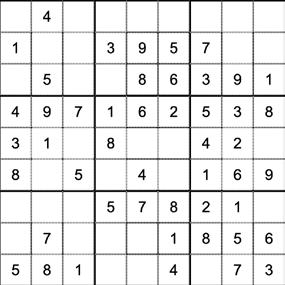
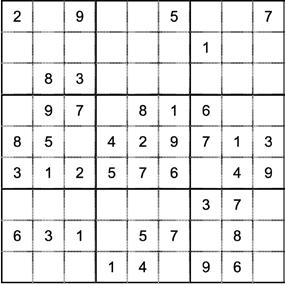
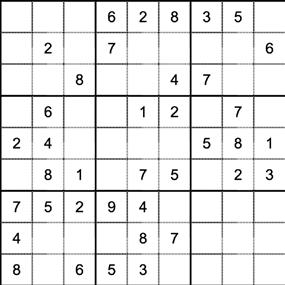
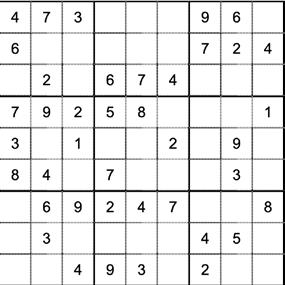
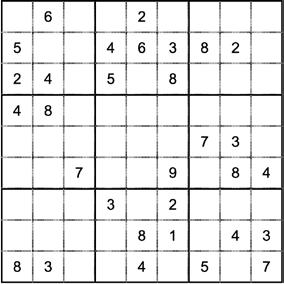
&5($785()($78 5(
36<&+2/2*,& $/
CREATUREFEATURE PSYCHOLOGICAL HAUNTEDHOUSE CURSEDOBJECT MASKEDFIGURE FOUNDFOOTAGE SUPERNATURAL POLTERGEIST POSSESSION
+$817('+286( 3266(66,21 28,-$%2$5' '$5.5,78$/ 3$5$1250$/ (9,/63,5,7
OUIJABOARD DARKRITUAL PARANORMAL EVILSPIRIT FINALGIRL JUMPSCARE BLOODMOON NIGHTMARE GRAVEYARD

EXORCISM WEREWOLF SURVIVOR SLASHER MONSTER VAMPIRE PSYCHIC SCREAM ZOMBIE
1,*+70$5( *5$9(<$5' (;25&,60 :(5(:2/) 6859,925 6/$6+(5 02167(5 9$03,5( 36<&+,& 6&5($0 =20%,( 6+$'2: .,//(5 &+,//6 7(5525 2&&8/7



SHADOW KILLER CHILLS TERROR OCCULT GHOST DEMON GORE FEAR
*+267 '(021 *25( )($5
If you have a story, confession, or experience you’d like to share—whether it’s an anonymous crush, workplace drama, or something else entirely—you may submit it using the QR code below.

i asked a guy out in one of my classes and he very politely turned me down because he was in a relationship but said we should be friends and told me his name twice but I forgot it :( we still wave at each other every time we pass on campus and i’m too embarrassed to ask his name because I would genuinely like to be friends with him
- anonymous

These puzzles are provided to be fun and challenging. The Salient team and our contributors aim for accuracy, but occasional errors may occur. If you notice an error, you may write to editor@salient.org.nz. Please note that our puzzlers and contributors are doing their best, and none are professionals or working on these puzzles full time. For the word find, words may appear diagonally and backwards. To access solutions for the crosswords and connections puzzles, scan the QR code next to Puzzhead.

To solve a Set Square, use arithmetic and logical reasoning. You are given a grid containing six sums: three reading across and three reading down. The arithmetic operations (division, multiplication, addition, and subtraction) are shown between the grid spaces. Place each of the numbers 1 to 9 exactly once into the grid so that all six sums are correct. Note that calculations are carried out in left-to-right order, not according to BEDMAS.
To solve connections, group the sixteen words into four sets of four based on a shared connection. Each word belongs in only one group. Continue until all four groups are identified. On our website, the groupings are uploaded one at a time, so if you get stuck, you can view the answer for a single connection without revealing the full solution.

To solve Word Wheels, form words of four letters or more using the letters in the nine-letter wheel. Every word must include the central letter. Each letter may be used only as many times as it appears in the wheel. The aim is to find as many valid words as possible from the target word list, including the nineletter word that uses all the letters.



Learn how to make pizza dough from scratch. Nothing beats a home cooked meal, and Leo, I think you’re eating a couple too many two minute noodles. Make some pizza. Enjoy. Know how to make pizza dough? Make enough for your flatmates; impromptu movie night incoming.
This week, make like the disco ball on our cover and be your true self. I want you to focus on selfcare and relaxation. Do what makes you happy, spend that extra bit of money. Treat yourself.




Get a new piece of art this week, your room is looking lowkey boring. Rip out a centerfold, buy a print from a local market, make your flat your home.
Watch Heated Rivalry.
It’s time to get your writing pants on: pitch something to Salient, finish that essay, and really just run with it. You’re going to understand yourself more if you put pen to paper, and it will be a huge benefit.



I get that the water is polluted, but you should check out the Fryberg Pools. They have a sauna, and you’ve been feeling a bit tense lately. Jump in the sauna or spa, relax, remember your togs.
Strange travellers from distant constellations have beamed you up to the Mothership to deliver some good news and hard truths. Consider the gravity of their words.

This is a week to be calm and quiet. The last few weeks have been a lot. I want to affirm that you’re doing a good job, the people in your life love and care about you, and it’s all going to be okay.
Do: Little things that spark joy
Don’t: Prioritize work over mental health
Last week I told you to date women and this week I’m going to lay off. Gemini, I want you to go wild this week. Let your hair down, go to town, and learn balloon animals so you can kick start your career as a clown—see what I did there? Jim the designer told me to rhyme town with clown.
Do: Whatever you want Don’t: Develop coulrophobia, it’ll ruin your budding career






Go to the Bubble on Tuesday or Friday between 11am and 2pm. Good things await.
Do: “Good boy”, “Good girl” Don’t: Be allergic to dogs
Do you know what’s calling you this week? JJ Murphys’s. You should ditch class on a sunny day, get a jug at JJ’s— the beer garden is open from three—and enjoy time with your friends. You can catch up on lectures later.
Do: Pints in the sun (or alcohol free alternatives)
Don’t: Ask questions in tutorials


Work stress is starting to get to you, and for that I have this advice: delete Outlook off your phone. Or, turn off notifications on the work group chat. They will all survive without you.
Do: Work life balance
Don’t: Message the work chat at 8pm


I think what would make you feel better is cleaning your room. Take a deep breath, put your headphones on and do a deep clean. Chuck out the old shit, donate the pile of clothes you never wear.
Do: Late spring cleaning
Don’t: Put it off…again