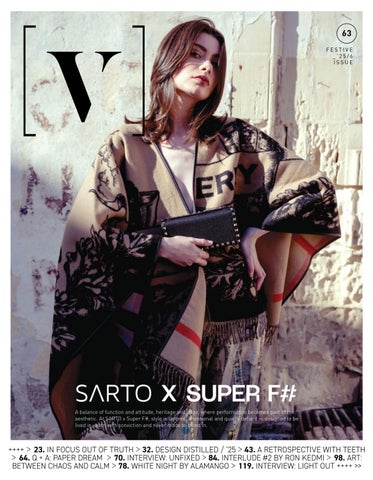
63 FESTIVE _’25/6 ISSUE
A balance of function and attitude, heritage and edge, where performance becomes part of the aesthetic. At SARTO x Super F#, style is layered, intentional and quietly defiant — designed to be lived in, worn with conviction and never made to blend in.
++++ > 23. IN FOCUS OUT OF TRUTH > 32. DESIGN DISTILLED / ‘25 > 43. A RETROSPECTIVE WITH TEETH > 64. Q + A: PAPER DREAM > 70. INTERVIEW: UNFIXED > 84. INTERLUDE #2 BY RON KEDMI > 98. ART: BETWEEN CHAOS AND CALM > 78. WHITE NIGHT BY ALAMANGO > 119. INTERVIEW: LIGHT OUT ++++ >>
HAPPY DIAMONDS Handcrafted in Ethical Gold
THE BLUE ELEPHANT RESTAURANT experience Royal Thai masterpieces.
BLUE ELEPHANT RESTAURANT Hilton Malta, Portomaso, St. Julians T: 21 383 383 F: www.facebook.com/blueelephantmalta
Campari is marketed and distributed by Farsons Beverage Imports Company Ltd.
CONTENTS
“GROWTH BEGINS THE MOMENT CERTAINTY COLLAPSES”
T
here’s a particular kind of magic that happens when creativity, craft, and curiosity collide, and this issue is built on that spark. Across these pages, you’ll find stories shaped by transformation: designers redefining materials, photographers reframing icons, architects blending memory with landscape, and artists distilling emotion into colour, fibre, and form. From Lorenzo Agius’s electric retrospective, a homecoming stitched with thirty years of cultural mythology, to James Dimech’s delicate yet defiant paper couture, this issue celebrates the makers who turn vision into something you can feel. We explore architecture rooted in nature, fashion that moves with confidence, and art that invites us to slow down and look a little closer. This season, we are also proud to feature an exclusive collaboration with Sarto x Super F#, bringing together some of the world’s most extraordinary brands in a shoot that pairs highfashion warmth with the dramatic light of Valletta. From Moncler and Burberry to Valentino, Fendi, Moon Boot, and more, these collections elevate winter dressing into a study of texture, silhouette, and modern luxury. Working closely with Sarto allowed us to curate something truly special, a visual narrative where craftsmanship meets contemporary edge. What ties this issue together is a devotion to process. Whether it’s the rigor of folding a single sheet of paper, the patience of waiting for a portrait’s unguarded moment, or the steady evolution of design shaped by environment and memory, every story here reveals that creation isn’t an act, it’s a practice. As always, our goal is simple: to inspire you. To give you moments of pause, sparks of fascination, and a sense of connection to the people whose work quietly shifts the world around us. Settle in, turn the page, and step into the season’s stories. Enjoy and take care, Kay K x
024. FRAMING REALITY: IN FOCUS, OUT OF TRUTH An exhibition tracing how image-making evolved from documenting reality to shaping perception, performance, and identity across six transformative decades.
036. DESIGN DISTILLED A global snapshot of Dezeen Awards 2025, highlighting innovative architecture and interiors from emerging studios and established design leaders worldwide.
044. INTERVIEW: A RETROSPECTIVE WITH TEETH Lorenzo Agius talks about the art of photographing icons, and what it takes to truly capture someone’s essence.
066. PAPER DREAM Architect and designer James Dimech transforms paper into wearable art, exploring fragility, structure, and imagination.
100. BETWEEN CHAOS + CALM Inside the Bali studio of Jean-Philippe, where Western technique meets spiritual practice to explore duality, transformation, and imperfect beauty.
108. AS ONE MJMDA’s IDDS+ approach redefines luxury architecture through unified design, seamless delivery, and a single, intelligent process built on clarity.
117.THE BEAUTY EDIT A curated selection of Clarins skincare and makeup, blending age-defying innovation, sensorial formulas, and glow-boosting essentials for radiant skin.
121. LIGHTS OUT An ambitious national project inviting Malta to switch off lights, rediscover darkness, question consumption, and reflect on collective responsibility.
072. Q + A: UNFIXED Kathrine’s raw charcoal drawings capture bodies in motion, exploring femininity, instinct, and myth through presence, emotion, and unapologetic vulnerability.
080. WHITE LIGHT A romantic bridal shoot featuring Alamango gowns, captured at Palazzo Parisio, where light, architecture, and timeless elegance converge beautifully.
086. INTERLUDE #2 Fashion shoot and interview with model Adi Neumann, photographed by Ron Kedmi, exploring presence, identity, and contemporary visual storytelling.
Editor Kay Psaila Design / Art Direction VOCAB Photographer Matthew B Spiteri Stylist Robert Walker Sales Director Sam: [+356] 7788 0300
Contributors Adi Solomon Alamango Celine Anchetti James Dimech Jean-Philippe Katherine Maj Kate Sanders Lorenzo Agius MJMDA Ron Kedmi Ryan Ellis Board Zahra Bridge
Reproduction in whole or in part without written permission from the publisher is prohibited. All rights reserved. Dates, information and prices are believed to be correct at the time of going to press but are subject to change and no responsibility is accepted for any errors or omissions. Neither the editor nor the publisher accept responsibility for any material submitted, whether photographic or otherwise. While we endeavor to ensure that the organisations and firms mentioned are reputable. The editor can give no guarantee that they will fulfill their obligations under all circumstances. Copyright 2025/6
WINTER_‘25/6 ISSUE
015
#GIFTING ’25/6
‘25/6
ASSOULINE – BURBERRY – FENDI –
“THE SEASON INVITES US TO SLOW DOWN AND GIVE WITH INTENTION—SELECTING PIECES DESIGNED TO BE LIVED WITH, NOT SIMPLY UNWRAPPED.” Assouline – Tiffany & Co: The Landmark – €175 This Assouline volume celebrates Tiffany & Co.’s rich legacy through captivating imagery and exquisite design. Encased in a luxurious slipcase, it serves as both a collector’s piece and an elegant home accessory. A meaningful gift for design aficionados and jewellery lovers alike. Available at: SARTO X SUPER F#
Burberry Wrapped in Iconic Check - €1,005 Wrap them in Burberry’s iconic check with the Charlotte cape, crafted in a soft wool-blend and finished with fluid fringe and an effortless open front. Perfect layered over knits or evening looks, this timeless one-size piece is a cold-weather staple they’ll reach for all season. Exclusively available at SARTO x SUPER F# Alexandre.J – Iris Violet Eau de Parfum (100ml) - €140
Fendi – Black Belt – €305 Fendi’s refined black belt features the iconic FF buckle, delivering instant sophistication to any outfit. Crafted with precision, it blends everyday practicality with unmistakable luxury. A sleek and versatile gift for those who appreciate polished designer essentials. Available at: SARTO X SUPER F#
016
WINTER_’25/6 ISSUE
Iris Violet enchants with vibrant fruity top notes, soft florals, and warm musk undertones. Housed in a decorative purple bottle, it’s a fragrance that feels indulgent and unforgettable. A beautiful gift for those who love expressive, luxurious scents. Available at: SARTO X SUPER F#
#GIFTING ‘25/6
AESOP – MISSOMA – GIVENCHY – D1 MILANO >> Givenchy – Antigona East-West Small Bag Price: €1,750 The Givenchy Antigona EastWest Small Bag offers sculptural elegance in glossy black leather with signature hardware. Compact yet statement-making, it transitions effortlessly from day to night. A striking gift for lovers of iconic, timeless luxury. Available at: SARTO X SUPER F#
Aesop – Shower Room Serenades Gift Kit – €65 Aesop’s Shower Room Serenades gift set elevates daily rituals with aromatic cleansers and nourishing formulas. Wrapped in the brand’s signature minimalist packaging, it transforms everyday bathing into a luxurious sensory escape. A refined, thoughtful gift for self-care enthusiasts. Available at: SARTO X SUPER F#
D1 Milano – Ultra Thin Light Gun Watch – €375 Missoma, Spiral Interchangeable Pearl Drop Earrings €255 These sculptural spiral earrings blend modern gold detailing with timeless freshwater pearls. Their interchangeable design allows for versatile styling, bringing artistic elegance to any look. A beautifully crafted gift for the jewellery lover who appreciates contemporary design and refined femininity. Available at: SARTO X SUPER F#
This ultra-thin D1 Milano timepiece pairs minimalist sophistication with everyday wearability. Lightweight and sleek, its matte gunmetal finish adds a modern edge. A perfect gift for those who value refined simplicity and contemporary craftsmanship. Available at: SARTO X SUPER F# WINTER_‘25/6 ISSUE
017
#GIFTING ’25/6
‘25/6
S.T. DUPONT – CLELAND & SOUCHET
S.T. Dupont Le Grand Dupont Mixed Lacquer Lighter (Dark Blue) Finished in deep blue lacquer with sleek palladium accents, the iconic Le Grand Dupont lighter combines elegance with performance. Its dual-ignition system allows for both a classic yellow flame and a powerful blue torch. Compatible with standard red lighter stones and red gas refills. Delivered without gas; refills sold separately. A screwdriver is included for stone replacement. Price on request https://elcol.com/
Baccarat Harcourt Candle Collection. Wax Candlestick - €100 Glass Candle - €120 Inspired by Baccarat’s legendary Harcourt glass, first created in 1841, this radiant candle collection captures the maison’s enduring spirit of luxury and light. Featuring wax candlesticks and glass candles in luminous hues, each piece celebrates French elegance through a blend of heritage craftsmanship and contemporary flair. A perfect gift to bring warmth and brilliance to the holiday home. Available: In store (14 Portomaso, St Julian’s) and online www.clelandsouchet.com Hermès Passifolia Dinner Set The Hermès Passifolia dinner set transforms every table into a tropical dreamscape. Crafted in France, it features 32 vivid, hand-applied colours and delicate gold accents illustrating lush botanical motifs. Designed by Nathalie RollandHuckel, each porcelain piece balances art and functionality—a vibrant celebration of nature’s abundance and Hermès’ timeless savoir-faire. Available: In store (14 Portomaso, St Julian’s) and online at www.clelandsouchet.com Price: On request
018
WINTER_’25/6 ISSUE
–
#GIFTING ‘25/6
L A L I Q U E M O N – J A C Q U E M U S – T U T T O T O N D O >>
Mühle Rytmo 4-Piece Shaving Set – Petrol Blue - €110 Lalique Mon Premier Cristal Sensuel - €650 Lalique’s Mon Premier Cristal Sensuel marries haute perfumery with the brand’s legendary crystal artistry. Presented in a hand-blown bottle that feels like a modern jewel, this exquisite scent exudes sophistication and heritage. An unforgettable luxury gift for those who appreciate beauty, craftsmanship, and timeless design. Available at: franks.com.mt
MÜHLE elevates grooming rituals with German precision and timeless craftsmanship. This refined four-piece set blends elegant design with durable materials, creating a shaving experience that feels both luxurious and lasting. A thoughtful gift for anyone who values quality, style, and the pleasure of a well-crafted routine. Available at: meninmalta.com
“THE BEST GIFTS DON’T FOLLOW TRENDS; THEY FOLLOW TASTE” Tuttotondo Exfoliating Cream Mirto 200g - €29 Tuttotondo captures the vibrancy of Italy through playful, fragrancefilled body care inspired by iconic destinations. This refreshing exfoliating cream blends colour, scent, and sensory pleasure, making it a joyful gift for anyone who loves pampering, travel-inspired beauty, and a touch of everyday indulgence. Available at: sageandivy.mt
S.T. Dupont Line D Éternité Fountain Pen
20,000 Leagues Under the Seas, Blue Gulf Stream Edition, Inspired by Jules Verne’s legendary tale, this limited-edition fountain pen features deep Blue Gulf Stream lacquer, exquisite guilloché, and refined goldsmithing. A collector’s piece where master craftsmanship meets imagination, perfect for those who treasure extraordinary writing instruments. Price on request https://elcol.com/
Jacquemus – L’Écharpe Carro - €250
This plush Jacquemus scarf adds warmth and understated luxury to winter dressing. Soft, textured, and effortlessly chic, it’s a timeless accessory that pairs seamlessly with any cold-season wardrobe. An ideal gift for the minimalist with an eye for subtle statement pieces. Available at: SARTO X SUPER F#
WINTER_‘25/6 ISSUE
019
AT THE HEART OF PINOT NOIR
#GIFTING ‘25/6
‘25/6
“THIS SEASON, GIFTING UNFOLDS AS AN ARTFUL EXPRESSION OF REGENERATION, BEAUTY & WELLBEING
Wellness, Wrapped: Myoka’s Christmas Collection The Myoka Spas Christmas Collection is built on one simple truth: care is a timeless gift. This season, discover rituals designed to restore, heal, and reconnect in today’s hectic world. Thoughtfully curated treatments and spa vouchers come with 20% loyalty cashback, plus a complimentary gift box in-store with voucher purchases over €120. Give care, beautifully and intentionally. https://myoka.com/ Science Meets Luxury: Biologique Recherche Globally acclaimed for its results-driven formulas and scientific precision, Biologique Recherche is available exclusively at Myoka Spas in Malta. Loved by icons such as Bella Hadid and Kim Kardashian, the brand delivers visible improvements in radiance, texture, and skin health through highly concentrated, skin-identical ingredients. An exceptional gift for the true skincare enthusiast or a transformative treat for yourself. https://myoka.com/
WINTER_‘25/6 ISSUE
021
Pietà, Malta 178, Marina Pietà, Malta Str. +35620103715 178, Marina Str. +35620102949 +35620103715 +35620102949
Floriana, Malta 31/32, St.Malta Anne Str. Floriana, +35621233715 31/32, St. Anne Str. +35621222949 +35621233715 +35621222949
#GIFTING ‘25/6
‘25/6
Million Gold for Her Parfum - From €82 Rabanne’s Million Gold for Her Parfum radiates bold, modern femininity with a dazzling, addictive warmth. Glamorous and luminous, it’s a scent designed to shine, perfect for someone who embraces confidence and elegance. A standout gift for lovers of statement fragrances that elevate every moment with golden brilliance. Available at: All Rabanne retailers and onlne txp.com.mt Graf von Faber-Castell Bloom Series The Bloom Series from Graf von Faber-Castell is where artistry meets innovation. Featuring handcrafted barrels in ebony or hornbeam, paired with precision-milled brass refined in gold or black ruthenium, each pen embodies contemporary elegance. The fountain pen’s 14-carat gold nib completes this masterful composition, a luxurious writing instrument for the creators of tomorrow. Available: The Fine Writer at Grey & Adler, Naxxar, and Victor Azzopardi Jewellery, Pietà | www.thefinewriter.com Price: On request
“THIS CHRISTMAS, GIFTING UNFOLDS AS AN ARTFUL EXPRESSION”
Aesop – Istros Aromatique Room Spray (100ml) - €53 Istros fills interiors with a warm blend of pink pepper, lavender, and tobacco. Just one spritz transforms any space into a cocoon of modern aromatics. A chic, thoughtful gift for lovers of elevated home fragrance. Available at: SARTO X SUPER F#
WINTER_‘25/6 ISSUE
023
NEWS
FRAMING REALITY: IN
024
WINTER_’25/6 ISSUE
NEWS
FOCUS, OUT OF TRUTH
When the camera turns on the world, who decides what is real?
T
his winter, City of Art presents BLOW-UP, a major exhibition at Spazju Kreattiv, Valletta, exploring how image-making, through cinema, fashion, photography, and performance, has evolved from documenting life to defining it. Taking its title from Michelangelo Antonioni’s 1966 masterpiece BlowUp, the exhibition traces a six-decade transformation: from the moment when film mirrored the world to our contemporary condition, where reality bends to the image. In Antonioni’s film, a fashion photographer enlarges a single frame in search of truth, only to find reality dissolving. That question, what do we really see when we look?, remains at the heart of this new curatorial project.
Across four rooms, BLOW-UP maps the entwined evolution of art, fashion, and cinema from the 1960s to today. The exhibition opens amid the visual codes of the decade that changed everything: Helmut Newton’s daring portraits, Christian Dior’s silhouettes, Andy Warhol’s serial pop images. David Hockney’s coloursaturated canvases converse with Joana Biarnés’ documentary photography, while the sounds of Karlheinz Stockhausen reverberate through the space, evoking a world newly conscious of itself as image. Each work becomes a fragment in a broader story, the moment when culture realised that to see was also to perform. If the sixties invented the modern image, BLOW-UP suggests, they also invented the modern attitude toward it: self-aware, performative, endlessly reproducible. Fast forward six decades, and Antonioni’s anxieties feel eerily prophetic.
Today, every frame, post, and self-portrait is a negotiation between authenticity and artifice. The exhibition’s contemporary sections explore this collapse of certainty, confronting surveillance, self-curation, and digital distortion. Visitors move through installations that make them both subject and observer, caught in the spectacle they came to watch. Beyond the gallery, BLOW-UP unfolds into a wider programme of events that extend its central ideas into dialogue and performance. Opening night features In Conversation with Francesca Grima, where Luke Azzopardi speaks with Francesca Grima, daughter of the visionary jeweller Andrew Grima (1921–2007). Known as the “father of modern jewellery,” Andrew Grima revolutionised postwar design with his sculptural approach and bold use of unconventional materials. >>
WINTER_‘25/6 ISSUE
025
NEWS
[ “BLOW-UP is not just an exhibition—it is a meditation on the gaze itself.” ] This marks Francesca’s first visit to Malta—an occasion of personal resonance as she reflects on her father’s legacy, Maltese roots, and the ongoing relevance of his work in contemporary design. Midway through the exhibition, BLOWUP hosts an academic seminar and catalogue launch, moderated by Maria Theuma, gathering artists and scholars to unpack the project’s key themes: visibility, truth, and the politics of perception. The accompanying publication is more than a record—it is a critical extension of the exhibition, pairing richly illustrated spreads with essays that move between eras and mediums. Contributors reflect on art, film, performance, and fashion as interlinked languages of power and representation. In their pages, the cultural ferment of the 1960s meets today’s fragmented media reality, reminding us that how we see remains inseparable from how we are seen. The programme culminates on 13 December 2025 with Azzopardi Studio’s 22nd collection, Venus in Furs—a
multidisciplinary presentation staged within the conceptual framework of BLOW-UP. Known for fusing couture with performance and research, Luke Azzopardi revisits the sixties not through nostalgia but as a way to reimagine its codes for the future. The garments evoke both decadence and discipline, drawing from the radical energy of the era’s art and cinema. Fashion here becomes a form of inquiry, asking what glamour and rebellion mean in an age that sees everything.
Office of the Deputy Prime Minister and Ministry for Foreign Affairs and Tourism, Festivals Malta, Deloitte, Heritage Malta, MAPFRE, and the University of Malta. For tickets, registration, and information, visit cityofart.eu [ V ]
Ultimately, BLOW-UP is not just an exhibition—it is a meditation on the gaze itself. To walk through it is to experience the tension between seeing and being seen, between the desire for truth and the seduction of illusion. In a culture saturated with images, it reminds us that every act of looking carries power. Perhaps what remains of the real, as Antonioni implied, is precisely what refuses to be captured. BLOW-UP is presented under the patronage of City of Art’s main patrons Jordi Goetstouwers and Valeria Limentani, with the support of Spazju Kreattiv, Arts Council Malta (Arts Support Scheme), the WINTER_‘25/6 ISSUE
027
TRENDING
STYLE = RITUAL
At SARTO x Super F#, festive gifting becomes a ritual of personal style, curated with intention and edge. >>
WINTER_‘25/6 ISSUE
029
TRENDING
[“Heritage luxury meets sharper energy in an –
T
here’s a particular magic that settles over the city during the festive season — a slowed-down glow, a pull toward beauty, a desire to give meaningfully. This year, SARTO x Super F# captures that mood with intention, transforming holiday gifting from a rushed task into a curated ritual of taste. Here, gifting isn’t about ticking boxes, but about choosing pieces that speak, linger and elevate the everyday. This festive season, SARTO x Super F# leans into the mood of the city, turning gifting into a ritual of style rather than a checklist. The boutique brings heritage names like Burberry, Dolce & Gabbana and Valentino into dialogue with the sharper energy of Asics, Stone Island, Acne, Moon Boot and Moncler, creating an edit that feels both grounded and of the moment. Aesop’s luxury self-care sets and Assouline’s collectible books and scented candles complete the narrative, bridging fashion and lifestyle for gifts that live well beyond the holidays. >>
030
WINTER_’25/6 ISSUE
TRENDING
edit that feels grounded and of the moment.”]
WINTER_‘25/6 ISSUE
031
TRENDING
Think of the space as a series of vignettes: a Burberry trench waiting by the door, a sculpted Valentino bag catching the light, Stone Island’s fabric innovations stacked next to Moon Boot’s playful silhouettes. Moncler’s outerwear and Acne’s soft, essential staples pull the story together, speaking to different personalities while keeping luxury as the common language. Every piece feels less like an accessory and more like a chapter in someone’s winter wardrobe. SARTO x Super F# is curated to be lingered in, not rushed through. The team guides you intuitively, suggesting combinations, styling ideas and unexpected pairings that make each gift feel intimately considered. In an evolving fashion landscape, the boutique becomes a quiet yet confident anchor for those who see gifting as an extension of personal style rather than a seasonal obligation. Here, gifting becomes personal, thoughtful and beautifully intentional — exactly as it should be. [ V ] 032
WINTER_’25/6 ISSUE
[“SARTO x Super F# transforms holiday gifting from a rushed task into a curated ritual.”]
TRENDING
WINTER_‘25/6 ISSUE
033
Feskekôrka (Fish Church), Gothenburg — renovated by White Arkitekter, winner of the Dezeen Awards 2025 Heritage Project
DESIGN DISTILLED DESIGN
Mapping creativity across continents and cultures.
034
WINTER_’25/6 ISSUE
DESIGN
[“The awards continue to champion both established and emerging designers, with over 60% of entries coming from small studios.”]
S
ome of the most striking examples of contemporary architecture and interiors have been revealed as Dezeen Awards 2025 announces its official shortlist. Now in its eighth year, the awards continue to champion exceptional work across architecture, interiors, design, and sustainability, spotlighting both global icons and rising stars. This year’s shortlist includes 269 projects competing across 49 categories, chosen from a remarkable 4,300 entries spanning more than 85 countries. The list reads like a global map of design innovation, featuring world-renowned studios such as Herzog & de Meuron, Foster + Partners, Olson Kundig Architects, Heatherwick Studio, and Neri & Hu. According to Claire Barrett, Dezeen’s awards and events director, this year’s edition reflects the platform’s ongoing commitment to nurturing diversity in design:
De Hoge Veluwe National Park” in the Netherlands, designed by JCR Architecten.
“It’s great to see Dezeen Awards reflecting Dezeen’s role in championing not only established architects and designers, but emerging ones too, with more than 60 per cent of this year’s entries submitted by small studios.”>> WINTER_‘25/6 ISSUE
035
DESIGN
[“This year’s shortlist maps the world’s most innovative ar
A Spiritual Enclosure by architect Rubén Valdez, a non-religious ceremonial space located in the Baja California Sur desert in Mexico.
The Tip of Nordø – a collaboration of Vilhelm Lauritzen Architects, Cobe, and Third Nature.
036
WINTER_’25/6 ISSUE
Villain House, Barcelona, designed by Architecture Office Clàudia Raurell.
DESIGN
chitecture and interiors across more than 85 countries.”]
The Sun Tower, Yantai, China, designed by OPEN Architecture.
WINTER_‘25/6 ISSUE
037
DESIGN
Detail shot of the public winter garden and exterior plaza of The Tip of Nordø, Copenhagen, Denmark.By the Danish studios Cobe, Vilhelm Lauritzen Architects, and Third Nature
The United States, the United Kingdom, China, Australia, and Japan lead the way as the top five entering countries, underscoring the awards’ truly global reach. Shortlists for architecture, interiors, and design are being released between 6 and 9 October on dezeen.com/awards, offering a glimpse into some of the year’s most talked-about projects, from groundbreaking cultural landmarks to innovative sustainable housing and luxury hospitality spaces. The winners will be revealed at the Dezeen Awards 2025 ceremony on 25 November at the Exhibition White City in London. The event promises to bring together the global design community for a celebration of creativity, craftsmanship, and the future of architecture. Tickets for the awards night are now available, priced at £180 for studios that entered this year’s competition and £225 for other attendees. [ V ]
038
WINTER_’25/6 ISSUE
[“The United States, the United Kingdom, China, Australia, and Japan lead this year’s entries, underscoring the awards’ truly global reach.”]
DESIGN
Detail shot of the Sun Tower, Yantai, China.
WINTER_‘25/6 ISSUE
039
044
Following a preview at The Phoenicia Malta in June, this full-scale show explores themes of fame and identity through Agius’s signature style. We spoke to him about his creative process and the stories behind his iconic images.
VAMP meets renowned photographer Lorenzo Agius ahead of his show in September titled “LOOK AT ME: Framing the Iconic” at Spazju Kreattiv, Valletta (12 Sept – 2 Nov 2025). Curated by Professor Charlene Vella, the exhibition showcases Agius’s bold, cinematic portraits of some of pop culture’s most recognisable faces.
Q+A
WINTER_’25/6 ISSUE
Q+A
A RETROSPECTIVE WITH TEETH THIRTY YEARS OF FACES, FAME, AND FLEETING TRUTH — LORENZO AGIUS, THE PHOTOGRAPHER WHO TURNED THE 90’S INTO MYTHOLOGY, RETURNS TO MALTA WITH FRAMING THE ICONIC.
T
his season, Malta gets a jolt of raw iconography. Photographer Lorenzo Agius, the eye behind Trainspotting’s now-mythic portraits and decades of cultural chaos, brings his first-ever major retrospective home. Framing the Iconic opens 12 September at Spazju Kreattiv, pulling together thirty years of cinematic faces, emotional static, and moments that don’t pose, they exist.
Agius, British-born, Maltese-blooded, carved his name into the visual DNA of the 1990s with portraits that felt like stills from the film of a generation. He shot stars before they knew they were stars, catching the flicker between confidence and collapse, between arrogance and innocence. His subjects? Not famous people, people who happen to be famous. Their power isn’t performance; it’s presence, distilled into a single, unguarded breath. The Shot That Changed Everything In 1996, when Britain was pulsing with Britpop and late-night neon, a young Agius was handed a modest brief: shoot the cast of a small independent film called Trainspotting. What he delivered detonated across culture.
Ewan McGregor’s eyes, wired with hunger and despair; the cast’s defiant swagger. These weren’t promo stills, they were portraits of a generation about to combust. The images didn’t just sell a film; they bottled the anarchic glamour of Cool Britannia. From that moment, Agius became the visual chronicler of a nation’s new mythology. He photographed David Beckham, The Spice Girls, Liam Gallagher, Patsy Kensit, icons of sound and attitude, before crossing the Atlantic to shoot Madonna, Brad Pitt, Penélope Cruz, Jack Nicholson, Helen Mirren, Angelina Jolie, and a constellation of Hollywood royalty. Yet what set him apart wasn’t access or fame. It was empathy. His lens disarmed, disrobed, revealed. These weren’t rehearsed poses; they were collisions between persona and truth, where celebrity cracked just enough to let the human light through. >>
WINTER_‘25/6 ISSUE
045
Q+A
[ “LORENZO AGIUS CARVED HIS NAME INTO THE VISUAL DNA OF THE 1990S WITH IMAGES THAT FELT LIKE STILLS FROM THE FILM OF A GENERATION.” ] >>
046
WINTER_’25/6 ISSUE
Q+A
>> WINTER_‘25/6 ISSUE
047
Q+A
Framing the Iconic The retrospective unfolds like a film told in four movements, each gallery a mood, a tempo, a fragment of Agius’s visual psyche. Cool Britannia kicks things off with the ferocity of youth. The Trainspotting portraits hang like relics of rebellion. Around them orbit Beckham, Law, Gallagher, and The Spice Girls, faces that once defined aspiration and chaos in equal measure. Contact sheets line the walls, messy and magnificent, revealing the near-misses and happy accidents that built the myth. Next comes Familiar Strangers, a room of suspended light. Forty portraits, Beyoncé, Christian Bale, Julia Roberts, Penélope Cruz, float midair, untethered from frame or wall. Visitors move among them as if drifting through a dream of recognition. It’s fame rendered weightless, intimate, and strange. Then, in Evolution of a Portrait, the curtain lifts. A short film plays, Agius in motion, coaxing laughter, silence, vulnerability. He talks gently, listens more. On a nearby wall, a collage of magazine covers, Vanity Fair, GQ, The Face, Elle, charts the golden age of print, when a cover could crown a star and a photograph could define an era. Finally, Legends closes the loop. Monumental prints of Madonna, Denzel Washington, Tom Cruise, Viola Davis, Helen Mirren stare back with impossible calm. No glass separates them from you, only air, light, and the quiet thrum of recognition. It’s less gallery, more communion. The Alchemy of Process Every photograph Agius makes feels alive because he builds tension between control and surrender. He stages, then he waits, for the heartbeat, the hesitation, the glance that betrays truth. “You can’t force honesty,” he once said. “You create space for it.” That philosophy informs the exhibition design. Mather & Co, working with Charlene Vella and Maltese studio Studjurban, sculpted a space that moves like music, ambient projections breathing across limestone walls, shadows shifting as visitors drift. You don’t just see the photographs; you inhabit their frequency. There’s a painter’s discipline to Agius’s imagery, chiaroscuro borrowed from Caravaggio, drama from cinema, texture from club lights and cigarette smoke. Each portrait is a collision of art history and pop culture, of the sacred and the street. The results are timeless but never static: elegance with bite. And beneath it all, warmth. Agius’s sets hum with conversation. Subjects aren’t captured; they’re invited. The result is an honesty that lingers long after you’ve left the room. >>
[“HE STAGES, THEN HE WAITS — FOR THE HEARTBEAT, THE HESITATION, THE GLANCE THAT BETRAY”] 048
WINTER_’25/6 ISSUE
Q+A
WINTER_‘25/6 ISSUE
049
Q+A
050
WINTER_’25/6 ISSUE
Q+A
>> WINTER_‘25/6 ISSUE
051
Q+A
052
WINTER_’25/6 ISSUE
Q+A
a little more legendary. [ V ]
The Homecoming Though raised in the UK, Agius’s Maltese heritage anchors his identity. “I look back at my childhood with great affection,” he says. “It was humble, full of strong values, and it shaped how I work. I hope this exhibition inspires young artists in Malta to pursue their vision. If I could do it, so can they.” Framing the Iconic is therefore not only a career retrospective, it’s a return to origin. For Agius, it’s personal. For Malta, it’s symbolic: an island claiming its place in the global conversation of image-making. There’s pride in that, but also grace. Agius doesn’t arrive as a conquering hero. He comes home as a storyteller, carrying decades of faces and flashes that belong to everyone who’s ever looked into a lens and hoped to be seen. Seeing and Being Seen At its core, Framing the Iconic isn’t about celebrity at all. It’s about perception, how we look at others and how they look back. Agius reminds us that fame is just another costume, and that behind every image lies the quiet ritual of being witnessed. You walk through the show and feel the world slowing down. Light becomes language again. You remember that photography isn’t about perfection; it’s about proof, that we were here, that we felt something, that someone saw us clearly for a moment. That’s the power of Agius’s work: it invites vulnerability on both sides of the lens. The icons seem less distant, and we, in turn, feel WINTER_‘25/6 ISSUE
053
Tested to minus forty degrees Celsius
ELEVATED
P H OTO G R A P H Y : M AT T H E W B S P I T E R I MAKE UP: ELISABET CASANY MODEL: CELINE ANCHETTI HAIR: ANNIE MORELLI 056
WINTER_’25/6 ISSUE
JACQUEMUS – La Chapka Hat, €505
STYLE FILE
WINTER_‘25/6 ISSUE
057
STYLE–FILE
CASABLANCA – Hooded Ski Fleece, €965 CASABLANCA – Dry Viscose Hybrid Pants, €865 MOON BOOT – Icon Low Fleece in Pink, €295
058
WINTER_’25/6 ISSUE
ACNE – Omenta P Denim Cotton Hand-Tech Jacket, €1,410 –VALENTINO – Ivory V-Light Sunglasses, €625
STYLE FILE
WINTER_‘25/6 ISSUE
059
CASABLANCA - SKI DRY VISCOSE HYBRID JACKET - 995E – CASABLANCA – Dry Viscose Hybrid Pants, €865
STYLE–FILE
060
WINTER_’25/6 ISSUE
STYLE FILE
CASABLANCA Hooded Ski Fleece, €965 CASABLANCA Dry Viscose Hybrid Pants, €865 MOON BOOT Icon Low Fleece in Pink, €295
WINTER_‘25/6 ISSUE
061
STYLE–FILE
YUZEFI – Gyoza Pebble-Grain Leather Espresso Bag, €595 ACNE – Chestnut Scarf, €295 ACNE – 1981 U TLO Goth Cute Jeans, €695 ACNE – Omenta P Denim Cotton Hand-Tech Jacket, €1,410 VALENTINO Ivory V-Light Sunglasses, €625
062
WINTER_’25/6 ISSUE
FENDI – Wallet Chain Zucca Velvet Bag, €1,375 – JACQUEMUS – La Chapka Hat, €505 – BURBERRY – Stone Check Scarf, €505 MONCLER – Barrante Jacket, €1,695
STYLE FILE
WINTER_‘25/6 ISSUE
063
VALENTINO – Nero Stud Bag, €900, BURBERRY – Gallant Knight Cape, €1,065
STYLE–FILE
064
WINTER_’25/6 ISSUE
STYLE FILE
This is winter dressing without compromise. Pieces that move between terrain and city, function and attitude, tradition and disruption. At SARTO x Super F#, style is never static — it’s layered, intentional and quietly defiant. Technical silhouettes meet heritage codes, soft textures clash with hard lines, and performance becomes part of the aesthetic rather than an afterthought. These are clothes designed to be lived in, weathered, styled instinctively and worn with conviction. Nothing here exists to blend in. Each look speaks to a mindset — one that values craft, edge and individuality over excess noise. As the season sharpens and the days grow shorter, this edit offers more than warmth. It offers presence. A reminder that great style isn’t about chasing trends, but about standing your ground. Winter, elevated — exactly as it should be.
WINTER_‘25/6 ISSUE
065
PAPER
shot_by_Andrei
DESIGN
066
WINTER_’25/6 ISSUE
DREAM
In this conversation, he opens up about his creative process, the tactile poetry of paper, and the balance between structure and imagination.
Architect, artist, and designer James Dimech has built a creative world where paper breathes, folds, and transforms into wearable art. From recycled sheets to experimental textiles like Kraft-Tex and Milk Tissue paper, his work challenges our perception of fragility, turning everyday materials into extraordinary couture. Blurring the boundaries between architecture, design, and fashion, Dimech’s creations have travelled from Malta to international stages — most recently gracing Milan Fashion Week with his striking Paper Crazy collection in collaboration with the Istituto Italiano Design in Perugia.
Most recently, I presented my Paper Crazy collection at Milan Fashion Week — a full-circle moment nearly a decade after that first Vamp collaboration. >>
That 2016 cover story was a turning point — the start of my journey into wearable art. Since then, I’ve continued pushing the boundaries of paper as a couture material, showcasing my work internationally at Rome Fashion Week, Miss Eco International in Egypt, the BigSEE Award in Lithuania, the Lucca Biennale Cartasia, the Paper on Skin project in Tasmania, and the “Carta è Cultura” festival in Fabriano. Teaching has also become central to my practice. I lecture on paper manipulation at the Istituto Italiano Design in Perugia and at the University of Malta, where I lead The Art of Paper Manipulation course.
Q: What’s kept you busy since our last conversation in Vamp back in 2016?
DESIGN
WINTER_‘25/6 ISSUE
067
DESIGN
Paper has always fascinated me. It’s humble, accessible, and full of possibilities. As a child I was always folding, cutting, and building small architectural models, never realising those same instincts would later define my artistic path. What drew me to paper was its duality: it can be both delicate and structural. That contrast between vulnerability and strength felt deeply human, and that’s what I wanted to express through fashion. 068
WINTER_’25/6 ISSUE
shot_by_Andrei
Q: What first drew you to paper as a medium for wearable art?
DESIGN
Q: How do you decide whether a material will work? Is it more about testing its limits or about letting it suggest a form? It’s a dialogue. I start by understanding the character of the material — its fibre, tension, and response to manipulation — but I also let it speak. Sometimes a fold, a tear, or a texture reveals an unexpected direction. I’ve learned that paper doesn’t like to be forced; it teaches patience. Over the years I’ve expanded to sustainable textiles made from post-consumer plastic bottles, yet my approach remains the same: to listen to the material and let it lead the design. >> WINTER_‘25/6 ISSUE
069
070
WINTER_’25/6 ISSUE
shot_by_Andrei
My background in architectural model-making naturally influences how I think about form. I design garments as I would construct a space, considering rhythm, proportion, and balance. But movement is essential. I build flexibility into the folds, using pleating systems that allow the paper to expand, contract, and flow with the body. It’s about finding equilibrium between sculpture and soul, between what stands and what breathes.
Q: Many of your works feel architectural, almost sculptural. How do you balance that sense of structure with the need for movement and wearability?
DESIGN
DESIGN
Q: Which themes or emotions are you most interested in conveying through your wearable pieces?
each challenge refines the final piece. I often say that paper doesn’t forgive mistakes, yet it rewards precision.
Transformation is at the core of my work, turning the ordinary into the extraordinary. Each piece is a metaphor for resilience and rebirth: paper that once carried words or ideas becomes a living form again. There’s also a quiet sense of grace and introspection in my designs; they invite viewers to slow down, to feel texture, light, and shadow. Ultimately, my work is about celebrating fragility as a source of strength.
Q: Folding is a recurring language in your work. Beyond technique, does folding carry symbolic or conceptual meaning for you?
Q: What challenges come with working with paper and recycled materials, and how do those challenges shape the final design? Paper demands respect. It has limits such as humidity, weight, and tension, but those same limits push me to innovate. I reinforce delicate areas, layer different grades, or combine them with sustainable alternatives like Kraft-Tex, cork paper, or milk tissue paper. The process is full of trial and error, but
Absolutely. Folding is both a technique and a philosophy. Each fold marks a decision, a moment of transformation. When you fold a sheet, you change its memory forever; it can never return to being flat. I see that as a metaphor for life. Every experience, like every crease, leaves a trace that shapes who we become. Folding is how I translate emotion into structure.
paper creations. That project, which went on to win Premju Ġieħ l-Artiġjanat as Product of the Year, reaffirmed that paper could hold artistic and emotional value even beyond fashion. But the most defining moment came this year, when I presented my Paper Crazy collection at Milan Fashion Week. Being featured among international designers was both humbling and transformative. It allowed me to see my work through the lens of the professional fashion industry while staying true to my roots in craftsmanship and material exploration. Milan was more than a show; it was a statement that paper couture has a place on the global stage.
Q: Looking back, which project or collection has felt most pivotal in shaping your direction as an artist?
Would you like me to create a short introduction paragraph and title for this Q&A layout (to sit above the questions in the magazine)? Something like:
Each project has marked a different chapter in my creative journey. Paper Grace was an important diversion as it moved away from wearable art into the realm of collectible
Architect by training, artist by instinct — James Dimech folds paper, passion, and precision into wearable art that challenges what couture can be. [ V ]
WINTER_‘25/6 ISSUE
071
ART
072
WINTER_’25/6 ISSUE
Unfixed
ART
Interview by Prof. Charlene Vella
Nothing in Kathrine Maj’s world stays still. Her drawings pulse with movement — bodies bending, merging, vibrating on the edge of becoming. Rendered in charcoal, her work is fast, instinctive, and alive with contradiction: beauty and brutality, intimacy and distance, softness and rage. At the centre is the female form — not idealised, but felt. Through limbs, lines, and smudges, she captures something primal and deeply human. This is not about perfection. It’s about presence. A visual language of emotion, memory, and myth, drawn in dust and nerve.
Q: Kathrine, your drawings are raw, powerful, and sometimes unsettling. How do you describe what you do to someone who isn’t into art? A: I’d say I draw people and emotions, but not in a traditional way. My work is about the human body, usually the female body represented in all its shapes, forms, bends, twists and turns. I’m not trying to make something beautiful or respectful; I’m trying to catch a moment that feels alive, animalistic, and even messy; these, I think, are feelings that the body is very capable of transmitting and which we can easily connect to. We all have a body after all. Q: There’s a lot of movement and emotion in your drawings. They almost seem to vibrate. Where does that come from? A: I use charcoal because it lets me move fast. It smudges, it reacts to pressure, it’s unpredictable. When I start drawing, I don’t have a finished image in mind; it’s always an organic process of impulse. I often leave “mistakes” or what in art history would be termed “pentimenti” visible because they feel honest. They are traces of the element that is left to chance when working with charcoal. Q: The female figure is central in your work. What draws you to it? A: The female body is fascinating because of
its many dualities: strength, power, vulnerability, creation, sexuality, exhaustion…. I’m fascinated by how these opposites exist in one form, not just for women today, but also for our ancestors. When I draw, I feel connected to the concept of what it means to be a woman and being a human: it’s about life, passion, connection and sometimes rage. Q: You often include animals, especially dogs. Tell us about that. A: Yes, the dogs are inspired by the Kelb tal-Fenek, the Maltese hunting hound. I see them as ancient, spiritual creatures , they’re part of Malta’s history but also seem foreign and otherworldly. When I moved to Malta from Denmark, I became obsessed with them; I saw them as being stubborn and agile, but also elegant and loving. In my drawings, they appear as companions, guardians, sometimes as extensions of the women themselves. They blur the boundary between human and animal, a duality which I find very appealing. Q: Your figures often merge together — bodies overlap and morph into one another. What does that represent? A: It’s about connection and transformation. I’m fascinated by liminality. The in-between states where one thing becomes another. Life isn’t fixed; everything’s always shifting - physically, emotionally, spiritually. So the merging of figures in my work is my way of
showing that we’re all part of a larger continuum. Q: How has living in Malta influenced your work? A: Immensely. Especially Malta’s matriarchal past and ancient temples. Since moving here, I’ve been looking more closely at church sculptures, traditional iconography, and the way women are represented in sacred spaces. It’s interesting to reinterpret those symbols through a contemporary, female lens. Q: There’s something almost mythological about your compositions. Do you think of them as stories? A: In my work, I refer to paintings by masters of various periods, especially the Medieval, Renaissance, Neoclassical, and Pre-Raphaelite periods. These Influences from our shared art history and visual culture are reinterpreted and perhaps give the work a quasi-mythological feeling. Something that feels both familiar and alien. Sometimes the result looks like a scene from a forgotten legend, but it’s all very intuitive and abstract. >>
WINTER_‘25/6 ISSUE
073
ART
[ “I’M FASCINATED BY HOW STRENGTH AND VULNERABILITY EXIST I AND THAT’S WHERE 074
WINTER_’25/6 ISSUE
ART
N ONE FORM. THE BODY CAN BE ANIMALISTIC, MESSY, AND ALIVE, WE CONNECT.” ] >> WINTER_‘25/6 ISSUE
075
ART
Q: Do you ever find your work too revealing, given how intimate it is? A: Sometimes, yes. Drawing the body can feel like exposing your own nerves. But art only works if you’re vulnerable. I think people connect to honesty. So I try not to censor
076
WINTER_’25/6 ISSUE
myself. The discomfort and confrontation is part of the process; it’s what gives the work energy. Q: What’s your studio routine like? Do you listen to music, or is it all silence and focus?
A: It’s a bit chaotic! The artmaking process is very organic and free – there is no point in trying to keep things neat and clean. I draw for many hours at a time, usually with jazz music, my dog snoozing in a chair next to me, plenty of coffee and with charcoal dust everywhere.
ART
Q: What do you hope people feel when they stand in front of your drawings? A: I hope they feel something, even if they can’t name it. Maybe recognition, maybe discomfort, maybe tenderness, maybe confusion. It’s all valid, and it’s all about feeling.
[ “WHEN I DRAW, I FEEL CONNECTED TO WHAT IT MEANS TO BE A WOMAN AND A HUMAN — LIFE, PASSION, CONNECTION, AND SOMETIMES RAGE. IT’S ALL PART OF A LARGER CONTINUUM.” [ V ]
WINTER_‘25/6 ISSUE
077
BRIDAL
080
WINTER_’25/6 ISSUE
BRIDAL
WHITE NIGHT PHOTOGRAPHY: MATTHEW B SPITERI LOCATION: PALAZZO PARISIO MAKE UP ARTIST: NICOLA POWELL MODEL: MARYSIA S PEREZ ALAMANGO www.alamango.com.mt
WINTER_‘25/6 ISSUE
081
BRIDAL
082
WINTER_’25/6 ISSUE
BRIDAL
WINTER_‘25/6 ISSUE
083
BRIDAL
084
WINTER_’25/6 ISSUE
BRIDAL
WINTER_‘25/6 ISSUE
085
STYLE FILE
IN T ER #
086
WINTER_’25/6 ISSUE
L U D E 2
Creative director & Photography: Ron Kedmi @ronkedmi Model: Adi Neumann @adineumann Styling: Eyal Hagbi @eyalhagbi Makeup: Adi Solomon @adisolomonmakeup Hair: Benjamin Ruimi @bengamivruimi Video: Niv Mayo @mayo.pic P r o d u c t i o n : Ya e l R o z n e r @ y a e l g a l 1 Retouching: Michal Israeli @michalisraeli.photoart
STYLE FILE
WINTER_‘25/6 ISSUE
087
STYLE FILE
088
WINTER_’25/6 ISSUE
STYLE FILE
WINTER_‘25/6 ISSUE
089
STYLE FILE
090
WINTER_’25/6 ISSUE
STYLE FILE
WINTER_‘2/65 ISSUE
091
STYLE FILE
092
WINTER_’25/6 ISSUE
STYLE FILE
WINTER_‘25/6 ISSUE
093
PEOPLE
From Runways to Reality: Modeling, Mysticism + Making Meaning
Q + A 096
WINTER_’25/6 ISSUE
PEOPLE
F
or more than a decade, Adi’s face was everywhere, from global fashion campaigns to icy fragrance sets and wild locations in Iceland and Mexico. Today, she moves between spiritual teaching, Kabbalah, kundalini yoga, psychedelics-informed work, and a new podcast that weaves all of those worlds together. In this conversation, Adi looks back at the most meaningful moments of her modeling career, the experiences that cracked reality open, and how a search for purpose led her from New York runways to inner work, startups and spiritual guidance. You had a remarkable modeling career. Looking back now, which moments or collaborations feel the most meaningful? The ones I remember most clearly are the shoots where something happened – where I learned something new about myself or life, not just about clothes or cameras. One of my absolute favourites was a Puma fragrance campaign called Puma Create. The concept was that another model and I would sculpt a giant ice block into the shape of the perfume bottle, using real chainsaws. They wanted it to look authentic, so instead of heavy safety goggles and huge gloves, we ended up learning how to work with these small, real chainsaws while protecting our faces from shards of ice. They sent us to this enormous ice warehouse in Brooklyn the day before the shoot. We spent hours in full gear learning how to move with the chainsaw, how to slide in and out of the ice so it felt powerful but controlled. By the end we were working almost bare-handed, just focused and precise, feeling strangely confident with these intense machines. It was freezing, I ended up with angina and a week on antibiotics afterwards – but it was still magical. There’s something unforgettable about mastering a completely new skill in a very short time. Another shoot I’ll never forget was in Iceland, over twenty years ago, with the same photographer who shot the Vamp story – Ron. We had long drives between dramatic locations, stopping at natural hot springs and a lagoon full of huge icebergs. At one point they put me in a little boat, took me out to an iceberg in the middle of the water, and shot me alone from far away.
I was standing there, changing looks, posing on this beautiful floating iceberg – and suddenly we heard a loud crack. I felt the ice shift beneath my feet, instinctively lifted one leg, and the chunk I had been standing on just dropped into the water. I sort of slid sideways and ended up on what was now a much smaller iceberg. I stayed dry, but it was one of those moments where you feel how thin the line is between magic and danger. On that same trip we completely lost track of time because of the endless daylight. I remember telling the crew, “My back really hurts, what time is it?” Nobody knew. When we finally checked, it was 2 a.m. We’d been shooting outside for hours without realising it because the sun refused to go down. Those jobs weren’t just “good work” – they were experiences that stayed in my body. You’ve also spoken about supporting younger models on set. Why was that important to you? There was a photographer, Enrique Badulescu, who used to book me often with very young models, 15 or 16-year-old girls, often on their first lingerie shoots. He would say, “You’re good with them, you help them feel confident.” We’d be in places like early-2000s Tulum, when there were only a few hotels and real jungle between them. On one job for Etam we were floating on this giant lily-pad raft in the middle of a jungle pond, in lingerie, being pushed around with long poles so it looked like we were fairy nymphs. At some point the rope anchoring our “lily pad” snapped and we just drifted away across the water while the crew screamed from the shore. Our decorative poles couldn’t reach the bottom, so eventually I half-slid into the water, kept my upper body on the raft and paddled us back with my legs. When we reached land everyone was relieved – and then immediately told me how dangerous the water was and how I should never put my body in there. I’m glad they told me afterwards. But beyond the funny stories, what felt meaningful was being able to pass on knowledge I never had as a beginner, how to move energy on set, how not to panic, how
to support the crew instead of pushing them to the edge. It was my first taste of mentoring, and I loved it. What first drew you into modeling, and how did your relationship with the industry change over time? It started with a very teenage moment. In Israel there was a pageant called Miss Teen Israel, and in 1995 the winner was on the cover of every youth magazine. I remember looking at her photo and thinking, I could do that. That could be me. Two years later, in 1997, I entered the competition – partly for the experience and partly because the prize was a car. I ended up winning Miss Teen Israel at 15, a week after my birthday. I chose a neon green car on live television, which my brother ended up driving for years because I didn’t even have a license yet. Part of the prize was a contract “worth $250,000” with a New York modeling agency. My parents and I later discovered that meant I was effectively tied to that agency until I’d earned that amount through them. Luckily, it was a good agency, Next Model Management, and I stayed with them for seven years. By 16 and a half I’d moved to New York, in the middle of high school, because once you have a New York agency calling with schools and apartments lined up, it becomes hard to say no. In the beginning I actually felt a bit embarrassed to say “I’m a model.” I come from a very academic family, both my parents are doctors, and modelling felt shallow compared to that. I used to mumble it, almost looking away. Over time, though, I realised how much the career had given me: independence, travel, exposure to cultures and ideas, and a deep understanding of image and perception. By my late twenties, after more than twelve years in the business, I was ready for a different chapter. I moved back to Israel to be with my then-partner, and slowly modelling stopped making sense as a full-time life. I wanted purpose in a new way. >>
WINTER_‘25/6 ISSUE
097
PEOPLE
You’ve spent many years studying Kabbalah and other spiritual paths. What pushed you onto that journey? I’ve always been a seeker. Even as a teenager in New York I remember having a conversation with my brother, who was also my roommate at the time. I was going through a rough patch, a breakup, some career frustrations, and I kept asking, “Why is life so hard? There has to be a reason for these challenges.” He got worried, thinking I was talking like someone suicidal, and I kept trying to explain, “No, I love life. I know how lucky we are. I just want to understand why the hard parts exist.” That question never left me. Eventually my brother’s girlfriend, now his wife, suggested we visit the Kabbalah Centre. We walked in together and both connected deeply. That was the beginning of more than 15 years of Kabbalah study, alongside other teachings. What Kabbalah and spiritual work gave me was language and structure for things I instinctively felt: that there are no coincidences, that everything is connected, that our inner work matters. It didn’t make life easier or challenge-free; it gave meaning and tools. It taught me how to see hardship as part of a process, not as punishment. Psychedelics have also been part of your path. How did those experiences change your understanding of self and consciousness? I was introduced to psychedelics quite young, in my late teens, but I was fortunate: the people around me had years of experience and treated it with respect. Looking back as a mother, I’d probably prefer my own kids to explore those realms later than I did, but I’m grateful for how it happened. Those early journeys weren’t just giggles and “the walls are breathing.” The friends guiding me would ask questions like, “Can you influence that blade of grass just by looking at it?” or “Do you feel how all of us are connected right now?” Psychedelics showed me – viscerally, beyond theory – that everything is one system, that consciousness is shared.
098
WINTER_’25/6 ISSUE
I often describe it like this, especially in group work: it’s as if several separate computers (our individual minds) temporarily plug into a bigger super-computer (a shared field). We each remain ourselves, with our memories and histories, but there’s a larger neural network connecting us. You can feel it in the way ideas ripple through the room or how everyone senses when one person isn’t telling the truth. One of the most powerful aspects is that in altered states, you can’t lie to yourself. If you say something that isn’t fully true, you feel the dissonance immediately. Over time that becomes a mirror. You see where you’ve been hiding pain, protecting old stories, or clinging to identities that don’t fit anymore. It can be confronting – but also incredibly liberating. For me, psychedelics were like being shown an “invisible chair.” Once you’ve sat on it and felt it hold you, you don’t need anyone to convince you that it exists. That direct experience made it much easier for me to trust spiritual work later. I already knew there was more than the visible world. After fashion, you moved into startups and education. Where did that shift come from? I realised I needed my work to matter in a deeper way. After modelling, my first big project was an urban agriculture startup. I loved the idea of growing food where people live, for sustainability, nutrition, and just having more green life in cities. It was meaningful in theory, but I eventually understood that it wasn’t my personal passion. My next venture, which I co-led for over six years, did ignite something much deeper: an educational startup for ultra-Orthodox men in Israel. Many of them had spent their lives studying only religious texts, with little exposure to maths, English or science, which meant they were locked out of the tech sector, the country’s fastest-growing industry. We built an intensive programme that combined foundational math, English and science with a full coding bootcamp, all packed into about a year and a half. Most of the men were in their late twenties or early thirties, often with several children, so time and financial pressure were intense. We used an
income-share model and helped them secure loans to support their families during the course. Watching them graduate, enter the tech world, and change the trajectory of their families’ lives was profoundly moving. It was the first time in my professional life that I woke up sick and still wanted to go to work because people were counting on me. It gave me a taste of soul-level purpose – not just brain or body engagement, but something that made my whole being say, Yes, this is why I’m here. You’re now launching a podcast around Judaism, Kabbalah and spirituality. What inspired it, and who is it for? For years, friends, communities and synagogues have invited me to speak, especially secular or culturally Jewish people who are spiritual but feel disconnected from traditional religious spaces. They’re seekers, but they don’t necessarily see themselves reflected in the old frameworks. At the same time, we live in an incredible era of access. With a phone and an internet connection you can take a yoga nidra class, listen to a Tibetan Buddhist teaching, or hear a physics lecture about consciousness. I started to feel that I might have something specific to contribute, a bridge language between Jewish mystical teachings, everyday life, and the wider spiritual landscape. The podcast grew out of that. It’s for anyone who feels curious, Jewish or not, religious or not, and wants another set of tools to understand themselves and reality. Kabbalah is, in many ways, a sophisticated technology for the mind. Yoga works through the body; psychedelics through expanded perception; Kabbalah works through ideas, symbols, and patterns. All three, for me, are pathways to the same place: oneness. I don’t want to convert anyone to anything. I want to offer distilled wisdom that’s been refined over thousands of years, in a language that feels modern and accessible, and invite people to weave it into their own journeys.
PEOPLE
After so many years in fashion and media, what does beauty mean to you now? Beauty, for me, is much less about perfection and much more about authenticity and care. There was a time when I felt conflicted about my looks and my modelling career. Coming from an intellectual family, I worried that being “the model” made people assume I was shallow or un-serious. Over the years, that softened. I’m grateful for my body, for my face, and for what that work allowed me to see and learn. But the older I get, the more beauty I see in how someone lives in their body, in softness, in presence, in how they hold space for others. I see beauty in women who are fully themselves, in lines that tell a story, in a face that has cried, laughed and kept going. I also see beauty in simplicity: in a clear table in the morning, in a room with enough space for breath, in a small ritual of brushing out the day before sleep. It’s not about owning the fanciest objects; it’s about tending to the spaces we inhabit, including our own skin, with respect. All women are beautiful. That’s not a slogan; it’s almost biological. We are built to hold life, to hold space, to change with the cycles of the moon. When a woman connects to that and lets herself be seen as she is, that’s the kind of beauty that moves me now. And finally, if you had to describe the thread running through all these chapters – fashion, psychedelics, Kabbalah, startups, motherhood – what would it be? Curiosity, and a refusal to believe that what we see on the surface is the whole story. Whether it was learning to use a chainsaw on a block of ice, standing alone on an iceberg, guiding younger models, sitting in a Kabbalah class, or helping someone change careers at 30 with four kids – I’ve always been drawn to moments where a deeper layer reveals itself. I think my work now, with the podcast and everything around it, is about sharing those layers. Saying: there is more, and you already have access to it. [ V ] WINTER_‘25/6 ISSUE
099
ART
B E T W E E N C H AO S+ CA L M [ Inside the Studio of a Bali-Based Artist Jean-Philippe ]
I
n a quiet studio in Bali, surrounded by the hum of nature and the rhythm of creation, a European-born artist has spent decades shaping a practice that merges philosophy, spirituality, and form. His work bridges two worlds. Western technique and Balinese sensibility, to explore themes of duality, transformation, and the beauty of imperfection. Through his painting and photography, he seeks not mastery, but meaning. >>
0100
WINTER_’25/6 ISSUE
ART
WINTER_‘25/6 ISSUE
0101
ART
Q: How has living in Bali influenced your identity as an artist? I have lived in Bali since I was twenty-one. I first arrived as a volunteer to run a small art school in Gianyar and never left. My identity now lies at the crossroads of two cultures, my French education and my Balinese life. What began as influence has become reality. I no longer see myself as a visitor but as part of this environment. Q: How would you describe your approach to painting? I work in two stages. First, I prepare a coloured background by flooding the surface and applying diluted pigments and water-based media. The natural flows and movements create unexpected textures. Once the surface dries, I use coloured pencils to build my composition, often inspired by my photographs. What underlies this process is the creation of chromatic chaos. It requires letting go of control and allowing the unexpected to appear. The second stage, the realistic drawing, emerges from this interplay between intention and chance. It becomes a conversation between order and intuition, between the seen and the felt. Q: Do your photography and painting influence each other? Absolutely. I take photographs with painting in mind. They are not photographs for their own sake, but rather visual archives that feed my paintings. My subjects are the people around me, neighbours, shopkeepers, farmers, dancers, those who fill my daily life. Q: How does the atmosphere of Bali shape your creative work?
Q: Could you describe a typical day in your Bali studio? As often as possible, I dedicate the early hours of the day to drawing on a coloured background or preparing a new one, usually until around eleven in the morning. When the heat of the day arrives, I move to my woodworking studio to prepare frames
0102
WINTER_’25/6 ISSUE
or create furniture. Evenings are devoted to reading sociology, philosophy, or history. Once a week, I take my motorbike to explore the island, sketching a landscape or temple, and taking photographs for future paintings. Whenever possible, I join life model sessions with fellow artists to draw directly from the human form.
During my art studies in Europe, I often felt confined by a nihilistic and overly conceptual environment. Coming to Bali was like breathing fresh air. Here, creativity belongs to a shared culture of artisans and artists, not to individual ego or ownership. This has given me freedom, not only in my work, but in how I understand art itself. Art, to me, is born from craft, community, and shared creation.
ART
Q: Your work often references duality, passages, and spiritual transformation. How do these appear in your practice? Duality reflects my two cultures and the ability to see myself from both perspectives. Passages are synchronicities, the fleeting moments and encounters that guide creation. My work often begins with chaos, not to express my ego, but to move beyond it, toward something larger and unexpected. These moments of passage reveal worlds that are psychological, spiritual, and deeply human. Q: Is there a project that marked a turning point in your journey? Yes, a painting called The Old Man. I presented it in hopes of joining the Bamboo
Gallery in Ubud, which was a major venue for collectors at the time. The gallery accepted the piece but refused to sell it. The director told me, “You must first understand how you made it before we can sell it.” He was right. That painting had a quality that emerged unconsciously, almost by accident. It led me to study chaos theory, the setting aside of ego, and the beauty of synchronicity. Q: Which philosophical or spiritual influences guide your work? I hesitate at the word “decision.” Art does not come from decision, but from practice. You can decide to practise, but art itself arises through doing and knowing. My influences are the great Christian mystics, Saint Benedict, John of the Cross, and the Gospel, which I read daily. I am also inspired by
thinkers like Bergson, Nietzsche, Bourdieu, and Jankélévitch, who explore the limits of expression and the nature of creation. Q: Have you faced creative challenges, and how do you overcome them? Even in this so-called paradise, I am still a child of my generation, and mornings can be difficult. Doubt and melancholy remain familiar. I turn to Saint Benedict’s rule, which divides the day into three parts: prayer, work, and study. Prayer restores my focus, work channels my energy, and study expands my understanding. Whether the work succeeds or not matters less than showing up for it. >>
[“I create by letting go of control and inviting the unexpected” ]
WINTER_‘25/6 ISSUE
0103
0104
Perhaps not a question, but a reminder: the value of the useless. To step away from numbers, statistics, and measurable outcomes, and simply play with colours and shapes. Nothing could be more useless, and yet, nothing more essential. [ V ]
Q: Is there a question you wish interviewers asked more often?
ART
WINTER_’25/6 ISSUE
ART
WINTER_‘25/6 ISSUE
0105
Built for exceptional people & companies.
These images may not mean or feel like much to you. But to their proud owners, these spaces are directly linked to their mind. They are the result of a crafted lifestyle that leverages their time & energy. These spaces feel just right to them. Its not a co-incidence. MJMDA’s Integrated Design & Delivery Services not only came up with the right concept and vision for the dream, but delivered it like a seamless product.
Architecture as One
“For the first time, I felt completely supported. One team, one process, one vision. IDDS+ turned what could have been chaos into the most enjoyable project I’ve ever undertaken.” Find out more on www.mjmda.eu
Est. 2003
ARCHITECTURE
0108
WINTER_’25/6 ISSUE
ARCHITECTURE
AS ONE.
THE LUXURY OF A SEAMLESS JOURNEY – MJMDA In a world where time is precious and clarity is rare, MJMDA’s IDDS+ offers something quietly radical: ease. At a glance, it’s a single contract for architecture, interiors, engineering, project management, and cost control. But in practice, it’s a design ecosystem, frictionless, intelligent, and made for people who value precision over chaos. This isn’t just about building better; it’s about building smarter. Where others juggle fragmented teams, IDDS+ aligns vision and execution from day one. One team. One direction. Zero noise. In Malta’s evolving design culture, that kind of cohesion is the new luxury. >>
WINTER_‘25/6 ISSUE
0109
ARCHITECTURE
[ . . . “A S I N G L E C O N T R A C T B I N D S E V E R Y S E R V I C E ,
I
n Malta’s increasingly discerning design landscape, the most valuable luxury isn’t a material: it’s time, clarity, and confidence. For those who refuse to compromise on quality or vision, MJMDA’s Integrated Design & Delivery Services, specifically the elevated IDDS+ pathway, deliver a new kind of architectural experience: cohesive, intelligent, and profoundly convenient. IDDS+ stands as the purest expression of the Architecture as One philosophy,
0110
WINTER_’25/6 ISSUE
where architecture, engineering, interiors, project management, cost control and quality control align under a single, unified process. Instead of juggling consultants, interpreting conflicting advice, or coordinating fragmented workflows, clients are supported by one unified team, driven by precision, creativity, and a shared commitment to excellence. The Power of One Contract The genius of IDDS+ lies in its simplicity. A single contract binds every service,
every discipline, and every responsibility. No loose ends. No blind spots. No “grey areas” where problems thrive. Payment schedules are condensed, predictable, reducing administrative noise and allowing clients to focus on what truly matters: the evolution of their space. This harmonized structure eliminates the inefficiencies that plague traditional project routes.
ARCHITECTURE
E V E R Y D I S C I P L I N E , E V E R Y R E S P O N S I B I L I T Y. ” . . . ]
With all decisions flowing through one accountable line, projects move faster, smarter, and more efficiently, with reduced risk and enhanced discipline. Integrated Design: The Concept At the heart of every exceptional project lies a guiding idea, a concept rooted not in aesthetics alone, but in purpose, identity, and lived experience. In IDDS+, this concept becomes the beacon that aligns every discipline from day one.
Structural logic, environmental performance, spatial flow, interior character, materiality, lighting, compliance, and buildability all pivot around this conceptual North Star. It is the anchor that maintains coherence as the project matures; the narrative thread that binds design intent with technical execution; the lighthouse that prevents drift when complexity increases.
Through in depth startup communication, brief refinement, and collaborative, modelling, MJMDA ensures that the concept is not merely inspirational, but actionable. It becomes the performance driver that informs cost strategies, engineering solutions, detailing standards, and ultimately, the lived emotion of the final space. >>
WINTER_‘25/6 ISSUE
0111
ARCHITECTURE
Delivery: Orchestration Bliss Today’s sophisticated clients understand that true luxury arises from rigor, not excess. It comes from the assurance that every detail has been considered; that every decision has a reason; that every specialist is aligned towards the same outcome. IDDS+ embodies this refined luxury,
0112
WINTER_’25/6 ISSUE
where creative ambition meets disciplined delivery. From high-end residences to complex commercial environments, the service elevates projects with consistent technical excellence, controlled execution, and an experience that feels effortless from first sketch to handover.
For those with a long-term mindset, who value architecture as a cultural investment rather than a commodity, IDDS+ is more than a service. It is a promise: that when a team operates as one, everything becomes not only possible, but better. [ V ]
ARCHITECTURE
WINTER_‘25/6 ISSUE
0113
BRIDAL BOUTIQUE 95, Manoel De Vilhena Street, Gzira www.alamango.com.mt +356 21314331
BEAUTY
THE BEAUTY EDIT: BY CLARINS
From age-defying innovation to glow-boosting essentials, Clarins delivers a collection of high-performance favourites designed to elevate every routine. Targeted treatments, skincare-infused makeup, and sensorial formulas come together to smooth, lift, hydrate, and protect, revealing skin that looks revitalised, radiant, and beautifully renewed.ature. Find your perfect match for radiant, healthy-looking skin every day.
1.
1. Double Serum — Anti-Ageing Double Serum pushes the limits of anti-ageing innovation with a dual-phase formula designed to target lifestyleinduced signs of ageing. With just one drop, skin looks smoother and more youthful. Fine lines appear softened, while skin feels firmer, plumper, and more radiant. Texture is visibly refined, pores look reduced, and overall luminosity is boosted. A powerhouse essential for restored vitality and age-defying glow. 2. Cryo-Flash Cream-Mask — Anti-Ageing Inspired by cryotherapy and Clarins’ renowned spa expertise, Cryo-Flash Cream-Mask delivers a refreshing, icy sensation for an instant lifting effect. In just ten minutes, this gel-cream mask mimics the benefits of cold therapy to visibly tighten, energise, and revitalise the skin. It helps combat signs of ageing, restoring
2.
a smoother, firmer, more radiant look. The perfect quick-fix for a lifted, rejuvenated complexion. 3. Total Eye Lift (Refillable) — Eye Care Total Eye Lift delivers a visible lifting effect in just 30 seconds, smoothing wrinkles and replenishing the delicate eye contour. Skin feels firmer and more elastic, while puffiness and dark circles are visibly reduced. The nourishing formula boosts hydration and radiance. Now in a refillable aluminium bottle, it reduces environmental impact by 73% from the first refill, combining powerful results with conscious beauty. 4. Skin Illusion Tinted Moisturiser SPF25 Makeup / Foundation Skin Illusion Tinted Moisturiser instantly enhances the complexion, blurring pores, fine lines, and wrinkles for a naturally
3.
radiant finish. With continued use, skin appears smoother, brighter, and more even, while visible signs of ageing diminish. Lightweight and breathable, it delivers daily hydration and SPF25 protection. Ideal for achieving a fresh, effortless glow and longlasting, natural coverage every day. 5. Clarins Men Super Moisture Balm, Face Care for Men Clarins Men Super Moisture Balm cleanses away dirt, pollution, and excess oil with a refreshing, gentle lather. The formula detoxifies, softens, and brightens without stripping moisture, helping counteract the drying effects of hard water. Skin feels purified, toned, and revitalised after each use. Perfect for daily care, it leaves the complexion comfortable, smooth, and refreshed, an essential step in every modern man’s routine. >>
WINTER_‘25/6 ISSUE
0117
A GIFT HAMPER UNLIKE ANY OTHER Delight a friend or thank a client with a special gift that will be appreciated long after it is received, with a distinctive collection of genuinely extraordinary hampers and gifts, each guaranteed to offer you the outstanding quality, unrivalled presentation and excellent value that you expect from us. Visit our flagship store in Portomaso or our website for online orders. Contact us for more information and a copy of our new Hamper & Gift Brochure.
Cleland & Souchet, Block 14, Portomaso, St Julians Shop 2138 9898, email info@clelandsouchet.com
www.clelandsouchet.com Cleland & Souchet, Block 14, Vjal Portomaso, St Julians Phone 21389898 Email info@clelandsouchet.com www.clelandsouchet.com
BEAUTY
4.
5.
6.
7.
8.
9.
6. Wonder Volume Mascara XXL, Makeup / Eyes Wonder Volume Mascara XXL delivers dramatic, +100% amplified lash volume with a 12-hour, smudge-proof hold. Formulated with 86% skincare ingredients, it nourishes and strengthens lashes day after day. Even bare lashes look fuller, with +25% visible volume after 28 days. Lengthened, revitalised, and bold, lashes maintain their impact even after removal— an everyday essential for maximum, eyeopening glamour. 7. Invisible Sun Care Stick SPF50 — Sun Care The Invisible Sun Care Stick SPF50 blends aloe vera extract and organic argan oil to protect and hydrate while leaving a dry-touch, invisible finish. Perfect for touch-ups, it glides easily over makeup without disturbing it. Ideal for targeted
areas, eye contour, nose, elbows, knees, it suits all skin tones. A convenient on-the-go essential for high-performance protection and a beautifully even tan. 8. Lip Perfector — Makeup / Lips Lip Perfector is a versatile lip and cheek balm that glides on for glossy, luminous colour in a single swipe. Its gel texture, enriched with plumping peptides, enhances volume and boosts radiance for a fuller, smoother look. On cheeks, it delivers a sheer, buildable tint with an ultra-natural, healthy glow. A multi-use essential for effortless shine, comfort, and fresh-faced beauty. 9. Hydrating Gentle Foaming Cleanser This Hydrating Gentle Foaming Cleanser refreshes the senses with uplifting notes of mandarin, neroli, and sandalwood. Transforming into a creamy foam, it
effectively removes impurities, makeup, and pollution while respecting the skin’s natural microbiota. Ideal for normal to dry skin, the colourant-free, dermatologisttested formula leaves the complexion soft, clean, and comfortable. A daily cleansing ritual that balances purity and hydration. Available at all leading pharmacies + perfumeries.
“ VISIBLE RESULTS, WITH AN EFFORTLESS GLOW. ”
WINTER_‘25/6 ISSUE
0119
MONTECRISTO SKELETON SWISS THREE HANDS AUTOMATIC MOVEMENT 72 HOURS POWER RESERVE STAINLESS STEEL AND TITANIUM PVD TREATMENT CASE ANTI-REFLECTIVE SAPPHIRE CRYSTAL AND SEE THROUGH CASE BACK 10 ATM WATER RESISTANT www.locman.it
PEOPLE
LIGHT OUT: RECLAIMING DARKNESS, RYAN BOARD ON ART, ECOLOGY, AND THE RADICAL POWER OF SWITCHING OFF
In an era of constant illumination, British Maltese artist Ryan Board asks what might be revealed if we chose darkness instead. Working for more than two decades at the intersection of art, ecology and systems thinking, Board’s forthcoming five-year project, LIGHT OUT, set to debut in Malta in 2026, proposes a radical yet poetic gesture: an entire nation switching off its lights in unison, captured from space. In this conversation with VAMP, he reflects on the evolution of his practice and why darkness, scale and uncertainty have become central to his work.
WINTER_‘25/6 ISSUE
>> 0121
PEOPLE
[...“DARKNESS IS ONE OF THE MOST POWERF
F
or more than two decades, British Maltese artist and experiential designer Ryan Board has worked at the intersection of art, ecology, and systems thinking. His upcoming five year project, LIGHT OUT, set to debut in Malta in 2026, poses a deceptively simple question, what would happen if an entire nation switched off its lights at the same moment?
environment allowed me to really look at the world. And what I saw was deeply troubling. Ecological collapse, systemic dysfunction, cultural exhaustion. I started asking how the kind of deep creativity I had developed could be redeployed toward confronting these issues, not with solutions, but with exploration. That shift pulled me naturally toward ecology and systems thinking.
tic research. It is exploratory, intuitive, and unconfined by outcomes. All artists are researchers, but I am interested in spaces where creativity meets inquiry without the pressure of resolution. That is where I am most grounded.
In this candid conversation, Board reflects on the evolution of his practice, the shift from spectacle to meaning, and why darkness, both literal and metaphorical, may be one of the most powerful materials an artist can work with today.
Q: Your work often operates at the scale of landscapes or even nations. Why does that scale appeal to you?
This project began as a childhood vision, thinking about Earth floating in space, signalling something outward. I was fascinated by the idea of a collective human gesture visible from beyond our planet.
Q: You have spent years exploring art, ecology, and perception. What first drew you toward systems and the natural world? Over the last twenty plus years working in the arts, I watched a shift from meaning toward spectacle. Experiences became visitor attractions. Museums, exhibitions, public art, everything leaned heavily into numbers, footfall, engagement, metrics. Postmodernism was fading, and installations offering immersive satisfaction became dominant. I found myself right in the middle of that shift. Curators were inviting experiential work, corporations wanted the same energy for launches and campaigns, and I was designing these environments, often with generous budgets, that allowed ideas to exist in three dimensions. It was creatively freeing for a while. But eventually, I became cynical. Too much energy was being spent creating experiences that existed purely to generate revenue or justify funding. Somewhere along the way, depth was lost. I reached a point of discomfort, possibly linked to becoming a parent, where I began searching for meaning beyond spectacle. Stepping away from that hyper speed
0122
WINTER_’25/6 ISSUE
I think of my projects as propositions rather than solutions. Science does not always have permission to explore the irrational, but art does. It can hold space for ideas that do not yet make sense, that feel audacious or impractical. We live in a time where ambition is often viewed with suspicion. Big ideas are dismissed as unrealistic or indulgent, especially in institutional or corporate environments driven by deliverables and timelines. I am interested in resisting that. I want to start with pure vision, without allowing fear or cultural limitation to crush it early. Many of the issues we face today exist because visionary thinking gets shut down too soon. The systems we live in do not support audacity unless it is profitable. I am comfortable leaning into that perceived profanity of big thinking. It is a childlike way of imagining that is beaten out of us early, and I think we desperately need it back. Q: Your work blurs boundaries between art, science, and philosophy. How do you define yourself? I do not, at least not easily. Labels are cultural tools for organisation, but they can be destructive. I have spent much of my life dodging dropdown menus, artist, designer, researcher. None quite fit. What I do now feels closest to deep artis-
Q: LIGHT OUT approaches light pollution as both ecological and cultural. What led you to darkness as material?
Eventually, that question narrowed, could an entire nation synchronise an action, turning lights off, that could be seen from space? Only later did I begin seriously researching light pollution and realise how under discussed yet destructive it is. Unlike other pollutants, light pollution stops instantly when the source is switched off. There is no residue. That makes it uniquely powerful and symbolic. It is not about cleanup, it is about coordination, awareness, and culture. Darkness also functions like reverse graffiti, removing something reveals presence. There is something deeply calming and primitive about going dark, despite our cultural fear of it. Using nothingness as form is incredibly compelling. Q: How have institutions and policymakers responded so far? We are still early in the process, but the most common response has been lack of awareness. Light pollution simply is not on many radars yet. Engaging Maltese institutions, particularly the Arts Council, has been challenging but illuminating. They are not structured to support ambitious projects that do not produce measurable outcomes. Research based art, especially when the result is nothingness, is difficult to frame. >>
PEOPLE
U L M AT E R I A L S A N A R T I S T C A N W O R K W I T H ” . . . ]
WINTER_‘25/6 ISSUE
0123
Clean Clear Cut 11 March - 29 May Valletta | Il-Birgu | Victoria | Ix-Xagħra
maltabiennale.art
PEOPLE
Still, we found a way forward. The first phase is now funded, and that dialogue, documenting institutional resistance and adaptation, has become part of the work itself. How do you balance poetic vision with logistical complexity? Vision is everything. It is the emotional anchor. When the vision is clear, people can tolerate complexity. The core idea of LIGHT OUT is incredibly simple, Malta switches off its lights in one synchronised moment, captured from the
Is LIGHT OUT also about consumption and attention? Absolutely. Seen from space, artificial light reveals a mechanical human footprint, energy extracted, processed, and burned to illuminate excess. It is profoundly visible. This visibility invites reflection. What do we consume? Why? At what cost? It is not an accusation, it is an invitation to awareness.
International Space Station. Most people can imagine it instantly. That simplicity allows space for complexity underneath. The project involves energy providers, aviation authorities, safety regulations, communities, even space agencies. And that is why it is a five year journey. The process, engagement, friction, discovery, is as important as the event itself. Malta’s scale makes it uniquely suited to this experiment. It could become a model for how small nations contribute meaningfully to global ecological discourse.
If you could switch off one light in the world, literal or metaphorical, what would it be? Fear. Fear once served survival, but today it fuels conflict, inequality, and division. It is intellectualised, institutionalised, and incredibly destructive. If we could turn that down, even slightly, it might be the most transformative act of all. LIGHT OUT will debut in Malta with an opening exhibition, scheduled for May 2026, introducing the five year project, and a se-
What might people rediscover when the lights go out? The night sky, first and foremost. Light pollution has severed our connection to the cosmos. Our ancestors navigated by stars, built belief systems around them. Today, we are consumed by immediate noise. Beyond that, there is the possibility of collective awareness. Whether people participate or not, it is a shared moment. A national signal. And perhaps a reminder of our place within something vast and unknowable.
ries of public forum events across Malta. This first phase is now supported by Arts Council Malta, with additional partners. The project is developed in collaboration with Art Hall, with photographic documentation by Lisa Attard, and curatorial and research assistance by Lola Bonnici. [ V ] More information is available at www.b-ard.com
WINTER_‘25/6 ISSUE
0125
/ EVENTS@
Seaside moments, unforgettable memories
/ MAKE THIS YOUR NEXT EVENT VENUE
www.koraexperience.com
PEOPLE
0128
WINTER_’25/6 ISSUE
PEOPLE
Negroni Week
Campari Serves An Icon
This year’s Negroni Week campaign set out with a clear ambition: to elevate awareness around the initiative’s charitable purpose while celebrating Campari’s unmistakable role at the heart of the world-famous serve. The objective was not only to honour the drink’s heritage, but to inspire experimentation, champion bartender creativity, and bring Malta’s growing cocktail culture to the forefront. By driving participation across on-trade, off-trade, and digital platforms, the campaign strengthened local engagement, reinforced trade partnerships, and increased visibility and sales for Campari across the market. At the core of the campaign was one powerful idea: there is a Negroni for everyone. Outlets and bartenders were encouraged to create their own unique twist, showcasing craft, creativity, and the versatility of this classic cocktail. This approach positioned bartenders as artists of flavour, while educating consumers on the breadth of possibilities within the Negroni family. To support this, venue tent cards displayed four signature serves, the Classic Negroni, Coffee Negroni, Tequila Negroni, and a Bartender’s Special, turning each order into an opportunity for discovery. Meanwhile, www. negroniweek.com featured an interactive global map of participating outlets, placing Maltese venues shoulder-to-shoulder with international hotspots, enhancing visibility, and highlighting their contribution to the campaign’s charitable partner, Slow Food. Across the island, Negroni Week came to life through rich, experience-led activations. The campaign launched with a vibrant Aperitivo Event at Paranga, reintroducing the Negroni as a refreshing daytime serve. Guests explored a selection of innovative twists, Campari-based aperitivo cocktails, and Mediterranean pairings, all set against a seaside backdrop. A Build-Your-Own Negroni menu encouraged experimentation and reinforced Campari’s versatility in casual, social settings.
At Hammett’s Mestizo, a series of intimate Negroni Masterclasses offered a deep dive into the cocktail’s history, balance, and craftsmanship. Participants learned to build their own interpretation, gaining insight into Campari’s essential role and leaving with a deeper appreciation for the drink’s creativity and complexity. Trade engagement was strengthened through an internal bartender competition at Cisk Tap. Bartenders created their own Negroni twists in a friendly, creativity-led challenge, with the winning serve featured on the venue’s Negroni Week menu. Three dedicated Negroni Sessions throughout September showcased twists paired with platters, culminating in the winning bartender sharing the story behind his creation with guests.
Participation also included the Negroni Week Reel Competition, where bartenders filmed videos showcasing their outlet’s atmosphere, their twist recipe, and the story behind it. These videos were shortlisted by Campari Group, with the top three per country entering a public Instagram vote — boosting consumer engagement and driving national pride. Malta’s winning serve was crafted by Rumen Kostadinov of Sip n’ Sail in Valletta, whose “Bounty Boulevardier” stood out for its balance, creativity, and storytelling. To honour Malta’s achievement and celebrate its bartender community, a dedicated Campari gathering was held at Sip n’ Sail, where industry professionals came together to taste the winning cocktail and strengthen connections within the community.
A limited-edition Negroni pack encouraged at-home experimentation and strengthened the Campari–Negroni association beyond the bar.
By uniting creativity, education, consumer engagement, and trade collaboration, Malta’s Negroni Week campaign showcased the spirit of innovation that defines Campari.
Negroni Week also performed exceptionally well online, driven by lifestyle creators James & Chloe blending entertainment with cocktail culture. Their videos ranged from at-home Negroni tutorials to twist challenges and engaging conversations with bartenders about preferences, perfect serves, and food pairings. This localisation made the campaign relatable, highlighted participating venues, and helped reinforce Malta’s emerging reputation as a Negroni-loving market.
Whether enjoyed by the sea, discovered in a masterclass, mixed at home, or personalised by a bartender’s imagination, Malta proved that there is “No Negroni without Campari.” [ V ] Campari is Marketed & Distributed by Farsons Beverage Imports Co. Ltd
WINTER_‘25/6 ISSUE
0129