THE SALEM STATE BIOLOGIST
FALL 2026
THE SALEM STATE BIOLOGIST FALL 2026 80 th Annual Meeting of the Phycological Society of America (PSA) 1 Notes from The Chair’s Office
2
Internship at NEB Summer 2026 – Reflections from Jimmy Elliott (Biology 2016) 3 Rylee Smith (Biology 2027) Reflections on My New England Biolabs Summer Internship 2026 4
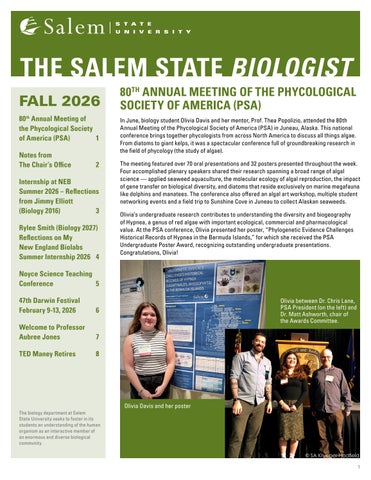
80TH ANNUAL MEETING OF THE PHYCOLOGICAL SOCIETY OF AMERICA (PSA) In June, biology student Olivia Davis and her mentor, Prof. Thea Popolizio, attended the 80th Annual Meeting of the Phycological Society of America (PSA) in Juneau, Alaska. This national conference brings together phycologists from across North America to discuss all things algae. From diatoms to giant kelps, it was a spectacular conference full of groundbreaking research in the field of phycology (the study of algae). The meeting featured over 70 oral presentations and 32 posters presented throughout the week. Four accomplished plenary speakers shared their research spanning a broad range of algal science — applied seaweed aquaculture, the molecular ecology of algal reproduction, the impact of gene transfer on biological diversity, and diatoms that reside exclusively on marine megafauna like dolphins and manatees. The conference also offered an algal art workshop, multiple student networking events and a field trip to Sunshine Cove in Juneau to collect Alaskan seaweeds. Olivia’s undergraduate research contributes to understanding the diversity and biogeography of Hypnea, a genus of red algae with important ecological, commercial and pharmacological value. At the PSA conference, Olivia presented her poster, “Phylogenetic Evidence Challenges Historical Records of Hypnea in the Bermuda Islands,” for which she received the PSA Undergraduate Poster Award, recognizing outstanding undergraduate presentations. Congratulations, Olivia!
Noyce Science Teaching Conference 5 47th Darwin Festival February 9-13, 2026
6
Welcome to Professor Aubree Jones
7
TED Maney Retires
8
Olivia between Dr. Chris Lane, PSA President (on the left) and Dr. Matt Ashworth, chair of the Awards Committee.
Olivia Davis and her poster The biology department at Salem State University seeks to foster in its students an understanding of the human organism as an interactive member of an enormous and diverse biological community.
1
THE SALEM STATE BIOLOGIST
FALL 2026
NOTES FROM THE CHAIR’S OFFICE Welcome to the Fall 2026 issue of The Salem State Biologist! We are in week two of the semester as I write this, and as we have begun most labs this week, the hallways are teeming with students. Your Biology Department has been very busy over the past year as you can see by the following: •
We bade farewell to 68 graduating Seniors at Commencement in May – see photo page 3.
•
Many of our students conduct and have conducted research with professors. The photo on page 3 shows students and faculty assembled during Research Day in early May.
•
Our students present the results of their research in various ways and at many different meetings. The highlighted story on the front page is about Senior Olivia Davis and her faculty mentor, Dr. Thea Popolizio. They conduct research into the phylogeny of a certain red algal genus and travelled to Juneau, Alaska in June to present their work. Olivia won the best undergraduate poster award!
•
Our students do all sorts of things outside of the classroom including internships with external institutions. Senior Rylee Smith worked with alumnus Jimmy Elliott (2014) in his role as a Process Development Scientist at New England Biolabs (neb.com/en-us ) in Ipswich, MA. They each reflect on the benefits of this type of experience in this issue.
•
Our instructors work extremely hard at ensuring their students succeed at their studies. Dr. Lisa Delissio, one of our botanists, was awarded one of the Distinguished Teaching Awards at Research Day in May – see photo page 3.
•
We welcome Dr. Aubree Jones to the faculty! Aubree joins us from Wellesley College and as you will see on the following pages, Dr. Jones has a wealth of expertise in fish (she will teach BIO323 Fish Biology in Spring 2027) and is an advising board member of MISS (Minorities in Shark Sciences – misselasmo.org/).
•
On the other side of the coin, we say goodbye to Professor Ted Maney who retires in October after 19 years helping our students immerse themselves in marine biology. Thanks for all you have done for our students Ted!
•
Salem State is a teaching university, and our department has many skilled instructors including Dr. Tess Killpack, our Secondary Education Lead Faculty member. Tess arranged a Noyce conference for middle and high school teachers in June with colleagues in the School of Education. The theme of the conference was “Ambitious Science Teaching and Learning for all Students.”
•
Our Biology Department offers a variety of pathways including Biomedical Sciences, Biotechnology, Environmental Biology, Marine Biology, and Nuclear Medicine Technology. This May we saw four Seniors graduate with a BS in Biology – Concentration in Nuclear Medicine Technology. All are employed by local hospitals. A large part of their success is due to our NMT ‘team’ led by Program Director Michael Soden, who joins us a full-time colleague! He works closely with his NMT colleagues Raechel Morganto (Clinical Coordinator), Danielle Faraczek (Assistant Clinical Coordinator), and Russ Arey (adjunct professor). A hallmark of our program is that the whole team completed their studies in our Biology Department!
As you read these pages you will note how active your Biology Department continues to be. To current students, please stop by the Biology Office if you have any questions and/or concerns and to alumni please do come by for a visit! Ryan Fisher September, 2026 – Meier Hall 404 2
THE SALEM STATE BIOLOGIST
FALL 2026
INTERNSHIP AT NEB SUMMER 2026 – REFLECTIONS FROM JIMMY ELLIOTT (BIOLOGY 2016) What is your role at NEB?
Graduated Biology Students and Faculty after the May 2026 Ceremony.
I am a Process Development Scientist in the Production Department at New England Biolabs. My role is to help optimize manufacturing processes for our products so that they are efficient, reliable and scalable. Primarily I am a specialist in the area of protein purification, but my role involves expertise in all aspects of bioprocessing. A typical day can involve designing and running experiments, analyzing data, troubleshooting production challenges and working closely with teams across the company to improve processes and product quality. I enjoy the combination of science, problem solving, and collaboration that comes with the role. There is an amazing variety of problems that reflect the diversity of products offered by the company.
How long have you been welcoming internship students at NEB?
Biology faculty and students at Research Day May 2026.
I have been working with internship students off and on for the last eight years. I have been the primary mentor for the last four summers. During that time, I’ve had the opportunity to work with students on research and process development projects, help them gain hands-on laboratory experience and introduce them to what a career in biotechnology can look like. It is always rewarding to see students grow in confidence and technical skills over the course of a summer.
As a Biology alumnus, what motivates you to work with current Biology students?
Dr. Lisa Delissio receives her Distinguished Teaching Award from Cami Condi.
As a Biology alumnus, I remember how valuable it was to learn from professionals who were willing to share their experiences and guidance. Mentoring current students gives me an opportunity to give back and help them make the transition from the classroom to a professional scientific environment. I enjoy helping students explore potential career paths, develop practical laboratory skills and gain confidence in their abilities. It’s especially meaningful because I can relate to many of the same questions and uncertainties they may be experiencing as they begin their careers. That first experience I was given to do something during my time at Salem State was critical to enabling me to take on more responsibility as I progressed in my academic and professional careers.
What advice would you give current Biology students as they look for an internship?
NMT students and NMT Program Director at Research Day (left to right) Kailey Roche, Brianna Skory, Christelle Cherisme, Lilly Palmer, and Program Director Michael Soden.
My biggest piece of advice is to stay curious and be open to opportunities that may be outside your original expectations. Look for internships that will allow you to learn new skills, ask questions and work alongside experienced scientists. Don’t be discouraged if you don’t have every qualification listed in a posting. Demonstrating enthusiasm, a willingness to learn and strong communication skills can go a long way. In-person impressions are worth more than an email, but both are valuable. Finally, take advantage of your network, including professors, alumni and classmates, because many great opportunities come through personal connections. Internships facilitate a larger network that can snowball into more opportunities. 3
THE SALEM STATE BIOLOGIST
FALL 2026
RYLEE SMITH (BIOLOGY 2027) REFLECTIONS ON MY NEW ENGLAND BIOLABS SUMMER INTERNSHIP 2026 Describe a typical day of your internship. A typical day of my internship would begin with checking the online task board to see which, if any, fermentations need an “expression check”. An expression check in purification process development is a test used to determine how well a specific cell line is expressing a particular product, through either a restriction enzyme titer or an SDS-PAGE for all other types of enzymes. NEB specializes in the distribution of recombinant and native enzymes from E. coli for molecular research, especially restriction enzymes, so it is important to ensure that the fermentation is expressing the product enzyme strongly and well. To prepare the cells for testing, it takes about an hour and a half of thawing, sonification and centrifugation. For the next hour, I would join the lab members for our weekly meeting, where the different scientists would meet to discuss their upcoming tasks, as well as their recent results for different purification and workflow optimization task. While the gel was running, I’d usually go to lunch for an hour with fellow interns. Then, I’d come back to check on my gels and make sure everything ran well. Then, I’d stain my gel if needed and take a photograph for annotation. I would annotate the gels for documentation purposes, with the cell line, NEB#, and the amount of sample being used, and make a mark of where the expression occurred. Then, I’d prepare an entry in the online laboratory notebook, which will be used to compare to future and past fermentations. This entire process usually took most of the day, but if I had some time, I would perform experiments and prepare data for my project, which included a broad range of steps and experiments, from developing clones to activity assays. My days at NEB were often busy, but I always had the chance to chat with other scientists and learn about their work.
What was the project you did that your poster was based on? My project is proprietary to NEB, so I cannot disclose the specifics of my work this summer (and also why my poster is blurred out). However, I can outline the process of what I did, and some of my findings. The focus of my project this summer was developing a workflow to analyze how aptamers interact with their targets. An aptamer is a single-stranded, synthetic DNA molecule that is used to bind to its target. They are used in diagnostics, therapeutics and research, and have shown to be a very helpful tool in biotechnology. My goal this summer was to insert a point mutation into a rather bothersome contaminant that is native to E. coli, and analyze how these mutations affected its activity with an aptamer, which was designed and functional against inhibiting the native enzyme.
What were two skills that you improved during your NEB internship? One skill that I greatly improved during this internship was my understanding and ability to perform routine experiments like PCR and SDS-PAGE. Although I’d learned about these techniques plenty of times in class and practiced them once or twice in lab, I hadn’t realized how much more I learned by actually performing these 4
experiments daily. By being tasked and trusted with doing these experiments on my own, I was able to develop a full understanding of why these tests are performed and what exactly we can learn from them. By the second month, I was able to perform these experiments completely on my own, some of which purely from memory, which made me feel great. I also had the opportunity to Rylee and her poster. It is blurred for design a couple of proprietary reasons. experiments, which was very exciting and rewarding. Another skill that I really developed during my time at NEB was my analysis and problem-solving skills. You can really only learn so much from being taught in classes. To actually understand how to analyze data, you must go through trial and error. There will be times where you have no idea what you’re looking at, and that’s okay! Even the best scientists still have those days. To work past this, you have to be able to look at data, ask a question and determine a way to solve that problem. Nine times out of ten, you’ll end up with more questions than answers, but with each experiment you run, you find new information that sometimes you never even considered in the first place. Being able to look at a problem and think of a few ways to solve it makes all the difference and I really feel like my time at NEB helped me work on that and grow stronger in my problemsolving skills.
What do you think the benefits of working with alumni are? I had the privilege of having two Salem State alumni in my lab, Jimmy, my mentor, and Vinny, another scientist in P&D. One of the biggest benefits of working with them was the sense of comfort I felt in the lab; during slow times or while waiting for a sample preparation step to finish up, we would just talk about life or local lore, like little restaurants or events going on nearby. It felt nice to come into work with people who knew what it was like to grow up around and live here. They really made me feel at-home and comfortable, despite how out of place and nervous I was when I first entered the building as an intern. Another great advantage to working with Jimmy and Vinny was knowing the fact that they know what Salem State is like. We’d talk Cont.
THE SALEM STATE BIOLOGIST
Rylee Smith Cont. about certain classes or professors, and they’d give me on advice on things to do or courses to take for this year. It felt nice to have that perspective and support from someone who was really once in my shoes, as an undergrad at Salem State. I really appreciated getting to work with them and develop such a comfortable environment at work; they never hesitated to help me out or answer a question about school or future plans, no matter how busy they were.
What advice would you give students as they seek internships? I would suggest reaching out and building connections with people involved in the career path/industry you think you want to pursue. Even if they feel totally out of reach it’s worth a shot! During Darwin Fest last February, Jimmy came to speak and although I was a bit nervous, I still reached out— with the help of Professor Fisher — to express my interest in his work and career. I hadn’t been too sure I’d even get a reply, knowing that he was a busy scientist, but I had just applied for the NEB summer internship and decided it was worth a shot. Instead of just a reply, Jimmy was kind enough to offer to give me a tour of NEB, which ultimately transformed into me landing this internship. This experience at NEB was truly so memorable, meaningful and important for me in figuring out what industry/specialty I want to pursue in my future career, so my advice to any students who are a bit hesitant to reach out or fear rejection, send that email anyways. Build those connections. Because if there’s at least one thing I learned about the wonderful scientists at NEB, it’s that they want to teach, and they want to help students out in any way they can.
Left to right, Drs. Lindsay Green-Gavrielidis and Lynn Fletcher in the Harrington Campus salt marsh.
FALL 2026
NOYCE SCIENCE TEACHING CONFERENCE On July 7-8, 2026, Associate Professor Tess Killpack and two colleagues form the McKeown School of Education (Professors Jacy Ippolito and Megin Charner-Laird) hosted a conference for 40 middle and high school science teachers and school administrators. The local learning institute was supported by the NSF-funded Northeast Noyce Professional Learning Network and focused on the topic of “Ambitious Science Teaching and Learning for all Students.” Salem State faculty presenters shared their ideas about how to make science authentic and meaningful for students, including exploring the questions about How is science done?, What counts as science?, and Who gets to do science? Three Salem State Biology faculty contributed presentations: •
Professor Lynn Fletcher shared a seminar presentation, “Worldviews and Their Impacts: Bringing an Indigenous Perspective to the Classroom and Beyond”
•
Associate Professor Lindsay Green-Gavrielidis brought participants on a campus field trip in her workshop, “Place-Based Learning: Salt Marsh Exploration”
•
Assistant Professor Thea Popolizio engaged participants multiple hands-on activities with seaweeds in her workshop, “Wonder First: An Art-Centered Path into Science.”
Dr. Thea Popolizio with algal samples in lab.
Left to right, Drs. Jacy Ippolito, Megin CharnerLaird and Tess Killpack. 5
THE SALEM STATE BIOLOGIST
FALL 2026
47TH DARWIN FESTIVAL FEBRUARY 9-13, 2026 Our 47th Darwin Festival began with the outstanding Founders Lecture by John Hunnex, Curator, British and Irish Herbarium, part of the Natural History Museum in London, UK, who discussed the museum and Darwin’s specimens housed there. Mr. Hunnex also discussed his collaboration with SSU’s own Prof. Lisa Delissio. Throughout the week, we had numerous other outstanding talks on topics ranging from misconceptions about shark conservation (David Shiffman, David Shiffman Scientific and Environmental Consulting) to DNA damage caused by repetitive DNAs (Prof. Erica Polleys, Endicott College). Professor Jayne Yack from Carleton University spoke about her groundbreaking work on how insects communicate through vibration and bestselling author Leigh Ann Henion shared her appreciation of the world that comes alive at night when we turn off our artificial lights.
After a successful alumni event on Thursday evening, Friday’s alumni day included two of our own. Salem State Prof. Lindsay Green-Gavrielidis talked with us about her work on marine algae and climate change. Alumnus, James Elliott (’16) from New England Biolabs tied together his varied scientific experiences in a fascinating talk that included his graduate work on the impact of bacterial infection on ticked-stressed moose calves and his role at New England Biolabs supporting mRNA vaccine production during the COVID-19 pandemic. During the 2026 Darwin Festival, four Salem State biology seniors received Virginia Keville Awards in Biology, which recognize outstanding student achievement in the Department of Biology. We are excited about the 48th Darwin Festival February 8-10, 2027 and hope to see you all there.
From L to R: Keville Award winners Leah Lundy and Arianny Grullon Rojas, Alumni Speaker James Elliott, and Keville Award winners Jon-Paul Amirault and Helena LaCortiglia. 6
THE SALEM STATE BIOLOGIST
FALL 2026
WELCOME TO PROFESSOR AUBREE JONES Prof. Jones joined the Biology Department this fall as the newest Assistant Professor. Prof. Jones grew up in Tulsa, OK, where she developed a passion for nature and life in the water mostly through fishing on the lakes of Oklahoma. After volunteering at the Oklahoma Aquarium during high school, she pursued her undergraduate degree in Marine Biology from Texas A&M University in Galveston, TX. Her undergraduate research on seal whiskers piqued her curiosity in how animals get information from their environment to find food, avoid predators, find mates and other essential behaviors. This newfound interest in sensory biology led her to the University of Rhode Island for graduate school, where she earned her PhD. During her PhD, she got to reconnect with her favorite fishes, studying the development of their flow-sensing system called the lateral line. Her work on trout and minnows brought her back to freshwaters, and her recent research focus has been on the sensory systems of live-bearing fishes.
Prof. Jones examining a brook trout (Salvelinus fontinalis) in the lab.
Prof. Jones also found her passion for inclusive research and professional development during graduate school and is a member of the advisory board for Minorities in Shark Sciences (MISS), a non-profit that focuses on bringing aspiring scientists from racial and gender minority groups into the field of shark sciences. For the past two years she has co-led a summer Diversifying Ocean Sciences (DOS) Biovisualization internship with MISS alongside Dr. Lauren Simonitis at Florida Atlantic University. Nine students have completed the program and presented their research at national conferences! This passion for mentorship and student success carries over into the classroom for Prof. Jones in her courses covering topics in Anatomy, Physiology and Fish Biology. Whether it’s in the classroom or the lab, Prof. Jones likes to help students find their interest in biology and build marketable bench and analysis skills that will set them up for a successful STEM career. If you are interested in learning microscopy or image analysis at a deeper level or are interested in working with fish (including elasmobranchs), find Prof. Jones and connect about your interests!
The 2026 cohort of MISS DOS participants at the workshop in the Berlin Imaging Lab at Florida Atlantic University in Boca Raton, FL. Back row, left to right: Professor Lauren Simonitis, Professor Aubree Jones, Kiera Mendez, Yuna Parrish, Adrianna West. Front row, L to R: Norah Mendoza, Janelle Budeya
7
THE SALEM STATE BIOLOGIST
TED MANEY RETIRES I have retired after 19 years at Salem State. It’s been my pleasure to work with students, faculty and staff during this time. While leaving Salem State, I’ll still be involved in underwater research, serving as the Diving Safety Officer for UMass Amherst, Boston, Dartmouth and Lowell. I’ve been doing this part time for four years now and will continue for a few more. The Byrnes Lab at UMass Boston works out of the Cat Cove Lab in summers so it’s possible to bump into me there diving with their lab or other projects. I’m also still diving for long term monitoring of rock wall communities in Massachusetts Bay at sites out of Salem and Nahant. This monitoring was started in 1977 by Ken Sebens currently at University of Washington (formally Northeastern), and I’ve been involved since 1987. We dove the last week in August at Halfway Rock and had this buddy tagged along with us. I’m still working on getting a USACE permit expansion for the NEMAC offshore mussel farm project with Professor Mark Fregeau. If approved, we’ll see where it goes? Thanks for all the memories I have from my time at Salem State. — Ted Maney
8
FALL 2026