Amy Minett Coordinator, Certificate in Writing and Rhetoric aminett@salemstate.edu
978.542.2621
English Department Faculty directory.salemstate.edu/english School of Graduate Studies
978.542.6323
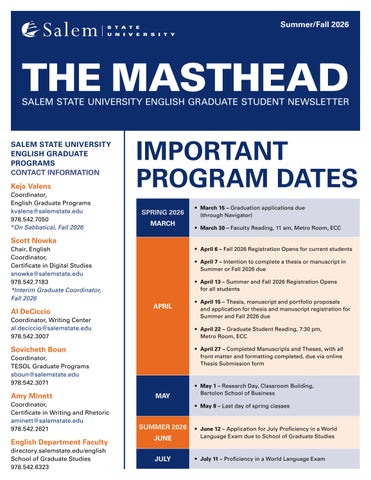
IMPORTANT PROGRAM DATES
SPRING 2026
MARCH
• March 15 – Graduation applications due (through Navigator)
• March 30 – Faculty Reading, 11 am, Metro Room, ECC APRIL
• April 6 – Fall 2026 Registration Opens for current students
• April 7 – Intention to complete a thesis or manuscript in Summer or Fall 2026 due
• April 13 – Summer and Fall 2026 Registration Opens for all students
• April 15 – Thesis, manuscript and portfolio proposals and application for thesis and manuscript registration for Summer and Fall 2026 due
• April 22 – Graduate Student Reading, 7:30 pm, Metro Room, ECC
• April 27 – Completed Manuscripts and Theses, with all front matter and formatting completed, due via online Thesis Submission form MAY
• May 1 – Research Day, Classroom Building, Bertolon School of Business
• May 8 – Last day of spring classes
SUMMER 2026
JUNE
JULY
• June 12 – Application for July Proficiency in a World Language Exam due to School of Graduate Studies
• July 11
– Proficiency in a World Language Exam
IMPORTANT PROGRAM DATES (cont.)
FALL 2026
OCTOBER
• October – Application for November Language Exam due to School of Graduate Studies
• October 16 – Intention to complete a thesis, manuscript or portfolio in Spring 2027 due
NOVEMBER
• November 3 – Thesis and manuscript proposal and application for thesis and manuscript registration for Spring 2027 due
• November – Proficiency in a World Language Exam
DECEMBER
• December 9 – Final theses and manuscripts, with all signed paperwork, due for fall graduation
COURSE DESCRIPTIONS (SUMMER 2026)
SUMMER I (MAY
18 – JUNE 27)
ENG 794 Studies in Literature of the World: Screening the Past Through the Private Lives of Girls and Women
Professor Stephenie Young Mondays 5–7 pm, Online Blended
This course explores how cinema and literature reveal women’s intimacy, labor, memory and survival across time and place. Focusing on domestic routines, social upheaval, and historical events, we examine how these stories illuminate women’s interior worlds. Screenings may include Ousmane Sembène’s Black Girl (Senegal/France, 1966); Kira Muratova’s Brief Encounters (USSR, 1967); Luis Puenzo’s The Official Story (Argentina, 1986); and Alfonso Cuarón’s Roma (Mexico, 2018). We will also read short stories and novels that engage themes of memory, identity and the intersections of the personal and the political.
ENG 830 Digital Writing
Professor MP Carver
Online Asynchronous
T his course will introduce students to digital writing and theory. Students will gain hands-on experience composing in a variety of digital genres including podcasts, websites, blogs and video, using publicly available resources and software. Students will be able to tailor some of these projects towards their own interests (such as creative writing, or particular fields of study). Students will engage with contemporary scholarship and consider how the nature of digital writing (multimodal, collaborative, interactive, etc.), the changing digital landscape and the affordances and constraints of digital platforms transform the writing process. Students will also examine some of the ethical complexities of digital writing such as questions of ownership, copyright and what it means to write in a world with AI.
SUMMER II (JULY 6 – AUGUST 15)
ENG 715 Topics in Digital Studies: AI
Professor Jim McGrath
Online Asynchronous
The ubiquity of artificial intelligence (AI) in our current moment invites us to reflect on relationships between digital technologies and literary studies: transformations of earlier literary objects into data, literary production in the age of augmented reality and social media, forms of close and distant reading. This course will consider recent developments in artificial intelligence (AI) through the lens of digital studies, connecting emerging usecases, critiques, and implications to earlier perspectives, projects, and methodologies taken up by digital humanities practitioners working in and around literary studies. We will also examine the roles that literature, metaphor, and rhetoric (among other areas) have played in the storytelling and speculative fictions informing AI hyperbole, marketing, reception and resistance.
AI usage will not be required of students in any coursework, though students can make informed decisions to optin to particular use-cases when relevant. Students with critical perspectives of AI are welcome. Students will have the opportunity to connect course materials to their own professional, creative and research interests.
COURSE DESCRIPTIONS (FALL 2026)
ENG 725 Introduction to Graduate Studies in Literature
This course introduces students to thinking and writing about literature in the context of the discipline’s academic discourse. The course focuses on familiarizing students with debates and problems relevant to the field, researching secondary literature and writing for a scholarly audience. Required of all MA, MAT and MA/MAT students in their first semester in the program.
ENG 736N Modern British Literature
Professor Michael Jaros
Thursdays 7–9:20 pm, Hyflex
T his course shall examine modern British literature since the Second World War. Through an analysis of novels, plays, and poetry, we shall explore a range of topics, including: the end of the empire and post-imperial identity; Britain’s shifting relationship to Europe, European identities and politics; postcolonial writing and writers in the metropolis; and queer complications to ideas of Britishness. Authors to be considered include Ian McKewan, Harold Pinter, Caryl Churchill, Julian Barnes, Sarah Kane, Mark Ravenhill, and Kazuo Ishiguro, among others.
ENG 821 Contemporary Approaches to Teaching Literature
Professor Theresa DeFrancis
Wednesdays 4:30–6:50 pm, Online
From textbooks to a standards-based instructional approach, from literature to informational texts and from class focal points to student-based activities, ENG 821 takes a practical, antiracist approach to teaching literature in today’s middleand high-school English classrooms. The goal is for students to leave each class meeting with hands-on materials and methodologies to use in their current and future classrooms.
ENG 825 Workshop in Memoir and other Prose Forms
Professor JD Scrimgeour
Mondays 6-8:20 pm, In-person
This course allows writers to practice writing forms of creative nonfiction with an emphasis on memoir. Fiction writers are also welcome. Readings will include contemporary memoirs and essays, and perhaps an autobiographical novel and some short fiction. Class time will be spent discussing student work and the assigned texts, along with some in-class writing exercises and discussion of the processes of writing and publishing. If you are curious about the literature of fact and different ways to shape experience, this course will give you tools to write in ways that works best for you. It also aims to create a supportive writing community that will last after the class has ended. This course may be repeated for up to 9 credits.
ENG 831 Podcasting and Audio Production
Professor Tanya Rodrigue
Thursdays 4:30-6:50 pm, In-person
In this production-based course, students will analyze educational, narrative and hybrid genre podcasts based on a variety of subjects such as arts, society and culture and true crime. Students will learn the process of creating a podcast, the technical skills needed to craft professional audio work and techniques for distributing a podcast to a target audience. With that knowledge, students will create their own podcasts individually or in small groups, compose and produce a trailer and 1-2 podcast episodes, and share their podcasts in digital spaces.
ENG 870 Graduate Writing Center Practicum
Professor Al DeCiccio
Wednesdays 1:40–3:30 pm, In-person
In this course, we will examine how writing interventions can benefit writers by exploring a range of strategies for tutoring writers. We’ll explore everything from what makes a successful writing center session to new media and online tutoring, working with writers in the disciplines, working with multilingual writers, working with graduate student writers and faculty members, and investigating how different identities surface and play out in the Writing Center. In addition to attending and participating in our Wednesday meetings, you will be required to tutor (in person or remotely) in the Mary G. Walsh Writing Center for three hours each week. Your work in the Center will be the basis for the rest of our course. As you read, write, think, discuss, and research, you will always be reflecting on your tutoring sessions, using your experiences in the Center to push back on the texts we read and theorizing how to build new knowledge about writing centers. Anyone interested in working at the Mary G. Walsh Writing Center as a tutor must successfully complete this course. Invitations to tutor will be based on a comprehensive assessment of your work, your professionalism and your enthusiasm for working with others.
ENG 878 Graduate Internship in English
Professor Jonathan Fitzgerald (Fitz)
By Arrangement
How would you like the chance to join the newsroom of a local publication, assist in putting on a major poetry festival, read manuscripts alongside a literary agent or manage social media for a local writer? Consider a Graduate Internship! An internship is a great way to gain real-world working experience in professional writing-related fields and earn course credit at the same time. While finding and securing an internship is the student’s responsibility, the English department’s internship coordinator can provide information and resources to help you get there. Reach out to Prof. Fitz ( jfitzgerald3@salemstate.edu) to get the process started!