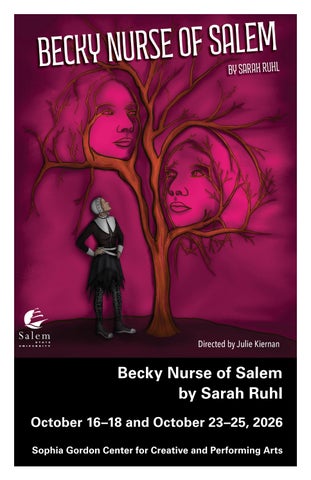
Becky Nurse of Salem by Sarah Ruhl October 16–18 and October 23–25, 2026 Sophia Gordon Center for Creative and Performing Arts
Salem State Land Acknowledgement The land occupied by Salem State University is part of Naumkeag, a traditional and ancestral homeland of the Pawtucket band of the Massachusett. We acknowledge the genocide and forced removal of the people of Naumkeag and their kin and we recognize the ongoing colonization and dispossession of Indigenous homelands. We respect and honor the Massachusett tribe and the many Indigenous Peoples who continue to care for the land upon which we gather. We recognize our own responsibility to this land we occupy. We commit to continuously learning and sharing its history and that of the Massachusett and other Indigenous People who have been and remain here. We commit to develop and implement initiatives that work toward repairing the injustices continuously being committed on the Indigenous People of this land. We commit to making our own environmental impact on this land as sustainable as possible. We commit to a renewed and ongoing engagement with the Massachusett and all Indigenous People in and around Salem State. To learn more about Salem State’s Land Acknowledgement please visit salemstate.edu/LandAcknowledgement.
THEATRE The Salem State University Theatre and Speech Communication Department presents
BECKY NURSE OF SALEM BY SARAH RUHL Director Julie Kiernan
Scenic Designer Michael M. Harvey
Voice and Text Director Ginger Eckert
Sound Designer Topher Morris
Costume Designer Ali Filipovich
Props Manager Adelaide Majeski
Lighting Designer Michael M. Harvey
Stage Manager Calista Gumuchian
Becky Nurse of Salem is presented by arrangement with Concord Theatricals on behalf of Samuel French, Inc. www.concordtheatricals.com Produced by Lincoln Center Theater, New York City, 2022. Originally commissioned by Tony Taccone and produced by Johanna Pfaelzer, Artistic Directors / Susan Medak, Managing Director. Developed with the support of New York Stage and Film and Vassar’s Powerhouse Season, Summer 2019.
This performance is presented in conjunction with Salem State University’s Center for Creative and Performing Arts.
CHAIRPERSON’S LETTER Dear Friends of Salem State Theatre, Welcome to the 2026-2027 season. As Salem celebrates its 400th anniversary, our department finds itself reflecting on the relationship between history and possibility. Last year, we celebrated the 50th anniversary of Salem State Theatre. This year, we turn our attention outward to the city we call home, a place where the past is never very far away and where each generation has the opportunity to decide what comes next. An idea I return to often is that theatre is fundamentally human. In a world increasingly shaped by technology, distance, and division, theatre gathers us together in the same room to listen deeply, imagine boldly, and create community. No one makes theatre alone. Every production is an act of collaboration, built by artists, students, faculty, staff, and audiences who choose to come together in pursuit of something larger than themselves. As I look across this season, I am struck by the ways each of our productions asks a similar question: What do we do with the stories, histories, systems, and circumstances we inherit? In Sarah Ruhl’s Becky Nurse of Salem, staged during Salem’s 400th anniversary year, a descendant of Rebecca Nurse struggles against economic hardship, addiction, grief, and the weight of history itself while searching for connection and hope. In Kaela Mei-Shing Garvin’s Corners Grove, a new generation questions inherited expectations and discovers the courage to define itself on its own terms. In Lorraine Hansberry’s The Sign in Sidney Brustein’s Window, characters grapple with political idealism, cynicism, justice, and the responsibilities we hold toward one another in complicated times. And in Shakespeare’s The Tempest, individuals wrestle with the legacies of past wrongs and ultimately explore the possibility of forgiveness, reconciliation, and a different future. Our First-Year Lab welcomed new students into our artistic community through collaborative creation, and the Veterans’ 10-Minute Play Festival continues our commitment to ensuring diverse voices and lived experiences are heard and valued through storytelling.
These works remind us that history is not something we simply observe. We participate in it. We inherit traditions, identities, and challenges, yet we are never defined solely by what came before us. We have the ability, and perhaps the responsibility, to ask better questions, listen more carefully, build stronger communities, and create new possibilities. This belief lies at the heart of our department. We strive to cultivate artists, scholars, and citizens who value creativity, academic rigor, belonging, collaboration, and civic engagement. We believe theatre can help us better understand ourselves, each other, and our shared humanity. Thank you for joining us this season. Your presence makes this work possible. As artists and audiences gather together throughout the year, my hope is that these stories encourage us to listen to voices different from our own and remember that community is something we create together. Welcome to Salem State Theatre. Let’s make something extraordinary together. Julie Kiernan Chair, Theatre and Speech Communication Department
DIRECTOR’S NOTE In her afterword to Becky Nurse of Salem, playwright Sarah Ruhl reflects on why playwrights write plays at all. She suggests there is often a public reason for writing a play and a private one, an intellectual way in and an emotional way in. She reminds us that history is not simply preserved; it is interpreted, retold, contested, and continually reimagined. This production arrives during Salem’s 400th anniversary year, making it a particularly meaningful moment to stage this play. Our students do not merely study this history; they live beside it every day. They walk streets that carry memories, narratives, contradictions, and questions stretching across four centuries. The city itself becomes a classroom, an archive, and, at times, a stage. This production is our contribution to the ongoing community conversation about what we remember, what we forget, and how we choose to tell the stories of our past. One of the questions that drew me to this play is: Who gets listened to? The Salem Witch Trials remind us that societies often fail to hear people clearly. We sort them into categories. We reduce them to stereotypes. We decide who is credible and who is not. In Ruhl’s play, Becky is not trapped by witchcraft but by systems: poverty, healthcare gaps, addiction, grief, aging, employment insecurity, and assumptions about who she is before she ever speaks for herself. Her struggles echo those of many people in our own communities today. Yet this play is not interested in villains. It is interested in human beings. Again and again, the characters are asked to confront inherited stories. Stories about themselves. Stories about their families. Stories about what kind of future awaits them. Some of those stories become cages. Others become pathways toward healing. The play asks whether we are destined to repeat history or whether, through empathy, accountability, and connection, we can rewrite it. The possibility for change in this play never comes through isolation. It comes through relationships. Through listening. Through seeing another person as fully human. Through community. In September I had the opportunity to hear Barack Obama speak on our campus. One comment has stayed with me. He warned that cynicism “is robbing us of our capacity to feel hopeful or to work together” and urged us to “fight cynicism, because that is the enemy of democracy.”
I thought immediately of this play. The opposite of a witch hunt is not agreement. It is community. It is the difficult work of listening across differences. It is refusing to reduce people to their worst moments. It is believing that understanding is still possible. Theatre gives us a rare opportunity to practice that work together. Tonight, we invite you into an artistic conversation about history, memory, justice, responsibility, and hope. More importantly, we invite you into a community conversation. Four hundred years later, Salem still has stories to tell. May we have the courage to listen. Julie Kiernan Director
DRAMATURG’S NOTES For playwright Sarah Ruhl, Becky Nurse of Salem is a dramatic investigation not only into the conflicting cultural identity of Salem, the Witch Trials, and Arthur Miller’s The Crucible, but also a probing of a much larger conversation surrounding history, who gets to own it, and who gets to sell it. It’s been seventy-three years since the premiere of The Crucible, and the play remains by far the most widely understood cultural touchstone for the Salem Witch Trials. This proves problematic given that Arthur Miller was broadly looking to stage an allegory for the troubles of his personal and professional life–his blacklisting during the Red Scare, and, as Ruhl identifies in her afterward, Miller’s lust for Marilyn Monroe–rather than construct a historically faithful portrait of the tragedy and injustice of Salem in 1692. The mythical shadow that Miller and The Crucible continue to cast over the true history of the Witch Trials unsettled Ruhl, particularly the mass acceptance of Miller’s portrayal of the child Abigail Williams as a temptress and “beautiful dissembler” as fact. Ruhl’s issue lies not with Miller’s artistic license – playwrights have always and will always contort myth and history into parables all their own – but with the conflation of fact and drama. The legacy of the fourteen hanged women, murdered for crimes they couldn’t possibly have committed,
is now intrinsically linked to the lamentations of one, albeit genius, male dramatist. Ruhl’s intention with Becky Nurse of Salem is not to discredit Miller’s work, or to operate as some sort of truth-teller; she instead is interested in the continued dialogue between artist, historian, and the general public about the ways in which we interpret and imagine figures from centuries past. There could be no better locale for this dramatic exploration than Salem, where history is not only preserved; it is performed. Where else can one visit the graves of wrongly executed men and women, and just down the street purchase items emblematic of the impossible crimes for which these innocent people were killed? There’s something humorous and absurd about this commodification of historical tragedy. Fittingly, Ruhl borrows her main theatrical magnifying glass from Suzan-Lori Parks’ 1994 masterwork, The America Play. Parks’ play concerns a black Abraham Lincoln impersonator whose customers eagerly pay to reenact Lincoln’s infamous assassination at the hands of John Wilkes Booth. Parks sets the play at an “exact replica of The Great Hole of History;” a nebulous space representing the lives and stories unsung by the keepers of history. Parks’ protagonist has been so denied access and voice in history that he finds himself selling a cheap reconstruction of someone else’s history to anyone who will buy it. Ruhl’s “Hole of History” is smaller, described by her as a “pin-hole”, and, in a humorous New England-ism, the “donut hole of history.” Instead of debating and commiserating from the sidelines, in Ruhl’s’ play, Becky is forced through the “pin-hole” of history and made to relive the horrors of the Witch Trials firsthand. History becomes less of a performance, and Becky’s identity as a descendant of Rebecca Nurse is challenged. Rebecca becomes a fully-realized woman instead of an idea or lens through which Becky understands her own struggle. In her afterward, Ruhl emphasizes the importance of not distilling historical figures into symbols, and continuing to honor their lives as fully realized stories worth preserving. Playwrights will continue to adapt and interpret, historians will continue to debate and disprove, and curious individuals will continue to pilgrim and explore, but let us not forget the humanity at the center of each life lost in tragedy. As Ruhl would put it: may we today, and every day, imagine each other to be real. James Bridges ‘27
AFTERWORD In 2022, the last accused witch from Salem was finally pardoned, three hundred and twenty-nine years after her conviction; Massachusetts lawmakers were spurred on by an eighth-grade Civics class. In Scotland, a bill is now before Parliament to formally pardon the four thousand accused witches (mostly women) who were tortured and killed there. It seems that Becky Nurse of Salem is coming at the right time. * I started writing this play in 2016 after Trump was elected, and after seeing a production of Arthur Miller’s The Crucible, when I started to wonder if the depiction of a lustful, deceitful young woman named Abigail stank of fabrication. Often, a playwright has both a public way into a play and a private way into a play. Ostensibly, Arthur Miller’s The Crucible was about McCarthyism and the blacklist. But privately it was about Miller’s guilt at wanting to sleep with Marilyn Monroe. This bit of truth was passed on to me by the brilliant playwright Branden Jacobs-Jenkins. We were talking about The Crucible over a glass of wine at a retreat in Princeton. I was explaining to Branden that I’d recently experienced some rage after seeing a production of The Crucible. My rage had nothing to do with its being a masterpiece or not a masterpiece—I think it is a masterpiece—but, instead, with my sense that the whole concept of witchery had been redirected toward girls’ desires for older married men, which felt like an enormous historical imposition. “Oh,” Branden said. “Didn’t you know that Arthur Miller wanted to get with Marilyn Monroe when he wrote that play and he felt guilty about it because he was married and she was young?” I did not. But watching the brilliant documentary Rebecca Miller made about her father, and reading Timebends, I saw that, indeed, Miller struggled with his feelings for the younger Marilyn Monroe during the writing of The Crucible. Of course, the play was also very much a parable about McCarthyism, about his friend Elia Kazan’s betrayal—but the heat of the play is the lust of John Proctor for Abigail Williams. Miller said that he saw a painting of the trials in Salem—of Abigail Williams reaching her hand toward John Proctor—and found a passage about her hand having a burning sensation when it touched Proctor. That was Miller’s way in. The real Abigail Williams was eleven years old. In the play, Miller made her seventeen. The real John Proctor was a sixty-year-old tavern keeper. Miller made him an upright farmer, age thirty-five. The real Abigail
Williams never turned to prostitution; Miller writes, in Echoes Down the Corridor, that legend has it that Abigail grew up to be a whore in Boston. There is no evidence for that line of thinking, nor is there any evidence that she and John Proctor knew each other before the witch trials. Playwrights deserve the creative liberty to enter their plays with all their emotional heat and history. I do not begrudge anyone a love story, real or fictional. After all, as my friend Ezra (the self-proclaimed maker of the best falafel in the Western world) once told me, every good story must contain a love story. I suppose what strikes me as fundamentally dishonest about The Crucible is the mixture of fact and fiction; the copious historical notes, unusually embedded in the stage directions, lead us to believe that we are watching actual history unfold. But we are watching what we always watch onstage - a psychic drama from the mind of a complicated individual relating his psyche to humankind’s larger, collective unconscious. That The Crucible is performed at almost every high school, and is in fact the way American girls and boys understand the history of Salem, added to my frustration. I thought, All those bonnets, all those Goody Sarahs, and, really, Arthur Miller just wanted to have sex with Marilyn Monroe! I thought, All those women died, but John Proctor was the hero of the story. I thought, to this day, no one knows why the girls engaged in mass hysteria, but it probably was not the lust of one duplicitous eleven-year-old for a middle-aged barkeep. For all of these logical reasons, I thought that I would end up writing my own historical drama about the Salem witch trials, but every time I tried to dip my toe into the seventeenth century my pen came back and told me to stay in my own era. Perhaps because I felt dwarfed by the long shadow cast by Arthur Miller’s mastery. Or perhaps I wanted to stay in the present moment because I have been undone and fascinated by the language of the witch hunt used by Donald Trump from his campaign, in which he whipped crowds into a frenzy, yelling “Lock her up!”, with those crowds often replying, “Hang the bitch!”, to his term in office, during which he has used the expression “witch hunt” hundreds of times, describing himself as the victim. Not since the burning of witches in Europe has the iconography of witchery been used with such base hypocrisy and to such effect. Although most contemporary historians have dismissed the rye-bread explanation for the symptoms of hysteria in Salem as sheer folly, we do know that rye was rare in the New World, and that it was shipped from Europe, often moldering on the long journey. And we also know
that Tituba fed rye bread mixed with urine to the girls, trying to get to the bottom of their maladies. It would be ironic if the “cure” for witchcraft was actually a biological deepening and intensifying of the girls’ symptoms, which would have subsided on their own after St. Anthony’s fire left their bodies. Most contemporary historians eschew a biological explanation, preferring post-traumatic stress from the American Indian Wars, property disputes, and the like as more feasible. I don’t know that we’ll ever understand why those girls accused their elders of witchcraft. But what we do know is that the accusations were not a function of the lust Abigail Williams had for John Proctor. Speaking of Tituba and the American Indian Wars, I think the historical characters of Tituba and John Indian deserve new plays of their very own. (Two contemporary novels have already been written about Tituba.) Apparently, Tituba may not have come from Barbados, as The Crucible suggests, but was, instead, from South America, a member of the Arawak tribe. The magic she was asked to do was not native to Barbados but was European witchcraft already known to the white women who asked her to perform it. The “othering” of Tituba throughout the ages, and the great mystery surrounding her own desires and intentions, deserve investigation. I did not think that story was mine to write. A note on the opioid crisis. Massachusetts is one of ten states that have the highest casualties for opioid overdoses in the country. In 2017, there were twenty-eight deaths per one hundred thousand people in Massachusetts. Sixty-four thousand Americans died of opioid overdoses in 2016, more than died in automobile accidents. It is the largest preventable cause of death for people between the ages of eighteen and thirty-five. This cluster has created what some call a lost generation, flooding the foster care system with their children. The greatest increase in opioid deaths has been attributed to synthetic opioids like fentanyl. In a bizarre Karmic loop, or bitter irony, the nineteenth-century opium trade with China, which destroyed many Chinese citizens, greatly enriched Boston. The money from the trade even helped finance cultural institutions, such as hospitals and libraries in Boston, as well as the Peabody Essex Museum in Salem. Even in nineteenth-century Boston, doctors like Dr. Fitch Edward Oliver warned against the dangers of opium, particularly for women: “Doomed, often, to a life of disappointment, and, it may be, of physical and mental inaction, and in the smaller and more remote towns... deprived of all wholesome social diversion, it is not strange that
nervous depression, with all its concomitant evils, should sometimes follow, — opium being discreetly selected as the safest and most agreeable remedy.” The current focus on the opioid crisis, which disproportionally affects white Americans, is in stark contrast to the lack of attention, empathy, and resources being directed toward public-health crises that feature fewer white faces on posters. As for St. Anthony’s fire, the disease comes from ergot — a poison produced by a fungus that grows on rye. The condition was named for St. Anthony, who was pursued by hallucinations of the Devil in the desert and resisted. Acute and chronic ergotism lead to convulsions, pain in the extremities, and delusions. LSD was originally synthesized from ergot, and medications derived from the fungus are used to treat migraines and Parkinson’s disease. I don’t wish to add to conspiracy theories by writing this play, nor do I want to ignore a biological explanation for hysteria. If we are to insist on fact, it should be noted that Gallows Hill does indeed appear to be at the site overlooking a Walgreens in Salem, not a Dunkin’ Donuts. Some townspeople and amateur sleuths have claimed that the original site is now a Dunkin’ Donuts (a strange fact that led me down the rabbit hole of this play), but the Walgreens was designated in 2016 as the most probable site of the executions. Much of the evidence was wiped away in an attempt to forget, and one of the few historical sites still preserved is the Rebecca Nurse Homestead, in Danvers. I did a reading of this play on July 19th, in Poughkeepsie, and a descendant of Rebecca Nurse, who worked at the theater, wanted to mark the day; in 1692, July 19th was the day that Rebecca Nurse, Sarah Good, and three other women were hanged. Before she died, Nurse said, “Oh, Lord, help me! It is false! I am clear. For my life now lies in your hands.” On July 19th, before the reading, we performed a ritual at a very large tree – it is said to have the largest self-supporting branch of any tree in the United States. I cannot tell you what we did around that tree. Today, August 19th, is the day that John Proctor was hanged. John Proctor, also an innocent victim, became the cultural symbol of the witch trials (rather than the large group of women who were put to death) as a result of Arthur Miller’s outsized success in turning Proctor into a tragic hero.
Arthur Miller once lived in my neighborhood. Maybe we heard the same fog horns from the water in Brooklyn Heights while thinking about witches. There is a public way into a play and a private way in, like a worm turning over the earth. Earthworms are blind. So, frequently, are writers, especially when they’re in the midst of writing. Often, a playwright will never recognize the private way into a play. Sometimes the playwright knows and keeps it secret. Sometimes the playwright does not know while writing but realizes, with some embarrassment, at the first preview, and blushes. Sometimes the playwright does not know while writing but realizes ten years later, and, like the great Arthur Miller, writes about it in a very thick memoir. Let playwrights have their secrets, their private lusts, their compulsions — but do let us free Abigail Williams from her manufactured lust for John Proctor. When John Proctor says, “It is a whore!” and the “it” is a child called Abigail, let us consider that the real historical child was neither an “it” nor a whore. As for my own private reason for writing this particular play, I either don’t know or I will never tell. Sarah Ruhl
SETTING: Salem, Massachusetts
TIME: Act I: 2016, and an imagined 1692 Act II: 2017, and an imagined 1692
SCENES: Act I: 1. At the Museum. A Tour. 2. Bob’s Tavern. Lock her Up. 3. At the Museum. 4. The Pilgrims and the Homebodies. 5. The Night Shift. Marriott Hotel. 6. Becky Visits a Witch. The Psychic Witch’s Emporium on Main Street. 7. Becky asks Bob for Money. Bob’s Tavern. 8. To Build a Fire. 9. Gail Comes Home. 10. I Want to Be Your Apprentice. 11. Bob and Becky. At the Bar 12. Sex and death. Becky’s House. Night. 13. He Wears Black Eyeliner. 14. Becky Runs into Herself in the Dark. 15. Toast Is Always Better When Someone Else Makes It for You. 16. Bob’s Heart. At the Hospital. 17. Lock her Up. The Town Square. Act II: 1. Lock her Up. The Town Square. 2. Bob Visits Becky in Jail. 3. Gail Visits Becky. 4. You Have a New Roommate. 5. Becky Falls Through a Hole in History. 6. Bob Visits Becky Again. 7. Sign our Book. And Shelby. 8. Stan Offers a Ritual. 9. The Dark Night of the Soul. 10. Bob Visits Becky. 11. A Ritual in the Dark. 12. Court. 13. Epilogue
The play runs approximately two hours and fifteen minutes, including one 15-minute intermission. CONTENT WARNING: This production contains mature themes and language, including depictions and discussions of opioid addiction, substance use and withdrawal, depression, grief, generational trauma, mental health challenges, incarceration, poverty, and historical and contemporary misogyny. The play also includes references to the Salem Witch Trials, accusations of witchcraft, abuse of power, strong language, partial nudity, and consensual romantic and physical intimacy. Flash paper and herbal cigarettes will be used onstage during the performance. SPECIAL THANKS: Thank you to Tad Baker, David Greenbaum, Karen Gahagan, Arjana Makoci, Sara Moore, Dominick Pangallo, Steve Perry, Sarah Roy, Greater Boston Stage Company, Samuel Pereria, Lucia Pinque, Ryan Goodwin, Sociology Department, Salem State University Center for Civic Engagement, and the Center for Creative and Performing Arts. Salem State is grateful for the support provided by the Dembowski Family Theatre Endowment in making this production possible. Out of courtesy to your fellow audience members and the actors onstage, please turn off all electronic devices and do not text or take photos during the performance. Please note that archival photos of this production will be available through the theatre and speech communication office. No food or beverages are allowed in the theatre. Salem State is a tobacco free campus. Thank you. The videotaping or making of electronic or other audio and/or visual recordings of this production and distributing recordings or streams in any medium, including the internet, is strictly prohibited, a violation of the author’s rights, and actionable under United States copyright law. For more information, please visit: concordtheatricals.com/resources/protecting-artists
CAST MEMBERS Becky..........................................................................Lillie-Marie LeClair Bob.....................................................................................James Bridges Gail.......................................................................................Lorelai Krisko Witch......................................................................................Av Acevedo Stan................................................................................. Samson Willcox Shelby............................................................................ Ava Irene Hawco The Judge/Jailer/Magistrate................................................Chris Raney U/S Becky...............................................................................Av Acevedo U/S Bob.......................................................................... Jayden Theodat U/S Gail.................................................................................. Kylie Lodge U/S Witch and Shelby............................................ Annabelle Chapman Swing: Stan, Judge, Jailer, Magistrate....................... Jayden Theodat
SALEM STATE PRODUCTION PERSONNEL Assistant Director..................................................................... Lola Cassino Intimacy Coordinator.................................................................Liv Dumaine Assistant Stage Managers..........................Layna Emery, Charlie Marrero and Liv Read Dramaturg...............................................................................James Bridges Cast Mentors.................................... James Bridges and Ava Irene Hawco Costume Shop Supervisor......................................................... Anna Splitz Assistant Costume Shop Supervisor......................................Anne Brower Costume Firsthand......................................................................Raya Young Costume Stitchers..................................... Katherine Dwinger, Sam Elliott, Gina Forbes and Max Harper Costume Build Crew................................Summer Bates, Hannah Castillo, Cayley Drigotas, Victoria García-De Peña, Percy Jones, Kylie Lodge, Lily Marino, Christopher Raney, Star Robinson, Lucia Smarra and Icho Weigold Wardrobe Run Crew Head..................................................... Deklan Nelson Wardrobe Run Crew.............. Katherine Dwinger and Ava Jane Graveline Technical Director......................................................................... Stu Grieve Assistant Technical Director..................................................... Tim O’Toole Assistant Scenic Designer...................................................Stefani Galeano Master Carpenter.................................................................Stefani Galeano Scenic Build Crew............Camryn Aifa, Remus Borden, Phay Borkowski, Logan Broadway, Lauren Donahue, Francis Doza, Morgan Forest, Dylan Fort, Rachel Gaul, Liam Hannon, Nick Houle, Elijah Jenkins, Shalom Kigotho, Logan Koosa, Dylon Medeiros, Julian Mendizabal, Angel Pingree and Nicholas Soares Scenic Paint Charge.................................................................Starr Cousins Scenic Paint Crew.............. Remus Borden, Olivia Burbage, Jessica Cote, Anaiah Ellcock, Gina Forbes, Nia Franklin, Rachel Gaul, Brendan Greeley, Ria Klein, Brendan Leane, Abi Martin, Izzy Schmidt, Finn Sforza and Aviana Wiltermuth
Scenic Run Crew..........................Patrick Arabie, Jessica Cote, Greg Fish, Lucas Foster, Isaac Saenz Ruiloba and Aviana Wiltermuth Assistant Props Manager.............................................................Nick Houle Props Build Crew................... Celestial Dickinson, Ria Klein, Izzy Schmidt and Amanda Seidler Props Run Crew....................................... Jayme Acker, Eva Marie Blevins, Anthony Cuevas and Jacob Glass Master Electrician...................................................................... Tim O’Toole Assistant Lighting Designer................................................... Emrys Jordan Assistant to the Lighting Designer......................................... Angel Katzen Programmer..................................................................................................... Electrics Crew......................................... Leah Campello, Anthony Cuevas, Francis Doza, Dylan Fort, Brendan Greeley, Angel Pingree and Teagan Wholley Light Board Operator..................................................................Devin Haley Assistant Sound Designer....................................................... Shea Lowney Sound Computer Operator...................................................... Louis Fowler Poster Artwork/Cover Image...................................................Ali Filipovich
ADMINISTRATIVE STAFF Center for Creative and Performing Arts Director.............Karen Gahagan Center for Creative and Performing Arts Assistant............. Dylin Sharkey Theatre Coordinator...............................................Ashley Preston O’Toole Theatre Office Assistants............................... James Bridges, Nia Franklin and Aidan Szabo Social Media Assistant................................... Louis Fowler and Gia Meola Theatre House Manager….................................................Adelaide Majeski Assistant House Managers...............Sydney Hamre and Amanda Seidler Box Office Managers..................... Celestial Dickinson and Sierra Poppitt Ushers.........................August Dadlani, Lauren Donahue, Anaiah Ellcock, Julian Medizabal, Amelia Parr, Robin Provost and Dahlia Viprino
CAST BIOS Av Acevedo (A Witch, Becky u/s) is a sophomore pursuing her Bachelor of Fine Arts degree in theatre performance. This is her second mainstage role at Salem State University. Previous credits include Adrien Garrett (And That’s the Work), Jonathan Brewster (Arsenic and Old Lace), Madame (Cinderella), Lady Catherine De Bourgh (Pride and Prejudice), and Abigail Williams (The Crucible). James Bridges (Bob and Dramaturg) is a senior pursuing his BFA in theatre performance. This is his fifth mainstage role at Salem State University. Previous Salem State credits include Anthony Hope (Sweeney Todd), Usher/God/Understanding (Everybody), Prior Walter/Man in the Park (Angels in America, Part One: Millennium Approaches), and Tom Snout/Bard Boy (Something Rotten!). Other favorite credits include Pippin (Pippin), Jack Kelly (Newsies), Frederic (The Pirates of Penzance), and Tom Wingfield (The Glass Menagerie). Performance Awards: KCACTF Irene Ryan Acting Scholarship Nominee (2025), ACTF Irene Ryan Alternate Nominee (2026), ACTF Musical Theatre Initiative Nominee (2026). Annabelle Chapman (Swing: A Witch/Shelby) is a sophomore pursuing her Bachelor of Arts degree in musical theatre. This is her second role at Salem State University. Previous credits include Jack (Into the Woods), Annie (Annie), Belle (Beauty and the Beast), Mrs. White (Clue), Miss Honey (Matilda), and Beggar Woman u/s, Ensemble (Sweeney Todd). Ava Irene Hawco (Shelby) is a junior working towards her Bachelor of Fine Arts degree in theatre performance. She has previously worked with Salem State University as Girl/Time (Everybody), and as a Swing for Betty 1 + Betty 2 (Collective Rage: A Play in Five Betties). Her favorite past roles include Gayle (Almost, Maine) and Cast Swing (The Family Man).
Lorelai Krisko (Gail) is a sophomore pursuing her Bachelor of Fine Arts degree in directing. This will be her first mainstage role at Salem State University, but she has assistant directed Sweeney Todd and read stage directions for Waiting... Previous acting credits include Emily Webb (Our Town), Racheal Brown (Inherit the Wind), and Snout (A Midsummer Night’s Dream). Lillie-Marie LeClair (Becky Nurse) is a junior pursuing their Bachelor of Fine Arts degree in performance. Previous credits include Performer (Shake-Speares Sonnets), Somebody (Everybody), Mathilde McKenna (What’s Past is Prologue), Deputy Governor Danforth (The Crucible), Lana (Unsound Effects), and Aaron Kreifels (The Laramie Project). Kylie Lodge (Gail u/s) is a sophomore pursuing her Bachelor of Fine Arts degree in performance. Previous credits include Mrs. Lovett u/s (Sweeney Todd), Pythio (Head Over Heels), Maleficent (Disney’s Descendants: The Musical), Denise (Ichorus), Mother u/s (Circus Fire), and Emma Nolan (The Prom). Chris Raney (Jailer/Magistrate/Judge) is a senior pursuing his Bachelor of Fine Arts degree in performance. This is his fifth role at Salem State University. Previous credits include Sweeney u/s (Sweeney Todd), Mihai/Translator (Mad Forest), Thomas Weber (Our Bones, Their Bones), and Ted (American Hero). Jayden Theodat (Swing: Bob/Jailer/Stan) is a sophomore pursuing his Bachelor of Fine Arts degree. This is his third role at Salem State University. Previous credits include Jonas Fogg (Sweeney Todd) and Frank (Son of Frank). Samson Willcox (Stan) is a junior pursuing his Bachelor of Fine Arts degree in theatre performance and Bachelor of Science degree in biology. Previous credits include Lucetta (Two Gentlemen of Verona), Everybody (Everybody), Meg (The Actor’s Nightmare), and Betty 4 (Collective Rage: A Play in Five Betties). Awards: American College Theatre Festival Region 1 Irene Ryan Acting Scholarship Competition finalist (2026).
CREATIVE TEAM AND PRODUCTION STAFF BIOS James Bridges (Dramaturg) is a senior pursuing his BFA in theatre performance. This is James’ third time serving as production dramaturg for a Salem State Theatre mainstage production. Previous credits include Angels in America, Part One: Millenium Approaches, As You Like It, and Mad Forest. James is a twice consecutive regional award winner and national finalist/fellow at the American College Theatre Festival for his dramaturgical work on Angels in America and Mad Forest. James was a fellow in dramaturgy and play development for the WildWind Performance Lab in collaboration with The Pack play collective, mentoring under Hansol Jung and Lexy Leusler. Dramaturgy Awards: 2025 KCACTF Region 1 dramaturgy winner and national finalist, 2026 KCACTF Region 1 dramaturgy winner and national finalist. Lola Cassino (Assistant Director) is a senior pursuing her Bachelor of Fine Arts degree in theatre performance. This is her sixth mainstage production at Salem State University. Previous choreography credits include: Sweeney Todd and Student Choreographer Showcase (Ballet RI). Previous acting credits include: Lucia/Student Doctor (Mad Forest), Betty 1 (Collective Rage: A Play in Five Betties), The Angel/Emily/Sister Ella Chapter/Woman in South Bronx (Angels in America, Part One: Millennium Approaches), Woman in Crowd/Dance Captain (Something Rotten!), and #14 (The Wolves). Previous Film/TV credits include Walker (The Walking Dead: Dead City Season Two and Three), and Bleach. Awards: Kennedy Center American College Theatre Festival Region One Irene Ryan Acting Scholarship Nominee (2025). Starr Cousins (Scenic Paint Charge) is a senior pursuing their Bachelor of Fine Arts degree in theatre design. Previous Salem State University design credits include Angels in America, Part One: The Millenium, As You Like It, Mad Forest, and The Further We Go: Three One Act Plays by C.A. Holmes. Liv Dumaine (Intimacy Coordinator) (she/her) is a Boston-based actor, director, and intimacy director. She has choreographed intimacy with Huntington Theatre Company, Actors’ Shakespeare Project (ASP), Gloucester Stage, Teatro Chelsea, Central Square Theater, Shakespeare and Company, Moonbox Productions, Boston Playwrights’ Theatre, Boston University, Tufts University, and others. Liv is the resident Intimacy Director at ASP as of spring 2023 and has choreographed the last eleven productions. She is a graduate of the BFA theatre performance program at Salem State University, a certified intimacy director with IDC, and a proud AEA member.
Ginger Eckert (Voice and Text Director) is the Voice and Speech specialist in the performance faculty, bringing her experience as a professional actor and vocal coach for stage and film to Salem State University. 15+ years as core faculty in professional actor-training programs: Oregon Center for the Arts at Southern Oregon University, SUNY/Purchase BFA program, Brown University/Trinity Rep MFA, NYU/Tisch at Atlantic Acting School and Playwrights Horizons Theatre School, and Uta Hagen’s HB Studio. She has performed with The Public Theater, Kennedy Center, Alabama Shakespeare Festival, Marin Theater Company, LaMama, Clubbed Thumb, in indie films, audiobooks, and more. Professional voice and dialect coaching includes two seasons at Oregon Shakespeare Festival, Showtime’s Brotherhood series, New York Theater Workshop, Ripe Time, Making Books Sing, River Rep New York. Certified Associate Teacher of Fitzmaurice Voicework® and proud member of VASTA/The Voice and Speech Trainers Association. MFA in Acting, Brown University/Trinity Rep. BA in Literature, American University. Ginger enters teaching as an actor and interrogator, who is also learning and creating. Her teaching features all the sounds and vocal dynamics of global languages, with the goal to arrive at communication that is honest, expansive, inclusive, and culturally sustaining for each person. Gratitude always to her supportive family and to her mentors, Thom Jones, Francine Zerfas, and Ronni Stewart. Layna Emery (Assistant Stage Manager) is a sophomore pursuing a Bachelor of Arts degree in elementary education with a minor in theatre arts. Recent stage management credits include Young Frankenstein, The Addams Family, Miracle on 34th Street, A Christmas Carol (2024, 2023, and 2022), and Seussical the Musical Jr. with Ozark Actors Theatre. Ali Filipovich (also known as Ali Flip) is a costume designer, draper, and educator who is an Assistant Professor of Costume Design at Salem State University. Originally from Minnesota, she holds a Bachelor of Arts from the University of Wisconsin-La Crosse and a Master of Fine Arts from the University of Memphis. Her professional background includes roles as a costume technician and dyer for Vstar Entertainment, shop supervisor at Luther College, and shop manager for Ballet Memphis, alongside a variety of freelance design and draping work in Opera, Dance, Wrestling, Theatre, and Fashion. Ali is proud to be a part of Salem State University, sharing her expertise and collaborating with students and faculty on Becky Nurse of Salem and The Sign in Sidney Brustein’s Window this season.
Stefani Galeano (Master Carpenter and Assistant Scenic Designer) is a junior pursuing her Bachelor of Fine Arts in technical theater. Recent Salem State University credits include The Scottish Play, Sweeney Todd, The Further We Go, and Mad Forest. Awards: American College Theatre Festival Lighting Design nominee (2026), American College Theatre Festival Stage Management: Honorable Mention (2025). Calista Gumuchian (Stage Manager) is a senior pursuing her Bachelor of Arts in technical theatre with a minor in dramatic literature. Recent credits include Sweeney Todd, First Year Lab 2025, Acting Recital 2025, Collective Rage: A Play in Five Betties, Angels in America, Part One: Millennium Approaches, and Roe (Salem State University); Waiting… and Trail to Oregon! (Constellations Stage Company); and The Family Man (Salem State Student Theatre Ensemble). Michael M. Harvey is an Assistant Professor of design at Salem State University where he teaches and designs scenery and lighting. Previously he spent four years at Southern Utah University where he served as Assistant Professor and Director of design and production. He taught scenic and lighting and sound design, as well as designed scenery, lights, and sound for the Department of Theatre Arts and Dance. He spent eight years teaching and designing at Central Lakes College in Minnesota. He also spent two years teaching at the University of Southern Indiana, where he served as scenic designer and technical director. Among his professional credits are scenic coordinator for the Opera Company of Philadelphia; scenic and lighting designer for several Primedia Inc. television productions; and production manager for both the New Harmony Theatre in New Harmony, IN, and Capital Repertory Company in Albany, NY. Michael holds a Master of Fine Arts in Scenic Design and Theatre Technology from Wayne State University in Detroit, MI. Emrys Jordan (Assistant Lighting Designer) is a junior pursuing their Bachelor of Fine Arts in theater design. Recent Salem State University credits include Mad Forest, The Further We Go, and Sweeney Todd. Julie Kiernan (Director) is Chair of Theatre and Speech Communication and an Associate Professor of Theatre at Salem State University. A Fulbright Scholar, she taught and directed theatre at New Bulgarian University in Sofia, Bulgaria, during the Spring 2024 semester and later led Salem State students to Bulgaria for a collaborative devised theatre project inspired by Shakespeare’s sonnets.
Kiernan is the founder and artistic director of Salem State’s National 10-Minute Veterans’ Playwriting Contest and Festival, now in its eighth year. Her directing work is rooted in theatre’s ability to foster dialogue, connection, civic engagement, and intercultural understanding. Recent productions include Everybody (2025), Collective Rage (2025), Antigone (2023), First Year Lab (2022), Orlando (2021), and Top Girls (2019). She is pleased to direct Becky Nurse of Salem as part of Salem’s 400th anniversary celebration. In addition to her artistic work, Kiernan has led a number of global engagement initiatives at Salem State, including service as Faculty Fellow for Global Engagement and COIL (Collaborative Online International Learning) Coordinator. She helped develop the university’s Global Engagement Seal and contributed to international education efforts recognized with the 2021 AASCU Excellence and Innovation Award for International Education. A recipient of Salem State University’s Distinguished Teaching Award, Kiernan regularly presents her work nationally and internationally. Her research and creative interests include feminist theatre, communityengaged performance, contemplative pedagogy, intercultural competence, and theatre as a tool for human connection. profkiernan.com Shea Lowney (Assistant Sound Designer) is a junior pursuing his Bachelor of Fine Arts degree in technical theater. Recent credits include Jimmy Buffett’s Escape to Margaritaville and The 25th Annual Putnum County Spelling Bee (New Bedford Festival Theater) and Sweeney Todd, Everybody, As You Like It, and Angels in America, Part One: Millennium Approaches (Salem State University). Awards: American College Theatre Festival Region 1 honorable mention for Allied Crafts (2026), Nomination for American College Theatre Festival Region 1 in Allied Crafts (2027). Adelaide Majeski (Props Manager) is a graduate of Salem State University with a BFA in stage management and has also served as Salem State University’s Theatre House Manager since 2024. Previous props credits: Annie, Founding F***ers (Greater Boston Stage Company). She is also a freelance stage manager and has worked with Commonwealth Shakespeare Company, Marblehead Little Theatre, the Boston Early Music Festival, Walnut Hill for the Arts, The Fayerweather Street School, and others. Awards: Kennedy Center American College Theatre Festival Region 1 Stage Management winner (2014).
Charlie Marrero (Assistant Stage Manager) is a junior pursuing technical theater. Previous credits include Assistant Stage Manager for As You Like It (Salem State University) and A Midsummer Night’s Dream, and Assistant Director for The Addams Family (WTHS). Topher Morris (Sound Designer) is a Professor at Salem State University in the Theatre and Speech Communication Department. During his time at Salem State, he has served as a Technical Director, Sound Designer, and Scenic Designer and is a Professor of Design and Technology. He has worked for American Players Theatre, Santa Fe Opera and Tibbits Opera House. He earned his MFA in Technical Production for Theatre from the Professional Theatre Training Program (PTTP) at The University of Delaware. He is an ETCP certified Theatrical Rigger and a proud Veteran of the Armed Services. Liv Read (Assistant Stage Manager) is a sophomore pursuing her Bachelor of Arts degree in musical theater. Her recent SM/ASM credits include Peace, Love, & Cupcakes (New Players Fitchburg), Mad Forest (Salem State University), Lost and Found in Ikea (Fitchburg High School), and The Lion, The Witch, and The Wardrobe (Fitchburg High School). Sarah Ruhl (Playwright). Sarah Ruhl’s plays include In the Next Room, or the vibrator play, The Clean House, Passion Play, Dead Man’s Cell Phone, Melancholy Play, For Peter Pan on her 70th Birthday, The Oldest Boy, Stage Kiss, Dear Elizabeth, Eurydice, How to Transcend a Happy Marriage, Orlando, Late: a cowboy song, and a translation of Three Sisters. She has been a two-time Pulitzer Prize finalist and a Tony award nominee. Her plays have been produced on and off Broadway, around the country, and internationally, where they have been translated into over fifteen languages. Originally from Chicago, Ms. Ruhl received her M.F.A. from Brown University, where she studied with Paula Vogel. She has received the Steinberg Award, the Samuel French Award, the Susan Smith Blackburn Award, the Whiting Award, the Lily Award, a PEN Award for mid-career playwrights, and the MacArthur Award. You can read more about her work on SarahRuhlplaywright.com. Her new book 100 Essays I Don’t Have Time to Write was a New York Times notable book of the year, and she most recently published Letters from Max with Max Ritvo. She teaches at the Yale School of Drama, and she lives in Brooklyn with her family.
THEATRE AND SPEECH COMMUNICATION DEPARTMENT Full-Time Faculty
Faculty Emeriti
Esme Allen
Celena Sky April
Ginger Eckert
William Cunningham
Ali Filipovich
James J. Fallon
Kaela Mei-Shing Garvin
Myrna Finn
Ryan Goodwin
David Allen George
Michael M. Harvey
Thomas J. Hallahan
Julie Kiernan, Chairperson
Elizabeth Hart
Christopher Morris
Jane Hillier-Walkowiak
Peter Sampieri
Vera Sheppard Whitney L. White
Staff Stuart Grieve Adelaide Majeski Ashley Preston O’Toole Tim O’Toole Anna Splitz Visiting Lecturers Brianne Beatrice Sara Conlon Seán Dixon-Gumm Brad Goren-Wilson Stacey Horne-Harper Alex Jacobs Margaret McFadden Rachel Rose Roberts Allen Vietzke Samantha Weisberg
Patricia Zaido
Support Tomorrow’s Artists The Center for Creative and Performing Arts Invest in the arts and support the development of a new generation of artists with a gift to the Center for Creative and Performing Arts. Donors at $250 or more receive invitations to donor-exclusive events including back stage tours, cast and director meet and greets, the Lifetime Achievement in the Arts Awards Evening, and other special events.
Gifts of $1,000 (Angel) or more automatically include you in the Sullivan Society, Salem State University’s most prestigious giving club.
Name(s): ________________________________________________________________________ Address: _______________________________________________________________ Phone: ______________________ Email: ____________________________________ __ Angel ($1,000+)
__ Artisan’s Circle ($100 – $249)
__ Muse’s Circle ($500 – $999)
__ Friend ($50 – $99)
__ Player’s Circle ($250 – $499)
__ Patron (Under – $50)
Donations will benefit all Center for the Arts disciplines unless otherwise specified.
Please restrict my gift to (circle one): General
Art
Creative Writing
Dance
Music
Theatre
Amount of Gift $ ______________ ___Check enclosed payable to: SSU Foundation/Arts Mail gifts to: Karen Gahagan, director Center for the Arts 352 Lafayette Street Salem, MA 01970
Give online at: participate.salemstate.edu/give
Select “other” and note CCPA and the arts discipline you wish to support.
FALL 2026
UPCOMING EVENTS salemstate.edu/arts
The Photograph/200 Years Later David Oxton/Trackside: Backyards Series October 13 – November 6 Winfisky Gallery, Ellison Campus Center
Music Faculty Recital October 15, 7:30 pm Recital Hall
Becky Nurse of Salem by Sarah Ruhl October 16–18 / October 23–25 Sophia Gordon Center Tickets at: salemstatetickets.com
Writers Series: Jacinda Townsend Gides November 4, 7:30 pm MLK Room, Ellison Campus Center
Dance Composition with Ali Kenner Brodsky November 13 1:40-2:55 pm I O’Keefe Complex 303 Visit salemstate.edu/arts for information about these and other arts events. These campus events are open and accessible to all members of the campus community. For accommodations and access information, visit salemstate.edu/access or email access@salemstate.edu.