salemstate.edu/humanitiesbrigade
THE HUMANITIES BRIGADE Humanities + Social Justice = Transformation THE HUMANITIES BRIGADE 2025-26: YEAR IN REVIEW In late summer 2025, Salem State University welcomed the inaugural class into its new, first-year program: The Humanities Brigade (THB). These intrepid students— from Lynn, Chelsea, Everett, Salem and more—were curious about the humanities and social justice, as well as how to use both to build successful lives. This pioneering cohort took a leap of faith by joining a first-of-its-kind program in the country. Over the next ten months each student completed substantive humanities coursework; built a robust toolkit of humanities skills and knowledge to apply to professional, civic and personal goals; participated in numerous academic and community events and field trips; conducted and presented public-facing research projects; completed paid internships; fulfilled five general education requirements as well as key elements of academic seals in two areas: Public Engagement and Diversity, Social Justice and Power Dynamics; and built lasting professional and personal connections at SSU and across the region. Funded by a generous grant from the Mellon Foundation, THB is breaking new ground in what it means to prepare students for success in the 21st century and how to transform both individuals and communities through and with the humanities. Keep reading for a recap of a great opening year!
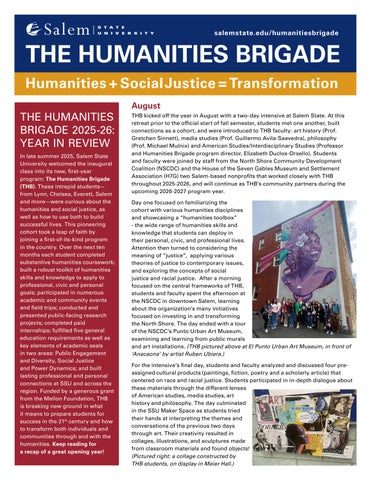
August THB kicked off the year in August with a two-day intensive at Salem State. At this retreat prior to the official start of fall semester, students met one another, built connections as a cohort, and were introduced to THB faculty: art history (Prof. Gretchen Sinnett), media studies (Prof. Guillermo Avila-Saavedra), philosophy (Prof. Michael Mulnix) and American Studies/Interdisciplinary Studies (Professor and Humanities Brigade program director, Elizabeth Duclos-Orsello). Students and faculty were joined by staff from the North Shore Community Development Coalition (NSCDC) and the House of the Seven Gables Museum and Settlement Association (H7G) two Salem-based nonprofits that worked closely with THB throughout 2025-2026, and will continue as THB’s community partners during the upcoming 2026-2027 program year. Day one focused on familiarizing the cohort with various humanities disciplines and showcasing a “humanities toolbox” - the wide range of humanities skills and knowledge that students can deploy in their personal, civic, and professional lives. Attention then turned to considering the meaning of “justice”, applying various theories of justice to contemporary issues, and exploring the concepts of social justice and racial justice. After a morning focused on the central frameworks of THB, students and faculty spent the afternoon at the NSCDC in downtown Salem, learning about the organization’s many initiatives focused on investing in and transforming the North Shore. The day ended with a tour of the NSCDC’s Punto Urban Art Museum, examining and learning from public murals and art installations. (THB pictured above at El Punto Urban Art Museum, in front of ‘Anacaona’ by artist Ruben Ubiera.) For the intensive’s final day, students and faculty analyzed and discussed four preassigned cultural products (paintings, fiction, poetry and a scholarly article) that centered on race and racial justice. Students participated in in-depth dialogue about these materials through the different lenses of American studies, media studies, art history and philosophy. The day culminated in the SSU Maker Space as students tried their hands at interpreting the themes and conversations of the previous two days through art. Their creativity resulted in collages, illustrations, and sculptures made from classroom materials and found objects! (Pictured right: a collage constructed by THB students, on display in Meier Hall.)
Humanities + Social Justice = Transformation Fall Semester During fall semester, THB students completed two humanities courses for the Brigade: American Identities with Prof. DuclosOrsello, and Introduction to Philosophy with Prof. Mulnix. Both courses emphasized the importance of understanding multiple perspectives and differing viewpoints when looking at a philosophical or historical topic, with a focus on complicating mainstream, dominant narratives and integrating minoritized ones. As the semester progressed, the TBH cohort expanded its learning with workshops and special humanities events across campus. THB spent a class session in the Salem State Archives and Special Collections, with archivist Susan Edwards, investigating documents related to the history of racial justice and social movements at Salem State since the school’s founding in 1854. On another trip to Berry library, the cohort met with librarian Dawn Stahura and explored the Alternatives Library Collection, which focuses on publications and texts related to social change. Off campus, THB also returned to the NSCDC and the Punto Urban Art Museum learning about the extensive immigrant histories of Salem, and observing how history and social justice combine in the NSCDC’s work. (Pictured right: THB’s November NSCDC visit.) During fall semester, THB co-sponsored two campus-wide speakers: In November, Professor Akela Reason of the University of Georgia gave a book talk about her recently published art history monograph, Politics and Memory: Civil War Monuments in Gilded Age New York (Yale University Press, 2025). In December, Dr. Cedric Woods, the director of the Institute of Native American Studies at UMass Boston, visited campus to discuss “Indigenous Lifeways and Approaches” as part of Salem State’s Philosophy Matters Speaker Series. Students also attended a seminar with visiting scholar Dr. Tatiani Rapazikou, Professor at Artistotle University of Thessaliniki, Greece, focused on racial discourse and American literature. As a cumulative project for their American Identities course, THB students curated an exhibit for the Berry Library’s Inclusion, Equity, Diversity, Awareness (IDEA) Den (pictured right: THB exhibit). The exhibit, “Examining American Stories of Opportunity and Belonging” featured materials drawn from online and SSU archives as well as the Alternatives Library collection. It explored and questioned the creation and persistence of beliefs about the United States as a place of opportunity and belonging for all. The public unveiling and student exhibit talks were attended by THB faculty, SSU staff, community partners and family. The exhibit remained on display at this public library through the end of January 2026. (Pictured right: THB students, faculty, and community partners.) Wrapping up the semester was a shared meal and a cohort showcase of their philosophy capstones, featuring posters that examined the ways that philosophy and the work of philosophers help explain and respond to contemporary social justice concerns. These materials are currently on display on the second floor of Meier Hall.
Spring Semester During the spring semester, the TBH cohort completed three courses that, together, expanded their understanding of humanistic inquiry and the real-world applications of humanities-based disciplines: Mass Media and Society with Prof. Avila-Saavedra, Introduction to World Art with Prof. Sinnett, and a new Civic Humanities course with Prof. DuclosOrsello. Students explored in depth how visual culture/media not only reflect and shape social realities but also respond to injustices across time and place. Among other hands-on experiences, the program sponsored a personalized tour of the world-class Edmonia Lewis exhibit at the Peabody Essex Museum and a lecture by artist James Monfort. Together, these activities helped bring theory and practice to life. In their Civic Humanities course, students investigated the many real-world applications of humanities skills and knowledge. Alongside academic readings, students were joined by guest speakers from many career fields who shared the specific ways in which they rely on their humanities training to do their work. These speakers included public policy professionals Tanisha Sullivan and the policy director for TN-02 US House candidate Michaela Barnett; nurse practitioner and public health expert Meg McLaughlin; mediator Prof. Amy Smith, and the Executive Director of Raw Art Works, Rosario Ubiera-Minaya. In February, THB also traveled to the House of Seven Gables for a behindthe-scenes tour and to learn more about the intersections of public history, social services and the humanities at this site. As a culminating cohort experience, THB students completed a semester-long research project, “Places and Faces of The Point”, developed in partnership with the NSCDC and carried
out in Prof. Duclos Orsello’s Civic Humanities course. Students applied content and skills from all five humanities courses to design and execute eighteen hours of multilingual interviews and surveys at various Salem locations including hair salons, laundromats and the NSCDC offices. With a primary interest in the El Punto neighborhood and the Latin@ community, THB students set out to identify and record the stories, places, and culture of Salem residents who are often underrepresented or forgotten in broader depictions of the city. After completing their research, the students presented their findings during both a plenary session at Salem State’s Undergraduate Research Day (pictured above) and an end-of-the-semester public forum (pictured below) attended by THB faculty, staff from the NSCDC and H7G Gables, and SSU administrators. The quality and substance of this THB research has since allowed the NSCDC to seek funding for and launch a new initiative highlighting these stories.
Summer 2026 This summer, alongside customized workshops in resume-writing and networking, every THB student completed a 120-hour paid internship at either the H7G or the NSCDC. The responsibilities and functions of these positions were unique and varied: At the NSCDC, some students expanded the research project begun in the spring, while others worked to promote the Punto Urban Art Museum, developed events for area residents or provided mentoring in the Youthbuild program. At the H7G, students worked to update the relevance and accessibility of the museum’s audio tours, contributed to critical preservation and climate futures work, and recorded new oral histories. No matter what their role required, each THB intern put to good use their deep understanding of and skills in the humanities to make positive changes in Salem.
We are incredibly proud of our inaugural cohort’s success and we are excited to welcome our year 2 cohort in August 2026! Applications for year 3 will open by January 2027: salemstate.edu/humanitiesbrigade
THB students and their supervisors at various internship sites summer 2026.