The Core Difference Explained
To choose the right hardware, it helps to understand how each device handles your main router’s wireless signals.
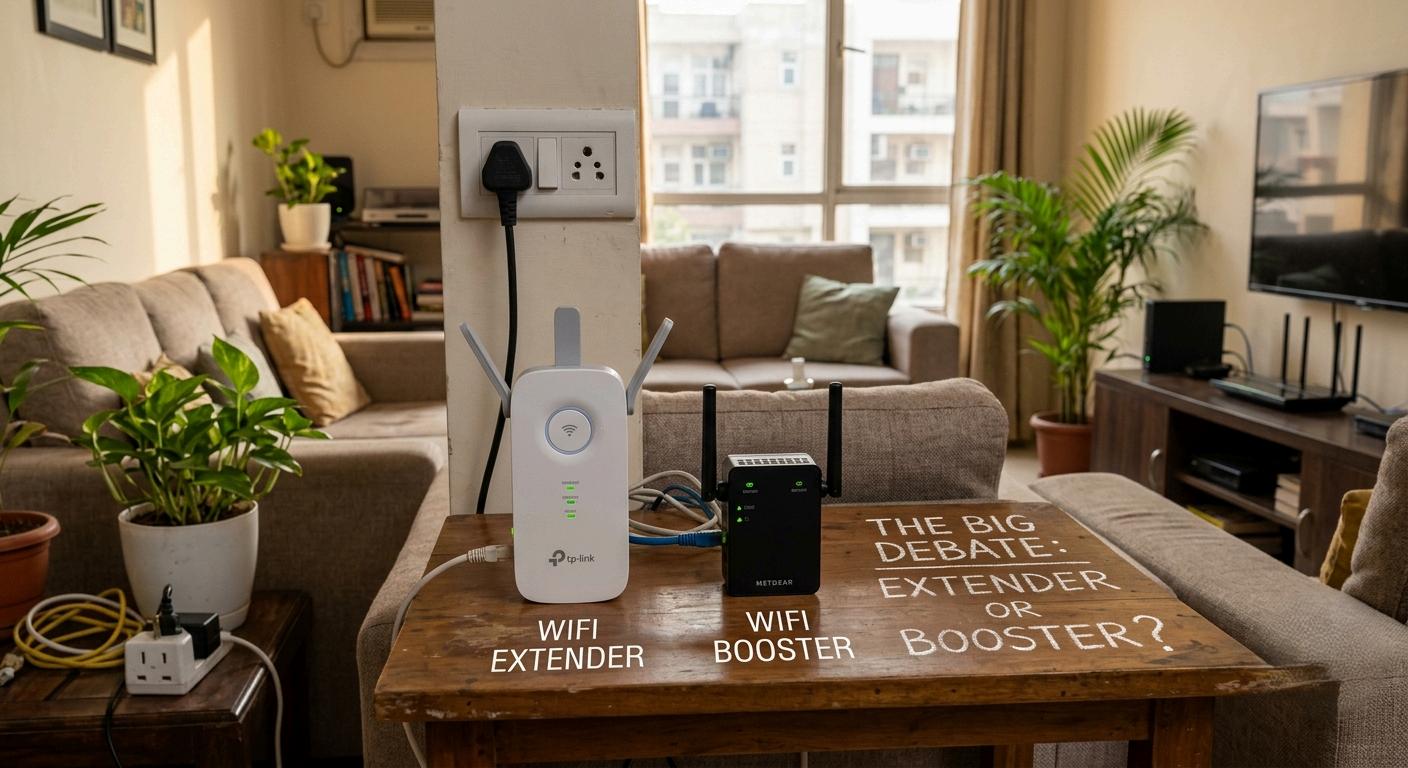
WiFi Booster: "WiFi booster" is a broad term for any device that enhances wireless coverage. Functionally, a booster captures an existing, weak signal from your router, amplifies its output power, and rebroadcasts it into immediate nearby areas
WiFi Extender: A WiFi extender acts as a bridge that physically extends the perimeter of your network. Extenders often connect to your main router via an Ethernet cable, MoCA (coaxial cable), or Powerline adapter, broadcasting a strong signal that can create a new network segment or access point
What is a WiFi Booster?
A WiFi booster is designed to strengthen an existing signal in areas suffering from minor interference or slight distance degradation [ Router ] ==== Strong WiFi ====> [ WiFi Booster ] ---->
Amplified Signal ----> [ Device ]
How It Works
A booster catches the signal coming from your primary access point Internal power amplifiers then boost the signal strength before re-transmitting it across a short range.
Best Use Cases
Small to Medium Apartments: Where signal drops off past a wall or two. Minor Signal Upgrades: When you already have decent reception but experience occasional drops during high-bandwidth tasks.
Plug-and-Play Setup: Users who want a quick, budget-friendly fix without laying down new cables
Pros & Cons
Pros:
Highly affordable and widely available.
Simple, quick installation (usually plug-and-play). Boosts weak signals through minor obstacles
Cons:
Relies entirely on wireless input quality (if placed in a total dead zone, it cannot boost a signal that isn't there)
Potential latency increases due to single-radio rebroadcasting.
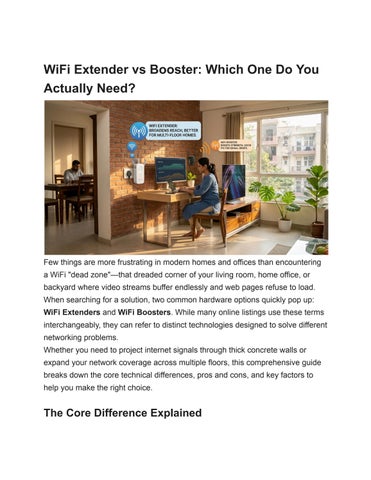
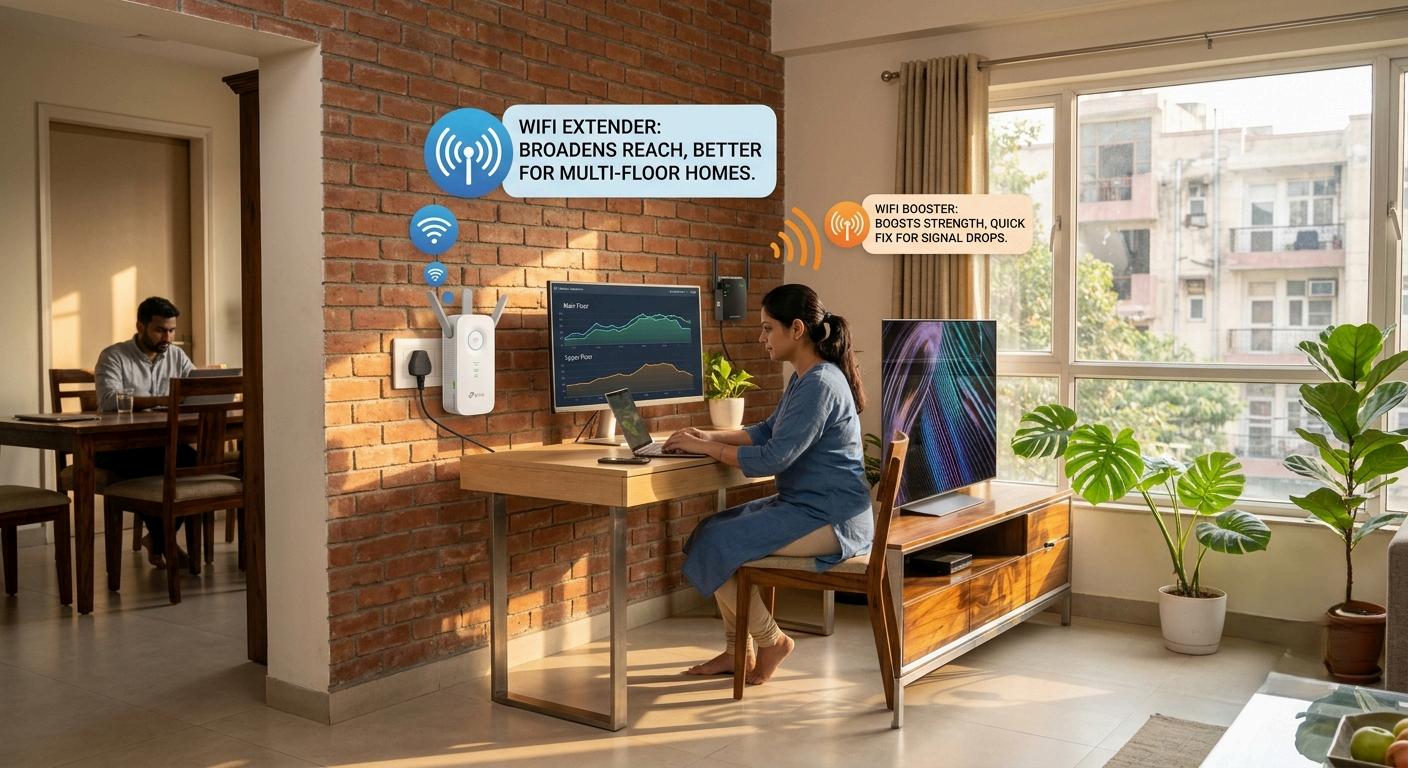
When deciding between a WiFi extender vs WiFi booster, it helps to understand that extenders widen your overall coverage area while boosters amplify existing signal strength
What is a WiFi Extender?
A WiFi extender broadens your network's physical footprint Unlike a simple repeater, modern extenders use dedicated wired connections or backhaul channels to transmit high-speed data without cutting your bandwidth in half.
How It Works
Extenders route data directly from the main router to a secondary node via a physical line (like Ethernet or Powerline) or a dedicated wireless band (dual-band/tri-band extenders). It then broadcasts a clean wireless signal to connected devices.
Best Use Cases
Multi-Story Homes & Large Workspaces: Reaching basements, upper levels, or detached garages.
Dead Zone Elimination: Covering areas blocked by dense brick, concrete, or plaster walls
High-Bandwidth Demands: Online gaming, 4K/8K video streaming, and large data transfers.
Pros & Cons
Pros:
Delivers faster speeds and lower latency across larger distances. Can bridge dead zones that wireless signals cannot penetrate.
Often includes Gigabit Ethernet ports for wired devices like gaming consoles or PCs.
Cons:
Generally more expensive than basic boosters.
May require running an Ethernet cable or configuring a powerline network for maximum performance
Direct Comparison: WiFi Extender vs. WiFi Booster
Feature / Metric
WiFi Booster
WiFi Extender
Primary Function Amplifies an existing weak signal Expands coverage into new areas
Best For Minor weak spots, single rooms
Interference
Penetration
Speed
Maintenance
Low to Moderate
Moderate (may lose bandwidth over distance)
Large homes, basements, outbuildings
High (via wired backhaul)
High (retains full bandwidth with wired connections)
Installation Effort
Plug-and-play
Cost Budget-Friendly
Simple to Moderate (may require cabling)
Moderate to High
Key Factors to Consider Before Buying
Before purchasing any network extension hardware, keep these critical technical factors in mind:
1. Distance and Building Materials
If your dead zone is separated by glass or drywall, a WiFi booster might be enough. However, materials like concrete, brick, foil insulation, and metal studs block wireless signals almost entirely In those cases, a WiFi extender utilizing a wired Ethernet line or Powerline adapter is necessary
2. Bandwidth and Speed Requirements
Simple wireless repeaters and boosters retransmit signals on the same frequency band, which can cut available bandwidth by up to 50% If you stream high-definition content, play online games, or host video calls, choose a dual-band/tri-band WiFi extender or a unit with wired backhaul to maintain low latency.
3. Mesh WiFi vs. Extenders
If your coverage issues span across an entire house, consider a Mesh WiFi System instead of standalone boosters or extenders. Mesh systems use multiple nodes that communicate under a single network name (SSID), providing seamless roaming as you move from room to room without manual network switching
How to Optimize Your Existing Router First
Before spending money on extra hardware, try these quick optimization techniques:
Reposition Your Router: Place your router in a central, elevated location away from walls and enclosed cabinets.
Avoid Electronic Interference: Keep routers away from microwaves, cordless phones, and large metal objects.
Change WiFi Channels: Use a network analyzer tool to find less congested channels on the 2 4 GHz or 5 GHz bands
Update Router Firmware: Outdated firmware can degrade network stability and signal strength.
The Final Verdict
When choosing between a WiFi extender and a WiFi booster, the decision comes down to the severity of your coverage problem:
Choose a WiFi Booster if you have a decent connection overall, but need a quick, affordable boost to eliminate a minor weak spot in a nearby room.
Choose a WiFi Extender if you need to eliminate complete dead zones, span long distances, send signals through thick walls, or maintain high internet speeds for multi-device households