Directory Submission Sites: The Complete SEO Guide
What is Directory Submission in SEO?
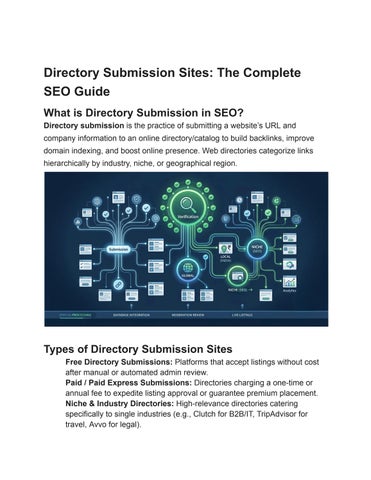
Directory submission is the practice of submitting a website’s URL and company information to an online directory/catalog to build backlinks, improve domain indexing, and boost online presence. Web directories categorize links hierarchically by industry, niche, or geographical region.
Types of Directory Submission Sites
Free Directory Submissions: Platforms that accept listings without cost after manual or automated admin review.
Paid / Paid Express Submissions: Directories charging a one-time or annual fee to expedite listing approval or guarantee premium placement
Niche & Industry Directories: High-relevance directories catering specifically to single industries (e.g., Clutch for B2B/IT, TripAdvisor for travel, Avvo for legal)
Local Citation Directories: Essential platforms for Local SEO (Google Business Profile, Yelp, Bing Places, YellowPages) that maintain consistent Address, Phone Number, and Business Name (NAP) records
Reciprocal Submissions: Directories requiring a reciprocal link back from your domain (generally discouraged by modern search engines).
Key Benefits for SEO
Backlink Diversity: Provides foundational, low-risk contextual and profile backlinks
Improved Local Visibility: Crucial for local pack rankings and NAP consistency.
Faster Indexing: Helps search engine crawlers discover new domains and subpages.
Referral Traffic: Brings targeted niche traffic from users actively searching business listings
High-Authority Web Directory Examples
& Citations
Optimization and Link Building
Executive Summary
In the constantly evolving field of Search Engine Optimization (SEO), off-page strategies remain essential for building domain authority, topical trust, and referral visibility. Among foundational link-building methods, directory submission sites continue to hold a distinct role While early search engines treated web directories as a quick method for mass backlink generation, modern algorithmic updates such as Google’s SpamBrain and helpful content evaluations require a much more selective, quality-driven approach. When executed strategically, directory submissions serve as vital foundational assets that establish digital footprints, enforce Name, Address, and Phone (NAP) consistency for local search, and diversify backlink profiles.
What is Directory Submission in SEO?
Directory submission is the practice of submitting a website’s URL along with structured business metadata (such as brand name, description, address, target keywords, and category) to an online directory catalog. Web directories function as digitized indices, organizing websites into hierarchical classification structures (e.g., Business > Technology > Software Solutions). Historically, web directories like DMOZ and Yahoo! Directory served as the primary navigation map for internet users prior to modern search engines. Today, web directories act as secondary discovery platforms, industry reference hubs,
and validation nodes that search engines crawl to verify a business's legitimacy, category relevance, and physical/digital presence.
Core SEO Benefits of Web Directory Submissions
Submitting your domain to reputable web directories offers several tangible advantages to an integrated digital marketing strategy:
1. Building Foundational Backlinks and Domain Authority
New domain names often lack the authority and historical trust required to compete for high-intent keywords. High-quality directory listings provide stable, foundational backlinks that establish an initial web presence, signaling to search engine bots that a domain is active and legitimate
2. Enhancing Local SEO and NAP Consistency
For businesses operating in specific geographic locations, local business directories (such as Google Business Profile, Yelp, and YellowPages) are critical Search engine algorithms crawl these directories to verify that a business's Name, Address, and Phone number (NAP) are consistent across the web.
Consistent NAP alignment strengthens local map pack rankings and local search visibility.
3. Accelerated Search Indexing
Search engine web crawlers continuously index prominent web directories. Submitting new web pages or new domain URLs to high-authority directory sites gives crawlers discovery paths, accelerating the indexing rate of your primary site content
4. Direct Referral Traffic and Brand Visibility
Directory users often search within structured listings to evaluate vendors, software, or service providers High-intent platforms (such as Clutch co or G2 for B2B services) drive targeted referral traffic directly down the marketing funnel, generating leads beyond search engine result pages (SERPs).
Categorization of Directory Submission Sites
Web directories are structured by approval mechanics, cost structures, and industry verticals:
1. Free Directory Submissions
These platforms allow site owners to submit listings at no cost They rely on manual administrative reviews, which can range from several days to months before approval.
2. Paid / Paid Express Submissions
Paid directories charge a one-time fee or recurring listing rate. In exchange, site owners receive fast-track editorial reviews (typically within 24–48 hours), guaranteed inclusion, and often dofollow backlink attributes.
3. Niche / Industry-Specific Directories
These platforms focus strictly on a single niche (e.g., real estate, technology, healthcare, or legal services). Because their content aligns directly with specific
industries, links from niche directories carry higher topical authority and contextual relevance in search algorithms.
4. Local Business Citations
Local directories focus on brick-and-mortar or geo-targeted service businesses. They display operating hours, customer reviews, exact coordinates, and address details alongside business URLs
Directory Assessment Matrix: Evaluating Quality vs. Risk
Not all directory submission sites provide positive SEO value. Low-quality directories that exist solely to sell links can negatively impact site authority Before submitting, evaluate directories using this risk assessment matrix:
Evaluation Metric High-Quality Directory (Target)
Domain Authority (DA / DR)
Spam Score
High (50–90+)
Low-Quality Directory (Avoid)
Low (< 20)
Minimal (< 3%)
High (> 10%)
Indexing Status Indexed regularly by Google Pages de-indexed or cached poorly
Editorial Moderation Strict submission guidelines & manual verification
Automated, instant approval with no review
Outbound Link Ratio
Co-Citation Quality
Balanced ratio of content to outbound links
Real, legitimate businesses listed in relevant subcategories
Hundreds of outbound links per page
Mixed in with spammy or adult categories
Step-by-Step Directory Submission Process
To maximize the SEO impact of directory submissions, follow this step-by-step workflow:
[Phas
Phase 1: Preparation & Asset Creation
Audit Target Directories: Create a vetted list of directories matching your domain's industry or regional scope
Draft Unique Descriptions: Write 3 to 4 variations of your business description (e.g., 50 words, 100 words, and 250 words). Never copy-paste identical descriptions across dozens of directories, as duplicate content can diminish the SEO value of the listings
Standardize Business NAP: Format your business name, street address, and phone numbers identically (e.g., ensuring "Suite 100" is formatted consistently everywhere)
Phase 2: Category Selection & Submission
Navigate to the Deepest Relevant Category: Choose the most specific sub-category available (e.g., Business > Marketing > Digital Marketing Services instead of simply Business)
Use Natural Anchor Text: Input your official business or brand name as the listing title rather than exact-match keyword targets (e.g., use "Acme Web Design" instead of "Best Affordable Web Design Agency")
Submit Verification Documents: Complete any required email verification or domain ownership validation steps to finalize the submission process.
Phase 3: Post-Submission Tracking
Maintain a structured tracking log to record submission dates, category paths, credentials, and verification status:
Submissio n Date Directory Domain
YYYY-MM -DD Crunchba se.com Business / Tech Free Approved Link
YYYY-MM -DD Clutch.co B2B Services Free Profile Approved Link
YYYY-MM -DD YellowPag es com Local / Services Free Citation Pending TBD
Common Hazards & Best Practices for Modern SEO
To ensure directory submission efforts yield positive outcomes without triggering search engine penalties, adhere to the following rules:
Practices to Avoid
Avoid Bulk Automated Submissions: Never purchase automated submission packages promising "1,000 Directory Backlinks for $5." Search engines easily identify these unnatural backlink spikes
Avoid Reciprocal Link Schemes: Avoid directories that require you to place a reciprocal widget or backlink on your homepage in exchange for inclusion, as this can violate webmaster quality guidelines
Avoid Over-Optimized Titles: Avoid stuffing keywords into directory title fields. Stick strictly to your legal or branded company name.
Strategic Best Practices
Pace Your Submissions: Build directory listings gradually over weeks and months to reflect a natural link growth profile.
Prioritize Topical Relevance: A link from a niche-specific directory with a modest DA often provides better contextual value than a link from an irrelevant, high-DA general directory
Keep Listings Updated: Revisit core directory profiles annually to ensure phone numbers, physical locations, operating hours, and domain URLs remain accurate
Directory submission sites remain a effective off-page SEO tactic when integrated into a balanced search engine optimization strategy Rather than treating directory submissions as a shortcut for high search rankings, view them as a foundational tool for establishing brand identity, supporting local citations, and building a natural backlink profile. Focusing on domain quality, topical relevance, and NAP consistency ensures long-term search engine visibility and sustainable domain authority.