How Ken Research Reads the APAC Organic Farming Market as a Structural Shift
in Agriculture
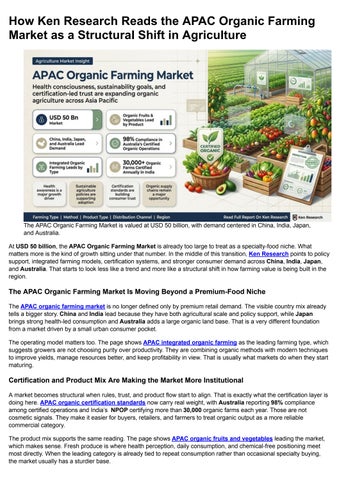
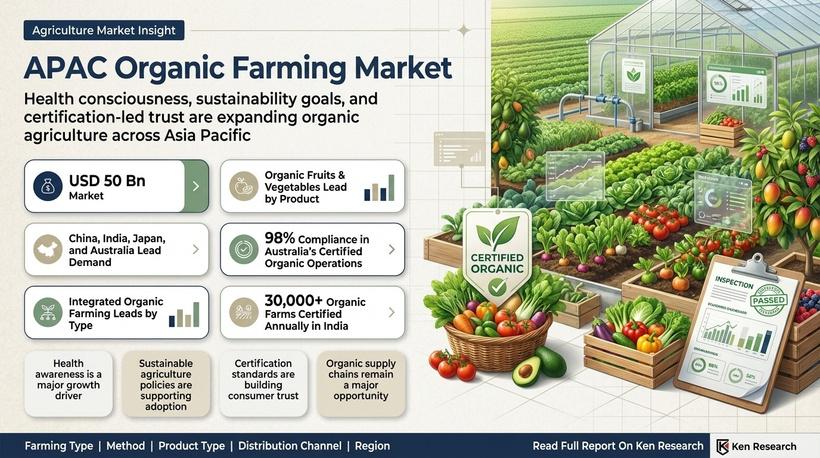
The APAC Organic Farming Market is valued at USD 50 billion, with demand centered in China, India, Japan, and Australia.
At USD 50 billion, the APAC Organic Farming Market is already too large to treat as a specialty-food niche. What matters more is the kind of growth sitting under that number. In the middle of this transition, Ken Research points to policy support, integrated farming models, certification systems, and stronger consumer demand across China, India, Japan, and Australia. That starts to look less like a trend and more like a structural shift in how farming value is being built in the region.
The APAC Organic Farming Market Is Moving Beyond a Premium-Food Niche
The APAC organic farming market is no longer defined only by premium retail demand. The visible country mix already tells a bigger story. China and India lead because they have both agricultural scale and policy support, while Japan brings strong health-led consumption and Australia adds a large organic land base. That is a very different foundation from a market driven by a small urban consumer pocket.
The operating model matters too. The page shows APAC integrated organic farming as the leading farming type, which suggests growers are not choosing purity over productivity. They are combining organic methods with modern techniques to improve yields, manage resources better, and keep profitability in view. That is usually what markets do when they start maturing.
Certification and Product Mix Are Making the Market More Institutional
A market becomes structural when rules, trust, and product flow start to align. That is exactly what the certification layer is doing here. APAC organic certification standards now carry real weight, with Australia reporting 98% compliance among certified operations and India’s NPOP certifying more than 30,000 organic farms each year. Those are not cosmetic signals. They make it easier for buyers, retailers, and farmers to treat organic output as a more reliable commercial category.
The product mix supports the same reading. The page shows APAC organic fruits and vegetables leading the market, which makes sense. Fresh produce is where health perception, daily consumption, and chemical-free positioning meet most directly. When the leading category is already tied to repeat consumption rather than occasional specialty buying, the market usually has a sturdier base.
The Wider Agri Stack Is Also Moving in the Same Direction
This market is not growing in isolation. The APAC smart agriculture market is valued at USD 3.6 billion and is being pushed by IoT-led resource management, precision farming, and the need for more efficient agricultural output. That matters because once farming systems start becoming more data-led, the case for higher-efficiency organic production gets stronger too.
The same pattern shows up in the Asia Pacific agriculture biologicals market, which stands at USD 9 billion and is supported by growing demand for eco-friendly inputs. Bio-fertilizers lead there, driven by application in organic farming. Put those two adjacent markets next to the target page and the message is pretty clear: organic farming is becoming part of a broader regional shift toward more systematized sustainable agriculture.
Conclusion
The APAC Organic Farming Market looks structural because demand, farming models, certification standards, and adjacent agri-input ecosystems are all moving in the same direction. A USD 50 billion market backed by leading demand centers, integrated production methods, and stronger regulatory trust is not a side category anymore. It is becoming part of how agriculture in the region is being reconfigured.
For readers tracking where this market goes next, Ken Research analysis is most useful when read alongside the full APAC Organic Farming Market, especially if the question is not whether organic demand exists, but how deeply it is being built into the region’s farming model.
FAQs
1. What is driving the APAC Organic Farming Market today?
The main drivers are health-led food demand, rising disposable incomes, and government support for sustainable agriculture. Those factors are pushing the Asia Pacific organic farming industry beyond a small premium-consumer niche and into a wider agricultural transition.
2. Why does integrated organic farming lead in the APAC Organic Farming Market?
It leads because it gives farmers a way to stay within organic standards while still improving resource use, soil health, and productivity. That is why the APAC integrated farming model looks more commercially practical than a narrower approach.
3. Which countries matter most in the APAC Organic Farming Market?
The most important countries on the page are China, India, Japan, and Australia. Together they combine scale, policy support, consumer demand, and land availability, which is why the China and India organic farming base matters so much to regional direction.
4. How important are certification systems to the APAC Organic Farming Market?
They are very important because certification is what turns organic output into a trusted commercial category. The APAC certified organic production system is becoming stronger as compliance and farm certification expand.
5. What do adjacent markets add to the APAC Organic Farming Market story?
They show that organic farming is being supported by a wider sustainable-agriculture buildout. The APAC precision farming ecosystem and biological-input markets both make the transition look more embedded and less isolated