Saint Michael's College Magazine Spring/Summer 2026
SAINT MICHAEL’S COLLEGE MAGAZINE SPRING/SUMMER 2026
24 Through Their Eyes: Global Eyes Photography Celebrates
Years 26 AI: Friend or Faux? by Becky Holt 30 AI in Biotechnology to Tackle Formerly “Undruggable” Diseases
A Q&A with Pam Carroll ’85
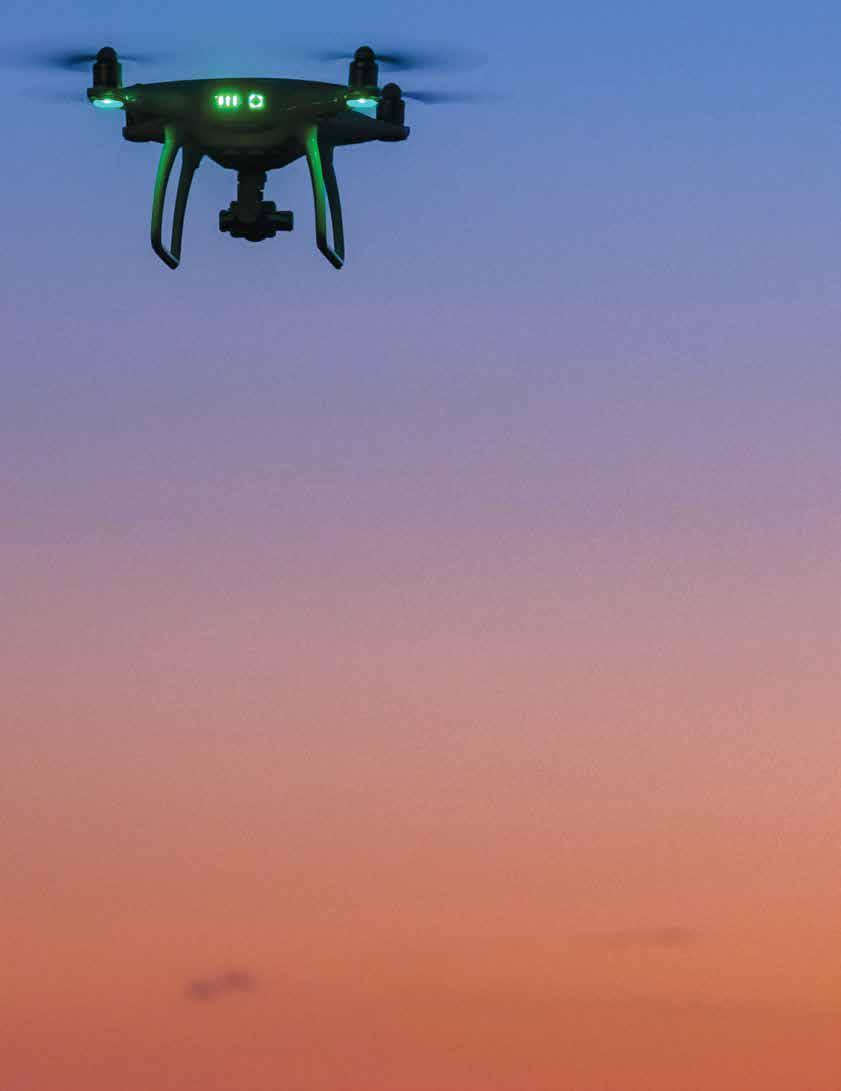
32 Utilizing AI in the Army’s Drone Program A Q&A with Mary Falcigno ’15
Amid Uncertain and Changing Times, Some Foundations Endure by April Barton
Photo: Jerry Swope
ALUMNI MAKING A DIFFERENCE
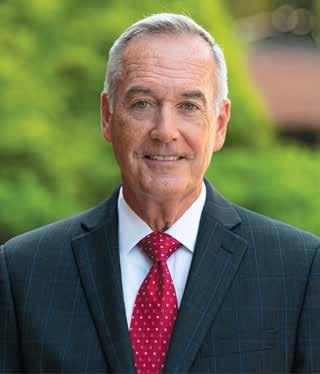
38 General Joe Dunford ’77 Takes the Helm at CSIS
39 Turning Grief into Light: James Kuczo ’93 and Kevin’s Afterglow
40 Building More Than a Game: Jason Curry ’95
41 Ten Years and Counting: HHH Reaches Major Milestone by April Barton
42 Ubuntu Futures: An Edmundite Partnership Rooted in Saint Michael’s College by Ellen Kane
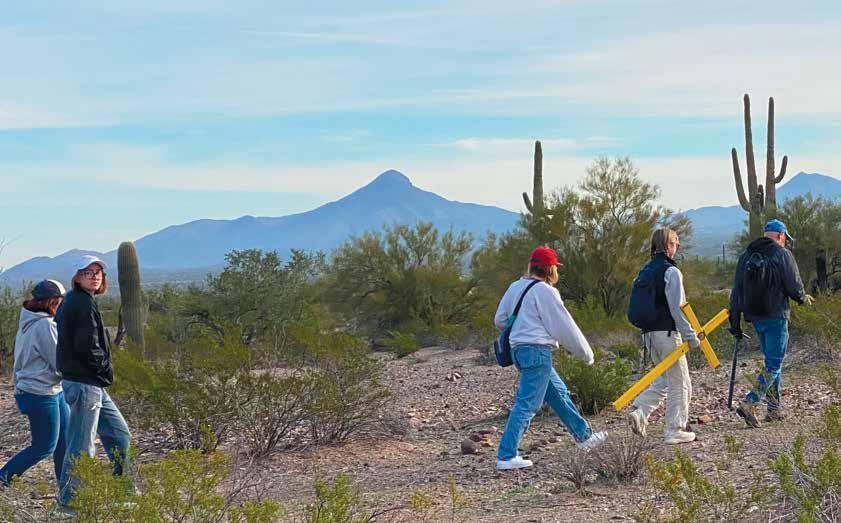
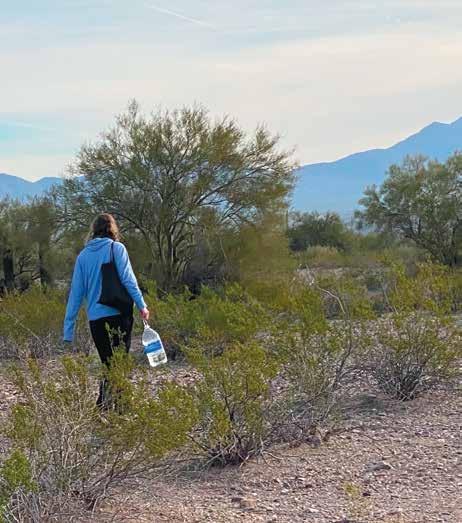
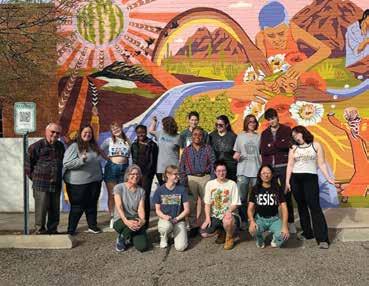
44 Trip to the Border by Rylee Anderson ’27
46 From Saint Michael’s College to Olympic Gold by Nathaniel Lauzon ’27
48 Faculty and Alumni Works
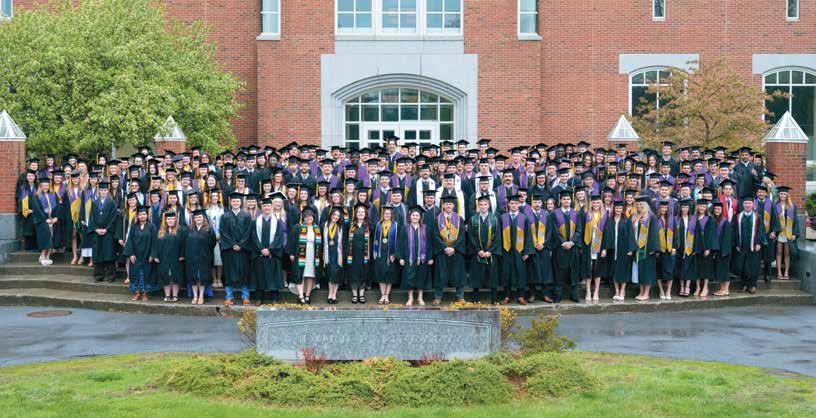
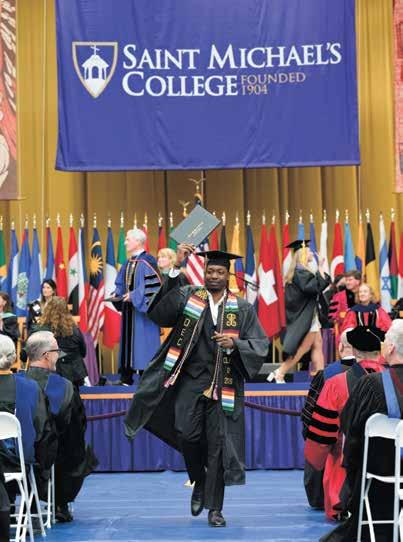
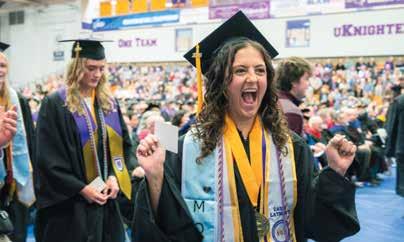
50 Commencement
CLASS NOTES
53 Letter from the Alumni Board President by Jillian Kasierski Charest ’04
54 Class Notes
62 In Memoriam
ALUMNI ESSAY
64 A Class Act: Final Reflections from Peter Harrigan ’83
Additional content available online at smcvt.edu/magazine
A Letter from the President
Walk through campus on almost any afternoon and you’ll see something that captures what makes Saint Michael’s College distinctive. Students lingering after class to continue a discussion. A professor surrounded by advisees. A conversation that begins in a seminar and carries into the hallway or across the dinner table. These small moments reflect something rare today—a place where intellectual seriousness lives alongside genuine belonging, where students are known well enough that no one simply disappears.
Often the questions are big ones about technology, justice, the environment, or what it means to live a meaningful life. These questions sit at the center of a Saint Michael’s education, rooted in the Catholic intellectual tradition, which holds that
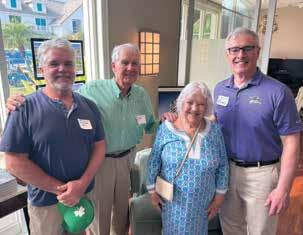
Members of the Dilworth clan reconnect with President Plumb at a reception in Florida. L to R: Thomas Dilworth ’93, Ed Dilworth ’63, P’89, P’91, P’93, Susan Dilworth P’89, P’91, P’93, President Plumb.
faith and reason are not in tension, but in conversation. The everyday rhythm of campus life is shaped by this openness to questions of purpose, responsibility, and the common good.
Education here has always involved more than earning a degree. It includes forming the habits of mind and character that allow a person to navigate a complex world, to ask thoughtful questions, to listen carefully, and to exercise judgment in service of others. In a technological age when information is available instantly, what matters most is the human capacities that cannot be automated: discernment, creativity, integrity, and the ability to work across differences to build a better future.
These are precisely the qualities a Saint Michael’s education seeks to cultivate. Our mission is to educate people of judgment, integrity, and purpose—graduates prepared not only for careers, but for lives that make a difference.
Our mission is founded on the Edmundite tradition that formed this college more than a century ago. Members of the Society of St. Edmund believe in accompaniment: walking alongside people, recognizing their dignity as given, rather than earned. That spirit is visible today in the close relationships between students and faculty, in the sense of belonging that pervades our residential campus, and in the understanding that service is not an obligation but a vocation.
At the same time, Saint Michael’s is not standing still. Over the past two years, our community has undertaken important work designed to strengthen the College for the future. We are clarifying our academic direction, investing in student success, and sharpening how we communicate the distinctive value of a Saint Michael’s education. This issue of the alumni magazine reflects much of that progress and the people who make it possible.
The results are already visible. Our graduates have achieved a 99 percent outcome rate within six months of graduation, entering meaningful employment or advanced study across a wide variety of fields.
But numbers alone cannot capture what distinguishes this place. Our graduates carry with them the experience of being known, challenged, and supported within a community that believes their lives can make a difference—and expects them to make one.
That spirit lives in our alumni community as well. Your accomplishments, leadership, and generosity extend the mission of Saint Michael’s far beyond its Vermont campus. Thank you for the many ways you continue to strengthen this community and the lives it touches.
Warm regards,
Richard Plumb, Ph.D. President, Saint Michael’s
College
THINK DEEPLY. BELONG FULLY. MAKE A DIFFERENCE.
SAINT MICHAEL’S
COLLEGE MAGAZINE
Spring/Summer 2026
Volume 26, No. 1
smcvt.edu/magazine
EXECUTIVE EDITOR
Michelle Jordan P’20
CONTRIBUTING WRITERS
Rylee Anderson ’27
April Barton
Peter Harrigan ’83
Becky Holt
Michelle Jordan P’20
Ellen Kane
Nathaniel Lauzon ’27
Terri Selby
PHOTOGRAPHER
Jerry Swope
MAGAZINE ADVISORY BOARD
Alaba Apesin
April Barton
Fr. Michael Carter, SSE ’12
Summer Drexel
Gretchen Galbraith
Michelle Jordan P’20
Ellen Kane
Josh Kessler ’04
Terri Selby
Jerry Swope
Saint Michael’s College Magazine (ISSN 0279-3016) is published twice per year. The views expressed in the Saint Michael’s College Magazine do not necessarily represent the official policies and views of Saint Michael’s College.
I have witnessed a lifetime of change: change in the world and change at Saint Michael’s College. I’ve gone from student to alumnus, from employee to parent, and from parent to grandparent of St. Mike’s students. To say “the more things change, the more they stay the same” is an understatement. I am lucky. I have had the benefit of witnessing change during many historically turbulent times, and have always felt grounded and grateful for what Saint Michael’s College has shared with me and prepared me for.
I started my journey of higher education in 1967, back when it was an all-male college. St. Mike’s wisely started admitting women in 1970, my senior year. Just two years prior to my arrival, the Edmundites marched side by side with Martin Luther King Jr. over the Edmund Pettus Bridge in Selma, Alabama. The country was entrenched in the Vietnam War. My friends and
classmates were being drafted. Many of them never returned home. I was living in a time when our country felt unstable culturally and politically. Perhaps not much different from what some are feeling right now.
I wanted to write in to simply say “Keep up the good work, Saint Michael’s College.” It was here that I received a strong education with an equally strong grounding in values and community. Today, we are witness to another tumultuous time, and I am thankful for the continued commitment of St. Mike’s to teaching values of humility, compassion, giving, social justice, and sustainability—the Edmundites’ mission—because it gives me hope for the future.
Let’s go, St. Mike’s—we need you now more than ever.
—Jerry Flanagan ’71
Letter from the Editor
After the publishing of each issue of the magazine, the team takes a breath. We review what is going on in the world, on campus, and with our alumni, faculty, staff, and students, knowing that that will produce the “nuggets” of what we want to share, highlight, and discuss in the next issue. And often, we find a subtle theme takes shape. During this issue, we kept referring to a song title— The Times They Are A-Changin’ by Bob Dylan (1964). For some of you this was the anthem of your youth. I didn’t grow up with it, but the classics have staying power for a reason—they resonate throughout generations. Saint Michael’s College has changed since 1964. In this issue, you’ll read about some more changes. Yet some things stay the same,
as Jerry Flanagan’s letter to the editor points out—the Saint Michael’s legacy of “teaching values of humility, compassion, giving, social justice, and sustainability.” I see this every day on campus in small but meaningful gestures—the smiles with which students greet tour groups of prospective students, faculty and staff getting behind the wheel to drive vans of students to connect with alumni. I see this every day online in the stories shared on social media and in the Class Notes you submit. Saint Michael’s is a place of shared experiences that make “a world of difference.” We love hearing from you—keep sharing with us.
—Michelle Jordan, P’20 Director of Marketing
DOMINIC DOUGLASS ’27
BUZZAROUND ALLIOT
CELEBRATING BASKETBALL GREATS
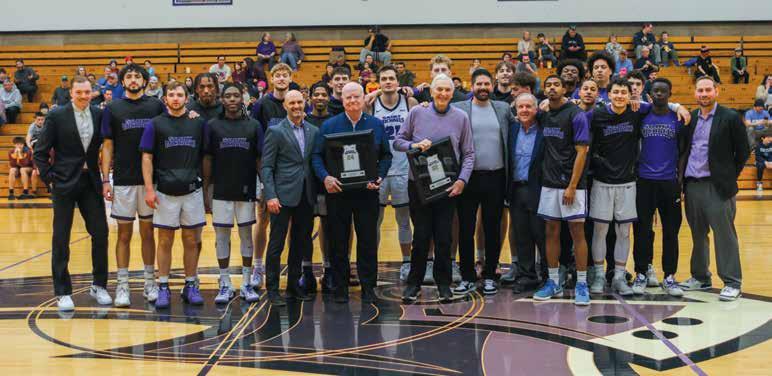
In January, Saint Michael’s College honored alumni Walter Baumann ’63 and Jack Russell ’70 before a men’s basketball game against Southern Connecticut State University. Both are longtime supporters of the program and have made lasting contributions to the College community.
Baumann, a former coach and assistant athletic director, led the team to multiple top finishes and earned Hall of Fame recognition in 1991. A standout student athlete, he was an All-American.
Russell, a former team captain and Hall of Fame inductee, built a distinguished career as a business
and community leader. He has supported numerous charitable efforts, advised the College, and played a role in bringing professional basketball to Vermont.
Together, Baumann and Russell exemplify the spirit of Saint Michael’s through their leadership, service, and enduring connection to Purple Knights basketball.
This year’s men’s basketball team earned an at-large berth to its second NCAA tournament in three years, continuing the program’s tradition of excellence.
NEW CO-OP HELPS STUDENTS AND EMPLOYERS
Saint Michael’s College has partnered with the Lake Champlain Chamber to launch SMC Co-op, a new pilot program designed to strengthen career pathways for students while supporting Vermont’s workforce needs.
The two-year initiative conceived by Nicole Morris, Associate Professor & LaMarche Endowed Chair in Business Administration and Accounting, connects high-achieving juniors and seniors with local businesses for paid, project-based work experiences. Unlike traditional co-ops, this program keeps students enrolled on campus while they work at least 20 hours per week, earning both academic credit and compensation.
The pilot aims to better integrate academic learning with real-world experience, allowing students to build professional skills without stepping away from
their college community. Through a collaborative matching process, students are paired with employers for meaningful, mutually beneficial placements.
The first cohort will run from September through December 2026, with priority given to students in the Honors Program.
Beyond individual student benefits, the initiative is designed to address a broader regional challenge: keeping talented graduates in Vermont. By connecting students with local employers before graduation, SMC Co-op helps build a stronger pipeline of skilled professionals ready to contribute to the state’s economy.
The partnership reflects a shared commitment to experiential learning, workforce development, and long-term community impact.
Photo: Ivan Henwood ’28
THE RADICAL POWER OF CRAFT
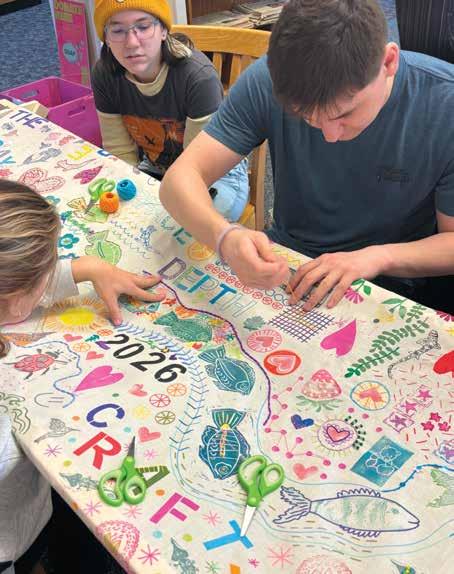
In March, under the tutelage of Maura D’Amore, assistant professor of english, students in the junior seminar Rhetorics of Craft transformed the first floor of the Saint Michael’s College library into a space for creativity and conversation. A large fabric installation invited students, faculty, and staff to take part in a communal embroidery project.
More than an art piece, it was a shared experience. Participants dropped in to stitch, reflect, and engage with one another, creating something collective while slowing down and focusing on the process. The project highlighted embroidery as both craft and expression, reflecting traditions tied to underrepresented voices.
The installation, grounded in course work on the nexus between craft and activism, explored what happens when a community creates together—offering connection, reflection, and critical hope.
STAY CONNECTED TO SAINT MICHAEL’S—YOUR WAY.
The Saint Michael’s College Hub is a new, personalized communications platform created for alumni and the St. Mike’s community. It brings together campus news, events, stories, and updates in one simple, easy-to-use space.
THE Saint Michael ’s College INTRODUCING
With the Hub, you decide what you want to hear about and how often. Whether it’s major announcements, key deadlines, campus happenings, or stories that highlight the people and moments that make St. Mike’s special, the Hub keeps you informed, never overwhelmed.
But it’s more than a news source— it’s a community space. Explore shared interests, join conversations, and stay connected to fellow Purple Knights wherever life takes you.
Join the Hub today—and stay connected in the way that fits you best.
Each January, Saint Michael’s College honors the legacy of Dr. Martin Luther King Jr. with a multi-day celebration that brings together faculty, staff, students, and the broader Vermont community. Now in its fourth decade, the annual event reflects the College’s deep-rooted commitment to social justice—a value that was embedded in its Edmundite Catholic mission long before terms like DEI entered the public conversation.
At the heart of the convocation is King’s vision of the “beloved community,” a world where love overcomes hatred and every person is treated with dignity and respect. Each year, a unifying theme guides a rich program of keynote addresses, panel discussions, artistic installations, music performances, and community dialogues. Past themes such as The Fierce Urgency of Now and Radical
Empathy, and this year’s theme, The World House, have challenged and inspired participants to move beyond awareness into action.
Driving the celebration are co-coordinators Vernita Weller and Lara Scott in addition to a host of faculty/staff volunteers. Weller’s own family history is intertwined with the Civil Rights movement. Under her leadership, the event has grown intentionally outward, extending the work of beloved community beyond the campus and into the greater Chittenden County region.
“Words cannot express the joy I feel when faculty, staff, students, and the broader community all strive to make a difference,” Weller reflected. “While the work is challenging, at times painful, it is essential to our growth as human beings and the survival of our democracy.”
CONSERVATION IN COSTA RICA
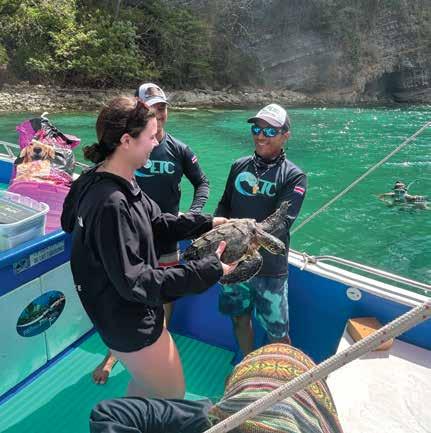
Over winter break, three Saint Michael’s College students, Connor Swales ’28; Hayley Jensen ’22, M’26; and Tatiana Araque-Ochoa ’27, traveled to Costa Rica’s Las Baulas National Marine Park for an immersive conservation experience. Participating in Earthwatch’s Costa Rican Sea Turtle Expedition, they spent nine days working alongside scientists studying endangered sea turtles.
The group conducted nightly beach patrols searching for nesting turtles, collecting data, and helping protect eggs from predators and poachers. They learned about the challenges facing sea turtle populations including habitat loss and human impact.
Beyond fieldwork, the experience offered a powerful opportunity to connect classroom learning with real-world conservation. Students gained a deeper understanding of ecological research, teamwork, and the importance of engaging in global environmental stewardship.
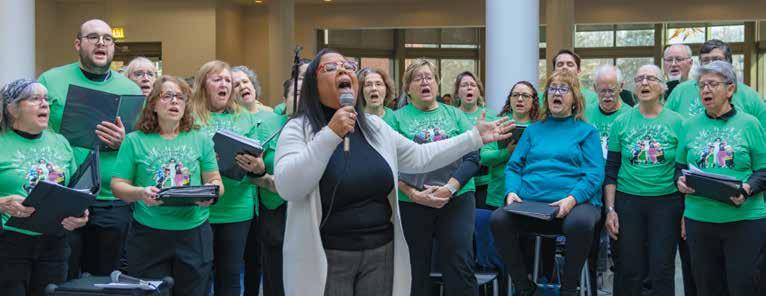
Vernita Weller singing with Vermont’s Freedom & Unity Chorus in celebration of Martin Luther King Jr. SIGNATURE EVENT—DR. MARTIN LUTHER KING JR. CONVOCATION—REINVIGORATED
Photo: Sophie Burt ’26
Photo courtesy of Hayley Jenson ’22, M’26
Vermonters Receive Service Award Scholarships
BY APRIL BARTON
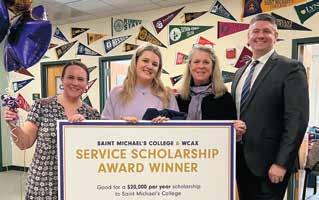
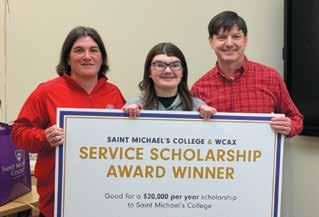
Three high school seniors were awarded the Saint Michael’s College and (local CBS affiliate) WCAX Service Scholarship this spring, a first-of-its-kind distinction. Each will receive a $20,000 per year scholarship in addition to their financial aid package. Winners were chosen based upon an essay that demonstrated their acts of service to the community. The students were surprised by family and friends and representatives from the College and WCAX. The reveals aired as video segments during local news broadcasts in March.
L to R: Brenna Sturtevant ’05, guidance counselor; Ava Walker; Michelle Jordan P’20,, Saint Michael’s College director of marketing; and Jay Barton, WCAX general manager.
“This is a dream come true! I have had my heart set on going to St. Mike’s since I took a tour, and receiving this scholarship has made my dream become reality. I am super excited to join the St. Mike’s community and experience all the great opportunities it has to offer!”
— JENNY BLANSHINE, CHAMPLAIN VALLEY UNION HIGH SCHOOL
“I couldn’t be more thankful for WCAX and Saint Michael’s College for providing myself and two other seniors with a scholarship of this magnitude. I have the opportunity to pursue my dreams and receive two bachelor’s degrees in Biology and Emergency Services, which, without this scholarship, I wouldn’t be able to do. I’m thankful to pave the way for future Vermont students to attend an amazing college in the Green Mountain State!”
— AVA WALKER, ENOSBURG HIGH SCHOOL
Jenny Blanshine (center) stands with her parents.
“Thank you WCAX and Saint Michael’s College for this life-changing opportunity. I couldn’t have done it alone, huge shout out to mom and dad.”
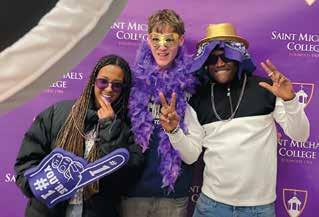
— MATTHEW MACDONALD, SAINT JOHNSBURY ACADEMY
Matthew MacDonald (center) attended St. Mike’s Admitted Student Weekend, where he and new pals donned props and took photo booth pics.
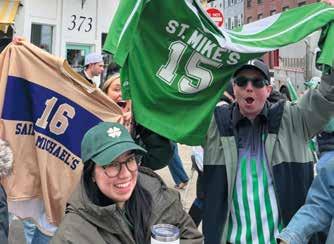
ST. PADDY’S DAY PARADE BOSTON
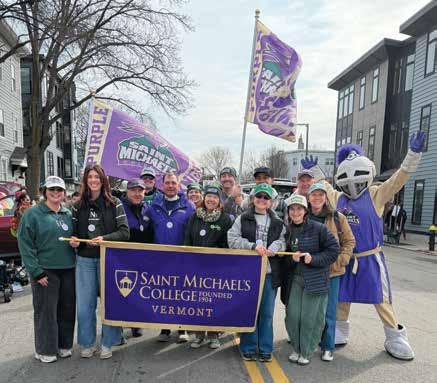
Saint Michael’s staff and alumni marching in Boston’s St. Patrick’s Day Parade. Come join us next year!
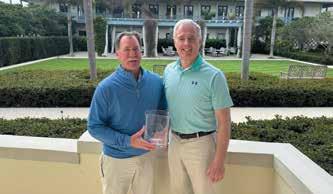
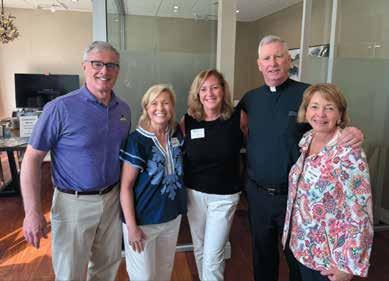
Steve Renehan ’81 met with President Richard Plumb and VP of Advancement and Communications Ellen Kane in Vero Beach, Florida, in March, where Steve and his wife, Deirdre ’81 (not pictured) were welcomed into the Society of Mont-SaintMichel for their generous lifetime giving.
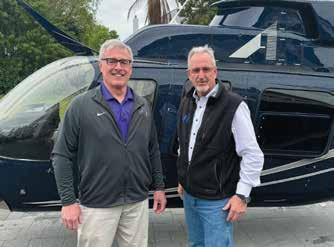
John Herring ’72 (R) and President Richard Plumb pose in front of Herring’s helicopter after he gave Plumb and VP of Advancement and Communications Ellen Kane a bird’s-eye view of Wellington, Florida.
ST. MIKE’S TAKES OFF IN FLORIDA
President Richard Plumb’s annual March trip to Florida to visit alumni featured a few new highlights this year—healthy donuts and a helicopter ride. The former was during a reception hosted by John ’73 and Heidi Versames before Mass at Saint Anne’s Church in Naples, which was co-celebrated by Fr. Brian Cummings and attended by about 30 alumni. The latter was piloted by John Herring ’72 of Wellington.
L to R: President Richard Plumb, Caroline Daly ’87, Sue O’Shea ’87, Fr. Brian Cummings ’86, SSE, and Nancy O’Shea ’83.
THE POLITI ENDOWED INTERNATIONAL SCHOLARSHIP
Dr. Francis A. Politi, a native Vermonter and accomplished global businessman, came to value the mission of Saint Michael’s College after returning home in retirement and building close relationships with the Society of Saint Edmund and former president Mark vanderHeyden. Though not an alumnus, he established the Politi International Fellowship through a generous bequest to support students in strengthening foreign language skills and expanding global awareness.
Dr. Politi’s intent is clear: to promote cultural understanding through transformative global experiences, a vision that reflects Saint’ Michael’s’ longstanding commitment to international engagement—from welcoming Hungarian refugees in the 1950s to sustaining a strong study abroad program and diverse international student community today.
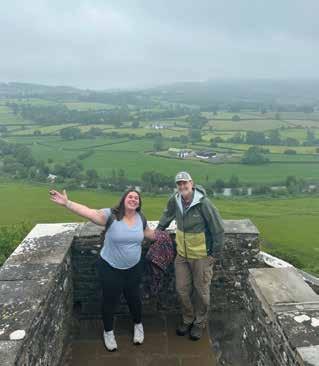
Jillian Lesinski ‘26 and Political Science and International Relations Professor Jeffrey Ayres during an academic study trip to Wales in May and June 2025
GLOBAL CAREER CONVERSATIONS: ALUMNI NAVIGATING THE WORLD
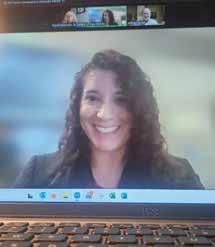
Three alumni—Brian Lacey ’72, Anne D’Angelo ’89, and Alex Melillo ’11 (see photo)—joined Jeff Ayres, director of the Institute for Global Engagement, and Ingrid Peterson, director of the Boucher Career Education Center, for a series of online, in-depth conversations about their international career journeys. Sharing personal stories of unexpected pivots, hard-earned insights, and the enduring value of a St. Mike’s education, these alumni offered students a window into global career paths. Their reflections highlighted how the intellectual curiosity, adaptability, and ethical grounding they developed at St. Mike’s shaped their success across continents and industries.
IN KIND
Shout out to Judith P’28 and Joe Maloy ’80, P’28, longtime supporters of Saint Michael’s, who are underwriting the print cost of all the direct-mail annual appeals for the College, pro bono. Joe and Judy own Polaris Direct, a full-service sustainable direct mail printing company in Hooksett, New Hampshire.
Photo courtesy of Jillian Lesinski
Alumni Connections
PRESENTATIONS AND NETWORKING: ALUMNI BRINGING INDUSTRIES TO CAMPUS
Across multiple disciplines, alumni returned to Saint Michael’s College to share expertise in the classroom and beyond and to open doors for current students.
• Michael Cammarata ’24 represented BAE Systems in an e-presentation introducing students to the company’s leadership development program.
• Bridget McElroy ’17 welcomed more than 25 students to OnLogic for an energetic networking event that connected students with area alumni.
• Tayla Reo ’14 of Vermont Teddy Bear and Nick Romano ’11 of Tytan Magnetic Tiles joined forces to discuss
CAREER CONNECTIONS EVENT
A highlight of Saint Michael’s College Spring Career Connections event on March 7 was the keynote address by Ted Brady ’00. Drawing on his St. Mike’s experience, Brady shared reflections on leadership, purpose, and community that resonated with students preparing to enter the workforce. His practical wisdom made his message both inspiring and grounding.
The full-day event brought together students, alumni employers, and industry experts for meaningful professional growth and connection.
Jointly led by the Career Education team, the Alumni Board of Direc-
BIG ACHIEVEMENTS, GLOBAL CONNECTIONS
Greg Hurter ’24 (right)—now pursuing his master’s degree in public health at Brown University—spent his spring break in the Czech Republic, guest lecturing in the English class of Fulbright Scholar Jarrett Sweet ’25 (left). It’s just one example of how Saint Michael’s alumni and students show up for each other around the world.
how they brought creativity, innovation, and business acumen—shaped by their St. Mike’s education—into the toy industry.
• Will Meconi ’03 returned to campus representing RSM, meeting with Accounting majors and minors to share professional pathways and recruitment opportunities.
• On International Women’s Day, Bethany Putnam ’20 of Goldman Sachs and Jackie Thibeault ’20 of Copper Leaf Financial offered an inspiring presentation on Women in Finance, highlighting the importance of representation, mentorship, and empowerment in the field.
tors, and the alumni team, the program offered students a dynamic mix of opportunities to explore career pathways and build lasting relationships.
Students engaged with alumni at employer spotlight tables representing OnLogic, Howard Center, One Day in July, Burlington Police Department, Essex Westford School District, Lund, MFS Investment Management, the Leahy Institute for the Environment, and event sponsor Acrisure. Small-group conversations gave students the chance to ask questions and gain insight from alumni who once sat in their seats.
The event concluded with a networking reception, where students formed the kinds of connections that can grow into mentorships, internships, and professional opportunities.
Alumni who are interested in getting involved and sharing their insights or opportunities with current students are encouraged to reach out to: OfficeofAlumniandFamilyEngagement@smcvt.edu.
Thanks a Million!
BY TERRI SELBY AND ELLEN KANE
PHILANTHROPIC MOMENTUM
Don Dion, Jr. ’76 has announced a transformational $1 million Catholic Scholarship initiative, launching in FY2027, to support new students enrolling from Catholic high schools. Additional details will be shared in the coming months.
The College also received a remarkable $1 million gift from an anonymous donor to launch a new current-use scholarship initiative aimed at making tuition more affordable for students and their families. The gift provides immediate support for the College’s recently expanded financial aid programs, reinforcing Saint Michael’s long-standing commitment to access, affordability, and student success.
“This extraordinary act of generosity reflects the deep commitment of our community to ensuring that
a Saint Michael’s education remains within reach,” said Richard Plumb, president of the College. “At a time when families face increasing financial pressures, this gift empowers us to expand opportunity, strengthen our mission, and continue providing an exceptional, values-driven education to students who will go on to make meaningful contributions to the world.”
The donor’s leadership gift has Inspired an additional $4 million to support scholarships and financial aid initiatives. The additional support builds on the success of the annual Saint Michael’s Fund appeal, which has nearly doubled over the past two years and which plays a critical role in reducing the overall cost of attendance for students. Over the next several years, the College’s goal is to triple the
Kathleen Dean ’26, 4.0 GPA, chosen for the Roger F. Keleher Award in Athletics (Field Hockey), recipient of a Donald Dion scholarship as a graduate of St. Dominic’s High School in Lewiston, ME, pictured with Don and Fr. Brian Cummings, S.S.E. ’86 after the Baccalaureate Mass.
current-use scholarship fund above and beyond annual donations essential for all the student focused activities and programs.
It was a nondescript Tuesday in late November, the kind of gray, quiet morning that usually precedes Thanksgiving break at Saint Michael’s College. In the Advancement Office, Tiffany Phuong, the College’s gift processing and donor records specialist, walked into the office of Ellen Kane, vice president of institutional advancement and communications, with a stack of envelopes in her hand.
Kane asked, “Anything interesting in that pile?” She randomly selected what appeared to be an ordinary envelope.
Inside was a $1 million check, a bequest of Peter French.
French was not a Saint Michael’s alumnus. He had been a guardian of
a student who thrived at the College and graduated many years ago, but French had no prior giving history—no hint that the College had ever crossed his philanthropic radar. Yet here it was, an enormous gift left entirely to Saint Michael’s College, with no restrictions. In an era when charitable gifts are often highly designated, French’s bequest simply stated that the funds were for the “general charitable use and purposes at the discretion of its President.”
For a small, close-knit liberal arts college like Saint Michael’s, a gift of this magnitude is nothing short of transformational, a powerful affirmation of the College’s mission and future.
Thanksgiving was still days away, but as word spread through the Pomerleau Alumni Center, the feeling was unmistakable: Christmas had arrived early at Saint Michael’s.
BY THE NUMBERS, FROM THE HEART
“
The “For the Love of St. Mike’s” campaign celebrated the relationships that define Saint Michael’s—and inspired gifts in their honor.
Allyson (Bradley) and I met [during our first year] at an unsanctioned dorm room party in 1987—we began dating in the spring semester of 1988. Thirty-eight years and three wonderful sons later, we couldn’t be happier that St. Mike’s brought us together.
— DAVID DILLMEIER
‘91
409
INDIVIDUAL DONORS (not households)
35
LOVE STORIES HIGHLIGHTED ON SOCIAL MEDIA THROUGHOUT THE MONTH
$134,941
TOTAL RAISED
100
GIFTS MADE IN HONOR OR MEMORY OF FACULTY, STAFF, OR CLASSMATES
$92,500 IN CHALLENGE MONEY UNLOCKED!
Strengthening the College’s Future
BY ELLEN KANE
ACADEMIC EXCELLENCE
Saint Michael’s continues to build on its enduring strengths in academic excellence, experiential learning, and community engagement.
Rooted in the Catholic intellectual tradition and guided by rigorous academic standards, students collaborate with faculty on impactful research addressing global health, environmental sustainability, and the evolving fields of digital marketing and design. The College is recognized for its academic rigor:
• Over 80 percent medical school matriculation rate—more than twice the national average.
• One of only 25 Catholic institutions with a Phi Beta Kappa chapter.
• Designated a “Top Producer” of Fulbright scholars by the U.S. State Department.
• One of just 33 U.S. colleges awarded a Freeman Foundation Grant to support internships in Asia.
• Consistent recipient of the NCAA Presidents’ Award for Academic Excellence
School of ARTS & HUMANITIES
98% FULL-TIME EMPLOYMENT OR GRADUATE SCHOOL
*Within 6 months of graduation
STUDENT OUTCOMES
School of NATURAL & HEALTH SCIENCES
• 78.2 percent of St. Mike’s students complete some type of experiential learning (internship, student teaching, etc.).
3 INSTITUTES ENVIRONMENT EQUITY & JUSTICE GLOBAL ENGAGEMENT
• 71 percent of graduates met with a Career Coach
• 84 percent in full-time employment and 20% in graduate school six months after graduation (2025 First Destination Survey Snapshot).
School of BUSINESS & TECHNOLOGY
*Some students are employed and in graduate school.
School of SOCIETY & CULTURE
Saint Michael’s College is embracing an important moment of transformation—one rooted in bold innovation, disciplined stewardship, and its enduring Edmundite mission. As workforce needs evolve and the landscape of higher education changes, Saint Michael’s is making strategic updates to its academic offerings to ensure students are equipped to thrive in an interconnected and dynamic world.
This work is guided by shared governance, extensive faculty collaboration, and the steady leadership of the Board of Trustees. The result is a new academic portfolio that strengthens disciplinary depth, expands interdisciplinary learning, and reinforces the values that have defined Saint Michael’s for generations: intellectual seriousness, authentic community, and the moral vision that knowledge must serve the common good.
Over the past 18 months, Saint Michael’s has redesigned its academic structures from 19 departments to programs housed within four interdisciplinary Schools—Arts and Humanities, Business and Analytics, Society and Culture, and Natural and Health Sciences. It has also redesigned its governance from a faculty assembly of the whole to a senate with elected
4 Schools + 3 Institutes = Pathway for co-academic learning and leadership development, professional development, and community engagement.
Co-academic = Academic life + student life.
Career Center = New career readiness assessment aligns academics with job skills.
representatives from each school. This transformation enhances collaboration, reduces academic silos, and creates a more coherent, responsive curriculum that reflects the College’s belief that both faith and reason, both inquiry and purpose, belong in conversation with one another.
“We are building on our enduring strengths while preparing Saint Michael’s for the future. By aligning our programs with emerging needs and the realities faced by today’s students, we will remain a place where academic excellence, mission, and opportunity come together to change lives,” said President Richard Plumb.
Complementing the four schools are three co-academic institutes—key hubs of interdisciplinary learning that function as “living laboratories,” connecting academic inquiry with real-world applications.
Directed by Professor Jeffrey Ayres, the Institute for Global Engagement is the College’s central hub for cultivating global fluency and intercultural understanding. Through lectures, workshops, career conversations, global engagement trips, and partnerships with organizations around the world, the institute helps students develop the judgment, cultural awareness, and moral imagination needed to navigate an increasingly interconnected world.
Under the leadership of Professor Kristyn Achilich, the Leahy Institute for the Environment anchors environmental inquiry across campus. The institute blends ecological science, sustainability practice, community partnership, and moral reflection—mirroring Saint Michael’s long-standing commitment to stewardship of creation. Students work directly in the College’s living classrooms: the Natural Area’s forests and wetlands, the Teaching Gardens, and the Lake Champlain watershed.
MISSION
We have strengthened our mission focus through the creation of the Division of Edmundite Missions and a new vice president role reporting directly to the president—ensuring that the Edmundite tradition and Catholic Social Teaching remain vibrant in their position at the heart of our community.
ALUMNI ENGAGEMENT AND FUNDRAISING MOMENTUM
• Alumni engagement is growing through new joint alumni and prospective student events across New England and the Mid-Atlantic.
• Giving increased 145% in FY2025, including a 56% rise in Saint Michael’s Fund donations.
• More alumni are including Saint Michael’s in their estate plans, reflecting deep and lasting commitment.
ATHLETICS
Our student athletes continue to excel both on the field and in the classroom. Competing in the NE10—the most competitive Division II conference in the nation—Saint Michael’s boasts a 92 percent retention rate among athletes and recently celebrated the NE10 Men’s Hockey Championship.
ECONOMIC IMPACT IN VERMONT (2024)
• $185 million total economic impact.
• 3,831 Fire and Rescue responses in Greater Burlington.
• 2,943 jobs supported by the College.
• 60,000 hours of student community service.
$3.2M
IN NAMED SCHOLARSHIPS
Through hands-on research, field studies, policy work, and service trips, students gain experience with real environmental challenges while exploring the ethical dimensions of land use, climate resilience, and environmental justice.
Led by Professor Jolivette Anderson-Douoning, the Institute for Equity and Justice sits at the heart of the Saint Michael’s mission. Grounded by the seven liberal arts, Catholic Social Teaching, and Laudato Si’, the institute provides a moral and intellectual foundation
for understanding justice in all its forms. It also carries forward the Edmundite tradition of hospitality—an invitation to see the dignity of every person as given, not earned. Through course work, public events, community partnerships, and student engagement opportunities, the institute helps students develop the courage, clarity, and civic responsibility needed to contribute to a more just society.
“This work reflects deep faculty leadership and shared commitment. Our updated academic portfolio better supports students’ aspirations while preserving the liberal arts foundation that makes a Saint Michael’s education distinctive,” said Gretchen Galbraith, provost.
Building on the new academic structure with a focus on the future, here are the new majors and exciting changes to academic programs launching in fall 2026:
NEW MAJORS
Emergency Services
Building on the College’s nationally recognized Fire and Rescue program and designed to pair with a second major or minor, this major focuses on disaster preparedness, response, recovery, and mitigation. Students will gain applied knowledge required for urgent, high-impact work in four specialized tracks—Emergency Medical Services, Fire Science, Wilderness Medicine, and Emergency Management.
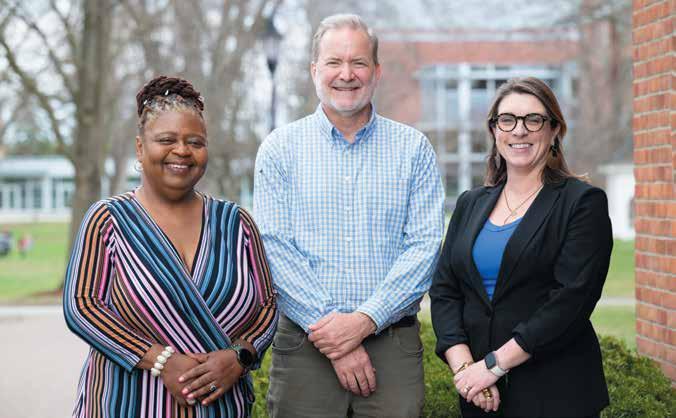
L to R: Jolivette Anderson-Douoning, Director of the Institute for Equity and Justice; Jeff Ayres, Director of the Institute for Global Engagement; Kristyn Achilich, Director of the Institute for the Environment.
Photo: Jerry Swope
Philosophy, Politics, and Economics (PPE)
Modeled after Oxford’s renowned program, PPE integrates ethical inquiry, governance, and economic theory to help students analyze complex societal challenges. The major develops analytical rigor, public problem-solving, and global awareness—ideal preparation for careers and callings where sound judgment, moral courage, and dedication to the common good matter.
Secondary Science Education
Created to address the critical shortage of qualified science teachers, this major includes course work in biology, chemistry, environmental science, and physics. Students gain classroom experience and complete licensure requirements for both middle school and high school teaching. This program reflects the College’s long-standing commitment to service, leadership, and the formation of educators who shape future generations.
Nutrition
The new Nutrition major prepares students for careers and graduate study in nutrition and allied fields, building skills in evaluating scientific research, communication, and applied nutrition science. Given the growing demand driven by the role of nutrition in disease prevention and care, graduates are well positioned for a rapidly expanding field.
Finance
With a foundation of data-informed decision-making and ethical leadership, the Finance major equips students to navigate today’s financial landscape with clarity and purpose.
Graduates are prepared for careers in corporate finance, investment banking, and portfolio management, contributing effectively in a global economy.
REVISED AND MERGED PROGRAMS FOR AN INTERDISCIPLINARY FUTURE
These strategic program mergers, by unifying related fields, illustrate the College’s commitment to an education that readies students to think across disciplines in preparation for the complex challenges they will encounter in their careers and communities.
• Analytics, Computing, and Data Science
Unifying Information Systems, Computer Science, Data Science, and Applied Statistics, this program prepares students for data-driven careers in many industries.
• Equity and Justice
An expanded version of the former Equity Studies major, this major examines social inequalities through historical, cultural, political, and structural lenses.
• Ethics, Philosophy, and Religion
School of ARTS & HUMANITIES
School of NATURAL & HEALTH SCIENCES
3 INSTITUTES ENVIRONMENT EQUITY & JUSTICE GLOBAL ENGAGEMENT
School of BUSINESS & ANALYTICS
School of SOCIETY & CULTURE
Combining Philosophy and Ethics with Religious Studies, this major explores the philosophical and spiritual frameworks that shape human behavior and society.
• Global Languages and Cultures
4 Schools + 3 Institutes = Pathway for co-academic learning and leadership development, professional development, and community engagement.
This merged program integrates French and Spanish language and cultural studies, emphasizing language proficiency, cultural literacy, and global engagement.
Co-academic = Academic life + student life.
• Performing Arts
Bringing Theatre and Music together, this program offers three tracks—Theatre, Music, and Musical Theatre—and emphasizes performance, creativity, and collaboration.
Aligned to and assessed by career readiness and ethical leadership competencies.
Answering the Call
Across the country—and especially in Vermont—the demand for emergency responders is growing. Emergency call volume has surged in recent years even as the workforce has declined, creating dangerous gaps in care. National projections suggest the U.S. could face a shortage of more than 100,000 healthcare workers by 2028.
Saint Michael’s College is directly addressing that need.
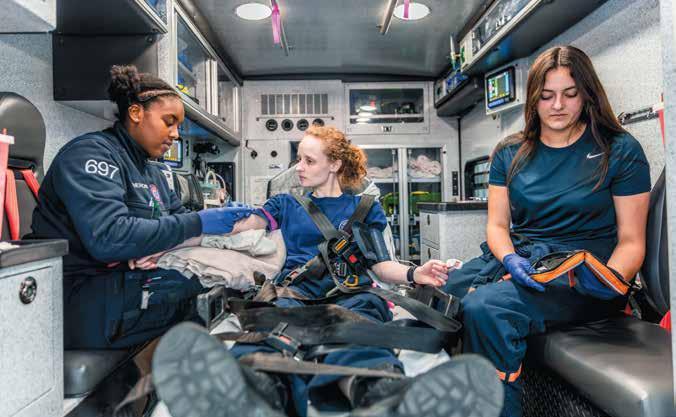
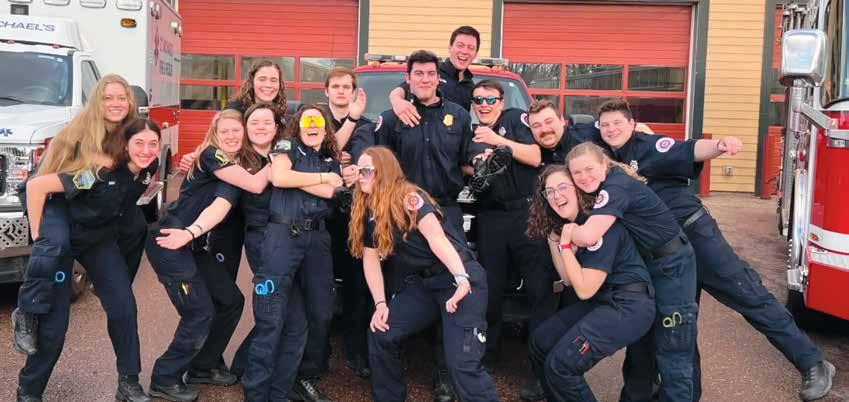
With the launch of a new bachelor of science degree in emergency services, the College is transforming a long-standing culture of student-led service into a comprehensive academic program—one designed to prepare graduates to respond when it matters most. For decades, students have volunteered with Saint Michael’s Fire
and Rescue, answering thousands of emergency calls each year. Now, that real-world experience is being paired with rigorous academic training to meet an urgent demand.
At its core, the program is built on a simple idea: Effective emergency response requires more than technical skill. It requires the ability to think clearly under pressure, communicate with compassion, and understand the human dimensions of crisis.
Kate Soons ’94 leads the program. When she was a student rescue team volunteer, she responded to a serious crash involving multiple victims—an experience that shaped her path. In those critical moments, success depended not only on her EMT training, but on her judgment, communication, and patient-centered
caregiving. It’s exactly that blend of skills the new major is designed to cultivate.
Students will train in four tracks—Emergency Medical Services, Fire Science, Wilderness Medicine, and Emergency Management—while pursuing a minor in another academic discipline. The goal is not simply to prepare students for a first job, but to equip them with the adaptability and perspective needed for a field that is constantly evolving, because the challenges are evolving.
Whether climate-driven disasters or public health crises, emergencies today are more complex, more frequent, and more interconnected than ever before. Responders must be prepared to act in the moment, and they must also be able to anticipate,
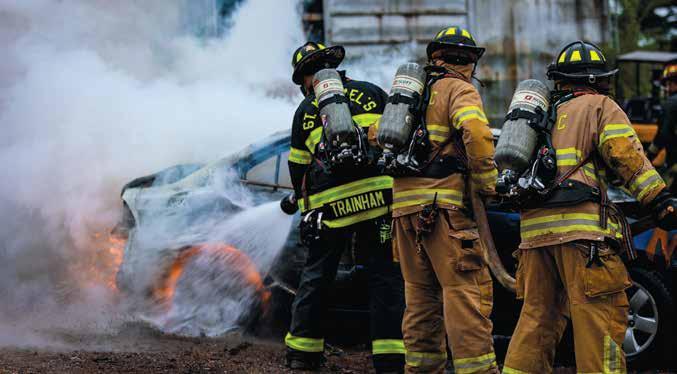
Saint Michael’s College Fire and Rescue training in Fall of 2025.
ORIGINAL REPORTING BY APRIL BARTON
Photos: Christina Cummings ’25
coordinate, and support recovery long after the immediate crisis has passed. That kind of preparation requires both specialized training and a broader understanding of systems, communities, and human behavior.
This is where the Emergency Services program’s distinctive approach stands out.
By pairing professional training with a liberal arts education, the program ensures that students develop both the technical expertise and the critical thinking skills needed to lead in high-stakes environments. Courses in ethics, communication, and public health complement hands-on experience, helping students understand what to do in an emergency, as well as how to do it in a way that builds trust and serves communities effectively.
Students graduate with nationally recognized certifications and significant real-world experience, positioning them to step immediately into roles as emergency medical technicians (EMTs), firefighters, emergency managers, and wilderness first responders. But just as importantly, they graduate with a mindset of service, responsibility, and care for others.
That mindset has long been a hallmark of the Saint Michael’s College community. Since 1969, the student-run Fire and Rescue program has offered a level of responsibility and real-world exposure rare among colleges. Students don’t just train for emergencies—they respond to them, often serving as the first line of care for their peers and surrounding community. By integrating this experience
“The goal is not simply to prepare students for a first job, but to equip them with the adaptability and perspective needed for a field that is constantly evolving.”
into a formal academic major, the College is amplifying something it already does exceptionally well.
The result is a program that does more than respond to workforce shortages—it helps redefine what it means to be prepared.
By aligning academic study with real-world service, the new Emergency Services major creates a direct pathway from classroom to community impact. It equips students to strengthen the critical fields they enter—to fill urgent gaps, improve outcomes, and bring a more human-centered approach to emergency response.
In an emergency, every second matters. The people who respond must be ready to make fast decisions, adapt to changing conditions, and care for individuals in moments of vulnerability and fear. Technical knowledge alone isn’t enough. What makes the difference is how that knowledge is applied—with clarity, compassion, and a deep sense of purpose.
Those are the kinds of emergency services graduates Saint Michael’s College produces.
Saint Michael’s College Rescue Squad training.
Andrew S. Jones ’22 Scholarship
BY BECKY HOLT
The Saint Michael’s Fire and Rescue Squad caught Andrew Jones’ attention as he and his family drove toward campus for a prospective student event in the late 2010s. He saw the student volunteers hanging out in front of the Robert E. Sutton Fire and Rescue Station on a beautiful day.
“It was just a different world,” said Jones, a 2022 graduate. “They had their own little community that they were a part of.”
Jones is now a full-time advanced EMT in the Outer Banks of North Carolina—and a new merit-based scholarship at St. Mike’s bears his name.
Kevin and Karla Jones, Andrew’s parents, established the Andrew S. Jones ’22 Scholarship to honor the Fire and Rescue community that helped shape their son, paying it forward to other students making the same commitment to service.
“Fire and Rescue takes on that responsibility of life and death, saving people, saving property—that
matures you,” Kevin Jones said. “As a parent, to see [that] in your child, it was phenomenal.”
The scholarship will be awarded to two outstanding students enrolled in the Fire and Rescue program who demonstrate academic excellence and show interest in pursuing a career in that field, one student specializing in fire and one in rescue. The selection process will involve representatives from the College’s Fire and Rescue leadership and the director of the new Emergency Services program.
“This gift will have a significant impact on the recipients who dedicate 20-plus hours a week to saving lives in the community while managing their academic schedules,” said Ellen Kane, Saint Michael’s College vice president for advancement and communications. “Many do not have the time to get a job for additional income. We are so grateful to the Jones family.”
Founded in 1969, Saint Michael’s Fire and Rescue operates 24/7 thanks to staffing by student and
Andrew S. Jones ’22
alumni volunteers. The independent volunteer organization serves both the campus and surrounding towns by providing fire protection and emergency medical treatment, responding to more than 3,000 calls annually.
St. Mike’s launched an Emergency Medical Services (EMS) minor in fall 2025, and this coming fall, the College will debut a bachelor of science degree in Emergency Services
Photo courtesy of The Jones Family
with specialized tracks in EMS, Fire Science, Wilderness Medicine, and Emergency Management.
The need for a well-trained, adaptable emergency workforce has increased as workforce shortages have become critical. Demand for emergency services in Vermont alone grew 22 percent in the last five years. The curriculum created for the new Emergency Services program responds to that need while honoring the core values of the Society of St. Edmund, the Catholic order of priests who founded the College.
“The Catholic religion teaches a life of service,” Kevin Jones said. The new program is “a huge step forward” for service, community, and the College itself, he added. “It’s for the benefit of everybody—the student and their communities, wherever they end up.”
Andrew Jones exemplified that model as a student, earning the trust of his peers and rising to captain his senior year. Meanwhile, he studied to earn an Information Systems degree and pursued additional emergency services training. He acquired his Firefighter I and II national certifications with Fire and Rescue, completed an EMT–Basic certification through the University of Vermont, and took additional classes through the Vermont Fire Academy.
“As a mother, obviously you always worry” about your child’s safety, Karla Jones said, but added that the training her son received taught him what to do and kept him safe. “I’m just very proud.”
Andrew Jones began working in a paid position at the Winooski Fire Department part-time during his junior year and full-time during the summers. Working for Winooski Fire, he also put his information systems education to good use. He analyzed years of call and staffing data to build a City Council presentation that made the case for increased staffing and a new
truck to meet the shifting needs in the city. Jones applied that same analytical lens to inspection data, strengthening the department’s community risk reduction efforts.
Upon graduation, Jones saw two different career paths before him. “Not only could I have gone into being a first responder, but I could have done information systems very easily,” he said.
During a Fire and Rescue boot camp run by St. Mike’s alumni, he decided which path to choose. Volunteers from across the country return to campus annually for a week of training, and what struck Jones most was their confidence in the squad.
“They said they would take any one of us students to work with them any day over people they work with now,” he said.
Jones’ alumni networking continued to prove valuable, connecting him with other training opportunities. Eventually, the Connecticut native landed his first post-grad job as a firefighter and EMT in Elizabeth City, North Carolina. His colleagues there have become a second family, he said, much like the tight-knit community he knew at St. Mike’s.
To focus on becoming a paramedic, Jones joined Dare County Emergency Medical Services, serving the Outer Banks, a popular spot with tourists in the summer. The warmest months are the busiest season for the department.
“We’re on call, pretty much all summer, every day,” Jones said. But regardless of the volume, “we still show them the same customer service.” Jones will complete his paramedic course work later this year. And, the new scholarship will be helping other dedicated students in the field.
SUTTON SCHOLARSHIP TOPS A MILLION
The Don Sutton Fire and Rescue Scholarship reached a remarkable milestone this past winter. More than 148 donors made gifts to push the scholarship over the $1,000,000 goal. This was the result of a dedicated fundraising campaign led by Chris Kenny ’86, P’18, executive director of stewardship and leadership giving, along with support from Pete Soons ‘82, retired director of public safety, and Kate Soons ’92, P’21 director of the Emergency Services Program. Now ranked among the top 20 endowed funds at St. Mike’s, the Sutton scholarship, created in 1988 through the generosity of Fran and Mary Ritz, Susan Ritz ‘77, and many others, continues to make a lasting impact.
The scholarship provides financial assistance to students involved in Saint Michael’s Fire and Rescue beginning their sophomore year and renewable through their senior year, in conjunction with the academic requirements and standards of Saint Michael’s Fire and Rescue members. The primary consideration is community service to Fire and Rescue, in addition to financial need. The scholarship is named in honor of Don “Pappy” Sutton, who worked at St. Mike’s for over 40 years, primarily in the Student Life office. Sutton is most celebrated as the founder of the Fire and Rescue program, after a student tragically died on campus in 1969. The unique studentled squads soon became the envy of other colleges and universities, with many modeling their own after St. Mike’s. Fittingly, the goal was reached on Pappy’s birthday, December 26.
Through Their Eyes
GLOBAL EYES PHOTOGRAPHY CELEBRATES 25 YEARS
BY MICHELLE JORDAN P’20
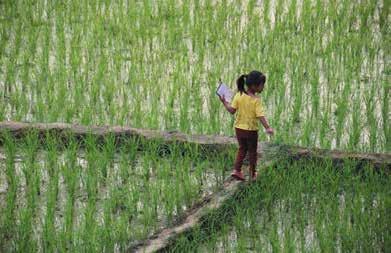
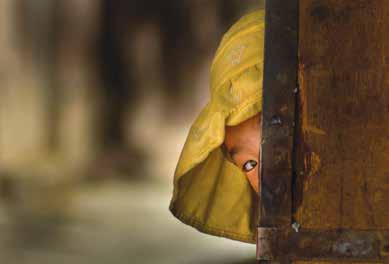
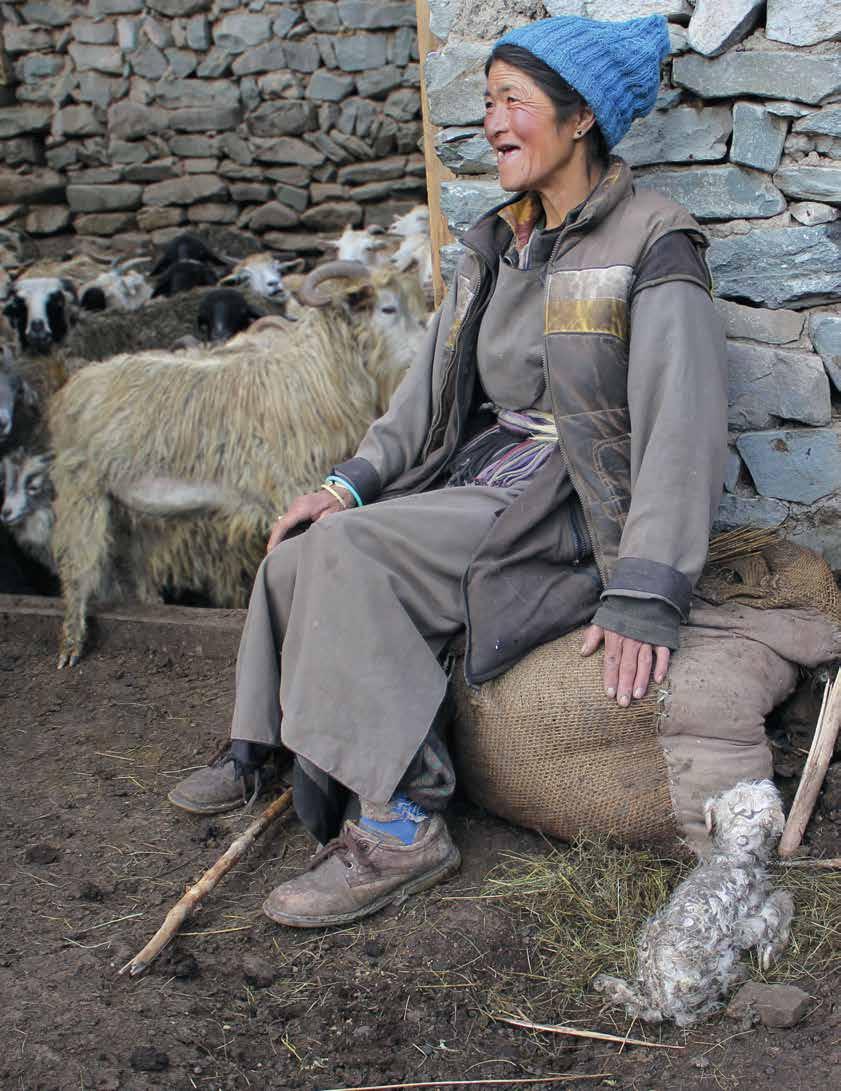
For a quarter century, Saint Michael’s College students have returned from study abroad not just with memories, but with photographs— and the stories behind them.
The Global Eyes Study Abroad Photography Competition, now celebrating its 25th anniversary, has become one of the most beloved annual traditions on campus. What began as a simple opportunity for returning students to share their international experiences has grown into a rich, community-wide celebration of curiosity, connection, and the transformative power of going beyond what is familiar.
Each year, students submit photographs organized into categories—Landscape, City Life, Nature, People and the Human Spirit, and the Essence of Study Abroad, among others—judged not only on technical quality but on the written narratives that accompany them. It is these captions that give the competition its soul.
A student in Japan describes waking at 3 a.m. to run through silent streets to a temple, writing that she has “never known peace” like the moment she captured in that photograph. Another, standing on the coast of Normandy, reflects on what it means to visit a place of immense historical weight 80 years after liberation. A third, fly fishing under the Southern Hemisphere’s Milky Way in New Zealand, captures a moment of stillness so profound it wins Best of Show.
These are not just photographs. They are evidence of students thinking deeply about the world— and about themselves.
Sponsored by the Office of Study Abroad, the Digital Media and Communications program, and the Institute for Global Engagement, Global Eyes culminates each April in an awards ceremony, with winning photographs remaining on display in Durick Library throughout the year.
Twenty-five years of Global Eyes. Twenty-five years of Saint Michael’s students seeing the world— and bringing it home.
From top: At a Crossroads by Ilit Bavly, 2014; A Liquid Future by Rebecca Kuttner, 2019; Peekaboo I See You by Brandon Bielinski, 2018; Opposite page: Enamored Shepherd by Anna Ste. Marie, 2015
AI: Friend or Faux?
Through Critical Engagement, Saint Michael’s College Prepares Students for World Consumed by AI
BY BECKY HOLT
ILLUSTRATION: ABBEY GYURKO ’27
At Saint Michael’s College, artificial intelligence (AI) is more than a technical tool—it’s a subject of inquiry, a partner in learning, and a catalyst for ethical reflection.
The College embeds AI across disciplines in ways that honor its liberal arts tradition: fostering critical thinking, creativity, and responsible citizenship.
“Our goal is for students to graduate knowing when, where, why, and how to use AI in their work,” said Gretchen Galbraith, provost and vice president for academic affairs.
The breadth of AI integration across Saint Michael’s curriculum reflects a distinctive institutional culture in which faculty autonomy drives innovation. Galbraith said faculty are deeply curious and engaging in AI use in an organic way. This leads to curriculum augmentation, greater depth of inquiry, and proficiency with the tools, which extends to the students.
“This reflects the best of St. Mike’s,” Galbraith said.
Below, explore four examples of how Saint Michael’s College has integrated AI into its curriculum.
Students Are Introduced to AI in Their First Semester
First-year students consider AI ethics, benefits, and pitfalls through their required First Year Seminar courses.
The current “common text”—a shared reading assignment for firstyear students—is AI Snake Oil: What Artificial Intelligence Can Do, What It Can’t, and How to Tell the Difference, by Arvind Narayanan and Sayash Kapoor.
AI Snake Oil challenges the hype, helping students learn the differences between effective, safe AI tools and
“snake oil” applications that are ineffective or harmful. The book distinguishes between generative AI tools such as ChatGPT and predictive AI applications, encouraging skepticism toward claims of AI miracles.
Judgment is particularly important given how rapidly AI has entered everyday life. The goal is to ensure AI serves society rather than the reverse, said Kristin Dykstra, director of First Year Seminar.
“If you want AI to do good things for your society, you’re going to have to work for it, and it can’t just be a few of the people in computing; it has to be people in every sector,” said Dykstra.
“This is about being smarter than your tools,” she added. “How can we work to ensure that AI serves the common good?”
AI as a Teaching Partner in Business Administration and Accounting AI is being implemented by students and faculty in a myriad of ways across disciplines.
In the Business Administration and Accounting program, faculty members Nicole Morris and Karen Popovich model a practical, transparent approach to AI integration—one that treats the technology as a “thinking partner” rather than a replacement for human expertise.
The approach to AI in business education focuses on preparing students for real-world applications. Students learn to understand AI’s capabilities and limits, evaluate outputs critically and ethically, communicate professionally while preserving authentic voice, and apply AI in workplace contexts with transparency and integrity.
Morris has used AI to create customized case studies that connect
abstract concepts to Vermont’s business landscape. For example, when teaching cost behavior and fixed versus variable costs, she began with base information from the textbook, combined it with AI prompts, and then edited a generic base into an example that would resonate with students.
Popovich has used AI to design an experiential learning activity for her Gospel of Work course, which explores the intersection of religion, culture, and commerce. Students were sent across campus in a scavenger hunt activity that was created in seconds.
The time savings allow the professors to focus on higher-level work with students. “I’m able to do so much more with my class. And to make my classroom more experiential, more engaged, rooted in the content that I’m the driver of,” Morris said. “It’s almost like working with your own personalized instructional designer.”
Both professors establish clear boundaries for student use of AI and teach critical evaluation of AI outputs.
Popovich assigned an exercise in which students were asked to use AI to revise their résumés. What the students discovered is that AI had overstated some of their skills and experiences.
“They realized that they weren’t always going to get something completely accurate,” Popovich said. The students learned “that they have to be the ones to verify and validate, [to] evaluate with critical thinking and ethical reasoning.”
Popovich provides explicit guidance on when and how AI can be used in her courses. For journaling exercises, she prohibits AI entirely. For case studies and other assignments, students may use AI tools like Grammarly for grammar checks but must cite what percentage of their paper
“We educate you to be an expert in your field, and you have to use that expertise to be a critical consumer of what you take from AI, what you ask AI to do.”
was changed by AI versus their own work. For larger assignments in which she wants students to connect ideas and demonstrate critical thinking, she has them utilize the Writing Center, where a peer tutor can help them.
“Anyone can copy and paste what Grammarly says to do,” Popovich said. “But I want them to be able to think, so I think they truly appreciate the safeguards when they’re on every assignment.”
Morris encourages students to use AI for ideation and revision rather than using it to simply do work for them. She also frames the decision to integrate AI as consistent with the College’s values.
“One of the things that we talk about at Saint Michael’s is leading with purpose,” Morris said. “And I think that to avoid AI would not be leading. It would be ignoring the reality of the world as we know it and ignoring the reality that the world will continue to evolve.”
Morris said she has come to appreciate that students at the College want to do the right thing—to act with ethics and integrity. “When you tell students what the boundary conditions are ... they will rise to the occasion,” she said.
Education and AI: Training Future Teachers to Be Critical Consumers
Claudine Bedell, associate dean of the School of Society and Culture, teaches her education students not
just how to use AI tools, but when to use them, when to avoid them, and how to recognize their limitations and ethical concerns.
Bedell’s approach centers on developing critical thinking skills specific to educational contexts, including ethical concerns such as avoiding bias and inaccuracies as well as student privacy under the Family Educational Rights and Privacy Act (FERPA).
“In education, one of the biggest ethical concerns is FERPA,” she said. “So you never want to put a student’s name, especially names of students with disabilities, into any kind of internet search or AI generative program.”
Bedell emphasizes that future teachers must understand their students’ learning objectives before turning to AI for assistance.
“You have to be a critical consumer, [thinking] what is your objective?” she said. How will you teach that objective to your students? Using what instructional strategies? And then, how will you assess the learning of that objective?”
She said when using AI to build a rubric for assessments or to generate texts at different reading levels, for example, it can be easy to miss the mark. Expertise in assessment, evaluation, and in the educator’s content area is crucial.
Bedell sees significant potential for AI to support personalized learning. One of her students created individualized math workbooks for every
student based on their assessment results. But here, too, teacher expertise remains essential.
“If you don’t read those workbooks, and you don’t monitor students’ progress,” the personalization loses its value, Bedell said. “We educate you to be an expert in your field, and you have to use that expertise to be a critical consumer of what you take from AI and what you ask AI to do.”
Philosophy and Ethics: Testing AI and Training Ethical Thinkers
Crystal L’Hote sees philosophy as uniquely positioned to help students navigate between extremes when it comes to artificial intelligence.
The director of the philosophy and ethics program said people can fall into opposing camps—“AI boosters,” who embrace the technology uncritically, and “AI pessimists, who don’t want to touch it.”
In her classes, L’Hote advocates for a middle-ground approach that seeks to use AI responsibly in service to the greater good.
St. Mike’s students are required to take one ethics course—which provides the basis for all other learning at St. Mike’s, because most academic disciplines require some knowledge of ethics. Students can also take additional ethics classes, including some recently created that focus on aspects of AI.
In the AI Ethics and Policy course, for example, students discuss the ethics of chatbot use and deepfakes (digitally altered photos and videos meant to impersonate someone to spread misinformation), as well as the ethics involved in using AI agents and AI co-scientists, “as a way to think about broad philosophical questions, like the nature and value of human thought and human creativity,” L’Hote explained.
The course examines different policy approaches, comparing frameworks in the United States and Europe, including the EU’s Artificial Intelligence Act. Students also consider practical dimensions such as cybersecurity risk management and ethics tool kits used by businesses and other organizations. L’Hote integrates Catholic texts alongside other resources to ground discussions in multiple ethical traditions.
One of the most revealing components of the course is a hands-on “red-teaming experiment,” in which students conduct AI audits. Working in interdisciplinary teams that might include Physics, Business, and Psychology majors, students attempt to expose biases in AI systems. In the most recent red-teaming experiment, one team tested a Gemini application called Nano Banana, designing
prompts to probe for racist or antireligious imagery.
Another team worked on Grok, which proved easy to manipulate. Students also created “ethical heat maps” to visualize their findings.
The results surprised the students themselves. Although the technology has become increasingly reliable, L’Hote said, the students “didn’t realize that hallucinations are not just a bug, they’re a feature of the tech.”
Students also completed individual projects tailored to their specific majors, connecting ethical frameworks to their future professional contexts. This personalization “really made it a high-value experience for them,” L’Hote said.
L’Hote referenced Oxford philosopher Shannon Vallor, saying, “AI reflects us back to ourselves, not perfectly,” perhaps like “a funhouse mirror.”
Business Professors Nicole Morris (left) along with Karen Popovich, recently received an award for their work on AI in the classroom. AI: FRIEND OR FAUX?
Photo: Christina Cummings ’25
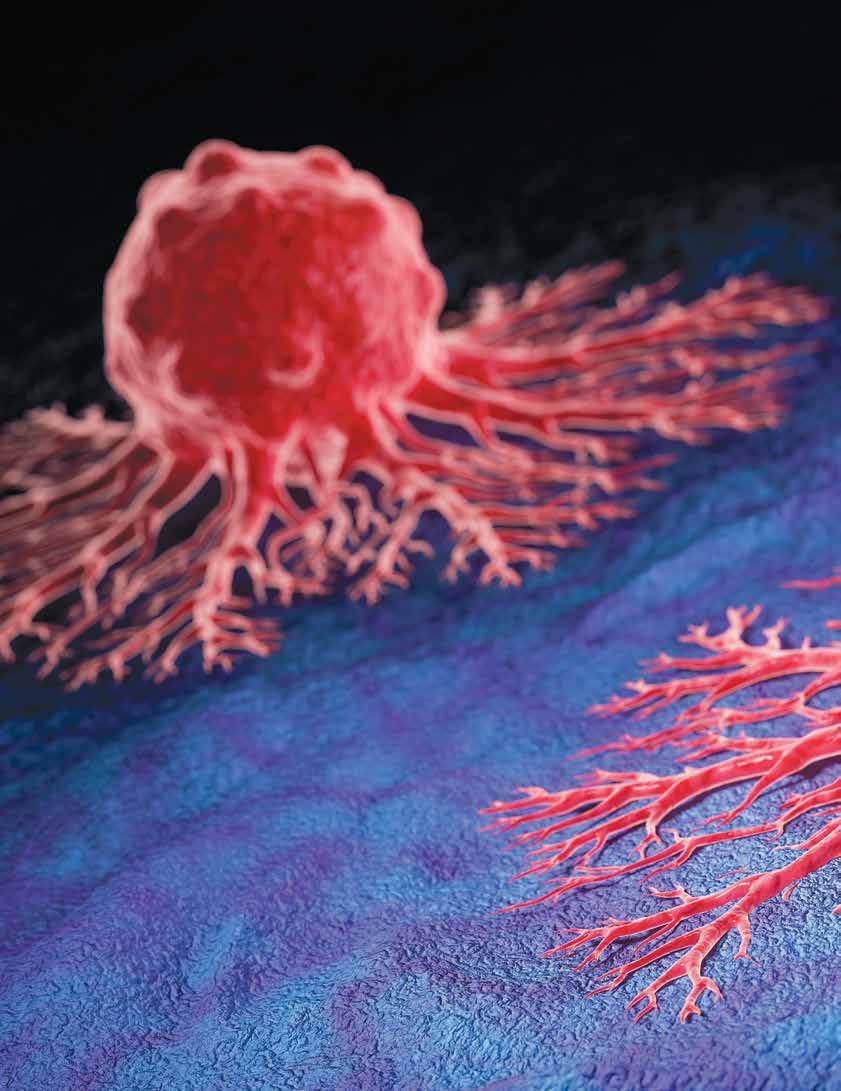
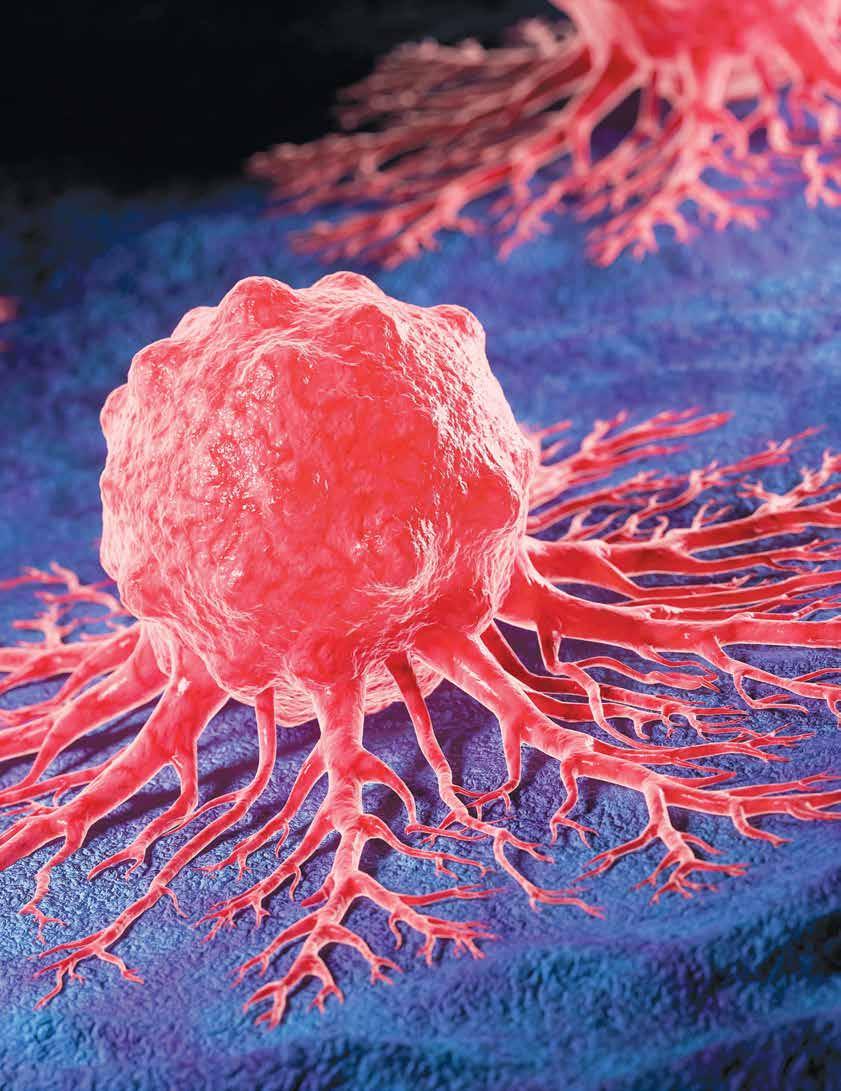
AI in Biotechnology to Tackle Formerly “Undruggable” Diseases
A Q&A WITH PAM CARROLL ’85
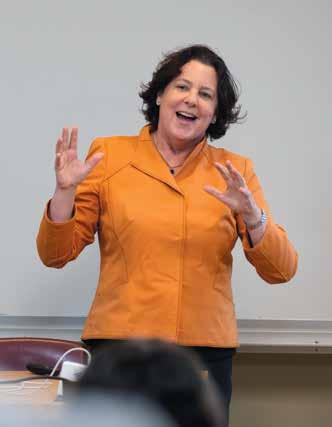
Pam Carroll is a 1985 Saint Michael’s College graduate and Board of Trustees member whose distinguished career in the sciences led to her current role exploring the use of AI in biotechnology. Carroll received her Ph.D. in cell biology and did postdoctoral work in genetics. After being inspired by the Human Genome Project in 2000, she joined a pharmaceutical company making advances in genomics. About a decade ago, Carroll pivoted back to biotechnology and moved to the business side. She said this shift allowed her to move into the high-tech world of AI without being a computer scientist or an AI expert herself. She applies skills such as a deep understanding of drug development and disease biology, along with business knowledge, to her position.
How is artificial intelligence currently showing up in your work, from research and discovery to decision-making or commercialization?
My career has always been fueled by the desire to solve “unsolvable” problems. I entered the field of AI drug discovery just as the industry reached a historic tipping point: the solution to the protein-folding problem called AlphaFold. For decades, predicting how a protein folds into its 3D shape was a baffling scientific mystery. With the team that discovered AlphaFold—which earned the 2024 Nobel Prize in chemistry—we launched Isomorphic Labs in London. Our mission is to build AI systems that will revolutionize the development of new medicines and the understanding of diseases. Traditionally, finding a single drug candidate has been like searching for a needle in a haystack—except the haystack is the size of a galaxy.
Pam Carroll ’85 speaks to students on campus.
At IsoLabs, we use an AI drug design engine to simulate trillions of molecular interactions in silico [via computer simulation]. This doesn’t just speed up the process; it allows us to tackle “undruggable” disease targets that were previously unapproachable by human researchers. IsoLabs is currently on track to begin its first clinical trials of an AI-designed drug by the end of 2026. Most recently, I joined a venture capital firm to build future AI-biotech companies.
Where has AI had the greatest impact in biotech so far?
AI will eventually improve the speed and quality of new medicines, as well as lower costs to the healthcare system. The field is not there yet, but is moving rapidly. We still rely on expensive and slow lab experimentation to test the accuracy of our AI models. In the next few years, scientists should be able to create truly foundational models where a drug can be designed in a month, not four to eight years.
How do you see AI reshaping biotech innovation over the next decade?
While AI has achieved landmark moments in protein design and chemical synthesis, it faces a steeper climb in disease biology, where the sheer multiscale complexity of living systems and the inherent noise of biological and clinical data remain formidable hurdles. I expect in 10 years, we will have a much deeper understanding of disease biology.
Do you think AI lowers barriers for biotech startups— or raises the stakes?
Generalized AI tools for drug discovery will eventually be commoditized. To succeed, the next generation of biotech will leverage AI tools and deep data integration, enabling scientists to have a singular focus on solving specific problems. If we can design drugs quickly and at less cost, a team can test many more hypotheses. This will reduce the currently high failure risk of drug development.
Biotech already carries ethical complexity. How does AI amplify those responsibilities?
At the forefront of AI integration in biotechnology, data security and algorithmic integrity must be considered. Some AI tools learn from personal genetic and clinical
info, so we have rock-solid legal guardrails to protect privacy and ownership. Furthermore, the risk of algorithmic bias poses a significant threat to equitable healthcare. The industry has to be completely transparent and we must ensure the data we’re using is as diverse as the patients we’re trying to help.
AI wasn’t part of the curriculum when you were a student—how did your education at Saint Michael’s prepare you to adapt to transformative technologies?
Saint Michael’s liberal arts education cultivated in me an intense curiosity to imagine the possible. In this new era, the most critical scientific skill isn’t data processing—it’s the human curiosity required to frame the right hypothesis.
Which skills or ways of thinking from a liberal arts education have proven most future-proof in your career?
While my career is rooted in science, introductory economics and finance courses provided tools that allowed me to pivot to business leadership. Beyond the classroom, the mentorship and close faculty interactions at St. Mike’s instilled a sense of professionalism that is the cornerstone of leadership.
This article has been condensed for space. Read the full Q&A here: smcvt.edu/magazine
Utilizing AI in the Army’s Drone Program
A Q&A WITH MARY FALCIGNO ’15
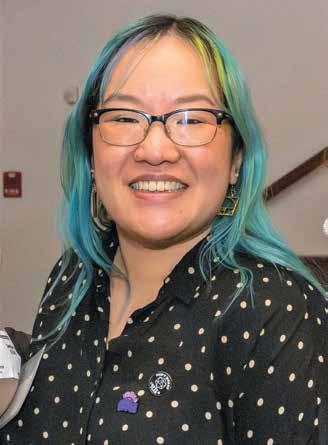
Mary Falcigno ’15 was a Math major and Computer Science minor at Saint Michael’s College when she became interested in coding. She began her career as a computer scientist leading data analytics and AI development projects, eventually earning her master’s degree in data analytics. An interest in federal service led her to the U.S. Army, where she works at an elite research and technology hub, DEVCOM (U.S. Army Combat Capabilities Development Command) in the DEVCOM Armaments Center. She is a project officer for the counter-unmanned aerial systems (C-UAS) project—essentially detecting and mitigating unauthorized or enemy drones— where she oversees cost, schedule, and performance while communicating with stakeholders across organizations.
To the extent that you can share, in what ways have you utilized artificial intelligence (AI) and machine learning (ML) in your role as a computer scientist in the U.S. Army?
In the C-UAS space, AI/ML has played a major role in keeping our technology fast, smart, and adaptable. As the Army, we have been exploring all the ways this type of software can make our current systems more effective and efficient for our warfighters. At the development level, using AI/ML for tasks such as summarization or writing unclassified code has been a time-saver!
How is AI reshaping the approach to C-UAS as well as data science and analytics?
The data science and data analytics realm is an easy starting point, both for C-UAS and other technical fields. In short, if we want good AI/ML, we need good data and tools for analyzing that data. So we have been working heavily on data standardization and wrangling to have the best available data for our AI/ML developers. For drone detection and mitigation, it’s about staying up to date with what is being done by our adversaries and developing our software accordingly.
The U.S. military is often on the forefront of developing and using new technologies. For those who are interested in where a career in STEM [science, technology, engineering, and math] could lead, what is it like to work at DEVCOM AC?
DEVCOM Armaments Center (DEVCOM AC) is definitely a cool and unique organization to call my workplace! We are working on innovative, next-level tech that will help protect soldiers in the future. Sometimes, it feels like we get to be mad scientists and make science fiction into reality. The collaborative and innovative environment that is fostered by being at a research lab is one of the most interesting aspects of my work.
How are you able to keep up with the rapid acceleration of change, and what qualities have prepared you to do so?
Building a strong network has been key to keeping me in the know with all the ever-changing tech. Over the years at DEVCOM AC, I’ve met and connected with such a range of other computer scientists, engineers, and leaders. Maintaining those connections has given me vectors for asking questions and receiving information that I would have missed out on otherwise.
I am always curious and have no problem asking questions! Someone once told me to never call my questions silly or stupid; that wires the brain to trivialize your own curiosity and learning.
How important do you think it is to have ethical use discussions with regard to AI?
I think it is definitely crucial. What we do, particularly at DEVCOM AC, impacts a wide range of lives, both military and civilian. The biggest concern for us is the validation and verification of AI/ML’s outputs. If we are using these tools to make major decisions for the Army, we need to know that the information is not grossly incorrect or skewed. Techniques and methods [addressing] this are a constant source of work.
You are a proponent of STEM careers and have used your time to mentor others on their STEM journey. Why is that important to you?
Much of my passion for mentoring others through their STEM journey stems (pun intended!) from providing what I feel I lacked. Many of my mentees are other women of color, and many [are first-generation students] with no foundational guidance for how to build a network, plan a career, or find opportunities.
In what ways did your experience at St. Mike’s influence the life and career you have now?
One of my biggest non-classroom takeaways from St. Mike’s was about service to others and outreach. [With respect to] my career, I had such strong, passionate, and intelligent professors throughout my time at St. Mike’s, it was hard to not also feel that way about my education and learning.
This article has been condensed for space. Read the full Q&A here: smcvt.edu/magazine
Amid Changes Foundations Endure
BY APRIL BARTON
Jerry Swope
he times they are a-changin’.
That Bob
Dylan lyric was penned in a time of social unrest 63 years ago during the Civil Rights movement and while the country was enmeshed in the Vietnam War. These days, there are two major conflicts on the continents of Europe and Asia, civil wars waging in Africa, and political differences boiling over in this country as well as all over the world. At the same time, a powerful technological leap in the form of artificial intelligence (AI) has the potential to radically change the working world— and the academic world.
It can feel disorienting, the speed of change. And yet, some things remain steadfastly true.
Saint Michael’s College has persisted for 122 years, through previous world wars, social upheaval, and massive technological leaps, and it continues to provide students with the grounding, skills and abilities, wisdom, and character to meet the needs of the time.
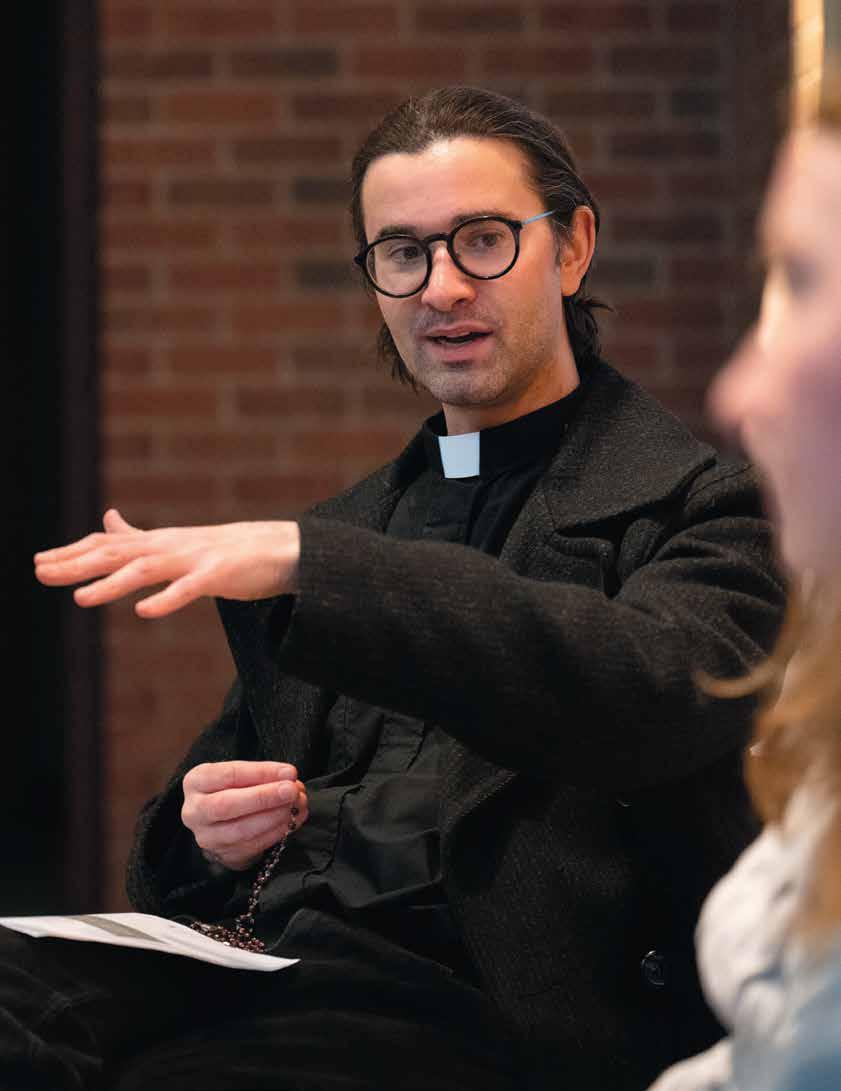
“In times of rapid growth and change, I think people are looking for their compass to guide them so they don’t lose the sense of themselves in all sorts of things that are happening around them,” offered Fr. Michael Carter, SSE ’12, director of Campus Ministry.
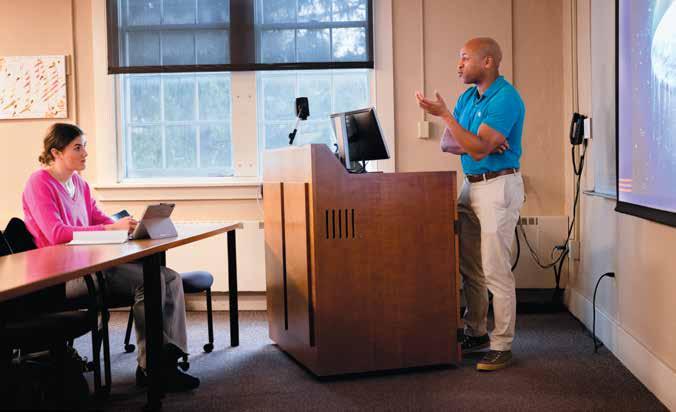
Stephon Boatwright, assistant professor of political science and international relations, notes that change can create positive progress.
“In times of constant change and societal unrest, it is easy to focus only on instability, but rapid change also reminds us that the future is not fixed,” he said. “The same forces that create uncertainty also create space for renewal and reform.”
As students prepare to meet the moment, navigating change and societal shifts, Saint Michael’s College continues to provide an enduring foundation upon which students can rely. Like a compass, the school strives to point students in the direction of their true north.
Below are grounding values and abiding foundations that Saint Michael’s College offers no matter the shifting nature of the times.
RESILIENCY CULTIVATED THROUGH CONFLUENCE OF SKILLS AND VALUES
The particular blend of skills the College fosters prepares students to be resilient leaders in times of uncertainty, according to Boatwright.
“For students at Saint Michael’s College, the foundations they can rely on are the habits of critical inquiry, ethical reflection, and civic engagement that a liberal arts education cultivates,” he said. “Those skills allow them to navigate uncertainty thoughtfully rather than react to it.”
Photos:
“In times of rapid growth and change, I think people are looking for their compass to guide them so they don’t lose the sense of themselves....”
— FR. MICHAEL CARTER, SSE ‘12
Stephon Boatwright, assistant professor of political science and international relations presents a lecture in his class Populism, Radicalism and Extremism.
Boatwright said Saint Michael’s College excels in its commitment to forming students who think seriously about ethical responsibility and the common good. “The College’s Catholic social tradition encourages students to ask not only what is possible, but what is right,” he said. And despite shifts in the cultural climate, he said some principles remain remarkably constant: “Ideas such as human dignity, honesty in inquiry, respect for others, and a commitment to the common good have endured across generations and intellectual traditions.”
STRONG SENSE OF BELONGING
Due to the Edmundite values that prioritize inclusion, and to the smaller nature of the school affording more direct interaction between students and faculty and staff, Carter says community connection at St. Mike’s is one of its most extraordinary characteristics.
“There’s lots of great opportunities to be present with one another, to connect with one another, and it’s based on this more universal sense that everybody here is a person of importance, is a person of value, and has something to contribute,” he said.
The College exposes students to a wide range of perspectives as they encounter people with different backgrounds, beliefs, and experiences, said Boatwright. “Learning to engage those differences respectfully and thoughtfully gives students the tools to navigate complex social questions without retreating into easy answers.”
PURPOSE AND MEANING
“The cultural tenor that we’re in now— the 21st-century United States in Vermont, even on Saint Michael’s College campus—might be moving in a direction away from a more traditionally understood notion of religious faith or religious practice. [However,] people are still searching for meaning; they’re still searching for their place or their role,” Carter said.
Because of its Catholic and Christian foundations, St. Mike’s is a place where—regardless of individuals’ faith background—conversations about meaning, spirituality, and purpose naturally occur, according to Carter.
“My faith community teaches that everybody is designed for a particular purpose … and being able to help people unpack and sort of discover who they are and what that is—St. Mike’s provides a great foundation for that,” he said.
In an increasingly digital world, Carter also finds that students are hungering for in-person interactions, opportunities for spiritual growth and development, and the ability to encounter the divine in nature in the beautiful landscapes that Saint Michael’s provides on and off campus.
A LIFE OF SERVICE—IN THE PRIVATE AND PUBLIC SECTORS
A commitment to serving others is a long-standing tradition at Saint Michael’s College—through the MOVE (Mobilization of Volunteer Efforts) program that provides volunteer opportunities for students, Peace Corps Prep, connections to the U.S. State Department, and a variety of alumni in public service who generously share their career experiences and time with current students.
“I think more people than not, they want to help out in some way, they want to contribute, they have a desire in their heart for justice, for helping out, for being part of wider things—but they don’t always know how to get started,” Carter said.
The College helps them get started by connecting them to an abundance of ways to serve. Carter says he has seen students forge career paths that began with volunteering at St. Mike’s.
This desire to serve extends to public service.
“At Saint Michael’s, [service] begins with encouraging students to see public life not as something distant or discouraging, but as a space where their engagement can make a difference,” Boatwright said. “When students study political institutions, meet public officials, complete internships, or observe policymaking firsthand, they begin to see how civic participation operates beyond headlines and partisanship.”
AN EMBRACE OF POLITICS
Politics may be considered taboo to discuss at the dinner table in mixed company these days, but at St. Mike’s, students are encouraged to go deep to understand the principles upon
which our country was founded, how it evolved, and how it functions today. Boatwright said that colleges play an important role in preparing students not only to understand politics, but to participate in politics thoughtfully and responsibly.
He said he and his colleagues help students develop intellectual tools to navigate a complicated political environment, learn to evaluate evidence, distinguish argument from rhetoric, think critically about information they encounter, and cultivate civil discourse.
Part of that process involves reflection. “Students are encouraged to examine their own assumptions and recognize how personal experiences and biases can shape interpretation,” Boatwright said. “Developing that awareness allows them to approach political questions with greater humility and intellectual discipline.”
RELIANCE ON INSTITUTIONS THAT PROVIDE A SOCIETAL FRAMEWORK
This year, the U.S. turns 250, and Vermont will attain the same semiquincentennial distinction next year. Americans inherit the responsibility to maintain a representative government of the people, by the people, for the people. It hasn’t always worked perfectly or effectively. The Constitution has endured, though, with 27 amendments and some substantial revisions to correct injustices and omissions—particularly those involving definitions of citizenship, rights, and federal authority, said Boatwright.
He said a strong civic education includes grounding in the constitutional framework, which
includes understanding the structure of government, the role of the three branches, the importance of legal precedent, and the enduring principles found in foundational documents that help students appreciate the institutions that sustain democratic life. Boatwright said this sound understanding helps students sniff out violations and corruption, which is a duty of all citizens.
“What matters most, in my view, is not that a specific document remains untouched for centuries, but that the underlying commitment to democratic governance, rights, and the rule of law continues to evolve,” said Boatwright. “The real measure of a democratic system is whether its institutions can adapt while still protecting the core principles of liberty, accountability, and representative government.”
Boatwright said civic confidence is built through participation rather than observation.
“When [students] study institutions carefully, speak with people working in public service, or take part in internships and community engagement, politics becomes something more tangible and constructive,” he said. “They begin to see that democratic systems are sustained by ordinary people doing difficult work, not just by the loudest voices in public debate.”
St. Mike’s students can feel confident they are getting a strong foundation in the skills and values they need to succeed in shifting times and, perhaps, take the lead in instigating positive change.
Boatwright, for one, is optimistic. He said, “If history teaches us anything, it is that periods of disruption often precede meaningful progress.”
General Joe Dunford ’77
Takes the Helm at CSIS
The Center for Strategic and International Studies (CSIS) is a bipartisan, nonprofit policy research organization based in Washington, D.C., that is dedicated to advancing practical ideas to address the world’s greatest challenges. So it should be no surprise that on March 12, 2026, CSIS named General Joe Dunford ’77 as its next chief executive officer. In this role, he will oversee all aspects of CSIS’s research programming and operations, guiding its strategic direction at what the organization describes as a critical moment—one shaped by competition, technological transformation, and evolving security threats.
It is a fitting appointment for a man whose career has been defined by navigating complexity with clarity of purpose and a strong moral compass. A Political Science major at Saint Michael’’s College, Dunford was commissioned as a Marine officer the year he graduated, 1977, rising rapidly through key leadership, planning, and battlefield postings both domestically and abroad. Prior assignments included service as the commandant of the Marine Corps and the commander of U.S. forces and NATO forces in Afghanistan. He later served as the 36th commandant of the Marine Corps and as the nation’s highest-ranking military officer—chairman of the Joint Chiefs of Staff—under Presidents Barack Obama and Donald Trump, from October 2015 through September 2019.
Those who know Dunford well trace the roots of his character back to his formative years, especially his time at St. Mike’s. In a previous interview with this magazine, Dunford spoke about how his Catholic liberal arts education was ideal preparation for a demanding military career, citing influences from his Saint Michael’s professors and experiences that “shaped the person I am now.” He has recalled a professor assigning students to visit Vermont radio stations and report at town halls on democracy in action—an experience that cemented his interest in political science and provided a foundation for the advanced degrees in international relations he would later pursue at Georgetown and Tufts.
The College’s Edmundite tradition of servant-leadership, moral courage, and commitment to something larger than oneself appears to have taken deep root in Dunford. His advice to today’s students reflects as much: Be open-minded when pondering life and future careers, but in the tradition of Saint Michael’s, seek to make a contribution that is greater than yourself.
As Dunford steps into his new role leading one of the nation’s most influential think tanks, St. Mike’s takes pride in knowing that the values forged on this campus—integrity, purpose, and a call to serve—continue to shape one of America’s most consequential leaders.
Photo courtesy of CSIS
Turning Grief into Light
JAMES KUCZO ’93 AND KEVIN’S AFTERGLOW
Some of the most profound acts of service begin in the deepest places of loss. For Saint Michael’s College alumnus James Kuczo, that moment came with the sudden death of his 17-year-old son, Kevin.
Two days after Kevin’s passing, the community gathered outside the Kuczo family home to grieve together. Standing before a large, hushed crowd, James and his wife Kristen did something remarkable—they channeled their grief into a call to action. “What happened to Kevin was a tragedy,” James told those gathered. “The only bigger tragedy would be if this happened again.”
That night, a mission was born. Rooted in kindness, empathy, and open conversation about mental health, Kevin’s Afterglow has since grown into a meaningful movement that touches young lives at every stage of education. From Buddy Benches installed at elementary schools to mental health awareness programs in middle and high schools, to scholarships
supporting future pediatric mental health professionals, the organization works to ensure that no other family has to experience what the Kuczos endured.
James has spoken at schools, sporting events, and community gatherings, putting a human face on mental illness and challenging the silence and stigma that too often surrounds it. His message is simple but urgent: Be kinder, listen more, and talk openly.
In carrying forward Kevin’s memory, James Kuczo embodies the values at the heart of a Saint Michael’s education—compassion, service, and the courage to make a difference for others, even in the most difficult of circumstances.
To learn more about Kevin’s Afterglow, go to kevinsafterglow.org.
James Kuczo ’93 visiting a classroom. Courtesy photo.
Building More Than a Game
JASON CURRY ’95
For Saint Michael’s College alumnus and Athletic Hall of Famer Jason Curry, basketball has always been about something bigger than the sport itself. In 1999, Curry founded Big Apple Basketball (BAB) in New York City, planting a seed that would grow into one of the city’s most effective youth organizations.
What began as a professional men’s touring team had evolved, by 2003, into a full nonprofit committed to serving individuals, families, and communities across New York and beyond. Today, BAB offers a wide range of programs spanning youth, high school, college, and professional players, along with mentoring and career initiatives that support families and non-athletes alike.
The numbers tell a powerful story. Over 26 years, Big Apple Basketball has served more than 7,000
youth, helped young people earn over 1,000 college scholarships, and built connections with 80 NBA players—reaching communities across 30 states. The organization has also been recognized by the New York Knicks for its community impact and leadership. But perhaps the most telling testament comes from those Curry has touched directly. As NBA legend Allan Houston put it, “Jason holds everyone to a really high standard, and that says a lot.”
St. Mike’s empowers students to go forth and make a difference. Jason Curry is doing exactly that, one young person at a time.
To learn more, visit bigapplebasketball.org.
Jason Curry ’95 (left) giving the peace sign surrounded by Big Apple Basketball players.
Photo courtesy of Jason Curry ’95
Ten Years and Counting
HHH REACHES MAJOR MILESTONE
BY APRIL BARTON
Hope Happens Here (HHH) was started by Saint Michael’s College hockey players
Danny Divis ’17 and Justin McKenzie ’17. For each, deeply personal experiences drove the desire to do something to help student athletes struggling with depression and suicidal thoughts. “There wasn’t really a ton of chatter about mental health in the sports space, and it felt like it could really make a difference,” Divis said.
In 2015, encouraged by the Athletics Department, they put their idea into action during a women’s volleyball game. “We bought a bunch of Sharpies and poster board, printed out a few pamphlets we found online, and set up a table with a small bucket to raise funds,” Divis said. “It’s fun to look back on that moment and see how we grew from there.”
The organization certainly did grow. At one point, there were more than 20 chapters between NE10 and Northeast colleges and high schools across the area.
The Saint Michael’s HHH chapter puts on signature events—such as a basketball tournament for Movember in fall 2025—and brings in the Vermont chapter of NAMI (the National Alliance on Mental Illness) to speak to student athletes. Each team turns at least one of its home games into an awareness game, which includes students giving speeches beforehand and sharing information on mental health resources.
Nicholas Wracker ’26 has been involved with HHH since his first semester and in a leadership role since he was a sophomore. It’s been important to him to help grow the organization’s reach, and he feels honored to follow in the footsteps of Divis and McKenzie, fellow hockey players.
“It’s super cool to be part of a legacy like that … and now have my legacy be part of that legacy,” he said.
Divis and McKenzie didn’t know 10 years ago just how much the group’s mission would resonate with future student athletes.
“It’s really awesome to see how the organization continues to make a difference,” Divis said.
Reflecting upon their time at the College, the pair are grateful for how their idea was received and how as students, they were encouraged and supported in growing it into a vibrant campus organization.
“We have always said that we don’t believe HHH would have been able to evolve into what it became had we not started it at St. Mike’s,” said McKenzie. “St. Mike’s is such a special place to Dan and me, and I wouldn’t trade my experience there for anything else in the world.”
Photo: Jim Rosvold
Justin McKenzie ’17 (left) and Danny Divis ’17 were awarded the Hockey Humanitarian Award in 2017 after creating Hope Happens Here.
Ubuntu Futures
AN EDMUNDITE PARTNERSHIP ROOTED IN SAINT MICHAEL’S COLLEGE
BY ELLEN KANE
Apowerful new Edmundite collaboration—stretching from Selma, Alabama, to Mystic, Connecticut—is reshaping lives and renewing the mission at the heart of Saint Michael’s College. Ubuntu Futures, launched by the Edmundite Missions, offers young Black men facing situational poverty a residential path toward stability through faith formation, therapeutic support, workforce training, and community.
At the heart of the initiative is the African principle Ubuntu—“I am because we are”—a reminder that human flourishing is inherently communal. Rooted in Catholic Social Teaching, Ubuntu Futures provides structure, healing, and opportunity in a context where poverty, violence, and limited educational access can make hope feel out of reach.
What makes this program exceptional is the leadership behind it: two Saint Michael’s College graduates and trustees, each stewarding one of the Edmundites’ major ministries.
CHAD MCEACHERN ’91: CARRYING FORWARD THE MISSIONS’ LEGACY
Chad McEachern ’91, president and CEO of the Edmundite Missions, brings to Ubuntu Futures a vocation shaped by the Edmundite community and by Saint Michael’s. He is a native of Vermont and a lifelong champion of Catholic service. His leadership extends a decades-long Edmundite presence in Selma’s Black Belt, where the Missions provide nutrition, education, social services, and compassionate outreach to families facing significant struggle.
Photos courtesy of Fr. Tom Hoar ’73
“Saint Michael’s changed me, and taught me the importance of giving back,” he said. He believes that Ubuntu Futures is a modern expression of the Edmundite ideal of walking with those most in need.
The program’s earliest results are promising. Its first participant, a 21-year-old from Selma who once lived in fear, addiction, and instability, is now sober, attending college, and experiencing a community centered on healing and purpose. “He told us this program saved his life,” McEachern says. “That is the power of Ubuntu.”
FR. TOM HOAR ’73: ENDERS ISLAND AS A SANCTUARY OF RENEWAL
At the residential heart of Ubuntu Futures is St. Edmund’s Retreat on Enders Island, directed by Fr. Tom Hoar ’73—an Edmundite priest whose own calling began with formative mission trips during his Saint Michael’s days.
Enders Island is an 11-acre spiritual refuge in Mystic, Connecticut, known for its peaceful grounds, seaside chapels, gardens, recovery programs, and sacred arts offerings. Originally a private Arts and Crafts estate, it was gifted to the Society of St. Edmund in 1954 to serve as a place of retreat and spiritual formation. Since then, it has become a place where thousands come seeking renewal, healing, and a deeper relationship with God.
Fr. Hoar has spent nearly three decades cultivating this environment of hospitality and transformation. As president and CEO of St. Edmund’s
Retreat, and as director of vocations and clergy formation for the Diocese of Albany, he has shaped Enders Island into a nationally recognized center for spiritual growth, recovery, and sacred arts.
Ubuntu Futures participants live within this prayerful community. They attend Mass, work with mentors, participate in recovery and formation programs, and begin to build lives marked by dignity rather than fear.
“Enders Island is holy ground,” Fr. Hoar says. “It is a place where people from all walks of life find healing and hope.”
TWO ALUMNI, ONE EDMUNDITE MISSION
This initiative represents something rare and deeply meaningful: Two Saint Michael’s College graduates— two trustees—each leading a major Edmundite ministry, joining together in one mission. McEachern is carrying forward the Missions’ foundational service to the poor. Fr. Hoar is sustaining a haven of healing, spiritual growth, and sacred beauty.
Separated by geography but united in spirit, their leadership brings together the full arc of the Edmundite charism: compassion, justice, hospitality, and education.
McEachern often imagines the program’s long-term potential. “I hope one day a young man from Selma completes this program and becomes a student at Saint Michael’s,” he says. “That would be a beautiful full-circle moment.”
Ubuntu Futures is more than a program—it is a testament to what
Saint Michael’s College instills in its graduates:
• A commitment to justice
• A life of service
• A belief in human dignity
• A willingness to walk with others on their hardest journeys
Through the partnership between Enders Island and the Edmundite Missions, that Saint Michael’s spirit now stretches across states, across communities, and across lives.
Ubuntu Futures represents Edmundite work for the modern world— and two Purple Knights are leading the way.
Fr. Tom Hoar ’73 (left) faith in action.
TRIP TO THE BORDER
BY RYLEE ANDERSON ’27
This past winter, a group of 13 from Saint Michael’s College traveled on a 10-day academic study trip to the vast desert where migrants’ remains had been found.
The activity was one of the ways students explored the experiences of people who cross the southern border into the U.S. The trip, connected with the Migrant Journey class from the fall semester, was coled by Allison Cleary, professor of digital media and communications, and Omara Rivera-Vázquez, director of the Criminology program.
The group joined artist Alvaro Enciso, who places crosses as memorials in the desert around Tucson, Arizona, for migrants who died on their journeys across the border. Enciso previously visited the College in 2023 to share how the project dignifies the lives of those who might otherwise go unacknowledged.
“All of these people were somebody’s sister, mother, brother, or uncle,” said Evie Mercier ’26, a
Sociology and Anthropology major. “Everyone deserves to be known.”
One of the main goals of the trip was to gain insight into the lived experiences of the immigrant community.
“I have been watching the news around immigration for years, and I have been concerned about how immigrants have been reduced to statistics and reframed as criminals and threats,” Cleary said. “Recognizing human dignity was at the heart of the course and the trip.”
Several years ago, Cleary met Saint Michael’s alumna Mary Joan Picone ’87, a social worker who uses her vacation time to do service work along the southern U.S. border.
In 2023, “funding from the Institute for Global Engagement allowed me to do a bit of an exploratory trip,” Cleary said. “It made me realize how much is happening at the southern border.”
Cleary partnered with Professor Rivera-Vázquez, then the director of the Institute for Equity and Justice,
to begin mapping out a course. “Trying to figure out what the best framework to talk about these issues is, we landed on Catholic Social Teaching,” Rivera-Vázquez said.
Catholic Social Teaching has seven core principles, which are also at the heart of Saint Michael’s education and heritage: life and dignity of the human person; call to family, community, and participation; rights and responsibilities; option for the poor and vulnerable; the dignity of work and rights of workers; solidarity; and care for God’s creation.
In the end, 16 students joined the preparatory fall semester course, and 10 went on the trip. Sarah Gardella ’26, a Criminology and Psychology double major, was among them. She intends to go to the University of Maine School of Law next year. “In Maine, we have Somalian refugees in different communities,” Gardella said. “I wanted to be more aware of the processes that they go through.” She said that legal
services, particularly free or low-cost options, are needed in the immigrant community.
The trip started in Tucson, where the group studied, hiked through Saguaro National Park, and visited a local church where the sanctuary movement began. The group explored the physical border in Nogales, Arizona. By day six, they had a view from the other side in Mexico.
They met a variety of people throughout their journey. “The most impactful was hearing about the individual stories of people’s journeys, like seeking asylum, getting citizenship, getting travel visas,” Gardella said.
Cleary said she and RiveraVázquez knew the stories that came up on the trip would sometimes be difficult to hear. Despite the tough topics, the people continually inspired the students, faculty, and staff.
One boy they met at a migrant shelter had lost his leg after falling from La Bestia, a freight train that
migrants sometimes use to travel north from southern Mexico. However, the boy seemed to be living his life with joy. “He was on the playground,” Mercier said. “Community can blossom in hard times; people just keep persevering and building connections. I think that’s really beautiful.”
What comes after such a meaningful trip?
Since returning, the students have been working to spread knowledge and create change in their own lives and communities. The trip was also a learning experience for the professors leading the excursion. Cleary and Rivera-Vázquez would like this trip to bring a new lens to conversations on campus.
“I think that’s the hope, that we can begin to think about how do we provide better support to our own students, staff, and employees in our community who might be impacted by what’s going on in the country,” Rivera-Vázquez said.
Opposite page: Saint Michael’s College students on a December 2025–January 2026 academic study trip to areas surrounding the southern U.S. border, with artist and activist Alvaro Enciso, walk to place a cross in the Arizona desert. Top right: Enciso carries a notebook containing information about migrants, both named and unnamed, who died in the Arizona desert after crossing the U.S. border from Mexico. Bottom right: Saint Michael’s College community members in front of a mural during a 10-day academic study trip to Arizona and Mexico.
Photo courtesy of Professor Allison Cleary
Photo: Olivia Miller-Johnson ’26
Photo courtesy of Professor Allison Cleary
From Saint Michael’s College to Olympic Gold
BY NATHANIEL LAUZON
As an assistant coach of the U.S. Women’s National Ice Hockey Team, Brent Hill ’04 traveled to the February Milano-Cortina Winter Olympic Games, where the team captured gold in the final match (defeating Canada in overtime, 2–1).
His journey to the gold medal game at the Olympics can be traced back to his time at Saint Michael’s College, where he experienced opportunities, success, and community that helped form him.
After playing junior hockey in Canada as a teenager, Hill stepped away from the game and began working to support himself. But the thought of lacing up his skates again never left his mind. Hill met with program directors across the Northeast and was told that balancing a collegiate hockey career and a full-time job would not work.
This changed when he met former Saint Michael’s hockey coach Lou DiMasi. DiMasi not only offered Hill the opportunity to play for St. Mike’s, but also convinced him that the balancing act was possible. And Hill did it, logging nearly 30 hours per week at Costco while studying and competing on the ice.
Hill found a strong support system in all aspects of his college experience. The sense of community that he experienced at St. Mike’s became a pillar of his coaching philosophy. “Those lessons tie directly into being a coach … how important people and relationships are,” Hill said.
Hill majored in Business Administration at St. Mike’s. He says the most important lesson he learned was time management, as he learned how to maximize every minute. He uses that lesson in coaching at the elite level. “It taught me to take any time I have and use it effectively,” Hill said.
Coaching roles at Rensselaer Polytechnic Institute, Merrimack University, and Quinnipiac University, where he still serves as an assistant coach, helped prepare him for Olympic coaching.
Though he had experienced coaching in intense situations before, nothing could compare to the atmosphere of the Olympics. “That gold medal game was the loudest environment I’ve ever been in,” Hill said. But after watching Megan Keller score the game-winning goal, everything seemed to go surreally quiet. “And then the emotion just hits you,” Hill said.
Hill has been named the U.S. Women’s National Team head scout for USA Hockey. He will be responsible for identifying, evaluating, and recruiting potential players.
Hill’s success isn’t unique among St. Mike’s grads, he said—anyone who graduates from the College can succeed. “You have everything you need around you to achieve your goals,” Hill said. “You’re at the place that can set you up for the greatest success in life, and you have all the resources you need right there.”
’27
Brent Hill ’04 holds his olympic gold medal in Milan, Italy.
Athletic Community IMPACT
BY MICHELLE JORDAN, P’20
Saint Michael’s College was named the NCAA Division II recipient of the NCAA/ Minority Opportunities Athletic Association (MOAA) Opportunities and Impact Award—a national honor that recognizes athletic programs creating meaningful environments of belonging, well-being, and student leadership. For the Purple Knights, the recognition affirms something already deeply embedded in campus life: impact that extends far beyond competition.
At Saint Michael’s, student athletes don’t just show up to play—they show up for one another. Through the Student-Athlete Advisory Committee (SAAC), they lead conversations on inclusion and well-being, while initiatives like Hope Happens Here, in partnership with Morgan’s Message, foster open dialogue about mental health.
These students’ reach extends into communities near and far. Some travel during breaks with MOVE (Mobilization of Volunteer
Efforts), supporting communities across the country. Others build lasting one-to-one connections through SMC Buddies or serve locally with Saint Michael’s Fire and Rescue, a student-run volunteer organization.
Women’s ice hockey player Annika Lavender ’26, a leader in SAAC’s diversity, equity, and inclusion efforts, sees the award as evidence of that shared commitment. “It reflects the way our student athletes show up for each other,” she said. “The work we’ve done has been intentional and rooted in care.”
Guided by the Athletic Department’s three C’s—community, classroom, and competition—student athletes regularly take part in events like the Burlington Pride Parade and Festival, the Making Strides Against Breast Cancer walk, and mental health awareness games, using their platform to build connection and raise awareness.
Partnerships such as that with Team IMPACT further advance the mission, connecting teams with
Layne Doherty ’27 (center), Best Buddies president, working on a project.
children facing serious illness and creating relationships grounded in compassion and purpose.
Saint Michael’s will be recognized during the national MOAA Symposium in Las Vegas on June 7–10—but the true impact is already happening every day, in the ways student athletes lead, serve, and strengthen the communities around them.
Photo: Lara Scott
Photo courtesy of Layne Doherty ’27
St. Mike’s athletes were among a group of students who traveled to Immokalee, FL to help build houses for migrant worker families.
FACULTY AND ALUMNI
Bunny and Bug Join the Spider Dance Party
By
Allison Lazarz ’25 (self-published)
Bunny and Bug are back for another spirited adventure! When they stumble upon a spider’s enchanting dance, the two friends discover the joy of trying something new—even when it feels a little scary. With Lazarz’s signature bouncing rhymes and heartwarming themes of friendship, courage, and inclusion, this charming picture book gently encourages young readers to embrace the unexpected, step outside their comfort zone, and dance joyfully to their own rhythm.
Rooted in the trusted CASEL (Collaborative for Academic, Social, and Emotional Learning) framework, this practical K–5 guide helps educators foster classrooms where every child feels seen, safe, and ready to learn. Simonyi and coauthor Tania Campanelli offer a wide range of responsive social and emotional learning (SEL) activities, rubrics, checklists, and compassionate classroom management strategies designed to build self-awareness, emotional regulation, and strong peer relationships. A bridge between social–emotional learning and everyday teaching, this resource empowers teachers to meet the whole child and help every student genuinely thrive.
Four Jarves Street
By Jeffrey Govoni ’87 (independently published)
Set against the rugged, seasonal rhythms of Cape Cod in the 1970s, this atmospheric coming-of-age memoir explores how the stories we inherit—family legends, local lore, and cherished memories—quietly shape who we believe ourselves to be. With vivid recollection and thoughtful reflection, Govoni traces the tender, difficult process of separating memory from myth, and discovering an identity not defined by the past, but chosen in the present.
Behold, the Garden
By Greg Delanty, Professor of English, with contributions from Young Writers Project (Fomite)
A celebration of the natural world and the voices that speak for it, Behold, the Garden unites the work of young writers with the poetry of Guggenheim Fellow and Saint Michael’s College Poet in Residence Greg Delanty. Rooted in a deep environmental consciousness, the collection weaves individual voices into a chorus of concern and wonder—intimate yet urgent, local yet universal—asking readers to look closely at the earth we inhabit and the future we are shaping together.
When Basketball Was a Game
By Mike Hickey ’71 (self-published)
In 1961, an 18-year-old named Don Ryan stepped into an unexpected role as founding coach of a Salvation Army basketball program in Hempstead, New York. Over six decades, his program recorded more than 3,000 victories and produced pro athletes, CEOs, and community leaders—all while placing character and education ahead of wins. Hickey’s tribute to Ryan is an inspiring reminder that the greatest coaches measure success not in trophies, but in lives transformed.
Conscientious Objectors at War
By Gary Kulik ’67 (Texas Tech University Press)
The first book exclusively devoted to conscientious objector medics in Vietnam, Conscientious Objectors at War tells their stories against the backdrop of America’s pacifist churches—whether they were Quakers, Mennonites, Catholics, or secular humanists. A conscientious objector medic himself, Kulik weaves his own experience into accounts of fierce combat, fleeting honor, and ever-present death—a deeply personal and long-overdue reckoning with conscience, faith, and war.
In Deep Water
By Michael Tougias ’77 (Macmillan Press)
When three friends fishing for red snapper in the Gulf of Mexico watch their boat sink 15 miles offshore, they are left clinging to a cooler with no way to call for help—and with sharks circling below. Over 28 harrowing hours, they battle hypothermia, jellyfish stings, and ever-present danger in this gripping true survival story from New York Times bestselling author Michael Tougias.
Living Your Wisdom Years Now: Practical Insights and Practices for Every Stage of Life
By Peter Vajda, PhD ‘65 (self-published)
Wisdom doesn’t have to wait. Drawing on psychology, neuroscience, somatic awareness, and lived spirituality, Vajda invites readers to see wisdom not as something tied to age, but to how consciously we engage with our emotions, relationships, purpose, and daily life. Through short chapters, practical exercises, and reflective questions, this thoughtful guide helps readers move from autopilot to presence—a steady companion for anyone ready to live with greater clarity and compassion.
Saint Michael’s College held its 119th Commencement on May 10, 2026, celebrating over 300 graduates. Keynote speaker Shabana Basij-Rasikh—who fought for her own education under Taliban rule and founded Afghanistan’s first boarding school for girls—urged the Class of 2026 to find their cause and act with urgency. President Plumb reminded graduates that judgment, moral courage, and integrity cannot be downloaded—only lived.
More available online at smcvt.edu/magazine
Photos: Jerry Swope and Teddy Vretzakis ’29
COMMENCEMENT SPEAKER AND HONORARY DEGREE RECIPIENT
Shabana Basij-Rasikh
Honorary Doctor of Humane Letters
As a child in Kabul, Basij-Rasikh risked her life attending secret schools under Taliban rule. That defiance became her life’s work. She cofounded SOLA—the School of Leadership, Afghanistan—while studying at Middlebury College, creating that country’s first and only boarding school for Afghan girls. When the Taliban returned in 2021, she personally led her entire school community to safety in Rwanda, where classes resumed within days. SOLA continues educating Afghan girls in exile through its online academy, SOLAx, and a permanent Rwanda campus is set to open later this year. A graduate of Middlebury College and University of Oxford, Basij-Rasikh has received the Malalai Medal, Afghanistan’s highest national honor, and been recognized by Forbes, Rolex, and National Geographic for her extraordinary leadership.
HONORARY DEGREE RECIPIENT
Donald R. “Don” Dion Jr. ’76
Honorary Doctor of Humane Letters
A Saint Michael’s alumnus, attorney, and entrepreneur, Dion built multiple financial firms over four decades before retiring in 2023. His philanthropy has left a lasting mark on campus—most visibly through the named gift for the Dion Family Student Center. He has also provided scholarship support and served four terms on the Board of Trustees.
HONORARY DEGREE RECIPIENT (posthumous)
Richard E. “Rich” Tarrant ’65
Honorary Doctor of Humane Letters
Tarrant, who died in 2025, founded IDX Systems Corporation, a pioneer in healthcare IT that began trading on the New York Stock Exchange in 1995. A trustee and major benefactor, he is also remembered as one of Saint Michael’s greatest athletes—an All-American basketball player whose #22 jersey is retired and who was drafted by the Boston Celtics in 1965.
Letter from the Alumni Board President
Dear Fellow Purple Knights,
For those of you reading this, spring has sprung and you are getting into the swing of summer. Which is refreshing, because as I write this note, spring feels eons away. We currently have lots of mud. But I know that soon, real spring and summer will be here and campus will be in full bloom, gearing up for students to return in just a few short months.
In this season of mud, you can literally and figuratively find yourself stuck in a rut. Thankfully, the alumni community is here to support you. We were reminded of this at the Career Connections event in March, when Ted Brady ’00 spoke about the benefits and strengths of the alumni network and the importance of networking. It was a wonderful reminder of the support and reach of the alumni community and how those connections can help you get unstuck.
The theme of this magazine issue is technology and artificial intelligence. AI is rapidly changing how students and alumni work and learn. Although AI can make us more efficient and instantly generate a ton of information, the most important aspect of it is not the information, but having the judgment and skills to navigate that output. It’s working alongside technology, and you are a crucial element of that process. Saint
Michael’s College has helped us grow and develop those human skills, like being able to disagree with someone thoughtfully and still work alongside them, having the courage to stand up for what is right, and having the empathy to understand the feelings of others. That is knowledge that can’t be downloaded, and we are equipped to meet these new challenges and changes head-on.
The Alumni Board has been busy this spring. We have had some great events on campus and locally in your communities. We are in the process of vetting and voting in new members and eager to see how these new team members change how we work.
As always, we’d love to hear from you. Get in touch with us at alumni@smcvt.edu. View your local events on the Events Calendar from the Outcomes section of the St. Mike’s website. Hope to see you soon!
With gratitude,
Jillian Kasierski Charest ’04
President,
Saint Michael’s College Alumni Association
CLASS NOTES
1967
(1.) Legendary high school coach and Saint Michael’s College men’s basketball standout Richard “Dick” Falkenbush was inducted into the Vermont Sports Hall of Fame on April 25. Part of the hall’s 13th induction class, Falkenbush was recognized for a lifetime of achievement on the court and his foundational impact on Vermont youth sports. His career milestones include being a prolific scorer for Saint Michael’s, tallying 1,431 points in just three seasons, including a historic 51-point game in 1967. That same year he was selected in the ninth round of the NBA by the St. Louis Hawks. He is best known in Vermont as dedicating more than 40 years to secondary education and athletes, including 21 seasons as boys’ head basketball coach at Burlington High School, where he secured 276 wins and the 1996 state championship.
(2.) Corky Meserole and wife Marty offering their thumbs up on classmate Tom Freston’s popular new book (at their home in Oregon).
(3.) Rich Feeley, who lost his left leg above the knee in a 1970 rugby injury, went on to compete in regional and national disabled sports, including downhill skiing, golf, and wheelchair racing. He and his wife, Terri Masters ’81, are retired in Ocala, Florida, and Vermont, recently celebrating their 58th anniversary at their Malletts Bay camp. Their son, Brad Feeley ’91, is also a St. Mike’s graduate.
1968
(4.) Louis Giancola: My wife Mary and I enjoy having lunch with my former music professor and Glee Club director, Dr. William Tortolano. Although he will be 96 on January 25, he continues to live independently and make music. His next Christmas concert in the Chapel at St. Mike’s will be on December 21. We plan to be there to sing along with other alumni and friends.
He is a true living legend and a treasure that the College still has.
1972
(5.) John Quinn: No special occasion! Just reaching out to say hello to my classmates! I’m living in a retirement community in Florida, playing golf almost daily and also playing bridge. I’m in pretty good health and enjoying a happy retirement from 31 years as a district attorney in Vermont. I would love to hear from some of my classmates.
1977
The Center for Strategic and International Studies (CSIS) announced that retired General Joseph F. Dunford, who served as the 19th chairman of the Joint Chiefs of Staff, has been named its next chief executive officer. General Dunford will assume the role on May 7, 2026.
1981
Bob Hammerl: My wife Michelle and I hosted some local St. Mike’s friends here at our home in Waterbury, VT.
(6.) From left to right: John Remy, Tina Madkour Companion, Gail Sullivan ’83, John Puleio ’82, Denise Dean ’80, Dan Casey, Bob Hammerl, Ray Broderick ’79. Glenn Benbenek: The fourth Floor Alumni Hall gang had their second annual reunion in Naples, FL in May 2025. The weekend was filled with fun and laughs… beverages while floating in the Gulf, dinner at Mercato, and a booze cruise boat tour in Naples Bay. We clean up well after the beach.
(7.) Pictured on the beach: Mike Morrissey, Marc Koczwara ’80, Jimmy Wilson ’80, Fred Stevenson almost ’81, Bob Budnick, Peter McGarry, Glenn Benbenek, Paul McGrath.
1982
(8.) Michael Petridis: I was honored to be invested as an Archon of the Holy Orthodox Church of the ancient Order of Saint Andrew, as conferred by His AllHoliness Ecumenical Patriarch Bartholomew
in a formal ceremony at the Holy Trinity Greek Orthodox church in Manhattan, officiated by His Eminence Elpidophoros, Greek Orthodox Archbishop of North America plus seven visiting Metropolitan Hierarchs. A truly humbling experience.
1986
(9.) Suzanne Prentiss: This past October I was named the 2025 NH Legislator of the Year by New Futures, a bipartisan advocacy group focused on healthcare, childcare, and maternal and behavioral health. I also received the
Peter H. Burling Legislative Achievement Award. I am now serving in my third term as a state senator.
(10.) Tom O’Keefe: Dave Dellea invited St. Mike’s friends to his house for a dinner in December where we had a great time trading stories. L to R: Dave Dellea, Tom O’Connor, Steve Lucey, and Tom O’Keefe. Also in attendance were Sandy Phelan Stanton, Joann Hogan O’Keefe ’87. Elaine Matthews Plonski wanted to be there but was not able to make it at the last minute.
1991
Shawn King and Alisa Gai King were married on August 2, 2025.
(11.) Pictured left to right: Jennifer Koch, Michele Silverio Peoples, Kevin Peoples, David Bouchard, Julie Malenfant Waite ’92, Jim Waite, Beth Moynihan Renaud, Heidi Bouchard, Katie McDonald, the groom, Mo Hanna, Ricky Renaud, the bride, Beth Gray Bowen ’92, Heidi Chapman Renaud, Anne Rayner, Sean Meehan ’92, Anna Nagle Meehan ’92, Shelby King, Peter Riley ’78.
1993
(12.) Rob Kennedy: Broadcast my first Saint Michael’s College hockey game since I was working at WWPV-FM in 1993! I’m now the broadcaster for Dartmouth’s men’s and women’s teams, so I was very happy when St. Mike’s stopped in to play in Hanover on Friday, December 12. The result wasn’t the greatest for the Purple Knights, but I still very much enjoyed seeing the purple and gold on the ice!
1994
Lynne Liebhauser Cinella: A group of us met up to cheer on the women’s basketball NCAA regional quarterfinal at Southern Connecticut on March 13. Most are one-time Purple Knight hoopsters.
(13.) Front row, left to right: Amy Toland Waldron ’95 and Lynne Liebhauser Cinella. Back row, left to right: Sarah Turkington Kallajian ’92, Katie O’Brien ’95 and Mary Kerins Birch ’93.
(14.) Jason Cameron and Pete Romanowski recently completed their quest to hike New England’s 67 highest mountains. Pete reflected on their adventures, “We’re wicked blessed to have some of the best hiking in the country right here in our backyard.” Jason added, “It’s been an amazing adventure hiking all these peaks, and to finish it with a fellow Purple Knight was icing on the cake!”
1999
Dr. Corey McCullough was granted tenure at Fort Lewis College in Durango, Colorado. He holds a Ph.D. in writing and rhetoric from the University of New Hampshire, an M.A. in Environmental Law and Policy from Vermont Law School, and an M.A. in English from
the University of Vermont. At Fort Lewis, he teaches a wide range of research and writing courses, with particular interests in primary-source, archival, and place-based research. He is currently a Center of Southwest Studies Teaching Fellow. He traces this milestone to the Saint Michael’s College professors and colleagues who shaped him both as an undergraduate and later as a teacher.
2000
(15.) Amie Davis: From Vermont to Guatemala, Saint Michael’s has a way of bringing people together. I crossed paths with fellow alumnus James Buitrago ’22 while traveling on a small shuttle with my family between Lake Atitlán and Antigua.
(16.) Jana Fabri Sbardellati is the recipient of a 2025 Rowland Fellowship. This award from the Rowland Foundation releases Jana from her teaching responsibilities at Hunt Middle School in Burlington, VT, for the year while she researches ways to incorporate financial literacy and career pathway exploration programming for middle schoolers. “This is an untapped equity and engagement lever that I’m excited to bring to middle schoolers in Burlington and eventually beyond.”
2001
Jesse Dobiecki was elected president of the Vermont Chapter of the International Association of Arson Investigators. Jesse has worked as an asst. state fire marshal at the Vermont Dept. of Public Safety, Division of Fire Safety, since 2007. He is a member of the Vermont Dept. of Public Safety Fire and Explosion Investigation Unit, an inspector/leader of the Youth Firesetting Intervention Team, and a State Fire Academy Instructor. He was a member of St. Michael’s Fire and Rescue as a student from 1997 to 2001 and is an active alumnus in the St. Mike’s Fire Unit.
2002
(17.) A gathering of ski alums in Norway.
Top Row: Berty Olsen ’23, Torjus Grimsrud ’19, Fredrik Sandell ’15, Margrethe Froland ’25, Anna Willassen ’20, Niko Selvaag ’24. Front Row: Gus McLeod ’02, Sofie Gjetsund ’25
2005
SunCommon, a B corporation and the largest solar provider for Vermont, recently named Mike McCarthy president. Mike also spent eight years as a Vermont state representative working on environmental issues and government ethics.
2007
(18.) Class President Lauren Remmes Delaney and Class Vice President Michael DeGrandpre met in Providence, RI, at a local swim meet where Lauren’s daughter, Madison, was handing down clothes from Lauren’s son Jack to Michael’s son Charlie. This St. Mike’s sweatshirt has been handed down among our classmates.
Kevin Labresh has been elected president of the Utah Association of School Psychologists (UASP). He is a public school psychologist in Davis County, Utah, currently serving elementary and junior high students and supervising graduate student interns. He has been a board member of UASP for the past six years and also co-chairs the UASP Legislative Committee, working collaboratively with state legislators to promote public policy in support of public education and youth mental health.
2008
(19.) James Sorrentine married Nicole Sorrentine in Sturbridge, MA, on August 23, 2025. Also in attendance were (L to R) Brian Monahan, Craig Carey, the bride, the groom, and Alex Monahan.
2010
(20.) Heather Vece-Strassel moved to France in January 2020 to pursue a second master’s degree in international management. Following graduation, she began working at the American Business School of Paris as the registrar and finance manager. On 28 February 2026, she married her partner Jean-Baptiste Vece in a beautiful ceremony on an old farm surrounded by friends and family from around the world. Heather is currently battling Stage 4 breast cancer.
2011
(21.) Alex Melillo is an inaugural member of the IGE advisory board and was recently accepted into the Maureen and Mike Mansfield U.S.-Japan Network for the Future program. The program is designed to support the next generations of public policy intellectuals working within the fields of Japan studies and/or policy issues pertinent to U.S.-Japan relations that lay the groundwork for a stable and prosperous world, a necessary component in solving the problems of the future. Alex also completed the Nogoya Women’s Marathon in Japan on International Women’s Day.
2012
(22.) Megan Durocher Masure M’14 and Ethan Masure were married July 19, 2025, in Westmore, VT, overlooking Lake Willoughby. The two were childhood classmates who reconnected in 2022, got engaged during the total solar eclipse on April 8, 2024, and are now expecting their first child in August 2026. They live in the Northeast Kingdom of Vermont.
2013
Lauren Barone Ozimek and Dan Ozimek ’11 welcomed a baby girl, Violet Delaney Ozimek, on February 17.
2014
(23.) On July 19, 2025, Kelly Celata married Alexander Johnson in Plymouth, MA. In attendance were, L to R: Joe Cardello, Meg Woodcock, Amy Kangas ’15, the bride, Caitlyn Burke, Erica Rogers, Chris Crocker ’13, Emily Forsyth Crocker, and Lauren McHatten.
(24.) Sara Vaclavik Norton M’23 married James Norton on October 4, 2025, in Colonie, NY. They met in Burlington, VT, in 2022 while Sara was completing her master’s in Clinical Psychology at St. Mike’s. While the couple has since moved out of Vermont, the state and
especially the Champlain Valley area will always hold a special significance for them as the place where their relationship began and grew.
2016
(25.) Katherine McGuinness and Michael Comitini were married in Montreal, QC, on February 8, 2025. In attendance from L to R: Gabrielle Redwine, Mike Schreiner, Megan Pfeffer, Alicia Copeland Puopolo, Kara Connolly, Brodie McCusker, Nick Potter, Jane McGuinness ’14, Kate Messitidis, Bridget Noble, Kara Cummings, and Savannah Clinton.
2017
(26.) Caroline Smith Quijada married Brian Quijada on May 31, 2025, in Bedford, NH. In attendance were Aly Kibbee Place, Tim Lynch ’18, the bride, the groom, Abbey Brophy, Erin Burke Tyman,
James Tyman. Not pictured: Alessandra Santone and Jacquelyn Duffy (who introduced the couple).
2018
(27.) Marrissa Kelemen was married to Imran Khan in October 2025. In attendance from back, left to right: Chih-Ning Lu ’22, Alexander Dixon, Daniel Brogan, Lauren Kelley, Judson Browning ’16 Front: the bride and groom.
(28.) On August 30, 2025 ,Tori Barrows married Ethan Springer ’17. St. Mike’s alumni in attendance: Top row, L to R: John Humes ’20, Joe Humes ’16, Erik Radzinski, Tyler Lucey ’17, Hannah O’Brien, Susie Ellicks, Josiah Poole, Lauren Sousa, Morgan Beck, Lizzie McCarty, Alexa Stewart, Maddy Linden. Middle row, L to R: Sam Costes, Caleb Mann, Bryce Turner ’17, Jamie Bender ’17, Katelyn
Crandall, Rachel Carey ’19, Becca Holland, Yannah Ziegler, Julia Costes. Front row, L to R: Andrew Donaghey ’15, Nicole Butler, Emma Woodruff, the groom, the bride, Amelia Weeks, Nichole Ciccarelli.
2019
(29.) Alex Masotti and Emma Rose were engaged on campus September 20, 2025. Maddie Berkman Tesauro and Krysyna Farrar were on hand to celebrate.
(30.) Eva Wilton Dunn and Christian Dunn ’20 were married at Maquam Barn and Winery in Milton, VT, on August 2, 2025. Alumni in attendance were, L to R: Devan LeabresO’Guerin ’19, Liam Cahill ’20, Erica Figueroa ’18, Lily Mello ’20, Elise Lemay ’20, Victoria Bradford ’21, Lindsay Ryan ’23, and Naudelis Fernandez Reyes ’18.
2020
(31.) Colby Jordan had a chance encounter with Margrethe Fröland ’25 in Italy while watching the Men’s Alpine Olympic GS race.
Saint Michael’s College takes pride in its alumni and joyfully shares the news of their lives and achievements. Publishing these alumni messages does not reflect any endorsements or positions taken by the College.
In Memoriam
We are saddened to learn about the loss of our beloved alumni, faculty, staff, and friends of the College.
To read their full obituaries, please use the listed URL or QR code below. Our deepest sympathies are extended to their families and loved ones.
1950
Salvatore D. Salerni
Former Trustee, Most Rev. Louis E. Gelineau, D.D., J.C.L., S.T.L.
1951
James M. Kelliher Jr. Ph.D.
1952
Raymond H. Nadeau
1954
John M. Latus
1955
Daniel J. Sullivan, Esq.
James P. “Jim” Leamy Jr. M’61
1956
Capt. John B. Kneen, USAF (Ret.)
1958
Henry P. Fox, DDS
1959
Thomas J. Hurcomb P’85
1960
Eugene L. “Gene” Reagan
Arthur A. Tateronis, Esq.
David T. King
Philip E. Varricchione P’93
1961
Ret. Col. Curran A. Robinson
Robert W. “Bob” Rice Jr.
1962
Joseph E. Krupinsky
Richard J. “Dick” Barber, Esq.
Chester D. “Chet” Menczywor
Michael E. Pedersen
1963
Robert L. LaMothe
Joseph A. “Tony” Morgan
1964
Bartholomew G. Nyhan P’91
1965
Victor R. Delguercio
1967
Robert P. Coontz
1968
Ronald F. Jewell
Richard E. “Dick” Crane
Gerald D. “Gerry” Sullivan 1969
Michael P. “Mike” Maselli
James Powers “Michael” Carroll G’29 1970
E. Thomas Pierce
Edward J. O’Keefe Jr.
Paul T. Fitzgerald
John N. Hahn P’14
Daniel F. Casey
Francis J. Landry M.D.
Cassandra Reyes
James L. “Jim” Mooney Jr.
Francis A. “Frank” Arnone
James E. Tamagini Jr., Esq. 1986
Lauren W. Nardone
Denise R. Diminuco
Linus W. Kinner
1989
Julie S. Demers
1991
John M. Thomas 1995
Dagmar “Dagy” Hermann-Estes
Michael P. Monaghan
2002
Richard M’97 1983
Matthew J. “Matt” Patterson
M1970
E. C. Mulherin
M1972
Maureen L. Seiple
M1974
Ronald A. Boucher
M1976
Phyllis E. Black
M1979
Nancy (Fish) Zorn
M1983
Sr. Pauline Y. Grenier, pm
M1994
Diane M. Small
M2002
Joan Haslett
M2007
Fred J. Harvey
M2009
Kimberly A. Means
FACULTY, STAFF, AND FRIENDS
Sr. Jacqueline Marie Kieslich, RSM, Former Trustee
A CLASS ACT
Final Reflections from Peter Harrigan ‘83
Photo: Jerry Swope
NOVEMBER 1978: Early morning trip with my parents from Claremont, New Hampshire to Saint Michael’s College in Winooski (Park), Vermont. We pull up to the Admissions Office in Klein Hall and Director Jerry Flanagan opens the door to my future. Admissions Counselor Jacki Murphy takes time to learn about me and is clearly persuasive about the opportunities available, since I stay connected with the College for 48 years, many of them happily spent in McCarthy Arts Center, across the lawn.
SEPTEMBER 1979: My parents drop me off at Joyce Hall. Orientation is a little much! I escape at some point, walk toward my safe space in McCarthy, and notice a low, indeterminate structure next to it. I ask an older student what that thing is and am told it is the foundation for a new McDonald’s restaurant. Imagine my joy! I will have fries before the snow flies! Eventually I find out this finished pile of bricks is Aiken Mall, named for Vermont Governor and U.S. Senator George Aiken, intended for outdoor gatherings. I was duped by one of those stories first-year students are always told—like the one about the pentagram in the attic of Joyce, and the one about Saint Edmund’s arm being stored in the library. But I was hooked on St. Mike’s and happy enough with the “Saga” food in Alliot, so I was in.
APRIL 1981: Joanne and Don Rathgeb, committed, energetic Saint Michael’s theater teachers, usually keep their talent and impact under the radar. But they enter an ensemble-based production of “Story Theater” in the American College Theatre Festival (ACTF). It is selected to be performed at a regional festival at Brandeis University, and it somehow advances to the national festival in Washington, D.C., at a prestigious cultural center where we share the stage door with Elizabeth Taylor and Mikhail Baryshnikov! And, in a pinching-ourselves moment, our next production, “The Birds,” follows the same route, arriving in D.C. in April 1982. Luckily, we have many people back on campus to keep us grounded and challenged, like Professors Nick Clary and Carey Kaplan in English, and Paul Leclair and William Tortolano in music. Outside the classroom we have Fr. Mike Cronogue, Jennie Cernosia, Mike Samara, Ed Markey, and Dave Landers to remind us to keep an outward focus and apply a healthy dose of kindness wherever possible.
SEPTEMBER 1983: Fresh from graduation and Saint Michael’s (summer) Playhouse, I land in graduate school in a major Midwestern city. I encounter a big theater department, housed in a 36-story building, and a large, culturally
rich city. But, something is missing. I gain enormous amounts of experience in theater but am surrounded by competition and “drama.” I gradually articulate the most important things I learned at St. Mike’s when I am placed in a setting where they are absent:
1. What a community is
2. How to function in a community
3. How to create community in places where it is diminished or gone
I continue my learning and create community where I can. I keep high standards in my own work but also value the people around me and the circumstances in which we work.
DECEMBER 1990: Now a faculty member at my graduate school, I’m honored to have a production selected for the regional American College Theatre Festival. Don and Joanne Rathgeb, thrilled to hear my news, mention that they are searching for a new team member in the theater department. Would I be interested in applying? Obvi! I am short-listed, have an on-campus interview, meet the amazing students, and am selected! Pinching myself leads to bruising by now.
FALL 1991: I arrive on campus and join the individuals shouted out above to carry forth the shared mission that is education at St. Mike’s. Aiken Mall—my faux McDonald’s foundation—has disappeared to make way for St. Edmund’s Hall. But the true foundation for life that I gained at the College is very much present—portable, breathing, growing, changing.
AFTERWARD: I have the privilege to learn from and with hundreds of colleagues and students over the next 35 years. It is a constant “class reunion,” with beloved peers and former students appearing at my office; they are in town on business or pleasure or later bringing their kids and grandkids to tour this beautiful campus. I am delighted to hear what they built upon the foundation they received here, and how they have joined and created communities in so many realms. I am grateful they find ways to give back—by mentoring our graduates who are seeking employment, speaking on campus to share their leadership experiences, recommending St. Mike’s to prospective students, and providing financial support as they are able. In a noisy and seemingly uncaring world, it is vitally important that we shore up this campus and one another whenever we can so Saint Michael’s College will continue to provide opportunity and foster community for generations to come.