

“We must know that God regards our purity of heart and tears of compunction, not our many words. Prayer should therefore be short and pure, unless perhaps it is prolonged under the inspiration
of

(The Rule of St. Benedict, 20:3-4)
The Rule of St. Benedict can seem strange and intimidating to many who read it for the first time. Even continual study can sometimes raise questions. Who’s it meant for? Who can possibly benefit from it these days?
The answer is in the first few lines. Verse 3 of the Prologue, in many English translations reads: “To you, therefore, my words are now addressed, whoever you may be …” (or something similar). Whoever you may be. In other words, anyone which includes you! Benedict himself describes his work as a “little rule for beginners” (cf. Chapter 73). The way of life he outlines—not so much in its particulars, but in its underlying values—is accessible to anyone serious about the Christian spiritual life.

Editor: Krista Hall
Designer: Camryn Stemle
Oblate Director: Fr. Michael Reyes, OSB
Oblate Chaplain: Fr. Joseph Cox, OSB
Content Editor: Diane Frances Walter
Send changes of address and comments to: The Editor, Development Office, Saint Meinrad Archabbey, 200 Hill Dr., St. Meinrad, IN 47577, 812-357-6817, fax 812-357-6325 or email oblates@saintmeinrad.org www.saintmeinrad.org ©2026, Saint Meinrad Archabbey
Although it has guided monks and nuns for hundreds of years, The Rule was not—and is not—exclusively for them. St. Benedict was not a priest (surprised?), and he wrote his “little rule” primarily for laymen in the mid sixth century who desired to follow Christ in a more structured, intentional manner—living in community under an abbot. He never intended to establish a formal religious order (these did not exist at the time) and certainly did not envision one consisting mainly of clerics. Those historical developments occurred much later—some of them rather problematic, considering St. Benedict’s intentions and the origins of a lay movement that began in the late third century with groups of nonordained desert hermits (men and women) in Egypt and Palestine.
So, despite present-day perceptions, The Rule is not the exclusive domain of “professional religious” or the “spiritual elite” (if such people exist!). It can—and does—benefit anyone who sincerely seeks God. This is evident in the growing interest in monastic spirituality among laypeople in the last 30-40 years. That appeal coincides with the steady and rapid growth of Saint Meinrad Archabbey’s oblate community. Today, there are approximately 1,300 oblates associated with Saint Meinrad. In 1995, there were only a couple of hundred!
As Esther de Waal wrote in the 2001 preface to her popular book Seeking God: The Way of St. Benedict:
“It is clear that great numbers of people—people busy with work and family commitments, many finding it stressful to hold together the demands of their busy and complicated lives— are today turning to the monastic tradition. ... I believe the main reason, quite simply, is that here they find what they know they most need: practical help and guidance in imposing the order and structure on the circumstances of their ordinary and daily lives that will give them a way to find God. …
“In St. Benedict himself we have a layman writing a guide for his household, his extended family of brothers with their busy shared life and all its inevitable demands: preparing food and washing up, looking after guests, maintaining buildings and property, educating children, caring for the sick, and also earning a living. …
“[Prayer] was the one essential priority, the central focus of everything else. There was here no separation of prayer and life. Everything flowed from one center, that contemplative center which so many today recognize as what they themselves are looking for.”
As a result, lay men and women for centuries—and especially in recent decades—have associated themselves with Benedictine monasteries. Today, oblates live in the secular world but seek God through the inspiration and guidance provided by St. Benedict’s Rule. They apply its values and principles to their individual, daily circumstances—within their families, homes, workplaces, places of worship, and wider communities.
Those expecting The Rule to be some kind of profound treatise on mystical prayer and the spiritual life will be sorely disappointed. Rather, it is a practical, down-to-earth guide outlining a structure and daily rhythm for life in a community whose members have one common goal: to love and serve the Lord.
This is all in line with the Church’s “universal call to holiness,” which includes all the faithful. As individual members of the Body of Christ, we the People of God constitute the Church, whose mission involves each member. Everyone is called to holiness; there are simply different ways to live out that call. (If you’ve never read the Second Vatican Council’s Lumen Gentium, which addresses this topic, I encourage you to study the document; it can be found free online.)
Incidentally, my patron saint, Francis de Sales, was a huge proponent of the universal call to holiness (400 years before Vatican II!). In his ministry and writings, he not only repeatedly emphasized that sanctity is for everyone, and that it is indistinct from
daily life, and is experienced in the very midst of it.
That has profound implications for what most of us consider the “routine drudgeries” of daily existence. Our prayer may indeed occasionally include brief, uplifting periods of divine insight or elation, but like the apostles Peter, James, and John, we too must “come back down the mountain” (cf. Matthew 17:1-9 and Mark 9:2-10), engage with the here and now, and become Christ to one another. However mundane, difficult, or pointless things may sometimes seem from day to day, that is precisely where God is to be sought, and virtue is to be practiced. Ours is an incarnate spirituality; we not only worship God but follow Christ, who came among us as a human being who walked this earth—the Word made Flesh.
This is the crux of the matter, isn’t it? How do we continue to seek God, believe in his omnipresence and omnipotence, and trust him amid our busy, overstimulated lives within an often indifferent or even hostile secular culture? Assuredly, it isn’t easy. Jesus never promised that it would be (quite the contrary!).
Navigating this journey and deepening one’s relationship with God amid such circumstances is not something that can be simply hoped for or left up to chance. A plan is needed. Like anything else worth pursuing (a military objective, a business goal, an athletic achievement, etc.), the Christian spiritual life requires strategy. And prayer must be at its center—not something employed merely to fill in the gaps around what we might term “priorities.”
That is precisely what St. Benedict is doing with his Rule. He offers a plan on how to respond to God’s universal call to holiness. It’s not the only way; there are many others. But I am convinced it’s one of the best (of
course, I may be biased!). The fact that it’s been around for nearly 1,500 years and has guided so many souls— monks, nuns, oblates, and others—on their earthly journeys testifies to that. This ancient wisdom has modern relevance. Not everyone is called to be a monk or nun, but all are called to faithfully live out the Gospel, and The Rule of St. Benedict offers a timehonored way for anyone to do just that.
The strategy St. Benedict prescribes is simple, practical, and down-to-earth, establishing a daily sacred rhythm for seeking God. As former Archabbot Justin DuVall, OSB, (d. 2021) once wrote of Benedict:
“He believed that the search for God engaged the whole person—body, mind, spirit—and the human person comes to conversion without division and in communion with others … Much contemporary spirituality strives for balance in life, and the hectic pace of modern life makes it an attractive goal. St. Benedict, however, roots the practices of his Rule in a rhythm that ebbs and flows according to the demands of the time … He establishes a regular rhythm to each day through his careful arrangement of the times for prayer, work, eating, and sleeping.”
Still, The Rule can present challenges to the modern-day reader. It can prompt objections, doubts, and confusion (just like Scripture!). That’s OK. But I propose that such challenges are signs to dig deeper, not pull away. A good question to keep in mind while reading The Rule is this: “What is this saying to me today— and how do I put it into practice?” That is what this column, “Living The Rule,” is meant to address.
For example, an oblate recently asked me what purpose or relevance Benedict’s chapters on such “boring”
items as the order of the psalmody and footwear can possibly have for her. I suggested that she focus less on the literal application of such items and more on their underlying values. What is Benedict conveying by including such pedestrian (even “boring”!) chapters in his Rule? Could it be that the “little things” matter? That structure is necessary in our pursuit of God? That there is really no distinction between the sacred and secular—that the world and everything in it is sacramental, and should be treated as such?
Those are the types of questions one should ask while striving to live out The Rule. In this column, I don’t seek so much to provide definitive answers as much as to explore the questions with you and offer some degree of direction as you seek God. With all that said, I leave you with a few tips for engaging with St. Benedict’s Rule:
■ Try to go beyond a mere literal reading. As noted with the example above, not all passages will have obvious relevance for you. Focus on the underlying values being conveyed.
■ The Rule is very much a flexible, “living” document. It is adaptable to nearly any living situation. No one observes it exactly as written (though some have tried!). As with Scripture, not everything in The Rule is equally edifying or even useful. Consider context while reading and look for overall themes. Take to heart what is helpful and leave behind what is not. Even Benedict himself suggests that if what he spells out is unsatisfactory, then do “whatever one judges better” (cf. Chapter 18:22).
■ Don’t just read The Rule. Pray with it. It is suitable for lectio divina. Both God’s Word in Scripture and The Rule (which is heavily steeped in Scripture, especially the Gospels), if
approached via the Holy Spirit, is living and active. It has something to say to each of us today. Prayerfully engage the text. Consult commentaries on The Rule. Ask God in prayer what a passage means for you. And listen for an answer.
Like Jesus, St. Benedict doesn’t promise that all this will be easy, only that it will be eternally rewarding. And over time, the path should widen and level out: “Let us set out on this way, with the Gospel for our guide … ,” he says. “Do not be daunted immediately by fear and run away from the road that leads to salvation. It is bound to be narrow at the outset. But as we progress in this way of life and in faith, we shall run on the path of God’s commandments, our hearts overflowing with the inexpressible delight of love” (RB Prologue 21, 48-49).
Whoever you may be.
Do you have a question about St. Benedict’s Rule—something within it that perplexes or troubles you? Perhaps you simply want to deepen your understanding of it. Or maybe you’d like to point out a passage you find particularly inspiring or insightful.
“Living The Rule” is meant to address these matters. In each issue of the Oblate Voice, Br. Francis will address questions you may have regarding how to live out the principles and values of The Rule in your daily circumstances, as well as those regarding monastic spirituality and practices in general.
Please email questions to brfranciswagner@gmail.com
Questions should be clear and concise. They will not be answered directly via email but will be considered for inclusion in each issue’s column.

BR. JOEL BLAIZE, OSB Saint Meinrad Archabbey
A Reading from the Letter of James: “Confess your sins to one another, and pray for one another, so that you may be healed. The prayer of the righteous is powerful and effective” (James 5:16).
There’s an ancient idea: to name something is to have power over it. Across many cultures, stories say that knowing the true name of a person or place gives one authority over it. In Egyptian mythology, Isis gained the power of the sun god Ra by learning his secret name. In German folklore, Rumpelstiltskin is defeated the moment his name is spoken aloud. Variants of this “name magic” motif appear across cultures: in some Scottish, Irish, and Scandinavian tales of fairies and trolls, or in Native American traditions where children were given “public” names while their true names were kept hidden to guard against hostile magic.
This sense of naming runs through Scripture in a way that speaks directly to us. In Genesis, Adam exercises stewardship over creation by naming the animals. The commandment not to take the Lord’s name in vain, and the ancient reverence that avoided pronouncing it altogether, reflect the sacred power of God’s name. When
Jesus confronts demons, he compels them to reveal their names before casting them out, and his followers continued to drive out demons in his name. It is in Jesus’ name that we have access to the Father in prayer, and it is in the name of the Father, Son, and Holy Spirit that we are baptized and made a new creation.
Names matter. But unlike in folklore, their power is not magical. To name something is to speak it truthfully, to call it what it is. When spoken in truth, a thing can be transformed by Christ, the eternal Word, the Logos, who orders all things and holds them together.
That is why, in the sacrament of reconciliation, the Church asks us to be specific in naming our sins, to call them what they are. It does little good to merely say, “I have sinned.” Instead, we are urged to confess the kind and the number of our sins, so that in naming them truthfully, they may be brought into the light, set in order, and healed by Christ.
In monastic life, there is also the custom called the Chapter of Faults. A few times a year, the monks gather
together in the Chapter Room to confess not their private sins, but the small faults they have committed against the common life: “For always being late,” “for breaking silence,” “for neglecting my work.” After naming these things aloud, the monk asks the community for their prayers. It is a simple, humble way of practicing what James urges: confessing faults, praying for one another, and seeking healing in Christ.
Although oblates do not share in this custom directly, the spirit of the Chapter of Faults belongs to them as well. All of us, in our families, parishes, and friendships, have moments when we must admit where we have fallen short. When we name these things honestly—whether in the confessional, in an apology, or in quiet accountability with a trusted friend—we loosen their grip on us and open the door for God’s grace to heal.
So may we learn from the monastic practice: not to hide our weaknesses, but to name them in truth and faith, trusting that Christ can transform them. And may our prayers for one another bring about the healing promised in Scripture. Amen.
A teenager lives on a remote desert planet with his aunt and uncle.
He acquires two droids, who lead him to a hermit named Ben. The hermit reveals himself as Obi-Wan Kenobi, a Jedi Master.
When stormtroopers kill his family and destroy his home, the teenager, Luke Skywalker, leaves to join a ragtag band of rebels against the evil Empire.
In an epic battle, when all hope seems lost, Luke abandons technology and draws on an ancient power called the Force. His one shot destroys the Death Star, the Empire’s most advanced weapon, and restores hope among the rebel forces.
This, as I’m sure you know, is the story arc of Star Wars: A New Hope.
George Lucas built the film using two narrative traditions. The first was the “Hero’s Journey,” a pattern identified by mythologist Joseph Campbell. It follows a protagonist who leaves the ordinary world, faces trials, undergoes transformation, and returns changed. Stories as varied as The Wizard of Oz, The Odyssey, and The Lion King share this monomythic structure.
The second tradition was the Western three-act narrative, rooted in Aristotle: Act one, something happens; Act two, conflict mounts; Act three, the climax resolves everything, and life returns to a new normal.
Most of us grew up with these stories. We learned to imagine ourselves as the heroes and our lives as epic journeys
overcoming obstacles and achieving significance.
But this narrative tradition poses a problem for us as Benedictine oblates.
The story we are invited into as oblates is not a heroic tale, and we are not the central characters.
The Rule is not a strategy for “winning” life, nor a spiritual self-help manual. It is a guide for living in communion with God and in community with neighbor. Its wisdom orients us not toward personal conquest and status, but toward love and humility.
Ora et labora is not about achievement. It is about rhythm and harmony. Prayer flows into work, and work flows into prayer. Everything belongs.
Stability, fidelity, and obedience are not struggles we must overcome. They are anchors, keeping us rooted in place, faithful in relationship, and attuned to God’s will rather than our own. These promises are not heroic acts of selfdenial but ways of belonging: to God, to others, and to the ordinary fabric of daily life.
The oblate path is not about building a heroic identity. It is about surrendering the need to be the hero at all. To live the Benedictine way is to discover that significance lies not in dramatic achievement, but in steady, faithful participation in a greater story.
And this is precisely where another narrative tradition can help us see more clearly.
the Beauty of Impermanence
The Japanese film Perfect Days (Wim Wenders, Takuma Takasaki) has no hero, no conflict, no climax. It simply follows a Tokyo public-toilet cleaner whose routine life becomes luminous through small, everyday joys like watching the sunlight dance in the treetops.
This reflects the Japanese sensibility of “mono no aware,” which describes the bittersweet awareness of impermanence and the transient beauty of things.
Where the Western three-act narrative is built on conflict and resolution, the Eastern form known as kishōtenketsu unfolds across four movements:
1. Ki: We enter a time and place.
2. Shō: We dwell deeply with the characters.
3. Ten: The story turns away from our expectations.
4. Ketsu: We glimpse the hidden connections holding everything together.
The liturgical seasons echo this kishōtenketsu flow—Advent’s quiet preparation, Christmas’s deepening mystery, Lent’s unexpected turn toward sacrifice, and Easter’s revelation of resurrection woven through all seasons, including ordinary time.
The Benedictine way offers us a new narrative. One that is not centered on conquest, but on surrender.
In this story, it is not my will but thy will that is done.
The life of oblation is not a battle to win or a heroic struggle to prove ourselves. It is instead a daily offering of self to God’s larger, more beautiful story—a story already unfolding in creation, community, and time.
It invites us to notice God’s presence in the ordinary, to live in rhythm, to embrace impermanence, and to play
our part without needing to be the center. Like the toilet cleaner in Perfect Days, we learn that holiness is not found in grand gestures or dramatic victories but in quiet, repeated acts of service.
This is the Benedictine invitation: to step out of the spotlight of our own heroic narrative and into the gentle,
sustaining rhythm of a community that has been praying, working, and finding God in the ordinary and everyday for over fifteen hundred years.
And perhaps you’ve noticed that this reflection has itself followed the fourfold flow of kishōtenketsu. It’s been an experiment in letting our narratives belong to something greater than us.
The Benedictine way offers us a new narrative. One that is not centered on conquest, but on surrender. “

FR. MICHAEL REYES, OSB Saint Meinrad Archabbey
Given at Cathedral of the Assumption, Louisville, KY. Presider, Archbishop Shelton Fabre; Homilist, Fr. Michael Reyes, OSB.
26th Sunday of Ordinary Time, Year C
First Reading: Amos 6:1a, 4-7
Second Reading: First Timothy 6:1116
Alleluia: Second Corinthians 8:9
Gospel: Luke 16:19-31
Every Sunday we come to this altar to see Christ in the Eucharist. But when we leave these doors, will we recognize Christ waiting for us in the Lazarus at our gate? In the Gospel today, a rich man was dressed in purple, living in comfort, eating like a king. And right outside his gate, Lazarus was covered in sores, hungry, with dogs licking his wounds. The rich man steps over him, ignores him, day after day. Then death comes, and suddenly the roles are reversed. The poor man is carried by angels to heaven. The rich man is tormented in flames. Between them is a great chasm that cannot be crossed.
Brothers and sisters, this is not just a story about Lazarus. It is a warning for us. Because the real question is, do we see Christ? Do we see Him only in the gold of the chalice? Or do we also see Him in the tired faces of the poor?
Here in the cathedral, we kneel before the Eucharist and say: “My Lord and my God.” We believe He is truly here, Body, Blood, Soul, and Divinity. But Jesus Himself said: “Whatever you did for the least of my brothers and sisters, you did it for me.” The Host on this altar and the hungry man on the street; they are the same Christ.
St. John Chrysostom was blunt: “Do you wish to honor Christ’s body? Do not ignore Him when He is naked. Do not honor Him in church with silk
vestments while leaving Him outside in rags and the cold.”
It’s easier to adore Christ in the Eucharist. The Host is clean, radiant, holy. But Christ also comes to us dirty, tired, and rejected. The scandal of the Incarnation is this: God became flesh. Flesh that sweated in a carpenter’s shop. Flesh that bled on the cross. Flesh that still suffers in the Lazarus lying at our gate.
Mother Teresa once said: “When we look at the Sacred Host, we understand how much Jesus loves us. When we look at the poor, we understand how much we love Jesus.” That’s the test of every Mass. We don’t just come to receive Christ. We come to be changed by Him. The Eucharist is not meant to stay here in the tabernacle. It is meant to live in our hearts and send us out. The deacon’s dismissal after every Mass is clear: “Go in peace.” “Go forth, the Mass is ended.” “Go in peace, glorifying the Lord by your life.” Go! Go! GO! GO! That means carry the Christ you receive here, and recognize Him again in the poor, the sick, the lonely, the forgotten.
The rich man in today’s Gospel never struck Lazarus. He never shouted at him. His sin was indifference. He saw Lazarus every day and walked by. And if we are honest, how often do we do the same? How often do we walk past the homeless man at the corner? How often do we ignore the neighbor who suffers in silence? How often do we close our ears to the cry for help?
St. Augustine shook his people awake with these words: “The bread in your cupboard belongs to the hungry. The
coat hanging unused belongs to the naked. The money you keep belongs to the poor.” Strong words, but true words.
And here’s the frightening part. The great chasm of hell began with the small gap between the rich man’s table and Lazarus’ doorstep. Heaven and hell can hinge on whether we cross that gap, whether we share bread, whether we open the door, whether we notice the person at the gate.
That’s why the message today must ring in our hearts: Christ at the altar. Christ at the gate. Christ in the poor. Two tables are set before us. The altar of the Eucharist, where Christ gives Himself for us. And the table of the poor, where Christ waits for our love, our mercy, our time. If we receive Him here and ignore Him there, we risk the fate of the rich man. But if we kneel here and then bend low before the poor, we walk the path of the saints, the path of truth, the path of life.
On the last day, the Lord will not only ask: “Did you adore Me in the Eucharist?” He will also ask: “Did you recognize Me in Lazarus? Did you cross the chasm between altar and street, between prayer and mercy?”
Brothers and sisters, don’t be blind. Let us not walk past Lazarus. Let us not adore Christ here while ignoring Him out there. Open your eyes. Stir your heart. Ready your hands. The Christ we adore at this altar is the Christ who waits at our gate. On judgment day, Christ will ask: Did you only find Me at the altar, or did you also find Me at your gate?”
MARY ORTWEIN Oblate of Frankfort, Kentucky
I turned over and looked at the clock. “2:32” it said. “Oh, no,” I thought as I squinched my eyes more tightly shut, hoping that would shut off my brain. “Lord, help me go back to sleep. Not another night!”
But it was another night—another night of pell-mell, warrish thoughts that soon culminated in imagined arguments that I would always win in the night, though I would never actually wage them during the day.
I am a mental health therapist by trade, so I have long studied and practiced mental health strategies to examine and/or dismiss invasive thoughts. Those strategies work sometimes, but not well when the matter seems a clear right/wrong issue in a polarized debate.
Thoughts in the night during the past year have shown me that I can be a closet captive of polarity. I have lost more than sleep from it. My ability to use professional skills to express personal values has been compromised. I have needed to find a way to do what St. Benedict says in RB 4:50: “Dash against Christ your evil thoughts as soon as they come into your heart and reveal them to a spiritual senior.”
How do I dash my evil (or at least heart-dividing) thoughts against Christ? From trial and error, as well as advice from Saint Meinrad monks: Pray the Night Psalms.
The Night Psalms
St. Benedict begins his description of how to pray the psalms with the Night
Psalms in Chapters VIII, IX, and X of The Rule. In those days, Benedictines prayed all 150 psalms in a week. In the winter, monks rose slightly after midnight to pray the night or Vigils psalms. Eight psalms were to be read each weeknight, plus three lessons, with responses. Twice as many psalms were prayed on Sunday. In the summer, monks rose later to read the psalms and lessons, with a brief interval before beginning morning prayer and a day of work, often in the monastery fields.
Today, Saint Meinrad monks pray Vigils at 5:30 a.m. All the psalms are covered in two weeks, so, besides the Invitatory, there are two to six psalms read each morning. It is special to be in the Archabbey Church to pray with them. The voices begin softly. Gradually, they grow stronger until full voice is given to the song that moves from Vigils to Lauds.
This setting is dramatic and evocative, but it is the content of the psalms of Vigils that make them such a good remedy for a polarized heart. There are some psalms of praise, but mostly they are narrative psalms that tell the salvation history of the Hebrew people or stories of the struggle between evil and good in individual lives. These narrative psalms are known as psalms of lament.
It is the psalms of lament that God has used to depolarize and clean my heart. They often include images of violence or requests that God do damage to enemies. They pull at my warring heart and give it voice. Years ago, I couldn’t see why these psalms were used as
Christian prayer. I asked Fr. Harry Hagan, OSB, about it one day. It was when the Ukrainian war first began. His answer was, “When I pray those psalms, I think there is some Ukrainian who feels like that this morning. I pray for him as I say the words.”
I did the same then, but in recent months, my divided heart took up those psalms as my own lament and gave both my concern and my not-soChristian thoughts exposure to God. As I settled into them, they stimulated me to make my own personal prayers of lament. It was not some Ukrainian who prayed, but me, very much standing in the need of prayer.
It took some counsel from a “spiritual senior” to get me to fully admit warring sentiments were within me. There is a part of my heart that is survival-of-thefittest minded, and current events or difficult conversations can call it forth.
I, who sing “Let There Be Peace on Earth and Let It Begin with Me” in the daylight can also cry out at night, “Let them be caught in their pride; for the curses and lies that they speak. Destroy them in your anger. Destroy them until they are no more. Let them know that God is the ruler over Jacob and the ends of the earth” (Psalm 59:13-14). From the words of the psalmist’s mouth, my heart speaks words I might not otherwise have the courage to admit.
But then, even as such thoughts are expressed, the spiritual movement of the psalm also moves my heart toward trust and often repentance. I also cry out:
“As for me, I will sing of your strength, And acclaim your mercy in the morning, For you have been my stronghold, A refuge in the day of my distress” (Psalm 59:17).
There is violence in many of the Vigil psalms, but there is also trust in God, humility (which we tend to lack in polarized situations), and a recovery of anchoring in the strength of faith, hope, and love. They enable me to bring my warring heart to God. They give me words and images that make me honest, then carry me where God leads.
As I reflect on these psalms of intense lament for self and world, my mind considers what it must have been like to pray those psalms in the night in a dark church without comforting heat
or electric lights in a period of history known today as “the Dark Ages.”
I imagine I am there, a local oblate fifth child, donated to the monastery by my family, now grown and a full member of the community. I stand in choir to sing the psalms at night next to a Visigoth invader who now is also a monk. We chant together in the night. What would that have been like—to pray those psalms standing next to someone who may have killed members of my family? What would it have been like to live The Rule in those first centuries?
Benedict’s Rule and way of common life, the Psalms in the night and in the day, the requirements of shared ora et labora created oases of civility, faith, and healing Christian love in times far worse than ours. Some of that was
possible because of the structure and vision the Holy Spirit gave to St. Benedict.
Much of it was possible because of the “deifying light” (RB Prologue: 9) that tamed and took up residence in the hearts of ordinary oblates, monks, and nuns—like me, like you.
This is a list of the Vigils Psalms as prayed at Saint Meinrad, courtesy of Fr. Harry Hagan’s Psalms and Wisdom Literature class. Vigils also includes a Scripture reading and a reading from a spiritual writer.
You can make a Vigils psalter by cutting and pasting pages from The Grail Psalms: A Liturgical Psalter Singing Version, prepared by the monks of Conception Abbey, 2010.
47 32, 36 36, 37
47 79, 80, 82 83, 88 Thurs 61 38, 39, 40 41, 44 Thurs 61 89ABC 92, 94 Fri 67 45, 49, 50 52, 53, 54 Fri 67 104, 105A 105B, 109 Sat 95 55, 56, 57 58, 59, 60 Sat 95 106AB 107, 109
BR. MARTIN ERSPAMER, OSB Saint Meinrad Archabbey
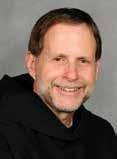
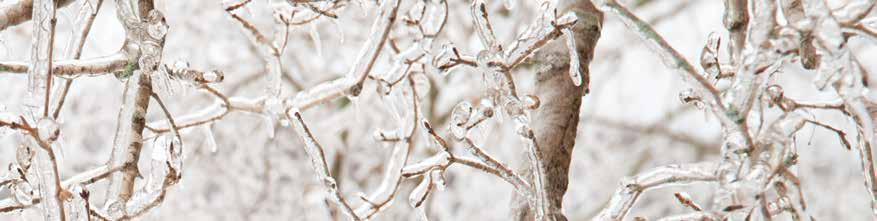
The new scapular, which is given to all the oblates of the monastery is now ready.
Fr. Michael Reyes, OSB, the oblate director,
asked that a new contemporary scapular be designed.
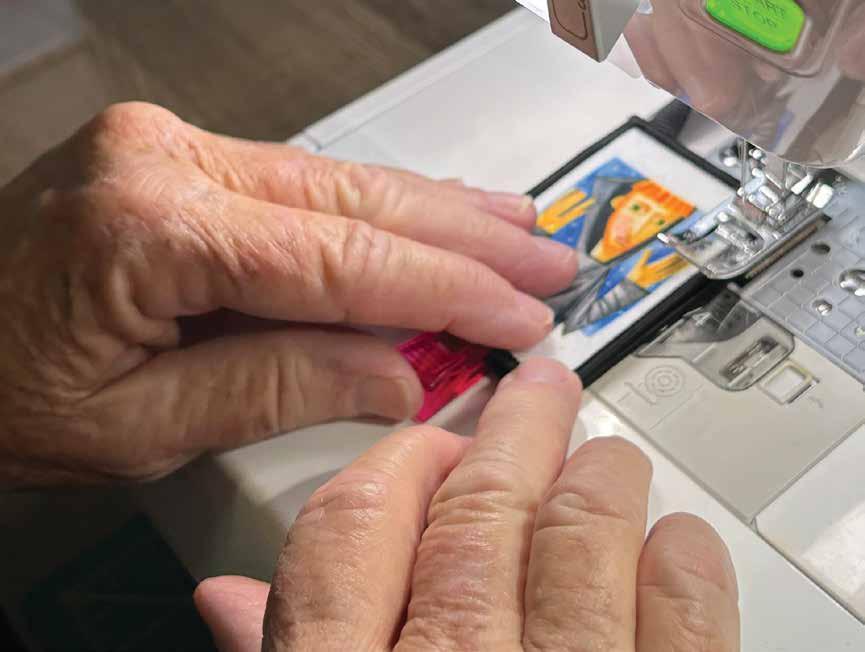
The scapular contains the images of St. Benedict, St. Meinrad, St. Scholastica, and Our Lady of Einsiedeln, all rendered in color. The images draw on traditional stories or legends surrounding the lives of each
DIANE FRANCES WALTER Oblate of Georgetown, Kentucky
Cutting the Pattern
In the early 1980’s Saint Meinrad Archabbey began a project to build a new monastic enclosure. The refectory, a big circular room where monks are nourished, is the heart of the enclosure’s triangular form. Cincinnati Flooring Company, along with Brenda Black's dad who worked for them, was contracted to help build the floor in the refectory. That detail of her dad’s
work life was forgotten until many years later.
Brenda began her life in Louisville, Kentucky, grew up and got married, had a family, and moved around Indiana from South Bend to Newburgh as her husband got new job opportunities. After the death of her husband, Brenda sought to complete a degree to teach family consumer
of the saints. My task was to render each panel of the scapular in a newer and fresher way. The color is bold and the design is simple.
This scapular is exclusively available to the oblates of this monastery. My prayer is that it will provide each wearer with a greater appreciation for our Benedictine saints and spirituality.
sciences and quickly landed a teaching job near Saint Meinrad at Heritage Hills High School. She enjoyed teaching high school students how to sew and cook, but even with that high school teaching job, she felt strongly that she had more to give.
Her mom raised her to work, to do something if there is something undone. As a result, Brenda sincerely
enjoys working and had a goal in finding a second part-time job. “I didn’t just want to sit on the couch,” Brenda explained, “I wanted to keep busy.” While she is an active member of the Daughters of the American Revolution, a service organization for women who are direct descendants of a patriot of the American Revolution, she still had even more of her time to give.
One of her friends told her that the call center at Saint Meinrad Archabbey had a part-time evening job. Brenda applied and was hired. When she told her dad about her new supplemental work he shared his excitement, explaining he had helped put down flooring in the refectory of the monastery enclosure decades prior.
Brenda worked the call center seasonally and eventually worked all year. In 2001, she moved to Santa Claus to shorten her drive. She ended up doing call center work for Saint Meinrad for eight years, ending when the call center was closed. However, she was happy to find herself at a new job assisting at the Guest House. She did that for about six years, and as her family life changed, found she was at an impasse with scheduling. Working weekends became difficult, hampering her ability to see her children and grandchildren.
Just when she thought she would have to leave the monastery and the monks whom she had come to know and love, the position of assistant to the oblate director opened up. She was a worthy candidate and was hired. She worked with former Oblate Director Janis Dopp for about six years.
If you happened to visit the Oblate Office during those years and met Brenda behind the desk, you may have noticed a sewing machine near her station.
Brenda really enjoyed teaching high school students how to sew, but that dedication was born of her own passion as a seamstress. Sewing is her lifelong escape hobby. It is something she finds creative and energizing. She said it was not only energizing but that, “sewing is a stress reliever for me.” Therefore, it didn’t take long for a sewing machine to find its way into the Oblate Office where during down time from work at the computer and taking calls, Brenda stayed busy sewing scapulars for oblates.
She made a few hundred of them and was assisted by oblate Teresa Lynn who volunteered to help keep up with the demand for new and replacement scapulars.
Tough decisions and changes surrounded the COVID pandemic and the death of Janis Dopp. The world slowed by global illness ushered ample time for reflection and new paths. Brenda was no exception.
During the height of the pandemic, the Daughters of the American Revolution needed masks for veteran hospitals. Brenda answered the call and was ready and able to help.
“I sewed 1,100 masks during that time,” she explained. “And that helped me figure out a better way to do big projects like that.”
The job at the Oblate Office was dear to Brenda, but she decided to focus entirely on sewing. She found herself headed to the Saint Meinrad Tailor Shop to prioritize her talent in sewing vestments. Just a few years into the new work, she decided it was time to head home. She admits worrying about losing touch with Saint Meinrad at that point.
“When, then Br. Michael [Reyes, OSB], told me he had been asked to be the next oblate director, I thought, ‘Oh
no, I bailed out too soon,’” she explained. “He is a great choice. I was worried about going home because I enjoyed working with those monks. But they know they can call me.”
She started getting calls right away.
“That’s around the same time Fr. Mateo [Zamora, OSB] asked me to hem some of his clothes,” she said. “He needed some hemming done on a vestment—adjustments made. So, I help him with that from home.”
That work helped deepen her friendship with Fr. Mateo and proved that her journey with Saint Meinrad was indeed lifelong.
Her friendship with Fr. Michael deepened as well, as she transitioned from the Oblate Office to the Tailor Shop and then to her home.
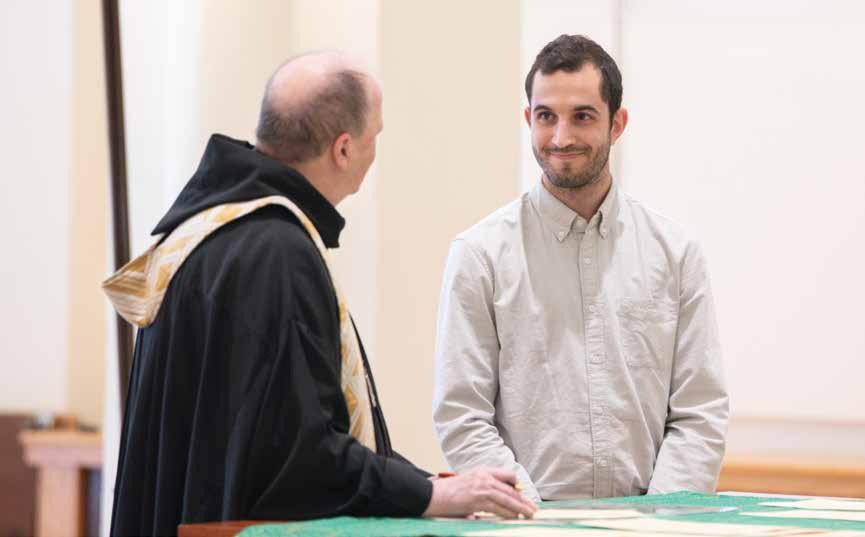
Unbeknownst to her, Fr. Michael had commissioned a design for a new scapular with iconographer Br. Martin Erspamer, OSB, and needed someone to sew 3,000 of them.
Brenda happily accepted.
Brenda was just shy of completing the halfway mark to the 3,000 new scapulars at the time of this interview. She said her previous work of making hundreds of COVID masks made it easier for her to come up with a plan for this improved batch of scapulars.
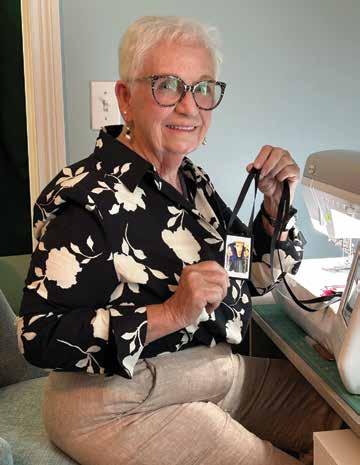
Brenda does the work at her home at a dedicated station. “Once I figured out how to do the assembly line, it was no big deal to me,” she explained. She begins by setting up all the pieces for a small group. Then she sews one step for all in the small group before moving to the next step of sewing. She repeats the process until all the scapulars have each of the steps done, such as sewing on the ribbon for each
scapular in the group. Once all are completed, she reloads her station and begins again.
In a time of about two and a half hours, she can complete 50 scapulars. The icons are sewn into their black, soft framing and those sacred images once secured are then connected to measured ribbons. She noted the icons were beautiful, and the new scapulars a huge improvement over the previous version.
“It [the work] keeps me connected to the Abbey, and to me, it is a special connection. I get to see my friends,” she said. “It has kept me connected to the oblates. I often have lunch with the oblates.” While not an oblate herself as she “never felt the call,” she said if she ever did feel the call to become one, she would.
Brenda noted that Fr. Mateo and Fr. Michael are about the same ages as her own children, so she views them as both friends and as adopted sons. She even helps beyond the work of making scapulars. She sewed Fr. Michael’s five vestments for his ordination, for which she feels deeply honored to have done. She drives around to nearby parishes with flyers for concerts and events scheduled at Saint Meinrad, making sure the information is up on bulletin boards so that all in the area know they are invited. She still tailors Fr. Mateo’s garments as needed. “They are friends,” she added, “I’m blessed to get to know them.”
A while back, Archabbot Kurt took Brenda into the monastic enclosure, so that she could see the area where her dad had put down that flooring. While the flooring he laid is no longer there,
Santa Claus, Indiana

she felt deeply honored to see the space he worked, especially since it is an area special to the monastic community and closed to the public.
Like her dad decades before, Brenda works on projects that require careful thought in putting something together piece by piece. Over the years, she has worked at tasks that are simple and necessary, yet they are what most people may not recognize in the moment as something done by the work of human hands.
As her sewing machine clatters and whirs on the rest of the 3,000 new oblate scapulars, it bears remembering that for all they signify spiritually, historically, and artistically, they also are threaded by the connective power of servitude and a lived openness to friendship.
ANGIE McDONALD Oblate of Huntingburg, Indiana
Editor’s note: This is the first in an ongoing series of reflections on the Spiritual and Corporal Works of Mercy in relation to The Rule of Saint Benedict.
What can The Rule tell us about feeding hungry people?
St. Benedict approaches eating like everything else—it is to serve the work of God in the monastic community. According to The Rule of Saint Benedict, Chapters 39-41, the kind and amount of food, when it is eaten, with whom it is eaten, and what happens while it is being eaten play a part in this effort.
The monks will eat at most just twice a day according to the specific liturgical season. They will have just two to three dishes, generally meatless. They will fast until the ninth hour (3:00 p.m.) on Wednesdays and Fridays from Pentecost through the summer to recall
Jesus’ death on the cross. They will exercise discipline even in the way they meet for meals, not speaking but only listening to holy reading. Punctuality in coming to the table mirrors the call to the Work of God at the specified hours.
How can this apply to the oblate life?
We could simplify our meals, saving special menus for special occasions. Fasting—including the one-meal-a-day option—has gained popularity as a health discipline, with many other options widely available according to personal preferences. Eating together is the norm in monastic life, except for correction of faults. As for listening to holy reading, why not set aside a few
nights a week to take in a good podcast during dinner?
How does all this help us feed the hungry?
With simpler meals, we spend less on groceries and free up funds to help others. Fasting demonstrates our complete dependence on God while also opening our hearts to other’s needs. Eating together at certain times helps us realize our mutual need for community and the role of food in bringing people together. Listening to God’s word or other spiritual writings as we eat together helps us move toward God as one, in community.
The life we feed may be our own!
CHRISTOPHER McCLURE Oblate Chapter Coordinator of Lancaster, Pennsylvania
We are called as oblates to practice obedience, stability, and continual conversion. These principles have long been alive and well among the Lancaster, Pennsylvania, Oblate Chapter at St. Joseph Catholic Church on Cabbage Hill, which for more than 25 years has gathered faithfully in person to live out the Benedictine way of prayer, community, and balance.
The Lancaster group’s origin was humble; just a few oblates met at St. Joseph’s in the late 1990s to pray the Liturgy of the Hours and discuss The Rule of St. Benedict together. The chapter was founded by Oliver and Sharon Ogden, whose dedication helped root Benedictine spirituality in the Lancaster community.
During those early years, Monsignor Thomas H. Smith, pastor of St. Joseph’s in the mid-1990s through the early 2000s, also became an oblate and attended the meetings regularly. When monks such as Fr. Meinrad Brune, OSB, former oblate director, visited, they stayed at the rectory. Oliver often took them around to various historic sites in the area, a reflection of the chapter’s hospitality and local pride.
Over time, the chapter grew into a vibrant, multigenerational community of faith, united by a shared commitment to the Benedictine charism and inspired by the example of their brothers at Saint Meinrad Archabbey. Though the group once had as many as 20 members, today it has seven active oblates who continue to sustain its mission with dedication and joy.
Each monthly meeting begins, as always, in prayer. The group often chants portions of the Psalms before moving into spiritual reading or reflection. Guest speakers are frequently monks from Saint Meinrad, who bring wisdom from the Hill and beyond, offering teaching on topics such as humility, balance in daily life, and the art of listening with “the ear of the heart.”
Over the years, members have expressed that these gatherings not only renew their spirits but also strengthen their call to holiness in the ordinary. The Rule’s timeless call to moderation and mindfulness offers a grounding counterpoint to modern life’s constant noise. We feel that coming together to pray and reflect helps reset our priorities and remind us that Christ must be at the center of all we do.
The Lancaster Chapter has also made a practice of ending each meeting with fellowship and hospitality, where members share food, conversation, and mutual encouragement; a lived expression of ora et labora in community.
We value the consistency of our chapter’s in-person presence. Through seasons of challenge such as illness, weather, and even a pandemic, our members have found creative ways to keep meeting safely and prayerfully.
Our chapter’s longevity has also allowed deep friendships to form. Members support one another through
life’s changes: retirements, family transitions, griefs, and new beginnings. This mutual care reflects the Benedictine vision that holiness is not found in isolation, but in ordinary acts of love within a faithful community.
In recent years, the chapter has welcomed newcomers from surrounding counties, drawn by the warmth and authenticity of the group’s witness. Some members have made their final oblation after years of discernment and formation within the chapter.
It’s beautiful to see new oblates embraced and guided by those who have walked this path for decades. There’s a real sense of continuity here, a living tradition that keeps growing.
Although the Lancaster oblates are not physically within monastery walls, we strive to embody the monastic rhythm in the midst of daily life and bring the peace of Benedictine spirituality into our workplaces, homes, and parishes across south-central Pennsylvania. Our commitment to gathering, praying, and learning together shows that the heart of monastic life beats wherever people sincerely seek God, side by side.
After more than 25 years, the Lancaster Oblate Chapter remains a testimony to perseverance and grace.
“Being an oblate has changed my life in a lot of subtle but very significant ways,” said longtime member Joe Lamont in a previous oblate newsletter.
“I’ve always had a curiosity about God, and being an oblate is about building your spirituality—your relationship with God. Over the years, I’ve become much more aware of God because we’re always seeking Him in everyday life. That’s been the most powerful
influence for me. It gives you a different framework for dealing with your life.”
In the spirit of St. Benedict, the Lancaster oblates continue to live stability, obedience, and conversion of
life grounded in community, rooted in prayer, and ever open to the transforming work of God.
For all oblate information, including chapter locations and how to contact the oblate office, visit https://www.saintmeinrad.org/oblates.
I’ve become much more aware of God because we’re always seeking Him in everyday life. “

FR. HARRY HAGAN, OSB Saint Meinrad Archabbey
Prayer is the way that we carry on our relationship with God, and the Book of Psalms attests to the vitality of prayer in the Old Testament. The Eucharist, the meal and sacrifice, offered by Christ on the day before he suffered, becomes the central prayer of the early Christian community, but already in the Acts of the Apostles, we see a distinction between the Eucharist and the prayer of the Church, where we read in Acts 2:42:
They devoted themselves to the teaching of the apostles and to the communal life, to the breaking of the bread and to the prayers.
It is not clear just what “the prayers” were. Some form of morning and evening prayer seems to have been common among some Jews at the time, and seemingly the Jewish Christians would have continued that practice. What the Hellenistic Christians did is less clear.
The Didache, a document of Church practice often dated to the early 100s, gives the Matthean version of the Lord’s prayer with the doxology, “for yours is the power and glory forever.” There follows the rubric: “Pray like this three times a day” (Ch. 8). Over the next 300 years, praying at midmorning, noon, and mid-afternoon becomes a typical practice.
Clement of Alexandria († c. 215) calls for Christians to pray at set times: as they rise, before they retire, and while they eat. He also links this prayer to Christ as the light of the world and
speaks of facing east to pray toward the rising sun. Also, since Christ is the light, Clement calls upon the community to rise at night because they are “children of the light and children of the day” (1 Thessalonians 5:5).
In the West, Tertullian († 240) also calls for prayer at the third, sixth, and ninth hours. He also gives these times more weight by linking them to events in the early Church. At the third hour, the Spirit came down at Pentecost; at the sixth hour, Peter saw the vision of animals coming down, and at the ninth hour, Peter and John go to the temple and heal a man who could not walk (Acts 2:1-4; 10:9; 3:1). To these hours, Tertullian adds the obligation of praying “at the beginning of light and of the night” (On Prayer, Ch. 25).
Cyprian in his treatise On the Lord’s Prayer confirms Tertullian’s testimony and ties morning and evening prayer to the movement of the sun. Morning prayer with the rising sun celebrates the resurrection of Christ, his rising from the dead. Evening prayer, as it faces the setting sun, recalls Christ “the true Sun” and prays that “the light may come upon us again” (Ch. 35).
Cyprian too speaks of Anna who day and night kept watch and prayed in the temple as an image of prayer through the night “as if in the daylight” (Ch. 36). The emphasis on light, especially the light of the sun, continues to play a central role in prayer for us today.
2. The Cathedral Office
During the fourth century, the cathedral churches in Egypt,
Cappadocia, Constantinople, Jerusalem, and elsewhere develop a celebration of the hours that scholars call “the Cathedral Office.” The most famous celebration is Jerusalem because a nun from a monastery on the far Atlantic coast decides to make a pilgrimage to the Holy Land. Egeria believed the sisters of her community would be interested in what she found and wrote a fascinating travelogue about her explorations. The manuscript was lost until J. F. Gamurrini discovered a large part of it in 1884.
Egeria tells us of the three years she spends in the Holy Land between 381384 A.D. She records in some detail her going to the Church of the Resurrection, built by Constantine over the empty tomb of Christ. In the morning, the monks and nuns gather early with some laity for psalms and antiphons, hymns and prayers. With the dawn, the bishop enters the church with his clergy and goes right into the tomb where he says, “The Prayer for All,” mentioning anyone he chooses by name. He blesses the catechumens and then the faithful. Coming out from behind the screen, he allows everyone who comes to kiss his hand, blessing them one by one. When the dismissal takes place, the day has already dawned (Ch. 24).
The bishop returns at the sixth, and ninth hour for a prayer and a blessing. Later in the afternoon, Vespers follows, which Egeria calls lucenare, that is, “the lighting of lamps,” a prominent feature of the service. Psalms and antiphons follow. The psalms are chosen because they fit the service. When the bishop
makes his entrance, more hymns and antiphons follow with intercessions by a deacon, more blessings, and the dismissal. On Sundays, a vigil for the Resurrection begins at cockcrow, prayed in the atrium until the doors open.
Cathedrals, throughout the empire have similar liturgies. Incense becomes a widespread hallmark of Vespers, following the rubric of Psalm 141:2:
Let my prayer be incense before you; my uplifted hands an evening offering.
Incense rising and hands raised becomes the image for this evening sacrifice in the cathedrals of the late Roman empire. Out of these liturgies comes “Gladsome Light,” one of the Church’s earliest hymns for Vespers, celebrating the undying light of Christ.
Scholars today identify these celebrations as the Cathedral Office with the following characteristics:
■ symbol and ceremony: lights, incense, processions, etc.
■ chant: responsories, antiphons, hymns
■ psalmody that was limited and selected for the service
■ a diversity of ministries: bishop, presbyter, deacon, reader, psalmist, etc.
■ a popular liturgy for the entire Christian community
Carrying on the tradition, the rising and setting of the sun form the anchors for these services which were not liturgies of the word but offices of praise and intercession.
In 313 AD, Constantine’s Edict of Milan makes Christianity a legitimate religion. Martyrdom, the crown of the heroic Christian, disappears, and large numbers of both men and women, searching for a deeper experience of God, go out into the deserts to pray
without ceasing. By the end of the fourth century, over 5,000 people had become monks and nuns in Egypt, and much of the early monastic literature comes from those who have spent time there.
The monastic movement tries to realize St. Paul’s admonition in 1 Thessalonians 5:17: “Pray without ceasing.” Prayer becomes an ascetical discipline, no longer tied to any specific time of day. Abba Isaac in “Conference 10” of John Cassian’s collection, The Conferences of John Cassian, discusses repetitive prayer as one way to achieve this ideal. The Book of Psalms offers another approach. A monk would begin reciting from memory the psalms, one after the other, and on finishing, he would just begin again. Achieving the prayer without ceasing, however, posed real problems.
According to the alphabetical Sayings of the Fathers, Abba John the Short declares to his blood brother that he is going off to the desert to become like the angels and pray always. Stripping off his clothes, he heads to the quiet of the desert. After a week, his brother hears a knocking at the door, and when he asks who it is there, a voice says that it is his brother, John. However, the brother answers, “Oh no, you are mistaken. My brother has become an angel.” Abba John continued to knock, but his brother does not let him in until the next day, saying, “You are human, and you must once again work to eat.” This story captures the problem of prayer and work.
The monastic solution builds on the practice of praying at certain times throughout the day. Psalm 119:164 provides the reason:
Seven times a day I praise you because your judgments are righteous.
While the biblical “seven times” means all the time, the monastic tradition
interprets the psalm literally. It adds Prime and Compline to make seven prayers through the day:
Lauds or Matins at dawn
Prime at the first hour
Terce at the third hour
Sext at the sixth hour
None at the ninth hour
Vespers at sunset
Compline at night before bed
To these, they added Vigils because Psalm 119:62 reads:
At midnight I rise to praise you because of your righteous judgments.
Unlike the Cathedral Office which selects only certain psalms, the monastic office makes its way through the whole psalter in succession. Later, St. Benedict in his Rule refines the arrangement. He begins Vigils on Sunday with Psalm 21, a royal victory hymn to celebrate the resurrection. The psalms that follow fill out Vigils except for those used for Lauds. The daytime prayers use Psalms 1-20 and 119-133. St. Benedict then begins Vespers with Psalm 110, the royal priestly psalm. Those that follow and not used elsewhere fill out the rest of Vespers, with the praise Psalms 148150 reserved for Lauds each day. With this arrangement, monastic communities are able to work and to pray. As is sometimes said, their work should become their prayer, and their prayer should become their work. With that, they pray always.
4.
The Cathedral Office and the Monastic Office originally met two rather different concerns of two rather different populations. In the mid-700s, however, St. Chrodegang, bishop of Metz, makes two fundamental changes in the cathedral practice. First, he divides his clergy into groups responsible for different parts of the whole Liturgy of the Hours. This
requirement grows until all diocesan clergy are expected to pray the whole psalter.
Secondly, St. Chrodegang requires that those unable to participate in the cathedral liturgy to pray the office in private. This leads to fewer and fewer communal and public celebrations of the Liturgy of the Hours. Unlike the liturgies of Egeria’s Jerusalem in which laypeople thronged the church, the Liturgy of the Hours becomes more and more a private practice reserved for the clergy who follow the Latin language, except for monasteries and later for other religious communities. This brings about the breviary, a set of four books that allows a person to say the office alone and not necessarily connected to any specific time of day. The praying of this Office would take a person a full hour, reading the Latin as quickly as possible, to finish the prayer for the day.
5. The Reform of the Second Vatican Council
The history recounted above comes largely from the classic work of Fr. Robert Taft, SJ: The Liturgy of the Hours in East and West. He covers everything from the beginning in extraordinary detail and shows that the reforms through the Middle Ages into the modern period were largely concerned with clearing away accretions and making small adjustments. At Vatican II, however, the Council makes a bold move to restore the Liturgy of the Hours as the prayer of the whole Church, clergy and laity, and to adapt its structure for the busy world of the Church today.
The Council wants the Liturgy of the Hours to be the prayer of the whole Church and not just the clergy, and the cathedral liturgy of the early Church serves as the ideal for the reform. The document on the reform of the liturgy, Sacrosanctum Concilium, says:
The divine office, because it is the public prayer of the Church, is a source of piety, and nourishment for personal prayer. And therefore priests and all others who take part in the divine office are earnestly exhorted in the Lord to attune their minds to their voices when praying it. The better to achieve this, let them take steps to improve their understanding of the liturgy and of the bible, especially of the psalms (§90).
It states, “Lauds as morning prayer and Vespers as evening prayer are the two hinges on which the daily office turns” (§89a). It retains the monastic practice of praying the whole book of Psalms but spreads it over four weeks instead of one. This simplifies the celebration, although those beginning to pray the Liturgy of the Hours can still find it complicated as they seek to align the ordinary parts with the seasons and saints. Finally, the move from Latin to the vernacular has opened this prayer of the Church to many.
The Council’s ideal envisions communities praying together. This ideal fails to reckon with the reality that many have prayed and continue to pray the Liturgy of the Hours privately. While communal prayer holds an important place in Catholic practice, it should not rule out or demean the practice of praying the office by oneself, for even when praying alone, we are joining ourselves to the common prayer of the Church. Furthermore, the busy life of parish priests and laity often makes it difficult to impossible for them to pray the Liturgy of the Hours either with others or at the assigned time of day. These realities do not negate the rich prayer of these people. Rather it points to the continued need for different forms of the Liturgy of the Hours. Monastic communities have found the freedom to renew and reshape the Liturgy of the Hours to fit the circumstances of each community. Earlier, the Latin language divided communities between those praying the Latin office and those who were not. The move to vernacular has brought the whole community together in prayer. While some communities continue to recite the whole Psalter in a week, as St. Benedict urged, many monasteries have moved to a two-, three-, or four-week cycle that mixes psalmody and silence and allows for a better balance of prayer and work and life. All this has opened up the possibilities of new music and texts. At Saint Meinrad, Fr. Columba Kelly, OSB, laid a musical foundation grounded in the tradition that also explores the power of the English language. The development of Gregorian chant in the early Middle Ages took centuries, and so the development of music for our Liturgy of the Hours has surely only just begun.
The American bishops are soon to replace the American edition of the Liturgy of the Hours, developed in the
1970’s, with new translations of most everything. This new edition should be a great blessing for the Church. However, its importance need not devalue the various shorter versions that have responded to the call of Vatican II. Both Give This Day, published by Liturgical Press, and Magnificat Magazine, published by the Dominicans, offer those not bound by the whole office the possibility of celebrating the mysteries of Christ through the Church year, which is the purpose of this prayer.
The new Liturgy of the Hours for Benedictine Oblates serves a similar need by giving the oblates of Saint Meinrad a share in the monastic office of the
Archabbey, whether prayed with others or alone.
The Liturgy of the Hours together with the celebration of the Eucharist leads the Church through the celebration of the mysteries of Christ in the Church year. These two fundamental prayers of the Church form the foundation of all spirituality. As Father Taft says: “There are many ‘schools’ of spirituality, but they are legitimate only insofar as they are rooted in the worship of the church” (346).
Celebrating the birth, death, resurrection, and proclamation of Christ forms the heart of our Christian
life. Father Taft is quick to insist that remembering plays a central role in this worship, but the liturgy is not just a recalling of the past. “In liturgical mystery, time becomes transformed into event, an epiphany of the kingdom of God” (348). The liturgy joins heaven and earth together, transcends past, present, and future, and makes our prayer a sacrament of God with us. Moving through the Church year, this liturgy transforms us, if only slowly, into the image of God. Some days, the words that we say and try to pray can seem but shadows, but the liturgy promises to those who give themselves to its relentless call a share in the life of God made manifest in Christ. With this hope, we take up our books each day to pray the Liturgy of the Hours.
Robert Taft, SJ, The Liturgy of the Hours in East and West: The Origins of the Divine Office and Its Meaning for Today (Liturgical Press, 1993). Except for the chapter on the theology of the Liturgy of the Hours, this book contains very technical information about the development of the office.
Harry Hagan, OSB, and Godfrey Mullen, OSB, “The Liturgy of the Hours: The Daily Prayer of the Church” in The Tradition of Catholic Prayer, ed. by Christian Raab, OSB, and Harry Hagan, OSB (Liturgical Press, 2007) pp. 147-168.

KRISTA HALL Director of Communications, Saint Meinrad Archabbey
Saint Meinrad is a place built on tradition, but tradition has never meant standing still. For many years, our familiar logo has served as a steady symbol of our mission, our Benedictine identity, and our commitment to forming the Church’s leaders. But just as physical spaces need maintenance from time to time, a visual identity also needs renewal. After nearly 30 years, it was clear that the tools we use to communicate no longer supported the clarity, consistency, or flexibility we need today.
Earlier this month, Saint Meinrad’s Communications Office released a refreshed logo and brand identity. The update includes the logo, a refined color palette, new fonts, a brand identity guide, and design templates for both print and digital communication. These pieces give us a clearer and more dependable way to present the mission of Saint Meinrad across many
platforms, from newsletters and websites to social media.
The symbols within the new logo remain familiar and meaningful. The Archabbey Church towers, rising above the Hill, are the first things people see as they drive to Saint Meinrad and are our most recognizable landmark. Both St. Benedict and St. Meinrad the hermit had raven companions. In our logo, the two ravens remind us of the Benedictine life that shapes our community and the formation of our students.
“The ravens for us, as Benedictines, are also the symbol of obedience,” explains Fr. Kolbe Wolniakowski, OSB, subprior of the monastery. “This idea that we are listening for the voice of God to direct how we act and move within this world.”
The boat, which is found in the Archabbey coat of arms and the
School’s seal, represents the monks who traveled from Switzerland and founded Saint Meinrad.
“The boat has also been used throughout the ages by saints to represent the Church herself, the fact that the Church is on a journey towards God, and it is directed by individuals who are listening to the voice of God,” says Fr. Kolbe. “The boat is a great image of being on mission, because here at Saint Meinrad, we are still actively working for the world today in caring for the world and sharing the Gospel message.”
While the design has been modernized for readability and flexibility, these symbols ensure that the refreshed look stays rooted in Saint Meinrad’s heritage. Although the visuals have changed, the heart of Saint Meinrad remains the same: a community grounded in prayer, committed to service, and prepared for the years ahead.