newscience NEWS FOR MEMBERS, PHILANTHROPIC PARTNERS, AND FRIENDS OF THE SAINT LOUIS SCIENCE CENTER
FALL 2026
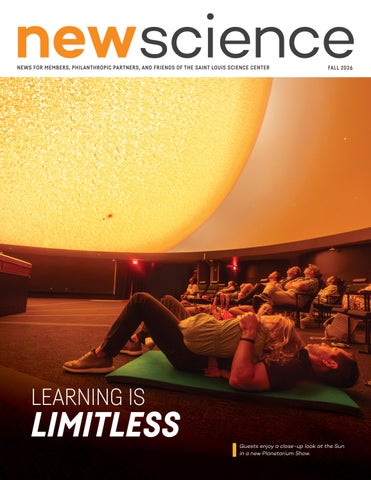
Guests enjoy a close-up look at the Sun in a new Planetarium Show.
Board Members Saint Louis Science Center Board of Commissioners
Letter from the President
Dr. Mark S. Wrighton, Chairman Dr. Christine Jacobs, Vice-Chair Dr. Kelvin Adams, Secretary Michael J. Baughman, Treasurer Chris Almeida David Baringer John Berglund Marius Johnson-Malone Mark Sawyier Mark Sears Dr. Jeremy Williams
Dear Friends of the Saint Louis Science Center,
Saint Louis Science Center Board of Trustees
Among the many other stories in this issue, I encourage you to read on page 6 about the work of Dr. Jean Potvin, the Science Center’s Scientist-in-Residence for our Blue Whale Story special exhibition, as he shares a look at how blue whales are inspiring a novel way of removing harmful microplastics from bodies of water. (Don’t forget to visit Dr. Potvin inside the exhibition on Monday, Wednesday, or Friday afternoons.)
Edward Monser, President Abe Adewale Aaron Addison Simon Bailey Lawrence Casey Barry T. Cervantes Jim Curran Beverly Estes Guyton Richard C.D. Fleming Paris Forest Devin Fraley G. Patrick Galvin Jenna Gorlewicz Kevin Gunn Jerome Harris Jamie Jabouri Lindsey Jubel David Kocs Dr. Toni Kutchan, Ex-Officio Erik Lindbergh Carol B. Loeb Gregg Maryniak John F. McDonnell (Life Trustee) RADM Lee J. Metcalf, USN (Ret.) Maurice Muia Dr. Sam Page, Ex-Officio James Qin Tim Rozar Donn Rubin Kathleen R. Sherby Judy Sindecuse Cara Spencer, Ex-Officio Zar Toolan Craig Unruh Kenneth L. Wagner Ray Wagner Breck Washam Candace Webster Dr. David J. Werner
Inside the James S. McDonnell Planetarium, guests are seeing the universe in a whole new light with the debut of our next-generation upgrades inside the Bill and Laura Orthwein StarBay. For more than six decades, the iconic McDonnell Planetarium has inspired millions of people to look up, and we are proud to continue that legacy for future generations at their Science Center. In this Fall issue of NewScience, you can learn more on page 12 about the new Planetarium Shows bringing the wonder of our universe—and, now, our planet—to life in ways that are truly awe-inspiring.
Learn more about the promising potential of “vibe coding,” where artificial intelligence is empowering practically anyone to become a software developer; and in our Gallery Spotlight on page 8, take a behind-the-scenes look at how our team develops the core interactive experiences that put our guests at the center of science. Our work to inspire everyone to be curious and engaged in science would not be possible without the dedicated support and advocacy of our members, philanthropic supporters, corporate partners, and community. In our Donor Spotlight on page 24, we are proud to highlight the contributions of Margaret and Martin Israel. From family visits and membership in the Einstein Society to Martin’s tenure of service on our Board of Trustees, the Israels continue to play an impactful role in sparking curiosity in our community. As we get ready for a season of gratitude and generosity, thank you for helping our Science Center ensure the thrill of discovery is available to all. If you are inspired to help us continue bringing curiosity to life, I hope you will consider making a gift of any size to the Curiosity Fund, becoming a member, or increasing your support. On page 14, you can find many easy ways to join in our mission and make an impact. Every day inside our museum is filled with wonder, and with so much to explore, now is a perfect time to discover something new at your Saint Louis Science Center.
With gratitude,
Ray Vandiver President and CEO
To inspire everyone to be curious and engaged in science. Mission of the Saint Louis Science Center
Smithsonian Affiliate Membership Program
2
FALL 2026
Smithsonian Affiliate Membership Program
Contact 314.289.4400 | slsc.org Saint Louis Science Center 5050 Oakland Avenue St. Louis, Missouri 63110
Membership Services, Sales & Member Reservations: 314.289.4414 slsc.org/membership memberships@slsc.org
Reservations
In This Issue... 6
If you were fascinated by our Scientist in Residence Dr. Jean Potvin’s article in the summer issue, wait until you read his next installment, which discusses how the baleen-inspired filtration systems are being used locally, and could be used on distant moons.
Advance Sales & Group Reservations: 314.289.4424
Education Programming information: education@slsc.org
Events Host your next private event at the Saint Louis Science Center. Services and catering provided by Saint Louis Science Center Events. For information: 314.286.4667.
Accessibility Complimentary wheelchairs and strollers are available in the lobby. Motorized scooters are available for a rental fee. Personal Hearing Assistance Devices are available at the OMNIMAX® Theater and Planetarium. Captiview caption devices are available for all OMNIMAX® films.
Official Partners The Saint Louis Science Center gratefully acknowledges the support of our Official Partners.
Connect with us for updates, special events, and fun science.
Science Today
8
Science Never Stops Learn what our Exhibits team is building and the physics concepts these new exhibits illustrate; meet Planetarium educator Eric Gustafson; and learn about vibe coding from Mike Seper of UMSL.
12 Join Us Discover what’s coming soon, from brand-new Planetarium Shows to the St. Louis Prehistoric Life Show and much more.
14 Share the Wonder Learn all the different ways you can support the mission of the Saint Louis Science Center.
20 Community Get to know Loeb Prize Winner Christy Lewis – and get some tips on how to help your kids with their math homework. Learn about our latest collaboration with ASL Aspire.
22 Partnership & Support Meet the co-chairs behind our upcoming Club WONDER: Light Years Ahead event and learn why they’re so excited to support our mission, join us in celebrating Margaret and Martin Israel in our Donor Spotlight, see what’s next for our Einstein Society members, and more!
FALL HOURS Wednesday
9:30am-4:30pm
Thursday
9:30am-4:30pm
Friday
9:30am-4:30pm
Saturday
9:30am-4:30pm
Sunday
11:00am-4:30pm
Monday
9:30am-4:30pm
Tuesdays
Closed
For the most current version of our schedule, please visit slsc.org.
3
MEMBERSHIP MATTERS
MEMBER SPOTLIGHT JIM AND KAREN HERTLEIN Jim and Karen Hertlein explore science wherever they go. The couple has hiked the Appalachian Trail, the Pacific Crest Trail, and more, experiencing the wonders of natural science firsthand by walking or biking miles per day. But they’re not just science lovers; they’re educators, too. Jim taught science, history, and even English in the St. Louis area for decades, and Karen worked in childcare, as well. Get to know the Hertleins and learn why they’re proud Science Center members. How long have you been Science Center members? We have been members since the 1990s.
What do you like to do here? We love the exhibits, especially the hands-on displays. Our boys enjoyed the OMNIMAX® shows, all the displays, and the Planetarium. And Karen, my wife, had a daycare for years and would bring the children to the Discovery Room often! Crossing the Skybridge has always been a favorite, as well as building the Arch. And finally, our three grandchildren love going to the Discovery Room, the OMINMAX, and the Planetarium, too.
Where did you teach and for how long? And as a retired science teacher, what especially speaks to you about visiting the Saint Louis Science Center? I taught at Parkway South Middle School for 30 years and then taught at Principia School for ten years. I have wonderful memories of field trips to the Science Center and students inquiring about different aspects of sciences.
What’s your favorite member perk? We really enjoy the OMNIMAX and special exhibition Member Previews!
4
FAL L 2026
Jim and Karen Hertlein enjoy The Blue Whale Story special exhibition with their grandson Gavin.
Why would you recommend a membership to anyone who is considering one? The Science Center works well for multi-generational outings! There are fun opportunities for learning at any level. With the rotating movies and exhibits, each visit is always full of freshness and new learning. It is a wonderful place to learn about life outside the comforts of our everyday lives, from looking outward into the universe to looking inward at the ecosystems of our own planet. It is a great way to share science with family and friends. And the free parking is always a bonus! The membership login and the ability to purchase OMNIMAX tickets online – and then they’re sent right to your phone – saves time and is so easy to use!
“IT IS A WONDERFUL PLACE TO LEARN ABOUT LIFE OUTSIDE THE COMFORTS OF OUR EVERYDAY LIVES, FROM LOOKING OUTWARD INTO THE UNIVERSE TO LOOKING INWARD AT THE ECOSYSTEMS OF OUR OWN PLANET.”
UPCOMING MEMBER EVENTS SUNDAY, SEPTEMBER 13, 11:00AM-2:00PM
Grandparents’ Day Member Lounge Tickets available now! Join us for a lounge featuring Morse code jewelry you can use to spell your name. Our activity produces a wonderful Grandparents’ Day gift and is fun for all generations!
SUNDAY, SEPTEMBER 13, 3:00-4:30PM
New Member Expedition Tickets available now! Are you a new member of the Science Center? Then this event is for you! Learn how to get the most out of your membership, take a quick building tour, and enjoy a science demonstration from one of our gallery team members.
THURSDAY, OCTOBER 8, 5:30PM & 7:00PM
OMNIMAX® Member Preview: Lost Wolves of Yellowstone Tickets available September 10 On January 12, 1995, wolves returned to Yellowstone, 50 years after their extinction within the park. Mollie Beattie, director of the US Fish and Wildlife Service, carried the first Canadianborn wolf, Alpha Female Wolf No. 5, into the park’s experimental acclimation enclosure. From that day forward, their lives would be forever connected. This is the true story of Mollie’s Pack and the Lost Wolves of Yellowstone.
Save the Date for Member Appreciation Night Thursday, December 10!
5
SCIENCE TODAY
Photo Credit: C. Becker (MDC)
Project BALEEN Hits the Road: From the Lab to Spanish Lake and to Jupiter’s Moon, Europa By Jean Potvin, PhD
Bio-inspired Architectures for Large-scale Extraction of Environmental Nondegradable milli/meso/macro particulates
Here I was, standing knee-deep in one of Spanish Lake’s tributaries in north St. Louis County, checking on a novel microplastic collector based on the oral filter of whales and aimed at tracking the movement of plastics debris washing into the lake during rainstorms. Waiting for the rest of the team to join me, I reminisced over the past few years of Project BALEEN, a Saint Louis University (SLU) research initiative started in 2023 with the help of three other colleagues. With the assistance of several undergraduates, the project started with the construction of a new water tunnel for laboratory-based studies of new filtration prototypes inspired by the baleen filters of the whales currently featured in The Blue Whale Story special exhibition. These studies, in turn, led to the design and construction of the devices we were now testing at Spanish Lake. Designing milli particulate collectors inspired by whales makes a lot of sense, given that some of the whales’ food of choice – the copepods – are similar in size to microplastics. Lacking teeth, whales use a filter and an outsized mouth to filter out tons of seawater and retain entire swarms of truly tiny prey. (For more information about whales’ filter systems, see “Not Your Typical Water Filter” in the NewScience Summer 2026 issue.) As a major pollution source, microplastics have become a health hazard to both humans and animals when absorbed either through breathing or swallowing. Produced from vast amounts of plastic-based consumer goods, microplastics are finding their way into landfills, roadside trash, creeks, and lakes. Further scrutiny of their movement in the environment and through the food chain is imperative. Project BALEEN is an applied research program at Saint Louis University’s WATER Institute following another, more fundamental series of investigations conducted in my computer simulation laboratory since 2008. Those studies first focused on the motions of the water entrained by the whales during swimming and feeding, and were followed in 2013 with simulations of water filtration through the whales’baleen-bristle system.
6
FALL 2026
Testing our concept at Spanish Lake Park The oral filter of baleen whales is comprised of two comb-like rows of approximately 300 baleen plates. The friction of the tongue against the plates erodes them into mats of filaments known as bristles, which forms the filtration surface that retains the prey while letting the water through. Prey collection is enhanced by the filter’s curvilinear shape and the prey’s entanglement in the bristle. Our team found that baleen whaleinspired microplastics filter design became quite straightforward once those principles were implemented. Project BALEEN microplastics collectors consist of pipes enclosing long conical filters made of mesh and bristles. The length of both tube and conical filter can be adjusted according to the size and desired number of particles to capture. Materials easily found at local hardware stores such as PVC piping, strap-on foam, and standard window nylon mesh are used for the purpose of rapid prototyping. Clearly plastic pollution sources themselves, these are to be replaced with environmentally friendly materials once the operational version of the BALEEN collector has been determined. An example prototype is displayed in The Blue Whale Story exhibition ticket counter area.
Left: Student Ava Alton holding a 3D-printed prototype of the fuselage of her particulate collector drone. Right: Jupiter’s moon, Europa, NASA/JPLCaltech/SwRI/MSSS Image processing: Björn Jónsson (CC BY 3.0)
for the best design. This day was no exception, as we were about to test the BALEEN collector in the lake’s outlet, where fast water currents can be found. Our work has been financially supported by the Saint Louis University WATER Institute, and by the Missouri Department of Conservation (MDC) and Saint Louis County in the form of site access, personnel assistance, watercraft availability, and expertise.
Next Up: Exploring the Oceans of Europa
Project BALEEN milli particulate collector design for the testing phase at Spanish Lake Park, in which a conical filter is inserted into a long PVC pipe. A slab of dense foam is used to ensure neutral buoyancy – a useful feature for sampling below the surface.
Back at Spanish Lake, our BALEEN collectors can capture plastic and organic particles by towing them behind a slow-moving boat for an hour or less, or by being tied to an anchor for a day or so, depending on current strength. Brief operating times help limit the accumulation of sediment which can mask the presence of microplastics. These limited runs, as well as small cylinder diameters, also prevent the entrapment of large organisms like frogs and fishes. As part of the St. Louis County Parks & Recreation System, Spanish Lake is situated north of I-270 near the confluence of the Mississippi and Missouri rivers. It is a popular spot for fishing as well as for picnicking, jogging, and cycling along the two-mile trail that encircles the lake. Its proximity to Midtown St. Louis (and SLU), and its location in the middle of a densely-populated area, makes Spanish Lake an ideal site for plastic debris collector testing. Students and their research mentors can quickly deploy prototypes in a variety of filter sizes and porosity in their search
Another exciting application of baleen whale-inspired filtration technology has been its implementation into Autonomous Underwater Vehicles (AUV) or drones, which are envisaged to autonomously ply the waters of not only planet Earth, but also of the outer planets and their moons, such as Jupiter’s Europa. One undergraduate student has used her recently acquired classroom knowledge to design a drone able to collect sub-millimeter debris present in rivers and lakes in our area. An additional grant from NASA has allowed her to design a version capable of exploring the subsurface ocean of Europa. Given that this ocean may be interacting with the moon’s rocky seafloor, there would be interest in the sampling of the particulate matter, so that scientists can remotely examine the salts, minerals, and most interestingly, the organic material that could have been generated by a primitive form of life.
Throughout the fall, guests will have the opportunity to connect with our Scientist in Residence, Dr. Potvin, in The Blue Whale Story special exhibition. Guests can meet him, ask questions, and hear firsthand about his research and the discoveries that help us better understand and protect marine life. Select weekday appearances will be available, with the most up-to-date schedule available online.
7
SCIENCE NEVER STOPS
Where the Cool Stuff Happens:
Prototyping Core Interactives Walking through the Science Center, guests may notice that the exhibits people linger at the longest aren’t always the newest and flashiest. Much of the time, they are the exhibits that put people at the center of science with experiences you can touch, push, spin, or feel. By experiencing the physical phenomena firsthand, you understand it – not because someone explained it, but because you experienced it yourself. This is the foundation on which the Core Interactives Project has been built. The project began with one goal: creating interactive exhibits featuring physics phenomena. The Science and Education team submitted and reviewed over 100 ideas, then narrowed those down to the final 30. The interactives span the physics field, and most fall into one of these categories: Light & Color, Fluid Flow, Force & Motion, Electricity & Magnetism, and Sound. Vice President of Science and Education Dr. Rebecca Thompson develops each interactive alongside Megan Linton, gallery content developer, ensuring the content of the core interactives is created using scientific and educational expertise.
8
FALL 2026
Transforming this content into immersive exhibits is the job of our talented Exhibits team. This team builds and maintains almost all the exhibits throughout the Science Center and is made up of exhibit professionals including a designer, production fabricators, an engineer, and an electrical engineer. Project Manager Lily Lewis-Stump coordinates with all these team members to create finished products, and Director of Exhibits David Francis ensures the project stays true to the Saint Louis Science Center’s vision and the preservation of the guest experience. After choosing the first six interactives, the content team began deciding how to communicate these physics phenomena and which aspects to focus on. The goal is to keep these interactives in the “cool stuff happens zone.” Physics demonstrations require specific conditions under close control for the interactives to illustrate the concepts properly. The “cool stuff happens zone” is the team’s term for the narrow window where everything works – where the science shows up every time, for every guest. Next, the Exhibits team gets to work with proofs of concepts and prototype designs. Meanwhile, Science Center graphic designers work with the content team to create signage
Superconductors are Supercool! In collaboration with the Physics department at Missouri University of Science and Technology, guests of the Saint Louis Science Center will now be able to experience superconductor science firsthand in a new, dynamic way. for the interactive. This signage explains the phenomena on display and encourages guests to try different prompts to further understand and observe the science in front of them. Currently, three interactives have entered the prototyping stage, and two have already spent significant time on the floor with guests: the Gear Cube and the Magnetic Pendulum. The Gear Cube gives guests the opportunity to magnetically attach gears of different sizes to a cube, creating their own gear train to explore the science behind force and motion. The Magnetic Pendulum features four pendulums of different lengths with a magnet bob on the end. Using free-floating magnets, guests can create their own pattern of opposite poles for the bob to interact with, experiencing the push and pull of the magnetic field by observing how the pendulum responds to the magnets. These two prototypes have spent time on the floor alongside our Research and Evaluation team members, who observe and report on the interactions the guests have so that we can continue to improve the prototypes before we create the final versions. The next prototype to hit the floor will be our Color Light Table, which has four stations – two with white light and two with RGB light. Several different lenses and prisms allow guests to freely experiment with light play. The Spinning Table, currently in development, features a central spinning disc with variable speed, and objects such as hoops and cylinders. When guests interact with the table and objects, they can observe the complex paths and experiment with angular momentum!
As the Core Interactives Project continues development, be on the lookout for prototypes featured throughout the museum! We value your feedback and can’t wait to hear what you think. Stop by the Research and Evaluation table in the Oakland lobby before leaving after your next visit.
It was after SciFest: Engineering Expo in February 2026 that Dr. Hyunsoo Kim, Assistant Professor of Physics, offered to create a superconductor track and donate it to the Science Center – and this one can also turn upside down, or invert. Dr. Kim is building “a magnet track for the demonstration of superconducting levitation and so-called quantum locking,” in collaboration with Matthew Dalton of S&T’s Makers Studio. The track is circular and about 1.5 feet in diameter. The magnet track is installed on a steel donut-shaped plate, which is fixed on a square Plexiglas plate. This is big enough to see the effect, and small enough for a demonstrator to bring it closer to the audience. The levitating superconductor is a disc approximately one inch in size. “This demonstration is one of the most effective ways to introduce all age groups to quantum physics, with the macroscopic quantum phenomena realized in real materials. The superconductor first levitates above magnets, and it can start revolving around the track when it’s gently pushed, like a swinging ball attached to a string. It remains on the track without any physical attachment because of the quantum mechanical locking mechanism,” Dr. Kim continued. After bringing the small track to SciFest and seeing how much the guests enjoyed it, he thought, “It would be nice for the Science Center to have one to showcase this fascinating scientific phenomenon to broader audiences.” “With this new superconductor track, we’ll be able to let guests experience electromagnetism, energy, and quantum physics in a new way,” gallery content developer Megan Linton enthused. “It also gives our educators a chance to dive into new topics that include superconductors, like transportation and medical imaging.” Guests will be able to interact with these tracks under staff supervision and get up close and personal to learn more about superconductors and their real-life uses. We are grateful for STEM experts like Dr. Kim who are willing to share their knowledge and expertise with the public and public institutions in such impactful ways.
9
SCIENCE NEVER STOPS
MEET THE TEAM:
Eric Gustafson Lead Educator & Producer | McDonnell Planetarium Eric Gustafson is celebrating 25 years as a Planetarium educator this year, so if you’ve seen a Planetarium Show in the last two and a half decades, there’s a good chance you’ve learned about our universe from him. Now with the help of the powerful new GOTO Chiron III Hybrid with Cosm Digistar projection system, find out what he’s excited to teach us next. What was it like working in the Planetarium 25 years ago? How has it changed during your tenure? I was hired just after the Planetarium reopened in 2001. At that time, construction of the International Space Station (ISS) had just begun, the Space Shuttles were still in use, we only knew about 18 moons orbiting Saturn, and Pluto was still called a planet. As of 2026, ISS has been continuously occupied for 26 years and will be retired soon. The Space Shuttles are no longer in use. We know of 274 moons orbiting Saturn and, well, Pluto is not a planet, but instead is a dwarf planet. As you can imagine, over 25 years, a lot has changed. To keep up with the increasing wealth of astronomical information, we had to change how we did Planetarium Shows, going from 8-to-12-minute live shows in 2001 to 45-minute live shows about a decade ago. These longer-format shows gave us better opportunities to explore content with visitors. What do you love most about the informal education you’ve been providing to our community for 25 years? What keeps it fun? Informal education allows us to reach anyone interested in visiting the Science Center. We are not restricted to a classroom that has a curriculum. We get to step away from textbooks and provide experiences that allow all guests the opportunity to explore and learn about the world around us. Knowledge and experience are best when shared with everyone. What has kept it fun over the years is how much it all changes. There are always new things to learn about and explore with guests. It is amazing to see how our understanding of the universe has changed in 25 years. I have also had the privilege to meet and work with many great people from all walks of life. What are you most excited about in terms of the new star projector? How will it change what you’re able to share with our guests? Over the last 25 years, I had the opportunity to work with an amazing projector. As great as it was, it had its limitations.
10
FALL 2026
Planetarium team members (L to R): Mike Malolepszy, Jessica Amann, Eric Gustafson, Will Snyder and Terec Morgan-Willson. Not Pictured: Alex Guajardo, Sonia Childs.
I often referred to it as the analog handcuff. We had an amazing, realistic starfield, but it was limited to a view from Earth, and some topics were difficult to explore. Our new system will have a better starfield, and it will have the addition of digital projectors. We will be able to leave Earth, travel through the universe, and help guests visualize complex topics we could not have before. One of the most asked-about topics in astronomy is black holes. With the old projector, we had to rely on conversation and still images to answer those questions, but with our new hybrid system, we can fly right up to a scientifically accurate model of the supermassive black hole in the heart of our galaxy. It will be fun to explore all of these new tools. Did you have a teacher who inspired you to become an informal educator? Who or what made you reach for the stars? While I had several great teachers over the years, I cannot say they influenced me to pursue informal education. I was very fortunate to have access to many natural resources growing up. My family is from Minnesota. My mother grew up in what many call the “Arrowhead” region of Minnesota, which is that pointy part north of Lake Superior. Summer vacations were always a trip back home to visit grandparents, much of which was spent in rural northern Minnesota. I had swamps, forests, and parks to explore. With no major cities around, I had pristine dark skies. Northern Minnesota is still my favorite place on the planet. My love of those wild spaces followed me everywhere I went. What made me reach for the stars was years of trudging through the woods, collecting bucketloads of rocks, and spending hours staring at the sky. I kind of fell into the world of informal education and discovered something I loved to do.
THE WONDER OF...
VIBE CODING With Mike Seper Director of Innovation and Intellectual Property, University of Missouri-St. Louis Many view the use of AI in education as just a tool that writes your papers and does your work for you, but it’s so much more than that.
Shortly after the vibe coding workshop, I was invited to help judge the 12th Annual UMSL Women’s Hackathon, which brought
The wonder of AI allows us to create anything we can verbalize, so our only limitation is our imagination. AI unlocks the abilities of idea people like me, so dreamers are now empowered as creators. Simply explain what you envision in natural language, and it can be coded, created, and uploaded to the Internet with just a few minutes of vibe coding.
together students from University of Missouri-St. Louis, Southern Illinois University Edwardsville, Saint Louis University, Washington University, and Harris-Stowe State University to use AI to turn ideas into impactful solutions for women’s health.
For those unfamiliar with vibe coding, it is the most accessible and exciting use of AI. Vibe coding allows anyone to become a software developer by using natural language to prompt the large language model (LLM) to create source code, essentially bringing an idea to life simply by talking. Coding was a skill that previously required software engineering expertise but is now available to anyone with an idea and a vision for innovation. This reduces the need to learn programming languages and evolves the role of higher education. My goal at UMSL has been to empower students, staff, faculty, and the community with opportunities to learn about AI and emerging technologies. We hosted an UMSL Innovation vibe coding workshop open to everyone in St. Louis, which was the first introduction to AI for many. The response from participants was tremendous.
The projects developed in only one day were astonishing, and results ranged from finding supportive care in local communities to improving EMT response by using AI to translate in dozens of languages, and even creating postnatal care platforms for mothers and newborns. These examples show how students are using AI for maximum human benefit and amplifying their abilities to achieve as the next generation of innovators in St. Louis, inspired by purpose and technology. It is our responsibility to help students of all ages understand that their potential is greater than ever with new AI tools. Life is about learning, creating, and connecting with our community. We all grow when we are willing to leave the safe harbor behind and set sail in search of the unknown. Humans have been to the moon, but our destination in the age of intelligence may be even more exciting because it is unknown. The rocket ship to tomorrow is available to all, and it is exhilarating to ponder where our dreams and determination will take us next.
Mike Seper is an innovative leader, educator, and entrepreneur. He serves as the Director of Innovation and Intellectual Property at the University of Missouri-St. Louis and previously supported the development of innovative technologies and promising university talent with the Defense Innovation Unit, the National Security Innovation Network, Washington University in St. Louis, and as the National Science Foundation I-Corps St. Louis Site Director. Seper is a proud alum of the University of Alaska Fairbanks and the University of Hawai’i at Mānoa in Honolulu, Hawai’i – the northernmost and southernmost institutions, respectively, among U.S. R1 public research universities.
11
JOIN US
Planetarium Shows
The (New) Sky Tonight The (New) Sky Tonight allows you to travel deeper into space than ever before! Utilizing the full capability of our GOTO Chiron III star projector hybrid with Digistar full-dome visualization system, live educators guide audiences to explore the cosmos and ensure that every show is unique.
slsc.org/
12
FAL L 2026
DON’T MISS OUT!
Star Parties Evening Telescope Viewing* Friday, September 4, 6:30-9:30pm Friday, October 2, 6:30-9:30pm Friday, November 6, 5:30-8:30pm
Solar Sundays THE
360
LITTLE STAR THAT COULD MCDONNELL PLANETARIUM SHOW
Daytime Solar Telescope Viewing* Sunday, September 20, 11:00am-3:00pm Sunday, October 18, 11:00am-3:00pm Sunday, November 15, 11:00am-3:00pm *Telescope viewing events are weather dependent; visit slsc.org or follow us on social media for event updates.
Yoga Under the Stars Monday, September 28, 7:00pm Monday, October 26, 7:00pm Monday, November 30, 7:00pm
FALL ASTRONOMY DATES Autumnal Equinox September 22
The Little Star that Could: 360! A St. Louis classic returns for the next generation! New 360-degree visuals take advantage of the Planetarium’s entire dome to surround audiences in this timeless story. A live introduction now welcomes guests to the Planetarium environment and to sights visible from their own backyards.
The Earth Today: A Changing Planet Supported by a grant from the American Physical Society and produced by the McDonnell Planetarium, this premiere program turns the traditional Planetarium Show on its head. Our planet changes every day, and this Planetarium Show will give a new view of Earth on every visit! Learn how to spot the increasing number of satellites visible from the ground in St. Louis, then join them in orbit to discover the immense amount of information they collect about weather, life, and Earth’s connected systems.
The first day of fall in St. Louis! Contrary to popular belief, we do not receive equal amounts of day and night on the equinox. That occurs a few days later, on the “equilux,” which will be September 26.
Saturn at Opposition October 4 During opposition, the jewel of the outer solar system is at its brightest for the year and is visible all night long in St. Louis. Look for Saturn in the east after sunset.
Orionid Meteor Shower Peak October 21-22 The annual Orionid meteor shower is produced by debrisleft from Halley’s Comet. Unfortunately, the 2026 peak coincides with a waxing gibbous moon that will obscure the fainter meteors.
BepiColombo Enters Mercury Orbit November 2026 Launched in 2018, the BepiColombo probe will enter orbit around Mercury in November, becoming only the third spacecraft in history to visit the inner most planet.
13
SHARE THE WONDER
Bring Curiosity to Life Easy Ways to Share the Wonder of Science Every day at the Science Center, people of all ages dive into the wonder of science and experience the thrill of discovery. Making every moment of inspiration possible are our supporters, from our dedicated members at every level to our generous donors. But science is always changing, and our community has more curious minds to inspire. Additional support helps extend our reach, deepen our impact, and carry our mission even further across our region. Whether you are already a Science Center member or someone who shares our belief that science has the power to change, connect, and transform, we invite you to explore the many ways to help our Science Center inspire everyone to be curious and engaged in science.
Membership Science Center members are instrumental in making it possible to share the wonder of science with our community. Together, we believe in the power of curiosity to open minds and shape the future, and membership support helps ensure that everyone, regardless of circumstance, can experience the spark of science and the thrill of discovery.
Become a member or upgrade today! Scan the QR code, stop by the membership desk in the Science Center’s main lobby, or visit slsc.org/membership.
Take your membership to the next level. By joining at or upgrading to the Galileo or Newton level, you unlock additional benefits like invitations to select special events, a Smithsonian Affiliate Membership, and recognition in our Annual Report.
Give the gift of membership! Share a full year of curiosity with someone in your life with the gift of a Science Center membership, perfect for holidays, birthdays, and more.
Einstein Society members lead the way among our community of supporters.
S aint Lou is S c ie n c e C e nte r
EINSTEIN SOCIETY
14
FAL L 2026
Einstein Society members provide the resources for the Science Center to create new hands-on STEM programs and experiences, the flexibility to connect more than 600,000 people each year with science and the innovation happening in St. Louis, and the momentum to build a society where people are passionate about science. Einstein Society members receive invitations to see our mission close-up through exclusive VIP events, Science on the Move tours of the STEM happening in St. Louis, opportunities to engage with Science Center leadership, and more. (See what events are coming up for Einstein Society members on page 26) Explore the Einstein Society. Scan the QR code or visit slsc.org/einstein-society to learn more.
Curiosity Fund The Curiosity Fund provides critical operating resources for the STEM experiences and programs that happen every day at the Science Center. By making a charitable gift of any size, you help empower our museum to serve more than 600,000 people each year.
Science Center members have extra impact when contributing to the Curiosity Fund! With an added gift beyond your annual membership support, you don’t just help sustain the moments of wonder happening every day at the Science Center—you provide the resources needed to bring new programs to life, expand our reach, and increase the number of people served.
Increase your impact with a recurring gift online. When making your gift online, you can opt to make your gift recur automatically each month. Recurring donations offer a more flexible way of giving (e.g. a $120 annual gift becomes $10/month) while also providing consistent, sustaining support for our work.
Honor or remember a special person or event with a Tribute or Memorial Gift. When making your gift, you have the option to make your donation a Tribute Gift, a meaningful way of honoring a family member, teacher, doctor, or friend, or celebrating an important occasion like a birthday, bar or bat mitzvah, graduation, or other life event—all while supporting the Science Center. You can even opt to have the recipient notified that a gift was made in their honor!
Make your gift today! Scan the QR code, visit slsc.org/ns-fall26, or use the reply envelope attached for your convenience.
Important note on mailing 2026 gifts! Due to recent USPS rule changes to postmarking, we encourage you to mail your gift earlier or request a manual postmark to help ensure your donation is credited as a 2026 gift. If you are sending your gift by mail, we encourage you to send your check by December 1. You may also make a donation, become a member, or renew your membership online for immediate confirmation.
Other Ways to Support
There are many other ways to support our work! From Donor Advised Funds and gifts of stock and appreciated securities to charitable IRA rollovers and planned giving options, it’s easy to support accessible science learning for our community. (Please remember to consult your tax advisor or financial professional for potential tax implications or more information on these giving options.) See more ways to support! Scan the QR code or visit slsc.org/support.
Leave a legacy of impact through the Curie Society. Create an
Join us at Club WONDER: Light
enduring legacy of inspiration and ensure wonder and discovery for future generations through a will, trust, or other planned estate gift to the Science Center. Curie Society members receive invitations to special events with Science Center leadership and recognition of their generosity in our Annual Report and on our donor wall. Learn more at slsc.org/planned-giving.
Years Ahead on October 3, 2026! The Science Center’s signature fundraiser returns this October with Club WONDER: Light Years Ahead! Learn more on page 22.
15
SEE IT THIS FALL AT THE
OMNIMAX® Theater
Yellowstone Wolf Project team carry a wolf crate during the 1995 reintroduction. Photo Credit: IMAX
A reintroduced gray wolf fitted with a radio collar in Yellowstone National Park. Photo Credit: IMAX
Lost Wolves of Yellowstone On January 12, 1995, wolves returned to Yellowstone, 50 years after their extinction within the park. Mollie Beattie, director of the US Fish and Wildlife Service, carried the first Canadian-born wolf, Alpha Female Wolf No. 5, into the park’s experimental acclimation enclosure. From that day forward, their lives would be forever connected. This is the true story of Mollie’s Pack and the Lost Wolves of Yellowstone.
16
FAL L 2026
Don’t miss these returning fan favorites!
September 1–30
October 1–31
Ends October 8
November 1–30
17
JOIN US
The St. Louis Prehistoric Life Show (SLPLS) is a FREE, one-day paleontology pop-up event bringing together scientists, artists, collectors, and curious guests of all ages for a day of hands-on exploration. Hosted at the Saint Louis Science Center, the event features exhibitors from across the region and beyond — including museums, universities, fossil clubs, and science organizations — offering interactive activities, specimen displays, live demonstrations, and a speaker series.
Highlights of this event will include:
18
+
Original documents and correspondence behind the designation of Missouri’s official State Fossil, the crinoid
+
Lola, a 12-foot Tyrannosaurus skull sculpture handcrafted by St. Louis Community College student artist Nicki Conaway in 2009, featured in Smithsonian magazine
+
A rotating schedule of talks and live demonstrations led by scientists, educators, and working fossil hunters
+
A rare opportunity to view fossils from private collections, including exceptional regional specimens and material gathered around the world
+
A chance to have experts evaluate your finds at the “Is It a Fossil?” station
+
The Fossil Trading Post, a family-friendly swap station where you can bring a toy dinosaur, take a toy dinosaur, while supplies last.
FALL 2026
Partner organizations include the Eastern Missouri Society for Paleontology (EMSP), a St. Louis-based fossil club founded in 1969; the Missouri Ozark Dinosaur Project (MODP), stewards of the Chronister Site, where Missouri’s dinosaur, Parrosaurus missouriensis, was unearthed; the Sainte Geneviève Museum Learning Center, the official Missouri Dinosaur Visitor Site; and Paleoheritage, a Missouri nonprofit dedicated to documenting and stewarding the fossil record and the human stories surrounding it. The St. Louis Prehistoric Life Show is an independent community event hosted in partnership with the Saint Louis Science Center. Learn more at slpls.org.
Keeping The Spirit of St. Louis Alive and Well Every year, the Saint Louis Attractions Association grants the Spirit of St. Louis award to an individual who embodies the true spirit of hospitality and makes a positive impact on the St. Louis tourism industry. On May 20, the Science Center’s Octavia Pastoriza, a guest services representative, was awarded the Spirit of St. Louis award for the outstanding, above-andbeyond service she provides to all Science Center guests. Guest Services Director Michelle McGruder had this to say about her team member: “Octavia is an exceptional asset to any team, consistently bringing a strong work ethic, a positive, team-oriented attitude, and high motivation.” McGruder continued, “Octavia’s excellence in customer service is perhaps best exemplified by the time she temporarily left her support position in the parking lot attendants’ booth to assist a guest whose vehicle stalled while attempting to exit the parking lot through the gates. Stopping in the middle of the exit lane and preventing other vehicles from using it, Octavia made sure the guests were safe, helped jump-start the car, cleared the blocked lane, and kept the
“Octavia is an exceptional asset to any team, consistently bringing a strong work ethic, a positive, team-oriented attitude, and high motivation.”
impact on guest experience to a minimum.”
- Michelle McGruder
Octavia’s commitment to excellence is commendable. She has
Guest Services Director
become an invaluable, intrinsic presence at the Science Center, greeting every guest as though they were old friends she has missed. She is a positive influence on everyone around her and receives countless compliments on her warm, welcoming presence from guests, board members, and teammates alike. Even if she hadn’t received the Spirit of St. Louis award, she would
Thank you for your great work, Octavia!
still be recognized as the spirit of the Saint Louis Science Center.
19
COMMUNITY
2026 LOEB PRIZE WINNER
Christy Lewis, 2026 Loeb Prize Winner, answered a few questions for our readers about her teaching philosophy and the inspirational teachers who led her to become a prize-winning educator. Did you have teachers who inspired you to get into mathematics? My middle school teacher, Mrs. Gorman, loved teaching and cared deeply about her students and their success. I babysat for her children while I was in high school, and she always asked about my math classes and cheered me on. Her belief in me helped build my confidence and showed me the lasting impact a teacher can have. My high school Honors Algebra 2 teacher, Mr. Jackson, presented mathematics in a way that sparked curiosity and encouraged us to make connections between different concepts. His enthusiasm challenged me to think deeply about mathematics. Like Mrs. Gorman, he also supported students by attending extracurricular activities and building meaningful relationships. Both teachers demonstrated that great teaching is about more than content knowledge. They combined a passion for mathematics with care for their students, and their example continues to influence the way I teach and support my own students. During my student teaching experience, I worked with two cooperating teachers, Ms. Mathis and Ms. Whitmill. They had very different teaching styles, and I learned valuable lessons from both. Ms. Whitmill was very structured and maintained high expectations. She challenged students to do their best and held them accountable for their learning. Ms. Mathis was more easygoing in her approach, but she excelled at building relationships and creating an environment where students felt supported and valued. Despite their different styles, both teachers were successful.
20
FALL 2026
Watching them taught me that effective teaching is not about following a single model. Instead, I realized that students can meet rigorous expectations when they know their teacher believes in them and cares about their success. That lesson has become a cornerstone of my own teaching philosophy. I strive to create a classroom where students feel supported, challenged, and empowered to achieve more than they thought possible. How do you incorporate technology into your math lessons? I do not rely heavily on technology simply for the sake of using it. The primary technology tool in my classroom is the graphing calculator, which helps students visualize concepts, explore how changes in equations affect graphs, and make connections between multiple representations of a function. The calculator also allows students to focus on higher-level problem solving by handling more complex computations after students have demonstrated an understanding of the underlying mathematical processes. I use technology such as Google Classroom, AP Classroom, and Desmos to provide students with access to practice resources and feedback. However, I believe that meaningful discussions, problem solving, and critical thinking should remain at the center of instruction. Technology is a valuable tool, but it is most effective when it supports—not replaces— the learning experience. How do you connect your lessons back to real-life experiences? Students often ask, “When am I ever going to use this?” and I believe it is important to show them that mathematics plays a role in fields like engineering, finance, healthcare, technology, construction, and more.
I also emphasize that mathematics teaches valuable life skills like logical reasoning, perseverance, and critical thinking. These are skills they will use regardless of their career path. By connecting math to real-world applications and everyday problem solving, I help students see that mathematics is not just a school subject; it is a tool for understanding and navigating the world around them. What advice can you offer to students who are struggling with math? Unfortunately, we can’t all send our kids to Hazelwood to experience the Mrs. Lewis magic! My biggest piece of advice for students and parents is to remember that success in math is not about being naturally “good at math.” It is about persistence, practice, and a willingness to learn from mistakes. I encourage students to ask questions as soon as they are confused rather than waiting until they are completely lost. Math builds on itself, so small misunderstandings can quickly become bigger obstacles. I also remind students that productive struggle is a normal part of learning mathematics. When a student says they can’t do something, my answer is, “You can’t do it…yet. If a problem feels challenging, it often means your brain is growing.” They can also take advantage of tutoring, study groups, or online resources. Students who experience the most growth are often not the ones who find math easiest; they are the ones who consistently seek help, practice regularly, and refuse to give up when concepts become difficult. I encourage parents to focus less on getting the right answer and more on helping their child develop confidence and perseverance. Asking questions like, “Can you explain your thinking?” or “What have you tried so far?” helps students process their learning and build problem-solving skills.
There is no “Mrs. Lewis magic.” The real magic happens when students believe they can learn, feel supported, and are willing to put in the effort. Every student can be successful in mathematics when those pieces come together.
Transforming Experiences for the Deaf and Hard of Hearing As the Saint Louis Science Center continues to strengthen connections throughout our community, we remain committed to identifying meaningful ways to make our experiences more accessible and inclusive for all visitors. We recognize that barriers to participation still exist for many underserved populations, and we know that everyone deserves the opportunity to fully engage with science, technology, engineering, and mathematics (STEM) learning experiences. To support this commitment, we are excited to announce our partnership with ASL Aspire to create a series of ten American Sign Language (ASL) videos that will be accessible through QR codes placed throughout the Science Center. This initiative is made possible with the support of a grant from Washington University with Washington University in St. Louis. Through this collaboration, ASL Aspire will film and produce videos using scripts developed by the Saint Louis Science Center’s content creation team. All videos will be filmed and reviewed by Deaf, native signers. The videos will highlight some of the Science Center’s most popular exhibits like the T. rex, the space capsules, and the CASE IH combine, providing Deaf and hard-of-hearing guests with an engaging and personalized way to explore the museum. This project aims to create a richer and more welcoming visitor experience by presenting exhibit content in a format that is accessible, culturally relevant, and designed with the needs of the Deaf community in mind. Ultimately, this work is about more than accessibility—it is about changing the narrative around who has access to STEM opportunities in the St. Louis region. We want every visitor to feel welcomed, valued, and empowered to explore their interests. Imagine a young Deaf child visiting a favorite exhibit and knowing, “Places like this are built for people like me.” This work brings us one step closer.
21
The countdown is on for a party with a purpose. Join us Saturday, October 3.
Margot and Ed Monser Club WONDER Chairs
Meet the Leaders Fueling Club WONDER: Light Years Ahead It takes a lot of time and vision to turn the Saint Louis Science Center into a one-night-only hot spot for raising funds that help to sustain the full breadth of the Science Center’s work. With the support of an energetic committee of volunteers, four leaders are taking a giant step forward to make Club WONDER: Light Years Ahead a sparkling success. Event chairs Edward and Margot Monser are deeply rooted in the region. Ed is a veteran executive with more than 30 years of leadership experience driving global growth, innovation, and operational excellence, including serving as president of Emerson. Today he invests his time in organizations and activities that help young people see positive opportunities in their future, including the Science Center (he’s president of the Board of Trustees), the Urban League, Ranken Technical College, Dance Moves STL, and women’s athletics. Margot is an athlete and former personal trainer who joined McMahon Group in 2021. She loves dogs and passionately volunteers with DUO Dogs, an organization that trains dogs for service and touch therapy. The Monsers are dedicated supporters of the Science Center as members of the Einstein Society President’s Council and the Curie Society. Mark and Anna Sears are excited to co-chair the event. Mark is at the forefront of science and technology in St. Louis as Vice President of Program Management and Business Transformation at Boeing (a longstanding generous partner of the Science Center). He serves on the Saint Louis Science Center Board of Commissioners. Anna is a Principal at ArchBridge Family Office and leads the firm’s values-aligned investing initiative. Beyond work and service, Mark and Anna have two children who keep them very busy. They are members of the Einstein Society.
22
FALL 2026
Mark and Anna Sears Club WONDER Co-Chairs
What do you want St. Louis to know about our Science Center?
St. Louis is a Science City because…
Ed and Margot: The Saint Louis Science Center has started a new phase of transformation to make it more relevant, more interesting, and more exciting. We are on this path as science and technology around the world race forward at an everincreasing speed. The people of St. Louis can count on their Science Center to keep all of us at the forefront of innovation, curiosity, and wonder at advancements and discoveries in fields of science that are important to our community.
science: advancements in agriculture vital to feeding the world;
Mark and Anna: The Science Center is for everyone. From the McDonnell Planetarium to its exhibits and special exhibitions, the Science Center has a wide variety of attractions and has something that everyone can explore and learn from. Importantly, the Science Center is free for all, accessible via major highways and public transportation, and actively invites many different groups of St. Louisans to experience the center through field
many more that are core to the St. Louis science community. This
trips, camps, and other events.
research and health management. Our city is built by the pioneers
Ed and Margot: Our city has a rich history of advancements in in aerospace that help bring humanity together and explore the boundaries of the universe; in geospatial sciences that give us profound understanding of our planet; in healthcare and medicine that give us all a chance for a better and longer life; in automation needed to make our industries safer, use valuable natural resources more efficiently, and do all this with less pollution; in transportation logistics needed to quickly and safely deliver goods to people; and has been true since the 1800s to today, and very hopefully into the future. Mark and Anna: St. Louis has a history that includes advancing aerospace and space exploration, leading agricultural biotechnology developments, and being a leader in bio-medical of exploration and innovation, and that spirit continues today.
You stepped up to lead Club WONDER, a night dedicated to sustaining the Science Center as a place where discovery thrives and every family can see themselves in the future. What is your “why?”
What’s something important that has shaped you recently?
Ed and Margot: We’re here because of the transformations happening at the Science Center. An exciting example is the
of focusing on the pain and frustration, I’ve come away with
re-invention of the McDonnell Planetarium. Our planetarium has long been a national leader and now will be the finest planetarium in our country with completely new technology for the study and understanding of our universe, right here in St. Louis. And this is just the start of what will be unfolding over the next five years. Mark and Anna: The Saint Louis Science Center is regularly voted
Ed: A year ago, I underwent major back surgery, and the recovery has been one of the greatest challenges of my life. Yet instead a deep appreciation for the people who care about me, including the many dedicated individuals at the Saint Louis Science Center. Thank you! Who would love Club WONDER, and why should they get their tickets now?
the best free science center in the country, and it is a place where
Ed and Margot: All those who want to help make the future of St. Louis vibrant and exciting by connecting our community
everyone is invited to explore, learn, and play with science of all
to advances in science and technology! We’d love for you to join
kinds. This sparks curiosity and future innovation for our city.
us in celebrating the reinvigoration and transformation of the
We want to keep our Science Center fresh, exciting, and
Saint Louis Science Center.
available to all.
Mark and Anna: People looking to support our incredible Science Center in offering an unmatched science experience for everyone should come join what promises to be a great night! It will be
DON’T MISS OUT! GET YOUR TICKETS OR BECOME A SPONSOR!
a fun night with adults-only access and an opportunity to see the Science Center from a different perspective.
SATURDAY, OCTOBER 3, 2026 A night to support our mission and champion the spirit of discovery, innovation, and momentum that carries us forward, Club WONDER invites you to be part of a highenergy, activity-driven celebration and enjoy the Science Center in a fresh, social, and immersive way. Explore reimagined spaces across the Science Center. Savor delicious hors d’oeuvres, cocktails, and refreshments. Dance the night away! And help ignite curiosity as part of a community of supporters who believe the wonders of science belong to everyone.
Trillions of miles from the typical sit-down gala, Club WONDER: Light Years Ahead will surprise, delight, and inspire with signature moments that transport you to new planets, stars, and beyond—all without ever leaving your Science Center. Scan to learn more or visit slsc.org/club-wonder.
23
PARTNERSHIP & SUPPORT
Margaret and Martin Israel Science has been at the center of life for Margaret and Martin Israel for as far back as they can remember. This includes more than 35 years of commitment to the mission and impact of the Saint Louis Science Center. The couple—who recently celebrated their 61st wedding anniversary— met at a mixer while Margaret was studying Italian language and literature at the University of California, Los Angeles, and Martin was working on his Ph.D. degree in physics at the California Institute of Technology. Both were serious students who loved to learn, and although Margaret didn’t have a formal academic background in science, just like Martin, she had enjoyed it ever since her childhood. “I remember visits to the La Brea Tar Pits and the Museum of Natural History, where I was awestruck by saber-tooth tiger bones and dinosaur skeletons,” she says. After graduating, Margaret and Martin pursued academic careers, first in California before coming to Washington University in St. Louis in 1968. There, they each took positions in Arts and Sciences with Margaret teaching Italian Language and Literature in the Department of Romance Languages and Martin teaching physics in the Department of Physics, instructing courses in Physics and Astronomy as well as conducting basic scientific research. Martin’s main research focus has been cosmic rays carrying samples of materials from elsewhere in the galaxy. He was a co-investigator on the Trans-Iron Galactic Element Recorder (TIGER) experiment, and one experiment, known as SuperTIGER, involved sending collection instruments on a record-breaking, 55-day high-altitude balloon flight over Antarctica. He has also worked with co-investigators from Caltech, the Jet Propulsion Laboratory, and NASA’s Goddard Space Flight Center to analyze data from the Cosmic Ray Isotope Spectrometer (CRIS) on the Advanced Composition Explorer (ACE) spacecraft. In between his research, Martin spent seven years as Dean of Washington University’s Faculty of Arts & Sciences. When it came to teaching, he most enjoyed introducing astronomy to non-science majors. “It reminded me of my own sense of childhood wonder, looking up at the night sky with an innate curiosity for how things work,” he says.
24
FAL L 2026
“Those students would ask the best questions after class.” Both Martin and Margaret encouraged the spirit of curiosity in their own family, bringing their children to places like the Science Center. Elisa, their daughter (who now serves as the Science Center’s Director of Research and Evaluation), loved coming to the museum as a young girl and even into her high school and college years. “We were buoyed by her enthusiasm,” Margaret says, “and it kept us going to things there.” But the Israels did more than just visit. While the Science Center’s expansion was being planned at the Oakland Avenue site, Martin’s astrophysics background and interest in education made him an excellent candidate for the Board of Trustees. This began a tenure of service that extended into 2026, when he decided it was time to step down. Martin was involved in planning major museum renovations, the expansion of educational programming, and visitation growth during this period, guided by a strong moral compass (recusing himself to avoid any conflicts of interest when Elisa was first hired as a gallery assistant). In 1988, the Israels began supporting the Science Center as members. In 2003, they stepped up to join the Einstein Society because, Margaret says, “science is important to how we function as a community, and we want everybody to feel the importance of what you do at the Science Center.” They love attending Einstein Society events as a meaningful way to connect with others who are passionate about science.
EINSTEIN SOCIETY The Israels also contribute to the community through their work with the National Fragile X Foundation. As founders of the Fragile X Resource Center of Missouri, they have helped support families across the nation facing Fragile X, a genetic disorder that their son Sam lives with. They received the National Fragile X Foundation’s Lifetime Achievement Award in 2017 but are most proud of organizing a special night at the Science Center for the entire group when its international convention was in St. Louis. In 2025, Margaret and Martin helped lead the way as early members of the host committee and donors for WONDER: A Quantum Blast, contributing to the success of the Science Center’s first fundraising event since the Covid-19 pandemic. The reason why was simple. “We wanted to help make a big impression,” they say. “Exploration and looking to the future are critical to discovery, and the Science Center excels at reaching out to the entire community.” For Margaret, the Science Center is a place for sparking new ideas and unlocking possibilities, helping people of all ages appreciate not just what humanity has learned but also to dream about what we can achieve. “There are always new things to discover,” she says, “And it’s so much easier for a family to enjoy an outing together if they don’t have to worry about an admission fee. We are happy to support that.”
“The value of our Science Center with free admission,” Martin adds, “is to encourage people to explore and try things. Dinosaurs might draw you in the doors, but then you could find yourself immersed in a Planetarium show or curious about physics after watching an educator dropping something from a balcony to see how fast it falls. Having a place that’s wide open for that type of discovery is wonderful.”
Upcoming Events
SCIENCE M OV E on the
SEPTEMBER 2026
Science on the Move: Tour of 4 Hands Brewing Company See the science of brewing and distilling at the source with a guided, behind-the-scenes experience among the tanks and stills. Stay for snacks and a complimentary beverage in the Tasting Room! Space will be limited.
DECEMBER 2026
Einstein Society Reception at Member Appreciation Night Elevate your enjoyment of our annual, building-wide member celebration at the Science Center as we create a lounge for Einstein Society members, full of activities offering a fantastic formula for a festive season!
The Science Center is a place where curiosity comes alive, where the seeds of innovation are planted and nurtured, where abstract ideas turn into “aha!” moments, and where anyone, at any age, can discover that science isn’t confined to laboratories but lives all around us, every day. Thanks to all who help sustain this work— and who believe that curiosity should belong to everyone—as members of our Einstein Society.
Learn more about the Einstein Society at slsc.org/einstein-society.
25
PARTNERSHIP & SUPPORT
Recent Mission Moments: Galileo and Newton Members, Einstein Society, and Corporate Partners
May 2026
The Blue Whale Story Opening Night Reception Top supporters and leaders from throughout the community were the first to make a big splash with “Blue” at a celebration to officially open The Blue Whale Story at the Saint Louis Science Center. Guests enjoyed cocktails and ocean-inspired bites before diving into the world of our planet’s largest animal. They also met the Science Center’s Scientist in Residence for the summer, Jean Potvin, PhD, a professor of physics from Saint Louis University and expert on how baleen whales feed. Attendees also enjoyed a special discount in the ExploreStore and connected with Science Center President & CEO Ray Vandiver, who provided a glimpse into the Science Center’s emerging vision and plans. “The Science Center can bring the wonder of The Blue Whale Story to St. Louis thanks to the people who help sustain our mission,” says Bobby Sanderson, chief advancement officer. “We are delighted to launch the exhibition’s run by recognizing this generosity and sharing our gratitude.”
26
FALL 2026
IN MEMORIAM:
Janey Studt Symington SCIENCE M OV E on the
June 2026
Tour of Ponce Health Sciences University As home to a thriving healthcare and biotechnology sector, St. Louis was a perfect choice for Ponce Health Sciences University’s first campus in the continental United States. The Science Center’s Einstein Society enjoyed a special opportunity to learn how our region’s newest educator of future physicians, nurses, and clinical psychologists is re-thinking and evolving the health science training landscape. Part of the Science on the Move series that connects Einstein Society members with science and innovation emerging in St. Louis, the event included a guided tour of the Ponce education building. Guests saw firsthand how Ponce is integrating the latest technology and a global perspective into a rigorous academic learning environment. They also had the opportunity to step into the shoes of today’s medical students through hands-on activities with Ponce’s clinical simulation mannikins. “It was a great time for our Einstein Society members to experience Ponce Health Sciences University as it is in the process of transforming its curriculum in response to the needs of modern healthcare,” says Noël Schiber, a major gifts officer for the Science Center. “We thank Ponce for being gracious hosts to wonderful people who cherish St. Louis as a science city.”
The Saint Louis Science Center is truly saddened to learn of the recent passing of Janey Studt Symington, a long-time supporter and founding curator of the Saint Louis Science Center. Dr. Symington grew up in the St. Louis area and graduated from John Burroughs School, where she was a member of the Junior Academy of Science. An avid devotee of nature since early childhood, she attended Vassar College as a student of plant science and later completed her Ph.D. in biology at Harvard University. During her career, Symington worked at the Brooklyn Botanic Garden, Washington University in St. Louis, and Saint Louis University, from which she retired as an associate research professor at the School of Medicine Institute for Molecular Virology. Throughout her career, Dr. Symington published numerous papers in the study of plant viruses and human adenovirus. Sometimes the pace of research was hectic when her four children were young, with midnight runs to the lab during experiments, but knowing that her work could benefit people kept Dr. Symington focused and fascinated. At the Saint Louis Science Center, Dr. Symington is remembered as Principal Investigator for the exhibit gallery called The Gene Scene: You and the New Biotechnology, as well as consulting on the DNA Zone exhibit gallery that followed. She was a Fellow of the Academy of Science – an honor reserved for scientists of outstanding achievement – and served as a trustee for the organization. “I would like to help bring more young people into this fascinating calling,” Dr. Symington once said. “We need to instill a pride of ownership in the future of science.” We are grateful for Dr. Symington’s contributions to our life science galleries as a subject matter expert, as well as her pioneering spirit in opening doors for women in STEM fields, not just in St. Louis, but around the world.
27
5050 Oakland Ave. St. Louis, MO 63110
NewScience is always GREEN The Saint Louis Science Center is a committed steward of the environment. We are proud to continue to offer the digital and interactive version of NewScience at slsc.org/newscience. If you would like to opt for a sustainable choice and only view NewScience digitally, please send an email to us at memberships@slsc.org to no longer receive a paper subscription. You can also send us an email if: • Your email address has changed • Your name is misspelled • Your address is incorrect
Celebrate Under the Stars At the newly renovated James S. McDonnell Planetarium featuring the spectacular GOTO Chiron III Hybrid Star Projector, your holiday party becomes an immersive journey through the cosmos. Whether you’re celebrating with colleagues, clients, or friends, the Planetarium offers a unique setting for unforgettable evenings. Now accepting holiday event reservations. Visit slsc.org/events or contact our Events Team at events@slsc.org to learn more.
NONPROFIT ORG U.S. POSTAGE PAID ST. LOUIS, MO PERMIT NO. 1491