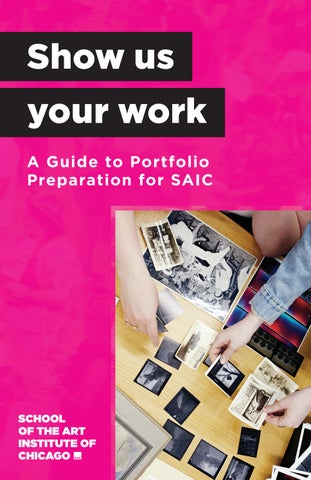
Show us your work A Guide to Portfolio Preparation for SAIC
Your portfolio is an important aspect of your application to the School of the Art Institute of Chicago (SAIC). Showing us your work shouldn’t intimidate you. In fact, it should be exciting, enlightening, and even fun! We offer many opportunities for you to talk to us about your portfolio, so that when you hit “submit,” you feel confident that you are showcasing your strongest creative vision.
We’re happy to review your work more than once! In fact, we encourage it in order to perfect a merit-worthy portfolio.
In-person and virtual admissions events Learn about us. Talk about your work. Prepare your application. At your convenience. From wherever you are. These events are designed to help you learn about us, prepare your strongest portfolio, and begin picturing your life at SAIC. Events include: • O ne-on-one portfolio reviews with faculty and admissions counselors • Admissions events across the nation, where you can get one-on-one feedback on your portfolio, meet with SAIC faculty and staff, and learn more about our interdisciplinary curriculum • Portfolio Tip Tuesdays: virtual events with application and portfolio preparation advice from faculty and staff • Portfolio reviews at in-person and virtual National Portfolio Days • Online information sessions about our distinctive approach to educating artists, designers, and scholars
Pick what event style works best for you: • I n-person events in cities across the world • Individual meetings • Live webinars with Q&As (recording available) • On-demand content that can be viewed at any time
Questions? As always, we are only a phone call or email away. 1.312.629.6100, 1.800.232.7242, or ugadmiss@saic.edu
• Opportunities to meet with current and prospective students • Sessions dedicated to helping parents and guardians understand the admissions process
SAIC.EDU/UGEVENTS
What should I bring to a portfolio review? Great question! There is no right answer. We want you to prepare for a good conversation. We want to talk to you artist-to-artist, maker-to-maker. Here are some tips to help you prepare. • Bring recent work you believe best represents your current creative direction(s) and technical abilities. It’s okay to bring a range, even work you are unsure about, because these are great conversation starters. • Classroom assignments are fine to show us, and can be great springboards to creating new work. • Making work outside the classroom? We hope you are, and we REALLY want to see it. • We like to see sketchbooks. The sometimes-informal ideas help us see your process and give us an insight into how you think.
Images, clockwise from top right: Star Castro, Safety; Kris Montgomery, But, Why?; Abigail Buzbee, Rock Toy; Nina Celeste Perez, Frauhaus; Youna Chung, Transcending Borders
We aren’t expecting perfection. Great ideas for new work and growth happen at every stage of your portfolio development.
Ruoqi (Rever) Li, Traceless?
PORTFOLIO REQUIREMENTS: Depending on the degree you are applying to—BFA in Studio, BFA in Art Education, Bachelor of Arts in Art History, BFA in Writing, or Bachelor of Arts in Visual and Critical Studies— there will be different portfolio requirements.
For more information, visit
Our merit scholarships are based on a review of your portfolio, grades, and your personal essay. Your hard work from high school matters to us.
SAIC.EDU/UG_PORTFOLIO
• T here is no perfect formula for creating the ideal portfolio.
How do I prepare my portfolio for merit scholarship? What SAIC looks at when assessing your work for merit scholarship is probably different from the other schools you’re considering. We are a school that values both meaning and making, which means that we are as concerned about the ideas behind your work as we are about your technical abilities.
Portfolios are a bit like fingerprints—they’re unique to you, and should help us see your individual passions and interests. No one else has your experiences and perspectives, and no one else can make your work.
• C onsider themes in your work. You might be interested in political, social, or environmental issues. Maybe you are interested in portraits. You could present a portfolio that consists exclusively of paintings, or maybe combine portraits that are sculpted, filmed, and incorporated into performance or fashion pieces. All approaches are welcome.
• E xperiment with materials. There are some students who love paint—that is fantastic! But what if you are an alchemist who loves to combine materials—plaster with string, video projected onto canvas, even office supplies as art materials? No matter your medium, we can’t wait to see what you come up with.
• S how us depth as well as breadth. If you are only interested in one medium, show us the range of what you can do there. Some schools ask students to show technical proficiency across a broad range of media—we don’t require that of you.
• S till not sure? Want advice? Talk to us. This is important, too!
How do I create and submit my portfolio? Everything you need to know, from start to submit! • SAIC requires an online portfolio. • Y ou access this through your application within the Common Application at apply.commonapp.org.
• O nce you have created your account
in the Common Application, go to your SAIC application, and make sure you are in the ‘College Information’ section, and the ‘General’ tab. Select ‘Yes’ under the portfolio acknowledgment statement.
• T he ‘Portfolio’ section will appear to your
left. Click on ‘Instructions.’ Then click on the ‘Portfolio Site’ link—this will take you to SlideRoom.
• F rom within SlideRoom, you should upload
10–15 pieces of your work. When uploading your work you are able to include details such as titles and dimensions, and be sure to credit any collaborators.
• F ilm, video, and animation is welcome and
should not exceed 5 minutes total. You can submit multiple clips and be sure to give credit to any collaborators. Specific portfolio requirements for each of our degree programs can be found at
SAIC.EDU/UG_PORTFOLIO
TECH INFO Still images (.jpg, .jpeg, .png, .gif, .tif, .tiff, .bmp, .tga) must be under 5 MB, in order to be uploaded to SlideRoom. Images do not have to be a particular size, as SlideRoom will process them to fit the system. Any videos (.m4v, .mov, .mp4, .wmv, .flv, .asf, .mpeg, .mpg, .mkv) must be less than 250 MB in size; audio files (.mp3, .wma, .ogg, .flac) need to be less than 30 MB in size; and documents (.pdf) must be less than 10 MB. As long as you meet the file size requirement and have media that is in the proper format, the system will process the media to fit the SlideRoom software. We encourage you to review our statement on AI use in portfolios at saic.edu/portfolio. saic.edu/ug 800.232.7242 or 312.629.6100 admiss@saic.edu