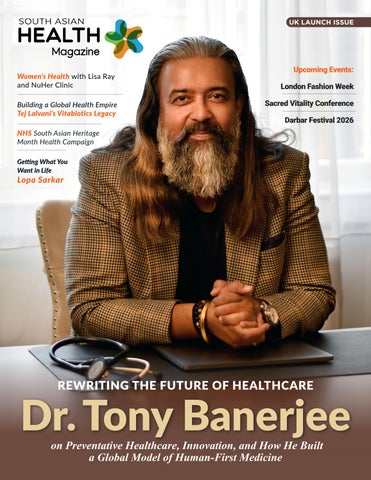
UK LAUNCH ISSUE
Women’s Health with Lisa Ray and NuHer Clinic Building a Global Health Empire Tej Lalvani’s Vitabiotics Legacy
Upcoming Events: London Fashion Week Sacred Vitality Conference Darbar Festival 2026
NHS South Asian Heritage Month Health Campaign Getting What You Want in Life
Lopa Sarkar
REWRITING THE FUTURE OF HEALTHCARE
Dr. Tony Banerjee on Preventative Healthcare, Innovation, and How He Built a Global Model of Human-First Medicine
St. Martinus University Fully Accredited by
Your Pathway to a Medical Degree and U.S. Residency Why St. Martinus University Fully Accredited by a WFME-Recognized Agency (AAEPO): Ensures eligibility for ECFMG certification and U.S.
residency training pathways while meeting internationally recognized standards in medical education.
Direct Entry Pathway Without MCAT: High school graduates
and university students can fast-track into medicine without the requirement of a 4-year undergraduate degree or MCAT examination.
Modern Campus with Advanced Learning Tools: State-of-
the-art infrastructure featuring digital anatomy systems, upgraded laboratories, research facilities, and on-campus student housing designed to support an optimal learning environment.
Secure and Comfortable Student Living: Safe and reliable housing with meal plan options, located in Curaçao — a stable Caribbean island outside the Atlantic hurricane belt. Strong Residency Match Record: Consistently high U.S.
residency match rates, with graduates placed across major specialties throughout the United States.
Cost-Effective Medical Education: Significantly lower tuition
and living expenses compared to many U.S. and Canadian medical schools.
Eligible for Canadian federal and provincial student loan programs, making medical education more financially accessible
for Canadian students.
SMU RESIDENCY MATCH RESULTS 2026 ERAS Cycle
Available in: Canada, US, UK, UAE, Australia & India
Message from the Publisher A new chapter for South Asian health, culture and community in the UK. It is with enormous excitement and a deep sense of purpose that we welcome you to the UK edition of South Asian Health Magazine. This launch is more than the arrival of a new publication; it is the beginning of a platform created to inform, connect and celebrate one of the UK’s most vibrant communities. The need is clear as the Asian ethnic group is the fastest-growing demographic in the UK. This speaks to the scale, diversity and influence of the community we hope to serve. We believe there is a real opportunity for a publication that brings together trusted health information, inspiring voices, preventative thinking, cultural insight and practical resources in a way that feels relevant to South Asian life in Britain. We are especially honoured to feature Dr. Tony Banerjee in our cover story, “Rewriting the Future of Healthcare.” Drawing on his experience across clinical practice, NHS commissioning, entrepreneurship and innovation, Dr. Banerjee shares a compelling vision for moving healthcare from reactive treatment towards proactive, preventative and human-first care. His perspective on accessibility, cultural understanding and representation is particularly resonant for South Asian communities, where health outcomes can be shaped by a complex interplay of genetics, lifestyle, trust, education and barriers to care. His message is ultimately empowering: healthcare should meet people where they are, while technology should enhance—not replace—the human relationship at the heart of medicine. This launch also arrives at an important moment in the UK health and cultural calendar. During South Asian Heritage Month this past July, NHS organizations and community partners brought health, wellbeing, culture and inclusion together under the theme “Unity in Diversity,” with activity spanning prevention, screening, diabetes, heart health, mental wellbeing, culturally responsive care and community engagement. We are proud to continue that conversation through the pages of SAHM. Looking ahead, we are also delighted to highlight events that celebrate the richness of South Asian thought and culture, including Sacred Vitality on Saturday 3 October at the Royal Society of Medicine in London, themed around “Neuroscience and Mind Energy,” and the Darbar Festival, returning from 24 October to 1 November with leading Indian classical musicians, talks, participatory events and wellbeing experiences. Finally, we want to thank every reader, contributor, clinician, community leader, partner, advertiser and supporter who has helped make this UK launch possible. A publication like this can only grow through collective belief and participation. Our hope is that, with your support, SAHM will establish a strong and lasting foundation within the UK’s South Asian community—becoming a trusted space for knowledge, dialogue, representation and connection. We look forward to building this journey with you, issue by issue, story by story, and community by community.
RINA GILL
Publisher, South Asian Health Magazine
rina@thehypeadagency.com 778 688 4973
The publisher is not responsible for any manuscripts, images, photographs or any other material. By accepting and publishing advertising, editorial, advertorial, profiles or any other information in this publication; the publisher in no way recommends, guarantees or endorses quality of services or products and information within the context of the above-mentioned. Although every precaution is taken in the preparation of this publication, the Publisher shall have no liability to any person or entity with respect to any loss or damage caused by the contents of this publication. The Publisher is not liable for any errors or omissions and does not guarantee in any way the accuracy of information provided in the contents of this publication. Copyright 2026 by The Hype Advertising Agency. All rights reserved. No part of this publication may be reproduced by any means, electronic, or mechanical, including internet or photocopying without written permission of the Publisher.
COMING SOON SOUTH ASIAN HEALTH MAGAZINE DUBAI LAUNCH ISSUE
SUSHANT SINHA TFG
Built on discipline. Driven by seva. Fitness. Wealth. Mindset. Meaning. Not every transformation begins in the gym. Some begin with a decision — to live better, think clearer, and build something that lasts. In the upcoming feature cover story, Sushant Sinha, known to thousands as @thefitblogger_ opens up about a journey that sits at the intersection of physical discipline, financial intelligence, and inner growth. What started as a deeply personal fitness journey quietly evolved into something much bigger — a movement rooted in consistency, service, and long-term thinking. While many chase quick results, Sushant chose a different path. He began helping people transform their health — without charging a single rupee. No funnels. No programs. Just seva. A passion project built on the belief that real strength is meant to be shared. Parallel to this, he built a second discipline — real estate investing and education — applying the same principles he lived by in fitness: patience, structure, and compounding over time. From body recomposition to wealth creation, his philosophy remained unchanged — do the basics exceptionally well, for long enough. But what truly sets this story apart is the writing. Through his blogs and reflections, Sushant documents the unseen layers of growth — the mental battles, identity shifts, failures, and quiet wins that rarely make it to social media. His words don’t preach; they resonate. They feel lived-in. Honest. Grounded. This feature will explore: n Why fitness was never just about aesthetics n How discipline in health mirrors discipline in money n The role of seva in building purpose n And why storytelling is his most powerful tool This is not a success story. It’s a process story. Some journeys are meant to inspire. Some are meant to remind you what’s possible.
sushant@sushantsinha77.com
www.sushantsinha77.com
WE ARE EXCITED TO ANNOUNCE THE SOUTH ASIAN HEALTH MAGAZINE IS LAUNCHING IN AUSTRALIA
Dr. Sanam Dhillon
Introducing Dr. Sanam Dhillon — doctor, multi-awardwinning clinician and entrepreneur, and co-founder of Rock Melan, a doctor-formulated cosmeceutical skincare brand built made for Women of Colour. After a decade in clinical medicine, Dr. Sanam saw a gap that was difficult to ignore: skincare simply wasn’t made with brown skin in mind. Skin of Colour remains underrepresented across dermatology, clinical research and the wider beauty industry — and in clinic, Dr. Sanam and her husband, Dr. Gobinder Kashmirian, struggled to find skincare they felt confident recommending to their melanated patients. So, they created their own. In our upcoming feature, Dr. Sanam takes us behind Rock Melan and the mission driving it, from challenging colourism and South Asia’s obsession with “fair” skin, to exposing mainstream beauty practices that can harm Skin of Colour, and building a brand where brown skin is finally at the centre of the conversation. It is the story of a woman at the intersection of medicine, entrepreneurship and representation — using each to challenge an industry that was never built with women like her in mind.
@dr.sanamdhillon @rockmelan
Dr. Gobinder Kashmirian and Dr. Sanam Dhillon
BUILDING A GLOBAL HEALTH EMPIRE:
TEJ LALVANI’S VITABIOTICS LEGACY British-Indian entrepreneur agrees to sell the family’s vitamin empire to Bain Capital in a deal reported at around £900 million For more than five decades, Vitabiotics has been a remarkable British familybusiness success story. Founded in 1971 by Professor Kartar Lalvani OBE, the company grew from a pioneering venture into one of the UK’s best-known vitamin and nutritional supplement businesses. Now, that family chapter is coming to an end. Tej Lalvani, who has led the company for more than a decade and became widely known to television audiences through BBC’s Dragons’ Den, has agreed to sell Vitabiotics to global investment firm Bain Capital. The transaction was announced on July 24, 2026, with financial terms not officially disclosed. However, multiple reports have put the value of the deal at approximately £900 million, making it one of the more notable British Asian family-business exits in recent years.
similarly said that the UK will remain at the heart of its scientific expertise, innovation and brand development while the business expands internationally. The deal is particularly significant because Vitabiotics remained under family ownership from its founding in 1971 until this transaction. Professor Kartar Lalvani’s original vision created a business that survived and grew across generations, while Tej Lalvani’s leadership helped take it onto a much larger international stage. His father is expected to continue to have an association with the business as an honorary figure following the transaction.
The agreement covers Vitabiotics’ UK operations and the wider group, including Meyer Organics in India and operations in Africa. Completion remains subject to customary regulatory approvals and closing conditions. The sale represents a major milestone for Tej Lalvani and the Lalvani family. Vitabiotics was built around Professor Kartar Lalvani’s belief in science, nutrition and innovation, and Tej joined the company after university, working his way through the business before becoming chief executive in 2015. During his tenure, the company expanded significantly, with reported annual global sales rising from about £101 million to nearly £196 million. The business now exports to more than 70 countries and has developed a portfolio of internationally recognized brands. Among Vitabiotics’ best-known products are Pregnacare, Perfectil, Wellman, Wellwoman, Osteocare and the Ultra range. These brands have helped establish the company as a major player in the global vitamins, minerals and supplements market. The business has also invested heavily in science-led product development and international distribution, allowing a company that began as a family enterprise in Britain to build a presence across multiple continents. For Tej Lalvani, the Vitabiotics story has also unfolded alongside a high-
profile public career. From 2017 to 2021, he appeared as an investor on the BBC’s Dragons’ Den, where he backed a range of entrepreneurs and emerging businesses. His television profile brought a new level of visibility to a businessman who had already helped transform his family’s company. His experience on the programme also reinforced his reputation as an entrepreneur interested in innovation, consumer brands and growth. Bain Capital’s arrival signals a new phase for Vitabiotics rather than the end of the company’s British identity. In announcing the acquisition, Bain emphasized the opportunity to support international expansion, innovation and the continued development of the company’s brands. Vitabiotics has
For the wider British South Asian business community, the sale is another example of how familyfounded companies can evolve into internationally recognized enterprises while retaining their entrepreneurial roots. The Lalvani family’s journey reflects a familiar story of migration, education, science, hard work and long-term business building—but on an unusually large scale. With Bain Capital now preparing to take Vitabiotics into its next chapter, the focus will turn to what comes next. The company already has a broad international footprint, established consumer brands and decades of scientific expertise. Bain’s investment is expected to provide additional resources for expansion and innovation. For Tej Lalvani, the sale marks the conclusion of one chapter of a family legacy—and potentially the beginning of an entirely new one.
NHS SOUTH ASIAN HEALTH CAMPAIGN 2026 South Asian Heritage Month • July 2026 • Unity in Diversity
COMMUNITY HEALTH, WELLBEING & ENGAGEMENT — 2026 OVERVIEW Throughout July 2026, NHS organisations and community health partners used South Asian Heritage Month to bring health, wellbeing, culture and inclusion together in accessible community settings. The national theme, “Unity in Diversity,” provided a platform for culturally relevant engagement, trusted conversations and recognition of the contribution of South Asian communities to the NHS and wider society.
KEY INITIATIVES & COMMUNITY ACTIVITY • Health awareness & prevention: Community-facing activity promoted practical health information and signposting around prevention, screening, vaccination, diabetes, heart health, cancer awareness, kidney health and organ/blood donation. • Mental health & culturally tailored care: NHS teams highlighted culturally responsive mental-health approaches, including conversations around stigma, wellbeing and culturally tailored psychological support, while creating safer spaces for discussion. • Family wellbeing & neighbourhood engagement: Community wellbeing events brought families together through play, music, creative activities, pet therapy and access to information, advice and wellbeing support from NHS and local partners. Culturally tailored mental-health and wellbeing • Culture, heritage & inclusion: NHS organisations hosted cultural celebrations featuring engagement highlighted during South Asian Heritage South Asian food, traditional clothing, music, dance, henna/mehendi, jewellery-making, Month. Source: Lancashire & South Cumbria NHS Foundation Trust. meditation and heritage displays, helping strengthen belonging and connection.
• Staff voices, careers & representation: Staff shared personal stories, career journeys and experiences of working in the NHS, while speakers, poetry and leadership sessions recognised the contribution of South Asian colleagues and communities. • Partnerships & health equity: A recurring focus was partnership working with community organisations, charities, cultural groups and trusted local voices. This approach supports more accessible, culturally relevant services and helps address health inequalities. COMMUNITY IMPACT The July campaign demonstrated the value of meeting communities where they are. By combining health education with culture, trusted relationships and inclusive community experiences, NHS teams and partners created more welcoming routes into health information and support. The month also reinforced a broader commitment to reducing health inequalities through listening, co-production and culturally informed engagement.
SOUTH ASIAN DESIGNERS TO KEEP YOUR EYE ON AT
LONDON FASHION WEEK September 17th - 26th, 2026
London Fashion Week is less than a few weeks away and it will bring designers together from all over the world. Here are some of the South Asian fashion designers to look out for:
AHLUWALIA Priya Ahluwalia launched her eponymous multi award winning label in 2018, after graduating from the MA Menswear course at The University of Westminster. The Ahluwalia ethos originates from family trips taken to Nigeria and India during this time. Considering every aspect of the design process, Ahluwalia works with responsible sourcing and manufacturing methods. The label combines elements from the designer’s dual IndianNigerian heritage and London roots and explores the potential of vintage and surplus clothing by giving existing materials new life through textile techniques. Ahluwalia is informed by art, music, literature, and culture across the African and Asian diasporas to create an intersection between near and far, and past and present, making Ahluwalia both nostalgic and futuristic at the same time.
Priya Ahluwalia clothsurgeon
CLOTHSURGEON clothsurgeon is a London based luxury bespoke menswear brand, that harmoniously brings together the two worlds of street culture and tailored craftsmanship. The brand offers a unique bespoke service which allows the customer to create whatever they wish, all starting with an initial idea and sketch, guided by Founder and Creative Director Rav Matharu. Meticulously crafted in London, England, the atelier hosts a highly experienced team of artisans to carry out the construction of a quality contemporary garment. In 2022 clothsurgeon made history by opening the first luxury bespoke streetwear store on the world famous, Savile Row.
SOUTH ASIAN HEALTH MAGAZINE - UK LAUNCH ISSUE
www.londonfashionweek.co.uk
NIKITA KARIZMA Nikita Karizma is a celebrated British-Indian fashion designer known for her signature style that blurs high fashion with culture. Her designs are recognised & respected by a discerning celebrity clientele, including icons across music, film, and entertainment, who are drawn to her ability to create innovative pieces that define a moment while empowering them with identity, attitude & authenticity.
Nikita Karizma
Nikita’s work is woven with storytelling and a culturally relevant voice. Drawing inspiration from her South Asian heritage and global pop culture, her designs explore themes of glamour, rebellion and self-expression through a modern, feminine lens. At its core, Nikita Karizma is about dressing the dreamers, the disruptors, and the icons of tomorrow. Her vision extends beyond fashion; she uses her platforms to create a community that champions the beauty of diversity in high fashion. Nikita’s designs have graced the magazine covers of publications such as CR Fashion Book, Galore & Billboard & been featured in Dazed & Confused, Harper's Bazaar, Elle India, Wonderland and Vogue Italia. Highlights of her fashion journey include dressing Paris Hilton for her viral press appearance with Kim Kardashian. She has been worn by the likes of Lady Gaga, Kylie Jenner, Jahnvi Kapoor, Gwen Stefani & more. Influenced by positive change, at the heart of the studio’s design journey is the service of giving back with numerous charities and philanthropic causes.
SANYUKTA SHRESTHA A pioneer in Sustainable Luxury Women’s Wear and Bridal, Sanyukta Shrestha is a multi-award-winning designer with a cult following of women across the world celebrating the organic, vegan, luxurious, cruelty free handcrafted timeless designs. The Nepalese born British Designer has redefined the luxury market with her innovative sustainable creations while empowering women in developing countries since 1998. Winner of PETA Luxury Vegan Wedding Awards 2021, the London based designer has been recognised by the media as “the dawn of the sustainable movement”, “Green Goddess'' and “the Greta of the Wedding World '' and was among the first to
Sanyukta Shrestha
introduce sustainability to the bridal industry in 2011. Honoured with several national & international awards for graceful creations and innovative approach of empowering women in developing countries, one of the designer’s bridal creations is preserved in The Fashion Museum. Amongst over 100,000 objects in the Museum collection ranging from Shakespeare era to today’s leading designers, Sanyukta Shrestha is the first designer of Nepali origin to be documented in the history of The Fashion Museum in 2012. London College of Fashion graduate Sanyukta Shrestha’s Zero waste approach, slow and transparent supply chain, minimal carbon footprint, and high-end designs reflects many hours of meticulous work using the handspun and hand weaved sustainable materials that pays tribute to the 1000 years old Nepalese Craftsmanship. Also seen at ‘The Oscars’, ‘BAFTA’, ‘Cannes’, her designs have been worn by celebrities like Victoria’s Secret supermodel Candice Swanepoel, American girl band Fifth Harmony, Soprano’s Natalie Coyle and Laura Wright and Amy Nuttall to name a few. www.londonfashionweek.co.uk
The Levitas Group Presents
Sacred Vitality
A landmark London longevity conference on the science, practice, and art of human longevity, bringing together the clinicians, founders and pioneers shaping how we age. Saturday 3 October 2026 - Central London A day devoted to living longer, and living well, where evidence-based medicine meets the practical art of human optimisation. Sacred Vitality is The Levitas Group's flagship longevity conference. Following the success of our previous gatherings, we return to London for our Longevity Conference, a full day of keynote lectures, panels and live demonstrations from the people redefining what it means to age. Across one carefully curated programme, delegates will move from cutting edge diagnostics and regenerative medicine through to nervous system mastery, hormonal health, breathwork and the ancient practices now being validated by modern science. Discount Code DRKAPOOR10 SOUTH ASIAN HEALTH MAGAZINE - UK LAUNCH ISSUE
https://sacredvitality.levitasgroup.com/
Dr Ash Kapoor Founder · Opening Keynote
Dr Ash Kapoor is a physician and longevity specialist with 30+ years of clinical experience, including two decades in the NHS. Founder of Levitas Clinics, Levitas One, Levitas Dental, Levitas Retreats and Levitas Academy, he is the creator of the NoMAD Programme and the 10R Methodology. These pioneering frameworks integrate advanced diagnostics, regenerative medicine and ancient wisdom to optimise healthspan. Through Levitas One, his global expansion programme, Dr Ash partners with leading clinics worldwide, delivering personalised, systems based longevity care that transforms prevention into a new paradigm of medicine.
Rewriting The Future Of Healthcare
DR. TONY BANERJEE on Preventative Healthcare, Innovation, and How He Built a Global Model of Human-First Medicine You began your career deep within the NHS, even leading large-scale healthcare commissioning. Looking back, was there a defining moment when you realised the traditional system wasn't enough—and that you needed to build something new? There wasn't a single moment, but rather a gradual accumulation of experiences that became impossible to ignore. As a clinician, I was seeing patients at the point of crisis. As a commissioner, I was managing a system that was constantly firefighting, stretched both financially and operationally. What struck me most was that we were incredibly good at treating disease, but not particularly effective at preventing it.
www.HarleyDoc.co.uk
DrBanerjee@HarleyDoc.co.uk
+447812016036
I saw patients who presented late, not because they didn’t care about their health, but because the system was difficult to navigate, culturally misaligned, or simply inaccessible.
We were waiting for people to become unwell before acting, and by that stage, the intervention was often more complex, more expensive, and less effective. That realisation stayed with me. I began to question whether the system itself was designed for the modern world, particularly for globally mobile patients who expect immediacy, continuity, and personalisation. HarleyDoc was born from that gap, not as a rejection of the NHS, but as an evolution of what healthcare could become.
Your early work in underserved communities clearly left a mark. How did those frontline experiences shape your long-term vision for equitable, accessible healthcare? Working in underserved communities teaches you very quickly that health is not just about medicine. It is about access, education, trust, and environment. I saw patients who presented late, not because they didn't care about their health, but because the system was difficult to navigate, culturally misaligned, or simply inaccessible. There was a disconnect between what healthcare offered and what patients actually needed. That shaped my thinking profoundly. HarleyDoc
is built on the idea that healthcare should meet people where they are, not the other way around. Whether that is through technology, language, cultural understanding, or simply being available when needed, accessibility is not a feature, it is a fundamental principle.
HarleyDoc is built around a proactive, preventative model of care. Why do you think healthcare systems globally have been so slow to move away from reactive medicine? Healthcare systems are, by nature, complex and risk-averse. They are designed around treating illness because that is where the immediate demand lies. Prevention, on the other hand, requires long-term thinking, behavioural change, and investment upfront for outcomes that may not be visible for years. That is a much harder model to implement, particularly in publicly funded systems under constant pressure. There is also a cultural element. Patients often seek care when something feels wrong, not when they feel well. Shifting that mindset requires both education and a different kind of relationship between doctor and patient. What we are seeing now, however, is a shift. Advances in technology, data, and diagnostics are making preventative care not only possible, but scalable. The question is no longer whether we can do it, but whether we are willing to redesign systems around it.
You've combined clinical practice with entrepreneurship, technology, and leadership. Do you see yourself more as a doctor, a disruptor, or a systems thinker—or is that distinction no longer relevant? At my core, I am still a doctor. That clinical grounding informs every decision I make.
However, I also see myself as someone who operates at the intersection of medicine, systems, and innovation. The traditional boundaries between these roles are becoming less relevant. To build meaningful change in healthcare today, you need to understand not just the science, but the infrastructure that delivers it. If I had to define it, I would say I am building systems of care rather than simply delivering care.
With patients spanning continents—from the UK to Asia and the Middle East—what has surprised you most about how different cultures engage with their health? What is most striking is that, despite cultural differences, the underlying concerns are remarkably similar. People want to feel safe, understood, and supported.
I also see myself as someone who operates at the intersection of medicine, systems, and innovation
Where cultures differ is in how they express those needs. Some are highly proactive, seeking regular testing and optimisation. Others are more reactive, engaging only when necessary. There are also differences in how openly people discuss health, particularly around mental health or chronic conditions.
www.HarleyDoc.co.uk
DrBanerjee@HarleyDoc.co.uk
+447812016036
The key is not to apply a one-size-fits-all model, but to adapt. True global healthcare requires cultural intelligence as much as clinical expertise.
South Asian communities in the UK face disproportionately higher risks of conditions like diabetes and cardiovascular disease. In your view, what are the underlying causes—and how can healthcare systems better respond in a culturally meaningful way? The causes are multifactorial. There is a genetic predisposition, particularly around insulin resistance and central adiposity, but that is only part of the story. Lifestyle factors play a significant role, including diet, physical inactivity, and stress. There is also a tendency towards later presentation, sometimes due to cultural perceptions of illness or barriers to accessing care. What is needed is a more tailored approach. That includes earlier screening, culturally relevant lifestyle interventions, and education that resonates with the community. It is not enough to provide information; it has to be delivered in a way that is meaningful and actionable.
As a British doctor of South Asian heritage, how important is representation and cultural understanding in building trust with patients—and do you think the system is doing enough to reflect the communities it serves? Representation matters because it builds trust. When patients feel understood, they are more likely to engage openly and follow advice. That said, representation is not just about ethnicity. It is about cultural competence. A
healthcare system should reflect the diversity of the population it serves, but it should also ensure that all clinicians are equipped to understand and respect different cultural contexts. We have made progress, but there is still more to do.
HarleyDoc integrates advanced diagnostics and AI-driven tools, yet your messaging remains deeply patient-centric. In an increasingly digital world, what does "human-first healthcare" really mean to you? Human-first healthcare means that technology enhances the relationship between doctor and patient, rather than replacing it. AI can analyse data, identify patterns, and support decision-making, but it cannot replace clinical judgement, empathy, or the nuance of a human conversation. For us, technology is an enabler. It allows us to be more present, more informed, and more responsive. But the centre of healthcare will always be the patient, and the relationship they have with their doctor.
Longevity and lifestyle medicine are central to your approach. Beyond the buzzwords, what are the most overlooked habits or interventions that truly move the needle on longterm health? The fundamentals are often overlooked because they are not particularly glamorous. Sleep, nutrition, physical activity, stress management, and metabolic health remain the cornerstones. If you optimise those consistently, you can have a profound impact on long-term outcomes. Advanced diagnostics and interventions have their place, particularly for high-performance individuals, but they should build on a solid foundation, not replace it.
You've chosen to grow HarleyDoc as a founder-funded venture. How has that independence influenced your decision-making—and the kind of company you're building? Independence allows for clarity of vision. We have been able to build HarleyDoc without compromising on what we believe healthcare should look like. It also means we can move quickly, adapt, and innovate without being constrained by external pressures that may not align with long-term value. That freedom has been instrumental in creating a platform that is both clinically robust and forward-thinking.
www.HarleyDoc.co.uk
Your platform has already demonstrated a reduction in unnecessary hospital visits. What do you think healthcare systems could learn from this in terms of efficiency and cost reduction? A significant proportion of healthcare demand can be managed earlier and more effectively outside of hospital settings. By providing patients with immediate access to a trusted clinician, supported by data and continuity of care, you can intervene before conditions escalate. This not only improves patient outcomes but also reduces the burden on hospitals, allowing them to focus on more complex cases.
DrBanerjee@HarleyDoc.co.uk
+447812016036
As HarleyDoc expands into global markets, how do you balance standardisation of care with the need for localised, culturally sensitive healthcare delivery? We standardise clinical excellence, not delivery. The core principles of care remain consistent, but how that care is delivered must adapt to local contexts. That includes language, cultural norms, and healthcare infrastructure. It is a balance between maintaining quality and ensuring relevance.
Outside of medicine, you're a stand-up comedian, DJ, and an active networker. How do these creative and social dimensions of your life feed back into your professional world? Those aspects of my life provide balance and perspective. Comedy, in particular, teaches you about human behaviour, communication, and timing. It forces you to connect with people in a very immediate way. In many ways, that translates directly into medicine. At its core, healthcare is about understanding people.
Finally, when you think about the future—not just of HarleyDoc, but of healthcare itself—what kind of impact do you hope your work will ultimately have on the way people experience care? Comedy, in particular, teaches you about human behaviour, communication, and timing. It forces you to connect with people in a very immediate way.
would like to see a shift from reactive to proactive care becoming the norm rather than the exception. If we can continue to create and execute a system where individuals are supported continuously, rather than episodically, we can fundamentally change health outcomes. Ultimately, it is about giving people a sense of control over their health, and ensuring that care is not something they access only when they are unwell, but something that is integrated into their daily lives.
Tickets & Information: www.massisyard.com
B A R R A D FESTIVAL 2026
Sat 24 Oct—Sun 1 Nov 2026
This festival of Indian classical music brings together leading artists, late-night performances and a programme of talks and participatory events across our centre. Now in its 21st edition, the festival returns with concerts celebrating the distinct strands of the Indian classical tradition over five days. The bold and new take centre stage this year alongside established masters. Witness Wasifuddin Dagar's 500-year dhrupad lineage, a spellbinding midnight jugalbandi where Kala Ramnath's Hindustani violin meets Jayanthi Kumaresh's Carnatic veena and Sandeep Narayan's genre-defying vocal brilliance. Beyond the stage, the programme expands into raga meditation, breathwork and yoga with live esraj, artist talks and the UK premiere of a new documentary. Plus, experience a pop-up market throughout the festival, offering space to explore even more between events.
WORLD’S BEST INDIAN CLASSICAL MUSIC FESTIVAL
Darbar Arts Culture Heritage Trust is a charity dedicated to promoting Indian classical music for everyone to enjoy.
BUY TICKETS
https://darbar.org/
Lisa Ray Rewriting The Conversation On Women’s Health
Looking back, what experiences and influences most shaped the woman you are today? Growing up as a mix of Indian and Polish heritage gave me an innate sense of being a bridge between cultures and perspectives. But looking back, my journey has been shaped just as much by life's unscripted detours as by my career. Navigating the public eye early in life taught me resilience, but it was my cancer diagnosis in 2009—and the long, reflective journey of writing my memoir Close to the Bone— that truly anchored me. Confronting my own mortality stripped away the artificiality of fame and forced me to ground myself in spirituality, selfadvocacy, and truth. Every shift, from acting to writing to health advocacy, has taught me that true strength comes from vulnerability and embracing every phase of life without fear.
SOUTH ASIAN HEALTH MAGAZINE – SPECIAL INDIA LAUNCH ISSUE
presence, deep connection, peace, and honoring your body. Resilience, I realized, isn't about toughing it out or putting on a brave face for the world; it's about gentle endurance, surrendering to the present moment, and learning to rebuild yourself from the inside out. It redefined how I measure success—no longer by external validation or productivity, but by how grounded and authentic I feel every day.
A life-threatening diagnosis acts as an intense clarity filter. It vaporizes minor anxieties and forces you to confront what actually holds value
Your cancer treatment brought an unexpected health transition. What did you learn about understanding your body and advocating for your health?
What continues to draw you to storytelling, and what is it about acting that has remained meaningful through the different chapters of your life? Storytelling is an exercise in empathy. Early on, acting was a canvas for expression and exploration; it allowed me to step into different lives and worldviews. Over time, as my own lived experience expanded, acting became less about performance and more about truth-telling and human connection. Whether I am in front of a camera or writing a page, storytelling allows us to make sense of our chaos and let others know they aren't alone. That core impulse—to connect, illuminate, and give voice to what is often left unsaid—remains as meaningful to me today as it was when I first started.
How did your health journey with cancer change your perspective on life, resilience, and what truly matters? A life-threatening diagnosis acts as an intense clarity filter. It vaporizes minor anxieties and forces you to confront what actually holds value: @nuher.me
When cancer treatment pushed my body into premature menopause overnight at 37, I was completely unprepared. I knew how to fight for my life, but I was not prepared for the sudden shift, the physical exhaustion, brain fog, and total lack of clear medical guidance surrounding it. For years, I normalized those symptoms and carried a quiet, unspoken shame—something so ironic because I was being praised publicly for being so open about cancer. That experience was a profound wake-up call. It taught me that we cannot rely on a system that historically minimizes women's health; we have to become educated, tuned into our own bodies, and unapologetic about demanding proper, personalized care.
Was there a particular moment when you recognized these conversations were part of a much bigger gap in women's healthcare? It hit me during conversations with close friends who were entering their late 40s. A dear friend of mine was suffering through debilitating mood shifts and fatigue, yet she had never even heard the term perimenopause.
@lisaraniray
www.nuher.me
When we began speaking about it openly on social media, the floodgates opened. I realized I wasn't just carrying my own experience; I was witnessing a generational silence. Historically, women were excluded from medical research for decades, and standard medical training spends astonishingly little time on menopause. Women were consistently being told that their suffering was just "a normal part of aging" that they had to endure. That was the moment I realized this wasn't just a personal gap—it was a systemic healthcare blind spot.
What inspired you to co-found NuHer, and why create a dedicated platform focused on women's midlife and hormonal health now? With cancer, my mission was to start the conversation and break the stigma. But with menopause and midlife health, starting a conversation wasn't enough—women needed real, accessible, actionoriented support. Midlife is often the longest, most transformative phase of a woman's life, yet it arrives with the least amount of structure or clinical clarity. I co-founded NuHer alongside a brilliant team because we wanted to create a dedicated space where menopause is not treated as a medical dead end, but as a woman's Prime Time. Suffering should never be the price of aging.
SOUTH ASIAN HEALTH MAGAZINE – SPECIAL INDIA LAUNCH ISSUE
Why was it important to build NuHer around a multidisciplinary team of doctors and health professionals rather than simply sharing personal wellness experiences?
Working with our medical team— specialists like Dr. Reina Punj, Dr. Kajal Parikh, and our extended panel—has been deeply validating and educational.
Personal stories are powerful for breaking taboos, but lived experience alone cannot prescribe treatments or balance hormones. Hormonal shifts affect everything—bone density, cardiovascular risk, metabolic health, cognitive function, and emotional well-being. Because every woman's biological blueprint is different, care cannot be one-size-fits-all or based purely on wellness trends. Bringing together internal medicine specialists, endocrinologists, gynecologists, dietitians, and mental health professionals ensures that women receive evidencebased, medically rigorous, and personalized care grounded in hard science.
What have you learned from working alongside the specialists at NuHer, and how has their expertise influenced your vision? Working with our medical team— specialists like Dr. Reina Punj, Dr. Kajal Parikh, and our extended panel—has been deeply validating and educational.
Dr Reina Punj
Dr. Kajal Parikh @nuher.me
@lisaraniray
www.nuher.me
I've learned how intricate the endocrine system is and how symptoms like joint pain, insomnia, or anxiety are often directly linked to estrogen fluctuations. Their expertise reinforced my conviction that NuHer must be a 360-degree ecosystem. It's not just about managing acute hot flashes; it's about long-term preventive care—protecting heart, brain, and bone health so women can thrive for decades to come.
What are the biggest misconceptions about perimenopause and menopause you hope NuHer can change, particularly in South Asia? In South Asia, there's a heavy cultural layer of shame, silence, and ageism. The biggest misconception is that menopause marks the decline of a woman's utility or vitality—that once reproductive years end, a woman must quietly retreat into the background. Another huge misconception is that symptoms like severe anxiety, mood swings, or brain fog are "all in your head" or just "drama."
SOUTH ASIAN HEALTH MAGAZINE – SPECIAL INDIA LAUNCH ISSUE
Dr. Anuya Manerkar
Dr. Prakhar Jain
Mitun De Sarkar
At NuHer, we want South Asian women to know that hormonal changes are real biological events with scientific solutions— whether through medical interventions like HRT, tailored nutraceuticals, or lifestyle protocols. Menopause is not the end; it is an invitation to step into your power age.
How has being honest about both the highs and lows of your life changed your relationship with the women who follow your story? It has transformed that relationship from a distant public dynamic into an incredible community of mutual trust. When you drop the facade of perfection, it creates a safe space for others to drop theirs. Sharing my struggles—whether with cancer recovery, premature menopause, or aging—has connected me with women on a level of deep intimacy and shared humanity. It taught me that vulnerability isn't a weakness; it's the ultimate connector.
Dr Priyanka Mehta
What does success look like to you beyond acting, and what impact do you hope NuHer will have? Success now is about impact and legacy. It's about leaving behind tools and spaces that make women's lives measurably better, healthier, and freer. My hope for NuHer is that it completely redefines how midlife health is delivered and understood across India and beyond. I want a future where no woman feels isolated, dismissed, or confused when her body begins to change. If NuHer helps millions of women navigate midlife with clarity, confidence, and vital health, that will be one of the most fulfilling achievements of my life. @nuher.me
@lisaraniray
Parinaz Agha
www.nuher.me
Lopa is currently based in London, UK
SOUTH ASIAN HEALTH MAGAZINE - UK LAUNCH ISSUE
Hi, I’m Samina. I was diagnosed with breast cancer at 45. Here’s my advice for other South Asian women...
It was a big shock for me to be diagnosed with breast cancer at the age of 45. No one spoke about breast cancer in my family here, or in Pakistan.
sakoonthroughcancer.org
It was never a conversation I heard amongst South Asian communities or in my own household.
One piece of advice I would give to every South Asian woman is: love yourself and know your normal.
sakoonthroughcancer.org
Know what is your baseline and what’s normal for you. If you experience changes, make sure you speak up.
I’m hoping I can reach as many South Asian women as possible, to normalise conversations and ensure that, as a community, we talk about breast cancer in a positive way. sakoonthroughcancer.org
WHEN WOMEN COME TOGETHER, WELLNESS FOLLOWS Inside Birmingham’s “Sorry Paaji” All-Girl Punjabi Summer Festival A celebration of music, movement, community, culture and the many dimensions of women’s wellbeing On July 31, 2026, Birmingham’s Luna Springs in Digbeth became the backdrop for a distinctly modern expression of Punjabi culture: Sorry Paaji’s first outdoor festival experience, created specifically for women. The event brought together a reported 1,000-plus women for an evening of Punjabi music, DJs, food, fashion and festival energy. The format was intentionally female-only and 18+, with an all-women crowd, all-girl DJs, food stalls and immersive production. Surprise appearances from UK Punjabi favourites Jassi Sidhu and Dr Zeus added to a lineup that also featured DJs Kizzi and Simz. On the surface, it was a party. Look a little deeper, however, and the appeal speaks to something much bigger: women need spaces where they can connect, move, laugh, express themselves and celebrate who they are without having to perform a role for anyone else. The health benefit of simply moving to music Dancing is joyful exercise. A night spent walking, dancing and moving to music can contribute to the physical activity people need for good health. The U.S. Centers for Disease Control and Prevention notes that physical activity can improve sleep, reduce feelings of anxiety, support heart health and help lower the risk of several chronic diseases.
@sorrypaajitour
Even when exercise does not feel
describes supportive social connections
A spiritual perspective: celebration
like “exercise,” movement still counts.
as important to mental and physical
as connection spiritual wellness does
That makes culturally familiar music
health, and notes that strong social bonds
not have to mean formal religion or a
particularly powerful. When the
are associated with healthier, longer
particular belief system. It can include
soundtrack is Punjabi, movement can
lives. A women-only environment can
meaning, gratitude, identity, connection
feel less like a workout and more like
make it easier for some attendees to
and the feeling that life is worth
celebration. The result is an enjoyable
relax, participate and form connections—
celebrating. In that sense, a shared
form of activity that encourages people
particularly when the event is designed
cultural celebration can be spiritually
to get on their feet, stay engaged
around shared cultural experiences.
nourishing: hundreds of women singing
and create positive associations with movement.
Culture can be part of wellness For many South Asian women, Punjabi music
Mental wellness: joy, release and
carries more than a beat. It can evoke
belonging The emotional side of an
childhood memories, weddings, family
event like this may be just as important.
gatherings, language, heritage and a
Singing along to familiar songs, laughing
sense of home. Bringing those sounds
with friends, dressing up, meeting other
into a contemporary festival setting
women and sharing an atmosphere of
allows culture to be experienced not
excitement can provide a welcome break
simply as something inherited, but as
from work, family responsibilities and
something living, evolving and proudly
everyday stress. Social connection is
owned by a new generation. There is
also a genuine health factor. The CDC
a wellness dimension to that sense of identity. Feeling seen and understood
the same words, moving together to the same rhythm and celebrating a heritage they share can create a powerful feeling of collective belonging. There is something deeply human about music and community turning an ordinary evening into a memory. For some women, that may feel restorative, grounding or even sacred—not because a festival is a substitute for healthcare or spiritual practice, but because joy, connection and cultural pride are meaningful parts of a well-rounded life.
within a community can strengthen
More than a party Sorry Paaji’s
belonging and self-esteem. For younger
Birmingham festival illustrates how
women, it can also challenge the idea
the definition of wellness is expanding.
that cultural expression belongs only
Health is not only about what happens
in traditional settings. Here, Punjabi
in a clinic or a gym. It is also shaped
culture becomes part of nightlife, fashion,
by whether people have opportunities
friendship and modern female identity.
to move, connect, belong, express themselves and experience joy. A women-centred Punjabi festival brings all of those elements together. It gives women permission to take up space, celebrate loudly, dance freely and enjoy their culture on their own terms. In a world where women are often balancing countless responsibilities, that kind of joy is not frivolous. It can be a meaningful part of wellbeing.
@sorrypaajitour
THE HYPE AD AGENCY Full-Service Boutique Agency Specializing in Multicultural Marketing Previous Clientele: Major Banks, Telecoms, Corporates, Small Businesses, Non-Profits & Community Organizations Event Production & Magazine Publications Across Canada Track Record for Securing Corporate Sponsorships & Funding
RINA Gill FOUNDER
647 465 7776 | 778 688 4973 rina@thehypeadagency.com
www.thehypeadagency.com
@hype_empire