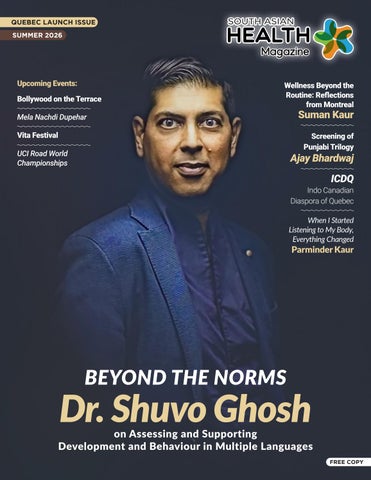
QUEBEC LAUNCH ISSUE SPRING SUMMER2026 2026
Upcoming Events: Bollywood on the Terrace
Wellness Beyond the Routine: Reflections from Montreal
Mela Nachdi Dupehar Vita Festival
Suman Kaur Screening of Punjabi Trilogy
UCI Road World Championships
Ajay Bhardwaj
ICDQ
Indo Canadian Diaspora of Quebec When I Started Listening to My Body, Everything Changed
Parminder Kaur
BEYOND THE NORMS
Dr. Shuvo Ghosh
on Assessing and Supporting Development and Behaviour in Multiple Languages FREE COPY
St. Martinus University Fully Accredited by
Your Pathway to a Medical Degree and U.S. Residency Why St. Martinus University Fully Accredited by a WFME-Recognized Agency (AAEPO): Ensures eligibility for ECFMG certification and U.S.
residency training pathways while meeting internationally recognized standards in medical education.
Direct Entry Pathway Without MCAT: High school graduates
and university students can fast-track into medicine without the requirement of a 4-year undergraduate degree or MCAT examination.
Modern Campus with Advanced Learning Tools: State-of-
the-art infrastructure featuring digital anatomy systems, upgraded laboratories, research facilities, and on-campus student housing designed to support an optimal learning environment.
Secure and Comfortable Student Living: Safe and reliable housing with meal plan options, located in Curaçao — a stable Caribbean island outside the Atlantic hurricane belt. Strong Residency Match Record: Consistently high U.S.
residency match rates, with graduates placed across major specialties throughout the United States.
Cost-Effective Medical Education: Significantly lower tuition
and living expenses compared to many U.S. and Canadian medical schools.
Eligible for Canadian federal and provincial student loan programs, making medical education more financially accessible
for Canadian students.
SMU RESIDENCY MATCH RESULTS 2026 ERAS Cycle
Message from the Publisher Dear Readers,
Welcome to the launch issue of Quebec South Asian Health Magazine! We are thrilled to introduce a new platform celebrating the people, stories, and achievements shaping health milestone and wellness within community. This vibrant community to enrich This year marks a truly special for BCQuebec’s SouthSouth AsianAsian Health Magazine as we proudlycontinues celebrate Quebec through its culture, languages, traditions, entrepreneurship, and strong sense of community. The mandate of South Asian Health 15 years of serving our community. began as aacross vision to create culturally relevant Magazine (SAHM) is to highlight successful SouthWhat Asians in healthcare Canada, and wemeaningful, are excited to bring this unique, one-of-a-kind conversations has grown into a trusted global brand. Over the years, we have remained committed to platform to Quebec now as well.
amplifying stories matter—stories in empowerment, education, and educator, representation forAfter South Our inaugural cover story that features Dr. Shuvo Ghosh, arooted Developmental-Behavioural Pediatrician, researcher, and advocate. completing his medical training in the United States, Dr. Ghosh moved to Montreal for fellowship training at McGill University and Montreal Asians everywhere. Children’s Hospital and ultimately made Quebec home. His work focuses on neurodevelopment, behavioural health, language, culture, and We dynamics. are honored continue standing as the onlyonplatform dedicated exclusively to health, family In our to feature, he shares valuable perspectives inclusive healthcare, supporting South Asian families,wellness, improving access to care, and ensuring South Asian health needs are represented in research and healthcare conversations. beauty, fashion, and fitness for the South Asian community on a global scale. This focus has always been
We also delighted to feature Suman in “Wellnesstopics Beyondthrough the Routine: Montreal.” Suman her able visit atare the heart of who we are. ByKaur addressing a Reflections culturallyfrom informed lens, weshares havehow been toto Montreal reminded her that wellness extends beyond exercise and routines. Through walking, yoga, friendship, food, exploration, and spark dialogue, inspire healthier lifestyles, and celebrate the diversity and strength of our community meaningful connection, she discovered a different dimension of wellbeing. Her story beautifully reminds us that connection, curiosity, presence, across generations. and the relationships we nurture are just as important to our overall wellness. AsOur part journey of our celebration of South and community in Quebec, we are excited to highlight several upcoming events taking place has also beenAsian oneculture of growth and expansion. With a strong presence across multiple provinces inin theCanada, Montreal we area are this August. From Bollywood on the Terrace – Cowboy Edition at Terrasse Camelia on August 14, to Mela Nachdi Dupehar now excited to be extending our footprint internationally. We are currently in the 2026 in Vaudreuil-Dorion on August 22, there will be plenty of opportunities to enjoy music, dance, food, and community. On August 23, process of expanding California (USA), London (UK),atand Dubai (UAE)—with India and Australia audiences can also experienceto filmmaker Ajay Bhardwaj’s Punjab Trilogy the South Asian Women’s Community Centre, featuringnext three on documentaries followednew by a Q&A with the filmmaker. not Thesejust events are wonderful examplesbut of the vibrant opportunities cultural experiences our radar. These markets represent geographic growth, deeper tobringing connect Quebec’s South Asian community together and celebrating our shared heritage. with South Asians worldwide.
Parminder Kaur brings an equally meaningful perspective with “When I Finally Listened to My Body, Everything Changed.” Parminder shares her As wepain, lookgrief, ahead, is shaping to betoarecognize year filled with her major personal journey through years of unexplained family2026 responsibilities, andup learning the signals bodymilestones was sending. Her experience with somatic yoga and nervous-system healing her towardWe greater and rest. As a wellness and content and bold newled chapters. areself-awareness energized by what lies ahead advocate and remain creator, she now to South Asian women who may appear to have together while focused onspeaks further solidifying our strong foundation aseverything the #1 magazine quietly struggling within.
source catering to South Asians worldwide. Thank you to our readers, As we introduce Quebec South Asian Health Magazine to our readers, we hope this first issue partners, and contributors for being an integral part of this journey—we feels meaningful, inspiring, and representative of our community. We hope our Quebec audience look to growing, together. enjoysforward this inaugural edition andevolving, feels proud and to seecelebrating South Asian voices celebrated on this new platform. This is only the beginning, and we look forward to bringing you more inspiring Cheers a Happy, Healthy New and Year! healthcaretoprofessionals, wellness stories, exciting issues in the near future. Cheers to Good Health!
RINA RINA GILL GILL
Publisher, Publisher, South South Asian Asian Health Health Magazine Magazine
778 688 4973 rina@thehypeadagency.com 647 465 7776
The publisher is not responsible for any manuscripts, images, photographs or any other material. By accepting and publishing advertising, editorial, advertorial, profiles or any other information in this publication; the publisher in no way recommends, guarantees or endorses quality of services or products and information within the context of the above-mentioned. Although every precaution is taken in the preparation of this publication, the Publisher shall have no liability to any person or entity with respect The publisher not responsible any manuscripts, photographs or any material. Byerrors accepting and publishing advertising, editorial, advertorial, profiles of or to any loss or is damage caused byfor the contents of this images, publication. The Publisher is other not liable for any or omissions and does not guarantee in any way the accuracy any other information this publication; publisher in no way recommends, guarantees or endorses of services products within context information provided ininthe contents of thisthe publication. Copyright 2026 by The Hype Advertising Agency.quality All rights reserved.orNo part ofand this information publication may bethe reproduced of the above-mentioned.by Although everyelectronic, precaution taken in theincluding preparation of this thewithout Publisher shall permission have no liability any person or entity with respect any means, orismechanical, internet or publication, photocopying written of thetoPublisher. to any loss or damage caused by the contents of this publication. The Publisher is not liable for any errors or omissions and does not guarantee in any way the accuracy of information provided in the contents of this publication. Copyright 2026 by The Hype Advertising Agency. All rights reserved. No part of this publication may be reproduced by any means, electronic, or mechanical, including internet or photocopying without written permission of the Publisher.
VITA Festival
2026
Move, Celebrate, Get Inspired in Montreal
When sport becomes a party. The Montréal event that celebrates the joy of movement through sports, festivities, and art. VITA is a vibrant festival where everyone finds their way to move. After bringing together nearly 10,000 people at its first edition, the festival returns in September 2026. A wave of energy: more than 20,000 participants expected on a new site to share the movement and joy!
FREE ADMISSION SEP 18, 2026 TO SEP 19, 2026 Esplanade Viau of the Olympic Park VITA is much more than a sports festival: it’s a festive and inclusive gathering where people move, get inspired, and celebrate the joy of being active. Come discover new sports without pressure, take part in engaging workshops, and experience a vibrant atmosphere fueled by collective energy!
Friday, September 18: 9 AM to 9 PM Saturday, September 19: 10 AM to 5 PM
Pickleball Skateboarding Family Zone presented by Promutuel Insurance CF Montréal Climbing Diving Athletics Intergenerational Zone presented by FADOQ Victory for Montreal Natation Latin Dances Artistic Navigation Teqball Rugby Lifesaving Sport Weightlifting Australian rules football Cheerleading Tennis Crosse Handball Ultimate frisbee Montreal Roses Cross-country skiing Biathlon Rest area presented by Hydro-Québec Naomi Struggle Rowing Kendo Aikido Flag football Cricket BJJ (Brazilian Jiu-Jitsu) Cycling Urban Race presented by LOOP Mission Vovinam Việt Võ Đạo Tchoukball Flycage Sumo Triathlon Wheelchair Basketball Adapted badminton Boccia Montreal Alliance Para-climbing Ringette Adapted fencing Squash Fencing Kin-ball Judo Balance bike course Golf Rugby Volleyball Kayaking Karate Kickboxing Tai Chi Badminton Pétanque Breaking Racquetball Ball on wall Ninja Warrior Course
Wellness Beyond the Routine: Reflections from Montreal Travel has always been an important part of wellness for me. Stepping outside of my everyday routine, experiencing a different place and giving myself the space to explore has a way of making me feel more present. So does spending time with the people I love. Those two things are what brought me to Montreal. I travelled there to visit one of my closest friends, not for a wellness retreat or with a carefully planned itinerary of workouts, healthy meals and activities. But over the course of a few days, I started to notice how naturally wellness had woven itself into the trip. It was in the long walks through the city and the yoga classes we took together. It was in stopping for coffee, sharing good food, discovering something unexpected and having conversations without needing to rush off somewhere else. None of it felt particularly structured.
www.sumankaur.com
@sumankaurwellness
And maybe that was the point. We often think about wellness as something we need to do: the workout we schedule, the food we prepare, the habits we try to maintain. Those things matter, and they are a big part of my own life and work. But Montreal reminded me that wellness can also be found in the experiences and relationships that make us feel connected to ourselves, to other people and to the world around us. There is something about Montreal that makes that particularly easy for me. I love exploring its different neighbourhoods on foot, stopping at coffee shops and flower stands, noticing the architecture and turning down a street simply because something catches my attention. Parts of the city carry that European feeling I love, and every time I return, there seems to be something new happening. On this visit, I walked everywhere. My friend and I went to Luna Yoga regularly, and when she was at work, I spent time exploring the city on my own. Movement became part of my days without needing to be planned. As a personal trainer and wellness coach, I spend a lot of time thinking about intentional movement. I believe in strength training, purposeful exercise and having a plan. But I also believe movement does not only count when we call it a workout. Sometimes movement is simply the way we experience our lives. Walking through a city allows us to experience it differently. We notice more. We slow down enough to take in what is around us. Movement becomes less about what we are trying to achieve and more about where our bodies are allowing us to go. There is something incredibly freeing about that. But the most meaningful part of my time in Montreal had very little to do with how much I moved. It was connection. The reason I had travelled there in the first place was to spend time with my friend. We went to yoga, ate at restaurants, explored the city and experienced some of the energy of the MURAL Festival. We went to a soccer match. She made dinner at home. We talked. We laughed. We simply spent time together. I also had the opportunity to meet another friend
while I was there. There was room to be curious. Room to walk without rushing. Room to have a long conversation. Room to enjoy a meal without thinking about what came next. Room to notice the flowers outside a shop, the art covering the side of a building or a street I had never walked down before. Travel has a way of reminding us how much we miss when we are moving through our everyday lives on autopilot. When I came home and looked through my photos, I realized I had captured plenty of Montreal, but very few photos of my friend and me together. At first, I wished we had taken more. Then I thought about why we hadn't. We were too busy being together. in person for the first time, someone I had originally connected with through TikTok years ago. A friendship that had existed through a screen suddenly became a conversation across a table. Lately, I have been thinking more about the role connection plays in our health, particularly connection between women. We talk a lot about the foundations of wellness, including movement, nutrition, sleep and stress management. But our relationships belong in that conversation too. Making time for people who make us feel seen, supported and connected is not something that sits outside of our wellbeing. It is part of it. Perhaps that is why this particular trip stayed with me. There were wonderful things to see and do, but when I think about Montreal, it is not one attraction or restaurant that comes to mind first. It is how I felt
www.sumankaur.com
That realization stayed with me because it captured something I believe about wellness. Our routines matter. Taking care of our bodies matters. Building strength, nourishing ourselves, resting and creating healthy habits matter. But wellness is bigger than the things we can track. It is also the quality of our relationships. It is curiosity and joy. It is moving our bodies in ways that connect us to the world around us. It is making time for experiences that bring us back to ourselves. Sometimes wellness is the workout you planned. And sometimes it is walking through a beautiful city with nowhere you need to be, sharing dinner with someone you love, saying yes to something new, or being so present in your own life that you forget to take the picture. Suman Kaur Certified Personal Training Specialist | Registered Yoga Teacher (RYT 200) Health, Wellness & Lifestyle Coach
@sumankaurwellness
INDO CANADIAN DIASPORA OF QUEBEC
Indo-Canadian Diaspora of Quebec goal is to build a strong, united community that values and respects cultural diversity.
OUR VALUE
OUR VISION
OUR MISSION
Dedication to promoting mutual understanding, collaboration, and respect for cultural diversity. We prioritize inclusivity, empowerment, and support for new immigrants in Montreal, Quebec.
To build a strong, united community where cultural, social, educational, and economic ties between the Indian and Canadian communities flourish. We aim to be a leading advocate for cultural exchange and community engagement.
Our mission is to cultivate a vibrant and inclusive community by showing unified face and fostering cooperation between the Indian and Canadian communities. Our organization is dedicated to celebrating Indian heritage while integrating the diversity of Canadian society through a variety of educational programs, cultural events, and community initiatives
514 594 1108
icdquebec@gmail.com
2020 Transcanadienne # 107, Dorval, Quebec, Canada H9P 2N4
When I Finally Listened to My Body, Everything Changed Parminder Kaur For fourteen years I woke up every morning in pain that no doctor could explain. I immigrated to the United States in 2004 to pursue my PhD in Plant Sciences. By 2008 I was in Canada, building a career in insurance, raising two children, managing a home, and showing up for everyone around me. From the outside I looked like someone who had it together. From the inside my body had been sending signals I did not know how to receive. The first time I understood that my body’s communications might not be taken seriously, I was in a delivery room. When my daughter was born in 2010 I lost feeling in my leg. I kept telling the nurses something was wrong. For hours nobody believed me — not until I tried to stand and could not. I spent months in physiotherapy learning to walk again, unable to carry my own newborn daughter. When my son was born the following year, the pain relief did not work. I said so. The procedure continued. I have lived with pain in my body ever since. Fourteen years. Eleven doctors. Every result normal. I learned early that my body’s signals might not be taken seriously. So over time, without realising it, I stopped taking them seriously myself. In 2015 I lost my mother. I folded laundry and cried into it because I did not know what else to do with my hands. Life did not pause for grief. So I got up, made breakfast, and went to work. I carried that loss through every ordinary day for years, performing okayness while something inside me was quietly breaking.
By 2017 I was sick every other day. Could not sleep even though I was exhausted. Still showing up for everything. Still saying I was fine.
I am still healing. I want to be honest about that.But I wake up now and the pain does not own my day. I stopped counting down to the weekend. I stopped crying in the bathroom with the water running so nobody could hear.
I was not fine. What nobody told me — what took me fourteen years to discover — is that fibromyalgia is not primarily a pain condition. It is a nervous system condition. My nervous system had been in survival mode for so long, from the birth rooms where I was dismissed to the grief I never had space to feel, that my body had forgotten there was another way to exist. I was not broken. I was dysregulated. And that, I finally learned, was something I could actually work with.
I am still healing. I want to be honest about that.But I wake up now and the pain does not own my day. I stopped counting down to the weekend. I stopped crying in the bathroom with the water running so nobody could hear.
Three years ago, I found somatic yoga. The first session I cried — not from sadness but from release. My body had been holding things I had never been given permission to put down.
my body needed instead of what I thought I should push through. I started saying no. Moving slowly on purpose.
I started listening. To the signals I had been ignoring for years. To what
Choosing rest before the crash came.
I started creating content about nervous system healing because I realized I was not alone. The South Asian immigrant woman who looks completely capable while quietly falling apart — she is everywhere. She has been dismissed by doctors, conditioned by culture to keep going, and never given language for what her body is experiencing. Your body is not dramatic. It is not weak. It is not imagining things. It has been talking to you for a long time. The question is whether you are ready to listen. Parminder Kaur is a nervous system healing advocate and content creator based in Kitchener, Ontario. She creates content for quietly exhausted women @Ansarvibes on Instagram.
QUEBEC SOUTH ASIAN HEALTH MAGAZINE – FEATURE COVER STORY
DR. SHUVO GHOSH Can you share a bit about your background and what inspired you to pursue a career in medicine and specialize in Developmental-Behavioural pediatrics?
The social and individual reactions I saw in classmates, family members, and friends in my neighbourhood often made me wonder what led them to particular actions.
(514)-933-3393
My interest in medicine came a bit late in comparison to many students. I was exposed to health care regularly from a young age, as both my parents were physicians, but seeing the very busy and demanding careers of my late father (a surgical oncologist) and my mother (now a retired pathologist) did not immediately strike me as the way I wanted to live when I grew up. Thus my childhood in Chicago, IL was spent considering medicine as a field that took much more than it gave. And as a result, my interest was in other pursuits such as writing and music, though I was always a scientific thinker and enjoyed every science subject in my studies.
info@centremeraki.com www.centremeraki.com
1600 Boul René Lévesque O, suite 130 , Montréal, Québec H3H 1P9
I was fascinated by the ways people interacted, behaved, and created dynamic relationships with one another all through my school years. The social and individual reactions I saw in classmates, family members, and friends in my neighbourhood often made me wonder what led them to particular actions. I suppose you could say that in some ways I was a little psychologist, analysing the situations around me, reflecting and trying to make sense of the world. Later in life I realised that these were pretty precocious thoughts and probably were a reason some of my early classmates thought of me as a bit too mature. Luckily I usually found a handful of friends who weren’t bothered by my philosophical nature at every step of my academic life. I entered Johns Hopkins University after high school, intending to get a general grasp of biological science and linguistics, while honing my skills towards a possible academic career in language and creative writing. But my plans shifted after I spent the summer after my 2nd year at university volunteering as an admin clerk in the Pediatric Emergency Room of Johns Hopkins Hospital in downtown Baltimore, MD. Suddenly I was fascinated by the myriad health issues that families came in with, and I was immediately drawn to the children I registered and sent to nursing triage. This was also a place where I had a great deal of exposure to socioeconomic injustices, both in terms of the regular challenges faced by minority communities, but also the huge health inequities created by the US insurance system. We were forced to redirect some families to other centres even when their children were in significant distress, and other times we could see that the parents were overwhelmed at the paperwork and documentation required to access health care. As my volunteer experience continued, I found that it wasn’t satisfying
enough to enter patient information or pull up files and then send families into the ER to see the health care providers. I began to feel the urge to follow them inside and find out exactly how these kids were evaluated, to know what was wrong with them, and to learn how to help them. That summer crystallised my desire to pivot and focus on eventually getting into medical school. At that point I made the decision to pursue medicine, much to my father’s pleasure! My mother, on the other hand, was more ambivalent and remained happy for me to choose my own path, medicine or otherwise. But just because my career goals had shifted, nothing could erase my ongoing passion for languages and creative output in writing and music. So, this continued to inform my choices as my path took me into medical school, and as soon as I learned about Developmental-Behavioural Pediatrics it seemed like a natural fit. Here was a specialty that combined so many of my interests: complex evaluation of children with issues related to their psycho-emotional functioning, language and motor skills, cognition, identity, and more. It requires time for reflection, analysis, and writing skills with the reports we have to produce. And it allows interaction with children and families from diverse backgrounds. What was not to love? When I completed medical school and my Pediatrics residency in the US, I made the move to Montreal to complete my fellowship in Developmental-Behavioural Pediatrics at McGill University/Montreal Children’s Hospital. Here I found not only the workplace that fit me best, but also the city which spoke to me as a multi-lingual person. And along the way I met my wife (also a pediatrician with specialisation in neurodevelopmental issues), which helped finalise my decision stay, become a Canadian citizen, and focus on serving the Quebec population.
You’ve done extensive work on Developmental-Behavioural Pediatrics and gender variance in children. How do you ensure that cultural values and family dynamics, especially within South Asian communities, are respected in these sensitive conversations? This is a very pertinent issue; many families from specific cultures, especially those in the South Asian diaspora, have differing views on how to manage developmental issues or gender identity. At the same time, what we see as wildly different values are often a lack of information or understanding about the science behind these issues, or a belief system that has not always allowed space for certain differences. What is really interesting is that historically South Asia was a part of the world that was incredibly inclusive, regardless of the religious or social norms of the various kingdoms and principalities that made up the subcontinent. We have ancient texts with descriptions of individuals with disabilities and multiple gender identities who were integrated into daily life and played important roles in the societies that eventually evolved into our modern South Asian cultures. These can be found in Hindu scripture, in many Islamic texts from the Mughal period as well as in the Bengal Sultanate (which was an extension of the Ottoman Empire), in Buddhist writings in Pali, and in various regional depictions of societal roles. These spanned centuries of cultural development in vastly differing regions from Kashmir to modern-day Sri Lanka, from parts of Afghanistan to the borders of Burma and beyond all the way to Cambodia.
(514)-933-3393
We have such a rich background to draw from, but much of it has been forgotten or purposefully buried. There is already a lot of wisdom to be gleaned from the ways in which our ancestors approached these issues
info@centremeraki.com www.centremeraki.com
1600 Boul René Lévesque O, suite 130 , Montréal, Québec H3H 1P9
So it is sometimes surprising to see that many South Asian families have such entrenched views about behaviour, how children should (or should not) develop, what constitutes an “acceptable” difference versus the kind of difference no one should talk about, or what the expression of gender identity is “supposed” to look like. We have such a rich background to draw from, but much of it has been forgotten or purposefully buried. There is already a lot of wisdom to be gleaned from the ways in which our ancestors approached these issues. To some extent, reminding families of this history has helped bridge the gap between resistance and acceptance of the differences in the youth I see; but of course the delicate balance between raising what seems like a very “modern” way of interpreting things and the belief systems that many families bring with them is a challenging part of my work.
The Meraki Health Centre has become known for its inclusive and community-driven approach. Can you tell us more about the philosophy behind the Centre and how it reflects your vision for equitable health care in Quebec? The motto for Meraki is “Avec nos mains, nos cœurs, et nos esprits ouverts - With our hands, hearts, and minds open.” This philosophy is derived from the concept of Whole Person Health Care, which looks at patients and families as whole humans, rather than diagnoses or “problems” of some kind. It permeates how we approach every consultation, knowing full well that our capacity is limited and we can only do a fraction of what is needed for subspecialty care in Quebec. But the goal is to try and serve our patients to the best of our ability, to help them navigate the management pathway when faced with challenges in their development or
behaviour. We hope that this Whole Person approach can become more common practise throughout the province, to make sure that health care is provided equitably and without bias to marginalised populations.
You’re known for your expertise in neurodevelopment, language, and behavioural health. What are some early signs parents— particularly those from multilingual or immigrant households—should look out for when it comes to their child’s developmental milestones? While of course every child is an individual and has a particular developmental trajectory that relates to their family genetics, their environment, and their prenatal and postnatal issues, there are some basic signs to remember. Many immigrant families’ concerns are minimised or ignored because of multiple language exposures or different cultural practises, and developmental delays are picked up much later than they could have been. For example, an important fact to remember is that children who are exposed to more than one primary language are not any more likely to have delayed early language milestones than their monolingual peers. They should still babble, say their first words, and make word combinations at the expected intervals, only they may often use multiple languages when achieving those milestones. If they don’t complete the typical steps in their development, this should not be chalked up to a misconception such as “Well, kids who learn more than one language are always behind other kids their age.” Actually, this is incorrect, and they should be screened for developmental delay if they are demonstrating issues with communication. The same applies to motor, emotional, or cognitive milestones; being from an immigrant family
does not mean that delays should be expected. They should be picked up by primary health care providers even if the family may not immediately recognise them or be significantly concerned.
Your work integrates both medical science and social understanding. How important is it for health professionals to consider cultural identity and language diversity in their clinical practice, especially in a city as multicultural as Montreal? Simply put, I believe that this is an essential aspect of being an effective health care provider. Many physicians and nurses do not give the appropriate importance to cultural context and language exposures as part of the health profile. Here in Montreal we are fortunate to have a substantial bilingual and polyglot population, so there is some awareness of how language and cultural influences can shape health outcomes. But despite that, many health professionals do not have enough personal comfort with the complex dynamics of multiple cultures and often miss important parts of a patient’s story. More emphasis is required for all health care workers to gain comfort in this area.
“It is clear that South Asians, as well as other ethnic groups, need to be included in conversations about health care access and support.” (514)-933-3393
You’ve been a strong advocate for inclusive healthcare for marginalized populations. What steps do you believe need to be taken in Quebec’s healthcare system to better support South Asian families and other minority groups? It is clear that South Asians, as well as other ethnic groups, need to be included in conversations about health care access and support.
info@centremeraki.com www.centremeraki.com
1600 Boul René Lévesque O, suite 130 , Montréal, Québec H3H 1P9
Understandably here in Quebec the language of official functioning is French, as it should be given the linguistic and historical context of this province. Clearly many South Asian families are not fluent enough to communicate about health issues in French, and still others are not even comfortable in English. Nonetheless, all of these families still deserve full access to health care and follow-up. In order to make sure that vulnerable minority kids with developmental and behavioural issues are appropriately served, so that they can in fact grow up to be healthy, happy, and contributory members of Quebec society, it is important that the family’s support needs are considered. This includes access to translation services and added support for French and English language instruction for those who lack skills in the two official languages of Canada. When it comes to health, effective communication is imperative and however this communication is achieved, it can mean the difference between an eventual mild and severe delay at school age, or in some rare cases even life and death. Being able to relay important information in a timely manner should not be underestimated as a powerful tool in helping families with children who have developmental or behavioural issues.
As a researcher, clinician, and educator and the Head of Developmental Pediatrics at McGill University Montreal Children’s Hospital, hat message would you give to young South Asians in Quebec who aspire to enter the medical or research fields? This is a really interesting question, because I think that South Asians in general experience the family expectation that an academic (especially medical) career is something to
aspire to achieve. With that expectation comes a sense of pressure and concomitant stress. My advice to young South Asians in Quebec who are interested in medicine or health research is to simply stay true to themselves. I speak from my own experience that led me on a circuitous journey, eventually landing in medicine but with a strongly retained aspect of my life in the arts and humanities. If a student is interested in pursuing a health care career, then the best way to make that happen is to gain exposures in diverse settings of health care. This will give a sense of understanding about the ins and outs, the realities and myths, and the challenges and opportunities that come with the field. I mentioned that as a child I often saw medicine as a career that demanded more than it seemed to give back to my parents, but as I got older and entered the profession, I realised that the rewards of being a physician are often invisible or subtle. Many times, there is no ovation or celebration for the hard work or effort that goes into helping a patient and their family. But the satisfaction of making a difference in a person’s life, and in helping a family navigate a particularly difficult time, really makes it worth it. This quiet and satisfying feeling remains despite the many obstacles that can get in the way of enjoying the day-to-day aspects of being a doctor, such as misinformed or oppositional patients, conflicts between family members of a patient, serious diagnoses that may not have a cure or much intervention available, administrative bureaucracy, etc. I think being realistic about all this and knowing that here in Quebec (as is the case throughout the rest of Canada), entering medicine requires a certain level of academic performance and perseverance, can help students decide if health care is a true passion. And if so, I strongly suggest gaining confidence in communicating in both English and French, then just going for
I think that my objective for the next steps in my career are to make sure that the core principles which guide me remain intact: namely, my commitment to equity in health care, to continue assisting the marginalised (and often misunderstood) members of our society as they navigate their differences, and to see each patient as an individual human being with strengths and weaknesses rather than a mere diagnosis it! There’s no reason a dedicated young South Asian student can’t achieve a career in health care here in Quebec, if that’s what they envision for their future.
Beyond your medical and academic achievements, you’re also a musician and writer. How do these creative outlets influence your approach to healthcare and connecting with people from diverse backgrounds? So I’ve already alluded to my other pursuits, and it is true that I write (in multiple languages) and play music individually and in a band as well. I believe that this creative side serves me in many ways. Two important things that come with having these outlets are 1) a way to release tension and emotions that can accumulate when working with so many people (patients, families, colleagues, collaborators) in so many difficult situations; and 2) a framework to use for the ongoing analysis of everything I experience as a health care provider. Music and creative writing are therapeutic, cathartic, and healing. I can put emotional content, whether minor or major, into songs I write, or poems/stories/
(514)-933-3393
essays that explore what I’m thinking about. Interestingly the most therapeutic feelings I get come from writing songs or stories that have nothing to do with medicine or health care, but which explore the complex emotions that arise in relationships, in political or social conflict, or simple observations of the natural world. These are helpful to keep me grounded and to prevent getting overwhelmed or drowned in the challenging parts of my work.
Looking ahead, what is your vision for the next phase of your work, and how do you hope it will impact both the broader Montreal community and the South Asian population in particular? I think that my objective for the next steps in my career are to make sure that the core principles which guide me remain intact: namely, my commitment to equity in health care, to continue assisting the marginalised (and often misunderstood) members of our society as they navigate their differences, and to see each patient as an individual human being with strengths and weaknesses rather than a mere diagnosis.
info@centremeraki.com www.centremeraki.com
1600 Boul René Lévesque O, suite 130 , Montréal, Québec H3H 1P9
identity and management of gender care, Staying true to functioning this way will hopefully lead me to success in a few other behavioural problems requiring intervention, goals, such as making sure that the South neurodevelopmental differences that affect Asian community in Quebec has a voice in academic life, or the many difficulties the institutionalised health care world and resulting from having an autism spectrum is not forgotten during conversations about disorder. To some significant extent I health needs and access. We have a large have worked with Quebec health ministry Bengali/Bangladeshi community here in mandates and initiatives to improve services Montreal, as well as significant groups of for the patients I see. I envision that this Tamil speakers, Hindi and Urdu speakers, advocacy will continue and likely expand Punjabis, and more. Combined, the numbers when the need arises. And I also hope to of individuals from all of South Asia make be a voice that reminds researchers and up a substantial portion of the minority research teams to remain inclusive of population of Montreal (and the South Asian population so thereby, the province that clinical studies do not Quebec, since almost presume that we are well At some point half of the provincial represented in results I would like to be population lives in the without adequate able to pass the baton to “métropole” as it is data showing that known in French). younger colleagues who with certainty. For
so long there has share the same interests and In addition, I would been a presumption passions so that families like to ensure that that whatever in need continue to be the next generation recommendations of young health effectively served are made using professionals gets a research on majority taste of the introspection populations (or simply we tend to utilise in including totally different Developmental-Behavioural minority groups), these will apply Pediatrics. Not only do we analyse to South Asians across the board as well. our patients’ issues, but also our response In fact, we know this not to be true, to those issues and how we can remain and I will continue to push to make sure objective and clear about the true underlying that whenever possible there is proper challenges that need to be examined. representation and study of South Asian health needs and outcomes. I am hopeful At some point I would like to be able to that this will keep us moving forward towards pass the baton to younger colleagues who a more respectful, accepting, and diverse share the same interests and passions society here in Quebec (and more broadly, so that families in need continue to be in Canada) where all South Asian families, effectively served. It’s important that up whether here for many generations, or new and coming physicians are comfortable in immigrants, feel included in our sociocultural dealing with issues such as: developmental tapestry. delays and differences, questions of gender
How Old You Are Shouldn’t Define How Young You Look And Feel
AGE IS JUST A METRIC, NOT A MANDATE. LIVE AGE FREE
Neety Mangat Shaklee Ambassador
Life Shake Whether you’re looking to lose weight or gain muscle, it’s essential to get your daily recommended protein to support your health goals. Of course, it’s not always easy to get all of your protein from food sources. With Life Shake, you can have a biologically complete meal in minutes that will fill you up and provide you with essential nutrients to support a healthy lifestyle!
Stress Relief Complex Stress is a natural part of life. Contrary to popular belief, some stress is important to your overall health. However, ongoing chronic stress can be detrimental, dragging down both your mental and your physical health. At Shaklee, our supplements and vitamins can help boost your mood, relieve stress, and support your mental health.
CONTACT ME TODAY TO FIND OUT HOW YOU CAN TRY SHAKLEE
Vivix Antioxidant Solution Vivix is formulated to help protect against oxidative cell damage and help in energy metabolism, immune function and cardiovascular health. n Vivix keeps your cells young. n Blunt the inflammatory response n Backed by 27 global patents
neety78@gmail.com ca.shaklee.com/en_CA/neetymangat/storefront
Comprehensive Natural Health Solutions for Brain, Body, and Beyond!
• Innovation-Driven
• Science-Backed
• Life-Enhancing
LOSS, LEGACY, AND WELLNESS: BUILDING A WELLNESS BRAND WITH PURPOSE.
SUNNY RODHEY Scientist and founder of Health IS Wealth Group Inc.
Promo code - SAHM15 for 15% OFF THE ENTIRE ORDER
info@healthiswealthnaturals.com www.healthiswealthnaturals.com
@healthiswealthnaturals
Strength is Just the Beginning: How
Suman Kaur is Redefining Wellness
Your philosophy centers on 'health beyond aesthetics.' What inspired this perspective, and how has it shaped your work? As someone who grew up during an era where so much of the fitness conversation centred around shrinking ourselves, losing weight, or achieving a certain body type, I spent many years believing that movement was primarily tied to appearance. I was always active and, in the gym, but the deeper purpose behind health was often missing from the conversation. Over time, I began to notice that although the aesthetic trends have changed, the underlying pressure has not. Today, many women still approach fitness through the lens of how they should look, whether that is chasing a certain physique, shape, or standard. While appearance-based goals are completely valid, I became far more interested in what movement, strength, and wellness could offer women beyond aesthetics alone.
@sumankaurwellness
info@sumankaur.com
That perspective became the foundation of my philosophy: health beyond aesthetics. For me, health is not just about physical appearance. It is about building a life that feels sustainable, grounded, and supportive long term. It is about helping women reconnect with movement as a form of self-respect rather than punishment. It is about supporting nervous system health alongside physical health, creating healthier relationships with stress, and helping women feel more capable, resilient, and connected to themselves. The work I do today takes a more holistic approach to wellness because our health is shaped by so many interconnected pieces. Movement, mindset, recovery, emotional wellbeing, boundaries, relationships, and daily habits all influence how we feel in our bodies and how we move through the world. Another philosophy I often return to is “motion is mindset.” To me, movement is not only physical. It represents growth, action, self-trust, and the willingness to move forward in our lives. Whether that is through strength training, setting boundaries, changing careers, prioritizing rest, or making healthier choices, meaningful change begins when we decide to participate in our own growth. Ultimately, I want women to feel supported in ways that extend far beyond appearance. Stronger physically, yes, but also more grounded mentally, more connected emotionally, and more empowered in the way they care for themselves and their lives.
In a world focused heavily on appearance, how do you help clients shift their mindset toward how they feel and function? I think the key to helping clients shift their mindset away from appearance alone is reconnecting them to why they’re moving their bodies in the first place and how they want to feel in their everyday lives. Of course, many clients come in with aesthetic goals, and there’s nothing wrong with wanting to feel confident in your body. But I try to help them expand the conversation beyond appearance and
“motion is mindset.” To me, movement is not only physical. It represents growth, action, self-trust, and the willingness to move forward in our lives start recognizing the deeper benefits of movement as well. As we age, especially as women, we begin to notice more clearly how stress, lack of movement, poor recovery, and lifestyle habits impact our energy, strength, mobility, mood, confidence, and overall quality of life. So, a big part of my work is helping clients understand that what they’re doing today is not just about how they look now, but about how they want to live and function long term. I encourage clients to pay attention to the things that often matter even more than aesthetics over time. Feeling stronger. Having more energy. Sleeping better. Managing stress more effectively. Feeling more connected to themselves. Being able to move through life with confidence and independence. I also remind clients that movement does not have to look one specific way. For some people it may be strength training, while for others it may be yoga, walking, hiking, mobility work, or simply finding ways to move that support both their physical and emotional wellbeing. Ultimately, I think lasting change happens when people feel connected to a deeper purpose behind what they’re doing. When clients begin focusing on how movement improves their daily life, mental wellbeing, resilience, and overall sense of self, the relationship they have with health often becomes much more sustainable and empowering.
How do strength training, mindful movement, and nervous system support complement each other in your philosophy around wellness? For me, these elements are deeply connected because true wellness is not just about how strong someone looks physically. It’s also about how they feel, how they move through life, how they manage stress, and how connected they feel to themselves overall. Strength training is incredibly important because it helps build muscle, resilience, confidence, mobility, and long-term health, especially for women as we age. I think there’s something very empowering about helping women feel physically capable and strong in their own bodies. At the same time, I don’t believe wellness should feel punishing, exhausting, or disconnected from the body. That’s where mindful movement and nervous system support come in. Mindful movement helps people slow down, become more aware of their bodies, improve mobility and breath awareness, and move with more intention rather than constantly operating on autopilot. Practices like yoga, mobility work, breathwork, walking, or simply learning to be more present during movement can help create a stronger mind-body connection. Nervous system support is equally important because so many people are living in chronic stress without realizing how deeply it impacts their physical and emotional wellbeing. When someone is constantly overwhelmed, overstimulated, or disconnected from themselves, it becomes much harder to create sustainable health habits. I think these elements work best together because they create a more balanced and supportive approach to wellness. Strength training builds physical resilience, mindful @sumankaurwellness
movement builds awareness and connection, and nervous system support helps people feel grounded, regulated, and safe within themselves. Ultimately, my goal is to help people feel strong physically, mentally, and emotionally, not just externally.
Many people struggle with sustainability in wellness routines. What does a truly sustainable lifestyle look like to you? A truly sustainable lifestyle, to me, is one that supports your health in a way that feels realistic, nourishing, and aligned with your actual life, not just something you can maintain for a few weeks. info@sumankaur.com
I work with a wide range of clients, including individuals living with neurological and chronic health conditions, and for many of them, the transformation goes far beyond physical appearance. I think a lot of people approach wellness from a place of pressure, perfectionism, or extremes. They try to overhaul everything overnight, and eventually it becomes exhausting. Real sustainability comes from creating habits that support your physical and mental wellbeing consistently over time. That can look like strength training a few times per week, prioritizing sleep, learning how to manage stress, spending time in nature, eating in a way that feels supportive rather than restrictive, and building routines that leave space for rest and joy as well. For me, wellness is also deeply connected to selfawareness. It’s learning to listen to your body instead of constantly overriding it. A sustainable lifestyle should help you feel more energized, grounded, resilient, and connected to yourself, not burnt out in the pursuit of “health.” I always come back to the idea that wellness should enhance your life, not consume it.
Can you share a client transformation story that reflects meaningful growth beyond physical changes? One of the most meaningful parts of my work is seeing women and individuals reconnect with trust and confidence in their bodies again, especially after feeling limited by stress, aging, or health conditions. I work with a wide range of clients, including individuals living with neurological and chronic health conditions, and for many of them, the
transformation goes far beyond physical appearance. For example, one of my clients is navigating a chronic neurological condition. Our work together focuses heavily on balance, coordination, stability, and strength. Over time, movement has become less intimidating and more empowering. She’s gained greater confidence in her body, improved her ability to move through dailylife with more ease, and developed a stronger sense of trust in herself physically and mentally. Some of my clients aren’t training for bigger muscles or faster race times. They’re training to maintain their independence, move with greater confidence, and continue participating in the activities they love. That’s where fitness becomes about so much more than aesthetics. Another meaningful transformation I’ve witnessed has been with executive and highperforming women who carry significant levels of stress and responsibility in their daily lives. Often, they initially come to training thinking the goal is physical change, but over time they begin to realize how deeply movement supports their mental and emotional wellbeing too. Strength training becomes a space where they can reconnect with themselves, regulate stress, build confidence, and create moments of grounding within otherwise demanding lives. Those are the transformations that mean the most to me. Helping people feel stronger is important, but helping them feel more capable, empowered, resilient, and connected to themselves is what truly stays with me.
How does stepping outside one’s comfort zone play a role in long-term health and personal development? Stepping outside of our comfort zone plays a huge role in both personal growth and long-term wellbeing because growth rarely happens when we remain in the familiar all the time. There’s a concept I often come back to in my own life called “growth activation.” I’ve noticed that some of my biggest periods of growth have happened when I’ve done things that initially felt uncomfortable or unfamiliar, whether that was travelling alone, attending events by myself, trying something new, or putting myself in environments that challenged me to evolve. When we step outside of our comfort zone, we expose ourselves to new experiences, perspectives, and challenges. That process stimulates growth mentally, emotionally, and even neurologically. We begin creating new ways of thinking, responding, adapting, and building confidence within ourselves. And often, what starts as discomfort eventually becomes self-trust. I also think there’s a strong connection between personal development and long-term health. Growth experiences can build resilience, confidence, adaptability, emotional regulation, and a deeper sense of self-awareness, all of which support mental and emotional wellbeing over time. For me, wellness has never been only about physical health. It’s also about how willing we are to continue evolving, learning, and expanding throughout our lives. Sometimes that growth looks like strength training. Sometimes it looks like having a difficult conversation. Sometimes it looks like booking the solo trip, walking into the class alone, or trying something that scares you a little. But every time we move beyond what feels familiar, we create space for a new version of ourselves to emerge.
Your background as a librarian is unique in the wellness space. How has it influenced your coaching style? People are often surprised when they learn I used to work as a librarian, especially because it feels so different from the wellness space on the surface. But honestly, the two worlds are more connected than most people realize.
@sumankaurwellness
info@sumankaur.com
My background in library sciences gave me a very strong foundation in research, information literacy, critical thinking, and understanding how to evaluate information thoughtfully. In today’s wellness industry, where there is so much misinformation and trend-based advice online, that background has shaped the way I approach coaching in a very meaningful way.
I think science and intuition are often treated as opposites in the wellness space, but I don’t really see them that way. To me, evidence-based research provides the foundation. It helps guide safe, informed, and effective decision-making, especially when working with women navigating hormonal changes, chronic conditions, stress, aging, recovery, or different health goals.
A lot of my work is rooted in evidence-based wellness. Whether I’m learning about women’s health, strength training, nervous system regulation, recovery, or longevity, I’m constantly researching, cross-referencing information, and looking at the science behind what I’m sharing with clients and my community.
My background as a librarian trained me to critically evaluate information, vet sources, and look beyond trends or oversimplified wellness advice. I naturally turn toward peer-reviewed research, evolving evidence, and credible information when building programs or making recommendations.
At the same time, being a librarian also taught me something equally important: how to meet people where they are.
At the same time, I think wellness is deeply personal, and people are not research papers. Two individuals can respond very differently to the exact same protocol, exercise approach, or routine. That’s where experience, observation, and intuition become important. Listening to how someone feels in their body, understanding their lifestyle, emotional state, stress levels, energy, and capacity all matter just as much as the science itself.
Libraries are deeply human spaces. People come in looking for support, guidance, education, connection, or simply someone who will listen without judgment. In many ways, wellness coaching is similar. My role is not to overwhelm people with information, but to help make health and wellness feel more accessible, supportive, and sustainable within the context of their real lives. I also think my background made me naturally curious. I genuinely love learning, asking questions, and continuing to evolve both personally and professionally. That curiosity carries into my coaching style and the way I approach wellness as a whole. For me, wellness is not about trends or extremes. It’s about helping people make informed, sustainable choices that support their physical, mental, and emotional wellbeing long-term.
You incorporate research and evidence-based insights into your work. How do you balance science with personal intuition and experience?
For me, the goal is never to blindly follow trends or rigid protocols. It’s about combining evidence-based knowledge with a more human, individualized approach that supports the whole person in a sustainable and realistic way.
What are some common misconceptions people have about health and wellness that you aim to challenge? One of the biggest misconceptions I try to challenge is the idea that health and fitness are primarily about appearance. We're constantly exposed to messages that tell us health looks a certain way, weighs a certain amount, or fits into a particular body type. While physical appearance is often the most visible aspect of health, it's only one small piece of a much larger picture.
This philosophy is what inspired my belief in “Health Beyond Aesthetics.” I want people to understand that movement, nutrition, rest, and self-care are not simply tools for changing how we look.
To me, health is about how we feel, function, and experience our lives. It's about having the energy to show up for the people and things that matter to us. It's about strength, resilience, mobility, mental wellbeing, and the ability to continue doing what we love as we age. I also think many people have been conditioned to believe that wellness must be extreme to be effective. More discipline. More restriction. More intensity. In reality, some of the most meaningful changes I've witnessed, both personally and professionally, have come from consistency rather than perfection. This philosophy is what inspired my belief in "Health Beyond Aesthetics." I want people to understand that movement, nutrition, rest, and selfcare are not simply tools for changing how we look. They are ways of supporting how we live. When we shift the conversation away from appearance and toward longevity, quality of life, confidence, and overall wellbeing, we create a healthier and more sustainable relationship with ourselves.
You also design corporate wellness programs. What are the key elements organizations need to support employee wellbeing effectively? Many organizations approach employee wellbeing with good intentions, but one of the biggest mistakes I see is treating wellness as a standalone initiative rather than part of workplace culture. @sumankaurwellness
info@sumankaur.com
While fitness classes, workshops, and wellness challenges can certainly be valuable, employee wellbeing is influenced by much more than access to programming. Factors such as workload, psychological safety, leadership, flexibility, workplace relationships, and opportunities for recovery all play a significant role in how people feel at work. I believe effective corporate wellness programs should take a holistic approach. Physical health is important, but so are stress management, mental wellbeing, movement, recovery, connection, and creating environments where employees feel supported as whole people rather than simply productive workers. The most successful organizations recognize that wellbeing is not a perk. It is an investment. When employees feel healthy, energized, supported, and valued, it benefits not only the individual but the organization through increased engagement, retention, creativity, and performance. Ultimately, workplace wellbeing is not built through a single event or initiative. It is built through a culture that consistently supports people in bringing their best selves to work while maintaining their health, balance, and quality of life.
away from familiar routines and reconnect with yourself more intentionally. Through movement, nature, mindfulness practices, meaningful conversations, and periods of reflection, participants are often able to gain clarity on aspects of their lives that have been overshadowed by the pace of daily living. What I find most powerful is that transformation rarely comes from a single breakthrough moment. More often, it comes from creating the conditions for people to listen to themselves more closely. When we slow down, we notice what is no longer serving us, what needs our attention, and what truly matters. For me, wellness travel is not about escaping life. It is about returning to it with greater presence, perspective, and intention.
Looking ahead, what is your vision for the future of wellness, and how do you hope to contribute to that evolution? I believe the future of wellness will move beyond appearance and toward longevity, resilience, and a more integrated understanding of what it means to truly thrive.
Your wellness travel experiences focus on reset and reflection. What makes these experiences transformative for participants?
For too long, we've approached health in silos. We focused on nutrition without addressing stress. We exercised without considering recovery. We prioritized physical health while overlooking emotional wellbeing, connection, purpose, or mental resilience.
I think what makes these experiences transformative is that they create something many people are lacking in their everyday lives: space.
But people aren't one-dimensional, and wellness isn't either.
Most of us move through our days in a constant state of responsibility, stimulation, and distraction. We are caring for others, meeting deadlines, responding to notifications, and moving from one obligation to the next without much opportunity to pause and reflect. A wellness retreat creates a different environment. It offers the space to step
I think we're moving toward a more holistic understanding of health, one that recognizes that our physical, mental, emotional, and spiritual wellbeing are deeply interconnected. Each influences the others, and when one area is neglected, it inevitably affects the whole. I'm particularly passionate about the role of strength training in that future, especially for women. I think we've significantly underestimated
its impact, not only on muscle and bone health, but on confidence, independence, metabolic health, cognitive function, and longevity. Strength training is one of the most powerful investments we can make in our future selves, yet many women still view it through the narrow lens of aesthetics. At the same time, strength is only one piece of the puzzle. For me, wellness also includes the practices that help us slow down, reflect, regulate our nervous systems, cultivate self-awareness, and stay connected to ourselves amidst the demands of modern life. It includes movement, recovery, learning, meaningful relationships, time in nature, and the daily habits that support both our health and our humanity. My hope is to contribute to a more expansive vision of wellness. One that honours the connection between mind, body, and spirit. One that encourages people to build strength not only in their bodies, but in the way they navigate challenges, relationships, and life itself. Ultimately, I hope we continue moving toward a definition of wellness that asks a different question. Not "How do I look?" but "How do I want to live?" To me, that's where real transformation begins. If you could give one piece of advice to someone just beginning their wellness journey, what would it be? If I could give one piece of advice to someone just beginning their wellness journey, it would be this: start smaller than you think you need to. So many people believe they need to completely transform their lives overnight. They think they need the perfect workout plan, the perfect diet, or hours of free time before they can @sumankaurwellness
begin. In actuality, lasting change is built through small, consistent actions repeated over time. Go for the walk. Take the class. Make it to the gym. Drink the water. Focus on showing up rather than being perfect. If you're not sure where to start, don't be afraid to lean on the resources available to you. Whether that's a personal trainer, health coach, yoga teacher, healthcare professional, or a supportive community, having guidance can help you navigate your journey safely, effectively, and with greater confidence. Most importantly, stick with it. The early stages can feel challenging because you're building new habits and creating new routines. Research suggests that habits can take much longer to develop than most people expect, so give yourself grace and be patient with the process. Wellness isn't created by what you do once; it's created by what you do consistently. Over time, those small choices build confidence, confidence creates momentum, and momentum creates transformation. You don't have to be perfect. You just have to keep showing up for yourself, one day at a time.
info@sumankaur.com
THE HYPE AD AGENCY Full-Service Boutique Agency Specializing in Multicultural Marketing Previous Clientele: Major Banks, Telecoms, Corporates, Small Businesses, Non-Profits & Community Organizations Event Production & Magazine Publications Across Canada Track Record for Securing Corporate Sponsorships & Funding
RINA Gill FOUNDER
647 465 7776 | 778 688 4973 rina@thehypeadagency.com
www.thehypeadagency.com
@hype_empire