

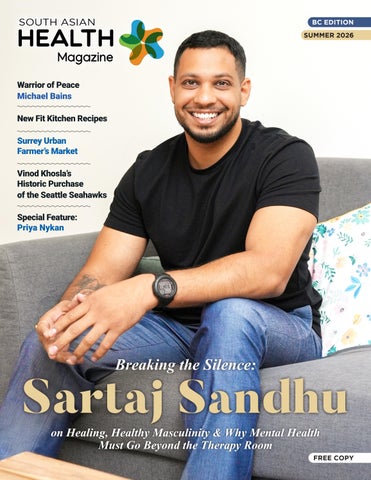
Warrior of Peace
Michael Bains
New Fit Kitchen Recipes
Surrey Urban Farmer’s Market
Vinod Khosla’s Historic Purchase of the Seattle Seahawks
Special Feature: Priya Nykan

Warrior of Peace
Michael Bains
New Fit Kitchen Recipes
Surrey Urban Farmer’s Market
Vinod Khosla’s Historic Purchase of the Seattle Seahawks
Special Feature: Priya Nykan


Fully Accredited by a WFME-Recognized Agency (AAEPO): Ensures eligibility for ECFMG certification and U.S. residency training pathways while meeting internationally recognized standards in medical education.
Direct Entry Pathway Without MCAT: High school graduates and university students can fast-track into medicine without the requirement of a 4-year undergraduate degree or MCAT examination.
Modern Campus with Advanced Learning Tools: State-ofthe-art infrastructure featuring digital anatomy systems, upgraded laboratories, research facilities, and on-campus student housing designed to support an optimal learning environment.
Secure and Comfortable Student Living: Safe and reliable housing with meal plan options, located in Curaçao — a stable Caribbean island outside the Atlantic hurricane belt.
Strong Residency Match Record: Consistently high U.S. residency match rates, with graduates placed across major specialties throughout the United States.
Cost-Effective Medical Education: Significantly lower tuition and living expenses compared to many U.S. and Canadian medical schools.
Eligible for Canadian federal and provincial student loan programs, making medical education more financially accessible for Canadian students.


Dr. Gehana Shankar is a Naturopathic Doctor, entrepreneur, mother of two young children, and clinic owner at Killarney Health, a family-centered integrative wellness clinic in Vancouver. Her passion for women's health, fertility, and PCOS stems not only from her clinical experience, but from her own journey.
At 17 years old, Gehana moved to Canada from India on her own while facing health challenges that left her searching for answers and support. As a young woman navigating an unfamiliar healthcare system, she experienced firsthand the frustration, uncertainty, and isolation that can come with not fully understanding what is happening in your own body. Today, those experiences fuel her passion for helping women gain clarity, confidence, and a deeper understanding of their health, so they never feel alone in their journey.
Through her work, Dr. Gehana focuses on supporting women with PCOS, hormonal imbalances, fertility concerns, and postpartum health. She believes that when women understand how their bodies work, they are empowered to make informed decisions and become active participants in their own healing. Through education, evidenceinformed natural medicine, and compassionate care, she helps women uncover the root causes of their concerns and build a foundation for long-term health.
As a clinic owner, her mission extends beyond patient care. She is building a space where women and families can find the support, answers, and sense of community she once searched for herself—creating a healthcare experience where every patient feels heard, supported, and empowered throughout their journey.


Dear Readers,
This year marks a truly special milestone for BC South Asian Health Magazine as we proudly celebrate 15 years of serving our community. What began as a vision to create meaningful, culturally relevant conversations has grown into a trusted global brand. Over the years, we have remained committed to amplifying stories that matter—stories rooted in empowerment, education, and representation for South Asians everywhere.
We are honored to continue standing as the only platform dedicated exclusively to health, wellness, beauty, fashion, and fitness for the South Asian community on a global scale. This focus has always been at the heart of who we are. By addressing topics through a culturally informed lens, we have been able to spark dialogue, inspire healthier lifestyles, and celebrate the diversity and strength of our community across generations.
Our journey has also been one of growth and expansion. With a strong presence across multiple provinces in Canada, we are now excited to be extending our footprint internationally. We are currently in the process of expanding to California (USA), London (UK), and Dubai (UAE)—with India and Australia next on our radar. These new markets represent not just geographic growth, but deeper opportunities to connect


As we look ahead, 2026 is shaping up to be a year filled with major milestones and bold new chapters. We are energized by what lies ahead and remain focused on further solidifying our strong foundation as the #1 magazine source catering to South Asians worldwide. Thank you to our readers, partners, and contributors for being an integral part of this journey—we look forward to growing, evolving, and celebrating together.
Cheers to a Happy, Healthy New Year!


Angie Biln, RSW, MSW


With over 18 years of experience in mental health, counselling, rehabilitation, and personal growth, Angie Biln is a Registered Social Worker, Certified EMDR Therapist, Certified Life Coach, Clinical Supervisor, and Mental Health Consultant. Fluent in English, Punjabi, and Hindi, Angie provides culturally responsive, trauma-informed care to individuals, couples, and families navigating trauma, anxiety, depression, grief and loss, relationship challenges, self-esteem concerns, emotional burnout, and recovery from unhealthy or abusive relationships. Certified in Brain Injury Rehabilitation, she also has extensive experience supporting individuals recovering from concussions, acquired brain injuries, chronic pain, and complex trauma. Angie is registered to practice in British Columbia, Alberta, and Ontario and has worked extensively with motor vehicle accident survivors, first responders, youth, families, and individuals navigating significant life transitions. Her approach integrates EMDR, Cognitive Behavioural Therapy (CBT), mindfulness, inner child healing, strengths-based interventions, and somatic approaches to support meaningful and lasting change.
In addition to her clinical practice, Angie provides clinical supervision, mentorship, and consultation to social workers, interns, and allied health professionals. She is also a speaker, podcast host, media contributor, and educator who regularly appears on television and radio discussing mental health, trauma recovery, relationships, resilience, and personal growth. As the host of the Designed For More podcast and a facilitator of wellness retreats, workshops, and community initiatives, Angie is passionate about breaking cultural stigmas surrounding mental health, empowering women, strengthening families, and helping individuals move from surviving to thriving. Through her work, she continues to inspire healing, resilience, self-worth, and meaningful transformation within the communities she serves.


One of the biggest ownership changes in professional sports history is set to reshape the National Football League. Venture capitalist and technology entrepreneur Vinod Khosla, together with his family, has reached an agreement to purchase the Seattle Seahawks for a recordbreaking $9.612 billion, pending approval from NFL owners. If finalized, the transaction will become the most expensive sale of an NFL franchise and one of the largest deals ever completed in global sports.
The Seahawks were placed on the market by the estate of the late Paul Allen following the team's
Super Bowl LX championship season. Allen, who co-founded Microsoft, purchased the franchise in 1997 and transformed it into one of the NFL's model organizations. Under his ownership, the Seahawks enjoyed sustained success, captured multiple NFC championships, and became one of the league's most respected franchises. The sale marks the end of an era while opening the door to a new chapter led by one of the technology industry's most accomplished investors.
Vinod Khosla is widely recognized as the cofounder of Sun Microsystems and the founder of
Khosla Ventures, one of Silicon Valley's leading venture capital firms. Throughout his career he has invested in groundbreaking companies across artificial intelligence, healthcare, clean technology, and software, including OpenAI, DoorDash, Instacart, and numerous innovative startups. With an estimated net worth of approximately $13.7 billion, Khosla has earned a reputation for identifying transformative technologies long before they become mainstream.
Although best known for his success in technology and venture capital, Khosla has also shown a growing interest in professional sports ownership. In 2025 he acquired a minority ownership stake in the San Francisco 49ers. NFL rules, however, prohibit ownership interests in multiple franchises, meaning the Khosla family will divest its investment in the 49ers before officially taking control of the Seahawks.
The acquisition is expected to be a true family endeavor. Neeru Khosla is expected to serve as the controlling owner, while their son, Neal Khosla, CEO of AI healthcare company Curai, is anticipated to play an active leadership role within the organization. Their combined experience in business, innovation, and long-term strategic planning has generated optimism that the Seahawks will continue building on their recent championship success.
The sale was managed by Allen & Co. on behalf of Paul Allen's estate and remains subject to formal approval by NFL owners. League rules require at least 24 of the league's 32 owners to approve any franchise sale. A special meeting has been scheduled for late August 2026, where the transaction is expected to receive final consideration.
Beyond the change in ownership, the record-setting purchase price demonstrates the remarkable growth in the value of professional sports franchises. Strong national television contracts, revenue sharing, global fan engagement, and the scarcity of available NFL teams have continued

to drive franchise valuations to unprecedented levels. The Seahawks' sale surpasses the previous NFL record established by the Washington Commanders and further highlights the league's position as one of the world's most valuable sports properties.
Following the announcement, Vinod Khosla expressed his appreciation for the opportunity to become the Seahawks' next steward, emphasizing his commitment to honoring Paul Allen's legacy while earning the trust of players, employees, and fans. His remarks reflected both respect for the organization's history and excitement about its future.
If approved, the acquisition will represent far more than a record financial transaction. It symbolizes the growing connection between the technology sector and professional sports ownership, while ensuring that one of the NFL's premier franchises enters its next era with experienced leadership, significant financial resources, and a long-term vision for continued excellence on and off the field.


After earning recognition for his debut novel Hooped, Surrey-born author Michael Bains is preparing to release his most personal work yet.
His upcoming novel, Warrior of Peace, is a comingof-age story that explores family, Sikh identity, and the timeless values that shape who we become. Set against the backdrop of a young boy's changing family life, the novel follows his growing relationship with his grandfather—a man whose wisdom, traditions, and quiet strength become the foundation for the boy's understanding of himself.
Rather than focusing on religion through instruction, Warrior of Peace introduces readers to the principles and philosophy of Sikhism through story. Themes such as seva (selfless service), humility, courage, compassion, equality, and
community are woven naturally into the lives of its characters, offering readers of all backgrounds an accessible introduction to Sikh values.
"I wanted to tell a story that anyone could connect with," says Bains. "The book happens to centre around a Sikh family, but at its heart it's about belonging, identity, family, and the people who quietly shape us."
The novel also carries a deeply personal connection. Part of the story follows the grandfather's battle with cancer— an element inspired by Bains' own experience after being diagnosed and treated for cancer in 2024. That journey influenced the emotional depth of the novel while reinforcing its central message: that strength is often found in compassion rather than conflict.
Building on the Success of Hooped Warrior of Peace follows Bains' debut novel, Hooped, released in 2020.


Set throughout Surrey, Delta, Burnaby and Vancouver, Hooped follows high school basketball captain Jimmy as he struggles with friendship, financial hardship, and the pressures pulling him toward gang culture. The novel has been praised for its authentic portrayal of life growing up in Surrey and its exploration of mentorship, identity, and resilience.
The book has been approved for use by the Surrey School District and has been featured in schools, libraries, and community organizations throughout the Lower Mainland. It has also received coverage from local media outlets including the Surrey Citizen, Surrey Now-Leader, SFU Peak, 5X Fest, Surrey604 and the KidsPlay Foundation.
In addition to his novels, Bains is also the author of the poetry collection The Night of the Morning, which explores themes of mindfulness, reflection, and personal growth. Together, his three books reveal a consistent interest in storytelling that encourages empathy,
self-discovery, and meaningful
A Story Rooted in Culture, Open to Everyone
While Warrior of Peace celebrates Sikh heritage and Punjabi culture, Bains hopes its message reaches far beyond one community.
"It's ultimately a story about grandparents and grandchildren, about carrying forward wisdom, about healing relationships, and about discovering who we are," he says. "Those are experiences that cross every culture."
As anticipation builds ahead of its release, Warrior of Peace is already drawing interest from community organizations, educators, and readers eager to see another locally rooted story added to British Columbia's literary landscape.
Warrior of Peace will be released later this summer through Michael Bains' website, with wider availability to follow. You can keep up with updates through Michael’s Instagram @michaelbains_ or his website www.michaelbains.ca

Gurpreet Kaur Mann is an executive coach, career strategist, and founder of GKM Coaching. Drawing on her background in human resources, leadership development, and entrepreneurship, she helps professionals and business owners build careers that align with their strengths, values, and longterm goals.
Through coaching, training, and mentorship, Gurpreet has guided professionals across North America to strengthen their leadership skills, elevate their personal brands, and pursue greater confidence and fulfillment. Her practical and empowering approach has made her a trusted voice in career advancement and personal development.
A strong advocate for holistic wellbeing, Gurpreet believes that professional success, mental wellness, financial confidence, and personal purpose are deeply connected. Her mission is to help people achieve meaningful success without sacrificing balance, authenticity, or overall wellbeing— making her a fitting feature for this edition of the Ontario South Asian Health Magazine.


You left a career in dentistry to become a counsellor — a significant transition. What pulled you toward this work, and what did you discover about yourself along the way?
Looking back, it probably wasn't as sudden as it appears on paper.
Dentistry was, if I'm honest, a checkpoint. As a brown child who grew up in Punjab, India, I was expected to tick certain boxes — medicine, dentistry, engineering — because those credentials bought you freedom. They earned you the right to eventually do what you actually wanted to do.
I worked hard. I became a dentist. And I also knew, from very early on, that it was never the destination.
What always pulled me was people's stories. Whether I was working in healthcare, community services, labour advocacy, or counselling, I kept returning to the same question: what actually helps people move through suffering and reconnect with themselves and others?
Over time, I realized that while physical health matters enormously, many of the struggles people face are emotional, relational, and almost entirely invisible. People carry grief, anxiety, trauma, loneliness, shame — and they do it while appearing completely functional on the outside.
The transition into counselling taught me something I want to say clearly to anyone reading this: go beyond what is expected of you. The expectations placed on us — by family, by culture, by community — often come from love and sacrifice. Honour that. And then ask yourself what your heart is actually calling you toward. Those two things don't have to be in conflict. But you have to be willing to ask the question.
Counselling gave me the most direct path to the work I was always meant to do. But I'll say this plainly — it isn't the last stop either.
Many people understand exactly why they struggle and can explain their patterns in detail, yet still feel stuck. Your work often focuses on the gap between insight and change. What is happening in that gap, and how do approaches such
as EMDR and Emotionally Focused Therapy help people move forward?
One of the most common things I hear is: "I know exactly why I do this, but I still keep doing it."
And right behind that is something I hear just as often: "I've been in counselling before, and all I did was talk about my problems. Nothing actually
changed." Both of those experiences are telling us something important.
Insight is valuable, but insight alone doesn't create change. And venting — while sometimes necessary — is not the same as processing.
Here's what's actually happening in that gap: much of what drives our behaviour doesn't live in the thinking brain. It lives in the nervous system, in emotional memory, in the beliefs we formed long before we had words for them. You can understand intellectually that you have anxiety, or that your relationship patterns trace back to something early, or that you learned to shut down your emotions — and that understanding still won't reach the part of you that's holding the pattern in place.
That's where approaches like EMDR and Emotionally Focused Therapy become powerful. They don't just help people understand their experience — they help people experience it differently. EMDR allows the nervous system to process what has been stuck and stored as an unfinished threat. EFT helps people reconnect with the emotions underneath the surface and build new ways of responding to themselves and the people they love.
When I envisioned Praxis Wellness, this was its core. Change that actually moves you forward. Not just awareness of the problem, but genuine freedom from it. That's what I'm trying to offer.
Much of your work is with men. Many appear to have everything under control, yet describe feeling numb, disconnected, lonely, or only able to access anger. What do you think is happening beneath the surface?
Many men have spent years becoming exceptionally skilled at functioning. They show up to work. They provide. They solve problems. They carry responsibility without complaint. And from the outside, that looks like strength.
Myroleisnevertotellmenwhotheyshouldbe.Myroleistohelpthembecome moreintentionalaboutwhotheywanttobe.ThemenIrespectmostarenotperfect. They’remenwhoarewillingtoreflect,takeresponsibilityfortheiractions,care genuinelyforthepeoplearoundthem,andkeepgrowingthroughouttheirlives.
Many men struggle to recognize or express emotions such as sadness, fear, or shame. When these feelings have no outlet, they often manifest as numbness, isolation, irritability, or anger, as anger is more familiar and acceptable. Sometimes, they resort to substances like alcohol or cannabis to escape the emotional burden.
But here's something I want to name that we don't talk about enough: we as a society don't actually allow men to struggle. The moment a man starts showing that he's not okay, the people around him often panic. The family starts treating it like a sinking ship. Or they remind him — explicitly — that as a man, his job is to hold it together and keep providing. We tell men to be vulnerable, and then we punish them for it.
So it's not that men don't have emotional lives. It's that they learned very early which parts of themselves were welcome — and which weren't.
What I've consistently found is that when men are given real space — not a performance of vulnerability, but actual safety — they are far more thoughtful, emotionally aware, and relationally motivated than most people assume. They've just never been allowed to show it.
"Healthy masculinity" means different things to different people. How do you think about it in your work — not as a set of rules, but as something men can explore and define for themselves?
I don't see healthy masculinity as a checklist or a particular personality type.
I think of it as integration.
It's the ability to be strong without becoming rigid — there's a phrase I return to often: strong back, open heart. Or, as we say in Punjabi: mann niwa, matt uchhi — a humble spirit, a sharp mind. It's the ability to carry responsibility without carrying everything alone. To be confident without losing humility. To be protective without becoming controlling. To be emotionally present without losing direction and purpose.
Every man will define this somewhat differently, based on his values, his culture, his family, and the life he's actually lived. That's as it should be.
My role is never to tell men who they should be. My role is to help them become more intentional about who they want to be.
The men I respect most are not perfect. They're men who are willing to reflect, take responsibility for their actions, care genuinely for the people around them, and keep growing throughout their lives. That's the standard I hold myself to. And it's the one I try to hold space for in the room.
Praxis Wellness emphasizes culturally grounded care. For South Asian and immigrant communities specifically, what do you understand about how distress shows up — and gets hidden — that mainstream mental health care sometimes overlooks?
Many South Asian and immigrant families carry remarkable strengths. Resilience, sacrifice, commitment to family, and a willingness to work hard through extraordinary adversity.

At the same time, distress in our communities doesn't always present the way Western mental health training teaches practitioners to recognize. People often don't come in saying they feel depressed, anxious, or overwhelmed. They come in talking about stress, headaches, sleep difficulties, conflict in their marriage, a feeling that they are carrying too much and can't explain why. Or they don't come in at all, because they've learned that asking for help is the same as admitting something is wrong with them, and that feels like a threat to the family's reputation.
I want to name something specific, because I see it often: I have young clients who tell me that their family will openly discuss mental health in general conversation, they'll watch the documentaries, read the articles, but the moment that same young person starts counselling, the message becomes: don't talk about family matters in there. Seeking help is acceptable in the abstract. Seeking it for yourself, about your actual life, becomes something to be hidden. That's a contradiction we need to be honest about.
I grew up in Punjab, India, and I offer counselling in Punjabi, Hindi, and English. This is significant as it allows for a deeper connection. When individuals can express themselves in the language tied to their earliest memories, it creates an environment where open communication becomes easier. For many in this community, being able to speak in their native language transforms what they feel comfortable sharing.
Here's what I want people to hear: counselling is not only for people who are struggling. It's not a sign that something is broken. At its best, it's a lifelong practice — a space where you can move from surviving, to stabilizing, to actually thriving. You don't have to be in crisis to deserve that kind of support.

Many people in our community grew up carrying the weight of a family's sacrifice and expectations. Over time, what
impact can that have on a person's identity, relationships, and sense of self?
For most people, it begins with love.
Parents sacrifice. Grandparents sacrifice. Entire families pour themselves into creating opportunities for the next generation. That is real, and it deserves to be honoured.
The challenge comes when gratitude quietly becomes pressure. When what started as love gradually shapes into obligation — and obligation into identity. People begin to measure their worth by achievement, by usefulness, by how well they meet others' expectations. They become very good at giving everyone else what they need, and entirely lose the practice of asking what they themselves need.
What I try to help people move through is learning to hold two things at once without letting one erase the other. There is a part that genuinely feels gratitude — and that part is telling the truth. The sacrifice was real. The love was real.
And there is another part that is allowed to say: some of what I inherited is still causing harm. That part can have the harder conversations. It can set boundaries — not from bitterness, but from a genuine desire for something better. It can begin to prioritise its own needs without the weight of guilt crushing every attempt.
What often gets missed in that work is the younger part — the inner child that got set aside somewhere along the way. That part shows up quietly: in forgetting to take care of yourself, in people pleasing, in the way a person shrinks in certain rooms. Sometimes it shows up louder — as anger, as withdrawal, as a hurt that doesn't have a name yet. That part isn't a problem to be solved. It's a part that needs to be seen.
Change can feel like a challenge — especially when the people around you are more comfortable with who you were. But the conversation has to happen. And it can happen with love. That's not a betrayal of culture or family. That's how people grow. And it's how cultures grow into where they are actually meant to be.
Much of your work involves helping people carry less alone. What have your clients taught you about what people need most when they are struggling?
The biggest lesson my clients have given me — consistently over the years — is that people do not heal in isolation.
Most people come to counselling believing they need answers. Often, what they need first is to be witnessed. To be in a room with someone who isn't trying to fix them, isn't alarmed by them, isn't performing care. Someone who actually believes
in them — sometimes well before they believe in themselves.
I think about one of my clients whom I worked with. He came to me through a court mandate and had limited resources, leaving him with no real choice but to be there. He could have easily gone through the motions and left, but he chose not to. Over time, something shifted as he felt that the process was genuine and that someone in the room truly believed he was capable of more. He came to trust that. He put in the work. Today, he is doing well enough that he chooses to pay the full fee to continue our sessions. That transformation — from being mandated and resource-limited to valuing this process enough to invest in it — illustrates what counselling can achieve when done right.
What that man taught me is something I've seen many times since: people begin healing parts of themselves even before they're consciously aware it's happening. The nervous system responds to real safety. The body knows when someone actually believes in you.
Whether I'm working with trauma, anxiety, relationship difficulties, addiction, or grief, I'm consistently reminded of the same thing: healing most often begins when people no longer feel alone with what they're carrying.
Many people today are navigating financial pressure, housing challenges, burnout, and uncertainty about the future. How do these realities affect mental health, relationships, and family life?
Mental health does not exist in a vacuum.
When people are worried about rent, mortgages, job security, childcare, and making ends meet, those pressures show up emotionally, relationally, and physically. Sleep goes. Anxiety climbs. People become short-tempered with those they love, not because they don't love them, but because their capacity is exhausted.

What concerns me is how often people end up blaming themselves for responses that are entirely understandable under chronic stress. The problem gets internalized as a personal failure when the conditions are objectively unsustainable.
And here's something I want to say plainly: we talk about mental health constantly now. It's in every corporate newsletter, every social media campaign. But there is almost no real publicly funded support unless someone is in active crisis. If your job offers extended health benefits, those benefits run out — often right around the point where a person has finally started to feel safe enough with their counsellor to do the deeper work. The timing is brutal.
If you're still surviving day to day, committing to your mental health feels like a luxury. I understand that. At the same time, I genuinely believe it is the most important investment you can make in yourself. Not because I'm in the business of counselling — but because everything else you want to build, in your relationships, your career, your family, runs through your mental and emotional health first.
Wellness is not just about individual choices. Healthy communities require conditions that allow people to belong, contribute, and live with dignity. We can't keep asking people to heal in systems that continue to harm them.
You have spent time in both counselling and labour advocacy. Why do you believe mental health work must extend beyond the therapy room and include the conditions people live and work in?
Counselling can be incredibly powerful. I've seen it change lives. I believe in it.
And I'm also clear-eyed about its limits — because I've sat on the other side of the table.
Before I was a counsellor, I organized workplaces to unionize. I worked as a union representative for healthcare workers. I negotiated collective agreements. And what that work showed me is how systems are built to make working people feel like they are asking for too much. Be grateful you have a job. Don't demand fair treatment or fair wages. Put the company first. Prioritize productivity over your own dignity.
That narrative doesn't stay in the workplace. It follows people home. It shows up in the counselling room as guilt for having needs, as an inability to rest without justifying it, and as a deep confusion between self-worth and output.
Work is part of life. It is not the whole of it. That seems obvious when you say it out loud. But enormous numbers of people are living as though it isn't true, and the systems around them are actively reinforcing that confusion.
People dealing with multiple jobs, housing insecurity, isolation, discrimination, or chronic financial stress don't leave these realities at the door when they enter therapy. While therapy can help individuals cope and grow, we must acknowledge that we often address symptoms of systemic issues that shouldn't exist in the first place.
Workispartoflife.Itisnotthe whole of it.That seems obvious whenyousayitoutloud.But enormousnumbersofpeople arelivingasthoughitisn’ttrue, andthesystemsaroundthemare activelyreinforcingthatconfusion
Data shows that over half of working Canadians find their job to be the most stressful part of their lives, and mental illness is a leading cause of disability claims. These challenges are not personal failures but structural ones. Mental health is both personal and social, and to truly address it, we must consider the broader conditions impacting individuals. I'm committed to having that conversation in my practice and beyond.
You founded Praxis Wellness with a particular vision. Beyond counselling, what are you ultimately trying to build for men, families, and communities in British Columbia?
Praxis is founded on the belief that everyone deserves a welcoming space to grow, heal, and reconnect, free from stigma and the pressure to appear strong. It emphasizes that while counselling is an essential part of this journey, it is not the entirety of it. The vision for Praxis extends beyond a clinical environment; it aims to create a warm, inviting physical space designed for human connection. This space will facilitate individual work and community engagement, offering opportunities for workshops, retreats, and collaborative projects.
The vision includes a diverse team of counsellors and practitioners because true wellness transcends the confines of therapy.
You don’t have to earn support. You don’t have to wait until things become unbearable. You don’t have to keep carrying everything alone simply because you’ve always been the one who does.

Although men’s mental health is a focal point due to its noticeable gaps, Praxis is inclusive, inviting everyone who is ready to embark on their personal journey.
The ultimate goal is to cultivate individuals who embrace all aspects of themselves, allowing them to show up as their best selves for their loved ones and communities.
That's the community I'm trying to build. People who are becoming, not just recovering. And the space will be financially accessible because a vision that serves only people who can already afford it isn't the one I'm interested in.
For someone reading this who recognizes themselves in these conversations — holding it all together while quietly struggling — what would you most want them to know?
That you are not alone.
Most people carrying this kind of weight look around and assume everyone else has it figured out. That the exhaustion they feel, the numbness, the sense of going through the motions — that's something only they experience. It isn't.
You don't have to earn support. You don't have to wait until things become unbearable.
Ifthere’sonethingI’velearnedfromthepeopleIsitwith—people whocarryenormousamounts,whohavesurvivedgenuinelyhard things—it’sthathealingdoesn’tusuallybeginwithabreakthrough. Itbeginswiththedecisiontostoppretendingyou’rebuilttodothis entirelyonyourown.
You don't have to keep carrying everything alone simply because you've always been the one who does.
There is real strength in responsibility. And there is also real strength in reaching toward others. Those aren't opposites.
If there's one thing I've learned from the people I sit with — people who carry enormous amounts, who have survived genuinely hard things — it's that healing doesn't usually begin with a breakthrough. It begins with the decision to stop pretending you're built to do this entirely on your own.
You're not. None of us are. And if cost is the thing standing between you and that first step, reach out anyway. I hold a limited number of spots at a sliding scale fee for people who need it. If I'm not able to offer that at the time, I will connect you to something that can help. The door is open. Let's figure it out together.
would meaningful change look like in how we support working people, immigrant families, and men's mental health in our communities?
Meaningful change would start with making support feel normal — not exceptional, not shameful, not a sign of failure.
It would mean men having real places to talk honestly, without the conversation being treated as a crisis requiring intervention. It
would mean immigrant and South Asian families having access to culturally grounded support before relationships fracture under the weight of unaddressed stress. It would mean mental health care is accessible regardless of income, not rationed by what your employer's benefits plan allows before you run out.
But I want to go further than that, because the individual level is not sufficient.
Meaningful change means public funding that doesn't reserve care only for people in acute crisis. It means workplaces being held to a standard that recognizes employees are human beings before they are productivity metrics. It means destigmatizing help-seeking not in the passive sense — putting up a poster — but actively, through the way institutions and communities respond when someone actually raises their hand.
And it means continuing to talk honestly about systemic conditions. Housing. Income. Workplace rights. Community belonging. These are not peripheral to mental health — they are central to it.
People are more resilient than we give them credit for. The question is never really whether individuals can heal. The question is whether we're building communities and systems that create the conditions for that resilience to actually have somewhere to go.
That's the work. And it's bigger than any one counselling practice can do alone. Which is exactly why I refuse to stay inside the room.

Presented by Hukam Wellness
Created & Facilitated by Kim Singh Rai
First Retreat Launching — Fall 2026
This experience is designed for men navigating stress, burnout, emotional exhaustion, trauma, grief, relationship loss, identity struggles, or major life transitions. It is for men who have spent years carrying responsibility for others while quietly neglecting their own emotional, physical, spiritual, and psychological wellbeing.
More than a retreat, this is a transformational reset designed to help participants reconnect with themselves in a grounded, clinically informed, and deeply human way. Through guided wellness experiences, facilitated conversations, mindfulness practices, reflective work, nervous system regulation, recovery practices, and meaningful connection, guests are supported in rebuilding clarity, resilience, confidence, purpose, and emotional balance.
The retreat will feature several experienced professional presenters, facilitators, wellness practitioners, and cultural supports who will help guide discussions surrounding healing, emotional wellness, resilience, trauma recovery, accountability, relationships, and personal growth.
Participants will also be encouraged to focus on transformation through rebuilding healthier habits, strengthening self-awareness, restoring emotional wellbeing, and creating a stronger foundation mentally, physically, and personally moving forward. Elements of Indigenous wisdom and Sikh spirituality will be incorporated in a balanced and respectful way, centered around compassion, connection, and shared humanity.
Set within a private oceanfront environment on Vancouver Island, the retreat offers an immersive oceanfront wellness experience designed to support healing, transformation, emotional wellbeing, personal growth, and meaningful connection. The goal is to create a safe and supportive environment where men feel challenged enough to grow, supported enough to heal, and empowered enough to return home stronger, healthier, more emotionally grounded, and more connected to themselves and others.
“The focus is not perfection. The focus is healing, rebuilding, and transformation.”


Full-Service Boutique Agency Specializing in Multicultural Marketing Previous Clientele: Major Banks, Telecoms, Corporates, Small Businesses, Non-Profits & Community Organizations
Event Production & Magazine Publications Across Canada
Track Record for Securing Corporate Sponsorships & Funding


At Fortis Physiotherapy, we are passionate about helping you live your best life through improved mobility and reduced pain. With a focus on personalized care and evidencebased techniques, our experienced team of physiotherapists is dedicated to guiding you on your journey to recovery and wellness. We believe in fostering a supportive and empowering environment where you can feel confident and motivated to reach your health goals.

Mandeep is a University Topper in Physiotherapy with over a decade of experience, specializes in treating Orthopedic injuries, MVA-related injuries, workplace injuries, and arthritis. Certified in dry needling (IMS) and trained in Maitland’s manual mobilization, she focuses on correcting movement dysfunction, relieving pain, and preventing re-injury.
Mandeep conducts detailed assessments, collaborates on treatment goals with clients, and employs a comprehensive approach including Manual Therapy Skills, IMS, modalities, shockwave therapy, and tailored exercise prescriptions to restore clients

Binant Litt is a top 10 rank holder in university, she specializes in manual therapy, myofascial release, and treating sports injuries and neuromusculoskeletal conditions. Binant is particularly interested in advanced manual techniques and female health, recognized with the Award for Excellence in Physiotherapy. She has extensive experience with ICBC/WCB/PVT/MSP patients and is currently specialized in IMS and Dry Needling.

Whether you’re looking to lose weight or gain muscle, it’s essential to get your daily recommended protein to support your health goals. Of course, it’s not always easy to get all of your protein from food sources. With Life Shake, you can have a biologically complete meal in minutes that will fill you up and provide you with essential nutrients to support a healthy lifestyle!


Neety Mangat Shaklee Ambassador


Stress is a natural part of life. Contrary to popular belief, some stress is important to your overall health. However, ongoing chronic stress can be detrimental, dragging down both your mental and your physical health. At Shaklee, our supplements and vitamins can help boost your mood, relieve stress, and support your mental health.


Vivix is formulated to help protect against oxidative cell damage and help in energy metabolism, immune function and cardiovascular health.
n Vivix keeps your cells young.
n Blunt the inflammatory response
n Backed by 27 global patents

When New Zealand's FIFA World Cup 2026 campaign came to an end, the All Whites left the tournament without advancing beyond the group stage. Yet one of the competition's most memorable stories was not measured by wins or losses—it was the historic journey of midfielder Sarpreet Singh.
For football fans across New Zealand and for South Asian communities around the world, Singh's appearance at the World Cup represented far more than another international cap. It marked a milestone for representation and inspired countless young athletes who rarely see themselves reflected on football's biggest stage.
Born in Auckland on February 20, 1999, to a proud family of Indian heritage, Singh developed his passion for football at local clubs Papatoetoe AFC and Onehunga Sports before joining the Wellington Phoenix Academy. His technical ability, vision, and creativity quickly distinguished him as one of the country's brightest young talents.
His performances in the A-League soon attracted international attention, leading to a careerdefining move to German powerhouse Bayern Munich in 2019. The transfer not only elevated Singh's career but also demonstrated that players from New Zealand—and those of South Asian heritage—could compete at the highest levels of world football.
During the 2026 FIFA World Cup, Singh added another chapter to football history when he became the first Sikh player to appear in a FIFA
World Cup match, taking the field during New Zealand's 2-2 draw with Iran. While his name did not appear on the scoresheet, his intelligent movement, accurate passing, and calm presence in midfield played an important role in the team's performance.
The All Whites ultimately finished their Group G campaign with one point after defeats to Egypt and Belgium. Although the results were disappointing, Singh's contribution extended well beyond the final standings.
His journey has become a powerful example of perseverance, determination, and the growing diversity of international football. For many young South Asian players, seeing someone who shares their cultural background competing on the world's biggest stage reinforces the belief that elite football is an attainable dream.
As football continues to expand its global reach, representation matters more than ever. Sarpreet Singh's World Cup appearance was not simply a personal achievement—it was a landmark moment for New Zealand football and for the wider Punjabi and Sikh communities worldwide.
While the 2026 tournament may not have delivered the results New Zealand had hoped for, it showcased a player whose influence will likely be remembered long after the final whistle. Singh's legacy is already extending beyond the pitch, inspiring the next generation to believe that talent, hard work, and ambition can overcome barriers and create history.


RN, CPT, CPPC

Manreet Aulakh is a Registered Nurse with nearly a decade of experience, with the last several years dedicated to perinatal care. After completing her Advanced Perinatal Nursing certification through BCIT, she fell deeply in love with supporting women through pregnancy, labour, and postpartum. Fascinated by the resilience of the female body, Manreet has cared for hundreds of women during some of the most transformative and vulnerable moments of their lives—an experience that shaped her belief in empowering women with education, confidence, and comprehensive support.
While working in labour and delivery, Manreet grew increasingly curious about the rising rates of high-risk conditions, emergency interventions, and preventable complications. This led her to dive into research, where she discovered a powerful connection: proper nutrition and strength training can significantly reduce the risk of gestational hypertension and diabetes, and even decrease the likelihood of instrumental deliveries and emergency C-sections. Motivated by these findings, she pursued certifications as a Personal Trainer and Pre- & Postnatal Coach to bridge the gap between medical care and preventative, lifestyle-based support.
Today, Manreet blends her clinical expertise with her lifelong passion for health and fitness to coach women through a holistic, evidence-based approach. Through Embody Fit Collective, she helps women prepare for pregnancy, stay strong and confident throughout motherhood, and build lifelong habits that support their wellbeing with individualized nutrition and exercise plans. Her mission is simple: to educate, uplift, and empower women to embody their strength at every stage of their journey.


My journey has really been shaped by movement — not just dance, but moving between cultures, countries, and identities.
Please share a bit about your journey from your early days in Canada and India to founding the HipHop–Natyam Dance Academy in California? What inspired you to blend classical Bharata Natyam with the modern energy of Hip-Hop?
My journey has really been shaped by movement — not just dance, but moving between cultures, countries, and identities. I spent my early years in Canada and after my dance graduation I spent a semester in Bangalore,India. Those two environments gave me very different artistic influences. In India, Bharata Natyam wasn’t just a dance form; it was a language of discipline, storytelling, and spirituality. In Canada, I was surrounded by a completely different rhythm — hip-hop culture, street styles, and a sense of creative freedom that felt raw and expressive.
WhenImovedtoCaliforniain2010,Isawacommunityhungryforcultural expressionandfusion.Itfeltliketherightplacetobuildsomethingnew. Foundingtheacademywasmywayofhonoringtraditionwhilealsogiving myselfpermissiontoinnovate.
For a long time, I kept those worlds separate because that’s how I was taught to see them. Classical dance belonged in one box, and hip-hop belonged in another. But as I grew older, I realized that my identity didn’t fit neatly into either box. I was both — and neither — at the same time. That tension became the spark for HipHop–Natyam.
It was the one day that I went to my cousin Vick’s recording studio in Vancouver, BC. He was known as a lyricist/rapper known as Advocate in the Greater Vancouver area. I went to visit him after my trip to India and started singing Bharata Natyam beats into the mic to a Hip-Hop beat. He then paused and called me, “HipHopNatyam.” Then the evolution began back in 2007.
When I moved to California in 2010, I saw a community hungry for cultural expression and fusion. It felt like the right place to build something new. Founding the academy was my way of honoring tradition while also giving myself permission to innovate. Blending Bharata Natyam with hip-hop wasn’t about being trendy; it was about creating a space where dancers like me — who straddle cultures — could see themselves fully. We also performed Bollywood dance, Belly dance, Bhangra and celebrated our artistic expressions at various community events.
I dedicate the name and my new studio to my cousin Vickash Nair, aka Advocate, the late rapper from Vancouver Canada.
The South Asian community in the San Francisco Bay Area is vibrant and diverse. How has this community influenced your artistic direction and the evolution of HipHop–Natyam?
The South Asian community in the San Francisco Bay Area has played a huge role in shaping both my artistic direction and the evolution of HipHop–Natyam. What I love about this community is its diversity — not just in terms of regional backgrounds, but in how people express their identities. You see first-generation immigrants holding tightly to tradition, second- and third-generation kids exploring what it means to be both South Asian and American, and artists who are constantly redefining what ‘cultural expression’ looks like. Being surrounded by that kind of energy has pushed me to think more expansively about my own work.
The Bay Area also has this incredible openness to innovation. People here aren’t afraid of blending genres or questioning tradition, and that gave me the confidence to push boundaries without feeling like I was betraying classical forms. Instead, I felt supported in honoring them in a new way. So, in many ways, HipHop–Natyam grew because the community here allowed it to grow. Their curiosity, their pride, and their willingness to embrace something unconventional have shaped the academy into a space where cultural heritage and modern expression can coexist naturally.
Bharata Natyam has a structure, a vocabulary, and a lineage that I never take lightly.

“HipHop-Natyam Studios offers classes in Bharata Natyam, Hip-Hop, HipHop-Natyam Choreography, Bollywood&Bhangra, Heels, Pilates, and Yoga.”
For the “many hats” please also add “wife” and being a wife for 16 years helps her grow as a woman.
It’s a reflection of the Bay Area itself — rooted, diverse, and always evolving. And now getting to teach in my own studio located in old town Pittsburg which is a booming city rich in culture and education.
Your fusion of Bharata Natyam and Hip-Hop is groundbreaking. How do you ensure that your choreography continues to honor traditional South Asian art forms while remaining accessible and exciting to younger generations?
For me, honoring traditional South Asian art forms begins with deep respect and rigorous training. Bharata Natyam has a structure, a vocabulary, and a lineage that I never take lightly. Even when I’m creating fusion work, I start from the foundation — the adavus, the mudras, the storytelling techniques, the emotional grammar of abhinaya. Those elements stay intact because they’re the soul of the form.
At the same time, I’m very aware that younger generations connect to movement differently and relate to different songs. And by layering the movements to the Hip-Hop lyrics, the youth can understand the dance with more critical thinking. Exploring different ways to count music and apply footwork and hand gestures. It’s simply beautiful and liberating.
My process is really about balance. I ask myself: ‘What part of this piece needs to stay rooted, and where can I let the dancers breathe?’ Sometimes that means keeping the Bharata Natyam footwork pure while layering Hip-Hop grooves in the upper body. Other times it means using classical storytelling but setting it to contemporary beats. The goal is never to dilute either form, but to let them converse.
And honestly, the students guide me too. Their curiosity, their playlists, their cultural identities — all of that shapes the evolution of HipHop–Natyam. When they feel seen and excited, they invest more deeply in the classical side as well. So in a way, honoring tradition and engaging youth aren’t opposites. They feed each other.”
As a South Asian woman leading a successful dance academy in California, what challenges and opportunities have you encountered in representing cultural heritage through movement?
Being a South Asian woman leading a dance academy in California has been both a responsibility and a privilege. One of the biggest challenges is navigating expectations — from within the South Asian community and from outside it. Within the community, there can be a strong desire to preserve tradition exactly as it has been passed down. That respect for lineage is something I deeply value, but it can also create pressure when you’re trying to innovate or blend styles. I’ve had to learn how to communicate that fusion doesn’t mean dilution; it means evolution.
On the other side, there’s the challenge of educating broader audiences who may not understand the
depth, history, or spiritual roots of forms like Bharata Natyam. I prepare a brief introduction before each event that we perform at to help educate audiences and communities about the history and artistry of Bharata Natyam and its ability to adapt to Hip-Hop culture which brought forth the evolution of HipHopNatyam.
So the journey has been about honoring where we come from while embracing where we’re going. Teaching women specifically and watching them explore their movements whether it be dance, yoga or pilates, I see such a relief of joy and self care. The women whom I share space and energy with are a driving force toward my purpose and I am so happy to be part of the Pittsburg community in 2026.
Many South Asian families in the Bay Area encourage their children to stay connected to their roots. How does your academy create a space for youth to embrace both their cultural identity and their individuality?
One of the things I love most about working with youth in the Bay Area is that they’re constantly navigating two worlds — the cultural heritage their families cherish and the individuality they’re discovering for themselves. At the academy, my goal is to create a space where those two things don’t compete, but actually strengthen each other.
We start by grounding students in the richness of South Asian traditions. Whether it’s Bharata Natyam technique, mythology, rhythm patterns, or the storytelling behind each gesture, they learn the ‘why’ behind the movement. When young dancers understand the cultural meaning, they feel a sense of pride and connection rather than pressure.
At the same time, I give them room to explore their own voice. Hip-Hop, freestyle exercises, collaborative choreography sessions — these are places where they can bring their personality, their lived experiences, and even their playlists into the room. They get to experiment, take risks, and shape the movement in ways that feel authentic to them.
Parents often tell me that the academy helps their children feel more connected to their roots while also becoming more confident in who they are as individuals. And that’s exactly the environment I want to cultivate: a place where culture is not a constraint, but a foundation for creativity, self-expression, and belonging.
You wear many hats—dancer, choreographer, Pilates and yoga instructor, Para Educator and mother. How do you balance these roles, and how do they shape your perspective on holistic wellness and movement?
Balancing all the roles I play — dancer, choreographer, Pilates and yoga instructor, Para Educator and mother — has taught me that movement and wellness aren’t separate parts of my life. They’re the thread that connects everything. Instead of trying to keep these roles in different boxes, I’ve learned to let them inform and support one another.
Dance gives me creativity and expression. Pilates gives me alignment and strength. Yoga gives me grounding and breath. My work as a para educator teaches me patience, empathy, and the importance of meeting people exactly where they are. And motherhood gives me perspective — a reminder that growth is not linear, and that rest, joy, and presence matter just as much as discipline.
There are definitely days when it feels overwhelming, but I’ve learned to listen to my body the same way I listen to music or choreography. Some days call for discipline and structure; others call for softness and rest. That awareness is what keeps me centered.

These roles also shape how I teach. I don’t see movement as just technique or performance — I see it as a holistic practice. I want my students to feel strong, expressive, and connected, not just physically but emotionally. Whether we’re doing Bharata Natyam footwork, hip-hop grooves, or Pilates core work, I try to create an environment where they can understand their bodies, honor their limits, and celebrate their individuality.

So balancing these roles isn’t about doing everything perfectly — it’s about staying aligned with my values, listening to my body, and letting each part of my life enrich the others.”
The South Asian diaspora often finds itself navigating between tradition and modern identity. How does HipHop–Natyam bridge this cultural duality and help others express their authentic selves through dance?
The South Asian diaspora is constantly balancing two worlds — the traditions we inherit and the modern identities we grow into. HipHop–Natyam was born from that exact tension, so it naturally becomes a bridge between the two. It gives dancers permission to honor where they come from while also embracing who they’re becoming.
Bharata Natyam brings structure, storytelling, and cultural memory. It reminds us of our roots — the discipline, the mythology, the emotional depth that has been passed down for generations. Hip-hop music brings individuality, rhythm, and the freedom to move in ways that reflect our lived experiences here in the U.S. When those two forms meet, dancers suddenly
What I love most is watching dancers find their authentic voice. Some connect more deeply to the classical side, others to the hip-hop side, and many find a unique blend that feels like home.
see that they don’t have to choose between tradition and modernity. They can embody both at the same time.
What I love most is watching dancers find their authentic voice. Some connect more deeply to the classical side, others to the hip-hop side, and many find a unique blend that feels like home. HipHop–Natyam gives them a safe space to explore that spectrum without judgment.
It tells them that their cultural duality isn’t a conflict — it’s a creative advantage.

In the end, the fusion isn’t just about dance. It’s about belonging. It’s about giving the diaspora a language — a physical, emotional, artistic language — to express who they truly are.”
As someone who integrates fitness, art, and culture, what message do you have for South Asians in California about the importance of dance and movement in maintaining both physical and emotional well-being?
For South Asians in California, dance and movement can be so much more than exercise — they can be a lifeline to both physical and emotional well-being. Many of us grew up in environments where academic success was prioritized, and movement was seen as optional or recreational. But our bodies carry our stories, our stress, and our heritage. When we move, we release, reconnect, and remember who we are.
What I want our community to know is that dance “doesn’t have to be perfect or traditional to be meaningful. It can be an ACT of pure joy.” Whether it’s Bharata Natyam, Bollywood, hip-hop, or even a simple flow at home, movement helps us stay grounded in a
fast-paced world. It strengthens the body, yes — but it also softens the mind. It gives us a space to breathe, to express emotions we don’t always have words for, and to reconnect with joy.
For the younger generation especially, dance becomes a bridge between cultures. It lets them honor their roots while expressing their individuality. For adults, it becomes a reminder that wellness isn’t just about productivity — it’s about presence, creativity, and self-care. My message is simple: make movement a non-negotiable part of your life. Not as a chore, but as a celebration. Dance is one of the most powerful ways we can stay connected — to our heritage, to our community, and to ourselves.
You’ve mentioned that your mission is to build a thriving dance community that connects cultures. What impact do you hope HipHop–Natyam will have on the broader dance scene in California and beyond?
My hope is that HipHop–Natyam becomes more than just a fusion style — I want it to become a movement that expands how people think about culture, identity, and artistic expression. In California, we’re already seeing a shift.
Dancers are hungry for forms that reflect the complexity of their lives, and HipHop–Natyam gives them a language that feels both rooted and contemporary. I want this fusion to encourage dancers to see tradition not as something fragile, but as something alive and adaptable.
On a broader level, I hope HipHop–Natyam is recognized by bringing Bharata Natyam and hip-hop into places for the first time. I want to show that both forms carry discipline, history, and emotional depth — just expressed differently. When audiences see them side by side, they start to understand the cultural evolution.
I also hope this work opens doors for more South Asian artists. Representation matters, and when young dancers see a style that reflects their dual identities, it gives them permission to take up space, to innovate, and to tell their own stories. If HipHop–Natyam can inspire even a handful of dancers to create boldly and unapologetically, then it’s doing its job.
Ultimately, I want the impact to be one of connection — connecting cultures, connecting generations, and connecting people to their own sense of belonging. The broader dance scene has become more inclusive, more curious, and more willing to embrace hybrid identities, and HipHop–Natyam from the Bay Area will have made its mark and is part of the evolution.
For a long time, our traditions lived mostly within community spaces — temples, cultural centers, and family events. But now, we’re seeing South Asian artists step onto mainstream stages, collaborate across genres, and redefine what American performing arts can look like. There’s a growing appetite for stories, rhythms, and aesthetics that reflect the multicultural reality of this country.
As this landscape expands, I see HipHop–Natyam playing a meaningful role in that evolution. It represents a new kind of artistic identity — one that honors classical roots while embracing contemporary expression. For young multicultural artists, especially those who grew up navigating multiple cultural worlds, this fusion becomes a model of possibility. It shows them that they don’t have to choose between tradition and innovation, or between their heritage and their individuality. They can create from all parts of themselves.
My hope is that HipHop–Natyam encourages the next generation to be bold — to experiment, to collaborate, and to trust that their hybrid identities are a source of strength.
My hope is that HipHop–Natyam encourages the next generation to be bold — to experiment, to collaborate, and to trust that their hybrid identities are a source of strength. If our work can inspire dancers to see cultural fusion not as a compromise but as a creative superpower, then we’re contributing to a broader shift in the arts.
Looking ahead, how do you envision the growth of South Asian performing arts in the United States, and what role do you see HipHop–Natyam playing in inspiring the next generation of multicultural artists?
I think we’re entering a really exciting moment for South Asian performing arts in the United States.
Ultimately, I envision South Asian performing arts becoming a vibrant, visible, and influential part of the American cultural fabric. And if HipHop–Natyam can help open doors, spark curiosity, and empower young artists to tell their own stories, then it will have fulfilled its purpose.”
HipHop-Natyam Studios is located at #4 160E Third Street, Pittsburg, CA 94565. The center for dance,yoga,and Pilates that is set in classical foundations while integrating American Hip-Hop culture.
