Gold, Property, LIC and SIPs: What a Real Net Worth
App for India Should Look Like
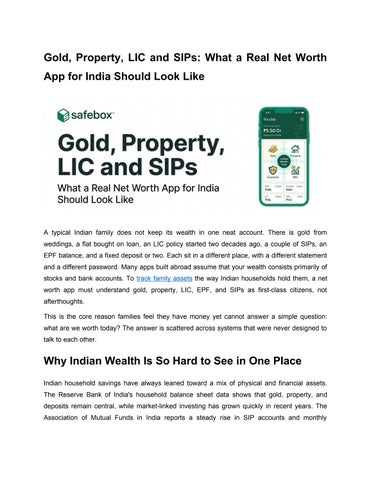
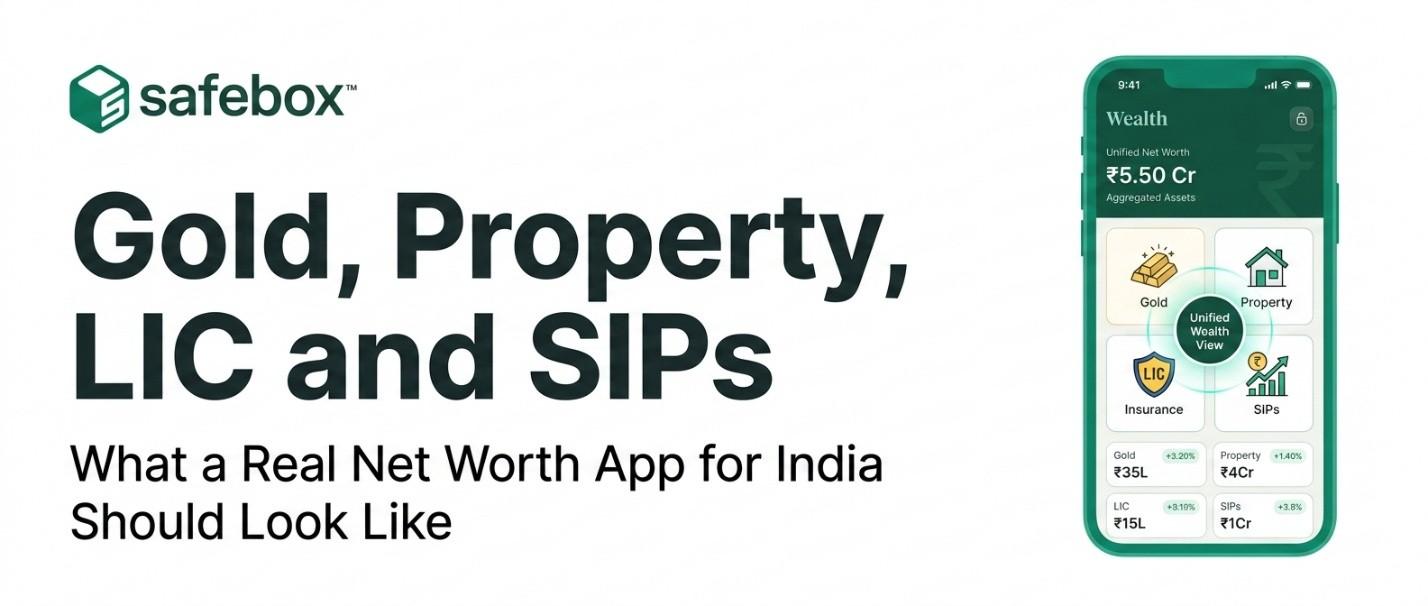
A typical Indian family does not keep its wealth in one neat account. There is gold from weddings, a flat bought on loan, an LIC policy started two decades ago, a couple of SIPs, an EPF balance, and a fixed deposit or two. Each sit in a different place, with a different statement and a different password. Many apps built abroad assume that your wealth consists primarily of stocks and bank accounts. To track family assets the way Indian households hold them, a net worth app must understand gold, property, LIC, EPF, and SIPs as first-class citizens, not afterthoughts.
This is the core reason families feel they have money yet cannot answer a simple question: what are we worth today? The answer is scattered across systems that were never designed to talk to each other.
Why Indian Wealth Is So Hard to See in One Place
Indian household savings have always leaned toward a mix of physical and financial assets. The Reserve Bank of India's household balance sheet data shows that gold, property, and deposits remain central, while market-linked investing has grown quickly in recent years. The Association of Mutual Funds in India reports a steady rise in SIP accounts and monthly
contributions, which means more families now hold market investments on top of their traditional assets, not instead of them.
The result is a layered financial landscape.. A family does not swap gold for mutual funds. It keeps the gold and adds the funds, then adds NPS, then a second property. Each layer arrives in its own silo. Nothing pulls them together, so the total stays invisible.
The Five Asset Classes Most Families Juggle
These five show up in household after household, and almost no single app tracks all of them natively.
Gold
Physical gold, jewellery, sovereign gold bonds, and digital gold. Often the most emotionally and financially significant asset, and the one most likely to be omitted from digital records.
Property
Self-occupied homes, rented flats, plots, and ancestral land. Usually, the largest single asset yet rarely valued or recorded anywhere a family can see briefly.
LIC and other insurance
Endowment plans, money-back policies, ULIPs, and term cover. Older LIC policies often have surrender and maturity values that families overlook when calculating net worth.
EPF, PPF, and NPS
Retirement balances built quietly over years, often spread across multiple employer accounts that were never consolidated.
SIPs and mutual funds
The fastest-growing layer for younger families, frequently spread across more than one platform.
The point is not the list. It is that these belong together. Putting all assets in one place is the only way a family can see what years of saving have built.
The Hidden Cost of Scattered Wealth
Scattered wealth is not just untidy. It quietly leaks value.
• Forgotten holdings: a matured deposit or a paid-up policy nobody remembers becomes effectively lost
• Unclaimed assets: substantial sums sit in dormant deposits and unclaimed insurance amounts across Indian institutions
• Duplicate effort: families re-buy cover they already hold because no one has the full list
• Emergency delays: relatives cannot trace assets when access was never shared or recorded
Poor planning: major financial decisions are made using only a fraction of the family's actual wealth.
Each of these is preventable. They persist only because the information was never brought together in one trustworthy place.
What a Real Net Worth App for India Must Do
An app built for Indian families has to do more than mirror a Western brokerage dashboard. The bar is specific.
Requirement
Track gold and property
Record LIC and insurance value
Consolidate EPF, PPF, NPS
Include loans and liabilities
Flag renewals and maturities
Capture nominee details
Why It Matters for India
These are often the largest holdings and the most overlooked
Older policies hold surrender and maturity value that counts
Retirement money is spread across years and employers
Net worth is meaningless without the debt side
Lapses and missed maturities are common and costly
Missing nominees cause the longest claim
Requirement
Controlled family access
Why It Matters for India delays
Wealth must be reachable by the right people, securely
When an app can track all investments alongside physical assets and liabilities, the family finally sees one honest number instead of seven partial ones.
A Worked Example: The Sharma Family
The Sharmas, a Pune family in their forties, believed they were comfortable but could not say by how much. When they listed everything once, the picture became clear and slightly surprising.
Holding
Flat (current market estimate)
Gold and jewellery
LIC and endowment policies
EPF and PPF combined
funds and SIPs
Approximate Value
Rs 95 lakh
Rs 14 lakh
Rs 9 lakh
Rs 21 lakh
Rs 17 lakh
Rs 6 lakh
Rs 1.62 crore Home loan outstanding
worth
Rs 38 lakh
Rs 1.24 crore
Before this exercise, the Sharmas tracked only their mutual funds and bank balances, which together amounted to less than ₹25 lakh. Their real net worth was roughly five times what they assumed. They had also forgotten one paid-up LIC policy entirely. Seeing the full sheet changed how they thought about retirement, the loan, and how much risk they could comfortably take. Bringing It All into One View
Consolidation does not require a dramatic overhaul. It rewards patience.
Start with what is largest
Record property and gold first, since these usually move the number most and are most often missing from any digital trail.
Add the financial layers
Bring in EPF, PPF, NPS, LIC, mutual funds, and deposits. Note the institution, the value, and the next key date for each.
Subtract the debt
Add every loan and outstanding balance so the view shows net worth, not just a pile of assets.
Keep it shared and current
Store the complete picture in one structured system that can be updated over time and accessed by a trusted family member when needed. A view only one person can see is not preparedness.
Why One View Protects More Than Money
A consolidated net worth view does something a scattered set of accounts never can. It survives the person who built it.
In most Indian homes, one member quietly holds the financial map in their head. They know which bank holds the deposits, where the gold is stored, and which agent sold the LIC policy. That arrangement works smoothly until the day it cannot, and then the family is left guessing. Insurance claims stall, deposits sit unclaimed, and property paperwork turns into a months-long search.
When every asset class lives in one structured view with nominee details and renewal dates recorded, continuity stops depending on memory. A spouse can see the policy. An adult child can find the property papers. Nobody has to reconstruct a lifetime of saving from scattered fragments during an already difficult time.
This is also where security and access control earn their place. Consolidation is only valuable if the right people can reach the information and the wrong people cannot. A real net worth app
for India therefore has to pair a complete view with strong encryption and permission-based family sharing, so the picture is both whole and protected.
Frequently Asked Questions
1. What should a net worth app for India track?
It should track gold, property, LIC and insurance, EPF, PPF, NPS, mutual funds, deposits, and all loans, then show total assets, liabilities, and net worth together.
2. Why do most apps miss gold and property?
Many tools are built around market-linked investments and bank feeds. Physical assets such as gold and property generally do not have automatic valuation feeds, so they get left out unless the app supports manual, structured entry.
3. Should I count my LIC policy in my net worth?
Yes. Endowment and money-back policies carry surrender and maturity value, which is part of what your family owns and should be recorded.
4. How do I track assets spread across many platforms?
Bring them into one consolidated view by recording each holding, its value, and its key dates in a single organised system rather than logging into each app separately.
5. Is it safe to store all my financial details in one app?
It is safe when the platform uses strong encryption, gives you control over who can see what, and avoids public sharing links. Security and access control are what make consolidation worthwhile.
Closing Thoughts
Indian wealth is built in layers across a lifetime: gold at a wedding, a home on loan, a policy in your twenties, SIPs in your thirties, provident fund all along. There is nothing wrong with this approach. What is missing is a place that holds it all at once and gives you a single, honest number.
Bring the five asset classes together, subtract the debt, record the nominees, and keep the view current and shareable. Families choosing where to keep that view often compare options on privacy and control, and
our look at Safebox vs DigiLocker lays out those differences clearly. Once your complete net worth is visible in one place, financial decisions become clearer, faster, and more informed.