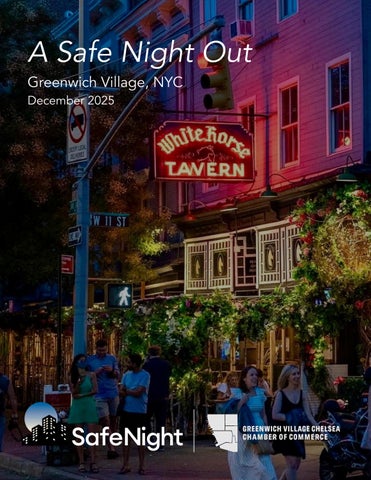
A Safe Night Out
Greenwich Village, NYC
December 2025


Safe Night sincerely thanks the following organizations, businesses, and NYC agencies for participating in A Safe Night Out – Greenwich Village,


![]()
Greenwich Village, NYC
December 2025


Safe Night sincerely thanks the following organizations, businesses, and NYC agencies for participating in A Safe Night Out – Greenwich Village,


In March 2023, Safe Night LLC (Safe Night) brought our proven nightlife management model, A Safe Night Out, to New York City (NYC) in partnership with the Greenwich Village Chelsea Chamber of Commerce (GVCCC). Safe Night is nationally recognized for developing the first voluntary bar accreditation model in the U.S., the Arlington Restaurant Initiative (ARI) in Arlington, Virginia, and creating nightlife management models in Dallas, Texas (Copper Star Certification), Norfolk, Virginia (Gold Bar Norfolk), and Fort Worth, Texas (Golden Lasso).
Founded in 2018, Safe Night is a consulting firm that provides solutions to increase trust, safety, and economic viability. Safe Night works with police departments, local and state enforcement agencies, economic development, business improvement districts, private businesses, community groups, and public-private partnerships to improve the safety and vibrancy of communities.
In September 2023, Safe Night conducted a thorough nightlife assessment of the Greenwich Village neighborhood using Risk Terrain Modeling (RTM) analysis, stakeholder interviews, in-person observations, and reviews of current NYC public safety and business operations. With this information, Safe Night provided a blueprint for NYC agencies and businesses to implement a multi-component model to improve nightlife safety
Throughout 2024, Safe Night developed the framework and policies for a voluntary bar and restaurant accreditation program meant to elevate the standards of businesses and venues serving alcohol. Together with our partner, GVCCC, we finalized the standards and policies and officially named the program the Village Safe Spot Accreditation.
Finally, in the fall of 2024, Safe Night delivered a three-day nightlife management training to NYC municipal staff and stakeholders, a training that includes the Proactive Alliance relationship-based approach and detailed guidance on building a multidisciplinary nightlife team. Municipal agency training focused on prioritizing prevention over enforcement, collaborative problem-solving, and building individual relationships with business owners. On the third day of training, Safe Night and GVCCC welcomed all stakeholders, including bar and restaurant owners and community-based organizations, to officially introduce the Village Safe Spot accreditation.
This project spotlight will discuss A Safe Night Out and the Village Safe Spot hospitality accreditation program, highlighting its early successes as an innovative model for nightlife management.

Greenwich Village is a vibrant, historic neighborhood in Manhattan, NYC. It is densely populated, with approximately 146,000 residents (NYU Furman Center, 2023), and has over 250 bars, restaurants, and live music venues. On Friday and Saturday nights, the streets are typically filled with patrons waiting in lines, establishments near capacity, and active outdoor seating areas. Data indicate that Greenwich Village experiences problems with alcohol-related harm, including violence, disorder, and quality of life crimes similar to other nightlife areas worldwide. Greenwich Village thanks to its high number of famed restaurants, bars, taverns, and clubs.

Safe Night completed a Risk Terrain Modeling (RTM) analysis of Greenwich Village to determine specifically where offenses occur. RTM is a geospatial analytic tool operated by Simsi, Inc. that identifies specific environmental conditions contributing to crime, traffic crashes, and other complex community problems. An RTM analysis also identifies key stakeholders and telling a story about how and why crime trends occur. for the RTM analysis from the NYC Open Data Portal and Data-Axle The RTM analysis provides a more detailed starting point to address why crime is occurring at specific locations. This data can be used by city agencies, businesses, and community stakeholders to begin addressing activities at or near the highest-risk and priority places.
Several RTM analyses of the NYPD’s 6th Precinct identified where offenses occur in Greenwich Village. Safe Night chose to analyze crime data most associated with nightlife, including disorderly conduct, criminal mischief, assault, and impaired driving between 2022 and 2023.
Criminal Mischief
In New York, the destruction of property is referred to as “criminal mischief” (New York Penal Law Chapter 40, Part 3, Title I Law Article 145). In 2023, dance clubs and nightclubs ranked fourth on the list of the highest-risk places for criminal mischief in Greenwich Village.


Disorderly conduct is defined as an offense that causes public alarm or fear, fighting, and violent or threatening behavior (New York Penal Law 240.20). It can be a precursor to violent crime and can impact how safe people feel in a neighborhood, on a street, or around a business. The riskiest place for disorderly conduct was in the area with the highest concentration of bars, nightclubs, and restaurants.
RTM identified the highest-risk areas and priority places for focused intervention efforts to address assaults

Impaired-driving data for the NYPD 6th Precinct alone were not available for the RTM assessment. However, the entire borough of Manhattan was used to identify risky places related to impaired driving.


New York City Police Department (NYPD)
The NYPD regularly posts officers in the Greenwich Village neighborhood on Thursday, Friday, and Saturday nights during nightlife hours. The NYPD 6th Precinct uses a combination of officers (Patrol, Neighborhood Safety Team Officers, and Neighborhood Coordination Officers) to manage issues associated with nightlife identified through CompStat.
Fire Department of New York (FDNY)
Inspections and enforcement at restaurants, bars, and clubs are the responsibility of the FDNY Fire Protection inspectors. The inspections cover the National Fire Protection Association (NFPA) 101 life safety code, including occupancy, means of egress, fire protection systems, emergency lighting, and accessibility (NFPA, 2024).
The NYC Department of Health and Mental Hygiene conducts regular inspections focused mainly on compliance with food safety regulations and food safety managers.
Code Enforcement
Noise complaints from restaurants, bars, and clubs appear to be a significant issue across the city. NYC 311’s most common call is a noise complaint. In 2018, NYC received over 60,000 calls for loud music originating from restaurants and nightlife venues (Glorioso and Stulberger, 2018). The NYC Office of Nightlife (ONL) uses the Mediating Establishment and Neighborhood Disputes (MEND NYC) program, which requires participants to give their personal information and commit to voluntary mediation.
Safe Night staff observed private security staff working at several restaurants, bars, and clubs throughout the neighborhood, primarily visually checking patrons’ identification at the door. No establishments appeared to use higher-level security procedures such as identification scanners, metal-detecting wands, pat-downs, or bag searches.
During interviews, business owners and their staff expressed concerns about general safety, nightlife-related crime, and regulatory issues when interacting with city agencies. Further, bar and restaurant owners, managers, and staff expressed frustration with a perceived lack of clear expectations, resources, training, and guidance from NYC agencies. When asked what could improve their experience, owners and staff identified several suggestions, including:
• A streamlined regulatory process
• Better communication among NYC agencies to eliminate inefficiency
• Reduce liability and scrutiny from NYC agencies for issues that do not originate in their establishments
• A standard of operation that all businesses are required to follow
"The City’s regulatory process for opening a bar or restaurant seems like it is designed to fail before it starts.”
(Interview, January 2, 2024)
Traffic congestion and the lack of dedicated rideshare pickup locations are moderate issues in the neighborhood. Adding dedicated rideshare loading zones in high-demand pickup locations would mitigate factors that lead to conflict and aggression.
Several stakeholders expressed concern about the increasing number of people experiencing homelessness in NYC, especially along the 7th Ave corridor, which has a high density of bars, restaurants, and clubs. Several restaurant and business owners describe open drug usage, theft, and disorder attributed to the increased number of people experiencing homelessness. They report that these crimes hurt their businesses and make patrons feel unsafe when visiting their establishments (New York Post, 2022).
In the mid to late 1990s, NYC agencies formed MARCH teams to respond to complaints from nightclubs and bars. The MARCH approach endured through several mayoral administrations, including the most current Adams administration. The MARCH operations focus solely on enforcement, conducting unannounced inspections of nightlife establishments that business owners describe as disruptive and unproductive, often occurring when the businesses are at their busiest. In 2018, the NYC Office of Nightlife began reporting MARCH operations semi-annually, as mandated by Local Law 220 of 2019 (NYC Office of Nightlife, 2023).
" Enforcement agencies have become accustomed to enforcement only, and violations as their KPI [Key Performance Indicator].”
(Interview, November 14, 2023)
During interviews, hospitality advocates and bar owners explained that the industry has pushed for much-needed change in how city agencies manage restaurants, bars, and clubs. A prominent hospitality industry advocate indicated that businesses want a culture change within city agencies, shifting from an enforcement-only approach to more relationshipbased guidance focused on navigating onerous city regulatory processes.

Coordinating a United Resolution with Establishments (CURE)
Due to the reactive nature of enforcement responses, most stakeholders are ready for substantial change related to the management and regulation of the hospitality industry. Bar and restaurant owners, NYC department leaders, and elected officials clearly stated their commitment to a new approach to improve safety, compliance, and trust among relevant stakeholders.
On December 28, 2023, NYC Mayor Eric Adams and the Office of Nightlife announced the launch of a new process called CURE “to improve public safety responses to nightlife establishments and more equitably engage with nightlife business owners” (New York City Mayor’s Office, 2023). The December 28, 2023, press release issued by the NYC Mayor’s Office describes the CURE process in the following way:
"Whether it's quality of life or public health and safety, we've long urged the City of New York to work collaboratively with bars, nightclubs, and restaurants to address and resolve these issues instead of using unnecessary enforcement actions that jeopardize successful outcomes and erode trust between government, small businesses, workers, and customers."
- Andrew Rigie, Executive Director, New York City Hospitality Alliance, and chairperson, New York City Nightlife Advisory Board
(New York City Mayor’s Office, 2023)


All of the following recommendations address safety and economic viability. The goal is for businesses to join the GVCCC’s effort to increase safety and collaboration by participating in the accreditation program. Although the following recommendations are complex and require a significant time commitment, the businesses appear ready for an innovative and new approach that values prevention over enforcement
Greenwich Village-Chelsea Chamber of Commerce
Recommendation 1: Move Beyond “Best Practices” Guides - While best-practice guides, such as NYPD’s Best Practices for Nightlife Establishments, can be helpful, they lack a mechanism or process to verify whether they actually improve safety for staff and patrons. Establishments often do not take the time necessary to operationalize the recommendations into policy and practice.
Recommendation 2: Use Data for Prevention - As the steward of Village Safe Spot, it is recommended that the GVCCC collaborate directly with the ONL. GVCCC can assist the ONL in providing the most helpful interventions to support businesses without duplicating efforts or interfering with individual roles and responsibilities
Recommendation 3: Expand Partnerships and Promote the Accreditation - A vital part of the success of a voluntary accreditation program is to help both the hospitality community and patrons understand the program's value To raise awareness, the GVCC, ONL, and the New York City Department of Small Business Services should collaborate to promote the Village Safe Spot program with residents, community groups, and ancillary businesses. Public support from elected officials and trade associations to promote the accreditation model is also required.
Recommendation 1: Adopt Risk Terrain Modeling (RTM) - a geospatial analytical tool that identifies specific environmental conditions contributing to crime, traffic crashes, and other complex community problems. Their model focuses on places, not people, and identifies areas at risk for issues such as crime, child maltreatment, terrorism, and driving while intoxicated. This place-based analysis model can provide accurate forecasts of the highest-risk settings and enable city agencies to deploy resources efficiently to disrupt the factors contributing to complex problems.
Recommendation 2: Enhance CURE with a Relationship-Based Approach - For the CURE process to be successful, it will require an evidence-based model to help city staff build relationships, trust, and transparency Business owners must understand how city agencies plan to collaborate with establishments, manage challenges, and prioritize prevention. Specifically, it is recommended that the team receive Proactive Alliance (PA) training, a foundational concept of the nightlife management model, A Safe Night Out. PA is a relationship-based approach adapted from evidence-based counseling psychology theory


and techniques to help establish trust with collateral agencies, business owners, and community stakeholders.
"MARCH operations will continue as usual. Nothing will change just because the city is changing the name to CURE."
(Interview, January 4, 2024)
Recommendation 3: Adopt a Full-Time Multidisciplinary Team - It is recommended that the ONL coordinate with a full-time nightlife and entertainment team consisting of dedicated city agency liaisons from New York City Police Department, Fire Department of the City of New York, New York City Department of Environmental Protection, New York City Department of Buildings, New York City Department of Health and Mental Hygiene, and the New York State Liquor Authority
Recommendation 4: Establish a Unified Nightlife Strategy - A unified nightlife strategy is crucial to the success of the nightlife team and will create more accountability for NYC agencies and businesses. A comprehensive, unified strategy includes parallel messaging from all team members, a clear understanding of others’ roles and responsibilities, and consistent enforcement efforts.
Recommendation 5: Implement Procedural Justice - There is an opportunity to expand on the evidence-based theory of procedural justice, a concept developed by Tom R. Tyler, Ph.D., Professor of Law and Psychology at Yale Law School and a Founding Director of the Yale Justice Collaboratory.
Recommendation 6: Broaden Public-Private Partnerships - Establish a public-private partnership that enables municipal agencies and establishments to collaborate to identify and ban the most harmful offenders. The business crime reduction partnership (BCRP) model is used widely in England to manage crime committed by a small number of offenders. Evidence supports the value of holistic partnerships, such as the BCRP model between businesses and government, in addressing harm (Stafford, 2018).

The Village Safe Spot Accreditation is a voluntary certification program for establishments that serve alcohol in Greenwich Village, NYC, overseen by the Greenwich Village Chelsea Chamber of Commerce (GVCCC). The program was developed in partnership with Safe Night to help businesses adopt rigorous safety protocols, including staff training in sexual violence intervention, public safety expectations, and responsible alcohol service. By achieving the Village Safe Spot accreditation, bars and restaurants demonstrate a commitment to public safety, helping to minimize alcohol-related harm and legal risks while signaling to patrons and the community that they are responsible, trustworthy destinations.
The Village Safe Spot certification demonstrates that an establishment has adopted specific policies and training to handle:

• Alcohol-related harm reduction: Preventing over-service and managing intoxicated patrons.
• Conflict de-escalation: Training staff to intervene safely before fights or aggression occur.
• Sexual violence intervention: Teaching staff how to spot and intervene in harassment or predatory behavior through Safe Night Active Bystander training.
• Fake ID detection: Demonstrates to patrons that preventing underage drinking is a priority for the business.
For a venue, earning the Village Safe Spot designation is not just about safety; it is also a business asset to include:
• Marketing & Reputation: Establishments can display the Village Safe Spot seal, signaling to tourists and residents that they are a safe, responsible place to visit.
• Legal Compliance: The program provides standardized operational manuals that help venues meet city and state laws, reducing the risk of costly fines or liquor license violations.
• Community Relations: It helps businesses build a direct line of communication with local police precincts and community boards, positioning the venue as a "good neighbor" rather than a source of noise or trouble.
• Chamber Membership: Accredited venues often receive complimentary or discounted GVCCC membership.

In September 2024, Safe Night’s President Molly C. Mastoras, MA, LPC, and Executive Vice President Dimitrios Mastoras conducted A Safe Night Out nightlife management training for New York City municipal staff and partners. The agencies and organizations included:
• New York City Police Department (6th and 9th PCTs)
• Greenwich Village Chelsea Chamber of Commerce
• Lower East Side Partnership
•
•
•
Safe Night’s nightlife management model uses


comprehensive training, including assessing needs, data collection, and setting higher operational standards for alcohol-serving businesses. Its core is the Proactive Alliance (PA) relationship-based approach, adapted from counseling psychology, teaching municipal staff to build relationships with business owners and foster collaboration (Gill & Mastoras, M., 2022). PA facilitates stakeholder involvement to reduce alcohol harm and enhance safety and economic outcomes.
City staff overwhelmingly reported that the Proactive Alliance's relationship-based approach changed how they view themselves and the community.
City staff empathy helps them connect with the community as they learn to become problem able to apply the knowledge and have more resources when they are in the field.


On November 1, 2024, FOX 5’s Richard Giacovas interviewed Safe Night’s President Molly C. Mastoras, MA, LPC, about the launch of Village Safe Spot. In the interview, Molly Mastoras discussed how the accreditation will help keep patrons safe and reduce liability for business owners. “Staff safety is of the utmost importance, and to develop more communicative, reciprocal relationships with the NYPD and FDNY. Give restaurants and bars a way to guide their staff to do the right thing. If something does happen, they should be able to understand what they should and should not do within the law” (Giacovas, Nov. 1, 2024).

After the Greenwich Village-Chelsea Chamber of Commerce launched the Village Safe Spot program to enhance safety protocols, a New York Post article covered the program, which offers accreditation and training on crowd control, de-escalation, overdose response, and incident reporting.
“A local business group is trying to help Greenwich Village-area bars keep their patrons from being robbed with a new accreditation and training program, dubbed Village Safe Spot, tackling safety protocols. ‘People are coming out of establishments, and maybe they’ve been a little overserved and are… by themselves, and they’re getting pickpocketed,’ Greenwich Village-Chelsea Chamber of Commerce Executive Director Jesse Gericke told The Post” (Rosenthal, September 26, 2024, NY Post)


To truly reduce harm in our nightlife districts, cities must move beyond reactive enforcement and invest in deep, collaborative relationships between all stakeholders and prevention. Our nightlife management approach takes patience and a willingness to try new practices, but the return on investment is proven. Holistic, systematic approaches not only improve safety but also protect economic prosperity (Roberts et al., 2020).
History shows us that heavy-handed regulation often backfires. Sydney, Australia, serves as a cautionary tale; their restrictive "Lockout Laws" cost the local economy nearly $16 billion in just five years (Gray, 2021). Cities and towns must avoid these unintended consequences by finding the right balance between prevention and enforcement. By building a foundation rooted in trust and collaborative problem-solving, municipalities can ensure a healthy, profitable future for nightlife in NYC. Safe Night is ready to continue supporting NYC and GVCCC through this cultural change and help unlock their full potential.
Giacovas, R. (2024). NYC bar owners unite to boost safety for customers and staff. Fox 5 New York. https://www.youtube.com/watch?v=SNDWD7W1HQM
Gill, C., & Mastoras, M. C. (2021). Proactive Alliance: Combining policing and counselling psychology. Journal of Community Safety and Well-Being, 6 (3), 112 –117. https://doi.org/10.35502/jcswb.193.
Glorioso, C. and Evan Stulberger, E. (2018). WNBC. I-Team: Noisy NYC Bars Avoid Fines 99
Percent of the Time
https://www.nbcnewyork.com/news/local/noisy-nyc-bars-avoid-fines-99-percent- of-thetime/1695977/
Gray, G. (2021, September 9). It’s only taken a decade but the last Sydney lockout laws are finally gone. The Brag. https://thebrag.com/lockout-laws-sydney/ New York City Mayor’s Office. (December 28, 2023). Mayor Adams Launches Effort to Enhance Nightlife Safety and Strengthen Small Businesses, Phasing Out 'March' Enforcement
https://www.nyc.gov/office-of-the-mayor/news/995-23/mayor-adams-launches-effortenhance-nightlife-safety-strengthen-small-businesses-phasing#/0
New York University Furman Center. (2024). Greenwich Village/Soho, MN02 https://furmancenter.org/neighborhoods/view/greenwich-village-soho
Roberts, M., Eldridge, A., Osborn, G., & Flacks, S. (2020) “The Night and Cultural Benefit: The Case for A Holistic Approach to Licensing”, Entertainment and Sports Law Journal 18(1), 9. doi: https://doi.org/10.16997/eslj.245
Rosenthal, N. (September 26, 2024). New York Post. Manhattan bars to ramp up safety protocols to keep NYC patrons from being robbed https://nypost.com/2024/09/26/us-news/nyc-bars-to-ramp-up-safety-protocols-withvillage-safe-sprogram-amid-theft-concerns/
Rutgers Center on Public Security, (2023). Risk Terrain Modeling. https://www.riskterrainmodeling.com/
Stafford, A.B. & Hobson, J. (2018) "Business crime reduction partnerships: examining a holistic approach," Safer Communities, Vol. 17 No. 4, pp. 238-248. https://doi.org/10.1108/SC-07-2018-0020
The Justice Collaboratory. (2022). Procedural Justice. https://law.yale.edu/justice-collaboratory/procedural-justice
The New York Post. (2022). Side Dish. NYC bars and restaurants beef up security as crime, homelessness soars
https://nypost.com/2022/06/29/nyc-bars-restaurants-beef-up-security-as-crimehomelessness-soars/


Molly C. Mastoras, MA, LPC Co-Founder, President
Molly Mastoras is a Licensed Professional Counselor (LPC) in Virginia and Connecticut. She has worked as an assistant program director and probation counselor for the Fairfax County Juvenile & Domestic Relations District Court and as a social worker for the Fairfax County Office for Women and Arlington County Child Protective Services (CPS). Molly has worked extensively with survivors of sexual assault throughout her career, leading to the creation of Safe Night Active Bystander, a sexual assault prevention and intervention training program.

She developed the Proactive Alliance relationship-based approach, which teaches police and enforcement agencies to build relationships to enhance community problem-solving using adapted counseling therapy concepts. She co-authored several articles, including Proactive Alliance in IACP Police Chief Magazine and Productive and Proactive in Sheriff & Deputy Magazine and Proactive Alliance: Combining Policing and Counselling Psychology in the Journal of Community Safety and Well-Being with Dr. Charlotte Gill.
Molly has presented the Proactive Alliance concept at the American Society of Evidence-Based Policing (ASEBP) conference, the Problem-Oriented Policing (POP) Conference, and the International Conference on Law Enforcement & Public Health (LEPH). Molly also serves on the Board of Directors for the Washington Regional Alcohol Program (WRAP).
Co-Founder, Executive Vice President
Dimitrios (Jim) Mastoras is the co-founder and executive vice president of Safe Night LLC, a global consulting firm that provides strategies to improve policing, public safety, and economic viability. Jim served as a Master Police Officer in Arlington County, Virginia, for almost twenty-four years and was named Arlington’s first nightlife liaison. Jim’s nightlife management model was recognized as a national model to reduce alcohol-related violence and harm by the U.S. DOJ COPS Office in a toolkit he authored, The Arlington Restaurant Initiative - A Nightlife Strategy to Improve Safety and Economic Viability.

Jim is a senior Proactive Alliance relationship-based policing instructor teaching police and collateral city agencies how to establish trustful relationships with community stakeholders to shift to collaborative problem-solving. The Proactive Alliance relationship-based approach has been used to address many complex community issues across the U.S., including alcohol-related violence, homelessness, and traffic safety and engagement. He is also a nightlife safety and community engagement expert who regularly speaks at national conferences. Jim has authored or contributed to numerous articles and case studies for the National Policing Institute, Policing Insight, IACP Police Chief Magazine, NSA Sheriff & Deputy Magazine, and Observatory of Public Sector Innovation.

Safe Night LLC, established in January 2018, is a consulting firm that combines the expertise of a licensed professional counselor and a career law enforcement officer to provide solutions that increase community safety and economic viability. Safe Night trains law enforcement agencies, including local and state enforcement agencies, police, fire marshals, code enforcement, and public health inspectors. Safe Night has years of experience in law enforcement, public policy, and social services. For more information about Safe Night and the Proactive Alliance relationship-based policing approach, visit Safe-Night.com.

For over 70 years, the Greenwich Village-Chelsea Chamber of Commerce (GVCCC) has served as the leading voice of business. Founded in 1949 by a select group of small business entrepreneurs in Greenwich Village, the Chamber now represents businesses in the Village, Chelsea, SoHo, NoHo, Union Square and Flatiron communities. What started out as a few dozen businesses banding together, is now hundreds of members strong. The Chamber membership ranges from sole proprietorships to locally owned independent businesses, to major institutions and organizations. Our diversity is one of our greatest assets, providing our membership with unique opportunities and a strong voice from which to address business issues. The Chamber also offers numerous benefits and services including networking opportunities, business and educational seminars, government advocacy, marketing and promotional campaigns and much more.