SEPTEMBER-OCTOBER 2026 | VOLUME XLI NUMBER 5
SPOTLIGHT
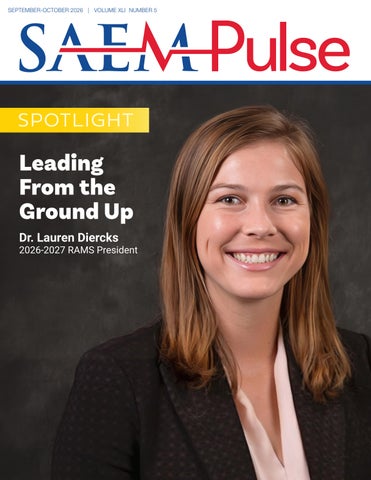
Leading From the Ground Up Dr. Lauren Diercks
2026-2027 RAMS President
Pulse
2026–2027 SAEM BOARD OF DIRECTORS EXECUTIVE COMMITTEE
Jody A. Vogel, MD, MSc, MSW
Ava E. Pierce, MD
Jeffrey P. Druck, MD
Michelle D. Lall, MD, MHS
Stanford University
UT Southwestern Medical Center
The University of Utah
Emory University School of Medicine
SAEM President
SAEM President-Elect
SAEM Secretary-Treasurer
SAEM Immediate Past President
Board Liaison to: • Bylaws and Governance Committee • SAEM Federal Funding Committee • Coaching Interest Group • Research Directors Interest Group
Board Liaison to: • RAMS (Residents and Medical Students) Board • Clerkship Directors in Emergency Medicine (CDEM) • Committee of Academy Leaders • Nominating Committee • Critical Care Interest group • Quality and Patient Safety Interest Group
Board Liaison to: • Informatics, Digital Health, Emerging Technologies, and AI (IDEA) Academy • Faculty Development Committee • Finance Committee • Emergency Medical Services Interest Group • Tech-Enabled Emergency Medicine (TEEM) Interest Group
Board Liaison to: • Academy for Women in Academic Emergency Medicine (AWAEM) • Fellowship Approval Committee • Behavioral and Psychological Interest Group • Pain Medicine Interest Group
Pooja Agrawal, MD, MPH
Cassandra K. Bradby, MD
Ryan L. LaFollette, MD
Nicholas M. Mohr, MD, MS
Yale Department of Emergency Medicine
East Carolina University
University of Cincinnati
University of Iowa Carver College of Medicine
Member at Large
Member at Large
Member at Large
Board Liaison to: • Academy of Emergency Ultrasound (AEUS) • Academy of Geriatric Emergency Medicine (AGEM) • Membership Committee • Airway Interest Group • Clinical Researchers United Exchange (CRUX) Interest Group
Board Liaison to: • Simulation Academy • Education Committee • Disaster Medicine Interest Group • Evidence-Based Healthcare & Implementation Interest Group
Board Liaison to: • Wilderness and Environmental Medicine Academy (WEMA) • Program Committee • Research Committee • Educational Research Interest Group • Tactical and Law Enforcement Interest Group
Bryn Mumma, MD, MAS
Marquita S. Norman, MD, MBA
Ian B.K. Martin, MD, MBA
University of California, Davis
UT Southwestern Medical Center
Medical College of Wisconsin
Member at Large
Board Liaison to: • Academy of Pediatric Emergency Medicine (APEM) • Awards Committee • Ethics Committee • Neurologic Emergency Medicine Interest Group • Toxicology/Addiction Medicine Interest Group
Member at Large
Board Liaison to: • Academy of Emergency Medicine Pharmacists (AEMP) • Grants Committee • Palliative Medicine Interest Group • Trauma Interest Group
Chair Member
Board Liaison to: • Academy for Diversity & Inclusion in Emergency Medicine (ADIEM) • Wellness Committee • Oncologic Emergencies Interest Group • Vice Chairs Interest Group
CONTACT SAEM: 1111 East Touhy Ave, Suite 540 Des Plaines, IL 60018 www.saem.org
Phone: (847) 257-SAEM (7236) Email: saem@saem.org Monday-Thursday: 8 a.m. to 5 p.m. CT Friday: 8 a.m. to 3 p.m. CT Staff Directory
Member at Large
Board Liaison to: • Academy of Administrators in Academic Emergency Medicine (AAAEM) • Global Emergency Medicine Academy (GEMA) • SAEM Federal Funding Committee • Operations Interest Group • Transmissible Infectious Diseases (TID) Interest Group
Indrani Guzmán Das, MD Resident Member Stanford University
Liaison to: • ED Administration and Clinical Operations Committee • Climate Change and Health Interest Group • Sex and Gender in Emergency Medicine (SGEM) Interest Group • Social Emergency Medicine and Population Health Interest Group
CONTACT THE EDITOR: Stacey Roseen, Managing Editor Email: sroseen@saem.org Submission Instructions & Writer Guidelines
HIGHLIGHTS
Articles displaying the RAMS icon have been identified as being of interest and benefit to residents and medical students.
4
President’s Comments Building the Next Chapter of Academic Emergency Medicine
66
Ethics In Action Making Decisions on Behalf of a Patient, Part II: Surrogate Decisionmakers
126
Simulation Education SIMposium Spotlight: How to Challenge Advanced Learners With Simulation
6
Spotlight: Dr. Lauren Diercks Leading From the Ground Up
70
130
Social EM Perspective ICE in the ED: What Emergency Clinicians Need to Know
10
Faculty Development Bridging the Gaps in the Academic Emergency Medicine Promotions Pipeline
Administration & Operations Beyond the Calendar: Building Strong Physician– Administrator Partnerships in Academic Emergency Medicine
74
Emotional Intelligence: An Essential Skill in Emergency Medicine
134
78
Toxicology & Addiction Medicine Naloxone and Pulmonary Edema: Association or Causation?
Reimagining the Leadership Pipeline in Academic Emergency Medicine: A Commentary
138
Serotonin Syndrome in the Emergency Department: A Rapid Review
82
Federal Funding Focus NIGMS Funding Opportunities for Emergency Medicine Investigators
142
Ultrasound From Uterus to Umbilicus: The Case of the Migratory IUD
86
Geriatric EM Beyond Screening: Building Systems to Detect and Respond to Elder Abuse
144
Wellness The July Transition in EM: Supporting Residents at Every Stage
90
Global Health Global Emergency Medicine for the Long Haul: Making Career, Family, and Purpose Fit
148
Wilderness Medicine Osteopathic Manipulative Treatment for Constipation in the Wilderness
94
Bridging the Digital Divide: Expanding Emergency Medicine Education in Uganda
14 18
The ED as a Strategic Partner in Accountable Care
22
ECAT: What Emergency Physicians Should Know About CMS' New Emergency Care Measure
26
Career Development Stop Giving Answers: What Coaching Can Bring to Academic Medicine
Beyond the Triage Desk: A Framework for EquityInformed ED Redesign
30
Climate Change & Health Climate Change and the Potential Northward Expansion of the Lone Star Tick
34
Clinical Practice Commentary What Are We Missing? The Emergency Department as a Front Door to Prevention
98
38
Digital Health & Innovation Bridging the Ethics Translation Gap for AI in Emergency Medicine
102
Cardiac Equity Is a Reliability Problem: Five Design Moves for Emergency and Urgent Care Teams
42
Responsible AI in Emergency Medicine: Putting Equity Into Practice
106
Leadership Leadership Is Learned: Lessons From the eLEAD Capstone
110
Osteopathic Medicine Osteopathic Manipulative Treatment in the Emergency Department: Another Tool for Musculoskeletal Pain
46
Where Clinical Informatics Meets Health Literacy
Health Equity & Disparities Beyond the Discharge Instructions: Addressing Social Risk at the ED Transition
50
Disaster Medicine Radiation Emergency Medicine: What I Learned — and What Every ED Team Should Know
54
Education & Training From Assessment to Final Grade: Rethinking EM Clerkship Grading
114
Pediatric EM From NICU to ED: Adapting SAFE-R for Pediatric Emergency Ultrasound
58
Beyond the Knowledge Gap: Learning to Understand the Learner
118
62
Emergency Medical Services Meeting Patients Where They Live: Community Paramedicine on Rural Deer Isle
Pharmacology Small Doses, Critical Moments: Push-Dose Pressors in Emergency Care
122
Sex & Gender in EM Updates in Early Pregnancy Loss: What Every Emergency Physician Needs to Know
152 156 158
162
Managing Falls from Height in Adventure Sports SAEM Foundation Legacy That Advances Emergency Medicine Briefs and Bulletpoints - A New Chapter in CME: SAEM Earns ACCME Accreditation - Celebrate Excellence: Submit Your Nominations for SAEM and RAMS Awards - SAEMF Launches National Research Scholars Program for Medical Students - Member Leadership: The Heart of SAEM SAEM Reports - Why Serve on the SAEM Bylaws and Governance Committee? - Celebrating the 2025 AEUS Sono Innovation Award Winners - GEMA: Building Connections Through Mentorship - Think Fast. Build Smart. Pitch Bold: The First SAEM Hackathon
166
Academic Announcements
168
Now Hiring
SAEM Pulse is published bimonthly by the Society for Academic Emergency Medicine, 1111 East Touhy Ave., Ste. 540, Des Plaines, IL 60018. (847) 257-SAEM (7236) Disclaimer: The views and opinions expressed in this publication are those of the authors and do not necessarily reflect the official policies, positions, opinions, or views of the Society for Academic Emergency Medicine or its members. © 2026 Society for Academic Emergency Medicine. All rights reserved. No part of this publication may be reproduced, stored, or transmitted in any form or by any means without prior permission in writing from the copyright holder.
PRESIDENT’S COMMENTS Jody Vogel, MD, MSW, MSc Stanford University 2026–2027 President, SAEM
Building the Next Chapter of Academic Emergency Medicine
SAEM PULSE | SEPTEMBER-OCTOBER 2026
It is an exciting time for the Society for Academic Emergency Medicine (SAEM). Even as we reflect on the tremendous success of our recent Annual Meeting, SAEM continues to advance new initiatives that strengthen education, scholarship, and professional development across our specialty. We are already looking ahead to SAEM27 in San Francisco, where we will once again come together to share innovative research, celebrate educational excellence, strengthen professional connections, and create opportunities for members at every career stage to learn, collaborate, and grow.
4
One of the significant milestones achieved this year was SAEM's attainment of continuing medical education (CME) accreditation. This accomplishment reflects the educational rigor, innovation, and scholarly excellence that have long defined our programs and activities. CME accreditation expands our ability to provide high-quality educational offerings that support lifelong learning and excellence in patient care. Most importantly, it creates new opportunities for members to access accredited educational experiences through the organization they know and trust. As we look ahead, this achievement strengthens SAEM's ability to advance academic emergency medicine through education and to better serve members across all career stages.
While these initiatives strengthen educational opportunities across the Society, our trainees remain among SAEM's greatest strengths and most important investments in the future of our specialty. In this issue, you will also learn more about the exceptional work of the Resident and Medical Student Association (RAMS) and its outstanding president, Dr. Lauren Diercks, whose leadership has helped foster innovation, mentorship, and meaningful engagement across the Society. RAMS continues to play a vital role within SAEM, bringing energy, innovation, and fresh perspectives to our academies, committees, and interest groups. Over the past year, RAMS leaders have launched new mentorship initiatives, strengthened collaborations with partner organizations, created opportunities for trainee engagement, and expanded connections across the Society. We are deeply grateful for their dedication and inspired by their commitment to the future of our specialty. At the same time, SAEM is actively helping our members navigate a rapidly evolving graduate medical education landscape. As ACGME changes and emergency medicine pilot initiatives move forward, educators, program leaders, and trainees are grappling with important questions about the future of training.
“Our goal is not simply to respond to change, but to help shape the future of emergency medicine education in a manner that reflects our shared commitment to excellence.”
SAEM is committed to serving as a trusted resource during this period of transition by developing educational resources, fostering meaningful dialogue, and convening experts from across the specialty to examine these changes thoughtfully and through the lens of evidence and scholarship. Our goal is not simply to respond to change, but to help shape the future of emergency medicine education in a manner that reflects our shared commitment to excellence. The strength of academic emergency medicine depends on the generation and dissemination of new knowledge, and SAEM's journals remain central to that mission. In September, we will begin the search for the next editor-in-chief of Academic Emergency Medicine
Education and Training (AEM E&T). This transition presents an exciting opportunity to build upon the extraordinary foundation established by founding Editor-in-Chief Dr. Susan Promes and to continue advancing educational scholarship within our specialty. The strength of our journals reflects the engagement, vision, and leadership of our members, and I am confident that the next generation of leaders will further elevate their impact. As this search begins, we look forward to identifying a leader who will build on AEM E&T's remarkable success and help shape the next chapter of educational scholarship in emergency medicine. The strength of SAEM has always been its members, whose volunteer leadership, curiosity, generosity, and
commitment to excellence continue to advance academic emergency medicine. Through their scholarship, mentorship, innovation, and service, they are helping to shape the future of our specialty and inspiring the next generation of leaders. It is a privilege to serve as your president and to work alongside this extraordinary community as we build the next chapter of academic emergency medicine together. ABOUT DR. VOGEL: Jody Vogel, MD, MSW, MSc, is an associate professor and the inaugural vice chair for academic affairs in the Department of Emergency Medicine at Stanford University.
5
SPOTLIGHT Leading From the Ground Up A Conversation With RAMS President Lauren Diercks, MD
From her first RAMS Board role as a medical student to the presidency, Lauren Diercks, MD, has learned that leadership starts with making room for others to contribute — and sometimes simply raising your hand. For Lauren Diercks, MD, some of the most important lessons in leadership have come from very different places: the RAMS Board, a college marketing program, an emergency department, and the slopes of California’s Bear Valley. Now a PGY-3 in the Stanford Emergency Medicine Residency Program, Dr. Diercks serves as 2026–2027 president of the SAEM Residents and Medical Students (RAMS) Board. It is the latest role in an SAEM journey that began in medical school and has included service as RAMS medical student representative, member at large, and 2025–2026 secretarytreasurer. Along the way, she has focused on strengthening member engagement, expanding trainee participation in SAEM committees and academies, and helping residents and medical students turn their involvement into meaningful opportunities for leadership, learning, networking, and career development. Originally from Sacramento, California, Dr. Diercks earned her bachelor’s degree in marketing from the University of Kansas, where she completed the Business Leadership Program and University Honors Program. She received her medical degree from the University of Texas Southwestern Medical Center with a Distinction in Quality Improvement. Her interests outside medicine have been equally formative. During medical school, she coached a 10-year-old soccer team for four years alongside her father, Bill Diercks, as assistant coach, twice taking the team to the championships. She also participated in the Lone Star Big Brothers Big Sisters program, exploring Dallas’ art and food scene with her 13-year-old mentee. And then there is skiing. Dr. Diercks first took to the slopes with her family at age 2. Now back in California, she is a National Ski Patroller at Bear Valley Mountain Resort — continuing a family tradition that ultimately helped lead her to emergency medicine.
SAEM PULSE | SEPTEMBER-OCTOBER 2026
We spoke with Dr. Diercks about the leadership lessons she has learned, the opportunities she believes trainees should seize, the connection between marketing and medicine, the people who keep her grounded, and what excites her about the future of emergency medicine.
6
You’ve held nearly every leadership position on the RAMS Board over the past several years. How has your leadership philosophy evolved from medical student representative to president? When I started on the RAMS Board, I was focused on the medical student experience. As my time on the board went on, I started to see other aspects of SAEM and what we can do for the whole RAMS community. Effective leaders in emergency medicine lead from the ground up. I had amazing RAMS presidents throughout my time on the board. I will always remember Dr. Wendy Sun making sure the board heard my voice as a first-year board member and student, and Dr. Hamza Ijaz citing ideas as mine in the larger group and with the SAEM CEO. I truly did learn from the best and try to emulate that as president. I try to identify the strengths of my peers on the board and encourage them to participate in tasks that I know they can achieve. As president, I have the big-picture goal and am wrangling projects of various acuity. I try to step back and identify barriers to success for the projects that are going on now and in the future. The other part of RAMS is encouraging the board to challenge themselves during their time in leadership. We have first-year medical student board members working with academy leaders to possibly shape how SAEM looks at mentorship. Two first-year board members are using data to improve our social media presence. We have created two high-yield infographics in the first four months of our term. Our board is so strong. I feel like my win in leadership is finding the strengths of the board and encouraging them!
Congratulations on becoming president of the RAMS Board. If, at the end of your presidency, RAMS members could say, “Lauren helped us accomplish _____,” what would you hope fills in that blank? Lauren helped us accomplish a strong membership experience. RAMS members should engage in SAEM in a way that promotes their career development as academic emergency medicine physicians. All RAMS members should have something related to SAEM on their CV, with the hope that tasks done through SAEM promote networking and skill development. Committee tasks, writing SAEM Pulse articles, and presenting abstracts are all things RAMS members have access to, even as students. My goal is for all members to participate in these things so they get something out of the membership that makes them stronger.
What opportunities within RAMS or SAEM do you think trainees often overlook? People overlook the skill-enhancing experiences you can receive as a committee member. Qualitative research is something that I wanted to learn about, and I was able to participate in focus groups through the Membership
Committee. As a medical student, I just asked to be involved and was able to participate in focus groups in New Orleans. Since then, focus groups have become a multiyear project for the Membership Committee, and I was able to use the experiences I had as a medical student to lead that project this year and next year. All I did to get this opportunity was raise my hand in the Membership Committee when Dr. Feeser asked who was interested. She really let me run with the opportunity so I could achieve the learning that I wanted. Dr. Feeser even invited me to participate with the focus group consultant so I could see the data analysis part that I was so interested in. The opportunities at SAEM are abundant — you just have to be willing to raise your hand.
What do you think makes someone an effective leader in emergency medicine today? What I’ve learned over the last couple of years is that good leadership is about staying grounded and moving forward with what you do know in the face of uncertainty. Take the ACGME changes — there’s still a lot we’re waiting to clarify. But rather than waiting, I try to focus energy on the pieces we do understand and make sure our members have the resources they need. I think that’s really what leadership comes down to: helping your team feel steady and supported while you figure things out together.
Why did you choose to study marketing? Every commercial is built around a target audience, trying to make the customer feel something that drives them to act. I’ve always found brand identity in advertising fascinating — I still watch the Super Bowl mostly for the commercials. continued on Page 8
7
continued from Page 7
I did marketing in college because I really loved the idea of understanding the customer. I knew I would do medicine, but I wanted to study something in college I was interested in outside of medicine. Marketing and emergency medicine are about reading an audience quickly and figuring out how to communicate the right message in a very short window. In marketing, you have to really understand the customer. We use research, focus groups, and pilot projects. In the ED, you often have even less time to earn a patient’s trust, explain what’s happening, and get them to understand and follow a treatment plan. Both disciplines are really about persuasion under constraint — knowing your audience, stripping a message down to what matters, and delivering it in a way that drives them to act.
You’ve said Ski Patrol has been one of the most influential experiences in your life. Why Ski Patrol? Ski Patrol is why I became a doctor. My mom, aunt, grandpa, and dad all did it, and my grandpa started patrolling at Bear Valley in 1970 — my family has been there ever since. My family members have each patrolled for 15-plus years, and my dad retired two years ago after 25 years. The moment that set everything in motion was watching my aunt perform CPR on the sun deck when I was 12. She did good-quality BLS, and the patient survived. After that, I knew I wanted to do emergency medicine.
SAEM PULSE | SEPTEMBER-OCTOBER 2026
I joined Ski Patrol as soon as I moved back to California. It’s been amazing to return to my happy place and work alongside the patrollers I grew up around.
8
that nerve blocks are included. The intention of these changes is to make our specialty better, which makes me excited for the future. The certifying exam is not going to directly improve care, but it should act as a “forcing function” to emphasize our training in procedures and communication. I am excited by our conversations with ABEM. They mention that, in the future, they will try to link performance on the board exam to patient-centered outcomes. I’m not sure what that will look like yet, but I appreciate our specialty for making modifications to make us overall better doctors and for keeping patient care as our top priority.
Ski Patrol has shaped how I practice medicine in ways I didn’t expect. It’s taught me a lot about EMS — what it actually means to follow protocols and treat people in conditions that are far from ideal. A pelvic binder, for instance, loses its Velcro grip once it gets wet in the snow, which isn’t something you learn in a textbook. My wound care in the ED has also gotten noticeably better because of my Ski Patrol training.
What’s one piece of advice you wish every fourth-year medical student applying into emergency medicine could hear?
I’m still a young patroller with a lot to learn, and I look up to my EMS and Ski Patrol friends constantly — I’m always trying to learn from them.
My support system is very close — my 91-year-old grandma lives 15 minutes from two of Stanford’s sites. She made me a candlelit dinner every night I was on ICU and bakes me cookies to bring to work. My other grandma is two hours away, and we make it work — she visits on my days off, or we meet halfway in Napa or Sonoma.
What excites you most about the future of academic emergency medicine? I’m excited about the ACGME changes and new certifying exam. The ACGME changes make the training of an emergency physician stronger and solidify our role as experts in resuscitation and emergency care. I am excited to learn about the new didactic content, such as palliative medicine, and even more excited
Don’t underestimate how much it matters to be close to your support system. When you’re picking programs, factor in proximity to family, because your life outside the hospital directly affects how well you show up inside it.
Beyond the personal side, Stanford’s also just a great program: The mix of academic, community, and county sites gave me a real range of how EM is practiced. But it’s the family piece that made my life outside the hospital feel whole, and that made me a better resident.
I’d tell any fourth-year: Don’t discount that when you’re ranking programs. The training matters, but so does having people nearby who remind you who you are outside of medicine.
Residency can be demanding. What helps you stay grounded outside the hospital? Ski Patrol keeps me grounded. It’s a completely different world from medicine. Nobody up there cares about your research, how many patients you saw on a shift, how many procedures you’ve logged, or anything else on your CV. To make friends, you just have to be a hard worker and someone people enjoy having around. There’s something really humbling about learning a physical skill that has nothing to do with medicine. Over the last two years, I’ve learned to run the toboggan (carry patients down the mountain on a sled), carry bamboo to set ski area boundaries, and tie knots. These are tangible skills that give me a goal completely outside of medicine. Knot-tying, in particular, is my kryptonite. It sounds simple, but once you actually learn it, you can genuinely help the team get the mountain set up for the day. Helping the team is something that really makes me feel like I accomplished something.
What is it like having three emergency medicine doctors in one family? Having three emergency medicine doctors in one family is awesome! It’s really helpful to debrief codes or procedures with my mom and sister. My mom is helpful in understanding the medicine behind a medically complex case. With my sister, I mostly share the funny things that happen on shift. She is the best audience for a good story, so I always share my best ones with her.
Quick Takes With Dr. Lauren Diercks Coffee or tea? Coffee with a creamer that has at least two adjectives before it. Mountains or beach? Mountains with a lake. Early shift or overnight? Overnight — that’s the Diercks way. My mom has been a nocturnist my whole life. Favorite ski destination? Bear Valley, of course. Favorite leadership book? Unruly: A History of England’s Kings and Queens. If you have met me once, you know I love royal history. This is a historical comedy about England’s royalty and has a lot of “what not to do” leadership moments. One word your co-residents would use to describe you? “Early.” Favorite way to spend a day off? Pick a new cheese to try. Right now, I am really into trying to find the best-tasting, stinkiest cheese. This is a very high-risk, high-reward thing to do because some of them smell so bad and also taste bad. Current podcast, book, or TV recommendation? I really like TV shows about history, so shows like The Serpent Queen are things I like to watch and follow along with by Googling to see if they’re historically accurate.
9
ADMINISTRATION & OPERATIONS
Beyond the Calendar: Building Strong Physician–Administrator Partnerships in Academic Emergency Medicine By Jennifer Muir, EdD, MBA; Frank Jurkiewicz, MBA; Amy Cutright, MD; Leigh Patterson, MD, MAEd; and Luan Lawson, MD, MAEd
At a Glance
SAEM PULSE | SEPTEMBER-OCTOBER 2026
• Why this matters now: Growing departmental complexity makes strong physician–administrator partnerships increasingly important to academic emergency medicine.
10
• What you'll learn: Practical ways to strengthen communication, trust, shared decision-making, talent development, and recognition of complementary expertise. • Who this is for: Physician leaders, administrative professionals, and others involved in leading or managing academic emergency medicine departments. Academic emergency medicine departments manage an increasingly complex mix of clinical operations, education, research, faculty development, finances, accreditation, workforce challenges, and health system priorities. No single leader
brings all the expertise needed to navigate these responsibilities. One important — and often overlooked — driver of departmental success is the partnership between physician leaders and administrative professionals.
Strong departments benefit when physicians and administrators work together, combining clinical insight with operational, financial, and organizational expertise. Although every partnership is different, several practices consistently emerge among high-performing physician– administrator partnerships.
Start With Communication, Not Assumptions
Many partnership challenges stem from differing expectations rather than poor intentions. Physician leaders often divide their time among clinical work, teaching, research, and administration, while administrative professionals coordinate workflows, manage deadlines, and maintain operational continuity. Without intentional alignment,
“Communication is not a one-time conversation but an ongoing commitment.” communication can quickly become fragmented. Effective partnerships establish communication expectations early. They agree on preferred communication channels, determine what constitutes an urgent issue, set expectations for response times, and identify escalation pathways when immediate decisions are required. Those norms should be revisited periodically. Responsibilities evolve, priorities change, and processes that worked during onboarding may become less effective as roles expand. Communication is not a one-time conversation but an ongoing commitment.
Ultimately, good communication is less about choosing the right technology and more about understanding how people work best together.
Recognize Different Professional Cultures
Physicians and administrative professionals may approach the same challenge from different perspectives. Physicians are often trained to make rapid decisions, communicate concisely, and solve problems quickly. Administrative professionals may work in environments that place greater emphasis on planning, relationship management, stakeholder engagement, and process improvement.
Neither approach is inherently better. Problems arise when differences in working style are interpreted as deficiencies rather than strengths. Leaders who invest time in understanding how their partners think, communicate, and make decisions can prevent misunderstandings that undermine trust. Curiosity, empathy, and active listening matter. Different perspectives, thoughtfully integrated, can produce better solutions than either partner might develop independently.
continued on Page 12
11
department’s long-term talent pipeline.
Treat Trust as a Strategic Asset
Trust is the foundation of an effective physician–administrator partnership. It makes room for honest feedback, productive disagreement, and candid conversations about sensitive issues without damaging the relationship. One useful principle is the “no surprises” rule: Communicate concerns early, share information transparently, and avoid allowing issues to surface unexpectedly. Openness creates the psychological safety for partners to discuss ideas, test assumptions, and challenge one another constructively before presenting recommendations more broadly. Trust becomes particularly important during financial pressure, organizational change, staffing shortages, or competing stakeholder interests. In those moments, a strong relationship becomes an operational advantage, not simply an interpersonal asset.
Leverage Complementary Expertise
ADMINISTRATION SAEM PULSE | SEPTEMBER-OCTOBER 2026
continued from Page 11
12
Promote Potential — but Support the Transition
Academic medicine often rewards strong performers with broader leadership opportunities. But success in one role does not automatically predict success in another. A talented coordinator, analyst, clinician, or program administrator may move into a position requiring strategic thinking, independent decision-making, staff supervision, or change management.
A common leadership mistake is promoting a high-performing “doer” into a fundamentally different role without assessing whether the new responsibilities align with the person’s experience or providing enough support during the transition. Successful leaders treat promotions as transitions rather than events. They establish clear expectations, create structured onboarding plans, provide development resources, and maintain regular check-ins during the first several months. Investing in development can improve individual success while strengthening the
The strength of a physician– administrator partnership lies in combining different forms of expertise. Physicians bring insight into patient care, clinical operations, educational priorities, faculty concerns, and frontline challenges. Administrative professionals contribute expertise in areas such as finance, human resources, regulatory compliance, project management, and organizational strategy. Solutions are stronger when both perspectives inform them. Clinical stories can be more persuasive when supported by meaningful data. Financial analyses can be more useful when connected to patient care implications. Together, context, evidence, and professional expertise can strengthen decisions and advocacy. Effective partners also recognize their own limitations. Physicians may rely on administrative
expertise in budgeting or operations, while administrators may depend on physician leaders to navigate clinical concerns and engage faculty stakeholders. Mutual respect for each person’s expertise strengthens decision-making and organizational effectiveness.
Make Administrative Excellence Visible
Administrative professionals often contribute significantly to departmental success while receiving limited visibility. Much of their work happens behind the scenes: coordinating programs, managing budgets, maintaining compliance, supporting faculty, and solving operational challenges that keep departments functioning.
The importance of this work can become particularly visible when a position is vacant and critical processes begin to falter. Departments can reinforce the value of administrative expertise by recognizing staff achievements, including administrators in strategic discussions, and celebrating operational accomplishments alongside faculty successes. Visibility is about more than recognition. It reinforces the role of administrative professionals as strategic partners whose expertise contributes directly to the department’s mission.
Invest in Partnerships Before They Are Needed Strong physician–administrator relationships are rarely built during a
crisis. They develop over time through consistent communication, mutual respect, transparency, and shared problem-solving. Departments that invest in these foundations are better positioned to navigate uncertainty and achieve their missions. As academic emergency medicine continues to evolve, these partnerships will become increasingly important. They are more than administrative conveniences. Done well, they strengthen leadership and organizational effectiveness while supporting the work at the heart of academic emergency medicine: patient care, education, research, and service.
ABOUT THE AUTHORS r. Muir serves as assistant D chair for administration in the Department of Emergency Medicine at East Carolina University’s Brody School of Medicine and is immediate past president of the Academy of Administrators in Academic Emergency Medicine. Frank Jurkiewicz is a health care executive and academic medicine leader with expertise in strategic operations, financial management, and faculty development in emergency medicine. He serves as president-elect of the Academy of Administrators in Academic Emergency Medicine.
Pulse Points •S et communication norms early. Agree on channels, urgency, response expectations, and escalation pathways, then revisit them as roles evolve. • Treat differences as assets. Physician and administrative professionals bring distinct professional cultures and perspectives to decision-making. • Support people through promotions. New responsibilities require clear expectations, onboarding, development, and ongoing support. • Build trust before a crisis. Transparency, candid feedback, and a “no surprises” approach create stronger working relationships. • Make administrative expertise visible. Include administrative professionals in strategic discussions and recognize operational achievements alongside faculty successes.
Dr. Cutright has been an educator at the University of Nebraska Medical Center since 2013. She has served as clerkship director, emergency medicine advisor, and a clinical transitions educator within the College of Medicine. Dr. Patterson is chair of the Department of Emergency Medicine at East Carolina University’s Brody School of Medicine in Greenville, North Carolina. She has served in multiple leadership roles, including residency director, associate dean for faculty development, and executive curriculum committee chair. Dr. Lawson is a professor of emergency medicine and senior associate dean for medical education and student affairs at Virginia Commonwealth University School of Medicine.
13
ADMINISTRATION & OPERATIONS
SAEM PULSE | SEPTEMBER-OCTOBER 2026
The ED as a Strategic Partner in Accountable Care
14
By Wendy W. Sun, MD, MBA; John Riggins Jr, MD, MHA; Liliya Abrukin MD MPH; Amy Mathew, DNP, MSN, MPH, RN; Monisha Dilip, MD, MBA; Michael Dorritie, DO; Liza Hartofilis MD; Christopher McStay, MD, MBA; Hassan Mohamed, MD; Jeremy Rose MD MPH; Ben-zion Rotter MD; Rush Shah MD; and Joy Gelbman, MD
At a Glance • Why this matters now: As accountable care expands, ED decisions can have significant implications for quality, care coordination, and total cost of care. • What you’ll learn: Where emergency medicine can contribute to ACO strategy, from governance and disposition decisions to care management, data integration, and population health. • Who this is for: Emergency medicine leaders, administrators, operations and quality leaders, and clinicians involved in value-based care.
As health care systems continue to shift toward value-based care, accountable care organizations (ACOs) have emerged as a central model for improving quality while reducing costs. As of January 2026, approximately 14.3 million Medicare beneficiaries receive care coordinated by ACOs, an increase from 13.7 million in 2025. ACOs are designed to incentivize coordinated, patient-centered care. Because it is
Strategic Priority
Recommended Area for Collaboration
Potential Impact
Governance and Leadership
Include emergency medicine leaders in ACO governance committees, operational planning, and strategy discussions.
Incorporates emergency medicine perspectives into population health, utilization management, and care coordination initiatives.
Performance Metrics
Develop shared quality measures that recognize ED contributions, including appropriate Better aligns ED and ACO priorities and disposition, avoidance of unnecessary demonstrates emergency medicine's admissions, observation management, and contribution to cost and quality performance. timely transitions of care.
Care Coordination
Strengthen collaboration among emergency medicine, primary care, specialists, care managers, and post-acute care providers.
Improves transitions, reduces fragmentation, and may reduce unplanned admissions and repeat ED utilization.
ED-Based Care Management
Invest in embedded care managers, social workers, and navigation teams in the ED.
Helps address social needs, supports high-risk patients, and connects patients with outpatient and community resources.
Data Integration
Give emergency clinicians timely access to relevant ACO data, utilization history, longitudinal care plans, and follow-up information when available and appropriate.
Supports informed clinical decisions and continuity across care settings.
Clinical Decision Support
Implement evidence-based decision support and risk-stratification workflows in the ED.
Supports standardized care, reduces unnecessary variation, and promotes appropriate resource use.
Admission Optimization
Develop protocols for observation care, outpatient pathways, and rapid specialty follow-up as clinically appropriate alternatives to inpatient admission.
May reduce avoidable admissions while maintaining patient safety and quality.
Population Health Collaboration
Engage emergency medicine clinicians in identifying high-utilization populations and developing targeted interventions.
Connects ED expertise with broader population health and utilization goals.
Continuous Feedback and Education
Provide ED teams with regular feedback on utilization, outcomes, and relevant ACO performance measures.
Supports accountability, continuous improvement, and clinician engagement in value-based care.
Table 1. Strategies for ACO and Emergency Medicine Collaboration
often perceived as a high-cost setting, the emergency department is an underrecognized component of ACO success. In reality, EDs are uniquely positioned to drive value, improve outcomes, and reduce total cost of care, aligning with key ACO goals and strategies. ACOs aim to align providers around shared accountability for quality and cost, emphasizing care coordination, prevention, and avoidance of unnecessary utilization. The ED sits at the intersection of these goals. It serves as a safety net for the health care system, providing 24/7 access regardless of insurance status or prior engagement with the health care system. This access positions the ED
as a key touchpoint for high-risk and underserved populations, including patients who may account for a disproportionate share of health care spending.
The ED’s Influence on Cost and Utilization
ED clinicians make high-stakes decisions that significantly influence downstream costs. Decisions regarding goals of care, diagnostic testing, and disposition directly affect resource utilization. EDs can reduce unnecessary admissions and testing through evidence-based protocols, clinical pathways, and observation medicine. These strategies align closely with ACO priorities of quality improvement and cost containment.
A recent systematic review and metaanalysis estimated the average cost of a 30-day all-cause adult hospital readmission at $16,037.08. In this way, EDs are not merely cost centers but active stewards of health care resources.
Beyond Acute Care: Connecting the Care Continuum Beyond acute care, EDs play a pivotal role in care coordination. Many patients presenting to the ED have fragmented care, unmet social needs, or poorly managed chronic conditions. Through case management, linkage to outpatient
continued on Page 16
15
ADMINISTRATION
SAEM PULSE | SEPTEMBER-OCTOBER 2026
continued from Page 15
16
services, and integration with health information technology, EDs can help redirect patients to appropriate care settings and potentially prevent avoidable hospitalizations. Linking patients back to outpatient care can also support ACO quality goals, including preventive screening and management of chronic conditions such as hypertension and diabetes. ED-based interventions such as case management and improved information systems are among the most commonly cited strategies for supporting ACO goals.
The ACO Integration Gap
Despite this potential, ED integration into ACO structures remains incomplete. Studies suggest that although many EDs are aligned with ACOs, emergency physicians often have limited awareness of ACO goals, and there are few direct financial incentives tied to ED performance. This is partly driven
by the structure of the Medicare Shared Savings Program (MSSP) administered by the Centers for Medicare & Medicaid Services. Under the MSSP, shared savings are largely influenced by longitudinal and outpatient care, including patient attribution, risk coding, and chronic disease management.
Emergency physicians generally lack patient attribution and direct access to shared savings despite their influence on total cost of care and quality through high-impact decisions, including decisions that may reduce avoidable hospital admissions. This disconnect represents a missed opportunity.
Without intentional inclusion of ED leadership and relevant performance metrics, ACOs risk overlooking an influential component of the care continuum.
Bringing the ED Into ACO Strategy
To fully realize the value of EDs within ACOs, several steps are essential (Table 1). First, emergency physicians should be engaged in ACO governance and strategy development. Second, performance metrics should reflect ED contributions, including appropriate disposition, avoidance of unnecessary admissions, and care coordination. Finally, investment in ED-based care management, data integration, and clinical decision support can amplify the ED’s impact on systemwide outcomes. In an era of value-based care, the ED is a central driver of value. By recognizing the ED’s role in decisionmaking, care coordination, and population health, ACOs can more fully incorporate emergency care into efforts to improve quality while managing total cost of care.
Pulse Points • Treat the ED as a strategic participant in accountable care, not simply a source of utilization to reduce. •G ive emergency medicine leaders a role in ACO governance, planning, and performance strategy. •B uild measures that recognize ED contributions to appropriate disposition, care coordination, observation management, and avoidance of unnecessary admissions. •G ive ED clinicians access to relevant longitudinal information and reliable outpatient and specialty follow-up pathways. • I nvest in care management, decision support, and feedback systems that connect acute care decisions with broader population health goals.
“In reality, EDs are uniquely positioned to drive value, improve outcomes, and reduce total cost of care, aligning with key ACO goals and strategies.”
ABOUT THE AUTHORS Dr. Sun is assistant medical director of the NewYorkPresbyterian Allen Hospital emergency department and an assistant professor at Columbia University Medical Center.
Dr. McStay is vice chair of clinical operations in the department of emergency medicine and an associate professor at Columbia University Medical Center.
Dr. Riggins is medical director of the NewYork-Presbyterian Allen Hospital emergency department and an associate professor at Columbia University Medical Center.
Dr. Mohamed is director of quality and patient safety in the department of emergency medicine and an assistant professor at Columbia University Medical Center.
Dr. Abrukin is vice chair of quality and patient safety in the department of emergency medicine and an associate professor at Columbia University Medical Center.
Dr. Rose is medical director of the Columbia University Irving Medical Center emergency department and an associate professor at Columbia University's Vagelos College of Physicians and Surgeons.
Amy Mathew is manager of clinical operations at NewYork Quality Care, the ACO of NewYorkPresbyterian, Columbia University, and Weill Cornell Medicine.
Dr. Rotter is the Lorna M. Breen Healthcare Administration Fellow in the department of emergency medicine and a clinical instructor at Columbia University Medical Center.
Dr. Dilip is assistant director of quality and patient safety in the department of emergency medicine and an assistant professor at Columbia University Medical Center.
Dr. Shah is assistant medical director of the Columbia University Irving Medical Center emergency department and an associate professor at Columbia University's Vagelos College of Physicians and Surgeons.
Dr. Dorritie is the Lorna M. Breen Healthcare Administration Fellow in the department of emergency medicine and a clinical instructor at Columbia University Medical Center.
r. Gelbman is director of D population health, an associate professor of clinical medicine, and associate chief medical officer at Weill Cornell Medicine. She is also medical director of NewYork Quality Care, the ACO of NewYorkPresbyterian, Columbia University, and Weill Cornell Medicine.
Dr. Hartofilis is medical director of the NewYork-Presbyterian Westchester Hospital emergency department and an assistant professor at Columbia University Medical Center.
17
ADMINISTRATION & OPERATIONS
Beyond the Triage Desk: A Framework for Equity-Informed ED Redesign By John K. Riggins Jr., MD, MHA
SAEM PULSE | SEPTEMBER-OCTOBER 2026
At a Glance
18
• Why this matters now: Triage decisions occur within increasingly complex ED systems, while evidence points to disparities in how some patients experience triage and timely emergency care. • What you'll learn: A nine-part conceptual framework for examining triage through operational, educational, research, and equity-informed perspectives. • Who this is for: Emergency medicine operational leaders, educators, researchers, quality improvement teams, and clinicians interested in triage redesign. Emergency department (ED) triage serves as the gateway to emergency care and remains one of the most consequential operational processes in emergency
medicine. Through triage, clinicians rapidly assess acuity, prioritize evaluation, and allocate limited resources in increasingly complex care environments. Yet triage is
often viewed primarily as a clinical nursing function rather than as a system-level process that can be intentionally designed, studied, and improved. A growing body of literature has identified disparities in triage assignment, wait times, pain assessment, and access to timely emergency care among various patient populations. Interventions proposed to improve triage performance include structured triage tools, team triage models, reviews of undertriaged patient cases, early warning systems, and emerging artificial intelligence applications. These efforts also create an opportunity to examine
triage through a broader operational and equity-informed lens. For emergency medicine educators, researchers, and operational leaders, triage represents an important area for scholarly inquiry and systems improvement. Examining how triage processes may contribute to downstream patient outcomes can help identify opportunities to improve equity and operational performance. Educational initiatives addressing implicit bias, communication barriers, and systems thinking may also strengthen clinicians’ ability to make equitable triage decisions in busy emergency care environments. The TRIAGE-EQU Framework is a proposed model to help emergency department leaders, educators, and researchers examine triage systems through an equity-informed perspective. It is not a validated intervention. Rather, it is intended as a structure for discussion, quality improvement, educational innovation, and future research focused on equitable emergency care delivery.
The TRIAGE-EQU Conceptual Framework
T — Triage Standardization Use structured triage tools, such as the Emergency Severity Index, and standardized chief complaint pathways to reduce unwarranted variability in triage assignment across patient populations. Goal: Reduce variability in triage decision-making across demographic and clinical groups. R — Real-Time Data Capture With Equity Stratification Develop real-time operational dashboards that stratify key ED metrics by patient demographics and visit characteristics, including doorto-triage, door-to-provider, and triageto-room times. Establish feedback loops for rapid-cycle performance monitoring. Goal: Identify and respond to disparities in triage and throughput processes. I — Integration of Bias Mitigation Strategies Incorporate decision-support tools
for high-risk or high-variability chief complaints and atypical presentations. Strengthen access to interpreter services and language support at the point of triage. Goal: Reduce the potential influence of implicit bias and communication barriers on triage decisions. A — Adaptation of Flexible Flow and Staffing Models Align staffing and flow design with variations in demand through
strategies such as provider-in-triage models, split-flow pathways, and flexible surge staffing. Goal: Help the triage system respond to operational strain and crowdingrelated constraints. G — Governance With Accountability Structures Incorporate equity-focused measures into operational dashboards continued on Page 21
19
SAEM PULSE | SEPTEMBER-OCTOBER 2026
“The TRIAGE-EQU Framework is a propo emergency department leaders, educators, a triage systems through an equity-inform
20
osed model to help and researchers examine med perspective.” ADMINISTRATION continued from Page 19
and leadership accountability structures, connecting performance measurement with system redesign efforts and relevant clinical outcomes. Goal: Establish sustained leadership accountability for equitable triage performance. E — Evaluation Through Iterative Improvement Use approaches such as Plan-DoStudy-Act (PDSA) cycles, pre- and post-intervention analyses, and balanced scorecards to evaluate triage interventions and system redesign efforts. Goal: Maintain a structured, iterative approach to continuous improvement. E — Exploration of Innovative Technologies Assess the responsible integration of emerging tools, including artificial intelligence-assisted triage and teletriage models, with explicit attention to bias, transparency, and safety.
Goal: Explore how innovation may support equity and operational performance. Q — Quality Transparency and Dissemination Share triage performance and equity measures with appropriate stakeholders, including frontline staff, leadership, and patients when appropriate. Disseminate findings to support shared learning and accountability. Goal: Make equity and quality performance visible and actionable across the system. U — Understanding of System Complexity and Barriers Recognize the sociotechnical complexity of ED triage systems, including structural constraints, workflow pressures, and cognitive load. Foster a culture of humility, reflection, and continuous learning. Goal: Sustain adaptive learning and realistic system awareness among leaders and frontline clinicians.
Educational and Research Opportunities
The TRIAGE-EQU Framework highlights opportunities for scholarship across emergency medicine. Educational programs could incorporate structured training on equitable triage practices, communication across language barriers, and recognition of cognitive biases that may influence decisionmaking. Faculty development could also help educators and clinical
Pulse Points • Treat triage as a system-level process that can be designed, measured, studied, and improved. •S tratifying operational measures can help teams identify variation that aggregate performance data may obscure. •E quity-focused triage redesign should consider workflow, communication, cognitive bias, staffing, governance, and system constraints together. •E merging technologies should be evaluated for bias, transparency, safety, and operational value rather than adopted on technological promise alone. • TRIAGE-EQU is a conceptual framework; research is needed to determine whether strategies developed from it improve patient, equity, or operational outcomes.
leaders evaluate triage processes through an equity lens. Important research questions remain about how triage decisions influence patient outcomes across diverse populations. Future studies could evaluate real-time equity dashboards, decision-support tools, artificial intelligence-assisted triage systems, and accountability structures intended to reduce variation in care delivery. Multicenter studies examining relationships among triage redesign, operational performance, patient experience, and clinical outcomes could provide evidence to guide future practice.
Conclusion
As emergency departments face increasing operational complexity, emergency medicine leaders continue to seek approaches that improve both efficiency and equity in triage models. The TRIAGE-EQU Framework encourages educators, researchers, and operational leaders to view triage as more than a point-of-entry process. Triage is part of a dynamic system with potential implications for patient experience, resource allocation, and downstream clinical outcomes. The framework is a starting point, not an endpoint. Research is needed to determine whether equityinformed triage redesign strategies improve meaningful outcomes and under what conditions. In the meantime, systematically examining standardization, data, bias mitigation, flow, accountability, evaluation, technology, transparency, and system complexity can help emergency medicine professionals ask more rigorous questions about how triage systems function — and for whom they function well.
ABOUT THE AUTHOR Dr. Riggins is an associate professor of emergency medicine at NewYorkPresbyterian/Columbia University Irving Medical Center and Columbia University Vagelos College of Physicians and Surgeons. He serves as medical director of the NewYork-Presbyterian Allen Hospital Emergency Department and chair of the emergency department's Bridge Builders Board.
21
ADMINISTRATION & OPERATIONS
SAEM PULSE | SEPTEMBER-OCTOBER 2026
ECAT: What Emergency Physicians Should Know About CMS' New Emergency Care Measure
22
By Seth Krupp, MD, on behalf of the SAEM Vice Chairs Interest Group Emergency physicians have described emergency department crowding and boarding as among the greatest threats to patient safety in modern health care for decades. As admitted patients remain in emergency departments while awaiting inpatient beds, other patients are forced to wait increasingly long periods for treatment spaces, ultimately requiring emergency physicians to deliver care to many in hallways and waiting rooms.
Although recognition of this problem has become widespread, national quality measurement has largely focused on isolated aspects of emergency department operations rather than the broader issue of access to emergency care. That is beginning to change. In the 2026 Hospital Outpatient Prospective Payment System (OPPS) Final Rule, the Centers for Medicare & Medicaid Services (CMS) finalized the Emergency Care Access and
Timeliness (ECAT) electronic clinical quality measure (eCQM). Voluntary reporting will begin in 2027, followed by mandatory reporting in 2028. ECAT represents a national quality measure specifically designed to quantify emergency care access and patient flow across the emergency department encounter.
From ECCQ to ECAT: A Measure Years in the Making
The measure was initially developed by the Yale New Haven Health
“Rather than focusing on a single operational metric, ECAT attempts to capture multiple dimensions of delayed access across the emergency care continuum.”
Services Corporation Center for Outcomes Research and Evaluation (Yale CORE) under a CMS Measure & Instrument Development and Support contract. The original measure was known as the Equity of Emergency Care Capacity and Quality (ECCQ) eCQM. Yale CORE sought to create a national measure capable of capturing the real-world consequences of crowding and boarding. The resulting measure focused on four key access failures: prolonged waits for treatment space placement, leaving before evaluation, boarding after admission
decisions, and excessive total ED length of stay.
renamed Emergency Care Access and Timeliness.
During public comment periods, emergency medicine organizations strongly supported the effort. The American College of Emergency Physicians (ACEP) provided recommendations during measure development, including that boarding be recognized as a hospital-wide systems problem rather than solely an emergency department operational issue.
Why ECAT Matters
As the measure matured and moved toward implementation within CMS quality programs, it was
Specifically, the measure identifies patients who experience one or more of the following events: 1. The patient was not placed, or waited longer than 60 minutes after arrival to the ED to be placed, in a treatment room or dedicated treatment area that allows for audiovisual privacy during historytaking and physical examination; or
continued on Page 25
23
24
SAEM PULSE | SEPTEMBER-OCTOBER 2026
“No quality metric can create inpatient beds, increase nurse staffing, or eliminate years of health system capacity constraints.” ADMINISTRATION continued from Page 23
2. The patient left the ED without being evaluated; or 3. The patient boarded in the ED for longer than 240 minutes, measured from the decision-to-admit order to ED departure for admitted patients; or 4. The patient had an ED length of stay (LOS) longer than 480 minutes, measured from ED arrival to the ED departure timestamp indicating when the patient physically left the ED. Rather than focusing on a single operational metric, ECAT attempts to capture multiple dimensions of delayed access across the emergency care continuum. A growing body of evidence has linked emergency department crowding and boarding to increased mortality, treatment delays, medical errors, worse patient experiences, and clinician burnout.
The ECAT measure may also provide emergency physician leaders with a new tool. Hospital executives and governing boards often pay close attention to publicly reported quality metrics, regulatory requirements, and reimbursement incentives. As ECAT data become more visible, conversations about inpatient capacity, boarding reduction initiatives, discharge efficiency, observation management, and hospital throughput may gain greater urgency.
3. O bservation stays are treated differently. ED encounters with observation stays are excluded from the boarding and total ED length-of-stay criteria.
Key Caveats With the ECAT Measure
The measure is unlikely to solve crowding on its own. No quality metric can create inpatient beds, increase nurse staffing, or eliminate years of health system capacity constraints. But establishing a national measure focused specifically on access to and timeliness of emergency care puts greater attention on delays that emergency physicians and their patients experience every day.
1. R esults are stratified. Findings are stratified by pediatric versus adult patients, as well as by whether a visit is associated with a mental health diagnosis. 2. A n encounter can be counted only once. For example, if a patient waits more than 60 minutes for a treatment space and also boards for more than four hours, the encounter is counted only once.
Pulse Points •E CAT identifies four types of access and timeliness gaps during an ED encounter. •A n encounter is counted only once, even when a patient experiences more than one ECAT criterion. •O bservation encounters are excluded from the boarding and total ED length-of-stay criteria. •E CAT brings several dimensions of ED access and flow together in a national quality measure. •E mergency physician leaders should understand what ECAT measures as reporting begins and institutions start interpreting their results.
4. E D volume is incorporated into scoring. Results are standardized based on ED case volume, stratified in increments of 20,000 visits.
Conclusion
ECAT represents an important change in how emergency care access and timeliness are measured nationally.
As ECAT reporting begins, emergency physicians can help their institutions understand what the measure captures and use the resulting data to inform broader conversations about patient flow, boarding, and access to timely emergency care.
ABOUT THE AUTHOR Dr. Krupp is vice chair of operations for the Department of Emergency Medicine at Henry Ford Hospital in Detroit. His work focuses on emergency department operations, patient flow, clinical quality, and care delivery redesign. He has also played a key role in planning and designing Henry Ford Hospital's new emergency department.
25
SAEM PULSE | SEPTEMBER-OCTOBER 2026
CAREER DEVELOPMENT
26
Stop Giving Answers: What Coaching Can Bring to Academic Medicine By Lindsay MacConaghy, MD; Taher Vohra, MD; and Jennah Morgan, MD, on behalf of the SAEM Coaching Interest Group
At a Glance • Why this matters now: Coaching offers another way to support individualized growth, career development, feedback, and leadership across academic emergency medicine. • What you’ll learn: How coaching differs from mentoring, advising, sponsorship, therapy, and remediation — and how coaching skills can be used in everyday professional conversations. • Who this is for: Residents, faculty, educators, and leaders interested in more effective approaches to professional development.
Picture a familiar scene: A midcareer faculty member steps out of a difficult shift and confides that she is questioning whether academic medicine is still the right fit. A colleague, wanting to help, immediately offers advice: Have you thought about a sabbatical? Talk to the chair. Maybe cut back on committee work. The conversation ends warmly, but nothing changes.
Now imagine the colleague instead asks, “If you fast-forward five years and things have gone well, what does your professional life look like?” — and then simply listens. That shift — from giving answers to asking questions that unlock another person’s thinking — is the essence of coaching. It is a deceptively simple approach with a growing evidence base and one reason SAEM launched a Coaching Interest Group.
What Coaching Is
Coaching is a structured, collaborative relationship in which a coach uses skilled questioning, active listening, and goal setting to help individuals clarify their values, identify obstacles, and generate their own path forward. The underlying assumption is that the person being coached — not the coach — is the expert on their own life and career. The coach’s role is not to provide answers but to help uncover them. This differs from other developmental relationships familiar in academic medicine. Mentors share wisdom from experience. Advisors provide expert recommendations. Sponsors use their influence to create opportunities. All are valuable, but each serves a distinct purpose.
What Coaching Is Not
Coaching is not therapy. Although both may involve reflective listening, therapy addresses mental health and psychological concerns, while professional coaching is generally forward-focused and centered on goals, development, and growth. Effective coaches understand the boundaries of their role and recognize when a concern calls for evaluation or support from a mental health professional. Coaching is also not remediation. It is not reserved for struggling physicians or learners. In sports and music — fields medicine increasingly looks to for lessons in performance improvement — high performers seek coaching because they want to become even better. As Atul Gawande illustrated in his 2011 New
continued on Page 29
Role
Primary mode
Typical example
Coach
Asks questions; the coachee generates the answers
“What would success in this role look like for you, and what is getting in the way?”
Mentor
Shares experience and guidance from having walked the path
“When I was applying for fellowship, here is what worked for me.”
Advisor
Provides expert direction on a defined question
“Given your timeline, submit the abstract to this meeting and hold the manuscript for that journal.”
Sponsor
Uses influence and access to advocate on your behalf
“I put your name forward for the national committee opening.”
27
SAEM PULSE | SEPTEMBER-OCTOBER 2026
28
Join the Conversation The SAEM Coaching Interest Group welcomes anyone interested in coaching, regardless of experience. Whether you are formally trained, coaching-curious, looking for a coach, or simply interested in bringing better questions to your next feedback conversation, we invite you to join us. Our goals include education, faculty development, scholarship, and building a community committed to advancing coaching within academic emergency medicine. Join us through SAEM ConnectED. We’ll start by asking good questions.
CAREER DEVELOPMENT continued from Page 27
Yorker essay “Personal Best,” even accomplished surgeons can benefit from an experienced observer who helps identify opportunities for improvement. Finally, coaching is not a wellness slogan or a substitute for fixing broken systems. It is a distinct approach to professional development that can complement, but not replace, organizational change.
Coaching’s Growth in Medicine
Professional coaching first became established in the business world as a tool for leadership development. Its adoption in medicine has accelerated over the past 15 years along two major paths. The first is physician wellbeing and career development. Randomized trials, including a 2019 JAMA Internal Medicine study, have examined professional coaching as an intervention for physician wellbeing, with reported improvements in measures including emotional exhaustion, quality of life, and resilience. The second is medical education. As competency-based education expanded, educators needed more individualized, longitudinal approaches to learner development. Coaching has become a framework for helping learners translate assessment data into meaningful
growth. Coaching principles also increasingly inform conversations about feedback, professional identity formation, and career development across undergraduate and graduate medical education.
What Coaching Looks Like in Academic Emergency Medicine
Coaching is already present in emergency medicine, sometimes without being recognized as such. Residency programs may use academic coaches to help residents create individualized learning plans, interpret assessment data, and navigate career decisions such as fellowship applications or first-job searches. Faculty coaching can support promotion, leadership transitions, and midcareer development, while executive coaching may help physicians taking on roles such as medical director, program director, or department chair. Perhaps most immediately useful, coaching skills can strengthen everyday conversations in the emergency department. Asking openended questions, listening before offering solutions, and establishing clear, accountable goals can change the quality of a feedback conversation after a shift. You do not need formal coaching certification to begin incorporating these skills into your teaching and leadership. Sometimes the first step is simply resisting the impulse to provide an answer and asking a better question instead.
Pulse Points •C oaching starts with questions that help another person think, rather than advice that tells them what to do. •C oaching, mentoring, advising, and sponsorship serve different purposes; knowing which role is needed can improve developmental conversations. •O pen-ended questions and active listening can bring a coaching mindset to routine feedback conversations. •C oaching can support learners, faculty, and leaders at multiple career stages. •C oaching should complement — not substitute for — appropriate mental health care or solutions to systemic problems.
Why It Matters
Academic emergency medicine presents challenges at every career stage. Learners benefit from individualized development rather than one-size-fits-all instruction. Faculty may face expanding responsibilities, changing career goals, leadership transitions, and difficult decisions about where to focus their time and energy. Coaching offers a structured way to navigate those moments. It can help physicians clarify goals, align their work with their values, strengthen leadership skills, and approach career transitions with greater intention. Departments also are asking how to develop leaders, retain faculty, support promotion, and build cultures that encourage psychological safety and growth. Coaching can contribute by creating space for physicians to examine how they work, what they want to accomplish, and what may be standing in the way. Coaching is not a solution to every systemic challenge, nor should it be used as a substitute for addressing organizational problems. But as a learnable approach to professional development, it offers academic emergency medicine another way to help learners, faculty, and leaders grow throughout their careers.
ABOUT THE AUTHORS Dr. MacConaghy is associate program director for the emergency medicine residency at Guthrie Robert Packer Hospital in Sayre, Pennsylvania, and an assistant professor affiliated with Geisinger Commonwealth School of Medicine. Dr. Vohra is vice chair of education at Henry Ford Hospital and a clinical associate professor of emergency medicine at Wayne State University.
r. Morgan is an assistant D clinical professor of emergency medicine and internal medicine at The Ohio State University Wexner Medical Center, where she serves as program director of the combined emergency medicine-internal medicine residency program.
29
CLIMATE CHANGE & HEALTH
Climate Change and the Potential Northward Expansion of the Lone Star Tick SAEM PULSE | SEPTEMBER-OCTOBER 2026
By Ana Ritz, DO, and Kevin Watkins, MD, on behalf of the SAEM Wilderness and Sports Medicine Interest Group and the SAEM Climate Change and Health Interest Group
30
Climate change is expected to influence the geographic distribution of many arthropod vectors, including ticks associated with human disease. One species of increasing public health concern is Amblyomma americanum, commonly known as the lone star tick. Historically concentrated in the southeastern United States, today, the tick is is commonly found throughout much of the eastern and central United States. Its range has expanded northward in recent decades, raising
questions about whether continued environmental warming could make additional northern areas suitable for established populations. Environmental conditions play an important role in determining where ticks can survive and establish stable populations. Ticks are ectothermic organisms, meaning their physiology and life cycles are strongly influenced by external conditions, particularly temperature and humidity. Temperature can affect development, survival, and host-
seeking behavior. Warmer conditions may accelerate development and extend the periods when ticks can remain active, allowing them to survive long enough to reproduce and establish populations in new areas. As global temperatures rise, some regions that were previously less suitable for tick survival may become more favorable. Climate warming could therefore contribute to further northward expansion of the lone star tick where other
“Climate change is one of several factors that may reshape the geographic distribution of ticks in North America.”
ecological conditions also support its survival and reproduction. Areas of the northern United States and southern Canada that have historically experienced winters too cold for tick development, may become increasingly suitable for stable populations of lone star ticks if other ecological conditions are favorable. The lone star tick is medically important because it can transmit pathogens associated with several human diseases, including Ehrlichia chaffeensis and Ehrlichia ewingii, which cause ehrlichiosis; Francisella tularensis, which causes tularemia; Heartland virus; and Bourbon virus.
Heartland and Bourbon viruses can cause nonspecific febrile illnesses. Lone star tick bites are also associated with Southern tickassociated rash illness (STARI), a condition of unknown cause that can produce an expanding rash similar to that seen in early Lyme disease, sometimes accompanied by constitutional symptoms. In addition to infectious diseases, lone star tick bites are strongly associated in the United States with alpha-gal syndrome, an allergy to a carbohydrate found in mammalian meat and other mammalian-derived products. As the geographic
distribution of the tick changes, clinicians in areas where lone star ticks have historically been uncommon may encounter patients with exposures and conditions they previously saw less often. Changes in the lone star tick's distribution also have public health implications. As established populations appear in new geographic areas, people who previously had little exposure to this species could face an increased risk of tick bites and associated illnesses. Continued
continued on Page 33
31
32
SAEM PULSE | SEPTEMBER-OCTOBER 2026
“As the geographic distribution of the tick changes, clinicians in areas where lone star ticks have historically been uncommon may encounter patients with exposures and conditions they previously saw less often.”
CLIMATE CHANGE & HEALTH continued from Page 31
surveillance can help distinguish isolated tick reports from established populations and identify areas where exposure risk may be changing. Public health responses may include surveillance, clinician awareness, and education about preventive measures such as avoiding tick exposure, wearing protective clothing, and performing tick checks after outdoor activities. Monitoring wildlife populations and environmental conditions may also help researchers better understand where lone star tick populations could become established. Climate change is expected to continue to play a significant role in reshaping the geographic distribution of ticks in North America. As temperatures rise and ecosystems
change, suitable habitat for the lone star tick may extend farther north, while host availability and other ecological factors will continue to influence where populations ultimately become established. Understanding these interacting environmental
influences can help clinicians and public health professionals anticipate future tick-borne disease risks and develop effective strategies to protect public health.
ABOUT THE AUTHORS
Pulse Points
•L one star ticks are already widely distributed across much of the eastern United States, including the Northeast, South, and Midwest. •C limate warming may increase habitat suitability farther north, but temperature is only one factor affecting range expansion. •H ost availability, habitat, and surveillance intensity also influence where lone star ticks are detected and become established. •L one star ticks are associated with ehrlichiosis, tularemia, Heartland virus disease, Bourbon virus disease, STARI, and alpha-gal syndrome. •C linicians outside the tick's traditionally recognized range may increasingly need to consider lone star tick exposure when evaluating compatible presentations.
Dr. Ritz is an emergency medicine resident and education chief at Cleveland Clinic Akron General.
Dr. Watkins is associate program director at Cleveland Clinic Akron General and an assistant professor at Northeast Ohio Medical University. He directs wilderness medicine education at both institutions and serves as president of the SAEM Wilderness Medicine Interest Group and on the Education Committee for the Wilderness Medical Society.
33
CLINICAL PRACTICE COMMENTARY
What Are We Missing? The Emergency Department as a Front Door to Prevention By Michael Taylor, MD
At a Glance
SAEM PULSE | SEPTEMBER-OCTOBER 2026
• Why this matters now: ED clinicians routinely identify chronic disease and risk factors in patients who may have limited access to ongoing care.
34
• What you’ll learn: One physician's framework for considering carefully selected preventive opportunities in emergency care — and why they require rigorous study before broader adoption. • Who this is for: Emergency physicians, trainees, researchers, educators, and others interested in the evolving boundaries of emergency care. A man in his early 50s arrived with a kitchen knife laceration. His injury was uncomplicated. A few sutures, a tetanus booster, discharge instructions, and he would be on his way.
mmHg despite repeated measurements over several hours. He admitted he had not seen a primary care clinician in years and had stopped taking medication after losing access to care.
Yet another finding lingered throughout his visit. His blood pressure remained near 190/100
The laceration was repaired nicely. As he walked out of the emergency department, I couldn't shake the
feeling that the injury on his hand wasn't the greatest threat to his health. That question has stayed with me ever since. Every emergency physician has cared for patients like this. We discover uncontrolled, yet asymptomatic, hypertension while evaluating ankle sprains. We identify diabetes during workups for cellulitis. We uncover untreated cardiovascular risk factors while ruling out acute cardiovascular disease. Many of these findings are documented in the patient's chart. Many receive little attention — not because they are unimportant, but because they seem to belong to someone else's specialty and responsibility. Emergency medicine has evolved well beyond resuscitation and
stabilization. For some patients, the emergency department is the front door — and sometimes their only point of contact with the health care system. Primary care shortages, insurance instability, and social barriers can place emergency physicians in the position of identifying disease and risk factors long before they become emergencies. Every shift presents opportunities to recognize risks that may ultimately contribute to myocardial infarction, stroke, heart failure, or kidney disease. Over the past several years, I've found myself thinking about these encounters through a framework I call Preventive Emergency Medicine. The name is intentionally provocative. The idea is intentionally modest. It does not ask emergency physicians to become primary care physicians. It does not ask us to manage chronic disease longitudinally. It asks a simpler question: When we identify preventable disease or risk factors during routine emergency care,
“The name is intentionally provocative. The idea is intentionally modest.”
are there circumstances in which deferring them to outpatient follow-up is no longer the best option? Importantly, Preventive Emergency Medicine is not a new standard of care. It is not universal screening, comprehensive chronic disease management, or treatment of every abnormal vital sign or laboratory result. It is a way of recognizing carefully selected opportunities in which a brief, evidence-based intervention, meaningful counseling, or stronger linkage to primary care might alter a patient's trajectory without compromising the mission of emergency medicine.
Our specialty already embraces prevention. We administer tetanus vaccinations, prescribe HIV postexposure prophylaxis, distribute naloxone, counsel patients about substance use and smoking cessation, discuss dietary changes, and address injury prevention. These interventions demonstrate that prevention is not inherently outside the scope of emergency care. Whether selected cardiovascular interventions deserve a similar place in emergency practice is an open question worthy of careful investigation. continued on Page 37
35
SAEM PULSE | SEPTEMBER-OCTOBER 2026
“The n
36
next step is not widespread implementation but rigorous evaluation.”
CLINICAL PRACTICE continued from Page 35
There are legitimate reasons this idea may fail. Emergency departments are crowded. Physician burnout is real. Additional documentation and new responsibilities compete with the core work of emergency care. Medication adverse effects, fragmented follow-up, and unintended consequences cannot be ignored. Any future model must complement — not compete with — the expertise that defines our specialty. Those same realities are precisely why this conversation belongs in emergency medicine. The next step is not widespread implementation but rigorous evaluation. Can targeted preventive interventions be incorporated without increasing physician workload or emergency department length of stay? Will patients establish primary care, complete therapy, or experience meaningful improvements in health? These are answerable questions, and feasibility studies should come before broad recommendations. Emergency physicians will always define themselves in part by the
crises they manage. We will always be experts in airway management, masters of resuscitation, and specialists in recognizing subtle presentations of life-threatening illness. Yet every myocardial infarction, every ischemic stroke, every case of heart failure, and many of the emergencies we treat each day have roots that extend years before the patient arrives in our department. Perhaps we cannot prevent every future emergency. Perhaps we shouldn't try. But if carefully selected
Pulse Points
• I dentifying a chronic disease or risk factor in the ED raises a separate question from whether the ED should intervene. •P reventive emergency medicine, as proposed here, would complement rather than replace longitudinal primary care. •A ny preventive intervention must be weighed against ED workload, length of stay, medication risk, and continuity of care. •E xisting ED-based preventive practices show that prevention is not inherently outside emergency medicine's scope. •F easibility and outcomes should be studied before new preventive practices are broadly recommended.
interventions in the emergency department can meaningfully change some patients' trajectories, that possibility deserves rigorous study. The emergency department may be more than the front door to acute care. It may also offer an important opportunity for prevention.
Preventive Emergency Medicine Is ... •C omplementary to primary care — not a replacement. •F ocused on carefully selected, evidence-based opportunities. •R espectful of emergency department workflow. •A research agenda that deserves rigorous study before widespread adoption.
ABOUT THE AUTHOR Dr. Taylor is an associate professor of emergency medicine at the University of Nevada School of Medicine and a community emergency medicine physician with Western Emergency Physicians at Renown Health.
37
DIGITAL HEALTH & INNOVATION
Bridging the Ethics Translation Gap for AI in Emergency Medicine SAEM PULSE | SEPTEMBER-OCTOBER 2026
By Jennifer A. Newberry, MD, JD, MSc; Arwen Declan, MD, PhD; Christopher Awad MD, MBA; Kenneth V. Iserson, MD, MBA; Josh Lesko, MD; Tricia Smith, MD; Yohan Sumathipala, MD; Laura E Walker, MD MBA; R. Andrew Taylor, MD, MHS; and M. Kennedy Hall, MD, MHS on behalf of the SAEM Informatics, Digital Health, Emerging Technologies, and Artificial Intelligence Academy (IDEA)
38
At a Glance • Why this matters now: As AI moves into emergency medicine, ethical principles must be translated into the complex realities of clinical practice. • What you’ll learn: How clinical context, stakeholder priorities, validation, governance, and competing incentives can shape AI's impact at the bedside. • Who this is for: Emergency physicians and others involved in developing, evaluating, implementing, or overseeing clinical AI. This article is submitted by the SAEM 2026 AI Consensus Conference (AICC) Working Group on Ethics, Legal, and Societal Research Priorities.
Artificial intelligence (AI) is often heralded as a force that will transform emergency medicine and democratize health care. Discussions among bioethicists and AI scholars frequently focus on normative ethics, asking how to ensure beneficence and uphold justice. However, emergency physicians working at the bedside experience a vast translational gap between philosophical ideals and the messy realities of AI integration in clinical practice. This ethics translation gap creates a persistent
tension that may contribute to moral injury for health care workers and risk harm to patients. Consider that an algorithm trained to predict sepsis, admission risk, or emergency department return visits in well-resourced urban hospitals may perform very differently in rural or safety-net settings, where patient populations, resources, and care pathways diverge. The algorithm may work under its original training conditions, yet its performance may suffer amid the uncertainty, resource constraints, and patient diversity of a critical access setting. The difference between expected performance under ideal conditions and actual performance during realworld implementation creates an ethics translation gap that we may experience as distrust. An ethics translation gap may be induced by technical limitations, inadequate governance, conflicting organizational incentives, regulatory uncertainty, unintended
consequences, and the inherent difficulty of operationalizing ethical principles. Emergency physicians who explore AI tools possess unique expertise to envision how AI could and should enhance patient care. Effectively applying essential ethical principles requires testing conceptual possibilities against the complex realities of the emergency department.
Whose Priorities Does AI Reflect? The ethics translation gap is further complicated by the competing goals and obligations of the stakeholders involved in clinical AI.
Empirical ethics examines evidence of the values, incentives, and choices that shape real-world decision-making, while normative ethics asks whether those priorities align with obligations to patients and communities. Although health care stakeholders share a common clinical context, they often bring different values, incentives, and priorities to AI development, implementation, and use.
Clinicians prioritize patient welfare. Administrators may emphasize efficiency and performance metrics. Developers operate within commercial and technical frameworks. Payers may focus on cost containment. Ethical challenges can emerge when AI systems encode the priorities of one stakeholder group in ways that shape decisions affecting other stakeholders, including patients and clinicians. For example, AI systems designed to optimize emergency department throughput embed efficiency as a design priority. Although efficiency gains may improve operational performance, an underlying focus on efficiency can incentivize productivity expectations that may compromise clinicianpatient interactions, contribute to clinician burden, and increase the potential for moral injury. Similarly, algorithms developed for utilization management, reimbursement, or continued on Page 41
39
40
SAEM PULSE | SEPTEMBER-OCTOBER 2026
DIGITAL HEALTH
continued from Page 39
quality measurement may prioritize administrative or financial objectives in ways that restrict access to care or constrain clinical judgment. The tensions that result from implementing divergent stakeholder priorities through AI tools reflect the underlying ethics translation gap between ethical foundations and bedside impact.
Bringing Bedside Expertise Into AI Implementation Bridging the ethics translation gap will require more than adopting new technologies. It will require emergency physicians to help shape how AI is developed, evaluated, and implemented in clinical practice.
As clinicians working at the intersection of vulnerable populations, constrained resources, and highstakes decision-making, we are uniquely positioned to recognize when AI advances patient care — and when it primarily serves less patientcentered goals.
Pulse Points
•A I performance under development or ideal conditions may not translate to every patient population or emergency department setting. •E thical challenges can emerge when AI systems encode one stakeholder group's priorities in decisions that affect patients and clinicians. •E mergency physicians bring essential clinical expertise to how AI is developed, evaluated, and implemented. •U nderstanding AI's capabilities, limitations, and failure modes is critical to responsible implementation. •A I should augment, not replace, clinical judgment, with equity considered throughout development, procurement, validation, and deployment.
Our responsibility begins with understanding AI's capabilities, limitations, and failure modes, as well as the crucial distinction between automation and augmentation. Emergency physicians must be prepared to ask how these tools were developed, whose values they reflect, and whether they have been adequately validated for the patients and environments in which they will be used. AI should augment, but not replace, clinical judgment. Equity should be a requirement, not an afterthought, in AI tool development, procurement, validation, and deployment decision-making.
Closing the Gap
The future of AI in emergency medicine should not be shaped solely by developers, administrators,
or market forces. Clinicians accountable for patient care have an essential role in defining responsible implementation. Closing the ethics translation gap means moving ethical principles from abstract commitments into the realworld evaluation, deployment, and oversight of AI. The central challenge is not simply whether AI can transform emergency care. It is how we can optimize its impact while grounding its use in the patient-centered ethical commitments that define our profession. Emergency physicians can help meet that challenge by bringing bedside expertise into the decisions that determine how AI is developed, evaluated, implemented, and monitored.
ABOUT THE AUTHORS Dr. Newberry is an associate professor of emergency medicine at Stanford University whose work focuses on community-engaged research to increase help-seeking and successful connection to care.
Dr. Smith is a clinical informaticist and assistant professor of emergency medicine at Emory University. Her work focuses on clinical documentation innovation and digital care coordination to improve patient outcomes and reduce health care worker burden.
Dr. Declan is an adjunct clinical assistant professor at Clemson University and co-lead of the working group. Her work applies expertise in cognitive and complex systems and human factors to artificial intelligence and health information technology decisions.
Dr. Sumathipala is a digital health and AI fellow at the University of Virginia and co-lead of the working group. His work spans the legal and governance implications of clinical AI and the AI model lifecycle, from development through postdeployment reassessment.
Dr. Awad is a third-year emergency medicine resident at The Ohio State University and an incoming critical care fellow at Emory University. His research focuses on human-computer interaction and the development of technology for the care of critically ill patients.
Dr. Walker is an associate professor and vice chair of digital emergency medicine at Mayo Clinic in Rochester, Minnesota. Her work focuses on technology development and implementation, gender equity in academic medicine, and systems of care.
Dr. Iserson is professor emeritus of emergency medicine at the University of Arizona and author of 15 books, including Ethics in Emergency Medicine. His work addresses medical ethics, device dependence, and the phenomenology of illness.
Dr. Taylor is vice chair of research and innovation and a professor of emergency medicine at the University of Virginia.
Dr. Lesko is an emergency medicine physician and clinical informaticist whose work focuses on the operationalization of artificial intelligence in health care and state and national health policy.
Dr. Hall is an associate professor and director of data science and informatics in emergency medicine at the University of Washington and co-lead of the working group.
41
SAEM PULSE | SEPTEMBER-OCTOBER 2026
DIGITAL HEALTH & INNOVATION
42
Responsible AI in Emergency Medicine: Putting Equity Into Practice By Joyce Wahba, MD; Hassan Mohamed, MD; Laurie Malia, DO; Michael Alfonzo, MD, MS; and John Riggins Jr., MD, MHA
At a Glance • Why this matters now: AI is entering emergency medicine workflows, making questions of bias, equity, validation, oversight, and safety increasingly relevant. • What you’ll learn: How education, research, local validation, governance, monitoring, and human oversight can support responsible AI implementation. • Who this is for: Emergency physicians, trainees, educators, researchers, informaticians, and ED leaders evaluating or implementing AI.
Artificial intelligence (AI) presents significant opportunities to transform emergency department operations and acute care delivery. AI-enabled tools are increasingly being incorporated into triage, clinical decision support, workflow optimization, and operational management, creating opportunities to improve efficiency, decisionmaking, and patient care. As adoption accelerates, emergency
medicine leaders, educators, and researchers have an important role in ensuring these technologies are responsibly developed, evaluated, implemented, and longitudinally monitored. Preparing the next generation of emergency physicians requires integrating AI literacy into medical education, including instruction on algorithmic bias, data quality, model interpretation, ethical considerations, patient privacy, and human-AI collaboration. Research must likewise evaluate AI performance across diverse patient populations and care settings, examining not only accuracy and efficiency but also effects on health care disparities, privacy, access to care, patient safety, and clinical outcomes. Advancing equitable AI will require multidisciplinary collaboration among clinicians, educators, data scientists, informaticians, ethicists, and health systems researchers. By prioritizing inclusive datasets, transparent
evaluation methods, bias surveillance, and implementation science, academic emergency medicine can build the evidence needed to guide responsible AI integration.
Education and Research Priorities for Equitable AI Integration
As AI becomes more integrated into emergency medicine, education and research must develop alongside the technology. Without a strong evidence base and intentional training, AI systems may reproduce biases embedded in health care data and existing clinical processes, contributing to inequitable decisionmaking, widening disparities, inefficient resource use, and increased health care costs over time. Educational initiatives should equip clinicians, administrators, and trainees to recognize how AI-enabled systems can introduce or amplify bias, critically evaluate AI-generated outputs, and participate in the validation, implementation, and monitoring of these technologies.
At the same time, research should focus on developing, validating, and continuously monitoring equitable AI models and implementation strategies across diverse emergency care settings. Prioritizing education and rigorous investigation alongside technological innovation can help academic emergency medicine determine not only whether an AI tool performs well, but also for whom, under what circumstances, and with what consequences.
Strategies for Mitigating Bias During AI Implementation
Responsible AI implementation requires more than selecting a highperforming technology. Emergency department administrators, educators, clinicians, and researchers should work collaboratively to evaluate how AI performs within the patient populations, workflows, and clinical environments in which it will be used.
continued on Page 45
43
SAEM PULSE | SEPTEMBER-OCTOBER 2026
“AI should augment, rather than replace, clinician expertise
44
e and decision-making.” DIGITAL HEALTH
continued from Page 43
A structured implementation approach should incorporate diverse and representative datasets, consideration of social determinants of health, and ongoing evaluation of AI performance across patient populations. AI implementation should also occur within an established governance structure that supports evaluation before, during, and after deployment. Before an AI tool is incorporated into clinical practice, local validation can help identify whether its performance differs across patient populations or whether its use could perpetuate existing disparities. Evaluation should continue after deployment. Health systems should monitor for unintended consequences, changes in performance over time, automation bias, and differential effects across demographic and social risk groups. Ongoing evaluation matters because patient populations, clinical workflows, data, and practice environments can change after an AI system is implemented. AI should augment, rather than replace, clinician expertise and decision-making. Maintaining human
oversight, often described as a human-in-the-loop approach, helps ensure that clinicians interpret AIgenerated information within the broader clinical context and remain meaningfully involved in patient-care decisions.
Building Responsible AI Into Emergency Medicine
Preparing emergency medicine for broader AI adoption will require sustained attention to education, research, implementation, and oversight. AI education should be incorporated into curricula for trainees and faculty, with emphasis on recognizing algorithmic bias, critically interpreting AI-generated information, understanding model limitations, and participating in responsible technology adoption. Research should continue to examine how AI can be integrated into clinical workflows and educational environments while identifying unintended consequences and potential effects on health disparities. Responsible implementation also extends beyond clinical performance. The computational infrastructure supporting AI has an environmental footprint, including substantial energy demands from data centers and server farms and associated local environmental and climate effects. These environmental consequences may disproportionately affect some communities and contribute to existing health inequities. As AI adoption increases, environmental sustainability should therefore
Pulse Points
•B uild AI literacy around bias, data quality, model interpretation, privacy, ethics, and human-AI collaboration. •E valuate performance across patient populations and care settings rather than relying only on aggregate accuracy or efficiency. • Validate AI within the environment and population in which it will be used. •C ontinue monitoring after implementation for performance changes, unintended consequences, automation bias, and differential effects. • Keep clinicians meaningfully involved in interpreting AI outputs and making patient-care decisions.
be considered within the broader discussion of responsible innovation. AI has significant potential to support emergency care, but realizing that potential requires more than technological advancement. Through education, rigorous evaluation, multidisciplinary governance, health equity, human oversight, and attention to sustainability, academic emergency medicine can help shape AI implementation that supports safe, effective, efficient, and equitable emergency care.
ABOUT THE AUTHORS r. Wahba is an emergency D medicine physician and health care leadership administration fellow at NewYork-Presbyterian/ Weill Cornell Medical Center. She previously served as chief resident at Harbor-UCLA and completed a medical education fellowship at UCLA. Dr. Mohamed is director of quality and patient safety and associate director of informatics for the Columbia University Department of Emergency Medicine.
Dr. Malia is an associate professor of pediatrics in emergency medicine at Columbia University Medical Center. She is medical director of pediatric emergency medicine at Morgan Stanley Children’s Hospital and director of informatics for the Columbia University Department of Emergency Medicine. Dr. Alfonzo is an assistant professor of clinical emergency medicine and clinical pediatrics and director of emergency department informatics and analytics at Weill Cornell Medicine. He leads multidisciplinary initiatives involving electronic health records, clinical decision support, workflow optimization, quality improvement, artificial intelligence, and health care analytics. Dr. Riggins is an associate professor of emergency medicine at NewYorkPresbyterian/Columbia University Department of Emergency Medicine and Columbia University Vagelos College of Physicians and Surgeons. He is medical director of the NewYork-Presbyterian Allen Hospital Emergency Department and chair of the emergency department's Bridge Builders Board.
45
DIGITAL HEALTH & INNOVATION
Where Clinical Informatics Meets Health Literacy By Chinweoke Crystal Osigwe, MD, MPH
SAEM PULSE | SEPTEMBER-OCTOBER 2026
At a Glance
46
• Why this matters now: More health information is delivered through digital systems, making clarity, usability, and accessibility increasingly important to patient care. • What you’ll learn: How clinical informatics can support health literacy through system design, communication tools, patient engagement, and equity-focused evaluation. • Who this is for: Emergency physicians, trainees, informaticists, educators, and health system leaders working with patient-facing digital tools. Clinical informatics and health literacy intersect at one of the most influential points in health care: where digital information systems meet patients’ ability to
understand and engage with their care. Clinical informatics uses technology, data, decision support, and workflow optimization to improve clinical care, while health
literacy encompasses a patient’s ability to obtain, process, understand, and use health information. When these two domains are aligned, they can help create care systems that are safer, more equitable, and more effective. When misaligned, they can contribute to preventable errors, poor adherence, health disparities, and suboptimal outcomes. Modern health care is increasingly mediated by digital tools such as electronic health records (EHRs), patient portals, telehealth platforms, mobile health applications, and artificial intelligence-enabled decision support systems. However, many of these tools were designed primarily for clinicians and
“Finally, informatics leaders can engage patients and community stakeholders in the design, testing, and evaluation of digital tools to help ensure that they meet real-world communication needs.”
administrators rather than patients with diverse literacy, language, numeracy, and digital skills.
follow-up care. Therefore, integrating health literacy considerations into informatics design is important.
Complex interfaces, medical jargon, and poorly organized information can make it difficult for patients to understand their diagnoses, follow discharge instructions, or participate in shared decision-making. In high-stakes environments such as emergency departments, limited health literacy has been associated with challenges in understanding discharge instructions and navigating
Clinical informatics is positioned to strengthen health literacy through intentional system design. For example, informatics teams can embed plain-language summaries directly into after-visit instructions or provide data visualizations that translate laboratory results into simple graphics using color coding and trend lines. Patient portals can incorporate interfaces that allow information to be
presented in more accessible formats. Clinical decision support within EHR systems may also help identify patients who could benefit from additional communication support, prompting clinicians to consider simplified explanations, interpreter services, or other appropriate resources. These informatics enhancements can improve patient comprehension and support more active participation in care. continued on Page 49
47
SAEM PULSE | SEPTEMBER-OCTOBER 2026
“Informa can imp these t
48
atics provides the infrastructure, automation, and data science that prove clinical communication, while health literacy helps ensure that tools are understandable, accessible, and meaningful for patients.” DIGITAL HEALTH
continued from Page 47
Several strategies can be implemented to advance health literacy through clinical informatics. First, universal design principles should guide the development of patient-facing technologies, helping ensure that information is accessible across a range of literacy levels and communication needs. This includes the use of plain language, minimal jargon, intuitive navigation, readable fonts, and multimodal formats such as short videos or pictographs. Second, literacy-sensitive messaging can be incorporated into patient portals and telehealth systems, allowing instructions and educational materials to better reflect patients’ language preferences, communication needs, and preferred ways of receiving information. Third, clinical decision support tools can prompt clinicians to use strategies such as teach-back, simplified educational materials,
or additional counseling when appropriate. Digital health literacy or readiness assessments may also help identify patients who need enhanced support, although health systems should ensure that any such tools are appropriately validated for their intended use and setting. Finally, informatics leaders can engage patients and community stakeholders in the design, testing, and evaluation of digital tools to help ensure that they meet real-world communication needs. Informatics can also help identify and address inequities related to health literacy. Through analytics and population-level dashboards, health systems can examine patterns of patient portal use, appointment adherence, and follow-up completion across demographic groups. These patterns can help identify where barriers may exist and inform targeted interventions such as digital navigation services, community health worker outreach, or linguistically appropriate educational resources.
Pulse Points
•B uild health literacy into patient-facing digital systems rather than addressing communication barriers only after they arise. •U se plain language, intuitive navigation, readable design, and multimodal formats to make information easier to use. •U se clinical decision support to reinforce — not replace — effective clinician-patient communication. • I nclude patients and community stakeholders in the design and testing of digital tools. •E valuate analytics, screening tools, and predictive models carefully so they do not reinforce existing inequities.
Predictive and machine learning tools may also help identify populations experiencing persistent barriers, but they should be carefully evaluated to avoid reinforcing the inequities they are intended to address. By embedding these approaches into clinical workflows, health systems can move toward more proactive, equitycentered models of digital care. In summary, integrating clinical informatics and health literacy is important to delivering accessible, patient-centered care in an increasingly digital health care environment. Informatics provides the infrastructure, automation, and data science that can improve clinical communication, while health literacy helps ensure that these tools are understandable, accessible, and meaningful for patients. Through strategies such as universal design, adaptive interfaces, literacy-sensitive messaging, clinician-facing decision support, appropriately validated assessment tools, and equity-focused analytics, health care organizations can address gaps in understanding and help patients make informed decisions about their health.
ABOUT THE AUTHOR Chinweoke Crystal Osigwe, MD, MPH is a fourth-year emergency medicine resident at Stanford Health Care. Her clinical interests include social emergency medicine, population health, and clinical informatics. She is passionate about leveraging data-driven approaches and health systems innovation to improve patient outcomes, reduce health disparities, and advance equitable care for diverse populations.
49
SAEM PULSE | SEPTEMBER-OCTOBER 2026
DISASTER MEDICINE
50
Radiation Emergency Medicine: What I Learned — and What Every ED Team Should Know By Michael Quaid Davis, DO
At a Glance • Why this matters now: Radioactive sources exist in medical, industrial, research, and other settings, making radiological emergencies uncommon but possible in any ED. • What you’ll learn: A resident shares practical lessons about irradiation, contamination, decontamination, team safety, and when to call radiation experts. • Who this is for: Emergency physicians, residents, medical students, and ED teams looking for an introduction to radiological emergencies.
Many of us may think of “radiation” as a danger associated primarily with nuclear warfare or a major nuclear accident. But radioactive sources exist much closer to home, including in imaging facilities and medical equipment sterilization centers in or near our communities. During my second year of emergency medicine residency at Aultman Hospital in Canton, Ohio, I traveled back to my home state
of Tennessee to take a three-day Radiation Emergency Medicine (REM) course at the Radiation Emergency Assistance Center/Training Site (REAC/TS) in Oak Ridge, Tennessee. The course included lectures, handson radiation detection training, and a simulation focused on receiving these patients and providing radiation emergency care. The training was well worth the trip and strengthened my skill set in emergency medicine. Here are some of the most important things I learned.
The Goiânia Cesium-137 Incident On Sept. 13, 1987, a radiological accident began in Goiânia, Brazil. An abandoned radiotherapy clinic contained old medical equipment, including a radiotherapy unit with a cesium-137 source. The source was removed from the facility and eventually dismantled, allowing radioactive cesium-137 material to spread through the community.
The accident ultimately resulted in four deaths, and approximately 250 people were contaminated. The
spread of radioactive material also generated a substantial amount of contaminated waste that had to be isolated and properly disposed of.
How will everyone stay safe around the “radiation patient”?
The Goiânia incident shows how a dangerous radioactive source can exist outside the settings we might normally associate with a radiation emergency.
Emergency physicians can help lead the response by understanding the principles of time, distance, and shielding, incorporating radiation emergency practices into the trauma assessment when appropriate, and contacting REAC/TS for assistance.
Irradiated vs. Contaminated
Time, Distance, and Shielding
Radiation is energy that can be harmless, but ionizing radiation can damage living tissue. People may become irradiated when they are exposed to ionizing radiation from an external source or contaminated when radioactive material that emits ionizing radiation is on or inside the body. This distinction is important. Introductory radiation emergency medicine knowledge can help us care for these patients while also protecting members of the medical team. Imagine this: The local fire department contacts your emergency department (ED) to say that a patient “exposed to radiation at work” is on the way.
“Time, distance, and shielding” is an essential concept in radiation protection.
If a patient has only been irradiated by an external source and is no longer near that source, the patient does not become radioactive simply because of the exposure. A contaminated patient is different because radioactive material may remain on or inside the patient. When appropriate, time near the radioactive source should be minimized, distance should be maximized when patient care allows, and appropriate shielding continued on Page 53
51
52
SAEM PULSE | SEPTEMBER-OCTOBER 2026
DISASTER MEDICINE continued from Page 51
and protective measures should be used. When a contaminated patient arrives, only essential team members should be directly involved when possible, and staff should follow appropriate radiation-safety procedures before leaving the controlled area. Most importantly, radiation concerns should not delay lifesaving care. Emergencies are stabilized during the primary trauma survey as usual. Once immediate threats to life have been addressed, the team can transition to radiation-specific assessment and management.
Surveying the Patient
The radiation-specific assessment may include systematically surveying the patient with appropriate radiation detection equipment to identify areas of contamination. Depending on local resources, equipment and expertise may be available through the fire department, ED, nuclear medicine department, radiation-safety office, or other hospital resources. If internal contamination is a concern, nasal swabs may be collected when indicated. If contamination is detected at a wound, the wound may also require evaluation and sampling. After the patient has been surveyed and areas of contamination identified, decontamination can begin.
Decontamination
Wounds should generally be addressed before intact skin. If foreign material is present in a contaminated wound, it may need to be removed and evaluated for radioactive contamination. For contamination on intact skin, clean the area gently and avoid spreading the material to previously uncontaminated areas. Continue to monitor the area during decontamination. One important lesson from my training was not to damage the patient's skin in an effort to remove every trace of contamination. Abrasions and irritation can compromise the skin barrier and potentially allow radioactive material to enter the body. Because radioactive contaminants can be extremely small particles, decontamination should be performed carefully and methodically. Masscasualty incidents may require different approaches, including largerscale decontamination procedures. Hair may be washed with shampoo when needed, but conditioner should be avoided because it can bind radioactive material to the hair.
The REM Workup
The workup for a patient involved in a radiation emergency depends on the circumstances of the incident and the type and extent of suspected exposure or contamination. For patients with possible significant irradiation, laboratory evaluation may include a complete blood count with differential and serial monitoring of the absolute lymphocyte count. Changes in lymphocyte counts
Pulse Points
• Start with the emergency. Life-threatening medical and trauma conditions take priority over radiation monitoring and decontamination. • Know the difference. Irradiation and radioactive contamination are not the same, and distinguishing them helps guide the ED response. • Decontaminate carefully. Remove contamination methodically without damaging the skin or compromising necessary patient care. • Use the right expertise. Radiation detection equipment has different capabilities, making radiation-safety and health-physics expertise valuable.
over time can help with radiation dose assessment and prognosis. Samples collected from potentially contaminated wounds, body openings, or foreign material may also contribute to the evaluation of contamination when indicated. Another tool used in radiation dose assessment is the dicentric chromosome assay. This form of cytogenetic biodosimetry evaluates radiation-associated chromosome abnormalities and can help estimate an absorbed radiation dose after significant exposure.
Call REAC/TS Early
Of utmost importance, REAC/TS should be contacted early when a patient with a significant suspected radiation exposure or contamination is coming to the ED. The center has physicians, health physicists, and other radiation emergency experts who can serve as consultants. They can help the ED team determine how to survey the patient appropriately, manage contamination, assess radiation dose, and determine whether specialized treatments are indicated. My experience at REAC/TS gave me a much better understanding of radiation emergency medicine and how to begin caring for these patients. The training was well worth the trip, but perhaps the most important thing I brought home was knowing that emergency physicians do not have to manage these uncommon cases alone. For a radiation emergency, REAC/ TS can be reached after hours at 865576-1005; ask for REAC/TS. Radiation emergencies may be uncommon, but having a basic understanding of what to do — and knowing whom to call — can make them much less intimidating when one arrives at your ED.
ABOUT THE AUTHOR Dr. Davis is an emergency medicine resident physician at Aultman Main Hospital in Canton, Ohio.
• Know whom to call. REAC/TS provides expert consultation for radiological emergencies.
53
EDUCATION & TRAINING
From Assessment to Final Grade: Rethinking EM Clerkship Grading By Michael DiGaetano, MD; Devjani Das, MD; Jonathan Giordano, DO; Tiffany Murano, MD: and John K. Riggins Jr., MD
SAEM PULSE | SEPTEMBER-OCTOBER 2026
At a Glance
54
• Why this matters now: EM clerkship grades can influence student progression and residency applications, yet grading practices vary across institutions and may be vulnerable to inconsistency and bias. • What you’ll learn: How grading committees could bring greater structure to clerkship grading, along with practical considerations for their design, implementation, and evaluation. • Who this is for: EM clerkship directors, medical educators, faculty and resident evaluators, education leaders, and researchers. Emergency medicine (EM) clerkships play a vital role in undergraduate medical education by developing core clinical competencies, introducing students to the specialty, and recruiting the next generation of emergency physicians.
Clerkship evaluations and the final grades they produce carry significant weight, affecting student progression as well as residency applications, career opportunities, and specialty choice. To date, most EM literature has focused
on student assessment methods rather than grading itself, and it has found wide variation across programs. In one survey, up to 86% of clerkship directors reported that no psychometric analysis of their assessment tools had ever been performed. This degree of variability can leave assessment vulnerable to bias, inconsistency, and lack of standardization. Bias in learner assessment has also been shown to disproportionately affect women and students from groups underrepresented in medicine, contributing to inequities in grades and narrative evaluations. To improve consistency, transparency, and fairness, some medical schools have
“This gap presents an important opportunity for educational innovation and scholarship in academic emergency medicine.”
implemented clerkship grading committees to reduce the influence of individual evaluator bias and provide a more holistic assessment of student performance. Thus far, the implementation of grading committees has been most widely researched and published within the internal medicine literature. Despite their increasing use across specialties, little is known about the implementation, effectiveness, or educational impact of grading committees within emergency medicine clerkships. This gap presents an important opportunity for educational innovation and
scholarship in academic emergency medicine. Current grading systems face several challenges that may contribute to inequitable outcomes. Typical EM clerkship grades draw on evaluations from a variety of faculty and residents, completed at different times and with variable completion rates. These evaluations are then incorporated into grading algorithms that differ from institution to institution. The resulting grade may be influenced by which evaluators happen to complete their assessments, as well as by the student’s actual performance. In addition, narrative evaluations
have been shown to differ by gender and race, including differences in language related to personal attributes and clinical competence. Because narrative comments often feed into final grades, Medical Student Performance Evaluations, Standardized Letters of Evaluation, and letters of recommendation, these patterns can carry forward into residency applications and may contribute to disparities in residency competitiveness and match outcomes.
continued on Page 57
55
56
SAEM PULSE | SEPTEMBER-OCTOBER 2026
EDUCATION & TRAINING continued from Page 55
Medical education has already established models for addressing similar challenges. Residency programs routinely use Clinical Competency Committees (CCCs) to provide structured, longitudinal, multisource assessment of resident performance. By synthesizing information from multiple evaluators, CCCs provide a useful model for committee-based assessment that can reduce reliance on any single evaluation and support more structured decision-making. The principles underlying CCCs provide a useful framework for the development of clerkship grading committees and may help standardize medical student assessment in emergency medicine. Although evidence remains limited, several practical strategies may support successful implementation of grading committees within emergency medicine clerkships. Prior research has highlighted concerns about grading committees, including the risk of “groupthink” and a passive approach to bias. Therefore, grading committees should include faculty members with varied clinical and educational perspectives and, when appropriate, fellows or senior medical educators. Members should receive standardized training in competencybased assessment, criterionreferenced grading, implicit bias, and evidence-based bias mitigation to promote consistent and equitable decision-making.
Committee processes should also incorporate continuous quality improvement. Routine reviews of grading outcomes and narrative evaluations stratified by learner demographics may help identify inequities and opportunities for improvement. Standardized review processes and flagging systems can detect discrepancies between narrative comments and assigned grades, identify potentially biased language, and prompt further discussion when evaluations appear inconsistent. At the same time, faculty and resident development should emphasize effective learner assessment, high-quality narrative feedback, and equitable evaluation practices throughout the clerkship. It may also be helpful for grading committees to provide actionable feedback to residents and faculty on the quality of their learner evaluations. Finally, grading committee deliberations should follow standardized procedures using transparent, criterion-based grading rubrics with clearly defined performance thresholds for each tier in the grading system, such as Honors, High Pass, Pass, and Fail. Consistent and transparent grading standards may improve reliability and strengthen learner confidence in the fairness of the evaluation process. Educational innovation surrounding the design, implementation, and evaluation of clerkship grading committees represents a significant opportunity for academic emergency medicine educators, leaders, and
Pulse Points
•L ook beyond individual assessment tools to examine how multiple evaluations become a final clerkship grade. •D raw on principles from Clinical Competency Committees when considering committee-based medical student assessment. •B uild grading committees with varied perspectives, standardized training, transparent criteria, and clearly defined performance thresholds. •U se continuous quality improvement to examine grading patterns, narrative evaluations, inconsistencies, and potentially biased language. •E valuate grading committees themselves; their effectiveness in EM clerkships remains an important area for education research.
researchers. Future studies should examine their impact on grading consistency, assessment equity, learner perceptions, educational outcomes, and residency match outcomes. By leading the development and rigorous evaluation of equitable assessment practices, academic emergency medicine can strengthen medical student education and help establish evidencebased models that inform learner assessment across undergraduate medical education.
ABOUT THE AUTHORS Dr. DiGaetano is a medical education fellow at NewYorkPresbyterian/Columbia University Irving Medical Center.
Dr. Das is an associate professor of emergency medicine and director of the emergency medicine clerkship for the Vagelos College of Physicians and Surgeons at Columbia University. She also is director of the emergency ultrasound division within the Department of Emergency Medicine. Dr. Giordano is interim director of assessment at Columbia University Vagelos College of Physicians and Surgeons, where he focuses on programmatic assessment across the curriculum. He is an associate professor of emergency medicine, leads the medical education fellowship, and serves as medical director of the Mary and Michael Jaharis Simulation Center. Dr. Murano is a professor and vice chair of education for the Department of Emergency Medicine at Columbia University and an associate designated institutional official for NewYorkPresbyterian Hospital. She also is chair of the Accreditation Council for Graduate Medical Education Emergency Medicine Review Committee. Dr. Riggins is an associate professor of emergency medicine at NewYorkPresbyterian/Columbia University Department of Emergency Medicine and Columbia University Vagelos College of Physicians and Surgeons. He serves as medical director of the NewYork-Presbyterian Allen Hospital Emergency Department and chair of the Emergency Department’s Bridge Builders Board.
57
EDUCATION & TRAINING
Beyond the Knowledge Gap: Learning to Understand the Learner By Janani Ahmed, MD, MPH
SAEM PULSE | SEPTEMBER-OCTOBER 2026
At a Glance
58
• Why this matters now: Emergency physicians teach and assess learners during brief, high-pressure interactions in which behavior can be easy to observe but difficult to interpret. • What you’ll learn: How curiosity, reflection, and questioning your first assumptions can help you better understand what a learner may need. • Who this is for: Emergency medicine faculty, fellows, residents, and others who teach or supervise learners in clinical settings. When I started my first year as an attending, I spent a lot of time thinking about how I wanted to teach. I paid close attention to how experienced faculty explained difficult concepts, taught clinical reasoning, delivered feedback, and
managed a busy department. Much of my own training had followed a familiar process: Educators asked questions to understand what I knew, identified gaps in my knowledge or reasoning, and helped me build from there. As
I prepared to teach learners of my own, I largely viewed my role through that same lens. I assumed becoming a better educator meant learning to identify those gaps more effectively and finding better ways to teach the clinical knowledge that filled them. I learned a tremendous amount through that process of identifying knowledge gaps and building clinical reasoning, and I continue to believe it is an essential part of bedside teaching. Yet as I look back on my own training, I realize that some of the most influential educators were doing something else as well. They understood not just what I knew, but who I was, what I was struggling with, and what I needed at that moment.
“They understood not just what I knew, but who I was, what I was struggling with, and what I needed at that moment.”
During medical school, I received feedback on a surgery rotation that I needed to speak up more and share my ideas with the team. I found the comment frustrating and unfair. When I discussed it with a mentor, he spent less time debating whether the feedback was accurate and more time helping me think about how I was responding to it. Was there a lesson I could learn from it? If so, it was useful. If not, it was one comment among many. More importantly, he reminded me that learning to engage thoughtfully with feedback would be an important skill throughout training.
Years later, during my first inpatient medicine rotation, I was struggling with efficiency and constantly felt behind. A senior resident observed my workflow and noticed something I had not recognized myself: Every time a nurse stopped by with a request or a message appeared in my inbox, I immediately abandoned whatever task I was doing to address it. While some interruptions required immediate attention, many did not. His advice was simple: Finish one task before moving to the next. As emergency physicians, we are constantly pulled in multiple
directions. Recognizing my tendency to abandon one task for another, and learning to manage it more intentionally, has influenced the way I work even many years later. Looking back, what stands out to me is not the advice itself, but how accurately it reflected what I needed at that moment in training. Both educators recognized something I could not yet see clearly on my own and responded in ways that helped me grow.
continued on Page 61
59
SAEM PULSE | SEPTEMBER-OCTOBER 2026
“Learner behaviors are often easie understand, and my first impression is
60
er to observe than to s frequently incomplete.” EDUCATION & TRAINING continued from Page 59
As I transitioned into my role as faculty, I found myself wondering: How did they know what I needed? What allowed them to recognize it, even when I couldn't see it myself? One of the most important realizations of my first year as an attending has been that understanding a learner requires more than understanding what they know. The reasons behind a learner's behavior are often not immediately obvious. I began noticing that learners often responded differently to the same teaching approach. Questions that energized one learner seemed to shut another down, and feedback that one learner immediately incorporated sometimes left another quiet and difficult to read. These experiences made me realize how little I understood about what learners were bringing with them into those conversations. Some learners make it easy to understand what they need. They actively seek feedback, ask questions, and openly discuss their goals.
Others are harder to interpret. They may respond briefly when feedback is offered, hesitate to share their thinking, or appear withdrawn.
learners and support their growth has become one of the most interesting educational challenges of my first year as an attending.
Earlier in my career, I might have been quicker to draw conclusions about these behaviors. Now, I find myself wondering what lies beneath them. Is this learner quiet because they are disengaged, or because they are carefully processing information? Are they reluctant to seek feedback because they are uninterested, or because they are worried about what they might hear?
As I work to develop this skill, I find myself returning to a familiar clinical process. We spend years learning how to understand patients. We gather information, develop hypotheses, and adapt our approach as we learn more. We are taught to remain open to new information when the diagnosis does not quite fit.
The challenge, of course, is that the emergency department does not give us much time to get to know our learners. We are asked to teach, coach, assess, and provide meaningful feedback during brief interactions, often before we have a clear sense of the person we are working with. Learner behaviors are often easier to observe than to understand, and my first impression is frequently incomplete. A learner who hesitates to answer questions may have a knowledge gap, but they may also be worried about being wrong in front of the team. A learner who presents an incomplete plan may be genuinely uncertain about what to do next, or they may be deferring to the attending's preferences because they do not yet feel ownership over the decision. The same behavior can have very different explanations. Learning to create an environment where I can better understand
Pulse Points
I wonder whether I should approach understanding learners in a similar way. Perhaps it begins with that same curiosity: a willingness to ask questions, challenge our assumptions, and recognize that our first impression is often incomplete. Learner behaviors, like patients' symptoms, often tell only part of the story. Maybe one of the most important educational biases we should guard against is premature closure on our explanations for learner behaviors. As I enter my second year as an attending, I do not have a framework for understanding every learner I encounter. What I do have are better questions. What motivates this learner? What worries them? What assumptions am I making? What might I be missing? When I perceive that a learner may need support, I want to spend more time thinking about what might explain what I am seeing before deciding how to respond. Instead of asking only, "What should I teach today?" I am increasingly asking, "Who is the learner in front of me today, and how can I best support their growth?"
•A learner's observable behavior may not reveal why they are responding in a particular way. •B efore responding to a learner's behavior, consider what else might explain what you are seeing. •D ifferent learners may respond very differently to the same questions, feedback, or teaching approach. • Treat your first interpretation as a hypothesis rather than a conclusion.
ABOUT THE AUTHOR Dr. Ahmed is an assistant professor of emergency medicine and internal medicine at The Ohio State University.
•A sk not only what a learner needs to know, but what may help that learner grow.
61
EMERGENCY MEDICAL SERVICES
Meeting Patients Where They Live: Community Paramedicine on Rural Deer Isle By Buzz Masters; Genice Billings; Jackie Pelletier; and Jessica Pelletier, DO, MHPE
At a Glance
SAEM PULSE | SEPTEMBER-OCTOBER 2026
• Why this matters now: Community paramedicine is expanding how some EMS systems support patients beyond emergency response and transport.
62
• What you’ll learn: How a volunteer ambulance service on rural Deer Isle built a community paramedicine program around local needs, primary care relationships, and repeated home visits. • Who this is for: EMS professionals, emergency physicians, educators, and others interested in community-based approaches to prehospital care. For many patients in rural areas, the emergency medical services (EMS) system can be a reliable safety net. Traditionally, EMS has focused on assessment, stabilization, and transport to an emergency department after a medical
emergency. Over the past decade, however, we have seen an evolving redefinition of EMS care to include services that support people in their homes through a preventive care model.
Among the most promising innovations in preventive, prehospital care are community paramedicine (CP) programs. With CP, trained EMS personnel visit people in their homes for nonemergent, nonurgent care based on a physician order or referral. These programs expand the roles of EMS professionals and shift some of the focus from emergent care to preventive care, supporting patients’ health care needs in their communities. Mobile integrated health care and community paramedicine (MIH-CP) programs have expanded across the country. A 2018 National Association of Emergency Medical Technicians survey documented programs in 33 states plus Washington, D.C. These programs can support medical care
while also addressing health-related social needs, improving the patient experience, and exploring alternatives to traditional EMS models. Community paramedicine programs have existed in Maine since 2012, when LD 1837 enabled pilot programs. In 2017, LD 1427 removed the pilot status, allowing community paramedicine services to continue on a long-term basis.
A Grassroots Program on Deer Isle In 2017, on Deer Isle, a fishing community off the coast of Maine, the volunteer Memorial Ambulance Corp. (MAC) implemented a community paramedicine program that is more than a clinical initiative. In many ways, it is a return to the era of seeing people before an emergency — providing support, monitoring, and education and establishing another layer of care that can help bridge gaps in the health care system. When a group of MAC EMT volunteers pitched the idea of starting
a CP program to their ambulance board, they were able to list the gaps they hoped to fill: monitoring and education for patients with congestive heart failure and diabetes, helping people understand and sort their prescribed medications, and being the eyes and ears for their primary care providers (PCPs), with the aim of supporting patients before problems become emergencies. With the MAC board’s approval, they moved forward and contacted providers at Northern Light Primary Care in Stonington as a source for patient referrals and clinical guidance. A few weeks later, with the first referrals of three patients, Memorial’s EMTs began their CP operations with a medical bag containing a stethoscope, glucometer, skin-probe thermometer, pulse oximeter, blood pressure cuff, and enthusiastic dedication to their patients. Through the lived experiences of program coordinator Genice Billings, an advanced EMT (AEMT) and retired
nurse of 48 years, and Buzz Masters, an AEMT, MAC’s CP program offers an example of a grassroots program meeting people where they live and growing organically to fit the needs of its community. One feature of MAC’s program is its emphasis on continuity: Whenever possible, the same team of EMTs visits a patient through scheduled, repeated home visits, creating an environment of familiarity, trust, and care. That consistency also gives the team an opportunity to see how patients are managing their health over time and to reinforce selfmonitoring, medication routines, and education.
Looking at the Whole Picture
The definition of healthy living spans a broad spectrum. In addition to regular vital-sign monitoring and medication support, MAC EMT teams connect patients experiencing food insecurity
continued on Page 64
63
EMERGENCY MEDICAL SERVICES continued from Page 63
or needing heating assistance with programs that may be able to help. Social isolation can be critical for anyone, but especially for older adults with limited transportation. MAC’s CP program can connect patients with local ride services for social events, doctor appointments, and shopping trips. Plus, the familiar faces of a patient’s EMT team, with a regular weekly visit, can provide some relief from social isolation and help patients feel that their community cares about them. With the goal of keeping people safe and in their homes, MAC CP teams also have connected patients with volunteer groups to build and install ramps to make it safer to enter or exit homes, widen interior doorways to accommodate wheelchairs and walkers, install grab bars in bathrooms, and check that smoke alarms are working. Throughout this work, EMT teams regularly update and consult with their CP director and provide weekly reports to patients’ PCPs.
SAEM PULSE | SEPTEMBER-OCTOBER 2026
From Inspiration to Implementation
64
While Memorial Ambulance’s CP program grew organically, other states have implemented highly structured pilot programs to test and refine specific models. For instance, California’s community paramedicine pilot projects tested distinct concepts, including post-discharge follow-up, directly observed therapy for tuberculosis, and alternatedestination approaches. Across the country, National Association of Emergency Medical Technicians survey data identified readmission avoidance (75%), managing frequent EMS users (74%), and chronic disease management (71%) among the primary goals reported by MIH-CP programs. Whether a program is a grassroots effort or a state-sponsored pilot,
one lesson is clear: The model must make sense for the community it serves. National EMS organizations have emphasized assessing community needs and engaging physician medical oversight when developing MIH-CP programs.
Operational Integration and the Continuous Care Model
A key takeaway from Memorial Ambulance’s experience is the importance of medical oversight and primary care integration. The CP team established a formal relationship with local PCPs to provide a medical umbrella for the program. Patients are referred directly by their PCPs for services ranging from medication support to diabetic glucose checks, and the CP team closes the communication loop by sending detailed reports back to
the patient’s PCP after visits. Memorial’s providers conduct repeat visits and stay involved in a patient’s care as needs continue or until the condition prompting the referral resolves. Memorial’s focus on longitudinal medication support also parallels an area being studied in other MIHCP programs. In a West Baltimore observational study, patients whose medication-related needs were fully addressed had a lower rate of total 30-day hospital readmissions than those whose medicationrelated needs were not fully addressed. Because the study was observational, the finding represents an association rather than proof that the intervention caused the reduction.
Similarly, a community paramedicine study involving patients with cardiopulmonary conditions in Minnesota found reductions in hospital readmissions and emergency department visits at several follow-up points. Investigators also calculated 218 hospital bed days saved and more than $410,000 in health care cost savings. These studies examined different programs and patient populations and should not be interpreted as evidence of outcomes from Memorial’s program. They do, however, provide broader context for the types of needs and outcomes being examined as community paramedicine models develop.
The Challenge of Sustainability
While Memorial’s team sees value in the services its CP program provides, sustaining the program financially presents a complex challenge. Memorial Ambulance’s CP program operates largely on a volunteer basis. Funding historically has been pieced together through COVID-19 grants, private community donations, and capital campaigns. Memorial also has chosen not to bill traditional insurance or Medicare. The program’s rationale has been to avoid potentially affecting patients’ access to other insurance-funded services,
such as home nursing care. Because reimbursement requirements and interactions among covered services can be complex and may vary, this aspect of the program should be understood within Memorial’s local circumstances and payer environment. The financial struggle is not unique to Memorial. National surveys have identified sustainable funding as a significant obstacle for MIH-CP programs across the United States. The traditional EMS fee-for-service model has historically centered on transporting patients to an emergency department, creating challenges for reimbursement of in-home, preventive services. As MIH-CP models continue to develop, sustainable approaches to reimbursement that recognize care delivered without transport will remain an important part of the conversation.
Fostering Professional Growth and Purpose
For EMS professionals, along with the focus on supporting a patient’s health, CP programs can offer a profound sense of purpose. The transition from brief, episodic 911 encounters to longitudinal preventive care is also an exercise in relationship- and community-building.
Pulse Points
These also benefit from sounding less like generalized recommendations derived from research and more like lessons illustrated by Memorial's experience. •S tart with the community. Memorial’s program grew from needs its EMT volunteers were already seeing among the people they served. •P rimary care relationships are central to the model: PCPs refer patients, provide clinical guidance, and receive regular reports from the CP team. •H ome visits can reveal needs that extend beyond vital signs, including medication support, transportation, food and heating assistance, social isolation, and home safety. •C ontinuity matters to Memorial’s approach. Whenever possible, the same EMT team makes repeated visits, allowing familiarity and relationships to develop over time.
That is perhaps the clearest lesson from Memorial Ambulance’s experience. Its program did not begin with a large health system, an elaborate infrastructure, or a one-size-fits-all model. It began with EMT volunteers who knew their community, could see where gaps existed, and believed they could help fill them. They brought the idea to their ambulance board, partnered with local primary care providers, accepted their first three patients, packed a medical bag, and went to work. As emergency medicine continues to grapple with crowded emergency departments and gaps in access to primary care, Memorial’s experience offers a grounded example of what community paramedicine can look like in one rural community: familiar EMS professionals meeting people where they live, working alongside local health care providers, and adapting the program to the needs they encounter.
ABOUT THE AUTHORS Buzz Masters is an advanced emergency medical technician with Memorial Ambulance on Deer Isle, Maine, where she works with the community paramedicine program.
enice Billings is an advanced G emergency medical technician and registered nurse who has served with Memorial Ambulance for more than 30 years.
J ackie Pelletier is a paramedic who has worked with Memorial Ambulance for 25 years and serves as training officer. Pelletier also teaches EMT-Basic courses at Eastern Maine Community College and is an advanced cardiovascular life support instructor. Dr. Pelletier is associate program director for an emergency medicine residency at the University of MissouriColumbia.
•B uilding the clinical program is only part of the challenge; sustainable funding remains an important issue for community paramedicine.
65
ETHICS IN ACTION
Making Decisions on Behalf of a Patient, Part II: Surrogate Decisionmakers By Jeremy R. Simon, MD, PhD
At a Glance
SAEM PULSE | SEPTEMBER-OCTOBER 2026
• Why this matters now: Emergency physicians regularly must make time-sensitive treatment decisions for patients who lack decisionmaking capacity.
66
• What you’ll learn: How surrogate decisionmakers are identified, how substituted judgment differs from the best-interest standard, and what happens when no surrogate is available. • Who this is for: Emergency physicians, residents, fellows, medical students, and other clinicians involved in treatment decisions for patients who lack capacity. In Part I of this series, published in the last issue, we considered the following case: An 85-year-old woman with metastatic lung cancer and mild to moderate dementia lacks capacity
to make the relevant decisions. She is brought to the emergency department from her nursing home in moderate respiratory distress and is diagnosed with pneumonia. Her oxygen saturation is 93% on
a 100% nonrebreather mask, and you suspect she may soon need intubation, although it is not yet emergent. You also question whether intubation is truly appropriate. She will probably not survive to discharge, and even if she does, notes in the electronic medical record indicate that her oncologists estimated her life expectancy at only a matter of weeks before this illness. Should you intubate? How should you decide? In that column, we discussed advance directives — the various ways patients can make their treatment wishes known so those wishes can guide decisions when they no longer have the capacity to decide for themselves.
But what happens when, as is often the case, a patient has not created an advance directive? Or when a general advance directive exists, but it is difficult to determine how it applies to the situation at hand? When there is no clear formal documentation of a patient's wishes regarding a particular decision, we generally must turn to someone else to make that decision. These individuals are called surrogate decisionmakers.
Who Can Serve as a Surrogate?
Not just anyone can serve as a surrogate decisionmaker. Although the specifics are governed by state law, there are some common approaches. Assuming the patient does not have a court-appointed guardian, the first person clinicians generally look for is someone the patient personally appointed. This person may be designated as a health care proxy or, depending on the state, through
a medical power of attorney. The designation is made through a legal document completed by the patient. In this sense, appointing a health care proxy is itself a form of advance planning and overlaps with the topic of Part I. The difference is that the proxy ultimately makes the treatment decision when the patient cannot.
— for example, a proxy or spouse — cannot be reached and the decision is truly emergent, it may be necessary to proceed according to the applicable legal and clinical framework. If the decision can safely wait, however, clinicians should not simply bypass the appropriate surrogate because someone else is easier to reach.
If there is no designated proxy, state law may identify family members who can serve as surrogates, often through a hierarchy that includes a spouse, adult children, parents, and siblings.
How Should a Surrogate Decide?
Of course, several of these categories may include more than one person, which can make things tricky when family members disagree. These cases may require mediation or assistance from a social worker, chaplain, ethics consultant, or other appropriate resource.
Two prevalent standards are substituted judgment and best interests.
Availability also matters. A person can act as a surrogate only if they can participate when the decision needs to be made. If an identified surrogate
Once the appropriate surrogate has been identified, another question follows: How should that person make a decision on the patient's behalf?
Under substituted judgment, the surrogate asks what the patient would have decided if they had the capacity to make the decision themselves. The surrogate relies on what is known about the patient's values, beliefs,
continued on Page 69
67
“Under substituted judgm
what the patient would h
SAEM PULSE | SEPTEMBER-OCTOBER 2026
the capacity to make the
68
ment, the surrogate asks
have decided if they had
e decision themselves.”
Surrogates are generally given considerable latitude in applying these standards, but there are limits. If a surrogate appears to be acting in bad faith or contrary to the applicable standard, a hospital may need to pursue additional ethics or legal review and, in extreme circumstances, seek to have that individual removed as decisionmaker.
What if There Is No Surrogate?
ETHICS IN ACTION continued from Page 67
prior statements, and preferences rather than deciding what the surrogate personally would choose. Under the best-interest standard, the surrogate considers what would be in the patient's best interests, taking the relevant circumstances into account. Which standard applies is governed by state law and may vary by jurisdiction. In many circumstances, however, known patient preferences are given priority. If the surrogate knows what the patient would have wanted — even if those wishes were not documented in an advance directive — that knowledge may guide the decision. A patient's known values or beliefs also may help clarify what they would have chosen. When there is no meaningful indication of what the patient would have wanted, the decision may instead turn to the patient's best interests.
What happens when there is no available proxy, spouse, adult child, parent, sibling, or other legally recognized surrogate? Here again, state law matters. Some states allow other relatives or close friends to serve in certain circumstances. New York, for example, includes a "close friend" among the potential surrogates identified in its statutory hierarchy. The requirements and authority granted to such individuals depend on the jurisdiction. When no authorized surrogate can be identified, the patient is sometimes described as unrepresented. Only then may clinicians or institutional processes be called upon to make decisions on the patient's behalf, according to applicable law and policy. Generally speaking, the same fundamental ethical questions remain. If reliable information exists about what the patient would have wanted, it should inform the decision. Otherwise, clinicians consider the patient's best interests.
Pulse Points
•S urrogate decision-making rules are governed by state law; do not assume the same hierarchy or process applies everywhere. •W hen possible, decisions should reflect the patient's own known wishes, values, and beliefs rather than the surrogate's personal preferences. •W hen the patient's preferences cannot be determined, the applicable standard may shift to the patient's best interests. •D isagreement among potential surrogates may require help from social work, chaplaincy, ethics, or legal resources. •D ecisions for unrepresented patients may be subject to additional legal and institutional requirements.
But the law may place additional restrictions on what clinicians can decide for an unrepresented patient. New York offers one example. Its law distinguishes among different categories of treatment decisions for patients without an available surrogate. For routine medical treatment, the law allows an attending physician to make decisions under specified circumstances. For major medical treatment, additional concurrence is required. Decisions to withhold or withdraw life-sustaining treatment face still more stringent requirements. For example, New York law permits certain decisions to withhold or withdraw life-sustaining treatment for a patient without a surrogate only when specified statutory conditions are met, including required concurrence by clinicians. These restrictions can mean that even when many people might personally choose to forgo a burdensome treatment, clinicians may not have the legal authority to make that choice for an unrepresented patient unless the statutory criteria are satisfied. The details are important, but so is the larger lesson: Clinicians caring for patients who lack decision-making capacity cannot assume that the same surrogate hierarchy, decisionmaking standard, or process applies everywhere. As with Part I, we will end with an important caveat. Although many of the principles discussed here are broadly applicable, surrogate decision-making is governed by state law. Emergency physicians should be familiar with the laws of the state or states in which they practice, as well as their institution's policies and available ethics and legal resources.
ABOUT THE AUTHOR Dr. Simon is a professor of emergency medicine at Columbia University and a faculty associate at the Columbia Center for Clinical Medical Ethics.
69
FACULTY DEVELOPMENT
SAEM PULSE | SEPTEMBER-OCTOBER 2026
Bridging the Gaps in the Academic Emergency Medicine Promotions Pipeline
70
By John K. Riggins Jr., MD, MHA
At a Glance • Why this matters now: Persistent disparities in academic advancement can affect faculty development, retention, departmental culture, and the future leadership pipeline. • What you’ll learn: How sponsorship, workload, service expectations, promotion criteria, and access to career-building opportunities can influence advancement. • Who this is for: Department chairs, academic leaders, promotion committee members, faculty developers, sponsors, mentors, and faculty navigating academic advancement.
Academic promotion matters not only to individual faculty members but also to the departments and institutions they serve. Promotion can expand opportunities for leadership, collaboration, and professional visibility, while helping departments develop and retain faculty and build the next generation of academic emergency medicine leaders. Yet persistent disparities in academic promotion remain across
emergency medicine, particularly affecting women and physicians from historically underrepresented groups. Promotion criteria are often presented as objective measures — publications, grant funding, teaching evaluations, and service contributions among them — but these measures may not account for inequities in access to the opportunities needed to meet those expectations. The value assigned to different contributions also can vary across promotion committees, adding another layer of inconsistency. Several structural factors contribute to these inequities. One is access to sponsorship. Unlike mentors, who provide guidance and advice, sponsors actively advocate for faculty members, connecting them with leadership roles, research collaborations, and national opportunities that can support advancement. Access to this type of advocacy, however, is not equally distributed. Protected time and clinical workload matter as well. Differences in these
“These inequities have consequences beyond an individual promotion decision.”
areas can affect a faculty member’s ability to produce scholarly work, pursue grants, participate in national activities, and take on leadership roles. Another factor is the disproportionate service burden placed on underrepresented faculty, sometimes described as the “minority tax.” Faculty from underrepresented groups may be called upon more frequently to lead diversity, equity, and inclusion efforts, mentor trainees, and contribute to institutional culture-building. Although this work
is important, it may not receive comparable recognition in promotion decisions. The time devoted to it also can reduce opportunities to pursue activities traditionally rewarded in promotion. These inequities have consequences beyond an individual promotion decision. Delayed advancement and faculty attrition can weaken engagement, affect departmental culture, and narrow the
continued on Page 73
71
72
SAEM PULSE | SEPTEMBER-OCTOBER 2026
FACULTY DEVELOPMENT continued from Page 71
pool of faculty prepared for future leadership.
Building a More Equitable Promotion Pathway
Addressing these challenges requires a deliberate reexamination of traditional promotion frameworks. Clear promotion criteria and routine assessments of promotion readiness can help faculty understand expectations earlier and identify gaps before they become barriers to advancement. Department leaders also can examine whether access to careerbuilding opportunities is distributed equitably. Tracking promotion rates alongside opportunities for authorship, grant participation, leadership roles, and other activities relevant to advancement can help identify patterns that might otherwise remain invisible. Structured sponsorship deserves similar attention. Departments can establish clearer expectations for senior faculty to advocate for junior colleagues and help connect them with opportunities that support their academic development. Promotion criteria also should reflect the range of work that contributes to an academic department and institution. Mentorship, community engagement, institutional service, and diversity, equity, and inclusion efforts can
“A rigorous promotion system should identify and reward academic achievement. An equitable one should also ensure that faculty have a fair opportunity to achieve it.”
represent meaningful contributions. Departments should consider whether their promotion systems appropriately recognize that work while maintaining rigorous standards for advancement. Emergency department chairs and other academic leaders have an important role in examining
Pulse Points
•M ake promotion expectations transparent and discuss promotion readiness before faculty reach a decision point. •E xamine who receives access to authorship, grants, leadership roles, protected time, and other career-building opportunities. •D istinguish sponsorship from mentorship and create intentional pathways for senior faculty to advocate for junior colleagues. •C onsider whether promotion criteria adequately recognize mentorship, community engagement, institutional service, and DEI contributions. •L ook beyond individual promotion decisions for patterns that may reveal structural barriers to advancement.
the systems that shape faculty advancement. More transparent expectations, equitable access to career-building opportunities, intentional sponsorship, and appropriate recognition of faculty contributions can strengthen the promotion pathway. A rigorous promotion system should identify and reward academic achievement. An equitable one should also ensure that faculty have a fair opportunity to achieve it.
ABOUT THE AUTHOR Dr. Riggins is an associate professor of emergency medicine at NewYorkPresbyterian/Columbia University Irving Medical Center and Columbia University Vagelos College of Physicians and Surgeons. He serves as medical director of the NewYork-Presbyterian Allen Hospital Emergency Department and chair of the emergency department's Bridge Builders Board.
73
FACULTY DEVELOPMENT
Emotional Intelligence: An Essential Skill in Emergency Medicine By Annabella Salvador-Kelly, MD; Justin Myers, DO, MPH; and Nancy Kwon, MD, on behalf of the SAEM Faculty Development Committee navigate challenging interactions and achieve better outcomes.
At a Glance
SAEM PULSE | SEPTEMBER-OCTOBER 2026
• Why this matters now: Emergency physicians routinely navigate highstress interactions that demand effective communication, collaboration, self-awareness, and conflict management.
74
• What you’ll learn: How emotional intelligence applies to patient care, teamwork, physician well-being, and leadership — and practical ways to strengthen it. • Who this is for: Emergency physicians, residents, educators, faculty developers, and leaders at every career stage. It is 3 a.m., and you are calling a consultant to request admission for a patient when you are immediately interrupted by a somewhat abrupt refusal. You feel your heart rate accelerate and heat rise to your face. Do you recognize this emotional shift and carefully choose your words? Do
you let your emotions take over and engage in personal conflict? Or do you “read the room,” respond calmly and level-headedly, and work toward a solution that serves both your patient and the consultant? This example shows how emotional intelligence can help us
This article explores the what (framework), why (relevance), and how (strategies) of developing emotional intelligence throughout your career in emergency medicine.
What Is Emotional Intelligence?
Emotional intelligence (EI), often measured as emotional quotient (EQ), is the ability to perceive, understand, manage, and constructively use one’s own emotions while also perceiving and understanding the emotions of others to build stronger relationships. EI is increasingly recognized as a foundation for skills that can affect patient outcomes, team performance, and physician well-being.
“Unlike some individual characteristics that remain relatively stable over time, EI is a flexible skill set that can be developed and strengthened.”
Several models of EI exist. One widely used framework divides EI into two broad areas: personal competence and social competence. Personal competence encompasses self-awareness and self-management, while social competence includes social awareness and relationship management. Together, these four domains comprise 12 EI competencies, as shown in Figure 1.
Why Do EM Physicians Need Emotional Intelligence?
Professional performance reflects a combination of intelligence quotient (IQ), personality, and emotional intelligence. Unlike some individual characteristics that remain relatively stable over time, EI is a flexible skill set that can be developed and strengthened.
Emergency medicine physicians lead interdisciplinary teams in highstakes, high-stress settings where information is limited and rapid decision-making and collaboration are essential. In this environment, EI can offer important benefits:
Improved Patient Safety and Patient and Family Satisfaction
Compassionate and effective rapport: Emergency physicians with strong EI skills can recognize a patient’s fear, pain, or frustration, even when the patient cannot express it clearly. The ability to build trust quickly in the emergency department can support communication and care. Improved communication: Emergency physicians must sometimes deliver critical or devastating diagnoses. EI can help physicians approach these conversations with empathy and sensitivity while helping patients and families feel heard, respected, and valued. De-escalation: EI can help physicians manage encounters with agitated or aggressive patients by remaining calm and using active listening to better understand the emotions underlying the interaction and promote a safer environment.
Greater Physician Satisfaction and Reduced Burnout and Compassion Fatigue Purpose: EI can help physicians connect with patients, families, and colleagues; navigate complex situations; manage emotional demands; and reconnect with their purpose in medicine. FIGURE 1. Twelve Competencies of Emotional Intelligence (Adapted from Daniel Goleman, author of Emotional Intelligence: Why it can matter more than IQ)
continued on Page 76
75
“In the high-stress emergency department, EI can help p tension, manage their own responses, and address disagree FACULTY DEVELOPMENT continued from Page 75
Self-care and well-being: Skills associated with EI, including self-awareness, adaptability, and emotional regulation, may help physicians recognize and manage stress and the emotional demands of emergency medicine.
Enhanced Team Collaboration and Operational Efficiency
Effective communication: EI skills promote clear, concise, and respectful communication, especially during high-pressure situations, shift changes, and interdisciplinary handoffs. Conflict resolution: In the high-stress emergency department, EI can help physicians recognize tension, manage their own responses, and address disagreements constructively.
SAEM PULSE | SEPTEMBER-OCTOBER 2026
Mutual support and psychological safety: An emotionally intelligent team supports psychological safety among its members. Team members who feel valued and respected may be more comfortable contributing ideas, asking questions, and raising concerns without fear of retaliation.
76
More Effective Leadership
Inspiring trust and culture: Leaders with strong EI skills can build trust, foster a supportive culture, and guide teams effectively, especially through challenging situations. Team support: Emotionally aware leaders may be better positioned to recognize signs of stress among team members and offer timely support. Coaching and mentorship: EI can help leaders deliver constructive feedback with empathy, recognize
physicians recognize ements constructively.” their mentees’ emotional needs, and support their professional growth while developing the next generation of emergency medicine talent.
How Can EM Physicians Develop and Implement Emotional Intelligence Skills?
Developing EI is a continuous process that can be supported through focused strategies at the individual, departmental, and institutional levels.
Individual Strategies
• Self-education: Enroll in an EI course, read about EI, and identify skills to practice. • Self-reflection: Use journaling, incident debriefing, or selfassessments to better understand personal emotional triggers and responses. • Feedback: Seek constructive feedback from patients, peers, mentors, and leaders. • Stress management: Practice strategies such as mindfulness meditation, deep breathing, exercise, therapy, and seeking professional support when needed. • Observational learning: Observe emotionally intelligent colleagues
and leaders, identify effective strategies, and consider how to integrate them into your own practice. • Practice: Actively practice difficult conversations, de-escalation scenarios, conflict resolution, and delivering bad news.
Educational and Departmental Strategies
• Integration into curriculum: Incorporate EI training into emergency medicine residency education, continuing medical education, and faculty development programs. • Performance evaluation: Consider how communication skills, professionalism, teamwork, and other competencies reflected in physician education and evaluation can support EI development. • Comprehensive 360-degree assessments: Use multisource assessments to provide meaningful feedback across dimensions of emotional intelligence. • Role-playing and simulation: Use simulation to practice challenging patient interactions, difficult conversations, and conflict resolution. • Peer-to-peer mentorship: Pair physicians with colleagues who demonstrate strong EI skills and can model and guide their development. • Peer support and debriefing: Establish structured opportunities for colleagues to support one another
Pulse Points
•R ecognizing your own emotional response is often the first step toward managing a difficult interaction effectively. •E motional intelligence includes self-awareness and self-management as well as awareness of and relationships with others. •F eedback, reflection, observation, and deliberate practice can help physicians strengthen EI-related skills. •S imulation and multisource feedback can provide structured opportunities to practice and assess interpersonal skills. •D epartments can support EI development through education, mentorship, peer debriefing, psychological safety, and leadership development.
and process emotionally challenging cases together. • Culture of psychological safety: Encourage open dialogue about challenging cases, medical errors, emotional challenges, and well-being concerns without fear of judgment or retaliation. • Leadership development: Incorporate EI concepts and skills into faculty development and leadership training.
Summary
Emotional intelligence is an important competency for physicians working in the demanding field of emergency medicine. Fortunately, for those with a growth mindset, EI-related skills can be learned and strengthened. These skills can support patient communication and care, physician well-being, team collaboration, and effective leadership. By intentionally integrating EI skills into emergency medicine education and practice, physicians can strengthen their communication, teamwork, leadership, and ability to navigate emotionally challenging situations. Emotional intelligence matters to the future of emergency care — and also to that next challenging consultant call at 3 a.m.
ABOUT THE AUTHORS Dr. Salvador-Kelly is deputy chief medical officer and senior vice president of medical affairs at Northwell Health and an associate professor of emergency medicine at the Zucker School of Medicine at Hofstra/Northwell. She is Mastering EQ Level 1 certified by TalentSmartEQ. Dr. Myers is vice chair of education and an associate professor in the Department of Emergency Medicine at the University of North Carolina at Chapel Hill.
Dr. Kwon is a vice president in the Central Market and Central Market medical director for health equity for the Center for Advancing Healthcare for All at Northwell Health. She is a professor of emergency medicine at the Zucker School of Medicine at Hofstra/Northwell.
77
FACULTY DEVELOPMENT
Reimagining the Leadership Pipeline in Academic Emergency Medicine: A Commentary By Rushabh Shah, MD, MBA, John K. Riggins, Jr., MD, MHA
SAEM PULSE | SEPTEMBER-OCTOBER 2026
At a Glance
78
• Why this matters now: Academic emergency medicine needs intentional systems for identifying and preparing future leaders as clinical and organizational responsibilities grow more complex. • What you’ll learn: How evaluation, sponsorship, visibility, development opportunities, and organizational processes can shape leadership pipelines — and where greater structure may help. • Who this is for: Faculty, department leaders, educators, and others involved in leadership development, assessment, promotion, and succession planning.
Introduction
Effective leadership is a critical component of academic emergency medicine, influencing clinical operations, educational outcomes, faculty development, and
organizational culture. As healthcare systems become increasingly complex, the need for skilled physician leaders continues to grow. Despite widespread recognition of the importance of leadership
development, the processes through which future leaders are identified, developed, and promoted remain incompletely understood and may be influenced by structural and organizational factors. Leadership development within academic medicine has increasingly been examined through the lens of organizational behavior, workforce development, and talent management. Existing literature suggests that access to leadership opportunities, evaluation processes, feedback systems, and mentorship structures may vary across individuals and institutions. Understanding how these factors influence leadership trajectories is essential to developing more
effective and transparent leadership development systems. This commentary examines common sources of bias within academic leadership pipelines, explores their potential impact on leadership advancement, and proposes a conceptual framework for promoting more systematic and evidence-informed approaches to leadership development within academic emergency medicine.
Bias Within Leadership Pipelines and Impact on Academic Medicine Leadership pipelines serve as mechanisms through which future departmental, institutional, and national leaders are identified and developed. Research from organizational psychology and academic medicine has demonstrated that leadership selection processes may be influenced by both formal and informal factors, including sponsorship, referral networks, visibility, and interpersonal relationships. Sponsorship represents one important mechanism through which emerging leaders gain access to advancement opportunities. While sponsorship can facilitate career development and organizational succession planning, access to sponsorship opportunities may not be evenly distributed across faculty groups. Similarly, referral-based recruitment processes often rely on existing professional networks, potentially narrowing the pool of candidates considered for leadership positions. Among the most frequently described cognitive biases affecting leadership advancement are affinity bias and visibility bias. Affinity bias refers to the tendency for individuals to favor others who share similar backgrounds, experiences, or characteristics. Visibility bias occurs when highly visible individuals receive disproportionate recognition or opportunities relative to less visible colleagues whose contributions may be equally or more substantial. Both phenomena have been described across multiple organizational
settings and may influence leadership selection and promotion decisions. Evaluation and feedback processes represent additional areas where bias has been documented. Studies examining faculty evaluations, letters of recommendation, have identified differences in language used to describe candidates across demographic groups. This is compounded by biases observed in formal evaluations in medical training. Although these individual
differences may be subtle, they can contribute cumulatively to disparities in advancement opportunities. The literature also suggests that access to mentorship, sponsorship, and professional development resources may differ across demographic groups. These differences may affect opportunities
continued on Page 81
79
80
SAEM PULSE | SEPTEMBER-OCTOBER 2026
FACULTY DEVELOPMENT continued from Page 79
for leadership skill acquisition, network development, and advancement within academic organizations.
Conceptual Framework for Leadership Development
Given the complexity of leadership development within academic medicine, several organizational strategies have emerged to promote more structured and transparent approaches to talent identification and advancement. These strategies emphasize standardization, accountability, and longitudinal assessment. A foundational component involves periodic review of faculty evaluation and promotion systems. Clear and accessible criteria may help reduce ambiguity surrounding advancement expectations and provide faculty with a more transparent understanding of leadership pathways. Standardized evaluation processes have also been proposed as mechanisms for improving consistency in leadership assessment. Examples include structured evaluation templates, competencybased leadership assessments, standardized feedback frameworks, and longitudinal 360-degree evaluations. Such approaches may facilitate more objective assessment while providing faculty with actionable developmental feedback.
Leadership development programs increasingly incorporate training on cognitive bias, effective feedback delivery, and evidence-based talent development practices. By integrating principles from organizational psychology and leadership science, these initiatives have the potential to create more effective, equitable, and sustainable leadership pipelines within academic emergency medicine. One potential model that we propose for faculty leadership assessment is the establishment of Leadership Evaluation and Feedback Committees (LEFCs). Conceptually similar to Clinical Competency Committees within graduate medical education, LEFCs could provide a structured mechanism for synthesizing data from multiple sources, including peer evaluations, learner feedback, operational metrics, and 360-degree assessments. By incorporating multiple evaluators and longitudinal data, such committees may reduce reliance on isolated observations and improve the consistency of leadership assessments. Another opportunity for improvement includes the equitable distribution of leadership development opportunities. Organizational research suggests that access to high-visibility assignments, committee leadership roles, protected development time, mentorship, and sponsorship can influence career advancement. Formalizing processes for opportunity allocation
Pulse Points
• Treat leadership development as an organizational system, not a series of isolated opportunities. •M ake leadership expectations and developmental pathways easier for faculty to understand. •U se multiple perspectives and longitudinal information when evaluating leadership growth. •E xamine how high-value assignments, mentorship, sponsorship, and other development opportunities are distributed. • Track organizational patterns over time to identify where leadershipdevelopment systems may need improvement.
may improve transparency and broaden participation in leadership development activities. Finally, data-driven approaches to leadership development warrant further investigation. Monitoring leadership demographics, promotion outcomes, participation in development programs, and other organizational metrics may provide insight into the effectiveness of leadership pipeline initiatives. Such data can support continuous quality improvement efforts and inform future leadership development strategies.
Conclusion
Leadership development represents a critical component of workforce sustainability and organizational effectiveness within academic emergency medicine. A growing body of literature suggests that leadership advancement is influenced by a complex interplay of organizational structures, evaluation systems, mentorship networks, and cognitive biases. Future research should evaluate leadership development strategies that foster transparency, effectiveness, and equity in academic emergency medicine. Integrating insights from leadership science, organizational behavior, and continuous improvement can guide evidence-based approaches to preparing the next generation of academic leaders.
ABOUT THE AUTHORS Dr. Riggins is an associate professor of emergency medicine at NewYorkPresbyterian/Columbia University and Columbia University Vagelos College of Physicians and Surgeons. He serves as medical director of the NewYork-Presbyterian Allen Hospital emergency department and chair of the emergency department’s Bridge Builders Board. Dr. Shah is an assistant medical director of the Columbia University Irving Medical Center adult emergency department, where his leadership work focuses on departmental operations, patient safety, and throughput.
81
FEDERAL FUNDING FOCUS
NIGMS Funding Opportunities for Emergency Medicine Investigators By Faheem W. Guirgis, MD; Lauren Page Black, MD, MPH; Robert Ehrman, MD, MS; and Nathan Shapiro, MD, MPH, on behalf of the SAEM Federal Funding Committee
SAEM PULSE | SEPTEMBER-OCTOBER 2026
At a Glance
82
• Why this matters now: NIGMS supports research in sepsis, injury, critical illness, physiology, host response, and other areas highly relevant to emergency medicine. • What you’ll learn: How NIGMS funding priorities, the MIRA program, program officers, and training opportunities may apply to emergency medicine research. • Who this is for: Emergency medicine investigators and trainees interested in mechanistic and translational research and NIH funding opportunities. Sepsis, trauma, burns, and multiorgan dysfunction or failure are common in the emergency department. Each year in the United States, more than 1.7 million adults,
and 18,000 children develop sepsis, accounting for substantial morbidity, mortality, and healthcare spending across the lifespan. According to the CDC, nearly 10,000 children die of
traumatic injuries in the U.S., one of the most common causes of death in children under 18. The National Institute of General Medical Sciences (NIGMS) focuses its funding portfolio on developing a deeper understanding of the mechanisms of these and other acute conditions affecting emergency department patients every day. Here, we share information about NIGMS and its interest in funding research for conditions that frequently present to the emergency department as well as their institutional funding strategy. NIGMS focuses its funding portfolio on several areas:
• Sepsis • Injury and Critical Illness Syndromes • Integrative Multi-organ Physiology •H uman Pharmacology and Therapeutics •H ost Response (across the full spectrum of disease, from very mild to critically ill) • Pain Biology and Neurophysiology • Wound Healing • Delivery of Therapeutics and Biologics •E arly Phenotyping and Mechanistic Discovery While these areas have always been of interest to NIGMS, few emergency medicine investigators take advantage of the funding opportunities they provide. The NIGMS 2025 budget was approximately $3.2 billion, with nearly $2.2 billion to fund research project grants, and budgets for fiscal years 2024 and 2023 were similar. In 2024, only $3 million of NIGMS funding provided support for 10 projects by emergency medicine (EM) principal investigators. Though this is an increase from 2019, where only $1
million of funding provided support to six projects by EM investigators, it is still far short of what would be expected for such common ED conditions, indicating a need for EM PIs to have a better understanding of NIGMS funding priorities and opportunities. Uniquely, NIGMS has intentionally moved away from traditional large research project grant mechanisms (R01) in favor of more flexible funding mechanisms. The flagship R35 program, labeled by NIGMS as the Maximizing Investigators' Research Award (MIRA), is a highly flexible, five-year research project grant that allows for innovative research, flexible funding, and longterm support of an investigator's research portfolio. It combines the stability of funding with the flexibility needed to leverage and pursue unexpected results and new insights and opportunities. Importantly, potential applicants should make note that MIRA applications are
divided into early stage investigator (ESI) and established investigator (EI) or new investigator (NI) NOFOs. This effectively separates ESIs from competing directly with more experienced investigators, increasing the chances of funding success for ESIs. According to the NIGMS 2021-2025 Strategic Plan, NIGMS set a target of supporting at least 60 percent of their R01-equivalent portfolio through R35 MIRA grants by 2025. As of FY 2023, MIRA grants constituted 54% of the NIGMS R01equivalent portfolio (Figure 1, taken from 2025 NIGMS Congressional Justification) NIGMS has promoted the R35 MIRA funding portfolio because they believe it offers several advantages: •S upports an investigator's overall research program rather than a single, narrowly defined project.
continued on Page 85
83
84
SAEM PULSE | SEPTEMBER-OCTOBER 2026
FEDERAL FUNDING FOCUS continued from Page 83
•P rovides five years of stable funding, allowing investigators to pursue long-term, high-impact research. •O ffers flexibility to shift research directions and pursue unexpected discoveries without being constrained by predefined specific aims. •R educes administrative burden by consolidating support into a single award, allowing investigators to spend more time conducting research. •E ncourages innovation by funding scientific programs that can evolve as new findings emerge.
Advice from NIGMS Funded EM Investigators
NIGMS has long supported research highly relevant to emergency medicine and encouraged investigators to leverage the specialty's unique strengths, including early patient enrollment and access to large, clinically relevant cohorts. We recommend contacting program officers early to discuss project scope. Of note, NIGMS has become increasingly interested in translational research, including novel data science approaches, organoids, and other mechanistic studies, while implementation research and clinical trials generally fall outside the institute's mission. Early conversations with program officers can help ensure the project aligns
with the priorities of the institution. Potential applicants should also seek advice from colleagues who have successfully obtained NIGMS funding, particularly MIRA awards, and review funded applications whenever possible. Because MIRA applications differ substantially from traditional NIH research project grants in both format and emphasis, examining successful examples can provide valuable insight into how to effectively present a broad, programmatic research vision rather than a narrowly focused project. Common Pitfalls. Carefully read the Notice of Funding Opportunity (NOFO) and accompanying FAQs. Applications are sometimes withdrawn before review because submission requirements are not followed. Be sure to allow ample time before submission to avoid preventable administrative errors. NIGMS Training Opportunities. NIGMS has a strong commitment to research training and career development. We encourage emergency medicine investigators to explore the institute's broad portfolio of training awards, which support investigators from students and trainees through early-career clinician-scientists and independent investigators to build up EM clinician scientists for the future.
Conclusion
In summary, given NIGMS's substantial investment in sepsis,
Pulse Points
•N IGMS supports research across several areas directly relevant to emergency medicine, including sepsis, injury, critical illness, host response, physiology, and therapeutics. • The R35 MIRA supports an investigator's broader research program rather than a single, narrowly defined project. •C ontact NIGMS program officers early to discuss project scope and alignment with the institute's priorities. •C arefully review the applicable NOFO and FAQs to avoid preventable administrative problems. • Seek advice from NIGMS-funded colleagues, review successful applications when possible, and explore training opportunities appropriate to your career stage.
trauma, critical illness, and other acute conditions, emergency medicine investigators are uniquely positioned to compete successfully for these funding opportunities, including the highly flexible MIRA program. By leveraging the unique strengths of the specialty, including early access to patients with acute illness, rich clinical phenotyping, and multidisciplinary collaboration, EM investigators can play an increasingly important role in advancing mechanistic and translational science. Greater engagement with NIGMS funding opportunities has the potential to expand the specialty's research portfolio, strengthen the emergency medicine physician-scientist workforce, and ultimately accelerate discoveries that improve outcomes for patients with acute illness.
ABOUT THE AUTHORS Dr. Guirgis is vice chair of research in emergency medicine at Mayo Clinic Florida. His research focuses on precision medicine for sepsis and critical illness, integrating lipid biology, multiomics, and data science. He leads translational research and clinical studies to improve outcomes for patients with sepsis. Dr. Black is assistant professor of emergency medicine at Northwestern University. Her research focuses on using data science and large electronic health record databases to improve care for patients with sepsis, with a particular focus on vasopressor initiation and computational septic shock phenotypes. Dr. Ehrman is associate professor of emergency medicine at Wayne State University and a sepsis researcher who uses ultrasound, biomarkers, and machine learning to identify distinct sepsis phenotypes and guide personalized fluid and vasopressor management to improve patient outcomes. Dr. Shapiro is vice chair of research in emergency medicine at Beth Israel Deaconess Medical Center and professor at Harvard Medical School. An internationally recognized expert in translational sepsis research, he has published more than 300 peer-reviewed manuscripts, including in JAMA and The New England Journal of Medicine.
85
GERIATRIC EM
Beyond Screening: Building Systems to Detect and Respond to Elder Abuse By Camryn Capoot on behalf of the SAEM Geriatric Emergency Medicine Academy
At a Glance
SAEM PULSE | SEPTEMBER-OCTOBER 2026
• Why this matters now: Elder mistreatment remains difficult to recognize in emergency care, and detection alone does not ensure an effective response.
86
• What you’ll learn: Why screening is only one part of identification and how multidisciplinary systems can support assessment, reporting, and safe disposition. • Who this is for: Emergency clinicians, educators, researchers, and health system leaders caring for vulnerable older adult. Emergency physicians are trained to recognize time-sensitive conditions that demand immediate intervention. Yet one of the most common and devastating threats to the health of older adults goes undetected in our emergency departments: elder abuse.
An estimated one in ten older adults experience some form of abuse, neglect, or exploitation each year. The consequences extend far beyond physical injury. Elder mistreatment is associated with increased mortality, greater healthcare utilization, functional
decline, and higher rates of institutionalization. Despite these profound health impacts, elder abuse remains underrecognized in emergency care, where clinicians may have the only opportunity to identify a vulnerable patient before they return to an unsafe environment. The challenge is not simply a lack of awareness. The emergency department is a uniquely difficult environment in which to recognize abuse. Unlike many emergency diagnoses, elder abuse rarely presents with a clear chief complaint. Instead, it can resemble conditions emergency clinicians encounter every day: falls, medication nonadherence, altered mental status, malnutrition,
“Effective identification therefore requires not only asking the right questions but also having the infrastructure to respond.”
dehydration, or recurrent injuries. Medical complexity, cognitive impairment, and multiple chronic illnesses can further obscure concerning findings. History-taking presents another obstacle. Many older adults depend on caregivers who accompany them during the visit and who, in some cases, may be responsible for the abuse or neglect. Limited privacy, competing clinical priorities, and time pressures can make sensitive conversations difficult. As a result, recognition frequently depends on an individual clinician’s suspicion rather than on a reliable system designed to identify patients at risk.
Growing recognition of elder mistreatment has led to the development of several screening approaches and assessment tools to assist clinicians in identifying possible elder mistreatment. Recent instruments, including the Elder Abuse Suspicion Index, derived approaches, and newer tools such as EldeR AbuSE (ERASE), have demonstrated encouraging feasibility. However, screening alone cannot solve the problem. Even when screening is performed consistently, a positive screen raises an equally important question: What happens next? Without established response pathways, clinicians may identify
concerns but lack the expertise, time, or resources needed to conduct further assessment, coordinate protective services, or safely discharge vulnerable patients. In these situations, screening becomes only the beginning of a much more complicated process. Effective identification therefore requires not only asking the right questions but also having the infrastructure to respond. Increasingly, emergency medicine recognizes that complex social and medical problems require multidisciplinary solutions. Elder abuse is no exception. continued on Page 89
87
SAEM PULSE | SEPTEMBER-OCTOBER 2026
“Identifying elder abuse is not solely an individual c
88
clinical skill. It is also a function of the systems that support clinicians.” GERIATRIC EM
continued from Page 87
Hospital-based elder abuse consult teams represent one promising systems-level approach that shifts responsibility from individual clinicians to coordinated interdisciplinary care. These teams may include emergency physicians, social workers, geriatric specialists, forensic nurses, and partners from Adult Protective Services or community advocacy organizations. When concerns arise, a multidisciplinary team can assist with detailed assessment, forensic documentation, community resources, reporting requirements, and safe disposition planning tailored to the patient’s circumstances. These teams can also support frontline emergency clinicians who otherwise may be managing complex cases with limited time and specialized resources. Although relatively uncommon, dedicated emergency department elder abuse consult teams are beginning to show promise. Early single-center experience from the Vulnerable Adult Protection Team (VEPT) at New York Presbyterian/ Weill Cornell Medicine suggests that
a 24/7 interdisciplinary consultation service can increase the identification of elder mistreatment relative to preprogram rates and facilitate protective interventions, including changes in living situation and new or additional home services for a majority of high- and moderate-suspicion patients. Surveyed ED providers also reported greater willingness to consider and assess elder abuse after implementation, and longer-term follow-up suggests that mistreatment was no longer occurring in most patients at 12 months. At the University of Colorado, the Vulnerable Elder Services, Protection, and Advocacy (VESPA) Team provided multidisciplinary consultation for emergency department patients when concerns for elder mistreatment arose. The team brought together expertise from emergency medicine, social work, geriatrics, and community resources to support assessment, documentation, safety planning, and referral. Programs such as VEPT and VESPA illustrate how health systems can move beyond reliance on individual clinician recognition alone. By creating structured pathways for evaluation and intervention, multidisciplinary teams can help emergency clinicians
Pulse Points
•E lder mistreatment may present through common ED concerns rather than an obvious disclosure or chief complaint. •S creening can identify concern, but clinicians also need a clear pathway for what happens next. •M ultidisciplinary consultation can bring together clinical, social, forensic, and community resources. •S ystems can reduce reliance on an individual clinician recognizing and managing a complex case alone.
respond more effectively when concerns arise and connect vulnerable adults with appropriate support services. Although these programs require institutional commitment and resources to sustain, they offer an example of how emergency departments can build infrastructure that complements screening and strengthens the overall response to elder mistreatment. Emergency medicine has successfully built systems to improve care for stroke, trauma, sepsis, and geriatric syndromes such as falls and delirium. Elder mistreatment deserves similar attention. Screening tools remain an essential component of detection, but they should be viewed as one element of a broader strategy rather than the final solution. Sustainable improvements will likely require multidisciplinary infrastructure, institutional commitment, and continued research to determine how consult teams can be implemented across diverse emergency care settings. For emergency clinicians, every encounter with an older adult presents an opportunity to recognize hidden vulnerability. By pairing clinical vigilance with systems designed to support action, emergency departments can play a critical role in protecting some of our most vulnerable patients.
ABOUT THE AUTHOR Camryn Capoot is a member of the Class of 2027 at the University of Colorado School of Medicine.
•C ontinued research is needed to understand how elder mistreatment response models can work across different emergency care settings
89
GLOBAL HEALTH
SAEM PULSE | SEPTEMBER-OCTOBER 2026
Global Emergency Medicine for the Long Haul: Making Career, Family, and Purpose Fit
90
By Stephanie Radu, MD, MCR; Benjamin Lindquist, MD; Priya Arumuganathan, MD, MPH; Adeline Dozois, MD; Lacey Menkin Smith, MD, MSc; and Katie Koval, MD, MPH, on behalf of the SAEM Global Emergency Medicine Academy (GEMA)
At a Glance • Why this matters now: Interest in global health may persist even as career and family responsibilities make sustained involvement more complicated. • What you’ll learn: How global EM engagement can evolve through changing priorities, travel capacity, mentorship, remote collaboration, and family life. • Who this is for: Emergency physicians and trainees considering how global health can remain part of a long-term career.
The desire to improve the lives of others is a defining feature of being a physician. For many emergency physicians, that instinct extends beyond their own communities. Interest in global health often begins with formative experiences that expose physicians to inequities in low-resource settings. Yet the optimism of those early experiences can be challenged as clinical, academic, and family responsibilities
“A season focused on family or clinical responsibilities does not preclude deeper global health engagement later.”
grow. These competing commitments may contribute to a pipeline phenomenon in which participation declines despite persistent interest, with global health experiences most common during medical school before dropping off throughout one’s career. So, how can global health work remain sustainable alongside a full clinical, academic, and personal life? Experienced global emergency medicine physicians emphasize a common lesson: As careers and family lives evolve, the path to contribution must evolve with them.
Flexibility in Expectations
One of the most consistent philosophies in global health is the
need for flexibility in both expectations and experiences. In some seasons, this may look like extended travel; in others, it may mean fewer intentional trips or remote partnerships. During home-bound seasons, shifting toward collaboration, mentorship, or systems development can foster continued engagement. While cross-cultural collaboration is never simple, the COVID-19 pandemic expanded remote opportunities and the use of telecommunication, easing some of the pressure for frequent travel. Partnership-building and remote education can allow physicians to stay involved while meeting responsibilities at home. These changes have challenged
the idea that meaningful global health work always requires physical presence. From a sustainability perspective, telecommunication may also offer ways to support continued collaboration while reducing reliance on travel. Ultimately, being realistic about your priorities and “bandwidth” allows global health engagement to align with your current stage of life. Sustainability depends on an internal compass that honors both personal responsibilities and professional purpose, recognizing that both require flexibility.
continued on Page 92
91
GLOBAL HEALTH
continued from Page 91
Changing Seasons and ReEvaluating Goals
Clinicians often face tension between competing priorities, particularly between personal life and the demands of medicine. Global health work can add another layer to that tension as family responsibilities change. For some physicians, parenthood also changes how they think about risk. Questions that once felt abstract, such as concerns about regional security, become deeply personal: What would happen to my family if something happened to me? These considerations can influence decisions about travel frequency and other practical preparations. Assessing your own risk tolerance during each season of life is an important part of building a sustainable career. Decide the type of parent you want to be — and be that parent. For some, that means prioritizing being home during the early years. For others, it means pursuing meaningful work while modeling purpose and service for their family. Whatever you choose should reflect your family’s values and your own goals.
SAEM PULSE | SEPTEMBER-OCTOBER 2026
A season focused on family or clinical responsibilities does not preclude deeper global health engagement later. The balance between parenthood and global health involvement can change as both a career and a family evolve.
92
The Power of “No”
Learning to say “no” can be essential to sustaining long-term involvement, even when it comes with the discomfort of feeling that you are not doing enough. A personal mission statement can help guide those decisions. Ask yourself which opportunities align most closely with the different aspects of your life and your longterm goals. Saying no to the wrong opportunities creates space for the right ones.
“Saying no to the wrong opportunities creates space for the right ones.”
For many, that may include a shift toward mentorship. If travel becomes less frequent, investing in trainees and remote education can provide another meaningful way to contribute to the field.
Integrating Family and Purpose
Rather than viewing global work and family life only as competing priorities, some global health physicians have found ways to connect them. Involving family through shared discussion and, when appropriate, travel can help align personal and professional identities. As one physician described it, the narrative shifts from “going to work” to “helping people,” allowing the family to understand and participate in a shared sense of purpose. Partners also carry responsibilities when international work takes a physician away from home, often without the firsthand experiences that accompany that work. Recognizing those contributions and making global health decisions together can help keep the work grounded in the needs of the family as a whole. Global health work can also carry financial costs, including travel, vaccinations, equipment, and unpaid time away from clinical work.
Responding to international needs may therefore require choices not only about a physician’s individual goals, but also about family time, resources, and priorities. There is no single model for a career in global emergency medicine, just as there is no single definition of being a good parent, partner, or physician. Some physicians pursue long-term international work and bring their families along. Others engage through short-term trips, remote collaboration, mentorship, or systems development. Some step away and return later. Across these different paths, one message remains constant: Physicians must define success for themselves and their families at each stage of life — and allow that definition to change. A sustainable global health career does not depend on never changing course. It depends on allowing your contribution to evolve alongside your life. The pursuit of global health can be daunting, but it remains deeply aligned with the core values of medicine. The challenge is not simply to engage in the work, but to build a way of contributing that can endure across a lifetime.
Pulse Points
•G lobal health engagement does not have to look the same throughout a career. •R eassess your time, priorities, and risk tolerance as professional and family responsibilities change. •S aying “no” strategically can preserve capacity for opportunities that better fit your goals. •M entorship, remote education, collaboration, and systems work can provide meaningful avenues for continued engagement when travel is limited. •D efine success with your family, and give yourself permission to redefine it as life changes.
ABOUT THE AUTHORS Dr. Radu is a chief emergency medicine resident at Grand Strand Medical Center and a South Carolina College of Emergency Physicians legislative and advocacy fellow.
Dr. Lindquist is a clinical associate professor of emergency medicine at Stanford University and former co-director of Stanford’s Global Emergency Medicine Fellowship. His work has focused on building emergency care capacity internationally through educational programs and system strengthening. Dr. Arumuganathan is an assistant professor of emergency medicine at the Medical University of South Carolina. She completed a Global Emergency Medicine Fellowship at the University of Pennsylvania, where she earned her MPH, and has worked to strengthen emergency care systems in Botswana, Pakistan, and Ghana through teaching, simulation, and research. Dr. Dozois is an associate professor of emergency medicine and fellowship director of the Global Emergency Medicine Fellowship at Carolinas Medical Center. She completed her emergency medicine residency and the inaugural Global Health Fellowship at Carolinas Medical Center and has remained on the faculty since 2019. Dr. Menkin Smith is senior advisor for global emergency medicine at the Medical University of South Carolina, where she founded and directed the Global Emergency Medicine Fellowship for four years. She practices emergency medicine at Gov. Juan F. Luis Hospital in St. Croix, U.S. Virgin Islands. Dr. Koval is fellowship director of global emergency medicine at the Medical University of South Carolina. She completed a Global Emergency Medicine Fellowship at Stanford University and leads global health efforts at the Medical University of South Carolina in Uganda in partnership with OneWorld Health.
93
GLOBAL HEALTH
Bridging the Digital Divide: Expanding Emergency Medicine Education in Uganda By Nakamatte Swabrah; Bethel Mwenze, EMT-P; Kamoga Dickson, MBChB; and Jessica Pelletier, DO, MHPE on behalf of the SAEM Global Emergency Medicine Academy (GEMA)
At a Glance
SAEM PULSE | SEPTEMBER-OCTOBER 2026
• Why this matters now: As emergency medicine grows in Uganda, unreliable internet and electricity can make consistent access to online medical education difficult.
94
• What you’ll learn: How TWB and its Ugandan collaborators are combining offline technology, knowledge co-creation, local leadership, and continuity to expand access to EM education. • Who this is for: EM clinicians, trainees, educators, and global health professionals interested in expanding educational access in resourcelimited settings. Techies Without Borders (TWB) is a United States-based nonprofit organization dedicated to increasing educational accessibility for health care workers in resource-limited settings. Through its flagship Continuing Medical Education
Solutions (CMES) program, TWB combines technology and medicine to support health care delivery globally. In Uganda, where emergency medicine (EM) is a developing
specialty less than a decade old, TWB is working with local clinicians and institutions to support this young field. By providing offline technological solutions, the organization gives clinicians another way to access medical information in areas where internet access and electricity may be unreliable.
A Technological Evolution for Bedside Care
The technological journey in Uganda reflects rapid growth, moving from simple USB drives to Raspberry Pi devices and now to powerful, palmsized mini-computers. While early Raspberry Pi installations supported only eight simultaneous users, the latest mini-PCs can accommodate 25 users at once and support highdefinition video.
“As emergency medicine continues to grow across Uganda, our experience suggests that bridging educational gaps requires more than technology alone.”
These devices project a local intranet signal within a hospital, providing offline access to a custom mobile app so clinicians can look up patient care information at the point of care. At sites such as Katakwi General Hospital, which recently established an accident and emergency unit, these tools allow staff to consult video tutorials on procedures such as intubation and ultrasound techniques at the bedside.
Strategic Partnerships and Local Leadership
TWB’s work in Uganda is built on integration with local institutions and
stakeholders. The organization has developed partnerships with teaching centers including Makerere University and Masaka Regional Referral Hospital, as well as specialized facilities such as Hope Children’s Clinic in Busesa. This year, TWB aims to expand its reach to Mbarara Regional Referral Hospital, further supporting the training of the next generation of EM residents. These efforts are led by clinicians including Bethel Mwenze, EMT-P, TWB African medical coordinator, and Dr. Kamoga Dickson, TWB Uganda liaison. A system of country and site
liaisons helps tailor the program to the specific cultural and clinical needs of each facility.
Empowering Clinicians Through Knowledge Co-Creation
A core focus of TWB is the co-creation of knowledge, transforming clinicians from passive users into active collaborators. Volunteers such as Dr. Dickson have been instrumental in documenting EMS ECHO sessions, a telementoring program conducted in collaboration continued on Page 97
95
SAEM PULSE | SEPTEMBER-OCTOBER 2026
“A core focu transforming clinic
96
us of TWB is the co-creation of knowledge, cians from passive users into active collaborators.”
GLOBAL HEALTH
continued from Page 95
with Seed Global Health and the Uganda Ministry of Health that provides biweekly emergency care webinars. Because internet constraints can prevent rural clinicians from streaming high-bandwidth Zoom or YouTube recordings, these ECHO summary documents help keep information from the sessions accessible. TWB also fosters a global community of practice through monthly journal clubs and the ID4U podcast series, which focuses on locally relevant infectious diseases.
Fostering Research and Professional Growth
Beyond providing educational resources, TWB is helping support research opportunities among Ugandan medical trainees. Through research collaborations with global EM experts, residents at Makerere University have published articles on platforms such as emDocs.net. Dr. Dickson has published six peer-
reviewed articles through these collaborative efforts. These collaborations provide residents with opportunities to contribute to and share knowledge within the broader emergency medicine community. They also provide tools for managing and sharing knowledge, an important consideration for clinicians practicing in geographically isolated settings. Research on knowledge management in resource-constrained settings has similarly examined the role of stakeholder engagement and knowledge exchange.
Overcoming Barriers to Sustainable Change
Implementing nonprofit initiatives in resource-limited settings is not without challenges, including bureaucratic delays, infrastructure needs, and skepticism toward free resources. To address these issues, TWB is advocating for comprehensive installation packages that include necessary infrastructure support so the technology can be effectively integrated into existing health care systems.
Pulse Points
•O ffline technology can make educational resources accessible without requiring continuous internet connectivity. •L ocal clinicians can contribute to educational content rather than serving only as end users. •P artnerships with local institutions and site leaders help adapt resources to specific clinical and cultural settings. •R esearch collaborations, journal clubs, ECHO summaries, and other resources create multiple avenues for learning and knowledge exchange. •P lanning for turnover matters: Local champions and intentional handoffs can help keep resources in use as students, clinicians, and administrators change.
By maintaining engagement through WhatsApp groups and clinical-IT team meetups, TWB works to maintain connections among participating clinicians and sites. We have also begun selecting local champions from our diverse end-user groups. This network keeps us updated on what is working well and what isn’t while creating a structure in which graduating students or departing health care workers can pass the baton to the next group of users. The TWB team can then help mitigate the risk of the CMES project stalling because of changes in local administration or because the device is not formally reintroduced to new staff or students. As emergency medicine continues to grow across Uganda, our experience suggests that bridging educational gaps requires more than technology alone. Strong local partnerships, committed volunteers, relevant educational resources, and continuity from one group of users to the next all have a role to play.
ABOUT THE AUTHORS Nakamatte Swabrah is a medical student at Mbarara University of Science and Technology in Mbarara, Uganda, and a TWB content volunteer.
Bethel Mwenze is the TWB African medical coordinator and director of education at Samaritan Health Systems in Kampala, Uganda, where she runs an American Heart Association training site. Dr. Dickson is an emergency medicine physician practicing in rural Uganda and the TWB Uganda liaison. He completed his residency at Makerere University in Kampala.
Dr. Pelletier is an associate program director in emergency medicine at the University of Missouri-Columbia and serves as TWB medical director.
97
SAEM PULSE | SEPTEMBER-OCTOBER 2026
HEALTH EQUITY & DISPARITIES
98
Beyond the Discharge Instructions: Addressing Social Risk at the ED Transition By John K. Riggins, Jr., MD, MHA
At a Glance • Why this matters now: Social barriers can affect whether patients are able to carry out an otherwise appropriate ED discharge plan. • What you’ll learn: Practical ways EDs can identify social risk, connect patients with available resources, and evaluate post-discharge outcomes. • Who this is for: Emergency physicians, trainees, department leaders, and teams involved in discharge planning, care coordination, quality improvement, and health equity.
Discharge from the emergency department is often treated as the endpoint of an acute, unscheduled care encounter. For patients, however, it is the beginning of the next phase of care — one that depends not only on an appropriate clinical plan but also on the ability to carry it out. Although many patients are medically appropriate for discharge,
“A medically appropriate discharge plan is most useful when the patient has a realistic path to completing it.”
some face social barriers that can make that transition more difficult. Housing and food insecurity, limited transportation, difficulty accessing pharmacies, and challenges obtaining timely outpatient follow-up can all affect what happens after a patient leaves the ED. These factors may contribute to return visits, medication nonadherence, delayed care, and poorer health outcomes, particularly among patients already experiencing structural barriers to care. Discharge therefore represents not only a clinical decision but also an important point at which health systems can consider factors that may affect a patient’s ability to follow the recommended plan. Examining these factors may also help identify disparities in outcomes, utilization, and population health.
When a Sound Discharge Plan Is Difficult to Follow
Emergency departments and health systems do not always have systematic ways to identify and track the factors that influence whether patients can successfully follow discharge instructions. Gaps in postdischarge support may contribute to ED revisits, adverse clinical outcomes, increased health care utilization, and disparities among populations facing structural barriers. Consider transportation. A patient without reliable transportation may have difficulty filling a prescription, attending a follow-up appointment, or completing recommended diagnostic testing. Insurance status may further limit access to medications needed for acute and chronic disease management. Limited access to
primary or specialty care — because a patient lacks an established clinician, appointments are unavailable, or transportation is difficult — can create additional obstacles. Patients may leave the ED with similar diagnoses, prescriptions, and follow-up instructions, but their ability to carry out those plans can differ substantially because of underlying social determinants of health. That distinction matters. A medically appropriate discharge plan is most useful when the patient has a realistic path to completing it.
Building Social Risk Into Discharge Planning
One approach is to develop more structured processes that account continued on Page 101
99
100
SAEM PULSE | SEPTEMBER-OCTOBER 2026
“For emergency departments, the practical question is not only whether a patient is medically ready for discharge.”
HEALTH EQUITY
continued from Page 99
for both medical and social factors affecting discharge. Depending on local resources and workflows, this could include incorporating social risk information into the electronic health record or discharge process to help identify patients who may face barriers related to housing, insurance coverage, primary care access, or transportation. When relevant needs are identified, patients could be connected with available social work, case management, or care coordination resources before leaving the ED. Depending on the institution and community, available supports might include transportation assistance, patient navigation services, medication access programs or delivery options, and referrals to community resources addressing housing, food, insurance, or other needs. These approaches are not one-sizefits-all. Available resources, staffing,
community partnerships, patient populations, electronic health record capabilities, and local workflows vary considerably. Departments considering such strategies should determine which social risks are most important to identify, what resources are available when a need is identified, and how new processes can be incorporated without creating unnecessary burden for patients or clinicians.
Measuring What Happens After Discharge Measurement is another important part of the equation. Emergency departments can consider postdischarge outcomes through both operational and equity lenses.
Measures might include follow-up appointment completion, prescription access, and risk-adjusted return visits. Review of ED revisits can also consider whether social barriers contributed to the return, alongside clinical factors. This type of evaluation can help departments ask more useful questions. Are certain groups encountering greater difficulty
Pulse Points
• Treat discharge as a transition in care rather than simply the end of an ED encounter. •C onsider whether patients can realistically obtain medications, transportation, follow-up care, and other resources needed to carry out the plan. •M atch social risk screening to resources that can actually be offered when a need is identified. • Examine post-discharge outcomes for both clinical and social contributors. •A dapt discharge-support strategies to local patient populations, staffing, workflows, and community resources.
completing follow-up? Are patients being referred to services they can realistically access? Do identified social needs lead to an available response? Are discharge processes working similarly across patient populations? The answers can help identify where discharge systems are functioning well and where additional attention may be warranted.
From Medical Discharge to Successful Transition
Clinical care can be undermined when patients lack the resources or access needed to carry out a discharge plan. Recognizing that reality does not mean every social need can — or should — be solved in the emergency department. It does mean that discharge planning can account more intentionally for the conditions patients will encounter once they leave. For emergency departments, the practical question is not only whether a patient is medically ready for discharge. It is also whether the plan that follows is realistic, accessible, and supported enough to give that patient a reasonable opportunity to carry it out.
ABOUT THE AUTHOR Dr. Riggins is an associate professor of emergency medicine at NewYorkPresbyterian/Columbia University Irving Medical Center and Columbia University Vagelos College of Physicians and Surgeons. He serves as medical director of the NewYork-Presbyterian Allen Hospital Emergency Department and chair of the emergency department's Bridge Builders Board.
101
HEALTH EQUITY & DISPARITIES
Cardiac Equity Is a Reliability Problem: Five Design Moves for Emergency and Urgent Care Teams By Kerri A. Reino
SAEM PULSE | SEPTEMBER-OCTOBER 2026
At a Glance
102
• Why this matters now: Cardiac outcomes can be shaped by system reliability at multiple points, from initial access and ECG acquisition through transfer, discharge, and follow-up. • What you’ll learn: Five ways emergency and urgent care teams can examine cardiac equity through workflow, human factors, AI governance, care transitions, and measurement. • Who this is for: Emergency physicians, urgent care clinicians, administrators, quality leaders, informaticists, and teams working to improve cardiac-care systems. Two patients can have the same threatened myocardium and face very different odds before a clinician interprets the first ECG. One arrives
by emergency medical services (EMS) at a percutaneous coronary intervention center. The other first seeks help at an urgent care site
after delaying because of work, caregiving, transportation, language, or cost. The second patient may encounter a noisy handoff, variable ECG technique, delayed laboratory turnaround, or an additional transfer before definitive care.
The diagnosis is cardiac, but the inequity is sociotechnical. In my work at the intersection of emergency medicine operations, systems science, human factors, and responsible health artificial intelligence (AI), I have come to view cardiac equity as a reliability problem. The current multidisciplinary acute coronary syndromes guideline reinforces
Figure 1. Cardiac equity as a care-pathway reliability problem: common failure points and five system-level design responses.
that acute management, discharge planning, cardiac rehabilitation, and secondary prevention belong to one continuum. Emergency and urgent care teams can improve that continuum by designing for the points where delay and drop-off predictably occur.
Treat Every Front Door as Part of the Cardiac Pathway
Patients with possible acute coronary syndrome enter through EMS, emergency departments, urgent care, virtual care, and primary care. Reliability requires each entry point to recognize symptoms that do not fit a stereotyped chest pain script, initiate rapid evaluation, and escalate without ambiguity. For emergency and urgent care leaders, the practical work is to map the complete pathway rather than optimize one department in isolation.
Measure time to the first ECG, time to a repeat ECG when clinically indicated, time to troponin result, time to consultation or transfer, and time to definitive treatment. Then consider stratifying those measures by race and ethnicity, preferred language, payer, disability status, and ZIP code or rurality. An acceptable overall average can conceal a subgroup that repeatedly waits longer.
Design for Human Performance Before Adding Technology
An ECG is fast and inexpensive, but its value depends on people and workflow. Staffing gaps, incorrect lead placement, interruptions, cognitive overload, and fragmented handoffs can turn a routine diagnostic step into an inequitable bottleneck. Human factors controls are often more immediately actionable than a new device. Standardize who obtains
and reviews the tracing, build a lead placement quality check, define repeat ECG triggers, and use closed-loop communication for escalation. Design communication for different needs as well: clear and literal language, visual steps, interpreters, and reminders that match the patient’s communication preference. These are not hospitality extras. They are reliability controls.
Use AI as a Second Set of Eyes, Not a Substitute for Accountability AI-enabled ECG interpretation may extend advanced pattern recognition to sites without continuous cardiology coverage. Recent external validation across a large U.S. health system illustrates the technology’s potential for emergency triage and cardiac screening. Potential, however, is not the same as readiness. continued on Page 105
103
SAEM PULSE | SEPTEMBER-OCTOBER 2026
“Cardiac e is a care s
104
access intervention, not oversold as a guaranteed clinical result.
equity is not identical care for every patient. It
system that remains reliable despite different starting points and barriers.”
HEALTH EQUITY
continued from Page 103
A responsible AI governance approach should answer several questions before go-live: Was the model validated on the local devices, population, and clinical setting? Are calibration, sensitivity, specificity, and predictive values reviewed across patient groups? Who must respond to an alert, within what time frame, and through what escalation pathway? How will discordance between the model and the clinical picture be handled? How will performance drift be detected? The FDA’s good machine learning practice principles emphasize a total product life cycle approach. For emergency care, that means the safety unit is not the algorithm alone. It is the algorithm, the workflow, and the accountable human response.
Close the Loop After Discharge
A discharge order is not an outcome. The 2025 acute coronary syndromes
guideline emphasizes cardiac rehabilitation and long-term secondary prevention, including home-based rehabilitation when center-based care is not feasible. Yet follow-up can fail because of medication cost, transportation, scheduling, language, caregiving, digital access, or food insecurity. Closed-loop care converts recommendations into completed connections. Schedule follow-up before the patient leaves when possible. Reconcile medication affordability. Use language-concordant instructions and teach-back. Offer transportation support, hybrid rehabilitation, remote monitoring, and navigation to food resources when appropriate and available. A recent American Heart Association systematic review found that Food Is Medicine programs generally improved diet quality and food security, while clinical outcome effects remained inconsistent. That nuance matters: food support should be integrated as a practical
Pulse Points
•M ap the cardiac pathway across entry points rather than evaluating the emergency department in isolation. •S tratify key process measures to identify differences that overall averages may conceal. •A ddress human factors and workflow reliability before assuming technology will solve a system problem. • Treat AI performance, workflow integration, and human response as parts of the same safety system. •M easure whether patients can complete the next step in care, not simply whether it was recommended.
Make Equity Visible Enough to Manage
The CDC Health Equity Indicators for Cardiovascular Disease Toolkit provides a framework for selecting measures that connect clinical performance with health care access, neighborhood conditions, socioeconomic factors, and other structural drivers. An emergency care dashboard does not need to begin with dozens of measures. Start with a small set that teams can act on: time to ECG, troponin turnaround, transfer time, early follow-up after a chest pain visit, cardiac rehabilitation referral and enrollment, and medication access failures. Give every measure an owner, a review cadence, and a predefined trigger for intervention. Pair outcome data with process observations so teams can determine whether a gap arises from staffing, equipment, communication, geography, cost, or workflow design. Cardiac equity is not identical care for every patient. It is a care system that remains reliable despite different starting points and barriers. The most useful question after a cardiac encounter is therefore not only, “Did we follow the guideline?” It is also, “Did our system make the plan achievable?” By combining human factors design, closed-loop follow-up, transparent measurement, and carefully governed AI, emergency and urgent care teams can help shorten time to treatment, reduce preventable drop-off, and learn where innovation narrows gaps — or creates new ones.
ABOUT THE AUTHOR Kerri A. Reino is the department administrator for emergency medicine and immediate care at Stony Brook Medicine. She is also a PhD student in systems science and industrial engineering at Binghamton University’s Watson School of Engineering, studying human factors and responsible health AI to advance equity in emergency and cardiac care.
105
LEADERSHIP
Leadership Is Learned: Lessons From the eLEAD Capstone By Jane Bryce, MD, MPH, MBA; Renee King, MD; Lindsay MacConaghy, MD; and Stephen J. Wolf, MD on behalf of the AACEM/SAEM Emerging Leader Development Program (eLEAD)
At a Glance • Why this matters now: Academic emergency physicians often assume leadership responsibilities before receiving formal leadership training.
SAEM PULSE | SEPTEMBER-OCTOBER 2026
• What you’ll learn: How one realistic leadership case can be examined through personal, interpersonal, systems, and organizational perspectives.
106
• Who this is for: Academic emergency physicians preparing for or currently navigating leadership roles. Leadership in academic emergency medicine rarely comes with an instruction manual. Faculty may take on leadership responsibilities long before receiving formal training in how to navigate the competing priorities, difficult conversations, and organizational pressures that come with them. The Association of Academic Chairs in Emergency Medicine
(AACEM) and the Society for Academic Emergency Medicine (SAEM) created the Emerging Leader Development Program (eLEAD) to help address that need. The yearlong longitudinal course prepares midlevel faculty for future leadership roles through in-person workshops, virtual sessions, mentoring, networking, and interactive discussions. Rather than focusing
solely on leadership theory, eLEAD emphasizes real-world application through thoughtful discussion of authentic challenges that academic leaders frequently encounter. One of the most impactful experiences of this year's program was the final capstone leadership case discussion. The scenario was complex — and remarkably realistic: Imagine being hired from outside an institution as the new chair of an emergency medicine department. Faculty morale is already low. Many members of the department expected a respected internal candidate to receive the position, and that individual remains highly regarded within the group. Meanwhile, the new chair is investing countless hours in the role, creating increasing strain on family life, while reporting to a dean
focused on measurable departmental performance and expecting rapid improvement across multiple metrics. There was no single "correct" answer. Instead, participants worked in small groups to explore the scenario from four leadership perspectives: personal, interpersonal, systems, and organizational. The richness of the discussion highlighted an important lesson: Effective leadership often requires balancing competing priorities rather than solving one problem at a time.
Start With the Leader
At the personal level, much of the discussion centered on sustainability. Leadership can demand significant time and emotional energy, making it easy for personal well-being and family relationships to become secondary priorities. Participants emphasized intentionally protecting personal time, maintaining open communication with spouses and loved ones, and identifying core personal values that can serve as a compass during difficult decisions. The discussion reinforced the importance of selfawareness and personal resilience in sustaining leadership over time.
Listen Before Leading
The interpersonal discussions focused on building trust. Rather than arriving with immediate solutions, many groups suggested that a new leader's first month should be devoted primarily to listening and observing. Meeting individually with faculty, learning about their professional interests, and demonstrating genuine curiosity about their perspectives were viewed as important first steps toward establishing credibility. Participants also discussed structured one-on-one meetings and 360-degree feedback as ways to better understand departmental culture while creating space for faculty — including those disappointed by the hiring decision — to feel heard.
continued on Page 109
107
SAEM PULSE | SEPTEMBER-OCTOBER 2026
“The exercise reinforced that leaders
108
ship is rarely about finding the perfect answer.” LEADERSHIP
continued from Page 107
Authenticity, humility, and visibility consistently emerged as foundational leadership behaviors.
Clarify What Success Means
From a systems perspective, participants recognized that managing upward can be just as important as leading downward. Rather than attempting to address every challenge simultaneously, the new chair could first meet with their supervisor to clarify expectations. What outcomes define success? Which metrics matter most? Which initiatives deserve immediate attention, and which can wait? Establishing measurable goals and identifying the highest-priority objectives for the first 90 days can turn an overwhelming set of expectations into a more focused action plan. Several groups also suggested making faculty morale an early priority as part of the broader effort to strengthen departmental culture and performance.
Engage the Organization
The discussion then expanded to the broader organizational level. Participants proposed using anonymous surveys to identify faculty concerns and better understand the factors contributing to low morale. Just as importantly, many groups emphasized thoughtfully engaging the respected internal candidate who was not selected as chair. Rather than viewing this individual as a potential obstacle, participants discussed intentionally partnering with them, acknowledging the difficult circumstances, recognizing their contributions, and identifying meaningful opportunities for continued leadership growth within the department. By elevating trusted voices rather than sidelining them, a new chair can begin rebuilding trust while creating early "wins" that demonstrate responsiveness to faculty concerns.
Leadership Without a Single Right Answer Perhaps the greatest strength of the exercise was that every group approached the scenario somewhat
Pulse Points
• Listen before acting. Early conversations can reveal departmental culture, concerns, and priorities that aren't visible from an organizational chart. •C larify expectations upward. Define what success means, which metrics matter most, and what requires immediate attention. • Protect leadership sustainability. Personal values, relationships, and boundaries remain relevant even when organizational demands intensify. • Engage trusted voices. Respected colleagues — including those connected to difficult transitions — may provide important perspectives and organizational credibility. • Expect more than one defensible answer. Complex leadership problems often require balancing personal, interpersonal, systems, and organizational considerations.
differently. Participants brought varied experiences, leadership styles, and institutional perspectives to the discussion, challenging assumptions and expanding one another's thinking. The exercise reinforced that leadership is rarely about finding the perfect answer. More often, it is about asking thoughtful questions, understanding multiple perspectives, communicating intentionally, and making difficult decisions with integrity. That capstone discussion also captured what makes eLEAD valuable. The program goes beyond teaching leadership principles by creating opportunities to practice leadership thinking alongside colleagues facing similar professional challenges. Through interactive learning, mentorship, expert faculty, and a cohort of peers, participants can develop practical skills while building professional relationships that extend beyond the program itself.
ABOUT THE AUTHORS Dr. Brice is chair and tenured professor of emergency medicine at the University of North Carolina and co-chair of the AACEM/SAEM Emerging Leader Development Program (eLEAD). Dr. King is associate professor of emergency medicine at the University of Colorado Anschutz Medical Campus and Denver Health Medical Center. She is a 2024-2025 eLEAD graduate and 2025-2026 Advanced eLEAD fellow. Dr. MacConaghy is associate program director of the emergency medicine residency program at Guthrie Robert Packer Hospital. She is a 20252026 eLEAD graduate and 20262027 Advanced eLEAD fellow. Dr. Wolf is chair of emergency medicine at Denver Health Medical Center and professor and vice chair for emergency medicine at the University of Colorado School of Medicine. He is also co-chair of the AACEM/SAEM Emerging Leader Development Program (eLEAD).
109
OSTEOPATHIC MEDICINE
Osteopathic Manipulative Treatment in the Emergency Department: Another Tool for Musculoskeletal Pain By Shawn Thayer, DO, and Jessica Pelletier, DO, MHPE
SAEM PULSE | SEPTEMBER-OCTOBER 2026
At a Glance
110
• Why this matters now: Emergency physicians continue to seek effective, non-opioid options for acute musculoskeletal pain. • What you’ll learn: What current evidence suggests about OMT in acute care, along with its limitations and barriers to ED use. • Who this is for: Emergency physicians and trainees interested in multimodal approaches to musculoskeletal pain. Musculoskeletal (MSK) complaints are among the most common reasons patients present to the emergency department, accounting for an estimated 10%–20% of ED visits. As emergency physicians, we are frequently tasked with
providing rapid pain relief while balancing concerns about opioid use, medication side effects, and patient expectations. Although nonsteroidal antiinflammatory drugs (NSAIDs),
acetaminophen, topical agents, and regional anesthesia all have important roles in multimodal pain management, another option remains less commonly used in many emergency departments: osteopathic manipulative treatment (OMT). First described by Andrew Taylor Still in 1874, OMT encompasses a variety of hands-on techniques designed to improve physiologic function, restore mobility, reduce somatic dysfunction, and alleviate pain. Although traditionally associated with osteopathic medicine, manipulative techniques also are used in physical medicine
“As with any procedural skill, appropriate training, patient selection, knowledge of contraindications, and experience matter.” and rehabilitation and physical therapy and have been used by some allopathic physicians.
outpatient treatment, but several studies have examined its use in acute care settings.
OMT has several characteristics that may make it useful in the ED. It is low-cost, requires little to no specialized equipment, and can often be performed during the patient encounter. Appropriate patient selection and techniquespecific contraindications remain essential, but commonly used softtissue, muscle energy, myofascial release, and counterstrain techniques generally carry low risk.
One of the earliest emergency medicine studies was conducted by Eisenhart and colleagues, who evaluated OMT in patients presenting with acute ankle injuries. Patients receiving OMT in addition to standard treatment had statistically significant immediate improvements in pain and edema and a trend toward increased range of motion (ROM). At follow-up, the OMT group had greater improvement in ROM than the control group.
What Does the Evidence Show? Much of the literature surrounding OMT focuses on chronic pain and
Similarly, McReynolds and Sheridan compared OMT with intramuscular
ketorolac for acute neck pain. Both groups experienced significant pain relief, while OMT produced a greater reduction in pain intensity. These findings suggest OMT may have a role as an adjunct or alternative for carefully selected patients. Evidence extends beyond these ED studies. A systematic review and meta-analysis by Licciardone et al. found that OMT significantly reduced low back pain. A trial published in the New England Journal of Medicine found similar clinical outcomes between osteopathic manual care and
continued on Page 113
111
SAEM PULSE | SEPTEMBER-OCTOBER 2026
“Patient satisfaction should never superse
112
ede evidence-based medical decision-making.”
OSTEOPATHIC MEDICINE continued from Page 111
standard medical care for patients with subacute low back pain, with less medication use and physical therapy in the osteopathic-treatment group. More recently, a narrative review examining OMT in emergency medicine summarized evidence for its potential use in acute musculoskeletal complaints. Larger, contemporary randomized controlled trials are still needed to better define which ED patients are most likely to benefit, which techniques are most effective, and how OMT compares with or complements other treatments.
More Than Pain Relief?
OMT also may influence the patient experience. Studies examining patients’ perceptions of OMT have reported high levels of satisfaction and improvements in comfort and anxiety. Patients have described osteopathic care as holistic, patientcentered, and empowering. That may be particularly relevant in emergency medicine, where crowded departments, extensive documentation requirements, and reliance on technology can limit
the time clinicians spend directly interacting with patients. OMT introduces therapeutic touch into the encounter and may provide an opportunity to strengthen the physician-patient relationship. Patient satisfaction should never supersede evidence-based medical decision-making. Still, for an appropriately selected patient, OMT may offer both a therapeutic intervention and a more hands-on patient encounter.
Barriers at the Bedside
Two commonly cited barriers are physician familiarity with OMT techniques and concerns about time constraints. Although osteopathic physicians receive formal OMT training during medical school, opportunities for continued instruction during residency may be limited. Many allopathic physicians receive little or no exposure to manipulative medicine during training. Yet interest is not necessarily limited to osteopathic physicians: one study found that approximately two-thirds of surveyed allopathic family medicine residents expressed interest in learning OMT for future practice.
Pulse Points
•O MT may be an adjunct or alternative within multimodal pain management for carefully selected patients.
Time is another challenge. Emergency physicians are under constant pressure to see more patients, reduce length of stay, and manage crowded departments. At first glance, OMT may appear impractical. Some techniques, however, can be performed relatively quickly and may be incorporated into the physical examination or reassessment. As with any procedural skill, appropriate training, patient selection, knowledge of contraindications, and experience matter. Residency curricula, workshops, and bedside teaching may provide opportunities for physicians interested in developing or maintaining these skills. As emergency physicians continue to seek effective, non-opioid approaches to pain management, OMT warrants consideration as one potential tool. It should not replace pharmacologic therapies or other evidence-based interventions, and important questions remain about its optimal use in the ED. For appropriately trained clinicians and carefully selected patients, however, it may have a place within a multimodal approach to musculoskeletal pain. The next time a patient presents with an uncomplicated musculoskeletal complaint, consider whether OMT is among the reasonable options. In a specialty that prides itself on adaptability and patient-centered care, perhaps one treatment worth remembering is quite literally already in our hands.
ABOUT THE AUTHORS Dr. Thayer is a PGY-3 emergency medicine resident physician at the University of MissouriColumbia.
•S mall ED studies have reported improvements in some pain and functional outcomes, but larger, contemporary trials are needed. •P atient selection, technique-specific contraindications, clinician training, and experience remain important. •L imited training and perceived time constraints are among the barriers to ED use. •O MT should complement, not replace, other evidence-based approaches to acute musculoskeletal pain.
Dr. Pelletier is an emergency medicine associate program director at the University of Missouri-Columbia, an OMT instructor for the Fascial Distortion Model Academy, and a director at large for the American FDM Association.
113
PEDIATRIC EM
From NICU to ED: Adapting SAFE-R for Pediatric Emergency Ultrasound By Zahra Ghazi-Askar, MD, on behalf of the SAEM Academy of Emergency Ultrasound and the SAEM Academy of Pediatric Emergency Medicine
At a Glance
SAEM PULSE | SEPTEMBER-OCTOBER 2026
• Why this matters now: Pediatric POCUS continues to expand, but no universally accepted structured protocol exists for the undifferentiated critically ill child in the pediatric ED.
114
• What you'll learn: How SAFE-R structures neonatal POCUS and how its framework might be adapted for emergency medicine. • Who this is for: Pediatric emergency physicians, emergency ultrasound clinicians and educators, fellows, residents, and others caring for critically ill infants and children.
Clinical Presentation
A 4-day-old full-term newborn is brought to the emergency department after 24 hours of progressively decreased feeding, fewer wet diapers, and increasing sleepiness. The parents report
that the infant has been difficult to wake for feeds and “felt cold” at home. The infant was born via uncomplicated spontaneous vaginal delivery to a Group B Streptococcusnegative mother with no perinatal complications. On arrival, the
infant is lethargic with intermittent apnea, dry mucous membranes, and a sunken anterior fontanelle, with a temperature of 35.2°C, heart rate of 178 beats/min, and blood pressure of 62/38 mmHg. In this hypothermic, hypotensive infant, a broad differential emerges, including neonatal sepsis, congenital heart disease, pneumothorax, metabolic disease, severe dehydration, and intracranial pathology. Emergency care requires simultaneous resuscitation and rapid detection of reversible causes, followed by laboratory testing and definitive imaging. This case illustrates a core challenge in caring for the critically ill neonate: nonspecific signs and
“This case illustrates a core challenge in caring for the critically ill neonate: nonspecific signs and a differential spanning multiple organ systems.”
a differential spanning multiple organ systems. Standard diagnostic pathways rely on laboratory and imaging studies that can delay recognition. Point-of-care ultrasound (POCUS) has emerged as a valuable bedside adjunct capable of rapidly narrowing the differential diagnosis and directing time-sensitive interventions. POCUS is now a cornerstone of emergency medicine, with most structured protocols — including Rapid Ultrasound in Shock (RUSH), Sonographic Assessment of Lifethreatening Emergencies (SHoC), Bedside Lung Ultrasound in Emergency (BLUE), and Focused
Assessment with Sonography for Trauma (FAST) — developed and validated in adults. Although elements have been extrapolated to pediatric practice, validated pediatric-specific algorithms remain limited, particularly for neonates and young infants.
The SAFE-R Protocol
Recognizing this gap, Dr. Yousef, Dr. Singh, and Dr. De Luca developed the Sonographic Assessment of Life-Threatening Emergencies– Revised (SAFE-R) protocol, the first structured ultrasound algorithm designed specifically for the acutely decompensating neonate in the NICU. SAFE-R uses a simplified, single-
probe, mnemonic-based approach to evaluate the most immediately reversible causes of neonatal collapse. Rather than attempting a comprehensive examination, it emphasizes rapid binary decisionmaking to identify conditions requiring urgent intervention. The algorithm sequentially evaluates six life-threatening conditions in order of urgency: cardiac tamponade, pneumothorax, pleural effusion, acute critical aortic occlusion (most often associated with umbilical arterial catheter complications), acute continued on Page 116
115
“Several features make SAFE-R attractive for potential adaptation to emergency medicine.” PEDIATRIC EM
continued from Page 115
SAEM PULSE | SEPTEMBER-OCTOBER 2026
abdominal emergencies, and severe intraventricular hemorrhage. Each examination point is standardized, allowing clinicians to complete the assessment within minutes while resuscitation continues. The protocol was designed to be easily learned, rapidly performed, and readily incorporated into emergency care.
116
Since its original description, modified versions of SAFE-R have expanded beyond the NICU to delivery room resuscitation, confirmation of endotracheal tube placement, and assessment during neonatal cardiac arrest. These expanded applications have been described in the neonatal literature. The American Academy of Pediatrics has also described a systematic multiorgan POCUS approach for acutely decompensating infants, with sequential evaluation of the lungs, heart, abdomen, and brain — reflecting growing recognition of the potential role of POCUS during neonatal emergencies. [Author: Please provide the supporting AAP hyperlink and confirm that “described” accurately reflects the source.]
Applying SAFE-R to the Case
The vignette above illustrates how a structured POCUS protocol could complement standard neonatal resuscitation in the ED. Within minutes, focused cardiac ultrasound can identify or exclude pericardial effusion and assess global ventricular function. Lung ultrasound can rapidly identify pneumothorax or pleural effusion as reversible causes
of respiratory distress and apnea. Focused abdominal imaging can evaluate for free fluid and selected bowel pathology, while transfontanelle ultrasound can identify severe intraventricular hemorrhage in infants with an open fontanelle. Although neonatal sepsis remains a leading diagnostic consideration requiring immediate empiric antibiotics, these sonographic assessments could identify or help exclude several life-threatening conditions requiring different interventions.
A Gap in Pediatric Emergency Ultrasound
Despite expanding evidence for pediatric POCUS, no universally accepted structured protocol exists for the undifferentiated critically ill child in the pediatric ED. The adult RUSH protocol organizes evaluation into a “pump, tank, and pipes” framework but remains unvalidated in pediatric populations. The SHoC protocol offers consensus recommendations for hypotension and cardiac arrest without addressing pediatric-specific epidemiology. The Pediatric Emergency Medicine Point-of-Care Ultrasound Network (P2Network) has identified shock, cardiac arrest, thoracoabdominal trauma, and intussusception as top research priorities, yet no single protocol unifies these conditions into a stepwise diagnostic algorithm. [Author: Please provide hyperlinks supporting the statements regarding RUSH, SHoC, and P2Network research priorities.]
Adapting SAFE-R for Emergency Medicine
Several features make SAFE-R attractive for potential adaptation to emergency medicine. Its simplicity, single-probe design, and binary methodology facilitate rapid bedside implementation among clinicians with varying ultrasound expertise. Its urgency-based sequence prioritizes treatable pathology, mirroring pediatric resuscitation decisionmaking. Many of the pathologies it evaluates — pericardial effusion, pneumothorax, pleural effusion, abdominal emergencies, and intracranial hemorrhage — remain clinically relevant beyond the NICU and are recognized applications of pediatric emergency ultrasound. An emergency medicine adaptation could preserve SAFE-R’s overall structure while modifying specific components to reflect pediatric critical illness epidemiology. Cardiac tamponade, pneumothorax, and pleural effusion assessments could remain unchanged, while the neonatal evaluation for aortic occlusion could be replaced with focused assessment of cardiac function and volume status using ventricular contractility and inferior vena cava measurement. The abdominal component could expand beyond free fluid assessment to include intussusception, given POCUS’s high diagnostic accuracy for this condition and its ability to expedite definitive management. Transfontanelle cranial ultrasound could remain applicable for infants with open fontanelles to rapidly
Pulse Points
•S AFE-R was developed as a structured POCUS protocol for acutely decompensating neonates in the NICU. • I ts single-probe, urgency-based approach targets potentially life-threatening conditions during ongoing resuscitation. • An ED adaptation could retain relevant SAFE-R components while modifying others to reflect pediatric emergency presentations. •A ny proposed pediatric ED version requires prospective validation before it can be considered an established protocol. •P OCUS should complement, not replace, laboratory testing, definitive imaging, resuscitation, and clinical judgment.
identify severe intraventricular hemorrhage. These modifications would represent a proposed adaptation rather than a validated pediatric emergency medicine protocol and would require prospective study. The expanding evidence base for pediatric POCUS supports further exploration of this approach: Bedside POCUS has demonstrated utility in pediatric shock, identification of reversible causes during cardiac arrest, procedural guidance, and diagnosis of common pediatric emergencies such as intussusception and testicular torsion. [Author: Please provide supporting hyperlinks for these claims.] The international pediatric emergency ultrasound community has identified standardized diagnostic pathways as a major research priority, and a pediatric adaptation of SAFE-R offers a logical framework aligned with these priorities while building on an established neonatal protocol.
Conclusion
The critically ill neonate described in this case exemplifies the type of patient in whom a structured, multiorgan POCUS protocol could influence early clinical decisionmaking. While bedside ultrasound does not replace laboratory testing, comprehensive imaging, or clinical judgment, it provides immediate physiologic information that may rapidly identify reversible pathology during the most time-sensitive phase of resuscitation. Prospective multicenter studies are needed to validate an emergency medicine adaptation of SAFE-R, evaluate its diagnostic accuracy and feasibility, and determine its impact on patient outcomes.
ABOUT THE AUTHOR Dr. Ghazi-Askar is a clinical associate professor of pediatric emergency medicine at Stanford University School of Medicine and director of pediatric ultrasound education. She is a member of the SAEM Academy of Emergency Ultrasound and vice chair of the SAEM Academy of Pediatric Emergency Medicine.
117
PHARMACOLOGY
Small Doses, Critical Moments: PushDose Pressors in Emergency Care By Christina X. Tran, PharmD, on behalf of the SAEM Academy of Emergency Medicine Pharmacists (AEMP)
At a Glance
SAEM PULSE | SEPTEMBER-OCTOBER 2026
• Why this matters now: Push-dose pressors can provide rapid, temporary blood pressure support, but preparation and dosing errors can create significant medication-safety risks.
118
• What you'll learn: How commonly used PDP agents differ, where the evidence remains limited, and which safeguards may reduce medication errors. • Who this is for: Emergency physicians, pharmacists, residents, fellows, and other clinicians involved in ED resuscitation. In the emergency department (ED), hypotension can develop before a vasopressor infusion is ready, as preparation may require medication compounding, infusion pump setup, and nursing support. In selected situations, including anticipated transient hypotension, hypotension
requiring a bridge to vasopressor infusion, or unanticipated hypotension, small, dilute peripheral bolus doses of vasopressors — commonly known as push-dose pressors (PDPs) — may provide rapid, brief blood pressure support.
Anesthesiologists have used this approach for decades in procedural areas, and much of the available evidence for PDPs comes from perioperative patients. The practice has also been described outside the operating room in critically ill patients, including in the ED for periintubation hypotension, transient hypotension during procedural sedation, and hypotension after return of spontaneous circulation while vasopressor infusions are being prepared. Although PDPs may offer clinical benefits, bedside dilution of vasopressors for push-dose administration carries a high risk of errors and adverse events. These risks may be heightened during high-stress resuscitations, especially
“Although PDPs may offer clinical benefits, bedside dilution of vasopressors for push-dose administration carries a high risk of errors and adverse events.”
when bedside dilution is performed by clinical staff who are not trained in compounding. Safeguards can help reduce these risks. Precompounded syringes at standardized concentrations may reduce bedside dilution errors; availability varies by institution, so consultation with the pharmacy department is recommended. The presence of an ED pharmacist may also help decrease the risk of medication errors. Protocolizing and standardizing PDP use at the institutional level may further reduce medication errors and adverse effects.
With appropriate safeguards, PDPs may be a useful temporizing tool for hypotension in critically ill patients outside the operating room, including in the ED. Epinephrine and phenylephrine are the most commonly used PDPs, with norepinephrine becoming increasingly available. The optimal agent for ED use remains unclear and is likely dependent on the clinical scenario. In a retrospective, singlecenter study, researchers compared push-dose phenylephrine with pushdose epinephrine and found that epinephrine was associated with
a larger increase in systolic blood pressure but also more dosing errors. Norepinephrine is recommended as a first-line vasopressor in several shock states and may have safety and efficacy benefits when used as a PDP. Higher-quality studies are needed to determine whether one vasopressor is superior to another.
Epinephrine
Epinephrine has alpha-1, alpha-2, beta1, and beta-2 activity. The standard push-dose concentration is 10 mcg/
continued on Page 120
119
PHARMACOLOGY
continued from Page 119
mL. Several epinephrine products are available in different concentrations; verify the concentration carefully before dilution. Dose: 0.5–2 mL (5–20 mcg) every 1–5 minutes as needed.
Phenylephrine
Phenylephrine is a pure alpha-1 agonist and does not have inotropic effects. Use caution in patients with cardiac disease, for whom increased afterload may be detrimental. Dose: 50–200 mcg every 1–5 minutes as needed.
Norepinephrine
Norepinephrine has alpha-1 activity, moderate beta-1 activity, and minimal beta-2 activity, which may provide favorable hemodynamic effects. The common standard pushdose norepinephrine concentration is 16 mcg/mL. Dose: 4–16 mcg every 1–5 minutes as needed.
Ephedrine
Ephedrine is commonly used as a push-dose pressor in the operating room because of its longer duration of action, approximately 60 minutes. However, this longer duration may be disadvantageous in critically ill patients with labile hemodynamics.
SAEM PULSE | SEPTEMBER-OCTOBER 2026
Pediatric Use: “Epi-Spritzers”
120
Push-dose vasopressor use has also been reported in pediatric patients, although evidence remains limited and dosing varies considerably. A 2021 multinational survey described peri-arrest push-dose epinephrine use and found endorsement by nearly all responding pediatric resuscitation experts. Respondents also noted the limited evidence supporting the practice in pediatric patients. Dosing varied substantially, including up to a 100-fold difference in reported initial weight-based doses, and some clinicians reported non-weight-based dosing. In a 2018 retrospective study of pediatric ICU patients, 24 resuscitation episodes involved
Table 1: Adult Push-Dose Pressors (PDP) Options. Verify medication concentration before preparation.
push-dose epinephrine, or “EpiSpritzer.” The authors concluded that Epi-Spritzers temporarily stabilized vital signs, with possible efficacy even at a low dose of 1 mcg/kg. If push-dose epinephrine is used in pediatric patients, protocolization and standardization are recommended to minimize dosing errors. The cardiac arrest epinephrine dose is 10 mcg/ kg, and the suggested Epi-Spritzer dose may be 1 mcg/kg. Although the
literature is limited, one suggested preparation is to draw the code dose of epinephrine 1:10,000 (10 mcg/ kg) into a 10 mL syringe, dilute with normal saline to a total volume of 10 mL, mix and label the syringe, and administer 1 mL (1 mcg/kg) every 2 minutes as needed.
Summary
• PDPs may provide short-term hemodynamic support while a continuous vasopressor infusion
Pulse Points
•U se PDPs as a temporary hemodynamic strategy in selected clinical situations, not as a substitute for definitive treatment or a needed vasopressor infusion. •S tandardized concentrations, precompounded syringes, clear labeling, institutional protocols, and pharmacy involvement may reduce medication errors. •E pinephrine, phenylephrine, and norepinephrine have different pharmacologic profiles; evidence does not yet establish a single optimal PDP for ED use. •V erify both drug and concentration carefully before administration, particularly when epinephrine products of different concentrations are available.
is being prepared or when hypotension is expected to be transient. • Epinephrine, phenylephrine, and norepinephrine are commonly used agents, but optimal agent selection remains uncertain and should be guided by patient physiology, institutional practice, and available preparations. • Medication safety is essential. Standardized concentrations, clear labeling, protocolized preparation, and pharmacy support may reduce dosing and dilution errors. • Pediatric use remains less standardized and should be approached cautiously with institution-specific guidance.
ABOUT THE AUTHOR Dr. Tran is an emergency department clinical pharmacy specialist at Methodist Dallas Medical Center in Dallas.
•P ediatric PDP evidence remains limited, and substantial dosing variability reinforces the importance of institution-specific guidance.
121
SEX & GENDER IN EM
Updates in Early Pregnancy Loss: What Every Emergency Physician Needs to Know By Diana M. Bongiorno, MD, MPH; Alexa Baughan , MD; Jess Adkins, MD; and Lauren Fine, MD, on behalf of the SAEM Academy for Women in Academic Emergency Medicine (AWAEM)
SAEM PULSE | SEPTEMBER-OCTOBER 2026
At a Glance
122
• Why this matters now: As access to hospital-based obstetric care changes, EDs may play an increasingly important role in diagnosing and managing early pregnancy loss. • What you’ll learn: Key diagnostic ultrasound criteria, evidence-based management options, and recent findings about EPL care in the ED. • Who this is for: Emergency physicians, residents, fellows, educators, and others involved in emergency reproductive care. Each year, U.S. emergency departments see approximately 900,000 visits related to early pregnancy loss (EPL). At the same time, hospital-based obstetric services have been declining, and approximately 35% of U.S. counties are considered maternity care
deserts. As access to obstetric care changes, emergency physicians may play an increasingly important role in diagnosing EPL, counseling patients about management options, facilitating timely treatment, and, in some geographic areas, navigating legal considerations.
This article reviews key clinical considerations in EPL and recent literature relevant to ED care.
Diagnosing Early Pregnancy Loss For patients presenting to the ED with vaginal bleeding or abdominal pain in early pregnancy, clearly communicating ultrasound results — including when findings are consistent with EPL or remain indeterminate — is critical. Clear communication helps patients begin processing the diagnosis, make informed management decisions, and obtain appropriate and timely follow-up. Although several ultrasonographic criteria can be used to confirm EPL, two are particularly salient in
the ED because they can establish the diagnosis on a patient’s first ultrasound: a crown-rump length of 7 mm or greater without fetal cardiac activity, or a mean sac diameter of 25 mm or greater without an embryo.
Offering the Full Range of Management Options
These criteria, developed in 2012 by the Society of Radiologists in Ultrasound Multispecialty Consensus Conference on Early First Trimester Diagnosis of Miscarriage, remain the gold standard. The thresholds were intentionally designed to be conservative to minimize the risk of erroneously diagnosing a potentially viable pregnancy as an EPL.
American College of Obstetricians and Gynecologists (ACOG) guidelines emphasize that management of EPL should be guided by patient preferences unless urgent procedural management is medically indicated. Patients should receive counseling about, and access to, the full range of treatment options: expectant management, medication management with misoprostol alone or the more effective combined mifepristone and misoprostol regimen, and procedural management.
The guidelines also identify findings that are suspicious for, but not diagnostic of, EPL, such as a mean sac diameter of 16–24 mm with no visible embryo. In these cases, follow-up ultrasound in seven to 10 days can help guide management. A 48-hour quantitative human chorionic gonadotropin (hCG) measurement also can be considered when an expedited diagnosis is needed.
Yet evidence suggests that where patients first receive care may affect what happens next. A large claimsbased analysis found that patients diagnosed with EPL in the ED had less than half the adjusted odds of receiving active management compared with patients initially evaluated in outpatient settings. The disparity remained seven days after the initial visit, suggesting that
patients first seen in the ED may experience persistent barriers to treatment after discharge. Data on how medication management of EPL is offered in U.S. EDs remain limited. In a recently published single-center retrospective study from an urban Texas ED, fewer than 15% of eligible patients received medication management with misoprostol, and all had received an obstetrics and gynecology consultation in the ED. Only about one-quarter had documentation that misoprostol was offered. The authors identified several potential barriers, including limited clinician knowledge about medication management, limited training and comfort with counseling patients about treatment options, and a lack of perceived urgency or benefit. For patients choosing medication management, misoprostol alone continued on Page 125
123
SAEM PULSE | SEPTEMBER-OCTOBER 2026
“Clear communication helps pat informed management decisions, a
124
tients begin processing the diagnosis, make and obtain appropriate and timely follow-up.” SEX & GENDER
continued from Page 123
is an option, but mifepristone 200 mg followed by misoprostol 800 mcg is more effective for confirmed EPL. In a landmark randomized trial by Schreiber et al., patients who received mifepristone pretreatment followed by misoprostol had complete gestational sac expulsion at first follow-up, a median of two to three days later, significantly more often than those who received misoprostol alone (83.8% vs. 67.1%). Patients receiving mifepristone pretreatment also had significantly lower rates of subsequent uterine aspiration (8.8% vs. 23.5%). When mifepristone is unavailable, misoprostol alone remains an effective option. ACOG guidelines support initial treatment with 800 mcg vaginal misoprostol, with the option for a repeat dose as needed. Recent evidence also suggests that EPL management patterns have changed in states affected by abortion restrictions following the Dobbs decision in June 2022.
Rodriguez et al. published a national analysis of commercially insured patients diagnosed with EPL between 2018 and 2024. Implementation of a six-week abortion ban postDobbs was associated with a 2.8% increase in expectant management for EPL relative to comparison states. Among patients receiving medication management, residing in a state with an abortion ban post-Dobbs was associated with a 13.8% increase in the use of misoprostol alone rather than the more effective combined mifepristone and misoprostol regimen, relative to comparison states. The authors also found that patients in states that implemented six-week abortion bans were more likely to be diagnosed with EPL in the ED. In these states, 21% of patients were diagnosed in the ED during the preDobbs period, compared with 14.8% in comparison states. In the post-Dobbs period, a greater proportion of patients with EPL were first diagnosed in the ED in both groups of states. Together, these findings underscore the importance of accurate counseling
Pulse Points •K now the ultrasound findings that can establish EPL on the first ED ultrasound and distinguish them from findings that remain indeterminate. •C learly communicate both definitive and indeterminate ultrasound findings so patients understand the diagnosis and next steps. •W hen medically appropriate, counsel patients about expectant, medication, and procedural management options. •R ecognize that mifepristone pretreatment followed by misoprostol is more effective than misoprostol alone for confirmed EPL. •P lan for timely follow-up and access to treatment, particularly because evidence suggests patients initially diagnosed in the ED may encounter persistent barriers after discharge.
and access to evidence-based management options when patients with EPL present to the ED.
From Evidence to Practice
For patients experiencing EPL, an ED encounter may be a brief but critical opportunity to receive essential information and, in some cases, definitive treatment. The evidence reviewed here points to several practical priorities for emergency physicians: applying evidence-based ultrasound criteria when diagnosing EPL, clearly explaining diagnostic and indeterminate findings, discussing the full range of appropriate management options, and facilitating timely care for patients who choose medication or procedural management. Bringing current evidence into ED practice can help ensure that patients experiencing EPL receive informed, compassionate, and patient-centered care.
ABOUT THE AUTHORS Dr. Bongiorno is a fellow in the National Clinician Scholars Program, an emergency physician, and an associate fellow of the Leonard Davis Institute of Health Economics at the University of Pennsylvania. She is co-chair of the Academy for Women in Academic Emergency Medicine Research Committee. Dr. Baughan is beginning her academic career as an emergency physician at Tufts Medical Center in Boston. Her academic interests include improving resident education in reproductive care in the emergency department. Dr. Adkins is an emergency physician partner with Lexington Clinic in Kentucky and serves as a medical adviser to Kentucky's Rural Health Transformation Program. She provides clinical education on reproductive emergency care through FeminEM. Dr. Fine is core faculty at Baylor University Medical Center's emergency medicine residency, an associate clinical professor at Texas A&M Vashisht College of Medicine, an implementation leader at Access Bridge, and senior clinical adviser at the Doctor Lawyer Alliance for Emergency Care.
125
SAEM PULSE | SEPTEMBER-OCTOBER 2026
SIMULATION EDUCATION
126
SIMposium Spotlight: How to Challenge Advanced Learners With Simulation By Marcus Sinewe, MD; Danier Ong, MD; and Janice Shin-Kim, MD, on behalf of the SAEM Simulation Academy
At a Glance • Why this matters now: Simulation that works for novices may not provide the right challenge for senior residents, fellows, faculty, and experienced clinicians. • What you’ll learn: How needs assessment, cognitive load, case complexity, role assignment, and psychological safety can inform advanced simulation design. • Who this is for: Simulation educators, faculty, fellows, and senior residents involved in simulation-based education.
Simulation-based education provides opportunities for learners to develop clinical decision-making, teamwork, and procedural skills in a psychologically safe environment. However, scenarios that are highly effective for novice learners may not adequately challenge more advanced participants, including senior residents, fellows, faculty, and experienced clinicians. Engaging these learners requires an
“A central message was that advanced learners need more than ‘harder’ cases.” intentional approach to simulation design grounded in clinical relevance, titratable complexity, and deliberate engagement. On June 16, the SAEM Simulation Academy presented a SIMPosium featuring Michelle Hughes, MD; Patrick Hughes, MD, MEd/MEHP; and Julie Rice, MD, MSMS. A central message was that advanced learners need more than “harder” cases. They require deliberate design informed by their previous experience, the gaps they perceive, and the challenges they face in practice. The panel emphasized needs assessment, adult learning theory, and deliberate use of cognitive load to create meaningful learning experiences.
Start With a Needs Assessment
A thorough needs assessment is critical when designing for advanced learners. Assumptions about gaps are often unreliable because senior trainees and practicing clinicians have varied experiences, exposures, and confidence levels. Educators can use a variety of practical approaches to better understand learner needs and inform simulation development, including: • Learner surveys • Solicitation emails • Informal discussions with staff • Curriculum committee input •P rogram Evaluation Committee discussions
Design for Relevance
Applying principles of adult learning theory can help educators design simulations that are engaging, relevant, and appropriately calibrated for advanced learners. Advanced learners may disengage when simulations feel simplistic, overly scripted, or disconnected from real-world clinical ambiguity. Rather than focusing on rote knowledge acquisition, simulations can challenge participants to navigate clinical uncertainty, refine decision-making, and optimize team performance. This approach aligns with the Zone of Proximal Development, which continued on Page 128
127
“A common misconception is that advanced learners need rarer diagnoses.” SIMULATION
continued from Page 127
suggests that learning occurs when tasks are slightly beyond a learner’s current level of competence. The goal, therefore, is to carefully titrate complexity so learners are appropriately challenged without becoming overwhelmed. Effective design should emphasize: • Relevance to real practice • Integration of prior experience • Complex decision-making • Reflection on difficult scenarios • Meaningful debriefing
Use Cognitive Load Deliberately
Cognitive load theory offers a useful framework for advanced simulation design. As learners gain expertise, they learn to “chunk” tasks, freeing cognitive capacity for more complex demands. Educators can deliberately manipulate cognitive load to enhance learning. Cognitive load can be divided into intrinsic and extrinsic load.
SAEM PULSE | SEPTEMBER-OCTOBER 2026
Intrinsic load reflects the inherent complexity of the clinical task. Increasing intrinsic load challenges learners to prioritize and synthesize information.
128
Examples include: • Multiple competing diagnoses • Simultaneous problems • Procedural complications • Clinical deterioration Extrinsic load includes factors not directly related to the task but that still require attention. Examples include: • Interruptions • Equipment issues • Distracting family members • Unexpected calls • Workflow disruptions
These elements can enhance realism but should be used intentionally because excessive extrinsic load may detract from the learning objectives.
Increase Complexity, Not Obscurity
A common misconception is that advanced learners need rarer diagnoses. In reality, meaningful complexity can come from the challenges of everyday practice, including competing priorities, procedural complications, difficult conversations, and supervisory responsibilities. Existing simulation cases can often be adapted by focusing on clinical presentations rather than diagnoses, introducing competing demands, and emphasizing judgment, leadership, and communication. This approach more closely reflects real-world practice, where clinicians must navigate uncertainty and make decisions based on presenting symptoms rather than predetermined diagnoses. Debriefs can then shift from finding the “right” answer to exploring clinical reasoning, prioritization, and decision-making in complex situations.
Keep Everyone Engaged
Simulation groups often include learners with varying levels of experience, creating a risk of disengagement when scenarios are perceived as either too simple or too complex. Deliberate role assignment and dynamic case complexity can provide meaningful opportunities for participation across experience levels.
Senior learners can supervise, lead, or contribute to debriefing. A “sim-tending” model can be particularly useful, requiring senior residents to balance supervision, teaching, and patient care while creating opportunities to examine leadership and teamwork. When staffing resources allow, facilitators can adjust simulation complexity dynamically during the scenario. For example, an embedded actor may escalate or de-escalate the situation in real time while another facilitator modifies vital signs or manikin responses behind the scenes. To maintain psychological safety, learners should be informed during the prebrief that scenario elements may evolve based on their actions and decisions. Without this expectation, participants may perceive the simulation as designed to make them fail rather than support their learning.
Incorporate Interprofessional Collaboration
Including interprofessional team members can improve realism and enrich debriefing. Nurses and other colleagues bring valuable perspectives, especially in scenarios involving communication challenges or team dynamics. Facilitators should model respectful communication to avoid reinforcing negative perceptions while still addressing difficult interactions. Providing interprofessional collaborators with debriefing materials before the session can also help align the debrief while reducing the risk of unintended negative learning.
Pulse Points
•S tart with learner needs rather than assumptions about what advanced participants should know. • I ncrease meaningful clinical complexity rather than simply choosing rarer diagnoses. •U se intrinsic and extrinsic cognitive load deliberately and in service of defined learning objectives. •G ive experienced participants roles that engage leadership, supervision, teaching, and decision-making. •P repare learners for evolving or emotionally challenging scenarios during the prebrief to support psychological safety.
Preserve Psychological Safety
As complexity increases, psychological safety becomes even more important. Emotional stressors and interpersonal challenges should be introduced thoughtfully. Learners should be prepared during the prebrief for cases that may be intentionally challenging. This supports the fiction contract and reinforces that the goal is growth, not evaluation. This is especially important when scenarios include conflict or emotionally intense elements. The value lies in helping learners recognize and manage these situations in ways that translate to clinical practice.
Conclusion
Effective simulation for advanced learners begins with understanding a group’s needs, incorporating principles of adult learning theory, and strategically using cognitive load. By titrating case complexity, promoting active participation, integrating interprofessional perspectives, and maintaining psychological safety, educators can design simulation experiences that remain relevant and engaging as learners gain expertise.
ABOUT THE AUTHORS Dr. Sinewe is a medical simulation fellow in the Stanford Department of Emergency Medicine and a simulation fellow representative with the SAEM Simulation Academy.
Dr. Ong is the assistant dean of simulation at Saint Louis University School of Medicine and a simulation fellow representative with the SAEM Simulation Academy.
Dr. Shin-Kim is director of emergency medicine simulation and an assistant professor in the Department of Emergency Medicine at Columbia University Medical Center.
129
SOCIAL EM PERSPECTIVE
ICE in the ED: What Emergency Clinicians Need to Know By Madison Haas; Alejandro Gomez; and Samantha Chao, MD
Introduction
At a Glance
SAEM PULSE | SEPTEMBER-OCTOBER 2026
• Why this matters now: Changes in immigration enforcement policy are creating new questions for emergency clinicians when enforcement personnel enter health care settings.
130
• What you'll learn: Three case-based approaches to questions involving patient-care access, law enforcement activity in the ED, and patients in civil immigration custody. • Who this is for: Emergency clinicians and trainees who may encounter immigration enforcement personnel in the clinical setting. Editor’s note: This information has been adapted from the didactic session “What to Do When ICE Is at Your Door: Navigating Bedside Interactions and Policy,” presented at the SAEM 2026 Annual Meeting in Atlanta. Immigration enforcement policies and their application in health care settings are rapidly changing
and may vary by jurisdiction. This article is intended to provide general educational guidance, not legal advice. Clinicians should follow current institutional policies and consult their hospital leadership and legal counsel regarding specific situations.
Encounters with U.S. Immigration and Customs Enforcement (ICE) in the emergency department (ED) present complex legal and ethical questions for emergency clinicians. Whether ICE agents are seeking a patient or accompanying a detained patient for medical evaluation or clearance, clear institutional policy and clinician awareness of our professional and legal obligations to the patient are essential to ensuring appropriate care. In this article, we use “Immigration and Customs Enforcement (ICE)” to refer specifically to federal immigration officers and “immigration enforcement” to encompass ICE as well as state and local agencies acting under federal authority.
“In general, it is not the clinician’s role to determine the validity or scope of a warrant in real time; institutional legal counsel or the designated hospital authority should be contacted to review the request.”
Context: A Changing Legal Landscape
In 2025, the Department of Homeland Security rescinded the “protected areas” policy that limited immigration enforcement activities in sensitive locations, including hospitals, schools, and places of worship. The policy generally required additional approval before enforcement actions could occur in these settings. Its rescission marked a significant shift in federal immigration enforcement and has contributed to increased concern about ICE activity in and around healthcare facilities, including emergency departments. Additionally, state and local law enforcement may be authorized to perform certain immigration enforcement functions under ICE supervision through the 287(g) program*. As a result, emergency clinicians may encounter immigration enforcement personnel from multiple agencies, often wearing different uniforms or plain clothes and operating under different legal authorities. Against this evolving policy landscape, emergency clinicians and trainees increasingly face questions about their legal obligations and ethical responsibilities when interacting with immigration enforcement personnel in the clinical setting.
Constitutional Rights and Legal Obligations
Some constitutional protections apply to individuals with uncertain immigration status, but the interpretation of these protections can vary regionally. It is best to consult
with your institution’s legal counsel regarding the constitutional rights of patients of uncertain immigration status in your jurisdiction. In general, the Fourth Amendment, which protects against unreasonable searches and seizures, and the Fifth Amendment, which includes the right to remain silent, are most relevant in this setting. Federal laws such as the Health Insurance Portability and Accountability Act (HIPAA) and Emergency Medical Treatment and Labor Act (EMTALA) apply to all patients, and clinicians should continue to fulfill their obligations regarding patient privacy, appropriate disclosure of protected health information, and the screening and
stabilization of emergency medical conditions.
Case Discussions: What to Know When ICE Is at Your Door
The following cases illustrate challenges emergency clinicians may face during immigration enforcement encounters and highlight key teaching points to help clinicians respond.
Case 1: ICE Agents Requesting Access to a Patient Care Area
While evaluating a patient with abdominal pain in a hallway bed, two individuals identifying themselves as ICE agents arrive at the charge nurse station. They do not present
continued on Page 133
131
132
SAEM PULSE | SEPTEMBER-OCTOBER 2026
SOCIAL EM
continued from Page 131
a judicial warrant but state that the patient is “removable” and that they are authorized to detain them. You are concerned they may enter the care space. Do you physically intervene? Key Takeaway: ICE agents may present different types of legal documentation. They may provide an administrative or judicial warrant, which do not grant the same permissions for entering private care areas. In general, it is not the clinician’s role to determine the validity or scope of a warrant in real time; institutional legal counsel or the designated hospital authority should be contacted to review the request. Clinicians should avoid physically obstructing law enforcement, concealing a patient, or providing false information, as these actions may create legal and safety risks. Instead, they should follow institutional policy by setting appropriate boundaries (e.g., if areas beyond a badge reader are designated as private care areas, politely advise agents not to enter pending legal consultation), limiting unnecessary disclosure of protected health information (e.g., turning off visible monitors and avoiding public discussion of patient information), and promptly notifying hospital leadership, security, and legal counsel. If ICE agents persist, clinicians should document the details of the encounter according to institutional
policy. These situations underscore the importance of proactive institutional planning before an enforcement encounter occurs.
Case 2: Law Enforcement Leaving the Bedside
A police officer accompanying a patient in custody leaves the bedside and begins walking through the ED, appearing to observe or document other patients. The officer’s police department has a 287(g) agreement, and is known to collaborate with U.S. ICE enforcement actions. What do you do next? Key Takeaway: Clinicians should know how to respond when law enforcement activity appears unrelated to a patient’s care or custody. They should notify hospital legal counsel or security to review whether an officer’s actions are consistent with institutional policy and minimize unnecessary disclosure of patient information in common areas using the strategies described in Case 1.
Case 3: Communication and Visitation for Patients in Civil Immigration Custody
A patient in ICE custody is admitted for pneumonia and asks if they can call the relative caring for their young children and whether their children can visit them in the hospital. How do you respond? Key Takeaway: Patients detained for immigrationrelated concerns are in civil custody, which differs from criminal custody.
Those in civil custody may be afforded privileges to visitation, communication with family, and access to legal counsel. Specific requirements and restrictions may depend on applicable law, detention standards, hospital policy, and the circumstances of the patient’s custody. Clinicians should consult institutional policy and appropriate hospital or legal resources when questions arise.
Conclusion
Immigration enforcement in health care settings is rapidly evolving, and ED policies must be revisited as federal guidance, state laws, and legal interpretations change. The most important step EDs can take is to develop, disseminate, and regularly update a clear institutional action plan that defines roles, escalation pathways, and expectations for interactions with immigration enforcement personnel. Proactive policy development and education can help protect patients, clinicians, staff, and hospitals while preserving the ED as a place of safe, equitable care. *287(g) agreement: A partnership that allows trained state or local law enforcement officers to perform certain federal immigration enforcement functions under the supervision of U.S. ICE.
ABOUT THE AUTHORS Alejandro Gomez is a fourth-year medical student at the University of Michigan Medical School.
Pulse Points
•K now your institution's policy for responding to immigration enforcement encounters before one occurs. •D o not try to determine the validity or scope of a warrant yourself; involve the designated hospital authority or legal counsel. •L imit unnecessary disclosure of protected patient information and maintain appropriate boundaries around patient-care areas. •W hen law enforcement activity appears unrelated to patient care or custody, notify hospital security, leadership, or legal counsel according to institutional policy. •B ecause immigration enforcement requirements vary and continue to change, ED action plans should be regularly reviewed and updated.
Madison Haas is a medical student at the University of Michigan Medical School.
Dr. Chao is a clinical assistant professor in the Department of Emergency Medicine at Michigan Medicine and the department's inaugural director of emergency medicine ethics. She is a certified health care ethics consultant.
133
TOXICOLOGY & ADDICTION MEDICINE
Naloxone and Pulmonary Edema: Association or Causation? By Cecilia Schowe, PharmD, MD and Andrew Posen, PharmD
At a Glance
SAEM PULSE | SEPTEMBER-OCTOBER 2026
• Why this matters now: Pulmonary edema is reported after naloxone administration, but determining whether naloxone actually caused it is more complicated than temporal association suggests.
134
• What you'll learn: How historical evidence, proposed mechanisms, case reports, observational data, and pharmacovigilance findings inform the causality question. • Who this is for: Emergency physicians, pharmacists, residents, fellows, and other clinicians who manage opioid overdose.
Background
Naloxone is a nonselective opioid antagonist that binds to mu-opioid receptors in the central nervous system and is indicated for the reversal of opioid-induced respiratory depression and sedation. Naloxone was originally approved by the U.S. Food and Drug Administration in
1971 and is commonly used in prehospital and hospital settings, with a variety of formulations available. Adverse effects related to naloxone generally result from precipitated opioid withdrawal in people with opioid dependence, manifesting as nausea, vomiting,
sweating, and tachycardia. Another rare but serious adverse event listed in the package insert is pulmonary edema. Pulmonary edema following naloxone administration has been described in case studies and case reports; however, causality remains uncertain because competing etiologies exist. Historical reports of pulmonary edema following heroin overdose suggest the condition may be a consequence of opioid toxicity rather than a specific adverse effect of antidotal therapy. Observational studies of heroin overdose managed in the emergency department and deaths investigated by autopsy document pulmonary edema, including cases in which naloxone or another antagonist had not been administered. These findings support the historically referenced
“Pharmacovigilance findings can identify potential safety signals but cannot, on their own, establish incidence or causation.”
term “heroin-induced pulmonary edema” as a recognized complication of opioid overdose. By 1977, Shanies described pulmonary edema as an established complication of opioid overdose and proposed mechanisms such as hypoxia and increased pulmonary capillary permeability. These early studies suggest that pulmonary edema may result from opioid toxicity itself rather than naloxone administration.
Theoretical Mechanisms
Conversely, multiple mechanisms have been proposed to explain naloxone-associated pulmonary edema. One mechanism proposes
that naloxone’s central antagonism triggers a catecholamine surge associated with acute opioid withdrawal, leading to a shift in blood volume into the pulmonary vasculature and increased hydrostatic pressure. Another proposed mechanism involves negative intrathoracic pressure as respiratory drive returns and a patient attempts to breathe against an obstructed upper airway or closed glottis, potentially resulting in negative-pressure pulmonary edema. With plausible mechanisms for pulmonary edema following naloxone administration and pulmonary edema
also recognized in opioid toxicity, distinguishing the true cause can be challenging.
Clinical Manifestations and Risk Factors
Reported cases of pulmonary edema following naloxone administration generally present within minutes to several hours. Following naloxone administration, a previously obtunded patient may become more arousable and subsequently exhibit acute dyspnea, tachypnea, hypoxemia, pink
continued on Page 137
135
136
SAEM PULSE | SEPTEMBER-OCTOBER 2026
TOXICOLOGY
continued from Page 135
frothy sputum, and bilateral pulmonary infiltrates on chest imaging. Several factors have been proposed as potential contributors, including higher naloxone doses, severe hypoxia, greater overdose severity, and coexisting cardiac or pulmonary disease. However, pulmonary edema also has been reported after low doses of naloxone and in otherwise healthy individuals. This variability, along with the potential for opioidrelated pulmonary edema and other competing causes, makes confidently attributing pulmonary edema to naloxone challenging.
Literature Evaluation
The literature documenting this phenomenon consists largely of case reports, with publications concentrated in two periods. Early reports emerged in the anesthesiology literature following naloxone’s approval. After a relative lull, reports have reemerged during the past decade, including in the emergency medicine literature. A systematic review of case reports describing noncardiogenic pulmonary edema following naloxone administration sought to assess causality using the Naranjo Adverse Drug Reaction Probability Scale. Of the 49 included cases, none met criteria for a definite connection to naloxone; 11 were classified as probable and 38 as possible. The authors concluded
that pulmonary edema may occur following naloxone administration but that the benefits of antidotal therapy outweigh the risks. A notable limitation is that establishing whether pulmonary edema was already developing before naloxone administration may be difficult in the underlying case reports, particularly when pre-naloxone chest imaging, pulmonary examination findings, or other relevant clinical information are limited. Additionally, reports in which the original authors attributed pulmonary edema to another cause were excluded. Therefore, although a minority of cases were classified as having “probable” causality, uncertainty remains. A recently published pharmacovigilance study of druginduced pulmonary edema using the FDA Adverse Event Reporting System database from 2004 through the second quarter of 2024 identified naloxone as having the strongest pulmonary edema safety signal among 37 drugs identified by the study’s signal-detection methods. Pharmacovigilance findings can identify potential safety signals but cannot, on their own, establish incidence or causation. If naloxone-associated pulmonary edema represents a causal adverse drug reaction, understanding its frequency and potential riskmitigation strategies is important. In a retrospective observational crosssectional study of 1,831 patients treated with naloxone for opioid
Pulse Points
•P ulmonary edema has long been recognized in opioid overdose, including cases occurring without opioid antagonist administration. •P roposed naloxone-related mechanisms include catecholamine-mediated hemodynamic changes and negative-pressure pulmonary edema. •A systematic review of 49 published cases found no cases meeting criteria for a "definite" causal relationship with naloxone. •O bservational data show an association between higher naloxone doses and overall pulmonary complications, but causality remains unresolved.
overdose, pulmonary edema occurred in 1.1% of cases. Although higher naloxone doses were associated with a composite endpoint of pulmonary complications, the study did not establish that naloxone caused the pulmonary edema events. The authors concluded that prospective study is needed to determine causality. Finally, although no longer a supported practice, historical experience with “ultra-rapid opioid detoxification” provides another perspective. In this approach, patients with opioid use disorder received rapidly escalating doses of opioid antagonists, typically under anesthesia, with the intention of rapidly precipitating withdrawal. In the cited controlled studies, pulmonary edema was not reported as an acute adverse event.
Conclusion
Naloxone is an essential medication for reversing life-threatening opioid overdose. Pulmonary edema following naloxone administration has been reported, but current evidence has not established a definitive causal relationship, and opioid toxicity itself provides an important competing explanation. Clinicians should recognize pulmonary edema as a potential complication following opioid overdose and naloxone administration and provide appropriate supportive care when it occurs. Concern about this rare complication should not delay naloxone administration when clinically indicated.
ABOUT THE AUTHORS Dr. Schowe is an emergency medicine clinical pharmacist at Corewell Health William Beaumont University Hospital in Royal Oak, Michigan.
Dr. Posen is a clinical pharmacist in emergency medicine at UI Health in Chicago.
•C oncern about pulmonary edema should not delay clinically indicated naloxone.
137
TOXICOLOGY & ADDICTION MEDICINE
Serotonin Syndrome in the Emergency Department: A Rapid Review By Charith Ratnayake, MD and Anthony Spadaro, MD, MPH on behalf of the SAEM Toxicology & Addiction Medicine Interest Group
At a Glance
SAEM PULSE | SEPTEMBER-OCTOBER 2026
• Why this matters now: Serotonin syndrome is uncommon but potentially serious, and its clinical features overlap with several toxicologic, neurologic, psychiatric, and infectious emergencies.
138
• What you'll learn: Key clinical findings, important mimics and medication exposures, and a practical approach to ED management. • Who this is for: Emergency physicians, residents, fellows, pharmacists, and other clinicians evaluating patients with suspected serotonin toxicity.
Overview
Serotonin syndrome is rare but is a critical diagnosis to identify and clinically manage in the emergency department (ED). In a retrospective review of more than 15 million people who had been prescribed at least one serotonergic medication,
the incidence of serotonin syndrome ranged from 0.07% to 0.19%, depending on the population and study year. Patients taking multiple serotonergic medications or supratherapeutic doses of a single serotonergic medication may be at higher risk. The characteristic
findings of serotonin toxicity are nonspecific and include altered mental status, autonomic instability, and central nervous system (CNS) excitation. As such, patients may be misdiagnosed with viral syndrome, sepsis, or even psychiatric emergencies.
Clinical Features
Patients with serotonin syndrome most commonly begin to experience symptoms within 12–24 hours after exposure, which can help distinguish it from the hyperacute time course of malignant hyperthermia (MH) or the more indolent time course of neuroleptic malignant syndrome (NMS). The classic triad of serotonin syndrome includes 1) neuromuscular excitation (hyperreflexia, clonus, hyperkinesis, akathisia, and
“Serotonin syndrome is ultimately a clinical diagnosis, with no definitive laboratory or imaging tests to confirm the diagnosis.”
rigidity); 2) autonomic dysfunction (hyperthermia, hypertension or hypotension, tachycardia, diaphoresis, flushing, nausea, and vomiting); and 3) altered mental status (anxiety, delirium, seizures, and coma). See Figure 1. There is a broad spectrum of presentations ranging from mild to severe. Mild cases may present with anxiety, tachycardia, and tremor, while severe cases often present with agitated delirium, severe hyperthermia, and seizures. Clonus is a key diagnostic feature, and its absence may suggest an alternative diagnosis. A key part of the clinical history is identifying the recent addition of a serotonergic medication, concurrent use of multiple serotonergic agents, or a dose increase of a prior medication.
Diagnosis
Serotonin syndrome is ultimately a clinical diagnosis, with no definitive
laboratory or imaging tests to confirm the diagnosis. Various diagnostic criteria have been proposed, including the Radomski, Sternbach, and Hunter criteria. Currently, the Hunter criteria are the most commonly accepted tool for diagnosis, with a reported sensitivity of 84% and specificity of 97% in the population in which they were developed. See Table 1. Notably, neuromuscular hyperactivity and hyperthermia overlap with many potentially lifethreatening toxicologic, psychiatric, neurologic, and infectious disorders. Important differential diagnoses include neuroleptic malignant syndrome, malignant hyperthermia, and malignant catatonia. While many of these are associated with hyperthermia and neuromuscular hyperactivity, the exposures are often different. NMS is commonly due to therapeutic or supratherapeutic
doses of dopamine antagonists or withdrawal of dopamine agonists. Depolarizing paralytics and inhaled anesthetics are typical precipitating agents for MH. In serotonin syndrome, neuromuscular hyperactivity primarily manifests as clonus and hyperreflexia, compared with the prominent rigidity of NMS or MH. Finally, more common conditions such as sympathomimetic toxicity, hyperthyroidism, or sepsis may also present with hyperthermia and altered mental status but typically lack the clonus or hyperreflexia present in serotonin syndrome. A novel withdrawal syndrome associated with the alpha-2 agonist medetomidine, which has emerged as an adulterant in the unregulated opioid supply in Philadelphia, can also produce severe autonomic findings that overlap with features seen in serotonin syndrome. With continued on Page 140
139
TOXICOLOGY
continued from Page 139
this degree of overlap, it becomes incredibly important to perform a comprehensive history and physical examination in patients when serotonin syndrome is suspected. Diagnostic testing that may be helpful in evaluating other causes of the patient’s presentation or complications from serotonin syndrome includes a complete blood count; renal and liver function testing; infectious testing, such as chest radiography and blood cultures; thyroid-stimulating hormone testing; co-ingestion testing, including aspirin and acetaminophen levels; and, when clinically indicated, noncontrast head CT or lumbar puncture.
Offending Drugs
SAEM PULSE | SEPTEMBER-OCTOBER 2026
Serotonin syndrome can result from a single serotonergic medication, overdose, or interactions between serotonergic medications. A 2025 analysis of the World Health Organization (WHO) global pharmacovigilance database identified 24,674 reports of serotonin syndrome from 1968 to 2024. Serotonin syndrome has been reported with the use of a single serotonergic drug at therapeutic doses, as well as with overdoses and combinations of serotonergic medications.
140
Generally, broad classes to consider are antidepressants, antiepileptics, antiemetics, opioids, and illicit drugs. Table 2 includes commonly identified drugs that have been associated with serotonin toxicity. While in isolation the risk of toxicity may be relatively lower, consider common scenarios of polypharmacy in the ED. For example, consider a patient with septic shock and vomiting going to the intensive care unit (ICU) who receives ondansetron, linezolid, and fentanyl; a patient with depression and a viral syndrome taking sertraline, tramadol, and dextromethorphan; or even a patient with epilepsy starting medications
for opioid use disorder (MOUD) who is taking lamotrigine and methadone.
Treatment
Emergency medicine management of serotonin syndrome is primarily supportive and aimed at managing the major clinical manifestations and complications. The obvious first step is to discontinue any offending serotonergic medications. Cyproheptadine, while conventionally taught as an antidote, has limited evidence supporting its utility in acute, severe serotonin syndrome. It is available only through the enteral route, which may be challenging to administer in an altered patient. It also has antihistamine and anticholinergic effects, which may complicate the clinical picture. Gastric absorption may be delayed, and it may take hours before it has an effect. Evidence that cyproheptadine improves clinical outcomes is limited. Therefore, it may have a role in mild to moderate cases but has much less utility in severe presentations, in which aggressive supportive care is paramount. Managing neuromuscular hyperactivity and autonomic instability is primarily accomplished with benzodiazepines. Benzodiazepines are a mainstay of treatment for agitation and seizures and can help reduce the excessive muscle activity contributing to hyperthermia in serotonin syndrome. Another sympatholytic, primarily used in critical care
settings, is dexmedetomidine. This benzodiazepine-sparing agent has been described in case reports for managing agitation. Unfortunately, hyperthermia in serotonin syndrome does not respond to antipyretics and therefore must be treated by reducing excessive muscle activity and using conventional methods of active cooling, such as direct conduction or evaporative cooling. Intubation and neuromuscular paralysis may be considered for severe hyperthermia associated with excessive muscle activity or for airway compromise associated with profound altered mental status. As emergency medicine physicians, disposition is key. Consider discharge
Pulse Points
•S erotonin syndrome is a clinical diagnosis; no definitive laboratory or imaging test confirms it. •L ook for clonus and hyperreflexia, particularly in a patient with a recent serotonergic medication addition, dose increase, overdose, or combination of serotonergic agents. •C onsider important mimics, including neuroleptic malignant syndrome, malignant hyperthermia, sympathomimetic toxicity, and sepsis. •M anagement is primarily supportive, with discontinuation of offending serotonergic medications, benzodiazepines, and active cooling when indicated.
with close follow-up or observation for relatively minor presentations that have not required active intervention and whose symptoms have resolved. Medical-surgical floor admission may be reasonable for patients requiring intermittent or continuous pharmacologic management, such as benzodiazepines, or fluids and electrolyte monitoring. Finally, ICUlevel care should be considered for patients with hemodynamic instability, CNS deterioration such as encephalopathy or seizures, severe hyperthermia requiring active cooling, or other manifestations of severe toxicity. These decisions can be made alongside consultation with regional poison control at 1-800-222-1222 or your friendly local toxicologist.
ABOUT THE AUTHORS Dr. Ratnayake is a PGY-4 emergency medicine resident at the Hospital of the University of Pennsylvania.
Dr. Spadaro is an assistant professor of emergency medicine at the Hospital of the University of Pennsylvania.
•S evere toxicity may require aggressive cooling, airway management, neuromuscular paralysis, and ICU-level care.
141
ULTRASOUND
From Uterus to Umbilicus: The Case of the Migratory IUD By Sean Eden, MD; Nikhil Patel, MD; and Mit Patel, MD
SAEM PULSE | SEPTEMBER-OCTOBER 2026
Editor's Note
142
This case was one of the winning submissions in the Clinical Images Competition at SAEM26, held in May in Atlanta. Selected from entries highlighting visually compelling and educational cases in emergency medicine, it demonstrates how a device presumed lost years earlier can reappear in an unexpected location — and with an unexpected complication.
Introduction
Intrauterine device (IUD) migration is a known complication of this form of contraception. When migration occurs, the most common locations are adjacent structures, including the intestines, bladder, omentum, or pelvic cavity; however, case reports have documented migration to the abdominal cavity and even the mediastinum. Pelvic pain is the most common symptom, but an estimated 30% of women are asymptomatic. Other presenting symptoms
may develop from secondary complications, such as bladder symptoms from partial or complete perforation of the bladder or ureter or bowel obstruction. Baseline migration rates are estimated to range from 0.3 to 2.2 per 1000. Seen higher in firsttime users, nulliparity, placement during breastfeeding, placement within 6 months postpartum, those with a higher number of abortions, poor healing of a uterine scar due to a hematoma or postoperative infection, and those with levonorgestrel-IUDs. This is a unique case of IUD migration causing a strangulated umbilical hernia.
Case Presentation
Chief Complaint: “Umbilical hernia pain” for one day History of Present Illness: A 26-year-old woman presented to a freestanding emergency department
(ED) with umbilical pain for one day. She endorsed flatulence and noted redness at the umbilicus and a bulge. She denied nausea, vomiting, fever, chills, constipation, diarrhea, and urinary symptoms. She rated the pain 4 out of 10, progressing from intermittent to constant and nonradiating. She denied vaginal discharge or bleeding and reported being sexually active only with her husband. She denied a history of sexually transmitted infections. After her first pregnancy in 2019, she developed an umbilical hernia and had an intrauterine device (IUD) placed during her postpartum visit. In 2020, she experienced lower abdominal pain and was found to be pregnant, but the IUD could not be located. Despite multiple transabdominal and transvaginal ultrasounds, the prior IUD could not be found and was presumed to have been expelled.
She became pregnant three more times and delivered all four pregnancies vaginally. Her only notable surgical history was a laparoscopic tubal ligation after the fourth pregnancy.
Physical Examination
Vital Signs: Temperature, 99 F; heart rate, 101; respiratory rate, 14; blood pressure, 149/84; oxygen saturation, 99% on room air. General: Awake and alert, no acute distress.
attempt at reduction in the ED was unsuccessful. CT of the abdomen and pelvis with intravenous contrast showed an IUD in the umbilical hernia with peritoneal fat stranding.
of intra-abdominal and intrapelvic pathologies requiring surgical removal. IUD migrations are themselves rare, and even fewer cases involve migration outside the pelvic cavity.
She was transferred to a tertiary care center, where she underwent semi-urgent repair of the hernia with removal of the intact IUD. The procedure was uneventful, and she was discharged in stable condition that same day.
Women who have a lost IUD should consider CT evaluation for localization and, once the device is localized, should be evaluated by a surgeon for elective removal before symptoms develop. Symptoms from IUD migration may not develop for years after the migration takes place. Clinicians should consider this in the differential diagnosis for any intraabdominal or intrathoracic complaint in a patient with a history of a lost IUD.
Cardiovascular: Regular rate and rhythm with no murmur. Pulmonary: Normal pulmonary effort with clear bilateral breath sounds. No wheezing, rhonchi, or rales. Abdomen: Flat and soft, with no distention or costovertebral angle tenderness. Nonreducible umbilical hernia with redness, warmth, and tenderness to palpation.
ABOUT THE AUTHORS Dr. Eden is a second-year emergency medicine resident at USF Tampa General Hospital and a medical officer in the Air National Guard.
Neurologic: No focal deficits.
Labs
Comprehensive Metabolic Panel: Sodium, 141; potassium, 3.5; chloride, 106; bicarbonate, 25; blood urea nitrogen, 9; creatinine, 0.6; glucose, 87. Complete Blood Count: White blood cell count, 11.29; hemoglobin, 12.1; hematocrit, 39.5; platelets, 237. BNP: 19 Serum hCG: Negative
ED Course
A bedside ultrasound was attempted, showing an incarcerated hernia. An
Dr. Nikhil Patel is a second-year emergency medicine resident at USF Tampa General Hospital.
POCUS after the CT was completed to see if the IUD could be visualized.
Discussion
While incarcerated hernias are not uncommon in the emergency department, it is rare to see one caused by a migrated IUD. Lost IUDs can migrate and cause a number
Dr. Mit Patel is the ultrasound director of the inaugural AdventHealth Tampa Emergency Medicine Residency.
143
WELLNESS
The July Transition in EM: Supporting Residents at Every Stage By Jennifer Goebel, DO; Jenna Borrelli, DO; Andy Garcia, MD; Wesley Mustafallari, DO; and Heidi Levine, DO, MBA
At a Glance
SAEM PULSE | SEPTEMBER-OCTOBER 2026
• Why this matters now: July brings new responsibilities and professional transitions for residents at every level, not just incoming interns.
144
• What you'll learn: Practical ways programs and faculty can strengthen mentorship, psychological safety, leadership development, recognition, and connection. • Who this is for: Emergency medicine residents, faculty, program leaders, chief residents, and medical educators. Every July, emergency departments across the country welcome a new class of interns. Fresh white coats, new ID badges, and orientation schedules signal the start of another academic year. For incoming residents, it is the realization of years of hard work and the beginning of a career in emergency medicine. For residency programs, however, July is
much more than orientation. It is an important opportunity to shape the culture of the department. Emergency medicine is unlike any other specialty. Residents quickly learn to care for critically ill patients, make high-stakes decisions with incomplete information, manage constant interruptions, and lead multidisciplinary teams
in unpredictable situations. The learning curve is steep, and the emotional demands are equally significant. While much attention is placed on helping interns adjust to emergency medicine, every resident experiences a transition each July. PGY-2 residents suddenly become supervisors. Senior residents assume greater responsibility as team leaders. Graduating residents prepare to practice independently after years of having colleagues immediately available for consultation. Every stage brings new responsibilities, expectations, and opportunities for growth. If we want residents to thrive, not simply survive, we need to intentionally support these transitions.
“If we want residents to thrive, not simply survive, we need to intentionally support these transitions.” Emergency Medicine Is Different
Unlike many specialties, emergency medicine offers little time to ease into new responsibilities. From the first weeks of residency, learners encounter critically ill patients, trauma activations, cardiac arrests, difficult conversations with families, and emotionally charged situations that often occur simultaneously. Residents must rapidly learn not only clinical medicine but also communication, teamwork, situational awareness, prioritization, and leadership. The transition into each new postgraduate year therefore represents much more than an increase in medical knowledge. It requires residents to develop new
professional identities. Interns become physicians. Second-year residents become supervisors. Senior residents become leaders. Graduating residents become attending physicians. Recognizing these transitions allows programs to move beyond teaching emergency medicine and begin intentionally developing emergency physicians.
aloud: Am I ready for this? What if I miss something? Can I really lead this resuscitation? Do I belong here?
Beyond Clinical Competence
Psychological safety — the ability to ask questions, acknowledge uncertainty, and seek help without fear of judgment — is essential to successful learning. In emergency medicine, where decisions are made rapidly and collaboratively, creating
Emergency medicine training has traditionally focused on procedural competency, medical knowledge, and operational efficiency. These remain essential, but they represent only part of becoming an emergency physician. Every July, residents ask themselves questions that are rarely spoken
Nearly every emergency physician can remember the uncertainty of beginning a new training year, whether it was caring for a first critically ill patient, supervising an intern for the first time, or leading a resuscitation with increasing independence.
continued on Page 146
145
“Leadership, like any clinical skill, develops through practice, obser WELLNESS
continued from Page 145
an environment where residents feel comfortable speaking up can also support safer patient care. Faculty who normalize uncertainty create space for residents to learn rather than expecting perfection.
Faculty Set the Tone
Residents often remember how faculty made them feel more than the details of any lecture or teaching point. Small actions can have a lasting impact. Introducing yourself, learning residents' names, checking in after a difficult case, celebrating a well-managed resuscitation, asking how someone is doing after a challenging shift, or providing thoughtful feedback all communicate that residents are valued as people, not simply learners.
SAEM PULSE | SEPTEMBER-OCTOBER 2026
Emergency physicians pride themselves on bedside teaching. Equally important is teaching through kindness, curiosity, humility, and respect. The attending who calmly says, “Let's think this through together,” often teaches more than the attending who simply provides the correct answer.
146
Supporting Senior Residents
Senior residents occupy one of the most challenging positions in emergency medicine. They supervise interns, coordinate trauma activations, lead cardiac arrests, communicate with consultants, manage emergency department flow, teach medical students, and support nurses — often all within the same shift. Despite these responsibilities, leadership development may receive less formal attention than clinical training. Programs can
rvation, and guidance.”
intentionally prepare senior residents through mentorship, simulation, coaching, and feedback focused on communication, leadership, and team dynamics. Leadership, like any clinical skill, develops through practice, observation, and guidance.
Connection Is a Clinical Skill
One of the defining strengths of emergency medicine has always been its sense of community. Residents frequently describe their co-residents as family, and that sense of belonging should never be left to chance. Programs can foster connection through peer mentoring, faculty mentorship, regular check-ins, resident gatherings, multidisciplinary events, and meaningful recognition. These initiatives help residents build relationships before they find themselves working together in highpressure clinical situations. Recognition deserves particular attention. Emergency physicians often move immediately from one critically ill patient to the next without pausing to reflect on lives saved, families comforted, or extraordinary teamwork. Taking time to acknowledge these moments reinforces purpose and reminds residents why they chose emergency medicine.
Recognition is more than appreciation; it can reinforce positive behaviors and help build a culture where people feel valued.
Small Interventions Can Have Lasting Impact
Supporting resident well-being does not require large budgets or elaborate wellness programs. Some of the most meaningful interventions are simple, consistent, and intentional. Pairing every intern with a senior resident mentor before July can ease the transition into residency. Scheduling brief check-ins after the first month or following particularly challenging clinical experiences creates opportunities for early support. Celebrating milestones, recognizing teamwork, conducting brief pulse surveys throughout the year, and encouraging faculty to provide regular positive feedback can all contribute to a culture where residents feel seen and supported. Importantly, these interventions should be guided by resident feedback. Listening to learners allows programs to design initiatives that address their actual needs rather than perceived ones and demonstrates that resident voices matter.
As programs prepare for another academic year, we should remember that July is not simply about welcoming new interns. It is about supporting every learner as they grow into the next version of themselves. The residents we mentor today will become tomorrow's educators, program directors, department chairs, and leaders in emergency medicine. By intentionally fostering mentorship, psychological safety, recognition, and connection throughout residency, we do more than prepare outstanding clinicians. We help develop emergency physicians who carry these values forward throughout their careers. In doing so, every July becomes not just the beginning of a new academic year but an opportunity to strengthen the future of our specialty.
ABOUT THE AUTHORS Dr. Goebel is director of wellness for the emergency medicine service line and an attending physician in emergency medicine at South Shore University Hospital/Northwell Health.
Every July Is a New Beginning
Dr. Borrelli is a PGY-3 chief resident in the South Shore University Hospital Emergency Medicine Residency at Northwell Health.
Emergency medicine has always been built on teamwork. The same teamwork that saves lives also shapes careers.
Dr. Garcia is a PGY-2 resident in the South Shore University Hospital Emergency Medicine Residency at Northwell Health.
Every emergency physician remembers their first July. Many also remember the attending or senior resident who believed in them before they believed in themselves.
Pulse Points
• Treat July as a transition for every postgraduate year, not solely as an orientation period for interns. •N ormalize questions and uncertainty so residents can ask for help and learn without fearing judgment. •P repare senior residents for leadership through mentorship, simulation, coaching, and focused feedback. •B uild connection before high-pressure situations through peer mentorship, faculty relationships, and regular check-ins.
Dr. Mustafallari is a PGY-1 resident in the South Shore University Hospital Emergency Medicine Residency at Northwell Health.
Dr. Levine is director of wellness and an attending physician in emergency medicine at South Shore University Hospital/ Northwell Health.
•A sk residents what support they actually need and use their feedback to shape program initiatives.
147
WILDERNESS MEDICINE
Osteopathic Manipulative Treatment for Constipation in the Wilderness By Alyse Oxenford, DO
SAEM PULSE | SEPTEMBER-OCTOBER 2026
At a Glance
148
• Why this matters now: Wilderness medicine often requires clinicians and trainees to think about symptom management when medications and other resources may be limited. • What you’ll learn: How the author performs one mesenteric-release technique used for constipation and where the evidence remains limited. • Who this is for: Emergency medicine trainees and clinicians interested in wilderness medicine and osteopathic approaches. For anyone who has spent significant time in the wilderness, whether backpacking, paddling, biking, or pursuing another kind of adventure, constipation can be a
familiar issue. Between increased exertion, dietary changes, changes in routine, and hydration, bowel habits can change during prolonged wilderness activities. Constipation
can lead to significant discomfort, impaired physical performance, and, in severe cases, the need to leave the backcountry. Many individuals carry medications to treat constipation, prunes, or other home remedies, but these approaches sometimes fail and may have unwanted effects. Osteopathic manipulative treatment (OMT) offers a potential nonpharmacologic adjunct for constipation management that requires no medication or specialized equipment. One specific OMT technique for constipation is mesenteric release of the four quadrants of the large intestine. The goal of
“Still, the experience reinforced for me the potential value of including OMT in wilderness medicine education.”
this treatment is to release fascial restrictions surrounding the colon within the abdominal cavity. One proposed mechanism is that direct manipulation of the viscera may stimulate peristalsis and influence somatic-autonomic reflexes involved in gastrointestinal function. There is also some preliminary evidence that OMT may affect the intestinal microbiome in patients with chronic constipation, although this evidence comes from a small study of patients with Parkinson’s disease using a multitechnique OMT protocol. The technique involves using two hands to apply diagonal traction to the colon and its mesenteric structures. To treat the sigmoid colon, for
example, the hypothenar aspects of both hands are placed into the tissue between the left iliac crest and the left anterior superior iliac spine. Once the colon is engaged in this way, gentle diagonal traction is directed toward the left upper quadrant of the abdomen. This traction is held for about five seconds, or until the tissue releases and recoils toward its natural position under the hands. The recoil is followed, and the new position of the colon is re-engaged to address the new restrictive barrier.
I was taught follows the direction of movement through the colon, beginning in the right lower quadrant, then proceeding to the right upper quadrant and left upper quadrant, and finishing in the left lower quadrant. In the upper quadrants, the costal margin, beginning two inches lateral to the tip of the xiphoid process, is used as a landmark. Techniques involving abdominal manipulation also have been described in studies of abdominal massage and physical therapy.
This is repeated two to three times in each quadrant. The technique is the same in all four quadrants, with traction directed diagonally toward the opposite quadrant. The approach
Other similar techniques to treat constipation exist within osteopathic
continued on Page 151
149
150
SAEM PULSE | SEPTEMBER-OCTOBER 2026
“It is a hands-on, nonpharmacologic technique that requires no medication or specialized equipment and can introduce learners to another approach to symptom management in resource-limited settings.”
WILDERNESS MEDICINE
manual medicine (OMT), including colonic stimulation and root of the mesentery release; however, this is the protocol I was taught and have used. Reported contraindications include open wounds in the region of treatment and patient refusal, with significant concern for bowel obstruction as an additional consideration. Reported side effects appear minimal and may include increased flatulence or transient discomfort with the treatment itself.
level of constipation. After a short lesson, everyone had the opportunity to practice both administering and receiving the technique. Several participants continued practicing it with their peers during the remaining days of the backpacking course. Subjectively, several participants who had been struggling with constipation reported significant improvement in their symptoms and four individuals had a bowel movement within two hours of treatment! No one significantly changed their diet or hydration, nor did they take medications to otherwise treat constipation.
I recently taught this treatment to 18 medical students and physicians, many without previous osteopathic training, four days into the backcountry portion of a wilderness medicine elective. Nearly everyone was dealing with some
This experience reinforced my belief that OMT may be a useful nonpharmacologic adjunct for constipation management in wilderness settings. It is quick, simple, can be taught to novice learners without prior experience,
continued from Page 149
Pulse Points
•M esenteric release is one osteopathic manipulative technique used in the management of constipation. • The technique described reflects the protocol the author was taught and has used; it should not be interpreted as a validated wilderness treatment protocol. •E xisting research has examined manual therapies for constipation, but interventions, study populations, and findings vary. •O MT requires no medication or specialized equipment, making it an interesting skill to explore in wilderness medicine education. •A dditional research is needed to determine the effectiveness and safety of this specific technique in wilderness settings.
and requires no medication or specialized equipment. Additional nonpharmacologic treatment options such as OMT may be useful for symptom management during prolonged wilderness activities. Additional studies should be performed on this technique and protocol in wilderness settings to better understand its effectiveness and potential role in patient care.
ABOUT THE AUTHOR Dr. Oxenford is a first-year emergency medicine resident at Virginia Tech Carilion in Roanoke, Virginia. She earned her medical degree from Western University of Health Sciences.
151
SAEM PULSE | SEPTEMBER-OCTOBER 2026
WILDERNESS MEDICINE
152
Managing Falls from Height in Adventure Sports By Abe Regner and Mary Bozsik, MD, on behalf of the SAEM Wilderness and Environmental Medicine Academy (WEMA)
At a Glance • Why this matters now: Falls in remote environments combine serious trauma with limited resources and potentially prolonged evacuation. • What you’ll learn: How to approach evacuation decisions, recognize important head and spinal injuries, and manage common wounds and fractures after a significant fall. • Who this is for: Emergency physicians, residents, medical students, and wilderness medicine providers who may encounter trauma in remote environments.
Vertical environments offer some of the most exhilarating experiences in the backcountry, but they also carry a narrow margin for error. More than 200,000 people are treated annually in U.S. emergency departments for outdoor recreation injuries, with falls accounting for nearly half of all cases. Managing patients after significant falls in the wilderness is uniquely challenging, requiring providers to balance multisystem
trauma, prolonged evacuation times, and limited diagnostic resources. While surface compliance, such as deep snow versus granite, greatly influences survivability, predictable injury patterns may emerge with increasing fall heights. Many serious climbing injuries and fatalities occur during transition phases — approaches, descents, and rappels — rather than during the technical ascent itself. According to the 2023 Accidents in North American Climbing, published by the American Alpine Club, only about half of reported falls occur during the primary climb. A review of 2024 reports similarly suggests that many preventable fatalities occurred during transitions. These findings highlight the risks of complacency during seemingly routine portions of an outing and reinforce the importance of maintaining the same safety standards throughout the excursion. Deciding between self-rescue and activating search and rescue (SAR) requires balancing the patient's condition, terrain, and available resources. SAR should be activated when evacuation requires technical rescue skills beyond the group's capability, movement would place rescuers or the patient at unacceptable risk, or the patient has injuries requiring rapid transport to definitive care. Indications for helicopter evacuation include uncontrolled hemorrhage or hemorrhagic shock, airway compromise, suspected tension pneumothorax, Glasgow Coma Scale (GCS) score of 13 or lower or deteriorating mental status, suspected pelvic fracture, two or more long-bone fractures, or penetrating trauma to the head, neck, or torso. Self-rescue may be appropriate when evacuation is straightforward, unlikely to worsen the patient's condition, or SAR resources are unavailable or significantly delayed. In many cases, a hybrid approach is most practical — for example, carefully moving a stabilized patient
“Deciding between self-rescue and activating search and rescue requires balancing the patient's condition, terrain, and available resources.”
continued on Page 155
153
SAEM PULSE | SEPTEMBER-OCTOBER 2026
“When spinal protection is indicated, the goal harmful spinal movement rather than achieve
154
l is to reduce potentially e rigid immobilization.” WILDERNESS MEDICINE continued from Page 153
toward a trailhead or helicopter landing zone while SAR is en route or leaving a stable patient with supplies while others seek assistance. Among patients with head trauma, acute subdural hematoma is the most common life-threatening intracranial hemorrhage following a fall. Providers should monitor for signs of elevated intracranial pressure (ICP). Early findings include headache, nausea, vomiting, visual changes, and pulsatile tinnitus. Late findings include declining consciousness, bradycardia, irregular respirations, unilateral fixed pupillary dilation, impaired upward gaze, and decorticate or decerebrate posturing. Falls from height should also raise suspicion for basilar skull fracture. Classic findings include Battle's sign, raccoon eyes without direct orbital trauma, and cerebrospinal fluid leakage from the nose or ears. The Wilderness Medical Society (WMS) classifies spinal injuries into five categories:
1. Uninjured spine 2. S table spinal injury without neurologic compromise 3. U nstable or potentially unstable spinal injury without neurologic deficit 4. U nstable spinal injury with neurologic deficit 5. I njured patient with unknown spinal status Not every patient requires spinal motion restriction. WMS guidance emphasizes balancing spinal protection with patient and provider safety and recognizes that unnecessary immobilization may cause harm. When suspicion for unstable injury is low, appropriately trained providers may use validated decision tools, such as the Canadian C-Spine Rule, to help determine whether cervical spine motion should be reduced. When spinal protection is indicated, the goal is to reduce potentially harmful spinal movement rather than achieve rigid immobilization. Rigid backboards and cervical collars generally should not be used as immobilization tools in wilderness settings. Soft collars, vacuum splints, or vacuum mattresses may be considered when appropriate and available. Alert, cooperative patients can be encouraged to minimize their own movement. When repositioning is necessary, movement should be gentle and should stop if resistance or increased pain occurs. After addressing immediate life threats and establishing an evacuation
Pulse Points
•E valuate the patient and the evacuation problem together; terrain, rescue capability, patient condition, and time to definitive care all matter. •M aintain vigilance during approaches, descents, rappels, and other transitions, not only during the technical climb. •A fter significant falls, look for time-sensitive head and spinal injuries even when diagnostic resources are limited. • Think spinal protection rather than rigid immobilization; unnecessary immobilization can itself cause harm. •A ddress immediate threats and evacuation needs before moving to wound, fracture, and other injury management.
plan, providers should manage other injuries according to applicable wilderness medicine guidance. Wounds should undergo high-pressure irrigation with potable water as soon as possible. Lacerations suitable for primary closure should be repaired promptly unless heavily contaminated, in which case they should be irrigated, packed, and managed with delayed primary closure. Facial lacerations may also be closed in the field unless they involve structures requiring more specialized repair, such as the eyelid margins, vermilion border, ear or nasal cartilage, facial nerve, or parotid duct. Fractures should be evaluated for distal pulse, motor, and sensory (PMS) function. If distal PMS is intact, splint the extremity in its current position. If distal PMS is absent, attempt realignment before splinting to restore perfusion. Open fractures should first be managed as contaminated wounds and then immobilized. Wilderness and military guidelines recommend oral moxifloxacin when oral antibiotic therapy is appropriate because of its broad antimicrobial coverage, excellent bone penetration, and oncedaily dosing. Managing falls from height in the wilderness requires disciplined trauma assessment, thoughtful evacuation planning, and evidencebased wilderness medicine principles. Recognizing time-sensitive injuries while realistically assessing the risks and capabilities of evacuation can help providers make safer decisions when definitive care is far away.
ABOUT THE AUTHORS Abe Regner is a second-year medical student at the Medical College of Wisconsin. He holds a degree in kinesiology from the University of Wisconsin-Madison and has professional experience as an emergency medical technician. Dr. Bozsik is a faculty member in the Department of Emergency Medicine at the Medical College of Wisconsin and co-director of the wilderness medicine program.
155
Legacy That Advances Emergency Medicine A Special Thanks to Our Legacy Society Donors
For many of us, academic emergency medicine is more than a career. It is a community that has shaped our professional lives through mentorship, discovery, education, collaboration, and service. A legacy gift to the SAEM Foundation (SAEMF) offers a meaningful way to help ensure those same opportunities remain available to the investigators, educators, and leaders who will shape emergency medicine for generations to come. We are grateful to the SAEMF Legacy Society donors. These generous individuals have made the decision to provide for SAEMF’s mission well into the future – they have established a planned gift to support our work. By making a commitment through an estate plan, donors help strengthen the Foundation’s long-term ability to support new investigators and advance academic emergency medicine. A legacy gift can be a powerful extension of the values that have guided a lifetime of work: curiosity, mentorship, scholarship, service, and a commitment to better care. That support matters at formative moments, when promising ideas need seed funding, protected time, mentorship, or evidence that can unlock the next stage of an investigator’s or educator’s career. For the specialty, that is transformative. Planned giving can also be more flexible than many people realize. The SAEMF identifies several options for consideration, including a bequest through a will or trust, naming SAEMF as a beneficiary of retirement assets or life insurance, or establishing a charitable remainder trust. A simple bequest may be one of the easiest ways to begin, and it can be structured as a specific
156
amount, a percentage of an estate, or a portion of the remainder. Because every donor’s financial and family circumstances are different, SAEMF encourages prospective donors to consult with their financial or estate advisor. Legacy Society donors are recognized for their commitment in SAEM and SAEMF communications, including online, in SAEM Pulse, at the SAEM Annual Meeting, and in the SAEMF Donor Guide. More importantly, their commitments help build the philanthropic foundation that can sustain research and education long into the future.
Learn more and watch the videos at www.saem.org/legacy
If SAEM, SAEMF, and academic emergency medicine have been meaningful parts of your career in academic emergency medicine, please consider whether a legacy gift might be part of the legacy you leave. You do not need to make the decision alone. The Legacy Society page includes information about planned giving options, suggested bequest language, a declaration of intent, and a Legacy Giving Video Series with information about options for legacy gifts. A legacy is not only what we accomplish during our careers. It is also what we make possible for the people who follow us. Through the SAEMF Legacy Society, your commitment can help ensure that the next generation has the opportunity, support, and resources to move emergency medicine forward.
Have you considered a legacy gift to benefit emergency medicine? “I literally grew up with SAEM, first as a resident presenting at my first national meeting, then as a junior faculty member serving on committees, and then in leadership roles. With this strong, almost visceral connection to the organization, it seemed natural to include SAEM in my legacy planning with the hope that those funds will help the next generation of academic emergency physicians advance in their careers, with the help of SAEMF. ”
– Brian J. Zink, MD Legacy Society Donor 157
BRIEFS & BULLET POINTS MARK YOUR CALENDAR Key SAEM Dates and Deadlines SEPTEMBER
Sep. 16 — SAEM27 Advanced EM Workshop submissions close Sep. 21 — SAEM leadership nominations open Sep. 23 — SAEM27 Didactic submissions close Sep. 23 — AEMP27 Year in Review and Didactic submissions close Sep. 30 — AEM E&T SAEM26 Proceedings Issue submissions due
OCTOBER
Oct. 1 — SAEM Award nominations open Oct. 16 — Committee signup closes Oct. 31 — ARMED MedEd applications close Oct. 31 — eLead applications close
NOVEMBER
Nov. 2 — SAEM27 Abstract and Clinical Images submissions open Nov. 2 — AEMP27 Abstract submissions open Nov. 6 — SAEM leadership nominations close Nov. 9 — SAEM27 IGNITE! submissions close Nov. 9 — SAEM27 Innovations submissions close Nov. 9 — AEMP27 IGNITE! And Innovations submissions close Nov. 14 — Great Plains Regional Meeting
DECEMBER
Dec. 1 — SAEM27 early bird registration opens Dec. 1 — Residency & Fellowship Fair program registration opens Dec. 1 — Giving Tuesday. Please support the SAEM Foundation! Dec. 4 — SAEM Award nominations close Dec. 31 — CAEMA applications close
158
FEATURED NEWS A New Chapter in CME: SAEM Earns ACCME Accreditation SAEM has achieved Provisional Accreditation from the Accreditation Council for Continuing Medical Education (ACCME®) through July 31, 2028, marking an important milestone in the Society’s commitment to educational excellence. As an ACCME-accredited provider, SAEM can expand access to high-quality continuing medical education (CME) that meets nationally recognized standards for quality, independence, and effectiveness. This new capability strengthens SAEM’s ability to develop innovative, learner-centered education that supports lifelong learning and the evolving needs of academic emergency medicine. Learn more.
will explore the issues affecting physician well-being and offer practical ways individuals, colleagues, and institutions can help create meaningful change. Explore the Stop the Stigma EM Month calendar of events and follow SAEM on social media for updates throughout October.
SAEM EDUCATIONAL COURSES Take the Next Step in your Academic Career! Advance your career in academic emergency medicine with two outstanding SAEM professional development programs designed to strengthen your skills and expand your impact.
Celebrate Excellence: Submit Your Award Nominations SAEM awards season opens October 1, and we invite you to join us in recognizing excellence in emergency medicine by nominating a colleague, mentor, or yourself for an SAEM or RAMS award. SAEM Awards celebrate excellence, honor achievements, and acknowledge the very best in academic emergency medicine research, education, and leadership. Explore the award categories and the nomination process and plan to submit your nomination by December 4! Your involvement is the key to making this season of recognition truly special. Learn more.
Stop the Stigma EM Month Events Announced Mental health belongs at the center of a healthy emergency medicine workforce. This October, #StopTheStigmaEM Month brings the EM community together to challenge stigma, encourage open conversations, and build a culture where seeking support is recognized as a strength. Throughout the month, programs and resources
• Advanced Research Methodology Evaluation and Design: Medical Education (ARMED MedEd): Develop the knowledge and skills to design rigorous medical education research projects and competitive grant proposals. Ideal for faculty with a strong interest or experience in medical education research. Scholarships available. Deadline Oct. 31. • Emerging Leader Development Program (eLEAD): Build essential leadership skills, expand your professional network, and prepare for future leadership roles through this year-long development program. Deadline Oct. 31. • Certificate in Academic Emergency Medicine Administration (CAEMA): Develop the knowledge and skills to succeed as an academic emergency medicine administrator through this cohort-based certificate program. Deadline Dec. 31.
SAEM JOURNALS Ideas Shaping EM Education: New Proceedings From SAEM25 A special issue of AEM Education and Training (AEM E&T) featuring peerreviewed proceedings from SAEM25 in Philadelphia is now available, bringing together fresh thinking, emerging research, and practical approaches shaping the future of emergency medicine education and training. The collection features conceptual white papers, educational strategies, and research abstracts. Together, these contributions explore timely challenges, innovative ideas, and new approaches with the potential to inform how emergency medicine educators teach, train, and prepare the next generation of physicians. Explore the special issue and discover the ideas emerging from SAEM25.
What’s Next for EM Training? Explore the SAEM25 Consensus Collection Academic Emergency Medicine Education and Training (AEM E&T) has released a special collection from the SAEM25 Consensus Conference, “Competency-Based Training and Certification: The Future of Emergency Medicine Education.” Featuring peerreviewed research, proceedings, and frameworks, the collection explores the advancement of competencybased medical education in emergency medicine. At its center is a 10-year national research agenda and priority research questions designed to guide scholarship and help shape the future of emergency medicine training. Explore the collection and the research priorities poised to influence the next decade of emergency medicine education.
Accepting Applications for AEM Education and Training Editor-inChief After a decade of exceptional leadership, Dr. Susan B. Promes will step down as editor-in-chief of Academic Emergency Medicine Education and Training journal at the end of December 2027. The SAEM Board of Directors is launching
a national search for a visionary successor to continue advancing the journal’s mission. Applications are officially open and we encourage leaders passionate about emergency medicine education and training scholarship to apply. Join us in shaping the future of this important publication. Learn more about this exciting opportunity!
Accepting Submissions for the SAEM26 Proceedings Issue of AEM E&T! AEM Education and Training (AEM E&T) is seeking submissions for a special SAEM26 Proceedings issue, to be published in early 2027. We invite manuscripts and conceptually based white papers from SAEM academies, committees, and interest groups. Papers should focus on innovative ideas and concepts unique to their areas of expertise, with an emphasis on education and training in emergency medicine. Submit by September 31, 2026.
SAEM REGIONAL MEETINGS Submit, Connect, and Learn at the Great Plains Regional Meeting Join colleagues November 14 at the Country Club of Missouri in Columbia, for the 2026 SAEM Great Plains Regional Meeting, featuring research, education, networking, and handson learning for emergency medicine residents, medical students, fellows, and faculty. Education submissions are open through September 30 for abstracts, interesting cases, medical education innovations, and Medical Student SimWars. The program includes a keynote presentation, Lightning Oral Abstracts, SimWars, an education showcase, Fellowship Fair, Procedure Playground, posters, and interesting case presentations. Register now! Visit the Great Plains Regional Meeting webpage for submissions, the full agenda, and sponsorship and exhibiting opportunities.
Great Ideas Deserve to Be Shared. Bring Yours to SAEM27. SAEM27 introduces a new educational submission timeline designed to provide earlier acceptance decisions and give presenters more time to prepare, collaborate, secure funding, coordinate travel, and deliver their best work. Explore the opportunities below, find the format that best fits your expertise and ideas, and submit your work for SAEM27, May 18–21, 2027, in San Francisco.
SAEM27 Submission Calendar Advanced EM Workshops Learn More Opens: August 3, 2026 Closes: September 16, 2026 Didactics— New Timeline! Learn More Opens: August 3, 2026 Closes: September 23, 2026 Innovations — New Timeline! Learn More Opens: September 2, 2026 Closes: November 9, 2026 IGNITE! — New Timeline! Learn More Opens: September 2, 2026 Closes: November 9, 2026 AEMP27 — New Timelines! Explore AEMP27 opportunities
Submission Resources Annual Meeting Submission Guide Annual Meeting Submission and Presenting FAQs
Save the Dates Abstract Submissions Opens: November 2, 2026 Clinical Images Submissions Opens: November 2, 2026 SAEM27 Early Bird Registration Opens: December 1, 2026 Residency & Fellowship Fair Program Registration Opens: December 1, 2026
continued on Page 160
159
BRIEFS & BULLET POINTS continued from Page 159
SAEM FOUNDATION SAEMF Launches National Research Scholars Program for Medical Students The SAEM Foundation, in partnership with SAEM, is launching the SAEMF National Research Scholars Program, a new national initiative designed to help build the next generation of emergency medicine clinicianscientists. The program will provide selected medical students with 12 consecutive months of full-time, mentored emergency care research at a U.S. institution outside their home medical school. Scholars will work with experienced emergency medicine investigators while building research skills, professional networks, and connections to the academic emergency medicine community. Each scholar will receive a $55,000 stipend, plus up to $10,000 in allowable expenses for mentor and research-site selection travel, relocation, attendance at two SAEM Annual Meetings, and health insurance if needed. SAEM student membership
and Annual Meeting student registration also will be provided. Applicants do not need to have a research project or mentor identified when they apply. Selected scholars will receive assistance identifying an appropriate mentor, research environment, and project. Research may span basic and translational science, clinical investigation, and health systems research related to emergency care. Medical students enrolled in accredited U.S. medical schools are eligible to apply with the recommendation of an emergency medicine faculty sponsor. Prior research experience is encouraged but not required, and students from institutions without established emergency medicine research programs are encouraged to apply. Applications open September 1, 2026, and close January 6, 2027. The inaugural scholars will begin their research year between July and September 2027. Questions: grants@saem.org Learn more and apply!
SUBMIT YOUR ANNOUNCEMENT! The SAEM Pulse Academic Announcements section publishes academic appointments, promotions, retirements, grant awards, research announcements, published papers, etc. Send your content (50-75 words max) to newsletter@saem.org. The next content deadline is October 1, 2026 for the November/December 2026 issue. 160
Your SAEM Community Is Here! Connect, Collaborate, Belong. SAEM ConnectED is your yearround home for connection and collaboration across academic emergency medicine. Join conversations, exchange ideas and resources, stay up to date on meetings and events, and connect with colleagues who share your interests. Make ConnectED work for you: • Find your people. Use the People Directory to search by name, institution, interests, or expertise and discover colleagues, collaborators, and potential mentors. • Join your communities. Your SAEM membership includes access to all SAEM academies and more than 30 interest groups. Browse communities under the Groups tab and click Join Group to get involved. • Share and collaborate. Participate in discussions, exchange resources, access community files, and stay connected with colleagues throughout the year. • Stay in the know. Follow the groups that matter to you and keep up with upcoming meetings, webinars, events, and opportunities. New to ConnectED? Watch the quick walkthrough to learn how to set up your profile, manage notifications, and explore the platform. Ready to get started? Visit SAEM ConnectED, click Log In, enter your SAEM credentials, and complete the account activation form.
Member Leadership: The Heart of SAEM The SAEM Nominating Committee asked current leaders to reflect on their SAEM leadership journeys. SAEM is a community built by members, for members. Its committees, academies, interest groups, educational programs, initiatives, and strategic priorities all depend on volunteers willing to contribute their time and expertise to academic emergency medicine. When current and former SAEM leaders reflected on their own leadership journeys, a consistent message emerged: leadership is not simply about holding a title. It is about service, collaboration, mentorship, and creating opportunities for others. For many, that journey began with involvement rather than election. One leader first became engaged through committee and academy work after attending the annual meeting as a resident, noting that many of their earliest leadership opportunities “were not elected.” Others described mentors who recognized their
Interested in Committee Service? SAEM committee service is an opportunity to contribute to the Society while building leadership skills, collaborating with colleagues, and expanding your professional network. Committee signups for the 2026–2027 term are open through Oct. 16, 2026. Members received a unique signup link at the email address associated with their SAEM membership on Aug. 31. Use your link to indicate the committee or committees you are interested in serving on.
potential and encouraged them to serve. Their experiences demonstrate that leadership can grow from engagement, relationships, and a willingness to contribute. Giving back was another recurring motivation. One respondent said that “SAEM has played a transformative role in my professional development,” helping them grow as “a clinician, educator, researcher, and leader.” Another described leadership as “a meaningful way to give back to an organization that has given so much to me.” Leaders also emphasized the value of collaboration. One respondent was surprised by “how collaborative the process truly is,” explaining that decisions emerge through thoughtful discussion and a shared commitment to SAEM’s mission. Ava Pierce, president-elect of the SAEM Board of Directors and chair of the Nominating Committee, echoed that theme: “It is both inspiring and energizing to partner with leaders from across the country who share a commitment to improving academic emergency medicine.” For several respondents, however, the most rewarding part of leadership was helping others grow. One described the satisfaction of “seeing mentees and emerging leaders take on new opportunities, succeed, and make their own impact.” Another cited the privilege of “helping
create opportunities for others” and supporting “the next generation of emergency medicine leaders.” Their comments point to a broader measure of leadership: not only what leaders accomplish themselves, but also the opportunities they create for those who follow. The responses also offered encouragement for members who are considering leadership — particularly those who have experienced a setback. “Every leadership journey includes setbacks,” one respondent observed, encouraging members to remain active through committees, academies, interest groups, and projects. Another offered a simple reminder: “there’s always more opportunity.” Cassandra Braby, member-at-large of the SAEM Board of Directors, offered perhaps the most direct advice: “Most importantly, just go for it. Don’t let imposter syndrome talk you out of putting your name forward.” Whether involvement begins with a committee assignment, academy leadership, or another volunteer role, the message from SAEM leaders is consistent: stay engaged, build relationships, and look for opportunities to contribute. Leadership often begins simply by choosing to get involved. Submitted by Dustin Williams, MD, Sara Hock, MD, and Michelle Lall, MD, MHS on behalf of the SAEM Nominating Committee.
Ready to Take the Next Step in SAEM Leadership? Nominations open Sept. 21, 2026, for leadership positions across SAEM, including the SAEM Board of Directors, RAMS Board, SAEM Nominating and Bylaws committees, AACEM, SAEM academy executive committees, and the SAEM Foundation Board of Trustees.
Explore SAEM committees
Consider nominating yourself or a colleague who is ready to contribute their experience, perspective, and leadership to SAEM and the academic emergency medicine community.
Questions? Contact governance@saem.org.
Nominations close Nov. 6, 2026.
Learn more about the nomination process
161
SAEM REPORTS COMMITTEES
ACADEMIES
Bylaws and Governance Committee
Academy of Emergency Medicine Pharmacists (AEMP)
Why Serve on the SAEM Bylaws and Governance Committee?
The Academy of Emergency Medicine Pharmacists (AEMP) champions excellence, innovation, and advancement in emergency medicine pharmacy practice through advocacy, education, research, and collaboration.
SAEM REPORTS
The Society for Academic Emergency Medicine (SAEM) Bylaws and Governance Committee has expanded beyond its traditional role of maintaining and revising the Society’s bylaws. Today, the committee also helps shape the governance practices, organizational structures, and policies that guide how SAEM operates and adapts. • Shape policy and strategy. Emergency medicine continues to evolve as practice models, health policy, and technologies such as artificial intelligence reshape training and patient care. Committee members help develop the policies and structures that enable SAEM to remain responsive and effective amid that change. • Collaborate across SAEM leadership. Recent committee initiatives have strengthened connections among SAEM leaders. These include establishing a permanent seat on the SAEM Board of Directors for the immediate past president of the Association of Academic Chairs in Emergency Medicine (AACEM) and creating a rotating liaison position for SAEM Residents and Medical Students (RAMS). • Strengthen organizational practices. The committee works to improve consistency and transparency in how SAEM committees develop agendas and conduct business. Clearer processes support communication, timely decision-making, and greater focus on substantive issues. • Build leadership skills. Service provides direct exposure to organizational governance, board-level decision-making, and strategic planning. These experiences can translate to leadership roles at the departmental, institutional, and national levels. • Make a lasting contribution. Committee members help strengthen governance, improve organizational structures, and foster collaboration among leaders while advancing academic emergency medicine.
162
For faculty interested in contributing to SAEM’s direction while developing their own leadership skills, service on the Bylaws and Governance Committee offers a meaningful opportunity to get involved. Submitted by Michael Gottlieb, MD, MBA; Edgardo Ordonez, MD, MPH; and Kartina Gipson, MD, MPH, on behalf of the SAEM Bylaws Committee.
Updates
• Congratulations to RxSTAT for winning Best New Innovation at the SAEM Innovation Theater. RxSTAT anticipates welcoming 14 new student pharmacist chapters this year. AEMP also congratulates its newly elected resident and student leaders, including Haley Snodgrass, incoming postgraduate year 2 emergency medicine chair. • AEMP recognizes its award recipients: Nicole M. Acquisto, PharmD, Emergency Medicine Pharmacist of the Year; Alli Cowett, PharmD, New Practitioner of the Year; Russ Scarpa, PharmD, Resident of the Year; and Michael Gottlieb, MD, Emergency Medicine Pharmacy Advocate of the Year. Travel Scholarship recipients are Bryan D. Hayes, PharmD; Christina Tang, PharmD; Cheney Gertz, PharmD; and Madison Savidge, PharmD. • AEMP will host a webinar on digoxin toxicity from 2 to 3 p.m. CDT Sept. 9. Members are also encouraged to read the AEMP summer newsletter, featuring a journal club corner, guideline updates, and a crossword puzzle. Interested in collaborating with AEMP on a work product, research initiative, or educational opportunity involving medications? Contact Kyle DeWitt, PharmD, BCEMP, at kyle.dewitt@uvmhealth.org to explore opportunities to advance emergency medicine pharmacy practice.
Academy of Emergency Ultrasound (AEUS) Celebrating the 2025 AEUS Sono Innovation Award Winners
The Academy of Emergency Ultrasound (AEUS) Sono Innovation Award supports clinicians and educators advancing point-of-care ultrasound (POCUS) in emergency medicine. Through the annual microgrant competition, applicants submit three-minute video pitches for innovative projects, with selected proposals receiving $200 to $2,000 in funding.
Figure 1. An ultrasound annotation platform that allows multiple users to review, grade, and annotate images
The 2026 competition opens this fall. The fifth annual AEUS Sono Innovation Competition opens in September. AEUS members at any career stage, including medical students, residents, fellows, and faculty members, may submit a three-minute video pitch. Proposed projects should address a clear emergency ultrasound problem, offer a concrete solution requiring $200 to $2,000, define measures of success, and demonstrate potential for collaboration or broader sharing.
SAEM REPORTS
underway, with a 3D printer awarded to the winning contributor.
Final dates and submission details will be posted on the AEUS Sono Innovation Award webpage. For questions, contact Matthew Riscinti, MD. Submitted by Nhu-Nguyen Le, MD; Jamie Pospishil, MD; Victoria Hurd; Taylor Fernberg, MD; and Matthew Riscinti, MD, on behalf of the Academy of Emergency Ultrasound.
Academy of Pediatric Emergency Medicine (APEM) The Academy of Pediatric Emergency Medicine (APEM) brings together SAEM members committed to advancing pediatric emergency care through education, mentorship, collaboration, and professional development. Figure 2. A dedicated holder for an in-use sterile gel packet during ultrasound exams and procedures, designed to keep the packet within reach and off surrounding surfaces.
An open-access platform for ultrasound annotation. Jamie Pospishil, MD, of Denver Health Medical Center received an award to develop an open-access platform for grading and sharing POCUS images across institutions. Developed by Victoria “Vicki” Hurd, a doctoral student at the University of Colorado Boulder, in collaboration with Pospishil, the platform is designed to help educators build labeled image libraries and researchers obtain expert image review. An initial version has been used by four graders to evaluate 750 ultrasound images for a study of artificial intelligenceguided POCUS acquisition among novice users. The team plans to make the platform publicly available through The POCUS Atlas. From a gel holder to a community of creators. Taylor Fernberg, MD, of Southwest Healthcare Medical Education Consortium received an award to develop a 3D-printed holder for single-use ultrasound gel containers, addressing contamination and workflow challenges associated with shared containers. With support from the award, Fernberg also created The POCUS Collective, a free, open-access platform where ultrasound educators and creators can share 3D models and do-it-yourself guides. The platform is intended to grow into a collaborative repository for simulation builds, phantom models, workflow aids, and other POCUS innovations. A design competition is also
Updates
• APEM meets at 12:05 p.m. Pacific time on the fourth Wednesday of each month. SAEM members who currently care for, or may eventually care for, children in emergency settings are welcome, regardless of whether they have completed a pediatric emergency medicine fellowship. Join APEM on ConnectED to learn more and get involved. • APEM is expanding its support and mentorship opportunities. In addition to sponsoring a scholarship for an academy member to attend Advanced Research Methodology Evaluation and Design (ARMED), APEM is launching its inaugural mentorship program, which will include drop-in office hours and, eventually, one-on-one mentor-mentee pairings. Members interested in exploring or advancing a career in pediatric emergency medicine are encouraged to participate. • APEM thanks Meta Carroll, MD; Eva Delgado, MD; Marjan Ghazi-Askar, MD; Neehar Kundurti, MD; and Ben Nti, MD, for joining Chair Dina Wallin, MD, on the academy’s executive committee. Nominations, including self-nominations, for APEM’s first executive slate open Sept. 21. Members interested in helping shape the future of care for acutely ill and injured children are encouraged to run for the board. For more information, contact Dina Wallin at dina.wallin@ucsf.edu. SAEM Reports continued on Page 164
163
SAEM REPORTS continued from Page 163
Academy for Women in Academic Emergency Medicine (AWAEM)
median program rating was 4 on a 5-point scale, and all respondents recommended continuing the GEMA Mentorship Program.
The Academy for Women in Academic Emergency Medicine (AWAEM) supports the recruitment, retention, advancement, and leadership of women in academic emergency medicine.
Year two is underway. The second GEMA Mentorship Program launched in July 2026, incorporating lessons from the inaugural cohort.
Updates
• AWAEM has created a Walk-On Music Playlist and invites members to share the music that energizes them before a shift or whenever they need an extra boost. Share your Walk-On Music Playlist selection. For more information, contact Laura Walker at walker.laura@mayo.edu.
Global Emergency Medicine Academy (GEMA) Building Connections Through Mentorship
The Society for Academic Emergency Medicine (SAEM) Global Emergency Medicine Academy (GEMA) launched its inaugural mentorship program in July 2025 to connect experienced global emergency medicine faculty with members seeking career guidance, professional development, and community. The first cohort included 24 mentor-mentee pairings. Twenty-four mentees were matched with 20 mentors based on shared interests, career stage, and, when possible, geographic proximity. Three senior faculty members mentored more than one participant.
By fostering meaningful relationships among learners, trainees, and experienced faculty, GEMA aims to strengthen career development, encourage collaboration, and support the next generation of global emergency medicine leaders. Submitted by Adebisi Adeyeye, MBBS, MSc, on behalf of the SAEM Global Emergency Medicine Academy
Informatics, Data Science, and Artificial Intelligence (IDEA) Academy Think Fast. Build Smart. Pitch Bold: The First SAEM Hackathon
At SAEM26 in Atlanta, the Informatics, Data Science, and Artificial Intelligence (IDEA) Academy launched the first SAEM Hackathon, bringing together students, residents, fellows, attending physicians, data scientists, and innovators for a fast-paced emergency medicine problem-solving competition.
Participants represented a range of career stages. Mentees included medical students, residents, fellows, and faculty members. Mentors included a resident, fellows, junior faculty members, and senior faculty members. Four mentees were affiliated with institutions outside the United States.
SAEM REPORTS
Participants reported meaningful professional benefits. Mentors cited opportunities for bidirectional learning, collaboration, networking, and professional fulfillment. Mentees valued individualized career guidance, scholarly collaboration, expanded professional networks, and support during residency and fellowship applications.
164
Feedback identified opportunities for improvement. Participants recommended greater transparency in the matching process, a structured mentorship guide with suggested discussion topics, opportunities to collaborate on defined projects, and stronger expectations for sustained engagement. Support for continuing the program was strong. Nine participants completed the end-of-year survey. The
Teams tackled a realistic operational challenge. Using a synthetic emergency department dataset, multidisciplinary teams were asked to identify drug exposures, predict patient disposition, and design a rapid triage tool that could be implemented in an emergency department. Preparation began before SAEM26. Participants were encouraged to attend the SAEM Hackathon Webinar Learning Series, which covered foundational problemsolving, agentic artificial intelligence, and strategies for improving data inputs and outputs.
INTEREST GROUPS
Five multidisciplinary teams competed. Yinz Soggy Bottom Docs, Patchwork Pirates, Tide Turners, Innominate Pirates, and Hearts Opine presented their solutions to an expert judging panel.
The Educational Research Interest Group brings together SAEM members interested in advancing scholarship and research related to emergency medicine education.
Hearts Opine won the inaugural competition. The team combined conventional statistical modeling, random forest prediction models, and agentic artificial intelligence approaches to create exposure prediction and patient deterioration tools. Its concept also included a wearable “MedBand” triage tool using biometric sensors and color-coded drug identification.
Updates
Planning for Hackathon27 is underway. Future opportunities include team participation, mentorship, webinars, leadership, ambassadorship, and sponsorship. Members interested in getting involved are encouraged to complete the Hackathon27 Interest Form. The inaugural event was supported by SAEM leadership, faculty mentors, judges, volunteers, Nutanix, and Vanderbilt University. The Hackathon also was featured on the STAT AI Podcast, helping broaden awareness of the event and its mission.
Educational Research Interest Group
SAEM REPORTS
A live twist tested teams’ adaptability. During the SAEM26 workshop, teams learned that a new fictional synthetic drug had emerged in the scenario. They had only a few hours to update their classification models, revise triage strategies, and prepare final pitches.
• The Educational Research Interest Group is developing an education research consultation group and seeks experienced members to review projects and advise early-career researchers as they develop their work. Members interested in volunteering as consultants should contact Kelsey Vargas at kelsey.vargas@uhhospitals.org or Liz Yetter at ejyetter@gmail.com. • The group also seeks speakers to give approximately 15-minute presentations during its monthly meetings on topics such as education research methodology, learning theories, and conceptual frameworks. Members interested in presenting should contact Vargas or Yetter. For more information, contact Kelsey Vargas at kelsey.vargas@uhhospitals.org or Liz Yetter at ejyetter@gmail.com.
Submitted on behalf of the IDEA Academy by Drs. Mona Moukkadem, Christopher Awad, Drew Birrenkott, Tony Macalindong, Bob Doerning, and Arwen Declan.
Join an Academy and/or Interest Group! 1
Log into SAEM.org
2
Click “My Participation” in the upper navigation bar
3
Under “My Participation” click the “Update (+/-) Academies or Interest Groups”.
Free to Join! 165
ACADEMIC ANNOUNCEMENTS Dr. Al’ai Alvarez Named Director of Stanford Center for Compassion and Altruism Research and Education and Receives Fulbright Award
Al’ai Alvarez, MD, clinical professor of emergency medicine at Stanford University, has been named director of the Stanford Center for Compassion and Altruism Research and Education. He also has been selected for a 202627 Fulbright Distinguished Scholar Dr. Al’ai Alvarez Award in Medical Science in Brazil. As a Fulbright scholar, Dr. Alvarez will partner with clinicians at the University of São Paulo to design and test teambased approaches to peer support and other wellness initiatives in emergency medicine, building on his work with Stanford’s peer support program and the Center for Compassion and Altruism Research and Education.
Dr. Breanne Jacobs Promoted to Clinical Associate Professor at George Washington University
Breanne Jacobs, MD, MA, has been promoted to clinical associate professor of emergency medicine at the George Washington University School of Medicine and Health Sciences. Dr. Jacobs is an emergency physician with US Acute Care Solutions. She provides Dr. Breanne Jacobs clinical care at multiple hospitals throughout the Washington, DC metropolitan area and teaches pre-clinical medical students. In addition to her clinical and academic roles, Dr. Jacobs serves as co-chair of the annual Women in Medicine Summit in Chicago.
Dr. Frederick Korley Receives ASCI Louis W. Dr. Eddie Irizarry Promoted to Professor of Sullivan, MD, Award Emergency Medicine at Albert Einstein College Frederick Korley, MD, PhD, professor and associate chair for research in of Medicine Eddie Irizarry, MD, has been promoted to professor of emergency medicine at Albert Einstein College of Medicine, his alma mater. A graduate of Einstein and the Jacobi/Montefiore Emergency Medicine Residency Program, Dr. Irizarry has served on the Einstein faculty since Dr. Eddie Irizarry 2011. A clinician-educator, mentor, and scholar, he has made significant contributions to medical education and emergency medicine research, particularly in advancing the evidence base for emergency department pain management.
Dr. Danielle Kerrigan Appointed Assistant Program Director at UCSF Fresno
Danielle Kerrigan, MD, has been appointed assistant program director of the University of California, San Francisco-Fresno Emergency Medicine Residency Program. Since joining the faculty in 2024, Dr. Kerrigan has served on the Clinical Competency Dr. Danielle Kerrigan Committee and Residency Recruitment Committee and as a specialty adviser for students applying to emergency medicine. She also has been a key contributor to the revival and continued success of the program’s journal club.
166
emergency medicine at the University of Michigan, has received the American Society for Clinical Investigation Louis W. Sullivan, MD, Award. The award recognizes Dr. Korley’s pioneering Dr. Frederick Korley research in acute care diagnostics and therapeutics and his commitment to training the next generation of physician-scientists. Dr. Korley is also the scientific director of the Massey TBI Grand Challenge, sponsored by the Weil Institute at the University of Michigan.
Dr. Christine McBeth Receives Fulbright U.S. Scholar Award
Christine McBeth, DO, associate professor in the UC Davis Department of Emergency Medicine, has received a Fulbright U.S. Scholar Award to advance trauma and emergency care in The Gambia. During a six-month appointment, Dr. McBeth will partner Dr. Christine McBeth with local clinicians and health leaders to develop emergency medicine and trauma training while supporting implementation of the country’s National Trauma Injury Prevention and Management Plan. Her work builds on seven years of collaboration aimed at strengthening sustainable emergency care systems in West Africa.
Dr. Ian B. K. Martin Appointed Provost and Dean of SIU School of Medicine
Ian B. K. Martin, MD, MBA, has been appointed provost and dean of Southern Illinois University School of Medicine in Springfield, Illinois, and CEO of SIU HealthCare, the medical school’s faculty practice. He will assume the roles Sept. 1, 2026. Dr. Martin currently Dr. Ian B. K. Martin serves as eminent scholar, professor with tenure, system chair of emergency medicine, and senior associate dean and associate provost for faculty affairs and leadership development. Dr. Martin is a past president of SAEM.
Dr. Tiffany Moadel Promoted to Associate Professor at Zucker School of Medicine
Tiffany Moadel, MD, has been promoted to associate professor in the Department of Emergency Medicine at the Donald and Barbara Zucker School of Medicine at Hofstra/Northwell. She also serves as the director of the medical simulation fellowship within the Northwell Health Dr. Tiffany Moadel Emergency Medicine Service Line and director of medical student simulation for the North Shore-LIJ Emergency Medicine Residency Program.
Science in Medical Education from the University of Pennsylvania after completing her emergency medicine residency at Vanderbilt University Medical Center. Dr. White brings a strong focus on resident education, mentorship, and innovation to her new leadership role.
Mass General Brigham Emergency Medicine Faculty Celebrate New Appointments and Honors Five Mass General Brigham emergency physicians have recently received academic appointments, promotions, leadership roles, and national recognition:
Dr. Shuhan He
Dr. Jarone Lee
Dr. Ali Raja
Dr. Anthony Scoccimarro Promoted to Associate Professor at Albert Einstein College of Medicine
Anthony Scoccimarro, MD, has been promoted to associate professor of emergency medicine at Albert Einstein College of Medicine. A medical toxicologist, educator, and innovator, Dr. Scoccimarro has made significant Dr. Anthony Scoccimarro contributions to residency education, curriculum development, and the creation of medical toxicology and geriatric trauma consultation services. His scholarship and mentorship continue to advance emergency medicine education and patient care.
Dr. Rebecca White Appointed Assistant Program Director at Hackensack University Medical Center
Dr. Rebecca White
Rebecca White, MD, has been appointed assistant program director of the Emergency Medicine Residency Program at Hackensack University Medical Center. She recently completed the institution’s Medical Education Fellowship and earned a Master of
Dr. Sara Tuttle-Lane
Dr. Laura Welsh
• Shuhan He, MD, has been named a National Academy of Medicine Scholar in Diagnostic Excellence for his project, “Diagnostic Safety by Design: Clinician-Centered Redesign and Multi-Site Deployment of a Digital Uncertainty-Reduction Tool for Emergency Medicine.” • Jarone Lee, MD, MPH, has been promoted to professor of clinical emergency medicine at Harvard Medical School. • Ali Raja, MD, past president of the Society for Academic Emergency Medicine, has been appointed chair of the Department of Emergency Medicine at Mass General Brigham. • Sara Tuttle-Lane, MD, has been promoted to assistant professor at Harvard Medical School. • Laura Welsh, MD, has been appointed assistant professor at Harvard Medical School.
167
NOW HIRING POST YOUR OPEN JOBS IN FRONT OF OUR QUALIFIED CANDIDATES! Accepting ads for our “Now Hiring” section! Deadline for the next issue of SAEM Pulse is October 1. For specs and pricing, visit the SAEM Pulse advertising webpage.
EXPAND YOUR PROFESSIONAL NETWORK
careers.saem.org
168
JOIN OUR TEAM
EMERGENCY MEDICINE OPPORTUNITIES AVAILABLE
Penn State Health Emergency Medicine About Us: Penn State Health is a multi-hospital health system serving patients and communities across central Pennsylvania. We are the only medical facility in Pennsylvania to be accredited as a Level I pediatric trauma center and Level I adult trauma center. The system includes Penn State Health Milton S. Hershey Medical Center, Penn State Health Children’s Hospital and Penn State Cancer Institute based in Hershey, Pa.; Penn State Health Hampden Medical Center in Enola, Pa.; Penn State Health Holy Spirit Medical Center in Camp Hill, Pa.; Penn State Health Lancaster Medical Center in Lancaster, Pa.; Penn State Health St. Joseph Medical Center in Reading, Pa.; Pennsylvania Psychiatric Institute, a specialty provider of inpatient and outpatient behavioral health services, in Harrisburg, Pa.; and 2,450+ physicians and direct care providers at 225 outpatient practices. Additionally, the system jointly operates various healthcare providers, including Penn State Health Rehabilitation Hospital, Hershey Outpatient Surgery Center and Hershey Endoscopy Center. We foster a collaborative environment rich with diversity, share a passion for patient care and have a space for those who share our spark of innovative research interests. Our health system is expanding and we have opportunities in both academic hospital as well community hospital settings.
Benefit highlights include: • Competitive salary with sign-on bonus • Comprehensive benefits and retirement package • Relocation assistance & CME allowance • Attractive neighborhoods in scenic central Pa.
FOR MORE INFORMATION PLEASE CONTACT: Amber Winters, MBA – Penn State Health Physician Recruiter
awinters@pennstatehealth.psu.edu
Penn State Health is an Equal Opportunity Employer and does not discriminate on the basis of any protected class including disability or veteran status. Penn State Health’s policies and objectives are in direct compliance with all federal and state constitutional provisions, laws,regulations, guidelines, and executive orders that prohibit or outlaw discrimination.
169
27
See You in San Francisco, CA May 18-21, 2027 | San Francisco Marriott Marquis