JULY-AUGUST 2026 | VOLUME XLI NUMBER 4
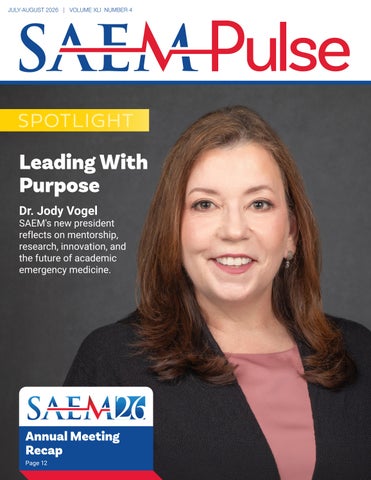
SPOTLIGHT
Leading With Purpose Dr. Jody Vogel
SAEM's new president reflects on mentorship, research, innovation, and the future of academic emergency medicine.
26
Annual Meeting Recap Page 12
Pulse
2026–2027 SAEM BOARD OF DIRECTORS EXECUTIVE COMMITTEE
Jody A. Vogel, MD, MSc, MSW
Ava E. Pierce, MD
Jeffrey P. Druck, MD
Michelle D. Lall, MD, MHS
Stanford University
UT Southwestern Medical Center
The University of Utah
Emory University School of Medicine
SAEM President
SAEM President-Elect
SAEM Secretary-Treasurer
SAEM Immediate Past President
Board Liaison to: • Bylaws and Governance Committee • SAEM Federal Funding Committee • Coaching Interest Group • Research Directors Interest Group
Board Liaison to: • RAMS (Residents and Medical Students) Board • Clerkship Directors in Emergency Medicine (CDEM) • Committee of Academy Leaders • Nominating Committee • Critical Care Interest group • Quality and Patient Safety Interest Group
Board Liaison to: • Informatics, Digital Health, Emerging Technologies, and AI (IDEA) Academy • Faculty Development Committee • Finance Committee • Emergency Medical Services Interest Group • Tech-Enabled Emergency Medicine (TEEM) Interest Group
Board Liaison to: • Academy for Women in Academic Emergency Medicine (AWAEM) • Fellowship Approval Committee • Behavioral and Psychological Interest Group • Pain Medicine Interest Group
Pooja Agrawal, MD, MPH
Cassandra K. Bradby, MD
Ryan L. LaFollette, MD
Nicholas M. Mohr, MD, MS
Yale Department of Emergency Medicine
East Carolina University
University of Cincinnati
University of Iowa Carver College of Medicine
Member at Large
Member at Large
Member at Large
Board Liaison to: • Academy of Emergency Ultrasound (AEUS) • Academy of Geriatric Emergency Medicine (AGEM) • Membership Committee • Airway Interest Group • Clinical Researchers United Exchange (CRUX) Interest Group
Board Liaison to: • Simulation Academy • Education Committee • Disaster Medicine Interest Group • Evidence-Based Healthcare & Implementation Interest Group
Board Liaison to: • Wilderness and Environmental Medicine Academy (WEMA) • Program Committee • Research Committee • Educational Research Interest Group • Tactical and Law Enforcement Interest Group
Bryn Mumma, MD, MAS
Marquita S. Norman, MD, MBA
Ian B.K. Martin, MD, MBA
University of California, Davis
UT Southwestern Medical Center
Medical College of Wisconsin
Member at Large
Board Liaison to: • Academy of Pediatric Emergency Medicine (APEM) • Awards Committee • Ethics Committee • Neurologic Emergency Medicine Interest Group • Toxicology/Addiction Medicine Interest Group
Member at Large
Board Liaison to: • Academy of Emergency Medicine Pharmacists (AEMP) • Grants Committee • Palliative Medicine Interest Group • Trauma Interest Group
Chair Member
Board Liaison to: • Academy for Diversity & Inclusion in Emergency Medicine (ADIEM) • Wellness Committee • Oncologic Emergencies Interest Group • Vice Chairs Interest Group
CONTACT SAEM: 1111 East Touhy Ave, Suite 540 Des Plaines, IL 60018 www.saem.org
Phone: (847) 257-SAEM (7236) Email: saem@saem.org Monday-Thursday: 8 a.m. to 5 p.m. CT Friday: 8 a.m. to 3 p.m. CT Staff Directory
Member at Large
Board Liaison to: • Academy of Administrators in Academic Emergency Medicine (AAAEM) • Global Emergency Medicine Academy (GEMA) • SAEM Federal Funding Committee • Operations Interest Group • Transmissible Infectious Diseases (TID) Interest Group
Indrani Guzmán Das, MD Resident Member Stanford University
Liaison to: • ED Administration and Clinical Operations Committee • Climate Change and Health Interest Group • Sex and Gender in Emergency Medicine (SGEM) Interest Group • Social Emergency Medicine and Population Health Interest Group
CONTACT THE EDITOR: Stacey Roseen, Managing Editor Email: sroseen@saem.org Submission Instructions & Writer Guidelines
HIGHLIGHTS 4
President’s Comments Defining Our Future Together
6
Spotlight: Dr. Jody Vogel Leading With Purpose
26 ANNUAL MEETING RECAP 12
SAEM26 Delivers Record-Breaking Attendance, Bold Ideas, and a Vision for the Future
15
Dr. Peter Rosen Memorial Keynote — From the Trauma Bay to the Boardroom: Insights and Perspectives From Dr. Brendan Carr
19 22
Celebrating SAEM's 2026 Award Winners! Thank You to our SAEM26 Exhibitors, Sponsors, and Supporters!
Articles displaying the RAMS icon have been identified as being of interest and benefit to residents and medical students.
64
Digital Health & Innovation Beyond the Clinical Note: How Ambient AI Could Improve Diagnostic Safety in the Emergency Department
68
Ethics In Action When Patients Cannot Decide: A Guide to Advance Directives in Emergency Medicine
70
Evidence-Based Healthcare How Artificial Intelligence Is Reshaping Critical Appraisal in Emergency Medicine
116
Quality & Safety When Efficiency Isn't Enough: Redefining Value in Emergency Department Operations
120
Sex & Gender in EM “Pinot & Podcast”: Interdisciplinary Discussions on Gender and Medicine in Emergency Medicine
124
Simulation Education AI in Simulation: Expanding Possibilities While Preserving Human Judgement
128
SIMposium Spotlight: The Art of the Pivot — A Conversation with Dr. Annemarie Cardell, MD
132
Social EM & Population Health Why Goals-of-Care Conversations Belong in the Emergency Department
74
Faculty Development From Mentorship to Promotion: Strategies for Faculty Success in Academic Emergency Medicine
78
Geriatric EM Constipation in Older Adults: A Common Complaint with Serious Implications
136
82
Global Health More Than Language: What Community-Based CPR Training Can Teach Global EM
Ultrasound Ghost Scanning in Point-of-Care Ultrasound: Why Image Archival Matters
140
86
Health Equity Perspective & Commentary Advancing Equity in Forensic Emergency Care
Wellness Difficult Patient Encounters: An Overlooked Driver of Emergency Physician Burnout
90
Reproductive Health Care in the Emergency Department: A Growing Responsibility
144
Saying No to Stay In: Boundaries, Burnout, and Longevity in Global Emergency Medicine
148
Wilderness Medicine When Rural Medicine Becomes Wilderness Medicine
152
SAEM Foundation Apply for Your SAEMF Grant Funding by August 1, 2026!
24
Administration & Operations How Health Care Economics Shapes Emergency Department Operations and Patient Care
28
Beyond Boarding Hours: Measuring the True Cost of ED Boarding
32
Ask The Pharmacist High-Risk Medications in Myasthenia Gravis: Practical Guidance for Emergency Care
36
Behavioral & Psychological EM The First 10 Minutes of a Psychiatric Emergency: A Teaching Framework for the Emergency Department
94
Historical Perspective America at 250: Emergency Care Before Emergency Medicine
40
Career Development Beyond the Traditional Path: Navigating Leadership and Career Growth in Academic Emergency Medicine
96
Infectious Diseases The 2026 Bundibugyo Ebolavirus Outbreak: What Emergency Physicians Need to Know
44
Climate Change & Health The Long Life of Plastic: Environmental, Wildlife, and Human Health Consequences
100
The 2026 FIFA World Cup: An Emergency Department Primer on Travel-Associated Infectious Diseases
48
Preparing Emergency Departments for ClimateRelated Health Threats
104
52
Pediatric EM Pediatric Appendicitis: New Approaches to Risk Stratification, Imaging, and Treatment
Climate Change and the Growing Threat of Lyme Disease
56
Mosquitoes on the Move: Climate Change and the Growing Burden of Arboviral Disease
60
Culture & Community Gender Equity in the Emergency Medicine Workforce: Five Key Articles From 2025
108
Perspectives What Artificial Intelligence Cannot Replace: Compassion in Emergency Medicine
112
Pharmacology No Tears, No IVs: Intranasal Analgesia for Pain Control in the Emergency Department
152 153
Announcing the SAEM Foundation’s Dr. Gregory L. Henry / RAMS Resident Research Grant SAEMF Academy, Committee, Interest Group Challenge
154
Meet Your 2026-2027 Leaders!
156
Academic Announcements
160
Now Hiring
SAEM Pulse is published bimonthly by the Society for Academic Emergency Medicine, 1111 East Touhy Ave., Ste. 540, Des Plaines, IL 60018. (847) 257-SAEM (7236) Disclaimer: The views and opinions expressed in this publication are those of the authors and do not necessarily reflect the official policies, positions, opinions, or views of the Society for Academic Emergency Medicine or its members. © 2026 Society for Academic Emergency Medicine. All rights reserved. No part of this publication may be reproduced, stored, or transmitted in any form or by any means without prior permission in writing from the copyright holder.
PRESIDENT’S COMMENTS Jody Vogel, MD, MSW, MSc Stanford University 2026–2027 President, SAEM
Defining Our Future Together We are at a pivotal moment for the specialty of emergency medicine—facing significant challenges while also embracing meaningful opportunities. Pressures on our workforce, rising health care system crowding, the need to sustain a strong research pipeline, and the rapid evolution of transformative technologies are all affecting our field. Yet within these challenges lies a powerful opportunity to define the future of academic emergency medicine.
SAEM PULSE | JULY-AUGUST 2026
SAEM remains deeply committed to helping guide that future by convening expertise, fostering thoughtful dialogue and creating meaningful opportunities for collaboration and innovation. We stand with you and are deeply grateful for your unwavering dedication to education, discovery and the advancement of our profession.
4
efforts make so much of our work possible—from the Annual Meeting to the many member-driven initiatives that sustain our organization throughout the year. Our membership continues to grow, now exceeding 11,000 members—the highest in our history—and reflecting the energy, innovation and engagement of this remarkable community. We are excited to announce the launch of three new academies: Informatics, Data Science, and Artificial Intelligence (IDEA); the Academy of Pediatric Emergency Medicine (APEM); and the Wilderness and Environmental Medicine Academy (WEMA); and two new interest groups: Coaching and Pain Medicine. These new communities are already fostering meaningful connections and collaboration with the goal of advancing our field.
At the leadership level, we are pleased to welcome our new chief executive officer, Rudy Anderson, CAE. Rudy brings extensive experience in academic medical associations and a strong track record in organizational leadership, fundraising, partnerships and philanthropy. We look forward to the energy and vision he will bring to this role.
As our society grows, staying connected is more important than ever. We recently launched ConnectED, our new online community platform, to enhance communication, collaboration, and mentorship among members. Looking ahead, we also plan to introduce new tools to better personalize outreach and launch a redesigned website that will improve accessibility, navigation, and ease of use.
I also want to express my sincere gratitude to our exceptional SAEM staff. Their dedication and tireless
I would also like to share an update on our journal, Academic Emergency Medicine. In late 2026, Dr. Jeffrey
“Within these challenges lies a powerful opportunity to define the future of academic emergency medicine.”
Kline will complete his tenure as editor-in-chief. We are deeply grateful for his extraordinary leadership and nearly a decade of dedicated service, during which he has significantly advanced the journal and strengthened its impact on academic emergency medicine. Beginning in January 2027, we are pleased to welcome Dr. Deborah Diercks as the next editor-in-chief. A nationally recognized investigator, accomplished leader and past SAEM president, Dr. Diercks brings extensive editorial experience and a distinguished scholarly record. We look forward to her leadership in shaping the journal’s next chapter. We will soon launch the search for the next editor-in-chief of Academic Emergency Medicine Education and Training, a key leadership role in advancing emergency care education. Applications will open Sept. 1, 2026, with an anticipated start date of January 2028. The SAEM Foundation continues to play a central role as our specialty’s largest research foundation, investing in the future of academic
emergency medicine and improving patient outcomes. With a $15 million endowment and more than $1 million in grants awarded last year—the most to date—the foundation’s impact continues to grow. As federal research funding faces ongoing challenges, this work is more essential than ever. We are deeply grateful to all who support these efforts and look forward to expanding opportunities for engagement in the year ahead. The SAEM Federal Funding Committee, established this past year, has already made meaningful progress, engaging with multiple institutes at the National Institutes of Health. The committee is focused on building strong, strategic relationships with federal funding agencies and promoting opportunities, programs and resources for our members. I encourage you to review its updates and recommendations in SAEM Pulse. Rapid advances in technology are transforming how we think about skill development and training. At the same time, ongoing pressures—hospital capacity, emergency department crowding and the boarding of
admitted patients—continue to affect patient outcomes, shape the experiences of our learners and impact physician well-being. Through collaboration and shared expertise, SAEM is working to advance thoughtful, forward-looking strategies that address these complex realities. It is truly an honor to serve as your president and to champion our shared mission of advancing academic emergency medicine through education, research and professional development. I look forward to the year ahead and remain deeply committed to listening to and learning from our members as we shape the priorities that will define the future of our field. Together, we will continue to shape a future for emergency medicine that reflects the very best of our shared purpose, innovation and commitment to those we serve. ABOUT DR. VOGEL: Jody Vogel, MD, MSW, MSc, is an associate professor and the inaugural vice chair for academic affairs in the Department of Emergency Medicine at Stanford University.
5
SPOTLIGHT Leading With Purpose New SAEM President Jody Vogel, MD, MSW, MSc, reflects on mentorship, research, innovation, and the future of academic emergency medicine.
When Jody Vogel, MD, MSW, MSc, talks about emergency medicine, she often returns to a simple idea: understanding people within the systems that shape their lives. It is a perspective rooted in her early training as a social worker and one that has guided her career as a clinician, researcher, educator, mentor, and leader. Today, Dr. Vogel serves as president of the Society for Academic Emergency Medicine (SAEM) and as associate professor and inaugural vice chair for academic affairs in the Department of Emergency Medicine at Stanford University. Throughout her career, she has championed research, education, and collaboration while helping shape the future of academic emergency medicine. A nationally recognized leader in the specialty, Vogel previously served as SAEM president-elect, secretary-treasurer, member-at-large, and resident member of the SAEM board of directors. She has devoted many years of service to the Society, including leadership roles on the Program Committee, where she chaired the 2019 and 2020 Annual Meetings. She developed and implemented Program Officer Events at the Annual Meeting and led SAEM initiatives to increase the number of emergency care researchers serving on federal study sections. As a board member, she worked with the National Institutes of Health to advance federal support for emergency care research. She has also contributed extensively to SAEM committees, academies, and task forces focused on advancing emergency care research, medical education, and professional development. A health services researcher, Dr. Vogel focuses on improving emergency care delivery and patient outcomes. She has authored numerous publications and received research funding from the National Institutes of Health and the Agency for Healthcare Research and Quality. Before pursuing medicine, Vogel earned a Master of Social Work from the University of Michigan. She later earned her medical degree from Wayne State University School of Medicine, completed an internship at the University of Colorado, and completed her emergency medicine residency and clinical research fellowship at Denver Health Medical Center and the University of Colorado Department of Emergency Medicine. She also earned a Master of Science in epidemiology from the Colorado School of Public Health. Dr. Vogel's contributions to emergency medicine have been recognized with numerous honors for leadership, research, and compassionate patient care, including Denver Health Medical Center's Academic Excellence Award, the American College of Emergency Physicians' Excellence in Research Award, and the Gold Humanism Award.
SAEM PULSE | JULY-AUGUST 2026
As she begins her presidency, Dr. Vogel shares her vision for SAEM, the challenges and opportunities facing academic emergency medicine, and the people and experiences that continue to inspire her work.
6
“If our members feel heard, supported, and better positioned to succeed, and if our organization is stronger and more prepared for the future, I would consider that a meaningful impact.”
You began your professional life in social work before pursuing medicine. How has that background shaped the way you approach emergency care, mentorship, and leadership?
I am incredibly grateful for my social work training, which has profoundly shaped my approach to patient care, mentorship, and leadership. It grounds my commitment to understanding the social determinants that influence health, meeting patients where they are, and developing care plans that are both evidence-based and achievable. When patients are unable to follow through, it prompts a broader view—considering the system- and communitylevel factors that influence their ability to fully engage. This same perspective informs my work within academic emergency medicine. I strive to create environments where learners and colleagues feel supported, valued, and inspired to grow. I believe deeply in collaboration and the strength of diverse perspectives. Across patient care, mentorship, and leadership, I approach complex problems with a broader lens—recognizing that many barriers are structural and that lasting solutions require both empathy and system-level change. Ultimately, my work is driven by a commitment to advancing equitable, patient-centered care and addressing the systems that shape outcomes across our specialty.
As the new President of SAEM, what priorities are at the top of your agenda for the coming year?
As President of SAEM, my foremost priority is to advance our strategic plan in ways that meaningfully support our members and help shape a strong, forward-looking future for our specialty. This work is grounded in a shared commitment to science, education, and community—and in the recognition that this is a defining moment for academic emergency medicine. First, we will continue to strengthen the research mission that is foundational to our field. Advancing discovery by supporting investigators at every stage, expanding the pipeline of researchers, and increasing the impact of our scholarship is essential to improving patient care and ensuring the continued growth and relevance of our specialty. Second, we are actively engaged in shaping the future of graduate medical education. As the recently announced ACGME changes take shape and the upcoming pilot focused on emergency medicine training unfolds, we have an important opportunity to meaningfully contribute to the evolution of how we train the next generation. SAEM is committed to supporting our members in this work and to bringing rigorous evidence and scholarship to inform these efforts. Third, we will prioritize strengthening connections across our community. SAEM has always been a place where people come together to learn, mentor, and collaborate. By expanding opportunities for engagement and amplifying diverse perspectives, we will continue to build a community where members at every stage of their careers feel supported, valued, and empowered to contribute.
Finally, we must remain responsive to the forces shaping our clinical and academic environment—from ongoing challenges such as emergency department crowding and capacity constraints to the rapid evolution of technology, including artificial intelligence. SAEM will continue to convene expertise, foster thoughtful dialogue, and advance practical, forward-looking solutions to these complex issues. These priorities reflect a shared vision for the future of our specialty. I am optimistic about what we can accomplish as a community. With the collective strength and dedicated commitment of our members, we are wellpositioned to advance the science of emergency medicine, support one another in meaningful ways, and improve care for our patients. I am honored to serve in this role and look forward to the work ahead—together.
What conversations do you believe SAEM needs to lead right now within academic emergency medicine—even if they are difficult or uncomfortable?
Academic emergency medicine is facing a set of defining and interdependent challenges and opportunities. There are several areas where SAEM is uniquely positioned to lead. We must begin with the reality unfolding daily in our emergency departments—the ongoing crisis of hospital capacity and crowding. The boarding of admitted patients continues to compromise patient safety, clinical care, the learning environment, and physician well-being. These are complex, system-level challenges that will require not only local innovation but also sustained national dialogue, collaboration, and advocacy. SAEM has an important role continued on Page 8
7
continued from Page 7
in convening these efforts and advancing meaningful solutions. At the same time, we must thoughtfully consider how we prepare and support learners and faculty in an increasingly digital world. Advances in artificial intelligence and digital technologies are reshaping our landscape in real time. If approached thoughtfully, they offer extraordinary opportunities to enhance learning, discovery, and care. We must ensure that innovation strengthens, rather than replaces, the essential elements of clinical experience, human connection, and professional identity. Closely aligned is the need for a deliberate and ethical approach to incorporating emerging technologies into clinical care and research. As these tools become more embedded in our work, their use must align with our core values—supporting high-quality patient care, advancing discovery, and maintaining the integrity of clinical decision-making. SAEM is well-positioned to help shape how these technologies are evaluated, studied, and responsibly adopted. We must also continue to engage in dialogue about the future of graduate medical education. The ACGME pilot focused on emergency medicine training represents a meaningful opportunity. SAEM and its members bring deep expertise in education and research to generate evidence to guide the next generation of training in our specialty.
SAEM PULSE | JULY-AUGUST 2026
Finally, the current research landscape demands our sustained attention. With ongoing uncertainty about federal funding, it is essential to advocate for robust investment in emergency care research and to strengthen a diverse and sustainable pipeline of investigators.
8
Our responsibility is not only to engage in these areas but to lead with clarity, purpose, and a shared commitment to shaping a stronger future for our specialty.
You’ve served SAEM in many roles over the years—from resident member to president. How has your perspective on the organization changed throughout that journey?
Over the course of my journey with SAEM—from resident member to President—my perspective has evolved in meaningful ways. Early on, I experienced SAEM as a community: a place to learn, connect, and receive mentorship. It was where I first began to understand what it means to be part of academic emergency medicine. As my involvement deepened, so did my appreciation for the breadth and impact of the organization. I came to see the intentionality behind its programs and scholarship, and gained a deeper appreciation for thoughtful leadership and for the collective effort required to move our specialty forward. This journey has reinforced the importance of connection, mentorship, and collaboration, and it continues to inform my vision for the future. I am committed to ensuring that SAEM remains a place where individuals feel supported, valued, and empowered to contribute—so that, together, we can continue to advance our field in meaningful and lasting ways.
As you begin your presidency, what do you hope your leadership legacy at SAEM will ultimately be?
As I begin my presidency, I hope my legacy will be one of strengthening our community and collective impact— expanding opportunities for engagement, advancing high-impact research, and fostering an inclusive academic community. More broadly, I hope it reflects leadership that brings people together, encourages meaningful dialogue, and helps navigate the complex challenges facing our field. If
our members feel heard, supported, and better positioned to succeed, and if our organization is stronger and more prepared for the future, I would consider that a meaningful impact.
the curiosity and perspective they bring. Whether at the bedside or in discussion, I am consistently reminded that teaching and mentoring are not one-directional—we are continually learning from one another.
What do you hope members—especially residents and early-career faculty—feel when they participate in SAEM?
Finally, I remain deeply inspired by the scientific foundation of our field. The spirit of inquiry that drives emergency medicine, the questions we ask, the discoveries we pursue, and the progress we make together, continues to energize and sustain me. It is both a privilege and a profound sense of purpose to be part of a community so deeply committed to advancing knowledge and improving patient care.
I hope that trainees and early-career faculty feel both inspired and supported when they engage with SAEM—that they see it as a community invested in their growth and full of opportunities to learn, connect, and lead. I am especially grateful for the mentorship I have received through this Society, which has been instrumental in shaping my career. It is my hope that every member experiences that same sense of guidance and belonging, knowing that SAEM offers mentorship at every stage. What has always stood out to me is the remarkable energy of the SAEM community—individuals deeply committed to advancing the science of emergency medicine and improving patient care. That shared purpose is powerful, and I hope it encourages new members to bring their perspectives forward, recognizing that meaningful progress depends on the voices and ideas of many. Through my experiences and leadership within SAEM, I have come to appreciate its essential role in advancing education, research, and innovation, while strengthening the relationships that make this work possible. My hope is that trainees and early-career faculty experience SAEM not simply as a professional society, but as a community where they can contribute, lead, and grow, and where their engagement creates a lasting impact.
What still inspires and energizes you after so many years in emergency medicine? Emergency medicine continues to inspire and energize me—often in the small, human moments that unfold in the midst of complexity.
Even after many years, I still find deep satisfaction in the intellectual challenge of clinical care—the process of bringing together a patient’s history, physical findings, and diagnostic data to arrive at a diagnosis and a thoughtful plan. What stays with me most, however, are the moments at the bedside: sitting with a patient or family, helping them understand what’s happening, and offering clarity and reassurance during what is often a vulnerable time. Equally powerful is the ability to advocate for our patients, particularly those who are most at risk. Many of our patients need support that extends beyond the walls of the emergency department—access to medications, safe shelter, or reliable transportation. Partnering with our interdisciplinary team members to address these barriers is a powerful part of what we do, and it reinforces the broader impact we can have in supporting patients’ ability to fully engage in their care. Working with our learners is another enduring source of joy and energy. There is something special about
Many people know you now as a national leader in academic emergency medicine, but what aspects of your journey were the most challenging or unexpected?
I’m a first-generation college student, and navigating higher education and its financial demands was one of the more challenging aspects of my journey. Those experiences, while difficult at times, were among the most valuable. They pushed me to be resourceful, think creatively, and approach problems with a solution-oriented mindset—skills that have served me well throughout my academic career. Those experiences continue to shape how I lead and mentor, with a deep appreciation for resilience and access.
How has emergency medicine changed since you entered the field—and what changes do you still hope to see?
Emergency medicine has evolved in remarkable ways since I first entered the field. What was once a growing specialty has matured into a foundational pillar of the health care system, with expanding reach, influence, and impact across medicine. We have seen extraordinary growth in the breadth of practice—from telemedicine to acute care across diverse settings—and in the expansion of training pathways, with a wide array of fellowships and advanced programs. Academic emergency departments now span multiple hospitals and care environments, and emergency physicians are increasingly represented in leadership roles across health systems and at the national level. These developments reflect the strength, adaptability, and leadership of our specialty. Equally important has been the growth of emergency care research. While there has been an increase in dedicated research programming and investigators, there remains significant work and opportunity ahead. We must continue to expand our research enterprise—strengthening the pipeline of investigators, fostering mentorship, and ensuring that early-career researchers are supported on the path to independence. Advancing the science of emergency medicine is essential to improving patient care, and it is a responsibility we must continue to embrace with intention and urgency. As we look forward, persistent challenges remain. I think of the many shifts in which emergency department continued on Page 11
9
10
SAEM PULSE | JULY-AUGUST 2026
continued from Page 9
crowding and boarding have shaped both the clinical environment and our learners' experience. These conditions affect patient care, education, and physician well-being, underscoring the urgency of finding meaningful solutions. Through thoughtful leadership and collective effort—including initiatives within SAEM—we will make progress in addressing these systemic challenges. I am also encouraged by the increasing diversity of perspectives within our specialty. While progress has been made, continued effort is needed to ensure that our workforce and leadership reflect the communities we serve. Finally, we are entering a new era shaped by rapid advancements in technology and artificial intelligence. These tools hold tremendous promise to enhance care delivery, education, and discovery. Our task will be to harness these innovations thoughtfully—ensuring their use is ethical, equitable, and aligned with our core mission of improving patient outcomes. Emergency medicine has always been defined by its ability to adapt, lead, and innovate. As we build on this progress, we will continue to strengthen our specialty, advance our science, and improve the care we provide to patients.
When you think about the future of emergency medicine, what gives you the greatest sense of hope?
Not long ago, I left a teaching shift feeling both challenged
and inspired—energized by the questions our learners asked and the passion they brought to each encounter. It was a powerful reminder of where the future of our specialty truly resides. What gives me the greatest sense of hope is the people— particularly our learners and early-career colleagues. Their energy, curiosity, and deep commitment to our patients are unmistakable. They are not only engaged in the work but genuinely excited about shaping what comes next for our specialty. I am equally inspired by the continued growth and evolution of emergency medicine. Our field now spans the full spectrum of acute care, and emergency physicians are increasingly stepping into leadership roles within health systems and at the national level. Their influence reflects both the breadth of our training and the critical role we play in the health care system. Within SAEM, I see this same sense of momentum. Our members—educators, investigators, and leaders—are deeply committed to advancing our specialty through science, education, and mentorship. The collaborative work being done across this community is strengthening our research enterprise and expanding our impact on patient care. Together, these forces give me great confidence in the future. They reflect a shared vision and a collective commitment to advancing emergency medicine as a field grounded in discovery, innovation, and dedication to improving the lives of our patients.
Off the Clock With Dr. Jody Vogel If you could spend a completely free day doing anything you wanted, what would it look like? I grew up on a farm, and it remains one of the most meaningful parts of my life. My perfect day would be spent back on my parents’ farm—working in the garden, being on the land, and reconnecting with those memories. I would end the day by cooking a homemade meal with fresh ingredients from the garden in our family kitchen. What’s your go-to way to recharge after a particularly demanding week? Nature and art are my go-to ways to recharge. I enjoy spending time outdoors, walking among the trees, gardening, or simply being in the sun. I also have a deep appreciation for art, which adds another layer of inspiration. Both help clear my mind and allow me to return with renewed energy and a fresh perspective. If you hadn’t pursued a career in medicine, what do you think you would have done instead? I’ve always enjoyed gardening and cooking, so I could easily see myself pursuing a farm-to-table restaurant—growing ingredients, creating meals, and bringing people together around food in a way that fosters connection and a shared experience. What’s one small thing—in work or life—that consistently brings you joy? Spending time outdoors, especially in nature with trees and flowers, consistently brings me joy. Feeling the sun and noticing wildlife helps reset my mind and often gives me a fresh outlook. That sense of renewal pairs beautifully with what I love about science and academia—the ongoing curiosity and joy of discovery that continue to inspire me. What’s a skill or hobby you’ve always wanted to learn but haven’t had time to pursue yet? Glass blowing is something I’ve always wanted to explore. I’m fascinated by how it brings together precision and creativity to produce something unique—and I think that same balance is important in leadership: blending thoughtful structure with inspiration to build something impactful.
11
26
ANNUAL MEETING RECAP
SAEM26 Delivers Record-Breaking Attendance, Bold Ideas, and a Vision for the Future What began as an ambitious reimagining of the annual meeting became a historic success. Held in Atlanta, Georgia, May 18-21, SAEM26 brought together the academic emergency medicine community for four days of learning, innovation, collaboration, and connection—and before the meeting had even concluded, it had already become the best-attended annual meeting in SAEM history.
ANNUAL MEETING
The record-setting attendance reflected more than enthusiasm for a meeting. It underscored the strength of a community committed to advancing emergency medicine through scholarship, education, leadership, service, and innovation.
12
A Meeting Designed for Today's Learners and Leaders SAEM26 introduced a refreshed annual meeting experience built around flexibility, accessibility, and engagement. Attendees participated in four full days of educational programming and two days of workshops, creating opportunities for both broad exploration and deep professional development.
For the first time, all 27 workshops were included with registration, significantly expanding access to hands-on learning and practical skill development. The Medical Student Symposium, Chief Residents Forum, Leadership Forum, and Education Summit: The Productive Educator's Playbook were also included, reinforcing SAEM's commitment to supporting members at every stage of their careers. Across the meeting, participants engaged in sessions focused on clinical excellence, scholarship, leadership, education, research methodology, and emerging technologies shaping the future of emergency medicine.
Conversations That Matter A defining theme of SAEM26 was dialogue—bringing together diverse perspectives to address some of the most important questions facing the specialty. Two landmark consensus conferences generated robust discussion and collaboration: • Artificial Intelligence and the Future of Emergency Medicine • Rebuilding Trust in Emergency Medicine
ANNUAL MEETING
These conferences convened researchers, educators, clinicians, and leaders to explore emerging challenges and opportunities while helping establish future research priorities and areas for collective action. The meeting also introduced Lightning Orals, replacing traditional ePoster presentations with a faster-paced format designed to promote engagement, discussion, and rapid exchange of ideas. The new format encouraged presenters and attendees alike to connect around innovative research and emerging discoveries.
Innovation by the Bay. Inspiration for the Future. The SAEM Annual Meeting | May 18–21, 2027 San Francisco Marriott Marquis
The Main Stage: Celebrating Excellence and Exploring the Future The new SAEM Main Stage served as the gathering place for the entire community—celebrating achievements, highlighting groundbreaking research, and exploring ideas shaping the future of academic emergency medicine. Attendees honored leaders and innovators during annual awards ceremonies and heard from distinguished keynote speakers who challenged conventional thinking and inspired new perspectives. Among the highlights was the Dr. Peter Rosen Memorial Keynote, delivered by Brendan Carr, MD, MS, who explored lessons from high-acuity care and their application to leadership, teamwork, and decision-making. The following day, Laura R. Hopson, MD, MEd, delivered the Education Keynote, Will Artificial Intelligence Be the Death of Clinical Reasoning?, prompting thoughtful discussion about the opportunities and risks AI presents for education, clinical practice, and decision-making. The Main Stage also showcased some of the highestscoring research presented at the meeting through plenary abstract presentations and moderated discussions.
Leadership Transitions and New Directions A significant moment during SAEM26 was the inauguration of Jody Vogel, MD, MSc, MSW, as SAEM's 2026–2027 president. In her inaugural address, Dr. Vogel outlined several strategic priorities for the year ahead, including leadership transitions, publication leadership, expanded member engagement, and new specialty-focused initiatives.
Join the academic emergency medicine community in one of the world's most innovative cities at the San Francisco Marriott Marquis. Located in the heart of the vibrant Yerba Buena and SoMa districts, this premier convention hotel offers an exceptional setting for learning, collaboration, and connection. What awaits you: • Spacious, state-of-the-art meeting facilities designed to support engaging educational sessions, scientific presentations, and meaningful networking • Expansive gathering spaces that encourage spontaneous conversations, mentorship opportunities, and new collaborations • A convenient downtown location with easy access to San Francisco's renowned cultural attractions, dining, and waterfront destinations • The iconic View Lounge, offering breathtaking skyline views and a memorable setting to connect with colleagues after a day of sessions • Multiple on-site dining and grab-and-go options, along with countless restaurants and cafés just steps from the hotel • The energy and innovation of the Bay Area, a global hub for discovery, entrepreneurship, and transformative ideas Whether you're presenting new research, exploring the latest advances in emergency care, reconnecting with colleagues, or forging new professional relationships, SAEM27 is where the brightest minds in academic emergency medicine come together to learn, collaborate, and help shape the future of the specialty.
continued on Page 14
13
continued from Page 13 Among the announcements: • Welcoming Rudy Anderson, CAE, as SAEM's new chief executive officer • Introducing Deborah Diercks, MD, as the next editor in chief of Academic Emergency Medicine, beginning in 2027 •L aunching the search for the next editor in chief of Academic Emergency Medicine Education and Training •E stablishing two new interest groups: the Coaching Interest Group and Pain Medicine Interest Group •L aunching three new academies: - I nformatics, Digital Health, Emerging Technologies, and Artificial Intelligence (IDEA) Academy -A cademy of Pediatric Emergency Medicine (APEM) -W ilderness and Environmental Medicine Academy (WEMA) These initiatives reflect SAEM's continued investment in emerging fields, professional development, and member engagement.
Community, Wellness, and Service SAEM26 also recognized that professional growth flourishes within a strong and supportive community. Attendees participated in popular traditions such as MedWAR, the wilderness medicine challenge through Piedmont Park, and embraced new opportunities for connection through the inaugural Pickleball Tournament. The meeting's commitment to wellness and inclusion was reflected in the introduction of The Oasis, a dedicated screenfree space for rest and recharge, as well as family-friendly resources including onsite childcare, a Family Room, and a Prayer Room. Participants also had the opportunity to give back through the Food Is Medicine volunteer event in partnership with Open Hand Atlanta, helping prepare and package nutritious meals for members of the local community.
Innovation in Action Innovation was not limited to educational sessions. The new EM Hackathon brought interdisciplinary teams together to create data-informed solutions to real-world emergency medicine challenges. Meanwhile, the new Innovation Theater highlighted breakthrough ideas from SAEM academies in an interactive format that invited attendees to help shape future directions.
ANNUAL MEETING
The Exhibit Hall was reimagined as a dynamic hub for learning, networking, and career development. New features included:
14
• Job Pavilion • Knowledge Hub • Roundtable Hub • Academies Hub • Passport to Prizes Competition These additions created new opportunities for meaningful conversations, career exploration, and engagement with colleagues and organizations across the specialty.
Looking Ahead SAEM26 demonstrated what is possible when innovation, scholarship, leadership, and community come together with purpose. From record-breaking attendance and transformative discussions to new learning formats and expanded opportunities for engagement, the meeting reflected both the vitality of academic emergency medicine today and the momentum driving it forward. SAEM extends its sincere gratitude to the Program Committee, moderators, presenters, volunteers, exhibitors, sponsors, and attendees whose dedication and enthusiasm made this historic meeting possible. The conversations that began in Atlanta will continue to shape the specialty long after the meeting's conclusion. We look forward to continuing that journey together at SAEM27, May 18-21 in San Francisco.
ANNUAL MEETING
Dr. Peter Rosen Memorial Keynote
From the Trauma Bay to the Boardroom: Insights and Perspectives From Dr. Brendan Carr Editor's Note: Brendan Carr, MD, CEO of the Mount Sinai Health System, delivered the Dr. Peter Rosen Memorial Keynote Address at SAEM26 on May 19, 2026. The following remarks have been edited lightly for grammar, punctuation, clarity, and Associated Press style while preserving the speaker's original voice and intent.
Finding My People This meeting is where I found my people. We built panels, wrote grants and papers, and navigated our professional and personal lives together. The SAEM Consensus Conference I co-chaired was a career pivot point for me. I'm incredibly grateful for this organization. Many of you know this — and others in the audience will learn — that as you navigate a career in academic medicine, you figure out who to call when you need to share a room, who will drive across the country with you at the last minute, and who will finish the last set of revisions on your grant and submit it to the NIH when your wife goes into labor early. Every one of those people, by the way, is in this room today. None of this is about recognition. It is about community. I hope the common thread you remember from me today is to keep leaning in and to do as much as you can. If you're here, you've been given incredible gifts. And you have decided to make a contribution to the world that few
can. You've decided to provide comfort and reduce suffering, both directly and indirectly, through patient care, research, and education. And this place, this meeting, is where you come to fill your tank and find your people. You never have to explain to anyone here the brutal realities of a soft-money life, or the toll that night shifts and a front-row seat to suffering and death take on your soul, or why you keep coming back for more. This is where I felt understood. And, if we're being honest, our lives are hard to understand. My 21-year-old son recently watched exactly one episode of The Pitt and then announced to the family group chat: "Well. Never watching that disturbing show again. But at least now I know why Dad is so broken." Two thoughts occurred to me simultaneously: 1. I love this funny kid. 2. Pal. You don't know the half of how broken I am. Here is the short version of me: • I accidentally got into medicine. • I worked in emergency medicine, trauma, and critical care. • I fell in love with the organization of the trauma system. • I had research fellowships and studied the delivery system. continued on Page 16
15
“We can't control what comes I did not earn his time by making an exceptional presentation. I stuttered and stammered. He chose to mentor me because that is what we do. We pay it forward. We give as much as we can. That sweaty mentor run-in was memorable because it was the first. But there are so many more. There are dozens of people who gave their time and attention and expertise to me, expecting nothing in return.
continued from Page 15 • I worked in government: trauma, disaster, and national health security. In 2020, I started as the academic chair at Mount Sinai. A month after I started, our health system had its first diagnosis of COVID-19. On the two-month anniversary, we opened a field hospital in Central Park. Now, I am the CEO of the Mount Sinai Health System in New York City. It is the job of a lifetime. Today, we're going to talk about the journey from the trauma bay to the boardroom. This journey is all about people. People come in all shapes and sizes — parents, kids, mentors, mentees, colleagues, patients. People come as individuals, and they come as groups. And your relationships have an enormous impact on your success. Let's talk about people as individuals first.
And I've tried to do my part. To pay it back. To remain grateful. To give as much as I could. I worked on Friday with a resident whom I've known since she was an intern. She thanked me for an interaction from four years ago. She has no idea how she filled my cup with that one comment. Or how incredibly heavy it feels to me that a passing interaction like that can carry so much weight. People matter. Relationships matter. And there is incredible grace in this world. So, for those of you who are as green as I was when the sweaty giant strolled up to my poster: You've come to the right place to build a network that will help develop your career. This is where you realize that your heroes really are heroes. Heroes who do the incredibly mundane things consistently without asking anything in return.
I presented my first poster at SAEM. There I was, a nervous student standing in front of my research poster, trying not to make eye contact with anyone.
Teams Matter
And a tall, skinny, sweaty guy fresh from the hotel gym came over and said, "Tell me about your work." I looked down at his name tag. And then cursed out loud. He was a New England Journal of Medicine author. A giant in my field. It was an amazing opportunity. ANNUAL MEETING
I had cereal weekly with a mentor for two years. It shaped my understanding of mentorship.
And for those of us who are more gray than green: Let's try to keep the faith. Keep taking the meetings, editing the grants and papers, and sharing your wisdom. We need this next generation to invent the future.
Mentors Who Pay It Forward
16
People who answered my emails. Line-edited my grants and papers. Propped me up when I needed it. And yes, put me in my place when I needed it.
Also, the worst nightmare for a student trying to match in emergency medicine. I rambled. His shirt dried. Mine became soaked with sweat. I've known him for almost three decades now. He coached me through job changes, and we had dinner a few months ago when he was in New York.
As I said before, sometimes people come in groups. In the ER, we call them teams. I don't have to tell this room what a high-functioning team looks like. You know the feeling of a crashing patient. And a glance to the nurse that speaks volumes. And you just start doing, alongside brilliant nurses, respiratory therapists, pharmacists and chaplains. True team-based care in service to the patient. It's really a beautiful thing when we're firing on all cylinders. A few weeks ago, I had a hypotensive, obtunded patient. And it was a no-resident day. On the one hand, I've been doing this for decades.
ANNUAL MEETING
s in the front door. We can control how we respond to it..” This is what every emergency physician across the globe does day in and day out. We can't control what comes in the front door. We can control how we respond to it. And how our team responds to it. We deal with it. No drama. No excuses. We complain only after we save the life. Our tagline at Mount Sinai is "We find a way." It perfectly embodies the culture of figuring it out. And it resonates with me. In my two years as CEO, we have dealt with significant challenges and made hard decisions. I spend my days now — as I have for the last 25 years — surrounded by individuals and teams who are responding to enormous challenges, one after another.
On the other hand, I'm spoiled. It's a room I haven't been in since the renovation. The resident usually gets the airway box and knows where we store Yankauers. But we're a team. And I look at the nurses and the techs. Someone is going to know where we store the Yankauers ... right? And then, the attendings from the other two zones start to peek around the corner of the room into the resuscitation bay. One says, "You need an extra set of hands?" The other says, "You OK, grandpa?" Same message. Different delivery. Neither of them was thinking about the importance of teamwork and the lessons that translate from the trauma bay to the boardroom. But both of them perfectly demonstrate how teams work.
The years of writing grants with dismal odds of success. And of trying and failing to improve access to care, trying to make national health security a part of national security, and of watching bad decisions, bad luck and bad policies result in human suffering. The years have all taken a toll and have taught me how to find people you can rely on when the hard times come. And they have taught me that we can all work together to carry the load. None of us carry it all every day. But we can carry the load when we work as a team. During residency and fellowship, and the grueling days of early parenting, my wife and I had a simple system. When life happens, you give a 1-10 score for how much gas you've got in your tank. When you're finishing a 36-hour call and the baby won't sleep, or when the dog has diarrhea in the middle of the night, or when the toddler has a fever.
They had a full board. They had their own things to do. But they heard the overhead call for a critical patient, and they checked in — on the patient and on the team.
You just look at each other. One says 7 and the other says 2. Boom.
This profession of medicine, and this specialty of emergency medicine, is a gift.
Snake eyes. You both cry. And then one of you goes to change the diaper.
From the Trauma Bay to the Boardroom
It's all about the team. It's all about communication. And knowing who can carry what load when.
The leadership that you learn in the ER has legs. I'm the CEO of one of the most prestigious academic health systems in the nation because, during COVID, I did exactly what you all did. I leaned in hard, believed in the people and the teams all around me, and gave as much as I could.
Two 8s? Great, we'll do it together.
Now, the boardroom challenges are different from parenting and different from the ER. For one, there are fewer bodily fluids. But the people have all been on their own journeys. continued on Page 18
17
continued from Page 17 And they've got something incredible to bring to the table. And all of them know that whenever there is a crisis, you lean over and say, "I got it." It is position play. No different than the teams that you run in your research lab, in your educational portfolio or in the clinical realm.
Comfortable With Uncertainty I took a leadership assessment a year ago, and my results were off the chart for one trait. I know what you're thinking, but no, it was not intelligence. Evidently, it said that I am comfortable with uncertainty. I'm willing to bet that resonates with some of you. That's our deal, right? Uncertainty.
We are running toward a future that will be dramatically impacted by technology. Health care is going to change rapidly. I get early looks at digital solutions. I have a lot of access to the people and companies that are at the forefront. And most of us are drastically underestimating where this is leading. And I can say that it is a good time for people who prioritize people, believe in teams, are comfortable with uncertainty, and can care for the patient in front of them — without losing sight of the big questions that surround us all — to lead and to help rebuild the trust that has been lost between the public and health care. And that's you. That's emergency medicine. Saddle up.
The famous philosopher Jerry Garcia once said, "Somebody has to do something, and it's just incredibly pathetic that it has to be us."
Because the world needs you.
I don't. In a lot of ways, I think the people in this room are uniquely trained to lead. We manage one crisis after another. We manage uncertainty. We make a lot of decisions with incomplete information. We design studies for a place where the rules are always changing. And we spend years chasing questions that may not have answers. We control what we can control. The room. The team. The patient's fears. The family's anxiety. The faculty, residents and staff are concerned about shifting political ideals and the impact on their patients. It is our job to deal with it, to implement Plan A and have Plan B ready if that doesn't work. And to reassess continuously and call a colleague for expertise when you need it. You find a way. I find myself returning to a memory I have of a surgical resident putting in a central line in the midst of absolute ER chaos. He was completely dialed in. It stuck with me. Because most of us aren't wired that way.
ANNUAL MEETING
Because the public trust in public health and health care is fractured. And more uncertainty is coming.
And good thing, because, oh my, is the world changing around us.
I love the Dead. And I love Jerry. And I don't think it's pathetic that it has to be us. But I think a lot of people find it surprising.
18
The Future Needs Leaders
While putting the line in, we're running the list. I wonder if Ms. Smith's chest CT is back yet. What's the blood pressure in Room 4? How many are in the waiting room? Are any of them sick? Call it what you want: situational awareness, vigilance or good anxiety. It's an adaptive trait. And it's a good thing.
Give as much as you can.
Celebrate the Wins Last thing. You all chose a job where no one remembers your name. You save a life in the middle of the night, and your patient wakes up in the hospital and thanks the team that was asleep when they were in extremis. My family is understated. There are no big birthday parties and no loud cheers when you graduate from school. I used to be insecure about it. I like little rooms. I like quiet conversations. I don't mind the attention, but I don't need it. Parenting and mentoring have taught me that consistency is much more important than volume. I'll never forget when I got my first independent R01 notification. I was ecstatic, and I called my friend and coinvestigator. He said, "That's huge! Let's celebrate!" But of course, I had to work overnight, so I said, "No, no, I can't. I'm taking a nap so I can go back to work at 11 p.m." When I walked out of the ER at 7:30 in the morning, my pal was right there, sitting on the curb with two cans of warm beer and a bag of pretzels. Our work is hard. The world is hard. So take a few minutes here and there to celebrate each other. It doesn't need to be loud. It doesn't need to be public. Just keep being present and consistent. Have cereal every week for two years. Have a warm beer after a long overnight shift. Find your people. They're probably in this room. Make friends. Trade stories. Build a career. Give as much as you can. Do some good. And enjoy the ride.
ANNUAL MEETING
Celebrating SAEM's 2026 Award Winners! SAEM awards are given each year to honor outstanding contributions to emergency medicine and patient care. These awards, presented at the SAEM Annual Meeting, recognize excellence across leadership, research, education, and compassionate service. Congratulations to all our 2026 award recipients — your achievements inspire and elevate our field!
Arnold P. Gold Foundation Humanism in Medicine Award
Organizational Advancement Award
Bhakti Hansoti, MBChB, MPH, PhD John Hopkins University
Jeffrey Kline, MD Wayne State University
Outstanding Department for Wellness
Scott G. Weiner, MD, MPH Brigham and Women's Hospital
Public Health Leadership Award Emmy Betz, MD, MPH University of Colorado
Mentor Award
John Marx Leadership Award
Wendy C. Coates, MD University of California, Los Angeles, David Geffen School of Medicine
Excellence in Research Award
Michael Gottlieb, MD, MBA Rush University Medical Center
Manish N. Shah, MD, MPH University of Wisconsin-Madison
Michelle P. Lin, MD, MPH, MS Stanford University
Hal Jayne Excellence in Education Award
Catherine A. Staton, MD, MScGH, PhD Duke University
Indiana University Department of Emergency Medicine Deborah B. Diercks, MD, MSc, MBA UT Southwestern
Amal Mattu, MD University of Maryland School of Medicine
Marcus L. Martin Leadership in Diversity and Inclusion Award
Mid-Career Investigator Award
FOAMed Excellence in Education Award Jennifer Beck-Esmay, MD Mount Sinai Morningside / Mount Sinai West
Regan Marsh, MD, MPH Mass General Brigham, Harvard Medical School
Amy H. Kaji, MD, PhD Early Investigator Award
Advancement of Women in Academic Emergency Medicine
Lauren M. Westafer, DO, MPH, MS UMass Chan-Baystate
Basmah Safdar, MD Yale University
Angela F. Jarman, MD, MPH University of California, Davis
continued on Page 20
19
continued from Page 19 Nicklaus P. Ashburn, MD, MS Wake Forest University School of Medicine
Lachlan Driver, MD Brown University Health
Philip Mudd, MD, PhD Washington University in St. Louis
Leah B. Colucci, MD, MS Yale University
Early Educator Award
Mitchell Blenden, MD, MBA Yale University
Allison Beaulieu, MD, MAEd University of Utah Janice Shin-Kim, MD Columbia University Medical Center Onyinyechi F. Eke, MD, MPH Massachusetts General Hospital
ANNUAL MEETING
Shayne Gue, MD, MS, MEd BayCare Health System / St. Joseph's Hospital
20
Fellow Awards
Alexander T. Clark, MD University of Michigan Jonathan Warren, MD Harbor-UCLA Medical Center and the David Geffen School of Medicine at UCLA
Tushara Surapaneni, MD Yale University
RAMS Leadership in Emergency Medicine Award Kristen Panthagani, MD, PhD Yale University
RAMS Excellence in Research Award Oluwafemi P. Owodunni, MD, MPH University of New Mexico Hospital
RAMS Excellence in Education Award
Eileen Williams, MD University of Texas Southwestern Medical Center Kevin Walsh, MD University of Michigan
Competition was fierce, creativity was on full display, and teamwork took center stage throughout SAEM26 in Atlanta. From simulation battles and ultrasound challenges to athletic showdowns and innovation showcases, participants brought their best to every event. Congratulations to the following champions and winners who earned top honors at this year's annual meeting. Innovation Theater Academy for Emergency Medicine Pharmacists (AEMP) MedWar UC Davis: Jon Oules, Joseph Robicheaux, Diego Amoroso SimWars University of Utah Dodgeball Ketamine Cowboys, UT Southwestern Pickleball David Lee, NYU Grossman School of Medicine Richard Shih, Florida Atlantic University Schmidt College of Medicine Sonogames HCA Orange Park RAMS Hunt Purkinje Finders, UT Southwestern Clinical Images Joshua Nowitz, The University of Texas Medical Branch Nicki Nikkhay, University of Vermont
Congratulations!
Coming in August: SAEM26 Content On Demand Couldn’t attend SAEM26 in Atlanta — or missed a few sessions during the meeting? Beginning in August, more than 120 hours of annual meeting content will be available through SAEM Online Academic Resources (SOAR). Access workshops, didactics, forums, abstracts, and more with convenient online and mobile viewing — anytime, anywhere.
ANNUAL MEETING
These are the Champions!
SAEM26 Attendees: Claim CME or Obtain a Certificate of Participation SAEM26 attendees should have received an email containing a link to an electronic form where they can claim CME credit and access their Certificate of Participation. (If you did not receive this email, please contact the SAEM Education team at education@saem.org.) Instructions for claiming credit and obtaining a Certificate of Participation are available here. Please note the following deadlines: • Physicians: Claim CME and complete the CME evaluation by July 27 • Non-Physicians: Download your Certificate of Participation by July 27 Attendees are also encouraged to complete the overall meeting evaluation by July 27. Your feedback helps SAEM enhance future meetings and educational offerings.
21
Thank You to our SAEM26 Exhibitors, Sponsors, and Supporters!
ANNUAL MEETING
SAEM26 Exhibitors and Sponsors
22
• Abbott Point of Care • Aistellor, LLC • American Board of Emergency Medicine • American College of Emergency Physicians (ACEP) • ApolloMD • ARPI, Inc • ARS Pharmaceuticals • ARS Pharmaceuticals Operations, Inc. • B Braun Medical Inc. • Bluejay Diagnostics • BRC • Butterfly Network • Cepheid • Ceribell • CIVCO Medical Solutions • Core Clinical Partners • D2i • Danaher • DDx by Sketchy • Diasorin • Drug Enforcement Administration • EMCREG International • Emergency Care Partners • Emergency Medicine Residents' Association (EMRA) • EMSpecialists • Emergent Medical Associates • EMRecruits • Fujifilm Sonosite • Full Code Medical • GE Healthcare • Gilead Sciences • HCA Healthcare • Indian Health Service
• Knoa Pharma LLC • Massachusetts General Hospital • Mayo Clinic • Medical College of Wisconsin • Mindray North America • MoneyScript Wealth Management PLLC • Northeast Georgia Medical Center • Oregon Health & Science University • PARO Robot-AIST • Penn State Health • Permanente Medicine • PGY1 Financial Solutions Corp • Philips Healthcare • QuidelOrtho • Roche Diagnostics Corporation • Rutgers Health/New Jersey Medical School • Sandhills Emergency Physicians • SERB Pharmaceuticals
• Simacademy • Stony Brook Medicine • TEAMHealth • The Ohio State University Hospital • Univ Emergency Medicine Foundation • University Hospitals Community Consortium • University of California San Francisco/San Francisco General Hospital • University of Maryland Department of Emergency Medicine • University of Michigan • University of Vermont Medical Center • UPMC Emergency Medicine • US Acute Care Solutions • Vituity • Washington University in St. Louis School of Medicine • WestJEM
• AMBU Inc. • American Academy of Emergency Medicine • American Board of Emergency Medicine • B Braun Medical Inc. • Brown University Health Medical Group (BHMG) • CIVCO Medical Solutions • Council of Residency Directors in Emergency Medicine (CORD) • Emory School of Medicine Department of Emergency Medicine • FUJIFILM/Sonosite • Gordon and Betty Moore Foundation
• Northwestern University Feinberg School of Medicine - McGaw
ANNUAL MEETING
SAEM26 In-Kind and Financial Supporters
• Philips Healthcare • Rush University Medical Center • Stanford University Department of Emergency Medicine • Surgical Science North America • The Curators of the University of Missouri (Sinclair School of Nursing, University of Missouri) • University of Virginia School of Medicine, Department of Emergency Medicine • Verathon Inc.
• Harbor-UCLA Medical Center (Emergency Medicine Residency Program)
23
ADMINISTRATION & OPERATIONS
How Health Care Economics Shapes Emergency Department Operations and Patient Care SAEM PULSE | JULY-AUGUST 2026
By John K. Riggins, Jr., MD, MHA
24
At a Glance • Why this matters now: Emergency departments face increasing pressure from crowding, boarding, workforce shortages, financial constraints and growing demands for value-based care. • What you'll learn: Four fundamental health care economics concepts— scarcity, opportunity cost, marginal cost and demand elasticity—and how they inform operational, financial and clinical decision-making. • Who this is for: Emergency medicine leaders, educators, researchers, residents and physicians interested in improving resource allocation, system performance and patient care.
Emergency departments (EDs) across the nation are facing mounting challenges, including rising patient volumes, increasing patient acuity, persistent boarding and crowding, workforce shortages, evolving reimbursement pressures, financial constraints and an ongoing shift toward value-based care models. Amid these competing demands, ED leaders are tasked with making critical operational, financial and clinical decisions
“Economic decisions also influence equity in emergency care delivery, particularly among populations that rely on the emergency department as a primary source of access to care.”
that influence patient care, health care costs, workforce stability and population health outcomes. Understanding and applying core health care economic principles can help emergency medicine leaders make more strategic, patient-centered decisions while addressing many of the challenges facing modern EDs. These concepts also provide an important foundation for education, leadership development and research within academic emergency medicine. One foundational health care economic concept is scarcity. In the emergency department, scarcity reflects the reality that resources are finite and must be strategically allocated to maximize safety, efficiency, equity and value. Limited resources may include staffing, treatment spaces, geographic zones, equipment, medications, diagnostic imaging, laboratory capacity and inpatient beds. One major consequence of scarcity is ED crowding and boarding, which significantly affect patient experience, workforce well-being, operational flow and quality of care. As a result, emergency medicine leaders must carefully allocate constrained resources in ways that optimize outcomes for patients and staff while remaining operationally and financially feasible. Economic decisions also influence equity in emergency care delivery, particularly among populations that rely on the ED as a primary source of access to care. Closely related to scarcity is the concept of opportunity cost, which describes how investing resources in one area necessarily limits investment in another. Because ED resources
are constrained, decisions regarding staffing, technology and workflow redesign often involve tradeoffs. For example, leadership may choose to invest in artificial intelligence as a triage tool that improves throughput and patient safety metrics while delaying investment in additional clinical staffing. Similarly, efforts to improve throughput during periods of prolonged boarding, such as the use of hallway beds, may produce unintended consequences, including reduced patient privacy, poorer patient experience and increased risk of adverse outcomes. Considering both the direct and indirect effects of operational decisions can help leaders anticipate and mitigate unintended downstream consequences.
Building on these resourceallocation decisions, leaders must also understand how costs change as patient volume and operational demands increase. One important distinction is the difference between average operational cost and marginal operational cost. Emergency departments are high-cost environments because they maintain continuous readiness regardless of fluctuations in patient volume. Average operational cost refers to the total cost of running the ED divided by the annual number of patient visits. Marginal operational cost, by contrast, refers to the additional cost associated with caring for one
continued on Page 27
25
26
SAEM PULSE | JULY-AUGUST 2026
ADMINISTRATION continued from Page 25
more patient. Because much of an ED's infrastructure and staffing expenses are fixed, marginal financial costs often remain relatively low during normal operations. Additional expenses may include medications, disposable supplies, laboratory testing and incremental physician or nursing workflow demands. However, this dynamic changes substantially once the ED exceeds operational capacity because of crowding, boarding or unexpected patient surges. Under these conditions, the marginal cost of caring for an additional patient can increase dramatically because of the need for additional staffing, overflow spaces, prolonged wait times and operational inefficiencies. When evaluating new staffing models, technologies or operational interventions, leaders should determine whether the marginal benefit of an intervention outweighs its marginal cost. While health care economics generally favors interventions in which benefits exceed costs, emergency medicine leaders must also balance patient safety, workforce sustainability and departmental priorities. Importantly,
even small improvements in efficiency can substantially influence marginal costs and downstream system performance. These principles can also inform research evaluating operational interventions, resource utilization and value-based outcomes in emergency care. Another useful concept is demand elasticity, which describes how utilization of health care services changes in response to incentives or barriers to care. Factors such as around-the-clock access, rapid diagnostic testing, specialist availability, insurance status, primary care access, telemedicine availability and social determinants of health all influence ED utilization patterns. When demand is elastic, utilization changes significantly in response to these factors. When demand is inelastic, utilization remains relatively stable despite changing incentives or barriers. Emergency care for high-acuity or time-sensitive conditions is generally considered relatively inelastic because patients with emergent needs will seek care regardless of cost or barriers and because regulations such as EMTALA guarantee access to emergency evaluation. However, lower-acuity ED utilization may be
Pulse Points Key leadership and operational takeaways: •S carcity is unavoidable: Every decision about staffing, space, technology and resources requires balancing safety, efficiency, equity and value. • Every investment has a tradeoff: Whether allocating resources to workforce expansion, technology or process improvement, leaders should consider both the intended benefits and potential downstream consequences. • Marginal costs matter: Small gains in operational efficiency can reduce costs, improve patient flow and strengthen overall system performance. • Demand is not always predictable: Understanding how access, insurance coverage, telemedicine and social determinants of health influence emergency department utilization can support more effective planning and resource allocation. • Economic literacy is a leadership skill: Integrating health care economics into education, training and research can help prepare emergency physicians to lead in an increasingly complex and resource-constrained environment.
more responsive to improvements in outpatient access, digital health services or insurance coverage. Understanding demand elasticity can help leaders anticipate utilization trends and develop system-level strategies that improve efficiency, patient flow and care coordination across the health care continuum. As emergency medicine continues to evolve, integrating health care economic principles into operational, financial and clinical decisionmaking will become increasingly important. As the health care safety net for acute unscheduled care, the emergency department operates within a uniquely complex and resource-constrained environment. A stronger understanding of concepts such as scarcity, opportunity cost, marginal cost and demand elasticity can help leaders create value, allocate resources strategically and design equitable systems that improve care delivery for patients and the workforce that serves them. For academic emergency medicine, these concepts extend beyond operations and administration. Incorporating health care economics into residency education, fellowship training and leadership development can help prepare future emergency physicians to navigate increasingly complex practice environments. Academic emergency departments are also uniquely positioned to study the impact of economic forces on patient outcomes, workforce sustainability and health system performance. By integrating economic literacy into education, training and research, emergency medicine can better advance high-quality, equitable and evidence-based care.
ABOUT THE AUTHOR Dr. Riggins is an assistant professor of emergency medicine at NewYorkPresbyterian/Columbia University Irving Medical Center and Columbia University Vagelos College of Physicians and Surgeons. He serves as medical director of the NewYork-Presbyterian Allen Hospital emergency department and chair of the emergency department's Bridge Builders Board.
27
ADMINISTRATION & OPERATIONS
Beyond Boarding Hours: Measuring the True Cost of ED Boarding By John K. Riggins, Jr., MD, MHA
SAEM PULSE | JULY-AUGUST 2026
At a Glance
28
• Why this matters now: Emergency department boarding continues to worsen nationwide, compromising patient care, operational performance, and workforce well-being while creating significant but often unrecognized financial costs. • What you’ll learn: How time-driven activity-based costing and predictive analytics can help quantify the true cost of boarding, identify inefficiencies, and support data-driven investments to improve patient flow. • Who this is for: Emergency physicians, department leaders, and healthcare administrators seeking practical strategies to measure, communicate, and address the operational and financial impact of emergency department boarding.
Introduction
Emergency department (ED) boarding remains a persistent and growing challenge for emergency departments and healthcare systems across the United States. ED boarding adversely affects quality of care, patient safety, patient experience, workforce experience, and overall system performance, while also generating substantial downstream financial consequences. Although the clinical and operational harms of ED boarding have been well described, its true financial burden on emergency departments
and healthcare systems remains underrepresented in the literature. Commonly tracked ED boarding metrics fail to capture the hidden direct and indirect costs associated with prolonged boarding, including inefficient resource utilization, staffing burden, and lost opportunities for revenue-generating clinical care. As a result, ED leaders often lack the financial data necessary to effectively advocate for system-level investments to address boarding. Advanced approaches, such as time-driven activity-based costing (TDABC) and predictive analytics, offer ED leaders powerful tools to quantify the real financial and operational impact of boarding and justify targeted investments aimed at improving patient flow and system efficiency.
Why Traditional Boarding Metrics Are Insufficient
Traditional ED boarding metrics typically focus on boarding census, total boarding hours, and emergency department length of stay (LOS). While
useful for describing congestion, these measures do not adequately quantify the financial and operational costs created by ED boarding. Specifically, these metrics fail to capture incremental staffing costs, resource consumption, workflow inefficiencies, or opportunity costs associated with treating boarded patients in high-acuity emergency department settings rather than appropriate inpatient units. Without an explicit linkage to cost and value, these metrics are often insufficient to justify strategic investments or systemwide interventions to hospital leadership. As a result, decisions regarding staffing, bed capacity, and care redesign may underestimate the true economic impact of ED boarding.
Using TDABC and Predictive Analytics to Measure Boarding Costs
Time-driven activity-based costing (TDABC) provides a structured methodology for assigning costs to clinical processes based on the
actual time and resources required to deliver care. By mapping emergency department workflows and calculating capacity cost rates for personnel and infrastructure, TDABC enables ED leaders to quantify the real costs associated with boarding-related activities, including nursing time, physician oversight, ancillary services, and space utilization. Prior work has demonstrated TDABC’s ability to identify inefficiencies, reduce waste, and inform value-based operational decision-making in healthcare settings. Predictive analytics complements TDABC by leveraging historical boarding and throughput data to forecast future boarding patterns, staffing needs, and resource constraints. Predictive models have been shown to accurately anticipate ED crowding and boarding risk, enabling proactive staffing and bedmanagement strategies that mitigate continued on Page 31
29
30
SAEM PULSE | JULY-AUGUST 2026
ADMINISTRATION continued from Page 29
downstream congestion. Together, TDABC and predictive analytics provide a comprehensive framework to both measure the true cost of boarding and anticipate future system strain.
Implementation of Financial and Operational Models
ED leaders are uniquely positioned to develop and implement financial and operational models that better address ED boarding and support investment in sustainable solutions. Successful implementation begins with collecting accurate data on staffing levels, personnel hours, resource utilization, and operational costs associated with boarded patients. Pilot programs using TDABC and predictive analytics can be deployed in the emergency department with targeted high-risk populations to demonstrate feasibility and impact before broader implementation. Integrating these data into executivelevel dashboards allows ED leaders to communicate boarding-related costs in a format that resonates with hospital leadership and other key stakeholders. When aligned with system priorities, these models can
strengthen the business case for new care-delivery models, staffing investments, and infrastructure changes aimed at reducing ED boarding and improving systemwide performance. There have been real-world applications of these tools in the emergency department setting. One study using TDABC found that caring for boarded medical, surgical, and ICU patients in the emergency department was more costly than caring for those patients in the appropriate inpatient setting. Similarly, multiple studies have demonstrated that predictive analytics can serve as a a valuable tool for operational leaders, enabling them to anticipate ED boarding, optimize resource allocation, and improve patient flow.
Challenges and Limitations
While TDABC and predictive analytics offer valuable frameworks for ED leaders advocating for system-level investments to address boarding, several challenges must be considered. EDs care for patients with unscheduled needs, and workflows can vary widely even among patients with the same diagnosis, making comprehensive data capture complex. Variations in staffing levels and skill mix throughout the day further complicate accurate measurement
Pulse Points Key leadership and operational takeaways: • Boarding is more than a patient flow problem. Prolonged emergency department boarding carries significant hidden financial and operational costs that traditional metrics often fail to capture. • Measure what matters. Time-driven activity-based costing can help quantify the true costs of boarding, including staffing demands, resource utilization, and lost opportunities for patient care. • Use data proactively, not reactively. Predictive analytics can help leaders anticipate boarding trends, optimize staffing, and reduce downstream congestion before it occurs. • Translate operational challenges into business cases. Framing boarding in financial as well as clinical terms can strengthen advocacy for staffing, infrastructure, and care-delivery investments. • Technology alone is not the solution. Successful implementation requires cross-departmental collaboration, ongoing data management, and a continued focus on patient-centered care.
of direct and indirect costs. Siloed healthcare systems often prevent seamless integration of data across the multiple platforms that influence ED boarding. Although predictive analytics show promise in forecasting boarding, uncertainty remains regarding the reliability and interpretability of their outputs. Both tools require frequent updating and active management as ED and hospital operations evolve. While they can provide objective data to support decision-making among key stakeholders, operationalizing and maintaining these systems is resource-intensive and potentially costly, posing both financial and labor burdens for healthcare organizations. To ensure effective use of these tools, cross-departmental collaboration and system-level investment are essential. They must be applied alongside consideration of their human impact on patients and the workforce so that ED boarding does not become purely a financial issue and remains patientcentered.
Conclusion
ED boarding is a systems-level failure with hidden financial and operational costs that extend beyond patient care. Using tools such as TDABC and predictive analytics, ED leaders can quantify these costs, identify bottlenecks, and advocate for actionable changes that address ED boarding. Along with its significant impact on patient care, framing boarding as both an operational and financial challenge elevates it to a strategic priority for hospital leadership. These tools can help ED leaders justify interventions and improve outcomes for patients, staff, and the broader healthcare system.
ABOUT THE AUTHOR Dr. Riggins is an assistant professor of emergency medicine at NewYorkPresbyterian/Columbia University Irving Medical Center and Columbia University Vagelos College of Physicians and Surgeons. He serves as medical director of the NewYork-Presbyterian Allen Hospital emergency department and chair of the emergency department's Bridge Builders Board.
31
ASK THE PHARMACIST
High-Risk Medications in Myasthenia Gravis: Practical Guidance for Emergency Care By Lisa Hayes, PharmD and Judah Brown, PharmD on behalf of the SAEM Academy of Emergency Medicine Pharmacists
SAEM PULSE | JULY-AUGUST 2026
At a Glance
32
• Why this matters now: Patients with myasthenia gravis frequently present to the emergency department with conditions requiring medications that can inadvertently worsen neuromuscular weakness or precipitate disease exacerbations. • What you’ll learn: Which commonly used medications pose the greatest risk in myasthenia gravis, the mechanisms behind those risks, and practical treatment alternatives and prescribing considerations for emergency clinicians. • Who this is for: Emergency physicians, residents, pharmacists, and advanced practice providers who prescribe, administer, or manage medications in patients with myasthenia gravis.
Background
Myasthenia gravis (MG) is an autoimmune neuromuscular disease known to cause fatigue and weakness of the face, extremities, and respiratory muscles. MG is characterized by the development of antibodies to the nicotinic acetylcholine receptor (AChR) in the postsynaptic membrane of the neuromuscular junction. It is reported that approximately 37 per 100,000 people in the United States have MG. In the emergency setting, patients with MG may present
“Many medications can exacerbate or precipitate myasthenia gravis symptoms, and understanding medication-associated risk in patients with myasthenia gravis is important in the emergency setting.” with a myasthenic crisis; however, they frequently present with other unrelated medical conditions that require treatment with medications. Many medications can exacerbate or precipitate MG symptoms, and understanding medicationassociated risk in patients with MG is important in the emergency setting. The Myasthenia Gravis Foundation of America identifies the following as cautionary medications in MG: macrolides, fluoroquinolones, aminoglycosides, neuromuscular
blocking agents, intravenous magnesium, procainamide, betablockers, antiarrhythmics, and others (e.g., statins, botulinum toxin, D-penicillamine, quinine, corticosteroids, and iodinated contrast media). Two mechanisms are commonly reported as the etiology of medication-related MG exacerbation: (1) activation of the immune system, causing an autoimmune response at the neuromuscular junction, and (2) interference with neuromuscular transmission.
Antibiotics
Antibiotics are the most commonly reported offenders in medicationinduced MG exacerbation. Classes carrying the highest risk for MG exacerbation include macrolides, fluoroquinolones, and aminoglycosides. Macrolides, such as azithromycin, clarithromycin, and erythromycin, are most often used for coverage continued on Page 34
33
preferred alternative to azithromycin for atypical pathogen coverage in CAP. Fluoroquinolones, including ciprofloxacin, levofloxacin, and moxifloxacin, have numerous case reports demonstrating worsening MG symptoms within several hours to several days of administration. Because they contain a structure similar to quinine, fluoroquinolones directly block the AChR ion channel in addition to exerting dose-dependent effects on endplate potentials that affect synaptic transmission. Generally, fluoroquinolones should be avoided in patients with MG whenever an alternative therapy is available.
SAEM PULSE | JULY-AUGUST 2026
Aminoglycoside use is well described as a cause of myasthenialike symptoms and MG exacerbation. Gentamicin and amikacin are both associated with MG exacerbation because of their magnesium-like ability to block acetylcholine release at the presynaptic membrane. Tobramycin is likely the safest aminoglycoside because it does not cause neuromuscular blockade at therapeutic concentrations.
34
ASK THE PHARMACIST continued from Page 33
of atypical pathogens, particularly in the treatment of communityacquired pneumonia (CAP). Azithromycin is the agent in this class most commonly associated with worsening MG symptoms; however, case reports also document MG exacerbation
associated with erythromycin and clarithromycin. Macrolides likely impair neuromuscular transmission at the presynaptic junction and should be avoided in patients with MG unless no appropriate alternative exists. Analyses demonstrate that macrolide-associated MG exacerbations may occur in up to 2.5% of cases after a single treatment course. For patients with MG, doxycycline is often the
Penicillins are typically viewed as safe in MG; however, limited case reports suggest possible MG exacerbation associated with amoxicillin and ampicillin. The limited number of reports, compared with the large number of penicillin prescriptions, suggests that penicillins should generally be considered safe in patients with MG. Tetracyclines, cephalosporins, sulfa drugs, and clindamycin also are generally considered safe. In patients with MG who require MRSA coverage, vancomycin and linezolid are generally considered safe, although a case report does describe vancomycin as a possible contributor to MG exacerbation.
Neuromuscular Blocking Agents Paralytics Both depolarizing and nondepolarizing NMBAs target the AChR. Direct agonism of AChR is required for succinylcholine to be effective. Because MG affects the
number of acetylcholine receptors, it traditionally is recommended that succinylcholine dosing be increased to 2 mg/kg, compared with the standard 1-1.5 mg/kg, to achieve adequate paralysis. However, use of succinylcholine in patients treated with cholinesterase inhibitors such as pyridostigmine may increase the risk of prolonged paralysis. Conversely, nondepolarizing NMBAs (e.g., rocuronium, vecuronium) directly antagonize the AChR, and patients with MG are likely to experience a longer duration of action than patients without MG. As such, rocuronium should be administered at a lower dose of 0.25-0.5 mg/kg compared with the traditional dosing range of 0.6-1.2 mg/kg to reduce the risk of prolonged paralysis. Nondepolarizing NMBAs (e.g., rocuronium) are typically favored over depolarizing agents (e.g., succinylcholine) in patients with MG because of their more predictable response and the availability of a dedicated reversal agent (e.g., sugammadex). Because of the risk of prolonged paralysis, it is essential to initiate sedation after rapid sequence intubation to prevent awareness during paralysis.
Intravenous Magnesium
Magnesium is often administered in the emergency department for
headache, reactive airway disease, eclampsia, arrhythmias, and electrolyte replacement. Magnesium has been shown to inhibit the release of acetylcholine into the neuromuscular junction and decrease the sensitivity of the postsynaptic membrane to acetylcholine, which can precipitate MG crises. As such, judicious use of parenteral magnesium is encouraged; enteral magnesium replacement may be the most appropriate option for managing hypomagnesemia.
Beta-Blockers and Calcium Channel Blockers
Commonly used for acute hemodynamic control, both betaadrenergic receptor blockers and calcium channel blockers have been associated with transient exacerbation of MG. Although the exact mechanism has not been fully elucidated, patients treated with beta-blockers appear more likely to experience MG exacerbations. Patients in remission or previously controlled on beta-blockers may, however, continue treatment at the lowest effective dose. Calcium channel blocker-induced MG crises are less commonly reported in the literature. However, case reports suggest that both dihydropyridine (e.g., nifedipine, amlodipine) and nondihydropyridine (e.g., verapamil,
Pulse Points Key clinical and practice takeaways: •M edication choices matter in myasthenia gravis; commonly used emergency department therapies can worsen weakness or precipitate exacerbations. •A void high-risk antibiotics when reasonable alternatives exist, especially macrolides, fluoroquinolones, and aminoglycosides. •P aralytic selection and dosing require extra caution; patients with myasthenia gravis may experience prolonged paralysis after rapid sequence intubation. •M agnesium, beta-blockers, calcium channel blockers, and procainamide should be used judiciously, with attention to patient-specific risks and safer alternatives. •C linical decision-support tools can reduce exposure to high-risk medications and help make medication safety more reliable at the point of care.
diltiazem) calcium channel blockers have been associated with worsening MG symptoms that resolved after medication discontinuation. Use of alternative agents (e.g., amiodarone) for rate or rhythm control should be considered if the potential risks of calcium channel blocker use outweigh the benefits.
Antiarrhythmics
Vaughan-Williams Class IA sodium channel blockers alter neuromuscular transmission and can induce MG-like symptoms. Specifically, procainamide is associated with the onset of MG symptoms in nonmyasthenic patients and respiratory failure in patients with MG. There are no reports of worsening symptoms associated with Class IC antiarrhythmics (e.g., flecainide) or Class III antiarrhythmics such as amiodarone. If acute rhythm control is warranted, procainamide should be avoided.
Takeaways
Overall, caution should be exercised when selecting medications for patients with MG to avoid exacerbating muscle weakness. Table 1 provides an overview of recommendations in select clinical situations. Furthermore, use of a clinical decision-support tool within the electronic health record is recommended. Implementation of drug-disease interaction checkers has been shown to reduce patient exposure to high-risk medications by nearly 19%.
ABOUT THE AUTHORS Dr. Brown is senior emergency medicine clinical pharmacy manager at NewYorkPresbyterian Hospital/Columbia University Irving Medical Center. He also serves as emergency medicine pharmacy residency program director. Dr. Hayes is a clinical pharmacy specialist in emergency medicine at Methodist University Hospital in Memphis, Tennessee. She serves as a preceptor for postgraduate year 1 and postgraduate year 2 pharmacy residency programs and is active in several Academy of Emergency Medicine Pharmacists committees.
35
BEHAVIORAL & PSYCHOLOGICAL EM
The First 10 Minutes of a Psychiatric Emergency: A Teaching Framework for the Emergency Department By Oliwia Dalek, MD
SAEM PULSE | JULY-AUGUST 2026
At a Glance
36
• Why this matters now: Psychiatric emergencies are common, highstakes emergency department encounters in which the first few minutes can shape patient safety, diagnostic accuracy, and the trajectory of care. • What you’ll learn: A practical 10-minute framework for approaching psychiatric emergencies, including safety assessment, medical and psychiatric triage, risk formulation, de-escalation, and early disposition planning. • Who this is for: Emergency medicine residents, medical students, and practicing emergency clinicians seeking a structured approach to the initial evaluation and management of psychiatric emergencies.
A 32-year-old man is brought to the emergency department by EMS after a 911 call reporting erratic behavior. He arrives in handcuffs—frightened, angry, and unwilling to speak. The restraints are removed only after security personnel enter the room. EMS delivers a hurried handoff, a police officer remains stationed at the doorway, and before a clinician has asked a single question, the patient has already received a powerful message: this encounter may be as much about control as it is about care.
“By 10 minutes, the team does not need a complete diagnosis, but it does need a preliminary pathway.”
What happens next matters. The first few minutes of the interaction can determine whether the encounter escalates into confrontation or begins to move toward trust, engagement, and therapeutic alliance.
Introduction
Emergency medicine clinicians learn to approach trauma, cardiac arrest, and stroke alerts with a rehearsed structure. Psychiatric emergencies merit the same early discipline. In practice, these situations often begin before anyone has a complete story: the room is loud, the patient is scared or angry, collateral information is incomplete, and the team is
trying to keep everyone safe. How these first 10 minutes unfold can determine whether the patient feels acknowledged or threatened, whether the room remains manageable, and whether an underlying medical cause is identified early. The main goals are to keep the room calm, quickly identify medical dangers, assess suicide or violence risk, and determine whether the patient can participate in their own care.
person to speak. Security may be needed, but its role is to maintain safety, not intimidate the patient. The STAMP cues—staring, tone and volume of voice, anxiety, mumbling, and pacing—can help staff recognize signs of escalation. Use them to identify escalating behavior, not to predict violence.
Minute 0–1: Make the Room Safer
The tendency to assume psychiatric patients are medically straightforward
Before asking detailed questions, look around the room. Remove hazards, lower the noise, keep only essential staff present, and designate one
Minutes 1–3: Conduct Medical and Psychiatric Triage Simultaneously
continued on Page 38
37
Minutes 5–7: Look for Delirium and Loss of Capacity
The mental status examination should remain focused: appearance, speech, affect, thought content, perception, and judgment should be assessed efficiently, with particular attention paid to orientation, awareness, and consciousness, where delirium often first becomes apparent. In older adults, sudden agitation should be considered a medical emergency until proven otherwise. The ADEPT tool for older ED patients provides an organized approach to delirium and agitation, helping clinicians avoid attributing altered behavior solely to age or baseline function.
BEHAVIORAL
continued from Page 37
SAEM PULSE | JULY-AUGUST 2026
is one of the more dangerous habits in emergency medicine. Hypoglycemia, hypoxia, head injury, intoxication, withdrawal, infection, seizure, toxidromes, and delirium can all appear “psychiatric” early in their presentation. The ACEP clinical policy on the adult psychiatric patient supports a focused emergency assessment rather than reflexive testing for every patient.
38
In practical terms, the initial assessment runs medical and psychiatric concerns in parallel: vital signs and oxygenation, a fingerstick glucose measurement whenever mental status is altered or unclear, a quick scan for trauma, and a differential diagnosis broad enough to include medical mimics. A mental checklist such as as AEIOU-TIPS — which covers causes ranging from alcohol use and epilepsy to trauma, infection, and psychiatric illness— can help prevent premature closure.
Minutes 3–5: Ask Only What Changes Immediate Decisions The early history is not meant to be a full psychiatric intake, and attempting one can be a mistake. Focus on three main questions, in
Minutes 7–8: Name the Immediate Risk Problem order of urgency: What changed today? Is there a plan to harm anyone? Is there anything in the clinical picture—such as hallucinations, withdrawal, or missed medications—that explains what is happening or changes the level of risk? The Columbia Suicide Severity Rating Scale helps organize the assessment of suicide risk by addressing ideation, intent, preparatory actions, and past attempts. However, completing the scale is not the same as exercising clinical judgment. The score should inform clinical judgment, not replace it. The process becomes more challenging when the patient cannot provide a reliable history—whether because they are intoxicated, psychotic, or too frightened to talk. In these situations, collateral information becomes the history. EMS personnel, family members, outpatient clinicians, and prior medical records may contain details the patient cannot provide. Gathering this information early can prevent the team from relying too heavily on an incomplete interview and may significantly alter the immediate safety plan.
By this point, shift from collecting information to developing a working risk formulation. Is the immediate danger self-directed—such as suicide or inability to meet basic needs—or directed outward, such as violence toward others? Is the patient medically unstable, delirious, intoxicated, withdrawing, or unable to make decisions regarding their own care? The binary classification of “low risk” and “high risk” oversimplifies the complexity that matters here. A patient who is suicidal with a plan and access to a firearm presents a different challenge than a patient expressing passive suicidal ideation in the setting of acute intoxication. A patient who is delirious and repeatedly removes an IV catheter presents a different problem than one who is guarded but cooperative. Identify the distinction, determine which factors are modifiable, and consider the least restrictive safe option available at that moment.
Minutes 8–9: Start With the Least Restrictive Safe Intervention
Project BETA’s verbal de-escalation guidance remains a useful teaching framework: engage the patient, reduce stimulation, acknowledge
distress, offer choices when possible, establish clear limits, and avoid unnecessary confrontation. If medication is needed and the patient can cooperate, oral medication is generally preferred and should be matched to the likely cause of agitation and local protocols. When parenteral medication is necessary for immediate safety, the ACEP 2024 severe agitation policy supports droperidol plus midazolam or an atypical antipsychotic plus midazolam for more rapid treatment of severe agitation. Haloperidol alone or combined with lorazepam remains an acceptable option. Ketamine may be considered if instant safety is at stake, but it is better viewed as a rapid-control option for selected cases of severe, uncontrolled agitation rather than as routine treatment for psychiatric emergencies more broadly. Physical restraints and parenteral sedation should be treated as high-risk clinical procedures. Use continuous observation, monitor airway and breathing, reassess regularly, and remove restraints as soon as safely possible.
Minutes 9–10: Choose the First Pathway
By 10 minutes, the team does not need a complete diagnosis, but it does need a preliminary pathway. What must happen next to keep this patient—and everyone around them—
safe while the evaluation continues? Too often, clinicians feel pressure to prematurely assign a psychiatric disposition before the broader medical picture has emerged. That impulse can lead to missed diagnoses, unnecessary conflict, and flawed decision-making. The priority is not to reach a final diagnosis but to identify the safest and most appropriate next step. Does the patient require continued medical evaluation? Is additional collateral information needed? Are immediate safety measures sufficient while the differential diagnosis remains open? Discharge, when it is appropriate, is not the end of the encounter. ED-SAFE and safety planning literature are consistent on this: a patient leaving the ED after a psychiatric emergency needs more than a referral and a phone number. Capacity should be confirmed, lethal means should be directly addressed, and a safety plan should be developed with the patient rather than handed to them. Follow-up must be realistic and accessible.
Special Populations
Special populations require adjustments to the framework. Children and adolescents need developmentally appropriate language and caregiver involvement when appropriate and safe. Older adults require a broad differential diagnosis that includes delirium, medication effects, infection,
Pulse Points Key clinical and practice takeaways: • The first 10 minutes can set the trajectory for safety, trust, diagnostic accuracy, and escalation risk. • Treat medical and psychiatric triage as parallel processes; “psychiatric” behavior can mask hypoglycemia, intoxication, delirium, trauma, or infection. •D e-escalation starts before medication: reduce stimulation, designate one speaker, remove hazards, and offer choices when possible. • “ Low risk” and “high risk” are too blunt; name the specific risk problem and identify what can be modified now. •D ischarge is not the finish line; capacity, lethal means, safety planning, and realistic follow-up all need direct attention.
pain, and metabolic disturbances. Pregnant patients require the simplest effective medication strategy, careful consideration of maternal-fetal risk, and early obstetric or psychiatric consultation when sedation is needed. Patients experiencing psychosis should be asked directly about command hallucinations, perceived threats, and whether voices are directing them to cause harm. Command hallucinations involving harm warrant urgent psychiatric consultation.
Conclusion
Psychiatric emergencies are among the most challenging encounters in emergency medicine. They do not always announce themselves as clearly as a failed airway, major trauma, or cardiac arrest, but the stakes are just as significant. The initial priorities are generally straightforward: make the environment safer, identify medical instability, assess immediate risk, and employ the least restrictive intervention necessary to protect the patient, staff, and others. For residents, these encounters may feel particularly difficult. The risk may be pressing, yet difficult to define, and the next step is not always as well rehearsed as it is in other emergency scenarios. A structured initial response will not eliminate all uncertainty, but it gives clinicians a framework from which to begin: slow the situation down, organize the assessment, and act without unnecessarily escalating the encounter. Psychiatric emergencies are part of emergency medicine. They deserve the same deliberate first-minute training that emergency clinicians already bring to other high-stakes situations.
ABOUT THE AUTHOR Dr. Dalek is a first-year emergency medicine resident at Jefferson Health New Jersey. Dr. Kazmi is a second-year internal medicine resident at Jefferson Health New Jersey.
39
CAREER DEVELOPMENT
Beyond the Traditional Path: Navigating Leadership and Career Growth in Academic Emergency Medicine SAEM PULSE | JULY-AUGUST 2026
By Ronny Otero, MD, MHSA, on behalf of the SAEM Vice Chairs Interest Group
40
At a Glance • Why this matters now: Physician burnout, attrition, and evolving career goals are prompting many academic emergency physicians to reconsider how they sustain long-term professional fulfillment. • What you’ll learn: Practical strategies for reassessing career trajectories, identifying new leadership opportunities, improving professional fulfillment, and developing skills that support career longevity. • Who this is for: Midcareer academic emergency physicians, emerging leaders, and faculty members exploring leadership pathways beyond traditional administrative or department chair roles.
Physicians who aspire to academic leadership embark on a journey that, as the phrase above suggests, may be complex and lengthy. On May 18, 2026, the SAEM Vice Chairs Interest Group partnered with the Association of Academic Chairs in Emergency Medicine (AACEM) to present Navigating Academic Leadership: Strategies for Midcareer Advancement. The workshop provided midcareer academic physicians with an opportunity to discuss professional goals and
“Periodically reassessing career goals allows physicians to evolve alongside their specialty rather than leave it altogether.” aspirations while exploring ways to adjust or expand their leadership trajectories. This was the first offering of the workshop. Unlike other SAEM and AACEM leadership programs, it was designed for physicians who may be beyond the ELEAD stage but are uncertain whether pursuing a department chair position aligns with their long-term interests. The session also encouraged participants to reflect on the trajectory of their academic careers and consider opportunities in both clinical and nonclinical settings that could broaden their skills and support career longevity. A panel of experienced leaders— including many who have successfully redirected their expertise into fulfilling careers outside the traditional paths of chairmanship or research leadership—facilitated the program. Mark Courtney, MD; Sheryl Heron, MD, MPH; Judd Hollander, MD; Jesse Pines, MD; and Ronny Otero, MD, MHSA, led breakout discussions focused on helping participants explore potential next steps in their careers. As academic emergency physicians, participants often shoulder responsibilities beyond clinical practice, including mentoring trainees, conducting research, and contributing to departmental and specialty infrastructure. The workshop sought to help attendees examine questions such as: What's next? Should I continue on my current path, or should I pursue a different trajectory?
Professional Fulfillment and Career Longevity
The session began with a review of literature examining physician attrition in emergency medicine and concerns about academic physicians leaving
clinical practice. The relationship between physician well-being and intention to leave is now well established. A study published in JAMA Network Open examined 18,719 academic physicians and found that nearly one-third reported a moderate or greater intention to leave their institution. Sponsored by the Healthcare Professional Well-being Academic Consortium (PWAC), which represents 15 academic institutions, the study identified factors associated with physicians considering departure from academic practice. Although the study examined contributors to physician attrition, it did not address specific strategies emergency medicine might adopt to mitigate this trend. Large-scale systemic changes are unlikely to occur quickly. As a result, a more individualized approach that helps physicians identify what motivates them and explore areas of genuine curiosity may help prolong engagement in both clinical practice and academic medicine. Examining structural barriers to professional fulfillment requires courage and personal insight. Such conversations can be difficult to have within one's home institution. The workshop provided a space where physicians could be honest about their interests and openly discuss changes they might like to pursue. Periodically reassessing career goals allows physicians to evolve alongside their specialty rather than leave it altogether.
Themes From the Breakout Sessions
A key component of the workshop was a series of breakout discussions involving approximately 20-25 midcareer physicians per group.
Participants were asked probing questions about their interests, motivations, and areas of curiosity, as well as potential barriers to achieving their next professional goal. Several themes emerged. Participants described becoming overburdened by projects they had not actively sought out and spending significant time on tasks that felt neither meaningful nor actionable. Others expressed a sense of stagnation in their leadership journeys. These challenges may contribute to reduced professional fulfillment. Panelists encouraged attendees to pursue opportunities thoughtfully while remaining cautious about accepting additional responsibilities that do not contribute to professional growth or that could reasonably be delegated when workloads become excessive.
Recalibrating a Career Path
Career evolution in emergency medicine can take many forms. Some physicians transition from full-time clinical practice to blended roles that incorporate medical education, administrative leadership, quality improvement, telehealth, or other professional interests. Such combinations may reinvigorate a physician's commitment to academic medicine by reducing some of the physical and cognitive demands associated with high-volume shift work. At the same time, these additional responsibilities can become burdensome if pursued for the wrong reasons or without adequate support. Academic medicine offers leadership pathways that allow experienced continued on Page 43
41
42
SAEM PULSE | JULY-AUGUST 2026
CAREER DEVELOPMENT continued from Page 41
physicians to contribute through departmental administration, graduate medical education, mentorship, and other avenues that extend beyond direct patient care. Reducing clinical workload, however, is only one aspect of maintaining professional fulfillment. Effective time management and the creation of predictable work routines can help physicians meet responsibilities more efficiently. For example, scheduling dedicated time to review email rather than responding to every notification as it arrives may reduce distractions and improve productivity. Several resources offer practical guidance in this area, including Slow Productivity and Deep Work by Cal Newport. Another useful exercise is reviewing one's job description and comparing it with current responsibilities. Although most job descriptions include language acknowledging that additional duties may arise, there should still be reasonable alignment between expected and actual responsibilities. When significant discrepancies develop, physicians may benefit from thoughtful discussions with department
leadership about workload expectations and role clarity.
Exploring New Opportunities Through Upskilling
The panel also encouraged participants to identify subjects that genuinely interested them and to consider ways to gain experience in those areas. Attendees discussed how they might "prototype" potential career directions by exploring new opportunities before making major commitments. This concept was popularized in Designing Your Life by Bill Burnett and Dave Evans. Panelists agreed that physicians interested in pursuing new career directions should consider "upskilling" existing talents. Opportunities may include advanced degrees such as an MBA or MHA, certificate programs, or specialized coursework that complements clinical and academic responsibilities. As Judd Hollander observed, physicians should "choose skills over additional letters." Panelists also encouraged participants to look beyond traditional medical education. Valuable learning opportunities may be found in fields such as computer programming, informatics, entrepreneurship, business, and leadership. Options
Pulse Points Key career and leadership takeaways: •P eriodically reassess your career trajectory—professional fulfillment often depends on aligning daily work with evolving interests, strengths, and priorities. •B e selective about new opportunities. Additional responsibilities do not always translate into meaningful growth and may contribute to burnout if they lack purpose or support. •C onsider "blended" career paths that combine clinical practice with education, administration, quality improvement, research, or other areas of interest. •U pskill strategically. New competencies in leadership, business, informatics, entrepreneurship, or other disciplines may open unexpected professional opportunities. •A surprising insight: Career longevity may depend less on reducing clinical workload and more on maintaining curiosity, purpose, and engagement throughout an evolving professional journey.
range from accessible online platforms such as Coursera to executive MBA programs and chief medical officer training programs.
Conclusion
Every academic emergency physician must navigate a unique leadership journey. No single path is right for everyone. Periodically reassessing professional interests, motivations, and areas of curiosity can help physicians determine whether they remain energized by their current work or should recalibrate their priorities. At times, this process may involve developing new skills through coursework, degrees, certifications, or apprenticeships. The goal is not simply career advancement, but identifying the workplace conditions, leadership structures, and professional activities that allow physicians to thrive over the long term. Leadership in academic emergency medicine requires acknowledging that the specialty is both cognitively and physically demanding and has been associated with burnout and reduced professional fulfillment. Addressing these challenges will require physicians to engage in honest self-reflection and make intentional decisions about their professional development. SAEM's mission is to advance academic emergency medicine through education, research, advocacy, and professional development. Continuing to invest in educational programs that support the longevity and growth of current and future leaders aligns closely with that mission.
ABOUT THE AUTHOR Dr. Otero is vice chair for clinical operations in the department of emergency medicine at Froedtert & the Medical College of Wisconsin. He chairs the Society for Academic Emergency Medicine Vice Chairs Interest Group, serves as a memberat-large on the Society for Academic Emergency Medicine Foundation Board of Trustees, and is director of the Health Executive and Administrative Leadership fellowship at the Medical College of Wisconsin.
43
CLIMATE CHANGE & HEALTH
The Long Life of Plastic: Environmental, Wildlife, and Human Health Consequences SAEM PULSE | JULY-AUGUST 2026
By Mary Bozsik, MD, on behalf of the SAEM Wilderness and Environmental Medicine Academy
44
At a Glance • Why this matters now: Plastic waste and microplastics have been identified in ecosystems worldwide, affecting soil health, wildlife, and potentially human health through increasingly widespread environmental exposure. • What you’ll learn: How plastics persist in the environment, the ecological and public health consequences of plastic pollution, and practical individual and policy-level strategies to reduce its impact. • Who this is for: Emergency physicians, residents, medical students, and environmentally conscious clinicians interested in environmental health, public health, wilderness medicine, and sustainability.
Plastic is an integral part of modern life. It is durable, versatile, lightweight, and inexpensive to produce. In the United States alone, approximately 60 million tons of plastic are manufactured annually. The influence of plastics extends far beyond direct production, as plasticdependent industries—including packaging, healthcare, automotive manufacturing, and construction— support millions of U.S. jobs and contribute more than $1.1 trillion in economic output. For these reasons,
plastics have become ubiquitous in daily life, found in products ranging from vehicles and household appliances to cosmetics and food packaging. Unfortunately, plastics are also increasingly found in places where they do not belong, including forests, mountains, rivers, and oceans. Plastic waste has now been identified in every major ecosystem worldwide, from Antarctica to tropical coral reefs.
Plastic Pollution Reaches Every Ecosystem
“Plastic waste has now been identified in every major ecosystem worldwide, from Antarctica to tropical coral reefs.”
The environmental burden of plastic waste is increasingly visible in wilderness areas and national parks. Approximately 70 million pounds of trash are collected from U.S. national parks each year. Although litter is difficult to quantify nationally because much of the available data comes from volunteer cleanup efforts, the 5 Gyres Institute’s TrashBlitz program estimates that approximately 85% of litter items identified in national parks are plastic-based products. Commonly collected items include single-use beverage bottles, food wrappers, plastic utensils, and takeout containers. Cigarette butts are the most commonly collected litter item; their filters are composed of cellulose acetate, a plastic-derived material. The highest concentrations of litter within the national park system are found along lakeshores and in high-elevation backcountry areas.
chemical structure. Plastics are composed of synthetic organic polymers linked by strong carboncarbon covalent bonds. These bonds provide plastics with their desirable characteristics, including durability, corrosion resistance, and lightweight construction, but they also make plastics highly resistant to natural degradation. Because these synthetic molecular structures are not commonly found in nature, microorganisms and enzymes are unable to break them down. As a result, plastics do not truly biodegrade. Instead, they gradually fragment through a combination of physical weathering and photodegradation caused by ultraviolet (UV) radiation exposure. Over time, this process produces microplastics, which are plastic particles smaller than 5 millimeters in size.
Why Plastic Persists
This degradation process occurs over many years. Cigarette filters take approximately 10 years to fragment,
The persistence of plastic in the environment is largely due to its
“Although research on the long-term health impacts of microplastic exposure is ongoing, the growing presence of plastics throughout the environment raises important public health concerns.”
plastic grocery bags around 20 years, and plastic beverage bottles as long as 450 years. Although some plastic resins are technically recyclable, most plastics become waste shortly after use, resulting in the continual accumulation of plastic debris in the environment. Polyethylene terephthalate (PET), high-density polyethylene (HDPE), and polypropylene (PP) are among the most widely recyclable plastic resins and are commonly accepted in curbside recycling programs. Despite this, more than 75% of plastics reaching end-of-life are sent to landfills, while only an estimated 6% to 8% are ultimately recycled.
Environmental and Wildlife Impacts
The widespread presence of plastics in the environment has significant consequences for plant, wildlife, and human health. It is estimated that nearly one-third of all plastic produced eventually enters soil ecosystems. Microplastics alter soil physicochemical properties by reducing aeration, changing pH, and decreasing nutrient availability. These changes negatively impact plant growth, photosynthesis, and antioxidant activity. Plants may also directly absorb microplastics through their root systems, further contributing to impaired growth and function. Wildlife is affected by plastic pollution primarily through ingestion and entanglement in plastic debris. Animals may mistake plastic debris for food, resulting in choking, gastrointestinal obstruction, internal continued on Page 47
45
46
SAEM PULSE | JULY-AUGUST 2026
“Ultimately, plastic pollution is not solely a waste-management issue—it is an environmental, wildlife, public health, and systems-level challenge that requires coordinated individual, industrial, and policy solutions.”
CLIMATE CHANGE & HEALTH continued from Page 45
injury, or starvation caused by false satiety. Entanglement in plastic waste can lead to severe injury, impaired mobility, or death. Improperly discarded human food waste can also alter wildlife behavior by reducing natural fear of humans and changing normal foraging patterns, increasing the risk of human-wildlife conflict.
Human Health Concerns
Concerns about the effects of plastic pollution on human health are also increasing. Microplastics have been identified in human livers, kidneys, placentas, and blood. In
addition, chemicals associated with plastic products have been linked to potential developmental, reproductive, neurological, endocrine, and immune system effects. Although research on the long-term health impacts of microplastic exposure is ongoing, the growing presence of plastics throughout the environment raises important public health concerns.
Pack In, Pack Out principles and dispose of waste in designated receptacles. Participating in local cleanup efforts and following local recycling guidelines can also improve waste management and reduce contamination of recycling streams. Tobacco product waste can be reduced by avoiding cigarette use altogether.
Individual Actions Matter
Policy Solutions Are Needed
Addressing plastic pollution requires both individual and systemic action. Individuals can help reduce plastic waste by minimizing the use of single-use plastics and opting instead for reusable water bottles, food containers, and utensils. Outdoor recreationists should follow
Pulse Points
Key clinical and practice takeaways: •P lastic pollution is more than a litter problem—it affects ecosystems, wildlife, and potentially human health through widespread environmental exposure to microplastics. •P lastics do not truly biodegrade; they fragment into microplastics that can persist in soil, water, and living organisms for decades or centuries. •W ildlife impacts extend beyond ingestion and entanglement—improperly discarded waste can alter animal behavior and increase human-wildlife conflict. • I ndividual actions matter: reducing single-use plastics, following Pack In, Pack Out principles, and recycling correctly can help limit environmental contamination. •A surprising reality: although many common plastics are technically recyclable, more than 75% end up in landfills, while only an estimated 6% to 8% are ultimately recycled.
At the policy level, the United States has implemented relatively limited national regulatory measures to incentivize plastic reduction and recycling compared with other developed countries. Supporting legislation and industry initiatives that improve recycling infrastructure, promote plastic reuse and recovery, and reduce unnecessary singleuse plastics may help mitigate the environmental impacts of plastic waste. Ultimately, plastic pollution is not solely a waste-management issue—it is an environmental, wildlife, public health, and systems-level challenge that requires coordinated individual, industrial, and policy solutions.
ABOUT THE AUTHOR Dr. Bozsik is an emergency medicine physician and faculty member in the department of emergency medicine at Froedtert & the Medical College of Wisconsin. She serves as president-elect of the Society for Academic Emergency Medicine Wilderness and Environmental Medicine Academy and has a particular interest in wilderness and environmental medicine.
47
CLIMATE CHANGE & HEALTH
Preparing Emergency Departments for Climate-Related Health Threats By Murat Çetin, MD; Robert Inglis, MD; and Arlene Chung, MD
At a Glance
SAEM PULSE | JULY-AUGUST 2026
• Why this matters now: Climate change is increasing heat-related illness, respiratory disease, infectious threats, and operational disruptions that directly affect emergency department care and capacity.
48
• What you’ll learn: Practical strategies for adapting emergency department operations, education, research, and leadership to better prepare for climate-related health challenges. • Who this is for: Emergency physicians, residents, educators, and departmental leaders interested in strengthening preparedness, resilience, and patient care in a changing climate.
Scope of the Problem
Emergency departments are a mirror of society. As with many other socioeconomic, political, and environmental forces, the impacts of climate change on population health
are often felt first in the emergency department. Heat waves, wildfires, floods, and extreme weather events now represent a persistent threat with the potential to affect care delivery in emergency departments.
A growing body of research suggests that climate change to increases emergency department utilization. Rising temperatures have been associated with increases in heat-related illnesses, acute kidney injury, cardiovascular events, and mental health emergencies. Wildfire smoke exposure can lead to surges in asthma and chronic obstructive pulmonary disease exacerbations across thousands of miles. For example, when wildfire smoke from Canada blanketed the eastern United States in the summer of 2023, New York City’s daily fine particulate matter concentration reached five times the federal air quality standard, and cardiopulmonary-related medical visits across Maryland rose by nearly 20%.
“By advancing climate-informed education, building real-time surveillance systems from emergency department data, and adopting sustainability frameworks, the specialty can move beyond reactive crisis response toward proactive leadership that protects patients, strengthens departments, and builds a more resilient health care system.”
Beyond heat and air quality, climate change is altering infectious disease patterns relevant to emergency care. Expanding geographic ranges of vector-borne diseases, increased waterborne infections following floods, and food insecurity-related illnesses are increasingly being reported across diverse settings.
These trends disproportionately affect vulnerable populations, including children, older adults, socioeconomically disadvantaged communities, and people with chronic disease—groups that already rely heavily on the emergency department as a health care safety net.
Climate-related surges also have the potential to overwhelm emergency department operations in ways that extend well beyond increased patient volumes. Extreme weather events such as heat waves, hurricanes,
continued on Page 50
49
CLIMATE CHANGE & HEALTH continued from Page 49
and severe cold create risks to hospital facilities, including power distribution networks, heating and cooling systems, and water supplies. In these situations, emergency physicians may need to manage disaster response activities and direct patient care simultaneously, often without clear guidance to distinguish between these responsibilities. Across the world, the emergency medicine workforce often lacks the skills necessary to effectively respond to climate-related emergencies. A survey of South African emergency specialists found that while most recognized climate change as relevant to their practice, few felt adequately trained to address it. This finding is not unique to one country. Many emergency medicine training programs do not include climate change education in their standard curricula despite growing recognition of its importance. Without established educational resources, treatment protocols, or decision-support tools, clinicians are often left to improvise, potentially increasing ethical conflict and professional burnout.
SAEM PULSE | JULY-AUGUST 2026
Why Emergency Medicine Is Positioned to Lead
50
While the challenges are substantial, emergency medicine is uniquely positioned to lead climate adaptation efforts. The specialty has long operated at the intersection of acute care, disaster medicine, and public health—precisely the domains required to respond effectively to climate-related health threats.
“Emergency department population health data can serve as an early indicator of climate-related health stress.”
• Clinical and Educational Innovation: Integrating climate-informed case discussions, simulationbased disaster preparedness, and recognition of climate-sensitive illness patterns into emergency medicine education represents a practical first step. Simulation training offers an effective method for preparing teams to manage heat-related surges, mass-casualty events, and infrastructure failures before real-world crises occur. • Research and Data as Early Warning Systems: Emergency department population health data can serve as an early indicator of climate-related health stress. Time-series analyses have demonstrated predictable relationships between temperature extremes and ED presentations. Leveraging real-time ED data for surveillance and predictive analytics could support earlier public health interventions and strengthen system-level preparedness. • Systems Thinking and Sustainability: Health care itself contributes substantially to global greenhouse gas emissions, creating a paradox in which emergency departments treat climate-related illness while contributing to climate-related harm. Initiatives such as the Green
ED framework demonstrate that operational sustainability—through waste reduction, improved energy efficiency, and optimized resource use—can align environmental responsibility with clinical efficiency. Adaptation does not require waiting for national policy changes. Practical steps are already within reach: • Emergency Department Operations: Develop heat-illness triage protocols, establish airquality response plans, review surge-capacity procedures, and incorporate climate-related scenarios into disaster drills. • Education and Training: Integrate climate-health concepts and cases into resident education and continuing medical education activities, including the management of heat stroke and wildfire smokerelated respiratory illness. • Scholarship and Research: Build on existing time-series and surveillance data to study how temperature extremes, air-quality events, and other climate factors influence ED presentations, with attention to disparities related to race, income, and geography. • Leadership Development: Champion hospital sustainability initiatives
Pulse Points
Key clinical and practice takeaways: • Climate-related illness is already in your emergency department. Heat waves, wildfire smoke, flooding, and severe weather are changing patient volumes, presentations, and operational demands. • Prepare before the surge arrives. Heat-illness protocols, air-quality response plans, and climate-focused disaster drills can strengthen departmental readiness and resilience. • Use emergency department data as an early warning system. Surveillance and predictive analytics can help identify emerging climate-related health threats and support earlier public health interventions. • Climate adaptation is a leadership opportunity. Emergency physicians are uniquely positioned to connect clinical care, disaster preparedness, public health, and hospital operations. • Sustainability can improve both environmental and operational performance. Efforts to reduce waste, improve energy efficiency, and optimize resource use can strengthen health care systems while supporting patient care.
such as medical plastics recycling, supply-kit rationalization, and energy audits, while ensuring that the emergency medicine perspective is represented in institutional planning efforts.
Conclusion
Emergency medicine has continually evolved in response to emerging threats, from the development of trauma systems to the implementation of pandemic response protocols. Climate change represents the next major challenge. By advancing climate-informed education, building real-time surveillance systems from ED data, and adopting sustainability frameworks, the specialty can move beyond reactive crisis response toward proactive leadership that protects patients, strengthens departments, and builds a more resilient health care system. As climate-related health risks intensify, developing climate-focused emergency medicine strategies to protect vulnerable populations will become increasingly important, and the emergency department will remain a critical point of access for care.
ABOUT THE AUTHORS Dr. Cetin is an emergency medicine specialist based in Izmir, Türkiye. He has extensive experience in clinical practice, academic leadership, international collaborations, global emergency medicine initiatives, and multinational research projects focused on advancing emergency care across diverse health care systems. Dr. Inglis is an assistant professor of emergency medicine at the University of Vermont Medical Center. He is engaged in clinical care, education, and research, with a focus on global emergency care and health systems development. Dr. Chung is a professor at the Larner College of Medicine at the University of Vermont and vice chair of academic affairs for the Department of Emergency Medicine. She serves on the board of directors of the Council of Residency Directors in Emergency Medicine and has received national recognition for her contributions to emergency medicine education and residency leadership.
51
CLIMATE CHANGE & HEALTH
Climate Change and the Growing Threat of Lyme Disease By Ana Ritz, DO, and Kevin Watkins, MD, on behalf of the SAEM Wilderness and Sports Medicine Interest Group and the SAEM Climate Change and Health Interest Group
At a Glance
SAEM PULSE | JULY-AUGUST 2026
• Why this matters now: Climate change is expanding the geographic range and seasonal activity of ticks, increasing opportunities for Lyme disease transmission in regions where risk has historically been lower.
52
• What you’ll learn: How temperature, humidity, wildlife hosts, and seasonal changes influence tick populations and Lyme disease risk, and what current research suggests about future disease patterns. • Who this is for: Emergency physicians, residents, medical students, and clinicians interested in climate-related health impacts, infectious diseases, wilderness medicine, and emerging public health threats. Global climate change, driven largely by greenhouse gas emissions such as carbon dioxide and methane, has led to measurable warming over the past century and is expected to accelerate without substantial
reductions in emissions. If global warming exceeds approximately 2 degrees Celsius above preindustrial levels, major ecological disruptions may occur. Because ticks are ectothermic organisms whose
life cycles depend strongly on environmental conditions, tick populations and the diseases they transmit are inherently sensitive to climate. Climate change can therefore influence tick survival, reproduction, development, and hostseeking behavior, with important implications for human health. Lyme disease is the most common vector-borne disease in the United States and accounts for the majority of reported tick-borne infections. It is caused by the bacterium Borrelia burgdorferi and transmitted primarily by the black-legged tick, Ixodes scapularis, in the eastern and north-central United States and by Ixodes pacificus on the Pacific Coast. Over recent decades, both the
geographic distribution of Ixodes ticks and the incidence of Lyme disease have expanded, raising concerns that climate change may further accelerate disease spread.
Climate and Tick Survival
Key environmental factors influencing tick life cycles and behavior include temperature, humidity, and precipitation. Laboratory studies demonstrate that extreme cold can rapidly kill ticks exposed to temperatures below approximately minus 5 degrees Celsius. In fact, minimum winter temperatures may be the best predictor of habitat suitability. However, in natural environments, ticks can survive subzero temperatures by sheltering within leaf litter or soil layers that buffer temperature extremes.
Temperature, Humidity, and Tick Behavior Temperature strongly influences the rate of tick development across life stages. Warmer temperatures generally accelerate development
and shorten the duration of the life cycle, allowing ticks to complete their life cycles more quickly. Assuming mortality rates remain relatively stable, shorter life cycles allow a larger proportion of ticks to survive long enough to reproduce, potentially increasing tick populations in warmer climates. Temperature also affects tick behavior. Some ticks begin questing when temperatures rise above approximately 45 degrees Fahrenheit. Warmer temperatures may also increase host-seeking behavior directed toward humans. Humidity plays a critical role because ticks are vulnerable to desiccation. In dry conditions, ticks must frequently descend into the moist leaf litter layer to rehydrate, reducing host-seeking time and potentially increasing mortality through depletion of energy reserves. In general, ticks require relative humidity levels of approximately 85% to survive.
Wildlife Hosts and Disease Transmission
Beyond direct effects on ticks, climate change may indirectly influence tickborne disease transmission by altering host communities and habitats. Many tick-borne pathogens rely on wildlife reservoirs to maintain transmission cycles. For Lyme disease, key reservoir hosts include white-footed mice, small mammals, and certain bird species that efficiently transmit Borrelia burgdorferi to feeding ticks. Climate-driven changes in wildlife distributions, habitat composition, and biodiversity may therefore influence both tick populations and pathogen transmission dynamics. Transmission cycles of tick-borne pathogens are also sensitive to the seasonal timing of tick life stages. In many tick-borne diseases, pathogens are transmitted through transstadial transmission, meaning the pathogen
continued on Page 54
53
CLIMATE CHANGE & HEALTH continued from Page 53
persists as the tick progresses from one life stage to the next. Efficient transmission often depends on the seasonal overlap between infective and susceptible tick stages. For example, nymphs infected with Borrelia burgdorferi must infect reservoir hosts that are later fed upon by larval ticks. Greater seasonal synchrony between nymphal and larval activity can therefore increase pathogen transmission efficiency. Because climate influences both tick development rates and seasonal activity patterns, climate change has the potential to alter these transmission dynamics.
Longer Tick Seasons, Greater Risk
Simulations incorporating seasonal temperature patterns show that rising temperatures primarily increase Lyme disease risk by extending the duration of tick activity seasons rather than dramatically increasing peak tick abundance. Under warmer conditions, ticks become active earlier in the spring and remain active later in the fall, increasing the cumulative time during which infected ticks can encounter hosts. This extended activity period increases the overall abundance of infected questing ticks throughout the year.
SAEM PULSE | JULY-AUGUST 2026
Nymph-stage ticks are particularly important for human infection because they are small and often go unnoticed during feeding. Modeling studies suggest that rising temperatures disproportionately
54
“Overall, current research suggests that warming climates will likely increase the geographic range and seasonal activity of ticks, thereby expanding opportunities for tick-borne disease transmission.”
increase the abundance of infected nymphs compared with adult ticks. Modeling studies further suggest that under scenarios involving approximately 6 degrees Celsius of warming, the number of infected questing ticks could increase by roughly 50%, driven primarily by longer seasonal activity rather than substantial increases in population density. Although some expansion of blacklegged ticks and Lyme disease has occurred in areas that were already suitable habitats, climate change appears to have accelerated this trend.
Expanding Geographic Range
Climate change may also influence the geographic distribution of ticks. Numerous ecological niche models and dynamic population models project poleward and upslope expansion of tick populations in temperate regions as climates warm. At the same time, some areas near the equator may become less suitable for ticks if temperatures become excessively hot or dry. Host movement, particularly by migratory birds, may further facilitate the spread of ticks into newly suitable habitats.
A Complex Relationship
Despite these projections, directly attributing increases in tick-borne
“Under warmer conditions, ticks become active earlier in the spring and remain active later in the fall, increasing the cumulative time during which infected ticks can encounter hosts.” diseases to climate change remains challenging. Observed increases in Lyme disease incidence may also reflect factors such as landuse changes, expanding suburban development in forested areas, increased deer populations, and improved disease surveillance. Climate change interacts with these drivers, making it difficult to isolate its independent effects. Overall, current research suggests that warming climates will likely increase the geographic range and seasonal activity of ticks, thereby expanding opportunities for tickborne disease transmission. However, extreme weather events, high temperatures, drought, and flooding may reduce tick survival in
Pulse Points
Key clinical and practice takeaways: •C limate change is extending tick activity seasons and expanding tick habitats, increasing Lyme disease risk in regions where clinicians may not traditionally expect it. •A thorough exposure history—including outdoor activities, travel, and geographic location—remains essential as tick-borne diseases emerge in new areas. •R ising temperatures may increase Lyme disease transmission not only by supporting tick survival, but also by lengthening the period during which infected ticks are active. •C limate is only part of the story: land-use changes, wildlife populations, and human behavior also influence the spread of Lyme disease and other tickborne illnesses. •U nderstanding vector-borne diseases through a One Health lens— recognizing the connections among human, animal, and environmental health—will become increasingly important for emergency physicians.
some locations. Because tick-borne diseases emerge through complex interactions among climate, hosts, ecosystems, and human behavior, understanding future risks requires integrated approaches.
Looking Ahead
A framework that recognizes the interconnectedness of human, animal, and environmental health provides an important foundation for studying and responding to these challenges. Longterm surveillance systems, integrated ecological research, and improved mechanistic modeling will be essential for detecting climate-driven changes in tick distributions and predicting future disease risk. As climate change continues to reshape ecosystems, coordinated public health, environmental, and surveillance strategies will be essential to address the growing threat of tick-borne diseases.
ABOUT THE AUTHORS Dr. Ritz is an emergency medicine resident and education chief at Cleveland Clinic Akron General.
Dr. Watkins is associate program director at Cleveland Clinic Akron General and assistant professor at Northeast Ohio Medical University. He directs wilderness medicine education at both institutions, serves as president of the Wilderness Medicine Interest Group, and serves on the education committee of the Wilderness Medical Society.
55
CLIMATE CHANGE & HEALTH
Mosquitoes on the Move: Climate Change and the Growing Burden of Arboviral Disease By Ana Ritz, DO, and Kevin Watkins, MD, on behalf of the SAEM Wilderness and Sports Medicine Interest Group and the SAEM Climate Change and Health Interest Group
At a Glance
SAEM PULSE | JULY-AUGUST 2026
• Why this matters now: Climate change, urbanization, and population growth are expanding mosquito habitats and increasing the global risk of arboviral diseases, including dengue, Zika, chikungunya, and West Nile virus.
56
• What you’ll learn: How changing temperature and precipitation patterns influence mosquito-borne disease transmission, vector expansion, and future public health risks. • Who this is for: Emergency physicians, residents, and medical educators seeking to understand the evolving epidemiology of arboviral diseases and their growing relevance to emergency care.
The Rising Threat of Arboviruses Arthropod-borne viruses (arboviruses) have emerged as a major global public health concern.
Transmitted by blood-feeding arthropods such as mosquitoes, ticks, sand flies, and midges, these viruses typically infect humans
as incidental hosts. The global proliferation of arboviruses is driven by a synergistic combination of climate change, rapid urbanization, and population growth. Diseases such as dengue, Zika, chikungunya, yellow fever, and West Nile virus (WNV) often lack effective antiviral treatments, and their complex zoonotic cycles between vectors and vertebrate hosts make transmission control a significant challenge.
Major Viral Families and Clinical Impact Mosquito-borne arboviruses primarily belong to the Flaviviridae, Togaviridae, Bunyaviridae, and Reoviridae families.
Flaviviridae
This family includes dengue virus (DENV), the most rapidly spreading mosquito-borne disease worldwide, infecting an estimated 390 million people annually. DENV exists as four distinct serotypes, and infection with one provides lifelong immunity only to that specific strain, complicating vaccine development. This family also includes Zika virus (ZIKV), which has been associated with GuillainBarré syndrome and congenital microcephaly, and yellow fever virus (YFV), which remains endemic in tropical regions of Africa and South America despite the availability of an effective vaccine.
West Nile and Japanese Encephalitis WNV, transmitted by Culex mosquitoes, circulates primarily between birds and mosquitoes but can also infect humans and horses. Although most infected individuals are asymptomatic or experience mild illness, approximately 1% develop neuroinvasive disease,
including encephalitis. The risk of WNV transmission increases with milder winters and extreme weather events. Viral replication can occur at temperatures as low as 14°C.
the extrinsic incubation period—the time required for a virus to become transmissible within the vector. Additionally, warmer temperatures often prolong transmission seasons.
Similarly, Japanese encephalitis virus (JEV) circulates among mosquitoes, pigs, and birds, with humans serving as dead-end hosts.
Shifting precipitation patterns also influence the availability of mosquito breeding sites. Climate change is facilitating the expansion of mosquito vectors into higher altitudes and latitudes, with North America projected to experience one of the most significant increases in arboviral suitability.
Togaviridae
This family includes chikungunya virus (CHIKV), which causes severe and often persistent joint pain that may last for months. Like DENV and ZIKV, CHIKV is transmitted by Aedes aegypti and Aedes albopictus, mosquito species that thrive in urban environments.
Climatic Drivers of Transmission
As ectothermic organisms, mosquitoes are highly sensitive to changes in temperature, humidity, and rainfall. Warmer temperatures accelerate larval development, increase blood-feeding frequency and reproductive capacity, and shorten
Vector Expansion: Aedes aegypti and Aedes albopictus
Aedes aegypti is the primary vector for DENV, CHIKV, and ZIKV. Historically limited by the 10°C January isotherm, its global population has increased by approximately 10% over the last century. Because these mosquitoes breed in urban environments and artificial water containers, rapid continued on Page 59
57
SAEM PULSE | JULY-AUGUST 2026
“Climate change is facilitating the ex North America projected to exper
58
xpansion of mosquito vectors into higher altitudes and latitudes, with rience one of the most significant increases in arboviral suitability.” CLIMATE CHANGE & HEALTH continued from Page 57
transmission in previously temperate regions is expected to increase.
Mitigation and Future Outlook urbanization and inadequate sanitation have contributed significantly to their expansion. Modeling studies suggest that by the late 21st century, the human population living within A. aegypti habitats could increase by more than 120%. While A. aegypti struggles to survive temperate winters, its close relative, A. albopictus, is more cold-tolerant and is already established throughout much of the United States. Transmission of DENV, CHIKV, and ZIKV typically occurs between 18°C and 34°C, with peak transmission occurring between 26°C and 29°C. Autochthonous (locally acquired) transmission has already been documented in several southern states, and as temperatures continue to rise, the risk of local
Although climate change is expanding mosquito habitats, urbanization and population growth may play an even greater role in increasing human exposure. Densely populated areas with inadequate water management and abundant artificial containers provide ideal breeding conditions for mosquito vectors. Current control strategies include: •E nvironmental Management: Eliminating standing-water habitats. •C hemical Control: Strategic use of insecticides. •B iological and Genetic Innovations: Releasing sterile mosquitoes and utilizing Wolbachia bacteria to inhibit viral replication. Overall, arboviruses represent a growing global health threat driven
Pulse Points
by environmental change, expanding mosquito habitats, and increasing human populations. Climate change is expected to facilitate the geographic spread of mosquito vectors such as Aedes aegypti, while urbanization and population growth will increase the number of people at risk.
Implications for Emergency Medicine
Emergency physicians should anticipate encountering arboviral diseases with increasing frequency, including in regions where these infections have historically been uncommon. Awareness of changing vector distributions, evolving travel patterns, and the potential for locally acquired infections will be increasingly important when evaluating patients with fever, rash, arthralgias, neurologic symptoms, or undifferentiated viral syndromes. Continued research, enhanced surveillance, and effective vector-control strategies will be essential to mitigating the future impact of arboviral diseases and preparing health systems for their expanding geographic reach.
Key clinical and practice takeaways: •M osquito-borne diseases once considered primarily tropical are expanding into new geographic regions as climate conditions become more favorable for vector survival and transmission. • I nclude arboviral diseases in the differential diagnosis when evaluating patients with fever, rash, arthralgias, neurologic symptoms, or undifferentiated viral syndromes—especially when travel or local exposure histories raise concern. •C limate change is not acting alone: rapid urbanization, population growth, and inadequate water management may contribute as much or more to increasing human exposure risk. •L ocal transmission of dengue, Zika, and chikungunya has already been documented in parts of the United States, highlighting the need for ongoing clinical vigilance. •U nderstanding changing vector distributions and emerging infectious disease patterns will become an increasingly important component of emergency medicine preparedness and public health awareness.
ABOUT THE AUTHORS Dr. Ritz is an emergency medicine resident and education chief at Cleveland Clinic Akron General.
Dr. Watkins is associate program director at Cleveland Clinic Akron General and assistant professor at Northeast Ohio Medical University. He directs wilderness medicine education at both institutions, serves as president of the Wilderness Medicine Interest Group, and serves on the education committee of the Wilderness Medical Society.
59
CULTURE & COMMUNITY
Gender Equity in the Emergency Medicine Workforce: Five Key Articles From 2025
SAEM PULSE | JULY-AUGUST 2026
By Diana M. Bongiorno, MD, MPH; Joe-Ann Moser, MD, MS; Isha Agarwal, MD, PhD; Richelle J. Cooper, MD, MSHS; Jennifer Love, MD, MSCR; Ivette Motola, MD, MPH; Sreeja Natesan, MD; Amy Zeidan, MD; on behalf of the SAEM Academy for Women in Academic Emergency Medicine
60
Women in emergency medicine (EM) continue to face challenges related to pay equity, advancement, and scholarly activity, even as the field works toward meaningful progress. A growing evidence base is sharpening our understanding of gender equity issues across the EM workforce. With this in mind, the Academy for Women in Academic Emergency Medicine (AWAEM) Research Committee conducted its second annual review of literature related to gender equity in the EM workforce. The committee searched PubMedindexed publications and reached consensus on the five articles from 2025 selected for highlighting. The articles that follow examine
compensation among academic emergency physicians, gender representation among national conference speakers, assessments of resident performance, differences in patient assessment times, and burnout. Collectively, these articles provide evidence that can help SAEM members advance gender equity within their emergency departments.
AAMC Faculty Salary Survey, which compiles data from accredited MD-granting institutions. The primary outcome was median total compensation among EM faculty, reported by gender, race, ethnicity, and academic rank, with each subgroup compared with White men at the same rank.
Financial Compensation of Academic Emergency Medicine Physicians in the United States
A total of 4,523 EM faculty members (36% women) were included in the analysis. Median compensation was lower for women than for men at each academic rank (for example, instructors: $282,892 for women versus $326,562 for men). Intersectional inequities were also evident, as most women and racial and ethnic minority subgroups
Carlisle E. W. Topping et al. Methods
The authors analyzed aggregate compensation data from the 2024
Key Results
earned less than White men at the same rank (for example, assistant professors: $306,801 for Black women versus $326,555 for White men).
Limitations
Statistical significance and trends over time could not be evaluated because the data were aggregate and cross-sectional. Additionally, the authors did not have access to information such as tenure at rank, productivity metrics, and geographic factors that could influence compensation.
Gender Representation Among Invited Physician Speakers at National Emergency Medicine Conferences Sara M. Krzyzaniak et al. Methods
The authors obtained data on invited presentations, including didactic, panel, keynote, plenary, and honorary named presentations, at the 2022 and 2023 annual meetings of SAEM, the American College of Emergency Physicians (ACEP), and the American Academy of Emergency Medicine (AAEM). They determined speaker gender using conference materials, online biographies, or Genderize.io.
Key Results
Among 2,133 invited speakers, 50.5% were women, 49% were men, and 0.5%
were nonbinary, indicating no overall gender disparity in representation. Representation did differ by conference, with SAEM speakers significantly more likely to be women and AAEM and ACEP speakers significantly less likely to be women.
time depicting male residents, and assessed each resident. Thematic analysis examined gender-based differences in qualitative data, particularly perceptions of residents’ ability to work supportively and collaboratively within a team.
Limitations
Key Results
Research presentations were not included in the analysis, and the authors did not examine whether speaking opportunities differed by gender in length, format (panel versus sole speaker), or keynote status. Gender identity inferred from online materials was also subject to potential misclassification, and data on submission or acceptance rates by gender were not available.
Beyond the Scores: Gendered Interpretations of Emergency Medicine Resident Assessments of Interdependent Performances Asil El Galad et al. Methods
Eighteen EM faculty members viewed videos of three standardized cases depicting female residents and completed a survey with quantitative and narrative assessments. In follow-up interviews conducted six months later, participants viewed the same standardized cases, this
In this simulation-based study, there was little difference by gender in quantitative Milestone and Entrustable Professional Activity scores. However, the same behaviors were characterized differently according to resident gender in qualitative assessments. For example, a male resident was described as a leader whose help-seeking was proactive, whereas a female resident was described as collaborative and whose help-seeking reflected a perceived knowledge deficit.
Limitations
Results may have been biased by order effects, since all participants viewed the female resident cases first, and by differences in data collection methods (anonymous surveys for female cases versus semi-structured interviews for male cases). The small sample size may also have left the study underpowered to detect differences in quantitative assessments. continued on Page 63
61
SAEM PULSE | JULY-AUGUST 2026
62
“When gender differences are identified, it is important to und contributing to those differences.”
CULTURE & COMMUNITY continued from Page 61
Gender Differences in Patient Assessment Times for Ambulatory Emergency Department Patients Scott Odorizzi et al. Methods
Research assistants observed 37 EM physicians (12 women) during 1,204 patient encounters over 65 shifts in a Canadian tertiary academic emergency department. They tracked the amount of time physicians spent on eight clinical tasks, including initial assessment, reassessment, discussion with learners, review of information on a computer, and charting.
Key Results
Women physicians spent significantly longer on patients’ initial assessments and on charting. Their median total assessment time was more than two minutes longer than that of their male counterparts.
Limitations
Only encounters in the low-acuity area were observed, and the study did not include overnight shifts. The authors’ predefined list of tasks may have excluded important data points, such as the duration of interruptions.
Gender Disparities and Burnout Among Emergency Physicians: A Systematic Review by the World Academic Council of Emergency Medicine-Female Leadership Academy for Medical Excellence Suman Thakur et al. Methods
The authors performed a systematic review of original, peer-reviewed
derstand the factors
studies indexed in PubMed and Epistemonikos. Eligible studies were published in English, measured burnout among EM physicians using the Maslach Burnout Inventory (MBI), and provided data stratified by sex.
Key Results
Across 18 included articles from 10 countries, there was no significant difference in overall burnout rates by sex. However, a significantly greater proportion of female physicians experienced high emotional exhaustion and low personal accomplishment relative to men.
Limitations
The primary limitation was substantial variation in how the included studies reported MBI data, which precluded a meta-analysis. Additionally, five studies were conducted during the peak of the COVID-19 pandemic, limiting generalizability to other periods.
Key Takeaways
Several themes emerge from these studies. Gender differences are often nuanced. El Galad et al. found qualitative, but not quantitative, differences in resident assessments, while Thakur et al. found no difference in overall burnout despite higher levels of emotional exhaustion and lower personal accomplishment among female physicians. When gender differences are identified, it is important to understand the factors contributing to those differences. For example, why do women physicians spend more time assessing patients than men? What factors contribute to lower compensation among women academic emergency physicians? Finally, there is some evidence of progress. Krzyzaniak et al. found no overall difference in gender representation among invited speakers at national EM conferences, in contrast to earlier studies. Continued research and investment in evidence-based strategies will be essential to closing the remaining gender gaps — work that ultimately strengthens the EM workforce as a whole.
ABOUT THE AUTHORS Dr. Bongiorno is a fellow in the National Clinician Scholars Program and an emergency medicine physician at the University of Pennsylvania. She is co-chair of the Academy for Women in Academic Emergency Medicine Research Committee. Dr. Moser is an assistant professor of emergency medicine and assistant residency program director at the University of Wisconsin. She is vice president of education for the Academy for Women in Academic Emergency Medicine and a former Emergency Medicine Residents’ Association director of education. Dr. Agarwal is an epidemiologist and emergency medicine physician at Maine Medical Center.
Dr. Cooper is a professor of emergency medicine and vice chair of research in the UCLA Department of Emergency Medicine. She also serves as executive deputy editor of Annals of Emergency Medicine. Dr. Love is an assistant professor of emergency medicine and medical toxicology at the Icahn School of Medicine at Mount Sinai. She is presidentelect of the Academy for Women in Academic Emergency Medicine. r. Motola is a professor of D emergency medicine and medical education at the University of Miami Miller School of Medicine. She serves as associate director of the Gordon Center for Simulation and Innovation in Medical Education and director of the prehospital and emergency training division. r. Natesan is an associate D professor of emergency medicine at Duke University and associate program director for the Duke Emergency Medicine Residency. She is immediate past president of the Academy for Diversity and Inclusion in Emergency Medicine. r. Zeidan is an associate D professor of emergency medicine at Emory University School of Medicine and an attending physician at Grady Memorial Hospital. She directs the Georgia Human Rights Clinic and the Grady Medical-Legal Partnership.
63
DIGITAL HEALTH & INNOVATION
Beyond the Clinical Note: How Ambient AI Could Improve Diagnostic Safety in the Emergency Department By Donald S. Wright, MD, MHS; Kent McCann, MD; Edward R. Melnick, MD, MHS; Moira Smith, MD, MPH; Arwen Declan, MD, PhD; and R. Andrew Taylor, MD, MHS, on behalf of the SAEM Informatics, Digital Health, Emerging Technologies and Artificial Intelligence (IDEA) Academy
SAEM PULSE | JULY-AUGUST 2026
At a Glance
64
• Why this matters now: Ambient artificial intelligence documentation tools are rapidly expanding in emergency departments, creating new opportunities to use real-time clinical conversations to improve diagnostic safety. • What you’ll learn: How encounter transcripts differ from clinical notes, and how transcript-driven clinical decision support could identify red flags, contradictions, and missed follow-up steps during patient care. • Who this is for: Emergency physicians, informaticians, educators, trainees, and clinical leaders interested in diagnostic safety, clinical decision support, and the future of artificial intelligence-enabled emergency care.
The clinical note is the primary record of what happened during an emergency department encounter, but it is not a neutral one. It is written after the fact from the clinician’s perspective and filtered through the cognitive lens of whatever diagnostic reasoning has already taken hold. This matters because clinical decision support (CDS) in the ED could benefit from information that is spoken during an encounter but not captured in structured, computable fields until after the visit has concluded—if it is captured at
all. As a recent review in Academic Emergency Medicine noted, AI offers promising approaches to address recognized diagnostic challenges in emergency medicine, including information gathering, clinical decision support, and quality-improvement feedback. However, most current CDS systems still lack access to the richest source of clinical information: the encounter itself as it unfolds in real time. Incorporating real-time data from the interaction between clinician and patient could make entirely new forms of CDS intervention possible.
The Note as a Filtered Lens
The clinical note is a filtered summary of the encounter from the clinician’s perspective, influenced by diagnostic reasoning. Details that were spoken but not judged relevant to the working diagnosis may never appear. Contradictions between what the patient reported and what was charted may go unrecorded. The temporal sequence of how a differential diagnosis evolved during the visit is often compressed or lost.
“Most current clinical decision support systems still lack access to the richest source of clinical information: the encounter itself as it unfolds in real time.”
Natural language processing (NLP) applied to completed notes has been used for diagnostic-safety surveillance, but this approach inherits the limitations of its source material. By the time a note is available for analysis, the encounter has usually concluded, and the cognitive filtering that shaped the documentation has become permanent. CDS that relies on notes is, in effect, asked to identify failures in a diagnostic process using
a data source that has already been shaped by that same process. This is the core limitation that transcriptbased approaches could address.
The Transcript as a Different Kind of Data
Ambient AI documentation tools, now in widespread clinical use, generate near-real-time transcripts of clinical encounters as a byproduct of their continued on Page 66
65
DIGITAL HEALTH
continued from Page 65
note-generation function. These transcripts represent a more direct record of the history-taking process, at least for the portions of the encounter during which the ambient scribe is actively recording. Several categories of diagnostically relevant information are preserved in the transcript that typically do not reach the clinical note in time for CDS to act on. The patient’s own symptom description— including onset, character, severity, temporal course, and contextual details—is often richer and more granular than any chief complaint field. Physician decision-making may also be captured incidentally when clinicians explain their reasoning to patients or learners. For example, a physician telling a patient, “We’re going to get a scan of the blood vessels in your neck to make sure nothing serious is going on, and I’ll come back to check on you after that,” communicates both a diagnostic plan and a reassessment commitment that may not exist in structured form until orders are entered, if they are formalized at all. Collateral history from family members, including witnessed events and details that may not be elicited again, is also preserved in the transcript but frequently condensed or omitted in documentation.
SAEM PULSE | JULY-AUGUST 2026
Potential Applications in the ED
66
It is important to distinguish transcript-driven CDS from autonomous diagnostic AI. The more appropriate and technically feasible target is a set of bounded safety checks that operate on conversational data to which CDS has not previously had access.
For example, a patient who states, “I’m on a blood thinner and I fell,” could trigger a passive safety prompt linked to the source utterance rather than depending on completion of formal medication reconciliation. A spoken allergy that conflicts with the charted medication list could be
flagged for reconciliation during the encounter. A verbalized reassessment plan could be extracted and converted into a trackable clinical task, reducing the gap between stated clinical intent and completed follow-through.
Any system that generates clinicianfacing prompts from transcript data must also contend with the risk of worsening alert fatigue, which already limits the effectiveness of existing CDS tools in the ED.
These applications are intentionally narrow and safety-oriented. They do not require the system to generate differential diagnoses. Instead, they require it to identify red flags, contradictions, or incomplete steps from spoken data and present them to the clinician with a clear link to what was actually said.
There is also an institutional barrier. As a recent New England Journal of Medicine perspective noted, many U.S. health care institutions are deleting transcripts after notes are finalized because of concerns about medical malpractice liability. Without retained transcripts, it becomes impossible to validate the accuracy of AI-generated notes, assess whether safety-relevant details can be reliably extracted, or build the datasets needed to develop and test transcript-driven CDS. The data sources that could enable these applications may not survive long enough to be used in current operational environments.
Challenges and Limitations
Practical challenges remain. Early ED adoption data suggest that ambient documentation has been used more commonly in lower-acuity encounters, and usage patterns continue to evolve. The transcript is captured only when the ambient scribe is actively recording, and not all portions of an encounter may be included. Errors at the level of transcript generation could also lead to unreliable CDS behavior. Misheard words, omitted statements, or inaccurate transcription may undermine safetycritical applications. Additional study is needed to determine whether transcript data are sufficiently accurate to support these uses.
Future Directions
The growing number of EDs now using ambient AI documentation means that large volumes of transcript data are being generated during routine clinical care for the first time. As adoption continues, robust datasets will emerge that could support research into transcript-driven CDS—work that was not previously possible because this data layer simply was not being captured.
Pulse Points
Key clinical and practice takeaways: • The clinical note is not a neutral record—it reflects diagnostic reasoning that has already occurred and may omit details that could be important for clinical decision support. •A mbient artificial intelligence transcripts capture patient conversations in real time, preserving symptom descriptions, collateral history, and clinical reasoning that may never appear in structured documentation. • The most practical near-term role for transcript-driven clinical decision support is not autonomous diagnosis, but targeted safety checks that identify red flags, contradictions, and incomplete follow-through. • Transcript quality, alert fatigue, and data-retention policies may prove just as important as artificial intelligence performance in determining whether these tools improve patient safety. •A surprising challenge is that many institutions are deleting transcripts after notes are finalized, potentially limiting the ability to validate artificial intelligence outputs and develop future diagnostic-safety tools.
Realizing the safety potential of these data will require progress on several fronts. Governance frameworks must address transcript retention and liability so that data remain available for secondary use. Methods for factuality assessment must be developed to surface model uncertainty at the level of transcription. Finally, clinician-facing interfaces must be designed to integrate transcript-derived prompts into existing workflows without compounding alert burden.
ABOUT THE AUTHORS r. Wright is a clinical informatics D fellow at Yale School of Medicine. He serves as communications officer for the Society for Academic Emergency Medicine's Informatics, Digital Health, Emerging Technologies and Artificial Intelligence Academy. Dr. McCann is a clinical informatics fellow at Yale School of Medicine.
Dr. Melnick is section chief for research and an associate professor of emergency medicine and biostatistics at Yale School of Medicine.
r. Smith is medical information D officer, director of digital clinical workflows, and an assistant professor of emergency medicine at the University of Virginia. She serves as president of the Informatics, Digital Health, Emerging Technologies and Artificial Intelligence Academy. Dr. Declan is assistant research director at Prisma Health Upstate and a clinical assistant professor at the University of South Carolina School of Medicine Greenville and Clemson University. She serves as vice president of the Informatics, Digital Health, Emerging Technologies and Artificial Intelligence Academy. Dr. Taylor is vice chair of research and innovation and a professor of emergency medicine at the University of Virginia.
67
ETHICS IN ACTION
When Patients Cannot Decide: A Guide to Advance Directives in Emergency Medicine By Jeremy R. Simon, MD, PhD
At a Glance • Why this matters now: Emergency physicians frequently care for patients who lack decision-making capacity, making advance directives essential tools for guiding ethically and legally appropriate care.
SAEM PULSE | JULY-AUGUST 2026
• What you’ll learn: The differences among Physician Orders for Life-Sustaining Treatment forms, living wills, out-of-hospital do-notresuscitate orders, and other advance directives, as well as how they inform emergency department decision-making.
68
• Who this is for: Emergency physicians, residents, and other acute care clinicians who may need to make time-sensitive treatment decisions on behalf of incapacitated patients. An 85-year-old woman with metastatic lung cancer and mild to moderate dementia, who lacks capacity to make relevant decisions, is brought to the ED from her nursing home in moderate respiratory distress and is diagnosed with pneumonia. Although her oxygen saturation is 93% on a 100% non-
rebreather mask, you suspect she may soon need intubation. However, the situation is not yet emergent. You also question whether intubation is appropriate, because she will probably not survive to discharge and, even if she does, notes in the electronic medical record indicate that her oncologists estimated her
life expectancy was only a matter of weeks even before the current illness. Should you intubate? How should you decide?
Advance Directives in the ED
In cases such as this one, we need to make an important decision, but the patient cannot tell us what she wants. There are two broad possibilities: Either the patient has already communicated her wishes, or she has not. If she has made her preferences known in advance, it is much easier to proceed. There are several ways a patient can provide advance guidance. The most concrete is through a POLST, or Physician Orders for Life-Sustaining Treatment, form. In some states, similar forms are known as MOLST, POST, or MOST forms. These are legally authorized documents that allow patients to indicate
“Either the patient has already communicated her wishes, or she has not. If she has made her preferences known in advance, it is much easier to proceed.”
their preferences regarding such questions as whether they want to be DNR; whether they would want to be intubated, decline intubation, or have a trial of ventilation; whether they want to be hospitalized; and what other lifesustaining or end-of-life care they may want, such as nutrition, hydration, or comfort care.
forms are signed by a physician or other authorized clinician and constitute medical orders that follow the patient. They are generally limited in scope, as described above. Living wills can be more free-form and are legally recognized, but they do not constitute physician orders.
out-of-hospital cardiac arrest. These orders often carry over to the ED and even to the hospital after admission, at least for a time. Again, the scope and authority of out-of-hospital DNR orders can vary from state to state.
POLST Forms and Living Wills
Out-of-Hospital DNR Orders
Another form of advance directive is an out-of-hospital DNR order. These also are regulated by state law and generally are in force only in the state in which they are issued. All 50 states and the District of Columbia have some form of out-of-hospital DNR, though not always as a stand-alone document. In some states, it is part of a POLST form.
Finally, a person can simply record their wishes in writing or communicate them verbally to someone else. These forms of advance directive may not be legally binding in the same way as the documents described above, but they may carry weight in some jurisdictions, particularly in guiding or binding surrogate decision-makers.
POLST forms are similar to living wills. In a living will, a person can record their wishes and have the document certified by witnesses. Both POLST forms and living wills are governed by state laws. Living wills are recognized in all 50 states and the District of Columbia. As of this writing, 43 states and the District of Columbia have POLST forms or an equivalent. The primary difference between the two types of documents is that POLST
The purpose of an out-of-hospital DNR order is to instruct EMS not to resuscitate a person in the event of an
Pulse Points
Key clinical and practice takeaways: •W hen patients lack decision-making capacity, advance directives can provide critical guidance for aligning emergency care with their values and preferences. •K now the difference between Physician Orders for Life-Sustaining Treatment forms, living wills, and out-of-hospital do-not-resuscitate orders— each carries different legal authority and practical implications. •A Physician Orders for Life-Sustaining Treatment form is more than a statement of wishes; it is a medical order that can directly guide treatment decisions across care settings. •N ot every advance directive is legally binding, but written and verbal expressions of patient preferences may still influence surrogate decisionmakers and clinical care. •S tate laws govern advance directives, so emergency physicians should understand the specific requirements and limitations in the jurisdictions where they practice.
Other Expressions of Patient Wishes
It is these decision-makers that we will discuss in Part II of this column, which will address how we should proceed when the patient has not told us what they want. That also will be the appropriate place to discuss the one type of advance directive not covered here: the health care proxy, also known as a medical power of attorney. As a concluding reminder, all of the documents and directives discussed above are governed by state law. Clinicians must become familiar with the specific requirements in the state or states in which they practice.
ABOUT THE AUTHOR Dr. Simon is a professor of emergency medicine at Columbia University and a faculty associate at the Columbia Center for Clinical Medical Ethics.
69
EVIDENCE-BASED HEALTHCARE
How Artificial Intelligence Is Reshaping Critical Appraisal in Emergency Medicine By Sangil Lee, MD, MS; Michael Brown, MD, MSc; Rebekah Richards, MD; Moira Smith, MD, MPH
At a Glance
SAEM PULSE | JULY-AUGUST 2026
• Why this matters now: Artificial intelligence is increasingly being used to summarize, synthesize, and evaluate medical evidence, raising important questions about its role in evidence-based medicine.
70
• What you’ll learn: A practical framework for integrating artificial intelligence into critical appraisal, including where it performs well, where it falls short, and why human judgment remains essential. • Who this is for: Emergency physicians, residents, educators, and researchers seeking efficient, responsible ways to incorporate artificial intelligence into evidence review and clinical decision-making. Emergency physicians are no strangers to information overload. The volume of clinical research continues to grow at a pace that challenges even the most disciplined practitioners of evidence-based
medicine. Critical appraisal remains central to evidence-based medicine, yet it is time-intensive, cognitively demanding, and difficult to scale in busy clinical environments.
Artificial intelligence (AI), particularly large language models (LLMs), has rapidly entered this space. The key question is no longer whether AI can assist with critical appraisal, but how it should be used effectively and responsibly. A commonly used phrase is to “keep a human in the loop.” While well-intentioned, this framing is increasingly insufficient. A more practical and accurate model is emerging—one that can be described as AI-first, human-adjudicated critical appraisal.
Where AI Excels in Critical Appraisal
Critical appraisal consists of multiple steps, including identifying studies, extracting data, assessing
“Artificial intelligence can accelerate the process, but it cannot replace the expertise required to make sense of evidence as it applies to an individual patient.” risk of bias, and interpreting results. AI tools are already demonstrating strong performance in the earlier, more structured components of this workflow. LLMs can extract study characteristics such as population, intervention, comparator, and outcomes. They can summarize methods and results and organize information into structured formats. These tasks are repetitive and rulebased, making them well suited for automation. In contrast, clinicians contribute contextual understanding and the ability to recognize subtle
methodological problems that are not easily captured by algorithms. This division of labor reflects how systematic reviews are increasingly conducted, with automation improving efficiency and human adjudication ensuring validity. Recent empirical studies clarify where AI performs well and where limitations remain. In a 2025 study published in the Annals of Internal Medicine, AI-assisted data extraction achieved an accuracy of 91% compared with 89% for humanonly extraction, while reducing the time required by approximately 41
minutes per study. These findings suggest that AI can improve efficiency without compromising accuracy when performing structured tasks.
What AI Still Cannot Do Well
However, performance is less robust for more complex judgments. A 2025 study in Cochrane Evidence Synthesis and Methods evaluating AI-assisted risk-of-bias assessment found only about 50% agreement between AI and human reviewers for overall bias judgments, although agreement was continued on Page 73
71
72
SAEM PULSE | JULY-AUGUST 2026
EVIDENCE-BASED HEALTHCARE continued from Page 71
higher for more objective domains such as randomization and allocation concealment. Taken together, these findings indicate that AI performs well for structured objective tasks, but remains limited when interpretation and nuanced judgment are required.
A Human-Adjudicated Model
The evolution from human-only and human-versus-AI assessment to human-AI-augmented assessment reflects a more deliberate and effective workflow. In this model, AI augments the initial review by rapidly extracting data, summarizing findings, and generating a structured appraisal. The human reviewer then verifies the output, resolves ambiguities, and applies methodological and clinical judgment. Importantly, disagreement between AI and human reviewers should not be viewed as failure. Instead, these discrepancies signal the need for deeper evaluation. For example, an AI model may classify allocation concealment as unclear, whereas a human reviewer may identify sufficient detail to categorize it as low risk. This difference highlights precisely where human expertise in critical appraisal adds value.
Practical Applications in Emergency Medicine
This model has immediate implications for emergency medicine. Emergency physicians can use AI to rapidly summarize new studies or guidelines before conducting a deeper review. Researchers can leverage AI for data extraction and the early stages of evidence synthesis, particularly during systematic reviews. Educators can use AI-generated appraisals as teaching tools for residents and fellows, encouraging critical evaluation of both the article and the AI interpretation while examining areas of disagreement. This approach shifts the emphasis from checklist completion toward reasoning and interpretation. AI becomes a cognitive scaffold that may accelerate learning while preserving rigor.
Limitations and Risks
Despite its promise, AI use in critical appraisal carries important limitations. LLMs may generate plausible but incorrect interpretations, a phenomenon often referred to as hallucination or confabulation. There is also a risk of overreliance, in which clinicians accept AI outputs without sufficient scrutiny. Additionally, AI systems may reflect or amplify biases present in their training data. Confidentiality concerns are also relevant, particularly when
Pulse Points
Key clinical and practice takeaways: •A rtificial intelligence performs best with structured tasks such as data extraction and study summarization, but human expertise remains essential for interpreting methodology and assessing risk of bias. •U se artificial intelligence as a first-pass tool, not a final authority— verification and critical appraisal still require clinician oversight. •D isagreement between artificial intelligence and human reviewers is often a signal for deeper analysis, not evidence that either is necessarily wrong. •E ducators can leverage artificial intelligence-generated appraisals to teach residents and fellows how to identify methodological strengths, weaknesses, and areas of uncertainty. • The future of evidence-based medicine is not human versus artificial intelligence—it is human-adjudicated, artificial intelligence-augmented decision-making that combines efficiency with clinical judgment.
unpublished manuscripts are uploaded into AI tools for peerreview in ways that may violate journal policies. These limitations reinforce the need for active human adjudication rather than passive oversight.
The Future of AI-Assisted Evidence Review
AI is not replacing critical appraisal, but it is reshaping how it is performed. The emerging model is one in which AI expands capacity by automating structured tasks, while humans ensure validity through interpretation and judgment. The quality of AIassisted appraisal still depends on the clinician interpreting the output and understanding its application. AI can accelerate the process, but it cannot replace the expertise required to make sense of evidence as it applies to an individual patient. For now, a strong foundational knowledge of evidence-based medicine remains essential for clinicians seeking to use these tools effectively and responsibly.
ABOUT THE AUTHORS Dr. Lee is a clinician scientist and associate professor of emergency medicine at Weill Cornell Medicine.
Dr. Brown is chair of the department of emergency medicine at Michigan State University College of Human Medicine and an editor for Cochrane.
Dr. Richards is incoming chair of the Evidence-Based Health Informatics Interest Group and associate clinical professor of emergency medicine at The Ohio State University College of Medicine. Dr. Smith is chair of the Informatics, Data Science, and AI Academy and assistant professor of emergency medicine and clinical informatics at the University of Virginia School of Medicine.
73
FACULTY DEVELOPMENT
From Mentorship to Promotion: Strategies for Faculty Success in Academic Emergency Medicine SAEM PULSE | JULY-AUGUST 2026
By Morgan Wilbanks, MD; Michael Van Meter, MD, MPH; Jaime Jordan, MD, MAEd; Joshua Wallenstein, MD, on behalf of the SAEM Faculty Development Committee
74
At a Glance • Why this matters now: Academic emergency medicine departments face growing challenges in recruiting, developing, retaining, and promoting faculty in an increasingly complex academic environment. • What you’ll learn: Practical, committee-informed strategies to support faculty development through mentorship, clinical excellence, educational expertise, scholarly productivity, and leadership sponsorship. • Who this is for: Department chairs, faculty development leaders, mentors, and academic emergency medicine faculty seeking effective approaches to career advancement and promotion.
Academic emergency medicine thrives on the excellence of its faculty—the clinicians, educators, and scholars dedicated to advancing patient care, training the next generation, and expanding scientific knowledge. However, the path to academic achievement, clinical excellence, and promotion can be challenging for junior faculty to navigate and difficult for departments to support consistently. Recognizing this challenge, members of the SAEM Faculty
“Effective faculty development extends beyond isolated workshops and embraces longitudinal, embedded programs that foster continuous growth.”
Development Committee compiled a series of practices designed to foster faculty growth and support academic advancement. Adoption of these practices may help institutions cultivate a supportive environment in which faculty can thrive.
Strategic Professional Development and Mentorship
Effective mentorship and professional development are foundational to faculty success. Institutions should consider implementing the following practices: •P air new faculty members with experienced mentors during onboarding and orientation to help them navigate institutional opportunities and align their professional interests with departmental priorities. •E stablish mentoring teams that can evolve over time rather than relying on a single mentor, while ensuring that midcareer faculty continue to receive guidance and support. •S chedule regular meetings with department chairs or faculty development leaders to discuss career goals, assess progress, and evaluate readiness for promotion. •F ormally recognize ongoing clinical and educational excellence in meaningful ways that can be documented and included in promotion materials. •E ncourage faculty to maintain and regularly update promotion materials while providing administrative support to assist with document preparation and organization. •P romote engagement in clinical leadership roles, such as medical
director or clinical service director positions. These opportunities often emerge from demonstrated excellence in clinical practice or specialized areas of expertise, such as simulation or ultrasound. •A ctively sponsor junior faculty by nominating them for national committee appointments, awards, and leadership opportunities.
Cultivating Clinical Excellence
Exceptional clinical practice remains at the heart of emergency medicine. Supporting faculty in developing and maintaining clinical excellence is therefore essential. Key practices include: • I dentifying and nurturing a clinical niche in which faculty can develop specialized expertise. •E nsuring sustained high-quality clinical care through strategies such as regularly scheduled simulation training for high-acuity, lowoccurrence (HALO) procedures. •U tilizing 360-degree evaluations to provide comprehensive feedback from peers, nurses, consultants, and patients. These evaluations can support professional growth, inform faculty development initiatives, and provide evidence of clinical effectiveness. •S upporting participation in continuing medical education (CME) activities that help faculty maintain and advance their clinical skills.
Developing and Nurturing Educational Expertise
For academic emergency medicine faculty, teaching is a cornerstone of professional identity and
advancement. Effective faculty development extends beyond isolated workshops and embraces longitudinal, embedded programs that foster continuous growth. Examples include ongoing seminar series, dedicated mentoring programs, and structured educator-development tracks. Institutions should consider the following strategies: •H elping faculty identify a focused area of educational expertise, such as graduate medical education (GME), undergraduate medical education (UME), simulation, ultrasound, or procedural skills. • I ncorporating experiential learning approaches that emphasize practice, reflection, feedback, and peer coaching rather than relying solely on didactic instruction. •P roviding regular, data-driven feedback from trainees and learners. Feedback should be readily accessible, reviewed regularly, and incorporated into faculty development and promotion materials. •E ncouraging participation in national faculty development programs, such as the ACEP Teaching Fellowship and similar opportunities.
Fostering Scholarly Contributions
Scholarship is often a critical component of academic advancement, yet it can present significant challenges for busy clinicians. Comprehensive institutional support can help faculty develop sustainable scholarly careers.
continued on Page 76
75
76
SAEM PULSE | JULY-AUGUST 2026
FACULTY DEVELOPMENT continued from Page 75
Recommended practices include: •E stablishing structured mentorship and coaching programs that provide guidance from both content experts and methodological experts. •P roviding training, or funding for external training, in essential scholarly skills such as grant writing, research methodology, and statistical analysis. •C reating durable peer-writing communities that promote accountability, knowledge-sharing, and collaboration on scholarly projects. •A ligning scholarly activities with long-term career goals. Faculty should be encouraged to pursue academic projects that support publications, presentations, educational products, leadership opportunities, and other forms of scholarly dissemination.
Conclusion
A robust infrastructure for faculty development and promotion represents a critical investment in the future of academic emergency medicine. Despite ongoing challenges, departmental leadership, institutional culture, and academic organizations can play an important
role in supporting structured faculty development programs. By embracing practices that promote clinical excellence, educational expertise, scholarly productivity, and career advancement, institutions can empower faculty to achieve their full potential while fostering innovation, education, and excellence in patient care. Additional members of the SAEM Faculty Development Committee contributed to this article through literature review and committee consensus in developing these recommendations.
Pulse Points Key faculty development and promotion takeaways: •F aculty development should be structured, longitudinal, and intentional—not left to informal mentorship alone. •P romotion readiness starts early: regular career check-ins, updated materials, and documented excellence help faculty build a stronger case over time. •C linical excellence counts, but it must be recognized, measured, and translated into promotion-ready evidence. •M entorship is not enough; active sponsorship through nominations, leadership opportunities, and national visibility can accelerate advancement.
ABOUT THE AUTHORS Dr. Wilbanks is an associate professor in the department of emergency medicine at the University of Alabama at Birmingham.
Dr. Van Meter is a professor and vice chair for education in the department of emergency medicine at UTHealth Houston.
Dr. Kwon is vice president for the Central Market and Central Market medical director for Advancing Health for All at Northwell Health. She is also a professor at the Zucker School of Medicine. Dr. Jordan is a professor and vice chair for faculty development at Oregon Health & Science University in Portland, Oregon.
Dr. Wallenstein is a professor in the department of emergency medicine at Emory University Hospital.
•S cholarship should align with career trajectory, turning clinical, educational, and leadership work into durable academic products
77
GERIATRIC EM
Constipation in Older Adults: A Common Complaint with Serious Implications By Ari B. Friedman , MD, PhD, on behalf of the SAEM Academy of Geriatric Emergency Medicine
At a Glance • Why this matters now: Constipation is a common emergency department complaint in older adults, but it can conceal serious pathology, including bowel obstruction, malignancy, and stercoral colitis.
SAEM PULSE | JULY-AUGUST 2026
• What you’ll learn: Key findings from national emergency department data, high-risk diagnoses to consider, and a practical approach to evaluating constipation while avoiding premature diagnostic closure.
78
• Who this is for: Emergency physicians, residents, and advanced practice providers who evaluate older adults and want to improve recognition of potentially serious causes of constipation. In the hustle and bustle of the emergency department (ED), complaints such as chest pain or abdominal pain in older adults immediately heighten diagnostic vigilance. A chief complaint of constipation, on the other hand,
is sometimes met with a sense of relief. It may seem low risk and potentially appropriate for discharge or triage to lower-acuity care. Yet recent data suggest emergency physicians may need to recalibrate that approach.
While constipation is often benign, it can mask serious underlying conditions, particularly in older adults, and warrants thoughtful evaluation.
A Familiar but Multifaceted Presentation
Abdominal pain is one of the most common reasons for ED visits among older adults, and constipation is also a frequent chief complaint. It is not surprising. Age-related physiologic changes, polypharmacy, and comorbidities such as Parkinson disease increase susceptibility. Constipation affects nearly one in three adults age 60 and older. Constipation is not merely a source of discomfort. In older adults, it can represent the tip of the iceberg. An analogy to atraumatic back pain in younger adults is useful: Most cases
are benign, but a notable minority reflect serious pathology requiring timely diagnosis and intervention.
serious, treatable conditions than their younger counterparts.
Although constipation refers to the failure to pass stool, the complaint may also represent abdominal pain that has been labeled as constipation during triage. Older adults frequently present with less classic signs and symptoms of serious abdominal pathology. In addition, constipation itself can lead to serious complications, including stercoral colitis and bowel perforation. As a result, physicians should approach constipation in older adults with appropriate diagnostic caution.
Hospital admission and intervention rates: Approximately 10% of older adults presenting with constipation were admitted to the hospital. Although lower than admission rates for abdominal pain, this finding underscores the substantial burden of disease concealed beneath a seemingly benign complaint. In addition, one in four patients required intravenous fluids.
The Data: What We Know About Constipation in the ED
A recent analysis of National Hospital Ambulatory Medical Care Survey (NHAMCS) data from 2013 to 2020 sheds light on this often-overlooked chief complaint. Among ED patients presenting with constipation, older adults were more likely to have
Key findings include:
Emergency general surgery diagnoses: Approximately 15.2% of older adults with constipation were diagnosed with conditions that have historically required surgical evaluation, including ileus, diverticular disease, and intestinal obstruction. Although many of these conditions were ultimately managed medically, approximately 4% of older adults presenting with constipation nationwide underwent surgery.
Imaging practices: Nearly half of older adults with constipation underwent plain radiography without crosssectional imaging, while one in four received a CT scan. Although the dataset does not identify the specific imaging studies performed, many of the radiographs were likely abdominal plain films (KUBs), which have limited sensitivity and specificity in older adults. While clinical judgment may appropriately support avoiding imaging in many cases, physicians should maintain a high index of suspicion and consider cross-sectional imaging when pathology beyond uncomplicated constipation is suspected.
Serious Diagnoses to Keep in Mind
These findings reinforce the need to approach constipation in older adults with the same systematic vigilance applied to abdominal pain. Potentially serious diagnoses include:
continued on Page 81
79
SAEM PULSE | JULY-AUGUST 2026
“For emergency ph may never carry th or shortness of bre with curiosity and physicians can bett and ensure tha does not g
80
GERIATRIC EM
continued from Page 79
1. I ntestinal obstruction or impaction: Common in older adults because of decreased bowel motility, medications, or structural abnormalities. 2. I leus: Often secondary to medications, recent surgery, or underlying disease processes. 3. D iverticular disease: Although frequently chronic, acute exacerbations and complications such as perforation may present with constipation. 4. M alignancy: Particularly colorectal cancer, which may initially present with vague complaints such as constipation.
hysicians, constipation he urgency of chest pain eath. By approaching it clinical rigor, however, ter serve older patients at serious pathology go unnoticed.”
5. S tercoral colitis: Severe fecal impaction can lead to stercoral colitis and bowel perforation, a complication associated with high mortality.
Practical Takeaways for Emergency Physicians
Although most older adults presenting with constipation do not require hospital admission or invasive intervention, approximately one in 10 will. The challenge is identifying those at greatest risk while avoiding unnecessary testing. A practical approach includes: 1. P erform a thorough history and physical examination. Just as a chief complaint of migraine may conceal a history of sudden-onset or otherwise atypical headache, constipation can mean different things to different patients. Avoid premature diagnostic closure. Distinguish between painless failure to pass stool, painful straining, and abdominal pain. Ask about changes in bowel habits, unintentional weight loss, melena, and hematochezia. 2. B eware of muted presentations. Older adults often underreport pain or perceive symptoms as less severe. A triage label of constipation may conceal abdominal pain or another serious condition. 3. U se imaging judiciously. Routine imaging is not necessary for every patient. However, when serious pathology is suspected, CT imaging
Pulse Points
Key clinical and practice takeaways:
is generally more informative than plain radiography, which may be misleading. 4. C onsider underlying causes. Think beyond the stool burden. Could medications be contributing? Is there an electrolyte abnormality, structural lesion, or malignancy? Tailor the evaluation accordingly. 5. C oordinate follow-up. Patients discharged from the ED should receive clear follow-up instructions. Although constipation is often manageable in the outpatient setting, close attention to symptom progression and escalation of medical management may prevent complications.
Constipation Is Not Always Benign In younger adults, back pain is a common and often low-risk complaint, yet it occasionally signals serious pathology requiring advanced imaging. Constipation in older adults follows a similar pattern. Most cases are straightforward, but a meaningful subset of patients harbor urgent or life-threatening conditions.
Constipation in older adults can be both a marker of significant underlying disease and a cause of serious complications. Systematic evaluation, a high index of suspicion, and judicious use of diagnostic testing can help prevent missed opportunities for timely intervention. For emergency physicians, constipation may never carry the urgency of chest pain or shortness of breath. By approaching it with curiosity and clinical rigor, however, physicians can better serve older patients and ensure that serious pathology does not go unnoticed.
• Constipation in older adults is common, but it should not automatically be treated as low risk. •A triage label of constipation may conceal abdominal pain, bowel obstruction, malignancy, or another serious condition. •P lain films can be misleading; when serious pathology is suspected, consider cross-sectional imaging. •A void premature diagnostic closure by clarifying whether the patient has painless stool retention, painful straining, or true abdominal pain. •D ischarge planning matters—clear follow-up and return precautions can help prevent complications from a seemingly routine complaint.
ABOUT THE AUTHOR Ari B. Friedman is Assistant Professor of Emergency Medicine, Medical Ethics and Health Policy at the University of Pennsylvania, is Core Faculty at the Center for Emergency Care Policy and Research and is a Senior Fellow of the Leonard Davis Institute of Health Economics.
81
GLOBAL HEALTH
More Than Language: What CommunityBased CPR Training Can Teach Global EM By Abena A. Dickson, MD, MPH
SAEM PULSE | JULY-AUGUST 2026
At a Glance
82
• Why this matters now: In many low- and middle-income countries, bystanders are often the first responders, yet lifesaving emergency education may not be delivered in a language or context communities readily understand. • What you’ll learn: Lessons from a community-based cardiopulmonary resuscitation education initiative in Ghana that highlight the importance of language, cultural context, literacy considerations, and community engagement in emergency response training. • Who this is for: Emergency physicians, trainees, educators, and global emergency medicine professionals interested in prehospital care, community preparedness, and adapting emergency education for diverse populations.
It is yet another Wednesday afternoon in Adum, one of the busiest market districts in Kumasi, Ghana. Streets bustle with traders and commuters, van horns fill the air, and street hawkers compete to have their voices heard above the chaos. Kofi, a minibus driver, gets a brief moment to rest after hours of transporting passengers across the city. His break is abruptly interrupted by screams from a crowd gathering a few feet away. Curious, he pushes through the commotion and finds a woman lying motionless on the ground. Traders surrounding her pour
“Communities should not simply be recipients of emergency education; they should be partners in its design.”
buckets of water over her and shake her vigorously, desperately trying to wake her up. Panic spreads quickly. "What happened to her?" "What do we do?" "Call a taxi! Let's rush her to the hospital!" Everyone wants to help, but no one knows what to do. Nearly two hours later, delayed by traffic congestion and the absence of immediate bystander intervention, the woman arrives at the nearest emergency department and is pronounced dead on arrival. The cause of death is out-of-hospital cardiac arrest. This scenario reflects realities that are all too familiar across many lowand middle-income countries (LMICs), where prehospital emergency systems remain limited and community response to medical emergencies is often inadequate. Discussions surrounding these gaps frequently focus on ambulance shortages, infrastructure limitations, limited emergency response education for the public, and weaknesses within formal emergency medical services. Less frequently discussed, however, is another potential barrier: What happens when emergency response education itself is not delivered in a language or context that communities instinctively understand?
The Language Gap in CPR Education
Increasing attention has focused on strengthening bystander response, expanding CPR training initiatives, and improving prehospital emergency care systems across many LMICs. Yet despite these efforts, much of the available CPR training material remains predominantly written in
English and is often poorly adapted to local community contexts. In many LMICs, bystanders are the first responders. Limited EMS coverage, delayed transport, and evolving emergency care systems mean that survival often depends on the immediate actions taken by ordinary people before professional help arrives. Yet many members of the public lack the knowledge and confidence to recognize cardiac arrest and initiate CPR.
Developing a Community-Based CPR Education Initiative
As a physician working in an emergency department in Ghana, I became increasingly aware of patients arriving after out-of-hospital cardiac arrest events with no CPR having been initiated. This got me thinking: How do we teach a market trader who primarily speaks Twi, Ghana's most widely spoken local language, and has limited formal education to recognize cardiac arrest and perform CPR
using materials developed in another language, another culture, and another health care system? That thought eventually led to the development of "Gye Obi Nkwa" (Save a Life in Twi), a community-based, hands-only CPR education initiative designed specifically for a Ghanaian audience. From the outset, our goal extended beyond translation. We sought to create educational content that felt familiar, relatable, and locally owned. The initiative centers around a CPR education video delivered entirely in Twi and set within a typical Ghanaian transport hub, using recognizable environments and culturally relevant scenarios to increase engagement. Every detail was intentional. We designed the content to reflect everyday life in Ghana, believing people are more likely to trust and act on knowledge that feels like their own. continued on Page 85
83
84
SAEM PULSE | JULY-AUGUST 2026
GLOBAL HEALTH
continued from Page 83
What We Learned From Community Engagement
Perhaps the most striking observation was not simply improved understanding, but how quickly familiarity translated into engagement. Participants appeared more willing to ask questions, volunteer for demonstrations, practice compressions, and contribute their own experiences. The educational content no longer felt like information being delivered to them; it felt like knowledge that belonged to them. Our experience reinforced that effective CPR education is about more than language alone. While translation improved accessibility, contextualization appeared equally important. Participants were not simply learning CPR; they were learning it within a context that reflected their everyday experiences. Implementation also revealed unexpected challenges. Although participants overwhelmingly preferred receiving instruction in Twi, many reported difficulty reading written Twi materials and instead preferred English text translated verbally in real
time. Had we assumed that translating all written materials into Twi was the optimal solution, we might have overlooked the preferences of the very people we hoped to reach. This finding highlighted an important distinction between spokenlanguage accessibility and writtenlanguage accessibility, reminding us that language adaptation is rarely a one-size-fits-all process. More importantly, it reinforced a broader principle: Interventions for communities should be designed with communities. Community engagement should not begin after educational materials have been developed. It should begin during their creation.
Implications for Global Emergency Medicine If language and context influence CPR education, what other aspects of emergency care might face similar barriers? Our experience suggests that the challenge extends beyond CPR training alone. Effective emergency response depends on people recognizing emergencies, understanding instructions, and acting quickly under stress. Ensuring that lifesaving information is communicated in ways communities
Pulse Points
Key clinical and practice takeaways: • Language is a patient-safety issue: Emergency education is less effective when communities cannot easily understand, relate to, or apply the information being taught. •T ranslation alone is not enough: Adapting training to local culture, literacy levels, and everyday experiences may be just as important as translating content into a local language. •D esign with communities, not for them: Engaging community members during development can reveal barriers and preferences that might otherwise be missed. •B ystanders are often the true first responders: In many low- and middleincome countries, survival from out-of-hospital cardiac arrest may depend more on community preparedness than on formal emergency medical services. •G lobal emergency medicine lessons extend beyond cardiopulmonary resuscitation: The principles of language accessibility, cultural relevance, and community partnership can strengthen emergency education across a wide range of conditions and settings.
can readily understand may be just as important as the information itself. For educators, trainees, and clinicians involved in global emergency medicine, one lesson stands out: Educational materials are rarely universally transferable. Communities should not simply be recipients of emergency education; they should be partners in its design. Language, literacy, culture, and community values should shape interventions from the beginning. During implementation of "Gye Obi Nkwa," discussions surrounding modesty and comfort with performing chest compressions emerged as important considerations — conversations that might easily have been missed without community input. "Gye Obi Nkwa" reinforced a simple lesson: People are more likely to embrace emergency education when they see themselves reflected in it. In many LMICs, where bystanders are often the first responders, that lesson may have important implications for community preparedness, willingness to act, and survival after out-ofhospital cardiac arrest. As global emergency medicine continues to strengthen emergency care systems worldwide, we should ask not only whether communities have access to CPR education, but whether that education reflects their language, realities, and lived experiences. When every second counts, education that communities recognize as their own may be one of the most powerful tools for improving emergency response.
ABOUT THE AUTHOR Dr. Dickson is a Ghanaian-trained physician working in emergency care in Ghana and a research intern with the global emergency medicine division at the Warren Alpert Medical School of Brown University. Her interests include community-based emergency response education, prehospital care, global emergency medicine, and strengthening emergency care systems in resource-limited settings.
85
HEALTH EQUITY PERSPECTIVES & COMMENTARY
Advancing Equity in Forensic Emergency Care
SAEM PULSE | JULY-AUGUST 2026
By Priyanka Datta, MD; Jordan Foste,r MD, MSc; Kessandra Agenor, MD, MS; Elias Youssef, MD, MBA; and John K. Riggins, Jr., MD, MHA
86
Health Equity Perspectives & Commentary explores issues related to healthcare access, equity, disparities, and emergency medicine practice. Articles in this section reflect the perspectives and interpretations of their authors and are intended to promote discussion and scholarly exchange. Publication does not imply endorsement by the Society for Academic Emergency Medicine (SAEM), its leadership, or its members.
Introduction
Forensic medicine is an essential component of emergency care, yet many emergency clinicians approach it with apprehension despite the profound impact
their actions can have on patient safety and experience, legal outcomes, and long-term recovery. Forensic medicine sits at a critical intersection of acute care and the legal system, serving as a lifeline for patients affected by violence, trauma, and exploitation. Yet despite its importance to both individual patients and the broader community, systems that support its delivery within emergency medicine remain underdeveloped. Gaps in infrastructure, inconsistent training, and limited operational integration leave many emergency departments insufficiently prepared to provide comprehensive, trauma-informed, and equitable forensic care. Addressing these shortcomings is
essential not only to improve clinical outcomes, but also to ensure that emergency care systems uphold their responsibility to vulnerable and underserved populations. Forensic emergency care involves the evaluation and treatment of patients affected by intimate partner violence, sexual assault, human trafficking, and child or elder abuse—populations that require both medical and forensic attention in the emergency department. Emergency clinicians play a central role that extends beyond medical stabilization. Providers who prioritize patient empowerment through trauma-informed care principles help create therapeutic encounters
that benefit patients. Clinicians can further support patients through objective injury documentation tailored to nonmedical audiences, evidence recognition and preservation, and coordination of safe discharge plans. Comprehensive care depends on accurate documentation, proper evidence handling, and strong connections to advocacy services, social support systems, and longitudinal resources.
Current Inequities and Gaps in Emergency Department Forensic Medicine Care
Despite its importance, forensic emergency care is shaped by structural inequities that negatively affect patient-centered outcomes. To provide high-quality emergency care, departments must invest in resources, education, and ongoing training in forensic medicine. Without these efforts, the needs of patients experiencing violence may continue to be underrecognized, perpetuating inequities in care and outcomes.
Inconsistent documentation and insensitivity or non-trauma-informed language can undermine care, impede the achievement of justice, and place patients at risk of retraumatization. Implicit bias may further influence clinical decision-making, contributing to disparities in evaluation, treatment, and referral. Fragmented systems, limited resources, and poor care coordination compound these challenges, and disproportionately affect vulnerable populations. Addressing these barriers is essential to achieving equitable, high-quality forensic care in the emergency department.
Proposed Framework and Case Study
Given the essential role of forensic emergency care and the inequities embedded within its current state, there is a clear need for a more intentional, equity-centered framework to guide improvement. Advancing this work requires moving beyond recognizing gaps and toward
implementing structured, measurable, and sustainable solutions. A foundational priority is the standardization of education and training in forensic care across emergency medicine. This includes not only clinical competencies, but also formal training in bias recognition and mitigation for frontline providers and forensic leaders. Without these efforts, well-intentioned care may continue to be shaped by unexamined assumptions that influence both clinical assessment and patient experience. Academic emergency medicine programs are uniquely positioned to advance forensic care through research, curriculum development, quality-improvement initiatives, and the dissemination of evidencebased protocols. These efforts can help establish best practices while ensuring that forensic care remains continued on Page 89
87
SAEM PULSE | JULY-AUGUST 2026
88
“Forensic m
care and th
affecte
HEALTH EQUITY
continued from Page 87
aligned with principles of equity, patient-centeredness, and scientific rigor. One example of this approach exists at NYC Health + Hospitals/ Kings County, where the Clinical Forensic Medicine Department was established to address critical gaps in the identification and management of violence-related injuries. Strangulation, in particular, is a leading predictor of future homicide and can result in fatal outcomes even when patients appear clinically stable. A key challenge is the widespread misconception that significant injury must be visible. In reality, up to 50% of survivors may have little to no external evidence of injury yet remain at high risk for serious internal complications, including vascular injury, arterial dissection, and airway compromise. Additionally, survivors at high risk for vascular injury may experience loss of consciousness during a strangulation event. During these periods, they are especially vulnerable to other forms of assault, including sexual violence. Vascular injury associated with sexual assault and other forms of blunt neck trauma is often missed without a trauma-informed history, focused examination, and appropriate imaging. Shifting from reliance on visible signs of injury to a symptom-based imaging strategy resulted in a 13-fold increase in imaging and fivefold increase in detected injuries that otherwise may have been missed. Recognizing the need for a standardized approach, NYC
Health+Hospitals/Kings County developed a Near-Fatal Strangulation Protocol to guide emergency department providers. The protocol establishes a consistent, evidenceinformed pathway for evaluation, management, and documentation with the goal of improving patient outcomes while strengthening both clinical and forensic care. Standardized, traumainformed protocols help ensure consistent, patient-centered care. Multidisciplinary teams—including emergency clinicians, forensic examiners, social workers, and legal partners—strengthen care coordination and improve patient outcomes. Clear guidance on objective, unbiased documentation is also essential given its clinical and legal significance. Progress requires engagement beyond the emergency department. Partnerships among hospital leadership, community organizations, academic institutions, and legal stakeholders can align priorities, improve care continuity, and support sustainable change. Implementation science frameworks can further support adoption, evaluation, sustainability, and scalability. Together, these approaches advance a more equitable and accountable model of forensic emergency care.
Conclusion
Without meaningful investment in the systems, resources, and accountability structures needed to measure and advance equitable outcomes in forensic emergency care, disparities will persist. Emergency department leaders are uniquely positioned to drive change by prioritizing this work, aligning stakeholders, supporting
medicine sits at a critical intersection of acute
he legal system, serving as a lifeline for patients
ed by violence, trauma, and exploitation.”
education and research efforts, and holding their institutions accountable for delivering equitable, high-quality forensic care. Through these efforts, academic emergency medicine can play a critical role in advancing forensic care that is evidence-based, trauma-informed, and equitable for all patients. The views expressed in this article are those of the author(s) and do not necessarily reflect the views or policies of the Society for Academic Emergency Medicine (SAEM).
ABOUT THE AUTHORS Dr. Datta is an attending physician in emergency medicine, director of clinical forensic services, and fellowship director at NYC Health + Hospitals/Kings County. She specializes in forensic medicine and intimate partner violence and is the founder and medical director of KingsCARES, a survivor-centered forensic followup practice. r. Foster is medical director D of the Sexual Assault Forensic Examiner Program at NewYorkPresbyterian and has served in that role since 2007. He also has served as Columbia University Emergency Department director of government and community affairs since 2015. Dr. Agenor became the first clinical forensic medicine fellow at NYC Health + Hospitals/ Kings County before becoming fellowship director. She currently serves as medical director of the Brooklyn Sexual Assault Response Team. Dr. Youssef is chair of emergency medicine at NYC Health + Hospitals/Kings County. He developed the clinical forensic medicine fellowship to help bridge gaps in care for victims of trauma and abuse. Dr. Riggins is an associate professor of emergency medicine at NewYorkPresbyterian/Columbia University Irving Medical Center and Columbia University Vagelos College of Physicians and Surgeons. He serves as medical director of the NewYork-Presbyterian Allen Hospital emergency department and chair of the emergency department's Bridge Builders Board for Community and Belonging.
89
HEALTH EQUITY PERSPECTIVES & COMMENTARY
Reproductive Health Care in the Emergency Department: A Growing Responsibility
SAEM PULSE | JULY-AUGUST 2026
By Morgan Bowling, DO; Lily Muldoon, MD, MPH; and Rebecca Nerenberg, MD
90
Health Equity Perspectives & Commentary explores issues related to healthcare access, equity, disparities, and emergency medicine practice. Articles in this section reflect the perspectives and interpretations of their authors and are intended to promote discussion and scholarly exchange. Publication does not imply endorsement by the Society for Academic Emergency Medicine (SAEM), its leadership, or its members. A 17-year-old woman arrives in the emergency department (ED)
with heavy vaginal bleeding and abdominal pain after delaying care for several days because the nearest reproductive health clinic recently closed. She is frightened, unsure whether she is having a miscarriage, and does not know where else to turn. As the emergency physician reviews her ultrasound and discusses management options, the encounter quickly becomes about far more than a single diagnosis. It reflects the growing reality that EDs are increasingly serving as a critical access point for reproductive healthcare in the United States.
Patients present to EDs daily with urgent and time-sensitive reproductive health concerns, yet reproductive healthcare has historically occupied an inconsistent space within emergency medicine training and practice. As barriers to outpatient reproductive care continue to grow, emergency physicians are being called to play a larger role in delivering timely, evidence-based reproductive care.
The Post-Dobbs Landscape
The Supreme Court’s 2022 decision in Dobbs v. Jackson Women’s Health Organization accelerated
“As barriers to outpatient reproductive care continue to grow, emergency physicians are being called to play a larger role in delivering timely, evidence-based reproductive care.” this shift dramatically. In the postDobbs landscape, abortion access has become fragmented across state lines, creating significant variability in what clinicians can legally provide depending on geography. Emergency physicians now navigate legal uncertainty, institutional ambiguity, and widening disparities in reproductive healthcare access. Reproductive health concerns represent an increasingly important component of emergency care delivery. Many emergency physicians receive limited formal training in reproductive health, and obstetrics and
gynecology exposure varies widely between residency programs. This can contribute to discomfort with counseling, inconsistent management practices, and unnecessary reliance on specialty consultation for conditions emergency clinicians are often wellpositioned to manage. At the same time, access gaps continue to widen nationally. Patients without insurance, transportation, paid leave, childcare, or reliable outpatient follow-up frequently turn to the ED as their only accessible healthcare option. For adolescents, immigrants, uninsured
patients, and other marginalized populations, the ED may function as the primary site of reproductive healthcare.
Building Emergency Department Capacity
These realities have prompted a growing movement within emergency medicine to strengthen reproductive healthcare education and implementation. One national effort helping lead this work is Access Bridge, a program of the Bridge Center at the
continued on Page 93
91
SAEM PULSE | JULY-AUGUST 2026
“Becau
92
regar
reproduct
potentia
patien
HEALTH EQUITY
continued from Page 91
Public Health Institute, which supports ED-based reproductive healthcare through education, clinician protocols, and operational guidance. Access Bridge is one example of a program designed to support emergency departments in addressing reproductive health needs through education and implementation resources. The program is grounded in the recognition that reproductive healthcare is already embedded in everyday emergency practice. The program provides EDfocused tools including protocols for medication abortion, early pregnancy loss management, emergency contraception, pregnancy of unknown location, and ectopic pregnancy evaluation. It also offers implementation guidance to help EDs navigate operational barriers, clarify workflows, and develop sustainable reproductive healthcare pathways across diverse clinical settings. This systems-based approach is critical because education alone rarely changes practice. Many emergency physicians work in environments where reproductive healthcare workflows are poorly defined, consultant availability is inconsistent, and institutional policies remain unclear. Post-Dobbs confusion has also blurred the distinction between abortion care and evidence-based management of early pregnancy loss (EPL). Although medical management
of EPL with mifepristone and misoprostol remains legal nationwide, uncertainty regarding institutional policies, legal risk, and scope of practice continues to affect care delivery. Emergency physicians must be prepared to counsel patients on the full spectrum of management options— expectant, medical, and procedural—in order to standardize best practices.
Reproductive Healthcare as a Health Equity Issue
Expanding reproductive healthcare in the ED is also a matter of health equity. Structural barriers disproportionately affect low-income patients, patients of color, rural communities, and other historically marginalized populations. Delays in care can have devastating consequences, particularly in timesensitive conditions such as ectopic pregnancy or septic miscarriage. Because EDs care for patients regardless of socioeconomic status, integrating reproductive healthcare into emergency practice has the potential to reduce disparities and improve access for patients most affected by healthcare inequities.
Academic Emergency Medicine's Role
Academic emergency medicine is uniquely positioned to lead this work. Residency programs can strengthen reproductive healthcare curricula through simulation, interdisciplinary collaboration, and structured didactics focused on pregnancy complications and patient-centered counseling. Faculty development initiatives can
use emergency departments care for patients
rdless of socioeconomic status, integrating
tive healthcare into emergency practice has the
al to reduce disparities and improve access for
nts most affected by healthcare inequities.”
improve clinician comfort and help standardize evidence-based care, while research efforts can further evaluate barriers, outcomes, and best practices in ED-based reproductive healthcare delivery. Emergency physicians already manage reproductive emergencies every day. As emergency departments continue to care for patients with urgent reproductive health needs, attention is increasingly focused on how clinicians and healthcare systems can provide evidence-based care safely and consistently. Programs such as Access Bridge demonstrate how emergency medicine can respond proactively through education, implementation, and systems-level change. For patients like the 17-year-old woman described above, access to timely reproductive healthcare depends on the preparedness of the emergency physician standing at the bedside. As reproductive healthcare access gaps continue to widen nationally, emergency medicine is well positioned to contribute to ongoing education, research, and systems improvement efforts related to reproductive healthcare delivery. The views expressed in this article are those of the author(s) and do not necessarily reflect the views or policies of the Society for Academic Emergency Medicine (SAEM).
ABOUT THE AUTHORS Dr. Bowling is a pediatric emergency medicine physician at Mount Sinai Hospital and Elmhurst Hospital Center in New York City. She serves as an Access Bridge implementation leader. Dr. Muldoon is an emergency physician at Zuckerberg San Francisco General Hospital and Kaiser Permanente East Bay in California. She serves as an Access Bridge implementation leader and FemInEM California cohort state lead. Dr. Nerenberg is an emergency medicine physician at University Hospital at Downstate in Brooklyn, New York. She also serves as clinical director for Access Bridge.
93
HISTORICAL PERSPECTIVE
America at 250: Emergency Care Before Emergency Medicine
SAEM PULSE | JULY-AUGUST 2026
By Cole Ettingoff, MD, MPH
94
Emergency medicine is often described as a young specialty. In the formal sense, that is true. The United States did not have boardcertified emergency physicians, residency-trained emergency physicians, or academic departments of emergency medicine at the time of the Revolution. The modern specialty would not emerge until the late twentieth century. Yet the absence of a specialty did not mean the absence of emergencies. At the time of the nation’s founding, medicine was still largely generalist, local, and personal. Most physicians in colonial America were trained through apprenticeship rather than through medical school. The first medical school in the colonies did not open until 1765, only eleven years before independence. A physician’s practice could include internal medicine, surgery, obstetrics,
pharmacy, public health, and whatever else arrived at the door. There were no emergency departments as we understand them today. There was no organized EMS system, no trauma registry, no CT scanner, no blood bank, and no airway cart. A medical emergency was not a destination; it was a summons. That summons might come for a child with fever, a laboring woman in distress, a laborer with a crushed limb, a sailor pulled from the water, a farmer thrown from a horse, a soldier wounded in battle, or a neighbor suddenly seized by apoplexy. The geography of care was different. Many patients were treated at home. Others were cared for in almshouses, taverns, military hospitals, early charitable hospitals, or wherever the injured and sick happened to be. Families, midwives, nurses, clergy, enslaved people, free Black caregivers,
neighbors, and local healers of many forms all participated in the practical work of acute care. Physicians entered this network when illness or injury exceeded the household’s capacity. By modern standards, much of eighteenth-century medicine was ineffective and sometimes harmful. Bloodletting, purging, mercury preparations, and other “heroic” interventions often reflected the theories of the day more than demonstrable benefit. But it would be a mistake to judge the period only by the inadequacy of its therapeutics. The ethical posture of the physician also matters. Even before emergency medicine existed as a specialty, there was a recognizable expectation that medical knowledge carried public responsibility. That expectation can be seen in institutions founded before and just
“Emergency medicine may be a young specialty, but emergency care is as old as human vulnerability.”
after independence. Pennsylvania Hospital, founded in 1751 by Benjamin Franklin and Dr. Thomas Bond, was established for the care of the sick poor and became a visible expression of medicine as civic obligation. Its seal drew on the Good Samaritan, with the charge to “Take care of him.” That phrase is strikingly familiar to emergency physicians today. It does not ask whether the injured traveler is insured, whether the wound is convenient, or whether the caregiver’s schedule is full. It begins with need. The record of eighteenth-century practice also shows how imperfect that ethic was. Care was deeply shaped by class, race, gender, geography, enslavement, and dependency. Many patients paid physicians directly, sometimes in cash, sometimes with goods or labor, and sometimes not at all. Access could depend on whether a patient had a household head, employer, patron, congregation, or public poor-relief system willing to intervene. In other words, the founding era did not provide an egalitarian model for emergency care. Access and outcomes were profoundly shaped by status, race, geography, gender, and enslavement. And yet, despite these inequities, there was a recognizable professional obligation to serve when need arose. It will come as no surprise to emergency physicians that such an obligation was not always met enthusiastically. In 1755, the physicians of Charleston, South Carolina, publicly lamented that they were “called out under the greatest Inclemencies of the Weather” and were often “slowly and seldom sufficiently paid.” Their complaint is striking not only because it sounds familiar, but because it reveals a durable tension in acute care: the physician’s duty to respond and the profession’s frustration when that duty is poorly supported.
The same Charleston appeal also described physicians as acting in the “Three distinct Offices of Physic, Surgery, and Pharmacy.” That phrase captures a world before specialization, when the boundaries of medical practice were broad and often improvised. It also helps explain why emergency medicine could not yet exist as a defined field. Medicine itself was only beginning to professionalize. The College of Philadelphia, later the University of Pennsylvania, opened the first medical school in the thirteen colonies in 1765, signaling a gradual movement from apprenticeship toward formal medical education. For members of an academic emergency medicine society, that transition should feel familiar. Our specialty, too, emerged when a practical social need became organized into a body of knowledge, a training pathway, and an academic discipline. Emergency medicine may be a young specialty, but emergency care is as old as human vulnerability. At the nation’s founding, there were no emergency physicians. But there were emergencies. There were physicians
called into storms, homes, streets, battlefields, and sickrooms. There were charitable hospitals built around the care of those in need. There were patients who could pay, patients who could not, and patients whose access depended on the fragile mercy of households, patrons, and public charity. The task of modern emergency medicine has been to turn that older obligation into a reliable system. We have replaced the house call with the emergency department, the informal summons with EMS, and the individual act of charity with a professional commitment to evaluate and stabilize all who come to us. The tools have changed beyond recognition, but the obligation to answer the summons of illness and injury remains familiar.
ABOUT THE AUTHOR Dr. Ettingoff is a resident at the University of Arkansas and vice president of the American Association of Public Health Physicians.
95
INFECTIOUS DISEASES
The 2026 Bundibugyo Ebolavirus Outbreak: What Emergency Physicians Need to Know By Amanda K Irish, MD, MPH, MS; Amelia Pousson, MD, MPH; Bhakti Hansoti, MBChB, MPH, PhD; and Phillip Moschella, MD, PhD on behalf of the SAEM Transmissible Infectious Diseases Interest Group
SAEM PULSE | JULY-AUGUST 2026
At a Glance
96
• Why this matters now: A growing Bundibugyo ebolavirus outbreak in Central Africa has prompted international public health action and highlights gaps in preparedness because no approved vaccine or targeted therapies currently exist for this Ebola species. • What you’ll learn: Key clinical features, epidemiologic risk factors, current Centers for Disease Control and Prevention guidance, and practical steps for identifying, isolating, and managing suspected cases in the emergency department. • Who this is for: Emergency physicians, residents, and emergency department leaders seeking to strengthen special pathogen preparedness, triage systems, and travel-related infectious disease screening.
In early May 2026, the World Health Organization (WHO) declared a Public Health Emergency of International Concern in response to an expanding Ebola outbreak caused by Bundibugyo ebolavirus (BDBV). As of May 29, the Democratic Republic of the Congo (DRC) had reported 134 confirmed and more than 1,000 suspected cases across Ituri, North Kivu, and South Kivu provinces. Neighboring Uganda had confirmed nine cases in Kampala, three linked directly to travel from the DRC. While the overall risk to the U.S. remains low, BDBV warrants attention
because it presents unique challenges to detection, treatment, and prevention compared with Zaire ebolavirus (EBOV), the strain around which most preparedness infrastructure was developed.
Why Bundibugyo Matters
Ebola virus disease can be caused by several related but genetically distinct viruses, including EBOV, Sudan ebolavirus, and BDBV. Small, sporadic outbreaks have occurred in Central and West Africa since 1976. A large EBOV outbreak from 2014 to 2016 spurred development of pharmaceutical countermeasures, including the rVSV-ZEBOV (Ervebo) vaccine and monoclonal antibody therapies such as REGN-EB3 (Inmazeb). Bundibugyo ebolavirus, first identified in 2007, is a distinct species within the Orthoebolavirus genus and has no approved vaccine or targeted therapies. Like EBOV, transmission of BDBV requires contact with infectious bodily fluids, including blood, saliva,
semen, and other secretions. Risk can persist after death. Armed conflict, population displacement, limited health infrastructure, and mistrust of health systems have further complicated detection and response efforts.
Context on the Ground
Traditional burial practices hold deep cultural and religious significance and often involve close physical
contact with the deceased. Because individuals who have died of Ebola remain highly infectious, these practices can pose substantial epidemiologic risk to families and communities. Balancing safe burial practices with cultural dignity has been one of the most persistent
continued on Page 98
Key Resources for Emergency Physicians • CDC Ebola Situation Summary (updated regularly) • CDC HAN Advisory: Ebola Bundibugyo Outbreak (HAN-00530) • CDC Clinical Guidance for Ebola Disease • CDC Guide: Evaluating an Ill Person for VHF • CDC VHF Infection Control Guidance • CDC Interim Guidance: Traveler Assessment During the 2026 Outbreak • CDC EMS and Emergency Services VHF Guidance • WHO Disease Outbreak News: Bundibugyo Virus DRC/Uganda • WHO Emergency Situation Page: Ebola DRC 2026 • ECDC Threat Assessment Brief: Bundibugyo Virus • NETEC: National Special Pathogen System Resources
97
“Like Zaire ebolavirus, tran bodily fluids,
The European Centre for Disease Prevention and Control has assessed the risk of infection in Europe as very low. Ebola is not airborne; transmission requires direct contact with infectious bodily fluids, and the risk of imported cases remains low. Nevertheless, health systems should assess readiness in the event that a suspected case presents to the ED. Facilities should have a wellrehearsed plan to identify, isolate, inform, and activate appropriate CDC and public health resources.
Recognizing Ebola in the ED
SAEM PULSE | JULY-AUGUST 2026
Unlike cinematic depictions, hemorrhage is a late manifestation of Ebola infection. Initial symptoms resemble many nonspecific febrile illnesses and include fatigue, headache, myalgias, and weakness. Illness often progresses to vomiting, diarrhea, abdominal pain, and dehydration.
98
INFECTIOUS DISEASES continued from Page 97
these challenges directly affect case identification, contact tracing, and the ultimate success of containment efforts.
challenges during outbreak response efforts.
What the CDC Is Doing and What It Means for US EDs
Médecins Sans Frontières (Doctors Without Borders) has reported ongoing tensions between response teams and local communities. While these dynamics are not new or unique to the current BDBV outbreak, they reflect longstanding friction between public health interventions and cultural practices surrounding death and mourning. Understanding this context is important for U.S. emergency physicians because
The Centers for Disease Control and Prevention (CDC) has activated enhanced travel screening at U.S. ports of entry, redirected travelers returning to the United States from the DRC, South Sudan, or Uganda, and issued a Level 3 Travel Health Notice for DRC and Level 1 for Uganda. The CDC Health Alert Network (HAN) advisory provides outbreak-specific guidance for clinicians.
For emergency physicians, the key differentiator is epidemiologic risk, particularly travel to an affected area or contact with a suspected case within the preceding 21 days. The HAN advisory reminds clinicians that consideration of Ebola should not delay evaluation for more common diagnoses, as most febrile travelers returning from outbreak regions will have malaria or another common infection. The CDC’s Identify, Isolate, and Inform framework remains the operational standard, and the agency’s Guide for Clinicians Evaluating an Ill Person for Viral Hemorrhagic Fever provides an accessible screening algorithm. For confirmed cases, WHO’s Optimized Supportive Care for Ebola Virus Disease offers evidence-based clinical management guidance.
nsmission of Bundibugyo ebolavirus requires contact with infectious , including blood, saliva, semen, and other secretions.”
Preparedness as Practice
Every Ebola outbreak has affected both health care workers and the broader community. The initial cluster of BDBV cases included health care workers who were exposed before cases were recognized. The National Emerging Special Pathogens Training & Education Center (NETEC) provides facility-level planning resources, including the National Special Pathogen System’s tiered readiness framework and an Ebola-specific resource library. The CDC’s guidance and personal protective recommendations on infection prevention and control for viral hemorrhagic fevers, as well as its personal protective equipment recommendations, details donning and doffing procedures, use of trained observers, environmental controls, and staff training requirements. This is an appropriate time to review facility protocols, not because an im-
ported case is imminent, but because preparedness is a perishable skill.
readiness not only for Ebola but also for future emerging infectious diseases.
The Bigger Picture: Integrated Triage
Now is an appropriate time for facilities to ask several practical questions: Does the triage workflow include travel and exposure history? Do nurses, technicians, and other frontline staff know how to escalate concerns? Does the organization understand its role within the National Special Pathogen System?
With the 2026 FIFA World Cup underway in the United States and an associated influx of international visitors, emergency physicians should remain attentive to travel-associated infectious disease risks. Patients with Ebola may present with symptoms similar to dozens of common illnesses encountered during any shift, and developing a separate triage protocol for every emerging pathogen is neither scalable nor sustainable. A more durable investment is the development of triage systems that integrate clinical severity assessment, epidemiologic risk screening, and rapidly deployable infection prevention protocols. Such systems are designed to identify uncommon causes of fever without impeding care for more likely diagnoses. This approach strengthens
Pulse Points
Key clinical and practice takeaways: •E pidemiologic risk matters—travel to an affected region or contact with a suspected case within the previous 21 days remains the most important clue when evaluating a febrile patient for Ebola. •D on't let concern for Ebola delay evaluation for more common diagnoses; most febrile travelers returning from outbreak regions will have malaria or another routine infectious disease. •P reparedness is a perishable skill—now is an ideal time to review isolation procedures, personal protective equipment protocols, and escalation pathways before a suspected case arrives. •E bola is not airborne; transmission requires direct contact with infectious bodily fluids, making early identification and appropriate infection prevention measures critical. •B uild systems, not disease-specific workflows—integrating travel screening, exposure history, and infection prevention protocols into routine triage creates readiness for Ebola and the next emerging pathogen.
These are practical questions with practical answers, and the current outbreak provides a timely reason to revisit them. The emergency department will always serve as the front door of the health care system; the question is whether it is prepared when something unfamiliar arrives.
ABOUT THE AUTHORS Dr. Irish is a clinical assistant professor in the Department of Emergency Medicine at University of Iowa Health Care.
Dr. Pousson is an assistant professor in the Department of Emergency Medicine at Johns Hopkins University.
Dr. Hansoti is an associate professor of emergency medicine, infectious diseases and international health at Johns Hopkins University.
r. Moschella is associate D research director in the Department of Emergency Medicine at Prisma HealthUpstate and chair of the Society for Academic Emergency Medicine Transmissible Infectious Diseases Interest Group.
99
INFECTIOUS DISEASES
The 2026 FIFA World Cup: An Emergency Department Primer on Travel-Associated Infectious Diseases
SAEM PULSE | JULY-AUGUST 2026
By Amanda K Irish, MD, MPH, MS; Joseph Lykins, MD; Branden Skarpiak, MD; Joshua Davis, MD; and Phillip Moschella, MD, PhD, on behalf of the SAEM Transmissible Infectious Disease Interest Group
100
At a Glance • Why this matters now: The 2026 FIFA World Cup will bring more than a million international visitors to North America, increasing the likelihood that emergency physicians will encounter infectious diseases uncommon in their local practice environments. • What you’ll learn: Key clinical features, epidemiologic risk factors, diagnostic considerations, and management principles for dengue, chikungunya, measles, mpox, Oropouche virus, and hantavirus. • Who this is for: Emergency physicians, residents, and advanced practice providers evaluating febrile travelers or patients with potential exposure to emerging and travel-associated infectious diseases.
The Fédération Internationale de Football Association (FIFA) has organized the World Cup every four years since 1930. In 2026, 16 cities across the United States, Canada, and Mexico will host a projected 1.24 million international visitors. Along with passionate support for their national teams, some travelers may arrive carrying infections endemic to their home regions. This article provides a primer on several infectious diseases that emergency physicians may encounter during the tournament.
Dengue
Dengue is a mosquito-borne flavivirus transmitted primarily by Aedes aegypti and Aedes albopictus. Vector ranges have expanded because of climate change, and locally acquired dengue has been reported in Florida, California, and Texas. The Americas experienced a historic surge in 2024, with nearly 15 million reported cases, surpassing the previous record of 6.8 million in 2023. Several World Cup-participating nations are disproportionately affected, and multiple host cities—including Miami, Houston, Dallas, and Los Angeles— harbor competent vectors. Dengue should be considered in febrile ED patients returning from affected countries or residing in these host cities, particularly when accompanied by leukopenia, thrombocytopenia, rash, retro-orbital pain, or prominent myalgias. Clinical manifestations range from a nonspecific febrile illness to severe disease characterized by plasma
leakage, hemorrhage, and shock. The tourniquet test may aid clinical assessment, but definitive diagnosis relies on nucleic acid amplification testing (NAAT), NS1 antigen testing, and serology. Management is primarily supportive, with emphasis on recognizing severe disease early. Nonsteroidal anti-inflammatory drugs (NSAIDs) should be avoided because of the risk of significant bleeding.
Chikungunya
Like dengue, chikungunya is an arboviral infection transmitted by Aedes aegypti and Aedes albopictus mosquitoes. Endemic throughout many tropical and subtropical regions, chikungunya causes periodic outbreaks of intense transmission. The Americas have been particularly affected in recent years, with spread to new countries throughout Latin America and the Caribbean. Brazil has reported the highest case burden thus far in 2026. Acute infection is characterized by abrupt onset of high fever and
severe, debilitating polyarthralgia that is typically bilateral and symmetric, often involving the hands and feet more than proximal joints. Patients may also develop a maculopapular rash and conjunctivitis. Less common complications include renal failure, hepatitis, myocarditis, and meningoencephalitis. Diagnosis is often clinical, although NAAT and serologic testing are available through public health departments and the Centers for Disease Control and Prevention (CDC). Treatment is primarily supportive. Because chikungunya and dengue frequently cocirculate and may be clinically indistinguishable early in the disease course, NSAIDs should be avoided until dengue-associated hemorrhagic complications have been excluded. Persistent polyarthralgia lasting months to years remains a distinguishing long-term sequela of chikungunya infection. continued on Page 102
101
Resources Dengue Resources • Dengue and Severe Dengue Fact Sheet • Clinical Care of Dengue • Clinical Testing Guidance for Dengue • Increase in Travel Associated and Locally-Acquired Dengue Virus • The global distribution of the arbovirus vectors Aedes aegypti and albopictus Chikungunya Resources • CDC Yellowbook Chikungunya • Areas at Risk for Chikungunya • European Centre for Disease Prevention and Control (ECDC) CHIK Worldwide Overview • WHO Factsheet Chikungunya
INFECTIOUS DISEASES continued from Page 101
Measles
Measles remains a concern because of potential importation from several nations experiencing ongoing transmission, including countries in sub-Saharan Africa, as well as continued spread associated with recent outbreaks in the United States. Readers seeking additional information are referred to a recent SAEM Pulse article addressing measles recognition and management in the emergency setting.
SAEM PULSE | JULY-AUGUST 2026
Mpox
102
Mpox is a viral infection caused by viruses within the genus Orthopoxvirus. Two major clades are recognized: clade I, found primarily in Central Africa and associated with higher mortality, and clade II, found in West Africa and responsible for the 2022 global outbreak. Transmission occurs through direct contact with lesions or body fluids, prolonged face-to-face respiratory exposure, and sexual contact. International travel has been associated with increased
Mpox Resources • Caring for Patients with MPox • Tecovirimat IND Protocol • Fact Sheet- MPox Oropouche Resources • Oropouche Testing & Reporting Guidance • Epidemiological Update (August 2025) • Pregnancy Considerations Hantavirus Resources • Clinician Brief: Hantavirus Pulmonary Syndrome (HPS) • What is Hantavirus? • Hantavirus Outbreak: First Test of US Public Health Response After WHO Withdrawal Measles Resources • Clinical Overview: Measles • Measles Outbreaks: 2026 • Vaccine Recommendations opportunities for casual sexual encounters, and large international gatherings may facilitate transmission by concentrating travelers within a limited geographic area. Following an incubation period of up to 21 days, patients typically develop a prodrome of fever, headache, and lymphadenopathy, followed by rash onset one to four days later. The rash is often painful and progresses through several stages, including prominent pustules. Lesions may involve the genitals, rectum, palms, and soles. Because lesions can resemble those of syphilis, herpes simplex virus infection, or varicella, diagnosis should be confirmed with polymerase chain reaction (PCR) testing according to local public health guidance. Evaluation for additional sexually transmitted infections, including HIV, is recommended. Management is primarily supportive. Although no FDAapproved treatment currently exists, tecovirimat remains available for selected severe cases. Vaccination is available for both prevention and post-exposure prophylaxis.
“Dengue should be c affected countries leukopenia, throm
Oropouche Virus
Oropouche virus (OROV) is an emerging arbovirus transmitted primarily by Culicoides paraensis midges (“no-see-ums”) and Culex quinquefasciatus mosquitoes, both of which are present in the United States. Since late 2023, OROV has expanded beyond the Amazon basin into new regions of South America and the Caribbean. More than 29,000 confirmed cases were reported across 11 countries through mid2025. Brazil, Peru, Cuba, Panama, and Colombia have reported the greatest burden of disease, and travel-associated cases have been identified in the United States, Canada, and Europe. Brazil, a World Cup-participating nation, reported nearly 9,000 cases in early 2025, including spread into previously unaffected regions. Transmission has continued into 2026. Clinicians should suspect OROV in patients presenting with abruptonset fever, headache, and myalgias within two weeks of travel to endemic areas. Up to 70% of patients experience symptom recurrence days to weeks after initial resolution, a feature that may help distinguish OROV from dengue and Zika virus infection. Vertical transmission associated with microcephaly, fetal death, and congenital malformations has been documented. No vaccines or specific antiviral therapies are currently available. Management is supportive, and NSAIDs should be avoided. Diagnostic testing is available through state health departments and the CDC.
considered in febrile emergency department patients returning from or residing in these host cities, particularly when accompanied by mbocytopenia, rash, retro-orbital pain, or prominent myalgias.”
Hantavirus
Hantavirus is a rodent-borne zoonotic infection transmitted through inhalation of aerosolized urine, feces, or saliva. The Andes strain is a notable exception because it is capable of person-to-person transmission and has recently been linked to a cruise ship outbreak. Several World Cupparticipating nations—including Argentina, Chile, Bolivia, Brazil, and Panama—report cases of hantavirus pulmonary syndrome (HPS). HPS typically begins with a nonspecific febrile prodrome followed by rapid progression to bilateral pulmonary infiltrates and respiratory failure. Recent rodent exposure or travel to endemic regions represents the most important epidemiologic clue. Thrombocytopenia, hemoconcentration, and elevated
hematocrit are characteristic early laboratory findings. Diagnosis is confirmed through serologic testing (IgM and IgG) or PCR. No FDA-approved antiviral therapy exists. Management is supportive, and patients frequently require intensive care. The cardiopulmonary phase carries a case fatality rate of 35–50% and may progress rapidly to distributive shock requiring mechanical ventilation and hemodynamic support.
Final Whistle
The 2026 FIFA World Cup will bring an unprecedented concentration of international travelers to host cities throughout North America. Although most febrile travelers will ultimately have more common diagnoses, emergency physicians
Pulse Points
Key clinical and practice takeaways: • Travel history matters—during and after the 2026 FIFA World Cup, recent international travel may be the key clue that transforms a routine fever evaluation into recognition of an emerging infectious disease. • Think beyond dengue—chikungunya, mpox, Oropouche virus, and hantavirus may present with nonspecific symptoms and can be missed without attention to epidemiologic risk factors. •A void nonsteroidal anti-inflammatory drugs when dengue remains in the differential diagnosis because hemorrhagic complications can develop before the diagnosis is confirmed. •M ost febrile travelers will have common infections, but emergency physicians should maintain awareness of uncommon diseases that require specific testing, isolation precautions, public health notification, or supportive management. •E merging infectious diseases are no longer confined to distant regions— expanding vector ranges, international travel, and global events increasingly bring these conditions into emergency departments across North America.
should remain aware of infectious diseases that may be unfamiliar in their local practice environment. Early recognition of epidemiologic risk factors, appropriate diagnostic testing, and timely supportive management can help ensure that these infections are identified and managed effectively when they present to the ED.
ABOUT THE AUTHORS Dr. Irish is a clinical assistant professor in the Department of Emergency Medicine at University of Iowa Health Care.
Dr. Lykins is an assistant professor in the Department of Emergency Medicine at Boston University's Chobanian & Avedisian School of Medicine.
Dr. Skarpiak is an assistant professor in the Department of Emergency Medicine at the University of Colorado Anschutz Medical Campus.
Dr. Davis is a professor of clinical medicine at Kansas College of Osteopathic Medicine and assistant medical director for ultrasound, quality, and research at Vituity in Wichita, Kansas. Dr. Moschella is associate research director in the Department of Emergency Medicine at Prisma HealthUpstate and chair of the Society for Academic Emergency Medicine Transmissible Infectious Diseases Interest Group.
103
PEDIATRIC EM
Pediatric Appendicitis: New Approaches to Risk Stratification, Imaging, and Treatment By Meta Carroll, MD and Marjan Ghazi-Askar, MD on behalf of the SAEM Academy of Pediatric Emergency Medicine
SAEM PULSE | JULY-AUGUST 2026
At a Glance
104
• Why this matters now: Pediatric appendicitis management continues to evolve, with newer risk-stratification tools, increased use of magnetic resonance imaging, and ongoing debate regarding nonoperative treatment strategies. • What you’ll learn: How to apply the Pediatric Appendicitis Risk Calculator, choose appropriate imaging based on risk and available resources, and counsel families about surgical versus antibiotic-first treatment options. • Who this is for: Emergency physicians, residents, medical students, and clinicians who evaluate children with abdominal pain in pediatric, community, and general emergency department settings.
The Case
A premenarchal 11-year-old girl presents to the emergency department (ED) with abdominal pain, nausea, and anorexia. Abdominal pain began 36 hours before ED arrival, increased in severity, and migrated to the lower abdomen. The pain was accompanied by vomiting and one loose stool. She is tachycardic, appears pale and uncomfortable, has a temperature of 38.1°C, and demonstrates right lower quadrant (RLQ) tenderness and guarding.
“Clinicians should incorporate all available evidence into a shared decision-making process that helps patients and families make informed treatment decisions.”
Although the differential diagnosis includes mesenteric adenitis, gastroenteritis, and ovarian torsion, appendicitis must be ruled out given the focal peritoneal findings. Clinical decision-making centers on three important questions: • Can the risk of acute appendicitis be quantified using the patient’s symptoms, examination findings, and laboratory data? • After risk stratification, is imaging warranted, and what is the most appropriate modality?
• What are the treatment options for this child?
Risk Stratification
The need to stratify appendicitis risk led to the development of clinical scoring systems, including the Alvarado score in 1986 and the Pediatric Appendicitis Score (PAS) in 2002. Both scoring systems demonstrated variable accuracy. The Pediatric Appendicitis Risk Calculator (pARC), initially derived and validated in three pediatric ED patient cohorts in 2018, subsequently was validated in the community hospital ED setting
in 2019 and again in a prospective, observational study in 2025. In both studies, pARC outperformed PAS. The pARC is used in patients ages 5 to 18 years and incorporates history, physical examination, and laboratory findings. Variables include ED setting (community versus pediatric ED), age, sex, duration of pain, white blood cell (WBC) count, percentage of neutrophils, pain with walking, maximal RLQ tenderness, abdominal guarding, and migration of pain. continued on Page 106
105
Ultrasound Findin
Diameter > 6 mm (measured from outer Noncompressible tubular structure Wall thickening (often > 2 mm) Presence of appendicolith Hyperemic wall (on Doppler)
Echogenic periappendiceal fat (indicatin
Maximal tenderness over thickened app Table 1. Ultrasound Findings in Appendicitis
widespread availability, absence of ionizing radiation, lack of required sedation, and cost-effectiveness. Limitations include variable operator experience, anatomic challenges such as elevated body mass index, patient guarding, excess bowel gas or stool, and variability in appendix location.
PEDIATRIC EM
SAEM PULSE | JULY-AUGUST 2026
continued from Page 105
106
The calculator generates a percentage score that categorizes patients into low-, intermediate-, or high-risk groups. In the pediatric ED setting, a score lower than 15% is considered low risk and a score greater than 90% is considered high risk. In community ED settings, a score of 85% or greater is considered high risk. In the 2018 validation study, patients in the highest-risk category demonstrated a specificity of 99.7% for acute appendicitis, while patients in the lowest-risk category demonstrated 100% sensitivity. Clinical pathways that incorporate pARC provide evidence-based standardization of care, support rapid decision-making, and reduce the cognitive burden on busy clinicians. One example is the Children’s Hospital of Philadelphia
appendicitis pathway, which incorporates a scoring tool during the initial assessment. This pathway can be adapted for local resources and applied in community hospitals and general EDs. For example, a child with abdominal pain and vomiting but no peritoneal findings may benefit from additional risk stratification using pARC. A low-risk score may support ED observation without imaging. If symptoms improve or resolve, the child can be discharged with appropriate follow-up instructions and return precautions. An intermediate-risk score generally prompts imaging, while a high-risk score warrants more urgent imaging and surgical consultation or transfer to a regional children’s hospital, depending on local resources.
Imaging Modalities
Ultrasound (US) offers several advantages in the evaluation of pediatric appendicitis, including
During sonography, graded compression is used to displace bowel gas and fluid to facilitate appendix visualization. Ultrasound findings consistent with appendicitis are listed in Table 1. Pretest clinical risk helps guide management after imaging. For example, a patient with intermediate clinical risk and an ultrasound demonstrating an abnormal appendix may proceed to surgical consultation. In contrast, an equivocal ultrasound in the same patient may prompt cross-sectional imaging. One study evaluating factors associated with appendix nonvisualization found that increasing patient age and weight were associated with a higher likelihood of a nondiagnostic examination. Investigators also found that the negative predictive value of ultrasound increased to 97% when a nonvisualized appendix was combined with a WBC count less than 10,000/μL. The shift from computed tomography (CT) to magnetic
ngs in Appendicitis
r wall to outer wall)
ng surrounding inflammation)
pendix
resonance imaging (MRI) as the preferred cross-sectional imaging modality for suspected pediatric appendicitis reflects growing concerns regarding radiation exposure. In a cohort of 3.7 million children and adolescents, hematologic cancers were associated with quantifiable radiation exposure to active bone marrow. The investigators concluded that “...10.1% (95% CI, 5.8 to 14.2) of hematologic cancers may have been attributable to radiation exposure from medical imaging,” with higher-dose CT imaging conferring greater risk (Smith-Bindman et al., 2025).
MRI demonstrates excellent diagnostic performance for appendicitis. Limitations include cost, availability, and longer examination times. However, one study of patients ages 6 years and older implemented a rapid, noncontrast, three-sequence MRI protocol with a median examination time of 11 minutes. The protocol demonstrated 100% sensitivity, specificity, positive predictive value, and negative predictive value. In our experience, successful MRI examinations lasting less than 15 minutes may also be possible in children younger than 6 years through the use of distraction techniques, such as music delivered through headphones, and/or anxiolysis with intranasal midazolam. In a retrospective cohort study of approximately 156,000 patients with acute appendicitis evaluated across 46 pediatric EDs over a 13-year period, roughly 19,000 patients presented to hospitals that adopted MRI. MRI adoption was associated with lower odds of complications, including appendiceal perforation and sepsis, as well as lower rates of ICU admission. Although the study did not evaluate cost or length of stay, these findings support expanded MRI use in the ED
Pulse Points
Key clinical and practice takeaways: • The Pediatric Appendicitis Risk Calculator outperforms older scoring systems and can help standardize evaluation, reduce unnecessary imaging, and support clinical decision-making. •U ltrasound remains the preferred first-line imaging study, but magnetic resonance imaging is increasingly replacing computed tomography when cross-sectional imaging is needed. •A nonvisualized appendix on ultrasound does not rule out appendicitis, but combining ultrasound findings with clinical risk assessment and laboratory data can improve diagnostic confidence. •C oncerns about radiation exposure continue to drive imaging practice changes, making magnetic resonance imaging an important option when available. •A lthough nonoperative management may be appropriate for carefully selected patients, laparoscopic appendectomy remains the standard treatment, and families should be engaged in shared decision-making when discussing alternatives.
while reducing unnecessary radiation exposure.
Treatment Options
The standard treatment for uncomplicated appendicitis in children remains laparoscopic appendectomy. Nonoperative management (NOM), or an antibiotic-first strategy, has emerged over the past two decades as a potential alternative in carefully selected patients. Appropriate candidates generally include children ages 7 to 17 years with imaging-confirmed uncomplicated appendicitis, appendiceal diameter of 11 mm or less, no phlegmon, abscess, or appendicolith, WBC count of 5,000 to 18,000/μL, abdominal pain duration less than 48 hours, no diffuse peritonitis, and no pregnancy. A recent meta-analysis limited to randomized controlled trials sought to better define outcomes associated with NOM in children. Across seven studies involving 1,480 patients, NOM was associated with higher rates of treatment failure, complications, and readmissions. One study reported recurrent appendicitis in 18.4 patients per 100 during the first year of followup. The authors noted that although NOM was associated with higher rates of reintervention, findings from a single study should not dictate management for every patient. Rather, clinicians should incorporate all available evidence into a shared decision-making process that helps patients and families make informed treatment decisions.
ABOUT THE AUTHORS Dr. Carroll is a clinical assistant professor at Northwestern University Feinberg School of Medicine and a distinguished clinician in the division of emergency medicine at Ann & Robert H. Lurie Children's Hospital of Chicago. Dr. Ghazi-Askar is a clinical associate professor and director of pediatric ultrasound education in the department of emergency medicine at Stanford University School of Medicine.
107
PERSPECTIVES
What Artificial Intelligence Cannot Replace: Compassion in Emergency Medicine SAEM PULSE | JULY-AUGUST 2026
By Saba Ali, MD and Shayne Gue, MD, MS, MEd
108
Emergency departments are often described in the language of speed: rapid assessment, critical intervention, door-to-balloon time, throughput, disposition. We train ourselves to think in algorithms while working in spaces defined by urgency, uncertainty, and interruption. Yet beneath the alarms, trauma activations, crowded waiting rooms, and relentless pace remains one of emergency medicine’s most powerful clinical tools: human compassion.
The emergency department is the front door of health care, but it is also where pain, grief, violence, addiction, psychiatric illness, homelessness, fear, and human vulnerability converge at every hour of the day. Patients do not arrive merely as chief complaints. They arrive as stories, sometimes fragmented, sometimes frightening, and sometimes never spoken aloud before. Before we treat disease, we first meet the person carrying it.
In modern emergency care, compassion can feel increasingly difficult to sustain. Crowding, boarding, staffing shortages, documentation burden, and moral injury have made the clinical environment feel less human for patients and clinicians alike. In that context, compassion is sometimes framed as secondary to efficiency, or worse, as an emotional luxury incompatible with the operational realities of emergency medicine.
“Compassionate care is not separate from high-quality care; it is part of how high-quality care is delivered.”
Compassion Is Clinical Care
The evidence suggests otherwise. The growing field of Compassionomics has helped make visible what many clinicians have long understood: Compassionate care is not separate from high-quality care; it is part of how high-quality care is delivered. Compassionate communication has been associated with improved patient-oriented outcomes, including better pain control, improved adherence to therapy, faster recovery, and improved quality of life. Compassion may also reduce cost of care, physician burnout, and risk of malpractice litigation.
Emergency medicine-specific data are particularly compelling. In a multicenter study of 4,501 emergency department patients across 14 EDs, patient-reported compassion was the strongest predictor of overall qualityof-care ratings, explaining 19% of the unique variance in those ratings beyond other measured factors. For a specialty increasingly measured by dashboards, that finding matters. Compassion is not just nice. It is patient-centered, value-based care. Importantly, compassion does not require extraordinary time or resources. It requires intention. A brief
compassionate statement, purposeful eye contact, sitting when possible, using a patient’s name, acknowledging fear, and explaining what will happen next can alter the emotional trajectory of an encounter. Classic work on brief compassionate communication found that even 40 seconds of compassion reduced anxiety. In the ED, these moments do not compete with clinical care; they strengthen it. Compassion in emergency medicine is also frequently misunderstood. It is not softness. It is not emotional continued on Page 111
109
SAEM PULSE | JULY-AUGUST 2026
“Compassion is not just n
110
nice. It is patient-centered, value-based care.”
PERSPECTIVES
continued from Page 109
excess. It is clinical effectiveness in its most human form. Patients are more likely to disclose sensitive information when they feel psychologically safe. They are more likely to trust physicians who demonstrate empathy. Compassionate care improves communication, strengthens the therapeutic alliance, and may be especially important for patients who already feel marginalized, dismissed, or unsafe within health care systems. This is not sentimentality. It is clinical power.
Compassion Can Be Learned
Compassion is also teachable. Like airway management, ultrasound, or resuscitation leadership, compassionate communication can be observed, practiced, coached, and refined. Medical education literature supports the use of empathy and compassion curricula, and practical frameworks such as E.M.P.A.T.H.Y. can help clinicians translate good intentions into observable behaviors.
If we expect learners to master procedures and clinical reasoning, we should also expect them to develop the relational skills that allow patients to feel seen in moments of crisis.
What Artificial Intelligence Cannot Replace At the same time, medicine is entering an era increasingly shaped by artificial intelligence. AI will likely transform emergency care through predictive analytics, diagnostic assistance, operational support, and documentation tools. These advances may improve efficiency, safety, and cognitive bandwidth. But efficiency alone is not healing.
No AI can sit silently beside a grieving parent after the loss of a child. No machine can recognize the shame beneath addiction, the fear hidden beneath anger, or the loneliness beneath a frequent ED visit. Technology may process information with remarkable speed, but it cannot offer moral witness, authentic presence, or human connection. Emergency physicians do more than stabilize physiology and manage
Read More, Learn More • Compassionomics: the revolutionary scientific evidence that caring makes a difference • Compassionomics: The Science and Practice of Caring • The Role of Compassionate Care in Medicine: Toward Improving Patients’ Quality of Care and Satisfaction • What role does compassion have on quality care ratings? A regression analysis and validation of the SCQ in emergency department patients • Can 40 seconds of compassion reduce patient anxiety? • Curricula for empathy and compassion training in medical education: A systematic review • E.M.P.A.T.H.Y.: a tool to enhance nonverbal communication between clinicians and their patients
acute illness. We accompany people through some of the most vulnerable moments of human existence. For some patients experiencing social isolation, trauma, poverty, or crisis, compassion may be the most meaningful intervention they receive that day. As emergency medicine evolves, compassion should not be treated as an optional virtue or nostalgic ideal. It should be protected as a core competency, taught deliberately, modeled consistently, and measured with the same seriousness as other elements of quality. In an increasingly technological specialty, our humanity is not a limitation. It is our defining advantage. Because even in chaos, patients still need to know: I see you. I am here with you. You are not alone.
ABOUT THE AUTHORS Dr. Ali is an emergency medicine resident at BayCare Health System/St. Joseph’s Hospital in Tampa, Florida.
Dr. Gue is founding program director of the emergency medicine residency program at BayCare Health System/St. Joseph’s Hospital and associate professor of medical education at the University of Central Florida College of Medicine.
111
PHARMACOLOGY
No Tears, No IVs: Intranasal Analgesia for Pain Control in the Emergency Department SAEM PULSE | JULY-AUGUST 2026
By Murat Çetin, MD and Sergey Motov, MD
112
At a Glance • Why this matters now: Delays in pain treatment remain common in emergency medicine, particularly when intravenous access is difficult, resources are limited, or procedural anxiety creates barriers to care. • What you’ll learn: The evidence behind intranasal analgesia, how commonly used agents compare, and practical strategies for integrating needle-free pain management into emergency department and prehospital workflows. • Who this is for: Emergency physicians, residents, advanced practice providers, nurses, and EMS clinicians seeking faster, patient-centered approaches to acute pain control.
Why Needle-Free Pain Control Matters
The timely administration of analgesics is frequently delayed by logistical barriers encountered in the emergency department. These include the need to establish intravenous (IV) access, competing clinical demands in busy EDs, and needle-related anxiety, particularly among pediatric patients. Such barriers disproportionately affect children, patients in rural or underserved communities, and those
“Intranasal analgesia provides emergency clinicians with a rapid, effective, and needle-free option for pain management.”
treated in prehospital or resourcelimited settings. Intranasal (IN) analgesia offers a needle-free solution that aligns well with patient-centered care. Over the past decade, increasing evidence has demonstrated that the IN route provides rapid and effective pain relief, often comparable to IV or intramuscular (IM) administration while avoiding treatment delays.
The Case for Intranasal Analgesia in the ED
Intranasal drug delivery fills a critical gap between oral and parenteral analgesia. The approach permits clinicians, nurses, and paramedics
to initiate treatment at the first point of contact, leading to faster analgesic administration. Research demonstrates that hospitals adopting IN analgesia protocols achieve more timely pain management than those relying solely on IV-based treatment methods. Key advantages of IN analgesia include: • Rapid onset of action • Titratability • No initial need for IV access • Reduced patient anxiety and procedural distress • Feasibility in prehospital and austere environments
Importantly, intranasal analgesia is no longer a pediatric-only strategy. Adult ED and prehospital data now strongly support its broader use. The nasal cavity provides a highly vascularized mucosal surface that enables rapid systemic absorption while bypassing first-pass hepatic metabolism. When delivered using a mucosal atomization device, medication is dispersed as a fine mist across a large surface area, improving bioavailability and consistency of absorption.
continued on Page 114
113
Typical Dosing Used in ED and Prehospital Studies
Agent
Adult Dose
Pediatric Dose
Approximate Duration
Fentanyl (IN)
1-2 mcg/kg
1.5 mcg /kg
30-60 min
Ketamine (IN)
0.7-1 mg/kg
1-1.5 mg/kg
120-180 min
Ketorolac (IN)
30 mg
0.5-1 mg/kg
240-360 min
Sufentanil (IN)
0.3-0.7 mcg/kg
0.5–1.0 mcg/kg
30-60 min
Hydromorphone (IN)
4-10 mg
0.03–0.06 mg/kg
5-20 minutes
PERSPECTIVES
continued from Page 113
Optimal administration depends on: • Limiting volume to no more than 1 mL per nostril (optimal delivery typically occurs with volumes of 0.2-0.5 mL per nostril) • Dividing larger doses between nostrils • Using atomization rather than nasal drops • Ensuring unobstructed nasal passages
Commonly Used Intranasal Analgesics Fentanyl
Intranasal fentanyl is the most established IN analgesic, particularly in pediatric patients with acute traumatic and nontraumatic pain. Multiple randomized trials and and systematic reviews demonstrate pain relief comparable to IV or IM morphine for acute musculoskeletal injuries, with excellent tolerability and a strong safety profile.
SAEM PULSE | JULY-AUGUST 2026
Ketamine
114
At subdissociative doses, intranasal ketamine provides effective analgesia without clinically significant respiratory depression. Pediatric meta-analyses demonstrate pain relief comparable to intranasal fentanyl, although with a higher incidence of mild, transient adverse effects such as dizziness, unpleasant taste, and light sedation. Adult studies similarly demonstrate analgesic efficacy comparable to intravenous opioids, with clinically meaningful pain reduction occurring within 10-15 minutes and no
increase in serious adverse events. Adults: A meta-analysis of seven randomized controlled trials (RCT) found no significant difference in pain scores between IN ketamine and IV analgesics at 5, 15, 25, 30, and 60 minutes, with only mild adverse effects reported. A tripleblinded RCT comparing IN ketamine 1 mg/kg with IV morphine 0.1 mg/ kg found no significant difference in time to onset of pain relief, with a median onset of 10 minutes in both groups. Pediatrics: The PRIME trial demonstrated that IN ketamine 1.5 mg/kg was noninferior to IN fentanyl 2 µg/kg for extremity injuries, with mean visual analog scale reductions of 30.6 mm versus 31.9 mm at 30 minutes. Ketamine was associated with higher rates of minor, transient adverse events, primarily sedation and dizziness. A subsequent metaanalysis confirmed similar analgesic efficacy but higher rates of mild side effects compared with IN fentanyl.
Ketorolac
Intranasal ketorolac provides a nonopioid, NSAID-based option, typically dosed at 0.5-1 mg/kg in pediatric patients or 30 mg in adults. Adults: A double-blind RCT comparing IN and IV ketorolac for renal colic found neither route superior, with both providing clinically meaningful pain reduction at 30-60 minutes. A prospective study of 28 adults demonstrated a median numeric rating scale reduction of five points, with a median onset of five minutes. Minor side effects included transient nasal burning.
Pediatrics: A randomized trial in children with migraine headaches demonstrated that IN ketorolac 1 mg/kg was noninferior to IV ketorolac 0.5 mg/kg for pain reduction at 60 minutes.
Sufentanil
Sufentanil is approximately five to 10 times more potent than fentanyl and is nearly 100% bioavailable intranasally, making it advantageous when larger opioid doses are needed in small volumes. Adults: A pilot RCT found that IN sufentanil 0.7 µg/kg provided analgesia comparable to IV morphine 0.1 mg/kg at 10 minutes, with no serious adverse events and similar patient satisfaction scores.
Hydromorphone
Intranasal hydromorphone has been explored as an alternative opioid analgesic because of its favorable pharmacokinetic profile and rapid nasal absorption. In a pharmacokinetic study of healthy volunteers, intranasal hydromorphone demonstrated clinically relevant bioavailability of approximately 55%, with peak plasma concentrations achieved within 20-25 minutes. No serious adverse events or respiratory depression were observed. More recently, a pediatric pilot study using an initial intranasal hydromorphone dose of 0.03 mg/ kg, titrated to 0.06 mg/kg as needed, demonstrated rapid and clinically significant reductions in pain intensity within 5-15 minutes, sustained analgesia beyond 60 minutes in most patients, and no major adverse events.
“By eliminating delays associated with intravenous access, it can improve patient comfort, reduce procedural anxiety, and accelerate treatment in both adult and pediatric populations.” Practical Tips for Bedside Use
Successful use of intranasal analgesia depends on technique and workflow integration: • Use a mucosal atomization device whenever possible • Clear excessive nasal secretions before administration • Divide doses greater than 1 mL between nostrils • Position the patient with slight head elevation • Reassess pain within 10-15 minutes Incorporating IN analgesia into nurse-driven triage protocols is one of the most effective ways to ensure consistent and timely use.
Safety Considerations and Monitoring
Intranasal analgesic doses are not identical for adults and children, and the duration of analgesia varies by agent. Therefore, dosing and repeat administration should be individualized according to patient
age, weight, clinical condition, and local ED protocols. Reported adverse effects are generally mild and transient: • Nasal irritation or unpleasant taste • Dizziness or nausea • Brief perceptual changes with ketamine Standard ED monitoring, including vital signs and clinical observation, is sufficient for most patients. Respiratory depression is uncommon at analgesic doses, particularly with ketamine. To move intranasal analgesia from available to routine, EDs should: • Embed IN options into pain pathways and order sets • Ensure ready access to atomization devices • Provide staff education on dosing and technique • Include IN analgesia as part of a multimodal pain-management strategy
Pulse Points
Key clinical and practice takeaways: • I ntranasal analgesia can deliver rapid pain relief without waiting for intravenous access, helping reduce treatment delays in both emergency department and prehospital settings. • Intranasal analgesia is no longer just a pediatric strategy—growing evidence supports its safe and effective use in adults as well. • Technique matters: using a mucosal atomization device, limiting volume per nostril, and reassessing pain within 10-15 minutes can improve outcomes. •E mbedding intranasal analgesia into nurse-driven triage protocols and pain pathways is one of the most effective ways to increase timely, consistent pain management. • I ntranasal ketamine offers an effective opioid-sparing option, providing meaningful analgesia while preserving airway reflexes and minimizing the risk of respiratory depression
Clinical Pearls
• Intranasal analgesia is effective for both children and adults. • IN ketamine offers an opioidsparing option that preserves airway reflexes. • Proper technique is essential to successful intranasal analgesia. • Timely, titratable IN analgesia can improve patient satisfaction and ED flow.
Take-Home Message
Intranasal analgesia provides emergency clinicians with a rapid, effective, and needle-free option for pain management. By eliminating delays associated with intravenous access, it can improve patient comfort, reduce procedural anxiety, and accelerate treatment in both adult and pediatric populations. As evidence supporting its safety and effectiveness continues to grow, intranasal analgesia deserves consideration as a routine component of modern emergency department pain-management strategies.
ABOUT THE AUTHORS Dr. Çetin is an emergency medicine specialist whose clinical and research interests focus on acute pain management and analgesia in emergency care. He serves in editorial roles for several international emergency medicine journals and has authored numerous publications on pain management. Dr. Motov is an emergency physician and research director at Maimonides Medical Center in Brooklyn, New York. His work focuses on safe and effective pain management in the emergency department, particularly opioid alternatives and multimodal analgesia. He has authored numerous publications on pain management and continues to advance research in the field nationally and internationally.
115
QUALITY & SAFETY
When Efficiency Isn't Enough: Redefining Value in Emergency Department Operations By John K. Riggins, Jr., MD, MHA
SAEM PULSE | JULY-AUGUST 2026
At a Glance
116
• Why this matters now: Emergency departments face increasing pressure to improve throughput, but an overreliance on efficiency metrics may obscure important issues related to safety, equity, and quality of care. • What you’ll learn: Why traditional operational measures such as length of stay and left-without-being-seen rates provide an incomplete picture of performance, and how a balanced scorecard can better define value in emergency care. • Who this is for: Emergency medicine leaders, medical directors, administrators, quality improvement professionals, and clinicians interested in operations, performance measurement, and systems improvement.
Emergency Department (ED) operational efficiency metrics such as length of stay (LOS), doorto-provider time, and left-withoutbeing-seen (LWBS) rates are foundational to modern emergency care delivery. In the setting of rising patient volumes, increasing clinical complexity, and persistent hospital capacity constraints, these metrics appropriately serve as key signals of system performance and patient flow. ED leaders rely on them to monitor crowding, guide staffing models, and identify bottlenecks that affect throughput.
“Intranasal analgesia provides emergency clinicians with a rapid, effective, and needle-free option for pain management.”
However, increasing operational pressure on emergency departments has also led to an unintended consequence: Efficiency metrics have become de facto proxies for overall quality of care.
When Efficiency Becomes the Only Signal
The persistent rise in ED boarding and crowding has reshaped the operational landscape, shifting leadership focus toward time-based metrics as a primary mechanism for system control. In many settings, EDs are tasked with managing not only emergency care delivery, but also broader hospital capacity failures. As a result, operational dashboards often prioritize speed of care as the dominant marker of success. This framing implicitly equates faster throughput with higher-value care.
While efficiency is essential to system sustainability, a singular focus on time-based metrics risks oversimplifying the complexity of emergency care delivery. It can obscure important dimensions of care quality, safety, equity, and patient and clinician experience.
may remain hidden within aggregate performance data.
What Traditional Metrics Miss
•D iagnostic uncertainty is managed through overtesting or defensive imaging
Standard ED operational metrics, particularly LOS and LWBS rates, are inherently limited in their ability to capture clinical nuance. They do not distinguish between low-acuity visits and diagnostically complex presentations, nor do they adjust for differences in patient complexity or social risk. Critically, these metrics are rarely stratified by race, ethnicity, gender, primary language, insurance status, or social determinants of health. As a result, disparities in care delivery
A system optimized primarily for speed may inadvertently create conditions in which: •C linically important evaluations are compressed or deferred
•P atients with complex social needs experience prolonged or fragmented care •D ischarges occur before underlying risks are fully addressed These outcomes may not be immediately visible within traditional operational dashboards, but they carry meaningful implications for patient continued on Page 119
117
SAEM PULSE | JULY-AUGUST 2026
“While efficiency is essential to system sustainability, a s based metrics risks oversimplifying the complexity of em
118
deliver the level of care they believe is appropriate.
singular focus on timemergency care delivery.” QUALITY & SAFETY continued from Page 117
safety, equity, and downstream healthcare utilization.
Unintended Consequences of Throughput-Driven Care
The pressure to maintain flow can also influence clinician behavior in ways that are not always aligned with high-value care. In some cases, this may manifest as increased diagnostic testing or imaging intended to expedite decision-making and preserve throughput rather than to answer focused clinical questions. Additionally, the patient experience may suffer when encounters are perceived as rushed, with limited opportunity for shared decisionmaking or adequate communication. Clinicians, in turn, may experience moral distress when operational demands constrain their ability to
These pressures may contribute to downstream effects such as avoidable return visits, near misses, and potentially unsafe discharges—events that are not consistently captured in traditional ED performance metrics.
Toward a Balanced Operational Scorecard
To address these limitations, ED leadership should move toward a balanced operational scorecard that integrates efficiency with complementary domains of performance. Rather than replacing throughput metrics, framework contextualizes them within a broader system of accountability. A comprehensive ED operational scorecard should include: • Efficiency metrics: LOS, LWBS, doorto-provider time • Patient safety metrics: Return visits, adverse events, near misses • Quality metrics: Guidelineconcordant care, evidence-based practice adherence, and clinical outcome measures • Equity metrics: Stratification of all major metrics by race, ethnicity, age, gender, insurance status, and language
Pulse Points
Key leadership and operational takeaways: •W hat gets measured gets prioritized. When emergency departments are evaluated primarily on speed, systems naturally optimize for throughput— even when other dimensions of care are equally important. • Efficiency is necessary, but not sufficient. Length of stay and left-withoutbeing-seen rates cannot fully capture safety, quality, equity, or the patient experience. • Look beyond aggregate metrics. Stratifying operational data by race, ethnicity, language, insurance status, and other factors can reveal disparities that standard dashboards may miss. • Operational pressure can shape clinical decisions. Throughput demands may influence testing, imaging, communication, and discharge decisions in ways that are not always aligned with high-value care. • Adopt a balanced scorecard. The strongest emergency departments measure efficiency alongside safety, quality, equity, and patient and clinician experience to create a more complete picture of performance.
• Patient and clinician experience: Patient-reported experience measures and clinician workload and burnout indicators In this model, success is defined not by performance in a single domain, but by balanced performance across all domains.
Redefining Value in Emergency Care
A balanced scorecard approach reframes how value is defined in emergency medicine. It shifts the focus from speed alone to reliability, safety, equity, and patientcenteredness alongside efficiency. Importantly, it also allows leaders to identify trade-offs that may otherwise remain hidden within aggregate operational data. This approach has the potential to reduce waste, improve outcomes, and better align operational goals with the core mission of emergency medicine: delivering timely, safe, equitable, and high-quality care for all patients.
Conclusion
Health care systems are ultimately designed to produce the outcomes they measure. When emergency departments are evaluated primarily on speed, systems will optimize for speed—even when doing so may compromise safety, equity, or experience. ED leaders are therefore challenged to rethink traditional operational frameworks. A balanced scorecard model offers a more complete view of performance, ensuring that efficiency does not come at the expense of what matters most: safe, equitable, and high-quality emergency care for every patient.
ABOUT THE AUTHORS Dr. Riggins is an assistant professor of emergency medicine at NewYorkPresbyterian/Columbia University Irving Medical Center and Columbia University Vagelos College of Physicians and Surgeons. He serves as medical director of the NewYork-Presbyterian Allen Hospital emergency department and chair of the department’s Bridge Builders Board.
119
SEX & GENDER IN EM
“Pinot & Podcast”: Interdisciplinary Discussions on Gender and Medicine in Emergency Medicine
SAEM PULSE | JULY-AUGUST 2026
By Justine L. Sweeney, MD; Devjani Das, MD; Diksha Mishra, MD; Juliet Jacobson, MD; Alison Bonner, MD; and Barbara J. Magid, MD, MPH, MIA
120
At a Glance • Why this matters now: Traditional educational formats do not always create space for reflection, interdisciplinary dialogue, and meaningful peer connection. • What you’ll learn: How a podcast-based discussion group fostered professional growth, cross-specialty learning, and practical clinical insights—and how to create a similar experience within your own institution. • Who this is for: Emergency physicians, residents, medical students, and educators interested in innovative approaches to professional development, mentorship, and lifelong learning.
It was the first warm day of spring in Manhattan, and the atmosphere was filled with excitement and curiosity. Eight of us gathered in a circle to enjoy dinner before our discussion. As I reviewed my talking points one last time, I wondered how the conversation would unfold. Would it flow naturally? Would we need much prompting? Would we discover unexpected but valuable insights? Imagine a traditional book club meeting a residency journal club— but centered around a podcast.
“What began as a discussion of a podcast ultimately became something more: an opportunity to reflect on how we listen to patients, how we respond to suffering, and how we can learn from colleagues across specialties.”
This was not the first "Pinot & Podcast" event organized by our Women in Emergency Medicine (WomEM) group. Two years earlier, we hosted a similar gathering after the release of the first season of The Retrievals. That season followed the story of several women whose severe pain during egg retrieval procedures went untreated after staff diverted opioids and other controlled medications, leaving patients to receive normal saline instead. When Season 2 was released, focusing on women's experiences of inadequately treated pain during cesarean sections, we invited medical students, residents, and attending physicians to listen to the fourepisode series and join a 90-minute discussion. We also welcomed a special guest: an anesthesiologist. Our goal was to foster open dialogue, examine the season's key themes, and learn from one another's experiences.
Talking About Pain
After dinner, I offered a brief summary of the season for those who had not been able to listen beforehand. Then I
introduced the topic that would anchor much of our conversation: pain.
area outside the expertise of most emergency physicians.
Emergency physicians are no strangers to pain. Before painful procedures, we often reassure patients with phrases such as, "You'll just feel pressure, not pain," or "You'll feel a little pinch." We may hope these comments reduce anxiety or help patients cope. Yet our discussion quickly revealed how such statements can have unintended consequences.
Our anesthesiology colleague explained the differences between epidural and spinal anesthesia, why these approaches sometimes prove inadequate, and the complexities involved in escalating care. He shared experiences caring for pregnant patients and described challenges such as airway edema, unpredictable hemodynamics, and aspiration risk.
Pressure can be painful. A "little pinch" may feel significant to the patient experiencing it. When we provide inaccurate or overly reassuring descriptions of discomfort, we risk eroding trust. If we minimize a patient's pain, what else might they perceive us as minimizing?
Although emergency physicians are unlikely to make decisions about anesthesia during cesarean delivery, many of the underlying principles felt familiar. We recognized the challenges of managing difficult airways, balancing risks and benefits, and responding when standard approaches do not work as planned.
The podcast challenged us to think critically about how we communicate with patients and how we validate— or inadvertently dismiss—their experiences.
Learning From Another Specialty The conversation then turned to the practical realities of managing pain during cesarean sections, an
The discussion provided valuable insight into how our anesthesia colleagues approach complex clinical situations and highlighted the benefits of interdisciplinary learning.
continued on Page 123
121
122
SAEM PULSE | JULY-AUGUST 2026
SEX & GENDER
continued from Page 121
Pain, Empathy, and Burnout
As the conversation evolved, we reflected on how constant exposure to suffering can affect clinicians. One resident described the moral injury she experiences when patients continue to suffer despite her best efforts. Others spoke about the frustration of managing refractory pain and the challenge of balancing symptom relief with patient safety. Although pain management during childbirth differs substantially from many of the conditions encountered in the emergency department, we found common ground. We discussed the tension between adequately treating pain and avoiding respiratory compromise. We acknowledged the humility required when initial treatment strategies fail. We also recognized that effective pain management often demands creativity, persistence, and empathy. The discussion was candid, thoughtful, and energizing. By sharing experiences across specialties and training levels, participants strengthened both professional relationships and clinical understanding.
Hosting Your Own Discussion Group
We hope this experience inspires others to organize similar events. Consider the following principles:
1. Use Accessible Media. Podcasts offer an engaging and accessible format for discussion. Similar conversations could be built around essays, documentaries, films, short stories, or other forms of media.
Continuing the Conversation
2. Balance Structure With Flexibility. We developed a loose discussion guide to ensure sufficient time for major themes while allowing conversation to develop organically. Some of the most meaningful insights emerged from unplanned tangents and personal reflections.
What began as a discussion of a podcast ultimately became something more: an opportunity to reflect on how we listen to patients, how we respond to suffering, and how we can learn from colleagues across specialties. Those lessons may be among the most valuable forms of continuing education we can offer one another.
oncluding with an opportunity C for each participant to share key takeaways helped solidify lessons learned. We discussed ways to improve our clinical practice, advocate for patients whose pain is being dismissed, and respond more effectively to challenging situations. 3. Create a Comfortable Environment. Holding the event in an informal setting, with good food and conversation, provided a refreshing change from the hospital environment and encouraged honest dialogue. 4. Invite Colleagues From Other Specialties. Including a physician from another specialty proved even more valuable than expected. We left with stronger professional relationships and a deeper understanding of how our anesthesia colleagues approach patient care.
As the evening came to a close, we raised a toast to good company, interdisciplinary collaboration, and continued conversations about gender, pain, and patient care.
ABOUT THE AUTHORS Dr. Sweeney is a third-year emergency medicine resident at NewYork-Presbyterian Cornell/ Columbia.
Dr. Das is an associate professor of emergency medicine at Columbia University Medical Center.
Dr. Mishra is an assistant professor of emergency medicine at Weill Cornell Medical College.
Dr. Jacobson is a fourth-year emergency medicine resident at NewYork-Presbyterian Cornell/ Columbia.
Pulse Points Key clinical and professional takeaways: •P odcasts can serve as effective catalysts for deeper conversations about clinical practice, professional identity, and patient care.
Dr. Bonner is a third-year emergency medicine resident at NewYork-Presbyterian Cornell/ Columbia.
•S ome of the most valuable learning occurs outside traditional classrooms, conference rooms, and lecture halls. • I ncluding participants from different specialties can broaden perspectives and strengthen interdisciplinary collaboration. •M ixing medical students, residents, and faculty creates opportunities for mentorship, near-peer learning, and richer discussion.
Dr. Magid is an assistant professor of emergency medicine at the Vagelos College of Physicians and Surgeons of Columbia University.
•A successful discussion group does not require extensive resources—just a relevant topic, thoughtful facilitation, and a welcoming environment.
123
SIMULATION EDUCATION
AI in Simulation: Expanding Possibilities While Preserving Human Judgement By Jordan Hammond, Katherine Stewart, MD; Sarah Rabinowitz, MD; Tiffany Moadel, MD; Suzanne Bentley, MD, on behalf of the SAEM Simulation Academy
At a Glance
Featured speakers: Afrah Ali, MD, and Michael Hrdy, MD
SAEM PULSE | JULY-AUGUST 2026
• Why this matters now: Artificial intelligence tools are rapidly entering simulation-based medical education, raising important questions about efficiency, assessment, ethics, and faculty oversight.
124
• What you’ll learn: Where artificial intelligence is already adding value in simulation, where experts see significant limitations, and why communication training may be a better fit than high-stakes assessment. • Who this is for: Emergency medicine educators, simulation faculty, residents, fellows, and learners interested in the evolving role of artificial intelligence in medical education. Artificial intelligence (AI) is rapidly finding its way into simulation-based education. Experts working at the intersection of health care, education, and technology say its most powerful role today is not as a replacement for human educators, but as an efficient assistant.
Dr. Afrah Ali
Dr. Michael Hrdy
That theme emerged throughout a recent panel discussion on AI in simulation featuring Afrah Ali, MD, associate dean of clinical simulation at East Carolina University, and Michael Hrdy, MD, associate director of CHOP’s Center for Simulation. The
“I see artificial intelligence as a second observer—something that helps with inter-rater reliability.” discussion focused less on whether AI belongs in simulation and more on a practical question: What works today, and what doesn’t?
Where AI Is Already Delivering Value
One of AI’s most immediate benefits is time savings.
documentation—essential tasks that often require significant time and effort. They agreed AI works best as a first draft that educators can review and refine. Hrdy framed the conversation around efficiency rather than novelty.
“It was lifesaving for me in terms of time,” Ali said. “I created the cases and prompts, and AI generated realistic electronic health records that we could actually use in simulation.”
“When I think about AI in education, I think about two buckets,” Hrdy said. “How can it make what we’re already doing easier and more efficient, and what entirely new forms of education does it make possible?”
The panelists described using large language models (LLMs) to draft case materials, patient histories, discharge summaries, and background
Even with minimal editing, AIgenerated cases have shown promise. Hrdy noted that while AI-written cases may not yet match the quality of peer-
reviewed educational cases, the gap is smaller than many educators might expect. “It wasn’t quite as good as a MedEdPORTAL case,” he said, “but it was not statistically significantly worse—and that’s without any editing. For a first pass, that’s pretty remarkable.”
AI as a Second Observer, Not the Final Judge
Another promising application is reviewing simulation sessions through transcription and analysis.
continued on Page 126
125
SIMULATION
continued from Page 125
Ali described using AI-generated transcripts to support facilitator observations. “I don’t completely depend on it,” she said. “I see AI as a second observer—something that helps with inter-rater reliability.” The approach can also help resolve disagreements and clarify feedback. If a learner believes they asked a question but did not receive credit, facilitators can review transcripts to verify what occurred during the scenario. Still, Ali emphasized the importance of maintaining boundaries. “I would never have AI deliver the debriefing,” she said. “The human touch is essential.”
Why High-Stakes Assessment Is Different While the panelists were optimistic about AI-generated content and observational support, they were far more cautious about using AI for high-stakes assessment. “I wouldn’t trust it,” Hrdy said. To illustrate his concerns, he described using an AI fitness application that was supposed to identify exercises from video recordings. “It couldn’t even get that right,” he said. “There is no way I’m trusting it to decide whether I listened to heart sounds correctly.”
SAEM PULSE | JULY-AUGUST 2026
Beyond technical limitations, the panelists raised legal and ethical concerns.
126
“Any high-stakes assessment requires validated, tested software,” Ali said. “A learner could challenge a testing decision if they failed an exam. Right now, the technology is not ready.”
Communication Training: A Better Fit
Although procedural assessment may not yet be a reliable application, communication training appears to be a much better fit.
“AI is great for communication skills training,” Hrdy said, “especially highrisk conversations.” He cited examples such as delivering bad news, addressing vaccine hesitancy, discussing code status, and navigating endof-life care—situations that can be emotionally challenging for learners. “Learners can practice before they ever talk to a real patient,” he said, “in a psychologically safe space.” Ali agreed, noting that AI-enabled tools can provide learners with greater autonomy. “It’s another tool they can use on their time, without a facilitator watching,” she said. “There’s real psychological safety in that.”
Ethical Risks: Bias, Privacy, and Creativity
The discussion also highlighted several ethical concerns, particularly around bias and privacy. “I looked at the images I’d generated and realized they were all white people,” Hrdy said. “If you’re not paying attention, bias sneaks in very easily.” Ali raised concerns about data privacy, particularly when educators
use free or consumer-facing AI platforms. “With free LLMs, I worry about how much learner data is exposed,” she said. “We have FERPA protections for medical students, but not always for residents.” The panelists also discussed the potential impact on creativity and critical thinking. “If we let AI do all our creative work, we risk losing our creativity and critical thinking,” Ali said.
Do Learners Even Notice?
Interestingly, both speakers suggested learners may not notice whether AI played a role in developing a simulation case. “I don’t think they know whether a case was AI-generated or humanwritten,” Hrdy said. “There are so many layers between the case and the learner experience.” What matters far more, he argued, is the quality of facilitation.
Ali hopes AI will eventually reduce the technical workload associated with running simulation scenarios. She envisions systems that can automatically advance scenarios based on learner actions, allowing faculty to focus more fully on observation and debriefing. Hrdy sees potential in combining AI with immersive technologies such as virtual reality, making simulation experiences more accessible beyond traditional simulation centers. The overarching message was clear: AI can enhance simulation, but it cannot—and should not—replace human expertise. As Ali summarized, “AI is a tool. What we choose to do with it still matters.”
ABOUT THE AUTHORS Jordan Hammond is a fourthyear medical student at Humanitas University in Milan, Italy.
“The facilitator matters far more than who—or what—wrote the case.”
Looking Forward, Carefully
Looking ahead, both speakers expressed cautious optimism about AI’s future role in simulation.
Pulse Points Key education and practice takeaways: •U se artificial intelligence as an assistant, not a replacement—experts say the greatest value today is generating first drafts, supporting documentation, and reducing administrative workload. •A rtificial intelligence may improve simulation review and feedback by serving as a second observer, but human facilitators remain essential for debriefing and learner development. •B e cautious with high-stakes assessment. Current artificial intelligence tools are not yet reliable enough to independently evaluate learner performance or make consequential testing decisions. •C ommunication training may be one of the strongest educational applications of artificial intelligence, allowing learners to practice difficult conversations in a psychologically safe environment. • The biggest risks are not just technical. Bias, data privacy, and overreliance on artificial intelligence-generated content require ongoing attention from educators and simulation leaders.
Dr. Stewart is a simulation fellow with the SAEM Simulation Academy and an assistant professor of emergency medicine at Tufts University School of Medicine. She practices at Maine Medical Center. Dr. Rabinowitz is a medical simulation fellow at Northwell Health and a simulation fellow with the SAEM Simulation Academy. She is an attending emergency physician at Long Island Jewish Medical Center. r. Moadel is president of the D SAEM Simulation Academy and director of the medical simulation fellowship at Northwell Health. She is an assistant professor of emergency medicine at the Zucker School of Medicine at Hofstra/Northwell. Dr. Bentley is chief wellness officer at Elmhurst Hospital, immediate past president of the SAEM Simulation Academy, and a professor at the Icahn School of Medicine.
127
SIMULATION EDUCATION
SIMposium Spotlight: The Art of the Pivot — A Conversation with Dr. Annemarie Cardell, MD By Katherine Stewart, MD; Sarah Rabinowitz, MD; Janice Shin-Kim, MD; Tiffany Moadel, MD; Suzanne Bentley, MD on behalf of the SAEM Simulation Academy
At a Glance • Why this matters now: Career paths in academic emergency medicine are rarely linear, and many physicians encounter periods of burnout, transition, or unexpected opportunities.
SAEM PULSE | JULY-AUGUST 2026
• What you’ll learn: Lessons from Dr. Annemarie Cardell’s journey through simulation, clinical informatics, and residency leadership, including strategies for navigating career pivots, building transferable skills, and turning challenges into innovation.
128
• Who this is for: Simulation educators, emergency medicine faculty, fellows, residents, and early-career physicians interested in professional development, mentorship, and career growth. At the March 2026 Simulation Academy Spotlight, Annemarie Cardell, MD, assistant professor at Emory University School of Medicine, associate program director for the emergency medicine residency, and faculty member with expertise
spanning simulation, medical education, and clinical informatics, shared her winding career path and the lessons she has learned along the way. Dr. Cardell began her professional career in engineering and consulting
before entering medicine. While consulting provided interesting work, the constant travel and time away from home eventually led her to look for something different. She attended medical school at Emory, where she found her calling in emergency medicine at Grady Memorial Hospital. A recurring theme throughout her talk was that careers are rarely linear. Looking back, many of the skills she developed in one phase of her career later became valuable in unexpected ways.
Simulation Sparks an Idea
After residency in New York City, she pursued a simulation fellowship. During her training, she had an experience that many simulation educators can relate to. Reflecting on a difficult case
“It was the first time I had performed poorly and didn't feel bad about myself, and instead was inspired to improve through thoughtful debriefing.”
with an experienced faculty member, she shared, "It was the first time I had performed poorly and didn't feel bad about myself, and instead was inspired to improve through thoughtful debriefing." That experience sparked an interest in simulation-based education and debriefing that would shape much of her subsequent career. As emergency medicine practice evolved, she recognized a growing challenge in procedural education. With increasing use of noninvasive respiratory support such as BiPAP and
high-flow nasal cannula, trainees were encountering fewer opportunities to perform intubations in clinical practice. Simulation offered a way to fill that gap. To address limitations in existing airway trainers, Dr. Cardell obtained both SAEM Foundation and institutional grant funding to develop a more anatomically realistic 3D-printed airway model created from CT imaging of real patient anatomy.
The project highlighted something simulation educators do particularly well: identifying educational problems and finding creative solutions. Whether through curriculum design, technology, engineering, or educational research, simulation often serves as a bridge between disciplines.
A Pivot into Informatics
Like many of us, Dr. Cardell also experienced periods of burnout.
"We printed and broke a lot of plastic," she recalled. continued on Page 130
129
SIMULATION
continued from Page 129
During the COVID-19 pandemic, while managing ongoing projects and recovering from a laboratory fire, she found herself questioning what came next. An unexpected opportunity arrived when she was approached about taking on administrative and informatics work. "I was tapped on the shoulder in triage one day and asked if I had interest in admin and informatics," she said. What could have seemed like a major career shift instead became another example of how previous experiences can create new opportunities. Her engineering and consulting background provided a strong foundation for systems thinking, workflow analysis, and problem-solving. "If I feel stuck or burned out, my next step is to change something, so I said yes."
SAEM PULSE | JULY-AUGUST 2026
As she became more involved in clinical informatics, she found ways to connect that work with her interests in education. She helped expand faculty and learner training around billing and coding, electronic medical record usability, workflow design, and informatics principles.
130
She also became interested in questions surrounding clinician well-being and technology. How do clinicians who experience high levels of burnout interact with the electronic medical record differently from those who do not? Are there practical skills that can help learners navigate the EMR more efficiently and reduce frustration? Eventually, Dr. Cardell returned to a larger educational leadership role at Emory as an associate program director. Bringing together her experiences in simulation, informatics, and residency education, she focused on procedural competency training. In doing so, she recognized significant variability among both faculty and learners
in how procedures were taught and assessed.
useful later, even if the connection is not obvious at the time.
This observation led to another project: the development of a repository of just-in-time procedural checklists that could support procedural competency both in simulation and at the bedside. The long-term goal is to build a broader national resource that educators can use across institutions.
• Third, invest in relationships. Dr. Cardell emphasized the importance of mentors and collaborators throughout her career. She intentionally uses conferences such as SAEM as opportunities to reconnect with colleagues, learn from mentors, and build new relationships.
Bringing It All Together
When asked how she maintains mentorship relationships over time, she emphasized the importance of staying connected and being intentional. For early-career faculty and fellows, formal mentorship programs can provide an important starting point. She encouraged mentees to come prepared to meetings, follow up on previous discussions, and circle back after receiving advice or feedback.
Throughout a career in simulation, the subspecialty naturally supports professional evolution. Simulation educators routinely work across traditional boundaries and collaborate with clinicians, engineers, educators, researchers, administrators, and technology experts. They learn to think about systems, communication, human factors, and performance improvement. Those skills remain valuable even when specific roles change. Dr. Cardell concluded with four lessons that have guided her career. •F irst, burnout will happen. Recognizing it early and being willing to make changes can create opportunities for growth. •S econd, build your toolbox. Every role contributes skills that may become
Finally, frustration often serves as a starting point for innovation. Many of her projects began with a problem that needed solving, whether it was a limitation in airway trainers, challenges with procedural competency assessment, or inefficiencies in clinical workflows. Dr. Cardell's career serves as a reminder that simulation training
Pulse Points Key career and professional development takeaways: • Careers are rarely linear. Skills developed in one role or discipline may become valuable in unexpected ways later in your career. • Burnout can be a signal for change. Recognizing it early and being willing to pivot may open doors to new opportunities, roles, and sources of professional fulfillment. • Build your toolbox intentionally. Experiences in education, research, administration, clinical practice, and technology all contribute transferable skills that strengthen future leadership opportunities. • Invest in mentorship and professional relationships. Long-term career growth often depends as much on trusted mentors and collaborators as on technical expertise. • Let frustration guide innovation. Many meaningful educational and systems improvements begin with identifying a problem and asking how it could be solved differently.
opens doors far beyond the simulation center. The skills we develop as simulation educators allow us to move among clinical care, education, research, administration, and innovation. While the specific direction may change over time, each experience adds to the toolbox we carry forward.
ABOUT THE AUTHORS Dr. Rabinowitz is a medical simulation fellow at Northwell Health and a simulation fellow with the SAEM Simulation Academy. She is an assistant professor in the department of emergency medicine at the Donald and Barbara Zucker School of Medicine at Hofstra/Northwell. Dr. Stewart is a simulation fellow with the SAEM Simulation Academy and an assistant professor of emergency medicine at Tufts University School of Medicine, based at Maine Medical Center, Maine Health. Dr. Moadel is president of the SAEM Simulation Academy and director of simulation in the department of emergency medicine at North Shore University Hospital, Northwell Health. She is also an assistant professor in the department of emergency medicine at the Donald and Barbara Zucker School of Medicine at Hofstra/Northwell. Dr. Shin-Kim is director of emergency medicine simulation and an assistant professor in the department of emergency medicine at Columbia University Medical Center.
Dr. Bentley is immediate past president of the SAEM Simulation Academy and chief wellness officer at NYC Health + Hospitals/Elmhurst Hospital. She is also a professor in the departments of emergency medicine and medical education at the Icahn School of Medicine at Mount Sinai.
ABOUT THE FEATURED SPEAKER Annemarie Cardell, MD, is an assistant professor of emergency medicine at Emory University School of Medicine and associate program director for the emergency medicine residency at Grady Memorial Hospital.
131
SOCIAL EM & POPULATION HEALTH
Why Goals-of-Care Conversations Belong in the Emergency Department By Loraine Ochoa, MD and Annie Hoang MD, MPH on behalf of the SAEM Social EM & Population Health Interest Group
At a Glance • Why this matters now: Many seriously ill patients arrive in the emergency department without documented care preferences, making goals-of-care conversations an increasingly important part of patientcentered emergency care.
SAEM PULSE | JULY-AUGUST 2026
• What you’ll learn: The difference between crisis and serious illness conversations, the evidence supporting emergency department– initiated goals-of-care discussions, and a practical communication framework for use at the bedside.
132
• Who this is for: Emergency physicians, residents, and medical students seeking to improve communication, align treatment with patient values, and deliver high-quality care during serious illness. The emergency department is built for action—rapid diagnosis, decisive intervention, and life-saving care under extraordinary pressure. Yet for our sickest, often elderly patients, some of the most important care has less to do with what we do
and more to do with understanding what they value most. Goals-of-care conversations clarify a patient’s values, preferences, and priorities in the setting of serious illness. While essential, they remain underused in emergency medicine.
For seriously ill patients, goalsof-care conversations are linked to are associated with better quality of life, lower rates of in-hospital death, less aggressive care near the end of life, earlier hospice referrals, and a greater likelihood that patients’ wishes are known and honored. Even so, many patients arrive without documented preferences. studies suggest that 56% to 99% of older adults do not have an advance directive available at presentation. In these cases, the emergency department encounter becomes more than a moment of crisis—it becomes a critical opportunity.
Why the Emergency Department Matters Time pressure, competing priorities, and clinical instability often push goals-of-care discussions downstream to inpatient teams.
“Goals-of-care conversations clarify a patient's values, preferences, and priorities in the setting of serious illness.”
However, deferring them carries a cost, and emerging evidence challenges the notion that the emergency department is the wrong place for these conversations. In one study of more than 7,000 admitted older adults, goals-of-care conversations initiated by the emergency physician were associated with hospital stays that were approximately three days shorter and a contribution margin that was $2,689 higher per patient. Contribution margin—the difference between revenue and the direct cost of care—is a marker of more efficient resource use.
Emergency department-initiated palliative care consultations were associated with even greater benefits, including inpatient length of stay that were nearly seven days shorter, approximately one fewer day in the intensive care unit (ICU), and about 60% higher odds of discharge to hospice. Earlier studies have reported direct-cost reductions of as much as $6,000 per patient when palliative care consultation begins in the emergency department rather than after admission. Together, these findings suggest the emergency department can be a
pivotal opportunity to align care with what patients value most.
Two Types of Goals-of-Care Conversations: Crisis vs. Serious Illness
Not all goals-of-care conversations in the emergency department look the same. They generally fall into two categories: hyperacute crisis communication and subacute serious illness conversations. In hyperacute scenarios—such as respiratory failure, sepsis, or cardiac continued on Page 135
133
SAEM PULSE | JULY-AUGUST 2026
“Importantly, they reinforce that excellent emergency care is not on do, but also what we should do, grounded in the patient's valu
134
nly about what we can ues and priorities.”
SOCIAL EM
continued from Page 133
arrest—decisions must be made quickly, often with limited information and little time to build rapport. These crisis conversations are inherently challenging, requiring clinicians to balance urgency with empathy. In these moments, the goal is often to establish a framework for decisionmaking: What would the patient consider an acceptable outcome? What burdens of treatment would they be willing to endure? In contrast, serious illness conversations occur when there is greater clinical stability and time for reflection. Here, emergency physicians can explore broader themes, including the patient’s understanding of their illness, hopes and worries, acceptable tradeoffs, and future planning.
Importantly, the role of the emergency physician is not to resolve every decision but to help patients begin—or revisit—these conversations and encourage continuity with the next clinician.
A Practical Approach: The Brief Negotiated Interview
One practical framework for approaching goals-of-care discussions in the emergency department is the Brief Negotiated Interview (BNI), a patient-centered communication strategy adapted from behavior-change counseling. Originally developed for settings such as substance-use counseling, the BNI can be readily adapted to goalsof-care conversations to efficiently elicit patient values and promote engagement. The core elements of the BNI—empathetic listening, reflective statements, and eliciting discrepancy—translate well to the emergency department setting. Rather than steering patients toward behavior change, clinicians help them reconcile the tension between their current clinical reality and their broader goals. For example, a patient who deeply values independence may be facing an intervention that carries a risk of prolonged mechanical ventilation or
Pulse Points
Key clinical and practice takeaways: •G oals-of-care conversations are not separate from emergency care—they are a core part of delivering patient-centered care during serious illness and critical decision-making. • The emergency department may be the first and best opportunity to identify patient values when advance directives or documented preferences are unavailable. •E ven brief conversations can influence care by clarifying code status, guiding immediate treatment decisions, and improving continuity with inpatient and outpatient teams. •N ot all goals-of-care discussions are the same—crisis conversations require rapid decision-making, while serious illness conversations allow for deeper exploration of patient priorities and acceptable tradeoffs. •E mergency physicians do not need to resolve every end-of-life decision; helping patients and families begin the conversation may be one of the most valuable interventions they provide.
lasting functional decline. By gently naming this discrepancy, the clinician can invite reflection without imposing a directive: “You’ve shared that being independent is very important to you. Given how sick you are right now, some of the treatments we’re considering could make it difficult to return to that level of independence. How are you thinking about that?” Emergency physicians know firsthand that even brief conversations can have a meaningful impact. They can clarify code status, guide immediate decisions, and lay the groundwork for more comprehensive discussions later. Importantly, they reinforce that excellent emergency care is not only about what we can do, but also what we should do, grounded in the patient’s values and priorities.
Moving Forward
Integrating goals-of-care conversations into emergency care requires a shift in mindset. These discussions are not ancillary to resuscitation—they are part of it. Aligning treatment with patient goals is central to high-quality, patientcentered emergency medicine. The emergency department will always be a place of acuity and rapid action. But within that intensity lies an opportunity to pause, even briefly, and ask what matters most. In doing so, we help ensure the care we provide is not only timely, but also aligned with the lives our patients want to live.
ABOUT THE AUTHORS Dr. Ochoa recently graduated from Robert Wood Johnson Medical School and is an incoming emergency medicine resident at Capital Health Medical Center in New Jersey.
Dr. Hoang is a PGY-4 resident in the UCLA-Ronald Reagan/ Olive View emergency medicine residency program. She is an incoming fellow in the National Clinician Scholars Program at UCLA and the Climate and Health Science Policy Fellowship at the University of Colorado.
135
ULTRASOUND
Ghost Scanning in Point-of-Care Ultrasound: Why Image Archival Matters By Robert Bradshaw, MD; Trent She, MD; and Zachary Boivin, MD, on behalf of the SAEM Academy of Emergency Ultrasound
SAEM PULSE | JULY-AUGUST 2026
At a Glance
136
• Why this matters now: Point-of-care ultrasound is increasingly embedded in emergency care, yet failure to archive images remains common and can create clinical, quality assurance, billing, and medicolegal challenges. • What you’ll learn: The causes of ghost scanning, its impact on patient care and documentation, and practical strategies institutions can use to improve image archival compliance. • Who this is for: Emergency physicians, residents, ultrasound faculty, and quality improvement leaders seeking to strengthen point-of-care ultrasound workflow and documentation practices.
We’ve all been there. An unstable trauma patient arrives in the emergency department, the trauma team mobilizes, and the primary survey begins. An eFAST is performed, is found to be positive, and the patient is taken to the operating room. Amid stabilization and care coordination, patient information is not entered, images are not saved, and evidence of the study’s existence disappears. This scenario is likely far more common than many emergency
physicians realize. Known as ghost scanning, or the performance of pointof-care ultrasound (POCUS) without image archival, these situations can affect patient care, medical billing, quality assurance, and medicolegal risk.
Ghost Scanning in the Emergency Department
The guidelines are not ambiguous. The Centers for Medicare & Medicaid Services, the American Institute of Ultrasound in Medicine, and the American College of Emergency Physicians all state that any POCUS exam obtained in the emergency department (ED) should include a representative archived image with an associated interpretation. However, in the chaotic, high-stakes environment of the ED, image archival can be overlooked in favor of more immediate patient care tasks.
When ghost scanning rates have been studied, most notably in the trauma setting, the results are troubling. A multicenter study found an overall eFAST ghost scanning rate of almost 50% across four Level I trauma centers, with individual institutional rates ranging from 21.1% to 93.2%. The widespread presence of ghost scanning, along with significant variability among institutions, suggests that this is a multifactorial problem without a universal solution. The consequences of ghost scanning extend beyond a missed billing opportunity. Unarchived images cannot be reviewed by consultants or admitting teams, evaluated for quality assurance, or used to provide improvement recommendations. They also create a documentation gap in the patient’s medical record. When a scan is performed but not archived,
there is effectively no record that it happened.
Why It Occurs
Ghost scanning is multifactorial and is not simply the fault of the ultrasound machine operator. Patients may arrive before they are registered in the electronic medical record or may be registered under a temporary identifier, making proper ordering and image archival difficult. In highacuity situations, such as a positive eFAST in a hemodynamically unstable patient or a cardiac arrest, image archival can, and often does, take a back seat to patient care. Institutional culture also plays a role, particularly in departments where POCUS billing is uncommon, archival compliance and ghost scanning rates are not tracked, or formal POCUS training is limited. continued on Page 139
137
SAEM PULSE | JULY-AUGUST 2026
“When e
138
a scan is performed but not archived, there is effectively no record that it happened.”
ULTRASOUND
barriers, memory prompts that reduce cognitive burden, and education about why ghost scanning is such an important issue.
What Can Be Done
At our institution, we introduced a sticker-based visual reminder to encourage operators to archive images. A sticker reading, “Please save all ultrasound clips, even if not ordered,” was placed on all ultrasound machines used in the trauma rooms. We were tracking ghost scanning rates at the time and noticed a nearly 20% reduction during trauma activations. Although ghost scanning can be difficult to track without archived images, proxy measures, such as nursing documentation or electronic medical record documentation that a POCUS examination occurred, can help identify where quality improvement interventions may be most useful.
continued from Page 137
Interventions will vary in effectiveness and resource requirements, given the institutional differences in ghost scanning rates and culture. Formal curricula and audit-and-feedback reminders have demonstrated some benefit, though each requires meaningful investment in faculty time, infrastructure, or both. Other described strategies, although not yet widely disseminated, include password-protecting machines to limit use to appropriately credentialed physicians, sending personalized email reminders, and incorporating automatic image capture. The most effective strategies likely address the issue at the individual level. These may include focused training on workflow and image archival, efforts to reduce workflow
Moving Forward
Ghost scanning is not a new problem, yet effective, scalable solutions
Pulse Points
Key clinical and practice takeaways: •G host scanning is more than a billing problem—unarchived point-ofcare ultrasound studies create gaps in patient care, quality assurance, documentation, and medicolegal protection. • I n high-acuity situations, image archival often takes a back seat to patient care; building workflows that make saving images easier is critical. • I nstitutional culture matters. Departments that track archival compliance and emphasize point-of-care ultrasound documentation are better positioned to reduce ghost scanning. •S mall interventions can have measurable impact. Simple memory prompts and workflow modifications may significantly improve image archival rates. • I f a point-of-care ultrasound examination is not archived and interpreted, there is effectively no record that it occurred—making image preservation a key part of the examination itself.
have remained elusive. The issue is further complicated by limitations in current ultrasound infrastructure, with ultrasound workflows varying greatly among institutions and little standardization. We encourage other institutions to consider the strategies detailed in this article and share their results with the broader community. Testing these interventions across institutions with different patient volumes and workflows will be essential to addressing a problem that has persisted for far too long. These efforts also may help drive future innovation at both the institutional and manufacturer levels.
ABOUT THE AUTHORS Dr. Bradshaw completed his residency at the University of Connecticut and a fellowship in emergency ultrasound at Boston Medical Center.
Dr. She is ultrasound fellowship director at the University of Connecticut and ultrasound director at Hartford Hospital.
Dr. Boivin completed his residency at the University of Connecticut and a fellowship in emergency ultrasound at Yale University.
139
WELLNESS
Difficult Patient Encounters: An Overlooked Driver of Emergency Physician Burnout By Rachel Stone, MD and Christine R. Stehman, MD, on behalf of the SAEM Wellness Committee
Difficult Encounters Are Common in Emergency Medicine
At a Glance • Why this matters now: Difficult patient encounters are a common but often overlooked contributor to burnout, moral injury, and emotional exhaustion among emergency physicians. • What you’ll learn: Practical strategies for reframing, de-escalating, and managing difficult encounters, as well as ways teams and institutions can reduce their impact on clinician well-being.
SAEM PULSE | JULY-AUGUST 2026
• Who this is for: Emergency physicians, residents, medical students, and department leaders interested in wellness, burnout prevention, and sustaining a healthy emergency medicine workforce.
140
A Tuesday afternoon in the emergency department, nine hours into a 12-hour shift. Six new patients have simultaneously replaced the six boarders who just moved upstairs. As you work through the patient bolus, one patient keeps leaving their room, berating the nurses about the wait and demanding a doctor.
When you enter the room, the visibly angry patient stands, makes demands for things outside your control, raises their voice, and continues to escalate. Despite your best de-escalation efforts, security gets involved. You are left frustrated and exhausted, with no time to reset. Three hours remain in your shift, and many patients still need to be seen.
As every emergency physician knows, these encounters are not “zebras.” They are part of the daily reality of emergency medicine. Burnout improvement efforts often focus on high patient volume, chronic understaffing, inconsistent hours, administrative pressures, and high-stakes decision-making with limited information. While these are major drivers of burnout, difficult patient encounters are a significant, yet often underacknowledged, contributor to emergency physician burnout.
Difficult patient encounters are emotionally draining events that result from interactions among physicians, patients, families, and an already stressed and underresourced health care system. These encounters commonly elicit negative
feelings such as dread, frustration, anger, or even animosity. They can demoralize clinicians and contribute to emotional exhaustion, poor job satisfaction, compromised clinical efficiency, and burnout. Importantly, difficult patient encounters are not simply a patient problem. The patient is not difficult; the encounter is difficult. These encounters stem from the interplay of system-level, situational, physician, and patient factors. A patient’s anxiety and frustration — shaped by physical illness, mental health needs, housing instability, financial stress, substance use, or other social needs — may manifest as unrealistic demands or outward hostility.
When System Gaps Become Clinician Stress
The emergency department often becomes the place people seek help when they have nowhere else to turn. At the same time, it may be a place
where their broader needs cannot be fully addressed. While some departments offer extended resources beyond emergency stabilization, these supports are not available everywhere. Most emergency departments are not equipped to address the full breadth of needs patients bring to their care encounters. In a fast-paced, high-stress, unpredictable environment with an unlimited census of undifferentiated patients and limited time, these tense and time-consuming encounters are likely to occur. They place significant stress on physicians and other clinical staff. Repeated activation of the body’s stress response, especially when accompanied by a threat of or actual violence, can contribute to hypervigilance and chronic anxiety. Emergency physicians train to handle high acuity and clinical uncertainty; they do not train to withstand repeated verbal abuse or threats of violence.
The Link to Burnout and Moral Injury
Although the acute conflict of a difficult encounter can trigger frustration, anger, or exhaustion, the deeper impact often comes from sustained moral injury. Emergency physicians enter the specialty for many reasons, but most are drawn to the work by a desire to help people in moments of need. Caring about patients is central to the job. Yet a small but significant subset of patients present in acute distress with needs the emergency department may not be able to meet. These encounters can leave clinicians feeling ineffective, unsupported, and emotionally depleted. Despite their frequency, they should not be viewed as personal failures of emotional intelligence, communication, or professionalism.
continued on Page 143
141
SAEM PULSE | JULY-AUGUST 2026
“Difficult patien The patient
142
nt encounters are not simply a patient problem. t is not difficult; the encounter is difficult.”
WELLNESS
continued from Page 141
They are often the product of systemic dysfunction. Over time, the weight of these encounters may appear outwardly as frustration, annoyance, anger, disdain, or emotional distancing. Coping through apathy, or depersonalization, is a hallmark of burnout. Burnout harms physicians and patients alike, including through increased risk of medical errors. For that reason, both emergency physicians and health systems have a duty to address the impact of difficult patient encounters.
Tools for the Shift and the System Reducing difficult patient encounters will require system-level changes that better support patients, physicians, and clinical staff. At the same time, there are actions emergency
physicians can take during a shift to protect themselves and their teams. Preparation begins before entering the patient’s room. Cognitive reframing allows clinicians to view a situation through a different lens and respond more productively. When approaching a potentially difficult encounter, it can help to remember that the patient is in crisis and may be struggling to communicate. This shifts the mindset from confrontation to exploration. Emergency physicians can also pause to recognize and regulate their own emotional reactions before entering the room. A patient’s or family member’s hostility may reflect fear, distress, or frustration rather than personal animosity. When needed, deescalation techniques can help defuse the situation. These include naming the patient’s displayed emotion, offering empathetic statements,
Pulse Points
Key clinical and practice takeaways: •D ifficult patient encounters are not simply communication challenges— they are a meaningful contributor to burnout, moral injury, and emotional exhaustion in emergency medicine. •R eframe the encounter, not the patient. Approaching hostility as an expression of fear, distress, or unmet needs can reduce conflict and improve interactions. •S mall actions matter: a brief pause before entering the room, active listening, clear expectations, and de-escalation techniques can help prevent escalation and protect clinician well-being. •D ifficult encounters are often symptoms of broader system failures, including limited access to mental health, substance use, housing, and social support resources. • Teamwork is a wellness strategy. Sharing the burden through collaboration, debriefing, and support from nurses, social workers, technicians, and security can reduce stress and strengthen resilience.
allowing generous personal space, adopting a nonconfrontational stance, and using active listening. Clear communication also matters. Short sentences, early goal-setting, aligned expectations, patient choices, and specific follow-up instructions can help make the encounter feel more like a partnership and less like a confrontation. As in all of emergency medicine, a team-based approach is essential. Mini-debriefs that acknowledge the difficulty of an encounter can be cathartic for all team members. Collaboration among security, nurses, emergency department technicians, social workers, and physicians can distribute the burden of managing complex encounters, improve patient care, and reduce clinician burnout. Difficult patient encounters will always be part of emergency medicine, but their effect on physician well-being does not have to remain unaddressed. Recognizing these encounters as a meaningful contributor to burnout is an important first step toward system-level and institutional change. Emergency physicians can also use practical techniques to manage or even prevent some difficult encounters during a shift. Patients and physicians alike need these changes. They are vital to maintaining a strong emergency department workforce ready for anything.
ABOUT THE AUTHORS Dr. Stone is a third-year emergency medicine resident at the University of Illinois College of Medicine Peoria. She earned her medical degree from Chicago Medical School at Rosalind Franklin University of Medicine and Science. Dr. Stehman is director of wellness education for the emergency medicine residency at the University of Illinois College of Medicine Peoria. She earned her medical degree from Northwestern University Feinberg School of Medicine and completed her emergency medicine residency at Cook County Emergency Medicine following a U.S. Navy transitional internship.
143
WELLNESS
Saying No to Stay In: Boundaries, Burnout, and Longevity in Global Emergency Medicine By Priya Arumuganathan, MD, MPH; Al’ai Alvarez, MD; and Diann Krywko, MD, on behalf of the SAEM Wellness Committee
At a Glance • Why this matters now: Many Global Emergency Medicine fellowship graduates struggle to remain engaged in global health work amid competing clinical, academic, and personal demands, increasing the risk of burnout and attrition.
SAEM PULSE | JULY-AUGUST 2026
• What you’ll learn: A practical first-year roadmap for building a sustainable career through recovery, mentorship, sponsorship, strategic planning, and intentional boundary-setting.
144
• Who this is for: Global Emergency Medicine fellows, early-career emergency physicians, faculty mentors, and departmental leaders committed to long-term career sustainability and physician well-being. Global Emergency Medicine fellowship is exciting and demanding in equal measure. Fellows balance clinical work, travel, scholarship, and graduate coursework, alongside personal priorities. The investment is substantial—from fellowship programs, departments, mentors, and fellows themselves.
After graduation, staying engaged in GEM can be harder than expected This is not simply an individual motivation problem. In one crosssectional survey of GEM-trained physicians, 30% had not participated in any GEM activities within the prior five years. While dedicated
studies on burnout in GEM fellows remain limited, data from pediatric EM fellows offer a useful, though imperfect, proxy. Commonly cited stressors included unsupportive work environments, academic responsibilities, job workload, and schedule demands. GEM fellows are unlikely to be insulated from these same pressures, and the absence of GEM-specific burnout data is itself a gap worth addressing. These pressures compound an already difficult reality: More than half of emergency physicians report burnout. Given this, it is no wonder that newly minted GEM physicians struggle to stay engaged. How does one build a career that can actually last? The answer lies within the first 12 months after fellowship. That first year is an important time to be intentional about recovery,
“Guarding your time is not a sign of disengagement. It is a signal that you are building something that can last.” planning, travel, partnerships, and where to put energy. It is also a time to learn that saying no—or not yet—is not disengagement. It is often what makes sustained engagement possible.
The First Three Months: Fill Your Cup
Fellowship requires tremendous growth and commitment, making graduation an accomplishment worth celebrating. For some, this means a delayed start date. For others, it means protecting the first month before taking anything on. The form matters less than the intention. The
transition into an attending role should not begin with immediate overextension. Give yourself something to look forward to. Give yourself time to savor the accomplishment. Give yourself space to reconnect with people you care about and with yourself. This is not indulgent; it is restorative. GEM travel can be meaningful and energizing, but it should not be mistaken for vacation. Teaching, partnership meetings, unfamiliar clinical environments, jet lag, and re-entry all require recovery. A sustainable career begins with
acknowledging that you are a full person outside of work, with relationships, responsibilities, and sources of joy that deserve attention and care. The first three months are also a chance to reassess what may have taken a back seat during fellowship, whether that is family, friendships, hobbies, or personal health. Earlycareer physicians should deliberately ask what needs to be reincorporated into their lives and how. This may mean scheduling time with loved continued on Page 146
145
di
WELLNESS
continued from Page 145
ones, returning to a creative or physical practice, making longdelayed medical appointments, or building healthier routines around food, exercise, and sleep.
SAEM PULSE | JULY-AUGUST 2026
For GEM physicians, protecting sleep and recovery time is a professional necessity, not a personal luxury. Changing shifts, time-zone changes, and returning to clinical work all require careful planning.
146
Finally, give yourself time to adjust to your new home, career, city, and life. Get to know your department, your colleagues, and the systems around you. Give yourself permission to say no or not yet to new projects without guilt. There will be time to build later.
Months Four Through Six: Build Your Foundation
After those few months of deliberate recovery, the next step is to build your foundation. Mentorship remains essential after fellowship. As an early-career GEM physician, you benefit from multiple mentors: some within GEM, some within your department, and
some who can offer guidance on promotion, leadership, finances, or career development. Mentorship has evolved beyond the single “guru” model toward networks of people with complementary roles, including near-peers, coaches, and advisers. Different mentors offer varying expertise and do not need to be in the same department or even the same specialty. Sponsorship is equally important. A sponsor is someone willing to advocate for and nominate a junior colleague, sometimes even when that person is not in the room. As you learn to navigate academic medicine, departmental culture, and national opportunities, sponsorship can be career-sustaining in ways that mentorship alone is not. This is also the right time to create a five-year plan. Not a rigid blueprint, but a general direction. A five-year plan at this stage is less about having all the answers and more about knowing what questions to ask—and what to advocate for—as you find your footing. Ask yourself: Where do I want to be in five years? What would make me happy? How involved do I want to be in GEM, in scholarship, and in my personal life? Which two or three projects deserve my best energy, and what travel,
recovery time, or clinical coverage will they require? Sustainable engagement in GEM rarely happens on the margins of a full clinical schedule. Among early-career EM research fellowship graduates, protected nonclinical time was identified as the single most important factor for research productivity, yet most did not negotiate this in their first job offer, often because they did not know they could. If protected time or travel support for GEM work was not part of your initial contract, it is worth raising with your chair as you build your five-year plan. These questions matter because opportunities often surround earlycareer physicians, and not all of them move you toward the life you actually want. A five-year plan helps you decide what to pursue, what to postpone, and what to decline. It is worth exploring the institutional resources around you: travel funding, grant-writing support, mentorship programs, global health offices, and leadership development offerings. These resources can help transform vague goals into realistic next steps. National organizations, including SAEM’s Global Emergency Medicine Academy, offer a concrete starting point.
“It is also a time to learn that saying no—or not yet—is not isengagement. It is often what makes sustained engagement possible.”
Months Seven Through Twelve: Protect Your Time and Flourish
By the second half of the first year, many new attendings feel more settled, and opportunities multiply. Grants, research collaborations, committee work, teaching requests, travel opportunities, and curriculum projects abound. Many are worthwhile. But be cautious—none of them requires an automatic yes. Careers have seasons. There will be periods when personal or family needs require dialing back, and periods when professional work can be amplified. A sustainable GEM career is not one of constant maximal output. It is one that allows physicians to remain meaningfully engaged across years and decades. This is the time to become intentional about saying yes. Early in your career, you may be eager to get involved, and that enthusiasm is a real asset. However, without boundaries, it quickly leads to overcommitment. Ask yourself: Does this align with my five-
year plan? Do I have the bandwidth to do this well? What will I have to give up to take this on? On the other hand, saying no does not necessarily close doors. A deliberate response such as, “I would love to get involved when I am more settled in my new role,” preserves future opportunities while protecting current capacity. Guarding your time is not a sign of disengagement. It is a signal that you are building something that can last. At this point, you can begin to flourish. Go to national conferences. Reconnect with colleagues. Meet people working in different areas of GEM. Revisit the work that first excited you about this field. Use your mentors, your sponsors, and your developing sense of direction to choose work that is meaningful, not just what is available. GEM needs physicians who can stay in the work over the long haul. That takes more than passion.
Pulse Points
Key career and wellness takeaways: •R ecovery is not a reward after fellowship—it is a prerequisite for longterm engagement in Global Emergency Medicine and protection against burnout. •B uild a mentorship network, not a single mentor. Sponsors, near-peers, coaches, and advisers each play distinct roles in career development. •C reate a five-year plan early. A clear sense of direction makes it easier to identify high-value opportunities and confidently decline those that do not align with your goals. •S aying “not yet” can be as important as saying “yes.” Strategic boundaries help preserve energy, protect priorities, and support career longevity.
It takes recovery, mentorship, planning, resources, boundaries, and the wisdom to recognize that not everything will happen in the first year. The goal is to build a life and career sturdy enough to last.
A Note for Departments and Program Directors
This transition does not rest solely on the fellow. Departments and program directors shape it more than they may realize. New attendings are more likely to remain engaged when departments provide protected time, mentorship infrastructure, and senior colleagues invested in their growth. Research on early-career EM faculty shows that most do not negotiate key elements of their first offer, not because they lack ambition, but because no one told them what to ask for. Organizations that provide these supports retain physicians who are more satisfied and more likely to stay.
ABOUT THE AUTHORS Dr. Arumuganathan is an assistant professor of emergency medicine at the Medical University of South Carolina and global director of clinical quality and systems at OneWorld Health.
Dr. Alvarez is a professor of emergency medicine at Stanford University and director of the Stanford Center for Compassion and Altruism Research and Education.
Dr. Krywko is chair of the department of emergency medicine at the Medical University of South Carolina.
•S ustainable Global Emergency Medicine careers are built over decades, not the first year after fellowship. Pace yourself to stay engaged for the long haul.
147
WILDERNESS MEDICINE
When Rural Medicine Becomes Wilderness Medicine SAEM PULSE | JULY-AUGUST 2026
By Halle Berg
148
At a Glance • Why this matters now: Workforce shortages, rural hospital challenges, climate-related disasters, and prolonged transport times are increasingly placing clinicians in resource-limited environments. • What you’ll learn: How wilderness medicine and rural medicine share core principles—and why integrating their approaches may better prepare clinicians for austere, remote, and rapidly changing practice settings. • Who this is for: Emergency physicians, residents, medical students, and rural or wilderness medicine practitioners interested in adaptability, broad-spectrum care, and future workforce preparedness.
The lines between wilderness medicine and rural medicine are becoming less distinct. In clinics, on dirt roads, and in the backcountry, geography, limited resources, and human resilience intersect in ways that challenge traditional boundaries of care. At first glance, wilderness medicine may bring to mind frostbite on alpine expeditions or improvised splints deep in national forests. Rural medicine, by contrast, is often framed as clinic-based care in small
“Both fields are rooted in the same core realities: constrained resources, delayed transport, and the need for adaptability.”
towns, shaped by physician shortages and long distances to tertiary care. But those distinctions are increasingly artificial. Both fields are rooted in the same core realities: constrained resources, delayed transport, and the need for adaptability.
Shared Challenges Across Settings
In rural America, a primary care physician may be the only clinician available for miles, managing everything from prenatal care to trauma stabilization. Similarly, a wilderness medicine provider often operates without immediate backup,
relying on limited supplies and clinical judgment in uncertain conditions. The overlap is striking. Both settings demand broad skill sets, procedural competence, and comfort with independent decision-making. Both require clinicians to think beyond protocols and adapt care to the environment in which they are practicing. What is emerging is not just overlap, but convergence.
Climate Change Is Blurring Boundaries
Climate change is further reshaping the health care landscape. Wildfires,
floods, extreme heat, and other severe weather events increasingly affect rural communities, sometimes turning familiar care environments into austere ones. A rural clinician may suddenly find themselves practicing what is essentially disaster or wilderness medicine: triaging patients without power, managing respiratory illness from smoke exposure, or coordinating evacuations when infrastructure fails. In those moments, the
continued on Page 151
149
SAEM PULSE | JULY-AUGUST 2026
“The overlap is striking. Both settings demand broa competence, and comfort with independent d
150
ad skill sets, procedural decision-making.” WILDERNESS MEDICINE continued from Page 149
distinction between rural medicine and wilderness medicine becomes less meaningful than the shared need for preparation, flexibility, and sound clinical judgment.
Rural Care and Prolonged Field Care
Access challenges in rural areas also mirror those in wilderness settings. A patient with chest pain in a remote farming community may face a long transport time to a hospital with interventional capability. During that window, the clinician’s role may resemble that of a wilderness provider stabilizing a patient for prolonged evacuation. The mindset shifts from rapid transfer to prolonged stabilization. Clinicians must manage uncertainty,
prioritize interventions, communicate clearly with receiving teams, and anticipate what may happen before definitive care is available.
Technology Is Expanding the Continuum
Technology is accelerating this convergence. Telemedicine, portable ultrasound, and point-of-care diagnostics, once associated with expedition medicine or specialized field settings, are becoming indispensable in rural practice. These tools extend the reach of clinicians and improve access to expertise, but they do not eliminate the need for independent decisionmaking. Instead, they reinforce the importance of training providers who can operate with partial information, limited backup, and high clinical stakes.
Training Must Catch Up
Medical education has been slower to adapt. Wilderness medicine is often treated as an elective niche, while rural medicine is frequently framed as a workforce issue. This separation misses an important opportunity. Integrating wilderness medicine principles into rural training could better prepare clinicians for the realities of resource-limited care. Likewise, wilderness medicine
Pulse Points
Key clinical and practice takeaways: •R esource-limited medicine is no longer confined to the backcountry—many rural clinicians routinely face challenges that mirror wilderness medicine scenarios. •P repare for prolonged care, not just rapid transfer. Distance, weather, infrastructure disruptions, and limited specialty access can extend stabilization and management responsibilities. •C limate-related disasters are increasingly transforming rural communities into austere care environments, requiring adaptability, disaster readiness, and broad clinical skills. • Telemedicine, portable ultrasound, and point-of-care diagnostics expand clinical reach, but they do not replace the need for strong independent decision-making. • The future may belong to clinicians trained at the intersection of wilderness and rural medicine—comfortable with uncertainty, broad-spectrum care, and delivering high-quality care when resources are limited.
programs could benefit from the continuity-of-care perspective that defines rural practice. A more integrated approach would help clinicians develop the practical skills and mindset needed across the full continuum of austere, remote, and resource-limited care.
A Shared Culture of Adaptability
There is also a cultural convergence between the two fields. Both are deeply rooted in community. In rural medicine, physicians often know their patients beyond the exam room. In wilderness medicine, providers work within tight-knit teams where trust, communication, and shared responsibility are essential. In both settings, medicine is not only a technical exercise. It is relational, contextual, and shaped by place.
Preparing for the Future of Care
The implications are significant. As health care systems face workforce shortages, rural hospital closures, infrastructure challenges, and increasing environmental instability, clinicians trained at the intersection of wilderness and rural medicine will be uniquely equipped to respond. They will be comfortable with uncertainty, skilled in broad-spectrum care, and attuned to the environments in which their patients live. The future of medicine may look less like a tertiary care center alone and more like a continuum that spans clinic, field, community, and transport. Preparing for that future means recognizing that wilderness medicine and rural medicine are not separate domains. They are connected parts of a broader approach to caring for patients when distance, environment, and limited resources shape every clinical decision.
ABOUT THE AUTHOR alle is a fourth-year medical H student at the University of Washington. She recently completed the BreckWild wilderness medicine elective in Breckenridge, Colorado, and will begin a preliminary internal medicine year at St. Joseph Hospital in Denver.
151
Apply for Your SAEMF Grant Funding by August 1, 2026! The SAEM Foundation (SAEMF), in partnership with SAEM, annually invests in the future of emergency medicine through competitive research and education grants. Eligible projects must align with one of the grant categories below and reflect the shared mission of SAEM and SAEMF. Explore the opportunities below and apply by 5 p.m. CT on August 1, 2026. • Research Training Grant (RTG) - $300,000 • SAEMF/Global Emergency Medicine Academy (GEMA) Research Pilot Grant - $10,000 • Research Large Project Grant (LPG) - $150,000 • SAEMF/Academy for Women in Academic Emergency •U PDATED! Education Research Training Grant (ERG) Medicine (AWAEM) Research Grant - $10,000 $100,000 • SAEMF/Academy for Diversity and Inclusion in • SAEMF Emerging Infectious Disease and Preparedness Emergency Medicine (ADIEM) Research Grant - $6,000 Grant - Up to $100,000 • SAEMF/Simulation Academy Novice Research Grant • UPDATED! SAEMF/ED Benchmarking Alliance Clinical $5,000 Operations Research Grant - $50,000 • SAEMF/Resident and Medical Students (RAMS) Research • NEW! NAEMSP/SAEMF Innovations in Prehospital Care Pilot Grant In Memory of E. Brooke Lerner, PhD - $50,000 Grant - $2,500 - $5,000 • NEW! The Dr. Gregory L. Henry / RAMS Resident Research • SAEMF ARMED Pilot Grant - $25,000 Grant - $5,000 • SAEMF ARMED MedEd Pilot Training Grant - $25,000 • The Ali and Danielle Raja RAMS Medical Student • Education Project Grant (EPG) - $20,000 Research Grant - Grant of $2,500 plus scholarship • Geriatric Emergency Medicine Research Catalyst Grant, to defray costs of participation as a Medical Student Supported by Michelle Blanda, MD and SAEMF Donors Ambassador at the SAEM’s Annual Meeting $10,000 • The David E. Wilcox, MD, FACEP Endowed Scholarships • SAEMF/Clerkship Directors in Emergency Medicine Scholarship: $1,250 bestowed upon the highest scoring (CDEM) Innovations in Undergraduate Emergency RAMS Resident and RAMS Medical Student Research Medicine Education Grant - $8,000 Grant recipients annually • Medical Toxicology Foundation (MTF)/SAEMF Toxicology Can’t find what you need? Take a look at Other Funding Research Grant - $20,000 Opportunities. Not all categories are offered every year. • SAEMF/Academy of Emergency Ultrasound (AEUS) Research Grant - $10,000
Announcing the SAEM Foundation’s Dr. Gregory L. Henry / RAMS Resident Research Grant Grant Funding: $5,000 grant Award Period: One-year period beginning July 1 Application Opens: May 1, 2026 Deadline: 5 p.m. on August 1, 2026 Apply / Learn More: saem.org/grants SAEMF is pleased to announce the Dr. Gregory L. Henry / RAMS Resident Research Grant, an endowed grant established through the generosity of the Henry Family. This grant supports emergency medicine residents in pursuing impactful research that advances emergency medicine and improves patient care. The Henry Family’s commitment honors Dr. Gregory L. Henry’s legacy and
dedication to emergency medicine, fostering the next generation of clinician-investigators and supporting meaningful contributions to the specialty. It provides $5,000 over a one-year period to foster interest in emergency medicine research among residents. The focus is on self-limited research projects that are impactful in the current or future practice of emergency medicine and can be completed within a one-year timeframe. This may include educational research projects. Learn more about The Dr. Gregory L. Henry / RAMS Resident Research Grant.
“Over the course of his career, Greg always strived to advance the field of emergency medicine. Above all he believed in championing the education of young clinicians and always supported the idea of multidisciplinary learning as a way to expand a physician’s abilities. We hope that this grant will honor his life’s work of education and mentorship by supporting the next generation of emergency Medicine doctors. ”
152
– The Henry Family on establishment of the SAEMF’s Dr. Gregory L. Henry / RAMS Resident Research Grant
Who will win the 2026 Academy, Committee, Interest Group Challenge? The annual SAEM Foundation (SAEMF) Challenge is underway! YOUR gift or pledge to SAEMF by August 31 will help your Academy, Committee, or Interest Group rise to the top.
Donate!
Winning groups will receive: Bragging rights for a year! A special treat at your group meeting during SAEM27 Recognition as the 2026 Challenge champions in SAEM communications
saem.org/donate
Challenge donors will also be recognized as Annual Alliance Donors
Thanks to generous SAEM members, many of whom are Challenge donors, SAEMF invested over $1 million in the research and career development of its 2026-27 research and education grantees. Let’s do our part to power more possibility for emergency care — become an SAEMF Challenge donor today at saem.org/donate.
“My project is a qualitative study investigating barriers experienced by key stakeholders to including nonEnglish language preferred patients in clinical research with the goal of creating systems to facilitate more equitable and generalizable research. I am deeply grateful to SAEMF for investing in this work and my development as a physician-scientist.”
- Alexa (Lexi) Curt, MD 2026 SAEMF/RAMS Resident Research Grantee
SAEM Foundation is a public charity exempt from federal income tax under Section 501(c)(3) of the Internal Revenue Code. Contributions to SAEM Foundation may be tax-deductible to the fullest extent permitted by law. Please check with a tax advisor regarding the deductibility of your gift.
153
MEET YOUR 2026-2027 LEA SAEM Board of Directors
Jody A. Vogel, MD, MSc, MSW
Lauren Diercks, MD
Mary E. Tanski, MD, MBA
Jody A. Vogel, MD, MSc, MSW
Lauren Diercks, MD
President Stanford University
President Stanford University
Ava E. Pierce, MD
Alison Bonner, MD
Susan B. Promes, MD, MBA
Jeffrey Druck, MD
Daniel Jose Artiga, MD
Andra L. Blomkalns, MD, MBA
Michelle D. Lall, MD, MHS
MEMBERS-AT-LARGE
Ian B.K. Martin, MD, MBA
President-Elect UT Southwestern Medical Center SAEM Secretary-Treasurer The University of Utah Immediate Past President Emory University School of Medicine
Pooja Agrawal, MD, MPH
Member-at-Large Yale Department of Emergency Medicine
Cassandra K. Bradby, MD Member-at-Large East Carolina University
Secretary-Treasurer New York Presbyterian Cornell Columbia Immediate Past President UC Irvine
Max Brummel, MD
The Ohio State University
Konnor Davis, MD
University of California, Davis, Health
Katherine Godfrey, MD NewYork-Presbyterian
Jude Luke, MD
Ryan L. LaFollette, MD
NYU/Bellevue Hospital
Nicholas M. Mohr, MD, MS
Harvard Affiliated EM Residency - Mass General Brigham
Member-at-Large University of Cincinnati
Carlisle Topping, MD, MHS
Bryn Mumma, MD, MAS
Payton Wolbert
Marquita S. Norman, MD, MBA Member-at-Large UT Southwestern Medical Center
Ian B.K. Martin, MD, MBA
Chair Member Medical College of Wisconsin
Indrani Guzmán Das, MD Resident Member Stanford University
Mary E. Tanski, MD, MBA
President Oregon Health & Science University President-Elect Penn State Hershey Emergency Medicine Secretary-Treasurer Stanford University School of Medicine Immediate Past President Medical College of Wisconsin
Angela M. Mills, MD Member-at-Large Columbia University
David W. Wright, MD
Member-at-Large Emory University School of Medicine
Sara Schulwolf, MD, MPH
Member-at-Large University of Iowa Carver College of Medicine Member-at-Large University of California, Davis
154
Residents & Medical AACEM Executive Students (RAMS) Board Committee
Yale School of Medicine
Central Michigan University
McRae Wood, MD
University of Arkansas for Medical Sciences MEDICAL STUDENT REPRESENTATIVES
Adhitya Balaji
Indiana University School of Medicine
Reed Stevens
Michigan State University College of Human Medicine
The 2026-2027 SAEM leadership officially assumed office at SAEM26 in Atlanta, GA.
ADERS! SAEM Foundation Board of Trustees
Meet Rudy Anderson, SAEM's New CEO
Rudy Anderson
James "Jamie" McCarthy, MD, MHA
James J. McCarthy, MD, MHA
President Memorial Hermann Health System
Paul I. Musey, Jr., MD, MSc
President-Elect Indiana University School of Medicine
Charles B. Cairns, MD
Secretary-Treasurer Drexel University College of Medicine
Zachary F. Meisel, MD, MPH, MSHP Immediate Past President University of Pennsylvania Perelman School of Medicine MEMBERS-AT-LARGE
Katie Buck, MD, MPH
The Ohio State University Hospital
Marie-Carmelle Elie, MD
University of Alabama Medical Center (Birmingham)
Cherri D. Hobgood, MD Penn State Health UNC
Robert W. Neumar, MD, PhD University of Michigan
Susan B. Promes, MD, MBA Penn State Health
Ronny Otero, MD, MSHA
Medical College of Wisconsin
What attracted you to SAEM? Honestly, the people and the culture, and I say that having sensed it from the outside before I ever walked in the door. But what really got me was thinking about who these professionals are and what they do. When most of us end up in an emergency department, we are not having a great day. We are scared, we are hurting, we might be at the worst moment of our lives. And the people SAEM serves have to show up and be their absolute best in exactly that moment, every single time. Getting to be part of an organization that supports them, in whatever way we can, in big ways and small, pulled me in and hasn't let go. What was your first impression of SAEM after meeting members at the Annual Meeting? I thought I knew what I was walking into. I was wrong, in the best possible way. The camaraderie, the fun, the seriousness, the genuine care people have for one another — none of that is something you can fully appreciate until you're immersed in it. It's hard to put into words, which is actually saying something. What are you most looking forward to in your new role? Getting to help lead this next chapter for SAEM, the Foundation, AACEM, and the academies. Building a home where there's a real space and place for everyone who fits this mission, vision, and culture. That's a special thing to get to do, and I don't think I'll ever fully get used to it. How would you describe your leadership style? I think about it less as a style and more as a posture. My job is to create the conditions for
the people around me to do their best work, whether that's staff, volunteer leaders, or members. That means knocking down barriers when they get in the way, but it also means protecting what makes this organization special and not messing with what doesn't need to be messed with. I care deeply about the how and the why, not just the what. Anyone can point to outcomes. The culture you build getting there, the way people feel working alongside each other — that's what I think defines real leadership. I'd rather be known for how we got somewhere than just that we got there. What's one challenge you're excited to tackle at SAEM? Showcasing what SAEM is to everyone ready to be part of what comes next. Big organizations should have big expectations, and ours do. But what I'm most excited about isn't the what; it's the how and the why. Not every organization operates with this level of passion, compassion, and collaborative spirit. That's not a given anywhere. Here, it just is. And that makes everything worth doing.
FAST FIVE
1. Favorite vacation spot? France. Much of my heritage is French and being able to see where parts of me come from felt surprisingly natural. That said, anywhere I get to spend time with family and friends is always a great vacation spot. 2. Go-to comfort food or drink? Chicken wings. Full stop. No apologies. 3. First concert? This one's lost to history. Some things are better left a mystery. 4. If you could instantly master one skill, what would it be? Woodworking or golf, both of which I've been happily humbling myself with for the past five or six years. 5. Hidden talent? I'm working on it. Check back next year!
Colin Greineder, MD, PhD
Ava E. Pierce, MD
Mayo Clinic & Mayo Clinic Health System
SAEM Grants Committee Chair University of Michigan
Stefanie Sebok-Syer, PhD
Andrew K. Chang, MD, MS
Jeffrey Druck, MD
Jody A. Vogel, MD, MSc, MSW
Michelle D. Lall, MD, MHS
Neha P. Raukar, MD, MS Indiana University
Susan A. Stern, MD
University of Washington School of Medicine
SAEM Finance Committee Chair Albany Medical College SAEM President Stanford University
SAEM President-Elect UT Southwestern Medical Center, Dallas SAEM Secretary-Treasurer University of Utah SAEM Immediate Past President Emory University
155
ACADEMIC ANNOUNCEMENTS Dr. Ian B. K. Martin Appointed Provost and Dean of SIU School of Medicine and CEO of SIU HealthCare Ian B. K. Martin, MD, MBA, has been appointed provost and dean of Southern Illinois University School of Medicine and chief executive officer of SIU HealthCare, the medical school's faculty practice. He will assume the role Sept. 1.
Dr. Martin joins SIU from the Medical College of Wisconsin, where he served as professor and system chair of emergency medicine and interim associate provost and senior associate dean for faculty affairs and leadership development. Dr. Ian B. K. Martin
Since joining MCW in 2018, Dr. Martin led a period of significant growth for the Department of Emergency Medicine, expanding its faculty from approximately 40 to more than 110 members and increasing its clinical footprint from three to eight emergency departments across southeastern Wisconsin. Under his leadership, annual emergency department visits more than doubled, research activity reached record levels, and emergency medicine became a required component of the medical school curriculum. In addition to his departmental leadership, Dr. Martin oversaw substantial growth within the Office of Faculty Affairs and Leadership Development, including the launch of new leadership development initiatives and the expansion of executive search services across the institution. Dr. Martin is a nationally recognized leader in academic emergency medicine. He is a past president of the Society for Academic Emergency Medicine and the Association of Academic Chairs of Emergency Medicine and is a founding member and former chair of the SAEM Global Emergency Medicine Academy. He received SAEM's John Marx Leadership Award in 2025 and the Marcus L. Martin, MD, Leadership in Diversity and Inclusion Award in 2018.
Dr. Michael E. Winters Named Chair of Emergency Medicine at the University of Maryland School of Medicine
Dr. Michael E. Winters
Michael E. Winters, MD, MBA, has been named chair of the Department of Emergency Medicine at the University of Maryland School of Medicine and chief of emergency medicine clinical services at the University of Maryland Medical Center. Dr. Winters, who has served as interim chair since September 2025, assumed the permanent role effective immediately.
A nationally recognized leader in emergency medicine and critical care, Dr. Winters has been a member of the University of Maryland School of Medicine faculty since 2004. He previously served as vice chair for clinical and administrative
156
affairs, overseeing emergency medicine operations across multiple clinical sites, and led the Combined Emergency Medicine/Internal Medicine Residency Program for more than a decade. Dr. Winters is widely recognized for his contributions to emergency medicine education and leadership, receiving national teaching awards from the American College of Emergency Physicians and the American Academy of Emergency Medicine. In 2026, he was named Chairperson of the Year by the Maryland Chapter of the American College of Emergency Physicians.
Dr. Christopher Hennessy Appointed Assistant Director of Clinical Services at Weill Cornell Medicine Christopher Hennessy, MD, has been appointed assistant director of clinical services for the Department of Emergency Medicine at Weill Cornell Medicine.
In his new role, Dr. Hennessy will focus on several areas of emergency department clinical services, including departmental Dr. Christopher Hennessy operations with an emphasis on night operations, staffing and scheduling, and emergency department radiology. Dr. Hennessy currently serves as the department's scheduler and has been actively engaged in resident education, including contributions to the Night School teaching program. He also serves as course director for the Weill Cornell Medicine Wilderness Medicine course and is a member of the Weill Cornell Medical College Admissions Committee. In 2025, Dr. Hennessy received the Attending Educator of the Year Award from emergency medicine residents in recognition of his dedication to teaching and mentorship.
Dr. David Bodnar Appointed Vice Chair of Clinical Services at Weill Cornell Medicine
David Bodnar, MD, has been appointed vice chair of clinical services for the Department of Emergency Medicine at Weill Cornell Medicine.
An assistant professor of clinical emergency medicine, Dr. Bodnar has spent nearly a decade shaping clinical operations Dr. David Bodnar across NewYork-Presbyterian sites. He currently serves as director of clinical services at NewYorkPresbyterian/Weill Cornell Medical Center and previously held senior leadership roles at NewYork-Presbyterian Lower Manhattan Hospital, where he advanced quality, patient experience and operational performance. In his new role, Dr. Bodnar will lead systemwide efforts to ensure consistent, high-performing emergency care. His work will focus on aligning emergency department operations
with institutional capacity strategy, strengthening throughput and staffing, enhancing surge preparedness, and driving performance in quality, safety and patient experience. He will oversee key clinical service domains and interdepartmental initiatives across the emergency service line. Dr. Bodnar has led numerous impactful initiatives and has been recognized with multiple awards for clinical excellence, including NewYork-Presbyterian's Physician of the Year Award.
Dr. Deborah Levine Appointed Associate Director of Research Operations at Weill Cornell Medicine
Deborah Levine, MD, has been appointed associate director of research operations for the Department of Emergency Medicine at Weill Cornell Medicine.
In her new role, Dr. Levine will oversee institutional review board activities, data analytics, resident and medical student Dr. Deborah Levine research education, the research assistant program and faculty meeting reporting. Dr. Levine also serves as associate professor of clinical emergency medicine and associate professor of clinical pediatrics at Weill Cornell Medicine. Her research interests include infectious diseases in neonates and injury prevention. Throughout her career, Dr. Levine has conducted numerous studies and published extensively on these topics. She also serves as a lecturer, mentor and peer reviewer.
Dr. Tony Rosen Appointed Associate Vice Chair of Research at Weill Cornell Medicine Tony Rosen, MD, MPH, has been appointed associate vice chair of research for the Department of Emergency Medicine at Weill Cornell Medicine.
In this role, Dr. Rosen will provide oversight of research activities, help define the department's strategic vision and support Dr. Tony Rosen the continued growth of its research enterprise while mentoring faculty investigators. An emergency physician and health services researcher, Dr. Rosen is also a national leader in elder abuse and geriatric emergency care. His research focuses on improving the identification, intervention and prevention of elder mistreatment in emergency departments and across health care settings.
Dr. Junaid Razzak Appointed Vice Chair of Innovation at Weill Cornell Medicine
Junaid Razzak, MD, PhD, has been appointed vice chair of innovation for the Department of Emergency Medicine at Weill Cornell Medicine while continuing to serve as vice chair of research.
In this expanded leadership role, Dr. Razzak will continue to lead the department's Dr. Junaid Razzak research mission while advancing innovation efforts across emergency care. He will oversee the development and implementation of new technologies, care delivery models and strategic initiatives designed to improve patient care, quality and operational efficiency. Before joining Weill Cornell Medicine, Dr. Razzak served as director of the Center for Global Emergency Care and a tenured professor of emergency medicine and international health at Johns Hopkins University. He is among a small group of NIH-funded investigators in global emergency medicine and has authored more than 130 peer-reviewed publications focused on emergency care delivery, vulnerable populations and technology-enabled solutions.
Dr. Sowmya Sanapala Appointed Director of Clinical Innovation at Weill Cornell Medicine
Sowmya Sanapala, MD, MBA, has been appointed director of clinical innovation for the Department of Emergency Medicine at Weill Cornell Medicine.
An assistant professor of clinical emergency medicine, Dr. Sanapala will lead efforts to expand industry partnerships, Dr. Sowmya Sanapala foster new collaborations and strengthen connections across the Cornell ecosystem to advance innovation in emergency care. Since joining Weill Cornell Medicine, Dr. Sanapala has been instrumental in building and leading an innovation team that collaborates with industry partners to develop and implement digital health technologies and medical devices that enhance patient care. Dr. Sanapala also serves as co-director of the Hospital Leadership and Management elective and Summer Scholars Program and associate director of the Hospital Leadership and Management Fellowship.
Dr. Justine Ko Appointed Assistant Director of Clinical Innovation at Weill Cornell Medicine Justine Ko, MD, has been appointed assistant director of clinical innovation for the Department of Emergency Medicine at Weill Cornell Medicine.
Among his accomplishments, Dr. Rosen developed the first emergency department-based multidisciplinary Vulnerable Elder Protection Team, an innovative model that assesses, treats and ensures the safety of elder abuse and neglect victims while coordinating closely with law enforcement and Adult Protective Services. Dr. Rosen has authored more than 110 peer-reviewed publications, received an NIH K24 award and participates in several national initiatives advancing geriatric emergency care.
Dr. Justine Ko
An assistant professor of clinical emergency medicine, Dr. Ko will support the oversight and growth of the department's telemedicine initiatives and serve as a faculty member at
Academic Announcements continued on Page 158
157
ACADEMIC ANNOUNCEMENTS continued from Page 157 the Center for Virtual Care. She will focus on quality improvement initiatives within virtual health and continue strengthening partnerships that advance the department's innovation mission. In addition to her emergency medicine practice, she provides sports medicine care through the Weill Cornell Emergency Orthopedic Sports Medicine Clinic.
Dr. Fan Jim Yang Appointed Associate Director of Quality Assurance and Patient Safety at Weill Cornell Medicine Fan Jim Yang, MD, MBA, has been appointed associate director of quality assurance and patient safety for the Department of Emergency Medicine at Weill Cornell Medicine.
In this role, Dr. Yang will lead and support initiatives focused on quality improvement Dr. Fan Jim Yang and patient safety. His work is centered on fostering a patient-centered, safety-first clinical environment grounded in evidence-based medicine while improving patient outcomes and emergency department operations. Dr. Yang joined the Department of Emergency Medicine in 2025 as an assistant professor of clinical emergency medicine. Before joining Weill Cornell Medicine.
Marielle Biagi Appointed PA Residency Director at Weill Cornell Medicine
Marielle Biagi, PA-C has been appointed physician assistant residency director for the Department of Emergency Medicine at Weill Cornell Medicine.
Dr. Marielle Biagi
Since joining the department in 2021, Biagi has made significant contributions to both clinical practice and the education of future providers.
In addition to her clinical responsibilities, Biagi serves as adjunct faculty in the Weill Cornell Medicine Physician Assistant Program, where she contributes to the emergency medicine curriculum and skills laboratories. She is also the lead preceptor for physician assistant students during their emergency department rotations.
Dr. Joshua Broder Appointed Vice Chair of Education and Faculty Development at Duke University
Joshua Broder, MD, has been appointed vice chair of education and faculty development for the Duke University Department of Emergency Medicine.
Dr. Joshua Broder
158
In this expanded role, Dr. Broder will continue to oversee the department's physician and student education and training programs
while leading faculty development initiatives designed to support a rapidly growing academic faculty and community physician workforce. He will build on existing programs to strengthen professional development, mentorship and leadership opportunities across the department. Dr. Broder is professor of emergency medicine and has served as residency program director since 2011. A nationally recognized educator, he has taught medical students, residents and practicing physicians for more than two decades and has mentored learners at all stages of training. His contributions to emergency medicine education have been recognized with numerous national and institutional honors. He is also an accomplished scholar whose work has focused on emergency diagnostic imaging, patient safety and medical education. Dr. Broder has authored more than 50 peerreviewed publications, written and edited several textbooks and serves on multiple national committees advancing emergency medicine practice and education. A longtime leader within academic emergency medicine, Dr. Broder has been an invited speaker at meetings of the Society for Academic Emergency Medicine, the American College of Emergency Physicians and the Council of Residency Directors in Emergency Medicine. He also chaired the Society for Academic Emergency Medicine's GRACE-2 writing committee, which developed national clinical guidelines for recurrent lowrisk abdominal pain in the emergency department.
Dr. Catherine A. Staton Awarded the Catherine Wilfert Distinguished Professorship of Emergency Medicine at Duke University
Catherine A. Staton, MD, MSc, has been awarded the Catherine Wilfert Distinguished Professorship of Emergency Medicine at Duke University.
The distinguished professorship recognizes Dr. Staton's exceptional Dr. Catherine A. Staton scholarly achievements, excellence in emergency medicine and global health, and transformative leadership in advancing acute care worldwide. An internationally recognized physician-scientist, Dr. Staton has dedicated her career to improving emergency and trauma care systems in low-resource settings. She is widely recognized for pioneering equitable global health partnerships and for building Duke University's global emergency medicine research and training programs. Through her work, she has helped advance systemlevel approaches to acute care while mentoring the next generation of global emergency medicine leaders. The Catherine Wilfert Distinguished Professorship honors faculty whose scholarship, leadership and impact have made enduring contributions to medicine and global health.
Dr. Elizabeth Girón Named Medical Educator for APP and Residency Programs at Weill Cornell Medicine
Dr. Elizabeth Girón
Elizabeth Girón, DMSc, PA-C, MSPA, MS, has been named medical educator for the advanced practice provider group and the physician assistant and nurse practitioner residency programs within the Department of Emergency Medicine at Weill Cornell Medicine.
Dr. Girón's passion for emergency medicine began early, spending nearly a decade shadowing in a local emergency department before becoming a physician assistant. She is passionate about emergency medicine education, simulation and procedural training and is dedicated to creating engaging learning experiences that support both new and experienced clinicians in the emergency department.
Dr. Robert A. Green Appointed Director of Clinical Intelligence and Evidence-Based Practice at Weill Cornell Medicine
Robert A. Green, MD, MPH, MA, has been appointed director of clinical intelligence and evidence-based practice, a newly created role within the Department of Emergency Medicine at Weill Cornell Medicine.
In this position, Dr. Green will bridge clinical informatics, health services research Dr. Robert A. Green and quality improvement by transforming electronic health record data into real-world evidence that informs clinical decision-making and advances the mission of academic emergency medicine. Dr. Green brings more than three decades of experience as a physician executive with expertise in clinical care, health care analytics, quality and real-world evidence. His leadership experience includes senior analytics roles at Roivant Sciences and enterprise wide quality and patient safety leadership positions across NewYork-Presbyterian.
Dr. Mehrin Islam Appointed Assistant Director of Informatics and Analytics at Weill Cornell Medicine Mehrin Islam, MD, has been appointed assistant director of informatics and analytics for the Department of Emergency Medicine at Weill Cornell Medicine.
In her new role, Dr. Islam will focus on improving emergency department operations through clinical informatics, workflow optiDr. Mehrin Islam mization and clinical decision support. She will also lead initiatives aimed at enhancing quality, efficiency and clinician experience across a multihospital system. Dr. Islam serves as assistant professor of clinical emergency medicine, assistant professor of clinical pediatrics and liaison for emergency department informatics and analytics at NewYork-Presbyterian/Weill Cornell Medicine.
Matthew Laghezza Appointed Senior Director of Practice Operations and Chief of Advanced Practice Providers at Weill Cornell Medicine
Matthew Laghezza, PA-C, MBA, has been appointed senior director of practice operations and chief of advanced practice providers for the Department of Emergency Medicine at Weill Cornell Medicine. In his expanded role, Laghezza will continue to advance the department's Dr. Matthew Laghezza strategic priorities, operational excellence, financial performance and new clinical programs, including the planned 2027 launch of the Immediate Care Center. Laghezza currently serves as administrative director of advanced practice providers, overseeing a team of 40 physician assistants and nurse practitioners. He is also a clinical instructor of physician assistant studies in emergency medicine, where he actively teaches and mentors future advanced practice providers.
Dr. Moira Davenport Promoted to Clinical Professor of Emergency Medicine at Drexel University College of Medicine
Moira Davenport, MD, has been promoted to clinical professor of emergency medicine at Drexel University College of Medicine. Dr. Davenport serves as clinical faculty at Allegheny General Hospital in Pittsburgh. Dual trained in emergency medicine and sports medicine, Dr. Davenport is an Dr. Moira Davenport attending physician at Allegheny General Hospital whose clinical practice spans both specialties. Her academic work focuses on medical education and the impact of sex and gender differences on emergency patient care. Dr. Davenport has more than two decades of experience in emergency medicine and sports medicine. Throughout her career, she has combined clinical practice, teaching and scholarly activity while contributing to the education and mentorship of medical students and residents.
Dr. Joshua McGough Appointed Medical Student Clerkship Director at Hackensack University Medical Center
Joshua McGough, MD, has been appointed medical student clerkship director for the Department of Emergency Medicine at Hackensack University Medical Center. Dr. McGough joined the department in 2026 and is recognized for his commitment to medical education, clinical excellence and Dr. Joshua McGough learner mentorship. In his new role, he will oversee the emergency medicine clerkship program, working closely with medical students, residents and faculty to enhance the educational experience and support the development of future emergency physicians. As clerkship director, Dr. McGough will help advance the department's educational mission through curriculum development, mentorship and clinical teaching, while fostering student engagement in academic emergency medicine.
159
NOW HIRING POST YOUR OPEN JOBS IN FRONT OF OUR QUALIFIED CANDIDATES! Accepting ads for our “Now Hiring” section! Deadline for the next issue of SAEM Pulse is August 1. For specs and pricing, visit the SAEM Pulse advertising webpage.
160
JOIN OUR TEAM
EMERGENCY MEDICINE OPPORTUNITIES AVAILABLE
Penn State Health Emergency Medicine About Us: Penn State Health is a multi-hospital health system serving patients and communities across central Pennsylvania. We are the only medical facility in Pennsylvania to be accredited as a Level I pediatric trauma center and Level I adult trauma center. The system includes Penn State Health Milton S. Hershey Medical Center, Penn State Health Children’s Hospital and Penn State Cancer Institute based in Hershey, Pa.; Penn State Health Hampden Medical Center in Enola, Pa.; Penn State Health Holy Spirit Medical Center in Camp Hill, Pa.; Penn State Health Lancaster Medical Center in Lancaster, Pa.; Penn State Health St. Joseph Medical Center in Reading, Pa.; Pennsylvania Psychiatric Institute, a specialty provider of inpatient and outpatient behavioral health services, in Harrisburg, Pa.; and 2,450+ physicians and direct care providers at 225 outpatient practices. Additionally, the system jointly operates various healthcare providers, including Penn State Health Rehabilitation Hospital, Hershey Outpatient Surgery Center and Hershey Endoscopy Center. We foster a collaborative environment rich with diversity, share a passion for patient care and have a space for those who share our spark of innovative research interests. Our health system is expanding and we have opportunities in both academic hospital as well community hospital settings.
Benefit highlights include: • Competitive salary with sign-on bonus • Comprehensive benefits and retirement package • Relocation assistance & CME allowance • Attractive neighborhoods in scenic central Pa.
FOR MORE INFORMATION PLEASE CONTACT: Amber Winters, MBA – Penn State Health Physician Recruiter
awinters@pennstatehealth.psu.edu
Penn State Health is an Equal Opportunity Employer and does not discriminate on the basis of any protected class including disability or veteran status. Penn State Health’s policies and objectives are in direct compliance with all federal and state constitutional provisions, laws,regulations, guidelines, and executive orders that prohibit or outlaw discrimination.
161
27
See You in San Francisco, CA May 18-21, 2027 | San Francisco Marriott Marquis