B E E K E E P I N G B E E K E E P I N G B E E K E E P I N G B E E K E E P I N G B E E K E E P I N G
THE WORLD OF
BEEKEEPING...
(or apiculture) is the maintenance of bee colonies, commonly in man-made hives, by humans. A beekeeper (or apiarist) keeps bees in order to collect their honey and other products that the hive produces, such as beeswax, propolis, flower pollen, bee pollen, and royal jelly, as well as to pollinate crops or to produce bees for sale to other beekeepers. A location where bees are kept is called an apiary or “bee yard”.
The keeping of bees dates back to 10,000 years ago, and has been traditionally done for honey. The domestication of bees can be seen in Egyptian art from around 4,500 years ago. There is also evidence of beekeeping in ancient China, Greece, and Maya. In the modern era, beekeeping is more often used for crop pollination and other products, such as wax and propolis. The largest beekeeping operations are agricultural businesses that are operated for profit, though many people have small beekeeping operations that they run as a hobby.
Early history
At some point in history at least 10,000 years ago, humans began to attempt to maintain colonies of wild bees in artificial hives made from hollow logs, wooden boxes, pottery vessels, or woven straw baskets (known as skeps). Depictions of humans collecting honey from wild bees date to 10,000 years ago. Beekeeping in pottery vessels began about 9,000 years ago in North Africa. Traces of beeswax are found in potsherds throughout the Middle East beginning about 7000 BCE. Domestication of bees is shown in Egyptian art from around 4,500 years ago. Simple hives and smoke were used and honey was stored in jars, some of which were found in the tombs of pharaohs such as Tutankhamun. It was not until the 18th century that European understanding of the colonies and biology of bees allowed the construction of the movable comb hive so that honey could be harvested without destroying the entire colony.

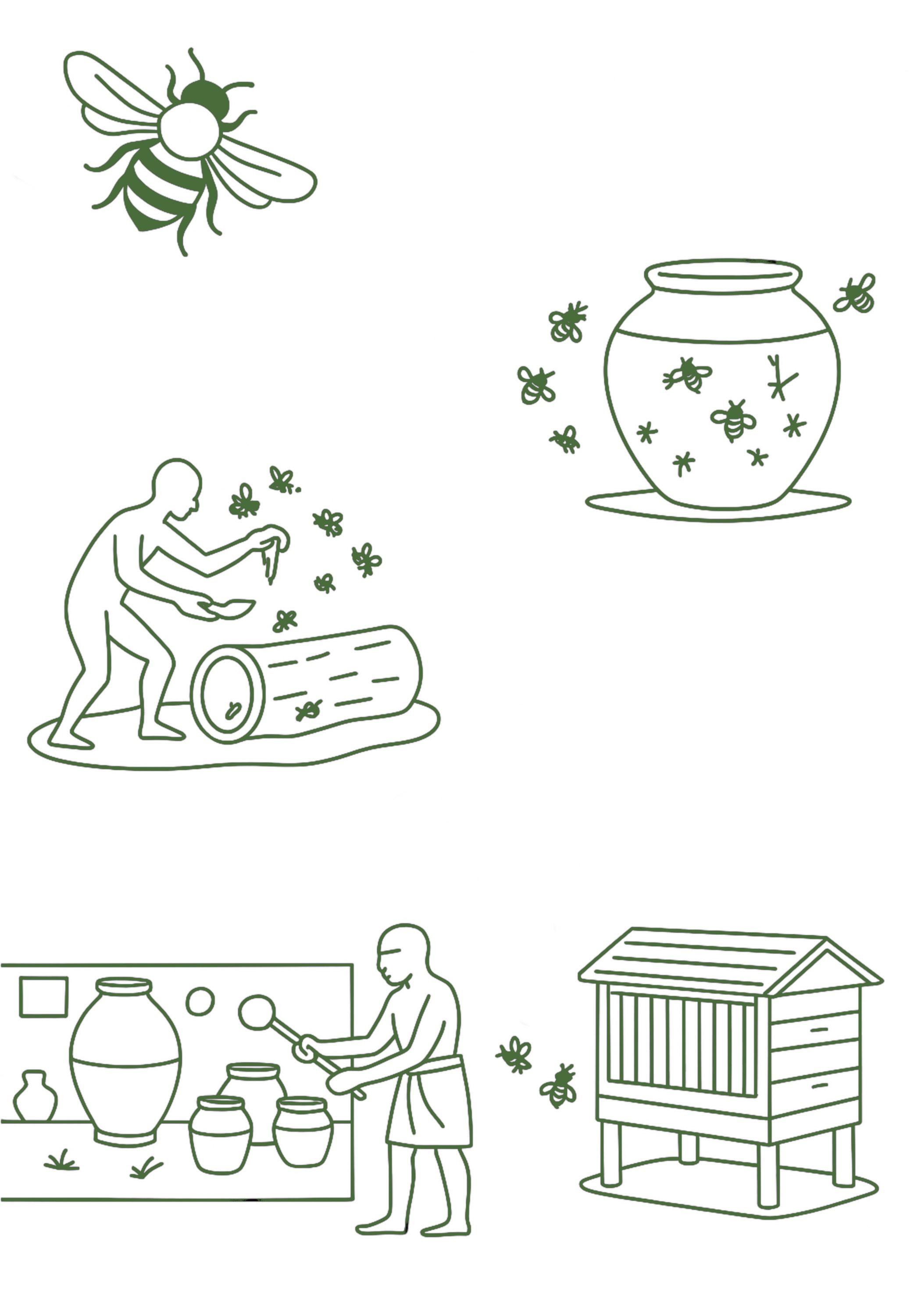
10, 000 YEARS AGO
4,5000 YEARS AGO
18TH CENTURY
9,000 YEARS AGO
An inscription records the introduction of honeybees into the land of Suhum in Mesopotamia, where they were previously unknown
“I am Shamash-resh-usur, the governor of Suhu and the land of Mari. Bees that collect honey, which none of my ancestors had ever seen or brought into the land of Suhu, I brought down from the mountain of the men of Habha, and made them settle in the orchards of the town ‘Gabbari-builtit’. They collect honey and wax, and I know how to melt the honey and wax –and the gardeners know too. Whoever comes in the future, may he ask the old men of the town, (who will say) thus: “They are the buildings of Shamashresh-usur, the governor of Suhu, who introduced honeybees into the land of Suhu.”
translated text from stele, (Dalley, 2002)
The oldest archaeological finds directly relating to beekeeping have been discovered at Rehov, a Bronze and Iron Age archaeological site in the Jordan Valley, Israel. Thirty intact hives, made of straw and unbaked clay, were discovered by archaeologist Amihai Mazar in the ruins of the city, dating from about 900 BCE. The hives were found in orderly rows, three high, in a manner that could have accommodated around 100 hives, held more than 1 million bees.
Beekeeping has been practiced in ancient China since antiquity. In a book written by Fan Li (or Tao Zhu Gong) during the Spring and Autumn period there are sections describing the art of beekeeping, stressing the importance of the quality of the wooden box used and how this can affect the quality of the honey. The Chinese word for honey (mì, reconstructed Old Chinese pronunciation *mjit) was borrowed from proto-Tocharian (where *is palatalized; cf. Tocharian B mit), cognate with English mead.
The ancient Maya domesticated a separate species of stingless bee, which they used for several purposes, including making balché, a mead-like alcoholic drink. By 300 BCE they had achieved the highest levels of stingless beekeeping practices in the world. The use of stingless bees is referred to as meliponiculture, named after bees of the tribe Meliponini—such as Melipona quadrifasciata in Brazil. This variation of bee keeping still occurs around the world today.
Invention of the movable comb hive
Honey harvesting in its earliest times frequently resulted in the destruction of the whole colony as a result of the honey being taken. The wild hive was broken into, using smoke to quiet the bees. The honeycombs were pulled out and either immediately eaten whole or crushed up, along with the eggs, larvae, and honey they held.
The movable frames of modern hives are considered to be the descendants of the traditional basket top bar (movable comb) hives of Greece, which allowed the beekeeper to avoid killing the bees. The oldest testimony on their use dates back to 1669 although it is probable that their use is more than 3000 years old.
The 19th century saw this revolution in beekeeping practice completed through the perfection of the movable comb hive by the American Lorenzo Lorraine Langstroth. Langstroth then designed a series of wooden frames within a rectangular hive box, carefully maintaining the correct space between successive frames, and found that the bees would build parallel honeycombs in the box without bonding them to each other or to the hive walls. This enables the beekeeper to slide any frame out of the hive for inspection, without harming the bees or the comb, protecting the eggs, larvae and pupae contained within the cells. It also meant that combs
containing honey could be gently removed and the honey extracted without destroying the comb. The emptied honeycombs could then be returned to the bees intact for refilling.
The invention and development of the movablecomb-hive fostered the growth of commercial honey production on a large scale in both Europe and the US.
Modern top bar hive
A top-bar hive is a single-story frameless beehive in which the comb hangs from removable bars. The bars form a continuous roof over the comb, whereas the frames in most current hives allow space for bees to move up or down between boxes. Top-bar hives are rectangular in shape and are typically more than twice as wide as multi-story framed hives commonly found in English-speaking countries. Top-bar hives usually include one box only, and allow for beekeeping methods that interfere very little with the colony.

Hive
Protective clothing
Most beekeepers also wear some protective clothing. Novice beekeepers usually wear gloves and a hooded suit or hat and veil. Experienced beekeepers sometimes elect not to use gloves because they inhibit delicate manipulations. The face and neck are the most important areas to protect, so most beekeepers wear at least a veil.
Traditionally beekeeping clothing was pale colored and this is still very common today. This is because of the natural color of cotton and cost of coloring was an expense not warranted for workwear, though some consider this is to provide better differentiation from the colony’s natural predators (such as bears and skunks) which tend to be dark-colored. It is now known that bees see in ultraviolet and are also attracted to scent. So the type of fabric conditioner used has more impact than the color of the fabric.
Bee smoker
Most beekeepers use a smoker, which is a device designed to generate smoke from the incomplete combustion of various fuels. Although the exact mechanism is disputed, it is said that smoke calms bees. Some claim it initiates a feeding response in anticipation of possible hive abandonment due to fire. It is also thought that smoke masks alarm pheromones released by guard bees or when bees are squashed in an inspection. The ensuing confusion creates an opportunity for the beekeeper to open the hive and work without triggering a defensive reaction.
Location of hives
There has been considerable debate about the best location for hives. Virgil thought they should be located near clear springs, ponds or shallow brooks. Wildman thought they should face to the south or west. One thing all writers agreed on is that hives should be sheltered from strong winds. In hot climates, they were often placed under the shade of trees in summer.
Natural beekeeping
The natural beekeeping movement believes that beehives are weakened by modern beekeeping and agricultural practices, such as crop spraying, hive movement, frequent hive inspections, artificial insemination of queens, routine medication, and sugar water feeding.


Practitioners of “natural beekeeping” tend to use variations of the top-bar hive, which is a simple design that retains the concept of having a movable comb without the use of frames or a foundation.
Urban beekeeping
Related to natural beekeeping, urban beekeeping is an attempt to revert to a less industrialized way of obtaining honey by utilizing small-scale colonies that pollinate urban gardens.
Some have found that “city bees” are actually healthier than “rural bees” because there are fewer pesticides and greater biodiversity in the urban gardens. Urban bees may fail to find forage, however, and homeowners can use their landscapes to help feed local bee populations by planting flowers that provide nectar and pollen.
An environment of year-round, uninterrupted bloom creates an ideal environment for colony reproduction.
Uses for Honey
Over its history as a food, the main uses of honey are in cooking, baking, desserts, as a spread on bread, as an addition to various beverages such as tea, and as a sweetener in some commercial beverages. Honey is sweet because of its high concentrations of the monosaccharides fructose and glucose. It has about the same relative sweetness as sucrose (table sugar). One standard tablespoon (15 mL) of honey provides around 190 kilojoules (46 kilocalories) of food energy. It has attractive chemical properties for baking and a distinctive flavor when used as a sweetener. Most microorganisms cannot grow in honey and sealed honey therefore does not spoil. Samples of honey discovered in archaeological contexts have proven edible even after thousands of years.
Hooded Hat & Veil
Gloves
Hooded Suit
Bee Smoker
Classification of honey by packaging and processing
Generally, honey is bottled in its familiar liquid form, but it is sold in other forms, and can be subjected to a variety of processing methods.
Crystallized honey occurs when some of the glucose content has spontaneously crystallized from solution as the monohydrate. It is also called “granulated honey” or “candied honey”.
Pasteurized honey has been heated in a pasteurization process which requires temperatures of 72 °C (161 °F) or higher. Pasteurization destroys yeast cells. It also liquefies any microcrystals in the honey, which delays the onset of visible crystallization.
Raw honey is as it exists in the beehive or as obtained by extraction, settling, or straining, without adding heat (although some honey that has been “minimally processed” is often labeled as raw honey).
Strained honey has been passed through a mesh material to remove particulate material (pieces of wax, propolis, other defects) without removing pollen, minerals, or enzymes.
Filtered honey of any type has been filtered to the extent that all or most of the fine particles, pollen grains, air bubbles, or other materials normally found in suspension, have been removed. Filtered honey is very clear and will not crystallize as quickly, making it preferred by supermarkets.
Creamed honey, also called whipped honey, spun honey, churned honey, honey fondant, and, in the UK, set honey, has been processed to control crystallization. Creamed honey contains a large number of small crystals, which prevent the formation of larger crystals that can occur in unprocessed honey.
Dried honey has the moisture extracted from liquid honey to create completely solid, nonsticky granules. This process may or may not include the use of drying and anticaking agents. Dried honey is used in baked goods, and to garnish desserts.
Honey decoctions are made from honey or honey byproducts which have been dissolved in water, then reduced (usually by means of boiling).

Comb honey is still in the honeybees’ wax comb. It is traditionally collected using standard wooden frames in honey supers. The frames are collected and the comb is cut out in chunks before packaging.
Baker’s honey is outside the normal specification for honey, due to a “foreign” taste or odor, or because it has begun to ferment or has been overheated. It is generally used as an ingredient in food processing.