Reproduction of any materials without written permission from the editor is prohibited. Opinions and statements expressed in this publication are not necessarily those of the editor.
By Sylvie Riecken
By Saddle Up with Tarp Designs
GMC Hitching
A New Perspective Behind the Wheel Up with
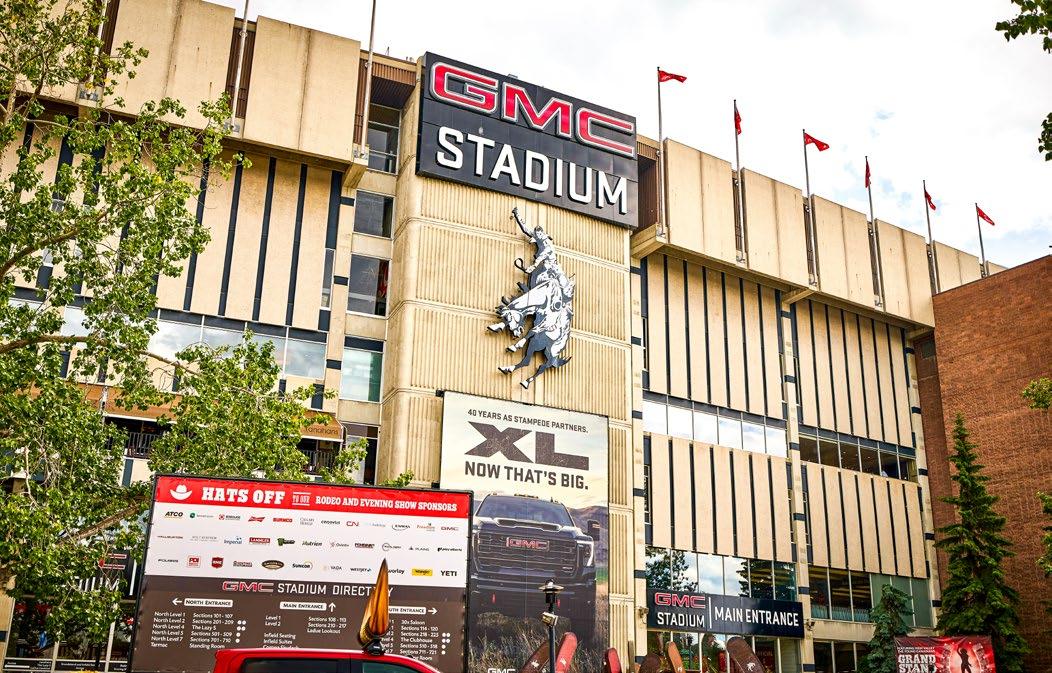
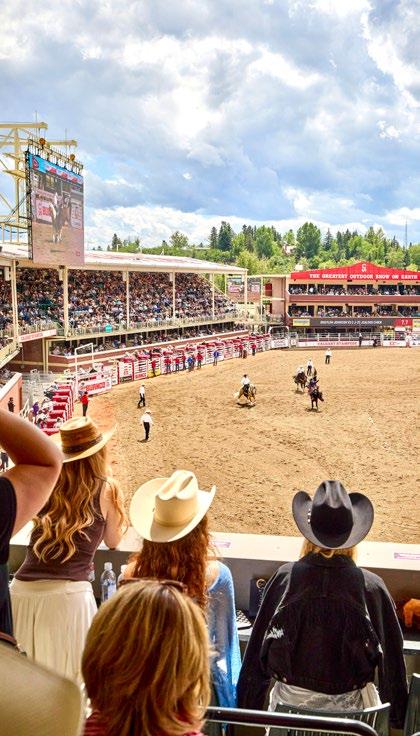
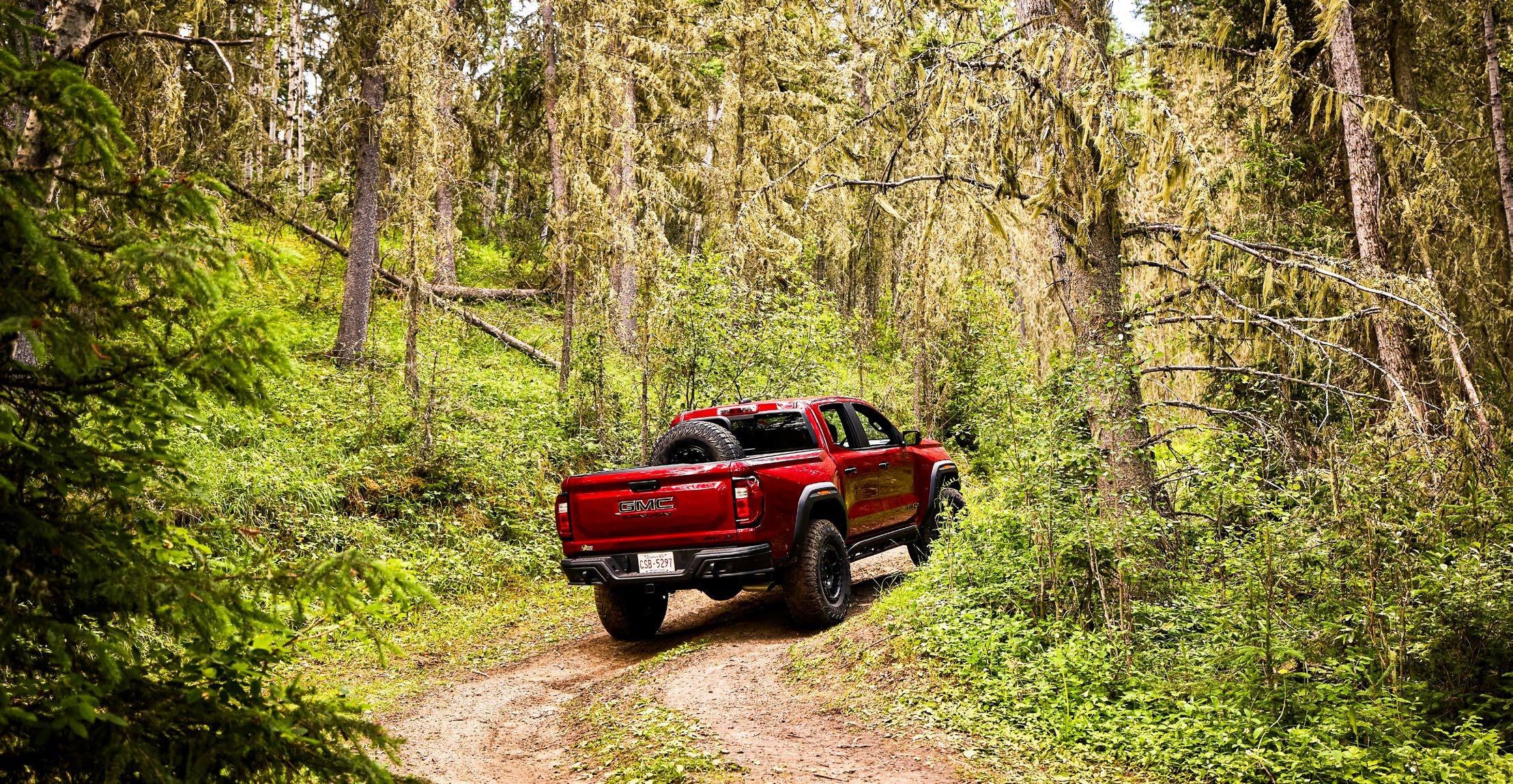
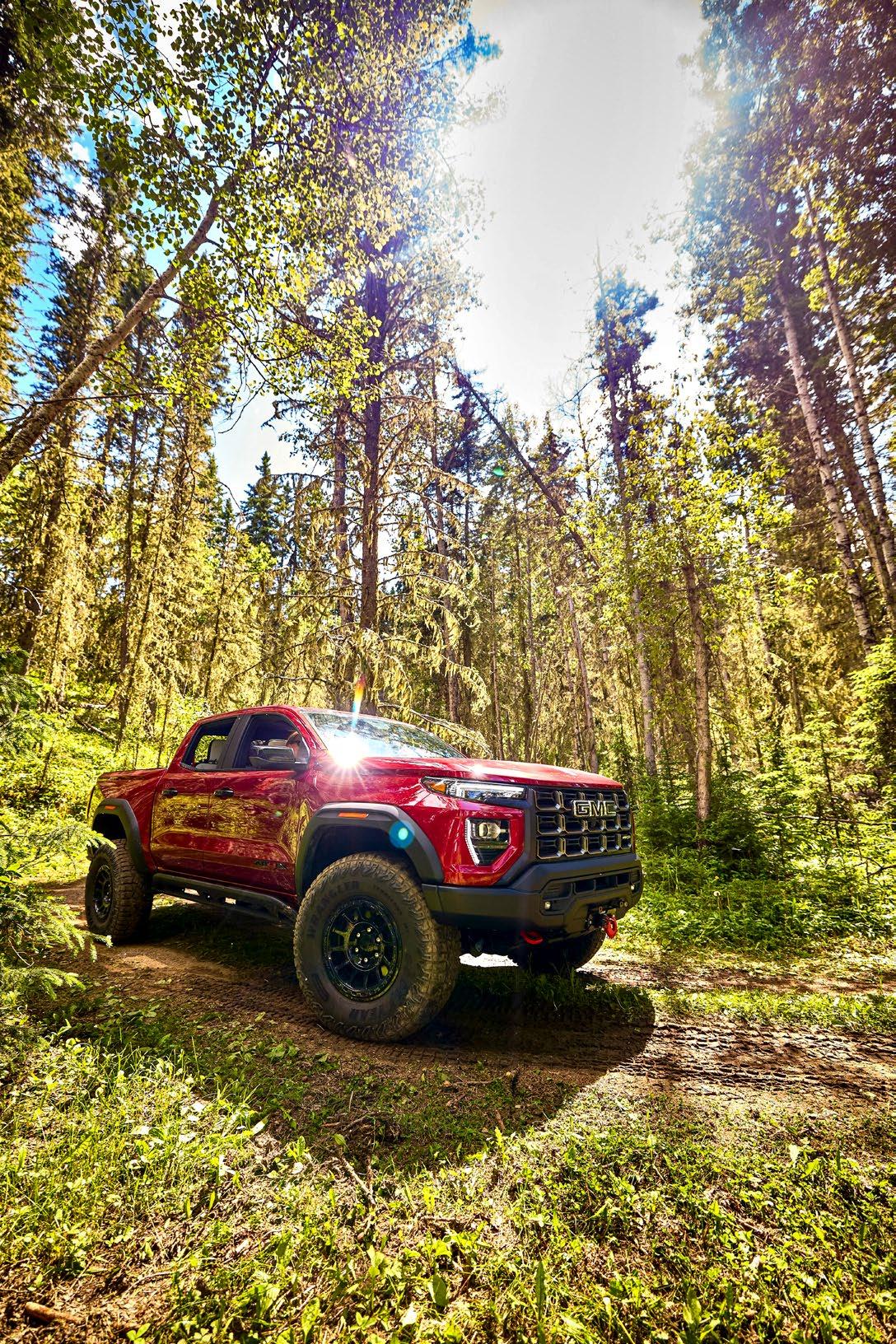
I was invited by GMC to attend the Calgary Stampede in celebration of the brand’s 40th anniversary of its partnership with the Calgary Stampede. It was a fantastic weekend filled with great company, rodeo experiences, and the opportunity to learn more about GMC’s truck lineup. The anniversary also highlighted GMC’s enduring connection to Western Canada’s ranching, rodeo, and equestrian communities, where trucks are more than transportation—they’re trusted partners that carry us from the barn to the show ring, the trailhead, and everywhere in between.
As part of the weekend, I attended the GMC Vehicle Immersion Experience expecting to learn more about the brand’s lineup and capabilities. I didn’t expect to leave with a new perspective—and a lot more confidence.
My chosen community is the equine industry. I love all things equine-related. There is nothing like getting up early, hooking up the truck to the horse trailer, loading my gear and horse, and heading off on a new adventure.
The thing is, once I get to my destination, my relaxed state is replaced by anxiety as I contemplate backing my trailer into a long line of other trailers. I know I’m not the only one who finds backing up a trailer an anxiety-filled event. One overcorrection leads to another; frustration and embarrassment set in, and I feel like throwing my hands in the air. Usually, someone nearby sees my struggle and offers to back my trailer in.
On day two of the weekend, I was offered the chance to take a Sierra AT4 1500 for a test drive. It was hooked up to a three-horse bumper-pull trailer, and I was excited to get behind the wheel and experience how the truck pulled. It towed the trailer effortlessly, and the shifting was smooth as silk. I asked how the truck maintained so much hauling power and was told it has a 10-speed automatic transmission. As I approached a small hill, I thought for sure I’d feel it digging in, but it was as though the hill didn’t even exist.
The GMC representative in the back seat answered my questions about the truck’s 8,700-lb. towing capacity and its Duramax 3.0L engine. Little did I realize that the best feature, for me, was yet to come.
We arrived back at our starting point, but instead of directing me into the upper parking lot, he asked me to stop just past the entrance to the lower lot. I unbuckled my seatbelt, figuring the test drive was over. Then he asked if I’d like to back the truck and
By Laureen James
trailer into a spot beside another GMC truck with a stock trailer attached. I felt the anxiety well up as I noticed the large boulders lining the entrance.
My partner Craig offered to trade seats, but I had enjoyed driving the truck so much that I couldn’t back down now. “Sure, I’ll back it in,” I said. What was I thinking? I put on my big-girl pants, shifted into reverse, and slowly eased the truck and trailer backward, watching the boulders on either side. I may have said a quick prayer.
Sponsored Content in Partnership With GMC Canada
Then I noticed the infotainment screen. The right side showed the traditional backup camera, but the left revealed something I had never experienced before—a complete bird’s-eye view of the truck, trailer, and surrounding area. I could see exactly where the entire unit was positioned.
I thought I was dreaming. What kind of pleasant sorcery is this? I thought, laughing. Even after completing the backing manoeuvre with far more confidence than I’d ever had before, I could hardly believe what I’d seen. With the bird’s-eye view, it felt like I had a drone hovering above me.
The GMC representative I spoke with after my driving experience assured me that I wasn’t losing my mind. GMC Denali and AT4X models come with HD Surround Vision, which uses cameras located in the front grille, the side mirrors (two angles), the back of the cab (two angles), the tailgate (two angles—one for backing up and one for connecting your hitch), and the front dash camera. Together, these cameras create the bird’s-eye view of the truck and trailer. An additional camera can also be added inside your horse trailer, allowing you to keep an eye on your horses while trailering.
The representative explained that the cameras provide up to 14 available camera views and a comprehensive 360-degree view around the truck and trailer. I wasn’t in the market for a new truck, but I’m rethinking that now. I want one of these! GMC offers 1500, 2500, and 3500 models, all built to work hard, play hard, and provide added confidence with advanced safety features.
Comfort, style, and safety—whether you’re hauling a horse trailer to a competition, heading out for a weekend adventure, or simply driving into town, GMC’s AT4 and Denali trims bring capability and premium features across the lineup. Capability and comfort aren’t reserved for one model—they’re available in the truck or SUV that best fits your lifestyle.
It’s easy to see why GMC has been part of Western Canada’s horse community for decades. These trucks are built to be part of the journey. The GMC Vehicle Immersion Experience at the Calgary Stampede was a great reminder of just how closely GMC is connected to the Western lifestyle. From the barn to the road, explore GMC’s lineup of trucks and trailering technologies at gmccanada.ca
Laureen James, BCom, journalist, and EC/NCCP Coach Certification IOB, is an equine journalist who writes for many publications. She also writes for the pet industry and is a columnist for Unison 50+ News. She has covered rodeos, show jumping, and other related events over the past few years as a journalist and photographer.
Photos provided by GMC Canada
ProTips ProTips ProTips
For Feeding Endurance Horses For Feeding Endurance Horses
By Eleanor Stronach, MSc
By Eleanor Stronach, MSc
Reviewed by Dr. Priska Darani, PhD, PAS, Mad Barn Director of Research
Reviewed by Dr. Priska Darani, PhD, PAS, Mad Barn Director of Research
Horses involved in endurance riding require balanced nutrition to support stamina and recovery. What should you be feeding your endurance horse to maximize their performance before a race and support their recovery post-race? Follow these seven steps to feeding and caring for your horse to prepare for long-distance riding.
1) Assess your horse’s health
Before beginning race training, consult your veterinarian and farrier to assess your horse’s health and baseline status.
Endurance horses should be examined for:
Heart problems such as arrhythmias
Respiratory issues such as inflammatory airway disease
Musculoskeletal concerns
Foot balance issues
2) Feed High-Quality Forage
High-quality forage should be the primary energy source for all endurance horses and should make up a minimum of 80% of their diet to support gut health. Forage is digested slowly in the hindgut, providing a sustained source of energy as the horse races.
3) Add Calorie Sources
Endurance horses have extremely high energy demands when in training and during races. They require slow-release energy sources as fuel for long competitions. Although forage should be the primary energy source for your horse, additional calories are usually required.
Fibre Sources
Soluble fibre sources such as beet pulp or soy hulls are good options to feed endurance horses. These concentrates provide energy through fermentation in the hind gut but have less bulk than forages.
Grains
Grains can also be provided to add energy to the diet, but their use should be limited. Grains supply quick calories but are not likely to sustain the horse over a long endurance ride. Feeding large quantities of grain is not recommended, as this can lead to digestive health issues such as gastric ulcers and hind gut acidosis.
Fats and Oils
Fat is an ideal energy source for endurance horses. All fats provide 9 calories per gram, which is double the calories provided by carbohydrates and proteins. Fat must be introduced gradually and increased over a six-to-eleven-week period, and for endurance horses, 7-15% of the total diet can consist of fat. Consider consulting with one of Mad Barn’s expert nutritionists to learn how to incorporate oils into your horse’s diet.
4) Optimize Protein Levels
Endurance horses have increased protein requirements and may be lacking certain amino acids. Amino acids are the molecules that make up protein, and equine diets commonly lack three essential amino acids: lysine, methionine, and threonine. If more protein is required in the diet, look for high lysine options, such as soybean meal or roasted soybeans. Work with a nutritionist to determine an appropriate feeding rate.
5) Ensure Vitamin and Mineral Requirements are Met
The prolonged exercise of the endurance discipline results in muscle damage and overall fatigue. These horses have increased requirements for antioxidant nutrients (vitamins E & C and selenium) to support muscle function. B-vitamin supplementation is also important for sport horses because these micronutrients serve as cofactors for many metabolic processes.
6) Support Electrolyte Balance
Electrolyte minerals such as sodium, potassium, and magnesium are lost in sweat during exercise. Horses are at high risk of electrolyte imbalance in hot temperatures or when heavily exercising. In extreme cases, loss of electrolytes through sweat can result in alkaline blood pH and a condition known as metabolic alkalosis. This is extremely detrimental to the horse.
Electrolyte supplements are typically provided in powder form and contain varying levels of minerals to support exercise and hydration status. It is recommended to dissolve electrolytes in water or a mash feed to encourage water intake. Electrolytes stimulate thirst so always provide your horse with free access to fresh water when feeding these supplements.
7) Support Hydration
Racing endurance horses lose 1 to 15 liters of water per hour through sweat and heat evaporation. By the end of a race, a horse may have a deficit of 40 liters of water (4 - 7% body weight). During races, vet gates should offer a choice of fresh water and electrolyte- or sugar-supplemented water.
To increase water consumption and palatability, consider adding flavor with apple juice or molasses. Water that is added to feeds to make a mash can also help support hydration. You should also monitor your horse’s water intake to ensure they are not drinking too much water. Unlimited water access while racing can result in osmotic shock related to changes in blood volume.
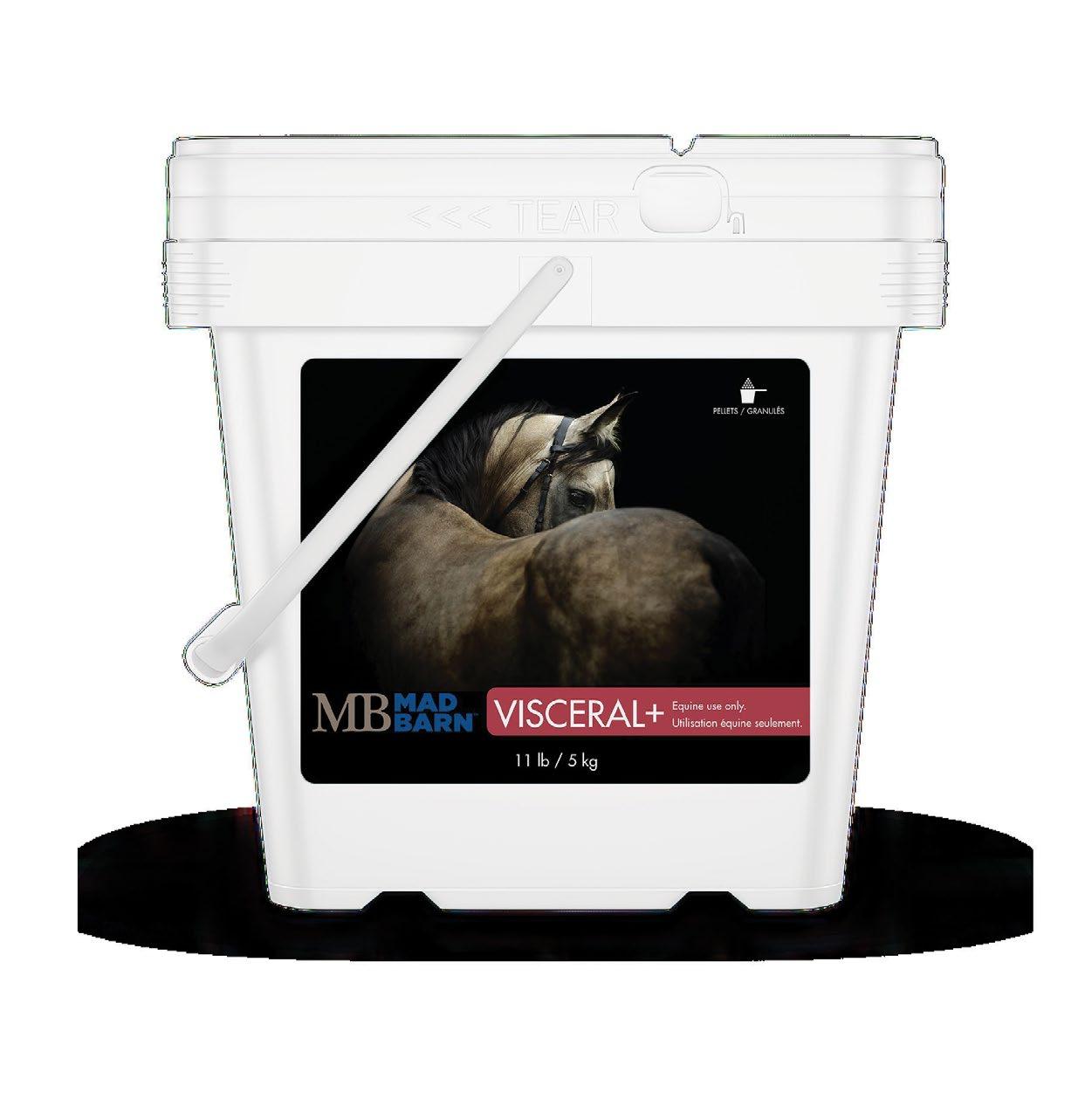
COMPETITION-READY GUT SUPPORT
“We put a lot of pressure on them to be athletes all the time. If we don’t support their gut health with Visceral+ we’re doing them a disservice.”
Jim Greendyk
Maintains Gastric Health Supports Stomach Lining
Aids Immune Function
Generations in the Saddle Generations in the Saddle
By Lisa Thompson By Lisa Thompson
The Fall Roundup at the Seely Ranch The Fall Roundup at the Seely Ranch
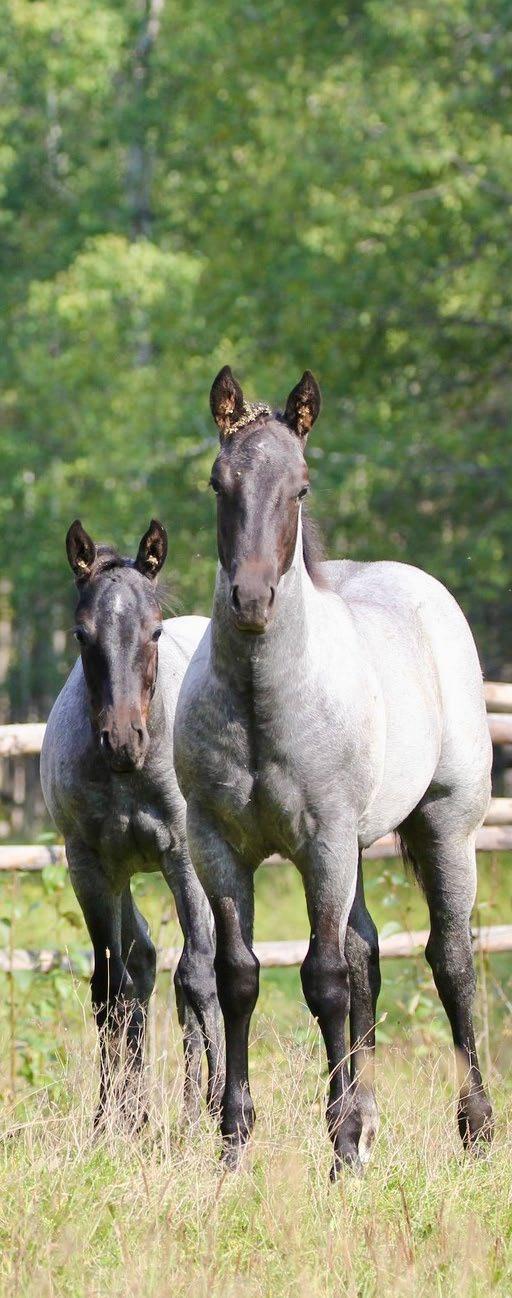
Take a step back in time to a rustic little town in the great province of Alberta, and you’ll find Alder Flats, population 140. On June 26, 1933, Ethel and Edmond Seely, along with their three-year-old son, JL, and their two-year-old son, Doyle, left New Dayton, Alberta, trailing 57 head of horses to Alder Flats. They arrived in late August, where Edmond purchased property, making Alder Flats their home.
Doyle purchased his first quarter section of land when he was 18 years old, in 1954 at a dance in Alder Flats, Doyle met Lorraine, from Edberg, Alberta; they married in 1955 and moved into a 12 x 16 shack on their homestead, and that’s where the Seely family legacy began. Doyle and Lorraine had 4 children. Dean is the eldest, born in his grandparents’ home; next came Janey, born in the backseat of Doyle’s brother’s 1957 Chevy, and then came Debora and Gene, born in a normal way, in the hospital.
I spent a season working for the Seely’s in their PMU operation. When they had roughly 270 mares and a full complement of stallions, it was a busy operation! I remember one day having a conversation with cheeky Doyle, I showed him a shiny new oneeared bridle I had bought with my pay, and Doyle said, “Oh, you brought a walk-home bridle.” I said, “What do you mean by that?” He replied with a grin, “Well, with a one-ear bridle, if it gets caught on a branch and comes off your horse, you’re walking home!” He was a character with a good sense of humour for sure; sadly, Doyle passed away in May of 2018, at the age of 86. I’m sure he is missed by many. But his children, I can say, are carrying on the important traditions of the past.
Witnessing the fall roundup and seeing all the mares and foals was something I longed to do, so I reached out to Janey and asked if it would be ok to come and take some photos for a couple days; once she cleared it with the rest of the family, it was a go!
Throughout the week of roundup, there is a plan each day. The stallions are brought home, there is sorting and branding, and every horse and foal on the farm has their feet trimmed and checked over. I joined on the two biggest days, and as I didn’t know what to expect, on day one, I was chauffeured in the backseat of the pickup, by sister Janey and her husband Colin, and of course I asked numerous questions!
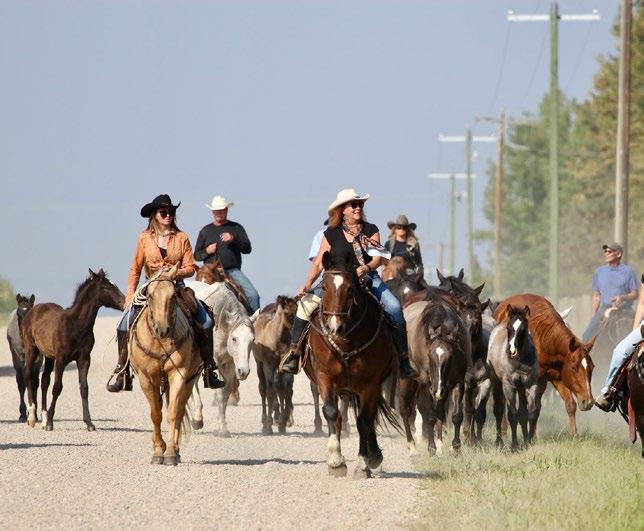
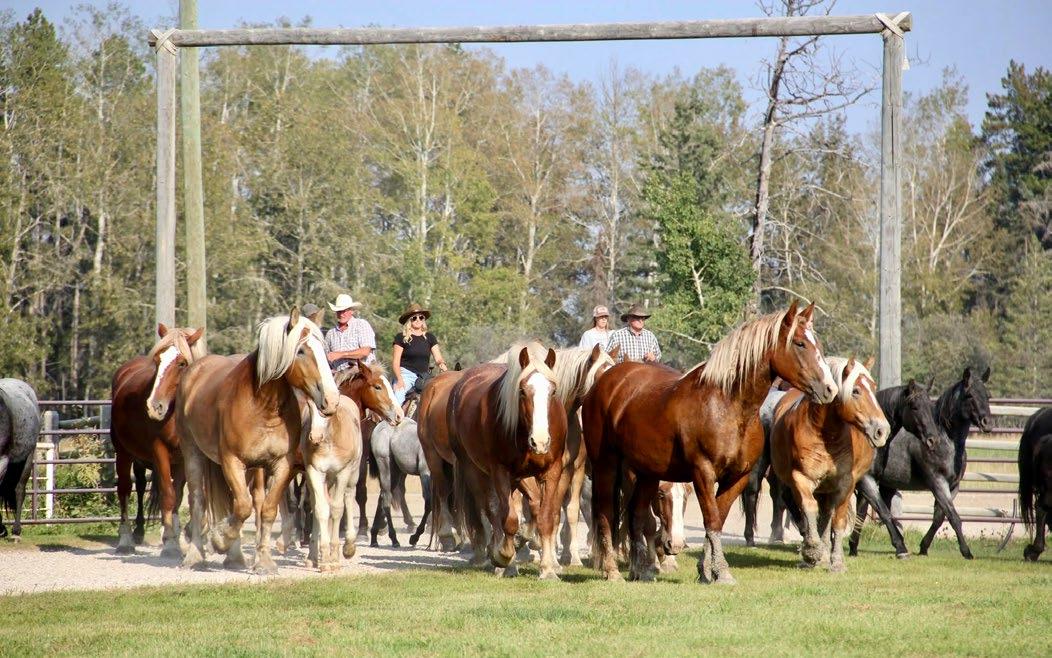
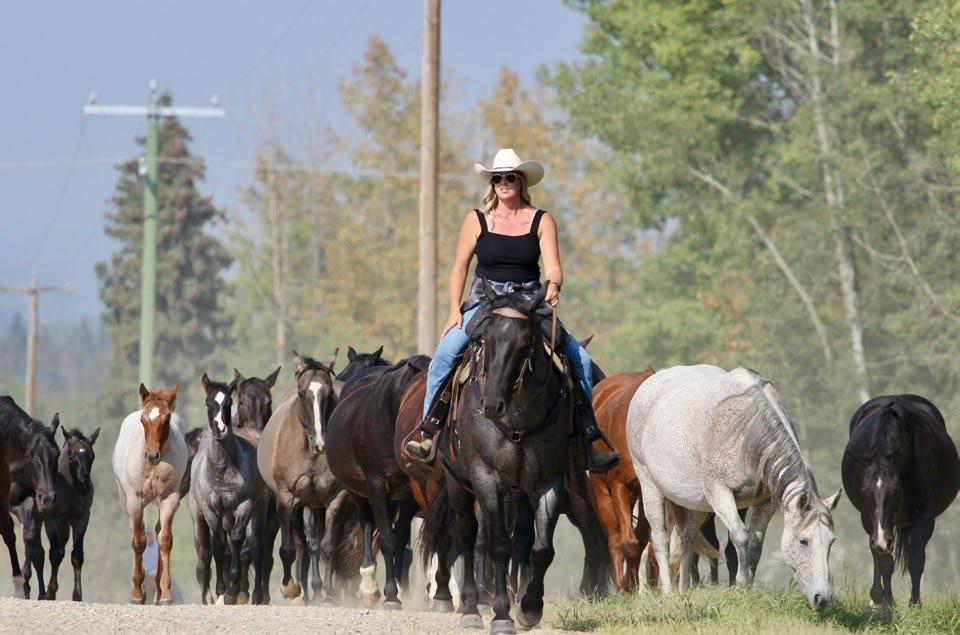
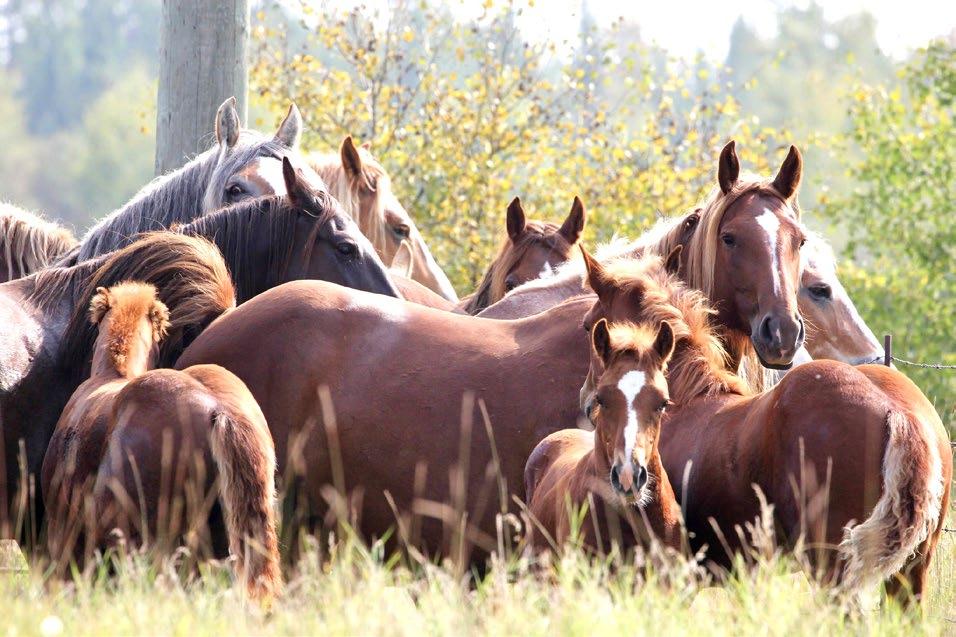
The saddle horses were hauled to brother Dean’s rustic and raw property back in the woods; nine riders mounted up and instinctively went on the search for the Belgian mares and foals. On a quarter section of land, they were found in 30 minutes and came majestically down the dirt road with sister Debi and friend Mike pushing the herd.
This was the only herd that was loaded into the trailers, as it was too far to trail the mares and foals home. Once we got back to the farm and unloaded, I eagerly asked Janey, “What’s next?” She said, “Oh, now we’re going back to Dean’s cabin and have a wiener roast for lunch.” I laughed to myself and took a breath; there was no hustle and bustle here, just good times with family and friends, riding some horses.
Sisters Debi and Janey Seely, and Lorraine’s great granddaughter Alyla
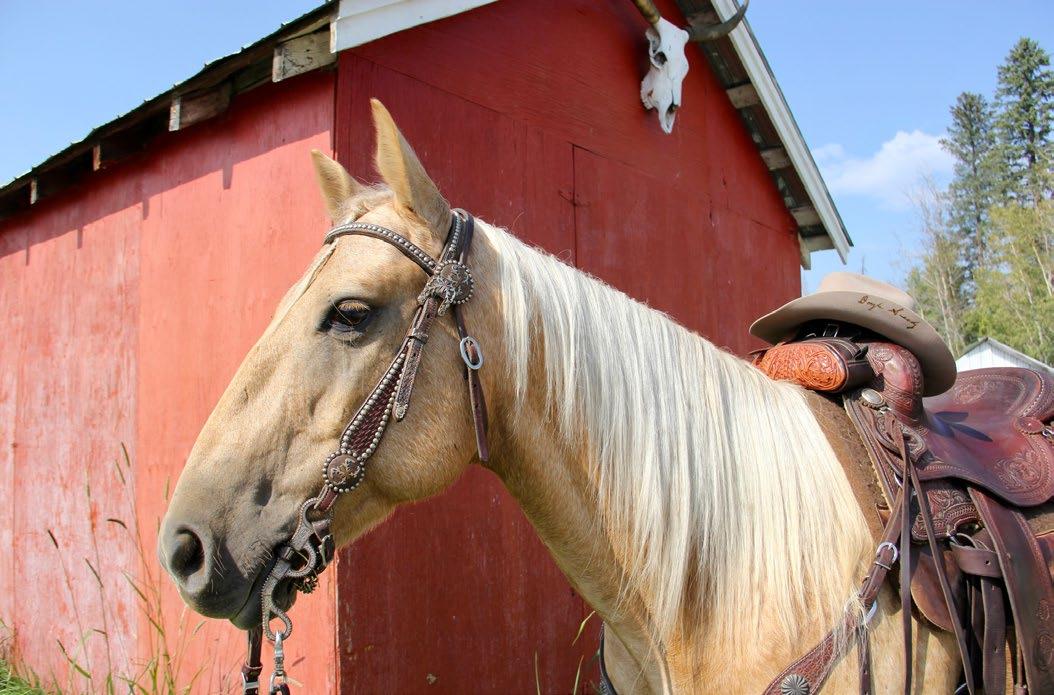
Doyle Seely’s hat signed with his signature!
The big mares coming home, on the left Gene Seely, and his daughter Taylor
Back at the cabin, Dean had the fire pit wiener ready; we had a bowl of Mom Lorraine’s potato salad, Janey’s homemade zucchini salsa and chips, and, of course, some beverages. The other stars of the show were the saddle horses, who patiently rested in the shade while we all enjoyed each other’s company and ate lunch and had some laughs, and no one was treated like a stranger.
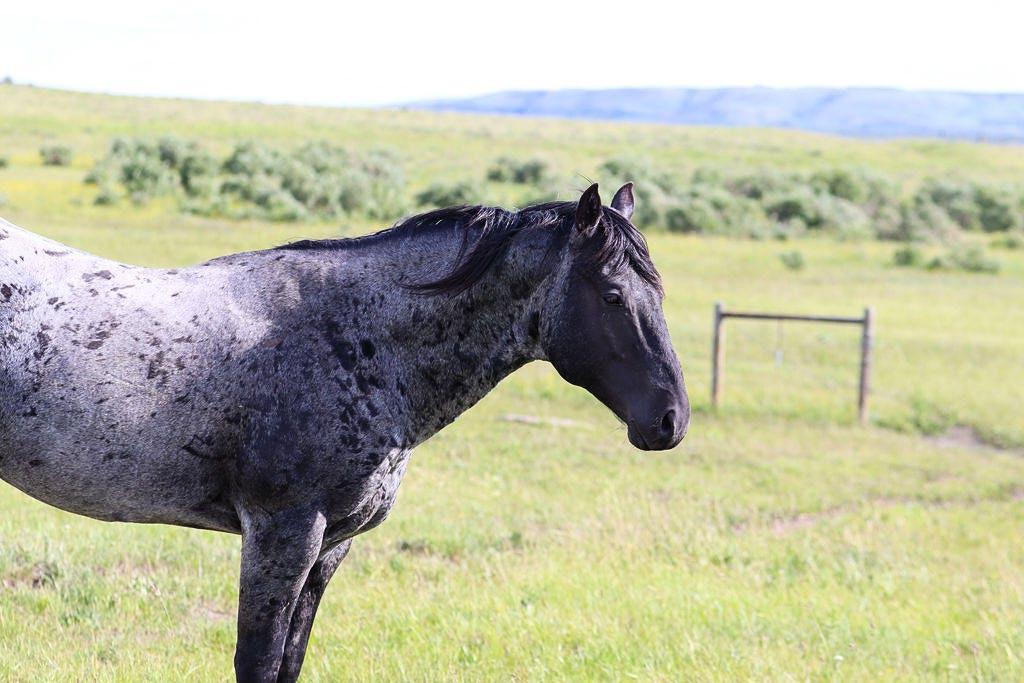
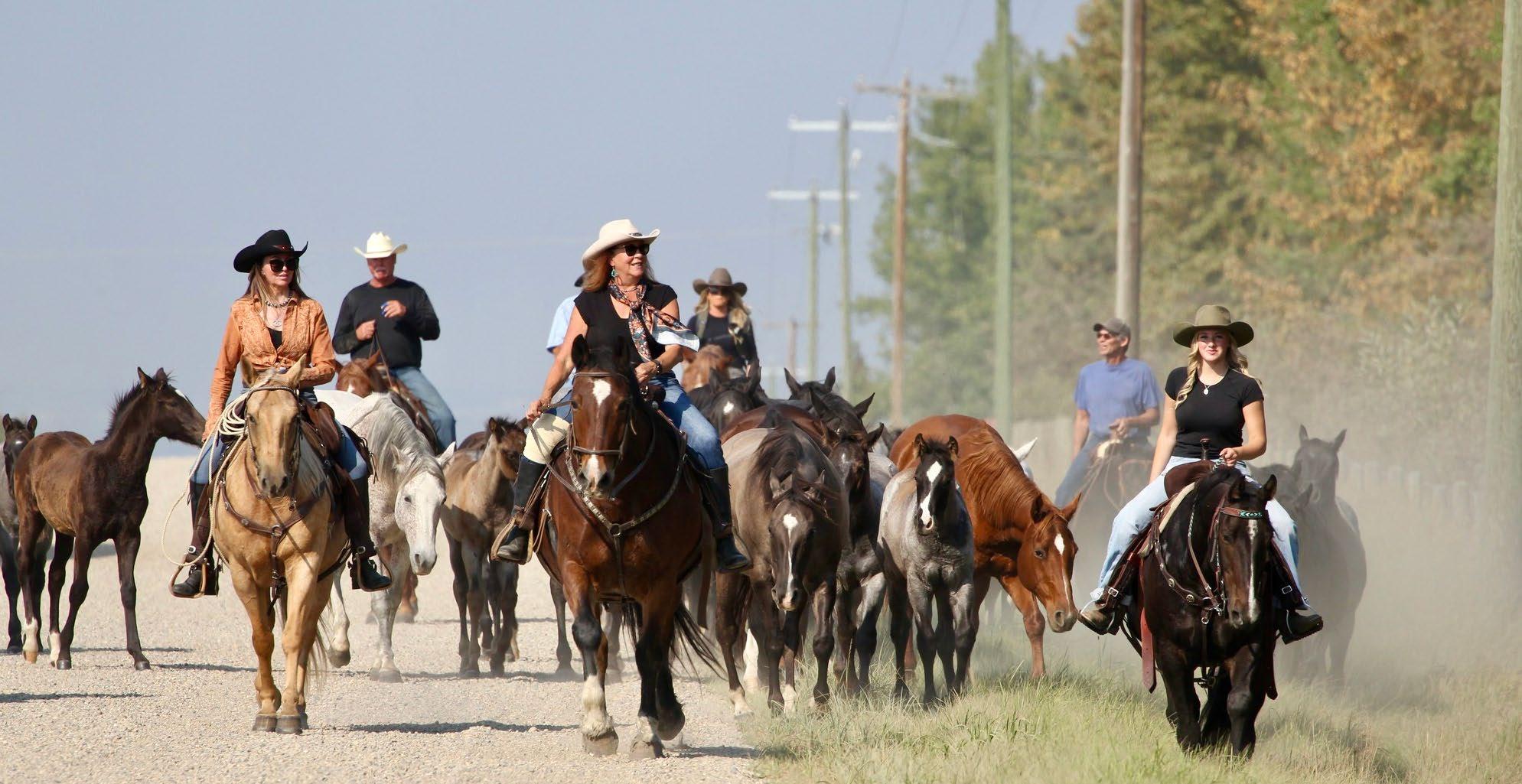
Two hot dogs later, and a full belly, we were on to the next pasture to bring the blue roan mares and babies home as well as join up with another herd just minutes away down the road. As I reflect, nothing was rushed that day; no one was in a hurry. The mares and foals walked down the road to home, with breaks in the shade to cool off and a bite or two of some long, luscious grass alongside the road.
Today Gene Seely runs the family ranch at 62 years young. He is my hero! Gene lost his right arm in an accident many years ago, and I’m amazed at how well he has adapted. There is nothing he can’t do on the farm. He has the patience of a saint, and when I bombarded him numerous times that day with the question, “What’s the next plan?” he calmly answered the same answer, “We are going to another pasture to get some mares and foals.” He can tell you the history of almost every horse and is teaching his ways to his daughter Taylor, who works full-time with him now. And as always, siblings Debi, Janey, and Dean are always close by if anyone needs some help.
But really, everyone knows the boss of the farm is 89-yearold Lorraine Seely, widow, mom, grandmother, and greatgrandmother; she is the matriarch of the family. There is always coffee or snacks in the main house, dough rising on the counter for homemade buns, or you may get lucky and have a taste of the best potato salad you’ll ever eat. She keeps a watchful eye on the gates and on the farm, tends to her lovely flowers in the yard, feeds the cats and dogs, and has many tales to delight you with from the past. One story she told me was she bought her first quarter section of land for $100.00 and had to pay the city of Edmonton 10% of her crop shares each year. I suppose that was property tax back in the day?
Third generation, Taylor Seely, Gene’s daughter and Doyle’s granddaughter
On the second day of the roundup, I was an old hand already. Colin, Janeys’ husband, and I each drove one of the trucks and trailers back that delivered the saddle horses to the pasture. Twelve riders went out in search of the mares and foals. Once again it was expertly executed, and the trail down the road began. The last day rounding up mares is casual, no rush, just lots of stories and laughs, with many stops in the shade to cool the horses. A day to just enjoy each other’s company and the love of horses. However, it did take them roughly three hours to go six miles; I’m assuming something called Yucca Flux, minus the fruit, was the culprit.
As I drove away that day, this city girl felt a tug at her country heart, longing to turn the car around and stay forever. I am eternally grateful to this kind and humble family and their friends for letting me have a peek inside their corner of the world.
Lisa Thompson has a passion for horses, and throughout the years this has shaped her journey to be a self-taught photographer and tack maker. One of her accomplishments was being honoured as a two-time Sovereign Award nominee for horse racing photography. “I’m proud to contribute to the horse racing industry, with my tack repair and photography. I don’t really have a favourite horse event; basically if there’s a horse involved, that’s where you’ll find me!”
Every pair in the Legacy Forge Collection begins the hard way with hand-cut leather, traditional construction, and techniques refi ned over generations. Then time takes over, shaping every crease and mark into something no factory could ever reproduce. Wear it in and pass it down. That’s how legacy is made. Shop the Legacy Forge Collection at ALBERTABOOT.COM
Photos by Lisa Thompson
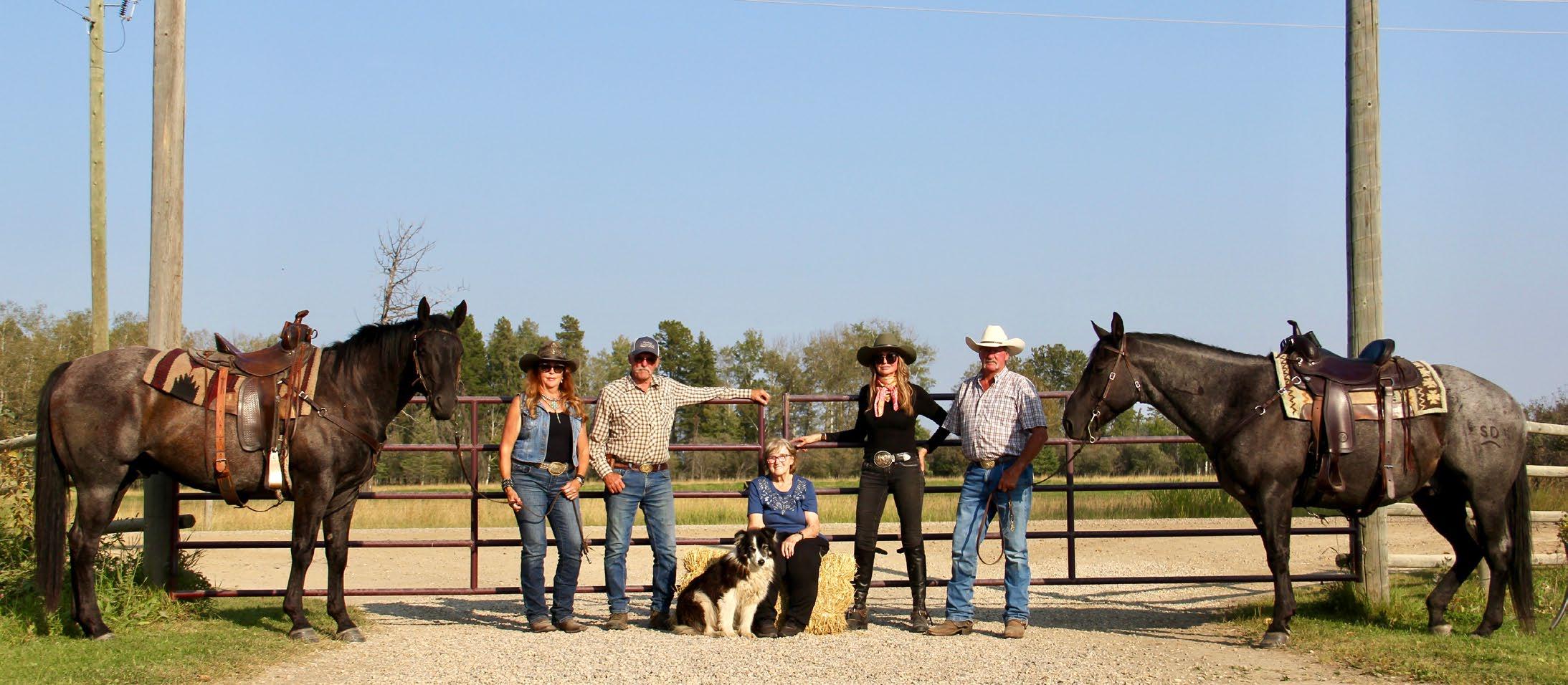
The Seely family L-R: Janey (daughter), Dean (son), Lorraine (mom), Jake the trusty border collie, Debi (daughter), and Gene (son)
With Cody Braaten Learning to Rope
Whether someone dreams of competing in the rodeo arena or simply wants to learn a new skill, roping is a sport that rewards patience, practice, and perseverance. Like any discipline, having the right guidance can make all the difference.
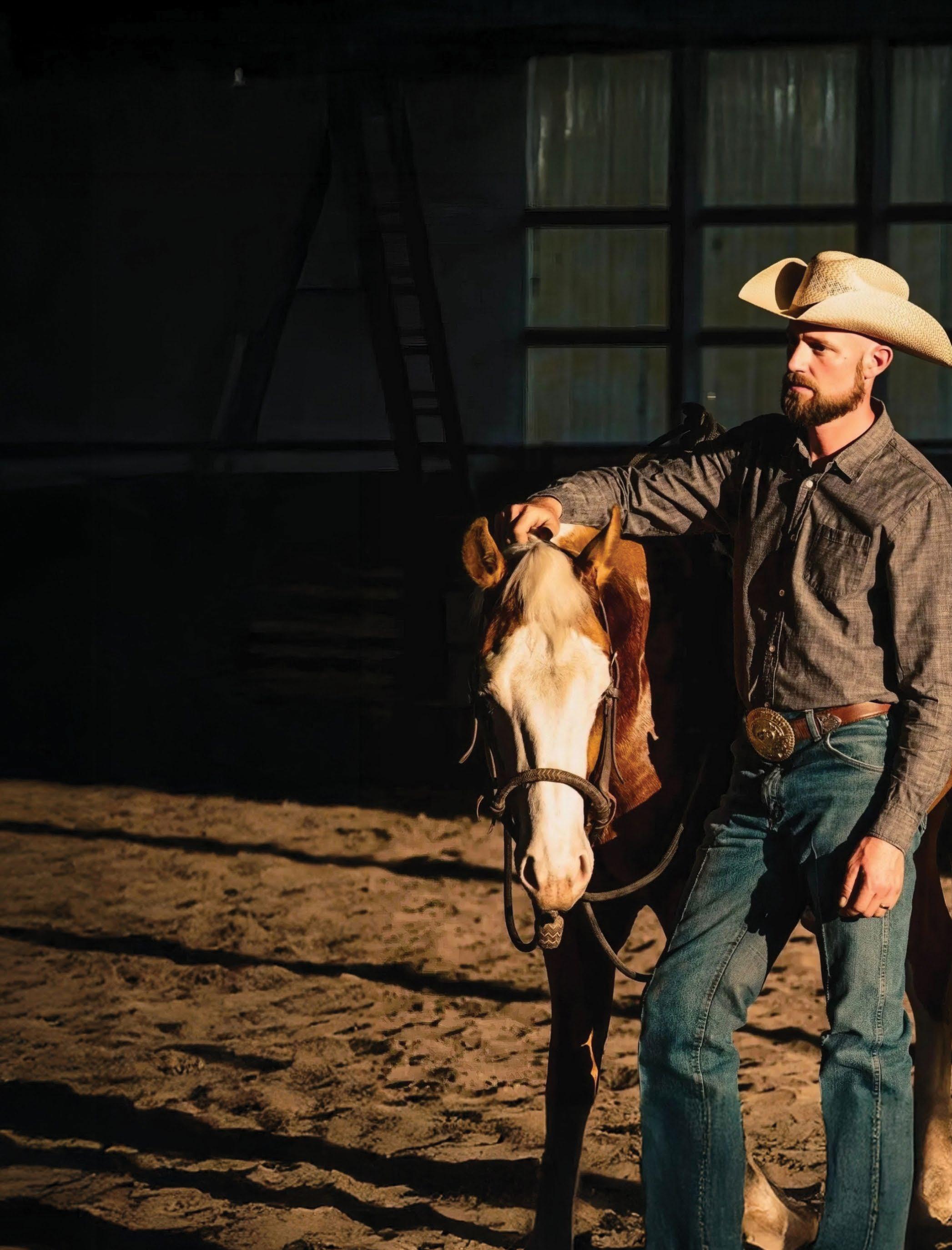
Cody Braaten has been roping for more than 25 years in British Columbia’s rodeo community with many accomplishments under his belt! His career began in high school rodeo, continued through college competition, and into the amateur circuit, where he earned two BC Rodeo season championships.
Today, he lives in 150 Mile House with his wife, Courtney, and daughters, Ella (8) and Savannah (2). While he continues to compete as a team and calf roper, he has become known for his roping clinics. Ask anyone who has attended one, and a common description quickly emerges—he is fun, funny, and kind.
His clinics are beginner-friendly and welcoming, with instruction tailored to all experience levels, from first-time ropers to advanced riders. Formats include ladies-only sessions (Ladies and Lassos), youth clinics, beginner and intermediate instruction, and sessions featuring live cattle.
Well known for his patient approach, he takes time to watch each rider, listen to their goals, and make small adjustments that build confidence and consistency over time. Learning, he says, should feel approachable. “I want people to enjoy the experience,” he says. “When you’re having fun, you’re more likely to stick with it.”
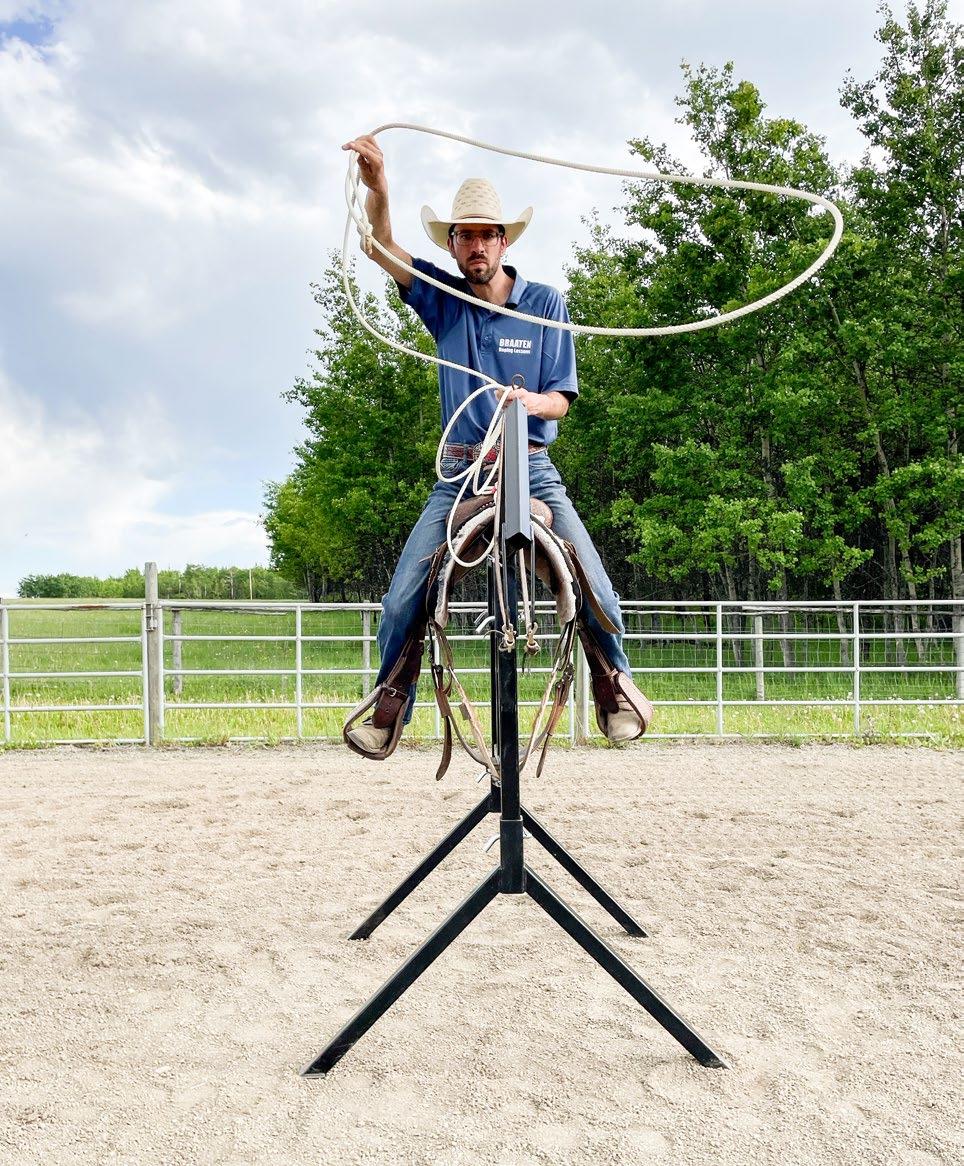
And like anything, improvement comes through repetition. To help students keep developing between clinics, he uses training tools including the Phony Pony (practice horse), the Heeling Helper (ground dummy), and the Breakaway Buddy (roping sled)—allowing riders to work on timing and technique outside the arena.
Roping Fundamentals – Part One
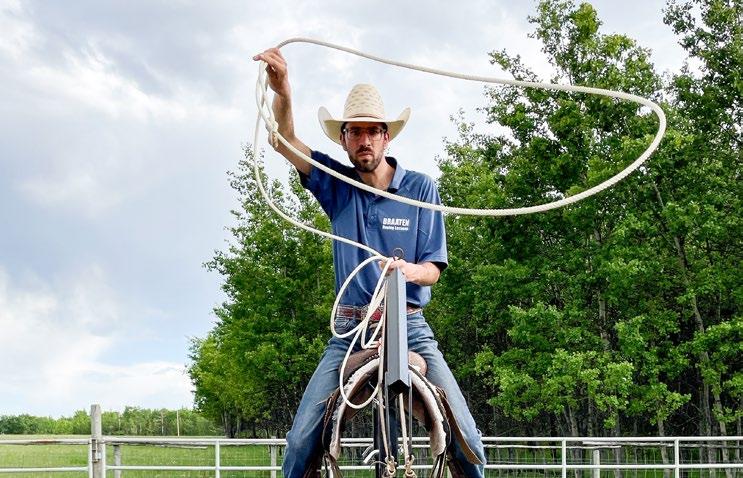
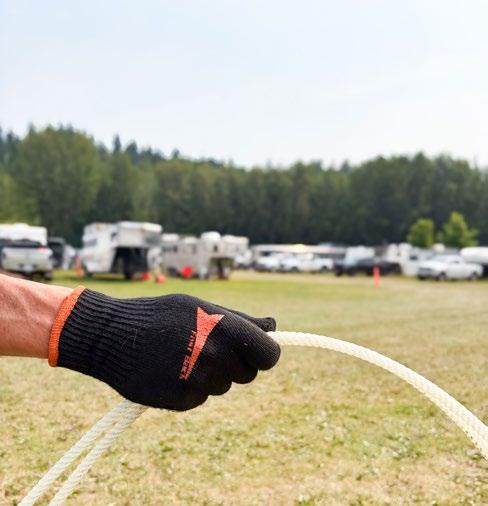
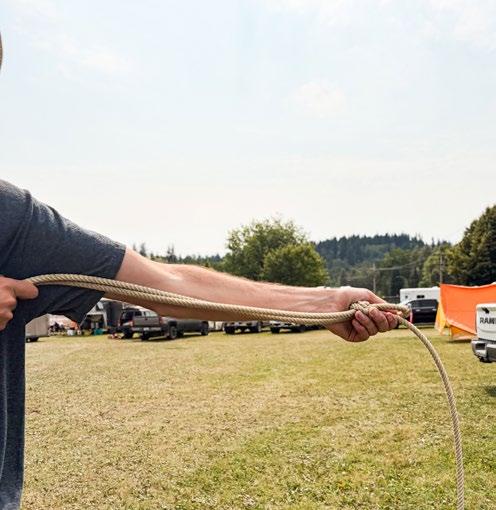
Start with a comfortable loop size — one of the most common mistakes beginners make is building a loop that is too small. While bigger doesn’t automatically mean better, a properly sized loop will feel comfortable and controllable. An easy rule of thumb when starting is to make the loop the same height as you and ensure your spoke is approximately an arm’s length. “Spoke” is the distance between the hondo and where you hold your hand on the loop.
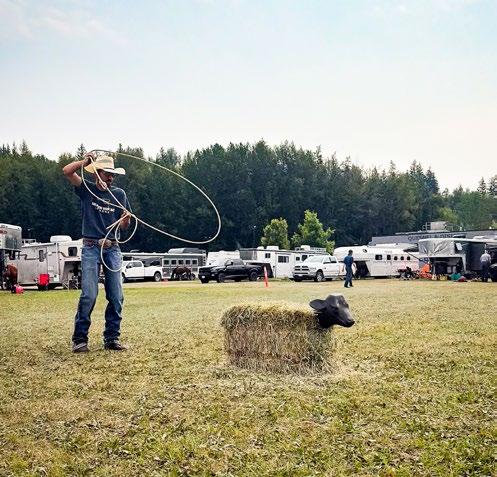
Smooth and Consistent Swings – Many beginners try to swing the rope too fast. Instead of focusing on speed, work on creating a smooth and controlled motion. The speed and motion of the swing should be the same throughout. To start your swing, bring your arm back and pause, then bring it forward and around your head in a large circle. During your swing, think about your hand pouring out a glass of water as you bring your loop forward to your target each swing.
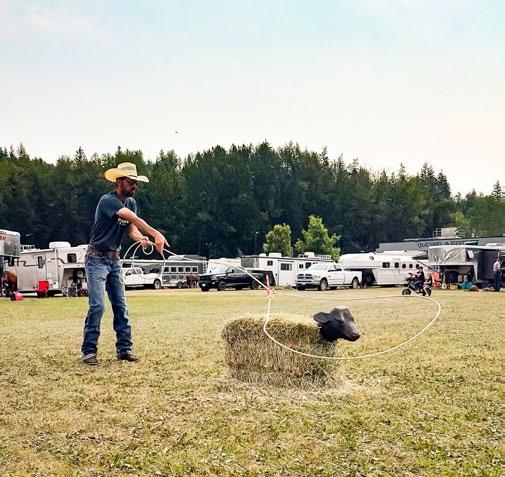
Angles and Delivery – It is important to ensure that your rope is pointed at your target while you are swinging to allow the rope to be easily guided onto your target. A proper delivery is completed by following all the way through to the target in your release. While roping, ensure that your shoulders are square to your target; this allows for you to easily point your rope towards it each swing. For many ropers, they find it helpful to point with their index finger while swinging their rope. This allows them to “find” their target with their finger each swing.
Starter Equipment
Safe horse – Calm and steady partner for timing.
Practice rope – Soft rope for control and repetition. A head rope or calf rope will work well depending on your desired discipline.
Bonus Tip
Consistency is something that should be done across all aspects of life but is especially true when applying it to learning or growing a skill. Fifteen minutes of roping the dummy every day is better than two hours on Saturday; exercising your horse all week is better than a long ride on the weekend, and stretching or working out regularly is better than going hard when you “have time” or “feel like it.”
Cotton Glove
Cody Braaten offers clinics, demonstrations, and online coaching; he can be followed on FB, Instagram & TikTok under “Cody Braaten Roping Lessons” or emailed at braatenroping@gmail.com
Action photo on the Phony Pony taken by Bernie Hudyma. Roping series taken by Courtney Braaten.
McGuinness
By Danika McGuinness with Cody Braaten
Dummy – Builds accuracy before live cattle work.
Modern-Day Medieval
Sound the trumpets!
Knights
By Laureen James
“If you don’t wear armor, you’re a shish kebab.” — Medieval knight Darrell Bossley
It Was a Faire Experience
“Welcome, esteemed readers, lords, ladies, and gentlefolk, to the first Millarville Medieval Faire & Artisan Market! As the sun rises over the Faire grounds, heralding the dawn of something new, we stand at the beginning of what we hope will become a cherished gathering for years to come. From the thunder of hooves in the jousting field to the hum of the artisan marketplace, from music and laughter to moments of quiet wonder, the Faire offers a wealth of experiences for all who pass through its gates. Yet, beyond the spectacle and merriment lies something deeper—a celebration of community, creativity, and the spirit of those who bring such a vision to life.” Excerpt from A Message From Medieval Faire Canada’s Magazine & Show Guide 2026, Millarville Medieval Faire.
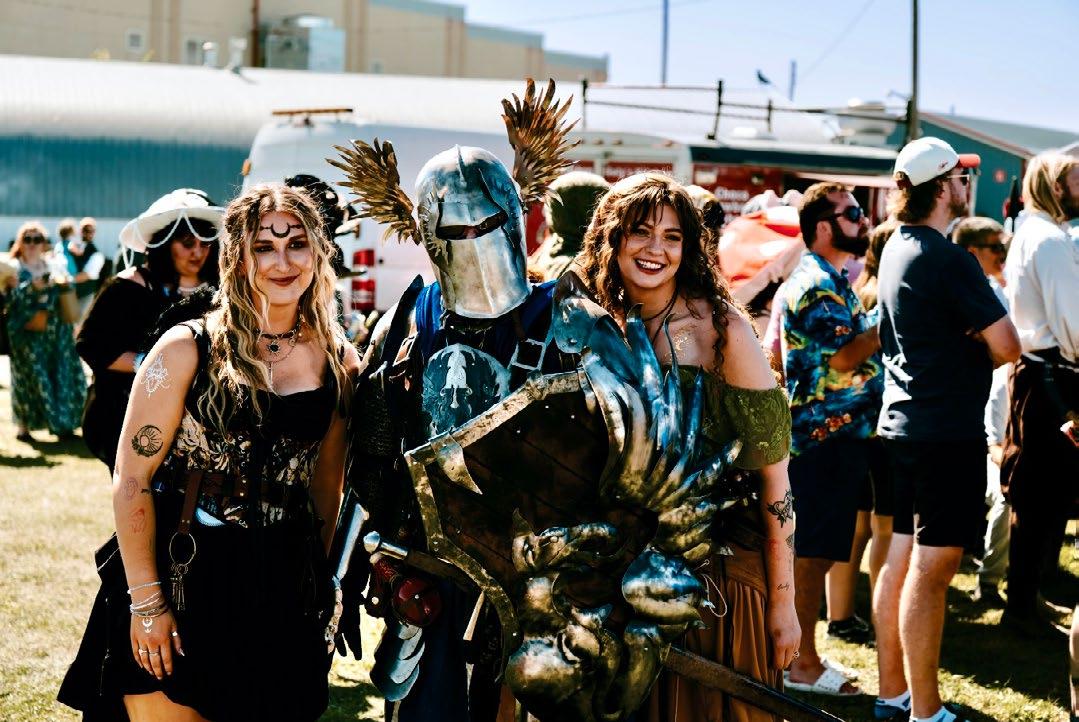
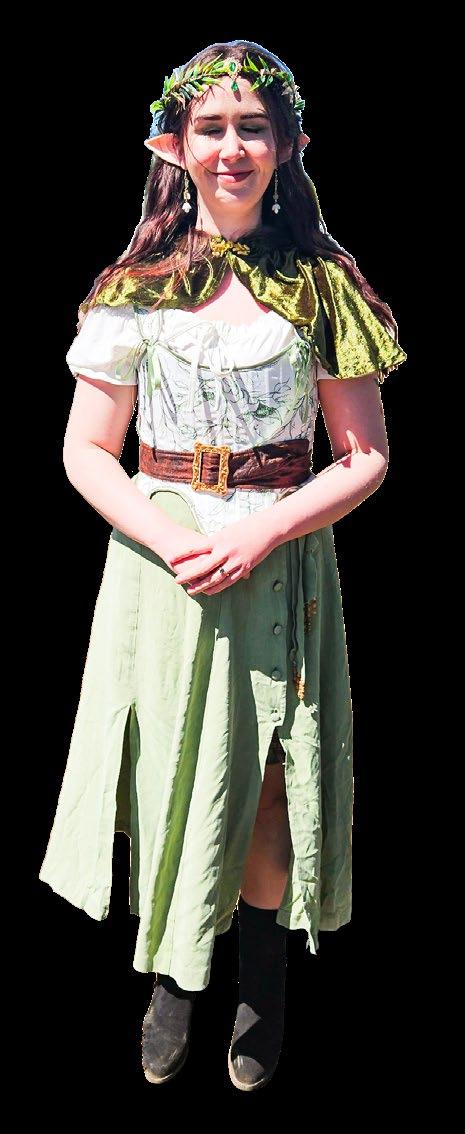
I entered the Faire grounds and was immediately ushered into another time and realm. Lords and ladies, woodland fairies, and armoured knights gathered to eat turkey legs and listen to musicians. Many Faire-goers were in awe of the elaborate costumes and stories behind their creation.
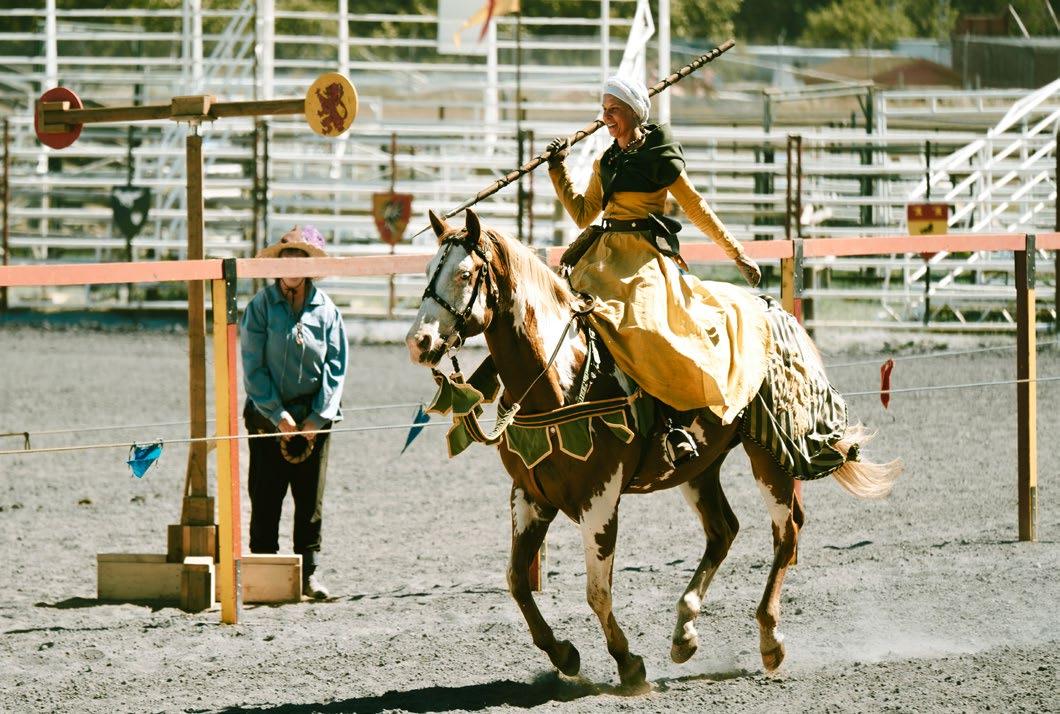
As I walked further, I noticed there were groups of people heading towards the grand stand. I checked my program and was happy to see I had made it in time to see the STALC (Society of Tilt and Lance Calvary Intl.) Skill at Arms demonstration.
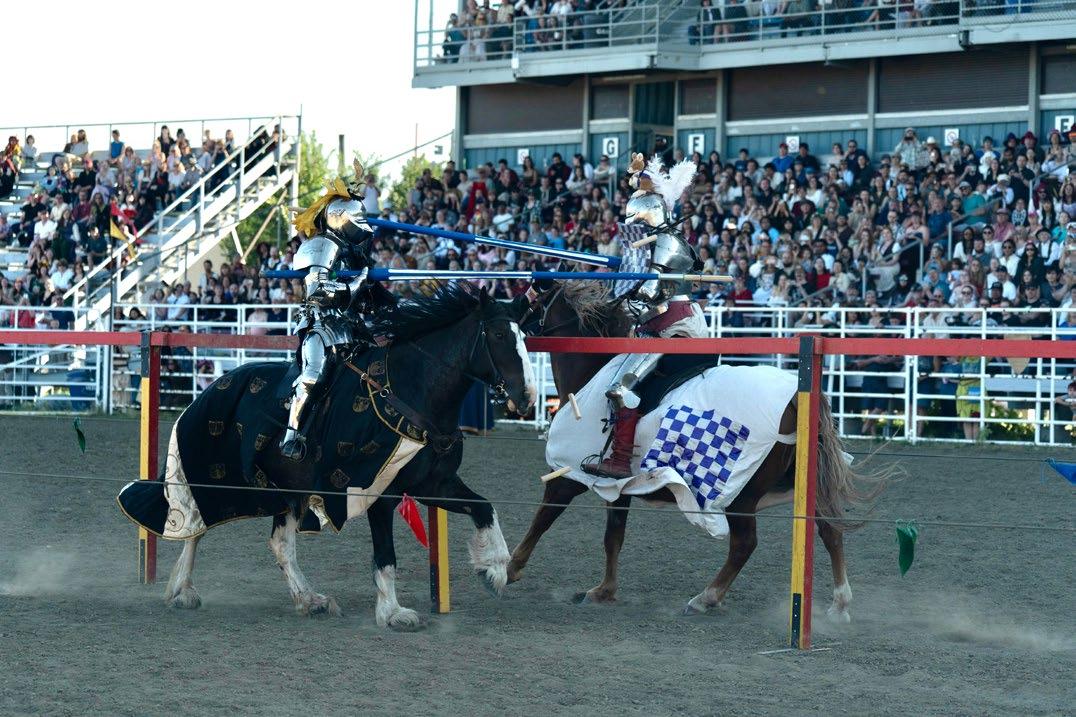
Skills at Arms, as explained by the announcer, encompasses the mounted martial exercises medieval knights used to train, maintain, and showcase combat readiness for jousting. The exercises demand great hand-eye coordination, good horsemanship, precision, and timing.
The core skills included:
The Ring Joust – where riders gallop down a track and use a lance or sword to spear small hanging rings.
The Quintain – a pivoting target that the knight must strike squarely to score points.
Heads & Reeds – in a true test of mounted swordplay. Knights galloping at top speed must slice through suspended targets or knock small wooden dowels off poles using forehand and backhand swings. I had never seen an equestrian sport like this before, and I could see the link to actual medieval history.
The horses were calm and relaxed, and there were a couple held in the background, gaining valuable experience being around the event. The announcer explained that they don’t rush the training of jousting horses and give them lots of opportunity to experience events before they are ever ridden in a demonstration or competition.
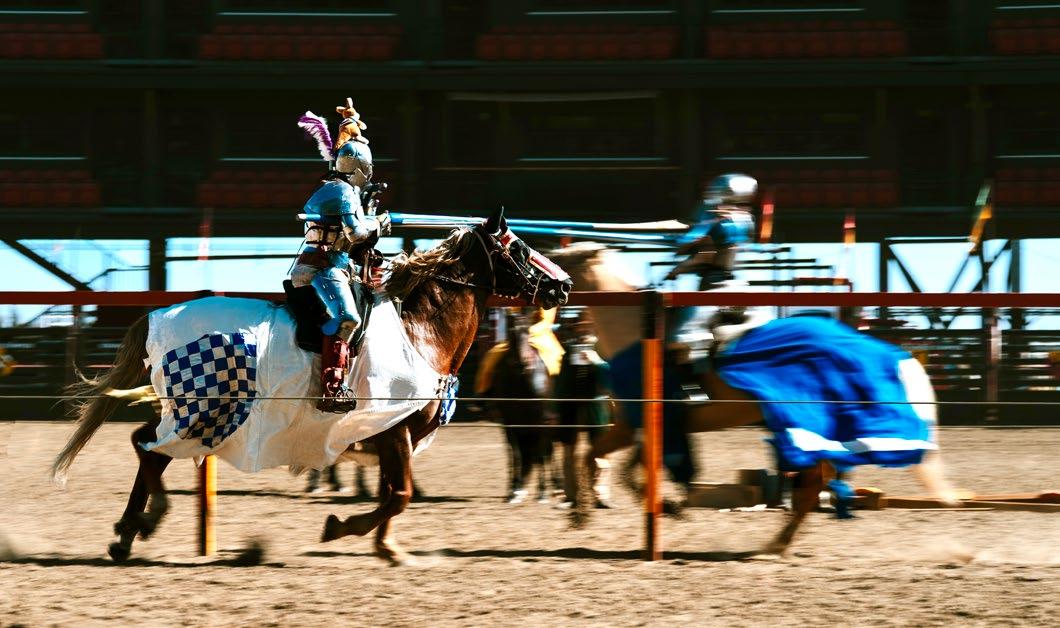
Later in the day I headed back to the grandstand to watch the knights dressed in armour jousting. The rules of engagement were explained along with the point system. Each joust was exciting, and the crowd cheered for their favourite knight. After the joust competition the knights came to the fence to answer questions about themselves, jousting, and their horses.
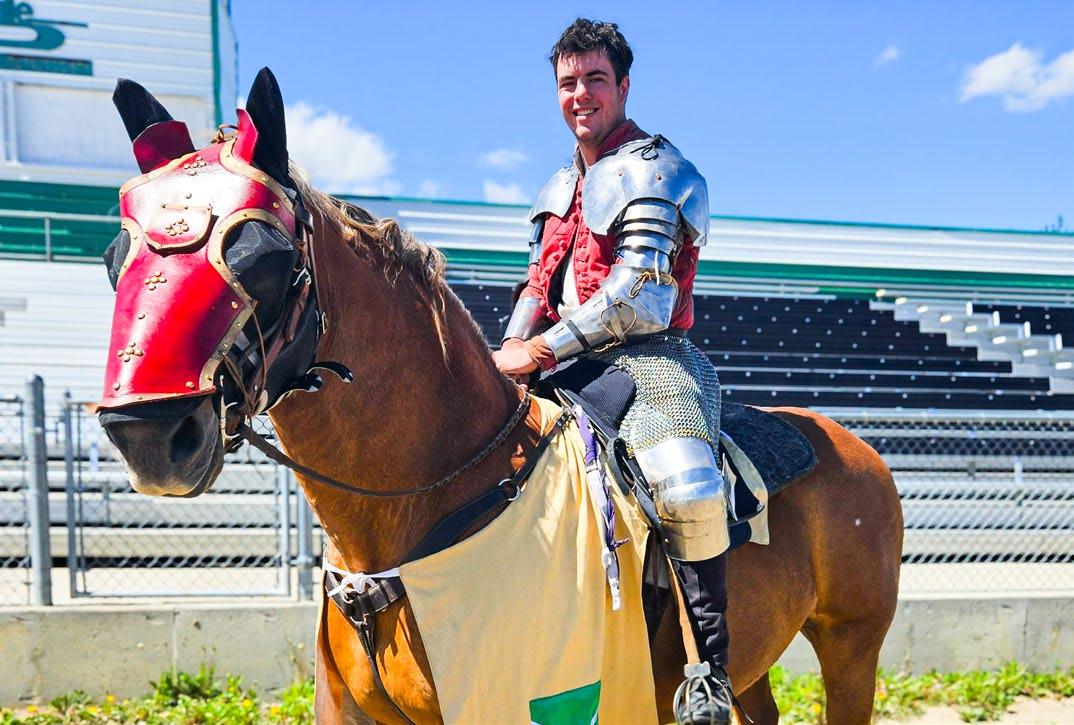
Oliver Hunter-Holland introduced himself and the horse he was riding, Atlas, to me. Turns out that jousting is an international sport, and Oliver is a jouster from Australia. His father has been a jouster for thirty years, so Oliver grew up in the sport. He shared a personal story from his childhood: “Sitting on a metal hobby horse with my stick lance, cardboard helmet, and a breastplate fashioned out of
an old plastic bucket, I liked to watch movies like A Knight’s Tale and believed I was actually in the movie.” He also spent hours riding his Shetland pony pretending to be knocked off by a rival
I asked Oliver if movies depicted real-life medieval times. His reply: “No, in the movies they show dark and drab colours, but in real history they loved lots of colour—colour represented finances and wealth and social status.” He went on to say, “The colour purple was only used by nobility and kings because it was the most expensive colour to produce.”
Just for fun, I Googled ‘jousting’ and ‘the colour purple’ and found this information. Purple dye was very expensive in medieval times; it was created from Murex brandaris, a type of sea snail. To create purple dye, a yellow fluid was extracted from the snails and exposed to sunlight until it turned a brilliant hue of purple.
The dye was called “Tyrian purple,” also known as “royal” or “imperial” purple. It was named after the Phoenician city of Tyre (modernday Lebanon). To this day purple is still the colour of royalty.
It was very expensive to make, taking up to 12,000 mollusks to produce just 1 gram of purple dye. The price of the dye
jouster.
was more than most folks made in a year. Only nobility and royalty could afford this lavish colour. Oliver continued by saying that people who are a part of the medieval lifestyle know a lot about medieval history. They study the clothes of that historical period along with what knights’ armour looked like. I asked him about the cost of armour and who makes it.
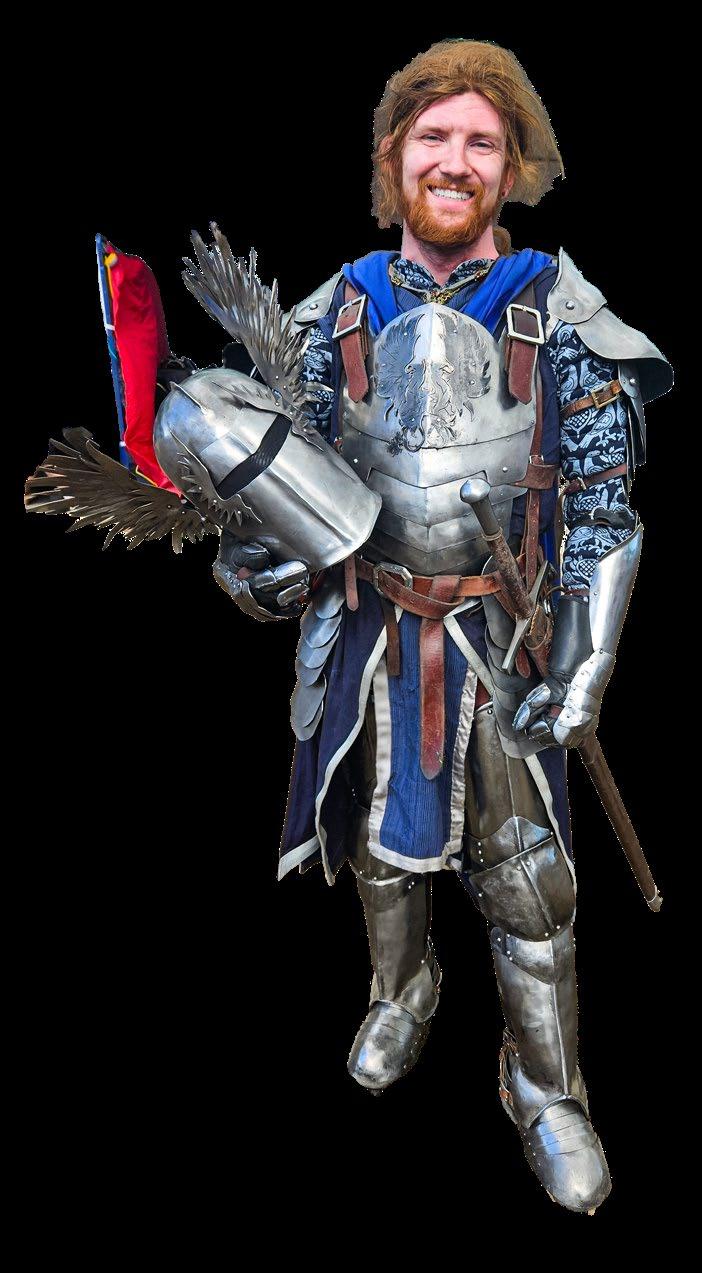
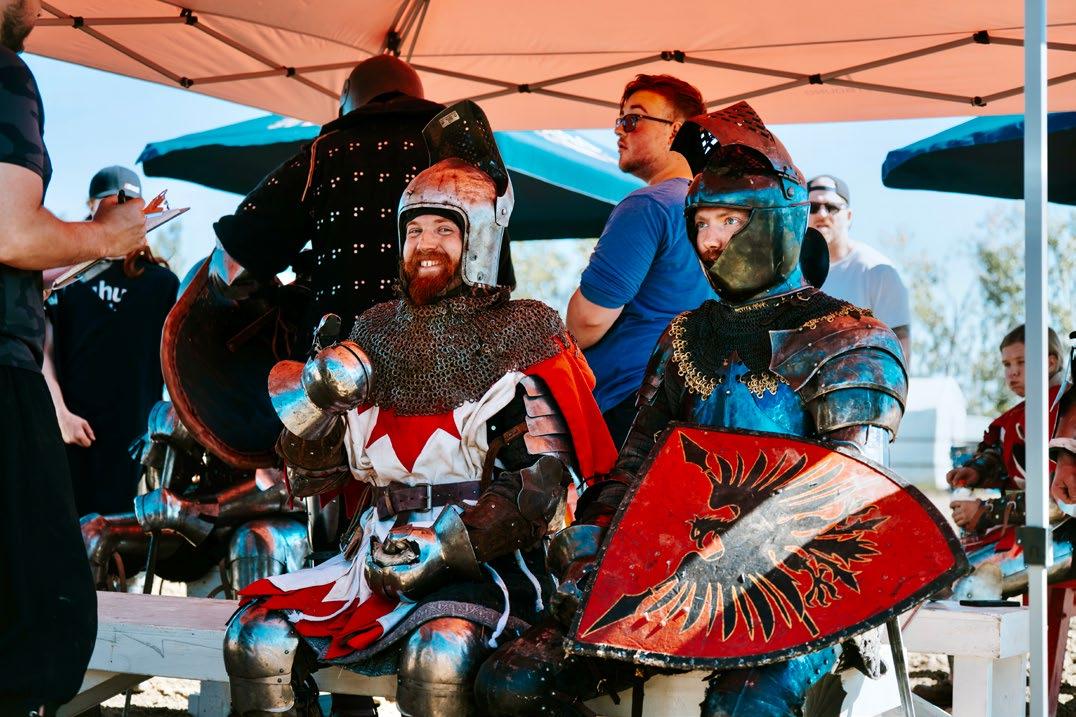
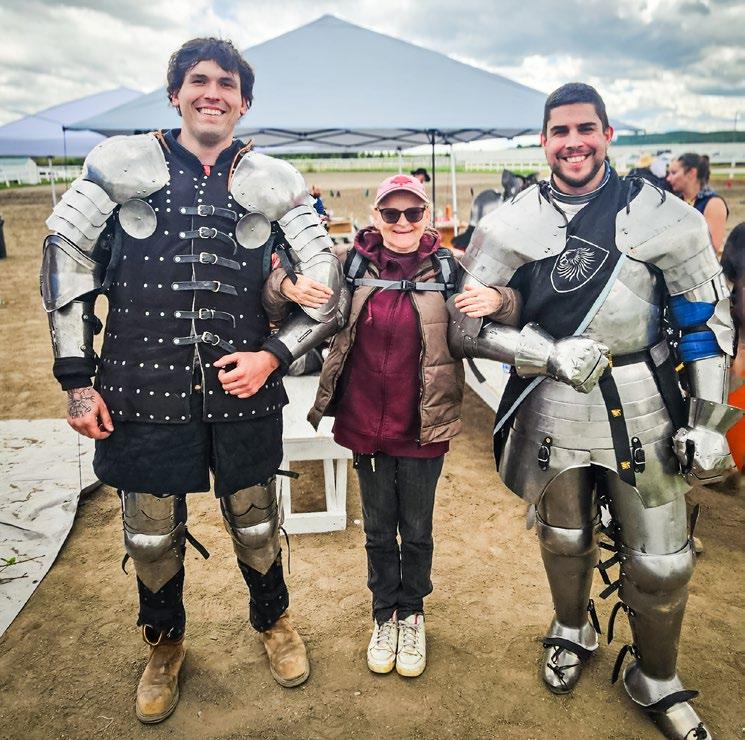
“Firstly, it’s a misconception that armour is clunky. It should be made to fit so well it’s like a second skin. In Australia a professional armorer takes 2-5 years plus an additional twelve to twenty-four months to create a suit of armour for a customer. The cost is anywhere from $10,000 to $50,000. Most people start with the essential pieces like the “cuirass” chest piece and helmet and slowly add more armour as their wallets allow.”
As I stood there listening while petting Atlas, I connected the dots that the skills at arms I had watched earlier seemed like training exercises and practice towards potentially learning to joust one day. I asked Oliver about my thoughts, and he said, “Exactly!” He continued, adding that both the rider (knight) and the horse have to learn the skills and become comfortable in a variety of environments.
I asked how he trains a jousting horse. “With patience,” he replied. “You want a steady, calm temperament; a willingness to go forward at the gallop; sufficient substance to carry a person wearing armour (no specific breed is better than another); and soundness for explosive starts and stops, and they need to neck-rein easily.”
Oliver continued his explanation of the training of the jousting horse. “It’s a long process. They have to be taught to run just about head on at each other and be ok with the noise of the armour and having a big pointy stick aimed at them. It takes anywhere from
6 months to two years to teach them to joust. The best place to start is learning Skills at Arms which gives both the rider and horse the needed basic skills.”
It was a creative and fun way to spend the weekend, and my husband enjoyed it as much as I did. We had such a good time watching jousting and sword fights and shopping for medieval wares that we have made plans to visit the Strathmore, AB, Medieval Faire in August. I might even sport a costume!
Laureen James BCom, Journalist, EC/NCCP Coach Certification IOB. Laureen is an equine journalist who writes for many publications. She also writes for the pet industry and is a columnist for Unison 50+ News. She has covered rodeos and related events over the past few years as a journalist and photographer.
Photos provided by Legend Works Events Inc. and Laureen James
Sir Oliver and Atlas
Course Management – Common Misconceptions
Show jumping is hard. And yet, it’s quite simple. How ever could this be?!
By Alexander Grayton
It’s unique to have a high-performance sport that isn’t conquered by sheer athleticism, grit, strength, effort, or individual skill.
Those are all important – crucial, in fact –but it’s not accurate to say that increasing each one of those categories to its extreme will yield better results in a logical way. Being an athletic rider or having an athletic horse are huge benefits and are indeed required. But being 10% more athletic, whether horse or rider, doesn’t necessarily mean anything. We’ve probably all witnessed horses at the very top end of the sport do some heroic things that your average midlevel amateur horse simply could never. I don’t want to minimize athleticism, but it is hard to differentiate among top-level horses in a meaningful way between their levels of athleticism and how that directly contributes to more success.
So let’s consider each of those factors as necessary, but in the sense that there’s a floor to them that horses and riders must meet or exceed to increase odds of success. What, then, is the ‘X-factor’ that, when controlling for these other credentials, makes the difference between winning and surviving, or between finding the sport relatively easy or nearly impossible? I submit that it boils down to strategy.
Strategy in training and preparation before the competition to improve these fundamental skills that are necessary for horses to be able to jump massive jumps, harnessing considerable power with pinpoint precision. But equally as much strategy at the competition on the day.
Everyone in a given competition is on a level playing field, or at least pretty close to one. Footing and weather conditions can change throughout a competition, which
can make a meaningful difference, but in general, each horse and rider will jump the exact same course and must strive for the same goal: minimize faults (i.e., rails down or refusals) and minimize time taken to complete the course. It’s easy to see that strategy should play a role here in an effort to meet these.
Another unique feature of show jumping is that nobody knows what the course is until the day of. That means all the preparation people put in at home is for a theoretical future situation that riders and trainers try to predict. It’s only on the day of the competition that riders find out exactly what they’re in for. Studying the course map and walking the course are the key moments to develop the ultimate strategy for the day, to understand how the course comes together and what that means for the unique pairing of horse and rider and their strengths, weaknesses, and tendencies.
So often when walking the course at a competition, you can hear riders and trainers talking about the order of the jumps—remembering the sequence, basically. This is important, but if that’s all the strategy is, people are leaving a lot on the table. One must dig deeper.
Remembering not only which jump comes next, but also how we get from one jump to the other is a sensible next step. How many
strides in this line should we turn inside or go around to get to the next jump and so on? This is the first place where riders’ plans may start to differ. One horse may be better suited to leave a stride out in a line and then go around, while another one may do one more stride and turn inside; both can yield a successful result and winning plan and depend entirely on the horse and rider pair and the tools they have at their disposal.
This is often where people get muddled in comparison, for all the wrong reasons. As I have referenced in previous articles, I am a stickler for wording and get stuck in the semantics—un-regrettably so, I might add. You can hear people say, “That’s a 6-stride,” or “That is a forward 8.” Something to that effect. And my contention is that those statements could be true but also aren’t necessarily true for a given situation.Watch any high-level competition and observe the variability of situations that horses and riders navigate differently yet produce the same result (a competitive clear round). Someone will do a quiet 9 stride instead of the forward 8. The 6-stride can easily become 5, given the right circumstances. What are the circumstances, you may ask? They are entirely related to the horse.
Take United Touch S—the current European champion with Germany’s Richard Vogel. Watch any competition he jumps in, and you will notice immediately that he does a different number of strides than almost anyone else in a large proportion of situations. Sometimes he matches other people’s strategy, but often he does one less stride, given United’s massive way of going and ability to remain elastic in such a large size. The “forward 8” referenced above becomes a short 7 for United.
The first point I would like to underline— develop a strategy when walking a course that actually makes sense for your horse. Don’t copy what everyone else is doing. Comparison is the thief of joy, as they say, but I would assert that comparison is the thief of success in this case.
The second point about strategizing and managing a course is understanding how the segments of a course fit together so well that when an unforeseen situation inevitably happens, you can ad-lib accurately, sensibly, and immediately. Having a plan from walking the course is a great start. But then when your horse slips a bit around the corner or spooks away from the timer, putting you on an inside track you didn’t mean to be on, what you do next is so important and not at all random.
If you understand the course and your plan, you will simply adjust to get back to the plan. That may mean now that you’re on the inside track, you might do one less stride, land from the next jump, and shift back out to get to where you wanted to be. Or, you might work hard to correct the track back to the middle and shorten the stride significantly because you still want to get the same number of strides heading into a short combination. There are innumerable options, and our ability to cope and manage stems from understanding the course to be able to make changes. Understanding the plan so deeply is what makes changing the plan on the fly a very reasonable thing to do when based on feelings in the moment.
The third point I find to be extremely important when making a plan for a course is to understand when to shift gears. Course designers will make riders change their horse’s strides at inconvenient moments, which is just a statement of fact to make the courses challenging. Riders make their own lives inconvenient when they go slow when they should be maintaining a stride length or go fast when they should be shortening. Notice first that I’m referencing stride length and not speed. I have spent a lot of time picking apart the myth of pace being fundamental in other articles, so if you need a refresher, please revisit those. For this purpose, let’s talk stride length, as it is more accurate.
People say “come forward through the turn” a lot. And sometimes that’s a fine thing to
think, but often it’s very, very wrong. The best analogy for this is Formula 1. It is so incredibly related to show jumping in terms of strategizing this component. Just imagine Max Verstappen hears on the radio, “Make sure you hit the throttle through the hairpin turn.” What would happen? Off the track, immediately. This is mind-blowing to me, that people treat horses like physics doesn’t apply to them.
If you want to make a tight turn, then there’s a big jump just after it. I strongly suggest you don’t “go forward through that turn” unless you want to sputter out of the turn, almost missing the jump, and have the weakest canter by the time you get there. There is only so much outside leg a person can ride with to counteract physics. The simpler tactic is to shorten your stride heading into and through a tight turn (just like Max!) while keeping the impulsion (because there’s no rule against maintaining power when you shorten if you have been practicing collection), setting the stage to step back up out of the turn (also just like Max heading to the straightaway).
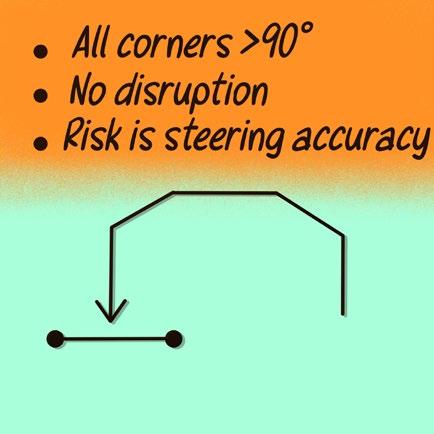
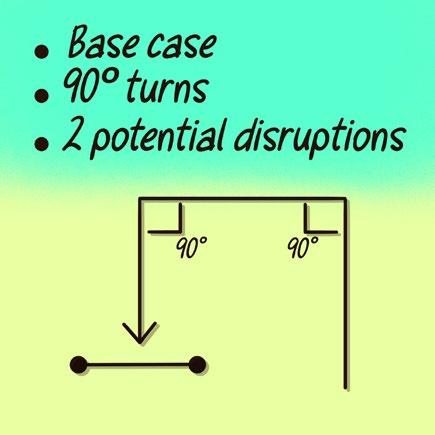
As a general rule, I like to think that if a turn is going to be 90° or less, it will impact your canter. And it should. It shouldn’t be the goal to maintain the same canter through a tight turn (i.e., less than 90°); it should be understood that the canter stride must change to maintain balance and power in an effort to leave that turn ready for anything—especially the jump.
If you were driving your car into a parking space at the grocery store, let’s say, it wouldn’t be a virtue to say you were able to make the 90° turn into the parking spot between two cars in cruise control. You would likely hit both cars and terrify onlookers. Of course you would slow down as you execute the turn. What’s the difference with a horse, you may ask? The answer is outside aids—a leg and rein. If the rider applies outside leg to counteract the physics pushing the horse to the outside through a tight turn, they may be able to stay on the desired track, but it isn’t without cost. Just because you can doesn’t mean you should.
The reliance on traction becomes a major factor—the use of the outside leg translates into additional torque in the horse’s feet pushing laterally against the footing. And in modern arenas with sport footing or grass arenas when using corks, that is a
possibility—to a point. At some point the footing can’t withstand the lateral shear, and it may slip. I would argue that if you’re relying on the footing to let you turn wildly as a general practice, that’s a big risk. Not to mention one has to consider the torque translating through the horse’s legs—the biomechanics are strenuous and, again, quite risky over time.
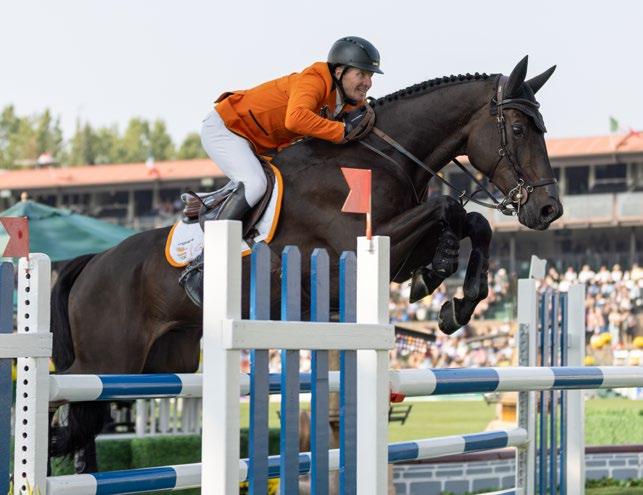
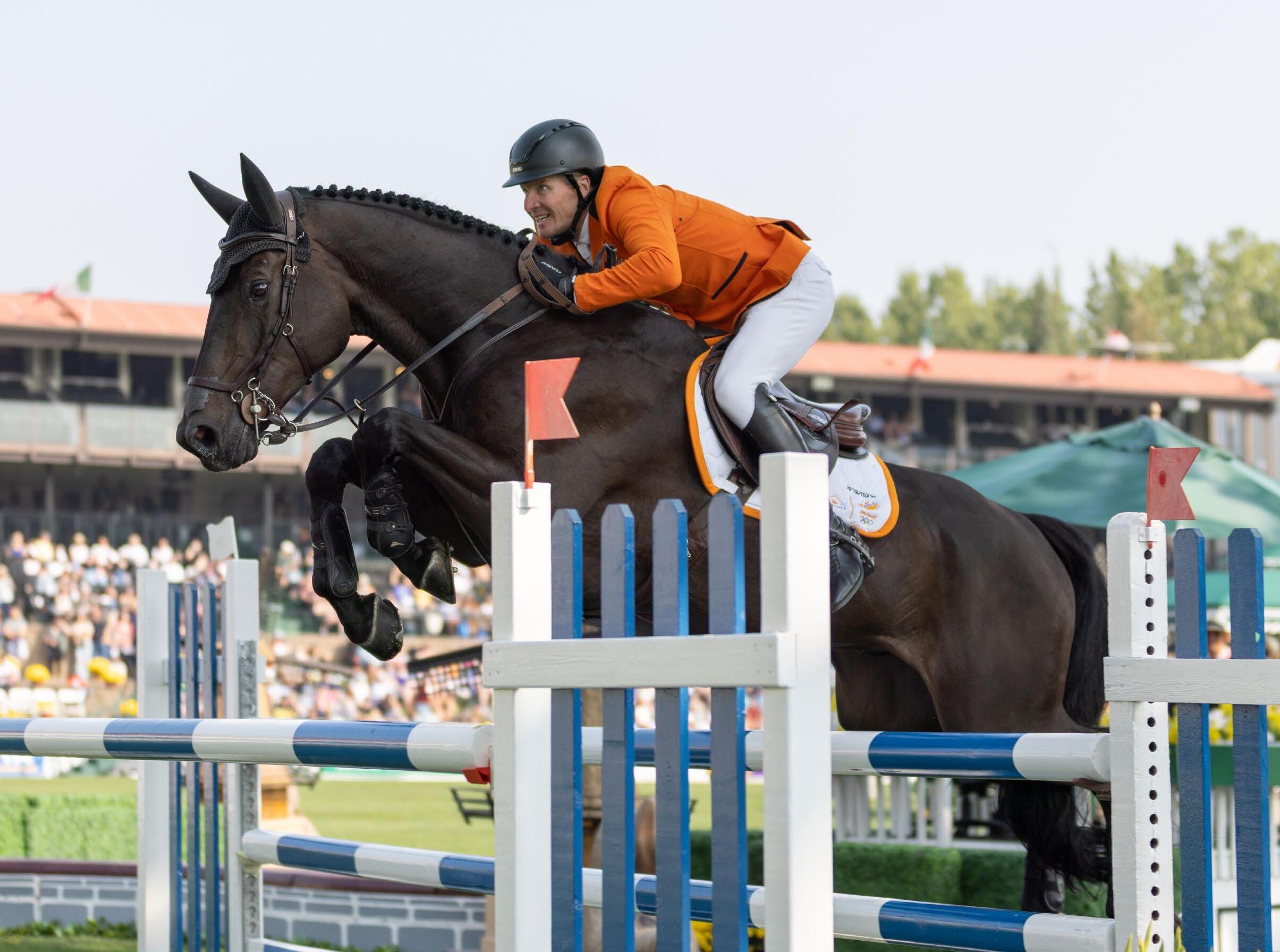
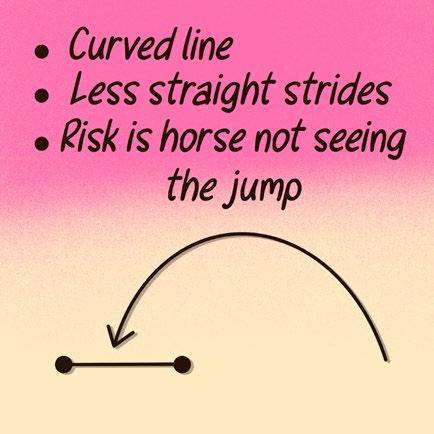
So what’s a better plan? This is the good news: there are two very easy options: understand the course so well that you know when the turns will be tight or not and adjust your stride accordingly to maintain balance and power so the horse is ready to step forward and jump at any moment (this is why a person should walk the course to make this kind of plan!). And, if for some reason you don’t feel like shortening the stride through a tight turn is a reasonable option (perhaps because you need to have a big stride for a big oxer or forward line coming up, etc.), then adjust the track on the approach to transform a tight turn into more sections, where no single part of the turn is less than 90° (see attached images).
There are a lot of ways to dig deeper and deeper into the technical parts of the sport, and it’s always a worthy endeavour to better understand what happens at the highest level. Truly, this is the level of understanding that riders should (and do) have at the highest level, even if it’s never put into so many words and is just felt intuitively.
But when walking courses at all levels of competitions, there are still plenty of riders and trainers who are missing the point or forgetting (or don’t know) some key parts of how things come together that lead riders down the wrong path, focusing on red herrings (“go forward through the turn” is simply not good information for some turns) instead of increasing understanding to be able to execute an intricate plan with our equine partners, who unfortunately can’t speak English but have hearts of gold and try to figure out what we mean.
Alexander Grayton is an accomplished international show jumper, coach, trainer and clinician. He has amassed a significant resume of Grand Prix wins and championships while staying true to his values and ethics of training, integrity and advocacy for the horse. His approach to training is rooted in precision, patience, adaptability and a fundamental understanding of the horse, all with a focus on high-performance competition. Visit graytonfarms. ca or follow @grayton_farms on Instagram for more information!
Photo by Jessie Campbell of Bluebird Photo
With Tales Cat
Horse Conversations Beyond the Competition
The Horse Tales with Cat podcast began two years ago as a passion project born from Catherine Shearon’s curiosity to hear the stories of riders and professionals beyond the typical interview, evolving into a series of conversations that connect listeners to the broader equestrian community, sharing the challenges, setbacks, and lessons that shape their journeys in the sport.
We asked Catherine to choose a few episodes she felt Saddle Up readers would enjoy. Here, she shares the stories behind her conversations with Michel Vaillancourt, Kyle King, Beezie Madden, Shane Sweetnam, and McLain Ward. We invite you to tune in and discover their stories for yourself.
Michel Vaillancourt - Makes Magic in Montreal, Ep. 46
This July marked the 50th anniversary of Michel Vaillancourt and his horse, Branch County, winning the individual silver medal in show jumping at the 1976 Olympics in Montreal (although the event actually took place in Bromont).
At 22 years old, Michel Vaillancourt was a long shot to qualify for the team, especially with a young horse that had no international experience. Couple that with an incredibly difficult course, a jump-off following a deluge of rain, and an unexpected delay after warm-up, and you begin to appreciate just how extraordinary his accomplishment was.
Their story played out like a movie. They were an unlikely pair to qualify, and the fact that they secured a medal makes it all the more remarkable. Michel has gone on to have a successful career as both a coach and course designer and has no regrets about any of his choices. I would say that is about as good as it gets in the horse world.
50 Is the New 40 - Kyle King, Ep. 32
The backstory behind Kyle King’s episode was so much fun. I initially reached out by phone the week after he finished second in the 3 million $ class at Spruce Meadows in 2025. It was evening, and he was in Rome on a moped in front of the Trevi Fountain when he answered. It was such a pleasure to feel like I was sharing in such a special moment, even though I was 4,000 miles away. He showed up with warmth and enthusiasm and never seemed rushed, even after a full day of showing.
Kyle King is no stranger to winning, having amassed many Grand Prix victories over the years. He has continued his success at the 5* level while embracing the challenge of developing the skills needed to navigate the demands of the sport at this level. Now a Canadian citizen, he proudly competes under the Canadian flag.
In a League of Her Own - Beezie Madden, Ep. 21
Beezie Madden remains America’s favorite rider by all accounts. I “fan-girled” a bit, as I have looked up to her for as long as I can remember competing. She surprised me with her shyness. There is a nervousness about her that you don’t expect because she is so confident and decisive on a horse.
She was very gracious, and I felt as though she was letting us into her inner world and revealing some of the secrets to her success: putting the horse’s needs first, focusing on the fundamentals of posture, and surrounding yourself with good people. She shared stories of some of her favourite mounts and biggest wins, as well as the horses that surprised her along the way.
Purposefully Patient - Shane Sweetnam, Ep. 44
What immediately struck me during my conversation with show jumping legend Shane Sweetnam was how in tune he is with his horses and how his partnerships with them are always evolving. He believes there is no single mold that fits every horse. Each one needs to be in the right place, at the right time, and in the right state of mind. He was also the first rider to talk to me about ring IQ—the ability of great horses to figure things out while they are competing. In fact, he believes they may learn more in the ring on competition day than they do while practicing.
Shane also has a great system for managing his nerves and, like many accomplished riders, is quick to give credit to his support team, especially his wife. I walked away feeling that I had met someone who has truly mastered the art of show jumping while maintaining tremendous respect for the sport.
McLain Ward has carried the pressure of trying to be “the best” since he first found success in the equitation ring, winning both the USEF and USET Medal Finals at the age of 14. Thirty-six years and five Olympic medals in show jumping later, he is very forthcoming about the pressure he still feels and the anxiety—especially on those days when he is the anchor rider for the team.
However, he is quick to admit that grit, determination, and hard work have always been on his side, and ultimately his competitive nature wins over his nerves.
Listen to Horse Tales with Cat on Apple Podcasts, Spotify, Buzzsprout, and YouTube. Catherine Shearon is the creator and host of Horse Tales with Cat podcast, available on Apple Podcasts, Spotify, YouTube, and Buzzsprout. An amateur jumper rider for more than 38 years, Catherine has trained with Jill Henselwood and Ian Millar while balancing multiple jobs to support her passion for the sport.
Photo from Catherine.
BCVRHA’s Cowboy Summer Classic
By Danika McGuinness
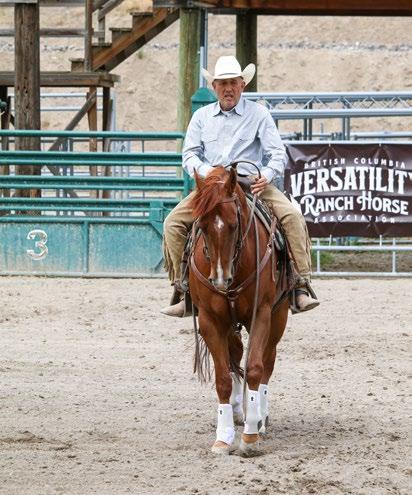
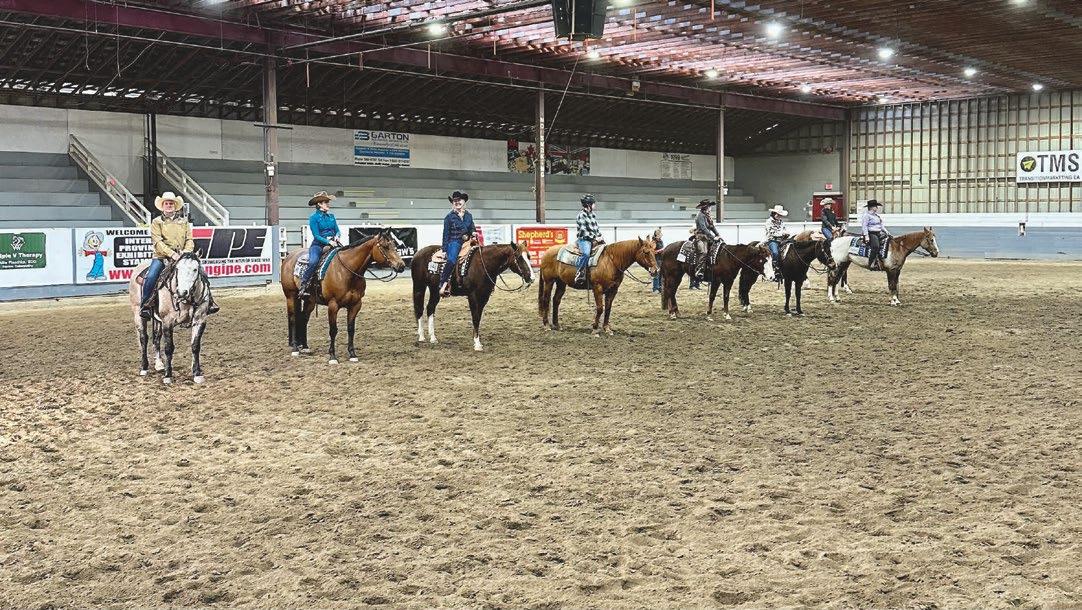
In Merritt, BC, the rodeo grounds were packed with enthusiastic riders and impressive horses over the July 10–12 weekend for the inaugural BC Versatility Ranch Horse Cowboy Summer Classic Show. The event highlighted the mission of the newly formed BC Versatility Ranch Horse Association (BCVRHA), which is in its first year and already making a name for itself by showcasing the versatility, athleticism, and partnership between horse and rider.
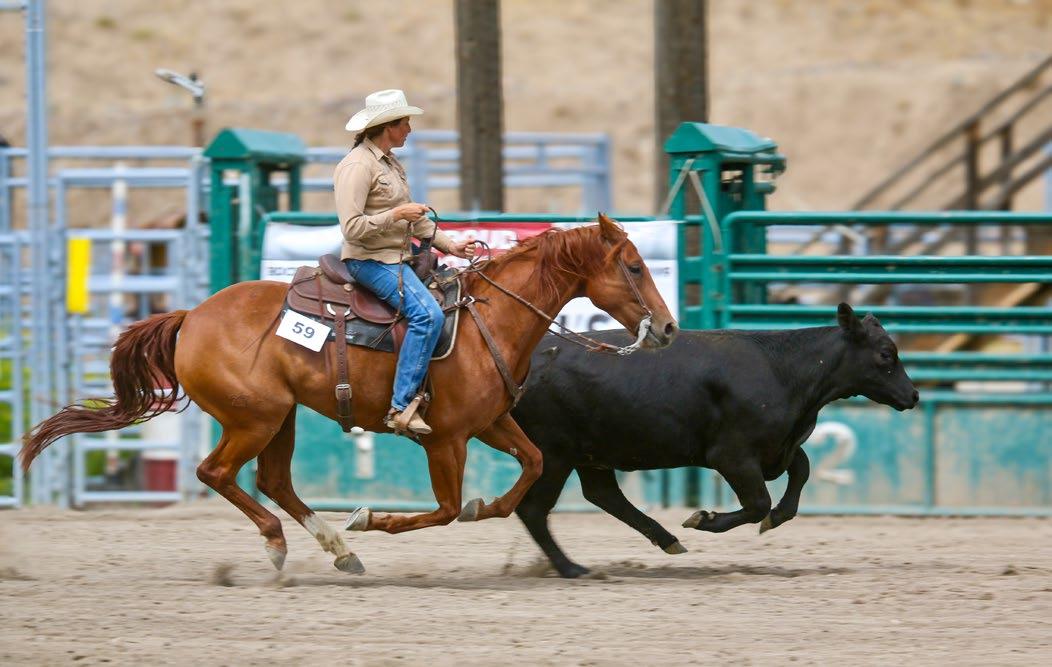
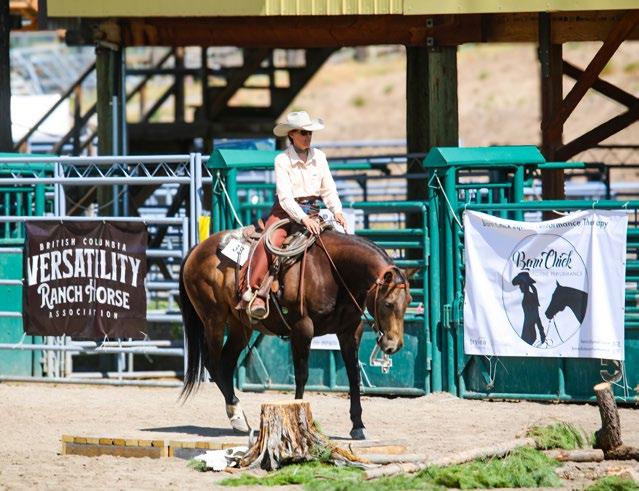
With 10 rider divisions, the competition accommodates a wide range of rider experience levels and horse abilities. Horse-and-rider teams showcase their skills across five different disciplines—cutting, cow work, ranch riding, ranch trail, and ranch reining—highlighting the horse’s versatility, athleticism, and partnership with its rider.
BCVRHA brought in world-class judges John Snyder from Colorado and show manager Holly Irish from Texas, who willingly shared their knowledge, offered guidance, and provided coaching throughout the event. During each competitor’s run, Holly was there on the sidelines, offering helpful coaching and support.
The weekend kicked off on Friday with a pre-show clinic led by John and Holly. Thirty riders had the opportunity to work cattle, practice their trail pattern, and refine either their reining or horsemanship pattern. Saturday started early with the cow-work classes. A special sponsor shout-out goes to Beaver Creek Ranch Ltd. for supplying all the cattle for the show—it would not have been possible without their support.
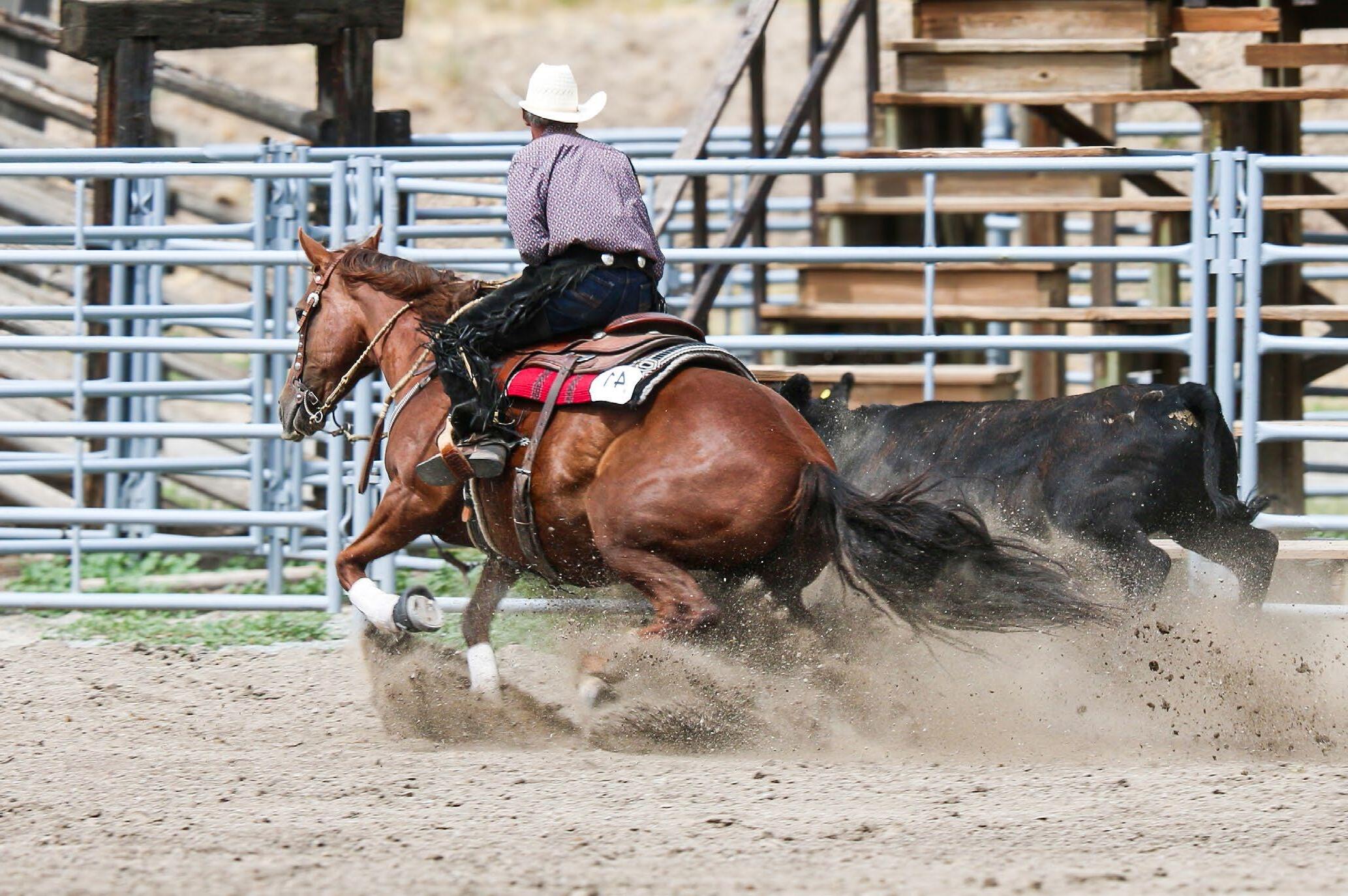
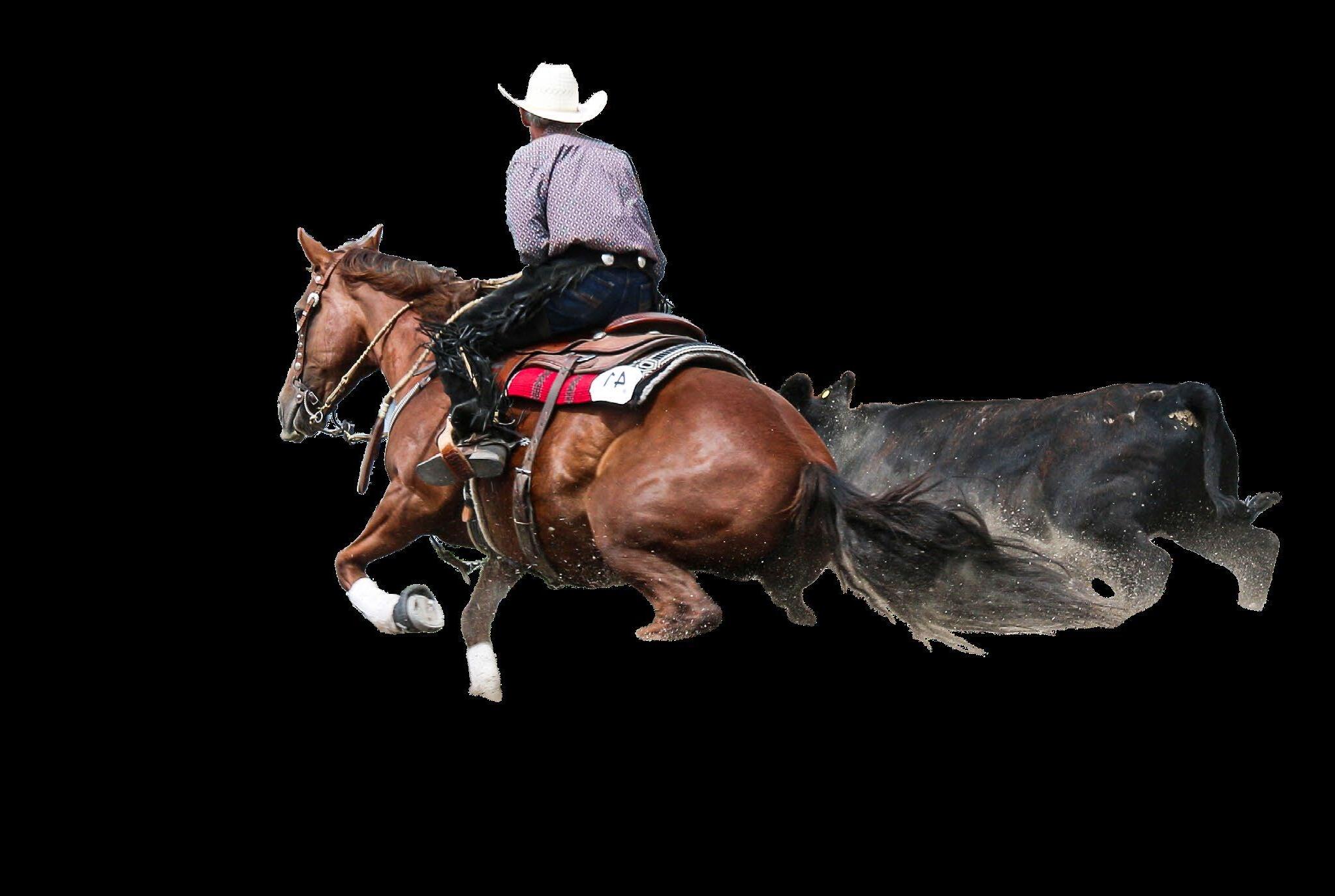
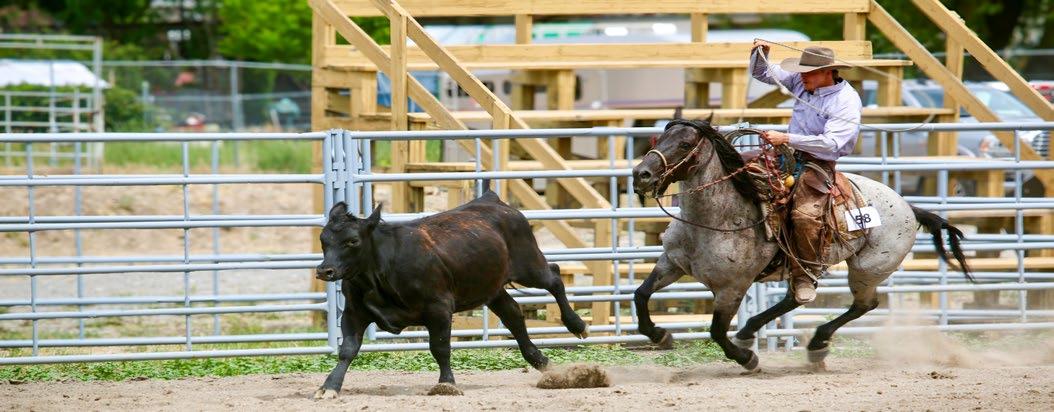
In my opinion, the cattle work is one of the most thrilling events to watch. There is nothing quite like cheering on friends and competitors as they challenge a bovine down the fence and showcase the partnership between horse and rider. Andy Jones and his horse, Kit Siss, had one of the most exciting rides of the day. After rolling the cow back on the first turn, with sand flying and the crowd cheering, Andy’s hat flew off. The look of sheer grit and determination on his face was unforgettable as the pair continued on to circle the cow in both directions.
Saturday night featured the Future Stars Class, where young riders ages 3–10, aspiring to one day compete in the show pen, had the opportunity to showcase their skills. Following that was the Trail Stakes Class, the spotlight event of the evening, with $1,000 added. Ten competitors navigated a challenging pattern built to AQHA World Show standards, featuring a drag, flying changes, and even a dismount and trailer-loading obstacle. With a smooth flow throughout, the course challenged both horse and rider while providing an exciting spectacle for the crowd. The winner was Debbie Hughes aboard YC Crime N Country, and it was well deserved, as the pair delivered a nearly flawless performance.
Sunday featured the dry-work classes in ranch trail and ranch riding patterns. The show also introduced a new division for competitors who wanted to participate in the Dry Work Challenge without competing in the cow events. This was a great reflection of BCVRHA’s commitment to creating an inclusive, welcoming show where riders of all levels can participate, have fun, and feel part of the experience.
It shines through that the team at BCVRHA is working hard to build something good. It’s not just a place to go and compete; it is a community they are building with opportunities to learn and grow. A supportive, safe haven to cheer each other on. This is just the beginning of an association that has the potential to create a positive, lasting impact in the performance horse industry, and I encourage you to saddle up and join the ride!
Photos by Danika
Danika McGuinness lives in the mountains of the Cariboo with her husband and two boys. Together they manage a small piece of land. Danika is also a leather artisan. To learn more info on Danika’s leather works and written works, please go to jackpinecowboy.com/blog,
Andy Jones and Kit Siss
Haley Rutherford and Ears Are Burning
Danika McGuinness and Riske
Wendell Stotlzfus
Chance Zweifel and Grace
NO FLY
Zone Zone
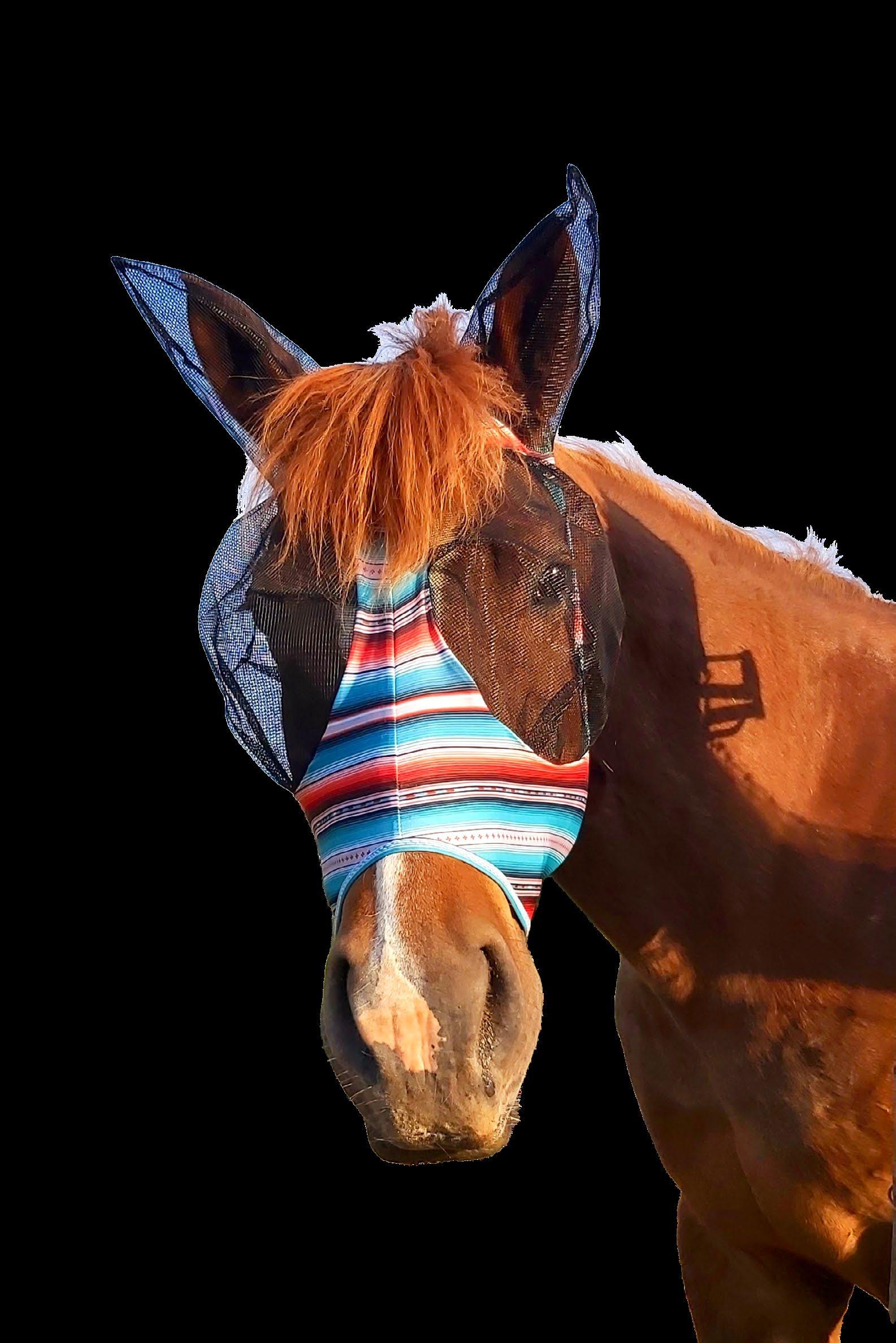
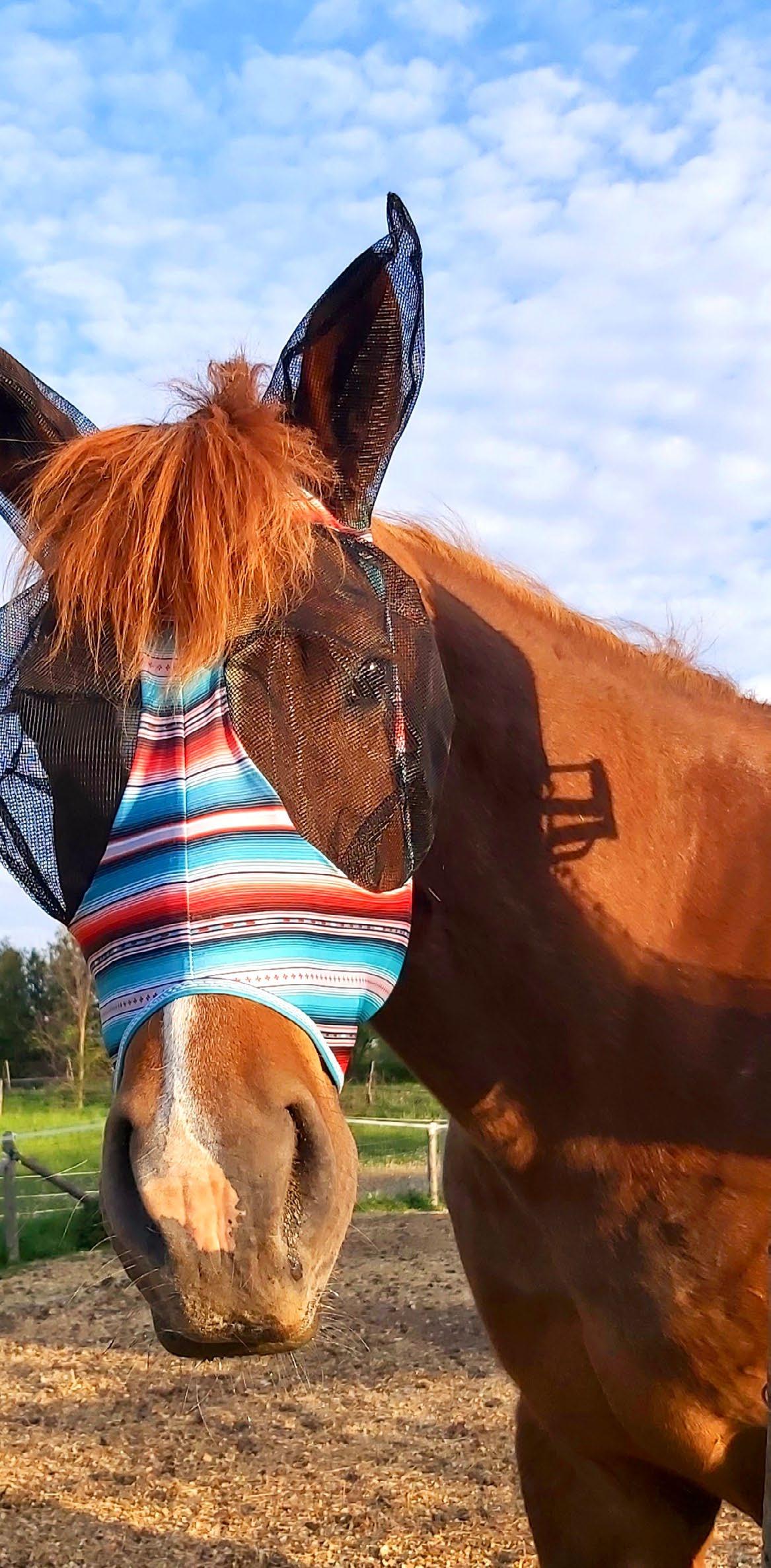
BUG SEASON …. Two words that most horse owners dread, and no matter where in the world you live with your equine friends, bug season is inevitable. The array of flying and biting pests is varied and annoying. We get ourselves ready and equipped for bug season armed with fly masks, fly sheets, fly boots, bug creams, fly sprays, and after-bite care. All in an attempt to help our horses survive bug season… ugh!
As I am on a quest to use more natural alternatives to my most regularly used grooming products, I have four horses at home, two of which seem to attract ALL the bugs and are very skin-sensitive (they get hives and get itchy) and sometimes just seem miserable in the hot, buggy weather. I go through a good amount of fly spray to try and make summer more bearable for them. Beau, my bay gelding, and Gia, our four-year-old sorrel mare, probably hate bug season as much as I do.
I decided to take a closer look at some ready-made fly sprays to see what ingredients they contain and compare them with some of the natural alternatives available. There are many different fly sprays on the market, each with its own blend of active ingredients and directions for use. As with any product, I think it’s important to read the label, follow the manufacturer’s instructions, and choose the option that best suits your horse and your preferences.
When my beautiful horse Milly was diagnosed with kidney disease in 2017, I leaned into using products that were as simple as possible for her care. I started exploring essential oils and soon realized there were so many that are commonly used around horses. I began swapping out some of the products I was purchasing for products I could make at home. I try to use things, when I can, that are natural, simple, and that work well for my horses and me.
By Nicola Cocorocchio
I am happy to say that if you take a look around your local tack shop, you will probably find some really nice, natural, essential oilbased fly sprays on the shelf. They can be more expensive than some conventional options, especially if you have multiple horses. I get it! As a beauty professional and product educator, I don’t like to compromise when it comes to the quality of products I use on
myself and my horses. I make my own fly spray so I always know exactly what I’m using.
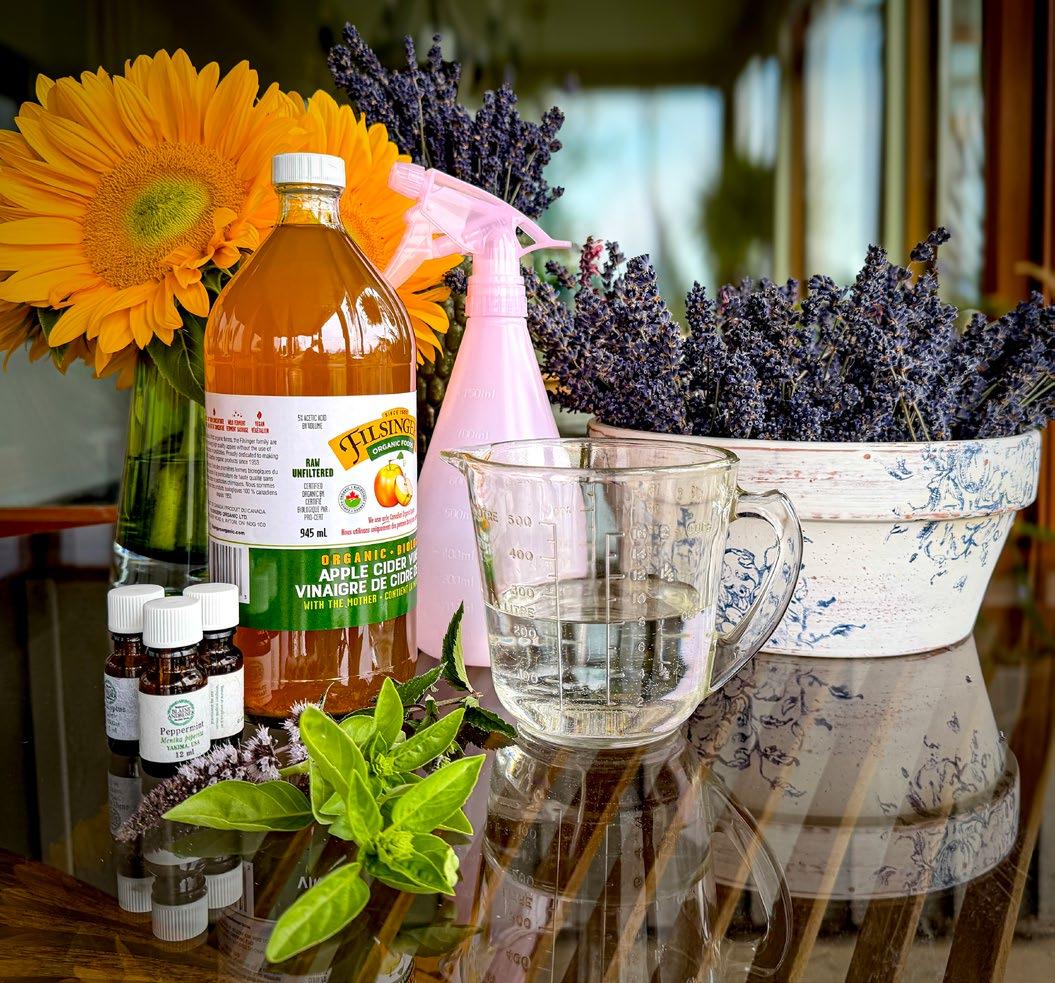
Deciding what to put in your homemade fly spray is really up to you. There are a lot of recipes out there. I have played around and blended a few different things together and found what works best for me. I like things to be very simple with minimal ingredients so they don’t seem overwhelming or a chore to make. Below is how to make my super simple, five-ingredient bug spray.
NO FLY Zone Spray
• 1 cup Apple Cider Vinegar (ACV)
• 2 cups water
• 10 drops citronella oil
• 10 drops basil oil
• 10 drops peppermint oil
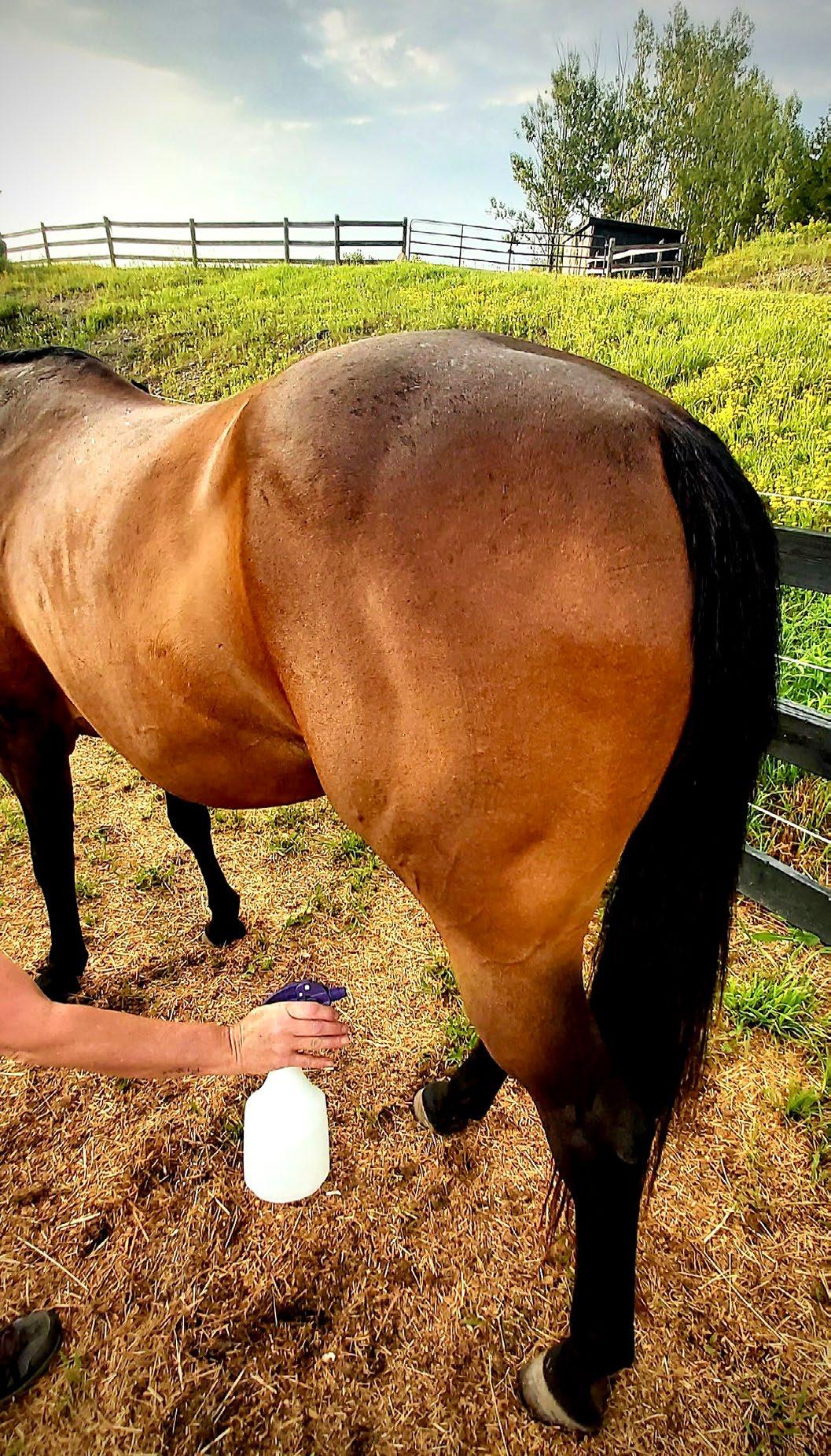
• Put in a Spray Bottle, shake well before each use and spray!
This is my go-to formula for my homemade fly spray. I prefer to use apple cider vinegar (ACV), but plain white vinegar also works well if that’s what you have on hand. Citronella oil is one of my favourite oils to include in my fly spray. I also like to use it on manes and tails during the spring and summer months. The tail becomes a lemon-scented bug “swoosher.”
Extra Tip:
You
could also put a drop or
two of citronella oil inside fly boots
if your horse wears them.
Basil oil is another oil. I enjoy using it during bug season. I sometimes mix it up on its own for myself. In my spray bottle I use ½ cup ACV, 2 cups water, and 15 drops of basil oil. Shake well and reapply as needed. I also add a few drops of basil oil to my wash bucket when bathing the horses. Plus, it smells so good—it is definitely one of my favourite oils.
Peppermint oil is another staple in my barn. I use it in my homemade fly spray and in a variety of other DIY products around the house and barn. I never make my fly spray without it.
To beat the heat in the summer months, I make what I like to call Coat Cooling Spray. And let’s be real, I use this on myself too. On those super hot days, this is a lovely way to freshen up your horses. I usually bring them in out of the sun, hose them off, and spray them with the cooling spray. Avoid spraying near the nose and eyes. I focus mostly on the neck, back, and legs.
Coat Cooling Spray
• ½ cup ACV
• 2 cups water
• 20 drops peppermint oil
• Shake well before each use and refrigerate for some extra cool!
Note: Peppermint oil should always be diluted in water or a carrier oil before applying it to your horse. Avoid sensitive areas and wash your hands after handling essential oils.
There are lots of other oils and ingredients you can use in your homemade fly sprays. Some recipes include witch hazel or a small amount of alcohol to help blend the oils with the water and help the spray dry more quickly. Without them, simply shake the bottle well before each use.
S ome other popular oils people enjoy using in homemade fly sprays include the following:
• Rosemary oil
• Lemongrass oil
• Lavender oil
• Cedar-wood oil
• Thyme oil
For a quick after-bite treatment, I like to add a drop or two of lavender oil or peppermint oil to cold-pressed coconut oil, blend, and apply it to the affected area.
With a few simple ingredients, we can all manage our horses during the dreaded bug season and have fun creating our own homemade outdoor sprays. As I always say, “Ingredients Matter.” And I wholeheartedly believe that for my horses too!
Nicola Cocorocchio is a MMCP Equi-Verde Therapies Canadian Advisor, Healing Barn Movement, for more information contact: nicola.cocorocchio@gmail.com
One of my favourite aspects of being a writer within the horse community is the opportunity to explore the many dimensions of equestrian sport. Every discipline offers its own unique perspectives, benefits, challenges, and approaches to horsemanship.
A concept I regularly encourage my clients to embrace is crosstraining across multiple disciplines. Whether it’s a barrel horse learning dressage fundamentals, a hunter spending time on trails, or a reiner incorporating pole work, exposing horses and riders to different activities develops a broader skill set while creating more versatile, well-rounded athletes.
But what exactly is cross-training, and why does it matter?
Cross-training is the practice of incorporating exercises, activities, and/or principles from other disciplines into your horse’s regular routine. Sometimes it’s as simple as taking a horse out on the trail or riding through a pasture instead of constant controlled arena work. Other times, it may involve specific movements from another discipline.
Borrowing from Other Disciplines
Breakaway Roping → Jumping
From a practitioner’s perspective, movement variability is incredibly important. Different disciplines place distinct demands on the body, causing differences in muscle engagement, coordination, balance, and proprioception. For example, a reining horse must generate explosive power from the hindquarters, while a dressage horse relies more on body balance and collection. Trail riding challenges stability over uneven terrain, and endurance develops cardiovascular fitness.
When the same exercises are repeated consistently, certain muscle groups naturally become more developed while others weaken. Over time, this can contribute to muscular imbalances, compensatory movement patterns, stiffness, discomfort, and strain on joints and ligaments from overuse. Introducing new environments, exercises, and challenges encourages horses to think, problem-solve, and adapt.
Exposure to different environments can also help create more adaptable horses. A horse that has experienced a little bit of everything is often better prepared to handle unfamiliar situations because they have learned how to process and respond to new experiences. Building confidence is similar to building strength; it develops by active engagement and increasing the ask gradually and consistently.
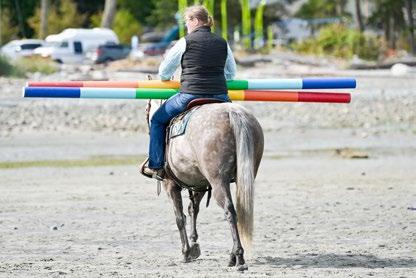
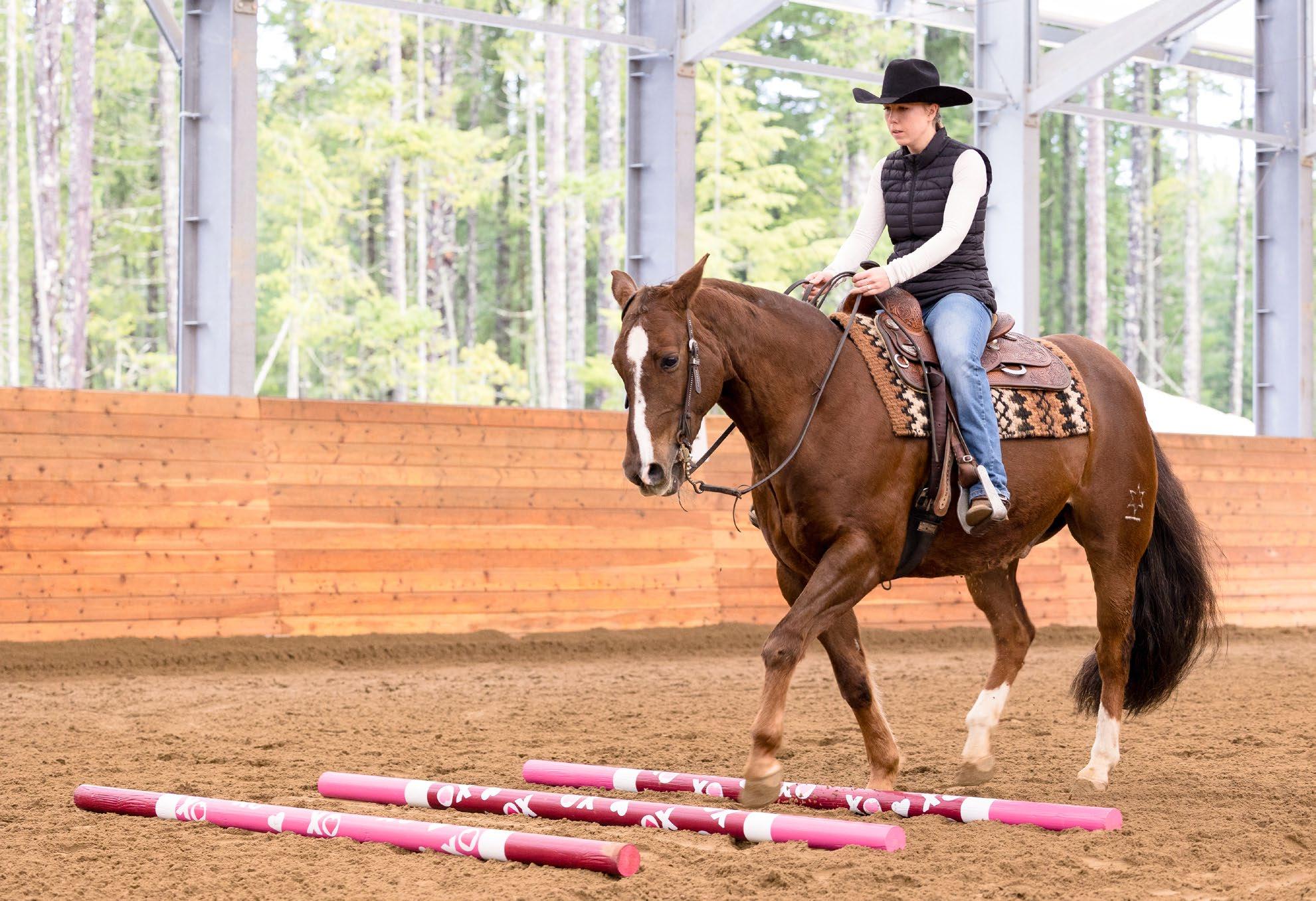
For example, trail riding is one of the most underrated forms of cross-training. Another movement I often encourage clients to do with their horses is pole work and/or cavaletti exercises too! These are great because they encourage horses to lift through their backs, improve body carriage, and develop greater limb awareness.
Whatever your goals involve, sometimes the best way to improve your chosen discipline skills is to step outside of it for a while. Who knows, it may even lead you into a new path that you enjoy more than your current discipline aspirations.
Exercise: Ride four raised trot poles followed by a collected canter departure.
Why: Builds top-line strength, improves hind-end engagement, and encourages a more balanced and powerful canter departure.
Reining → Dressage
Exercise: Practice transitions within the gait, moving from an extended trot into a collected trot while maintaining rhythm and balance.
Why: Improves self-carriage, adjustability, and responsiveness, helping to create higher-quality circles, stops, spins, and transitions.
Eventing → Trail Riding
Exercise: Incorporate trail rides over varied terrain, including hills, uneven footing, water crossings, and natural obstacles.
Why: Builds confidence, sure-footedness, and endurance while teaching the horse to think independently.
Dressage → Cow Horse
Exercise: Practice controlled rollbacks and fence turns.
Why: Develops quicker reactions and stronger hind-end engagement.
Working Equitation → Endurance
Exercise: Incorporate long-distance conditioning rides with varied terrain and pacing goals.
Why: Improves stamina, cardiovascular fitness, and mental resilience, helping horses maintain power, speed, and focus.
Photo provided by Copper Pony Arena and Stable Equipment. Visit copperpony.ca to explore their amazing assortment of equipment.
Summer Summer
Dog Refreshers! Dog Refreshers!
Harmony Farm Kennel in Monte Lake accepts all dogs every day, including hot summer days! Heat can be especially challenging for many dogs. The number one summer concern is dehydration. Dogs pant to release internal heat but sweat through their paws, so hot surfaces are extremely tricky! Dehydration results from drinking/ absorbing too little and can quickly lead to organ damage – even death, so please pay attention to your dog’s clear dehydrated symptoms.
Specific Overheating Signs
Have horses … Love to travel, but terrified of a breakdown?
Have horses … Love to travel, but terrified of a breakdown?
Me too! Whether it’s horse camping, a roping clinic or a horse show, there is nothing an equestrian loves to do more than get away with horses in tow! Just last week I was all packed, the gooseneck trailer loaded with horses – all excited for a 4-day camping reprieve! All was excellent until travelling the Coquihalla; my truck started violently lurching forward at 100 km/h. With hazards flashing, I barely found enough shoulder to pull over.
Quickly putting my orange caution cones out, I called the diesel shop for help. First, they said, “Don’t move your truck,” then reminded me that BCAA won’t assist if I have horses on board. Ughh! WTH was I going to do with horses stuck in a metal box in 33°C heat and semis passing non-stop on the highway from hell?!
Thankfully, I remembered a local tow service. Mark of KTM Towing in Westwold took my location information and instantly offered to load his personal truck on his flat-deck tow truck, bring it to me to hook on to my horse trailer so I could haul my horses, and take my truck to the shop. Can you spell RELIEF? Mark arrived, gave me a hug and efficiently proceeded to save my day!
That night, recalling the stress of my ordeal, I remembered that 20 years ago, hauling horses in the states, my trailer and horses were covered under “US Rider”. (I still have the old decal on my truck!) I enquired if they have any coverage in Canada these days. EUREKA! (Non-commercial) horse lovers trailering horses anywhere in Canada are covered! I was so relieved and excited; I became an ambassador for Canadian equestrians and was able to negotiate for Canadian equestrians to receive a 20% discount! It is my hope to enlighten every horse enthusiast that there is equestrian emergency roadside assistance available to help Canadian riders with your vehicle, horse trailer AND your horses!
USRider is a nationwide roadside emergency assistance membership programme designed specifically for equestrians! Built with horse owners in mind, USRider provides dependable support for hauling emergencies, equine-related incidents, and everyday challenges that can disrupt your plans. With one membership, riders can gain protection that follows them wherever they travel! Hallelujah!
Just use this link https://usrider.org/ps26/ and add our code PS26 on the checkout page to get your classic or premium coverage with a 20% discount! RIDE ON!
Finally, we can haul our horses with confidence that if and when we break down, there is help on the way! ( Btw, Mark Schimmens, KTM Towing, 250-552-4107, is becoming a USRider service provider!) Win-Win-Win!
Normal dog temperature:101-102.5°F (38.3-39.2°C)
Dangerous metabolic changes occur at 104 degrees F (40.0°C)
Normal respiration for dogs is 10-30 rpm
With extreme stress, panting can increase to 400 pants per minute! (Note that flat-faced dogs overheat quicker due to challenges breathing). Appetite loss, depression, anxiety, pacing, excessive panting, extreme salivation, bright-red gums, instability or laboured breathing...all clear symptoms of a dog overheating! First, wrap a cold wet towel around your dog’s neck, move them to a cool place… Call your vet immediately!
Suggestions to help your dog beat the heat:
Remember dark-coloured dogs/thick undercoats are more vulnerable to overheating – keep thin hair coats as much as possible (consult a vet before shearing, which can be a negative option).
Never take dogs in a vehicle (or the back of your truck). EVER! Don’t walk them anywhere you wouldn’t walk barefoot! Their pads will actually burn, causing extreme pain and a long recovery.
Hose down rest areas to keep pads cool and moist.
Exercise during cool hours, preferably on grass.
Ventilation by AC or a fan (using ice blocks in front of a fan helps)
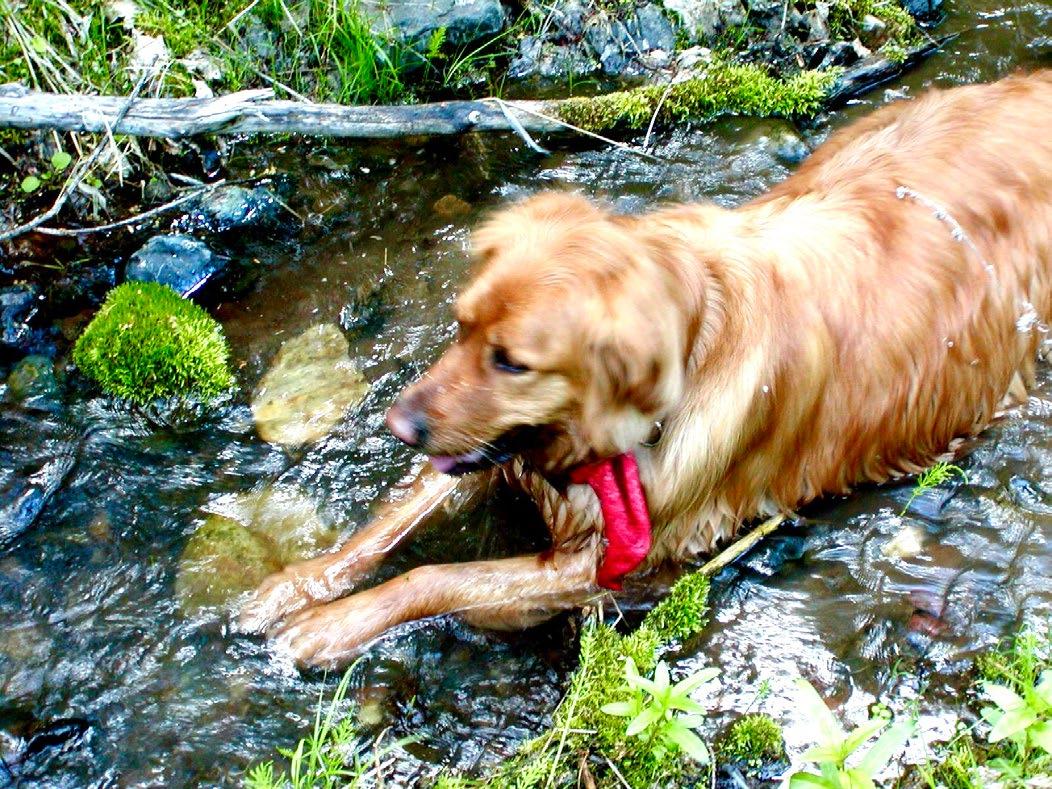
Many dogs love a wading pool!
Frozen treats like stuffed kongs help keep dogs hydrated and entertained!
Partially frozen drinking water in a metal bucket will stay cool longer, encouraging sips, not gulps.
Patricia Skinner-Porter is the owner/operator of Harmony Farm Kennel & Lamb at Monte Lake, BC. Offering custom care boarding, providing personal care, attention and daily exercise for ALL dog types, breeds and dognalities! Here she shares her vast array of experience with a beneficial monthly tip for you and your pooch to enjoy!
Plan Ahead for Wildfire Season Plan Ahead for Wildfire Season
As August arrives, so does the height of wildfire season across much of British Columbia. For horse owners, this season is a critical reminder that emergency preparedness is not something to put off—it’s something to act on now.
Wildfires and other emergencies can escalate quickly, leaving little time to react. Having a clear evacuation plan for you and your horses can make a significant difference when every minute counts. Start by ensuring your trailer is in working order, accessible, and stocked with essential supplies. Practice loading your horses regularly so they are calm and responsive in a high-stress situation. Preparing your property—by clearing combustible materials and creating defensible space—can also help reduce risk.
Equally important is having the right information at your fingertips. Horse Council BC offers a free library of emergency preparedness resources tailored specifically to the equestrian community. These include practical checklists, planning guides, and strategies to keep your horses, property, and people safe.
Training videos: https://learn.hcbc.ca/resources.php
Taking the time now to prepare can help reduce uncertainty and improve outcomes during an emergency. This August, make preparedness a priority—and encourage fellow horse owners to do the same. A well-prepared community is a safer community for everyone.
Emergency Evacuation Checklist for hauling horses and livestock
Keep truck fuelled and trailer ready
Practice loading horses before an emergency
Pack a grab-and-go emergency kit
Include feed, water, and any required horse medications
Ensure horses wear identification
Keep halters and lead ropes easy to access
Have a list of evacuation destinations and emergency contacts
Sign up for local emergency alerts and monitor wildfire updates
Evacuate early—don’t wait until the last minute
Emergency Evacuation Checklist
Horse identification (photos, markings, records)
Registration papers and ownership documents
Vaccination and veterinary records
Medication list and extra medications
Feed, hay, and supplements
Water containers and buckets
Halters, lead ropes, and gloves
Horse first-aid supplies
Extra tack and basic repair supplies
Blankets or protective gear (if needed)
Emergency contact list
Veterinarian contact information
Backup hauling contacts
List of safe evacuation locations
Chargers and backup power banks
Cash and important documents
Labels or ID tags for equipment and horses
Current photos of each horse
Handling notes (special needs, behaviour, medical concerns)
Manure fork, shovel, and cleanup supplies
Flashlight or headlamp
Extra clothing and supplies for yourself
Trailer supplies (jack, spare tire, tools)
Wildfire Resources to Bookmark
Firemap.live https://firemap.live
BC Fire Map (Interactive 3D Wildfire Map) https://bcfiremap.infinus.ca/
NASA FIRMS Fire Map (Satellite Hotspots) https://firms.modaps.eosdis.nasa.gov/usfs/map/
Zoom.earth https://zoom.earth
Joey Only - Cariboo Weather Dude https://www.youtube.com/@JoeyOnly
Executive Director administration@hcbc.ca
Agriculture & Industry industry@hcbc.ca
Membership membership@hcbc.ca
Coaching and Education coaching@hcbc.ca
Marketing and Communications communication@hcbc.ca
Recreation and Trails recreation@hcbc.ca Competition competition@hcbc.ca
Community Development development@hcbc.ca
HCBC Bookstore bookstore@hcbc.ca
Finance and Grant Funding finance@hcbc.ca
The Back Country Horsemen of BC Bear Spray Education
The Back Country Horsemen of BC Bear Spray Education
Submitted
by
Dawn Hickerty, Robson Valley Chapter
Submitted by Dawn Hickerty, Robson Valley Chapter
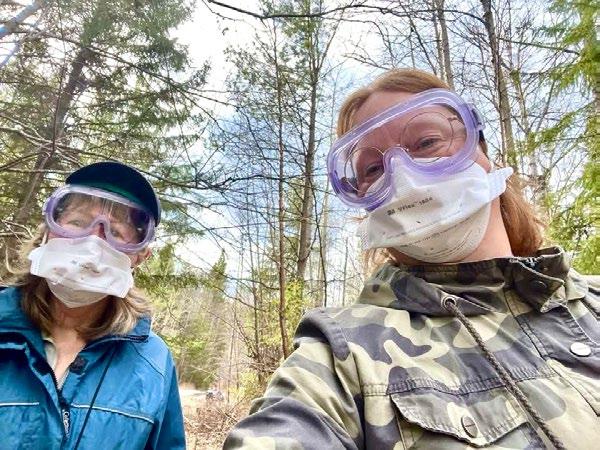
The Robson Valley chapter hosted an “inservice” (education session) for our members put on by member Terry Winkler this spring. Participants were asked to bring expired or partially discharged bear spray to practice with. A change of clothes was also recommended in case of accidental exposure!
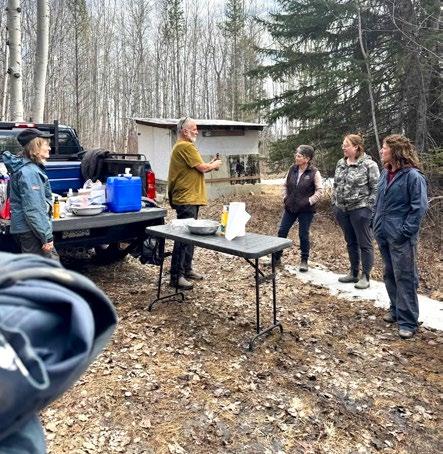
Safety contingencies were in place, including clean water, wash basins, soap, paper towels, saline for eye washing, face masks, and eye shields. Stations were set up with targets on a clothes line in a forested area. Prior to the practice sessions, a knowledgeable member led the information session. He reminded members about bear awareness, use of bear spray, and how to best carry it. He advised carrying an air horn as well. Background topics included bear behaviour, types of encounters, and how best to avoid them. We learned the importance of keeping a clean camp and proper food storage to avoid attracting bears.
The session covered the importance of having your spray and air horn readily accessible in your hand, on your belt or backpack shoulder strap at your chest, or in front horn bags and practicing regularly taking it out of the holster and taking the safety off.
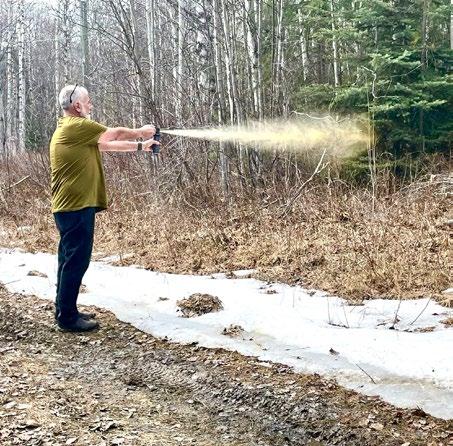
We learned about safe storage, transport, and expiry dates. We discussed how to use spray when being charged, including effective spray distance and factors such as wind direction and the potential for the user being sprayed. Decontamination by flushing with copious amounts of water and soap was recommended.
When travelling on trails, users should be using their observational skills and their horses’, looking for birds or signs of carrion. Additionally, simply making more noise to avoid surprising a bear when in areas more likely to encounter one…such as berry patches or travelling along creeks or rivers (or when travelling quietly in the morning listening for your horse’s bells on a pack trip!) is an effective tool to avoid encounters.
If we encounter a bear, we learned the importance of making noise, having a barrier between ourselves and the bear, and backing away. Most importantly, not turning and running away.
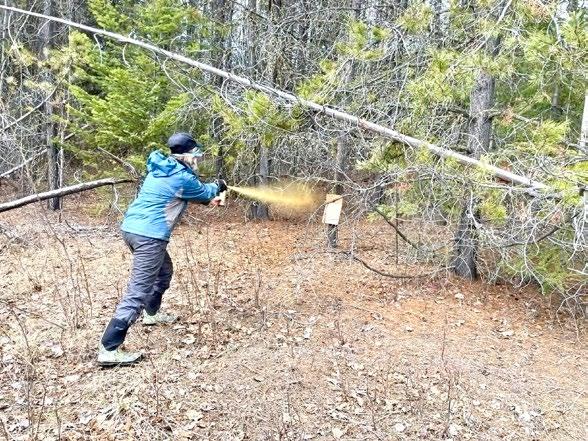
Following the theory, participants practiced on the targets set up in the bush. A member pulled the line, and participants practiced spraying the moving target. Practices were also done on stationary targets and innocent
shrubs. Great fun was had by all! We all learned a lot, and we look forward to a safe season on the trails.
1 Eileen and Shelly are geared up to practice.
2 The group gathers around.
3 Terry demonstrating the spray distance and direction.
Using Bear Spray While Riding Using Bear Spray While Riding
Be prepared — Practice drawing your spray before you need it.
Know your horse — Be aware of how your horse reacts to sudden movement, sounds, and spray.
Control first — Keep your horse calm and create distance if possible.
Watch the W ind — Avoid spray blowing back onto you or your horse.
e xpeC t a reaction after spraying — Your horse may startle from the sound or smell of the spray.
Move away after spraying — Leave the area once it is safe.
Check out the The Back Country Horsemen of BC bchorsemen.org
Photo credits: Shelly Cousineau
ClUb Hub ClUb Hub
July Adventures with Phillippé
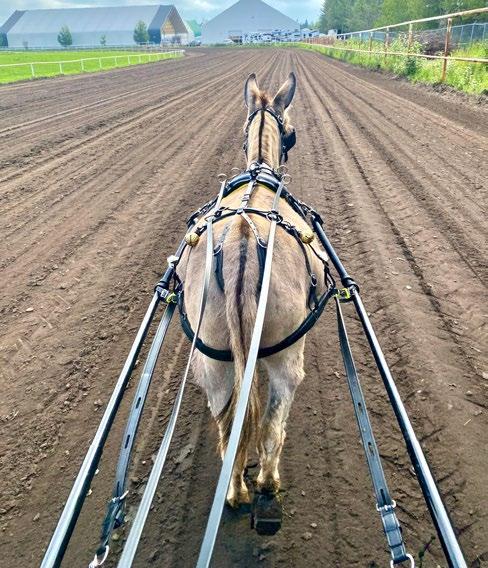
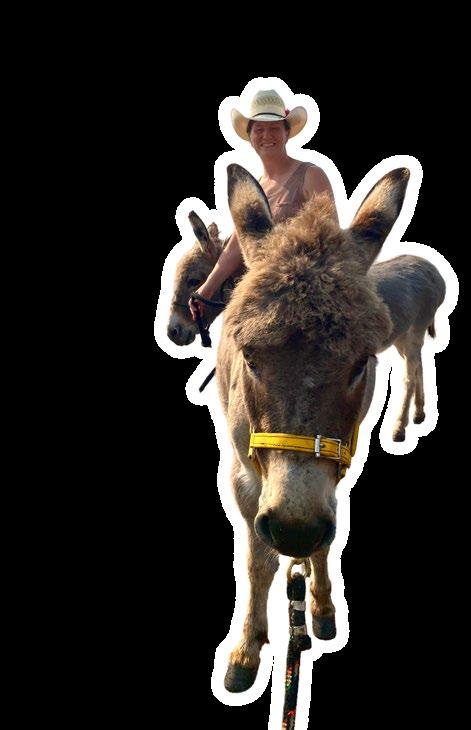
Phillippé and his friends from the Alberta Donkey and Mule Club had a great time at this year’s Westerner Days! Phillippé and his buddy Chilli ventured out to the midway to mingle and enjoy the sprinkler stations set up. He also got to live his racehorse dreams while out for a morning run around the track, much to the delight of the chuckwagon teams!
Vintage Riders Equestrian Club Vintage Riders Equestrian Club
Full on into Summer!
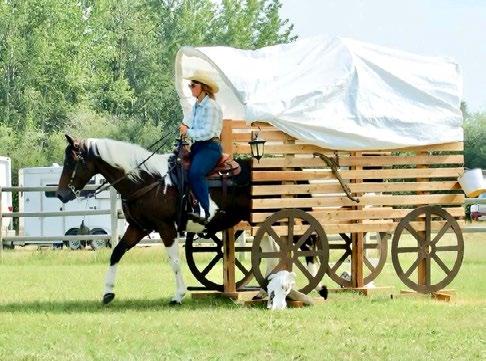
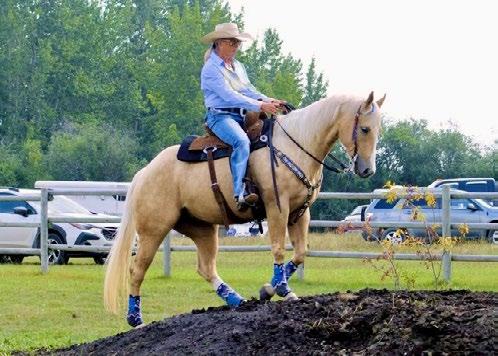
Vintage Riders Equestrian Club members are varied in age, we are riding different breeds of horses and our chosen disciplines are a cross section of the equestrian world. The good thing is that we all benefit from that diversity by expanding our horizons.
Our executive brainstorms continuously and comes up with tremendous opportunities for us to try a few of many areas of riding and handling. Our club members get to know one another, hence getting grouped together with others of similar skill level at these events. Always with an eye to the age, fitness and training of the horse.
The Canadian Cowboy Challenge
The CCC is well into the Challenge season. How judges score a team on an obstacle course has been explained using the “Three Es”: Entrance, Execution, and Exit. There have been questions from riders about how judges determine the “horsemanship” score at the completion of their ride.
The horsemanship score will be the focus this month. The CCC horsemanship score is basically how well the horse and rider—the team—work together.
First, the rider: How soft are their hands? How is their seat positioning, balance, and overall positioning? Are they balancing themselves using the reins?
Second, the horse: Is the horse relaxed and moving smoothly? Judges look for signs such as tail switching, bracing of the neck or jaw, pinned ears, stiffness, or an open mouth, which may indicate tension. As a team, judges are looking for correct leads, correct diagonals or sitting trot, and effective communication. They observe how the rider uses reins, leg aids, and body language to direct the horse, and how well the horse responds.
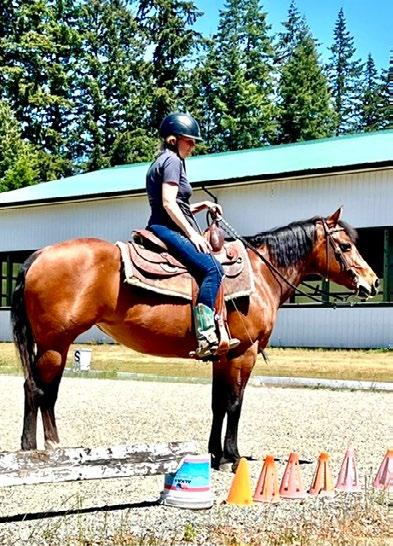
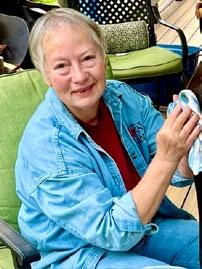
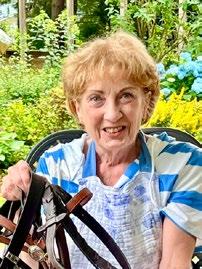
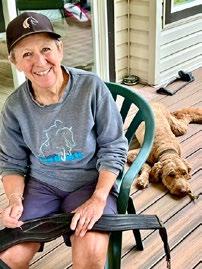
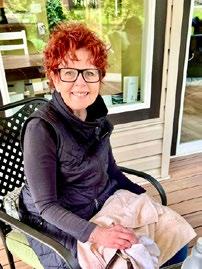
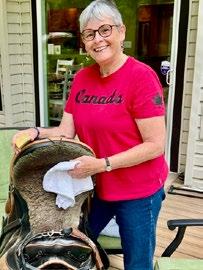
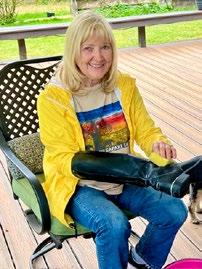
Try a little pole work gymnastics. Experience a little Ranch Riding or Working Equitation. Join the others in a field trip to the Squamish area to visit a horse sanctuary that we voted to include in our yearly donation. There is a trail ride arranged, where we peacefully meander through the woods together. Followed by a potluck meal. Comes complete with corrals to stash our horses in. Lots of room here to build confidence and calmness.
Coming up within a few days of writing this, there will be a tack cleaning social. Enjoy some snacks and spend some time making sure our gear is safe. After all, we’ve been pretty busy, so it is time to remove the dust and sweat of our many activities. Our time with our horses is very precious. Enjoy every moment!
By Kendra Kowalski
Want to come play with us! It’s only a whole $42/yr!!!! Need more info? Reach out anytime! vintageriders@gmail.com
Photos submitted by VREC with permission.
When the team is working together and the communication system is properly given and understood, they will overcome obstacles in a smooth and fluid manner. The overall look of the team should be that of working together as a unit and creating a pleasurable experience for both the rider and horse.
Other aspects a judge considers include the team’s ability to manoeuvre obstacles and handle safety issues. Some divisions require riders to handle a rope, including dragging a log or roping cattle. Forming the loop, throwing, and how the rider dallies and tightens the rope after the catch are all observed and scored.
The log drag is another example where safety and horsemanship are important. How the rider dallies and the amount of rope length between the horse’s rump and the log must be carefully managed. Too short a rope could cause the log to hit the horse’s hind legs, while too long a rope could create a hazard by getting under the horse’s tail.
This is a brief overview of what a judge is looking for when determining a rider’s horsemanship score at the completion of an obstacle run. The big picture for both the team and judge is that there is a lot happening at the same time—the team is performing and the judge is evaluating. Enjoy your ride and have fun riding!
By Hans Kollewyn
For more information events and locations, check out our website at canadiancowboychallenge.com
Photos with permission: Darcy riding Apple and Joanne and Holly.
Photos provided with permission
Promoting equine activities and knowledge in the south Cariboo with Shows, Clinics, Gymkhanas and more. President: Danita McLaren 325
We welcome all levels of riders and all breeds of equines. bctherapeuticriding.com
Promoting therapeutic riding, equine-based therapeutic services, and para-equestrian activities throughout BC through networking, educational programming, and outreach activities. JOIN US! Canadian Cowboy Challenge A SPORT for the whole Family!
Seven Divisions to accommodate all! For more info please call 403-828-2044 or visit www.canadiancowboychallenge.com
EDUCATION. RECREATION. INSPIRATION.
Welcoming a diverse equestrian community by fostering an environment of enjoyment, development, and competition. More details and dates available at kelownaridingclub.ca 3745 Gordon Drive, Kelowna BC
Want to enjoy miles of beautiful new trails with your equine partner in BC? Try Endurance Riding! Info on clinics and events at www.erabc.com
BC CARRIAGE DRIVING SOCIETY
Pleasure, Combined, Recreation from Minis to Drafts, bccarriagedriving.com
BC PAINT HORSE CLUB
bcphc.com, Open Show & Competition Program, award sponsorships for local clubs, youth scholarship. maddy.shannon33@gmail.com
NORTHERN SADDLE CLUB
Smithers BC. Check out our website at northernsaddleclub.com and follow us on Facebook
VERNON DISTRICT RIDING CLUB (Vernon BC), check out our website at vernonridingclub.com or visit our Facebook & Instagram pages
BEDDING, HOG, FUEL, SHAVINGS
REIMERSFARMSERVICE.COM (BC Interior) 1-855-737-0110 or 250-838-0111. Bulk Shavings, Sawdust, Bark Mulch and Hog Fuel. 4x4x4 Shavings Totes
FEED DEALERS
ASHCROFT HOME BUILDING CENTRE (Ashcroft)
250-453-2281 Otter Co-op Dealer & Pet Foods. You can find us on Facebook
HORSE BLANKET & REPAIR
HORSE BLANKET & SADDLE PAD
WASHING & REPAIRS Clean used Blankets for sale Town Centre Dry Cleaners 250-546-0104 Armstrong
TRAILER REPAIRS
PETERSEN TRAILERS LTD. (Langley) 604-533-4209 Service and Repairs. All makes. petersentrailers.ca
TRAILER SALES
KITT EQUIPMENT
STALLIONS & BREEDERS
APPALOOSACENTRE.COM
250-963-9779 Real Appaloosas for Today and the Future!
VETERINARIANS
CONNECT VETERINARY SERVICES (Okanagan)
250-863-5996 Mobile Equine
Dr. Savannah Beavers
Dr. Troy Looper connectvetservices.com
INTERIOR VETERINARY HEALTH
SERVICES (Okanagan)
250-769-4217, Mobile Equine, Brytann Youngberg DVM, VSMT, College of Animal Chiropractors
PET SUPPLIES & BOARDING
EVERYTHING PETS
Princeton, BC 250-295-7381
Quality Foods & Supplies for all your pets! See us on FB
HARMONY FARM KENNEL AND LAMB
Monte Lake, BC 250-375-2528
“Custom Care” boarding welcomes ALL dogs! Harmonyfarmkennelandlamb.com