Reproduction of any materials without written permission from the editor is prohibited. Opinions and statements expressed in this publication are not necessarily those of the editor.
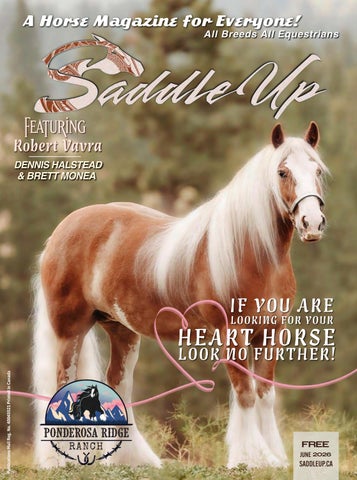
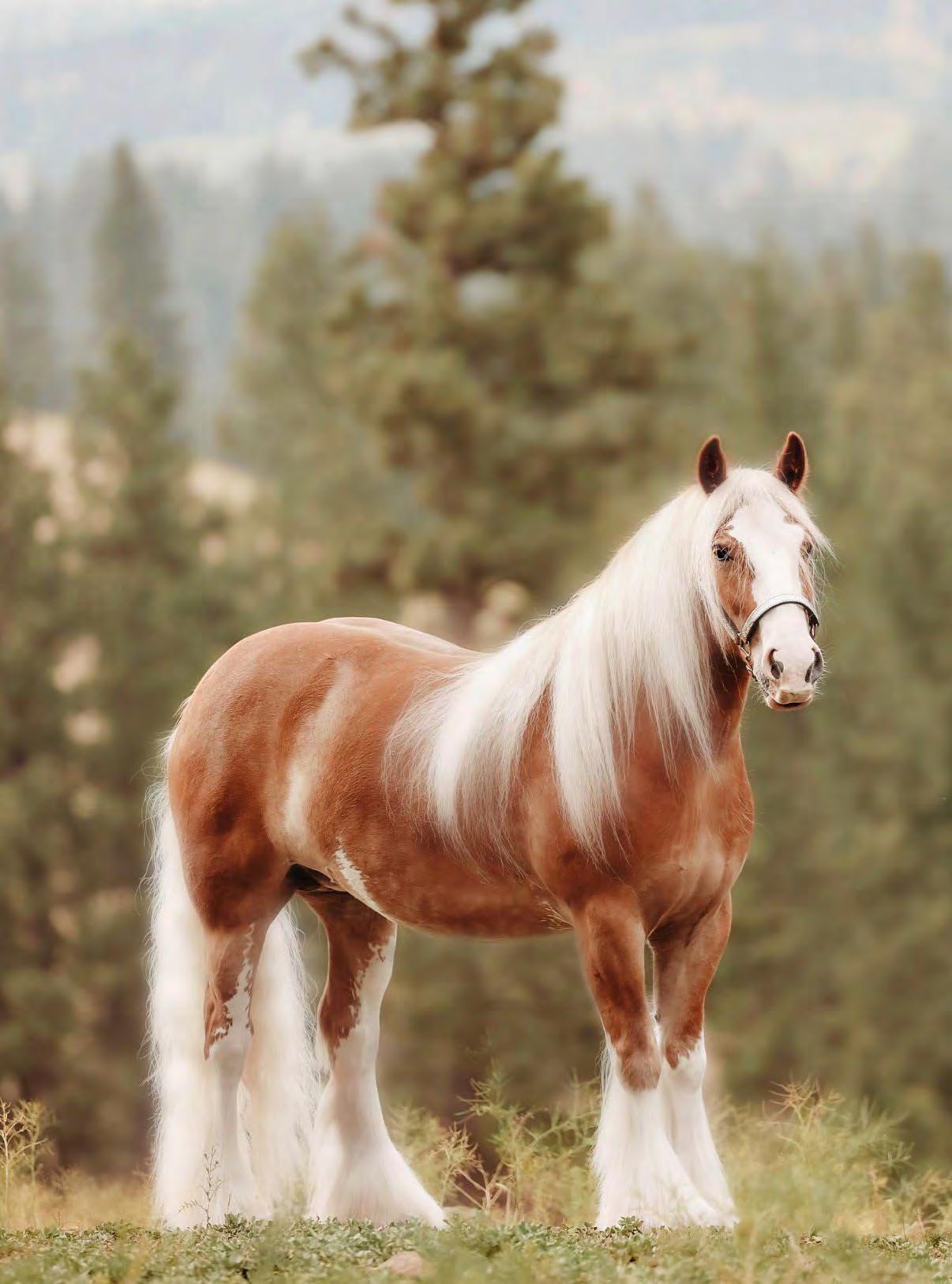
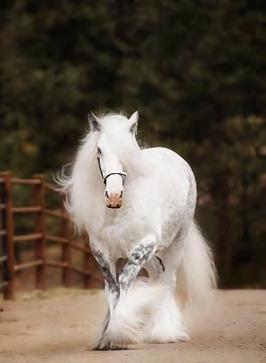
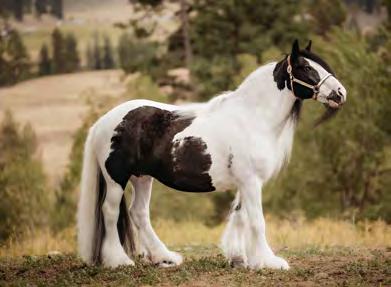
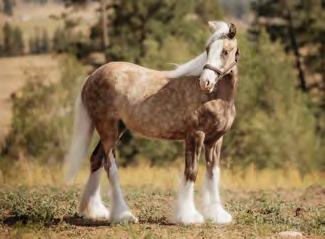
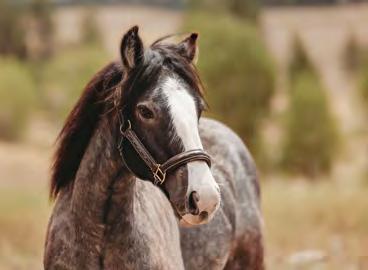
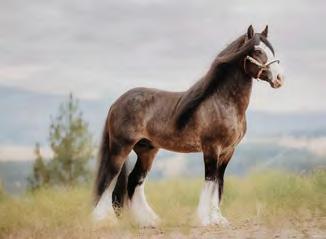
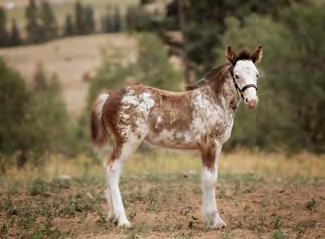
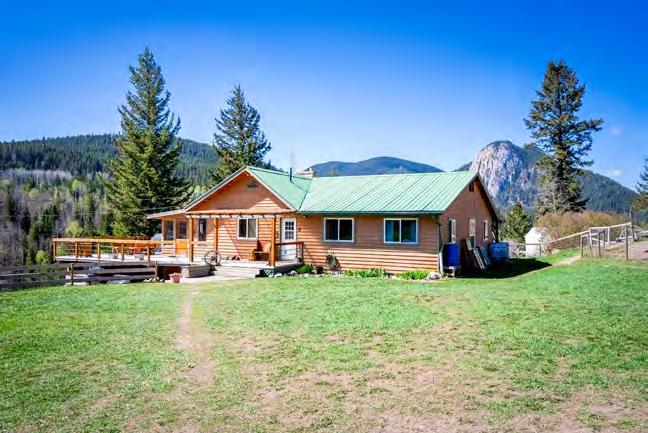
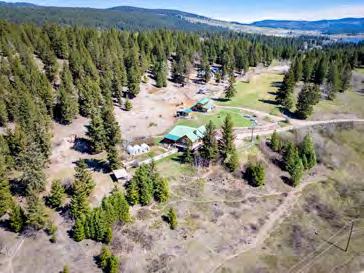
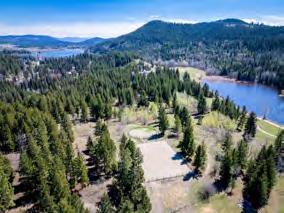
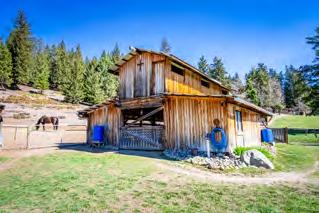
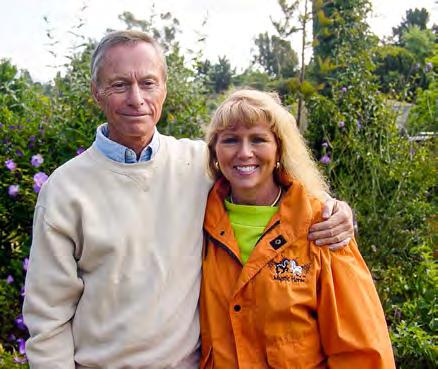
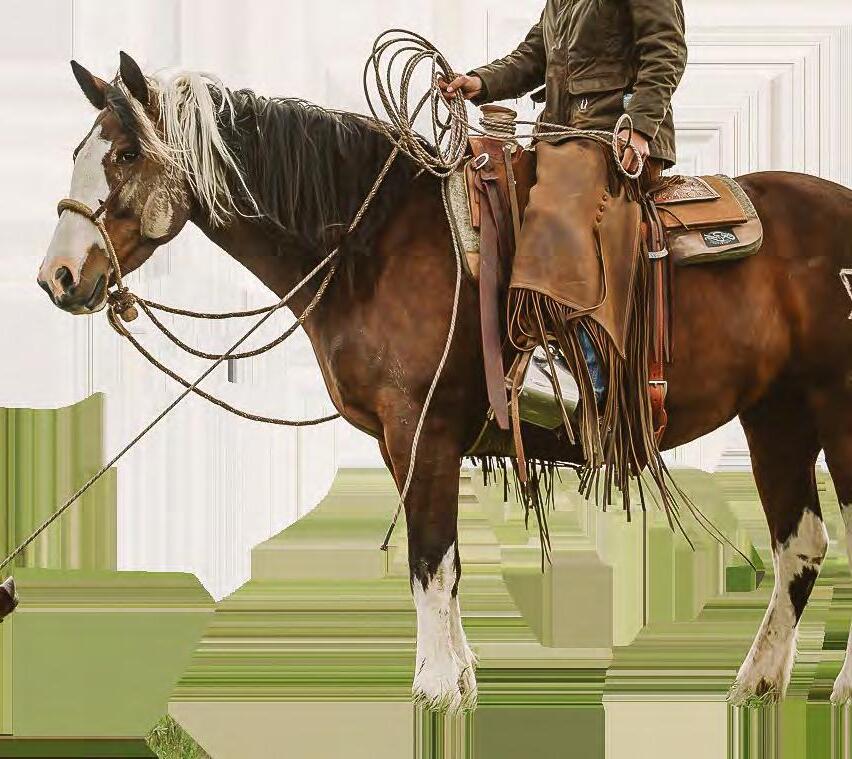
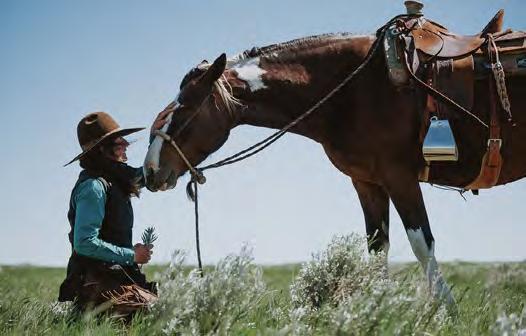
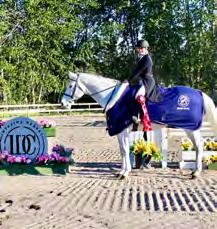
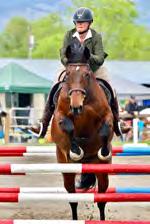
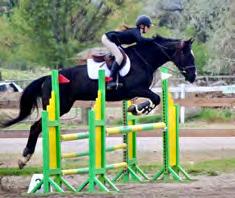
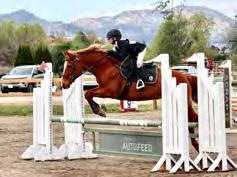
Ponderosa Ridge Ranch, see page 5 for more info, visit ponderosaridgeranch.ca
CONTRIBUTORS
Laureen James, Mary Ann Simonds, Danika McGuiness, Alexander Grayton, Mad Barn Canada, Britain Mills-Dawes, HCBC News,Club Hub, and BCHBC Stories
$1,185,000
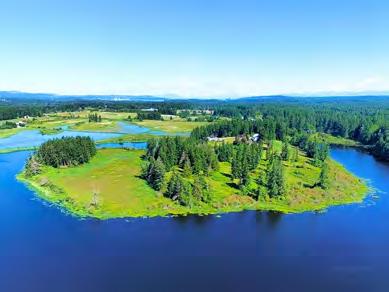
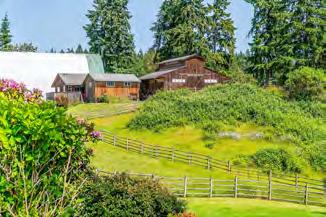
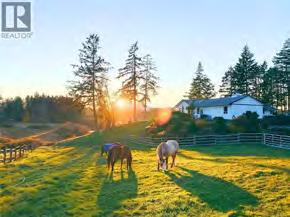
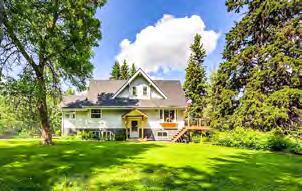
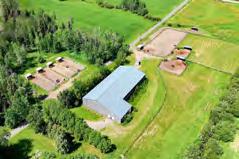
Set on 37.71 acres in the sought-after Pinantan Lake area, this is the kind of property that changes your pace of life. Wake up to wide open skies, sip your coffee while the horses graze, and spend your days riding, exploring nearby Crown land, or simply enjoying the privacy and quiet—just 20 minutes from Kamloops, with a local school and community store nearby. Thoughtfully set up for horse and livestock enthusiasts, the property features cross-fenced pastures for rotational grazing, an impressive 80x120 riding arena with sand footing, a 30x40 barn with stalls, tack room and hay loft, a 20x40 cover-all sheep barn, and an 18x24 hay shed with lean-to. All with power and water. Established riding trails weave throughout the property, making it easy to enjoy everything your land has to offer.The 30x40 heated shop with separate 200 amp service and mezzanine provides excellent workspace, plus ample covered storage and parking. The well-maintained 4-bedroom home offers a warm, functional layout with hot water heating,
and enjoy
or
and
and
Photography by Tickled Pink Imagery
Trust is Everything
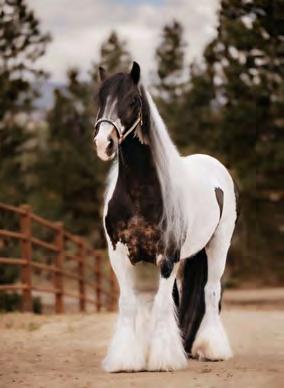
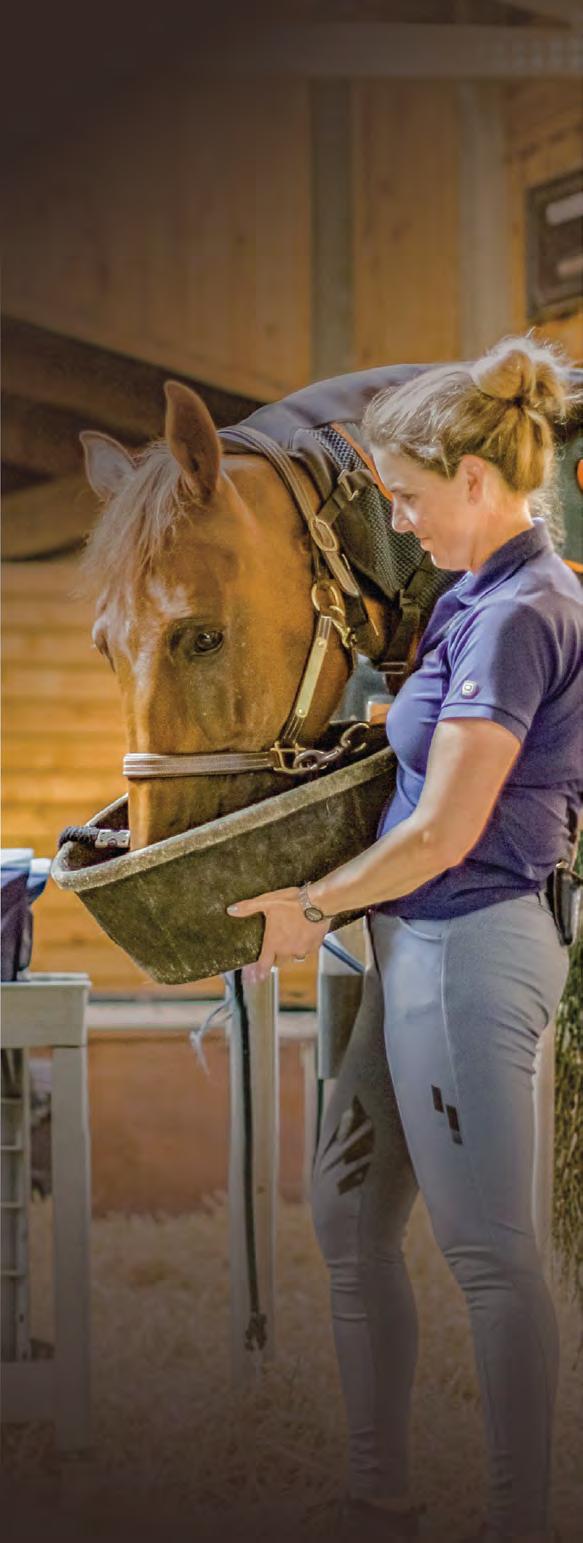
When they run to greet you at the gate every morning or ready themselves for you to saddle up and give a world champion performance, their trust in you is everything.
Give them the best so they can give you the best with champion level care.
By
Bull
Laureen James & the Rider Between the
A Cowboy’s Prayer
Commonly attributed to Badger Clark
Our Heavenly Father, we pause at this time, mindful of the many blessings you have bestowed upon us. We ask, Lord, that you will be with us in the arena of life. We as cowboys do not ask for special favors. We don’t ask to draw around the chute fighting horse, the steer that won’t lay, or to never break the barrier. We don’t even ask for all daylight runs. We do ask, Lord, that you will help us live our lives here on Earth as cowboys, in such a manner that when we make that last inevitable ride to the country up there—where the grass grows lush, green, and stirrup high, and the water runs cool, clear, and deep—that you will take us by the hand and say: “Welcome to Heaven, cowboy.
Your entry fees are paid.”
“I don’t remember much about that day… I remember I went into the finals. I probably shouldn’t have been competing, since I was already pretty beat up. But, with it being my rookie bull riding year, I just wanted to push through the pain. Now there’s a year of my life I don’t remember.” - Jamie Vang
Jamie Vang
Bull
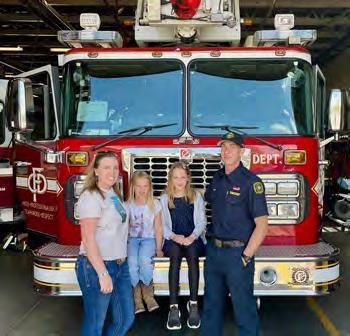
Rider, Fireman, Husband, and Father
Born on January 21, 1987, to Huey and Joanne
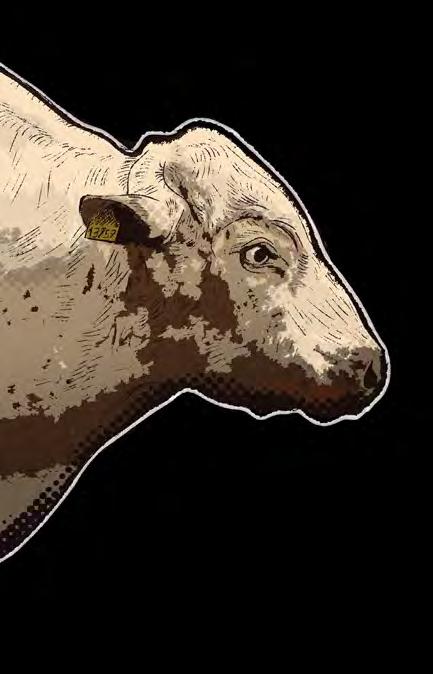
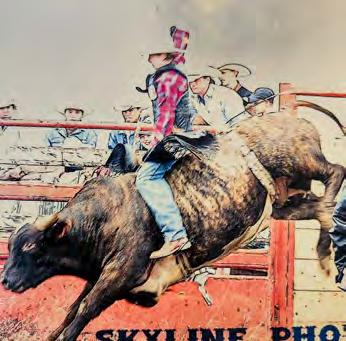
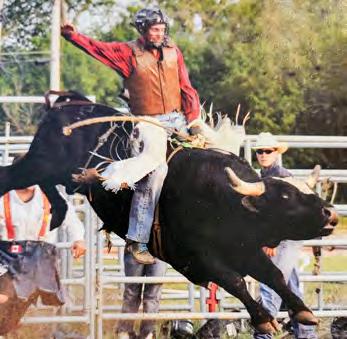
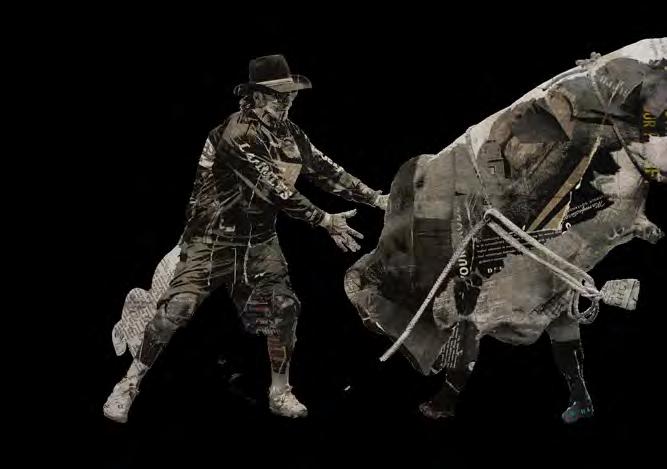
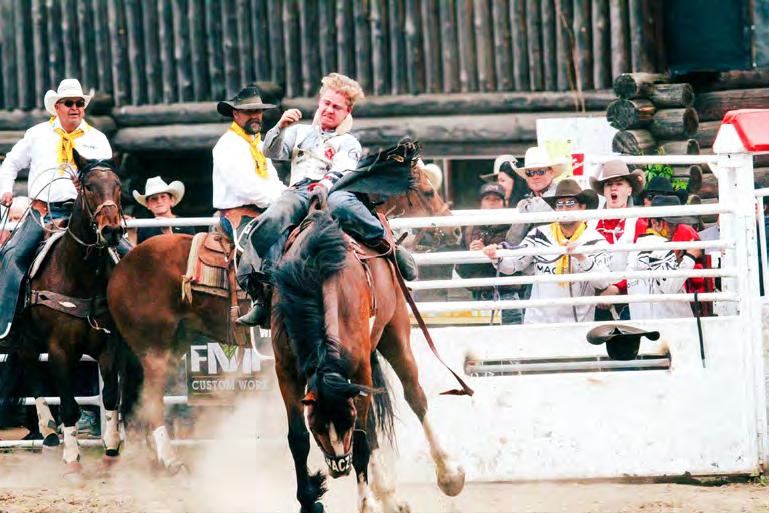
According to Jamie Vang’s mom, Joanne, Jamie drew what’s known as a “headhunter.” A bull that is dangerously aggressive. A bull that actively attempts to gore a rider with its head or horns after the bull rider has fallen. These bulls tend to focus on the rider rather than just bucking.
That fateful day my son was pulled down by the
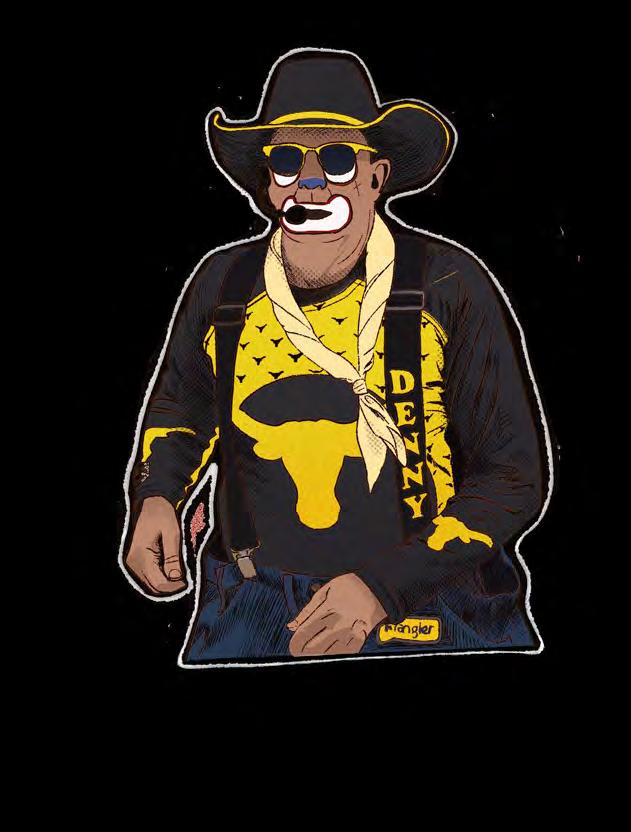
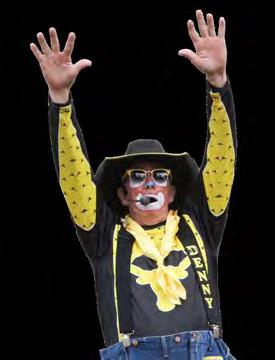
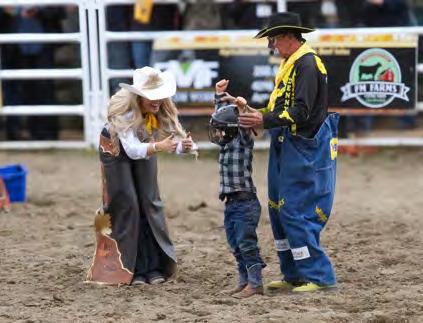
horns. He was knocked unconscious and a skilled rodeo clown, Dennis Halstead saved my son’s life. Dennis got Jamie’s airway cleared so he could breathe, then gave the ambulance
paramedics critical information on his status. Jamie was taken to a hospital in Lethbridge and from there was airlifted to Calgary, where he spent about 4 months in therapy recovering from his head injury. My thanks go out to Dennis and also the rodeo community for the amazing support following his injury.
I followed in my father’s footsteps and started riding bulls at the Johansen bull riding school in Balzac, AB, in May of 2004. I was riding in the Chinook Rodeo Finals, where I sustained a serious head injury, where Dennis Halstead was
clowning, thankfully! Dennis stepped in with his fire department medical training and was able to stabilize me on the arena floor. Further stabilization was done at the Lethbridge Hospital so I could be airlifted to the Foothills Hospital in Calgary.
It took six months to recover enough to return to bull riding. The doctors wanted me to take a year off, but I was eager to compete again. In 2006 I was awarded a rodeo/athletic scholarship to Frank Phillips College in Borger, Texas, where I competed as a bull rider until
Vang, in Black Diamond, AB.
bull’s
2013, when my first daughter Brooke was born. I didn’t make any finals in 2013, so I hung up my rope and walked away from the rodeo scene, other than to help some friends. In 2016 I was blessed with another daughter, Adalyne. Once I quit rodeo, I worked construction and oil patch, living on my acreage with my wife Jill and my two daughters. In 2021 I hired on with the City of Calgary Fire Department, which was a long process. With the help of friends and family, I’m in my dream career.
My head injury has altered my life. I think I am very lucky; I know some guys have gone through similar events but have both motor and cognitive loss. I still, at times, especially when I’m tired, have difficulty finding a word or putting words together properly. When I was going through the application process to become a firefighter It took me a long time. Each step of the process had extra challenges
Dennis Halstead
due to my brain injury. When I was a rookie firefighter, one of my captains noticed the difficulties I was having remembering some things. He understood some of what I was going through because his own brother had suffered a brain injury.
Q. Did you ever go back to bull riding? In 2014 my cousin and I were invited back to the Cops Rodeo with the fire department. Dennis Halstead brought some firefighters out to learn how to ride bulls. I was talking to the firefighters, and that’s what got me interested in becoming a firefighter. At that point in my life, I had no plan for what I was going to do after my bull riding career. I thought I was just going to be doing steel-toed jobs my whole life.
Dennis Halstead, who was a rodeo clown and Calgary firefighter, saved my life at the rodeo in Lethbridge, and he inspired, supported, and helped me in my quest to become a Calgary
Firefighter and World Renowned Rodeo Clown
firefighter. I owe him so much, and I am glad we are great friends. In 2015 I did ride one more bull, where I won, at the Cops Rodeo.
Q. How do you feel about Dennis Halstead? I thank God for him—I wouldn’t be here, alive, today without him. He’s a truly genuine person with a great sense of humour. He is a retired firefighter who was really respected. As a rodeo clown, Dennis is the best. I knew him before I got hurt and even helped him with his clown act once.
Q. Would you ever consider becoming a rodeo clown? No way! Dennis is really witty and quick mentally and physically. He keeps saying he’s going to slow down, but he loves what he does. He, at 65 years old, is still going strong, leaping in and out of barrels, keeping rodeo athletes safe while entertaining crowds.
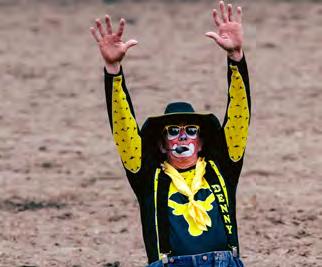
Dennis Halstead – Firefighter and World Renowned Rodeo Clown
Seven-time Canadian Pro Rodeo Entertainer of the Year, two-time Canadian Finals Rodeo Clown/Barrelman, and three-time Dodge Ram National Circuit Finals Rodeo Clown/ Barrelman.“From fighting fires to staring down bulls, Dennis continues to put his life on the line in his second career as a rodeo clown and bullfighter.” By CTV News, July 8, 2015. In 2026 Dennis is still having a fulfilling and exciting career. He’s 65 years old and says he has broken every bone but continues to entertain crowds of rodeo fans and protect rodeo athletes with a grin and twinkle in his eye.
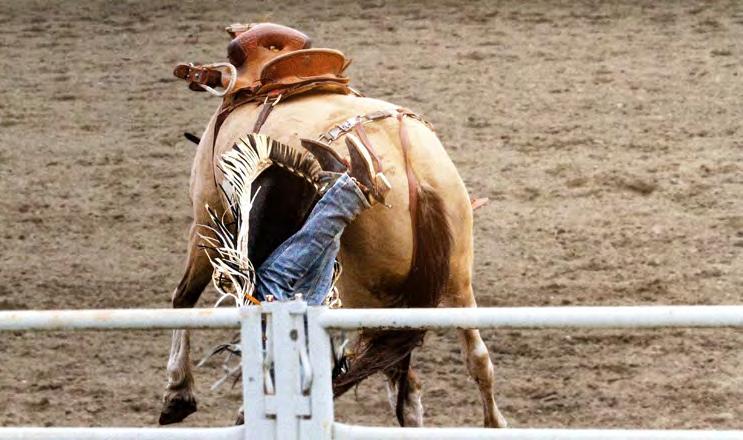
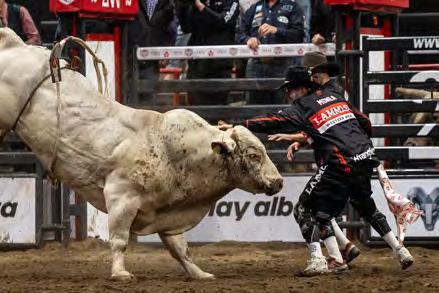
Q. Can you tell me about that fateful day Jamie Vang lay unconscious in the arena dirt after getting hit by a “headhunting” bull? Jamie was a young bull rider, kind of an up and comer. When he came out of the chute, the bull was really aggressive, and even though Jamie was an aggressive rider, he ended up getting thrown off like a lawn dart, thrown head first into the ground. I’ve been in the business for a long time, 31 years, and I’ve seen a lot of stuff. Once Jamie hit the ground, I knew he was hurt. When I got to him, he was having convulsions, and he was out cold. I thought he had broken his neck, for sure.
Back then they only had St. John’s Ambulance first aiders at the rodeo, and I’ll be honest with
you, sweetheart—this guy didn’t have a clue what he was doing. The biggest thing with a brain injury is to get as much oxygen to the brain as possible. It’s one of the secrets to helping a person with a brain injury before they get to a hospital. I asked the first aider to turn on his oxygen bottle to 15 litres per minute. He said, “I don’t think mine goes that high.” So, I took what he had and started putting oxygen into Jamie. His tongue started swelling because he was going into convulsions. I grabbed what is called an OPA. (OPA, or Oropharyngeal Airway, is a curved, rigid plastic device used in emergency medicine to help keep the airway open in unconscious patients by preventing the tongue from blocking the throat.) Anyway, I grabbed one of those and got his tongue down and then monitored him closely until the ambulance got there to take Jamie to the hospital.
H e was in the hospital for a long time. I received a call about 6 months later saying they were having a benefit for Jamie and asked if I’d be interested in coming. They presented me with an award. When I accepted the award, I told them that it was an honour, but I said, “To be honest, if you want to thank anybody, you should call the Calgary Fire Department because if it wasn’t with the training I received as a firefighter, I would have been standing beside Jamie, not knowing what to do.
Now to turn the story around, Jamie is a firefighter too now. Jamie called me when he was thinking about applying; I told him it’s the best job in the world—go for it! He works hard; as a firefighter, he has a wife and kids. I tell you, he could have quit so easily after his bull riding accident, but he didn’t!
Q. What you do at rodeos as a clown has so many sides to it—you’re an entertainer, but there’s a serious side that I don’t think spectators notice, the safety part of your career? I play the most dangerous sport in
DE N Y N
the world. It’s entertainment, but it’s dangerous! I’ve been in the arena when two guys have been killed. Both times it happened on a beautiful sunny Sunday afternoon. Both riders were crushed by bulls.
From a rodeo fan’s point of view, they go to the rodeo to see danger and mishap. It’s like going to a car race. There’s going to be a wreck, and people go to rodeos to see wrecks. That’s just human nature. I guarantee if there is a good wreck on Friday night, there will be two hundred more tickets sold for Saturday night. Being a rodeo clown is a tough career; you’re not going to do this job and not have aches and pains. It can become a problem in the long run.
Q. You’ve been lucky to have a long career; on average, how long is a rodeo career? Very few guys have had the long career I have. The bronc and bull riders in general last about 5-6 years; very few guys last 10-12. Out of two hundred bronc riders in Canada, there may be 3-4 that get a 10-12 year career; the same goes for bull riders – the injuries just pile up. I’ve broken every bone in my body. Not sure what my body is made of, but at 65 I can still run and jump into my barrel. Being in a barrel with a bull smashing into it is like being in car accidents repeatedly.
Q. So Dennis, who are you clowning around with these days? My friend Brett Monea has been with me pretty much since he started as a young bullfighter. Our sport is family. Brett’s been a bullfighter for over twenty years. For twenty years we’ve travelled together. I’ve watched his kids grow up. It’s like going camping with your best friend every weekend. Our bond is so close! Right now, he is Canada’s top bullfighter.
Brett Monea
Professional Bullfighter and Entrepreneur
Co-founder of the Ultimate Bull Fighting Experience
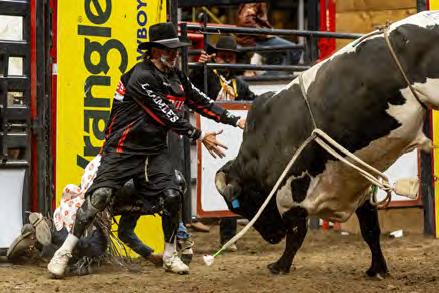
Q. Are there differences between bullfighters and rodeo clowns? Yes, very distinct differences. Rodeo clowns are there strictly to entertain the crowd, fill the gaps when there’s a pause in the action, and get the crowd engaged and having a good time. They do so by telling jokes and having acts that they do throughout the rodeo performance. They usually have a barrel in the arena during the bull riding; it acts as an island of safety for bull riders and bullfighters if they are stuck in the middle of the rodeo arena with an aggressive bull. They usually wear face paint and have long baggy pants and a western shirt with their own distinct style. Bullfighters are there strictly to protect bull riders during the bull riding event. Their job is very serious and dangerous, and they do their best to do everything possible to make sure the bull riders get away safely.
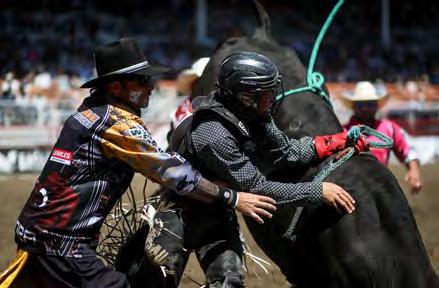
Q. How do bullfighters do their job? It’s the bull rider’s job to attempt to ride the bull for 8 seconds—50 points for the rider and 50 points for the bull. Those two are added together for a top score of 100 points. The highest score wins. So, if either the bull rider rides his bull for 8 seconds or gets bucked off early, it’s our job to distract the bull so the bull and rider can both get to safety. There are always two bullfighters and sometimes three (depending on the rodeo or bull ring), and we work together to distract the bull using our knowledge of cattle and our athletic ability. When everything goes smooth, you may not even notice the bullfighters, and when there’s a wreck, the good bullfighters are in the middle of it.
Some bullfighters wear large pants that are cut off (called baggies), and some still wear face paint. Others wear more of an athletic-style outfit with no face paint. The bullfighter can choose his own style to a certain extent. I like to wear face paint at rodeos and an athletic jersey and shorts with my personal sponsor on it. I wear a protective vest underneath the jersey, wear a good set of knee braces, and have a football-style cleat for traction in the arena.
In an article written in the Albertan by Simon Ducatel, October 18th, 2020, you mention a few interesting points about your Ultimate Bullfighting Experience (UBE). I have a few follow-up questions related to your quotes in that article. “We’ve had farm kids with similar stories to mine…”
Q. What is your story? What or who inspired you to begin your education, training, and eventual career as a professional bullfighter? I grew up on a seed-stock farm west of Wetaskiwin, actively involved in hockey, 4-H, and team roping in the practice pens. My dad enjoyed roping so much that he built an indoor arena with roping chutes in it. I had a couple of 4H friends that were a couple of years older than me that started bull riding, so what do 4H kids do? They build their own bucking chutes and put them in my dad’s arena. We would buck cows there weekly, having school friends come over to watch for entertainment. I would get on the odd cow, although I enjoyed trying to turn them back for my friends riding them or distracting the cow away from
them if they got bucked off or lasted the 8 seconds to dismount. One day a bull rider’s mom asked me, “Why don’t you go to bullfighting school?” Honestly, I never thought about it until then. So, the next week I enrolled in the TJ Baird and Jason Davidson bullfighting school in Balzac, AB. It was a three-day school, which I survived, and that was in March of 2001. I’ve been doing it ever since.
Q. Have you started the rodeo school, the Brett Monea Bullfighting Academy? And how will the academy train future bullfighting athletes? I changed up the idea of the bullfighting academy. A good friend of mine, Kynan Vine, and I came up with the idea during Covid—offering a unique experience to people that don’t want to be bullfighters but do want the experience of what it involves. So, we came up with the Ultimate Bullfighting Experience (UBE), and I’ve been running it ever since. At these experiences we do not allow participants to fight live cattle. They can go to a traditional rodeo school for that, if they decide to pursue bullfighting further, although my great team of professionals and I might fight one at the end for a demonstration.
Q. You mentioned, during our phone conversation, that you offer participants of all ages and abilities an opportunity to engage in a unique bullfighting experience. Can you elaborate on the UBE experience? I live southwest of Carstairs on 150 acres and take care of about 120 beef cows with my beautiful wife Amy and our two children, Wesley and Kate. We named our ranch Rafter U Ranch and Wellness Centre. We offer programs to children and adults alike. The kids’ program is modified for safety. People get a first-hand experience that they wouldn’t usually be able to get.
Advice from Brett for youth who want to pursue a career as a rodeo bullfighter. Be a good person and be patient. The only way to learn how to drive a car is by driving a car; the same is true for bullfighting. You need to go to practice pen after practice pen to work on the craft. The sport demands a strong work ethic, or you’re not going to last. You need to be able to get the fundamentals down on how to protect yourself in the arena against a 1,700 lb bull. If you can’t protect yourself, how can you expect to protect bull riders? You’re going to make mistakes (that’s how you learn anything in life), although in this sport, when you make them, it will seriously injure you. So, you will realize very fast how bad you want this.
Advice from Dennis for youth who want to become rodeo clowns. You need to be very athletic and brave. At 65, I still am able to jump in and out of a barrel. You need to be funny and will perform in front of hundreds to thousands of people. Although the job entails being an entertainer, I still have a responsibility to protect bull riders while I engage the audience.
TRUST YOUR STEP FROM DUSK TO DAWN
Laureen James BCom, Journalist, EC/NCCP Coach Certification IOB. Laureen is an equine journalist who writes for many publications. She also writes for the pet industry and is a columnist for Unison 50+ News. She has covered rodeos and related events over the past few years as a journalist and photographer. Photos of Jamie Vang were submitted by Jamie Vang with permission. Photos of Dennis Halstead were taken by Saddle Up Magazine at the 2026 Falkland Stampedethefalklandstampede.ca Photos of Brett Monea were provided and taken by Covy Moore - Covymoore.com
HANDCRAFTED
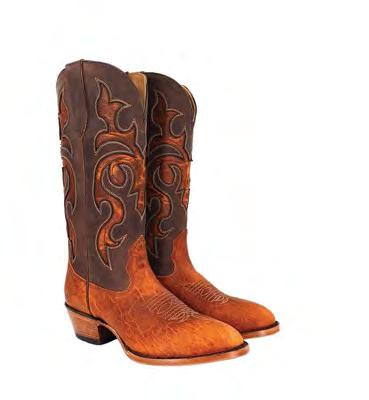
The arena demands a certain standard of confidence to reward the bold. “The Shane” was handcrafted to hold its own under that pressure with leather inlays, signature embroidery, and a tall cowboy toe shaft that’s always ready for the next ride. Shop boots and gear at ALBERTABOOT.COM
Not to Be Forgotten
By Mary Ann Simonds
Robert Vavra and I met through my video distributor Charlie many years ago. Charlie called me and asked if I would speak to Robert, as “he does not listen to others.” Charlie was Robert’s media distributor at the time and was concerned that Robert’s new film “Such is the Real Nature of Horses” needed some review and “tweaks” aside from Robert’s edits before publishing. That was the start of a long friendship.
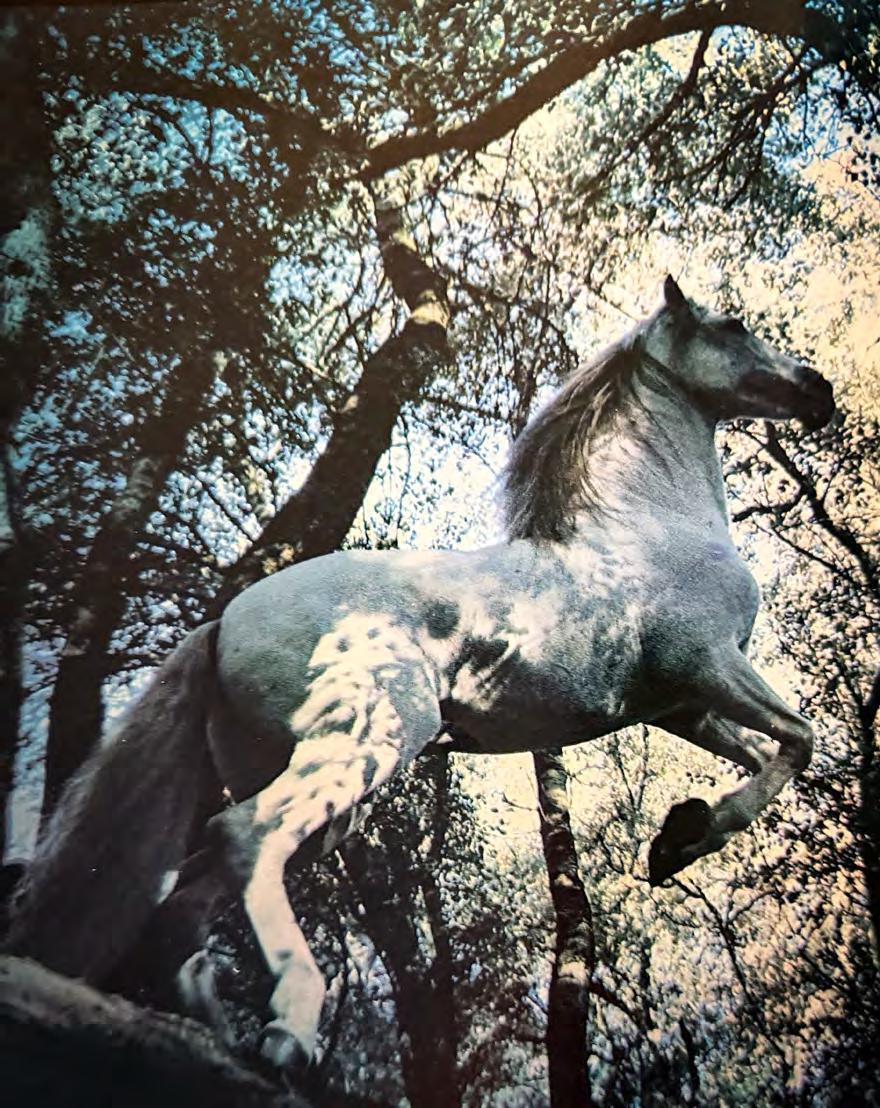
Robert and I talked horses for hours, comparing my field notes from my 20 years of research of the social behaviours of wild horses in the Western United States to his 20-year study of the Camargue horses of France. I reviewed the film scene by scene, often predicting the next scene by the behaviour of the horses, particularly the mares. We had very detailed discussions about several scenes where Robert’s perspective of what was happening was different from a more modern scientific perspective. Robert’s artistic eye, combined with his established fame, gave Robert more freedom to make statements that were perhaps poetic but not accurate regarding equine behaviour for a documentary film. At one point I had to tell Robert he would appear “outdated” regarding modern research if he did not agree to change his narrative.
“Such is the Real Nature” of Robert Vavra
I think
Robert was taken aback, as he was not used to being challenged. It was regarding a scene in which the stallions were fighting and the mares were calmly grazing in the background with their foals. His narrative discussed the danger of stallions attacking each other, but in fact it was “horseplay”—young stallions rearing and mock fighting, practicing their skills, as the mares are the indicator of seriousness in most situations. In another scene the mares take off with their foals off camera before you can see another stallion galloping into the scene. I told Robert, “This is serious, as the mares just left.” He had been watching the stallions and not noticing the mares, so at this point Robert became curious and interested in learning more. The stallion who was approaching off camera had previously attacked another stallion and ripped his ear off. And the scene eventually shows the other stallions coming together to protect each other. But it was the mare’s behaviour that predicted the seriousness of the situation. Robert recognized that his “lens” was through a courageous male perspective; mine was through the awareness and protectiveness of the mares.
We talked almost every week, sometimes for hours, and I realized there were few people Robert could have such deep discussions with, not just about horses but about the process of living in nature and becoming a part of the animals and their lives. While Robert approached it as an “outside observer” trying to “conquer” the dangers of nature, I opened another avenue to him shared by many women who live in the field—that of being “one with nature.” But Robert admired the challenge one faces in life. He enjoyed the fact he lived in a lovely hacienda in Seville (with 7 bathrooms) part of the year and then lived in his twin brother’s small garage apartment in El Cajon and used a “bucket to piss in.”
Robert was a constant seeker and gathered memories like charms. He talked of times with Michener when he was Michener’s young photographer and shared personal stories I won’t repeat here. He talked most fondly about his time in Africa. He had a deep love for exploring and no doubt would have excelled as a National Geographic Explorer in another lifetime. He spent months learning about the people and the animals he was photographing. He wanted to understand their deepest feelings and connections.
On the outside, Robert could seem independent and aloof, but there was another side to Robert. He supported children’s education in the countries he worked in, including Africa and Mexico, and often contributed to the people and villages where he photographed. While he hung out with celebrities and adventurers like Hemmingway, Michener, William Shatner, Jane Goodall, and others, he also developed deep friendships with villagers, often living with them and enjoying the experience of their culture.
As his friends were aging and dying, he was saddened that an entire culture was dying as well. He was good friends with people like Jane Goodall, who also died several months after Robert. However, he was most affected by learning of his friend John Derek’s death in 1998 while filming in Africa. Robert gave me a VHS version of the film for my input. He was quietly walking among cape buffalo known to be aggressive. One buffalo had chased the camera man up a tree, but Robert was in such a state of grief he did not care. I explained that the reason the buffalo were not interested in him was because he was not “looking at” them. His energy was in a lower brainwave state of just “being,” allowing the energy of grief, which carried no fear. The buffalo are casually seen looking at him walking among them.
Like many of us, we hold to the fond memories and do not embrace change. Robert resisted the digital age and appreciated the time and knowledge it took to capture the perfect photograph with the “light just right.” He was hesitant to have his new film turned into digital, but thanks to Charlie and Equivision, it is in DVD form. He had hoped the film would be sold to a movie studio as a nature documentary, but it was produced just at the end of film when digital and streaming were coming in full strength.
Seeing Robert’s whole life was in books and photography, I realized his life would not be remembered either if I did not interview him. I joked with him that “he would be forgotten if I did not interview him.” So he agreed to an interview in 2006. It was personal and in depth and is available on my YouTube channel: https://www. youtube.com/@maryannsimonds
Robert’s books reflect his deep love and passion for the horses, people, animals, and places he chose to photograph and write about. He was a complex man who honoured those who took risks and had the courage to venture into the world to explore. But Robert had a sensitive side as well. He cared about the people he knew. He valued friendships and appreciated the little things. He once told me he missed receiving written letters sealed with wax that smelled of an exotic place, as he would wrap each book he sent in brown paper tied with twine filled with personal notes or comments.
Robert Vavra should not be forgotten. His legacy showing the beauty and connection with humans and horses gives history to this long and deep connection. Take time to sit and read his stories and poetry as he brings to life a time when moments were cherished.
of
Simonds
Badger A Mare Worth Her Weight in Gold
By Danika McGuinness
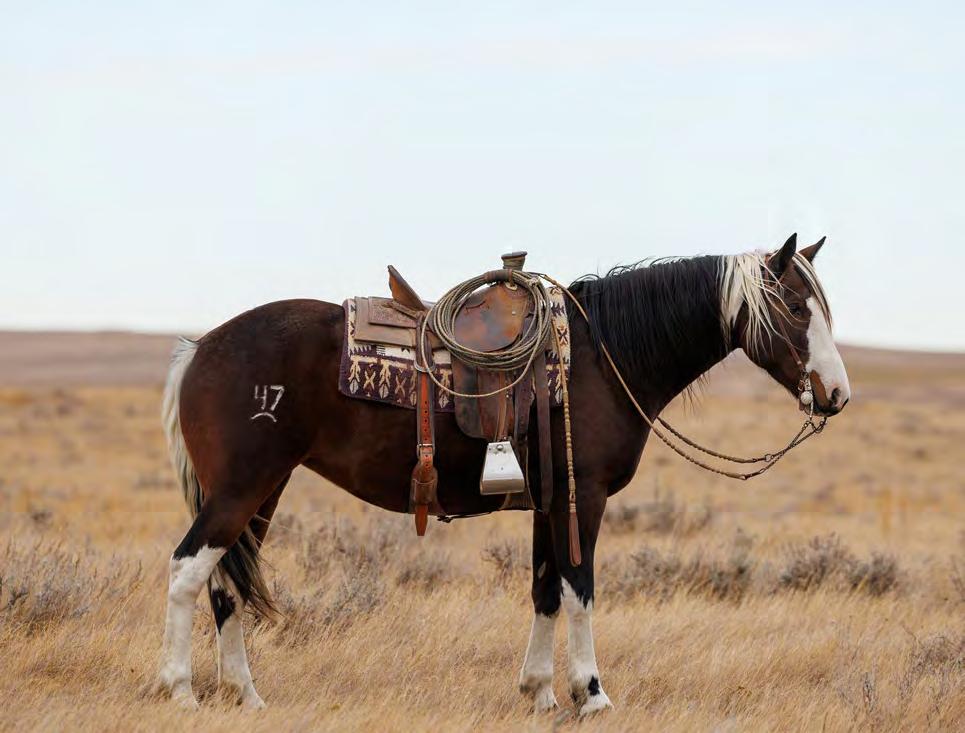
The horse industry is full of top bloodlines across every discipline and breed. Talented horses with lifetime earnings bigger than the average person’s salary. But what about the other horses, those who do not carry ‘papers’ with million-dollar winning ancestry backing them up? Some of these horses may never earn money in the show pens but work with all their heart and try to please their family at home on the ranch, community pasture, or feedlot, helping their Cowboy gal earn a living. Badger has proven to be just that horse.
Badger, a 2017 Grade (un-papered) Draft x Paint mare. A once-in-a-lifetime horse most could only dream of owning. Beauty, brains, a long mane, and a tail are all what make this feather-footed mare the complete package. Owned by Levi and Vanessa Ould from Kindersley, Saskatchewan.
Badger came into their lives when they were working on a place near Dawson Creek, BC, managing a cow/ calf operation. The owner had bought some mares from an auction and bred them to his ‘bucking horse’ stud. One of the mares foaled, and when Vanessa saw the foal, instantly she knew this was her ‘dream horse. A draft-type paint with white socks and a bay colour. They made a deal with the owner, and at weaning time Badger joined the Ould family.
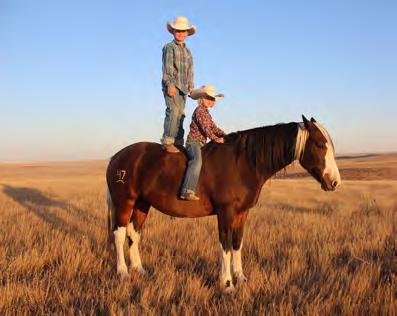
Vanessa’s husband Levi does all their colt starting, and Badger was an easy start right from the first ride as a three-year-old. At 5 years old on her first day working the community pasture, she was needed to rope and doctor a couple sick cows and calves, and she handled it like an old ranch horse. That’s just Badger’s demeanour: strong, steady, quiet, and reliable. The following year, when their daughter Hadley was just 2 years old, Badger showcased where her true value shines. She became the trusted mount for packing life’s most precious possessions. Our Children!
The Ould family spends their days together horseback riding and working the community pasture, kids and all. Their kids have never known their life without Badger. Vanessa wouldn’t have been able to work alongside her husband if Badger wasn’t in their lives to pack their kids around. “It’s been beautiful to watch our kids grow along with Badger, from riding in a buddy saddle behind us to the kids being able to ride her on their own now.” Vanessa says Badger does all the things: branding, roping, riding, and packing kids around. She doesn’t get worked up about anything. Badger is their go-to horse when a bull needs to be roped or when the weather is tough. T heir oldest child Jeremiah (8) says ‘ Badger has never been scared of anything.’
Last fall the Oulds got an offer to enter Badger into the 2026 famed ‘Art of the Cowgirl’ Elite Horse Sale in Wickenburg, Arizona. This was a hard decision for the Ould family. There were lots of tears, and they had a hard time making the decision, but finally they decided to list her. Vanessa says, ‘The Lord gave her to us for the time we needed her for, and she really fulfilled that role for our family.’ Badger is a horse they truly believe in, and she showcases what they do in their equine program.
The trip down to Arizona did nothing but solidify just how ‘perfect’ Badger truly is. From being able to make the long trip down there. It was a really fun trip with enjoyable stops along the way. Cowboying in Utah among the red rock, in Idaho Badger gave little girls pony rides. They saw the mountains and rode through some beautiful country in Montana. Finally settling in for d esert riding journeys among the Saguaro and Cholla cacti in Arizona. Badger herself made the trip a pleasure because she proved how easy she is to have along as a travel buddy.
At Art of the Cowgirl the duo competed in the all-girls ranch rodeo qualifiers during the week leading up to sale day. When sale day arrived, it had been a week where so many people got to meet Badger and ride her and just get to know her more. The Oulds are really grateful for all the connections and new friends that wouldn’t have been possible without this experience. W hen the duo rode in the ring, Vanessa said, “It was peaceful; the outcome was in God’s hands.” The auction brought an offer of $40,000 USD for Badger. The only non-papered draft horse in the sale. But Badger did not meet the Oulds reserve for her, and the sale did not go through.
The couple returned home with Badger, grateful for the outcome. Jeremiah and Hadley are overjoyed to have her home, proving that a horse as special as Badger is truly priceless—and a reminder that some of the best ones aren’t measured on paper.
Danika McGuinness lives in the mountains of the Cariboo with her husband and two boys. Together they manage a small piece of land, Danika is also a leather artisan, to learn more info on Danika’s leather works and written works please go to jackpinecowboy.com/blog and for more events check out Blackcreekranchbc. com You can follow the Ould family @wifeofacowboy to see more of Badger and the other special horses in this family’s life.
Left Hand Page Photos: Top centre photo by Meagan Schmidt(Piller). LH photo by the Oulds family. RH photo by Tonia Thomsen-Smith.
Right Hand Page Photos: Top LH photo by Lauren Toews. Centre, top RH, bottom RH and LH photos by Rachel Neufeld.
Going Slower To Be Faster Forward Thinking Going Slower To
Be Faster Going Slower To Be Faster
By Alexander Grayton
Sometimes I wonder if I am being too picky, getting stuck in the realm of semantics. Other times I wonder how it could possibly be good enough to expect someone to know what you really meant when the words you actually used were quite different from what you meant. I am reminded of the “reasonable person standard” in the realm of law, which essentially clarifies that intent simply doesn’t rule the day—impact does.
You may be wondering, “What does this have to do with horse training?” Fair question, but this is actually a very important principle that we have to remember when dealing with horses in particular but also when training or coaching riders.
Here is one of the most important cases: the concept of PACE. Is it fundamentally important? If you spend enough time around a warm-up ring, in the competition arena when people are walking the course, or at home in daily training, you will undoubtedly hear at one time or another someone referencing “setting the pace,” “maintaining the pace,” or other variations of pace talk. I am here to say this is not a good thing to say. Full stop.
I will now offer my argument for why this is a crucial distinction and people need to change the way they speak, never again to utter the word “pace” when it’s not what they meant. The impact is that riders of all levels get way off topic, which essentially makes the sport harder than it needs to be, and the poor horses are the ones that mostly have to deal with that.
Let’s start with defining the term PACE. It is basically rate of speed, no matter the units you use—miles per hour, kilometres per hour, metres per minute, and so on. In the show jumping world, you may be familiar with the rate used to determine time allowed. Depending on the level and location of competition: Horses and riders may be required to navigate a course at an average speed of 350 m/min up to 400 m/min.
Note the average part of that. As long as horses complete the course at an average rate of 350 or 400m/min, they will be within the time allowed. It’s possible to be doing some parts of the course at 450 m/min and others at 250 m/min and still ultimately be within the time allowed. We have identified the possibility that pace (aka speed) can change around the course and yet still meet the threshold of time allowed. So “maintaining pace” for that reason simply doesn’t matter.
W hy would a rider elect to change their pace around the course? A few key points will show us the way.
First of all, harken back to the days of school mathematics (who ever thought that would happen and be useful in the horse world?!). Pace is not fundamental in the sense that it can be split up into smaller factors or units of measurement.
Rhythm—or the regularity of stride— is truly a fundamental part of riding . Every horse’s rhythm will be unique depending on their size and way of going, so it’s important to understand that there isn’t a right or wrong rhythm. The key here is that the rhythm shouldn’t change for a given horse—or rather, if it does change, the rider should be aware of that and what it could mean.
A rhythm that is getting faster should alert the rider that the horse is possibly getting anxious, tense, or something like that. A rhythm that is slowing should alert the rider of a possible loss of impulsion or power, too much relaxation, and not enough intensity. As with everything in the horse world, there’s no guarantee how horses react to anything—that’s up to them— but we can note these changes as instructive and helpful to check in with them. So our goal when riding in general is to keep a consistent rhythm all the time.
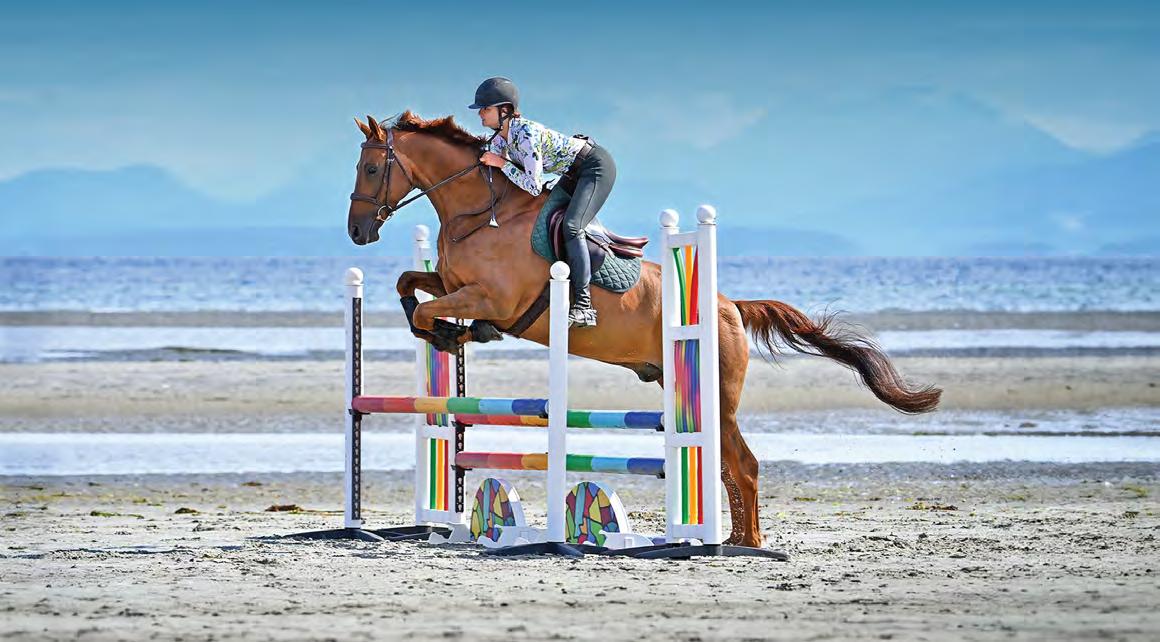
Stride length, however, is a totally different situation. Course designers will set lines that are sometimes long, sometimes short— changing the stride length on course is simply a necessity due to the way the jumps are put together. But it’s not just about a long or short line; stride length will also be impacted by the track a rider chooses to ride. If the rider wants to execute a hairpin rollback turn in the
jump-off, the strides around that turn will be materially shorter to make it possible. If the rider then gallops to the last jump of the jumpoff, the strides will get significantly longer.
Looking back up to our helpful formula, if rhythm is consistent, but stride length has to change to be able to navigate a course (competitively or not), then pace will absolutely change.
That concludes my argument for why saying “set the pace” or “maintain the pace” is simply bad instruction. Definitely, riders should think about their stride length—does it suit the track they want to ride or the line they want to jump? So much of this can be planned and strategized in advance. It is the primary reason to walk the course! A person can learn the order of jumps to do by staring at the course map, but to actually understand the track and stride length requirements necessitates walking the course.
Is it possible to maintain the same stride length around a whole course, including hairpin turns, awkward angles, and so on? Look no further than our friends at Formula 1 to see what can happen if the driver doesn’t gear down in time—they go off the track at worst, or at best, whoever optimizes the gearing down and up through turns will be able to navigate the track faster.
This is an important analogy—show jumping is very much more Formula 1 than Nascar. If we want to ride the fastest jump-off track, which will include turns as well as straightaways, horses and riders that gear down (i.e., shorten their stride) and gear up (lengthen their stride) at the optimal time will be faster. A real pathway to “going fast” is to slow down better than everyone else (at the right time!).
Hopefully by now it’s agreed that pace varies, stride length varies, rhythm should be consistent, and sometimes going slow helps us go faster by turning tighter.
There is another consideration that should remain at the top of our minds as riders: Forward Intention
This is not a measurable variable, which is why it’s hard to really talk about with the most beginner of riders, but it is a feeling that riders will be familiar with fairly early on into their education. Intention is the key here—does the horse want to go forward, never mind how fast they are going? Backtracking one step, is it possible for a horse to want to go forward without actually going quickly? A rider can feel this in a number of ways: is the horse taking the contact? If so, then it’s possible the horse is taking that contact forward and “in a forward gear.” If the horse isn’t taking
the contact, the horse is far more likely to be in neutral.
When riding around in any gait (walk, trot, or canter) or even on course, is the rider using their leg as a forward aid consistently? That is a major red flag for forward intention. If the rider applies leg every stride simply to maintain whatever stride length they want (and therefore speed), the horse is not demonstrating forward intention, and the rider is making up for it with constant cues. The opposite example is often helpful to better illustrate: if the horse is thinking so forward and taking the contact as they bolt around the ring, so much so that the rider would never dare to use their leg every stride, well, that’s a forward-thinking horse.
We are after the middle ground, where the horse is taking the contact and volunteering forward without running through the contact. This is where the horse’s understanding of being forward-thinking interacts with their understanding of contact, connection, and boundaries. We need it all! Far too often riders compromise on some aspect of that, because finding the balance is hard, and it’s a common human trait to take on more and more to “help.”
I would argue that compromise like this should never be the tactic to take. When you’re on course at the competition, riders use the tools they have to navigate the course as best they can. Every other moment is an opportunity to improve this part of their training and rideability.
The ability to lengthen and shorten strides at a moment’s notice, without destroying forward intention, is necessary to be competitive at the highest level . Riders should be clear about those concepts, because that is what should inform your training techniques and exercises you build.
Just like when we watch Formula 1 races and there are some things we can see happening clearly (stayed on the track or not, went faster than everyone else or not), there is so much happening beneath the surface to make all this come together, and the same is true in show jumping.
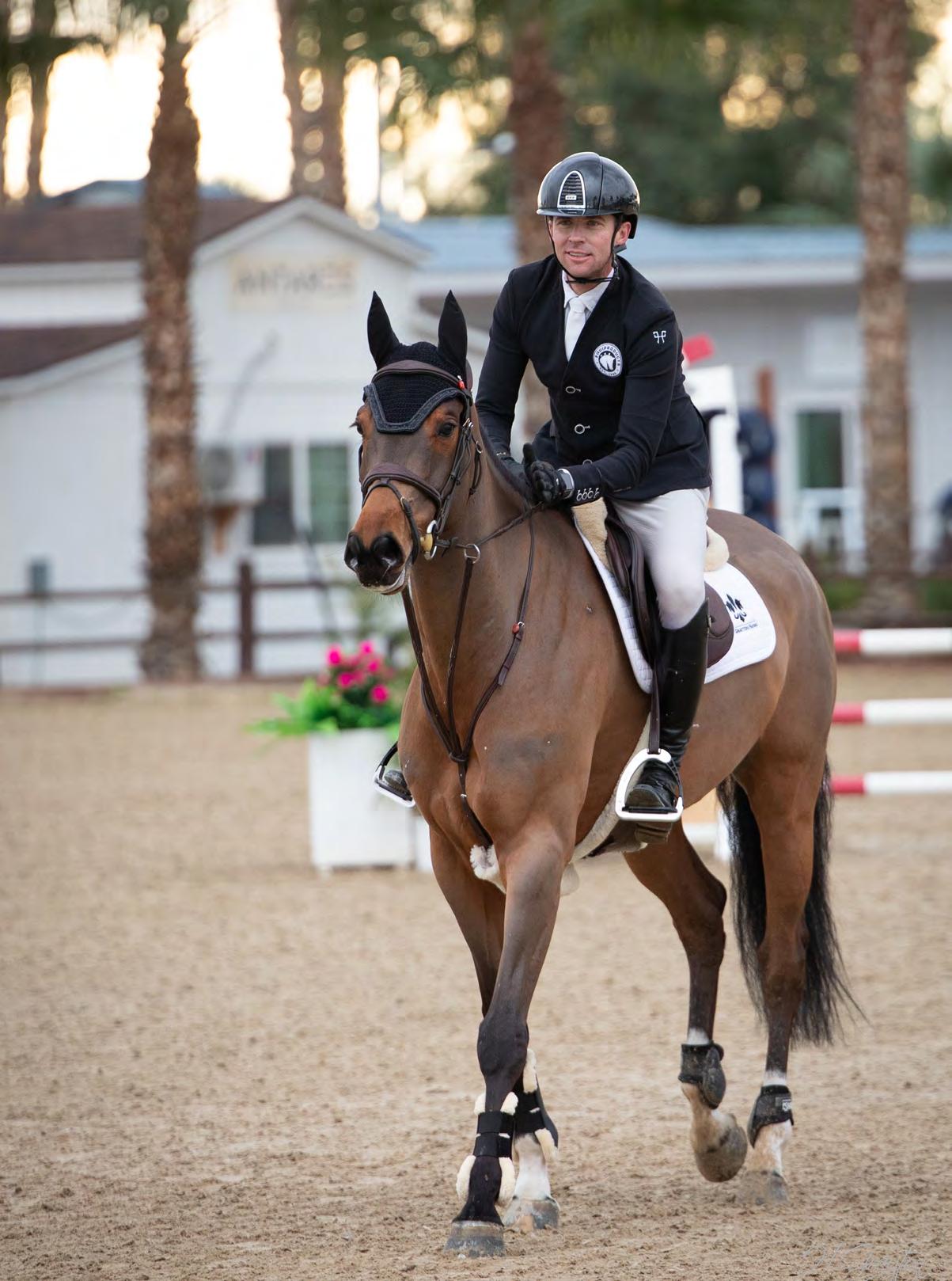
If you watch any very high-level show jumping—like Kent Farrington winning the 5* Grand Prix in Wellington a few short weeks ago—the subtle adjustments to stride length (therefore pace) while always having a horse striving to go forward just right are hard to notice, and it looks seamless and intuitive, but the work to get to that point includes understanding some of these really important concepts.
Alexander Grayton is an accomplished international show jumper, coach, trainer and clinician. He has amassed a significant resume of Grand Prix wins and championships while staying true to his values and ethics of training, integrity and advocacy for the horse. His approach to training is rooted in precision, patience, adaptability and a fundamental understanding of the horse, all with a focus on high-performance competition. Visit graytonfarms.ca o r follow @grayton_farms on Instagram for more information!
P hoto by
Quinn Saunders Media
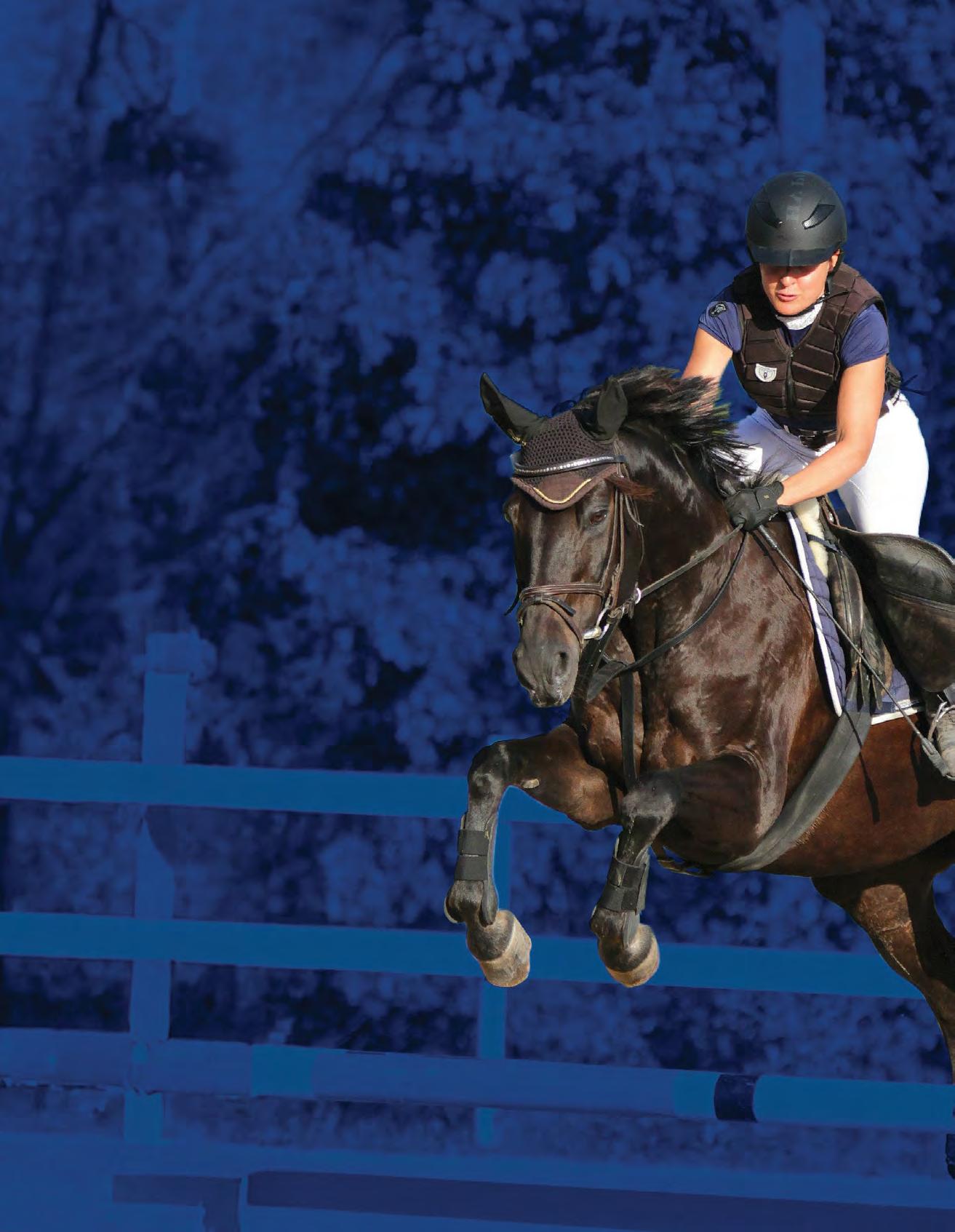
Quick Guide to Popular Western Disciplines Quick Guide to Popular Western Disciplines
By Caroline Cochran BScn, Reviewed by Dr. Emily Gilbert, PhD
Western riding is a diverse category of equestrian sports with roots in ranch work and cattle handling. Disciplines range from fast-paced rodeo events to precise arena patterns, offering excitement for every kind of rider. Read on to discover some of the most popular Western disciplines.
Cutting
Cutting is a cattle work discipline that showcases the horse’s ability to separate a single animal from the herd and prevent it from returning. The event highlights the natural instinct of a good cow horse, along with the athleticism, balance, and responsiveness required to control livestock with minimal rider interference.
In a cutting competition, the rider selects and drives a cow out of a small herd, then allows the horse to work the cow using minimal cues. The horse must mirror the cow’s movements, anticipating changes in direction and speed. Judges score performances based on difficulty, style, and how effectively the horse maintains control of the cow without direction from the rider.
Reining
Reining is one of the most recognized performance disciplines in Western riding. This discipline is often compared to dressage due to its emphasis on controlled, flowing patterns. The sport tests the horse’s athleticism, responsiveness, and ability to perform advanced manoeuvres with style.
Reining patterns typically include spins, sliding stops, rollbacks, circles at varying speeds, and lead changes. Horses are scored on the accuracy, smoothness, and style of each manoeuvre, as well as overall attitude and willingness. Minor penalties may be given for excessive head movement, incorrect leads, or breaks in gait.
Ranch Riding
Ranch riding is a Western discipline that highlights a horse’s versatility, smoothness, and ability to perform practical ranch tasks with style and efficiency. The class evaluates both the horse’s athleticism and its responsiveness to the rider’s cues.
In competition, horses are asked to perform a pattern that simulates ranch work, including smooth gaits, precise transitions, and optional obstacles such as gates, bridges, or poles. Judges assess the horse’s willingness, quality of movement, and overall responsiveness. Penalties may be applied for breaking gait, missing obstacles, or lack of control.
Roping Events
Roping events are among the most iconic rodeo disciplines, testing the coordination and teamwork between horse and rider. These events showcase the horse’s speed, agility, and responsiveness, as well as the rider’s timing and precision.
Rodeo roping is divided into three different classes:
● Calf Roping - tie-down roping: The rider ropes a calf and quickly dismounts to tie its legs. Precision, speed, and smooth execution are key to a successful run.
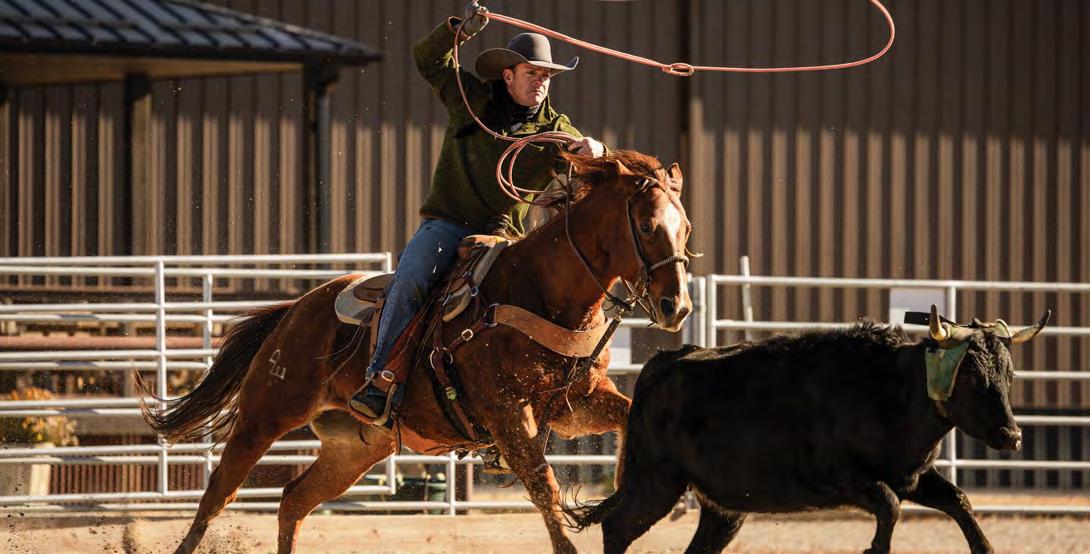
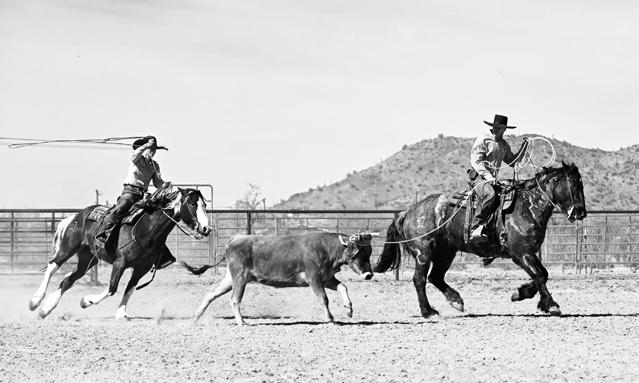
● Team Roping: Two riders, a header and a heeler, work together to rope a steer. The header ropes the steer’s head while the heeler ropes the hind legs, requiring coordination and communication.
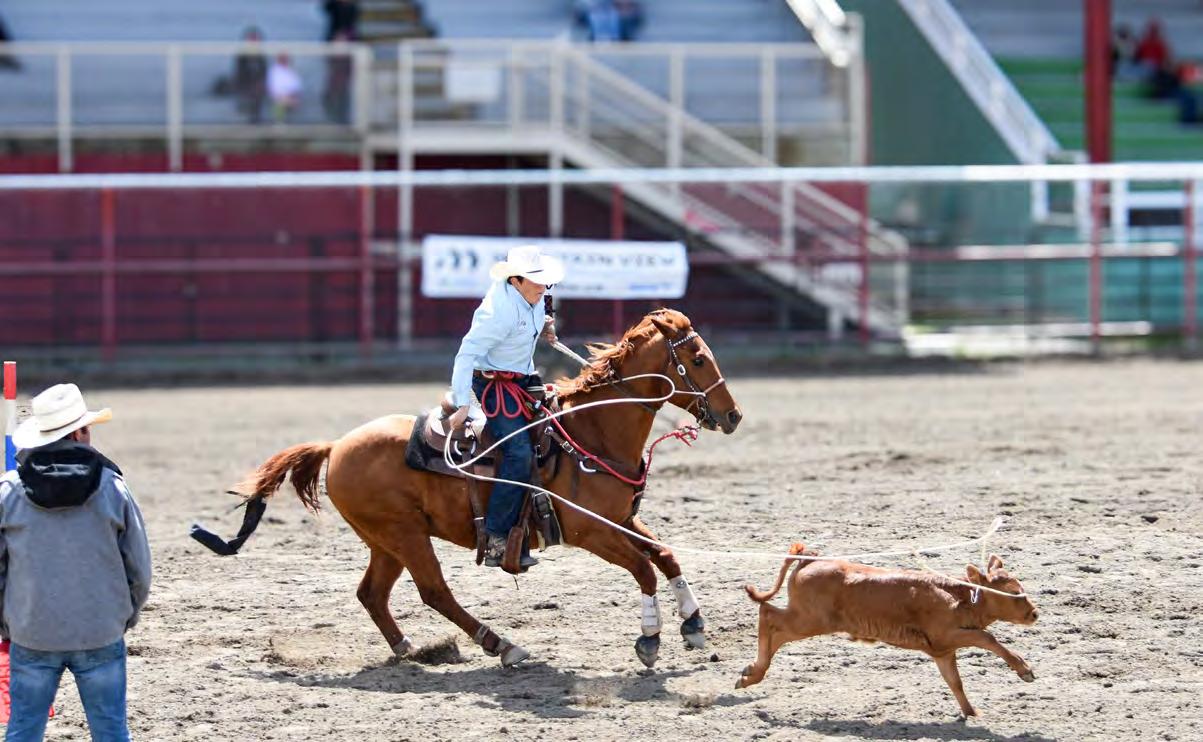
● Breakaway Roping: A growing women’s event, breakaway roping involves roping a calf without dismounting. The rope is attached to a string on the saddlehorn, and the run ends when the rope breaks away.
Western Pleasure
Western Pleasure is a show discipline that emphasizes a horse’s calm demeanour, smooth gaits, and overall training under saddle. The goal is to present a horse that is a pleasure to ride, demonstrating consistency, balance, and responsiveness.
In Western Pleasure classes, horses perform at a walk, jog (trot), and lope (canter) in both directions of the arena. Judges assess the quality of movement, cadence, smooth transitions, and the horse’s attitude. Horses should appear relaxed and willing, with minimal visible cues from the rider.
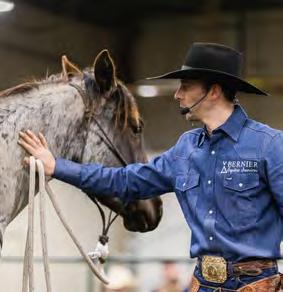
I had the pleasure of watching Horse Expo Canada’s Trainer Showdown, where three trainers were selected to compete in a colt-starting competition over the next three days. The trainers who competed were Kyle Fischer, Braden Bernier, and Trevor Mertes, with Braden Bernier ultimately coming out on top.
After I had the chance to catch up with Braden and learn more about his win. To start, Braden began his horsemanship journey through life on the ranch, where he watched his grandparents and parents working horses and starting colts. He was known to be infatuated by their process, so much so that his parents set up a picnic table beside the round pen to be able to watch while he did homework.
However horse training was never the ultimate goal for Braden growing up; it was more like a fated path that unfolded. At the age of 15, he took on his first outside horse for colt starting, because, like any other 15-year-old, he wanted to be able to buy himself a truck and the fuel associated with it. This then led him to move away and start working with a local horse trainer, who pushed him to work hard. He then went off to college, where horse training followed and helped pay for his schooling. With horses being a constant throughout his life journey, it was a natural progression to make it his full-time living.
One of Braden Bernier’s fundamental philosophies in his work with horses is that we release on the effort, not just the execution. At the expo, you could clearly see that principle in action throughout his Trainer Showdown sessions with his equine partner, Oscar. Towards the beginning of his sessions, Oscar was rewarded for his try, which allowed for not only his body to be worked but also his mind, leading to a beautiful breakthrough of trust in one of the earlier sessions.
While watching these, it can be a difficult concept to understand why you release on the effort opposed to the correct goal; however, it is meant to provide safety to that horse while telling them they answered your question to them correctly. This helped lead them to moments like when Oscar actively came towards Braden seeking reassurance and safety after being worried walking over the bridge. Braden mentioned to me how, in that moment, he was so proud of himself and knew right there, no matter how the rest of the competition went, he was happy. This was the ultimate moment where he was most proud during the competition.
Braden remained incredibly humble when reflecting on his win, sharing that he was simply grateful to have been part of the event. More than anything, he expressed feeling thankful and blessed to be a part of such a great production surrounded by good people. That appreciation was clearly felt and resonated with attendees, as his approach to working with the horse earned the audience’s admiration. This resulted in not only a Trainer Showdown victory but also the People’s Choice Award, making for a full sweep of the event.
Braden said that the people’s choice award meant even more to him, as the audience would not reward you if they felt like you didn’t do right by the horse. It was evident throughout the competition that he played the competition for the horse, having Oscar’s best interests at heart. He went on to tell me that regardless of if he had won, he would have been pleased with how it turned out because he didn’t go and sour a horse just to win.
He went on to elaborate that he did not see the competition as against his competitors Trevor and Kyle but instead against himself and to be able to show good horsemanship to help people better understand their horse. When asked what he hoped people took away from his sessions, he shared, “I hope people took more than just a strategy to use. Instead, I hope they realized everything you do with a horse has to make sense to you and how everything you do relates to horsemanship—creating a partnership with you built in a way that goes with their nature.”
Oscar’s Bio
Oscar was selected as Braden’s horse to use in the trainers’ challenge; he was a blue roan gelding from Rocking Heart Ranch. His registered name is RHR Blu Frenchman, and his influential lines are Frenchman’s Guy and Blue Valentine. Oscar was also the winner of the Rocking Heart Weanling Challenge in 2023 and was sold during the event to a new home. Stay tuned with Rocking Heart Ranch at rockingheartranchltd. com for the Young Guns Challenge Sept 11-13, 2026, where the winner will receive a spot to compete at the 2027 Horse Expo Canada’s Trainer’s Challenge.
The next Horse Expo Canada will take place April 23–25, 2027, at Westerner Park in Red Deer, Alberta. Known as Canada’s largest equine expo, the event is a must-attend for horse enthusiasts, industry professionals, and families alike. We recommend keeping an eye on the official website, horseexpo.ca, to plan ahead and stay updated on next year’s schedule, exhibitors, clinics, and special events. Saddle Up Magazine will be there with free magazines, exciting prize draws, and plenty of opportunities to connect. Be sure to stop by and say hello — and watch for coverage and stories from our talented writers who attend the show each year.
Britain Mills-Dawes, owner of Stable Instincts—an equine wellness business specializing in bodywork and nutrition. She’s a practitioner, clinician, and speaker who’s presented at some of the largest Canadian equine events, such as the Calgary Stampede and Horse Expo. Britain also co-hosts her equine podcast Uncinched. Connect with her at stableinstincts.ca
Photos by Krystina Lynn Photography
F A L KLANDSTAMP
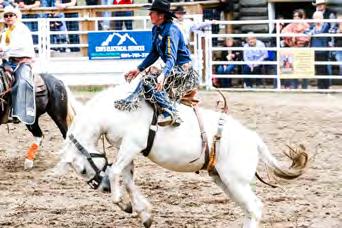
Legacy, Community, and a Buckin’ Good Time
Protective Association, now the Canadian Professional Rodeo Association. This helped attract competitors from across Canada and the United States, marking a new chapter for the rodeo. Today, it is recognized as one of Canada’s oldest professional rodeos, still rooted in tradition while continuing to offer dances, parades, breakfasts, and camping that keep its small-town character intact.
The history of the Falkland Stampede is closely tied to the Churchill family, whose involvement now spans four generations. Homer Churchill helped establish the family’s early role in the rodeo during the 1940s. His son, Mervin “Merv” Churchill, became a central figure in its development and served as rodeo manager from 1960 to 1991, dedicating more than five decades to professional rodeo. Merv played a major role in shaping the Stampede into a respected stop on the Canadian circuit. His contributions were recognized in 1982 when he was named Canadian Professional Rodeo Association Committee Person of the Year, and he was later inducted into the Canadian Pro Rodeo Hall of Fame.
The tradition continued with Jason Churchill, who managed the rodeo through much of the 2000s. In 2019, Melissa Seaman—Merv Churchill’s granddaughter and Jason Churchill’s daughter—became the fourth generation to help guide the event. Under her leadership, the Stampede has continued to grow while staying rooted in community. Revenue from the event continues to support local facilities, including the community hall, skating rink, and rodeo grounds.
We were able to experience the Falkland Rodeo in May, and from the first contact with Rodeo Manager Melissa Seaman, everything set the tone for the weekend—she was prompt, professional, and helpful with our media requests. On arrival, we were met by a parking attendant, then guided by an athlete to where we needed to be, followed by gate staff, volunteers, competitors, and spectators—all consistently welcoming, easygoing, and approachable. That welcoming atmosphere carried throughout the grounds and into the crowd, and it was easy to see why so many people call it one of their favourite rodeos. Nearly everyone we spoke with said the same thing.
What we experienced was far more than rodeo action. The Falkland Stampede felt less like a show and more like a living tradition—deeply rooted in community, family, and rural heritage. There was an easy, unhurried atmosphere throughout the grounds, where old-time cowboys, longtime volunteers, young athletes, and families all shared the same familiar space. You could see the strong sense of connection in the way experienced riders helped younger competitors through the gates with the quiet confidence of people who had once stood in their boots themselves. Homegrown and grounded in tradition, the Falkland Stampede remains closely tied to the town that supports it, earning its place as a respected stop on the rodeo circuit.
107th Falkland Stampede
Each year, the BC 55+ Games bring athletes from across the province together to celebrate active living, connection, and the joy of sport at every age. In September 2026, equestrian sport once again plays a key role, with competitors gathering at the North Thompson Fairgrounds in Barrière for several days of horsemanship, camaraderie, and learning.
The equestrian portion of the 2026 BC 55+ Games highlights the diversity of BC’s horse community, with divisions that include dressage and western dressage, driving trials, ranch horse, and mountain trail. Alongside the competition, two official seminars offer an opportunity for riders, drivers, and spectators to gain valuable insight into the judging process—straight from the judges themselves.
Through the Eyes of a Driving Judge - September 11–13, 2026
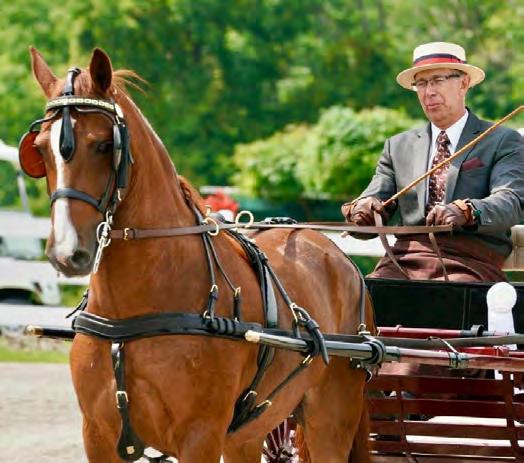
Driving competitors and enthusiasts are invited to step into the judge’s seat with Through the Eyes of a Driving Judge, led by Francois Bergeron, an FEI 3* Driving Judge. This seminar breaks down how driving performances are evaluated for turnout and overall presentation.
Held alongside the Driving Trials at the 55+ Games, the seminar combines observation with discussion. Friday and Saturday include post-competition Q&A sessions, giving participants the chance to ask questions based on what they see in the arena. Sunday rounds out the weekend with a full day of judging, demonstrations, and discussion, helping connect the dots between performance and score. The seminar is free for competitors entered in the 2026 55+ Games Driving Competition, with a $150 registration fee for all other participants.
Through the Eyes of a Ranch Horse Judge - September 11–13, 2026
Running the same weekend is Through the Eyes of a Ranch Horse Judge, led by respected multi-carded judge Jodie Moore. This clinic focuses on what defines a quality ranch horse, including correctness, manoeuvre quality, authenticity, and overall presentation.
Like the driving seminar, this clinic is closely tied to the ranch horse competition. Participants can attend post-competition Q&A sessions on Friday and Saturday, followed by a full day on Sunday dedicated to judging practice, demonstrations, and discussion. Seeing runs in real time helps bring judging standards to life and makes them easier to understand and apply. This seminar is also free for competitors entered in the 2026 55+ Games Ranch Horse Competition, with a $150 fee for others.
A Learning Opportunity Worth Catching
These officials’ seminars offer a rare chance to learn in the middle of real competition, turning questions into clarity. Whether you’re aiming to sharpen your performance or simply want to better understand what judges are looking for, they’re a valuable addition to the 2026 BC 55+ Games experience. Photos are courtesy of HCBC.
ClUb Hub ClUb Hub
Kelowna Riding Club
The Kelowna Riding Club kicked off the show season with the Spring Classic Hunter Jumper Show from May 1st through 3rd. The show is HCBC Sanctioned, and riders collected points for the Interior Desert Circuit. The show provided a relaxed and supportive environment for riders looking to get more time in the show ring at the start of the season.
Townsend Equestrian generously sponsored lunch for competitors on Friday. The View Winery served wine, cheese, and cider during Saturday’s hunter derby. Connect Equine Veterinary provided a pancake breakfast on Sunday morning to wrap up the community events. Three rings ran classes from poles on the ground to the 1.10 m jumpers. The prize list included a Happy Valley Mini Medal, a $400 Okanagan Farrier Beginner Hunter Classic, and a $500 Okanagan Equine Mini Prix.
The KRC’s next event will be the Dance in the Vineyard Dressage Show June 6th and 7th. Check out their website for a full list of events in a variety of disciplines, ranging from working equitation, ranch classes, derbies, and percentage days. To see more show dates with KRC, visit: kelownaridingclub.ca
BC Bridlehorse
Last year’s Art of the Bridlehorse, held Sept 21–22 at the
These practices honour early BC ranch heritage and emphasize understanding cattle behaviour, keeping work slow and stress-free. Riders are encouraged to plan ahead, work as a team, think on their feet, and partner with their horse. The annual event gives riders an opportunity to showcase their skills, rewards those who demonstrate success while honouring this heritage, and helps preserve and promote this traditional system.
More than a competition, it is a gathering celebrating BC’s Bridlehorse heritage. Competitors and mounts must demonstrate versatility in three categories: sorting, roping, and horsemanship. Riders sort designated steer(s), demonstrate roping (breakaway or hard), and complete a ranch horse pattern showcasing communication and partnership. In addition to the competition, the Makers Market brings members from across BC together to network, connect, and showcase crafts such as braiding, leatherwork, silversmithing, and other artisan work that preserves traditional gear and history. A Saturday night fiesta with dinner, entertainment, and a “cowboy trade” provides a social outlet and helps build community beyond the event. This year’s pre-event workshop will include a day with the judges, offering a unique learning opportunity from their combined experience and knowledge.
This year’s Art of the Bridlehorse will be at the North Thompson Fall Fairgrounds in Barriere, BC, shared with BC Ag Expo, on Sept 25–27. It will include a preevent educational workshop on Sept 25, the mounted competition on Sept 26–27, and a Makers Market beginning Sept 25.
To learn more about the BC Bridlehorse Heritage Association, membership, the Art of the Bridlehorse, or how to get involved or sponsor, please visit bcbridlehorse.ca
Photos by Vanessa Kopp with Elemental Equestrian
North Thompson Fall Fairgrounds in Barriere, BC, was the BC Bridlehorse Heritage Association’s first annual celebration of the shared love of quiet, respectful stock handling and high-caliber horsemanship brought north with the Vaqueros some 200 years ago.
Photo by Audrey May
Vintage Riders Equestrian Club
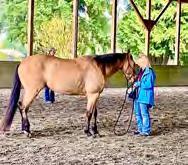
You can be all things to all people, or horses. You just cannot do it all of the time. In the spirit of what Vintage Riders is, our varied and interesting members took a break from intensive study. When they attended the Liberty clinic with Faith Head.
In an atmosphere of companionship, there was so much learning, fun and connection. A special thank you to Rita R for the use of her facility. Faith kindly guided the horses and horse moms, creating a fabulous experience. Carol, as always, did a great job organizing. And feeding people. We don’t know how you do it. We appreciate it!
Peace, poetry, and pleasure sum up the day. Thank you, Faith, for showing us the way to dance with and enjoy our horses. Simply more of what we love, which brings us alive.
By Kendra Kowalski
Photos submitted by VREC with permission.
The Canadian Cowboy Challenge Questions for the Judges of CCC
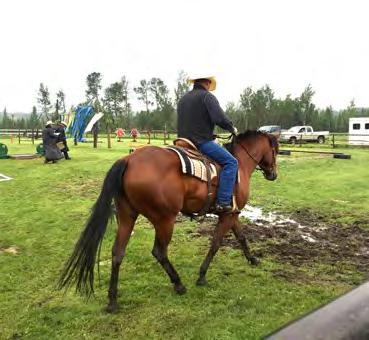
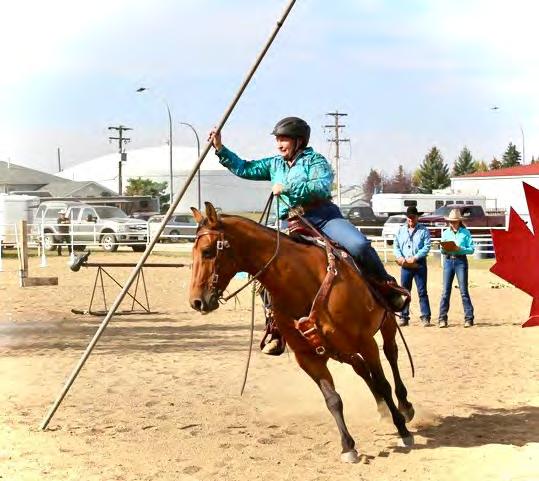
1) Do the judges ever tell a host that an obstacle is not safe and needs to be removed? For example, walking on slippery silage poly? Yes, and we have removed obstacles. It’s based on each division.
2) Is there, or should there be, a limit for the depth of a water box? No, we don’t. If it became an issue, it would be reviewed at that time.
3) When roping the dummy, I like to stand in my stirrups and lean forward like I would when actually roping a live calf. Is that the body position you want to see? There is no specific body position. Standing or sitting is irrelevant.
4) How much of a deduction is it if a horse touches/ticks a rail when side-passing or backing an “L”?
A tick is about 1⁄4 point per tick. Moving a rail is between 1⁄2 and 1 point or more, depending on the scenario. Backup L is more about the straightness and control.
5) Do you want to see the rope coiled after throwing or just thrown back to the dummy steer?
I f you miss, we would like to see it coiled up and ideally take it with you. If you catch it, coil it up and put it on the steer head.
6) How much of a deduction is it to switch from one hand to two? Or from the left hand to the right?
I f you are switching to complete an obstacle, it’s typically not an issue. If it’s between an obstacle and a free ride, then 1⁄4-1/2 point each time. If you have to switch to two hands from one during an obstacle because of an issue, then you might gain the points you lose by switching to two hands. A shank bit should be ridden one-handed.
7) How many times should a person attempt an obstacle if a horse refuses an obstacle, but a rider knows their horse can do it, as it has done it in the past?
I t’s up to the rider how long they want to keep going. Every refusal will cost you. You also need to keep in mind how many obstacles you have left to complete.
8) Do you want to see side passing in and out of obstacles like the gate, send-around, or other circular obstacles, or would you prefer to see them just ride smoothly to it?
T here isn’t “one correct way” to enter and exit obstacles. Each obstacle is different, and it depends on which direction you are coming from and going to next. The goal is to have a fluid and smooth transition.
9) When time is called and a participant is ready to execute or in the middle of executing an obstacle, will that obstacle count, or do they need to have completed it to count?
A s per rule 4.4, a maximum time of six minutes is allowed to complete the course. Each ride will be timed, and there will be a one-minute warning. Should a rider not complete the course in the time limit, they will be scored only for the obstacles completed. The time limit may be extended where longer courses warrant it, at the discretion of the judges and course designer.
Al Bignell judging Alana on George, a scribe is standing beside Al.
The Back Country Horsemen of BC The Back Country Horsemen of BC
Who Ensures Your Equine Access to Trails and Your Right to Ride and Recreate with Equines?
Submitted
by
by
Rose Schroeder, Shuswap Chapter
Rose Schroeder, Shuswap Chapter Submitted
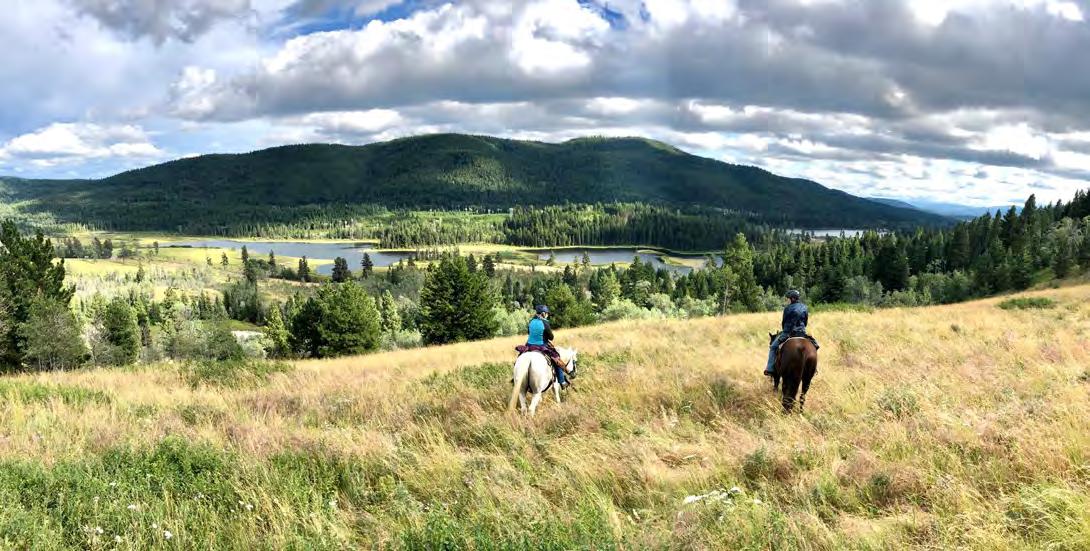
When you are out riding a trail or camping at one of the facilities that dot BC, do you think about who might have built the campsite and be keeping access and the trails open? It might just be Backcountry Horsemen members. BCHBC is a not-for-profit society compiled of volunteers that direct their efforts to ensure recreational riders have camps and trails to ride now and in the future.
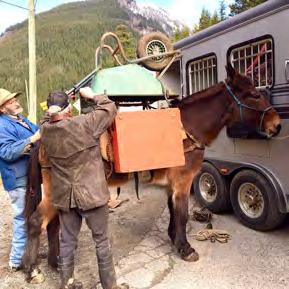
The name ‘Backcountry’ may mislead some people to think we are only concerned with trails in the far reaches of wilderness areas. The truth is, we work on both front and backcountry trails. Another myth is that we only consider horse trails. A good number of the trails we deal with are historic, built for and by horses and horsepower, but almost all of these trails are now used for other forms of recreation as well. Almost all horse trails are shared-use trails, and if you keep on reading, you will find out the importance of that statement.
A quick history of the society is interesting. The idea of starting a BCHBC Society was planted in 1988, when one of the founding members, Jim McCrae, was riding solo from Mexico back to Canada on the Pacific Crest Trail. Backcountry Horsemen of America were there whenever he needed a hand. From that seed the idea grew; BC could use a Backcountry Horsemen’s group to preserve, protect, and maintain horse trails now and for the future. Around a campfire, eight people decided to unofficially form the first chapter, and on June 11, 1991, BCHBC was incorporated under the Societies Act. In 2025, BCHBC had 19 chapters around the province and a membership of approximately 1000, ages 8 to 80!!
There was a time we could have depended on government employees to keep the trails open and maintained, but with all the cutbacks that is no longer true. While the ministries support our initiatives, they can no longer provide the manpower and supplies like they once did. If the trails are to stay open and rideable, it will require the volunteer efforts of individuals and organized user groups. Mother Nature also tries to take the trails back relentlessly.
Equestrians need to show their concern when trail access is threatened or lost. “Use it or lose it,” as the old saying goes. Chapter members get involved in local issues, and BCHBC has a strong voice in both the Horse Council BC and the Outdoor Recreation Council BC, where we share our concerns as well as collaborate with other stakeholder user groups.
By becoming a BCHBC member, you can help provide a unified voice for all recreational riders. You can see your time, money, and efforts are put towards trail works and participating in chapter functions. Why not join BCHBC members as they quietly go about doing great things with horse trails across BC so that recreational use of horses and mules on public lands will remain a part of our heritage!
More information can be found at our website: bchorsemen.org
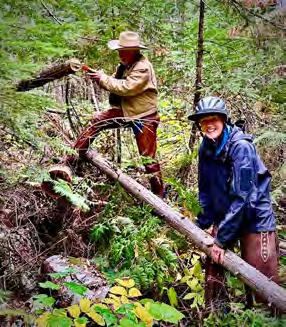
3. Work bee at Cultus Lake Provincial Park brushing equestrian/hiker trails in the spring.
2. Linda and Scott, clearing the trail with hand tools at Skimikin Rec Site.
4. Linda and Scott, clearing the trail with hand tools at Skimikin Rec Site.
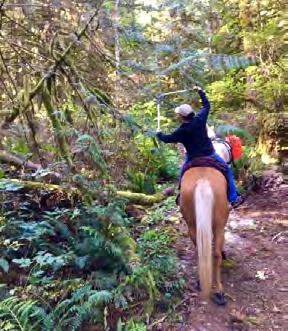
1. And when we finish…we go riding! 1 2 3 4
Photo credits: Rose Schroeder
BC CARRIAGE DRIVING SOCIETY
Pleasure, Combined, Recreation from Minis to Drafts, bccarriagedriving.com
BC PAINT HORSE CLUB
bcphc.com, Open Show & Competition Program, award sponsorships for local clubs, youth scholarship. maddy.shannon33@gmail.com
Smithers BC. Check out our website at northernsaddleclub.com and follow us on Facebook
VERNON DISTRICT RIDING CLUB (Vernon BC), check out our website at vernonridingclub.com or visit our Facebook & Instagram pages
VINTAGE RIDERS EQUESTRIAN CLUB (Fraser Valley BC), English/Western, lectures, clinics, socials, safe and fun, vintageriders@mail.ca, on Facebook
WILD ROSE DRAFT HORSE ASSOCIATION www.wrdha.com. Barb Stephenson (Secretary) phone 403-933-5765 (8:00 am to 8:00 pm)
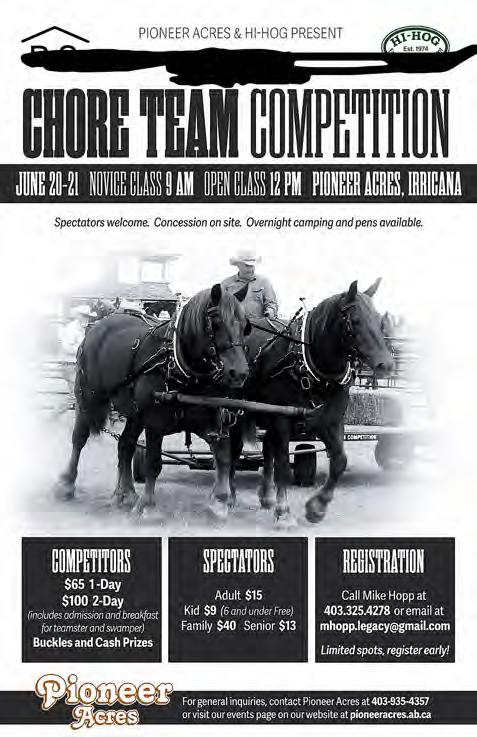
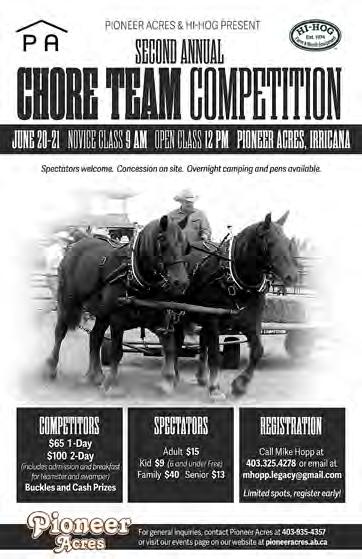
We are dedicated to providing therapeutic horseback riding lessons to riders of all abilities in Princeton, BC. Contact us at hoofbeatstra@gmail.com www.hoofbeatstra.ca 250-487-9733 PIONEER ACRES AND HI-HOG PRESENT THE Second Annual
BEDDING, HOG, FUEL, SHAVINGS
REIMERSFARMSERVICE.COM (BC Interior) 1-855-737-0110 or 250-838-0111. Bulk Shavings, Sawdust, Bark Mulch and Hog Fuel. 4x4x4 Shavings Totes
FEED DEALERS
ASHCROFT HOME BUILDING CENTRE (Ashcroft) 250-453-2281 Otter Co-op Dealer & Pet Foods. You can find us on Facebook
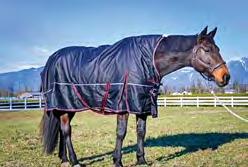
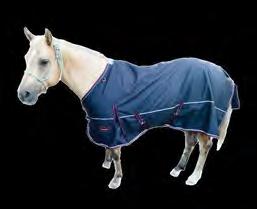
HORSE BLANKET & REPAIR
HORSE BLANKET & SADDLE PAD
WASHING & REPAIRS Clean used Blankets for sale Town Centre Dry Cleaners 250-546-0104 Armstrong
TRAILER REPAIRS
PETERSEN TRAILERS LTD. (Langley) 604-533-4209 Service and Repairs. All makes. petersentrailers.ca
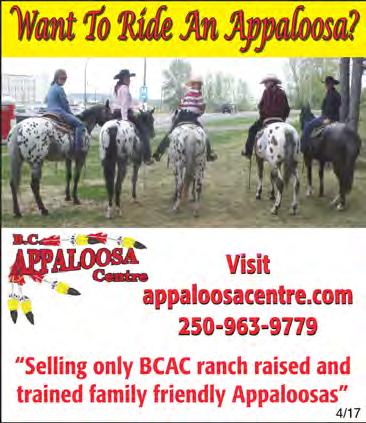
250-963-9779 Real Appaloosas for Today and the Future! VETERINARIANS
CONNECT VETERINARY SERVICES (Okanagan)
250-863-5996 Mobile Equine
Dr. Savannah Beavers
Dr. Troy Looper connectvetservices.com
INTERIOR VETERINARY HEALTH SERVICES (Okanagan)
250-769-4217, Mobile Equine, Brytann Youngberg DVM, VSMT, College of Animal Chiropractors
PET SUPPLIES & BOARDING
EVERYTHING PETS
Princeton, BC 250-295-7381
Quality Foods & Supplies for all your pets! See us on FB
HARMONY FARM KENNEL AND LAMB
Monte Lake, BC 250-375-2528
“Custom Care” boarding welcomes ALL dogs!
Harmonyfarmkennelandlamb.com
Rural Roots Real Estate
Extraordinary 48-acre peninsula on Quennell Lake, in Nanaimo. With over 5,000+ feet of shoreline. Includes a spacious 3 bed main home, and 2-bedroom cottage. Equestrians will love the 5-stall barn, pastures, paddocks & a covered arena. Just a short drive in or fly in by float plane. It feels like a sanctuary! Enjoy unlimited water recreation and live a life you don't need to take a vacation from. Property also has development potential.
Premier Performance
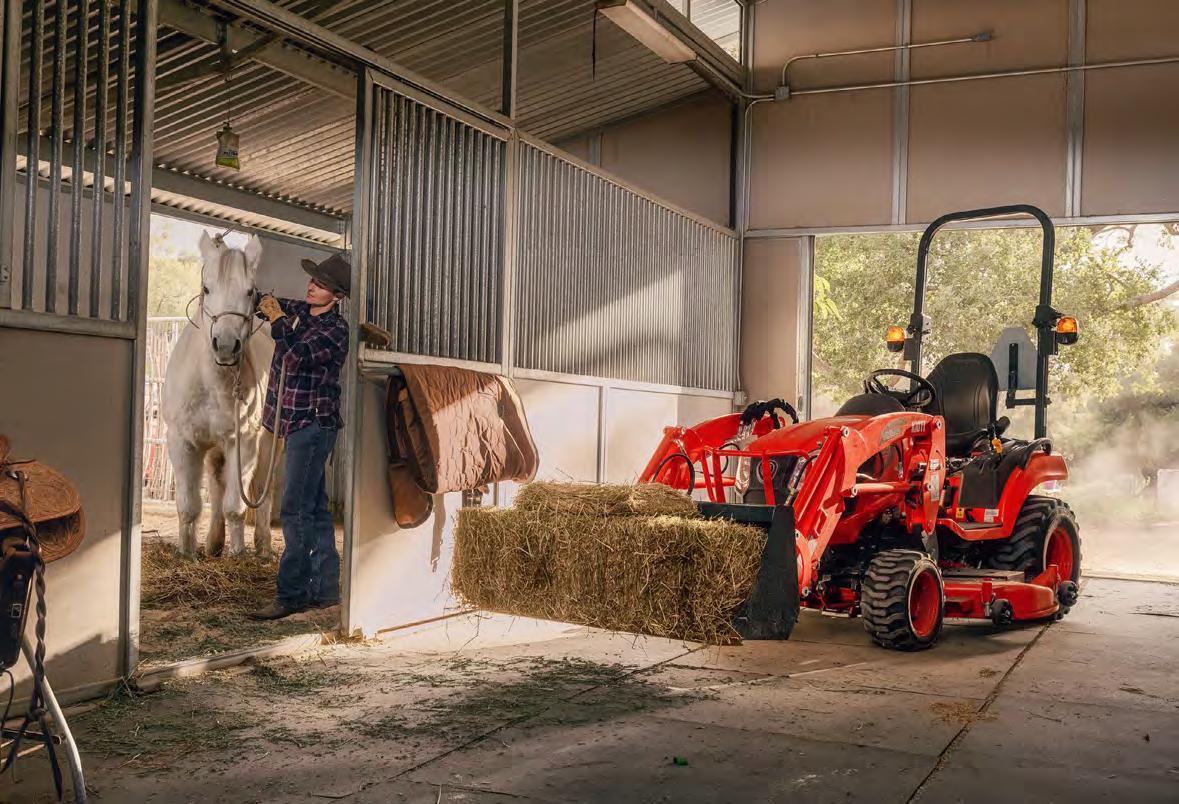
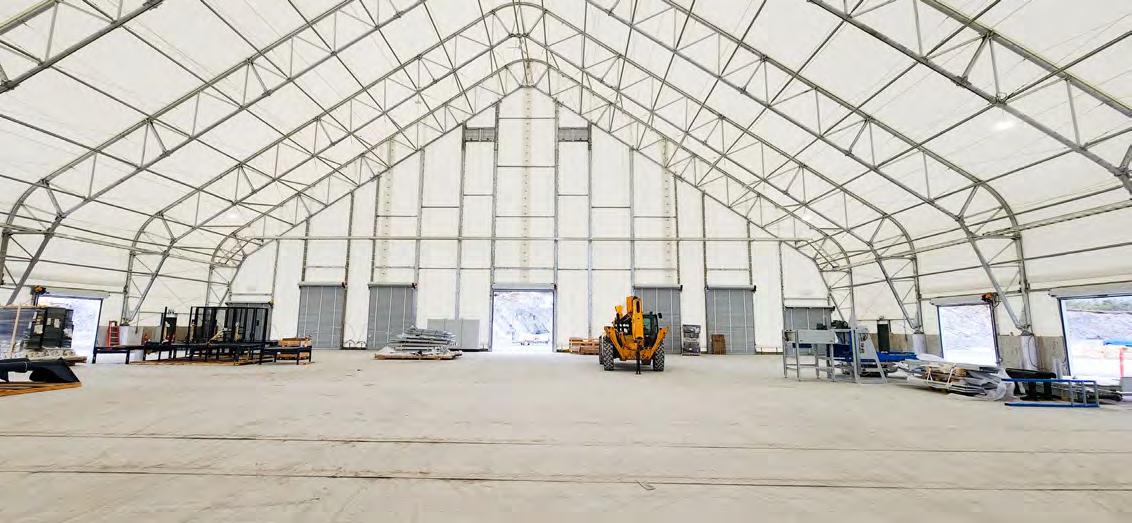
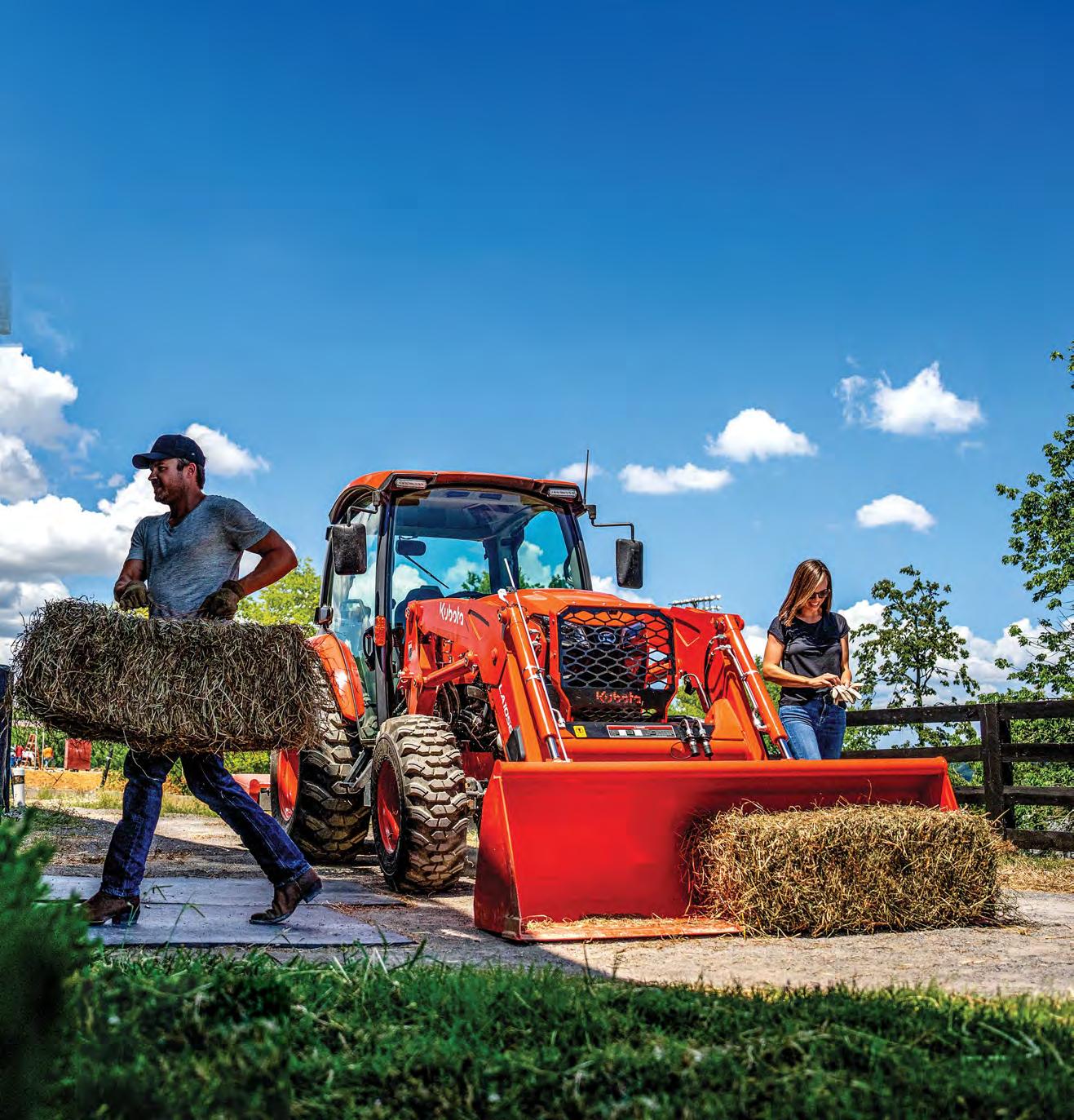
Power meets precision in the Kubota L70 series—ideal for moving material, hauling, and maintaining larger properties with ease. With the all-new ProCab for supreme comfort, intuitive controls, and performance matched with a wide range of Land Pride implements, it delivers uncompromising performance that makes big jobs feel easier. Designed for acreages and homesteads, this is more than a tractor—it’s a commitment to doing things right every time.