Saathee Raleigh May 2026

Page 1


Hello Readers

Welcome to our 28th anniversary issue!

The world is moving into an artificial one. AI that is. In this digital universe, the print edition of Saathee has special meaning. This is something tangible, and you can hold in your hands. With the support of advertisers, family, friends, and readers, we will strive to continue to bring this resource to you every month.

We welcome comments and suggestions. Just drop us a note.

Remember that when you call or visit one of our advertisers, be sure to mention that you saw their ad in Saathee Magazine, Saathee.com or the weekly e-Newsletter. We can’t bring this resource to you without their continuing support. Visit Saathee.com for regularly updated content.

Some highlights in this issue:

♦ How Does Our Gut Microbiome Play a Role in Our Immunity? See our “Nutrition for Life” column on page 30.

♦ Find movies coming up in our “Upcoming Movies” on page 34.

♦ Looking for a job or new business? See latest Classifieds on page 108.

We would be happy to add anyone in the Carolinas to the Saathee Magazine mailing list at no charge, visit saathee.com/subscription and also sign up for our free weekly e-newsletter.

Follow us on Facebook and Instagram (@saatheemagazine).

"Three things cannot be hidden: the sun, the moon, and the truth." - Buddha

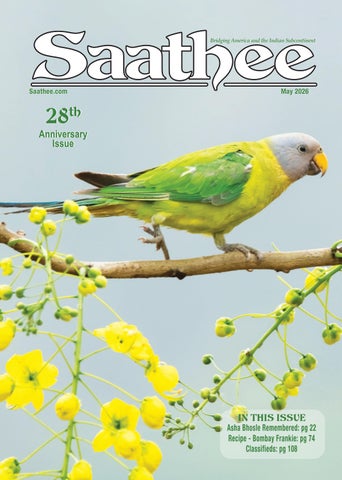
Cover: Plum-headed Parakeet

A female plum-headed parakeet perched on a tree branch and feeding on paddy seeds in the paddy fields on the outskirts of Shivamooga, Karnataka

by Chaithanya, Adobe Stock

“Bridging America and the Indian Subcontinent.”

May 2026 Issue # 336

Editor Samir Shukla (Samir@Saathee.com)

Publisher & Advertising

Divakar Shukla 704-527-7570 or saatheemag@hotmail.com

Digital Media & Marketing

Jennifer W. Allen

Ad Design / Layout

DSJ Graphics, Cooper’s Hive

Contributors for this issue:

Taige Shukla, Lavanya Kethamukkala, Dipika Kohli, Balaji Prasad, Ketu Desai, Mihika Paranjpe, Dr. Maha Gingrich, Hiren Deliwala, Malini Amaladoss, Dhruv Pathak, Payal Nanjiani, Anuj Kasera, Girish Modi, and Jalendu Vaidya.

Mission: Our goal is to be a valuable source of information for the South Asian community and to be a vital advertising tool for businesses. - F OUNDED 1998 -

Saathee

(USPS 021-116) (ISSN: 1543-8147) is published monthly by: Shukla Entertainment Inc.

612 Heather Ln., Charlotte, NC 28209

Periodicals postage paid at Charlotte, NC and additional mailing offices.

POSTMASTER: Send address changes to Saathee, P.O. Box 11468, Charlotte, NC 28220-1468

Opinions expressed herein are those of the writers and advertisers and not necessarily of the publisher or editor. Please contact us prior to submitting articles or photographs. Saathee is published monthly. Deadlines for advertisement, submissions and events information is 15th of the month.

For a free Saathee subscription, visit saathee.com/subscription All content © 2026 Shukla Entertainment, Inc.

The Editor’s Desk

Upcoming Events

14

Asha Bhosle Remembered pg. 22

Choosing Where to Grow Old pg. 24

The Through Line

Kismuth and the Way

Nutrition for Life

Upcoming Movie Releases

Thinking About Thinking

.pg. 28

30

36

Editor’s Desk Editor’s Desk

Designer Granola

There we were at one of those behemoth membership shopping clubs. You know those giant stores that take up three football fields. Half marathons could be organized to run in their lanes. It’s where you can pick up a shovel in one aisle and walk over to the next aisle and grab a gallon of milk.

Ah, so this particularly popular proprietor of prodigious products shall remain nameless, but you know which one I’m talking about. There are other such stores, but this one seems downright popular with Desis. I think half of their business comes from folks of Indian heritage.

Recognizing this, these mega marts have started carrying pani puris, pickles, pendas, and poha. Not necessarily in that order. Soon enough there will be a paan parlor there. On any given day there will be people running around with shopping carts overflowing with oversized items. Sometimes even two carts. If you go on a weekend, have someone get in line while you shop so by the time your turn comes, it will be quicker to get to the cashier with your overly filled cart.

I feel they should just open the doors to the 18 wheelers that deliver the goods to these stores and let people have at it. Why bother spending effort bringing things into the store. Drop that 200-piece toilet paper package right into the trunk.

These stores also have their own gas stations, of course. Yes, with some luck there will only be a few dozen cars in front of you lined up to buy gas at any given hour. Sure, gas is a bit cheaper, but you lose some of the benefit while the engine is idling waiting your turn.

The idea is that it may be cheaper to shop at these giant membership clubs. That is an admirable quest, but in my experience any grocery store will give you deals on any given day - via clearance items, many buy one get one free deals, sometimes buy two get three free deals, along with weekly specials and lots of in-house coupons. Don’t forget the time saved when you can pop into a grocery store and quickly pick up an item or two. Heck, many items are now competitively priced even at convenience stores. Time is money.

Frugality is built into our DNA. It is a worthy endeavor, up to a certain point. There’s a juncture where saving money becomes secondary and madness kicks in. There is a certain point where the time spent running around huge stores, in lines, membership fees, buying mega packs of everything, that the savings begin to be questioned. Yeah, we are generally frugal people. Our parents were more in tune with saving money than we are. Their parents were even more cost conscious. It was out of sheer necessity. The world was different back then.

We pride ourselves on saving a couple of bucks and getting the best deals we can find pretty much on everything.

Our children and the incoming generations may be different. Ok. They are different. Sure, they like to save money, but they are also all about experiencing life and all its offerings. Lots of hearts and likes and LOLs included. That’s cool. That’s their thing.

We endeavor to make the next generation’s lives better with more opportunities than our parents or we had. We have many more options and choices than our parents did. It’s a natural progression. We live vicariously through the happiness of our children.

The other day I found a 20-year-old coupon for a Mexican restaurant I had cut out from the newspaper I used to subscribe to stuffed in a drawer. Ahhh, the forgotten joys of coupon clipping. Frugality can be fun. Or is frugality the death of fun?

So back to the mega mart. I’m weaving through the heavy traffic in the store, trying to navigate my cart through the throngs of other carts being pushed around. I grabbed a sack of granola, and I mean a sack. I think that thing was 25 pounds. I braced my back as I lifted it and placed it into the cart.

Editor’s Desk continued on page 88

Upcoming Events

Shankar, Ehsaan, Loy in Concert: Raleigh, NC (May 3, 2026)

Bollywood musical trio Shankar, Ehsaan, and Loy will present “Dil Chahta Hai” concert on Sunday, May 3, 2026, beginning at 5:15pm, at Raleigh Memorial Auditorium, Martin Marietta Center for the Performing Arts. For more details call 347-205-7276 or for tickets, visit Ticketmaster.com.

Swami Sarvapriyananda: Durham & Cary, NC (Through May 3, 2026)

BOOM

Charlotte: (Through May 3, 2026)

The annual festival is a platform for independent artists developing new work and for audiences seeking experimental performance in Charlotte. Nearly 100 Fringe artists/groups form the lineup for this year’s festival, which takes place May 1 – 3, 2026 at the Boardwalk at University City. Works range from immersive theatre performances, musical and sonic exploration through DJ sets and dance, one-of-a-kind light shows, comedy, and magic. Info: Boomcharlotte.org.

CMAC Flute-Vocal Jugalbandhi: Charlo

tte, NC (May 3, 2026)

The Classical Music Association of Charlotte (CMAC) presents a Flute-Vocal Jugalbandhi with Shashank Subramanyam, Abhishek Raghuram, Parupalli Phalgun, and S. Krishna. The performance will be held on Saturday, May 3, 2026, starting at 4pm at the Hindu Center of Charlotte’s Gandhi Bhavan. Info: 704-904-9454 or visit Onlinecmac.org.

The Vedanta Center NC presents inspiring spiritual discourses with Swami Sarvapriyananda on May 1, 2026, in collaboration with Duke University Chapel and Religious Life, he will give a talk on the universal message of Vedanta at 6:30 pm at Duke’s Goodson Chapel in Durham, NC. Between May 2 & 3, 2026, he will present talks at West Cary Middle School in Cary, NC. Info: Vedantanc.org.

Ashwini Bhide Deshpande Concert: Charlotte, NC (May 2, 2026)

The Indian Performing Arts Association of Charlotte (IPAAC) presents an evocative live performance by Dr. Ashwini Bhide Deshpande, who is a renowned Hindustani classical vocalist of the Jaipur-Atrauli gharana, known for her technical mastery. She will perform on Saturday, May 2, 2026, from 6:30 –9pm at the William Davie Recreational Center in Charlotte. More details at Ipaac.org.

Sangeetmai Sunderkand Path: Morrisville, NC

(May 5, 2026)

Guruji Ashwinkumar Pathak will present a musical Sunderkand Path, the 5th Chapter of Shree Ramcharitmanas, on Tuesday May 5, 2026, at 7pm in the HSNC’s Temple in Morrisville, NC. For details, call 919599-9567.

Artisphere: Greenville,

SC (May 8 – 10, 2026)

The annual Artisphere offers a one-of-a-kind experience. From award winning restaurants to some of the most talented artists gathered on one of the quaintest main streets in the south, Artisphere is for all. This mixture of visual, performing, and culinary arts will be on display along the streets of downtown Greenville from May 8-10, 2026. More info can be found at Artisphere.org.

Gujarati

Natak: Greensboro, NC (May 11, 2026)

GCAP presents the Gujarati comedy natak "Halo Patelbhaini Jaanma" on Monday, May 11, 2026, 7pm, at 127 Landmark Dr., Greensboro, NC. The natak is written and directed by Nimesh Shah. Light refreshments will be served. Admission: Members $10, non-members $15. For details, call 336-430-7961 or 336-471-6242.

Shri

Maha Rudra Yagam: Charlotte, NC (May 15 – 17, 2026)

Hindu Center of Charlotte presents Shri Maha Rudra Yagam on May 15 – 17, 2026. Devotees are required to wear traditional attire – Dhoti / Sari. Located at 7400 City View Dr., Charlotte. For more info, call 704535-3440 or visit Hcclt.org.

Upcoming Events

Trendsetters Bollywood Musical: Greensboro, NC (May 16, 2026)

Enjoy Trendsetters: A Bollywood Musical Journey concert on Saturday, May 16, 2026, 5 – 7:30pm, at Sloan Theater, Greensboro Day School, 5401 Lawndale Dr., Greensboro, NC. Live musical performances along with dances will be presented. For more info, call 336-312-3384 or 336-210-1469.

Charlotte Dragon Boat Race & Asian Festival: Cornelius, NC (May 16, 2026)

The Charlotte Dragon Boat Race & Asian Festival will take place on Saturday, May 16, 2026, from 11am to 5pm at Ramsey Creek Park in Cornelius, NC. The festival celebrates Asian cultures, diversity, ethnicity, roots and history. Explore all the cultural heritage showcases, retail vendors, live music and dance performances, along with exciting dragon boat races. Details: Charlottedragonboat.com.

TGA Kite Flying Festival: Morrisville, NC (May 17, 2026)

Taste of Charlotte (June 5 – 7, 2026) Taste of Charlotte returns to uptown Tryon Street between June 5 & 7, 2026. Enjoy delicious food samples while strolling the festival experiencing 3 stages of entertainment, performances and interactive tours. Aside from that, a large variety of local, regional, and national partners will provide information, and various free goodies. Admission is free. Details: Tasteofcharlotte.com.

Raleigh

International Food Festival (June 6, 2026)

Triangle Gujarati Association presents a family Kite Flying Festival on Sunday, May 17, 2026, from 11am –6pm at Cedar Fork District Park in Morrisville, NC. There will be kids’ games, food, vendors and of course, kite flying. For more details call 919-522-5511 or visit the website Nctga.org.

Hindi Vikas Mandal Poetry Recitals: Morrisville, NC (May 17, 2026)

Hindi Vikas Mandal presents heart-warming recitals by poets on Sunday, May 17, 2026, 4:40 -7:30pm, at HSNC Cultural Hall, 309 Aviation Parkway, Morrisville, NC. Food will be available for purchase. Tickets start at $10. Info: 919-656-5224 or 919-801-0672.

Spoleto

Festival USA: Charleston, SC (May 22 - June 7, 2026)

Spoleto presents performances by renowned artists as well as emerging performers in opera; theater; dance; and chamber, symphonic, choral, and jazz music. The Spoleto Festival USA is internationally recognized as America’s premier performing arts festival. This year’s festivities will take place between May 22 & June 7, 2026. Find out more details at Spoletousa.org.

Charlotte Water Lantern Festival (May 23, 2026)

The Charlotte Water Lantern Festival will be held on Saturday, May 23, 2026, starting at 5:30pm at Symphony Park at South Park in Charlotte. The family friendly festival features colorful lanterns and brings friends, families, neighbors, and lots of people that you haven’t met together to create a peaceful, memorable experience. Details available at Lanternfestival.com/events/charlotte.

Dances of India:

Charlotte, NC (May 31, 2026)

Dr. Maha Gingrich presents the 22nd anniversary performances of Dances of India on Sunday, May 31, 2026, beginning at 4pm, at Matthews Community Center. Enjoy a variety of performances. For more details, visit Mahasdancesofindia.com.

The 11th annual Raleigh International Food Festival will take place on Saturday, June 6, 2026, from 11am – 9pm. Experience unique international food from around the world. Vote for your favorite dish. Two stages of entertainment. Folkloric performances, live bands & international music. Enjoy a vast beer & wine selection along with delicious desserts & sweet treats. Fun & games for all ages. Celebrate culture, community, and cuisine at a festival that brings the world to Raleigh, all with free admission. It will be held at the City Plaza Downtown. Info: Visitraleigh.com.

Cordusa

Charity Run: Cary, NC (June 20, 2026)

Cordusa is presenting its charity run event on Saturday, June 20, 2026, at 101 Soccer Park Dr., Cary, NC. Proceeds will benefit two nonprofit organizations. Timed runs with medals in various age categories, bubble station, games, photo booth, local vendors and more. For more info, write to Raleigh@cordusa.org.

Prana

Prathishtapana: Greensboro, NC (June 23 – 27, 2026)

The Triad Hindu Temple presents Prana Prathishtapana, a once-in-a-generation spiritual event. Experience the sacred rituals performed by esteemed priests as they invoke divine grace and energize the spiritual power of their temple. This celebration will take place between June 23 & 27, 2026 at 7751 Arcord Road in Greensboro, NC. To learn more: Facebook.com/triadhindutemple/.

Life Mission Youth Camp:

Mebane, NC (July 19 – 25, 2026)

The annual youth summer camp, featuring yoga, nature walks, arts, drama, Indian culture, sports, and cultural discussions, will take place from July 19 – 25, 2026 in Mebane, NC in an Ashram setting. For more details call 760-473-4811 or visit Lifemissionusa.org.

Asha Bhosle: A Remembrance

April 13, 2026. On this day we lost one of the last towering pillars of an extraordinary era in Indian music—an era defined by legends like Mohammed Rafi, Mukesh, Lata Mangeshkar, and Kishore Kumar. Now, with the passing of Asha Bhosle, a golden chapter of music truly comes to a close.

She was not just a singer, but an emotion that transcended generations, languages, and borders. With a career spanning decade and songs in more than 20 languages, she touched so many lives, leaving behind a legacy that will continue to inspire for generations to come.

I had the profound privilege of hosting Asha Bhosle in 2007 at the PNC Arena in Raleigh, where nearly 3,900 patrons gathered to witness her magic. At the time, I had only recently begun promoting shows in 2005, and had already hosted artists like Javed Jaffrey, Paresh Rawal, Jagjit Singh, and Sonu Nigam. But hosting Asha Bhosle was a dream of a different magnitude.

I was saddened to hear the passing of the legend Asha Bhosle last month. It brought back memories of seeing her in concert with Adnan Sami in Atlanta 2003 and in 2007 in Raleigh. The promoter of the Raleigh show Arvind Mahajan had set up a pre-show interview for me for Saathee and Nazar Television with Asha ji. My daughter Taige and sister Nehal greeted her backstage as she arrived for the show. A moment they still talk about often. I had the privilege of spending some time with Asha ji in the green room for the informal interview. During our chat her son, Anand entered the room and they began discussing the evening’s set list of songs. I became a fly on the wall listening to the casual mother/son conversation. Though we ran out of time for a formal on camera interview, she was very gracious in answering a few questions. Hope you enjoy reading Arvind’s memories here.

When I heard she would be touring the U.S. with Kunal Ganjawala and Kailash Kher, I knew I had to make it happen. At 74, she was already a living legend, and I decided to book the largest venue in town, believing the entire community would share my excitement. At that time, I was working full-time with IBM, traveling to Atlanta during the week, and raising a one-year-old son. Yet, with the unwavering support of my wife Neha, what seemed impossible became achievable. Weekdays were for work, weekends for promotion—and together, we brought nearly 3,900 people together for an unforgettable evening.

Asha Bhosle continued on page 96

Divakar Shukla is the publisher of Saathee
Photos courtesy Arvind Mahajan

Choosing Where to Grow Old

When the future begins to look different: Part 3

Over time, a quiet realization began to settle in. Our later years will not unfold the way our parents’ did. For them, aging happened within the same household, the same daily closeness, the same shared routines. Generations lived side by side, and life flowed naturally from one stage to the next.

Our lives are unfolding differently. The very independence we hoped for our children — the freedom, opportunities, and global paths we worked so hard to give them — has reshaped what the future may look like.

This is not a sad realization. It is simply a truthful one. Across the world, lifestyles and mindsets are evolving. Careers are global. Families are mobile. Social media has quietly synchronized cultures across continents in ways we rarely pause to notice.

No matter where we live, the shape of family life is changing. And because of that, aging requires a different kind of preparation.

It becomes clear that we must begin building a life that stands on its own, not one that waits to revolve around our children.

The dream that quietly stayed in the background

For many years, a simple idea lived quietly in the background: To divide our time between the country where we built our adult life, the place where our children live, and the country where our roots began — and, if health and finances allowed, to travel along the way.

It felt comforting to imagine. But imagining is easy Turning an idea into a plan is something entirely different. For a long time, it remained a distant possibility rather than a present intention, until we realized that waiting indefinitely might mean it never happened at all.

My
Photo by Samir Shukla

The Path I Stumbled Along

The Path I Stumbled Along

The Through Line

Pathak. I answered to it my whole life before I thought to ask what it meant.

My surname comes from the Sanskrit pathaka: one who recites, one who carries others along the path. Most likely, my ancestors explained the rituals to the masses but did not perform them. I always just took my dad’s word for it. He said we were “Brahmins,” so we were invited to the secret club of hidden Hindu knowledge. Or, through my teenage angst, I interpreted it as meaning we were better than non-Brahmins. This confusion about our place would echo in many of the practices I eventually inherited.

On many Sundays, sometimes Mondays (you never knew which day), we’d be at the mandir. I sat cross-legged on the red carpet. My lungs filled with incense. I watched my parents mouth prayers I couldn’t follow. I knew the rhythm: Om Namah Shivaya. The slow rocking motion, then the smooth, satisfying clockwise turn while holding the aarti flame with my brother. I knew when to pass it to the impatient auntie behind me. I knew when to stand and sit. But I couldn’t tell you what it meant, or why we couldn’t just do this at the small temple we kept in my bedroom at home.

Outside, boys tossed a football in the grass, their laughter drifting through the open doors. For a child desperate to belong, ritual stripped of meaning never stood a chance against the unquestioned joy of pickup football.

Some of us attended our mandir’s Children’s Religious-Oriented Program (CROP), our version of Sunday school, held in a repurposed church in Charlotte called the Gandhi Bhavan. The name itself is a lesson in how Hinduism works. Gandhi, a secular political figure, absorbed into spiritual significance. In one of those earlymorning sessions, I remember a third-grade girl being called to the front to explain, in a high-pitched but serious voice, why Hindus should not eat marshmallows. Beef gelatin. The other kids nodded. We applauded. And then we moved on.

There is a name for the education we received: orthopraxy. Correct practice over correct belief. This emphasis in Hinduism was never accidental. For centuries, high-level theological inquiry was largely the domain of the priestly class, while others received only the functional layer. Rituals were meant to ease anxiety, ensure prosperity, and unite the community. My parents did not withhold the deeper tradition out of indifference. They passed down what had been passed to them. Orthopraxy was the inheritance. I never knew it had a name.

All the People

Time Well Spent

Kismuth and the Way by

Time is our most precious resource: time does not come back. This is the topic that I think I return to, most often; I suppose it lines up with ‘kismuth,’ generally, too.

But when we talk about time how about mentioning what it means to experience it deeply? What is, that is, time well spent?

I had hosted a conversation salon called “Now” in Bangkok ten years ago. The idea was to hear what people had to say about it, people whom I’d found on the internet and invited to be part of the ticketed event. It went splendidly, I quite enjoyed what these experts shared, and most importantly, I think, they had fun being there. This event was part of a series, ‘N.’ I hosted this set of conversations in Phnom Penh, Bangkok, Hanoi, and London. (I tried to do them in Helsinki and Singapore, but couldn’t quite work it up into reality, maybe because Finland and Singapore are places where people might not be excited to opt into something like, ‘Let’s just see who comes and make it up on the spot, together!’)

‘N’, or ‘16N’, as I called it, was going to be a sixteen-city series, for sixteen people apiece. Cities that have an ‘N’ in them. So I could host conversations that start with the letter ‘N’. I did ‘Normality,’ ‘Narrative,’ and ‘Noteworthiness,’ and ‘Now.’ (I know this is all very, very esoteric, but you can check it out, I’ll put a link at the end, if you are curious.) The reason I’m mentioning all this is a lot of things had to happen to lead up to the staging of the event, but the event itself was where the magic unfolded. This day-of experience, I felt, was where time went deeper, and it felt extremely well spent. Even if it cost me a lot to go places and invent things and make them happen. I’m glad I did. Money is a vector. But time. The time doesn’t come back.

Guess it’s part of my art-making; relational art, it’s called, someone informed me once, at one of these things.

Kismuth continued on page 82

Spectrum Family Medicine

Accepting new patients and all major insurances

For appointments, please call 919-233-8183

519 Keisler Drive, Suite 104 Cary, NC 27518

WE PROVIDE PRIMARY CARE AND FAMILY MEDICINE SERVICES

• Physical Examinations

• Women’s wellness visit, pap smear

• School/ Sports Physicals

• Sick visits, fever, cough, cold, wheezing

• Diabetes, Thyroid and other endocrine problems

• Heart diseases, high BP, high cholesterol

• Depression, Anxiety, ADHD

• Asthma and lung diseases

• Women’s health issues, menopause

• Minor procedures done at office like mole and cyst removal, wart treatment, suturing and laceration repair.

How Does Our Gut Microbiome Play a Role in Our Immunity?

Nutrition for Life

Everything we eat and drink passes through the gut along the gastrointestinal (GI) tract. It seems simple enough, but the GI tract, lined with a thin mucous, is embedded with 100’s of trillions of microorganisms that live, grow, and metabolize in what’s considered a complex ecosystem. It is called the gut microbiome. Your gut microbiome makes up 80% of your immune system and contains 10x more bacterial cells, both beneficial and harmful, than human cells. Everyone’s gut microbiome is different and is as unique as each individual’s fingerprint. Altogether, these microbes may weigh as much as 2–5 pounds, which is roughly the weight of your brain. Together, they function as an extra organ in your body and play a huge role in your health. Most of us are familiar with the term “Gut-brain axis”. The gut-brain axis is believed to be a bidirectional communication between your gut and the brain, which occurs through multiple pathways that include hormonal, neural, and immune mediators. Your gut

bacteria impact many different aspects of your health, including how your brain responds to stress (Gut-brain axis), how well your body can digest certain carbohydrates, the health of your immune system, how you store fat, and much, much more. If your gut microbiome is disrupted, it can cause dysbiosis (an imbalance between healthy and unhealthy microbes present in a person’s natural microflora, especially that of the gut, thought to contribute to a range of conditions of ill health) This can lead to chronic illness.

What Exactly Does the Gut Microbiome Do Within Our Body?

● Maintains Gastrointestinal (GI) Motility. Gut microbes support digesting and moving food through the GI tract by regulating neurotransmission throughout the enteric nervous system of the gut. The microbiome and GI motility have a symbiotic relationship. If the microbiome is altered, it can impact motility and issues with motility can also impact the microbiome.

Chandnis Chandnis

Upcoming Movie Releases

May 1

Raja Shivaji (Director: Riteish Deshmukh)

Cast: Riteish Deshmukh, Sanjay Dutt, Abhishek Bachchan, and Vidya Balan

The Devil Wears Prada 2 (Director: David Frankel)

Cast: Meryl Streep, Anne Hathaway, and Stanley Tucci

G2 (Director: Vinay Kumar Sirigineedi)

Cast: Adivi Sesh and Emraan Hashmi

Deep Water (Director: Renny Harlin)

Cast: Aaron Eckhart, Ben Kingsley, and Angus Sampson

Summer Holidays (Director: Srikar)

Cast: Rohan Roy and Arun Dev Pothula

Ek Din (Director: Sunil Pandey)

Cast: Junaid Khan and Sai Pallavi

Hokum (Director: Damian McCarthy)

Cast: Adam Scott, David Wilmot, and Austin Amelio

May 8

Mortal Kombat II (Director: Simon McQuoid)

Cast: Karl Urban and Adeline Rudolph

Chand Mera Dil (Director: Vivek Soni)

Cast: Lakshya Lalwani and Ananya Panday

The Sheep Detectives (Director: Kyle Balda)

Cast: Hugh Jackman, Nicholas Braun, and Patrick Stewart

Gabru (Director: Shashank Udapurkar)

Cast: Sunny Deol, Simran Bagga, and Prit Kamani

Remarkably Bright Creatures

(Director: Olivia Newman)

Cast: Sally Field, Lewis Pullman, and Colm Meaney

May 15

Vvan – Force of the Forrest (Director: Arunabh Kumar)

Cast: Sidharth Malhotra, Tamannaah Bhatia, and Shweta Tiwari

In the Grey (Director: Guy Ritchie)

Cast: Henry Cavill, Eiza González, Rosamund Pike, and Jake Gyllenhaal

Newton’s 3rd Law (Director: Rajesh Karna)

Cast: Sumanth and Avasarala Srinivas

Pati Patni Aur Woh Do (Director: Mudassar Aziz)

Cast: Ayushmann Khurrana, Sara Ali

Khan, and Wamiqa Gabbi

Magic Hour (Director: Katie Aselton)

Cast: Katie Aselton, Daveed Diggs, Brad Garrett, nd Susan Sullivan

Maa Inti Bangaaram (Director: B V Nandini Reddy)

Cast: Samantha Ruth Prabhu and Diganth Manchale

May 22

The Mandalorian and Grogu (Director: Jon Favreau)

Cast: Pedro Pascal, Sigourney Weaver, and Steve Blum

Tera Yaar Hoon Main (Director: Milap Zaveri)

Cast: Aman Indra Kumar and Akanksha Sharma

Jack Ryan: Ghost War (Director: Andrew Bernstein)

Cast: John Krasinski, Wendell Pierce, and Sienna Miller

Bandar (Director: Anurag Kashyap)

Cast: Bobby Deol, Sanya Malhotra, and Raj B Shetty

I Love Boosters (Director: Boots Riley)

Cast: Keke Palmer, Naomi Ackie, LaKeith Stanfield

Tuner (Director: Daniel Roher)

Cast: Leo Woodall, Jean Reno, and Dustin Hoffman

May 29

Backrooms (Director: Kane Parsons)

Cast: Chiwetel Ejiofor, Renate Reinsve, and Avan Jogia

The Breadwinner (Director: Eric Appel)

Cast: Nate Bargatze, Mandy Moore, and Kumail Nanjiani

Saathee.com/movies has the latest info on where the movies are showing or streaming. Release dates subject to change.

i l m C l i p s

The Sheep Detectives

Every night a shepherd reads aloud a murder mystery, pretending his sheep can understand. When he is found dead, the sheep realize at once that it was a murder and think they can solve it. Kyle Balda directs Hugh Jackman, Nicholas Braun, and Patrick Stewart. May 8, 2026.

Remarkably Bright Creatures

Through unlikely bonds formed during night shifts at a local aquarium, Tova, an elderly widow, learns of a life-changing discovery that may bring her joy and wonder once again. Sally Field, Lewis Pullman, and Colm Meaney star in the Olivia Newman directed film. May 8, 2026.

Vvan – Force of the Forrest

A rational urban man defies his ancestral village’s forbidden forest and awakens a divine goddess, forcing him to confront powers beyond logic as he becomes the unlikely savior protecting his people. Sidharth Malhotra, and Tamannaah Bhatia in the film directed by Arunabh Kumar. May 15, 2026.

In the Grey

A covert team of elite operatives are living in the shadows. When a despot steals a billion-dollar fortune, they’re sent to take it back-an impossible heist that erupts into a deadly game of strategy, deception and survival. The Guy Ritchie directed film stars Henry Cavill, Eiza González, Rosamund Pike, and Jake Gyllenhaal. May 15, 2026.

Jack Ryan: Ghost War

Follows Jack Ryan who reunites with CIA operatives to navigate a treacherous web of betrayal against an enemy who knows their every move, facing a past they thought was long put to rest. John Krasinski, Wendell Pierce, and Sienna Miller in the film directed by Andrew Bernstein. May 22, 2026.

Chand Mera Dil

Starring Lakshya Lalwani and Ananya Panday, Chand Mera Dil is a drama film based on an intense love story. The Dharma Productions theatrical release is directed by Vivek Soni. May 22, 2026.

Ramayana

Ranbir Kapoor stars as the iconic Rama, one of the most enduring figures in global storytelling. The upcoming films are among the most significant large-scale productions in the history of Indian cinema. Directed by Nitesh Tiwari with music by Hans Zimmer and A.R. Rahman. Part one Diwali 2026 and part two on Diwali 2027.

Thinking Outside Their Box

Thinking About Thinking by

“The first principle is that you must not fool yourself, and you are the easiest person to fool.”

The common aphorism, “Simple living and high thinking!” may not be as simple as it sounds.

Like many such exhortations, there is an underlying intent behind this as well as an associated remedy that seeks to mitigate some problem. But if you see this deeply, a cure with allure could render worse some hideous curse; or, horror of horrors, that the good intent might even result in the exact opposite of what the original aspiration was.

Aspirations can be thwarted by incorrect framing, and a “thinking” inside the box. Is there a reframing that aligns better with reality? Can an actual remedy come not from amplifying something but from minimizing it? Could the problem with “thinking” be that there is too much of it rather than too little?

Simply Living, Unhigh Thinking

D’you hyper- hyper-optimize?

D’you over- over- over-think?

D’you see it when you theorize?

D’you shrink space-time to just a blink?

Do foam oh! wistful dreamy eyes drive you to dredge bottom of thing?

Do you think you may be unwise to see through only lenses pink?

If you sense your lofty “logic” flies

‘n’ imagination takes to drink, that’s when you’ll see that it tells lies … the Self that lies under the thing.

Could “Think unhigh!” touch real highs, and stop your heart from taking wing?

Your highness?

‘High thinking” may be an unfortunate turn of phrase that reveals something more than it may have intended to. A lot of “thinking” is devoted to the same purpose as most intoxicants: to make the imbiber and swiller high!

Substances of many kinds are widely and wildly popular. Across cultures, geographies and lands. Even if we don’t want to burden ourselves with the “why” of this, it is

Thinking continued on page 90

Healing Through Sound: When Vibrations Transform the Mind and Body

Healing Through Sound: When Vibrations Transform the Mind and Body

Her name was Nicole, a petite young woman with a warm smile. Yet beneath that quiet demeanor, there was a quiet weight she carried.

She came to me with a simple complaint: persistent back pain. During the intake, I invited her to share anything else. She mentioned only physical discomfort, back pain and a temporary upset stomach, nothing that suggested deeper emotional distress.

We began with breathing techniques, allowing the body and mind to settle into connection. Gradually, we chanted “OM,” letting the vibration create a calm, focused awareness. I then introduced singing bowls, playing tones designed to relax the nervous system and restore balance.

Within minutes, tears gathered in her eyes. Soon, she began to cry.

For a moment, I hesitated. But trusting the process, I allowed the session to continue. Her heartbeat, initially elevated, began to slow. The sound seemed to guide her into a deeper emotional release, a place where words had never reached. It was as if the vibrations were unlocking layers of stored tension that had held within her body for a long time.

After nearly an hour, the crying subsided. She lay still, in a deep, trance-like rest. When I brought her back, she seemed disoriented, as if returning from

another space. I offered her water, allowing her to reconnect with her surroundings at her own pace.

Then, unexpectedly, she hugged me.

“You saved me,” she said. “I had so much anxiety stored inside me. I feel like a new person.”

Her smile had changed. It was lighter, freer, more real.

Later, she shared her reality. She worked as a therapist in a prison, constantly absorbing the trauma and suffering of others. Over time, she had carried it all within herself, silently and without release.

That night, she says she slept deeply and without interruption. In the following days, she began listening to meditative music before bedtime and gradually stopped relying on sleeping pills.

Nicole’s experience is not an isolated one. Sound and music have long been recognized for their impact on human physiology and psychology. Scientific studies suggest that music can stimulate the release of endorphins—the body’s natural “feel-good” chemicals— reducing pain perception and easing anxiety. It also serves as a powerful distraction, gently shifting focus away from discomfort and emotional stress.

Across cultures and centuries, sound has been used as a tool for healing, spiritual connection, and emotional balance. From ancient chants to rhythmic drumming, civilizations have intuitively understood the power of vibration. Today, modern research is beginning to validate what these traditions have long practiced, sound can influence the body at a fundamental level.

Insurance Shopping

How to Move from Manager to Senior Leader

“Payal, how do I move from a manager to a senior leadership role? I’ve done everything—but I’m still not able to make the transition.”

This is one of the most common questions I get asked by high-performing professionals. And my answer is always simple yet often uncomfortable: Long before the move happens, you need to start thinking and acting like a senior leader.

You see my friend, we have got into the habit of associating senior leadership as a title and position. Most professionals unknowingly fall into a trap.

They tell themselves:

“When I get there, I’ll think strategically.”

“When I get that role, I’ll start influencing.”

“When I become a leader, I’ll take bigger decisions.”

But leadership doesn’t work like that. You don’t become a leader when you get the role. You get the role because you’ve already become the leader. Senior leadership is not an upgrade. It is a transformation. And that transformation begins much earlier than most people realize.

At the managerial level, your success is often driven by:

Execution

ciency

Delivering on time

Being dependable

And you’ve likely excelled at all of this.

But here’s the truth:

Coach continued on page 72

Festival Dances of the World

Festival Dances of the World

Across the world each year, there are hundreds of cultural festivals that celebrate the unique beliefs and traditions belonging to a specific region. They celebrate through dances, rituals, symbolic costumes, storytelling, prayers, food, just to mention a few.

India is filled with so many different festivals each year, including New Years for each sub-culture. It is almost impossible to experience these festivals in person in each state. If I take Indian festivals into account and add the festivals of the world to that list, it is unbelievable. For those of us who are not local to a particular area, visiting these festivals can be a great way to immerse ourselves in other cultures and join in on unique celebrations for a truly unforgettable experience. As I feel it is almost impossible to attend these celebrations yourself, I thought it would be great just to learn more about other people’s cultural traditions through dance. This year for my Dances of India production I decided to show a glimpse of these festivals and connect them to the cultural festivals around the world.

This has been a fun and exciting journey. As I continue to research world festivals, I see the same theme of my signature dance, “Unity in Diversity”, that is “We are more alike than different”.

This year, we depict through classical and traditional folk dances, many religious festivals such

as Diwali, Ganesh Chathurthi, Maha Shiva Rathri, Janmashtami, Holi, Dasara, Baisakhi, just to name a few. Many countries in Asia, South America, Eastern Europe, and others that have great agricultural communities also celebrate harvest festivals and spring festivals.

Some of the festivals like Holi (festival of colors), St. Patrick’s Day, Christmas (festival of lights) are celebrated worldwide. Now a days, irrespective of their background and religion, they take part in these world festivals. Harvest festivals are the most popular festivals, and many aspects of their celebrations are similar. When harvesting rice, grapes, wheat, fruits, or anything else we consume, the celebrations are similar. They all have songs, rituals, unique foods and clothing that are associated with these celebrations. As we know for many countries, harvesting still is the most important livelihood.

During our upcoming Dances of India show, through dance we are sharing the stories of 10 to 14 festivals of India and the world. These include many of the Indian festivals and festivals from other parts of Asia, South America, and Eastern Europe. As I always say, dance has no language barriers. We are delighted to share the stories and the cultures of our beautiful world through dance, props, and costumes. We don’t need to travel the world if we can’t.

Why is this important? Festivals are an integral part of all cultures around the world. These celebrations bring people together to commemorate important events, traditions, and values. They play a crucial role in fostering a sense of community, preserving cultural heritage, and promoting unity among diverse groups of people. These

Dances of India by Dr. Maha Gingrich
Dances of India continued on page 72
photo courtesy of Dr. Maha Gingrich

Shankar Jaikishan: Emperors of Hindi Film Music

Voice

Shankar-Jaikishan, one of the most iconic music composer duos in Hindi cinema, redefined Bollywood music between 1949 and 1971. Their work set new standards in film music with their unique ability to blend Indian classical melodies with Western influences, leaving an influential mark on Indian cinema. Almost all their films until Jaikishan’s death celebrated silver jubilees, so in a way their popular initials, SJ, also apply to the maestros. SJ often collaborated with actor and director Raj Kapoor and composed timeless, classic tunes for films like Barsaat, Shree 420, and Sangam.

Shankar-Jaikishan were pioneers in using orchestration not just as a backdrop, but as a way to express emotions and elevate the storytelling in songs. At their peak, they were the highest-paid music directors in the industry, with their names often outshining the stars of the films they worked on.

Their innovative style and unforgettable melodies continue to be celebrated, making SJ true legends of Indian cinema’s golden era. Their success also depended on three other duos – Sebastian & Dattaram (music arrangement), Shailendra & Hasrat Jaipuri (lyricists) and Lata-Rafi (singers). Without their collaboration, the SJ name may not have dominated the industry.

They never compromised with the quality of their music, and they used to compose 10 songs for a film and every song used to have its own melody or special feature to attract the audience before the release of films. SJ were the only music composers who could compose set of masterpieces continuously!

Lata Mangeshkar sang over 450 songs for ShankarJaikishan across in over 100 films, with more than 300 of these being solos, making her their primary female voice for decades. Barsaat was not only SJ’s first film but also Lata’s first film, too. She was supposed to sing only one or two songs but instead sang 8 solos and 2 duets. The music of Barsaat was a rage across India. The music was fresh accompanied by melodious tunes while breaking barriers music compositions for a movie.

Their career took off and in the next five years together they created evergreen songs for many films. SJ’s fascination with Lata’s voice was so profound that they used her for solo songs (no male voices) for films like Poonam, Aurat, Mayurpankh, Aas, Dil Apna Preet Parayi and more. I have two cassettes of Lata’s rare gems which are not released in LP yet.

Years later when I heard Lata sing Barsaat songs live at a New York concert, I closed my eyes and felt like I was listening to the record playing. It was the same magical voice. I still hum all songs of Barsaat. Many singers, like Sanjeevani Bhelande, open their concerts with a song from Barsaat Violin was a prime instrument for Barsaat songs, and therefore it was used as RK Films’ famous mascot. Other films and many songs of Anarkali, Mahal and Nagin were released around the same time as Barsaat, and they were also sung by Lata. Raj Kapoor played an integral role in establishing SJ and used their compositions in all his films until 1971 and then worked with Lakshmikant Pyarelal for films like Bobby and Satyam Shivam Sundaram and music director Ravindra Jain for Ram Teri Ganga Meli, Prem Rog and Heena. Many people argue that LP used tunes from Raj Kapoor’s collection of SJ compositions over the years for Bobby and Satyam Shivam Sundaram

Shankar Jaikishan continued on page 60

How to Make a High-Deductible Health Plan Work For You

1. You might qualify for an HSA and not know it.

An elementary school teacher chose a low-price health insurance plan but soon realized she wasn’t clear about what it would mean for her family’s finances.

When enhanced federal subsidies expired at the end of 2025, a lot of people buying their own health insurance on the state and federal exchanges saw their expected monthly rates jump. To keep costs down, many switched to a highdeductible health plan. These plans offer lower monthly payments, but in exchange patients can face steep out-ofpocket costs when they need care.

The plans are common. In 2023, 30% of people who got insurance through their employer had a high-deductible plan, up from only 4% in 2006.

Madison Burgess, a teacher in San Diego, gets health insurance through her teaching job. But when she investigated adding her husband to her plan, it was just too expensive, so she started shopping on the exchange for a cheaper option for him.

The longer she scrolled through the plan options, the more overwhelming it felt. Insurance jargon made it hard to tell what her family would owe if her husband got sick.

“I didn’t know what a deductible was, so I just went with what was cheap, and now I have regret,” she said.

In exchange for that lower monthly premium payment, her husband’s coverage won’t kick in for most care until they’ve paid $5,800 in medical bills. Burgess didn’t know that the deductible must be met before insurance picks up part of the tab.

How do you prepare for thousands of dollars in upfront costs? One option is a health savings account, or HSA, which lets you save pretax money and is now available to people enrolled in lower-tier state and federal exchange plans, including bronze and catastrophic coverage. These plans generally have the lowest premiums on the exchange but the highest out-of-pocket costs when you need care.

Burgess had chosen a bronze plan and didn’t know HSAs were an option.

“I’ve never thought about having to put money away for a deductible,” she said.

Burgess and others are often more worried about socking away money for unexpected car and house repairs or vet bills.

If, like Burgess, you chose cheaper health coverage for this year only to discover you’re on the hook for meeting a high deductible, these tips can help you prepare.

If you’re enrolled in a bronze or catastrophic plan, you qualify to open a health savings account. Think of it as a medical piggy bank with tax perks. You put in pretax money, which lowers your taxable income. The money grows tax-free, and when you spend it on qualified medical expenses, those transactions are also tax-free. That’s what people call a “triple tax advantage.”

These accounts build a cushion for future health costs, such as doctor visits, prescriptions, and even products like over-the-counter medicine, tampons, and sunscreen.

The money typically can’t be used for monthly premiums, but the account is yours to use for qualified medical expenses for yourself, your spouse, or your dependents anytime in the future. The money in the account is yours, even if you change jobs or health plans.

An HSA is not the same as a flexible spending account, or FSA. FSAs are tax-advantaged too but are offered only through employers. The money expires annually and you lose any remaining money when you leave that job.

2. HSA-curious? Here’s how to open one.

You open a health savings account through a bank or other financial institution. The institution will issue you a debit card so you can make purchases from the HSA.

You can open an HSA at any point during the year as long as you’re covered by an eligible plan. You can choose where to open the account but be sure to check for any fees financial institutions charge and shop around.

If you get insurance through your job, your employer may require you to use a specific IRS-approved company.

Many people decide they can’t afford to contribute to an HSA. For some households, the desire to set aside money for medical expenses competes with the need to pay rent and buy groceries.

But there’s a detail that can make it feel more manageable. Contributions don’t have to be large. Just a few dollars a month can get you started.

There is, however, a limit. The IRS sets an annual cap on how much you’re allowed to contribute to an HSA. In 2026, an individual is limited to $4,400, or $8,750 for a family plan. Under that ceiling, the amount is up to you.

3. Preventive services should be covered at no cost to you.

All plans sold on marketplaces must cover certain preventive services at no cost to the patient as long as the care is provided in-network. Those services include routine immunizations and cancer screenings.

Beyond preventive care, understanding what different services cost can help you decide which type of medical

Health Plans continued on page 60

Home Insurance: Roof Damage

The roof is one of the most important parts of your home. Not only does it protect you against the elements, but it is also a vital part of the structural support of your house. Roof damage also happens to be one of the most common insurance claims and, of course, it is an expensive claim. Insurance companies are increasingly denying roof claims. Some carriers have a strict policy of not insuring a home if the roof is greater than 15 years.

So let us look at what is covered, exclusions, and filing a claim, if needed.

Types of roof damage covered by insurance: Individual policies differ but generally your policy should cover damage caused by fire, wind, lightning, and ice.

Damage not covered: As a rule, damage caused by neglect or poor maintenance is not covered. Damage caused by termites, mold, rot etc. do not occur suddenly but are a result of long-term lack of maintenance and repairs. Hence, these may be denied.

Another important concept is Actual Cash Value (ACV) vs. Replacement Cost Value (RCV) – Simply put ACV is the current value of the roof after considering the depreciation.

The older the roof is, the less you will receive. RCV will pay to replace the roof based on market value of the roof. It is advisable to buy RCV option when getting your insurance even though the premium may be higher.

Missing shingles, sagging roofs, watermarks in the interior wall or ceiling are signs that your roof may need some repair. It may be easier and cheaper over the long term to get a licensed and insured contractor to inspect your roof periodically and take care of the minor issues immediately.

When to file a claim:

Roofs have a limited lifespan and will eventually need to be replaced. Your insurance company has promised to protect you from an unexpected and sudden disaster, not to cover your routine upkeep. However, in genuine cases where the damage is substantial and damage exceeds your deductible, you may want to file a claim. Note that you must file a claim within the stipulated time frame as mentioned in your contract.

NASA’s Orion spacecraft with Artemis II is seen as it lands in the Pacific Ocean off the coast of California, Friday, April 10, 2026. Following a splashdown at 8:07p.m. EDT, NASA, U.S. Navy, and U.S. Air Force teams worked to bring the crewmembers and Orion spacecraft aboard USS John P. Murtha.

Image Credit: NASA/Bill Ingalls

The Science Behind Splashdown

How NASA Got the Artemis II Crew Safely Back on Earth

The crew of NASA’s Artemis II lunar flyby mission splashed back down to Earth on April 10, 2026, in their Orion spacecraft. While splashdown can be harrowing – the spacecraft hurtled through the atmosphere faster than the speed of sound and reached temperatures in the thousands of degrees – NASA has been doing it for decades.

One of NASA’s biggest learning experiences came in 1961.

For about 15 minutes on July 21, 1961, American astronaut Gus Grissom felt at the top of the world – and indeed he was.

Grissom crewed the Liberty Bell 7 mission, a ballistic test flight that launched him through the atmosphere from a rocket. During the test, he sat inside a small capsule and reached a peak of over 100 miles up before splashing down in the Atlantic Ocean.

A Navy ship, the USS Randolph, watched the successful end of the mission from a safe distance. Everything had gone according to plan, the controllers at Cape Canaveral were exultant, and Grissom knew he had just entered a VIP club as the second American astronaut in history.

Grissom remained inside his capsule and swayed on the gentle ocean waves. While he waited for a helicopter to take him onto the USS Randolph’s dry deck, he finished recording some flight data. But then, things took an unexpected turn.

An incorrect command in the capsule’s explosives system caused the hatch to pop out, which let water flow into the tiny space. Grissom had also forgotten to close a valve in his spacesuit, so water began to seep into his suit as he fought to stay afloat.

After a dramatic escape from the capsule, he struggled to keep his head above the surface while giving signals to the helicopter pilot that something had gone wrong. The helicopter managed to save him at the last instant.

Grissom’s near-death escape remains one of the most dramatic splashdowns in history. But splashing down into water remains one of the most common ways astronauts return to Earth. I am a professor of aerospace engineering who studies the mechanisms involved in these phenomena. Fortunately, most splashdowns are not quite that nerveracking, at least on paper.

The Artemis II splashdown put the Orion spacecraft’s heat shield to the test. This shield bears the brunt of the heat of reentry to protect the crew inside. During the uncrewed Artemis I mission, the shield took more damage than expected, prompting engineers to spend years investigating and eventually mapping out a new trajectory for the craft to take through the atmosphere as it returns on Artemis II.

During splashdown, the Orion heat shield was able to take the heat, and the astronauts returned to Earth without incident at 8:07 p.m. Eastern time.

Spot the Differences

See if you can spot the 15 differences between original photo on top & modified photo below. (Solution on page 104)

We Went to India It Doesn’t Count

I’ll start with an honest confession: even though I’ve read all the advice about “don’t compare yourself with others,” I still do it. I get influenced. I feel jealous. I feel like I’m behind. And nowhere is that feeling stronger than in travel.

Travel brings a special kind of FOMO. Maybe it’s because it’s so visible. People post photos or talk about islands, mountains, European streets, exotic resorts, and fancy dinners with perfect lighting. And suddenly, even if we were happy five minutes ago, we start feeling like we’re missing out on some alternate life that everyone else is living.

Sometimes it’s not even the destination. It’s the way people describe it.

An acquaintance once casually told me, “Those lay-flat seats are perfect for this kind of travel.” We get it. You traveled first class. And listen, I have nothing against first class. Good for you. Seriously. But did you really have to say it that way?

That one sentence can do more emotional damage than an entire Instagram post. Because now it’s not just about where they went. It’s about how comfortably they went. The subtle brag disguised as a helpful tip. And suddenly, without warning, the comparison starts.

Among the Indian diaspora, travel is almost a default conversation topic. It starts very casually: “So where have you been lately?” or “Where are you going next?” And I want to have a good answer. Something impressive. Something exotic. But when we say we went to India, it doesn’t feel like it counts in the same way. Not because India isn’t amazing — it is. But for many of us, an India trip doesn’t mean exploring India. It means going back home. Staying put in our hometown, hanging out with parents, visiting relatives, eating home food. And even if we want to travel within India, there’s guilt attached. It feels like we are stealing time from family. So, we stay. And later, when we hear friends talk about Europe, Iceland, or Bali, we start questioning ourselves. Did I waste my vacations? Should I have seen more?

That is the real trick of travel FOMO. It is not about seeing the world. It is about having the right answer when someone asks where you have been.

by Samir Shukla

Mindful Masala continued on page 110
Photo

Shankar Jaikishan

continued from page 48

Apart from the RK films, SJ’s musical compositions and success is breathtaking in films including, Daag, Seema, Halaku, Basant Bahaar, Humrahi, Sasuraal, Amrapali, Asli Naqli, Dil Ek Mandir, Junglee, Professor, Love in Tokyo and Suraj There are so many others.

In fact, apart from Raj Kapoor’s super stardom, SJ also played a big hand in establishing Shammi Kapoor and Rajendra Kumar and many of their films ran to packed houses only because of SJ’s enchanting musical bouquets. SJ were nominated for 20 awards and received 9 Filmfare awards, more than any music director. They held the record for the highest number of consecutive nominations 9 years, (1959–1967).

Though SJ conducted huge orchestras, they always ensured that the distinctive sounds of different instruments came forth with immaculate clarity without distorting the harmony of the composition. SJ may have used accordion for many of their compositions, but their use of Sitar stands out. Take “O Basanti Pawan Pagal” from film Jis Desh Mein Ganga Behati Hai, where sitar makes this song more appealing. Similarly, “Bhahiya Meri Rakhi” in Chhoti Bahen and “Rasik Balma” from the film Chori Chori are heartpiercing because of sitar. Who can forget “Man Mohana Bade Jhoothe” from the film Seema with sitar as the main instrument?

SJ used accordion as mostly for Raj Kapoor songs with Mukesh as playback singer, such as “Awara Hoon,” with Raj Kapoor holding it like in “Bol Radha Bol” and “Har Dil jo Pyaar Karega” songs in Sangam

Their first film Barsaat was released in 1949 and had their 50th film Rangoli released during 1962. It took nearly 13 years to reach that landmark. But their 2nd fifty were achieved just in 7 years in 1969. They accelerated more until the premature death of Jaikishan in 1971 by which time 122 films were released which means that just in two years they completed 22 films, a feat which no other music maker of that time would have even thought of.

After Jaikishan’s death Shankar composed music for 28 more films in which he used voices of many singers, but mainly Sharda’s voice.

If Naushad exuded classical charm, Sachin Dev Burman exemplified Himalayan tranquility and O. P. Nayyar evoked nature’s countless rhythms, then Shankar Jaikishan duplicated various colors of the seasons in their compositions. They created masterpieces ranging from symphonies to rustic ballads.

Shankar Jaikishan were pioneers in holding concerts to raise funds for worthy causes. One can say that they are the only music directors to conduct the maximum number of such shows and particularly without getting a single paisa for this purpose. Their benevolence is admirable.

Girish Modi

is an 85-year-old retired engineer who is passionate about Indian music and classical dances. He donates money to various Indian organizations and provides free photo service. Contact: girish39@yahoo.com.

Health Plans continued from page 50

appointment works best for your health needs and your wallet. For example, some plans charge less for a telehealth visit than to see your primary care doctor in person.

Check out your summary of benefits for more details.

4. Seek care early in the year.

Most deductibles reset on January 1. Scheduling appointments or surgeries early in the year can be strategic if you discover a condition that requires ongoing care. If you can afford it, meeting your deductible sooner can make the rest of the year significantly cheaper, said Caitlin Donovan, a senior director at the Patient Advocate Foundation.

5. Consider paying cash instead of spending down your deductible.

Some hospitals, clinics, or other providers offer cheaper prices if you pay cash. You have the right to an itemized estimate and explanation of how much a health service would cost if you paid out-of-pocket. Ask for the estimate before you get care. Then, compare that price with what your insurance company tells you it would cost if you used your insurance. If you decide to go with a cash payment, you’ll need to pay while you’re still at the doctor’s office, before charges get submitted to your insurance company.

Paying cash may save you money, but the amount you pay generally won’t count toward your deductible or outof-pocket maximum.

“If you don’t think you’re ever going to hit your deductible — you’re that young invincible, and your deductible is $10,000 — negotiate the cash price,” Donovan said.

6. On an ACA plan? Update your income and use an HSA to avoid a tax surprise.

If you’re on an ACA plan and you’re eligible for subsidies, be aware: If your earnings change and you don’t update your marketplace application, you could owe thousands of dollars at tax time. The fix is simple. Report raises, new jobs, or side gigs as they happen. If your income goes up, stashing money in an HSA can help because the money you put in the account doesn’t count toward your taxable income.

As soon as you report an increase in your income, that could mean higher premiums (if you no longer qualify for the same subsidy), but experts say it’s better to pay now than owe a big bill that you have to pay all at once.

“One of the biggest problems I see is someone is newly unemployed and they sign up for coverage, they say that they’re not making any money, and then eventually they get a job and don’t report it, and then they have this huge tax bill at the end,” Donovan said.

She advises updating your marketplace profile as soon as your income changes, which could newly qualify you for Medicaid or a plan that contributes more toward your medical bills.

Article courtesy of KFF Health News. Visit kffhealthnews.org. Taylor Cook contributed to this report.

VEMA MORTGAGE

PURCHASE & REFINANCE

• ZERO CLOSING COSTS! (Lender credit of $2500)

• TOP 1 % BROKER IN USA

• MOST LOANS CLOSE IN 15 DAYS

• 600 + 5 STAR RATINGS (GOOGLE & ZILLOW)

We Welcome You to Become a Part of This Loving Spiritual Family

“For God so loved the world that He gave His only begotten Son, that whoever believes in Him should not perish but have everlasting life.” John 3:16 (The Holy Bible)

Regular Activities

Sunday Worship Service: 9 AM (Dynamic Praise Time)

Children’s Sunday School & Adult Bible Study: Sundays at Noon

Sunday Love Meal: 11 AM Wednesday Intercessory Prayer Fellowship: 7 PM

Zakar Bible Club: Character development of children through memorization of God’s powerful and redemptive word. Please send your child and receive guaranteed life lasting blessing.

We welcome you to our new facility come and receive a blessing through this evangelical, Christ-centered, Bible-based, non-denominational, loving, caring, mission-minded spiritual family church.

News Notes

United Gujarati Convention

The United Gujarati Convention will take place May 23 – 26, 2026 at Renaissance Orlando (SeaWorld). This event will be marked as the second such convention that works to unite over 1.8 million Gujaratis living in USA, represented by over 100 Gujarati associations in USA. Sponsored by FOGA (Federation of Gujarati Associations), which was established in 2021 with a vision to connect all Gujaratis living in United States of America and provide a platform to them as “one united voice of Gujaratis”. Info: Fogausa.org.

Swami Vivekananda Monument Now Adorns Downtown Seattle

In another historic first, the City of Seattle has become the first city government in the United States to host a life size statue of Swami Vivekananda in the center of downtown Seattle. The life-size bronze statue was jointly unveiled on April 11, 2026 by the Mayor of Seattle Katie Wilson and Consul General of India in Seattle.

This monument is the first installation of Swami Vivekananda that is hosted by a city government anywhere in the United States. It is located at the prestigious “Westlake Square” in downtown Seattle, which is a unique melting spot in the center of the city that records over 400,000 daily visits and millions of visitors each month and within walking distance of the Spheres, Seattle Convention Center and Seattle Center Monorail.

The Swami Vivekananda Monument is a gift from the Indian Council of Cultural Relations (ICCR) to the City of Seattle in recognition of the city’s rich multicultural character and spirit of inclusivity and as such it was befitting that the event was held on the occasion of celebration of ICCR Day. The installation of SVM is part of India’s broader cultural diplomacy initiative, facilitated through ICCR and aims to strengthen people-to-people ties between India and the US Pacific Northwest.

The SVM installation in Seattle is sculpted by prominent Indian sculptor Naresh Kumar Kumawat. With over 600 installations across more than 80 countries, his works serve as cultural icons of India across continents.

India’s Census 2027

India’s 2020 census count was delayed by the pandemic and then administrative issues. Now the Indian government has kicked off the mammoth exercise to count its entire population. Over the next year, more than three million people will go door-to-door, travelling through cities and remote villages, to contact every household and resident of India. The census will also collect data including social and economic characteristics of the country’s citizens. The results of the effort will not be known until next year due to the vast complexity of the country’s people and geography. The census count is conducted once every decade. During the last official census in 2011, India counted just over 1.2 billion people. The UN Department of Economic and Social Affairs now estimates it’s overtaken China to become the world’s most populous nation with 1.4 billion people. According to estimates, more than 40% of India’s residents are under the age of 25.

The census will be held in two phases and cover all of India’s 26 states and federally administered territories.

First, officials will gather details on the condition of households across India, the amenities in each one, and all the assets available to them.

The second phase, scheduled for February 2027, will collect data on demographics, salary, education, migration, and fertility.

Workers will travel to nearly 640,000 villages and 10,000 towns, according to a government statement.

Find more details at: Censusindia.gov.in.

Hindu Student Council Youth Camp

HSC’s annual camp is a weekend filled with learning in the company of fellow students and recent alumni, in a setting that takes participants away from the hustle and bustle of life and school pressures into a serene environment. Campers from all over North America get together to learn about India’s heritage and culture, play team building games, engage in discussions, enjoy blissful yoga and meditation sessions and more. The evenings are filled with singing, dancing,

games, and opportunities to share memories and create new ones. This year’s camp will take place July 3 - 6, 2026 at Indian Spring State Park, 678 Lake Clark Rd, Flovilla, Georgia. The camp is for students and young professionals ages 15 – 35. Info: Hindustudentcouncil.org.

New Asian Grocer & Retail Coming to Wake County

IndiFresh grocer is set to open Apex, NC, one of busiest growth corridors in Wake County. Retail developer Pradeep Chakravarthy and group are set to break ground in July 2026 for the 18,000-square-foot IndiFresh Supermarket at 1215 Pine Plaza in Apex. IndiFresh team is exploring two options for Building 2: leasing the full space to a single tenant, such as a medical provider, under a build-to-suit arrangement, or dividing the property into four equal office suites of 3,645 square feet each in partnership with several medical practitioners, with potential equity participation in the building. For details, email Pradeep at pradeep@indifresh.net.

2026 IAAC Literary Festival Opens Submissions

IAAC (Indo-American Arts Council) is seeking authors whose craft reflects the depth, diversity and evolving narratives with roots in Indian culture and identity. Experience the power of storytelling at the 2026 IAAC Literary Festival, coming to New York City in November. This distinguished celebration of the written word spotlights the vibrant cultures of India and its diaspora, offering a platform for stories that inspire, challenge, and connect.

Submissions are now invited of published books across a wide range of genres, including poetry. For the 2026 edition, the festival program will focus on adult and general literature. While children’s literature will not be featured this year, IAAC deeply values this vital genre and is actively exploring a dedicated, standalone initiative to support and showcase authors writing for young readers.

IAAC welcomes submissions from Indian and diaspora authors, as well as from individuals of all backgrounds whose works draw inspiration from or are deeply rooted in India’s rich cultural heritage. Original content in English and Indian languages (with English translations) is encouraged.

Submit your published works by May 15, 2026. Info: Iaac.us.

Dharma Endowment Fund 2026 Grants Now Open

The Dharma Endowment Fund (DEF) has announced that applications for 2026 Grants Program are now officially open. The Dharma Endowment Fund is a nonprofit initiative dedicated to supporting organizations and community projects that uphold and promote Dharma — including spiritual education, preservation of Vedic traditions, cultural heritage initiatives, humanitarian service, and programs that strengthen ethical and value-based living. The mission is to provide financial assistance to initiatives that create meaningful and lasting impact within their communities.

Through the annual grants program, the organization aims to support temples, spiritual institutions, educational initiatives, community outreach programs, and serviceoriented organizations that align with the core values of compassion, integrity, and service. The fund is especially interested in supporting projects that preserve sacred knowledge, expand access to spiritual learning, and uplift underserved communities.

For further details, visit Dharmafund.org.

India Philanthropy Alliance Announces Youth Essay Competition

The India Philanthropy Alliance (IPA), a U.S.-based coalition of nonprofit organizations focused on India, has announced its 7th Annual Youth Essay Competition. This year’s theme, #YouthWithPurpose, highlights the role young people can play in creating a better future for India and the world, with critical thinking, problem-solving, and writing.

Since the competition’s launch in 2020, the Youth Essay Competition has served as a platform for young voices to engage with global challenges and learn about the role philanthropy can play in addressing them. Students are invited to research one of the most pressing issues they see India facing today and write a compelling essay that examines the challenges and offers potential solutions based on their research and lived experience.

“We believe that young people bring fresh perspectives to complex social challenges and can inspire innovative solutions,” said Alex Counts, Executive Director of the India Philanthropy Alliance. “This competition reinforces that students have the power to shape India’s future through creative ideas and a commitment to making a difference.”

Essays will be evaluated separately in Middle School and High School categories by a panel of nonprofit professionals.

Each year, approximately ten standout essays are selected for publication on the India Philanthropy Alliance website, offering students an opportunity to share their ideas with a broad audience and connect with organizations working towards meaningful change.

Winners in each category will have the opportunity to present their ideas at a national gathering of philanthropists, business leaders, and nonprofit executives in the fall. In addition, winners will be able to direct a $1,000 grant to the charitable organization of their choice. Runners-up will be able to direct a $500 grant to a nonprofit they select, and their essays will be promoted through IPA’s website and social media channels.

The deadline for essay submissions is July 1, 2026. Winners will be notified in early September and invited to attend and speak at a major philanthropy conference in Dallas, Texas, on September 29, 2026.

Airfare and accommodations for the two winners will be provided by IPA.

For more details, visit Indiaphilanthropyalliance.org.

New York Indian Film Festival 2026

The Indo-American Arts Council (IAAC) has unveiled the schedule for the 2026 edition of the New York Indian Film Festival (NYIFF), which runs May 28–31, 2026 in New York City. The lineup blends a high-profile restoration, an awards-season breakout, and a slate of filmmaker appearances aimed at reinforcing the festival’s position as North America’s leading showcase for Indian independent cinema.

The festival will kick off with a Gala Preview Night on May 28 featuring a 4K restored presentation of Sholay, the landmark Bollywood classic. A defining work in Indian cinematic history, this special presentation celebrates the film’s enduring influence with a newly restored print which includes the original ending of the film, setting a grand, nostalgic, and cinematic tone for the festival.

Founded in 2001, NYIFF is presented annually by IAAC and remains the longest-running North American festival dedicated to Indian independent film, with a focus on regional voices, diasporic narratives and emerging talent.

For details, visit Nyiff.us.

U.S.-India Forensic Chemist

Workshop Strengthens Joint Efforts to Fight Narcotics Trafficking

Experts from the U.S. Drug Enforcement Administration (DEA) and India’s Central Revenue Control Laboratory (CRCL) worked together at the 2026 CRCL-DEA Forensic

Chemist Workshop held March 16-20 in New Delhi. This collaboration underscored the deepening partnership between the United States and India in combating illicit drug trafficking and advancing forensic science.

In its second year under the bilateral Counternarcotics Working Group, the workshop provided a platform for DEA and CRCL chemists to share advanced forensic tools, investigative techniques, and best practices for identifying new illicit substances and disrupting narcotics trafficking networks. Participants discussed laboratory systems, field techniques for clandestine laboratories, and methods for analyzing unidentified substances, as well as reviewed recent trends and emerging threats in the global narcotics landscape.

Speaking at the inaugural session on March 16, 2026, U.S. Deputy Chief of Mission Jason Meeks said, “Programs like this one represent more than professional exchange—they represent trust, collaboration, and a shared commitment to addressing complex global challenges. Illicit drug manufacturing and trafficking continue to evolve rapidly, and scientific laboratories are on the front lines of identifying new substances, understanding emerging threats, and supporting investigators and policymakers with reliable data.”

The DEA’s partnership with CRCL reflects a shared commitment to technical excellence and bilateral cooperation. Through this workshop, both agencies strengthened institutional collaboration, facilitated the exchange of technical expertise, and enhanced joint efforts to address the evolving challenges posed by synthetic drugs and new chemical compounds in order to build a safer, healthier future for the people of both nations.

India and South Korea said on April 20, 2026 that they would boost their economic ties by expanding cooperation in energy, minerals, shipbuilding, semiconductors and steel as they seek to double their trade to $50 billion by 2030. South Korean President Lee Jae Myung was in India for a three-day visit. He was accompanied by around 200 South Korean businesspeople.

Wall of Worry

Wall of Worry

Eye on the Markets

The wall of worry is high. The question for investors as we move forward is how much of this worry is already priced in. Sentiment and positioning have turned quite significantly lately. CNN features a fear and greed index and that is currently in “extreme fear”. We’ve been in “fear” or “extreme fear” for the majority of the time since October.

Fund managers have raised cash at the quickest pace since the pandemic. Active investment managers have the lowest exposure since the tariff bear market. AAII (American Association of Individual Investors) has more bears than bulls in their Investor Sentiments Survey. Hedge funds have net sold equities for six straight weeks. They have sold the third most amount in the last decade. We have seen one of the largest jumps in shorts on record.

The volume of short ETFs is the largest ever. Demand for right tail protection is minimal. The VIX (volatility index) has spent most of the time since early February above 20, peaking at 35. The VIX curve was inverted for most of March. The market is down over the last six months with most sectors correcting or in a bear market. The market is well hedged, sentiment has tanked, and positioning is a lot lighter.

Oil is at the forefront of concerns. The market-implied pricing of a ceasefire only moves above 50% in May. The forward curve expects prices above $80 into October. Investors have the largest net long position in Brent crude in years. Oil prices have not been able to take out the initial spike price near $120, and momentum has been making lower highs. Investors are 34% overweight commodities, the most since the last cycle peak in April 2022. Policymakers are panicking, which is a good sign for investors. The market has priced in a lot of bad news; it will take incremental bad news for a further rise in prices.

We have had a rolling correction taking out industry by industry. Nearly half of the S&P 500 is in bear market. The average stock is already down by 20%. The Nasdaq has been down in 9 of the last 10 weeks. When we’ve had similar instances, Nasdaq was up 100% of time one year later with

an average gain of 32.5%. The correction started in late summer 2025. Software and Bitcoin were the first to correct. Most software names are down more than 50%, as was Bitcoin. The correction moved along to other sectors such as consumer discretionary. These stocks have hit wash-out levels, where north of 50% of the sector is in bear market.

Financials have traded poorly for months. Premiere names such as American Express, Visa, Goldman Sachs, JP Morgan all are in bear market. In recent weeks, the rolling correction has taken out large-cap tech, real estate, transports, healthcare, staples, and materials. Later in the month we got to gold, silver, memory, and AI buildout industrials.

Nearly every group has already had a correction, and many a bear market. The last group standing is energy. Not only have most groups corrected, but the market has also repriced Fed expectations.

We came into the year pricing in 2 cuts, now we are priced such that the Fed is more likely to hike. There is a new chair coming in a few months, it is highly likely he will want to cut. The point being that the market has priced a lot, and any incremental good news creates the upside.

Private credit is another major headwind. The industry witnessed rapid growth from $250bn in 2008 to nearly $2 trillion. It pushed into new distribution channels such as retail and private wealth. With all that growth, the competition for deals was fierce. This led to a situation where underwriting standards were relaxed with reduced protections, limited covenants, and more PIK deals. In recent months, cracks have formed. First with potentially fraud cases such as First Brands.

More recently concerns about over-exposure to software, an industry that could be disrupted by AI. This has caused a flood of redemptions from private credit funds, leading to gates being put up at many funds. This process will take a lot of time. Lenders will likely work with borrowers to amend and extend loans, PIK, or equity deals. They will utilize CLO (Collateralized Loan Obligation) structures to offload certain deals. The secondaries market will be active. It is not a great situation for private credit or equity;

How to Keep an Organized College List

How to Keep an Organized College List

Fit Matters More Than You Think

College Admissions Insider

Creating a college list is one of the most important, and often overwhelming parts of the admissions process. But at its core, it’s pretty simple: you’re building a list of schools that fit you—your academics, your goals, and the kind of experience you actually want.

Start With Self-Reflection

Early in high school, students may not yet know their standardized test scores, long-term GPA trajectory, or even their intended academic interests. During this exploratory phase, it is perfectly appropriate to research a wide variety of colleges and programs simply to understand the range of options available.

As students move into junior year, however, the process becomes more strategic. At that point, students can begin evaluating their SAT or ACT scores, cumulative GPA, course rigor, and extracurricular résumé to understand how they compare with the academic profiles of admitted students at various institutions.

Use Real Data

When it’s time to build your list, reliable information is everything. Look at official admissions websites, tools like Naviance or Scoir, and “Incoming Class Profiles.” These profiles show GPA ranges, test scores, and other stats from recently admitted students. Try to avoid relying too much on random forums or social media. They can be misleading. Instead, talk to people you trust—counselors, teachers, family, or advisors—who can help you make sense of the data.

Build a Balanced List

A strong college list usually includes a mix of Safety schools (where you’re very likely to get in), Match schools (where your stats fall in the middle range) and Reach schools (where admission is less certain.)

When comparing yourself to a school, focus on the middle 50% of admitted students. That’s the sweet spot. It is also important to remember that certain institutions and programs are extraordinarily selective for all applicants. Schools such as the Ivy League institutions, Stanford, and MIT — as well as specialized programs like BS/MD pathways — are highly competitive regardless of a student’s academic credentials.

Academic statistics, however, should not be the only factor guiding a college list. Students should also carefully evaluate institutional fit. Researching campus culture, geographic location, and student life can provide valuable insight into whether a school aligns with a student’s preferences and learning style. Social media, virtual campus tours, and in-person campus visits can help students develop a more complete understanding of the student experience.

Several additional parameters should be considered when evaluating potential colleges. Financial factors, including tuition and scholarship opportunities, are often among the most important. Students should also consider whether a school offers their intended major, the size of the student body, the surrounding location, and transportation logistics. For students pursuing pre-med or other healthrelated pathways, proximity to hospitals and clinical opportunities can be particularly valuable.

How Many Schools Should You Apply To?

One factor that is often misunderstood during the college search process is rankings. While rankings can provide a broad overview of institutional reputation, they should not be treated as the primary factor guiding a student’s list. The best college choice is ultimately one that aligns with a student’s academic goals, personal preferences, and financial considerations.

Students frequently ask how many schools they should include on their list. The Common Application allows students to apply to up to twenty institutions through its platform. However, students applying to highly competitive programs such as BS/MD pathways may apply to a larger number of programs, often in the range of twenty to thirtyfive applications. Because different institutions use different application systems, students may need to apply through multiple portals, including the Common Application, the University of California Application, ApplyTexas, the Coalition Application, or school-specific systems.

Geographic considerations can also influence strategy. For example, students applying within their home state may benefit from understanding local admissions policies, such as automatic admission programs or priority pathways to public universities. Being aware of these policies can help students identify reliable safety options within their list.

Discover the rich and vibrant flavors of Northern India, Nepal and Tibet!

Tandoori Dishes, Biryanis, and unique specialties like Momos and Sizzlers!

Open: Lunch & Dinner

Dine In, Pick Up or Delivery

At the next level, all of this is assumed. Everyone in the senior leadership pipeline is competent. Everyone is hardworking. Everyone delivers.

So, the question is no longer: “Can you do the job?”

The question becomes: “Why you?”

What distinguishes you now is not your effort—but your elevation.

How do you think?

How do you show up?

How do you influence?

What conversations do you lead?

You must become the person who attracts the senior leadership role. Your thinking and your behaviors need to change for that level. The management needs to see you more than just working hard and delivering on time. Many of us believe that our knowledge and hard work is what will take us ahead in the game. However, it is far more than necessary to reach the next level. At every level, the game changes, and the way to play it changes too. It is assumed that you have the skills and knowledge. In fact, everyone at that level has it. You have to see what distinguishes you at every level.

Here are 5 shifts you need to make to be seen as a senior leader.

Talk in the Language of Outcome: Move beyond reporting what was done to articulating what changed because of it. When you start speaking this language consistently, people begin to see you as someone who understands business impact—not just execution.

Move from Producer to a Multiplier: Your value is no longer in how much you can do. It lies in how much you can enable others to do. Your success is no longer measured by your output, but by the capability you build in others. Communicate Like a Partner: At higher levels, communication is not about giving updates, it is about shaping thinking. Speak with context, connect the dots, and align conversations to business priorities. When you communicate like a partner, stakeholders rely on you. Be Bold and Courageous: senior leaders are not passive participants. They are active contributors to direction and decision-making. Your voice matters only when you choose to use it.

Build Positional Authority: This is perhaps the most powerful and misunderstood shift. Many professionals wait for authority to come with the title. But true leaders build authority before they are given one.

The journey to senior leadership is not about doing more. It is about becoming more. The moment you stop waiting for the role and start embodying it, everything begins to shift. People see you differently. Conversations change.

Opportunities find you.

So don’t wait to be invited to the table. Start showing up as someone who already belongs there. Senior leadership is not the next step in your career. It is the next version of you.

So, the real question is not:

“When will I get there?”

The real question is:

“Am I already showing up as someone who belongs there?”

Payal Nanjiani

is an Indian-American executive coach, leadership expert and author. She is a trusted partner and advisor to leaders and organizations globally.

Info: Payalnanjiani.com.

Dances of India continued from page 46

celebrations become a platform to teach and educate our children while sharing and honoring cultural traditions and stories. These events help in passing down customs, rituals, and beliefs from one generation to another, ensuring that they are not lost or forgotten over time.

We can’t forget the inner joy these festivals bring to all of us. They help us travel through the ups and downs of our lives with grace, and creates a sense of belonging, remove loneliness and isolation, build and strengthen our relationships with family and friends. This is our opportunity to transform from an individual into a community, an extended family. When you meet in person, the joy of being together increases exponentially. A virtual celebration cannot replace that experience.

Thousands of years ago, our ancestors figured this out. They introduced and gave us the gift of divine dances, such as Bharatha Natyam, Kuchipudi, Kathak, Kathakali and so on. From these divine dances, the art of story-telling was developed. Then the general communities weaved the stories through community dances and folk dances. The oral tradition through dance was developed to share the stories of our epics and literature to pass on for generations to come.

I am reflecting on these gifts and sharing them through dances with our diverse international audiences. Dances of India offers a platform for different communities to share their unique heritage, customs, and values with others through dance to foster mutual respect and understanding. I hope to offer an opportunity for you and your family to relax and unwind from the stresses of daily life. Taking a break to enjoy dances filled with great music and to share the event with friends and family can help reduce anxiety and improve mental health.

I thank my Gurus and family for imparting this knowledge to me. I am now honored to do the same for my students and my audience. Dances of India will be presented on Sunday, May 31, 2026, at 4 pm at Matthews Community Center near Charlotte, NC.

Dr. Maha Gingrich

For questions or comments, contact via email at GingrichMaha@gmail.com.

IG: @whatsthe_chai

Potato Bombay Frankie

Spring is here, Saathee fam which means it’s officially picnic season! I’m excited to share a delicious, easy recipe that’s perfect for your next outdoor gathering. Bombay Frankies, sometimes called “Mumbai burritos,” are a beloved Indian street food: simple to make, but packed with bold, vibrant flavor. These wraps are typically made with roti or paratha (or even flour tortillas if you’re in a pinch) and filled with your choice of spiced veggies or protein. This version features a comforting aloo masala (spiced potato) filling, but you can easily switch things up with roasted cauliflower and chickpeas, paneer in a rich curry, or your favorite marinated protein. What really brings it all together are the chutneys, adding sweet, tangy and slightly spicy flavor to every bite.

Ingredients Directions

6-8 rotis (option to use flour tortillas or parathas)

For Aloo Masala (Potato) filling4-5 medium potatoes

1 small red onion (finely chopped)

1 green chili (finely chopped)

2 tsp ginger garlic paste

½ cumin seeds (jeeru)

1/4 tsp turmeric

1 tsp ground cumin seeds + coriander seeds (dhana jeera)

(or ½ tsp coriander powder and ½ tsp cumin powder)

½ tsp chili powder

2 tbsp ketchup

1 pinch of chopped Cilantro

Optional: 1 tbsp chaat masala

Salt & pepper to taste

For Apple Butter Chutney:

½ cup apple butter

Juice of half a lemon

1 tsp coriander powder

1 tsp cumin

½ tsp chili powder

Pinch of salt & pepper

Water

For Green Cilantro Chutney:

1 bunch cilantro

1 Serrano green chili pepper

½ tsp cumin

Pinch of salt & pepper

Juice of half a lemon

Water

Optional: handful of mint

Servings: About 6 - 8

Prep Time: One Hour / Cooking Time: 25 minutes

1. Start by prepping the chutneys. For sweet chutney, mix all ingredients together in a bowl until well combined, add water until you have a saucy consistency. For green chutney, place all ingredients together in a blender and blend until well combined, add a few splashes of water if needed. Feel free to add or subtract amount of spice to ideal taste for each chutney. Set aside.

2. Prep the Aloo Masala (spiced potato) filling. Start by boiling the potatoes for 15 mins or until easily pierced, then remove skin and lightly mash.

3. Add 1 tbsp of oil and cumin seeds to a pan on medium heat. Once sizzling, toss in the red onion (saving about 1/4 cup onion for serving), green chili and a pinch of salt, cook for three minutes and stir in the ginger garlic paste. After another minute, mix in the rest of the spices, a splash of water and ketchup until well combined.

4. Mix in the mashed potatoes and a pinch of chopped cilantro. Mix until everything is well combined. Add salt and pepper to taste and let cool.

5. Form the potato patties. Split the potato mixture into about 6-8 equal parts and form into long patties. About 3/4 the length of your roti and 2 inches wide.

6. In a pan on medium heat, add a small amount of oil and fry your patties until golden brown on each side. About 4 mins on each side.

7. Assemble your Frankie. Spread 1 tbsp of each chutney on a warm roti, place a cooked potato patty in the center and top with chopped red onion and extra cilantro. Roll it up like a burrito and serve with extra chutney.

Stress, a leading contributor to many modern diseases, disrupts both mental and physical health. Sound therapy offers a non-invasive way to restore balance, helping regulate heart rate, breathing, and emotional states. Clinical studies have shown that patients recovering from heart conditions experienced measurable improvements such as lower heart rates, reduced respiratory rates, as well as decreased anxiety after exposure to calming music. Similarly, soothing sounds have been found to lower systolic blood pressure and support post-surgical recovery by calming the nervous system.

Indian classical music, in particular, offers a structured and deeply therapeutic approach to sound healing. Built on precise scales, rhythms, and tonal patterns, it is designed to influence both emotional and physiological states. Specific ragas are believed to resonate with the body’s internal systems, creating a vibrational response that promotes balance and healing. Each raga is traditionally associated with specific times of day and emotional moods, further enhancing its therapeutic potential.

This tradition also incorporates Vedic chants and bija (seed) mantras, which are thought to align with the body’s energy centers, or chakras. According to this philosophy, the human body contains a vast network of energy pathways, often described as 72,000 nadis. Sound vibrations interact with these pathways, helping to regulate the flow of energy and restore harmony.

Importantly, sound therapy is not a one-size-fits-all approach. Each individual responds differently, and treatments must be tailored accordingly. It can be used alongside conventional medicine for pain and trauma management or as a standalone method for stress reduction, improved sleep, and emotional well-being.

For individuals with neurological conditions such as Parkinson’s disease, rhythmic sound can even aid movement. The simple act of hearing a steady beat can help restore coordination and improve mobility, demonstrating the deep connection between sound and the human nervous system.

Many instruments are used in sound therapy and among these, singing bowls hold a special place. Originating in regions such as Nepal and India, these handcrafted metal bowls have been used for centuries in meditation and healing practices. Each bowl produces a rich, resonant tone when played, creating vibrations that can be felt throughout the body. These vibrations are not merely heard; they are experienced physically, often inducing a deep sense of relaxation and release.

From a scientific perspective, this effect is not surprising. The human body is composed of more than 70 percent water, making it highly receptive to vibrational energy. When exposed to sound waves, the body responds at a cellular level. Some researchers suggest that these vibrations may promote cellular repair and stimulate the release of beneficial neurochemicals such as endorphins and oxytocin, leading to reduced stress, improved mood, and an overall sense of well-being.

Beyond singing bowls, a wide range of instruments

including gongs, chimes, tuning forks, and of course the human voice are used in sound therapy. These sounds help shift brain activity from active, alert states to calmer, meditative states, encouraging relaxation and inner awareness.

Sound healing bridges the gap between ancient wisdom and modern science. It offers a gentle yet powerful approach to addressing the complexities of human health in all aspects. As lifestyles become increasingly fast-paced and stress-driven, the need for holistic, non-invasive therapies continues to grow.

Nicole’s story is a reminder that healing does not always require words. Sometimes, it begins with a simple, resonant vibration that reaches places within us we may not even realize are in pain.

Perhaps the future of healing will not only be written in prescriptions but also heard in sound and rhythm. A quiet return to ourselves.

Mihika Paranjpe

is a licensed and certified vibrational sound therapy practitioner. She conducts individual therapy sessions at her studio in RTP area and also offers group sessions at various locations under the name "The 7 Vibrations." In addition to being a therapist, she is a musician and the owner of Bliss Tours. Contact: mihika@blisstours.biz.

College continued from page 70

Organization and Timeline

Application timelines should also factor into list construction. Colleges offer a variety of application plans, including Early Action, Early Decision, and Regular Decision. Because deadlines are spread across several months — typically from October through January — students do not submit every application simultaneously. Planning ahead and organizing deadlines can make the process far more manageable.

One of the most effective ways to organize the college search process is by consolidating information into a working spreadsheet. Students can create columns to track key factors such as admissions statistics, application deadlines, financial considerations, and personal priorities. This system also allows students to periodically revisit and adjust their rankings as preferences evolve. Counselors and advisors can often assist students in building and refining this document to ensure their list remains balanced and strategic.

Ultimately, building a college list is not about identifying the most prestigious institutions. It is about creating a thoughtful set of options that align with a student’s academic profile, personal priorities, and long-term goals. When approached strategically, the college list becomes the blueprint for a successful and manageable application cycle.

Kristen Moon

is the founder of Moon Prep, an education consultancy brand with a focus on U.S. Medical programs. Contact: kristen@moonprep.com.

Steps:

• Identify and document your damages. Videos or pictures will be very helpful.

• Contact your insurance company immediately and alert them. It may be helpful to also review your policy and ensure that the damage has been caused by a covered peril.

• Take steps to protect yourself and the property from further damage. You are obligated per the insurance contract to make temporary repairs to mitigate further damages.

• Get help from a reputable and insured roofer. Immediately after a storm, you may see random folks knocking on your door offering a free estimate. These may be out of state roofers whom you will never see after the repairs/replacement are completed. So, it may be advisable to choose someone local who has been in business for a long time.

• Work with the adjuster who is assigned to your file after the claim has been filed. Cooperate fully with this person and do not volunteer more information than is asked. This adjustor is responsible for documenting the damage, ensuring that the damage is covered and sending the final report to the insurance company, who will then determine how much to pay, if anything at all.

• Keep records of all communications – this includes keeping track of any emails, phone calls and visits related to this claim.

• The insurance company will then determine whether to pay or not, and how much it decides to pay.

Again, do not file claims for minor issues, especially if the deductible is more than the damages. Most insurance companies keep your claim history for 5-7 years. Multiple claims in a short period of time can lead to higher premiums or refusal from the carrier to insure you.

Keep yourself updated about the policy details – perils covered and exceptions. Finally, maintain your roof with periodic visits from a reliable roof vendor.

Roof damage can be stressful and expensive. Proper maintenance will vastly increase the life of the roof and give you years of enjoyment and peace of mind.

Disclaimer: The information in this article is for informational and educational purposes only. Views expressed here are solely my own and does not constitute professional advice.

Anuj Kasera

is a long term resident of Charlotte, NC and owns an insurance agency, focusing mostly on home, auto and business insurance. He can be reached at anujkasera@gmail.com.

Kismuth continued from page 28

Today, I have all these ways of hosting conversations, and some comfortable smoothness in connecting people with each other. I think it comes out of ‘N’ and other events that I’ve put together around here and elsewhere all this time. Yes, it took my time to go to those places and look for people to invite, and I often wonder about it. Why I was compelled, for example. But in those years and those days, I just was

I think following your instinct and doing that which moves you just makes sense, for me. Somehow, and thankfully, I have encouragement to keep going from those near me, who will, I know, cheer me on.

A good time is when you’re with people who are enjoying themselves, I feel.

A good time is also when you’re in flow, writing or making something and feeling good about where you’re going. This can be physical movement, too, simply moving around in a way that flows nicely can make it feel like time is slowing down.

It’s okay to have off time, too. For sure we are off, at times.

Some of the stories I had planned for writing here today just aren’t flowing. How I went to Singapore and stayed in Little India and also over by Clarke Quay and met a hundred people in a fast ten days and what I found out and what they said and how it landed and how I learned about ‘kiasu’ culture on that trip and what that was like, and more

But I can’t seem to wrap it together today. Thinking instead about time. Time and all the impressions from all the people I’ve met through all this time are starting to fall into place, somehow, making a kind of picture for me. I can see it now.

Time in general.

Freshness, brightness, a little bit of novelty each day in the form of a newcomer to the city you’ll meet at a networking event, say, or a new kind of food, or the season’s fruits. Mango, currently. The neighbors gave me mangoes the other day, six or something, in a plastic bag. ‘All? All of them?,’ I asked.

‘Yes, yes, take them.’

‘Wow! Thank you... That’s really kind of you.’

Writing all this now I’m remembering how I felt when I first got here, in this season. ‘Hot season,’ as they say. Warmth. The flowers. Yellows and all shades of reds and greens and more and more greens, plants and pots and shrubs and the occasional moments of happening upon treelined streets. This is nice. How it feels. To be here: in the right now.

Dipika Kohli hosts the occasional miniature party, ‘16N.’ See designkompany.com/16n

Dipika Kohli is an author who is based in Phnom Penh. Discover her books at kismuth.com and her projects at dipikakohli.com.

Nutrition for Life

continued from page 30

● Supports Gut Barrier Integrity. Gut microbes help stimulate the cells that make up the lining of the intestines and regulate the proteins that bind cells in the intestine together. They also boost the development of a type of tissue found exclusively in the gut that assists with immunity called gut-associated lymphoid tissue (GALT).

● Competes with Pathogens. Gut microbes compete with pathogens for colonization in the human gut; the healthier the microbiota is, the lower the risk of gut infections.

● Produces Short-Chain Fatty Acids (SCFA). Gut bacteria produce SCFA which have multiple beneficial functions. Two key functions of SCFAs are digestion and antiinflammatory effects.

● Synthesizes Vitamins. Gut bacteria synthesize a selection of important nutrients such as vitamins K2, B12, folate, and thiamine.

The bottom line: The gut microbiome affects the body from birth and throughout life by controlling the digestion of food, immune system, central nervous system and other bodily processes.

What can happen if your Gut Microbiome is Imbalanced? Because the functions of a healthy gut microbiome are so diverse, any number of symptoms can appear due to dysbiosis.

● Compromised Immune System. Metabolites of beneficial gut bacteria, such as SCFA promote the development of a robust immune system. Gut dysbiosis may impair the immune response, increasing the likelihood of GI infections and respiratory infections.

● Allergies. Your gut bacteria are responsible for “teaching” your immune system how to tolerate proteins in food and environmental allergens such as pollen. When the gut microbiota is disrupted, this teaching process is impaired and the body has a negative reaction to allergens, resulting in food and environmental allergies.

● Autoimmunity. In addition to influencing autoimmune diseases directly linked to the gut, such as Crohn’s disease and ulcerative colitis, we know from emerging research that gut microbiota also affects the development of non-intestinal autoimmune disorders, including lupus, multiple sclerosis, and type 1 diabetes.

● Bone Health. Two of the underlying causes of skeletal issues, such as osteoporosis, are inflammation and nutrient deficiencies. By regulating the body’s inflammatory balance, gut microbes can either promote or inhibit bone loss. A healthy gut microbiome also enhances the absorption of critical bone-building nutrients, including vitamins D and K2, calcium, and magnesium.

● Brain Function. The gut microbiome influences the brain and neurobehavior via the gut–brain axis, a network of neurons and signaling molecules linking the enteric nervous system of the gut with the central nervous system. Disruptions of the gut microbiome are implicated in anxiety, depression and neurodegenerative diseases.

● Heart Disease. Heart Disease is the leading cause of death

worldwide. Gut dysbiosis causes bacteria to move from the gut into the bloodstream, initiating an inflammatory response that triggers the growth and build-up of arterial plaque (atherosclerosis), which can cause heart attack and stroke.

● Type 1 and 2 Diabetes. Gut dysbiosis is highly associated with insulin dysfunction in type 1 diabetes. Studies show that children with type 1 diabetes have lower levels of Lactobacilli and Bifidobacterium (healthy bacteria) compared to children without diabetes. Gut microbes may promote type 1 diabetes by inducing a pro-inflammatory immune response that damages insulin-producing pancreatic beta cells. The gut microbiome also plays a critical role in type 2 diabetes. Several studies have shown that opportunistic pathogens are increased while microbes that produce a beneficial compound with an antiinflammatory effect are decreased in type 2 diabetes. The resulting gut dysbiosis allows harmful bacteria into circulation, inducing chronic inflammation, an important underlying cause of type 2 diabetes.

● Gastrointestinal Health. Not surprisingly, gut microbes play crucial roles in the development and progression of GI disorders, including irritable bowel syndrome (IBS). In IBS, there is an abundance of pro-inflammatory bacteria such as Enterobacteriaceae and reduced levels of Lactobacillus and Bifidobacterium.

● Obesity. Dysbiosis may promote obesity by increasing the number of calories obtained from the diet, by promoting inflammation, increasing appetite, and inflaming the nervous system, leading to overeating.

How do you keep your gut healthy?

Our microbiome is influenced on a daily basis by our food and lifestyle choices, chronic stress, antibiotic use, infections, and toxins. An imbalance in our microbiome, or dysbiosis*, has been implicated in countless chronic health conditions. Making lifestyle and dietary modifications is key in restoring our gut health and function which directly correlates to improving our immune system and minimizing inflammation.

1. Eat a Diverse Range of Foods: As previously stated, there are hundreds of species of bacteria in your intestines. Each species plays a different role in your health and requires different nutrients for growth. Generally speaking, a diverse microbiota is considered to be a healthy one. This is because the more species of bacteria you have, the greater number of health benefits they may be able to contribute to. A diet consisting of different food types can lead to a diverse microbiota!

2. Eat Lots of Vegetables, Legumes, Beans and Fruit: Vegetables, fruit, beans and legumes are the best sources of nutrients for a healthy microbiota. They are high in fiber which can’t be digested by your body but can be digested by certain bacteria in your gut, which stimulates the growth of healthy gut bacteria.

Some high-fiber foods that are good for your gut bacteria include: Raspberries, artichokes, green peas, broccoli, chickpeas, lentils, and beans (kidney, pinto and white). Nutrition continued on page

The Path continued from page 26

The gap between performance and understanding is not a personal failure, nor is it only an American one. In India, Hinduism travels through families, temples, and the rhythm of daily life, yet even there, ritual has long outpaced intentional clarity. The immigrants who arrived after 1965 were largely doctors, engineers, and scientists, not theologians. When they were stripped of the extendedfamily networks that informally transmitted the tradition, they improvised. The ocean crossing did not create the gap. It only removed the scaffolding that had been quietly disguising it.

On a sunny Saturday afternoon when I was twenty-four, two Jehovah’s Witnesses came to our door: a kindly older Black woman and an older Black man. They offered my mother a Watchtower pamphlet. She asked me what it was about. I tried to explain in my tragically bad half-Gujarati, half-English, interspersing the wrong Hindi idioms. My mother laughed, but we moved on. Later, as I reached to throw the pamphlet away, she stopped me. She said, switching between English, Gujarati, and Hindi, “Look, I never throw away anything with bhagvan (God) on it. You never know what he will do, and when I die, I want to be in heaven, okay?”

Heaven. Not moksha. Not svarga. Heaven, borrowed from another tradition. My mother spoke it in a house full of murtis, a framed picture of Ganesha, and a statue of the Buddha.

Scholars of diaspora studies note that Indian women abroad often supervise pujas, prepare offerings, and hold families together, even as they feel uncertain about their own place within it. My mother practiced, as best I can tell, out of ingrained orthopraxy and reverence for the unknown. The form survived her journey; the essence did not.

I did not question it, partly because questioning felt disrespectful, and partly because America in 1965 wanted engineers, not gurus. Yet within our tradition, questioning holds a unique significance.

In the Katha Upanishad, a boy named Nachiketa is inadvertently given to the god of Death, Yama, by his own father. He arrives at Yama’s door and waits three days without food. When Death finally appears, he offers the boy wealth, kingdoms, and long life. Nachiketa refuses. He wants only one thing: to know what we truly are beneath the body and the name. Yama relents and teaches him. Our tradition has kept this story alive because Nachiketa’s refusal to be distracted was itself the practice. Questioning was the entry point.

The mandir gave us every offering, tokens of reverence I cradled and dropped in turn. But no one told us our questions were holy, too. That unspoken expectation shaped how many of us approached faith.

My father prays to Ganesha. My aunt follows Lakshmi. I have family members who are Jain or at least follow Jain dietary restrictions. Some have found meaning through the Brahma Kumaris, and others through various sadhgurus. Each of them would call themselves Hindu. None of them practices the same religion in a strict sense. All of them are right. Others would say all of them are wrong.

Hinduism holds this conflict without making it an irreconcilable contradiction. Instead of handing you a threeline creed to sign, the tradition offers you a question and asks you to sit with it honestly. In the Bhagavad Gita, Arjuna is offered three paths, not just one: jnana (knowledge), bhakti (devotion), and karma yoga (action released from its outcomes). Conflicted and unsure, Arjuna admits his helplessness. Only the individual can know the right path for themselves.

That freedom is real, yet it is also a challenge. Hinduism offers no map, no institution, no clergy to catch you when you stumble. The tradition was always meant to be personal, a dialogue with yourself. That is not a weakness in the architecture. It is the architecture.

At the center of Sanatana Dharma sits a mahavakya, a great saying: tat tvam asi, “that thou art.” Not a commandment. An invitation to recognize yourself in what you seek. I keep returning to it.

My surname means the one who carries others along the path. Yet I am still stumbling forward, hands outstretched in hope. I sit with these ancient words, letting their centuries-old questions turn over in my mind. Sometimes, unexpectedly, they comfort me.

I haven’t arrived anywhere yet. My path is about seeking, not arriving. Embracing this quest is itself the tradition. That is our Hinduism.

Dhruv Pathak

is a salesman and aspiring writer based in St. Louis, originally from Charlotte, NC. He writes to better understand people and contribute to our shared humanity. Contact: pathak.d@icloud.com.

Editor’s Desk

continued from page 14

The granola our daughter recommended and wanted wasn’t available there. Ok, I thought. I’ll grab that one at one of the nearby grocery stores later.

That was the last thing on the list, so it was now off to the checkout lines that put the lines at the rides in Disney World to shame.

On the way home, I popped into a grocery store and found the bag of granola our daughter had texted about. Let me check the price tag. Whoa. The little bag in a beautiful package with lots of health benefit describers could have been at home displayed in a boutique on Park Ave. in NYC. This bag looked like an ant sitting next to the titanic sized sack of granola from the mega mart in the trunk. It’s price per ounce reflected its royalty over its modest, larger cousin.

The generational gap of the ways of experiencing life could be studied in history classes. Necessity vs experience. Cheap beer vs top shelf cocktails. Sacks of food vs boutique bags of food. It’s a wonderful life. But who knew there was such a thing as designer granola?

Samir Shukla

is the Editor of Saathee Magazine

Contact: Samir@Saathee.com

X: @ShuklaWrites

Newsletter: ShuklaWrites.Substack.com

Thinking continued from page 38

su

fficient to acknowledge that this is so. Incontrovertibly so. Drinking is probably the only thing that comes close in popularity – as evidenced by its use and abuse – to the thing we unashamedly call “thinking”. It even rhymes.

Exploring a layer below all this, an “I” comes into view – the miscreant that craves such inebriation and slyly calibrates the “high-Q” index of various available substances, including the thing we call “thinking”. The “I” is here to stay: it’s not going anywhere. So, a wary bear (or human) will want to keep an observant eye out for this thing that will drink pretty much anything that is within touching distance.

“Thinking”, of course, is not just within touching distance, but actually within the over-eager tippler. And there is a lot of it. A whole lot! Would somehow having less of this make life more? And, if so, how might this be accomplished?

Can the creator destroy?

“Creative destruction” is a term, popularized in business strategy. This framing may contain within it the seeds of a personal strategy too, to accomplish the above.

The interesting thing about such neologisms is that they reframe one’s “logic” box. Thinking creates such boxes. An unfortunate one caught inside one cannot see the box. However, it may be sufficient to see what the box is constructed from: “logic”. “Logic” is made from the stuff of words. And the worst part is … the words may not even be one’s own! So, “thinking inside the box” may be often more accurately restated as “thinking inside their box”.

The boxes come from an indoctrination through continual injection of words and frames that begins from the cradle. And is repeated. And repeated. And repeated. These boxes were never meant to replace reality and one’s senses. But the human brain may fail to draw bright lines between such boxes versus the grasp that comes through one’s own senses, and that is marshalled by a deeper, more organic intelligence.

Make the truth whole again!

The magic of word-boxes separates “creation” from “destruction”. The magic of the reframing it as “creative destruction” puts Humpty Dumpty back together, which allows one to see that when you destroy something, you increase something else, in comparison. Even though you don’t explicitly increase it.

Destroying “Intelligence” could make more room for the gift of organic intelligence – the innate thing that boldly goes where no word has gone before. Similarly, destroying part of the “I” could make more room for the “It” – the real world that is, whether the “I” is or not.

Think less, live more?

Balaji Prasad

is an IIT/IIM graduate, a published author, SAT/ACT Online and in-person Coach, and K-12 Math Tutor at NewCranium. balaji.prasad@newcranium.com.

Growing Old continued from page 24

Seeing India with new eyes

After decades abroad, we faced an honest question: What would everyday life in India actually feel like now? We stayed connected with family and visited often, but visiting and living are very different experiences. As guests, life feels lighter. Living independently would be something entirely different. And India itself had changed tremendously in recent years; in ways we had only observed from afar. Returning would not mean stepping back into the past. It would mean learning how to live in a country that has grown and evolved. That realization made the idea feel both exciting and uncertain.

From thought to preparation

We began with practical steps. We applied for OCI cards. We obtained PAN cards. We opened a bank account in India. These small actions made the possibility feel real.

Around the same time, life took an unexpected turn. My husband’s stroke, and the insurance challenges we faced in the United States created a pause we had not planned. And within that pause, an opportunity appeared. We decided to try something we had only imagined before: A trial stay in India for two to three months. Not as visitors but as temporary residents.

Packing felt different. The questions we carried felt different. We were no longer imagining a distant future. We were taking the first step toward experiencing it. As this series continues, I will share the steps we took to experience life in India again after three decades away and what we learned along the way.

Where Seasons blend seamlessly: Part 4

As retirement moved from a distant idea to something visible on the horizon, our conversations became more detailed. We began looking closely at daily life — not philosophically, but practically. How much energy does ordinary living require?

In the United States, we manage almost everything ourselves. Driving everywhere. Maintaining a home. Handling repairs. Cooking daily. Managing appointments and errands independently

There is dignity in that independence. But it also requires stamina. Over time, I noticed how much of daily life was spent maintaining systems rather than simply living within them.

In India, domestic help is more accessible and woven naturally into daily routines. The difference is not about indulgence. It is about reducing physical strain and conserving energy. That contrast began to matter to me more than I expected.

however, it is unlikely that we will get a sudden spike in defaults, causing an economic collapse.

Goldman expects private credit headwinds to result in a 0.1% drag on GDP. Deals will work slowly in the background for a long period of time. The market will continue to re-price the equity of many of these names. The terminal value has been significantly diminished. Fundraising will slow. Exits have been minimal. Public markets have outperformed private across all time frames, with better liquidity, transparency, and access to the biggest and best companies in the world leading the most important themes such as AI. This private market capital will eventually flow into public markets.

While there are short-term deviations, stocks ultimately follow earnings. The decline this year has been all multiple contractions. The multiple is down 15%, while earnings expectations remain strong at +16.3%. Despite all the headwinds, S&P earnings estimates have moved up for Q1, full-year 2026 and 2027. One of the areas that has been hit hard that looks attractive is the financials. They came into the year as a loved group, and now positioning is completely washed out in the second percentile.

They are expected to have double digit earnings growth this year and next. They trade at just 0.96x PEG ratio, meaning that they are growing faster than their multiple. They trade at just 12.5x cash flow, compared to 18x for S&P, a 44% discount. They received a positive tailwind in March with the announcement that they are able to hold a lower amount of capital. Large banks will be able to hold on average 2.4% less capital. This is a meaningful tailwind. If the rate environment improves and the yield curve steepens that is a further tailwind. Loan growth should also improve as private credit is hampered.

They will benefit from large IPOs such as SpaceX, Anthropic, and OpenAI. The M&A environment has only one way to go. Morgan Stanley’s co-head of the financial institutions group sees the possibility of $100 billion in bank consolidation in the years ahead. Margins have expanded to 20%, trailing only tech within S&P. Margins will continue to expand, as technology and AI get integrated. Goldman’s CEO said, “the initial registration prospectus for an IPO – might have taken a six-person team two weeks to complete, but it can now be 95% done by AI in minutes.” Virtual assistants like Wells Fargo’s Fargo and Bank of America’s Erica automate 80%+ of customer inquiries, reducing staffing costs and increasing service efficiency, which cuts expenses while improving satisfaction. Margin expansion means that the multiple re-rates closer to a market multiple. Longer-term the sector could trade as a growth sector with new financial infrastructure on the blockchain, stablecoins and tokenization.

Looking forward, the market will focus on the latest in geopolitics, first quarter earnings, and the economic data.

Ketu Desai is the principal of i-squared Wealth Management Inc. (www.isquaredwealth.com), an investment management firm based in New Jersey. ketu@isquaredwealth.com

Apples, artichokes, blueberries, almonds and pistachios can all increase a beneficial bacteria called Bifidobacteria in humans. Bifidobacteria can help prevent GI inflammation.

3. Eat Fermented Foods: The process of fermenting usually involves bacteria or yeasts converting the sugars in food into organic acids or alcohol. Examples of fermented foods include Yogurt, kimchi, sauerkraut, kefir and tempeh. Many of these foods are rich in lactobacilli, a type of bacteria that can benefit your health.

4. Don’t Eat too Many Artificial Sweeteners: Artificial Sweeteners are commonly used as low-calorie replacements for sugar. Studies show that they can negatively impact gut bacteria.

5. Eat Prebiotic Foods: Prebiotics are foods that promote the growth of beneficial bacteria in the gut, especially Bifidobacteria. They are mainly fiber or complex carbs that can’t be digested by human cells. Instead, certain species of bacteria break them down and use them for fuel. Many fruits, vegetables and whole grains contain prebiotics, but they can also be found on their own. A few examples of prebiotic foods include Garlic, onions, asparagus, bananas, and leeks.

6. Eat Whole Grains: Whole grains contain lots of fiber and non-digestible carbs. These carbs are not absorbed in the small intestine and instead make their way to the large intestine. In the large intestine, they are broken down by the microbiota and promote the growth of certain beneficial bacteria such as Bifidobacteria and lactobacilli.

7. Eat a Plant-Based Diet: Diets containing plant-based foods promote the growth of different types of intestinal bacteria than animal-based diets do. A number of studies have shown that vegetarian diets may benefit the gut microbiota. This may be due to their higher fiber contents.

8. Eat Foods Rich in Polyphenols: Polyphenols are plant compounds that have many health benefits, including reductions in blood pressure, inflammation, cholesterol levels and oxidative stress. Polyphenols can’t always be digested by human cells and make their way to the colon, where they can be digested by gut bacteria. Good sources of polyphenols include Cocoa and dark chocolate, red wine, grape skins, tea, almonds, onions, blueberries, and broccoli.

To conclude, take care of your gut and it will take care of everything for you. Eat a clean, healthy, mostly plantbased diet loaded with nutrients that support your gut health. It is never too late to start eating healthy.

Lavanya Kethamukkala

RDN, CLT, LDN, is a Registered Dietitian Nutritionist and the founder of Nourishing Expert, LLC, a private practice based in Apex, NC. With nearly 20 years of clinical experience across inpatient, outpatient, and long-term care settings, she provides evidence-based, personalized nutrition care.

Contact: Lavanyard@gmail.com.

Rediscovering Space

A few years before retirement, as family responsibilities gradually eased, something else quietly shifted. For the first time in decades, I had space. Less rushing. Fewer constant demands. A calendar that did not feel full before the week even began.

In that space, I found myself returning to parts of me that had been waiting patiently. I began writing again. This time not as a task, but as a desire. The book I had carried quietly for years started to take form. My reflections felt less like passing thoughts and more like a direction.

It became clear that retirement is not simply the absence of work. It is the presence of time. And time, if left unshaped, can feel empty. But if entered with intention, it can feel expansive.

I began thinking about how I wanted my days to feel — intellectually alive, creatively engaged, emotionally steady Where we live influences that rhythm. But how we use our time defines it.

The Wealth of Relationships

Another awareness deepened during this season. I often think of my mother not in sentimentality, but in observation. Her life remained full because her relationships remained active. Siblings, extended family, close friends, she nurtured those connections consistently

Her home felt connected because she stayed connected. I have tried, in my own way, to maintain that continuity by keeping close to friends and family across distances, not letting years create silence. As I think about later life, relationships feel less like social preference and more like infrastructure.

Financial Clarity

My thinking around finances also began to shift. For many years there was an unspoken assumption that we should continue building and preserving assets primarily for our children. It felt responsible. Necessary, even. But slowly, I began asking quieter questions.

If we were able to build stability from the ground up in a new country, would our children not be capable of building their own futures? At what point does preparation become pressure?

I found myself wanting balance rather than accumulation. That desire led to practical planning. At least a year before our intended move, I asked my cousin, who is a financial analyst, to help us estimate realistically what a comfortable life in India might require. He built a detailed spreadsheet covering living expenses, travel, contingencies, and long-term considerations. Seeing everything laid out clearly replaced vague assumptions with structure.

I also spoke with my brother, a physician, about medical care — hospitals, insurance policies, emergency funds, and the practical details of navigating healthcare in India. He and his wife helped us think through questions we might not have considered on our own.

Those conversations grounded the dream. They made it measurable.

Moving Toward Calm

Beginning this process early — at least a year before any planned transition — changed something subtle inside me. I felt less reactive. Less uncertain. Not because everything was solved. But because the future no longer felt abstract.

Choosing where to grow old began to feel less like a philosophical question and more like a thoughtful design. Not rushed. Not romanticized. But considered. I am learning that aging does not need to be drifted into. It can be shaped quietly — through preparation, reflection, and honest evaluation of what will make daily life sustainable.

The journey continues.

Malini Amaladoss

is a software engineer and published author who writes about family, independence, and life transitions. Her work can be found at MaliniAmaladoss.com.

Splashdown explained

Before it can perform a safe landing, a spacecraft returning to Earth needs to slow down. While it is careening back to Earth, a spacecraft has a lot of kinetic energy. Friction with the atmosphere introduces drag, which slows down the spacecraft. The friction converts the spacecraft’s kinetic energy to thermal energy, or heat.

All this heat radiates out into the surrounding air, which gets really, really hot. Since reentry velocities can be several times the speed of sound, the force of the air pushing back against the vehicle turns the vehicle’s surroundings into a scorching flow that’s about 2,700 degrees Fahrenheit (1,500 degrees Celsius). In the case of SpaceX’s massive Starship rocket, this temperature even reaches 3,000 degrees Fahrenheit (nearly 1,700 degrees Celsius).

Unfortunately, no matter how quickly this transfer happens, there’s still not enough time during reentry for the vehicle to slow down to a safe enough velocity not to crash. So, the engineers resort to other methods that can slow down a spacecraft during splashdown.

Parachutes are the first option. NASA typically uses designs with bright colors, such as orange, which make them easy to spot. They’re also huge, with diameters of over 100 feet, and each reentry vehicle usually uses more than one for the best stability.

The first parachutes deployed, called drag parachutes, eject when the vehicle’s velocity falls below about 2,300 feet per second (700 meters per second).

Even then, the rocket can’t crash against a hard surface. It needs to land somewhere that will cushion the impact. Researchers figured out early on that water makes an excellent shock absorber. Thus, splashdown was born.

Why water?

Water has a relatively low viscosity – that is, it deforms fast under stress – and it has a density much lower than hard rock. These two qualities make it ideal for landing spacecraft. But the other main reason water works so well is because it covers 70% of the planet’s surface, so the chances of hitting it are high when you’re falling from space.

The science behind splashdown is complex.

In 1961, the U.S. conducted the first crewed splashdowns in history. These used Mercury reentry capsules.

These capsules had a roughly conical shape and fell with the base toward the water. The astronaut inside sat facing upward. The base absorbed most of the heat, so researchers designed a heat shield that boiled away as the capsule shot through the atmosphere.

As the capsule slowed and the friction reduced, the air got cooler, which made it able to absorb the excess heat on the vehicle, thereby cooling it down as well. At a sufficiently low speed, the parachutes would deploy.

Splashdown occurs at a velocity of about 80 feet per second (24 meters per second). It’s not exactly a smooth impact, but that’s slow enough for the capsule to thwack into the ocean and absorb shock from the impact without damaging its structure, its payload or any astronauts inside.

Following the Challenger loss in 1986, when the space shuttle Challenger broke apart shortly after liftoff, engineers

started focusing their vehicle designs on what’s called the crashworthiness phenomena – or the degree of damage a craft takes after it hits a surface.

Now, all vehicles need to prove that they can offer a chance of survival on water after returning from space. Researchers build complex models, then test them with laboratory experiments to prove that the structure is sturdy enough to meet this requirement.

Onto the future

Between 2021 and June 2024, seven of SpaceX’s Dragon capsules performed flawless splashdowns on their return from the International Space Station.

On June 6, the most powerful rocket to date, SpaceX’s Starship, made a phenomenal vertical splashdown into the Indian Ocean. Its rocket boosters kept firing while approaching the surface, creating an extraordinary cloud of hissing steam surrounding the nozzles.

SpaceX has been using splashdowns to recover the Dragon capsules after launch, with no significant damage to their critical parts, so that it can recycle them for future missions. Unlocking this reusability will allow private companies to save millions of dollars in infrastructure and reduce mission costs.

Splashdown continues to be the most common spacecraft reentry tactic, and with more space agencies and private companies shooting for the stars, we’re likely to see plenty more take place in the future.

Article courtesy of theconversation.com

Marcos Fernandez Tous is Assistant Professor of Space Studies, University of North Dakota

When she arrived in Raleigh on June 12, 2007 —her first and only visit to what she fondly called a “small town”— she greeted us with her characteristic warmth and humor, asking, “Yahan par Holiday Inn toh hoga?” (There must be a Holiday Inn here?) We had the honor of hosting her at The Umstead Hotel and Spa, newly opened at the time.

What made it even more special was that Mrs. Goodnight, the owner of the hotel, personally met us along with her team and graciously offered to host Ashaji. It was a gesture of respect from one accomplished individual to another legend.

She loved the serene water views and the quiet elegance of the place.

Over the next few days, we experienced not just the artist, but the person behind the legend. She insisted we call her “Asha Tai,” and preferred simple homecooked meals like chapatti and dal. She spent time playing with our young son, Arnav, showering him with grandmotherly affection. She shared personal photo albums, stories of her journey, her bond with Lata Mangeshkar, and reflections on her life in the film industry. Those moments were intimate, humbling, and unforgettable.

She was candid about her boundaries, including declining photographs due to uncomfortable past experiences, people interrupting her while eating, or being overly intrusive. This gave a deeper appreciation of the grace with which she navigated fame.

Ganjawala, the entire arena erupted. Everyone was on their feet, welcoming her. And what followed was nothing short of magic.

For over 90 minutes, despite arthritis in her knees, she sang and danced with a spirit that defied age. From lullabies like “Lalla Lalla Lori” to timeless classics, she took the audience on a journey across decades from the 1940s to the 2000s.

The crowd laughed, cried, clapped, danced, grew emotional with her songs and sang along, completely immersed in the experience. It wasn’t just a concert; it was a celebration of a lifetime of music.

Every moment and every song was like a shower of love and excitement. Everyone just absorbed everything as this was their time of life with her.

After a brief intermission, during which Kailash Kher kept the energy alive, I requested her to perform duets, songs immortalized with Mohammed Rafi. Her initial response was sharp and honest: “Rafi kahan se laoge tum?” (How will you bring Rafi?). Yet, in her generosity, she agreed, and returned to the stage to perform alongside Kunal Ganjawala, creating moments the audience will never forget, with songs like “Aaja Aaja” and “Piya Tu.”

My brother, actor, Sandeep Mahajan was touring with her as an emcee. She guided him in several instances and surprisingly suggested that he should do something other than film industry as she would not prefer her kids to be in film industry as it’s very hard to survive. She had seen it all during her decades in the industry.

On June 15, the day of the concert, Raleigh came alive. The roads leading to the venue were filled with anticipation. It felt surreal. She had already made headlines in the local press and the excitement was palpable.

Dressed in a stunning cream saree with delicate sequins, her signature flower in her hair, and her cherished diamond bracelet—her “lucky charm”—Asha Tai radiated elegance. When a string of that bracelet went missing backstage, she was visibly concerned, but Neha found it just in time, restoring her calm before the performance.

On the way to the venue, she made sure Neha sat with her in the car, which was a small gesture that showed how comfortable she had become with us in just a couple of days.

Moments before stepping on stage, she did her ritual hug with her son Anand Bhosle.

Backstage, just before going on, she said something that stayed with me: She still felt nervous—like it was her first performance.

But once she stepped on stage, everything changed. Once the first note was sung, she became one with the audience.

As she walked towards the stage, introduced by Sandeep Mahajan and after a warm-up performance by Kunal

As the evening drew to a close, she stood on stage with her fellow performers, bowed to the audience, and bid farewell to Raleigh. No one wanted the night to end.

To our utmost surprise, as she came down from stage, she told me- “Arvind, please bring your friends and sponsor - I will take few pics with them”. Her son reminded “Asha Tai - aap toh photo nahin lete usually”. Her response was “Aaj le lenge. Yeh log alag hain.” (Today we will take the pics. These people are different). Our friends and sponsors were at the top of moon and got their picture with their Queen of Melody.

She came back to her hotel at 1 am after the performance and must have slept at 2am after dinner. She came down with same energy at 4:30am ready to take a flight to Calgary.

I was so surprised to see Asha Tai, at age of 74, so charged up and couldn’t see any sign of tiredness on her face. We saw her off at the airport after lot of warm hugs from her, with hope to see her sometime soon.

Nineteen years later, that evening remains vivid in my memory. The sound of her voice, the energy of the crowd, the honor of hosting a legend.

Today, while we mourn her loss, we also celebrate a life that gave us immeasurable joy. For me, it was not just an event but a privilege, a dream fulfilled, and a memory I will carry forever.

I feel immense gratitude. For those few days. For that one unforgettable night. For the privilege of hosting not just a legend—but a beautiful human being.

Asha Tai may have left us, but her music—and the moments she gifted us—will live on eternally.

Memories like these are rare!

Arvind Mahajan will present Shankar, Ehsaan, Loy in concert on May 3, 2026 in Raleigh.

Contact: Arvind@akminvestment.com.

Asha Bhosle continued from page 22

CarToon Corner

Tune Your Brain

Solve these brain teasers - Solutions on Page 110

PUZZLES

Puzzles 4 Kids Answers on page 110

Answers on page 104

Maze Answers on page 110

Magic

Key Word Search

Fill in blanks of these clues, then take the first letter of each word and unscramble them to find this month’s Key Word.

Artemis II Recently visited the _____. The day before today _____.

NC Utility company, Duke _____. NC’s barrier islands, _____ Banks. Capital of North Carolina _____. Fourth planet in our solar system _____. Answers on page 104

Chess Puzzles

Difficulty:

Game reference: Batsiashvili v Beridze 2003

Directions: White to move and checkmate in 2.

Difficulty:

Game reference: Cahen v Bellahcene 2020

Directions: Black to move, checkmate in 3.

Difficulty:

Game reference: Becerra v Riazantsev 2004

Directions: White to move, win material

Answer: Answer:

Festivals & Holidays Puzzle Solutions

May 2026

May 1 – Maharashtra / Gujarat Day

May 1 – Vaishakha Purnima (Full Moon)

May 1 – Buddha Day

May 2 – Narada Jayanti

May 3 – World Laughter Day

May 4 – Star Wars Day

May 5 – Lag BaOmer

May 5 – Cinco de Mayo

May 5 – National Teacher Appreciation Day

May 6 – National Nurses Day

May 7 – National Day of Prayer

May 9 – Rabindranath Tagore Jayanti

May 13 – Apara Ekadashi

May 14 – Vrishabha Sankranti

May 10 – Mother’s Day

May 16 – Darsh Amas (No Moon)

May 16 – Armed Forces Day

May 16 – Vat Savitri Vrat / Shani Jayanti

May 25 – Memorial Day

May 25 – Ganga Dussehra

May 26 – Padmini Ekadashi

May 27 – Eid al-Adha / Bakrid

Spot the Differences Solutions from page 56

9. Man holding a giant fork

10. Man holding a toothbrush

11. Dolphin fins

12. Christmas tree decorations

13. Man wearing a Viking’s hat 14. Person holding a balloon 15. UFO peeking through trees

is different color

Key Word Search Answers from page 103

Moon

Yesterday

Energy

Outer

Raleigh

Mars

Key Word of the Month: MEMORY

May 30 – Jyeshtha Adhika Purnima Go Figure! answers from page 103

Puzzle Solutions from page 102

1. Man is missing
2. Different flag
3. Man holding guitar
4. Cow sitting on bank
5. Man wearing a hat
6. Octopus arm 7. Truck is missing 8. Flag

Astroscope

Aries

(March 21 – April 19)

Now is a good time to feel exceptionally confident. Your luck will bring in some extra income, which can then be spent on some extracurricular fun. By the end of the month, you’ll calculate some overspending and instead change strategy to curb such wasteful costs. Even though you will be in control, you could unwittingly worsen any existing health-related issues. Use your energy for creative projects instead.

Taurus

(April 20 – May 20)

Make sure to save enough money to cover upcoming expenses and avoid taking on any loans. If you work on your dream project, you will achieve your goal. You may even earn a good enough reputation to become famous. Disputes with friends are possible. If working, chances of a promotion are there. Luck will favor you with an enjoyable love life. Slow down during the last week of the month to avoid overextending your expenses.

Gemini (May 21 – June 20)

Avoid egoistical comments this month. The month may start with high expenses, but you should earn enough to afford them and curbing unnecessary ones will also help. You will see your income rise slowly. Surprisingly, making mistakes will be a part of this growth. Outstanding invoices will be paid, and bank balance will move in positive territory. All of this will no doubt help you regain your confidence.

Cancer

(June 21 – July 22)

After experiencing some initial hardship, you will gain longterm solutions to family problems and promising returns on an investment. Both you and your partner should see recovery in your health and a rise in status with increased income. Some fear may still be there, negatively affecting your peace of mind. Some travel may shift your attitude. While temporary, this deviation could prove to have a significant impact on your overall philosophy.

Leo (July 23 – August 22)

Grasp the chance to compromise and enjoy a happy married life. You will see an increase in workload and responsibility at your workplace. If your work remains sincere, the stars will bring memorable blessings. Avoid useless energy on extracurricular activities for now. Some health issues may cause discomfort. If involved in politics or a power war, you could end up on the losing side.

Virgo

(August 23 – September 22)

Try to slow down and avoid making any major decisions for quick and easy benefits, else you may face negative consequences. Check your diet to avoid stomach-related health issues. You may see positive change during last week of the month, but it will take time to see concrete results. Luckily, this won’t impact you much financially.

Libra

(September 23 – October 22)

Even if you work hard, you won’t be rewarded and even experience a setback in income. You and your partner will struggle to uphold morals, but it won’t be easy and could negatively affect your reputation. The last week of the month should be better compared to the others. Don’t do anything you’ll regret in future. You must also watch your health. Students may see good results and feel relaxed.

Scorpio

(October 23 – November 21)

Try to curb your expenses by avoiding long-distance travel or spending on luxury items. A positive family atmosphere will provide some relief. You may see changes in your work responsibilities, which can retroactively help you make more money. This could even be a result of someone fulfilling a bit of closure for a past commitment. You could pay for your partner’s mistake. Feel proud of your kid’s achievement.

Sagittarius

(November 22 – December 21)

A business or entertainment-related trip may bring unexpected good luck. The second half of the month could be even better than first. A minor family dispute may bother you at the beginning of the month. An old issue or outstanding invoice could be resolved and offer peace of mind. Be sure to make positive decisions quickly.

Capricorn

(December 22 – January 19)

Life may take a slow but positive turn. It could take a while to execute actions leading to this change, but an adjustment in attitude and ideology will be a great motivator. This time will turn positive for senior citizens as they receive love and respect from family. This period is very good for planning a short vacation with friends. A rise in income may be gradual but will become significant fairly soon.

Aquarius

(January 20 – February 18)

Frustration and failure will disappear as you take command of every situation. A new job and/or business opportunity may knock at your door. Your savings will flourish. Family happiness should delight you while planning a social gathering. You may resolve a misunderstanding with your partner and begin a better life for both of you. A good state of health is clearly indicated. Avoid or delay any legal issues.

Pisces

(February 19 – March 20)

You will receive excellent news to enjoy and celebrate. Just be sure to share it with others. You may also take considerable risks but avoid investing in real estate for now. This is a good time for people suffering from a long-term health problem. Move fast to take maximum advantage and enjoy life before it slows down by the last week of the month.

CLASSIFIEDS

Business Opportunities

Beauty Salon for Sale close to downtown Cary in busy shopping center. Established business with 25 years of successful operation. Includes all equipment, furnishings & client base. 919-649-1228.

C-store with Property for Sale / Lease in Denmark, SC along with displays for fresh produce & frozen items. Gross income $40k / Lotto $25k per month. Daily income not included. Priced for quick sale! Call for full details 904-307-4770.

Independent Financial / Insurance & Agent Development Opportunities

Work from home in the financial insurance industry with excellent income potential! Call / text 908-590-4210 to schedule an appointment.

Established Indian Store for Sale in Durham, NC. $145k plus 90% inventory cost price, $50k sales per month. Limited option of lease / partnership / owner finance available. Contact Hari by text 919-225-2518 or email harig81us@gmail.com.

Employment Opportunities

Looking for Nanny

Gujarati Doctor couple looking for in-house Nanny care for toddler, and light household help in Myrtle Beach, SC. Pay Negotiable. Please call 954-850-8720 / 954-850-8724.

Sales Associates Wanted for Mall Perfume Stores in Charlotte, NC, Pineville, NC, Hickory, NC, Memphis, TN & Knoxville, TN. Full-Time or Part-Time shifts available. Call Veer Singh at 415-265-8686.

Cashier Wanted for Convenience Store near Kannapolis, NC. Accommodations provided. Very attractive salary! Text / Call 704-701-9482.

Help Wanted for Convenience Stores in Concord and Kannapolis, NC. Full or Part-time. Good Pay! Experience and legal status required. Call Sam at 704-787-1567.

Manager / Front Desk Needed for Franchise Hotel in Rock Hill, SC. With Accommodations. Please call 803-517-4662.

Gas Station / C-store Help Needed For stores near Huntersville & Northlake areas. Must speak English. Family friendly oriented people. Call 704-402-4661.

Part-Time / Full-Time Business Opportunity

Looking for licensed / unlicensed financial professionals for one of the fastest growing companies in North America. Maximize your income with highest compensation plan, ownership & legacy. Guaranteed support & professional training. Contact Bhavesh Patel (Executive Director) 704-3904747 or visit bpatel.experiorfinancial.com.

Elder Care Needed in Charlotte

Looking for female to work 4 to 5 hours daily to assist active 84-year-old lady in daily chores, some cooking and companionship. Must be able to drive. Please call 980-339-5575.

Front Desk Help Needed for Franchise Hotel Accommodations provided. Concord, NC. Call 704-772-5554.

South Indian / Indo-Chinese Chef Needed who matches the vibe of growing IndianFusion Food truck located in Charlotte, NC. QSR systems in place. Please call 704-477-4393.

Full-Time Cashier Required for Gas Station / Subway Shop in Charlotte and Matthews area. Contact 704-241-4499

Front Desk Receptionists Needed for Motel in Simpsonville, SC. Students can apply for cash pay. Accommodations provided. Text 828-386-5184 between 9am-5pm.

Sewing & Cutting Supervisor Needed for curtain & window treatment manufacturing company in Triad area. Must have cutting and sewing knowledge and be able to work in a full-time production environment. Salary & benefits offered based on experience. Email resume to rajm@amerifabintl.com.

Help Needed

in Asheville, NC for C-Store/Gas Station with Deli. Accommodations available. Call 828-808-3360.

Hotel Help Wanted

Front Desk / Manager, Night Auditor & Housekeeper (Single/Couple) for franchise hotels in Charlotte (Airport Area) & Winston-Salem (Near Hanes Mall). Accommodations provided. Call 704-626-4849 between 4-8pm.

Gas Station/C-Store Help Needed in Greensboro, NC. Must have previous experience and legal status. Great salary with benefits. Call 336-509-4054.

Help Wanted for Convenience Store in Mooresville, NC. Responsibilities include assisting customers, handling transactions, & maintaining a clean/organized store. Parttime, weekend availability preferred. Please contact 919-951-8924 / lalsenj@gmail.com

Front Desk Manager & Housekeeping Couple Wanted for franchise hotel in Columbia, SC. Accommodations provided. Fluent English required. Text / Call 704-701-9975.

Appetizer, Assistant Curry Chef & Server needed for New Restaurant in South Carolina. Accommodations included. Call 704-267-6272.

For Immediate Hire

Multi-Unit Hotel Management Co. looking for: Corporate IT/Business Analyst; Accounts Payable Assistant; Hilton/Marriott/IHG Hotel Certified General Managers. Front desk positions available. Prior experience Required. Competitive pay with benefits. Contact By Text only: 704-649-6833 or Email: abcone@abcinns.com.

Immediate Opening for Experienced Manager for independent motel in Charlotte, NC. Communication skills and legal status required. Complimentary accommodations provided. Excellent salary w/ bonus program. Please send resume to wmalone683@gmail.com.

Join the team at Manhattan Jewelers at Fourseasons Town Center Mall in Greensboro, NC. Should be honest and hard working. Must have basic computer skills. Training provided. Email info@manhattan-jewelers.com for more info or text 336-880-3698 with your resume.

Motel Help Wanted

Looking for Experienced Couple to operate 27-room independent Motel in Richmond, VA. Must speak fluent English. Legal work authorization required. Accommodations provided. Call 804-517-7484 or 804-317-8587.

Gas Station Seeking Help

Single or couple. in Rock Hill, SC seeking help. Good pay for an experienced person! No accommodations. Call 803-659-3330.

Manager/Associate/Partner/Buyer for Indian grocery store in Durham, NC. Please contact by text 919-225-2518, call 919489-9084 or email harig81us@gmail.com.

Convenience Store Help Wanted in Charlotte, NC. Single or Couple. Salary w/ incentives. Store hours 6am to 11pm. Call Vipul 704-431-8310.

Store Support Staff Wanted stocking/cashier at retail store Harrisburg, NC area. Contact sur_mysap@yahoo.com.

Seeking Furniture Salesperson to join a Hospitality supplier company team in High Point, NC. This B2B sales role focuses on developing new business opportunities, nurturing client relationships, & offering tailored furniture solutions to meet the needs of hotel environments. The ideal candidate must be self-motivated & goal-oriented with exceptional organizational skills. Proficiency in Microsoft Office Suite required. Some understanding of commercial space planning and design principles preferred. Competitive base salary plus commission. Mon to Fri in High Point, NC (not remote). Email resume to rajm@amerifabintl.com.

Seeking Bride

Seeking suitable bride for a 35 year-old man employed at well-known US Bank in Charlotte, NC. Prospective bride must be a US citizen/green card holder. Please contact 336-529-1534.

41 year-old groom looking for Bride. Medical Doctor. US Citizen in North Carolina. Contact 919-437-1202 or bpraja1985@gmail.com.

US citizen, Hindu, business graduate, 33 currently working in a federal position in Raleigh, NC. Looking for educated bride. Contact 336-683-7631, +91 96246 87260, or cstore1947@yahoo.com.

Uncle seeking suitable match for Nephew (Agarwal). PhD, Professor of Electrical Engineering in Charleston, SC. Handsome, 32, 5'7", H-1 Visa and well settled. Caste no-bar. Text details to 864-915-0619.

43 year-old groom looking for Bride. Physical Therapist. Contact 919-437-1202 or dharmessh57@gmail.com

Looking for Bride for 47 year-old Gujarati man (never married, vegetarian, nonsmoker/drinker, but open-minded, single, and highly educated). Over 19 years of experience in the IT industry, currently working as an Application/Solution Architect at well-known U.S. bank in Charlotte, NC. Call 980-406-0666.

Seeking Groom

Seeking suitable match for 34 year-old girl. 5'6", US-born and raised, MD, physician, currently starting fellowship training in Atlanta. Refer RP. Text 404-381-1045.

Seeking suitable match for 38 year-old girl. 5'9", raised in India, divorced without children, MD, physician, currently based in North Carolina but open to relocation. Refer HM. Text 404-381-1045.

Seeking a well-educated, US-born and raised North Indian groom for 23-year-old girl from a Punjabi Hindu family. 5’1”, US-born and raised, vegetarian, currently based in Texas & starting dental school in New York this June. Refer MV. Text 678-304-8184.

Seeking suitable match from Sikh or Christian community for 27 year-old girl. 5'6", USborn and raised, Masters, Elementary school teacher based in NJ. Refer JB. Text 404-381-1045.

Room

For Rent in Charlotte at Independence and Harris Blvd near Hindu Center. Furnished, with access to bathroom, hall and kitchen. Good for Student or working person, preferably Indian - vegetarian. Please contact Sudha: 704-771-5724 Or Kamal: 512-680-8199.

House for Rent

Single family ranch house in prime Morrisville, NC area. 1650 ft. 3 bedroom, 2 full bath, two-car garage, brick front porch, fenced backyard, patio & newly painted, Min. 12-month lease. Contact rajdave46@gmail.com.

Numerology Services

Find your way with Vedic and Chaldean numerology! Discover your personality, strengths, career, health, and marriage. Get insights into your current Dasha, name, mobile number, personal month, year, and practical remedies for a successful life. Call Hitesha Joshi at 631-629-5955 / 848-565-4926.

Travel Passion

International & Domestic Air tickets. We process India Visa, OCI, Indian Passport Renewal, Hotel bookings & Tour packages. Call 509-550-9076 or 509-550-9034 or email travelpassion24@gmail.com.

Pari Beauty in Matthews

Threading, Waxing, Facials, Postnatal & Newborn Massage, Home Cooking for Elderly & other services. 37 years of experience & great Service! Call 704-846-7912.

Kala Kreations Services for weddings, parties or any occasion. Catering for 25 to 150 people, Henna tattoo, fresh flowers garlands and more. Call Kashmira: 732-647-5527.

Priest Available

for Shree Satya narayan katha, Shanti hawan, Vastu shanty, Weddings, Baby shower, Bhumi pujan, Mata ki chowki pujan, Funeral, all types of karmakand. Please call Viral Bhatt 704-438-6334.

Immigration Services

Interested in a Green Card, but have no employer-sponsor? We'll be your partner in a legal and reliable pathway to obtaining permanent residency status. Visit partnerbusinessllc.net or email partner.business.llc@gmail.com.

Neeta's Beauty Parlor

Full service. Near Hindu Center of Charlotte. For details on our services or to make an appointment please call 704-968-0270.

Looking for Liver Donor

I'm a Stage 4 colon cancer survivor and facing end-stage liver disease. Please contact UPMC Transplant Services at 412647-4438 and refer Pareshkumar U. Joshi if you have Blood Type A or O (positive or negative). There is no cost to you.

continued from page 58

Travel FOMO isn’t only about destinations. It’s also about who we travel with. When someone tells me they traveled as a group, I instantly imagine them laughing, playing games, eating together, and just chilling. I don’t picture the coordination headaches, the disagreements, the compromises, or the constant “where should we eat?” debate. That’s how FOMO works. It edits out the messy parts.

Over time, I’ve realized something important: some of the most meaningful trips don’t look exciting on paper. In the last few years, my wife and I started traveling separately to India. She stays with her family, and I stay with mine. It’s not glamorous. It’s not “content.” Nobody is clapping for this trip. But it has been deeply meaningful.

It’s mostly just being with our parents. Talking. Taking them to places they want to visit. Sitting at home, doing nothing productive, just being present. Eating the dishes my mom makes when I come home. Nothing fancy. Not exotic. But real.

Another trip that stays with me was when all three of us brothers traveled to India to celebrate our parents’ 50th anniversary. For a few days, it felt like childhood again, just the five of us. We remembered school days, struggles, love, and all the old hassles — no AC, no hot water, not the best neighborhood, debts, sacrifices, and then the success that followed.

We also laughed about stupid childhood memories. The Diwali rocket that flew over our heads. The time Dad got upset at a schoolteacher and made it a full drama. The neighbor who did something ridiculous and had the whole street talking. The dog bite that we treated like the end of the world.

Then we threw a grand party for our parents. The kind where they got to dress up, get congratulated, feel celebrated. Watching them enjoy it was something else. It reminded me how easily we forget what our parents accomplished, how quietly they sacrificed to raise us. That celebration wasn’t just a party. It was our way of saying: we see you.

We can still plan better trips. We can still travel more. But the goal was never to impress anyone at dinner. It was to come back feeling like something happened that was worth remembering. And some of those memories, it turns out, were made in a small house in India with no AC, a dog that bit someone, and parents who deserved a party a long time ago.

Hiren Deliwala

is a Charlotte-based overthinker, closet philosopher, and avid board gamer. He writes about everyday life, Indian upbringing, and finding humor in the chaos. When not philosophizing over chai, he’s usually losing arguments to his wife and, shockingly, learning from them. Contact: hcdeliwala@gmail.com

Magic Maze & Puzzles4Kids answers pgs 102 -103
Mindful Masala

Advertisers

Index for Charlotte, South Carolina & Atlanta Region

AmeriFab International.......................................45

Anand, Versha (Real Estate) .................................47

Anjappar (Now Open in Durham)........................27

BAPS Shri Swaminarayan Mandir (Charlotte).......16

Bashyam Global LLP - Immigration Law..............44

Bhavesh Patel (Excel Empire)...............................23

Bhindi Jewelers ...............................................116

Blooming Buds...................................................57

Brijal Shah (Keller Williams - Real Estate)...........107

British International School of Charlotte................9

Brown Immigration Law (Rishi Oza, Partner)......114

Carolina Law Group .........................................111

Carolina Medical Partners...................................59

Carolinas Aesthetics ............................................65

Charlotte Chess Center ........................................13

Charlotte Eye Ear Nose & Throat .........................89

Chiro-Carolina ...............................................61

Classifieds.........................................................108

Color Master Collision Center..............................63

Concha, David (Immigration Attorney).................75

Concord Children's Clinic ..................................85

Copper Restaurant (Charlotte).............................21

Countywide Commercial (Pavement Solutions)......37

Dances Of India (Charlotte)...................................7

Desai & Desai LLP (CPA & Financial Services)......81

Desai & Mehta CPAs PLLC .................................85

Dhira Hapani (Realtor) .......................................69

DJ Lalit (Lalit Hemnani).....................................41

Eesha Realty, LLC.............................................105

Ekal Vidyalaya .....................................................7

Elite Motors.......................................................11

Geological Resources, Inc.....................................99

Glo Dentistry (Ankit M. Amin, DMD)..................67

Global Mall / Legacy Jewels ...............................115

H2 Laser & Skin..................................................63

Harish Bhasin (Independent Insurance Agent)........65

Health Markets (Medicare, Health, Life, Supplemental).91

Heaven Properties LLC (Rohit Patel)....................25

Hindu Center of Charlotte (Events)................ 76-79

i Care Med Clinic (Pineville).................................71

Insurance - Tushar Barot, Supreme Insurance Serv...51

Insurance Shopping (Sonal Patel - Independent Agent).41

JVC Realty (Balaji Tatineni Realtor / Broker).........31

KB Zaveree (Atlanta)...........................................19

Khanna & Sons Jewelers.......................................15

Krunal Joshi (Life Insurance Advisor)....................37

Kumar, Kokila (Real Estate - Allen Tate)................75

Lead Designs LLC...............................................45

Life Mission USA (Summer Youth Camp)..............49

Malak Jewelers....................................................35

Malaya Kitchen...................................................67

Malleswar Varikuti Realtor (Realty One Group).....67

Mass Mutual (Sunil Nagpal & Karl Stuppnig).........2

Master Sakthi (Astrologer & Psychic Spritual Healer)107 Mathur, Gitanjali (Howard Hanna Allen Tate)........27

Maxim Tours.......................................................41

Meenakshi Creations LLC....................................71

Mehta & McConnell, PLLC (Injury Lawyers).........93

Mint MedSpa & Laser Studio...............................59

Neeta's Beauty Parlor..........................................67

New York Life Insurance (Rasheed Ulhaq).............69

Nexus Capital & Venture Group............................39

North American Bancard ......................................5

NRS PAY Credit Card Processing.........................97

NSD Tax & Accounting Services............................55

One 2 Entertainment...........................................51

Partner Business LLC (Immigration Advice)..........57

Patel & Samatova, Law......................................113

Patel, Mrugesh (Law Offices)................................55

PKT Tours USA..................................................43

Pramukh Mandapam...........................................53

Prime Value Financials (Beena & Rahul Parmar)....47

Queen City Smiles (Dr. Kanupriya Tewari).............61

Raja Reslan - Financial Advisor (Edward Jones).....75

Regal Oaks Dental & First In Smiles Dentistry.......17

Ruby Realty LLC (Neil Pathak)............................10

Rug & Home.........................................................3

Sankalp Restaurant Charlotte..............................69

Shah & Associates, CPA, PLLC.............................47

Shah & Trivedi CPA, PLLC..................................43

Shah, Anish (Real Estate)....................................87

Sona Realty (Venkat Suryadevara)........................73

SP Orthodontics (Matthews)................................65

Swadhyay Pariwar................................................4

Taaza Fresh Indian Bistro.....................................51

Taige Media......................................................113

Technone LLC (Securtiy Systems).........................37

The Blue Taj........................................................21

TMSA (Public Charter Schools)...........................29

Travel Passion.....................................................57

Trensetters Concert (Greensboro) By Dhunn............6

Triad Hindu Temple (Prana Prathishtapana)..........83

Union Family Eye Associates (Dr. Keshav Bhat)......25

Uniworld Travel................................................113

VAS Mortgage (Sunita Dalal)...............................53

VAS Realty LLC (Ashwani Dalal).......................101

Vema Mortgage LLC (Chirag Rachhadia)......25 & 61

Vimal Realty (Vimal Patel Realtor / Broker in Charge) 32

Worldwide Travels...............................................55

Index for Raleigh (Triangle), Greensboro (Triad) & Virginia

AmeriFab International.......................................45

Anand, Versha (Real Estate) .................................47

Anjappar (Durham)............................................27

Apna Bazar (Morrisville).....................................76

Aura Skin & Laser (Dipan Patel)..........................63

Bashyam Global LLP - Immigration Law..............44

Bhindi Jewelers ...............................................116

Blooming Buds...................................................57

Bombay Central (Grocery & Take Out Food)..........87

Brijal Shah (Keller Williams - Real Estate)...........107

Brown Immigration Law (Rishi Oza, Partner)......114

Carolina Law Group .........................................111

Cary Internal Medicine & Diabetes Center, PA........63

Cary Medical Clinic.............................................77

Chandni's Beauty Salon .......................................33

Charlotte Chess Center ........................................13

Cone Health (Triad Foot & Ankle Center - Dr. K Patel)73

Crescent Dental (Dr. Kavita Ghai)........................33

Desai & Desai LLP (CPA & Financial Services)......81

DJ Lalit (Lalit Hemnani).....................................41

Eesha Realty, LLC.............................................105

Ekal Vidyalaya ...................................................21

Euroclassics LTD (Auto Sales & Service)................29

GCAP (Events).....................................................6

Geological Resources, Inc.....................................99

Global Mall / Legacy Jewels ...............................115

Health Bloom (Anoon Sheth, MD, MMCI)............31

Health Markets (Medicare, Health, Life, Supplemental)91

Hindi Vikas Mandal (Hasya Kavi Sammelan).........16

Hindu Center Charlotte ......................................78

HSNC (Expansion Fundraising Event)..................71

Huntington Learning Center...............................23

Inchin's Bamboo Garden......................................21

Insurance - Tushar Barot, Supreme Insurance Serv...51

Insurance Shopping (Sonal Patel - Independent Agent).41

International Community Church.........................61

KB Zaveree (Atlanta)...........................................19

Khanna & Sons Jewelers.......................................15

Krunal Joshi (Life Insurance Advisor)....................37

Lead Designs LLC...............................................45

Life Mission USA (Summer Youth Camp)..............49

Madan Khatri (Vema Mortgage)..........................75

Malak Jewelers....................................................35

Mansi Gowin (Real Estate Advisor).......................25

Marriott Raleigh Crabtree Valley..........................10

Mass Mutual (Sunil Nagpal & Karl Stuppnig).........2

Master Sakthi (Astrologer & Psychic Spritual Healer)107 Maxim Tours.......................................................41

Mehta & McConnell, PLLC (Injury Lawyers).........93

Morgan & Allen Insurance (Hitesh Patel)...............75

Myriad Enterprises (Nitika Prajapati)...................61 NC Dermatology Associates..................................85

PreJuve Medspa & Wellness (Neelu Agarwal MD)...77

Prime Value Financials (Beena & Rahul Parmar)....47

Rajeev Devgon, CPA ...........................................79

RB Realty Group (Ravi Bheemarao).....................65 Real

(Real Estate)..................................67 Spectrum Family Medicine (Sujatha

Turn static files into dynamic content formats.

Create a flipbook
Saathee Raleigh May 2026 by Shukla Entertainment - Issuu