


Dear members,
April is when the RV business begins to come alive in a very real way. Across the country, dealers are shifting from planning mode into execution mode as the season starts to take shape. After months of working on our businesses, budgeting, preparing, forecasting, and building plans. We now find ourselves back where many of us thrive most: working in our businesses, alongside our teams, serving customers, solving problems, and helping Canadians get ready for the road ahead.
That shift is an important one. It is also a reminder of what defines this industry so well. At its core, the RV business is still a grassroots business. It is built in local communities, powered by entrepreneurial spirit, and led by people who wear many hats each day. Our dealerships are not just places of business; they are family-run operations, hometown employers, community supporters, and often the front line of the RV experience for Canadian families.
Even as the pace of spring picks up at store level, our work on behalf of the industry continues at the national level. On Wednesday, April 30, board members from the RVDA of Canada and the Canadian Camping and RV Association will gather in Ottawa for our annual RV Industry Awareness Day. This remains an important opportunity to bring the voice of our members directly to Parliament Hill and ensure that decision-makers hear firsthand about the realities, contributions, and needs of our sector.
Throughout the day, we will meet with Members of Parliament from across the country to share the story of our industry, where we are seeing momentum, where challenges remain, and why this sector matters so much to communities across Canada. The RV and camping industry supports tourism, drives local economic activity, creates employment, and helps sustain countless small businesses from coast to coast. It is an industry rooted in freedom, family, travel, and connection, but it is also one rooted in hard work, investment, and resilience.


One of the most visible and effective parts of the week will once again be the RV display on Sparks Street. Bringing RVs into the heart of downtown Ottawa helps turn our message into something tangible. It gives MPs, staff, and the public an opportunity to step inside, ask questions, and experience firsthand what our products and our lifestyle are all about. Just as importantly, it brings our advocacy out of the boardroom and into a more approachable, human setting, one that reflects the real people and real businesses behind this industry.
That grassroots connection matters. It reminds people that this industry is not abstract. It is made up of dealers, campgrounds, manufacturers, suppliers, technicians, and front-line staff in communities large and small. It is made up of small business owners opening their doors every morning, local teams preparing units for delivery, and families making memories at parks and campgrounds across the country.
As we move further into spring, our attention will soon turn to June and Canadian RV and Camping Month. This is always a valuable opportunity to celebrate the lifestyle we all believe in, while also highlighting the role our industry plays in encouraging Canadians to explore their own backyard. From destination parks to family campgrounds, from weekend travelers to lifelong RVers, our industry helps create experiences that are personal, accessible, and uniquely Canadian.
For our dealer members, June also provides a strong opportunity to connect with your customers and communities in meaningful ways. Whether through events, promotions, partnerships, or simple storytelling, every effort helps reinforce the value of RVing and camping and strengthens the local relationships that continue to be the backbone of this business.


As we head into the busy season, I want to thank all of our members for the work you do each day. This time of year asks a lot of all of us. It requires focus, flexibility, and a willingness to stay close to the business. But it is also the season that reminds us why we do it. There is something special about this industry, and much of that comes from its people, hard-working, community-minded, entrepreneurial people who continue to move it forward.
There is much to look forward to in the months ahead. As an association, we will continue advocating on your behalf and telling the story of this industry at the national level. And as members, you will continue doing what this business has always done best: showing up in your communities, serving customers well, and helping more Canadians enjoy the RV lifestyle.
All the best,
Ken Dobson, Board Chair RVDA of Canada

Canadian retail sales statistics are now available for both motorized and towable recreational vehicles.
These statistics will allow dealers to better manage the inventory on their lot by knowing which units are selling in their area, which price points are attracting buyers as well as knowing the local trends affecting their marketplace.
The RV retail sales statistics compiled by Statistical Surveys Inc. are the result of matching manufacturer VIN numbers with RV registrations.
The RVDA of Canada endorsement agreement includes free access for national monthly figures only, for members only. Going forward, these figures will be published in the RVDA of Canada bimonthly newsletter and archived at the “RV Statistics / National RV Sales” link on the member side of www.rvda.ca.
This information is copyrighted to Statistical Surveys Inc. and for your use only, not for distribution. In order to protect your endorsement benefit, please honour that confidentiality.
To purchase more detailed statistics – by province, region or city and learn more about Statistical Surveys Inc., visit www.statisticalsurveys.com
Elite Insurance Company is a subsidiary of Aviva Canada Inc., one of the leading Property and Casualty insurance groups in Canada which provides insurance protection to more than 3 million Canadians.
Aviva Canada is on a mission to change insurance. "At Aviva, we listen to our customers' views and opinions because by listening and acting on your feedback, we become better at what we do.
We want Aviva customers to feel they are being treated as people, not as a number. We want our customers to be confident and comfortable that they have the right insurance to cover their needs. And we want our customers to have a positive experience at Aviva. We've already started the change by introducing our claims service satisfaction guarantee which you can learn more by visiting www.ClaimsGuarantee.com
Elite Insurance Company is Canada's largest insurer of specialty personal insurance products since 1954, covering recreational vehicles, mobile homes, antique & custom cars and pleasure crafts. To learn more about Aviva Elite and their mission to change insurance visit their website: www.avivacanada.com Aviva Elite




US tariffs and the unpredictability of future trade arrangements are disrupting the Canadian economy. Growth in Canada is expected to remain modest, while inflation stays close to 2%.
The Canadian economic outlook is little changed since the October Report. Canada continues to adjust to a new trade landscape. Affected businesses are reconfiguring their trade and seeking new suppliers and markets. As this adjustment proceeds, capital will start being reallocated and some workers will shift into new roles. This adjustment will take time, and growth will be restrained through the transition.
Uncertainty remains high. The world is becoming more fragmented, and geopolitical risks are elevated. For Canada, the future of trade in North America is an important uncertainty with the USMCA renewal in 2026 and lack of agreements for other recently imposed tariffs on select goods.
The Canadian economy continues to evolve much as expected, although quarterly growth patterns have been quite volatile. Much of this volatility has been driven by large swings in trade and inventories. After expanding rapidly in the third quarter of 2025, growth likely stalled in the fourth quarter. Growth over the second half of 2025 is estimated to have averaged about 1¼%.
Gross domestic product is expected to rise by 1.1% in 2026 and 1.5% in 2027. The pace of expansion is modest due to slow population growth and the impact of the ongoing reconfiguration of trade.
Nevertheless, it is still sufficient to gradually absorb excess supply. Consumer price index (CPI) inflation and CPI inflation excluding indirect taxes were both about 2½% in December. In recent months, most core inflation measures have eased, with CPI-trim and CPI-median also now close to 2½%.
Over the projection horizon, inflation remains close to 2%. Downward pressures from excess supply roughly offset upward pressures related to trade reconfiguration and structural adjustments in the economy. Global economic growth is projected to be solid at around 3%, supported by investment related to artificial intelligence (AI) and stimulative fiscal policies. However, the outlook remains vulnerable. The global economy is still adapting to US tariffs and trade policy uncertainty, geopolitical tensions remain high, and there are questions about the sustainability of the pace of AI-driven investment.
READ MORE
29
Because sometimes all it takes is one experience to change how someone sees the future
There’s something special about the Skills Canada National Competition. It’s not just the scale or the number of trades it’s the people. Students arrive curious, sometimes unsure, and within minutes they’re trying something new, asking questions, and surprising themselves.
And just like that, a spark.
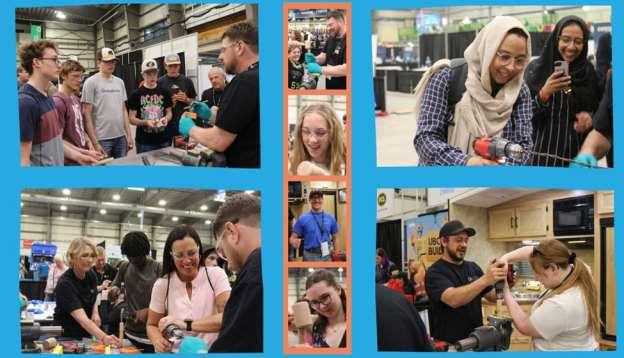
At RVDA of Canada, that’s why we continue to invest in our RV Careers “Try-A-Trade” exhibit. It’s about more than visibility—it’s about being present at the exact moment when young people begin to imagine their future.

Because career decisions aren’t made in isolation. They’re shaped by what students see, what they experience and who encourages them along the way. Teachers help guide those decisions. Parents help validate them. And events like this bring everyone into the same space to explore what’s possible.
With more than 10,000 attendees, this national stage gives us the opportunity to showcase the full spectrum of RV careers from design and manufacturing to service, parts, and sales and to demonstrate that our industry is innovative, hands-on, and full of opportunity
Help us spread the word


We’re inviting members across the industry—dealers, manufacturers, and suppliers—to be part of this effort.
Join us on-site
Volunteer at the RV Careers booth and help guide students through hands-on activities, share your experience, and be part of the moment when something clicks.
The event is free and open to the public, and we encourage you to share it with your networks especially local schools, educators, students, families and online.
If you can’t attend in person, your voice still makes a difference. A simple share or conversation can help connect someone to a career they may not have otherwise considered.
If students don’t see our industry, they won’t consider it.
This is our chance to show them not just what we do but what they could become.
Sometimes, it starts with something simple: handing someone a tool and saying, “Give it a try.”
Interested in volunteering or helping promote the event? Contact Anita to learn more.
If you’re hiring millwrights, industrial electricians, welders, HVAC techs or maintenance mechanics in Canada in the 2026 hiring economy, it can feel like you’re competing for the same small group of proven people; again and again.
While the Canadian skilled trades shortage is real, it is not a dead end. It’s a set of solvable constraints: retirements, training capacity, project volatility, the upskilling puzzle and shifting worker priorities. Having said that, the progressive organizations in 2026 aren’t finding a covert talent pool.
They’re restructuring how they plan, recruit, train and retain exceptional skilled trades talent. What does this mean for your talent strategy? Although standardization is your baseline, flexibility must be your fuel. Additionally, insert a strong safety culture in critical skilled trades roles.
Furthermore, six critical challenges are running the show while you recruit top-tier skilled trades talent. As a consequence, these issues weigh in on every shift and can fizzle out our project delivery if left unchecked.
If your strategy doesn’t account for this ambiguity, you’ll be left in the dust. Therefore, to get ahead, set out on a roadmap backed by verified data. This article brings forth a deep dive into the critical hiring challenges in 2026’s talent economy and offers insights into how to equip your talent strategy with pragmatic tactics.

why 2026 hiring obstacles seem permanent, but not in reality.
Skilled trades hiring is in a tight spot because of a perfect storm of challenges. Retirements are steady, yet many businesses brush them off until it’s too late. As your senior workforce retirement, the loss of institutional expertise is a steep cliff. You can’t shrug them off as minor vacancies.
When a skilled worker moves on, they take the ways of work around site intuition with them. Therefore, solidify your mentorship layers before the brain drain takes its toll. Furthermore, demand doesn’t always run parallel with your hiring pace; it comes along in unpredictable surges.
Our research corroborates these trends. Hiring needs are expected to reach nearly 172,000 positions by 2027, just as 13% of the skilled workforce is set to retire. However, you can’t rush a skilled apprentice. Nurturing a ready-to-lead skilled workforce is a journey that takes on years of dedication. Why?
When an expansion project kicks in, your lack of preparation will show through. What’s more? Modern tradespeople won’t settle for just anything; they need a mocktail of benefits from your organization. What are they?
Schedule autonomy, upskilling opportunities and a clearly laid safety protocol are decisive to draw in top-tier skilled trades talent. Hence, there’s a compelling need to creating a sustainable talent framework tailored to your current growth needs.
the 6 challenges to skilled trades talent in 2026.
How does hiring for elite skilled trades talent respond to the global recruitment challenges? Explore this section to gain a keen insight into these obstacles and how you can solve them effectively.
1. generational shift is creating a readiness gap.
In 2026, the generational shift shows up most clearly as a loss of expert judgment in skilled trades. These seasoned experts about to retire stand their ground against downtime and costly errors. Therefore, it’s important to step up and safeguard their practical knowledge.
Having said that, Gen Z talent steps into this gap with a distinct profile. This new wave of talent craves shorter tenures, sharper digital instinct and a radically distinct relationship with work. Additionally, our data confirms that 42% of Gen Z workers in Canada have already quit a job because it clashed with their personal life.
Furthermore, 82% of the Gen Z operational talent are confident that they can acquire new skills quickly. Hence, switch gears from reactive hiring to strategic forecasting to ensure you don’t fall short on readiness. Work on your existing rosters for flexibility and take inventory of your staff’s skill profiles.
Based on this information, create a talent strategy that promises schedule autonomy, long-term skill upgrades and flexibility in decision-making, knowledge transfer and taking stock of the facility.
2. tech automation, PLCs and diagnostics are redefining quality standards.
In 2026, modern plants and warehouses are teeming with PLCs and robotics. You need skilled trades experts who can handle complex automation and controls. However, finding the perfect talent fit is clearly tough. Why?
Most skill profiles have strong mechanical foundations but lack exposure to the latest techpropped systems. Furthermore, our research suggests that 37% of Canadian operational workforce would quit a job if they don’t see a promising career progression trajectory.
Having said that, take inventory of your existing hiring efforts. Based on the feedback your workforce provides, rebrand your current role list from “manual” to “modern” to draw in skilled trades talent in comfort with data-driven quality control.
Reiterate your talent requirements based on your real business needs, such as troubleshooting VFDs, rather than vague expertise. Beef up your pay bands to reflect the market reality for automation-adjustment tradespeople. Your strategy is simple: recruit for fundamentals and carry out structured onboarding to close the gap.
3. deal with project spiles and shutdowns with talent agility.
In 2026, skilled trades demand is rarely a straight line. A single shutdown can throw a wrench in the works, creating urgent needs across multiple trades in an instant. When delays elsewhere suddenly free your budget, you must gear up for rapid mobilization.
Furthermore, Canada’s voluntary turnover rate stays close to 10%, pushing you to adopt a blended workforce model. Naturally, an agile talent model is one that floats your boat. Start by putting together a bench of specialist tradespeople and solidify your temporary workforce.
Hence, flexibility must become your primary competitive advantage. Additionally, a framework such as this strengthens your core leadership, while you fill urgent talent gaps with expert skilled trades talent on a contract payroll. As a consequence, this talent mix protects your operational continuity without inflating fixed costs.
4. upgrade your compensation conversation with the new employee value proposition.
Don’t water down the impact the massive shift in talent priorities has on your workforce strategy. Today’s skilled workforce signs up for an employer who can bridge the gap between your targets and workforce morale.
That means your compensation package is a mocktail of benefits from flexibility, autonomy and talent value, along with tools, PPE and predictability. On top of that, pair this approach with technological know-how and excellent communication.
Moreover, our research unveils the current talent reality. 57% of the Canadian operational workforce now rank work-life balance as a top priority over just compensation. However, for skilled tradespeople this rarely means remote work.
Flexibility has obtained a new form. One that offers your workforce the comfort of predictability and awareness around the facility. Audit the day-one experience effectively.
How would you do it? Take stock of whether your lockers are ready, tools available and leads aligned to instill safety culture in new hires.
Take effort to train your front-line leaders on respect and clarity. Train them on aspects of work assignment and how feedback is given. Go the extra mile to compress their weekly schedule and make rotations more predictable.
5. turn upskilling as a sustainable solution with apprenticeships.
Stop holding out for a miracle hire. In 2026, skilled trades shortage in Canada is a tall order. That too, if you hire reactively. As a fix, you must cleverly provide the structure that fully formed talent usually brings to the table.
Having said that, treating an apprentice like a program rather than just a hire give you the real edge. Hence, map out clear progression paths and shore up your coaching capacity. That said, if you gloss over the mentorship angle, your training will fizzle out before it even takes off.
Furthermore, counting on skill evaluation will always keep your hiring cycle safe. Our research corroborates this claim by noting that 71% of hiring employers lean on skills testing to predict on-the-job success better than resumes screaming experience.
Additionally, move your workforce from an annual evaluation framework to comprehensive career roadmaps to keep them on the hook for the long haul. Therefore, a workforce nurtured in-house with a clever training ecosystem is the most loyal.
6. human-centric AI boosts trust in your skilled trades workforce.
When you position AI as a competitor instead of being your talent’s aid, you’ll witness an onslaught workplace morale and trust your workforce displays. This isn’t just a theory. It’s almost on the tail of just being a narrative. Why?
Face this statistic: 49% of Gen Z worry about the impact on their own job security. Furthermore, 63% of the overall operational talent worrying that AI will limit career growth opportunities. Conversely, the ground reality is distinctly far off from the talent’s psychological trend.
While AI can speed up your recruitment cycle by weeding out weak resumes and working out complex schedules, it can’t pick up the nuance of human intuition on the floor. Moreover, for your skilled trades talent, the highest-stakes moments still require a human who can sense when something is off.
Hence, communicate on how your staff can leverage AI’s assistance to clear your path to focus on what’s clearly critical. Additionally, flesh out tools that accelerate decisions with the help of safety-critical tools. For instance, equip your assessment processes with ticket validation and scenario-based checks.
Adopt strategy, tools and PPE that ramp up your operational speed without watering down your safety standards. Team up with tradespeople who can bring onboard a safe pair of hands and steer your AI capabilities with well-informed human intellect.
Adapted from Randstad Workplace Insights



By Dave Kahle
Recently, one of the members of my CBIG groups suggested I make a list of the 20 most important things I’ve learned in my 30 years of experience working with B2B sales organizations.
So, I created a list and discovered it to be far longer than 20 items. To narrow down the long list, I applied these four criteria:
1. It had to be an important lesson – one which has the potential to dramatically impact a person, a sales team, or a business not superficial or trivial.
2. It had to arise out of my personal experience. In other words, not something that I garnered from a book, or borrowed from someone else. Something I’ve learned in the trenches.
3. It had to have been tested in the caldron of real-world experience. No blue- sky stuff.
4. I had to unwaveringly vouch for its validity. These are concepts and lessons that I would stand behind.
Applying these four criteria, I narrowed the list down to 25. In no particular order, here’s one of them. Rapid change is the greatest threat to our businesses and careers.
Most leaders understand that the world is changing rapidly. The actual details are even more terrifying than that which we intuitively sense.
Our generation is facing change to such a degree that it is unprecedented in the history of mankind. Of course, individuals and small groups of people have lived through mind-boggling change. Time of war and natural disasters, for example, have uprooted groups and transported them to a condition light year away from where they started. But these changes have typically been the consequences of an event. After the event passes, the folks settle into a new situation.
Today, however, the changes are pervasive, systematic and continuous. Let me illustrate. The root cause of our changing situation is the increase in information. As information expands, it seeps into every area of our economy and culture and causes change. So, to measure change, track the growth in information.
There is a measurement called ‘the total amount of information available to mankind.” It is estimated that, in the year 1900, the total amount of information was doubling every 500 years. That meant that the world was changing relatively slowly. Our great grandparents, for example, probably lived in the same kinds of houses their parents did, worked at the same kinds of jobs, and interacted within the same kinds of social structures.
Now, fast forward to the year 2,000. The total amount of information available to mankind was doubling every two years. Imagine the growth in the pace of change!

We went from it doubling every 500 years to it doubling every two years. As a result, the world of the year 2,000 was changing much more rapidly than the world in 1900.
But what about now? Estimates indicate that the total amount of information doubles about every 30 days. Is it any wonder that we feel like the ground that we stand on is shaking? We’re overwhelmed and confused.
Richard Swensen, writing in his book, Margin, had this observation to share:
“The spontaneous tendency of our culture is to inexorably add detail to our lives: one more option, one more problem, one more commitment, one more expectation, one more purchase, one more debt, one more change, one more job, one more decision. We must now deal with more ‘things per person’ than at any other time in history.”
That Margin was published in the year 2000 adds even more emphasis to the speed of change today. One can’t help but conclude that there has never been a generation of businesspeople who have had to deal with the pace of change moving as rapidly as our generation. It truly is unprecedented.
The potential consequences
Look around us and we see products that have become obsolete almost overnight, (remember the I-pod) and companies come and go (where’s Howard Johnson’s these days?). Disruptive technologies upend entire industries in the blink of an eye. (Anyone want to invest in taxi companies these days?) And now, the emergence of AI portends to usher in a world dramatically different than it was just a year ago.
While we can and do react to specific instances of change that impact us, few of us recognize that the pace of change itself is the greatest threat. We can, for example, respond to a new competitive product. But more important than that specific instance of change, we need to recognize that the pace of change will bring ever more new competitive products. Today’s instance is just today’s instance.

It’s like a piece of driftwood being swept along by an ocean current. We can see and respond to the driftwood, but the underlying current is far more extensive and powerful.
That powerful current threatens to upend our jobs, transform our industries, and warp our culture. The rapidly increasing pace of change is the single biggest threat to our businesses and our careers – and our personal lives – that we will face for the balance of our lives.
If we don’t effectively manage change, we risk our organizations and our lives being upended and rendered obsolete before we can respond. There was a time when an organization prided itself on being quick reacting. Today, if you wait to react, you are probably behind the curve. Leaders need to build disciplines and processes in their organizations that pro-actively identify the ‘next thing’ before it hits. Unprecedented change calls for new thinking.
Dave Kahle is one of the world's leading sales authorities. He's written twelve books, presented in 47 states and eleven countries, and has helped enrich tens of thousands of sales people and transform hundreds of sales organizations. Sign up for his free weekly Ezine. His book, How to Sell Anything to Anyone Anytime, has been recognized by three international entities as "one of the five best English language business books.” Check out his latest book, The Good Book on Business





Exclusive discounts up to 35% off select FedEx services when shipping within Canada, to the US, or internationally. If you have a FedEx account, simply enroll in this program through the dedicated FedEx webpage that can be found at the member link If not, see the member benefit page for a link to do so View FedEx services at www fedex ca




Introducing member benefit from John Deere ! RVDA of Canada members are now eligible for an upgraded John Deere Rewards membership which unlocks extra discounts on equipment, parts and merchandise. Enroll today! It’s simple , fast & free. Check JohnDeere.ca/rvda
As your current cards expired, we're offering you an easier way to shop! To receive the discounts, all you need to do is mention the RVDA of Canada account number at check-out. This offer is available at all Mark's stores across Canada. We're still working on extending the program to online purchases so stay tuned. Access the program now through the RVDA of Canada member site
Discounts and offers for top attractions, shows and other entertainment!
Exclusive discounts and offers for all your stay at Home and work from home needs including, Disney+ subscription,Showtime subscription, black Friday pricing for computers/laptops audiobooks and much more! Access the program now through the RVDA of Canada member site.


Great perks on everyday products and services! Perkopolis is continuously sourcing exclusive offers and benefits for you! Use your Perkopolis membership to enjoy great savings on entertainment, travel, attractions, shopping, health, wellness, sports and more!
Click here for more information

With use of the Petro-Canada SuperPass credit card, members of Explorer RV Club & RVDA of Canada can realize significant savings, convenience, control & security.
Click here for information / application form & ontact information.


With a network that spans coast to coast, Park’N Fly is focused on providing our customers with cost-effective parking options while enjoying a park happy experience with every stay. Access Program
CSAE has negotiated group shipping discounts of up to 55%* on Purolator Shipping Services.Service designed with you in mind! Whether it’s across town or across the country, you’ll get reliable, professional shipping that will satisfy and impress your customers. Access Program








Baseline Processing provides payment solutions and expertise to more than 1,000 merchants across North America including many RVDA of Canada members. Vancouver-based Baseline offers transparent pricing on an RVDA plan pricing that won’t change for the duration of our relationship.
Contact: Hugh Lalande (604) 606-7950)
Website: www.baselineprocessing.com
Chekkit is an all-in-one customer communication platform that brings texting, calling, social messaging, reviews, and webchat into a single, unified inbox. Businesses use Chekkit to respond instantly, automate conversations with AI, manage leads, send quotes and invoices, and deliver consistent 5-star customer experiences at scale. With thousands of businesses across North America relying on Chekkit, we help teams work faster, stay organized, and turn more conversations into revenue.
Contact:Daniel Fayle daniel@chekkit.io
Website: www.chekkit.io
The Corpay brand unifies the domestic U.S. payments solutions Comdata Corporate Payments, Nvoicepay, and Roger with their cross-border payment solutions, Cambridge Global Payments and AFEX, and offers customers the power to more seamlessly connect their finance and AP departments. As part of Corpay, Cambridge’s main goal will be to continue to meet our customers cross-border payments and currency risk management needs.
Contact : Brad Loder at 416-646-6401 Ext:2392 Website : http://cross-
Federated Insurance
Federated Insurance provides customizable Group Employee Benefit coverage. Contact: Western Canada: Reza Kamrani at 1-800-665-1934
Federated Insurance Company of Canada provides direct underwriting of Property and Casualty Insurance for RV dealerships. In addition, the Inventory Floor Plan Advantage is available from Federated Insurance for Commercial Distribution Finance (CDF) customers. Website: www.federated.ca






iA Dealer Services: F&I protection programs including, Creditor's Group Insurance (life, accident & sickness, involuntary unemployment, critical illness), Extended Warranty, Appearance Protection and Theft Deterrent System. An array of dynamic and RV specific F&I training webinars to support your business office. To find out more about iA Dealer Services or to become an iA Dealer Services dealer partner, contact us today. Contact: 1 800 663 9498; email: info.iads@ia.ca Website: www.iadealerservices.ca
KYCS(Keep Your Community Safe),KYCS Global’s state of the art Bluetooth and IoT theft recovery solutions create peace of mind for your customers. KYCS works in partnership with Crime Stoppers to assist in the recovery of RV and Trailer theft. The company’s flagship solution includes KYCS Locate sold exclusively at dealerships. With seamless installation, KYCS Locate is covertly hidden in RVs & Trailers
Contact: Jason Lyall at (289) 230-1833, Email: jlyall@kycs.ca Website: http://www.kycs.ca/
NCM Associates, Inc., help dealers improve management skills, learn best practices, and apply them to your dealership while utilizing detailed proprietary reports and hard intelligence on group and industry trends.
Call: 1.800.756.2620 (US and Canada) Website: info@ncmassociates.com | www.ncmassociates.com
Discover the latest trends, insights, and key performance indicators shaping the dynamic landscape of RV sales across the country. Waterfall’s comprehensive reports provide a detailed analysis of the Canadian RV pre-owned market, offering valuable data and actionable intelligence for industry professionals, enthusiasts, and investors. Contact:info@wtrfll.ca Website: https://wtrfll.ca/
Wells Fargo Commercial Distribution Finance (CDF) is a global inventory financing solutions provider with more than 45 years of expertise in the RV industry. Wells Fargo CDF delivers inventory financing solutions, service, and intelligence through indepth expertise and a commitment to customers.
Contact: Charbel Bejjani Tel: (204)255-5965; Cell: (204) 430-6410; Website: www.wellsfargo.com/cdf

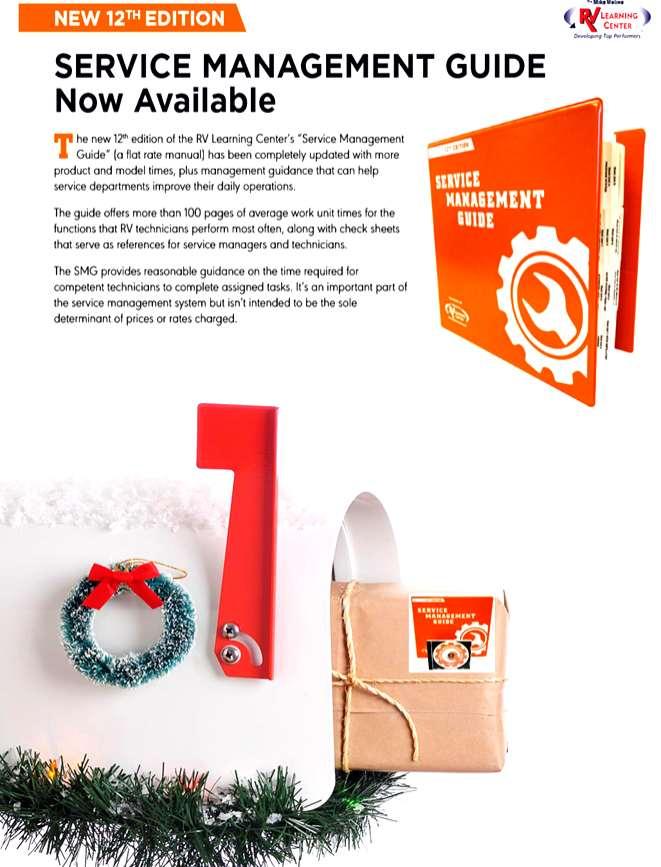
Developed by RV industry service management experts, the online course topics including managing appointments and workflow, generating additional revenue, and enhancing communication with customers.
Fully interactive and easy to navigate, the course is an ideal way to jump start the knowledge base of new employees or provide a refresher for more experienced fixed operations professionals. Modules reinforce the customer service skill sets service writers/advisors are required to perform every day.
The course concludes with a comprehensive final assessment to test knowledge and skills learned in the course. The course is excellent preparation for the RV Learning Center’s Service Writer/Advisor Certification Test, which is separate from the online training program.



The Mike Molino RV Learning Center continues to add to its curriculum online courses designed to help dealers and fixed operations meet the needs of a new generation of customers.
The Parts Specialist online course
Parts Manager Online Course


The RV Learning Center partnered with the Ohio State University’s Center for Education and Training for Employment have developed Certifications, Competency Profiles, and instructional materials in the following areas:
Service Manager
Service Writer/Advisor
Warranty Administrator
Parts Manager
Parts Specialist
The RVDA of Canada Member Newsletter is produced and distributed through the national association office : RVDA of Canada, Richmond BC
For Inquiries please contact us at:
#145 – Coppersmith Way Richmond, BC V7A 5J9
Ph: (604) 718-6325
Fax: (604) 204-0154 www.rvda.ca powered by rvhotlinecanada.com
Emails :
Eleonore Hamm, eleonore_hamm@rvda.ca
Anita Lien, anital@rvda.ca
Amee Inocencio, ainocencio@rvda.ca

Post your Positions at www.RVCareers.ca
To post a job, simply go to the employers tab and log in using your RVDA of Canada user name and password.
Contact RVDA of Canada at 604-718-6325 or e-mail if you do not have this
WWW.BUYLOCALRV.CA
RVDA of Canada’s “BUY LOCAL” campaign promotes “Buy your RV close to home. It’s better in the long haul, to consumers.
We encourage you to download a copy of brochure available at the member’s website.


The RVDA of Canada is a national federation dedicated to advocating, protecting, and promoting the interests of RV dealers across Canada, enabling the industry to reach its full potential.

Chairman, Ken Dobson
Leisure Time Sales Quispamsis, NB
Vice-Chairman, Marc Rémillard
Centre du Camping Rémillard St-Jean-sur-Richelieu, QC
Treasurer, Peter Schmucker Fraserway RV Lacombe County, AB
Past Chair
Jim Gorrie
Classic Trailer Sales Ltd. Headingley, MB
John Krohnert Chardell Brydon Platinum RV Sales Jerry's RV Trailer Sales & Service
Jonathan Stone Kyle Kehoe Stone’s RV Center Kehoe RV
Mathieu Hérard Cole O'Connell Roulottes Chaudière Pulse RV
Travis Bromley
Jeff Redmond Transcona Trailer Sales Midtown R.V. Ltd.