

�"'� I\_UTGERS II
UNIVERSITY I CAMDEN Honors College


The Undergraduate Review
Spring 2022
Volume 3 Issue 1
Jochebed Airede, co-editor
Isaiah Dingle, co-editor
Honors College Advisory Board
Lee Ann Westman, Director, Honors College
Brian Everett, Assistant Dean, Honors College
Faculty Advisory Board
Rick Demirjian
Kelly Dittmar
Ophelia Eryn Hostetter
Charles Idler
Amy Liberi
Robrecht Van Der Wel
David P. Vitt
Copyright © 2022, The Undergraduate Review Rutgers University-Camden. All rights revert to authors.
The Undergraduate Review is a publication of the Honors College at Rutgers University-Camden. The views expressed in The Undergraduate Review are solely those of the contributors and should not be attributed to the editorial staff, the Honors College, or to Rutgers University.
on Contributors
Student Editors’ Introduction
Tim Pan
A true mark of an "interdisciplinary" journal lies in its ability to reflect the full spectrum of scholarship offered by the university. The student contributions featured in this issue bear not only the stamp of approval from their dedicated faculty members but also embody the rich tapestry of student research and creative pursuits at Rutgers University-Camden. The Undergraduate Review is a true interdisciplinary collaboration among students, faculty, and the student editors. This journal serves as a dynamic platform for students to share their scholarly and original work, garnering the recognition of their peers and the esteemed staff and faculty at Rutgers University-Camden.
What lies ahead is student research and creative work spanning across disciplines such as history, law, urban studies, and literature. Though this semester marked the beginning of the relaxation of COVID-19 preventive measures on our campus, some of this issue’s works continue to address the lingering after-effects of the pandemic. Both Samuel Hsiao in "Pandemic Online Education and Our Stolen Youths'' and Victoria Matt in "Examining the Effects of the Switch to Online Learning” recognize how COVID still lives with us in the impact of no-contact rules on the U.S. educational system, which were necessary for survival at the height of the pandemic. With its unequal impact on U.S. Americans, the pandemic continued to reveal the social injustices that run rampant in the U.S.
Many of this issue’s works grapple with American history, culture, and industry. Kennedy Samuels’ “Success in Colonial and Early America” examines who achieved “success” and how. Josefina Ewins's article, "Studying the Movements of Black Women State Legislators,'' takes a deep dive into political inequalities, exploring the intersections of race and
gender in determining who writes U.S. laws, as Tania Martinez’s "Variations in Housing Policy for Undocumented Immigrants" addresses the how housing policies shape how undocumented persons in the States live. Then, Alexis Marini's "Say No To the War on Drugs" tackles another public health crisis drug addiction. Finally, Amina Andou’s analysis “Quality Management at Ford Motor Company” provides insights about American corporate culture.
Even our more light-hearted pieces, such as Cassidy Jones' review of Tom Robbins’ Another Roadside Attraction, confront real-world issues, such as the perceived conflicts between religion and logic and the increasingly hostile battle between political ideologies in the U.S., where commentators on the right and left encourage a range of sometimes-contradictory beliefs.
This issue's sole creative work, Gabrielle Krier's I Will Never Truly Be Fixed, embodies the gnawing consequences of surviving a devastating, toxic interpersonal relationship.
Rutgers University-Camden boasts a community of students celebrated for their awards, innovation, and intellectual distinction. We extend our heartfelt gratitude to every student who has dedicated their time and effort to submitting and honing their work until it reflected their very best. A special tribute goes to our esteemed faculty advisors, whose unwavering support was instrumental in bringing this edition of the journal to fruition. Over the years, the editorial team of The Undergraduate Review, in collaboration with their faculty advisors, has tirelessly worked to achieve their goal of curating the finest student submissions with each new edition of the journal. As you delve into these pages as a reader, we trust you will find pleasure and gain deeper insights into the vibrant community of our campus. This journal serves as a testament to the unwavering ambition and dedication of our student body, whose accomplishments are nothing short of
exceptional. And we remind all students of our motto: Get noticed; Be remembered.
The Undergraduate Review 5
Pandemic Online Education and Our Stolen Youths
Samuel Hsiao
The pandemic was a disruptive time for everyone, but the biggest impact for students was the switch to online learning. While reading about the use of technology in education, I was reminded of how big the change was (Idler, 2021). This led me to wonder whether or not pandemic online education worked, especially compared to traditional face-to face education. To find out, I wanted to see from history what makes for successful distance education. Using this background, I then looked at some of the common problems faced by teachers and students during pandemic online learning, before finally addressing the specter of pandemic education: cheating.
History
Distance education can trace its roots back to the 18th century The basic premise was still the delivery of educational instruction where the educator and student are physically separated, but instead of going through the internet the teachers of those days used letters to correspond. However, it is arguable whether it could truly be considered formal education, as it only involved one-way communication by the teacher. This method would gain mainstream popularity in 1840 under Isaac Pitman who improved the system by asking his students to mail back work so that he could verify it (Kentnor, 2015). This method would become popularized by the “Chautauqua movement,” which utilized Pitman’s method to give summer classes to Sunday school teachers but quickly expanded to cover general education and arts by popular demand (Kentnor, 2015). Some universities like the University of Chicago would quickly follow suit under the name “correspondence college” and offer college-level
courses or even entire four-year certificates through it. The success of these distant learning programs seems to come down to two factors: a reliable means of communication at a distance courtesy of the United States postal system and an enthusiastic group of adult students who are prevented from attending normally due to a lack of access to traditional educational institutions, whether due to geographic or societal difficulties (Kentnor, 2015; Writers, 2021). This convergence of ease of supply and high demand is the reason for early forays’ success.
The next evolution of distance learning, radio and television, had their improvements curbed by cost and difficulty of use. At the turn of the 20th century, the advent of the radio would offer the world a means of communicating at the speed of light, potentially a huge boon to distance education. This potential was not lost on the educational institutions, with the University of Wisconsin being an early adopter. This yielded results in 1919 when a group of professors was able to start a federally-backed amateur wireless station explicitly for educational purposes (Kentnor, 2015). Other institutions quickly followed suit, and by 1922 there were 73 other such radio stations, but more than half would not survive the decade due to the increased federal regulation on radio communication and the Great Depression.
A similar potential existed for the television, which had people speculating its effectiveness for educational purposes even before its invention with pundits eagerly claiming that an audio-visual medium would soon make traditional classrooms a relic of the past. Yet its actual implementation was far more strenuous due to difficulties in securing channels for education, which required several institutions banding together to negotiate (Kentnor, 2015). The problems did not stop there as early educational programs were not met with much success due to low production quality from staff
inexperienced with the new medium. It would not be until the 1970s that the BBC began effectively running educational programs by upholding a standard of quality (Kentnor, 2015).
The struggles to use the radio and the television highlighted an important requirement for effective distance education: the need for easy access by the educators. This means distance education must be both affordable and easy for the instructors to adapt to the new platform. Another important factor to consider is whether these systems were actually a regression in terms of educational effectiveness compared to correspondence schools; while the information is delivered much faster, the students lose the ability to meaningfully interact with the instructor and content. More importantly, without ways for the instructor to assess the students' knowledge, these systems may not even provide a competent formal education (Idler, 2021). Remedying these problems required an audio-visual system that can allow for two-way communication between teacher and students while being cheap and easy to use.
Early Computers internet did not seem to fit these requirements, but decades of development and popularization would soon change that. By 1989, University of Phoenix became the first institution to offer a fully online collegiate bachelor’s and master’s degree quickly followed by other institutions and non-profits. These early attempts for online education saw polarizing levels of success. For example, while the University of Phoenix saw rapid growth into the early 2000s, many other institutions that attempted to implement an online division failed within years (Kentnor, 2015). A common problem was instructors finding the new platform difficult to navigate without sufficient support. Despite the risk, online education continued to grow in the 2000s (Allen & Seaman, 2007; Kentnor, 2015). The success of the internet as a tool for education had to do with its flexibility, which is also its greatest weakness. Today’s internet comes closer to
face-to-face communication than ever before, and in some ways, it surpasses physical communication in its ability to record past information and on-demand computational power. The sheer amount of tools on the internet theoretically offers the instructor more information, ways of delivery, and personalized content for each student with less work and over any distance (Idler, 2021). However, this high volume of options leaves a paralyzing amount of choices to make (i.e. which programs to use when?) and places a burden on instructors to achieve technical competence. The vast internet also poses a danger to students who may be led astray by other interests and shortcuts/cheats. Yet these problems are solvable: Pre-covid switches to online learning following natural disasters showed success by providing a standardized format (platform, schedule, etc.), easily accessible technical support, and a more interactive system for the students (Dhawan, 2020; Twigg, 2013). By limiting the number of choices, the flexibility of the internet is more effectively used and its pitfalls avoided by all members of the educational community.
The requirements for successful distance learning have not changed since the days of pen and paper correspondence learning: all that’s really required is a reliable means of communication and motivated students and staff. History highlights two clear mistakes in the lack of teacher-student interaction and accessibility. The internet can avoid these mistakes and provide unique advantages, but only if the institution is willing to maximize its potential by providing assistance for the teachers and students. In this light, how did online education fare during the recent Covid pandemic?
Problems of Online education during Covid
In early spring 2020, the Covid-19 pandemic made the switch to online education necessary for many institutions.
Despite the seeming success on the surface, there appears to be a great deal of discontentment by both educators and students. Thus, I will investigate the common complaints of teachers and students, then consider their possible solutions.
Looking back, I’m still astounded that most teachers around the world were able to answer the herculean task of upending their entire semester plans and moving online, sometimes in as little as a single weekend (Mishra et al., 2020; Niemi & Kousa, 2020). However, this was not necessarily a smooth transition; the most common issue early in the pandemic (and would persist throughout) was technical difficulties (Dhawan, 2020). While some technical issues are unavoidable, a large part could’ve been prevented with sufficient IT skills by the teachers (Niemi & Kousa, 2020). To this end, institutions could have provided training courses, continual IT support, and preferably time to adapt.
Next, even discounting technical issues, the educators’ workload increased during the pandemic of online education. This was due to increased student communication at irregular hours, increased vigilance against cheating (more on this later), and low interaction (Vinichenko et al., 2021). The last point is especially damaging as it hinders teachers’ ability to observe student performance and adapt accordingly; this creates more work for instructors who are still expected to perform as if they are in the original school environment (Idler, 2021; Vinichenko et al., 2021). These factors culminate in an extremely stressful environment that may easily lead to burnout and decreased commitment, a terrible outcome for the entire class (Idler, 2021).
To me, these issues stem from the aforementioned overwhelming number of options that the internet provides which can be remedied by the administration imposing greater standardization. A common platform would allow more efficient IT support, the standardized schedule and policy would at least make work more predictable, and the
resulting stability should help decrease stress. Promoting stability should be effective as studies have also emphasized unfamiliarity with online education and uncertainty of the situation as the main educator concern (Betille, 2020; Niemi & Kousa, 2020). While online education poses many unforeseen challenges for the instructors, they may be mitigated with precise intervention by the institution.
During the pandemic, students did not face as many logistical stresses as the instructors. Rather, their challenges stem more from overall psychological state. A common complaint the students had about the pandemic online courses was the lack of interactivity (Gandhi, 2020; Ltd, 2020). This is likely an inherent limitation of the current internet, as shown by students finding interactive classes (e.g. labs) to be the least effective in the online format (Gandhi, 2020). Paradoxically, the other major complaint was of personal time management, or rather, the lack of it (Onyema et al., 2020). Why are students having more problems managing their time given similar levels of work and less requirement to interact (Niemi & Kousa, 2020)? I think the culprit is the one most cited issue by the students: motivation (Patricia, 2020; Niemi & Kousa, 2020). Specifically, decreased interaction could lead to less positive encounters, which leads to lower motivation (Idler, 2021); this could lead to a death spiral if low motivation in turn caused less willingness to interact with the class.
From my own observation, I further postulate another source of low motivation could be a perceived lack of control; this would explain why low motivation was more often reported by students than teachers since the latter had relatively more control in an educational setting (Mishra et al, 2020; Niemi & Kousa, 2020). Therefore, I recommend a solution that focuses on restoring a sense of personal control for students. This may include institution-wide measures like making psychological services more available, or smaller-scale
plans like giving the students a say in how the class is to be conducted. I believe addressing the root cause of students’ low motivation is the most effective means to improve student performance.
Although online education offers certain advantages such as the ability to rewatch lectures and self-pace, both are very popular with students. These advantages are offset by the failure to address the aforementioned issues (Mishra et al., 2020). So, while members of some institutions have found success in online education, the story of struggle seems to be the more common narrative (Campillo-Ferrer, 2021; Gandhi, 2020; Rasiah 2020; Vinchenko et al, 2021). This is supported by more quantitative evaluations, which revealed that while online education is effective given the limited time for the transition, it still lags behind face-to-face instruction (Ltd., 2020; Suci et al., 2020). Even then, this assumes that quantitative measures like grades are an accurate measure of educational effectiveness, which may not be true considering the elephant in the room.
Cheating and Academic Dishonesty during the pandemic
Academic dishonesty has long been a part of the educational system, but the situation has significantly worsened during pandemic online education to the point of gaining media attention (Online cheating…, 2021). Interestingly, the spike in rates of academic dishonesty is mainly with regards to cheating during exams rather than in its other incarnations (Janke, 2020). Upon learning this disheartening news, I was eager to find out the cause for this increase of cheating, and if there were any solutions to this problem.
The increase in exam cheating is likely due to a change in the cost-benefit of cheating coupled with lack of student
drive/integrity. It should first be established that exam cheating (henceforth shortened as “cheating”) rates have skyrocketed during pandemic online education. According to student self-reported surveys during Covid, 71.5-93.8% of students admitted to cheating and other forms of academic dishonesty (Janke, 2020). Quantitatively, in a (brilliant) study done analyzing public google searches, it can be demonstrated that AP exam-specific terms were being searched at a significantly higher frequency during exam periods (Bilen & Matros, 2021). Bilen & Matros (2021) postulated that the increase is caused by the ease of cheating online which tilts the cost-benefit balance.
I see an additional reason. Pre-covid studies regarding cheating rate in online education showed that students do not claim to cheat significantly more, but in practice scored higher when given the same preparation but took the test online (Watson & Sottile, 2010; Fask et al., 2014 as cited by Bilen & Matros, 2021). Comparing these studies makes it clear to me that the pandemic has not really affected student's propensity to cheat in an online environment, rather it made the students feel less shame in the act of cheating. In other words, some pandemic related factor (other than the online format) is causing students to see cheating as the “new normal” in education. This decrease in integrity is accentuating the tilted cost-benefit to result in the staggering increase in cheating rates during pandemic online education. As such, solutions to this problem should use a dual behaviorist and humanistic approach to disincentivize cheating and bolster student integrity, respectively.
The staggering increase in rates of cheating is a call for administrative actions, which preferably addresses both the changes in cost-benefit and integrity, There should also be a reevaluation of cheating policy in an online setting. In looking for a solution, Bilen & Matros (2021) considered the rise in cheating in online chess. They attributed this to a failure to
implement an effective anti-cheat system as well as the interperson competitive nature of chess which creates a constant incentive to cheat, if only as a deterrent. To address the first point in context of education, Bilen & Matros advocated for the indiscriminate implementation of camera monitoring systems for all exams. Privacy and financial concerns aside, I also see this as poisoning the class climate as it is a huge sign implying a lack of trust by a teacher towards the students. Besides, such methods are not infallible. I would rather see a lighter-handed approach that is targeted towards potential cheaters, such as one proposed by Didenhofen and Musch (2017), who found that a JavaScript program that gives a warning for frequent tab switches from the exam as seemingly effective at stopping potential cheating.
Another lesson from chess is to avoid making a competitive environment. To that end teachers may consider not curving grades in favor of providing more effort-based bonus assignments; doing this would promote a culture of self-improvement through effort, rather than putting grades as the ultimate end of a student's education (which is likely a big reason students cheat). Additionally, the removal of curving (while unpopular) would decrease some student's motivation to cheat, since a group of cheaters making the curve "worse" for honest students would no longer be a consideration. Boosting student integrity could be done by putting an emphasis on “striving for competence development.” This would include assuring students that grading would be done based on the process of solving the question which has been shown to reduce cheating rates (Janke, 2020). Lastly, an institution or class conducting online education may reconsider its academic dishonesty policy. I’m not advocating for plagiarism or other such practices, but for certain classes it may be reasonable to design exams to allow for the use of online resources. This avoids the debate of invasive anti-cheat programs and may prove to be more
accurate to practical applications of certain subjects (i.e. pretty much no one remembers atomic mass of later period elements). In summary, there are many ways to help prevent students from cheating, some more heavy-handed than others. However, no matter what the ultimate decision is, it is crucial that a decision is made to curb the rampant cheating rate during a pandemic online education, lest the students normalize academic dishonesty.
Conclusion
During my research I found this telling quote “Learning is caused by instructional methods rather than instructional media” (Mayer, 2018. While online learning can provide educators with powerful new tools, without proper implementation the versatility of the internet will only end up causing more issues than traditional face-to-face teaching. This is confirmed by looking at the history of distance learning, where the same characteristics of ease of access/use, sufficient interaction, and motivation determined the success and failure of the various platforms across time. So, even as the internet provides a greater degree of flexibility for distance education than ever before, it is still not exempt from these governing factors for distance education. This is made evident during the quick switch to online learning during the pandemic, where the most common problems were related to the technical stability of the online programs, lack of interaction in the classes, and low motivation (especially from the students). These problems have thus far hindered online education to be inferior qualitatively and quantitatively to face-to-face education. Although this can be attributed partially to the rushed nature of the switch, the institution could definitely have taken more measures to improve the quality of online education in the months that followed. A good representation of these problems can be seen in the
staggering rise in cheating and other forms of academic dishonesty during pandemic online education, which came about as a result of a failure to address both ease of cheating and lapse in student integrity. This clearly demonstrates a need for greater intervention by the administrative side of the institution to provide adequate support to the teacher and students in order to ensure the continued well-functioning of the education system. Specifically, the institution should not only continually combat technical difficulties, but aid in situating the teachers and students into the “new norm” of online education through training, provision of psychological support, and revision of rules where necessary. While the pandemic has taken something from all of us, still, that does not absolve us of the responsibility as both educators and students to adapt to the new circumstances and online format presented to us. Without actions to streamline online learning and strengthen our own commitment to education, we are no less thieves of our youths’ potential than the disaster itself.
References
Allen, I. E., & Seaman, J. (2007). Online Nation: Five Years of Growth in Online Learning. In Sloan Consortium (NJ1). Sloan Consortium. https://eric.ed.gov/?id=ED529699
Beteille, T., Ding, E., Molina, E., Pushparatnam, A., & Wilichowski, T. (2020). Three Principles to Support Teacher Effectiveness During COVID-19 [Policy Note]. World Bank. https://doi.org/10.1596/33775
Bilen, E., & Matros, A. (2021). Online cheating amid COVID19 ScienceDirect. https://www.sciencedirect.com/science/article/pii/S016726 8120304510?casa_token=yZGSvQrmBJ8AAAAA:7itvzU6Ta
EJSxxwAI_RMOZXmKko9ytdKdQlpjtVPFZTjSMBWa4Yj GGz9SjacV60lGRNh15c
Campillo-Ferrer, J. M., & Miralles-Martínez, P. (2021). Effectiveness of the flipped classroom model on students’ self-reported motivation and learning during the COVID-19 pandemic. Humanities and Social Sciences Communications, 8(1), 1–9. https://doi.org/10.1057/s41599-021-00860-4
Dhawan, S. (2020). Online Learning: A Panacea in the Time of COVID-19 Crisis. Journal of Educational Technology Systems, 49(1), 5–22. https://doi.org/10.1177/0047239520934018
Gandhi, N. K. D. D. J. A. A. (2020). Study of the effectiveness of e-learning to conventional teaching in medical undergraduates amid COVID-19 pandemic. National Journal of Physiology, Pharmacy and Pharmacology, 10(7), 563–567.
Janke, S., Rudert, S. C., Peterson, A., Fritz, T. M., & Daumiller, M. (2020). Cheating in the wake of COVID-19: How dangerous is ad-hoc online testing for academic integrity? Preprint from PsyArXiv. https://doi.org/10.31234/osf.io/6xmzh
Kentnor, H. (2015). Distance Education and the Evolution of Online Learning in the United States. 18.
Ltd, I.-I. B. (2020). Online Teaching Practices and the Effectiveness of the Educational Process in the Wake of the COVID-19 Pandemic. Amfiteatru Economic, 22(55), 920–936.
Mayer, R. E. (2018, November 8). Thirty Years of research on online learning. Wiley Online Library. Retrieved December 7, 2021, from https://onlinelibrary.wiley.com/doi/full/10.1002/acp.3482.
Mishra, L., Gupta, T., & Abha, S. (2020). Online teachinglearning in higher education during lockdown period of COVID-19 pandemic ScienceDirect. https://www.sciencedirect.com/science/article/pii/S266637 4020300121
Niemi, H. M., & Kousa, P. (2020). A Case Study of Students’ and Teachers’ Perceptions in a Finnish High School during the COVID Pandemic. https://doi.org/10.46328/ijtes.v4i4.167
Online cheating is the next hurdle for students and schools. (2021, January 18). The Independent. https://www.independent.co.uk/news/education/onlinecheating-learning-students-schools-b1787289.html
Onyema, M., Eucheria, N., & Obafemi, F. (2020). Impact of Coronavirus Pandemic on Education. Journal of Education and Practice, 11(13). https://doi.org/10.7176/JEP/11-13-12 Patricia Aguilera-Hermida, A. (2020). College students’ use and acceptance of emergency online learning due to COVID19. International Journal of Educational Research Open, 1, 100011. https://doi.org/10.1016/j.ijedro.2020.100011
Segawa Ko. (2015). 謎好き乙女と奪われた青春 . Shinchosha.
Twigg, C. A. (2003). Improving Learning and Reducing Costs: New Models for Online Learning. EDUCAUSE Review, 38(5), 28–38.
Vinichenko, M. V., Vinogradova, M. V., Nikiporets-Takigawa, G. Y., & Rybakova, M. V. (2021). The impact of the pandemic on the quality of education and the image of a university. XLinguae, 17–37.
18 The Undergraduate Review
Writers, S. (2021, September 22). The History of Online Schooling. OnlineSchools.Org. https://www.onlineschools.org/visualacademy/the-history-of-online-schooling/
Examining the Effects of the Switch to Online Learning
During the COVID-19 Pandemic on Rutgers-Camden Students
Victoria Matt
Abstract
Thispaperprovidesaninsightintotheeffectsofemergency pandemic online instruction on Rutgers-Camden students' motivation, desire to learn, and social support. A 30-question survey was given to a pool of college students at RutgersCamden and measured the levels of each variable. The purpose of this study was to determine if there was a change in student motivation and academic performance after transitioning from in-person education to remote learning. The findings recorded by the survey determined that motivation was not significantly correlated with GPA during the pandemic, therefore stating that there was not a decrease in student’s academic success during the pandemic.
The COVID-19 Pandemic impacted millions of people worldwide in the daily aspects of their lives.The quarantine the world was placed under caused shifts in normal activities, such as attending school. One of the significant shifts during this time was the transition from in-person to online education.
Teachers and students were faced with the stress of tackling a new problem: figuring out how to properly educate themselves virtually. The hypothesis for this study on COVID-19 impacting education is that the switch to online learning has decreased students’ motivation to learn and caused a decrease in their GPAs after the sudden transition.
The effects of this stress about online learning can have an impact on a student’s desire to learn (Kim & Frick, 2011). Along with that, the motivation students have can be changed due to the new factors of the online learning environment. Researching if switching to online learning decreased a
student’s motivation in the pandemic is imperative to make proper changes to the online learning environment, and the ways teachers instruct students (Kim & Frick, 2011). With this information regarding desire to learn and motivation, the online learning atmosphere can be improved for both students andprofessors.SwitchingtoonlineclassesduringtheCOVID19 pandemic has decreased student’s motivation and desire to learn.
A variety of psychological articles have influenced the hypothesis for this study. A study conducted by Kim and Frick measures student motivation prior to starting an online course, and what factors motivate the students to begin the online learning (Kim & Frick, 2011). Furthermore, the quality of elearning is a present topic in the article; the experimenters use this research to further the improvement of e-learning (Kim & Frick, 2011). In a second study, the authors examine the effectiveness of online education for both teachers and students. The findings of this study include the fact that in person education is extremely hard to replicate, leading to stress for both students and teachers (Zapalska, LaMonica, & Hart,2020). Also, multipledifferenttechnologiesareexamined on their effectiveness for student learning within this study (Zapalska, LaMonica, & Hart, 2020).
A third study by a group of researchers measured motivation and academic success levels through a survey given to 190 undergraduate students forced to transition into remote learning. The researchers were studying the effects of emergency online learningduringthe COVID-19 pandemic on student performance and connectedness. The survey found that levels of motivation to continue school online were low, along with elevated levels of procrastination and yearning for in-person conversations with professors (K.B, S.V, J.C & others, 2020). The study also found that online learning requires extremely elevated levels of a student’s solo
participation, which caused feelings of disconnect when it came to online learning (K.B, S.V, J.C, & others, 2020). The articles supporting this current study present valuable incentives about online education, and the room it has for improvement.
Teachers and students were faced with newfound stress when switching from in person education to online learning. In this study, the values that will be studied include motivation anddesiretolearnwhilecompletingonlineeducation.Through a survey, researchers will measure levels of motivation and desire to learn while participating in the online learning environment. Specifically with the information found, professors and students can make improvements to the online learning and provide students with a better environment to succeed. Furthermore, the stress of changing over to online learning will also be measured through multiple questions on emotional health.
Method
Participants: For this research study, a survey is used to collect data about levels of motivation and achievement during education. The participants of the survey were over 50 college students, primarily in the psychology department at Rutgers University-Camden. Specifically, many of the participants are from the Psychology department, and take both Experimental Psychology and Experimental Psychology Lab. The pool of participants was also both youngmen and women in their early twenties. Participants were selected for this survey because of their firsthand experience with both in person and online college education. The participants formed a convenience sample and were all online students during the COVID 19 Pandemic, as well as in person students prior to the pandemic. All participants were Rutgers University-Camden students that
transitioned to online learning during the COVID-19 Pandemic. Therefore, the participants are excellent candidates for the survey, as they experienced levels of motivation and achievement in both of these situations.
Materials: The materials used to measure levels of motivation and achievement before and after the COVID-19 Pandemic was a thirty-question survey. The survey featured a scale from 1-5, which described how frequently the participants experienced the nature of the questions. From beginning to end of the scale: 1 is none/never, 2 is sometimes, 3 is neutral, 4 is frequently, and 5 is always. The types of questions asked on the survey ranged from: experiences with academicsuccess,attendanceinclasses,turninginassignments, and participation in group work or discussions. In another part of the survey, students report their grade point average from prior to the switching to online learning, and after. This assists in measuring the form of education that is most beneficial for students in education. The survey was utilized on a platform named Qualtrics, an online website that collects information from surveys created by researchers. The stimulus in this study is the change from in person college education to online education. This change in the form of education altered feelings of motivation and achievement for students. The methods used for this study consisted of a thirty-question survey for college students that measured their levels of motivation and achievement in two scenarios: pre and post pandemic.
Procedure
During the testing session, participants were sent an online link or QR code to complete the survey designed on Qualtrics. Participants were instructed to rate their levels of frequency of when they experienced what the question was asking. Students selected a number from the scale from 1-5 to report the
frequency of motivation they had in completing their academic responsibilities. The participants were not confined to one room, as the survey was utilized on an online platform. Participantswereabletocompletethesurveyintheirowntime, as well as having atleastthreedays to respond to the questions. The survey measures two variables: motivation and academic success. Participants are only required to complete the survey one time, and therefore there is one trial. The data that was recorded was anonymous, but recorded basic demographic information of the participants, such as their gender and year in school.
Results
The purpose of the study described was to conclude if the switch to online learning from in person learning during the COVID-19 pandemic caused a decrease in Rutgers students’ desire to learn, as well as a decreased GPA as a possible consequence of this. Social support and its relationship between motivation and academic achievement was another objective examined. GPA was also taken into account twice during the study, one pre-pandemic (in-person learning), and again mid-pandemic (online learning). This study aimed to produce more information that could contribute to previous studies' findings on the relationship between student motivation, desire to learn, and its relationship to academic performance.
We used a cumulative response system to find six specific items prior to Rutgers-Camden shutting down its in person teachinginstructionandotheractivities.Basedonthestudent’s responses, the higher their score on these specific measures, the higher their own personal level of motivation is. Cronbach’s alpha for this subscale for motivation prior to the pandemic was 0.762. To measure social support before the pandemic occurred, four other terms on the survey were used.
For this subscale for social support prior to COVID-19, the Cronbach’s alpha was 0.646. We also took out seven questions from the original survey that included information about housing pre and post in-person instruction, as well as gender and age. This occurred to protect reliability purposes.
Six more items were used to measure motivational levels that Rutgers-Camden students had while they were learning back at home during the pandemic. Relatable to the other scores, the higher theywere, the more motivated students were to learn during online learning. For this subscale of motivation during the pandemic, Cronbach’s alpha was 0.680. Additionally, four items were added to the survey to measure social support during online learning and the pandemic. This subscale regarding social support mid pandemic had Cronbach’s alpha as 0.558.
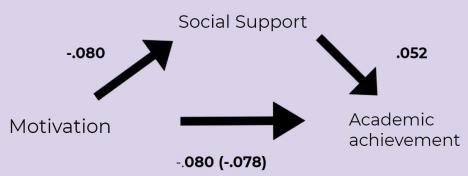
Our group compared the measures of motivation and academic performance during the pandemic (M=3.77, SD=0.72) to determine our hypothesis in regard to the relationshipbetweenlevelsofmotivationandacademicsuccess (M=3.5, SD=0.29). During online classes in the COVID-19 pandemic, the Pearson correlation was (r =-0.80, p =0.595, n =46). This showed our study that there was no significant correlation between motivation and GPA during the pandemic. We also compared the measures of motivation (M=3.5, SD=0.36) and academic performance prior to the pandemic (M=3.75, SD=0.61) and classes shifting to online
instruction. The Pearson correlation showed us that there was a positive correlation between motivation and GPA prior to the pandemic. The results of the Pearson correlation showed that before: r=0.363, p=.013, n=46.
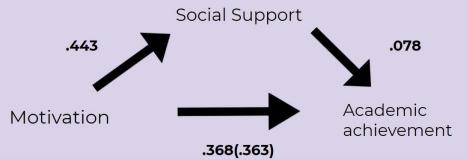
Social support was a third variable added to our study to conclude if social support influenced student motivation and academic performance (M=3.04, SD=0.77). Before the COVID-19 Pandemic, the Pearson correlation was r=0.443, p=0.002, n=46. This identifies that there is a correlation between social support and motivation, but not academic success and social support before online instruction. Similarly, we examined the data found about motivation and academic performance during the COVID-19 Pandemic (M=3.04, SD=0.77). During the global pandemic, the Pearson correlation was r=0.052, p=0,729, n=46; this shows that there is no significant relationship found between academic achievement and social support.
Discussion
The purpose of this study was to determine if the drastic switch to online learning during the COVID-19 Pandemic amid Rutgers-Camden Spring 2020 semester affected students while examining their levels of motivation, social support, and GPA. These factors were measured twice in the survey, once pre-pandemic (in-person learning), and again mid-pandemic (online learning). Our hypothesis was that the switch to online learninghasdecreasedstudents’motivationtolearnandcaused adecreaseintheirGPAafterthequicktransitionthatwasmade to online learning. The hope of this study was to better understand the relationship between student motivation, academic success, and social support.
Drawing from the results, we have found that motivation was not significantly correlated to GPA during the pandemic. Whenlookingatthisfinding,weweresurprisedtoseethisdata. But, after considering the factors it does make sense. During the transition to online learning after Rutgers-Camden closed in-person classes, many professors recognized the stress students were under and altered their course load. Most students who took the survey discussed afterwards that many of their professors changed the overall difficulty of their class by changing policies such as eliminating timed online tests and allowing students to use notes on their exams. This change by professorsallowedstudentstostillcompletetheirclasswithout as muchstressanddifficultyasbefore the pandemic. Thus,this backs up the findings that there was no correlation found between motivation and academic success during the pandemic.
There was also a correlation found between motivation and support, but not between social support and academic success. This concludes that students at home felt more motivated to complete their online studies with the social support of their household. Although, there was no correlation between social
support and academic achievement which implies that social support was not enough of a driving force for students to continue their online education during the pandemic. Our hypothesis was not supported by this study and was rejected because there was no significant GPA decrease while students participated in online education instruction. There were also issues with our study, including having a controlled sample/sample sizeand self-reporting. The self-reportingissue came up during the GPA section of the study: students were able to self-report their GPA, which had the potential to have an inaccurate account of true GPA for the two semesters. This study conducted by our research group is beneficial to future studies on stress and motivation in students’ lives, as well as having the potential to give insight on how professors can change their courses to best fit their students' needs. Like the studies thatcame before this one, researching the effects of certain teachingtechniques utilizedinonlinecourse instruction canimproveeducationforstudents(Kim&Frick,2011).Stress is a variable examined in other studies regarding emergency online education instruction (Zapalska, LaMonica, & Hart, 2020). This variable would be beneficial to also add into other future studies to gain more knowledge about how to improve education for students, regardless of their type of educational instruction. In closing, the data obtained during this study showed that motivation was NOT significantly related to GPA during the pandemic and disproved our original hypothesis.
References
Kim, K.-J., & Frick, T. W. (2011). Changes in Student Motivation During Online Learning. Journal of Educational Computing Research, 44(1), 1–23. https://doi.org/10.2190/EC.44.1.a
Poon, P.-L., Lau, M. F., & Tang, S.-F. (2021, August). Effects of emergency online learning during COVID-19 pandemic on student performance and connectedness. ISEDJ.org. Retrieved September 29, 2021, from http://www.isedj.org/202119/n4/ISEDJv19n4.pdf#page=23.
Zapalska, A M., LaMonica, C., &, Hart, S. Combating the Stress of an Urgent Move to Remote Learning Caused by the COVID Pandemic. Interdisciplinary Education and Psychology. 2020; 2(3):4. http://riverapublications.com/assets/files/pdf_files/c ombating-the-stress-of-an-urgent-move-to-remotelearning-caused-by-the-covid-pandemic.pdf
Success in Colonial and Early America
Kennedy Benjamin Samuels
Success, as it is defined by Merriam-Webster, is “the fact of getting or achieving wealth, respect, or fame.”1 The United States of America has maintained a high standard of success, changing in some form from generation to generation, with achievable goals that represent, upon them being fulfilled, the making of a virtuous and respectable citizen. This is especially true with America during her colonial period under British rule, not only in the latter half of the 17th century, but also well into the antebellum years of the 18th century. As the virgin, untamed lands of America opened up to European colonization, a wide variety of people who arrived for an even wider range of reasons slowly began to mold the land. Once this experiment demonstrated to not only be successful, but fruitful in the early colonial settlements of Plymouth Bay and Jamestown, others began to arrive en masse. It was at this time that land, but more importantly farm ownership, was deemed essential to success in the agrarian society that was rapidly forming on the continent. It was during the following 18th century, however, that the ideas of what made a person successful, and what groups of people could be successful changed, as new models to achieve “wealth, respect, or fame” were introduced. In order to understand identity in early America, it is crucial to understand how this powerful ideology developed.
Initially, during the 17th century, success was determined not only upon your survival in the harsh landscape of America, but your ability to preserve your identity from being corrupted by said landscape. In an ironic twist of fate, this relentless environment would go on to shape the backbone of America’s sectional and national identities. Of the many methods utilized to preserve identity among early English colonists, one of the most prominent was the use of written
records. During the King Philip's War (1675-1676) in the area of New England, written records not only assisted colonists in delineating the differences between the actions of savage Indians and civilized Englishmen, but also were crucial to the legacy of the conflict in which the English portrayed themselves as being able to easily and virtuously dispel the savagery of the Indians. In doing so, the English colonists not only displayed an image of victory, of success, but differentiated themselves from the other colonial powers on the continent whose rules had been marked with brutality: Spain and France.2
It was inevitable, however, that the land Native American communities populated would have some effect on the success of peoples inhabiting in close proximity. In between the forestry wilderness, which was considered the territorial backyard of Native American tribes, and the centers of civilization, which newcomers to the continent found to be the closest thing to their European homelands (which they quite literally were in many cases), were areas that possessed peoples from both cultures. It was these locations, such as the Susquehanna River Valley, in the middle of what is now the modern-day Commonwealth of Pennsylvania, towards the middle of the 18th century that many saw a formula for success. Of those who did, Andrew Montour was arguably the most prominent case, as he not only envisioned a multiracial, multicultural land that possessed influences from Native Americans, white Europeans, and Black people, but he actively lived it himself as an ethnically ambiguous individual.3
Although Montour believed that a multicultural landscape would be advantageous towards success, his notion would ultimately fail to come to fruition. Montour’s unsuccessful venture of incorporating Native Americans and Black people into the idea of American success is representative of the mainstream models of prosperity catered towards whites that would stand until the middle of the 19th century. Despite
this, questions regarding what made an American and, more importantly, what made American success persisted.
As throngs of poor from Europe reached the shores of North America, they sought new opportunities, new identities, but most notably new success. As the newcomers settled on the continent, from Massachusetts to Virginia, their lifestyles were rapidly shaped by the harsh realities of their landscapes. Regardless of these realities, there was yet a development of a nationalized concept of an American man, of American achievement. The changed newcomer, in his new persona, developed an ideology, and relied upon principles associated with virtue and justice to achieve it. “‘Go thou and work and till; thou shalt prosper, provided thou be just, grateful, and industrious’” was the ethos central to the new American man and the many models of success introduced in the 18th century.4
Of the numerous formulas for prosperousness provided in British colonial America, certain individual qualities were rapidly deemed essential for economic and social stability. One of the most prominent Founding Fathers in American history, the patriarchal Benjamin Franklin, espoused thirteen differing characteristics: temperance, silence, order, resolution, frugality, industry, sincerity, justice, moderation, cleanliness, tranquility, chastity, and humility. He not only credited these attributes with his own success during his youth in the colonies, but he recommended them to future Americans as a path to follow, in his first-of-its-kind autobiography. It was also in this work that Franklin attempted to speak to his son, who he saw as forgetting his roots among the common people. It was in his belief of a national identity, and likewise success, that he viewed America to embody middle class qualities.5 As the identity of the American man developed, and as he was encouraged to embrace new techniques and ideals, the cultural connections with the motherland Britain gradually began to unravel.
As America appeared to prosper seemingly more and more independently, without the assistance of the British, questions of a common sentiment arose among the populace of the colonies, “is it possible for us, American colonists, to succeed without the aid of Britain?” At a time of heated tension across the Great Atlantic pond, as the continent was continuing to reel from the hardship of the Seven Years’ War, many colonists felt that they were unjustly bearing the brunt of the costs brought about by said conflict. One of the most prominent colonists to voice such a sentiment was Thomas Paine, who authored his best-selling revolutionary pamphlet, Common Sense, in 1776. He assertively spoke with direction to his fellow colonists, because as he saw it, the colonies’ success was being hindered, as the interests of Great Britain and the American colonies diverged both economically and socially. As he passionately stated, “(t)he authority of Great Britain over this continent, is a form of government, which...must have an end.”6 With the notion that society in America would be unable to reap success for the colonists under monarchical rule, the colonies would collectively declare independence from the British Isles later that same year, changing not only the idea of what it meant to be referred to as an American, but what future prosperity on the continent could be.
As the colonies of British America transitioned into the United States of America, following the Revolutionary War (1775-1783), and developed their form of national government as a constitutional republic, ideas over how this newfound experiment of a country would manifest success appeared. The first two-party political system in the country soon formed between the Democratic-Republicans, the party of Thomas Jefferson, and the Federalists, the party of John Adams and Alexander Hamilton. It was between the ideologies of these two parties that the notion of what and who constituted success was made increasingly important. Federalists focused their ideas of success upon trade in a
mercantilist economic system; meanwhile, DemocraticRepublicans highlighted prosperity in an agrarian economy that became increasingly reliant upon African slavery to fuel it. Although both organizations were limited in their view of who could be successful, it was the party of Hamilton that possessed a perspective that encompassed more “liberty and racial fairness.”7In the Democratic-Republicans’ defense of slavery, the liberty of white male Americans was predicated not only on the backs of African slaves (and the alienation of Native Americans), but the relegation of those same peoples to an animalistic classification.8 The polarized ideologies among the Democratic-Republicans and Federalists would continue in various forms, leading to many confrontations and eventually, a second revolution in the continent of North America.
The idea of possible upward mobility was a driving force in the British American colonies. It was such a thoughtprovoking, eliciting idea that it was able to lure many different peoples from their homelands, and into creaking wooden ships that haphazardly sailed across the unforgiving depths of the Atlantic Ocean. For those that survived the months-long trek, and stepped foot on the continent of North America, their journeys of success were only just beginning. Once America proved to be a prosperous land, and developed its own national identity, she declared her independence. In the beginning, models of success centered around an ethos that in most cases required an individual to attain and maintain qualities of a benevolent, hard-working, and virtuous citizen. Eventually, in the 18th century, success was bound to specifically white land-owning males, with women, blacks, and Native Americans (even from the perspective of the more liberal Federalists) being subjugated to lesser roles in society. Although the identity of America has come a long way since the time of her colonial and early republican past, questions continue to persist today regarding who can achieve
success and how it can be attained.
Notes
1 Merriam-Webster.com Dictionary, s.v. “success,” accessed October 13, 2021, https://www.merriam-webster.com/dictionary/success.
2 Jill Lepore, The Name of War: King Philip's War and the Origins of American Identity, (New York: Vintage Books, 1999), xiv, 9.
3 James H. Merrell, “‘The Cast of his Countenance’: Reading Andrew Montour,” in Ronald Hoffman, Mechal Sobel, and Fredrika J. Teute, eds., Through a Glass Darkly: Reflections on Personal Identity in Early America, (Chapel Hill: University of North Carolina Press, 1997), 19-21.
4 J. Hector St. John de Crèvecoeur, and Albert E. Stone, Letters From an American Farmer and Sketches of Eighteenth-Century America, (New York: New American Library, 1963), 90.
5 Benjamin Franklin, and L. Jesse Lemisch, The Autobiography and Other Writings, (New York: Signet Classics, 2014), xii-xiv, and 78-79.
6 Thomas Paine, Common Sense and the American Crisis I, (New York: Penguin Books, 2015), 33.
7 Paul Finkelman, “The Problem of Slavery in the Age of Federalism,” in Doron Ben-Atar, and Barbara B. Oberg, eds., Federalists Reconsidered, (Charlottesville: University Press of Virginia, 1998), 155-156.
8 Peter Kolchin, American Slavery: 1617-1877, (New York: Hill and Wang, 1993), 90-91.
Studying the Movements of Black Women State Legislators: Intersections of Race and Gender Impacting Legislation
Josefina Ewins
Within the political system of the United States, there has been a history of exclusion of Black people. As Black men began to advance within society, gaining the right to vote and the ability to have positions of political power, Black women, who were at the forefront of social movements such as the civil rights movement, were taken away from the narrative. This was not the first movement in which Black women faced some sort of erasure at the end of it. During the first wave feminist movement, Black women experienced the same type of erasure. Not being able to walk with the group at the Women Suffrage Procession in 1913, Black women were at the back of a fight that they would have to make their own. This exclusion that Black women face shape their political motives. Their individual experience that differs from that of other women of color, White women, and Black men create a unique strategy for Black women's legislative behavior. There has not been enough focus on the distinct influence Black women have within American politics. I ask/investigate whether the behavior of Black women legislators is more distinct from than shared with White women and Black men legislators.
The issue that comes to the forefront of Black women dealing with their Blackness and their womanliness is that the two identities are viewed as being separate. As stated by Simien and Clawson (2004), Black Americans see feminism as the property of white women, making Black women who believe they are feminists seem as less authentically Black. This creates a sort of teeter-totter that Black women face, going between their Blackness and their femininity. McClain, Carter, and Brady (2005) take from Hull, Scott, and Smith,
discussing the fact that at the time in which Black women began to move in the world, after the time of slavery, "all the women were white, and all the Blacks were men, there existed virtually no place for Black women" (53). Black women had to find their own space within the world, both as political actors and voters.
Research by Brown (2011) found that within the Maryland state legislature, there is a use of both race and gender when the legislators make decisions, especially surrounding Black women. Within the study, Brown (2011) discovered that the Black women legislators she interviewed almost immediately rely on the entanglement of their identities when they explain how their legislative process goes. As for Black men legislators, those she interviewed went in the same direction when discussing the impact of their race: their racial identity formed their decisions, yet their gender did not make a difference. We can synthesize this information into seeing that for Black individuals, their Blackness makes a difference in their judgment. Seeing that there is a shared responsibility between Black women and men, legislators make note that there is a connection among a race that causes this. However, Black men believe that their male identity does not create an impact.
Shirley Chisholm as an example of overlapping identities of Black women legislators.
As the first Black woman elected in congresses in 1968, Shirley Chisholm exemplified how understanding how your identities come together and form who you are and shape how your supporters view you. Although Chisholm had no national profile, she had deep roots within her community and she was able to win her congressional seat and become the first Black woman congress in 1969 (Curwood 2015, 209). Consistent with existing research showing that Black women
are more likely to win in Black- or majority-minority districts, Chisholm’s success was in a district that was predominantly Black and Puerto Rican (Smooth 2009). In addition to having Black support, Chisholm also had the support of women, due to her advocacy on behalf of all women during her first Congressional campaign (Curwood 2015, 208-209). Chisholm actively tapped into both of her identities, allowing for her to appeal to more of a broad base rather than that of just Black women, which is important due to the need to form a coalition in order to win (Smooth 2009). The majority of the supporters during her Congressional campaign came from women's organizations due to Chisholm being so active when it came to the discussion of women's rights (Curwood 2015) allowing for the intersections of her identities to be at the forefront.
As for the Black feminist thought possessed by Chisholm, which correlates with the Black feminist consciousness (Simien and Clawson 2004), she allowed this thought to permeate through the legislature, and influence her legislative actions. She acknowledged her experience and the particular aspects of it and used it to demonstrate the possible unification and coalition of different movements (Curwood 2015, 212). Her fight with abortion rights, which Simien and Clawson (2004) believe correlates with the Black community's issues, demonstrates how Chisholm used her identity to shape how she worked within the legislator as well as the fight for the Equal Rights Amendment. Chisholm is the beginning of seeing how gender and race change how one interacts within the political space. Her force of pushing for the ERA, as well as abortion rights, demonstrated the work of both for all women as well as Black women (Curwood 2015, 214). She believed that legal abortion would aid Black children in being raised by willing parents. Furthermore, Chisholm saw firsthand that lower-class people lacked education on birth control and so the ability to have an abortion would aid not
only Black youth and women but lower-class women as well (Chisholm 1970, 114-16 as in Curwood 2015, 214).
Many scholars state that there is a lack of understanding of how gender and race intertwine. By studying figures such as Chisholm, who demonstrated how these intersections could aid the legislature, we can have a better understanding. Looking at minority women’s, more specifically, Black women ’s political participation, we can assess how their legislative counterparts will act. Political participation spans over a broad set of involvement that includes voting, being present at a political meeting or rally, working for a candidate, contributing campaign funds, and/or contacting a government official (Brown 2014, 322-23).
Why do we expect that Black women will behave differently?
In addition to studies done on Black women legislators, Smooth (2009) looks at the support of Black women legislators, finding that understanding how their gender and race intersects allows for a better turn out of their election. Smooth (2009) discusses how the intersection of Congresswoman Donna Edwards's (D-MD) identity will enable her to be relatable to her base, which comprises of mainly Black voters. Smooth (2009) notes that the majority of Black candidates are elected most in Black majority districts (181). This information proves the theory that was developed by Philpot and Walton (2007) that Black women and men are more likely to vote for Black women candidates. Their findings demonstrate the theory of awareness of the fact that Black women are "doubly bound" by their race and gender, and they have formed the consciousness of the fact that Black women are within a category of their own (Philpot and Walton 2007, 52). Due to Black men voting for Black women candidates, there is an advantage for Black women candidates
in some cases. The understanding of this Black feminist consciousness demonstrates where Black women are placed within society and the uniqueness of their position amongst other women of color.
Distinct consciousness/Black feminism
Simien and Clawson (2004) discuss this Black feminist consciousness, stating that the awareness of being both Black and female does not detract from recognizing the difference of race or gender. They define Black feminist consciousness as "the understanding that black women are discriminated against based on both their race and gender" (Simien and Clawson 2004, 793). This understanding of how Black women are discriminated against on both accounts of their race and gender allows us to understand the voters’ voting decisions and where Black women and men stand on specific issues. Simien and Clawson study the popularity of the ideas surrounding abortion and affirmative actions, in which they believe they are both issues that are discussed deeply within the Black community. By way of a survey, the coauthors find that 70 percent of those whom they interviewed believed that there was a connection between race and sex discrimination in addition to the fact that the American society has tried to silence the work of Black women (Simien and Clawson 2004, 800). However, there is still continuous sexism that occurs within the survey; the majority of the interviewees believe that Black women should not have a high power within the clergy (Simien and Clawson 2004, 800). We can use this information to understand how Black women navigate within spaces of power and how they could come together to push their ideas. Since Black men believe that Black women should not be within places of power such as the clergy, we can use Simien and Clawson’s study to understand why Black women would vote in support of Black women over Black men. The
research finds that race trumps gender, instead of a constant scale going back and forth in cases that gender may outweigh race (Simien and Clawson 2004, 801). This finding is further proven by Philpot and Walton (2007), who suggest that Black people rely on their racial identity more than that of their gender identity (Philpot and Walton 2007, 59). Philpot and Walton (2007) study a hypothetical election in which they look at how Black and White women and men vote for candidates. Within the study, they find that the largest supporter of Black women candidates were Black women, no matter whom the candidate was running against, followed by Black men (Philpot and Walton 2007, 55). This information solidifies the notion that racial identities, when, in combination with gender identities, impacts the voters' decisions.
Demand from diverse communities
Philpot and Walton’s (2007) findings demonstrate the necessity Black women legislators face to appeal to more than just Black women and men in spaces in which their constituents are not the majority. Their study was done by having a standard description of four candidates, assigning one description to each participant. The hypothetical candidate was either a Black or White woman, or a Black or White man; descriptions of their characters and work history were the same. Philpot and Walton found that there was an approximate 30 percent difference between Black women and White men when voting for a Black women candidate against a White women candidate (56). Thus, demonstrating that there is a difficulty to appeal to White men. Black women candidates have to present themselves as a surrogate representative. Being a surrogate representative is advocating for issues that do not correlate to the target voters, yet promotes communication within different groups
(Mansbridge 1999, 642). By being a surrogate representative, Black women legislators will speak for issues that pertain to those who are not part of their target voters.
Due to the discrepancies within the support of Black women from White men, within White majority districts, there will have to be a more proactive efforts to gain their vote. White voters have reported a willingness to vote for qualified Black candidates, yet still believed that a White candidate would be more qualified for the job (Williams 1989). Black candidates do not always have the luxury of running within Black majority electorates (Smooth 2009), driving the necessity of having an open campaign that can appeal to all. However, when Black women win, it is usually local district offices in comparison to that of governor’s offices due to the districts having a Black majority (Smooth 2009). Smooth (2009) also finds that Black candidates have to balance their appeal to both their base as well as racially tolerant Whites to ensure their high voter turnouts (177).
State legislative Evidence
Studies have demonstrated that Black women legislators have appealed to more stereotypically Black-oriented legislation. Reingold, Widner, and Harmon (2019) study how the racial and ethnic differences of legislative bodies create a difference within policy agendas and legislation when looking at the intersection of race and gender. They find that White women and men, as well as Black men, are less likely to engage in race-gender policy leadership than Black women (Reingold, Widner, and Harmon 2019, 7). Reingold, Widner, and Harmon (2019) define race-gender policy leadership as the sponsoring of bills that are in the interest of both women as well as racial/ethnic minorities (2). Black women legislators’ experiences influence their legislative work on race-gender policy. Because the coauthors are looking at race-
gender polices, it can be evaluated that historically that Black women were not allowed to be in certain political spaces due to their race and gender (Brown 2014b). Understanding that Black women activists were often criticized by their Black men counterparts when they spoke against the sexism within the Black community allows us to see why the shift would be in this way (Simien and Clawson 2004).
Bratton, Haynie, and Reingold (2006) study Black women's state legislature agenda-setting behavior. They find great Black women legislator support for bills that focus on the interests of both Black people and women (Bratton, Haynie, and Reingold 2006, 84). The theory that they push is that Black women will sponsor more legislation focusing on Black interests and women's interests in comparison to their non-Black legislators and male legislators, respectively. Their findings demonstrate that there is an overlap between the two identities possessed by Black women. Black women are more likely than both groups to support a piece of legislation in both categories based on the information served by Bratton, Haynie, and Reingold (Bratton, Haynie, and Reingold 2006,87).
However, the differences are not substantial. The authors note that Black women sponsor Black interest issues slightly more than Black men, but that they support women's issues slightly less than non-Black women (Bratton, Haynie, and Reingold 84). These choices made by Black women legislators are most likely made if they see that there are other women within the room, demonstrating a strategy in terms of which bills they support (Bratton, Haynie and Reingold 2006, 91). If there are more women within the room, then the Black women legislators will not bring up a women's interest legislation due to them thinking that the other women will take the initiative (Bratton, Haynie, and Reingold 2006, 91). The act of them supporting women's interest legislation varies depending on the presence within the room and demonstrates
how Black women legislators speak on behalf of those who are not present within the room.
Qualitative findings on Black women’s motivation and behavior
Brown (2014) makes the distinction that the category "women of color" does not define the complex group enough, but instead lumps a large portion of women together. Brown examines minority women in their categories, furthering the research of Simien and Clawson due to her realization of the barriers faced by minority women, prohibiting them from political participation. This distinction of women of color in comparison to Black women exemplifies the differences between groups of women, and why they must be studied individually as the research shows that Black women voters do not engage politically in the same respects as Asian American women, yet closer in the same of Latinas (Brown 2014a, 326). Examining non-legislator political behavior will allow an understanding of why legislators choose to vote on certain bills, due to those who support them. In addition, Brown’s (2014a) study found that the higher education that Black women had, the more likely they are inclined to be politically involved (330).
In comparison to both White and Asian American women, who, on average, participate in politics about the equivalent of each other regardless of education? (Brown 2014a 325), Black women and Latinas respond the same within a political call to action. Brown (2014a) shows that the more the women are mobilized, the more they are inclined to participate (328). This study of seeing what compels Black women to be politically involved demonstrates that because Black women are competing within politics, they cannot rely on Black women only for votes
As stated, prior, women who are more educated tend to vote at higher rates (Brown 2014a, 326). With this in mind, Brown (2014a) looks at the different statistics of several variables amongst the groups of women in which she studies. Amongst those interviewed, Brown (2014a) found that 56% of Asian American women had obtained a bachelor's degree or higher, while Black women and Latinas come around half of that percentage point (326). Again, if Black women are primary supporters of Black women in legislature (Philpot and Walton 2007), this information of women of all racial/ethnic backgrounds being more engaged based on education plays a significant factor. Black women legislators should be appealing to more than just stereotypically Black women issues. Looking at the activeness of voters allows us to judge where Black women legislators fit within these criteria, and if they can appeal to their voters. Research shows that the assumption that due to historical imbalances of treatment against women of color in comparison to White women, they are more likely to be politically engaged (Brown 2014a, 318).
Brown (2014b) analyzes the actions of Black women legislators based on their personal history, looking at the engagement of their parents within their lives, how their parents' careers formed around their lives, and so forth. We can look at the findings of Brown (2014b) and others to understand how the race and gender of legislators impact the legislation they put forth. Still using the Maryland state legislator as her sample group, Brown (2014b) finds that gender roles within the legislators' childhood impact the decisions that they make within the legislature. One interviewee, Delegate Kiera Miller, states that because her parents labeled politics as “men’s business,” she had to learn how to be dominant in a space that was not meant for her (Brown 2014b, 57). However, the women interviewed who stated that their household chores were split with their
brothers, making them equal in a sense, ultimately noted that these roles allowed for them to understand that girls could do anything (Brown 2014b, 58).
Beyond their childhood experiences, the women also believed that their identity plays into a large part of their decisions within the legislature. Delegate Miller discussed how being a Black mother whose family was impacted due to drug dealing within her neighborhood, which caused her to lose her son, impacted her journey to be a part of the legislature (Brown 2014b, 75). Brown (2014b) points out the fact that although Delegate Miller just focused on her being a mother, the impact of her Black son came through her work. Brown (2014b) states that although the legislator's son made bad decisions, he was impacted differently because Black men are incarcerated and unemployed at different rates in comparison to other minority groups. In this case, the intersection of his gender and race plays a part (75) As the mother of a son who faced these disproportionate rates of incarceration, Delegate Miller’s pursued her desire to develop a recreational center for children (Brown 2014b, 75). Ergo, we must also take into account the fact that although a person may hold “strong gender identity and a strong race identity” (Simien and Clawson 2004, 796), this does not mean that the race or gender they belong to believes in the same ideologies as them.
One of the women legislators Brown (2014b) interviews offers additional evidence of how identities intersect in shaping legislative behavior when within a different environment. In comparison to the previous interviewee, Delegate Julissa Moore did not have a childhood or live in a space in which drugs played a factor within her or those surround her lives. Yet, she states that her gender and her race, sometimes singularly, sometimes unified, aid her in making legislative decisions (Brown 2014b, 76). Although she had a privileged childhood coming from a middle class, stable family, Delegate Moore believes that everyone has
fundamental needs to be met and does not let her privilege get in the way of being able to represent those to whom she cannot relate personally (Brown 2014b, 76). These realizations of her identity of race and gender-mixed with her class identity allow her to think about what must be done for the needs of others, which is shown through her legislation that is passed, such as HB 1181.
Tying Chisholm and State Legislative together with the case example: Domestic Abuse
Orey and Larimer (2008) find that past literature has failed to represent Black women and their work within the legislature correctly. Their article takes time examining the likelihood in which individual progressive bills within the state legislature would depend on the gender and race of the representatives who are the primary sponsors. The two bring up a statistic in which describes the actions of women such as Chisholm. Due to Black women facing a double disadvantage, they would pass bills combating both racism and sexism (Orey and Larimer 2008, 23).
On the topic of if Black legislators pass more progressive bills based on their belief system and their own experiences based on their identity, Brown (2014b) and Crenshaw (1991) both focus on the topic of domestic abuse. Crenshaw (1991) focuses on how the understanding of intersectionality is not apparent within specific legislation. Although there is an effort to represent women of all backgrounds, there is a disconnect when the legislator themselves is not a part of the category. Crenshaw (1991) discusses the Violence Against Women Act of 1991 and how Senator Boren (D-OK.) and his colleagues did not reach the "other" women in which they were not racially connected (Crenshaw 1991, 1260). Crenshaw (1991) mentions that if the Senators and other policymakers do not ask the question of why minorities are not being given
the proper resources as White victims, then the Senators let their identities lead (1260). Therefore, the lack of their understanding of how other women who are impacted by domestic abuse in comparison to White women will hinder in getting the aid for women of color. Crenshaw (1991) mentions that the women of color who experience abuse do not have the funds or the support to utilize resources such as a counselor (1250). Instead of the counselors discussing the violence that the women suffered, they often have to discuss ways in which they must get the woman housing aid, while gathering resources for the women to use for her other necessities (Crenshaw 1991, 1251). This goes to show how, when there is a lack of diversity of backgrounds, both racial and ethnic, as well as gender, there can be a lack of understanding of how a bill will benefit all women, even if it was done within good intentions.
As for Brown's (2014b) work, she researches how Black women legislators' backgrounds impact the legislation in which they support. Brown (2014b) found that the Black women legislators pulled from their experience, culture, and identity to support their positions on the legislature for domestic abuse, they discuss these variables without prompting of Brown, demonstrating how important these variables are when examining legislation (91). The legislators interviewed by Brown (2014b) participate in the descriptive representation. Their constituents believe that due to their physical appearance being similar to theirs, they possess the ability to speak for them within the legislature (Dovi 2007, 300). The interviewees demonstrate that descriptive representation is important within their regions, exemplifying the point that Crenshaw was making, that you must have those who represent the people in a bill that speaks for those in particular. Brown (2014b) looks at a bill going through the Maryland state legislature, the HB 1181, which would allow for alleged abusers to have their record expunged, ridding all
possibility of the victim being able to receive a restraining order against their abuser (96). Amongst the legislators, all those interviewed by Brown (2014b) supported the bill. Delegate Kenya Barnes supported the bill, believing that it would aid those who were falsely accused. She states, "in Prince George's we have domestic violence…than anywhere in the state.” (Brown 2014b, 102-103). Taking into account that her district is primarily Black people, she understood the stigmas put against Black people as a whole, especially since she believes that those who experience domestic violence the most are Black women (Brown 2014b, 102). She continues to discuss the discrepancies between a Black man with a record going to get a job or housing, in comparison to a White man. She notices the hardships in which a Black man would have to face in comparison to his White counterpart were they to have a record of domestic violence accusations.
Another Delegate who supports the legislation is Delegate Yasmin Wood. As a married Black mother of five boys, she believed the bill would also aid those facing unsubstantiated claims of abuse, believing that those allegations would hinder Black men’s ability to provide for their families (Brown 2014b, 103).
Each of the women interviewed by Brown (2014b) took from their knowledge of how Black men are treated within the justice system and how it can work against those who are wrongfully accused and create a stigma around them for the rest of their lives. Of those whom Brown interviewed, they understood what this meant for Black women and those who have been a victim of domestic abuse, however, relied primarily on their racial identity rather than balancing their identities of being Black and a woman at once. They considered how this legislation would impact the Black community and their families, thus looking at other Black issues such as poverty, housing security, and others. In contrast, one of the White women delegates Brown (2014b)
interviewed said that her main priority was women's issues, pushing her to oppose the legislation because she believed it would put women at risk of abuse by men previously accused of domestic violence. With gender as her primary focus, this delegate did not look at interlocking issues that women face, including how they might be affected by false or disproven allegations made against men in their lives (Brown 2014b, 108-109).
Conclusion
Throughout literature, there has been a call for the understanding of intersectionality and how it impacts different spaces. In this paper, I am most interested in how the intersection of racial and gender identities shape Black women legislators’ behavior. Black women are within a space in which they must be both Black as well as a woman. These identities yield different experiences of Black women legislators that are used to make legislative decisions, while in some ways are connected amongst other racial/ethnic groups. Scholars have argued that for Black women to have a position within the legislature to make a difference within their communities, they must have a strong support base of the Black community as a whole, thus demonstrating how important the two identities possessed by Black women must be used. However, as outlined above, there must be support coming from other communities as well. Black women must participate in surrogate representation to win the support of those who are not within their constituency.
Looking at women such as Shirley Chisholm demonstrates how important the understanding of the layers of one's identity can formulate how they use their position, as well as the delegates interviewed by Brown. When the two identities, gender, and race, are combined, there is a different lens being looked through. Instead of measuring specific legislation on
how it would impact women or the Black community, there is a constant back and forth to ensure that both groups' needs are met.
Going forward, the discussion of how legislators vote must be based on the parts of their identity. Due to the United States being founded with a vision of who would be in power, it is crucial to evaluate these spaces of power due to the fact they do not fit the concept proposed by the founding fathers. These spaces must reflect the area they are in control of, and we must understand how those within spaces of political power speak to the people.
Bibliography
Bratton, Kathleen A., Kerry L. Haynie, and Beth Reingold. 2006. "Agenda Setting and African American Women in State Legislatures." Journal of Women, Politics & Policy 28: 71-96.
Brown, N. E. 2014a. "Political Participation of Women of Color: An Intersectional Analysis." Journal of Women Politics & Policy 35: 315-48.
Brown, Nadia 2011. "Identity and the Legislative Decision Making Process: A Case Study of the Maryland State Legislature." Ethnic Studies Review 34: 45-0_8.
Brown, Nadia E. 2014b. Sisters in the Statehouse : Black Women and Legislative Decision Making. Oxford ;: Oxford University Press.
Crenshaw, Kimberle. 1991. "Mapping the Margins: Intersectionality, Identity Politics, and Violence against Women of Color." Stanford Law Review 43: 1241-99. Curwood, Anastasia. 2015. "Black Feminism on Capitol Hill: Shirley Chisholm and Movement Politics, 1968-1984." Meridians 13: 204-32.
Dovi. 2007. “Theorizing Women’s Representation in the United States.” Politics & Gender 3: 297-319.
Mansbridge. 1999. “Should Blacks Represent Blacks and Women Represent Women? A Contingent ‘Yes’.” The Journal of Politics 61(3): 628-657
McClain, Paula D., Niambi M. Carter, and Michael C. Brady. 2005. "Gender and Black Presidential Politics: From Chisholm to Moseley Braun." Journal of Women, Politics & Policy 27: 51-68.
Orey, Byron D'Andra, and Christopher W. Larimer 2008. "The Role of Race, Gender, Party, and Structure in State Policymaking*." The Journal of Race & Policy 4: 22-33.
Philpot, Tasha S., and Hanes Walton. 2007. "One of Our Own: Black Female Candidates and the Voters Who Support Them." American Journal of Political Science 51: 4962.
Reingold, Beth, Kirsten Widner, and Rachel Harmon. 2019. "Legislating at the Intersections: Race, Gender, and Representation." Political Research Quarterly 0: 1065912919858405.
Simien, Evelyn M., and Rosalee A. Clawson. 2004. "The Intersection of Race and Gender: An Examination of Black Feminist Consciousness, Race Consciousness, and Policy Attitudes *." Social Science Quarterly 85: 793-810.
Smooth, Wendy G. 2009. "African American Women and Electoral Politics: A Challenge to the Post-Race Rhetoric of the Obama Moment." In Gender and Elections: Shaping the Future of American Politics, eds. Richard L. Fox and Susan J. Carroll, 2 ed. Cambridge: Cambridge University Press. 165-86.
Williams, Linda. 1989. "White/Black Perceptions of the Electability of Black Political Candidates." National Political Science Review 2:45-64.
Variations in Housing Policy for Undocumented Immigrants
Tania Martinez
In the history of housing policy in the U.S. and the world, there has been a confabulation in the positionality of rights undocumented immigrants have. Although undocumented immigrants reside in the country and contribute to society, they get treated differently than those that have documentation simply because they lack legal documents that show legal immigration or residency. There is a gap in both the equality and equity that undocumented immigrants receive, and there are efforts by policymakers to both increase and decrease this gap. There is significant value in exploring the barriers that exist for undocumented immigrants and the ways that local, state, and federal government create change through housing policy.
The Status Quo of Undocumented Immigrants
Before approaching what the policy of housing looks like, it is important to understand the realities of undocumented immigrants in the U.S. Currently, the population of undocumented immigrants makes up 10.5 million individuals. This is almost a fourth of all foreign-born populations in the U.S. (Budiman, 2020). Further, this number could be larger as undocumented immigrants tend to be underreported as there is fear of their status (Chinchilla, M., & Gabrielian, S. 2019). Many choose to live under the radar of ICE and prefer to live in areas that have lower neighborhood or housing quality (Hall, & Greenman, E., 2013). Furthermore, there is a lower likelihood of interacting with bankers or other institutions to get a mortgage even if they have fake social security cards. Furthermore, these individuals have intersectionalities in their identity of being undocumented with their country of
origin. This causes there to be even more inequality and inequity in their lives. The differences between these two terms provide an important framework for the policies and laws created. The lack of equality is displayed when undocumented immigrants are not treated the same as others, and they lack receiving the same resources and opportunity (Online Public Health, 2021). These are laws that are explicit in denying equality for undocumented immigrants and it is exemplified by the lack of access to a social security number (Sharpe, 2020). The lack of equity for undocumented immigrants is displayed when the group is unable to have an equal outcome because they are not allocated the proper resources and attention (Online Public Health, 2021). An example of this is in being allowed the same resources, but there being no multilingual outreach for undocumented immigrants to know the resources to which they have access (Chinchilla, M., & Gabrielian, S., 2019).
However, the data that does exist helps guide policy, so there is value in looking at large immigrant communities and comparing how documentation status changes access to housing. Immigrant Latinx communities are one of the largest populations that experience housing insecurity. One of the largest immigrant populations in the U.S. with an estimated undocumented population of 9% of foreign-born nationals is in Los Angeles County, which provides for a great case study to understand the inequalities and inequities of housing policy for many that are undocumented (Chinchilla, M., & Gabrielian, S., 2019).
Los Angeles has a large population of Latinx individuals making up 48% of the county, yet they make up 35% of the homeless population (Chinchilla, M., & Gabrielian, S., 2019). Latinx individuals already are more likely to be underrepresented in this population. The undercounting can occur because of how Latinx immigrants tend to utilize their social networks for assistance, and many tend to live in
overcrowded households. They also tend to live outside of traditional homeless spaces and utilize public services at a lower rate than other populations. The three top reasons as to why many experience homelessness and do not access resources are due to their immigration status, cultural and language barriers, and being of low-income status. These three elements can be addressed by policies and practices that the government can implement to improve the livelihood of undocumented immigrants.
Government Housing Policies Negative Effect on Undocumented Immigrants
Although the federal government policies are seen as centers of change for equality, housing policies that are created are imperfect and can leave gaps that hurt members of the undocumented community. For example, under the Fair Housing Act (FHA), undocumented immigrants are not directly included as a suspect classification that experience discrimination (Ley, 2013). Although undocumented immigrants can fall into the categories of race and national origin, the lack of explicit protection allows for loophole policies to be created that would be discriminatory based on documentation. Furthermore, there are inequities within the FHA in that there is a lack of public awareness in fair housing policies that have low rates of reports of discrimination being detected (Ley. 2013). Although it is the duty of the federal government to ensure those that experience discrimination are protected, there is a lack of public engagement with tenant rights that enables discrimination to continue.
Gaps in the federal system created space for local policymakers to create city ordinances that were discriminatory against those that are undocumented. In particular, San Bernadino, California is where the practice of discriminatory policies against undocumented immigrants first
Government Policies Positive Effect on Undocumented Immigrants
Although there are various instances in how the federal government does not provide just laws that directly impact people, the Immigration Reform and Control Act (IRCA) of 1986 had a large positive impact that helped people acquire housing (Sharpe, 2020). The IRCA allowed for any undocumented immigrant that entered the U.S. before 1982 to be able to obtain legal permanent residency (LPR) status. A study conducted by Sharpe provides evidence of a path to homeownership if someone gets documentation status. In particular, the IRCA created a natural case study of the impact that documentation would have on improving living conditions and access to housing. The study looked at the homeownership rate of Mexican immigrants that arrived in 1981 and found that it was 3.9% higher than those who arrived in 1982. When this rate is applied to all undocumented people, the estimates get raised to a homeownership rate of 13%. Allowing undocumented individuals to have access to
The Undergraduate Review happened that inspired other cities to follow (Clifton). It began with policies that would fine landlords who rented to undocumented immigrants. This policy set off various replications that had expanded across the country, including that of Hazleton Ordinance (Ley). This anti-housing ordinance had prohibited and penalized landlords from renting property to undocumented immigrants and punished anyone who would house undocumented individuals in their house. All these practices were eventually declared unconstitutional but still served a purpose of fearmongering those that are undocumented. Many remain, having to hide under the shadows of society as many across the country were hearing about their status being jeopardized simply by trying to rent or buy a house.
legal documentation is the most direct way to provide equality for this population of people that has a positive impact.
Furthermore, local and state policies can close the gap of protecting undocumented immigrants from discrimination. Throughout the past few decades, movement in federal government policies has been especially stagnant. As a result, policymakers that serve large populations of undocumented immigrants create laws that help protect these groups of individuals from discrimination. Specifically, New Jersey had a bill that was introduced called the “Immigrant and Tenant Protection Act,” (New Jersey A866: 2020-2021). This bill is not novel as various states have already implemented this policy including Illinois (Poverty Law). This bill would penalize landlords that have threatened or exposed the status of immigrants to others, which might lead them to vacate the unit. The money that is taken from the landlord can then be reallocated to the tenant (New Jersey A866: 2020-2021). It is a frequent practice to manipulate and threaten tenants that are from vulnerable communities, and this helps protect individuals that are less likely to speak up because of their status as undocumented.
Finally, a practice that urban cities have recently used to address the influx of xenophobia across the world is the practice of sanctuary cities and states. While other places may be creating hostile environments for undocumented individuals to the point of not being able to live in the city, sanctuary cities create a welcoming area. Sanctuary cities were created in response to anti-immigrant policies from national governments that did not represent the values of the city. The elements of a sanctuary city include social inclusion, discourse, identity, and scale (Bauder, & Gonzalez, D. A., 2018). These five elements created spaces for undocumented immigrants to be advocated for, even if the policies created did not provide full protection. While many undocumented immigrants fear ICE raids in the US, many sanctuary cities
created municipal laws that prohibit service providers from cooperating with federal migration enforcement. Examples of sanctuary cities around the world include Philadelphia, Barcelona, and Berlin. Individuals are even able to establish residency in the city through policies that create and accept municipal IDs as undocumented immigrants cannot obtain a state ID as a form of residency.
Although housing policies can both hurt and help undocumented immigrants, it is important to emphasize the values of our nation that should be upheld. Housing policies that hurt undocumented immigrants go against the fabric of American values and access to housing should be able to be accessed by all equitably and equally, regardless of status.
References
Bauder & Gonzalez, D. A. (2018). Municipal responses to “illegality”: Urban sanctuary across national contexts. Social Inclusion, 6(1), 124–134. https://doi.org/10.17645/si.v6i1.1273
Budiman, A. (2020, September 22). Key findings about U.S. immigrants. Retrieved from https://www.pewresearch.org/fact-tank/2020/08/20/keyfindings-about-u-s-immigrants/
Chinchilla, M., & Gabrielian, S. (2019). Stemming the rise of Latinx homelessness: Lessons from Los Angeles County. Journal of Social Distress and Homelessness, 29(2), 71-75. doi:10.1080/10530789.2019.1660049
Clifton R. Gruhn. (2008). “Filling Gaps Left by Congress or Violating Federal Rights: An Analysis of Local Ordinances Restricting Undocumented Immigrants’ Access to Housing.”
58 The Undergraduate Review
The University of Miami Inter-American Law Review, 39(3), 529–557.
“Equity vs. Equality: What's the Difference? Online Public Health.” (2021, May 03). Retrieved from https://onlinepublichealth.gwu.edu/resources/equity-vsequality/
Hall, & Greenman, E. (2013). “Housing and neighborhood quality among undocumented Mexican and Central American immigrants.” Social Science Research, 42(6), 1712–1725. https://doi.org/10.1016/j.ssresearch.2013.07.011
“Know Your Rights Under the Immigrant Tenant Protection Act.” (2021, March 10). Retrieved from https://www.povertylaw.org/article/itpa-fact-sheets/
Ley, Robert F. (2013). “Reviving housing rights of the undocumented through disparate impact and the Fourteenth Amendment: the problem with the FHA, s. 1981, & preemption.” Berkeley La Raza Law Journal, 23, 35–.
New Jersey A866: 2020-2021: Regular Session. (n.d.). Retrieved from https://legiscan.com/NJ/text/A866/20
Sharpe. (2020). “A Pathway To Homeownership? Evidence from the Immigration Reform and Control Act of 1986.” Contemporary Economic Policy, 38(3), 435–447. https://doi.org/10.1111/coep.12455
Say NO to the War on Drugs
Alexis Marini
No one can make decisions for anyone but themselves. With this in mind, does the law determine a decision? The law can certainly deter people from committing ones deemed poor by societal standards, yet I challenge the reader to question who makes the final decision. As humans, we routinely do actions that are considered morally or lawfully wrong. Despite this, we possess free will. The law cannot stop people from doing what is wrong nor does one's moral and ethical principles outshine the law in this respect. Considering this, I now ask if our personal doctrines determine our actions or if our decisions are in the hands of the law?
The law gives us a guideline for how the government expects us to act. The law enacted is to be followed, despite the opinions of those conforming to it. Speed limits are enacted to ensure safety among the general population, though governed citizens routinely speed despite the consequences of the law. The law is not only used for personal safety; it is constituted for the safety of others. Laws are constructed to ensure that freedoms are protected, safety remains guaranteed, and our rights are not infringed upon. The concept of a law aids a civilized society. Nonetheless, this concept fails to grasp the idea of human desire. Desire will always outweigh the law, just as a certain set of morals will continue to prioritize the law. The law is not stopping someone from mass murdering, an individual's free will dictates their actions.
John Stuart Mill’s On Liberty provides a powerful framework of moral and lawful doctrine. He highlights punishment and discusses the overarching theme of the government punishing not for the benefit of humanity, yet for the gain of society. He presents the idea that “If grown persons are to be punished for not taking proper care of
themselves, I would rather it were for their own sake, then under pretense of preventing them from impairing their capacity of rendering to society benefits which society does not pretend it has a right to exact” (Mill). This applies to the idea that drug legalization is currently being framed through the idea of personal harm. When drug laws are discussed, it is deduced that drugs are harmful to the individual, therefore the government shall regulate or allow them to maintain a status of illegality. The government has not enacted these laws to protect individuals from self-harm; it has been a control tactic for several decades. Constantly we see individuals harm themselves through alcohol addiction, smoking cigarettes, and numerous other legal substances.
Who is anyone to say one cannot use cocaine? At first glance, that question may appear as if it were satirical. Until recent times, the legitimacy behind the concept of legalizing drugs has been undermined. As societal standards continue to adapt, there has been further exploration of implementation of a more lenient drug policy. The amount of reliance we place on punishing habitual drug users causes great detriment to society. Through this disquisition, the ideas of pursuing drug legalization will be presented in a way where we can put our focus on viewing drug users as humans rather than dismissing them and their rights.
Arguments Against Drug Legalization
Before diving into the beneficial qualities drug legalization provides for society, I will discuss some pivotal arguments against drug legalization and provide evidence-based research to initiate a more open-minded approach to the argument. The first issue to be addressed is the negative connotation associated with illicit drug usage. At a young age, we are taught that drugs are bad. The opposition to the drug legalization argument base their opinions on the fact that they
believe drugs are “bad.” Instead of countering this argument with the idea that other “bad” things are legal, ask why a government erected by the people can decide what is good or bad for an individual. Why does a government decide where one can derive individual pleasure? Drug usage has been linked to similar stimulation to everyday stimulants we consume daily. The consumption of sugar has been linked to stimulating similar brain activity in regions where recreational drugs are used (Goldstein). If people can derive pleasure from sugar, does that give it grounds to be banned? Sugar in high concentration is surely unhealthy and “bad” for a person, yet does that mean the government can exert the power it has over the consumption of sugar?
Another inference is derived from the idea that legalizing drugs means an increase in the overall consumption of illicit drugs. While this argument has withstood the test of time, there is no proven correlation between the overall demand being higher upon legalization. Upon the legalization of recreational marijuana, there was no substantial increase in marijuana users. These hypothetical dangers of drug legalization do not explain why drug usage continues to be punished by the law. This is similar to wanting to take on the obesity crisis by making pizza illegal (Husak), which is an example of punishing the majority for personal issues of no self-control. If the short-term cognitive effects only affect the person who is consuming the substance, why are laws enacted?
There is an unassailable belief that drug usage leads to related and non-related crimes. The belief that crime necessitates drug consumption is evidently false. Even if this theory were true, we should put focus on legalizing illicit drugs, in turn lowering the price, making this lifestyle less profitable. The enslavement theory of addiction claims that people are unable to afford the high cost of drugs on the illegal market, leading them to take part in crimes to fuel their
addictions. As stated earlier, there is no solid evidence to support this theory. The theory in itself continues to represent a minority of drug offenders.
Addressing the Public Health Crisis
The health crisis associated with drugs continues to plague both habitual drug users and the public alike. If we continue down a path of unsafe drug consumption, people will continue to fall prey to it, despite feelings of antagonism displayed by the law. We know college students consume alcohol while underage. We know people who speed on their daily commutes. We know people who break laws every single day. Despite our feelings towards the law, whether we believe it is minute or a big deal, law breakers are still going to do what they desire. Within human nature, we balance beliefs based on our individual priorities. We weigh each law differently based on our personal value judgment. If we are aware people are going to continue to use drugs, despite the status of their legality, why do we allow them to harm themselves? Do our laws have such high standing that those who break them should be harmed due to their decision to break the law? If our law is a representation of morality, do we allow these people to suffer?
The initial step is to provide those who inject drugs with a safe environment to do so. Instead of allowing these individuals to continue to harm themselves, we can educate. The United Nations Office on Drugs and Crime has claimed that there are 15.9 million people who inject drugs and 3 million of those individuals are currently living with HIV. To combat this, needles and syringe programs exist in eighty-two of the 151 countries where injecting drugs is a known concern. These programs perform drug treatments, opioid substitution therapy, prevention and treatment of viral hepatitis/STDS/tuberculosis, antiretroviral therapy for HIV,
HIV testing, counseling, and clean injecting equipment (The United Nations Office on Drugs and Crime). Not only do these places provide safety for drug users, but they provide numerous services to aid these people with their addictions and personal battles.
The statistics for the implementation of syringe services places the focus on minimizing the risk of these activities rather than banning them and allowing them to happen with the continued risks. Cities in Switzerland have designated places where addicts are able to inject drugs while being surrounded by public health workers. A policy in Geneva encourages safety through allowing the police to provide a new needle upon search of a citizen arrested (Husak). Supporting these individuals instead of arresting them not only aids the public health crisis but also provides dignity and human decency towards these individuals. Statistics show that:
Washington state documented an 80 percent drop in new diagnoses of hepatitis B and hepatitis C And in the District of Columbia, syringe access programs were credited with a 70 percent decrease in new HIV infections over two years, saving $44.3 million in lifetime healthcare costs. Nationally, researchers estimate that syringe access programs yield a return on investment of $7.58 for every dollar spent Philadelphia estimated that SIFs would save up to 76 lives every year and avert up to 18 cases of HIV and 213 cases of hepatitis C.47 In New York, research found that SIFs would prevent an estimated 130 overdoses and save up to $7 million in health care costs annually. (American Progress)
This proves the positive impact of focusing on the rehabilitation of addicts. Not only is it saving lives, financially there is a return on investment. The financial incentive is just as pivotal as the health incentive in this case, they both work towards a similar goal and yield a safer, more affordable option. If it saves lives and saves money, why the hesitation?
Drug regulation puts addicts in a safer position. Instead of allowing them to continue to harm themselves, regulation can prevent further transmission of AIDS, Hepatitis C, and several other illnesses. Above it is shown financial incentives and health benefits both can work together to help people. Although we see a financial gain, the emphasis should be on how much of a public health crisis is truly presented. In 2015, 39,513 diagnoses of HIV in the United States were attributed to injection usage of those sharing needles; this issue must be addressed to save lives (Goldstein). If the United States does not wish to help these individuals, although it is a viable option fiscally, then they should encourage sterilizing. If we are unable to provide for these people, let us incentivize help for these people instead of allowing them to hurt themselves. If we cannot stop them, we might as well encourage safe habits.
Despite the physical health issues, the mental health crisis is another public health issue that lacks a solution. Why do these people do drugs? When metal health resources are sparse, those who struggle mentally may turn to something that can provide a temporary escape from their troubles. Though it should be noted not all who do drugs to justify their usage with issues regarding their mental health. This section is to explore the stigma of the coinciding of mental health and drugs, while taking the time to address the health crisis associated with habitual drug users and possibility of predisposed mental health issues. There is a strong association between addicts and childhood trauma. These individuals have also been noted to have multiple diagnoses
of mental illnesses, which ended up predating their illicit drug usage (Weeks). Some of these individuals feel they do not have any other way out; drugs are their only option, as they can provide a euphoric state to achieve relief. If society cared about these people, the question would arise of why these people feel the need to use illicit drugs.
How does legalizing drugs help this issue? The safer needles are an obvious benefit, yet it is not the only public health issue it begins to remedy; people will now have access to safer drugs. Upon legalization, the financial incentive businesses will be presented with create much safer drugs based on an aspect of accountability. Producers would be forced to pay the costs, fearing lawsuits related to the harms of consuming their drugs. Those producing them would be incentivized to avoid these costs, in turn selling safer drugs (Husak). Another point deals with the idea that the fear of laced drugs will dissipate. When accountability is in play, people will know exactly who is selling and producing. Those who consume illicit drugs will now be able to ensure their drugs are no longer being associated with cost saving chemicals (Chand).
Legalization not only creates accountability, but it also creates potential within the markets. There may be an influx of sellers within the drug market. Husak argues that legalization may lead these companies to change their priorities in research and development. To date, these companies have not expanded their talent or ingenuity to create better and safer recreational drugs. If more enjoyable and less dangerous drugs could be perfected, consumption might boom, but the development of safer drugs would make the increase in consumption less of a social problem (103104). Legalization does not just make drugs accessible; it creates new possibilities. Exploring these options may find safer ways to find other euphoric properties to reach the
desired high. If no exploration occurs, it can be inferred that only certain substances will remain marketable.
In addition to the heightened high risk consumption illegality creates, it also encourages unsafe endeavors. Illegality itself has a set of incentives. The main incentive is to not get caught, therefore enabling dangerous interactions to avoid the consequences of the law. Drug users find sketchy dealers on roadsides in order to get their hands on something that arguably is a right to them. If your child were to purchase marijuana, would you rather them access it from a safe source or from some grown man they found through a friend's friend?
Earlier, I addressed the idea that society would rather continue criminalizing these individuals than addressing the public health crisis associated with these people. We can better use this money that would be used to incriminate these people to rehabilitate them. From a cost perspective, statistically proven:
Every dollar invested in addiction treatment programs yields a return of between $4 and $7 in reduced drug-related crime, criminal justice costs, and theft. When savings related to healthcare are included, total savings can exceed costs by a ratio of 12 to 1. Major savings to the individual and to society also stem from fewer interpersonal conflicts; greater workplace productivity; and fewer drug-related accidents, including overdoses and deaths. (NIDA)
It is an overall more affordable option. The cost associated between both should not be addressed if it is a true public health crisis, yet the main argument against rehab is the cost associated. We see similar statistics:
Substance abuse costs our Nation over $600 billion annually and treatment can help reduce these costs. Drug addiction treatment has been shown to reduce associated health and social costs by far more than the cost of the treatment itself. Treatment is also much less expensive than its alternatives, such as incarcerating addicted persons. For example, the average cost for one full year of methadone maintenance treatment is approximately $4,700 per patient, whereas 1 full year of imprisonment costs approximately $24,000 per person. (NIDA)
Society is neglecting the health of a population by claiming that it is too expensive, and it is wrong. Statistics presented above are concrete evidence this is not a fiscal or economic issue and not neglect towards cost. Rather, it is a neglect towards humans. It is neglect towards society for the desire to throw people into prison rather than helping them when it is cheaper and financially incentivized to help these people.
The Economics Behind Drug Legalization
Within our modern capitalistic society, monetary values have become a priority, arguably one of the most pivotal building blocks to society. This section of the disquisition is the most vital in terms of concrete statistical evidence and holding the most proven value in regard to cost and markets. The largest statistic through this argument is that; “the reduction in criminal justice spending ($41.3 billion per year) and the increase in tax revenue ($46.7 billion per year) that would result from legalizing all drugs in the United States at the federal level and in all states'' (Mirion). This is approximately 88 billion dollars that would result from legalization of illicit substances. Taking into consideration the
fact that this statistic may not resonate, we can use models of legalizing marijuana in the United States:
Washington collected nearly $70 million in marijuana tax revenues during the first year of legalization, almost exactly the estimate in the 2010 report once adjusted for inflation. In fiscal year 2016, however, Washington collected nearly triple that amount, and in fiscal year 2017 tax revenues reached nearly $320 million. Oregon collected only $20.6 million in fiscal year 2016, about half the 2010 estimate, but it collected $70.3 million in fiscal year 2017, well above the 2010 estimate. In Colorado, marijuana tax revenues have risen from $67.6 million in calendar year 2014 to $247.4 million in calendar year 2017 (Mirion)
This reflects the legalization of marijuana within these states; we can use the statistics prior to infer full legalization. The statewide statistics above portray how the estimates were lower than the true revenue, some even tripled their expected value.
A different economic perspective is also able to be reached when we view the expected value of drugs and the potential nash equilibrium. Nash equilibrium deals with game theory and the strategies where each player is doing their best, given opponents actions. Using game theory, the payoffs of drug legalization can be dissected. Through one game theory model, “well-being is the utility provided by the expected value that the Government obtains on considering the tax income generated by the consumption and commercialization of drugs and the social costs thus incurred” (Albuquerquemello and Ramos). With the evidence used prior
and the game theory, we can conclude the payoffs exceed far more than only the gain in the revenue incurred.
When drug costs are brought into conversation, the war on drugs becomes a central topic in the monetary debate. The war on drugs started on June 18, 1971, and has persisted for five decades. Since 1971, the war on drugs has accumulated a cost estimate of $1 trillion. In 2015, the federal government alone spent an estimated cost of $9.2 million every day to incarcerate people and continue to charge people with drugrelated offenses. This ends up being calculated to be $3.3 billion annually (American Progress). These are the costs incurred from the mass incarceration of drug offenders, money coming out of the people to punish others for their personal decisions. It is also stated that:
State governments spent another $7 billion in 2015 to incarcerate individuals for drug-related charges. North Carolina, for example, spent more than $70 million incarcerating people for drug possession. And Georgia spent $78.6 million just to lock up people of color for drug offenses 1.6 times more than the state’s current budget for substance use treatment services. (American Progress)
This is money being wasted on imprisonment. If crime is solidified on the idea that not everyone will be caught, why is money continually being wasted on something that people get away with constantly? Why are states wasting seven billion dollars to punish?
There are various models that can be followed to view the potential effects drug legalization will have on the market and the overall demand for these substances. Since illicit drugs would be widely available upon legalization (cocaine, crack, heroin, marijuana, etc.), drug prices would end up declining in
the new market. This would be because of the high demand of all the products becoming available and accessible. It is not outrageous to assume the American market economy will prioritize marketing strategies and expansion to profit off of drug usage similarly to the profit from marketing from tobacco and alcohol consumption. Americans spent $71.9 billion on beer, wine, and distilled spirits (Inciardi). This added revenue would create leaps and bounds within the American economy. Illicit substances would be able to be profited from just as cigarettes, pornography, and alcohol have done and continue to do for the past several decades.
Comparison to monetary values through tobacco and alcohol may not be enough evidence to sway an opinion on the profits of the legalization of drugs. The comparison to marijuana can be a tool due to the fact it is a drug that is still frowned upon in modern day society. In America, marijuana legalization saves approximately $7.7 billion per year in averted enforcement costs and would yield an additional $6 billion in tax revenue (American Progress). American progress continues the statistic, “the net total $13.7 billion could send more than 650,000 students to public universities every year” (American Progress). The comparison to marijuana opens various doors for the possibilities and economic profits from the legalization of these substances.
The Dutch have been the largest and most progressive model for drug legalization. Through their legalization process, the Dutch have been able to reduce both the monetary and human costs of incarcerating cannabis offenders without little to any effects on the overall usage (MacCoun). Not only have they reduced the costs:
Since the Dutch initiated the de facto legalization of marijuana in 1976, we have ample evidence about how their novel experiment has worked. Overall, consumption rates in the
Netherlands are probably lower than those in the United States. Recent data indicate that only 21 percent of Dutch citizens aged 12 to 18 have ever tried marijuana, compared to 38 percent of Americans that age. 5 Nor are they more inclined to use cocaine and heroin than their American counterparts. (104)
They have been able to conclude that there is no significant evidence that marijuana usage will lead to incentivization of the usage of other illicit substances. The Dutch models have been able to observe economic and socioeconomic behaviors through the legalization of marijuana.
The Rights of the People (Including the Idea of Vices)
Criminal punishments seem redundant upon first glance. The appeal to force routinely is proven to be a logical fallacy. The government places laws to encourage certain behaviors and deter others. Punishing people for smoking weed and possessing certain substances is not a logical call to action, as imprisonment fails to aid with abuse or addiction. If the issue were truly about people and their health, punishment would not be involved. Many claim punishment will help these people break addiction, but this is far from the truth. (Goldstein). The appeal to force is a logical fallacy; although it seems to deter some evils from occurring, it ultimately is unable to deconstruct the idea of free will.
Scare tactics and imprisonment alone do not solve issues related to societal harm; it only prolongs it until those convicted complete their sentences or fines are paid. In some cases, the foreboding nature of an activity allows something to be found more attractive, especially within the adolescent population. The thrill is not from the substance, it is provided by the perception of illegality (Husak). This is an example of
the forbidden fruit effect, mainly adolescents falling victim to this behavioral study. This effect focuses on the attractiveness of an activity based on the fact it has been banned and could be perceived as bad. Due to the ban, individuals are at a much greater risk for engaging in these activities (Husak). When the elimination of the desire to find something wrong is brought into light, capitalize on the opportunity to find why it has been deemed wrong.
If the idea of punishing “convicted criminals” was a form of deterrence towards the usage of illicit drugs, the rates of consumption would have a strong correlation between the decline of usage when punishment became more localized, severe, and frequent. There is no apparent correlation between the frequency and the severity of punishment and the overall trend with drug usage (Husak). Husak also notes “states with greater rates of incarceration for drug offenders tend to experience higher rates of drug use, data from other parts of the world provide better evidence for an inverse than for a positive correlation between severities of punishment and rates of illicit drug use” (Husak, 110). This correlates with the idea of prohibition as well; when something is banned, the desire for it is increased within its absence. The lack and longing builds anticipation for the fear of what is being missed.
Drug laws have been proven ineffective. Drug laws have only been attributed to evils far worse than drug consumption. These laws and policies prey on habitual drug users. According to the American Progress:
Incarceration is linked with increased mortality from overdose. In the first two weeks after their release from prison, individuals are almost 13 times more likely to die than the general population. The leading cause of death among recently released individuals is overdose. During
that period, individuals are at a 129 percent greater risk of dying from an overdose than the general public. (American progress)
These people do not receive helped when locked up. Instead of rehabilitating them, we use the more expensive and inhumane tactic of just throwing these people into prison and fining them money they may not be able to even afford. What about life post-incarceration? With the stigma behind those incarcerated for drug possession, this population is unable to get a job after a drug charge. Husak brings this to a focal point; “Because of their criminal records, drug offenders who have been incarcerated are less likely to find housing or employment, to reestablish ties with families, or to regain their self-esteem. As a result, they are at greater risk to resume their use of drugs” (Husak 114). When we think of locking people up, we have to think of the consequences they will face. Is the punishment enough deterrence, no. After incarceration will these individuals be able to go back to a normal life, no. Did these people do something extremely immoral, no.
If the law is protecting communities from drugs, why does the law lack in protecting us from other inherent dangers? When we apply the schema of legality to other everyday activities, freedom now becomes relevant overall. Many activities can be very dangerous yet have little to no restrictions. Motor vehicle racing, skydiving, cliff diving, boxing, bull riding and bungee jumping are deemed unsafe, yet they are not illegal. The idea that criminal punishment is applied to a social problem is deemed unfit, the engagement in any dangerous activity (unless harming others) should not end with criminal charges for decisions one is free to make (Goldstein). The government deserves no right to overstep one's desire to engage in activities that are not harmful to others from a societal standard.
Prohibition is known to meditate crime; the best way to view drug rights is through the consumption of alcohol. There is no burden imposed upon those who want to drink alcohol; the claim is that they have the right to do so. If they have the right to drink alcohol, why are drugs treated differently? Imagine there was a law saying prison terms would be required upon consumption of any amount of alcohol. This law would lack to focus on the problems that alcohol creates. This law just punishes people for doing it without reason (Goldstein). Is it a generational issue or a power issue? Proposition 36, approved by a 3 to 2 margin by California voters in 2000, required individuals using illicit drugs to seek some form of treatment. Failure to comply or to undergo treatment resulted in being sent to prison (Husak). For reasons unknown, people view alcohol consumption differently than they view drug usage. One of the leading causes of death in the United States is DUI, with rates higher than overdose (Goldstein). Alcohol continues to cause more issues yet remains both legal and accessible. Using alcohol as a future framework for how to impose drug legalization is a model still being explored. One of the methods is only punishing when one's drug habits infringe upon someone’s rights and creating an age barrier. The overall aim is to make consumption safer and use laws to protect rather than criminalize. Approximately 1 to 1.5 million people are involved in treatment programs in the United States alone. Treatment is used as an option to avoid charges and imprisonment. These treatments and options are humane and cost-effective alternatives to punishment (Husak). Although age limits tend to be broken even with alcohol, it is a beneficial first step to accessibility. Alcohol has been known to cause a variety of issues. Husak argues that; “Alcohol is the drug implicated in most of the date rapes, property damage and violent behavior on campus. A possible decrease in alcohol consumption is one of
the silver linings on the feared black cloud of drug decriminalization” (Husak). If alcohol is such a big issue, why is it not illegal? Prohibition failed if you view the now repealed Eighteenth Amendment. It could also be argued most drugs do not evoke health crises like alcoholism has. Inciardi claims, “with cocaine, a snort in each nostril and the user is up and away for about 20 minutes or so. Alert, witty and with it, the user has no hangover, no lung cancer and no holes in the arms or burned-out cells in the brain” (Inciardi).
The idea of self-sovereignty is thrown away when we impose restrictions on personal autonomy. Many people push for the idea of having control over personal autonomy, so where is an individual doing drugs crossing the line of personal autonomy? Laws exhort control by prohibiting people from using drugs deprive the individual of important forms of control over their personal minds and bodies, and therefore violate this right. These laws continue to violate our rights because the reasons for some people to consume drugs are not decisively outweighed by anyone’s reasons to want them not to do so. Choices are deemed fit by the involvement of various important forms of discretionary control over personal choices and both the mind and body (Marneffe).
People who want to make poor decisions will make them despite anyone else’s hesitation. Let the decision be made. Receive profit, make it safe, stop imposing upon rights.
The illogicality of the law continues to fail people constantly. Some populations are far more challenged in comparison to others, yet the law is meant to provide an equal playing field. When certain populations are preyed upon, trust in the law tends to dwindle and is misunderstood. When it comes to drug usage, it has been noted that; “heroin addicts are a pretty docile lot, who cause little mayhem compared with alcohol users, but the harm caused to them; HIV, hepatitis b, hepatitis C, cellulitis and death by overdose is caused by the illogical, uncaring ass of a law and is totally
disproportionate to their ‘crime’” (Weeks). The law is meant to make people feel safe and it is constantly argued that it is fair and provides safety. In this situation it is not.
Works Cited
Albuquerquemello, Vinicius Phillipe de, and Francisco S. Ramos. “Legalization of Drugs and Strategic Behaviour.” Revista de Economia Política, vol. 41, no. 3, 2021, pp. 525–37, https://doi.org/10.1590/0101-31572021-3117.
Chand, Kailash, and Joseph A. Califano Jr. “Should Drugs Be Decriminalised?” BMJ: British Medical Journal, vol. 335, no. 7627, British Medical Association, 2007, pp. 966–67, https://doi.org/10.1136/bmj.39360.489132.AD.
De Marneffe, Peter. “Vice Laws and Self-Sovereignty.” Criminal Law and Philosophy, vol. 7, no.1, Springer Netherlands, 2012, pp. 29–41, https://doi.org/10.1007/s11572-012-9157-x.
Director, Julia, et al. “Ending the War on Drugs: By the Numbers.” Center for American Progress, Center for American Progress, 28 Oct. 2021, https://americanprogress.org/article/ending-war-drugsnumbers/.
Goldstein, B. (2017). Political Chemicals: Drugs, rights, and the good life (thesis).
ScholarWorks @ Georgia State University, Atlanta.
Husak, Douglas N., and Peter De Marneffe. The Legalization of Drugs. Cambridge University Press, 2005.
Husak, Douglas. “Four Points About Drug Decriminalization.” Criminal Justice Ethics, vol. 22, no. 1, Taylor & Francis Group, 2003, pp. 21–29, https://doi.org/10.1080/0731129X.2003.9992137.
Husak, Douglas. “Predicting the Future: a Bad Reason to Criminalize Drug Use.” Utah Law Review, vol. 2009, no. 1, Utah Law Review Society, 2009, p. 105–.
Inciardi, James A., and Duane C. McBride. “Legalization: A High-Risk Alternative in the War on Drugs.” The American Behavioral Scientist (Beverly Hills), vol. 32, no. 3, SAGE PUBLICATION, 1989, pp. 259–89, https://doi.org/10.1177/0002764289032003006.
Mill, John Stuart. On Liberty. Andrews UK, 2011.
Miron, Jeffrey. “The Budgetary Effects of Ending Drug Prohibition.” Cato.org, 23 July 2018, https://www.cato.org/tax-budget-bulletin/budgetary-effectsending-drug-prohibition#notes.
The United Nations Office on Drugs and Crime. “2. Drug Statistics and Trends.” The United Nations Office on Drugs and Crime, https://www.unodc.org/documents/wdr/WDR_2010/2.0_ Drug_statistics_and_Trends.pdf.
National Institute on Drug Abuse. “Is Drug Addiction Treatment Worth Its Cost?” National Institute on Drug Abuse, National Institute on Drug Abuse, 3 June 2020, https://www.drugabuse.gov/publications/principles-drugaddiction-treatment-research-based-gui de-thirdedition/frequently-asked-questions/drug-addictiontreatment-worth-its-cost.
78 The Undergraduate Review
Weeks, Roger L. “Try a Little Compassion.” BMJ, vol. 335, no. 7629, British Medical Journal Publishing Group, 2007, pp. 1061–1061, https://doi.org/10.1136/bmj.39402.572685.BE.
Quality Management at Ford Motor Company
Amina Abdou
Quality management is a concept that can either be extremely rewarding or completely devastating to a company. The importance of quality should not be overlooked by any business, as high-quality products are what all consumers expect from well-established businesses. The act of employing a quality management system proves to consumers that your business is capable of producing high quality products, and cares about the final products that leave their factories. The products that consumers receive reflect not only the business as a whole, but the quality management system in place, if any. Quality is not something that businesses should compromise on, as it is something that should be monitored and focused on. Low-grade products can leave a lasting impression on customers, which can result in a loss of sales in the long run. Businesses only have one shot to leave a good impression on first time customers, because if the product does not live up to what is promised, then the business just gave their customers away to their competitors. Companies want consumers to think highly of their business, and want to ensure that consumers speak about how great the quality of their products are. Ensuring high quality is the only way to keep customers for years. A good quality management system is the first step in ensuring a successful long-term business.
Features of Quality in Business
Quality can be defined in many different ways, and can vary from person to person. There is no concrete definition of quality because everyone has a different opinion on what defines quality. A consumer might define quality as a product that has no defects, while a producer might define quality as a
product that has maybe one or two defects. Another example is if one person considers more expensive products as highquality products because they assume the price to reflect specialized labor and rare or high-grade materials. Some people understand that this isn’t usually the case, as some businesses can markup cheap products because they can get away with it, so these two different types of consumers have different assumptions about quality. But generally, quality is a degree of excellence. A product of high quality is considered a product free of deficiencies.
There are two different perspectives when viewing quality: the consumer’s perspective and the producer’s perspective. The consumer is more concerned with quality of design, which refers to quality characteristics and the price of the item. The producer focuses on the quality of conformance, which is how well a product conforms to specifications, and the cost to make the item. Quality management is the act of overseeing all the different activities and tasks that are needed to maintain the desired level of excellence. Quality management includes quality planning, quality assurance, quality control, and quality improvement. A quality management system ensures that there are standards that must be met for the product to go out on the shelves, and that the production is being monitored for any issues that may affect the overall condition of each product.
There are a few different quality management systems that can be used, which include Deming’s 14 points, the Deming Wheel, also known as PDCA, and Six Sigma. Deming’s 14 points can be used as a guide to ensure there is a constant quality improvement. “Dr. W. Edwards Deming offered 14 key principles for management to follow to significantly improve the effectiveness of a business or organization.” (The Deming Institute, 2017). This is an extremely important point to consider, as customers will actually get used to the quality and eventually require more. An example of this is any cell
phone company. Every year each company puts out a brandnew phone, with adjustments from the previous year. These adjustments may be a faster system, more storage, a better camera, or a bigger phone, but there’s something new every year. Cell phone companies understand that consumers will become accustomed to the current quality, and will expect more in the future. Deming’s 14 points outline the necessary steps to increasing quality, and include constantly improving the system and workers, ceasing mass inspection, selecting a few suppliers based on quality, and instilling leadership among supervisors.
The Deming Wheel, or PDCA, is a four-step simple approach to problem solving. The steps are to plan, do, study/check, and act. It is a continuous cycle that ensures there is always an improvement being made (ASQ, 2018).
Six Sigma is a set of techniques for process improvement and reducing product variability. It measures how much of a process deviates from perfection, and helps to align, mobilize, accelerate, and govern the process. The process steps that Six Sigma consists of is define, measure, analyze, improve, and control. The increase in performance and decrease in process variation that results from Six Sigma “helps lead to defect reduction and improvement in profits, employee morale, and quality of products or services.” (ASQ, 2019).
Aside from the systems, there are also tools that can be used to improve quality. Some tools that can be used are process flow charts, cause-and-effect diagrams, check sheets, pareto analysis, histograms, scatter diagrams, and statistical process control charts. When combined, quality management systems and tools can greatly increase the overall quality and efficiency of a business, which can lead to increased sales and more satisfied customers.
The cost of quality depends on the perspective being viewed. If a company has outstanding quality, the cost of quality for them would depend on prevention costs and
appraisal costs. If a company has bad quality, then the cost of quality would be internal failure costs, and external failure costs. Prevention costs and appraisal costs are good, and these are costs that a company should want and expect to have. Prevention costs contain quality planning costs, product-design costs, process costs, training costs, and information costs. These costs are incurred during the product design stage, where any item defects are trying to be avoided before production. This is the best way to steer clear of any defects in the overall process. Appraisal costs is the cost of measuring and testing out the items after they’ve been produced. These costs are inspecting and testing, test equipment costs, and operator costs, and these are incurred after production and before they leave the factory or warehouse.
On the other hand, internal failure costs and external failure costs are quality costs that a company does not want to incur. These are costs that result in failure to maintain a high standard of quality in production. Internal failure costs include scrap, rework, process failure, downtime, and price reductions. Once a defective product is produced, it is considered scrap, unless it can be reworked. If a company decides to put a product with defects out on the shelves, then they will have to reduce the price, which incurs a cost as well. External failure costs should absolutely be avoided no matter what. These costs include customer complaints, returns, warranty claims, liability, and lost sales. In the long run, it is more effective and less costly to implement a system to prevent and appraise products before they leave the warehouse to be sold. This can also help avoid low ratings and dissatisfied customers.
The effect of a poor-quality management system is that it can deteriorate a business. “Poor quality can also weaken consumer relationships, damage your brand, and add major operational and financial costs.” (Suarez, 2017). When a
business fails to meet quality expectations of consumers and continues to put low quality products out for sale, then a reputation for low grade products will begin. By not implementing an effective quality management system, a business can face many costly internal and external failure costs. Without an effective quality management system in place, there will be a great number of low-quality products produced that must be discarded, reworked, and discounted. Companies will also have to deal with the rise in customer complaints, returns, and lost sales. In the long run, a good quality management system can save a company a good amount by avoiding internal and external failure costs. But if a company decides not to implement a quality management system, then they will create a bad reputation for themselves. If a company continues to supply low grade products, then they will create a history and consumers might consider it a company to avoid. Consumers will talk about the issues amongst each other, through reviews, and other forms of outlets. The word will spread rapidly, and it’s difficult to improve a damaged reputation once it’s been set. This will lead to lost sales, less product yields (as there is a low percentage of good units), and a negative impact eventually.
Quality management is an extremely important concept that all businesses should focus on. The products that a company produces and sells represent the company as a whole; therefore, it’s crucial that a company puts in the required measures to ensure each product that leaves their warehouse is up to the consumer’s standards. When an effective quality management system is implemented, internal and external failure costs can be avoided, as well as a bad reputation and lost sales due to bad reviews. Higher quality products can lead to better reviews, ratings, and even awards. Some awards that companies can earn are the Baldrige Award, Deming Prize, J.D. Power, and many more. Awards are a great way to prove to your customers that quality is a
priority. Exceptional quality products will lead to an increase in sales and happier customers overall. By monitoring production and boosting the standards, companies should expect to see a higher yield, as there will be more good units. A higher yield also means a lower product cost because fewer defects increase output, and quality improvement reduces inputs.
Issues at Ford Motor Company Background
Started by Henry Ford on June 16th, 1903, in Detroit, Michigan, Ford was determined to build a reliable and affordable car. Because of this, he went on to develop the assembly line model and was able to sell millions of cars. Ford Motor Company is now a multinational automobile manufacturer with its headquarters still in Michigan. Ford Motor Company manufactures every car you can imagine, from small sedans, trucks, SUVs, sport cars, and even has their own luxury line of cars, Lincoln. Known for its iconic Mustang and heavy-duty trucks, Ford seems to be doing okay on the outside. But when you take a closer look on the inside, Ford has some very concerning issues. Ford has recalled more cars than any other company in American automotive history, due to many defects and safety issues. Employees of Ford complain that Ford is ignoring the major quality issues, which can be detrimental to the company. Unfortunately, Ford has a long, extensive history of poor quality, and it does not seem to be improving.
Ranking of Ford
Consumer Report ranks Ford at the bottom of the scale for reliability, and J.D. Power ranks Ford’s dependability at two out of five. Because two different highly trusted ranking
companies rank aspects of Ford pretty low, the consumers who keep up with these reports and ratings also have a low opinion about Ford. Consumer Report is every car buyer’s first stop when beginning to look for a car. Consumer Report keeps everyone updated on issues regarding every car that is on the market. When considering options, buyers are able to see any current problems any car is having. While Ford’s initial quality rating is quite high, customers may find themselves searching for a new car after owning their Ford for just a few years. This of course causes a huge issue for Ford, as there will be many new cars classified as “used,” or just end up being junk because the quality of the cars are so low.
Two of the important aspects of a car are reliability and dependability, and Ford is unable to efficiently provide these. No one wants to spend $25,000 or more on a car that will only last three or four years, with complications in between. Every person who gets in their new car in the morning to go to work should not have to worry if their car is going to start or not, or if their car is going to cost them thousands of dollars to constantly keep fixing. Typically, consumers want to buy a reliable car that is low maintenance for their everyday commute. Aside from enjoying the obvious benefits of a new car, consumers buy new cars so they know that they will not have to worry about buying another car soon. Cars should be made to last, and this is why reliability and dependability should be important for Ford to improve on.
Quality Management System
In an attempt to fix the issue of low quality, Ford implemented Six Sigma as their quality management system in 2000. “And so, once again, the company is embracing quality as the answer to its problems. This time, it has seized on Six Sigma, a management tool that is sweeping corporate
America.” (Gabor, 2001). Six Sigma initially helped to reduce quality cost, which helped save Ford $300 million (Paton, 2002) but the overall quality still remains low 21 years later, so it seems to have barely any impact on the company. While recalls are typically normal in the automobile industry, Ford by far has experienced many issues and has the most recalls compared to other manufacturers. According to Cars.com, Ford has had 467 NHTSA safety recalls on all models between the years 2003-2021. In comparison, Toyota has had 213 recalls on all models between the years 2000-2021. Compared to another American automobile manufacturer, Dodge has had 216 recalls on all models between 2000-2021. Ford has had over double the amount of recalls than Dodge, in less time.
Recalls are external failure costs. Not only are recalls extremely expensive, but they lead to damaged perspectives which can bring overall reputation down and cost a lot more in the long-run. Taking a look at some of Ford’s recalls will show that there is a low-quality standard in the company. 1.2 million Explorers that were made between 2011 to 2017 had to be recalled, which resulted in a $180 million cost. The issue in this case was the cars could have had a faulty rear suspension toe link, which could potentially lead to diminishing steering control and increase the risk of a car crash. (Varnhagen, 2019).
Another case is when Ford recalled three million vehicles for airbags issues. The defect was the airbag inflators were sending potentially deadly metal fragments flying. This incident began one of the largest automotive recalls in U.S. history, with more than 67 million inflators (Shepardson, 2021). This recall cost Ford $610 million.
More recently, Ford has experienced more issues with the new Mustang Mach-E. Revealed in 2020, it has already experienced recalls. Due to improper bonding during manufacturing, “Ford has announced two recalls for its
Mustang Mach-E electric cars to address potential problems with the panoramic roof glass and windshield.” (Bartlett, 2021). 13,544 Mustang Mach-Es were recalled due to the panoramic roof, and 17,692 recalls were due to the windshield. These issues could have resulted in increased noise while driving, leaking, and detachment.
Conclusion
Quality issues at Ford Motor Company are not new, and it does not seem to be stopping anytime soon. An article titled “18 Reasons Why Car Buyers Should Avoid Buying a Ford'' was written by Hotcars.com in April 2018, and lists many quality reasons why consumers should consider another vehicle. The recent issues and recalls happening at Ford only add fuel to the fire. Consumers are fully aware of the quality, or lack of, at Ford, and even employees have something to say. “The Ford workers have said anonymously that they fear Ford isn’t taking measures to fix chronic manufacturing problems.” (McGlaun, 2019). The article “Ford Workers Fear Quality Control Is Lost” by Shane McGlaun highlights some major issues of Ford. One issue that is talked about is the high miles on brand new cars. Typically, 4-10 miles is the average amount of miles that a new car should have for testing purposes. The normal amount for Ford is about 15 miles, but there have been cars with anywhere between 150200 miles on them, with the highest being 402 miles. The issue is that these are brand new cars that require extra testing before they can even be delivered to dealerships. The high number of miles makes it obvious that they have to be repaired before they are even owned. This means that Ford has a high reworked cost, which results in a smaller yield. A smaller yield just means that the product cost is higher since there’s more defects. If Ford took the time to properly
implement quality planning and product design, the extra testing would not be necessary.
Future Improvement
Ford Motor Company avoids the necessary steps to take to improve quality management, and this results in poor quality cars that are put out on the market for sale. Because of the low quality, customers are complaining, and there seems to be an endless number of recalls on all vehicles. These expensive recalls are external failure costs, which leads to a damaged reputation and lost sales overall, as people shopping for a new car might see all these issues as a major red flag. The overall consumer perspective is that Ford is inferior, and has extremely low-quality standards. Ford seems to be sweeping all the issues under the carpet, and not taking the time to properly employ an effective quality management system.
If Ford continues to ignore the importance of quality management, then it will not be in business for very long. If Ford were to implement an effective quality management system, then they will be able to avoid internal and external failure costs. Ford would focus more on prevention and appraisal costs, but eventually these would be cheaper. The overall reputation of Ford Motor Company would improve, and they would avoid lost sales due to the poor reviews about quality. The higher quality could result in better rating and even awards, which will help increase consumer’s perspective on Ford. A great quality management system would help increase sales, yield, and quality, which would result in a lower product cost and more revenue. There are many different systems and tools available for Ford to take advantage of and that would have a huge positive impact on their business. By increasing quality standards, Ford would be able to avoid costly recalls and provide higher quality cars to consumers.
References
Bartlett, J. S. (2021, September 24). Ford Mustang Mach-E Is Recalled Roof and Windshield Problems - Consumer Reports. Consumer Reports. https://www.consumerreports.org/carrecalls-defects/ford-mustang-mach-e-recalled-due-to-roofwindshield-problems-a7787022187/
Dr. Deming’s 14 Points for Management - The W. Edwards Deming Institute. (n.d.). The W. Edwards Deming Institute. Retrieved November 23, 2021, from https://deming.org/explore/fourteen-points/
Ford Cars, SUVs, Trucks, & Minivans - Consumer Reports. (n.d.). Product Reviews and Ratings - Consumer Reports. Retrieved November 23, 2021, from https://www.consumerreports.org/cars/ford/
Ford Recalls | Cars.com. (n.d.). Cars.Com. Retrieved November 23, 2021, from https://www.cars.com/research/ford/recalls/
Gabor, A. (2001, June 13). Management: Ford Embraces Six Sigma - The New York Times. The New York Times - Breaking News, US News, World News and Videos. https://www.nytimes.com/2001/06/13/business/manageme nt-ford-embraces-six-sigma.html
Loehr, K. (2018, April 14). 18 Reasons Why Car Buyers Should Avoid Buying A Ford. HotCars; HotCars. https://www.hotcars.com/18-reasons-why-car-buyersshould-avoid-buying-a-ford/
McGlaun, S. (2019, September 13). Ford Workers Fear Quality Control Is Lost. Ford Authority.
https://fordauthority.com/2019/09/ford-workers-fearquality-control-is-lost/
Paton, S. M. (n.d.). Consumer-driven Six Sigma saves Ford $300 million. Quality Digest. Retrieved November 23, 2021, from https://www.qualitydigest.com/sept01/html/ford.html
PDCA Cycle - What is the Plan-Do-Check-Act Cycle? | ASQ (n.d.). Excellence Through Quality | ASQ. Retrieved November 23, 2021, from https://asq.org/qualityresources/pdca-cycle
Shepardson, D. (2021, January 21). Ford torecall 3millionvehicles for air bags at $610 million cost | Reuters. Reuters; Reuters. https://www.reuters.com/business/autostransportation/ford-recall-3-million-vehicles-air-bags-610million-cost-2021-01-21/
Six Sigma Definition - What is Lean Six Sigma? | ASQ. (n.d.). Excellence Through Quality | ASQ. Retrieved November 23, 2021, from https://asq.org/quality-resources/six-sigma
Suarez, J. R. (2017, April 6). Understanding the True Cost of Poor Quality and How to Reduce It – Sourcing Journal. Sourcing Journal; Sourcing Journal. https://sourcingjournal.com/topics/compliance/understandi ng-true-cost-poor-quality-reduce-64659/
Test, A. (2012, December 17). With the Most Recalls of Them All, Ford is the Least Reliable Brand | Gold Eagle Co. Gold Eagle. https://www.goldeagle.com/tips-tools/with-the-most-recallsof-them-all-is-ford-the-least-reliable-brand/
Varnhagen, S. (2019, June 12). Ford issues recall on 1.2 million Explorers at cost of $180 million. The Business Journals.
https://www.bizjournals.com/atlanta/news/2019/06/12/for d-issues-recall-on-1-2-million-explorers-at.html
92 The Undergraduate Review
Review of AnotherRoadsideAttractionby Tom Robbins
Cassidy Jones
Many readers associate the author Tom Robbins with his knack for comedic flair and absurdity woven throughout his purely entertaining theatrics, but his serious thematic portrayal of important topics shouldn't be undermined with his 1971 novel Another Roadside Attraction. The author depicts a decade that broke free from societal convention yet battles with the stubborn safety of organized religion. Told from the first-person point-of-view in a nonlinear fashion that reads like journal entries, the reader can peer right into the bizarre and transitional occurrences of the 1960s. The novel captures the wonderful oddities of an era that allowed free-spirited subcultures to blossom, and the characters that pioneered such hippy inspired movements are at the foreground of this story. Strong insights are offered into the mindset and lifestyle of the eccentric of the 1960s generation, yet greatly contrast with the skeptical standing expressed by the story's narrator. This spiritual adventure is centered around the bold group composed of a magician, a clairvoyant, a jock, and a scientist. The protagonist and female lead is a free-spirited woman in her early twenties named Amanda. Promiscuous, she promotes a free-love approach, which the author utilizes through sexualizing her on more occasions than I thought necessary. However, her character has many layers: Amanda is also portrayed as a powerful master of the mystic arts. The unrealistic tongue in which she speaks oozes intellect and a pristine education which does not accurately reflect her background. Nonetheless, the substance of her expression is rich with insight; the development of her character portrays a woman and mother that confidently marches to her own beat. This is also accomplished with her partner John Paul Ziller, a world-traveling magician with a unique sound and natural rhythm that allows him to be the best drummer of his time.
The extensions of their family include Amanda's baby son Thor and John Paul’s pet baboon Mon Cul. Together, they form a reimagined family, devoid of influences from the traditional 1950s Leave it To Beaver ideals. This unconventional family opens a roadside zoo in Skagit County, Washington, which catches the eye of passersby with the enormous hot dog that hangs above it, signaling the zoo's sale of wieners and refreshments. Marx Marvelous, a well-educated scientist who is eventually revealed as the narrator, stumbles upon the zoo and immerses himself into their lifestyle in search of spiritual answers. John Paul’s good friend “Plucky” Purcell, a sporty masculine type with a taste for adventure, finds himself in the Vatican where he discovers the body of Jesus Christ, leaving the characters of the novel conflicted with what this means for humanity.
The most gripping aspect of this novel is the dialogue and character dynamics. Each character in this novel displays a different worldview, each of which captivated and illuminated me. The author's ability to depict such accurate and vastly different types of people, while convincingly building their interpersonal dynamics, is the biggest page-turner. Amanda is a symbol of the mysterious and metaphysical aspects of life, whereas Marx Marvelous depicts just the opposite: an accredited scientist, he often challenges Amanda's philosophies, though this does not diminish his fondness for her, thus demonstrating that different approaches to life can still find balance and even a common ground. The debates between these characters on topics like organized religion, eccentric spirituality/lifestyles, and metaphysics versus science, were the bread and butter of this novel. Additionally, Marx’s journey to spiritual discovery is a story within itself. Learning more about the narrator's background fills many gaps since the story is told through his doubting lens. This is an ironic element of the novel: a spiritually centric tale written by a formally educated and disciplined scientist. He devotes
most of his life to the scientific community until he witnesses his colleagues experience an existential crisis, which awakens something in him. "Their research in math and science had taken them beyond science into the realm of the personal, the poetic, the mystical…" (258) states Marx in reflection on his experience with the Frontiers of Science. His attempt to discover what exists "beyond science" leads him to a groundbreaking religious revelation that Christ may not be immortal, and Catholicism may be a hoax. Each character ponders a course of action to take following this discovery, weighing out the benefits and risks of such a monumental finding. The crew discusses this at length, Amanda suggesting a private ritual "decent burial on the slopes" and Plucky insisting on "illuminat[ing] his mug on channels 0 through 99" (284). These different approaches beg contemplation on whether it would be more ethically sound to abolish ignorance by exposing the truth or to protect society’s sense of faith because without something to believe in, the masses would suffer. All these years later, it seems that humanity's search for truth has unfolded into madness.
As preposterous as the plot may sound, Robbins successfully creates a convincing diegesis in a narrative where the foundational belief system of the nation rests in the hands of the most unlikely folks. When you peel back the outlandish layers of Amanda’s tribe, there lies a group of outcasts that find solace and contentment with one another. This communal context could translate to anyone, for we all feel most complete when we find somewhere to belong. A novel as imaginative as this one requires a balance of logic and fantasy, which Robbins manages through the blend of character attributes and virtues. The author's unique voice also contributes to the audience's captivation; he is as satirical as he is knowledgeable, keeping the reader laughing and learning. Heavy subject matter is tackled through dry humor, rendering the flaws and ludicrousness of blind faith apparent;
I believe this is the author's purpose. The discovery of Jesus’s body begs compelling and astute debate from these contrasting characters that activates much philosophical food for thought from the reader.
The themes of this narrative are the eccentric and progressive lifestyles pursued in the 1960s and western civilization's toxic devotion to religious dogma. Exposing the corruption of the Catholic church and its manipulative hold on American society spoke volumes then and even now. No longer the standard in modern society, Catholicism has been replaced by systems of political belief. Crosses and nun habits have been replaced by news channels and suited political figures. Thus, American society has transferred its faith into politics. The circulating propaganda, corruption, and denial, however, remain in effect. Politics also polarize the public as much as religion does in the novel. Moreover, an absence of spiritual belief can leave individuals feeling lost and detached, which contributes to an overall sense of apathy. Therefore, Robbins's observations of the trajectory of American youth holds up more labels and conventional practices are challenged every day, but people's sense of faith has only changed to a different dogma.
I Will Never Be Truly Fixed Gabrielle Krier
I HAVE BEEN RIPPED APART AND TORN. I WAS CRUMPLED UP; MY EDGES WORN.
SOME WROTE THEIR NAME IN PENCIL AND OFTEN GET ERASED BUT THEIR INDENTATIONS WILL NEVER BE REPLACED.
OTHERS WROTE IN SOMETHING MUCH DARKER. IT WILL NOTGO AWAY.
ITISPERMANENTMARKER.
THE AMOUNT OF TAPE YOU USE TO FIX ME NEVER MATTERED.
LOOK AT WHAT I AM… COMPLETELY BATTERED.
"the only good thing about being a piece of paper is that you're useful to others. but, some people use you."
Interview with Cover Artist Elijah Soto Isaiah Dingle, Jochebed Peace Airede
Elijah Soto’s series Golden World appears on the front and back covers of this Spring 2022 issue of The Undergraduate Review. Senior student editor Isaiah Dingle discussed Mr. Soto’s work with him. Their conversation has been reported in the interview below by Jochebed Peace Airede.
Isaiah Dingle: What’s your major and minor? Graduation year?
Elijah Soto: I graduate Spring 2022 semester with a major in Fine Art and a Painting concentration.
ID: Congratulations in advance! What are your postgraduation plans?
ES: I will take a gap year and apply to graduate schools; I plan on beginning my master’s degree in January 2024.
ID: Are you involved in any extracurricular activities on or off the Rutgers-Camden campus?
ES: No, not really. I devoted most of my time as a student to making the series, which I presented at CURCA 2022 [the Celebration of Undergraduate Research and Creative Activity, hosted by the University each semester] and my senior thesis show.
ID: For how long have you been an artist?
ES: I’ve been creative and artistic since I was a child; I began drawing when I was about three years old. In 2021, I dipped my creative pen into oil painting. So, all my life, I’d say.
ID: What was the inspiration behind your series, Golden World?
ES: The biggest inspiration was mythology/religion. I was particularly interested in the connection between mythology/religion and history and how historical stories reflect the preeminent issues of the time. So, I wanted to create my own mythology, which deals with modern, specifically environmental, issues. As such, nature and the environment were other huge inspirations.
Notes on Contributors
Amina L. Abdou graduated summa cum laude in May 2023 with a Bachelor’s degree in Business Administration. She is currently working as an Analyst at Subaru of America while pursuing her MBA. By submitting this paper, she hopes to provide a new perspective on the quality in the automotive industry.
Josefina M. Ewins graduated cum laude in May 2022 with a B.A. in Political Science and Philosophy with a concentration in Legal Studies, and since submission for the Undergraduate Review, has graduated in October 2023 with a Masters’ s degree in Public Administration, with a concentration in Public and Non-Profit Management, and an Eagleton Graduate Fellowship Certificate. Post graduate school, she will begin the New Jersey Governor's Fellowship with the Office of the Secretary of Higher Education’s policy team. By submitting this piece, Josefina hopes to continue the academic conversation surrounding the importance and perspective of Black women within politics, at the local, state, and federal levels.
Samuel Hsiao is a Biology and Chemistry major with minors in Psychology and Mathematics. As a hobby Samuel is working on a translation of a novel. He hopes the work helps contextualize some of the trends that occurred as a result of a shift to online learning.
Cassidy Jones graduated summa cum laude in 2023 with a Bachelors in English Literature and received an Associate’s degree in Psychology in 2020 from Atlantic Cape Community College (ACCC). She is currently employed as a writer, editorial assistant, photographer, and subscription manager at Cape May Magazine where she has had many works
100 The Undergraduate Review
published over the last year. Cassidy says the journalism course she took at Rutgers informed her present pursuits.
Gabrielle (Gabby) Krier graduated in the Spring 2024 semester as a Management major with a Leadership minor. After graduation, she took a management position at Amazon. Gabby plans to pursue a master’s degree in Leadership Studies and intends to continue writing on the side. She hopes her work moves those who read it.
Alexis Marini graduated summa cum laude in May 2024 as a double major in Economics and Philosophy, a 4-semester Teaching Assistant for the Honors College First Year Forum, and a highly decorated student athlete at Rutgers-Camden where holds the program record in the discus throw. Before graduating in 2024, she was awarded the Student Engagement Award for her work with Days for Girls at Rutgers-Camden. After graduation, she will attend University of Georgia School of Law.
Tania Martinez graduated summa cum laude in May 2022 with a B.A. in Political Science, Philosophy, and Global Studies, a minor in Spanish, and an Eagleton Undergraduate Associates Certificate. After graduation, Tania served as a NYC Urban Fellow in the NYC Department of Small Business Services where she currently works as the Rezoning Manager with the Intergovernmental Affairs team. Tania hopes the reader will gain a greater awareness about the impact housing policy has on undocumented immigrants.
Victoria J. Matt graduated cum laude in May 2023 with a B.A in Childhood Studies, Gender Studies, and Psychology. She begins working on her M.A in Teaching here at Rutgers in Spring 2024, and hopes to continue onto her Doctorate later in her career. By submitting this paper, Victoria hopes that
the research she did will benefit children and other schoolgoers in regard to the improvement of online education.
Kennedy B. Samuels graduated summa cum laude with a B.A. from Rutgers University in May 2023. As a member of the Honors College, he double-majored in history and political science with a minor in law and legal studies. Alongside this, he earned a certificate in national security studies. He recently created his town’s first newspaper, The Pine Hill Tribune, while he is concurrently studying for the Law School Admission Test in preparation of pursuing a J.D.
Elijah Sotos is a Rutgers University-Camden alumnus who graduated in Spring 2022 with a major in Fine Arts and a concentration in painting. Art has been an integral aspect of Elijah’s life since he began drawing at age three; in 2021, he began oil painting. Elijah dedicated much of his senior year to curating a series of his work, which was presented at CURCA 2022 (Celebration of Undergraduate Research and Creative Activity). He is taking a gap year and plans to return to school in winter 2024 to earn his master’s degree.