

The Undergraduate Review
Spring 2021
Volume 2 Issue 1
William Huang, co-editor
Kaitlin McGee, co-editor
Honors College Advisory Board
Lee Ann Westman, Director, Honors College
Brian Everett, Assistant Dean, Honors College
Faculty Advisory Board
Michael Boyle
Margaret Cozzens
John Dighton
Jason Ghibesi
Bryn Herrschaft-Eckman
Ray Massi
Kimberlee Moran
Greg Salyer
Copyright © 2021, The Undergraduate Review Rutgers University-Camden. All rights revert to authors.
The Undergraduate Review is a publication of the Honors College at the Rutgers University-Camden. The views expressed in The Undergraduate Review are solely those of the contributors and should not be attributed to the editorial staff, the Honors College, or to Rutgers University.
Acknowledging Your Resilience
Grandma, What Big Fears You Have! Cultural Femininity in Little Red Riding Hood
Amanda Clapcich 5
Ericoid mycorrhizae influence nitrogen acquisition by Vacciniummacrocarpon(American cranberry)
Julia DeFeo and Dr. John Dighton 35
Michael Walzer’s Equality in the Context for the Undocumented in Healthcare
Tania Martinez 47
Blood and Soil: Right-Wing Terrorism Poses an Existential Threat to the United States
Benjamin Simonds Nixon 53
COVID-19 Exponential Growth
Geoffrey Downing 69
The Utilization of Bite-mark Evidence in Concert with Cognitive Bias in the Wrongful Convictions of Ray Krone
Diana Melissaratos 75
The Second Chance Act of 2007
Ashanti Howard 85
Editors’Introduction
William Huang and Kaitlin McGee
The Honors College at Rutgers University-Camden is delighted to introduce the third edition of The Undergraduate Review for the Spring of 2021 semester an academic journal by the students, for the students. The Undergraduate Review provides an exciting platform for the students to publish their academic and creative work and to get noticed by thousands of their fellow campus members as well as the staff and faculty at Rutgers University-Camden.
Student work in this issue is not only approved by their faculty mentors but also represents the diversity of student research and creative work at Rutgers University-Camden. Although the classrooms were empty and college work migrated online, this edition reflects the resiliency and hard work of our student body in the face of an unprecedented international event. Indeed, we were delighted to receive S.N. Taylor’ s submission about student resiliency and included it as an introduction to this edition and a celebration of student success during the pandemic.
Rutgers University–Camden is home to award-winning, innovative, creative, and distinguished undergraduate students. We thank all the students who have taken the time to submit their work. We would like to give special appreciation to our faculty advisors who have made the second edition of this journal possible: Dr. Lee Ann Westman, director of the Honors College and Brian Everett, assistant dean of the Honors College. As a reader, we hope that you enjoy every article and gain a little insight in our family of Rutgers University-Camden. This journal is a testament to the ambition and drive of our student body, whose accomplishments cannot be undermined even by a global health crisis. Get noticed; be remembered.
Acknowledging Your Resilience
S.N. Taylor
Life here lately has been a tad bit different. No, let's be honest, it’s been beyond different.
We’ve had to modify the way we live, play, and learn. But that has not stopped you, any of you, from continuing your educational journey.
You’ve mastered virtual learning. You’ve employed zoom technologies to ensure group assignments are completed. You’ve adapted to the ever-changing world and campus settings.
You’ve proven that nothing will stand in the way of your success.
You’ve been resilient.
Many will enter fields that will require you to continue to be flexible.
You should be confident in your abilities to do so. You are resilient.
Your resilience is not unnoticed. Your resilience will help shape the future and your continued success.
Your resilience tells others that it can and will be done. Your resilience tells me that you are destined for greatness. Your resilience gives me hope for the future. Your resilience, I acknowledge today!!
Continue to be resilient, today, tomorrow and in all your future endeavors Rutgers Raptors
Grandma, What Big Fears You Have! Cultural Femininity in Little Red Riding Hood
Amanda Clapcich
Once upon a time, a girl in red strayed from the path. With so few details, it is immediately apparent who this girl is and the story about to follow. This is a tale older than literature, instantly recognizable, and still being retold and adapted for new audiences. This paper examines several retellings of the story of a girl wandering from the path from a post-structural perspective, that is, in the context of the times and places in which they were written, as well as the critical differences in these retellings. Each adaptation reveals important details about the society for which it was adapted, in particular their attitude towards women and concerns about the monster that prowls outside the boundaries of civilization. It is, after all, a cautionary tale.
One of the earliest recognizable, written variants of “Little Red Riding Hood” is an eleventh century poem attributed to Egbert of Liege titled “De Puella a Lupellis Seruata” or, “About a Girl Saved From Wolf Cubs. ” The value of including this poem among the lineage of “Little Red Riding Hood” is questioned by many folklorists, Alan Dundes in particular. Dundes places higher value on the purely oral telling of this tale, claiming that written versions do not attend to “authentic oral versions of the tale which reveal important details not contained in either Perrault’s or the Grimms’ accounts” (Ziolkowski 552). What Dundes claims is that, in attempting to perhaps capitalize on the success of such versions as Perrault and Grimm, many authors do not give the oral retellings as much attention as they should and in the process lose many of the important details found within the story. He goes on to state that, “It is well to keep in mind that fairy tales are first and foremost an oral form. So from that point of view, any written version is suspect” (552). In his
folklore elitism and dismissal of these literary touchstones, Dundes unfortunately overlooks a critical bridge between the oral tales and their more modern, literary counterparts.
Egbert of Liege dedicates his poem to a schoolmate, and within his dedication discusses the basis of his poem in the oral tradition and explains his view of “oral tradition as a precious resource in teaching because it was once familiar from everyday speech in the native language and yet novel when written in the learned language” (557). Egbert acknowledges and appreciates the wisdom found in the adages of the common people and hopes that “if in some way the clear insights could be retained, they would make neglectful students into attentive listeners” (557). To call Egbert a collector of folklore, however, would be incorrect. He did record the common, oral traditions he encountered but he also placed on these stories his own theological twists. In this regard it is difficult to know exactly what portions of “De Puella a Lupellis Seruata” are from oral tradition and what portions are Egbert’s personal touches (560). This fact in no way disqualifies the poem from its place of importance within the Little Red Riding Hood lineage, after all “a folktale does not cease to be a folktale merely because it has been transferred and adapted from an oral to a written medium” (553). It simply means that it must be looked at within the context of the time in which it was written and for whom it was written.
Egbert’s work is different enough from more commonly retold versions that in order to fully understand the nuances it should be taken as a whole, rather than in pieces and excerpts:
What I have to relate, countryfolk can tell along with me, and it is not so much marvelous as it is quite true to believe.
A certain man took up a girl from the sacred
font, and gave her a tunic woven of red wool; sacred Pentecost was [the day] of her baptism. The girl, now five years old, goes out at sunrise, footloose and heedless of her peril.
A wolf attacked her, went to its woodland lair, took her as booty to its cubs, and left her to be eaten. They approached her at once and, since they were unable to harm her, began, free from all their ferocity, to caress her head. "Do not damage this tunic, mice," the lisping little girl said, "which my godfather gave me when he took me from the font!"
God, their creator, soothes untame souls. (559)
The Christian influence is immediately apparent. Many folklorists argue that Egbert’s poem has no relation to the modern thread of Little Red Riding Hood as, though it contains wolves and girls in red, it lacks many of the characteristics and motifs so readily recognized in other versions (562). This is shortsighted and, like Dundes, discounts a valuable piece of “Little Red Riding Hood” ancestry. Though admittedly light on many of the traditionally recognized motifs, Egbert’s tale most certainly does contain several that he then gives a unique religious twist. The wolf that carries the little girl away is, in Egbert’s original Latin, described as lupus, not lupa (563). That is, it is a male wolf taking the child back to the cubs, not a female. This word choice is intentional, and perhaps indicates that the wolf is indeed more than it seems. In keeping with the religious tone and imagery of Egbert’s poem, it could be that the lupus is a representation of the devil. The hooded tunic the young girl wears then symbolizes the blood of Christ rather than a more Freudian interpretation of menstruation and puberty, or the
other religious association of sin and sexuality. Under this protection of the blood, the girl would be protected from evil and able to tame the untamed.
In regard to cultural femininity, this poem says very little either positive or negative. The little girl was likely an original part of the oral tradition Egbert drew his inspiration from, "otherwise Egbert would have been free to make the protagonist a little boy - surely a casting that would have made sense for his male audience, if they had not known the story with a girl as the protagonist beforehand” (560). Still, the little girl is secondary to the message Egbert seeks to communicate: that baptism under the blood of Christ has the ability to save children from the powers of evil. Unlike so many following versions of “Little Red Riding Hood,” the color of the hood and tunic is a benefit rather than a target. Infant baptism was a critical sacrament in the Catholic Church, particularly in the Medieval age in which Egbert wrote. With infant mortality an unfortunate and frequent occurrence in Medieval life, focus on saving their souls from eternal damnation was essential (561). By dressing an older oral tradition in a newer, Christian cloak, Egbert sought to persuade peasants to bring their children to be baptized.
Another precursor to more modern retellings of “Little Red Riding Hood” is an undated story titled “The Story of Grandmother.” Paul Delarue, one of the most well-versed authorities on the ancestry of “Little Red Riding Hood,” collected “thirty-five oral versions of the tale...in fact part of a larger, more ambitious project, namely, the compilation of the first French tale type index” (Dundes 13). Of these thirty-five oral versions, “The Story of Grandmother” is one. This story is more familiar for modern readers and likely the version that directly influenced Perrault to pen his Mother Goose tale. There is very little set-up in this story within two sentences the protagonist has already met the wolf. This wolf, whom the girl meets at a crossroads, is specifically meant to be a
werewolf the word used in the story is bzou which the source for the story likens to the French garou (15). This bzou inquires if the little girl is taking the “Needles Road” or the “Pins Road” (15). This is right away a large departure from the commonly recognized plot of Perrault of Grimm’s “Little Red Riding Hood.” From this, it would appear as if the bzou already knew where Grandmother lived, and his main concern was how the girl was getting there, not the end destination at all. These two paths, along with the meeting occurring at the crossroads, is a very important detail that reveals some of the intent behind this tale. Traditionally, crossroads are places of decision-making, places indicative of change, and, if one is not careful, a place to meet the devil.
The crossroads of this story hints at a transition from girlhood to adolescence, further solidified by the wolf’s question of the Needles Road or the Pins Road. At the time this story and others like it were circulating within the collective oral tradition, there was “an informal system of ageclasses. The stages of a woman’s life were distinguished by the symbolism of pins and needles” (Douglas 4). The pin is easy to use and represents a temporary fastening whereas needles require skill and make more permanent fixtures. Needles also require threading, intimating the sexual imagery of a thread through the eye of the needle (4). The pin represents a continuation down the path of childhood, and the needle represents a transition to adulthood.
Contemporary listeners of this tale would have recognized these symbols and understood that this story was one of transition and “the sequence of roles that the female child will go through in her life” (4). Future literary versions of the “Little Red Riding Hood” tale omit this question and all references to pins and needles, eliminating the “framing cue for setting the stories in the ritualised passage of the female generations” (5). “The Story of Grandmother” also includes a scene, common in older oral traditions but omitted in later
literary ones, of the wolf tricking the protagonist into eating her grandmother’s flesh and drinking her blood. This appalling act of cannibalism seems so out of place in a children’s fable; however, it simply ties back into the description of ritual passage from child to adult and the “role transfers between generations of women” (5). Subsummation is a common theme throughout mythology and this tale is no different. The grandmother, who lives at the end of the Needles Road, has grown old, “too old to be able to thread a needle (in both senses)” (5). While an unknowing cannibal, the girl takes her grandmother into herself and assumes her experiences and her mantle of adulthood.
The most apparent aspect of the protagonist’s sexual maturity in this tale is the strip tease, another detail often omitted from later literary versions. After consuming parts of her grandmother (and having a helpful cat point out that it was her grandmother she just ate), the wolf tells the girl to undress and come to bed (Delarue 15). The girl could be under no illusion that her grandmother was still alive, she would have known the order came straight from the wolf himself. She undresses for him, “each time she takes off a garment [she] asks the wolf where she should put it, which leads to an enigmatic or frankly menacing response from the ferocious animal” (Soriano 28). After stripping for the wolf, the girl then remarks on his various physical features: how hairy he is, how large his shoulders, how big his mouth all hallmarks of sexualized masculinity. She addresses her observations to her grandmother, knowing full well by now her grandmother is dead (Delarue 16). It’s almost as if she were teasing the wolf, flirting with him by playing along with the charade. There are clear sexual overtones to this exchange. Finally, the girl’s salvation from the bzou comes not from a parent or heroic woodsman, but from her own wit and quick thinking. She asks to use the bathroom outside and, slipping the tether the wolf has tied around her, escapes to
her home. While the girl’s “feminine body invites the sexual advances of the wolf; however, it is that same excessive body through which she frees herself” (Marshall 263).
Oral versions of “Little Red Riding Hood” akin to “The Story of Grandmother” are quite unlike Egbert’s poem before it or the literary versions after that were inspired by it. This story embodies much of the ritual knowledge passed down through generations of women, informing them of and guiding them down the path towards sexual maturity. The details of this story, the overt sexuality and the cannibalism, seem indecent for children from modern standards. At the time these stories were circulating, however, standards and life in general were far different. Children were “raised in contact with the realities of existence, in the promiscuity of misery and ignorance” (Soriano 25). Life was hard and harsh; these were realities children would eventually have to face and sheltering them from it did little good in the long run. When the young girl sets off for her grandmother’s house, her mother never warns her to stay on the path or not to talk to strangers. Her mother knows the path her daughter will take is one all young girls must walk at one time or another. The girl does meet danger on the path, tells the wolf where she is going and how she will get there, takes her clothes off for him, climbs into bed with him, and at no point is punished for impropriety of willfulness. The wolf, while representing ill-intentioned men, is merely used as a tool to further the young girl’s development, and when the girl finds herself in over her head, she is allowed to return safe to her mother’s home. In “The Story of Grandmother,” no privilege is given to sexual innocence or obedience, reflecting the time in which this story was told and those for whom the story was intended.
Charles Perrault, better known as Mother Goose, based his 1697 “Le Petit Chaperon Rouge” heavily on “The Story of Grandmother,” while also remodeling it for a more modern,
literate audience. His is also one of two versions most familiar to English-speaking audiences. During this time, the fairy tale genre as it is known today took its shape from authors of the salons; Marie-Catherine d’Aulnoy published the “first literary fairy tale of the French tradition in 1690” (Feat 217). Over a dozen authors, Perrault included but mostly women, continued in this new tradition of literary fairy tales from 1690-1715 (217) Women made this new literary space their domain, a place to foster their creative and intellectual development. This female-dominated space and genre was unusual; France was “the only country where ‘the written transcription of fairy tales was not totally controlled by men’” (217). These new female authors attempted to “reclaim the voice that society from Boileau to Perrault himself was hoping to suppress” (218). Perrault was vocally against the concept that women could have an intellectual life and higher education. In 1694 he penned the tale “Griselidis” in which Perrault mocks Parisian women for their supposed inability to control
[T]heir intellectual passions: they are excessive and irrational when it comes to intellectual topics...Their loss of self-control...in the public sphere, their excessive and frivolous activity, lead the prince to long for a “natural” woman, which, for him, equates to a young woman with no will of her own (226)
This prince finds his ideal, obedient, submissive mate in Griselidis and says to her, "’Il faudrait me jurer que vous n'aurez jamais / D'autre volonté que la mienne’ (‘You must swear to me that you will never have a will apart from my own’)” (226). This wish crops up again in fewer words in his story “Le Petit Chaperon Rouge,” reducing his young female protagonist to an impotent prop in her own story.
Though the young girl in question arrives at the same destination in both “The Story of Grandmother” and “Le Petit Chaperon Rouge,” Perrault’s interpretation arrives at a very different conclusion than “The Story of Grandmother” via a very different path. The young girl in this story is distinct from the rest; rather than a general child that on to which one might overlay oneself, this girl is “the prettiest that had ever been seen,” and doted on by both her mother and grandmother (Perrault 4). Her grandmother makes her a red hood this is the first time since Egbert’s poem that the garment color bears mention in the story that sets her further apart from the other village girls. This girl’s mother sends her off to her grandmother, as in “The Story of Grandmother,” without a warning against straying from the path or speaking with strangers. Along her way, the girl once again encounters a wolf le loup, strictly a wolf, as opposed to loup-garou, a wolf hairier on the inside than out and, “not knowing that it was dangerous to stop and listen to a wolf,” tells him where she is going (4). If it were not for the nearby woodcutters, the wolf would have devoured her instantly. This is the first introduction of the woodcutter into this story, and while he plays a generally small role in Perrault’s version, he is still integral. The mere presence of men in the area is enough to keep the young girl safe for now. Instead, the wolf says he will meet her at her grandmother’s house, and the two go their separate ways. The girl never leaves the path, but she dallies by gathering nuts, chasing butterflies, and picking flowers all of those “frivolous activities” Perrault referenced in “Griselidis.” The wolf once again arrives first at grandmother’s house and devours her. Perrault omits the act of cannibalism in his version, though when the young girl arrives, he still allows the wolf to invite the young girl into bed with him. The girl once again comments on the attributes of the wolf, exclaiming about his big arms which are all the better to embrace her with, and is ultimately devoured by the
wolf. There is no salvation for this story’s little girl. Perrault concludes with an additional morality poem, belaboring an already obvious moral conclusion.
The ending of Perrault’s tale seems truncated as opposed to other traditional oral tales where the girl is always saved, usually through her own cunning as in Perrault’s source material. Perrault removes this redemption, meting out solely punishment to the protagonist. The tacked on moral poem that serves as a conclusion leaves nothing up to interpretation, whereas a good fairy tale should remain more ambiguous:
Good fairy tales have meaning on many levels; only the child can know which meanings are of significance to him at the moment. As he grows up, the child discovers new aspects of these well-known tales, and this gives him the conviction that he has indeed matured in understanding, since the same story now reveals so much more to him. (Bettelheim 171)
Perrault presents a story with a patriarchal agenda; he wishes to warn “pretty, courteous and well-bred" young girls how they should conduct themselves so as to avoid a similar fate (Perrault 6). The focus on the attractive, well-bred girl immediately makes it obvious that Perrault is writing for a different audience than his predecessors. This is no longer a story for common folk, but a literary fable for the bourgeoisie. His moral poem also warns of wolves of several types: wolves of the forest but also wolves of the city, those well-seeming gentlemen that follow girls in the streets and vie for their attention. Initially, this seems like a fine warning. However, Perrault places the blame for any ill that befalls a young girl who listens to strangers on the girl herself, and not the wolf that stalks her. Unlike the young girl in “The Story of
Grandmother” who uses her wit to escape a deadly situation, Perrault’s young girl
…makes no move to escape or fight back, either she is stupid or she wants to be seduced. In neither case is she a suitable figure to identify with. With these details Little Red Riding Hood is changed from a naïve, attractive young girl, who is induced to neglect Mother’s warnings and enjoy herself in what she consciously believes to be innocent ways, into nothing but a fallen woman. All previous allusions to puberty and the coming of age tale this once was has been removed, Perrault omits the crossroads, the Needles Road, the Pins Road, and with those all agency “Little Red Riding Hood” was given in previous versions. (Bettelheim 171)
Perrault transforms “a hopeful oral tale about the initiation of a young girl into a tragic one of violence in which the girl is blamed for her own violation” (Marshall 263). In this story, the punishment she receives is directly related to her behavior or more accurately the behavior of others and her perceived complicity in that behavior.
On its own, Perrault’s “Le Petit Chaperon Rouge” is already a heavy-handed attempt at forcing a patriarchal morality on young women of good breeding. He not-sosubtlety suggests that young women should stay close to the men they know can protect them, avoid frivolous activity, and never listen to not just wolves but also one’s own urges. Paired with the historical context in which it was written and the women Perrault wrote alongside, these messages seem even more patronizing and infantilizing. Perrault appropriated a female-dominated space and genre in order to “undercut the authorial status of his contemporary female fairy-tale
writers” (Feat 226). He has made the women of his story the young girl, grandmother, and even the narrator Mother Goose passive objects in his cautionary tale. Perrault’s “Le Petit Chaperon Rouge” sharply deviates from previous versions of the story; instead of allegorically communicating the stages a young girl passes through on her journey towards adolescence, Perrault “attempts to suppress the female authorial voice while pretending to praise a characterological one” (226).
Over a century after Perrault altered previously told folktales to craft his cautionary tale, Jacob and Wilhelm Grimm gentrified the story almost out of recognition (Douglas 4). Despite fervent avowals that they were “reporting pure oral tradition as it fell from the lips of uneducated German peasants” the Grimms almost certainly did no such thing (Dundes 7). Their source of this tale was a particular French Huguenot named Marie Hassenpflug, ladyin-waiting for a divorced duchess. (8) This indicates a very likely direct relationship between Perrault’s tale and the one told by the Grimms, as Hassenpflug would certainly have heard the story given her rank and nationality. As fairy tales are a product of the time in which they are written and told as well as their creators, “the Grimms’ tales are the epitome of small-town middle-class central Germany, where the values of hard work, thrift, modesty, enterprise and orderliness are underpinned by a simple Protestant faith” (Blamires 149). Social changes to how children and their needs were perceived also led to the Grimm brothers taking their cautionary tale a step further than Perrault and creating a tale meant to educate children as well as frighten them (Shavit 145). Whereas in “The Story of Grandmother,” topics for children were indistinct from more adult matters, in nineteenth-century Germany the child “was seen as an entity distinct from the adult, with different needs and capabilities of understanding” (146). The Brothers Grimm discuss in the
introduction to the 1819 edition of their Children’s and Household Tales, “the manner in which they made the stories more pure, truthful and just. In the process, they eliminated those passages which they thought would be harmful to children’s eyes” (Marshall 263). The Grimms’ “Rotkäppchen” is responsible for explicitly turning Little Red Riding Hood into a canonically “disobedient, helpless little girl” (Zipes 125). They are also, however, the first in several centuries to also give her the opportunity for redemption.
Jacob and Wilhelm Grimm’s “Rotkäppchen,” also called “Little Red Cap,” starts on an already different note from its predecessors. The protagonist of this tale is described as “a sweet little maiden” and that anyone who “laid eyes upon her could not help but love her” (Grimm 8). Unlike the focus on breeding and pedigree in Perrault’s version or the nondescript girl in “The Story of Grandmother,” the Grimm’s protagonist is immediately set apart through her declared sweetness and maidenhood. This is a pure, innocent little girl with whom none could find fault. She is instructed by her mother to go visit her grandmother, however this time the mother sets out a specific warning to “be nice and good and don’t stray from the path” (9). The girl agrees, once again sets off on the path to her grandmothers, and once again encounters a wolf. As with Perrault, the Grimms’ little girl also “did not know what a wicket sort of animal he was and was not afraid of him” (9). This time it is not the threat of woodcutters that prevents the wolf from eating the little girl, but the wolf’s greed and his desire to catch both the girl and her grandmother. The wolf persuades the little maiden to stop and enjoy the beauty of nature around her, pointing out that she is so focused on her task that she fails to notice the beautiful flowers or the singing birds. Convinced, the girl ventures from the path to pick flowers and wanders into the forest, finding prettier flowers the deeper she goes. As with prior versions, the wolf arrives at Grandmother’s first and makes quick work of her. The
little girl, finally arriving, doesn’t need to knock as in other tales the door is already open. She thinks this is odd, but ignores any warning or instinct indicating something is amiss. Approaching her Grandmother’s bed, she again observes her strange appearance and is again devoured by the wolf. The Grimms’ tale doesn’t end here, however; a huntsman who happens to be passing by stops in and, seeing the sleeping wolf, cuts him open thus saving the young girl and her grandmother. The girl then fills the sleeping wolf’s stomach with rocks so that when he awakens and attempts to flee, he falls down and dies (8-10).
With this story, the Grimms have “created their own version to fit normalizing discourses about the girl. The Grimms add a mother, who warns her daughter not to stray from the path. Little Red ignores these instructions, gets devoured by the wolf, and is finally rescued by a benevolent woodsman" (Marshall 263). The mother equates keeping to the path and heeding her words with being nice and good, both seemingly desirable traits in a young girl. In characterizing their protagonist as a sweet maiden, the Grimms have also laid the groundwork for her later redemption. Had they said she was only sometimes sweet, or occasionally disobedient, or perhaps was für ein Horror! not even a maiden, they would have presented her as tainted from the start. Her salvation is in her innocence and her ability to be reformed. Unlike Perrault’s little girl in his “Le Petite Chaperon Rouge,” Little Red Cap neither takes her clothes off once at Grandmother’s nor climbs into bed with the wolf. Hers is not a sexual transgression, but rather one of simple disobedience. She “emerges from the wolf’s stomach only after she learns that curiosity and independence are dangerous traits for a young girl to possess” (261). Little Red Cap experiences a “metaphorical rebirth, fully dressed of course,” now ready to be the obedient child she should have been before (264). If there was any question about the lesson
learned, she states it herself in the moral of the story, “Never again will you stray from the path by yourself and go into the forest where your mother has forbidden it” (Grimm 11). This perfectly embodies the purpose of a childhood cautionary tale, “Using intimidation, cautionary tales persuade children to obey the laws set down by parental authority, celebrating docility and conformity while discouraging curiosity and willfulness” (Marshall 262).
Jack Zipes excellently sums up the moral of Grimms’ tale as well as the social implications of the time in which the story was written:
But times had changed since Perrault, and the nineteenth-century moralists no longer argued for killing or burning heretics, especially not their own children. First they displayed the power of their authority in the form of the police, in this case the hunter gamekeeper, and then they set an example of punishment using a misfit or outsider from the lower classes that is, the wolf. (125)
According to social expectations of the time, Little Red Riding Hood needed to be punished in order for a lesson to be learned, however the true example of punishment was reserved for the outsider, the wolf. As evidence of her repentance and rebirth, the young girl fills the wolf’s eviscerated body with stones so that when he awakens to flee, he falls and dies. In this tale the wolf is not simply a male outside of the village, but rather “symbolizes natural urges and social nonconformity. The real hero of the tale, the hunter-gamekeeper, is male governance” (126). It is not just men that must be punished for their interference in the lives of young girls, but rather wild, untamed urges as a whole; “Inner and outer nature must be brought under control,
otherwise chaos and destruction will reign” (124). The lesson behind the Grimms’ cautionary tale is obvious, and their story “privileges discourses of femininity that suggest obedience as an ideal characteristic for a girl” (Marshall 264). In society at this time, “Inner and outer nature must be brought under control, otherwise chaos and destruction will reign" (Zipes 124). In leaving the path to explore her own sensuality, the inner nature, and the pleasures to be had in nature, the outer nature, Little Red Riding Hood violated the bounds of acceptability.
Continuing ahead another one hundred years, Little Red Riding Hood makes her way to the big screen. Tex Avery, of Looney Tunes fame, began his wolf-and-the-showgirl cartoon pairing with Warner Brothers in 1937 and continued the series when he moved to MGM in 1942. He created six of these cartoons for MGM, spanning from “Red Hot Riding Hood” in 1943 to “Little Rural Riding Hood” in 1949 (Gains 54). One would think from the way Little Red Riding Hood is presented in these cartoons that they would have a good deal to say about how women were considered in wartime America, but they in fact have very little to say. The focus of this film is in fact the wolf his desires, reactions, disappointments and how they relate to the soldiers that were the target audience for this cartoon during the Second World War. Looking specifically at “Red Hot Riding Hood,” Avery utilizes cultural icons and stereotypes overly familiar to contemporary audiences in order to communicate a message of expectations, but also subverts that message into something more unexpected.
Avery’s cartoon opens with an extremely familiar narrative tale: Little Red Riding Hood skipping through the woods on her way to her grandmother’s house, the Big Bad Wolf lurking in the forest nearby. Breaking the fourth wall, the wolf demands that the narrator and the audience as well give him a newer, fresher narrative, and Little Red Riding Hood
and her grandmother agree. Cut to a new scene: the corner of Hollywood Boulevard and Vine Street and the wolf still on the prowl. Grandma has been rehomed into a penthouse apartment and Little Red Riding Hood now Red Hot Riding Hood works the club scene. During her performance, the focus is on the wolf and his reactions. This scene is iconic in its cartoon reactions: he stiffens like an arrow at the sight of her, howls, (wolf) whistles, pants, hits himself on the head with a mallet, and his eyes enlarge and pop out of his head. After her song and dance, the wolf pulls Red over to his table and propositions her. She responds in her best Katherine Hepburn accent “You wolves are all the same, really you are. No, I’m terribly sorry, but you see I’m going over to my grandmother’s, she’s burning a little light in the window for me, really she is” (Red Hot Riding Hood 0:03:57-0:04:10). Not dissuaded, the wolf drops his American accent for a far more cultured, Charles Boyer-esque one, and attempts to bribe her to come away with him, promising furs and diamonds and other luxury items. As an answer, Red’s theatrical, Transatlantic accent falls away, she shouts “No!” and smashes a lamp over the disappointed wolf’s head. Red escapes the club in her red cape and flees to Grandmother’s penthouse with the wolf hot on her tail. The wolf arrives once again at Grandmother’s house first, and rather than finding a meek old lady, he finds a sexualized man-eater. Grandmother mimics the same cartoon reactions the wolf displayed earlier: stiffening at the sight of him, whistling, and bulging eyes. “At last! A wolf!” she cries. The pursuer now becomes the pursued, and the wolf makes a desperate escape from Grandma. Beaten and bruised, the cartoon ends with the wolf back at the club swearing that he was “through with women. Why I’ll kill myself before I even look at another babe” (Red Hot Riding Hood 0:06:40-47). He springs to attention though as Red takes the stage and, true to his promise, shoots himself in the head. Even in death though, the wolf’s ghost can help
but howl over Red (Red Hot Riding Hood).
There are quite a few obvious sexual associations with his reactions: stiffening of the body, enlarging and elongating eyes, a lolling and engorged tongue. Avery uses code switching to make the wolf’s eyes in particular stand in for the physical manifestation of male desire, “As both signs share the connotation ‘arousal,’ theoretically they can be exchanged" (Gaines 61). He also utilizes commonly recognized stereotypes of the era as signs, letting visuals represent larger ideas surrounding sexuality. In the same way “the gangster in the lounging robe...has come to stand for a range of ideas about decadence and corruption, showgirl is a kind of stand-in for a whole set of ideas about sexuality” (567). Audiences in 1943 would have been very familiar with the contemporary symbols of sexuality that were used to create Red’s appearance, “the décolletage of the chorus girl’s costume, Mata Hari’s heavy-lidded eyes, Betty Grable’s flawless legs and poodle dog bangs and the new Technicolor vision of the fiery redhead” (54). Avery created a Frankenstein’s monster of sex symbols, ones that even modern viewers are familiar with so that with one glance it is immediately obvious that Red is a caricature of an attractive woman. As previously stated, however, the focus of Avery’s cartoon is not Red but the wolf; Red functions strictly as a sign and gets very little screen time.
The wolf in this story, like several previous versions, most certainly stands in for a human male. The first use of the term “wolf” as slang dates from approximately 1917, when it was used in reference to a particular aggressive homosexual male. By the 1930s, its use shifted and instead meant a “dangerous ladies’ man” (62). By World War II, the term was given a more complimentary association and was used to mean a man that was particularly successful with women. The intended audience for this cartoon, the deployed men fighting the war abroad, would have seen this wolf as a representation of
masculinity and something to be encouraged. It was “essential for morale that men be assured of their virility. Remember that it is basic cultural premise that aggressiveness, the mark of a fighter, corresponds with a ‘healthy’ taste for the opposite sex” (59). The wolf’s reactions to Little Red Riding Hood’s appearance and actions reflects this virility and reinforces the heterosexual ideals of the time. In this way the spectacle of Red the showgirl and the wolf’s reactions “flattered males with an appetite for women, celebrating the theory of magnetic, irrepressible attraction of opposites. In another way, simultaneously, it snatched the pleasure out of the soldiers’ mouths, undercutting the ritual by breaking down and toying with the sacred components: looking, arousal, aggression” (59). These sacred components receive a reversal of convention; whereas the male is traditionally the one looking at the sexualized body of the female, becoming aroused, and then pursuing her with aggression, Avery shifts the action onto the spectator. At Grandmother’s house, the wolf now becomes the one being looked at, the one causing arousal in another, and the one being aggressively pursued. As with many cases of inversion, the results are comedic as they defy traditional expectations of gender and storytelling. By shifting the action on to the wolf, Avery “also pushes the essentially static showgirl to the point that she becomes superfluous” (57).
Avery’s “Red Hot Riding Hood” and the other films in the series served a useful purpose for the Army during World War Two. The Army needed to communicate to the men that their virility, aggression, and attraction to the opposite sex was natural and encouraged in a fighter. They also had to communicate that these urges should be kept in check and redirected into appropriate outlets while serving overseas. “Red Hot Riding Hood” accomplished both of these goals “in that it resolved the opposite expectations that the soldiers be both continent and virile” (66). The “idea of looking at the
girl confirmed his maleness, along with everybody else’s and insured his fighting spirit” (66). By inverting the traditional expectations of the wolf’s behavior and the behavior of those around him, however, the subversive message of the cartoon “is that the substitute for sexual satisfaction is an unsatisfactory situation, the search for which is futile, and the guys who go after it just get more frustrated” (66). The message of this story is not that Little Red Riding Hood should keep to the path and avoid involvement with strangers, but that the Wolf, and by extension the soldiers he represents, should keep to the behaviors expected of them.
With the 1960s came the second wave of feminism and with it, feminist literary criticism. This new criticism was concerned with the representation of women’s condition within literature, in particular the depiction of fictional female characters (Snowden 84). What better place to start retaking traditionally male-dominated spaces than to begin a new chapter of fairy tales? Angela Carter does just that with her collection of stories in “The Bloody Chamber” and its film adaptation The Company of Wolves, which she co-wrote with director Neil Jordan. Carter makes use her audience’s familiarity with “the structures and expectations of fairy tales...what makes them so readily recognizable. The existing canon indicates a central fact about the study of fairy tales: we cannot help but know what a fairy tale is before we know what a fairy tale is” (163). This deep cultural knowledge makes the fairy tale the perfect medium for a new, feminist cultural pedagogy. The framework is already set deeply into cultural subconscious, so much so that what is hung on top of the framework is infinitely malleable. Carter elects to address the “complexities of female desire and sexuality within patriarchal contexts” against the framework of the very traditional story of “Little Red Riding Hood” (169).
Carter and Jordan’s The Company of Wolves draws its source material from three chapters of Carter’s “The Bloody
Chamber.” These chapters are independent short stories based around the centralized idea of the girl and the wolf and are woven together in the plot of The Company of Wolves. The protagonist of the film, Rosaleen, is asleep throughout the whole movie; each of Carter’s short stories becomes an aspect of Rosaleen’s dream. In this way the story threads do not necessarily have to be cohesive, the purpose of the narrative is not the plot itself but the overall ideas about young women and emerging sexuality. In Rosaleen’s dream, she becomes Little Red Riding Hood after she is gifted her red cloak by her grandmother after the death of her older sister at the hands of a wolf. As her family buries her sister, Rosaleen’s grandmother remarks, “Your only sister, all alone in the woods and nobody there to save her” (Company 0:11:50). Rosaleen in turn asks her grandmother, “Why couldn’t she save herself?” (0:11:56) She goes to stay with her grandmother after her sister’s death; on the way to Grandmother’s house she tells Rosaleen, "Once you stray from the path, you're lost entirely...It's something you'll have to learn, otherwise you'll end up like your poor dear sister" (0:13:20-39). Grandmother frequently imparts this coming-ofage wisdom to her granddaughter, though Rosaleen seldom understands or appreciates the warnings. She tells Rosaleen,
A wolf may be more than he seems. He may come in many disguises. the wolf that ate your sister was hairy on the outside, but when she died, she went straight to heaven. The worst kind of wolves are hairy on the inside, and when they bite you, they drag you with them to hell.
(0:15:12-34)
To drive this idea home, she then proceeds to tell her a story of a woman who unknowingly married a werewolf. There are many stories told within this film, harkening back to the oral
traditions of the fairy tales it draws from. Back in her village, Rosaleen speaks with her mother about sex and what her grandmother has told her about them. Rosaleen’s mother tells her not to mind her grandmother so much and that “if there’s a beast in men, it makes its match in women too” (0:36:21- 23). This is a far cry from the warnings Little Red Riding Hood’s mother gave her in the Grimms’ story, rather it acknowledges the similar nature of both genders and restores agency to the women of the tale. Rosaleen is then courted by an amorous boy in the village; encouraged by both sets of parents, he asks Rosaleen to walk with him in the woods, assuring her they “won’t stray from the path” (0:37:17). After Sunday church, she and the boy go for a walk in the woods where the boy goads her into kissing him; she is at best underwhelmed and abandons him in the woods to climb a tree. At the top of an impossibly tall tree, Rosaleen finds a stork nest with eggs, a mirror, and red lipstick in it. The eggs crack, and inside each is a stone baby. She returns to the village to find chaos: a wolf has killed a heifer and her family has assumed the boy “led [their] only daughter to the mouth of a wolf” (0:50: 46). Her parents are overjoyed to see her safe return, and she offers her mother the stone baby. Later, the men of the village go out to hunt the wolf killing their livestock and Rosaleen starts to develop her own fairy tales and tell them to her mother. Her tale differs greatly from those of her grandmother’s; in this story the ill-used woman that strayed from the path exacts her revenge on those who used her so poorly and, turning them into wolves, forces them to sing to her and her baby at night. Rosaleen’s mother is shocked and asks her where the pleasure would be in having wolves serenade her, Rosaleen answers that “the pleasure would come from knowing the power that she had” (1:01:18).
Finally, two-thirds into the film, Rosaleen is sent to her grandmother’s house with a basket of food. She slips a knife
into the basket for protection and leaves with a warning from her mother not to stray. The amorous boy attempts to follow her into the woods to protect her, but once again she gives him the slip. She is alone in the woods, but not for long. From nowhere, she runs into a dapper, finely dressed huntsman who manages to disarm her and take the knife away as well. The two have a picnic in the woods with the items from her basket and Rosaleen plays into the huntsman’s advances, calling the village boys clowns. After a flirtatious roll around on the forest floor, the huntsman bets Rosaleen anything she likes that he can arrive first at Granny’s house using his compass to navigate through the country while she can “trudge along the dreary path” (1:12:19). As expected from this fairy tale, the huntsman arrives first to Granny’s house. He enters under the pretense of being Rosaleen, but once inside Granny instantly recognizes him for what he really is, telling him to “Get thee back to hell from which you came” (1:14:38). “I don’t come from hell,” says the huntsman, “I came from the forest” (1:14:40-42). Granny attacks the huntsman, who begins to betray that he is in fact hairy on the inside, and he hits her on the side of the head, sending it flying off into the mantle where it shatters like porcelain. Rosaleen arrives at the cottage, realizes her grandmother is dead and that the huntsman is a werewolf though, her lack of surprise seems to indicate she’s known this for longer. The wolf asks, “Are you very much afraid?” but Rosaleen answers that it “wouldn’t do much good for [her] to be afraid, would it?” (1:17:47) The wolf has Rosaleen burn her cloak, and after failing to shoot him with his own gun, asks him questions about his Otherness, his dwelling in the spaces between man and wolf. She asks him, “Are you only a man when you dress like one? Like Granny said?” (1:20:16-19) To prove Granny wrong, the wolf takes his shirt off, a reversal of which character is often unclothed at this point in the fairy tale. The wolf claims his kiss as the reward
for arriving at Granny’s first, during which Rosaleen exclaims what big teeth you have. The wolf says they are for eating her, and she shoots him in the shoulder which triggers his transformation into wolf. She pities the wolf, not having known that wolves could cry, and tells him another fairy tale of a wounded wolf. The village, Rosaleen’s parents included, approach the cottage, causing the wolf to flee through the window. They enter, only to find another wolf but no human daughter. Rosaleen’s mother recognizes that she is the wolf and stops her from being shot, allowing Rosaleen to escape and join her new mate. The wolves race through the woods, coming closer and closer to a sleeping, real-world Rosaleen, stampeding through the decaying remains of her home. Howling at her bedroom door, they crash through the window, sending her toys and dolls to the floor, and Rosaleen wakes, screaming.
There is a tremendous amount to unpack in this film. It is laden with symbols, implication, and revision of traditional expectations. Both Angela Carter through her stories and Neil Jordan through his additions “disrupt the traditional rites of passage for young women often found in family- and marriage-centered fairy tales” (Snowden 167). They achieve this end through Rosaleen’s relationships and interactions with the men she comes in contact with as well as her mother. Traditional expectation dictates that she would marry one of her peers from the village, however after trying one of these boys and finding him lacking,
[she] rejects the traditional courtship rituals and, instead, acts on her own desires with the hunter/werewolf. And, at the same time, she challenges the assumption that her rite of passage requires severing the bond between mother and daughter. (167)
This results in a narrative which gives Rosaleen the ability to make her own decisions, all with her mother’s blessing. She is given the ability to recognize and act on other options, “Traditional rites of passage do not define her coming of age; she defines it” (171). Rosaleen does a lot of story writing in this film both her own and the ones she tells others. The fairy tales she tells her mother and the wolf differ greatly from the ones she hears from her grandmother. Her Granny’s tales are ones of traditional roles and expectations, the stories she tells “invokes women who stray from the path and are comfortable in the forest, who are kin to the wolves, recognizing themselves in these animals’ otherness” (171). Oral tradition is strongly linked to matrilineal inheritance, and through creating her own stories Rosaleen assumes this mantle of oral tradition, passing on stories of her own creation. The stone baby inside the stork egg seems a very strange thing for a girl to find in the woods, but as avatar represents the endurance of the bond between Rosaleen and her mother. She finds this baby after rejecting the village boy’s advances, and with it the accepted path to marriage, but before embarking on her journey where she encounters the wolf. By giving this baby to her mother, she is symbolically “turning in” her childhood to her mother in order to assume a new role in adolescence while still maintaining a link to her family home. Like the girl in “The Story of Grandmother,” Rosaleen still has the ability to return home if things go awry in the forest (172)
As with the other little girls in red from other tales, Rosaleen far less afraid of the wolf she encounters than one might think a young girl should. Unlike these other girls, however, Rosaleen’s fearlessness stems from curiosity rather than ignorance. At first, she “plays along with [the wolf’s] seduction, enjoying the game, exploring her feelings with a mixture of naivety and boldness that keeps the viewer guessing about her knowledge and experience” (173). She
appears to be aware of her part in this dance with the wolf and enjoys the power she has to be both coy and coquettish.
When she arrives at Granny’s house, she is immediately aware that something is wrong, yet continues regardless. She takes the presence of the wolf as a challenge, shrugging off her fear the way she shrugs off her red cloak; “she understands the power of her sexuality, not as an object of male desire but something pleasurable to her” (173). The sexuality in Perrault and Grimm is found in the wolf, the young girl is simply the object of his desire, whereas in “The Story of Grandmother” the girl has similar agency to Rosaleen. Neither the young girl in “The Story of Grandmother” nor Rosaleen “use [their] sexuality to tame the beast or lull him into a false sense of security and escape. Instead, she discovers the pleasure in controlling her own desire and, in doing so, frees herself from male dominance” (174). Similarly, as with Red Hot Riding Hood, this scene plays with the “woman-as-object/man-as-viewer dichotomy” (174). Whereas in Red Hot Riding Hood the subversion happens when the wolf is suddenly the object of the grandmother’s desire, the subversion in The Company of Wolves is expressed in Rosaleen’s “pleasure and her somewhat naïve and experimental approach to sexual agency and autonomy” (174). This subversion allows for “an interpretation of desire that falls outside the male perspective” (174). Rosaleen is allowed to have control over her own body, sexuality, desire and safety.
The ending of Carter and Jordan’s The Company of Wolves can appear problematic, contradicting the messages from earlier in the film. Rosaleen has explored her sexuality and achieved a coming-of-age on her own terms, yet the final scene appears almost as punishment. Rosaleen’s dreams begin to bleed into the real word and the wolves she joined in her dream break into her bedroom as if to attack her. It’s interesting to note that though the film is heavily based on Angela Carter’s work, this ending was supposedly written
solely by Neil Jordan and did not receive Carter’s endorsement (174). Does this ending negate the film’s message of female liberation, or support it? Both readings are possible, though taken within the context of the film and Carter’s body of work, it would seem that the ending does in fact support the overall theme. Carter’s work is largely one that deals with opposites, “such as repulsion and desire, but never privileging one over the other” (175). This structure creates an oppositional relationship between dreaming Rosaleen and the Rosaleen of dreams, where the latter is the Other. The Rosaleen of dreams “fears girls like her sister, ones like her dreaming self the passive, sleeping beauties” (175). Similar to the end of the film where Rosaleen fully embraces the Other within through her transformation into a wolf, the dreamer and dream aspects of Rosaleen must now be reconciled in order to form a cohesive, fully-realized woman. When the wolves force their way into her bedroom, the Rosaleen of the waking world is “possibly devoured and incorporated by her powerful, sexual, desiring Other, allowing a new understanding of femininity, sexuality, and power” (175). The wolves are not a punishment sent to Rosaleen as they are in many other versions of “Little Red Riding Hood,” but rather an indication that she has successfully traversed her own path through the woods of adolescence rather than the path laid out for her by society.
The story of Little Red Riding Hood is vast and varied, spanning centuries, cultures, and forms of media. It is often frequently “a story of gendered violence, of sexual violation with a specific history in which certain elements have been emphasized to fit particular conceptualizations of gender and sexuality” (Marshall 266). This is evident in all early versions examined in this paper except Egbert of Liege’s poem, which, though interesting, is an outlier in “Little Red Riding Hood” history. In these versions, Little Red Riding Hood is “compelled to assume responsibility for the ‘predatory acts’
of...the assortment of wolves created in illustrations and narratives that are only too willing to eat her. In this way, the textual body of Little Red Riding Hood becomes a site of power/knowledge where discourses about sexual violation and femininity intersect” (266).
Considering these fairy tales from a poststructural point of view provides the ability to assess each tale based on its own cultural merits from its unique position in history rather than as part of a “universal category with one single meaning” (268). Rather than analyzing Little Red Riding Hood in terms of the concept of what it means to be a girl, poststructural critique instead looks at “the various and contradictory discourses that attempt to school children’s pregendered bodies into girlhood” (269). This point of view makes it possible to view, as this paper has, the character of Little Red Riding Hood as a dynamic character in history “whose representation intersects with larger cultural discourses about childhood, gender, and sexuality” rather than a static, single interpretation of how girls are meant to behave (268). These discourses are not limited to historical representations of women but extend into modern, feminist treatments of the tale, as can be seen in Angela Carter’s iconic stories. Early forms of “Little Red Riding Hood” find the young girl guilty of the same thing so many young women are guilty of today when they encounter a wolf in the street, being “somewhere she should not have been, moving her body in ways that she should not have, carrying on in a manner so free and easy as to convey an utter abdication of her responsibility of self-protection, that is, of self-surveillance" (267-8). With this long legacy of requiring the victim to carry the burden of her punishment, how can a culture shift its perceptions about women? The answer, it seems, lies in changing the stories told to its children. The morals of the stories children hear when they are young are the morals they grow up perpetuating and in turn pass on to their children. If,
like Rosaleen, the children learn to tell new and different stories, then in time cultural perceptions of women can and will change.
References
1. Bettelheim,Bruno. "LittleRed Cap andthe PubertalGirl." Little Red Riding Hood: A Casebook, edited by Alan Dundes, The University of Wisconsin Press, 1989, pp. 168-191.
2. Blamires, David. Telling Tales: The Impact of Germany on English Children’s Books 1780- 1918. Open Book Publishers, Cambridge, United Kingdom, 2009.
3. JSTOR,www.jstor.org/stable/j.ctt5vjt8c.13.
4. Delarue, Paul. "The Story of Grandmother." Little Red Riding Hood: A Casebook, edited by Alan Dundes, The University of Wisconsin Press, 1989, pp. 13-20.
5. Douglas, Mary. “Red Riding Hood: An Interpretation from Anthropology.” Folklore, vol. 106, 1995, pp. 1–7. JSTOR, www.jstor.org/stable/1260747.
6. Dundes, Alan, editor. Little Red Riding Hood: A Casebook. The University of Wisconsin Press, 1989.
7. Feat, Anne-Marie. “Playing the Game of Frivolity: Seventeenth-Century ‘Conteuses’ and the Transformation of Female Identity.” The Journal of the Midwest Modern Language Association, vol. 45, no. 2, 2012, pp. 217–242. JSTOR, www.jstor.org/stable/43150852.
8. Gaines, Jane. “The Showgirl and the Wolf.” Cinema Journal, vol. 20, no. 1, 1980, pp. 53– 67.JSTOR, www.jstor.org/stable/1224971.
9. Marshall, Elizabeth. “Stripping for the Wolf: Rethinking Representations of Gender in Children's Literature.” Reading Research Quarterly, vol. 39, no. 3, 2004, pp. 256–270. JSTOR,www.jstor.org/stable/4151769.
10. Perrault, Charles. "Little Red Riding Hood." Little Red Riding Hood: A Casebook, edited by Alan Dundes, The University of Wisconsin Press, 1989, pp. 3-6.
11. RedHotRidingHood. Directed by Tex Avery. Metro-Goldwyn-Mayer, 8 May 1943. Total Short Films, http://www.totalshortfilms.com/ver/pelicula/245.
12. Soriano, Marc, and Julia Bloch Frey. “From Tales ofWarning to Formulettes: The Oral Tradition in French Children's Literature.” Yale French Studies, no. 43, 1969, pp. 24– 43.JSTOR, www.jstor.org/stable/2929634.
13. Snowden, Kim. “Fairy Tale Film in the Classroom: Feminist Cultural Pedagogy, Angela Carter, and Neil Jordan’s The Company of Wolves.” Fairy Tale Films: Visions of Ambiguity, edited by Pauline Greenhill and Sidney Eve Matrix, by Jack Zipes, University Press of Colorado, 2010, pp. 157–177. JSTOR, www.jstor.org/stable/j.ctt4cgn37.13.
14. The Company of Wolves. Directed by Neil Jordan. ITC Entertainment,19April1985.Tyson,Lois. CriticalTheoryToday:A User-Friendly Guide. New York, Routledge, 2006.
15. Ziolkowski, Jan M. “A Fairy Tale from before Fairy Tales: Egbert of Liège's ‘De Puella a Lupellis Seruata’ and the Medieval Background of ‘Little Red Riding Hood.’” Speculum, vol. 67, no. 3, 1992, pp. 549–575. JSTOR, www.jstor.org/stable/2863656.
16. Zipes, Jack. "'Little Red Riding Hood' as Male Creation and Projection." Little Red Riding Hood: A Casebook, edited by Alan Dundes, The University of Wisconsin Press, 1989, pp. 121-128.
Ericoid mycorrhizae influence nitrogen acquisition by Vacciniummacrocarpon(American cranberry)
Julia DeFeo1,2 and John Dighton1,2,3
1Rutgers University Pinelands Research Station, New Lisbon, NJ
2Department of Biology, Rutgers University, Camden, NJ
3Department of Ecology and Evolution, Rutgers University, New Brunswick, NJ
Introduction
Vaccinium macrocarpon (American cranberry) is an important crop in New Jersey’s agricultural industry, with the 2018 crop valued at $15.8 million, making New Jersey the third-largest grower of this fruit in the United States1 Generally, Vaccinium species account for a significant portion of New Jersey’s total crop production value, accounting for 65% of the 2018 fruit crop valuation and 26% of the total fruit and vegetable crop valuation in that same year2. Beyond their agricultural value, Vaccinium and its relatives are also prominent members of the forest understory in the upland forests of the New Jersey Pine Barrens, especially V. vacillans (lowbush blueberry), Kalmia latifolia (mountain laurel) and Gaylussacia baccata (black huckleberry)3 In the wild, V. macrocarpon is commonly found in the Atlantic White Cedar bogs of New Jersey’s Outer Coastal Plain3 . These plant species and other members of family Ericaceae are adapted to the poor soil quality and high fire frequency that are characteristic of the New Jersey Pinelands region4 .
Further, mycorrhizal fungi are known to improve the fitness of plants, including Vaccinium species5,6 . The formation of root associations between plants and mycorrhizal fungi is known to benefit host plants through increased capacity to
acquire water and nutrients7 , as well as through increased salt tolerance8 , aid in defense of plant pathogens, and the sequestration of heavy metals9 . Ericaceous plants form root associations with ericoid mycorrhiza (ERM), a mycorrhizal group primarily comprised of Ascomycetes5,9. These associations are known to benefit Vaccinium species in agroecosystems as well as natural environments; ERM colonization of V. corymbosum (highbush blueberry) increases root biomass10 , as well as fruit mass and flower abundance11 . Unlike its host plants, ERM are able to access nitrogen from recalcitrant sources12 , through the secretion of hydrolytic enzymes13, which decompose organic detritus and create a pool of inorganic nutrients. These nutrients can then be absorbed by fungal hyphae and shared with host plants9 . ERM have also been found to successfully break down chitin, a complex polysaccharide, in order to procure nitrogen14 . Further, ERM are able to facilitate nitrogen uptake by host plants, even in low pH environments5, and presence of ERM is known to increase the efficiency of nitrogen uptake in V. macrocarpon6 . Specifically, root associations formed between V. macrocarpon and the ERM symbiont Rhizoschyphus ericae increase the uptake of nitrate, a bioavailable form of nitrogen, which is essential for plant growth; nitrogen absorbed by R. ericae hyphae are made readily available to V. macrocarpon hosts6 .
Given the ecological and agricultural relevance of V. macrocarpon and its relatives, and the prevalent use of synthetic inorganic nitrogen as fertilizer in agricultural systems, the mechanisms of nitrogen uptake by Vaccinium are of particular interest. Notably, McArthur and Eaton (1989) found that excessive fertilization with inorganic nitrogen, potassium, and phosphorus decreased flowering in commercial cranberry strains. When grown in agricultural settings with well fertilized soils, V. macrocarpon produces low-quality leaf litter and maintains active ERM symbiosis15; these are also traits of V. macrocarpon in nutrient-poor soils. Promotion of ERM
associations may therefore promote nitrogen uptake from organic sources, and limit the necessity for inorganic fertilizers in Vaccinium agroecosystems16 .
Because ERM are capable of obtaining nitrogen from organic sources and are known to share these nutrients with host plants, V. macrocarpon may preferentially utilize nutrients obtained from its mycorrhizal symbionts over freely available synthetic nitrogen fertilizers. By controlling V. macrocarpon exposure to mycorrhizae and providing an inorganic nitrogen fertilization treatment containing a 15N isotopic tracer, we evaluate the preferred nitrogen source of V. macrocarpon and provide additional context to the cycling of nitrogen between V. macrocarpon, its mycorrhizal symbionts, and the rhizosphere. Further, we hypothesize that (1) generally, mycorrhizal presence will increase overall leaf nitrogen concentration, and (2) when inorganic fertilizers are applied, V. macrocarpon will preferentially uptake nitrogen from organic sources when ERM are present.
Methods
Plant Growth and Treatment
For a period of eight weeks, V. macrocarpon specimens were grown under 24-hour fluorescent light in a LabLine Biotronette Mark III Environmental Chamber and watered daily with 10 mL portions of distilled water. Standard potting soil was sterilized by autoclaving for 30 minutes at 250 °C before propagation. Parent plant material, a V. macrocarpon vine of the “Crimson Queen” variety, was provided by the Philip E. Marucci Center for Blueberry and Cranberry Research.

stage.
After six weeks, 25 plants were transferred to individual 550 mL planters and filled with approximately 250 g of soil (Figure 1). The soil utilized at this stage had a sandy consistency and was sourced from a region of the Brendan T. Byrne State Forest, in Burlington County, New Jersey, known to have a high abundance of ericaceous plants, including V. vacillans and G. baccata. Although the same soil was provided to all 25 plants, 14 plants received sterilized soil, in order to prevent the formation of mycorrhizal associations (Fig. 2). The remaining 11 plants received untreated soil as a means of natural ERM inoculation (Fig. 2). This method of ERM inoculation has been shown to successfully initiate mycorrhizal colonization of container-grown plants17. Plants were allowed two weeks to acclimate to these new conditions, under 24-hour fluorescent light, with daily watering.
Figure 1. Vacciniummacrocarpon specimens growing during experimental treatment
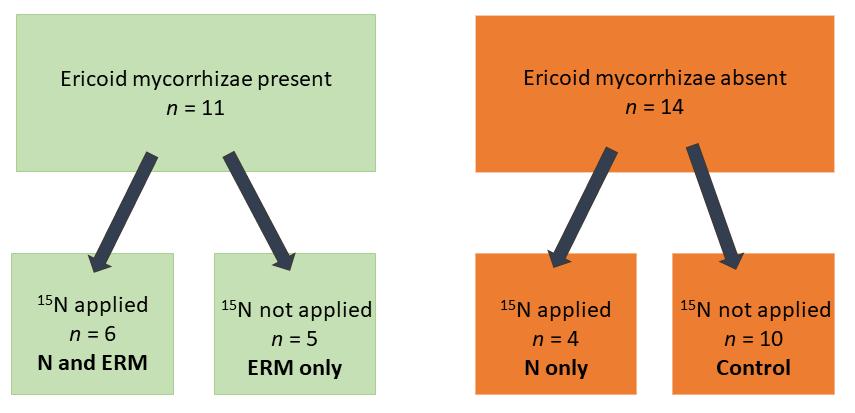
Figure 2. Experimental Design. Bold text in lower boxes indicates name of associated treatment group with reference to presence of ericoid mycorrhizae (ERM) and addition of inorganic nitrogen (N).
Supplemental nitrogen fertilization began 10 weeks after initial propagation. At this time, all plants were moved near a window, so as to provide natural light and establish a lightdark cycle. For 12 consecutive days, four non-mycorrhizal plants and six mycorrhizal plants were fertilized with the daily application of 100 microliters of a 150 mg/L 15N ammonium nitrate solution (Figure 2).
Elemental Analysis
Upon conclusion of the ammonium nitrate treatment, isotopic analysis was performed on dried leaf material from each plant specimen, via a Thermo Delta V isotope ratio mass spectrometer, interfaced to a NC2500 elemental analyzer. Further elemental analysis to determine total carbon and nitrogen content of the growth medium was performed using a Thermofisher FlashSmart C:N Soil analyzer.
Statistical Analysis
Statistical analyses were conducted in R. Normality of data within each treatment group (Figure 2) was assessed using the Shapiro-Wilk Test for Normality. Two-way Analysis of Variance (ANOVA) evaluated differences in isotopic nitrogen
ratio (15N:14N), total leaf nitrogen, and total leaf carbon, using mycorrhizal presence/absence and presence/absence of 15N fertilizer as predictor variables. Post-hoc testing was conducted with Tukey’s Honest Difference Significance Test. To compare the quality of the growth medium between treatment groups, total soil carbon and total organic matter for each treatment group were compared to that of the control group using two-way ANOVA
Results
Compared to control plants, total soil carbon did not vary significantly in plants that received the nitrogen fertilization treatment (p > 0.05) (Figure 3). However, plants that formed ERM associations but did not receive nitrogen fertilization had significantly greater soil carbon when compared to control plants (p < 0.05) (Figure 3)
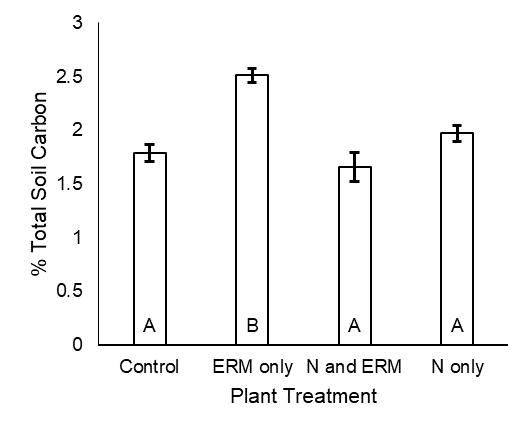
Figure 3. Total carbon, expressed as a percentage, of soil used as experimental growth medium. Letters denote results of two-way ANOVA (p < 0.05).
Based on statistical analysis, presence of ERM did not influence the ratio between 15N and 14N (hereinafter referred to as “isotopic nitrogen ratio”) (p > 0.1), but nitrogen fertilization did have a significant effect on this response (p < 0.001) (Figure 4). The combined effect of ERM associations with nitrogen fertilization did not significantly affect isotopic nitrogen ratio (p > 0.1) (Figure 4).
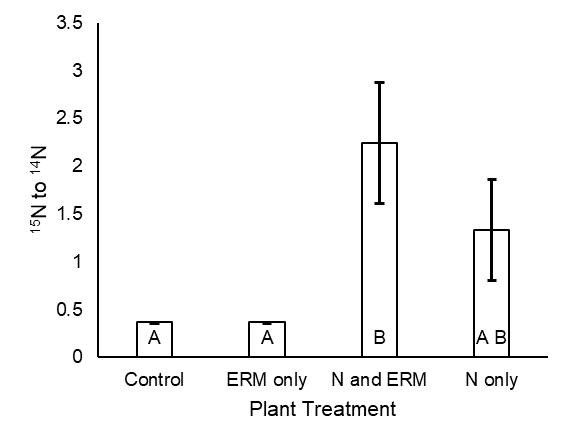
Figure 4. Ratio of nitrogen isotopes (15N to 14N) observed in V. macrocarpon leaf samples following isotopic analysis. Letters denote results of two-way ANOVA (p < 0.05).
Plants that received 15N fertilization in the absence of ERM did not differ significantly in their isotopic nitrogen ratio from those that did not receive this treatment (p > 0.05) (Figure 4). This represents the baseline 15N:14N ratio. Furthermore, plants with mycorrhizal associations in the presence of 15N fertilization did exhibit significant increases in isotopic nitrogen ratio, when compared to control plants (p < 0.05), but this did not differ significantly from that of fertilized plants without ERM (p > 0.05) (Figure 4). If mycorrhizal plants treated with 15N accessed more inorganic
nitrogen, as hypothesized, the “N only” treatment group would have had a greater isotopic ratio than the “N and ERM” treatment group. However, the reverse is true, and ERM plants exhibit a slightly better rate of acquisition of inorganic N than non-mycorrhizal plants (Figure 4).
Although ERM presence did not significantly affect isotopic nitrogen ratio, it did increase overall nitrogen uptake when compared to non-mycorrhizal treatment groups (p < 0.05) Total leaf carbon uptake was increased in 15N-fertilized mycorrhizal plants, compared to control plants (p < 0.05).
Discussion
Because ericoid mycorrhizal fungi are able to obtain nitrogen from organic sources, and are known to increase nitrogen uptake by the roots of their host plants, it was hypothesized that nitrogen utilized by Vaccinium macrocarpon, an ericaceous vine, would predominantly come from organic sources in the presence of ERM, even after the application of inorganic nitrogen fertilizer. However, the results of this study suggest that V. macrocarpon and its mycorrhizal symbionts do not preferentially absorb nitrogen derived from organic sources over inorganic sources, as hypothesized. Instead, inorganic materials were the preferred nitrogen source, given the observed increase in isotopic nitrogen ratio in fertilized ERM plants (Figure 4).
Further, fertilized ERM plants were also found to acquire a greater amount of nitrogen than if ERM were not present: 15N uptake was greater on average in the mycorrhizal treatment group than in the non-mycorrhizal treatment group, although this increase was not statistically significant (Figure 4). As anticipated, ERM presence did significantly increase overall leaf nitrogen content, regardless of inorganic fertilization, corroborating results of previous studies that suggest ericoid mycorrhizae mobilize nitrogen from rooting
zones and share these resources with host plants, specifically with Vaccinium macrocarpon6,15 .
Analysis of the growth medium indicates that the ERMonly treatment group was exposed to a greater portion of organic matter during the growth period, with a greater portion of soil carbon (Figure 3) than other treatment groups, but this increase was likely not sufficient to influence nitrogen uptake
Future research will include a larger sample size and standardization of organic matter across all treatment groups. Further, because nitrogen dosage in this study was standardized within fertilized treatment groups, but not across all four treatment groups, it is difficult to quantify the total acquisition of nitrogen from organic sources that occurred during the growth period. Follow-up research should standardize the nitrogen content of the organic material, using leaf litter tagged with 15N to trace nitrogen from organic sources. Further, ERM colonization within treatment groups was not quantified. Although non-mycorrhizal plants received only sterilized soil, it is possible that some colonization did occur and influence the results shown here. To resolve this, future research should also quantify ERM presence/absence in the growth medium.
This study suggests that V. macrocarpon does not prefer organic sources of nitrogen over inorganic sources, which contributes to a greater scientific understanding of the relationship between Vaccinium macrocarpon and ERM. The significant differences in nitrogen uptake between mycorrhizal and non-mycorrhizal V. macrocarpon individuals corroborate earlier research that container-grown ericaceous plants can be effectively colonized with natural mycorrhizal inoculum17 . In accordance with established knowledge of mycorrhizal function5,6,9, nitrogen content was significantly increased in mycorrhizal plants compared to non-mycorrhizal plants. This result furthers the understanding that mycorrhizal
associations are of benefit to plant hosts, particularly with respect to nutrient acquisition.
Given the ecological and economic significance of ericaceous plants and their mycorrhizae, continued research should work to further elucidate the nitrogen consumption habits of this symbiotic partnership. Because this research did not confirm that preference of mycorrhizae influences the origin of nitrogen utilized by V. macrocarpon, these hypotheses should be tested again under more robust conditions.
Acknowledgements
The authors would like to thank the Phillip E. Marucci Center, Dr. Nicholi Vorsa, and Jennifer Johnson-Cicalese for their provision of plant material and guidance during the propagation process. The authors would also like to acknowledge the Rutgers University-Camden Dean’s Undergraduate Research Grant, which funded this work, and thank Dr. Mike Gallagher, Steve Schulze, Dr. Jennifer Oberle, and Alexis Everland for their assistance in the lab and suggestions during the development of this report.
References
1. Wolfe, J. New Jersey Department of Agriculture Highlights Cranberries. New Jersey Department of Agriculture https://www.nj.gov/agriculture/news/press/2019/approved/press191 028.html (2019).
2. 2019 Annual Report and Agricultural Statistics. (2019).
3. Boyd, H. P. The Ecological Pine Barrens of New Jersey: An Ecosystem ThreatenedbyFragmentation. (Plexus Publishing, 2008).
4. Whittaker, R. H. Vegetational Relationships of the Pine Barrens. in Pine Barrens: Ecosystem and Landscape (ed. Forman, R. T. T.) (Rutgers University, the State University of New Jersey, 1998).
5. Coleman, D. C., Callaham, Jr., M. A. & Crossley, Jr., D. A. Primary Production Processes in Soils: Roots and Rhizosphere Associates. in FundamentalsofSoilEcology 21–45 (Academic Press, 2018).
6. Kosola, K. R., Workmaster, B. A. A. & Spada, P. A. Inoculation of cranberry (Vaccinium macrocarpon) with the ericoid mycorrhizal fungus Rhizoscyphus ericae increases nitrate influx. NewPhytologist 176, 184–196 (2007).
7. Finlay, R. D. Ecological aspects of mycorrhizal symbiosis: with special emphasis on the functional diversity of interactions involving the extraradical mycelium. Journal of Experimental Botany 59, 1115–1126 (2008).
8. Fadaei, S., Vaziriyeganeh, M., Young, M., Sherr, I. & Zwiazek, J. J. Ericoid mycorrhizal fungi enhance salt tolerance in ericaceous plants. Mycorrhiza 30, 419–429 (2020).
9. Dighton, J. FungiinEcosystemProcesses. (CRC Press, 2016).
10. Bizabani, C., Fontenla, S. & Dames, J. F. Ericoid fungal inoculation of blueberry under commercial production in South Africa. Scientia Horticulturae 209, 173–177 (2016).
11. Brody, A. K. etal. Genotype-specific effects of ericoid mycorrhizae on floral traits and reproduction in Vaccinium corymbosum. American JournalofBotany 106, 1412–1422 (2019).
12. Adamczyk, B. et al. The contribution of ericoid plants to soil nitrogen chemistry and organic matter decomposition in boreal forest soil. SoilBiologyandBiochemistry 103, 394–404 (2016).
13. Lin, L.-C., Lee, M.-J. & Chen, J.-L. Decomposition of organic matter by the ericoid mycorrhizal endophytes of Formosan rhododendron ( Rhododendron formosanum Hemsl.). Mycorrhiza 21, 331–339 (2011).
14. Leake, J. R. & Read, D. J. Chitin as a nitrogen source for mycorrhizal fungi. MycologicalResearch 94, 993–995 (1990).
15. Stackpoole, S. M., Workmaster, B. A. A., Jackson, R. D. & Kosola, K. R. Nitrogen conservation strategies of cranberry plants and ericoid
mycorrhizal fungi in an agroecosystem. Soil Biology and Biochemistry 40, 2736–2742 (2008).
16. Caspersen, S. et al. Blueberry Soil interactions from an organic perspective. ScientiaHorticulturae 208, 78–91 (2016).
17. Zinati, G. M., Dighton, J. & Both, A.-J. Fertilizer, Irrigation, and Natural Ericaceous Root and Soil Inoculum (NERS): Effects on Container-grown Ericaceous Nursery Crop Biomass, Tissue Nutrient Concentration, and Leachate Nutrient Quality. HortScience 46, 799–807 (2011).
46 The Undergraduate Review
Michael Walzer’s Equality in the Context for the Undocumented in Healthcare
Tania Martinez
Abstract
Since our nation's conception, equality discussions have become efforts that bind together with discussions of money and power. However, money inherently does not constitute anything more than simply a medium of exchange, as Michael Walzer argues in his writing of "In Defense for Equality" (Walzer 719). Walzer's arguments discuss the realities of the relation money has to power within our society and what all that does entail compared to what it should. There is much strength within Walzer's argument that applies within our society in various contemporary issues. Walzer uses healthcare examples throughout his entire argument, and healthcare in itself has various policies that need reform specifically, in regard to equity in healthcare access, especially for undocumented immigrants.
Walzer's Argument in the Context of Healthcare
The disparities that lie in the healthcare system are found in the duty to prioritize those that are sick and seek medical attention regardless of the individual. However, there is more of a trend of treating individuals based on income lines. Walzer addresses the issue of capitalism within our nation in that it enables those that are wealthy and powerful to have easier accessibility and affordability to health care. The lower class has the most challenging ability to seek or afford it. This dynamic exists in many different arenas in capitalism regarding affording and accessing luxury goods. However, it also exists in essential need areas, creating the "Tyranny of the Bell-Shaped Curve" (Walzer 720). This tyranny removes the
ability to have equality within a society as individuals do not necessarily deserve health services above another individual due to their wealth. An individual is only deserving based on the state of their illness. Essentially, the power of money should stay within its "proper sphere of wealth" (Walzer 724) and should not allow an individual to have more power.
This issue within Walzer's argument was made in the 1980s and lacked contextualization in the United States' current climate. The US, since the 1980s, has had a lot of healthcare reform that has helped create more equality within the nation, but it is still a hot-button issue with a lot of tension. Some of the most extensive progress areas include the State Children's Health Insurance Program (S-CHIP) in the 1990s and in 2010 the Affordable Care Act (Timeline: History of Health Reform in the US). The healthcare reform policy covered the individuals living in poverty in America with Medicaid and accessible healthcare plans for the middle class. Reform occurred to eliminate the discrimination against individuals on receiving a healthcare plan based on health or gender.
Although there is much-seeming progress with healthcare reform and equity issues, there have been some subtle backslidings. The progress made is at the forefront of pushback and tension, yet there is the issue of those who have not been able to get an opportunity for access to healthcare that is problematic. Undocumented immigrants are discouraged and even intimidated from accessing health services, a prominent issue of equity.
Healthcare in the Context of Immigration
Currently, immigrants experience exclusion from access to health care and insurance. IN 1996, a federal welfare reform law (Personal Responsibility Work Opportunity Reconciliation Act) restricted Medicaid eligibility for legal
immigrants. This restriction caused immigrants admitted to the US after August of 1996 ineligible to receive any coverage for five years (Sommers). Previously, legal immigrants were allowed to access coverage, but that was changed. Another important sector of the immigrant community is the undocumented community.
Undocumented immigrants cannot receive any federal healthcare coverage through Medicaid or the affordable CARES act, even though many would otherwise qualify. Another critical factor is that Undocumented immigrants contribute a net contribution of $2.5 Billion, and they cannot access the social good (Zallman). Although undocumented immigrants cannot receive federal aid, few states allow individuals to receive aid, such as California, but many states do not have this. Furthermore, undocumented immigrants can receive private insurance. However, many undocumented immigrants are unable to afford to receive that type of coverage (Sommers).
Although undocumented individuals cannot receive much coverage, they have access to emergency urgent care through Emergency Medical Treatment and Active Labor Act (EMTALA) and Emergency Medicaid regardless of their status (Lawrence). However, they are not necessarily guaranteed to receive it as specific regulations exist on who can use it. Furthermore, they would only be allowed to receive care after it is too late or more costly when preventive measures could have occurred. These issues that undocumented immigrants are experiencing is something that happened after Walzer wrote about equality as the welfare reform changes in the mid-1990s caused immigrant families to have problems getting insured (Ku & Matani).
Furthermore, immigration policy such as the zerotolerance policy that has caused the separation of families and the deportation of even more immigrants has caused undocumented individuals to live in fear. However, there is a
severe issue in which many immigrants feel a need to weigh if they prefer deportation or risking their lives where they could potentially die. A rational fear exists for undocumented immigrants as hospitals used to be considered a "sensitive location," according to a 2011 USCIS memo under the Obama Administration. However, when President Trump took office, there was a change in this policy. Undocumented individuals have brought their children and babies to the hospital seeking medical care and had ICE officials waiting for them, where they were eventually deported (Adams).
Applying Walzer's Argument for Equality
The premise of Walzer's argument on equality I find applies in this contemporary issue very well, and it is best to break down the issue. Throughout Walzer's argument, he addresses an issue many conservative individuals have against equality. Often, they tend to equate money to goods and services, including social goods. There is an implication that if individuals work hard or offer a unique talent, they can move upwards in their economic and social position, as is the American Way (Cohen 719). However, this argument does not even apply to undocumented immigrants as there are built-in barriers that prevent them from being able to have mobility as they cannot work legally (and as a result, many take advantage of them). There is also no pathway to citizenship or any form of legal residency status for these individuals, so there is no option to mobility in that way either. The other issue is that many came here because their lives were in danger, or they were simply babies/children when they arrived. Critical consideration needs to occur on who is deserving of healthcare. If it is specific to just citizens, there is a lack of fairness as they cannot move out of their undocumented status.
Walzer's argument focuses on equality within social goods,
and in this case, the discussion is of healthcare. As established earlier, social goods distribution should be on need rather than wealth and power. However, while efforts to promulgate undocumented immigrants' flounder, there is also a lack of equity and access to wealth and power. In both instances where spheres of wealth determine someone's ability to receive healthcare and a system where those spheres are not present in the system, undocumented immigrants cannot access healthcare justly.
The more significant implication that Walzer is making is about the nature of having this inequality between two individuals is an issue in our nature about how free people genuinely are. The two most critical virtues of a social institution are liberty and equality, and a nation cannot uphold one without the other (Walzer 727). There is a lack of equality within our nation, which should be changed. As a nation built on these values, there is not an upholding of equality that it claims to have, and as a democracy, it is not upholding the will of the people. According to Pew Research, when it comes to undocumented immigrants who got sick from the coronavirus, 68% say the federal government has a responsibility to provide medical care. There is a recognition that they should be receiving fair access to medical care and that this is a duty the federal government holds.
References
Adams, R. (2018, January 25). Immigration Crackdown Raises Fears of Seeking Health Care. (n.d.). Retrieved from https://www.rollcall.com/2018/01/25/immigration-crackdownraises-fears-of-seeking-healt h-care/
Cohen, M., & Walzer, M. (2018). In Defense of Equality. In Princeton readings in political thought: essential texts from Plato to populism. essay, Princeton University Press.
Krogstad, J. M., & Lopez, M. H. (2020, July 27). Americans favor
medical care but not economic aid for undocumented immigrants affected by COVID-19. Retrieved from https://www.pewresearch.org/fact-tank/2020/05/20/americansfavor-medical-care-but-not economic-aid-for-undocumentedimmigrants-affected-by-covid-19/
Ku, L., & Matani, S. (2001). Left Out: Immigrants’ Access To Health Care And Insurance. Health Affairs, 20(1), 247-256. doi:10.1377/hlthaff.20.1.247
Lawrence Gostin, J. (2019, September 05). Is Affording Undocumented Immigrants Health Coverage a Radical Proposal? Retrieved from https://jamanetwork.com/channels/healthforum/fullarticle/2759639
Sommers, B. D. (2013). Stuck between Health and Immigration Reform Care for Undocumented Immigrants. NewEnglandJournalofMedicine, 369(7), 593-595. doi:10.1056/nejmp1306636 Timeline:HistoryofHealthReformintheUS. https://www.kff.org/wp content/uploads/2011/03/5-02-13-history-of-health-reform.pdf
Zallman, L., Woolhandler, S., Himmelstein, D., Bor, D., & Mccormick, D. (2013). Immigrants Contributed An Estimated $115.2 Billion More To The Medicare Trust Fund Than They Took Out In 2002–09. HealthAffairs,32(6), 1153-1160. doi:10.1377/hlthaff.2012.1223
Blood and Soil: Right-Wing Terrorism Poses an Existential Threat to the United States
Benjamin Simonds Nixon
Abstract
Terrorism poses grave threats to the stability of democratic societies. Right-wing terrorists (RWT) are disillusioned by equity in American society and yearn for a pre-civil rights era replete with segregation at the least and forcible removal or genocide of minority racial groups, Muslims, and Jews at most. Their demand for this accelerationist, revolutionary sociogenic shift is influenced by racialist propensities of American history: slavery, eugenics, nativism, racial violence, and discrimination are deep national scars. For RWT, societal privileges afforded to whites are not enough. RWT organizations are planning for and accelerating a breakdown of civil order within the United States. This is so that they can establish white separatist ethnostates, exterminate non-whites, and eliminate equal protection under the law.
RWT of the 21st century have replaced their forebears’ Klan robes and brownshirts with coiffed hair, suit jackets, and polished leather shoes. They have swapped epithets for dog whistles. They espouse radical political beliefs in calm tones, peppering their lurid diatribes with hints of pseudoscientific intellectualism and feigned thoughtfulness. This illusory exterior, nonetheless, is bursting with anti-Semitic bile, encouragement of terroristic acts, and a refusal to abide by the rule of law. RWT poses the greatest threat to the United States compared to other types of terrorism because the ubiquity, organic appeal, and historicity of RWT buttresses the ability of these organizations to radicalize white Americans into belief systems beholden to America’s racist,
violent past. This ultimately inspires manifold approaches by RWT to weaken and possibly destroy the United States.
Keywords: ethnostate, ghost skins, the Turner Diaries, jouissance, alt-right, accelerationism, fashwave, white genocide
Main
“[F]ear breeds repression: that repression breeds hate; that hate menaces stable government.” Justice Louis Brandeis, Whitney v. California, 1927.
The history of the United States includes judicially sanctioned genocide against Native Americans (ValenciaWeber, 2002), chattel slavery (Post, 2003), ethnic cleansing (MacWilliams, 2020, pp. 52-53), racially motivated exclusions preventing participation in American real estate markets or banking structures by means of redlining and blockbusting (Rothstein, 2017), segregation, and lynching (Cook, Logan, & Parman, 2018). White supremacism, nativism, patriot militiadom, and white separatism are conspicuous features of far-right politics in nations of historically Caucasian leadership (Mudde, 2019); the United States is no outlier in this regard (Gordon-Reed, 2018). Groups operating under these aforementioned racialist beliefs functioned at the furthest fringes of the American political spectrum during the 1970s through the early 2000s, though their conspiracism and extremist beliefs have been finding a home in the nation’s body politic over the last ten years (Chandler, 2020). Their beliefs include that of the QAnon conspiracy, which alleges that elites and politicians are Satanic cannibals engaged in child sex trafficking (Coaston, 2020). This tale reeks of the blood libel conspiracy, which is an anti-Semitic trope dating back to the Black Death of 14th-century Europe. This conspiracy accused members of the Jewish faith of sacrificing
Christian children during supposed Judeo-Satanic rituals as means of self-protection from contagious diseases (Schwartz, 2016). (It is more likely that members of the Jewish faith comparatively avoided plagues and disease because they were socially ostracized and therefore lived separately in ghettoes thus rarely interacting with others outside their community. Likewise, Jews during the Medieval Ages observed modern hygienic practices such as regular hand washing and bathing while their Christian European contemporaries did not [Wein & Astor, n.d.].) A new movement of far-right politics which has adopted these beliefs overlaps with right-wing terrorism. This movement has been labeled as alternative right, or “altright” for short. Alt-right beliefs are a mainstay in contemporary American politics (Wilson, 2018) with multiple QAnon proponents now holding elected office.
In the late 1970s, American right-wing terrorists (RWT) received a toxic metaphysical roadmap on how to overthrow the United States government, terrorize non-whites, and conduct asymmetrical warfare. William Luther Pierce (1978) wrote about a hypothetical war conducted by white separatists against a tyrannical “System” built by Jews, liberals, and Blacks to “oppress the white race.” Since that time, multiple terror attacks have been committed by RWT in imitation of those conducted in Pierce’s book, the Turner Diaries.
Timothy McVeigh’s bombing of the Murrah Federal Building in Oklahoma City was influenced by the Diaries (Morris & Crank, 2011). The attack killed and injured hundreds and remains the deadliest RWT attack in the United States. The Order was a paramilitaristic white supremacist gang whose name was inspired by an organization within the Diaries. Alan Berg, a prominent and controversial Jewish radio host, was assassinated by members of the Order in his driveway (Southern Poverty Law Center, n.d.). The Order also committed robberies of armored vehicles on the West Coast of the United States during the 1980s. These attacks
were seen by security services to have been conducted with militaristic efficiency. The yield from these robberies funded RWT criminal enterprises including firearm, explosive, and ammunition purchasing for at least a decade (Smith, Damphousse, & Roberts, 2003-2006). Eventually, all leaders of the Order were incapacitated by law enforcement. Some chose to end their lives in martyrizing blazes of glory against “gun toting bureaucrats” (Mathews, 1984). Others were convicted for life sentences for crimes ranging from racketeering to criminal conspiracy (McClary, 2006).
The publication of the Turner Diaries represents a foundational shift of RWT thinking in the United States from one of resistance to civil rights and sustained violence against Black Americans to one of protracted asymmetrical warfare against the government. RWT poses the greatest threat to the United States compared to other types of terrorism because the ubiquity, organic appeal, and historicity of RWT buttresses the ability of these organizations to radicalize white Americans into belief systems beholden to America’s racist, violent past. This ultimately inspires manifold approaches by RWT to weaken and possibly destroy the United States:
• RWT caused thousands of American terrorism deaths and injuries in the 19th (Budiansky, 2008), 20th, and 21st centuries (Jones, 2018).
• Given that the nation was founded with racial animus, the true number of fatalities stemming from RWT may never truly be known. They include victims of hate crimes before their official recording, post-Reconstruction retaliation, and a culture of hostile jurisprudence (Horne, 2018, pp. 49-50) and legislation (MacWilliams, 2020, p. 70).
56 The Undergraduate Review
• From 1994 until 2020, RWT’s conducted 57% of terror attacks in the United States (Jones, Doxsee, & Harrington, 2020).
Right-wing terrorism is sewn deeply into the fabric of American society; attempting to combat it presents a dynamic need for society to readjust its foci towards dismantling systems of white supremacy which, through its permeation of American society, empowers RWT each day these power structures persist. It is important to note that RWT views can be canalized into several different belief systems which differ in small ways from one another. Nevertheless, nearly all hold virulent anti-government, anti-Semitic, and anti-democratic views (Dafaure, 2020). Recurring themes among RWT groups include accelerationism, which is a belief system that seeks to hasten the breakdown of American society by means of emphasizing racial animus, fomenting disorder, encouraging sexual violence, and disregarding laws (Noys, 2014). Goals of RWT in the United States include the creation of white separatist ethnostates in the Pacific Northwest (Medina, Nicolosi, Brewer, & Linke, 2018) and Florida (Segarra, 2018), rallying around neo-Nazi and neofascist iconography, and dismantling equal protection under the constitution. Other beliefs are indeed most inscrutable. Ecofascists, for example, imagine a sociogenic reversion to a numinous, traditional Jeffersonian agrarianism replete with environmentalism, neo-paganism, anti-capitalism, antisocialism, and dogmatism (Lamoureux, 2020). Analogous to these abstruse neofascist belief systems, a member of the Washington House of Representatives named Matt Shea worked with patriot militias to traffic firearms with the intention of filling a power vacuum in the event of a governmental collapse. Shea’s goal is to establish a Christian theocratic government in Washington state (Leodler & Leodler, 2019). Shea distributed a manuscript which called for
the execution of non-Christian males and the divvying up of “war booty” among Christian combatants after the successful conclusion of a religious war against the government and non-Christians in and around Washington state (Shea, 2018).
Internet conspiracism acts as the lodestar for RWT. Ecofascists, for example, assert that capitalism is a Jewish conspiracy to degrade the environment for capitalistic gain at the expense of the natural order. White genocide, another RWT conspiracy, alleges that the white race is being strategically eliminated by means of integration, racial miscegenation, mass migration, and disempowerment by globalist elites (Wilson, 2018). Economic changes such as the North American Free Trade Agreement have caused disruption to the economic viability of the American working class. Trade protectionism is one aspect of how RWT signal, identify, and cultivate disaffected white Americans (Moriba & Paksima, 2020b). The online deployment of language to blame globalists for economic and social woes is especially powerful and draws directly from historical fascist iconography against Jews, trade unionists, social democrats, capitalists, socialists, anti-fascists, feminists, and centrists (Martin, 2016).
However, salacious and cliché conspiracies are not unilaterally proselytizing hapless denizens of the internet while conscripting naïve, disgruntled whites into a life of terrorism. Other new-wave tactics are used by RWT to influence internet users subliminally and overtly. Caucasians in the United States have greater access to internet compared to their peers of different races (Pew Research Center, 20132019). It therefore bears no surprise that RWT conduct outreach and recruitment by facilitating digital dialogue. This occurs via:
• Unironic Holocaust-denial or pro-Nazi meme sharing on imageboards, internet forums, and video games (DeCook, 2018).
• The crafting of comments on websites to subliminally normalize misogynistic, xenophobic vitriol as humorous and acceptable within wider culture (Gibson, 2019).
• Positively framing toxic masculinity and chauvinism at the expense of feminism and womanhood (Campbell, 2017).
• Duplicitously trolling or flaming opponents with outrageous statements and contrarian beliefs ostensibly to guffaw at their opponents’ anger or disdain when the tacit goal is to defame, humiliate, and incite (Jakubowicz, 2017).
• Deploying hashtags for disinformation or coded language out of the realm of discernment by mainstream internet users to denigrate and mischaracterize justice movements geared towards constructive social change (AntiDefamation League, n.d.).
Hateful ideologies have been stylishly and enigmatically repackaged so that it is difficult for social media platform administrators to detect when certain posts truly violate terms of service. Nowhere is this better exemplified than in an internet subculture called “fashwave,” a portmanteau of “fascism” and “synthwave.” Synthwave is an internet microgenre noted for dark, heavy synthesizer loops conjoined with an electronic 1980s-Americana science-fiction Reaganitehorror esthetic. Fashwave as an extension utilizes a comparable esoteric, nostalgic esthetic steeped in memology to reinforce and tout neo-Nazi propaganda, often in easily accessible spaces on the internet (Love, 2017).
This cryptic subculture flummoxes those who are unaware of its machinations while gesticulating to those who are au fait. The ability of RWT to hide in plain sight on electronic forums, apps, and message boards maintained by corporations is disquieting because RWT expedite communiqués and recruitment in commonly shared internet spaces where users do not anticipate encountering nativist rhetoric. Serendipitous exposure to subliminal racist messaging is seen by psychologists as a crucial element of internalizing racism. Psychotherapists suggest that the spontaneous discovery and cultivation of joy by transgressing against others’ cultures or race a concept known as jouissance is phantasmatically rewarding to the psyche like how eating or having sex is reinforced by subconscious survival drives (Hook, 2018).
RWT do not need to sneak into the country, receive training in remote and isolated regions of the world replete with terrorist training camps, fight abroad as volunteers in jihad to gain battle experience, or hide their true beliefs. They are already here and have been here since before the inception of the country (Horne, 2018), some are military veterans with combat experience, they can train in their own backyard (Moriba & Paksima, 2020a), and they have considerable understanding of American culture and the English language. White supremacist beliefs, a primary component of RWT, are not a view that disqualifies people from spiritually counseling large swathes of the American public (Jones, 2020), holding elected office (Murphy, 2017), or maintaining administrative and educational jobs (Starke, Heckler, & Mackey, 2018).
RWT push for recruits to join law enforcement and counterintelligence agencies nationwide so they can clandestinely gather information about security services’ daily operations. Recruits are ordered to remain mum about their true beliefs while working in these power structures.
Infiltrators of this stripe are referred to by RWT as “ghost skins.” Ghost skins’ infiltrative impact is unknown to counterintelligence, law enforcement, and the public. Further, the agencies they work for often have opaque remedial remedies to combat clandestine RWT reconnaissance (Chin, 2013). Some ghost skins were embedded inside the United States State Department, where they gleaned large amounts of proprietary information about governmental policies and procedures relating to international relations goals of the United States and its allies (Williams & Siemaszko, 2019). Recent investigations have uncovered RWT leaders as having served in counterintelligence and federal law enforcement (De Simone & Winston, 2020), the United States Armed Forces (U.S. Department of Justice, 2020), and local police departments (Chin, 2013).
One notable instance of a ghost skin is the case of Rinaldo Nazzaro. Nazzaro leads a neo-Nazi, neo-pagan, accelerationist group called the Base, unironically named after the translation of al-Qaeda, which in Arabic means “the base.” Nazzaro is a former Federal Bureau of Investigation (FBI) counterintelligence officer and Pentagon contractor who fled to Russia in 2018. He now conducts virtual, remote recruitment of disaffected white Americans into the Base (De Simone, Soshnikov, & Winston, 2020). The Russian Federation shelters and supports United States citizens who hold idiosyncratic secessionist ideals in an attempt by Russia to balkanize or otherwise weaken the United States from afar (Ragozin, 2016). The ability of foreign governments to redress RWT inside the United States insulates these organizations. It allows them to conduct activities without fear of their upper echelon being neutralized by traditional counterintelligence means such as adjudication, surveillance, law enforcement confrontation, or civil forfeiture. Nazzaro is considered by American intelligence agencies to be an “active measure,” meaning the Russian government most likely
shelters Nazzaro to actively disrupt American society (Barnes & Goldman, 2020).
According to the Institute for Economics and Peace (2020), the most significant losses incurred from terrorist actions are resultant from deaths and injuries and not by damage to buildings or property. RWT have taken note:
• Targets of homegrown RWT are overwhelmingly peaceful protestors (Binkowski, 2017) (Jones, 2018) but also include worshippers (Vogel-Scibilia, 2020), shoppers (Abutaleb, 2019), federal employees (Gartrell, 2020), police (Berman, 2014), women (Beekman, 2014), Black Americans (Alcindor & Stanglin, 2015), Muslims (Green, 2020), and countless others (Piazza, 2017).
• 2019 saw the most violent year for victims of hate crime in over a decade with over 7,000 killed or injured, along with comparable numbers in 2018 and 2017 (FBI, 2020).
• Since 2002, jihadi and left-wing terrorism has killed and injured fewer Americans when compared to RWT and hate crimes (New America, 2020).
• Yet merely 20% of FBI counterterrorist agents are dedicated full-time to conducting domestic probes against RWT (Bergengruen & Hennigan, 2019).
Until security services take RWT more seriously by dedicating additional manpower and capital, Americans will pay the price. That failure to act will lead to fear, and that fear will inevitably succumb to hate. As observed by Justice Brandeis nearly 100 years ago during the peak of eugenics,
segregation, and Klan membership, “hate menaces stable government.”
References:
1. Abutaleb, Y. (2019, August 4). What's inside the hate-filled manifesto linked to the alleged El Paso shooter. TheWashington Post.
https://www.washingtonpost.com/politics/2019/08/04/whatsinside-hate-filled-manifestolinked-el-paso-shooter/
2. Alcindor, Y. & Stanglin, D. (2015, June 19). Affidavits spell out chilling case against Dylann Roof. USA Today. https://www.usatoday.com/story/news/nation/2015/06/19/d ylann-roofcharleston-police-charged murder-blackchurch/28975573/
3. Anti-Defamation League. (n.d.). Disinformation: #allwhitesarenazis and #awan https://www.adl.org/disinformationallwhitesarenazis-and-awan
4. Barnes, J. E. & Goldman, A. (2020, March 10). Russia trying to stoke U.S. racial tensions before election, officials say. The New York Times. https://www.nytimes.com/2020/03/10/us/politics/russianinterference-race.html
5. Beekman, D. (2014, May 26). Elliot Rodger wrote manifesto on his hate for women and his vindictive scheme prior to deadly rampage. New York Daily News. https://www.nydailynews.com/news/national/maniac-writesmanifesto-prior-deadlyrampage-article-1.1805474
6. Bergengruen, V. & Hennigan, W. J. (2019, August 9). ‘We are being eaten from within.’ Why America is losing the battle against white nationalist terrorism. TIME. https://time.com/5647304/white-nationalist-terrorism-unitedstates/
7. Berman, M. (2014, June 9). Las Vegas shooters had expressed anti-government views, prepared for “lengthy gun battle.” The Washington Post. https://www.washingtonpost.com/news/postnation/wp/2014/06/09/las-vegas-shootershad-expressed-antigovernment-views-prepared-for-lengthy-gun-battle/
8. Binkowski, B. (2017, August 12). Driver in Charlottesville car attack identified as James Alex Fields, Jr. Snopes News.
https://www.snopes.com/news/2017/08/12/identifieddriverjames-alex-fields/
9. Budiansky, S. (2008). Thebloodyshirt:TerrorafterAppomattox. The PenguinGroup.
10. Campbell, E. (2017). "Apparently being a self-obsessed c**t is now academically lauded": Experiencing Twitter trolling of autoethnographers. Forum:QualitativeSocialResearch,18(3).
11. Chandler, K. J. (2020). Where we go 1 we go all: A public discourse analysis of QAnon. McNair Scholars Research Journal, 13(1),4.
12. Chin, W. Y. (2013). Law and order and white power: White supremacist infiltration of law enforcement and the need to eliminate racism in the ranks.JournalofLaw&SocialDeviance,6, 30-98.
13. Coaston, J. (2020, August 21). QAnon, the scarily popular proTrump conspiracy theory, explained. Vox. https://www.vox.com/policy-andpolitics/2018/8/1/17253444/qanontrump-conspiracy-theory4chan-explainer
14. Cook, L. D., Logan, T. D., & Parman, J. M. (2018). Racial segregation and southern lynching. Social Science History, 42(4), 635-675.
15. Dafaure, M. (2020). The “great meme war:” The alt-right and its multifarious enemies. Angles: New Perspectives on the Anglophone World,10 https://doi.org/10.4000/angles.369
16. DeCook, J. R. (2018). Memes and symbolic violence: #proudboys and the use of memes for propaganda and the construction of collective identity. Learning,MediaandTechnology, 43(4),485-504.
17. DeSimone,D.,Soshnikov,A.&Winston,A.(2020,January24). Neo-Nazi Rinaldo Nazzaro running US militant group the Base from Russia. BBC News. https://www.bbc.com/news/world51236915
18. De Simone, D. & Winston, A. (2020, June 22). Neo-Nazi militant group grooms teenagers. BBC News. https://www.bbc.com/news/uk-53128169
19. Federal Bureau of Investigation. (2020). Hatecrimestatistics,2019 [Data set]. https://ucr.fbi.gov/hate-crime/2019/topicpages/incidents-and-offenses.pdf
20. Gartrell, N. (2020, June 29). Federal grand jury returns indictment against California men accused of murdering federal
officer after meeting on ‘Boogaloo’ Facebook group. Mercury News. https://www.mercurynews.com/2020/06/29/federalgrand-jury-returnsindictment-against-ca-men-accused-ofmurdering-federal-officer-after-meeting-onboogaloo-facebookgroup/
21. Gibson, C. (2019, September 17). ‘Do you have white teenage sons? Listen up.’ How white supremacists are recruiting boys online. The Washington Post. https://www.washingtonpost.com/lifestyle/on-parenting/doyou-have-white-teenagesons-listen-up-how-white-supremacistsare-recruiting-boys-online/2019/09/17/f081e806d3d5-11e99343-40db57cf6abd_story.html
22. Goodrick-Clarke, N. (2002). Blacksun:Aryancults,esotericNazism, andthepoliticsofidentity. NewYorkUniversityPress.
23. Gordon-Reed, A. (2018). America’s original sin: Slavery and the legacyofwhitesupremacy. ForeignAffairs,97(1),2-7.
24. Government Accountability Office. (2017). Countering violent extremism. https://www.gao.gov/assets/690/683984.pdf
25. Green, A. (2020, February 21). Jeremy Christian guilty on all counts in MAX stabbings trial, including murder and hate crimes. The Oregonian. https://www.oregonlive.com/news/2020/02/jeremy-christianguilty-on-all-counts-in-maxstabbings-trial.html
26. Hook, D. (2018). Racism and jouissance: Evaluating the “racism as (the theft of) enjoyment” hypothesis. Psychoanalysis,Culture& Society,23(3),244-266.
27. Horne, G. (2018). The apocalypse of settler colonialism: The roots of slavery, white supremacy, and capitalism in 17th century North America andtheCaribbean. NewYorkUniversityPress.
28. Institute for Economics and Peace. (2019). Globalterrorismindex 2019: Measuring the impact of terrorism. https://www.visionofhumanity.org/wpcontent/uploads/2020/11/GTI-2019web.pdf
29. Jakubowicz, A. (2017). Alt_right white lite: Trolling, hate speech and cyber racism on social media. CosmopolitanCivilSocieties:An Interdisciplinary Journal, 9(3), 41. http://dx.doi.org/10.5130/ccs.v9i3.5655
30. Jones, R. P. (2020). White too long: The legacy of white supremacy in AmericanChristianity. SimonandSchuster.
31. Jones, S. (2018). The rise of far-right extremism in the United States [Issue Brief]. Center for Strategic & International Studies.
https://www.csis.org/analysis/rise-far-right-extremismunitedstates
32. Jones, S, Doxsee, C., & Harrington, N. (2020). The escalating terrorism problem in the United States [Issue Brief]. Center for Strategic & International Studies. https://www.csis.org/analysis/escalating-terrorism-problemunited-states
33. Lamoureux, M. (2020, September 25). Neo-Nazis are using ecofascism to recruit young people. VICE News. https://www.vice.com/en/article/wxqmey/neo-nazis-ecofascism-climatechange-recruit-young-people
34. Leodler, K. & Leodler, P. (2019). Report of investigation regarding RepresentativeMattShea:WashingtonHouseofRepresentatives.Rampart Group. https://www.documentcloud.org/documents/6589242Shea-WA-House-Report.html
35. Love, N. S. (2017). Back to the future: Trendy fascism, the Trump effect, and the alt-right. New Political Science, 39(2), 263268.https://doi.org/10.1080/07393148.2017.1301321
36. MacWilliams, M. (2020). On fascism: 12 lessons from American history. St. Martin’s Griffin.
37. Martin, B. G. (2016). TheNazi-fascistneworderforEuropeanculture HarvardUniversityPress.
38. McClary, D. (2006, December 6). Robert Jay Mathews, founder of the white-supremacist group the Order, is killed during an FBI siege on Whidbey Island on December 8, 1984. HistoryLink.org. https://www.historylink.org/File/7921
39. Medina, R. M., Nicolosi, E., Brewer, S., & Linke, A. M. (2018). Geographies of organized hate in America: A regional analysis AnnalsoftheAmericanAssociationofGeographers,108(4),1006-1021. https://doi.org/10.1080/24694452.2017.1411247
40. Moriba,G.&Paksima,J.(Hosts). (2020a,October22).Baseless: Part II (No. 6) [Audio podcast episode]. In Sounds Like Hate. SPLC.https://soundslikehate.org/season-one/baseless/
41. Moriba, G. & Paksima, J. (Hosts). (2020b, August 17). Getting Out: Part II (No. 2) [Audio podcast episode]. In Sounds Like Hate.SPLC.https://soundslikehate.org/seasonone/getting-out/
42. Morris, T., & Crank, J. P. (2011). Toward a phenomenology of terrorism: Implications for research and policy. Crime, Law and Social Change, 56(3), 219-242. https://doi.org/10.1007/s10611011-9310-9
43. Mudde,C.(2019) Thefarrighttoday.JohnWiley&Sons.
44. Murphy, T. (2017, March 14). Steve King’s district was built by “somebody else’s babies.” Mother Jones https://www.motherjones.com/politics/2017/03/steve-kingsiowaimmigrants/
45. New America. (2020). Terrorism in America after 9/11 Part IV [Data set]. https://www.newamerica.org/in-depth/terrorism-inamerica/what-threat-united-statestoday/
46. Noys,B.(2014). Malignvelocities:Accelerationismandcapitalism.John HuntPublishing.
47. Pew Research Center. (2013-2019). Internet/broadband fact sheet [Data set]. https://www.pewresearch.org/internet/factsheet/internet-broadband/
48. Piazza, J. A. (2017). The determinants of domestic right-wing terrorism in the USA: Economic grievance, societal change and political resentment. Conflict Management and Peace Science, 34(1), 52-80.
49. Pierce, W. L. (1978). The Turner Diaries. National Vanguard Books.
50. Post,C.(2003).Plantationslaveryandeconomic developmentin the antebellumsouthernUnited States. JournalofAgrarianChange, 3(3),289-332.
51. Ragozin, L. (2016, December 7). How to Make California Great: Secede, With a Little Help From Putin. Bloomberg https://www.bloomberg.com/news/features/2016-12-07/howto-makecalifornia-great-secede-with-a-little-help-from-putin
52. Rothstein, R. (2017). Thecolor of law: A forgotten history of how our governmentsegregatedAmerica. LiverightPublishing.
53. Schwartz, M. (2016, January 28). The origins of blood libel. The Nation. https://www.thenation.com/article/archive/the-originsof-blood-libel/
54. Shea,M.(2018). Biblicalbasisforwar [Unpublishedmanuscript].
55. Smith, B. L., Damphousse, K. R., & Roberts, P. (Principal Investigators). (2003-2006). Pre-incident indicators of terrorist incidents:Theidentificationofbehavioral,geographic,andtemporalpatterns of preparatory conduct. (Project Nos. #1999-IJCX-0005 & #lO6-1 13-2000-064) [Grant]. National Criminal Justice Reference Service.
https://www.ncjrs.gov/pdffiles1/nij/grants/214217.pdf
56. Southern Poverty Law Center. (n.d.). David Lane. https://www.splcenter.org/fightinghate/extremistfiles/individual/david-lane
57. Starke, A. M., Heckler, N., & Mackey, J. (2018). Administrative racism: Public administration education and race. JournalofPublic Affairs Education, 24(4), 469-489. https://doi.org/10.1080/15236803.2018.1426428
58. Segarra, L. M. (2018, February 15). What to know about Republic of Florida, the white supremacist militia. TIME https://time.com/5161203/republic-of-florida-nikolascruzwhite-supremacist-militia/
59. United States Department of Justice. (2020, June 22). U.S.Army soldierchargedwithterrorismoffensesforplanningdeadlyambushonservice members of his unit. https://www.justice.gov/opa/pr/us-armysoldier-charged-terrorism-offenses-planningdeadly-ambushservice-members-his-unit
60. Valencia-Weber, G. (2002). The supreme court's Indian law decisions: Deviations from constitutional principles and the crafting of judicial smallpox blankets. University of Pennsylvania JournalofConstitutionalLaw,5,405.
61. Vogel-Scibilia, S. (2020). Community resilience and the Pittsburgh synagogue shooting. In Moffic, H., Peteet, J., Hankir, A., Seeman, M. (Eds.), Anti-Semitism and psychiatry (1st ed., pp. 223-241). Springer, Cham. https://doi.org/10.1007/978-3-03037745-8_18
62. Wein, B. & Astor, Y. (n.d.). The Black Death. JewishHistory.org. https://www.jewishhistory.org/the-black-death/
63. Williams, A. & Siemaszko, C. (2019, August 7). State Department worker outed by civil rights group as a white nationalist placed on leave. NBC News. https://www.nbcnews.com/news/us-news/state-departmentworker-had-secret-other-lifewhite-nationalist-right-n1040101
64. Wilson, A. F. (2018). #whitegenocide, the alt-right and conspiracy theory: How secrecy and suspicion contributed to themainstreamingofhate. SecrecyandSociety,1(2).
COVID-19 Exponential Growth
Geoffrey Downing
At the end of the fall 2020 semester, the Covid-19 global pandemic has taken 1.61 million lives, and there have been 72.1 million cases globally since it was first recognized as a health threat by the U.S. Government on January 28, 2020. At that point in time, there were less than 100 documented cases in the world. The coronavirus spread like wildfire, and the mathematical way to understand the spread of such a virus is using an exponential function. It is my goal with this project to grasp and demonstrate an understanding of the spread of Covid-19 as an exponential function, and to discuss the application of this factual information in decreasing the exponential spread of Covid-19.
In mathematics, an exponential function is defined as a function of the form f(x)=abx where b is a positive real number not equal to 1, and the argument x occurs as an exponent. The World Health Organization describes it slightly differently with respect to viruses, but the graph of an exponential function looks the same, as it increases exponentially, the curve of the graph increases more and more rapidly through the progression of time. WHO, for purposes of describing the exponential spread of Covid-19, has assigned a person who is infected with Covid-19 a reproductive number, or R0, which they believe to be 3. This means that for every one person who gets infected with the virus, that one person will likely infect, on average, three other people. Then those three people will likely each infect three other people. The reproductive number is applied over the course of 5 days from the time the individual is infected. Therefore, starting at one case of Covid-19, in 5 days there would be 3 additional cases for a total of 4 cases, and in another 5 days there would be an additional 9 cases for a total of 13 cases At the 15-day mark there would be 27 new
cases, for a total of 40 cases. 20 days from the first infection there would be 81 new cases, and the progression of new cases every 5 days for 30 days would increase to 243, 729, 2187, 6561, 19,683, to 59,049 new cases at 50 days after the very first infection and a total of 88,573 Covid-19 cases, using this model from WHO. That is, if an infected person only infects 3 other people.
The reproductive number is the average the WHO uses, but we know from current events that the actual number of people an infected person could spread the virus to is often much higher. These higher rates of transmission can account for jumps in the number of virus cases, as we know the rates of infection did not follow only a smooth exponential curve sharply upward, but sometimes increased by much more than the expected reproductive number. The reason for these jumps in transmission of the virus is part of the basis for the reasoning that social distancing is important and wearing masks is important, not because it eliminates the cause of the spread of the virus but because it keeps the spread of the virus at the expected average number of reproductions per person the WHO is using to estimate the outcomes and needs of the infected population.
Another way of understanding the exponential growth of Covid-19 infections is to multiply the number of cases for the previous day by some constant greater than 1 to come up with the number of current cases. This number is not totally consistent, but there is a range of this constant which is 1.15 to 1.25. This means that at day 50, with the example of estimated infections using the WHO reproductive number of 3, we have 88,573 cases, and multiplying this number by the constant in the range of 1.15 to 1.25 we can predict the number of cases on day 51 to be somewhere between 101,859 and 110,716. We can then take that range and reconcile it with the actual number of cases recorded on that day. The estimates can be used as both a model of expected outcomes
and to see if the constant is going up or down. In other words, we find out when the number of cases is higher than the range or lower than the range, if efforts to decrease the spread of the virus are helping. In the exponential growth of viral infections, what causes the number of new cases of the virus are the existing cases of the virus. No matter how high or low the range of the constant or the reproductive number, more existing cases will result in more new cases. It sounds repetitive but it is worth examining. If Nd is the number of cases on a given day, and E is the number of people each infected person is exposed to on a given day, and P is the probability of the exposed people becoming infected with the virus, then ∆Nd+1= EPNd. As N gets bigger, the function of N gets bigger. The variable of N can actually be factored out of the equation to reveal a simplified equation of EP multiplied by some constant greater than 1, as with the constant which has been discovered to be at 1.15-1.25 with Covid-19.
However, what is unique about this understanding of the equation is that it draws attention to the importance of the variables E and P. E is the number of people the infected person exposed to the virus and P is the probability of the exposed person being infected. With Covid-19 we know the rates of infection are very high with exposure. The probability is high, because the virus is very contagious. P is hard to control.
In contrast, E is one variable over which we do have a lot of control. Social distancing and isolation dramatically reduce E. By reducing E we can reduce the resultant infections, and the overage range of the constant. This is the math of flattening the curve. Because an exponential function is the inverse of a logarithmic function, we can use a logarithmic equation to view Covid-19 spread in a different way. The line of linear regression on a Log10 graph of a Covid-19 exponential equation can show us the increase in Covid-19
cases every 10 days. We can much more easily determine this number on a Log10 graph than on an exponential curve, because the number is just the slope of the linear regression line between two points on the line 10 days apart. Another interesting feature of the exponential function in the context of viruses or anything else which affects the population of the world is that at some point, the exponential function stops increasing exponentially, and reproductive numbers and a constant greater than 1 can no longer be used to accurately depict the spread. The reason for this is that the population of the world is limited whereas an exponential function continues into infinity positive.
When the exponential function starts to near the population of the earth, the predictions of the spread of the virus are only realistic if the mathematician uses a logistic curve to reflect the inability of the exponential function to exceed the earth’s population Another way of thinking about this is if the curve flattened naturally because there were no people left on earth who had not already been infected with the virus. In viruses where having been infected once creates almost certain immunity, this logistic curve can be used to predict the natural flattening of the curve in smaller populations, such as within a quarantined city or town or within the borders of a country banned form global travel. The logistic curve is useful in outcomes involving Herd Immunity, but we do not know if it applies broadly to Covid19 or if the data varies between individuals and strands of the virus. Herd Immunity therefore is widely considered in the mathematic and scientific communities as a false sense of security and a poor reason to eschew making every effort to control the variable of E.
Through this project, I have learned that measures we take to protect ourselves and others from exposure to the Covid19 virus is of literally exponential importance. The impact of variable E is the only card we have to play until the
administration of a vaccine. 39% of the people who contract Covid-19 are at risk for losing their life to the virus. Using basic math and the reproductive number of 3, every individual who is infected with the virus has a life in their hands not their own. That would be the 39% of the 3 people they are likely to infect. It is excellent motivation to social distance, wear masks in every social interaction, and sanitize to prevent the spread of Covid-19
Visual Representations

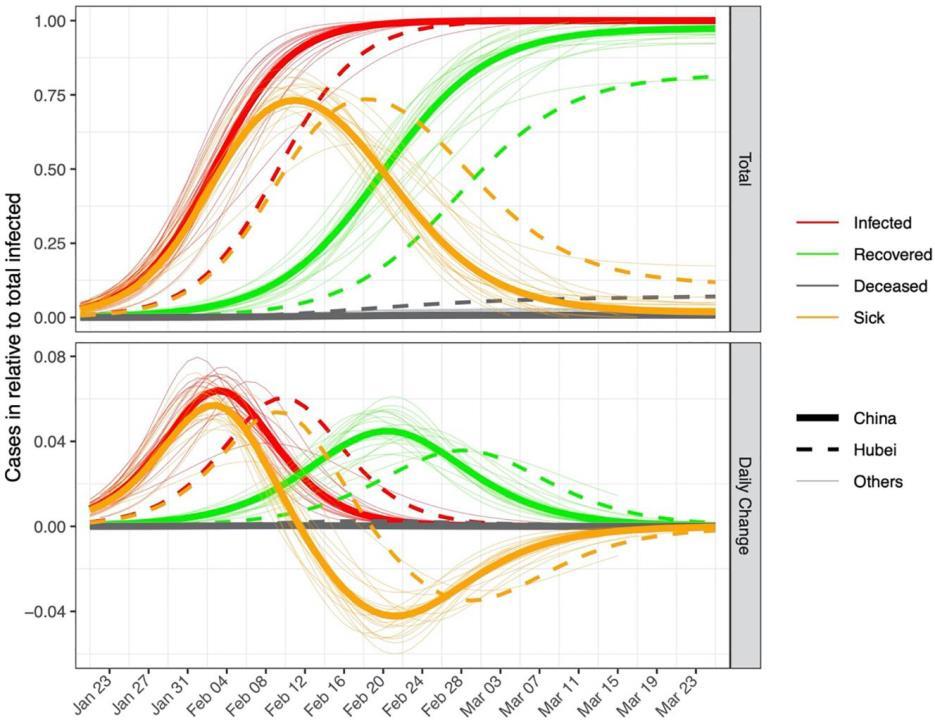
The Undergraduate Review
The Utilization of Bite-mark Evidence in Concert with Cognitive Bias in the Wrongful Convictions of Ray
Krone
Diana Melissaratos
There are several types of forensic science with long histories of research and development that can be very helpful in convicting offenders; however, some forms of forensic evidence, such as forensic odontology’s bite-mark evidence, are utilized despite a high error rate and short history of application since its first use in 1948. Ray Krone, who was wrongfully convicted twice on first degree murder and kidnapping charges due to a combination of cognitive bias and faulty bite-mark evidence, spent 11 years in prison, part of which was on death row, before he was exonerated by a DNA match to another person. Krone was convicted, overturned that conviction on appeal, and was convicted again despite a wealth of evidence demonstrating that he could not have been the perpetrator. Some of this evidence included footprints, DNA, hair, and fingerprints that did not match Krone; nevertheless, the prosecution convinced the jury through the testimony of a forensic odontologist, that bite-mark evidence is unique and that “DNA is meaningless and has nothing to do with this case” (Koen & Bowers, 2017).
In the early morning hours of December 29, 1991, Kim Ancona was seen closing up the C.B.S. Lounge in Phoenix, Arizona where she worked as a waitress. Later that morning, her body was found in the bathroom by the owner of the C.B.S. Lounge: she had been raped and stabbed to death. The bathroom floor had been cleaned by Ancona just before her murder, which meant that the crime scene was relatively clean and uncontaminated (Nelson, 2005). During the investigation, police reported having found “14 [bloody] shoe prints in the kitchen area leading to and from the area where the knife
used in the killing was kept” (Nelson, 2005). They found seventeen hairs on her body, most of which were Caucasian in origin. In her address book, police found the name “Ray” along with a phone number (see photo 2). Most pivotal to this case were several bite marks on Ancona’s neck and breast. Investigators immediately assumed that Ancona was murdered by someone she knew because there was “no evidence of a break-in or robbery” (Koen & Bowers, 2017). Several witnesses described a short man with black hair hanging around in the area near the bar. One of the witnesses sent police an anonymous note describing this man in detail (see photo 1), but because one of Ancona’s coworkers told investigators that Ancona “liked a guy named Ray Krone” investigators immediately headed to Krone’s place of residence and took him in for questioning (Koen & Bowers, 2017).
Krone was questioned for three hours, and investigators insisted that he and Ancona were in a relationship, which he denied. Krone also voluntarily submitted to shirtless upper body photographs, a blood draw, fingerprinting, and dental impressions in Styrofoam (Koen & Bowers, 2017). Two days later, Krone was arrested by officers in riot gear and placed in a county jail. While in prison, Krone was charged with firstdegree murder, kidnapping, and sexual assault. Krone’s initial Public Defender told him, “You can expect to be found guilty, but we will fight it on appeal” (Koen & Bowers, 2017). He quickly changed lawyers which put a severe financial strain on his family. At the first trial, which began 7 months after his arrest, the defense attorney was able to demonstrate that the shoe prints didn’t match Krone’s in size or brand, and that the fingerprints on the murder weapon and the crime scene did not match Krone (Koen & Bowers, 2017). Hair analysis was considered inconclusive at the time, as the hairs that were tested were Caucasian in origin but did not contain follicles. Krone also had an alibi witness in his best friend and
76 The Undergraduate Review
roommate; however, the Prosecutor discredited his alibi witness by indicating he would lie for Krone because Krone said, “we had been in the air force together, we had known each other for over a decade, and I had always been there for him in times of need” (Koen & Bowers, 2017).
Despite all the evidence pointing to another perpetrator, the prosecution’s star witness, Dr. Raymond Rawson, who was paid over $50,000 for his expert testimony, played a video he prepared comparing Krone’s dental model to the wounds (see photo 4); he went on to state that Krone’s bite was a complete match to the bites on Ancona’s body. The prosecution then went on to declare that bite marks are as unique as fingerprints. It only took the jury three-and-a-half hours to return with a guilty verdict on the charges of firstdegree murder and kidnapping. Krone was sentenced to death.
Although it took several years, in 1995, Krone was able to overturn his initial conviction due to a violation of the discovery process. The videotaped evidence of bite-mark comparisons created by Dr. Rawson was withheld from Krone’s defense team despite a documented requested to either preclude the tape or have time to review it, so the Appeals Court found that “the trial court should have either granted a continuance or precluded the tape when first asked to do so…we cannot say it did not affect the verdict” (State v. Krone, 1995).
At Krone’s second trial, the defense attorney again demonstrated that the fingerprints and handprints found at the crime scene and on the murder weapon were not a match to Krone. The shoe prints in blood “belonged to someone who wore size 9 1/2 Converse sneakers, whereas Krone wore a size 11 and did not own Converse sneakers” (Koen & Bowers, 2017) (see photo 4). “Almost 30 experts testified and three bite mark experts testified for the defense” yet, again, Dr. Rawson was called for the prosecution where he
testified that Krone’s bite-mark was a “match” to the victim’s wounds and as unique as fingerprints (Koen & Bowers, 2017). The defense also discovered that investigators had swabbed the bite-mark areas and discovered saliva during the initial investigation, but that the saliva had not been DNA tested even though testing was available at the time of the crime. The defense had the saliva samples tested for DNA, and the tests came back not a match to Krone. At this time “the statistics of a DNA match “ranged from 1 in 2 million, to 1 in 200 million” which is a far cry from current statistics of 1 in 1 trillion (Dawid & Thomas, 2010).
During summation, in order to explain away the difference in DNA evidence results and bite-marks the prosecutor said, “You can disregard that DNA. That DNA is meaningless and has nothing to do with this case…that DNA was just transferred there by accident off of somebody’s glass” (Koen & Bowers, 2017). After 3 days of deliberation, Krone was again found guilty. He was sentenced to life in prison plus 21 years.
Krone spent another 6 years in prison before the “Arizona State Legislature passed a new law allowing inmates who had untested DNA available in their case to get that DNA tested if it had direct bearing on guilt or innocence” (Koen & Bowers, 2017). Although the saliva on Ancona’s body was already tested and was not considered new DNA evidence under this law, Krone’s defense team was able to have the DNA on Ancona’s clothing tested instead, which confirmed that he was not a contributor of the DNA at the crime scene; however, because the jury at the second trial had already rejected the importance of the DNA evidence, the information was not enough to overturn Krone’s conviction.
An unnamed forensic analyst took the extra effort (even though this step was not part of the court order) to have the DNA run through the national database which identified a man already serving time for the sexual assault of a child
78 The Undergraduate Review
(Koen & Bowers, 2017). This man, Kenneth Phillips, matched the description of the man written about in the anonymous letter. When questioned, Phillips stated, on tape, that he was so drunk he didn’t remember anything about that night but that he had been in the bar and woke up the next day covered in blood (Koen & Bowers, 2017). This information was presented to the prosecutor’s office, where the prosecutor argued that the taped statement meant nothing and that the DNA wasn’t as reliable as bite-mark evidence.
It was also discovered that, before Krone’s first trial, FBI bite-mark analysts had declared the bite-marks could not have been Krone’s but that that information was suppressed by the prosecution. “The defense never learned that, before trial, police had initially consulted an FBI odontologist who after examining the bite marks concluded that Krone’s teeth were very different from the marks.” (Garrett, 2011). Despite all of this information, it took a newspaper reporter writing an exposé on the case and another year in prison before Krone was finally exonerated in 2002. He became the one hundredth death row inmate in the United States to be exonerated.
After reviews of exonerations due to bite-mark evidence, the Forensic Odontologist who helped prosecute Krone, Dr. Raymond Rawson, was also found to be responsible for the conviction and then exoneration of another innocent man.
There are indications that Dr. Rawson knew bite-mark evidence is not unique but was under pressure to overstate its importance due to the amount of money he was being paid by the state for his expert testimony. Dr. Dick Souviron, a Forensic Odontologist who helped convict serial killer Ted Bundy in Florida with bite-mark evidence, independently reviewed the dental evidence that Rawson used against Krone and said "It was…so obvious that Ray Krone's teeth didn't match the wound. But Rawson went right ahead saying it did. Stunning!” (Nelson, 2005).
Forensic Odontology’s bite-mark evidence is so unreliable, that, “in 61% of the trials of [the first 250] defendants who were exonerated [by DNA evidence], the forensic [experts] gave invalid testimony which included 5 of 7 bite mark comparisons” (Garrett, 2011). This is due to the different variables in skin elasticity, the questionable uniqueness of tooth cusps, and the violence during the biting process; without a researched background the “error rates by forensic dentists are perhaps the highest of any forensic identification specialty still being practiced” (Bowers, 2019).
In 1999, the American Board of Forensic Odontology performed a test on some its diplomats, where they attempted to match a small number of dental models to bite-marks they were correct only 36.5% of the time (Bowers, 2019). In fact, “Forensic Odontologists…regularly disagree not only about whether a bite mark matches a defendant, but whether a mark comes from a human bite at all” (Garrett, 2011). In 2015, the ABFO performed another test on its members to test this theory. Thirty-nine examiners were in the study, and agreed unanimously in “only 4 of the 100 cases [with an] agreement of at least 90 percent in only 20 of the 100 cases” (Bowers, 2019).
On top of the unreliability of bite-mark evidence, Detective Gregory, who investigated Ancona’s murder “also ignored evidence pointing to the real killer…[and] based on a New Times review of police records in the case, it seems clear that Gregory, then others in the justice system, fell into…[cognitive bias].” (Nelson, 2005). The forensic analyst, Piette, who was responsible for the evidence collected from the scene (including fingerprints, hair, and DNA) did not test much of the evidence, including the one hair that matched Kenneth Phillips. Although the technician’s inventory and alleged analysis included all 17 hairs found at the scene, the report ends right before the 17th hair, which is the one that matched Phillips’ DNA profile (Nelson, 2005). In the 2005
Phoenix New Times exposé of the case, reporter Robert Nelson stated that:
From a New Times analysis of his work in the case, it’s clear that Piette had in his hands…the means to both immediately exonerate Krone and immediately indict Kenneth Phillips. Instead, he at best ignored the evidence pointing to Phillips while focusing on bits of hair that, analysis showed, actually could have come from any Caucasian in the world. (Nelson, 2005)
It seems that prosecutors should be cautious when using under-researched processes as evidence, especially when their evidence is the only physical evidence presented. Krone is aware of the many injustices involved in his convictions despite having access to attorneys and experts that many others did not. He has also said that, “It should never be forgotten that the little girl who was sexually assaulted by Kim’s actual murderer would not have been if the police had simply done their job and not focused all of their efforts on nailing me” (Koen & Bowers, 2017). Law enforcement and the prosecutor’s office may experience public pressure to convict, especially in high profile cases, but no one benefits from a wrongful conviction. Because of the cognitive biases of the lead detective and the forensic analyst in the Ancona murder case, not only was a little girl sexually assaulted by Phillips, but Ray Krone spend 11 years of his life in prison where he contracted Hepatitis C, and the state had to pay out millions of dollars in (well-deserved) lawsuit money to him.
Forensic analysts also have a responsibility to remain neutral and seek the truth and not analyze evidence either in favor of conviction or acquittal. Only in 2009 did the National Academy of Sciences start to publish research on the
cognitive bias that some forensic analysts exhibit, after Brandon Mayfield was wrongfully implicated as the Madrid Bomber based on his fingerprints (Charman & Mueller, 2017). It has been suggested that if the analyst has information on who the suspect is then he is less likely to find the evidence ambiguous due to an unconscious bias. The study also suggests that “keeping evaluators blind to extraneous case information” may help avoid cognitive bias when evaluating evidence; it may also help as a checkpoint to reign in the effects of law enforcement’s bias as well (Charman & Mueller, 2017). This needs to be practiced not only by the forensic analyst, but also by law enforcement and the prosecutor’s office. The responsibility of both law enforcement and the prosecutor’s office is to the People, not the conviction.
Photos:
1 (Cooper, 2009)
2 (Cooper, 2009)


References:
1. Bowers, C.M. (2019). Review of a Forensic Pseudoscience: Identification of Criminals from Bitemark Patterns. Journal of Forensic and Legal Medicine, 61, 34-39.
2. Charman, S.D. & Mueller, D.H. (2017). Cognitive Bias in the Legal System: Police Officers Evaluate Ambiguous Evidence in a Belief-Consistent Manner. Journal of Applied Research in Memory and Cognition, 6, 193-202.
3. Cooper, S.L. (2009). Ray Milton Krone: Once Bitten, Twice Convicted. Amicus Journal, 20, 32-37. Retrieved from amicus-alj.org
4. Dawid, P. & Thomas, R. (2010). It’s a Match! +Plus Magazine. Retrieved from https://plus.maths.org
5. Garrett, B.L. (2011). Convicting the Innocent: Where Criminal Prosecutions Go Wrong (1st ed.). Cambridge, MA: Harvard University Press.
6. Koen, W.J. & Bowers, C.M. (2017). Forensic Science Reform: Protecting the Innocent (1st ed.). London, UK: Elsevier.
7. Nelson, Robert (2005, April 21). About Face. Phoenix New Times. Retrieved from https://www.phoenixnewtimes.com
8. State v. Krone, 897 P.2d 621 (Ariz. 1995), Arizona Supreme Court. Filed June 22, 1995, Docket #: CR-92-0480-AP
The Second Chance Act of 2007
Ashanti Howard
Introduction
Crime has always been among us, whether it was a caveman stealing food that didn’t belong to them or the most recent news story about an individual who committed grand theft auto. The act of committing crime is nothing new and neither is recidivism, the act of reoffending. Many researchers have racked their brains trying to figure out why people reoffend once they’ve been released from incarceration. There’s no exact answer to this question because each individual who commits a crime has a unique reason for doing so. However, even though there isn’t one answer to the problem of recidivism, researchers have begun studying the effects of invisible punishments to try and explain why people reoffend.
Invisible punishments was a term coined by former Director of the National Institute of Justice (NIJ) Jeremy Travis. He stated, “Invisible punishments are laws that limit the rights and privileges of ex-offenders” (Travis, 2002). The laws vary from not being able to obtain public housing to not being able to get a job because of one’s criminal history. This means that despite ex-offenders being released from incarceration, they’re still trapped by these invisible punishments that make their lives more difficult by introducing new barriers for them to overcome. As a result of these invisible punishments, ex-offenders will reoffend because they are unable to properly reintegrate into society.
For example, if there’s only one store in a neighborhood to work at and the employer at that store conducts a background check and discovers the candidate who applied for the job was charged with a crime, they may not hire that person, but that person still needs money to pay for clothes
and food. As a result, they may resort to an illegal way of making money or stealing in order to get the items they need. This is the unfortunate reality some people must face when they have invisible punishments holding them back.
Another term used to describe invisible punishments is collateral consequences. These are outcomes that result from a criminal conviction and they include: difficulty obtaining employment, ineligibility for public and government-assisted housing, disenfranchisement, and many more obstacles (Pinard, 2010). Employment opportunities drastically decrease when one has a criminal record, especially when trying to obtain very lucrative jobs and potential careers. Most employers will conduct a background check which usually includes a criminal-history check and tells the employer if the candidate has ever been convicted of a crime (both felonies and misdemeanors), has ever been incarcerated, and has any pending charges against them (Collatz, 2018). Studies have shown that employers are more likely to choose candidates without a criminal record than a candidate with one. So many studies have been conducted on this topic that advocacy groups have started a new campaign called “Ban the Box” to remove the question that asks applicants if they have a criminal record during the hiring process. 35 states within the United States (U.S.) have adopted Ban the Box policies to help rid the stigma of criminal convictions and give exoffenders more employment opportunities (Avery & Hernandez, 2020).
Obtaining housing is another obstacle ex-offenders face after leaving incarceration. Public housing is property (this “property” can vary in forms from single family homes or entire apartment buildings) owned by the government and provided to low-income families and individuals (U.S. Department of Housing and Urban Development, 2020). For people returning home post-incarceration, public housing or government assisted housing is very beneficial to them
because immediately after release, most previously incarcerated individuals do not have jobs. This housing assistance gives them the opportunity to have a place to live while they find reliable work. Housing restrictions imposed by the federal government make receiving public housing very difficult or impossible for individuals with a past conviction (Pinard, 2010). Restrictions include: federal laws banning sex offenders from receiving government assisted housing for life and giving housing authorities discretion to disqualify any individual with a criminal history at all (regardless of the offense) from receiving housing.
Disenfranchisement is yet another obstacle ex-offenders face when it comes to leaving incarceration. Disenfranchisement is a fancy word used to describe someone who is deprived of the right to vote. Unlike the other two obstacles previously mentioned, this one varies tremendously depending on which state the ex-offender lives in. For example, there are only two states (Maine and Vermont) where people who enter jails and prison never lose their right to vote (National Conference of State Legislatures, 2020). In Colorado, Illinois, and other states people lose their right to vote when they’re incarcerated but their right to vote is reinstated as soon as they finish their sentence. In California, Connecticut, and other states voting rights are restored only after parole or probation have been completed. This is a problem because there’s a significant percentage of people being released from jails and prisons who cannot participate in one of the country’s oldest, most respected and important decision-making processes which dictate their future. Prisoner and ex-offender rights are important, especially to those who are or have been directly affected by the loss of them. Disenfranchisement takes opportunities away from ex-offenders whose votes could change the country’s future in a monumental way.
Mass incarceration, a term used to discuss the extremely
high rates of imprisonment and retention of inmates within the U.S., has persisted for a number of reasons. One of those reasons being a lack of resources. As mentioned above, individuals sometimes face no other option but to turn to crime. One may turn to crime as a way to financially support themselves, or they may commit a crime due to poor mental health or substance abuse issues. And the reason they don’t have money or proper treatment is because there’s a lack of resources where they live and they don’t have the means (available work, money, accessible health care, etc.) to get what they need. Incarceration is a punishment that happens after the crime has been committed as a way to deal with the offender, but why do people commit crimes in the first place? Up until 2005, nobody was addressing this question. Findings brought to light by the Bureau of Justice Statistics showed people that the underlying problem of why people were committing and re-committing crimes was something that needed to be looked into.
In 2005, the Bureau of Justice Statistics gathered information from 30 different states throughout the U.S. concerning recidivism rates. The statistics showed that 67.8% of those released from prison returned in 3 years and over 76% returned within 5 years (Durose et. al, 2014). Recidivism rates were very high and it was clear why. Ex-offenders were being sent back to their communities with a multitude of additional obstacles and without real plans or treatment to help them rehabilitate and stop committing crimes. Many non-profit organizations and elected officials believed change needed to occur to combat the high recidivism rates and this was how the Second Chance Act (SCA) came to be.
Policy Goals, Design, & Implementation
Many people were supportive of reducing recidivism rates and helping ex-offenders and as a result, there were many
stakeholders who worked on getting the SCA passed into law. The SCA was first sponsored in 2007 by Illinois Congressional Representative Danny K. Davis (Congressional Record, 2008). The act was met with an immense amount of support from other Democrats and Republicans alike, and was ultimately passed through a true bipartisan effort. There were 92 cosponsors of this act as well, including: Rep. Donald Payne, Rep. Mike Pence, Rep. Barbara Lee, and 89 others. Many non-profits who specialized in criminal justice reform also advocated for the act to get passed. Some non-profits who supported the SCA were: The Sentencing Project, The Connection Inc, and Prison Fellowship. These organizations, along with newly created ones continue to support the SCA.
Although a majority in the house and senate supported the SCA, not everyone did. A popular view expressed by those who opposed the act was that it wasn’t the federal government’s role to deal with increasing recidivism rates and giving offenders a “second chance” would be too lenient. Rep. Gohmert of Texas was one of the individuals who opposed the SCA. He stated in his closing opinion, “We don’t have enough information on how successful they [reentry programs] are, there are provisions in the act that allow for too much administration, and dismissing charges for someone who completes drug rehab is ridiculous; how will people be kept in line?” (Gohmert, 2007). Many underlying assumptions about the SCA believed it would dismantle law and order. But those who favored the act saw it as a potential way of fixing a flawed system that merely cycled people back into incarceration.
The Second Chance Act (SCA) was a law passed in 2008 by the 110th congress and signed into order by President George W. Bush (Congressional Record, 2008). The SCA was an amended version of a previous law called The Omnibus Crime Control and Safe Streets Act of 1968 (Congressional Record, 2008). Both laws had the same goal of improving
reentry programs to reduce recidivism rates, and ultimately enhancing public safety. The amendments written in the SCA included: reauthorizing federal funds to state and local agencies for reentry programs, improving substance abuse treatment programs, redefining who is a “violent offender” for drug court grant programs, and more. The primary objective of the SCA is to reauthorize funds to different institutions and entities for the purpose of creating or improving reentry programs (Congressional Record, 2008). The long-term goals that will come out of these reentry programs are reducing recidivism, so people don’t return to state or federal prisons, jails, and juvenile facilities and also increasing public safety as a whole.
Reentry programs are programs tailored to help adult and juvenile ex-offenders successfully reintegrate into society post-incarceration. Reentry programs can assist with any barrier ex-offenders face. Examples are: vocational classes that can help ex-offenders receive employment, addiction counseling or treatment to help them stop using drugs or treat their mental health problems, and housing workshops that can help them find affordable and accessible housing with a criminal conviction. These programs can be offered to those currently incarcerated who are in the process of transitioning out of incarceration and can also be offered to ex-offenders after they’ve already been released.
The SCA does not appropriate funds meaning the federal government does not decide where specifically funds go, but the SCA does reauthorize funds in the form of grant programs which entities may apply for and use towards reentry programs (Nelson & Turetsky, 2008). Only states, units of local governments, territories and federally recognized Indian Tribes are eligible to apply for SCA grants (Congressional Record, 2008). Applications must be sent to the Attorney General because they’re responsible for administering the grants (Center for Law and Social Policy,
2008). The application itself must encompass three key components in order to be approved. It must include: a longterm strategic plan describing in detail what will take place throughout the program, the roles of the task force (trained professionals) that will be working for the entity to help implement the program, and a means of evaluating their work to determine if the reentry program is successful or not.
The great thing about the SCA is that it isn’t only for adult ex-offenders or only for juvenile ex-offenders it’s for both. The Bureau of Justice Assistance (BJA) and the Office of Juvenile Justice and Delinquency Prevention (OJJDP) both award grants for adult reentry programs and juvenile reentry programs. This means regardless of age, gender, ethnic background, criminal history, etc., all people who are returning to their communities can receive assistance because of the SCA and because of these departments who approve the grants. The U.S. Department of Justice has many subsidiaries that work under it and handle different policies. When it comes to the SCA, the Office of Justice Programs (OJP) delegates the BJA to administer grant funds to adult reentry programs and the OJP delegates the OJJDP to properly administer funds to juvenile reentry programs because they work specifically with juvenile delinquency programs.
As stated previously, the SCA does not appropriate funds, so they don’t tell grant recipients what specific programs to create or how specifically to spend their money. But, they do have provisions concerning the kind of initiatives they’d like the grants to be used towards. The initiatives stated in the SCA were the same ones included in the Serious and Violent Offender Reentry Initiative (SVORI). They are as follows:
Improving quality of life for ex-offenders through employment, housing, family and community involvement, improving health by
addressing substance abuse (sobriety and relapse prevention) as well as physical and mental health, and achieving systems change through multi-agency collaboration and case management strategies. (Youth.gov, 2008).
Despite SVORI being terminated in 2005, the initiatives it introduced are still accepted as appropriate uses for the grants and those initiatives along with new creative ideas are welcomed by the SCA.
Policy/Program Critique & Proposed Modifications
The SCA has been very successful in many cases. So successful that in 2018 it was revamped and now accompanies a new law called The First Step Act (FSA). The FSA is very similar to the SCA because it also aims to reduce recidivism through reentry programs, but they’re different because the FSA has also made changes to federal sentencing laws to enhance criminal justice reform (CSG Justice Center Staff, 2018). The most successful part of the SCA is that it has actually helped to lower recidivism rates as a whole. A study was conducted in Alabama, Mississippi, and Georgia to analyze the effects of the SCA on recidivism rates (AmasaAnnang & Scutelnicu, 2016). The study was conducted over a three-year time period and compared recidivism figures from the previous three years (2004-2007) to the three years after the SCA had been implemented (2008-2011). The results showed that in Georgia and Mississippi there was a reduction in recidivism rates. And although Alabama didn’t reduce their recidivism rates, it’s important to keep in mind that this study only monitored and evaluated the SCA within the first three years of implementation. It’s possible that if more time was given between the SCA being used and the evaluation, the results could have been different for Alabama.
Not all SCA funded reentry programs were successful. An evaluation was conducted in 2011 on Project Greenlight, a SCA funded reentry program in New York. The program intended to reduce recidivism through a cognitive-behavioral program (Wilson & Zozula, 2011). The results showed that less than half (47.5%) of the participants (a total of 345 people) were not rearrested within 30 months after the program had concluded. This means that more than half of the participants were rearrested and recidivism continued to occur at a high rate, despite the use of a transitional reentry program.
There were many unintended problems that developed in both the successful and failed SCA funded programs. In the first evaluation conducted by Amasa-Annang and Scutelnicu, the reentry programs were all voluntary so ex-offenders were not required to participate in them after being released. This means, out of the hundreds of ex-offenders who were released annually, there were hundreds not receiving vital resources to help them properly reintegrate into their communities. In the second evaluation mentioned, Project Greenlight was originally intended for small groups of eight to 10 people but each Greenlight class had 26 participants in them. It’s also evident that high-risk offenders were rearrested more than low-risk offenders. This tells us that there were very large classes and there was a lack of diversity in program content that wasn’t specific for different types of offenders.
There are many ways to combat the problems that arose from SCA funded reentry programs. To begin, it would be in the program's best interest to partner with the local jail or prison and make the program a requirement for all exoffenders leaving incarceration. This could help prevent exoffenders from cycling back into jail or prison because they will be obligated to join the program and will have the resources they need to reintegrate. Next, class sizes are extremely important. Smaller class sizes would be better for
ex-offenders as opposed to larger ones. Fewer students would allow the participants to get one-on-one time with their program instructors to really understand their options and learn important information about how they can start rebuilding their lives. Lastly, programs need to be specific. They shouldn’t be broad, but rather they should be tailored to help the individual. All ex-offenders’ needs are different; some will need to find housing, some will need to receive more education, some will have both of those and may just need to find work. It’s important to address the individuals needs in order for the program to be successful. This also includes addressing challenges that high-risk offenders will endure compared to low-risk offenders. High-risk offenders may need more time within the programs than low-risk offenders so the duration of the program needs to fit the individual as well. All of the problems that were introduced are remediable and could be resolved to create more successful SCA funded programs.
The federal government also realized change was needed to combat some of the problems that emerged from these programs. In 2018, the SCA was amended to include more provisions on what grant recipients now needed to use the money for. Some of the new provisions include: establishing a memorandum of understanding with the partner correctional agency from which the participant was recruited, using a criminogenic needs assessment, serving a minimum of 150 who are assessed as medium or high risk reoffenders or serving a minimum of 75 people if the operating budget from the grant is less than one million dollars (National Reentry Resource Center, 2018). All of these revisions to the SCA will help improve reentry programs so financial resources are adequately used. And as a result, the SCA will continue reducing recidivism and ultimately enhance public safety as intended.
References:
1. Amasa-Annang, J., & Scutelnicu, G. (2016). How promising is the Second Chance Act in reducing recidivism among male ex-offenders in Alabama, Georgia and Mississippi?. Journal of Public Management & Social Policy, 23(2), 3.
2. Avery, B., & Hernandez, P. (2019). Ban the box: US cities, counties, and states adopt fair hiring policies. New York: National Employment Law Project.
3. Chesney-Lind, M., & Mauer, M. (Eds.). (2003). Invisible punishment: The collateral consequences of mass imprisonment. New York: The New Press.
4. Collatz, A. (2018). What does a background check show for preemployment screening?. Crum Lynne, PA: TransUnion.
5. Congressional Record. (2007). Recidivism reduction and Second Chance Act. Washington, DC: United States Senate, Section, 20.
6. CSG Justice Center Staff. (2018). President Trump signs First Step Act into law, Reauthorizing Second Chance Act. New York: Council of State Governments.
7. Durose, M. R., Cooper, A. D., & Snyder, H. N. (2014). Recidivism of prisoners released in 30 states in 2005: Patterns from 2005 to 2010 (Vol. 28). Washington, DC: US Department of Justice, Office of Justice Programs, Bureau of Justice Statistics.
8. Law, P. Law 110-199. Second Chance Act of 2007: Community Safety through Recidivism Prevention.
9. National Conference of State Legislatures. (2020). Felon voting rights. Washington, DC: National Conference of State Legislatures.
10. National Reentry Resource Center. (2018). Second Chance Act programs supporting community-based mentoring and transitional services for adults. Washington, DC: Bureau of Justice Assistance.
11. Nelson, A., & Turetsky, V. (2008). Second Chance Act of 2007: Community safety through recidivism prevention. Washington, DC: Center for Law and Social Policy.
12. Pinard, M. (2010). Collateral consequences of criminal convictions: Confronting issues of race and dignity. New York: New York University Law.
13. Prison Fellowship. (2020). Second Chance Reauthorization Act. Lansdowne, VA: Prison Fellowship.
14. U.S. Department of Housing and Urban Development. (2020). HUD’s Public Housing Program. Washington, DC: Department of Housing and Urban Development
15. Wilson, J. A., & Zozula, C. (2011). Reconsidering the Project Greenlight intervention: Why thinking about risk matters. NIJ Journal, 268, 10-15.
16. Youth.gov. (2008). Serious and Violent Offender Reentry Initiative (SVORI). Washington, DC: Interagency Working Group of Youth Programs (IWGYP).
Anarchism Throughout History and Whether Anarchism is Radical
Jack Textor
With the diverse historical vernacular throughout the centuries of humans' existence, the terms used to describe anarchy have many variations. But the very concept of anarchy has been present since the dawn of man. Anarchism is the absolute expression of individualism, and the rejection of institutions that are put into place that try to coerce citizens. However, it was during the Industrial Revolution, when wealth disparity, in combination with an increased centralized state, that political thinkers that we regard as the earliest established anarchists developed their ideas that would eventually become the foundation of anarchism as we understand it.
Anarchism is often passed over in the common political discourse of modern developed societies, yet there is a certain degree of unspoken strength that anarchism has within the masses. As absurd of an example as it may be, when United States citizens are stuck standing in line at the DMV for hours, one could argue that anarchist thoughts began to arise. It is in these moments that people began to question what exactly it is that the government is doing to serve them as a citizen. Of course, these questions only come to creation when we feel as though our government is working inefficiently toward our favors, as in the case with the line at the DMV. However, these thoughts arise nonetheless, and even the faintest sparks of conviction in what we regard as unconventional ideology is worth analyzing.
An interesting thing about the idea of anarchism is that it transcends a classification of analysis. Simply put, a political realist would explain that the international relations system is anarchical, with no power residing over it. Whereas a political philosopher would analyze anarchy as the innate desire within
humans to have no outside power residing over their decisions made in life. As is true with any political ideology, there are countless sects that branch from the main ideology, and such is the case with anarchism. If one were to read about different styles or forms of anarchism, they would find an endless supply of political theorists developing their own types, some of which coincide or disagree with other theorists works. For the sake of this analysis, we will look solely at how anarchism differs on each side of the ideological spectrum, using Leon P. Baradat and John A. Phillips work Political Ideologies, Their Origins and Impact as the main point of reference. Likewise, there are common means that anarchists have used throughout history to try to achieve their ends, and some of these means are still employed by modern anarchist groups.
Anarchists that reside on the far left of the political spectrum, referred to as social anarchists, believe that government control limits the capabilities that people can contribute to society, and therefore, government must be eliminated. Social anarchism believes that government best serves the elites of society who, with their positions of power, create laws and political rules that serve only the elites, but laws that are nonetheless still expected to be obeyed by citizens. This unjust treatment of the citizens, it is believed by social anarchists, limits the people's opportunity to optimize their contribution to society. By promoting the advancement of the community, social anarchists believe that a society improves collectively when the restraints of coercive government are lifted. From this, most social anarchists would promote regional communities or societies, in which humans serve said communities with the optimized skills that they have developed without government trying to oppress their abilities. Social anarchism is perhaps the most wellknown form of anarchism, due in large to the fact that many of the earliest anarchist writers were social anarchists, and
their work is often regarded as the basis of anarchism as we understand it.
Anarchists on the far right of the ideological spectrum, called individualist anarchists, have a set of beliefs that center around the notion that all people are driven by their own self interests. In individualist anarchism, it is believed that people's emphasis on self-interest creates a vacuum of Social Darwinism, where the society will best improve by the surviving of the most apt people. Individualist anarchism also “resists government policies such as minimum wage laws, welfare programs, affirmative action policies, and progressive income taxes, arguing that these policies protect the weak at expense of the strong” (2020). Programs, and most notably social welfare programs, are perceived by individualist anarchists as crutches that allow the weak to survive.
As forementioned, many of the earliest anarchists we regard as social anarchists because it was their angst towards their oppressive governments and societal elitists that promoted economic disparity that they most abhorred. The scholars and thinkers were most driven against the coercive forces of big business and government, rather than the idea of individual competition. Dissimilar are individualist anarchists, whose self-interests are such a focus of human success, that they would look at their peers as oppressors of their full capabilities as well, rather than people capable of promoting the community.
It is true that both social and individualist anarchists wish to disestablish the standing government in their given society. However, there are two crucial differences that one must recognize when looking at anarchism as an ideology on each side of the spectrum. The first being how both social and individualist anarchists feel government serves or disserves the current society. As previously mentioned, social anarchists feel as though elitists enforce laws and norms that oppress the masses, whereas individual anarchists feel that government
acts as a crutch that allows the societies weak to survive. Where one perceives government as an impediment on the capabilities of people, the other perceives government as a support system for people who aren’t fit to maintain survival in the world.
The other important difference between both the far left and far right of anarchism is in the fundamental idea of what it is believed people desire for themselves. A social anarchist would argue that by having skills optimized, people will involuntarily be willing to serve the community that they live within for the betterment of the entire society. Individual anarchists are always self-driven, and self-interest is the absolute pinnacle of motivation. These differences not only alter how each anarchist views the world around them, but it could also alter the means through which they would attempt to achieve freedom from any coercive government.
Before recognizing the common means that anarchists believe to be the most apt in achieving their ideal society, it is important to note that either the social or individual anarchist can partake in any of the means mentioned below. Later in this paper, the militaristic nature of modern individual anarchism in the United States will be discussed. However, both the left and right anarchic ideologies have ideological participants that would use any strategies necessary to succeed in achieving their goal.
To achieve the ideal society, one that disestablishes the standing government and allows people to live without oppression, certain anarchists would emphasize using pacifism. Pacifism is the belief that nonviolent means are the most successful in achieving the end result anarchists seek. One man who emphasized the use of pacifism was Russian noble Leo Tolstoy who, after witnessing the harsh mistreatment of Russian peasants by the state, developed his ideals of anarchism across his wide array of writings. Tolstoy denounced the churches treatment of the peasants and
100 The Undergraduate Review
believed that the church manipulated the bible by telling the peasants to simply endure their hardships. However, Tolstoy remained a devout Christian, and a lot his ideas were centered around his conviction in God. Tolstoy is credited with developing a doctrine of passive resistance that would eventually be used by both anarchists and other individuals seeking change in their given societies. Beyond anarchists, other individuals seeking change in their society learned from Tolstoy’s pacifist messages. One of these individuals was Mahatma Gandhi, who used pacifism in his fight for Indian independence, and in doing so, “demonstrated dramatically the immortality of using force” (2020). It’s worth mentioning that although pacifism would imply no use of violence or force in working towards achieving autonomy from government, that is not to say that there is a lack of motivation in using pacifism, but rather, pacifists perceive their strategies as the most necessary to achieve their goals. Pacifism has a certain objectivity to it that makes it stray from the other possible avenue of means: revolution. Pacifists make a conscious choice not to employ violence; no matter how aggressive the protest tactics may become, there is still zero violence being used by a pacifist. Revolutionary anarchists believe that any means that are necessary to achieve what they wish to achieve can be used, including violence. An example of the changes in revolutionary strategies could be expressed by Russian aristocrat Mikhail Bakunin, who advocated “terrorism and destruction. Bakunin contended that a successful revolution would come about by arming the underworld of a society its vagabonds, pimps, thieves, murderers the lumpenproletariat” (2020). This should not be confused with somebody such as Karl Marx, although not an anarchist, who called for his communist revolution to be enacted by the hardworking and honest proletariat working class who had been subject to economic disparity at the hands of societal elites. When looking at the past, and more
specifically past revolutions, through a historical lens, we fall victim to examining the events objectively and placing similar labels on historical figures that are far from similar. Sure, Marx’s proletariats and Bakunin’s lumpenproletariat are both revolutionist groups. However, their hypothetical means through which they would employ their tactics would be drastically different.
The question of whether anarchism as an ideology is radical rests mainly in the intent and beliefs of each individual anarchist. The idea of radicalism is dependent on individuals seeking “immediate, profound, and progressive change in the existing order” (2020). So, if we are to follow this understanding of radicalism to its absolute core, anarchism has the potential to be a radical ideology. The difference between a radical anarchist and another anarchist would be distinguishable by the means through which each anarchist would try to achieve their “perfect world” of sorts, or one where anarchism succeeds. What is meant by this is that an anarchist, residing on either the left or right of the ideological spectrum, who seeks global change, but understands the impediments that would inhibit the possibility of such change anytime soon, is not radical. The earliest anarchists were observational scholars, who studied their societies and developed ideas about the ideal society in which no government existed. Because the earliest works were more theoretical than practical, many of them didn't write about the actual means through which they wanted to succeed in their goals. So, anarchist scholars who devote their lives to writing about the core foundations of anarchism aren’t radical. However, an anarchist who is seeking immediate change, and is partaking in the necessary means to achieve that change, whether it be through pacifism or revolution, is radical. There is no “off switch” that anarchists can simply turn off. Throughout this discussion, the objection to national government was most closely examined. However, anarchists'
102 The Undergraduate Review
disdain for the current society that they live in rarely end at the standing government. If someone is extreme enough in their thinking to wish for the destruction of their nation's government, then they are certainly more likely to oppose other facets of society such as (but not limited to) religion, family environment, and social institutions. So, it seems fair to say that people such as this are never going to be entirely content with whatever world is developed from the existing one. And if by chance they are, then there will be a new “crop” of anarchists in the new society, willing to take the helm of opposing the norms that exist in the newly created anarchical world.
Likewise, it would seem almost paradoxical to have an anarchist organization try to disestablish the government, because such an organization would require hierarchy and rule following to some extent, which is the very idea that anarchism abhors. Russian revolutionary and nihilist Sergi Nechayev, a protégé of Bakunin, greatly expressed the behavior that many anarchists would most likely involve themselves with, if required to partake in a movement with a group. Nechayev “schemed and plotted unscrupulously. Devoted to only one idea, the destruction of the state, he lied, cheated, and even murdered his own co-conspirators" (2020). Although this scenario sounds like the intro to some tacky bar joke, imagine 20 anarchists sitting in a room together, trying to plot the disestablishment of their government. There is too much room for debate amongst anarchists Establishing what facets of society are to be disestablished, the means of success, and what exactly is desired upon success make it difficult for anarchism to be a viable ideology in the relative future.
As humans, we are constantly in search of a certain identity that defines who we are. Even without a state residing over people, people will always live their lives by a set of unconscious laws that they obey, and they involuntarily even
expect others to obey. In this is another example of why anarchism wouldn’t be a viable outcome in the near future. If people are always going to have their own set of rules that drive their own decisions, then humans are never entirely capable of separating themselves from what they perceive as law and order. Simply put, no matter how many institutions/governmental ordeals the anarchists try to remove from a society, there will always be underlying systems that drive the decisions of humans. These underlying decisions differentiate their moral rights from their moral wrongs.
At times, people today feel as though they’re in a pressure cooker of politics, steadily reaching its boiling point and being fueled by the polarization that we face as a country. The Capitol riots that took place on January 6, 2021 were a case that has left the country picking up the pieces. What exactly caused us to reach this point? Many are quick to place it on the 2016 election. However, lack of trust in government has been on the rise far longer than we may expect. In her work Political Behavior of the American Electorate, Elizabeth A. ThesisMorse writes, “certain contextual factors lead to upticks in trust, but the overall message is the dramatic drop in political trust over the past fifty years. By the 2016 election, the level of trust had dropped to the lowest level ever recorded by the ANES survey” (2018). Part of Trump’s campaign, which he further emphasized while in office, was a message that emphasized a lack of trust that citizens should have in both politicians and overall government. Of course, Trump wasn’t the first member of the two main parties to take the approach of “cleaning out the gutters” of our government. However, never before has a political outsider with such notoriety placed himself at the head of one of the two main parties in such a manner as Trump did.
Following the events at the Capitol, media outlets were quick to group the mass of people at the Capitol as
supporters of President Donald Trump. While many of them were in fact there in support of President Trump, it seems that it was the people’ s lack of trust in government more than anything else that drove them to behave the way they did. As is forementioned, the sheer possibility of anarchism having a potential future in the United States seems unlikely. However, when a mass group expresses an extreme lack of trust in government, and expresses feelings that the voting process is corrupted, this can lead people to lose conviction in everything that their government stands for.
When observing an event such as the Capitol riot, it is dangerous to simply label every individual person that was involved as ideologically minded. Political ideologies are so widely esoteric that the only thing uniting a lot of the people that day was their allegiance to the narrative their president was cheated out of his position. In a New York Times article written by Katrin Bennhold and Michael Schwirtz, the authors label the insurrectionists as “apocalyptically minded and far right” (2021). Of course, when relaying the news to the public, journalists must sometimes cast journalistic nets that try to aptly explain situations in a manner that is still consumable by the public. Yes, many of the people that were at the Capitol building were far right, but can we argue that they were anarchic?
In this we discover the difficulties of trying to understand anarchism as an ideology, especially when trying to apply it to people. If we are to hypothetically explain that the people at the Capitol were anarchists, and we believe that many of the people were far right, then it should hold true that they were individualist anarchists. However, their lack of trust in the political systems, and more specifically the presidential election, seems more socially anarchic in nature.
The concept of anarchism often carries with it a negative connotation. Anarchy is most commonly synonymous with chaos and disorder, and that is how the general public will
most likely always perceive anarchism as an ideology as well. Yet, our understanding of words and ideologies are constantly changing, and political culture is never idle. That’s not to say that anarchism will one day be an ideology that is commonplace, and it’s certainly not to say that one day the world will work within an anarchic system. But to count out the possibility of any potential future is misguided, especially in the realm of politics.
References:
1. Baradat, L. P. (2020). Political Ideologies: Their Origins and Impact (13th ed.). New York, NY: Routledge, Taylor & Francis Group.
2. Bennhold, K., & Schwirtz, M. (2021, January 24). Capitol riot puts spotlight on 'apocalyptically minded' global far right. Retrieved March 10, 2021, from https://www.nytimes.com/2021/01/24/world/europe/capit ol-far-right-global.html
3. Flanigan, W. H., Zingale, N. H., Theiss-Morse, E., & Wagner, M. W. (2018). Political Behavior of the American Electorate (14th ed.). Washington, D.C: CQ Press.
4. Zhong, L.-X. et al. Circadian misalignment alters insulin sensitivity during the light phase and shifts glucose tolerance rhythms in female mice. PLOS ONE 14, e0225813 (2019).
106 The Undergraduate Review
The Geometry of Love
Jennifer Le
? ?? ???
1. The mole below your lips,
2. that lies above your
3. Straight-lined chin,
4. Those lips that cradle perfect, cubed teeth.
5. The arch of your fingers fit perfectly besides mine,
6. And the parabolas etched into the palm of your hands are
7. fascinating to trace, with the ridges of my fingertips.
8. The Music of the Spheres and celestial objects above 9. cannot contend with the melodic sine wave of your voice.
10. The diamonds in your eyes outshine
11. the brightest of stars.
1(2). Darling, I am lucky to be existing in 13. this moment of time,
?. with you.
??. Your beauty is beyond mortal ???. comprehension.
Too Nice
Shannon Moran
They say that I’m too nice
Like it`s such a bad thing to be too nice It is when they make claims and place blame
"The reason you were victimized Was because you were just too nice And you smiled at him once or twice" As if I can’t smile without welcoming danger
"You’re just too nice
Did you even fight?
Did you ask him to leave? Did you scream?"
No this isn’t your sick fantasy rape scene Not all abuse look anything like this
Like when your friend just won’t stop asking "Come on you know we both want it"
Even after you've said no Then they take what they want As you lay there emotionless
When you tell them over and over You don’t want to do anything But they won’t stop touching you No matter how many times you pull away
I didn’t know it was a curse to be too nice And by being too nice to others I'd be welcoming in the not so nice
The ones who will abuse, take advantage and victimize
"Why would you still be so nice It’s like you’re asking to be victimized" Forced and coerced Like it hasn’t happened before
When will you ever learn You can’t be nice to everyone Or you’ll end up hurt or maybe even dead Since some see kindness as weakness
"Don't be too nice or it'll happen again You're better off being a bitch to them" But then there's a higher chance to get hit It seems like I just can't win
Notes on Cover Artist Elis
Moustafa
Front Cover
Elis Moustafa, “Benjamin Franklin Bridge”
Elis Moustafa was an Honors College student and Biology major at Rutgers University-Camden, with a minor in Childhood Studies. She graduated in December, 2021. Elis has always had a love for the arts, but it wasn’t until her freshman year of high school that she was first exposed to photography classes and began her journey in the digital arts. She excelled to the point where she was inducted into the Technology Honors Society at her high school for outstanding academic performance in three photography courses and she won an award for one of her photos.
At Rutgers-Camden, Elis helped found the Photography Club and had been the Vice President since the end of her freshman year. She loves architecture photography, but also loves taking candid photos of people because every expression tells a different story. During her undergraduate work, she took LinkedIn headshots and graduation portraits for her classmates. Now that she has graduated, she seeks for opportunities to take her photography to another level by contributing to media outlets and publications.
Elis Moustafa writes the following about her cover photograph of the Ben Franklin Bridge:
I photographed the Ben Franklin bridge because it's one of the most well-known landmarks that make up the Rutgers-Camden campus. I have so many different shots of the bridge but this specific one was inspired by catching a different perspective of it. Rather than snapping a picture from the waterfront, I ventured onto
the walkway to capture the bridge while the PATCO Speedline was making its way across it!
Back Cover
Elis Moustafa, “Space Center”
Elis Moustafa writes the following about her cover image “Space Center” :
I created the "Space Center" during an editing workshop I was hosting for the Photography Club on detail correction! Our members came up with the idea of photoshopping this photo I had of the Campus Center with the galaxy above it and we took it a step further by switching around the letters in "Campus Center" to spell out "Space Center" to better fit the space themed photo. I've always liked messing around with my pictures in photoshop to see what I could create out of them, and "Space Center" turned out to be one of them!
Notes on Contributors
Amanda Clapcich graduated summa cum laude from Rutgers-Camden in January 2022. This is her second published work at Rutgers. She is thrilled to be able to share more of her passion for folk tales, depictions of gender throughout history, and the intersections between the two.
Julia DeFeo graduated from Rutgers with a B.S. in biology in 2021, and in 2022 she received a Master’ s of Forestry from Virginia Tech. Currently, she is a forestry Ph.D. student at Virginia Tech, where her research focuses on the firemediated restoration of native pine-oak ecosystems in the central Appalachian region of the United States.
John Dighton, Ph.D., is director of the Division of Pinelands Research and Professor at Rutgers University with a split appointment between the Department of Ecology Evolution & Natural Resources, Cook College, New Brunswick, and the Rutgers-Camden Department of Biology. Dr. John Dighton is interested in forest soil ecology and has spent many years investigating nutrient requirements of plantation forests, especially fast-growing trees and interactions of forest trees with mycorrhizal fungi. After the nuclear accident at Chernobyl, he became interested in the role of fungi in radionuclide acquisition and impacts of radionuclides on fungi.
Geoffrey Downing was born in Southern California and was raised by his grandmother. He grew up overcoming adversity and is a first-generation college student. He always had a very inquisitory nature growing up and was fascinated with trying to understand cause and effect relationships within the environment around him. He has a passion for data analytics, technology, business management, and big-picture strategy. He is completing his bachelor’s degree in Business
Administration from Rutgers University and wants to pursue a career in Technology or Management Consulting. While he enjoys his work, he also values balancing this with personal time. He and his wife are best friends, and they do everything together. They like going on daily walks, occasional road trips, playing with their chihuahuas, cooking, and binge watching their favorite shows.
Ashanti Howard is a Rutgers-Camden alumna. She graduated in May 2021 with a B.A. in Criminal Justice and Political Science and a minor in Theater. While in school, she served in a number of student leadership positions from Vice Chair of NJPIRG Students to Editor for Black Student Union. She hopes readers learn something new from her research and are inspired to create change whenever it is needed.
Jennifer Le is a Biology major with a minor in Chemistry. She serves as a part-time math and science tutor for the KIPP Charter School, and also as a part-time Undergraduate Research Assistant for Dr. Xingyun Qi. Jen looks to pursue a master’s degree and Ph.D. in Biology. She hopes that this work makes the reader feel something.
Tania Martinez graduated Summa Cum Laude in May 2022 with a B.A. in Political Science, Philosophy, and Global Studies, a minor in Spanish, and an Eagleton Undergraduate Associates Certificate. She will be beginning the NYC Urban Fellows Program in fall 2022 where she hopes to advocate for immigrant rights through local government before pursuing a J.D. in immigration law. By submitting this paper, Tania hopes to bring awareness to the lack of access to healthcare for undocumented immigrants in a philosophical and political context.
Diana Melissaratos is currently a first-year graduate student in Biology, having completed her undergraduate biology degree at Rutgers University - Camden in May 2022. Diana began as a forensics major and is passionate about The Innocence Project. She is hoping that this essay brings attention to the affect that cognitive bias can play in wrongful convictions, especially when they land people on death row.
Shannon E. Moran is a May 2022 Phi Alpha graduate from the School of Social Work at Rutgers University. She obtained her MSW along with a certificate in Promoting Child and Adolescent Well-being (ChAP). She plans to complete the licensing exam to be an LSW, then she’ll be striving to become an LCSW. Her poetry is written from her heart and soul, through her own experiences. Her only hope is that her poetry resonates deeply with others, and they know that they’re not alone.
Jack Textor is an alumnus of Rutgers University, recently graduating with a B.A in political science. While in school, Jack spent his summers lifeguarding Spring Lake Beach in New Jersey, and during the year, he served as a legislative assistant to New Jersey State Assemblyman Ned Thomson. As he transitions into post-graduate life, Jack intends on furthering his education, and pursuing a career focused in public policy and administration two things for which he has a keen passion. Jack hopes this paper adequately uses historical context to give a fresh and original perspective to the application and placement of anarchism within the confines of the standard political ideological spectrum.
Benjamin Simonds Nixon graduated summa cum laude from the Camden College of Arts and Sciences with a degree in Psychology. During his time at Rutgers, he received awards and recognition for research and excellence in the fields of
non-partisan student voter organizing, psychology, criminal justice, and counterterrorism. He works as a criminal intelligence analyst for the Camden County Police Department. He is also a graduate student at Georgetown University, where he is pursuing a Master's in Applied Intelligence. He hopes to continue his education and career in the fields of forensic psychology, law enforcement, and intelligence analysis. The maladaptive amalgamation of psychology and medicine in the field of criminal justice is evaluated in Nixon’s paper. He warns of patient deprivation and looks at the systemic abuse of those with unsound minds as an established precedent within medical ethics as well as inside the American legal system.
Shannon N. Taylor, known to many as Shae’, considers herself a non-traditional student. In May 2021, some 20 years after her high school graduation, Shae’ received her bachelor’s degree from Rutgers School of Social Work. In addition to graduating with Latin Honors, Shae’ was also recognized for her contributions to her community by Rutgers Civic Association. In 2022, Shae’ earned yet another degree from Rutgers after completing the advanced standing MSW program and obtaining her ChAP certification. It was this Social Work Convocation that brought Shae’ her greatest joy as she marched with fellow social worker and beautiful daughter, Shay’Nell. While pursuing her MSW, Shae’ served as treasurer for Phi Alpha Nu Omicron. Shae’ is the mother of 10 children and says her children both motivated and supported her academic progress/success. Shae’ is committed to helping others and is in the process of establishing her own nonprofit organization in the city of Camden.