
The Undergraduate Review
Fall 2021
Volume 2 Issue 2
William Huang, senior editor
Jochebed Airede, co-editor
Isaiah Dingle, co-editor
Honors College Advisory Board
Lee Ann Westman, Director, Honors College
Brian Everett, Assistant Dean, Honors College
Faculty Advisory Board
Ross Allen
Michael Boyle
Lauren Grodstein
Emily Helck
Aaron Hostetter
Susan Mokhberi
Luis Ruiz
Caitlin Walker
Phillips Young
Copyright © 2021, The Undergraduate Review
Rutgers University-Camden
All rights revert to authors.
The Undergraduate Review is a publication of the Honors College at Rutgers University-Camden. The views expressed in The Undergraduate Review are solely those of the contributors and should not be attributed to the editorial staff, the Honors College, or to Rutgers University.
Editors’Introduction
Isaiah Dingle & William Huang
The Honors College at Rutgers Camden is honored to present its fourth edition of The Undergraduate Review for the Fall 2021 semester. Highlighting academic and creative work, this edition continues in its efforts of those previous issues providing student merit a platform.
What lies ahead is faculty-approved work spanning across disciplines, such as history, law, business, and literature. With the pandemic becoming an increasingly normalized aspect of our lives, we can now begin to reflect on how our world has shifted since. Two examples from this issue consider this perspective: Jonathan Lepselter examines COVID-19’s impact on international trade and the distribution of consumer goods in “Global Supply Chain Disruptions.” The beginning of the pandemic was also a time to reflect, where we were forced to examine our political climate and the issues that arose from it. “The Most Pressing Threat: Right Wing Terrorism” by Mariah MacIntosh invites readers to observe the harmful implications of political extremism and how it divides us as a nation.
There are creative works which are just as thought provoking, such as Mare Jannicelli’s work which explores the challenges of navigating interpersonal relationships in a world built upon mundane routines in “Person Seeking Comfort. ”
“My Other Half” by Nicholas Rienstra shares similar themes but adds technology into the equation. Examining life on global and singular scales acts as a reminder of how we are all simply trying to live our lives, day in and day out.
Rutgers University-Camden has a diverse, flourishing undergraduate student body engaged in prolific research. We would like to thank the students who have submitted their work for review. Special thanks to our faculty advisors: Dr. Lee Ann Westman, director of the Honors College and Brian
Everett, assistant dean of the Honors College. Finally, thank you, dear reader, for taking the time to indulge yourself in our student contributors’ outstanding writings. It is our hope that you learn or feel something new, whether from thoughtprovoking research or heartfelt prose. Get noticed; be remembered.
4 The Undergraduate Review
Limb and Love: A Narrative Shaped By and Against its Protagonist in ServiceofLadies
Isaiah R. Dillon
Ulrich von Liechtenstein, the supposed chivalric hero of Service of Ladies, is a perversion of the traditional medieval romance elements of romance and Arthurian tales. His character is brash, stubborn. He would make a prime example of a patriarchal society, masculine to a fault, unwilling to back down from whom he becomes enamored. He is a knight, a jouster, and in tune with the romances of the court titles he perverts entirely in that he was not born into the higher-class society to which the lords and ladies the knights serve belong. He takes on the role of the noble knight in pursuit of his love and undergoes visceral changes to his body to fit into this role. His heart and his head are at war:
My heart and body then conspired // to win the prize which both desired. // I went to her with loving eyes. // I thought with joy, “Can this be she // to whom I give my loyalty…?”1
He is not who he says he is, but in his yearning for his lady and the noble life, he is unnatural, and his knightly identity is separate from him.
But how does this perversion of romance occur? Medieval romance is “characterized by: 1…idealize[d] chivalry [and] the hero-knight and his noble deeds…the knight’s love for his lady (courtly love) ….settings of medieval romance tend to be imaginary and vague…[and] often uses concealed or disguised identity…,”2 all of which occur in Service of Ladies. However, Ulrich is neither knight nor noble. His entire adventure begins in disguise. Instead of a knight’s love, it is a provincial's love. His hidden identity is the foundation of the story, as, without it, there would be no romance (in a love sense) or adventure.
Further, the genre itself is often “more distinctly [an] aristocratic form of literature”3 as it tells noble stories and was more available to those of the so-called higher class of society. Service of Ladies is almost a parody of the genre, then, as the extreme elements of aristocratic society are highly exaggerated. Ulrich's tale is compelling, though, as instead of love and romance being on the periphery of an otherwise adventurous story, it is brought front and center as the catalyst for Ulrich’s narrative. This centerpiece is incongruent with other medieval romance texts: "In most Middle English chivalric narratives love is peripheral or decorative, rather than central."4 He is not a knight first, lover second, but rather lover first and knight second.
Love brought in from the periphery separates the Service of Ladies from other medieval romance texts, and it begins with hands:
Many times in summer hour // I would gather pretty flowers // in fields and meadows, everywhere, // and bring them to my lady fair. // If she should take them in her hand // my joy was all that I could stand. // I thought, “Your fingers hold each stem // just where I was holding them.”5
Should the author have said “you hold each stem” or omitted the inner dialogue entirely, the juxtaposition between violence and hands would not fully connect. The acknowledgment of fingers with the hindsight of its future loss centers on the violence undergone by Ulrich in pursuit of love. Ulrich swears loyalty to his lady. He jousts and sends word to her of his health. The moment his lady states that it is not enough for her that he is injured but fine, Ulrich further subverts the courtly tradition.
She heard the finger was all right, // and she believes the wound was slight; // what I have told of you is lies // and I’ve deceived her, she implies. // She’s peeved at you and quite upset // but glad you have the finger yet. // She wouldn’t have the wound be bad, // it’s just the lie that makes her mad.6
There is a turning point here. The lady states that she does not fully believe in both Ulrich's disguise or his knightly display and affirms that while she is happy that he did not lose the finger entirely, she is upset by a supposed lie that he is not actually injured as severely as he makes it seem. Courtly tradition is once again weaponized against him as one of lower-class, and even in his masquerade, the court takes what is most important to him: his finger. To prove his loyalty and that he is not a deceiver, he removes once more the injured finger, and for added effect, sends it to his lady to prove both his love for her and his jousting (or aristocratic) prowess. The court takes his finger from him in the first joust, but he removes it himself upon the second instance. He is forced to succumb to the whims of the court to keep up appearances, and he does so willingly. It is an unconscious fight to remove an “outsider” from a strict tradition where he does not belong and despite the hostility towards his mind and body. He is willing to lose both life and limb as proof that he is worthy of courtly nostalgia. As a jouster, his hand is most important, and it is taken away from him twice. Loss of limb as a motif is not at all uncommon in medieval romance. After Chrétien’s Perceval, in which “amputation loses its connection to battlefield glory…missing limbs [then begin to] indicate a path toward redemption rather than the prelude to perdition.”7
Ulrich is chasing a life that was never made for him nor accessible to him sans his masquerading as a knight. Under
the spell of courtly romance, Ulrich reshapes its tradition to fit his own narrative while at the same time becoming ensnared by the strict and ruthless life of the medieval court. He complies with the loss of his body to experience even a smidgen of a nostalgic romance that he has never, and will never, truly experience.
Notes
1 1 J.W. Thomas, “Ulrich von Liechtenstein’s Service of Ladies,” (The University of North Carolina Press: Chapel Hill, 1969), ll. 41-46.
2 “Characteristics of the Medieval Romance,” StudyLib, https://studylib.net/doc/7660250/characteristics-of-themedieval-romance , p. 3.
3 Nathaniel E. Griffin, “The Definition of Romance,” (Modern Language Association: Mar 1923), vol. 38, no. 1, pp. 50-70, https://www.jstor.org/stable/457359, pp. 54.
4 John Finlayson, “Definitions of Middle English Romance,” (Penn State University Press: 1980), vol. 15, no. 1, pp. 44-64, https://www.jstor.org/stable/25093739, pp. 59.
5 Thomas, “Ulrich von Liechtenstein,” ll. 57-64.
6 Ibid., ll. 435-442.
7 David S. King, “A Motif Transformed: The Meaning of Lost Limbs in Arthurian Romance,” (Seriptorium Press: 2008), vol. 18, no. 2, pp. 31-41, https://www.jstor.org/stable/27870903, pp. 38.
Bibliography
“Characteristics of the Medieval Romance,” StudyLib, https://studylib.net/doc/7660250/characteristics-of-themedieval-romance
8 The Undergraduate Review
John Finlayson, “Definitions of Middle English Romance,” (Penn State University Press: 1980), vol. 15, no. 1, pp. 44-64, https://www.jstor.org/stable/25093739
Nathaniel E. Griffin, “The Definition of Romance,” (Modern Language Association: Mar 1923), vol. 38, no. 1, pp. 50-70, https://www.jstor.org/stable/457359
David S. King, “A Motif Transformed: The Meaning of Lost Limbs in Arthurian Romance,” (Seriptorium Press: 2008), vol. 18, no. 2, pp. 31-41, https://www.jstor.org/stable/27870903
J.W. Thomas, “Ulrich von Liechtenstein’s Service of Ladies,” (The University of North Carolina Press: Chapel Hill, 1969).
Examining the Visions and Voices ofJoand’Arc
Kennedy Benjamin Samuels
Joan d’Arc (1412-1431) rose to contemporary fame waging war against the English occupiers of her native France in the early 15th Century and she was able to do so through her excellence in leadership; however, if that were all to her story she would most likely have been forgotten to the annals of history. It was through her religiously zealous actions that she was able to achieve ever-lasting celebrity. She claimed to have been God’s messenger; she aimed to save France at his command. She claimed to have heard voices and seen visions of apparitions; she received signs from prominent saints, such as Michael, Margaret, and Catherine.1 Her self-proclaimed God-given mission was cut short when she was caught by (English-allied) Burgundian forces at Compiégne in 1430. She was handed over to members of the Catholic Church who accused, tried, and found her guilty of multiple canonical crimes. As a result, she was burned at the stake in 1431. In the entire process leading up to her execution, despite an abjuration (in which she retrospectively believed she was beguiled into agreeing) that she later recanted, she held steadfast.2 Joan never vacillated under the intense, scrutinous questioning and painful torture that she was subjected to, and not to mention the threat of being “abandoned [by the Catholic Church] as a heathen.”3 Many prominent people through different ages of history have taken a gander at the claims that Joan d’Arc made through her short lifespan, and deduced very different conclusions on her supposed divinity. I now look to study those same zealous claims of hers myself in order to find what could best have explained her visions and voices. Was she a liar who conjured these claims for her own self-benefit? Was she legitimately and divinely chosen by God to save France and to rid the Frankish land of Angles? Did she believe in her own divinity? Was she suffering from
epilepsy (which in retrospective psychiatric analysis is something she possibly could have had) or did she possess a different disability? What I present hereafter on Joan d’Arc’s claims will have its basis on accounts- in imagery and literature- that detail her life before the trial, documents relating to the trial and retrial, and works after her death that were either originally transcribed in or translated to the English language.
During her life, the youthful Joan d’Arc had been adamant that she had received countless visions and voices directed to her from the Almighty Lord himself. Although there had been a high level of devotion to Roman Catholicism among the people in her village of Domrémy during her adolescence, even to those Frenchmen and women, her piety seemed abnormal, and she was often “made fun of” by others when she was a child.4 Even as she stared at her deathly fate, which was soon to arrive at the stake, the French Maid claimed that she was still receiving the same visions and voices on a daily occurrence. Many during her life and in the past five-hundred years after her fiery departure from this world and into the next have accepted this notion of piety. In order to ascertain the reasoning behind Joan’s ambitions and her selfproclaimed visions, exploring her symptoms while receiving these God-given messages is a crucial place to begin understanding her.
Joan first began to encounter these supposedly divine apparitions that plagued her entire life, “when she was thirteen” years old.5 It was during her trial in Rouen that she went into further detail when questioned about this abnormal aspect of her life. When she heard these God-sent voices, with them came physical symptoms. She stated that they rarely occurred “without light” present, and the aforementioned lights only ever arrived to her on the “same side” that the voices originated from.6 The onset of her voices often synchronously started “when the [church]bells rang.”7
When asked during her trial how she knew these visions and voices were divinely sent, Joan never divulged much information. On numerous occasions she was profoundly certain she had been in the presence of Saint Michael, the modern-day patron saint of military personnel.8 She also claimed to have seen Saint Gabriel, the patron saint of messengers, Saint Margaret, the patron saint of the falsely accused, and Saint Catherine, a saint who like Joan was a virgin and a powerful feminine figure. In the record of the trial, Joan consistently (and carefully) answered questions which were hurled at her. It is quite possible that Joan could have deliberately acted in such a way simply to help craft and sustain her own image or maybe there was something else someone else guiding her.
It is first important to accept the possibility that Joan d’Arc, the French Maid, conjured up these claims for her own self-benefit, to further herself in French society, or to simply find a reason to fulfill her wish to rid the French nation of the English occupiers. There were many cases of women in France, before the rise of Joan d’Arc, who had also claimed to have heard voices and seen visions. There were “a few visionaries” that “claimed the ability to prophesy and sought out the [French] king in order to inform him of that which they knew, thus foreshadowing Joan’s own actions.”9 She was not unique in this regard; however, it was her military prowess in the fight for France’s freedom that did make her distinctive from those before her.
Two years before Joan’s death in 1429, a prominent Parisian expressed a view that was common among many Burgundians (who were pro-English): Joan d’Arc possessed “a superhuman power that was neither divinely miraculous nor diabolically monstrous and that tended, as such, to be identified with the marvelous.”10 This view has been propagated within works published since her death in 1431. In a play titled, Saint Joan, which was
written by George Bernard Shaw and first published in 1924, Pierre Cauchon, the Bishop of Beauvais, in one scene downplays Joan’s accomplishments to anything supernatural and suggests the English are subpar on the battlefield when compared to her. He states, “(w)hat do her victories prove but that she has a better head on her shoulders than your swearing Glass-dells and mad bull Talbots?”11 This depiction of Cauchon gives credence to Joan’s capabilities over connection to the divine, because in reality, Cauchon was a bishop who worked for the English, whose main concerns were her heresy and her presumed supernatural abilities. Although this perspective of Joan strongly defends her military prowess, it is also biased against her divinity.
At certain times, when questioned about her voices and visions, Joan gave unspecific answers and would instead retort in a demanding manner, reasoning that her sole aim was to save France with having the purest intentions of serving God while doing so. Among the multiple occasions she made statements along these lines, she was once recorded as having stated she was of the knowledge that “the [French] king and the duke of Orléans” were favored in the eyes of God.12 Now, in looking at the translated trial records, one would be able to explicitly view that Joan was being interrogated and tortured, and that her experience while she was being put on trial was harsh overall. During her trial, while she was imprisoned at Rouen, Joan made multiple testimonies of instances when she was being mistreated. She even stated that some “guards had tried to rape her” on occasion.13 In a novel titled, Personal Recollections of Joan of Arc which was originally written as a serial by Mark Twain in the late 19th century Joan is described as being “as white as ever” at her trial, highlighting her fear and torment.14 In moments of great pain, such as the ones Joan underwent, when we feel the emotions of fear, anger, sadness, betrayal, etc., it is perfectly reasonable to lash out; it is important to consider this. However, this
then raises a particular objection. If she was sent from God, then she should have been able to remain cool headed despite the harsh reality that she was subjected to. We would expect somebody who was sent from a divine being, a higher power, to be more in control of their feelings than a flawed human being.
When Joan was asked what her voices sounded like during her questioning at trial, she sometimes gave indistinct and demeaning retorts, as was stated previously. In one instance it was said that she stated to her questioner that the voices spoke “(a) better tongue than you do.”15 If Joan could describe the sound of the voices to give her more credencethat is, if the voices were of legitimate origins then why did she not make a statement along this manner? Joan, although being illiterate, was not unintelligent, so if she was using the voices and visions as a facade for her self-benefit, she was masterful in what she possibly and intentionally invoked.
As was aforementioned, Joan discussed particular saints who were and continue to be synonymous with certain groups of people. She made mention of Saint Michael, Saint Catherine, Saint Gabriel, and Saint Margaret. Michael the Archangel was known as “God’s warrior against the Devil.”16 Today, he continues to be a saint revered by military personnel who is thought of as bringing luck and victory in battle. Any contemporary soldier would have been heavily influenced to vacillate to or valiantly fight for a person who supposedly possessed this saint on their side. Catherine of Alexandria (or “Katherine” as it is also often spelled) “was one of the most popular saints in medieval Europe.”17 She was and is still thought to bring protection against any sudden and or easily avoidable deaths. It would also be important to make note that she was thought of “as a prime example of female prudence, polished reasoning, and persuasive speech.”18 Any examination of Joan at her trial could deduce that she was a reasonable and benevolent beguiler through
her own “polished reasoning, and persuasive speech.” Very similar characteristics have often been attributed to Margaret of Scotland (or Margaret of Hungary, as she is also often referred to) another saint that Joan often mentioned. Saint Margaret’s pious fame resulted from her “modesty, mildness of temper, and a great benevolence of disposition.”19 In her short life, Joan d’Arc perhaps could have been attempting to channel her own inner-Catherine or inner-Margaret. If she purposely identified herself with those saints, then she would have incredibly and purposely strengthened her reputation and claims of divinity.
During the Medieval Period in Europe, many disabilities mental or physical were categorized and treated differently by contemporary professionals compared to how doctors would look at those same disabilities today. Any “mental disorder” was believed to have necessitated repairs to “the soul” of the person with the affliction. These apertures in one’s moral fabric were thought to be solvable only through “the counsel of a priest, rather than a physician.”20 This must have been the castor oil of the time for sickly children. It is hard to imagine that any child that would enjoy pilgrimages to their local church to assist in ridding themselves of illness or disability, instead of playing in creeks or meadows; except for maybe a French maiden, who through the sufferance of a disability, was under the belief that she was divinely sent.
This is one of the most intensely debated views of the young shepherd girl turned nation-saver of France that she could have possibly suffered from a disability. Multiple scholarly sources have narrowed down their scope to support the view that Joan d’Arc had one specific illness: a form of epilepsy. (There are multiple views that conclude she could have possessed various forms of epilepsy, but it is less important to address every form of epilepsy.) An extensive article written by Dr. Barbara Schildkrout, published online in 2017 by The American Journal of Psychiatry, supports this view of
Joan. In her article, Dr. Schildkrout agglomerated many sources together to form a consensus that would align itself with her work. However, out of the nine total sources that she referenced, five of them were either from Epilepsy & Behavior or Epilepsia journals that focus on anatomical and psychological analysis. One could make the argument that with these numbers, her work possesses a dearth of depth in relation to historical analysis. However, she still was able to provide a perspective on Joan d’Arc that many historical analyzers would most likely not be able to produce. Dr. Schildkrout, in concluding her work, judiciously stated, “(w)hile we will never be certain about Joan’s diagnosis, transcripts of her testimony, no matter how biased, are remarkably consistent with partial seizures.”21 In regard to uncertainty that is present in retrospective neurological analysis, she is definitely correct. However, she then references a quote that is also important to note, as it mentions the most obvious of Joan d’Arc perspectives. She stated, “Joan knew the voices were from God.”22
This introduces the most prominent and most simplistic view of Joan, the view that she was sent by God. Similar to the whole picture of Joan, which encompasses all possible perspectives that could explain her visions and voices, even with this particular perspective, there was for a long period of time not an absolute consensus on how the Maiden of France should be remembered in relation to Holy Roman Catholicism. In the 15th century, her conviction of heresy and burning at the stake resulted from the propagation of officials in the Catholic Church from within the English-occupied area of France. In the 20th century, during World War I (19141918), Joan d’Arc was canonized by the same Church that had condemned her. It is important to see how this occurred and why. This pious view and fate of Joan had many twists and turns that developed over centuries.
In the centuries following after her death, the battle over Joan’s legacy with Catholicism was not a pertinent issue. It was not until the late 19th century when those of a religious viewpoint saw Joan d’Arc in two different perspectives and then, a “battle” ensued. First, there was the view held by Catholics and royalists. This group saw Joan as “one sent by God to aid the [French] King.”23 This was the contemporary view held by many in France during Joan’s life. Christine de Pizan, an influential French writer of the time, epitomized this view. She once stated, “God has wished to bestow His grace...through a tender virgin.”24 Joan was not betrayed by God; her downfall resulted from her overextending herself. This was the cause of her demise from that perspective. The second view, the view of Romantics, perceived Joan as a French martyr; a national symbol of French liberation and bravery. Joan, “the daughter of the people, [was] betrayed by her King and burned by the Church.”25 A compromise was eventually met, and hostilities between the two sects ended. The French Maid would be both a symbol of French patriotism, bravery and pride, and a symbol representing the virtuous and pious aspects of Catholicism. Despite this resolution, however, this “(b)attle of Joan of Arc” would continue (with small aftershocks) until 1914. It was in that year when the Catholic Church canonized her, centuries after her death. Her path to sainthood was unique. She was granted sainthood during a time of dire French need: the people of France needed a person to look up to for courage and bravery in the face of hard times during, and immediately after, World War I.
Of the many reasons why this view became the most popular perspective of Joan d’Arc and remained that way was the fact that it became popularized through early motion pictures in the first half of the 20th century. One of those many films, The Passion of Joan of Arc (1928), is still revered and studied. The film, directed by Carl Theodor Dryer, relies
heavily on French Impressionism (i.e., shots created solely to provide emotion for the scene) to depict the ordeal that Joan underwent while she was imprisoned. It depicts her bravery and reliance on God’s protection and wisdom through its imagery and script.26 The movie puts Joan on a high pedestal of devotion and vulnerability, making it easy for audiences to identify with her struggle. At the end of the movie, a man proclaims that they anybody present at her burning at the stake had just allowed the murder of a saint. This part of the film is eerily similar to a scene from the Bible when a man shouts after the death of Jesus, “(t)ruly this man was God’s Son!”27
Another one of the many films that has propagated this view of Joan, albeit with more of the Hollywood Style (i.e., shots created solely for the progression of narrative), is Saint Joan (1957). The film, which was based off of George Bernard Shaw’s play from 1924, and directed by Otto Preminger, shows a much more mature Joan, a Joan in control. In one scene, she is shown tending to Charles VII like a concerned mother.28 If one is unable to relate to Joan through her piety and vulnerability in The Passion of Joan of Arc, then films such as Saint Joan and similar depictions through other mediums have allowed people to latch on to Joan in another way: as a powerful feminist figure.
Not only has Joan been portrayed on the big screen, but she has also been plastered on canvas and etched in wood. Many works of art show Joan and focus on her piety, her virginity, and her devoutness. One such work of art, by J. William Fosdick in 1896, shows (in figure 1) Joan being prayed for and guided to heaven by angels.29 It would be incredibly difficult to find works of art of many other people in recent history who have been shown in even a similar state of reverence. The divinity of Joan has retained its relevance at the forefront primarily due to images such as these (and films similar to the ones aforementioned), because they present
their audiences with the impression that Joan should be viewed as a religious figure, a respectable pious figure, who died for no malevolent intention.
With all of these viewpoints of Joan d’Arc having been explored, how should a woman with such accomplishments that have inspired many, and will inspire many more to come, be remembered? Joan was not only able to rise to a level of fame in her contemporary time, but she was also able to rise to a level of celebrity that has since lasted far longer than that. Without her overall assistance and leadership prowess it is quite possible that the English forces might have eventually overtaken the rest of France, thus changing the course of history. Joan was a go-getter, she did what she thought she was able to achieve, and more importantly, she acted on what she thought was right and virtuous. A question still remains: what could reasonably explain the visions and voices that Joan herself was adamant that she had experienced? Well, there is not a clear answer to that question as the answer has been hidden by time and a lack of unbiased contemporary information. Any one of these perspectives could be the explanation for Joan’s voices and visions, and this does not mean that any two or even all of them could have in reality explained Joan’s proclamations. Whether she lied for her self-benefit, acted on symptoms caused by disability, or even if she was legitimately and divinely chosen by a higher power, Joan d’Arc is a figure whose story, whose struggle, is so universal that she has been meticulously imitated and studied for hundreds of years, and will continue to be studied for hundreds of years to come.
20 The Undergraduate Review

Figure 1.
Endnotes
1 Daniel Hobbins, The Trial of Joan of Arc, (Cambridge: Harvard University Press, 2005), 65-66.
2 Hobbins, The Trial of Joan of Arc, 208.
3 Hobbins, The Trial of Joan of Arc, 169.
4 Larissa Juliet Taylor, The Virgin Warrior: The Life and Death of Joan of Arc, (New Haven: Yale University Press, 2009) 14.
5 Hobbins, The Trial of Joan of Arc, 53.
6 Hobbins, The Trial of Joan of Arc, 53.
7 Hobbins, The Trial of Joan of Arc, 206.
8 Anatole France, The Life of Joan of Arc, Vol. 1 and 2, (New York: John Lane Company: MCMIX: October 17, 2006), 30
9 Karen Sullivan, The Interrogation of Joan of Arc, (Minneapolis: University of Minnesota Press, 1999), 22.
10 Sullivan, The Interrogation of Joan of Arc, 1.
11 George Bernard Shaw, Saint Joan: A chronicle play in six scenes and an epilogue, (Mineola: Dover Publications, Inc., 2019), 37.
12 Hobbins, The Trial of Joan of Arc, 140.
13 Régine Pernoud, The Retrial of Joan of Arc, (San Francisco: Ignatius Press, 2007), 213.
14 Mark Twain, Personal Recollections of Joan of Arc, (Mineola: Dover Publications, Inc., 2002), 236.
15 Pernoud, The Retrial of Joan of Arc, 113.
16 Antonella Palumbo, “Saint James the Greater and Saint Michael Archangel: Historical, Anthropologycal and Artistic Features in their Routes,” Almatourism Special Issue No. 6, (Italy: Chieti Pescara University, 2017), 68.
17 Jacqueline Jenkins and Katherine J. Lewis, St Katherine of Alexandria: Texts and Contexts in Western Medieval Europe, (Turnhout: Brepols Publishers n.v., 2003), 2.
18 Emily C. Francomano, “‘Lady, you are quite a chatterbox’: The Legend of St Katherine of Alexandria, Wives’ Words, and Women’s Wisdom in MS Escorial h-I-13,” in Jacqueline
Jenkins and Katherine J. Lewis, eds., St Katherine of Alexandria: Texts and Contexts in Western Medieval Europe, (Turnhout: Brepols Publishers n.v., 2003), 136.
19 Dr. John Geddes, The Life of Saint Margaret, Queen of Scotland. With some account of her husband, Malcolm III. Surnamed Kean More, and of their children., (Aberdeen: J. Chalmers And Co., 1794), 10.
20 Eliza Buhrer, “‘But what is to be said of a fool?’ Intellectual Disability in Medieval Thought and Culture,” in Albrecht Classen, eds., Mental Health, Spirituality, and Religion in the Middle Ages and Early Modern Age, (Boston: De Gruyter, Inc., 2014), 318.
21 Dr. Barbara Schildkrout, “Joan of Arc Hearing Voices,” American Journal of Psychiatry 174, No. 12, (December 1, 2017): 1153-1154.
22 Dr. Schildkrout, “Joan of Arc Hearing Voices,” 11531154.
23 Gerd Krumeich, “Joan of Arc between left and right,” in Robert Tombs, eds., Nationhood and Nationalism in France: From Boulangism to the Great War 1889-1914, (HarperCollinsPublishers, 1992), 66.
24 Christine de Pizan, “The Tale of Joan of Arc,” 254.
25 Gerd Krumeich, “Joan of Arc between left and right,” 69.
26 Carl Theodor Dreyer, The Passion of Joan of Arc (1928), 44:35.
27 Arnfriđur Guđmundsdóttir, “Joan as Jesus: A Feminist Theological Analysis of Dreyer’s The Passion of Joan of Arc,” in Dialog: A Journal of Theology, Vol. 55, No. 4, (December 2016), 372-378.
28 Otto Preminger, Saint Joan (1957), 23:00.
29 J. William Fosdick, Adoration of St. Joan of Arc, 1896, Fire Etched Wood Relief, 109 ¾ in. x 49 ½, Washington, D.C., U.S.A.
22 The Undergraduate Review
Polarity of the International System: Shift to Multipolarity
Alyssa Granato
Great Powers, measured by their territory and population, resource endowment, economic capacity, strong military capabilities, and political stability, often impose implications by how they carry their power on the global scale. These balances or distributions of power between the Great Powers within the international system are defined by polarity. Polarity largely speaks on the stability of the system, while factoring in the likelihood of conflict, burdens on leadership to maintain order, and the amount of latitude or freedom smaller states are granted. An international system in equilibrium often appears like a stable situation in which each of the poles, plus allies, has roughly equivalent amounts of power and no urgent need to upset the international order, including both capacity and threat.
In the post-Cold War Era, many scholars have argued that the international system has been under a unipolar distribution of power, with the United States being the single, leading power. For decades, the United States has arguably held status over the international system as the “police” of the world. This still appears to hold true today, but there appears to be a shift toward a more multipolar system, as Russia and China start to politically and economically stabilize. Also, as the United States and China become more economically interdependent on each other, the less the system looks like a unipolar distribution. The system currently is moving from unipolar to multipolar; with the United States and China resembling bipolarity, and Russia being tertiary.
The traditional view on unipolarity is that power becomes a wasting asset and a preponderance of it is time-limited and cannot last forever. One of the substantial reasons being having unipole status comes with extreme responsibility and
cost in retaining one’s own power and keeping order as the “police” of the world. Layne suggests that the United States should engage in offshore balancing, end military occupations, and ultimately accept the emergence of a multipolar order (Layne). Looking at the Biden Administration’s current handlings in foreign policy, pulling out of Afghanistan and refusing to keep bearing the costs of wars, it is becoming apparent the United States does not want to keep using its resources to maintain order on the global system and may be embracing this idea, as China and Russia begin to emerge as superpowers.
This connects to one of the large implications of being a unipole: the leading state can overplay its hand, engaging in reckless and costly wars to keep order internationally. However, while the unipole gains and conserves their power over the international system, the society itself experiences “moral decay” at the same time (Gibbon). With all this abundance of power, the hegemon can experience a high level of decadence and luxury, which depletes the “marital spirit” of the state and creates a society that no longer wants to fight (Gibbon). It seems as though the United States is comfortable with its economic postures and society no longer is fighting over not having what it needs, but rather who gets more and more goods and services relative to others. This pullback and comfortability has created a climate more primed for other superpowers to come, like Russia and China, especially. A traditional feature of multipolar systems is that wars are less frequent and intense, due to states operating within the limits and there being no need for global conflict or challenge to existing order. This would support the emergence of a more multipolar distribution of power because an all-out world war seems arguably unrealistic to the Great Powers contemporarily.
Under a unipolar system, not being the hegemon, states can become fearful and encourage balancing over time. Some
scholars have argued that balancing happens over time due to the hegemon being the emergence and reign of an empire, rather than a Great Power that can perpetually conserve its power over the global system indefinitely. Unipolarity is typically assumed to be peaceful, however there is tension in this notion because the track record the United States has with its involvement in wars and global military occupations suggests that it may not be deemed peaceful (Monterio). There has been criticism that “the United States is an empire that doesn’t think it's an empire” and has largely wagered its desire to spread democracy as a form of soft coercion to keep order internationally as its unipole status (hence the joke, “be nice to Americans or they’ll bring democracy to your country”). Connecting with Layne’s theory, “the United States argues that it is a benevolent, non-threatening hegemon, but an overwhelming power resource is inevitably seen as a threat” (Layne). To other actors in the international system, the United States appears largely self-interested and multilateralism does not prevent it from being viewed as a threat. In part, this could explain why Russia and China have increasingly made more of an effort to keep diplomatic relations with the United States, so they can keep a closer eye on their largest threat.
The arrival of technological advances and a more globalized, interlocked economy between the Great Powers in the last few decades is a simple fact that could be affecting how easily polarity can be defined or seen in the current global system. States are no longer balancing or recognizing power just through direct military conflict. Generally, most states have become unconventional in their approaches to balance power from the unipole and attempt to do so in ways that avoid military confrontation with the established hegemon, due to their overwhelming preponderance of power (Pape).
Arguably, China has been effective in employing unconventional or “softer” strategies to balance the United States’s unipole status. Using Pape’s theory, there are two major strategies to do so: soft balancing and leash slipping. Soft balancing refers to finding political, economic, and other ways to cut into the advantage held by the hegemon like refusing to contribute to military expeditions, placing trade embargoes and tariffs, and creating political opposition at the UN (Pape). In regard to leash slipping, states try to develop the capability to act independently of the United States while formally remaining in alliance with it. Specifically, dealings regarding the Iraq War are an example of European allies trying to “slip the leash” by funding Iraqi insurgents to bleed the United States.
There are also some limitations to looking at polarity as a predictor for how unipoles or Great Powers may act. Because theories about unipolarity do not consider the strategies or choices the hegemon makes, it can be questionable whether the system is stable and lasting (Monterio). Unipolarity may only act as a deterrent for major war between the Great Powers, but does not avoid smaller conflicts. Monterio’s theories argue that unipolarity is underdetermined in that it can produce an offense-dominant strategy or a defensedominant strategy, both of which lead toward wars between the unipole and minor powers. This system can also lead to disengagement, creating a regional war or regional systems with new hegemons (Monterio).
Understanding all these limitations and tensions with unipolarity, some scholars argue that this emergence of a more multipolar international system may be more suitable. Analyzing the theories of Deutsch and Singer, they claim that “increases in the number of states and dyads (paired relations with states) is a good thing because it multiples interactions opens up for the prospect of cross-cutting cleavages” (Deutsch & Singer). Meaning, states are linked with one
superpower for one set of reasons and linked with another superpower for another set of reasons. Ultimately, this creates significantly less incentive for states to fight either superpower, creating a more peaceful, less war-prone system. This seems appropriate and fitting for the trend of globalization, specifically economically, that has been growing for the last couple of decades. With the increasing interdependence the United States has with China in regard to exports and imports of goods, the system resembles that of a bipolar economic set-up, with Russia as a trailblazer to create more multipolarity. Smaller states may get in line and link up to each of the superpowers for different sets of reasons or for varying benefits, especially as they see the superpowers link up to each other. Applying Waltz’s theories, an economically bipolar relationship between China and the United States, with Russia’s emergence into a more multipolar set-up, an arguably stable international system may be created. Because of an absence of peripheries, all competition will be involving the superpowers, and each is acutely focused on their losses and gains (Waltz). This could increase the range of factors in competition and spill into domestic policy due to the constant pressure to focus attention, allow states to acknowledge limitations, and develop tacit bargains (Waltz).
Bibliography
Karl Deutsch and J. David Singer, “Multipolar Power Systems and International Stability,” World Politics 16:3 (April 1964): 390-406 (CV)
Nuno Monteiro, “Unrest Assured: Why Unipolarity is Not Peaceful,” International Security36:3 (2012), p. 9-40.
Kenneth Waltz, “The Stability of a Bipolar World” Daedalus 43:3 (Summer 1964): 881-909 (CV)
Virtuosity and Ethics in Medicine: Pellegrino’s Taxonomy as a Temporal Metric for Lobotomy
Benjamin Nixon
In 1936, American neurologist Walter Freeman performed the United States’ first frontal lobotomy. At the time, and indeed for decades thereafter, lobotomies were practiced on patients who exhibited extreme neuroses, psychosis, schizotypal personality disorders, “hysteria,” and other related manifestations of a perceived neurodivergent nature. In a sense, the surgery was seen as no pun intended cuttingedge. Today, frontal lobotomies are non-existent in practice and have been replaced by controlled shock therapy and removal of hyper-specific regions of the brain to offset physiological brain trauma and dysfunction. Yet it took decades of unsound practice and unethical usage of this highly invasive brain-cutting procedure for modern medicine to eschew the usage of such a surgery because of its immorality and anti-ethical philosophy. Only as recent as the 1970s did the United States begin banning this procedure en masse, which was seen as disproportionately aimed at the mentally disturbed, poor, women, and minorities.
Edmund Pellegrino’s essay, “The Virtuous Physician and the Ethics of Medicine,” raises a defense of medical dogma which calls for duty and virtue as primary components of a physician’s creed. Pellegrino posits that the imposition of human law is the ultimate ethical imperative under which doctors should operate, followed by the ethical duty to which a physician is obligated independent of laws, and finally the act of virtue (operationally defined as compassion and humanity). This tripartite legal-ethical-virtue framework, according to Pellegrino, is a hierarchical system of commitments that all physicians must undergo. The foregoing constructs, for sake of clarity referred to henceforth as Pellegrino’s Taxonomy, would have been an outlandish and
unwelcome structure during the heyday of the frontal lobotomy. Indeed, had Pellegrino’s Taxonomy existed, it would likely have been warped in such a way to justify the status quo relative to the ubiquity of lobotomies as a course of regular treatment.
Pellegrino’s Taxonomy identifies the law of the land as the authority which guides how doctors should interact within the framework of patient care. Yet, the law as it exists at any given time is only as ethical as its intentions. It was once illegal in the United States to harbor fugitive slaves who escaped their enslavement. It could be argued that the ethical consideration of the person’s life outweighed any law which mandated their return as chattel to a life of dehumanization, violence, and suffering. Laws may not be ethical, and ethics are not innately legalistic. Like law, the ethical history of medicine in the United States has a sordid past, rife with abuses and deceit. Within a legalistic framework, the ethical considerations of Pellegrino’s Taxonomy could still allow for abuse under certain backdrops. Indigent defendants in the United States were not always assured a right to counsel, and poor criminal defendants who experienced psychiatric disorders are still today punished more severely than their non-afflicted peers.
Some of this punishment sent convicts into the hands of antiquated and overzealous neurosurgeons. This legal-medical pipeline resulted largely from the criminal justice system’s general inability to differentiate between criminals, the mentally ill, and the “criminally insane,” the latter of which were often found as such by wildly nebulous assertions of incurable mental illness. Modern concepts in criminal justice such as incorrigibility, competency to stand trial, psychometric evaluation, or a defendant’s mental feebleness stemming from deprivation were not adequately considered as mitigating factors by judges who instead relied on archaic medical professionals who interacted regularly with the
criminal justice system. As agents who were sought after so that they could convey impartial medical insight to the court, physicians often erred within a legalistic framework and relegated indigent defendants to lobotomization as an arbitrary cure for incorrigibility.
The whole premise of legally based ethics in medicine during the early and mid-20th century found at its intersection with criminal justice the allowance of medical professionals to make assumptions of a criminal defendant on only the most cursory of evaluations. Forensic psychiatry a profession in its early infancy during the 1930s and the development of uniform criminogenic-medical evaluations a rarity even under the best circumstances into the late 20th century were more often existent to the extent that any medical professional claimed their incidence and made arbitrary decisions resultantly which courts would take at face value as proficient The search for a neuropathological basis for “criminal insanity,” therefore, was a way for medical professionals to receive a nigh infinite pool of test subjects to perfect their craft and, however legally and ethically, oppress those perceived to be enfeebled by their own morbidity, intransigence, immorality, or stupor. All of this occurred within a legal framework and meets Pellegrino’s taxonomic legal criterion.
Pellegrino’s second taxonomic echelon prioritizing ethical rights and duties beyond what the law stipulates could be similarly perverted to suit unscrupulous medical acts. Within a societal setting, rightly or wrongly, criminals are maligned and detested. The prison systems set up to reform them often include systemic violence as a means of further punishing those at the fringes of our society. While crimes are deserving of reformation and differential strata of punishment based on the crime’s impact and scope, crimes rarely necessitate corrective brain surgery A multi-state bank robber in 1948 was sentenced to a lobotomy by a judge as a means of
curing his criminogenic behavior. The robber’s incorrigibility was noted as an aggravating circumstance in this sentence, despite no longitudinal attempt being made to reform the 28year-old criminal. Instead, a quicker path was suggested by a court-appointed counsel and a district attorney. They believed that it was in the defendant’s best interest to receive a lobotomy. The presiding judge requested guidance from a local neurosurgeon who provided context to the court regarding what a lobotomy could do: reduce the likelihood of the criminal’s recidivism. Missing from the neurosurgeon’s assessment was what a lobotomy could not do (reprogram a criminalistic mindset), let alone what it would do (stupefy the recipient of the lobotomy). The ethical imperative, as the neurosurgeon saw it, was to uphold the opinion of the robber’s defense counsel and district attorney in the case without legislation mandating the lobotomy as a course of action. It was then seen as the duty of the neurosurgeon to destroy the physiological component which was thought to provoke the robber’s pathological behavior. It was the ethical duty of the neurosurgeon to incise the offender’s brain, and so he did.
The practicability of virtue the third component of Pellegrino’s Taxonomy is also highly subjective based on context, relative time in which one lives and works, personal identity, and many other variables. A truly virtuous physician, according to Pellegrino, would recognize sociological forces which demand conformity and continuation of the status quo. From this certitude, a physician would determine that such influences may ultimately detract from or at the very least fail to surpass the moral challenges of society writ large. Stated differently, a virtuous doctor would challenge the cultural norms and mores of the times if they believed what they were practicing was in line with a higher morality and deeper ethical standard that went well beyond what could be expected from a sensible, normative practitioner. The
morality of stopping psychopathic behaviors, intercepting peculiar manifestations of disruptive and violent behavior, application of medical knowledge to reduce aberrant or deviant thoughts, and destruction of criminal operability are all objectively positive actions irrespective of how these acts are carried out. To a lobotomist, undertaking neutralizing actions to prevent future crimes while assuaging the public that there is a medical approach to solving crime is rightly honorable and virtuous.
Lobotomies did not occur without controversy, and indeed their usage for a short time span of human history indicates the identification of such procedures as indignant and violative. Nevertheless, the underlying applicability of Pellegrino’s Taxonomy as a means of retroactively justifying one of the medical world’s great shames should serve as a cautionary tale of how patient-provider relationships can be piloted by neological and subsequently prevailing ethical sensibilities. Though Pellegrino’s Taxonomy has been used to redefine acceptable margins of ambiguity in patient-provider relationships and better identify ethical weaknesses in patient care, the existence of this Taxonomy is by no means a guarantee that all providers will adhere to the same creed and means of caregiving. By extension, the room for medical misconduct and abuse exists wherever good intention mixes with contemporaneous ethical and legal considerations.
Bibliography
Caruso, James P., and Jason P. Sheehan. “Psychosurgery, Ethics, and Media: A History of Walter Freeman and the Lobotomy.” Neurosurgical Focus: The Journal of Neurosurgery, vol. 43, no. 3, 2017, https://doi.org/10.3171/2017.6.focus17257
Mayer, Edward E. “Prefrontal Lobotomy and the Courts.” Journal of Criminal Law and Criminology (1931-1951), vol. 38, no. 6, 1948, p. 576., https://doi.org/10.2307/1138689
Pellegrino, E.D. (1985). The Virtuous Physician, and the Ethics of Medicine. In: Shelp, E.E. (eds) Virtue and Medicine. Philosophy and Medicine, vol 17. Springer, Dordrecht. https://doi.org/10.1007/978-94-009-5229-4_12
The Most Pressing Threat: Right-Wing Terrorism in the United States
Mariah MacIntosh
Introduction
Over the last three decades, the United States has had a hard focus on terroristic threats. Specifically, threats and acts of terrorism mainly sourced from terror groups outside the U.S., those from Middle Eastern-based groups. This stigma comes as no surprise following the day that many say changed the nation, September 11, 2001. The terrorist attacks aimed for New York City and Washington, D.C., were a result of Al Qaeda’s aggression. This attack, as well as a line of others in similar nature, even contributed to the war that American troops continue to fight today. Moreover, this created a fear of terrorism sourced in groups like Al Qaeda and ISIS. However, as we move into a new decade, this threat has come into question, are these groups the greatest terrorist threat facing the United States?
The United States today faces a much different threat than that of the previous decades one that resides within our borders. The threats and acts that come with the violence of far-right extremism are often taught as things of the past, focusing on those acts and groups that were prevalent during the times of slavery through the civil rights movement. Today, white supremacy and far-right extremism have come to the forefront of current threats to American national security. Though this category of terrorism is vastly overlooked by the United States’ government, it has reemerged as a huge issue in today’s world. The frequency of these attacks and plots, as well as loss of life and broadening recruitment tactics, have allowed for far-right extremism terrorism to become the most pressing threat to the United States’ national security.
Background
Terrorism is a term that has no one blanket definition and is even more difficult to identify. A basis for the concept would be “the deliberate use or threat of violence by non-state actors to achieve political goals and create a broad psychological impact” (Hoffman 2017). There are four main categories of terrorism: right-wing, left-wing, religious, and ethnonationalism. A majority of the current counterterrorism focus and strategies the U.S. has in place deals with religious terrorism. However, the shift in right-wing extremism is the most threatening to the U.S. has come.
Right-wing extremism is largely an umbrella term used to encompass groups and acts of far-right or racially and ethnically motivated terrorism. Right-wing extremism has existed inside and outside the United States for centuries. The United Nations’ Security Council identifies right-wing extremism as “a unique form of political violence with often fluid boundaries between hate crime and organized terrorism. It is not a coherent or easily defined movement, but rather a shifting, complex and overlapping milieu of individuals, groups, and movements (online and offline) espousing different but related ideologies, often linked by hatred and racism toward minorities, xenophobia, islamophobia or anti-Semitism” (United Nations Security Council 2017). This definition adds some level of clarity but again cannot give you a clean-cut line as to what right wing extremism is or rather isn’t. In general, the right-wing extremism in the U.S. is to identify white supremacists, antigovernment extremists, and incels. The Center for Strategic and International Studies defined it best as, “Far-right terrorism refers to the use or threat of violence by subnational or non-state entities whose goals may include racial or ethnic supremacy; opposition to government authority; anger at women, including from the involuntary
celibate (or “incel”) movement; belief in certain conspiracy theories, such as QAnon; and outrage against certain policies, such as abortion” (Jones, Doxsee, and Harrington 2020).
Frequency of the Attacks and Plots
The current rise of far-right extremism is considered to be on an up-tick, not a peak. However, several attacks within the U.S. borders have made this form of terrorist the greatest domestic threat. Of the 893 attacks the U.S. saw between 1994 and 2020, 57% of them were carried out by right-wing terrors (Jones, et al 2020). The most active year before the last decade in the data presented is 1995. One of the most significant terrorist attacks in U.S. history, the Oklahoma City bombing occurred on April 19th, 1995, was just one of the far-right attacks of that year. 1995 held the most active year in terms of far-right terroristic acts until 2016, 2017, and 2019. As of today, 2019 holds the most spot for most rightwing terrorist events at 53 (Jones, Doxsee, and Harrington 2020). The increase in attacks is alarming in itself, but even more alarming is the international trend that also supports a growing trend of right-wing extremism of 320% increase over the last five years (United Nations Security Council 2017).
According to a 2020 report from the Center for Strategic and International Studies, “white supremacists and other like-minded extremists conducted 67 percent of terrorist plots and attacks in the United States in 2020” (Jones, Doxsee, and Harrington 2020). This trend follows a string of increases in previous years as previously discussed. In the last few months alone, the U.S. has had several headlining cases involving far-right extremists and white supremacists. In the case of most criminal or terrorist activities, not every case is brought to the public’ s attention by the media; it is uncommon in the daily news. This makes it even more
notable to emphasize these headliners, like the racially motivated killing of Ahmaud Arbery, the killing of two protesters at a social justice protest for Jacob Blake by Kyle Rittenhouse, the plot to kidnap Governor Whitmer of Michigan by the Wolverine Watchmen, or a plot that is still unknown but tied to a QAnon van being driven to the postelection rallies in Philadelphia. These acts are only a few of many carried out this year but do showcase the increase in right-wing extremist acts large enough to draw national attention.
Casualties
The loss of life is often looked at to measure the threat or effect of any attack or group. It is important to acknowledge that from January 1994 to May 2020, the subcategory of terrorism groups responsible for the most deaths in the U.S. would be religious terrorism, mainly because of the 2,977 individuals that lost their lives on September 11th, 2001 (Jones, Doxsee, and Harrington 2020). However, it is more significant to look at the distribution of loss of life. During this time, 3,086 people were killed by religious terrorism and 334 were caused by right-wing extremist acts. This means that aside from 9/11, only 109 people were killed by religiously motivated terrorism, the arguably most targeted form of terrorism by the U.S. government, during that time frame. Additionally, casualties from terrorist attacks in 1996, 1998, 1999, 2006, 2008, 2010, 2011, and 2012 were a result of right-wing terrorist attacks. They were responsible for more than 90 percent of fatalities related to terrorism in the U.S. in 1995, 2018, and 2019 (Jones, Doxsee, and Harrington 2020). This demonstrated a clear significance in the number of casualties as a result of terrorism and furthers the notion that right-wing terrorism stands as the biggest terrorist threat to the United States.
Recruitment
The recruitment process for any terrorist group or organization has grown significantly since the internet and social media evolved. These tools have opened access for these groups to recruit outside of their surroundings and further expand their following. A 2009 report estimated that more states have more far-right militia groups (92%), neoNazis (89%), and racist skinheads (89%) than Jihadi extremist groups (65%) (Freilich, Chermak, and Simone, 2009). This commonality of these groups has only grown with the tools the internet has provided.
The seemingly important role in all of this is the role that social media plays. The 1990s and early 2000s were full of forums that were used for radicalization and spreading propaganda within groups of like-minded individuals (Scrivener, Conway, and Macnair 2019). The recruitment aspect itself didn’t take the shape that is currently used until major social media platforms developed like MySpace, Facebook, Twitter, YouTube, and eventually Instagram, and an array of others (Davey and Ebner 2017). These spaces created massive ways of communication and outreach to like-minded people to grow their base. Following the Christchurch mosque shootings in New Zealand, there was a large flood to far-right social media accounts, especially because of the intent and carrying out of the shooting that was documented on Facebook by the shooter. Similar trends occurred following the Pittsburgh mosque shooting in 2018, and the El Paso Walmart shooting later in 2019 (Scrivener, Conway, and Macnair 2019). This drew people to their sites and profiles, some out of curiosity, but more importantly, others interested in joining the cause could have an open line of communication via other profiles associated with the accounts.
Right-wing extremist groups often require their members to be involved in some level of recruitment. National Consortium for the Study of Terrorism and Responses to Terrorism (START) identified three different populations these groups try to recruit:
(1) frustrated and angry youth looking for solutions to their problems; (2) individuals looking for intimate relationships outside of their families and (3) younger adolescents who typically lacked maturity and may have been unable to fully comprehend the ramifications of a group’s radical ideology. (Semi, Windisch, Sporer 2016).
All of these groups can be identified and aligned with that of a typical internet user, engaged in social media, and also video games. A new trend outside of traditional communication means via social media has been chatrooms and game sharing capabilities through gaming consoles. An emerging strategy that targets violent shooter video games is being used as pathways for recruitment to find angry young men (Kamenetz 2018).
The focus of these strategies is to point out the accessibility of these organizations to others outside of their immediate community, opening the possibilities for recruitment. This strategy in itself has brought more “blind” recruits in, meaning those who didn’t necessarily align themselves with these groups before, as well as allowed for these groups of like-minded individuals to have open lines of communication. This is a major threat to national security as it allows for the growth of far-right extremist groups and violence, which is already quite dominant in our nation.
Conclusion
The United States has spent far too long focusing on the threat of religious terrorism. Mainly, this is due to the massive loss of life that occurred as a result of the 9/11 attacks. However, while the focus has been on religious terrorism, far-right extremism has become the biggest threat to national security. The motivations, as well as this form of terrorism, is not new to the United States. Many would argue it is planted in the roots of our nation and darkens our history. The frequency of these attacks has only increased since 1995. In fact, within the last five years, we’ve seen the most active years for right-wing terrorism. The casualty rates support this trend as well. Aside from the lives lost because of 9/11, far-white extremists have claimed more lives since 1995. Additionally, recruitment and radicalization for these groups have only grown substantially easier as the internet has grown and evolved to include massive means of communication, like social media. The accessibility to these channels and networks have allowed for these groups to expand their following and grow in members. Despite knowing this, right extremism is still downplayed in the United States. The most pressing threat to the United States government has been alive and well on U.S. soil for a significant period. Right-wing extremism stands as the biggest threat to the security of the United States.
Citations
Davey, Jacob and Julia Ebner (2017), The Fringe Insurgency: Connectivity, convergence, and mainstreaming of the Extreme Right, ISD.
Freilich, J.D., S.M. Chermak, & J. Simone, Jr. 2009. Surveying American state police agencies about terrorism threats, terrorism sources, and terrorism definitions. Terrorism and Political Violence 21(3): 450475.
Hoffman, B. (2017). 1. Inside Terrorism (pp. 1-41). New York, New York: Columbia University Press.
Jones, S., Doxsee, C., Harrington, N. (2020, November 23). The Escalating Terrorism Problem in the United States. Retrieved November 19, 2020, from https://www.csis.org/analysis/escalating-terrorismproblem-united-states
Jones, S., Doxsee, C., Harrington, N., Hwang, G., & Suber, J. (2020, November 05). The War Comes Home: The Evolution of Domestic Terrorism in the United States. Retrieved November 20, 2020, from https://www.csis.org/analysis/war-comes-homeevolution-domestic-terrorism-united-states
Scrivens, R., Conway, M., & Macnair, L. (2019, November 25). Right-Wing Extremists' Persistent Online Presence: History and Contemporary Trends. Retrieved November 19, 2020, from https://icct.nl/publication/right-wing-extremists-
42 The Undergraduate Review persistent-online-presence-history-and-contemporarytrends/
Semi, P., Windisch, S., & Sporer, K. (2016). Recruitment and Radicalization among US Far-Right Terrorists. Retrieved November 19, 2020, from https://www.start.umd.edu/pubs/START_Recruitme ntRadicalizationAmongUSFarRightTerrorists_Nov201 6.pdf
United Nations Security Council. (2017). MEMBER STATES CONCERNED BY THE GROWING AND INCREASINGLY ... Retrieved November 19, 2020, from https://www.un.org/sc/ctc/wpcontent/uploads/2020/07/CTED_Trends_Alert_Ext reme_Right-Wing_Terrorism_JULY.pdf
The Never-Ending Revolt: The Hong Kong Protests on Reddit
Sean Bray
In June 1989 the Chinese Communist Party ordered their military to enter Tiananmen Square. It was where Mao Zedong had announced the birth of the People’s Republic of China, where he himself was laid to rest, and now where thousands of protesters had gathered there to demand reform from their authoritarian government. By midnight on June 4th, untold hundreds of the protesters lay dead in the square. We have a vague idea of what happened that day, but the details are lost to history. Imagine what conversations these heroes must have had. Did they share their hopes for their country? Or how they must have feared for their lives? All that remains are the short strips of film, the newspaper clippings, and the grief. With each passing year, the humanity of that day fades further away.
History often rhymes. For many decades, the people of Hong Kong were accustomed to broad civil liberties under British rule. Eventually, the 100-year lease the British had extorted from Imperial China expired, and power was handed over to the Communist Party. Until recently, Hong Kong had maintained relative independence from oppressive Mainland rule. For example, while discussion of the 1989 Tiananmen Massacre was banned on the mainland, Hong Kong hosted a museum and an annual vigil dedicated to the victims. When the CCP finally began to clamp down on civil liberties in Hong Kong, the people took to the streets. They were met with batons, pepper spray, kidnappings, and rape. But things were different than they were in 1989. Each act of oppression was shared far and wide online, as was each act of resistance. The world heard the people’s voice directly, and not through some foreign correspondent’s over-the-phone thousand-word summary. Still, when all was said and done, the result was the
same. After a handful of small symbolic concessions, the Communist Party removed all pro-democracy politicians from the government, reduced judicial independence, and begun systematically arresting leading dissidents. The Mainland now holds complete control over Hong Kong and its steady encroachment on civil liberties shows no signs of relenting. The Hong Kong Tiananmen Museum was raided and the vigil organizers arrested. Hong Kong’s freedom has come to an end.
Nonetheless, its story will be unique. Through the internet, the world can see into the story of these righteous dissidents like no others before them. They expressed themselves in too many ways to count. To better understand their movement, it is best to zoom in and ask how did these protesters use social media platforms to document and promote their movement?
Reddit is in essence a network of forum pages. These forums are called subreddits. Each subreddit has a unique name and is dedicated to any imaginable subject matter. The name of the sub will frequently (but not always) indicate what the topic is, and is always prefaced with r/. So, for example, the most prominent subreddit about video games is r/Gaming. Said aloud, Redditors will often say either “R Gaming,” or “R slash gaming. ” To compare it to another social media platform, the idea of the subreddit is similar to that of the “public Facebook group.” On these subreddits, people with Reddit accounts create posts or comments on existing content which other members can then “upvote” or “downvote.” A member upvotes if they value the content and downvotes if they particularly dislike the content. Content with more upvotes and comments gets more views. If a post gets a particularly large number of upvotes and interactions, then it can make it to “r/all” or “r/popular,” which combines the top content from all the subreddits. R/all is frequently called “the front page of the internet.” Additionally,
“redditors” can “join” subreddits in order to create a customized feed filled with content about their favorite topics.
Redditors created r/HongKong on November 3rd, 2009. Originally, it was not much different from the many other local interest subreddits. Posts were concerned with advice for new residents, local news, and discussion about tourist destinations. All this changed in the summer of 2019 when the Chinese Communist Party enacted what became known as the “National Security Law.” For context, it is important to know that Hong Kong has for over a hundred years been a political chimera. From the mid-1800s to 1990, the City was ruled by the British, after which the city was formally handed over to the People’s Republic of China. Under British governance, Hong Kongers enjoyed relatively broad civil liberties compared to Mainland Chinese. This, in turn, created immense prosperity on the island. Fearing what might happen to that prosperity after taking command, the CCP sought to soothe Hong Konger’s fears by promising a “one country, two systems” policy, allowing them to assert sovereignty over Hong Kong while leaving its local institutions intact.
The National Security Law was a major step in undoing One Country Two Systems. It allowed for Hong Kongers to be extradited to the Mainland, opening the door to censorship and unjust trials. This sparked shockingly large popular protests. The people of Hong Kong responded with what they call The Five Demands. Taken together, these demands amount to a return to One Country Two Systems, the implementation of universal suffrage, and amnesty for the protesters. These terms are essential to understanding the discussions on r/HongKong. Police brutally repressed the protesters, arrested democratic leaders, and extradited them to the Mainland. In recent months, the protests have basically come to an end. No one is left to fight for Hong Kong.
The protests completely redefined r/HongKong. As they garnered the world media’s attention, more and more redditors joined the sub. The number of subscribers to r/HongKong more than quintupled in just six months. During this growth, it was consistently one of the top 100 most commented subreddits. Almost all of the content was intended to promote the cause of the protesters. Top terms on the sub include “vigil,” “crackdown,” “detained,” and “Cantonese.” That last term highlights a very interesting part of r/HongKong’s identity: linguistic conflict. In Mainland China, the lingua franca is Mandarin Chinese. However, in Hong Kong, the most widely spoken language is Cantonese, with both English and Mandarin neck and neck at just under 50% fluency rates. The CCP has tried to turn the tables and reduce Cantonese’s prevalence in favor of Mandarin, leading r/HongKong and others to double down on the promotion of Cantonese. Nonetheless, virtually all of the content on the sub is in English or captioned with an English translation. This reflects the protesters’ strategy; they were fully aware that they were no match for the CCP on their own. Foreign pressure would be necessary, so they needed to be speaking our language, literally.
The most popular content has been a mixture of memes and reporting on human rights abuses. Many characters and public figures have become symbols of the struggle. The character “Mei” from the popular video game Overwatch was adopted as an icon of the protest movements. In fact, r/HongKong’s most popular post of all time was an Overwatch promotional video featuring Mei that was edited to portray her as a protester. Posts criticizing public figures who publicly support the CCP are also popular. LeBron James and Mulan star Liu Yifei have frequently been targeted for their public comments on Hong Kong. One such post shows LeBron wearing Mao’s uniform, while others show communist symbols added to his branded merchandise.
Other more obvious figures are also frequently depicted on the sub, such as the CCP-backed Hong Kong Chief Executive Carrie Lam, and CCP leader Xi Jinping. Throughout China, Xi is frequently mocked for his resemblance to Winnie the Pooh. As a result, r/HongKong is full of posts comparing Xi to Pooh. For example, one popular video shows a man wearing a Winnie the Pooh costume waving to the people as he is surrounded by men dressed as security guards, who aggressively push the protesters away from Pooh.
Umbrellas are also important symbols for r/HongKong. This is due to the similar 2014 Umbrella Movement in support of more transparent elections. These elements are often worked into memes and political cartoons posted on the sub, such as one post where protesters took pairs of umbrella handles to make hearts. Other than the memes, there are hundreds of posts sharing videos of police violence, articles about disappearances, and even some advice for protesters. One such post warns redditors not to post about escape routes for protesters, fearing government surveillance of the sub. In recent months, however, this kind of content has become less common as the protests have shrunk. One has even begun to see more content like that of the pre-2019 era. More and more people are posting about everyday life as CCP rule has been normalized.
Membership to the community is fairly open but not without some notable restrictions. In theory, anyone can view the content posted. In practice, access is made more difficult by CCP censorship. Reddit is behind what has become known as the “Great Firewall,” which is the government’s list of restricted websites. There are of course ways around the firewall, but these do not render it completely ineffective. Many are unable to access these workarounds, and many more are simply deterred by them. Once one has access to the sub, there are 12 rules created by the community which all
new content must follow. Most of these rules are aimed at ensuring the content is relevant, civil, and accurate. The most intriguing rule is number 8, which forbids “Anything of the other hong_kong sub or the sino sub.” These two subs are notorious for their pro-CCP content. Many have speculated that they are run by the “Wu Mao,” or “Fifty Cent Party,” who are CCP-paid trolls who supposedly earn 50¢per post. At the birth of the internet, many heralded the end of tyranny everywhere. From now on, people would be able to criticize, protest, and subvert authority without any obstacle. Not distance, nor cost, nor government censors could intervene, so the thinking went. Time has done away with these naive dreams. Institutions of control are not so brittle as to be broken by any old popular movement. But this does not mean the internet has done nothing. In his famous work “Power of the Powerless,” Vaclav Havel about life as a dissident under Soviet rule. He presented a hypothetical greengrocer in the Eastern Bloc who puts a sign reading “Workers of the World Unite!” in his window. Havel says that the greengrocer never thinks of the truth of the sign, he simply puts it there because to do otherwise would be an act of nonconformity. Only once he takes down the sign, begins to speak his mind, and supports others who do the same, does he begin to live in truth. And to live in truth under a dictatorship is in Havel’s mind an act of revolt. r/HongKong is just such a revolt. The overthrow of the system is not a simple matter of marching in the street. It is about showing people that it is “possible to live in truth.” It is the power the students of Tiananmen were denied. It is the power of the powerless.
Arguments Against the Death Penalty
Sumana Gadiraju
Introduction
The death penalty is a government-issued sentence for capital crimes such as murder, treason, and espionage. The term “capital punishment” refers to the practice of executing someone as punishment for such extreme criminal offenses. As of 2019, beheading, electrocution, hanging, lethal injection, and shooting are the primary methods of execution used around the world. The United States is the only country to authorize electrocution (Amnesty International Global Report, 2020, p. 10).
International legislation regarding the death penalty does exist. The Safeguards Guaranteeing Protection of the Rights of Those Facing the Death Penalty, adopted by the UN Economic and Social Council and endorsed by the UN General Assembly, outlines a set of regulations regarding when and how the death sentence should be imposed and carried out. It recognizes that when the death penalty is enforced, it must be carried out in a manner that induces the least possible level of suffering (United Nations, 1988). In the United States, issuing the death sentence is not only a responsibility at the federal level but also of the state government, although not all states utilize the death penalty as a form of punishment. In fact, 22 states and the District of Columbia do not implement the death penalty, and more than half of the states have not performed executions over the past two years (Death Penalty Fact Sheet, 2020, p. 1, 3). Although the use of capital punishment is becoming a lot less frequent, it remains an extremely controversial issue on several grounds.
History
The origins of the death penalty date back to Babylon in the Eighteenth Century B.C., when the Code of King Hammurabi established the ancient “eye for an eye ” principle (Hood, 2020). The code prescribed the death penalty for twenty-five crimes and was originally created to ensure that the death penalty was not disproportionately applied. However, over the next few centuries, the death penalty evolved to become an extremely harsh punishment, in which the severity of the execution method was not always proportionate to the magnitude of the crime. In the 7th century BCE, the Draconian Code of Athens made the death sentence the sole overarching punishment for almost any crime (Augustyn, 2020). The methods of execution varied in different empires but were often extremely harsh. Some forms of capital punishment that were used in Rome included being hurled from a cliff, crucifixion, drowning in a sealed bag with a vicious animal, and forced gladiatorial combat. Other methods that were used in China included boiling, sawing the criminal in half, and flaying him alive. Extreme European executions included burning at the stake, drawing and quartering, and drowning (Hood, 2020).
Through the Early Modern period, the number of crimes punishable by death increased continually, and by the 1700s, there were 222 crimes that were considered capital crimes (Reggio, 1997, p. 23). Britain has a long history of capital punishment, and its colonies were highly influenced by these practices. Under British rule, the American colonies also implemented a harsh death sentencing code, with some states enforcing it more strictly than others. Death penalty reform finally began towards the end of the 18th century, when a law that reserved capital punishment only for crimes involving treason and murder was proposed (Reggio, 1997, p. 24). While it was not accepted, this proposed legislation, along
with the treatise An Essay on Crimes and Punishments by Italian jurist Cesare Beccaria, had a strong impact on making Americans question the necessity of such cruel punitive measures. Through the 19th century, several organizations began to form across the colonies to advocate for the elimination of the death penalty, and in 1846, Michigan became the first state to eradicate the death penalty for all crimes except treason (Reggio, 1997, p. 26). Many more states followed suit over the next few decades. The movement died down in the early 1900s but revived again in the 1950s when the issue was taken to the courts.
In 1972, the Furman v. Georgia case ended capital punishment in the United States, as the Supreme Court determined that the cruel and unusual capital punishment laws violated the Eighth and Fourteenth Amendments (Furman v. Georgia, 1971). However, just four years later, the Gregg v. Georgia case reinstated the death penalty when the Court determined that the reformed death penalty laws did not necessarily entail cruel and unusual punishment (Gregg v. Georgia, 1976).
Capital punishment continues to be a highly disputed topic today, due to both its moral implications and its effectiveness on criminal behavior (or lack thereof). There are several aspects of capital punishment that are highly debated, but this paper focuses on the morality and fairness of the death penalty, as well as the financial burden it creates. While there are some potentially legitimate arguments in favor of capital punishment, the drawbacks seem to outweigh the benefits on all fronts.
Morality of the Death Penalty
Supporters of the death sentence often believe that people who have taken the life of another have lost their own right to life and that criminals should be punished to the extent of
their crimes. They also believe that capital punishment is a form of retribution and should be implemented in order to demonstrate the anger of the victim’s family, as well as to condemn such criminal behavior in public view. However, capital punishment is often ineffective because it legitimizes the same behavior that the law is trying to suppress, so it is ultimately counterproductive in terms of the message it relays. The death penalty is unique to other forms of punishment in that it mimics the crime of murder, which (along with treason) is the main offense that is punishable by death in the United States. Considering the act of murder to be both a heinous crime and an acceptable punitive measure relays a message of hypocrisy and double standards. Additionally, regardless of the severity of the crime, the death sentence seems more of an act of vengeance as opposed to retribution. Another argument supporting the death penalty is that such severe punishment acts as a deterrent to other criminals. However, there has been no statistical evidence to prove this claim. On the contrary, according to 18th-century jurist Cesare Beccaria, certain and swift punishment has been shown to be a more effective deterrent (Beccaria, p. 76). Neither of these conditions apply to the death sentence, which can take an average of 19.8 years from sentencing to execution (Snell, 2020, p. 2).
Fairness of Death Sentencing
Although there are laws and procedures in place to regulate which criminals receive a death sentence, the process is often ultimately biased and discriminatory. As a result, the punishment of death may be disproportionate to the crime. There is a large amount of evidence to support the argument that the death sentence targets people of color. Even though these communities are guaranteed “equal protection of the laws'' under the Fourteenth Amendment of the Constitution
(U.S. Const. amend. XIV), there are several factors that may result in an unfair sentence. One such factor is jury selection. This selection process, known as “death qualification,” often results in an over selection of jurors who are biased in favor of capital punishment and prevents other equally qualified jurors from serving. In addition to excluding a large percentage of death penalty opponents from the jury despite the declining public support of capital punishment, death qualification also results in the disproportionate exclusion of African Americans (Lynch & Haney, 2018). Thus, such juries often neither represent the views nor the racial diversity of their communities.
Once the jury becomes biased, there is a significantly higher chance that prejudices based on race, ethnicity, religion, gender, or other factors will come into play during the trial. When the legislation is unable to clearly determine whether or not the criminal should receive the death sentence, decision-makers often fall back on their personal beliefs and opinions. There have been several studies that show that people who kill white victims are more likely to receive the death sentence than those who murdered African or African American victims. A study conducted by Professors Michael Radelet and Glenn Pierce, who examined more than 15,000 cases of homicides in North Carolina, supports this argument. Their results showed that the odds of receiving the death penalty are three times higher for killing a white person than for killing a black person (Radelet & Pierce, 2011, p. 2120). This racial disparity can be seen by the overrepresentation of the black population on death row. According to a Bureau of Justice Statistics report, more than 41% of prisoners under the death sentence are black (Snell, 2020, p. 11). However, only approximately 13% of the United States’ population is black or African American (U.S. Census Bureau, 2019). While these massive discrepancies can be explained by other factors, such as socioeconomic
circumstances, these statistics are an indication that the death sentencing process is not entirely unbiased.
Another issue with the death sentence is the possibility of innocence. Whether it be due to racial biases or other factors, it is possible that witnesses might see or perceive something slightly different from reality, which can lead to false convictions. There have been a handful of exonerations, but such cases are very rare. Since 1973, there have been only 172 exonerations in 28 states (Death Penalty Fact Sheet, 2020, p. 2). There is no way to determine how many people were given a death sentence and executed for a crime they were not guilty of. Once the execution is complete, it cannot be undone. One such case occurred in 2004, when Cameron Willingham was executed for murdering his three children by arson. However, reports later revealed that the original forensic investigation was flawed, and all of the scientific evidence used to incriminate him was invalid. While this does not prove that Willingham was innocent, it does indicate that the evidence presented in his case would not have been enough to sentence him to death (Carpenter et al., 2006).
Financial Aspect
In several states, the costs of implementing the death penalty are much higher than those of life without parole. Death row, the section of prisoners who are convicted of capital crimes and sentenced to death, requires more resources to maintain than high-security prisons, not to mention the actual execution that costs additional money and manpower. For example, in Louisiana, the security costs for death row are at least seven times higher than those for a secured camp (Johnson & Quigley, 2019, pp. 27-28). Given that death row is extremely backlogged and slow, an inmate may serve on death row as long as incarceration for life without parole. In fact, this is often the case, as many
prisoners on death row die before the actual execution. Additionally, when the execution does take place, the government takes on an additional burden of liability in the case of a botched execution.
Several studies across various states have shown that the expenses of capital punishment sentences at the state level far exceed those of life without parole sentences. A study conducted in Oklahoma shows that capital cases typically cost about 3.2 times more than non-capital cases (Collins et al., 2017). Another report, from New Jersey Policy Perspectives, shows that the death penalty has cost New Jersey taxpayers more than $253 million since 1983 (Forsberg, 2005). Thus, the death penalty becomes a financial burden on the economy not only at the state and national scale, but also at the level of the individual taxpayer.
Conclusion
Based on all these perspectives, an effective solution might be to eliminate the death sentence altogether and replace it with incarceration for life without parole. In recent years, public support of the death sentence has been decreasing, while life without parole is becoming a more commonly agreed-upon alternative. Almost two-thirds of American voters were in favor of alternative punishments to the death penalty, with a majority of these voters choosing life without parole as a better alternative (Lake Research Partners, 2010). Additionally, it is important for states to focus on preventative measures, like initiatives to reduce violent crime rates, so that the number of capital crime cases up for death sentencing is decreased. However, regardless of what measures are taken, there is no one solution that satisfies all the controversies revolving around the death penalty. There will always be disagreement about whether or not it is morally correct or necessary.
References
Amnesty International. (2020). Amnesty International global report: Death sentences and executions 2019 (Rep.). London, UK: Amnesty International.
Augustyn, A. (2020). Draconian laws. Retrieved November 27, 2020, from https://www.britannica.com/topic/Draconian-laws
Beccaria, C., & Voltaire, M. D. (1764). An essay on crimes and punishments (E. D. Ingraham, Trans.). Philadelphia, PA: Philip H. Nicklin.
BBC. (2014). Ethics: capital punishment. Retrieved October 10, 2020, from http://www.bbc.co.uk/ethics/capitalpunishment/
Carpenter, D. J., Churchward, D. L., Lentini, J. J., McKenzie, M. A., & Smith, D. M. (2006). Report on the peer review of the expert testimony in the cases of State of Texas v. Cameron Todd Willingham and State of Texas v. Ernest Ray Willis (Rep.).
Collins, P. A., Hickman, M. J., & Boruchowitz, R. C. (2017). An analysis of the economic costs of capital punishment in Oklahoma (Rep.). OK: Oklahoma Death Penalty Review Commission.
Death Penalty Information Center (2020, October 2). Death penalty fact sheet. Retrieved from https://files.deathpenaltyinfo.org/documents/pdf/FactSh eet.f1601652961.pdf
Forsberg, M. (2005, November). Money for nothing? The financial cost of New Jersey’s death penalty. Retrieved
56 The Undergraduate Review
October 16, 2020, from http://www.njadp.org/forms/cost/Moneyfor NothingNovember18.html
Hood, R. (n.d.). Capital punishment. Retrieved October 16, 2020, from https://www.britannica.com/topic/capitalpunishment
Johnson, C., & Quigley, W. P. (2019). An analysis of the economic cost of maintaining a capital punishment system in the Pelican State (Rep.).
Lake Research Partners. (2010). Death penalty information center: Final weighted toplines. American Environics.
Lynch, M., & Haney, C. (2018). Death qualification in black and white: Racialized decision making and death-qualified juries. Law & Policy, 40(2), 148-171. doi:10.1111/lapo.12099
Radelet, M. L., & Pierce, G. L. (2011). Race and death sentencing in North Carolina, 1980-2007. North Carolina Law Review, 89(6), 2119-2160.
Reggio, M. H. (1997). History of the death penalty. In L. E. Randa (Ed.), Society's final solution: A history and discussion of the death penalty (pp. 21-31). Lanham, MD: University Press of America.
Snell, T. L. (2020, September). Capital Punishment, 2018 –Statistical Tables. Retrieved October 10, 2020, from https://www.bjs.gov/content/pub/pdf/cp18st.pdf
Stewart, P. & Supreme Court Of The United States. (1975) U.S. Reports: Gregg v. Georgia, 428 U.S. 153.
Supreme Court Of The United States. (1971) U.S. Reports: Furman v. Georgia, 408 U.S. 238.
United Nations. Economic and Social Council. (1988). Safeguards guaranteeing protection of the rights of those facing the death penalty. [New York] : United Nations, Dept. of Public Information.
U.S. Census Bureau (2019). United States Census Bureau quick facts. Retrieved from https://www.census.gov/quickfacts/fact/table/US/PST0 45219.
U.S. Const. amend. XIV.
58 The Undergraduate Review
Global Supply Chain Disruptions
Jonathan Lepselter
Introduction
Throughout the latter half of the 20th century, globalization and international trade have increased rapidly, as nations have embraced free-market economies and more companies have invested in production facilities throughout the world. These innovations increased profitability for many multinational enterprises. But companies grew over-reliant and unprepared for disruptions to international commercial activity. In the following case study, I analyze this issue and discuss opportunities to reduce disruptions and increase local production.
Reliance on China at the Expense of Diversification
The degree to which the world relied on Chinese exports became abundantly clear during the height of the Covid-19 pandemic lockdowns. As lockdowns occurred throughout the world, economic activity fell and companies responded by cutting production. Then demand quickly rebounded, leaving many companies unprepared and causing a cascade of increased production activities. For many companies, this meant ramping up production at factories in China. From June 2020 through June 2021, Chinese exports increased 32% and head haul shipping rates on transpacific trade lanes increased 350% from $4000 to $18,000.1 Carriers even increased the speed of their vessels from an average of 14 knots to 24 knots on the Shanghai to Los Angeles trade lane.2 Shipping rates on this route illustrate the overreliance on cheap production from factories all located in the same region of the world.
Analyzing the Unprecedented Rise in Rates
Each step of the global supply chain (ships, ports, warehouses, trucking, and rail lines) has witnessed capacity constraints. A mismatch of empty containers located in the wrong parts of the world and labor shortages at each step of the global supply chain has further complicated the issue. Additionally, tens of thousands of TEU (twenty-foot equivalent) shipping containers shipped personal protective equipment to Europe, Africa, and South America in the early part of 2020, as those continents saw a dramatic rise in Covid infection rates. Paired with a slowdown in shipping activity (Maersk idled roughly 10% of its container fleet or about 2.2M TEUs of capacity3), many empty containers were left in parts of the world just as locked down consumers began to increase their spending on e-commerce.
The Demand Side
E-commerce activity further fanned the flames on the demand side. Online retail sales increased 30% in 2020 to $795B. Examining the E-commerce payment processor Stripe illustrates just how quickly demand increased in one year. As everyday activities moved entirely online, Stripe processed payments for over 500,000 merchants. Their 2020 revenue increased 70% to $7.4B and gave the company a $95B valuation compared to $36B the previous year.4 Locked-down consumers redirected their spending habits almost entirely online.
The Supply Side, Relying on China
The pressure to fulfill e-commerce demand for goods and services has come mainly from Chinese production facilities. China has become the factory to the world. Their
manufacturing dominance has concentrated container capacity within their ports. China is home to 70% of the largest ports in the world as measured by container capacity, with the largest container ship in the world currently holding roughly 24,000 TEU containers. Lori Ann LaRocco, the author of Trade War: Containers Don’t Lie, Navigating the Bluster, argues that the world is interconnected such that if any port goes down, the domino effect reverberates globally.5 In 2020, ports went down. The Chinese economy shut down for two months to fight the spread of covid infections. Labor shortages at Chinese ports began a domino effect that reverberated globally, exacerbated by increased e-commerce demand.
The Big Picture
The World Shipping Council estimates that $4T of goods move by sea annually. If China accounts for 70% of the largest ports in the world, by my estimations, it is plausible to assume that China moves 70% of that $4T in goods or roughly $2.8T annually. The latest Chinese export data shows $2.7T of exports in 2020.6 That equates to approximately $233B a month in exports leaving Chinese ports. Therefore, it is plausible to estimate that a two-month lockdown accounted for $466B worth of disrupted exports during this time. In other words, the shutdown of the Chinese economy disrupted $466B of exports.7 As of now, it appears that shippers are willing to pay skyrocketing rates to recuperate that pent-up demand, with reports of some head haul shipments costing as much as $32,000 on the transpacific trade lane from Shanghai to Los Angeles. As Lori-Ann LoRocco discussed in her book, there is no grace period on the world stage to account for these disruptions. They have reverberated around the world and continue to do so today, causing prolonged global chaos.
The following table calculates the figures discussed in this section:
$4T global shipping volume by sea annually
x .7 70%, largest ports in the world located in china
$2.8T exports passing through Chinese ports annually
÷ 12 months in year
$233B potential exports passing through Chinese ports monthly
x 2 2-month shutdown
$466B total Chinese exports disrupted by shutdown
Ways to Reduce Supply Chain Disruptions
It is highly improbable and inefficient to forecast global disruptions from black swan events in hopes of reducing their impact. It is much more prudent to prepare for disruptions caused by everyday business factors such as weather disruptions, labor disputes, minor bottlenecks, and other dayto-day disruptions. These events are much more probable than extreme one-off global disruptions like we are currently experiencing. Effective strategies should include segmenting supply chains by region, nearshoring production8 and, stockpiling inventory.9 Home improvement retailer Home Depot has come up with a third strategy. Home Depot chartered a feeder vessel to avoid disruptions to its import
62 The Undergraduate Review
operations. I discuss this in greater detail in the section below titled “Analyzing Companies Better Prepared and Less Prepared for Future Disruptions.”
Segmenting the Supply Chain by Region
One option to mitigate supply chain risk is to segment the supply chain by region or nearshore production. Segmentation would mitigate any regional disruptions and isolate exports by region, reducing the reliance on select parts of the world. Production facilities would have to get established in countries with access to shipping lanes to facilitate segmenting. Bjorn Vang Jensen, VP of Advisory Services at Sea-Intelligence, argues that world trade is less like a chain and more like a web. Multinational companies rely on primary suppliers, and those suppliers rely on sub-suppliers for their needs.10 One of the factors from Michael Porter's diamond on National Competitive Advantage states that the spillover effect from a nation with a competitive advantage (such as China has) is that supporting industries (subsuppliers) cluster near a primary supplier leading to a concentration of exports from one region. We have already seen the weaknesses inherent in such tight concentrations. Regional disruptions should be easier to handle using a segmented, nearshoring approach. However, this approach requires investments in other parts of the world besides China. Since 2009, China has led the world in exporting activities. The country has production activities in electronics, data processing technologies, clothing, textiles, and medical equipment, to name a few industries.11 In the next section on U.S. manufacturing titled “The Benefit to Local U.S. Manufacturing,” I discuss ways the U.S. is trying to bring data processing manufacturing back to local U.S. factories.
Stockpile Inventory
Another option to mitigate supply chain risk is to stockpile inventory. Although, I believe this strategy is not practical. Stockpiles of inventory are expensive to maintain and carry risks of their own. However, we have seen some stockpiling occur to counteract recent shortages and price increases. The construction sector saw massive raw cost increases as lumber recently doubled in price from $800 to $1600 per Board Foot. Many homebuilders reacted by stockpiling as much supply as possible while simultaneously halting sales for new orders to cope with the orders already on their books. The Generally Accepted Accounting Principle (GAAP) of revenue recognition explains the logic behind rejecting new orders. Revenue does not get recognized until the product or service gets delivered to the customer. This past spring, the window of completion and delivery estimates for new home construction was 6-8 months out into the future. In that time frame, many homebuilders believed that raw costs would exceed the original revenue of an order and halted new orders to cope. They stockpiled as much supply as they could in hopes of sidestepping shortages to fulfill their current contracts. Lumber prices fell sharply in July 2021 after reaching $1600 per Board Foot and demand for new homes slowed throughout the summer months compared to the spring. Homebuilders that stockpiled lumber at higher prices paid a premium on the inventory as prices have fallen and sawmill capacity has slowly recovered. The stockpile strategy is equivalent to insurance against supply constraints and, similar to other types of insurance, is often costly.
The Benefit to Local U.S. Manufacturing
Asian nations have gained a comparative national advantage in many industries, especially in semiconductor
manufacturing.12 Taiwan Semiconductor, the largest semiconductor manufacturer in the world, has a monopoly in the industry. Many of its competitors and sub-suppliers are also located in Asia, further concentrating global production. Taiwan Semiconductor accounts for over 50% of global semiconductor production, as illustrated by the accompanying chart.13 Semiconductors are components in everything from automobiles, airplanes, home appliances, and military equipment. In the 1970s and 1980s, American companies such as Intel, Advanced Micro Devices, and Texas Instruments were the dominant players in semiconductor manufacturing. But, just as the U.S. government was taking a hands-off approach to the industry, barriers to global trade were diminishing. A shift in production occurred, and by 1990 only 37% of semiconductor production took place in the United States. Production has continued to fall to 12% as of 2020. In the 90s, Asian governments began incentivizing chip production in Taiwan, South Korea, and China. Today those nations are home to the companies that hold the largest market share of new contracts awarded for semiconductor manufacturing.
The U.S. Senate recently passed the U.S. Innovation and Competition Act which subsidizes domestic semiconductor manufacturing. The bill provides $52B of funding for research, development, and production of semiconductors in the United States. Additionally, Intel announced plans to build a $20B production facility to design and manufacture chips in Arizona. These actions are an attempt to regain some of the early advantages the U.S. once enjoyed. Many New Trade Theorists argue that nations should subsidize their factors of production to gain a competitive advantage as the first entrant in a new industry. In the case of semiconductors the U.S. is not attempting to gain a first-mover advantage but
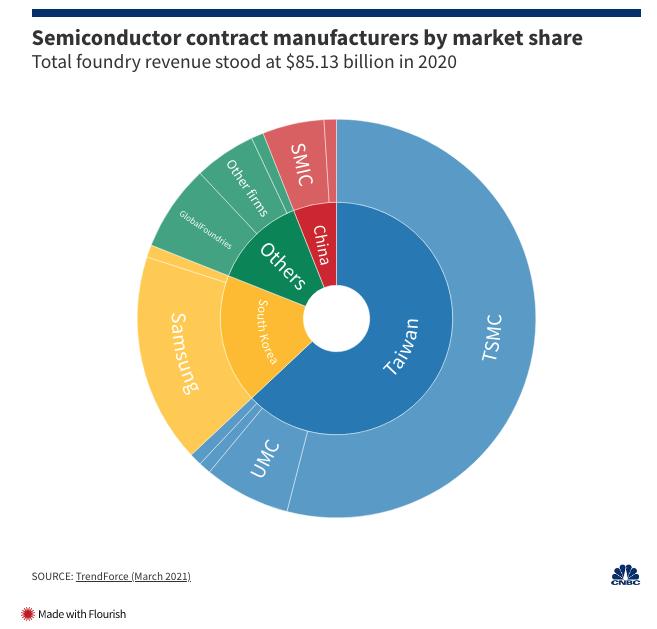
Analyzing Companies Better Prepared and Less Prepared for Future Disruptions
Companies are adjusting to ongoing supply constraints by testing different strategies to alleviate the problem. However, not every company is addressing the situation in the same way. Home Depot and Starbucks are two such companies. Home Depot has learned valuable lessons from the current crisis and is actively mitigating its future risk. As the third-largest sea importer in the U.S. behind Walmart and Target, Home Depot has witnessed significant disruptions to its operations.14 Recently, the company chartered a feeder vessel to handle volume for the upcoming holiday season and beyond. Home Depot’s immediate response was to procure merchandise on the spot market at rates up to four times higher than they typically pay for similar merchandise. Home
66 The Undergraduate Review rather to regain a competitive advantage by subsidizing development and production.
Depot also used air freight as an alternative means of shipping, which is more expensive than ocean freight rates. The situation was so dire that Home Depot was willing to risk its 34% gross profit margins to alleviate supply pressures. The company took a bold step in chartering a feeder vessel. Their strategy could become a model for future risk management. Starbucks has experienced similar disruptions to Home Depot.
Starbucks responded to initial shortages of raw materials by increasing prices rather than proactively addressing ways to mitigate their risk. When ingredients ran out at their locations, the company stopped serving the associated product.15 The company raised prices on their products while supplies lasted and then stopped offering those products altogether after they ran out of ingredients. Starbucks will eventually have to alter this approach to prepare for future disruptions. But, as of now, the company has not addressed this concern. On the Q2 2021 earnings conference call, the company never directly mentioned supply chain issues. The only mention of supply chain issues occurred when analyst Chris O’Cull from Stifel Financial asked about optimizing the supply chain for raw ingredients of plant-based milk products. Starbucks CFO Patrick Grismer responded that there is enough price premium in their products that the company can absorb rising costs. However, he never addressed how the company plans to optimize its procurement process. And we saw similar comments in Q1 2021. CEO Kevin Johnson mentioned it on the conference call but did not elaborate on the details.16
Summary
While supply chains have never been perfectly efficient, they have helped revolutionize modern business and global commerce. However, the current disruptions have magnified
weaknesses inherent to such interconnectedness. Supply backlogs might persist for many months and possibly years to come as the domino effect from original shutdowns continue to reverberate globally from pent-up demand not being met by increased capacity as labor shortages persist. Companies will have to adapt as best they can and learn from the current situation.
Notes
1 https://www.nytimes.com/2021/07/13/business/chinaexports.html
2 https://www.freightwaves.com/news/full-steam-aheadwhy-container-ships-are-racing-across-the-pacific
3 https://www.youtube.com/watch?app=desktop&v=9IEcZOa4rg&feature=youtu.be
4https://www.wsj.com/articles/how-payment-processorstripe-became-silicon-valleys-hottest-startup-11618306201
5https://www.youtube.com/watch?app=desktop&v=E7t5yj1 rScI&feature=youtu.be
6https://www.macrotrends.net/countries/CHN/china/expor ts
7https://www.youtube.com/watch?app=desktop&v=E7t5yj1 rScI&feature=youtu.be
8https://sloanreview-mitedu.cdn.ampproject.org/v/s/sloanreview.mit.edu/article/red ucing-the-risk-of-supply-chaindisruptions/amp?amp_js_v=a6&_gsa=1&usqp=mq331A QKKAFQArABIIACAw%3D%3D#aoh=16257842848760 &referrer=https%3A%2F%2Fwww.google.com&_tf=Fr om%20%251%24s&share=https%3A%2F%2Fsloanrevie w.mit.edu%2Farticle%2Freducing-the-risk-of-supply-chaindisruptions%2F
68 The Undergraduate Review
9https://www.linkedin.com/posts/zelman-%26associates_building-construction-buildingmaterials-activity6779842773710450688-dVqN/
10https://www.sea-intelligence.com/market-commentary/12opinion-pieces/73-chains-vs-webs
11https://www.investopedia.com/ask/answers/011915/whatcountry-worlds-largest-exporter-goods.asp
12https://time.com/6075425/semiconductor-chip-shortage/
13https://www.cnbc.com/2021/03/16/2-charts-show-howmuch-the-world-depends-on-taiwan-for-semiconductors.html
14https://www.cnbc.com/2021/06/13/home-depotcontracted-its-own-container-ship-to-avoid-shippingdelays.html
15https://www.nytimes.com/2021/06/10/business/starbucks -shortages.html
16https://www.fool.com/earnings/calltranscripts/2021/01/27/starbucks-corp-sbux-q1-2021earnings-call-transcri/
WorksCited
note: Citations5&7arethesamesource.Thesourcewascitedtwice in my research and listed here twice to maintain continuity between footnotesandworkscited)
1. Bradsher,K.(2021,July13).Chinareportsstrongexportnumbers despite shipping delays. The New York Times. https://www.nytimes.com/2021/07/13/business/chinaexports.html
2. GregMiller,SeniorEditor.(2021,July16).Fullsteamahead:Why container ships are racing across the Pacific. FreightWaves.
https://www.freightwaves.com/news/full-steam-ahead-whycontainer-ships-are-racing-across-the-pacific
3. HowMaerskDominatestheGlobalShippingIndustry.(2021,July 13). YouTube. https://www.youtube.com/watch?app=desktop&v=9IEcZOa4rg&feature=youtu.be
4. Rudegeair, P. (2021, April 13). How Payment Processor Stripe Became Silicon Valley’s Hottest Startup. WSJ. https://www.wsj.com/articles/how-payment-processorstripe-became-silicon-valleys-hottest-startup-11618306201
5. What’s Causing The ContainerShipTrafficJamCloggingUpGlobal Trade. (2021, July 2). YouTube. https://www.youtube.com/watch?app=desktop&v=E7t5yj1r ScI&feature=youtu.be
6. China Exports 1960–2021. (2020). MacroTrends. https://www.macrotrends.net/countries/CHN/china/export s
7. What’s Causing The Container Ship Traffic Jam Clogging Up Global Trade. (2021, July 2). YouTube. https://www.youtube.com/watch?app=desktop&v=E7t5yj1r ScI&feature=youtu.be
8. Rosano,L.(2020,August31).ReducingtheRiskofSupplyChain Disruptions. Sloan Review. https://sloanreview-mitedu.cdn.ampproject.org/v/s/sloanreview.mit.edu/article/red ucing-the-risk-of-supply-chaindisruptions/amp?amp_js_v=a6&_gsa=1&usqp=mq331AQK KAFQArABIIACAw%3D%3D#aoh=16257842848760&ref
70 The Undergraduate Review
errer=https%3A%2F%2Fwww.google.com&_tf=From%20 %251%24s&share=https%3A%2F%2Fsloanreview.mit.edu% 2Farticle%2Freducing-the-risk-of-supply-chaindisruptions%2F
9. Zelman & Associates on LinkedIn: #building #construction #buildingmaterials. (2021, March). LinkedIn. https://www.linkedin.com/posts/zelman-%26associates_building-construction-buildingmaterials-activity6779842773710450688-dVqN/
10.Madsen,N.H.(2021,June10).Sea-Intelligence-ChainsvsWebs? Sea-Intelligence. https://www.sea-intelligence.com/marketcommentary/12-opinion-pieces/73-chains-vs-webs
11.Which Country Is the Largest Exporter of Goods in the World? (2020). Investopedia. https://www.investopedia.com/ask/answers/011915/whatcountry-worlds-largest-exporter-goods.asp
12. Blum, A. (2021, June 28). From Cars to Toasters, America’s SemiconductorShortageIsWreakingHavoconOurLives.CanWe Fix It? Time. https://time.com/6075425/semiconductorchip-shortage/
13.Lee,Y.N.(2021,March16).2chartsshowhowmuchtheworld depends on Taiwan for semiconductors. CNBC. https://www.cnbc.com/2021/03/16/2-charts-show-howmuch-the-world-depends-on-taiwan-for-semiconductors.html
14.Repko,M.(2021,June14).Howbadareglobalshippingsnafus? HomeDepotcontracteditsowncontainershipasasafeguard.CNBC. https://www.cnbc.com/2021/06/13/home-depot-
72 The Undergraduate Review contracted-its-own-container-ship-to-avoid-shippingdelays.html
15.Creswell,J.(2021,June10).Starbucks,FlushWithCustomers,Is Running Low on Ingredients. The New York Times. https://www.nytimes.com/2021/06/10/business/starbucksshortages.html
16.Transcribers,M.F.(2021,January27).StarbucksCorp(SBUX)
Q1 2021 Earnings Call Transcript. The Motley Fool. https://www.fool.com/earnings/calltranscripts/2021/01/27/starbucks-corp-sbux-q1-2021earnings-call-transcri/
My Other Half
by Nicholas Rienstra
There is a quiet piano bar inside the hotel down on Fifth street where I like to go and drink. It is a little red room where a person can hide away.
There are booths along the windows, but I spend my evenings attached to the long, saloon-like bar dressed in the warm amber of the lamplight. I listen to the piano player cycling dreamily through the standards and grin when he sneaks in covers of Tears for Fears or the occasional dog food jingle like an inside joke that only he and I know. He looks very reserved in his shirt and tie and his long surferblonde hair raised in a bun, but he probably plays drums in some band with a non-sequitur name like One-Armed Scissor or Quarterback Princess that makes loud, trashy music to the delight of ten other musicians in the basement of some pizzeria or something. Maybe I could ask him about it and maybe he would invite me to the next show. But to be honest, I probably would never work up the courage to go. I like to talk to the hotel guests when they come in. I ask them what brings them into town: business or pleasure? I insist on making that joke every time, but nobody ever laughs; even the balding sales reps, who drink until they find their own reflection funny. But I am never too concerned about making a good impression with strangers. I don’t have any good stories to tell, and I would probably butcher the delivery if I did. Instead, I let other people tell theirs. I find it far more interesting to be the audience than the performer. You can learn so much about people and their lives just by asking them questions. Some people will surprise you too. I met this one old woman last Thanksgiving. She came in and she looked so sweet and loving. She wore a light blue shirt with big colorful flowers sprouting all over it and long, tan slacks.
Her outfit hung on her in that relaxed, oversized way that all grandmothers wear their clothes. She walked tentatively up to the bar as if she could fall at any moment and I prepared myself to swoop in if she did. She slowly lifted herself up onto a stool and, in a dark gravelly voice, ordered a drink. I think the bartender was just as startled by the revelation of the old lady’s voice as I was and poured the drink quickly and quietly so as not to inconvenience her any further. I asked if she was in town visiting family. She took a long swig of her drink, turned, and said tersely, “My son and his children.”
“Oh, that’s lovely,” I said with a smile, “You must be so happy to see them!”
She turned and looked at me like I was dressed in a clown costume. “Happy? I hate children. Especially my grandchildren. They’re so dumb and loud. I told my son I was late for my flight just to have an excuse to leave. The plane doesn’t even leave till tomorrow.” She was laughing and coughing all over the bar, and then she looked around and turned back to me and said, “You got a smoke?”
People will ramble on and on if you let them. Everybody just wants to talk about themselves. And since I don’t really have much to say, I’m more than happy to oblige them. I considered becoming a therapist, but then they might expect me to fix their problems too and I wouldn’t even know where to begin. I am so indecisive myself, the thought of telling somebody else what to do is terrifying.
2
He was a larger guy with a thick, bushy beard and big round, doglike eyes squinting behind his too small wireframed glasses. He was not altogether unhandsome, but he walked with his head on his chest and his feet between his knees as if that made him invisible. He looked uncomfortable: in his chair, in his starchy department store button-up, and in his
own body. He kept readjusting the snugness of his tie like a slide whistle and moving closer to the table only to then move himself further away from it. I felt sorry for the guy and sort of responsible for him like I was the witness to a mugging. I just ordered another drink and continued to watch silently from the bar.
It was obvious he was waiting for somebody, and that person was running late Every time someone walked through the doorway, he would whip his head around and then sink back into his chair when it wasn’t her. One after the other, people filing in, but not the one he was expecting. And still he nearly leapt out of his chair in boyish ecstasy every single time; the routine never dulling his excitement. His mind racing to find any excuse for her tardiness. Maybe she was caught in traffic. Maybe the clocks in her house were all broken. Maybe she forgot. It wouldn’t bother him that much if she did. As long as she was real, and she showed up, he would forgive her. He had to.
The night continued and he was still fidgeting around in his chair and glancing down at his phone. I could see he was tapping his foot beneath the table and the sweat was beginning to show through his shirt. The waitress kept coming over to ask if he wanted anything to eat or drink and he would wave her off without looking up from his feet. He was just taking little sips out of his water glass and nibbling on the free peanuts. He was a mess. His sadness was a thick and heavy thing and it lingered on him like a bitter cologne. I couldn’t help but be affected by it. We were linked together like twins separated at birth. I could picture myself in his chair, I could see myself so sad and hopeful. I even started looking towards the door when he did, hoping she would appear, but I knew she never would. I knew the sad, unfortunate truth and still I rooted for him. I wanted so badly for her to be real.
Finally, I decided to rescue him, my other half. I couldn’t keep watching him flop around in his chair like a fish in the sun. I approached his table and took the seat across from him. He looked up but didn’t speak right away. I think he wanted me to speak first, but I didn’t know what to say. We sat in silence for a moment, and I could hear his foot tapping like a heart beating below the floor.
“Come drink with me,” I said awkwardly.
“Who are you?” he said, glancing up briefly.
“I figured you could…umm…use some company.”
“Company? Why do you think I need company?” He looked up at me and I was worried he was going to start yelling and make a scene, but his face was contorted in pain. I think he was afraid to admit it, but he did want my company, I know he did.
“Sorry, I didn’t mean to…well, I don’t know. I saw you sitting here by yourself and…I don’t know, I was kind of bored and lonely so I thought I would…”
“I’m not gay, if that’s what you’re getting at.” I laughed and felt my whole face go red. I couldn’t help but feel a little hurt myself. It felt doubly insulting to be rejected by someone who himself was so clearly the victim of rejection.
“That’s not what I meant; it’s just nobody should be drinking alone.”
“I’m not drinking,” he said swishing the water around in his glass.
“What’s your name?”
“James,” he said it as if he didn’t mean to let it slip, “What’s yours?
“She stood you up, didn’t she?” I blurted it out, “I’m sorry, I didn’t mean to say that.”
He didn’t speak for a minute. “She didn’t stand me up.”
“I’m sure she didn’t.”
“Maybe she did. Dating is the worst.”
“Dating does suck. You get your hopes up and then they’re dashed away. Rejection is son of a bitch, you know. Again and again, you feel like it’s personal.”
“Yea, it is. I don’t even know why I try anymore,” he said looking towards the door, “It’s so frustrating. Like you put all this energy into a person and then all of a sudden, they ghost you.”
“Tell me about it! It’s like you try so hard and you think there’s chemistry, but you have no idea what the other person feels. You have almost no way of knowing whether they feel that chemistry too. And if you get rejected enough, you start expecting them to reject you and how do you start a relationship like that? You can never trust anyone.”
“Sometimes I think about just giving up. I’ve deleted the apps so many times, but I always end up downloading them again. It seems like no matter how many times it happens, I still need to try. I just want it so bad.”
“What? What do you want so bad?”
“I don’t know. I want a relationship, a good relationship, but honestly, I just want attention. I want to be noticed and to be wanted by anybody, anybody at all. It would be so nice to know there was someone who depended on me. Maybe that would make me feel a little more real, I guess.”
“You don’t feel real?”
“I don’t feel like I have a purpose. And people are supposed to have a purpose, right? Like why am I alive? I should have somebody to spend time with, somebody I want to spend time with. I want to be THAT person for somebody else.”
“Have you always had trouble with dating?”
He was silent for a while. He seemed to be tossing the words around inside his mouth like mouthwash. “I’ve never really dated anyone. I’m almost 25 years old and I haven’t even kissed a girl. How pathetic is that? I just never tried to. I didn’t think I could.”
“What do you mean you didn’t think you could?”
I could see it was becoming too much for him. Each sentence was a tooth being pulled and each one had to be yanked out, but he couldn’t bring himself to do it. The pain of each tooth was so new and visceral. “I didn’t think I was good enough; you know. I couldn’t see why anybody would want to be with me. I was ugly and overweight, and I was just a loser. I felt like I didn’t belong anywhere and anybody that was being nice to me I assumed was doing it out of pity or they were setting me up for a prank. And now I’m dating, and I knew it, nobody wants to be with me. I’ve been doing this for a while now and barely get any matches and the matches eventually ghost me when they realize what a loser I am. Like tonight, I thought Diane and I had really hit it off. She was so funny and sincere, but I guess that was all some big joke on me. I should have known; the profile picture was too beautiful. She was totally out of my league. I don’t deserve anybody like her. How could I be so stupid?”
“You’re not a loser.” I believed it as I said it and I think he could recognize the naked honesty of my voice. It came out naturally and entirely uncontrived.
“If I’m not a loser, then what am I?”
“Why do you think you have to date someone?”
“I don’t know…my family. I used to have my family, but everybody’s getting older. They’re getting married and having kids and I’m just doing nothing. I don’t have anybody. You know how embarrassing that is, to be surrounded by couples and being all alone yourself?”
“So, you think you need a girlfriend? You think that’ll solve everything?”
“I don’t know. I think it might just need somebody.”
“Well, if you ever need anything, I can be there for you.”
James and I talked for hours. Once he opened up, it seemed like he couldn’t stop. He just had to get it all out and I just sat and listened. He told me how he struggled through
high school and how miserable he had been. He never cried, but I always felt like he wanted to and maybe he did when he was alone later that night. We did hug and he held me tight in his arms. It felt nice. It was like he was comforting me. 3
I don’t quite remember how the whole thing started Maybe like most hobbies, it developed out of boredom or curiosity and then snowballed from there.
I guess I had been doing the dating apps for a while, trying to put myself out there and not having much luck. I downloaded a few of them on my phone and I would alternate between them during the day. Honestly, I was obsessed. Sitting at work or waiting in line at the grocery store; wherever I would be, I had to be swiping and checking for possible matches. It was the only thing I thought about. It was the only thing that mattered to me.
I think it started as a joke. Something I did without really thinking about it. I made a new account as a woman and named her Diane. I stole some pictures off some other girl’s profile and assumed a new persona. Her bio was identical to mine. I based most of Diane’s backstory on my life and then filled the gaps with a few stories I had heard at the piano bar.
I didn’t want her to be completely separate from my own identity. It would still be me. They would still be swiping on me. Then I started swiping and soon enough I got a few matches and few more. I enjoyed the attention that this female version of myself was receiving. Everyone messaging to tell me how attractive I was and how badly they wanted me. I started to message people under the guise of Diane, and I would spend hours talking to them. We would make each other laugh and share embarrassing secrets. It was so much fun, and it was all I did. But then the men wanted to meet me in person, and I didn’t know what to do. I would try to
explain it off or postpone dates, but they kept asking and I felt bad. I was so caught up in my little game that I had led some of these guys on for weeks.
I arranged to meet one of my matches at the piano bar. I came and there he was waiting for me anxiously. I sat there and watched him for hours until he left. He never messaged me again. I kept arranging dates and then just sitting at the bar while my dates got mad and left. I didn’t know how to let them down gently and, for a while, it seemed to work. Then one day, my date, frustrated with my not showing, came and sat at the bar and we started a conversation. He told me about Diane and how smart and funny she was and how disappointed he was that she hadn’t showed. He was heartbroken over me and here he was telling me that. I couldn’t help, but press him for more details, my ears tingling at the praise and adoration. I couldn’t believe I had this power over them. We actually became friends and hung out a few times after that first night and we still send each other yearly Christmas cards. But I wanted to do it again and so I kept doing it. I would arrange a date, let them think they had been stood up, and then I would be there to comfort them over the rejection. That’s what I did to James. And I still talk to him all the time. The last time I had talked to him he told me he had met somebody, and they were happy together. I told him I was so proud of him, and he thanked me for always being there for him. I like to think I’ll get an invitation to their wedding and maybe I would be the best man. But to be honest, I probably would never work up the courage to go.
Person Seeking Comfort
Mare Jannicelli
The large white wooden door crept open, creaking as if it were hitting notches on a gear, just before stopping halfway. A slim body stepped through the narrow space, a messenger bag slipping off of a weak shoulder. Electronics made plastic clacking noises, papers rustled, collectively making a single sound. The light switched on, dim, slightly flickering. They walked to the small loveseat, allowing body weight and the weight of the day to sink into the cushions. A sigh escaped a tired mouth. Their choppy hair flipping back, feet over the armrest. It had only been a few months since Pepper had settled into the tiny apartment, but old junk mail sat with lazily thrown keys and pocket remains. It was almost intentionally left there as if random crap showed a sense of establishment. Cat food crumbs gathered around a small metal bowl, and overboiled water clung to a stovetop. They did what they could, of course, cleaning on days off, feeding the cat every day, and yoga or reading as time allowed. But it was so hard, being alone. It was good, though, they thought. It had to be. Getting away from a closed-off family, a town that only seemed to induce a deep state of nostalgia. It was supposed to be like hitting the refresh button on a frozen browser screen. But it’s been so hard.
Dinner was old pasta, still dry despite copious buttering, with a side of an old film that covered the screen with film grain. Pepper grew up watching westerns with their grandfather, their mom often leaving them with him when she had to work. Despite young Pepper being unsure of the plot and its meaning, they were always enthralled by the fantasy, the action. Now the film was mostly background noise, but it felt like how a home was supposed to feel. The studio apartment felt less hollow and cold.
Then it was suddenly midnight, and an empty bowl laid on the table, a scrunched-up napkin and an overturned book beside it. They wiped their eyes, snagged the bowl, and dropped it into the sink with a soft metallic clang. They stood at the sink in the bathroom, staring into their own eyes while brushing teeth that often felt tight from clenching their jaw.
Rinse. Spit. Stare into the mirror.
Dull green eyes sat on nearly purple eyebags surrounded by light freckles. They stared deep into forehead lines and enlarged pores. Picked at blackheads that sat beneath the skin of a pointed chin. Then just stood there.
An alarm rang through their ears, the cat perking up his head before settling back down. An outstretched hand silenced the vibrating, slightly moving phone. The hand stretched further upwards, as legs pointed toes and stretched downwards. Tired muscles tightened and released. One way or another, the cat was fed, and coffee and toast were made. Pants were pulled up past chubby legs and tightened around a peach-fuzz covered stomach, a shirt buttoned and tucked in. They grabbed the bag that had been dropped onto the floor only twelve hours before and reached for keys. The weather was only warm for small moments, the breeze of a new fall reminding pedestrians of a patient but oncoming winter. The streets were full suffocatingly so on a usual day but they offered the bustling that Pepper often missed in their day. Dodging traffic cones, construction areas, joggers, and dogs pulling leashes. It made them feel as if they were a part of something.
Immediately after getting to the sterile office building, they stepped onto the creaky elevator, the doors softly shut behind them. It was only a floor later when a feminine person stepped on, making eye contact and smiling. The two stood there, similar styles of clothing noticeable. Her hair was a shaggy, almost shoulder-length bob. Just as they were about to compliment each other, the elevator door opened. A man
in a starched suit stepped through, standing in front of the two. He tapped the button with the scraped off number 6 and seemed to come and go quickly, leaving time for a moment of opportunity. But the person was gone a moment later, on floor 7. They sighed and stepped off at the twelfth floor into the office for the fifth and final time of the week.
The same secretary greeted them with a soft smile and nod, filling her brief moment between phone calls. She was the only one who said “hi” to them, and they wondered if it was a polite gesture or forced due to daily eye contact.
They got to the same plain wooden desk, a desktop computer greeting them with a bright screen. Their messenger bag plopped down, their hand reached in for their superior laptop, opening it up slowly, almost as if it were an old book. They grabbed a mug from their drawer, slowly getting up from their workstation. Besides the standard refrigerator and sink, the office’s small kitchenette only contained a microwave, a toaster oven, and a Keurig machine. Pepper used the Keurig for its water. It made almost guttural noises as it spittled into the ceramic mug below. They grabbed it and returned to their desk, passing coworkers whose gazes always seemed to be distant. They began writing a list of their tasks for the day on a small notepad, and after scribbling over fifteen items, they realized they would be working from home this weekend. An idle hand pinched the bridge of their nose, a soft sigh followed. At least it would help pass the time. It didn’t matter really; they always ended up working from home. It just sucked to see it all laid out like that.
Just before lunch break, their manager walked by. He leaned over, staring at their screen. He asked how much they had finished on the new layout. He hoped they would skip lunch and work from their desk instead; he needed the layout by Monday. They agreed and held in a frustrated and tired sigh until he was out of earshot. They had skipped their lunch hour three times that week, eating pretzels and leftover snacks
from the break room instead of getting a hot meal from a nearby food truck or deli, taking their hour under dim fluorescents rather than the warm sun. Their tea had grown cold.
After leaving late, they stepped back onto that same elevator. It seemed as if the gears were trying their hardest to make sure the ride was smooth, yet the car still jumbled slightly. It screeched a bit and stopped on floor 7. The person from the morning stepped on, both of their eyes widening, followed by a smile. A short, almost dreadfully quiet moment passed before they looked at each other and finally said hello. She complimented their shirt. They complimented her hair. There was a sense of relief in talking to one another, her eyes were brighter than Pepper’s, a light blue, with less extreme notes of exhaustion that contrasted Pepper’s often strained, bloodshot look.
She asked about their job: graphic design. They asked about hers: photography. She was only going to be in the building for a few weeks. She worked freelance. Their heart sunk, and the elevator reached the ground floor. The two stepped off, and she put her hand out. They awkwardly shook clammy hands, and the words “would you like to meet for coffee sometime soon?” slipped out from her lips. They nodded and blushed, their face and ears warm from a mix of embarrassment and excitement.
When they got home, they dropped their bag as always, but didn’t feel the weight of the world or workday rather, on their shoulders. It was as if a strange rush of calm had run over them. They made dinner, put on something random on Netflix. A cigarette was lit, and red-orange flurries of ash floated away from the apartment window in small groups. They hung their head out, leaning it onto the dusty frame, taking in the night air. The only thing on their mind was coffee.
Pepper pictured the ever-busy coffee shop a few blocks down from the office building. It had tall lofty ceilings and was always dark from the exposed brick walls. They imagined her sitting at the bar stools alone, people buzzing around her. Pepper would make eye contact with her the moment they walked in. A wave of excitement or maybe a nervous fear would follow.
It wasn’t until Sunday that the loneliness would set in. Only after the weekend work was done, and the only thing left to do was be alone with themselves. For every daydream of this meetup that they had that went well, the fear of being stood up, lousy conversation, or just a flat-out awful time followed. If a simple coffee hangout failed, Pepper feared they would never meet anyone, fear they wasted her time, that they would be alone in this city as long as they lived here.
Then they pictured themselves in the dark coffee shop sitting alone at a table in the corner, absently playing with an empty paper cup and hopelessly looking out the window with each passerby.
When things were really bad, they would open the windows and listen to conversations of those walking by. Or they’d go for a walk. Most times, they’d put headphones in, but wouldn’t put any music on. It felt nice to pretend they were in on something. And eavesdropping was better than nothing. They liked hearing the middle-aged women on their morning walk gossip about their friends from high school “You know who died?” one would say, and soon after there would be something like “Such a sin and he was only 61 so young. ” It made Pepper laugh to themself. It reminded them of their mom.
They got into the steaming shower, staring at the ceiling. Eyes closed and rested as steam rose. They covered themselves in soap, allowing it to create a foam layer on top of thick skin. The brush scrubbed the layer away and what felt like the epidermis in its entirety. They started with their arms,
going in circular motions, and ended at their feet. Their flesh beamed red, fresh, almost reborn. Hands picked at the remaining skin, then applied moisturizer.
Suddenly, it was Monday again. Toast was quickly shoved into a dry mouth, scratching the roof of it before disintegrating. The walk to work was colder than usual, and they pulled their coat tight around their still sleeping body as if they were tucking it back into bed. Then came the same elevator inside the same building. They didn’t see her on the way up this morning. They wondered if she had forgotten about their coffee meet-up today. Maybe she was joking, or perhaps she didn’t want to talk to them in the first place. Maybe they’ll skip it, just go home after work. Maybe they’ll make a friend another time.
Long hours and multiple cups of tea would follow. A bouncing leg keeping them on task as if it were counting the seconds and minutes going by. The stern look of a boss would pass by twice, once to say hello, and once to offer a nonchalant compliment, pleased with the long hours Pepper had spent on an improved website layout. No consolation for the skipped lunches or angry blood vessels that required eye drops two times a day.
When it came time to clock out, nervously tapping feet turned into what felt like spiders walking across skin. They waited for a moment. The rustling of personal belongings echoed around them as coworkers eagerly yet mechanically made their way to the door. Not a passing glance made. They packed their bag slowly, cleaned out a stained mug with boiling hot water, leaving their hands stinging. Now the only thing left to do was go to the elevator. Suddenly there was an urge to take the stairs. When Pepper got to the ground floor, they looked around for her, hopeful. Nothing. They headed down the street to the coffee shop they had agreed on, another look around. Nothing still. They got into line, ordered coffee, and sat down, fearful of being stood up. They
pulled out the stool, an eruption of scuttling scraping noises of its legs on the hardwood floor followed. Embarrassed, they sat down without a sound. They watched each of the patrons, sipping their coffees, impatiently waiting by the counter. One picked up the next drink that came out, without listening to the barista and yelled “is this mine?” The barista sighed and repeated the drink. The customer put it down and apologized. Pepper created backstories for everyone they watched. Especially those who were obnoxious. They sipped their coffee, it stung their lips, still burning hot. They directed their attention to the slowly fading daylight, the sun peeking through the tall city buildings. In the midst of their thoughts, they felt a tap on their shoulder.
Interview with Cover Artist Crystal Contreras Nikitha Jeyaprakash
Crystal Contreras’ artwork Sedona My Love appears on the cover of this Fall 2021 issue of The Undergraduate Review. Student co-editor Nikitha Jeyaprakash discussed Ms. Contreras’s work with her and reported their conversation in the interview below.
Nikitha Jeyaprakash: What’s your major and minor?
Graduation year?
Crystal Contreras: I am a business major majoring in business administration, and I graduate in May 2023.
NJ: Please share your history as an artist. How long have you been drawing, what inspired you to draw, and what general themes are in your art if any?
CC: I have been involved in the arts since I was a young child. I started with drawing. Around twelve I was introduced to painting and participated in many projects which included creating props for the drama club, a painting for the board of education and partaking in my middle school’s mosaic art piece. While in high school I took elective art classes to further my skills and knowledge about art. During that time frame, I learned stamp making, papier mâché, ceramics and modeling. After high school I became self-taught in digital art, collage art, photography and wire wrapping. In college I took an elective art class which was art appreciation. Today, I mainly focus on abstract acrylic painting and digital art. Currently, I still create for myself and others. You can find my art on my socials creatresscrystal (instagram, YouTube, and TikTok) and radartwork (Instagram). When it comes to
art, my inspiration for creating is to be able to express myself and to uplift others.
NJ: Will you share your artistic achievements?
CC: I had an artwork published in second grade. I was appointed to create a painting of my school for my middle school’s board of education. In high school my self-portrait drawing was displayed and I was the subject model for a student photographer’s project.
NJ: Please tell us more about Sedona My Love.
CC: The artwork is a reference from a photo I took while on a spiritual women's retreat in Sedona, Arizona. It was October 25, 2022 at 5:33pm. We had just finished our second hike of the trip and were walking on a dirt path back to the car. During the walk my spiritual coach played some Disney princess songs to help us connect to our inner child. This was a special day to me because this is when the ladies and I fully connected. I remembered looking at the scenery and being completely captivated by the environment and so I took a picture to keep the memory forever. During this timeframe in my art journey, I was focusing on making linework art and I wanted to make this piece solely with lines.
NJ: What meaning do you hope viewers see in this work?
CC: The meaning behind this artwork is that everything is going to work out in divine timing and to trust our intuition because it will guide us to the most beautiful experiences in life. We come here on earth to appreciate the beauty of life, to make connections and to know we are never truly lost, for we are always home on earth. For me, this piece is inspired by a moment in my life where I chose to listen to my intuition and
pushed myself out of my comfort zone. If I had chosen to not get serious about my healing journey then I wouldn’t have reached out to my spiritual coach, taken a chance on flying alone, meet inspiring women, and be who I am now. For me, this was my turning point in stepping into being my most authentic self.
NJ: Does the time the artwork was created hold any significance to it?
CC: The time this artwork was created holds deep significance to this piece. That day was very impactful in terms of having faith. I woke up around 7 a.m. and tried to schedule a flight with my father who works for the airlines. I fly under the buddy system, so it isn’t always clear if they are good flights. I was stressed out because I did not want to take a flight back to New Jersey. Before coming to the retreat, I left New Jersey on not the best of terms which made me want to be around a supportive community instead of the one I had there. So, I asked to go to Texas instead. We managed to book a flight to TX for around 4pm but the seating did not look so promising, which meant in the worst-case scenario I would have to go back to NJ or be stuck out in AZ with nowhere to go. The ladies and I packed our things and grabbed some breakfast. We decided to take our last hike of the trip on a whim to kill some time. It was around 2:30pm when we finished the hike and we realized we had cut it close. The airport was roughly an hour away from where we were, so we headed off quickly. The closer it got towards 4pm, I started to panic because it was dawning on me that I might miss the flight and be stuck in Arizona with nowhere to go. During the ride, a song played that held great significance to me and I knew in my heart that I’ll be okay. We arrived at the airport with 30 minutes left until my boarding time. I had no time to change out of my hiking clothes, which meant there
was a chance I wouldn't be accepted onto the flight because of the strict clothing policy for flying with the buddy system. I rushed through security and towards my gate. I passed by a large window on the way, it made a reflection of a rainbow, and I knew it was a sign that a blessing was right around the corner, so I tried to remain optimistic. I got to my gate and there were no available seats, but I was asked to wait just in case someone didn't show up, which ended up happening. That meant I was able to get on the flight. A wave of fear and uncertainty left my body, it was like a weight had been lifted off my shoulders. While on the flight I went through my photos trying to find one to recreate the scenery I saw until I found one that resonated which is the reference photo for this piece. As a final goodbye to the place that made me feel so welcomed, loved and supported I made the artwork, Sedona My Love.
Notes on Contributors
Sean Bray studies international relations, specializing in Chinese and Russian politics. He is also co-founder and editor of TheDissentChannel.org, which seeks to explain how geopolitical developments will impact the future of liberal democracy. He hopes the readers will be inspired by the courage of the countless protesters who have stood up to the CCP.
Crystal Contreras is a student at Rutgers University-Camden School of Business majoring in business administration who graduates in May 2023. Crystal has been involved in the arts since childhood and has since nurtured her love and interest in art by learning art of various media and partaking in the creation of many art pieces since her time in school. Crystal’s work “Sedona My Love” is a reference to a photo she took while on a women’s retreat in Sedona, Arizona and seeks to capture the moments of connectedness and belonging she felt with the fellow retreat participants. The work hopes to capture the beauty of nature and the magic of life and marks a moment in Crystal’s life when she pushed herself out of her comfort zone. Why the very moment the artwork was created holds great significance to the message Crystal hopes to convey to those that see her work; “Sedona My Love” was created on a plane ride around when her life seemed turbulent and is a recreation of one of the pictures she took on her journey. The artwork conveys a message of hope and Crystal hopes that her work for the front cover convinced everyone that everything in life eventually falls into place.
Isaiah Dillon graduated summa cum laude from RutgersCamden in May 2021 with a B.A. in English and a B.A. in History. He currently lives in southern NJ and works in New Castle, Delaware as a Vault Cataloger. This is his first work
published in the Undergraduate Review and he hopes his work sheds light upon the more covert and often unknown aspects of history.
Sumana Gadiraju graduated summa cum laude from Rutgers in 2022 with a B.S. in Biology and minors in Psychology and Chemistry. While in school, Sumana served in a number of student leadership positions and was actively involved in community-based service and volunteerism. Through this paper, which discusses capital punishment in both a historical and modern context, Sumana aims to bring attention to various ethical, practical, and financial implications of the death penalty. This is her second published work at Rutgers.
Alyssa Granato graduated with a B.A. in Political Science from Rutgers University in 2022. She was a member of the Honors College and the Political Science Honors Program. Through the program, she has done original research on attitudes toward consent practices in the age of #MeToo to shed light on staggering rates of sexual assault, particularly on college campuses. She served on the executive boards of the Political Science Society and the Student Governing Association (SGA), where she chaired the Student Health and Wellbeing and Sustainability committees. Through the Civic Scholars program, Alyssa also did social outreach volunteer work with the Promise Neighborhood Family Success Center in Camden, a preventative program aimed to empower the family unit in urban areas. She has done constituency work at her local legislative office. She is currently pursuing her Master of Applied Psychology at Rutgers University in New Brunswick, where she specializes in Addiction Counseling Training. She hopes to continue conducting research and helping populations that are often underserved, particularly when it comes to mental healthcare policy and accessibility.
Mare Jannicelli is a Rutgers-Camden alumnus who graduated cum laude with a B.A. in English and a minor in Film Studies in January 2022. They are originally from Marlton, New Jersey, and now reside in Philadelphia. Currently, they are enrolled in the master’s in library science program at Rutgers New Brunswick with a concentration in Archives and Preservation. They hope to obtain a Historical Preservation Certificate and work in Media Preservation. They hope the readers enjoy and relate to the experiences within their story.
Nikitha Jeyaprakash is a sophomore at Rutgers UniversityCamden with a plan to double major in Health Sciences and Nursing. Nikitha is a member of the Honors College, which has positively impacted her growth as a student. Her contribution as one of the editors of The Undergraduate Review is her first experience in integrating herself into the campus community and she hopes to expand her horizons exponentially over the duration of her undergraduate studies. Nikitha’s passions lie in public health efforts and community involvement, and she hopes to not only strengthen her own voice, but to hear those of her peers’ during her time spent working with The Undergraduate Review. Being on the Dean’s list for consecutive semesters since her freshman year and officially accepted to the nursing program as of Fall 2023, she hopes to navigate her undergraduate experience and find her niche by integrating her career plans with her passions.
Jonathan Lepselter graduated magna cum laude from the Rutgers Online BBA program in August 2022. This article is his first published piece of research. Jonathan drew inspiration from his international business courses, which he took during the supply chain issues of 2020, making for a compelling learning experience. He hopes his research sheds
light on the economic impacts those issues had on consumers during that time.
Mariah MacIntosh is a Rutgers University Camden alumna. She graduated magna cum laude earning her Bachelor of Arts in Political Science, with minors in criminal justice and legal studies in May 2022. She currently attends Widener University Delaware Law School as a first-year law student. Mariah began her career while studying full-time at Rutgers Camden, first by serving as a legal intern to Senator Troy Singleton of the 7th Legislative District of New Jersey and the Philadelphia District Attorney’s Office. Ultimately, she began working full-time as a legal assistant at the Burlington County Prosecutor’s Office before beginning law school. She hopes to use this experience, as well as her educational background to one day serve as a prosecuting attorney. Her interest in domestic terrorism stemmed from the ongoing gun violence epidemic and the threat that white nationalist terrorism poses, as well as her background in politics. She hopes this paper will bring attention to the danger and threat of violence within the United States, and push for legislative measures just as she has.
Benjamin Simonds Nixon graduated summa cum laude from the Camden College of Arts and Sciences with a degree in Psychology. During his time at Rutgers, he received awards and recognition for research and excellence in the fields of non-partisan student voter organizing, psychology, criminal justice, and counterterrorism. He has previously worked as a corrections supervisor and criminal intelligence analyst. He is also a graduate student at Georgetown University, where he is pursuing a master’s in applied Intelligence. He hopes to continue his education and career in the fields of forensic psychology, law enforcement, and intelligence analysis. The maladaptive amalgamation of psychology and medicine in the
field of criminal justice is evaluated in Nixon’s paper. He warns of patient deprivation and looks at the systemic abuse of those with unsound minds as an established precedent within medical ethics as well as inside the American legal system.
Nicholas Rienstra will graduate May 2023 with a Masters of Art in Teaching. He is a New Jersey native and plans on teaching high school English. He has a passion for reading and writing as well as film and social issues such as environmentalism and the labor movement. His writing explores ordinary and unexceptional people and the unusual relationships that they form in an increasingly isolated world. He hopes readers will relate to his characters and find something comforting or even romantic in his stories. This is his second submission to The Undergraduate Review.
Kennedy B. Samuels is a senior in the Honors College double-majoring in History and Political Science with a minor in Law and Legal Studies. In addition to attaining membership within Phi Alpha Theta, Athenaeum, and Pi Sigma Alpha honor societies, he was also recently awarded an Arts and Sciences Opportunity Meets Innovation Challenge Summer Undergraduate Research Grant to research the depictions of Judaism and Jewish culture in early modern Europe. His excellent academic record also granted him an invitation to the BA/MA Dual Degree Program He has maintained a commitment to public service through his work in the Honors College, and he was recently able to participate in Congressman Donald Norcross’ internship program where he assisted him and his team in serving the needs of all district constituents. Currently, he is a member of the inaugural Dean’s Undergraduate Advisory Council where he serves to better the experience of Camden College of Arts and Sciences and University College-Camden students. While a full-time
student, he has worked multiple part-time jobs to put himself through college. He is an aspiring lawyer who hopes to further develop the skills he has gained at Rutgers University to serve the needs of the public.