OPINION
MANAGEMENT
Balancing farm life with advocating for rural wellbeing.
Make every drop of rain count.
HORT NEWS
PAGE 14
PAGE 11
Potato industry stars shine at awards. PAGE 23
TO ALL FARMERS, FOR ALL FARMERS OCTOBER 6, 2026: ISSUE 860
www.ruralnews.co.nz
Arable sector eyes revival NIGEL MALTHUS
FLAT PRICING in the face of significant increases in costs is the greatest problem facing the arable sector, says Foundation for Arable Research (FAR) chief executive Dr Scott Champion. Champion recently acted as facilitator for an Arable Sector Forum that brought together FAR, Federated Farmers, the Ministry for Primary Industries and growers, to grapple with an exodus of farmers reportedly
leaving the sector in search of better returns. Champion told Rural News that all the key inputs – fuel, fertiliser, machinery, agrichemicals – had outpaced any gains on the product price side. “Some of those are very significantly beyond our control because of tensions in the Middle East or whatever it might be. “We can’t necessarily address those in the shorter term.” However, he was encouraged by the working relationships evident at the
forum. As a smaller sector, everyone knew everyone else, and no-one was trying to hide from the challenges, he said. “The fact that people have come together and getting some energy and momentum into this conversation is really positive. “I’m really encouraged by, number one, the recognition of the issues; and number two, the desire to do something about it and the willingness to actually move and try to move reasonably quickly.” A press release following the
meeting said it identified five initial priorities for action and further engagement with the sector: • Addressing poor on-farm profitability and managing costs • Improving market intelligence and data to support on-farm decisions • Growing the partnership between the arable sector and the dairy and livestock sectors • Identifying opportunities to improve transport and logistics • Developing customer recognition of the benefits of New Zealand grown grains.
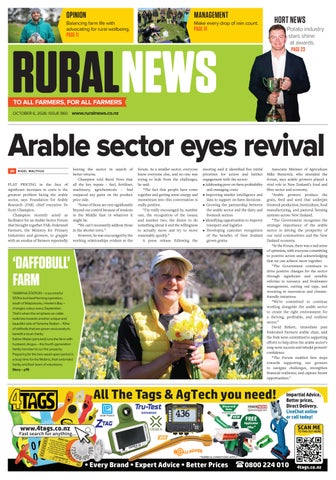
‘DAFFOBULL’ FARM TANIWHA STATION – a successful 550ha bull beef farming operation, south of Waipukurau, Hawke’s Bay – changes colour every September. That’s when the emphasis on cattle switches towards another unique and beautiful side of Taniwha Station – 10ha of daffodils that are grown exclusively to benefit a local charity. Esther Mabin (pictured) runs the farm with husband, Angus – the fourth-generation family member to run the property. Preparing for the two-week open period is a busy time for the Mabins, their extended family and their team of volunteers. Story – p15
Associate Minister of Agriculture Mike Butterick, who attended the forum, says arable growers played a vital role in New Zealand’s food and fibre sector and economy. “Arable growers produce the grain, feed and seed that underpin livestock production, horticulture, food manufacturing, and pastoral farming systems across New Zealand. “The Government recognises the strategic importance of the arable sector in driving the prosperity of our rural communities and the New Zealand economy. “At the Forum, there was a real sense of optimism, with everyone committing to positive action and acknowledging that we can achieve more together. “The Government continues to drive positive changes for the sector through significant and sensible reforms in resource and freshwater management, cutting red tape, and investing in innovation and climatefriendly initiatives. “We’re committed to continue working alongside the arable sector to create the right environment for a thriving, profitable, and resilient sector.” David Birkett, immediate past Federated Farmers arable chair, said the Feds were committed to supporting efforts to help drive the arable sector’s long-term success and rebuild growers’ confidence. “The Forum enabled first steps towards supporting our growers to navigate challenges, strengthen financial resilience, and capture future opportunities.”
All The Tags & AgTech you need! NEW
www.4tags.co.nz
FREE
Impartial Advice, Better prices, Direct Delivery. LiveChat online or call today!
Applicator Offer*
SCAN ME
0800 224 010
4tags.co.nz
TO FIND OUT MORE
NEW
*TERMS & CONDITIONS APPLY
� Every Brand � Expert Advice � Better Prices
RURAL NEWS // OCTOBER 6, 2026
NEWS 3 ISSUE 860 www.ruralnews.co.nz
SOE looking to lock in gains SUDESH KISSUN sudeshk@ruralnews.co.nz
NEWS ��������������������������������������� 1-9 HOUND, EDNA �����������������������10 CONTACTS ������������������������������10 OPINION �����������������������������10-13 MANAGEMENT ����������������14-15 HORT NEWS ����������������������17-24 ANIMAL HEALTH ������������������ 25 MACHINERY AND PRODUCTS �����������������������27-30 RURAL TRADER ��������������������� 31
HEAD OFFICE Lower Ground Floor, 29 Northcroft Street, Takapuna, Auckland 0622 Phone: 09-307 0399 Fax: 09-307 0122 POSTAL ADDRESS PO Box 331100, Takapuna, Auckland 0740 Published by: Rural News Group Printed by: Inkwise NZ Ltd
STATE FARMER Pāmu is bracing for a $30 million hit from soaring farm input costs this financial year. After posting a record net operating profit of $113 million for the 2026 financial year, the SOE has trimmed back its forecast 2027 net operating profit to a range of $77 million to $87m in its integrated report released last week. In August, Pāmu reported a NOP of $113 million, up from $49 million the previous year, alongside a net profit after tax of $160 million. The Government received $25m in dividends from Pāmu for 2026, including a $10m special dividend reflecting Fonterra’s special capital return to farmer shareholders. While farms are still on track to increase production, chief executive Mark Leslie says the profit forecast revision has come down due to two factors – rising input costs and weather. “Those additional feed, fertiliser, and fuel prices mean nearly $30 million of additional costs that the businesses are facing this year, so that’s a big reason for the backing off that profit,” he told Rural News. “We haven’t backed off on the
production side of it, so that’s being held. “We are watching, like everybody is probably watching, two things now: one is those fuel and fertiliser feed costs, and the other, what plays out with weather conditions around El Nino. “But if you look at a $77 million to $87 million range, if you asked me two to three years ago how that looks, it looked pretty positive.” This year’s record results reflect the progress Pāmu has made in strengthening the commercial performance of its core farming business. Strong protein prices supported the result, but they were not the whole story, says Leslie. “An estimated 60% of the improvement came from productivity and operational performance: producing more from our land, livestock and people, managing costs carefully, and making better decisions across the portfolio,” he says. Over recent years, he says Pāmu has maintained a disciplined focus on the fundamentals of farming performance, growing more feed, improving animal performance, managing costs carefully, and ensuring resources are directed to where they create the greatest value. Pāmu dairy farms produced 15.8m
Mark Leslie, Pamu, says their priority is now to lock in the gains made.
kgMS last year, 13% more than the previous year. Livestock productivity rose slightly to 22m kg liveweight. At the same time, cost of production for conventional dairy dropped 7% to $6.99/kgMS, went up 10% for organic dairy and up 7% for livestock. Leslie says their priority is now to lock in the gains made. “That means continuing to lift productivity, sharpen capital allocation, manage costs and risk, and focus effort where it will have the greatest commercial impact. “We also recognise that ongoing
global volatility and forecast El Nino conditions are expected to increase costs in the coming year. We will keep investing in people, systems and stewardship where they support stronger operating performance and long-term value creation. “There is more work ahead, but the direction is clear. When we stay focused on our core operations, make good commercial decisions and keep lifting productivity, we create value for our shareholder and, through that performance, contribute practical benefit to New Zealand agriculture.”
CONTACTS Editorial: editor@ruralnews.co.nz Advertising material: beckyw@ruralnews.co.nz Rural News online: www.ruralnews.co.nz Subscriptions: subsrndn@ruralnews.co.nz
RED MEAT EARNINGS SOAR NEW ZEALAND’S red meat and fifthquarter exports reached $867 million in August, up 23% on the same month last year, as stronger returns lifted earnings across all major markets. Sheepmeat exports were worth $309m, 20% more than in August last year. China increased 46% to $71m, while the United Kingdom rose 118% to $54m and became the third-largest sheepmeat market by value for the month.
Beef exports increased 26% in value to $403m. The US remained the leading market at $155m, up 30%, while China rose 12% to $79m and Canada increased 55% to $18m. Fifthquarter exports were worth $156m, an increase of 13%. Meat Industry Association chief executive Nick Beeby said the result underlined the value the sector continues to generate for New Zealand.
“A 23% lift in export value is a strong result. Export volumes have also increased compared with August last year, but the more significant movement is in value, reflecting improved returns from international markets. “The breadth of the result is encouraging, with export values higher across all major markets and gains for both sheepmeat and beef in China.” However, Beeby says one month’s
data should be viewed in context, given the global volatility and costof-living pressures that may push some consumers towards lower-value proteins. The August result builds on the returns for the 2025/26 financial year (year ending 30 June), where red meat and fifth quarter exports were worth $13.1 billion. This was 21% higher than in 2024/25 and a record annual export value.
Certainty, by the bagful. There’s plenty on a New Zealand farm you can’t control. The weather. The markets. The summer that turns up late – or doesn’t arrive at all. Your pasture seed shouldn’t be one of them. Scan the QR code to learn more.
Grow with Confidence
Stack the odds in your favour. Choose proven Barenbrug cultivars and grow with confidence. Learn more at barenbrug.co.nz
RURAL NEWS // OCTOBER 6, 2026
4 NEWS
Rural NZ faces ‘digital poverty’ PETER BURKE peterb@ruralnews.co.nz
THE MINISTER for Rural Communities, Mark Patterson, says there’s a massive infrastructure deficit in rural areas. He says this needs to be fixed because it’s inhibiting development in these areas. He cites a report by the combined Chambers of Commerce of the South Island which points out the funding for infrastructure across
the country is wrong because it prioritises population growth over economic growth. Patterson says, for example, the South Island is only getting 11% of the national roading funding. Yet he says there are rural roads in the South Island that need resealing and bridges that need repairing. “We have got to be wary that some of the big mega projects don’t suck out the potential to maintain our rural infrastructure, because it is under a lot of pressure
to severe weather-related events. If you look at really productive areas like Tairawhiti, they face huge challenges at times getting their product to market,” he says. Patterson says lack of infrastructure is hindering economic development in areas with known huge potential. Another issue that is inhibiting growth in some rural areas is a lack of quality internet access. He says the telcos keep saying everything is right, but Patterson says that’s
not the feedback he’s receiving. He says the roll-out of broadband has reached 87%, but asks, what about the remaining 13%? “We can’t have digital poverty in NZ and a lot more work needs to be done. Lack of quality broadband is not only affecting farmers to run their businesses properly, but it’s making some people think twice about working in some remote places. There’s a perception in Wellington that the job is done – well it isn’t,” he says.
Mark Patterson
Finally, Patterson says in all his interactions with rural communities, the issue of most concern is that of health. He says health services are under pressure in multiple places and are just being held together by very dedicated and hardworking
professionals on the frontline. He says Labour’s decision to restructure the health service in the middle of the Covid pandemic was madness. He says a number of moves are underway to improve the situation. “Often some of the
problems could be fixed with the addition of a few thousand dollars. And this could result in a more comprehensive service,” he says. Mark Patterson says there is a need to fortify rural health services to take the pressure off base hospitals.
FAR HELPING ARABLE SECTOR ‘LOOK FOR ANSWERS’ NIGEL MALTHUS
DR SCOTT Champion, Foundation for Arable Research chief executive, says that everyone in the supply chain had a role to play in driving the sector’s long-term success. Participants at the recent Arable Sector Forum were actively following up on the five big headings to consider how they could best be addressed. As a research, development and extension organisation, FAR’s work would continue to bring as sharp a focus as possible on the things that make a difference to the growing of crops, “whether that’s about improving profitability or reducing costs or whatever it might be”. Champion said FAR was looking
more closely at connecting arable to other sectors, primarily dairy and sheep and beef. He noted that 75% of wheat and barley go into animal feeds rather than human consumption, and probably 90% of arable farms would carry livestock in some form. “So how do we think about connecting better into dairy, identifying and then providing the opportunities around using New Zealand grains for supplementary feeding in those pasture-based systems? “These are some of the things that we’re turning our attention to.” However, there were some barriers to replacing imported feeds with local grains, such as their nutritional profiles versus animal
Scott Champion
nutrition needs, and greenhouse gas impacts.
“We’ve released some life cycle analysis data recently which is the first New Zealand generated data across maize grain, maize silage, feed wheat and feed barley. “We now recognise that there are dairy farmers who are interested in it and there are small incentives that are available at the moment for lowering emissions.” While PKE was the most common imported feed, there were others such as dried distillers’ grain and soy. “The reality is we won’t be able to substitute all of that. The volumes are more than we produce here in New Zealand.” Champion has been in the role as FAR CEO since July last year, following several years with
Beef+Lamb NZ and in a private consultancy. He said the organisation recently released a new five year strategy focusing on four key goals, with strong connection to growers and collaboration at the heart of FAR’s approach. One goal area was building an understanding of arable and “getting a bit more visibility” on what arable does, said Champion. Arable had a strategic role in underpinning the sheep and beef and dairy sectors, both through the provision of grazing land in mixed farm systems – which was becoming more important in key areas like Canterbury – and in the supply of the pastoral and forage seeds that that drive those big export industries.
RURAL NEWS // OCTOBER 6, 2026
NEWS 5
Positive vibes in red meat sector PETER BURKE peterb@ruralnews.co.nz
THE RED Meat sector is in great heart. That was the message from Meat Industry Association chair Nathan Guy in his opening address at last week’s Red Meat Sector conference in Wellington. He told the 300 delegates that many good things are happening in the sector and pointed to the investment taking place in the sector – notably the Irish meat processing giant Dawn Meats taking a 65% shareholding in Alliance and ANZCO taking over the successful Greenlea Meats. The theme of the conference was ‘managing volatility’,
appropriate given the myriad of geopolitical events impacting the red meat sector at present. But Guy insists that the industry is nimble and agile. “We have always faced headwinds, but it just so happens they are blowing pretty hard in our face at the moment,” he told Rural News. “We are worried about the US investigation to ours and Australian lamb exports there and claims that these are ‘injuring’ American lamb producers,” he says. The sheep flock in the US is a mere five million, and Guy says NZ does not believe that its exports to the US are impacting negatively on their sheep producers. Rather he says our lamb goes into their
market at a time when American lamb is not on supermarket shelves and there is a strong argument that having lamb on shelves for 12 months of the year is beneficial to all parties. He says other challenges are the high cost of diesel and rising freight costs, which are impacting on profitability right across the sector. Another problem is the proliferation of nontariff trade barriers – or specific rules that countries we export to impose on us to protect their own producers. “These are costing us $1.5 billion a year and we are working closely with MPI and MFAT to eliminate these,” he says. Despite the volatility, there are many
positives emerging. The conference heard from a variety of experts in market intelligence and international trade, including Simon Quilty and Brett Stuart from Global Agritrends who pointed to a positive outlook for beef exports to the US. Making a video appearance at the conference was the former CEO of Air NZ, Greg Foran, who now heads up Kroger - a large US company which runs supermarkets, manufacturing facilities and other retail outlets. One unexpected insight from him was the fact that about 12% of Americans are now on weight loss drugs – a trend likely to continue. This has positive implications for NZ because these
Meat Industry Association chair Nathan Guy at the conference last week.
people need high-quality protein which our beef offers. Guy says NZ can meet this need immediately, although he says our processing companies may need to reduce the size of the portions of the meat they supply. Immediately after
the conference, Guy in his capacity as NZ’s special trade envoy left for India, taking a delegation of representatives from the primary sector to progress the benefits of the recent India FTA that comes into force later this month. While he’ll be supporting the
National keeps its promises to farmers • • • • • • • •
Scrapped the Ute Tax Delivered the UAE, Gulf Cooperation Council, and India FTAs Created Investment Boost – tax deductions on assets to turbocharge your productivity Banned farm-to-forestry conversions Replaced the RMA Removed unworkable winter grazing, stock exclusion and SNA rules Tackling wilding pines and pests across the country Removed Agriculture from the ETS national.org.nz/farming
National is fixing the basics and building the future for rural New Zealand Authorised by J de Joux, ps@national.org.nz
apple and pear, kiwifruit and honey sectors, he also plans to attend a wool and textile expo and take part in a lamb promotion. “The timing of this trip is perfect because there’s a lot at stake and a need to build the relationship with India,” he says.
RURAL NEWS // OCTOBER 6, 2026
6 NEWS
GENERAL ELECTION 2026
What will the incoming Govt o With a general election under five weeks away, Rural News is asking major political parties about their policies and positions on key issues facing the primary sector. We will run their responses to each question over the next four weeks. The ACT Party and the Greens didn't respond in time. WITH THOSE in the primary sector facing uncertainty - geopolitical events, looming El Niño and a general election around the corner - what assurances of support can you give the farming community?
NZ FIRST
There can be absolute assurance that New Zealand First will continue to prioritise the primary sector within the next government. We have a strong policy focus on regional New Zealand and understand implicitly
Mark Patterson
that 82% of New Zealand’s merchandise exports are derived from the efforts of our
farmers, growers, fishers and foresters. Sectors that are not only vital for underpinning thriving
rural communities but fundamental to the overall economic performance of New Zealand as a whole. We have a proven track record of standing up for maligned and neglected industries like mining, fishing, aquaculture, forestry and wool and will continue to promote policies that prioritise their future. Our track record in using our political leverage in coalition negotiations is to secure funding for regional infrastructure, previously
via the Provincial Growth Fund (PGF) and during this term of government, the Regional Infrastructure Fund (RIF). We have secured funding for key regional infrastructure like flood protection, water storage and irrigation projects and port upgrades. We believe the regions earning the money should get a fair share back from Wellington. Regional development will continue to be a huge focus for us and policies like returning half of mining royalties
Jo Luxton
to the regions they are extracted from will further advantage rural New Zealand.
GET GEARED UP WITH CASE IH Unlock value on Case IH tractors and hay equipment. There’s never been a better time to invest in proven performance that’s built to deliver and backed by us.
1.99% P.A1 FINANCE ON ALL TRACTORS
PUMA & OPTUM CONNECTED TRACTORS
1.50% P.A2 FINANCE ON HAY GEAR
Whether you’re upgrading or expanding, make your investment go further with low-rate 1.99% P.A1 finance across all Case IH tractors.
For a limited time get an extra 4 years/4,000 hours of RedXtend Total Protect coverage.3 More capability, more value and greater peace of mind.
Case IH hay tools deliver the performance and reliability you need for every pass. Secure with low-rate finance.
GET A QUOTE
Terms & Conditions apply. Finance provided by CNH Capital Pty Limited. For full terms and conditions please visit caseih.co.nz or contact your local dealer.
LABOUR
JUST LIKE the cost-ofliving crisis, our farmers are having a cost-of-
RURAL NEWS // OCTOBER 6, 2026
NEWS 7
GENERAL ELECTION 2026
t offer the rural sector? farming crisis. Rising costs, energy insecurity, biosecurity risks and extreme weather are all putting pressure on farming businesses and our rural communities. Government has a role to play in easing those pressures. We are focused on practical policies that give the rural sector the confidence and certainty they need to remain profitable, build resilient businesses, and plan for the future. Our Small Business Action Plan is an example of this. Small business owners will get
paid sooner, get more support to invest in the equipment they need, and keep more of what they earn.
NATIONAL
Our track record and farm profitability is the best assurance we can offer. When we came into government, farmers were facing a price on livestock emissions, a ute tax and a pile of new rules from Wellington. We scrapped the ute tax in our first weeks. We scrapped He Waka Eke
Todd McClay
Noa and took agriculture out of the ETS. And we started cutting back the red tape.
Farmers noticed. In late 2023, rural confidence in the Federated Farmers survey
was at an all-time low of negative 66%. Within two years it had rebounded to plus 37%, one of the biggest turnarounds, because farmers were allowed to farm again. We declared Labour’s war on farmers over, and we’ve celebrated your success. Farmers are now more confident about profitability than at any time since records began. The sector has responded. Food and fibre exports are forecast to hit a record $64.3 billion this year. Across the whole economy,
exports are up around $20 billion since we took office. One in every seven New Zealanders works in the primary sector, and our goal is to double export value in ten years. Trade is a big part of that. We’ve concluded deals with the UAE and the six Gulf states. Our free trade agreement with India comes into force on 20 October. It removes or cuts tariffs on 95% of what we sell there and opens up a market of 1.4 billion people. Exports to the EU have risen $3 billion.
Today we have more market access than we can supply. That’s a good problem to have, but we need to fix it. In our next term, our land use flexibility policy will make it easier for farmers to change how they use their land, so they can produce more while still meeting our sensible environmental and climate obligations. Strong national numbers don’t make life easy on every farm. Conflict in the Middle East is pushing up fuel and fertiliser prices.
PROVEN PROTECTION. Alleva Animal Health’s superior parasite control combinations are designed here in New Zealand with proven results. Formulated using Alleva’s DMI-Sorb® formulation system to prevent run-off as well as enhance active-ingredient delivery and absorption.
AAH-BOTU-2026-042
Purchase a 2.5L TURBO® or BOSS® Pour-on and receive a Starrett professional filleting knife set*
PROUDLY
NZ
OWNED
DMI-Sorb®, TURBO® and BOSS® are registered trademarks of Alleva Animal Health Ltd. TURBO® Pour-on (A011722) and BOSS® Pour-on (A010817), are registered pursuant to the ACVM Act 1997. See www.foodsafety.govt.nz for registration conditions. *Starrett professional filleting knife set available while stocks last.
RURAL NEWS // OCTOBER 6, 2026
8 NEWS
GENERAL ELECTION 2026
What’s in it for farmers? El Niño could bring a dry summer. Farmers carry that risk every day, and we know it. So we’ll keep backing you when it gets tough. That means the Rural Support Trusts, Farmstrong and the Rural Wellbeing Fund. It means simpler rules and consents for on-farm water storage. It means $40.5 million over four years for catchment groups, because locals usually know what works best in their own patch. And it means certainty. We’ve replaced the RMA. For the first time, food and fibre
production is now written into the new Natural Environment Act as a goal. For too long it was treated as something to be controlled. We’ll also soon announce new policy on water storage and irrigation. It will boost rural production and give the world’s best farmers the certainty to invest.
OPPORTUNITY
We believe there are two things farmers and indeed all New Zealanders - need from the government in these increasingly uncertain times. Political stability
Daniel Eb
and investment in innovation. Returning stability to politics is central to Opportunity’s platform this election. That’s
why we have called for a 30-year infrastructure strategy with the buildout of our roads, bridges, power plants and other critical infrastructure
led by the Infrastructure Commission, not politicians. It’s also why we will convene crossparty plans for health, education and energy -
Sharpen up your pre em options in maize. NEW FlexiRate now registered Trials show that the new 100 g/ha rate of Sharpen + acetochlor delivers better broadleaf weed control and yield protection than atrazine + acetochlor. The original 150 g/ha rate remains the gold-standard for targeting high yields or managing high weed pressure.
Scan the QR code or contact your local BASF representative on 0800 558 399 ALWAYS READ AND FOLLOW LABEL DIRECTIONS ACVM registration number: Sharpen®: P008391. © Copyright BASF 2026. ®Registered trademark of BASF. BASFNZAR0009 0826
so the system settings for these services stop changing each election cycle. Underpinning our commitment to stability is our Citizen’s Voice policy, which will mainstream the use of Citizen’s Assemblies in central and local government to ensure that decisions are real, lasting and informed by the communities those decisions affect. Innovation is how we meet the challenges coming at us, because there are no problems that farmers and Kiwi innovators cannot solve, if given the
proper support to get on and solve them. Our Breakthrough Economy policy includes a generational uplift in our research and development spending, with a focus on funding our regional polytechnics, agricultural scientists and technology incubator programmes properly. We will also back small businesses, like farms, to step-up their technology rollout through a 25% tax credit on new investments, and make financial and accounting support services for small businesses more widespread.
RURAL NEWS // OCTOBER 6, 2026
NEWS 9
From horses to side-by-sides SUDESH KISSUN sudeshk@ruralnews.co.nz
WHEN NORTHLAND leather worker Vernon Suckling started making horse saddles 50 years ago, quad bikes and side-by-side vehicles were unheard of. But in the early 1990s, stock horses on farms began to disappear due to a growing preference for quad bikes and later side-by-sides or UTVs. Suckling knew he had to change the direction of his business. Seeing potential in the quad market, in 1991 Suckling launched his first product, a cab for quads called Quad Pod. Over the coming years, as UTVs began replacing quad bikes, Suckling ventured into cab kits and accessories like windscreens and launched a new business, Ag-Tech Industries in Dargaville. Soon, UTV cab kits were in hot demand, and the saddle business ceased. The biggest breakthrough came in 2012 when the world’s first flexible crush protection device (CPD) for quads was launched - the ATV LifeGuard.
The LifeGuard began winning innovation and health and safety awards and by 2014 over 1000 had sold, including a first shipment to Australia. Innovation continued to play a key role in the company’s development and by 2019 a new flexible crush protection device made from plastic, the QuadGuard, was launched. Today the business, under the name Trax Equipment, makes windscreens, roof kits, doors, stock crates, mudflap kits and CPDs. Vernon Suckling has retired and his son Kerry and son-in-law Kingsley now manage the business, which carries the reputation of making farm work easier and safer for side-by-side and ATV users. Kerry told Rural News that problemsolving is what built the Trax reputation from day one. “It hasn’t stopped since. Honda, Yamaha, Polaris, CF Moto – every model that’s landed on our shores has brought a new design challenge. “Trax has met every one of them. If your quad or UTV is doing real work on the farm, there’s a solid chance something on it carries the Trax name.”
However, Kerry says the part of the range that matters most doesn’t get talked about enough. Quad bike rollovers are still one of the leading causes of death and serious injury on New Zealand farms. Not a statistic – a reality that too many rural families know firsthand, he adds. Trax’s award-winning Lifeguard crush protection device, and its nextgeneration QuadGuard, exist for exactly that reason. Kerry says they aren’t accessories and could be the difference between life and death for quad bike riders involved in a rollover. When the NZ Government decided to reintroduce roll bars due to the number of deaths, Kerry recalls a person coming up to his dad and suggesting the concept of “a Roman arch could be incorporated into a roll bar somehow”. “This got dad thinking and he made many prototypes out of wooden blocks before launching one at Mystery Creek which won an award. “That got dad a lot of attention all around.” The CPDs are now sold worldwide.
Unleash the Power of Weed Control The CONVISO® SMART system is saving us a lot of time, which means more time to spend with family, which is important to me. Patrick Bell, Grower Burnham, Canterbury
Ask your local agronomist about our system or visit kws.com/nz CONVISO® SMART represents the innovative fusion of SMART KWS Seeds with Bayer’s advanced CONVISO® ONE Herbicide. CONVISO® is a registered trademark of Bayer.
The world’s first flexible crush protection device (CPD) for quads- the ATV LifeGuard was launched in 2012.
While Australia and New Zealand are the main markets, the UK is also embracing CPDs made in New Zealand. Lifeguard CPDs have also been sent to Antarctica to be fitted on ATVs used there. Kerry believes his dad’s innovation has been a game changer for farm safety. “We’ve had many numerous reports of how it’s [prevented] injury or death.” CPDs are not mandatory but WorkSafe and ACC strongly encourage
farmers to have their ATVs fitted with one. So, what’s Kerry’s message to quad bike users? “It is their call at the end of the day, but too many ATV riders are killed or seriously injured in rollovers and the stats speak for themselves, CPDs and helmets are a crucial part of preventing this. “It’s like a seatbelt in a car: it minimises your chances of injury or worse if there’s a mishap.”
RURAL NEWS // OCTOBER 6, 2026
10 OPINION EDITORIAL
EDNA
No small challenge THERE COULD hardly be a more appropriate theme for a conference than the one chosen by the red meat sector – Navigating Volatility. In just two words it summed up what not only this sector but in fact the whole world is facing. Think of the multiple threats emanating from the Middle East, the war in Ukraine, the unpredictability of Donald J Trump and the rapid rise in trade protectionism and the erosion of rules-based trade. Then overlay that with climate change and more frequent adverse weather events, be they droughts or floods. At the same time, the red meat sector is having to look into its crystal ball and second guess the flips and flops of consumer preferences and the myriad rules and regulations which spring up almost daily to challenge our marketing and logistic teams. Can it get worse? Who knows. At the Red Meat Sector Conference it was heartening to see the resolve of positivity and determination of the sector to get through this maze of adversity. Once upon a time the sector was renowned for the inability of meat processing companies to work collaboratively alongside farmers. Thankfully, this is no longer the case and now we have a united sector pooling its expertise, innovating at pace and doing a great job for New Zealand. We are seeing an example of excellence at the research level with improved and appropriate genetics, better farm systems and management, skill at the processing level with workers on the chains developing techniques that maximise the value of every carcass. At the same time, the companies themselves are deriving maximum returns for every ounce of meat produced and opening up new markets. And credit where due, our officials and politicians are doing well to secure access to markets. That the red meat sector is in good heart and in good hands is a credit to thousands of dedicated individuals and the mood of positivity at the recent conference is real and justified.
RURALNEWS TO ALL FARMERS, FOR ALL FARMERS
HEAD OFFICE POSTAL ADDRESS: PO Box 331100, Takapuna, Auckland 0740 Phone 09-307 0399 PUBLISHER: Brian Hight .......................................... Ph 09 307 0399 GENERAL MANAGER: Adam Fricker ....................................... Ph 021-842 226 EDITOR: Sudesh Kissun ...................................... Ph 021-963 177 sudeshk@ruralnews.co.nz
“Don’t worry Edna – the ACT party is promising to put the fun back in farming.”
Want to share your opinion or gossip with the Hound? Send your emails to: hound@ruralnews.co.nz
THE HOUND Too little, too late?
Crying wolf?
The Zoo
The food crisis
IN RESPONSE to a news story online announcing ‘NZ arable sector unites to drive revival’ – about an arable sector forum that drew up a wishlist of five priorities to turn the industry around – former Feds grain chair and current arable farmer, David Clark, was a tad cynical. His view was that action, not more talk, is what’s needed. The forum, he said, “sounds remarkably like the Arable Industry Marketing Initiative (AIMI) Group that was started in 2010 and still meets and has the same participants; which was remarkably similar to the Arable Food Industry Council (AFIC) formed in 1998 and also still meets and has the same participants”. Clark says that given the pace of land use change by disillusioned arable farmers, “I sure hope we move on from talk to action soon”.
THE USUAL suspects are having kittens about ECan planning to call off the ‘nitrate emergency’ that its councillors stupidly declared this time last year. Your old mate could have written the matching press releases fired out by Greenpeace, the Green Party, Forest & Bird et al, all claiming that Canterbury water has been ‘poisoned’ by the great white peril – dairy farming – and lambasting ECan for essentially coming to its senses over this ‘emergency’ nonsense. ECan says its Drinking Water Action Plan was “sufficient response” to resolve the “emergency”. The Hound reckons the real story is less about any change in the water quality, more about an admission of sorts from the council that they overreacted last year and that their little ‘declaration’ was a classic case of virtue signalling, which they’re now trying to walk back
PARLIAMENT IS frequently referred to as the zoo, reflecting the fact that it’s home to a diverse range of at times untrained, unruly, egotistical political animals. But with the upcoming election, help is potentially on the way - if Rachel Ward from the Opportunity Party makes it into parliament. She is a self-proclaimed professional parrot trainer, so well used to controlling noisy, disruptive creatures. She’d be well suited to the role of Speaker of the House and could bring order to the zoo. She could also give one-onone training to some ‘seasoned politicians’. Unscrambling the narrative of the Greens would be a challenge, as would be toning down Shane Jones, and shutting up Winston would be impossible. As for Te Pati Māori, getting any sense out of them would stretch the capability of the best parrot trainer in the world!
THE COST of living has caught the eye of our politicians as they desperately try to gain or cling on to power. Supermarket food prices and their profit margins are the favourite political football this year, and cutting down the duopoly seems to have populist appeal like never before. But no politician that the Hound can recall has said a word about the plight of our nation’s food producers who are also facing their own cost of living crisis, paying through the nose for fuel, fert, chemicals and labour. We are hearing stories of perfectly good crops of vegetables being mulched back in the soil because it’s uneconomic to send them to market. The political narrative around breaking the duopoly has been ideological, very urban centric, is unlikely to delivery cheaper food, and ignores the question, ‘would producers get a better price?’
EDITOR-AT-LARGE: Peter Burke ........................... Ph 021 224 2184 peterb@ruralnews.co.nz
AUCKLAND SALES CONTACT: Stephen Pollard ......................... Ph 021 963 166 stephenp@ruralnews.co.nz
SOUTH ISLAND SALES CONTACT: Kaye Sutherland .......................Ph 021 221 1994 kayes@ruralnews.co.nz
REPORTERS:
WAIKATO & WELLINGTON SALES CONTACT: Lisa Wise .................................. Ph 027 369 9218 lisaw@ruralnews.co.nz
DIGITAL STRATEGIST: Jessica Marshall .............. Ph 021 0232 6446
Nigel Malthus ........................Ph 021-164 4258 MACHINERY EDITOR: Mark Daniel ..............................Ph 021 906 723 markd@ruralnews.co.nz PRODUCTION MANAGER: Becky Williams ......................Ph 021 100 4381 beckyw@ruralnews.co.nz
PRINTED BY INKWISE DISTRIBUTED BY REACHMEDIA
Paper used in this publication is from forests managed in line with the strictest environmental, social and economic requirements. 100% recyclable, the papers we use are from forests that will be around for generations to come.
Rural News is published by Rural News Group Ltd. All editorial copy and photographs are subject to copyright and may not be reproduced without prior written permission of the publisher. Opinions or comments expressed within this publication are not necessarily those of staff, management or directors of Rural News Group Ltd.
RURAL NEWS // OCTOBER 6, 2026
OPINION 11
The heart of rural wellbeing Sam Whitelock is an All Black rugby great, Farmstrong Ambassador and working dairy farmer in the Manawatu. Having stepped away from professional sport and returned to his roots on the family farm, he talks about balancing farm life with advocating for rural wellbeing. WHEN I hung up my boots and stepped back onto the farm, I left behind a world where belonging was built in every day. In professional rugby, we are in each other’s pockets. We wear the same jersey, speak the same language, and rely on each other on the pitch. Moving back into farming was a massive shift for me, both in routine and identity. Because out on the farm you can spend a lot of hours by yourself, in your own head. We talk a lot in farming about our connection to the land. It runs deep, and there’s a big difference between
Sam Whitelock
working on your own and actually feeling lonely. On the other hand, you can love your dirt, know every paddock like the back of your hand, but end up feeling isolated if you’re not regularly seeing people. For me, belonging to the land keeps me grounded, but it’s the people - the
neighbours, family, local schools - who actually turn a place into home. When my family moved back onto the farm, we certainly didn’t expect anyone to feed us, but local neighbours turned up with a meal just to say welcome. That small gesture of kindness anchored us and made us feel like we belonged right away. The trouble is, farm life is flat out. Between calving, milking, weather and the endless daily tasks, there’s always a reason to keep your head down. We tell ourselves we’ll pop over to see a neighbour once things quieten down, but in farming, things rarely do. If you wait for free
time to connect, it won’t happen. You have to make getting off the block a deliberate choice and a regular habit. That’s one thing sports taught me - the value of a bit of team commitment. If you sign up for a local team, you turn up; if you don’t show, the team is short and can’t play. That positive bit of pressure forces me to put down the tools and get off the farm once a week. Running around a social netball court is good fun and great exercise, but more than that, it’s a genuine protective factor for my own mental health. It gets me out of my own head, builds my sense of belonging in the
local community, and burns off a bit of steam. And we always have a good laugh. Looking out for each other doesn’t need to be a heavy conversation either. I never pick up the phone and think, right, I’m going to go increase someone’s sense of wellbeing today. It’s
simpler than that. It’s sending a quick text. It’s pulling the ute over for five minutes when you spot a neighbour out by the fence line. It’s just letting people know they are on your radar. With Mental Health Awareness Week this year focusing on ‘Belonging Matters’, it’s
a good reminder for our rural community. We don’t have to wait for a crisis to happen to pop in across the road. Keeping up those simple, everyday connections is what holds our communities together and makes sure none of us are walking the paddock alone.
BELONGING MATTERS MENTAL HEALTH Awareness Week 2026 runs nationwide from 12 - 18 October around the theme Belonging Matters. Visit mhaw.nz to access ideas, free resources, events and find simple ways to connect in your workplace or community. Farmstrong is a nationwide, rural wellbeing programme that helps people manage the ups and downs of farming and growing. Last year, 20,000 farmers attributed an increase in their wellbeing to the programme. For free, farmer-to-farmer tools and resources head to farmstrong.co.nz
ALL-NEW MODELS
Evolution of everyday capabilities 3.99% FINANCE
3.99% FINANCE
EX GST
25,750
3.99% FINANCE
EX GST
13,990
3.99% FINANCE
EX GST
11,990
3.99% FINANCE
EX GST
33,990 EX GST
3.99% FINANCE
3.99% FINANCE
3.99% FINANCE
3.99% FINANCE
3.99% FINANCE
UP FRONT
UP FRONT
UP FRONT
UP FRONT
UP FRONT
IN 12 MONTHS
IN 12 MONTHS
IN 12 MONTHS
IN 12 MONTHS
IN 12 MONTHS
IN 24 MONTHS
IN 24 MONTHS
IN 24 MONTHS
IN 24 MONTHS
IN 24 MONTHS
10,990
$
• 408cc Single-cylinder, 33hp
$
• 498cc Single-cylinder, 39hp
• Power Steer • CVT with engine braking
• Power Steer • CVT with engine braking
• Available in Cypress Green
• Available in Magma Red
• 612 Tow capacity • 2500Ib winch
• 612 Tow capacity • 2500Ib winch
$
• 647cc Single-cylinder, 54hp
• Omnidrive CVT • 14-inch wheels
• 830kg Towing cpty • 24L Fuel cpty • Available in Granite Ridge
$
• 998cc 3-cylinder engine, 90hp
• CVT Transmission • Power Steer
• 1,134kg Tow cpty • 45L Fuel cpty • Available in Forest Green
*3.99% p.a. interest rate fixed for the 24-month term of the loan. An upfront deposit of 1/3 of the RRP, a $130 UDC establishment fee, a $10.35 PPSR fee, a monthly maintenance fee of $2. Two further payments of 1/3 of the RRP are to be paid on the 12-month loan anniversary and the 24-month loan anniversary. This offer is only available on U10 Pro XL, U10 Pro Highland, U10 Pro SE, UFORCE 800XL, UFORCE 600 EPS Farmspec, UFORCE 600 EPS, CFORCE 400 EPS, CFORCE 520 EPS, C4 EPS, C5 EPS, C6 Pro SWB, C6 Pro LWB, UFORCE U6 EV, CFORCE 625 EPS SWB, CFORCE 625 EPS Touring LWB models. Offer ends 31st December 2026 (while stocks last). The loan is provided by UDC Finance Limited. UDC’s lending criteria, standard terms and conditions apply. This offer is available through Approved CFMOTO dealers only and cannot be used in conjunction with any other discounts
$
• 998cc 3-cylinder engine, 90hp
• CVT Transmission • Power Steer
• 1,134kg Tow cpty • 45L Fuel cpty • Available in Forest Green
RURAL NEWS // OCTOBER 6, 2026
12 OPINION
Making farming a matter of ‘core national resilience’ NEW BRITISH Prime Minister Andy Burnham has said that farming and food production is a matter of ‘core national resilience’ and must be spoken about in Whitehall at the same level as issues with ‘defence, energy, water and steel’. The PM indicated the importance of the primary sector when talking to journalists after announcing the government’s drought relief support package of £65m for farmers hit by the drought. He was then asked whether there would be increased funding for the Department of Food, Environment and Rural Affairs (Defra) in the next budget. Although he didn’t answer directly, he did say that “I do not think we can face the future in the same way we may have done in the past, where we just think, somehow magically food will arrive on everyone’s plate at a price that they can afford”. He also restated the intent to position farming and food production within core national resilience – “I think that should give you your answer”. There are lessons in this for New Zealand. Prominence and funding go hand in hand as society realises that
COMMENT
Jacqueline Rowarth the people working the land are important and need research in order to cope with the changes in climate, regulation and societal preference (affecting social license and consumption) that are being experienced. The basic issue is food. It does not magically arrive. For New Zealand it is also an issue of the economy, which then supports people to buy the food they need. In an RNZ broadcast (now a podcast findable as ‘Our economic recovery: Want the good news or the bad news?’), Sharon Brett-Kelly explained the basics of the current economy. The message was that some parts of the economy are doing better than others, but that the good parts were having a positive effect on adjacent areas. “Primary industries are doing well and that’s filtering into South Island cities.”
Andrew Kelleher, the executive director of financial services company Shaw and Partners, calls it the proximity factor – proximity to primary produce markets. In the rural sector we know about the moneygo-round, where the farm income is then dispersed to employees and rural companies which in turn support others, including the supermarkets. This message is not as clearly articulated in urban areas, where people’s first reaction (at least when asked by journalists) is that ‘food is too expensive’. However much leaders explain that domestic prices reflect the export prices (and then the cost of processing and transport and employment in the retail outlets selling the food and the rates and interest on the buildings…), ‘too expensive’ and ‘the costof-living crisis’ prevail. Yet when asked (sadly not since the end of 2022, and published in 2023), 70% of people agreed or strongly agreed that a farming-based economy is good for New Zealand. Only 8% did not – and they do tend to have loud voices. It is the 70% that we can focus upon when talking about the
• Ideal for Cattle Troughs • High Flow • Side/Bottom Mount • Detach to Clean • Compact/Robust
importance of producing food and supporting the export economy. Recent reports from BERL for beef and lamb, and Sense Partners for dairy, make the value of pastoral farming, through processing to export, clear. The reports show that processing employment in the primary sector has grown considerably, in contrast to the manufacturing sectors. “This long-run performance matters because processing jobs are generally higher paid and anchored in regional supply chains.” In particular, ‘dairy is a large, regionally distributed, highwage, export-intensive platform that supports a broad domestic supply chain and converts New Zealand’s natural advantage into durable national income’. Farmers, rural professionals and researchers have created a competitive advantage globally. This advantage is already eroding because of lowering costs of production in some countries. It will be under threat if we don’t have the promised shifts in regulation to enable productivity gains, and ongoing research to create further productivity. Both are vital.
New UK Prime Minister Andy Burnham believes farming and food production must be spoken about in Whitehall at the same level as issues with ‘defence, energy, water and steel’.
The government is making progress with regulatory changes. As long as we keep explaining that on farm the changes are within environmental requirements and enable increased productivity, social license to operate will be maintained. The government is also funding large research programmes with direct relevance to farming through the Ministry for Primary Industries. Programmes such as Resilient Pastures, and Dairy
• Up to 50mm Inlet • Flows up to 600L/min • For Storage Tanks • Easy Access to Valve Seal
Beef opportunities, are under way, but what is also needed is the identification of drivers that have resulted in the apparent plateau in pasture productivity. Is drought, flood, heat or nutrient availability causing limitations? Or something else? Until scientists identify what is causing the problems, the promises made by developers of new technologies to do with, for instance, pasture management will not be realised. By aligning food
production with defence, energy, water and steel as core to national resistance, Andy Burnham has raised the profile of the importance of farmers and farming. The world, including New Zealand, should do likewise. • Dr Jacqueline Rowarth, Adjunct Professor Lincoln University, is a farmerelected director of DairyNZ and Ravensdown. She is also a member of the Scientific Council of the World Farmers’ Organisation. jsrowarth@ gmail.com
• Inlets Upto 50mm • Avoids Starting & Stopping of Pump When Tank is Filling
0800 JOBE VALVES jobevalves.com
RURAL NEWS // OCTOBER 6, 2026
OPINION 13
Paris Agreement – what are the costs and returns to NZ? HELEN MANDENO
WE ARE only weeks from the election, and my vote is looking for a home. I’m sure most farmers would agree that a rightleaning government is more favourable than a left-leaning one for our agricultural sector. But I think it is important to look beyond the sound bites, slogans and social-media memes and examine what this coalition Government has actually done over the past three years. If you don’t dig into the detail, it is very easy to come away with the impression that everything is going just fine. Due to editorial constraints, I will focus on one area: Paris Agreement and Net Zero National remains committed to New Zealand’s Paris Agreement commitments and the country’s 2050 net-zero target. The question isn’t simply whether these goals sound worthwhile. The question is: what are they costing New Zealand, and what are we getting in return? Domestic Costs New Zealanders have all felt the impact
of rising costs, and the transition towards decarbonisation is not cost-free. Electricity prices have risen significantly, placing pressure on households and businesses, with some energy-intensive manufacturers scaling back or closing operations. The Government’s drive towards Net Zero is one factor contributing to the changing energy landscape and increased costs businesses face. At a time when households and businesses are already under financial pressure, these costs also raise questions about whether valuable resources are being diverted from essential services and priorities. Treasury’s June 2026 analysis estimates that meeting New Zealand’s Paris Agreement emissions commitments could involve up to $5.0 billion in offshore mitigation costs for 2021– 2030, plus a further $1.6 billion for 2031–2035. These are in addition to wider domestic economic costs. The Prime Minister has expressed confidence that New Zealand can meet its emissions targets without spending
billions on offshore mitigation, with much of that confidence resting on new agricultural technologies. But will farmers actually want to use them? Many farmers aren’t prepared to sacrifice the productivity, profitability or viability of their businesses to meet what they see as the demands of an ideological global climate agenda. Why should farmers adopt methane inhibitors, vaccines, boluses or other technologies when there is no tangible benefit? As one farmer put it, “I will not flagellate myself on the climate altar”. The National Party has continued to provide millions of dollars in research funding for biotechnology tools to reduce methane. The problem is that market
demand appears to have received less attention. Feedback from farmers suggests many remain unwilling to incorporate methane biotech tools such as vaccines, boluses or low-methane genetics into their farm systems. After all, what tangible benefit will they see? The Government has now committed a further $51 million to accelerate the development and adoption of these technologies. When substantial sums have already been invested, the temptation to keep spending in the hope of achieving the desired outcome can be difficult to resist. Are we seeing the sunk-cost fallacy in action? We are consistently told that we need to stay in the Paris Agreement
Helen Mandeno is a dry stock farmer from South Waikato and a member of the Methane Science Accord.
because of trade. However, an OIA to Treasury in 2025 asked what cost-benefit analysis had been undertaken comparing New Zealand remaining in the Paris Agreement with withdrawing. Treasury replied that it held no such analysis and did not believe any other government agency held one. Therefore, when the Prime Minister states that New Zealand cannot afford to leave the Paris Agreement, the Government cannot point to a Treasury
BEYOND THE HEADLINES THIS GOVERNMENT has delivered some policies that will be welcomed by farmers. But that doesn’t mean that the details should escape scrutiny. The Paris Agreement and Net Zero commitments carry significant economic consequences. Hundreds of millions of dollars are being invested in agricultural emissions research and technology, while many farmers remain unwilling to adopt those technologies
without a clear productivity, profitability or business benefit. This issue cannot be properly judged from a political slogan or a Facebook meme. The devil is always in the detail. The question is whether the costs, commitments and consequences of these policies are receiving the scrutiny they deserve and which party/s are brave enough to challenge them.
Enrolments open now! Training available across agriculture, horticulture, processing and support services. Talk to one of our Training Advisers today to learn more about our courses and how they can help you and your business.
primaryito.ac.nz 0800 20 80 20
cost-to-benefit analysis comparing the economic consequences of staying with withdrawing. We don’t know the full economic consequences of withdrawing. But we do know that meeting the commitments associated with staying is already exposing New Zealand to billions of dollars in potential costs. International Costs Article 9 of the Paris Agreement says developed countries “shall provide financial resources” to assist developing countries with mitigation and adaptation. However, the agreement does not give New Zealand a specific dollar figure. New Zealand chose to make a NZ$1.3 billion grantbased climate-finance commitment for 2022– 2025, with at least 50% directed to adaptation. MFAT describes this as part of New Zealand’s Paris Agreement commitments. New Zealand’s net
Crown debt is now around $186 billion, with Treasury forecasting it to rise above $230 billion over the next few years. For a country already heavily in debt and under financial pressure, does this make good financial sense? Our hospitals and essential services are under significant pressure, yet substantial public funds continue to be funnelled to climate policy, including international climate finance. If a household found itself deeply in debt, a financial adviser would likely recommend cutting back to essentials, prioritising the bills that matter most and scrutinising discretionary spending. Perhaps the Government should apply the same discipline to climate spending while prioritising essential services (health, education, roads). • Helen Mandeno is a dry stock farmer from South Waikato and a member of the Methane Science Accord.
RURAL NEWS // OCTOBER 6, 2026
14 MANAGEMENT
Make every drop of rain count BEEF+LAMB NZ funded research has shown that some simple changes to pasture management could help farmers make better use of rainfall and build resilience before dry
conditions hit. That was the focus of Catch the Rain, a farmerled research project funded by Beef+Lamb New Zealand (B+LNZ) and led by Quorum
Sense. For non-irrigated sheep and beef farms, rainfall is one of the most important resources. But rain falling on a farm does not automatically
mean more soil moisture and pasture growth. If soils cannot absorb rainfall effectively, water can run off rather than soak into the soil. More than 60 farmers
More than 60 farmers contributed to the project.
across the South Island and lower North Island contributed to the project through workshops, interviews and on-farm trials, with 11 farmers testing practical, low-cost ways to improve rainfall infiltration on their own farms. “The value of Catch the Rain is that it has tested practical management changes in real farm environments. Farmers can now see where there is potential to improve rainfall infiltration and, importantly, have a way to test what works for their own farm,” says Dr Suzi Keeling, head of science and research at B+LNZ. “Being part of Catch the Rain opened up a totally different way of looking at soil for us. Learning about Visual Soil Assessments and how soil structure influences rainfall infiltration was really interesting,” says Banks Peninsula farmer Will Johns.
More lambs survive with Ultravac. ®
The clostridial vaccine proven on-farm in New Zealand to reduce lamb losses. Protect ewes and lambs against key clostridial diseases with a vaccine proven over decades in New Zealand farming systems. Ultravac® 5in1 has been trusted for over 45 years and is backed by local on-farm trial research. These trials showed vaccinating with Ultravac® 5in1 reduced lamb deaths by 23.6% from tailing to pre-lamb compared to unvaccinated lambs,¹ helping more lambs survive when it counts. Choose Ultravac®, the proven performer in the paddock.
ZOET26032_Ultravac_280x187_RN
Talk to your vet about Ultravac® or visit sheepsolutions.co.nz to learn more.
1. Bingham, C. M. & Hodge, A. (2022) Lamb mortality and clostridial disease. New Zealand Veterinary Journal 70 (1) 49-54.Zoetis New Zealand Limited Tel: 0800 963 847, www.zoetls.co.nz. ULTRAVAC Is a registered trade mark of Zoetls. ACVM No.A3585, A6926, A11606 and A11607.
Three approaches were tested: • Longer pasture recovery periods • Applying a biostimulant to support soil biology • Establishing more diverse pastures The strongest result came from longer pasture recovery periods. On three farms, infiltration rates almost doubled on average within nine months compared with control areas. Longer recovery periods are a relatively low-cost change that can be introduced into existing farm systems without capital investment. In the trials, farmers compared standard rotation lengths (i.e. 30 days) to extended recovery periods ranging from 60 to 90+ days. “The results show that farmers don’t necessarily
need major investment to make a difference. Longer pasture recovery periods are a relatively simple change, and the trials showed a significant improvement in infiltration on the farms involved,” says Keeling. The biostimulant trials, using a Biomarinus fish hydrolysate product, also showed positive results. Infiltration increased by about one third within just nine months on three farms, while soil analysis showed increased abundance and activity of fungi. Sam Lang, project lead for Catch the Rain, says “The farmers chose practices intended to deliver other benefits alongside improving infiltration, such as carrying more feed into summer or improving nutrient cycling. Finding system or practice changes that deliver those kinds of win-wins is important to maximise the short- and long-term benefits”. The diverse pasture trials were less conclusive. Infiltration fell during the trial period, reflecting the short-term disruption to soil structure caused by pasture renewal, but longer-term benefits still need to be assessed. Dr Gwen Grelet, science lead for Catch the Rain says, “What was really encouraging was that we could detect measurable changes in soil function within less than a year, using relatively simple management changes. These were small, farmerled trials, so we need to be careful about generalising the results, but they provide a strong reason to keep testing these approaches across different farms, soil types and climates”. @rural_news facebook.com/ruralnews
RURAL NEWS // OCTOBER 6, 2026
MANAGEMENT 15
The amazing ‘daffobull’ farm PETER BURKE peterb@ruralnews.co.nz
SOUTH OF the central Hawke’s Bay town of Waipukurau is Taniwha Station – a highly successful 550ha bull beef farming operation. But during September, the emphasis on cattle switches towards another unique and beautiful side of Taniwha Station – the 10ha of daffodils that are grown exclusively to benefit a local charity. The farm is owned by Angus and Esther Mabin and Angus is the fourth-generation family member to run the property. Since his grandfather acquired the property in the mid1890s it’s been variously a conventional sheep and beef operation, a deer farm and a polled Hereford stud. When Angus took over the farm from his father in the 1980s it was a conventional sheep breeding operation with steers. Angus’ return to the farm, after finishing his degree at Massey University, coincided with the major economic reforms of the then Labour government. “I had some very inspiring uncles who were into the bull beef game at an early stage, so I exited sheep and entered bull farming, which was the best thing I ever did. Now we are known as the daffodil
farm,” he says. The story of the daffodils is one of remarkable generosity and community spirit. It was the birth of Angus’ brother that prompted his mother Railene to begin what has turned out to be a lifetime legacy. According to Esther Mabin, her mother-in-law was so grateful for the help given to her by the Plunket nurse that she decided that she would like to thank that organisation in some tangible way. “She said ‘I can’t sell cakes because I am not very good at baking so instead, I will grow daffodils and sell them’. Initially she’d bundle them up and sell them in town, and then as the children grew up, the daffodils were put at the farm gate on the main road in buckets and she got her kids to do that,” she says. Initially, says Esther, the daffodils were just around the main homestead like they were on many similar properties, but Railene dug these up and started a major planting programme. This included buying a whole range of different varieties and finally she purchased all the stock from a grower at Palmerston North who was retiring. “This led to Railene’s husband Barrie having to slightly reduce the farm and the enlarge the house
paddock to ten hectares, all of which is devoted to beds of daffodils of different colours and varieties,” she says. With this expansion has come the development of a large park which, besides the huge number of daffodil beds, includes ponds and trees, not to mention stunning views of the distant mountain ranges. Taniwhai has now also become a popular wedding venue. It also includes a building that serves as a shop that sells light refreshments during the two weeks Taniwhai is open to the public. Esther Mabin says when she married Angus, the daffodils were still being sold in the nearby town of Waipukurau along with a few gate sales. Then a small committee was formed and it was decided they would offer people the chance to come and pick their own flowers. Various times to do this were tried, including
Angus Mabin, Taniwha Station, says it’s now known as the daffodil farm.
opening the property every two years, to weekends and so on. But Esther says the demands on the family were great and finally, after Covid, they decided that they would open up the property every September for two weeks and three
weekends. Initially the local Plunket society was the chosen charity of the Mabins, but that organisation made a decision that any money given to the local group had to be passed on to their national office. At
that point the Mabins decided they wanted to just give to a local charity and so now their Taniwha Daffodil Charitable Trust supports the CHB Parents Centre and the CHB Pregnancy and Parenting Hub – which supports parents and
their babies. Preparing for the twoweek open period is a busy time for the Mabins, their extended family and their team of volunteers. The 10ha house paddock has to be mowed, signs erected and areas marked out for parking cars.
JOY TO THE PEOPLE AT THE centre of all of this is Railene Mabin who instigated this amazing project, for which in 2017 she received the QSM for her services to Plunket and charity. She is centre stage in the shop selling flowers and chatting to members of the public. For Railene, Esther and Angus Mabin, opening up their property to the public and selling daffodils comes with some very satisfying moments, such as seeing up to 300 cars in their carpark at weekends. Also seeing the smiles on the faces of people
who come and pick flowers and picnic on the spacious grounds. Then there is the money that is raised. This year they expect to give around $20,000 to their main charity and a few small ones. “It brings a lot of joy to a lot of people. Just when you are feeling grumpy about it, someone says ‘this is a great community service and thank you for opening your property’. This is our dividend,” says the family.
Railene Mabin
Advantage Smart Auger Mobile Unit Features 5" (125mm) Auger Diameter 5m Auger Length Single Phase Electric Motor Portable & Easy To Position Robust Construction 12-15T Per Hour (Wheat / Grain)
Measurements: Auger Length – 5m Clearance – 2.85m (35° angle) Horizontal Distance – 4.1m (35° angle)
0800 668 534 | info@adplasnz.com advantageplastics.co.nz
A Smarter way to move bulk product!
Engineered To Endure.
Trusted!
50 Years Time Tested “When kiwi Bert Hansen decided to invent a pipe fitting for farmers to join alkathene poly pipe together, his main focus was to keep it simple and make it last! 50 years on, and with over 100 million fittings in the ground, Bert’s pipe fittings are still simple to use, unquestionably time tested, but most importantly trusted by kiwi farmers”
Don’t just ask for a pipe fitting, ask for a Hansen fitting!
www.hansenproducts.co.nz
HORTNEWS
ISSN 2624-3490 (print) ISSN 2624-3504 (online)
WWW.HORTNEWS.CO.NZ
OCTOBER 2026, ISSUE 57
Post-Gabrielle trauma lingers on in orchards Peter Burke peterb@ruralnews.co.nz
THREE AND a half years on from when Cyclone Gabrielle hit Hawke’s Bay, some orchardists in the region are still receiving counselling to help them deal with the trauma they suffered. Hawkes Bay Fruit Growers Association president Brydon Nisbet says neither he nor any of those in the orcharding business will forget that day. Many are still rebuilding their businesses and lives and need psychological support, along with financial support. Nisbet had an orchard in one of the worst hit areas, Puketapu, where the Tutaekuri River broke through the stop banks and wiped out
or damaged multiple orchards, including a large kiwifruit orchard owned by the Ngāi Tukairangi Trust. When he finally got to Puketapu, Nisbet says he was devastated by what he saw, but he says his role as the association president meant his focus was to lead the charge to get other orchardists and the region as a whole back on their feet. “It was hard to say exactly how many orchardists were affected, with some having their orchards smashed to
Hawkes Bay Fruit Growers Association president, Brydon Nisbet.
pieces; others had trees buried in silt, some had water go through their properties and others just had surface flooding,” he told Hort News. “Undoubtably those closest to the rivers and in specific areas such as the Esk Valley and Puketapu got hit the worst,” he says. As well as advocating for the needs of growers, Nisbet says his association organised key events that brought growers together to share their problems and find ways of dealing with some of the terrible situations they were experiencing. “That is why we’ve employed a psychiatrist, to be available to help people, and realising that often it takes time for people to come to the
“That is why we’ve employed a psychiatrist, to be available to help people.”
realisation of problems they face. To this day, some people are still seeking counselling,” he says. While much of the 600ha of land damaged to various degrees by Gabrielle has been replanted, the financial impacts are ongoing, and it will be years before some get back to position they were in before the cyclone struck. Nisbet says those that lost trees have had to reorder, and this has taken time with some orchardists only now replanting and putting in the structures to support the trees. Nisbet says some people are thinking about putting in new infrastructure, such as hail netting, particularly if they have planted high value trees.
GROWERS DOING WELL, RETURNS HAVE BEEN GOOD BRYDON NISBET says overall growers are now doing well and returns have been good. He says there are lots of new plantings of apples with both large corporates and medium to small growers all looking to expand. Some of this has come about because of the downturn in the wine industry where vines are being ripped out and replaced by apple trees. The closure
of the McCains vegetable process plant has seen cropping farmers looking for new options. “Just recently I had a sheep and beef and cropping farmer ring me inquiring about the opportunities to get into orcharding,” says Nisbet. Another major group entering the apple growing business is a contingent of Indian growers. According to Nisbet, many
are locals who have worked their way up through the industry, while others have come from outside the district. “Some of their operations are very large and they are leasing land to grow their businesses. I am aware of one that is over 500 hectares and is a mixture of apples and stone fruit. This is good for the industry because it’s creating employment and revenue,” he says.
Nisbet says many of these new orchards have sprung up in the last five years. He says the hope is that this will help offset some of the losses faced by growers who were caught up in the collapse of the company Kiwi Crunch, which he says cost about 200 people their jobs. He says the collapse of Kiwi Crunch was disappointing to say the least. Nisbet says the outlook for the region
is positive with apples, cherries and summer fruit all doing well. But hanging over growers is rising costs – the likes of fuel, chemicals and labour – not to mention weather and apprehension about what might occur in regard to the regulatory environment post the election. “But at a macro level, Hawke’s Bay apples growers are positive about their industry and their future,” says Nisbet.
Swiss precision. Made to last. FELCO 211 LOPPERS
NEW
FELCO POWER TOOLS
The perfect balance of power and manoeuvrability.
Power through even the biggest jobs with ease.
The FELCO 211 range feature lightweight aluminium handles for comfortable cutting and curved cutting heads to pull in and easily slice through branches.
Designed to act as an extension of your body, the new FELCO Power Blade series feature lightweight, ergonomic handles for comfortable pruning all day long.
Available at your local FELCO Stockist. Heiniger is the exclusive FELCO distributor and authorised service centre in NZ - contact us to find a FELCO dealer near you. (03) 349 8282
|
heiniger.co.nz
18 HORTNEWS
OCTOBER 2026
Fruit growers told to brace for El Niño Peter Burke peterb@ruralnews.co.nz
HAWKE’S BAY fruit growers are being reminded of the need to prepare for whatever the El Niño weather system may bring in the coming months Hawke’s Bay Fruit Growers Association president, Brydon Nisbet told Rural News that his organisation is putting out a newsletter reminding growers of the conditions they could face depending on how severe this El Niño might be. He says the region –
known as the fruit bowl of NZ – has been through El Niños before, and while it can be a problem, there is a chance that it may be good for growers – providing there is rain in the early part of the season. “Good, warm, dry weather means there are less pest and disease problems than when it’s wet. Also, when it’s hot and dry you get good quality fruit, but if we get an extreme El Niño, this could potentially cause problems. Right now, there’s not a lot of talking or fretting amongst growers about an extreme
El Niño,” he says. Nisbet says growers live and work in the weather and therefore they are making plans for whatever conditions that may eventuate. He says they will be making sure that their irrigations systems are maintained and have checked their sprinklers so that when they switch the system on, everything goes effectively and there are no surprises. He says there are also other remedies that they can put in place if there are extremely hot, dry days. “Once you get around to the 28, 29 and 30
Hawke’s Bay growers are being reminded of the conditions they could face depending on how severe this El Niño might be.
degree Celsius mark the apple tree shuts down and it’s at that point you can get sunburn damage on the apples. To mitigate this, a grower can droop shade cloth over the trees or they can spray their trees with a product that amounts to suncream and that can protect the fruit for up to three weeks,” he says. Nisbet says growers have to work out the cost
effectiveness of such mitigations, which may depend on the value of the crop. He says if high winds are forecast, growers may choose to prune excess growth off their trees because leaves can damage the fruit. One of the big issues for growers is water security and it’s no secret that there is support in the primary sector for water storage that
COMPETE ON VALUE, NOT VOLUME
NEW ZEALAND’S citrus growers have been told to compete on the value built into their fruit rather than the volume they grow. The message was delivered at Citrus New Zealand’s annual gathering in Gisborne last month. The two-day event ran in two parts: a full Industry Forum under the theme ‘Profitable Citrus: Backing Growth in a Changing Landscape’; followed by the Citrus NZ industry awards dinner, drawing growers, packers, marketers
and researchers from Kerikeri to Christchurch. The forum programme opened by asking the two questions the sector’s leadership says matter most – how to attract serious investment into citrus, and where the value will actually sit in the years ahead. Dr Hamish Gow, who holds the Sir Graeme Harrison Chair in Global Value Chains and Trade at Lincoln University, made the growth case. Drawing
BUILT FOR
ORCHARDS & VINEYARDS
on a career studying how primary industries around the world shift from selling volume to selling value, and work advising bodies including the European Commission, the OECD, the World Bank and the USDA, he argued that what makes a sector genuinely investable is not how much it produces but the value and ownership it can defend. Strategic foresight leader Dr Victoria Hatton then worked back
enables growers and farmers to better manage the normal summer dry, when low flows become the norm in rivers. Nisbet says while there are good aquifers in Hawke’s Bay, there are limits on how much water can be taken – especially when a drought sets in. “Most growers are prepared and have systems on their orchards
from 2050. She said the squeeze on growers is structural. Around 90% of New Zealand citrus is sold at home, roughly half (by value) the citrus New Zealanders eat is now imported, and imported citrus has carried a zero tariff for decades – so growers cannot out-price imported fruit, and no trade negotiator is coming to fix it. The answer, she argued, is value not volume. Pointing to kiwifruit, she noted Zespri export value grew far faster
than tonnage from 2000 to 2023 – the difference being variety ownership and brand, not agronomy. The sector’s real constraints, she said, are decisions it has yet to make: backing an owned variety, building a category brand, and proving where its fruit comes from. The forum also heard about the value chain, market access and biosecurity, and a pan-sector outlook from Horticulture New Zealand chief executive Kate Scott.
SPRING IS GROWING.
GET MOWING. APPLIES TO THE
entire MOWER RANGE
vineyard premium mower 8mm thick single piece galvanized deck Reliable quality Italian gearbox's Fully sealed front rollers with taper roller bearings Widths: 1.6m, 1.8m, 2.0m, 2.1m, 2.2m, 2.4m, 2.7m
NZ made
0800 269 776
that can record moisture levels and tell them when they need to water. It’s all quite advanced in that area with the technology and they just don’t water randomly,” he says. In the Hawke’s Bay there are a lot of new apple trees and Nisbet says not only do these trees need more water, they need it on a regular basis. In the meantime, it’s a case of wait and see.
OR
OR LANDQUIP GIVEAWAY PACK
$500 WORTH OF BLADES
Including a quality French made Opinel knife, NZ Swanndri oil skin vest, Landquip Hat
A stack of mower blades (3 years' supply)
VALUED AT $500
info@landquip.co.nz
FREIGHT
free NZ Wide
VALUED AT $500
Visit our website for more info
www.landquip.co.nz/springmowerdeal
HORTNEWS
OCTOBER 2026
19
Hort specialist to help deliver India apple plan Sudesh Kissun sudeshk@ruralnews.co.nz
A SEASONED horticulturist has been appointed to deliver the Apple Action Plan, a key initiative of the IndiaNew Zealand Free Trade Agreement. Lachlan McKay brings more than three decades of experience to the delivery of plan, which focuses on bolstering long-term productivity for Indian apple growers. The appointment marks an important step in the delivery of the New Zealand industry’s commitment within the FTA, which comes into force on October 20.
Indian growers produce an average of six metric tonnes of apples per hectare, compared to NZ growers doing 120MT/ha. The Indian climate is extremely hot. The cool chain is difficult and the rootstocks and the varieties are very old. To win access for NZ apples under FTA, New Zealand Apples and Pears (NZAPI) went to the NZ Government with a co-operation plan: if NZ apples were included in the FTA, they would send experts to India for five years post-FTA at their own cost to help Indian growers lift production. Last week, McKay
was in India alongside NZAPI chief executive Danielle Adsett and Special Agricultural Trade Envoy (SATE) Nathan Guy. They visited Himachal Pradesh, one of India’s key apple-growing regions, to speak with growers in the region, and saw a proposed site for the Plan’s Centre of Excellence. Implementation of the AAP will roll out over the next five years, with McKay expected to spend significant time in-market to coordinate activities, support strategic relationships, and oversee projects. The AAP’s delivery
NZAPI chief executive Danielle Adsett.
will be supported by New Zealand growers, technical experts and
scientists. Adsett says McKay’s appointment signals the
When black spot threatens...
beginning of an exciting new phase of the sector’s commitment to the FTA. “We’re excited to have Lachlan on board and to get started on the Apple Action Plan. Lachlan brings extensive horticultural experience, particularly in apples, strong commercial acumen, and his appointment provides the capability and focus needed to deliver tangible outcomes for Indian Growers, supported by our New Zealand growers, experts and scientists, over the next five years. “The upcoming SATE visit is an opportunity
to build on already established relationships, progress collaborative projects and advance implementation of the Apple Action Plan. “India’s apple sector is fast evolving and there is enormous value in sharing knowledge between our industries, but most importantly this is about delivering on our commitment to the long-term development of their sector.” NZAPI will continue to provide regular updates to growers and industry stakeholders as the India Action Plan progresses and key milestones are achieved.
20 HORTNEWS
OCTOBER 2026
Five young finalists ready t There are five entrants in this year’s Young Horticulturist of the Year, competing in a series of technical, practical, business and leadership challenges. In its 21st year, the competition is run by the Royal New Zealand Institute of Horticulture Education Trust. Hort News is a proud supporter of the event, which showcases the industry’s most promising young professionals and helps them develop the skills, knowledge and leadership needed to shape the sector’s future. ANNA KELLAND was more than a decade away from being legally able to drink when she declared she wanted to be a winemaker when she grew up. “My parents definitely encouraged me. I grew up surrounded by Hawkes Bay wineries, and while they don’t work in the industry, they do enjoy the product,” the now 25-year-old jests. “I was seven when I decided I wanted to make wine. At that age you draw a picture of what you want to be, and for me I was either a pop star or in a lab coat. “I was definitely nosey as a child. I was very much a ‘why’ toddler. Why this? Why that?” As well as asking why, she also asked why not, and pushed boundaries even at primary school. “When they didn’t have a core science competency session in the New Zealand curriculum, I got some intermediate level books at primary school and started learning for myself.” That thirst for knowledge has paid off, with the viticulture technician becoming a finalist in this year’s Young Horticulturist of the Year, being held in November. But Anna, who won a scholarship from Constellation Brands and now works for the company in Marlborough, always thought science would be the focus, not agriculture. “But this is definitely the side that I want to be on,” says Anna, who is working towards a masters in agribusiness at Massey University.
CLAYTON HART is an opportunist – he is always on the hunt for ways to grow and develop his career as a plant producer. So much so, that every job he has had, came from opening doors, not responding to job vacancies. Ten years in the horticulture industry is the result of equal measures of tenacity and skill for the Auckland 27-year-old who will compete in this year’s Young Horticulturist of the Year competition in November. “I’ve still made CVs and sent emails, but I’ve been happy to call people up, and rely on connections,” he says. He loves his current role Rainbow Park Nursery, highlighting there is now so much to learn with automation: “There’s a new glass house that has some pretty cool stuff in it – instead of fixed mist emitters, there’s a moving boom. It’s all controlled, environment growing. A computer system monitors the environment and makes decisions on how to regulate the temperature and the humidity and shading based on sensors. “Different crops in different stages need different types of light at different intensities. You’re always fine-tuning things, especially in propagation.” He estimates around 70% of what they grow is for big store contracts, a fast-paced growth cycle works backwards to ensure timed orders.
DANE SALES is fervent about looking after native trees – and he wants to educate others. So the Auckland arborist has authored a guide to protect urban forests. Working toward his diploma in arboriculture, Dane did a research project on identifying native tree roots. It has prompted him to pursue the research full-time so he can expand his unpublished book into a comprehensive guide. “Native Tree Roots of Aotearoa New Zealand features 14 trees. I’m hoping to get it to about 50 different species before I publish it,” the 31-year-old says. “It will help arborists identify what roots belong to which native tree – hopefully improving tree preservation outcomes for trees on or adjacent to development sites. They won’t have to send a sample off to a lab for identification. They won’t have to trace the root back to the tree and cause more damage. “A big part of it is wanting to educate people on the effects of what we do, how we can go about it differently, and get the result we’re looking for in terms of urban development – and also get what we want in terms of conserving and protecting the urban forest,” Dane explains. Dane has funding from the Waikato Botanical Society to work on his book and will do the research at the Waipahihi Botanical Gardens in Taupo, where there is a broad range of native species.
EFFECTIVE WEED CONTROL
Trailing model towed by a small vehicle Control of Californian thistles, Rushes, Scotch thistles, Ragwort, Dock and more
• Single height adjustment • Roller drive disengagement • Fold-up drawbar • Tank leveller adjustment • Double frame – great strength
48 Bremners Road, Ashburton • W: www.rotowiper.com P: 03-308 4497 • M: 027-311 9471 • E: sales@rotowiper.com
HORTNEWS
OCTOBER 2026
y to showcase talents MEG SPITTAL sees horticulture as an art form, so much so that many of the tattoos she has inked are species – both wildlife and plant form. On one forearm she has a large wētāpunga, and on the other are lush foxgloves. “It all started with insects because I felt bad in an entomology paper at university. We had to do a specimen collection for the paper, and I was like, ‘I am so sorry that I have to kill you’. I just find them intriguing and fascinating,” the 27-year-old recalls. The horticulturist at the 64ha Auckland Botanical Gardens since 2023, has always loved an outdoor life, and fell in love with gardens through her mother. “Mum’s done private gardening for people. I helped out in the veggie patch, and a lot of my core memories from childhood stem to plants, and I can remember some of the trees that were at my childhood home,” a finalist in this year’s Young Horticulturist of the Year competition says. The winner of the Young Amenity Award, Meg has recently returned from a nine-month internship in the United States – one of up to ten people from around the world chosen annually to work at the internationally-regarded 200-acre Longwood Gardens in Pennsylvania. There she was immersed in land stewardship and ecology, conservatories and outdoor landscapes.
PHOEBE SCHERER is the first to point out the irony – she is an awardwinning kiwifruit grower but she isn’t an orchardist. Instead the 30-year-old helps hundreds of other growers improve kiwifruit yield and quality, skills she hopes will set her apart when she competes in this year’s Young Horticulturist of the Year. “That’s why I also love the industry, it’s so inclusive. I don’t have an orchard, but I may have a far bigger impact than an orchard owner, because I am influencing hundreds of growers,” she says. “If I can get a message across to someone about reducing their chemical use, or helping soil biology in a positive way, then hopefully that’s having a bigger impact.” Phoebe recently joined grower shareholder organisation East Pack as a technical representative, focussed on the Prospa Orchard management team’s kiwifruit growing – liaising on orchard management plans and best practice. “That’s anything from fertilisers to sprays and pest control, to how many fruits should we be hanging, and how do we get the best out of the vines so that they get the most fruit and the best pack out,” she explains. The Bay of Plenty woman was working at local kiwifruit packhouse Apata when she won the Young Grower of the Year, providing a pathway to the wider sector competition, Young Horticulturist of the Year, in November.
...your choice is clear! Powerful protection you can count on, 2 sprays, too good!
Scan here to learn more or contact your local reseller
ALWAYS READ AND FOLLOW LABEL DIRECTIONS © COPYRIGHT BASF 2025. ®REGISTERED TRADEMARK OF BASF. ACVM REGISTRATION NUMBER: BELANTY: P009798. READ PRODUCT LABEL BEFORE USE. AU55-P00002232 0825
21
22 HORTNEWS
OCTOBER 2026
Upskilling for emerging hort leaders TWENTY EIGHT emerging leaders from across the horticulture sector spent two days last month learning valuable skills and connecting with industry experts. The event was the inaugural edition of Rabobank’s HortPathways programme in Papamoa. Across the day and a half, participants heard from speakers covering a range of topics, including communication skills, succession, people management, personality profiling and governance. The programme was sponsored by the Rabo Community Fund with no cost for participants. HortPathways is a spin-off of Rabobank’s AgPathways programme which first ran in 2015. The AgPathways programme was developed by Rabobank’s Lower South Island Client Council with the aim of developing young farmers skills and contacts to advance their careers in the agricultural sector. AgPathways has taken place annually in Otago or Southland across the last decade with other events held in Canterbury, Manawatu, Taranaki, and the East Coast over recent years.
The idea for the horticulture specific event came from members of Rabobank’s Upper North Island Client Council. One of those Client Council members, Te Puke-based kiwifruit grower Brigid Crawford, said the event had been an “amazing couple of days”. “Close to thirty emerging leaders from across the horticulture sector attended the programme and we were rapt with how this inaugural event went,” she said. “We covered a whole host of topics and we had some great speakers come in.” Crawford said the programme also included a ‘war stories’ segment which featured two local farmers discussing their experiences in the agricultural sector. “The first was a dairy farmer who talked about some of the challenges he’s faced including weather events and seasons with a low milk price payouts,” she said. “The second was a young kiwifruit orchardist who bought his first orchard at 29 years of age. He covered
some of the adversity he faced to get to that point, and his story was really inspiring.” Crawford said the initial feedback from participants has been excellent. “One participant said he had gained something from every session and it was hard to identify his favourite session as they were all so good,” she said. “Hopefully, participants went away fully inspired and ready to take our industry forward into the future.” Crawford said at the end of the programme, participants had been challenged to set goals and to start to think about their future pathway in the horticulture industry. “With so much positive feedback, we do see this programme running again in the future,” she said. HortPathways attendee William Kenna said the programme was a great opportunity for personal development. “It was good to get off-orchard and out of business and to focus on myself a little bit,” he said. “You always need
HortPathways attendee William Kenna said the programme was a great opportunity for personal development.
to keep growing and upskilling and HortPathways provided a fantastic opportunity to do this.” Kenna, who works for Katikati-based orchard and innovation business KW Kiwi, said HortPathways was “well organised” and covered a “multitude of different aspects of the horticultural industry”. “I really enjoyed the session covering personality testing and goal setting. It was eye
opening to learn about the different personality types and how to interact and communicate with different types of people, and this has honed a few areas that I think I need to work on,” he said. “The session on governance was also really valuable, as was the session on succession – especially given KW Kiwi are a family owned business. “As the industry grows, it is always important to look back at where
2027 Kellogg Programme One applications are open until 25 October. Lead with purpose and impact in Horticulture. To apply or to learn more head to ruralleaders.co.nz/kellogg Kaitlin Bates, 2025 Kellogg Scholar, Farmlands Co-operative
we’ve come from and some of the challenges we’ve faced, and it was fantastic to have so many great speakers provide us with their insights and guidance on future pathways in the sector.” Kenna is the current Bay of Plenty Young Grower of the Year. He said he already knew many of the HortPathways participants through his involvement with New Zealand Kiwifruit Growers Incorporated
(NZKGI). “But it was really good to have a different environment to connect with other horticulture sector participants and to learn,” he said. “I met several new people, not just kiwifruit growers, but boysenberry and vegetable growers as well. I’d definitely recommend HortPathways to any sector participants who want to meet new people and continue their learning.”
HORTNEWS
OCTOBER 2026
Potato industry stars shine at awards THE POTATO industry is celebrating the success of two rising stars - James Blair, the 2026 Young Grower of the Year and runner-up and innovation award winner, Amber Davy. Blair, an agronomist for AS Wilcox, is also the Pukekohe regional champion. Davy, the Canterbury regional champion, is a quality and field manager for seed potato supplier Eurogrow. For the potato industry, seeing two of its own stand on the national podium was a proud moment, says Potatoes New Zealand chair Paul Olsen. He says the achievements of Blair and Davy reflect the calibre of people working across the industry and the bright future ahead. “These awards celebrate excellence, dedication and leadership, and we could not be prouder of what James and Amber have achieved,” says Olsen. “To have James take out the national title and Amber secure both runner up and the innovation award is an incredible result for them personally, for their organisations and for the wider potato industry. “Success at the Young Grower of the Year Awards does not happen by chance. It comes from hard work, a commitment to learning and a genuine passion for growing food. James and Amber exemplify these qualities and are wonderful ambassadors for our industry.” Olsen says both competitors represent the next generation of industry leaders who will help shape the future of New Zealand’s potato sector. “What stands out about James and Amber is not only their technical capability, but also their enthusiasm,
professionalism and willingness to embrace new ideas. These are exactly the qualities that will help drive our industry forward and ensure it continues to thrive for generations to come. “The future of our industry is in good hands with people like James and Amber coming through. Their achievements should inspire other young people to consider a career in horticulture and see the many opportunities that exist within the potato industry.” Blair’s Young Grower of the Year title recognises his exceptional performance across a demanding programme of challenges that tested technical knowledge, business management, communication, leadership and practical growing skills. Davy’s innovation award highlighted her ability to think creatively and embrace new approaches, while her Runner Up placing recognised her consistently high performance throughout the competition. Potatoes New Zealand also congratulates all competitors who took part in the 2026 Young Grower of the Year Awards, including third place getter Amelia Marsden of Thomas Brothers Orchard, who was also recognised with the Outstanding Leadership Award. “The standard of competition continues to be exceptionally high, and all finalists should be incredibly proud of their achievements,” says Olsen. “As an industry, we celebrate James and Amber’s success and look forward to seeing the contribution they will continue to make to New Zealand horticulture in the years ahead.”
2026 Young Grower of the Year James Blair.
WHO WILL BE THE
Young Horticulturist of the Year 2026? Anna Kelland
Clayton Hart
Phoebe Scherer
Viticulture Technician Constellation Brands Marlborough
Propagation Manager Rainbow Nurseries Drury
Technical Rep (Kiwifruit) Prospa by EastPack Tauranga
NZ Winegrowers
NZ Plant Producers
Horticulture NZ
Meet the finalists competing for Young Horticulturist of the Year!
Dane Sales
The Grand Final takes place 4–5 November in Ellerslie, Auckland, with the winner announced at the Awards Evening on 5 November at Novotel Auckland Ellerslie.
Meg Spittal
Arborist Undertaking further study Auckland
Collections Curator Auckland Botanic Gardens Auckland
NZArb
Recreation Aotearoa
Competition details & Awards Dinner tickets: younghort.co.nz
2026 SPONSORS
The RNZIH Education Trust thanks our valued sponsors
OFFIC IAL PART N E R S
S I LVE R S P O N S O RS
B RO N Z E S P O N S O RS
FR IE N D S
23
24 HORTNEWS
OCTOBER 2026
More than a century of partnership Mark Daniel markd@ruralnews.co.nz
THE 2026 DELIVERY of their thirteenth John Deere tractor marks a relationship with the brand that goes back over 40 years, in a business that was first registered in 1963 and a family enterprise that dates back over one hundred years. Makan Daya sailed from India to New Zealand via Fiji, at the start of a 1920s New Zealand winter, seeking a better life. He travelled all over the country working multiple labouring jobs, gaining citizenship and settling in Pukekohe in 1940, before moving to Tuakau in 1962. Today, his descendants are building on the legacy of the market garden he established on the rich volcanic soils that surround Pukekohe and Tuakau, south of Auckland. Officially registered in 1963 as Makan Daya & Co Ltd and branded as Dayaveg, the business is a grower, packer and supplier of fresh vegetables to food markets in New Zealand, managed by Makan’s 80-year-old son Dheru and grandson Navin Makan. Life was tough when his father first arrived.
“There were no tractors, just Clydesdale horses for the ploughing and raking, and they planted potato and onion crops by hand,” Dheru said. “They could see opportunities, so they leased land and worked until they could buy it. I used to help weeding onions or feeding the chooks in between going to school and remember we bought our first tractor in 1956.” From humble beginnings on eight hectares, the family has become a successful commercial enterprise, harnessing new technology and advances in irrigation and machinery and buying neighbouring plots to build the current holding. Both Dheru and Navin men remember the key investments in machinery that revolutionised the family business, from a travelling irrigator in the 1970s to their first John Deere 1750 tractor in the 1980s, a second-hand, open cab, model which has amassed more than 10,000 hours and is still going strong. “The 1750 was so easy to operate, and its performance led us to getting into a new, larger John Deere, from where
Dheru Makan (left) and grandson Navin Makan.
we’ve never looked back,” Dheru said. The latest arrival, a new 6M 130, was chosen for its versatility in heavy loader work and field tasks, and was supplied by local dealer Brandt and its sales manager Barry Beukes. The grower is embracing new and emerging technologies, that typically sees a sprayer talking to the tractor and the tractor talking to the spreader, resulting in quantifiable
bottom line savings. Navin Makan agrees that precision agriculture has brought new gains to the business to offset rising labour costs and a shortage of experienced agricultural workers. Using the John Deere Operations Center, he monitors the tractor fleet, optimising input costs like fuel consumption, optimising his machinery to ensure no tractor sits idle. “We will use the new 6M 130 for onion
and potato harvesting and spreading fertiliser, meanwhile, our old original 1750 is still used to pull the irrigator around,” he said. “With all our costs rising due to global issues, Operations Centre tracks fuel use, fertiliser and spraying operations, so that we’re putting the right amount on the plant or the ground.” For 80-year-old Dheru, comfort is also a bonus on one of his other tractors, the recently purchased
6R 185. “Operating that joystick is so relaxing,” he said. “The new technology means you’re working the tractor with your hands and not your feet, which takes the tension out of what to do when you get to the end of the row. I really like driving, so they put me on the slow jobs now, of course, but I love it, it’s all so much easier.” For the Makan family, the journey from a few hectares worked by
hand to a premiumquality vegetable-growing operation is a testament to generations of hard work, resilience and innovation. More than a century after Makan Daya first set out in search of opportunity, the family continues to honour his legacy, embracing new technology and trusted partnerships to help ensure the business remains productive, sustainable and ready for the future.
STRONGER PLANTS BETTER FRUIT HIGHER RETURNS
Agrizest supports the plant's own natural repair, growth and defence systems. NO ORDINARY BIOSTIMULANT.
Optimise fruit quality, size and yield Fewer rejects, better storage Reduce damage and boost recovery from pest, disease and weather stress PROVEN IN NZ ORCHARDS AND VINEYARDS
027 411 4332
Try It Risk-Free - 100% Money-Back Guarantee* See agrizest.co.nz for terms
www.agrizest.co.nz
5 15+ Years of Success +
RURAL NEWS // OCTOBER 6, 2026
ANIMAL HEALTH 25
Making 2027 the year of selective dry cow therapy Matt Buckley, MSD Animal Health
therapy.’” And recent New Zealand research suggests that for the vast majority of herds, treating every cow isn’t necessary. DairyNZ says extensive analysis has found blanket DCT provides a benefit only in herds where bulk milk somatic cell count (BMSCC) is above 250,000 cells/mL and rises by more than 50,000 cells/ mL during the final three months of the season. Fewer than 5% of New Zealand herds are likely to meet those criteria. For the rest, DairyNZ’s advice is selective antibiotic DCT for qualifying cows, combined with internal teat sealant for all cows to help prevent new infections during the dry period. Why does it matter? The objective isn’t to remove access to antibiotics for cows that need them, but to avoid
using them where there isn’t evidence they’re required, reducing unnecessary antimicrobial use without compromising animal health. It also forms part of the much bigger challenge facing agriculture and human health: antimicrobial resistance. Buckley says protecting the effectiveness of the antibiotics available to treat both people and animals is ultimately what responsible use is about. “We want antibiotics to work when we genuinely need them. This isn’t about not treating cows that need treatment – it’s about the right treatment, for the right cow, at the right time.”
For New Zealand dairy, that’s also an important position to protect. DairyNZ says New Zealand farmers already rank among the lowest users of antibiotics internationally. Selective DCT might sound straightforward in principle, but the harder question is how to make it work in the shed. Unlike a blanket approach, selective DCT requires farmers and vets to determine which individual cows warrant antibiotic treatment, using evidence such as clinical mastitis records and individual-cow somatic cell count (SCC) information. Buckley says this is
where the conversation needs to move beyond simply telling farmers to use fewer antibiotics. “If we’re asking a farmer to make a decision for every individual cow, we need to make that practical,” he says. Building a picture of the cow over time Traditionally, individual-cow SCC information has commonly come from herd testing. Increasingly, in-line milk monitoring can provide another source of that information. A 2024 study published in the Journal of Dairy Science involving 1544 cows across four predominantly pasture-fed New Zealand dairy herds
investigated whether SenseHub Dairy In-Line Somatic Cell Count could help identify cows for different treatments at dry-off. Researchers found that in-line SCC information collected over the final 12 weeks of lactation delivered similar results to conventional herdtest SCC measures in identifying cows with major intramammary infections at dry-off. The researchers concluded that the in-line SCC data had utility for selecting cows for either antimicrobial DCT or internal teat sealant at the end of lactation. For Buckley, the value of collecting that
information extends well beyond the dryoff decision. Having individual-cow SCC data available throughout the season gives farmers a deeper picture of what’s happening within their herd, including the ability to identify cows with rising SCC earlier and investigate potential mastitis issues sooner, ultimately driving better outcomes and more milk the vat. “It’s about having more information about the individual cow and being able to act on it,” says Buckley. “By the time you get to dry-off, you’ve already built up that history rather than starting from scratch.”
TURNING DATA INTO A DECISION MANY FARMERS already use herd-test results, clinical mastitis records, dry-off dates and other information to create reports identifying cows that meet the criteria for antibiotic DCT. “If you’ve got a report that can identify the cows that are above the agreed threshold over the last 12 weeks and have had mastitis, you’ve got your list of cows that need antibiotic Dry Cow Therapy and your list of cows that don’t,” says MSD animal health veterinary technical Advisor Matt Buckley. “It becomes a two-second job.” Technology can also help make those deci-
OOST BB
ER
LAM
FOR YEARS, New Zealand’s dairy sector has been moving towards more selective use of antibiotics at dry-off, yet blanket dry cow therapy (DCT) – treating every cow in the herd with antibiotics, regardless of her individual infection status – has persisted on some farms. From 1 January 2027, that approach could become much harder to justify. Updated Veterinary Council guidance will put greater emphasis on antimicrobial DCT being justified at the individualcow level, strengthening the expectation that antibiotics are used only where there is evidence they are needed. MSD Animal Health veterinary technical advisor Matt Buckley says selective DCT itself isn’t new. What is changing is the weight behind it and emerging technologies to support smarter dry cow decisions. “The thresholds and guidelines have been there for quite a while. The difference now is that vets have much stronger backing to say, ‘show me the evidence that this cow needs antibiotic dry cow
sions easier to implement on farm, including by helping farmers identify and separate cows requiring different treatments. Milk volume can also help determine when an individual cow is ready to be dried off, while other individual-cow data can help farmers manage the wider transition through dry-off. The technology doesn’t replace the veterinarian. The appropriate thresholds and treatment strategy still need to be determined between the farmer and their vet, taking into account the mastitis situation within the individual herd.
R E C N ENHA NTIAL!
GUETASE THEIR POTE REL
Gut health is not important, it’s everything! LARGE INTESTINE
SMALL INTESTINE
L AM
SCAN HERE FOR MORE INFO
The liver is the engine that drives growth
“As 2027 approaches, farmers who have traditionally used blanket DCT should talk to their veterinarian about how they will approach dry-off, what criteria will be used to identify cows requiring antibiotic treatment, and whether they have the individual-cow information needed to support those decisions,” says Buckley. Selective DCT has been best practice for years, and from 2027, farmers and vets will need to work together with evidence regarding which cows actually need antibiotic treatment to ensure that selective DCT decisions are implemented on all farms.
M
AB
SU OMA
B
OMA
SUM
NO - MO
GASTRI
EN
RUM
C
UR ET YONG G O T E NI IT’S TIMING & WEARTED! DOCKRITION SO NUT
Get an extra 5% rebate when you spend $200 or more*
*Spend $200 or more in-store or online in a single transaction and get an EXTRA 5% rebate on top of your existing Farmlands pricing.
3 DAYS ONLY
IN-STORE AND ONLINE Fri 16 - Sun 18 October 2026
Promotional period from 12:00am Friday 16 October 2026 to 11:59pm Sunday 18 October 2026. Excludes delivery, installation and special orders. Offer available in-store and online. For full T&Cs visit farmlands.co.nz/terms-and-conditions/bunnings-vip-weekend
RURAL NEWS // OCTOBER 6, 2026
MACHINERY & PRODUCTS 27
CR11 combine harvester RURAL NEWS delivers excellent results RURAL NEWS
Even when times are tough, we’ll keep delivering the news to your letterbox for free.
TO ALL FARMERS, FOR ALL FARMERS
TO ALL FARMERS, FOR ALL FARMERS
The CR11 was trialled in some of the toughest small seed conditions, with early results showing it performing exceptionally well.
MARK DANIEL markd@ruralnews.co.nz
BASED JUST north of Ashburton on New Zealand’s Canterbury Plains, Fairfield Farms has been operating for six years and farms around 4050ha, including roughly 2200ha in arable production, with harvest completed by three New Holland CR10.90 machines Its core business is grain and seed, particularly grass seed, followed by grain, brassica and clover seed, alongside processed vegetables and beef finishing. The 2025 harvest put the business under pressure, with repeated rain leaving only a few short harvesting windows. After trialling the New Holland CR11 combine harvester alongside its current CR10.90 machines in a wet, stop‑start harvest, the business confirmed it will upgrade to a duo of the new CR11 model, next generation combines from 2026. Managing director Aaron Chudleigh spent his time in the paddock personally trialling the CR11 in heavy, high‑value pickup crops to see how it performed when conditions were at their toughest. Across key crops, compared to
We love Farmers... and letterboxes World’s most powerful variable speed clipper is here!
handypiece the CR10.90 units, the CR11 delivered around 1.7 times the capacity in wheat, 1.9 times in clover and up to 2.2 times in grass seed, while maintaining a clean sample and low losses. “The biggest gains for us have been in the pickup work,” Aaron said, “Around 60 to 65% of our harvest is lifting windrowed grass, brassica and other small seeds, so I was really focused on how the CR11 coped with those heavy, high‑value crops on large
format pick-up fronts. “With the CR11 we can pick up two windrow rows at our normal harvesting speed, and in grass seed it’s basically doing the work of two machines,” he said. “In a wet season like this, one every extra minute counts. There were times when the CR11 could go out 30 to 60 minutes earlier in marginal conditions, pick up two rows and still do a tidy job, which was the difference between getting a paddock done
FEATURES: High spindle speeds result in more cuts per forward metre of travel Stand on belt covers for easy access to rear of tractor Auto belt tensioners provide better drive to spindles in long grass
before the next rain or not.” Cochranes, the largest New Holland dealer in the South Island, worked alongside Fairfield Farms to trial the CR11 in the region’s demanding small‑seed conditions. Group sales manager Barth Landy said, “We trialled the CR11 in some of the toughest small seed conditions, including new variety perennial ryegrass, to really test the machine, with early results showing it
performing exceptionally well”. “The scale of small seed production here in New Zealand is larger than almost anywhere else in the world, so these trials were some of the most demanding CR11 small seed tests done to date. They gave us real‑world data to prove how the machine performs in small seeds and to help validate its potential for large-scale growers across New Zealand, and indeed, globally.”
MAKE DIRTY JOBS EASY THIS SEASON ■ Ideal for shearing sheep, alpacas, goats and cow tail. ■ Variable speed from 2600-3500rpm. ■ Latest brushless motor technology means minimal heat build up ■ 1400gms means 100-200gms lighter than standard handpiece ■ At 2800rpm the 12v lithium battery will trim up to 400-500 cows tails or crutch 300-400 sheep ■ We customise cables for lifestyle shearers
GET YOUR REPAIRS & SERVICE DONE ASAP! View in action go to www.handypiece.co.nz
0800 474 327
Freephone email: dave@handypiece.co.nz
RURAL NEWS // OCTOBER 6, 2026
28 MACHINERY & PRODUCTS
JCB sets new world land speed record MARK DANIEL markd@ruralnews.co.nz
JCB HAS set a new world land speed record of 406.320mph with its hydrogen-powered Hydromax. Blitzing the previous FIA-officiated hydrogen internal combustion benchmark of 185.5mph set by the BMW H2R in 2004, the record was achieved using two of JCB’s own productionbased hydrogen digger engines, producing a combined 1600bhp. Manufactured at the company’s engine plant in Foston, Derbyshire, the same basic engines are currently powering JCB machines and equipment rolling off UK-based, Foston production lines, as part of the company’s £100 million hydrogen programme. Driven by wing commander Andy Green OBE, the 32-foot car recorded an average speed 400.623mph in
its first run across the Bonneville salt flats, and 412.135mph on its second run, giving the average of 406.320mph – the fastest a hydrogen internal combustion car has ever travelled. Green was also the driver of Dieselmax when it set the, still standing, FIA world diesel land speed record of 350.092mph at the same location in 2006 and remains the only person to have broken the sound barrier on land JCB is no stranger to breaking records and in addition to the Dieselmax success, the Fastrac became the world’s fastest tractor at 135.191mph in 2019, and in 2014 the GT set the backhoe loader record at 72.58mph. Looking at the Hydromax’s specifications, its twin, 4.8 litre, turbocharged four-cylinder engines, sees a four wheel-drive layout, with one unit
DRAINAGE AND SOIL AERATION PAY BIG DIVIDENDS Don’t put good fertiliser on compacted soil which can’t absorb it. If your soil can’t support 15cm root growth and good worm population check for compaction. You could need aeration. In dollar terms, what would 20% production increase mean to your yearly turnover?
powering the front wheels and the other the rear. A steel lattice chassis is encased in an extremely aerodynamic carbon fibre skin over its 9.8m length and tipping the scales at 2.6 tonnes. Developed in just over a year, with intensive testing in the UK before heading to Bonneville. The car features advanced cooling systems, including ice and water to manage engine temperatures, and a six-speed racing gearbox controlled via paddle shifters. The project focuses on JCB’s commitment to hydrogen technology for heavy machinery, showing practical applications of zero-emissions technology. Having led JCB’s hydrogen engine project, Chairman Anthony Bamford came up with the idea of the hydrogen World record in 2025. Lord Bamford commented, “Twenty
AERATORS
HEAVY DUTY AUTO RESET
JCB’s record-setting, hydrogenpowered Hydromax.
years ago we came to Bonneville with JCB Dieselmax and showed what British engineering could do with diesel
power. Today we have done it again — this time with engines powered by hydrogen-the same engines powering JCB
diggers right now.” The record comes ahead of the opening of JCB’s new $500 million factory in San
Antonio, Texas, which will employ 1500 people manufacturing machines for the US market. www.jcb.co.nz
NEW COO FOR CARRFIELDS MARK DANIEL markd@ruralnews.co.nz
CARRFIELDS HAS announced the appointment of Stu Hall to the newly created role of chief operating officer, Carrfields Ltd, reflecting the continued growth of their agribusinesses and the need to ensure the company has the leadership capacity and support in place as it pursues the emerging opportunities ahead. Hall brings extensive senior executive and commercial leadership experience across New Zealand’s agribusiness and food
sectors, most recently as acting chief executive and deputy chief executive commercial at AgResearch, where he was responsible for commercial performance, stakeholder engagement, organisational transformation and led geographically dispersed complex teams. Prior to AgResearch, Hall held senior sales and marketing leadership positions with ANZCO Foods, including responsibility for global markets and significant revenue portfolios. Hall’s initial focus will be supporting the fast-growing
NOW AVAILABLE, 5, 6 OR 7 LEG MODELS
Carrfields Machinery business, while also working closely with group managing director Craig Carr and the senior leadership team on several strategic projects and initiatives underway across the group. Carr said the appointment would strengthen the leadership of the business as it continues to grow. “We welcome Stu to our Carrfields family and look forward to the contribution he will make as we continue to grow and strengthen the business for the future.”
Based in Ireland, built to suit New Zealand conditions
Tedd-Air 840T | 1128T Built tough and designed for efficient tedding and spreading forage by means of the well proven double hook tines.
MOLEPLOUGH
YOUR GREATEST ASSET IS THE SOIL YOU FARM. DON’T DESTROY IT!
ProCut 285 | 320 | 370 Mounted disc mower
• SOIL AERATION SPECIALISTS •
PRE RIPPERS
MAITLAND RD5, GORE. PH/FAX 03-207 1837 OR 027-628 5695 www.james-engineering.co.nz
The Malone ProCut 285, 320 and 370 centre pivot mowers combine heavy-duty construction with outstanding cutting performance.
Contact Frank Berkers - 027 497 9085
gaz.co.nz
RURAL NEWS // OCTOBER 6, 2026
MACHINERY & PRODUCTS 29
Machinery maker grows revenue MARK DANIEL markd@ruralnews.co.nz
AUSTRIAN MANUFACTURER Pöttinger has completed its fiscal year 2025/26 (ending 31 July) with what it suggests is a satisfactory overall result, with revenues of EUR 485 million, an increase of 5%. Following a record year in 2022/23, with revenues of EUR 641 million, and a subsequent downturn (EUR 461 million in 2024/25), the trend is on the way up again, driven by multiple developments in grassland technology, including updates to its Harvest 4.0 app, auto swath placement for Novacat V and two additions to the loader wagon ranges. With a steady 90% export ratio, with France and Germany among the most important markets, the company
also achieved year on year growth in the allimportant Austrian domestic market. Employee numbers remains stable at 2100 people, who represent 37 different nationalities of which 1173 work in Austria, 407 in Czechia, 208 in Germany, 76 in Italy, and the remaining 217 work at Pöttinger subsidiaries around the world. Manufacturing is centred around manufacturing plants at Grieskirchen and St. Georgen bei Grieskirchen in Austria, Bernburg in Germany, Vodňany, Czechia and Tagliamento in Italy. With its international parts logistics centre in Taufkirchen (Upper Austria) and 17 regional warehouses across Europe, America, Asia and Australia, Pöttinger ensures a fast and reliable supply of parts over the longer term around the globe,
A Pottinger loader wagon on a New Zealand farm.
An expansion at Taufkirchen, that commenced in March 2026 and scheduled for completion by the end of the year, will create an additional 3000 sqm of warehouse capacity, alongside a fourth aisle in the automated small parts warehouse, which
will create another 10,000 storage spaces. Despite ongoing geopolitical challenges, Gregor Dietachmayr, speaker of the executive board, had an optimistic outlook for the future until last month: “While the markets remain challenging, we did
THREE GREAT UNDERSOWING OPTIONS FOR REJUVENATING TIRED PASTURES.
see the first signs of stabilisation. However, the situation is bound to change as a result of the drought affecting almost all European countries and the
consequent drop in crop yields. Our mission is to continue supporting our customers by investing in innovation, digitisation and new products and services. This provides
• Broad visual plant type in all farm systems • Ideal for short pasture rotations
TPW Xpress Woolpress
• Also available in AR128 for greater production and persistency beyond twelve months • Manta undersowing rate 12-15 kg/ha
• Broader leaved, well tillered tetraploid hybrid
• An extremely high yielding hybrid ryegrass
• Ideal for undersowing programmes
• Combines strong winter and summer growth traits for a powerful all season forage boost
• Proven in 2-4 + year pasture rotations • Perfect for short term finishing pastures, run-off pastures, and supplementary systems • Mohaka undersowing rate 15-18 kg/ha
• Unique very late heading date with an exceptional leafy growth habit through spring and summer • Well suited for 2-4 + year pasture rotations
AGC3261
• Anvil undersowing rate 15-18 kg/ha
Contact 0800 183 358, visit your local seed merchant or agricom.co.nz
facebook.com/ruralnews
Because we care about your safetywhile working.
With industry leading safety features, the #1 selling and most trusted woolpress helps to keep you and your workers safe in the shed. The TPW Xpress now comes with the new indicator with audible and visible alarms that let you know when you’re approaching the target weight.
equipme Watch our in action! • High total yield
@rural_news
Heiniger capital equipment, is trusted by New Zealand farmers, contractors and shearers to get the job done safely and efficiently.
NEW
• Very strong winter growth
the basis for ensuring that we continue to grow in the future.” https://www. poettinger.at/en_nz
nt
Evo Shearing Plant The world’s leading shearers trust the #1 selling shearing plant in the world, winner of multiple WorkSafe awards. The Evo delivers industry leading safety features, impressive performance and superb reliability.
TPW Backease Hoist Industry professionals trust the versatile, compact and cost effective TPW Backease Hoist to safely lift loads of up to 600kg with extendable 1.2 - 1.8m boom. At only 78kg, it’s easy to install with no loss of load space and features hydraulic lift and pressure regulated downwards movement. Heiniger New Zealand | (03) 349 8282 | heiniger.co.nz
RURAL NEWS // OCTOBER 6, 2026
30 MACHINERY & PRODUCTS
Landpower opens new dealership at Feilding MARK DANIEL markd@ruralnews.co.nz
AT A time when many businesses are taking a cautious investment approach, Landpower continues to back its customers, having officially opened the doors to its new CLAAS Harvest Centre dealership in Feilding, marking a significant investment in the future of agriculture across the lower North Island. The business has been operating from the new site since early June, followed by the official opening celebration in mid-September September. The purpose-built facility, situated on a 10,000sqm site, is said to have been designed to meet the demands of modern agricultural machinery, growing customer fleets and increasingly sophisticated service requirements and represents a major step forward in capability, capacity and customer support for the region. Landpower founder and director Herby Whyte said the investment reflects the company’s long-standing commitment to New Zealand agriculture and the communities it serves. “I have always held a long-term view of
showing our commitment by investing in New Zealand agriculture, and this building is an expansion of our future,” says Whyte. The facility has been designed around operational excellence, with a significantly expanded workshop featuring modern tooling and gantry systems to improve service efficiency and reduce turnaround times. In line with Landpower’s strategy of a greater parts stockholding, closer to where equipment is working, the new location incorporates a purposebuilt parts department of over 200m², housing in excess of 3300 individual inventory line items, aimed at improving parts availability, reducing customer downtime, with the capacity to support future growth. The workshop addresses future expansion needs, including a site and wall configuration that enables seamless extension as demand continues to grow. In addition, acknowledges increasing equipment values, with a 50-metrelong pole shed providing covered storage for customer machinery, including large combines and forage harvesters, alongside new machinery
The 10,000 square metre purpose-built facility, was officially opened last month.
Landpower chief executive Richard Wilson.
awaiting assembly and delivery. Landpower chief executive Richard Wilson says the development reflects the company’s commitment to combining world-class agricultural machinery
with industry-leading customer support. “It’s bringing the best of a family-owned business and the latest agricultural machinery together in a futurefocused facility designed to help and support our
Landpower founder and director Herby Whyte.
local customers,” says Wilson. Led by branch manager Jordan Law, the Central Districts team is proud to play
SPRAY UNITS
an active role in the local community, from supporting Feilding Rural Days, school and sports fundraisers, to taking part in the annual Feilding
30m Hose Reel c/w Spot 300 Spray Gun 650kg Break Strength Strapping
Christmas Parade. www. claasharvestcentre. com/dealership/ claas-harvest-centrecentral-districts
TRAILED 12V SPRAYER
• •
www.mckeeplastics.co.nz
PETROL DECK SPRAYER
Honda GP200 Motor • 40 Bar/580 PSI • Flow Rate 41L per min • Comet APS41 Diaphragm Pump •
• 5D Suction Filter • Pressure Regulator & Return System NORTH ISLAND:
SOUTH ISLAND:
23 Mahinui St, Feilding. Ph 06-323 4181
35 Wilkin St, Waimate. Ph 0800 625 826
• •
Petrol & 12V Trailers available Comes in 200L, 400L & 600L models
Hot dipped Galvanised Trailer
ATV 12V SPRAYER
RURAL NEWS // OCTOBER 6, 2026
RURAL TRADER 31 CRAIGCO SENSOR JET
LASER FF95
DIESEL HEATER
enviroMate 100TM
enviroMate 100TM The automatic dispensing bait station Theand automatic Set Leave dispensing bait station To lure
Set & Leave
To safely dispense poison to possums , rodents, mustelids & wild cats.
ü Huge 9.5kW output.
To lure to safely dispense poison to possums, rodents, mustelids & wild cats.
Contact Shane: 021 326 563 A/H: 09 405 1376 Email: enviromate100@gmail.com FB: automatedbaitstation www.enviromate.co.nz
ü Made in Japan since 1991. ü Energy Efficient - 92% certified ü Safe, convenient and easy to use no mess, no fuss. ü DIY Install or we can arrange. ü No wood to cut, cart or store. ü N O indoor diesel odours.
0800 379 247 www.avonheating.co.nz
• Robust construction • Auto shut gate • Total 20 jets • Lambs only 5 jets • Side jets for lice • Adjustable V panels • Davey Twin Impellor Pump • 6.5 or 9.0hp motors
SHEEP JETTERS SINCE 1992
GUARANTEED PERFORMANCE QUICK TO SETUP – EASY TO USE – JOB DONE
PH 06-835 6863 • MOB 021-061 1800 JETTER VIDEO: www.craigcojetters.com
NORTH ISLAND
SOUTH ISLAND
23 Mahinui St, Feilding
35 Wilkin St, Waimate
Ph 06-323 4181
Ph 0800 625 826
Top Dog Box, Single ............................................... $737.00 Top Dog Box, Single no Steelwork ...................... $825.00 Top Dog Box, Wellside ........................................ $1,165.00 Top Dog Box, Flatdeck ........................................ $1,165.00 ALL PRICES INCLUDE GST BUT MAY INCUR FREIGHT
PH: Shane: 021 326 563 A/H: 09 405 1376 E: enviromate100@gmail.com FB: automatedbaitstation www.enviromate.co.nz
Free Range & Barn Eggs SUPPLIERS OF:
• Nest boxes - manual or automated • Feed & Drinking • Plastic egg trays
Expert led travel with like minded travellers
Quadbar introduces the new $
QUALITY PRODUCTS MADE IN EUROPE OR BY PPP
❖
FLEXIBAR
935
+GST & Freight
Flexibar includes all the safety and convenience features of the Quadbar with the added advantages of:
A trusted name in Poultry Industry for over 50 years
• A flexible joint that allows the bar to flex rearwards in the event of contact with an overhead obstacle
❖
PL ATINUM
• The joint facilitates some sideways flexibility before locking and becoming more of a traditional crush protection device
C O L LEC TI ON
Grand Tour of Europe 24 Nights - 19 Apr 2027 Premium Inclusions: Economy Class airfares Quality 4 star hotels throughout Eurostar Premium class travel 7 night Mediterranean Cruise incl. drinks package Curated sightseeing
LATEST STORIES EVERY DAY Get up-to-date news at www.ruralnewsgroup.co.nz
FLY OR LICE PROBLEMS? The magic eye sheepjetter since 1989
Quality construction and options • Get the contractors choice Featuring...
from
• Incredible chemical economy • Amazing ease 1500+ per hour • Unique self adjusting sides • Environmentally and user friendly • Automatically activated • Proven effective on lice as well as fly • Compatible with all dip chemicals • Accurate, effective application
$27,499 pp share twin
$6,949 single supplement
special host
Simon Dallow
• In the event of a rearwards flip there is negligible movement from the flexible joint
Recommended by Worksafe.
• The top section of the Flexibar can also be easily removed for transportation inside a vehicle.
For a Quadbar, call me, Stuart Davidson, owner of Quadbar NZ. Phone: 021-182 8115 Email: sales@quadbar.co.nz or for more info go to www.quadbar.co.nz
Quality Greenhouses Range of models sized 2 metres - 10 metres
07 573 8512 | dipping@electrodip.co.nz – www.electrodip.com
CONTROL FLYSTRIKE & LICE INCLUDES:
morrifield CELEBRATING
40 YEARS IN BUSINESS 1980-2020
• Jetter unit • Pump & Hose kit • Delivery to nearest main centre
7680
$
MORRIFIELD GREENHOUSES
+GST
Thank you to our Valued Customers for • Easy assembly • NZ made since 1980 your continued support over the years ! • Strong Win! and durable • Grow all year round PROUD TO BE NEW ZEALAND MADE
Greenhouses
0800 11 60 60
www.morrifield.com
T/F 03 214 4262 E info@morrifield.com
SUPPLYING FARMERS SINCE 1962
www.morrifield.com
www.travelwiseholidays.co.nz
CULVERT PIPES www.mckeeplastics.co.nz 300mm x 6 metre ............................ $485.00 400mm x 6 metre ............................ $615.00 500mm x 6 metre ............................ $875.00 600mm x 6 metre .......................... $1170.00 800mm x 6 metre .......................... $1790.00 1000mm x 6 metre ........................ $2745.00 1200mm x 6 metre ........................ $4375.00
Made from polyethylene & recycled plastic •
•
Water Troughs
Culvert joiners FREE with pipes on request Water Transport
ALL PRICES INCLUDE G.S.T. | FREIGHT TO STORE INCLUDED* *PRICING SUBJECT TO CHANGE T’S & C’S MAY APPLY
NORTH ISLAND 23 Mahinui St, Feilding Ph 06-323 4181
SOUTH ISLAND 35 Wilkin St, Waimate Ph 0800 625 826
•
Lightweight, easy to install
Water Storage