NEWS
ANIMAL HEALTH
NZ wool air filters aim for dizzying heights. PAGE 9
Prepare for bad weather, minimise lamb losses. PAGE 16
MACHINERY & PRODUCTS Norwood signs big distribution deal. PAGE 20
TO ALL FARMERS, FOR ALL FARMERS SEPTEMBER 1, 2026: ISSUE 858
www.ruralnews.co.nz
Drone regs hit turbulence PETER BURKE peterb@ruralnews.co.nz
THE AGRICULTURAL aviation industry has reacted angrily to government plans to cut regulations to make it easier for farmers to buy drones and use them on their farms. The Aviation Industry Association of NZ, whose members include commercial drone operators, says the new reforms are rushed and could put public safety, the environment and other air space users at risk. Regulation Minister David Seymour and Associate Transport Minister James Meager say red tape was getting in the way of farmers using agricultural drones for spraying and other tasks. They claim the changes will slash burdensome red tape and make agricultural drone use for spraying cheaper, faster, and more efficient. They add that farmers, growers and foresters have been clear that the current certification process is impractical and no longer fit-forpurpose and that existing rules have not kept pace with the evolving technological landscape. “Drones have become an everyday tool in modern agricultural spraying, offering precise application of pesticides and fertiliser that helps minimise product wastage, while also reaching tricky terrain safely and efficiently,” says Meager. But the association says it was blindsided by the announcement and the changes do not provide the fitfor-purpose safeguards needed for this activity and could increase the
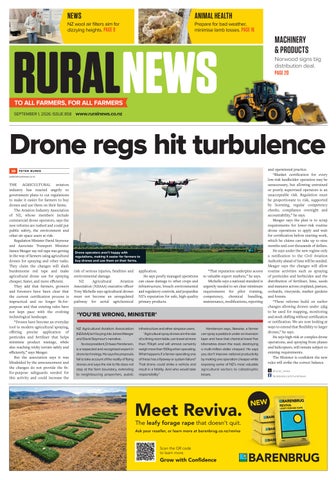
Drone operators aren’t happy with regulations, making it easier for farmers to buy drones and use them on their farms.
risk of serious injuries, fatalities and environmental damage. NZ Agricultural Aviation Association (NZAAA) executive officer Tony Michelle says agricultural drones must not become an unregulated pathway for aerial agrichemical
application. He says poorly managed operations can cause damage to other crops and infrastructure, breach environmental and regulatory controls, and jeopardise NZ’s reputation for safe, high-quality primary products.
“That reputation underpins access to valuable export markets,” he says. Michelle says a national standard is urgently needed to set clear minimum requirements for pilot training, competency, chemical handling, maintenance, modifications, reporting
‘YOU’RE WRONG, MINISTER’ NZ Agricultural Aviation Association (NZAAA) isn’t buying into James Maeger and David Seymour’s narrative. Its vice president, Dr Isaac Henderson, is a respected and recognised expert in drone technology. He says the proposals fail to take account of the reality of flying drones and says the risk to life does not stop at the farm boundary, extending to neighbouring properties, public
infrastructure and other airspace users. “Agricultural spray drones are the size of a dining room table, can travel at more than 70kph and will almost certainly weigh more than 100kg when operating. What happens if a farmer operating one of these has a flyaway or system failure? That drone could strike a vehicle and result in a fatality. And who would take responsibility.”
Henderson says, likewise, a farmer can spray a paddock under an inversion layer and have that chemical travel five kilometres down the road, destroying a multi-million-dollar vineyard. He says you don’t improve national productivity by making one operation cheaper while exposing some of NZ’s most valuable agricultural sectors to catastrophic losses.
Meet Reviva. The leafy forage rape that doesn’t quit. Ask your reseller, or learn more at barenbrug.co.nz/reviva
Scan the QR code to learn more.
Grow with Confidence
and operational practice. “Blanket certification for every low-risk landholder operation may be unnecessary, but allowing untrained or poorly supervised operators is an unacceptable risk. Regulation must be proportionate to risk, supported by licensing, regular competency checks, compliance oversight and accountability,” he says. Meager says the plan is to scrap requirements for lower-risk routine drone operations to apply and wait for certification before starting work, which he claims can take up to nine months and cost thousands of dollars. He says under the new regime only a notification to the Civil Aviation Authority ahead of time will be needed. Meager says the changes will allow routine activities such as spraying of pesticides and herbicides and the distribution of fertiliser, lime, seeds and manures across cropland, pasture, orchards, vineyards, market gardens and forests. “These reforms build on earlier changes allowing drones under 25kg to be used for mapping, monitoring and stock shifting without certification or notification. We are now looking at ways to extend that flexibility to larger drones,” he says. He says high-risk or complex drone operations, and spraying from planes and helicopters, will remain subject to existing requirements. The Minister is confident the new rules will strike the correct balance. @rural_news facebook.com/ruralnews
SEPTEMBER DAIRY DEALS FONTERRA FARMER EXCLUSIVE*
FONTERRA FARMER EXCLUSIVE*
BONUS
BONUS
PER $500 SPEND
PER $500 SPEND
40
30
ON SELECTED CROPPING SEED1
NUFARM SLUGOUT 10KG 205985
SKELLERUP FILTER SLEEVE 100 PACKS
FONTERRA FARMER EXCLUSIVE*
211153 211154 211155 211280 211596 211622
ON SELECTED PASTURE SEED1
SAVE
34
$
COUNTRY MILE CALF FEEDER BOTTLE 2.5L
SAVE
5
$
262780
GALLAGHER W-0 WEIGH SCALE + 1500KG LOAD BARS COMBO
SAVE
200
$
263877
NOW
NOW
NOW
$
$
$
9999
FIL DETAIL WATER BASED TAIL PAINT 1L 249140 249148 250643 249145 249149
1999
SAVE
14%
242916
NOW
2299
$
COUNTRY MILE CALF PELLETS 20% 20KG6
265936
FONTERRA FARMER EXCLUSIVE*
BONUS
50
10
$
GREYSON ECONOMY GATE, 4.88M 16FT, 4.57M 15FT, OR 4.27M 14FT
266839
SAVE
5
$
NOW
3069
SAVE
ADDITIVE BEDDING EAZYBED DRY 25KG
PER TONNE
14299
$
EA
COUNTRY MILE FENCE HUNG WATER TROUGH 12L
1,66099
$
FONTERRA FARMER EXCLUSIVE*
SAVE
40
$
BONUS
15
PER $500 SPEND
203462 203214 203213
NOW
11499
$
ON SELECTED AG-CHEM2
Terms and conditions apply. All offers valid until 30.09.2026 unless otherwise stated or while stocks last. Prices include GST and are subject to change. Any saving is based off the current retail price. *FONTERRA EXCLUSIVE PRICING excludes online orders and is only available to Fonterra Suppliers. The Fonterra Farmer Exclusive F$ Bonus Offers are exclusive to Fonterra farmers and available from: Cropping and Pasture Seed¹ available from 1 September to 30 November 2026. Ag-Chem² available from 1 September to 30 November 2026. For full T&Cs visit nzfarmsource.co.nz/tcs.
**
SCAN HERE TO SHOP NOW
ON SELECTED DEOSAN HYGIENE AND TEAT CARE PRODUCTS3
FONTERRA FARMER EXCLUSIVE*
BONUS
50
ON SELECTED FIL AND ECOLAB HYGIENE AND TEAT CARE PRODUCTS4
PER $500 SPEND
FONTERRA FARMER EXCLUSIVE*
BONUS
35
MILK BAR BLACK OR COLOSTRUM TEAT 206688 208191
PER $500 SPEND
STANDARD RETAIL
FONTERRA EXCLUSIVE*
$ 99
$ 49
5
BUNDLE DEAL TUX ENERGY EXTRA KIBBLE 20KG
FRISKIES 2.5KG RANGE 264546 264545 264547
262065
FONTERRA FARMER EXCLUSIVE*
SAVE
6
$
EA
5
EA
SILVAN BACKPACK SPRAYER 15L KN15D-2
25
$
263299
2 BAGS + FREE BOWL^^
$
19000
NOW
NUFARM CRUCIAL 15L 262444
$ SAVE
23
$
NOW
12499
$
EA
BAILEY WATER TANK 30,000L
360 MENS BRUSH COTTON SHIRT 266240 265594 264785
NOW
4,19999
3499
24699
$
$
ON SELECTED BRANDS OF CALF MEAL PURCHASED6
NOW
1999
NON BUNDLE PRICE $109.99 EACH
FONTERRA FARMER EXCLUSIVE*
BONUS
50
PER TONNE
$
EA
ON EVERY 20KG BAG OF ANCALF™ CALF MILK REPLACER PURCHASED5
FONTERRA FARMER EXCLUSIVE*
BONUS
10
PER BAG
^^Offer available at participating Farm Source stores only. Free bowl available while stocks last. The Fonterra Farmer Exclusive F$ Bonus Offers are exclusive to Fonterra farmers and available from: FIL and Ecolab3 Available from 1 June to 31 October 2026. Deosan4 Available from 1 June to 31 October 2026. Calf Milk Replacer Ancalf 5 Available from 1 July to 31 October 2026. Calf Meal6 Available from 1 August to 30 November 2026. For full T&Cs visit nzfarmsource.co.nz/tcs. **T&Cs and lending criteria apply.
100
$
Proven Solutions Fast-Flo Valve Compact, high flow & extremely versatile
34 L/min @ 29 PSI
Super-Flo Valve Slipper Fit Piston helps prevent stuck valves
188 L/min @ 29 PSI
Max-Flo Valve Stock proof & self cleaning
570 L/min @ 29 PSI
www.hansenproducts.co.nz
RURAL NEWS // SEPTEMBER 1, 2026
NEWS 3 ISSUE 858 www.ruralnews.co.nz
One voice, better returns? SUDESH KISSUN sudeshk@ruralnews.co.nz
NEWS ��������������������������������������� 1-9 HOUND, EDNA �����������������������10 CONTACTS ������������������������������10 OPINION ������������������������������10-11 AGRIBUSINESS ���������������������� 12 MANAGEMENT ����������������14-15 ANIMAL HEALTH ������������� 16-17 MACHINERY AND PRODUCTS ����������������������� 18-20 RURAL TRADER ��������������������� 21
HEAD OFFICE Lower Ground Floor, 29 Northcroft Street, Takapuna, Auckland 0622 Phone: 09-307 0399 Fax: 09-307 0122 POSTAL ADDRESS PO Box 331100, Takapuna, Auckland 0740 Published by: Rural News Group Printed by: Inkwise NZ Ltd CONTACTS Editorial: editor@ruralnews.co.nz Advertising material: beckyw@ruralnews.co.nz Rural News online: www.ruralnews.co.nz Subscriptions: subsrndn@ruralnews.co.nz
WILL A stronger, more coordinated voice help rebuild confidence and improve returns in the wool sector? That’s the question from sheep farmers in response to a new sectorled body focused on growing the value of New Zealand wool. Last week it was announced that Wool Impact and Campaign for Wool NZ have formally merged to form the New Zealand Wool Collective. Federated Farmers meat and wool chair Richard Dawkins told Rural News that farmers welcome the establishment of the New Zealand Wool Collective. “New Zealand’s domestic wool industry has shrunk considerably, so consolidating effort and capability is a positive and logical step,” he says. “For farmers, the important thing now is whether that stronger, more coordinated voice can help rebuild confidence in wool and improve returns over time.” NZ Wool Collective chief executive Ross McIsaac says the merger builds on two years of partnership between the organisations, aligning their work, expertise and resources.
Federated Farmers meat and wool chair, Richard Dawkins.
“New Zealand wool has value that isn’t being fully realised, and capturing more of that for wool growers will require collective effort alongside the work of individual businesses. “A number of wool organisations and businesses are doing valuable work to support the sector, and that’s helped to create a strong foundation. Many in the sector have said the lack of one focused wool sector organisation and voice has been a frustration and this merger addresses that.” Campaign for Wool NZ chair Ryan Cosgrove says the merger secures their work. “It’s exciting to reach this milestone.
We are confident that combining the work and capability of the two organisations will create the focus and efficiencies needed to modernise the wool sector.” Wool Impact chair Stuart Heal says the merge makes sense. “Wool needs more coordinated effort to create demand and value across sector good and commercial entities and this supports that.” NZ Wool Collective will need additional funding and is in discussions with Wool Research Organisation of New Zealand and B+LNZ to secure the long term financial backing needed to realise value for growers, industry
participants and the wider wool sector will continue. A funding model is being developed in consultation with growers and industry. Sheep farmers facing lower wool prices for over a decade have been given a reprieve in recent months. Strong wool prices are sitting over $5/kg clean, higher than at any other point in the past decade and up 55% year-on-year. However, prices have come down from their highs of May and June this year. Supply is tight on both sides of the Tasman; that hasn’t changed and demand is consistently strong.
HOW TO MANAGE EL NIÑO PETER BURKE peterb@ruralnews.co.nz
ARE YOU ready for El Nino? That’s the question asked by Beef+Lamb NZ’s Ian Tarbotton who leads B+LNZ’s farm extension service. He says there’s a lot of speculation about what this weather system may throw at farmers and they need to plan and be ready for any eventuality. One thing Tarbotton says B+LNZ is encouraging farmers to do is to plant a crop to give them a feed
• Ideal for Cattle Troughs • High Flow • Side/Bottom Mount • Detach to Clean • Compact/Robust
buffer if things turn for the worse. He also suggests following the advice of a fertiliser company and getting fert – nitrogen and sulphur – on early and making wise use of it to boost pasture growth. “Put fertiliser on now and don’t wait until pastures dry out. Nitrogen put on now has a more gradual response over a longer period, which is just perfect underfoot of lactating ewes,” he says. He also recommends farmers check the udders of ewes at weaning
and cull any animals with defects immediately. He says it’s important to get poor performing animals off the farm early and give the young stock priority for the quality feed. “Last but not least, it’s probably not the season to finish all lambs. It may be the time to sell some as store to give yourself more of a buffer if things get dry in the summer period, especially in the east coast regions,” he says. Tarbotton says selling some of the poorer lambs and getting others to finish them makes perfect sense.
• Ideal for Small/Low Demand Troughs • Low Flow • Above/Below Water Mount • Built in Check-Valve
0800 JOBE VALVES jobevalves.com
It means that the capital stock they want to hold are in good condition for tupping. Providing that extra quality feed is important, he says, and farmers that have flat land should make more silage and hay to build up that buffer of surplus feed. “This is an easy management lever to pull,” he says. Finally, Tarbotton says farmers should have a plan and do stock takes of their animals and feed throughout the season and make decisions based on the latest weather information.
• Ideal for Compartment Troughs/Tanks • High Flow • Top Mount • Detach to Clean • Compact/Robust
RURAL NEWS // SEPTEMBER 1, 2026
4 NEWS
Red meat farmers back ETS report NIGEL MALTHUS
NEW ZEALAND’S Emissions Trading Scheme (NZ ETS) encourages afforestation while not achieving climate goals, says a new report released by the Parliamentary Commissioner for the Environment, Simon Upton. The report, Adrift: What future does the Emissions Trading Scheme have? says the NZ ETS is not fit for purpose. It says it will not achieve climate goals, nor yield carbon prices high enough to significantly reduce emissions.
“Instead, it will continue to drive the planting of new forests to offset emissions, leading to a significantly larger forestry estate over time. “That forestry estate will need to be maintained by future generations in the face of increasing risks from fire, disease and extreme weather.” The report was tabled in Parliament last Wednesday. Upton said the role of forestry in particular needs a fundamental rethink if New Zealand was to have any hope of achieving its climate commitments and
reducing the risks that the inclusion of forestry in the NZ ETS has created. Beef + Lamb New Zealand says the report “supports many of B+LNZ’s positions and will encourage important discussions”. Chair Kate Acland says B+LNZ has been calling for changes to the ETS since 2019. “We have continually raised concerns about the unintended consequences of the current ETS settings, particularly the amount of productive sheep and beef farmland being converted into carbon forests.
“Independent research we’ve commissioned shows the total extent of whole sheep and beef farms sold for afforestation since the beginning of 2017 is now 330,000 hectares. The PCE’s report shows the trees planted on that land will break the ETS from the 2030s, when there will be an oversupply of sequestration.” But the immediate past president of The Institute of Forestry, James Treadwell, said it was carbon emitters, not forestry, that the commissioner should look to take real action, and reduce their
emissions. “At the moment, the only thing that is helping New Zealand meet its commitments internationally is forestry. “Whilst we’d like that not to be the case, we have to continue doing that or else every single New Zealander will be paying for it in 2030 and 2050 because we’re going to have to buy units from overseas.” Treadwell said constant changes to the scheme – for example the national annual cap of 15,000ha for new exotic forestry on class 6 farmland imposed last year – made it hard for
Simon Upton
foresters to make market decisions and do their part to reduce emissions. “Is the ETS working wonderfully? No it’s not, but it’s working okay,” said Treadwell. “But emitters do have
to start reducing their emissions, that’s the end goal. “We are the only people who are actually doing anything about emissions at the moment, to be frank.”
BEWARE OF THE CHANGING WEATHER PETER BURKE peterb@ruralnews.co.nz
THE TERRIBLE floods that hit the Wairarapa may have subsided, but the danger to farmers still exists, according to local Federated Farmers president Rob Hickson. The problem is that many farm tracks have been damaged and the ground remains wet, is still moving and slips could occur at any time. His comments mirror that of the local police who say that in the last six months they have attended at least six accidents on farms where
people have been badly injured and in one case died because of the state of farm tracks or simply unstable and damaged pastures. Hickson says there have been a lot of slips on farms, including his own hill country property out towards Castlepoint, and these have made tracks impassable. Like the police, he is warning farmers not to take risks. “With damaged tracks, there is often the temptation to get around a slip and try to push on, and that’s when accidents can happen as ground gives way with the weight of the vehicle. They should also stick to tracks and
not drive on wet grass. From personal experience, driving on any wet grass is where a lot of accidents can happen because you can lose traction,” he says. Wairarapa Police Area Commander Inspector Nick Thom says the message is to take particular care as farmers in the region are busy with lambing and calving. The weather has caused extensive slipping on farm tracks as well as waterlogged paddocks, leaving the ground unstable, uneven, and slippery. He says police are strongly urging all farm owners, managers, and operators
to review their safety vehicle protocols, particularly when navigating sloped surfaces and steep hillsides. “Farmers are urged to choose the right vehicle for the specific job, ensure all machinery is regularly serviced, and verify that every operator is competent, trained, and wearing the correct personal protective equipment,” he says. Meanwhile, Sarah Donaldson of the Wairarapa Rural Support Trust, says during the lambing and calving season, and through this extra challenging post-storm period, they encourage everyone to be on the lookout for
one another, be aware of the impact of fatigue, and take extra precautions on the land. “History and analysis of incidents over the years shows that injury and death can occur to even the most experienced operators, so all rural folk are urged to think carefully about their own situations and experiences when it comes to operating all rural machinery,” she says. Sarah Donaldson says in response to these ongoing challenges, the Wairarapa Rural Support Trust is actively scoping avenues to offer community farm safety courses.
With Active Descent Control, Polaris has you COVERED.
STEEP HILL? NO WORRIES. Automatic Engine Braking System (EBS) and Active Descent Control (ADC) delivers a smoother and more controlled deceleration downhill.
WWW.POLARISNEWZEALAND.COM
44 HP | 612 KG TOWING CAPACITY | 1,587 KG WINCH 22.6 CM OF TRAVEL & ARCHED DUAL A-ARM
MY26 SPORTSMAN 570 TRAIL FROM $18,995 INC GST
RURAL NEWS // SEPTEMBER 1, 2026
NEWS 5
Arable sector ‘losing good people, land’ NIGEL MALTHUS
THE ARABLE sector losing good people and land is a major concern for the 2026 Arable Farmers of the Year, Mid Canterbury seed growers John and Mel McCaw. The couple came away with the premier award at the recent awards dinner in Christchurch, the judges citing their industry leadership as much as their on-farm performance. As well as producing a diverse range of high-quality seed and cereal crops, they were recognised for their “exceptional attention to detail, innovation, and commitment to advancing the seed industry”. While saying it was important for the industry to stay positive and not talk itself down, John McCaw told Rural News that the arable sector faced real challenges around profitability, with near static prices for an extended period while farm inflation had been running rampant. “Farmers are having to have a pretty close look at their expenses and they really need to consider the contract terms and pricing before signing up, because some of the contracts that are on offer just simply would not be profitable.” McCaw said there was certainly a lot of land use change underway. He was aware of six
current dairy conversions in the Methven area, and others considering it. And for every dairy farm, there was a support block, he said. McCaw said farmers putting in more kale for wintering stock, grass for silage, or trading more lambs, were decisions that tended to “fly under the radar” but were very significant and add up very quickly. The real change on farm would be a shift in emphasis over time, from seed to feed. “People may, for example, choose not to grow autumn feed wheat, but rather go through a crop of green feed oats for winter feed, and then grow a spring cereal crop instead because the value of that winter feed is now greater than the yield penalty of growing a spring cereal versus an autumn cereal. “These are the things that are happening now and people are making these decisions now. “It won’t be until the autumn when the seed companies are looking to contract Autumn Zone crops that they find that actually that area is no longer available.” McCaw said that once a dairy shed goes on a farm, there’s no going back. “So, we are certainly losing, not only good land, but very good growers and a lot of skill and expertise that are leaving the industry. And that is a real concern.
“But to counter that, I think there will always be demand for high-quality seed production. “I personally believe that a very clean well-run
continuing to invest in our in our businesses on that basis. “But there are certainly challenges to work through with the
Arable Farmers of the Year and Seed Grower of the Year - John and Mel McCaw.
seed companies. And I think, to be honest, it’s only really just starting
to dawn on the seed companies, just how serious this is.”
Sustainable, targeted and cost effective
CONTROL IN PASTURE
Targeted insect protection
SEED TRADERS
Soil-borne seedling disease defence
With the recent removal of chlorpyrifos from the market, Superstrike® seed treatment is a sustainable, targeted and cost-effective solution for pest and disease control for your new pasture.
PROTECT YOUR SEED, PROTECT YOUR FUTURE.
PWS2717
THE FAMILY farm 560ha near Methven - the farm John McCaw grew up on, his parents having bought the original property in 1968. The farm specialises in high-quality small seed production, chiefly ryegrass and cocksfoot and also vegetable seed. They trade 5000 lambs a year, winter dairy cows and raise young stock for a neighbouring dairy farm, in a multifaceted operation. The couple also owns McCaw Seeds seed dressing plant in Methven, servicing other growers in the province. John is also the chair of Federated Farmers’ herbage seed subsection. The McCaws also won the Seed Grower of the Year award.
arable farm producing high-quality seed has a future. “We’re certainly hoping that that is the case and we’re
For more information, talk to your local seed retailer or visit seedtreatment.co.nz
RURAL NEWS // SEPTEMBER 1, 2026
6 NEWS
EPA’s major reset PETER BURKE peterb@ruralnews.co.nz
THE CHAIR of the country’s environmental regulator, the Environmental Protection Agency (EPA), says changes are already under way to improve the performance of the agency to better meet the needs of those who interface with them. The EPA is responsible for approving and setting controls on the use of new hazardous substances, such as chemicals used on farms and orchards, and also the importation of biological control agents such as parasites to control weeds. But for a number of years the agency has been the subject to widespread criticism for being too
bureaucratic and taking too long to approve new organisms and hazardous substances. Dr Barry O’Neil told Rural News the new
board, new CEO and new senior staff have got the message. He says they have developed a strategy that will set the EPA on a pathway to becoming
a modern regulator that understands what is happening in the real world, is connected to the stakeholders and is delivering the right
CONSUMER FOCUS BARRY O’NEIL says NZ has a unique environment that it needs to preserve and part of that is reducing the use of certain agrichemical products which are viewed negatively by consumers. “Consumers are becoming very discerning, especially those who spend more money to buy NZ products which they regard as high quality, safe and nutritious. And we need to provide these for them,” he says. The other issue that is constantly being raised by those in the horticulture sector is the need for a faster approval pathway for products that have been approved in other countries with high-quality regulation – such as Australia, Canada the UK and Europe.
O’Neil agrees that NZ needs to be better connected with what he calls “like-minded regulators” and points out that just recently the CEO of the EPA was in Australia seeking to build stronger relationships with our transTasman neighbours. However, he warns that NZ still has to make sure that a product approved in another jurisdiction does meets our specific requirements. Overall, O’Neil says in a relatively short space of time the EPA has modernised its operating systems, put in place new quality control measures and is shaping the organisation to be a modern, effective regulator that is connected to its stakeholders.
outcomes for NZ in an appropriate timeframe. These changes are starting to show, with the EPA saying that in the past year it reduced the number of applications waiting for approval by more than 36% and the level of applications approved is back to precovid levels. “We are focusing on new technologies such as AI and seeing how we can use this in our regulatory processes. Some of the regulated products we are dealing with are novel, which we have never had to deal with before. What we are endeavouring to do is getting an understanding of what is coming down the pipeline and having systems in place to be able to deal with these,” he says. One of the emerging
Sharpen up your pre em options in maize. NEW FlexiRate now registered Trials show that the new 100 g/ha rate of Sharpen + acetochlor delivers better broadleaf weed control and yield protection than atrazine + acetochlor. The original 150 g/ha rate remains the gold-standard for targeting high yields or managing high weed pressure.
Scan the QR code or contact your local BASF representative on 0800 558 399 ALWAYS READ AND FOLLOW LABEL DIRECTIONS ACVM registration number: Sharpen®: P008391. © Copyright BASF 2026. ®Registered trademark of BASF. BASFNZAR0009 0826
Dr Barry O’Neil
challenges facing the EPA and other similar regulators worldwide is pressure from consumers about the amount of chemicals being used to control diseases. Barry O’Neil says there’s a move away from the concept of one thing/ product to solve a problem and an emphasis
on ‘integrated pest management’ (IPM). This involves using several things, be they chemicals or biological products, to control a problem disease. These are exciting times with more tools being added to the toolbox, he says. @rural_news facebook.com/ruralnews
RURAL NEWS // SEPTEMBER 1, 2026
NEWS 7
TOP seeks to end ‘cycle of instability’ JESSICA MARSHALL jessica@ruralnews.co.nz
THE OPPORTUNITY Party has faced criticism during the election campaign that its policies are too urban-focused and offer little for rural communities. But deputy leader and agriculture and forestry spokesman Daniel Eb says the party’s approach is designed to tackle some of the structural problems affecting both rural and urban New Zealand. Eb is running in the Kaipara ki Mahurangi seat set to be vacated by former Defence Minister Chris Penk. Prior to entering politics he launched Open Farms, the national open farm day designed to reconnect urban New Zealanders with farming land.
Over the past few weeks, he has travelled up and down the country, attending events with rural Opportunity candidates, with events previously held in Masterton, Wanaka and Whangarei. “We’re getting into more of the rural New Zealand heartland through public meetings primarily,” Eb told Rural News. A key part of Opportunity’s pitch, he says, is a willingness to listen to experts and make longer-term changes rather than repeatedly reversing policy when governments change. Eb points to health as an example, arguing that successive governments have created a “cycle of instability” by restructuring or abandoning policies
TOP deputy leader and ag spokesman Daniel Eb.
introduced by their predecessors. “And that’s been particularly keenly felt in health,” Eb says. He cites changes to capitation funding, which GP practices rely on when planning staffing and resources, as an example of the uncertainty facing the sector. “So, things like rural health just can’t really
be a political football anymore. We actually need to take the politics out of health care planning as much as possible,” Eb says. That philosophy also shapes Opportunity’s approach to agriculture. “We’re more about big systemic, transformational changes that affect everyone because whether you’re rural or urban New
Zealand, you have to participate in the tax system, you participate in the health system, you participate in the education system. And so we’re more interested in shifting the really big underlying pillars of our systems rather than little carve-outs to help this industry or little carveouts to help that industry. “So, we’re more interested in that than, you know, what does this slice of regional New
Zealand need? We think that is a recipe for more bureaucracy. And that sort of administration, that’s not always effective.” Eb says he doesn’t believe the rural versus urban framing within New Zealand is helpful. “You know, you sort of see this line trotted out, an attack on farming. No one is attacking farming. What we’re trying to do is enable New Zealand’s economy to take a
transformational shift, right? Like we did in the ‘80s. We’ve done it prior to that before. The New Zealand story has always been about taking a big shift to the next model. “I don’t think this reflexive pushback from some in the agricultural sector is helpful. Frankly, it’s rather, sit down, compromise, have mature adult discussions about these things, instead of labelling each other as the enemy.”
LAND-VALUE TAX ONE OF Opportunity’s flagship policies is an overhaul of the tax system that includes an annual land-value tax (LVT) of 0.5% on rural land and 1.75% on urban land. The policy is likely to be one of the more significant points of interest for farmers considering the party’s platform. Deputy leader Daniel Eb says that
for those farmers who are land rich but cash poor, a deferral scheme will be in place. This, he says, is because the party recognises farming as a “boom and bust business”. “Prices are really good right now, but they weren’t two years ago, so that mechanism exists in the system,” he says.
Expert-Led Travel with like minded people Up to 40 Domestic & International tours available
The Chatham Islands Unique wilderness, culture and landscapes 16 Jan 2027 I 8 days I $5,225 pp
Coromandel Charms Coromandel, Whitianga, Whangamata, Rotorua 21 Feb 2027 I 6 days I $3,199 pp
Southern Africa Sights of the South Luxury Mini Van, max 14 guests. Akaroa, West Coast, Lake Tekapo 23 Feb 2027 I 8 days I $5,090 pp
0800 11 60 60 www.travelwiseholidays.co.nz Prices shown are share twin per person
RURAL NEWS // SEPTEMBER 1, 2026
8 NEWS
Freshwater farm plan changes applauded PETER BURKE peterb@ruralnews.co.nz
THERE’S BEEN widespread support from the primary sector for the Government’s announcement on changes to freshwater farm plans that come under the Natural Environment Bill, which is now set to replace the existing RMA. Primary sector groups say the changes give great clarity, reduce costly consenting processes and are in line with what the sector has been asking for. In essence, while all farmers or growers will
need to produce a farm plan as such, only those deemed to be engaged in ‘high risk’ activities will need to have their plan certified. The risk activities are defined as dairy farming, grazing pigs, commercial vegetable growing and land used for feedlots. Exempt from audited plans are orchardists and vineyards, and sheep and beef farming operations will only need to have an audited plan if any of the activities on their properties are deemed high risk. In the case of winter grazing or irrigation, the auditing requirement will only
kick in if the land used for this purpose is more than 50ha or 10% of the farm, whichever is the greatest. Agriculture Minister Todd McClay says the changes to freshwater farm plans create a simpler, cheaper system focused on real risk. He says the changes fix a system which farmers said was too costly and too complicated for the risk involved on many properties. These changes fix that,” he says. Associate Agriculture Minister Andrew Hoggard says once the regulations are in place,
EFFECTIVE WEED CONTROL
the Government will be helping farmers get their plans sorted so they’re ready to go under the new planning system, where they will play a key role. He adds that a pathway has been set up for industry organisations to provide certification and audit services to their members when their plans are delivering equivalent outcomes,
avoiding duplication. “As a farmer, I hate having to do a job twice, especially if it involves paperwork,” he says. Hoggard says the changes result in a system that is risk-based, focuses on managing those actual water quality risks, avoids unnecessary duplication and reduces costs. @rural_news facebook.com/ruralnews
GREATER CLARITY FEDERATED FARMERS president Colin Hurst says the changes make the system much more straightforward, practical and give greater clarity. He says Feds have been clear that farm plans can have a role to play in improving freshwater outcomes, but only if they are practical, proportionate and reduce red tape rather than adding to it. Hurst says his organisation is particularly pleased that not every farm plan will require certification and auditing, and where certification is required, it’ll generally apply only to the higher-risk activity that triggers it, rather than the whole farm. “That’s a really big win for farmers who under the previous approach could have had their whole farm dragged into certification,” he says. Hurst says Feds have long argued that farm plans should replace and not add to regulation and adds that this is the most important issue still to be resolved.
World’s most powerful variable speed clipper is here!
handypiece Trailing model towed by a small vehicle Control of Californian thistles, Rushes, Scotch thistles, Ragwort, Dock and more
• Single height adjustment • Roller drive disengagement • Fold-up drawbar • Tank leveller adjustment • Double frame – great strength
Get your Repairs and Servicing done NOW! ■ Ideal for shearing sheep, alpacas, goats and cow tails. ■ Variable speed from 2600-3500 rpm. ■ Latest brushless motor technology means minimal heat build up ■ 1400gms means 100-200gms lighter than standard handpiece. ■ At 2800 rpm the 12-volt lithium battery will crutch 300-400 sheep or trim up to 400-500 cow’s tails. ■ We customise cables for lifestyle shearing.
HELP US TO HELP YOU FOR THE NEW SEASON View in action go to www.handypiece.co.nz
48 Bremners Road, Ashburton • W: www.rotowiper.com P: 03-308 4497 • M: 027-311 9471 • E: sales@rotowiper.com
Freephone
0800 474 327
email: dave@handypiece.co.nz
Associate Agriculture Minister Andrew Hoggard says once the regulations are in place, the Government will be helping farmers get their farm plans sorted.
RIGHT BALANCE BEEF+LAMB NZ describes the changes as pragmatic and cautiously welcomed them. Chair Kate Acland says B+LNZ had been advocating for a system that is practical and workable for farmers and one that takes a risk-based approach to what is required. “In principle we support farmers having a plan for how they manage their land – including their water, biodiversity and soil health. Land is their most important asset, after all, but plans should add value to a farming business – not simply be a compliance tool,” she says. Acland says it’s critical to strike the right balance in the level of regulation around freshwater plans. DairyNZ chair Tracy Brown says the new system is simple, more practical and lower cost. They say this means less duplication, reduced compliance burden, and greater flexibility in how environmental outcomes are achieved on farm. Brown says DairyNZ welcomes improvements that reduce cost and complexity and provide greater flexibility in plan structure. According to Brown, Freshwater Farm Plans must remain robust and credible and should cover the whole farm, particularly where a plan is used as an alternative to rules or resource consents. NZVeg, which represents commercial vegetable growers, says it applauds the Government for taking action to provide certainty in the key growing areas of Pukekohe and Levin, where regional plan changes could have seen growers walking off the land. CEO Mike Brown says growers in these areas have been living with uncertainty for more than a decade, due to tortuous and expensive regional plan change processes. “It was incredible to think that growers could have been forced to arbitrarily reduce vegetable production by as much as a third in some areas. And at the same time increased prices when New Zealanders are facing a costof-living crisis,” he says. Brown says the changes will restore confidence to the vegetable industry, and support growers to do what they do best: grow fresh healthy vegetables at reasonable prices, for the good of Kiwis’ health.
RURAL NEWS // SEPTEMBER 1, 2026
NEWS 9
NZ wool air filters aim for dizzying heights SUDESH KISSUN sudeshk@ruralnews.co.nz
NEW ZEALAND wool is reaching new heights as air filtration companies moves away from synthetic products to biodegradable alternatives. Wool from selected New Zealand farms is being used by Auckland-based tech company Lanaco to make filters for air purifiers. Lanaco has partnered with Unilever-owned Blueair to launch the world’s first biobased wool filter – made from NZ wool and 100% USDA certified biobased material. Wool material from Lanaco has proven effective in the toughest environments, even selected for NASA’s Artemis missions to the moon and back, as part of the vehicle’s emergency air protection systems. Lanaco founder and chief executive
Nick Davenport says that being selected for the Lunar missions is a tick of confidence for NZ wool. Davenport believes NZ wool “stands at the base of a large mountain”. “Air is universal and where people breathe, there will be opportunity for NZ wool,” he told Rural News. Davenport said Lanaco was targeting the global filter media market, valued at more than US$8 billion. The Unilever partnership was the first of several high-volume market opportunities that the company was pursuing, and more announcements around commercialisations are expected in the coming months. The bio-based, USDA-certified wool filter based on Lanaco’s Ecostatic filter that uses biodegradable alternatives while maintaining its high-performance standards.
Designed for the Blue Pure 211i Max air purifier, the new filters offer an 18-month lifetime and effectively capture allergens such as dust, pollen, and pet dander, removing 99.97% of airborne particles. Davenport says the breakthrough of having the product make it to a global market is significant, both for Lanaco and for New Zealand wool. “Just as Icebreaker did for wool clothing, Lanaco is bringing its branded New Zealand wool technology to the global filtration market by partnering with one of Europe’s greatest consumer goods companies.” Blueair chief executive Andy Lu says Blueair has stayed true to its mission of helping people breathe cleaner, better air for 30 years, and its partnership with Lanaco, which brings the industry’s first filter to market, shows what that mission can achieve.
Nick Davenport, Lanaco, says the breakthrough of having the product make it to a global market is significant.
“We have spent the past two years working hand in hand with Lanaco to bring this groundbreaking achievement to the masses. Thirty years in, and we continue to pioneer what air wellness
can mean for people’s everyday lives.” New Zealand remains a small market for the wool filters, with some used in car air filters and DVS home ventilation systems.
MAGNIFICENT RIVERS
OF EUROPE
21 DAYS I 25 MAY 2027 HIGHLIGHTS: Budapest - Bratislava - Vienna - Wachau Valley Regensburg - Rhine Gorge - Cologne - Amsterdam
SAIL THROUGH THE HEART OF EUROPE Embark on a fully escorted, unforgettable journey to Europe. From Budapest to Amsterdam, discover grand capitals, explore charming medieval towns and cruise through the breathtaking Wachau Valley and the Rhine Gorge. With Avalon Waterways' renowned service, and spacious Suite Ships, every day brings another unforgettable experience. Enjoying pre & post cruise stays with sightseeing, this expertled cruise-tour is perfect for the 60+ traveller.
0800 11 6060 info@travelwiseholidays.co.nz www.travelwiseholidays.co.nz
$18,480pp share twin Includes: Return Economy class flights to Europe from Auckland Pre & post cruise accommodation incl. sightseeing Avalon Waterways 14 night Budapest to Amsterdam river cruise including meals, daily happy hour plus drinks with lunch & dinner, shore excursions All gratuities & entrance fees Terms & Conditions apply, please enquire.
RURAL NEWS // SEPTEMBER 1, 2026
10 OPINION EDITORIAL
EDNA
Drones are not toys DAVID SEYMOUR and James Maeger’s plan to make it easier for farmers and orchardists to operate drones can best be described as a ‘courageous’ move. It appears to be a case of Ministers ignoring the advice of the professionals who know the intricacies of drone technology and operation, and bowing to drumbeats of some farmers who think that drones are just a toy. No doubt there are farmers, growers and orchardists who can fly drones properly and safely, but surely there need to be rules to protect those who think they know more than they do. The NZAAA has made it clear they are open to changes to the drone rules and have long agreed that they support some freeing up of the present regulations and the cutting of red tape. But this move is a bit akin to allowing everyone to get a driver’s license without undergoing a test appropriate to their use of the vehicle. What is missing from the narrative put out by the Ministers is that cutting the CAA regulations and supposedly stripping out red tape is just one part of the equation. What they fail to mention is that the rules around spreading chemicals and fertiliser are strictly controlled by the regional councils. There are also strict rules on handling chemicals. Do they realise that the spray drift from drones is less controllable than from fixed wing aircraft or helicopters? Do Seymour and Maeger plan to make changes to the new RMA and HSNO legislation? Because if they don’t, a new drone may just be that – a drone on the bank balance. Buying a drone is just one step and being able to safely fly a large drone over a paddock or an orchard is not the same as taking family pictures from high up. Commercial drone operators say it takes months to become proficient with their machines and the legislation that controls their use. In some ways, the narrative from the coalition Ministers sounds like a bit of con job – who knows. Their announcement does raise a cauldron of pertinent questions.
RURALNEWS TO ALL FARMERS, FOR ALL FARMERS
HEAD OFFICE POSTAL ADDRESS: PO Box 331100, Takapuna, Auckland 0740 Phone 09-307 0399 PUBLISHER: Brian Hight .......................................... Ph 09 307 0399 GENERAL MANAGER: Adam Fricker ....................................... Ph 021-842 226 EDITOR: Sudesh Kissun ...................................... Ph 021-963 177 sudeshk@ruralnews.co.nz
“Have we had any luck?”
Want to share your opinion or gossip with the Hound? Send your emails to: hound@ruralnews.co.nz
THE HOUND Zero affinity
Pot calling
The ‘Opportunists’
Right of way
KIWI FARMERS can count themselves lucky they are represented in Parliament by at least a few people that have an affinity with farming. Contrast this with the UK, where Stephen Morgan, the Labour MP for Portsmouth South, and more significantly, Britain’s new farming minister, can’t even stand the sight of meat without fainting. On a recent visit to a food processing plant, where in the words of a local farmer, “he’d been shown large chunks of beef as well as some steaks”, Morgan reportedly fainted. Not a good look and it has done little to disavow UK farmers of the view that Labour and its ministers have zero affinity for them. In fact, it’s hard to imagine someone less suited to the job. What hope is there for UK farming when the man in charge faints at the sight of meat?
WHILE THE Feds, among many others, have welcomed the Government’s decision to step in and pause key parts of Waikato Plan Change 1, giving farmers breathing room while the resource management system is overhauled, the Waikato Regional Council struggled to hide its bitterness about being over-ruled. The intervention comes after repeated calls to put PC1 on ice because it threatened to burden farmers with new rules while the Government is in the middle of overhauling the RMA, freshwater rules and the farm planning system. In response, WRC chair, Warren Maher, was “disappointed discussions were had with a number of parties, but our advice or input was not sought”. The Hound reckons the same finger can be pointed at this and other councils who rushed ahead with their own agendas, knowing full-well the Government planned an RMA overhaul.
FOR REASONS which defy logic and political nous, a group of individuals known to few and calling themselves the ‘Opportunity Party’ have, with some help from media, managed to figure in the election polls. Their rise has been rapid and seems in part fuelled by frustration with the established parties. On present polling, they could hold the balance of power, and this old mutt would argue that this is scary stuff. Professional opinionator Helen Clark aptly described TOP’s leader’s attempts to defend its land tax, high income tax and public sector job cuts as “fantasy posing as policy”. Is this just a new bunch of politically inexperienced dreamers selling fairy dust politics to the disaffected? The Hound reckons at least the media is finally holding these clowns to some level of scrutiny rather than just regurgitating their fantasies.
SHED A tear for poor old Christopher Luxon. Times have been tough as he attempts to screw down a lid on the can of worms - AKA, two aborted coups. However, he has finally recognised what many Wellingtonians have complained about for ages – the plethora of silly cycleways – one of which is making it difficult to get across Molesworth Street from Parliament to the inviting ale houses across the street. To cross this street from Parliament, you have to negotiate a row of parked cars, then the street itself, then another row of parked cars and then the cycleway and finally, with luck, reach the footpath on the other side. Wellington’s Greens have clogged the city with cycleways and removed parking, killing the inner city’s economy. The joke about Wellington now rings true...it’s the dead centre of NZ!
EDITOR-AT-LARGE: Peter Burke ........................... Ph 021 224 2184 peterb@ruralnews.co.nz
AUCKLAND SALES CONTACT: Stephen Pollard ......................... Ph 021 963 166 stephenp@ruralnews.co.nz
SOUTH ISLAND SALES CONTACT: Kaye Sutherland .......................Ph 021 221 1994 kayes@ruralnews.co.nz
REPORTERS:
WAIKATO & WELLINGTON SALES CONTACT: Lisa Wise .................................. Ph 027 369 9218 lisaw@ruralnews.co.nz
DIGITAL STRATEGIST: Jessica Marshall .............. Ph 021 0232 6446
Nigel Malthus ........................Ph 021-164 4258 MACHINERY EDITOR: Mark Daniel ..............................Ph 021 906 723 markd@ruralnews.co.nz PRODUCTION MANAGER: Becky Williams ......................Ph 021 100 4381 beckyw@ruralnews.co.nz
PRINTED BY INKWISE DISTRIBUTED BY REACHMEDIA
Paper used in this publication is from forests managed in line with the strictest environmental, social and economic requirements. 100% recyclable, the papers we use are from forests that will be around for generations to come.
Rural News is published by Rural News Group Ltd. All editorial copy and photographs are subject to copyright and may not be reproduced without prior written permission of the publisher. Opinions or comments expressed within this publication are not necessarily those of staff, management or directors of Rural News Group Ltd.
RURAL NEWS // SEPTEMBER 1, 2026
OPINION 11
It’s the margins that matter IT APPEARS to be difficult for people who haven’t tried to run a business to understand the difference between assets and cash. Nor do they understand that record payouts and schedules aren’t the same thing as record profits – it is the margins that matter. Or that the risk in farming is such that interest rates are higher than for housing, and that if something goes wrong, it is the house as well as the business that might be lost. Farmers and growers understand all these factors, but somehow the message is not getting through to society in general and some groups in particular. Economists have tried to explain that farming is hard work with
COMMENT
Jacqueline Rowarth variable returns on the investment – and that the payoff isn’t in farming, it is when the farm is sold and capital gains banked that the farmer benefits. But strangely, the capital gains that are expected to be part of selling the family home are considered to be ‘unfair’ in farming. Even more strange is the adoption of the phrase ‘farming is a lifestyle’ by those outside the industry. Although farmers use the phrase to
justify the challenges of working in the industry, and to try and encourage the young to consider that they might have a future in farming, when people outside of the industry start using the phrase it tends to be in justifying why farms aren’t businesses. New Zealand is not unique in the lack of understanding. UK farmers are battling the Inheritance Tax. Many farm businesses are marginal or loss-making, with families surviving on subsidies (which are reducing) and off farm income. Despite this they will soon be hit with unaffordable inheritance tax bills, which in many cases will dwarf their annual profit. The television programme, Clarkson’s Farm, has
been helpful in bringing the issues to the fore, but the ever-changing UK government leadership has not indicated any relief. Although Andy Burnham has pledged to “safeguard” farming and declared it a “critical sector”, the statement appears to be more about national manufacturing and food security than assistance for farmers. Food security has also been in the news here, with statements that ‘food should be cheaper’. These statements overlook the costs of production. Margins matter. Record margins (percentage of revenue) help pump the economy for the benefit of everybody as the money goes round. It is the rising tide floating all boats, and the tax paid
to the government by profitable businesses is invested in education, health, infrastructure and other public services. These good messages are lost in the hype about the ‘crisis’ in the cost of living. A crisis is something that is short lived; inflation escalated during 2021 and although it has reduced at various stages since then, various weather events and global disruptions have combined to continue uncertainty and price fluctuations. The reality with the cost of living, at least according to the Reserve Bank Inflation Calculator, is that in the last year to Q1, wages and food increased by 4%. And despite the ongoing gloom about crises, public happiness,
HANDLE BAR PROTECTOR
safety and ‘being surrounded by such diverse, breathtaking scenery’ all help to improve the country’s score. Despite this, ‘crisis’ continues to be top of mind for people living here and food is considered to be part of the problem. Whose job is it to explain that when the minimum wage goes up, everything increases in price at every stage? Whose job is it to explain that record prices do not equal record margins? And who should try and explain the difference between assets and cash? Should NZ on Air consider the equivalent of Clarkson’s Farm to raise issues while providing information and education? Some of our
FRONT CARRIER
kiwi farming personalities could be hosts. Perhaps different episodes could be presented by past presidents of Federated farmers of New Zealand, interspersed with past Young Farmers of the Year? Whatever the solution, kiwi ingenuity should be able to think of something to assist general understanding. Margins matter, cashflow is important, and food inflation matches wage increases. Everybody has a part to play in getting the message through. • Dr Jacqueline Rowarth, Adjunct Professor Lincoln University, is a director of DairyNZ and Ravensdown. She is also a member of the Scientific Council of the World Farmers’ Organisation. jsrowarth@ gmail.com
3,900
$
EX GST
NEW
REAR CARRIER
Introducing the CFMOTO 230 Dual Farm Bike, a tough, affordable machine designed specifically for New Zealand farming conditions.
• 229cc Single cylinder, 4 stroke engine • Wet, multi-plate, manual clutch
ENGINE PROTECTOR
• Full set of NZ made farm accessories as standard • 31mm Telescopic fork front suspension • Seat height 840mm
• Available in Tundra Grey
Reference image only. Local model may vary.
9,990
$
EX GST
NEW
10,990
$
EX GST
NEW
11,990
$
EX GST
2.99% FINANCE
20,750
$
EX GST
NEW
2.99% FINANCE UP FRONT IN 12 MONTHS
IN 24 MONTHS
• 408cc Single-cylinder, 33hp • Bosch EFI • CVT • Spiral spring oil shock absorber • 612kg Towing cpty • Available in Gedanite Grey
• 408cc Single-cylinder, 33hp • Bosch EFI • CVT • Electronic Power steering • 2500Ib Winch • 612kg Towing cpty • Cypress Green
• 498cc Single-cylinder, 39hp • Bosch EFI • CVT• Electronic Power steering • 2500Ib Winch • 612kg Towing cpty • Magma Red
*2.99% p.a. interest rate fixed for the 24-month term of the loan. An upfront deposit of 1/3 of the RRP, a $130 UDC establishment fee, a $10.35 PPSR fee, a monthly maintenance fee of $2 and a $300 dealer origination fee apply. Two further payments of 1/3 of the RRP are to be paid on the 12-month loan anniversary and the 24-month loan anniversary. This offer is only available on U10 PRO XL, U10 PRO, U10 PRO HIGHLAND, UFORCE 1000 EPS LE,
UFORCE 800XL, UFORCE 600 EPS FARMSPEC, UFORCE 600 EP, UFORCE U6 EV, CFORCE 520 EPS, CFORCE 400 EPS models purchased between 20th January 2026 and the 31st September 2026 (while stocks last). The loan is provided by UDC Finance Limited. UDC’s lending criteria, standard terms and conditions apply. This offer is available through Approved CFMOTO dealers only and cannot be used in conjunction with any other discounts
• 580cc Four-stroke single-cylinder engine • Half Door Kit • Full Windscreen • Front Protector bar •3500Ib winch • Available in Velocity Grey
RURAL NEWS // SEPTEMBER 1, 2026
12 AGRIBUSINESS
Record returns for kiwifruit sector SUDESH KISSUN sudeshk@ruralnews.co.nz
MORE SIGNS of a booming kiwifruit sector. The largest producer of kiwifruit in New Zealand and Australia, Seeka, has reported a record half-year net profit before tax of $62 million. The listed company has also raised its 2026 full year net profit before tax guidance to $39 to $43m. For six months ending June 2026, Seeka’s revenue reached $305m. A dividend of 20c/ share will be paid to shareholders this month. Kiwifruit marketer Zespri released its first full forecast for the 2026 season with strong value expected to be returned to growers from a record crop of 225 million trays. Average per hectare
returns are forecast to exceed last year’s record returns for all categories other than Green and Organic Green. Zespri organic Sungold kiwifruit is forecast to fetch $15.67/tray and $192,000/ha. Zespri RubyRed is to fetch $17/ tray and $117,000/ha. Zespri chief executive Jason Te Brake says the forecast per hectare returns reflect this season’s increased yields and the value that’s been secured across global markets, despite a more challenging market environment. Te Brake says with more fruit to sell, the focus has been on actively managing the allocation of this year’s crop to help maximise grower returns. “There’s continued strong demand in
North America which is helping offset some of the pressures we’ve seen from a more challenging market environment this season. “In recent weeks we’ve also seen encouraging signs in Europe with summer fruit exiting the market, with our teams focused on closing out the season as strongly as possible.” For Seeka, investments in postharvest automation delivered efficiency gains, lifted margins, and improved service to customers. Seeka’s earnings increased despite higher input costs and a seasonal reduction in fruit volumes grown and handled in New Zealand and Australia. Seeka advanced its strategy to operate
a portfolio of highly automated facilities in the regions where the fruit is grown. Seeka’s post-harvest business benefitted from investment in new technology, programmed maintenance, and automation. This included new Reemoon packing solutions, which in the first season delivered results ahead of forecast and have an outlook for further improvement as Seeka refines application of this new technology. Seeka chief executive Michael Franks says the company has the facilities, coolstore capacity, and systems to handle an increase in New Zealand kiwifruit volumes and is considering future capacity and growth opportunities.
A booming kiwifruit sector means record returns for growers and exporters.
Meanwhile, Seeka intends on offering a new grower loyalty share scheme towards the end of the year. The scheme will be similar to the scheme offered in 2024. Seeka says the purpose of the scheme is to
reward growers with the right to receive and pay for shares in return for supplying their fruit to Seeka for a three-year period. The growers pay for the shares in cash at the end of the scheme at today’s share price, less
PROUDLY PARTNERING WITH
THE ULTIMATE PROTECTION for you and your livestock
Be prepared with this reversible, water resistant, hi-vis vest FREE* with qualifying ECLIPSE products. We’re proudly partnering with Farmstrong to ensure your wellbeing is a priority. Sign up to receive helpful fortnightly Toolbox tips. Do Farmstrong. Be Farmstrong. For more information visit
futureproducers.co.nz
PROUDLY AVAILABLE FROM YOUR LOCAL PARTICIPATING VETERINARY CLINIC See product labels for full claim details and directions for use. ACVM Registration Nos. A011151, A009270, A010640. ECLIPSE® is a registered trademark of Boehringer Ingelheim Vetmedica GmbH, used under license. © Copyright 2026. Boehringer Ingelheim Animal Health New Zealand Limited. All rights reserved. NZ-RUM-0056-2026. *Promo runs 1st Aug - 30th Sept 2026. While stocks last.
any dividends paid over the three-year period. The offer is subject to Seeka shareholder approval which will be sought at a meeting later in the year if the board decides to proceed with the offer.
t s u j t o N ANOTHER FINANCE OFFER.
Finance offers are everywhere, and they all sound the same. Anyone can offer a deal, but real value goes beyond the percentage. Brandt goes above and beyond for your 5&6 Series tractor:
1.49% for 4 years, 48 months 4-year extended warranty
Better Parts Availability Get the parts you need, when you need them, to minimise downtime and keep your operation moving.
24/7/365 Customer Support Around the clock, 7 days a week, a Brandt professional is just a phone call away
Call your local Brandt location for more information. 0800 872 2867 *Terms and conditions apply. Finance available from John Deere Financial Limited to approved commercial applicants only. Finance rates of 1.49% based on a 30% deposit of the GST-inclusive purchase price and a 48-month term. Offer is available on eligible in-stock John Deere 5 and 6 Series Tractors only. Fees and charges apply. Extended warranty (limited engine/powertrain) provides up to 4 years or 2,500 hours, whichever occurs first. Unless amended or withdrawn earlier, offers end 31 October 2026.
RURAL NEWS // SEPTEMBER 1, 2026
14 MANAGEMENT
New rape holds quality longer than expected KATHY DAVIS
IT’S ONLY just hit the market, but a new forage rape bred for dryland farms has already won the approval of lambs and young cattle both north and south. Farmers who tested Reviva for summer feed last year say their animals did well on it, even when grazing was delayed by weather and they thought the crop might be past its best. Bred by Barenbrug, Reviva offers high yields, multiple grazings and quality eating right to the ground, according to the company. “It fits very well into dryland systems which rely on high energy forage crops to keep animals growing through summer,” says Barenbrug pasture specialist Graham Kerr. In the Maniototo, where lack of rain is the biggest potential challenge to sheep and beef breeding and finishing
for Matt McSkimming, forage rape is a staple crop for its hardiness. Up to 45ha was sown in total last spring. A small trial paddock of Reviva was planted three weeks later because of weather, but that didn’t hold it back. “It went gangbusters, grew as high as the fence. I was a bit worried the lambs wouldn’t get through it because the stems might have got woody, but they chewed it right down,” McSkimming says. Likewise, Chris Ensor in South Canterbury was surprised by how well his trial crop retained quality on a dryland finishing and grazing farm near Timaru. “The usual issue with rape is that from maturity you really have to feed it quickly, because it loses nutritional value.” Reviva got little rain after planting,
but a month later, the rain started and never stopped, Chris says. “By maturity, it was really nice and leafy, but we stayed off it because the ground was so wet, and we had heaps of grass.” Dairy grazers finally got onto it three weeks later, and still averaged nearly 1kg liveweight gain/day over the next three weeks, he says. King Country sheep and beef farmer and stud breeder Russell Proffit tried rape for the first time last year – including Reviva - to put weight on young cattle during a difficult time of year. “Our biggest challenge here is during February, March and April. Between the humidity, facial eczema and poor grass quality, we’ve historically had zero weight gain in cattle no matter what we do. “But we wanted to kill those animals
Reviva is said to offer high yields, multiple grazings and quality eating right to the ground.
before their second winter, so last season with some steers that are part of a trial with Beef+Lamb NZ and NZ Shorthorns to fatten we tried summer autumn crops of rape and kale. “We decided to graze them on rape during February, and kale during March and April.”
As well as voluntarily grazing Reviva down close to the ground, (with a lot less stem on Reviva compared with another rape side by side) the steers did well on the crop, possibly better than they did on kale subsequently. Lack of residue also made cultivation easier after the crop was finished.
REMARKABLE RESULTS
ENERGY TO GO THE EXTRA MILE
PROVEN* trace mineral injection for cattle to support optimal health, production and fertility, with the added benefit of Vitamin B12 in one convenient injection PPORTS SU
PPORTS SU
PPORTS SU
PPORTS SU
IMMUNITY
FERTILITY
ENERGY
GROWTH
*Boehringer Ingelheim data on file.
Ensure young stock become future high producers through improved health, growth and energy at:
futureproducers.co.nz
PROUDLY AVAILABLE FROM YOUR LOCAL PARTICIPATING VETERINARY CLINIC See product labels for full claim details and directions for use. MARKS-MIN® a registered trademarks of Boehringer Ingelheim Vetmedica GmbH, used under license. ACVM Registration No. A011687. © Copyright 2024. Boehringer Ingelheim Animal Health New Zealand Limited. All rights reserved. NZ-MSP-0026-2024.
RURAL NEWS // SEPTEMBER 1, 2026
MANAGEMENT 15
Real data, real benefit PETER BURKE peterb@ruralnews.co.nz
RESEARCHERS AT Massey University are using a special piece of scientific equipment to improve the measurement of greenhouse gas emissions from pasture soils. The major advantage of the LI-COR infrared gas analyser is its portability which allows GHG measurements to be collected rapidly under field conditions. Improving the way these emissions are measured will help researchers, farmers and policy makers better understand how different pasture systems, soils, and management practices influence emissions under real farming conditions. Better measurements provide stronger scientific evidence to support future farm management, environmental policy and the development of practical mitigation strategies. Dr Andrew Cartmill, a senior lecturer in grassland science at Massey University, says much of the research into agricultural GHG emissions has focused on animal nutrition and livestock systems. But he says direct measurement of greenhouse gas emissions from soils is much more challenging and therefore less common.
While portable greenhouse gas analysers are quite common in crop, soil and environmental research, their application in grazed pasture systems is more challenging. This is because of the spatial and temporal variability created by grazing animals, pasture management and changing environmental conditions, he says. “One important component that’s often overlooked is the soil. Soils represent one of the world’s largest terrestrial carbon stores and play a critical role in the cycling of greenhouse gases. If we don’t include soil measurements, we’re only seeing part of the overall picture. “We want to make sure we’re capturing as complete a picture as possible of where gas emissions are coming from,” he says. Because its portable, the infrared gas analyser can be taken directly into the field to measure greenhouse gas emissions from pasture soils. A chamber is placed over the soil surface, allowing the analyser to measure changes in carbon dioxide, methane and nitrous oxide concentrations within the chamber over a short period. These measurements provide near real-time estimates of greenhouse gas emissions from the soil under different
to make sure reliable and consistent measurements are collected in the field. “What I particularly value about the LI-COR system is that it allows us to take many measurements across a paddock quickly, helping us capture the natural variability that exists under real farming conditions. Good data starts with good field measurements,” he says The LI-COR infrared gas analyser is currently being used in a range of agricultural research projects on Massey University’s research farms. With additional
with in the United States several years ago. Its portability and ability to provide near realtime greenhouse gas measurements make it a valuable tool for agricultural research. “As we are a bioeconomy, having access to high-quality greenhouse gas data is a major benefit. Better information provides the evidence needed to help farmers, researchers and policy makers make more informed decisions about environmental management and the future of NZ’s agricultural systems,” he says.
Dr Andrew Cartmill (left) and Eduardo Sandoval-Cruz, the senior technical officer involved in the project.
environmental conditions and management practices. This allows researchers to compare how soils, pasture systems and management practices influence greenhouse gas emissions under real farming conditions. Cartmill says that a day before measurements are taken, a series of collars are strategically placed in the paddock to ensure the measurements provide the most representative assessment possible of GHG emissions from that area. Each measurement takes between one and two minutes to complete. “The analyser provides a snapshot of the emissions at a particular
place and time. “Those measurements are influenced by several factors. “For example, urine patches can be major sources of nitrous oxide, so whether or not a measurement includes one can significantly influence the results. Soil moisture, temperature and other environmental conditions also affect greenhouse gas emissions,” he says. Cartmill says each research site differs in soil properties, pasture composition and management, all of which influence greenhouse gas emissions. He says the more measurements that are collected, the better researchers
The portable LI-COR infrared gas analyser.
can understand this variability and develop a more representative picture of GHG emissions across a paddock, farm or farming system. Eduardo SandovalCruz, the senior technical officer involved in the project, says his role is
Advantage Smart Silo Fertiliser Storage
Advantage Smart Mixer Liquid Fert Mixing
Features
Specs
Space Optimisation
funding, there is potential for this technology to be used more broadly across commercial agriculture, industry-led research and environmental monitoring. Cartmill says the analyser is a significant improvement on similar equipment he worked
Cartmill says as NZ continues to reduce agricultural greenhouse gas emissions, accurate field measurements will become increasingly important for evaluating management practices and ensuring decisions are based on robust scientific evidence.
Easy & Fast Mixing
Protection & Preservation
Complete Drainage
Reduce Waste
Strong & Robust
Cost Savings
Proven & Tested
Enhanced Farming Practices
Range Of Sizes
Long-Term Investments
0800 668 534 | info@adplasnz.com advantageplastics.co.nz
This season - Make performance your advantage!
Engineered To Endure.
RURAL NEWS // SEPTEMBER 1, 2026
16 ANIMAL HEALTH
Prepare for bad weather, minimise lamb losses WITH LAMBING underway in many regions, Beef + Lamb New Zealand is encouraging farmers to put together a wellequipped lambing kit to help minimise lamb losses, particularly in bad weather. Will Halliday, Beef + Lamb New Zealand’s senior manager for technical policy, says a waterproof backpack or container containing lamb covers, iodine spray, bearing equipment, dextrose solution and syringe, gloves, veterinary lubricant, a towel and a thermos of warm water will help give lambs the best possible chance of survival. He says a 20%
dextrose mix can be used as a last resort to revive weak or hypothermic lambs during a cold snap. Injecting the warmed (where possible) dextrose straight into the lamb’s abdomen will give it the energy boost it needs to survive. “It is important that this is done before warming the lamb up. If you warm the lamb up before administrating the dextrose, it can hasten its death.” He says the ideal candidates for this treatment are lambs that are four or five hours old that have not fed off their mothers. Newborn lambs will typically respond to just being warmed up without the injection, although a
dextrose injection won’t hurt them. Halliday says farmers can buy the 20% dextrose solution off their vet. While 20% dextrose is not available to purchase, vets should be able to supply 40% dextrose already diluted
with sterile water or saline solution. He stresses that dextrose is not the same as table sugar and the latter should never be used as a replacement for dextrose. To inject a lamb, a 5ml or 10ml vaccinating
gun should be connected to the draw-off tube or the dextrose extracted using a 60ml syringe. A 10mm 18G vaccinating needle is ideal for this purpose- it must not be longer than 12.5mm. The dosage is 10ml of dextrose per kilogram of
ENERGY BOOST LAMBS BORN during a heavy cold snap can exhaust their energy stores just trying to keep warm. Too weak to feed off their mother, they will starve and die. Injecting a 20% mix of dextrose directly into the lamb’s abdomen can give them the energy boost they need to survive. This technique is known as an intraperitoneal injection. It can be done by the farmer, on the spot, and gives good results. Inject lambs with dextrose who are too
cold or weak to feed off their mother. You must do this before you warm the lamb. If you warm the lamb before you ‘fuel’ it, you will hasten its death. Give the injection when the lamb is over four or five hours old. Lambs younger than this should still have enough energy stores to recover when warmed. It is not a disadvantage to inject very new lambs. It is just that warming them should be enough. • Articles - Beef + Lamb NZ
Farmers must put together a well-equipped lambing kit to help minimise lamb losses, particularly in bad weather.
bodyweight. Most lambs in need of this treatment will weigh less than 4kg, so 40ml is suitable dose, says Halliday. After preparing the injection site with iodine, the needle is inserted just above the navel and pushed in at a slight angle towards the chest. There should be a slight popping sensation as the needle pierces the abdominal wall. The solution is then gently injected into the abdomen. Any swelling underneath the skin will indicate that the needle is not in far enough.
Another option is to inject dextrose saline (which is not the same as 20% dextrose) under the skin. This requires a much higher dose – 30ml/kg or 120ml for a 4kg lamb – and this is injected under the skin around the ribs on both sides of lamb and the area rubbed. After the lamb has received the dextrose, it can then be warmed up and put back with the ewe, ideally with a lamb cover. It will need to be closely monitored to ensure the ewe has accepted and fed it.
GONG FOR TOP VET
Heiniger capital equipment, is trusted by New Zealand farmers, contractors and shearers to get the job done safely and efficiently.
Because we care about your safetywhile working. TPW Xpress Woolpress With industry leading safety features, the #1 selling and most trusted woolpress helps to keep you and your workers safe in the shed. The TPW Xpress now comes with the new indicator with audible and visible alarms that let you know when you’re approaching the target weight.
equipme Watch our in action!
nt
B+LNZ’S WORMWISE veterinarian Mary Bowron has won the Best Sheep and Beef Vet of the Year Award in recognition of her outstanding contribution to New Zealand’s sheep and beef sector. The award was presented by the Sheep and Beef Cattle branch of the New Zealand Veterinary Association (NZVA) who recognised her excellence in veterinary practice, farmer education, and industry leadership. They said Bowron exemplifies the very best of rural veterinary practice—combining technical excellence, practical farming knowledge, and a genuine commitment to supporting sheep and beef farmers to succeed. Combining qualifications
in both veterinary science and biochemistry, Bowron has dedicated her career to improving animal health and farm productivity. Throughout her years in mixed and sheep and beef veterinary practice, she earned the respect of farmers and colleagues alike for her practical advice, technical expertise, and commitment to achieving positive outcomes for farming businesses. Bowron’s influence has extended well beyond the clinic through her leadership in farmer extension programmes, particularly as a B+LNZ Wormwise facilitator, where she has helped farmers across the South Island improve parasite management and reduce drench resistance risks, says the
NZVA. She has also contributed to facial eczema education, animal health resources, podcasts, and the development of Wormwise programmes for fine-wool lamb systems. She also sits on B+LNZ’s Northern South Island Farmer Council which guides organisational decision-making and extension delivery. NZVA says, as both a veterinarian and sheep and beef farmer, Bowron brings a unique combination of scientific knowledge and practical experience. Her advocacy for bestpractice animal welfare, including the use of pain relief during lamb tailing and castration, has helped drive positive change within the industry.
RAPIDE 100 SERIES Best chopping length from the hydraulically pressurised knife bank, shaped pick-up tines, unique trailing pick-up, excellent hillside stability, compact design and steering make these market favourites.
Evo Shearing Plant The world’s leading shearers trust the #1 selling shearing plant in the world, winner of multiple WorkSafe awards. The Evo delivers industry leading safety features, impressive performance and superb reliability.
TPW Backease Hoist Industry professionals trust the versatile, compact and cost effective TPW Backease Hoist to safely lift loads of up to 600kg with extendable 1.2 - 1.8m boom. At only 78kg, it’s easy to install with no loss of load space and features hydraulic lift and pressure regulated downwards movement. Heiniger New Zealand | (03) 349 8282 | heiniger.co.nz
Unique trailing pick-up with exceptional ground following
Market leading chop quality
Contact Frank Berkers - 027 497 9085
Unique rotor packs more crop in and has lower horsepower usage
www.gaz.co.nz
RURAL NEWS // SEPTEMBER 1, 2026
ANIMAL HEALTH 17
Bovonic set for expansion ANIMAL HEALTH company Bovonic is gearing up for its next stage of growth after increasing New Zealand sales of QuadSense by more than 50% in the last 12 months, including a record quarter for the business this year. QuadSense is a self-installable, in-line mastitis screening technology designed for conventional milking systems. Bovonic says more than 300 New Zealand dairy farms now use the technology, with almost 7500 units installed across the country. The company says its research shows farmers can achieve a return on their investment in less than six months through fewer clinical mastitis cases and reduced antibiotic use, increased milk production, lower somatic cell counts and labour savings. With demand continuing to grow, Bovonic says it is well positioned to strengthen its foothold in New Zealand and expand into global markets. Bovonic is already building its presence offshore, with founder
and chief executive Liam Kampshof now based in the UK to oversee the rollout of QuadSense into the UK and Ireland. An Irish distributor has recently purchased a large order of units, with the technology also attracting enquiries from other markets, alongside continued interest from investors and potential partners. Kampshof believes QuadSense is gaining traction because it offers
farmers a practical and affordable way to introduce more automation into the shed. “A lot of farmers are interested in automation, but it’s got to make financial sense, it’s got to be robust and it’s just got to do the job,” he says. “That’s where QuadSense fits. It solves a very real problem without farmers having to completely change the way they milk.”
TACKLING MASTITIS NEWLY APPOINTED managing director Chris Morgan says Bovonic is in a strong position for its next stage of growth, with the right people and systems in place to keep up with demand while staying true to its down-to-earth, farmer-first approach. “The opportunity for QuadSense extends well beyond New Zealand. Mastitis is a global problem, and it costs dairy farmers a lot of money. Whether it’s New Zealand, Ireland or the UK, the problem is the same, and that creates
a significant opportunity for a practical solution like QuadSense. “We’ve got a product farmers want and some really exciting opportunities ahead of us,” Morgan says. “Our focus now is making sure we grow in a way that allows us to keep looking after our existing customers while building the capability we need for the future. “We don’t want to grow for growth’s sake. We want to do it well.”
Unleash the Power of Weed Control I’ve been very impressed using the CONVISO® SMART system. There’s no need for plant checks after the spray. It’s been very simple to use the two post-emerge sprays. Chris Stacey, Dairy Farmer Korakonui, Waikato
Ask your local agronomist about our system or visit kws.com/nz CONVISO® SMART represents the innovative fusion of SMART KWS Seeds with Bayer’s advanced CONVISO® ONE Herbicide. CONVISO® is a registered trademark of Bayer.
Bovonic’s newly appointed managing director, Chris Morgan.
RURAL NEWS // SEPTEMBER 1, 2026
18 MACHINERY & PRODUCTS
Tyre Tosser makes clamping simple MARK DANIEL markd@ruralnews.co.nz
WITH THE grass harvest just a matter of weeks away, farmers
and contractors will be looking forward to cutting and conserving next winter’s feed. However, there won’t be quite so much
enthusiasm for getting the crop covered with a sheet and tyres, with the latter being heavy, filled with cold, slimy, smelly water and a likely visit to
the chiropractor after the event. The interestingly named Tyre Tosser is a machine built by Palmerston North
NO REPAYMENTS UNTIL APRIL ‘27 ON SELECTED 155 –425HP TRACTORS*
Farming doesn’t wait. Neither should you. Massey Ferguson tractors are built to keep going. Now with no repayments until April 2027 with finance available from 1.99% p.a.* Strictly for a limited time only.
The Tyre Tosser offer a relatively stressfree method of delivering tyres up onto the clamp plus an easy way of removal for feeding and stacking for future use.
fabrication specialists RMI and marketed by Strautmann Hopkins, who have recently relocated to Feilding. The machine is designed to remove the ‘chore’ and offer a relatively stress-free method of delivering tyres up onto the clamp, and indeed, an easy way of removal for feeding and stacking for future use. Despite the name, the machine features a modular steel spine, not dissimilar to a giant chainsaw cutterbar, with an integral, notched chain, driven by a bi-directional Parker hydraulic motor. Hot-dipped galvanised to endure the corrosive nature of its intended working environment, the 7m-long unit is quickly mounted to the pallet forks of a telehandler, removing the need for any dedicated adapter plate, and has a capacity
of around 35 car tyres. In operation, it can be “loaded” onto the Tosser by staff manually by reversing the direction of rotation, or by picking upper-arranged stacks using the 7-metre “sword’. The load can then be lifted over the clamp, where forward rotation of the chain discharges the load under the guidance of a spotter who, when the machine is being reloaded, can place the tyres in their final position to achieve a good seal. Weighing in at around 330kg, the unit needs an oil flow of approximately 76 litres per minute, typically delivered by the handler’s third service connection without the need for any sensors or complex electronics. The distributor notes that the unit can be modified, to allow towing between jobs. www.strautmann. co.nz
MF 9S 285– 425HP
See your local Massey Ferguson dealer now. While stocks last! *Offer is based on an interest rate of 1.99% p.a. with repayments starting in April 2027, a 30% deposit, and the GST component repaid in the 4th month. Repayments can be either 36 monthly repayments starting in April 2027 or 3 Annual repayments with the first annual repayment due in April 2027 and 2 further annual repayments thereafter. This offer is only available on selected series and while stocks last for new orders placed between 1 July 2026 and 31 October 2026 with delivery and settlement by 30 November 2026. Selected series include: MF 7S Dyna-VT (155-210HP), MF 8S, MF 8S Xtra, MF 8700S and MF 9S tractors. Not available in conjunction with any other offer. Finance provided by AGCO Finance Limited company number 1530800 for approved customers and for business purposes only. Credit criteria, fees, terms and conditions apply.
Tyre Tosser is built by Palmerston North fabrication specialists RMI.
RURAL NEWS // SEPTEMBER 1, 2026
MACHINERY & PRODUCTS 19
Fendt Ideal gets even better MARK DANIEL markd@ruralnews.co.nz
UPDATES TO the latest models of AGCO Group’s Fendt Ideal headers for 2027 sees a greater separation area and a new straw and chaff spreader kit. Described as being more capable and cost-effective, for the Ideal 8 and 9 models, removing all the blanking plates from the Helix processor and replacing them with finger separation grates, increases the total separation area by 27% on the 8 and 12% on the 9, alongside meaning that all four models in the range now share the same rotor configuration. The Hi-Wear package for the feed area and feed drum is also new to the range, offering an extended service life of key wear components, with wear plates in the feed area upgraded from stainless steel to Hardox, alongside the front wear plate and bolt guard. An expanded Hi-Wear option adds a stainless-steel base plate for the crop elevator and hard-chromed augers throughout the machine.
Next season’s models also come with a redesigned mounting system for wear plates on the front rotor scrapers, incorporating new, self-locking nylon nuts and bolts, said to offer a more stable fixing, which withstands torque under demanding harvesting conditions without additional welding. A new straw and chaff spreader kit uses two hydraulically driven centrifugal discs with spread width adjustment to distribute crop residues without shredding. The company notes that this configuration can be fitted in place of the straw chopper and spreader to help reduce unnecessary wear when working in maize. Other updates include the new standard radiator for the MotionShift transmission to improve oil cooling performance to maintain optimum temperatures during long road journeys, or when operating on steep gradients. Reflecting on the performance of Ideal machines during the 2026 harvest, a Fendt source says the new CyclonePlus cleaning system has performed well, featuring a redesigned
Fendt Ideal headers for 2027 will come with a greater separation area and a new straw and chaff spreader kit.
pre-sieve with 1.0m² of concave area, 8% wider sieves and a revised airflow concept, cumulatively increasing cleaning capacity by around 25%.
Customers using the new cleaning system have reported improved grain quality, and lower losses across a wide range of settings. Meanwhile,
an optional slope performance kit optimises crop distribution on the top sieve when harvesting on side slopes. www.carrfields.co.nz
WE’VE BEEN INTIMATE WITH YOUR LETTERBOX FOR OVER 35 YEARS! No subscriptions, no donations – just good honest, independent media that farmers trust.
Even when times are tough, we’ll keep delivering the news to your letterbox for free.
RURAL NEWS TO ALL FARMERS, FOR ALL FARMERS
We love Farmers... and letterboxes
RURAL NEWS // SEPTEMBER 1, 2026
20 MACHINERY & PRODUCTS
Robotic herbicide spreader signals future of agriculture MARK DANIEL markd@ruralnews.co.nz
DEVELOPED IN Australia and launched in 2021, John Deere’s See & Spray Select System uses camera-based greenon-brown technology to identify living green plant matter in fallow paddocks and apply herbicide only where it is needed. This means that instead of treating an entire paddock, the system makes thousands of decisions in real time, targeting individual weeds while leaving bare ground untouched. The concept
sounds simple, but its implications are significant. The recently achieved milestone of more than 10 million acres being treated using the technology across Australia is not simply a measure of area covered, but firm evidence precision agriculture is moving from promise to practice. In an environment shaped by rising input costs, herbicide resistance, labour pressures and increasingly complex sustainability expectations, growers are constantly looking for ways to be more efficient
with every decision they make. Targeted spraying has emerged as one of the clearest examples of this shift. Across the 10 million acres treated in Australia to date, growers have achieved average herbicide savings of 74%, at a time when input costs remain under pressure, those savings represent a meaningful contribution to farm profitability. Every litre of herbicide that is not applied is a litre that doesn’t need to be purchased, transported, stored or handled, while the technology supports environmental
The system makes thousands of decisions in real time, targeting individual weeds while leaving bare ground untouched
responsibility by reducing unnecessary inputs. The milestone also provides a glimpse into
where agriculture is heading next, with See & Spray Generation 2 launched earlier this year and available on
MY27 400 and 600 Series Sprayers. This will deliver green-ongreen capability to help farmers apply only
exactly what’s needed, across more hectares and across an expanded range of crops. www.deere.co.nz
NORWOOD SIGNS BIG DISTRIBUTION DEAL Xuzhou Construction Machinery Group has been China’s number one construction machinery brand for the past 35 years.
MARK DANIEL markd@ruralnews.co.nz
CB NORWOOD Distributors Ltd has announced an agreement with XCMG to distribute their range of construction machinery in New Zealand. XCMG or Xuzhou Construction Machinery Group has been China’s number one construction machinery brand for the past 35 years, with revenues in 2025 of US$14.2 billion putting them in the Top 3 construction machinery brands globally. “We’re excited to be bringing the XCMG heavy construction equipment range to our customers. This is a worldleading global manufacturer, operating across 190 countries and backed by over 80-years of experience – a similar
length of time to Norwood’s own presence in the New Zealand market – and a fantastic addition to our product portfolio,” says John Skurr, Norwood
general manager. Norwood’s initial product focus will be excavators classed 12-tonne and above and wheel loaders classed
6-tonne and above. The company says XCMG’s higher weight classes will sit alongside products from Norwood’s existing
construction machinery supplier Kubota and allow them to become a one-stop-shop for compact and heavy classes of equipment. The agreement means Norwood will be able to offer a larger range of equipment for customers in the civil construction, earthmoving, roading and waste management sectors. The first shipment of XCMG excavators and wheel loaders is due to arrive in late spring this year and will be based at Norwood’s Auckland and Christchurch dealerships. Additional stock will be arriving in the new year, with the company inviting interested parties across the country to get in touch with either key accounts manager Hamish Lim or the construction equipment sales team. www.norwood.co.nz
RURAL NEWS // SEPTEMBER 1, 2026
RURAL TRADER 21 CRAIGCO SENSOR JET
CONTROL FLYSTRIKE & LICE INCLUDES:
• Jetter unit • Pump & Hose kit • Delivery to nearest main centre
7680
$
+GST
• Robust construction • Auto shut gate • Total 20 jets • Lambs only 5 jets • Side jets for lice • Adjustable V panels • Davey Twin Impellor Pump • 6.5 or 9.0hp motors
SHEEP JETTERS SINCE 1992
GUARANTEED PERFORMANCE QUICK TO SETUP – EASY TO USE – JOB DONE
PH 06-835 6863 • MOB 021-061 1800 JETTER VIDEO: www.craigcojetters.com
SUPPLYING FARMERS SINCE 1962
NORTH ISLAND
SOUTH ISLAND
23 Mahinui St, Feilding
35 Wilkin St, Waimate
Ph 06-323 4181
Ph 0800 625 826
Single Dog Box – no steel work ........................ $670.00 Single Dog Box - with steel work ..................... $750.00 Wellside Dog Box ............................................. $1055.00 Flatdeck Dog Box ............................................. $1055.00 ALL PRICES INCLUDE GST BUT MAY INCUR FREIGHT
Quadbar introduces the new FLY OR LICE PROBLEMS?
$
The magic eye sheepjetter since 1989
EARMARKERS
Quality construction and options • Get the contractors choice
FLEXIBAR
935
+GST & Freight
Flexibar includes all the safety and convenience features of the Quadbar with the added advantages of:
Featuring...
• Incredible chemical economy • Amazing ease 1500+ per hour • Unique self adjusting sides • Environmentally and user friendly • Automatically activated • Proven effective on lice as well as fly • Compatible with all dip chemicals • Accurate, effective application
DE HORNER
• The joint facilitates some sideways flexibility before locking and becoming more of a traditional crush protection device
HOOF TRIMMER
Free Range & Barn Eggs
07 573 8512 | dipping@electrodip.co.nz – www.electrodip.com
SUPPLIERS OF:
Even when times are tough, we’ll keep delivering the news to your letterbox for free.
• A flexible joint that allows the bar to flex rearwards in the event of contact with an overhead obstacle
BIRDSCARER
• Nest boxes - manual or automated • Feed & Drinking • Plastic egg trays
LASER FF95
DIESEL HEATER
QUALITY PRODUCTS MADE IN EUROPE OR BY PPP
❖
A trusted name in Poultry Industry for over 50 years ❖
• In the event of a rearwards flip there is negligible movement from the flexible joint
Recommended by Worksafe.
• The top section of the Flexibar can also be easily removed for transportation inside a vehicle.
For a Quadbar, call me, Stuart Davidson, owner of Quadbar NZ. Phone: 021-182 8115 Email: sales@quadbar.co.nz or for more info go to www.quadbar.co.nz
Quality Greenhouses Range of models sized 2 metres - 10 metres
ü Huge 9.5kW output. ü Made in Japan since 1991. ü Energy Efficient - 92% certified ü Safe, convenient and easy to use no mess, no fuss. ü DIY Install or we can arrange.
The Automated Bait Station
ü No wood to cut, cart or store. ü N O indoor diesel odours.
0800 379 247 www.avonheating.co.nz
Follow-up coming on www.ruralnews.co.nz
RURAL NEWS RAL NEWS
LATEST STORIES ON www.ruralnews.co.nz
TO ALL FARMERS, FOR ALL FARMERS
S, FOR ALL FARMERS
We love Farmers... and letterboxes
BREAKING NEWS MARKETS & TRENDS COMPETITIONS MANAGEMENT STORIES MACHINERY REVIEWS AND MUCH MORE...
That saves hours of reluring and checking This pest control tool continuously supplies lures and baits from secure on-board storage; overcoming the need for daily replacement. When pests are steadily taking from it bring in traps or add poison pellets to the lure mix. One unit can control 24 Ha per year when rotated.
morrifield CELEBRATING
40 YEARS IN BUSINESS 1980-2020
MORRIFIELD GREENHOUSES
Thank you to our Valued Customers for • Easy assembly • NZ made since 1980 your continued support over the years ! ! • Strong Win and durable • Grow all year round PROUD TO BE NEW ZEALAND MADE
Greenhouses
www.morrifield.com
T/F 03 214 4262 E info@morrifield.com
Phone: Shane Hyde 021 326 563 Evenings: 09 4051376 E: enviromate100@gmail.com www.enviromate.co.nz www.facebook.com/automatedbaitstation
www.morrifield.com
CULVERT PIPES www.mckeeplastics.co.nz 300mm x 6 metre ............................ $485.00 400mm x 6 metre ............................ $615.00 500mm x 6 metre ............................ $875.00 600mm x 6 metre .......................... $1170.00 800mm x 6 metre .......................... $1790.00 1000mm x 6 metre ........................ $3025.00 1200mm x 6 metre ........................ $4375.00
Made from polyethylene & recycled plastic •
•
Water Troughs
Culvert joiners FREE with pipes on request Water Transport
ALL PRICES INCLUDE G.S.T. | FREIGHT TO STORE INCLUDED* *PRICING SUBJECT TO CHANGE T’S & C’S MAY APPLY
NORTH ISLAND 23 Mahinui St, Feilding Ph 06-323 4181
SOUTH ISLAND 35 Wilkin St, Waimate Ph 0800 625 826
•
Lightweight, easy to install
Water Storage
NSL CHISEL PLOUGH with double wavy discs The spring ripper taking over New Zealand The ideal tool for turning around winter crop paddocks, fast. Transform pugging and compaction into drill-ready ground, faster and earlier than ever. 280mm staggered row spacing Optional winged feet and depth wheels
40mm square, self-driving axle
Non-stop leaf-spring stone protection
120+ HP required Dual rows of 510mm waved discs
Variety of widths and rows available
820mm underbeam clearance
Limited stock remaining! Act fast. farmchief.co.nz | 0800 327 624 Southland | Canterbury | Manawatu | Waikato