FARMERS AND growers are powering the economy with export revenue at record highs.
Two reports, released at National Fieldays last week, show record farmgate prices across dairy, red meat, and horticulture sectors.
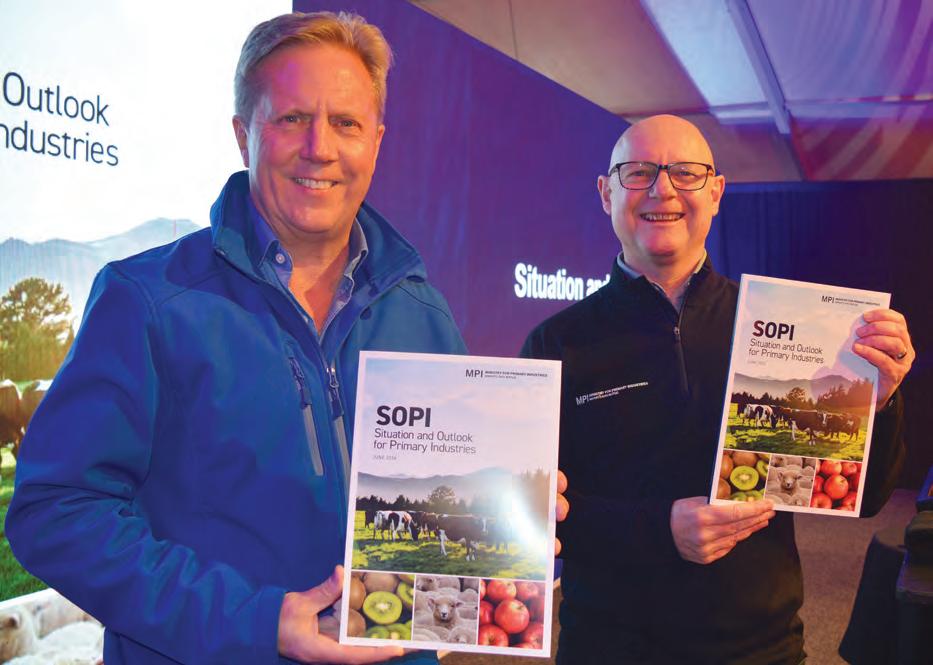
The Situation and Outlook for Primary Industries (SOPI) report, from Ministry for Primary Industries (MPI), shows that export earnings will top $64 billion for year ending June 2026.
ANZ’s Agri Focus for June notes that farmgate prices are at or very near record levels for beef, lamb, mutton and wool. Milk, venison, kiwifruit, and apples aren’t too far behind.
It’s all systems go for these sectors, the report says.
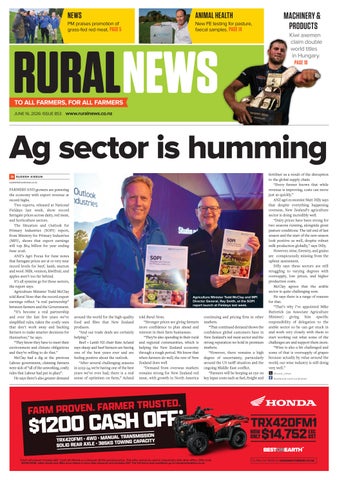
Agriculture Minister Todd McClay told Rural News that the record export earnings reflect “a real partnership” between farmers and the Government.
“It’s become a real partnership and over the last few years we’ve simplified rules, taken the costly ones that don’t work away and backing farmers to make smarter decisions for themselves,” he says.
“They know they have to meet their environment and climate obligations and they’re willing to do that.”
McClay had a dig at the previous Labour government, claiming farmers were sick of “all of the unworking, costly rules that Labour had put in place”. He says there’s also greater demand
around the world for the high-quality food and fibre that New Zealand produces.
“And our trade deals are certainly helping.”
Beef + Lamb NZ chair Kate Acland says sheep and beef farmers are having one of the best years ever and are feeling positive about the outlook.
“After several challenging seasons in 2023-24, we’re having one of the best years we’ve ever had, there is a real sense of optimism on farm,” Acland
told Rural News
“Stronger prices are giving farmers more confidence to plan ahead and reinvest in their farm businesses.
“They’re also spending in their rural and regional communities, which is helping the New Zealand economy through a tough period. We know that when farmers do well, the rest of New Zealand does well
“Demand from overseas markets remains strong for New Zealand red meat, with growth in North America
continuing and pricing firm in other markets.
“That continued demand shows the confidence global customers have in New Zealand’s red meat sector and the strong reputation we hold in premium markets.
“However, there remains a high degree of uncertainty, particularly around the US tariff situation and the ongoing Middle East conflict.
“Farmers will be keeping an eye on key input costs such as fuel, freight and
fertiliser as a result of the disruption to the global supply chain.
“Every farmer knows that while revenue is improving, costs can move just as quickly.”
ANZ agri economist Matt Dilly says that despite everything happening overseas, New Zealand’s agriculture sector is doing incredibly well.
“Dairy prices have been strong for two seasons running, alongside great pasture conditions. The tail end of last season and the start of the new season look positive as well, despite robust milk production globally,” says Dilly. However, wine, forestry, and grains are conspicuously missing from the upbeat assessment.
Dilly says these sectors are still struggling to varying degrees with oversupply, low prices, and higher production costs.
McClay agrees that the arable sector is quite challenging now.
He says there is a range of reasons for that.
“That’s why I’ve appointed Mike Butterick (as Associate Agriculture Minister) giving him specific responsibility of delegation to the arable sector so he can get stuck in and work very closely with them to start working out what some of the challenges are and support them more.
“Wine is also a bit challenged and some of that is oversupply of grapes because actually by value around the world, our wine industry is still doing very well.”
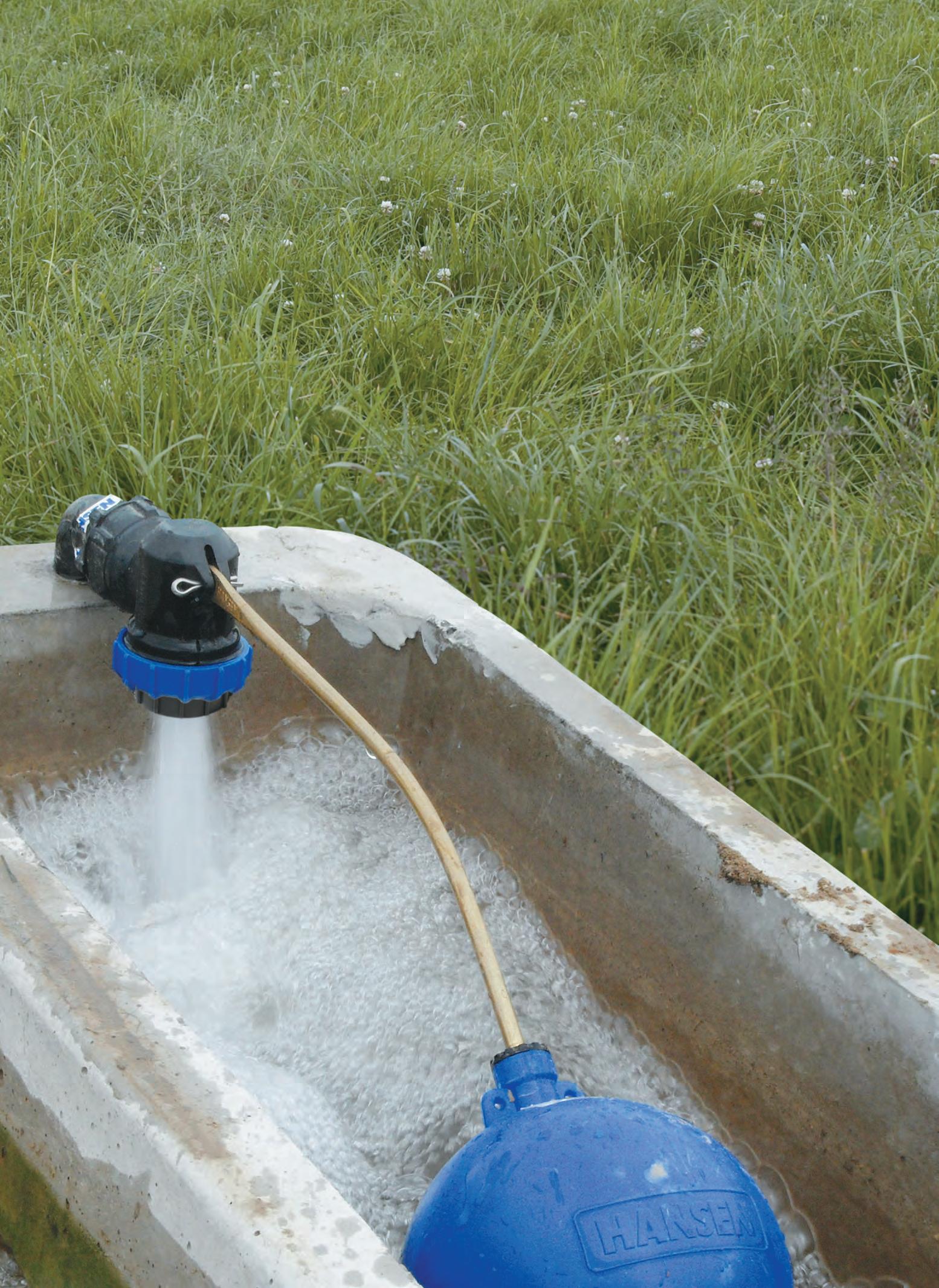
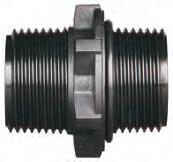
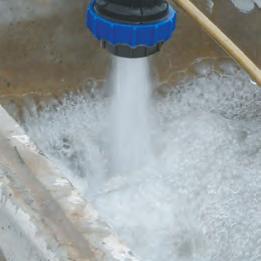
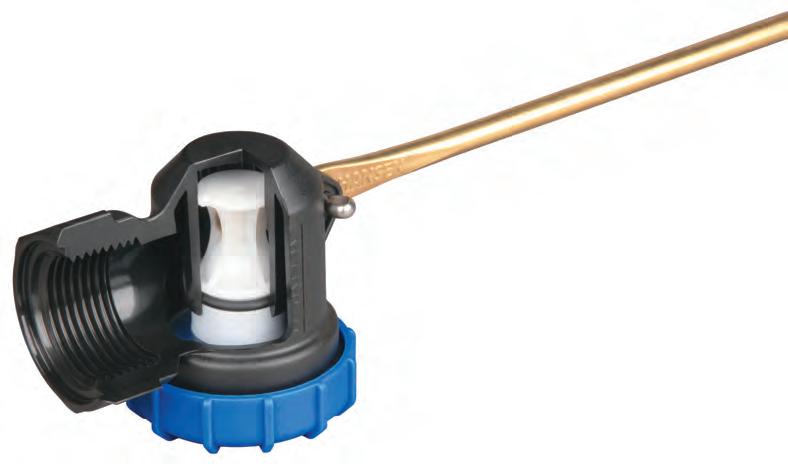
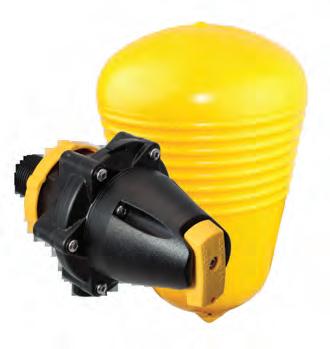
Reliable Trough Valve
Now includes 15, 20 & 25mm Adaptors in Superflo Standard Adaptor Pack
The Hansen Superflo Valve has been design and built from the ground up to produce a High Performance Super Low Maintenance Valve. With it’s proven success it’s not difficult to see why so many farmers have embraced it. High Performance 188 L/min @
Slipper Fit Piston Helps Eliminate Stuck Valves
Multiple Size Options
Threaded Outlet for Portables, Washdown, Tanks, Irrigation
HAND TESTED
Rural News Group
Printed by: Inkwise NZ Ltd
CONTACTS
Editorial: editor@ruralnews.co.nz
Advertising material: beckyw@ruralnews.co.nz
Rural News online: www.ruralnews.co.nz
Subscriptions: subsrndn@ruralnews.co.nz
Primary exports reach new heights
PETER BURKE peterb@ruralnews.co.nz
AGAINST ALL the odds, the primary sector has turned in a stellar performance with export returns for 2026 hitting $64.3 billion – up 6% on the previous year.
The Ministry for Primary Industries (MPI) Situation And Outlook Report For Primary Industries (SOPI) report predicts that this trend will continue with primary exports reaching just over $70 billion by 2030. This upsurge is led by significant increases in returns for dairy, meat and fibre and horticulture.
The 150-page report – produced every six months – recaps the past year and forecasts what the future for the sector will likely be over the coming four years. It also gives valuable insights on a range of issues including trade, climate change, geopolitical matters and the general economic conditions on the land.
Agriculture Minister Todd McClay says the report highlights a resilient high performing food and fibre sector driving healthy demand and prices for NZ’s world class products.
“This is a strong result in a challenging global environment shaped by the Middle East conflict and trade policies in key markets that have disrupted supply chains and raised inflation and input prices,” he says.
This increase in primary export earnings is led by dairy which currently accounts for 45% of the sectors revenue, followed by meat and wool at 22% and horticulture 15%.
For the current year (30 June 2026) dairy exports are expected to be worth a record $28.6 billion – up 5%, meat and wool $14.1 billion – up 14% and horticulture $9.5 billion – up 7%. Forestry returns are static as are arable exports.
Of the individual sectors, the dramatic increase in meat and wool returns of 14% comes on the back of a 9% increase last year. Of note is that wool prices were up 16% on last year
Wool
prices were up
16% on last year and are set to enjoy modest rises in the coming years.
and set to enjoy modest rises in the coming years.
Dairy exports are up by just 5% and future increases are predicted
to be modest percentage wise. The increase in horticulture exports is due largely to kiwifruit being up by 16% to $4.8 billion this year and
WARNING BELLS ALSO RINGING
WHILE THE news for 2026 is good, MPI sounds some warning bells about the future, saying that disruptions from the Middle East conflict bring an “uncertain medium-term outlook that may compress margins”. And adds that the longer-term outlook depends on the relative impact of the disruptions verses global competitors.
MPI notes that this situation also applies to our competitors, some of whom it says are not as well placed as us to deal with the vagaries of global trading conditions.
The report suggests that the compounding economic pressures
will be felt harder by some businesses more than others and warns that firms exposed to energy, freight, fertiliser and other imported inputs will suffer most. It suggests that demand for NZ’s core exports will remain strong for the next six months but says that this may not continue for the rest of the year if the Middle East crisis is not resolved.
The report contains a section highlighting the NZ/India FTA and the benefits NZ exporters will gain in this market when the deal is finally signed off. This section of the report also stresses the importance and sometimes forgotten role that MPI staff play in the
to a lesser extent apples and pears exports rising by 6% to $1.3 billion. MPI predicts that by 2030 kiwifruit exports will be worth $5.3 billion.
negotiation of FTAs and the troubleshooting role they play in sorting out problems that occur from time to time in markets and facilitating improved access for our primary exporters.
MPI Director General Ray Smith says his organisation’s trade teams, both in NZ and overseas, continue to build and strengthen trade relationships to open further doors for exporters.
“I’ve been in a range of key markets over the past year and the one thing that always stands out is the positive reputation NZ has for producing high quality food and fibre products,” he says.
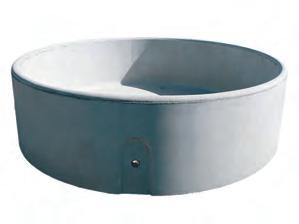
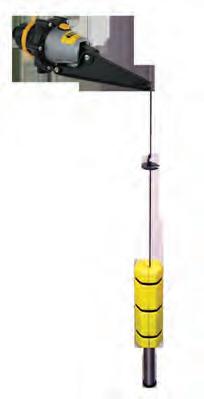
• For Water Storage Tanks
• Adjustable levels from 50mm-2.5m
• Minimises pump operation
•Available in 20/25/32/50mm
Stainless steel bracket and Shaft
Fits plastic and concrete tanks
• Rugged and long lasting
PETER BURKE peterb@ruralnews.co.nz
MOVES ARE underway to create a single organisation to represent the country’s beekeepers.
Currently, NZ Beekeeping Inc (NZBI) represents commercial beekeepers, while Apiculture New Zealand (ApiNZ) is a broadchurch organisation representing all those in the industry including the large number of ‘hobby beekeepers’.
But at an online meeting held this month by ApiNZ, an overwhelming number of those attending agreed to change its constitution, allowing the formation of a new entity – nominally called Honey and Bees NZ – and for it to have a ‘commercial focus’.
ApiNZ chief executive Karen Kos says having this vote and getting members’ support was
the first step towards amalgamating the two organisations.
Both ApiNZ and NZBI have been working towards this goal for nearly two years, and both have travelled up and down the country seeking feedback from their respective members.
The move to a single organisation to represent the beekeeping industry has largely been driven because it wasn’t financially viable having two organisations with slightly different objectives.
“The new entity with its commercial focus will mean that the new board will be made up only of commercial beekeepers and only they will have voting rights,” Kos told Rural News
“The hobby beekeepers and others who are currently with ApiNZ will not have a vote. However, the others are very welcome
to become members of Honey and Bees,” she says.
Kos says while the focus of the new organisation will be commercial, there are other issues that it will deal with such as bee health, which is common to all keepers of bees.
Ian Fletcher, who represents NZBI, describes the move as positive and says it means that we can get on and deal with the issues that face commercial beekeeping in NZ. His organisation represents what he describes as the medium sized commercial operators – not the large corporate operator.
He says the decision to form the new entity is a good start of a process and hopes it will lead to things being better for commercial beekeeping in several ways.
“While this doesn’t solve the issues, it’s a framework to get
EU EXPORTS GROW BY $3 BILLION Beekeepers vote to amalgamate
PETER BURKE peterb@ruralnews.co.nz
THE EUROPEAN Union ramped up its presence at this year’s Fieldays.
The EU once again had its own stand while other EU states including Ireland and Germany had their own sites.
EU Ambassador to NZ, Lawrence Meredith, says their presence this year was their biggest. As well as a site in the pavilion area, they also hosted
a special luncheon for farming and trade leaders.
“The Europe NZ Agri Innovation lunch was an opportunity for 200 European and kiwi agriculturalist specialists and leaders including politicians and CEOs of top companies to meet and showcase what we are all doing,” he told Rural News.
Meredith says the key message is that NZ and the EU are stronger together and says he’s really impressed with many of the creative
organised and help commercial beekeepers express their issues and inform government about what’s going on,” he says.
Fletcher points out that there are up to 8000
people who keep bees in NZ, but only about 330 are actual commercial operators – meaning they produce honey or provide pollination services.
“In actual fact, 97% of the hives in NZ are managed by commercial beekeepers,” he says.
Honey and Bees NZ has now been incorporated and the next phase is to put together a transitional group that will fully establish the new organisation. A new board will have to be elected and they will have the task of setting up a strategy for the future.
ways that NZ farmers are innovating.
Meredith, who has Irish heritage, says Ireland and NZ are collaborating on research to combat methane emissions. He says the two countries have a very good bilateral research arrangement.
“I think that partnership is the way forward so let’s put our brains and experiences together to see how we can increase productivity and also do so in a way that is compatible with our ambition to hit net zero emissions
by 2050,” he says.
Again, the EU site at Fieldays was a gourmet delight for visitors with samples of cheese and speciality meats there for the taking. The goal was to show products that related to special regions in Europe and demonstrate the importance and value of these.
Meredith says this is also part of promoting the free trade agreement between NZ and the EU. Since the FTA came into effect two years ago, the value of our exports there has
increased by a staggering $3billion –a lot of that due to the lifting of tariffs by the EU.
He says there has been a big bounce in horticulture exports and opportunities for lamb and says there is the opportunity to expand trade. The key message from the EU at Fieldays has been partnerships.
“I know in Europe there is great respect for kiwi farmers as there is among a lot of kiwi farmers for their counterparts in Europe,” he says.
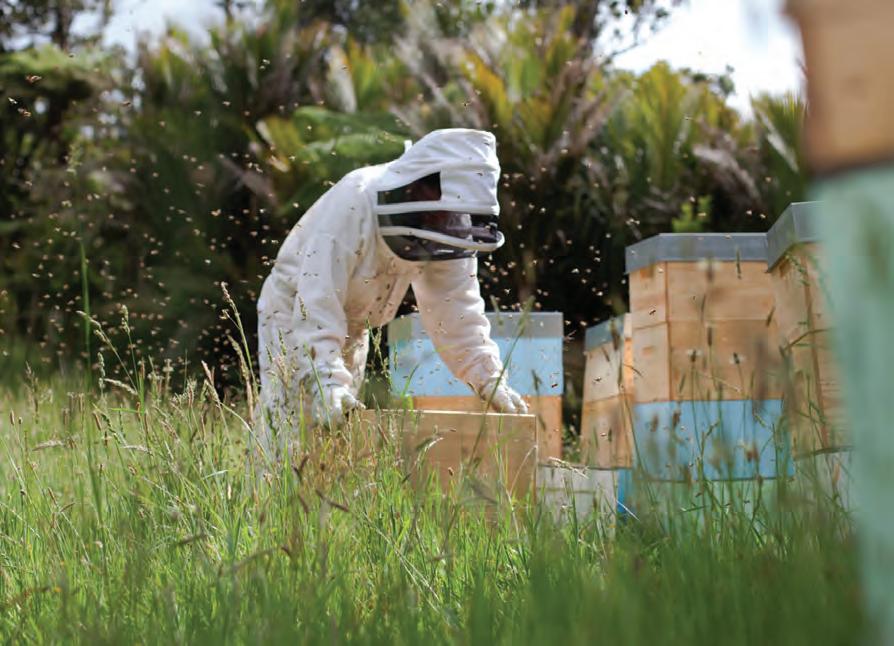
Beekeepers have voted to form a new body, Honey and Bees NZ.
Vegetable groups joining forces
THE voice of vegetable growers on “big ticket items” will be the
immediate focus of newly formed New Zealand Vegetable Council (NZVeg), says inaugural chair Alison Stewart.
The council comprises four small product groups
– Onions NZ, Tomatoes NZ, Vegetables NZ and Process Vegetables NZ.
Stewart told Rural News that existing product groups boards and levies will be
maintained but they will come together as a unified sector to ensure the vegetable sector is heard and listened to by government in Wellington.
“As small groups, they generally don’t get the profile needed,” she says.
“We will have one strong voice on key issues like when engaging with government agencies
and making submissions on policies and other big-ticket items like biosecurity.”
Stewart points out that each group is different: Onions NZ is strongly export focussed while fresh vegetable growers are domestic focused.
But they are facing similar challenges like productivity, land use changes and growth margins under threat by increasing input costs.
She says over the coming months, the council will identify issues that can be handled better by Horticulture NZ, the over-arching body representing the sector.
“We will need to work where Hort NZ will take the lead on as they have a lot of good resources and the sand pit the council plays in.”
Stewart says the council won’t be investing large chunks of new money in projects.
Instead, it will focus on strengthening the voice of vegetable
NEW CEO
growers.
Stewart stepped down as chief executive officer of the Foundation for Arable Research last year after seven years in the role.
She says she welcomes the opportunity to provide leadership and work with the commercial vegetable industry to ensure it receives the recognition it deserves.
“New Zealand’s vegetable growers put healthy food on New Zealanders’ tables 365 days a year and generate approximately $1.1b in revenue,” says Stewart.
“They provide employment for nearly 10,000 people while at the same time playing a critical role as custodians of the environment.
“While there are many challenges, there are also many opportunities to grow better and smarter. This is why I jumped at the chance to be involved at this pivotal time in the New Zealand vegetable industry’s trajectory.”
Brown who has extensive experience in primary industries, governance, trade and advocacy – takes up his new role in August.
NZVeg board chair, Alison Stewart says Brown is recognised for building collaborative relationships across industry, government and the export sector.
“His leadership approach combines strategic thinking with a strong commitment to supporting people, strengthening organisations and delivering long-term
value for members.” Brown has held senior leadership and governance roles in primary sector organisations for 25 years. He has been chief executive of the Marlborough Grape Growers Cooperative since 2020 and is also chair of Cooperative Business NZ and the NZ Blackcurrant Cooperative.
‘Vegetables are such an essential part of healthy communities, and the sector has a direct connection to wellbeing, sustainability and regional prosperity,’ says Brown.
Brown says he will work to ensure the vegetable sector remains strong and resilient.
Inaugural NZ Vegetable Council chair Alison Stewart.
SUDESH KISSUN
More NZ wool bound for India
wool manufacturing city.
THE RECENTLY signed free trade agreement with India is an invitation to strengthen relationships between the New Zealand and Indian strong wool industries, says Wool Impact chief executive Andy Caughey.
Among other measures, the FTA removes India’s 2.75% tariff on New Zealand wool imports.
“The value of that is small but it’s the administrative burden,” said Caughey.
“I think the removal of it is an invitation for closer relationship building, for collaboration and working together.”
Caughey recently hosted a delegation representing five wool processing companies based in Bikaner, Rajasthan, India’s leading
As the first inbound delegation since the FTA was signed, they met Trade Minister Todd McClay in Wellington a month to the day after the signing. They also visited a sheep farm and attended a national wool auction at the PGGW auction rooms in Christchurch.
The delegation was led by Dhiraj Bilandani, the India-based CEO of NZ Wool Services International Ltd, a wool import/export and marketing company with offices also in New Zealand and China.
Bilandani said the visitors were all very big consumers of New Zealand wool.
“So, they’re very dear clients to us and it’s our aim to show them the industry, to familiarise them with the processes
here - scouring, auction, shearing and everything.
“It’s a learning experience for them; it will give them more confidence and more connect to buy more from us and increase their trade.”
Bilandani said the FTA was something they had been looking forward to for some time.
“Now, the duty of 2.75% will be waived off so the exports will be more seamless. And it will encourage the buying of New Zealand wool further for the Indian market.”
Caughey said that about 70% of the New Zealand wool that goes to India goes through Bikaner, where it is blended, dyed and spun into yarn.
Much of it then goes on to Bhadohi in Uttar Pradesh, which is dubbed the “Carpet City of
India”, being the largest hub for the hand-knotted carpet and rug weaving industry in South Asia.
Caughey said India was the second largest buyer of wool from New Zealand after China but it was growing rapidly.
“In the last two years, they’ve purchased around $77 million worth of wool a year and it’s growing in importance.”
He said India would become an even more important market because of Prime Minister Narendra Modi’s ‘Pathway to Prosperity’ vision that aims to transform the nation through structural reforms and technological self-reliance to boost infrastructure and elevate the standard of living.
India had a huge amount of inherent capability with about 45 million people employed
in textiles and about 100 million in agriculture.
“But they’re looking at doubling the number of people in textiles and fashion to around 90 to 100 million.
“It’s building vertical capability to sell to the world.”
Caughey said many of the delegation
represented family-run companies. Their fathers and grandfathers had been buying New Zealand wool for five or six decades, and some had themselves been buying for 25 or 30 years but had never been to New Zealand.
He said it was important for them
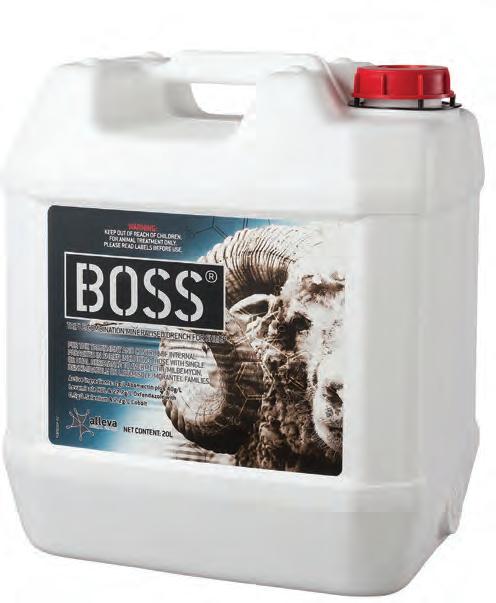
Defend your sheep with New Zealand’s own triple star.
For over 15 years, our kiwi-owned business has thrived through innovation and the continued support of farmers like you.
BOSS® Triple Mineralised Drench is a result of this innovation. Delivering the power of three individual drenches, in one convenient dose. A true triple star in worm control.
see and experience our systems of farming, animal welfare, environmental care and attention, “and just green grass”. Their levels of understanding and appreciation of our systems had significantly changed during their visit.
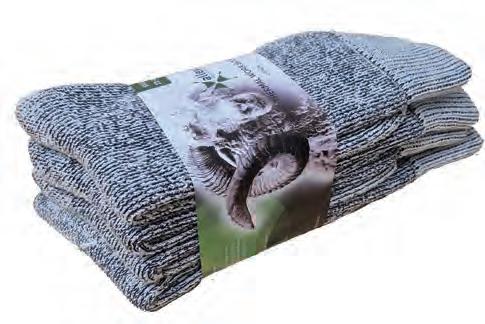
PURCHASE 20L of BOSS® Triple Mineralised Drench & receive a FREE double pack of NZ Merino blend socks*. Kiwi’s supporting kiwi’s.
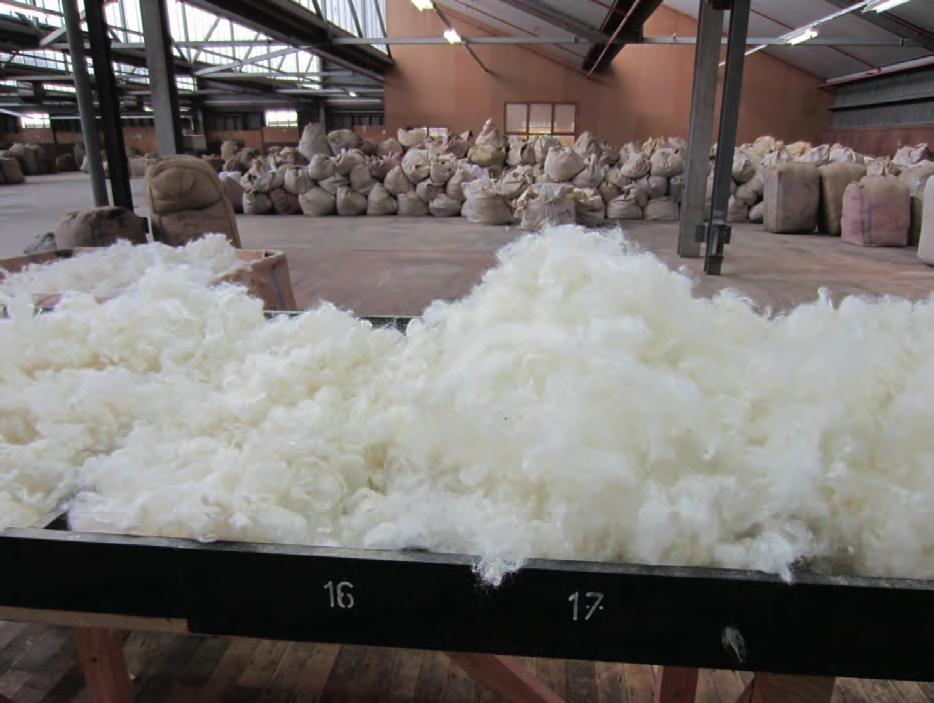
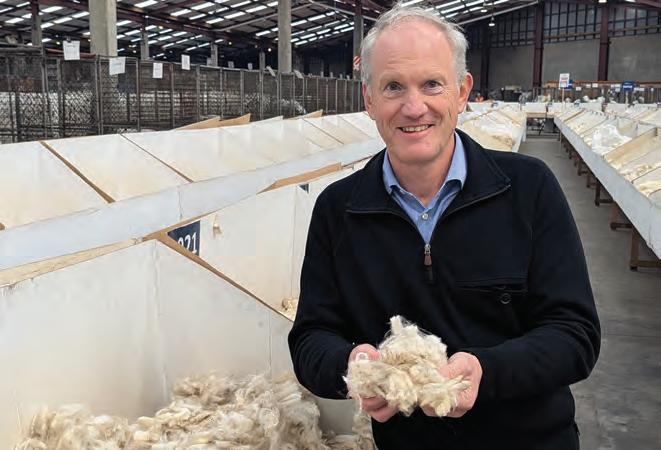
Wool Impact CEO Andy Caughey inspects a sample of strong wool at the PGW auction rooms in Christchurch.
EDITORIAL
Outstanding performance
THE LATEST update from the Ministry for Primary Industries (MPI) on the state of NZ’s primary sector paints a positive picture about its performance over the past 12 months.
Our primary exports hit a new high of $64.3 billion dollars, a rise of 6% - and that was on top of 13% increase in 2025. Not bad for a sector that has been challenged on the home front by a series of adverse weather events and rising costs.
Not to mention a multiplicity of global events ranging from wars to tariffs which have been imposed out of the blue by countries that should know better.
The MPI report also sends a message to those individuals and organisations in NZ who demonised the dairy industry. The fact is that this sector generates 45% of the total export revenue generated by the primary sector – well ahead of meat and wool 22% and horticulture 15%.
Aside from the dairy industry is the rise and rise of our kiwifruit as an export earner – this year bringing in $4.7 billion and well on its way to making this $5.3 billion in 2030.
The report highlights a resilient high performing food and fibre sector driving healthy demand and prices for NZ’s world class products.
This is a strong result in a challenging global environment shaped by the Middle East conflict and trade policies in key markets that have disrupted supply chains and raised inflation and input prices.
There is no doubt that the primary sector collectively – from farm and orchard to plate have performed outstandingly. Great products, clever science, good marketing, better access to markets and strong political support to do better.
But there is a but in all of this. While NZ is doing everything in its power to do better, the world is now a complex maize of threats that make it increasingly challenging for us to maintain the momentum we have enjoyed – at least in the past year. The signing of more FTAs such as the recent one with India, developing new markets with affluent consumers that spread risk and reduce dependence on just a few big markets will be the order of the day.
So, while we can celebrate the success of 2026, we must be prepared and be agile and resilient to cope with what 2027 deals to us.
RURALNEWS
HEAD OFFICE POSTAL ADDRESS: PO Box 331100, Takapuna, Auckland 0740
Phone 09-307 0399
PUBLISHER: Brian Hight .......................................... Ph 09 307 0399
GENERAL MANAGER: Adam Fricker ....................................... Ph 021-842 226
“If all our data is stored in the clouds, what happens when there aren’t any?”
THE HOUND
Good eggs
THIS ONE will upset the identitypolitics obsessed snowflakes in Wellington. Sainsbury’s is phasing out brown eggs in its own-brand ranges, switching exclusively to white eggs, “to reduce carbon emissions and support net-zero targets”.
Research conducted for the UK’s second-largest supermarket found that white eggs have a 12.7% lower carbon footprint than brown eggs, primarily because the hens that lay white eggs are smaller and require less feed, which reduces emissions associated with egg production.
The switch to white eggs is expected to indirectly reduce demand for land and water used to grow feed crops. Sounds fair, but your old mate is sure the Greens won’t fall for this greenwashing story and will be lodging a discrimination complaint with the Race Relations Commissioner forthwith!
That’s the game
WELL-KNOWN and politically very neutral RNZ DJ John Campbell may be having politically neutral kittens about the news that Fonterra lobbied the PM’s office over climate change laws, but John and his definitely-not-lefty mates are really pretending that political lobbying isn’t the second oldest profession and that all political parties are donkey deep in it. If JC thinks the Wooden Bicycle Manufacturers Guild would miss a chance to bend the ear of Green Party leader Chloe Swarbrick, he’s dreaming. The more important question being ignored by Mr Politically Neutral is, should political activists like Mike ‘Lumberjack’ Smith and the courts be deciding NZ’s climate law settings or should the elected government of the day, do it? In the Hound’s humble opinion, definitely the latter!
EDITOR-AT-LARGE: Peter Burke ...........................Ph 021 224 2184 peterb@ruralnews.co.nz
MACHINERY EDITOR: Mark Daniel ..............................Ph 021 906 723 markd@ruralnews.co.nz
PRODUCTION MANAGER: Becky Williams ......................Ph 021 100 4381 beckyw@ruralnews.co.nz
No choice
A NATION that relies as heavily as NZ does on functional global shipping lanes will have to do its bit on the international security front, hence the additional $1.58b in military spend over 4 years that Dame Lynda Topp thought should have been spent on sheet music. It’s the price we must pay to secure some measure of defence alliance and safe passage for the $50-60b the ag sector ships abroad every year. For the same reason, our Aussie mates are buying second hand subs off the Yanks. A mate of yours truly quipped, the old subs “will be the equivalent of turning up to a Holden dealer expecting to pick up a new Calais and the being chucked the keys for a rooted old Captiva that’s blowing a bit of blue smoke with all the clearcoat peeling off the bloody thing!”
AUCKLAND SALES CONTACT: Stephen Pollard .........................Ph 021 963 166 stephenp@ruralnews.co.nz
WAIKATO & WELLINGTON SALES
CONTACT: Lisa Wise .................................. Ph 027 369 9218 lisaw@ruralnews.co.nz
Want to share your opinion or gossip with the Hound? Send your emails to: hound@ruralnews.co.nz
Great idea!
CENTRAL HAWKE’S Bay farmer recently Mark Warren told the Hawkes Bay Times it’s time for a conversation about allowing skilled and properly equipped locals to help councils clear debris and reopen roads after severe weather events. His inspiration was a Scottish local council that made BBC headlines by calling on individuals and communities to take more responsibility for their roads during weather events. Warren reckons New Zealand needs to have the same attitude, and doing so would save ratepayers significantly.
“Ratepayers should be demanding efficiency and using local machinery on or near the spot to do critical work rather than forking out thousands for a contractor to come and do what a farmer could do in 10 minutes,” he said. Great idea, although it’ll likely come a gutser as soon as the H&S clipboard carriers at the council get involved!
SOUTH ISLAND SALES CONTACT: Kaye Sutherland .......................Ph 021 221 1994 kayes@ruralnews.co.nz
DIGITAL STRATEGIST: Jessica Marshall ..............Ph 021 0232 6446
Paper
requirements.
100% recyclable, the papers we use are from forests that will be around for generations to come.
Spinning the climate stuff
WITH THE winter months officially here, I trust all is well at your place.
I noted a news headline recently that informed us it was now twenty years since the release of Al Gore’s climate movie An Inconvenient Truth.
People that watched it were told we had a small window of ten years to avoid reaching the “tipping point” of irreversible climate disaster. Apparently a catastrophic climate collapse was just up ahead for all of us; especially so if we didn’t act and embrace Al’s solutions!
It reminded me of a conversation I had with a young man in Auckland
years ago. Nearing the end of his schooling years, he was looking closely at what was up ahead for him.
To my surprise, he told me was thoroughly fed-up with being made to watch Gore’s movie over and over at school.
Eight or nine times he had seen it, he informed me! So what did I think, he asked.
Some of us have been around long enough to see many of the climate predictions come and go without fulfilment.
Now, I knew even back then, the movie had nothing to do with education, but rather it was all about instilling an ideology. So, I warmly assured him he would be fine and had a great future to look forward to!
Back in 2021, some ‘research’ that got termed a landmark global survey was published. It informed readers that 10,000 young people aged between 16 and 25 across 10 countries were questioned.
Fifty nine percent were said to be very worried or extremely worried about climate change. More than 45% said those feelings negatively affected their daily lives.
Three quarters of them said they believed the future to be frightening, with more than half feeling powerless, helpless, and for some, even feeling guilty about what they were facing.
How sad is that?
Anyone of us could easily
sum these findings up with just the one word – fear.
I do recall myself in my younger years sweating a little too much with news of a coming big freeze!
Now for me, I will always have questions when fear is used to promote stuff, especially an ideology. And yes, it can even get terrifying when governments start ruling with fear.
Yep, some of us have been around long enough to see many of the climate predictions come and go without fulfilment. It is more than a little strange that the mainstream media avoids all comments on this.
Three very astute and
wise words from decades ago provide great insight, for those willing to be instructed by them.
Those three words?
Follow The Money.
Who is being coerced and being taxed to finance this thing? Do they ever get any say on the matter?
Where is all that money going? Whose pockets does it quietly find its way into?
With China happily building new coal fired power stations, why hasn’t ‘Saint Greta’ been in China saving the planet? Just a thought!
And while we hammer our own rural sector with climate regulations, we export coal to China & India - what hypocrisy!
We’ve got an election
coming up shortly. For me, I’ll be listening in carefully to see who is spinning what when it comes to this climate stuff.
Consider just one little fact with me for a quiet moment: our planet and its atmosphere rotate around the sun at 67,100 miles an hour. And we’ve been holding this speed for yonks. Truly, what amazing precision design!
For me and many others like me, the Designer of it all has got this! And He has got us. Yep, my days of sweating are done! Keep warm and God Bless.
• To contact Colin Miller, email thefarmerschaplain@ gmail.com
FARMER’S CHAPLAIN
Colin Miller
Spinning the climate stuff
WITH THE winter months officially here, I trust all is well at your place.
I noted a news headline recently that informed us it was now twenty years since the release of Al Gore’s climate movie An Inconvenient Truth. People that watched it were told we had a small window of ten years to avoid reaching the “tipping point” of irreversible climate disaster. Apparently a catastrophic climate collapse was just up ahead for all of us; especially so if we didn’t act and embrace Al’s solutions!
It reminded me of a conversation I had with a young man in Auckland
years ago. Nearing the end of his schooling years, he was looking closely at what was up ahead for him.
To my surprise, he told me was thoroughly fed-up with being made to watch Gore’s movie over and over at school.
Eight or nine times he had seen it, he informed me! So what did I think, he asked.
Now, I knew even back then, the movie had nothing to do with education, but rather it was all about instilling an ideology. So, I warmly assured him he would be fine and had a great future to look forward to!
Back in 2021, some ‘research’ that got termed a landmark global survey was published. It informed readers that 10,000 young people aged between 16 and 25 across 10 countries were questioned.
Fifty nine percent were said to be very worried or extremely worried about climate change. More than 45% said those feelings negatively affected their daily lives.
Three quarters of them said they believed the future to be frightening, with more than half feeling powerless, helpless, and for some, even feeling guilty about what they were facing.
How sad is that?
Anyone of us could easily
sum these findings up with just the one word – fear.
I do recall myself in my younger years sweating a little too much with news of a coming big freeze!
Now for me, I will always have questions when fear is used to promote stuff, especially an ideology. And yes, it can even get terrifying when governments start ruling with fear.
Yep, some of us have been around long enough to see many of the climate predictions come and go without fulfilment. It is more than a little strange that the mainstream media avoids all comments on this.
Three very astute and
wise words from decades ago provide great insight, for those willing to be instructed by them.
Those three words?
Follow The Money.
Who is being coerced and being taxed to finance this thing? Do they ever get any say on the matter?
Where is all that money going? Whose pockets does it quietly find its way into?
With China happily building new coal fired power stations, why hasn’t ‘Saint Greta’ been in China saving the planet? Just a thought!
And while we hammer our own rural sector with climate regulations, we export coal to China & India - what hypocrisy!
We’ve got an election
coming up shortly. For me, I’ll be listening in carefully to see who is spinning what when it comes to this climate stuff.
Consider just one little fact with me for a quiet moment: our planet and its atmosphere rotate around the sun at 67,100 miles an hour. And we’ve been holding this speed for yonks. Truly, what amazing precision design!
For me and many others like me, the Designer of it all has got this! And He has got us. Yep, my days of sweating are done! Keep warm and God Bless.
• To contact Colin Miller, email thefarmerschaplain@ gmail.com
FARMER’S CHAPLAIN Colin Miller
Malt maker celebrates home-grown status
A CENTRAL Canterbury business which turns malting barley into a key ingredient in beer making has celebrated its 100% New Zealand grownstatus with a special event.
Founded by Doug and Gabi Michael more than 20 years ago, Gladfield Malt near Dunsandel now supplies malt products to breweries throughout New Zealand as well as overseas.
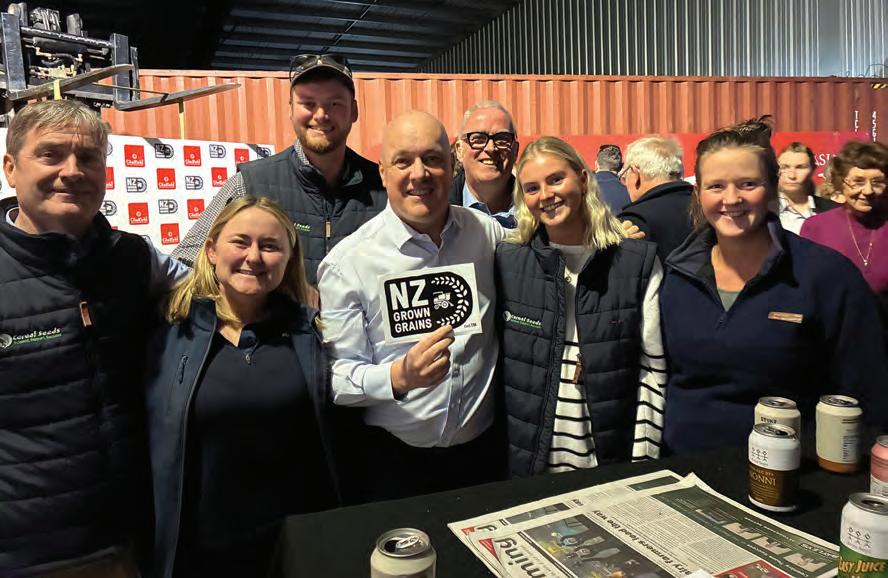
Its grower open day attracted about 300 grower-suppliers and industry people, as well as Prime Minister Christopher Luxon and Selwyn MP Nicola Grigg.
From a fifthgeneration family of barley growers, the Michaels also receive crops from about 200 contracted growers.
These are processed to produce more than 50 types of malted grains ranging from base malts ale, pilsner and lager to roasted malts with specialty colours and favours such as chocolate and supernova.
“We started 22 years ago and it was never meant to get as big as this,” Doug Michael told the gathering. The couple have complementary skills, he said. “I made it and Gabi sold it.”
The couple are proud to use 100% New Zealand-grown malting barley and have signed up to a NZ Grown Grains branding initiative which makes it easier for consumers to identify domestically-grown products.
“We need to tell the world about the importance of looking after local. The arable industry is undervalued in New Zealand. We are going to change that.
“Growing and processing crops is expensive. Shipping crops around the world is even more expensive. So, food security is more
important than ever,” Doug Michael says.
As well as selling domestically, Gladfield Malt also exports to China, Japan, India, Australia and the Pacific. It has not always been plain sailing, with their business suffering damage after being close to the epicentre of the September 2010 earthquake. Demand was also knocked by the February 2011 Christchurch earthquake and Covid hitting hospitality, leading it to pivot to new markets and products.
Co-founder and head
brewer of Hamiltonbased Good George, Brian Watson, says that the first thing he would be doing when he got back to the office was to sign up for the NZ Grown Grains branding.
“We need to put that on our cans. Brewers cannot exist without growers producing malting barley.”
While he had a relationship with hop growers, malting barley growers had been “faceless” until now. “So, it is great to meet you.”
When Good George started 15 years ago it initially used imported
malt. “However, I realised we were suddenly getting 20 per cent extra beer out of the malting barley and the difference was the Gladfield Malt supply.”
They had sourced all their malt from Gladfield Malt ever since, despite being offered cheaper product from overseas.
“Relationships with people you work with through the supply chain are just as important as your customers.”
Like growers, brewers and hospitality were also facing rising costs and competitive pressures, Brian Watson says.
SUPPORTING NZ-GROWN GRAIN
FOUNDATION FOR Arable Research general manager business operations
Ivan Lawrie told the gathering that since the launch of the NZ Grown Grains’ logo in October last year, support has been massive, with 25 companies signing up to use the branding on their products.
It is now appearing in bakeries and on supermarket brands including Harraways’ oats, The Good Oil edible oils and Otis oat milk.
This makes it easier for consumers to identify and purchase New Zealandgrown produce.
At present, consumers, particularly in the North Island, are more likely to be eating imported grain, especially if they are eating bread, Ivan Lawrie says.
Prime Minister Christopher Luxon also lent his support to the NZ Grown
Grains campaign. “As arable growers it is not easy, with the ups and downs of weather events, commodity prices and rising costs.”
The Free Trade Agreement with India would reduce tariffs on malt by up to 33%. This was a huge opportunity, with the middle class in India growing from 440 million now to 750 million by the end of this decade.
“As their country gets wealthier, they want better quality food and beverages and we can sell this to them.”
By 2030, the Indo-Pacific region will be home to two-thirds of the world’s middle class, Christopher Luxon says.
“The thinking that we are a long way away from markets is no longer the case. Instead we are in the middle of the most dynamic region in the world.”
Prime Minister Christopher Luxon promotes the NZ Grown Grains logo with arable growers and industry people during a visit to Canterbury.
•
•
•
More money to help farmers protect special habitats
SUDESH KISSUN sudeshk@ruralnews.co.nz
MONEY INVESTED
TO protect native bush, wetlands and other special habitats on farms is paying huge dividends.
That’s the message South Auckland farmers Shirley-Ann and Rick Mannering had for Prime Minister Christopher Luxon and a team of National Ministers and MPs on their farm this month.
The Mannerings run a productive sheep, beef and dairy operation at Paparimu.
Luxon visited their sheep and beef farm where, including two other dairy blocks, 148 hectares have been placed in covenants with about 5000 plants planted annually. He was there to announce that National is doubling the permanent, baseline funding for the Queen Elizabeth II National Trust for the first time since 2015.
Luxon described it as “another win for the agriculture and rural sector”.
If National was re-elected it would mean funding for the trust, which formed partnerships with landowners to create protected pockets of land under covenants, would increase from about $4.2m to about
$8.5m per year.
The trust did get a temporary funding uplift to $5.8m this year, but National’s policy would increase funding from its previous level.
Rick Mannering told the PM that without the help of the Queen Elizabeth II National Trust, Auckland City Council and the Government, farmers wouldn’t be able to put in fences and tackle pest animals and plants.
“We just couldn’t be doing what we’re doing. The value of the money that you guys get by investing in the farmers and investing through the trust pays off in a huge amount,” Mannering says.
He says budget constraints are holding back the QEII Trust work
on farms.
“There are so many farmers who are doing great things in New Zealand, and they would really like to do more.
“Constraints around budgets have been strong for the last few years.
“There’s a little more money now in the system. But there’s a real need out there to help those guys a lot and encourage them on their journey to improve their farms.”
The QEII Trust provides the covenant legal paperwork and expertise on how best to protect native bush, wetlands and other special habitats.
Farmers voluntarily commit the land and their hard work putting in fences and tackling pest
POLITICAL SUPPORT
FEDERATED FARMERS president Wayne Langford is urging other parties to get behind National’s plan to double baseline funding for the Queen Elizabeth II Trust.
“I can’t see any reason why all political parties wouldn’t support this,” he told Rural News.
“This is an absolute no-brainer for conservation, a no-brainer for agriculture, and a no-brainer for restoring nature like what we want it.”
Federated Farmers has been pushing for more funding for QEII Trust. Langford says doubling the trust’s
0800 901 902
animals and plants.
A Waikato University study found for every dollar of QEII money, farmers and other landowners put in $6 to $7 in foregone production from the land, and ongoing work to protect the habitat.
More than 5400 QEII covenants now protect almost 190,000 hectares of privately-owned land across New Zealand with the vast majority located on farms.
If all QEII covenants were combined, it would be New Zealand’s fourthlargest national parksized protected area.
With government base funding static since 2015, and other one-off funding streams drying up, QEII Trust chief executive Dan Coup says this year’s new
funding has been a long-standing priority for Federated Farmers because it’s a model that is well-proven.
Demand for new covenants has been growing rapidly but government base funding has remained largely unchanged for more than a decade.
Langford says the extra funding would allow more areas to be “properly protected”.
“It is the fourth largest national park in New Zealand, if you combine all the areas together, there’s no reason why it couldn’t go to the largest because it is a very good project that they’re running.”
Federated Farmers president Wayne Langford (left) with Paparimu farmers, Shirley-Ann and Rick Mannering.
covenant target is just a quarter of what was achieved in 2024.
“It’s the first time we’ve had to ration what we’re doing really tightly.
“That means some covenant opportunities will be lost forever as people stuck on our waiting list pass away, lose faith or sell their property.”
Coup says the funding
shortfall doesn’t just hit new covenant rates.
“These farmers and landowners are facing increasing challenges looking after their native bush and wetlands with more extreme weather events, more feral animals and more weeds, including wilding pines.
“We want to be able to provide a bit more advice and support for those
A UNIQUE MODEL
PRIME MINISTER Christopher Luxon says the Queen Elizabeth II Trust is a unique conservation model.
He says its voluntary, practical, landowner-led, and offers some of the best-value conservation in the country.
“Every dollar the Government puts in, farmers match many times over. It’s great bang for buck for both the taxpayer and nature.
“More funding will support landowners with costs like fencing, surveying and legal work – costs that can often stop good
5400 property owners who are already doing this good work.”
Coup says the trust is very grateful to the National Party for its leadership and acknowledgement of what the trust does.
“This is not a politically contentious cause so we hope other parties will take a similar view.”
projects from going ahead.
“We back farmers to know what is best for their land, they choose to protect important conservation areas, rather than having rules forced on them.”
Luxon announced the funding boost on a South Auckland farm with National MPs including Agriculture Minister Todd McClay and Conservation Minister Tama Potaka.
Potaka noted that farmers are at the forefront of environmental stewardship and that the Government is here to partner with them.
Vaccine helps keep clostridial disease at bay
CLOSTRIDIAL
DISEASES are a major cause of sudden death in young lambs and calves, and for King Country farmer and veterinarian, Stacey Turner, vaccinating with Ultravac 5in1 is a nonnegotiable animal health practice.
Stacey and her husband Stephan farm Stephan’s family property at Piopio, where he is the third generation to farm the land. The couple has purchased some of the 290-hectare effective sheep and beef farm and lease the balance, with a goal to purchase more in the future.
The farming operation is diverse, with 1000 breeding ewes and about 80 breeding cows. They also trade some stock and rear autumn born calves and fatten bulls.
Stacey, who is originally from Australia, moved to Piopio to
work as a vet, where she met Stephan. She practices full-time as a mixed animal vet, predominantly with sheep and beef farmers.
The couple uses the Zoetis Ultravac range in their own operation to vaccinate ewes prelambing and cows precalving, as well as giving it to lambs at docking, and again preweaning or at weaning time. Calves are given Ultravac at disbudding time, and again as a booster.
“In my opinion, clostridial diseases are very common and are an unnecessary loss when there’s a very successful and affordable vaccine out there. For me, it’s a no brainer for lamb and calf survival,” Stacey says.
The closer to lambing and calving the vaccine is administered, the better. They usually give it two to four weeks prior to lambing. “This
increases the antibodies lambs and calves get in the milk from mum.”
Stacey explains that clostridial diseases include things like tetanus, pulpy kidney, black leg and botulism. They are a toxin present on the pasture that animals ingest, usually resulting in sudden death. “And it’s usually your nice, big fastgrowing animals that tend to like to die.”
Vaccination is both an insurance policy and delivers good return on investment, she says.
“A lot of farmers don’t give it at docking or weaning, but for the cost of the vaccine, it’s a good insurance policy. I would never not give it. It’s all about increasing survivability – the more animals you have, the more money you make.
“Before we routinely used clostridial vaccinations for ewes, you might see twins or triplet bearing ewes with
lambing problems, and that’s the perfect time for clostridial diseases to take hold. You only have to lose one ewe and twin lambs and that’s $500 or $600, which is far greater than the cost of a pack of vaccine.”
Stacey says for youngstock, clostridial disease is often more common on lush, faster growing pastures, which can be a problem for highly productive farms.
“Those that have lambs on crops with high protein content or lush feed can have greater incidence of death from clostridial diseases. Often with bulls, if they are fighting, they can have bruising or wounds that increase the chance of clostridial disease as well. So, some farming systems are more prone to issues.
“Clostridial diseases are the diseases you often see with your bigger, faster growing
animals and there is probably a correlation with what they are eating, or the feed they are on.”
Being able to administer the vaccine at key times when animals are in the yards for other procedures, like docking, means it is labour efficient and doesn’t require any extra manpower.
Stacey also values the ability to add trace elements, like selenium or B12, to
Ultravac. “You’re not having to give multiple treatments. B12 is closely related to growth rates and we give our lambs the vaccine with B12, which I love. It’s great to have the ability to give extras but still only one jab, that’s a big win.”
As a vet, this also allows her to tailor recommendations to individual farms and their systems. Some farms may only need 5in1, while others may
like to give selenium to ewes with the pre-lamb vaccination.
“I can tailor my approach to that farm with the same product; it’s not one size fits all. Farms with selenium deficiency, for example, can get white muscle disease in lambs, so adding selenium to the vaccine might be a good option.”
• Article supplied by Zoetis @rural_news facebook.com/ruralnews
Stephan Turner moves vaccinated ewes on the family’s Piopio sheep and beef farm.
New FE testing for pasture, faecal samples
PARASITE TESTING
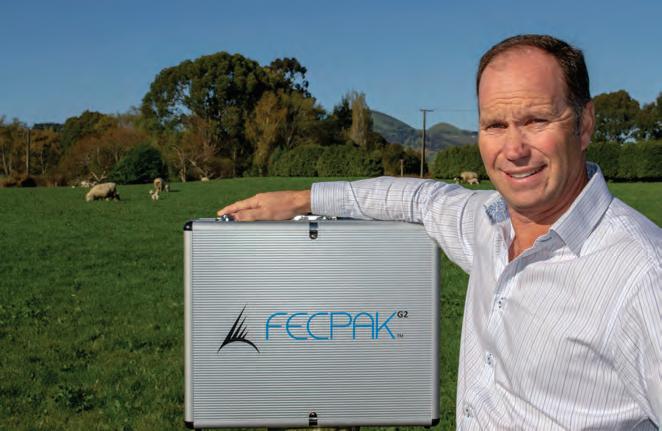
platform FECPAK has launched a facial eczema testing solution that delivers faster results.
The solution provides pasture spore counts and faecal spore counts, combining on-farm sampling with FECPAK’s digital, AI-supported testing platform to deliver fast results and help farmers, veterinarians and advisors make earlier, informed management decisions.
The new facial eczema test helps farmers understand the spore challenge
present on pasture and the level of spores animals have recently ingested. Combining these two sample types with FECPAK rapid reporting and online results portal provides a complete picture of facial eczema risk on farm and supports better timing of interventions such as grazing management and zinc use.
Facial eczema is one of New Zealand’s most significant seasonal livestock health challenges. Because there is no cure, prevention is critical.
It is estimated to cost New Zealand farmers over $300 million each year through lost production, reduced growth, lower fertility and animal health impacts. Monitoring spore levels gives farmers results to make informed grazing management decisions and timely, targeted treatment to avoid and protect against the disease. This helps farmers reduce the risk of liver damage, production loss and animal welfare impacts associated with toxic sporidesmin exposure.
Pasture spore counts indicate the number of spores present in a paddock, guiding decisions about where and when animals should graze. Faecal spore counts indicate the number of spores animals have ingested over a recent grazing period. Together, these tests help farmers move beyond guesswork and base their decisions on timely, farmspecific information.
Greg Mirams –founder and managing director of Techion, the company which developed FECPAK – said
the ability to run quick, faecal and/or pasture spore counts on farm will be especially valuable for dairy farmers managing facial eczema risk through the season.
“For dairy farmers, the real advantage is being able to do daily faecal spore counts within minutes before washing down the yard.
“Cows bring the samples in for you, and the FECPAK Facial Eczema test gives a picture of their exposure
to facial eczema. That means farmers can respond quickly by shifting the mob to a safer area or treating animals in a targeted way,” says Mirams.
Tuanui Farming Company co-owner and operations manager Kieran Wills has been trialling the machine all year.
“I can’t get over how easy facial eczema spore testing is; it’s actually easier than conducting a FEC test.
“Before undertaking the facial eczema testing, we were making assumptions or relying on general regional information from vets that was usually at least a week old. Now, we have immediate data and can make management decisions based on fact rather than guessing.”
FECPAK Facial Eczema testing sits alongside a wider range of tests including FEC, lung worm, fluke and new Worm ID for sheep.
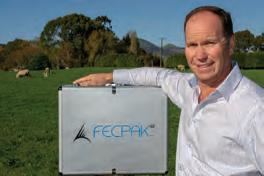
Greg Mirams, founder and managing director of Techion, which developed FECPACK.
Dairy reproductive performance soars
NEW SEASON data from LIC shows a strong reproductive performance for the 2025-26 season, with a lift in key metrics compared to last season.
The six-week in-calf rate (6wkICR) has edged up to a new record of 70.4%, from 70.2% last season, while the notin-calf rate (NICR) remains relatively stable at 14.7%.
LIC chief executive David Chin says maintaining performance at this level is a positive result for the industry and reflects the consistency farmers are achieving on farm.
“After the gains we’ve seen over recent seasons, seeing another lift is a fantastic result for New Zealand dairy farmers. Achieving a record six-week in-calf rate of 70.4% reflects the continued focus farmers are placing on reproduction performance and making good decisions on farm.”
The industry’s topperforming 25% of herds achieved a six-week in-calf rate of 78.2%.
“Those topperforming herds are getting more cows submitted, achieving higher conception rates and ending the season with fewer empty cows.
“The difference isn’t one thing done exceptionally well - it’s consistently getting the basics right, from nutrition and cow recovery through to heat detection and mating management,” says Chin.
Reproductive performance varied across the country, with softer results in the North Island offset by stronger performance in the South Island.
Standout gains were seen in Otago, South Canterbury and Canterbury, where six-
week in-calf rates lifted by between 1.4 and 2.5 percentage points compared to last season. Otago saw the biggest gain, increasing from 68.9% to 71.4%, while South Canterbury lifted from 70.6% to 72.6%, and Canterbury increased from 70.5% to 71.9%.
In the North Island, results eased slightly, with Waikato shifting from 71.2% to 69.6% and Northland from 71.0% to 69.2%.
Chin says reproduction outcomes are influenced by a range of factors, including seasonal and weather conditions, which can affect pasture quality and how cows recover heading into mating.
“Given some of the conditions parts of the North Island experienced this season, maintaining overall national performance and seeing a slight lift is a good outcome.”
He says stronger South Island performance was likely supported by favourable pasture conditions and farmers investing in quality feed through mating.
“Whether farmers are using conventional dairy, sexed semen, beef or SGL products, preparation before mating remains one of the biggest influences on getting cows back in calf.
“At the end of the day, good reproductive performance comes back to healthy, well-managed cows, and this year’s results show farmers are continuing to do that well.”
The results are based on data from 4776 herds and more than 2.6 million cows, continuing to provide a strong representation of national performance.
Survey gives insight into on-farm safety issues
MARK DANIEL
A SAFETY push across New Zealand has revealed significant gaps in hazardous substances management, farm
vehicles, tractors, quad bikes and side-by-sides.
Worksafe inspectors completed 680 assessments across the country between October and December 2025,
visiting sheep, beef and dairy farms. The recently published findings are aimed at offering farmers practical insights into where the sector needs to improve, and how
WorkSafe can help.
WorkSafe’s project lead Carl Baker says the assessments were designed to understand what’s happening on farms, not to catch
people out.
“We went in to have honest conversations with farmers and figure out where we can help them lift their game. The response from the sector
has been overwhelmingly positive,” says Baker.
He acknowledged the farmers who participated in the assessments, along with industry partners Safer Farms, Federated Farmers and Dairy NZ.
Healthy ewes set up stronger lambs.
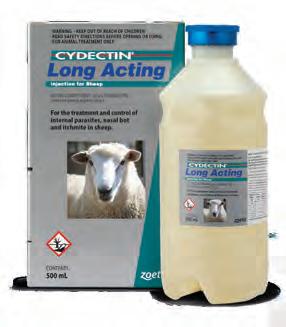
Cydectin® Long Acting Injection provides extended worm protection to help maintain ewe condition through lambing.
When planning your pre-lamb programme, supporting ewe condition, particularly in light ewes is critical to setting lambs up well from the start.
Cydectin® Long Acting Injection helps protect against worms through late pregnancy and lactation when nutritional demand is at its highest.
Shown to increase ewe and lamb weights at weaning¹, Cydectin® Long Acting Injection is a trusted pre-lamb solution for farmers wanting reliable, long lasting worm protection through the lambing period.
Consider your pre-lamb needs today.
The inspections revealed that hazardous substances emerged as the highest-risk area, with 39% of assessments requiring improvement. 94% of improvement notices issued related to missing safety data sheets or chemical inventories, meaning a relatively straightforward fix with significant safety benefits.
Machinery and vehicle safety also raised concerns, with inadequate guarding of PTO shafts a common issue, with 16% of assessments requiring improvement, rising to 25% in the South Island.
Farm vehicles, tractors, side-by-sides and quad bikes all featured, with 14% of assessments requiring improvement in this area. Looking at the mix of businesses assessed, 81% had fewer than five employees, a reminder that even small operations carry real risk.
Carl Baker says many of the improvements identified are straightforward and low-cost. “Keeping
complete and up-to-date records of hazardous substances, can prevent serious and often longterm harm. Safety data sheets and inventories are vital. They offer best practice advice of how to manage chemicals and help emergency services respond, as without them, we don’t know the risks.”
Baker went on the explain that taking basic steps such as keeping vehicles serviced, regularly checking brakes and tyres, ensuring workers wear seatbelts and helmets, and making sure PTOs are properly guarded are all relatively simple measures that can save lives.
WorkSafe has a range of resources to help farmers act on these findings, including new online learning modules on hazardous substances covering inventory management, risk assessment, and emergency planning.
“We know farmers take the safety of everyone on their properties seriously,” says Baker. “We’re here to support that – and we’re all working toward the same goal, for everyone who works on a farm to get home safely at the end of the day.”
WorkSafe inspectors completed 680 assessments across the country.
Trailseeker signals Subaru’s next phase of EV adoption
MARK DANIEL markd@ruralnews.co.nz
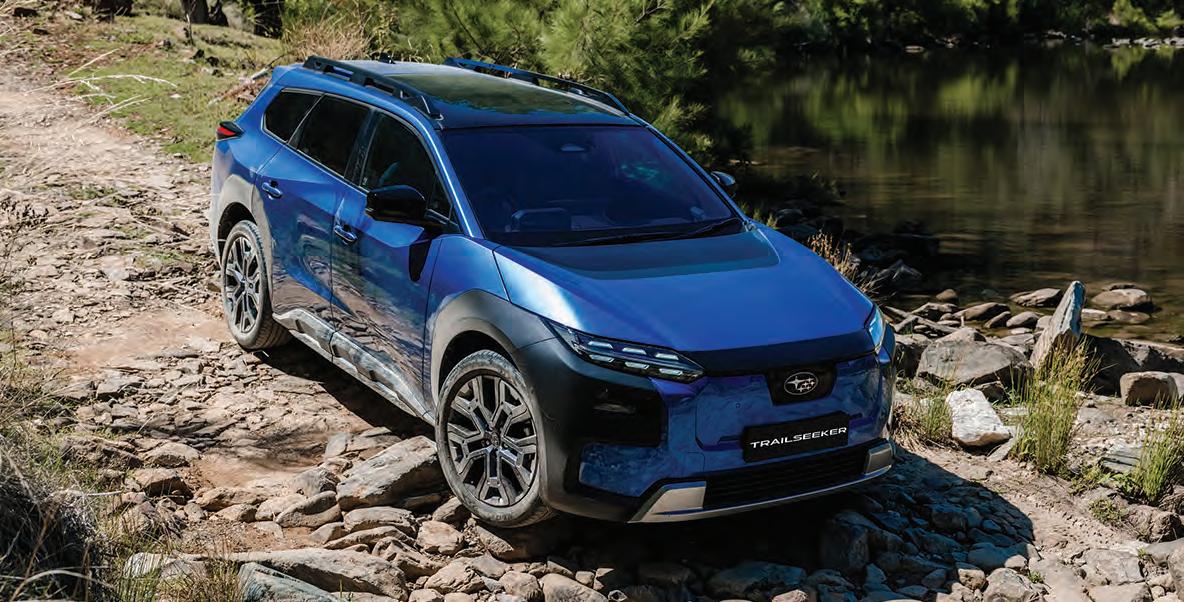
SUBARU NEW Zealand has announced the all-new, all-electric Trailseeker will join its SUV line-up in September 2026.
A new nameplate for the brand, the Touring, will be Subaru’s electric SUV, offering Kiwi customers a larger, more adventure oriented EV.
Producing 280kW of maximum combined power and accelerating from 0–100 km/h in approximately 4.4 seconds, the vehicle is set to become the fastest-accelerating production Subaru ever built, while also retaining the all-road capability that makes Subaru so well suited to NZ’s varied conditions.
Trailseeker is built around the company’s next-generation e-Subaru Global Platform, developed specifically to support higher outputs, extended driving range and enhanced all-wheel
drive performance.
Power is supplied by a 74.7kWh CATL battery, delivering a driving range of up to 488 kilometres, that with 150kW DC fast charging, can charge from 10 to 80% in approximately 30 minutes.
Other features of note include 1500W, vehicle-to-load (V2L) capability, alongside a 1500kg braked towing capacity, 211mm of ground clearance and, of course, Symmetrical All-Wheel Drive, via a dual motor configuration.
Jerry Delaney, general manager of Subaru distributor Inchcape New Zealand welcomed the addition of Trailseeker to Subaru’s New Zealand range.
“It’s the ideal vehicle for Kiwi drivers seeking adventure and for those who want to enjoy an engaging performance drive, all while remaining grounded in the confidence, safety and all-wheel drive capability that
underpins Subaru’s DNA.
“After we sold out of Solterra in New Zealand, we have been eagerly awaiting a new EV Subaru model here and the Trailseeker is a fantastic
option.
“It delivers electric performance without compromising on confidence, control or real-world capability – the qualities our customers expect from a
Striving to Exceed Expectations
Reliable parts and service support is essential when investing in tractors and machinery. Power Farming has built a nationwide network designed to keep New Zealand operators moving with confidence.
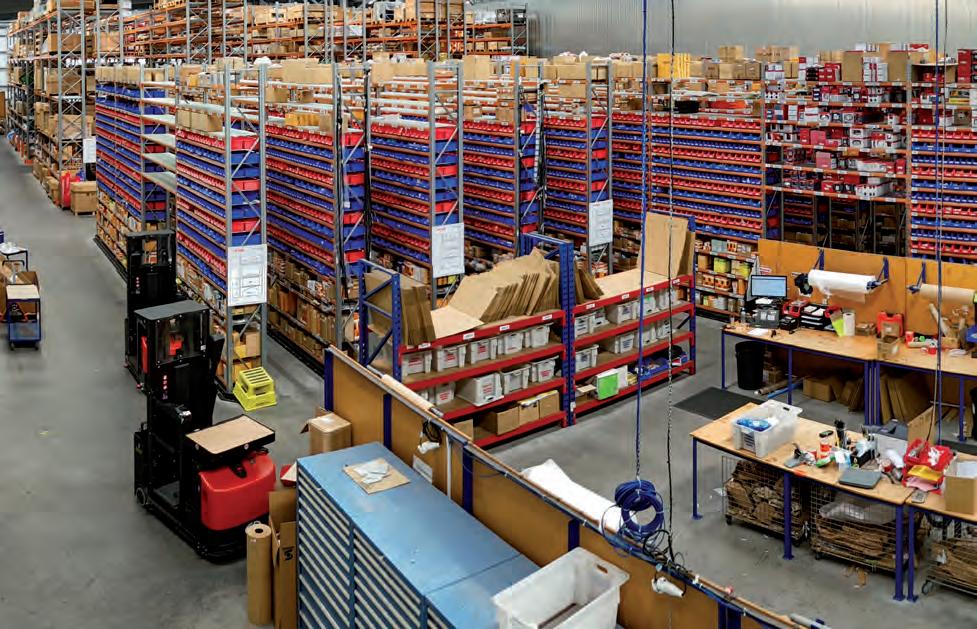
Across the country, 21 branches carry tailored parts stock to support local machines and seasonal needs. These are backed by major distribution centres in Morrinsville and Christchurch, ensuring fast access to slower‑moving or bulk parts, with additional overnight supply available from Australia when required.
A recent multi‑million‑dollar investment has strengthened this network further, with a new 1,650 m² purpose‑built parts facility in Morrinsville now supporting over 110,000 line items across NZ and Australia. Combined inventory exceeds $70 million, giving customers strong assurance of availability. During peak periods, same‑day dispatch and extended courier cut‑offs help minimise downtime, supported by 24/7 seasonal assistance through the dealer network. Experienced parts teams nationwide provide deep product knowledge to support both current and older machines.
Power Farming’s partnership with Kramp broadens access to competitively priced parts for a wide range of machinery, ensuring operators can get back to work efficiently, regardless of machine or tractor brand.
Power Farming – We keep you growing.
Subaru. While the all-new Trailseeker joins the updated Solterra, we will be focusing solely on Trailseeker Touring in New Zealand at this stage,” Delaney says.
Subaru says Trailseeker is the ideal vehicle for Kiwi drivers seeking adventure.
Kiwi axemen claim double world titles in Hungary
MARK DANIEL
NATIONAL AND world records tumbled as top Kiwi axemen claimed two Stihl Timbersports world titles at the same event in Budapest, Hungary over the first weekend in June.
Touted as the best axeman on the planet, King Country farmer Jack Jordan set yet another world record on his way to achieving an incredible four-peat of the Stihl Timbersports World Trophy.
Described as the 20/20 cricket of international wood chopping, the
quickfire event sees four disciplines taken on backto-back, with no rest breaks between each, meaning the competition is only suited to competitors with superior fitness and endurance, as they make their way through knockout stages to the final showdown.
Jordan set a new World Record of 50.84 seconds, eclipsing his previous World Trophy record time of 52.53 seconds set in Milan, Italy in 2024.
The 29-year-old is also the current Stihl Timbersports World Champion and the NZ Rural Sports Person of
the Year Supreme Award winner. He beat 16 of the world’s top axemen from 16 different countries to claim his latest historic feat.
“It’s great to be able to come over here and succeed after all the training you put in at home, especially when you sometimes wonder what it’s for when you have no competition, but this year, there was a lot of pressure in the final.
“Five years ago, no one knew about me, so hopefully I can keep on doing it. I’m grateful to be able to come over here and win these events so let’s hope I can continue
doing so,” says Jordan. Meanwhile, Matthew Gower from Whangamomona in Taranaki snatched victory in the final discipline to win his first ever world title, taking out the Stihl Timbersports Rookies (Under 25) World Championship, by just five hundredths of a second.
Gower, aged 23, set four national records and a personal best across the five timber sport disciplines in the rookies’ section against 12 other competitors. The title came down to the last of the five disciplines, with Gower pipping Australia’s
Awatea Moore Barrett by the slimmest of margins in the technical springboard event.
“It hasn’t fully sunk in yet,” says Gower.
“I’m honestly lost for words, but it feels so good to know everyone
is watching at home and I wouldn’t have been able to do it without the supportive community I have back in Taranaki. It was definitely worth the trip, it’s been amazing.”
The qualified diesel mechanic with a passion
for hunting who also works on the family’s Whangamomona farm, has represented NZ in age group tournaments for the past five years, and won the NZ Rookies championship for the first time in 2025.
VETS SUPPORT VIRTUAL FENCING
VETS SAY they support the responsible use of virtual fencing and virtual herding technology for cattle and wants to work with farmers, manufacturers and government to help shape standards for future use backed by ongoing research to strengthen animal welfare outcomes.
NZVA chief executive Kevin Bryant says virtual fencing is already delivering benefits on some New Zealand farms, including greater flexibility in pasture management, environmental protection, and reduced reliance on physical fencing.
“Our members working with dairy farmers are already seeing many of these positive benefits.
“The focus now
should be on future proofing this technology by ensuring animal welfare remains at the centre of its development, regulation, and use.”
The NZVA believes veterinarians have an important role to play in supporting farmers as they adopt new technologies, by carefully selecting which farms and animals will benefit from using the technology, helping ensure animals are appropriately trained, monitored, and managed to achieve the best welfare outcomes.
“Virtual fencing has significant potential, but that potential must be supported by strong welfare safeguards and robust standards.
Farmers, technology providers, regulators, and veterinarians all
have a role to play in ensuring the technology is designed and used responsibly.”
While current research indicates cattle can learn to respond to audio and vibration cues, reducing the need for electrical stimuli over time, the NZVA supports continued independent research to better understand long term welfare outcomes and ensure standards evolve alongside the technology.
“Virtual fencing is becoming an important part of modern livestock management. The NZVA wants to be part of ensuring its future development is guided by robust science, practical farming experience, and a commitment to high standards of animal welfare.”
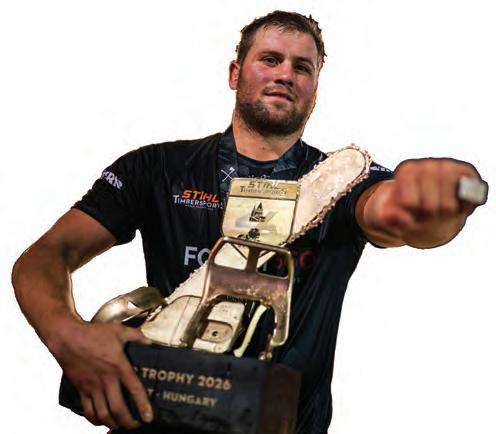
King Country farmer Jack Jordan set yet another world record.
JCB plans to add to its record haul
MARK DANIEL markd@ruralnews.co.nz
WHILE ITS best known as a manufacturer of construction and agricultural machinery, JCB holds a significant place in the record books, with a surprising mix of land speed records, including the fastest diesel car in 2006, the fastest backhoe loader in 2014 and the fastest tractor in 2019.
Alongside creating those records, the company has been instrumental in keeping things in-house by building its own diesel engine, the JCB 444, in 2004, followed more recently by the launch of a hydrogen combustion engine in 2020. Of course, given its appetite
for breaking records, it was only a matter of time before the UK manufacturer wanted to add to the list with the world’s fastest hydrogenfuelled car.
The Federation Internationale de l’Automobile (FIA), the global governing body for motorsport, last month introduced a hydrogenfuelled category for land speed racing, with JCB acting as the first entrant in this year’s Bonneville Speed Week in Utah, USA. Hosting land speed record attempts since 1914, the 30,000-acre dried lake has been the site of several famous records, including JCB’s 350.092mph Dieselmax run in 2006.
With that Dieselmax
car providing a starting point for the new Hydromax, factory sources suggest the car is more powerful, 10% lighter and 10% more aerodynamic, so delivers a great recipe for performance.
Power for the car is delivered from two fourcylinder engines, with one driving the front wheels and the other driving the rear. Physically, the only connection between the two drivetrains is the salt surface of the lakebed, so removing the complexity and weight of a connected driveline, but adding the challenges of a complex engine management system to operate the two engines in tandem.
The major change from the ‘conventional’ JCB
hydrogen engine used widely in its constructionorientated products is power output. Production versions of the engine typically deliver 80hp, but Hydromax will see a tenfold increase to 800hp, giving a combined total of 1600hp.
Layout is also a technical jigsaw, meaning to provide sufficient space for the fuel tanks and cooling infrastructure, each engine is mounted at 82 degrees and operates with a dry sump, with separate oil reservoir and air separator.
Tight-lipped about the
speed it wants to achieve, one can assume that the number required is more than 350mph, so it’s no surprise to hear that driving the car will be the current fastest man on earth, retired RAF Wing Commander Andy Green. Green holds the current land speed record from Thrust SSC in 1997 with a top speed of 763.035mph and piloted the Dieselmax vehicle in 2006.
Besides wanting to head into the record books, the project’s other
aim is to demonstrate the capability and performance of hydrogen as a diesel replacement, particularly as fuel cell research is heading forward at a rate of knots with several conventional car manufacturers. Following engineering testing in the UK in June, the car will take part in Bonneville Speed Week in August.
The project is a personal endeavour of JCB chairman Anthony Bamford, who speaking
during Hydromax’s reveal said, “Britain has a proud heritage of setting speed records and, as a British company, I am excited to challenge for a new one using hydrogen. This is not just about speed; it’s about showcasing the world-class engineering talent we have here in the UK and the robustness of our new hydrogen engines. As for the speed we are aiming for with JCB Hydromax? We certainly intend to beat 350mph.” www.jcb.co.nz