NEWS
AGRIBUSINESS
Will El Niño hit kiwifruit?
Drone regulations revamp ‘won’t lower standards’. PAGE 16
PAGE 11
TO ALL FARMERS, FOR ALL FARMERS www.ruralnews.co.nz
SEPTEMBER 15, 2026: ISSUE 859
Seeds of trouble NIGEL MALTHUS
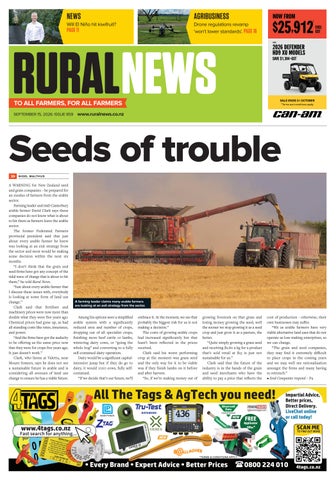
A WARNING for New Zealand seed and grain companies – be prepared for an exodus of farmers from the arable sector. Farming leader and mid-Canterbury arable farmer David Clark says these companies do not know what is about to hit them as farmers leave the arable sector. The former Federated Farmers provincial president said that just about every arable farmer he knew was looking at an exit strategy from the sector and most would be making some decision within the next six months. “I don’t think that the grain and seed firms have got any concept of the tidal wave of change that is about to hit them,” he told Rural News. “Just about every arable farmer that I discuss these issues with, everybody is looking at some form of land use change.” Clark said that fertiliser and machinery prices were now more than double what they were five years ago. Chemical prices had gone up, as had all standing costs like rates, insurance, and power. “And the firms have got the audacity to be offering us the same price now that they were for crops five years ago. It just doesn’t work.” Clark, who farms at Valetta, near Mount Somers, says he does not see a sustainable future in arable and is considering all avenues of land use change to ensure he has a viable future.
A farming leader claims many arable farmers are looking at an exit strategy from the sector.
Among his options were a simplified arable system with a significantly reduced area and number of crops, dropping out of all specialist crops, finishing more beef cattle or lambs, wintering dairy cows, or “going the whole hog” and converting to a fully self-contained dairy operation. Dairy would be a significant capitalintensive jump but if they do go to dairy, it would 1000 cows, fully selfcontained. “If we decide that’s our future, we’ll
embrace it. At the moment, we see that probably the biggest risk for us is not making a decision.” The costs of growing arable crops had increased significantly but that hasn’t been reflected in the prices received. Clark said his worst performing crop at the moment was grass seed and the only way for it to be viable was if they finish lambs on it before and after harvest. “So, if we’re making money out of
growing livestock on that grass and losing money growing the seed, well the sooner we stop growing it as a seed crop and just grow it as a pasture, the better. “Quite simply growing a grass seed and receiving $2.80 a kg for a product that’s sold retail at $15 is just not sustainable for us.” Clark said that the future of the industry is in the hands of the grain and seed merchants who have the ability to pay a price that reflects the
cost of production - otherwise, their own businesses may suffer. “We as arable farmers have very viable alternative land uses that do not operate as loss making enterprises, so we can change. “The grain and seed companies, they may find it extremely difficult to place crops in the coming years and we may well see rationalisation amongst the firms and many having to retrench.” • Seed Companies respond – P4
All The Tags & AgTech you need! NEW
www.4tags.co.nz
FREE
Impartial Advice, Better prices, Direct Delivery. LiveChat online or call today!
Applicator Offer*
SCAN ME
0800 224 010
4tags.co.nz
TO FIND OUT MORE
NEW
*TERMS & CONDITIONS APPLY
� Every Brand � Expert Advice � Better Prices
RURAL NEWS // SEPTEMBER 15, 2026
NEWS 3 ISSUE 859
www.ruralnews.co.nz
Labour urged to rule out emissions tax SUDESH KISSUN
NEWS ��������������������������������������1-13 HOUND, EDNA ����������������������� 14 CONTACTS ������������������������������ 14 OPINION �����������������������������14-15 AGRIBUSINESS ���������������� 16-17 MANAGEMENT ����������������18-19 ANIMAL HEALTH ������������ 20-21 MACHINERY AND PRODUCTS �����������������������23-27 RURAL TRADER ���������������������27
HEAD OFFICE Lower Ground Floor, 29 Northcroft Street, Takapuna, Auckland 0622 Phone: 09-307 0399 Fax: 09-307 0122 POSTAL ADDRESS PO Box 331100, Takapuna, Auckland 0740
sudeshk@ruralnews.co.nz
FOR THE first time in a quarter of a century, Federated Farmers has something positive to say about the Labour Party’s climate change policy leading into a general election. Farmers are welcoming Labour leader Chris Hipkins’ statement that his party will not campaign on taxing agricultural emissions. However, they want Labour to categorically rule out any emissions tax on farmers as part of potential coalition negotiations. If Labour does form a government after the election, it will need the support of the Greens, a party with a history of targeting farmers. Federated Farmers is also backing Labour’s plans to tackle the incentives driving productive
CONTACTS Editorial: editor@ruralnews.co.nz Advertising material: beckyw@ruralnews.co.nz Rural News online: www.ruralnews.co.nz Subscriptions: subsrndn@ruralnews.co.nz
their understanding of these kinds of issues,” he says. “It should come as no surprise that climate policy, particularly issues around methane and forestry, have been a major focus of these meetings. “We’ve also worked hard to get Labour leaders out on farm to see the impacts of whole-farm carbon forestry conversions with their own eyes. “That work has clearly had an impact that’s now flowing through into Labour’s policy.” Dawkins says Labour is right to recognise the current ETS settings can make planting exotic forests more attractive than producing food. “It’s really encouraging to see Labour acknowledge the current settings can incentivise the loss of productive farmland to exotic
Richard Dawkins, Federated Farmers.
forestry. “We support Labour’s commitment to pause new forestry registrations, review forestry’s role in the ETS and develop rules to prevent whole-farm carbon forestry conversions.”
ETS CHANGES ‘TO ERODE INVESTOR CONFIDENCE’ NIGEL MALTHUS
Published by: Rural News Group Printed by: Inkwise NZ Ltd
farmland into forestry, but it has serious questions about wider plans for the Emissions Trading Scheme (ETS). “The Labour Party has campaigned on taxing farm emissions in some form in every election since 2003,” Federated Farmers climate spokesperson Richard Dawkins says. “Credit where credit is due, they’ve clearly listened to farmers’ views, looked at the evidence, and been open to changing their position. That’s a significant policy shift. “We now need Labour to go one step further and categorically rule out any emissions tax on farmers as part of potential coalition negotiations.” Dawkins says the change hasn’t happened by chance. “For the last three years we’ve hosted an annual two-day meeting with the Labour caucus to build
THE NEW Zealand Institute of Forestry (NZIF) says unnecessary changes to New Zealand’s Emissions Trading Scheme (NZ ETS) will seriously erode investor confidence and result in significant reductions in forest planting rates. NZIF president Adrian Loo was responding to the report “Adrift: What future does the Emissions Trading Scheme have?” in which the Parliamentary Commissioner for the
Environment, Simon Upton, called for a major rethink of forestry’s role in the ETS. Loo said the report raised legitimate questions about the balance between reducing gross emissions and removing carbon through forests, but proposals to halt new forestry registrations or progressively remove forestry from the scheme were premature. “New Zealand needs faster reductions in gross emissions, but this does not diminish the importance of carbon removals. We need both.
“The challenge is to design a system which recognises their different roles and provides credible incentives for each.” Loo said the report’s modelled scenarios were projections rather than predictions and depended heavily on assumptions about future carbon prices, planting rates and forest owner behaviour. “A model looking ahead to 2075 can help us understand possible risks, but it cannot tell us with certainty how markets, technology, landowners or governments will behave over the
next 50 years. Major policy decisions should not be based on one set of modelled scenarios.” Loo said the report also overlooked the difference between government auction units and forestry units. “Government auction units are permissions to emit. Forestry units recognise carbon which forests have actually removed from the atmosphere. Treating both forms of supply as though they have the same climate effect overlooks a fundamental difference.”
RURAL NEWS // SEPTEMBER 15, 2026
4 NEWS
Seed, grain companies ‘share sector concerns’ NIGEL MALTHUS
SEED AND grain companies share the concerns of arable farmers about the viability of their sector, says Seed and Grain New Zealand chief executive Dr Sarah Clark. With increasing numbers of arable farmers looking to diversify or even abandon arable altogether to go dairying, Clark said it was not true that the
companies were unaware of the exodus facing the sector. “The seed companies have seen that coming, they’re aware of it. And are doing what they can,” she told Rural News. She said the companies know that profit margins for farmers are under threat, with costs having increased significantly, particularly for fuel, fertiliser, agri-chemicals and replacement machinery.
Unfortunately, a lot of that was caused by things that neither the farmers not the companies had control over – global inflation, geopolitics impacting markets and the cost of fuel and fertiliser, and poor weather over the last two summers leading to yield and quality issues. Clark said part of the difficulty was that the sector was fragmented, with different pressures on its four broad
areas – grain, Nui ryegrass, vegetable seed multiplication, and proprietary New Zealand seed. Clark said that grain and the New Zealandbred non-proprietary Nui ryegrass were both commodities with prices set internationally and minimal margins. “There are a lot of components that the seed companies can’t control.” Seed multiplication of vegetable seed for
POWER OF COLLABORATION THE ARABLE Sector Forum took place in Christchurch last week (September 7). It brought together government, growers, and industry to discuss challenges and opportunities facing the sector and actions to help drive its future success. Key discussion included sector priorities, creating value, boosting grower returns, building sector resilience, market insights, and potential opportunities for collaboration. Seed and Grain New Zealand chief executive Dr Sarah
Clark said a big strength of the sector was its power of collaboration. “Without the arable farmer, there is no seed and grain trade and there are no seed companies. The seed companies absolutely understand that we’re in it together.” She said the companies working with overseas seed multiplication had been negotiating hard with their suppliers, and there had been an increase in returns for farmers this year.
Seed and Grain NZ chief executive Dr Sarah Clark.
overseas companies was one area where returns could be good but the need for strict rotation for purity assurance, pest control and soil health meant farmers had to
break it up with poorerperforming grains. “The seed companies have to provide pure seed back to the company offshore and to do that, they can’t grow the
same variety in the same paddock year after year; I think there’s between about 10 and 12 years before you can grow the same species in the same spot.”
ARABLE FARMING ‘NO LONGER SUSTAINABLE’ NIGEL MALTHUS
MID CANTERBURY Federated Farmers arable chair, Bevan Lill, said Beef + Lamb NZ data indicated that for the last six years, the average arable return on investment was about 0.8% while inflation ran about 4% - so the average arable farm was going backwards at about 3% a year. “That’s not sustainable in anyone’s imagination.”
Lill said that the seed companies believe they could look to other areas such as Southland for seed production if Canterbury farmers turn away from it. But that might not be as easy as they think. “The reality is a Southland sheep and beef farmer has a greater net profit per hectare than I do. So they’re not going to want to change to an arable system that’s less profitable than their current system.
“And the dairy farmers aren’t going to let a seed company push them out of their wintering ground. They’ll pay what’s needed to do the job.” Lill said the companies were a bit naive in their approach, and the idea that they can go without Canterbury will be found wanting. “And in the meantime, the Canterbury arable farmers will have moved on.” Lill said the seed industry has
wanted to ignore inflation and had not moved contract pricing “in the necessary direction” for a very long time. Either they had to share the ‘pie’ more appropriately, or make the pie bigger. “Either way, more money needs to get back within the farm gate for farmers. Otherwise they will go in search of a better option.” Lill said his own farm, 400ha near Methven, had a traditional ryegrass
seed production focus, alongside spring break crops and autumngrown wheat. But over the last 10 years he has incorporated more and more trading lambs into the system, now finishing about 6000 lambs. “That’s become a critical part of our business to the point where I now have about 50ha of the farm that doesn’t go through the combine. It’s planted in kale, forage crops, and there’s an area of potatoes as well.”
With Active Descent Control, Polaris has you COVERED.
STEEP HILL? NO WORRIES. Automatic Engine Braking System (EBS) and Active Descent Control (ADC) delivers a smoother and more controlled deceleration downhill.
WWW.POLARISNEWZEALAND.COM
44 HP | 612 KG TOWING CAPACITY | 1,587 KG WINCH 22.6 CM OF TRAVEL & ARCHED DUAL A-ARM
MY26 SPORTSMAN 570 TRAIL FROM $18,995 INC GST
RURAL NEWS // SEPTEMBER 15, 2026
NEWS 5
Growers want bad employers taken to task PETER BURKE peterb@ruralnews.co.nz
WHERE ANY worker in the kiwifruit industry is mistreated, we expect the authorities to take action. That’s from Colin Bond, the CEO of NZKGI, the organisation that represents kiwifruit growers. His comments come following another
report of migrant exploitation. Reports say two migrant workers were forced to work up to 70 hours a week in Bay of Plenty kiwifruit orchards for low or no pay, and one was made to hand back $1500 in cash under the guise of paying tax. This was the latest in a series of incidents in the past year where
migrant workers in the kiwifruit industry have been exploited. Bond says they have seen such reports over the past years and his organisation has zero tolerance for such behaviour by employers. He says they would encourage anyone who is aware of any exploitation to report it
to the authorities, and would in turn expect them to take action. But he admits in the case of immigrant workers, the situation is tricky because those affected may not be aware of NZ laws or are too afraid to report a problem. According to Bond, the kiwifruit industry has 10,000 permanent
The kiwifruit industry has 24,000 seasonal workers at the peak of the season. PHOTO: NZKGI FACEBOOK
employees and 24,000 seasonal workers at the peak of the season. “Our hope is that every one of those workers gets treated well
and gets a fair day’s pay for a fair day’s work and has a good experience working in the sector,” he says. Bond says he’s
confident that most employers in the sector are good and that staff are well treated. @rural_news facebook.com/ruralnews
LABOUR’S PLEDGE TO REVIEW ETS RED MEAT farmers are welcoming Labour’s plan to review the Emissions Trading Scheme and not to campaign on pricing agricultural emissions. Beef+Lamb New Zealand says Labour’s climate policy announcement points to an emerging political consensus that agriculture and climate policy must be practical, internationally aligned and fair to farmers. Labour is also reconsidering the role of forestry, developing new rules to prevent whole-farm conversions, pausing new forestry registrations while the work is
completed, and ensuring the ETS supports New Zealand’s Paris targets. B+LNZ chair Kate Acland says those signals are welcome. “It is encouraging to see broad recognition that pricing agricultural emissions is not the right tool, and that the ETS should not keep incentivising the loss of productive sheep and beef farmland into carbon forestry. “Farmers will also be seeking reassurances that agricultural emissions pricing will not be revived through coalition negotiations or future policy
reviews. “Labour’s potential coalition partners support agricultural emissions pricing, so Labour needs to make it clear that keeping agriculture out of emissions pricing would be a bottom line in any negotiations, if it is elected.” Announcing its policy last week, Labour leader Chris Hipkins and climate change spokeswoman Deborah Russell said the party would urgently review the scheme and move quickly to implement any changes. Hipkins also confirmed Labour would not campaign on pricing
agricultural emissions, ending nearly two decades of Labour campaigning on some form of emissions pricing for agriculture. Labour is concerned at the rampant tree planting that has depressed the ETS price without encouraging emissions reductions. A low ETS price encourages polluting firms to buy offsets instead of investing in processes that actually reduce their emissions. Acland says red meat farmers agree that there is no need to price agricultural emissions. “Sheep and beef farmers are already cutting emissions, and New
Zealand should be backing them with practical tools and incentives, not loading them with costs our overseas competitors do not face. “Labour’s announcement is in line with our international partners. Updated research released by B+LNZ in May found no country is looking to include agriculture in an emissions trading scheme, and virtually no country is looking to price agricultural emissions. “Most jurisdictions are instead using incentives, investment, carbon credits and market-led approaches to support farmers to reduce emissions.”
Walking the talk with over 200 ANZ agri specialists From Houhora to Bluff, find local expertise to help your farm succeed.
ANZ Bank New Zealand Limited
H261204_ANZ_Agri_RuralNews_W265xH130mm_v1FA.indd 6
09/12/2025 8:26 am
RURAL NEWS // SEPTEMBER 15, 2026
6 NEWS
Courting the rural vote PETER BURKE peterb@ruralnews.co.nz
IT WAS billed as a chance for all the political parties to woo the rural vote, but question marks hang over just how effective this was. On the morning of
Sunday, September 6, just as New Zealanders were getting over the All Blacks’ defeat at the hands of the Springboks, the television programme Q&A with Jack Tame as the moderator ran an hour long special, which all party spokespeople
on agriculture (except Te Pati Māori) turned up for. It was wisely prerecorded at a Hamilton sports club with an audience made up of locals of all political hues. Those taking part were Todd McClay (National), Jo Luxton (Labour), Mark
Patterson (NZ First), Andrew Hoggard (Act), Steve Able (Greens) and Daniel Eb (Opportunity). Issues canvassed included biosecurity, the dairy industry and its effects on the environment, the Paris Agreement, free trade
ACT’s Andrew Hoggard makes a point while Labour’s Jo Luxton (left) and Opportunity’s Daniel Eb look on.
Sustainable, targeted and cost effective
CONTROL IN PASTURE
Targeted insect protection
Soil-borne seedling disease defence
With the recent removal of chlorpyrifos from the market, Superstrike® seed treatment is a sustainable, targeted and cost-effective solution for pest and disease control for your new pasture.
agreements, deregulation, rural health and the land tax. In essence, each representative trotted out their party line and it was difficult for those who follow rural politics to be any the wiser because of the event. Perhaps a rather startling revelation was Luxton saying that Labour has yet to announce its agricultural policy. McClay defended his party’s stance on the FTAs while Hoggard was in jovial form, making a few quips at his opponents and promoting deregulation. Patterson made some good points but looked a trifle nervous when it was pointed out that he was the first MP to visit India just after the FTA with that country was signed. Able strictly followed the party line about the need to reduce cow numbers and claiming that this may not necessarily affect total milk production. Eb defended his party’s controversial land tax policy which came under attack from others on the panel. One of those at the event was regional councillor and former local Federated Farmers president Keith Holmes.
He described the event as being well run and said Tame did a really good job in getting the politicians to state their point of view. He says his impression was that there was quite a bit of intellectual horsepower on the panel, but noted that many of the answers to question were in the form of platitudes. “What worries me is whether the rankand-file voter actually understands the critical components that farming needs and the implications of some parties’ policies to re-engineer the economy,” Holmes told Rural News. “I worry that people will vote on the basis of the platitudes and not the hard facts. To me, a move away from the present coalition would be a retrograde step,” he says. He says the implications of the land tax were well exposed in the debate, but while he may have disagreed with speakers from the left wing, he noted they came across convincingly. He says, on reflection, the debate was more entertainment than being of any political significance.
Even when times are tough, we’ll keep delivering the news to your letterbox for free.
RURAL NEWS RURAL NEWS TO ALL FARMERS, FOR ALL FARMERS
PWS2717
PROTECT YOUR SEED, PROTECT YOUR FUTURE.
TO ALL FARMERS, FOR ALL FARMERS
For more information, talk to your local seed retailer or visit seedtreatment.co.nz
We love Farmers... and letterboxes
RURAL NEWS // SEPTEMBER 15, 2026
NEWS 7
AgFirst boss humbled, thrilled to get award PETER BURKE peterb@ruralnews.co.nz
SURPRISED, HUMBLED and quite thrilled. That’s the reaction of James Allen, one of the founding partners and now chief executive of AgFirst, on being made a life member of the Institute of Rural Professionals. He told Rural News that being honoured by one’s peers is probably the highest accolade that any person can receive. The honour recognises his dedicated work across rural consultancy, agribusiness and industry leadership over 30 years. The citation for his award says that throughout his career,
Allen has combined practical farm advisory work with a commitment to lifelong learning and thought leadership. He initially gained a Bachelor of Commerce in Agriculture at Lincoln University and later completed a Master of Agribusiness. In recent years he was awarded a Nuffield Scholarship, during which he researched artificial intelligence and the future of agricultural advisory services. The citation goes on to say that he’s undertaken international study and research, led major extension and mentoring programmes, and developed expertise
in farm systems, nutrient management, governance and business transition. “His work has taken him from South Waikato to Uruguay; Ireland to Rwanda; and Chile to Vanuatu; bringing global insights back to benefit New Zealand farmers and
rural businesses. Service has been a constant theme. Allen served as National President of New Zealand Young Farmers, President of NZIPIM, President of the National Fieldays Society, and Associate Director of AGMARDT,” says the
citation. Finally, the citation says Allen has also been a passionate advocate for professional standards through his long-standing involvement with certification and advisory programmes. It adds that he’s has never been
AgFirst chief executive, James Allen
short on ideas, projects, committees or air miles, but throughout it all he
has remained grounded, practical and deeply committed to people.
FARMING’S MORE COMPLEX IN HIS 30 years as a rural professional, James Allen says some things have changed enormously, while some fundamentals have not changed. The technical tasks that rural professionals do are becoming more complicated. “Originally it was, how do you feed an animal, grow it better,
grow more grass, but now you have to do all that plus do it in an environmentally friendly and socially sustainably way, plus look after your staff and grow the business. So, you have governance, environmental and social parameters,” he says. Farming has become a lot more complex and Allen says therefore
rural professionals have had to adapt and grow their skills set and collaborate more with industry. He says the technology role is changing dramatically and it will change more dramatically over the next five years as AI comes into play. “As rural professionals, we do have to be right up to date and
technology is moving very quickly. A classic example is wearables… as a rural professional, we have understand them and what works for what farm and the technology behind them. We have got to be right up to date with technology but equally recognise that some of the leading farmers are pushing boundaries as well,” he says.
WEANING MADE SIMPLE.
Worm Control & Coccidiocide in a single dose.
AAH-TUIT_2026-035
Recommended as the first drench for young stock. Alleva Animal Health. Proudly New Zealand owned and operated.
Twice the stock, half the time. Proven results.
World-first formula, developed here in NZ.
PROUDLY
NZ
OWNED
TURBO® is a registered trademark of Alleva Animal Health Ltd. TURBO Initial (A011703) is registered pursuant to the ACVM Act 1997. See www.foodsafety.govt.nz for registration conditions.
The biggest job requires the best solutions To love and succeed in farming you have to enjoy solving problems. The next potential setback is never far away. Fortunately we now have better solutions than ever before and with our ongoing investment in R&D both here and around the world, we look forward to partnering with you for many years to come. The challenge is big, but so too is the appetite for success.
For the love of farming
#TheBiggestJobOnEarth
Scan here for more information or call us on 0800 558 399
ALWAYS READ AND FOLLOW LABEL DIRECTIONS ACVM Registration Nos: Belanty P009798, Polyram DF: P002062, Delan WG: P003507, Sercadis: P008977 & Regalis Xtra: P008734 © Copyright BASF 2026. ®Registered trademark of BASF. BASFNZNA0005 0926
BASFNZNA0005_BASF_NZ_Horticulture_NorthIsland_Advert A_Rural_News_390mm(h)x 265mm(w)_Newsprint_FA.indd 1
2/9/2026 3:05 PM
RURAL NEWS // SEPTEMBER 15, 2026
NEWS 9
Food safety regulator’s balancing act PETER BURKE peterb@ruralnews.co.nz
STRIKING A balance between meeting the needs of industry to speed up approval time for products but on the other hand ensuring that risks are properly assessed. That’s the challenge NZ Food Safety Authority head Vincent Arbuckle faces on an almost daily basis. The authority is part of MPI and has an important role in ensuring that food exports meet the NZ standards and comply with the regulations in countries where a product is being exported to, as well as making sure that any food imports comply with our rules and regulations. Arbuckle says
understandably there is a lot of pressure on companies to get product to market faster and there is pressure therefore on regulators such as his to do their job as quickly and efficiently as possible. Today he says they are far more alert to that pressure and are working hard to speed up the process. “But we can’t throw the baby out with the
bath water and cut corners,” he told Rural News. “Our bottom line is protecting NZ food production and that products going to export markets are safe and compliant with the rules of the importing country. Our focus has to be on the real, not the imagined risk,” he says. In the past year the Ministry of Regulation looked at
the operation of the Food Safety Authority and the Environmental Protection Authority (EPA) and recommended that they work more closely together, and this is now happening. The goal is that while the two regulators have different roles, they must appear as seamless to the industry because products often go through approval processes in both NZ Food Safety Authority head Vincent Arbuckle.
BUILDING TRUST VINCENT ARBUCKLE says a big part of his group’s role is to give assurance to trading partners and to build up an understanding of each other’s farming system and what chemical or product may or may not be acceptable. For example, he says a product acceptably used in a feedlot system will possibly be unacceptable in our pasture-based system. He says there is a need to be
aware of any differences in withholding periods. Arbuckle says customers such as China come to NZ on a regular basis to get proof of what we say we are doing. He says they will inspect premises and conduct tests on products and if they find something there that is wrong it can become a problem. “The aim in all of this is to get the trust of our trading partners,” he says.
organisations. Arbuckle says a strong relationship has now been established between the two regulators with both parties keeping each other informed about the progress of applications through their respective systems. He says his
organisation is well aligned with the primary sector and understands their need to get products to market as quickly as possible, but he says they need to be clear about the risks of any products they use to produce the food. “We look at it from a trade and sector
National keeps its promises to farmers • • • • • • • •
Scrapped the Ute Tax Delivered the UAE, Gulf Cooperation Council, and India FTAs Created Investment Boost – tax deductions on assets to turbocharge your productivity Banned farm-to-forestry conversions Replaced the RMA Removed unworkable winter grazing, stock exclusion and SNA rules Tackling wilding pines and pests across the country Removed Agriculture from the ETS national.org.nz/farming
National is fixing the basics and building the future for rural New Zealand Authorised by J de Joux, ps@national.org.nz
perspective. For example, the dairy and red meat sectors are very dependent on us to make sure we are not exposing ourselves to serious risks. If there was a major problem in markets such as China, the US or the EU it could be catastrophic for us,” he says.
RURAL NEWS // SEPTEMBER 15, 2026
10 NEWS
Almond hull - a potential dairy feed SUDESH KISSUN sudeshk@ruralnews.co.nz
ALMOND HULLS sourced from Australian orchards may have the potential to help New Zealand cows reduce emissions, boost milk yield and lower input costs. That’s according to initial results from trials done on a few pilot farms near Tokoroa, South Waikato. While it’s early days, independent milk processor Olam Food Ingredients (ofi) is hopeful that almond hulls and shells repurposed into feed for dairy cows in New Zealand have the potential to help reduce both methane emissions and input costs on farms. Ofi has been operating a milk plant at Tokoroa since 2023 and pilot supplier farms have been
trialling almond hulls and shells for two seasons. Ofi’s chief operating officer dairy Naval Sabri says they have been working with agencies to analyse methane reduction on these farms. “The initial results have been very positive,” he told Rural News. Ofi, one of two operating divisions of Singapore-based conglomerate Olam Group, owns almond orchards and processing plants in Victoria, Australia. In a recent earnings call with analysts, Olam stated that “a significant part of the future is going to be on ofi”. Australian dairy farmers successfully used almond hulls as a source of fibre in a pasture-based system. This gives ofi
confidence that the model could work in New Zealand. The feed will be supplemented with Agolin Ruminant, which has the potential benefit of reducing methane emissions and increasing the feed conversion rate, which in turn will support milk yields. The trials are also looking at ways to efficiently and effectively package and transport the feed, reducing input costs. Sabri points out that it’s a practical example of how they have been able to use an existing ofi business and supply chain. “And being then able to, in a way, provide support to New Zealand farmers. The almond hulls do replace some feed supplements which have the higher carbon
footprint. “So, they are more sustainable. But they also provide an alternate feed option for a farmer when pasture growth is under pressure.” He cautions that almond hulls may not be a silver bullet for NZ farmers when it comes to reducing emissions. “I’ve been asked every time whether it’s scalable, because we still consume a lot of feed. “So, in terms of scalability, I’ll say that it’s not a universal solution for the entire New Zealand system. “I keep using this phrase – that it’s just one tool in a toolbox.” The almond hulls trial and initial results have also been well received by ofi’s global customers, who themselves trying to reduce their carbon
Naval Sabri, ofi’s chief operating officer dairy.
footprint. Sabri says using almond hulls as an alternative feed is a good example of “a practical intervention which solves a few things”. “It obviously provides an alternate feed to a farmer.” Palm kernel expeller (PKE) is a big part of the dairy feed regime in New Zealand but is a favourite target of environment lobbyists like Greenpeace. Sabri says almond hulls provide an alternate feed source for cows. “It’s more sustainable and initial results from agencies show that they do reduce carbon footprint. This is where
I see the real value – our customers also value it. “Most of our customers, when we share the story with them, they really see value for it. They obviously need proof, which is where we are currently trying to work with our agencies to provide that proof.” Sabri doesn’t expect all NZ farmers to embrace almond hulls as a feed source for their cows and scalability of almond hulls would depend on farmer uptake. He accepts there can’t be “a one size fits all approach”. “Every farmer has a different feed system.
Every farmer has a different farm economics. “Every farmer has a different comfort with changing the feed they use. We are not here to force our farmers to use a feed which we believe is more sustainable or which we believe is good for them. “We want those decisions to be taken by the farmers themselves. “They know better than us. They have been running that system, a particular system on their farm. So, the scalability would be a function of how farmers want us to scale, how much they want us to scale.”
HUNT FOR MORE MILK
ONE SECOND ONE ROLL
ONE LIFE FLEXIBLE CRUSH PROTECTION Designed to help protect riders in a rollover See the range at traxequipment.co.nz/atv-safety
I
Windscreens, UTV + ATV Acessories
A NEW second dryer has been commissioned by Olam Food International (ofi) at its Tokoroa plant. The new dryer has doubled milk processing capacity at the site, operating since 2023. It adds another 23 million kgMS processing capacity per annum, taking the plant capacity to over 45m kgMS. Ofi’s chief operating officer dairy Naval Sabri says the investment reflects the confidence of the company board in NZ dairy and its farmer suppliers. The second dryer gives ofi a more flexible ingredient platform. “The new capability will allow us to also process skim milk powder, cream and more importantly milkprotein concentrate,” Sabri told Dairy News. “This means we will retain the flexibility to produce whole milk powder and have the capability to produce other products.” Sabri says ofi’s strategic direction is clear: they want to create more value from the milk stream by participating in high value ingredients and nutrition applications.
“But in the same balance, we still want to maintain flexibility to respond to market conditions.” The new dryer means ofi is looking for more raw milk. “Because when you’re putting up a new asset, you always want to be mindful that you don’t overstress the asset in the first season itself.’ Ofi’s organic growth of milk supply remains on track, and the company is also on the hunt for new suppliers. “We are confident that within the next season, we will be able to attract enough milk through our farmers and with new farmers to be able to fill the capacity. “And we are very happy that we are able to support that organic growth.” At the same time, Sabri agrees that they won’t be able to fill the milk supply gap from within their current supply base. “We are working to attract new farmers in our cohort. “And we have got very good positive response from them. Which is basically giving us the confidence that we will be able to secure enough milk for this asset.”
RURAL NEWS // SEPTEMBER 15, 2026
NEWS 11
Will El Niño hit kiwifruit? growers is to use this time now to prepare, regardless of whether we get a long dry spell or not,” Bond told Rural News. “It makes sense to ensure that they have tested their irrigation system and are managing their orchards well. Also, making sure that they have good drainage systems in place in case we get very wet weather, but above all, have a plan,” he says. Bond says they are reminding their growers that all might not be bad with El Niño because a dry summer can be very good for fruit quality. He says with kiwifruit, the timing of weather conditions is everything. Bud break has taken place with red fruit, gold is about to happen and green is still a few weeks
PETER BURKE peterb@ruralnews.co.nz
KIWIFRUIT GROWERS are watchful but remain optimistic as concerns around the potential effects of the El Niño weather pattern this season. Colin Bond, the chief executive of NZKGI, the organisation that represents kiwifruit growers, says his members are reading in the press about what’s happening in the Northern Hemisphere this year and are starting to get a bit apprehensive about the dry spell that could be coming our way. He says he’s noticed that the frequency of that conversation is happening more in the last few weeks. “But our message to
away. Bond says the fruit needs rain from now until about Christmas, which is its main growing. “But rainfall becomes less of an issue postChristmas, and a dry summer can lead to high sugar content and better tasting fruit. And when it comes to the post-harvest period, dry conditions
can lead to high-quality storing fruit as well,” he says. Bond says NZKGI doesn’t send out specific weather information to growers because they have their own access to various sources of information and says any information they send out is more along the lines of a general conversation.
He says as orchardists get through bud break, they will be taking a very active interest about how their fruit is sizing and what the moisture horizon looks like. “We just want to make sure they have tested all their equipment and is ready to go when it’s time to turn the irrigation taps on,” he says.
Colin Bond, NZKGI.
ANOTHER RECORD CROP WHILE THE selling season for the 2025/26 crop still has some time to go, the predictions are for another record crop – even topping the previous seasons sale of 225 million trays. Colin Bond says this is good news for his members and may provide something of a potential buffer if El Niño causes problems. He says rising costs remain
a threat to profitability and notes that with things like fuel, growers are price takers. He says the best they can do is manage their operations as efficiently as possible. “But you can’t simply cut out things like irrigation completely because it’s a necessity if there’s a dry summer – that is why we encourage people to have good
HANDLE BAR PROTECTOR
moisture sensors in place. When it comes to fertiliser, it’s about applying just what the plant needs at the right time so you can be effective as possible with your costs and maximise every dollar spent,” he says. Recently, Earth Science NZ put out a paper suggesting what El Niño might bring in the coming season and they say that
its impacts are already starting to be felt. They say peak El Niño conditions are most likely to occur either in late spring or early summer, with the potential for this event to have significant impacts. They add it’s likely to peak as one of the strongest in recent history and say the event is already comparable to that experienced in 1997.
3,900
$
FRONT CARRIER
EX GST
NEW
REAR CARRIER
Introducing the CFMOTO 230 Dual Farm Bike, a tough, affordable machine designed specifically for New Zealand farming conditions.
• 229cc Single cylinder, 4 stroke engine • Wet, multi-plate, manual clutch
ENGINE PROTECTOR
• Full set of NZ made farm accessories as standard • 31mm Telescopic fork front suspension • Seat height 840mm
• Available in Tundra Grey
9,990
$
EX GST
NEW
• 408cc Single-cylinder engine, 33hp • Bosch EFI • CVT with engine braking • Spiral spring oil shock absorber • 612kg Towing cpty • 17L Fuel capacity • Available in Gedanite Grey
10,990
$
EX GST
NEW
• 408cc Single-cylinder engine, 33hp • Bosch EFI • CVT with engine braking • Power steering • 2,500Ib Winch • 612kg Towing cpty • 17L Fuel capacity • Available in Cypress Green
11,990
$
EX GST
NEW
• 498cc Single-cylinder, 39hp • Bosch EFI • CVT with engine braking • Power steering • 2,500Ib Winch • 612kg Towing cpty • 17L Fuel capacity • Available in Magma Red
2.99% FINANCE
2.99% FINANCE
EX GST
20,750 EX GST
2.99% FINANCE
2.99% FINANCE
UP FRONT
UP FRONT
IN 12 MONTHS
IN 12 MONTHS
IN 24 MONTHS
IN 24 MONTHS
9,990
$
• 400cc Single-cylinder, 31hp • Bosch EFI • CVT with engine braking • Power steering • 2,500Ib Winch • 612kg Towing cpty • 17L Fuel capacity • Available in Lava Orange
*2.99% p.a. interest rate fixed for the 24-month term of the loan. An upfront deposit of 1/3 of the RRP, a $130 UDC establishment fee, a $10.35 PPSR fee, a monthly maintenance fee of $2. Two further payments of 1/3 of the RRP are to be paid on the 12-month loan anniversary and the 24-month loan anniversary. This offer is only available on U10 PRO XL, U10 PRO, U10 PRO HIGHLAND, UFORCE 1000 EPS LE, UFORCE 800XL, UFORCE 600 EPS FARMSPEC, UFORCE 600 EPS, UFORCE U6 EV, CFORCE 520 EPS, CFORCE 400 EPS models. Offer ends 30th September 2026 (while stocks last). The loan is provided by UDC Finance Limited. UDC’s lending criteria, standard terms and conditions apply. This offer is available through Approved CFMOTO dealers only and cannot be used in conjunction with any other discounts.
$
• 580cc Four-stroke single-cylinder engine • Half Door Kit • Full Windscreen • Rear screen • Front Protector bar • 12V Bus Bar • 3500Ib winch • Available in Velocity Grey
The biggest job requires the best solutions The biggest crop yields – and profits – start with the best protection. Trust Sharpen® and Arietta® to set up more productive maize and sweet corn crops whilst strengthening your herbicide resistance management program for the seasons ahead.
Pre-emergent control of tough weeds
Post-em control of BLW & grass weeds
Sharpen up your pre em options in maize. NEW FlexiRate now registered Trials show that the new 100 g/ha rate of Sharpen + acetochlor delivers better broadleaf weed control and yield protection than atrazine + acetochlor. The original 150 g/ha rate remains the gold-standard for targeting high yields or managing high weed pressure.
To find out more scan the QR code or call 0800 558 399
ALWAYS READ AND FOLLOW LABEL DIRECTIONS © Copyright BASF 2026. ®Registered trademark of BASF. ACVM registration number: Sharpen®: P008391 and Arietta®: P008825. BASFNZAR0013 0626
BASFNZNA0005_NZ2026Media_Sharpen&Arietta_RuralNews_390x265_FA.indd 2
26/8/2026 3:29 pm
RURAL NEWS // SEPTEMBER 15, 2026
NEWS 13
Margins tight for sheep and beef FARMGATE LAMB prices down by 8%, beef cattle by 4.5% and farm expenditure up by 4.2% That’s what Beef+Lamb NZ is predicting in its new season outlook and all due it seems to the rising NZ dollar, higher input costs and the risk of what the El Nino weather system will bring. Farm Profit Before
Tax is forecast to average $267,200, down 20% on the provisional record season average of $335,500 in 2025-26, but still well above the fiveyear average. But it’s not all bad news. B+LNZ chair Kate Acland says that even with forecast decreases the new season returns promise to be very good. “They are still well
LETTER TO THE EDITOR SPAWNED FROM co-governance communistic ideology and predicated on false premise, courtesy of the current government. Farm Plans will employ hundreds and produce nothing. Another pen pushing industry
above the 2024-25 season and above the five-year average,” she says. Acland says recent prices provided a muchneeded turnaround and stronger cashflow through 2025‑26 have allowed many farm businesses to repay debt, catch up on fertiliser programmes, complete deferred repairs and maintenance, and
reinvest in the farm business after several low‑profit years. Looking ahead, she says global red meat supply remains tight and demand from key markets continues to support strong prices. But she adds that slower global economic growth, cost-of-living pressures and a stronger NZ dollar are expected to limit
further price increases in the coming season. Acland notes that events in international markets could negatively impact NZ, such as the US investigation into lamb imports and volatility in global beef export flows caused by China’s beef safeguard. “The conflict in the Middle East is leading to higher fuel and fertiliser
Kate Acland
costs and farmers also need to consider the risk that the forecast dry El Niño conditions could inhibit pasture growth, leading to lower liveweight gains, lighter carcass weights and less production,” she says.
Acland says these factors will all impact farm margins and farmers need to focus on building financial resilience, improving productivity, and planning for both climate‑related shocks and market downturns.
NO TO FARM PLANS
that will find excuses to grow itself, clawing funds from hard working food producers. There are enough leeches in the system already. And these pen pushers will know nothing about food production and all the many
variables. It doesn’t begin and end with dairy farming. Less money for food producers, erosion of food production, increased costs to consumers, erosion of local, regional and national economies, and the further erosion of rights
in property. Is Federated Farmers still doing its usual soft shoe shuffle? Government placation with a holding pattern? Forget putting it on hold, ditch it completely. And if farmers say, ‘shove your plan where the sun
doesn’t shine’, what will the powers-that-be do? Shut farms down? Take the stock? Uproot the vegetables? Knowingly decrease food production and increase consumers costs, food production costs, erode local, regional and national
GET GEARED UP WITH CASE IH Unlock value on Case IH tractors and hay equipment. There’s never been a better time to invest in proven performance that’s built to deliver and backed by us.
1.99% P.A1 FINANCE ON ALL TRACTORS
PUMA & OPTUM CONNECTED TRACTORS
1.50% P.A2 FINANCE ON HAY GEAR
Whether you’re upgrading or expanding, make your investment go further with low-rate 1.99% P.A1 finance across all Case IH tractors.
For a limited time get an extra 4 years/4,000 hours of RedXtend Total Protect coverage.3 More capability, more value and greater peace of mind.
Case IH hay tools deliver the performance and reliability you need for every pass. Secure with low-rate finance.
GET A QUOTE
Terms & Conditions apply. Finance provided by CNH Capital Pty Limited. For full terms and conditions please visit caseih.co.nz or contact your local dealer.
economies? Will the ultimate penalty for non-compliance be to take your land? Guess hubby and I are about to find out. Bring it on! Sandra Goudie, Thames Retired Member of Parliament Retired Mayor
RURAL NEWS // SEPTEMBER 15, 2026
14 OPINION EDITORIAL
EDNA
Arable woes WARNING BELLS are ringing in the arable sector. Arable farmers are looking at exit strategies as grower profitability takes a hammering. For farmers, the costs of growing arable crops has increased significantly but that hasn’t been reflected in the prices received. As one farming leader pointed out to Rural News, the worst performing crop was grass seed and the only way for it to be viable was if they finish lambs on it before and after harvest. Growing a grass seed and receiving $2.80/ kg for a product that’s sold retail at $15 cannot be sustainable for any grower. The arable sector is sometimes known as the invisible industry. It is a significant part of New Zealand agriculture. While its export profile, at around $350 million, appears modest compared to dairy or meat, that understates its true economic contribution. Arable production feeds directly into both the human food chain and the livestock sector. When domestic grain is displaced by imports, that value leaves the country rather than circulating within it. In total, the sector contributes close to $1 billion to GDP, supports more than 11,000 jobs, and drives over $2 billion in direct and indirect economic activity. However, arable growers have been under the pump. Feed grains continue to operate under a pricing ceiling set not just by domestic demand but by imported alternatives, with PKE or imported grains anchoring the economics of locally grown feed wheat and barley. At the same time, fertiliser, labour, energy, compliance, and finance costs are on the rise. Beef+Lamb NZ data indicated that for the last six years, the average arable return on investment was about 0.8% while inflation ran about 4%. So the average arable farm was going backwards at about 3% a year. That’s not sustainable in anyone’s imagination. Let’s hope that the sector – seed companies and arable growers – can stitch together a plan to bring the sector back to profitability. This will be the best outcome for everyone.
RURALNEWS TO ALL FARMERS, FOR ALL FARMERS
HEAD OFFICE POSTAL ADDRESS: PO Box 331100, Takapuna, Auckland 0740 Phone 09-307 0399 PUBLISHER: Brian Hight .......................................... Ph 09 307 0399 GENERAL MANAGER: Adam Fricker ....................................... Ph 021-842 226 EDITOR: Sudesh Kissun ...................................... Ph 021-963 177 sudeshk@ruralnews.co.nz
“I was watching footy after feeding out – the ref made a dumb call – and then the screen went blank!”
Want to share your opinion or gossip with the Hound? Send your emails to: hound@ruralnews.co.nz
THE HOUND A total pig’s ear
Nimby nutters
Don dug a hole
‘Systemic failures’
THE POLICY folk at PorkNZ must have the patience of saints. It’s nearly four years since they laid a complaint to Parliament’s Regulations Review Committee that products made from imported pork could carry prominent “Made in New Zealand” wording and imagery, while the true origin of the pork itself was disclosed less prominently elsewhere on the packaging. Seems a no-brainer to this old mutt that the rules need changing to protect local producers. In 2022, the Committee agreed this could confuse or mislead consumers and recommended the Government deal with it, forthwith. Four years later, exactly nothing has been done, despite NZPork’s “repeated approaches to MBIE, and ministers officials. Time for action, Minister Cameron Brewer!
IT SEEMS like there is a new and ever-growing job category in NZ – full time complainers, AKA nimby’s. The latest lot at Whangarei are complaining about the noise of the rescue helicopter taking off from the local airport to save some poor individuals life. What a bunch of cretins. They weren’t forced to buy a house near the airport. Maybe they thought emergencies only take place between 9am and 5pm. This moronic behaviour goes on all the time in rural areas where newly minted lifestyle farmers complain about roosters crowing, topdressing aircraft flying overhead or the ‘terrible’ sound of a chainsaw. But the ultimate nimbys must surely be a bunch of Wellington residents who, back in 2009, complained that the tuis’ early morning raucous bird song were waking them up at 5am!
TO BORROW an old US military term, President Trump has really got his you-know-what stuck in the drawer with the balls-up known as ‘Operation Epic Fury’ in Iran, and we’re all paying the price. The rebound in diesel prices follows two months of relative stability, with higher diesel costs once again feeding into trades such as excavation and demolition. If you’re putting new buildings on your farm, demolishing old ones or doing major earthworks, it’ll cost you. QV CostBuilder quantity surveyor Martin Bisset says diesel prices had rebounded in August after falling sharply in July. “The effect is most obvious in fuel-hungry trades such as excavation (costs up 4.3%) and demolition (costs up 3.7%), where machinery and transport make up a much bigger part of the job… when diesel jumps, those trades tend to feel it quickly.”
THE GREAT Australian businessman and aviation pioneer Sir Reginald Ansett famously coined the phrase, ‘The speed of the boss is the speed of team’. Meaning the top dog is responsible for everything, good or bad, in their place. Nowadays it seems that on too many occasions, if an organisation makes a huge mistake, no one takes responsibility. Instead, they coin the phrase systemic failure, which they see as a way of getting them and their staff off the hook. Is this the case at the Tauranga City Council or at MBIE where to bosses refuse to leave? The jury is out! The phrase systemic failure is an expensive middle finger to taxpayers, ratepayers and shareholders. Should the words honesty and responsibility now be removed from our dictionaries and spell check?
EDITOR-AT-LARGE: Peter Burke ........................... Ph 021 224 2184 peterb@ruralnews.co.nz
AUCKLAND SALES CONTACT: Stephen Pollard ......................... Ph 021 963 166 stephenp@ruralnews.co.nz
SOUTH ISLAND SALES CONTACT: Kaye Sutherland .......................Ph 021 221 1994 kayes@ruralnews.co.nz
REPORTERS:
WAIKATO & WELLINGTON SALES CONTACT: Lisa Wise .................................. Ph 027 369 9218 lisaw@ruralnews.co.nz
DIGITAL STRATEGIST: Jessica Marshall .............. Ph 021 0232 6446
Nigel Malthus ........................Ph 021-164 4258 MACHINERY EDITOR: Mark Daniel ..............................Ph 021 906 723 markd@ruralnews.co.nz PRODUCTION MANAGER: Becky Williams ......................Ph 021 100 4381 beckyw@ruralnews.co.nz
PRINTED BY INKWISE DISTRIBUTED BY REACHMEDIA
Paper used in this publication is from forests managed in line with the strictest environmental, social and economic requirements. 100% recyclable, the papers we use are from forests that will be around for generations to come.
Rural News is published by Rural News Group Ltd. All editorial copy and photographs are subject to copyright and may not be reproduced without prior written permission of the publisher. Opinions or comments expressed within this publication are not necessarily those of staff, management or directors of Rural News Group Ltd.
RURAL NEWS // SEPTEMBER 15, 2026
OPINION 15
More to overall health than bugs and viruses MORE THAN three decades ago, I was part of a group who received a monthly audio cassette tape from international leadership statesman, Dr. John Maxwell. On one of these tapes, he spoke about the importance of having a good filing system. He encouraged his listeners to start filing stories, quotes, key truths learned – anything that spoke to you. I started filing that very day. I began with one file, then two, which soon enough became three. Now all these years later, I have a large filing cabinet draw with close
FARMER’S CHAPLAIN
Colin Miller
to 40 different files jammed in it. Quite a treasure trove! So, from my files, here’s a great story for today. It comes out of South Africa’s Truth & Reconciliation Commission, back in the mid 90’s.
The Commission heard the case where a white police officer with his colleagues came to a woman’s home. They shot her son and then burned his body, while they partied nearby. Her husband too was also killed by this same group, with his body also burned nearby. Finally, this was now her opportunity to see justice served, whatever that might mean for her. A member of the Commission hearing her case, asked her what do you want, how do you see justice being served? And what do you say should happen to the
officer responsible? She clearly and confidently replied, “I want three things. First, I want to be taken to the place where my husband’s body was burned so I can gather up the dust and give his remains a decent burial. My husband and son were my only family. I want secondly for the officer to become my son. I want him to come twice a month to the ghetto and spend a day with me so that I can pour out on him whatever love I still have”. “And finally, I would like him to know that I
offer him my forgiveness, because Jesus died to forgive. This would also be the wishes of my husband. I kindly ask for someone to lead me across the courtroom, so that I can take the officer in my arms and let him know that he is truly forgiven.” When the old lady stood to her feet, her and some of her elderly supporting friends quietly began to sing that classic song from the 1770s, Amazing Grace. Wow! It was truly a moment in time that all those present for her hearing could never forget. And it
was all glaringly obvious who the truly great persons in that room were. Yep, a great story. Now when it comes to our overall health and wellbeing, there is so much more to it than bugs and viruses. There are some deeper inner world issues that pills and jabs can never reach. We have seen some people come through some truly horrible stuff. I vividly remember asking one lady when all the sexual abuse started for her. She told me, “As far back as I can remember, Pastor”. Right from when she was a
GROWING HEALTHY FUTURES STARTS WITH EFFECTIVE PARASITE CONTROL.
AVAILABLE AT PGG WRIGHTSON NATIONWIDE Registered pursuants to the ACVM Act. 1997 Nos. A011735 & A11111
VETMED.CO.NZ
little girl. Vaccinations simply cannot reach stuff like that. Even the best and healthiest of diets and fitness programmes, as good and necessary as they may be, simply have no answers for our inner battles and struggles. I have seen firsthand, like with the lady I mentioned above, there is One who can reach this stuff and truly get it sorted for us. Keep well and God bless. • To contact Colin Miller, email: thefarmerschaplain @gmail.com @rural_news facebook.com/ruralnews
RURAL NEWS // SEPTEMBER 15, 2026
16 AGRIBUSINESS Check out our websites www.ruralnews.co.nz www.dairynews.co.nz
Expert-Led Travel with like minded people Up to 40 Domestic & International tours available
Napier Art Deco Festival Discover Napiers history, charm and vintage style 18 Feb 2027 I 5 days I $2,999 pp
Sights of the South Luxury Mini Van, max 14 guests. Akaroa, West Coast, Lake Tekapo 23 Feb 2027 I 8 days I $5,090 pp
Southern Africa NZ Rail Experience Northern Explorer, Coastal Pacific, TranzAlpine and the Taieri Gorge 11 Mar 2027 I 11 days I $7,299 pp
0800 11 60 60 www.travelwiseholidays.co.nz
Drone regulations revamp ‘won’t lower standards’ AGRICULTURAL DRONE operators say that a government decision to allow lowerrisk drone work without certification won’t lower standards but drive innovation and efficiency. The Agricultural Drone Association, which represents 130 members – about half of New Zealand’s certificated agricultural drone operators – says it has been calling for reforms. “This is what we asked for,” says ADA president Craig Simpson. “We raised this topic with the Minister only two weeks ago, so we’re very pleased to see today’s announcement. “New Zealand usually leads in agricultural technology adoption but current regulation slowed drone uptake and put us behind the rest of the world. This change will help accelerate the innovation we are internationally known for.” But the Aviation Industry Association of NZ whose members include commercial drone operators say the new reforms are rushed and could put public safety, the environment and other air space users at risk. The association claims they were blindsided by the announcement and say the changes do not provide the fitfor purpose safeguards
New drone regulations announced by the Government have faced both praise and criticism.
needed for this activity and could increase the risk of serious injuries, fatalities and environmental damage. Executive Officer of NZAAA, Tony Michelle, says agricultural drones must not become an unregulated pathway for aerial agrichemical application. He says poorly managed operations can cause damage to other crops and infrastructure, breach environmental
and regulatory controls, and jeopardise NZ’s reputation for safe, highquality primary products. “That reputation underpins access to valuable export markets,” he says. Michelle says a national standard is urgently needed to set clear minimum requirements for pilot training, competency, chemical handling, maintenance, modifications, reporting
and operational practice. “Blanket certification for every low-risk landholder operation may be unnecessary but allowing untrained or poorly supervised operators is an unacceptable risk. Regulation must be proportionate to risk, supported by licensing, regular competency checks, compliance oversight and accountability,” he says. Associate Transport
SPRAY DRIFT FEARS ALLAYED ASSOCIATE TRANSPORT Minister James Meager also stressed that pilot certification remains. Chemical handling competency still applies. Certification would still be required for complex and higher-risk work. Spraying from aircraft and helicopters is unaffected. He says that draft proposals will go out for consultation and decisions made after robust scrutiny by the aviation and farming sector. He rejected concerns around spray
drift, arising from inexperienced farmers and operators handling drones. Meager says farmers understand the rules. “They can be trusted to use farm machinery on their farm for pretty straightforward operations. “Agricultural drones are serious pieces of equipment. Nobody is pretending otherwise. But they are also serious farming tools. It is time our regulations treated them that way.”
Minister James Meager announced what he called common-sense reforms to drone regulations. The new regulations will come into effect mid2027, following detailed design and engagement, Meager says. The Government is scrapping requirements for lower-risk routine drone operations to apply and wait for certification before starting work, which can take up to nine months and cost thousands of dollars. Only a notification to the Civil Aviation Authority ahead of time will be needed. This will cover routine activities such as spraying of pesticides and herbicides and the distribution of fertiliser, lime, seeds and manures across cropland, pasture, orchards, vineyards, market gardens and forests, says Meager. @rural_news facebook.com/ruralnews
Prices shown are share twin per person
STRIKE FLIES AND LICE
With a precision engineered PPP Sheep Dipper that’s built to last www.pppindustries.co.nz sales@pppindustries.co.nz
Engineering precision since 1962
$7,825 + GST
LK0118762©
0800 901 902
RURAL NEWS // SEPTEMBER 15, 2026
AGRIBUSINESS 17
Regulated rural plastics recycling plan coming NIGEL MALTHUS
ENVIRONMENT MINISTER Nicola Grigg has announced details of a new rural plastics recycling scheme. Speaking during a visit to a plastics recovery facility near Christchurch, she said the new nationwide rural recycling scheme will significantly increase the recovery of farm plastics. “The new, regulated Rural Recycling Scheme will expand recycling and recovery of agrichemical containers, bale wrap and silage sheet, with a new nationwide takeback system replacing the current voluntary recycling schemes. “The scheme has been designed by industry and - with the support of farmers - will significantly increase the recovery and recycling
of farm plastics. It will be managed by the notfor-profit Agrecovery Foundation. “We’ve listened to feedback from farmers and growers who wanted a simple take-back system that is easy to use and can take all the usual plastic farm products into one recycling. Grigg said voluntary schemes operated by Agrecovery and Plasback currently collect less than half of the in-scope plastics that farmers and growers use. The new system would significantly reduce the quantity of farm plastics going to landfills, being buried or burned on farms. The scheme will require the producers of plastic waste – companies which supply products such as silage wraps, or fertilisers and agrichemicals in
plastic packaging – to contribute a small fee, typically around 1% or less of the full product price, to support a free, nationwide network of collection sites and services. The existing regional network of around 240 take-back sites will be expanded to cater to the increased volume. “Recycling services will operate in tandem with collection services for agrichemicals, making it easier to safely manage unused end-of-life products,” said Grigg. “Take-back services will also be available to other users of agrichemicals and farm plastics including the forestry, manufacturing, hospitality, tourism and sport sectors, and local authorities and contractors. Households will also have a bespoke national service for their
pest and weed control products.” Agrecovery CEO Tony Wilson told Rural News that their polling showed 90% of farmers supported the scheme. Existing voluntary schemes will continue to operate until the regulated scheme starts on March 1, 2027. The regulations will require participation in the scheme by all producers of regulated products, including: • agrichemicals in plastic containers and drums, including household pest and weed control products • plastic bale wrap and silage sheet • small plastic bags • bulk woven polypropylene bags The regulations target products mostly used in agricultural settings and a small subset of agrichemicals used by
Environment Minister Nicola Grigg announces the new Rural Recycling Scheme alongside AgRecovery CEO Tony Wilson at a plastics recovery site at Yaldhurst.
households. Products that may be used in significant volume by other industries – for
example sanitisers and detergents not unique to the agricultural sector – are not targeted by the
regulations but producers and manufacturers from any sector can voluntarily participate.
The farm didn’t get smaller
Your View Got Bigger
LINKING RURAL GOVERNORS TO BOARD VACANCIES find the roles that match their experience, and organisations that cannot find the people who understand their communities,” Speller says. “Nobody had built the infrastructure specifically for rural and regional governance. That is what RRGNZ is.” Platforms that aggregate volunteer and community opportunities are not new. What RRGNZ adds is a specific focus on governance roles across rural and regional New Zealand, drawing from sources that general platforms do not consistently
cover: council websites, CCO careers pages, statutory body job boards, cooperative election cycles, and sector publications. This includes roles advertised in Facebook posts, on organisations’ own websites, and in places that never reach a dedicated board recruitment platform. Organisations can submit vacancies directly at no cost, but submission is not required. If a role is publicly listed elsewhere, RRGNZ will find it and increase its visibility, directing traffic to the original source. Organisations do not need to choose between platforms.
South Africa & Victoria Falls
MAY 2027
NZ-Made Windscreens UTV + ATV Accessories Scan for your nearest dealer
United Kingdom & Ireland includes Highland Show
JUNE/JULY 2027
Escorted Global Tours for Farmers Book now for 2027!
ph 0800 38 38 747 www.farmtofarm.co.nz
RURAL NEWS ISSUE 841 16 Dec2025 70h x 265w
A FREE online platform aggregating governance vacancies across rural and regional New Zealand has been launched. It aims to address a gap in how board, trustee and committee roles reach the people best placed to fill them. Rural and Regional Governance New Zealand was founded by Palmerston North-based governance practitioner Stefan Speller after 14 years of observing the same problem from the inside. “The regions are full of capable directors and trustees who cannot
RURAL NEWS // SEPTEMBER 15, 2026
18 MANAGEMENT
A calculated leap of faith RICK MA JOOR
IN DACRE, near Invercargill in New Zealand’s South Island, Bruce Dinnington is running a dairy operation unlike any other. By combining a freestall wintering barn with modernised robotics and a traditional grazing system, Bruce has created a unique hybrid farm that prioritises pasture health and cow welfare. Running a herd of about 350 cows, the farm utilises six Lely Astronaut A4 robots, four Lely Discovery Collector manure robots, a Lely Calm automated calf feeder and a Lely Juno feed pusher. The journey to automation began with raising calves. After installing an automatic calf feeder, Bruce noticed huge benefits on how the calves behaved, walking in and out to feed at their own pace. As their 50-bail
rotary shed neared the end of its life after 18 years of use, Bruce knew he wanted that same relaxed atmosphere for his cows. “It’s how quiet and contented those cows were... nobody’s herding them in, nobody’s pushing them out,” Bruce recalls after visiting his first robotic dairy farm. Seeing big, well-fed cows naturally managing their own schedules convinced him to take the plunge. While the farm does not explicitly operate under a certified organic banner, its entire design is rooted in protecting the natural state of the pastures and promoting holistic animal welfare. The 360-bed freestall barn keeps the cows comfortable and the soils safe from damage during wet winter months. In the summer, the cows graze naturally outdoors, while autumn brings a hybrid approach
where they graze during the day and return to the barn at night for supplements. This flexible, four-way grazing system (A, B, C, D blocks) ensures the cows always have access to fresh, natural pasture while flowing back to the robots at their leisure. The switch to robotics brought unprecedented insights into herd health. Every milking acts as a full herd test, providing Bruce with health and milk quality control readings for each individual quarter. Combined with milk temperature and somatic cell count monitoring, Bruce can detect mastitis infections much earlier than in a conventional system. Furthermore, the robots feature built-in scales. If a cow loses more than 7% of her body weight in three days, Bruce receives an immediate alert on his
Bruce Dinnington’s farm combines a freestall wintering barn with modernised robotics and a traditional grazing system.
phone, allowing him to catch lameness or other hidden illnesses rapidly before they escalate. “You are no longer just looking at an udder in a rotary; you are observing the health of the entire cow as she walks naturally in and out of the shed,” Bruce said. The financial and operational benefits
have been immense. By downsizing the farm to a family unit and eliminating the need for outside staff, the Dinningtons save approximately $150,000 annually on labour and housing costs. Production has soared from 560 to 750 milk solids per cow. Thanks to the highly customised feeding and
stress-free environment, the herd has transitioned to an 18-month calving interval. This extends the cows’ peak lactation periods and adds three to four years to their lifespan, keeping the “money cows” in the herd much longer. Ultimately, the entire robotic investment saw an estimated five-year
payback period. For conventional farmers hesitant about the technology, Bruce offers simple advice: “If you keep doing what you’ve always done, you always get what you’ve always got”. He encourages farmers to take a leap of faith, visit a robotic farm, and witness the benefits firsthand.
FARM FACTS: • • • •
•
• Running a herd of about 350 cows, the farm utilises six Lely Astronaut A4 robots.
• High Flow • Compact/Robust • New Pilot Flow Filter • Side/Bottom Mount • Detach to Clean
Location: Dacre, near Invercargill, South Island, New Zealand. Herd Size: Approximately 350 cows. Setup: A unique hybrid system featuring a 360-bed freestall barn paired with a traditional grazing layout. Equipment: Six Lely Astronaut A4 milking robots, four Lely Discovery Collector manure robots, a Lely Calm automated calf feeder and a Lely Juno feed pusher. Health Tracking: Robots monitor milk temperature, body weight, and per-quarter somatic cell counts to proactively manage mastitis and lameness. Production & Longevity: Shifted to an 18-month calving interval, boosting production to 750 milk solids per cow and extending the cows’ productive lives by 3 to 4 years.
• For Water Storage Tanks • Adjustable levels from 50mm-2.5m • Minimises pump operation •Available in 20/25/32/50mm
0800 JOBE VALVES jobevalves.com
• Stainless steel bracket and Shaft • Fits plastic and concrete tanks • Rugged and long lasting
RURAL NEWS // SEPTEMBER 15, 2026
MANAGEMENT 19
BVD control begins long before you see a problem ANDREW MACPHERSON
BOVINE VIRAL Diarrhoea (BVD) is sometimes viewed as a dairy industry issue, but the reality is that the disease can have serious consequences for beef breeding herds as well. In fact, a recent New Zealand survey of farmers and veterinarians found that while awareness of BVD is generally high, many farmers rely on a single control measure rather than the more comprehensive approach recommended by veterinarians. The challenge is that BVD often goes unnoticed until it starts affecting reproductive performance, calf health or growth rates. By then, the virus may already be well established within the herd. The most significant losses occur in breeding herds. When pregnant cows are exposed to BVD during a critical stage of gestation, the result can be empty cows, abortions, weak calves or the birth of
persistently infected (PI) animals. These PI animals are central to the ongoing spread of BVD. They are born carrying the virus and shed it continuously throughout their lives, exposing other cattle wherever they go. From a beef farming perspective, this is particularly important because PI animals can move through trading, grazing and breeding systems while appearing outwardly normal. A PI calf in a mob may be responsible for infecting numerous other animals before anyone realises there is a problem. BVD can also impact growth rates and overall animal performance. Animals exposed to the virus may experience immune suppression, making them more susceptible to other diseases and reducing productivity. One of the key findings from last year’s survey was that many farmers approach BVD using a single control method.
ROUND BALEAGE TIPPER Transports and stands wrapped round bales on end for storage
A PI calf in a mob may be responsible for infecting numerous other animals before anyone realises there is a problem.
Some rely primarily on vaccination. Others focus on testing. Some place most of their emphasis on biosecurity. Veterinarians consistently recommended an integrated approach. Rather than relying on one strategy, vets advocated for a layered programme that combines testing, biosecurity, vaccination and ongoing monitoring. This approach recognises that each farm has different risk factors. For example, purchasing breeding stock, introducing bulls, trading cattle, sharing boundaries with neighbouring properties and grazing animals off-farm can all
CHECK OUT OUR WEBSITES
create opportunities for BVD to enter a herd. Understanding these risks is a critical first step. Producers should work with their veterinarian to establish their herd’s current BVD status and identify where exposures may occur. Protecting breeding animals is another key
priority. The farms achieving the strongest outcomes are typically those that take a broader approach and regularly review their BVD management plan. To support those conversations, a practical BVD decision guide has been developed to help farmers assess their
current level of risk and identify opportunities for improvement. The guide focuses on four key questions: • Is your herd genuinely closed? • Do you know your herd’s BVD status? • Are breeding animals protected? • Is your BVD control plan complete? Depending on the answers, the guide outlines practical next steps, including monitoring, testing, PI detection, biosecurity improvements and vaccination. The recent survey reinforces a simple but important message. BVD
control is not a one-off decision or a single farm practice. It requires a coordinated approach that reduces risk from multiple angles. For beef farmers, that means looking beyond individual management tools and considering how the different pieces fit together. By working with your veterinarian and adopting a comprehensive strategy, you can reduce the impact of BVD on reproductive performance, calf health and long-term herd productivity. • Andrew MacPherson is Veterinary Technical Advisor, MSD Animal Health.
Change starts with a conversation.
IT’S QUICK, IT’S CONVENIENT, IT’S EFFICIENT ✸ NOW AVAILABLE AS A SINGLE OR DUAL UNIT ✸
CONTACT US FOR YOUR LOCAL DEALER
Maitland - RD5 - Gore Phone/Fax 03-207 1837 or 027-628 5695 www.james-engineering.co.nz
BREAKING NEWS MANAGEMENT STORIES MARKETS & TRENDS MACHINERY REVIEWS
Let’s talk parasite management in sheep. Zoetis oral sheep drenches support a wide range of parasite management needs so you can choose options that are effective on your farm. Options include: • • • •
Combination drenches Novel drench combination Added minerals Short and long-acting protection
Have the conversation with your vet, or visit ChangeItUp.nz to find the Zoetis oral drench options that are right for your sheep. ZOET26015_OralDrench_RN
• Thick layers of plastic on bale ends provide superior protection against ground moisture and weather while stored. • No flat sided bales (simplifies feeding out). • Less storage area required. • Suitable for medium HP tractors. • 3PL mounted (no front axle stress). • Bale tipped in one easy movement. • No need to reposition bale before tipping. • Simply trip and flip.
COMPETITIONS AND MUCH MORE...
www.ruralnews.co.nz
Zoetis New Zealand Limited. Tel: 0800 963 847; www.zoetis.co.nz. Q-drench, Pentamox, Troika, Cydectin, Strategik and Startect are registered trade marks of Zoetis. ACVM No. A9291, A10983, A10598, A10353, A7388, A7700.
RURAL NEWS // SEPTEMBER 15, 2026
20 ANIMAL HEALTH / FEED
Planning next year’s winter forage crops AS FARMERS begin thinking about establishing next year’s winter forage crops, Beef + Lamb NZ is encouraging farmers to carefully consider what crops they are planting and where. B+LNZ’s environment project lead, Tom Orchiston, says with El Niño weather conditions forecast, farmers will be keen to make the most of early spring soil moisture to get crops established, but it is important that they plan carefully to mitigate any risks associated with the practice. “A winter grazing plan is a valuable tool to help underpin management
decisions around the establishment, growing and feeding of winter forage crops,” says Orchiston. Factors that should be taken into consideration before planting crops include soil type, slope, location of waterways and critical source areas, access to shelter and stand-off areas, and placement of water troughs and supplementary feed. Cultivation practices should also be considered that mitigate sediment loss, with low-tillage options being suitable in many situations. He says it has been encouraging to see such
significant improvements in the management of intensively grazed winter forage crops in recent years and knowing how important these crops are for many farmers, means care needs to be taken to protect soil, water and nutrient resources while ensuring animals remain wellfed and cared for over winter. “There are a lot of factors to consider, but done well, forage crops are a valuable part of farming systems, particularly in the south, as they provide highquality feed at a time of year when grass-growth is at a stand-still.” Orchiston encourages
farmers who send or receive stock from other farms for winter grazing, to have appropriate contracts in place that cover expectations and responsibilities around animal health, environmental considerations and plans for adverse weather events. He also suggests farmers look back on the past winter grazing season to review their practices. “Think about what went well and any management tweaks that could be implemented for next winter. To get the best results, it is good to start planning early for your next winter
Farmers are being urged to plan carefully to mitigate any risks associated with winter grazing next winter.
grazing season.” He says there is a wealth of information for farmers on winter forage
crops from establishment to post-grazing management on B+LNZ’s website. There is also
plenty of information available on DairyNZ’s website and on regional council websites.
sown in the ideal window. Other tools farmers can use as the forecast El Nino takes grip include de-stocking, using older run-out pastures as a feed pad. “By late summer,
continuing finish lambs on summer crops when you have skinny ewes is missing the opportunity for these crops to be used as tupping feed, setting up the following years reproductive performance.”
PUSHING FEED FOWARD INTO LATE SUMMER IF YOU’RE thinking about investing in ways to push feed forward, this is the year to do it. This is according to Agricom’s Allister Moorhead who was speaking about preparing for a hot, dry summer
at a recent levy-funded Beef+Lamb New Zealand workshop. He urged farmers to use short-term tools such as strategically applied nitrogen to maximise the spring flush and summer forage
crops to help push feed forward into late summer. While soil temperatures are only just starting to rise, Allister encouraged farmers to get N on as soon as possible to help
drive early spring pasture growth. “But pick your paddocks to power up.” The resulting feed will help drive lactation and pre-weaning growth rates - or depending on the pasture species could
be differed and carried further into summer. “It’s about trying to maximise spring surpluses as surpluses gives farmers choices.” Having a spring surplus allows for summer crops to be
Twelve months’ fetal protection is central to preventing persistently infected (PI) calves and helping break the cycle of BVD. Effective control goes further: INVESTIGATE your herd’s BVD status, ELIMINATE PI animals, and VACCINATE breeding cattle to prevent fetal infection, reduce the risk of future PI calves, and strengthen herd protection. Together, these actions support planned herd management. * Following a third dose (annual vaccination) Bovilis BVD provides 12 months fetal protection. ** CEESA Market Data Q1 2026. AVAILABLE ONLY UNDER VETERINARY AUTHORISATION. ACVM No: A008237. Schering-Plough Animal Health Ltd. Ph: 0800 800 543. www.msd-animal-health.co.nz. Copyright ©2026 Merck & Co., Inc., Rahway, NJ, USA and its affiliates. All rights reserved. NZ-BOV-260800004.
The longest coverage available. NZ’s leading BVD vaccine**
Woolover Animal ANIMAL HEALTH 21 HAVE YOU COVERED RURAL NEWS // SEPTEMBER 15, 2026
Refresh parasite management in the new season DRENCH OPTIONS are become increasingly limited for sheep farmers, highlighting the importance of proactive parasite management planning within the wider farm system to stretch the longevity of drench as a tool. Veterinarian and Zoetis veterinary advisor livestock, Victoria Chapman, says it’s more important than ever that farmers look after effective drenches, so they last into the future. “We don’t know when the next drench will come and if it does, it won’t be a silver bullet. We need to be thinking now about managing parasites for drench longevity and better production,” she says. “When we focus on parasite management, reducing reliance on drench and feeding stock better, it often results in improved production. This has been well demonstrated on farms that have hit a wall with drench resistance, particularly to triples, and have had to change their ways in order to keep farming sustainably.” Feeding is a crucial element and good worm management goes hand-in-hand with better feeding, especially for youngstock, which are the parasite factories on farm. There are three key factors to consider in parasite management planning heading into a new season: advance planning of the paddocks that lambs will be weaned on to, feeding and monitoring. 1. Plan your grazing carefully Plan in advance the paddocks on your farm that lambs will be weaned on to. You do not want to be weaning lambs on to highly contaminated pasture. “A fat, single bearing mixed age ewe would have a lower faecal egg count than a skinny multiple bearing ewe, for example. So, with that example in mind, is there something you can do prior to weaning to prepare paddocks, like putting cattle through or early weaned ewes to mop up the worm burden where ewes and lambs that might be higher contaminators, have been?” Another option is for lambs to be weaned straight on to finishing crops, such as clover. The key point is to minimise exposure of lambs to larvae by providing them with clean pasture, as lambs will not grow optimally if they are ingesting thousands of larvae a day. 2. Feed to the best of your ability Present the youngest, most susceptible animals with the best feed you have. You don’t want lambs having to look for feed, and do not wait to shift them. “Shift too early, rather than too late. They are picky and will eat the best feed, don’t force
Wool Working 24/7 If you can get to them, you can save them. A NZ$6.00 investment in a Woolover Cover can return you NZ$180! The covered lamb will enjoy the warmth and also have increased growth rates over the first three weeks. Enjoy the satisfaction of saving at risk lambs and be well rewarded in doing so.
Regular Calf Covers
Raising calves is not for the faint hearted. Ensuring the calf is warm and dry in a draft free environment, is the ideal situation. QUESTION; What was the air temperature at 4:30am this 3 SIZES AVAILABLE morning in your calf rearing facility? If the air temperature was below +10C, the calf is now cold. Drop that air temperature to +4C then calf is shivering and cold. The 'shot of milk' at 7:30am on a cold calf is now being absorbed to regain body heat rather than being used to actually grow the calf. THE ANSWER IS; By fitting a Woolover Calf Cover to those new born calves, the wool is now ensuring the calf is warm and able to absorb that milk into growth rather than trying to maintain body temperature. All calf rearers should be ensuring their calves reach target weights earlier, be it your replacement heifers or your dairy / beef contract calves. Simple really! Just use the Woolover Calf Covers to ensure this next crop of new borns reach their true genetic potential.
Veterinarian and Zoetis veterinary advisor livestock, Victoria Chapman.
them to graze down where the larvae are.” From weaning, you also want to turn your focus to fattening ewes for a good tupping the following year. “What are your options? With the talk of drought and El Nino do you maybe get rid of the poorer ewes?” 3. Monitor, monitor, monitor Monitor before you drench. Bear in mind that a Faecal Egg Count (FEC) only gives you a small snapshot of the female worm population producing eggs. The lifecycle takes three weeks inside the animal from the time the lamb picks up the L3 larvae off the pasture until it is producing its own eggs. “We need to be mindful that what they have just ingested will not be visible in a FEC. Regular monitoring is important, but it is never the only tool to use before considering whether to drench.” Along with monitoring, stockmanship plays a significant role. Farmers need to take into consideration the history of where animals have been grazing, climate (cold and dry means less development of larvae, while warm and wet can result in more worms), how much feed animals have been eating, the age of the animals and the stocking rate. Having knowledge around the contamination level of pasture is crucial and that’s where a tool like the new DAGI app can help to identify highly contaminated pastures or safe paddocks, when planning grazing rotations. “It’s about using data but also
using stockmanship. A FEC is no replacement for good animal husbandry and stockmanship.” Monitoring is important to help increase drench intervals, taking the pressure off the drench. If you plan to increase drenching intervals, you must monitor. A FEC 14 days after drenching will help assess the effectiveness of your drenching process. “The drenching process includes everything from the correct dose rate to ensuring the drench goes down their throat. If the egg count is not zero, getting some advice from your vet would be a really good place to start,” Chapman says. “Farmers often ask, which drench should I use? The answer is, an effective one that works on your property.” The only way to be sure a drench is effective is to carry out a drench check, or a full drench reduction test. Using an ineffective drench not only compounds the drench resistance issue, it is a waste of money. Proactive management Drench has its place and is an important tool to reduce worms on farm, but drenching alone is not a parasite management strategy. By having a comprehensive parasite management plan, including drench, farmers give themselves the best chance to keep drench in the toolbox for as long as possible, Chapman concludes. • Article supplied by Zoetis
Woolover Ultra Calf Cover
As above with the Regular Calf Cover, wool providing the warmth plus total water shedding ability, to ensure those calves in the harshest climatic conditions, survive and grow to reach their true potential.
Woolover Finn Lamb / Kid Goat / Triplet Cover Especially designed for those kid goats, or finn lambs or triplet lambs, these covers will ensure and assist those smaller animals survive and reward the effort to cover them. Wool Working 24/7
The Woolover Fit n Forget Beef Calf Cover Designed especially for those USA / Montana blizzards, the cover is designed to simply 'fall off the beef calf after 4 weeks' and simply biodegrade on the ground where ever it falls. No rodeo nor catching the calf to remove the cover. Perhaps you have a mob of dairy cows calving early on a paddock of swedes, less that ideal weather, simply fit the Woolover Fit n Forget Beef Calf Cover, knowing full well the calf should survive that hostile environment, and capture some additional growth rate.
FROM ALL LEADING STOCK AND STATION OUTLETS AND VET CLINICS
W
oolover
ANIMAL COVERS
@rural_news facebook.com/ruralnews
3 SIZES AVAILABLE
CONTACT:
E: david@woolover.co.nz W: www.woolover.co.nz Ph: 03-354 4123 or 0274-341 606
HELD IN BRANDT BRANCHES AROUND NZ. While stocks last.
9am - 12pm FRIDAY 2ND OCTOBER.
Kids can bring in their used toys and negotiate with our friendly Brandt teams to get the best price to go towards a new John Deere toy. Traded toys will then be donated back into the local community.
more.brandt.ca/nz 0800 872 2867 T&Cs apply: Offer only available at participating Brandt branches. Limited to one trade per person. Maximum discount of $100 applies to any single item. Extra activities and giveaways may vary at each location. Subject to availability. Brandt reserves the right to amend or withdraw this offer at any time.
RURAL NEWS // SEPTEMBER 15, 2026
MACHINERY & PRODUCTS 23
Kiwi talent shines at JD Tech Awards MARK DANIEL markd@ruralnews.co.nz
LEADING JOHN Deere technicians and apprentices from New Zealand and Australians were recognised at the recent sixth annual JD Technician of the Year Awards, held in Brisbane. Established in 2021, the awards champion the important contribution John Deere technicians make to New Zealand’s agriculture, construction and forestry industries, and honour the outstanding service and support highly skilled and committed technicians provide to John Deere customers. The award winners were announced following initial nominations,
online assessments and intensive, two-day testing program at John Deere’s Crestmead headquarters in Queensland, where 30 finalists from New Zealand and Australia completed a series of practical, diagnostic and technical challenges. The New Zealand winners recognised at the 2026 John Deere Technician of the Year Awards were James Doherty, Drummond & Etheridge, Christchurch, who took out the New Zealand Agriculture & Turf Service Technician of the Year Award, and Aaron Game of Brandt, Silverdale, who came away with the New Zealand Parts Technician of the Year Award. Doherty was a farm
kid from the South Island, who grew up in John Deere tractors and knew there was only one career path for him, leaving school in 2017 and heading straight to working with tractors. “It’s all I ever wanted to do, and John Deere has always been the brand for me,” said Doherty. “I also feel like I’ve done really well for everyone who has helped me.” The 26-year-old is renowned for his exceptional product knowledge and dedication to the job, with customers regularly asking for James specifically when they need technical support. He is committed to continually expanding his knowledge of the John Deere range and
Purchase select Kverneland products and
SCORE A PREZZY CARD *
Contact us for more information. * Terms and Conditions apply.
2020 Dealerships Phone0800 0800627 627 222 DealershipsNationwide Nationwide || Phone 222
Power PowerFarming FarmingNZ NZ
is proud of having the opportunity to work with test parts and at the forefront of the brand’s latest developments. He particularly enjoys working on the modern 8R Tractor and X9 Series Combine Harvester, but it is the 2850 (utility tractor) he has at home that has his heart. Aaron Game said the first thing he thought of when claiming the title of 2026 New Zealand Parts Technician of the Year was being thankful to his customers at Brandt Silverdale for their support. “We’ve got quite a number of large customers in our area, both agricultural and forestry and we’ve built pretty close bonds.”
James Doherty, Drummond & Etheridge, Christchurch (right) and Aaron Game, Brandt, Silverdale, with their awards.
The parts manager said he also enjoyed the great team culture with his colleagues at Silverdale. Parts, service and sales all work really well together and it’s very much like a family environment, he said. “We all want the same thing. We all want success. We either succeed together or we fail alone.” Aaron admits the role can be challenging, but “that’s what makes it fun”. John Deere managing director Australia and New Zealand, Luke Chandler, said the calibre
of this year’s winners spoke to the depth of capability across the John Deere dealer network, and the important role technicians and parts professionals play in keeping customers up and running. John Deere Australia and New Zealand director, aftermarket and customer support, Steph Gersekowski, said the New Zealand finalists highlighted the diverse range of career pathways available to people pursuing technical careers through John Deere
dealerships. “Our finalists and winners show there is no single pathway to a rewarding career as a technician or parts professional in our industry and at John Deere,” Gersekowski said. “Whether they have come straight from school or made a career change later in life, they have embraced the opportunities that new technology is creating and have continued to build the skills needed to support customers in a fast-changing industry.”
RURAL NEWS // SEPTEMBER 15, 2026
24 MACHINERY & PRODUCTS
Can Am delivers new riding experience with 2027 range MARK DANIEL markd@ruralnews.co.nz
CAN-AM HAS introduced its 2027 range of side-by-side vehicles (SSV) and all-terrain vehicles (ATV), including the industry leading Defender, the Maverick R and the hugely capable Outlander ATV, incorporating a host of advancements designed to deliver an exceptional riding experience. Following the success of the 2026 Defender HD11, Can-Am is bringing the same innovation, comfort and performance to its mid-horsepower offering, with the Defender HD10. Equipped with a new best-in-class 80-horsepower Rotax triple-cylinder engine, the second-generation HD10 lineup boasts quiet, hardworking power to knock out the toughest jobs. In addition to its revamped powertrain, the new-generation HD10 also benefits from an updated chassis and suspension design, state-
of-the-art technology and premium interior comfort, all while working harder and smarter than ever before. The Defender XU model is available with the second-generation Defenders (HD10 and HD11), with the exception of the mud specialist X mr package. Inside the cab, the 2027 Defender offers an upgraded experience with a new 5-inch colour information display, while the Limited, X mr and Lonestar models offer a refined 10.25inch wireless, touch display with an embedded navigation function, AM/ FM radio, alongside digital audio for cleaner sound and customisable screen capabilities. The wireless display also allows owners to update their vehicle’s software remotely to access the latest features and improvements. Having showcased the gamechanging Can-Am Outlander Electric at National Fieldays in June, alongside the powerhouse of the Outlander 1000R, the Pro ATV lineup also
2027 Can-Am SSV’s get a raft of upgrades.
receives notable upgrades for 2027. Factory-installed Can-Am accessories, including hand guards, fender flares, footwell protectors and a trailer hitch mount, offer practical benefits, as well as more connectivity packages. The high-horsepower Outlander XT and Backcountry models are available with a 10.25-inch touch display infotainment system,
offering a built-in GPS for access to offline mapping, while also offering convenient ride setting adjustments on the fly. On the performance front, for 2027, all Maverick R models are equipped with the second-generation Rotax dual-clutch transmission, featuring an extra low gear for optimal power delivery in low-speed terrain and
reinforced components to make the most of the additional torque. All 2027 Maverick R and Maverick X3 models are equipped with integrated window nets for better protection from the elements, while Maverick X3 models come equipped with door fillers for improved cabin sealing, Meanwhile the RS and DS variants receive a fully enclosed roof.
MAGNIFICENT RIVERS
OF EUROPE
21 DAYS I 25 MAY 2027 HIGHLIGHTS: Budapest - Bratislava - Vienna - Wachau Valley Regensburg - Rhine Gorge - Cologne - Amsterdam
SAIL THROUGH THE HEART OF EUROPE Embark on a fully escorted, unforgettable journey to Europe. From Budapest to Amsterdam, discover grand capitals, explore charming medieval towns and cruise through the breathtaking Wachau Valley and the Rhine Gorge. With Avalon Waterways' renowned service, and spacious Suite Ships, every day brings another unforgettable experience. Enjoying pre & post cruise stays with sightseeing, this expertled cruise-tour is perfect for the 60+ traveller.
0800 11 6060 info@travelwiseholidays.co.nz www.travelwiseholidays.co.nz
$18,480pp share twin Includes: Return Economy class flights to Europe from Auckland Pre & post cruise accommodation incl. sightseeing Avalon Waterways 14 night Budapest to Amsterdam river cruise including meals, daily happy hour plus drinks with lunch & dinner, shore excursions All gratuities & entrance fees Terms & Conditions apply, please enquire.
RURAL NEWS // SEPTEMBER 15, 2026
MACHINERY & PRODUCTS 25
Farm machinery outlet changes hands MARK DANIEL markd@ruralnews.co.nz
CLOSE TO the Abel Tasman and Kahurangi National Parks, Motueka is known for apples, pear and kiwifruit orchards, alongside specialised crops such as hops. Indeed, that specialisation, saw the area being the New Zealand centre of the tobacco growing, until the early 1980s. Equally well known throughout the area as a one-stop shop for all things farm equipment is Motueka Farm Machinery, operated by George and Dee Sturgeon. After 44 years in business and one of the pair hitting a birthday milestone that starts with a seven, the pair have decided to hang up the overalls and switch off the computer, put their feet up and take things a little easier. From September 1, the newly formed Motueka Farm Machinery 2026 is operating from the existing site, ensuring the long-term association with local farmers, growers and orchardists will continue. The new business is owned by industry stalwart Gayne Carroll who operates specialised importer AGTEK, which focuses on orchard, viticulture and horticulture, alongside retailer BOP Tractors, both located in the Bay of Plenty town of Te Puke. The new business will also keep its association with Motueka and the Sturgeon family, as George and Dee’s son, Brad, who has worked in the business for more than 22 years, will also be a shareholder. Gayne Carroll says, “The Mot Farm Machinery story is one about a great Kiwi family, that 44 years
ago saw George operating out of the back of a van, then setting down roots in a premises to serve the Upper South Island and West Coast.” Carroll says his connection with the business dates to the mid1990s when Mot Farm became the second dealer in NZ to become a Landin dealer. “Over those thirty plus years, George and Dee became valued customers, but more importantly great friends, who went on to sell more than 600 tractors and countless pieces of machinery in the area.” Motueka Farm Machinery 2026 will operate from the same King Edward Street site, led by Brad, who will oversee branch and service management, supported by a team of mechanics, parts and administrative staff and supported by head office in Te Puke. “MFM 2026 allows us to set down some roots in the South Island, continuing the great work of George and Dee, while also bringing with us, unrivalled and extensive knowledge of the Landini and McCormick brands, having been the importer and distributor between 2011 and 2024. We are still able to offer genuine parts and service support for those brands, while at the same time, offering existing customers, access to existing and emerging brands such as Goldoni, TYM and Basak,” says Carroll. These prime movers will be complemented by a wide portfolio of machinery brands including, Orizzonti mulchers, Dondi ditchers, Faza spreaders, Goppel front linkages, Special Cabs, Zago mixer wagons and Segway ATV / UTVs. They will
NOW READ IT ONLINE READING THE PAPER ONLINE HAS NEVER BEEN EASIER
■ BREAKING NEWS ■ MARKETS & TRENDS ■ MACHINERY REVIEWS ■ MANAGEMENT STORIES ■ COMPETITIONS ■ AND MUCH MORE...
www.ruralnews.co.nz
also stock a wide range of NZ-manufactured implements and all the usual machinery implements. “We wish George and Dee a well-deserved retirement, although I’m sure they will stay involved with the Sturgeon Amusement business that is a staple
of local A&P shows throughout the South Island,” says Carroll. “In the meanwhile, we look forward to a continuing relationship with the region’s farmers, growers and orchardists and welcoming new customers through our doors.” www.motfarm.co.nz
Motueka Farm Machinery owners have sold up after 44 years in business.
NO REPAYMENTS UNTIL APRIL ‘27 ON SELECTED 155 –425HP TRACTORS*
Farming doesn’t wait. Neither should you. Massey Ferguson tractors are built to keep going. Now with no repayments until April 2027 with finance available from 1.99% p.a.* Strictly for a limited time only.
MF 9S 285– 425HP
See your local Massey Ferguson dealer now. While stocks last! *Offer is based on an interest rate of 1.99% p.a. with repayments starting in April 2027, a 30% deposit, and the GST component repaid in the 4th month. Repayments can be either 36 monthly repayments starting in April 2027 or 3 Annual repayments with the first annual repayment due in April 2027 and 2 further annual repayments thereafter. This offer is only available on selected series and while stocks last for new orders placed between 1 July 2026 and 31 October 2026 with delivery and settlement by 30 November 2026. Selected series include: MF 7S Dyna-VT (155-210HP), MF 8S, MF 8S Xtra, MF 8700S and MF 9S tractors. Not available in conjunction with any other offer. Finance provided by AGCO Finance Limited company number 1530800 for approved customers and for business purposes only. Credit criteria, fees, terms and conditions apply.
RURAL NEWS // SEPTEMBER 15, 2026
26 MACHINERY & PRODUCTS
Fendt has fuel usage under control MARK DANIEL markd@ruralnews.co.nz
OPERATING LARGE tractors became more expensive back in March due to the ongoing Strait
of Hormuz conflict, meaning contractors had to introduce fuel surcharges and farmers had to adjust their budget forecasts. Manufacturers are reporting that potential
purchasers are now paying much greater attention to fuel consumption figures, which in many cases also must take account of the addition of secondary Diesel Exhaust Fluid
(DEF), most commonly referred to as AdBlue. Fendt’s 832 Vario recently evaluated in the DLG PowerMix test averaged a fuel consumption figure of just 235g/kWh of diesel
The Fendt 832 Vario is powered by a six-cylinder, 7.9L CORE80 engine.
WORK, PLAY. P.A. Fixed Interest rate Finance* over a 24-month term. On select MY23 and 24 ROV models.
Credit criteria, fees, charges, terms and conditions apply including an application fee of $325, $8.05 PPSR fee, and a Dealer Administration Fee may apply.
$
NOW JUST $27,999 EXC. GST
5,900^
$
NOW JUST $33,999 EXC. GST
2024 Wolverine RMAX2 XT-R
SAVE
6,250^
2023 Wolverine RMAX4 1000 XT-R Compact
SAVE
SAVE
2023 Wolverine X4 XT-R
3,750^
$
NOW JUST $29,999 EXC. GST
and 29g/kWh of AdBlue in the field, which sets a record for tractors up to 350ps tested in the DLG PowerMix test to date. In addition, the 832 also fared well in for transport efficiency, achieving a best-in-class figure of 331g/kWh of diesel and 36g/kWh of AdBlue at 60km/h, in the large tractor class of over 305ps. The DLG (German Agricultural Society) introduced the PowerMix test back in 2005 as a response to criticism of existing OECD tractor tests. That criticism stemmed from the fact that OECD tests measured tractors’ features under fixed, laboratory conditions that did not accurately reflect farm work. Indeed, it was suggested that many tractors submitted for testing were “tweaked” to suit the static testing. This led to the development of the PowerMix test, which uses 14 different test cycles that simulate typical agricultural jobs by combining drawbar work including ploughing and cultivation, PTO work such as mowing
or baling, hydraulic demand and transport operations. These standards apply more realistic fuel consumption and efficiency in everyday farming. The Fendt 832 Vario is powered by a six-cylinder, 7.9L CORE80 engine (which was awarded the ‘Diesel of the Year 2026 Award’), developed by AGCO Power, delivering a maximum power output of 342PS (252kW). On the DLG test bench, it delivered a maximum power output of 232kW and maximum torque of 1553Nm at 1300rpm. Fendt has credited the tractor’s performance in the DLG PowerMix test to the CORE80 engine, the VarioDrive CVT and the Fendt iD low-speed concept working together, while also noting that its smaller sibling, the Fendt 826 Vario, also achieved noteworthy scores in the DLG PowerMix test, clocking in at 239g/kWh of diesel and 29g/kWh of AdBlue, suggesting that efficiency is not just a feature of the top-of-therange model, but applies to the entire series. Visit www.fendt.com/ au
Even when times are tough, we’ll keep delivering the news to your letterbox for free. Terms and conditions apply: *Finance disclaimer: Fixed rate of 0% p.a. on a loan term of 24 months and a fixed rate of 1.95% p.a. on a loan term of 36 months on Yamaha Motor Finance New Zealand Ltd (YMFNZ) Consumer contract standard terms and conditions to approved applicants. No deposit required. Demo units allowed. The offer is available for private and commercial buyers on the 2023/24 Wolverine X4 XT-R; 2023 Wolverine RMAX4 1000 XT-R Compact; 2024 Wolverine RMAX2 1000 Sport; and the 2024 Wolverine RMAX2 XT-R between 01/09/2026 and 30/11/2026 and settled on or before 31/12/2026. Credit criteria, fees, charges, terms and conditions apply including an application fee of $325, $8.05 PPSR fee, and a Dealer Administration Fee may apply. Finance is provided by YMFNZ NZBN 9429036270798, FSP 9622. ^All savings stated are GST exclusive on the manufacturer’s Recommended Retail Price (RRP) and are available to private and commercial buyers. Savings are not redeemable for cash or other products. Offer available between 01/09/2026 and 30/11/2026 while stocks last through participating authorised Yamaha Motorcycle dealers. $6,250 off the RRP of $34,249 for 2023 and 2024 Wolverine X4 XT-R equates to $27,999; $5,900 off the RRP of $39,899 for 2023 Wolverine RMAX4 1000 XT-R Compact equates to $33,999; $3,150 off the RRP of $29,149 for 2024 Wolverine RMAX2 1000 Sport equates to $25,999; and $3,750 off the RRP of $33,749 for 2024 Wolverine RMAX2 XT-R equates to $29,999. Yamaha Motor New Zealand Ltd. NZBN: 9429040177113.
RURAL NEWS TO ALL FARMERS, FOR ALL FARMERS
We love Farmers... and letterboxes
RURAL NEWS // SEPTEMBER 15, 2026
Free Range & Barn Eggs
MACHINERY & PRODUCTS / RURAL TRADER 27
LASER FF95
DIESEL HEATER
SUPPLIERS OF:
• Nest boxes - manual or automated • Feed & Drinking • Plastic egg trays QUALITY PRODUCTS MADE IN EUROPE OR BY PPP
❖
A trusted name in Poultry Industry for over 50 years ❖
ü Huge 9.5kW output. ü Made in Japan since 1991. ü Energy Efficient - 92% certified ü Safe, convenient and easy to use no mess, no fuss. ü DIY Install or we can arrange. ü No wood to cut, cart or store. ü N O indoor diesel odours.
Makita’s new cordless GP001G 40vMax XGT grease gun.
RURAL NEWS RURAL NEWS
Even when times are tough, we’ll keep delivering the news to your letterbox for free.
Grease gun for big jobs MARK DANIEL markd@ruralnews.co.nz
POWER TOOL manufacturer Makita has released details of its new cordless GP001G 40vMax XGT grease gun, designed as a practical and precise solution for lubrication of the largest machinery. Configured with a 1200mm flexible hose, a maximum flow rate of 350ml/min, alongside maximum operating pressure of 69Pa and an air lock detection function, Makita claims that it can increase efficiency by as much as 175% at 40MPa when compared to the existing 18v model. In addition, a fixed quantity discharge function simplifies applying the required volume of grease.
Discharge volume can be adjusted with a simple trigger pull, while continuous greasing is simplified by locking the trigger, which also helps to prevent accidental operation. Bulk grease is directly loadable into the gun’s barrel. Compared to its predecessors, a redesigned lower housing features a wider opening to simplify changes to the bellows cartridge, while ease of use is achieved with twin, LED job lights and a shoulder strap. Suitable for use with the firm’s BL4080H, BL4020 and BL4080F batteries, accessories include a three-piece adapter set, a loader fitting, adapter, joint and flexible hose set. www.makita.co.nz
735
$
+GST & freight
E: enviromate100@gmail.com www.enviromate.co.nz www.facebook.com/automatedbaitstation
QUADBAR
Proven beyo nd do ubt!
Recommended by Worksafe.
“I have no doubt that if I did not have a Quadbar fitted, my accident would have been fatal!” – Rozel Farms “The Quadbar saved our employee from significant injuries.” – Colin van der Geest For a Quadbar, call me, Stuart Davidson, owner of Quadbar NZ, on 021-182 8115. Email sales@quadbar.co.nz or for more info go to www.quadbar.co.nz
FLY OR LICE PROBLEMS? The magic eye sheepjetter since 1989
Quality construction and options • Get the contractors choice
Quality Greenhouses Range of models sized 2 metres - 10 metres
Featuring...
• Incredible chemical economy • Amazing ease 1500+ per hour • Unique self adjusting sides • Environmentally and user friendly • Automatically activated • Proven effective on lice as well as fly • Compatible with all dip chemicals • Accurate, effective application
07 573 8512 | dipping@electrodip.co.nz – www.electrodip.com
That saves hours of reluring and checking
Phone: Shane Hyde 021 326 563 Evenings: 09 4051376
TO ALL FARMERS, FOR ALL FARMERS
TO ALL FARMERS, FOR ALL FARMERS
The Automated Bait Station
This pest control tool continuously supplies lures and baits from secure on-board storage; overcoming the need for daily replacement. When pests are steadily taking from it bring in traps or add poison pellets to the lure mix. One unit can control 24 Ha per year when rotated.
0800 379 247 www.avonheating.co.nz
CRAIGCO SENSOR JET • Robust construction • Auto shut gate • Total 20 jets • Lambs only 5 jets • Side jets for lice • Adjustable V panels • Davey Twin Impellor Pump • 6.5 or 9.0hp motors
morrifield CELEBRATING
40 YEARS IN BUSINESS 1980-2020
MORRIFIELD GREENHOUSES
Thank you to our Valued Customers for • Easy assembly • NZ made since 1980 your continued support over the years ! ! • Strong Win and durable • Grow all year round PROUD TO BE NEW ZEALAND MADE
SHEEP JETTERS SINCE 1992
Greenhouses
www.morrifield.com
T/F 03 214 4262 E info@morrifield.com
GUARANTEED PERFORMANCE QUICK TO SETUP – EASY TO USE – JOB DONE
www.morrifield.com
PH 06-835 6863 • MOB 021-061 1800 JETTER VIDEO: www.craigcojetters.com
CULVERT PIPES www.mckeeplastics.co.nz 300mm x 6 metre ............................ $485.00 400mm x 6 metre ............................ $615.00 500mm x 6 metre ............................ $875.00 600mm x 6 metre .......................... $1170.00 800mm x 6 metre .......................... $1790.00 1000mm x 6 metre ........................ $2745.00 1200mm x 6 metre ........................ $4375.00
Made from polyethylene & recycled plastic •
•
Water Troughs
Culvert joiners FREE with pipes on request Water Transport
ALL PRICES INCLUDE G.S.T. | FREIGHT TO STORE INCLUDED* *PRICING SUBJECT TO CHANGE T’S & C’S MAY APPLY
NORTH ISLAND 23 Mahinui St, Feilding Ph 06-323 4181
SOUTH ISLAND 35 Wilkin St, Waimate Ph 0800 625 826
•
Lightweight, easy to install
Water Storage
Stick with the product that delivers. Made right here in New Zealand for more than 100 years, superphosphate has earned its place on Kiwi farms. Spring is the ideal time to spread quality super and set your pasture up for the seasons ahead.
Call 0800 100 123 or talk to your agri manager today.
EDNA CALENDAR 2027
EDNA!! “Edna just identified the ‘Secret Santa’ who gave her a beer brewing kit for Christmas.”
2027 Edna Calendar
❱❱ $29 including post & packaging ❱❱ 12 of Edna’s best cartoons ❱❱ 330mm x 240mm, spiral bound
ORDER NOW!
T: 09-307 0399
then press 1 to be put through to reception E: julieb@ruralnews.co.nz
“Let’s hope
DECEMBER
2026
S
M
6
7
8
13
9
14
10
15
11
16
12
17
22
18
23
19
24
29
25
30
26
31
20 27
21 28
T
W
T
1
2
3
F
4
SUNDAY
MONDAY
31 3
before he spo
ts ours!”
RURAL NEWS
HORTNEWS
TO ALL FARMERS
, FOR ALL FARMERS
JANUARY 20 27 TUESDAY
WEDNESDAY
THURSDAY
1
4
5
FEBRUARY M
T
W
1
T
2
3
8
4
9
14
10
15
11
16
12
17
13
18
23
19
24
20
25
26
27
21
22
28
FRIDAY
2
7
8
12
13
14
18
15
19
16
20
21
25
22
26
23
27
28
29
30
11
17
WELLINGTON
ANNIVERSAR Y
NEW YEAR’S
DAY
2027
S
7
6
DAY AFTER NEW YEAR’S DAY (OBSERVED)
10
24
S
5
for a drought
SATURDAY
DAY AFTER NEW
9
F
5
YEAR’S DAY
S
6