AGRIBUSINESS
MANAGEMENT
NEWS
Tradition to meet technology at East Coast Farming Expo.
A keeper of memories from an age gone by.
Remembering a pillar of NZ hort sector. PAGE 6
PAGE 10
PAGE 12
TO ALL FARMERS, FOR ALL FARMERS JANUARY 13, 2026: ISSUE 842
www.ruralnews.co.nz
Dairy prices rebound SUDESH KISSUN sudeshk@ruralnews.co.nz
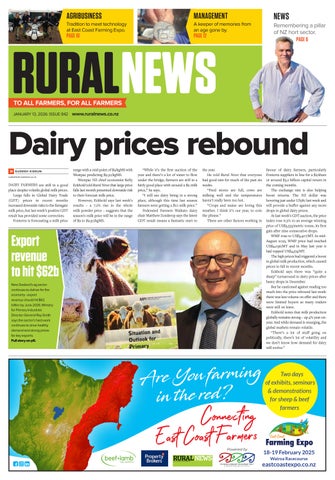
DAIRY FARMERS are still in a good place despite volatile global milk prices. Large falls in Global Dairy Trade (GDT) prices in recent months increased downside risks to the farmgate milk price, but last week’s positive GDT result has provided some correction. Fonterra is forecasting a milk price
range with a mid-point of $9/kgMS with Westpac predicting $9.30/kgMS. Westpac NZ chief economist Kelly Eckhold told Rural News that large price falls last month presented downside risk to their forecast milk price. However, Eckhold says last week’s results – a 7.2% rise in the whole milk powder price – suggests that the season’s milk price will be in the range of $9 to $9.30/kgMS.
“While it’s the first auction of the year and there’s a lot of water to flow under the bridge, farmers are still in a fairly good place with around a $9 milk price,” he says. “I still see dairy being in a strong place, although this time last season farmers were getting a $10 milk price.” Federated Farmers Waikato dairy chair Matthew Zonderop says the latest GDT result means a fantastic start to
the year. He told Rural News that everyone had good rain for much of the past six weeks. “Feed stores are full, cows are milking well and the temperatures haven’t really been too hot. “Crops and maize are loving this weather. I think it’s our year, to coin the phrase.” There are other factors working in
Export revenue to hit $62b New Zealand’s ag sector continues to deliver for the economy - export revenue should hit $62 billion by June 2026. Ministry for Primary Industries Director-General Ray Smith says the sector’s hard work continues to drive healthy demand and strong prices for key exports. Full story on p5.
favour of dairy farmers, particularly Fonterra suppliers in line for a $2/share or around $3.2 billion capital return in the coming months. The exchange rate is also helping boost returns. The NZ dollar was hovering just under US58c last week and will provide a buffer against any more drops in global dairy prices. At last week’s GDT auction, the price index rose 6.3% to an average winning price of US$3,533/metric tonne, its first gain after nine consecutive drops. WMP rose to US$3,407/MT. In midAugust 2025, WMP price had reached US$4,036/MT and in May last year it had topped US$4,374/MT. The high prices had triggered a boost in global milk production, which caused prices to fall in recent months. Eckhold says there was “quite a sharp” turnaround in dairy prices after heavy drops in December. But he cautioned against reading too much into the price rebound last week: there was less volume on offer and there were limited buyers as many traders were still on leave. Eckhold notes that milk production globally remains strong – up 4% year-onyear. And while demand is resurging, the global markets remain volatile. “There’s a lot of stuff going on politically, there’s lot of volatility and we don’t know how demand for dairy will evolve.”
g n i m r a f u o Y e Ar in the red ? C onnecting East C oast Far mers Farming Expo
Two days of exhibits, seminars & demonstrations for sheep & beef farmers
East Coast
Powered by
18-19 February 2025 Wairoa Racecourse
eastcoastexpo.co.nz
East Coast
Farming Expo 18-19 February 2026 Wairoa Racecourse
s r e m r a F st a o C C onne ct i ng East
Two days of exhibits, demonstrations & seminars for East Coast & Hawke’s Bay sheep & beef farmers Tickets available online or at the gate
eastcoastexpo.co.nz Powered by
RURAL NEWS // JANUARY 13, 2026
NEWS 3 ISSUE 842 www.ruralnews.co.nz
NEWS ���������������������������������������� 1-7 HOUND, EDNA �������������������������8 CONTACTS ��������������������������������8 OPINION ���������������������������������8-9 AGRIBUSINESS ����������������������10 MANAGEMENT �����������������11-12 ANIMAL HEALTH ������������������� 13 MACHINERY AND PRODUCTS ������������������������14-15 RURAL TRADER ��������������������� 15
HEAD OFFICE Lower Ground Floor, 29 Northcroft Street, Takapuna, Auckland 0622 Phone: 09-307 0399 Fax: 09-307 0122 POSTAL ADDRESS PO Box 331100, Takapuna, Auckland 0740 Published by: Rural News Group
Meat, wool and hort big winners in Indian FTA PETER BURKE peterb@ruralnews.co.nz
PRIMARY SECTOR leaders have welcomed the announcement of a Free Trade Agreement (FTA) between India and New Zealand. The only exception is a disappointed dairy sector, which hardly features in the deal, but was never likely to. The big winners in the FTA are meat and wool, horticulture and forestry. The 33% tariff on sheepmeat will go as soon as the deal comes into force. This has been a particular bugbear for sheep farmers who have lost out badly to the FTA between Australia and India. Before Australia got its FTA, India bought 89% of its lamb and mutton from NZ, but now it’s down to a mere 8%. This will change under the new arrangement. The tariff on wool exports will also go. The other big win for NZ is in horticulture. India is the fourth largest market for our apples, but they currently attract a 50% tariff. From day one, this will be reduced to
just 25% for 32,500 tonnes growing to 45,000 tonnes over six years. Kiwifruit will also benefit with the 33% tariff cut to zero for 6250 tonnes from day one and growing to 15,000 tonnes over six years. For volumes outside the quota, the tariff rate will be 16.5% from day one. Manuka honey will get a 75% tariff rate reduction over five years and the 33% tariff on cherries and avocados will be phased out over 10 years. The wine industry is another beneficiary with the 150% tariff cut back to between 66-83%. The 5.5-11% tariff on forestry products will be immediately eliminated. The announcements of the FTA came just before Christmas at a hastily-called press conference at Parliament, fronted by Prime Minister Christopher Luxon and Trade and Agriculture Minister Todd McClay. Luxon described the deal as a landmark moment and an exciting opportunity for NZ exporters, saying the gains are wide ranging and significant. He says India is the
Prime Minister Christopher Luxon and Trade Minister Todd McClay announce the Indian free trade deal at Parliament last month.
world’s most populous country and is the fastest-growing big economy – and that creates opportunities for jobs for Kiwis, exports and growth. “The result is a high-quality trade agreement with a trusted partner that will deliver deep and lasting benefits for NZ. I have just spoken to Prime Minister Modi who shares our excitement to further cement the strong relationship between New Zealand and India,” he says. Trade Minister Todd McClay says the FTA is a once-in-a-generation
agreement that creates opportunities for our exporters that they have never had in India. He says it will deliver thousands of jobs and billions in additional exports and give unprecedented access to 1.4 billion Indian consumers. “Trade grows the economy and creates jobs – the NZ India Free Trade Agreement is about future – proofing opportunities for our exporters and allowing Kiwi companies to continue to punch above their weight on the world stage,” he says.
Printed by: Inkwise NZ Ltd CONTACTS Editorial: editor@ruralnews.co.nz Advertising material: beckyw@ruralnews.co.nz Rural News online: www.ruralnews.co.nz Subscriptions: subsrndn@ruralnews.co.nz
POSITIVE REACTION FROM SECTOR LEADERS PRIMARY SECTOR leaders have praised the government and its officials for putting the Indian free trade deal together in just nine months. Agriculture Minister Todd McClay himself has been to India seven times and has met with his Indian counterpart 15 times at different forums. Officials have made many more trips and had online meetings; one official is reported as going to India nearly two dozen times. Prime Minister Christopher Luxon has also led a trade mission to India and the horticulture sector on a fact-finding mission. B+LNZ chair Kate Acland says the
• Ideal for Cattle Troughs • High Flow • Side/Bottom Mount • Detach to Clean • Compact/Robust
announcement is positive for sheep farmers and puts them on a level playing field with Australia, which concluded an FTA with India several years ago. “Although the impact on farmgate returns may not be significant in the short-term, this is an important step for future resilience and profitability in the sector,” she says. Horticultural Export Authority (HEA) head Simon Hegarty says news of the FTA is a welcome positive against the current backdrop of a range of significant challenges in exporting perishable products.
He says Indian consumers will benefit from the agreement, enabling greater choice and better security of access for healthy NZ food products. “The phased reduction or removal of tariffs on trade with India under the FTA will provide an estimated benefit of NZ$20m to $30m annually and equates to the removal of approximately 30% of our entire annual horticulture tariff costs globally,” he says. HortNZ chief executive Kate Scott says the FTA is a boost for the hort sector and paves the way for new export opportunities in a market with strong long-term prospects.
• Up to 50mm Inlet • Flows up to 600L/min • For Storage Tanks • Easy Access to Valve Seal
“Improved access to India will further diversify horticulture’s export portfolio and help drive the sector’s ambitions for growth. With India forecast to become the world’s third-largest economy, this FTA offers our growers and exporters an opportunity to build scale and value over time,” she says. Zespri CEO Jason Te Brake says the deal represents a huge opportunity for kiwifruit with the world’s largest population and fastest-growing large economy. Indian consumers are increasingly focused on health and wellbeing and looking for high quality, nutritious products to support this.
• Inlets Upto 50mm • Avoids Starting & Stopping of Pump When Tank is Filling
0800 JOBE VALVES jobevalves.com
RURAL NEWS // JANUARY 13, 2026
4 NEWS
China beef tariff a boon to NZ? SUDESH KISSUN sudeshk@ruralnews.co.nz
ADDITIONAL TARIFF introduced by the Chinese Government last month on beef imports should favour New Zealand farmers and exporters. That’s according to China market strategist Claire Tan, who points out that NZ has been allocated a quota much higher than its recent annual exports to China. Tan, who led brand strategy and marketing for Silver Fern Farms in China, says the safeguard strategies introduced by China create several strategic opportunities for New Zealand beef exporters beyond shortterm volume. China shocked its major beef suppliers by announcing 55% duties on beef imports above quota levels, dealing a blow to major suppliers including Australia, Brazil and the US. According to Tan, China’s decision reflects increasing pressure on its domestic beef sector following several years of rapid import growth. “The safeguard measures are primarily aimed at protecting China’s
domestic beef cattle industry,” she told Rural News. But New Zealand beef exporters need not worry. Under the safeguard framework, New Zealand has been allocated an annual beef quota of 206,000 tonnes for 2026, rising to 214,000 tonnes in later years. Tan says this is significantly higher than New Zealand’s recent annual export volume to China, which has been around 150,000 tonnes. “Crucially, beef exported within this quota continues to enjoy duty-free access, shielding New Zealand from the additional tariffs that will apply to volumes exceeding quotas for other major suppliers.” New Zealand is also expected to benefit from reduced Australian supply. “One of the most immediate benefits for New Zealand is likely to come from reduced Australian supply,” says Tan. “Based on historical export data, Australia faces the risk of reaching its quota relatively early in the year, potentially creating a supply gap of up to 200,000 tonnes in the Chinese market.
“New Zealand is well positioned to help fill part of this gap, particularly with grass-fed beef and premium chilled products.” She says reduced competition from Australia is also expected to ease price pressure, allowing New Zealand exporters—especially those focused on higher-value segments—to achieve stronger pricing power and improved margins. Nathan Guy, independent chair of the Meat Industry Association, says that while they maintain that safeguard measures being applied to New Zealand are unjustified, this quota is currently only for three years and has room to grow from 206,000 tonnes to 214,000 tonnes by 2028, maintaining New Zealand’s current market share. “We are working closely with the Ministry of Foreign Affairs and Trade, the New Zealand Government and Chinese authorities on the administration and management for this quota.” Beef + Lamb NZ chair Kate Acland says that between 2019 and 2024, New Zealand’s beef exports to China have averaged 193,000 tonnes.
China market strategist Claire Tan.
“Therefore, the Chinese decision to impose a country-specific zero tariff rate quota volume of 206,000 tonnes is broadly in line with New Zealand’s historic average exports. “However, the out-of-quota tariff
KICK OFF 2026 WITH UNBEATABLE DEALS *
rate of 55% means growth above that volume is unlikely. “Importantly, demand for beef globally is strong at present and New Zealand has alternative markets available.”
LEARN MORE
*Offer ends 31/3/26 or while stocks last. Offer only available at participating Polaris Dealers. Not valid with any other offer. Excludes fleet clients. See website for full details.
RURAL NEWS // JANUARY 13, 2026
NEWS 5
Stable but uncertain year ahead for primary sector PETER BURKE peterb@ruralnews.co.nz
A STABLE but uncertain year lies ahead for New Zealand primary products, says Ministry for Primary Industries (MPI) Director General, Ray Smith. His comments to Rural News came at the launch of the final outlook for the sector just before Christmas. The report predicts that our primary exports for the year ended June 30, 2026, will hit a record $62 billion – just 3% up on last year. This modest increase is led by an expectation that meat and wool revenue will be up 7% to $13.2 billion and horticulture up 5% to $9.2 billion. Forestry exports are predicted to be a modest 2% up on last year to $6.30 but the revenue from the mainstay of NZ’s main primary sector revenue earner is up by just 1% to
$27.4 billion. One of the big gains for the sector comes from meat and wool exports. The report says tight sheep and beef production is driving up prices despite the lower volumes being produced. These prices outweigh the current challenges in the sector in US and Chinese markets, but the report adds that global geopolitical tensions are affecting the market. It suggests that, given this, more frozen product is likely to be exported. Finally, it notes that the average farm profit before tax will increase by 20% to $166,500. Smith says the news is great for the red meat sector, coming as it does after a couple of very tough years. He says there’s a shortage of supply worldwide of red meat protein, so NZ will fill that gap, even if our own volumes are down a bit.
“Beef and veal exports are expected to make $5.1 billion and increase to $5.5 billion in 2027. “Likewise, lamb is trending upwards to reach $3.8 billion next year and to close in to $4 billion a year later, and wool is up slightly, but again the trend is positive for the following year,” he says. Horticulture remains a rising star in the sector with kiwifruit leading the way, with exports from NZ alone hitting $4.3 billion by next June, meaning that the returns per hectare are strong, according to Smith. He says the other hort area performing well is apples and pears, which are well over the $2 billion mark. Smith says the uncertainty facing the sector is caused by the situation with tariffs and the geopolitical tensions that exist around the world. But he says, at the same time, our
Agriculture Minister Todd McClay says hitting the $62 billion mark is an outstanding result.
markets are proving to be extremely resilient and NZ’s production capability has been stable. “The world wants our products and the reason it relies on us is because what we are best at is producing and exporting food,” he says. Heiniger capital equipment, is trusted by New Zealand farmers, contractors and shearers to get the job done safely and efficiently.
FARMER CONFIDENCE RETURNS AGRICULTURE MINISTER Todd McClay says hitting the $62 billion mark is an outstanding result considering that it’s been a tough year with extreme weather challenges in NZ and the impact of global tensions. He says farmer confidence is back up, farm profitability is improving for many producers, and NZ is turning the corner out of recession thanks to our export-led economic recovery. McClay says the rise in primary exports is not just luck but comes through the hard work of farmers and horticulturists. At the same time, he says government has been
working hard to simplify rules in rural communities to cut costs and free up farmer to do what they are best at. However, he is aware of the uncertainty that lies ahead. “NZ exporters have adapted well to that and are making decisions for themselves and judging risk. What you have seen is a movement in some areas of product into China and Europe because they offer better returns and less uncertainty,” he says. At the same time the Horticulture Minister, Nicola Grigg, says horticulture is in an exciting space and is going from strength to
Because we care about your safetywhile working. TPW Xpress Woolpress With industry leading safety features, the #1 selling and most trusted woolpress helps to keep you and your workers safe in the shed. The TPW Xpress now comes with the new indicator with audible and visible alarms that let you know when you’re approaching the target weight.
strength. She says statistics show that since 2021, horticulture exports have risen from $6.5 billion to $9.2 billion and the predictions are that this rise will continue.
equipme Watch our in action!
nt
Evo Shearing Plant
SWEET TOOTH LIKE ALL reports, there is always something that pops up unexpectedly and in this case it’s a sweetener of sorts – yes, it’s chocolate. Last year it earned $215 million and is expected to rise by 7% to $440 million in 2026 and by another $10 million in 2027. MPI Director-General says this is a great story with Canada and Australia being the two main markets. “NZ chocolate is trusted,
especially in Australia, because there is confidence about what is in the ingredients. I think what consumers are saying is that when I am buying chocolate, I want to know what’s in it and what they expect to be in it and that’s what they get it from NZ,” he says. Ray Smith recently visited some of our major markets Australia, the USA, Japan, Korea and China where he met his counterparts. He says in all those
markets NZ is highly regarded, trusted and enjoys positive relationships. “But what really struck as I went through Japan and Korea was that they talked very fondly about NZ products. They said they trusted them and how they are made and what was in them. But what they also said was NZ needed to raise its profile and push a bit harder and market ourselves a little better because we were less visible than our Australian counterparts,” he says.
The world’s leading shearers trust the #1 selling shearing plant in the world, winner of multiple WorkSafe awards. The Evo delivers industry leading safety features, impressive performance and superb reliability.
TPW Backease Hoist Industry professionals trust the versatile, compact and cost effective TPW Backease Hoist to safely lift loads of up to 600kg with extendable 1.2 - 1.8m boom. At only 78kg, it’s easy to install with no loss of load space and features hydraulic lift and pressure regulated downwards movement. Heiniger New Zealand | (03) 349 8282 | heiniger.co.nz
RURAL NEWS // JANUARY 13, 2026
6 NEWS
Remembering a pillar of NZ hort sector GLENYS CHRISTIAN
A PILLAR of New Zealand’s horticultural industry, Dr Stuart Davis, was farewelled at a well-attended funeral service in Tuakau, South Auckland, on December 18. Mourners were told the fingerprints from his last four decades of work in the sector would remain for many years to come. He was 66. As LeaderBrand’s sustainability manager he was awarded the Bledisloe Cup in 2024, recognising his outstanding contribution of over 35 years to the horticultural sector. In July last year he was awarded a Horticulture New Zealand life membership, with board chair Bernardine Guilleaux saying his influence on the industry had been immense. He already held a similar honour from Vegetables NZ, awarded at its conference several years previously. He started his career in the Wattie’s
group working in Gisborne, Hawke’s Bay and the Manawatu. In the 1980s he pioneered the commercial use of mathematical crop prediction models for sweetcorn and other vegetable crops in collaboration with Crop & Food Research and NIWA, creating the foundation for a closer partnership between science and the vegetable industry. He later moved to LeaderBrand in Gisborne then to Sutherland Produce at Bombay, before returning to LeaderBrand in Pukekohe. He managed many projects which spanned regenerative farming, riparian planting, biodiversity, emissions, nitrogen, and water efficiency. He championed the use of science, technology and innovation to enhance sustainable vegetable production. He was a director of Vegetables NZ for 10 years, chair of the Vegetable Research and Innovation Board(VRI) and held many leading roles in
industry projects, particularly those concentrated on integrated pest and disease management. Most recently he was the Industry Stakeholder Advisory Group chair for A Lighter Touch, concentrating on how their use could help reduce chemical inputs into vegetable cropping. His last project was an initiative he’d championed for many years, the Makauri aquifer recharge in Gisborne to ensure water security for the area. Murray McPhail, LeaderBrand’s founder, knew him for 40 years, meeting him first when he joined Watties’ agricultural teams, where the company’s research farm manager had to tow his two-wheel drive station wagon out of the water table. “They were usually operational people but he had a degree,” he said. Davis progressed up the chain at the company, championing the use of science, technology and innovation to enhance sustainable
vegetable production. He oversaw the introduction of self-propelled harvesters and early growing of organic sweetcorn which found a ready market with a Japanese buyer. McPhail said there was nothing Davis didn’t know about growing, telling him that if the LeaderBrand knew when crops flowered they could predict when they would be ready for harvest. “We’re very thankful for what he brought to us.” Mike Arnold, from LeaderBrand’s South Island farm, said he’d worked with Davis on several projects where he made an invaluable contribution. On the day he died from Motor Neurone Disease he had emailed him asking if he could keep his company laptop and phone for further work. “He called a spade a shovel but transferred his knowledge to anyone who asked.” His two brothers and three sisters
Dr Stuart Davis
said they all looked to him. “He was someone worth looking up to,” youngest sister, Heather said. “His knowledge was incredible, and he was passionate about sustainability.” His sons Simon and Michael said that right to the end he was busy working on projects which he knew he would never see come to a conclusion. Beneath his stoic, scientific exterior there was a man who loved his family along with poetry, music and cricket. “And we’re happy to report that vegetables continue to grow without him.”
Together. Let’s vote. It’s time to vote. The upcoming Milksolids Levy vote is a moment to do what you’ve always done for the sector – to come together to continue building a stronger future for dairy farming in New Zealand. What happens on your farm is because of you. It’s your hard work, your care and your plan that drives your farm business forward. But there’s a lot of what you do that keeps getting better because for generations, you’ve been part of each other’s success. You’ve shared knowledge. You’ve shared both the cost and the onfarm solutions from future-focused research. You’ve established the clear, united voice of dairy that has generated more government support and practical policy. That’s what your levy is for – a collective investment that has supported you on farm and in your community. These outcomes are what you share, and what keeps us all moving forward. And there’s more to get done. So, let’s vote – together.
For more information go to
dairynz.co.nz/levy-vote
RURAL NEWS // JANUARY 13, 2026
NEWS 7
Right Guy for the job PETER BURKE peterb@ruralnews.co.nz
FORMER AGRICULTURE Minister Nathan Guy says he’s excited about his new role as NZ’s Special Agricultural Trade Envoy. Guy told Rural News that his first task is to listen to what exporters have to say and get a full appreciation of their needs. He says while he has a good understanding of the major exporters such as those involved in meat, dairy and the big horticulture crops, he wants to connect with new and smaller exporters as well. Guy says he’ll get briefings from MFAT and other agencies in the coming weeks and from there will work out a travel plan. He says being a former minister means he still has good international connections. “My ministerial background will certainly help open some doors and ultimately that should help me get pretty good access when required. “I led a trade delegation last year and went on two very successful missions to India and also to China with the Prime Minister, so I know how it all works and I know what diplomacy means,” he says. Trade and Agriculture Minister Todd McClay says Guy’s background promoting NZ’s producers, both as a
Minister and as a farmer, means that he is uniquely well placed to tell the story of our primary production sector to the world. The position reports directly to the Ministry of Foreign Affairs and Trade, but Guy will obviously work closely with Minister McClay and other government agencies such as MPI. McClay says the position supports key government objectives, including ensuring that our trading partners understand our approach to agriculture and primary production. “The role also focuses on raising the performance of NZ’s agricultural and primary sector exports in global markets, thereby contributing to the Government’s goal of doubling the value of exports in 10 years. Nathan Guy’s immediate priorities will be to advocate for New Zealand’s primary production interests from the perspective of a practising farmer,” he says. McClay says he’s asked Guy to show particular focus on India and GCC markets, to leverage the opportunities that trade agreements with these countries would present. Guy adds that an important part of his role is to connect back to farmers and growers and share insights from his overseas connections.
Nathan Guy is excited about his new role as NZ’s Special Agricultural Trade Envoy.
Your air + our science Grow smarter with BioN
You already have Nitrogen sitting above every paddock. BioN’s biology works with your soil to capture Nitrogen from the air and turn it into usable nutrition for stronger grass growth. Farmers are seeing real gains without pushing their N Cap.
Try BioN on your farm and grow smarter. Find out more at agraforum.co.nz
@rural_news facebook.com/ruralnews
MAKE SHEARING SAFE WITH
DAILY GROWTH (kg DM/ha/day)
120
112.68kg
AVERAGE COST (8 Weeks of Growth)
BioN
110 98.3kg
100
97.35kg
UREA
94.09kg
90
82.83kg
83.58kg 76.48kg
80
68.14kg
70 60 50
BioN
UREA
FARM 1
FZP051055_GTM_RN
heiniger.co.nz/shed-safety
AVERAGE DAIILY GROWTH (Daily Kg Dry Matter / Hectare)
BioN
UREA
FARM 2
BioN UREA FARM 3
BioN
UREA
FARM 4
$105 / Ha
$160 / Ha
1 Application of 100g of Bio N
3 Applications of 18.4 units of Nitrogen
For 8 weeks of growth comprising 3 x 18.4 units of Nitrogen, the trial indicated a 35% reduction in cost (materials and application) and 16% improvement in dry matter production.
RURAL NEWS // JANUARY 13, 2026
8 OPINION EDITORIAL
EDNA
Indian FTA is great news TRADE MINISTER Todd McClay and the trade negotiators in government have presented Kiwis with an amazing gift for 2026 – a long awaited and critical free trade deal with India. It offers reduced tariffs on meat and wool, horticulture and forestry. It will enable NZ to reclaim a huge amount of the market share for lamb it lost when Australia got its FTA with India two years ago. As well as trade, the FTA brings with it a special political relationship with India like we have with China, the UK, the EU and the Gulf States. This is a great achievement by McClay, Prime Minister Christopher Luxon and the negotiating team led by MFAT’s Vangelis Vitalis – arguably one of the greatest NZ trade negotiators of all time. But no FTA has ever been perfect, and it was no surprise that the dairy industry received minimal gain in the deal. This is because the dairy industry in India comprises 80 million dairy farmers – mostly with very small holdings but with immense political power. Remember also that India has 300 million cows and buffalos and produces about a quarter of world’s milk. So, the question that is being asked around the traps is why is Winston Peters saying he’ll vote against ratifying the FTA when it comes before parliament later in the year? And why has the main opposition party, Labour, hinted it will vote for the FTA? Does Peters seriously believe he could have got a better deal for dairy, or is it the clause on immigration that is his main concern? Others have said, given more time, a better deal could have been struck. Most experts reject this argument. Even Dairy Companies Association of NZ (DCANZ) who represent the dairy exporting companies, while expressing disappointed at the FTA, have praised team McClay for their work and politely urged them address the trade challenges that dairy faces and that could well happen. Come on you detractors – at least we have a deal! - Peter Burke
RURALNEWS TO ALL FARMERS, FOR ALL FARMERS
HEAD OFFICE POSTAL ADDRESS: PO Box 331100, Takapuna, Auckland 0740 Phone 09-307 0399 PUBLISHER: Brian Hight .......................................... Ph 09 307 0399 GENERAL MANAGER: Adam Fricker ....................................... Ph 021-842 226 EDITOR: Sudesh Kissun ...................................... Ph 021-963 177 sudeshk@ruralnews.co.nz
“Let’s hope for a drought before he spots ours!”
Want to share your opinion or gossip with the Hound? Send your emails to: hound@ruralnews.co.nz
THE HOUND Stinging response
PM finds the fence
Famous last words
The bow-tie effect
MPI’S RESPONSE to the yellowlegged hornet has received a mixed report card from New Zealand Beekeeping Inc (NZBI), with praise for the Ministry’s expansion of response funding and front-line efforts in Auckland, but a sting in the tail – criticising MPI for not focusing enough on regions outside the big smoke. By New Year’s Eve, MPI and Biosecurity NZ had successfully located and destroyed 39 queen hornets, 26 of which had been nest building, according to Apiarist’s Advocate, thanks to intensive trapping and monitoring. But NZBI says MPI needs to “shed the lone hero persona” and “must expect and receive full-throated community and industry support”. NZBI says it just wants MPI to think more longterm and more nationwide about the response to the yellow peril.
WHEN HE promised an Indian FTA in his first term, Prime Minister Christopher Luxon was really putting it all on red for the win. Against the odds (and with help from Todd McClay and others), he has thumbed his nose at the many doubters by closing just such a deal before Christmas – a move that will change the narrative around the PM and could help him win the election. Winston Peters is clearly going to use the immigration aspect to his advantage in the election, but this mutt reckons Labour will find it hard to credibly vote against a deal that delivers obvious benefit to our export sector. Dairy and beef miss out, but that was expected. Sheepmeat however will enjoy zero tariffs on day one, as will nearly 60% of NZ’s exports to India, increasing to 82% over 10 years.
WITH WINSTON Peters playing politics with the PM’s Indian FTA, all eyes will be on Labour who have the casting vote. Your old mate reckons Chris Hipkins can’t credibly block a deal as good as this one, but he’ll have to eat humble pie to vote ‘yes’. During an election debate, Hipkins once laughed at Luxon’s promise to secure an India FTA within his first term in government. He later accused the PM of reversing our nuclear free stance by negotiating with India and said he didn’t want an FTA achieved at the expense of “selling out large parts of New Zealand’s economy”. And on Labour’s recent “disappointment” that Luxon’s deal excludes dairy, when last in power, Labour trade spokesman Damien O’Connor admitted getting “huge volumes of dairy” into India was “never realistic” during their term.
IF THE hand-wringing, cravat and bow-tie wearing commentariat of a left-leaning persuasion had any influence on global markets, we’d be in a full-blown crash by now, what with the pessimistic wailing about the recent political ‘reshuffle’ in Venezuela – orchestrated by the US Administrative Arm and executed, quite efficiently, by the US Guns & Choppers Division. The Hound offers no opinion on whether or not this should have happened, but merely observes that, despite it raining lefty tears of sorrow, the sky did not in fact fall because a South American dictator was deposed without ceremony. Grain markets rose, Asian equities surged, the Dow Jones, S&P 500 and Nasdaq were all up. While there was some brief “haven-related hedging activity” boosting gold, overall risk appetite reportedly remains intact. Perhaps not surprisingly, oil company stocks were among the upside leaders.
EDITOR-AT-LARGE: Peter Burke ........................... Ph 021 224 2184 peterb@ruralnews.co.nz
AUCKLAND SALES CONTACT: Stephen Pollard ......................... Ph 021 963 166 stephenp@ruralnews.co.nz
SOUTH ISLAND SALES CONTACT: Kaye Sutherland .......................Ph 021 221 1994 kayes@ruralnews.co.nz
REPORTERS:
WAIKATO & WELLINGTON SALES CONTACT: Lisa Wise .................................. Ph 027 369 9218 lisaw@ruralnews.co.nz
DIGITAL STRATEGIST: Jessica Marshall .............. Ph 021 0232 6446
Nigel Malthus ........................Ph 021-164 4258 Leo Argent MACHINERY EDITOR: Mark Daniel ..............................Ph 021 906 723 markd@ruralnews.co.nz PRODUCTION MANAGER: Becky Williams ......................Ph 021 100 4381 beckyw@ruralnews.co.nz
PRINTED BY INKWISE DISTRIBUTED BY REACHMEDIA
Paper used in this publication is from forests managed in line with the strictest environmental, social and economic requirements. 100% recyclable, the papers we use are from forests that will be around for generations to come.
Rural News is published by Rural News Group Ltd. All editorial copy and photographs are subject to copyright and may not be reproduced without prior written permission of the publisher. Opinions or comments expressed within this publication are not necessarily those of staff, management or directors of Rural News Group Ltd.
RURAL NEWS // JANUARY 13, 2026
OPINION 9
EPA remains committed to deliver improved outcomes BARRY O’NEIL
AT THE end of my first year as chair of the Environmental Protection Authority (EPA), I have been reflecting on the progress made in the time I have been in the role. Not surprisingly, in being appointed chair I was given a very clear understanding of Environment Minister Penny Simmonds’ expectations for improvements in the EPA’s hazardous substance application performance, something that I and my Board are absolutely committed to achieving. New Zealand’s environment is the cornerstone of our economy, cultural heritage, and unique biodiversity. And while our economy is dependent on the primary sector, our environmental integrity also supports horticulture and agriculture to grow and prosper. I want to acknowledge up front that due primarily to a lack of resources and Covid19, we haven’t delivered sufficiently in assessing new agrichemicals for the primary sector. A recent report by Sapere compared our performance with other international regulators and found that while our performance was comparable our funding was significantly lower, including low levels of
Barry O’Neil
cost recovery. Since receiving the Sapere report we have made significant changes, and I am starting to see real improvements in processing applications. The time for staff to assess new substances has begun to reduce and will go down even further when a new applications team is fully up to speed. Thirteen new roles have been created this year through reprioritising existing funding, and we have made a commitment to the Minister to reduce the applications queue by 30%. Arising from the Ministerial Regulatory review the Government is progressing an Omnibus Bill, and once in place this will make a range of changes that will potentially enable us to eliminate the queue. One of the proposed changes will enable the EPA to issue time-limited conditional approvals, which will mean new products can be made available to growers and farmers while a full assessment is being completed. The EPA is also currently consulting
on how we can prioritise applications that have the most benefit to New Zealand. In Budget 2025 we received $10 million to update outdated risk assessment models, much needed funding, and the updated models will be available to industry, who can then use the information to improve their applications. I deeply understand the cost and impact of delays, as both a kiwifruit grower and former veterinarian, but increased speed cannot come at the expense of scientific integrity. The consequences of making the wrong decision can have far-reaching consequences for the environment and New Zealand’s economy and trade reputation. And in New Zealand, unlike other countries, once a product is approved, it doesn’t have a time limit associated with that approval. The only way that the EPA can change how the product is used is to undertake a reassessment, a long and costly process and often not welcome by industry when products are still being used. The board and management have focused on connecting with industry, to both understand issues and provide greater visibility of the work we are doing to improve timeframes. This is why
LETTER TO THE EDITOR
STORM IN A SMOKO CUP Dear Editor, Congratulations to the SPCA chief science advisor for volunteering to review the hundreds of thousands of hours of CCTV footage of sheep being shorn superbly well, by trained craftsmen and women, known as “shearers.” I hope she can stay awake long enough to find the infinitesimally small number of so called “incidents of cruelty” she speaks of. I have shorn a few sheep in my life. One year I got carried away, and my 12-month
tally got to 44,000… just a snip compared to the late great Tom Brough from Aria, who’s 12-month tally got to 73,000! How much time do you think either of us wasted, by bothering to hit a sheep? If a shearer hits a sheep, it’s sheep 1, shearer nil. And would this same sheep shearing expert “science advisor” like to reveal the number of sheep she has shorn, please? Talk about a storm in a smoko cup! Roger Milne Auckland
it’s so disappointing to see some members of industry continue to question our commitment to improvement or raise examples which misrepresent the progress the EPA is making. I have personally been contacting industry leaders to seek a better understanding of any gaps in their agrichemical toolbox. I have also met with the Animal and Plant Health NZ board twice to hear their concerns and reiterate that we want to work with industry to achieve the outcomes we both want, quality decisions delivered in
BUILT TOUGH
The EPA says it’s starting to see real improvements in processing applications.
acceptable timeframes. I appreciate industry’s impatience to see meaningful results, especially for new actives, and I’m also impatient to
see the changes pay off. But please don’t question the commitment of the EPA, its board and its staff to deliver improved outcomes for New
Zealand, improvements which are already becoming visible. • Barry O’Neil is chair of the Environmental Protection Authority.
TRUSTED EVERYWHERE
SMART, SIMPLE DESIGN THAT STANDS THE TEST OF TIME. The McIntosh Bale Feeders range handles tough bales like they’re nothing. No fuss, no second try, just feed out and move on. It’s the kind of kit you hook up without a second thought and know it’ll do the job. 0800 622 276 / sales@mcintosh.net.nz
www.mcintosh.net.nz
RURAL NEWS // JANUARY 13, 2026
10 AGRIBUSINESS
Tradition to meet technology at East Coast Farming Expo TRADITION MEETS some of the latest in technology at the 2026 East Coast Farming Expo. From the Eastland Building and Farm Supplies Fencing Hub to Guy Peacock’s working dog demo, Air Borne Solutions drone demo and the Beef + Lamb New Zealand Station Challenge, all is well covered at the two-day February 18-19 gathering. B+LNZ extension manager Ali Forbes says their commitment to the Expo and challenge is part of their support to the wider rural community. “The event attracts local shepherds, many of whom are the emerging leaders and managers of the future, and supporting their development aligns with our purpose and values,” she says. “It is an engaging and dynamic event that fosters strong team culture. The challenge
encourages collaboration among shepherds as they work together to achieve a shared goal in a competitive, practical environment while upskilling at the same time.” The challenge is being run on Wednesday (February 18) at 1.30pm. Entries will open towards the end of January. Forbes says it also provides the public with a meaningful insight into the skills and responsibilities involved in shepherding: “It blends education, practical skill-building and healthy competition, making it both valuable and enjoyable for all involved.” Scott Horgan from Air Borne Solutions will be demoing drone spraying. He’s seen huge growth in drone use. “Workload and sales are doubling year on year which is largely due to the drones’ abilities becoming greater and greater. They can
fly further, faster, carry heavier loads and are smarter.” Eastland Building and Farm Supplies’ Myles Vennell says a visit to the 2025 Expo and the resulting “good” business from it encouraged him to step up and sponsor the Fencing Hub. He will have world champ fencer Tony Bouskill on site and has extended an invite to Tony’s award-winning dad Shane as well. “Tony is keen to talk to whoever has an interest in fencing and pass on the knowledge where he can,” says Vennell. “Most of our fencing contracting clients are short of workers but not short of work.” He’s also looking to have some of his suppliers there. His team will be able to do on the spot quote and offering Expo deals. “This is an opportunity to meet new people and find out what
tunnel houses Grow vegetables all year round T Very affordable and easy to install T New Zealand designed and made T 40 years producing tunnel houses T Range of models sized from 2m - 10m T t/f 03 214 4262
| e info@morrifield.com
www.morrifield.com
else we can do to support our farmers.” The Fencing Contractors Association NZ have voiced their support too. Executive director Jaime Bigwood says they’d seen the value of a fencing hub at Northland Field Days where people liked that they could speak to product suppliers and more. “Having skilled fencers onsite to share tips and tricks is invaluable to both the end users and the sales reps.” Fencing was now recognised as a trade in itself and the time and money saved by getting the job done by the experts was invaluable for many. “It’s a great career for people who love to
Air Borne Solutions will be bringing this beauty to the Expo . . . . pictured with (from left) Monique Horgan, Bayden Neustroski, Jamie Nyx and Scotty Horgan.
work in the outdoors and appreciate the gratification of seeing a job well done,” says Bigwood. The working dog demo from highly retarded trainer and triallist Guy Peacock runs over both days of the Expo. “Shepherds and
shepherdesses love their dogs and will benefit from the demonstrations from Guy who will share
techniques to help people get the best from their Huntaways or heading dogs.”
WHAT: East Coast Farming Expo WHEN: February 18-19, 2026 WHERE: Wairoa Race Course, Wairoa, Northern Hawke’s Bay MORE INFO: https://eastcoastexpo.co.nz
HEMP PROCESSOR RELOCATES HEMP FIBRE processor Rubisco is relocating its core processing facility to Ashburton as part of a $20-$30 million expansion to leverage what it says is an accelerating global demand for sustainable and renewable fibres. The Carrfields majority-owned company installed a European hemp decorticator machine, which separates the valuable bast fibres from the woody hurd, at a former wool carpet factory in Burnside,
Christchurch, just six years ago. The company says demand for its services has now surpassed its capacity. By relocating the decortication line to a purpose-built facility in Ashburton, Rubisco will be closer to its primary hemp fibre supply base, streamlining the supply chain and reducing transportation emissions. The Burnside facility remains the company’s centre for product
development, advanced textiles, functional fibres, biocomposites, and non-wovens. Rubisco CEO Guy Wills said the decision to move operations to Ashburton was both practical and forward-thinking. “With the strength of our local supplier network and rising demand for hemp products, the new facility will position Rubisco to scale up production and continue to innovate.”
IMPORTANT REMINDER ABOUT PRE-MATING NUTRITION
NUTRITION G N TI A -M E R P S E W E R U IT’S TIME TO GET YO
SORTED!
Containing:
Omega 3, 6 & 9 Antioxidants Electrolytes Vitamins A, D & E B Vitamins Trace Elements (TE) Iodine, Selenium & Cobalt
Freephone 0800 848 276 or visit www.palamountains.co.nz/revive-pretup
RURAL NEWS // JANUARY 13, 2026
MANAGEMENT 11
Native tree study a NZ first A NEW Zealand-first native tree study has highlighted the Bioeconomy Science Institute’s position as a forestry research leader. Its work to improve propagation and increase the production of indigenous species in nurseries was the focus of a journal article published in 2025. This work investigated the impact of container grade size on the survival and field performance of 12 key native species – to better understand the link between containers and post-planting seedling survival and growth performance. The study saw the Bioeconomy Science Institute team raise seedlings from the selected species in different container sizes and test how they performed in good-, average- or poor-quality sites. It was a collaborative effort with Te Uru Rākau – New Zealand Forest Service, Minginui Nursery, CNI Iwi land Management, the Tumunui Land Trust, Timberlands, Rotorua Lakes Council and the Tipu Waiariki Charitable Trust (Tipu Wai), which provided the sites and helped with preparation and planting.
Industry-standard pots used for natives were compared with bigger containers such as 7cm and 8cm paper Ellepots and smaller forestrygrade pots. The effect of differences in the type of container were monitored to determine the impact on survival rates and tree growth across sites. Programme lead David Siqueira says results showed variable patterns depending on tree species, container size and the quality of the respective planting sites. “Some species, such as manuka (Leptospermum scoparium), survived and grew well (>75%), even when raised in small containers, while others such as kowhai (Sophora microphylla) had low survival rates (< 5%), even when raised in revegetation container grade sizes.” Other species such as cabbage tree (Cordyline australis) and totara (Podocarpus totara) appeared to depend more on site quality. “The results show the importance of aligning the choice of container grade size to the needs of individual species and planting purpose,” Siqueira says. “Nursery container systems for
raising New Zealand native plants should be chosen based on the biology of the species, nursery management practices, quality of the planting site and a balance between cost and benefit for each situation.” Nurseries have traditionally used large containers to successfully establish native species, but this means the trees take longer to grow – making this approach costly and labour-intensive at the planting stage. It also limits the rate of establishment. “The conventional approach of sowing native seed, setting out and then growing in containers takes 12-36 months, adding significantly to native tree establishment costs over typical New Zealand-grown exotic forest trees,” Siqueira says. “By enhancing our understanding of how container size affects native tree growth when planted in sites of varying qualities, we hope this research will result in more fit-for-purpose natives being raised in nurseries to generate our thriving future forests – conserving New Zealand’s biodiversity and contributing to the mitigation of climate change.”
The root systems of two tī kouka seedlings grown in different containers.
SAVE BIG ON THE CFORCE 1000 EPS OVERLAND THE CFMOTO 2026 SUMMER SALE
WAS $16,990
15,990
NOW
$
EX GST
SAVE $1,000
• V-twin, liquid-cooled four-stroke
• 2WD/4WD with locking front differential • Power steering
Learn more
• CVT Transmission
• Four-wheel hydraulic disc brakes • Towing capacity 450kg • 30L fuel capacity
7,790
$
EX GST
• Four-stroke single-cylinder • 2WD/4WD with locking front differential • Hydraulic disc brakes
11,990
$
EX GST
• Single-cylinder, liquid-cooled, EFI four- stroke engine • Power steering • 350kg towing capacity
9,490
10,490
$
$
EX GST
• Four-stroke single-cylinder • 2WD/4WD with locking front differential • Hydraulic disc brakes
EX GST
• 495cc engine, 38hp • Power steer • LED headlights • Alloy wheels • 2500lb winch • 5” display
40+ CFMOTO dealers nationally. To find your local dealer visit www.cfmoto.co.nz Terms and conditions apply. CFMOTO 2026 CFORCE 1000 OVERLAND Summer sale starts 12th January 2026 and ends 28th February 2026. While stocks last. *Price quoted excludes GST.
RURAL NEWS // JANUARY 13, 2026
12 MANAGEMENT
A keeper of memories Libby Judson is a keeper of memories from an age gone by. TIM FULTON tells her story. LIBBY’S PARENTS, Jim and Kitty, grew up on Browns Rd, next to the original Petrie family homestead in Swannanoa, not far north-west of Christchurch. These Petries originally came from nearby Woodend, where Jim grew up in the area known as ‘Five Crossroads’. Jim farmed together with his older brother, Hugh. Both were passionate about stud sheep – Jim had Southdowns and later had a Clydesdale stud. That memory remains around Libby’s neck in the form of a medal he won at the Amberley A&P Show. Jim and Hugh were good farmers, specialising in cocksfoot and small seeds as well as wheat, barley and the like. The Eyre River beside them never burst out on farming land, though Libby, now 80, can remember the way floodwater would burst down the usually-dry river a couple of times a year. “When it came down, it came down in a huge torrent and sometimes
FUN AND ADVENTURE
Libby Judson remembers the last draught horse used on their farm at Swannanoa, Canterbury. Below: medal her father, Clydesale breeder Jim Petrie, won at the Amberley A&P Show.
you could see the waves going down it from our house, about two paddocks away,’’ she says. Libby remembers swimming in the Eyre in the August holidays: “we were pretty tough”. In another marker of the times, she had to ride a pony 8km to Swannanoa School and home from the age of 5, guided by sister Jeannie, six years older. There were also four boys, John who died of an aneurism at only 21, when Libby was only six, as well as Dugal, Dick and Graeme who lived long lives. “I can remember John was very loving to me,
■ Ideal for shearing sheep, alpacas, goats and cow tail.
‘’Libby says. ‘’He was training to be a surveyor and his office was down by the old Waimak bridge, the old catchment board house. The day he went up the hills for surveying, he must have shot a goose up there and he put it in our mailbox on our big old mailbox on North Eyre Rd. That night he died in his sleep.” Libby’s father, Jim, also farmed sheep on about 80ha on the corner of Two Chain Rd and Woodfields Rd, near where the Larsens now farm extensively. When Libby came along, all the draught horses had been changed to tractors but she can remember the last draught horse; her name was Flora. Jim was a keen dog breeder with a kind streak: he would give pups to other farmers rather than selling them. He was also passionate about dog trialing, which served as a common interest for so many local farmers of the time. Swannanoa was an isolated area in the ‘50s: Tram Rd was shingle, Swannanoa School had less than 20 pupils at one point and the Eyreton branch train line along
■ Latest brushless motor technology means minimal heat build up
TAKING PART IN LOCAL SPORT
World’s most powerful variable speed clipper is here!
handypiece MAKE DIRTY JOBS EASY THIS SEASON
■ Variable speed from 2600-3500rpm.
■ 1400gms means 100-200gms lighter than standard handpiece ■ At 2800rpm the 12v lithium battery will trim up to 400-500 cows tails or crutch 300-400 sheep
■ We customise cables for lifestyle shearers.
GET YOUR REPAIRS & SERVICE DONE ASAP! View in action go to www.handypiece.co.nz
0800 474 327
Freephone email: dave@handypiece.co.nz
North Eyre Rd took passengers and freight. Libby swears she could hear trains coming by putting an ear to the track. “Because we didn’t have a school bus, when we had to go by car, or walk or ride a pony. The Education Board used to pay my father and mother a certain amount for our ponies to be shod.” And it was hard to get a blacksmith: old Charlie Cattermore at Fernside did the job and the kids had to ride to his place to get the ponies shod. “We’d have to have a day off school to go down there and shoe them.” Her brothers used to go to school in a pony cart, picking up the Larsen children and Janet Frizzell on the way.
LIBBY JUDSON and her siblings invariably got involved in local sport growing up. The Petrie boys played rugby for Rangiora: Graeme was a hooker who played for years, Dick was a goalkicking fullback and Dugal played too. The Petrie’s home farm at Swannanoa, Eyredale, was mortgage-free. When the boys were old enough, Jim bought about 400ha over by the Dixons at Claxby – at an attractive price of 10 Pounds per acre. “It had been left for years and years. The
“One day the train came along and they must have thought the pony would be okay but she reared up, jumped the fence and left the cart on the other side. My father was very angry because they broke the shafts on the cart.” Later, when her brothers were ploughing near the railway line, they’d turn over coal from the steam engines. The original Swannanoa School building, now part of the hall across Tram Rd, was still in the school grounds in Libby’s time. “My father was on the school committee and also on the baths committee that built those lovely baths, which are still going. I can still remember the men building them and
LIBBY JUDSON, the youngest child, revelled in adventures to and from Swannanoa school, stopping in the afternoons at the pine plantation on the corner of Tram Rd and Two Chain. “There was a house over the road but we’d go down to the boundary of Dick Frizzells’ where we’d build huts and take little violet plants, trying to grow them. Just have half an hour or so there before we headed home after school. “My sister had to cart me home unconscious one day, when I was only six or seven and came off a pony. The first pony I had. Sally, was 12-2 hands. Dad had backed her for me and I’m not very tall. “This pony was not a nice – she used to try and go under trees and pull me off. She was given or sold to the Luisettis in Rangiora. The next pony, which Dad bred, was called Sixpence. I’ve got a photo her her at the Christchurch show – that was the first year I rode at the show.” Sixpence was a sour little pony and father Jim was very concerned about horses getting foundered, when they get heat in their hooves from autumn and spring grass. “It’s like us getting a smashed fingernail; it’s so painful and makes them lame.” So next thing Jim bought two yearlings from his friend, Mal Jenkins, who was a war veteran. Jim couldn’t go to war because he had an enlarged heart and he was needed as a farmer: instead he served in the Home Guard. These two yearlings arrived; 13-2 hands high which is a medium-size pony. “These two ponies were put in the top paddock, where they lived for a year before they were touched to be broken in.” Once Mr Jinks was broken in, Libby had to ride him home. (Mr Jinks was named after the breeder, Mr Jenkins “I rode from Fernside, with a man riding beside me. Mr Jinks was the most amazing pony – he was school pony and I had another pony which Dad bought off Malcolm Jenkins the following year. She was called Gleam.” Libby would ride each horse alternately, one day at a time. “My father would get me to ride the one I wasn’t riding to school for about two rounds, round the paddock, then go and have my breakfast before leaving at quarter to eight to ride to school. Them I’d come home and I’d ride that pony again, because he believed in fitness in horses.” Those two ponies one championships – and I was at the start of one-day eventing with them. “Mr Jinks was a tremendous jumper and I used to hunt: when I was six I went to my first hunt, Brackenfield.”
my mother taught me to swim in there. She used to get me to put my hands round her neck and I’d swim on her back.” Mother Kitty was made a Life Member of the Women’s Division
paddocks were about 40ha each. My brothers would go over there, leaving about 7.30, through the riverbed to Claxby from the middle of our farm. They wouldn’t get home till probably 7 o’clock at night.” Libby’s oldest surviving brother, Dugal, ended up doing a lot of fencing, working for Harry Sidey in the Hurunui. He then worked for well-known harness racer, Bill Doyle, who had about 800ha at Doyleston in Selwyn, and he did a stint with the McPhersons in Cheviot. “I had a holiday there
of Federated Farmers (now Rural Women New Zealand). Sister Jeannie received the honour too. “Women’s Division used to do so much for the community, helping young mothers and all sorts of things.”
with Dugal and I was able to ride all round the farm with him, which was quite exciting because it was hilly.” Libby went to Rangi Ruru School in Christchurch, as a day pupil. They refused to let her board because of mileage criteria. “I had to private board for three years and that was horrible: I had one lovely lady in the middle of my time who was very homely but the other two were not like that. But I was very lucky because I was allowed to get home in the weekends and ride my ponies.”
RURAL NEWS // JANUARY 13, 2026
ANIMAL HEALTH 13
Beef Progeny Test enters its sixth year MATING WRAPPED up last month at the acrossbreed Beef Progeny Test on Pāmu’s Kepler Farm in Manapouri. Now entering its sixth year, the progeny test is a cornerstone of the Informing New Zealand Beef (INZB) programme. On Kepler farm, Hereford and Angus cows are run side-by-side with crosses undertaken both ways. This replicates the crossbreeding systems commonly used by commercial beef breeders across New Zealand. Data is collected from conception through to processing, including carcase data from calves and reproductive data from heifers born into the programme. The test retains purebred and first-cross heifer progeny (where commercially viable), evaluating them under natural service
for at least their first two matings. Last year’s mating at Kepler achieved a record 70% conception rate via artificial insemination. Jason Archer, head of genetics at B+LNZ, says the Beef Progeny Test (BPT) plays a critical role in creating a stronger future for New Zealand beef farmers and the industry. “It allows us to evaluate good bulls on the same level playing field while demonstrating the differences and similarities between the breeds, as well as the benefits of hybrid vigour - and the opportunities this presents for ongoing genetic improvement.” Breeders of bulls selected for use in the BPT receive detailed information about the performance of their bull’s progeny, including
processing data (in the case of steers). The across-breed progeny test builds on data gathered from the original Beef Progeny Test (2014-2020), which compared bulls across several largescale commercial beef operations nationwide. B+LNZ continues to analyse the dataset collected over the course of the original Beef Progeny Test and the current across-breed Beef Progeny Test to provide valuable insights for stud breeders and commercial farmers. A series of short articles by scientist and ‘data wrangler’ Dr Nicola Dennis brings to life some of these findings. Topics covered include mature live weight and growth, the genetics of body condition scores,
On Kepler farm, Hereford and Angus cows are run side-by-side with crosses undertaken both ways.
increasing beef marbling without excess external fat, carcase rib fat depth, and how ultrasound
CRAIGCO CRAIGCO SHEEP JETTERS
scanning can predict marbling in beef. The articles can be found on the B+LNZ website.
SHEEP JETTERS SENSOR JET SENSOR JET
BCS FOR BULLS COW BODY condition score is one of the key factors to manage throughout the farming calendar. A breeding cow with a bit of spare energy stacked on her back is more productive, more robust, and better-looking. But where does genetics come into all this? Could your bulls be working harder to produce full-bodied bovine goddesses of fertility? Right now, there are no body condition score (BCS) breeding values calculated for most kiwi bulls. But outcomes from the B+LNZ Genetics Beef Progeny Test have shown that there c ould be. Over 240 sires have been assessed for cow
BCS in the B+LNZ Genetics Beef Progeny Test and more than 4500 cows have had their BCS measured at three time points: prior to mating, at weaning and prior to calving. There was quite a range of average cow BCS scores between sires (graph below). The heritability of cow BCS was 0.26 indicating that around 26% of variation in cow chunkiness can be attributed to genetics. So, there is plenty of opportunity to add extra love-handles to your herd via bull selection. The researchers also looked at related traits. There was a genetic correlation between cow BCS and the existing rib fat depth trait (measured via ultrasound in finishing animals).
powered by powered by
Bulls with a higher genetic merit for rib fat depth tended to have daughters with higher cow BCS. However, the genetic correlation (0.29) was not strong enough to consider rib fat depth a good predictor for cow BCS on its own. This means that rib fat depth EBVs only explains 8% of the variation in cow BCS. Likewise for the eye muscle area trait (4%). And since rib fat depth and eye muscle area are measured in finishing animals which don’t have the demands of calving and lactating, there is a case to be made for adding a dedicated cow BCS breeding value to future genetic evaluations. • Dr Nicola Dennis
Guaranteed Performance Save Time and Money . Flystrike and Lice cost $$$ Guaranteed Performance Quickand to Set up - Easy to useand - Job Done Save Time Money . Flystrike Lice cost $$$ Quick to Set up - Easy to use - Job Done
Robust construction. Auto shut gate. Adjustable V panels Total 20 Jets. Lambs 5 jets. Side jets for Lice. Robust construction. AutoPump shut .gate. Adjustable V panels Honda 6.5 or 9.0Hp Davey Twin Impeller Total 20 Jets. Lambs 5 jets. Side jets for Lice. Davey Twin Impeller Pump. Honda 6.5 or 9.0Hp
06 8356863 - 021 061 1800
06 8356863 - 021 061 1800 www.craigcojetters.com www.craigcojetters.com
SPRAY UNITS
30m Hose Reel c/w Spot 300 Spray Gun 650kg Break Strength Strapping
TRAILED 12V SPRAYER
• •
www.mckeeplastics.co.nz
PETROL DECK SPRAYER
Honda GP200 Motor • 40 Bar/580 PSI • Flow Rate 41L per min • Comet APS41 Diaphragm Pump •
• 5D Suction Filter • Pressure Regulator & Return System NORTH ISLAND:
SOUTH ISLAND:
23 Mahinui St, Feilding. Ph 06-323 4181
35 Wilkin St, Waimate. Ph 0800 625 826
• •
Petrol & 12V Trailers available Comes in 200L, 400L & 600L models
Hot dipped Galvanised Trailer
ATV 12V SPRAYER
RURAL NEWS // JANUARY 13, 2026
14 MACHINERY & PRODUCTS
Carrfields expands ag machinery range MARK DANIEL markd@ruralnews.co.nz
COMPLEMENTING ITS existing portfolio of agricultural machinery brands, which includes Grange Machinery, Horsch, Novag, Manitou and MacDon, Ashburtonheadquartered Carrfields has been appointed as distributors for Stocks Ag, best known for its applicators and seeders. Supplying the full range of Britishmanufactured products across both North and South Islands, with new machines held in stock, parts and service will be available for new and existing machines via the ongoing development of Carrfields’ regional support network. There are already many Stocks Ag applicators and seeders working in New Zealand. “I’ve known the brand for years and am aware of the potential it holds here in NZ,” says Paul Southgate, Carrfields’ technical sales specialist and Stocks Ag product specialist. “With an excellent build quality and competitive pricing, we anticipate
strong demand from the farming sector for effective, high-performing applicators and seeders to meet a wide range of requirements.” In other news, Carrfields has announced an unconditional agreement to purchase Hinds Seed Cleaning, marking a significant strategic step in strengthening the group’s seed capabilities. Hinds Seed Cleaning has been owned and operated by the Ellis family for generations and has built a strong reputation as an independent, specialist seed processor servicing NZ farmers and seed companies. Following completion, the business will continue to operate as a standalone entity and remain independently managed, trading as Hinds Seed Cleaning 2026 Ltd. Carrfields sees the acquisition as a strategic move as Hinds Seed Cleaning currently processes large volumes of small seeds each year for Carrfields, with increasing pressure on processing timeframes and priorities to meet both international and domestic customer quality and deadlines.
From left, Paul Southgate, Carrfields and Sean Stanfield, Stocks Ag.
The acquisition enables deeper vertical integration across seed processing, calibration, treatment, and packaging, particularly as Carrfields and its subsidiary Winseed invest in new seed processing and calibration
equipment not currently available in New Zealand. Carrfields Group managing director Craig Carr said, “This is a progressive and exciting step for Carrfields and further cements the foundations we
R E H T E G TO NGER O R T S S
RTNER A P R U YO
are building for the future.” 2025 was a busy year for Carrfields, with several major milestones announced, while 2026 will mark 50 years since the business was founded by Greg and Glenys Carr.
ORDER EARLY TO SECURE YOUR GEAR AND REAP THE REWARDS:
LAGE
ECT SI F R E P IN
CLAAS JAGUAR FORAGE HARVESTER
Exclusive warranty options Guaranteed delivery Locked-in pricing Bonus JAGUAR specs worth up to $75,000*
CLAAS DISCO MOWER
*Terms and Conditions apply.
25-044
Talk to your local CLAAS Harvest Centre today, or scan the QR code to find out more. claasharvestcentre.com
25-044_PRINT_PSP_Rural-News-HP_200x265mm.indd 1
28/10/2025 10:22:11 am
RURAL NEWS // JANUARY 13, 2026
Free Range & Barn Eggs
MACHINERY & PRODUCTS / RURAL TRADER 15
SUPPLIERS OF:
• Nest boxes - manual or automated • Feed & Drinking • Plastic egg trays QUALITY PRODUCTS MADE IN EUROPE OR BY PPP
❖
A trusted name in Poultry Industry for over 50 years ❖
FLY OR LICE PROBLEMS? The magic eye sheepjetter since 1989
Quality construction and options • Get the contractors choice Featuring...
• Incredible chemical economy • Amazing ease 1500+ per hour • Unique self adjusting sides • Environmentally and user friendly • Automatically activated • Proven effective on lice as well as fly • Compatible with all dip chemicals • Accurate, effective application
The Krone BiG Pack HDP II 1290 Gen 6.
A BiG leap in baling technology RECENTLY NAMED Farm Machine of the Year 2026 in the forage and harvesting category at Agritechnica in Hanover, Germany, the arrival of the Krone BiG Pack HDP II 1290 Gen 6, is being touted as a major leap forward in baling technology for New Zealand farmers and contractors. The new model is said to deliver denser bales, faster performance and an increase of smart features designed to make the process more efficient, reliable and safer. From collecting crop to tying and stacking bales, the BiG Pack Gen 6 has been engineered to help NZ operators work more productively in tough, dry and variable conditions. Combining maximum baling density, enormous throughputs, intelligent technology
with maximum operator comfort, alongside ease of maintenance and durability, key improvements include a hydraulic starter aid, the proven EasyFlow Active pick-up for cleaner crop collection and Krone’s patented V-knotter system, which ties bales securely without leaving twine residue. Michael Murer, Krone’s product manager, said the new BiG Pack is perfectly suited to New Zealand’s high-output industry. “New Zealand producers demand machines that deliver high-density bales, handle tough crop conditions and minimise downtime,” Murer said. “The BiG Pack HDP II 1290 Gen 6 offers exactly that, with more throughput at highest baling density, it‘s the most powerful machine of
the range, offering more efficiency and exceptional bale quality. It’s a machine built for large-scale operations that can’t afford to compromise.” Further refinements include a new cutting rotor, a redesigned bale channel and upgraded hydraulics, each improvement targeted at boosting throughput and reliability. The BiG Pack’s advanced cutting system,
revised Variable Filling System, PowerClean knotter cleaning and ISOBUS-ready controls help producers work efficiently across all crop types and conditions. Optional features, include moisture measurement, bale weighing and the BaleCollect accumulator. The machine will be available to NZ customers in season 2026.
07 573 8512 | dipping@electrodip.co.nz – www.electrodip.com
Quadbar introduces the new $
935
+GST & Freight
FLEXIBAR Flexibar includes all the safety and convenience features of the Quadbar with the added advantages of: • A flexible joint that allows the bar to flex rearwards in the event of contact with an overhead obstacle • The joint facilitates some sideways flexibility before locking and becoming more of a traditional crush protection device • In the event of a rearwards flip there is negligible movement from the flexible joint
Recommended by Worksafe.
• The top section of the Flexibar can also be easily removed for transportation inside a vehicle.
For a Quadbar, call me, Stuart Davidson, owner of Quadbar NZ. Phone: 021-182 8115 Email: sales@quadbar.co.nz or for more info go to www.quadbar.co.nz
CONTROL FLYSTRIKE & LICE INCLUDES:
• Jetter unit • Pump & Hose kit • Delivery to nearest main centre
7680
$
+GST
SUPPLYING FARMERS SINCE 1962 NORTH ISLAND
SOUTH ISLAND
23 Mahinui St, Feilding
35 Wilkin St, Waimate
Ph 06-323 4181
Ph 0800 625 826
Single Dog Box – no steel work ........................ $670.00 Single Dog Box - with steel work ..................... $750.00 Wellside Dog Box ............................................. $1055.00 Flatdeck Dog Box ............................................. $1055.00 ALL PRICES INCLUDE GST BUT MAY INCUR FREIGHT
CULVERT PIPES Made from polyethylene & recycled plastic
www.mckeeplastics.co.nz 300mm x 6 metre ..............................$440.00 400mm x 6 metre ..............................$555.00 500mm x 6 metre............................... $795.00 600mm x 6 metre ........................... $1060.00 800mm x 6 metre ............................ $1625.00 1000mm x 6 metre ......................... $2495.00 1200mm x 6 metre ........................... $3975.00
•
SOUTH ISLAND 35 Wilkin St, Waimate Ph 0800 625 826
Culvert joiners FREE with pipes on request Water Transport
ALL PRICES INCLUDE G.S.T.
NORTH ISLAND 23 Mahinui St, Feilding Ph 06-323 4181
•
Water Troughs
•
Lightweight, easy to install
Water Storage
Young Horticulturist
OF THE YEAR 2025 K A I A H U O N E R A N G ATA H I O T E TA U
CONGRATULATIONS
Jake Linklater Nursery Manager Nova Natives, Christchurch
Thank you to our valued 2025 sponsors O F F I C I A L PA R T N E R S
SILVER SPONSORS
F R I E N D S O F T H E CO M P E T I T I O N
BRONZE SPONSORS
2025 Participating Sectors
For more information on entering or supporting the competition in 2026 visit younghort.co.nz