Did Fonterra conspire against the ‘breastapo’? Page 6 myrtle proves its mettle
Famous tractor still going strong PageS 42-43
fonterra board elections
Candidates line up Page 3
august 26, 2014 Issue 319 // www.dairynews.co.nz
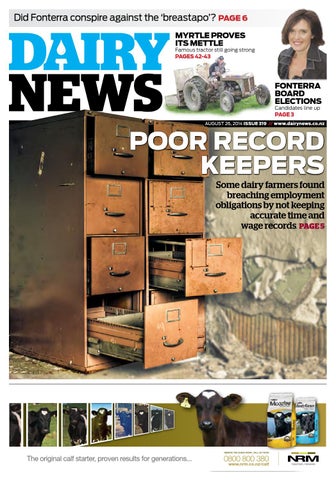
Poor record keepers
Some dairy farmers found breaching employment obligations by not keeping accurate time and wage records. PAGE 5
REMOVE THE GUESS WORK, CALL US TODAY
The original calf starter, proven results for generations...
0800 800 380 www.nrm.co.nz/calf
DELIVERING QUALITY STOCKFOODS FOR OVER 10 YEARS
Dairy News august 26, 2014
news // 3
Candidates line up for board elections ANDREW SWALLOW andrews@ruralnews.co.nz
THE ‘WINDOW’ for Fonterra board nominations remains open for a week or so and three challengers have come forward. Election rules prohibit candidates from courting media coverage but by asking around and making a few calls Dairy News soon discovered Leonie Guiney and Gray Baldwin are in the mix, and Grant Rowan is a likely candidate. Guiney is a former consulting officer who, with husband Kieran, has built a multiple dairy farm business around Fairlie, South Canterbury, in the past decade. She was often at the forefront of debate on TAF (trading among farmers). Last week she said she’s standing because of the importance of Fonterra to farmers and the wider New Zealand economy. “Governance is about purpose and direction which is where my passion lies. The cooperative model has given so much to my family…. I by no means claim to have all the skills the Fonterra board needs, but if I can bring something different to the current board I can make a contribution.” Baldwin, who stood in 2011, has three farms in various ownership structures around Fonterra’s Lichfield factory, Waikato. He’s also on the board
Waikato demo farm launch. PG.04
Super barn ready for cows. PGS.26-27
of Ballance AgriNutrients, LIC, and Trinity Lands, a dairy and kiwifruit farming charitable trust. He sees the biggest issue for Fonterra as staying relevant globally and getting more milk. “The rest of the world’s dairy production is growing significantly and Fonterra has a large slice of the world trade at the moment but if we don’t grow our milk supply overseas in ten years we could be only 10% of that world trade.” MyFarm director Grant Rowan says it’s his intention to stand again, having done so in 2012. “I’m positive about Fonterra and believe we need a strong intergenerational cooperative that adds value to the dairy business of New Zealand for New Zealand dairy farmers.” Asked what he sees as the key issue for Fonterra’s future, he says internationally it’s staying relevant, succeeding and growing, particularly in emerging markets, but domestically it’s making sure Fonterra is the cooperative and processor dairy farmers want to belong to and can afford to belong to. Rowan has three dairy farms in Southland of his own, and leads farm procurement and management for MyFarm. The director retiring by rotation and seeking re-election, David Macleod, said he was pleased to hear there are a few candidates. “It’s good for the governance of the cooperative that share-
holders have a choice.” Besides his Fonterra directorship, Macleod is chairman of Taranaki Regional Council, managing director of Greaves Electrical, and a director of PKW Farms, Fonterra’s 13th largest supplier. “When I stood three years ago I made a commitment that if I was successful I would be there long-term, as long as shareholders want me to be. They’ve invested three years in me. It would be remiss of me not to seek re-election.” Macleod sees delivering on Fonterra’s strategy as a key issue for the cooperative. “When I started, the chief executive was as new as I was but now he has his feet well and truly under the table. It has been an interesting journey over the past three years, almost a baptism of fire you might say, with the issues we’ve had to deal with, but we have a clear strategy in place – a strategy I’m totally behind and believe in... it will deliver great value to shareholders.” John Monaghan, could not be reached to confirm he’ll be seeking re-election. With Waikato farmer Jim van der Poel stepping down after 12 years on the board there’s sure to be at least one new face at Fonterra’s top table by the close of Fonterra’s annual meeting in November. Nominations for the board close noon September 5 and a full list of candidates will be announced September 23 after they are assessed.
Versatile seed/fert spreader. PG.45
News ������������������������������������������������������ 3-21 Opinion ���������������������������������������������22-23 Agribusiness ���������������������������� 24-25 Management ������������������������������ 26-29 Animal Health ��������������������������30-33 mating Management ����������������������������� 34-40 Machinery & Products ���������������������������������������41-46
Grant Rowan
Gray Baldwin
Leonie Guiney
Looking to weigh your young dairy stock? Take a look at these deals. EziWeigh5 Weigh Scale
MP600 Load Bars
EziWeigh7 Weigh Scale
MP600 Load Bars
1545TTSM01
ID5000 Weigh Scale
NEW
MP600 Load Bars
$1495
$2195
$3595
SRS EID Stick Reader
Calf Platform (1.1M)
$1095
$495
XRS EID Stick Reader
Cattle Platform (2.2M)
Calf Weighing System
$1895
$895
$3995
Includes: Tru-Test EziWeigh7 Weigh Scale, Tru-Test MP600 Load Bars and Prattley Calf Crate
For more information or to take advantage of these offers call your local Tru-Test Area Sales Manager on 0800 263 278 Offers available until 31 August 2014. Pricing is GST inclusive,subject to change and includes delivery to the retail store.
www.tru-test.com/livestock
How are you tracking? Let’s talk. 0800 263 278
Dairy News august 26, 2014
4 // news
Huge riparian fencing worldclass effort SUDESH KISSUN sudeshk@ruralnews.co.nz
FONTERRA FARMERS’ fencing of 23,500km
of waterways is a fantastic achievement, says chairman John Wilson. Speaking this month at the launch of the St Peter’s School – Lincoln University dairy demonstration farm at Cambridge, Wilson praised farmers for their efforts. He says dairying seeks to improve sustainability for the environment, the economy and for people. “We’re already doing a great deal to improve the
environmental sustainability of our farms. For example Fonterra farmers have fenced 23,500km of waterways… a world class achievement. “However, that in itself is not enough; we have to look at the full farm system and bring science to life so we can deliver an industry which is profitable and which attracts and retains the best people.” Wilson later told Dairy News that the remaining 5% involved “some really hard stuff”. “These are waterways that flood and are hard to rein in.” However, Fonterra will
continue to work with farmers. “We won’t be able to get all the remaining waterways fenced off because some of them are flood channels but our farmers have put in a great effort and we are in great shape.” The demonstration dairy farm aims to be in the top 3% of farms in the region for profitability and environmental performance through scientific research and best practice farming coupled with scientific monitoring of impacts. Launching the farm, Primary Industries Minister Nathan Guy said that
while the farm’s goals are focused on the Waikato region, its benefits will extend across New Zealand. “The goal for agriculture is to double current revenue to $65 billion by 2025. That can only be achieved by demonstrat-
Primary Industries Minister Nathan Guy with St Peter’s College students, from left: Sam Frengley, Kent Hawkins and Lucy Stockdale at the demonstration farm.
ing that it is possible to be productive and profitable without compromising the environment. This farm, bordering the Waikato River, provides the perfect setting.” The role of the farm,
and its location alongside the Waikato River, was of particular interest to the Waikato Regional Council, said chairman Paula Southgate. “The challenge is to measure and respond to
the impact dairying has on the environment and in particular our waterways. This farm will help us understand and meet those challenges.” @dairy_news facebook.com/dairynews
showing the realities of dairying LINCOLN UNIVERSITY vicechancellor Dr Andy West says combining best onfarm practice with robust science are driving forces behind the new demonstration farm. The farm will represent the realities of dairy farming in the
region through field days, online research and education through the St Peter’s and Lincoln curricula. “We anticipate a high degree of interest from students at St Peter’s and other schools, existing and potential dairy farmers
and the public. “The farm will be a ‘best practice dairy farm in action’, able to be observed and studied, not just physically but in the strategy, practice data and results achieved.” The farm will be governed by a committee .
A rain gauge is so simple yet so vital. It has a simple task: measuring rainfall. But what can be gained from it is vital. What we do is vital to your business too. We’re an agribusiness bank. This exclusive focus enables us to meet the specific needs of your business and help secure your long-term future.
Rabobank. One focus.
Dairy News august 26, 2014
news // 5
Govt turns heat on dismal record keepers pam tipa pamelat@ruralnews.co.nz
DAIRY FARMERS are now on
notice over poor record keeping that doesn’t meet minimum standards for employment law. They may soon face fines of up to $10,000 for individuals or $20,000 for companies if employment records are not up to scratch – whether or not there’s been an actual breach of employment conditions. About a quarter of 42 farms employing migrant workers inspected in the third phase of the national dairy strategy by the Ministry of Business, Innovation and Employment’s labour inspectors were found in breach of employment laws for poor record keeping. This was a an improvement on the second phase, held late last year to early this year, which found half of 40 farms inspected were in breach with record keeping. Senior inspector Kris Metcalf says inadequate employment record keeping is a widespread problem in the sector and the ministry is cracking down. “Keeping records is a basic legal requirement and breaching it is serious. “Record keeping is essential. We will have to consider pursuing penalties if farmers don’t have accurate wage and time records regardless of
whether we received a complaint or whether or not there was a short payment of wages. “There has been plenty of focus on this, there’s been widespread media attention; farmers need to lift their game.” Ten farms found employing migrants in breach of minimum standards over record keeping “was a bit disappointing considering the formal process they went through to employ migrants”. No actual exploitive conduct was found. “It was an improvement on phase two: they weren’t farms that employed migrants, they were just regional farms. Over half of those 40 we visited didn’t comply or didn’t have wage and time records. So it is a widespread problem. “Without records showing what the hours are – and the focus was on seasonal averaging – you can’t see what hours they are doing and therefore there is no transparent employment relationship. “The only way we can confirm what’s going on is by interviewing the employer and the employee. “If there were no records or the records didn’t show the hours worked, we looked at the employment agreement, if there was one, to see what hours were specified. We would interview separately both the
worker and the farmer and establish what hours were worked from there. “In this latest phase there were records but they needed improving. The areas important are the days worked, the start and finish times and the breaks recorded so you can see accurately how many hours are worked in a day and work out if the minimum wage was paid for the hours worked.” The problem is across the board from small to large farms. “We acknowledge larger corporate farms probably have more resources and systems in place but it is probably more on the accuracy of the records and showing details so it is transparent.” The 10 farms under notice from phase three have 28 days to comply with enforcement or the matter will progress to the Employment Relations Authority. DairyNZ and Federated Farmers have products and services to help farms comply. In addition inspected farms are provided with material and the MBIE website has free examples of wage and farm records. Metcalf says farmers must also ensure they have accurate leave records including details of annual leave, sick leave, bereavement leave and public holidays and alternate days off if they work on public holidays.
Farmers could soon face fines of up to $20,000 if employment records are not properly kept.
MASODINE TEAT SPRAY 200 Ltr
40 Ltrs
MASODINE
GLYCERINE
$1,199 +GST price includes Delivery
200 Ltr Masodine
Kills Mastitis causing bacteria in 15 seconds 20 Ltr
Glycerine
NPE FREE
20 Ltr
Glycerine
TESTED USING EN 1656 ✔ PASSED New Zealand PROTOCOL-A Buy Online
www.evansonline.co.nz
All In One account. All your business finance needs in one. As New Zealand’s only dedicated agribusiness bank, we understand the unique financial needs of farmers. That’s why we’ve created the All In One account. With a single account, you have all the advantages of working capital with term debt. And what’s more, there’s the everyday convenience of ATMs, online access and Debit MasterCard®. To discover how our All In One account can benefit your business, call Rabobank to arrange a visit.
Call 0800 722 622 or visit rabobank.co.nz
®
MasterCard is the registered trade mark of MasterCard International Incorporated.
15 SECONDS
✔
Dairy News august 26, 2014
6 // news
Fonterra not doing the dirty on breastfeeding pam tipa pamelat@ruralnews.co.nz
INFANT NUTRITION Jan Carey, Infant Nutrition Council, says Fonterra is not a marketer of infant formula.
Council chief executive Jan Carey does not believe Fonterra had anything
WHEN YOU’Re FARMING YOU CAN EXPECT THAT, IF YOU WANt
A JOB DONE
PROPERLY
YOU’LL HAVE To DO IT YOURSELF.
to do with posts on the Whale Oil blog internet site making disparaging comments about breastfeeding advocates. However she says it raises the issue of how things escalate when
‘extreme’ comments are made by both sides. Some blogs on Whale Oil hit out at breastfeeding advocates after they made comments about the marketing of infant formula. The Dirty Politics book by
BUT WHEN YOU’Re FARMING, ONE THING YOU CAN RELY ON WORKING AS IT SHOULD FOR LONGER IS CYDECTIN. CYDECTIN® Pour-On gives you healthier stock for longer, with the longest persistent activity available, controlling Ostertagia ostertagi for 35 days, Trichostrongylus axei and Haemonchus spp for 28 days, and Lungworm for 42 days. With stock free from worms for longer, use of CYDECTIN Pour-On has been proven to improve milk production and liveweight gains. Weigh up the benefits and choose CYDECTIN Pour-On.
Works as it should for longer!
www.cydectin.co.nz
Nicky Hager infers they could have been requested or paid for by Fonterra. Fonterra says: “We have never, directly or indirectly, requested or paid for posts on the Whale Oil blog.” Carey says Fonterra is not a marketer of infant formula in New Zealand and she does not believe they were involved. “I don’t know what Fonterra would have gained by doing such a thing and they’d have everything to lose. “They are a good quality member of the Infant Formula Council, they adhere to our code of conduct and members would not be allowed to be members of the council if they were engaging in the behaviour alleged. “I haven’t spoken to Fonterra about it because they have responded themselves that they weren’t involved and I would accept that. “I don’t condone what was in the blog…. As far as this industry is concerned we are all providing the best possible nutrition for infants. Breast milk is the best.
“But there is absolutely no need to be thinking that because you are a breast feeding advocate you are at war with the infant formula industry and vice versa. That’s ridiculous.” Dirty Politics claims a public relations company posted several blogs attacking breastfeeding advocates, labelling them as the ‘breastapo’. Hager implies they were posted on behalf of Fonterra. The book, based on the hacked emails of Cameron Slater who runs the Whale Oil internet site, claims they were among a number posts written by a public relations man under different pseudonyms and paid for by food or tobacco companies. Infant Nutrition Council members include Fonterra, Nestle, Synlait and Nutricia and 25 associated members. Carey says members have agreed to uphold the values of the council – to be truthful, ethical and accountable and not bring the council into disrepute. And the industry supports “breastfeeding as the first and best form of nutrition for infants”.
Zoetis New Zealand Limited. Level 5, 8 Mahuhu Crescent, Auckland 1010, New Zealand. Tel: 0800 ZOETIS (963 847), Fax: 0800 628 629. CYDECTIN is a registered trademark of Zoetis Inc. or its subsidiaries. ACVM No A06203.
ZOE 1184 CYDECTIN Press Ad Brand 280x187_ƒ.indd 1
ZOE1184
Extremists welcome to their views
7/31/14 9:50 AM
CAREY SAYS she understands some Whale Oil blogs were responding to comments breastfeeding advocates had made at a forum about the marketing of infant formula. Some ideas raised by breast feeding advocates such as plain packaging for infant formula “were not terribly helpful”. “But I don’t think you then respond to those ideas in a negative or nasty way. They are entitled to their views and beliefs.” But the blog responses were “an extreme response to an extreme view”. “How helpful is that? If someone says something critical of you that’s nasty it makes you react – people get in their corners. “But there are some good organisations promoting the benefits of breastfeeding.” Following the Christchurch earthquake the Infant Nutrition Council was criticised for organising infant formula supplies for families that needed it – for children being bottle fed not breastfed, says Carey. But she does not see any need to get into war with breastfeeding advocates because they are people who care about infant nutrition. “I am a breast feeding advocate myself,” she says. “Some people as advocates have quite extreme views, then people respond to those extreme views and you get people pushed into their corners and not engaging with each other.” But she notes that a high quality infant formula is the only recommended substitute for infants not being breastfed.
Dairy News august 26, 2014
news // 7
GDT rule changes raise questions ANDREW SWALLOW andrews@ruralnews.co.nz
FONTERRA SUBSIDIARY Global Dairy Trade is defending a proposal which at first sight appears set to undermine the transparency of GDT events and even artificially inflate average prices reported. It has proposed that sales made at a seller’s start price be no longer publicly reported, though such results would still be available to those with access to the bidders’ website. GDT says the rule change is needed to prevent non-participants in auctions from using sellers’ start prices for their own purposes. It also says the move “strengthens the incentive on sellers to set attractive starting prices so that winning prices are discovered through a multi-round competitive bidding process”. However, if the only sales reported were those attracting two or more bids, the results would exclude the lowest winning bids. Challenged on this by a spokesperson for GDT said the rule would rarely apply and “certainly will not materi-
ally reduce the transparency of winning prices achieved for NZ product”. “Transparency is maintained because, first, the vast majority of winning prices will continue to be reported and, second, viewers can now be assured all reported prices are the outcome of a competitive bidding Con Williams process over at least two bidding rounds.” Currently some reported prices could be for a trade of just one tonne “and therefore not a credible market price,” the spokesman added. “We believe our GDT prices will be more credible as a result of this change.” Bank analysts will need some convincing, it seems. “For independent observers like us it makes it more difficult to interpret the data in a timely manner,” was the initial response of Westpac’s Anne Boniface. ANZ’s Con Williams said he doesn’t think the case for the changes “stacks up”. “Especially with the proposed two levels of transparency between participants and non-participants… To me,
what is sold at whatever prices should be reported because this reflects what has traded. “I don’t understand why there would be two levels of transparency. If you want to achieve the listed objective then the same level of transparency should be given to both participants and non-participants.” Williams questioned how, if participants are able to see start prices, the proposed changes would get around GDT’s concern that sellers can currently infer other sellers’ starting prices. “Seems to me sellers would be able to find out if participants can.” For analysts, if the changes do distort averages, it will be more difficult to forecast farmgate milk prices, he added. The changes would also mean GDT reports break with convention for reporting auctions. “In other markets if you get one bid and a product is sold for that price then it has traded and that is the market price. I don’t see why it is
any different in this case.” GDT said a key driver for the changes is competition law, notably in the EU and US, that says no seller of the same product type should be able to observe another seller’s starting price. Since some non-participants are sellers of dairy products in international dairy markets, it is required to take all practical steps to prevent such sellers from identifying another seller’s starting prices. However, it said it was not claiming non-participants had used starting price information in a way which was detrimental to GDT participants. It also denied restriction of such information is anti-competitive, or an
slide levels HAS THE slide stopped? Or are we on another ledge anticipating the ride to the bottom – and hopefully back up again – will be even more exciting? Last week’s GDT saw the all-commodity index down 0.6% with an average winning price of US$3000/t. The good news, from
THE FORMULA FOR FASTER FINISHING
Ingham TopCalf Formula range gives your calves the perfect balance of energy, protein, fibre, vitamins and minerals to help them hit their target weights sooner. Scientifically developed for New Zealand feeding systems, TopCalf is a blend of high quality cereal grains and protein meals that will promote early rumen development and lean tissue growth. With a great balance of nutrients in every mouthful, you couldn’t give your calves a better start. Call us to find out more or to arrange an on farm visit – 0800 650 505.
TRACTA52077
attempt to make results appear better than they are. “Advice of competition law experts in NZ, EU and US is that preventing sellers from observing another seller’s starting price is pro-competitive, ie positive for competition…. “This change is being made purely to ensure, first, that GDT is compliant with competition law and, second, that viewers are not misled by results which do not reflect a competitive price setting process.” Submissions on the proposal must be lodged in writing to help@globaldairytrade.info by September 12. If adopted, the new rules are expected to take effect in November.
inghamfeeds.co.nz
a New Zealand perspective, was whole milk powder gaining 3.4% to average US$2804/t, helping close a large and unusually high discount to skim milk powder. Meanwhile SMP came down 12% to meet WMP, averaging US$2874/t.
Dairy News august 26, 2014
8 // news
‘Superflush’ blew the gasket in co-op’s calculator PAM TIPA pamelat@ruralnews.co.nz
FONTERRA’S SETTING of the 201314 base milk price failed the ‘efficiency test’ when it adjusted the farmgate price partly because of the ‘superflush’ and its asset configuration’s inability to deal with it. That is what the Commerce Commission is saying in its draft report on the milk price released this month, says Shareholders Council chairman Ian Brown. “My reading of it is the Commerce Commission ticks the box for contestability under section 150 of the act (DIRA) but in their view it fails its test in terms of efficiency because Fonterra adjusted the price to reflect the impact of its asset configuration over its revenues this year,” Brown told Dairy News.
Brown says the commission is deal- season’s ‘superflush’ – more milk than ing with a “hypothetical or notional anybody could handle.” Although Fonterra’s decisions did model”. But he respects the commission and think it’s correct that it should not tick the box in respect of the model monitor milk price setting. “They have the commission must measure it against, the commission to have a yardstick. It does “take into account is the right thing to do “At a farm level, the real world we all for all farmers, Fon- we fill that vat operate in”. terra farmers in paronce a day: the Looking from a dairy ticular. It puts some increased transpar- processors have farmer’s point of view, ency around the deci- to take that milk Brown says the cow sions on milk price.” or we can’t milk numbers for this spring are now fixed, feed is in Brown notes the tomorrow.” place and spring sunlight commission says will determine what hapthat though adjusting the milk price did not meet the effi- pens in the next six-eight weeks. “At a ciency requirement under the act, it farm level we fill that vat once a day; the didn’t mean Fonterra was inefficient. processors have to take that milk or we “It made reference to its asset distri- can’t milk tomorrow. It’s a fantastic bution in terms of its processing assets industry and you will get these situaand there’s no contingency in its inter- tions in it – that’s the reality.” Brown says the Shareholders Counpretation of the manual to allow for last
Fonterra Shareholders Council chairman Ian Brown.
cil is monitoring and asking questions about the final milk prices for 2013-14 and the final deviation from the milk price manual calculation. “Farmers will ask bluntly ‘is there a transfer from milk price to profit?’ and that question will be answered when you get the final result. But we are aware of that.” The stream return between the cheese and casein and the powder products in the last 12 months has been unprecedented. Brown says the ‘gap’ between the milk price manual calculation and farmgate price was 55c in the last calculation, but they were now waiting for the final figures from Fonterra. “The council has been straight-up
at the meetings, understanding what the gap is and where that gap is influenced from which part of the business and what effect on cost that is. It is the first place you go. “But absolutely, there will be complete transparency around those numbers. It has come up every meeting since the gap has been announced. It is impossible to go out there until the final numbers are calculated because during the second half of the season you saw the decline in commodity prices and a good production season and the gap adjust. “I have no idea where it will finish up but you would think with the commodity prices dropping that it may not be where it is now.”
Dairy News august 26, 2014
news // 9
Farmers have right to know more IN THE new capital-
structure environment the Fonterra Shareholders Council’s role has increased and farmers seek more detailed answers on the milk price question, says Fairlie dairy farmer Leonie Guiney. “The Shareholders Council has not been in the position before where there could be any potential influences on milk price that could conflict with farmer interests,” she told Dairy News. “They now are, so the importance of their role has increased. Farmers rightfully expect more detailed answers.” On the Commerce Commission’s draft report on the milk price, Guiney says the commission needs to keep in mind that Fon-
terra is a cooperative designed to generate the best possible return for its member-owners. “Whatever system is used to determine the milk price [we must] get the best possible outcome with the objective of delivering back to the farm the highest possible milk price while protecting the cooperative. “It is onfarm profitability that drives GDP rather than Fonterra’s profitability. Fonterra has been able to punch above its weight in international markets because it is supported by 11,000 farming businesses resilient enough to ride the peaks and troughs of the commodity wave better than any other farmers in the world. “Delivering earn-
ings back to the farm via a strong milk price is an integral [factor in] those businesses continuing to thrive. In fact, every NZ dairy farmer, no matter what company they supply, is dependent on a strong Fonterra delivering on milk price. As a consequence so is the average New Zealander. “In our new capital structure environment, where a portion of earnings are now owned by non-farmers, it is the role of Fonterra’s Shareholder Council to determine that this is occurring with no risk of any earnings leaking off-farm that shouldn’t be. For example, dividend payments being made – some of which now go to non-farming unit holders – without being able
Leonie Guiney
to be justified from company profit. If this were to happen the milk price would effectively be subsidising the company profit and hence the unit holders’ returns.” Guiney says the Commerce Commission’s comments in the draft report could be interpreted as raising this question. “But they could also be seen as challenging Fonterra’s right to retain earnings in the long term interests of the co-op.”
Milk payout under scrutiny FONTERRA’S DECISION to pay farmers an adjusted price for the 201314 season that is less than the company’s milk price manual calculation is the most significant issue in this year’s review, says the Commerce Commission. In May this year, Fonterra announced a milk price consistent with the manual of $8.95/kgMS and its proposal to adjust that price downwards by 55 cents/kgMS to $8.40/kgMS. “At this stage, our overall finding is that the way Fonterra is calculating and applying its adjustment to the base milk price is not consistent with incentives for the company to operate efficiently,” said Commerce Commission deputy chair Sue Begg in a draft report. “Fonterra is setting a lower price to cancel out the adverse effect of a number of unanticipated events that would otherwise have had a negative impact on its profits. “Despite our draft finding, we emphasise that the regime is only intended to monitor, not restrict, how Fonterra calculates the base milk price.” Fonterra is permitted to set a price
higher or lower than that calculated under its manual. There are no consequences for Fonterra under the act if the commission’s final report concludes that the co-op has set a price not consistent with the purpose of the milk price monitoring regime. “The monitoring regime only requires us to look at whether Fonterra’s base milk price calculation provides incentives for Fonterra to operate efficiently. We recognise there are many other factors that provide efficiency incentives for Fonterra. So our draft finding does not imply that Fonterra is inefficient,” says Begg. “In the longer term however, we might be concerned about whether the wider efficiency objectives of the act are being met if significant discounts to the base milk price persist.” The commission welcomes comments on the draft report by September 1. The final report will be published by September 15. See the draft report on the Commission’s website at: www.comcom. govt.nz/review-of-milk-price-calculation201314-season.
Dairy News august 26, 2014
10 // news
Inductions gone, mating mantras begin ANDREW SWALLOW andrews@ruralnews.co.nz
WITH SCHEDULED
inductions banned as from next season the annual barrage of mating management advice seems set to be more intense than ever. LIC fired a salvo earlier this month, saying
start planning calving without inductions now, and DairyNZ’s September Inside Dairy, due in mailboxes any day, has mating advice “referencing the new policy”. DairyNZ has also updated induction information in the reproduction area of its website and regional teams are inform-
Nita Harding, DairyNZ.
ing farmers personally, says DairyNZ technical policy advisor, veterinary, Nita Harding. “We’ve got information out to farmers before the start of mating, so they have time to work with their advisors and can manage mating this year knowing that routine inductions will not be per-
“ THEY THOUGHT WE WERE MAD” BRENDON WOODS DAIRY FARMER, CANTERBURY
mitted next year.” Harding says further advice from veterinarians and DairyNZ’s InCalf programme can also help better manage calving pattern (see www.dairynz. co.nz/incalf ). LIC’s veterinarian and reproduction solutions manager, Joyce Voogt, says make a robust plan to minimise the number of late calving cows. “The most natural way to do this is by focussing on the herd’s 6-week incalf rate, with a proactive approach to mating management, all year-round. For many farmers that needs to start this spring.” Voogt points out the industry target for cows in calf after six weeks of mating is 78% but the national average is 65%, so there’s a big opportunity. Minda records show many farms achieve the 6-week conception target without inductions and these farms are also substantially closer to target three-week submission and conception rate targets. While there will always be some late cows, the key is to be proactive in managing them, she says. “It’s not as simple
as pulling the service bulls out early this year. Mating-length decisions should be made with your veterinarian or farm management consultant. Gathering and using the right herd testing and pregnancy testing information will be crucial for making the best mating and culling decisions.” Analyse which cows will calve late and why, so that underlying causes of slippage in the calving pattern can be addressed. “The key areas to look at now are heifer liveweight and mating date, cow condition at calving and mating, and early identification and management of non-cyclers. “Heat detection is always crucial, but don’t forget the natural mating period too. Farmers with enough pregnancy test data can check out their new pregnancy rate graphs in Minda reproduction to see how things went after AB finished in their herd last year. “Many things can impact a cow’s ability to get in-calf. Now more than ever, as an industry, we need to focus maximising performance in the first half of mating.”
Joyce Voogt, LIC.
WWW.UNBEETABLES.CO.NZ
BECOME UNBEETABLE AND WIN A TRIP TO THE SYDNEY FILM FESTIVAL
LIC’S mating checklist
TRACTAJ52660-B
R O F G N I T H G P FI HT IS DONE. O T S R E V E THEY’LL NBEET UNTIL THE FIG FODDER
■■
Will R1 heifers hit target weight to mate at 15 months?
■■
Mate R1 heifers 7-10 days before herd to allow more time to cycle post first calf.
■■
85% of herd at BCS 4.0-4.5 by start of mating.
■■
Is nutrition sufficient? Calculate need from production.
■■
ID non-cyclers, underlying causes, and plan response.
■■
Check heat detection skills and systems. Train if necessary.
■■
Check bulls and plan natural mating management.
Use advice and tools available: LIC’s six week challenge (www.6weeks.co.nz) and DairyNZ’s InCalf.
Dairy News august 26, 2014
news // 11
Enquiry for farms ‘quite strong’ andrew swallow andrews@ruralnews.co.nz
PAYOUT FORECAST
cuts don’t appear to have dampened buyer interest in dairy and grazing farms though price impact remains to be seen, says REINZ’s rural spokesman Brian Peacocke. Speaking to Dairy News on the release of REINZ’s latest rural sales data, he said already there’s “quite strong enquiry” for properties this spring but lambing and calving means few farms are coming to market. “These initial enquiries indicate there’s still an enthusiasm to purchase. The unknown is the price. To a large extent there will be a reliance on the advice of the banks on that.” The dairy support market is “consistently strong across the country,” as there’s “just not enough supply to meet the demand,” he adds. Across all categories there is a continuing trend to greater caution among buyers due to compliance requirements with existing and emerging regulations. “There’s quite a strong pattern of due diligence.” REINZ’s dairy farm price index for the three months to July fell 1.2%
compared to the three months to June, but was up 8.7% compared to the three months to July last year. The index adjusts for differences in farm size and location, unlike median price per hectare. Median price/ha for dairy farms to the end of July was $36,673 across 47 properties sold, compared to $33,543/ha for 69 sales in the three months ended June and $34,882/ha over 47 sales for the three months ended July 2013. The median price for finishing farms in the three months to July was $27,907/ha on 105 sales, up 4.5% compared to $26,694/ha on 115 sales in the three months to June and 24% ahead of the $22,500/ha median on 109 sales a year previously. However, median price for grazing farms was down 2.1% at $15,500 on 225 sales compared to $15,833 for 236 sales in the three months ended June. In the three months to July 2013 the median was $15,367 on 193 sales. Across all farm types there were 512 sales in the three months ended July 2014, a 16.9% increase on turnover in the corresponding months a year ago, but back 5.9% on the three months ended June 2014. The median price
in the three months to July 2014 was $26,680/ha, up 29% on the $20,667/ ha median for the three months ended July 2013 and up 2.6% compared to the three months ended June 2014. However, movements in RENZ’s all-farm price index, with its adjustments for differences in farm size, location and farming type, were more modest. It fell 5.7% in the three months to July compared to the three months to June but was up 8.8% compared to the three months to July 2013. “While annual statistics confirm a solid increase in volumes and prices over the past 12 months, three monthly figures to the end of July indicate an easing in volumes and prices…. Apart from a small burst of activity in Westland, as expected at this time of year when peak workloads dominate all other activity,
dairy farm sales have virtually come to a standstill. “By contrast, sales of finishing and grazing properties have maintained some momentum, with reasonable enquiry for beef farms in the north, for dairy support properties through the centre of
In demand: there’s still an enthusiasm to purchase dairy farms despite a sharp drop in dairy prices.
the country, and for sheep, beef properties and dairy support farms in the lower south. Sales in the horticultural sector have been
steady,” said Peacocke. Grazing properties accounted for the largest number of sales (43.9%) in the three months to July,
finishing properties 20.5%, horticulture 10.9% and dairy 9.2%. @dairy_news facebook.com/dairynews
Chris Murdoch... SPECIALISING IN RURAL REAL ESTATE THROUGHOUT CANTERBURY ❱❱ Local knowledge ❱❱ Over 20 years experience ❱❱ Tens of $millions of rural property sold If you need a confidential chat about the current rural property market, call me today.
027 434 2545 Hastings McLeod Limited. Licensed under the Real Estate Agents Act 2008 217 West Street, Ashburton
Pumps, Stirrers & Hydrants 0800 686 334 www.numedic.co.nz
chris@propertybrokers.co.nz
New Zealand Manufacturers & suppliers of: • Strongest, most durable pumps available • Efficient & robust pond stirrers • Pontoons & Hydrants • Evenspread low application travelling irrigators • Stationary irrigators
MANUFACTURE AND DESIGN
AGENTS NATIONWIDE, EXPORTING WORLDWIDE
Looking for a cost effective autodrafting solution? Get a load of this. MilkHub Auto Drafter Pre-set drafts online 24/7 with MiHub Herd Management
NEW
$19,995*
Operate from the shed via smartphone or tablet Cloud based technology means no need for broadband or PC at the shed Uses Tru-Test’s proven EID Reader technology for reading all tag types
1471TTSM01
Kitset design allows drafter to be moved from one shed to another. Tru-Test MilkHub — Your Dairy Intelligence Partner. * Pricing excludes GST and installation. MiHub monthly subscription costs apply.
How are you tracking? Let’s talk.
www.tru-test.com/dairy
0800 6455 482
Dairy News august 26, 2014
12 // news
Beaut, he won our ute! OF THE many thousands of entries in the Dairy News ‘Beaut I Want to Win that Ute’ competition, Richard Main of Pukeatua is the lucky winner. Richard and Margaret Main live south of Mount Maungatautari, near the Waikato township of Pukeatua. The rolling country of their 198ha farm was once home to the Te Whanake South Devon stud,
which is no longer registered. The main income on the farm now is dairy grazing, which provides more steady income than the beef and sheep used to. Richard was taken aback by his win, saying he hadn’t had a lot of luck in his time. “Thanks very much to Dairy News and to Mahindra for the opportunity. I can’t believe it,” he said.
But the win creates a problem of sorts: what to do with the faithful 1986 Land Rover 110 that has served him so well, but is suddenly surplus to requirements. Keen to avoid clutter, Margaret Main had the answer: “Sell it!” Thanks to all the Dairy News readers who entered this competition. More great prizes are coming and we wish you the best of luck with those.
Lucky winner Richard Main with his new Mahindra ute.
40,000 cows say they prefer a Redpath clear roof shelter … if cow’s could talk LIC’s bull acquisition team.
More bull selectors for farmer co-op
T C E R I BUY D lands/CRT
h or throug
Farm
!
te i s n o t l i Bu an h t s s e l r fo !* w o c r e p $500
N An effective and affordable on-farm shelter system N Multiple flooring options, or build over existing pads N Designed for Feedpads, Standoffshelters or Winteringbarns 40,000 cows already enjoy a Redpath shelter for improved feed control, better pasture quality and protection from poor weather
N
! S N O S A E ES
H T T BEA
For Your Free Info Pack Free Ph 0508 733 728 www.redpath.co.nz Email: sales@redpath.co.nz * + GST. Conditions apply.
LIC HAS appointed two more analysts to its bull acqui-
sition team at Newstead, Hamilton. Sam Fogden and Nick Rolley join other analysts who identify and buy genetics for the co-op’s artificial breeding bull teams. “Sam and Nick bring a strong passion for genetics, breeding and dairy farming,” says bull acquisition manager Simon Worth. “We work with farmers to produce bulls for the sire proving scheme. These go on to form part of our premier sires teams and potentially sire tens of thousands of heifers for the national herd and more sons for our teams.” This year 220 bulls will enter sire proving, increasing from 205 last year, as the co-op aims to have eight of the top 10 bulls on the ranking of active sires (RAS) list for all three breeds. Fogden, BSc in zoology and genetics, was an LIC farm solutions manager in the Raglan area. She will work with bull breeders and support the team to acquire new young bulls. “I get to do what I love and put my genetics knowledge to good use while… helping provide our customers with the best genetics,” she says. Rolley, BAgSc has worked in farm consultancy, rural banking and 14 years in the NZ Police. He says his role as sire analyst allows him to put a lifetime interest in genetics and breeding into practice, in an industry he is passionate about. “Working for LIC provides an opportunity where your clients, customers, shareholders and owners are all the same people. Because of this, when farmers win, we win too,” says Rolley.
Check out our websites www.ruralnews.co.nz www.dairynews.co.nz
Dairy News august 26, 2014
news // 13
Feds last to sign on induction line andrew swallow andrews@ruralnews.co.nz
The decision has had a mixed reaction onfarm, says Andrew Hoggard.
FEDERATED FARMERS was
likely the last to sign an industry agreement consigning scheduled inductions to the farm management dustbin, it has emerged. Inductions policy has been managed by a group of signatories to a memorandum of understanding including the New Zealand Veterinary Association, DairyNZ, the Dairy Companies Association of New Zealand and Feds. In 2010 rules were imposed requiring non-emergency inductions to be scheduled 90 days in advance, and limited to 15% of the herd. The ceiling tumbled to 8% in 2011, and 4% in 2012, and has stayed at that level since; about 30% of farms took advantage of that last year. Feds’ Dairy chairman Andrew Hoggard says the decision to ban the practice from June 1 next year was made “at a high level” back in February though Feds didn’t sign to it until after an in-committee debate at its annual conference. “I think we are the last to decide,” he told Dairy News last week. Hoggard says the decision has had “a mixed reaction onfarm” among the 30% of farmers who still used the practice. “A number were disappointed that they hadn’t had the opportunity to speak on the matter through their networks.” However, given the sensitivity of the issue in the mainstream, it always had to be dealt with discreetly, he says. “70% of farmers didn’t induce last year, so we assume they’re not worried and a number have said ‘a good job too’ since the ban,” he adds. Kimberly Crewther, executive director of the Dairy Companies Association of New Zealand, says the ban
was seen as “a logical next step” by the association. “It reflects that from the industry perspective the acceptability of the practice had changed over time.” When pressed, she acknowledged there were concerns about a public and consequent market backlash against New Zealand product had the practice continued. “There’s potential for that with any of these [animal welfare] issues.” With inductions gone, she says there are no other common practices on dairy farms that “spring to mind that are not consistent with the [animal welfare] codes”. Farmers who’ve been using inductions that Dairy News spoke to accepted the ban is probably a necessary step, albeit with some hesitation. “With the internet and media today, perception is far greater than reality,” James Houghton, Waikato, said. “It was a convenient tool and economic to do, but we just have to accept it’s gone and move on.” He’s hopeful “getting smarter” in various areas of the business can recoup most of the $13,000 or so of extra milk income inducing 17 cows in his herd of 430 this season is likely to bring.
South Canterbury Federated Farmers Dairy chairman Ryan O’Sullivan also accepts the ban was necessary, but again more because of public perception than reality. He says there will be downsides which the public wouldn’t be aware of. “The 50 or so we would have had [induced] next year will be in the latecalving mob, calving in October, and they will be as fat-as because we just won’t be able to keep the weight off them calving that late, which means we’re more likely to have metabolic problems – more milk fever.” As such, the risk to the cow is greater than an induction, and calving so late the chances of her getting in calf in time for the following year are slim so she’s likely to be culled, whereas a one-off induction could have reset the clock for what was otherwise a good cow. “If the [induction] process was managed properly I don’t believe there was a huge animal welfare issue. It was quite a valuable tool and one we’re sad to lose but that rationale’s hard for the public to accept. And no-one wants to see a video clip of a premature calf being pulled from its mother and euthanased going viral on the internet.”
FLICK SWITCH TO TAKE OUT MID TO LATE SEASON MASTITIS. Mastitis cases caused by Staph. aureus can be tricky to manage. It’s most prevalent mid to late season, and the bacteria can hide within cells, meaning some antibiotics can’t reach and kill it. Using an ineffective treatment will just cost you time and money. But Orbenin® LA has proven high cure rates against both clinical and sub-clinical mastitis, and is particularly effective against Staph. aureus. This is because its treatment regime gives a longer contact time. Between 6 and 10 days to be exact – so when you use Orbenin LA you can be confident it works.
For ultimate mastitis control, ask your vet or visit dairywellness.co.nz
Just one part of the ultimate mastitis control system from Zoetis. Always use antibiotics responsibly.
Zoetis New Zealand Limited. Level 3, 14 Normanby Road, Mt Eden, Auckland 1024, New Zealand. Tel: 0800 ZOETIS (963 847), Fax: 0800 628 629. ORBENIN is a registered trade mark of GlaxoSmithKline NZ Ltd. ACVM No. A3664. RVM; Available only under Veterinary Authorisation.
ZOE9680LA
Dairy News august 26, 2014
14 // news
Cloud lifts farming to new heights IMPROVED BROADBAND and cloud soft-
Prime Minister John Key and Brian Eccles, CRS Software in Masterton last week.
ware are set to help farmers better manage their businesses, says farm management software firm CRS Software, Masterton.
The company last week opened new offices – Prime Minister John Key officiating – and it now has 600m2 of space for at least 60 staff, says managing director Brian Eccles. Real-time access to
Go-ahead in Wairarapa ■■
CRS Software
■■
Masterton based and established in 1981
■■
The first New Zealand-based farm financial software company to launch a cloud product
■■
Turnover of farmers using the product at least $10 billion
■■
Currently hires 40 staff including sales, developers, help-desk and management personal
■■
Double-digit growth during the past five years
NEW
Wheat DDG-S “ProvEN WhEat basEd ProtEiN” auStralian Wheat DDG-S (DRIED DISTILLERS GRAINS WITH SOLUBLES) are produced from Australian wheat and are guaranteed NON-GMO and free from any antibiotic or glyphosate residues that are present in many corn based DDG. Wheat based DDG-S are a proven performer in New Zealand pasture based systems, as they provide an ideal balance of energy and essential proteins to increase cow performance. Manildra Stockfeed’s DDG-S are a safe, clean feed that provide a cost effective increase in milk production.
NON GMO No aNtibiotics No gLyPhosPhatE
“vaLuabLE ProtEiN aNd ENErgy For high PErFormaNcE dairy coWs”
information will lift farmers’ ability to decide their responses to climate, environment and market pressures, Eccles says. Accurate, timely information is the key. “Our vision is to provide farmers with software tools that assist day-to-day management, including physical and financial indicators, while supporting the ‘big-picture’ plan. “Armed with good information, farmers are better equipped to deal with variable seasonal and economic conditions.” CRS Software in 2009 released a cloud-based financial management system especially for farmers. The benefits of being able to access the same information from any PC has surprised everyone, Eccles says. “It’s a success well beyond expecta-
tions.” The company’s next round of innovations will include: enabling data to just arrive – coded and ready to analyse; apps for mobile phones; connections directly to cloud software becoming available to farm accountants; and providing systems needed by large farming businesses. And despite the intermittent broadband plaguing some farmers, CRS products will deliver the goods. The new building will house a rapidly growing team of developers and sales staff, Eccles says. “I am immensely proud of how our team has come together in the past few years to help us become New Zealand’s leading rural financial software company.”
Our Wheat DDG-S are: Safe source of valuable protein and energy to enhance pasture based dairying with improved milk quality and production
iN stock aNd avaiLabLE NatioNWidE
Contain higher levels of metabolisable energy than almost all other dry feedstuffs to increase milk production Made using premium NON-GMO ingredients produced in-house by the Manildra Group of Companies NON-GM and free from residual antibiotics and gylphosphate typically found in many corn based DDG. Wheat DDG-S available now alongside our quality feeds, including: NEW PaSture PluS PelletS: “PushiNg ProductioN”
Supply contracts available for the whole dairy season. Not affected by local grain supply issues.
NEW Dairy Goat PluS PelletS: “goats LovE ‘Em” Wheat Bran PelletS: “high quaLity, digEstibLE starch” Canola Meal: “Puts ProtEiN iN thE vat”
PROUDLY DISTRIBUTING oilSeeD ProDuCtS nZ WWW.OSPSTOCKFEEDS.CO.NZ 0800 6773333 0800 oSPFeeD Available through our distribution partners
Charge it to your card SATELLITE BROADBAND onseller Wireless
Nation (using the Optus satellite service) is working with PGG Wrightson in a new deal for farmers. As part of PGG Wrightson’s rewards scheme, account holders get a deal on Wireless Nation’s satellite and fixed wireless (rural broadband initiative) broadband plans, chargeable to their PGG Wrightson rewards card. Wireless Nation’s offer will be promoted through PGG Wrightson’s retail outlets and technical field reps. “We know how important fast, reliable internet is to farmers,” says Shannon Galloway, general manager marketing PGG Wrightson. “We also know farmers don’t want to have to spend time trying to work out plans and gigs or worry about getting caught with penalties and hooks. Wireless Nation [can] make the process simple and jargon free.” Wireless Nation’s technical director Tom Lin says the company offers PGW account holders, regardless of where they live, “a fast consistent internet connection”.
B&LIC0723
LIC’s new, fresh semen, SGL™ bull teams can offer you up to 10 more days in milk. After 13 years of selective breeding for a single trait, gestation length, we are able to offer SGL semen that brings forward calving by about 10 days. Talk to your local LIC Farm Solutions Manager about the various SGL semen options on offer.
Dairy News august 26, 2014
16 // news
in brief Cheese month returns NEW ZEALAND Cheese Month returns in October with the country’s top specialist cheesemakers, big supermarkets and cheesemongers all supporting the celebration of Kiwi cheese. The New Zealand Specialist Cheesemakers Association (NZSCA) is promoting the campaign including ‘meet the cheesemaker’ events, in-store cheese specials and promotions, tastings, farm open days and more. Dianne Kenderdine, secretary, recently
returned from the 2014 American Cheese Society (ACS) competition and conference, saying New Zealand cheese producers are amongst the best in the world. “New Zealand cheese is unique because our grass-fed animals have plenty of space to roam, which results in top quality milk that produces natural, full-flavoured cheese. “The [promotion is to get everyone] eating… Kiwi specialty cheese, and enjoying events, activities and promotions nationwide during October.” Meyer Gouda Cheese, Puhoi Valley, Crescent Dairy Goats, Over the Moon Dairy and Il Casaro Cheese Company will host events and activities.
DOLOMITE NZ’s finest BioGro certified Mg fertiliser For a delivered price call... 0800 436 566
Council sets lure for food sector investors A WAIKATO district council is hoping a proposed export ice cream factory will lure more investors to a site it is promoting as a food manufacturing hub. Hauraki District Council wants to establish a food technology and production hub at Kerepehi. The council is offering to sell large blocks of land as an ideal location for the development, to be called Hauraki Park. The 16 sites are a few 100 metres from SH2, opposite the former Kerepehi dairy factory bought earlier this year by the Chinese-owned
Allied Faxi Food Company for conversion into an ice cream export manufacturing plant. Conversion of the plant is due to start in spring, and it is expected by late 2015 to be producing 10 tonnes of ice cream and 10 tonnes of frozen cream daily. All output is for China. The council hopes the ice cream start-up will help attract investors. Hauraki mayor John Tregidga says the council researched the potential economic benefits of its proposal. “Our council believes in thinking differently.
Vacant sections for sale at Kerepehi are seen by Hauraki District Council as the site of a food technology hub.
We wish to partner with food-based companies in Hauraki Park. We’re keen to talk to established companies and ‘start ups’. “The council has approved a resource consent application and
Phillip Taylor – Kiwitahi – 4953m 3
Pondco
Effluent Ponds
0800-901-109 www.pondco.co.nz
Winners of the 2013 IAGI Installation Small Project Award
Steri
Kills all known bacteria, fungi, protozoa, spores and viruses.
ETHICAL AGENT S LTD VETERINARY MARKETING
Phone: 0-9-262 1388 www.ethicalagents.co.nz
Ideal around the farm
The mayor earlier this year led a council delegation to China and Taiwan to promote the Kerepehi hub. Bayleys Waikato commercial salesman Josh Smith says the council’s proposal would be positively viewed by potential new tenants at the park. “As a new start-up location in a small rural environment, the anticipated square metre rates for these 16 sites are much lower than Auckland or Hamilton,” Smith says. “Kerepehi has direct state highway access to two ports – Tauranga and Auckland – enabling any business in the town to make best use of trade conditions at either destination. “And the township is surrounded by primary productive land which will supply much of the dairy product required by the dairy factory, when it comes back on line, and new dairy -based businesses coming into the hub,” Smith says.
4 Kills all 17 virus families 4 Safe on stainless steel, will not cause spotting or rust
High Level Disinfectant and Cleaner
Marketed in New Zealand by
design for a waste water treatment plant to process waste water from food processing businesses.” The council has spent $9 million upgrading Kerepehi’s water treatment plant. “Understanding that industry requires high volumes of potable water, the council has recently upgraded its potable water capacity at Kerepehi so we can supply a town the size of Palmerston North,” says Tregidga. New Zealand Trade & Enterprise is also supporting the council to attract investors and food businesses with an eye to exports. Whakatu Coldstores Ltd, adjacent to the Hauraki Park, manages a coldstore with capacity for 12,500 pallets at -24C. It has the highest-possible coldstore rating granted by MPI. “Having the coldstore available in Kerepehi offers food-based companies savings in storage and distribution,” says Tregidga.
4 Safe for use on rubber & vinyl 4 Cleans & disinfects 4 Economic 4 Easy to mix 4 Fast acting HA379
AVAILABLE FROM VET CLINICS NATIONWIDE
Dairy News august 26, 2014
news // 17
R&D now linked to products, services DAIRYNZ IS merging
its R&D teams and has appointed David McCall to a new role – general manager R&D – to integrate research work with the products and services developed for farmers. This follows the retirement last month of chief scientist Dr Eric Hillerton. DairyNZ chief executive Tim Mackle says it is timely with Hillerton leaving to re-think the role of the research leader. “We also have a new industry strategy with ambitious targets and we need to think about how to organise ourselves to best deliver those for farmers. “I’m keen to see greater integration because one of the dairy industry’s key strategic objectives is to research and develop innovative technologies and solutions to meet the current and future needs of dairy farms. “That’s a crucial area of work for us and one that DairyNZ is leading for the industry. We need to be the best at delivering the results of our own and our partners’ research. We want to help farmers make good decisions and apply new knowledge on farms.
This new role will help us do that.” McCall has been general manager of DairyNZ’s development and extension group since 2007. He is trained in agricultural economics and management, with a relevant PhD from Massey University. He was a farm systems scientist at AgResearch until 1998 and then spent eight years in business development and managing technology company startups and investments for Celentis Limited. Says Mackle, “David brings a strong and practical background in farm systems research and economics to this new role…. He’s already led a lot of work for us on how to farm within environmental limits and drive productivity.” DairyNZ’s regional extension manager Craig McBeth, BAgSc Massey University, has taken on the new role of general manager of extension and engagement as part of the changes. Mackle says he wants to improve the flow of research to farmers. “Extending our engagement and boosting the
adoption of new and existing technologies and knowledge is crucial to our success. Craig will become a part of my senior management team too…
defining our strategy for increased farmer engagement.” McBeth has 20 years of experience in rural banking. He was general
manager of rural banking at ASB before joining DairyNZ in 2011. @dairy_news facebook.com/dairynews
David McCall
in brief Fonterra’s new partner FONTERRA HAS signed a five-year strategic agreement with the Commonwealth Scientific and Industrial Research Organisation (CSIRO) to drive innovation in sustainable farming, manufacturing, health, nutrition and consumer dairy products. The agreement will see CSIRO applying its expertise to the cooperative’s global dairy chain using its broad range of industrial know-how and scientific capability in remote sensing, resource engineering, ecosystem, food and water to help propel Fonterra’s V3 strategy. Fonterra chief technology officer Dr Jeremy Hill says the partnership will develop a range of solutions to address Fonterra’s science and technology needs. “On-farm, CSIRO will turn their attention to herd productivity, effluent management and milk quality, and then work through our supply chain looking at processing and analytical technology, food structure and design, and consumer health benefits. “We’re leaving no stone unturned to ensure Fonterra stays at the cutting edge of dairy innovation.” Hill says innovation developed from strategic partnerships with the likes of CSIRO will be crucial to meet the needs of new markets and to ensure the industry remains commercially and environmentally sustainable.
Tony Drnasin, TE PAHU, WAIKATO
Until you are more successful, We won’t be satisfied. Pioneer brand products are provided subject to the terms and conditions of purchase, which are part of the labeling and purchase documents. ®, TM, SM, Trademarks and service marks of Pioneer Hi-Bred International, Inc. ®
PIONEER.co.nz 0800 PIONEER
0800 746 633
Dairy News august 26, 2014
18 // news
Farm invite falls on deaf ears andrew swallow andrews@ruralnews.co.nz
A SOUTH Canterbury
dairy farmer’s invite to newspaper letter writ-
Farmer John Gregan is disappointed no one has taken up his offer.
ers to see and discuss cow welfare first hand has gone unanswered. Following a string of letters in the Timaru Herald last month slamming dairy farmers for
“If you’re looking for maize hybrids that consistently deliver - whatever the conditions Pacific Seeds has got you covered.” Ross Carter
We’ve grown Pacific Seeds hybrids for a number of seasons now and they have always performed really well, with high yields, big well filled cobs and ME levels that are always in excess of 11%.
Dry matter yields and grain yield/quality. Yield stability across environments and seasons. Standability, drought and disease resistance.
FULL SEASON PACIFIC SEEDS HYBRID OPTIONS SUITABLE FOR: NORTHLAND, CENTRAL WAIKATO/BOP, EAST COAST, NORTHERN HAWKES BAY (105 to 110+ days)
SOUTH WAIKATO and LOWER NORTH ISLAND (95 to 105 days)
TASMAN TO MID CANTERBURY (90 to 95 days)
PAC 624 115 CRM Silage only Outstanding yields and quality
PAC 343 104 CRM Dual purpose A resilient top end performer
PAC 606 114 CRM Silage only Long harvest window, soft grain
PAC 301 102 CRM Dual purpose Large girth ears, excellent grain
PAC 249 95 CRM Dual purpose Reliable yields across regions, and environments
DKC57-83 107 CRM Grain pref. Excellent drydown and standability
PAC 230 98 CRM Dual purpose High yields and consistency PAC 249 95 CRM Dual purpose Reliable yields across regions, and environments
DKC43-72 93 CRM Silage only Large cobs 18 to 20 kernels around PAC 065 89 CRM Dual purpose Exceptional grain quality and dry down PAC 062 87 CRM Dual purpose High yields in challenging conditions
PAC0643-DN-RC
For our full hybrid range visit www.pacificseeds.co.nz
Barry Smallridge
Al Park
• Northland • Waikato • Bay of Plenty • Poverty Bay • South Island
• Southern Waikato • Hawkes Bay • Southern North Island
027 494 7706
027 287 8776
News it had been very wet in the Waimate area in autumn and early winter which meant many paddocks were muddier than normal. One farm with stock next to the main road had been visited twice by the SPCA following complaints by passers-by, but the SPCA had found the stock in good condition. “I admit it’s not a great look to have cows standing
“As a dairy farmer I feel we’re often put under the pump by the public and it would be nice to get them to engage and get a bit more understanding about what goes on onfarm.”
Ngatea
TRIED, TESTED, PROVEN: Pacific Seeds maize hybrids are bred to deliver strong performance across the following:
having skinny cows, muddy paddocks, lack of shelter, once-a-day milking and/or calf feeding, John Gregan invited readers to visit his farm. No-one replied. “It’s a little disappointing because it was a genuine offer,” Gregan, a Fonterra Shareholders Councillor and former regional Feds Dairy rep, told Dairy News. “As a dairy farmer I feel
www.pacificseeds.co.nz | 0800 PACMAIZE
we’re often put under the pump by the public and it would be nice to get them to engage and get a bit more understanding about what goes on onfarm.” The letters, which also touched on calf euthanasia and ill-treatment of cows by staff, were probably “based a bit on ignorance, and a bit on misunderstanding,” said Gregan. “I felt enough was enough. I’d never feel I have the right to be critical of a nurse or a lawyer when I don’t understand their occupation.” Gregan’s letter did not criticise the correspondents. Instead he offered to help them contact authorities whose role is to investigate alleged animal welfare abuses. He wrote, “Our industry has no place for those who do not care for the welfare of their animals…. When it is happening we all need to work together to stop it. “We need the public to be proud New Zealand has a world-class dairy industry.” As a once-a-day calf feeder, he defended that practice. “The calves have 24-hour access to calf meal and our contented, outstanding young stock are testament to how well calves thrive when reared in this manner.” Gregan told Dairy
in mud but it doesn’t last long and they are often fed twice a day when it is like that. These animals are meant to live outside; we can’t house them all.” Federated Farmers South Canterbury Dairy chairman Ryan O’Sullivan echoes Gregan’s comments. “It looked bad but by and large – and I’ve had a vet confirm this – cow condition across the region is pretty good. We had R1 calves on fodder beet up to their guts in mud at times and they still put on 0.9-1kg/day liveweight over 60 days. Cows on kale have done well too. Most people have been able to feed stock well despite the wet. But it’s been hard work, shifting them two or even three times a day.” O’Sullivan says in some parts of the region the autumn rains were a 1:70-year event so the conditions had been exceptional. “It’s atypical for South Canterbury. Wintering stock in high densities on crop isn’t normally an issue here.” As for the lack of response to Gregan’s invitation, he says he’s not surprised. “You’d never convince the individuals who wrote those letters it is any different anyway.” @dairy_news facebook.com/dairynews
Dairy News august 26, 2014
world // 19
Recovering from perfect storm RICK BAYNE
THIS TIME last year Aus-
tralian farmers Barry and Linda Morgan were pondering their future in the dairy industry. The farmers from Cobden, south-west Victoria, were battling their toughest season in 24 years. A ‘perfect storm’ of conditions – low milk prices, a prolonged dry spell, poor grass growth and high feed and input costs – had them planning to exit the industry. A year later things have turned around. The milk price is up, the weather has been near perfect, production is up and they’ve made a decent profit. Linda says it took some time to turn around from the dire situation, but their persistence has paid off. “We really did think we would chuck it in,”
Morgan says. “It took some time to recover but we got there. When we started getting good milk prices we had to pay off the creditors for the hay and grain we’d been feeding, but we managed to get all that done and ended the year with a profit, which was amazing.” She says their priority during the lean period was to protect the cows’ health, which led to high imported feed costs. However, it was hard to maintain the herd in peak condition and some effects of the bad start to 2013 continue to be felt. The farm’s calving pattern has expanded to counteract the lesser condition of the herd at joining and they finished with more empty cows than normal. But the Morgans persisted. “We pulled our head in and got down to the job.” The turnaround was
prompted by a mixture of price and conditions. “I think if the season weather-wise is perfect, a good milk price is just a bonus.” The farm has signed on to Australian processor, Bega’s three-year growth and sustainability programme. “We seem to be able to shop around
more now… there seem to be more options. I still get annoyed that we don’t know our milk prices when we start the financial year. It’s hard to plan when you don’t know what you’re going to get.” Now the Morgans are on the front foot. The cows are healthier, the grass is growing, produc-
tion is on the rise and their confidence has returned. The farm is 2000L/ day up on last year and Morgan is confident the upward trend can continue. “We were thinking of finishing in March next year, now we’re really motivated to continue,” she says. “We survived.”
Linda Morgan, Victoria.
Tough season, poor prices cause drop QUEENSLAND FARMERS fear the state’s struggling milk output will keep declining unless they get positive signals from the market. The state has again suffered the biggest production drop in Australia, a 5.34% decline compounding a fall of 5.6% the previous year. Low prices and bad weather are holding down morale. Queensland Dairy Organisation president Brian Tessmann says it is frustrating and abundantly clear that Queensland needs more milk to cater for its own needs “but the market is failing to provide a response that adequately stimulates an increase in production”. Tessmann says the clearest signal farmers can get is the farmgate price. “Milk needs to be priced fairly along the value chain, particularly at the supermarket retail end,” he says. The state saw a small lift in price in recent months but this followed three years of depressed prices and huge costs from floods, cyclone and drought. “We have lost 100 farmers in three years so it is clear there is a long way to go for the trend to turn around,” Tessmann says the recent price rises, though welcome, did not alone completely address the shortfall. “Farmers will be looking for an even stronger indication of the market’s value on fresh Queensland milk. “Queensland dairy farmers could also do with a couple of years of seasons free of damaging floods and drought to improve their confidence on the back of recent price movements.” A recent Queensland Dairy Organisation survey found that 9 of every 10 farmers lack confidence in the industry, most reporting negative cash flow. Lockyer Valley farmer Luke Stock says the A$1/L supermarket price war, Queensland’s reliance on the domestic milk market and poor weather caused the fall. Consumers can’t be blamed for choosing cheaper generic labelled milk, Stock says. – Rick Bayne DJ2891_SW_dairy_news_280x187_v2_ol.indd 1
2/07/14 9:05 AM
Dairy News august 26, 2014
20 // world
No confidence to invest in NSW DAIRY farmers uncertain about their industry’s direction need processors to give them confidence to invest in their businesses. Milk production in the state has fallen at least 3% on the previous financial year. Dairy NSW chairman Michael Perich says farmers’ lack of confidence is the biggest issue facing the industry. “That will come from the processors giving us the confidence to continue to invest on farm. It’s not just price, it’s more about confidence and
long-term strategy. “There’ll always be demand for our product but we need a long-term view and sustainable price.” Perich says the industry was constrained by the capacity of farmers willing to invest in farm infrastructure and to pay consultants or advisors to help them. He says he doubts the industry can grow but he hopes it could stop the decline. “With the Queensland industry retracting we’ve got some opportunities, along with the export market.”
Michael Perich, Dairy NSW chairman.
Conditions in NSW have been variable but mostly quite dry “which is causing a big issue for farmers without irrigation”. Western Australian Farmers
Federation dairy president Phil Depiazzi says the state’s 2.73% decline can be addressed only by paying farmers better prices. A recent two-cent lift will
slow the decline and stimulate growth, but won’t solve the problem, he says. “We clear signals from processors that they want milk and are prepared to pay a reasonable price. “Some farmers are getting about 45 cents and that’s not enough. The Sustainable Price Report suggests we need mid50s to get a reasonable return on assets and to get guys motivated to halt this decline in milk production.” Despite the concerns there is a slightly more positive feel
Newborn calves?
about the industry, Depiazzi says. “I don’t believe it will decline in the coming 12 months. The figures will show we struggled with a wet spring last year that limited production. “This year we’ve had a good start. Grain crops are looking good and that should stimulate a bit of production through summer, as should a summer incentive programme.” While Western Australia volumes have dropped, some farms are increasing production and predicting better times.
in brief Oz dairy forum
Give them lifetime traceability Tag them with NAIT approved RFID ear tags within six months of birth or before being moved off farm.
Register them in the NAIT system online within one week of being tagged. This links the animal to their individual tag.
To find out more go to www.nait.co.nz | info@nait.co.nz 0800 624 843
STRONGER OPENING season milk prices, burgeoning demand from China and growing farmer confidence about the industry’s future are the backdrop to the inaugural Australian Dairy Farm Investment Forum next month. The forum, on September 15 in Melbourne, will offer a deeper understanding of the operating environment, outlook and innovations shaping the industry’s future, says forum chairman John McKillop. “[Attendees] will share information, improve knowledge and explore capital raising options. Australian dairy farmers need to see the breadth of investment models that can bring capital into their businesses to make them more profitable. “The forum will also provide attentive investors with an understanding of the workings of our industry.” McKillop says Dairy Australia and other industry entities have for about 12 months seen growing enquiry about investing in Australian dairy. “We have different production types, diverse geographical regions and a complex regulatory and operating environment, so it’s time to come together and properly discuss these things more directly with the people who want to inject capital into the sector. “Australian dairy production is already a focus for local and overseas customers, suppliers and investors. And many farmers are keen to ramp up production and get dollars behind the business to achieve greater volumes and become more profitable. Australian Minister for Trade and Investment Andrew Robb will open the forum.
DRIVE PRODUCTION EVEN FURTHER WITH Purchase a tonne of Calcimate (40x25kg bags only) between 1 July and 31 Oct 2014 and you could WIN a Honda XR125 Duster. Simply text ‘Calcimate’ and your full name to 226 to enter the draw or enter online at www.onlime.co.nz (proof of purchase per entry required).
Cows need calcium. Help your cows fly through calving with Calcimate - the trusted, quality choice for calcium supplementation. Available from your rural retailer.
See website for full terms & conditions. Manufactured by:
MCD1168
NSW
Dairy News august 26, 2014
world // 21
Oz farmers urgently seek China FTA THE AUSTRALIAN
government is facing calls from farmers to quickly finalise a strong FTA with China. The call from Victoria Farmers Federation comes as Russia imposed a 12-month ban on food imports from Australia, the US and the EU. Victorian dairy farmers are pointing out that New Zealand exports to China are booming since our FTA launch in 2008. United Dairyfarmers of Victoria president Tyran Jones says the Australian dairy industry faces a 10-15% tariff on its milk and infant formula powder exports to China. “Compare that to New Zealand, who’ve negotiated an FTA with China that imposes a tariff of less than 5% on milk powders, which wind down to zero by 2019,” Jones says. “Last year we exported… 100,000 tonnes of dairy produce to China, while the Kiwis exported about 853,000 tonnes of milk powders and other key dairy products.” VFF president Peter Tuohey says he trusts that the federal government Trade Minister Andrew Robb would deliver an FTA with China that stripped away tariff barriers hampering agriculture’s access to China. “Russia [before its ban had been buying] $400 million of our $38 billion in food and fibre exports,”
says Tuohey. “Compare that with what China could offer us in export growth under an FTA. Australian grain, beef, sheepmeat, dairy and horticultural producers all stand to gain from an FTA with China, via the removal of import quotas and tariffs. “What’s happened in Russia, just highlights the need for us to get strong FTAs in place that open up more markets for Australian exports – such as China.” In a speech last week, Australian Trade and Investment Minister Andrew Robb noted that negotiations with China continue apace. They are tough negotiators but a conclusion this year remains a realistic objective. Robb says it is pushing hard for a deal that affords strong market access within China for Australian services. “Over recent decades China has performed a humanitarian miracle in moving 500 million people out of poverty…. Moving many more out of poverty requires continued economic adjustment including a transition from export- to consumptionled growth.” Earlier Robb described the Russian food ban as disappointing, requiring work with affected producers to minimise the impact on their businesses.
Award for Euro co-op EUROPEAN DAIRY co-op FrieslandCampina has won the Asia Pacific Best Sustainable Business Practice Award. Its winning entry looks at shared value creation by means of stakeholder engagement, through a case study of its Dairy Development Programme (DDP). FrieslandCampina analysed the programme, showing how it created value via community activities and local economic development. The co-op’s director of public affairs, Hendro Poedjono, expressed the co-op’s pride at the award. “This is the first year FrieslandCampina has entered and it shows that our efforts on DDP are being recognised by all audiences. DDP provides a great platform for farmer-to-farmer knowledge sharing.”
Russia ranks 28th on Australia’s list of export destinations; the country’s trade with Russia represents 0.4% of its trade overall and 1% of agricul-
tural exports. The country exported A$76 million of dairy and milk to Russia last year. “So we are not heavily reliant on it as a trad-
ing partner. The excellent reputation of our agriculture sees it in strong demand in many other major markets including China, Japan and Korea.”
Australian Trade Minister Andrew Robb.
Dairy News august 26, 2014
22 // OPINION Ruminating
EDITORIAL
Inductions move overdue
milking it... TAF ‘told you so’ coming?
FOR ALL its denials prior to TAF (trading among farmers), Fonterra’s behaviour since suggests outsideinvestor interest is gaining increasing sway in the boardroom. The standout is paying 55c/kg short of the milk price manual-calculated milk price for 2013-14. As the Commerce Commission notes, Fonterra set a lower price to cancel out “unanticipated events that would otherwise have had a negative impact on its profits”. Meanwhile a 10c/share dividend forecast remains. Prior to TAF the payout would have been higher, perhaps with a retention, and dividend zero. Then there’s guaranteed milk pricing. Not a problem if extra profit (or loss) from fixed price milk were shared among other suppliers, but Fonterra says it won’t affect payout, so windfalls will be dished out in dividend, and we all know where some of that goes. It’s the corporate model and the thin end of the wedge in the cooperative door.
Uneasy four weeks
THE GREENS are indicating they are no longer willing to play second fiddle in a Labour-led Government. While the chances of Cunliffe leading the Government after September 20 are as remote, Russel Norman and Metiria Turei want senior cabinet positions that reflect their party’s priorities, social justice and the economy, should they get over the line. Are we going to see finance, environment and energy and resources portfolios controlled by the Greens? Will dairy farmers be forced to reduce the number of cows in a bid to control methane emissions? Just thinking about this will be making many farmers uneasy.
Camel milk anyone?
FANCY SOME camelmilk chocolate? How about a camel milkshake or a splash of camel milk in your morning coffee? Substituting camel milk for cow’s milk might not sound appetising but a look at the health benefits might have you queuing for a camel latte sooner than you think. Already popular in North Africa, the Middle East and Asia, camel milk has been known as a health tonic since the first desert nomads learnt how to milk wild camels. Now the popularity of camel milk is growing among the health conscious who claim the nutrient-rich drink can help such disorders as diabetes, autism, digestive problems and food allergies. So is camel milk set to become the next superfood to seduce consumers?
1080 votes confirmed
IF THE Greens make their way into the cabinet after September 20, this party need not worry: the Ban 1080 political party has announced nine candidates for this year’s elections. The party was formed this year in response to DoC’s continuing aerial dropping of the poison sodium monofluoroacetate (1080), which rural New Zealanders attest is contaminating waterways and cruelly killing their livestock, dogs and the native birds it is supposed to be protecting. Party co-leader Bill Wallace says the rising anger in provincial New Zealand has reached a tipping point. The question we ask is ‘can this party even get 1080 votes on September 20?’
BANNING INDUCTION as a management tool is the right move, and, it could be argued, overdue – pun intended. The ceiling tumbled from 15% of any one herd in 2010, to 8% in 2011 and 4% in 2012. Some expected, even called for, further reductions in 2013 or this year, asking for a signal when the practice would be removed as a management tool altogether, but nothing was forthcoming. The 4% limit rolled on. Now, in the wake of the Chilean calf clubbing furore and amendment of regulations on such practices here, scheduled inductions have been banned. There’s no doubt the two are linked. The reaction to the calf clubbing footage was a wake-up call to the industry on the damage an animal welfare scandal could do. It was fortunate the footage was from Chile. Had it been Opunake, Kereone, or Tuatapere the market consequences could have been severe; which is why scheduled inductions had to go, and probably should have gone already. It’s not so much an animal welfare issue as a public perception issue. For most non-farmers, the concept of inducing a cow to calf so early that the calf is either born dead or has to be immediately euthanased is a step too far. The fact many naturally born calves go on a bobby truck at a week old isn’t palatable to them either, but as the calf meets a useful end, and nature was allowed to run its course up to that point, most meat eaters and milk drinkers will accept it. Yes, the loss of induction as a management tool will add some cost to some farms, but the potential cost of a sting by the likes of PETA would cost every farmer much more in reduced demand for New Zealand dairy product. With tail docking, calf clubbing and now inductions gone, hopefully our industry has no more animal husbandry skeletons in the closet. Outdoor wintering of cows will be in the sights of some, but cattle evolved in winter-cold, summer-hot climates so this is defensible, provided conditions underfoot are kept comfortable. Whether it is defensible on environmental grounds is another matter, but that’s another debate for another day. For those with inductions scheduled for this spring, let’s make sure it’s done right, and won’t end up on YouTube. Having done the right thing, it would be a shame to fall at the last hurdle.
Publisher: Brian Hight ...................... Ph 09-307 0399 Head Office: Top Floor, 29 Northcroft St, Takapuna, Auckland 0622 Phone 09-307 0399. Fax 09-307 0122 Postal Address: Published by: Printed by: Contacts: Advertising material: Rural News on-line: Subscriptions:
PO Box 331100, Takapuna, Auckland 0740 Rural News Group PMP Print Editorial: sudeshk@ruralnews.co.nz davef@ruralnews.co.nz www.ruralnews.co.nz subsrndn@ruralnews.co.nz
ABC audited circulation 27,726 as at 31.12.2013
ISSN 1175-463X
Editor: Sudesh Kissun ................ Ph 09-913 9627 Reporters: Neil Keating .................... Ph 09-913 9628 Tony Hopkinson ............. Ph 07-579 1010 Peter Burke....................... Ph 06-362 6319 Andrew Swallow ............ Ph 021-745 183 Pamela Tipa...................... Ph 09-913 9630 Subscriptions: Julie Beech ...................... Ph 09-307 0399 Production: Dave Ferguson ............... Ph 09-913 9633 Becky Williams ................ Ph 09-913 9634 Website Producer: James Anderson............. Ph 09-913 9621
Dairy News is published by Rural News Group Limited. All editorial copy and photographs are subject to copyright and may not be reproduced without prior written permission of the publisher. Opinions or comments expressed within this publication are not necessarily those of the staff, management or directors of Rural News Group Limited.
NATIONAL SALES MANAGER: Ted Darley ........................... Ph 07-854 6292, 021-832 505 ted@ruralnews.co.nz AUCKLAND: Stephen Pollard................... Ph 09 913 9637, 021 963 166 stephenp@ruralnews.co.nz WELLINGTON: Mark Macfarlane ............... Ph 04-234 6239, 021-453 914 markm@ruralnews.co.nz SOUTH ISLAND: Kaye Sutherland ..............Ph 03-337 3828, 021-221 1994 kayes@ruralnews.co.nz
Dairy News august 26, 2014
opinion // 23
Volatility here we go again THE RECENTLY
announced reductions in milk prices are a reminder of volatility as our constant companion. As market corrections materialise they highlight the importance of effective budgeting systems and how fundamental timely monitoring and forecasting are to profits and sustainability. This also raises questions about how farming businesses can be better informed so they have time to react rather than trying to self-manage the milk price rollercoaster. It’s frustrating that there isn’t more robust guidance from key industry players. The combination of seasonal prices announced only a couple of days before the financial year commences along with contradictory signals from fixed term milk prices compared to seasonal forecasts makes budgeting more difficult than it needs to be. Others will no doubt disagree but I see a place for some ‘smoothing’ of milk prices between seasons. Short-term volatility has negative effects on capital decisions, reward to labour and input costs as farmers compete in buoyant times only to frown when downturns come. Judicious industry management to deliver consistency along with a more structured approach to providing guidance on likely returns would be more helpful than having to rely on the mixed views of economists, industry commentators and rumour. So what are the keys to better managing this inside the farmgate? Recent positive returns have meant some businesses have taken their focus off this process as they have allowed boom times to mask fundamental weaknesses in capital and cost structures. Now is the time to reinstate disciplines and get clarity on business outlook. Priority must be to ensure that when the next upturn comes the business is in the best possible shape to capitalise on it. A first step is to rec-
“Priority must be to cut fat rather than muscle.” ments there is no excuse for lack of commitment to forecasting. Highly automated and time effective systems are available for everything from entry-level cashbook ognise that effective forecasting is as much fundamental to farmer wellbeing as it is a contributor to sound business decisions. This is something many still have to work on. Comment from banking circles suggests that most farmers still don’t have inhouse budgeting in place. I find this a surprising and something needs to change quickly. Effective budgets ensure better decision making and increases the confidence of business owners. They provide a roadmap against which change can be evaluated so when volatility occurs there is a more measured response. I’ve seen too farmers stressed by uncertainty from lack of planning. Their decisions are less effective because they are based on imagination rather than calculation. Quantifying the impact of price changes gives certainty about how big the challenge will be in reality. While this is left undefined there is potential for knee-jerk reactions. The New Zealand agribusiness sector is seeing considerable growth in technologies to support financial monitoring and forecasting. New programs are emerging to better link information required for financial accounts with forecasting and stock recording systems. Existing technology providers are responding with positive improvements to their systems with even more farmer friendly budgeting and analytical tools. When these advances operate alongside credible industry benchmarking systems such as Dairybase the combination of internal and external evaluation of the business provides real confidence. Given these develop-
recording and forecasting through to quite sophisticated systems that give in-depth analysis of farming policies, development options and assessment of restructuring opportu-
nities. These enable proactive management of another key planning area -- tax management. Profits achieved from record milk prices over the last 12 months contrast with more modest returns if current milk price forecasts come to fruition.
With timely accounting advice and effective forecasting there will be payback from proactive tax management. Driving profit requires businesses to again focus on time proven principles for challenging times. Priority must be to cut fat rather than muscle.
It’s important to protect farming infrastructure and resources while capitalising on reserves achieved from recent fertiliser policies, spending on maintenance and infrastructure. • Kerry Ryan is a Tauranga agribusiness consultant. www.kerryryan.co.nz
EARLIER. EASIER. EFFECTIVE.
MINIMISE RISK TO YOUR FAMILY AND STAFF, VACCINATE NOW FOR PEACE OF MIND.
ASK YOUR VET ABOUT STOPPING LEPTO BEFORE IT STARTS. Latest New Zealand research shows that vaccinating your calves at a young age is a key first step to protecting your farm, staff and family from leptospirosis. It’s much easier with Ultravac 7 in 1 – the only combination vaccine that protects against leptospirosis and clostridial diseases. Be sure you get in there before lepto does, and remember to vaccinate your calves this spring with Ultravac 7 in 1. ®
www.ultravac7in1.co.nz
Zoetis New Zealand Limited. P.O Box 2094, Shortland Street, Auckland 1140, New Zealand. Tel: 0800 ZOETIS (963 847), Fax: 0800 628 629. ULTRAVAC is a registered trademark of Zoetis Inc. or its subsidiaries. ACVM Registration No. A6935. RVM; Available only under Veterinary Authorisation. ZOE9946
Field-to-Family Protection
Dairy News august 26, 2014
24 // agribusiness
Farmers must sharpen up more on health, safety
Hilux to drive rural games NEW ZEALAND Rural Games,
a new event celebrating our traditional sports and rural heritage, is to be sponsored for three years by Toyota New Zealand. The first Hilux New Zealand Rural Games will be at Queenstown over Waitangi weekend, February 6-8, 2015. Contests will include sheepdog trials, coal shovelling, wood chopping, highland games and
“100,000 in use… many of them in the regions. “It’s great to give something back to that community by supporting the games.” Games founder and trustee Steve Hollander says the sponsorship is a big boost. “Toyota has supported the games concept since day one and we couldn’t have hoped for a stronger or more relevant naming partner.”
speed shearing in which David Fagan, five-time world shearing champion from Te Kuiti, is planning to compete. There will also be fun participation events for spectators including children and live music and entertainment. Toyota spokesman Andrew Davis says the company’s Hilux ute has for 32 years been New Zealand’s favourite rural workhorse,
A director of a farming company was DAIRY FARMERS’ workplace health and safety obligations will rise next April recently charged with manslaughter after a tourist died in a quad crash on the farm, says adult training provider Workbase. Workbase is a not-for-profit trust Sutton pointed out. The new law would that offers workplace training in liter- make it even easier for the regulator to lay charges for workplace acy, numeracy and deaths. communications. Its comments reflect “Trustees, farm impending legislation owners and employfrom the Health and ers should immediately Safety Reform Bill, begin work on determinpart of ‘Working Safer: ing how they will meet a blueprint for health the new requirements.” and safety at work’. Sutton notes that getWorkbase spokesting to grips with health man Brent Sutton and safety requirements says dairy farmers’ is particularly chalhealth and safety oblilenging for small and gations will rise from medium-size farms. April 1, 2015 when the Brent Sutton Doing more of the new laws take effect. same is not an option, Employers will be more responsible for says Sutton. “There is a need for practiensuring workplace practices are safe and cal, industry-specific, workplace health employees know how to work safely. and safety systems that are simple, easily Business owners, directors, trustees understood and used by everyone, and and managers – all ‘duty holders’ who influ- integrated into all parts of the business.” ence and control a business – must know the risks and hazards of their businesses and how they are being managed, Sutton says. They must be able Dairy farmers can start by: to verify their safety management is ❱❱ Identifying all the business’s effective and conforms to health and hazards and risks. safety laws. ❱❱ Understanding the business’s Duty holders must ensure their health and safety obligations, and organisation’s safety changes its strengths and gaps. Farmers are implemented and see that could speak with Federated workplace practices are safe for Farmers and other farmers, about employees, contractors and vishow well their health and safety itors. system is working. Sutton says the owners of farms ❱❱ Developing a plan for implementing run by sharemilkers will have to the health and safety changes, and assume more responsibility for the making it manageable by creating a health and safety practices of those prioritised list. sharemilkers. ❱❱ Addressing first the business’s “Getting prepared for the new obligreatest health and safety risks. gations is a concern because the new law will be more prescriptive.”
From Plucks Effluent Division (since the 1980s)
ADR 500 Effluent Screening Plant COVERED BY N.Z. PATENT APPLICATION No. 591985
r Very low kW at 0.4kW r Self cleaning screen, built-in auto wash r Effluent is clean enough to be pumped into a pivot system if required r Screens out everything bigger than 1 mm r Once per year maintenance of a quick look over and wash down
Pluck’s latest model Pond Stirrer
start preparing now
r Only 1.1kW driving a 1.0 M Ø blade r Two year warranty on the new type of motor and planetary gear box r New to the world of agriculture – the latest in five-lip sealed bearings
r No greasing required – ever! r All bearings and seals above the water line r Huge 1.0 M Ø blade, moving 44,000 litres per minute r Good range of sizes for any pond type whether lined or earth, clay or concrete—big or small Call us now to find a distributor and installer in your area
0800 PLUCKS 0
8
0
0
www.plucks.co.nz
7
5
8
2
5
7
enquiries@plucks.co.nz
Main South Road, Rakaia 7710, Mid Canterbury
THE CLOSEST THING TO A MANUAL TEAT SPRAYER
WITHOUT THE LABOUR UNIT
Feature
Benefit
Moves under the udder
Consistent coverage of all four teats
Self cleaning nozzle
No blockage worries
Sprays from close to the udder
Very economical spray
One spray nozzle and solenoid
Few operating parts
Stationed on platform at exit bridge
Better coverage because cow is stationary
The Teatwand 400 has 400mm reach on a flexible arm (further than the original Teatwand) allowing the nozzle to position closer to the front teats and so gaining ideal spray coverage on all four teats. The Teatwand controller automatically adjusts the timings of the system as the platform speed is changed.
‘Teat spraying cows is still the single most important step in controlling the spread of Mastitis during milking’ Adrian Joe Mastitis Consultant & co-developer of Teatwand
Spreadeagle leg spreader Flexible spray arm
0800 888 212
info@onfarmsolutions.com www.onfarmsolutions.com
Dairy News august 26, 2014
agribusiness // 25
Fonterra puts milk under the scanner PETER BURKE peterb@ruralnews.co.nz
IN HOSPITALS they use it for diagnosing illness. Fonterra scientists and researchers use it in creating innovative dairy products. It’s commonly known as MRI (magnetic resonance imaging). The technology was developed in the 1970s and is commonly used in hospitals for medical diagnosis. MRI is a safe technology that uses strong magnetic fields and radio waves to create images. But as Fonterra’s chief technology officer Dr Jeremy Hill explains, a mini version of the same
technology has been used there to analyse the characteristics of dairy products. “So if you’re looking at butter fat products or cream it is important because in butter and cream you have fat in a liquid or solid form. You have either a crystallised state or a liquid state of fat. Depending on the… balance of these two states it affects the characteristics of the product.” MRI enables Fonterra to measure those characteristics then using those measurements they can influence processing characteristics that create the products. The technology enables them to get the right blend of solids and
More farming data via online hub BALLANCE AGRI-NUTRIENTS is raising the
range and volume of farming data it offers online via its Ag Hub databank. The hub is accessible on any internet device including smartphones and tablets. Data and services now offered cover production, environment, fertiliser and nutrition. Adding more agribusiness partners is the key to offering more data, says the co-op. General manager aginformation Graeme Martin says the aim is “to bring all [farm management] information together in an integrated way to support… good management decisions”. For example, via GPS and automatic telemetry a farmer can use the system to measure and control water, irrigation and effluent; measure parameters such as soil moisture and weather conditions; and display livestock weights, kill sheets and fertiliser applications. Ag Hub’s linking with cloud accounting firm Xero has added accounting tools for livestock management. Council links are also offered, Martin says. “For example, partnering with Environment Canterbury and Waikato, Otago and Horizons regional councils enables farmers to track their water use and remain within consents limits.” Water use and water quality are covered by Ag Hub linking with Watermetrics, Harvest and Smart Farm Systems. The system also enables nutrient tracking and effluent management on dairy farms. Ag Hub with Harvest, Tru Test and Gallagher offers links to livestock weights and milk production, and via links with NAIT it facilitates stock movement reporting. Extra milk production data comes via links with Fonterra, Miraka, Synlait and Open Country. An Ag Hub link with NIWA provides 15-day weather forecasting: Ag Hub FarmMet will give Ag Hub users weather accuracy to within 1.5km of a property. This will be available from late this year. www.aghub.co.nz
liquids of the milk fats. “By refining those characteristics and particularly tying that to our processing, we are able to create some of the superior benefits that make up the performance of Fonterra’s
specialty cream products.” One of the first uses of MRI technology was in creating spreadable butter. Fonterra’s Jeremy Hill says the MRI scanner helps analyse dairy products.
Dairy News august 26, 2014
26 // management
Big barn next step in In a few weeks the largest all-in-one dairy shed in the southern hemisphere, possibly the world, will fill with cows and start pumping out milk. Andrew Swallow reports.
AS YOU drive up the
back road off SH1 towards Van Leeuwen Group’s latest dairy development in South Canterbury the scale of it isn’t immediately obvious. The long, gentlypitched roof of the 1500cow free-stall barn blends into the skyline and the 7m tall effluent tank on the flats below looks fairly standard. It’s only when you notice the apparently miniature – and now redundant – woolshed next to it that the size of the development hits home. “We think it’s the biggest all-in-one shed in the southern hemisphere, possibly the world,” says Aad van Leeuwen as we walk
up one of the barn’s two feeding lanes towards the central control room and 24 robotic milkers. The control room is raised over the main cow floor, providing an overview of the milkers and feeding lanes and stalls beyond. Each feed lane is 193m long with rubber-matted walkways for the cows on either side and latex-lined free-stalls. “The rubber mats in the walkways are the latest development, the ultimate in cow care.” They also mean there’s no need to transition the cows onto concrete – they can go in full-time straight off grass, and they will mean there’s no need to regroove concrete after
several years to prevent slips. Experience with his other sheds is that the cows enjoy the indoor facilities. “If you walk through the sheds you find the cows are content and there are virtually no lameness issues, which is often the first thing people raise when you say you’re going to house cows. Because we’re using robotic milking there’s no forcing of cows into the shed: it’s their own decision to be milked. You might have to get one or two lazy ones in but that’s it. They’re also in good [body] condition.” While he’s used Lely’s Astronaut milkers in his other two free-stall barns
– both 500-cow facilities built in 2009 – for the new shed he’s trying DeLaval’s VMS. “We lined up both and DeLaval’s quote was ❱❱ Super-sized robotic shed quite sharp ❱❱ 1.3ha footprint free-stall barn and there are ❱❱ 1500 cows milked by 24 DeLaval robots a few things ❱❱ Feed mostly cut, carried and ensiled off I liked the surrounding 600ha look of on the DeLa❱❱ Year-round milking val. This is an ❱❱ Target 800-850kgMS/cow/300+ ideal opporday lactation. tunity to line up the two systems over the next five milking arm with fewer things that appealed with years or so and see how the VMS. electronics on it, a milkthey work next to each As with the Lely sysing bail that adjusts to the other, to see which are the size of the cow and a “very tems, every cow’s producmost reliable and econom- good” pre-milking udder tion, every milking, will be ical.” recorded so staff can monpreparation with water A less complicated itor performance from the and air were among the
Next step: Aad and Wilma Van Leeuwen’s 1500-cow freestall barn near Makikihi.
super farm
control room. The aim is for an average 24-25 litres/ cow/day at 8.5% milksolids. “We’ve got a very average herd going in, put together out of our other
For pre-emergent weed and insect control in maize Orion Crop Protection Ltd is a leading supplier of maize herbicide inputs for New Zealand farmers. To get your maize crop off to the best possible start, spray bare ground recently planted in maize before the maize and any weeds have germinated, use the proven weed control formula below. Use
Pasture to Maize
3 PLUS 3
3 litres of Sylon® mixed with 3 litres of Atraflow™ per hectare
Use
Maize to Maize 2-3 seasons
3 PLUS 3
3 litres of Sylon mixed with 3 litres of Atraflow per hectare
Use
Maize to Maize over 4 seasons
or where difficult to control weeds are present
3 Litres Sylon FOLLOWED BY Post-Emergent Spray
Add Cypher® 150-200mls per hectare for insect protection
after the maize has emerged and weeds are present
For further expert information contact Northland, Auckland: Waikato, B.O.P: Gisborne, Wairoa: Southern North Island: Northern South Island: Southern South Island: Orion Head Office:
®SYLON and ®CYPHER are Registered Trade Marks of Orion Crop Protection Limited. Registered pursuant to the ACVM Act 1997, Nos. P5817 and P7409. ™ATRAFLOW, is aTrade Mark of Orion Crop Protection Limited. Registered pursuant to the ACVM Act 1997, No. P7775. See www.foodsafety.govt.nz for registration conditions. See www.epa.govt.nz for approval conditions.
Greg Chalmers Graeme Robb Rob Shannon Tony Polkinghorne Nick George Nigel Goodwin
027 436 2337 021 337 977 027 443 6912 021 671 616 021 281 3285 021 636 654 0800 674 6627
www.orioncp.co.nz
Dairy News august 26, 2014
management // 27
sustainability? herds plus some surplus heifers.” The herd will be mated with Holstein Friesians and calved year-round. In due course he expects to get production up to 800-850kgMS/cow, with cows going out of the shed at drying off and coming back in after calving. Feeds will include grass and lucerne, fresh or ensiled, and maize silage, plus a few extras such as Canola meal, mixed in a 46m3, 25 tonne capacity three-axle mixer wagon and fed out once a day along the lanes, plus a pellet ration offered in the robotic milkers. Total ration will typically provide 250-260MJ ME/cow, at 17-17.5% protein. “With the right balance of feed even ordinary cows will give two to two-and-ahalf times the production off conventional grass systems.” Nearly all the feed will be home-grown, cut and carried off the surrounding 600ha. It was the size of the block that persuaded Aad and wife Wilma to go for such a big barn. “We thought our next free-stall barn (his first two are 500-cow units) would be 1000 or 1200 cows but because of the land available we went for 1500. It’s been a bit of a challenge getting it through the consent process and built and I wouldn’t think you’d want to go much bigger, but we’re pleased with how it’s turning out.” The building’s been done by Advanced Cow
Instant access: rubber matting in laneways for cows to walk straight in.
Barns, Winton, who also designed the main structure, with various other local contractors. The set-up for the robots was van Leeuwen’s. In the shed alone nearly 2000m3 of concrete’s been poured, and including the surrounding infrastructure, the total’s 2500m3. Completion will be about a month behind schedule, largely due to a wet autumn and early winter, but once the cows take up residence next month it will soon be running at capacity. “We’ve found we can get most cows trained to using the robots in one to two weeks.” Effluent from the laneways will be continually cleared by automatic chain-pulled scrapers, draining down into the 7m deep, 23.5m radius tank. “We’ve got enough capacity for half a year.” The aim is to use the effluent as base fertiliser for the feed crops surrounding the shed, with a 20,000L slurry tanker applying it by dribble-bar or injector. “With injection we’re burying it in the soil so there’s no loss of nutrient to the air or smell to annoy the neighbours. It’s very effective. We’ve been doing it for three years.” The dribble-bar is used on existing grassland and lucerne. The shed will be manned 24/7, with a ratio of 200-250 cows/man during daytime, including feeding out. Overall running cost of the farm will be about $4.25/kgMS.
Capital cost of the barn and surrounding infrastructure is about $2500/cow, but the robots “double it”, says van Leeuwen. Nonetheless, he says it should be profitable at about a $5.75/kgMS payout, and the returns
accelerate above that, far more than off a traditional outdoor grazed system because of the much higher per cow, and per man, milk production. “We’ve done the traditional system for a long time and we felt housing our cows was the next
step,” he explains, reflecting on 31 years in the New Zealand dairy industry since emigrating from Holland in 1983. “It means we can look after our cows, and the environment we’re farming in, better. We’re more in control.”
View from the bridge: a dozen DeLaval robots are installed inside the shed.
Dairy News august 26, 2014
28 // management
Fewer tedious chores, higher milk SUDESH KISSUN sudeshk@ruralnews.co.nz
BAY OF Plenty farmers
Shaun and Fiona Kehelys’ milk production last season was up 120,000kgMS due to a $1.1 million investment in two HerdHomes. The Kehelys, who farm at Oropi, near Tauranga, say their farm management practices have remained the same. However, since commissioning the two HerdHomes the workload has eased, cows are more comfortable in shelter and milk yield has soared. “It was nice to have done 356,000kgMS last season,” Shaun told Dairy News. The farm is 900ha with 430ha for the dairy platform, 100ha of native
bush, 100ha of plantation pines and the balance a cut-over forestry block. The two HerdHomes, 90m long x 12.5m wide, and the dairy shed, a 20-aside herringbone, are at 335m altitude and the highest paddock is 450m. They trade as Oropi Bushlands Ltd with Shaun’s parents Graham and Joan. The farm has 35km of races with the furthest paddock 3.5km from the milking shed. He says it was hard on staff and stock to achieve 220,000kgMS two seasons ago. Feeding out was a fulltime job on the farm, the tractor running 12 hours per day. “Sometimes we had to carry feed to the last paddocks – an hour trip and fuel costs on top of
that. I had to change a flat tyre every week; we’ve never had flat tyres since we put the HerdHomes in.” The Kehelys started looking at a HerdHome six years ago; doing their homework they saw its potential for their farm. ”And when all HerdHomes users we visited said they increased production by at least 20%... it was a factor in us committing to the project,” says Shaun. Shaun says they looked at other concepts but HerdHomes ticked all the boxes. “For us the most important thing was to get away from the daily chores like scraping effluent and feeding out.” Kehely says the HerdHomes option was the most expensive; a basic HerdHome for
QUALITY THAT’S PROVEN
from 30 years of reliable service 3,000 farmers cannot be wrong CONVERSION KIT AVAILABLE
MODEL 10 & 15 EFFLUENT MACHINES
• Low pressure self travellers • Designed to apply effluent at rates down to 6.5mm • Fully hot dipped galvanised • Flexible travel speeds • Low running costs
Model 10 revamped to apply light application with larger tooth drum
Manufactured in NZ by...
10 ROBINSON ST, ASHBURTON Ph 03 307 9049 • Fax: 03 307 9047 email: rainer@ashburton.co.nz website: www.rainer.co.nz
Each shed can feed 300 cows.
No changes to farming system HERDHOMES CHIEF executive
Hamish McMillan says the shelters have been perfected over the past 12 years. It has been designed by New Zealand farmers for New Zealand conditions, to enhance pastoral farming systems, he says. “This design is so unique it is patented, even the name ‘HerdHomes’ is a trademark. “What this means is the only buildings that can be called HerdHomes shelters, are ones built by us. Clients are able to provide animals shelter from adverse climate conditions, meet desired pastoral residuals, protect soils, simply contain effluent and reduce their environmental footprint. “Most importantly, clients are able to improve their bottom line.” HerdHomes shelters are able to be funded through greater cash flow, not capital; with quick pay backs being demonstrated throughout New Zea-
land. McMillian says users are not changing their farming system to suit the building. Instead they are able to farm the way they have always wanted to by protecting their animals and the environment. “Pasture is still and always will be the focus. It is the cheapest source of feed and pasture yields can increase through an improved management system. Soils are easily protected and overgrazing is stopped meaning that there is a quicker bounce back from droughts or wet periods. “By using a HerdHomes shelter, nitrogen leaching is significantly reduced as less urine is deposited on paddocks. Rather than high concentration patches, effluent can be lightly applied to land when it suits both the environment and the farmer. “Using effluent decreases the artificial fertiliser requirement on the property and because HerdHomes
manure is high in organic matter this also helps with soil structure.” The “clever design” of the HerdHomes shelter is able to naturally cool animals during hot weather and during cold weather provide a warmer, drier environment. Not only does this mean animals are more comfortable, but it means they also produce better. Less feed is directed to controlling their temperature and more can go to towards production, this is of great benefit to both animals and farmers. According to McMillan no other forms of standoff provide such a user friendly effluent system. “Not only do the animals tidy their own effluent away, but the product is stored in its own natural state. No water is contaminated, nor is any power required. This full proof system is a relief to users, they can pick when they want to apply their manure to suit their pasture.”
Now NZ distributors for Trailco – full range of gun and hard hose irrigators
the beginning of a legendary journey
Rugby World Cup 2015 Tours & Packages Three great options available now: • Semi-finals & the Final Corporate Package • Quarter-finals to the Final Hosted Supporter Tour • English Coaching Inns & Pubs; quarter-finals to the Final Tour Register online today or call BCD Travel on 04 891 1000 www.bcdsport.co.nz/rwc2015 TM © Rugby World Cup Limited 2008 - 2014. All rights reserved.
Dairy News august 26, 2014
management // 29
production his farm was going to cost $450,000. Other costs included concreting driveways and earthworks. The first cows used the structure in April 2013. The parallel HerdHomes have feed strips on each side of both sheds. In the middle, running the length of each shed, there is a mounded base of pumice/sand mix from the farm, with stalls and railings. Each shed can feed 300 or sleep 250 for 12 hours or house 200 for 24 hours.
be spread on the forestry conversion block. The cows are now fully fed, eating fewer supplements than last year as all feed is consumed and there is no wastage. “We’re on a 60-day round and we have grass to burn. We’re spending only one hour per day feeding out compared to six hours daily under the old method and getting by with two staff instead of the usual four.” Other initial benefits include a dramatic drop
“A lot of people would have ripped out that cow shed and put in a bigger shed but they would have got little advantage.”
Slatted floors over effluent holding pits 1.5m deep are reckoned to last 12 months before needing cleaning. There are two separate pits on each side. The Kehelys have installed a perforated downpipe in each pit that allows the urine to drain out and this is pumped to the dairy shed ponds and irrigated to the farm. At present about 2000L are separated daily; if cows are brought in wet their body hair retains up to 10L per cow. When the pits are cleaned the effluent will be spread on paddocks furthest from the shed where there has been fertility transfer over the years. The balance will
Shaun Kehely says the HerdHomes ticked all the boxes.
in tractor usage leading to fuel savings reckoned about $2000 monthly, the races are clean with no tractor usage, cow traffic has halved and there are no muddy paddocks. Shaun says farmers need to work out what’s the best option for their farm; the cheapest option is not always the best. “A lot of people would have ripped out that cowshed and put in a bigger shed costing $1m, but they would have got no advantages. We have left the shed as it is and have invested the same amount of money and got an extra 120,000kgMS out of it. “The milking probably
Shaun and Fiona Kehely’s million dollar investment is paying off.
would have been quicker with a bigger milking shed.” He says last year’s drought also affected his farm. “If it had been a normal season and the grass had grown normally we would have done better.” @dairy_news facebook.com/dairynews
My idea of financial freedom
Taking the family some place new, yet really old Whatever your idea of financial freedom, we can help keep your vision on track. At Spicers we have been providing specialist investment solutions and financial advice to Kiwis for more than 25 years. We help our clients achieve their ideas of financial freedom and are trusted with over $1.3 billion of funds under advice. Call us today to arrange a free, no obligation consultation on 0800 102 100. Eligibility criteria apply. spicers.co.nz
Your Spicers Adviser has a disclosure statement that is available on request and free of charge.
32518_DAIRY_C
Dairy News august 26, 2014
30 // animal health/feed
Think before pruning milk production FONTERRA’S RECENT announcement
of a $1/kgMS drop in the forecast payout has many farmers reviewing their budgets. While pruning costs may be tempting, be careful when taking out inputs that drive milk output; feed fits this category. Unless your system is
wasting a lot of pasture or supplement, a drop in feed
input will result in a corresponding decrease in milk production. I learn a lot from the top farmers I visit. They are producing impressive returns, even in lower payout seasons. This is a result of tight cost control, top pasture management and the strategic use of supplementary feed.
The BesT
JusT goT BeTTer
Buy any stallion mobile this month and get a
free 55Kg Polycone valued at $450
Valid from 18/8/14 to 30/9/14 excludes MG26 7093F
AvAilAble At your locAl fArm supplier
When pruning costs, be careful taking out feed inputs that drive milk yield.
These farmers have the following in common; they: Maximise pasture harvested Pasture is the lowest-cost feed for most NZ farmers. Most of the costs of growing pasture are fixed: it costs about the same amount for every kgDM wasted as it does for every kgDM harvested. It will never be economic to feed supplements to waste pasture. Are realistic about variations in pasture supply While it is tempting to take supplements out of your feed budget be careful. It always costs more to buy feed on the spot market in times of widespread feed shortage and with a good possibility of an El Nino summer, farmers could be once again needing feed. Forward planning allows these farmers to buy in feed at the best possible price. Feed the most costeffective supplements. Most New Zealand dairy cows are lacking one thing – energy. While
Table 1: Cost of home-grown maize silage1
18
20
22
24
26
High fertility paddock2 (c/kgDM)
15.9
14.4
13.0
12.0
11.0
High fertility paddock2 (c/MJME)
1.48
1.33
1.21
1.11
1.02
Maize Silage yield (†DM/ha)
fancy supplements and complex rations may produce more milk, there is a high chance they will not generate as much profit as you would get by feeding the cheapest form of energy. Crop to increase homegrown feed There are many benefits from growing highyielding crops such as maize silage on the home farm or run-off. Generally the cost per kgDM is lower (table 1); cropping enhances the pasture renewal process and gives more control over crop harvest time. Choose bought-in supplements carefully The relative economics of bought-in supplements change between seasons and districts. The Pioneer feed cost calculator (http://www.pioneer.co.nz/ maize-silage/tools/feed-cost-
calculator/) allows you to compare the price of commonly available supplements on a c/kgDM and c/ MJME basis. Choose supplements which give them farm systems benefits Successful farmers integrate cost-effective supplements they choose into their farm systems. They use maize silage to manipulate pasture cover levels to increase cow condition, get more days in milk, renew pastures and reduce nitrogen leaching, etc. Minimise storage and feed-out losses. If you buy a supplement for 25.0c/ kgDM and waste 10%, the cost is now 27.8 c/kgDM eaten; if you waste 30% it rises to 35.7 c/kgDM. Often infrastructure such as a feed pad can pay for itself in the medium term by reducing feed-out losses
and minimising pugging. Invest wisely in grazingoff This can be ‘cheap feed’ if your livestock are well fed and achieve growth targets, but it can be costly if your heifers fail to, or are late, getting in calf because they do not meet liveweight targets. Don’t just prune feed inputs – it could cost you production and profit. Instead ensure you control feed costs so the milk produced from what you feed pays your production costs and leaves you with money to bank. • Ian Williams is a Pioneer forage specialist. Contact him at iwilliams@genetic. co.nz 1 See Pioneer brand Maize Silage North Island 2014-15 pages 33-34 for a list of costs and assumptions. 2 Assumes no additional fertiliser is required to grow the maize silage crop.
ORAL-MAG NEW ADVANCED FORMULATION
ORAL-MAG is a ready to use smooth palatable Magnesium Pidolate drench and here’s why it should be the product of choice for your magnesium requirements. ORAL-MAG is guaranteed 25% active and easily metabolised plus it is recognised for its high degree of bio-availability retention in the body for prolonged periods - 10 days.
Available from your local rural merchandise and veterinary outlets.
FREE BEANIE WITH EVERY 20LT
06 873 3611 | 1229 Maraekakaho Rd, Hastings | sales@ahdltd.co.nz | www.ahdltd.co.nz
ZEA1326
ORAL-MAG is your best solultion when cows are at risk of low magnesium levels.
Dairy News august 26, 2014
animal health // 31
Growing diagnostics service to farmers to consider and pressure to reduce antibiotics and on-farm costs and increase production. About 60% of dairy herds in New Zealand will have their herd’s BVD (bovine viral diarrhoea) status monitored through the co-op’s bulk milk monitoring service this season, which uses samples collected by the dairy company. Some farmers are also using a new LIC milk test to identify animals with high levels of Johne’s disease and better manage its transmission to young stock. “Diseases like BVD and Johne’s can have a devastating impact on a farming business, with flow-on effects to production, profits and overall herd improvement. “[We’ll help] reduce the occurrence of disease on New Zealand dairy farms and make it easier for our farmers to operate their businesses. We’ll be investigating how the tissue and milk samples for tests we have currently can be utilised for more tests that analyse other health problems.” The new 1492m building will house the herd testing laboratory now at the Riverlea site which processes all milk samples from North Island herds. The Waikato depot staff
GeneMark help GeneMark’s animal health testing allows screening for: ■■ BVD – a highly infectious viral disease: Animal impacts can include infertility, mastitis, loss of production, and early mortality. ■■ EBL – an infectious viral disease causing fatal malignant cancer. ■■ Freemartins – Heifers born as part of heifer-bull twin calvings are infertile GeneMark DNA analysis service helps farmers: ■■ Reduce stress and lower the demands on you and your staff during calving, so everyone has more energy for the task at hand, today. ■■ Know the best cows and the best calves to keep, no matter what happens on the day, or who is doing the job. ■■ Gain increased accuracy in your herd records so you can make the right decisions every time. ■■ Increase genetic gain and profit in your herd for minimal risk and maximum value
who collect the samples from farms in the region will also move into the new building from Morrinsville. “The diagnostics service will expand into the vacated area… to
increase throughput and provide existing services to more farmers.” Construction will start next month and finish next April, allowing herd testing to relocate in the off-season.
GET ONE
LIC IS seeking to grow its GeneMark diagnostics service to dairy farmers wanting to confirm ancestry and identify diseases in their animals. This annually analyses about 750,000 tissue or milk samples for disease identification, gene testing and parentage verification. LIC says it will build more facilities at its Riverlea site at Hamilton, to expand the service, increase throughput and investigate new tests. General manager biological systems Geoff Corbett says the national cow herd of 4.5 million cows and the 1 million calves born annually make diagnostics a good growth prospect. “At least 1 million animals have been screened by the DNA parentage service since it was introduced in 2009, and each year more farmers are making use of tests to identify diseases in their herds. “Some farming operations have big herds and many staff. If they’ve got 30-40 calves born each day during calving then matching mothers to those calves can be a challenge, but DNA parentage testing makes it much simpler.” Corbett says animal health is also a concern for many farmers, with international trade perceptions
Geoff Corbett, LIC
5 LITRE FREE
WHEN YOU PURCHASE 3 X 5L EPRINEX ® POUR-ON YOU WILL RECEIVE ONE 5L FREE. PLUS RECEIVE ONE FREE LINE7 MILKING APRON WITH EVERY 5L EPRINEX. OFFER IS NOT AVAILABLE WITH ANY OTHER PROMOTION. ONLY AVAILABLE AT PARTICIPATING VET CLINICS. ENDS 30 SEPTEMBER 2014.
PROUDLY AVAILABLE FROM YOUR LOCAL VETERINARY CLINIC. Merial is a Sanofi company. MERIAL NZ LTD. LEVEL 3, MERIAL BUILDING, OSTERLEY WAY, MANUKAU, AUCKLAND, NEW ZEALAND | WWW.MERIAL.CO.NZ | EPRINEX® IS A REGISTERED TRADEMARK OF MERIAL. REGISTERED PURSUANT TO THE ACVM ACT 1997 | NO. A7191 | ©COPYRIGHT 2014 MERIAL NZ LTD. ALL RIGHTS RESERVED. NZ-14-EPR-155.
MAL_EPR_3+1 Deal with apron 2014_28x5.indd 1
19/08/14 1:51 PM
Dairy News august 26, 2014
32 // animal health
Is she pregnant or not? HOW DO you know if a cow is pregnant? How do you know if she’s not? The best way to tell is by using pregnancy testing. Pregnancy testing allows you to calculate in-calf and conception rates, if done within 14 weeks of the planned start of mating (PSM) date.
The conception rate tells you the percentage of inseminations that result in a confirmed pregnancy at pregnancy test. If you don’t spend the money on pregnancy testing, you need to rely on watching for heat. You may presume a cow is pregnant if she doesn’t return
what to measure YOU WILL need to achieve high 3-week submission rates and conception rates to achieve a high 6-week in-calf rate. The 6-week in-calf rate describes the percentage of cows in the milking herd that became pregnant in the first 6 weeks of the mating period. Top farmers achieve a 6-week in-calf rate of about 78%; anyone achieving less than 68% should seek advice. Early rectal pregnancy testing provides the most accurate assessment of
6-week in-calf rate. The empty rate describes the percentage of cows not pregnant at the end of mating. It requires pregnancy testing after the end of mating and cannot be calculated before this time. Empty rates do not give a good indication of how quickly cows get in calf and must be used with 6-week in-calf rates to assess overall herd performance. To assess the empty rate, you need to take into account the length of the herd’s mating period.
to heat after service. The non-returnto-heat rate (shortened to the nonreturn rate) is often used to estimate the conception rate. It tells you the percentage of cows mated at least 24 days ago and have not been detected on heat since. Conception rate and non-return rate are not the same thing: a high non-return rate is not the same as a high conception rate. After a cow has been inseminated, some cows become pregnant and do not come back on heat (on average about 53% of cows). Others do not become pregnant and come back on heat 18–24 days later. If all cows did one of these, a high non-return rate would always indicate a good conception rate. But the absence of heat doesn’t necessarily mean a cow is pregnant. Unfortunately, cows are more complicated than this! Some cows will not become pregnant and will cycle 18–24 days later, but the heat will be missed. Others will not become pregnant and will cycle 18–24 days later, but will
low pressure
easily move d
Greener grass, more fertile pastures The K-LineTM Irrigation system delivers the right amount of water to the right areas, quickly, effectively and cost efficiently. Find out more: call 0800 288 558 or visit rxplastics.co.nz
available e nationwid
Pregnancy testing is the best way to tell you that the cow is pregnant.
express no – or very weak – heat signs. Others will become pregnant but will later lose the embryo; some may come back on heat four or more weeks later. Other cows will not become pregnant but will not cycle. These points mean that the conception rate is almost always lower than the non-return rate. Conception
rate is typically about 10 percentage points lower than non-return rate but in your herd, conception rate could be as much as 20 percentage points lower than the non-return rate. Alarm bells should ring if the nonreturn rate is less than 64%. Ask your adviser to help you set a plan to improve.
Dairy News august 26, 2014
animal health // 33
Getting cows pregnant without undue delay HIGH REPRODUCTIVE performance means
cows become pregnant without undue delay. To compare your herd’s current reproductive performance to previous years and to other herds, it is necessary to assess what percentage of cows in your herd became pregnant quickly. DairyNZ’s InCalf recommends specific measures to describe herd reproductive performance. Getting an accurate picture of herd reproductive performance offers a starting point
for improvements. It is important these measures are accurate and can be consistently calculated year after year. This isn’t easy without a good record keeping system. Taking little steps can often make the biggest gains, so accuracy is important. Accurate records begin with the birth of every calf. If you measure the reproductive performance of your herd with the best measures at the best times, you will be able to: ■■ Confidently compare your herd’s reproductive performance to previous years and to
■■
■■
the results achieved by top farmers Respond more quickly when the measures indicate that reproductive performance is not as good as desired Assess whether the changes you have made
■■
Accurate records begin with the birth of every calf.
to improve herd reproductive performance have worked Use reliable, accurate measures to help motivate your farm staff and guide them towards better performance.
performance measures INCALF RECOMMENDS the 6-week in-calf rate and the empty rate. The 6-week in-calf rate tells you the percentage of cows in your herd that became pregnant in the first 6 weeks of the mating period. These cows will calve early in the calving period next year without being induced. Where artificial breeding (AB) is used for the first 3-6 weeks of the mating period, many or all of these cows will be pregnant to an AB sire. The empty rate tells you the percentage of the herd that failed to become pregnant during both the AB and bull mating periods.
ELE_01358_RN
The 6-week in-calf rate tells you the percentage of cows pregnant within 6 weeks of mating.
METRICURE® IS THE PROVEN CURE FOR ENDOMETRITIS
Lost time at calving is lost time in milking. Endometritis affects the fertility of your cows – and can cost a herd of 250 around $11,000* per season. Identifying at-risk cows and treating them with Metricure is a proven way to increase both reproductive and economic performance on your farm. So don’t cut corners after calving.
Talk to your vet today about Metricure – the proven treatment for endometritis. *Based on 2014/2015 projected payout of $7.00/kgMS. AVAILABLE ONLY UNDER VETERINARY AUTHORISATION. ®Registered Trademark. MSD Animal Health Phone 0800 800 543 www.msd-animal-health.co.nz NZ/MET/0514/0001
Dairy News august 26, 2014
34 // mating management
Farmers, cows all deserve a break FARMERS DESERVE
a clean break from calving of two-three weeks before a herd’s planned start of mating (PSM), says DairyNZ. Cows need a break also
– at least six weeks postcalving, to resume cycling. And first calvers (heifers) need one-two weeks more than that. From June 1, 2015, routine use of inductions
will not be permitted. So farmers will need to focus on other management areas, such as heifer rearing, body condition score, heat detection, genetics, AB practices, bull manage-
GET MAXIMUM
RETURN ON YOUR INVESTMENT
Cows need a break, at least six weeks postcalving, to resume cycling.
TEAM ADVANCE FROM $6.75/straw Liberty Genetics proudly leads the genetics market on price. Saving you money without compromising on quality. “At Liberty Genetics, we’re farmers too - we believe in our products and use them on our own dairy farms.”
START SAVING MONEY NOW Call Glen Williams at 027 272 5494
Freephone: 0508 454 237 E-mail: info@libertygenetics.co.nz Website: www.libertygenetics.co.nz
ment and cow health to manage calving pattern. DairyNZ suggests farmers address fundamental issues and create more profitable options by increasing herd reproductive performance. Focus on increasing 6-week in-calf rate, and reducing the not-in-calf rate. If your herd’s reproductive performance is not high, the first thing to look for is a spread calving pattern. However many NZ herds have good calving patterns, but poor reproductive performance, as
reported in the InCalf fertility focus report. A closer look might show a good calving pattern being ‘manufactured’ by induction, high replacement rates, buying in cows and carry-over cows. This suggests that unresolved problems in other management areas are limiting performance, and a good calving pattern is masking areas such as heifer rearing, body condition, heat detection, genetics, AB practices, bull management, cow health. Strategies to better manage calving pattern Farmers manage a
CRV ESTROTECTTM HEAT DETECTORS
the 85% rule
herd’s calving pattern by culling empties and late For your herd to be highly calvers, buying fertile: early calvers and ❱❱ 85% of the whole herd carrying-over should calve by end of empty cows. week 6 To improve ❱❱ 85% of first calvers herd calving should calve by end of pattern, more week 3 cows need to ❱❱ 85% of all cows should calve early natbe at least body condiurally and fewer tion score 4.0 just before should calve late. PSM. So at least 85% of Calving patall cows cycle naturally tern of first calby PSM. vers is the number This will drive a high one strategy to 6-week in-calf rate, and increase the proportion reduce the not-in-calf rate of the herd calving before herd planned start of calv- for your chosen length of mating of 12 weeks or less. ing (PSC), and by end of Feed supply and week 3. demand is also crucial. Mating well-grown Plan your feed supply for heifers 1-2 weeks earlier early-season feed demand. than the herd is a good Consider delaying the option to get 85% calved cows’ PSM a few days to by end of week 3, and match heifer mating a every chance of cycling week earlier. As calving naturally before PSM. pattern improves review Maximise 3-week subyour herd PSM date to balmission rate and concepance feed demand with tion rate With 85% of all pasture growth. cows cycling naturally by Any farm systems PSM, you are well on the changes should address way to a 90% submission root cause of reproductive rate and a 60% concepperformance problems. tion rate.
calving pattern targets
AS GOOD AS A BULL What should we be aiming at?
CRV Ambreed are the exclusive stockists of CRV ESTROTECT Heat Detectors. If you would like a FREE sample pack to try please phone 0800 262 733. TM
1. A good calving pattern for the whole herd has 85% calved by week 6.
2. A good calving pattern for first calvers has 75% calved by week 3, and 92% calved by week 6.
W W W. C R V 4 A L L . C O. N Z
BETTER COWS | BETTER LIFE
But first calvers need an extra 1-2 weeks to start cycling, so yearling heifers should start mating 1-2 weeks earlier than the cows. Then 85% of first calvers will calve by end of week 3, and they will have plenty of time to resume cycling and be fertile naturally by PSM.
Dairy News august 26, 2014
mating management // 35
Heifer fertility is in farmers’ hands FROM THE day a heifer calf is
Bulls with high reliability give greatest genetic gain for the herd.
Latest genetics at lower cost
born, you control the factors that influence her fertility and whether she gets in calf on time, every time. What you do each day of the heifer’s life will determine how well she grows, whether she is healthy at calving time, whether she recovers before mating, whether she is correctly detected on heat and mated, and whether she conceives. The cycle then starts again. The ‘fertility for life’ cycle involves calf and heifer rearing; first mating, pregnancy and calving; subsequent matings, pregnancies, calvings; and, eventually, culling. Success will depend on your attention throughout the cycle. At each stage of a cow’s life, you must have a management plan that answers an important question: “Today, have I done all I can to ensure high reproductive per-
Farmers control factors that influence heifer fertility.
formance?” Here are some of the questions that need asking at each stage of the fertility-for-life cycle to help you achieve high reproductive performance. ■■ Calf and heifer rearing – Are your heifers reaching the target liveweights you have set for
your farm? ■■ Mating heifers for the first time – Are the heifers big enough to be cycling before mating? – What bulls have you selected? – Are you going to synchronise the heifers? – How many bulls do you need? ■■ First pregnancy
– What is your pregnancy testing strategy for heifers? ■■ Calving heifers – Do they start calving before the cows? – Will they calve at body condition score 5.5? ■■ Calving cows – Will they calve at body condition score 5.0-5.5? – How will you manage cows with health problems? – Is the total feed supply sufficient? – Are there too many late-calvers? ■■ Pre-mating and mating cows – What is your heat detection strategy? – How will you deal with noncyclers? – Are your AB facilities adequate? • This article was reproduced from the The InCalf Book for New Zealand Dairy Farmers by DairyNZ.
CRV AMBREED says its progeny testing pro-
gramme is one way to get the latest genetics and other herd improvement products and services at lower cost. Progeny testing coordinator Simon McLachlan says to get highest-possible returns farmers choose bulls with high reliability to get the greatest genetic gain for their herds at lowest-possible risk. But they can’t achieve this without the progeny testing programme, “which allows CRV Ambreed to identify superior trait leaders and market these as proven bulls,” says McLachlan. “Hundreds of potential superstars are considered each year to build the team of bulls to progeny test. We select the bulls based on their breeding value, pedigree and phenotypic traits, so farmers can access the latest genetics at a lower price.” Any farmer can join the programme. They must maintain an excellent standard of records for their herd, use a minimum of 80% of the herd in the programme, herd test four times each year on a classical am/pm testing model, and complete and assist with TOP inspections, liveweight and body condition scoring when requested. “Progeny testing is fundamental to the future of our industry and we need more farmers to take part,” says McLachlan. “It gives us the information we need to select the bulls that will fit well into our herds to make us more profitable.”
NEW
Each pack contains 120 Detectors & 3 x 500 mL Cans of Adhesive
ü Fast and easy with convenient “quick cure” aerosol adhesive ü Allows adhesion to the skin for be:er reten;on compared to self adhesive detectors ü All for only $1 + GST per detector (includes the glue)
0800
HEATMARK Self Adhesive Detectors also available (in packs of 50)
Available from all leading vet/farm supply stores
One EarTag Device - total herd management - accurate heat detection! - early warning of impending health issues! - eating and rumination data to help you understand feeding patterns Data collected 24/7 ! available as it happens on your smart-phone or PC
Marketed in New Zealand by:!
Samen NZ Limited!
Enquiries:! Freephone - 0800 220 232! Email: sales@samen.co.nz
Dairy News august 26, 2014
36 // mating management
Beef genetics a value-add option for Synlait Farms OPTING FOR Firstlight Wagyu genetics across some cows is said to have provided Synlait Farms Ltd (SFL) with practical mating options. SFL’s livestock performance manager Andy Millar says the company wanted some alternative, non-dairy genetics across the poorer performing animals among its 14,000 cows. “There [were] cows we did not want to keep replacement animals from as we focus on genetics that will ultimately improve the future generations of our milkers.” In the past, one way to achieve this involved separating those cows then mating them naturally with a whiteface bull. “There is a ready market for those calves, but [they] can fluctuate in price,” Millar says. Firstlight Wagyu director Gerard Hickey says the company offers various ‘entry points’ to farmers wanting to supply, rear or finish Wagyu-cross animals. Dairy farmers may supply fourday-old calves from Wagyu genetics for
an agreed, contracted premium price. Overseas demand for its beef enables it to pay the premium. The company wants to double pro-
duction using Wagyu as a terminal sire across dairy cows and heifers. Farmers, including the breeder, are rewarded for the quality of beef they produce.
Carolina Giorgi of Argentina, calf rearer for the Synlait Wagyu herd.
Caroline Fellows head calf rearer of the Synlait Wagyu herd.
SFL last year used Wagyu genetics through AB. SFL staff chose cows, from various herds, that met the criteria and they were mated using Wagyu genetics. For this season all the Wagyu-cross cows are in one herd on one farm. Millar says SFL rearing staff were told about ‘challenges’ in dealing with Wagyu calves on arrival at rearing facilities. “The calves required more attention in those early days, ensuring they were feeding properly.” He says for SFL the Wagyu option has given SFL the opportunity to look outside the conventional options to breed calves from lower BW cows. It also fits well within the company’s economic and welfare goals. “We have a non-replacement calf policy we are comfortable with that delivers acceptable outcomes. However the more calves that can be reared the better it is for farmers and the industry.”
Conception results that speak for themselves! 75%
100%
100%
100%
95.7%
conception rate
Case Study 8
Case Study 7
Case Study 6
75%
95%
conception rate
Case Study 9
100%
96%
75%
conception rate
75%
50%
50%
50%
50%
25%
25%
25%
25%
2014
Trial completed with a 210 herd farm, 201 eight weeks scan.
2014
2014
Trial completed with a 280 herd farm, 267 eight weeks scan.
Trial completed with a 380 herd farm, 365 eight weeks scan.
96%
conception rate
2014
Trial completed with a 125 herd farm, 120 eight weeks scan.
Total Mated 995 = 953 in Calf. 95.7% Overall Average. The best results come from the herds in the best condition. Better Lactation. Better Condition. Better Results.
Supplementary Boost
To see how these results can be achieved on your farm freephone 0800 848 276 or visit www.palamountains.info
HE ASKED FOR IT Reece Croasdale: Taupiri. Herd size 450. Reece loves slalom skiing, he’s been doing it since he was 8 and he loves the speed and the challenge of making every turn as efficient and tight as is possible. He takes the same approach with his other early morning challenge - milking. That’s why Reece installed a Protrack™ solution. Protrack lets him run milking just as fast, accurate and tight as he skis, which leaves him with more time on the water. We don’t know what you will do with the extra time a Protrack system will give you. We just know that you, like Reece and every other Protrack owner, will find better things to do with the time you used to spend in the shed.
B&LIC0699
To find out more about how Protrack can help make your life easier visit www.lic.co.nz, call 0508 Protrack or contact your LIC Farm Solutions Manager.
Dairy News august 26, 2014
38 // mating management
Detecting oestrus behaviour penny back
MILKING COWS once a day (OAD) has positive effects on reproduction. Experimental results show that compared to milking twice a day (TAD), milking OAD in early lactation reduces the days from calving to first ovulation and the number of anoestrus cows at planned start of mating, as well as increasing 3-week submission rate and 3-week pregnancy rate (Clark et al 2006). Data from commercial OAD herds shows this impact on reproduction is seen in a condensed calv-
Cows at Massey No.1 dairy farm where the trial was held.
ing pattern, more cows mated to artificial insemination and lower empty (non-pregnant) rates (Mikkelsen 2012). Anecdotal evidence also suggests it is easier to identify when cows are in oestrus, making heat detection for artificial insemination easier (Mikkelsen 2012). Anecdotally, cows milked OAD seem to maintain better body condition; if so this would also benefit reproductive performance. However, there are no published data that compare the effect of milking OAD on body condition with that of cows milked TAD, so the magnitude of the
WIN A HONDA AUTO SHIFT CAMO WITH CRV ESTROTECTTM HEAT DETECTORS Purchase 100 CRV ESTROTECTTM Heat Detectors before August 31st 2014 and go in the draw to WIN a Honda Auto Shift Motorbike. * Terms and Conditions apply
0800 262 733 | WWW.CRV4ALL.CO.NZ
BETTER COWS | BETTER LIFE
effect of milking OAD is unclear. To determine the level of intensity of oestrus behaviour, and the effect of body condition score on oestrus behaviour, cows from No.1 dairy farm were monitored using a Dutch oestrus behaviour scoring system (Van Vliet & Van Eerdenburg 1996). The aims of this trial were to: ■■ Establish whether the oestrus behaviour scoring system worked with OAD cows at pasture ■■ Determine whether there was an effect of body condition score on the oestrus behaviour of cows milked OAD. The farm used for the study was Massey No.1 dairy farm (n = 247 cows) which had recently converted to milking cows OAD so this was the first mating period for the herd. This posed some challenges associated with using this herd. These included retaining 70 autumn-calving cows (to increase numbers) and the addition of 40 new Jersey cows (to increase the proportion of the herd genetics which was Jersey). In addition the herd’s previous history of poor fertility meant that the calving pattern of the spring-calving cows was relatively flat, with the same proportion of cows calving in each 3-week block of the 12-week calving period. Five weeks prior to PSM, daily oestrous scoring in the paddock commenced. Cows were observed for presence
of vaginal mucous at the vulva and seven behaviours (flehmen, restlessness, being mounted but not standing, sniffing vagina of other cows, mounting other cows, mounting head side of other cows, and standing to be mounted) for 3 hours/day between 9am and 2pm (in half-hour blocks). Scores of > 50 were deemed to indicate oestrus. This scoring was used alongside twice-weekly cow-side measurement of milk progesterone (P4) concentration (P4 Rapid, Ridgeway Science, UK) for the whole 5-week period and tail paint from 3 weeks before PSM Pre-mating heat detection Results from the behaviour observations for the 5-week period prior to PSM resulted in scores above 50 for 75% (187 of 247 cows) of the herd. These results were used alongside the tail paint and P4 data to define a ‘cycling’ cow, with cows being recorded as cycling if two of the three measures indicated oestrus. Using this criterion, 202 (82%) cows were identified as having cycled by PSM. None of the cows with an oestrus score of >50 were identified as having milk p4 concentrations incompatible with oestrus. Although a high proportion of the herd cycled during this period, the flat calving pattern meant many cows were cycling for the first time just before the original PSM; the decision was therefore taken
Go Wagyu this spring!
To get the benefits in your pocket and on your plate. Using Firstlight Wagyu genetics in your dairy herd will deliver high value non replacement calves next spring. Firstlight Wagyu genetics provides an easy calving option with added value non replacement calves for dairy farmers.
We have Wagyu genetics available for AI this mating season – sign up between now and October 1 and be in the draw to win a box of high value Wagyu steaks, valued at $500!
Contact Firstlight Wagyu is enjoying strong demand in premium markets – we invite you to be part of our value chain Contact the Firstlight Wagyu team and ask for Peter, Andy or Debs.
0800 4 WAGYU (0800 492 498) Andy / North Island: 021 488 540 Debs / South Island: 027 674 6862 info@firstlightfoods.co.nz www.firstlightfoods.co.nz
Dairy News august 26, 2014
mating management // 39
during OAD milking to delay the planned start of mating (PSM) by one week. Of the 247 cows, 45 cows were identified as not cycling prior to PSM. Of these, 21 had rising P4 concentrations just prior to PSM. These were all later-calving cows so were left to cycle naturally. Of the remaining 24, 12 were treated with a P4-GPG to synchronise oestrus because they were the last calving cows; the remaining 12 cows were checked to identify any potential reproductive issues and then treated with the same programme. Mating During the mating programme weekly behaviour detection was picking up the same cycling cows, so the manager took the decision to use only tail paint for confirming cows that were showing oestrus behaviour. P4 Rapid dipsticks were used for monitoring cows thought to be cycling but not showing obvious signs. This was most commonly seen in the autumn-calving cows. The good oestrus expression, combined with being able to definitively diagnosis oestrus, meant that despite starting with a poor calving spread the decision was made to go for a 10-week mating period with 5 weeks AI and 5 weeks bull mating. The submission rate in the first 3 weeks was 92% and in the first 4 weeks 99%. After the first 3 weeks of mating, on average there were 3 returns/ day, which reduced to 1 return/day after 6 weeks. Five weeks after the PSM, the P$ rapid test was used to confirm that the insem-
inated cows were holding. Milk samples were tested from 75 cows mated 18-24 days previously. Of the 75 cows, 62 (82%) showed high P4, indicating they were pregnant. At the end of the breeding season, the 6-week in-calf rate for the spring-calving cows was 80%, with an empty rate of 8%. Primary conclusions The scoring system proved valuable, particularly in the prePSM period. All the behaviours in the scoring system were observed in the herd while grazing at pasture: vaginal mucous (12%), flehmen (42%), restlessness (47%), being mounted but not standing (64%), sniffing vagina of other cows (78%), mounting other cows (86%), mounting head side of other cows (27%), and standing heat (36%). The level of activity was relatively consistent across the whole 3-hour period, with average activity level scores ranging from 52 to 62. Time of oestrous observation had no effect on average activity score. Cows were monitored for behaviour during a documented ‘rest time’ after milking which makes it easy to spot active cows. In addition, using the scoring system to look for specific behaviours creates confidence in that you are correctly identifying cows coming on/on heat. It removes potentially confusing situations such as in races or yards where dominance may be being expressed. By monitoring the behaviour, and combining this with tail paint and P4 data, we knew exactly how
Lots of opportunity THE MASSEY No 1 dairy farm has recently undergone a change in role from being the town supply farm with cows calving in autumn and spring, to a ‘sustainable’ farm aiming to minimise impact on the environment, provide a good work experience, and demonstrate farming to the local population. This provides lots of opportunity for development and research. The fertility of dairy cattle has been reported to be declining world-wide. One of the key components of this decline has been a reduction in oestrus detection efficiency; this has been linked to data suggesting it is harder for farmers and their staff to identify when cows are in oestrus so that they can be mated at the correct time.
long mating was likely to need to be looking at the original PSM date. This allowed us to make a proactive decision in managing herd fertility. This is unusual in New Zealand dairy herds where most data is gained only after the end of the breeding season or, at best, the end
of the AI period. Additionally, using the P4 rapid test we were able to confirm that the apparently high non-return rate was not due to missed heats. This regime meant that in one season we improved from a 6-week in-Calf rate of <60, and thus below average for
NZ to a rate that was in excess of the 78% target – a reflection on both good cow management and the fertility benefits of going OAD. • Penny Back is a senior lecturer in dairy production at Massey University.
Milking cows OAD has a positive impact in reproduction.
@dairy_news facebook.com/dairynews
It’s business time. Poor heat strengths? Low submission rates? High empty rates? If you tick the box to any one of these, let us run a COWCULATOR™ fertility assessment on your herd using industry-accepted formulae.
«
Scan me to enter your herd data. Contact Bell-Booth now on 0800 80 90 92
E: 4n1@bell-booth.co.nz W: www.bell-booth.co.nz
Dairy News august 26, 2014
40 // mating management
Herefords adding value for farmers HEREFORD FRIESIAN-cross calves
Hereford Friesion-cross calves are in demand.
are fetching about $300 in some regions says PGG Wrightson. In Waikato the calves are fetching $280-340/ head for good calves 4-8 days old.
What makes a happy farmer? A vet who can optimise the fertility of the herd.
PGW livestock auctioneer Neil Lyons says the Hereford Friesian calves are standouts for demand. “Calves with the right markings are meeting with strong demand.” That’s the calf everyone wants – bulls and heifers, he says. Red
ones are selling better than in previous years. Lyons says with reductions in beef cattle numbers, beef farmers were relying on the dairy industry to source cattle. He says using registered Hereford bulls is good for dairy farmers. “The registered bulls are pure, not something that looks like a Hereford.” He says he has seen bulls that look like a pure bred Hereford produce progeny with speckled coats or undesirable markings. PGW says it’s the same in the South Island; prices may differ but there is still demand at premium prices. South Canterbury stock agent Jonty Hyslop says Hereford bulls play a vital role for dairy farmers in that they are a marker bull between AI and natural mating. “And some top Hereford genetics out there are particularly short in gestation length,” meaning more milk in the vat. Hyslop says these Hereford Friesian calves also sell for more – typically $100 and heifers $70 compared to the average bobby calf price (dairy calves) of about $28. Quiet temperament helps too, he says, especially for farm workers who are often cutting the bulls so they don’t go over the platform and their feet can last well too.”
PGW dairy co-ordinator for mid and south Canterbury, David Earl, says the marker bull function is probably the biggest benefit in Hereford use by dairy farmers. The white face enables staff to quickly and reliably identify where AI and natural mating stopped and began. Earl says there is a good market for Hereford-cross calves at four days old. “Anything dairy farmers can get from calves or surplus stock is good going into a season [with reduced forecast payouts].” AgResearch scientist Dr Vicki Burggraaf says 70% of New Zealand’s beef production originates from the dairy industry, yet despite this few dairy farms use beef bulls of known genetics. The five year Beef + Lamb New Zealand dairy beef integration programme is looking at the impact of using good beef genetics in a dairy beef supply chain and early results are showing clear advantage. She says the use of beef sires with high estimated breeding values for calving ease, growth and carcase characteristics will produce surplus calves of higher value to dairy farmers, beef finishers and beef processors. The NZ Hereford Association has developed some tools to help dairy farmers identify the right bull for their herd.
Online selection
And there’s no better way to make that happen than by recommending CIDR Cattle Insert. Early treatment with CIDR will help your farmers get:
-COWS IN CALF EARLIER -IMPROVED CALVING SPREAD -MORE DAYS IN MILK 10-16 more days in milk, in fact. Put simply, that means more return on investment for your client.
ZOE9951
So recommend CIDR, and add more value to your client’s business with a Repro Ready consult. And the next time you’re chewing the fat down the pub, he might just buy the round.
Zoetis New Zealand Limited, PO Box 2094, Shortland Street, Auckland 1140, New Zealand. Tel: 0800 963 847, Fax: 0800 628 629. CIDR is a registered trade mark of InterAg. ACVM No. A4559.
THE MERIAL-ANCARE Merit Dairy Sire scheme identifies yearling bulls with low birthweight, optimum growth rate EBV’s, particularly suited to use in dairy beef breeding. The criteria include a maximum of +2.0kg for birthweight (in top 10% of 2013 bull calf drop) and top 70% of the breed for 600 day i.e. +58kg minimum. The sire birthweight maximum is +3kg and dam birthweight maximum of +3kg. The Merit dairy sires must also be in the top 20% of the breed for dairy maternal selection index at +$91 minimum. To be eligible all animals must have actual birthweight data recorded and a minimum birthweight accuracy of 70%. Sire and dam birthweight accuracy must be a minimum of 75%. A full list of these yearling bulls can be found on the website of the NZHA. The New Zealand Hereford association is also the only breed with a dairy beef selection index. Found on the NZ Herefords website, this sire selection tool is economically weighted to reflect dairy beef profitability with emphasis placed on calving ease and growth.
Dairy News august 26, 2014
machinery & products // 41
Safety, ergonomics feature in specialty tractors TRACTOR MAKER
New Holland says its newest offering, the T4.105 F/N/V, has new safety and ergonomic features. Claiming a 60-year edge in specialty tractor innovation, the company says this new model “further enriches its industryleading range”. The distributor’s operations manager Kyle Baxter says “the entire T4 F/N/V range has an upgraded hydraulic and PTO offering, and our customers operating on steep terrain will appreciate the mechanical park lock, which holds the tractor dead still when parked”. Speciality customers are demanding more and are doing more specialised work that necessitate a high power output in a compact package, Baxter says. The T4.105 satisfies this requirement. Power comes from a 4.5L turbo charged and intercooled Nef engine fully compliant with B100, 100% biodiesel. Maximum power of 106hp is achieved at 2300 rpm and a 31% torque rise means the T4.105 is able to tackle the most demanding tasks, such as power harrowing. Operator comfort is much enhanced by a complete overhaul of the cab on the entire range. All controls have been precision placed: all key tractor functions have been repositioned and grouped on the right hand console for immediate and intuitive operation including the rear remote valve controls, together with the front and rear linkage controls. The front part of the rear fenders has also been completely redesigned to offer a more natural operating position for the throttle and clutch pedals. The T4 F/N/V range now features a factory-fitted dedicated mid-mount block with up to four remote valves. The zero-leakage, proportional electronic mid-mount valves are con-
The new New Holland T4-105.
Power comes from a 4.5L turbo charged engine.
The BesT
JusT goT BeTTer
trolled by a new electronic joystick which “falls perfectly to hand” on the end of the right-hand control console. A dedicated motor connection guarantees up to 20L/minute of flow is always available, and it is activated in the cab via an on-off switch; a specific dial guarantees precision flow control. The T4 F/N/V is good for gradients up to 45%. So for maximum parking safety New Holland has developed the mechanical park-lock to work with the Dual Command transmission. This ensures a 100% lock on the transmission, and prevents any forward or reverse creep when parked on steep inclines, even when a fully laden trailer is hitched. The park-lock is engaged either via a dedicated lever or via a specific ‘gate’ on the creeper lever. The parklock must be manually deactivated before drive can be engaged. The reduction in the PTO operating speeds by
as much as 5% has cut fuel consumption. 540 PTO speed is now attained at 1958 engine rpm, whereas 1000 speed is achieved at 2000 engine rpm. Improved PTO flexibility is a standout, New Holland says, as the speed at which maximum engine
power is achieved has been matched to that of the PTO for greater flexibility under load. New Holland is imported in New Zealand by C B Norwood Distributors Ltd. Tel. 06 356 4920 www.newholland.co.nz
Buy any stallion mobile this month and get a
free 55Kg Polycone valued at $450
Valid from 18/8/14 to 30/9/14 excludes MG26 7093F
AvAilAble At your locAl fArm supplier
Special Deals
3m 12mm Spiked Harrow
1,700+GST
$
20ft Folding Cultivator
17,250
$
+GST
Subsoiler with 65mm Pipe Laying Attachment $
3,150+GST
Freight free to dealers yard.
www.hoopermachinery.co.nz | 0800
476 868 | sales@fairbrother.co.nz
Dairy News august 26, 2014
42 // machinery & products
How an obscure tony hopkinson
‘IN THE future everybody will be world-famous for 15 minutes,’ said pop-artist Andy Warhol in 1968. Myrtle, a TEA Ferguson 28 tractor (1952), got her 15 minutes in 2003 when MP Shane Arden drove her
Myrtle has been owned by Bob Appleton since 1975.
MOLASSES • • • •
up the steps of Parliament during Federated Farmers’ FART (‘fight all ridiculous taxes’) protest against the Labour government’s plan to tax methane emissions from farm animals. She carries the rego number 48 WCP, ‘birth certificate’ number 206476625-00, VIN
Marsden Point Mt Maunganui
Palmerston North Nelson Reefton
Boosts herd energy levels Aids digestion of dry summer feeds Encourages higher intakes of silage and wholecrop Stimulates rumen microbes to digest available nutrients
Christchurch
Timaru Winton
INDEPENDENT IMPORTER We source our molasses direct from the sugar mills of Thailand, the Philippines and Indonesia, and import direct into 8 ports around NZ. NZ WIDE DISTRIBUTION We have most of NZ covered, we deliver direct to farm from 8 depots nationwide.
Create a custom blend of minerals in molasses for delivery along side the existing in shed feed system. Condose is unique in that it can deliver non soluble minerals like Mag Oxide, Limeflour or Dolomite suspended in Molasses. Conedose is more accurate then dusting and water dosing, saves time and wastage, more cost effective than mineral feed pallets and more profitable. Conedose was the supreme winner at Lincoln Field Days in
number 404221 and engine number SC 79067E. Rated engine size is 1274cc. Her owners since 1975 are Bob and Doreen Appleton, farming at Eureka, Waikato. He is a self-styled ‘graduate’ of Motuamaho University, Morrinsville, where they 39% share milked, staying 16 years. After 10 years they bought 73ha at Eureka and installed a 50:50 share milker. Six years later they had saved enough to buy a herd and shifted to Eureka, farming there 37 years before selling in 1996.
No farm without Myrtle BOB AND Doreen Appleton bought Brookside Farm, Te Poi, in June 2013 and employed their daughter Carole as farm manager. Her only stipulation, says Appleton, was she had to have Myrtle. The first year (June 2013 - May 2014) they grazed 550 dairy yearlings and spent the year re-fencing the farm to mainly 1ha paddocks all feeding into a central race for easier stock control and movement. Says Carole, “I started farming as a kid two steps behind dad, helping with the cows, and when I was big enough riding his horses doing track work. I’ve always been big on animal health and welfare.” She employs no dogs, to minimise stress. Most stock are called, two gates being left open if necessary so stock find their own way at their own pace between paddocks. This season they wintered 400 grazers, 330 Friesian-cross and 70 straight Friesian animals. The straight-breds are charged at $1/head/ week extra. A change this season is 300 extra weaners arriving in November. All the stock are owned by just three farmers. “We had enquiries from another 25 farmers before the season started”. Supplements are 400 bales of silage harvested on the farm and some bought-in hay. Owners are welcome and pay regular visits. Extra to paying grazing they are required to pay for and do any drenching needed. Bob and Carole have planted 5000 mostly native trees and will plant 1000 more this year where animals find it difficult to graze, around new and old ponds and streams, to beautify land and attract birds and bees. Myrtle gets any required TLC only from Bryce Henderson at Te Poi garage. He alone is allowed to touch her “private parts”. Apart from that she remains unchanged. “A repaint would ruin Myrtle,” says Carole. “She is part of the Appleton family and always will be.”
2013, and is available to lease NZ wide.
0800 MOLASSES 0800 6652 7737 OR 03 236 6089 Email: office@wintonstockfeed.co.nz Website: www.wintonstockfeed.co.nz
TO ORDER: Phone 0800 MOLASSES (0800 6652 7737)
While at Eureka they also bought 17ha and converted it to a deer farm (110 hinds) and a separate 13ha grazing block. He trained and raced successful racehorses, was active in Federated Farmers and was a long-time chairman of the Waikato farm cadet scheme. “Most of the cadets we employed still keep in touch with us.” After selling Eureka he doubled his land area, buying at Reporoa, setting up a dairy farm and employing a share-milker. Then with an equity partner he bought a
Myrtle on the farm.
Dairy News august 26, 2014
machinery & products // 43
tractor achieved world fame
264ha ex-forestry block, converting it to grazing and eventually running 1400 yearling dairy heifers. Health problems prompted him to sell his interest in 2013, the same
year buying a 102ha farm with 5ha of riparian rights at Te Poi, Matamata in the lee of the Kaimais. Daughter Carole became farm manager. Myrtle gets to help out
there, starting ‘first pop’ even on frosty mornings and still doing faithful service as farm ‘hack’. Top: FART tax sticker still visible. Right: Carole Appleton uses Myrtle on the farm while dad, Bob, looks on.
Never seen in the rent-a-crowd mob
Good to see you again Daisy! How’s Bobby doing? I’ve got just the tonic for my regulars.
PUMPS
STIRRERS
PONTOONS
HYDRANTS
UNI SPRINKLERS
COBRA
The Hi-Tech Cobra™ is a revolutionary new product that will change the way farmers irrigate their farms. Easy to move around and set up, this raingun can achieve low application depths and rates and could be perfect for your farm. Call us today to find out more.
COBRA TRAVELLING RAINGUN
DAIRY EFFLUENT PRODUCT SPECIALISTS
For more information contact one of our local dealers, lers, call 0800 889 7755 or visit hitechenviro.co.nz
SERIOUS effluent pond stirring With the new range of electric pond stirrers. Think your pond is too big for a single shore-mount stirrer? Think again. Nevada’s electric stirrers, with Typhoon propeller technology, are powerful enough to stir dairy effluent volumes in excess of 5 million litres.
0800 464 393
Call or visit www.nevadanz.co.nz for more info.
Yeah right on Sam. Nothing tastes as good or picks me up like Calol!
Calol
®
Registered to and distributed by
ETHICAL AGENT S LTD VETERINARY MARKETING
HA378
MORE PRODUCT
WE KNOW IRRIGATORS. HI0115
NOT YOUR ‘rent-a-crowd’ sort-of protestor, says Bob Appleton of Myrtle. She’s got more class. And a lot of staying power: after the episode at parliament she joined several smaller protests in Waikato and Wellington. But the parliament episode was the biggie: about 20 tractors and 2000 farmers. Appleton drove the tractor to Wellington specially for the event. He found himself at the centre of attention. “I drove it up two steps, parked it and turned it off. Moments later Shane asked for the key, started it and took it to the top of the stairs. The rest, as they say, is history.” There were two more trips to Wellington. During one Appleton parked the tractor outside the high court where Ardern was facing a charge of reckless driving. It was dismissed. Another Federated Farmers protest opposed the Labour party’s mention of the populace getting the ‘right to roam’ farmland. “Shane borrowed Myrtle for six-seven years and used it as a publicity gimmick during at least two election campaigns. Following Wellington jaunts we had several offers to buy her – one for $25000.” Now Ardern is retiring, Myrtle has returned to the Appleton family.
0800 800 624 eage@xtra.co.nz www.ethicalagents.co.nz
Registered pursuant to the ACVM Act 1997. No. A7044 See www.foodsafety.govt.nz for registration conditions.
Dairy News august 26, 2014
44 // machinery & products
Sure-footed, easily handled on hill country
Robin Broderson is loyal to Massey Ferguson because they handle the hill country he works north of Taupo.
REPOROA DAIRY
farmers Robin and Annette Broderson have only ever owned Massey
ONCE BITTEN YOU’LL BE SMITTEN.
Ferguson tractors, finding no reason to look at other brands, says distributor Agco. The Brodersons run a 150ha dairy unit on the central plateau, where they milk 380 cows. They also have a 46ha runoff and another 190ha dry stock unit they’re breaking out of trees. Broderson, who is the master of the Taupo hunt, was brought up on his mother’s farm and says she was always a loyal Massey Ferguson customer. “Mum had three MF 35s at that stage before she bought a new 135. I’ve had 11 Masseys myself over the years and we’ve had a good run out of them.”
is comfortable to drive. It’s meant to be 140hp and I think it’s all of that at least. It’s got a huge amount of power. We do quite a bit of steep work and that’s where we found we were running out of power.” Massey Ferguson’s 6400 and 7400 series tractors offer plenty of space, excellent visibility and exceptionally low noise levels, Agco says. The result is that working long, hard hours becomes far less stressful and more productive. Broderson’s MF 7475 and MF 6465 tractors also deliver high power and torque and give outstanding performance in a wide range of applications, with
“They’re easy to handle and good on the hills, as we work in quite a bit of steep country.”
With farming at our core, and a love for machines our passion – the rethinking of our already successful sprayer range was pure instinct. Hustler’s Katipo sprayer range embodies a raft of new features never seen before – all designed to make spraying easier and more accurate.
Introducing... • More NEW Booms • More NEW farmer friendly options • Easy choose packs
THE HUSTLER SPRAYER RANGE >
Katipo 680
Katipo 890
Katipo 1150
Call us on 0800 487 853 Global Headquarters + 646 879 7926 or visit www.hustlerequipment.co.nz
Fox 1500/1800
Columbia 2000
Advance 3000
Today they own a twoyear-old MF 7475, an MF 5445, which they’ve had for five years, and an eight-year-old MF 6465. “They’ve been reliable and user friendly. I just like them. They’re easy to handle and good on the hills, as we work in quite a bit of steep country. “The two big tractors have duals. We do a lot of silage and cultivation and some of the land we drive over is marginal.” He uses the large MF 7475 for most cultivation work and for mowing and fertilising. The MF 6465 is used to feed out and cultivate, while the MF 5445 is used for feeding out on the home block. “We do most of the farm work ourselves and the Masseys are good for towing. The new MF 7475 has a Vario transmission and we’re pleased with that. It’s easy to drive and you can do any revs at any speed. You can do any job with it. “The MF 7475 also has front suspension and
excellent fuel economy. His 90hp MF 5445 model has Massey Ferguson’s Dyna-4 transmission and T-bar shift. “The MF 5445 is a general-purpose farm tractor and its transmission is useful. It has a good power-toweight ratio. I did all our mowing with it before we got the big tractor and it was surprising how it handled it. It’s a handy front-loader tractor.” High visibility and generous hydraulics make the MF 5445 perfect in dairy applications, the company says. Alternatively, with its high ground clearance, stability, powerful engine and robust chassis, it’s an ideal arable tractor. It is straightforward to operate, has easy access and is comfortable. Brodersons bought their fleet from Terry Cameron at Taupo Tractors. Tel. 0272 708 027 peter.scott@agcocorp. com.
Dairy News august 26, 2014
machinery & products // 45
Seeder/fert spreader finishes well with many seed types GARETH GILLATT
AUTUMN TRIALS of
a new version of the Pottinger Terrasem C6 air seeder/fertiliser spreader have shown it can achieve a more consistent finish on multiple seed types, says the importer Origin Agroup. Its South Island sales manager Darryl Chambers refers to the drill’s improved controls and running gear. He says the maker has improved the unit’s ground contact. Its side frame has been engineered for ‘unlimited’ upward movement and up to five degrees downward movement to maintain constant work pressure, with nitro-
gen accumulators equalising pressure right across discs. Chambers says this gives it precise working depth adjustment, and produces a homogenous seedbed and elimination of power peaks. The unit has aggressive discs to offer accurate seed placement and to make sure the ground is left in an ideal state for seeding with the smallest turning circle possi-
ble. Individually mounted packer wheels keep the soil level with no smearing. Chambers says extra work on the suspension makes it possible for the drill to work effectively quickly, resulting in faster seeding times. “The drill can do a good job at 10-12km/h.” The seeder can handle from rye grass to turnips and fertiliser. Fertiliser and seed are kept in sepa-
Multiple seed types is not a problem for Pottinger C6.
rate hoppers with a lever underneath controlling the
ratio of seed to fertiliser. Everything on the seeder can be controlled
70%
from a cab-mounted remote control. Power required is 200-
300hp. Tel. 07 823 7582 www.originagroup.co.nz
12% gain in 12 years with rising costs
60% 50% 40%
OR
30% 20%
62% gain in 12 years with flat costs
10% 0% -10%
HerdHomes Farms
Region Average
Can You Afford to be Average? Data taken from LIC Production statistics for one NZ region Data taken from 4 farms in the same region with HerdHomes® Shelters Costs based on dollars per kg milk solids
The future of productive farming www.herdhomes.co.nz Talk with us now - 0800 HERDHOMES (0800 437 346) NZ Patent Numbers: 521150, 544190, 550635, 545042. Further patents pending. International Patent Numbers: 2003267874, 03748807.9. Further patents pending
Dairy News august 26, 2014
46 // machinery & products
Magnesium provider goes national BEC FEED Solutions
now has a national network of distributors for its Bolifor magnesium products. The Australian firm launched Bolifor in June and now sells through feed suppliers, consultants and rural supply stores including Farmlands.
BEC New Zealand country manager Trina Parker (right) and technical services officer Jennifer McCarty.
Stocks of its Bolifor MGP+ and Bolifor MAG33 are now substantial, the company says. Orders can be secured via a Farmlands account or through feed suppliers; delivery can arranged to farms. Trina Parker, country manager of BEC NZ, reports an “incredible
SERIES 2 KINGHITTER
September Special 2014 SERIES 2 KINGHITTER $
20,990
+GST
tastes slightly salty; both are said to be more appealing to cows than bitter-tasting commercial magnesium products. The products are said to have no laxative effect. Both are granulated and free flowing, making them less dusty, non-irritable to the digestive tract and easier to handle than commercial finely ground and magnesium oxide, says BEC. Made in Sweden from European sourced ingredients, Bolifor meets the requirements for stated mineral levels, feed safety and quality control imposed by the EU.
reaction” by farmers to the magnesium product range. “Dairy farmers have been waiting for a new means of feeding magnesium. We had scores of farmers seeking us out at field days for an alternative to messy pasture dusting.” BEC says the products have distinct advantages over magnesium oxide (MgO) and other magnesium supplements – palatability, ease of application, accuracy of dosage and high bioavailability of the mineral. The products can be consumed directly. The big difference lies in the products’ palatability. Bolifor MGP+ is neutral in taste, while Bolifor MAG33
Tel. 0800 BEC 001 @dairy_news facebook.com/dairynews
Offer Ends 30/09/2014 Complete with: • 270 KG Hammer • 4.25 (150 UC) Beam • 6 Bank Valve • Hydraulic Hinge • 900mm Terminator Base Side Shift • 250mm Super Side Shift
Comparing traditional dusty magnesium oxide (left) and granular Bolifor MAG33.
www.fairbrotherind.com | 0800 476 868 | sales@fairbrother.co.nz
“Help keep our milk clean this season! Beat the threat of thermodurics with Silclear Fittings and Tubing. It’s guaranteed not to perish – you won’t be disappointed.” Reasons to choose Silclear... HYGIENIC Silclear does not crack, erode or perish. or become porous, and does not support bacterial growth. Silclear is a totally different material to conventional rubber. It is not degraded by light, air, dairy cleaning chemicals, or milk-stone remover. Silclear meets all EC and international hygiene standards. The smooth internal and external surfaces are easy to clean and sterilise, helping to reduce your Thermodurics.
QUALITY SILICONE FOR LONG LIFE Silclear blend and process specially formulated high grade medical silicones optimised for maximum strength, tear resistance and optical clarity. Different formulations are used for different Silclear products, which means that each product has the best possible material properties for the job. Careful control of all manufacturing parameters, and good production practices ensure that all Silclear products are of the highest quality. The visual clarity enables monitoring of milk and vacuum lines for cleanliness and milking equipment maintenance.
Genuine product ex UK
Silclear tubing after 54 months use
FLEXIBLE AND STRONG Silclear is flexible, easy to install and does not become stiff or brittle, even below freezing to minus -70˚C! it is not ORDER deteriorated by UV light, ozone or temperatures up to NOW FOR NEW 170˚C. As Silclear tubing is lighter than conventional rubber SEASON tube, pull on the cluster is lessened, reducing slippage, and improveming teat contact. The proven durability means that Silclear will give you a host of benefits at a lower overall cost. Rubber tubing after 12 months use
Call Free: 0800 92 92 98
For technical advice on your cropping and pasture requirements talk to PGG Wrightson today.
Freephone 0800 10 22 76 www.pggwrightson.co.nz
Helping grow the country