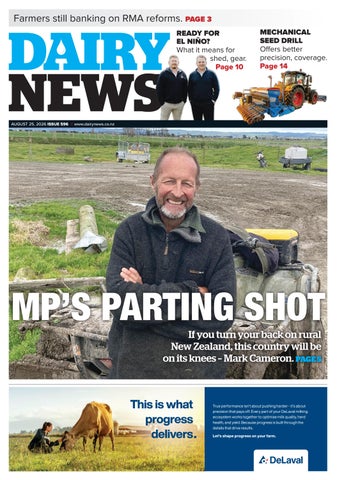
Farmers still banking on RMA reforms. PAGE 3 READY FOR EL NIÑO? What it means for shed, gear. Page 10
MECHANICAL SEED DRILL Offers better precision, coverage. Page 14
AUGUST 25, 2026 ISSUE 596 // www.dairynews.co.nz
MP’S PARTING SHOT If you turn your back on rural New Zealand, this country will be on its knees – Mark Cameron. PAGE 5
This is what progress delivers.
True performance isn’t about pushing harder - it’s about precision that pays off. Every part of your DeLaval milking ecosystem works together to optimise milk quality, herd health, and yield. Because progress is built through the details that drive results. Let’s shape progress on your farm.
DAIRY NEWS AUGUST 25, 2026
NEWS // 3
Farmers confident RMA reforms will be enacted SUDESH KISSUN sudeshk@ruralnews.co.nz
DESPITE POLITICAL shenanigans in Wellington, Tackling BVD. PG.11
Higher milk feed, higher milk production. PG.13
Foton returns with a ute range. PG.15
NEWS ������������������������������������������������������������� 3-7 OPINION �������������������������������������������������������8-9 MANAGEMENT ���������������������������������������� 10-11 ANIMAL HEALTH ����������������������������������������� 13 MACHINERY & PRODUCTS �����������������������������������������������14-15
farmers are confident that Resource Management Act (RMA) reforms will get over the line in this term of Parliament. For a moment, National’s leadership drama threatened the passage of two new pieces of legislation earmarked to replace the RMA. RMA Reform Minister Chris Bishop was one of the senior ministers named by media as gunning for Prime Minister Christopher Luxon’s job. However, the leadership drama ended when Luxon sacked Defence Minister Chris Penk and told journalists that he didn’t believe Bishop and Education Minister Erica Stanford were involved in the attempted putsch in any way. Federated Farmers strongly backs the RMA overhaul and replacing the old framework with the new Planning Bill and Natural Environment Bill. Feds RMA spokesman Mark Hooper told Dairy News that he was still confident RMA reforms remain on track. Officials will be completing redrafting work on the NEB and Planning Bill following select committee reporting and final ministerial consultation to prepare bills for second reading. This will continue according to a tight timetable regardless of any other political, says Hooper. He doesn’t think that the coalition’s ambition to finalise the bills in this term of Parliament will be impacted by the leadership drama. “There seems to be strong alignment within the coalition parties to get the bills passed before the end of the current term,” he says. “The general sense is that not passing the bills leaves too much planning etc in limbo waiting for direction from the new legislation.
Federated Farmers RMA spokesman Mark Hooper.
“Whilst all parties may not agree on all the details within the bills, there seems to be a strong sense of urgency to get the primary legislation across the line and maybe consider amendments in the next term. “Simultaneously there is considerable work going into new National Policy Direction, the secondary regulation that will support the bills, and announcements on NPD are expected anytime soon.” Hooper says they met with Minister Bishop and Under Secretary Simon Court, ACT, recently and “they are very focused on finalising decisions on various sections so the bills can progress to the next stage”. “We have discussed with and written to the
Minister our suggestions on some final drafting edits. Whether any of these are adopted remains to be seen, but either way, we have been given every indication that the process is on track, albeit a tight timeline.” According to Federated Farmers, the RMA is the single biggest handbrake on growing agricultural productivity and rural economies. For farmers, expensive resource consents, unachievable freshwater targets, Te Mana o te Wai, and outstanding natural landscape overlays, these are all things that sit under the RMA legislation. Federated Farmers says investment, farmer confidence and productivity have been strangled in red and green tape for far too long.
Premium stockfeed STOCKFOODS
For New Zealand farmers
Civil construction | Aggregates | Stockfoods | Storage | Transport 0800 4 JSwap | 07 888 7025 | WWW.Jswap.co.nz
DAIRY NEWS AUGUST 25, 2026
4 // NEWS
Attempted coup a body blow to National PETER BURKE peterb@ruralnews.co.nz
I THINK it’s going to
greatly weaken National at the election. That’s the view of a former senior National Party MP on the recent attempted coup against Prime Minister Christopher Luxon. Speaking to Rural News on the condition of anonymity, the former MP described the coup attempt as “untimely and unseemly” and an event that could damage National’s chances at the November election. The former MP noted that National has undeniably done a lot of good things for the primary sector during the past three years. They pointed to the RMA reforms and changes to
other regulations that are of real benefit to the sector, which they add is looking in pretty good shape at present. “But if there was a change of government back to a Labourled coalition, these gains would likely be lost. Labour and the Greens would quickly move to nullify the changes to the RMA and other environmental regulations,” they say. They believe that voters in the rightleaning camp who don’t like Luxon, may turn to ACT or NZ First, but are unlikely to switch to Labour. What is uncertain is what the significant number of undecided voters may do. Few believe Luxon’s claim that the present caucus is right behind him. The faces of those
Ministers standing with him at his ‘victory’ press conference after the caucus meeting was telling. According to our source, there is a strong belief that the caucus is not united and that the dissatisfaction with Luxon’s leadership will just bubble on until someone can organise a proper coup. They also claim that when it comes to politics, Luxon is an amateur and that being a CEO doesn’t always equate to being a good leader or chairman. In the opinion of our informant, Luxon is prone to making mistake after mistake and that only time will tell just exactly what went on in that caucus meeting. “Chris Penk was a very capable minister and a nice guy and I am
sorry to see that he’s now leaving politics,” they say. And one final word on the other parties – in particular NZ First. Despite all words being said about not working with Labour, they believe that if push came to shove, Winston Peters may go with Labour if only to keep the Greens out of office.
Prime Minister Christopher Luxon says RMA Reform Minister Chris Bishop isn’t after his job.
UNNECESSARY DISTRACTION RURAL NEWS also spoke to a former high profile farming leader who agreed that the attempted coup was “an unnecessary distraction”, but that would not alter their support for Christopher Luxon. They blamed the media for putting a slant on the story and claimed that they are out to get Luxon. They do admit that while Luxon lacks charisma, he has credibility and is the right person to lead
the country. They believe that the worst outcome for National will be that some voters will change their allegiance to ACT. Finally, the dissatisfaction within the National Party of Christopher Luxon’s performance and leadership cannot be dismissed by a single press conference with him saying we are all together again. The public aren’t that easily fooled. His premiership is on the
line, but what is unclear is what voters actually think. The polls are showing dissatisfaction with both Labour and National and bouncing around the various minor parties. What people are saying to pollsters now may not accurately reflect which way they will vote on election day. This would be the hardest election to call in more than half a century.
WHY SYNLAIT COULD BE A STRATEGIC BUY SPECULATION OF a possible joint
move by Fonterra and a2 Milk to buy Synlait raises a much bigger strategic question, says agribusiness expert Dr Nic Lees. He asks if Synlait’s assets could be worth more to other owners than they are within Synlait itself? Lees, a senior lecturer in
agribusiness management at Lincoln University, says both Fonterra and a2 Milk could benefit in different ways. For a2 Milk, the attraction is specialised nutrition manufacturing. “Synlait’s Dunsandel plant remains important to its infant formula supply chain, and greater control could reduce manufacturing risk,” he says.
For Fonterra, the opportunity may be less about owning another factory and more about gaining access to Synlait’s Canterbury milk pool. “Fonterra can optimise milk across a much larger South Island network, potentially directing it into higher-value products and processing streams,” he says.
“This is something Synlait has not been able to do. Synlait has needed to switch from high-value infant formula to lower-value commodities when milk supply peaks.” For Bright Dairy, the majority owner of Synlait, the calculation is different again. “It must decide whether selling
now provides better value than continuing to support Synlait as an independent business,” he says. Lees notes that Synlait has said it is not involved in discussions, so this remains speculative. “The question isn’t what Synlait is worth today, but what its different assets are worth to different owners.”
SAVE 1,000 + $1,000 FREE ACCESSORIES $
2.99
*
+
*
%
P.A. FINANCE^
36 MONTHS | 10% DEPOSIT
WWW.POLARISNEWZEALAND.COM
44-hp ProStar engine | 680 kg Towing Capacity | 226 kg Dump Box Capacity Electronic Braking System (EBS) | Active Descent Control (ADC) 8-Ply X-Terrain Pro Armor Tyres | Full Coverage Skid Plate
MY26 RANGER SP 570 HD NOW FROM $23,995 INC GST
*Offer ends 30/9/26 or while stocks last. Offer only available at participating Polaris dealers. Not valid with any other offer. Excludes fleet clients. ^Finance offer only available at participating Polaris Dealers and on selected models as stated and is not valid with any other promotions. Finance is provided by Polaris Finance, a program operated by De Lage Landen Limited Company No 1355515 and available for business purposes only on a Hire Purchase Agreement. Credit approval, fees, terms and conditions apply. Finance is based on a 36 month term, for full promotion details and structure please contact your Polaris Sales Representative. Offer ends 30/9/26.
DAIRY NEWS AUGUST 25, 2026
NEWS // 5
Back to the farm for farmer advocate SUDESH KISSUN sudeshk@ruralnews.co.nz
WHEN NORTHLAND
farmer Mark Cameron entered Parliament six years ago, the Beehive was a lonely place. “I spent more time explaining stuff around farming than actually debating stuff,” recalls Cameron. He believes MPs now have a better understanding of issues faced by farmers and rural communities. That’s in part because of the leading role Cameron and other farmer MPs have played in relaying the voice and concerns of farmers.
In three months he steps down as an ACT MP. Health issues have forced the Ruawai dairy farmer to exit politics and go back to farming. He recently bought a second farm – 200ha running 500 cows – a short distance from his home farm of 114ha, milking 265 cows. Cameron told Dairy News that he will leave Parliament satisfied that farmers’ hopes and passion have been rekindled. Cameron recalled an expression his grandfather had: if you allow bad things to happen, you become complicit in a bad outcome.
He learnt during his first three years that hope in farming had collapsed. “It seemed like every time farmers went out the front door, someone was complaining about what they we were doing. “Someone was telling them how to live their lives. And I asked myself, ‘what farmer goes to the centre of Auckland and says, you can’t do this, you can’t do that?’ “We don’t. Auckland, be there, we live our lives out in the country, and we bloody love it. So, leave us alone.” During his first term in Parliament, Cameron saw first-hand how Labour and the Greens took the rule book to
farming. He says morale among farmers collapsed because the government wasn’t listening. “They just didn’t believe in the same vision of rural New Zealand that we had.” He reminded politicians of the saying attributed to US President Dwight D. Eisenhower – “Farming looks mighty easy when your plow is a pencil and you’re a thousand miles from the corn field.” “That’s what it is - for us, it’s hard work,” says Cameron. “So, leave us the hell alone, because we’re good at it.” In the current Parliament, the number of MPs from a farming background increased. Cameron says rural people backed ACT and the party is backing them.
ETS ‘BLUNDER’ THE INCLUSION of agriculture in an emissions trading scheme (ETS) has been a contentious issue for many farmers. Mark Cameron says the ACT Party has done everything to keep farmers out of any ETS. He took a swipe at former Prime Minister Jacinda Ardern and former Climate Change Minister James Shaw for signing the country up to the Zero Carbon Act. “We were the only party that voted against that.
ACT MP Mark Cameron steps back from politics in November.
“Because it’s all very well being pious on the international stage, but at what cost? “This is a dear little country. If you throw the baby out with the bathwater or give away the golden goose, and we’re not minerally rich like Australia. Our wealth is in our farming.” Cameron says the current Parliament has delivered regulation relief for farmers on several fronts. One was putting limitations on pine plantations, because carbon farming was
running away and eating up rural New Zealand, he says. And an issue dear to Cameron’s heart has been reducing methane targets. “We reduced the methane targets and I’m immensely proud of that. “I don’t think there should be any targets at all. Get rid of the whole bloody lot. “You know, you’re taxing an animal for living, really. But apparently that’s what the world wants to do. I think the whole lot is bollocks. Get rid of it.”
“I’m just a person. I’ve got a big heart, I haven’t got much of a body left, but I’ve got a big heart. “And I believe in what
farmers are doing because they believe in what we’re doing together.” @rural_news facebook.com/ruralnews
NATIONAL’S WOES OUTGOING ACT MP Mark Cameron is backing Prime Minister Christopher Luxon’s stance on the latest National leadership vote. Describing the leadership spill called by Luxon “very sad”, he says politicians are there to serve the people. “If we don’t serve the people, we shouldn’t be there.
“Now the fact that they’ve got all this in-house fighting does nothing for their brand. “I hate to say the obvious, but mutineers get made to walk the plank.” Cameron praised Luxon for standing up for what is right. “We get elected to serve the people, not each other.”
How did Mike save
5 hours of time this season?
Ballance: A fertiliser plan for the season ahead helped Mike save time and stay organised. Now he can order and Request a Spread through MyBallance whenever it suits. Mike: Now I’ve got my farm at my fingertips. I’ve saved around 5 hours of time this season, giving me more time for what matters most. Make every minute count with Request for Spread. Chat with a Nutrient Specialist today. ballance.co.nz/make-it-count 0800 222 090
Mike White Dairy Farmer
DAIRY NEWS AUGUST 25, 2026
6 // NEWS
Ballance shareholders in line for $18m rebate SUDESH KISSUN sudeshk@ruralnews.co.nz
BALLANCE AGRINUTRIENTS chief
executive Kelvin Wickham says despite a tough year, he is pleased the business has returned to profit. Wickham says strong farmer confidence in dairy, sheep and beef and horticulture sectors led to a 5% increase in nutrient sales. At the same time, the co-op kept costs under control. For the first time in three years, the farmerowned co-op announced a rebate totalling $18.2 million, averaging $17.55/ eligible tonne.
The cash rebate is only available to fully shared-up farmer shareholders. For partially shared-up farmers, the rebate will be in the form of shares to build up their stake. Wickham says earlier this year a farmer roadshow was held to discuss shareholder returns and how Ballance needs to be a good custodian of farmers’ money. A total shareholder return (TSR) target of 10% was set. Ballance reported a TSR of 14.3% for the financial year. The rebate represented a 6.5% return on quota shareholding. Wickham says the co-op has also reinvested
in the business to make it more future proof. These investments include a digital upgrade, new service centres in Timaru and Kaikohe and upgrades to its Bluff site where its manufactures super phosphate. Revenue for the 2026 year increased 17.7% to $1.14 billion. Underlying net operating profit before rebate and tax increased 126% to $86.7 million, before asset impairment and site closure costs. Wickham said the year had also demonstrated the value of the co-operative model during a period of significant global supply pressure. “Geopolitical events
continue to create uncertainty across global nutrient, energy and shipping markets. “As a co-operative, our job is to perform financially, and to do everything we can to secure supply and have cost-effective nutrients available when and where our farmers and growers need them. “That means taking a longer-term view and balancing shareholder returns with investment in supply security, local manufacturing, our distribution network and the services our customers rely on.” During the year, Ballance maintained flexibility in its global sourcing, secured gas
for Kapuni through to 31 December 2026 and continued to firm up orders to support spring demand. “Reliable nutrient supply is fundamental to New Zealand farming,” says Wickham. “While there’s no doubt that global uncertainty will continue, we are confident in the strength of the business and our ability to respond. “We enter FY27 focused on what matters most to our farmers - reliable supply, competitive value, strong on-farm support and a co-operative positioned to deliver for them over the long term.” Ballance chair
Kelvin Wickham
Duncan Coull said the result was driven by the progress the co-operative had made in resetting the business for the future, while continuing to deliver value for shareholders. “It’s pleasing to be in a position to reinstate returns through a rebate after three years. More broadly, this year’s result shows the value of balancing direct returns to shareholders with retaining strength in the co-operative so we can continue to invest for the future.”
Ballance ended the year with total equity of $510.8 million. Loans and borrowings increased by $39 million during FY26, largely reflecting higher year-end inventory values as the co-operative ensured nutrient availability for spring supply, but remain $108 million below their 2023 peak. The co-op is positioned to reduce borrowings through FY27 as inventory values normalise, while continuing its focus on reducing core debt.
Massey ag degrees to match need
NZ’s only combination clostridial and Lepto vaccine.
PETER BURKE peterb@ruralnews.co.nz
INTEREST IN agritech
and production animal systems has prompted Massey Universities School of Agriculture and the Environment to new majors to its popular animal science degree. The head of the school, Professor Paul Kenyon, says feedback suggests that people want to work with production animals such
as sheep, cattle, pigs and poultry. He says they have people who want to work with companion animals such as horses and cats and dogs and ruminant systems. “So, this major is basically around pasture management, agronomy soil science and a bit about farm systems. The second major is around animal agritech,” he told Dairy News. Kenyon says remote sensing and technologies such as wearables are now very much in vogue in the primary
sector and the major on animal agritech is about catering for this change. “However, we are not trying to train people to develop new technologies, rather our course is designed to teach them how to use the new technologies and to fully utilise the benefits that they offer to farmers and horticulturalists,” he says. Kenyon says options really suit the likes of rural professionals and those who intend to go back and work on farms.
INTERNATIONAL STUDENTS Hardjo is the #1 Lepto serovar infecting people in NZ. Get 12 months proven protection with Ultravac® 7in1. NZ’s only combination clostridial and Lepto vaccine for cattle and sheep.
Consult your local vet to develop a comprehensive Leptospirosis management plan today.
Zoetis New Zealand Limited. Tel: 0800 963 847; www.zoetis.co.nz. ULTRAVAC is a registered trade mark of Zoetis Inc. or its subsidiaries. ACVM No. A6935. RVM; Available only under Veterinary Authorisation.
ZOET260112_Ultravac7in1_DN
The risk of Leptospirosis can be minimised through a combination of livestock vaccination, rodent control, biosecurity and hygiene.
WHILE A relatively low percentage of NZ students don’t tend to stay at university and complete a PhD, this gap is filled by international students, according to Professor Paul Kenyon. Conversely there are only a few overseas students doing undergraduate degrees. This latter trend is very much in the interests of ‘NZ Inc’, he says, and a lot of the science in our country is underpinned and supported by those international students. Professor Kenyon says they come to NZ, often supported by their own country, but sometimes just off their own bat, and in time they will become future leaders in agriculture and horticulture back home.
“NZ is seen as a favourable destination for them. It is wrong to think about them coming here and taking away our secrets. The agricultural and horticultural systems in the countries that many of these students are coming from are so different from ours, and so they are not taking secrets away. What they are learning about is just principles and concepts,” he says. Kenyon says the reality is they are helping us to create new knowledge that we otherwise wouldn’t be able to get done. He says the international students come from places such as Sri Lanka, China, South America, India and the wider Asian region.
DAIRY NEWS AUGUST 25, 2026
NEWS // 7
New funding for health draws cautious praise JESSICA MARSHALL jessica@ruralnews.co.nz
RURAL NEW Zealand
is welcoming the Government’s recent package of rural healthcare initiatives. The package, announced last month, includes $2.5 million funding for a Point of Care Ultrasound (POCUS) training and support, expanded access to Primary Response in Medical Emergencies (PRIME) training, and $6 million for a refreshed National Rural Recruitment and Locum Support Service. Associate Health Minister Matt Doocey says that giving rural clinicians better training will mean more people can get the care they need closer to home, while ensuring that those who do need
hospital care can be identified sooner. “When someone needs urgent care in a rural community, having a highly trained clinician nearby can make all the difference,” Doocey says. “We’re making it easier for more clinicians to get the training they need so they’re ready to respond.” Bronwyn Main, Rural Women New Zealand (RWNZ) board member and health policy action advisory group convenor, says RWNZ welcomes the announcement of the new investments. “The investment is a positive step towards addressing some of the unique healthcare challenges faced by rural communities,” Main told Dairy News. She says that investing in tools and training that expands
what can be done in a rural setting is a practical way to back the people who care for their communities. She says that the investment is “part of the puzzle and a positive step”, however the realities of rural life – issues like accessibility, distance, and isolation – are still proving to be a barrier for medical care in rural communities. “For many rural families, a healthcare appointment isn’t just an hour out of your day. It can mean a round trip of several hours, taking leave from work, organising someone to pick the kids up from school, or finding childcare,” Main says. Meanwhile, Hauora Taiwhenua Rural Health Network chief executive Dr Grant Davidson says the announcement demonstrates the value
of sustained advocacy and constructive engagement with Government. “For many years we have consistently advocated that improving rural health outcomes requires investment in the people delivering care,” Davidson says. He says the announcement recognises that rural clinicians require the correct training, support and workforce solutions to provide equitable healthcare for rural New Zealanders. “Workforce recruitment and retention remain among the greatest challenges facing rural health providers. Expanding the service to include registered nurses and allied health professionals recognises the multidisciplinary
DAIRYNZ, LIC TO SHARE DATA FARMERS CAN spend less time
on paperwork, thanks to a new data sharing agreement between DairyNZ’s DairyBase and LIC’s MINDA software. DairyBase is New Zealand’s largest and longest-running dairy benchmarking service. The tool supports practical decision-making across profitability, production and emissions. Its comprehensive datasets are used by farmers, government, industry, academia and financial institutions to benchmark, inform and support policy, advocacy and business matters. MINDA is a herd management system that helps farmers record, view and share real-time animal information to support on-farm decisions. From this month farmers can connect their MINDA account with DairyBase. Once connected, some of the herd data in MINDA will be automatically uploaded into DairyBase, reducing the amount of manual data entry required from farmers and advisors. DairyBase manager Jodie Goudswaard says the data integration is a strong example of DairyNZ and LIC bringing their farm systems and credible,
Data can now be shared between DairyNZ’s DairyBase and LIC’s MINDA software.
evidence-based approach together to benefit farmers. “DairyNZ is continually seeking opportunities to make farmers’ lives easier, and reducing duplication of information is an important part of that. This is one of the most significant physical data integrations we’ve delivered into DairyBase,” she says. “By securely using herd information farmers have already provided to LIC, we’re able to prefill up to 30% of DairyBase’s required physical information, including stock and herd records, reproduction and health. That means less time spent entering data and more time focused on understanding farm performance and identifying opportunities for
improvement. “Selected farmers have tested the integration on farm and provided positive feedback, reporting that it has already saved them heaps of time. Over the coming months, we will add more data integrations with MINDA, making the process even more streamlined,” she says. LIC’s head of farm software, Blair Smith, says farmers expect the information they record once, to work across the tools they use every day. “This integration is another step towards a more connected farm ecosystem, reducing double handling and making it easier for farmers to get value from the information they already record in MINDA.”
Associate Health Minister Matt Doocey says the new funding will allow better training for rural clinicians.
nature of modern rural healthcare and will help build more sustainable teams,” says Davidson. However, he says there is still more work to be done.
“Rural health services continue to face workforce shortages, funding inequities and increasing demand. We look forward to continuing to work
alongside government, Health New Zealand and our sector partners to ensure rural communities receive the healthcare they deserve.”
DAIRY NEWS AUGUST 25, 2026
8 // OPINION RUMINATING
EDITORIAL
The value of credibility
MILKING IT... Put to bed?
Sleepwalking
Don’t forget dairy
Back to the future
PM CHRIS Luxon claims to have put the last coup attempt ‘to bed’. Milking It reckons that’s not a great choice of words really. Putting a child to bed won’t necessarily stop it crying, or asking a grumpy old man to go to bed won’t stop him snoring all night. The reality is that while the caucus may, for all intents and purposes, be in bed together, the mutterings of discontent are surely keeping everyone, including the voting pubic, awake. An animal might hibernate, but one day it will wake up and mayhem will resume.
WHILE ON the subject of sleep, staying quiet and saying virtually nothing seems to be the election strategy of Labour. Just the occasional snipe at National and other coalition partners, but three months out from the election, just a smattering of policy announcements and no talk of a coup to get rid of Chippy. Some call it the ‘small target’ strategy – having no policy means having nothing for political opponents to attack. Milking It reckons it’d be closer to the truth to say sleepwalking seems to be their strategy. They’ll need more than that come election day.
THE NATIONAL Party’s big plan to explore nine new free trade agreements, if it gets reelected, may not be welcome news to the dairy sector. The first country out of the blocks – Switzerland – has already indicated that NZ dairy exports may be a sticking point. Trade officials from the two countries begin preliminary talks next month. Switzerland would be the first of nine potential new trade deals the National Party has pledged to explore over the next five years if it is re-elected. But Fonterra warns agreements should be comprehensive. In other words, dairy must be in scope.
FARMERS ACROSS the ditch are looking to the past to tackle the future. A deep dive into 50 years of official weather records from across western Queensland is helping farmers adapt to a changing climate. Scientists have analysed five decades of weather data from several towns and the analysis shows hotter summers, warmer nights and a longer warm season, prompting some producers to reconsider livestock breeding schedules. “Specifically, we looked at temperature, number of hot days, number of cool nights, timing of the rainfall, evaporation, extreme heat waves,” said University of Southern Queensland earth scientist Dr Mahdiyeh Razeghi.
Head Office: Lower Ground Floor, 29 Northcroft St, Takapuna, Auckland 0622 Phone 09-307 0399. Postal Address: PO Box 331100, Takapuna, Auckland 0740 Published by: Rural News Group Printed by: Inkwise NZ Ltd Contacts: Editorial: sudeshk@ruralnews.co.nz Advertising material: beckyw@ruralnews.co.nz Rural News on-line: www.ruralnews.co.nz Subscriptions: subsrndn@ruralnews.co.nz
Publisher: Brian Hight ...................... Ph 09-307 0399 General Manager: Adam Fricker ................... Ph 021-842 226 Editor: Sudesh Kissun ................ Ph 021-963 177 Machinery Editor: Mark Daniel...................... Ph 021-906 723 markd@ruralnews.co.nz Reporters: Peter Burke.....................Ph 021-224 2184 peterb@ruralnews.co.nz Subscriptions: Julie Beech ....................Ph 021-190 3144 Production Manager: Becky Williams ..............Ph 021-100 4831 Digital Strategist: Jessica Marshall ..........Ph 021 0232 6446
• Printed by Inkwise • Distributed by Reachmedia Dairy News is published by Rural News Group Limited. All editorial copy and photographs are subject to copyright and may not be reproduced without prior written permission of the publisher. Opinions or comments expressed within this publication are not necessarily those of the staff, management or directors of Rural News Group Limited.
IN POLITICS credibility is and should be big. It must surely rank higher than charisma, which is quite trite and superficial. Yet, voters nowadays are often wooed and influenced by how someone looks or talks at a superficial level. TV plays a huge role in this. But voters do see through obvious gaps in the narrative politicians offer. The most recent example is Christopher Luxon’s claim that he has the full support of his caucus. As he stood there at his brief – no questions – media conference, claiming the weeks of speculation about his leadership style and mishaps was over, it simply lacked credibility. The faces of the people, whom many suspect were behind or at least complicit in the coup, said it all. They looked like stunned mullets, and much of the public aren’t buying into his version of events. Luxon has always positioned himself as the CEO – like he was at Air New Zealand – and that is an honest and admiral appraisal of his style. A CEO can give orders to staff and expect nothing less than instant obedience and compliance. It could be argued that others such as Helen Clark were seen in something of a similar light. But politics is a bit more organic than corporate life and while a political leader must be strong and decisive, they need to be super sensitive to the egos and aspirations of their own people and country they serve. True leadership is about creating order – not giving orders. The Luxon leadership saga is not over just because Luxon says it is at a press conference. It is a talking point in the community, and the media is right to highlight this in the same way they should be scrutinising all those in public office. The National Party knew from the outset that Luxon would run the party ‘corporate style’ and much has been achieved in the past three years. Only after November 7 will we know how credible this modus operandi has been. – Peter Burke AUCKLAND SALES CONTACT: Stephen Pollard............................................. Ph 021-963 166 stephenp@ruralnews.co.nz WAIKATO & WELLINGTON SALES CONTACT: Lisa Wise ........................................................Ph 027-369 9218 lisaw@ruralnews.co.nz SOUTH ISLAND SALES REPRESENTATIVE: Kaye Sutherland .........................................Ph 021-221 1994 kayes@ruralnews.co.nz
Paper used in this publication is from forests managed in line with the strictest environmental, social and economic requirements. 100% recyclable, the papers we use are from forests that will be around for generations to come.
DAIRY NEWS AUGUST 25, 2026
OPINION // 9
Disruption is the new normal Ballance Agri-Nutrients has released its latest fertiliser outlook, detailing some of the current global trends influencing fertiliser supply. Ballance head of procurement Shane Crea takes part in a Q&A in the report: What’s shaping global fertiliser markets right now? A: Looking back to our last outlook in January, no one could have predicted the escalation we’ve seen following the attacks on Iran and the subsequent conflict in and around the Middle East. With around 35% of the world’s urea moving through the Strait of Hormuz, disruption in that region has placed significant pressure on urea availability and trade flows, with conditions we haven’t seen since 2022. Sulphur has faced even greater pressure, not surprising given more than 45% of the world’s sulphur is supplied from this region too. While the conflict is the key driver behind tight nutrient markets across N, P and S, the traditional influences are still at play as well. Domestic food security policies in key fertiliser-producing nations such as China, Russia and Egypt continue to influence the market, as do regional demand requirements from large consumers such as Brazil and India. So, what’s the overall outlook for the remainder of 2026? A: Forecasts across the range of commodities in the current geopolitical climate are about as
reliable as the weather. They’re changing almost daily and driven largely by developments between the US and Iran. At the time of writing in late July, urea is beginning to firm again after easing through June. If the Middle East conflict continues, we can expect that tightening trend to continue. One factor helping to slow that current momentum is China, which relaxed its urea export controls in June. We’ve started to see more product coming out of that region recently, at levels closer to pre-war conditions. Sulphur pricing, however, continues to hold firm. With an export ban on most industrial grades of sulphur from Russia, restrictions on sulphuric acid from China, constrained supply in the Persian Gulf, and increasing competition for sulphuric acid from nickel producers, fertiliser products with sulphur inputs such as DAP, SSP, TSP and sulphur bentonite continue to face challenging market conditions. DAP continues to be completely banned from export in China, which accounts for between 35% and 40% of the world’s production. Saudi Arabia accounts
for a further 10% and, while suppliers there have redirected shipping out of the Red Sea instead of their usual Persian Gulf ports, volumes have been far smaller. We’re also now seeing new tension in the Bab el-Mandeb Strait, another potential pain point in the Middle East, where both Iran and Houthi rebels realise the significance of causing disruption in this important trade route. Potash remains one of the few commodities where the current disruption has had little impact, largely because most of the world’s deposits are in Canada, China, Russia and Belarus. How is Ballance placed for product availability for spring? A: We want to reassure farmers we have the nutrient supply they will need as we head into spring, noting that the nutrient may sometimes be in a different form from what they have historically purchased. While we’re not expecting supply constraints, the current market environment means working closely with your nutrient specialist to develop a fertiliser management plan specific to your needs remains an important way to
• Ideal for Cattle Troughs • High Flow • Side/Bottom Mount • Detach to Clean • Compact/Robust
support seasonal decision-making. Ballance representatives recently attended the International Fertiliser Association conference. What were the key takeaways from that? A: The recent 2026 International Fertilizer Association (IFA) conference was an important opportunity for global fertiliser participants to meet in one place, and this year’s conference theme centred around securing the fertiliser lifeline supply chains, energy, and food security in an era of conflict. Unsurprisingly, the conflict in the Middle East was at the centre of conversation. Another key topic of the conference was that the greatest risks confronting the global economy right now may not even be conflict related. Rather they come from weatherrelated impacts caused by the slowing of the jet stream across the Atlantic and the looming El Niño formation in the Pacific. These are things which will exacerbate water and climate stress, food cost and price stress in the US, Europe and other economies. Uncontrollable natural risks could potentially act to amplify
Shane Crea, Ballance, says forecasts across the range of commodities in the current geopolitical climate are about as reliable as the weather.
geopolitical risks in a ‘double whammy’. Those natural trends come after several years of trade volatility, conflict volatility, price increases related to the closure of Strait of Hormuz, disruption of the Red Sea, and restriction of exports from Ukraine among other events. These trips serve as an opportunity to
• Up to 50mm Inlet • Flows up to 600L/min • For Storage Tanks • Easy Access to Valve Seal
also visit incumbent or potential new suppliers, and act as an important part of robust due diligence. On this occasion, we took the opportunity to connect with our suppliers from Morocco, Spain, and Egypt as part of our ongoing due diligence, and build those personal connections which become invaluable in times of supply
disruption. Any final thoughts? Disruption really is the new normal. In a business largely reliant on sourcing raw materials or finished products internationally to support our local manufacturing capability, we’re certainly exposed to a wide range of more frequently occurring disruptions.
• Inlets Upto 50mm • Avoids Starting & Stopping of Pump When Tank is Filling
0800 JOBE VALVES jobevalves.com
DAIRY NEWS AUGUST 25, 2026
10 // MANAGEMENT
What El Niño means for your shed, gear and cows After a winter of frozen pipework and refrigeration call-outs, Terravest chief executive Kip Bodle and chief operating officer Luke Walker explain why this El Niño summer calls for a different kind of preparation, before the first heatwave finds the weak points for you.
THIS WINTER,
Terravest’s call-out list told its own story: frozen pipes, seized valves and frozen milk in the vat. Now, with forecasters pointing to a swing toward El Niño conditions this summer, that workload is about to flip. “The gear that just survived a hard winter is exactly the gear you want to get in front of before it has to survive a hard summer too,” says Luke Walker, who also
leads Cryvex, Terravest’s refrigeration division. What El Niño actually means for New Zealand this summer comes down to a handful of specific risks flagged in current reporting on the outlook: stronger and more frequent westto-southwest winds across the country; an increased risk of dryness and drought in northern and eastern regions; wetter-thanusual conditions in western and southern
areas such as Southland and Fiordland; and an elevated fire weather risk in exposed regions as vegetation dries out under hot, windy spells. “It’s not just ‘hot and dry everywhere’ it’s hot and dry in some places, wet in others, and windy pretty much everywhere,” says Kip Bodle. “Farmers need to think about what that actually means for their own patch, not just the national headline.”
Going from frozen gear to overheated gear is a predictable swing, says Walker, but it still catches people out every year. “In winter, we’re pulling frozen valves and cracked pipework. In a hot, dry summer, it’s the opposite problem, compressors working harder for longer, condensers struggling to shed heat as the ambient temperature climbs, and milk cooling systems, that are already running
ADVANCED CALF REARING SCAN HERE TO WATCH WHY MORE FARMERS ARE CHOOSING CALF XTREME
MICRO-ENCAPSULATED, MULTI-STRAIN, RAPID ABSORPTION PROBIOTIC PASTE
CALF XTREME is a probiotic additive that improves calf health and enables faster growth rates in calves while on milk, resulting in rearing bigger heifers and bulls. By delivering probiotics efficiently through milk, it supports rumen health, protects against nutritional scours, and improves digestion and feed intake - setting calves up for success from day one. Compatible with once-a-day feeding, it reduces labour while maximising results. "We’ve slashed our calf illness and deaths using Calf Xtreme. Just 212 in sick pens and only 8 losses out of 7,000 calves last year. This year is shaping up to be similar." Chris, Okoroire
“On day 1 we offer them 5 litres of gold colostrum. By day 3 they can be drinking 6-7 litres of milk, so they get to 8 litres once a day by 8 to 10 days of age. Then we maintain that level until weaning.” Nicole, Te Puke
"Calves exceed growth rates and with improved immunity from Calf Xtreme, our calves are better equipped to handle rotavirus. Out of 800 calves, we only had 2 unexplained deaths" Brooke, Southland
Chris 027 459 1061 Matt 021 234 1713
Stuart 021 247 7405
www.probioticrevolution.co.nz
Terravest chief executive Kip Bodle (right) and chief operating officer Luke Walker.
close to their limit on a normal day, getting pushed past it. “A system that’s a bit tired going into a 30-degree week is where you get your milk quality problems and your unplanned downtime,” says Walker. “With El Niño bringing more of those hot, windy spells, there’s less margin for error than usual.” His advice is straightforward: get compressors and condensers serviced now, check refrigerant, clean condenser coils, and make sure you do a seasonal swap of rubber wear. “Don’t wait for the hottest day of the season to get a service,” he says, “because there will most likely be a queue of breakdowns in front of you.” Plant hygiene in the heat is its own challenge, Bodle points out. Heat doesn’t just stress machinery, it stresses the hygiene side of the operation too.
“Bacteria don’t take a break in warm weather, they multiply faster,” he says. “Wash routines, chemical concentrations and contact times that are dialled in for a cool, damp winter aren’t automatically right for a hot, dry one.” He says it’s worth actively revisiting plant hygiene protocols going into summer, rather than assuming they still hold: wash water temperatures, detergent and sanitiser dosing, and how standing water or residue behaves differently once the shed itself is running hotter for longer each day. On the animal side, teat condition swings the other way entirely, Bodle says. “In winter, everything’s about mud, moisture and organic matter breaking disinfectant down before it can do its job. In a dry, windy, dusty summer, the challenge flips, teat skin can crack from dust and wind
exposure rather than mud, and a spray that’s too harsh or too drying just adds to that. “It’s the same lesson as always. Match the product and the routine to the conditions you’re actually in, not the conditions you were in six months ago.” The bottom line, both Bodle and Walker agree, is that an El Niño summer like the one being forecast isn’t a reason to panic, but it is a reason to check things now rather than in January. “Every year, the businesses that get ahead of the seasonal swing spend a lot less time on emergency callouts than the ones who wait for it to become a problem,” Walker says. Bodle agrees: “Winter told us where the coldweather weak points were. Summer’s going to tell us where the hotweather ones are, the only question is whether you find out now, or find out on the same week as everyone else.”
Are you hitting your target market? ■ BREAKING NEWS ■ MACHINERY REVIEWS
■ MANAGEMENT STORIES ■ AND MUCH MORE...
Get in touch with your local sales contacts for more information Auckland Stephen Pollard ...........Ph 021-963 166 Waikato & Wellington Lisa Wise ...................Ph 027-369 9218 Christchurch Kaye Sutherland .......Ph 021-221 1994
www.dairynews.co.nz
DAIRY NEWS AUGUST 25, 2026
MANAGEMENT // 11
Tackling BVD: why single control plan isn’t enough ANDREW MACPHERSON
BOVINE VIRAL Diarrhoea
(BVD) remains one of the most significant infectious diseases affecting New Zealand dairy herds. While many farmers recognise the name, recent research suggests there is still a gap between awareness and effective control. A nationwide survey of New Zealand farmers and veterinarians conducted last year found that many farmers tend to focus on a single BVD control measure, whether that’s vaccination, testing, or biosecurity. Veterinarians, however, were much more likely to recommend a combination of approaches. The reason is simple: BVD is a complex disease, and no single action can effectively manage all risks. For dairy farmers, BVD can quietly erode herd performance through reduced fertility, lower milk production, poorer growth rates in youngstock, and increased susceptibility to other diseases. Often the biggest losses are never directly linked to BVD because the virus can circulate in a herd without obvious clinical signs. The most damaging
effects occur when pregnant animals are exposed to the virus. Infection during early pregnancy can result in embryo loss, abortions, or the birth of persistently infected (PI) calves. These PI animals are the primary source of infection within and between herds because they continuously shed large amounts of virus throughout their lives. A single PI animal can expose numerous susceptible cattle. One of the challenges with BVD is that PI animals are not always easy to identify. While some appear unhealthy or fail to thrive, others can look completely normal. This means a farmer may be unknowingly carrying the source of infection within the herd. The good news is that there are proven tools available to reduce the impact of BVD. The first step is understanding your herd’s current status. Regular bulk milk monitoring can provide valuable insights into whether recent virus exposure has occurred within the herd. When monitoring suggests active infection may be present, veterinarians can advise on additional testing to identify potential PI animals.
Biosecurity also plays a critical role. Dairy farmers should consider all sources of cattle movement onto and off the farm, including purchased animals, replacement heifers, contract grazing arrangements, returning youngstock and introduced bulls. Even occasional contact with infected cattle can create a pathway for BVD to enter a herd. Protecting future pregnancies is equally important. Because unborn calves are at greatest risk, vaccination can play an important role in reducing the likelihood of fetal infection and the creation of PI calves. However, vaccination works best when combined with monitoring, testing and biosecurity measures. The survey conducted last year highlighted an important point: many farmers rely on only one layer of protection. Yet BVD control is most effective when several management tools work together. Think of it like mastitis control. Dairy farmers don’t rely on a single practice to maintain udder health. They combine multiple strategies such as milking hygiene, dry cow management, monitoring
BVD is a complex disease, and no single action can effectively manage all risks.
and treatment protocols. BVD requires a similar mindset. Many farms have measures in place to manage BVD, but important gaps can still exist. To help identify potential risks, MSD Animal Health has created a BVD Decision Guide that farmers can work through with their veterinarian. The guide helps assess: ■ How closed your herd really is ■ Whether you know your herd’s BVD status ■ Whether pregnant animals are adequately protected ■ Whether your BVD
control programme is complete Based on the answers, the guide helps farmers and veterinarians identify potential gaps in their current BVD approach and discuss practical actions to address them. These may include testing, identifying and removing PI animals, strengthening biosecurity, vaccination, and ongoing monitoring. The key message from both veterinarians and recent farmer research is that BVD control is not a single action. It is an ongoing management plan. While no farm can eliminate every risk,
Tired of bagging down cows?
Give them what they need, so they can put more in the vat. TranzSol™ prevents metabolic chaos during the make-or-break transition period. Feed for a minimum of 14 days pre-calving to kickstart your season the right way. To find out how it works scan this QR code or get in touch today. phone: 0800 765 587 | www.sollus.co.nz
Andrew MacPherson
those that combine monitoring, testing, biosecurity and vaccination are generally better positioned to reduce the impact of BVD and protect productivity. If you’re unsure whether your current approach covers all the bases, now is a good time
to sit down with your veterinarian and work through the BVD decision guide. The decisions made before mating can have benefits that last well beyond the current season. • Andrew MacPherson is veterinary technical advisor, MSD Animal Health
Trusted!
50 Years Time Tested “When kiwi Bert Hansen decided to invent a pipe fitting for farmers to join alkathene poly pipe together, his main focus was to keep it simple and make it last! 50 years on, and with over 100 million fittings in the ground, Bert’s pipe fittings are still simple to use, unquestionably time tested, but most importantly trusted by kiwi farmers”
Don’t just ask for a pipe fitting, ask for a Hansen fitting!
www.hansenproducts.co.nz
DAIRY NEWS AUGUST 25, 2026
ANIMAL HEALTH // 13
Brought to you by
High milk feeding rates, higher heifer milk production MATT COLLIER,
Probiotic Revolution, says calves will drink a lot of milk once-a-day with their probiotic Calf Xtreme. Collier says the abomasum of a new-born Friesian calf is only 1.2 litres, so with big feeds, the milk spills into the calf’s rumen. He says Calf Xtreme has been developed to turn this into a positive. “We’ve refined the probiotic strains, so calves avoid nutritional scours. “At the same time, we’re establishing beneficial bacteria in the rumen at a young age, improving digestion of meal, hay and grass. “Therefore, the intake of hard feed is not limited by high milk volumes, they simply grow faster and post weaning intake of grass is higher.” Near Te Puke, Nicole Oppert, along with her husband Kevin, rears 200 crossbred heifer replacements on their 260 hectare equity farm purchased two years ago, as well as supervising
another 200 calves on a second equity property. Nicole has always reared calves on a once-a-day system.
DairyNZ guidelines indicate firstcalving heifers typically produce around 75-80% of the milk solids achieved by mixedage cows. “On day one we offer them 5 litres of gold colostrum. By day three they can be drinking 6-7 litres of milk, so they get to 8 litres once a day by 8 to 10 days of age. Then we maintain that level until weaning.” Nicole has always reared calves on a oncea-day system and has had 7 years’ experience using Calf Xtreme. “It allows for a huge increase in milk volume and despite the extra
milk, the intake of hay meal and grass also goes up significantly. Our heifers are much bigger at calving, and we’ve had no calving difficulties this year.” Growth rates before and after weaning have also impressed. Collier says Friesian calves consuming 7-8 litres once a day by around 10 days of age are averaging close to 1kg of liveweight gain per day from birth to Christmas – indicating no post weaning check. While early growth is encouraging, Collier believes the real value comes later. “The objective isn’t simply heavier calves at weaning. Faster early growth leads to betterdeveloped heifers entering the milking herd, and that’s where the production gains can be realised.” DairyNZ guidelines indicate first-calving heifers typically produce around 75-80% of the milk solids achieved by mixed-age cows. Collier cites an
example of a Stratford farmer who used Calf Xtreme to change from feeding 2 litres twice a day to 7 to 8 litres once-a-day by day 10. “Research shows better tissue is being laid down in the udder in the first five weeks of a calf’s life and they are still growing better after weaning
Matt Collier checking Nicole Oppert’s calves being fed 8 litres of milk once a day.
off milk. “On this farm heifer milk production compared with mixed age cow production has lifted from 74% to 86%. That’s a lift of 50kg milk solids
per heifer” As more farmers look for ways to improve labour efficiency as well as improve heifer milk production, once-a-day feeding programmes
supported by nutritional technologies are attracting increasing attention across the dairy sector, Collier adds. @rural_news facebook.com/ruralnews
Stay Healthy and Active Research backed NZ healthy ageing supplements MyVitality supplements are formulated, tested, and bottled right here in New Zealand.
Trusted by Kiwis since 2019
For over 6 years, Kiwis have trusted us to support healthy ageing – with proven ingredients, science-backed quality, and products that help you stay active on the land and at home.
20% OFF
Free rural delivery for orders over $70
NZ-owned & operated
Lab-tested for purity
Order now at myvitality.co.nz or call 0800 460 240
Twelve months’ fetal protection is central to preventing persistently infected (PI) calves and helping break the cycle of BVD. Effective control goes further: INVESTIGATE your herd’s BVD status, ELIMINATE PI animals, and VACCINATE breeding cattle to prevent fetal infection, reduce the risk of future PI calves, and strengthen herd protection. Together, these actions support planned herd management. * Following a third dose (annual vaccination) Bovilis BVD provides 12 months fetal protection. ** CEESA Market Data Q1 2026. AVAILABLE ONLY UNDER VETERINARY AUTHORISATION. ACVM No: A008237. Schering-Plough Animal Health Ltd. Ph: 0800 800 543. www.msd-animal-health.co.nz. Copyright ©2026 Merck & Co., Inc., Rahway, NJ, USA and its affiliates. All rights reserved. NZ-BOV-260800004.
Get 20% OFF your first order. Use discount code Rural20.
The longest coverage available. NZ’s leading BVD vaccine**
Made for healthy aging
DAIRY NEWS AUGUST 25, 2026
14 // MACHINERY & PRODUCTS
Mechanical seed drill offers better precision, coverage MARK DANIEL markd@ruralnews.co.nz
THE NEW Lemken Saphir
XMR mechanical seed drill has been introduced as the successor to the proven Saphir 10m, with the manufacturer claiming new standards for precision, ease of use and area coverage. The XMR’s metering system, developed from the ground up, is built for ease of use, allowing the metering wheels to be removed individually without tools, making it easy to switch between different seed types, alongside cleaning and maintaining the machine. Different seed wheels ensure that both fine and larger seeds are sown precisely and evenly, while as standard equipment, the system
includes a double-sided electric drive with halfwidth section switch, meaning reducing overlap at headlands or while operating in irregularly shaped fields, can help save seed and reduce costs. In addition to its precise metering, the Saphir XMR is configured for ease of use, with depth control adjusted via a central lever, while coulter pressure and sowing depth can be adjusted separately. A patented tramline control system is also designed for flexibility, allowing operators to select different tramline patterns and working widths. Meanwhile, the iQblue drill offers an ISOBUSbased operating concept with logical, clear access to all key machine
functions. To ensure reliable seed placement, the drill uses the tried-and-tested parallelogram-guided double disc coulter with pressure roller, to ensure consistent seeding depth and good soil contact even under varying soil conditions and at higher speeds. In addition, coulter pressure can be easily adjusted to up to 45kg using the grid adjustment mechanism, with the drill available with 12.5or 15-centimetre row spacings. The Saphir XMR can be configured with 900, 1200, or 1500 litre tank capacities, featuring a large opening, rigid, waterproof plastic lid, making filling with big bags or a front loader easy. In addition, the MultiHub can be installed
as an optional 200-litre auxiliary tank for microgranules or catch crops. The Saphir XMR can be mounted as a combination unit on the Zirkon EMR and Zirkon XMR power harrows, equipped for the first time with the optional 600-series roller, offering significantly reduced rolling resistance and improved reconsolidation, particularly on light soils. During operation, the semi-mounted design sees hydraulic cylinders lift and swivel the seed drill forwards simultaneously, reducing the rear axle load and ensuring stable weight distribution – particularly important during road transport. In other news, challenging market conditions in the
The new Lemken Saphir XMR.
agricultural machinery sector are behind Lemken’s decision to temporarily introduce short-time working between July and the end
of the year at its Alpen site in Germany. The site, which is also Lemken’s headquarters, employs around 1200 staff and produces
about 15,000 ploughs, cultivators, compact disc harrows, power harrows and seedbed combinations annually. www.lemken.com/nz
Fast acting. Fully loaded. A pivoting headstock allows the rake to follow the tractor accurately when cornering and delivering a central swath.
NEW TWIN ROTOR RAKE MARK DANIEL markd@ruralnews.co.nz
AUSTRIAN MANUFACTURER Pot-
After milking, cows don’t wait around for teat spray to dry, they’re straight back out into the weather. Unpenetrated teat spray is wasted effort, wasted money, and a missed chance for better milk yield. Deosan’s teat spray range outpaces every other teat spray on the market. Protection is locked in on contact. High levels of glycerine emollient are already built in, so there’s no extra to mix or add. Less prep at the shed, faster protection on the teat, and real SCC improvement - even in herds that already look good on paper.
Not convinced? Ask for a free trial. www.deosan.co.nz/contact Trial only available to new customers
tinger has released details of a new compact, linkage-mounted compact twin rotor rake, without a chassis, that is said to deliver impressive manoeuvrability. The new TOP V 6520 C features an innovative pivoting headstock, which allows the rake to follow the tractor accurately when cornering and delivering a central swath. Controlled central tracking is maintained by mechanical stabiliser struts acting on the pivoting headstock, ensuring the machine runs smoothly without swaying side to side and staying in line behind the tractor when raking downhill. Working width is adjusted mechanically from 5.9 to 6.5 metres, producing a swath between 1.0 and 1.6 metres, making it ideal for heavy forage
crops, in combination with smaller balers or harvesters. The floating rotor suspension ensures three-dimensional ground tracking, with the option of the new MULTITAST jockey wheel, mounted on the headstock, allowing the rake to glide over any ground imperfections. The company suggests that the machine, equipped with these features, works accurately to ensure a low crude ash content and dirt ingress to deliver high forage quality. Meanwhile, the tandem axle layout compensates for uneven ground, allowing smooth running, particularly at high speeds. When lifted at the headland, the machine gently moves and locks into the central position, while also offering high ground clearance, making for easier headland turns and preventing disruption of the already-formed swaths. The machine is also compact during transport with its centre of gravity kept close to the tractor. www.originagroup.co.nz
DAIRY NEWS AUGUST 25, 2026
MACHINERY & PRODUCTS // 15
Foton returns with a new ute range MARK DANIEL markd@ruralnews.co.nz
FOTON HAS returned
to the New Zealand light commercial vehicle market with the launch of the all-new Tunland V Series ute range, aimed at Kiwi drivers seeking capability, technology and value in a modern utility vehicle. Positioned between traditional dual-cab utes and American-style
full-sized pickups, the new Tunland V Series line-up consists of the V7 and V9 models, both powered by a 2.0 litre Foton Aucan turbo-diesel engine, paired with a 48V mildhybrid system and a ZF sourced, eight-speed automatic transmission. The Aucan Series engine boasts a B10tested lifespan of 500,000km, with an emphasis on reliability and low-down torque,
delivering 120kW of power and 450Nm of torque. The Tunland offers towing capacity of up to 3500kg and payloads of up to 1115kg, depending on variant. The V7-C comes in 4x2 and 4x4 configurations, focused on work-ready durability and practicality for fleets, tradespeople, and business operators, with over 1000kg payload capacity alongside
Foton has launched the all-new Tunland V Series Ute range.
the essential features needed for everyday commercial use. The V9-S is available in a 4x4 format only, clearly aimed at drivers looking for greater comfort, refinement and lifestyle versatility. Featuring multi-link rear suspension, enhanced interior comfort and additional technology features, the V9-S is equally suited to weekday duties and weekend adventures.
The V Series come equipped with a comprehensive suite of advanced driver assistance systems, including autonomous emergency braking, lane keep assist and blind spot monitoring, providing added confidence and safety behind the wheel. Customers will also benefit from a sevenyear unlimited kilometre warranty, seven years of
roadside assistance, and servicing intervals set at 15,000 kilometres or 12 months, whichever occurs first. Supporting the launch is a growing dealer network across major centres, ensuring customers receive localised sales and aftersales support throughout ownership. “The launch of the all-new Tunland V Series marks an
exciting new chapter for FOTON in New Zealand,” said Roger Jory CEO of Foton NZ. “We recognise that Kiwi customers demand vehicles that are capable, reliable, and offer outstanding value, and the V7 and V9 have been developed with those expectations firmly in mind.” www.foton.co.nz @rural_news facebook.com/ruralnews
FIRST BATTERY HOLE BORER FROM STIHL MARK DANIEL markd@ruralnews.co.nz
WITH BATTERY tools becoming more
widespread and more importantly, productive and reliable, it was only time before we saw augers or post-hole borers. Stihl has released details of its BT140, its first battery-powered auger, which Stihl says lends itself to multiple tasks, including tree planting, installing fence and gate posts, or constructing gateways. Said to offer increased performance over the existing BT131 petrol auger, the new arrival offers high performance with the lower noise, zero emissions and the reduced maintenance aspect of batterypowered technology. The company suggests pairing the BT140 with the latest AP300 P Allpro battery, as
well as the previous generation AP300 S. Both are said to be capable of boring up to 230 holes on a single charge when equipped with a 90mm auger in moderately compacted soil. Fully compatible with the existing Stihl range of auger attachments, the machine offers two drilling speeds, while a reverse gear enables the unit to be released if it gets stuck in tough conditions. Should the auger encounter an obstruction, the QuickStop System automatically detects the resulting torque forces and immediately stops the machine. An automatic reset function allows work to resume simply by re-activating the throttle. Meanwhile, a protective frame with recessed handle helps protect the power unit during transport, with the BTA 140 is IPX4-rated for splash protection. www.stihl.co.nz
Are you hitting your target market? ■ BREAKING NEWS ■ MACHINERY REVIEWS
Stihl’s BT140 - its first batterypowered auger.
ProCut 285 | 320 | 370 Mounted disc mower Designed for New Zealand conditions, the Malone ProCut 285, 320 and 370 centre pivot mowers combine heavy-duty construction with outstanding cutting performance.
✓ Heavy-duty disc cutter bar
■ MANAGEMENT STORIES ■ AND MUCH MORE...
✓ Quick-change blades ✓ 45° breakaway protection
Get in touch with your local sales contacts for more information
✓ Clean cut for faster grass recovery
Auckland Stephen Pollard ...........Ph 021-963 166
✓ Hydraulic suspended
Waikato & Wellington Lisa Wise ...................Ph 027-369 9218 Christchurch Kaye Sutherland .......Ph 021-221 1994
✓ Local parts support
www.dairynews.co.nz
Contact Frank Berkers - 027 497 9085 CAMBRIDGE | ŌTOROHANGA | ROTORUA | TAUPŌ
gaz.co.nz
Johne’s costs the NZ dairy sector * over $88m annually.
We test for: Johne’s BVD Mastitis LIC data shows cows that test positive for Johne’s produce up to 11% less milk on average. However, Johne’s can impact more than the vat, affecting fertility, herd health and culling rates for years. Testing helps you make informed management decisions sooner. Talk to your vet about booking an LIC Johne’s test today. *Refers to Dairy NZ’s estimated cost of lost milk production.