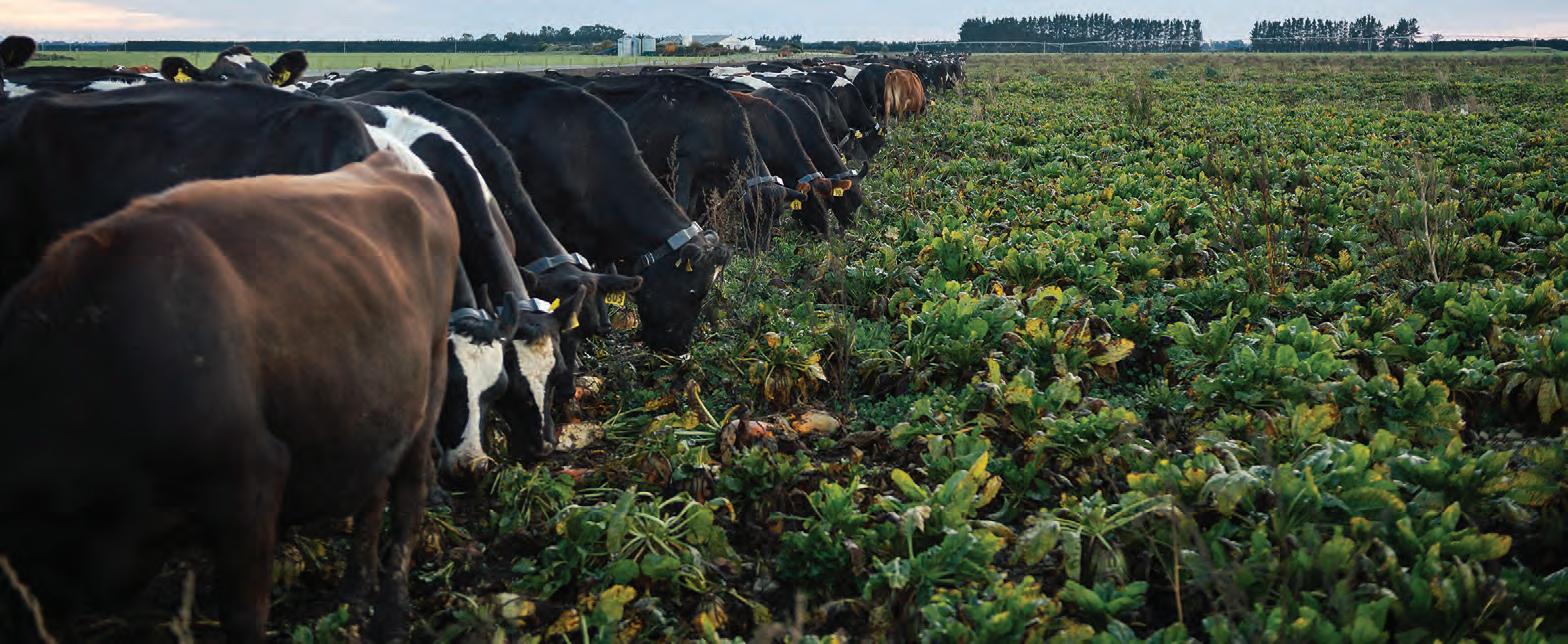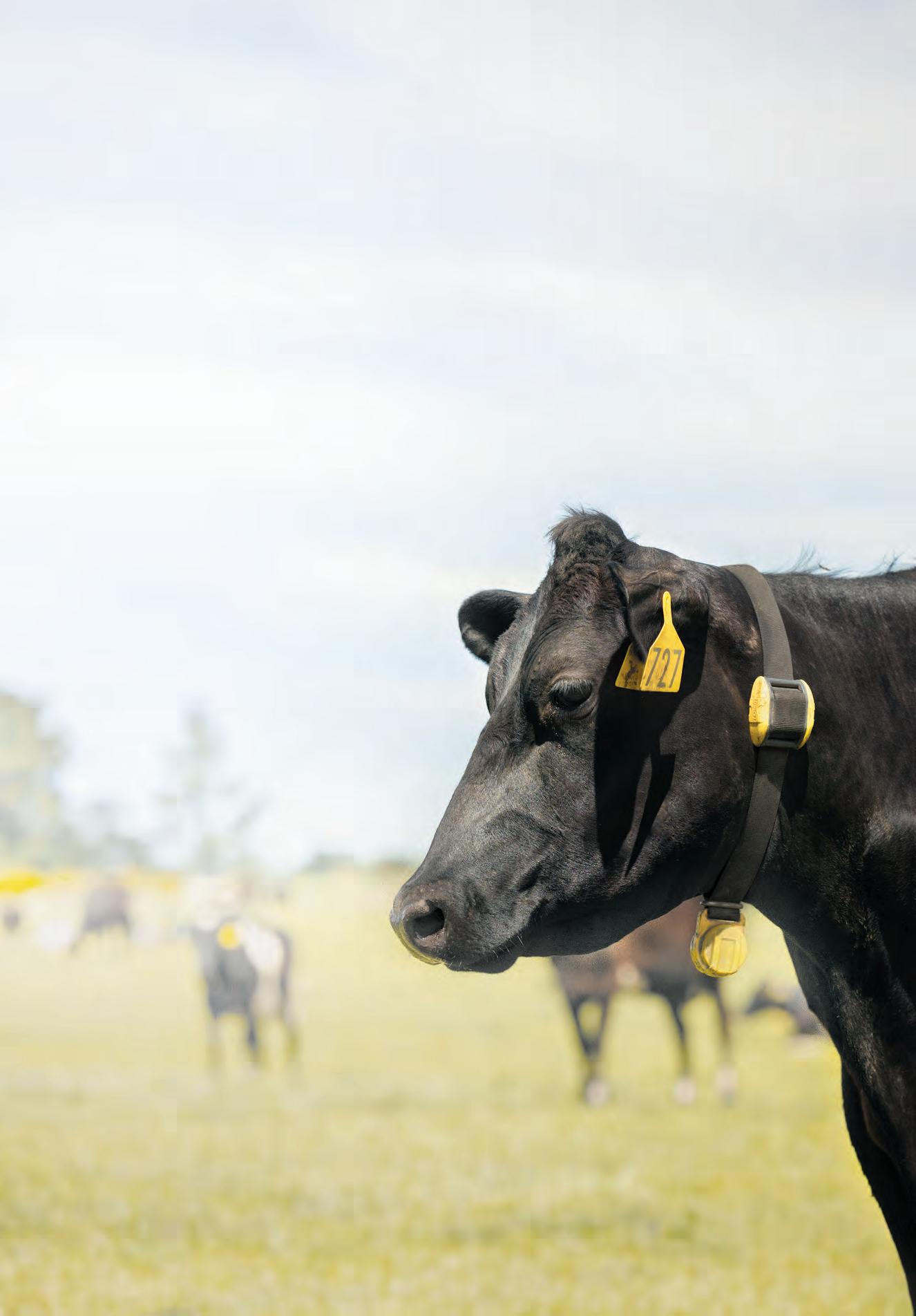
Set your season up for success with Teatseal ® - New Zealand’s #1 mastitis protection.
Teatseal is New Zealand’s most proven, trusted and recommended internal teat sealant, designed to protect cows throughout the entire dry period. The result is fewer mastitis issues around calving and early lactation, lower treatment costs, and more milk in the vat.
Safeguard your herd with Teatseal. Talk to your vet about using Teatseal this season.

PETER BURKE
peterb@ruralnews co nz
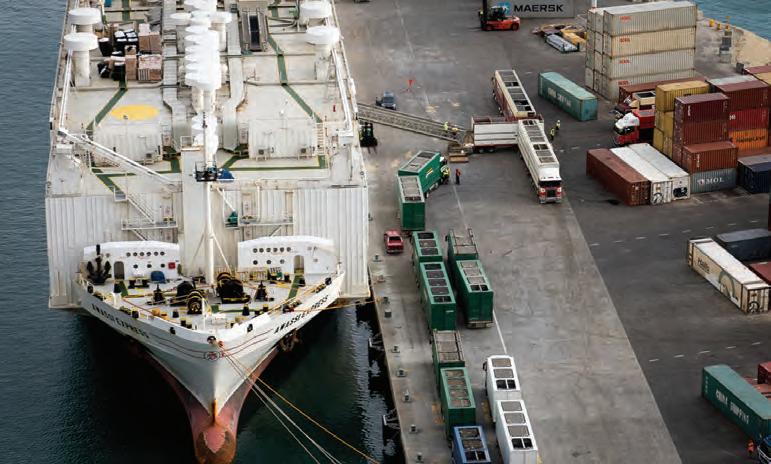
EXPORTERS OF live animals by sea say the decision by the coalition Government to go back on its word to reinstate the live export trade is “mys-
‘A SMART DECISION’
LABOUR’S DAMIEN O’Connor, who placed the ban when he was in office, says keeping it is one of the few smart decisions the coalition have made but that it doesn’t make up for all the stupid ones they’ve made He says, internationally, there’s been less investment in ships to carry live animals and more countries have been legislating to reduce or ban the trade O’Connor says the challenges for a distant nation like NZ are too great around animal welfare, business viability and customer demand to get involved in live animal exports by sea He says while some farmers may complain about
losing an option, the reality shouldn’t affect a good business
“The sustainability and viability of a business should not hinge on just one option There are many options that are removed from businesses overnight and this one has been well flagged I gave the industry two years, and anyone who was looking around the world could see that this is dying trade,” he says Meanwhile, Green Party agriculture spokesperson Steve Able says the clear reality of the situation has caught up with the Government He says live exports are fundamentally cruel, despite industry spin

Mainland dividend to be in the range of 14-18 cents per share.
will be smiling all the way to the bank next month.
The co-operative has signalled April 14 as the date for paying a $2/ share capital return to shareholders and unit holders.
Fonterra is returning $3.2 billion to shareholders and unit holders with farmer shareholders receiving an average of $400,000 each.
The windfall comes on the back of a $9.50/kgMS forecast milk price for the season. Fonterra has also signalled a special
This dividend reflects earnings of the Mainland Group before its sale to Lactalis for $4.22 billion. The sale is now unconditional.
Fonterra Co-operative Council chair John Stevenson told Dairy News that with a solid forecast milk price, projected strong earnings and a capital return it is a good time to be a Fonterra farmer.
He says councillors are seeing this positive sentiment reflected in their discussions with farmers.
“That said, most farmers have been around long enough to
be wary of the negative impact that international volatility and commodity cycles can have,” he says.
The council backed the sale of the Mainland Group to Lactalis, which includes iconic brands like Anchor, Mainland and Kapiti in New Zealand.
Fonterra is also pulling out of Australia where it will offload brands like Western Star Butter and Perfect Italiano to Lactalis.
Stevenson says the council is comfortable that the sale process offered many opportunities for Fonterra farmers to meet with Fonterra to discuss and question the divestment proposal.
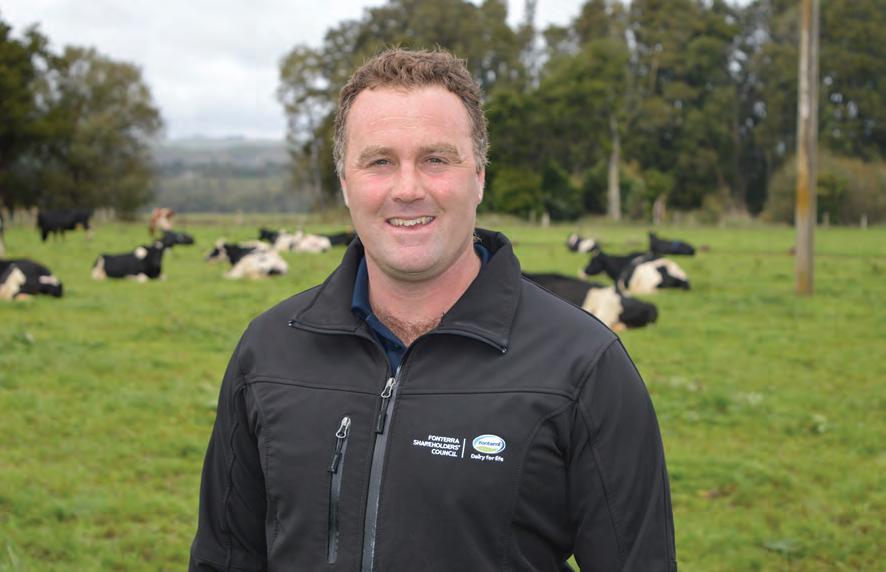
JOHN STEVENSON says Fonterra farmers have been pleased to see the recent turnaround in Global Dairy Trade (GDT) auction results.
But he adds that it is over six months until their final milk price is announced in September so there is still room for volatility.
Looking forward, he says the council’s focus is on ensuring that Fonterra delivers on what it has promised farmers in the divestment process.
“This includes monitoring Fonterra’s performance in the B2B environment post divestment of the Consumer and associated businesses.
“Council and farmers will be keen to see Fonterra maintain the consistent strong performance that we have been seeing in the last couple of years.”
“There was strong engagement from farmers in this process, and council was pleased with the quality of the information provided to farmers for consideration – including the council commissioned report from Northington Partners.
“Given the magnitude
“From
“Farms
“Other
of the decision, council believed it was important to see a strong mandate from Fonterra farmers for the sale, and the quality of the process delivered that.”
“Council has also heard that the capital return will be used to enable some farm succession plans.”
The cash injection will also benefit the rural community, he adds.
“Benefits from the capital return will be enjoyed not only by shareholders but the broader rural communities we live and work in.”
THE SEVEN participants selected for the 2026 Grassroots Dairy Management Graduate Programme are now working on farms.
Originally hailing from across New Zealand, the graduates have relocated to dairy farms between Lincoln and Isleworth in Canterbury. Alongside their on-farm roles, they will complete up to 25 designed modules to prepare them for future dairy management and business ownership.
Now in its fifth year, the programme began with an overnight induction camp at Peel Forest, where participants took part in a range of team-building activities including a high ropes course, fitness challenges and programme orientation.
Recruitment will soon begin for ambitious university graduates to join the 2028 programme. Successful applicants will be supported into on-farm employment with local farmers committed to developing the next generation of industry leaders.

SUDESH KISSUN
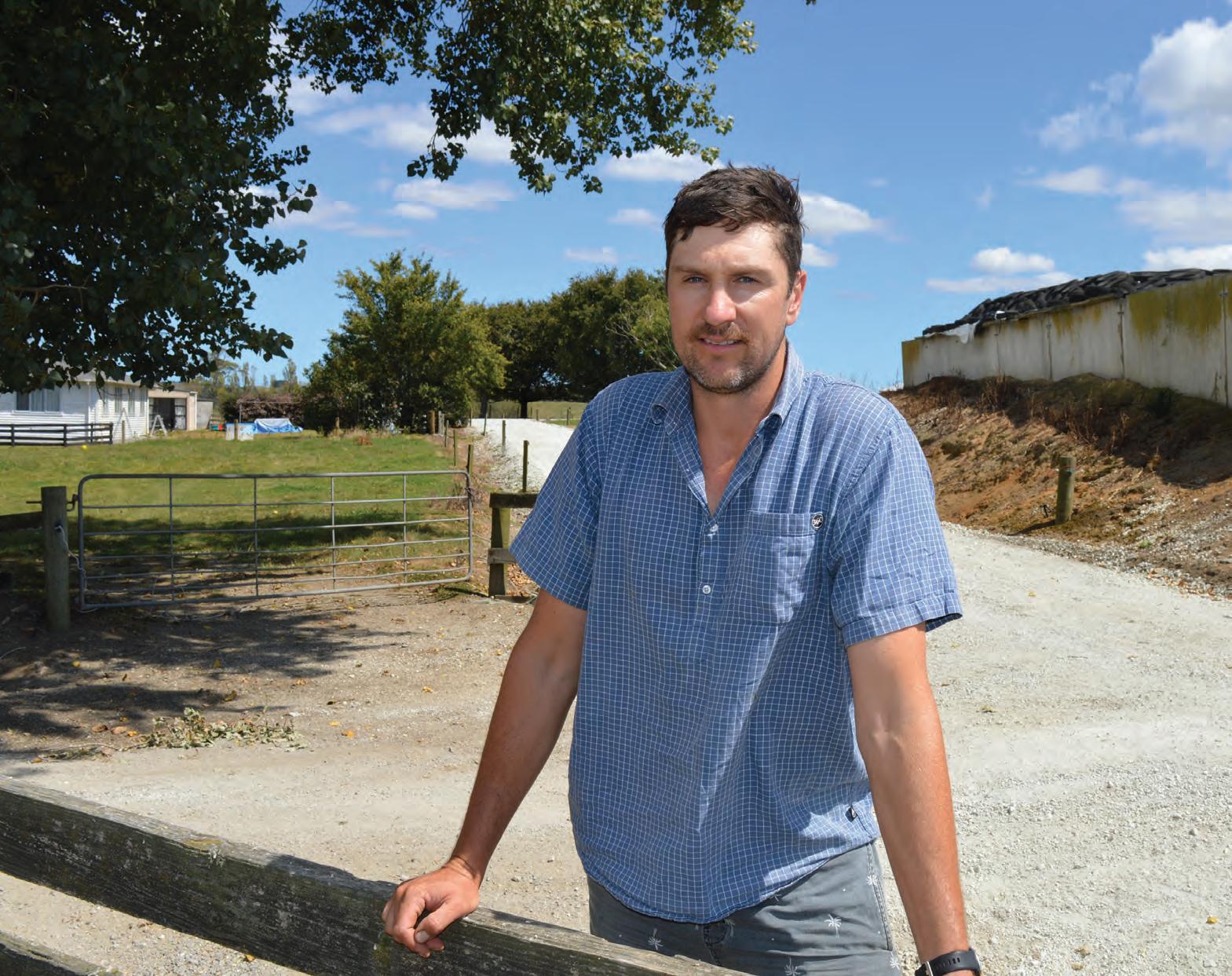
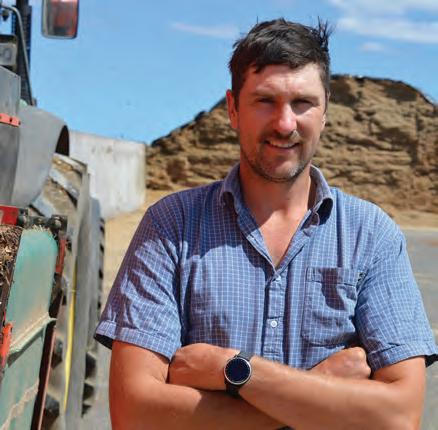
TECH SAVVY Huntly farmer Rhys Darby believes technology could help solve one of the dairy industry’s pressing problems – how to attract more young people into farming.
Darby says younger people love new technology and are better adopters than most farmers.
“So, the more technology we have on farm, the more young people we can bring into the industry where they not only enjoy technology but can farm with it,” he told Dairy News Darby and his partner Liz Lawrence operate a 380ha business – made up of three farms. There’s Kauri Moor, a 230ha eff autumn calving dairy farm, Kingbury, a 50ha eff sheep milking unit and a 100ha eff support block to rear replacement calves and lambs. Darby has six staff. DairyNZ recently hosted a ‘Technology for future-fit farming’ field day on the farm.
Efficiency is the number one priority for Darby. He also believes is using good data to make good decisions.
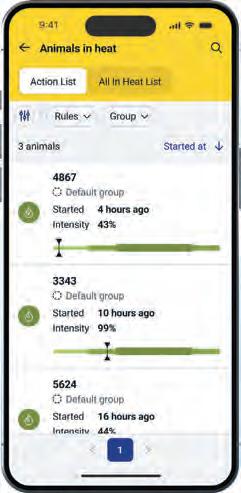
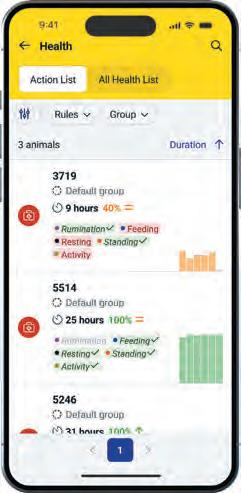
On Kauri Moor, Darby’s love for technology is on full display. The farm has Pasture.io for pasture monitoring and Allflex
collars on cows for mating plans and heat detection. The collars are also used for animal health observation and group rumination plans.
An Allflex drafting gate, which runs off vacuum rather than a compressor, integrates with LIC’s MINDA.
The farm also has solar power, consisting of 96 panels and 48kw inverter. It cost $72,000 and saves about $1000/month in power bills.
Milk, water and effluent are monitored on the farm by Halo sensors.
Darby says having a string of technologies helps him and the team utilise information to make better decisions on farm.
“So, we are essentially trying to collate all that data together, so we aren’t just guessing, but using real-time data to make decisions,” he says.
Darby says the technology has enabled him to hire young people who are now using data from various sources to help them run the farm.
“So, I’m not making all the decisions. I’ve been able to encompass people into our business rather than me just trying to make things up.
“It’s not essentially me doing all the work and not sort of offering any support for the younger generation coming through.”
He says Pasture.io is
a great guide for young people.
“It’s about looking at information and utilising that data to make decisions rather than picking a paddock or using your eye and that stuff.
“It’s just got good information there that people get to utilise and us.”
Darby isn’t planning on introducing any new technology in the coming months, although from
“Good
“I
last month, he’s started trialling Halter collars on some heifers.
“It’s probably just crunching down and getting the best information out of the software we have,” he says.
Invest alongside an experienced, locally owned manager.


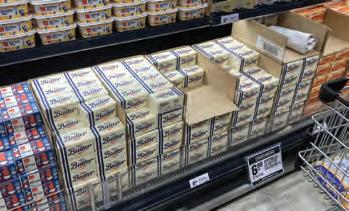
AMERICAN BUTTER undercutting New Zealand’s own product on New Zealand supermarket shelves appears to be a case of markets working as they should, says the Dairy Companies Association of New Zealand.
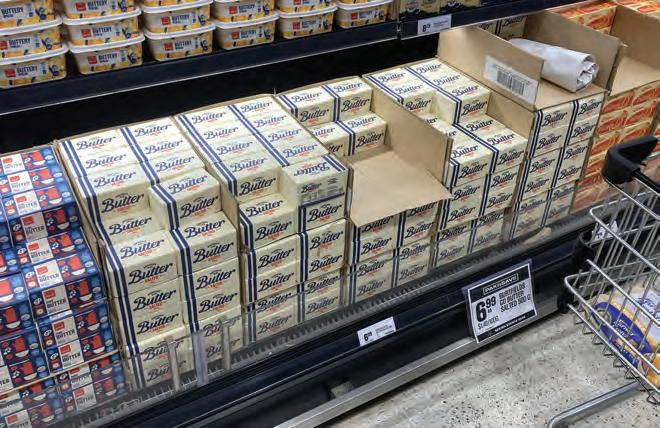
The American butter has been bought in bulk by Synlait’s subsidiary Dairyworks and packaged in Christchurch under the “Burtfields & Co” brand. It is retailed though Foodstuff’s Pak’n’Save supermarkets, initially in the North Island and now in the South.
500g blocks were
initially selling at $6.99, with the next cheapest butter reportedly being Pams at $7.19.
DCANZ executive director Kimberly Crewther said that DCANZ supports free trade, so consumers globally should have the choice of New Zealand dairy products, and New Zealanders should also have the choice of products produced elsewhere.
It reflected New Zealand’s low import tariffs, and supply and demand dynamics globally.
Crewther said New Zealand was recognised as a producer of very highquality dairy products,
and our butter was valued globally for its premium qualities.
“New Zealand butter sells at a premium to US butter in global markets,” she told Dairy News
“Given this is the case, and that there has been a desire voiced for cheaper butter options in the New Zealand retail market, the importation of US butter into New Zealand appears to be a case of markets working as they should.
“New Zealand farmers will continue to earn a market return that reflects the quality and premium value of their products, and New Zealand consumers will benefit from choice.”
As Synlait’s consumer
brands subsidiary, Dairyworks markets its own New Zealand-made butter, cheese and milk, under the Dairyworks, Alpine and Rolling Meadow brands.
Dairyworks general manager sales, Mark Simpson, said they had an opportunity to bring butter in from the US at a lower price, at a time when butter consumption was under pressure with people buying less butter, just based on the shelf price.
“So, we looked at what our options were to help in that space.”
Simpson did not reveal details of the American source, nor how much they had brought in, but
it would be “a couple of months’ worth” depending on consumer uptake.
Final retail pricing was up to Foodstuffs rather than Dairyworks, said Simpson.
respond over a more sustained period of time.”
Simpson said it was “very much” just a trial.
markets work, but it won’t work all the time.”
Speaking when the butter had been available in the North Island for about a week and had yet to go on the shelf in the South, he said it was selling well but competing with several other brands.
“So, it really depends on how consumers
“If there is good consumer uptake, if consumers go ‘Actually, butter that’s slightly lower cost on shelf is something I’m wanting to come back and buy more of’, then we’ll look at it again, but it needs to make commercial sense.
“Getting butter from the US to New Zealand, it works at certain times given the way global
Simpson acknowledged social media criticism of the American product, chiefly that it is too pale, due to American cows being primarily grain fed, in contrast to New Zealand butter’s yellow colour from the betacarotene content of a grass diet.
But Simpson said they were getting feedback “all across the spectrum” and the taste was very similar to New Zealand butter.
SUDESH KISSUN sudeshk@ruralnews.co.nz
FARMERS NEED not worry about fertiliser supply this autumn but the prices they pay will depend on how the Middle East conflict plays out.
That’s the message from the two major fertiliser co-operatives, Ballance Agri-Nutrients and Ravensdown.
Significant volumes of nutrient commodities are shipped through the Strait of Hormuz by Qatar, the United Arab Emirates, Saudi Arabia, Bahrain and Iran.
With Iran imposing a blockade on shipping through the vital sea passage, disruptions to Middle East shipping routes can affect shipping time and freight costs.
Ballance general manager customer Jason Minkhorst says fertiliser prices had seen significant price increases leading into this conflict.
“Given this latest escalation and the market’s reaction, we anticipate more,” he told Dairy News.
“Upcoming shipments are mostly subject to pricing at time of shipment.
As a commodity, fertiliser pricing
experiences movements similar to the imported oil market.”
Minkhorst is encouraging customers to work with their nutrient specialists to plan ahead.
“Thinking ahead and creating a plan early will help us make sure we have what they need, when they need it.”
Ravensdown chief sales and marketing officer Daniel Pranic says the cooperative has product on hand to meet expected fertiliser demand for autumn.
“Supply is assured, with product already in New Zealand or on the water.
“We operate seasonally and, as you know, the next period of demand for fertiliser in New Zealand is some months away in spring.
“As we plan for the spring season, we will be leveraging our longstanding global supplier relationships to help secure supply of product to New Zealand.”
Looking ahead to product sourcing requirements for spring, he says the price they pay for that product is yet to be determined and will depend on multiple factors, including timing and length of the Middle East conflict, and energy costs.
aren’t run down and stressed.
CRAFTING A successful family succession plan is a notoriously hard act to pull off.
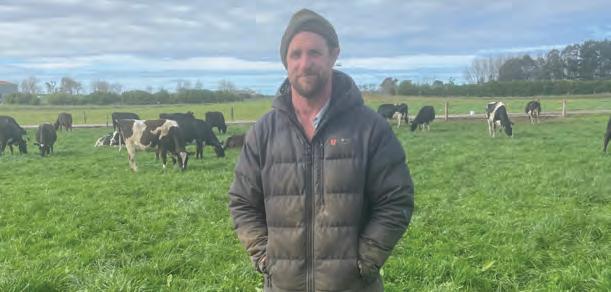
Attendees at a recent Smaller Milk and Supply Herds (SMASH) event, near Patea in Taranaki, heard how the Werders have created a plan where everyone in the family benefits.
They also found out how Thomas and Courtney Werder’s farming system evolved to meet their goal of low impact farming, with family front and centre.
“It’s not about pushing numbers. If we’re a 280-cow farm, it’s not about pushing to 300 and squeezing everything out of every hectare. It’s about having good cows that produce well,” said Thomas.
“The way to describe it is low impact. Low impact on the cows, low impact on staff, low impact on the land. We don’t use massive amounts of nitrogen, we don’t run huge stocking rates, and we don’t run bare-bones labour set-ups. It’s about balance. I like happy cows. I get joy from seeing them content. The kids see cows that
“I still think there’s a lifestyle aspect to dairy farming that’s been lost a bit in the industry. That’s why low impact is important to me. I enjoy it. I want my staff to enjoy it. I want my kids to see it’s enjoyable so they might want to do it one day. Low impact isn’t about avoiding stress; it’s about having a platform that works. Pushing hard can be profitable – but relaxed and profitable works too.
“When I first came back to the farm, I had big ideas. But the more I farmed, the more I came back to that low impact style,” he said.
Open communication is central to the Werders working successfully together as a family. Initially, after their father passed away, they took some time to develop a structure that worked for them.
“In 2008, Dad passed away,” said Thomas. “My brother came home and did a year on the farm while I finished university. Then Courtney and I came back. We were workers, then lower-order milkers, 50/50 sharemilkers, leased the farm, and eventually bought it in 2017.
“We also had off-farm income within
the dairy industry. Leasing was probably our biggest money spinner. We also moved through equity partnerships with my siblings.
“Mum was still here to start with, but I had a fair bit of freedom in how I farmed. That was exciting – probably frustrating for Mum at times – but she was incredibly open. Her attitude was, ‘Go and try it. If it fails, you’ll learn from it.’ That’s something I’ll take forward with my own kids. Don’t always be the safety net. Let them try. There are things I’ve done that Mum and Dad might not have thought were great ideas at the time, but they work for our system now.
“Succession planning didn’t really exist growing up. After Dad passed, my brother – who had worked at the bank and seen family breakdowns –suggested we start sibling meetings.
“There are six of us. We decided meetings would be siblings only –partners weren’t in the room, Mum wasn’t either. Nothing was secret; partners could know everything. But the room itself was a safe space.
“In our first meeting we shared our one-year, five-year, and ten-year goals.
Over time, things evolved. We’d pool ideas and opportunities. We formed equity partnerships. Shares shifted over time as people moved on. We’ve all risen together.
“Family support helped us to buy the farm. I’ve got no shame in saying we couldn’t have done it as quickly without them.”
Communication and openness are key to the Werders’ success as a family, with everyone being heard and supported.
“One of my sayings is: to accept, you’ve got to understand. Fair isn’t always equal. If people understand it, they can accept it.
“The biggest thing was prioritising

Mum. All of our family loans are interest-bearing and that interest goes to her. We worked out what she needed to live comfortably – travel to Switzerland, see friends, be with her 18 grandchildren. She doesn’t worry about the payout or drought.
“And succession itself wasn’t smooth. I brought plans to siblings. They didn’t like them. I adjusted. Took them to Mum. She didn’t like them. Adjusted again.
“It wasn’t clear sailing. There were obstacles. But with communication, patience, and understanding, we worked through it.”
• Louise Hanlon is an executive member of SMASH.
FARM SOFTWARE outfit Trev has released new integrations with LIC, giving farmers a more connected view of animal performance across the season and turning routine data capture into actionable farm intelligence.
The integrations bring liveweight and animal records into Trev alongside feed, production and operational data, creating a single source of truth for farm performance and enabling clearer decision-making year-round. Trev is an operational farm management software platform that centralises farm information.
The integration with LIC’s MINDA herd improvement software further strengthens performance tracking by bringing core animal and herd records into Trev.
“The MINDA integration has been the number one request from our farmers,” says Scott Townshend, Trev chief executive.
“So, we’re delighted to deliver it, reducing the friction of double handling data and helping farmers get more performance value from
information they already collect.”
Blair Smith, LIC’s head of farm software, says the integration is designed to better support on-farm decisions.
“The MINDA integration has been the number one request from our farmers.”
“MINDA is a unique herd improvement platform, built to help farmers measure, compare and improve herd performance over time,” says Blair. “By integrating with Trev, that high quality animal data can be rolled up with wider farm information, giving farmers a clearer view of what’s driving results across their business.”
These integrations extend Trev’s ecosystem, including Fonterra’s Farm Dairy Records, Figured, and Trev’s own API for secure, farmer-approved data sharing. Together, Trev’s integrations support a more complete view of

farm performance by linking animal, production and financial data to inform better decisions across the season.
On farm, this connected approach is said to support clear performance
targets and earlier intervention. Farms tracking young stock performance can automatically monitor whether calves and heifers are meeting defined liveweight targets at key seasonal milestones, including weaning, grazing
transitions and entry to calving. Mobs falling behind can be identified earlier, before impacts are felt at mating or calving, with growth performance linked back to feed inputs and management decisions.
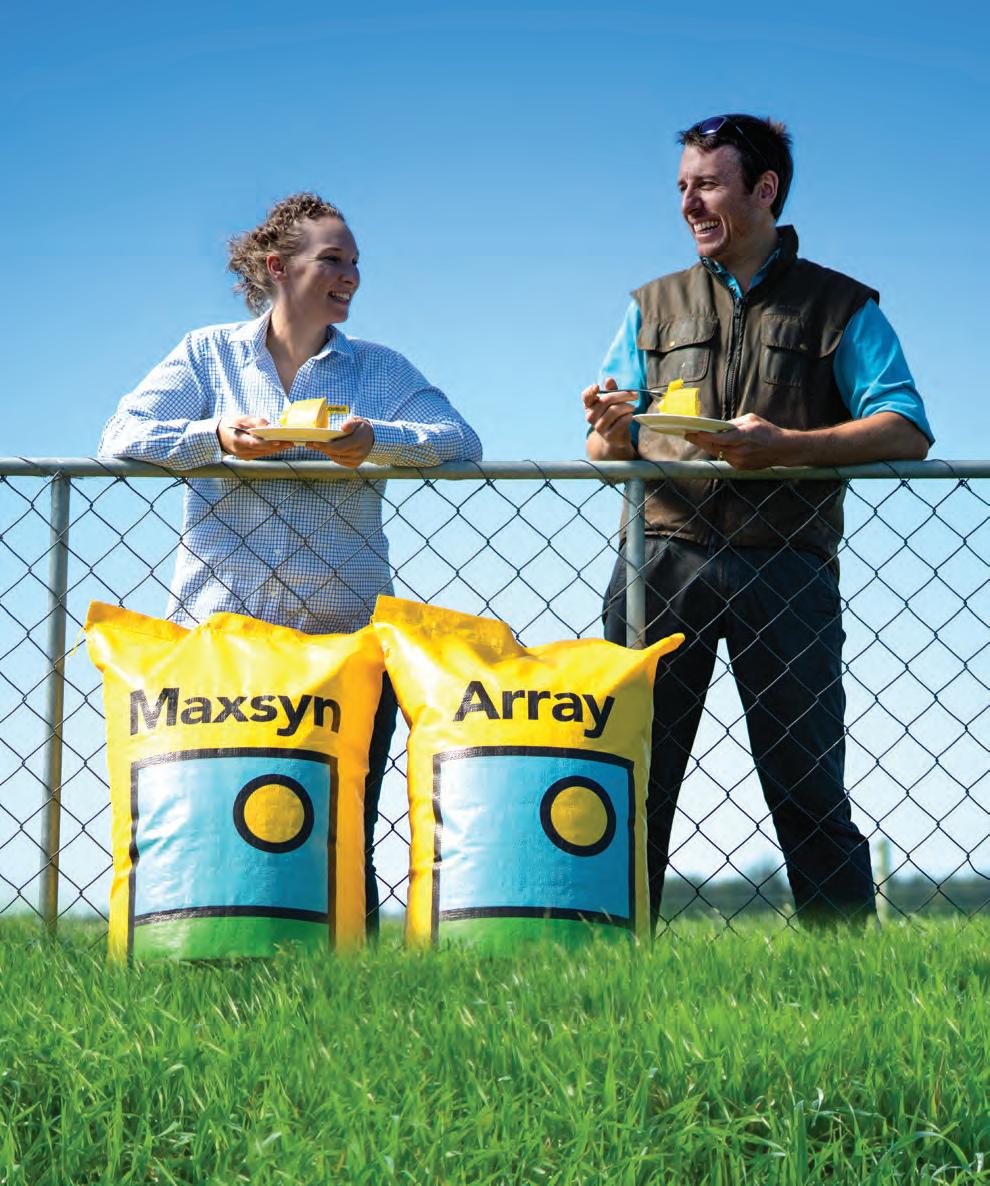
When you invest in pasture, you’re investing in your future. Nothing delivers returns like proven, persistent Maxsyn and Array.
Maxsyn, New Zealand’s top-selling perennial ryegrass, just got even better – now supercharged with NEA12 endophyte for increased resilience and productivity.
Don’t forget Array, the environmental all-rounder delivering high yield plus nitrogen efficiency. It’s the complete package! Ask your Reseller, or learn more at barenbrug.co.nz
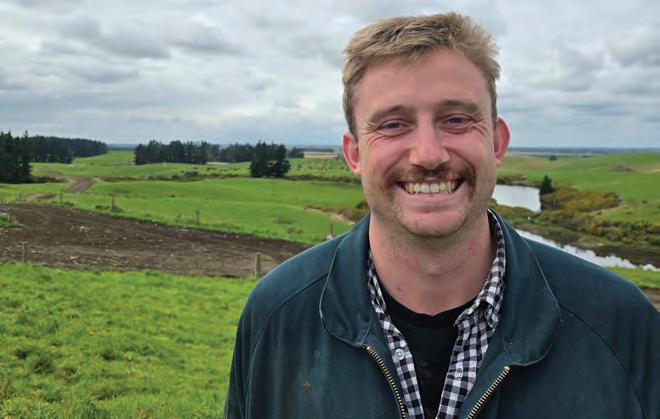
SAFER FARMS has welcomed its first three regional champions that will be taking the Farm Without Harm message directly into their rural communities.
George Dodson, manager of a dairy farm in Hororata, Canterbury, is already sharing his ideas on social media.
“Farm safety isn’t about rules, it’s about looking after your team, your family and your business.
“I’m enjoying showing what works on my farm, hearing from other farmers and helping normalise a culture where failing safely is part of everyday farming.”
Dodson, 2024 Young Farmer of the Year, joins Wairarapa sheep and beef farmer Roger Barton, and winner of the 2022 Ahuwhenua Young Māori Award for sheep and beef Chloe Butcher-Herriesin
sharing their own safety experiences, practical tips and lessons learned with other farmers.
They will also be attending local events and speaking to community groups.
Lindy Nelson, Farm Without Harm ambassador and Safer Farms director, says the appointment of the Regional Champions marks a major milestone for the programme.
“Farmers trust farmers. We were looking for relatable people with strong rural community connections, who are curious and keen to share their own journeys. Roger, Chloe and George really ticked all the boxes.
“Being a Regional Champion is about sharing stories, showing practical solutions and connecting with rural communities. Roger, Chloe and George will be playing a critical role
in helping influence change from the ground up.”
The Regional Champions role isn’t about having all the answers, says Nelson.
“It’s about reframing safety and the conversations we want to be having about practical solutions.
“Safer farms are happier, healthier and more productive farms. Our champions will be sharing what they do and what they learn from other farmers, so we can all be better.”
The Farm Without Harm strategy takes a practical, real-world approach to health and safety, she says.
“It’s not about rules and tick-boxes. It’s about solutions that actually work on the ground - learning, trying new things, sharing what works and even acknowledging when it doesn’t.”
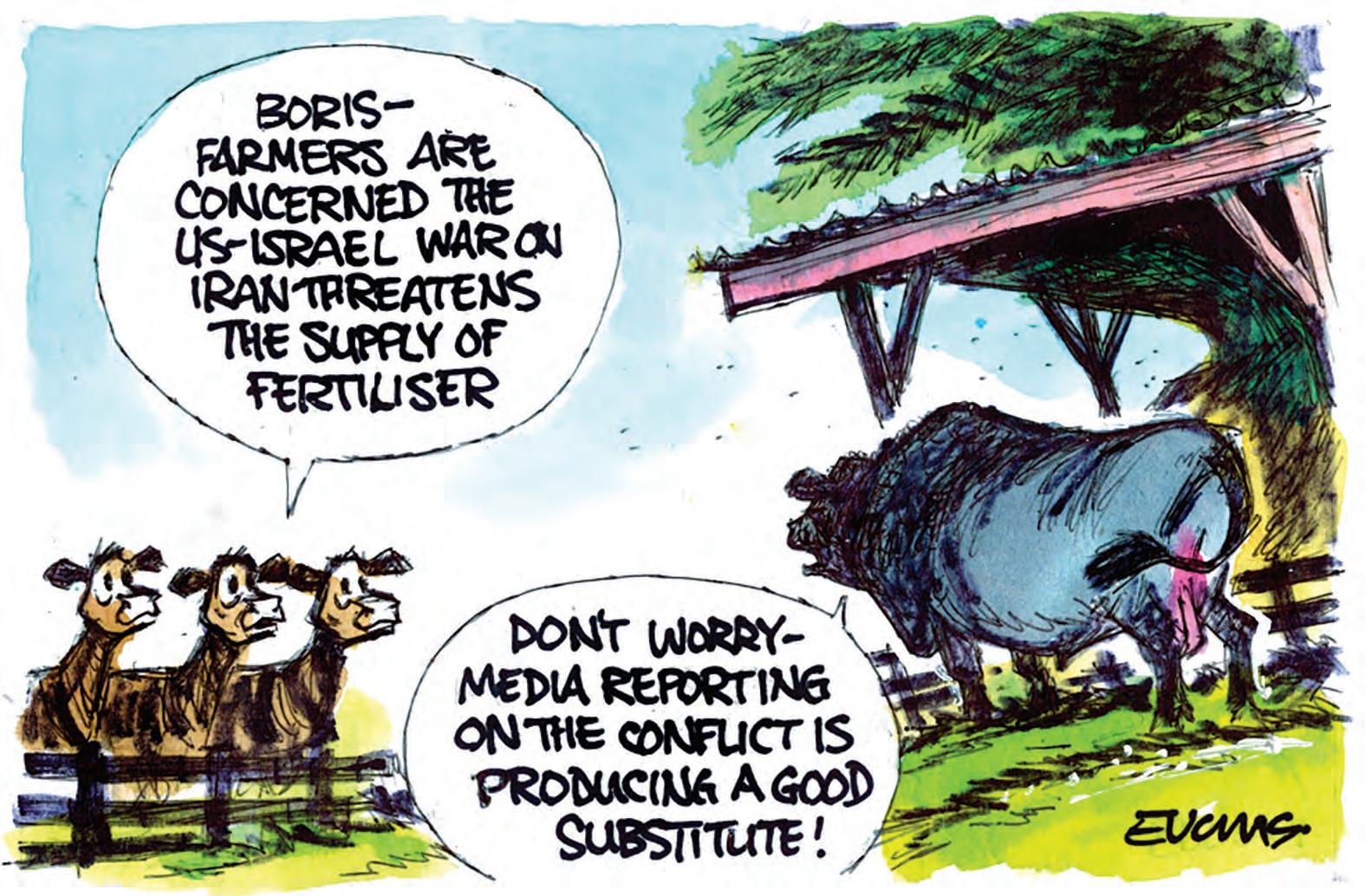
THE COALITION Government seems to have chickened out when it comes to live animal exports by sea.
Associate Agriculture Minister Andrew Hoggard was unable to get Cabinet to agree to reinstate the live export trade, so that’s one 2023 election promise that won’t be progressing this political term.
Both National and ACT campaigned at the last election on overturning the ban on livestock exports by sea and promised to bring in a new gold standard to ensure the highest standards of animal welfare.
While ACT seems to be in favour of lifting the ban, National, which is taking a beating in latest polls, seems to think it’s not worth the risk. Time will tell.
CHEAPER US butter on New Zealand supermarket shelves isn’t impressing everybody.
Social media chatter shows that, while it’s cheaper, even Americans are warning Kiwis to avoid the stuff.
The Burtfield’s & Co American butter is being sold at Pak’n’Save for $6.99, compared to the likes of NZmade staples like Mainland and Anchor, which go for upwards of $8.
The Burtsfield’s butter is pale, almost white, compared to NZ’s precious golden yellow spread - likely because US cows are grain-fed, whereas Kiwi cows are typically used to chomping on grass.
The butter was bought at a fortuitous time for the market, when US butter prices were trading below New Zealand’s export-linked pricing. It was acquired for a “very competitive price”, according to Foodstuffs, which is reflected in how much the supermarket is selling it for.
WITH EXPORT of livestock by sea dead in the water, opponents of the Gene Technology Bill think they can also force another U-turn from the Government.
Organics Aotearoa NZ (OANZ), which is spearheading opposition to the Bill, has the begging bowl out, seeking cash from the community to kill the legislation, which has the backing of all coalition partners in Government.
OANZ is against environmental release of genetically engineered organisms in the country.
“Together, we helped stall the Bill, mobilised thousands of submissions, and pushed this debate into the national spotlight. But stalled is not stopped!” it told supporters.
“Regulatory decisions in this election year will shape the future of food and fibre in New Zealand. So, our advocacy continues, but it depends on sustained backing.”
THE GOOD news keeps getting better for NZ dairy farmers.
DairyNZ’s updated forecast for the 2025-26 season portrays a favourable outlook for farmers.
Driven by strong milk prices, DairyNZ estimates farmers will receive an average payout of $9.92/kgMS for the 2025-26 season. With a forecast breakeven milk price of $8.36/ kgMS, this points to an average surplus of around $1.56/kgMS for the season.
At the same time, seasonto-date milksolids production is running 3.3% ahead of the same period last season.
The combination of relatively high payout expectations and strong production means many farms are tracking towards a very solid revenue season. For many farms, margins will be comfortably above breakeven levels, despite increases in farm working expenses.

Head Office: Lower Ground Floor, 29 Northcroft St, Takapuna, Auckland 0622
Phone 09-307 0399.
Postal Address: PO Box 331100, Takapuna, Auckland 0740
Published by: Rural News Group
Printed by: Inkwise NZ Ltd
Contacts: Editorial: sudeshk@ruralnews.co.nz
Advertising material: beckyw@ruralnews.co.nz
Rural News on-line: www.ruralnews.co.nz
Subscriptions: subsrndn@ruralnews.co.nz
Publisher: Brian Hight ......................Ph 09-307 0399
General Manager: Adam Fricker ...................Ph 021-842 226
Editor: Sudesh Kissun ................Ph 021-963 177
Machinery Editor: Mark Daniel......................Ph 021-906 723 markd@ruralnews.co.nz
Reporters: Peter Burke.....................Ph 021-224 2184 peterb@ruralnews.co.nz
Subscriptions: Julie Beech ....................Ph 021-190 3144
Production Manager: Becky Williams ..............Ph 021-100 4831
Digital Strategist: Jessica Marshall ..........Ph 021 0232 6446

PUBLIC OPINION, political pragmatism and commercial and market reality have caused the Government to abandon introducing legislation into Parliament to legalise the shipment by sea of live animals – mainly cows – to overseas destinations.
This has always been a contentious issue, supported by a number of (not all) farmers, those directly involved in the trade, and particularly the ACT Party. But equally strong has been the opposition from animal rights groups and the Labour Party. Some veterinarians have supported the continuation of live exports, while others have opposed it.
A strong advocate of restoring live exports under a new code of compliance and so called ‘gold standard’ has been ACT MP Andrew Hoggard, himself a dairy farmer. He promised to have the ban overturned by 2025, but for several months there have been murmurings in coalition political circles that such a move could negatively affect their chances at this year’s election.
Past images of animals on ships in appalling conditions could cost votes regardless of what evidence live exporters could show to prove things have changed.
The line from Cabinet was that they couldn’t be certain that the ‘gold standard’ on ships could be met. But more credible is the view that no right-thinking businessperson would invest in new ships, knowing full well that if Labour were elected the ban would immediately be reinstated and gold-plated ships would have no future.
Farmers and live exporters are naturally upset and see the decision as a broken promise on the part of the coalition, but those who have been around politics for a long time are always sceptical about promises.
For the animal welfare lobby this is a significant victory, and it now appears for the foreseeable future the export of live animals by sea from NZ will not happen. But then again, in this topsy turvy uncertain world, things could change tomorrow.
AUCKLAND SALES CONTACT: Stephen Pollard .............................................Ph 021-963 166 stephenp@ruralnews.co.nz
WAIKATO & WELLINGTON SALES CONTACT: Lisa Wise ........................................................Ph 027-369 9218 lisaw@ruralnews.co.nz
SOUTH ISLAND SALES REPRESENTATIVE: Kaye Sutherland .........................................Ph 021-221 1994 kayes@ruralnews.co.nz
New Zealand have also increased.
THE JOINT US-Israeli strikes on Iran, and Iran’s retaliation against several countries in the region, may further tighten farm margins due to the risk of increased input costs, especially for fertilisers like urea and also for diesel.
The wider Middle East region is a key supplier of crude oil, natural gas, urea and sulphur fertilisers. Crude oil and urea prices have already risen since the attacks started, and diesel and fertiliser prices in
Urea price movements are linked to the risk that around 45% of the global urea supply could be disrupted via the Strait of Hormuz. The wider Middle East region accounts for a significant share of this trade. Iran has become a sizeable urea exporter in recent years, accounting for almost 10% of global urea exports. Any closure or disruption to shipping in the Strait of Hormuz – a crucial corridor for exports of crude oil, natural gas and urea –would limit shipments from Iran, Iraq, Kuwait,
Bahrain, Qatar, the UAE, and to a lesser extent, Oman and Saudi Arabia.
Qatar exports about 10% of global urea via the Strait of Hormuz, and Saudi Arabia ships a large portion of its roughly 8% share of global urea exports through the same route.
Iranian retaliation against countries in the region could also affect urea supplies indirectly – for example, in Egypt, where production depends on natural gas sourced from Israel. Egypt accounts for about 8% of global urea exports.
The Middle East has also become an
increasingly important market for milk powders in recent years, particularly important as Chinese demand has softened. Most imports are destined for Egypt, Saudi Arabia and the UAE. The region also imports other food and grains including around 5% of New Zealand’s lamb exports and under 2% of beef. Disruptions are possible but are difficult to forecast.
The recent US tariff changes stem from a US Supreme Court ruling in early February requiring the trade tariffs introduced by the second Trump administration
early last year to be removed. In response, President Trump immediately introduced a revised tariff rate of 15% under alternative tariff rules and schemes. For New Zealand products like sheepmeat and wine, US tariffs will remain unchanged, while for some of our competitors like Australia they will increase from 10% to 15%. This potentially slightly improves the competitiveness of New Zealand products in the US market relative to that of some other countries.
For beef, New Zealand’s major export product to the US, tariffs remain
given the US had exempted beef imports from tariffs in 2025.

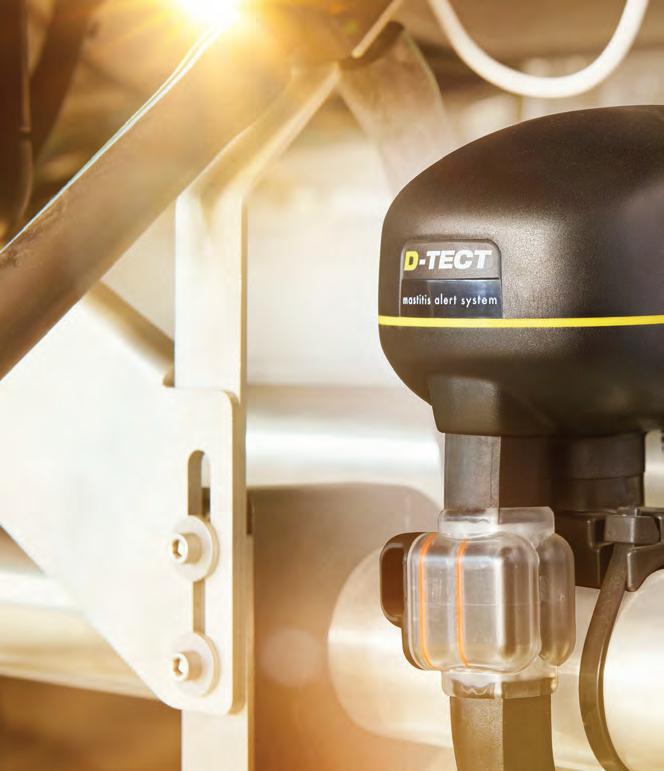
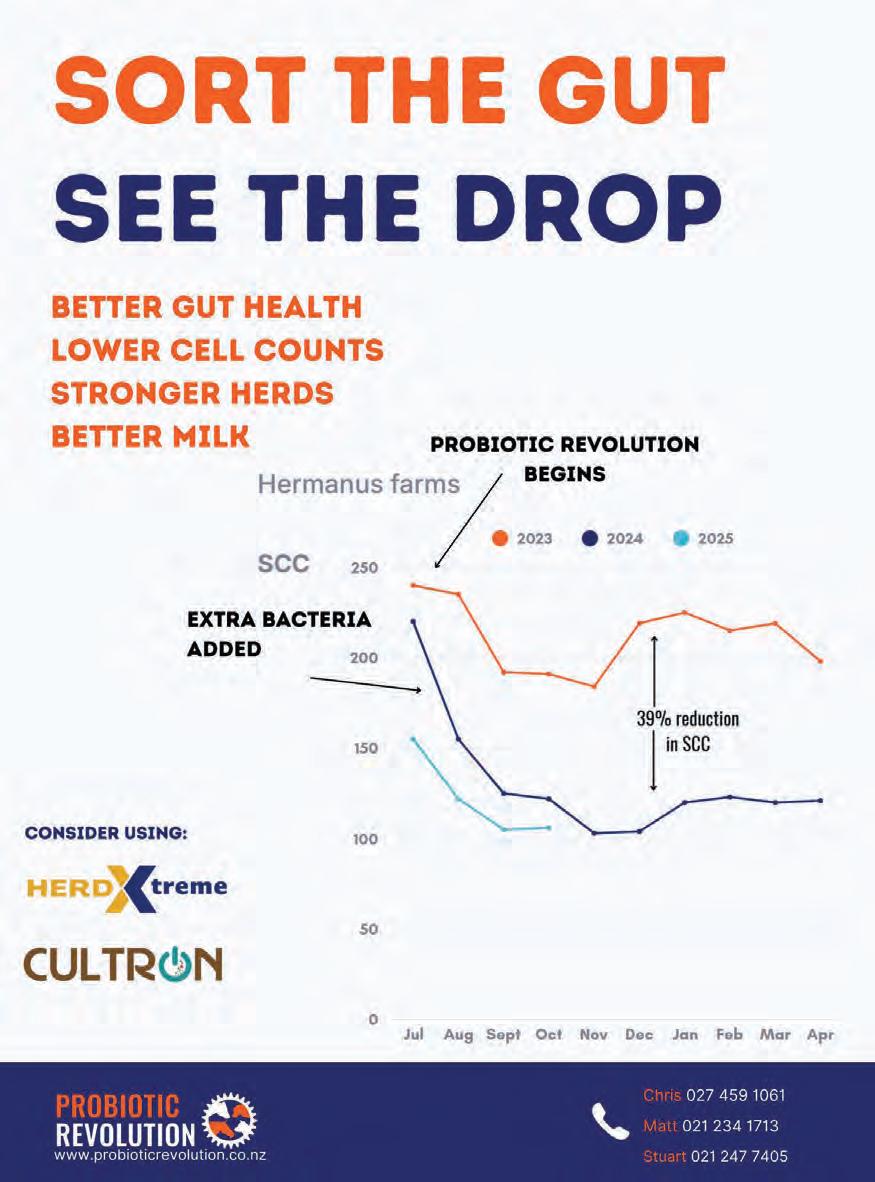
SOMATIC CELL counts on the rise in late lactation?
According to Probiotic Revolution, the answer may lie with probiotics and prebiotics.
It says these can help counter the typical decline in milk production and the rise in somatic cell counts that occur in late lactation.
Even when summer pasture growth is strong, overall pasture quality usually drops as summer grasses and dead material accumulate, it says.
“This natural seasonal decline in production can be made worse – and cow condition can suffer – when rotation lengths are extended and cows are pushed to consume lower-quality feed.
“As milk production falls, somatic cell counts tend to increase as well.
“A practical way to reduce these issues is to use a low-cost additive that boosts the metabolizable energy (ME) of pasture and silage by stimulating fibre-digesting bacteria in the rumen.”
Probiotic Revolution says it’s now
importing Cultron, a prebiotic yeast extract.
It claims that because Cultron is produced from the fermentation of sugarcane and maize in ethanol production, it contains eight times more metabolites than yeast extracts derived from the brewing industry. This richer nutrient profile more effectively stimulates beneficial rumen microbes, including fibre-digesting bacteria.
In previous autumn seasons, Probiotic Revolution relied mainly on high doses of live bacteria to lower somatic
counts.
With the addition of Cultron, farmers now have access to a stronger, cost-effective additive to help maintain autumn milk production, it says.
Cultron is manufactured by Brazilian company Aleris.
Since its inception in 2012 Aleris has produced the new yeast extract.
Probiotic Revolution says that Cultron has made big inroads as a nutritional supplement in Asia Europe and North America and it is now making this available for dairy herds in New Zealand.
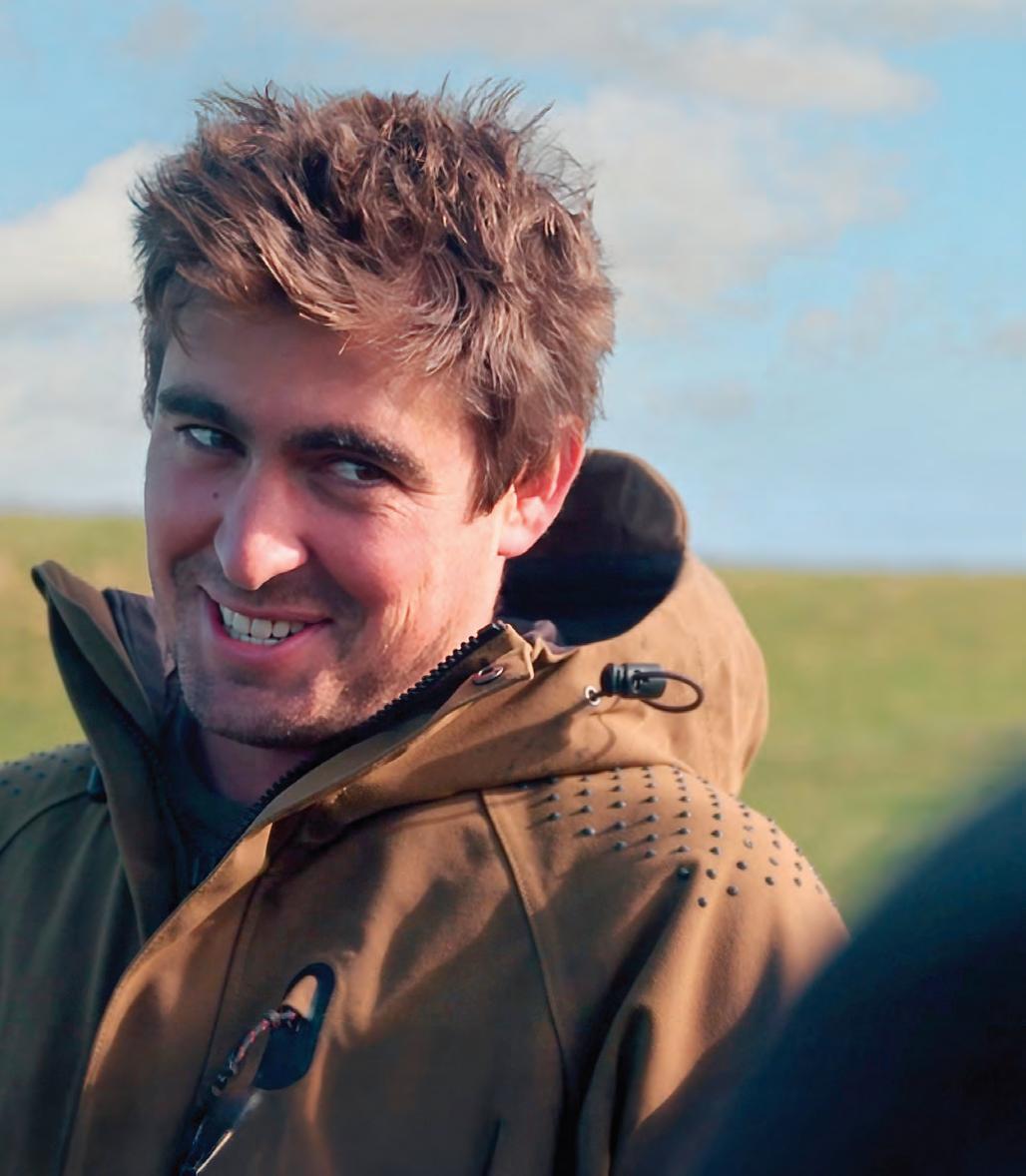
“Want to know how to keep your missus happy?”

The secret is timing: get your tag order in early. She’ll be swooning over the $0.97c per tag you just banked.
That sweet deal covers the whole herd: the entire range of Allflex NAIT-approved cattle tags, including EID calf packs, birth EIDs, and replacements. If you run big numbers, that adds up to a seriously handy discount you get to keep.
Get the tags sorted, keep the cash. Order your NAIT cattle tags between 5 January 2026 and 30 April 2026, and Allflex New Zealand will discount the order to the value of the applicable NAIT levy ($0.97 plus GST per tag).*
KATHY DAVIS
NEW INDUSTRY trials confirm what matters most for perennial ryegrass seed this autumn: Cool, dry storage keeps endophyte viability above the 70% commercial threshold, according to pasture specialist Barenbrug.
Anything else risks dead endophyte and weak pasture, it says.
Scientists stored perennial ryegrass seed containing two common endophytes - AR37 and NEA2 - in six bag types under different conditions for 12 months.
The results for both were almost identical.
Only cool storage (4°C, 30% relative humidity) held endophyte viability at 83-92%, matching prestorage levels.
Ambient storage (15-25°C, 65% relative humidity) dropped it to

54-68%, with most loss in the final three months.
Bag type made almost no difference, researchers concluded.
The study was led by Lincoln University and the Seed Industry Research Centre to find out how storage conditions and packaging affect seed quality and endophyte viability.
“The results are pretty sobering,” says Barenbrug sales manager Jason Gardner.
“Buying seed without knowing its storage history is a gamble, and jeopardises what should be a highly profitable, multi-year return on investment.”
Elevating the risk is the fact that most seed sold for autumn pasture renewal is at least 12 months old, as the window between harvest and sowing is too brief to process it all.
The findings challenge the industry assumption
What does the science say? Why does it matter? Our ongoing investment
that ambient storage works fine for a year in New Zealand, Gardner says.
“It doesn’t – not if you want reliable endophyte protection against pests and better pasture persistence.”
Over 90% of perennial ryegrass seed in NZ contains endophyte.
“The research backs up the care and effort we’ve made for many years to cool store seed with endophyte in both the North and South Island and continually test and check its quality. Anything other than correct cool storage puts endophyte at risk.”
Farmers can protect their investment in autumn pasture renewal simply by asking about the stewardship of their intended seed purchase and making an informed decision.

Endophyte is fragile. It dies fast in the wrong conditions. So we’ve built New Zealand’s best supply chain infrastructure to keep our endophytic seed safe.
New research1 reveals what happens when endophytic seed is stored poorly, and it’s not good. These graphs show the results.
Diploid perennial ryegrass seed endophyte levels over time
Tetraploid perennial ryegrass seed endophyte levels over time
Little perennial and hybrid ryegrass seed is ready to sow the autumn it is harvested. For the industry there’s just not enough time to process and test it. So most seed is at least a year old before it’s sold.
If it hasn’t been looked after and cool stored during that time, odds are the endophyte is no longer viable when seed goes in the ground.
In 2025 we opened our purpose-built upper North Island cool store, to keep endophytic ryegrass seed in optimal conditions.
Combined with our three existing Canterbury cool stores, plus just-in-time delivery, this new facility raises a high bar for seed stewardship. We believe our system is now the industry’s best, so you can rely on Barenbrug seed to reach farmers ready to perform.
One of Barenbrug's four controlled humidity cool stores, this one at our Rolleston distribution hub.
ANNE BOSWELL
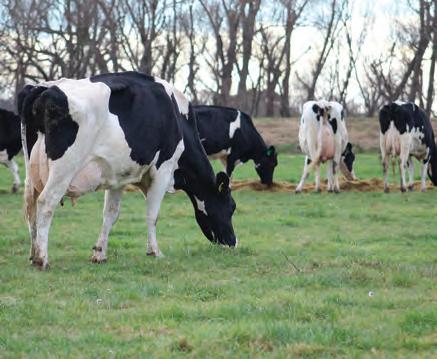
THE SUBDIVISION and sale of the Rangiora’s Coldstream Estate in 1921 was advantageous for not one, but four Canterbury familiesbut one in particular has become synonymous with outstanding Holstein Friesian cattle.
The Robinson, Stalker and Tull families were the successful bidders at the auction held at the
Choral Hall, Christchurch, where the Coldstream Estate – described in the newspaper as “undoubtedly one of the finest blocks of dairying and cropping land in New Zealand” – went under the hammer.
However, two years later in 1923 Arthur and Janet Stewart became the owners of 49 acres (19.8ha) of this fertile land, just south of the Ashley River.
Arthur tried his hand
at growing crops, but they kept getting washed out. Janet tried her hand at milking cows, with much greater success; the farm started supporting a herd of black and white cows in 1929.
Although they weren’t pedigree Holstein Friesians at that point, they did well to turn a profit. Arthur was even the first farmer in the district to put in spray irrigation, in the 1930s.
Arthur’s grandson and current farm owner Graham Stewart says irrigation has been key to the success of the farm.
“The land is very good at growing grass in the summer,” he says.
Arthur’s son Gordon
founded the Cresslands stud in 1953, with the purchase of his first pedigree Holstein Friesians: from the Royal Oak herd of DB Robinson of Waikuku, the animals carried strong Rosevale and Elmwood bloodlines. Foundation cattle also came from DB Mehrten’s Weir Bank herd at Oxford, also carrying Elmwood genetics. Gordon had been encouraged into pedigree stock by Cecil Humm, from whom he purchased a part of the Glenhope property 20 years later.
Gordon also used Supplementary Register females to build up his herd.
Gordon was passionate about
dairy industry matters and was considered a key contributor in the overhaul of the classification system.
At the time of his HFNZ Council presidency in 1989-1990, negotiations were underway with the dairy breeds and Livestock Improvement Council to emphasise the importance of animal conformation when it came to sound, longproducing stock.
Gordon, Brian Knutson and Brian (Buster) Burton worked with these organisations and from their discussions, the TOP system - now largely accepted by the dairy industry and breed societies - evolved.
After slowly becoming
GRAHAM STEWART says the farm and business have seen many changes over the years.
“Technologically, things have changed dramatically – we now have collars and drafting that help pick up sick cows and draft them for mating,” he says.
“And the tasks we used to do by hand – cutting hay, forking silage – we just couldn’t do now, with 500 cows. Isn’t technology a wonderful thing!”
Farm infrastructure has changed. In addition to irrigation upgrades – the farm now utilises three centre
pivots, as opposed to hard pipes – they are on the third milking shed in 100 years, a herringbone.
But Graham says the biggest change has been in cow numbers.
“When I started working on the farm we had 120-150 cows, and that was a big
increasingly responsible for the day-to-day running of the farm, Gordon’s son Graham took over the farm in around 1988 – and it has grown exponentially in the time he has been at the helm.
Today, Graham and wife Nicky milk 500 cows on a 140ha milking platform, having increased cow numbers by 20% with the addition of part of the neighbour’s farm last season.
The herd is split calved, with 300 milking in the winter and 500 over summer.
The day-to-day running of the dairy side of the business is
herd,” he remembers.
“Now, a 500-cow herd is an average herd.”
Another change has been the advancement of genetic technology.
“We’ve probably had access to worldwide genetics for 30-plus years, but it’s so easy now,”
split between Graham, son Andrew and the farm’s manager. Andrew spends most of his time managing tasks such as feeding out, fertiliser, the run-off block, maize, crops, re-grassing and irrigation.
Graham uses all North American genetics over the herd, focusing on breeding a complete cow that is good looking and efficient; a true-type quality that has been at the front of the family’s breeding strategy since Gordon established the stud.
While the ‘T’ and ‘P’ families are an established part of the herd, none have flourished quite so much as the ‘D’ family, which can be traced back to the first Herd Book, with a cow named Milkmaid of Brundee. Andrew also enjoys taking stock to local and major shows, including the Holstein Friesian South Island Championships, gaining much pleasure and satisfaction in the showring.
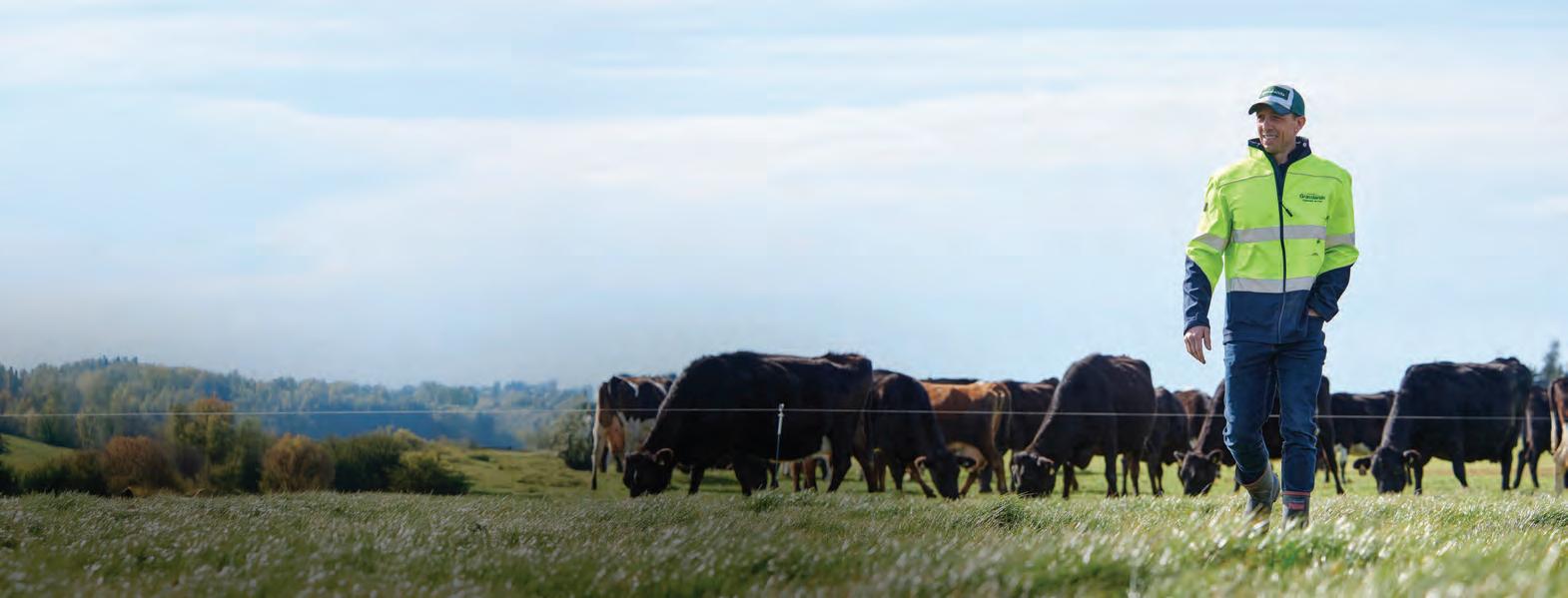
Fonterra is focused on delivering sustainable returns back to our shareholders, through investment into new capacity, growing food service and really turning the dial up on ingredients.
“We’re not just producing milk together, but we’re building a future for our people, our land and our communities.”
Grasslands CEO Simon Le Heron
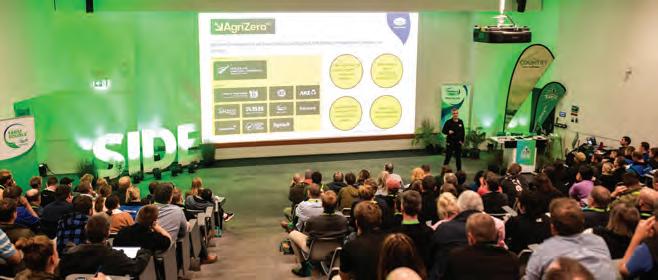
SOUTH Island Dairy Event (SIDE) returns to Lincoln University next month.
With the theme “Empowering Tomorrow’s Leaders to Turn Knowledge into Value”, the three-day event will be held from 13-15 April.
Organisers says SIDE continues its proud tradition as New Zealand’s leading dairy conference, run by farmers, for farmers.
Over three energising days, attendees will take part in 10 interactive workshops designed to spark conversation, challenge thinking and drive innovation.
The programme also includes a dedicated field trip visiting an apple orchard and a new dairy conversion, alongside three keynote speaker sessions.
A highlight of the event will be the Legends and Leaders of Dairy
keynote session, bringing together respected dairy farmers Colin Glass, Leonie Guiney, and Will Grayling. All at different stages of their wealth journey, they will share what’s worked, what’s changed, and what still holds true, while challenging the idea that “it was easier back then”. Attendees will gain practical, relevant insights for every age and stage, along with alternative thinking and enduring principles of wealth creation.
“The power of SIDE lies in its authenticity,”
says Tom Chapman, event committee chair.
“Farmers speaking directly to farmers in our interactive workshops creates a dynamic where theory translates into practice right before your eyes.”
The 2026 event further highlights SIDE’s focus on developing leadership within the dairy sector. The event is organised entirely by an event committee of industry leaders who are actively progressing through roles such as equity partnerships, contract milking and farm
management, bringing real-world experience and fresh perspective to the programme.
“They’re very goal driven and a really exciting group to be around. I’ve certainly learned a lot from them already. It’s going to be a conference that will really appeal to their colleagues or others in a similar position” says SIDE governance group chair, Glenn Jones.
“It is very much an event for our future generation and future leaders, organised by our future leaders.”
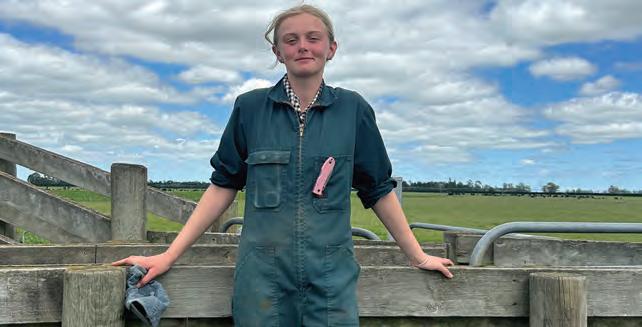
THE SOUTH Island Dairy Event’s BrightSIDE has named Jessica Kilday as the recipient of the BrightSIDE Scholarship, recognising her commitment to furthering her education and future career in the New Zealand dairy industry.
Kilday is currently studying towards a Bachelor of Agriculture at Lincoln University and has recently completed her second year of study. She will begin her third and final year in 2026, where she plans to tailor her degree towards the dairy sector.
“The Bachelor of Agriculture has been a great degree so far, as it’s allowed me to study across a wide range of agricultural disciplines,” says Kilday. “I’ve gained exposure to animal husbandry, soil management, plant sciences and farm systems management, which has really helped shape where I want to head next.”
With her final year largely made up of elective papers, Kilday is focusing on courses that will strengthen her knowledge and practical understanding of dairy farming systems. She intends to enrol in Dairy Production Science and Pasture Agronomy, which she believes will best prepare her for a career in the dairy industry.
“These courses will help me better understand both animal performance and pasture-based systems, which are so critical to our farming model.”
The BrightSIDE Scholarship has been established as part of the BrightSIDE programme to extend its impact beyond the one-day BrightSIDE event. It reflects SIDE’s commitment to investing in the next generation of farmers and agricultural leaders.
The BrightSIDE Scholarship is open to past BrightSIDE attendees pursuing further education or training in agriculture, including those entering university-level agricultural study, beginning a career in the dairy industry through a recognised training provider, or upskilling as a working farmer through a high-level course. Successful applicants may receive funding of up to $3,000 to support their education or training. Applications open later in the year.
THIS YEAR, the South Island Dairy Event (SIDE) has taken a fresh approach, stepping away from the traditional trade stand format to instead partner with organisations that genuinely support and invest in the future of the dairy industry. As part of an updated strategy, SIDE has also refreshed its mission to “inspire and empower the next generation
of leaders in the South Island dairy industry”.
Registrations for SIDE 2026 are now available at www.side. org.nz, along with full details of the programme and workshops. FRESH
CHECK OUT OUR
Event partners including Fonterra, LIC, BNZ and DairyNZ will play a key role in the 2026 event, bringing their expertise, insight and commitment to farmers to the forefront.
Glenn Jones, chair of the SIDE governance group, says he is excited
to have these organisations on board and looks forward to working closely with partners who share SIDE’s values and have both SIDE and the long-term success of the dairy sector firmly in their sights.
“I want to build a degree that gives me a strong foundation for working within the New Zealand dairy industry,” she says.
This year, BrightSIDE will be held on 1 April 2026 at Ashley Dene Research Development Staton near Lincoln, and is targeted at those considering a career in the dairy industry - particularly Year 11-13 students, school leavers, university students, and anyone looking for a change in career.
BrightSIDE registrations are now open – visit www.side.org.nz for more information or to register.

DairyNZ partners with SIDE to stretch your levy further. It’s where South Island dairy farmers and professionals come together to share ideas, navigate change and strengthen their businesses.
Learn more about our partnerships at From business strategy to environmental and practical know-how, SIDE delivers.
dairynz.co.nz/partnerships


WATER MANAGEMENT
is an integral component of sustainable farming practices, according to Watermetrics.
The company provides equipment, servicing and data management to ensure best use of water.
Watermetrics gathers a large amount of data from many sensors such as water meters and soil moisture probes, right throughout New Zealand.
“If you want to monitor it, we can customise a solution,” the company says.
“A range of sensors for a range of solutions. From grain to rain, wind
and weather, if you want to monitor it, we have the solutions to measure it.
“We have clean water solutions, as well as effluent monitoring, and easy to use data for farm environmental planning to keep you compliant.”
Watermetrics now offers the new Axioma meters for stock water and other smaller pipe flow measurement. These fit 15mm to 50mm piping, can be self-installed and can transfer the data to internet portal and phone app. Standard meters on this size piping have been till now very expensive and the company says
the Axioma range makes a first to the market, cost effective solution.
The company says these meters are effective for supplies to houses and apartments but also play a significant role on farm. Assisting with leak management.
“Water meters are a valuable tool for monitoring stock water use on farms and rural properties.
“By accurately measuring the volume of water flowing through a pipeline or supply system, they allow farmers to understand how much water livestock are con-

suming and help identify potential losses within the system.”
One major advantage of using water meters is improved water management, the company says.
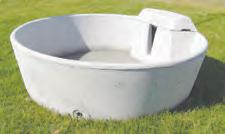
Livestock such as cattle and sheep require reliable access to clean water, and consumption levels often change depending on temperature, feed quality, and stocking rates. A water meter provides precise data on daily water use, enabling farmers to track patterns and ensure that supply systems are meeting the needs of their animals. If consumption suddenly drops, it may indicate that troughs are
empty, blocked, or that animals are not accessing water properly.
Water meters are also useful for detecting leaks and infrastructure failures.
Watermetrics says stock water systems often include long pipelines, tanks, valves, and troughs that may be spread across large areas. Small leaks in these systems can go unnoticed for extended periods, wasting significant amounts of water and having a significant financial impact.
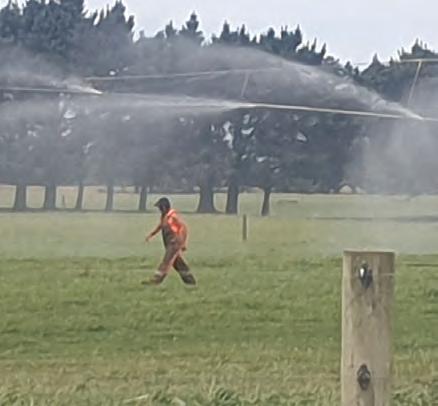
By monitoring meter readings, farmers can quickly detect unusual increases in water flow that may signal a broken pipe, faulty float valve, or leaking trough. Early detection helps reduce water loss and prevents unnecessary pumping or storage costs.

Another advantage is
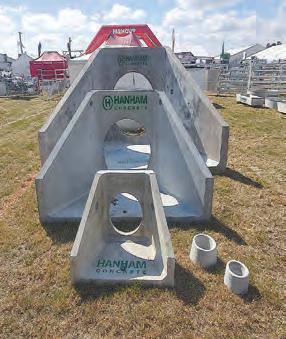
improved cost control and resource efficiency. Pumping and storing water requires energy and maintenance. When water use is accurately measured, farmers can identify inefficiencies and make better decisions about system upgrades or repairs. In areas where water supply is limited or regulated, meters also help ensure compliance with allocation limits.
Water meters provide useful records for longterm farm planning. Historical water use data can help determine whether current infrastructure is adequate for future stocking levels or seasonal conditions.
Overall, installing water meters in stock water systems improves monitoring, reduces water losses, and supports more efficient and sustainable farm management.

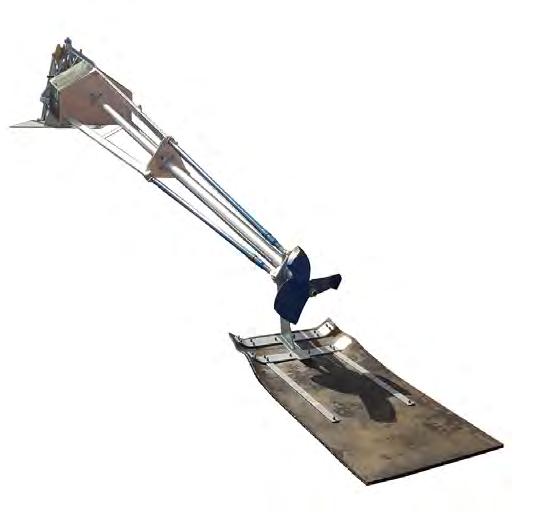
TARAUA DISTRICT
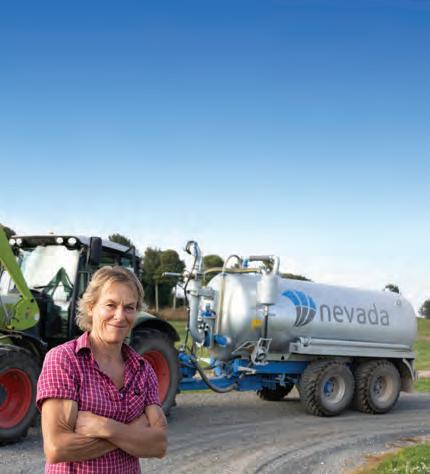
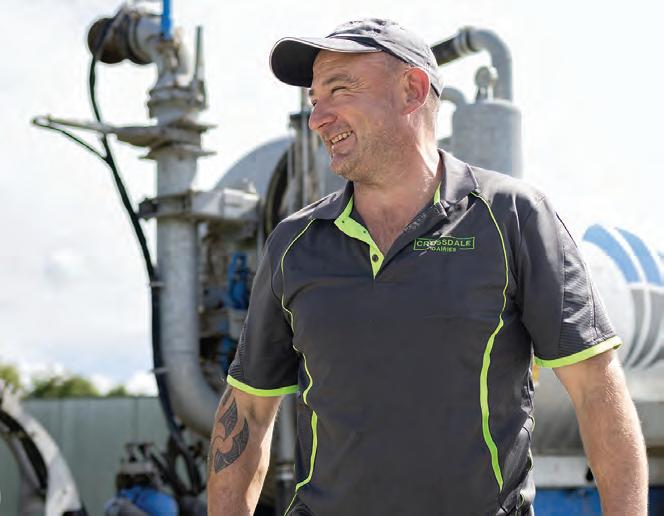
farmer Jamie Harris milks around 400 cows using a split calving system on his farm, Crossdale Dairies.
Jamie’s farm at Pahiatua sits between two rivers, so the soil is good, silt loam, and hardly a stone gets overturned when he’s ploughing a field, but they do get quite a bit of rain and not so much sun as other parts of New Zealand. They are using a System 3, but the goal is to get back to no brought in feeds. To do that they need more crops.
Taking control of costs
Jamie’s way of thinking is that he can’t control the payout each year on
his milksolids; that’s out of his hands. But what he can take control of are his costs. Rein in his costs, and he can get back onto firmer ground.
That is the plan, to make dairy farming more cost-effective by reducing his dependence on artificial fertiliser and boosting his crop production by spreading effluent.
Enough effluent to cover the farm
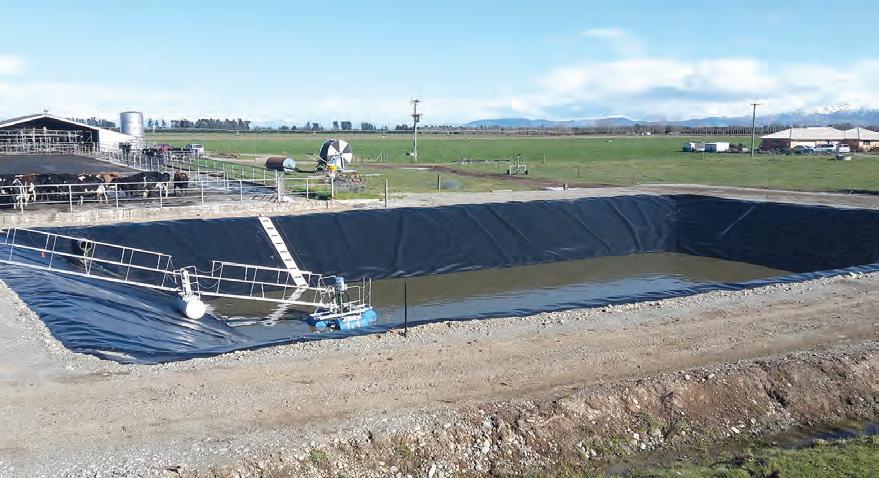
Jamie has put in place a simple effluent management system. With his system, he only needs to use one pump. He has a 40-a-side cowshed with a 1,100-square-metre feed pad. He dry scrapes into a
bunker at the end of the feed pad once the cows come out.
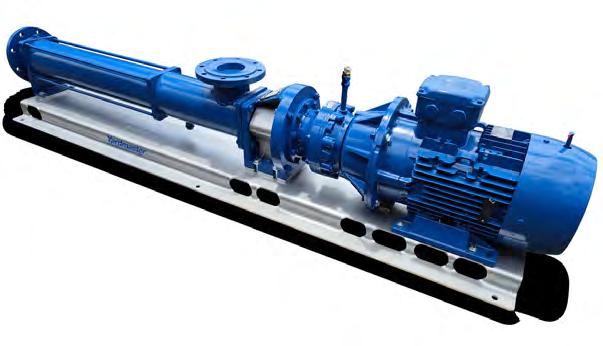
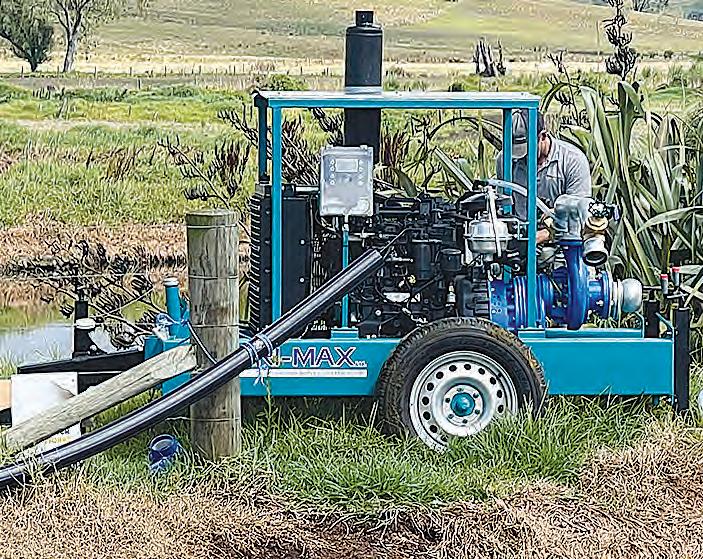
That bunker is connected to a sump, which in turn is connected to a 500,000L holding tank via an effluent pump. Gravity can send effluent back to either the sump or bunker that Jamie uses to fill his Nevada slurry tanker. You’d think that 500,000 litres is a lot of storage, but not when it rains all the time. It was a headache, but now all of that effluent is being used efficiently and spread across the whole farm for nine or ten months of the year.
Unproductive land transformed
TANKER COVERS 100% OF FARM
BEFORE THE farm had a slurry tanker, Jamie Harris says they could just cover 12 hectares with buried and fixed effluent lines and covered a further five- or six-hectares using drag hoses. Now they cover 100% of the farm, all 190 hectares.
Using the slurry tanker to spread the effluent, even the furthest paddocks are growing at the same pace as the nearest paddocks to the cowshed.
Jamie did his research and opted for the Nevada 14,750L slurry tanker with a lease-to-buy arrangement that he was very happy with.
It has tandem axles and big flotation tyres that protect the ground from getting
The
They had leased some land that had been very unproductive for a dry stock farm. The paddock wasn’t growing a lot of grass, so they decided to grow a winter crop and make better use of the land. For fertiliser, they thought the most costeffective choice would be effluent. That has been a very wise choice.
20% increase in crops
They have always grown maize and like to have about a tonne of maize per cow. Since using effluent, they have been able to grow four tonnes more per hectare than they did before. This is a fantastic result for them. A crop that gave marginal
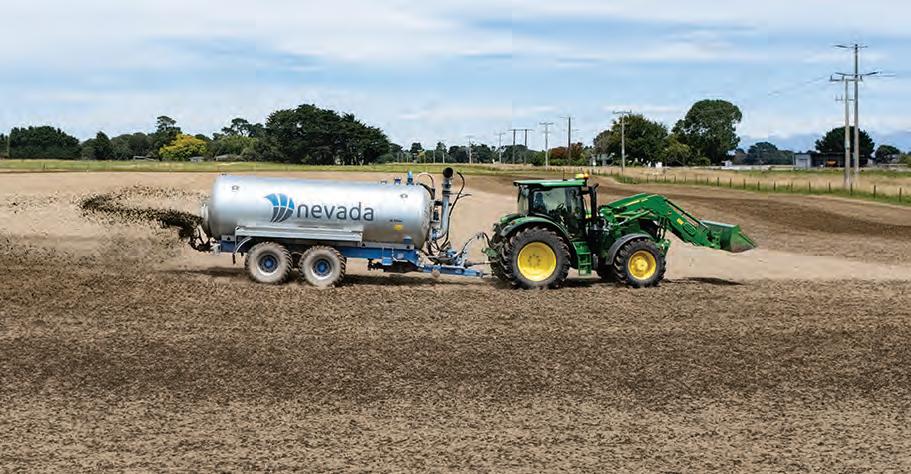
churned up. He can just sit in the cab and operate it in comfort from there, simple and clean. The auto-fill arm drops into the bunker, fills up the tanker in minutes, and he can be off spreading while his staff is washing down the cowshed. It is simple,
efficient and saved him a considerable amount of money on artificial fertiliser costs.
For him the biggest benefit is that he has been able to get nutrients to all parts of the farm. His soil health has improved, and
returns is now producing a good profit. The soil is great here but they don’t get the sun that other
farms would enjoy. They have gone from producing 20 tonnes per hectare to 24 tonnes per hectare and
they have done that two years in a row and that growth is down to the effluent.
crop production has been his biggest surprise. He has saved thousands in artificial fertiliser costs, and his plan to become self-sufficient is well underway. His recommendation is, do your research, and it will quickly point you to a Nevada.
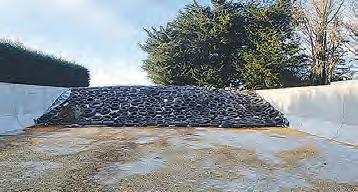
• Cost competitive
• Utilise your existing site
• Control contamination and gas
• 20 year material warranty
• Reliable seam testing
• Proven performance
• Full QA report

IRRIGATION NZ is warning that the government’s Resource Management Act (RMA) reform risks falling short of its objectives unless water use for food production and water storage infrastructure are clearly recognised in the goals at the top of the new system.
In a comprehensive submission on the Natural Environment Bill and Planning Bill, IrrigationNZ emphasises that how the goals are framed will determine how the entire regime is interpreted - from national direction through to regional plans and consent decisions.
“The goals are the lens through which everything else will be read,” says chief executive Karen Williams.
“If water use is framed primarily as something to be constrained, that signal will flow through the whole system. The legislation must clearly reflect that while water must be protected, it must also be responsibly used within
“If water use is framed primarily as something to be constrained, that signal will flow through the whole system.”
environmental limits.”
Williams says IrrigationNZ wants to see water storage and distribution infrastructure explicitly
recognised alongside other essential infrastructure.
“Transport and energy networks are clearly recognised as
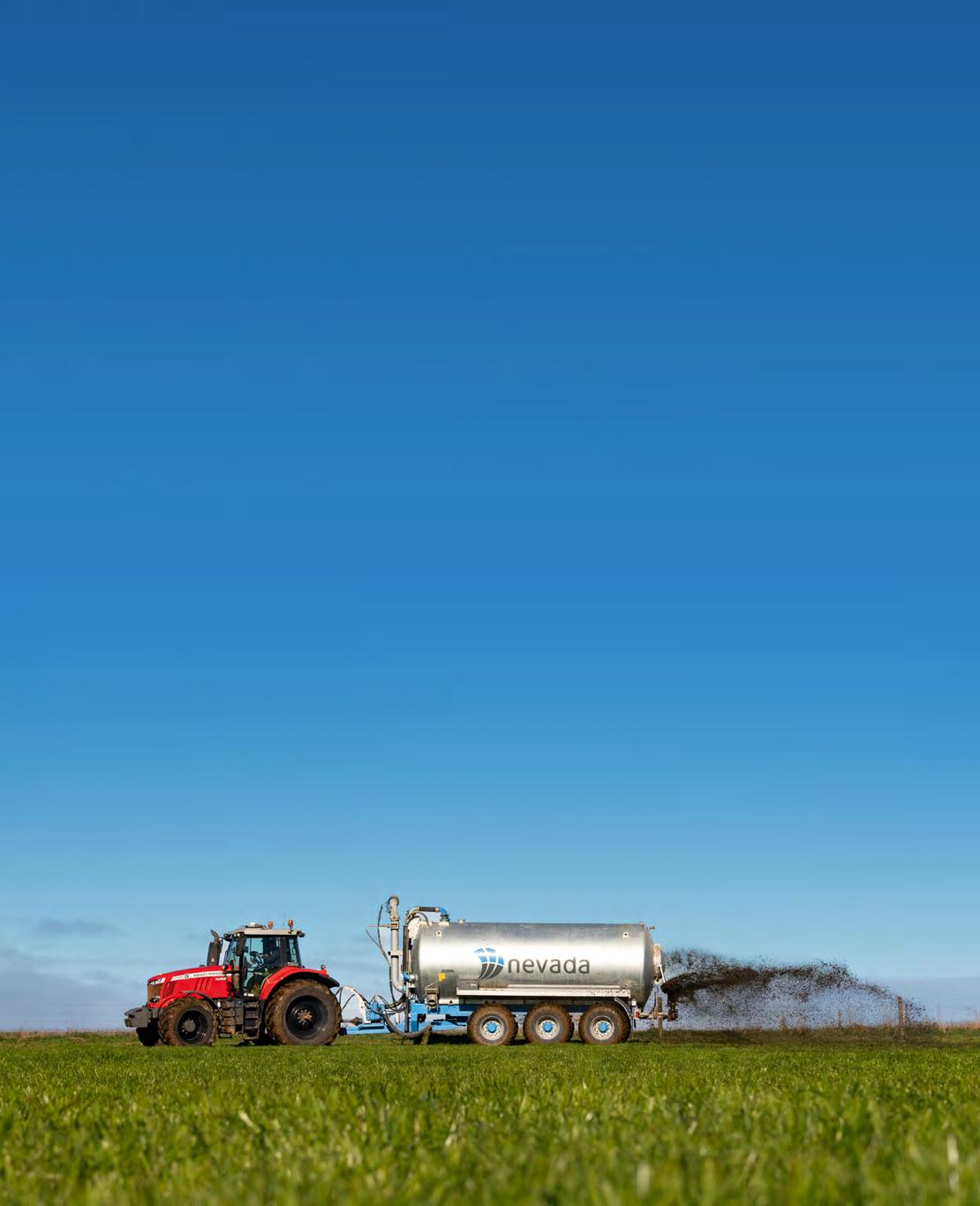
Order a new Nevada Tandem or Triple Axle Slurry Tanker by 30 APRIL 2026 and we’ll include a FREE Nevada TurboStirTM 5000 PTO Pond Stirrer.
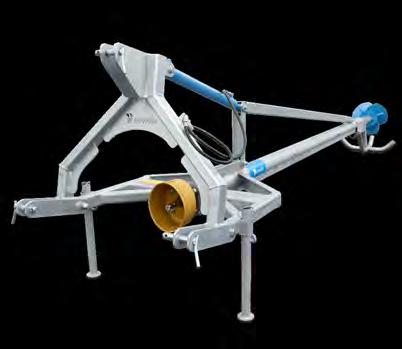
Offer valid on orders placed for stocked new Nevada Slurry Tankers (Tandem and Triple axle units only) by 30th April 2026. Limited stock available. Bonus item is a Nevada TurboStirTM 5000 PTO Pond Stirrer (valued at $9,490+GST). Not valid in conjunction with any other offer. Terms and conditions apply.
essential, long-lived infrastructure. Water infrastructure deserves equal recognition. These are multidecade investments that underpin food production, regional economies and community resilience. If we want water in the right place at the right time, that enabling infrastructure must be written into law.”
Without storage and distribution systems, water cannot be captured when abundant and made available when scarce - limiting
New Zealand’s ability to manage flood risk, support environmental flows during dry periods, and maintain consistent food and fibre production.
While IrrigationNZ supports reform that delivers clarity, simplification and stronger environmental outcomes, the organisation says the legislation must actively manage economic and community benefits within environmental limits - not treat them as secondary considerations.
THE IRRIGATIONNZ submission also raises concern that significant operational detail has been deferred to secondary legislation and future national direction, alongside broad regulation-making powers.
“Too much of the ‘how’ is missing,” says chief executive Karen Williams.
“Without clearer guardrails in primary legislation, future changes could materially shift how water is managed without full scrutiny. That undermines confidence for longlived infrastructure and intergenerational investment.”
IrrigationNZ represents nearly 5,000 members nationally, including irrigation schemes, irrigated food and fibre producers, and infrastructure operators responsible for billions of dollars in assets.
“For our sector, certainty is not a nice-to-have - it directly affects food security, regional resilience and investment decisions that span decades,” says Williams.
“We support reform. But the goals must embed balance at the top of the system. If they don’t, the reform will not operate as intended.”
Williams says New Zealand has a strategic advantage in water, but only if it is managed with foresight.
“Water is one of New Zealand’s shared strengths. Protecting it and using it responsibly are not competing ideas. They must sit together in legislation. If we get this right, the reform can deliver the balanced outcomes New Zealanders expect.”
INGER VOS
A DRAIN is sometimes considered a negative word associated with depletion, exhaustion and loss of resources.
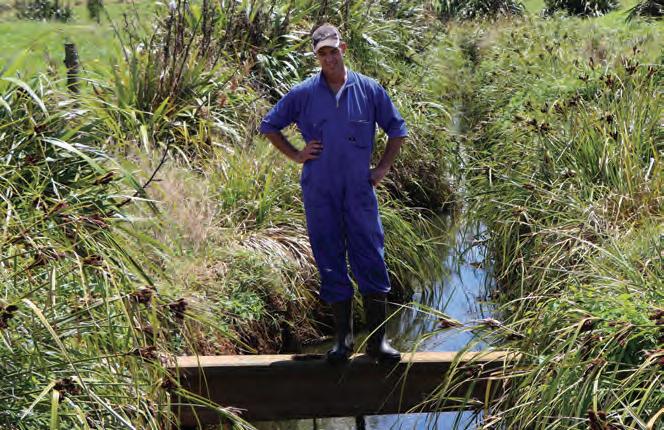
It’s a word that Johan van Ras no longer uses on his Te Pununga dairy farm, which lies in the Waihou-Piako flood management area.
“It is not a drain,” says Johan, who is constantly looking for ways to make environmental improvements on his land, including to water quality and native habitat.
“It’s a managed waterway that has been straightened for the function to remove water, but it’s an actual stream with wildlife in it.”
Johan is one of 14 landowners involved in Waikato Regional Council’s Thames Valley channel diversion planting programme that was started in 2024 to address the significant bank erosion and slumping that occurred in the Waihou-Piako land drainage network during heavy flooding in 2022/23.
The council received $1.08 million from the Regional Infrastructure Fund, administered by Kānoa Regional Economic Development & Investment, towards the $1.8m programme to help improve the overall performance of the Waihou-Piako flood protection scheme.
Work includes reshaping about 15km of drains and planting them out in bankbinding native sedges (Carex) so they can effectively clear surface water from farmland without introducing high sediment loads to the Piako and Waihou river systems.
Previous trials by the council and other organisations show benefits of reduced maintenance requirements (weed spraying and mechanical excavation) and improved water quality (greater clarity, cooler
temperatures and higher dissolved oxygen levels).
“It’s the right thing to do,” says Johan, who himself heeded the research and planted sedges along one of the drains on his property (the Te Puninga Stream) before taking part in the council’s programme to plant out the rest.
“I used to call them drains, and they were filled with weeds, their banks eroding. I had posts that fell in, I had cows fall in – they’d graze hard up to the stream.
“We were part of the drainage network process of spray, dig, spray, dig, to control the weeds and to dig out the layer of sludge that would build up. This would then expose the banks and if a large flood came through, they’d collapse.
“Now, I can just forget about it.”
Johan says the New Zealand sedges grow fast and “are insane at holding the banks together”, but they also create shade which suppresses weeds and cools the water for native fish species eDNA monitoring on his property has revealed banded kōkopu and shortfin eels, and Johan is waiting for the return of longfin eels and kōura from his restoration efforts.
“There is life here now in an area that was once unproductive and had no native habitat values.
“Now we have kōkopu, eels, inanga, birds; you can hear the insects. It’s awesome.”
Waikato Regional Council Integrated Catchment Management director Greg Ryan says the Thames Valley channel diversion planting programme is an example of how the council considers nature-based solutions, where feasible, as part of its flood protection maintenance and renewals programme.
“We take a whole catchment approach to support our core business of managing water, so that includes planting to reduce erosion and
sedimentation and improve water quality and habitat and replacing or upgrading pump stations with fish-friendly ones.
For some of our big flood management projects,
we’ve also created wetlands and water refuges for native fish species.”
• Inger Vos is a communications partner at Waikato Regional Council.
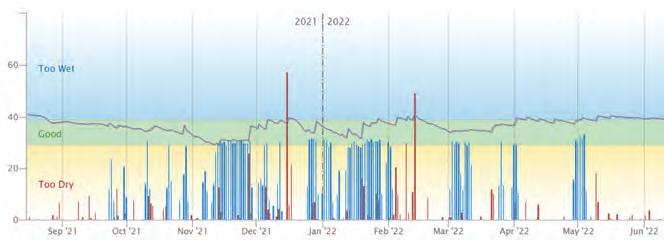
Your Farm Water Data With:
• Tailored Solutions
• Accurate data
• Action Alerts
• Mobile Friendly
• Blue Tick accreditation ✔
• Clean water setup and monitoring
• Suitable for FEP
We connect your data to give a real basis to use water
• Correct irrigation
• Tank and pond levels
• Soil moisture Analytics
• Climate station
• Good Value... cost effective data
• Easy setup and easy to use
• Uncomplicated presentation giving simple farm management decisions
• Saves staff time
• Nationwide service and backup
• Trusted leader provider of water measuring systems
• Reliable leading global equipment
• Industry expertise designed for and by agri people
to us about:
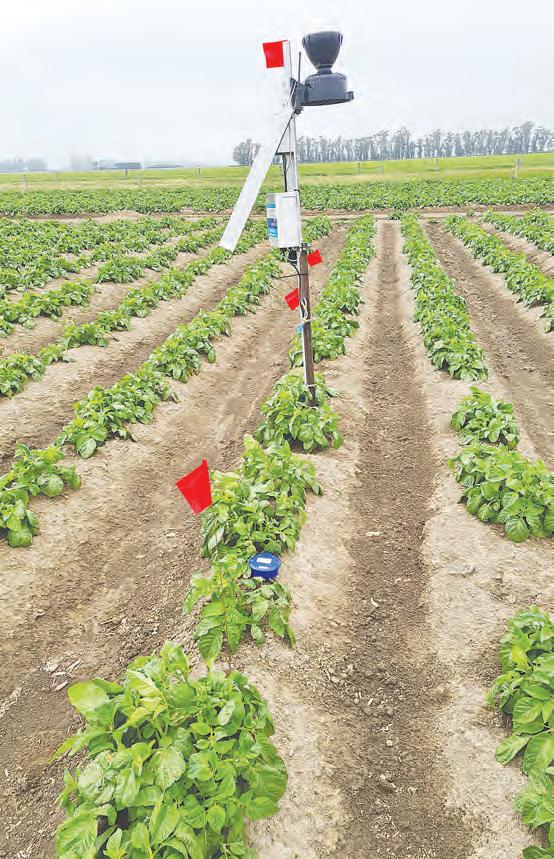
WITH THE forage maize harvest started in Northland and the Waikato, the Foundation for Arable Research (FAR) is telling growers of later crops, or those further south, to start
checking their maize crop maturity about three weeks prior to when they think they will start silage harvesting.
Good quality maize silage is best made when whole plant dry matter is between 30-40%. If harvested at less than 30% dry matter, the silage stack will be too
wet, resulting in stack leachate, which in turn, represents nutrient loss. In contrast, if dry matter is above 40%, stack compaction and air exclusion will be much more difficult, typically leading to aerobic bacterial losses.
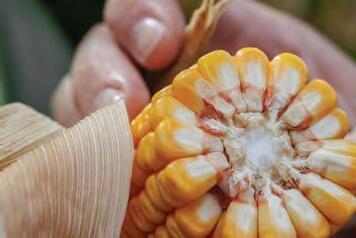
An important maturity indicator is the
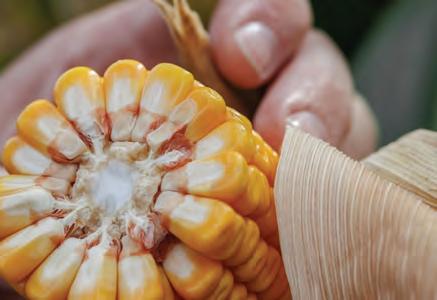
maize kernel milk line, where the milky liquid changes into the harder darker starch line. By snapping a cob in two and examining the upper portion’s kernels, the milk line can be easily seen. When the milk line is one third of the way up from the bottom of the kernel, the plant is in
the 28-32% DM range. Milk line is only indicative that harvest time is near and there are other indicators needing consideration. In-field estimation of crop DM requires considerable experience, which most contractors and technical advisors have experience in

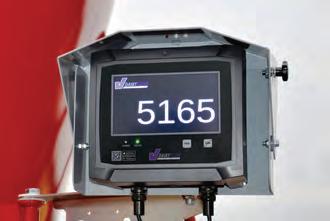
Digital Feed Management tool for daily use.
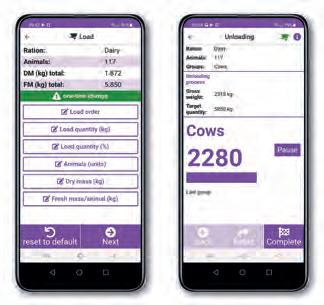


• Ability to split your herd into different groups and create a specific feed mix based on each feed source for each group based on their nutritional requirements.
• Visual display of remaining quantity required for each feed source, mixing order and mixing time for each feed source.
• Visual display of remaining feed mix quantity to be fed out.
• Track on farm inventory to ensure you never run out.
• Preset inventory list or tailor the list to your own feed sources.
• Easily adjust dry matter and cost for each feed source.
• Ability to run multiple reports e.g.
» Feed cost per group
» Total inventory used
» Feeding accuracy
» Feed Conversion Efficiency (FCE)
• Ability to integrate with other farm management software.
• Ability to set up user permissions and system setup for individual users eg Farm Manager, Farm Worker, Nutritionist or Vet.
harvest scheduling and can offer advice on harvest maturity.
As the maize harvest season proceeds, North Island Velvetleaf coordinator Sally Linton reminds farmers, growers and contractors that machinery hygiene is critical in the prevention of the spread of unwanted weed pests including velvetleaf.

MARK DANIEL markd@ruralnews.co.nz
AS THE agricultural machinery market shows signs of recovery after a difficult two years, manufacturers are continually looking at new additions to maintain turnover.
Handling specialist Bobcat has been looking at such opportunities by transitioning into the footwear market with a range of safety boots, made under license by Overland Shoes.
Marketed through the Bobcat Safety Footwear brand, the five series are named after iconic American industrial locations.
The Forge is said to deliver ladder grip technology; the Keystone offers heat-resistant protection when welding; and the Bastion heavy-duty boots are for the most demanding applications. Other models include the Delta and Summit options.
With many jobs requiring prolonged standing on hard surfaces, which can lead to heel pain, all models feature Redback’s leaf-spring technology, which actively disperses pressure, reducing strain across the foot to stop pain before it starts.
The collection includes 14 styles across both men’s and women’s fits, with industry appropriate safety ratings. Most designs are 100% metal-free construction, with composite safety toe caps and puncture-resistant midsoles., alongside selected models also featuring a quick-release system for fast, secure fastening.


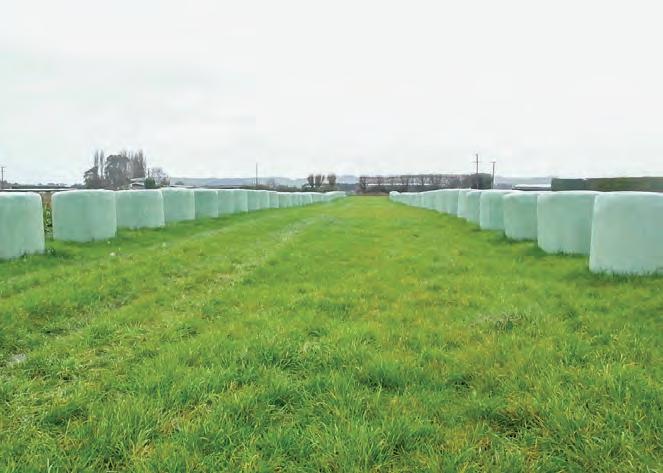
WRAPPING BALES
preserves forage quality, but its evolution over close to fifty years has seen the development of practical solutions to solve problems that arose.
In the late 1970’s, Lloyd Forster, a hill farmer from Northumberland, UK, was keen to look for a new solution for
storing winter feed, as the topography of his farm and continual wet conditions, made hay making unfeasible.
At this time, the concept of using plastic bags to conserve wilted grass was becoming more common, addressing the problem of air ingress into the conserved material. The method offered flexibility and the
option to store more feed for the winter months.
Bags were tied at the opening to keep them air-tight and allow the fermentation process to begin. While the process offered benefits, silage bagging was very labour intensive, while levels of moulds and spoilage were also fairly high, as the bags were generally inconsistent in quality,
so far from perfect at keeping air out.
The concept of mechanically wrapping grass, emerged from Australia, where industrial plastic films were being used to wrap paper for the newspaper industry. Forster visited Australia and met with Ken Williamson, where the duo recognised the potential to use similar
wrapping technology for grass, given that the newsprint reels were a similar size to the grass being conserved in bags.
Approaches to potential manufacturers, saw an Australian company create the first
“balewrapper” design, which was imported into the UK. It proved popular, so the duo looked to develop the concept further, eventually selling the rights to Underhaug (part of the Kverneland group), who manufactured a new bale wrapper, capable of applying 500mm rolls of plastic film and marketed by Volac International Limited.
film, which increased the speed of wrapping, and the introduction of square bales. This began with retrofitting kits to the Kverneland round bale wrappers, before a purpose-built square wrapper, with satellite wrapping arms, was introduced.
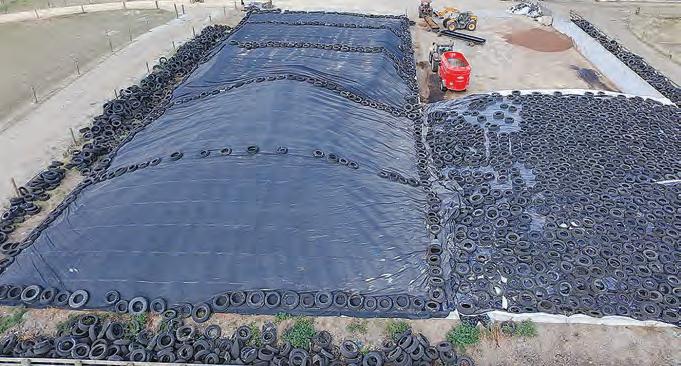
•Nationwide Firestone trained and
installation contractors.
•Future proof - dependable performance, 50 year life expectancy even when exposed, 20 year Firestone material warranty.
• No daily shifting of tyres • 10 year UV warranty



At the same time, Forster approached several firms to manufacture a suitable plastic film to use with the bale wrapper.
Bonar Polythene Films developed the first multilayer blown silage film, under the Silotite brand.
By the early 1990s, bale weights had nearly doubled, while the introduction of net wrap to bind the bales made the process faster. This was achieved by removing the need to wait for 14 rotations to bind with string, as net wrap could be applied in three rotations.
The early 1990s also brought developments, such as 750mm rolls of
Later in the decade, following on from wrappers towed by the baler, the launch of combi-balers, resulted in a machine that could form and wrap the bale in a self-contained unit. By the 2000s, mini-wrappers were introduced for the equine market, wrapping small square haylage bales with 250mm and 360mm stretch film.
By the turn of the decade, the idea of binding the bale with film rather than net started to gain traction. Balers could be retrofitted with film binding kits, until eventually the leading manufacturers provided “film on film” balers from the factory that today is offered by almost all OEMs and considered the gold standard for silage production.

AGCO POWER, part of the AGCO corporation, has won Diesel Engine of the Year with its Core80 Engine.
The award recognises engines that combine technological innovation, efficiency, performance and emissions compliance, highlighting solutions that significantly influence the global offhighway powertrain market.
One of the world’s leading developers and manufacturers of engines for off-road machines, it produces powerplants for AGCO’s Fendt, Valtra, and Massey Ferguson brands, as well as other off-road machines, including forestry equipment.
Developed and manufactured in Linnavuori, Finland, the engine is said to represent the most advanced technology in AGCO Power’s new Core engine family, with the company noting that its architecture also supports future powertrain technologies, including hybridisation and alternative fuels such as hydrogen.
The development and manufacturing of the CORE engine family has been a company-wide effort at AGCO Power, with close collaboration between production and engineering. As an example, engines developed together with Fendt saw the low RPM Core engines delivering high performance with low noise and exceptional drivability.
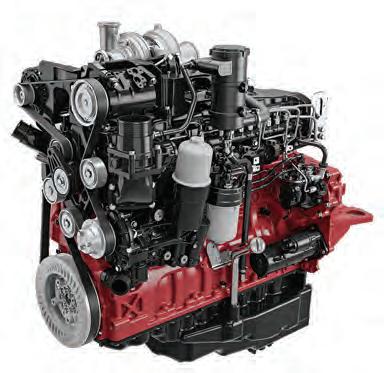
According to AGCO Power, with up to 1680Nm of torque, the Core80 is the most powerful engine in the family. Steel pistons and a variable geometry turbocharger (VGT)
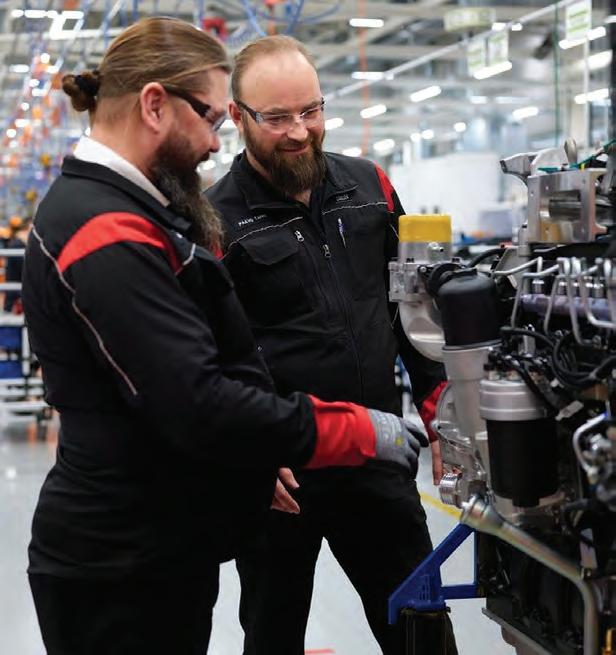
With up to 1680Nm of torque, the Core80 is the most powerful engine in the family.
deliver rapid response, strong engine braking and improved efficiency.
When deciding the winner, Powertrain International editor in chief Fabio Butturi, said, “Core80
represents exactly the kind of technical courage and innovation we wanted to highlight.”
While the Core80 is yet to be tested by the independent DLG institute, Core50 and 75 engines have proven to be the most fuel efficient and lowest emission machines in their class. www.agcocorp.com