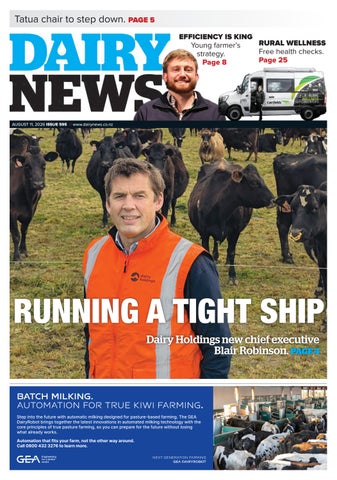
Tatua chair to step down. PAGE 5 EFFICIENCY IS KING RURAL WELLNESS Young farmer’s Free health checks. strategy. Page 25 Page 8
AUGUST 11, 2026 ISSUE 595 // www.dairynews.co.nz
RUNNING A TIGHT SHIP Dairy Holdings new chief executive Blair Robinson. PAGE 4
Are you milking canola meal for all it’s worth? Canola meal is a premium protein source for dairy cows, supporting milk solids production through: Improved metabolizable protein efficiency Higher and more persistent milk yield Increased dry matter intake and maintenance of cow condition Canola meal is a valuable source of rumen undegradable (bypass) protein, supplying highly digestible essential amino acids to the small intestine. Its amino acid profile is well aligned with milk protein requirements, with comparatively high concentrations of methionine, a key limiting amino acid in high‑producing dairy cows. Diets containing canola meal have been consistently associated with improved efficiency of metabolizable protein supply, increased dry matter intake and enhanced milk yield. Cargill’s canola meal is available through your local feed supplier, with non‑GMO options and sustainability credentials available where required. For more information about canola meal visit www.cargill.co.nz.
DAIRY NEWS AUGUST 11, 2026
NEWS // 3
Hursts go the milk whey PETER BURKE peterb@ruralnews.co.nz
Business prize for Otago farmer. PG.15
FEDERATED FARMERS president Colin Hurst
More days in milk. PG.21
Jimny’s special edition. PG.26
NEWS ����������������������������������������������������������� 3-10 OPINION ����������������������������������������������������12-13 AGRIBUSINESS ��������������������������������������������15 MANAGEMENT ����������������������������������������16-17 ANIMAL HEALTH ������������������������������������18-19 MATING MANAGEMENT ������������������� 20-22 MACHINERY & PRODUCTS ��������������������������������������������� 24-27
and his family raised a glass of milk last week to toast the start of a new addition to their farming operation at Makihihi south of Timaru. Colin, his wife Janis, son Nick and partner Alice took over a dairy farm right next to their established arable operation in June and last week a Fonterra tanker arrived to pick up the first milk from their new dairy farm. The 600-cow operation is based on a 260ha effective platform, a mere fence away from where they grow wheat, grass seed and turnips. The Hursts already have a 700ha property of which 450ha is cropped and the remainder is devoted to grazing their own and other farmers’ cattle. Colin Hurst says the purchase of the dairy farm was part of the family’s succession planning and will enable son Nick and partner Alice to have a stake in the overall business. He says he grew up looking at the dairy farm and is aware of challenges ahead. “It’s right next to the sea, so there are quite a few challenges with water, and the soils are heavy, which present challenges when we get heavy rains. There are also a couple of waterways that run through the farm,” he told Dairy News. Hurst says while his son and partner are 50/50 sharemilkers on the new farm, they have employed a contract milker which enables Nick to continue to be involved in the family’s arable property. He says there is potential to increase production on the new dairy and integrate in with the arable side of the business. “On our arable farm, we have always grazed
Federated Farmers president Colin Hurst and his wife Janis toast the first milk pick up from their new farm.
cattle and dairy cows and at one stage even sheep. But now we can graze the cows from our dairy farm on the arable land, and it also means we will be able to rear calves, and we know that we will have a market for our grain. So, there are now significant synergies for both sides of the operation,” he says.
Hurst says he’s always been keen to have young people on the farm, and this latest move is all about succession planning and keeping the family business going. Hurst took over as Federated Farmers president in June this year after serving three years as vice president.
Premium stockfeed STOCKFOODS
For New Zealand farmers
Civil construction | Aggregates | Stockfoods | Storage | Transport 0800 4 JSwap | 07 888 7025 | WWW.Jswap.co.nz
DAIRY NEWS AUGUST 11, 2026
4 // NEWS
Country’s largest dairy farmer runs tight, self-contained ship NIGEL MALTHUS
RUNNING A tight and
self-contained ship is the key to the success of the country’s largest dairy farmer, says Blair Robinson, the new man at the helm of Dairy Holdings. Robinson took on the role when the company’s inaugural chief executive officer, Colin Glass, stepped away at the end of May. He was formerly the Dairy Holdings’ chief operating officer, a role created eight years ago to help grow the business, focus on farm performance and provide for succession. From its beginnings with about 30 farms in 2001, the Ashburtonheadquartered company now has about 90 farms on its books, 69 of them dairy production and the
rest support blocks. Robinson said that as COO, he initially concentrated on the dairy farms before changes in the executive team saw him pivoting to add the dairy support farms as well. “It’s a big part of our business because we’re fully self-contained,” he told Dairy News. “We don’t go out to the market for any grazing for our young stock, or for our wintering.” Robinson said the business was very disciplined around a farming system that hasn’t changed in a long time. He added that the management was fortunate to have a group of shareholders that was very stable and took a long-term view. “We follow the pasture curve and the only feed we put on is to get our
pasture curve back to where we want it. “It’s a little bit different to many farmers who are bringing in purchased feed to make milk. We’re bringing it in to make sure we’ve got enough grass going forward.” The self-contained model helped Dairy Holdings remain unscathed by the Mycoplasma bovis epidemic and is now helping insulate the company from external price shocks. Robinson points out that many dairy farms in New Zealand buy in significant amounts of feed – and those input prices “have really jumped up in the last six months”. Robinson says it keeps things simple. “If we were running a system that was using more purchased feed,
Dairy Holdings chief executive Blair Robinson says the business was very disciplined around a farming system that hasn’t changed in a long time.
it would create more decisions to make during the season.” He said it was a matter of matching pasture supply with pasture demand and stocking rates though the year. Culls are removed early, to ensure enough
FARM OWNERSHIP GOALS DAIRY HOLDINGS currently has eight sharemilkers, 57 contract milkers and 19 farm managers (including dairy and dairy support) as part of the team. It encourages its people to build their own herds and move up through the system, with any direct company employees in areas such as finance and health and safety also able to own animals. Blair Robinson says Dairy Holdings
was very proud of the number of couples – now approaching 60 – who had come through its system and gone on to buy their own farms. “Three of our sharemilkers bought their own farms last season, which is quite incredible given land prices in Canterbury have jumped up a bit in the last 24 months.” Robinson himself is an equal partner with Mick and Kirsten
O’Connor and one other in a 278ha, 1000-cow farm at Burnham. He says the farm has very good soils and irrigation, and benchmarking with others shows the farm has “really good numbers”. But he is not hands-on, except when he comes at weekends to tackle only the “most manual” tasks. “I just get out of Mick and Kirsten’s way. They’re the real farmers.”
grass to feed the pregnant cows so they’re in good condition by the end of May, and the farm has enough grass for calving in August. “We’re never second guessing how we are going to run the farms. “All we’re trying to do is the same thing we did the prior year, just slightly better.” Robinson adds that the sector has an issue
with pasture productivity, with pasture harvested by stock on many farms diminishing, and increasing amounts of purchased feed being used. “This is and will erode New Zealand’s competitive advantage in the global market.” Robinson says Dairy Holdings has been performing well and growing, and there will
be no wholesale changes with him at the helm. The business was not just about milk but was increasingly a people business, with about 450 people now employed, either directly or through its various contractors and sharemilkers. Growing cows and grass is not easy but finding and retaining good people make it that much easier, he says.
FONTERRA SUPPLIER DAIRY HOLDINGS has recently divested itself of the remaining three Westland Milk Products supplying farms in the Springs Junction area, to consolidate operations to Canterbury, Waitaki and Southland, supplying only Fonterra.
Blair Robinson says these are the areas where the company sees further opportunities for growth. It has also been selective in buying farms where irrigation costs are likely to remain low.
SAVE 1,000 + $1,000 FREE ACCESSORIES $
2.99
*
+
*
%
P.A. FINANCE^
36 MONTHS | 10% DEPOSIT
WWW.POLARISNEWZEALAND.COM
82-HP PROSTAR ENGINE | 1,134KG TOWING CAPACITY 454KG DUMP BOX CAPACITY | ACTIVE DECENT CONTROL
MY26 RANGER XP 1000 HD NOW FROM $31,995 INC GST
*Offer ends 30/9/26 or while stocks last. Offer only available at participating Polaris dealers. Not valid with any other offer. Excludes fleet clients. ^Finance offer only available at participating Polaris Dealers and on selected models as stated and is not valid with any other promotions. Finance is provided by Polaris Finance, a program operated by De Lage Landen Limited Company No 1355515 and available for business purposes only on a Hire Purchase Agreement. Credit approval, fees, terms and conditions apply. Finance is based on a 36 month term, for full promotion details and structure please contact your Polaris Sales Representative. Offer ends 30/9/26.
DAIRY NEWS AUGUST 11, 2026
NEWS // 5
Tatua chair to step down TATUA CHAIR Stephen Allen says he leaves the co-op with a deep sense of gratitude for the people who have contributed to its success. “It has been one of the greatest privileges of my life to serve Tatua’s supplier shareholders and to work alongside exceptional directors, management, staff, customers, and industry partners over the past 30 years,” says Allen.
He steps down at Tatua’s annual meeting in December, having served as chair for 23 years and a board member for 30 years. Allen said one of the most important lessons from his career was that long-term success ultimately comes from people. “When people understand the purpose, feel trusted and are encouraged to contribute,
Stephen Allen
exceptional performance becomes the natural outcome. “Whatever Tatua has achieved has always been the result of talented people working together with a shared purpose.” Based in Tatuanui, near Morrisnville, Tatua is one of only three dairy
co-ops in the country – Fonterra and NZ Dairy Goat Co-op being the other two. During the 2001 mega-merger that formed Fonterra, Tatua shareholders voted to remain independent. Allen joined the Tatua board in 1996, became deputy chair in
1997, and was appointed chair in 2003 following the retirement of Sir Alan Frampton. During his tenure, he helped guide the co-operative through one of the most significant periods in New Zealand dairy industry history, including the lead-up to dairy sector
deregulation. Reflecting on his retirement, Allen says he leaves Tatua with a deep sense of gratitude for the people who have contributed to the co-operative’s success. Allen will be succeeded by director Mark Dewdney.
UPSKILLING AG TEACHERS PETER BURKE peterb@ruralnews.co.nz
SPECIAL COURSES for secondary school teachers to
help excite kids about agriculture and horticulture are now being run at Massey University. Part of the new science curriculum, which comes into effect in 2028, includes a focus on soil, plant and animal science. To that end Massey University, in association with the Horticulture and Agriculture Teachers Association (HATA), have been busy designing courses that will upskill teachers to cope with the new requirements of the curriculum. Leading the project to design these courses at Massey is Professor Chris Anderson, who says an exciting part of the reforms is that that ag and hort will be taught to students in year 11 and this will continue through years 12 and 13. In recent years there has been increasing demand by students for secondary schools to offer agriculture and horticulture, but one issue has been having teachers with the appropriate knowledge and skills to teach these subjects. For some time, Massey University and HATA have been developing courses for teachers and some have already been run and the aim, says Anderson, is to have a suite of seven different ones on offer. “We have already been running the soil science course and now we have two plant science and two hort crop courses, which will be offered for the first time. Then we have two animal science courses that we will have ready for next term, and finally an ag business course will flesh things out,” he says. Anderson says the courses are introductory and are based on the 100-university level. He says they are targeted for teachers so they can get some robust, fit-for-purpose development to help them provide a better teaching experience. The courses are designed to be engaging and include some short videos but don’t contain heavy technical detail. “It’s about providing the appropriate level of information the teachers would need to make them more confident when they get in front of the students, and then they are hopefully going to incentivise and excite the kids. “In the long term, this is about making kids understand that ag is a cool subject and also increase their capability when they come to the university,” he says. All the individual courses are being delivered on-line over a ten-week period with participants expected to put in about five hours work per week and fifty hours over the ten weeks.
You want gear that goes the distance.
Choose the world’s longest-lasting collars.
Make the proven choice. Not all cow monitoring systems are created equal. After 50 years of proving and improving our system on dairy farms worldwide, only Nedap can guarantee you the longest battery life available. Because we think your choice of cow monitoring should endure way beyond your initial investment. Join the global leader at Nedap-livestockmanagement.co.nz
DAIRY NEWS AUGUST 11, 2026
6 // NEWS
Co-op profit prompts rebate SUDESH KISSUN sudeshk@ruralnews.co.nz
WHEN IT comes to annual rebates, it’s been a long time between drinks for Ravensdown shareholders. Since paying shareholders a rebate of $20/tonne for the year ending May 31, 2022, the co-operative had been facing financial headwinds – caused mostly by plunging volumes. But that’s set to change. For the financial year ending May 31, 2026, Ravensdown is reporting a $50 million profit before tax, backed
by a solid lift in fertiliser demand. Fully paid shareholders will receive a cash rebate totalling $14 million or $15/tonne. Partly paid shareholders will this year receive their full rebate in the form of shares. Revenue for the year topped $917m, 20% up on the previous year. After several years of subdued fertiliser demand, improving agricultural returns, particularly for sheep and beef farmers, have supported a recovery in nutrient applications and sales volumes. Overall fertiliser sales volumes were up 8% with over 1 million
tonnes sold, compared to 962,000 tonnes sold in the previous financial year. Ravensdown chief executive Garry Diack says the co-op last broke the 1m tonne sales mark in the 21/22 financial year. He told Dairy News that it was great to pay a rebate to shareholders after three years. Diack says Ravensdown “operates inside the farmgate” of shareholders. “We are part of their cost structure. If they do well, then we do well.” He says the jump in sales volumes was matched with better efficiency within the business, enabling the
conditions to pay a rebate. Over the past year, the co-op delivered a number of targeted projects to drive performance including significant investment in manufacturing commitment, freight optimisation, improved data decision support, and automation supported by AI. “This result reflects the discipline we’ve applied across the business to become a more efficient, resilient co-operative,” says Diack. “By improving our operations, we’ve strengthened our financial performance while continuing to
invest in the products, services and expertise our shareholders rely on.” Like other importers, Ravensdown continues to face shipping disruptions and be impacted by global oil price fluctuations. But this financial performance demonstrated the value of the co-operative to deliver on its purpose in an increasingly uncertain global environment, according to Diack. “International fertiliser markets remain heavily influenced by geopolitical events. Conflict in the Middle East, the ongoing war in Ukraine and broader supply chain disruptions
Garry Diack, Ravensdown
continue to create volatility in both product availability and pricing.” Ravensdown’s longstanding relationships with global suppliers and joint venture partnership with Ravensdown Shipping Services are
valuable strategic assets that have proven their worth to the business and shareholders over the last year. “Our supplier partnerships have been built over decades,” he says.
FONTERRA STAYING CLOSE TO CHINESE CUSTOMERS FONTERRA HAS opened its upgraded Chengdu Application Centre, bringing New Zealand dairy expertise closer to customers in one of China’s fastestgrowing regions. First opened in 2015, the Chengdu Application Centre has moved to a more central location in the city’s Jinjiang District. With the upgraded facilities, Fonterra’s technical experts, chefs and customers are now better empowered to develop, test and showcase food and beverage products. Fonterra chief executive of Greater China, Teh-han Chow, says the
investment builds on Fonterra’s nearly half-century presence in China and reflects the co-op’s focus on staying close to customers in a fast-moving market. “China’s foodservice sector is evolving quickly, and our customers are looking for dairy solutions that help them respond to changing consumer tastes with speed, quality and confidence. “Through our upgraded centre, we can co-create more closely with customers, develop more relevant applications, and bring the benefits
Your Team. Your Co-op. Fonterra farmers Zara & Brandon Lawson know that the time, energy and care they put into making their milk, is met with a Co-op wide commitment to making the most of every drop of their milk.
Watch their story by scanning the QR code or visit fonterra.com/your-co-op
Teh-han Chow, Fonterra
of premium New Zealand grass-fed dairy to more Chinese consumers across Southwest China and beyond. “By bringing our technical expertise
closer to customers in Chengdu, we can better understand local needs, move faster on new ideas and help turn those insights into practical foodservice solutions.” New modern kitchens will allow customers to see how Fonterra products perform in applications such as cakes and beverages, supported by seminars, demonstrations and virtual learning sessions led by Anchor Food Professionals advisory chefs. Chengdu, the megacity capital of Sichuan province, is known for its spicy food and teahouse culture.
In 2010, it became the first city in Asia to be named a UNESCO City of Gastronomy, making it a natural place for Fonterra to expand its local investment. Alongside sites in Beijing, Shanghai, Guangzhou, Shenzhen and Wuhan, Chengdu is one of six Fonterra application centres in China. This network helps Fonterra work closely with customers to understand changing food trends, support innovation, grow demand for New Zealand milk and deliver more value for farmer shareholders.
DAIRY NEWS AUGUST 11, 2026
NEWS // 7
Trial backs plantain’s ability to cut N losses A FOUR year trial
has reaffirmed that mixing plantain into dairy pastures can help reduce nitrogen losses to freshwater while maintaining milk production and profitability, say researchers. Final results from the farmlet trial at Lincoln University Research Dairy Farm showed annual nitrate leaching was reduced by an average of 33% from 18 kg/ha/year to 12 kg/ha/year in perennial ryegrass–white clover pastures containing an average of 17% plantain dry matter, compared with pastures without plantain. The Lincoln trial, part of DairyNZ’s Plantain Potency and Practice programme, compared nitrogen leaching and production between farmlets with perennial ryegrass and white clover pastures sown with, or without, Ecotain plantain. The findings support those reported from the programme’s grazing trial at Massey University, several smaller component studies, and the aligned Low N Farmlet Trial, also at Lincoln University, that stacks plantain with other nitrogen mitigation options. DairyNZ senior project manager Kate Fransen says milk production remained consistent across both treatments. Herbage production and silage use were also similar between treatments. “The findings demonstrate that plantain can deliver environmental benefits without compromising farm performance,” says Fransen. Fransen says the nitrate leaching reductions achieved at Lincoln are more than double those predicted by current models which only account for the effect of plantain on reducing urinary nitrogen. “The high-water content of plantain dilutes the concentration of cow urine, and the nutritional makeup of plantain also causes more nitrogen to be diverted to faeces and milk, and less into urine. “We are now gaining
a better understanding of the effects of plantain on drainage and nitrogen cycling in soil which result in additional reductions in nitrogen leaching.” The programme aims to have these additional effects of plantain reflected in models such as Overseer by 2028. One of the key findings was that relatively low levels of plantain still delivered good reductions in nitrogen losses. “At the Lincoln site, we achieved consistent reductions in nitrate leaching over four years, despite plantain content plateauing to 10-15% in the final years of the trial,” says Fransen. The programme has also worked with more than 30 partner farmers in N-sensitive catchments. This has provided practical insights on using plantain, and supported understanding of the wider farm systems implications and potential catchment-scale impacts through benchmarking and modelling. Plantain is a shortlived perennial and mixed swards require ongoing maintenance through oversowing or undersowing. Partner farmers have successfully maintained 10–15% plantain content by including Ecotain in new pasture mixes and broadcasting seed annually, at an estimated cost of $46/ha per year. DairyNZ modelling indicates that achieving similar reductions in nitrogen leaching without plantain would likely require substantial reductions in nitrogen fertiliser use, imported feed and stocking rates, or significant infrastructure investment, with greater impacts on farm profitability. The benefits of plantain for reducing nitrogen leaching are recognised in regulatory frameworks in Canterbury, Southland, Waikato, Bay of Plenty and Horizons. Ecotain plantain has been used in all programme trials where leaching has been measured and is proven to be effective at farm scale. The Plantain Potency
and Practice programme is a collaborative research initiative that commenced in 2021 led by DairyNZ and funded by the Ministry for Primary Industries through the Sustainable Food and Fibre Futures fund (now Primary Sector Growth
Fund), DairyNZ, PGG Wrightson Seeds and Fonterra. Research is delivered in partnership with Lincoln University, Massey University, Lincoln Agritech and the Bioeconomy Science Institute.
The trial showed nitrate leaching was reduced in pastures containing plantain dry matter.
NEW ELECTRIC UTV This Tough Side-by-Side 3 Seater uses latest Lithium Battery Technology to offer range busting performance - up to 100km per charge. Silent, fast, very economic!
Large 10" LED Touch Screen for reversing camera, with Carplay
Full Info Screen speed, battery condition etc.
$25,850 +GST We offer full back up Service - Since 1934 • Range up to 100km per charge • Power cargo tray tipper • Electric Power Steering • 2/4 Wheel Drive with rear diff lock • Waterproof USB-C charging ports • 72v 150AH Lithium battery • Top speed 55km/hr • 3 Seater
• Charge time 5-6hrs • Power Winch • Luxury Seating • Cargo capacity 350kg • Front/Rear Disc Brakes • Gradient up to 35% • 5 year battery warranty • For off road use
• Reversing Camera • Seat Belts • Towing capacity 800kg • Full LED lights • Up to 20kw power • Large Mudgrip tyres • 2 year warranty • Towball Hitch
1 Homersham Place, Burnside, Christchurch Email: sales@irl.co.nz
Phone: 03 358 4000
DAIRY NEWS AUGUST 11, 2026
8 // NEWS
‘On-farm efficiency is key’ PETER BURKE peterb@ruralnews.co.nz
EFFICIENCY IS the big one because it tracks back into what is done on farm. That’s the view of George Dodson, the 2024 FMG Young Farmer of the year and the founder of the Canterbury Young Dairy Farmers Leaders Network. He was a special guest speaker at the recent Animal Health and Plant Association conference in Wellington, where he talked about his insights as a young up-andcoming dairy farmer. George Dodson is a partner in a 50/50 share milking operation, along with his father
and cousin. It milks 400 cows on a property at Leeston in Canterbury. As soon as he left school, Dodson began his farming career and by 20 was already managing a dairy farm. He has a great passion for the sector and in a relatively short time has emerged as leader with some valuable insights into dairy farming. He says dairy farming has always been a lowcost business and it’s his intention to keep it that way. “It’s just about managing production verses profitably. Obviously, costs are going to be tied to your production, so you will want to get as much production as you can to dilute your costs, but not for the sake of
going out and spending money. It is just about being smart about what we put in our system,” he says. Labour he says is a big cost and it’s hard in NZ because dairy farmers are very reliant on migrant labour. Dodson says the aim of his family is to run a low labour operation so that it can be run by him and his father, or him and his cousin or siblings. He says they want to get to a 600-cow farm and be able to ideally run it with just two people. One of the pathways to this is applying innovation and technology. “We are putting on Halter collars in September; that will make a big difference to our farm system. It will
enable us to run two herds of cows, which means that we should get better performance out of our animals. As well, we are utilising a new fertiliser spreader and building a new cow shed. This will allow us to just have one person to milk the cows and this, and all the innovations, will drive efficiency and reduce labour,” he says. A focus on management skills and keeping them up to date is another area identified by Dodson. He says embracing innovation and technology and such things as new pasture species are all part of a tool kit that can create a more profitable business. “I think a lot of those sustainability targets
Innovation that never stops. We’ve worked closely with calf rearers to understand what matters for them, then refined our Thriver Calf Teats - adjusting, validating, and proving every change along the way. Available in Screw-In and Pull-Through, get yours from your local rural retailer today.
Scan to learn more SKELLERUP.CO.NZ/DAIRY
Young farmer George Dodson says dairy farming has always been a low-cost business and he wants to keep it that way
are really well linked to financial and production efficiencies on the farms. For example, if you think you are losing a
heap of nitrogen on your farm you are actually losing a heap of money,” he says. Dodson says farmers
should always want to do the best for the land because in the long term it’s the land that looks after them.
DAIRY NEWS AUGUST 11, 2026
NEWS // 9
Is fork to farm the way to go? PETER BURKE peterb@ruralnews.co.nz
IN THE past, much has been made of the concept of farm to fork, but an Australian expert in food science and marketing with experience in the dairy industry, Dr Angeline Achariya, says the reverse of this slogan is critical to win modern day consumers. She says ‘fork to farm’ is the way to go, meaning that producers and manufacturers should be tailoring what they grow to the ever changing and sometimes fickle future food preferences of consumers. Achariya says clinging to the old farm to fork concept is simply a case of remaining in the pack with other producers, instead of leading the way and setting and meeting evolving
consumer trends. “It’s about moving into the valueadd space, creating new products and converting your supply chain to meet the demands of consumers. It’s about shedding the mentality of just production,” she says. Achariya says there are well known, timeless global mega trends which show what consumers are looking for. Convenience, health and price are at the top of the list. She points out that consumers are looking for food which can effectively double as a medicine and adds that they want natural things and minimally-processed foods. Achariya says sophisticated companies look at market segmentation and divide the market into generation groups to identify the ‘bullseye’ market. She notes that one of the biggest competitors of foods is pharmaceuticals and it’s
a case of producing foods that offer functionality and health benefits. “Convenience is now becoming a very important factor in consumer preference. People are busy, fewer are cooking and many modern homes don’t have kitchens or ovens – just microwaves. In some countries, consumers will pay a premium for foods that require little or no preparation,” she says. Achariya says exporters selling into China, for example, need to be aware that people there have only a small amount of freezer space, so foods need to be tailored to deal with that fact. In terms of where NZ sits in this picture, Achariya says there are some very good examples of our country being there in many of the foods it offers. Fonterra is one company that has products that meet the fork to
Food science and marketing expert, Dr Angeline Achariya.
farm criteria. Another, she says, is kiwifruit, which is both healthy and convenient. “This is all about seeing how people shop and the way they look at
food and it’s about knowing the value curve. Back on the farm it’s about creating new products and extracting the maximum value from the basic raw product,” she says.
ADVERTORIAL
Save on growing cost. Gain on yield. Located in Korakonui some 20 km south of Te Awamutu, Chris and Jude Stacey, alongside their children Tom and Stella, farm this top performing 155 hectare dairy platform with 450 crossbred cows. To ensure they have enough feed for the summer, the Staceys grow a range of crops, including fodderbeet which is a perfect supplementary feed late in summer and early autumn. Like many farms, the main challenge with growing fodderbeet is the weed burden and gaining control of it. And this is where the CONVISO® SMART System impresses Chris.
Chris explains: “I’ve been very impressed using the CONVISO SMART System. There’s no need for plant checks after the spray. It’s been very simple to use the two post-emerge sprays. The crop has been very clean, and has yielded very well, so I’m very happy with it.”
SCAN TO LEARN MORE ABOUT CHRIS STACEY
When it comes to weed control, Chris reckons the CONVISO SMART System performs well at the initial knockdown and the residual weed control. “We’ve been able to control Amaranthus or Red Root, which in the past we’ve had issues with that weed in our crop. I’ve only had to spray it three times with this system and at a reduced cost.” The herd also loves the beet and they find the grazing easy, getting the beet out of the ground with little effort and leaving very little behind – with 95% utilisation. While this is just his first year using CONVISO SMART, Chris is pretty sure it’s already paying dividends. “The system is fairly priced, with the seed and the chemistry. I think we’ve definitely saved money on our growing costs, and we’ve gained yield, so our cost per kg of dry matter grown, is lower.”
Unleash the Power of Weed Control Ask your local agronomist about our system or visit kws.com/nz
Chris Stacey, Dairy Farmer - Korakonui, Waikato
CONVISO® SMART represents the innovative fusion of SMART KWS Seeds with Bayer’s advanced CONVISO® ONE Herbicide. CONVISO® is a registered trademark of Bayer.
DAIRY NEWS AUGUST 11, 2026
10 // NEWS
Farmers urged to get ahead of nutrient plans as El Niño looms FORECASTERS advising El Niño conditions will develop through winter and strengthen into spring and summer, Ballance AgriNutrients is encouraging farmers and growers to think ahead about nutrient planning and be prepared to work around challenging weather conditions. Current forecasts indicate El Niño has the potential for stronger westerly winds, drier conditions in eastern regions and increased rainfall particularly in parts of Southland, Taranaki and the West Coast. Ballance science strategy manager Warwick Catto says while every El Niño is different, farmers should expect greater variability and fewer ideal application windows. “Whether it’s dry soils, persistent winds, or saturated paddocks, the common theme here is that nutrient application may become more difficult to time,” he says. “Farming has always been about making good decisions in the conditions you’ve got, not the conditions you’d like. This season may require a bit more flexibility and forward planning than usual.”
WITH
Daryl Crimp with his latest book, Hunting Distant Places
Hunting Distant Places: Win a copy! HUNTERS SHARE a common affliction, filtered through the generations from our ancestors: an overwhelming urge to see what lies around the river’s bend, over the next ridge or beyond the faraway mountains. To some, it’s a drug — and it’s addictive. Daryl Crimp (known to most as Crimpy) has it bad. His latest book, Hunting Distant Places, recounts his lifelong passion for hunting. He has spent over 50 years in pursuit of game, leaving his footprints in remote mountain valleys and alpine meadows as he stalks pigs, goats, red deer, fallow, sika, whitetail, tahr and chamois. But New Zealand can’t contain him — other far flung destinations beckon: Australia, Pitt Island, New Caledonia, Austria, Sweden, England, Africa and Lithuania. And the diverse species stalked include wild sheep, chital deer, rusa, African plains game, European moose and roebuck. Full of humour, suspense, triumphs and trials and more twists than a bag of pretzels, Hunting Distant Places is more than just a collection of hunting yarns — it’s about the pull of wild places that never let go. To go in the draw to win a copy from Dairy News, email your details to editor@ruralnews.co.nz. Autographed copies are also available to buy direct from the author: darylcrimp@gmail.com
Warwick Catto
Warwick adds aerial application could be particularly challenging in exposed hill country and highcountry environments where stronger westerly winds are forecast. “Waiting for the perfect conditions can sometimes mean missing the opportunity altogether. Our advice is to plan ahead and where possible, act early, so nutrients have time to generate the feed required heading into spring and further on into the season.” Recent research and field observations undertaken by Ballance show there are still productivity benefits from nutrient application even when conditions are less
than ideal. “Many farmers worry that if rain arrives unexpectedly after an application, or if soil temperatures are lower than they’d like, they’ve wasted their investment. The reality is that’s often not the case,” adds Catto. “The timing may not be perfect but having some nutrient application when pastures and crops need it is far better than running short entirely.” Ballance’s work examining nutrient performance across a range of environmental conditions has shown nitrogen continues to deliver productive pasture responses under both dry and wet scenarios, provided applications are made appropriately and aligned with farm feed requirements. “Nobody is suggesting extreme weather is ideal for growing feed, but what we’ve seen is that nutrients continue to do their job across a wider range of conditions than many people assume,” he says. “The key is understanding the likely response and planning accordingly.”
LIC BULL BAGS TOP AWARD AN LIC bull, Tronnoco AR Sadio-ET S3F, bred by Tony and Keri O’Connor of Tronnoco Farming Co Ltd near Timaru, has won the 2026 Mahoe Trophy. Presented annually by Holstein Friesian New Zealand, the Mahoe Trophy recognises the top New Zealand-bred Holstein Friesian sire based on a combination
of production, conformation, management and daughter performance traits. Tronnoco AR Sadio-ET S3F achieved the highest overall score of 385 points to secure this year’s title. LIC livestock selection manager Kelli Buckley said the award recognises years of dedication to breeding excellence.
“Winning the Mahoe Trophy is a fantastic achievement and a testament to the dedication, patience and long-term vision that underpins successful breeding. Congratulations to Tony and Keri O’Connor, and everyone involved in developing Tronnoco AR Sadio-ET S3F.” Tony O’Connor said seeing Tronnoco AR Sadio-ET S3F receive
WASTE NOT
the Mahoe Trophy was especially meaningful. “It’s incredibly rewarding to see a grandson of our exceptional brood cow, Tronnoco Mint Sunita VG85 19 Starbrood, recognised in this way. She was an outstanding cow that left many exceptional female descendants, so it’s especially pleasing to see one of her male
descendants receive this honour.” Tronnoco AR Sadio-ET S3F was bred through the Discovery Project, a collaboration between Holstein Friesian New Zealand and LIC established in 2004. The programme helps identify and develop elite New Zealandbred Holstein Friesian sires for New Zealand’s artificial breeding industry.
HB & ROTARY FEED SYSTEMS
Beat the rush book your system in for 2026
With a small deposit confirm your system now
www.pppindustries.co.nz sales@pppindustries.co.nz
0800 901 902 Engineering precision since 1962
PPP Feed System that’s built to last
HEAT SENSE HEALTH SENSE MILK SENSE HERD SENSE COMMON SENSE SenseHub® Dairy is an evolving platform that brings together behaviour monitoring, youngstock insights, milk monitoring and drafting gates in one simple, easy-to-use system. Modular and flexible, it can be tailored to your farm today and evolve with you over time, ensuring you always have the right tools to make confident, informed decisions.
Scan to hear how SenseHub® Dairy made sense for other farmers.
This product is not intended to diagnose, treat, cure, or prevent any disease in animals. For the diagnosis, treatment, cure, or prevention of disease in animals, you should consult your veterinarian. The accuracy of the data collected and presented through this product is not intended to match that of medical devices or scientific measurement devices. Copyright © 2026 Merck & Co., Inc., Rahway, NJ, USA and its affiliates. All rights reserved. NZ-SHB-260600028
Available as tags or collars.
DAIRY NEWS AUGUST 11, 2026
12 // OPINION RUMINATING
EDITORIAL
Hunting policy misses the mark
MILKING IT... Make it up!
Floating farm sinks
A no-brainer
Domestic focus
PM CHRIS Luxon can’t seem to buy a trick when it comes to the polls, particularly for his own approval rating as preferred Prime Minister. As the late Jim Bolger famously said, “bugger the polls!” However, the media love to make a headline out of every fractional movement in the polls, even when the shift is well below the margin of error, and it is election year. So, Milking It recommends Luxo takes a leaf out of Trump’s playbook – just make up your own poll numbers! Official polls have Trump’s approval rating as low as 33%, but, without referencing any poll, he claimed his ratings were “THE HIGHEST EVER!” Then on June 26 he made up an approval rating of “50%”. He then bumped it up 15 points, claiming “other polls” have him at 65%!
THE WORLD’S first floating dairy farm, once hailed as a vision of farming’s future, is up for sale after seven years. Situated at the Port of Rotterdam in the Netherlands, its owners say outdated regulations, environmental bureaucracy and the loss of their Rotterdam site have left them with no option but to sell the farm and its cows. The project even featured on Clarkson’s Farm, with Jeremy Clarkson describing it as an example of why farming must modernise. So, irony of ironies, the environmental bureaucracy has taken down a world-first project that was designed to save the environment.
WITH FUEL prices soaring, one would have expected most farmers to be reclaiming excise duty on petrol. However, too many farmers put reclaiming excise duty on petrol into the “too hard” basket, according to farm accounting software provider, Farm Focus. A little over six months ago, the company launched a partnership with PR Claims, a specialist provider that manages fuel excise duty refund claims and says its customers have now recovered more than $500,000 in fuel refunds through their system. It says that for many farmers, refunds of excise duty on petrol used for on-farm off-road use went unclaimed simply because the process felt too complex to pursue. And at the current rate of 78 cents a litre, it stacks up. But with strong farmgate prices, farmers may not be too keen to go after “small change”.
AFTER HOGGING the media limelight for telling a NZ Chinese MP to “go back home”, Winston Peters has decided to focus on a domestic issue – oil and gas drilling. On social media site ‘X’ last week, Peters claimed the rise in unemployment is directly attributable to the recent conflict in the Strait of Hormuz and the resulting massive increase in fuels costs which directly affects business costs. “We said at the start of this conflict that this would severely impact both inflation and unemployment,” he wrote. Winnie now claims that this is more evidence of the need for New Zealand to find and control our own oil and gas in our deepsea basins. And with the Chinese holding the world’s largest oil reserves, and exploration capability, he may be turning to them for some help on this.
Head Office: Lower Ground Floor, 29 Northcroft St, Takapuna, Auckland 0622 Phone 09-307 0399. Postal Address: PO Box 331100, Takapuna, Auckland 0740 Published by: Rural News Group Printed by: Inkwise NZ Ltd Contacts: Editorial: sudeshk@ruralnews.co.nz Advertising material: beckyw@ruralnews.co.nz Rural News on-line: www.ruralnews.co.nz Subscriptions: subsrndn@ruralnews.co.nz
Publisher: Brian Hight ...................... Ph 09-307 0399 General Manager: Adam Fricker ................... Ph 021-842 226 Editor: Sudesh Kissun ................ Ph 021-963 177 Machinery Editor: Mark Daniel...................... Ph 021-906 723 markd@ruralnews.co.nz Reporters: Peter Burke.....................Ph 021-224 2184 peterb@ruralnews.co.nz Subscriptions: Julie Beech ....................Ph 021-190 3144 Production Manager: Becky Williams ..............Ph 021-100 4831 Digital Strategist: Jessica Marshall ..........Ph 021 0232 6446
• Printed by Inkwise • Distributed by Reachmedia Dairy News is published by Rural News Group Limited. All editorial copy and photographs are subject to copyright and may not be reproduced without prior written permission of the publisher. Opinions or comments expressed within this publication are not necessarily those of the staff, management or directors of Rural News Group Limited.
AS THE general election approaches, political parties are churning out policies in the hope of attracting more votes. However, some policies are missing the mark, like ACT’s Backing Hunters policy. The party proposes hunter-led management of game animals on conservation land, something which has been handled by DoC. ACT wants the Game Animal Council to do this. While this is music to the ears of hunters, farmers aren’t impressed. ACT will transfer responsibility for managing game animals on conservation land from DoC to the Game Animal Council, meaning hunters will set the targets rather than just being consulted. This will include full funding for all their current and proposed duties. Farmers have fired a shot across ACT’s bow, claiming that allowing the Game Animal Council to set game population targets is extremely concerning. “ACT has fired a shot with this policy, but they’ve completely missed the mark,” says Richard Dawkins, Federated Farmers pest management spokesperson. Hunters generally see deer as a valuable resource. They want healthy herd numbers, plenty of hunting opportunities and, in some places, quality trophy animals. On the other hand, many farmers view those same deer as pests that cause huge problems when they damage pasture, crops, fences, forestry and native vegetation. Under ACT’s plan, the people who value the animals would be setting the limits, while neighbouring farmers could carry the consequences and the costs. Has ACT mistakenly assumed that the interests of hunters and neighbouring farmers are automatically aligned when they are not? In any case, farmers should not be expected to carry the cost of maintaining game animal populations for someone else’s recreational benefit.
AUCKLAND SALES CONTACT: Stephen Pollard............................................. Ph 021-963 166 stephenp@ruralnews.co.nz WAIKATO & WELLINGTON SALES CONTACT: Lisa Wise ........................................................Ph 027-369 9218 lisaw@ruralnews.co.nz SOUTH ISLAND SALES REPRESENTATIVE: Kaye Sutherland .........................................Ph 021-221 1994 kayes@ruralnews.co.nz
Paper used in this publication is from forests managed in line with the strictest environmental, social and economic requirements. 100% recyclable, the papers we use are from forests that will be around for generations to come.
DAIRY NEWS AUGUST 11, 2026
OPINION // 13
Six priorities to unlock growth TRACY BROWN
DAIRY FARMERS know better than anyone that change is constant. But farmers are looking for certainty. They need policy that rewards investment, encourages innovation and lets them get on with producing world-class food. The challenge is to create more value while continuing to reduce the sector’s environmental footprint. To do that we need to ensure the sector continues to create value for New Zealand in a world shaped by environmental limits, climate pressures, changing consumer expectations, and increasing global competition. Future success won’t come from just producing more. It will come from producing more value. The next government has an opportunity to build on the progress farmers have already made. Getting policy settings right, now, will provide the confidence to invest, adopt new technology and continue creating value for New Zealand. Delaying action risks slowing that progress. Dairy farmers have spent years investing in environmental improvements, animal welfare, better
infrastructure, planting, effluent systems, genetics and more resilient farm systems. That investment has lifted standards across the sector and provides a strong foundation for the next phase of improvement. Farmers need government to be a durable and practical partner, providing policy that gives them confidence to invest, encourages improvement and recognises dairy’s critical contribution to New Zealand. The document sets out six practical priorities: resource management and freshwater, biosecurity, workforce, science and data, climate and infrastructure, and animal welfare. DairyNZ is ready to work with the next government to deliver practical policy that backs farmers, strengthens regional New Zealand, and keeps dairy contributing to our country’s success. Together, we can ensure dairy continues to deliver for New Zealand for generations to come. DairyNZ is calling on the next government to: ■ Get our resource management and freshwater systems right. ■ Build and fund a strong biosecurity system. ■ Strengthen the dairy
■
■
workforce. Boost science funding and accelerate technology uptake. Promote lowemissions technology
and invest in rural infrastructure. ■ Back strong animal welfare rules • Tracy Brown is DairyNZ chair
Tracy Brown, DairyNZ chair
Looking for new financial pastures? You know better than anyone that strong assets need to work hard all year round. PMG takes the same active management approach to our commercial properties, making your investment work harder over time. With a $700m+ portfolio, the Pacific Property Fund is New Zealand’s largest diversified unlisted commercial property fund and is now open for investment - offering investors access to more than 29 high-quality large-format retail, industrial and office properties across New Zealand. Properties are actively managed by PMG, with income generated from rental activity and longterm asset performance. The Fund also operates within a PIE structure, which may be tax-efficient depending on individual circumstances. Join thousands of Kiwi investors who are seeking to grow their wealth by investing alongside a trusted manager with 34 years of experience in commercial property investment and management.
7.7% p.a. total return since inception, with cash returns paid monthly.
Download a copy of the Product Disclosure Statement at pmgfunds.co.nz/invest
Farmers want the new Government to get their resource management and freshwater systems right.
This is an offer of shares in Pacific Property Fund Limited (Fund) (the issuer). A Product Disclosure Statement (PDS) is available free of charge from pmgfunds.co.nz. Any information provided to prospective investors is general only and does not constitute financial advice. Prospective investors should seek advice from a licensed Financial Advice Provider, who takes into account the investor’s personal circumstances. PMG Property Funds Management Limited (PMG) (as provider of management services to the Fund) and its Investor Relationships team do not provide financial advice. Like any investment, an investment in the Fund comes with risks and there is a chance you may lose some or all of your money. Prospective investors should seek advice from a licensed Financial Advice Provider. PMG and its Investor Relationships team do not provide financial advice. Past performance is not a reliable indicator of future performance. Returns are not guaranteed and investments involve risks, including the potential loss of capital. Total return since inception reflects historical gross cash returns and capital growth between 2014 and 2026. These metrics reflect the merger of the Fund and PMG Generation Fund, and are based on the assumption that the capital raise offer under the PDS proceeds, and an additional property investment is acquired (amongst other factors). These metrics are indicative only and are subject to change. Details on the risks associated with an investment in PPF are set out in the PDS, which is available free of charge on PMG’s website, pmgfunds.co.nz.
It makes a lot of cents. Trusted by farmers for effective worm control with NIL MILK withholding periods and improved R.O.I Studies in NZ dairy cows have shown the potent effects of EPRINEX® on parasites resulted in more daily milk, more milk protein and more milk solids.1,2
DAYS
NIL
M
T WH EA
P
M
ILK WHP
DAYS
NIL
Scan here to calculate the R.O.I. on your herd or for more information visit: futureproducers.co.nz REF 1. McPherson, W.B., et al,. 2001. Effect of peri parturient eprinomectin treatment of dairy cows on milk production. New Zealand Veterinary Journal 49(3): 106-110. 2. Lawrence. K.E., et al,. 2017. The effect of mid-lactation treatment with topically applied eprinomectin on milk production in nine New Zealand dairy farms. Veterinary Parasitology: Regional Studies and Reports 10: 95-101.
PROUDLY AVAILABLE FROM YOUR LOCAL PARTICIPATING VETERINARY CLINIC
See product label for full claim details and directions for use. EPRINEX® is a registered trademark of Boehringer Ingelheim Vetmedica GmbH, used under license. ACVM Registration No. A007191. © Copyright 2025 Boehringer Ingelheim Animal Health New Zealand Limited. All rights reserved. NZ-CAT-0004-2025.
DAIRY NEWS AUGUST 11, 2026
AGRIBUSINESS // 15
West Otago farmer awarded trans-Tasman business prize WEST OTAGO dairy
farmer Luke Kane has been awarded the 2026 Rabobank Dr John Morris Business Development Prize. He beat a field of New Zealand and Australia’s leading primary producers for the prestigious transTasman award. Awarded annually as part of the Rabobank Executive Development Programme (EDP), the prize recognises the participant who develops and presents the most outstanding business development project focused on strategic growth, leadership and long-term business sustainability. The Rabobank EDP is a course developed for farmers looking to build their strategic planning capabilities and
commercial management skills to explore options for business growth. It is run as two weekly residential modules held approximately a year apart. Kane, who farms near Tapanui in West Otago with his wife Nicole, received the award at the graduation dinner for the EDP’s 27th cohort on Thursday, July 23. A fourth-generation farmer, Kane is a director of two family farming companies, including Westholm Dairies Limited, which operates a 668ha farming enterprise encompassing a 264ha dairy platform milking 700 crossbred cows, alongside beef finishing and stud cattle operations. The project charted the evolution of the Kane family farming
Luke Kane on his farm in Tapanui alongside wife Nicole and daughter Poppy.
business across four generations and examined the strategic, financial and personal challenges involved in positioning the enterprise for future growth. Developed following the first module of the EDP, Kane’s project explored the family’s transition from sheep
and beef farming into dairying, the restructuring of the business to support the next generation, and the strategic decisions made to strengthen profitability, governance and succession outcomes. The project also detailed the family’s recent buy-out of extended family
shareholders, a significant business reset undertaken in 2024, and a longer-term plan to reduce debt, fund future family obligations and create opportunities for continued expansion. Kane said his attendance on the EDP had helped him think
more holistically about his farming operation and career objectives. “The first module last year got me thinking more about the whole of farm aspect, from business performance and community involvement, right through to things like personal fitness and nutrition,” he said. “There were a number of lightbulb moments on that first EDP module, and these gave my wife and I a bit of confidence to go and enter the 2026 Otago Ballance Farm Environment Awards. “We were fortunate enough to pick up the Otago Supreme Winner Award, and our involvement with these awards was also really helpful for my business
development project and the second module of the EDP.” Kane said the programme prompted the couple to reassess and review everything they were doing on farm. “Prior to the programme, we thought we were doing pretty well and chugging along quite nicely, but the programme prompted us to have a really good look at the things we were doing well, and not so well, and to make some changes in areas that needed improvement,” he said. “The course also provided some really good tools, certainly around investing and getting a decent return on investment on all aspects of our business.”
COMMUNITY LEADERSHIP
VALUABLE NETWORKING LUKE KANE says he also found the networking aspect of the EDP hugely valuable. “The calibre of the attendees on the programme is amazing and, even though there was only one other dairy farmer, there was still so many other things that I was able to take away from the attendees involved with other industries.” EDP director Dr Robin Stonecash said Kane’s project stood out for its honest reflection on a complex family business journey and its practical
application of strategic planning principles. “The winner of the Dr John Morris prize presented a strong narrative about the journey the family farm business had gone on,” Stonecash said. “He demonstrated that they understood the challenge of balancing the emotional needs of family members and the imperative of growing a strong business. They had the ability to pivot in their enterprise, leaned on their knowledge and experience and took what they learned from the EDP to
• High Flow • Compact/Robust • New Pilot Flow Filter • Side/Bottom Mount • Detach to Clean
develop a strong plan for the future.” Stonecash said the project demonstrated the type of leadership and strategic thinking the Executive Development Programme seeks to foster. “Luke showed a clear understanding of where his business has been, where it is today and, importantly, where it needs to go next. His project combined strong commercial thinking with a practical appreciation of the people and governance factors that influence long-term success.”
ALONGSIDE HIS farming and business responsibilities, Luke Kane sits on Federated Farmers’ Dairy Council, where he advocates for practical, farmer-led solutions to dairy industry and regulatory challenges. He has been an active contributor to regional water policy discussions and is passionate about ensuring farming businesses remain economically viable while continuing to improve environmental outcomes. On farm, Luke and Nicole maintain a strong commitment to environmental stewardship, including planting native trees and managing riparian areas along the Pomahaka River.
• For Water Storage Tanks • Adjustable levels from 50mm-2.5m • Minimises pump operation •Available in 20/25/32/50mm
0800 JOBE VALVES jobevalves.com
The couple live on the farm with their two daughters, Poppy and Addison, continuing a family farming legacy that began when Luke’s great-grandparents, David and Nellie Kane, established the property in 1929. Now in its twenty-seventh year, the Rabobank EDP has helped develop the strategic and leadership capabilities of more than 850 Australian and New Zealand farmers and agribusiness professionals. The programme focuses on strategic planning, leadership, business growth, succession, governance and commercial decision-making, while fostering lifelong networks among progressive farming leaders across Australasia.
• Stainless steel bracket and Shaft • Fits plastic and concrete tanks • Rugged and long lasting
DAIRY NEWS AUGUST 11, 2026
16 // MANAGEMENT
Awards success helping open pathway to farm ownership ANNE BOSWELL
FOR TAUPIRI dairy
farmers Logan and Sian Dawson, their involvement in the NZ Dairy Industry Awards has been a key catalyst in the growth of their business - the experience helping shape how they approach the farm ownership pathway they are pursuing today. Their journey was recognised nationally in 2024 when they were named runner up in the NZ Dairy Industry Awards Sharefarmer of the Year. At the time, Logan and Sian were equity partners in a 50/50 sharemilking venture with Jim and Sue Van der Poel - a role that helped sharpen both their business skills and confidence. Today they are leasing a 143ha Taupiri property milking 550 cows, with the agreement that they will lease the farm until they are able to buy it. “This is the place we will put our roots down, and fine tune our herd,” Logan says. “We have full autonomy here, which we love.” Logan’s pathway into dairying was almost inevitable. He grew up farming alongside his grandfather and father and went straight into full-time dairying when he left high school. Staying within the Waikato, he worked across Te Awamutu, Otorohanga and North Waikato, steadily climbing the ladder
from farm assistant to 2IC, then lower order sharemilking, contract milking and eventually equity farming. And when Logan and Sian stepped into their newest role, they had farm ownership clearly in their sights. They brought with them their own 170 Holstein Friesian cross cows, and retained the existing herd on the farm, a top Jersey herd. At the Van der Poel’s, the crossbred and Holstein Friesian herd was producing around 570 kgMS/cow, and the Dawsons brought the same high-performance mindset with them to their new role at Taupiri. “We run a System 5 farm, and with the farm owner’s support, a covered feedpad was built so we could maintain our high-input approach,” Logan says. The herd is fed a diet that is two thirds pasture, with the balance being maize, PK, a breadand-biscuit byproduct, canola and soybean. With one third of the herd calving in spring, Logan says they
are currently aiming to breed as many replacements as they possibly can by using sexed semen, with some elite cows being flushed and the resulting embryos being put into cows not earmarked for wanting replacements. “We want to fine tune the herd and simultaneously sell surplus calves,” he says. “We are in the growth phase of our business at the moment.” Technology plays its part at mating time: with Allflex collars across the herd, all mating is done via AI. “It keeps it simple,” Logan says. The Holstein Friesian cross portion of the herd is mated to nominated Holstein Friesian semen, with a strong emphasis on corrective mating. “We want to lift the udder up – a lot – and make sure the Holstein Friesians are not too big,” Logan says. “We want to keep the size of the cows down to around that 500kg mark. We are in the business of converting feed to milk and we need cows that
FARM FACTS ❱❱ Owners: Logan & Sian Dawson trading as LJ Dawson Ltd ❱❱ Location: Taupiri, Waikato ❱❱ Farm size: 143ha ❱❱ Cows: 550 cows (170 Holstein Friesian) ❱❱ Production: 570 kgMS/cow ❱❱ Stud name: Victory Hill
are comfortable to walk to pasture. We are using some overseas genetics as well.” Among the Holstein Friesian sires whose progeny have stood out include Woodcote Gins Lucifer S2F, a bull marketed by Matriarch Genetics. “We have 23 daughters of his, and we are over the moon,” Logan says. “We also have some lovely Meander Shot Alibi-ET S3F daughters who are three-four years old now.” Looking ahead, refinement is the goal. It is a philosophy grounded in family history. Logan’s grandfather bred SRD Dawsons Belvedere, the first equal bull to reach one million lifetime inseminations in New Zealand. Two staff work
The Dawson family on their farm at Taupiri.
alongside Logan to run the farm, while family life remains front and centre. Logan and Sian
hunting and tramping, as well as being involved in the local community church.
A DEFINING PART OF THE JOURNEY THE DAWSONS’ involvement in the NZ Dairy Industry Awards has been a defining part of their journey. After winning Waikato Sharefarmer of the Year in 2024 and placing runner up nationally - only their second year entering - they have stayed closely connected to the programme. In 2025 they were both on the committee, and this year Logan was involved in judging the Dairy Manager of the Year competition. “It was really interesting to see young, passionate people driving their careers and futures in different ways,” Logan says. “They all have strengths and weaknesses and no two were the same.” As competitors, the experience left
a lasting mark. “It was an amazing opportunity to benchmark ourselves personally and professionally alongside the higher echelon of dairy farmers,” Logan says. “We also made some really good friends along the way. We were given the opportunity to examine facets of the business that weren’t our strengths, giving us the opportunity to turn them into strengths. “We love building a robust business. Receiving critique and feedback really helps cement our direction forward.” That same mindset carries through to the Dawson’s involvement with Holstein Friesian classification. They have hosted several TOP workshops
Xplorer Pro
dairy Clipping Solutions
have five children Noah, River, Winter, Ochre and Obie - and they enjoy the outdoors,
on farm, and this season is the first year they have completed TOP across their Holstein Friesian heifers and registered the cows. “Holding the TOP workshops on farm was a great opportunity for our staff and us to learn more about classification,” Logan says. When it comes to the Holstein Friesian breed itself, Logan is unapologetically enthusiastic. “They are pretty no fuss; we have a quiet and friendly herd,” he says. “I love how robust the Holstein Friesian breed is, and they are suited to the higher input. It is satisfying to see a lovely animal with a full udder in the morning, And black and white looks so good.”
Xplorer
2-Speed cordless clipper
Cordless clipper
• Up to 120 min runtime • Lightweight at 975g • Battery level indicator • All-new clipping pressure display • 2 Cutting speeds of 2450/2900 dbs/min
• Up to 120 min runtime • Light at 990g • Very silent • Slim and ergonomically shaped • Single speed 2500 double strokes 708-402
708-602
21/23 Blade Set
• Perfect for dairy clipping • Leaves 2-3mm cover 703-520
Heiniger New Zealand (03) 349 8282 | heiniger.co.nz
DAIRY NEWS AUGUST 11, 2026
MANAGEMENT // 17
Plenty of grass, but are cows getting what they need? CHIS BALEMI
IT’S EASY to look over a lush spring paddock and assume cows are getting enough usable nutrition. But while fast‑growing pasture can give plenty of volume, its high moisture, variable dry matter and uneven mineral profile can leave real nutrition gaps when cows need it most. Spring grass is high in moisture, rapidly fermentable carbohydrates, and crude proteins that can be higher than optimal. This comes at a time when freshly calved cows will have limited rumen capacity, yet very high nutrient demands. Even when cows are eating a lot of grass, they may still fall short on dry matter, energy, and key minerals. High water content and a lack of fibre also mean rapid passage through the gut, allowing less time for digestion and absorption; the result is an intake gap at the very time when feed seems so plentiful.
Mineral levels between paddocks Fast-growing pasture is also variable in mineral content. Magnesium,
sodium and phosphorus levels can be low relative to the cow’s needs, especially in early lactation. Trace elements such as selenium, cobalt and zinc are influenced by soil type and fertiliser history and can vary widely across paddocks. High potassium in lush spring grass is a particular risk as potassium can interfere with magnesium absorption and raise the chance of hypomagnesemia. Even cows eating well can struggle to mobilise enough magnesium when potassium is high. In fact, pasture can deliver a wide range of mineral antagonists; commonly, high sulphur can affect available copper and selenium levels, and high iron levels common with soil-contaminated pasture also affect
mineral availability to the cow. Consistent element source When pasture cannot reliably supply the minerals cows need, supplements provide a consistent source of those elements that help to support appetite, rumen function and the cow’s ability to utilise the energy she eats. It is important to note that while minerals close some key nutritional gaps, they do not create calories or replace dry matter. They enable the cow to make better use of the feed she is given and reduce the risk of disease. When cows fall short Signs cows may not be getting what they need include inconsistent appetite or rumination, loose manure, poor
milk response to feed, falling milk protein or fat percentages, poor cow health, slow recovery after calving, loss of body condition and an increased incidence of metabolic issues. Watch your cows closely and be on the lookout for subtle changes, like a drop in milk protein or uneven intakes at the feed pad. Any one of these can be an early warning sign. Beyond paddock appearance Farmers should use multiple information sources rather than relying on paddock appearance alone. Useful checks include: ■ Pasture and feed testing (can help quantify dry matter, metabolisable energy and mineral levels so you can see what is
Even when cows are eating a lot of grass, they may still fall short on dry matter, energy, and key minerals.
actually available to the cow) ■ Monitoring herd milk yield and composition ■ Scanning body condition ■ Tracking rumination and other cow behaviour metrics ■ Milk SCC levels ■ Other cow health metrics such as metritis, RFMs, lameness, treatments etc Delivery of minerals must suit the farm system and ensure
MATCH PASTURE WITH ENERGY START BY testing representative paddocks for dry matter, metabolisable energy and mineral levels. Monitor milk test information constantly, looking at protein, fat, lactose, and MUN levels as these are very good indicators of feed balance. Closely track body condition in
freshly calved cows and introduce additional feed if it drops too far. Intake behaviour and rumination can also signal problems early. Choose a supplementation method that provides consistent access and works for your team, and seek veterinary or nutrition advice if metabolic
issues recur each spring. Getting the most from spring is not simply about growing more grass. Think about matching pasture with the energy, fibre and mineral support your cows need to convert that feed into milk while maintaining health and condition.
Tired of bagging down cows?
Give them what they need, so they can put more in the vat. TranzSol™ prevents metabolic chaos during the make-or-break transition period. Feed for a minimum of 14 days pre-calving to kickstart your season the right way. To find out how it works scan this QR code or get in touch today. phone: 0800 765 587 | www.sollus.co.nz
consistent access. There are options for all systems, including in‑feed blends, water-based delivery, dusting, freechoice supplements, all of which can be tailored to your individual farm needs. Each method has pros and cons related to consistency, labour, and wastage. The best approach is the one that fits your system and reliably delivers the required minerals to the right cows at the right time. Get a plan in place When planning spring nutrition, ask what the pasture is supplying in dry matter, energy and minerals, and whether freshly calved cows are consuming enough dry matter to meet early lactation demand. Consider which minerals may be short or poorly absorbed, and whether
supplement intake is consistent across the herd and easy to monitor. Review herd history for patterns in milk composition, metabolic issues and spring health challenges. Mineral planning should be part of a wider spring feeding strategy. Ensure cows have adequate dry matter and energy through appropriate grazing management, buffer feeding where needed and making quality supplements available. Use mineral supplementation to plug the gaps that pasture cannot fill reliably. Work with your vet or nutritionist to interpret pasture tests and herd records and to design a delivery method that fits your system. • Chris Balemi is Agvance Nutrition founder and managing director.
Woolover Animal HAVE YOU COVERED
DAIRY NEWS AUGUST 11, 2026
18 // ANIMAL HEALTH/FEED
Wool Working 24/7 If you can get to them, you can save them. A NZ$6.00 investment in a Woolover Cover can return you NZ$180! The covered lamb will enjoy the warmth and also have increased growth rates over the first three weeks. Enjoy the satisfaction of saving at risk lambs and be well rewarded in doing so.
In many respects, maize silage acts as a form of feed insurance.
Regular Calf Covers
Raising calves is not for the faint hearted. Ensuring the calf is warm and dry in a draft free environment, is the ideal situation. QUESTION; What was the air temperature at 4:30am this 3 SIZES AVAILABLE morning in your calf rearing facility? If the air temperature was below +10C, the calf is now cold. Drop that air temperature to +4C then calf is shivering and cold. The 'shot of milk' at 7:30am on a cold calf is now being absorbed to regain body heat rather than being used to actually grow the calf. THE ANSWER IS; By fitting a Woolover Calf Cover to those new born calves, the wool is now ensuring the calf is warm and able to absorb that milk into growth rather than trying to maintain body temperature. All calf rearers should be ensuring their calves reach target weights earlier, be it your replacement heifers or your dairy / beef contract calves. Simple really! Just use the Woolover Calf Covers to ensure this next crop of new borns reach their true genetic potential.
Woolover Ultra Calf Cover
As above with the Regular Calf Cover, wool providing the warmth plus total water shedding ability, to ensure those calves in the harshest climatic conditions, survive and grow to reach their true potential.
3 SIZES AVAILABLE
Woolover Finn Lamb / Kid Goat / Triplet Cover Especially designed for those kid goats, or finn lambs or triplet lambs, these covers will ensure and assist those smaller animals survive and reward the effort to cover them. Wool Working 24/7
The Woolover Fit n Forget Beef Calf Cover Designed especially for those USA / Montana blizzards, the cover is designed to simply 'fall off the beef calf after 4 weeks' and simply biodegrade on the ground where ever it falls. No rodeo nor catching the calf to remove the cover. Perhaps you have a mob of dairy cows calving early on a paddock of swedes, less that ideal weather, simply fit the Woolover Fit n Forget Beef Calf Cover, knowing full well the calf should survive that hostile environment, and capture some additional growth rate.
FROM ALL LEADING STOCK AND STATION OUTLETS AND VET CLINICS
W
oolover
ANIMAL COVERS
CONTACT:
E: david@woolover.co.nz W: www.woolover.co.nz Ph: 03-354 4123 or 0274-341 606
What’s the value of feed security to your system? WALKING AROUND
the Fieldays this year, I expected most of the conversations to be about machinery purchases and farm infrastructure upgrades. Instead, one topic seemed to keep cropping up more frequently with farmers – the price of PKE. As many farmers would have seen, this year’s Fieldays contract pricing was sitting around $389/t for July onwards. Once freight is added, many North Island farmers are likely to be paying somewhere around $420–430/t delivered to farm. That’s a significant increase on last year’s contract price and a timely reminder of just how quickly feed markets can change. What interested me most, however, wasn’t the price itself. It was the conversations that followed. Compared with previous years, there seemed to be a little more hesitation around how much PKE to contract and whether to commit to longer-term supply. This isn’t to suggest PKE won’t continue to play an important role on many dairy farms, it undoubtedly will. Rather, it felt like more farmers were taking the opportunity to reconsider where PKE fits within their overall feed strategy this season at the current price, and how it compares with alternative feed options.
When comparing supplements, it’s easy to focus on price per tonne. The reality is that a tonne of one feed is rarely equivalent to the same amount of another. Nutritional composition varies between products as does palatability, the amount that can be fed, likely pasture substitution rate and price. Once the current price is converted to a dry matter basis and freight is included, palm kernel is approaching $470/tDM delivered. Depending on yield and growing costs, home-grown maize silage can often be produced for considerably less than this, while purchased maize silage may also compare favourably. However, comparing supplements on price alone risks overlooking the importance of feed security. We know pasture supply can vary considerably from season to season. Wet springs, summer dry, variable autumns and cold winters all influence how much pasture is grown and harvested. When pasture
falls short of expectations, having already secured additional feed provides a level of certainty that simply can’t be measured in dollars per tonne. This is where maize silage offers something different. Farmers have a much greater ability to influence both supply and cost. Crop area can be planned months in advance, feed can be contracted before harvest, and surplus silage can simply remain in the stack until it is required. If pasture growth exceeds expectations, it stays there. If a feed deficit develops, it is already on hand. In many respects, maize silage acts as a form of feed insurance. It provides confidence that when pasture doesn’t deliver, decisions can be made around how best to utilise feed that is already on hand, rather than wondering whether additional feed can still be sourced at an acceptable price. Perhaps the biggest lesson from this year’s Fieldays pricing isn’t that PKE has become more expensive. Rather, it is a reminder that feed prices, like milk prices, will continue to fluctuate. The most successful farm businesses don’t redesign their systems every time markets move. Instead, they develop robust farming systems that consistently harvest large quantities of high-quality pasture, grow additional
feed as economically as possible and use purchased supplements strategically to complement, not replace their home-grown feed. Whether the best supplement is PKE, maize silage or another feed source will depend on the individual farming system. Rather than asking, “Should I buy PKE?”, the better question is, “What feed will my herd require over the next 12 months, and what is the most economical and reliable way of securing it?” Good feed planning isn’t about trying to predict where feed or milk prices are heading. It’s about designing a farming system that remains profitable as markets inevitably change. With maize planting decisions only a few months away and supplement contract terms being considered, there is value in revisiting your annual feed plan. Sit down with your consultant or contact one of our Farm Systems Specialists for farm-specific advice. A changing market doesn’t necessarily require a change in system, but it is an excellent opportunity to confirm that your current feed plan is still delivering the most profitable outcome for your business. • Wade Bell is Genetic Technologies farm systems manager. Contact him at wbell@genetic.co.nz
DAIRY NEWS AUGUST 11, 2026
ANIMAL HEALTH // 19
Brought to you by
Having enough bulls when cows likely to be on heat BULL MANAGEMENT
involves ensuring the right number of healthy bulls for your herd, minimising stress and reducing injury risks. A correct ratio depends on your herd’s size and percentage of pregnant cows. Generally, one yearling bull per 20 heifers is advisable. Select bulls considering their health, age, size, and temperament. Keep bulls in good condition before and during mating periods, ensuring their diet and body score are appropriate. Regular checks and quarantine are essential to maintain a healthy herd. Lastly, monitor their mating performance by comparing expected and actual in-calf rates. Good bull management means running adequate numbers of bulls with the herd, reducing their stress, and handling bulls to minimise the risk of injury to people and animals. The right number of bulls Having enough bulls when cows are likely to be on heat is important in ensuring good reproductive performance. The number of bulls required will depend on the number of cows or yearling heifers likely to come on heat while the bulls are with the group.
CHOOSE WISELY
Good bull management means running adequate numbers of bulls with the herd.
A minimum of two bulls should be with a mob at all times. Bull power for yearling heifers Run one yearling bull per 20 yearling heifers at all times to cover the poorer performance of yearling bulls. Ensure there are always at least two sexually active bulls running with each mob throughout the mating period. Bulls are typically run with yearling heifers on an all-in basis. You may want a few extra bulls around in case any need to be replaced. The ratio should be about one bull to 15-20 heifers. Managing return heats after a synchrony treatment If you are using heat synchrony, and returns
will occur when bulls are running, you need to estimate the minimum number of bulls running with cattle during this period (using one bull per 10 non-pregnant cows). Alternatively, recommence heat detection and AB for three or four days, starting 19 days after the previously synchronised inseminations. Bull selection To make sure bulls are sexually mature and able to serve, bulls need to be well grown. By the time a bull reaches 14–15 months, they should have achieved 50% of their mature weight. This should increase to 85% by two years of age. To maintain the health of bulls and all other
MANAGING BULLS Before bulls arrive on farm Bulls need to be kept in good body condition, particularly in the 3 months prior to their mating start date. Several weeks before the bulls will be used, make any required diet changes to ensure bulls are not too fat or too thin. They should be in body condition score 4.5 to 5.5 prior to mating. Body condition score bulls well before mating to give you time to make diet changes. Consider veterinary examination of bulls at least a month before the bulls start work. Examinations range from a simple physical exam to a serving ability test, or a full assessment of semen quality. Bulls arriving on farm Good bull management will ensure bulls are well adjusted to their environment
before mating and have been through a biosecurity quarantine. Bulls should be moved to the farm between two to three months and ten days before they are required for work. Split the bulls into teams for rotating (half resting, half working) to reduce fighting. On arrival: ■ check for any injuries that may have occurred during transport ■ quarantine for 10 days and observe for any disease or walking defects ■ trim hooves if necessary ■ walk among them observing for any individuals showing aggression or ‘stalking’ behaviour, especially Jersey bulls – they may not be suitable to run with the milking herd.
animals, ensure that bulls receive the same vaccination programme as the heifers and cows. Develop a drenching programme with your vet as well.
Considerations when choosing bulls: ■ Select bulls from a bull rearer or leasing service with a reputation of growing and delivering healthy bulls. Query what disease exposure bulls may have had like Thieleria or BVD. Insist on bulls certified free of TB, BVD, IBR and EBL, and blood test negative for Johne’s Disease. If unsure about Johne’s, discuss with your vet. ■ Insist on bulls certified fully vaccinated for leptospirosis and BVD. They must have been vaccinated twice initially, 4 weeks apart and then boosted with a single shot annually for each of these diseases. ■ Use bulls that are no more than 3 years old. Older bulls can be temperamental, difficult to manage and are more likely to have injuries to the penis, back or legs. They increase the risk of injury to both the cattle and to the people working with them. ■ Choose virgin bulls whenever possible as they are less likely to introduce venereal diseases to the herd; but avoid
■
■
■
■
using bulls that are less than 15 months old. If using non-virgin bulls, discuss testing for the venereal diseases, Trichomoniasis and Campylobacter with your vet. Use bulls that are likely to minimise the number of calvings requiring assistance, especially with the heifers. Select bulls ideally from the same mob. This will reduce fighting when they are with the herd. Otherwise the bulls need to arrive earlier to establish their social order well before mating start date. Exclude fully horned bulls and those with deformed feet. Select bulls of similar size to the cows or heifers to be mated. If bulls are substantially heavier than the cows or heifers (e.g. >100kg heavier) then injuries to both bulls and cows are more likely. Observe bulls serving tall cows; ensure they are able to serve correctly. Also observe larger bulls serving cows. If the cows collapse under the weight, find lighter bulls.
DAIRY NEWS AUGUST 11, 2026
20 // MATING MANAGEMENT
Essential to maintain BCS targets BODY CONDITION Score (BCS) is a critical element in managing the health and reproduction of the dairy herd. It’s essential to maintain BCS targets, as too thin or too fat cows can negatively affect reproductive performance. Regularly track feed and nutrition to avoid excessive BCS loss. Also, it’s crucial to score the condition at key times in the year, allowing you to monitor trends and act accordingly. For effective herd reproduction, you should implement a strategy for BCS assessment, considering feed budgets, milking frequency and plans for drying off. Remember, balance feed supply and demand to keep your cows well fed. Effective management of body condition over the whole season improves herd reproductive performance, cow health and milksolids production. Most New Zealand herds have some cows that are too thin at calving. They may also have some cows that are too fat at calving and lose too much body condition in early lactation. Both are problems that reduce reproductive performance. Hitting BCS targets is important
Regularly track feed and nutrition to avoid excessive BCS loss.
Cows calving in body condition score (BCS) 5.0 for mature cows, and 5.5 for first and second calvers, have substantially better reproductive performance than cows in lower body condition. Losses of one body condition score can be expected in early lactation, and cows calving at BCS 5.0 and 5.5 targets will likely be condition score 4.0-4.5 at mating start date. Cows that calve in low condition
score (4.0-4.5) may lose less condition but end up at condition score less than 4.0 at mating. They produce less milksolids, take longer to start cycling and their reproductive performance suffers. Excessive losses of condition score (1.5 scores or more) can occur when cows calve in body condition score above 5.5, reducing their reproductive performance. First calvers are at risk of losing more than one condition
score, but if they calved early, and are gaining condition prior to mating start date (MSD), they have every chance of getting back in calf early. Managing body condition score is all about managing your herd’s nutrition and lactation programme. Condition scoring at critical times throughout the year lets you know if you need to consider changing herd nutrition or shortening lactation of some cows.
Herd managers need to regularly track against budget all aspects of feed and nutritional management. This allows you to anticipate and detect problems early and take action to avoid excessive loss of condition and reduced reproductive performance. A sound BCS programme allows you to meet herd targets ■ Not more than 15% of mature cows are below body condition score 5.0 at calving and not more than 15% of mature cows are above body condition 5.0 at calving ■ Not more than 15% of first and second calvers are below body condition score 5.5 at calving and not more than 15% of first and second calvers are above body condition score 5.5 at calving ■ The average decrease in body condition score for the herd between calving and mating is not more than 1.0 ■ Not more than 15% of cows are below body condition score 4.0 at mating; and ■ Cows maintain or gain body condition from the commencement of mating. • Article- DairyNZ
Maaate... mating starts before mating starts! Know who’s cycling and who isn’t, before planned start of mating. CowManager monitors every cow, day and night, recording pre-mating heats and helping identify cows that may need a closer look.
NOW WITH CALVING ALERTS
So you have time to check the right cows, talk with your vet and head into mating with a plan - and not literal stab in the dark! Because once mating starts, every missed cycle costs you.
Get CowManager installed and get mating started - before mating starts.
0800 770 566 cowmanager.co.nz
DAIRY NEWS AUGUST 11, 2026
MATING MANAGEMENT // 21
More days in milk: efficiency drives all decisions on farm \WHEN FRASER Hasnip returned to his family farm in Pirongia, Waikato, he saw an opportunity to do things differently. He and his wife Claire bought the neighbouring farm with Fraser’s parents in 2013, expanding the family operation. But with his father Peter stepping back from the day-today running of the farm, Claire working as a nurse, and the couple raising three young children, Fraser says he had to build a farming system that was productive, efficient and simple enough to run largely on his own. “We’re all about driving efficiencies. Whether that’s production, labour or pasture, we’re always trying to make the system better.” One of the first changes was introducing Short Gestation Length (SGL) semen through LIC, helping tighten his calving pattern, gain
more days in milk and give cows more time to recover before mating. More than a decade later, SGL remains a key part of his breeding programme. More days in milk While many farmers reserve SGL semen for the tail end of mating, Fraser starts using it much earlier. After mating the cows he wants replacements from, he begins using SGL over the lower-performing portion of the herd from week two before switching the remainder of the herd to SGL from week four for another six weeks. Last season, Fraser says calves conceived using SGL arrived around 12 days earlier than those conceived with conventional dairy semen. Around 80% of the herd calved within the first three weeks, giving the cows more time in milk. “When you multiply that across your herd,
Fraser Hasnip opted for Short Gestation Length (SGL) semen through LIC to gain more days in milk.
it’s worth a couple of kilograms of milksolids per cow. At a good milk price, that’s worth more to me than rearing and selling a beef calf.” Fraser has used beef genetics in the past and sees a place for beef-ondairy where it suits other farming systems. For his own business, compact calving remains the priority. “It’s about tightening the calving spread as much as we can, getting more days in milk and making the money.” Buying time For Fraser, one of the biggest advantages of SGL is that cows have more time to recover before the
next mating. But he knows those extra days only create value if cows are healthy. “If cows aren’t right, it doesn’t matter what semen you’re using. You’re going to have problems getting and keeping them in calf.” A few seasons ago, his empty rate climbed to around 18%, forcing him to take a closer look at everything happening in the lead-up to mating. Preparing cows for mating now starts well before AB begins. Fraser focuses on maintaining rumination through the dry period, keeping cows in good body condition with quality feed and a feed pad, and getting
cows back into peak production as quickly as possible after calving. If needed, he’ll move selected cows onto oncea-day milking for the week before mating. He also carries out regular metrichecks and gives cows a multivitamin around a month before mating. Wearable technology has become another important tool. Fraser and Peter were among the first farmers to adopt Halter, and Fraser says using the technology to identify cows that need attention before they become a problem has been a huge help. “The data tells you where to look. I can see
whether a cow is cycling, and if she’s a good producer that I want replacements from, I can step in earlier if she needs a bit more support.” Together, SGL, good transition management and targeted interventions have helped lift his herd’s reproductive performance. Fraser’s empty rate has fallen from around 18% to closer to 10%, while his six-week in-calf rate has lifted to around 75%. “We’ve found a system that works. We try to keep it simple and get things right early, rather than spending heaps of money on interventions later.”
LOOKING AHEAD FRASER HASNIP believes genetics will play one of the biggest roles in helping him reach his next goal - increasing production from around 510kg of milksolids per cow to 550kg while keeping the system simple enough to continue running largely on his own. His next focus is genomic testing, allowing him to identify his best
replacement heifers earlier and make more informed breeding decisions. That information will help him decide which animals receive sexed semen, and which bulls are the best fit to balance the traits he wants to strengthen across the herd. SGL will continue to play an important role alongside those
decisions to keep things manageable. “Once you’ve decided how you want to feed cows, genetics is probably one of the biggest drivers you’ve got. You’ve got to run the numbers and give things a go. We’re just always trying to improve every part of the system, so if we can get a better result by doing something differently, then it’s worth having a look.”
DAIRY NEWS AUGUST 11, 2026
22 // MATING MANAGEMENT
Ear tags sensors ‘have made mating a breeze’ THE INAUGURAL winners of the NZ Dairy Awards’ CowManager Experience prize say it will be a no-brainer to keep the technology in their farm business after experiencing the results. Rerewhakaaitu farmers Paul and Sarah Koopal won CowManager for three seasons and now in their last season using the system. The couple are now equity owners in their 580-cow farm and say the system gives them and their staff invaluable visibility across their herd. The ear-tag sensors have made mating a breeze, allowing more time off during mating, while maintaining excellent reproduction results. Once Paul started dissecting all the health data, he was able to make impactful decisions about feed and nutrition, he said. “It’s made a massive difference to monitoring the health of our herd, especially around calving, and the transitioning of cows.
Paul and Sarah Koopal say it will be a no brainer to keep the CowManager technology.
“The team at CowManager are great at deep diving into the data as well and have helped us understand what’s happened during the season and what we can do better.” The NZ Dairy Industry Awards (NZDIA) programme comprises 60 events across 11 regions, culminating
in the national gala dinner in May. CowManager’s national sponsorship supports these regional events and the grand prize pool at the Nationals Gala Dinner which includes a two-year CowManager Experience for the Share Farmer of the Year category. NZDIA general manager Robin
Congdon commended CowManager for their support to the awards programme and for bringing such a valuable prize to the table again. “We are thrilled to announce CowManager has extended its partnership for another three years. This means that the game-changing system will be available to deserving winners on farms for the next three years.” The winners of the CowManager Experience prize will receive the CowManager Performance+ monitoring platform, giving them access to valuable herd data as well as support from their own CowManager Performance Specialist. Their specialist will help them understand and interpret the information, so they can use it to make informed on-farm decisions and support the growth of their business. That combination of technology, practical support and learning closely
reflects what the NZDIA programme is all about,” Congdon said. CowManager managing director Jared Bekhuis said one of the most rewarding parts of partnering with NZDIA was seeing how the winners used CowManager in their own farming operation. “We’re proud to continue our partnership with the New Zealand Dairy Industry Awards for another three years. The programme plays an important role in developing the next generation of dairy leaders, and we’re excited to help put practical technology and meaningful herd information into the hands of people working towards farm ownership. “They’re ambitious, forwardthinking farmers, and it’s great to see the technology helping them and their teams understand their herd better, save time and plan for what’s next.” Entries for the 2026/27 season open on October 5.
Effluent & Water OCTOBER 27 ISSUE
Booking Deadline 14 October | Material Deadline 20 October Water and effluent can be both a valuable resource and a headache, depending on how they are managed. This special report will examine the latest technology available for efficient water and effluent management. 24,500
copies every fortnight. 49,000 copies a month
100%
dairy focus. No wasted audience
Trusted
rural journalism farmers engage with
A3
format your ads can’t be missed in
High quality, targeted online farming audience
DAIRY NEWS AUGUST 11, 2026
24 // MACHINERY & PRODUCTS
More bells and whistles for Amazone’s combi spreader MARK DANIEL markd@ruralnews.co.nz
AMAZONE’S ZG-TX combi spreader has been updated with several new features, centred around improved accuracy and easier operation. Built for spreading both fertiliser and lime, Amazone says the ZG-TX is a popular choice for farmers and contractors, so the features, including an integrated weighing system and automated rate control for lime spreading. Already offering versatility and accuracy for spreading lime and fertilisers, the new weighing system gives operators accurate hopper fill level information, that the manufacturer suggests will also make it easier to set spread rates for both product groups.
The system is configured with a pair of weigh cells mounted between the axle and frame, along with a drawbarmounted sensor, to continuously measure the load. All information for the weighing system is displayed on the ISOBUS terminal, allowing operators to quickly calibrate application rates, achieved after spreading a known amount of material, from where the system checks the hopper weight and automatically calculates the calibration factor. The company says this removes the need to manually measure material bulk density and helps ensure accurate application across a wider range of products. When combined with the ZG-TX’s optional work lights, the system can also help during filling, particularly at night or in poor lighting conditions, by flashing once a pre-determined fill height has been reached, so eliminating
Built for spreading both fertiliser and lime, Amazone says the ZG-TX is a popular choice for farmers and contractors.
spills and resultant waste. The new FlowControl function automates spread rate regulation for lime, using torque measurement technology through newly developed gearboxes to monitor and adjust the flow of material, by continuously measuring the torque loading at the spreading discs.
Already well proven in conventional fertiliser-spreading applications, operators enter the target application rate, and the system automatically monitors and adjusts material flow rates during operation. Amazone suggests this helps “maintain a consistent spread rate and improves accuracy”, particularly when
using lime products that can vary in quality or flow characteristics. These new technology upgrades are available on all ISOBUS-equipped ZG-TX models, including the ZG-TX Super and the ZG-TX Special, which offer maximum permissible weights of 21 and 12.5 tonnes respectively. www.claasharvestcentre.com
PERFECT PAIRING FOR ANY DAIRY FARM
“I am now on to my third Dieci telehandler. They are very reliable and are really comfortable to drive. We do a lot of pad work, and it is the most used machine we have on our farm, they are just so versatile.”
“After a few months of operating a BvL Mixer Wagon, my cows are more content, they just stand there and eat, and when you put the minerals through the mixer wagon, I know that each cow is getting their correct portion” – WAIKATO DAIRY FARMER
TIM CURRIE DIECI PRODUCT SPECIALIST 021 221 5016 www.webbline.co.nz
webblineltd
D IN NZ STE
LOCHLAN GORDON BvL PRODUCT SPECIALIST 021 873 436 @webblineagltd
WAIKATO • MANAWATU • CANTERBURY • SOUTHLAND
OVE FOR R
DIECI TRU
– SOUTHLAND DAIRY FARMER
DAIRY NEWS AUGUST 11, 2026
MACHINERY & PRODUCTS // 25
Foundation offers free health checks MARK DANIEL markd@ruralnews.co.nz
CELEBRATING 50 years
in the rural landscape of Central Canterbury and beyond, Ashburton-based Carrfields, has been the exemplar for all aspects of modern agriculture via its extensive range of services including supply, growing, agronomic advice and marketing. The Carr Family Foundation, through its Rural Health & Wellness Programme, continues to take preventative healthcare directly to rural events and community gatherings, helping overcome barriers such as geographic isolation, workforce shortages, and limited access to health services. Between 1 July 2025 to 30 June 2026, the programme has reinforced its commitment to improving health outcomes for rural New Zealanders, by completing over 700 preventative heath checks across rural communities across the country, that in turn, facilitated more than 100 referrals to GPs during the year, identifying individuals with elevated blood pressure and other health concerns that may otherwise have gone undetected. Carr Family Foundation chairperson Stacey McKerchar said the programme continues to demonstrate the importance of making healthcare accessible within rural communities. “Preventative healthcare can have a significant impact on
long-term wellbeing outcomes. By taking health services directly to where people live and work, we are helping rural New Zealanders access support that might otherwise be difficult to obtain.” Throughout the year, the Foundation attended a wide range of agricultural events, field days, and community gatherings across the country, providing health education, wellness advice, and free health assessments. A major milestone during the year has been the development of a nationwide network of highly skilled nurses who support the programme, enabling the Foundation to expand its reach and deliver services across an increasing number of rural communities. Along the way, the Foundation has also experienced strong growth in donor support, with machinery distributor Kubota joined the programme as a Gold Donor, alongside silver donors Ansley & Associates and Nutrien Ag. Their support, alongside Platinum donor Carrfields and Silver donor Chemist Warehouse, together with contributions from community donors and supporters, has helped strengthen the programme’s impact. “Growing support from businesses and individuals who share our vision is enabling us to reach more people and make a greater difference in rural communities,” said McKerchar. Looking ahead, the Foundation plans to
further expand the programme, with a longterm goal of operating two mobile wellness vans with both nurses and doctors available to increase access to preventative healthcare services throughout New Zealand. Alongside its health initiatives, the Foundation
continues to support rural communities through sponsorships and community partnerships, including a new long-term sponsorship agreement with the EA Networks Centre in Ashburton and its ongoing support of Westpac Trust Helicopter.
The Carr Family Foundation continues to take preventative healthcare directly to rural events and community gatherings.
www.carrfamilyfoundation. co.nz
Take control of your mating season.
READ US UNTIL THE COWS COME HOME!
Take control of your mating season and maximise your herd’s reproductive efficiency with the trusted, Kiwi-made CIDR® from Zoetis. It’s the cost-effective, vet preferred tool proven to tighten calving spread and produce more days in milk.
READING THE PAPER ONLINE HAS NEVER BEEN EASIER
Talk to your local vet about boosting your productivity and profitability.
❱❱ ❱❱ ❱❱ ❱❱ ❱❱
Breaking news Management Animal health Agribusiness Machinery & Products reviews Zoetis New Zealand Limited. Tel: 0800 963 847; www.zoetis.co.nz. *CEESA Data December 2024. ACVM No.A4559
ALL THE LATEST STORIES AND MORE AT www.dairynews.co.nz
ZOET24128_CIDR_DN_HPV
CIDR® Cattle Insert. NZ’s #1 repro device*.
DAIRY NEWS AUGUST 11, 2026
26 // MACHINERY & PRODUCTS
New addition to Jimny offering MARK DANIEL markd@ruralnews.co.nz
SUZUKI NEW Zealand has announced the arrival of the latest version of its Jimny SUV, the Horizon special edition, a one-off for the local New Zealand market. Available in 3-door
and 5-door variants, the Jimny Horizon has been developed for Kiwi customers seeking a practical, capable and distinctly styled compact 4WD for outdoor terrain and everyday versatility. Building on Jimny’s established reputation for ruggedness and offroad ability, the Horizon
has over $4000 worth of adventure-ready accessories and unique design elements that reinforce Jimny’s position as a compact 4WD with genuine go-anywhere credentials. Externally, the Horizon features a package of genuine Suzuki accessories,
including an attachable Osagawa tent shade, roof platform and side door mouldings, while a heritage-inspired grille and custom vinyl decals further distinguish the model. Beyond the enhancements, the Horizon retains Suzuki’s proven ALLGRIP PRO
The Jimny SUV – the Horizon special edition – is a one-off for the local New Zealand market.
O G S ’ T LE
! S D THIR Landpower 145 with Sigma 4 Loader: from only
149
$
,000*
+ GST
4WD system, lowrange transfer gear and generous ground clearance, all being central to the vehicle’s capability, combined with the strength of its rigid ladder-frame construction. Inside, the Jimny focuses on a practical, durable design with standard features including a touchscreen infotainment system, Android Auto and Apple CarPlay, smartphoneconnected navigation, a tilt-adjustable steering wheel, auto light-sensing headlamps, daytime running lamps, fog lamps and Guide Me Light functionality. Customers can choose between a 5-speed
manual transmission and a 4-stage automatic transmission. The Horizon 3-Door Sierra adds climate control air conditioning and headlamp washers. The Horizon 5-Door adds four speakers, autolevelling headlamps and 377 litres of luggage capacity with the rear seats folded. Safety and driver support remains an important consideration, with all models equipped with six airbags, Dual Sensor Brake Support, lane departure warning, weaving alert, cruise control, hill hold control, hill descent control and Brake LSD traction control. www.suzuki.co.nz
1/3 1/3 1/3 3% P.A. DEPOSIT
IN 12 MONTHS
IN 24 MONTHS
INTEREST RATE*
Split your Landini Landpower payment in 3!*
The new Jimny SUV builds on its established reputation for ruggedness and off-road ability.
Landini Landpower is a high-horsepower, versatile tractor series designed for open-field farming, offering rugged reliability, modern comfort, and multiple transmission options to suit demanding tasks. Strong torque output makes them ideal for heavy tillage, ploughing, transport, and PTO-intensive work. Impressive Features: • • • •
Tier 3, 6-cylinder turbocharged FPT engine, 141hp 54x18 T-Tronic powershift transmission Electrohydraulic 4wd, PTO and diff lock engagement Fender mounted linkage controls
NOW READ IT ONLINE
• High capacity 110 litre min CCLS hydraulic pump • Suspension seat with tilt and telescopic steering wheel • Quality European Sigma 4 loader
To find out more - talk to your local Landini dealer today!
READING THE PAPER ONLINE HAS NEVER BEEN EASIER
* From pricing applies to Landpower 145 model standard offering including Sigma 4 loader and does not include additional attachments. Limited edition paint job pictured, and may not be available from all dealers. This Landini Finance offer is based on a 3.00% p.a. interest rate fixed for the 24-month term of the loan. An up-front deposit of one-third (1/3) of the RRP (excel GST) plus a PPSR fee of $10.35 and a dealer establishment fee of $495 is required. Two further payments of 1/3 of the RRP (excl GST) are to be paid on the one-year loan anniversary and the two-year loan anniversary. This offer is available on Landini Landpower 145 & 165 models, purchased from 1 July 2026 to 30 September 2026 (while stocks last) at the RRP. The GST component of the purchase price is repayable in month 3. Finance must be drawn down by 31 August 2026. The offer cannot be used in conjunction with any other discounts or offers. Finance is provided by UDC Finance Ltd. Approvals are subject to responsible lending inquiries.
■ BREAKING NEWS ■ MACHINERY REVIEWS ■ MARKETS & TRENDS
Find a NZ Dealer:
Landini Sales, Service and Support 20+ Locations New Zealand wide
Landini. Passion for innovation.
www.landininewzealand.co.nz
■ MANAGEMENT STORIES ■ COMPETITIONS ■ AND MUCH MORE...
All the latest stories and more at www.dairynews.co.nz
DAIRY NEWS AUGUST 11, 2026
MACHINERY & PRODUCTS // 27
New Deutz AG engine facility launched in India MARK DANIEL markd@ruralnews.co.nz
FOUNDED IN Cologne, Germany, in 1864, Deutz AG is the world’s oldest engine company, with its engines and systems used in construction equipment, agricultural machinery, material handling equipment, such as forklift and telehandlers, as well as stationary equipment such as gen-sets The company was founded by Nicolaus Otto, the inventor of the four-stroke internal combustion engine, and his partner Eugen Langen on 31 March 1864. It began as N. A. Otto & Cie, later renamed to Gasmotoren-Fabrik Deutz after moving operations in 1869, from Cologne to Deutz, on the opposite side of the River Rhine. In the early years, Otto and Langen were interested only in producing stationary engines, not automobiles, employing at the time, as technical director, Gottlieb Daimler, who
went on to become a famous name in automobiles. Deutz AG and TAFE Motors, who have recently parted way with its long-term partner AGCO, have jointly launched a production collaboration for a Deutz engine production facility with capacity to produce 35,000 engines annually, at TAFE Motors manufacturing plant in Rajasthan. Under the licensing agreement, TAFE Motors will manufacture Deutzlicensed 2.2L and 2.9L engines for both domestic and international markets. The facility with also have capacity to manufacture 50,000 subassemblies. Deutz’s chief executive officer Dr. Sebastian Schulte spoke positively about the launch of the facility. “The inauguration of the new Deutz engine assembly line in Alwar marks an important milestone in our cooperation with TAFE. It reflects the commitment and strong collaboration
of both teams in turning our shared vision into industrial reality.” TAFE Motors and Tractors Limited (TMTL) is a subsidiary of Tractors and Farm Equipment Limited (TAFE), one of the largest tractor manufacturers in India by volume. TAFE chair and managing director, Mallika Srinivasan, says TAFE and the Amalgamations Group, are together one of India’s largest engine manufacturing ecosystems, with a production capacity projected to expand from 400,000 to 550,000 engines annually by 2030. “Our partnership with Deutz, one of Europe’s premier engine manufacturers and a pioneer in diesel engine technology, brings together the precision of German engineering and the strength of India’s manufacturing capabilities,” says Srinivasan. “This venture will also be a growth catalyst for allied engineering industries in Rajasthan,
The TAFE-Deutz facility is said to integrate high levels of automation.
further strengthening the state’s position as a manufacturing hub.” The TAFE-Deutz facility is said to integrate high levels of automation across manufacturing, testing and logistics, with the production
facility set to have a 40% female workforce, as the company advances its gender diversity goals. Interestingly, agricultural machinery manufacturers have identified India as a key marketplace due
to the large home agricultural sector and numerous small/ medium-sized farms. The country also boasts lower manufacturing costs through competitive labour costs, component sourcing and
manufacturing costs. In turn, India has rapidly become a hub for tractor exports, with global companies establishing manufacturing plants in the country. @rural_news facebook.com/ruralnews
Fast acting. Fully loaded.
Notice of 2026 Elections • DairyNZ Board of Directors • DairyNZ Directors’ Remuneration Committee Invitation for 2026 candidate nominations – three positions available • One farmer director for the Board of DairyNZ Incorporated. • Two members for the DairyNZ Directors’ Remuneration Committee. Current levy-paying dairy farmers who are also members* of DairyNZ Inc are now invited to nominate candidates to fill these three positions. All farmers paying a levy on milksolids to DairyNZ and who are members of DairyNZ Inc are eligible to stand for election. An information pack outlining desired criteria and nomination requirements for the positions can be obtained from the Returning Officer. Nominations must be received by the Returning Officer by 12 noon on Friday, 21 August 2026. Elections If more than the required nominations are received, a voting process will be carried out by postal voting using the STV (single transferable vote) voting method. Votes will be weighted by annual milksolids based on 2025/26 dairy season ended 31 May 2026. Voting credentials will be posted to all members on 1 October, with voting closing at noon on Thursday, 29 October 2026. Election results will be announced on 30 October 2026. The DairyNZ Annual Meeting will be held on Wednesday, 4 November 2026. For further details contact the Returning Officer below. Anthony Morton Returning Officer – DairyNZ Incorporated 0800 666 935 vote@electionz.com * At the Annual Meeting held on 22 October 2024, DairyNZ amended Rules 8.2 and 8.3 to align with the Incorporated Societies Act 2022 (the Act). Under these amendments, any new levy payer must actively confirm their membership to comply with the Act. All levy payers prior to 22 October 2024 are automatically deemed members under the Act.
Rural news
14 x 3 col
After milking, cows don’t wait around for teat spray to dry, they’re straight back out into the weather. Unpenetrated teat spray is wasted effort, wasted money, and a missed chance for better milk yield. Deosan’s teat spray range outpaces every other teat spray on the market. Protection is locked in on contact. High levels of glycerine emollient are already built in, so there’s no extra to mix or add. Less prep at the shed, faster protection on the teat, and real SCC improvement - even in herds that already look good on paper.
Not convinced? Ask for a free trial. www.deosan.co.nz/contact Trial only available to new customers
Breed more replacements from your herd’s top performers. LIC’s Premier Sires® Sexed Semen helps you breed more replacements from your top cows and get more value from every mating decision.
Our fresh sexed semen delivers conception rates comparative to conventional fresh semen, giving you the confidence to accelerate your herd improvement without compromising performance. Contact your sales rep about Premier Sires Sexed Semen.