Farmers urged to plan for El Niño. PAGE 3 NEED FOR HONESTY Groundswell on RMA AI IN CONTROL reforms. JD is here to help. Page 12 Page 19
SEPTEMBER 22, 2026 ISSUE 598 // www.dairynews.co.nz
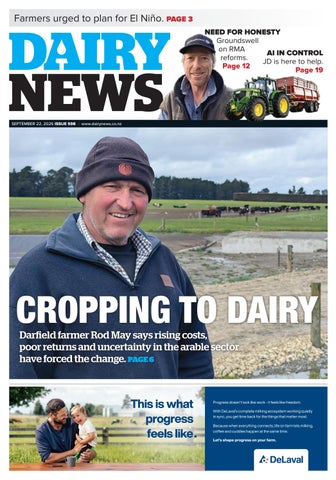
CROPPING TO DAIRY Darfield farmer Rod May says rising costs, poor returns and uncertainty in the arable sector have forced the change. PAGE 6
This is what progress feels like.
Progress doesn’t look like work - it feels like freedom. With DeLaval’s complete milking ecosystem working quietly in sync, you get time back for the things that matter most. Because when everything connects, life on farm lets milking, coffee and cuddles happen at the same time. Let’s shape progress on your farm.
DAIRY NEWS SEPTEMBER 22, 2026
NEWS // 3
Start planning for El Niño now SUDESH KISSUN sudeshk@ruralnews.co.nz
HAVE A plan in place for your cows and staff.
Breeding robot-ready herd. PG.08
Cutworm pressure on crops. PG.13
Data-driven success. PG.15
NEWS �������������������������������������������������������������3-8 OPINION ��������������������������������������������������� 10-12 MANAGEMENT ��������������������������������������������� 13 ANIMAL HEALTH ������������������������������������14-15 MACHINERY & PRODUCTS �����������������������������������������������17-19
That’s the advice from Waikato Federated Farmers dairy chair Matthew Zonderop as DairyNZ warns a very strong El Niño could push farm working expenses higher. The industry-good body warns that farm working expenses could rise to $6.78/kgMS and the national breakeven milk price to $9.07/kgMS. DairyNZ is also urging farmers to prepare for tighter margins and potential feed shortages should an El Niño materialise. Zonderop, sharemilking 400 crossbred cows in Te Poi near Matamata, told Dairy News that the industry good organisation has summed it up well. “Get a plan in place, watch both the feed and financial budgets and talk with your bank and farm consultants,” he says. “The golden rule is that it’s 90% planning and 10% execution.” Zonderop says it’s also important for farmers to have a plan for all their livestock and staff. “Don’t forget them and your staff: cows don’t perform well under heat stress and neither do we. “Have a plan in place for both.” Zonderop is also calling for farmers to be realistic about the situation. “Don’t think rain is around the corner and ‘she’ll be right’. Be sensible and think of next season and not the here and now.” DairyNZ modelling shows the anticipated El Niño event adds a layer of uncertainty to a dairy season already marked by major global events and cost pressures, with the potential for drier conditions to affect pasture growth, feed supply
Matthew Zonderop, Waikato, is urging farmers to have a plan in place for their animals and staff.
and milk production. Earth Sciences New Zealand (ESNZ) has confirmed El Niño conditions are developing in the tropical Pacific, with the event expected to strengthen through spring, peak in early summer and influence New Zealand’s weather into autumn 2027. DairyNZ head of economics Mark Storey says farmers are now facing the prospect of weather-related challenges on top of existing cost pressures. “Three months ago, our focus was on the Strait of Hormuz and the impact of higher fuel, fertiliser and feed costs on farm,” says Storey. “While those pressures remain, another challenge has emerged in the form of the strong El Niño. We now need to consider what the weather could mean for pasture growth and feed supply on farm.”
ESNZ chief scientist Chris Brandolino explains that this is shaping up to be a very strong El Niño, and more likely than not, the strongest on record. “When considering previous very strong El Niño events, as well as what long-range modelling is indicating, drier-than-usual conditions are favoured over northern and eastern areas of New Zealand during spring and summer,” says Brandolino. “However, for western and lower parts of the South Island, spring and summer is likely to feature wetter than usual conditions. It’s important that people stay up-to-date and regularly check for the latest outlooks and forecasts, as things may change.” In its EconTracker quarterly update, DairyNZ has modelled two El Niño scenarios – ‘strong’ and ‘very strong’ - comparing against a baseline season without significant El Niño impacts. The modelling shows the national breakeven milk price could increase from $8.62/kgMS under the baseline scenario, to $8.90/kgMS under a strong El Niño, and $9.07/kgMS under a very strong El Niño. Farm working expenses are also modelled to increase from $6.18/kgMS under the baseline scenario to $6.57/kgMS under a strong El Niño and $6.78/kgMS under a very strong El Niño. “Pasture will take the first hit, creating the biggest driver of the additional cost pressure, with national feed expenses modelled to increase from $1.56/kgMS under the baseline scenario to $2.02/kgMS under a very strong El Niño,” explains Storey. Milk production is also expected to dip, rather than collapse, with national production modelled to be around 2.1% lower under a strong El Niño and around 3.3% lower under a very strong El Niño.
Premium stockfeed STOCKFOODS
For New Zealand farmers
Civil construction | Aggregates | Stockfoods | Storage | Transport 0800 4 JSwap | 07 888 7025 | WWW.Jswap.co.nz
DAIRY NEWS SEPTEMBER 22, 2026
4 // NEWS
‘A privilege to serve farmers’ OUTGOING FONTERRA
Co-operative Council chair John Stevenson says that it has been a privilege to represent the co-op’s farmer shareholders. Stevenson, who milks 1500 cows in the Wairarapa, chaired the council since November 2022. He will retire at Fonterra’s annual general meeting in November after reaching the maximum nine-year tenure. Stevenson told Dairy News that he has always enjoyed the direct nature of conversations with farmers. “They never leave you wondering what they are thinking, and they demand
accountability.” Stevenson believes the council is in a strong position moving forward. “We have a group of really capable councillors and a strong management team, all of whom will ensure Fonterra farmers are strongly represented into the future.” However, Stevenson isn’t slowing down on the final stretch of his term. “There is plenty of work to do before I finish at the AGM. “This includes running the director elections, the production of our annual report, analysing Fonterra’s financial results and our assessment of how well
Fonterra has performed against our letter of expectations.” Stevenson’s successor is expected to be named at a council meeting this week. He represents the Wairarapa ward in the 28-member council, which comprises 25 elected members and three appointed councillors. Stevenson is one of seven elected councillors, who terms are up for re-election. Other councillors retiring end of this year are Cushla Smith, Southern Northland ward and Aleisha Broomfield, Piako ward. Councillors seeking re-election are Grant Coombes, Waikato West,
Andrew Myers, Waipa, Kylie Leonard, Central Plateau and Don Moore, Eastern Southland. Nominations close at midday, Thursday, October 1. The council’s role is to support shareholders’ democratic control of Fonterra and to actively represent members’ interests as owners, investors and suppliers. Meanwhile nominations are being called for Fonterra board elections. This year, directors Brent Goldsack and Cathy Quinn retire by rotation. Quinn is standing for re-election while Goldsack is retiring from the board. An independent assessment process,
Outgoing Fonterra Co-operative Council chair John Stevenson.
where candidates are assessed by a threemember panel, was held last month. Candidates who opted for the process will be announced this week.
The non-assessment process – where farmers can put themselves forward as a candidate for the board outside the Independent Assessment Process
– is now open for nominations. The Returning Officer will confirm all directors’ election candidates on Friday 2 October.
FARMER CONFIDENCE ON THE WANE? PETER BURKE peterb@ruralnews.co.nz
WILL THE good times last? That’s one
of the key issues to come out of the latest Federated Farmers confidence survey. It shows that while right now most farmers are making a profit, 39% of dairy farmers are expecting a downturn. That’s opposed to only 18% sheep and beef farmers who think that things will get worse. Feds president Colin Hurst says this comes at a time when profitability
is the highest it’s been in a decade, with the survey showing 72% of farmers are making a profit, with fewer than one in 20 making a loss. That, he says, is an incredibly positive result, adding that just a few years ago high interest rates, low commodity prices and skyhigh input costs were making it really hard for farmers to earn a living. “Now dairy, sheep and beef farmers are getting strong returns again, meaning farming has been one of the main bright spots in an otherwise sluggish NZ economy,” he says. But Hurst says confidence has started to wane and there is genuine
Colin Hurst
uncertainty in the sector. He says the three main concerns of farmers are: rising farm input costs, regulation, compliance and red tape, and the potential result of the upcoming election. He says the rising cost of fuel, fertiliser, freight, insurance and other costs are ratcheting up faster than returns, meaning profit margins could be eroded. “Worries about commodity prices and weather, such as a potential El Niño-driven drought, are well back at 12% and 11% respectively,” he says. A key concern to come through
in the survey is the plight of the arable sector, which supplies seeds, grains and feed for the country’s livestock industry. Hurst says it’s deeply concerning that only one in five arable farmers are making a profit. “The current conditions lifting the pastoral sector are not reaching our cropping farmers and that’s bad news for all of us,” he says. Hurst says for political parties wondering what farmers want most from the Government, the clearest single instruction is to finish what has been started.
With Active Descent Control, Polaris has you COVERED.
STEEP HILL? NO WORRIES. Automatic Engine Braking System (EBS) and Active Descent Control (ADC) delivers a smoother and more controlled deceleration downhill.
WWW.POLARISNEWZEALAND.COM
44 HP | 612 KG TOWING CAPACITY | 1,587 KG WINCH 22.6 CM OF TRAVEL & ARCHED DUAL A-ARM
MY26 SPORTSMAN 570 TRAIL FROM $18,995 INC GST
DAIRY NEWS SEPTEMBER 22, 2026
NEWS // 5
Global supply slowdown tipped to lift milk price A ‘TSUNAMI’ of milk
from key exporting countries is winding down and this may be good news for New Zealand dairy farmers. While milk production is easing, demand for dairy remains resilient especially across Asia. This presents upside potential for New Zealand milk price and a possible $10/kgMS milk price, according to RaboResearch senior agricultural analyst Emma Higgins. In its Q3 Global Dairy Quarterly, Rabobank notes that global milk production has continued to expand across the major exporting regions through the third quarter of 2026, although the pace has slowed to an estimated 1.4% year-onyear, the weakest quarterly growth since early 2025. It says the global dairy market is transitioning from a period defined by milk production growth to one increasingly influenced by supply uncertainty, with anticipated slowing production growth, tightening producer margins, structural constraints in Europe and a stabilising Chinese market providing greater support to global dairy commodity prices. Milk supply remains elevated in the US, New Zealand and, at a headline level, the EU, although north-western Europe is showing clear heat impacts. Production growth in Brazil and Argentina is also moderating due to challenging year-earlier comparisons and heavy rainfall.
Higgins said milk powder markets – which are particularly significant for New Zealand as milk powder makes up just over half of all New Zealand dairy exports – have been the standout performer during quarter three. While last week’s Global Dairy Trade result saw a slight drop in whole milk powder prices, the previous two auctions delivered a significant lift in powder markets. Skim milk powder prices jumped more than 10% across the events, while whole milk powder prices gained nearly 3%, despite the large volumes on offer. “We’ve also seen strong demand for New Zealand dairy product from Southeast Asian countries (Indonesia, Malaysia, Philippines and Thailand) throughout 2026, which has helped to ensure New Zealand farmgate prices have held up better than in the Northern Hemisphere,” she says. Higgins says New Zealand farmgate milk price prospects for 2026/27 were weakened when Fonterra’s opening midpoint figure of $9.75/ kgMS was shifted 50c lower to $9.25/kgMS in July. “However, RaboResearch thinks this position may be shortlived and we anticipate the final milk price for 2026/27 has room to land somewhere closer to $10 kgMS which would help maintain broad-based profitability for another season if costs are well managed,” she says. The Rabobank report says New Zealand milk
production for the 2026/27 season is expected to grow marginally. “The 2025/26 season closed at a record 2.027 billion kgMS, becoming the first season to exceed the 2 billion kgMS threshold,” Higgins said.
“The first two months of the 2026/27 season have confirmed that strong momentum is continuing. June and July 2026 both set new monthly production records, surpassing the highs established in the
same months last year.” At this stage, RaboResearch forecasts New Zealand production growth of around 1% in 2026/27, although this outlook is likely to change as the effects of El Niño become clearer.
PROFIT STARTS HERE • Calving ease • Short gestation • Registered bulls, backed by certification • Powerful growth rates Registered Hereford bulls, backed by generations of recording and genomics - because profit starts with the right bull.
MARGINS UNDER PRESSURE AS IN other regions around the world, New Zealand producer margins are increasingly under pressure, says Emma Higgins. “Strong milk price forecasts continue to support farmer confidence, but increasing on-farm costs and rising interest rates mean that milk prices and input costs are beginning to move towards each other, reducing the margin buffer that has supported profitability over the past couple of years,” she said. “Although producer returns remain positive in most regions, profitability is less secure than it was earlier in the year, raising the risk that producers may become more cautious about expansion.”
Start here. Visit www.herefords.co.nz to purchase a registered Hereford bull.
RaboResearch senior agricultural analyst Emma Higgins.
DAIRY NEWS SEPTEMBER 22, 2026
6 // NEWS
Conversion helps keep farm in the family NIGEL MALTHUS
CONVERTING A
longstanding cropping farm to dairy was the only way to ensure the land stayed in the family long term, says new dairy farmer Rod May. May farms at Greendale, near Darfield, on land that has been in the family as a cropping farm for about 150 years. But he says rising costs, poor returns and uncertainty in the arable sector have forced the change. His was just the second in a “new wave” of many dairy conversions now underway in a belt from Greendale through Darfield to the
Waimakariri. “In the last two to three years here, land values have gone up because of one industry. And it’s not the cropping.”
Rod May says dairying was very good for farm succession and business, while cropping was “living on the edge”. May said dairying was very good for farm succession and business, while cropping was “living on the edge”. As a cropping farmer he grew clover and
ryegrass, alongside specialist crops like spinach, radish and Chinese kale seed, which were high input and high return but at the mercy of the weather. May said cropping was a lot more hands-on, and he’s “not missing it”. Previously he could have 12 or more different crops all with their own management needs and schedules. “We spent a hundred thousand a year just on chemicals. “Then we pay for all the seed dressing. Then we pay for the germination test, even if it fails. “Then we pay for the transport. We pay to get
the seed here and then we pay to get it taken away. “And then all that machinery we’ve got sitting in the yard.” Despite spending about $12,000 a year on leased bees, yield was poor in his last cropping season because of poor germination. May also notes that many Canterbury arable farmers suffered crop losses in major hailstorms in the past couple of years. “If a crop fails you only get one go at it. And in this modern age with our costs, the cost of being a cropping farmer, it hurts you. “Once you lose those crops, that’s it. Whereas
CRYVEX
Same team. Same service.
New name. New chapter.
25 years of partnerships built on trust, expertise, and reliability.
The service you’ve always relied on, now proudly New Zealand owned and operated.
DTS Refrigeration is now Cryvex Refrigeration PH: 0800 500 387 | WWW.CRYVEX.CO.NZ
Rod May’s farm is the second in a “new wave” of dairy conversions now underway in a belt from Greendale through Darfield to the Waimakariri.
we get another go with the cows. We can get more feed in.” Another big driver was rising costs. He could no longer afford to insure crops after premiums went up 30%. The last big development on the farm was installing
irrigation under the Central Plains Water scheme about nine years ago, when May put in a central lane dividing the farm into eight big paddocks, four each side. The lane is still the main highway for the dairy operation but the internal fences have
been shifted to create multiple seven-hectare paddocks. “It’s been a two-year journey. Eleven months to build it, 12 monthsplus planning it. So it’s been on our mind for a while.” @rural_news facebook.com/ruralnews
A BUSY LAST SEASON ROD MAY said it had been a busy last season trying to get the last crops off while building the dairying infrastructure. The dairy shed, yards and effluent ponds have gone in at the centre of the farm under the existing large centre pivot, which has been raised to clear the shed. CPW irrigation water cannot be used to run the shed or for stock water so a separate well and supply line was put in a year ago in readiness for the conversion. May called CPW one of the best irrigation systems in New Zealand, albeit the priciest. “We put that in because we knew, 10-plus years ago, that water was gold. And water is the secret. You can do anything under it.
“Once you’ve had water there wouldn’t be anyone that would farm without it.” May said that on the CPW system he was operating under “probably the strictest criteria in New Zealand,” with every drop of water accounted for, and probes to monitoring leaching and soil moisture. So, did May know how to milk a cow? Not at all, he readily admits. “The kids laughed at me when I said what I was doing. But we knew we had to do it to keep the land.” He said there were a lot of good people in dairying and it was a matter of getting the right expertise. Consultant John Donkers of Dairy Farm Management Services was instrumental, as was hiring an experienced dairy manager, Adrian Holden. May’s wife Adrienne is
looking after the calves and their son Locky is Holden’s 2IC. May owns the herd, which numbers 650 cows in the first season. The cows are KiwiCross with Jersey genetics, chosen because they are not too large for his heavy soils. They are running a modern system with AllFlex SenseHub collars on the cows. The 54-bail rotary shed boasts a ProTrack auto drafting gate, automatic cup removers and scales on the feed silos. Although the conversion required many new fences, May chose not to try virtual fencing collars because of the cost. “We’ve got to walk before we run. We’re mindful of that. These things you can add later if you want.”
DAIRY NEWS SEPTEMBER 22, 2026
NEWS // 7
Taranaki farmers cautious PETER BURKE peterb@ruralnews.co.nz
A SPATE of southerly winds bringing
cold temperatures has presented challenges for Taranaki dairy farmers. Ag First’s Lauren McEldowney, based in Stratford, says there’s been below average rainfall in July and August. As a result, overall it’s been drier across the region. She says colder than normal temperatures and more frosts, combined with the southerly winds, have resulted in below average pasture growth rates. McEldowney says for certain parts of Taranaki in late July and early August, pasture growth rates were a lot lower than long term averages and what had been experienced in the last couple of seasons. In those years it was a lot wetter and while more grass was grown, it wasn’t all utilised because the ground was so wet. “But what we have seen in the last two weeks is that it’s got a lot better, with soil temperatures rising
and pasture growth picking up,” she told Dairy News. The other point of note in Taranaki is that there are normal climatic variations. In the coastal areas of the region there is greater exposure to wind and recently they got hit a lot harder than the central and northern parts. For example, in Stratford, which is sheltered by Mt Taranaki. Latest reports say that milk production in Taranaki is now about on a par with other seasons, although
Milk production in Taranaki is now about on a par with other seasons.
EL NIÑO’S EFFECT ACCORDING TO Lauren McEldowney, the potential impacts of El Nino are in the back of farmers’ minds. But she points out that dry conditions are not unusual in the region, and in the case of El Nino, it’s a case of just how dry it might get. She says, as rule, South Taranaki can get very dry. “Interestingly, that central area around Stratford, twenty or thirty years
ago you would have said we were summer safe, but not so much now,” she says. McEldowney says farmers now need to get set up for summer in terms of feed and make sure that they have reserves, and know where they can get feed from, and at what price. She says they may need to look at reducing cow numbers before Christmas and follow the best management practices.
Overall, farmers in the region are generally in a positive frame of mind. McEldowney says Fonterra suppliers are benefiting from the capital payout, and many have used this to reduce debt. But she says with the threat of El Nino and the uncertainty of the election, farmers are cautious about what steps to take in the future and potentially what the outlook for them might be if there were to be a change of government.
it was a bit behind for the month of August. Calving is said to be going well, noting of course that some parts of the region calve earlier than other parts. In terms of animal health, McEldowney says there have been some well publicised issues with salmonella, but vets are helping farmers with this. Also, she says there appears to be a few more instances of mastitis, but nothing major and the cause may be related to management practices.
WEANING MADE SIMPLE.
Worm Control & Coccidiocide in a single dose.
AAH-TUIT_2026-035
Recommended as the first drench for young stock. Alleva Animal Health. Proudly New Zealand owned and operated.
Twice the stock, half the time. Proven results.
World-first formula, developed here in NZ.
PROUDLY
NZ
OWNED
TURBO® is a registered trademark of Alleva Animal Health Ltd. TURBO Initial (A011703) is registered pursuant to the ACVM Act 1997. See www.foodsafety.govt.nz for registration conditions.
DAIRY NEWS SEPTEMBER 22, 2026
8 // NEWS
Breeding the ultimate robot-ready Jersey herd RICK MAJOOR
IN THE beautiful, scenic
expanse of Invercargill, Joanne (Jo) Crack of Southern Star Farms is redefining what it means to run a modern, selfsufficient dairy operation. The Crack family manages a 456 hectare farm near the Waituna Lagoon. As part of this, Jo balances a 350 to 370strong Jersey cow herd alongside 2000 ewes and some beef stock. The farm’s transition from a conventional system to an automated grazing setup powered by four Lely Astronaut A5 robots has completely revitalised their business
and family lifestyle. Southern Star Farms didn’t always look this way. Jo and her family started on a smaller, conventional dairy farm further up the road, milking up to 400 cows in an old herringbone shed. While they loved the industry and the animals, they quickly discovered two major pain points: they disliked the day-to-day grind of putting cups on cows, and they did not want to manage outside staff. The logical step was to bring the cows home to their main property, downsize the herd slightly to focus on efficiency, and let automation take over the
labour. Now, the dairy unit thrives at the top of the farm, while the sheep occupy the bottom acreage closest to the lagoon. The transition has empowered Jo to manage the bulk of the dairy operation mostly by herself. When peak seasons arrive, family support steps in seamlessly. Her husband, Darrin, helps train heifers in the mornings and evenings, and the second generation - daughter Kimberly and daughterin-law Annabel - can walk in and run the system with zero formal training. “The system is pretty easy to follow,” Jo notes, explaining that
she simply leaves a list on the wall for them to reference. Operating on a peaty soil base that naturally keeps the animals above the mud, Southern Star Farms features a highly strategic grazing layout. Nearly four years ago, they added a barn to the property to protect the pastures and house the winter milkers during Southland’s frequently rough weather spells. While the farm originally launched with a three-way grazing model, Jo quickly realised that optimising cow flow required an upgrade to a strict four-way grazing system (A, B, C, and D blocks). Under this
Joanne Crack of Southern Star Farms, Invercargill.
system, the herd spends exactly six hours in each even break across a 24-hour period. According to Jo, keeping the blocks perfectly identical is the secret to a steady,
PASSION FOR GENETICS ONE OF Joanne Crack’s greatest passions is cow genetics, and the Lely system has completely transformed her breeding program. Dissatisfied with catalogues - where bulls are marketed as “robot ready” but fail to perform under real-world automated conditions - Jo took matters into her own hands. By extracting deep data from her Lely Horizon management software, Jo meticulously monitors metrics like milk speed, culling information, and the performance of specific cow families. This level of granularity simply isn’t available in conventional systems, or even in large rotaries according to her. “The last few years I’ve actually
been keeping bulls from those families, and the resulting progeny, there’s no surprises with them,” Jo says. “They milk exactly as I expect them to and generally better than anything I get out of the catalogues.” This customised breeding approach has driven consistent, yearon-year production increases without expanding the herd size. Seeing her top Jersey cows regularly achieve 800 to 900 kilograms of milksolids has set a new benchmark for what her entire herd could achieve. Reflecting on their journey, Jo stands firmly by a sentiment she shared back in 2024: “If we hadn’t put in the robots, we wouldn’t be dairying
• High Flow • Compact/Robust • New Pilot Flow Filter • Side/Bottom Mount • Detach to Clean
right now. Robots have given us freedom and taken the stress away.” Today, that statement remains entirely accurate. The automation allows the family to handle a highly diversified workload - including raising all their own Jersey replacements, selling yearling bulls, growing out beef crossbreeds, and managing their own cultivation and muck spreading without burning out. Looking ahead, Jo sees virtual fencing as the next evolutionary step for their property, which would allow her to shift grass breaks right from her phone and potentially explore batch-milking groups to minimise cow walking distances.
predictable robotic system. If the allocations are uneven, cow flow becomes erratic, causing large groups to bottleneck at the lounge. By utilising four even intervals, the
cows achieve an optimal milking frequency of two to three times a day, voluntarily spreading their traffic evenly across the day and night. @rural_news facebook.com/ruralnews
FARM FACTS ❱❱ Herd Size & Breed: 350 to 370 high-producing Jersey cows, alongside a diverse livestock operation including 2000 ewes and home-raised beef crossbreeds. ❱❱ Milking Infrastructure: Four Lely Astronaut A5 milking robots operating in a free cow flow pasture-based system. ❱❱ Grazing Strategy: A highly optimised, four-way grazing layout (A, B, C, D) with strict six-hour rotations to guarantee maximum voluntary cow flow over a 24-hour period. ❱❱ Data-Driven Breeding: Utilising Lely Horizon analytics to track individual quarter milk speeds and cow family histories, allowing the farm to successfully breed its own superior, robot-ready bulls. ❱❱ Calving Structure: A split-herd calving model with one-third calving in February and the remaining two-thirds calving in August, keeping calving windows tight at seven weeks each.
• For Water Storage Tanks • Adjustable levels from 50mm-2.5m • Minimises pump operation •Available in 20/25/32/50mm
0800 JOBE VALVES jobevalves.com
• Stainless steel bracket and Shaft • Fits plastic and concrete tanks • Rugged and long lasting
Certainty, by the bagful. There’s plenty on a New Zealand farm you can’t control. The weather. The markets. The summer that turns up late – or doesn’t arrive at all. Your pasture seed shouldn’t be one of them.
Maxsyn
Array
The next generation perennial legend, for superior persistence and summer growth.
Perennial
Stack the odds in your favour. Choose proven Barenbrug cultivars and grow with confidence. Learn more at barenbrug.co.nz
Perennial
4front
Perennial
Shogun
Forge
The superstar perennial, delivering high intake, yield, N uptake and persistence. The diploid of the future!
The benchmark in tetraploid perennials. Grows longer, is good for the environment and animals love it.
The outstanding hybrid, rockstar with NEA12 – still setting the standard for 1-3 year pasture.
The phenomenal 3-5 year pasture. With environmental benefits, delivers performance your neighbours will envy.
1-3 years
3-5 years
Scan the QR code to learn more.
Grow with Confidence
BBGN0133 Spring_Dairy News FP ad.indd 1
31/08/2026 3:46 PM
DAIRY NEWS SEPTEMBER 22, 2026
10 // OPINION RUMINATING
EDITORIAL
Preparing for El Niño
MILKING IT... No idea
Hogwash
National’s win
Danone on the move
THE OPPORTUNITY Party was flavour of the month for a minute, but their star might be fading a bit now that they’re being held to account on policy. A mate of Milking It reckons a recent appearance by the party’s ‘ag spokesperson’ was a classic case of “Tell me you know nothing about farming without telling me you know nothing about farming”. On Q+A’s rural issues debate, Opportunity’s Daniel Eb said “herd sizes are declining”. Yet, DairyNZ’s statistics say average dairy herd size is still rising, which other party candidates gleefully noted. Caught out, he pivoted to sheep. “Sheep aren’t a herd,” notes our source, “they’re a flock. So, to be clear, the guy who wants to tax farms and lecture farmers on land use, can’t even tell a herd from a flock, or herd size from herd numbers. Brilliant.”
THE VEGAN Society has made another feeble attempt to discredit the dairy industry. In a media release this month, the group falsely claims that behind NZ’s dairy production is a system of cruelty. It, again falsely, claims that newborn calves “are systematically separated from their mothers and sent to slaughter, all so that female cows can continue to produce milk for human consumption”. They even go on to say that dairy is “an unnecessary industry, considering the wide availability of plant milks and dairy alternatives”. Thankfully, the market knows better and the vast majority of consumers don’t agree with such dishonest hogwash.
AFTER MONTHS of wrangling, the Indian free trade deal sailed through Parliament last week. The India Free Trade Agreement Legislation Amendment Bill passed its second reading on September 15 by 93 votes to 29, with National, Labour and ACT supporting it; while the Greens, New Zealand First and The Māori Party voted against it – unusual bedfellows for the Winston First party! The vote was a landslide in favour and is a clear demonstration of Parliament’s strong support for this FTA and its significant benefits for the economy. It’s also a feather in the cap for Prime Minister Christopher Luxon, who had vowed to get the FTA done before the end of this term of Parliament – a statement widely ridiculed at the time he first made it.
FRENCH DAIRY giant Danone is moving beyond infant formula in New Zealand. It has entered the local retail dairy market for the first time, launching its YoPro protein yoghurt brand. The launch forms part of Danone’s wider activity in the Oceania dairy business. The company has moved to acquire Made Group, which owns the fresh dairy brand The Collective, and has agreed to purchase the remaining 49% stake in its Australian fresh dairy joint venture with Saputo Dairy Australia. YoPro products sold in New Zealand will be supplied from the Australian processing site across the Tasman Sea.
Head Office: Lower Ground Floor, 29 Northcroft St, Takapuna, Auckland 0622 Phone 09-307 0399. Postal Address: PO Box 331100, Takapuna, Auckland 0740 Published by: Rural News Group Printed by: Inkwise NZ Ltd Contacts: Editorial: sudeshk@ruralnews.co.nz Advertising material: beckyw@ruralnews.co.nz Rural News on-line: www.ruralnews.co.nz Subscriptions: subsrndn@ruralnews.co.nz
Publisher: Brian Hight ...................... Ph 09-307 0399 General Manager: Adam Fricker ................... Ph 021-842 226 Editor: Sudesh Kissun ................ Ph 021-963 177 Machinery Editor: Mark Daniel...................... Ph 021-906 723 markd@ruralnews.co.nz Reporters: Peter Burke.....................Ph 021-224 2184 peterb@ruralnews.co.nz Subscriptions: Julie Beech ....................Ph 021-190 3144 Production Manager: Becky Williams ..............Ph 021-100 4831 Digital Strategist: Jessica Marshall ..........Ph 021 0232 6446
• Printed by Inkwise • Distributed by Reachmedia Dairy News is published by Rural News Group Limited. All editorial copy and photographs are subject to copyright and may not be reproduced without prior written permission of the publisher. Opinions or comments expressed within this publication are not necessarily those of the staff, management or directors of Rural News Group Limited.
HAVE A plan in place now! That’s the message from DairyNZ as scientists warn that a “very strong” El Niño will be impacting New Zealand over the coming months. Modelling done by the industry-good organisation paint a bleak picture. A very strong El Niño could lift farm working expenses to $6.78/kgMS and push the national break-even milk price to $9.07/kgMS. This would mean narrow financial buffers while national milk production could drop between 2.1% and 3.3% depending on the severity of the weather pattern. Projecting impacts of an El Niño event is extremely challenging because no single El Niño event plays out like another, and the expected impacts of this coming El Niño event vary significantly by region and, in some cases, sub-regionally. The biggest risk for many farmers will be seasonal feed availability. The key is to keep feed budgets up to date, monitor pasture growth and cover, and set clear trigger points for action if conditions get tougher, according to DairyNZ. Their message is clear: having a plan in place now gives farmers more options to respond, depending on how El Niño plays out. New Zealand dairy farmers are experienced at managing changing conditions, but acting early is what helps protect feed reserves, autumn pasture cover and longer-term farm performance. Farmers will most likely respond to a summer feed gap partly by buying feed and adjusting herd management. Nationally, feed costs are anticipated to range between $1.56/kgMS under a ‘no El Niño’ event and $2.02/kgMS under a ‘very strong El Niño’. The scary part is the effects do not stop in 2026/27. Feed, fertiliser and breakeven milk prices stay elevated into 2027-28 under various El Niño scenarios. Some farmers say that the weather always wins. But planning now for the coming months may make losing out to El Nino less painful.
AUCKLAND SALES CONTACT: Stephen Pollard............................................. Ph 021-963 166 stephenp@ruralnews.co.nz WAIKATO & WELLINGTON SALES CONTACT: Lisa Wise ........................................................Ph 027-369 9218 lisaw@ruralnews.co.nz SOUTH ISLAND SALES REPRESENTATIVE: Kaye Sutherland .........................................Ph 021-221 1994 kayes@ruralnews.co.nz
Paper used in this publication is from forests managed in line with the strictest environmental, social and economic requirements. 100% recyclable, the papers we use are from forests that will be around for generations to come.
DAIRY NEWS SEPTEMBER 22, 2026
OPINION // 11
Let farmers decide what they farm ANDREW HOGGARD
WELL, THE silly season is upon us and
all us politicians are running around shaking babies and kissing hands, or maybe the other way around. One of the things I have heard from the opposition in the debates so far is this picturesque view that our farms “should be a mosaic of land use types”, that we will all be doing multiple things on our farms, and that somehow just being a sheep and beef farmer, or just being a dairy farmer, is a bad thing. This idea of doing many things on your farm may sound great as a plot for an episode of Country Calendar, but it does ignore human history. Go back to that point in evolution where we learned as a species to start making tools and using them. Those tribes soon found that some of their number were best placed to make the tool, some to use it and others to carry it. That was the beginning of specialisation. In economic terms we call it comparative advantage. New Zealand’s comparative advantage is in pastoral
agriculture. We have a temperate climate with good rainfall over most of the country, and certain regions favour certain things. Bay of Plenty for kiwifruit, Hawke’s Bay for apples, Cromwell for cherries, Pukekohe for vegetables. It just makes economic sense to do the farming or growing that will deliver the best return for your land. If your land is suited to dairy farming, why not specialise in it. Now, you may have a farm with a variety of land types where having a mix does make economic sense. But for most of us, we stick to what we are good at and what our farm is best suited for. My own farm could well do a multitude of different farming types. It has class 1 soil. But if I were to try and become a jack of all trades, that requires either a whole lot of extra specialised machinery or a truckload of extra people. All of it increases the cost of production. It probably also means I am not running new and modern gear but second or third hand stuff, which means I would spend more time fixing machinery than farming. If I had three times the land I do, then maybe that would provide
the scale where it makes sense. But I don’t. So, I focus on dairy, because that makes the most sense for my farm, for me and for my family. So, when other politicians try to paint some kind of future where they think I will be doing all these other things on my farm, I must ask. Is that because they will force me to? Will they be deciding what alternative crops I grow? Will I be expected to sell to the new “Pak n’ Soviet” national supermarket, at cost? From the ACT Party viewpoint, farmers are the best placed people to decide what their own farm should do. They are the ones who take the risk, who live and breathe the job. The Government’s job is to manage any impact farming might have on other landowners or the wider community and then get out of the way. My view? The most critical thing that needs to happen next term for rural New Zealand is ensuring that the National Policy Direction and the National Standards that will sit underneath the new Natural Environment Act and Spatial Planning Act deliver certainty for our regional economy.
Andrew Hoggard
When you are making decisions on whether to build a new cowshed or an irrigation system, or any large investment on farm, you need certainty. More to the point, your bank needs certainty that you will be able to farm and utilise that asset for longer than the loan period. You need confidence that entering into a regulatory process won’t result in huge uncertainty for multiple years and the potential to spend hundreds of
thousands on lawyers and consultants. Otherwise, you sit on your hands. Investments are not made, jobs are not created, and productivity is not lifted. That’s what I see as my must-do for the next term of government. Others think we can tax our way to prosperity, but to quote the other Winston, Churchill: “For a nation to try to tax itself into prosperity is like a man standing in a bucket and trying to lift himself up by the handle.” • Andrew Hoggard is an ACT MP
GET GEARED UP WITH CASE IH Unlock value on Case IH tractors and hay equipment. There’s never been a better time to invest in proven performance that’s built to deliver and backed by us.
1.99% P.A1 FINANCE ON ALL TRACTORS
PUMA & OPTUM CONNECTED TRACTORS
1.50% P.A2 FINANCE ON HAY GEAR
Whether you’re upgrading or expanding, make your investment go further with low-rate 1.99% P.A1 finance across all Case IH tractors.
For a limited time get an extra 4 years/4,000 hours of RedXtend Total Protect coverage.3 More capability, more value and greater peace of mind.
Case IH hay tools deliver the performance and reliability you need for every pass. Secure with low-rate finance.
GET A QUOTE
Terms & Conditions apply. Finance provided by CNH Capital Pty Limited. For full terms and conditions please visit caseih.co.nz or contact your local dealer.
DAIRY NEWS SEPTEMBER 22, 2026
12 // OPINION
Where is the honesty among our farmer representatives? JAMIE MCFADDEN
A FOUNDING principle
of Groundswell NZ is that farmers, and people generally, should be provided with full and
accurate information about regulations that directly affect them. What is particularly
disappointing about the RMA reforms is the lack of honesty from our representatives in both
Take control of your mating season.
CIDR® Cattle Insert. NZ’s #1 repro device*. Take control of your mating season and maximise your herd’s reproductive efficiency with the trusted, Kiwi-made CIDR® from Zoetis. It’s the cost-effective, vet preferred tool proven to tighten calving spread and produce more days in milk. Talk to your local vet about boosting your productivity and profitability.
Zoetis New Zealand Limited. Tel: 0800 963 847; www.zoetis.co.nz. *CEESA data March 2026. ACVM No.A4559 TRACTA23116_PROD_GG
Jamie McFadden, Groundswell, claims both government and farming advocacy groups aren’t honest about RMA reforms.
government and farming advocacy organisations about these reforms and their implications. That it is our own fellow farmers that promulgate this behaviour is all the more disappointing. A case in point is the proposal around Freshwater Farm Plans. Behind the PR claims of ‘simpler, cheaper and better’ lies a very different story that leaves farmers misinformed over this legislation. All the purported benefits provided by our representatives to justify this legislation relate to farmers currently operating under consents. No mention of how the freshwater farm plan legislation impacts the majority of farmers across the country that currently do not require a consent - such as dryland farmers; sheep, beef and deer; hill and high country, organic and regenerative farms. No mention of how these lower environmental impact farmers will lose the benefit of being a permitted activity, free from a system of government oversight a benefit they have had for the past 35 years under the Resource Management Act. No mention of how most farmers will be worse off under the Freshwater Farm Plan legislation than they currently are under the RMA. Particularly once other environmental
issues such as indigenous biodiversity and emissions are added to these Freshwater Farms Plans as has always been government’s (from both sides) intention. Our representatives have provided no justification as to why these freshwater farm plans are being rolled out as a top-down government prescribed and controlled system, rather than allowing the industry to continue to lead the roll out of farm environment plans as they have been doing for the past 5 plus years. And no explanation about how the Freshwater Farm Plan legislation opens the door to a new type of totalitarian control that captures all farmers over 50ha into a government oversight system administered by regional councils. Or the perils of handing the whole farming sector on a plate to a new government (if elected) that is not so farmer friendly as the current one. We are calling on honesty from our farming representatives and advocacy organisations in providing all farmers with a full and accurate explanation of the freshwater farm plan legislation and the RMA reforms generally. The ball is in your court. • Jamie McFadden is Groundswell NZ environment spokesperson
DAIRY NEWS SEPTEMBER 22, 2026
MANAGEMENT // 13
Mild winters will increase cutworm pressure on crops KATHY DAVIS
INSECT PEST vigilance
is key with spring-sown crops this year, experts say. Whole paddocks of summer forage and maize were wiped out last season by unusually high greasy cutworm (Agrotis ipsilon) numbers and had to be re-sown in some areas. Even some farmers meticulous about scouting newlygerminated forage crops say they got caught out. Bioeconomy Science Institute (BSI) research associate Derrick Wilson says El Nino creates ideal conditions for cutworm. “Mild winters allow more pupae to survive, leading to larger moth populations in spring. “These moths begin laying eggs earlier, and the resulting caterpillars emerge at exactly the wrong time for growers, when crops are just establishing and most vulnerable.” Maize is a favourite target, but they can also decimate chicory, turnip and forage rape seedlings. And on at least one farm in Taranaki, they removed all the clover in a two- to three-year old pasture last season.
Barenbrug pasture specialist Graham Kerr says forewarned is forearmed, and farmers, resellers and consultants planning spring-sown crops should prepare accordingly. “We know the risk is likely to be high. The trouble with cutworm is that by the time you see significant signs of feeding, the damage is already done. We want farmers to be on guard this season.” Having been ‘nailed’ by cutworm in 2024/25, Otorohanga dairy farmer Bruce Collinson-Smith took no chances last spring, and will do the same this season. He direct drills about 180ha of maize, chicory, turnips and winter swedes a year. “Everything gets
sprayed for cutworm now. If we time it right, we only need to do it once. Generally, we find it works best when the crop seedlings are around the two-leaf stage.” Forty per cent of turnips sown in spring 2024 were destroyed by cutworm in a week, and
Whole paddocks of summer forage and maize were wiped out last season by unusually high greasy cutworm. Inset: Derrick Wilson
had to be re-sown, he says. “We’d had it before, but never that bad. Anything that wants to
PASTURE TARGET STRATFORD DAIRY farmer Thomas Higgins says cutworm attacked where he least expected it last year. “They didn’t really touch the chicory, but in late summer, they demolished the clover in one of our recentlyestablished pastures, then moved onto the grass. I’ve never seen cutworm in pasture here.” Preparation for cutworm and early action are critical under El Nino conditions this spring, Derrick Wilson
from BSI says. “Weedy paddocks, particularly those containing plantain and dock, can favour greasy cutworm populations by providing alternative host plants. “Controlling these weeds and implementing a fallow period, where the paddock is left free of crops and weeds for at least six weeks, can help reduce cutworm numbers by removing food sources and disrupting their life cycle, lowering the risk of infestation in
subsequent crops. “Using insecticide treated seed can provide early protection during establishment and this also helps control other pests such as black beetle and Argentine stem weevil. “Regular crop scouting is essential. Damage is often detected only after it has occurred, so frequent monitoring allows growers to respond quickly with appropriate control measures if needed.”
kill a crop has got worse in the past five to seven years.” Recent mild winters in South Taranaki have also changed the pests affecting summer crops for dairy farmer Angus Middleton at Waverley. “Our biggest issue here has always been springtails, which we’ve been able to deal with through good crop management,” he says. “Over the past two to three years, however, more cutworm has been evident in maize. We had to re-drill about six hectares of maize last spring, but it was particularly bad in our chicory.”
Despite good monitoring, high populations of cutworm ‘smoked’ parts of their crop, and 12-14 ha of chicory had to be re-sown. With chicory playing a critical role in his farm system, Middleton is now looking at ways to reduce the risk of similar damage this year. “We’re not afraid to spend money on insecticide, pest prevention and spraying if we need to, because we know the value we get out of those crops in summer.” @rural_news facebook.com/ruralnews
BUILT TO LAST
LANEROTR R1
Laneway maintenance, edge removing. Reduces lameness, promotes drainage.
PASTURE mOWERS Topping, and mulching paddocks Width ranging from: 1.8m to 6.0m
tyred Roller
For de-pugging paddocks and post cultivation/drilling. info@landquip.co.nz | 0800 269 776
DAIRY NEWS SEPTEMBER 22, 2026
14 // ANIMAL HEALTH
Brought to you by
Tackling leptospirosis LEPTOSPIROSIS IS one
of the most significant health threats to New Zealand dairy herds and the families who work with them. Putting simple control measures in place, including vaccinating calves early, is key to protecting humans and animals against this serious and costly disease. An infectious bacterial disease, spread mainly through urine, leptospirosis can cause devastating losses in stock: abortions, weak or stillborn calves, milk drop, mastitis, and even sudden death in young animals. For humans, infection can result in anything from flulike symptoms to lifethreatening kidney and liver damage. Two thirds
of people diagnosed with leptospirosis will be hospitalised and many still describe ongoing symptoms, such as severe fatigue, eight months after getting sick. People can catch leptospirosis when they are exposed to leptospires, which are shed in the urine of infected animals. Leptospires thrive in wet environments, especially in warm humid conditions, and can be transferred to people or animals via their eyes, nose, mouth or skin wounds. There are different types of leptospirosiscausing bacteria, known as serovars, which behave differently, so it is important to understand the most common serovars in order to protect your farm.
The most common leptospirosis serovar in both humans and livestock in New Zealand is Hardjo. Infected cows shed Hardjo in their urine for up to two years, yet they often appear outwardly healthy. Vaccination of livestock, use of personal protective equipment such as milking gloves, and personal hygiene (e.g. covering cuts, hand washing) are simple but effective ways to protect people on your farm against Hardjo infection. Ballum is the second most common serovar causing leptospirosis in people. Rather than livestock, Ballum is carried by pests such as rats, mice, and hedgehogs, highlighting that an effective pest control programme is another crucial piece of
the leptospirosis control puzzle. Farmed livestock and dogs can be vaccinated against leptospirosis. The success of your farm’s vaccination plan depends on the use of effective vaccines, vaccinating animals before they are exposed to leptospirosis, and keeping up with booster vaccinations every year. Proven vaccines for New Zealand dairy farms Early leptospirosis vaccination is safe, effective, and the best way to protect your herd and your family. Research from New Zealand dairy farms has shown a link between the age at which calves are first vaccinated and the risk of leptospirosis in the herd. Farms that vaccinate calves before six months old, ideally
Farmed livestock and dogs can be vaccinated against leptospirosis.
starting at four weeks old, have lower rates of leptospirosis shedding in the urine of dairy cows. Delaying vaccination until calves are six months or older leaves a dangerous gap, as calves are susceptible to infection well before this point. Infected cattle can shed leptospires in their urine for up to two years, often without showing signs of illness, posing a risk to both humans and
NO MORE PLASTIC NO MORE TYRES FROM THIS... FROM THIS...
See us at
NZ Dairy Expo Site #2
ENT PONDS
which er er w
d
m estone
• Nationwide Firestone trained and accredited installation contractors. • Future proof - dependable performance, 50 year life expectancy even when exposed, 20 year Firestone material warranty. • Over 120 million square meters installed worldwide. • 30 years in the NZ lining business.
TO THIS... ... TO THIS
AND REDUCE SPOILAGE WITH GEOSMART REUSABLE SILAGE COVER! CONTACT US FOR MORE INFORMATION
0800 109 093 or 021-280 7266
ctor
animals. Early vaccination closes this window, preventing calves from becoming silent carriers, and helping break the cycle of infection on your farm. Risk of leptospirosis is highest when the environment is wet, but changing weather patterns can make wet conditions hard to predict. The best way to ensure protection is to use a vaccine that will guard animals against leptospirosis for a full year. Ultravac 7in1 and Leptoshield are both proven in clinical trials to prevent shedding of leptospires in urine for 12 months. Ultravac 7in1 is the only combination
leptospirosis and clostridial disease vaccine in New Zealand, making it a practical vaccine choice for calves. Clinical trial work has demonstrated it is effective against leptospirosis for calves vaccinated from four weeks of age. All livestock classes need yearly booster vaccinations for lifelong protection against leptospirosis. Boosters are typically administered in autumn for peak protection during wet weather, when infection risk for livestock is highest. • Article supplied by Zoetis @rural_news facebook.com/ruralnews
THREE PILLARS THREE KEY pillars should be included in every leptospirosis control plan: ■ Vaccinate all livestock. Start calf vaccination with Ultravac 7in1 from four weeks of age and administer a second vaccination four to six weeks later to complete the primary vaccination course. Give annual Ultravac 7in1 or Leptoshield booster vaccinations to all stock. ■ Maintain a pest control programme on-farm; review and intensify control measures if you see evidence of rodents. ■ Practise biosecurity and hygiene — especially during high-risk activities like milking or calving. Wear waterproof gloves and protective clothing, and wash hands thoroughly afterwards. ■ Seek advice from your vet to make sure your farm’s leptospirosis prevention plan covers all bases and is tailored to your farming system.
email: vaughan@cosio.co.nz • www.cosio.co.nz
093
co.nz
Authorised importer and distributor of Firestone Building Products
Xplorer Pro
dairy Clipping Solutions
Xplorer
2-Speed cordless clipper
Cordless clipper
• Up to 120 min runtime • Lightweight at 975g • Battery level indicator • All-new clipping pressure display • 2 Cutting speeds of 2450/2900 dbs/min
• Up to 120 min runtime • Light at 990g • Very silent • Slim and ergonomically shaped • Single speed 2500 double strokes 708-402
708-602
21/23 Blade Set
• Perfect for dairy clipping • Leaves 2-3mm cover 703-520
Heiniger New Zealand (03) 349 8282 | heiniger.co.nz
DAIRY NEWS SEPTEMBER 22, 2026
ANIMAL HEALTH // 15
Data-driven dairy success ANNE BOSWELL
FOR CANTERBURY
FARM FACTS
Farmers, Sian Meijer and Rick Wobben with daughter Fleur.
❱❱ Owners: Roel & Diana Wobben trading as Netherland Holdings Ltd
❱❱ Farm size: 500ha milking platform with 300ha support, in one block
❱❱ Contract Milkers: Sian Meijer & Rick Wobben
❱❱ Cows: 1850 (95% Holstein Friesian)
❱❱ Location: West Eyreton, Canterbury
❱❱ Production: 540 kgMS/cow ❱❱ Stud name: Caridi
NZ’s only combination clostridial and Lepto vaccine.
Hardjo is the #1 Lepto serovar infecting people in NZ. Get 12 months proven protection with Ultravac® 7in1. NZ’s only combination clostridial and Lepto vaccine for cattle and sheep. The risk of Leptospirosis can be minimised through a combination of livestock vaccination, rodent control, biosecurity and hygiene. Consult your local vet to develop a comprehensive Leptospirosis management plan today.
Zoetis New Zealand Limited. Tel: 0800 963 847; www.zoetis.co.nz. ULTRAVAC is a registered trade mark of Zoetis Inc. or its subsidiaries. ACVM No. A6935. RVM; Available only under Veterinary Authorisation.
ZOET260112_Ultravac7in1_28x5_DN
dairy farmers Sian Meijer and Rick Wobben, wearable technology has become one of their most valuable on-farm tools - helping manage 1850 cows across an expansive, high-performing dairy operation while improving efficiency, mating outcomes and day-to-day decision making. Together with Rick’s parents, Roel and Diana Wobben, they operate a large-scale dairy business at West Eyreton, near Rangiora, where technology and genetics work hand-in-hand to support productivity and profitability. The operation, originally converted from a deer farm in 2000, milks through two sheds across two adjoining farms, but is managed as one unit. The introduction of Afimilk AfiCollars two seasons ago has added another layer of precision to an already highly organised system. “We’re always looking for ways to improve,” Sian says. “The collars have become another tool that helps us take the farm to the next level.” Rick and Sian are currently contract milkers for Roel and Diana, in their fifth season on the property. The scale of the farming operation means management is complex. The “big shed” peak milks up to 1200 cows through an 80-bail rotary fitted with GEA ACR cup removers, Protrack and Afimilk technology. Meanwhile, the “little shed” has the same technology in a 60-bail rotary and feed pad system and is home to the younger and lighter cows. “That’s where the 450-500 heifers calve in spring and where we top up with lighter cows to approximately 600 to 650 total, season-dependent,” Sian says. The farm split-calves, with around 1550 cows calving in spring and
250-300 cows calving in autumn. Autumn-calving cows are milked through winter, while carryover empties and sound culls boost milk production until August 1, when all cows leave the little shed and move over to the big shed. Five full timers are employed at the big shed, and three full timers at the little shed. Additionally, three-four full-time, fixed term staff are brought on board during the busy periods of the season. The predominantly Holstein Friesian farm produced 986,000 kgMS last season, and they are closing in on a milestone they’ve had in their sights from the beginning. “We’ve hit record after record and we’re on track to produce 1,000,000 kgMS this season,” Sian says. “When we started here, Rick told Roel he wanted to hit one million milksolids. Roel kind of chuckled and said, ‘Go ahead.’ Now, we’re almost there.” Despite the large herd size, the family remains focused on breeding functional, efficient Holstein Friesian cows suited to their farming system. “The perfect cow for us is a Holstein Friesian that’s not too big, but still does the milk,” Sian says. “We want a cow with a big engine room, good udders and strong fertility. Herd genetics is one of our passions.” The herd is approximately 95% straight Holstein Friesian and increasingly, red genetics are becoming a feature of the herd as well. “We love a red factor,” Sian says. “If they tick all the boxes, we’d pick red over black and white every time. About 20 percent of the herd has a red factor now.” When walking through the herds, they check records to see what Holstein Friesian sires they have used that they are particularly impressed with, the type and functionality the family values showing in their offspring.
HELD IN BRANDT BRANCHES AROUND NZ. While stocks last.
9am - 12pm FRIDAY 2ND OCTOBER.
Kids can bring in their used toys and negotiate with our friendly Brandt teams to get the best price to go towards a new John Deere toy. Traded toys will then be donated back into the local community.
more.brandt.ca/nz 0800 872 2867 T&Cs apply: Offer only available at participating Brandt branches. Limited to one trade per person. Maximum discount of $100 applies to any single item. Extra activities and giveaways may vary at each location. Subject to availability. Brandt reserves the right to amend or withdraw this offer at any time.
DAIRY NEWS SEPTEMBER 22, 2026
MACHINERY & PRODUCTS // 17
Clever option ensures uniform crop delivery MARK DANIEL markd@ruralnews.co.nz
TWIN ROTOR swathers
have become the ‘go-to’ for forming swaths to feed hungry harvesters and balers, however, the design layout often means that crop located between the two rotors is not picked up, turned over or incorporated into the swath formed for subsequent harvesting. Particularly when bringing three cut swaths into one, material gathered from either side by the rotors is deposited onto the untouched crop in the centre. This means that there is little or no drying effect, particularly in challenging crop types or damp conditions. A new option from Claas, designed for the company’s LINER 31002600 twin-rotor rakes, sees a swath turner mounted beneath the drawbar and connected to the existing hydraulic circuit. It allows lifting and lowering at the headland, using the hydraulic circuit of the lift cylinders for the
rotor arms. Two pairs of twin, passively-driven star wheels pick up the crop under the centre of the swather and convey the material outwards, from where the main rotor tines lift and loosely incorporate it back into the swath in the direction of travel. The incorporation promotes an airy placement that promotes even drying, but also ensures the swath can be picked up more effectively by following machines, as the stalks and leaves are no longer aligned lengthways but crosswise to the direction of mowing. The wedge-shaped arrangement of the star wheels – smaller at the front and large diameter at the rear –utilise flexible spring steel tines, set in a flexible, resilient thermoplastic polyurethane (TPU) frame with adjustment in three dimensions, ensures a clean crop pick-up. The easily adjustable coil spring suspension is complemented by standard plastic scrapers
A new option from Claas, designed for the company’s LINER 3100-2600 twin-rotor rakes.
Two pairs of twin, passively driven star wheels pick up the crop under the centre of the swather.
to prevent particularly long crops from being ‘dragged along’ before they reach the main rotors. The company suggests that the option is suited in relatively delicate crops, such as alfalfa or clover-grass or during haymaking, where a consistent crop quality is required. www.claasharvestcentre.co.nz @rural_news facebook.com/ruralnews
EDNA CALENDAR 2027 EDNA CALENDAR 2027
EFFLUENT PONDS
EDNA CALENDAR 2027
EDNA!! “Edna just identified the ‘Secret Santa’ who gave her a beer brewing kit for Christmas.”
EDNA!! EDNA!!
8000m3
“Edna just identified the ‘Secret Santa’ who gave her a beer brewing kit for Christmas.”
“Edna just identified the ‘Secret Santa’ who gave her a beer brewing kit for Christmas.”
2027 Edna Calendar
Calendar ❱❱2027 330mmEdna x 240mm, spiral bound
“Let’s hope
DECEMBER
ORDER NOW!
S
ORDERNOW! NOW! ORDER T: 09-307 0399
T:E:09-307 0399 julieb@ruralnews.co.nz
then press 1 to be put through to reception
then press 1 to be put through to reception
E: julieb@ruralnews.co.nz
W
2026
T
2
F
3
4
8
9
10
15
11
16
12
17
18
19
25
26
20
21
22
27
23
28
24
29
30
31
3 10
TUESDAY
WEDNESDAY
5
6
7
11
W
12
1
2
6
7
8
13
9
14
15
16
19
25
RURAL NEWS
T
F
186
2513 26 14
S S M T W T 3 4 TO ALL FARMERS, 5 FOR ALL FARMERS 1 10 WELLINGTON 11 2 12 ANNIVERSARY 3
20
21
22
23
28
24
29
30
31
SUNDAY
19 7
8
F
S
4
5
9
10
11
16
12
21
17
22
18
19
27
23
28
29
MONDAY
30
24
25
SUNDAY
31
3
4
10
113
26
31
TUESDAY
MONDAY
5
17
18
24
25
10
THURSDAY
TUESDAY
6
7
13
5 14
24
ANNIVERSARY
20
27
18
S
6 13 20 27
YEAR’S DAY
or 021 280 7266
16
before he spots
30
FEBRUARY M
T
1
W
2027 T
F
S
ours!”
HORTNEWS
2
3
4
9
5
10
6
11
12
13
1
7
8
14
15
16
21
17
22
18
23
19
24
20
25
26
27
28
FRIDAY
DAY
THURSDAY
DAY AFTER NEW
9
12
21
22
23
28
29
30
13
S
YEAR’S DAY
7
1
T
2027 T
F
S
3
8
4
9
5
10
6
15
11
16
12
13
21
22
23
28
2 DAY
W
2
7 14
FRIDAY
NEW YEAR’S
8
FEBRUARY M
1
SATURDAY
2 WEDNESDAY
NEW YEAR’S
8
16
26 ANNIVERSARY
F
5 12 19 26
23
S
156
19
25 WELLINGTON
T
DAY AFTER NEW
15
0800 109 093
2027 4
11 18 25
JANUARY 20 27
DAY AFTER NEW YEAR’S DAY (OBSERVED)
11
26
17
WELLINGTON
19
4
W
3 10 17 24
SATURDAY
9
22
FOR ALL FARMERS
WEDNESDAY
DAY AFTER NEW YEAR’S DAY (OBSERVED)
12
DAY
for a drought
ours!”
21
TO ALL FARMERS,
JANUARY 202 7
15
20
31
before he spots
29 RURAL28NEWS HORTNEWS
T
2 9 16 23
2
NEW YEAR’S
“Let’s hope
20
27
M
1 8 15 22
FRIDAY
8
14
for a drought
DECEMBER
17
27
13
“Let’s hope
26 2026
2026
FEBRUARY
S
7 14 21 28
THURSDAY
1
18
DECEMBER T
ours!”
HORTNEWS
DAY AFTER NEW YEAR’S DAY (OBSERVED)
17
M
before he spots
FOR ALL FARMERS
JANUARY 202 7
4
24 S
TO ALL FARMERS,
MONDAY
31
for a drought
RURAL NEWS
S
5
7 14
SUNDAY
❱❱ 12 of Edna’s best cartoons ❱❱ 12 of Edna’s best cartoons
E: julieb@ruralnews.co.nz
T
1
❱❱ $29 including post & packaging
T: 09-307 0399 ❱❱ 330mm x 240mm, spiral ❱❱then330mm x 240mm, spiral bound bound press 1 to be put through to reception
M
6 13
• Nationwide trained and accredited installation contractors. • Future proof - dependable performance, 50 year life expectancy even when exposed, 20 year material warranty. • Over 120 million square meters installed worldwide. • 30 years in the NZ lining business.
For your nearest installation contractor call
❱❱ $29 including post & packaging
2027 Edna Calendar ❱❱ 12 of Edna’s best cartoons
❱❱ $29 including post & packaging
• Rolls up to 15m wide, therefore fewer joins which means less risk, faster installation and shorter good weather window required. • Design assistance and volume calculations available. • Material warranty from global company - Elevate, a brand of Holcim (formerly Firestone Building Products).
17
18
19
24
20
25
26
27
SATURDAY
DAY AFTER NEW
9
14
15
16
20
21
22
23
27
28
29
30
YEAR’S DAY
7400m3
Email: vaughan@cosio.co.nz
www.cosio.co.nz
Authorised importer and distributor of Elevate, a brand of Holcim.
DAIRY NEWS SEPTEMBER 22, 2026
18 // MACHINERY & PRODUCTS
Tabula adds weather intel to field operations platform The latest addition to Tabula’s field operations platform is a weather functionality system.
MARK DANIEL markd@ruralnews.co.nz
FOUNDED IN New
Zealand in 2006, over the following 20 years, Tabula (formerly TracMap) has evolved to develop technology that helps organisations plan, coordinate and prove complex field operations. The latest addition to its field operations platform is a weather functionality system, giving teams access to current conditions, forecasts and visual
German effluent specialist Vogelsang and Slovenian machinery manufacturer BeTEC are joining forces to develop slurry applicators.
VOGELSANG TEAMS WITH BETEC GERMAN EFFLUENT specialist Vogelsang has entered
weather data within the same map they use to
plan and manage work. At the centre of the
NOW READ IT ONLINE READING THE PAPER ONLINE HAS NEVER BEEN EASIER
■ BREAKING NEWS ■ MARKETS & TRENDS ■ MACHINERY REVIEWS ■ MANAGEMENT STORIES ■ COMPETITIONS ■ AND MUCH MORE...
www.dairynews.co.nz SILAGE SHIELD SILAGE PROTECTION
EFFLUENT PONDS • Rolls up to 15m wide, therefore fewer joins which means less risk, faster installation and shorter good weather window required. • Design assistance and volume calculations available. • Material warranty from global company - Firestone Building Products.
• Nationwide Firestone trained and accredited installation contractors. • Future proof - dependable performance, 50 year life expectancy even when NOTE exposed, 20 year Firestone REDUCED material warranty. TYRE • Over 120 million square USAGE! meters installed worldwide. • 30 years in the NZ lining business.
release, a new compact weather widget provides an at-a-glance view of current conditions for the area being viewed, and as users browse the map, the weather information updates with them. This allows teams to move between fields, job sites or other working areas and quickly check the conditions at each location, without switching between different systems. Expanding the widget provides greater detail on current conditions, alongside a forecast for the next 24 hours. Users can toggle between six interactive visual layers including temperature, humidity, wind, wind gusts, rain and Delta T and view them directly on the map. Each layer provides a visual representation of conditions across the map, making it easier to identify differences
between locations. Wind can also be overlaid with the other weather layers, showing wind direction alongside conditions such as rainfall, humidity or Delta T. For weather-sensitive work such as spraying, the Delta T layer provides important context, helping teams understand how conditions vary across different locations when planning work. Weather on Tabula Live is powered by Open-Meteo, with information provided to support work planning and decision-making. Customers should continue to carry out appropriate checks when assessing conditions for weather-sensitive work and follow relevant compliance and health and safety requirements. Pilots should continue to use an approved meteorological product for flight planning.
a “strategic joint venture” to develop slurry applicators with Slovenian agricultural machinery manufacturer BeTEC, with the latter driving needs-based production, design and technical development of the applicators. Effective from September 1, the partnership has confirmed the launch of a joint range of slurry application booms, dribble bars and trailing shoes from both companies, marketed under the brand name Vogelsang-BeTEC. As part of the newly established partnership, manufacturing of all slurry application booms will move to the BeTEC site in Slovenia. Vogelsang’s head of sales for agricultural technology and biogas in Germany, Henning Ahlers, spoke about the reasoning behind this combination of slurry machinery portfolios. “We will be able to offer our customers – from large-scale operations and contract farming businesses to part-time farmers – an even wider range of slurry application technologies, working widths and price segments. The partnership will combine the German company’s comprehensive expertise in sales and after-sales with BeTEC’s effective construction and production processes.” Product ranges will include the BlackBird series of trailing shoe applicators, available in two new models, a RedLine and GreenLine, both of which are built on the Vogelsang framework. GreenLine, identifiable by green painted parts, is a more price-focused range that will be supplied with the BeTEC OptiCut distribution technology and standard skids. The more striking RedLine range will offer an advanced applicator selection that will feature the Vogelsang leaf springs alongside the ExaCut distribution heads and PrecisionFlow skids. There will also be the option of additional packages including DoubleFlow and NightShift. Some existing products including the SwingUp, SwingMax and UniSpread ranges will continue production unchanged. The Umbilical range will include the UniSpread and the BackPack Series, which will be offered alongside the Stylo, the Hilly, and the Cameleon and Cameleon Light Series of machines. Spare parts sales and servicing for both existing and new machines will be handled by Vogelsang.
Visit www.tabula.live
Visit www.vogelsang.info
ProCut 285 | 320 | 370 Mounted disc mower Designed for New Zealand conditions, the Malone ProCut 285, 320 and 370 centre pivot mowers combine heavy-duty construction with outstanding cutting performance.
✓ Heavy-duty disc cutter bar
AND REDUCE YOUR TYRES
✓ Quick-change blades ✓ 45° breakaway protection
Use Silage Shield shadecloth cover to protect your traditional plastic silage covers, helping to reduce pest damage and reducing the need for tyre weights.
✓ Clean cut for faster grass recovery ✓ Hydraulic suspended
For your nearest • Reduces bird damage to silage covers installation contractor • Reduces habitat for rats & wasps call • Guaranteed for 7 years • Recyclable
0800 109 093 Contact us for more information
Authorised importer and distributor of Firestone Building Products
or0800 021 280109 7266 093 or 021 280 7266 Email: vaughan@cosio.co.nz • www.cosio.co.nz Email: vaughan@cosio.co.nz
www.cosio.co.nz
✓ Local parts support
Contact Frank Berkers - 027 497 9085
gaz.co.nz
DAIRY NEWS SEPTEMBER 22, 2026
MACHINERY & PRODUCTS // 19
AI tool offers more control MARK DANIEL markd@ruralnews.co.nz
A LONG way from when
AI meant plunging a plastic-covered arm armpit deep up a cow’s rear, John Deere has shown off its new artificial intelligence (AI) assistant, aptly called JD, which aims to simplify data processing on farms. Initially available in the US, the tractor and machinery manufacturer is updating its ‘John Deere Operations Centre’ management platform with JD, an AI assistant built into the system that the company says, “offers farmers an entirely new way to put their data to work”. John Deere says farmers can ask JD a question, to which it will generate results based on data collected in the tractor. The AI “enables farmers to have a conversation with the vast amount of field, machine and operational data they generate”, the company says. In turn, it is said to create the opportunity to improve yields, drive savings and strengthen farm profitability. In practice, instead of searching across multiple dashboards and reports, farmers can ask questions, such as, How did my fuel use during tillage this year compare with the last three years? How did singulation compare across my fields, and what impact did it have on yield? Which sprayer operator is covering the most acres per hour, or when is the optimal time to harvest based on historical trends? According to John Deere, farmers can “source the right information quickly and receive practical responses grounded in their own data”. John Deere chief technology officer, Jahmy Hindman, spoke about the role JD can play in improving data analysis on farms. “Farmers have more data available to them than ever before, but the
value comes from their ability to use it in the moments that matter, “he said. “JD changes the experience from navigating through a sea of data to simply asking it a question, putting advanced data analysis within reach by enabling farmers to receive answers tailored to their farm and their needs in a matter of seconds.” John Deere says that farmers should remain in control of their data, claiming its Farmer Data Commitment reinforces that approach with 10 principles, including that the farmer controls their data, the company does not sell data and only uses it as described in agreements and policies. It also confirmed that any data it uses is anonymised and aimed at developing “improved machine performance and decision-making insights”. Farmers can choose not to share farm data with third parties or also choose which third parties they want to share data with. Deanna Kovar, who leads John Deere’s agriculture division, spoke about the company’s commitment to putting farmers in control of their data. “Our view is simple,” she said. “Farmers should control their data, clearly understand how it is used, and benefit from the insights it can create. JD and the Farmer Data Commitment are part of the same vision for helping farmers put their data to work on their terms.” John Deere is opening a limited early access programme for select agricultural customers in the US. It will then become more broadly available later this year through Operations Centre on web, mobile, and eventually via in-cab display interface. Timelines for availability in ANZ are yet to be confirmed. www.deere.co.nz @rural_news facebook.com/ruralnews
John Deere’s artificial intelligence (AI) assistant, JD, aims to simplify data processing on farms.
BIG FEEDERS. BIG LOADS.
TOUGH GEAR FOR THE REAL WORK. When the work’s tough and the clock’s ticking, you want gear that pulls its weight day in and day out. Whether you’re feeding beet, silage, bales, or a mix of whatever’s on hand, the Combi Pro, Beater Wagon, and Titan Silage Wagons handle the lot with no fuss. Built strong with smart design so you spend less time fixing and more time feeding. Less waste, lower running costs, and proven to last in the roughest conditions. That’s gear you can trust.
Built Tough. Trusted Everywhere. / 0800 622 276 / sales@mcintosh.net.nz / www.mcintosh.kiwi
You’re not just milking a herd. You’re breeding one.
Every herd tells a story of Kiwi farmers thinking beyond today. Shared knowledge and generations of insight helping breed better herds. That’s the strength of a co-operative.
www.lic.co.nz