FEATURE
Health and safety reform to bring changes on farm Just over three years ago the Pike River tragedy became seared into New Zealand’s history as one of our worst disasters. BY RICHARD RENNIE
10
RE AL FARM E R
FEATURE In the ensuing investigation it quickly became apparent work place procedures and safety processes were sadly lacking, falling far short of the minimum standards Australian and other western nation miners could reasonably expect.
The two groups have developed website information sources that are regularly updated with latest developments, with Worksafe promising to keep industry informed as the Bill makes its way through Parliament.
Following the recommendations of an independent taskforce on workplace health and safety, and the Pike River Royal Commission, the government created “Working Safer”—a blueprint for workplace health and safety reforms.
A comprehensive background is also provided on what exactly the bill means, and why it is developing the way it is (see accompanying article).
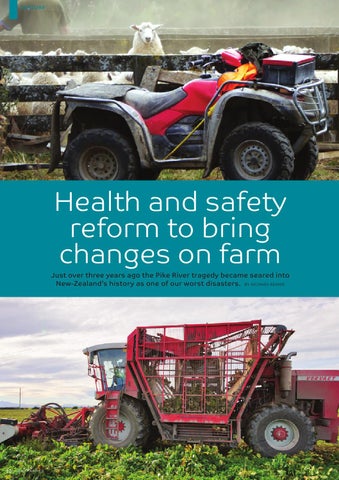
It contains proposals that promise to make New Zealand equal with other western countries to ensure workers in all fields are more likely to come home safely at the end of the day. These changes have been captured in the Health and Safety Reform Bill, now working its way through Parliament and likely to be in place by mid-2015. The farming sector has been warily eyeing the Bill and its implications, knowing very well the sector sits near the top of an unenviable list for the level of workplace injuries and accidents, claiming on average 20 farmers and farm workers a year. Ashburton based health and safety consultant Cindy Meadows has been engaging with the rural sector for over two years in her role as director and founder of Unique Solutions. Cindy has drawn on her extensive experience in the meat processing sector developing safety procedures and policies. Ten years ago the industry was forced to address health and safety issues. It now sets benchmarks and standards that provide some useful templates for the farming sector. “I think we are seeing farming at about where the meat sector used to be, and just starting to recognise that something needs to change, and looking at the methods and means to affect that change,” she says. As a Ruralco Supplier providing advice to cardholders on health and safety issues, she has been heartened by the level of interest from farmers in the region wanting to instil a stronger culture of safety into their businesses. “Most farmers have that desire, but what really frustrates them is knowing where to start from. They hear all the media stories about quad bike accidents in particular, but rather than being a motivator, that can actually scare you off from making changes that will prevent such things happening. What they want is constructive, easily accessed information on how and where to start.” She applauds the work done by WorksafeNZ and DairyNZ to provide such resources to farmers on how to lay down a foundation of health and safety practices. “There is also a real willingness among WorksafeNZ staff to try and better understand the issues individual sectors like farming face when it comes to instilling those standards. It’s less of a ‘policeman’ approach and more of a consultative, collaborative attitude which is really appreciated.”
“Before you would have to try and sift through a lot of separate material to try and find what you needed.” Her meat industry experience highlighted the need for health and safety buy in across all levels of the business. Successful processes did not only include the process workers on the floor conducting what was often the most dangerous work, but also buy in from their supervisors, middle and upper management too. While a processing plant’s footprint is far more compact than that of an extensive pastoral farming business, setting the principles and processes in place remains a “must do”, regardless. Cindy will typically visit a farmer client and conduct an audit including interviewing them and their staff to get a gauge on how deep the operation’s health and safety culture is already embedded. From there she can identify actions that need to be taken and processes to review the plan once it is in place. “It could be you just do a quarterly review on it. Most farmers would prefer something like that, rather than a five hour review once a year.” In addition Cindy also runs monthly health and safety forums as part of her relationship with Ruralco as a supplier. Recently the forestry industry launched its Forest Safety Review which provides a full blueprint for the industry to instil a culture of safety from the point of felling to final timber processing. Cindy said she would welcome an industry specific framework for farming, given the industry’s own unique challenges. Staff awareness of health and safety is also proving a valuable catalyst for farmers wanting to bring more formal processes and procedures to their business. “It is certainly greater than it was 10 years ago, and you do notice it when you have an older and younger generation together at my forums, perhaps it is just that the older generation have got away with things when they were younger, so now don’t always see it the same way.” She believes worker engagement is vital, particularly under the reforms proposed. The Bill aims to ensure workers are required to take some personal responsibility when on the job for their own safety. This reflects a key requirement in the Bill that health and safety is the responsibility of everyone who is on the work site.
Health and Safety Reform Bill: What it means The reform bill aims to ensure New Zealand brings down its workplace accident and injury rate. On average 75 people a year die in the work place, and 10% of workers are harmed, with another 600-900 dying from work related diseases. Farming and forestry claim two of the top spots for workplace death and injury – in 2012-13 19 farmers were killed on the job, and the sector is likely to be a focus for getting the Bill’s reforms in action quickly. Some key points:
Primary Duty of Care: Person Conducting a Business or Undertaking (PCBU) This is a key part of the reform, with PCBUs being the entity or person in best position to control risks to work health and safety. They have the primary duty under the new law for workplace safety. In farm situations contractors visiting who are self-employed will have a “duty of care” themselves to take reasonable steps to ensure their safety. However the farmer will also be required to take reasonable steps to ensure their safety ie identifying any risks and hazards the contractor would not know about.
PCBUs and Primary Duty of Care The Primary Duty of Care will require all PCBUs to take “reasonably” practicable steps to ensure workplace safety. This encompasses all aspects of the environment’s plant, systems, handling, facilities, training and monitoring of health and conditions. PCBUs cannot contract out of their Primary Duty of Care responsibility, and have to work with other PCBUs involved in a workplace, coordinating responsibilities.
Workers and their duties. Responsibilities for safety will be shared, and workers will be required to ensure they too take “reasonable care” to do so.
RE A L FA RM E R
11