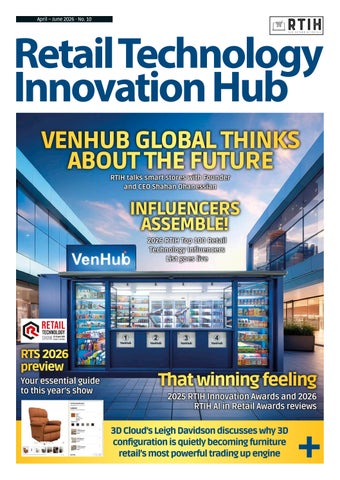

Retail InnovationTechnology Hub


Retail InnovationTechnology Hub


ISSUE
April - June 2026
EDITOR AND FOUNDER
Scott Thompson
Email: scott.thompson@retailtechinnovationhub.com
Website: www.retailtechinnovationhub.com
LinkedIn: www.linkedin.com/company/ retail-technology-innovation-hub
CONTRIBUTORS
Vineta Bajaj
Mike Cadden
Jack Dowling
Rachel Lawler
Gregg London
Liz Morrell
Emma Thompson
PRINTED BY Walstead UK
18 Westside Centre
London Road
Colchester
Essex
CO3 8PH
Website: www.walstead-uk.com
GRAPHIC DESIGN
Steve Kelly
Concept Graphics
Tel: 07734 264835
Email: steve@conceptstudio.co.uk
© 2026 Paxton Media Limited

CWelcome to the tenth issue of RTIH magazine.
hances are, you’ve picked up a copy of this mag at Retail Technology Show (RTS) 2026 in London. If so, we’re over at stand B45, so please feel free to drop by and say hi to myself and our team members.
I’m pleased to report that this is our biggest issue yet, clocking in at a mighty 104 pages. And they say print is dead, eh?
With thanks to our supporters: VenHub Global, 3D Cloud, Vista Technology Support, Alert Data, Star Micronics, VoCoVo, Barron McCann, Retail247, Datitude, LoweConex, SCALA, Foundit!, Melissa Moore, The Barcode Warehouse, SAI Group, SolvedBy.Ai, PPRO, Hanshow, Retail Express, and Sitoo. Many of these guys are out in force at Retail Technology Show 2026, and you should definitely drop by their stands and check out what’s on offer. More retail innovation than you can shake a stick at!
In this issue, in addition to our unmatched RTS 2026 coverage, we take a look back at the 2025 RTIH Innovation Awards and 2026 RTIH AI in Retail Awards ceremonies, which took place in October and January respectively.
Two fantastic evenings in which we announced our worthy winners. To quote a member of our judging panel: “Retail is being absolutely transformed by technology and these awards provide such a great showcase of the best of what is coming through.”
This edition of RTIH magazine also includes the latest edition of the RTIH Top 100 Retail Technology Influencers List, sponsored by 3D Cloud. We’re bringing you the people who made a splash in 2025 and are set for a barnstorming 2026.
We’re witnessing a seismic change in shopping habits. Retailers are doubling down on innovative technologies like AR, AI, machine learning, robotics, and automation, and finding ways to use them to boost business efficiency and make customer experiences more exciting and dynamic.
Which is where the RTIH Top 100 Retail Technology Influencers List comes in, presented, we should stress, in no particular order. Such disruption requires new ways of problem solving and thought leaders who can both evangelise and execute on the likes of digital transformation and omnichannel excellence.
If you made the list, well done you! If you would like to be considered for the next edition, which will be published later this year, drop me a line at the email address below.

Scott Thompson Editor & Founder, RTIH
scott.thompson@retailtechinnovationhub.com www.retailtechinnovationhub.com
ON THE COVER
VenHub Global, 3D Cloud, RTS 2026 preview, and the 2026 RTIH Top 100 Retail Tech Influencers List.

SALES ADVISER POWER TOOLS
Leigh Davidson, Managing Director, International for 3D Cloud, discusses why 3D configuration is quietly becoming furniture retail’s most powerful trading up engine.

3D configuration drives higher spend*
Shoppers who engage with configuration tools spend significantly more on average than those who do not.
Nearly one in two shoppers say they would consider adding extra modules or premium finishes if they could visualise the result in real- time.
58% say seeing the product configured in their space makes them comfortable choosing higher-priced options.
*3D Cloud Furniture Shopping Trends Study, 2026
The 3D Cloud Furniture Shopping Trends Study, 2026, shows that shoppers expect configurable furniture experiences and spend more with retailers that provide them. As brands like La-Z-Boy, Herman Miller, and CITY Furniture demonstrate, unified 3D platforms are turning product configuration into a measurable growth lever. For decades, trading up in furniture retail relied on the sales associate. The conversation happened in the store: suggesting the chaise instead of the standard arm, recommending a more durable fabric, and extending the layout to better suit the room.
Today, that conversation increasingly happens on a screen, either on the showroom floor with a sales adviser or online before a customer ever steps foot in a shop.
In modular sectional sofas, the 3D configurator is emerging as one of the most powerful drivers of basket expansion. Not because it looks impressive, but because it opens the door to more options and directly engages the shopper in a creative process. When customers move from selecting a product to designing a solution, they build more complete, higher cost configurations.
The 3D Cloud Furniture Shopping Trends Study, 2026, makes the shift clear. 72% of shoppers say they are more likely to purchase when they can customise or configure furniture online, and 67% now expect configuration options in modular categories such as sectional sofas.
From product selection to solution building
A modular sofa is not a single item. It is a system of components such as left- and right-arm units, corner pieces, chaises, and ottomans. There is also typically a wide range of fabrics and finishes.
Historically, this complexity constrained online performance. Photographing every combination is impractical. Static product pages flatten choice. Customers default to smaller or simpler layouts because they feel safer.
3D modular configurators change that dynamic. Layouts update in real-time. Fabrics refresh instantly. Pricing evolves alongside each design decision. The experience moves from comparison to creation.
When customers spend time configuring products, they are no longer asking, “Is this the cheapest option?” They are asking, “Is this what I want?” and “Does this feel complete?”
Confidence is the catalyst
Furniture is a high consideration purchase, and uncertainty suppresses spend.
The 3D Cloud Furniture Shopping Trends Study, 2026, shows that 74% of shoppers worry about fit and layout when buying modular furniture online. Yet 69% say interactive 3D configuration reduces that uncertainty
Nearly half say they would consider adding extra modules or premium finishes if they could visualise the result in real-time. That is the tipping point.
When hesitation falls, customers are more comfortable investing in larger configurations, additional modules, and premium upholstery. Trading up becomes a design decision, not a sales tactic.


La-Z-Boy: making millions of combinations shoppable La-Z-Boy, one of the most recognisable names in upholstered furniture, has embraced 3D configuration to modernise how customers explore and customise products.
For La-Z-Boy, configuration is not a minor feature. The brand’s upholstered furniture collections offer millions of possible combinations, driven by the mix of frames, fabrics, leathers, colours, and functional features available across its ranges.
Working with 3D Cloud, the company launched a next-generation 3D product configurator for their full catalogue with integrated WebAR OnDemand, allowing shoppers to customise furniture and visualise it in their homes at life-size scale.
Customers can explore all of their options interactively, configuring materials, colours and product features while seeing the design update instantly in 3D. Once complete, the product can be placed directly into the customer’s living space using WebAR on a mobile device.

The result is a dramatically clearer shopping experience. Instead of imagining what a configuration might look like, customers can see it. That confidence makes it easier to explore premium fabrics, upgraded features, and more complete configurations.
Herman Miller: Configuring an icon
Configuration is equally powerful in design-driven product categories. Herman Miller, part of MillerKnoll, selected 3D Cloud to power scalable 3D product configuration for its iconic Aeron chair, one of the most recognisable office chairs in the world.
While the Aeron’s silhouette is instantly familiar, the product offers a remarkable level of customisation. With multiple sizes, frame finishes, tilt mechanisms, support options, and accessories, the chair can be configured in more than 16 million possible combinations.
Herman Miller selected 3D Cloud to power scalable 3D product configuration for its iconic Aeron chair.
La-Z-Boy has embraced 3D configuration to modernise how customers explore and customise products.

Communicating that level of choice through static imagery or specification tables is nearly impossible. The 3D configurator solves the problem by allowing customers to explore these options visually while viewing the chair from every angle.
Instead of navigating technical product data, shoppers can configure the Aeron chair in real-time and immediately see the result. For a premium product with highly specific ergonomic and performance features, clarity is essential. The configurator ensures each configuration is accurate, visually consistent, and easy to understand - helping customers make confident decisions about a highly customised product.
CITY
Furniture: revenue per session uplift
The same pattern emerged at CITY Furniture, a rapidly growing top home furnishings retailer in the United States. After unifying its 3D applications and introducing modular sectional configuration, the retailer saw measurable gains across key metrics. Previously managing multiple disconnected 3D tools, CITY consolidated visualisation, WebAR, room planning, and 3D configuration into a single platform.
The impact was clear:
• 10% revenue per session growth on configurable collection pages
• 46% lift in add-to-basket rate
• 18% increase in average order value for customers using “Build Your Own”
• 5.2% overall revenue per session uplift
Across markets, the conclusion is consistent. When customers configure modular furniture themselves, they spend more.
The infrastructure behind the experience
Configuration performance depends on more than interface design. Many retailers have adopted 3D incrementally, layering different vendors for WebAR, spins, and configuration. The result: fragmented workflows and inconsistent content.
UK retailers John Lewis & Partners and B&Q have rolled out comprehensive 3D design programmes with an end-to-end customer experience in mind. John Lewis for their home design service and B&Q kitchen and bath design appointments.
La-Z-Boy, Herman Miller, and CITY Furniture have all simplified their 3D ecosystems by consolidating under one 3D partner powering every 3D application.
Centralised assets and unified workflows created

Previously managing multiple disconnected 3D tools, CITY consolidated visualisation, WebAR, room planning, and 3D configuration into a single platform.
consistency across channels and allowed modular ranges to scale efficiently.
Vendor consolidation did not replace the tradingup story. It made it repeatable. With one platform supporting spins, AR, configurators, and room planning, configuration becomes a structured infrastructure rather than a one-off feature.
The next evolution: intelligent configuration
As modular ranges grow, so does complexity. Managing thousands of SKUs and countless valid configurations requires intelligent systems.
Recent innovation in AI driven 3D workflows reflects a move towards smarter configuration pathways, behaviourbased recommendations, and automated optimisation.
AI can guide customers towards well balanced layouts, reduce decision fatigue, and surface combinations that historically drive stronger performance.
In practical terms, AI strengthens the mechanics of trading up. It helps customers build better solutions, faster.
Designing for value expansion
Furniture retail is shifting from product selling to solution selling.
Customers do not simply want a sofa. They want a layout that fits their space, reflects their style and feels complete.
The 3D Cloud Furniture Shopping Trends Study, 2026, confirms that interactive configuration reduces risk and increases purchase intent
Trading up is no longer dependent on persuasion in-store. It is embedded within the design journey itself. In configurable furniture, that shift is redefining the customer experience.


movingonUP
VoCoVo, Everseen, Sensei, Gander, Iceland, Olio, Trust Retail, East of England Co-op, Lekkerland SE, Poq, Mamas & Papas, Varner, Sitoo, and Zebra Technologies were among the winners at the 2025 RTIH Innovation Awards.
Best Data Analytics
Driven Retail Initiative went to Tesco and LiveRamp.

2025 RTIH Innovation Awards
Our 2025 hall of fame entrants were revealed during a sold out event which took place in October at The HAC in Central London and consisted of a drinks reception, three course meal, and awards ceremony presided over by award winning comedian, actress and writer Tiff Stevenson.
In his welcome speech, Scott Thompson, Founder and Editor, RTIH, said: “This is the awards’ fifth year as a physical event. We started off with just 30 people at the South Place Hotel not far from here, then moved to London Bridge Hotel, then The Barbican, and last year RIBA’s HQ in the West End.”
“But I’m conscious of the fact that, to
quote the legend that is Taylor Swift, You’re only as hot as your last hit, baby. So, this year we’ve moved to our biggest venue yet, and also pulled in our largest number of entries to date and broken attendance records.”
He added: “This year’s submissions have without doubt been our best yet. To quote one of the judges: The examples of innovative developments across both traditional and digital retail spaces were truly remarkable.”
Congratulations to our 2025 winners, and a big thank you to our sponsors, judging panel the legend that is Tiff Stevenson, and all those who attended our October gathering.

Payments Innovation was a hard fought category this year.
2025 RTIH Innovation Awards
Our winners and highly commended entries
Bricks and Mortar Innovation
WINNER
Retail AI
HIGHLY COMMENDED: Lekkerland SE
Supply Chain Innovation
WINNER Shoeby and WAIR
Payments Innovation
WINNER Oh Polly
WINNER Ecommpay
Most Innovative UK Retailer
Sponsored by 3D Cloud
WINNER White Stuff and AbsoluteLabs
HIGHLY COMMENDED: Pharmacy2U and Commerce
Most Innovative Retailer (Rest of World) Sponsored by STRATACACHE
WINNER ICA Gruppen, Cleveron and Ingrid
HIGHLY COMMENDED: Sonae MC and Sensei

The guys from Sitoo.
2025 RTIH Innovation Awards
Digital Transformation Project of the Year (UK)
WINNER
Currys, Vestcom and SOLUM
HIGHLY COMMENDED:
Sellfware Technology and VJ Technology
Digital Transformation Project of the Year (Rest of World)
WINNER Harding+ and TPP Retail
Customer Experience Excellence
WINNER
Molton Brown and SAP Emarsys
Omnichannel Retail Initiative of the Year
WINNER Longchamp and Yocuda
AI Innovation (UK)
Sponsored by EdTech Innovation Hub
WINNER B&Q and Foundit!
AI Innovation (Rest of World)
WINNER Legion Technologies
Sustainable Retail Innovation
WINNER Gander, Iceland and Olio

2025 RTIH Innovation Awards
Best Data Analytics Driven Retail InitiativeNEW CATEGORY
WINNER
Tesco and LiveRamp
Best Use of Automation in the Retail SectorNEW CATEGORY
WINNER
Sinch and Clarins
Technology Vendor of the Year (UK)
WINNER
Barron McCann and Retail Assist
Technology Vendor of the Year (Rest of World)
WINNER
Hanshow Technology
Startup of the Year
WINNER
Zyntrix
WINNER
VenHub Global
Technology
Implementation of the Year (UK)
WINNER
Trust Retail and East of England Co-op

Dinner is served,
2025 RTIH Innovation Awards
Technology Implementation of the Year (Rest of World)
WINNER
Nextail
Best Retailer/ Technology
Supplier
Relationship
WINNER
VoCoVo and Currys
RTIH Editor’s Choice Award
Sponsored by VenHub Global
WINNERS
Everseen and Tesco
Retail Response and New Look
Varner, Sitoo and Zebra Technologies
Poq and Mamas & Papas
EE Red Ant
Vista Technology Support
Overall Winners
Sponsored by Vista Technology Support
Tesco and LiveRamp
VoCoVo and Currys

With thanks to our 2025 judging panel
Rob Smith, Technology Officer, East of England Co-op
Suhas Grama, Senior Software Development Engineer, Amazon Just Walk Out
Vineta Bajaj, Group CFO, Holland & Barrett
Nadine Neatrour, Chief Marketing Officer, Gordon Ramsay Restaurants
Jack Dowling, Transformation Director (Strategy, Product, Operations & AI)
James Pepper, CEO, Vista Technology Support
Mike Cadden, Chief Technology Officer, Marie Curie
Carole Kingsbury, Chief Technology Officer, C&C Group
Christine Russo, Industry Analyst and Retail Influencer
Matt Taylor, CTO of Global Managed Services and VP of SecDevOps, NCC Group
Paula Bobbett, Chief Digital Officer, Boots
Yatin Garg, Head Product & Engineering, Amazon
Gregg London, Supply Chain Consultant
Scott Thompson, Editor and Founder, Retail Technology Innovation Hub
Toby Pickard, Retail Futures Senior Partner, IGD
Gary Newbury, Supply Chain Advisor and Delivery Executive
Our host for the evening, Tiff Stevenson.

Drinks reception.
Winner profile
2025 RTIH Innovation Awards winner profile
As the global leader in retail communications, VoCoVo is dedicated to setting the standard for connected retail.
VoCoVo’s mission is built on a deep, sector specific understanding of the modern retail environment, allowing its teams to engineer technology that empowers retail teams, prioritises colleague safety and streamlines in-store operations, while simultaneously elevating the customer experience.
The multi-award-winning company connects more than
250,000 users across the globe with wireless in-store communication products, including lightweight headsets, two-way call points, keypads, telephony, and third-party smart technology and AI integrations - all designed to connect colleagues and customers through voice technology.
VoCoVo has achieved several milestones over the last 30 years, from the integration of telephony into colleague headsets, enabling
the handling of incoming customer calls from the shop floor, to the addition of an API, integrating colleague headsets with alerts from IoT enabled devices.
VoCoVo then developed and launched its flagship product, the revolutionary Series 5 Pro, in 2023. The lightweight, robust and sustainable headset was crafted in direct response to feedback from retailers and designed specifically for fast-paced, demanding store requirements.

Founded in 1994, VoCoVo has grown from a small team of just five people to almost 200 members of staff, serving major UK retailers including Tesco, Dunelm, The Cooperative Group, Iceland, Currys and Wickes, as well as customers in North America and Europe.
Today, the business is guided by an executive board and senior leadership team led by CEO Beth Worrall. This leadership oversees a seamless integration of departments, from core hardware and software R&D teams to dedicated sales, marketing, logistics and operations, all working in unison to deliver leading communication solutions.
VoCoVo commits itself to fostering long-term partnerships that grow alongside its customers’ needs. A prime example of this dedication is a nine-year collaboration with Co-op, which recently announced it is continuing its relationship with VoCoVo by upgrading its existing headset devices. This move reflects a shared long-term investment strategy in in-store technology, ensuring teams remain equipped with the most advanced tools to succeed.
By enabling instant communication within stores and with Co-op’s Support Centre, teams can respond quickly to customers. Whether answering customer enquiries or requests for assistance, checking stock availability, managing parcel collections or handling online orders, the S5 Pro supports colleagues in carrying out everyday tasks more efficiently.
“Following the trials, we are confident the S5 Pro headsets will simplify everyday tasks for colleagues, strengthen communication and support our focus on ensuring a safe and enjoyable shopping environment
Winner profile
for everybody, all while helping us deliver an even better experience for our members and customers.”
David Tyas, Head of Retail Support Centre & Innovation at Co-op
This commitment to long-term success is further mirrored by VoCoVo’s partnership with Currys, which led to VoCoVo being recognised by the Retail Technology Innovation Hub for the Best Retailer/ Technology Supplier Relationship Award for the second year in a row.
Following a successful trial of VoCoVo’s Headsets in 20 selected stores, Currys began a full roll-out across all of its UK and Ireland stores in 2025 as part of the retailer’s biggest annual investment in store safety measures. This equipped every colleague with a headset for each shift, helping them stay better connected and, in
turn, safer on the shop floor amid an industry-wide rise in shoplifting and incidents of abuse.
Colleagues have reported feeling significantly safer and supported, particularly when dealing with challenging situations such as shoplifting, thanks to the ability to communicate with peers across large store areas.
VoCoVo’s solution has also improved the in-store experience for customers. Colleagues can communicate with ease and efficiency, ensuring customer queries are answered quickly.
The partnership between Currys and VoCoVo has enabled faster pick-up times for online orders and improved time management across the store. Two-way customer call points incorporated throughout stores also enable customers to request assistance at the touch of a button, with notifications delivered straight to colleague headsets.

VoCoVo and Currys at the 2025 RTIH Innovation Awards Ceremony.
Today, VoCoVo is guided by an executive board and senior leadership team led by CEO Beth Worrall.
Winner profile
Feedback from stores includes:
One store described the headsets as a “game changer”.
One colleague appreciated being able to complete warehouse tasks while remaining available for customer support, praising the audio quality and comfort of the headset.
Another noted that the headsets eliminated the need to chase down more experienced colleagues for quick questions.
A third colleague found the headset lightweight and comfortable, with no issues wearing it alongside their glasses.
VoCoVo’s market leading devices are just one element of an evolving relationship between the two organisations. VoCoVo is working closely with Currys to explore more ways in which in-store technology can transform both colleague efficiency and customer experience.
Currys is looking at the integration of solutions that enable real-time notifications of online orders, delivery arrivals, and messages specifically targeted to sales floor leaders. This will serve to further enhance the customer experience and drive additional efficiencies.
“Technology was at the core of addressing the pain points we faced - we needed a partner who not only understood our challenges, but who could bring deep retail expertise to help solve them.
What made the partnership so successful was VoCoVo’s collaborative approach. They worked incredibly closely with us to design a structured pilot programme that addressed our specific needs, which allowed us to clearly see the measurable benefits of the technology before moving to a phased roll-out.
VoCoVo’s ability to align with our tech first strategy, while also bringing a deep understanding of
retail operations, has made them more than a supplier. They’ve become a trusted long-term partner in helping us transform the way our teams work and the way we serve our customers.”
Matthew Speight, Director of UK Stores at Currys
In 2024, VoCoVo won its first RTIH award for the Best Retailer/ Technology Supplier Relationship with British supermarket chain, Iceland.
Following a successful trial, the Series 5 Pro headset was initially rolled out across 974 stores in the UK. The headsets have enabled Iceland colleagues to respond faster to customer queries, reduce unnecessary walking, and coordinate efficiently across departments. They have also increased staff safety, acted as a deterrent to theft and supported inthe-moment training, transforming store operations nationwide.
“The investment in VoCoVo headsets is a step forward in improving the efficiency, communication and safety of our store colleagues, which are all paramount to our current and future plans.”
Kristian Barrett, Retail Director at Iceland
“VoCoVo’s headsets act as a deterrent to crime and save time. They speed up customer service as colleagues can quickly ask somebody in the back areas if we’ve got a product available. Our colleagues absolutely love them.”
Emma
Tysoe, Head of IT Development at Iceland
Beyond the rapid expansion of people, products and market reach,
VoCoVo is proud of its commitment to sustainability. VoCoVo was once again awarded a Silver EcoVadis Medal in 2025, has achieved ISO 14001 compliance, and received a Zero Waste to Landfill certification in 2024.
As part of its continued commitment to its customers and the wider retail industry, VoCoVo often commissions research to highlight and raise awareness of the real and sustained pressures the retail sector faces.
VoCoVo’s most recent independent report, In-store Intelligence: AI’s Role in Retail’s Human Touch, uncovers how AI is being adopted, the challenges retailers face and where shopper expectations align or diverge. The research was commissioned with 250 UK retail decision-makers across sectors, including fashion, DIY and grocery, as well as 503 consumers, diving into how AI is reshaping the in-store experienceboth for colleagues and customers.
In 2026, VoCoVo will continue to build upon its expansion into the US and Europe, while strengthening its focus on people development and AI enabled customer success.
For more information and to access the AI Report, please visit www.vocovo.com.

VoCoVo serves major UK retailers including Tesco, The Co-operative Group, and Iceland.


Powering retail efficiency through INNOVATION
See Vista Technology Support live at Retail Technology Show - Stand N55.
Walk any high performing store in 2026 and you’ll notice something subtle: fewer bottlenecks, faster decisions, and teams who spend more time with customers and less time firefighting systems. This step change isn’t about one blockbuster technology - it’s a disciplined approach to harnessing innovation to enable efficiency. It’s about integrating smart automation, resilient infrastructure, and actionable data into the everyday rhythms of retail operations.
In this article, and on this year’s stand, we explore how retailers can harness innovation not as a standalone project but as an operational system, and why the most effective transformations happen when technology is paired with robust service, predictable execution, and dependable engineering.
At Vista Technology Support, we deploy and support the technology that powers some of the UK and Ireland’s most recognised retailers, hospitality operators, pharmacies, and entertainment brands. We supply, stage, deploy, and - once live - maintain the estate with preventative and highly responsive breakfix services, service desk, and managed IT underpinned by industry leading SLAs. In short: whatever technology you use, we’ll keep it running.
Who we are - and why efficiency is our north star For over 25 years, Vista has specialised in technology deployment and ongoing support for customer facing environments. Our portfolio spans IT maintenance and breakfix, IT service desk, and IT project services (including new store openings and technology refresh). We are trusted by 120+ retail, hospitality, and pharmacy businesses, from quick service restaurants to national grocers, to keep the lights on and the lanes moving. Our operating model is built for efficiency at scale: Our package of services mean retailers aren’t juggling multiple vendors for the basics of uptime. When equipment fails, our breakfix teams work to SLAs as tight as 2/4/8 hour and next business day, and returned parts flow through our repair centre back into inventory to shorten resolution times and reduce cost of service. This “wholelife” approach to store technology matters. because lost minutes = lost margin. By removing operational friction - whether that’s an EPoS fault, a scanner that won’t scan, or a network segment that’s misbehaving - retailers reclaim capacity to serve customers and sell.
Deploying smarter, supporting faster
Our projects team stages and rolls out the kit - front of house and back of house - so stores start strong
Vista deploys and supports the tech that powers some of the UKI’s most recognised retailers, hospitality operators, pharmacies, and entertainment brands.
from day one. Support faster. Service desk triage plus inhouse field engineering keeps downtime to a minimum. Learn continuously.
We use performance and incident data to inform continuous service improvement and cost to serve reductions across the estate. That’s how we’ve become the partner of record for complex, multisite retail estates across the UK and Ireland. [vistasupport.com]
This year, we’ve doubled down on Ireland through our group company SCT (Store Computer Technology) - an established retail and hospitality technology support provider founded in 1994 and now part of the Vista family. With a Dublin HQ, nationwide engineers, and support for 7,000+ locations, SCT extends Vista’s ability to deliver a seamless UK-Ireland service for brands operating crossborder.
What harnessing innovation looks like
At RTS, we’re showcasing a set of innovations that are pragmatic, deployable, and laser focused on efficiency. You’ll see our service blueprint in action: how compelling partner technology integrates with retail workflows - and how Vista keeps it running at enterprise scale.
1) Simbe’s Tally - helps store teams keep shelves stocked and shoppers happy
Every store wants better availability, more accurate pricing, and sharper execution. The fastest route is continuous, high fidelity shelf data - and that’s where Simbe’s Tally shines. Tally is the autonomous shelf scanning robot adds up to 12 hours of runtime, ultra high resolution imaging, expanded 3D/360° coverage, and NVIDIA edge AI to deliver near realtime insight into what’s in stock, how it’s priced, and where it sits. In practice, that means tighter replenishment, fewer out of stocks, and cleaner plans - without stealing hours from store teams. Visit Stand N55 to explore how Tally seamlessly integrates into stores, and with service desk, field engineering, and your existing data stack.
2) Ergonomic solutions (SpacePole®) - faster, safer, more flexible touchpoints
Front of house efficiency lives and dies by ergonomics and modularity. Ergonomic Solutions, creators of SpacePole®, supply technology mounting solutions for PoS, payments, selfservice, digital signage, and tablet applications - 12.5 million+ installations globally and used by a majority of top retailers. Their SCO Flex and SpacePole Kiosk ranges show how to convert fixed checkouts into hybrid and selfservice formats without
For over 25 years, Vista has specialised in technology deployment and ongoing support for customer‑facing environments.
Vista Technology Support
ripping and replacing core systems - reducing queue times and freeing staff for assisted sales.
SpacePole’s modular design lets you iterate layouts and peripherals (e.g., move from manned PoS to SCO, or add a customer display) with minimal disruption, exactly the kind of “change at the edge” that builds efficiency without multiyear transformations.
3) HP - Retail redefined by design
HP Engage systems anchor many modern store experiences - from sleek, all in one tills to modular back office platforms and self-service kiosks. HP’s portfolio spans allinone, convertible/mobile, modular, and self-service options, plus peripherals - letting retailers standardise on a platform while tailoring the form factor per use case. HP is also investing in AI ready PoS and a unified retail solution that connects hardware, software, and services to reduce in-store friction and bring online and offline closer together.
For operators, this means longer lifecycles, fewer skews, and easier estate management - a quiet but meaningful driver of device uptime. Pair HP hardware with SpacePole mounting and Vista’s breakfix/service desk and you have a stable, scalable, futureproof foundation for store transformation.
4) BOXTEC - Customer engagement hardware that adapts to your estate
When retailers want fit for purpose kiosks, SCOs, and PoS that can be tailored quickly, BOXTEC’s UK designed, inhouse manufactured hardware is a

Vista Technology Support

compelling option. With three decades of heritage, BOXTEC’s Ninja PoS family, kiosks, and embedded PCs are engineered for real-world robustness and rapid integration, and the company maintains a deep ecosystem of solution and technology partners across retail and hospitality. The value is speed + fit: projects move faster when your hardware partner can design, manufacture, and iterate locally - and when a service organisation like Vista can stage, deploy, and support it end to end.
Smart stores win
Talk to ten retailers and you’ll hear ten definitions of “efficiency.” But the pattern is consistent:
1. Make every minute productive - keep devices, networks, and applications stable: Vista’s maintenance and breakfix services are designed to shorten MTTR via tight SLAs and in-house engineers, repair centre and logistics - no third-party hopscotch.
2. Automate where it helps colleagues - free employees from repetitive checks to focus on service and sales: Simbe’s shelf intelligence feeds replenishment, pricing and planogram compliance with minimal manual effort.
3. Design for adaptability - reconfigure frontofhouse quickly as demand shifts.
Ergonomic Solutions modular mounts and kiosks turn fixed lanes into flexible touchpoints, supporting SCO or assisted modes.
4. Standardise the platform - reduce “estate complexity” HP Engage’s portfolio provides consistent, AI ready endpoints across till, kiosk, and mobile, backed by enterprise lifecycle commitments.
5. Close the UK–Ireland loop - run one operating model across both markets.
Vista’s Irish arm, SCT, supports 7,000+ sites with service desk and field engineering across all 32 counties - extending group capability and giving brands a unified playbook.
When these pieces work together, you get an efficiency flywheel: fewer incidents, faster fixes, better data, smarter merchandising, and more capacity to serve customers.
Seeing is believing:
Why you should visit us at Stand N55
It’s one thing to read datasheets; it’s another to see the flows - how Simbe’s Tally data lands in dashboards, how SpacePole formats can be rearranged for peak periods, how HP Engage endpoints are secured and monitored, how BOXTEC kiosks accelerate specific journeys - and how Vista connects all of them with service desk workflows, field engineering coverage, repair logistics, and managed services.
And we’ll go deeper on service orchestration: from incident intake at the service desk, through diagnosis and dispatch, to part repair/replenish, and on to continuous improvement using incident analytics.
Beyond the show:
Partnering for outcomes, not just installs Vista doesn’t measure success by the number of devices installed; we measure it by the outcomes our customers care about: minutes saved per incident, first time fix rate, store uptime, conversions, etc. Because we control the end to end chain, we can close the feedback loop and drive down the cost to serve over the life of your technology.
Our growth journey, underpinned by long-term investment and acquisitions like SCT in Ireland, is about building the scale and capability to keep modern stores running while helping brands adopt innovation without disruption.
Your invitation
If your 2026 priorities include unifying store and digital, reducing rework, or accelerating transformation without risk, come and see us at Stand N55. Watch the technology run, quiz our engineers, and map the steps to deploy in your estate.

Tally, Simbe’s autonomous shelf‑scanning robot.


RTIH’s Top 100 Influencers

INFLUENCERS ASSEMBLE!
The latest edition of the RTIH Top 100 Retail Technology Influencers List is here! The list has seen a surge in popularity over the past few years, to the point that we’ve decided publishing it once a year is no longer enough. Here, then, is the first edition for 2026, with some names dropping out of the top 100 and some new names coming in (the latter are flagged as new entries for ease of reference).
RTIH has scoured the retail technology world to find the most influential figures for this comprehensive round up of people and trends that shape the industry and help drive it forward.
We’re witnessing a seismic change in shopping habits. Retailers are doubling down on innovative technologies like AR, AI, machine learning, robotics, and automation, and finding ways to use them to boost business efficiency and make customer experiences more exciting and dynamic.
Which is where the RTIH Top 100 Retail Technology Influencers List comes in, presented,
we should stress, in no particular order.
Such disruption requires new ways of problem solving and thought leaders who can both evangelise and execute on the likes of digital transformation and omnichannel excellence.
We hope you enjoy reading through it and, as always, if you would like to give feedback or believe that there are some glaring omissions, please feel free to get in touch.
Many thanks to 3D Cloud, which provides 3D product visualisation software trusted by top furniture and DIY retailers, for sponsoring the report.
Scott Thompson, Founder and Editor, RTIH
RTIH’s Top 100 Influencers
BECKY LOMBARDO | NEW ENTRY
LinkedIn Bio Helping fast growth global eCom businesses scale and grow profitably | Logistics | Supply Chain | Operations | SME | eCommerce | Omnichannel | Retail | Scale Up | Start Up | Growth Accelerator | Advisor | COO.
ANDY GAMBLE
LinkedIn Bio Group CIO at Currys PLC | Investor | Former CIO Sony & Dyson.
PAULA BOBBETT
LinkedIn Bio Chief Data and Digital Officer @ Boots UK | Executive Director| NED.
VINETA BAJAJ
LinkedIn Bio Group CFO @ Holland & Barrett | ExOcado | Ex-Rohlik Group | Chief People Officer | NED | Mentor | Advisor | Investor | Top 100 Retail Tech Influencer 2024 | Expert.
ELAINE PARR
LinkedIn Bio Consumer Products, Retail & Luxury Industry Leader | Recognised Industry & LinkedIn Top Voice | The CPG Geek™ | Gender Equality & Talent Champion | Proud Mum of The Firecracker | IBMer |
IAN RASMUSSEN | NEW ENTRY
LinkedIn Bio Leading the Future of Convenience Retail | Trusted Advisor to Executives | Leading Business Transformation & Customer Success.
GRAHAM BROOMFIELD
LinkedIn Bio Managing Director Austen & Blake | NED | Investor | CEO | Trustee | Advisory Board Member.
SHISH SHRIDHAR
LinkedIn Bio Global Retail Startups Lead | Top AI Leader 2024 | Top Retail Expert 2024 | Top 100 Retail Technology Influencers | Advisory Board | Public Speaker.

Becky Lombardo
RTIH’s Top 100 Influencers
ANDREW BUSBY
LinkedIn Bio Senior Industry Adviser, BOXTEC | Retail Writer at Fortune | Founder, Redline Retail Consulting | BestSelling Author | Bookmark Charity Ambassador | ReTHINK Retail / RTIH Top 100 | Speaking: Speakers Corner.
ALICE RACKLEY
LinkedIn Bio Chief Executive Officer @ Polytag Limited | Circularity Pays - platform solutions to power sustainable businesses. Digital Product Passports and more. ISO certified. Global Brand Clients. VC Backed.
RESHAD HOSSENALLY | NEW ENTRY
LinkedIn Bio Co-Founder & CEO - Boxbar TechReinventing Bars | Tech Advisor | Founded tech which generated $900m in sales.
DEANN CAMPBELL
LinkedIn Bio Retail turnaround through optimising stores | Global Speaker | Rethink Retail Top Global Influencer | RTIH Top 100 Retail Technology Influencer.
OLIVIA ROBINSON | NEW ENTRY
LinkedIn Bio Global Strategy & Enablement Director, VoCoVo.
MARTIN BAILIE | NEW ENTRY
LinkedIn Bio Global Retail CEO | Multi-Award AI & Growth Expert | Founder MWB Advisory | Leading Retail Transformation via AI & Operational Excellence | Advisor PwC Strategy&, Vusion, Quorso | CEO Tesco/Tata, COO Lidl, Primark Board.
MICHELLE GRANT
LinkedIn Bio Director, Strategy and Insights, Retail and Consumer Goods at Salesforce.
MARSHALL KAY
LinkedIn Bio Strategic Advisor to retailers, global brands and investors. Speaker. Writer on Retail topics for Forbes. Named one of 2024’s Top Retail Influencers by UK-based Retail Tech Innovation Hub and US-based RETHINK Retail.

Andrew Busby
RTIH’s Top 100 Influencers
JAMES PEPPER
LinkedIn Bio CEO @ Vista Technology Support | Charity Sector Trustee.
DAN MCGRATH
LinkedIn Bio JD Group Customer Operations at JD Sports Fashion plc.
RICHARD NOON
LinkedIn Bio Implementation Engineer | Fintech & Technology I Payments Did you know i’m also a Retail Technology Innovation Hub 100 Tech Influencer for both 2024 & 2025 | Speaker at Retail Technology Show 2025.
SCOTT THOMPSON
LinkedIn Bio Editor and Founder at Retail Technology Innovation Hub and EdTech Innovation Hub. Organiser of the RTIH Innovation Awards and RTIH AI in Retail Awards. Member of the judging panel for EHI Retail Institute’s reta awards.

VIV CRASKE
LinkedIn Bio Retail Media, E-commerce consultant. Host: Retail Media Therapy Podcast. | Author: Surviving Digital Disruption.
MELISSA MOORE
LinkedIn Bio The Retail Advisor | The Retail Tea Break Podcast Host | Retail & Sales Lecturer | Conference Chair & Event MC | RETHINK Retail Top Retail Expert |
DR. CHRISTIAN BOCK
LinkedIn Bio Bereichsleiter Unternehmensentwicklung Vertrieb | Empowering Tomorrow’s Retail Potential Today.
YAZ HANLEY | NEW ENTRY
LinkedIn Bio Head of Customer Success @ Strongpoint ALS.
BECK BESECKER
LinkedIn Bio Founder & CEO at 3D Cloud.

Melissa Moore
James Pepper
RTIH’s Top 100 Influencers
MATTHEW TAYLOR
LinkedIn Bio CTO | Driving Business Value Through Global Technology, Cyber Security, Data and AI Leadership | CIO | Technology Executive.
PAULA MACAGGI
LinkedIn Bio Informing Retail Leaders | Founder of OFFBounds - #1 Podcast for Retail and Brands Executives | Reta Awards Judge | Top Retail Expert 2024 & 2025.
STEVE COLLINGE
LinkedIn Bio Rethink Retail Top Retail Expert 2026, RTIH Top 100 Retail Technology Influencer 2025, Commentator, Content Creator, International Speaker and Expert on the Home & Garden Industry. Group Managing Director.
TED MCCAFFREY | NEW ENTRY
LinkedIn Bio Omnichannel Champion | Rethink Retail Top Retail Expert 2024-2026 | Retail Tech + RFID + AI |

Strategic Partnerships • Store Intelligence • Data-Driven Execution | Micro LinkedIn Influencer.
CAITLIN ALLEN
LinkedIn Bio RTIH Top 100 Retail Tech Influencer | PG 2025 Top Woman in Grocery | SVP of Market @ Simbe.
PAUL DO FORNO
LinkedIn Bio Global Commerce Practice Lead at Deloitte Digital.
DEAN D. MCELWEE | NEW
ENTRY
LinkedIn Bio VP of E-Commerce | Digital Transformation Leader | Expert in Digital Marketing & Strategy | Author of “eCommerce for CEOs” | Scaling Omnichannel Revenue & Brand Growth | Driving ROI through Data-Led Innovation.
MOHSEN GHASEMPOUR | NEW ENTRY
LinkedIn Bio Chief AI Officer @ Kingfisher | NonExecutive Director @ Hays Travel.
DAVID POLINCHOCK
LinkedIn Bio Pres, Brand Experience Lab | Retail Innovation Strategist | RETHINK Retail Top Expert | RTIH Top Voice in Retail | |Top AI In Retail | Mentor | Writing book on 3rd Place with Sydney Polinchock.
MELISSA MINKOW | NEW ENTRY
LinkedIn Bio Global Director, Retail Strategy & Insights at CI&T RETHINK Retail Top 100 Expert.
MIKE CADDEN
LinkedIn Bio Transformational retail focused IT Director/CIO/Programme Manager; RTIH Top 100 Retail Tech influencer.
ASIF AZIZ
LinkedIn Bio Retail Director EE/BT Group | NED | BT Group Clinical Advisory Board Member.
WALTER HOLBROOK
LinkedIn Bio YODA RETAIL | RETHINK Retail Top Expert 2024/2025/2026 | Leadership Development | Merchant | Transformation & Change Coach | Retail PioneerMad Man Era to Today | RTIH/3D Cloud Top 100 Retail Technology Influencers.
Yaz Hanley
MATT BRADLEY
RTIH’s Top 100 Influencers
LinkedIn Bio Director & Founder - Retail Technology Show.
MARTIN NEWMAN
LinkedIn Bio One of the world’s leading authorities on customer centricity, a global speaker, part time chief customer officer, author, creator of the Mini MBA in Customer Centricity and a trusted board advisor.
CHRISTINE RUSSO
LinkedIn Bio Leading Industry Voice | Tech Scouting | Events | Believer in Converting with Content | Partnerships | Creator and Host What Just Happened Podcast on Spotify | Moderator, Advisory Board Member | Debate Winner.
TREVOR SUMNER
LinkedIn Bio CEO of i-Genie.ai - Top 100 Retail And Top 50 RetailTech Expert - Entrepreneur - Executive - Advisor – Angel.
Sharon Yourell Lawlor
GREG DEACON
LinkedIn Bio Commercial & Growth Leader | Quick Commerce, Retail Media & FMCG | Scaling Revenue, Partnerships & Market Expansion.
KOMAL KOUL | NEW ENTRY
LinkedIn Bio Head of Digital Performance at Currys.
NICHOLAS FOUND | NEW ENTRY
LinkedIn Bio Head of Commercial Content at Retail Economics.
GARY NEWBURY
LinkedIn Bio Rapid Performance Recovery | Supply Chain Transformer | 25+ Operational Turnarounds | Mid-Market Growth Escalator | Speaker | Radical Strategic Thinker | Highly Focused | Empowering | Interim C Suite Leader.

Asif Aziz
RTIH’s Top 100 Influencers
ROB SMITH | NEW ENTRY
LinkedIn Bio Technology Officer @ East of England Coop | Technology Leadership.
BRITTAIN LADD
LinkedIn Bio Supply Chain AI Implementation l Supply
Chain Strategy l Automation l Supply Chain and Logistics
Consulting l Automotive l Industrials l Retail l Perishables l Healthcare l Oil & Gas l Chemicals l CPG l FMCG
JENNIFER STEPHENS
LinkedIn Bio CMO / CCO / NED | AI Native | FinTechTokenization / Digital Assets | B2B / B2C | I write about the intersection of culture, technology and business.

SHARON YOURELL LAWLOR
LinkedIn Bio Helping businesses develop innovative marketing strategies that connect effectively with today’s shoppers | International speaker | NRF Retail Voice | RETHINK Retail Top Expert ‘23 - ‘26 | RTIH Top 100 Tech Influencer ’25.
JO HICKSON
LinkedIn Bio Innovation Director | Emerging Tech | Product Leader | Growth generation / Transformation | NED | Start-up advisory.
CHRIS CONWAY | NEW ENTRY
LinkedIn Bio Chief Digital Officer | Ecommerce Director | Commercial Director | Operations Director | Global Tech Top 50 Retail Week 2024 & Board Adviser.
ANDY BALDAUF
LinkedIn Bio Future Agent & Impact Architect for #EasyShopping | Decision-making across the shopping ecosystem | Switzerland → global.
STEVE LISTER
LinkedIn Bio Sustainability Consultant to Global Brands, Retailers & Partners - RETHINK Retail - Top Retail Expert Consultant 2024 - Top Retail Influencer 2023/24 - Retail Expert - RTIH Top 100 Retail Technology Influencer 2023/24.
DOMINIQUE PIERRE LOCHER
LinkedIn Bio 1st generation digital pioneer, early stage investor and Food- and RetailTech entrepreneur.
TONY D’ONOFRIO
LinkedIn Bio President @ Sensormatic | Recognized Global Top Retail Expert - 11,000+ Direct Contacts / 150,000+ Followers > Views my own.
MIKE ANTHONY | NEW ENTRY
LinkedIn Bio Driving brand sales without increasing retail spend. Rethink Retail Top 100 Expert: Shopper marketing training, retail key-note speaker; insights, strategy & capability: shopper marketing & customer teams.
VIRGINIA MARSH | NEW ENTRY
LinkedIn Bio Top Retail Expert 2026, 2025 |AI Retail & CPG Data Strategist | Audience Activation & Data Monetization | AdTech & Martech Leader.
Rob Smith
RTIH’s Top 100 Influencers

LEONID GLADILIN
LinkedIn Bio Global eCommerce Leader | Scaled Amazon/Costco-equiv. to $720M+ ARR | P&L, DTC & Omnichannel Growth | Top Retail Expert 2025, 2026 | Top 100 Retail Tech Influencer 2024, 2025.
RICHARD HAMMOND
LinkedIn Bio Uncrowd CEO & Founder | Expert in Experience Analytics.
HENRIK HÄLLBERG | NEW ENTRY
LinkedIn Bio MD @ WAIR Nordic | AI native | Inventory Planning | Fashion.
DAVID PERKS | NEW ENTRY
LinkedIn Bio Experienced MD | Rethink Retail Industry Expert | Tesco | Sainsbury’s | Kingfisher | BP | Accenture |
TOBY PICKARD
LinkedIn Bio Retail Futures Senior Partner @ IGD | Top Retail Expert from Rethink Retail and RTIH Top Influencer.
GLENN FAULKNER
LinkedIn Bio Automating Retail | Innovative Infrastructure & Hardware Product Manager.
GILES SMITH | NEW ENTRY
LinkedIn Bio CPO/CTO | Keynote Speaker | Technologist | Executive, Leader & Board Trusted Advisor @ Burberry, Unilever, Selfridges, John Lewis, Matalan, Arcadia, Walmart, Woolworths, Mondelez, Diageo, Kao, Kimberley Clarke, Waitrose+.
ALEX BAKER
LinkedIn Bio Co-creating the new retail ecosystem.
NATALIE BERG
LinkedIn Bio Retail Analyst | Author | Host of the Retail Disrupted Podcast.
MARTIN SCHOFIELD
LinkedIn Bio CEO at Retail247 | PIM and Stock SaaS Solutions.
Toby Pickard
RTIH’s Top 100 Influencers
BEN GIBBINS
LinkedIn Bio Director @ WeComm | Retail Technology, Transformation & Product Executive Search and Senior Appointments | Building Retail’s Most Impactful Leadership Community - Future of Retail.
KATE HARDCASTLE
LinkedIn Bio The Customer Whisperer™ partnering brands to delight consumers globally. Creating trust & growth | NonExec Director | Advisor | Broadcaster | Keynote Speaker | Author,The Science of Shopping | Award winning Maker of Joy.

CELIA VAN WICKEL
LinkedIn Bio Expert in eCommerce, Retail, CPG, and Marketing activation, insights, and trends |Creative and curious thought leader & storyteller |Thoughts expressed are my own.
SIMEON SIEGEL
LinkedIn Bio Managing Director, Senior Analyst, Board Member.
MARK SIMPSON | NEW ENTRY
LinkedIn Bio Retail / Technology Advisor / CEO / NED / Ex ASDA Exco - Chief Supply Chain and Transformation Officer.
NADINE NEATROUR
LinkedIn Bio Customer Centric Leader. Helping brands see through a customer lens to thrive. CMO. CCO. Advisory. Fractional. Consulting. NED.
OLIVER BANKS
LinkedIn Bio I help retailers drive operating model transformation and change // Consultant & Advisor // Author: Driving Retail Transformation // Podcast: The Retail Transformation Show // Keynote Speaker.
GREGG LONDON
LinkedIn Bio U.P.C. Data for Regulations, Compliance, and GS1 2D Initiatives - Supply Chain ConsultantGrocery Pragmatist - Magician – Rabbi.
OSKAR JAKOBSSON
LinkedIn Bio Director Customer Solution @ICA - Senior retail manager. RTIH - Top 100 Retail tech influencer. Rethink Retail - Global Retail Leader. Retail tech expert and speaker.
MICHAEL GUZZETTA | NEW ENTRY
LinkedIn Bio Product & Innovation Leader | Omnichannel Retail & Guest Experience | AI, Automation & Platforms | $552M+ Impact | USAF Veteran.
CATHY MCCABE
LinkedIn Bio CEO & Co-Founder - Leading Global Retail Clienteling Solution | Empowering Associates with Omnichannel Retail | Build Your Business By Growing Customer Engagement | Understand Interactions | DataDriven Retail Marketing.
Natalie Berg
RTIH’s Top 100 Influencers
CAMILLA YOUNG
LinkedIn Bio Chief Firestarter | Retail Transformation Leader | Connected Packaging Evangelist | High Impact Career Coach for Courageous Change Makers | DM me to talk future of retail or career reinvention.
JUSTIN BRETON
LinkedIn Bio Marketing executive driving meaningful customer engagement through innovation; Recognised as Ad Age 40 Under 40, Event Marketer Watchlist, Brand Innovators 40 Under 40, & Business Insider Rising Star of Brand Marketing.
STEVE DENNIS | NEW ENTRY
LinkedIn Bio Transforming Retail QA | Giving Technology Leaders the Confidence to Launch at Scale. With Zero Surprises.
GONEN GERSHUNI
LinkedIn Bio Unmanned Stores | Auto Pick & Pack | 24/7 Omnichannel | 100% Loss Prevention ☑️ Automation & Robotics Pro | Top Retail Expert @ RETHINK Retail | RTIH Top 100 Retail Tech Influencer | Entrepreneur & Mentor.
ISABELL AAKERVIK
LinkedIn Bio Chief Expansion Officer at Sitoo | MACH Alliance Community Council Member | Women in MACH Ambassador.
MERIEL NEIGHBOUR | NEW ENTRY
LinkedIn Bio Global Transformation Director | Leadership - Delivery | Digital, eCommerce, Point of Sale, ERP | Award winning | Customer focused | Technology and Business Change portfolio strategist | Results driven | Mentor |Speaker.
JOHN-PIERRE KAMEL
LinkedIn Bio Rethink Retail Top Retail Expert 2024 & 2025 | Retail, Omni-Channel, RFID Technology Executive | RTIH Top 100 Retail Global Technology Influencer 2024.
CHRIS IGWE
LinkedIn Bio Award winning industry leader | Global Retail Authority | Retail Voices by NRF 2025 | Top Retail Expert 2023 - 2025 | Keynote Speaker | Author | C-Suite roles & Board positions | Mentor.
GLEN RICHARDSON
LinkedIn Bio Non Executive Director | Former COO @ The Range, CMO @ Fruugo.
CARL BOUTET
LinkedIn Bio Retail Prescriptor | Marketing Educator | Global Strategist | Board Member & Advisor |

Justin Breton
RTIH’s Top 100 Influencers

YATHU KANAGARATNAM | NEW
ENTRY
LinkedIn Bio Head of Technology & AI Strategy | AwardWinning AI & Digital Transformation Leader | Retail Tech | E-Commerce | Building AI Systems That Deliver Real Business Results.
CHAMIAH DEWEY | NEW
ENTRY
LinkedIn Bio Strategic Consultant, Founder, 16x Award Winner, Drapers 30 Under 30 & Public Speaker.
HARRY RIDLEY
LinkedIn Bio Head of Technology at Levy UK + Ireland.
OLIVER BAGGALEY | NEW ENTRY
LinkedIn Bio General Manager, Autonomous Stores at Trigo.
SVETLANA STOTSKAYA
LinkedIn Bio Global Omnichannel Marketing / Strategy / AI & Data / Mentor at Techstars, Startup Wise Guys, Founder Institute / Awards Jury Member / Speaker / CMO Council.
BELLA TRANG NGO | NEW ENTRY
LinkedIn Bio Founder at Brarista - We make bra & swimwear shopping so much easier | Sifted’s Femtech Startup to watch | Draper’s Tech Innovator Finalist | Women in Innovation Awardee.
CHRIS DUNN | NEW ENTRY
LinkedIn Bio COO & Co-Founder @ FoundIt! | Driving sales & revenue for retailers through innovative marketing technology.
Isabell Aaervik
ROGER DUNN | NEW ENTRY
RTIH’s Top 100 Influencers
LinkedIn Bio Global Retail Media Lead |LinkedIn Top Voice | Keynote Speaker | The Drum Commerce Media Power 100 | Retail Media Leader of the Year | RETHINK Top Retail Expert | WFA & IAB Council | Marketing BSc & MBA.
TOBIAS CATERER
LinkedIn Bio EMEA Strategic Accounts Lead - RTIH Top 100 Retail Tech Influencer 2025.
PATRYK POWIERŻA
LinkedIn Bio Chief Growth & Innovation Officer at x-kom | Forbes 30u30 | Robotics.
CAROLE KINGSBURY
LinkedIn Bio CIO | Technology Director | Peoplefocussed Change and Digital Transformation Leader.
HOW DO WE IDENTIFY THE TOP 100?
We use a variety of sources to select our top 100, including feedback from industry observers, research within our own networks, direct or third-party nominations via our website, and social media tools.
In addition to social presence, we also take into account award winners and judges, event speakers, books published, media appearances, and people building innovative companies, solutions etc in the retail space.

Bella Trang Ngo

SIGNAGE IN STORE is doing more
As in-store digital investment rises, Scala EMEA’s General Manager, Harry Horn, shares his thoughts on what makes instore digital solutions successful for brands and shoppers.
In-store digital solutions, especially signage, have been generating headlines of late, largely thanks to the rapid growth of retail media networks and the rush to add in-store digital signage inventory.
But while the newly appreciated commercial opportunity presented by in-store digital signage is exciting for many, the underlying technology has been serving retailers, brands, and shoppers for decades. In-store retail media is, in many ways, simply shining a brighter light on capabilities that have quietly
delivered significant value for years.
“Retail media has provided a fresh focus on in-store digital’s capabilities, which is a positive development. Increased attention to what differentiates digital from static signage - such as its impact on the brain and its versatility, scalability, and sustainability - is always beneficial,” says Harry Horn, General Manager EMEA Scala. “However, digital solutions in-store are more than an advertising channel. Retailers and premises must carefully define the outcomes they want and how to measure success.”
Scala, which has been deploying digital signage, software and other integrated solutions for almost 40 years, provides, maintains and scales up in-store digital capabilities for a variety of premises types.
Its client list includes some of the world’s most recognisable retailers for whom they provide the display and content management systems for in-store retail media as well as guided selling solutions, in-store game opportunities for brands, product discovery activations, digital displays and more.
The rise of online shopping which accelerated during the 2020 lockdown, led
Harry, who has been part of the Scala team for the last 15 years, has seen the evolution of in-store digital and is enthusiastic about the future: “Data from our own partners as well as competitors all show the value of digital to businesses. From menu boards and ordering systems, to AI assistance on team tablets or digital signage at till points, digital solutions are creating efficiencies, increasing customer satisfaction and driving sales.”
The foundations of modern in-store digital
Long before the term “retail media” entered the mainstream, digital signage was already playing a critical role in physical environments. Screens positioned at storefronts, aisles, and checkout areas, attract customers, communicate brand identity, and promote offers in real-time.
Unlike static signage, digital displays enable retailers to react
instantly - adapting messaging based on time of day, inventory levels, or even external factors such as weather. This flexibility has made digital signage one of the most effective tools for bridging the gap between online and offline retail, helping brands create cohesive, omnichannel experiences.
80% of retailers are now using digital signage to enhance in-store experiences and drive conversions.1 Studies also show that digital signage boosts the likelihood of featured products to be purchased by 8.1%, underlining its effectiveness at influencing shopper behaviour at the point of decision.2
The enduring appeal of physical retail
The rise of online shopping which accelerated during the 2020 lockdown, led many to predict physical retail would decline. It hasn’t. E-commerce channels remain critical, but consumers have

returned to stores, attracted by tangible, social, and experiential qualities that online can’t match. Brands have responded with renewed investment in bricks and mortar. New store openings are continuing across sectors, often with innovative formats designed to maximise engagement and efficiency. “Shop-in-shop” concepts, where brands create curated spaces within larger retail environments, are becoming increasingly popular, allowing for deeper brand storytelling and more controlled product presentation; presentations that can benefit deeply from digital displays and interaction opportunities to articulate the visiting brand’s point of difference. At the same time, smaller footprint stores are emerging in urban centres, designed for convenience and high-impact experiences rather than extensive inventory. These formats rely heavily on digital technology to virtually extend product ranges, guide customers, facilitate sales and customisation, and create immersive environments within limited physical space.
The role of experience and technology partners
Delivering these environments requires more than screens. It takes strong technology, creative design, and operational know-how. As Harry notes, companies like Scala play a pivotal role: “Experience matters in designing, installing, and maintaining digital solutions in shop-in-shop environments, where brand requirements change often.
many to predict physical retail would decline. It hasn’t.
Scala’s Harry Horn: Digital solutions in-store are more than an advertising channel.
1. Digital Signage Today
2. Herhausen, de Jong, Grewal
Scala
The same is true for small spaces where digital lets shoppers explore and order off-site inventory. To create a reliable and impressive digital experience, retailers need a capable technology partner.”
With nearly four decades of experience, Scala leads in digital signage innovation, providing scalable solutions that blend hardware, software, and services. While focusing on retail, Scala’s technology supports businesses as diverse as stadiums, airports, museums, healthcare, and emergency centres.
Building for today, and tomorrow
Harry says the key to successful instore digital is balancing immediate impact and long-term flexibility:
“Retailers need solutions that work flawlessly from day one, but just as importantly, they need systems that can evolve. That means using proven, reliable software and hardware, and working with experts who understand how to scale.
The most effective in-store digital experiences are those that meet today’s needs while being ready for whatever comes next.”
This emphasis on scalability is increasingly important as retailers expand their digital ambitions. What might begin as a pilot in a handful of stores can quickly grow into a global network which requires consistent performance, centralised control, and the ability to adapt to new use cases.
Award winning innovation in action
Scala was recently recognised with a Digital Signage Award for Retail Marketing and Messaging for its work with one of the world’s leading multienergy providers, Repsol. The project delivered a marketing solution that can seamlessly connect thousands
of displays across Repsol’s service station network in Spain and Portugal.
The scale and complexity of the deployment highlight how far in-store digital has come - from isolated screens to fully integrated, networked ecosystems that deliver consistent, high quality experiences across vast estates.
“What we’re seeing with Repsol and similar installations is a real shift in expectations. In-store digital experiences are becoming more varied, more ambitious, and more technically demanding. They need to deliver different types of content across environments, all while remaining easy to manage and scalable. That’s what makes this space so exciting - it’s challenging, it’s creative, and it gives us a chance to really demonstrate what’s possible,” notes Harry.
He adds that this growing appetite for innovation is something Scala actively welcomes: “It’s genuinely exciting to see retailers and other organisations pushing the boundaries. These projects are fun to work on, and they allow us to showcase the full potential of our technology and partnerships.”
The future of in-store digital experiences
Looking ahead, the future of in-store digital is positive. A key driver is the changing habits of younger consumers - especially Gen Z.
For this generation, stores are not just places to transact; they are destinations for discovery, social interaction, and content creation. The physicality of retail - being able to see, touch, and experience products - remains deeply important, but it is increasingly enhanced by digital layers that make those experiences more engaging and shareable.
Physical retail spaces are becoming community and culture

With nearly four decades of experience, Scala leads in digital signage innovation, providing scalable solutions that blend hardware, software, and services.
hubs, hosting events, collaborations, and immersive activities beyond shopping. Digital signage is key, offering the flexibility and immediacy to keep environments fresh and responsive. Harry sees stores entering a creative, connected era: “As technology advances and expectations rise, in-store digital grows more vital for brand-audience connection.” If current trends are anything to go by, the future of retail is not a choice between physical and digital, but a powerful fusion of both, with the store firmly at its centre.

Retailers need solutions that work flawlessly from day one, but just as importantly, they need systems that can evolve.
Scala is trusted by the world's leading retailers, banks, cultural institutions, transport hubs, restaurants and more to deliver truly engaging, reliable and scalable digital solutions.
From assisted selling to intuitive wayfinding, discover how Scala adds value to businesses by enhancing customer communications and creating unforgettable in-store experiences.


The END of the back office DVR
Why cloud CCTV is entering the retail tech stack
From composable Point of Sale and frictionless payments to workforce management and real-time inventory analytics, retailers are re-evaluating almost every part of their technology stack. Yet one operationally critical system is rarely part of that conversation: CCTV.
For decades, CCTV in shops has followed a familiar, albeit flawed, model: on-premise servers sitting in back offices, ageing NVRs tucked away in comms rooms, and limited remote access unless you invested heavily in infrastructure (and put your cybersecurity at risk). This “black box” approach to security has left many retailers with blind spots that go far beyond simple theft prevention.
Now, Video Surveillance is being reimagined as a Service (VSaaS). Hosted in the cloud, it is opening the door to deeper insight, stronger security,
and greater operational visibility. In a recent industry discussion, Phil Davies, Director at Alert Data, Richard Flenley from security integrator Alert Systems, and Mike Calverley, Head of IT at UK Manufacturer Charlie Bigham’s, explored what cloud CCTV means in practice, and why long standing misconceptions are starting to fall away.
From back office hardware to strategic infrastructure
At its simplest, cloud CCTV replaces onpremise recording servers with a single, cloud-hosted video platform. But the
implications are broader than a change in storage location. For Mike Calverley, the tipping point for his organisation was the realisation that their legacy hardware was becoming a liability.
“We used to have ageing infrastructure, and it started to fail and cause us problems,” Calverley explains. “The cloudbased solution is much better because it’s managed, it’s flexible, and it’s helped us retire old legacy unsupported onpremises equipment that did pose both security and operational risks.”
For retailers operating multisite estates, those ageing DVRs and
SEiNG is a fully managed VSaaS developed by Alert Data.
unsupported operating systems present more than just a maintenance headache; they represent a significant cyber risk. In an era where cybersecurity and resilience sit firmly on the board agenda, surveillance infrastructure can no longer be treated as standalone hardware.
Legacy without liability: bridging the hardware gap
Whether managing a high street footprint or a network of production sites, the operational challenges remain the same: the need for real-time oversight and the burden of managing legacy hardware across multiple locations. Calverley and his team use SEiNG - a fully managed VSaaS developed by Alert Data - to overcome both challenges.
One of the primary barriers for retailers is the cost of ripping and replacing hundreds of existing cameras. However, this is no longer required of most VSaaS platforms. For a retailer with a mixed estate, the ability to migrate to the cloud without replacing functional hardware is a game-changer.
As Davies explains: “We can revitalise legacy systems, making them smarter and potentially extending their lifespan. You get rid of the on-premise servers, but the cameras are still functional; that’s where the power of the cloud really comes in.”
Reducing the IT burden in a resource constrained environment
In the current climate, IT teams are being asked to do more with less. Legacy CCTV systems are a constant drain on these resources, requiring manual updates, on-site troubleshooting, and periodic hardware replacements. Cloud platforms remove this burden through automatic updates and even proactive system health monitoring in the case of SEiNG.
“It’s reduced the operational burden on my team, which is fantastic because they can then work on higher-value projects rather than supporting old
A barrier for retailers is the cost of ripping and replacing hundreds of existing cameras. This is no longer required of most VSaaS platforms.

legacy CCTV systems that keep failing,” Calverley explains.
For retailers opening new stores, refurbishing existing formats, or even managing temporary pop-ups and concessions, the simplicity and scalability of the cloud matters.
Calverley puts it succinctly: “Cloud CCTV is highly scalable, it’s versatile, and it’s simple to use, which gives us that strong security posture and allows us to grow the business. Especially if we’re expanding physically.”
Addressing the common retail concerns: connectivity, security, and cost
Despite the growing adoption of VSaaS, some retail leaders remain cautious. The concerns tend to be consistent across the sector: connectivity, cybersecurity, and capital investment.
1. The connectivity myth
Historically, bandwidth limitations were a genuine barrier to cloud surveillance, particularly for stores in rural locations or older buildings. But that landscape has shifted.
“The reality is that businesses are so well connected nowadays,” Flenley notes. “Even rural sites often have
multiple leased lines. I haven’t found connectivity to be a problem.”
Calverley reinforces the point from his own experience: “We’re in a quarry, and if anyone should have connectivity issues, it should be us, but we don’t. We’ve never had a problem with the cloud service.”
For most modern retailers, robust store connectivity is already a baseline requirement for card payments, inventory systems, and omnichannel fulfilment. CCTV simply leverages that same resilient infrastructure.
2. Cybersecurity, centralised control, and data sovereignty
Another persistent misconception is that moving video to the cloud reduces control over data. In fact, for most IT leaders, the opposite is true. The shift to VSaaS allows for the implementation of security protocols that are nearly impossible to maintain across a fragmented, on-premise estate.
As Calverley explains, “Some people think it reduces control, when in reality the opposite is true. The platform integrates seamlessly with our environment through single sign-on (SSO), which gives us strong security and simple user management.”
SEiNG
In the retail sector, where staff turnover is high and managers frequently move between sites, the ability to revoke or grant access instantly from a central dashboard is a huge win.
However, for UK retailers, cloud security also hinges on where the data resides. With CCTV systems often capturing personally identifiable information, where footage is stored can have legal and compliance implications.
Davies explains that this was a deliberate design decision for the SEiNG platform: “Cloud solutions must be secure by design, but also compliant by design. By hosting data within the UK, retailers know exactly where their footage sits and don’t have to worry about the complexities of international data transfers.”
This localised storage ensures full GDPR compliance and a more robust security posture. As Davies concludes, “Replicating this level of resilience on-premise at every store would be cost-prohibitive for even the largest global brands.”
3. Shifting from CapEx to OpEx
Retailers are often locked into forced hardware refresh cycles that demand significant capital outlay every few years. Some cloud platforms exacerbate this by requiring proprietary cameras, effectively locking the organisation into a single ecosystem.
However, by supporting legacy hardware, VSaaS allows retailers to balance sustainability targets with financial discipline. Calverley highlights the financial predictability of the model: “One of the biggest advantages is the ability to budget and predict fixed monthly costs. I don’t get unexpected costs anymore from hardware failures, and I don’t have sleepless nights when things fail because it’s all managed.”
The managed advantage: democratising video data
A critical distinction in modern cloud security is the difference between simple subscription software and a genuinely managed service. As Davies explains, many platforms function like Netflix: you pay a subscription and are left to manage the complexity yourself. In contrast, a managed VSaaS model includes onboarding, proactive health monitoring, and ongoing support. “If something goes offline, we’re already working on it in the background,” Davies notes.
For retail IT leaders, this distinction determines whether cloud adoption actually reduces the workload or simply shifts the burden to a new platform. Because SEiNG is a managed first service, it democratises access to video data across the organisation. You no longer have to be an IT expert to extract value from the system.

In a retail environment, this accessibility transforms CCTV from a siloed security tool into an operational asset. Security teams can review incidents on tablets, regional managers can audit store standards remotely, and store managers can investigate health and safety claims without IT intervention. Whether addressing shrinkage, a slip-andfall, or a customer dispute, the ease of browser-based access directly improves the speed and quality of the response.
The direction of travel: AI and automation
Looking ahead, innovation in retail surveillance will focus more on intelligence. Cloud-based platforms provide the foundation for new capabilities that extend beyond traditional security.
Calverley is clear about the direction of travel: “VSaaS will become the dominant model. On-premise CCTV will gradually disappear, particularly for growing businesses with distributed estates.”
The next phase will focus on using AI responsibly to deliver practical operational benefits. Tools such as queue monitoring, heatmapping, and intelligent alerts that integrate with wider retail analytics are already available within cloud platforms.
As Davies notes: “AI isn’t going away, but it needs to deliver genuine value. Intelligent automation is about improving systems and processes, not simply adding complexity.”
A strategic reassessment
For retailers navigating cybersecurity risks, operational efficiency pressures, and increasingly complex store environments, cloud CCTV is quickly becoming an integral part of the modern retail technology stack.
As Flenley concludes: “If you’ve not seen or looked into it, you probably owe it to yourself to scratch the surface and see what you find.”
“We can revitalise legacy systems, making them smarter and potentially extending their lifespan.”

Seriously Flexible Cloud CCTV

ACTION in AI
Brarista, IBM Consulting, Foundit!, Quorso, Vusion, Sensei, Reckon.ai, EE, Walkbase, Globant, Riskified, and Goddiva were among the winners at the RTIH AI in Retail Awards.
RTIH’s Scott Thompson gives a welcome speech.

ORTIH AI in Retail Awards
ur 2026 hall of fame entrants were revealed during a sold out event which took place at The Barbican in Central London on Thursday, 29th January, and consisted of a drinks reception, three course meal, and awards ceremony presided over by comedian, actress and writer Lucy Porter.
In his welcome speech, Scott Thompson, Founder and Editor, RTIH, said: “According to Amazon’s Andy Jassy: AI is a once in a lifetime reinvention of everything we know, and the largest technology transformation since the cloud.”
“Whether that’s overstating it or not, we’re certainly
seeing an increasing number of innovative, potentially game changing developments in this space across both traditional and digital retail spaces.”
“And that is reflected in tonight’s finalists, who are boosting customer experiences and tackling retailers’ painpoints across the likes of physical stores, online, omnichannel, supply chain, and payments.”
“To quote one of our judges: I have to admit, judging these awards was so difficult. So many that would have been worthy winners. And great to see how AI has moved firmly into delivery mode. Firmly into delivering for customers and driving huge innovation.”
Our host for the evening, Lucy Porter, kicks off the awards ceremony.
RTIH AI in Retail Awards will launch in July. The 2027


AI and Physical Stores
WINNER Sensei
Online Retailer of the Year
WINNER Depop
AI and Omnichannel Retail
WINNER Globant
Best Use of AI in Customer Service
WINNER Brarista
AI and Supply Chain
WINNER Nextail
AI and Payments
WINNER LatentView Analytics
HIGHLY COMMENDED Riskified
HIGHLY COMMENDED Movable Ink and Currys Our 2026
Digital Transformation Project of the Year
WINNER Goddiva

AI in Training and Learning
WINNER Attensi and Dawn Foods
RTIH AI in Retail Awards

AI Technology Supplier of the Year (UKI)
WINNER Renude
HIGHLY COMMENDED Quorso
AI Technology Supplier of the Year (Rest of World)
WINNER Vusion
HIGHLY COMMENDED Orquest
AI Startup of the Year
WINNER Reckon.ai
Retail AI and Data Analytics (UKI)
WINNER EE
Retail AI and Data Analytics (Rest of World)
WINNER Walkbase
Best Use of AI for Sustainable Retail
WINNER IBM Consulting Inclusive Technology Innovation
WINNER Ikea

Congrats to our 2026 RTIH Editor’s Choice Award winners.
RTIH AI in Retail Awards
Most Innovative Retailer WINNER
Best Retailer/Technology
Supplier Relationship of the Year WINNER Currys and Quorso

RTIH AI in Retail Awards
With thanks to our 2026 judging panel
Glen Richardson, Non-Executive Director, PoundFun and former COO, The Range
Dan McGrath, JD Group Customer Operations, JD Sports
Suhas Grama, Senior Software Development Engineer, Amazon Just Walk Out
Vineta Bajaj, Group CFO, Holland & Barrett
Becky Lombardo, Founder, Londra Consulting
Graham Broomfield, Managing Director, Austen & Blake
Nadine Neatrour, Chief Marketing Officer, Gordon Ramsay Restaurants
Andrew Grill, AI Keynote Speaker, Bestselling Author, Brand Ambassador
Mike Cadden, Chief Technology Officer, Marie Curie Carole Kingsbury, Chief Technology Officer, C&C Group
Matt Taylor, CTO of Global Managed Services and VP of SecDevOps, NCC Group
Christine Russo, Industry Analyst and Retail Influencer
Paula Bobbett, Chief Digital Officer, Boots
Oliver Banks, Retail Transformation Director & Consultant, OB&Co
Scott Thompson, Editor and Founder, Retail Technology Innovation Hub
Emma Thompson, Editor and Founder, EdTech Innovation Hub
Toby Pickard, Retail Futures Senior Partner, IGD

Post-awards ceremony celebrations.
Getting the most out of RTS 2026
Retail Technology Show 2026 takes place on 22nd and 23rd April at ExCel London.
As usual, the organisers, Nineteen Group, are spoiling us with a packed retail tech innovation agenda. It’s impossible to take in everything on offer over the course of the two days, so take RTIH’s advice and prioritise the following.
1. Archie Norman
Marks and Spencer Chairman Archie Norman is returning to the Headline Stage at RTS 2026.
This follows a 2025 appearance in which he joined ‘Customer Whisperer’ Kate Hardcastle for a fireside chat to discuss M&S’ recent transformation and its work on sustainability.

The session also explored how the retailer has substantially changed its omnichannel delivery, how it uses its Sparks programme to drive customer loyalty and insight as well as how it has led its workforce through periods of huge disruption.
Having held the role of Chairman of M&S since 2017, Norman has also been instrumental in transforming several major retailers and brands, including Kingfisher, Asda, ITV and Hobbycraft. He was also the first and only FTSE 100 Chairman to be elected a Member of Parliament (MP), where he served for eight years. As Chairman at Signal AI, he also covered how retailers can use AI to drive profit and market share.
Matt Bradley, Founder and Event Director at RTS, comments: “Archie’s session was one of the standout moments of RTS 2025, with his no holds barred discussion and invaluable insights drawing a standingroom-only crowd, reinforcing just how strongly our audience wants to hear from Marks & Spencer.”
“As an iconic British retailer, M&S continues to set the pace, embedding technology and innovation across the business while maintaining the trust and confidence of customers in a fast changing and unpredictable market. We’re delighted to welcome Archie back to the Headline Stage in 2026 for what promises to be another unmissable conversation for retailers looking to drive long-term growth and customer connection.”
Back for more: Archie Norman.
2. Touker Suleyman
Touker Suleyman has been also confirmed as a headline speaker at RTS 2026.
Suleyman brings more than 50 years’ experience across retail and is best known as the Founder of clothing manufacturer and brand owner, Low Profile Group, British menswear label Hawes & Curtis, and womenswear house Ghost. He joined Dragon’s Den in Series 13 and to date has pledged more than £3.8 million in investments during his ten years on the TV show.
Speaking on the Supernova Stage on day one at 2.35pm, Suleyman will join Kate Hardcastle for a fireside chat drawing on his decades of experience building and scaling businesses, turning around underperforming brands and backing early-stage ventures. The session will also explore the realities of retail growth, strategies for resilience and long-term value creation.
Suleyman has a keen interest in supporting startups and invests in a number of small British companies spanning circular fashion, marketplaces and consumer products, including Loop Generation, Bikesoup, Matchstick Monkey, Little Rolla and Sonisk.
“Building and rebuilding businesses has taught me that success rarely comes without risk, but the right risks, taken with discipline and belief, will create long-term value,” Suleyman says. “Retail is an industry that rewards those prepared to back themselves, learn fast and stay close to both the detail and the customer - and that’s a conversation I’m keen to have with my sector peers at RTS 2026.”
3. The BIG Retail Party
Sponsored by PMC, this will take place at the end of day one at the Champagne Bar. Always a great way to unwind and network after a packed day of meetings etc, although we’re not sure how they will ever top the bonkers genius Elton John impersonator from two years ago.
4. Cyber & Loss Prevention Zone
Cyber security will be a key focus across the RTS exhibition floor, with a new Cyber & Loss Prevention Zone showcasing solutions that help retailers protect their businesses and their customers.
The move is in response to cyber attack instances in the UK rising +129% over the past year, with the National Cyber Security Centre saying it handled four

major incidents a week in 2025. This included a series of significant cyber incidents at major UK retailers, including M&S, which was forced to suspend online trading for almost four months in the wake of attack, and Co-op, who later admitted data from 6.5 million members had been stolen.
5. Focus on social commerce
The changing dynamic of social commerce will be a key focus across the RTS conference programme. Martin Newman, a keynote speaker, columnist, author, expert, and advisor on customer centric transformation and consumer experience, will lead discussions on
Touker Suleyman is among the headline speakers at RTS 2026.
RTS 2026
the Spark Stage on day one, including a keynote from Christiana Hawes, Senior Director at Warner Bros, outlining how customer experiences will evolve by 2030.
On day two, brand founder and digital broadcaster, Grace Beverley, will headline on the Supernova Stage in a fireside chat with Kate Hardcastle exploring how retailers can truly embrace the social and influencer opportunity.
6. 2026 Innovation Awards
Handpicked by a judging panel including retail influencer
Andrew Busby, Retail Disrupted podcast host Natalie Berg, retail consultant Oliver Banks and IGD analyst Toby Pickard, the 2026 Innovation Awards shortlist highlights solutions from across the RTS showfloor which track ahead of the hype curve.
Cyber security will be a key focus area at RTS 2026, following high profile attacks on the likes of M&S.

Shortlist as follows:
Cloz (stand #K10): Agentic AI styling engine, Cloz curates shoppable looks based on intent and customer context to build confidence into fashion buying journeys. Integrated directly into retailers’ e-commerce platforms, it helps boost conversions and AOV while reducing returns.
Duvo (stand #SU21): Duvo is an AI workforce solution which streamlines retail operations, closing the gap and the information flow between systems to speed up execution.
Motorola Solutions (stand #Q20): Shortlisted for its Theatro Communication Platform, which digitally connects shop staff, area managers and retail leaders to enhance performance. The solution’s in-built voice assistant speeds up onboarding, as well as enhancing CX, improving workflows and supporting employee experience.
Ocasta (stand #E40): Frontline operations platform, Ocasta replaces guesswork with real-time knowledge and insight by connecting the head office with shop floor teams, delivering targeted operational communications to improve store performance.
PervasID (stand #P20): RFID solution PervasID’s TrackMaster 3X delivers near-100% item accuracy and one metre location accuracy in complex retail environments. It converts RFID data into actionable insights that increase sales, improve stock visibility, reduce shrink, and optimise omnichannel fulfilment.
ProGlove stand #L38): Its AI powered wearable solution, MAI, is a hands free companion that supports frontline staff directly in their workflow. Featuring an integrated AI voice assistant, it improves efficiency, reduces errors and enhances safety in logistics, production and retail environments.
Retail Advantage (stand #W98): Retail intelligence platform, Retail Advantage Insights, uses data to improve performance and communication between brands and landlords. With accurate, real-time insights, it provides augmented analytics allowing brands to unlock greater value from their data.
Sony (stand #E45): Spatial Reality Display (SRD) technology from Sony delivers lifelike stereoscopic 3D without the need for glasses or headsets, redefining immersive visual displays. It also reduces reliance on printed or physical displays within VM, promoting more sustainable store and retail design practices.
Vusion (stand #P10): Selected for its EdgeSense AI operating system, which connects more than 250 million endpoints globally, it uses ESLs, AI cameras and sensors to power one intelligent network. Vusion’s platform automates pricing, optimises merchandising, improves inventory accuracy and reduces shrink.
YOOBIC (stand #V10): The frontline employee experience platform was shortlisted for its YOOBIC Hub solution, which turns communication into execution by unifying knowledge, communities and tasks on one central system.
The winner of the RTS 2026 Innovation Awards will be crowned during the BIG Retail Party on day one.

Macarons & Pitching


What I’m looking forward to at RTS 2026
What makes Retail Technology Show 2026 interesting this year, at least for me, isn’t really the themes on paper.
We’ve all seen those before. AI, customer experience, loyalty, innovation. They’ve been circulating for a while. What feels different this time is the mix of people shaping the agenda and the conversations that come from that. Having spent time on the advisory board, one thing that stood out quite quickly was just how much retail has shifted, almost quietly, over the last few years. Technology is no longer sitting to the side as an enabler. It’s embedded in how the business actually runs, whether that’s supply chain, pricing, how customers are engaged, or even how decisions get made internally. And yet, I still don’t think that’s fully understood outside of the industry.

You can see that shift in the people involved. It’s not a room full of technologists talking to each other. It’s a mix of CEOs, operators, transformation leads, customer leaders, all coming at the same questions from slightly different angles.
That tends to change the tone quite quickly. The conversation becomes less about what could be done and more about what is actually being done, and what that really looks like when you’re dealing with the day to day reality of running a business.
AI will, inevitably, be everywhere. It always is. But the part I find more interesting now is what sits underneath that headline. I’ve found myself thinking a lot more about what I’d call the “boring AI”, not in a negative sense, but the kind that doesn’t make it into big announcements.
The improvements that start to show up in forecasting, in replenishment, in how decisions are made day to day, often without much noise around them. It’s less visible, but that’s usually where the real impact sits.
Part of the reason for that is that most businesses aren’t starting from a perfect place. Data isn’t clean, processes aren’t always consistent, and there are still plenty of workarounds that exist simply because they always have. Layering technology on top of that doesn’t automatically fix anything.
If anything, it tends to highlight where things aren’t working. So what I’m interested in is where AI is being used in a way that acknowledges that reality, rather than assuming everything underneath is already in good shape.
The same applies to customer experience and loyalty. These are areas that have been talked about for years, but they’re getting more complex rather than less. Expectations continue to rise, but so does the cost to serve. It’s not as simple as adding more personalisation or more touchpoints.
There’s always a trade-off somewhere, whether that’s margin, operational complexity, or something else that sits slightly out of view. That balance is where a lot of the more
Vineta Bajaj: Technology is no longer sitting to the side as an enabler. It’s embedded in how the business actually runs.
interesting decisions are being made at the moment.
Cyber is another topic that feels like it’s moved into a different space altogether. It used to sit more clearly within technology teams, whereas now it’s very much a leadership issue. As retail becomes more connected, the opportunities are obvious, but so are the risks. How different organisations are navigating that, particularly in a way that doesn’t slow everything else down, is something I’m keen to hear more about.
I’ll also spend some time in the startup zone, although probably for slightly different reasons than people might expect. It’s less about finding the next big thing and more about seeing how problems are being approached before they’re shaped by scale. There’s often something useful in that. A slightly different perspective, or a simpler way of thinking about something that has become unnecessarily complicated over time.
The real test is always whether that thinking translates into a live retail environment. It’s one thing to build something that works well in isolation, and something else entirely to make it work across stores, supply chain, and a mix of systems that weren’t designed to work together. That gap hasn’t gone away, and in many cases, that’s still where things tend to fall down.
RTS 2026
The speaker line-up this year should make for some interesting discussions as well. Hearing Archie Norman will be particularly valuable, especially given the year M&S has had. It’s been one of the more widely discussed stories in the sector, but those situations are rarely as straightforward as they appear from the outside. Understanding what actually happened, and how decisions were made along the way, is usually where the insight sits.
What I’m looking for is fairly simple. Not what sounds good, but what actually works. Retail hasn’t been short of ideas for a long time. The difference now comes down to execution, and who is managing to make these things work in practice rather than just in theory.
About the author: Vineta Bajaj spent ten years at Ocado Group, supporting its growth and strategic M&A, strategic divestments and fundraising over £1.5 billion. She then took on the Group CFO role at Rohlik Group. She recently joined Holland & Barrett as Group CFO. Her experience spans the US, UK, Europe and Asia. She is a finance, tax and business expert. She acts as an angel investor and advisor to a number of pre-series to Series A startups across a variety of industries and gives her time to supporting small businesses.

Tech - A silver lining in challenging times
Six weeks ahead of Retail Technology Show 2026, retailers and brands came together in Central London for a panel session covering the next era of tech evolution.
Matt Bradley, Event Director at Retail Technology Show, told attendees the show’s conference programme was a “vital and integral part of the event” and aims to provide visitors with useful insights.
With the cost-of-living still a challenge for many retailers, panellists shared that technological innovations have provided a silver lining to the current economic climate.

Reducing returns and increasing personalisation
Yathu Kanagaratnam, Head of Technology and AI at Goddiva, said that while many of the independent boutiques it partners with have closed down or reduced their orders in the years since the Covid-19 pandemic, new technologies have recently helped it return its first profit.
“It was a loss making business for almost a decade,” he said, adding that a new personalised shopping tool, called Goddiva AI, has helped the retailer break even. Since it launched in November 2025, Kanagaratnam said the tool has attracted more than £1 million in additional revenue.
Goddiva has also deployed AI technologies to help reduce returns. “Our turnover was amazing, but the returns rate was killing us,” Kanagaratnam said. The retailer has launched a virtual try on experience powered by AI. While it originally aimed to reduce the rate of return by just 4-5%, it has already achieved an 8% reduction.
“That is huge for us,” Kanagaratnam added. “We’re talking about profitability now after just breaking even.”
Who owns the customer?
River Island’s Director of Technology Meriel Neighbour shared that the retailer was currently undergoing a “re-establishment” after greenlighting a major restructuring that saw it announce the closure of more than 40 stores in the past year.
“Who owns the customer when shopping becomes available on ChatGPT?”
It has found success with new technologies, as Neighbour shared it had seen an 80% reduction in calls to its IT service desk thanks to the use of AI agents.
However, she also cautioned that while AI can help retailers reduce costs, many tools can require expensive data. She was also wary of the promise of direct selling in LLMs, as ChatGPT has shared plans to work with retailers, including Walmart, to offer this service.
“Who owns the customer when shopping becomes available on ChatGPT?” she asked. “I want to own that data and interact with my customers post-purchase. I want to drive them to my site and platforms that I own.”
As sales of secondhand fashion continue to increase, Neighbour also expressed interest in selling such items from River Island directly. “Why would I want to direct my customers to Vinted?” she asked, adding that the retailer is looking to offer this service itself in the future.
Ana Machado da Silva, Vice President of Digital Product at Pentland Brands, which owns sports, outdoor, and lifestyle brands including Speedo and Canterbury, agreed that Vinted was becoming a huge competitor for many fashion retailers.
Pentland’s outdoor brand Berghaus offers its customers an in-house repair service called Repairhaus. Items that cannot be mended are replaced free of charge, while those outside of this window are provided with a discount.
“We’re convincing consumers that our clothes will last,” da Silva explained, also noting that customers buying practical items will often continue to make these purchases, despite wider market difficulty.
Payment parters
Jim Hingston, Digital and Tech Director at the Azzuri Group, which owns Zizzi, ASK and Coco di Mama, shared that his industry has already experienced a similar challenge from delivery apps such as Deliveroo. “We want that data, and they don’t want to share it,” he observed.
Hingston said the restaurant sector has also gained experience of payment technologies that he warned retailers should be wary of. “Technology should be relatively invisible,” he explained. “We do offer order and pay at our tables, but that currently accounts for just 10% of orders.”
“Technology can sometimes put up a barrier and we have seen that with kiosks,” he commented, adding that rival chain Leon has recently been removing its digital ordering points.
Will Lockie, Global Digital Director, at luxury skincare brand Noble Panacea suggested that AI could help customer service agents provide a better service, but cautioned that retailers need to think about why they are adopting new technologies, using the example of Frasers Group, which last year became the first major European retailer to deploy commercetools’ agentic commerce offering enabling shoppers to discover and purchase products directly within AI shopping channels such as ChatGPT.
“If agentic works for Frasers, then that’s great. But you need to be really clear on the problem you are solving,” Lockie said. He suggested that retailers follow the example of luxury brands and hospitality in its use of technology. “Those brands are able to retain the importance of customer service and the screen is usually hidden,” he added.
Lockie also noted the many examples in the Chinese retail market. “The level of service you get there is completely different and that technology needs to arrive here, but in a way that is unobtrusive.”
“Technology can sometimes put up a barrier and we have seen that with kiosks.”

Turning every store into a real-time performance engine
Why the Store Digital Twin matters now

Turning
hidden store realities into actionable insight to support performance driven growth and new opportunities across operations,
experience, and sustainability.
For years, retail transformation has focused on strengthening supply chains and building omnichannel capabilities, while increasingly shifting towards proactive approaches to impact performance in real-time, right at the shelf.
Retailers know what should happen - but often lack clear visibility into what does happen on the shop floor. Out-ofstocks are detected too late. Planogram compliance relies on manual checks. Shopper behaviour is inferred, not observed. And energy - one of the largest cost drivers - remains largely unmanaged in real-time.
The store is still a blind spot. This is where the Store Digital Twin comes in. Not as a concept, but as an operational reality. By connecting real-time shelf data, shopper interactions, and store infrastructure into a unified intelligence layer, retailers can move from reactive execution to continuous, insight led operations.
Why the Store Digital Twin has become essential
Physical retail faces mounting competitive pressure that demands the highest operational standards and continuous adaptation. Only the strongest players survive and grow.
The modern store concentrates an extraordinary level of operational pressure into a limited physical space. Thousands of SKUs, frequent promotional changes, labour constraints, rising energy costs, and heightened shopper expectations must all be managed simultaneously. For retailers, the challenge is not complexity itself, but whether daily store activity can be translated into efficiency, effectiveness, and measurable return.
While store digitalisation has added tools such as electronic shelf labels, cameras, dashboards, and apps, many retailers still struggle to gain a clear view of what is truly happening inside their stores. Critical information about execution quality, promotion performance,
asset health, and energy usage often remain fragmented, delayed, or disconnected from commercial outcomes.
Retailers don’t lack data - they lack the ability to translate data into actionable performance insights that drive measurable improvement. The Store Digital Twin represents the next step in this evolution. At its core, it is a digital replica of the physical store, continuously reflecting shelves, products, shopper movement, equipment, and the store environment through connected data. Rather than replacing existing systems, it links them, enabling a shift from inferred understanding to ground truth intelligence, anchored in real-time shelf data as the primary source of truth.
Hanshow’s Store Digital Twin enables a 3D digital store map and digital twin rendering, helping teams better visualise analysis and execution in real-time. Powered by Hanshow’s omni-scenario positioning capability, this visual layer connects shelf level reality across all

While NexShelf creates the digital twin of products and space, Smart Cart brings it to life by connecting the shopper.
store areas, turning data into an intuitive, shared view for stores, headquarters, and brand partners.
Through these capabilities, Hanshow’s Store Digital Twin drives performance for every retailer, every store, and every shelf by optimising operating costs, accelerating sales, and unlocking new revenue streams.
To empower this vision, Hanshow established a strategic collaboration with Microsoft, focused on exploring the future framework of Store Digital Twin and how cloud‑based intelligence can support more connected, insight driven store operations.
Hanshow and Microsoft: connecting store reality to cloud intelligence
The collaboration between Hanshow and Microsoft is built on a shared understanding of what physical retail increasingly requires: accurate store level perception combined with scalable cloud intelligence.

Hanshow contributes deep expertise in store level digital infrastructure, including electronic shelf labels (ESLs), AI enabled vision, and a growing ecosystem of IoT touchpoints that enable granular sensing of shelves, products, and customer behaviour insights. Microsoft brings cloud‑based digital twin technologies, data platforms, and analytics capabilities powered by Microsoft Azure, to support scalable modelling, integration, and analysis of complex store environments.
The future of retail will not be built on more tools, but on connected intelligence.
Together, the two companies are exploring an open, interoperable foundation that allows retailers to align physical execution with digital strategy. Rather than creating another closed platform, the emphasis is on standardisation, integration, and long‑term scalability.
The message is clear: the evolution of retail technology is shaped by connected systems and shared intelligence, not isolated point solutions.
NexShelf: making the shelf the source of truth
The value of a Store Digital Twin depends on access to contextual, reliable data that reflects real execution inside the store. In physical retail, that data begins at the shelf.
Yet the shelf has long been one of the least digitised and least understood areas of the store.
NexShelf transforms each shelf into a real time data source. Powered by Hanshow’s Nebular Ultra ESLs, it enables centimetre level positioning, allowing execution to be continuously mapped and compared against plan.
The shelf is no longer just a display it becomes the source of truth.
By using high precision location data as its reference point, NexShelf helps surface misplacements, missing facings, and execution gaps, translating
Hanshow
them into actionable insights and tasks for store teams. This supports faster response, more consistent execution, and improved labour efficiency.
Within the Store Digital Twin framework, NexShelf does more than improve compliance. It establishes a dependable representation of shelf reality providing the foundation upon which higher‑level analysis and retail intelligence can be built.
Smart Cart: connecting shopper to store digital twin
While NexShelf creates the digital twin of products and space, Smart Cart brings it to life by connecting the shopper.
By turning each cart into a connected, location aware touchpoint, retailers can move from inferred behaviour to observed, contextual insight. Shopper decisions can be understood in the context in which they happen.
This integration allows retailers to move beyond inferred shopper behaviour toward observed, contextual insight. Movement patterns, dwell time, and in‑aisle interactions can be analysed alongside real‑time shelf conditions, enabling closed loop learning and optimisation. Layouts, assortments, and promotions can be refined based on how shoppers actually navigate and engage in store, rather than relying solely on assumptions or post‑transaction analysis.
For shoppers, this supports a more intuitive in store experience, including guided item finding, real‑time pricing visibility, basket tracking, and self‑checkout options. These capabilities reduce friction and help shoppers make more informed decisions as they move through the store.
For retailers and brands, Hanshow Smart Cart unlocks both operational and commercial value. Operationally, it improves execution by linking shopper behaviour with shelf availability and promotion placement, helping identify where experience or conversion breaks down.
NexShelf transforms each shelf into a real-time data source.
Hanshow
Commercially, by combining shopper location with live shelf data and ESLs, Hanshow Smart Cart enables location‑based promotions and in‑store retail media closer to the point of decision. As a unique media channel for each shopper, this creates new opportunities for brands to activate campaigns with clearer execution visibility and for retailers to drive incremental revenue while better measuring in‑store performance.
NexOptim: making intelligence sustainable
One of the least visible, but most impactful, dimensions of store performance is energy consumption.
Hanshow’s Digital Energy solution, NexOptim, constitutes the operational infrastructure of the Store Digital Twin. Instead of treating energy purely as a fixed cost, NexOptim integrates energy usage, equipment status, and operational patterns into the broader store data model.
By collecting and analysing data across devices and zones, retailers gain clearer insight into where energy is being consumed and where inefficiencies may exist. AI assisted monitoring helps identfify risks earlier and reduces reliance on manual inspections, supporting more proactive maintenance and operational planning.
Importantly, energy management is no longer isolated from other store decisions. Retailers can better understand how merchandising changes, traffic patterns, or layout adjustments influence energy usage, supporting more balanced decisions across cost, experience, and sustainability.
Within the Store Digital Twin, digital energy is not an add‑on it is a key enabler of sustainable, scalable retail intelligence.
From reactive stores to intelligence led operations
What differentiates Hanshow’s Store Digital Twin approach is not any single

component, but the way these layers work together:
• NexShelf improves execution accuracy and shelf visibility
• Smart Cart connects shopper behaviour with in‑store context
• Digital energy brings infrastructure and sustainability into view
• Cloud platforms and AI support integration, analysis, and insight generation
Individually, these tools improve operations. Together, they redefine how stores are managed. By combining real‑time sensing with AI assisted analysis, retailers can better identify execution gaps, operational patterns, and improvement opportunities supporting more timely, performance driven decisions grounded in observed store reality.
This integrated approach also supports closer collaboration between retailers, brands, and technology partners, enabling alignment around shared data and clearer measures of execution.
The intelligent store as a competitive advantage
In today’s retail environment, limited visibility is no longer just an operational issue it is a competitive disadvantage. As cost pressure intensifies and execution margins narrow, the ability to clearly understand and manage what is happening on the shopfloor has become essential.
Hanshow’s Store Digital Twin brings this shift into the present. By connecting people, products and spaces into a shared intelligence layer, it gives retailers and brands a more reliable basis for action inside the physical store. In a world where execution gaps directly impact growth and profitability.
The Store Digital Twin is not a future vision. It is becoming the operational foundation of modern retail.
To learn more about Hanshow’s Store Digital Twin, visit www. hanshow.com, and follow Hanshow on LinkedIn for the latest insights on retail technology.
Hanshow’s Digital Energy solution, NexOptim, constitutes the operational infrastructure of the Store Digital Twin.


VENHuB thinks about the future as it builds momentum
While many new store concepts over the past few years have claimed to be automated, Shahan Ohanessian, Founder and CEO at VenHub, says his concept is the world’s first fully autonomous smart store. And, he adds, it’s the future of shopping and store management.
By appearance, VenHub’s store is, as its name suggests, akin to a giant vending machine, a concept most shoppers are already familiar with. “In the early days, someone said, ‘Give me a 30-second pitch,’ so I said, imagine a vending machine getting married to a retail store and having a genius baby,” he laughs.
Today, that genius baby offers vending at scale, turbocharged by AI. The concept is designed for high traffic environments, with each Smart Store featuring robotic automation, real-time inventory tracking, a mobile first checkout and centralised oversight with the aim of delivering reliable, unattended shopping at scale.
Shoppers pre-order through the VenHub mobile app and, once they are close to the store, two robotic arms within each VenHub prepare the products for collection.
These are then delivered to one of the delivery windows, each of which can handle up to 12 items.
The process of collecting the items and leaving takes less than 30 seconds, according to Ohanessian. If shoppers want to add more items once they are at the store, they do so via the mobile app and the process extends to a minute and a half, he says.
VenHub has been built by a team with an Amazon background. Ohanessian himself was an Amazon partner, supplying high end products to the marketplace. “In 2021, I came to my team and said we have smart cars and smartphones, but we don’t have smart retail.”
On a piece of paper that Ohanessian says he still has today, he wrote down the pillars he believed a smart store should be based on. “I wanted it to be customer friendly, smart and fast, safe and secure, open 24 hours a
Venhub’s Shahan Ohanessian: “We are amazed at the different organisations reaching out to us, some of which we never thought of as prospective customers.”
day, easily installed and remotely managed, very low cost entry and a very high profit margin and suitable for every vertical,” he says. “They told me I’d lost my mind, it will never happen. That was exactly the answer I was looking for and that was day one.”
Worldwide demand
The first store opened in October 2025 and is now in LA Union Station and at LAX Metro Transit Centre, amongst other locations. Ohanessian says the concept, suitable for both large and individual operators, has been well received from both ends. “Our pre-orders have gone bonkers, not only in the US but worldwide, but we’ve spent $0 on advertising and this demand is coming from the smallest to the largest operators in the world,” he states.
The concept works very well, he adds, for smaller operators struggling with the operating challenges of running a store, such as crime, shrinkage, finding employees and 24/7 availability and consistent delivery. “VenHub is addressing all these issues,” he says.
The robots that operate the store are nicknamed Bob and Peter, after two friends of Ohanessian. “They don’t do shrinkage and they are working 24/7. We are talking to them all the time and if they are not reaching our level of expectation that we have software wise, we can get the robot to take a break, reboot it and the other will take over.”
Currently, the VenHub unit is available in a fixed size of 22ft in length by 10ft in height and 10ft in depth. However, later this year the company will introduce a modular 4ft long version that will allow it to fit more flexibly into spaces and enable operators to build to the size they want - so three units for a 12ft unit and 10 for a 40ft unit, for example. A mobile version is also planned.
Offering a standard size enables faster delivery, according to Ohanessian. “Everything in the store can be delivered and installed at your location and be operating ready for grand opening within seven days or less,” he says.
It’s then up to the operator how they brand the store, so long as it includes an ‘operated by VenHub’ acknowledgement. They can choose their colour or wrap the store to their branding or requirements, with LAX wrapping its VenHub as a giftbox over the Christmas period.
As of today, VenHub stores are only in the US, but Ohanessian says demand extends worldwide and his company will begin planning its international expansion strategy in the third quarter.
VenHub

He notes that there are also greater ambitions in the pipeline. “Our vision is to take an existing retail store and, whether it’s a large brand store or a small store, we can go in, scan the store, learn the store through our vision and AI system and be able to take over the store and provide the same functionality 24 hours a day, seven days a week.”
Store management
Both ordering and restocking are easy processes set to get even easier, Ohanessian states. “Your phone or iPad will give you live data from your inventory management, so if it hits a threshold, it will say ‘get more of this’. The system has a level of critical but also of predictability and is also smart enough to know it sold more diet yoghurt in January and therefore needs to order more next time.”
Humans are currently needed to manually go in to restock the stores, with the store safely secured so that no one can enter at any other time. However, this is another change due in the next version of VenHub before the end of the year. From that point, window four of the VenHub unit will be a receiving delivery window where Bob and Peter will pick up delivered items from the box, recognise them and restock the unit accordingly.
The existing setup includes refrigerators and dry cabinets, but the next version will add freezers. Although the stores are focused on a convenience product offer today, this will also change as the company scales its aggressive ambitions. “Amazon was a bookstore that
VenHub has been built by a team with an Amazon background.
VenHub
became the store of everything in a very short 17 years,” says Ohanessian. “Our goal is to become the store of everything in the next ten years.”
And that won’t be constrained to the current setup but will also include smart stores suitable for any type of retail operation and smart lockers. “Every technology we build, we do so making sure that it fits different products in retail,” he says.
How does it differ?
Ohanessian says the differences between VenHub and concepts such as Amazon’s Just Walk Out are radical.
“Other stores are not fully unattended, fully autonomous stores. They are frictionless stores. They still need attendants. The cost of operations is tremendous because there are cameras and RFID readers and if one of those go wrong, then you have an issue. Also, the shrinkage is well over 20% from people who just pick up items and walk out without paying.”
“Ours are totally autonomous and they’re a sealed store. We don’t have any shrinkage. We don’t have any need for employees. The stores will operate 24/7 and we have dual everything so the store can always operate.”
He quotes figures that claim 80% of future retail will be unattended. However, he says he realises that not all customers may like the unattended concept. “We are early stage and it will take time for adoption. We also understand that there are some customers who will be looking for somebody to interact with.”

“So, we’re also working on solutions where there’s a live operator, salesperson or even a live virtual person assisting them. We’re sensitive to that, and we’re always going to look for what’s best for the consumer and to see what’s the best way to serve them.”
Constantly adapting
The VenHub concept will continue to be adapted as the market and conditions dictate. “We are always changing and always looking for solutions,” says Ohanessian. “We used to have a conveyor belt, but that was not dependable and would break, so we eliminated that. We also had a small pad to order items, but that was being damaged and destroyed, so we learnt from that and now it’s all app-based. Every day we learn something.”
“Also, the stores have so much AI and brains behind them. They will tell you what they sell versus what they don’t sell and will say, ‘hey, stop ordering product A because I’m only selling product B’.”
International expansion is also on the cards, with Europe on the horizon in the next year or two, according to Ohanessian. This will be enabled in part by the launch of the modular version.
“We are amazed at the different organisations reaching out to us, some of which we never thought of as prospective customers - we are blessed with the demand. That’s where we see ourselves in the next couple of years - going to those continents, providing multiple different SKUs and continuing to learn and adapt.”
Making retail work
Despite the high profile names already using VenHub, he says it’s a perfect offer for smaller retailers too, especially since it can enhance the security and safety of retail.
“In the early days I used to take some of the customer service calls,” he says.
“I was speaking to a Spanish woman who, within a minute, was crying because her and her husband had a convenience store and their son had been shot while operating it. It’s our duty and our responsibility for future generations to give the store owner a safe place to operate their business.”
But it’s not just about safety. It’s also about being able to enjoy the freedom that such technology advances allow, Ohanessian stresses.
“For centuries, we’ve worked for retail. It’s time for retail to work for us. We’re shifting that dynamic and we can go and have a pina colada on the beach and manage our stores without having to go anywhere near them because they are smart enough to manage themselves.”
The VenHub concept will continue to be adapted as the market and conditions dictate.


THRIVING IN THE CHAOS


This article reflects my own thoughts and opinions, opinions based on experience and train journey pondering; it is potentially indulgent and, for that, I apologise in advance. I hope it gives some food for thought; as a minimum, I hope it generates debate and I am, as ever, happy to make myself available for a discussion over coffee.
Ihave always believed, well, at least after my first few years in the industry, that retail is fundamentally a sector that thrives on change. It is always looking for the next ‘shiny thing’ that will yield competitive advantage and drive ultimate success. In more recent times, this has sadly often shifted to a focus on survival versus demise. The modern consumer, with an ever-shortening attention span, is constantly seeking the new, the differentiator, the bargain, and retailers continually fuel this self-fulfilling dilemma.
However, retail technology struggles; it struggles to keep pace with the demands of change. Compromise and accelerated deployment lead to short-term pain, brought on by constantly seeking the promise of short-term gain. More importantly, and inevitably, the sprawl of instantly legacy solutions and forgotten interfaces leads to a technical landscape incapable of agility. It leads to spreadsheets becoming key operational systems driven by disillusioned users seeking to supplement the ‘official’ technology landscape. It leads to multiple versions of key retail metrics and data that is best described as approximate rather than accurate.
Layer on to this the increasing burden on technology resource and you have an environment that will always struggle to be on top of demand. Information security alone could be a career-breaker and disaster is always just around the corner. So what have I seen over and over again? The ERP, touted as the saviour: all data in one place

Over 70% of recently implemented ERP initiatives will fail to fully meet their original business use case goals, and as many as 25% of these will fail catastrophically.
and inherently accurate, all functional areas talking seamlessly to each other. We all then know the story; standard solution aspirations often bastardised by the inability to let go of processes that nobody can really explain, overspend, time slippage and frustration.
Fundamentally, it is a project that spans multiple years, striving to deliver the same level of capability that the organisation already enjoyed and, at the same time, burning money at an alarming rate, causing business-wide chaos and angst. Sadly, an unacceptable number of these projects end in failure or, at best, massive compromise, followed by the paralysing fear of any future technology investment. I have seen tens, if not hundreds, of millions of pounds wasted on these projects and I’m not aware of a business case that has ever been proven. This cycle of failure, compromise, frustration and ‘transformation’ then repeats whilst, remarkably, organisations stand relatively still.
So, why do we keep doing it? What, when we know and have seen the pain, keeps enticing us to commit to projects measured in years? If I fully knew the answer to that one, I would be a wealthy person. I can only assume a fundamental disconnect between the rigid process promise of the ERP, appealing as a logical proposition, and the compulsion of the retailer to be agile in a highly competitive sector. Maybe it’s just about time; slow and complex deployment again being at odds with retail aspiration driven by modern retail need.
Moving to the positive, over the years I have been involved in many projects that did actually work: that just got the job done, that dared to take guidance from established methodology rather than blind obedience, where individuals, including developers, were empowered to think and where the specification focussed on the end game rather than a mandated approach. The best projects also acknowledge that people change their minds, that they ‘don’t know what they want until they see what they can have’. This philosophy is at the heart of the way I now operate. I’m not sure it’s a good thing, but my favourite quotation is that ‘rules are for the guidance of the wise and the obedience of fools’. As retail technology providers, we are employed as experts; we should not be afraid to act in that capacity.
Philosophically, there are a few factors to consider in an alternative approach.
The acknowledgment of ‘chaos’ and, by this, I mean the agility to embrace the new, the opportunity, the ‘quick win’; combining this with a ‘fail fast’ approach that validates the ability to deliver these


ideas quickly, and potentially say goodbye to them just as quickly, without compromising the integrity of the basic business and technology needs.
Supporting this is the need to protect and avoid the compromise of retailing basics, an infrastructure that is the custodian of core data that is there to support an agile world. By all means, let it flow to ad hoc spreadsheets for analysis and to support innovation, but it must remain the single and unequivocal version of the truth. Call it composable, call it best of breed; an approach that facilitates and even encourages the rapid adoption of capability that could yield competitive advantage has to be the way to go. In a world of increasing change, we may have no choice. However, this needs to be underpinned by accurate, real-time foundational data. There is little use in having the latest clever tools if the data on which decisions are being made is poor.
A quick word of warning: there is a danger that agility can be misinterpreted as short-termism, and to a certain extent it is. However, short-termism to the exclusion of vision is a bad thing, the balance must be found. It is ok to be tactically strategic.
I couldn’t conclude a meandering article without looking at Al. An onslaught of Al tools and services is being adopted at a frightening pace. Affecting all walks of life,
we are seeing rapid adoption and the exponential increase of both performance and capability. We cannot yet fully perceive how our lives will change, for the better and for the worse, but we are already witnessing the reliance on these tools for our day-to-day decisionmaking. Systemically speaking, we are, in effect, seeing the abstraction of the traditional User Interface. To maintain relevance, solutions will need to become comfortable as data providers, the guardians of accuracy, but not protective of visibility. For example, users will turn to ChatGPT to seek stock transactions that deviate from the norm, relate this to data held across multiple other solutions and invoke complex workfiow to investigate. ChatGPT is the User Interface and the User eXperience is completely user-dictated. This just reinforces the foundational approach. Accurate data that is protected and curated but that is accessible where it is needed.
Once we have confidence in this foundational data and approach, the possibilities are endless. We have the compute power at our fingertips to analyse and process data at scale, to combine our localised understanding with external influencing factors, and not just blaming the weather. The optimum level of stock in the right place to achieve the best margin will soon be calculated in the blink of an eye. Data accuracy underpins everything and is a prerequisite for automation and decision making in the modern retail world.
Thank you for your indulgence and, if you had the attention span to get to the end of this article, then maybe there’s still hope for us all.
Martin Schofield CEO, Retail 247


Printing solutions driving growth of self-service kiosks

The self-service kiosk market is expanding rapidly across multiple sectors, including retail, as is demonstrated by the emergence of kiosks in an ever wider range of locations.
Offering the potential for improved operational efficiencies, an ability to drive down costs and enhanced customer satisfaction, this trend shows no sign of abating.
Given their inherent versatility alongside a desire by retailers and restaurant operators to reduce their cost base and boost revenue, kiosks have for many businesses become part of an overall omnichannel customer engagement strategy. Users can benefit from reduced waiting times while retailers have the potential to offer a highly personalised customer service, for example with add-on purchases via AI driven upselling prompts and by redeploying staff to enhance customer service elsewhere in the store.
In line with sustainability trends, kiosks have an increasingly important role to play in reverse vending as many countries introduce a deposit return scheme (DRS) to
encourage the recycling of single use beverage containers in return for a monetary or non-monetary reward.
Another sector experiencing particularly high growth is parcel delivery and collection. As consumer delivery preferences shift towards a demand for greater convenience and flexibility, the growing use of parcel lockers can boost footfall and improve customer retention. Moreover, by consolidating parcel stops and limiting delivery traffic, environmental impact is reduced.
Key considerations when designing a kiosk
Clearly there are costs associated with kiosk installation, infrastructure conversions and maintenance which can represent financial hurdles, especially for small and medium-sized organisations. As a result, it is essential to consider the design and components of the kiosk in order to maximise a return on investment and benefit
Star Micronics
from reliable hardware that can withstand constant, often unattended and remote usage.
There are a number of factors to take into consideration when designing a kiosk. Given the range of components required encompassing hardware, software, screen, payment terminal, scanner or RFID module and operating system as well as the kiosk housing itself, established partnerships with different suppliers often ensure successful design and installation.
Further considerations include where the kiosk is to be located and customers who will be using the kiosk in order to provide ease of access and use. Allowing users to select their preferred language improves the customer experience, while recent legislation ensures accessibility for users with disabilities via features such as adjustable heights, text to speech and tactile keypads.
Printing solutions for optimal performance
Consideration of hardware components should be made at the beginning of the design process. Designing a receipt, ticket or label printer to fit perfectly into a kiosk during the initial design stage not only maximises space but ensures optimal performance, particularly with regard to paper path. A high quality printer is pivotal to the reliable operation of the kiosk to minimise downtime and servicing costs, whether this is an open frame mechanism or a ready to install packaged printer.
Packaged printers are ideal for self-service kiosks where staff are physically present to replenish print media. Most kiosk printers have a standard size paper holder and a large capacity option. If frequent paper roll changes are required this can be time consuming, so it is important to select a printer that has the correct paper roll capacity for the application. Furthermore, in a busy retail or hospitality environment, the front operating packaged printer with drop-in paper loading provides a compact printing solution that facilitates easy paper roll changes.
Reliability for continuous operation
Printers can operate on a cut and drop basis or incorporate a presenter or bezel depending on the
Star Micronics has over 30 years’ experience and expertise in the kiosk industry and an unrivalled reputation for reliability.
application. The presenter prevents paper jams caused by the paper being taken before printing is complete, while the bezel is positioned between the kiosk slot and the printer in order to provide an accurate exit path for the paper. While a kiosk printer with presenter is better suited to unattended operation, a packaged printer is suitable in an environment where staff are on hand and are already familiar with media changes.
The printer should also be equipped with sensors and paper status alerts to indicate when a kiosk is low on paper, has a paper jam or is offline. These should ideally be visible centrally so the status of an entire estate of printers can be viewed to keep operations moving efficiently.
A high quality print head offers enhanced long-term reliability, especially with regards to barcode legibility. This is particularly important in reverse flow, parcel deposit and reverse vending machines where barcodes and QR codes are critical to the returns process.
Ease of integration
A comprehensive SDK and driver suite is crucial for software developers to simply integrate the printing solution, particularly when working with multiple printers or a large network of kiosks. An experienced technical team to support and advise regarding both hardware choice and software development is equally invaluable for ease of integration.
With over 30 years’ experience and expertise in the kiosk industry and an unrivalled reputation for reliability, Star Micronics is a leading global installer of packaged and modular specialist kiosk printing solutions with an extensive portfolio of industryleading products.
Providing specialist kiosk products for some of the world’s most prominent retail, hospitality, leisure and entertainment chains as well as large scale lottery and ticketing applications, Star has developed long standing partnerships with leading kiosk manufacturers. Supporting iOS/Android/Windows/ChromeOS software partners with kiosk integrations, Star also offers StarIO. Online which is one of Star’s advanced Cloud services enabling fully managed cloud connected receipt, label and online order printing along with powerful device management tools for monitoring and controlling CloudPRNT enabled Star devices.
Visit Star on stand N52 at RTS 2026 to view its range of open frame and packaged kiosk printers integrated into a variety of customer kiosk applications.
Retail innovation
Conversations shaping next wave of retail innovation

Over the past two decades we’ve seen the rise of e-commerce, mobile commerce, omnichannel retail and now the rapid adoption of artificial intelligence across the sector.
But something interesting is happening in retail technology right now.
The most significant shift isn’t just the technology itself; it’s the conversations happening across the industry about how that technology is used. Retailers, technology providers and industry experts are increasingly exploring innovation together rather than in isolation.
In recent months I’ve had the opportunity to speak with retailers, technology providers and industry leaders across the sector, and one theme continues to surface in those conversations.
Retail has always been an industry defined by innovation.
Hosting The Retail Tea Break podcast has given me a fascinating front row seat to those discussions, with retail leaders, innovators and technology partners openly sharing how they are navigating the next wave of retail transformation. And that collaborative mindset may be one of the most important developments shaping the future of retail.
Retail innovation has always been collaborative Retail innovation has rarely been driven by technology alone. The most successful developments happen when technology providers understand the operational realities retailers face every day, from store operations and supply chains to customer experience and data management.
Increasingly, retailers are looking beyond traditional vendor relationships. They are seeking partners who understand the complexity of modern retail and can help solve real operational challenges. Technology companies that recognise this dynamic are often the ones building the most meaningful and lasting relationships within the industry.
The store is back at the centre of innovation
For a period of time, much of the retail innovation narrative focused on digital transformation. Yet one of the most interesting shifts in recent industry conversations is the renewed focus on the physical store. Rather than replacing stores, technology is helping retailers rethink how they operate them. From real-time inventory visibility and mobile PoS to clienteling tools and AI assisted insights, stores are becoming highly connected environments that support both customers and store teams.
Physical retail is no longer viewed as a legacy channel. Increasingly, it is becoming one of the most dynamic environments for innovation.
Melissa Moore: After nearly three decades in the industry, one thing has remained constant: the industry evolves fastest when ideas are shared openly.
The
Retail innovation

Practical innovation is taking priority
Another noticeable shift is the growing emphasis on practical outcomes. Retailers are becoming more focused on the real-world impact of technology rather than the novelty of innovation itself.
Questions being asked across the industry are increasingly pragmatic:
Does this improve the customer experience? Does it help store teams do their jobs better? Does it help retailers make better decisions?
Technology that delivers measurable operational value is gaining the most traction.
AI is changing the nature of retail conversations
Unsurprisingly, artificial intelligence continues to be central to many discussions across the retail technology sector. You just had to walk the floor at NRF in January to see this. Luckily, the conversation has matured quickly. Rather than asking whether AI will transform retail, industry leaders are now exploring how it can be applied responsibly and effectively, from forecasting and supply chain optimisation to decision support and personalisation. In many ways AI represents the next evolution in a long history of technology augmenting human expertise within retail businesses.
The power of industry dialogue
Retail has always been an industry that evolves through shared learning. Increasingly, podcasts, industry events
and collaborative forums are creating spaces where retailers and technology innovators can openly explore ideas, challenges and opportunities.
These conversations are often where the most valuable insights emerge. Because while technology will continue to evolve rapidly, the future of retail innovation will depend just as much on collaboration as it does on capability.
After nearly three decades in the industry, one thing has remained constant: the industry evolves fastest when ideas are shared openly.
Technology will continue to change. New platforms will emerge. Fresh challenges will appear. However, if the conversations currently happening across the sector are any indication, the next wave of retail innovation will be shaped just as much by collaboration as by technology itself.
And those conversations are only just getting started and I’m thrilled to be at the heart of them with The Retail Tea Break podcast.
Author bio
Melissa Moore is named on the RTIH Top Retail Technology Influencer List for 2026. With more than 25 years in the retail industry, she now works in retail education and is known for connecting retail leaders and technology innovators through industry conversations.
She hosts The Retail Tea Break, a podcast featuring discussions with retail leaders, innovators and technology experts exploring the ideas shaping the future of retail. Find it on your favourite podcast platform or subscribe on Substack.
Find
Retail Tea Break on your favourite podcast platform, subscribe on Substack, or scan the QR code.
The five stages of
It’s funny how - if you listen to most everyone in the world - AI has reached Skynet mode, where everything is AI or AI related. But have we?

Anthropic’s Dario Amodei has issued a stark warning about the “real danger” posed by AI systems.
Are Large Language Models populated with verified and validated item data… or are these models doing nothing more than “scraping data” from the internet? Do the recommendation engines rely on - as above - verified and validated item data, or, are they “pushing” brands solely? Can AI analyse products, such that, a person afflicted with food allergies, chronic medical conditions, or food related diseases, can rely on said systems? As a data provider, who maintains a massive, fully attributed, item database for food, beverage, and beverage alcohol, I don’t think so.
To date, not one of these vaunted AI systems (too many to name here) relies on my data, or anyone else’s for that matter. That said, and pardon me for taking literary license, i believe we are in the throes of the five stages of AI (hint - we are at stage three moving to stage four, and it’s not good).
Stage one
Artificial intelligence - “a singular consciousness that spawned an entire race of machines” - Morpheus.
Stage two
Attract investment. “Elon Musk’s rocket maker SpaceX has acquired artificial intelligence startup xAI in a deal that will value the company at $1.25 trillion” - CNBC.
Stage three
Absent inspection. “Your scientists were so preoccupied that they could, that they didn’t stop to think if they should” - Dr. Ian Malcom from Jurassic Park.
Stage four
Absolute implosion. “There is a reason that errors in AI systems are called hallucinations…that’s because you’d have to be “dropping acid” to even think these systems are ready for prime time” - me.
Stage five
Actual intelligence. “The ability to learn or understand things or to deal with new or difficult situations (in effect, to reason)” - Mirriam Webster.
The simple reality is this - in health and wellness, AI is not capable of either recommending the required products, or providing valid item information for review. and it opens the door to public safety and massive litigation.
To wit, last year, I gave a file of 20 food and beverage items to several AI firms (names withheld to protect the…). The data included the U.P.C., manufacturer, brand, item name, size, and unit of measure.
I asked these AI systems to tell me which items could be safely consumed by someone afflicted with celiac disease and peanut allergies. This “first pass” yielded completely different results; but what should have been found was that all of the items in my test file could not be safely consumed. (Yes, I rigged the test, duh).
So, I sent a “second pass” file to these vendors (a second chance, if you will), with a file that contained nutrition, ingredients, allergens, and health and wellness claims (all the data necessary for an accurate result).
Again, varying results, andagain - not one of these systems passed my test. So yes, in my five stages of AI, stage one and stage two are not only here to stay, they continue, almost unabated.
But stage three is here. and most AI systems, even when presented with “dead solid perfect” data, have no idea what it means, what to do with it, how to format it, etc. but they should. And this includes health and wellness firms (again, no names) that rely on AI to “gather” (OK, scrape) data.
This, sadly, and eventually, will lead to stage four, and the inevitable physical harm and lawsuits. The CEO of Anthropic - Dario Amodei - issued a stark warning about the “real danger” posed by AI systems. In a lengthy essay, he describes this as a critical moment for humanity, urging immediate action on AI safety and calling for maturity in wielding the technology.
At day’s end, while AI systems can outperform humans in specific tasks - they lack, for health and wellness - a true understanding of the FDA nutrition fact panel, the ingredient statement, the FALCPA allergen statement, endorsements, health and wellness claims, and more. The power of AI doesn’t come from innate reasoning; rather, it comes from the fully attributed item data, system
There’s a reason that errors in AI systems are called hallucinations - that’s because you’d have to be dropping acid to even think these systems are ready for prime time.
training, health and wellness fundamentals, and “good ole fashion” human knowledge. Perhaps at some point, these AI systems will pay attention; but I have my doubts. Stage five, anyone, Buehler, anyone?
About the author: A member of the RTIH Top 100 Retail Technology Influencers List, Gregg London is a supply chain consultant who describes himself as a grocery pragmatist.
Can AI analyse products, such that, a person afflicted with food allergies, chronic medical conditions, or food related diseases, can rely on it?


Come see SolvedBy.Ai
at RTS 2026 on stand R30
At SolvedBy.Ai we provide advanced AI solutions designed to improve retail planning and operational decision-making. We help retailers forecast demand more accurately, align labour, stock, promotions and operations, and optimise resources across stores and supply chains.
We combine internal operational data with deep exogenous data intelligence to help retailers better understand the real drivers of demand and translate those insights into practical planning decisions
Turning retail forecasting into operational intelligence
Retail success depends on hundreds of decisions made every day. How many colleagues will be needed to serve demand? Where should inventory be positioned across the network? How much stock shall we order per product line? When and where to run the right promotions? And many more…
These decisions shape performance, customer experience and operational efficiency, and ultimately margins and the bottom line. Yet for many retailers, they are still made with
limited visibility into how demand will actually behave.
As retail environments become more complex, predicting these changes and translating them into operational decisions has become increasingly important. We specialise in helping retailers solve this challenge through advanced AI forecasting and decision intelligence.
A leading UK optician increased clinical profitability by £5+ million annually by using SolvedBy.Ai optimisation solutions.
Understanding the real drivers of demand
Traditional and outdated forecasting models often rely heavily on historical sales data.
While historical patterns provide valuable context, they rarely capture the full set of factors that influence demand in
modern retail environments. Customer behaviour is shaped by a complex set of external drivers, from promotional activity and pricing changes to weather conditions, traffic, local and national events and wider economic signals.
At SolvedBy.Ai, we combine internal operational data with deep exogenous data intelligence to identify the true drivers of demand and produce more accurate forecasts.
These forecasts operate at the level where retail decisions are actually made, by product, by store, by day and even by time interval. This level of forecasting precision allows you to understand not only what demand is likely to be, but when and where it will occur, and how to allocate resources accordingly.
Connecting demand to operational excellence
Accurate forecasts are valuable only when they inform operational action. Our solutions are designed to translate demand signals into the decisions you need to make across your operations.
These include:
• AI Demand Forecasting to predict product sales and customer activity across locations and time intervals
• AI Labour Demand Forecasting to align staffing requirements with predicted customer demand and workload
• AI Staff Scheduling to ensure the right colleagues are available at the right time to meet service and operational needs
• AI Inventory Optimisation to position stock where it is needed most, reducing stockouts and excess inventory
• AI Opening Hours Optimisation to determine the most effective trading hours for each location based on demand patterns, customer behaviour and operational cost efficiency
• AI Price Optimisation to identify optimal pricing strategies by analysing demand sensitivity, competitive positioning and external market factors
• AI Task Scheduling to prioritise and allocate in-store tasks based on expected demand, ensuring teams focus on the highest value activities at the right time
• AI Resource Allocation to deploy people, capital and operational capacity effectively across stores and regions
• AI Footfall Forecasting to anticipate store traffic levels and understand how customer flow impacts operations
“The insight from SolvedBy.Ai has fundamentally changed how we think about store opening hours. Their forecasting has streamlined our planning process, freed our teams from manual analysis, and given us the confidence to act on real opportunities. It’s faster, more accurate, and has delivered results we simply couldn’t have achieved before.” - A Director of Retail Analytics.
Turning retail data into decision-ready insight
Retailers generate vast volumes of operational data across stores, supply chains and customer interactions. However, transforming that data into actionable planning insight remains a major challenge.
We apply the world’s largest library of forecasting algorithms; our engines continuously evaluate hundreds of models to ensure the most accurate approach is applied to each forecasting scenario every time it runs.
By combining advanced modelling with deep external demand signals, you gain forecasts that are highly granular, continuously improving and directly usable within your planning workflows. This allows your teams to anticipate operational pressure earlier and make more informed decisions about staffing, inventory and store operations.
Delivering measurable results
SolvedBy.Ai takes a commercially accountable approach to AI deployment. Engagements typically begin with a focused proof of concept that targets a specific operational decision, using real business data and clearly defined success metrics. This approach allows you to measure forecasting improvements and operational impact before scaling AI capabilities more broadly across your organisation.
What retailers will see on the SolvedBy.Ai stand R30
On the stand, you will understand how AI models incorporate external demand drivers such as weather, promotions and local events, and how these signals can translate into practical operational decisions and improve forecasting accuracy.
You’ll see how improved demand forecasting can help align labour planning, inventory positioning and store operations with expected customer demand. SolvedBy.Ai helps you turn forecasting into operational intelligence and a competitive edge.
If you don’t have time to stop by our stand, but want to explore forecasting opportunities, contact us at info@solvedby.ai
Senior retail leaders are invited to join us at the Retail Technology VIP Afterparty
The Alchemist, Canary Wharf Private Terrace, Reuters Plaza, London, E14 5AJ
22nd April, 17:30
Scan to register. Retail leaders only. No service providers.


Retailers have never faced a year quite like 2026. We are operating at the intersection of rising fraud, escalating technology costs, a global memory crisis, and a step change in how customers expect to shop and be served. These pressures aren’t simply cyclical; they’re structural, and the retailers who win from here will be those who rebuild their operating models around identity, resilience, interoperability and real-time service delivery.
As someone who has spent more than two decades working alongside retailers on the frontline of technology transformation, I’ve never seen the industry’s challenges evolve this fast. The conversations retailers are bringing to us - from store security to OS agnostic PoS to supply chain shock - are sharper, more urgent, and more interconnected than ever.
In this article, I unpack four forces reshaping retail in 2026 and what they mean for every retail leader preparing for the next wave of change.
THE GREAT RETAIL RESET
Gary Piper, Sales Director, Barron McCann (part of the Barron McCann Group), discusses why 2026 demands a new approach to security, supply chains and store technology.
1. The new security battleground: theft, staff safety, and online fraud
Retailers are facing increased pressure to protect themselves from online attacks, reduce shrinkage, and improve colleague safety.
As e-commerce fraud continues to rise, security breaches and identity fraud attempts are increasing and not just during high risk periods, such as Black Friday. This is costing retailers dearly.
Inside the store, shoplifting offences have risen in the UK by 5% in 2025 to 519,381 (ONS data) making in-store loss, shrinkage, and store associate safety a real concern for retailers.
However, the risks are not limited to theft and shrink. As physical and cyber converge, identity breaches become multi-dimensional; that leaders must consider making this a key strategic priority.
Modern instore security requires the integration of not one but multiple systems and hardware solutions. Integrating CCTV with AI enabled cameras, behaviour
Gary Piper: Retail is not entering a period of gradual evolution - it is a fundamental reset.
analytics, footfall monitoring, headset communication systems, and PoS linked exception reporting can support colleague safety and loss prevention. However, these solutions only work when hardware, software, and data platforms are integrated and implemented correctly, which is an ongoing challenge for many retailers and their IT estates.
2. The global memory crisis: a structural threat to retail technology
The supply chain crisis of 2026 is unlike anything we saw during the pandemic. This time, it’s not logistics causing disruption - it’s AI.
TechXplore reports that memory prices surged 90% in Q1 2026 compared to Q4 2025, driven by hyperscalers absorbing an unprecedented share of global RAM and HBM output.
This is not a temporary blip. The AI sector is consuming 3–5× more memory per server compared to traditional infrastructure, and as a result:
• Micron, Samsung and SK Hynix have redirected capacity to AI grade memory
• Supply of general purpose RAM has plummeted
• Retail hardware costs have spiked
• Lead times for PoS, kiosks and back office devices have significantly lengthened
Retailers are facing increased pressure to protect themselves from online attacks, reduce shrinkage, and improve colleague safety.
Barron McCann
EnkiAI forecasts that AI demand could absorb up to 70% of global memory production by the end of 2026, creating a structural shortage that will continue into 2027. For retailers, this creates immediate operational and financial risk:
• Hardware refresh cycles are slipping
• Estates must run older devices for longer
• Budget overruns are becoming unavoidable
• Supply chain resilience must now be a strategic capability, not a procurement exercise
If the Covid chip shortage was a warning shot, the 2026 memory crisis is a full scale reset.
So why does the supply chain squeeze matter? It matters because retailers can’t advance AI, GenAI or agentbased automation without the hardware foundations to support them. Legacy IT estates simply cannot run the workloads required for next generation retail experienceswhether this is personalisation, predictive analytics, cyber defence models or real-time operational automation. Retailers now face surging hardware costs, extended lead times, and constrained budgets. Without stable access to chipsets, memory and advanced computers, they risk falling behind competitors in the AI race, unable to deploy customer centric innovation or the cybersecurity capabilities required to protect modern retail environments.

Barron McCann
3. The race toward OS agnostic PoS systems
Retail technology leaders strongly desire Point of Sale (PoS) systems that can dynamically switch between Android and Windows.
Android PoS offers agility and affordability whilst Windows PoS offers processing power and enterprise stability. Retailers increasingly expect both which is leading to “hybrid estates” where:
• Android-based mobile devices support speed and low cost deployment
• Windows-based fixed terminals support heavy workflows
• And ultimately apps can run across both PoS is evolving into unified commerce platforms that integrate inventory, CRM, and real-time analytics. Retailers expect cloud native architecture, omnichannel integration, enterprise level security, and mobility. The missing link is true OS fluidity which would radically simplify device strategies amid global hardware shortages.
Those who build OS agnostic PoS first will set the standard for the next decade.
4. Remote service delivery - from “support” to strategic infrastructure
If 2020 forced retailers to accept remote support, 2026 is forcing them to industrialise it.
Retailers, including partners, and vendors are using or exploring AI augmented service delivery, enabling predictive maintenance, remote diagnostics and autonomous workflows.
Remote operations are also becoming more personalised. Retailers now expect:
• Custom dashboards
• Behaviour-based reporting
• End-to-end visibility across devices, stores and supply chains
Retail is shifting toward real-time, intelligence driven operating models, where decisions are orchestrated across customer engagement, operations and workforce planning. From remote service delivery to onsite maintenance, retailers that partner with providers who offer this can improve uptime, ensure estate performance, and reduce inefficiencies.
Remote tools have moved from “helpdesk” to mission critical infrastructure. For retailers running large, distributed estates (many with ageing hardware and constrained budgets) this evolution is not just beneficial, it’s critical.
Actions retail leaders must take now
Taken together, these trends reveal a sector undergoing
structural transformation. The retailers who succeed in 2026 and beyond will be the ones who act decisively:
1. Make identity the foundation of trust
Through biometric adoption, AI enhanced and cyber physical security capabilities that verify people and protect revenue.
2. Build hardware resilience into the operating model
Diversify hardware suppliers, extend refresh cycles intelligently and plan for sustained component shortages.
3. Demand OS-flexible, open PoS ecosystems
Push vendors toward interoperable architectures that reduce technical debt and increase estate agility.
4. Treat remote operations as core infrastructure
Invest in AI driven remote service delivery, predictive maintenance and unified device management.
Retail is not entering a period of gradual evolution - it is a fundamental reset. Fraud is more intelligent whilst hardware is becoming more expensive. Consumers are more demanding. And operating models must be more flexible, more intelligent and more connected than ever before. Retailers who embrace these principles effectively will not just survive the turbulence; they’ll shape the future of modern retail.
2026 is not just another year. It is the year retail resets.

Those who build OS agnostic PoS first will set the standard for the next decade.


Nicole Asling: Understanding why shoppers abandon purchases at the last minute is crucial to recovering lost revenue. The two big culprits are checkout friction and limited payment options.
Nicole Asling, Senior Vice President, Commercial at PPRO, talks solving cart abandonment with local payments.
THE HIDDEN COST OF CHECKOUT FRICTION
Cart abandonment is one of retail’s most persistent challenges. The average cart abandonment rate is 70%, rising to more than 75% on a mobile device. Research has revealed that friction at the checkout page is a key reason for lost sales, with 19% of shoppers abandoning their purchase at the last stage due to a lack of available payment methods or an overly complex process.
The repercussions of this are significant. Online retailers lose an estimated $18 billion annually due to abandoned carts, with the projected value of merchandise left sitting in online carts reaching around $4 trillion each year.
Retailers are unknowingly losing revenue at the final step of a customer journey, and to fix this, payment optimisation can solve the hidden cost of checkout friction.
The potential of a global e-commerce market
The global e-commerce market is booming, reaching $8.3 trillion in 2025, and shows no sign of slowing down. By 2030, the market is projected to exceed $10 trillion, presenting a major opportunity worldwide. However, to succeed retailers must unlock a clear, market specific payments strategy. This transforms the checkout experience and contributes directly to conversion rates, customer loyalty and international expansion. The importance of an optimised payment experience can’t be understated, especially to reduce checkout friction for cross-border shoppers. 72% of merchants report higher rates of failed payments for overseas transactions compared to domestic ones, driving customers away and limiting international growth.
At the same time, 94% of cross-border shoppers expect to pay in their local currency, while 99% want to use their preferred, customary payment methods. Familiar local payments have become a key distinction between retailers that effectively capture global demand and those who lose customers and revenue at the checkout.
Reducing cart abandonment
Understanding why shoppers abandon their purchases at the last minute is crucial to recovering lost revenue. The two big culprits are checkout friction and limited payment options.
A streamlined process improves the shopping experience and increases purchase completion rates. Every point of friction, from forced account creations to not offering preferred local payment methods, raises the risk of drop-off. Reducing the number of actions required to complete the transaction is key.
Paving the way for a smoother journey includes simplifying user information entry, optimising the website for mobile device users, transparency around pricing and delivery expectations and enabling the right local payment options.
Offering secure and diverse payment methodssuch as credit cards, digital wallets, and buy now pay later (BNPL) - personalises the experience for the user and fosters loyalty for the brand. Failing to provide a preferred payment method is often enough to drive a customer away entirely.
Especially when shopping with a new merchant, the user relies on familiar ways to pay to establish trust. Research has found that businesses that offer local payment methods experience, on average, a 12% increase in revenue and 7.4% boost in conversion rates.
Bridging the conversion gap
Combatting checkout friction isn’t always simple, and retailers can face obstacles when implementing local payment methods. While this directly impacts their revenue, it’s possible to solve these pain points.
Failed payments account for up to 11% of lost e-commerce sales, but only a few merchants understand the root cause. By identifying this, retailers can improve authorisation rates and maximise their sales.
In Latin America, cross-border card success rates are disproportionately low because most cards only work with domestic transactions. To solve this, global retailers often work with a payments partner as their Merchant of Record (MoR), which processes transactions locally before transferring the funds to the merchant’s bank account.
Other levers are also available to boost conversions. Advanced features like smart routing, automated retries, and account updates significantly lift approval rates. Meanwhile, offering locally preferred digital wallets, cards, and bank transfer options built to work seamlessly within local bank ecosystems can increase first-time payment success.
Implementing local payment methods and carrying out a global multi-market retail strategy can leave finance teams overwhelmed with operational logistics. Every new market brings a tangle of fragmented systems, and different payment methods generate different settlement files, reporting formats and currencies. The result is a growing web of complexity, where finance teams are slowed down by manual data reconciliation.
The solution lies in investing in platforms that unify reporting and settlement through a single, global API that streamlines data across dozens of sources. It leads to simplified operations, faster cash flow and reduced manual overhead, and in turn accelerates the onboarding of new local payment methods to significantly reduce time to market while driving performance at a local level.
Ultimately, to solve checkout friction and unlock international growth, retailers must offer the right local payment methods, supported by reliable technology built to make payments familiar, fast and convenient. Retailers must tailor this to specific high growth regions to reflect cultural habits, access to modern technologies, and local payments infrastructure that varies across the world.
Your checkout isn’t broken, it just isn’t localised. Start converting more customers with PPRO today: www.ppro.com
Retailers can face obstacles when implementing local payment methods. While this directly impacts their revenue, it’s possible to solve these pain points.

Beyond the hype into the hard choices
If 2025 was the year retailers talked about AI, 2026 is the year that the successful organisations move from talking to really doing, but doing quickly and accurately.
I’ve spent enough years in retail boardrooms to recognise the pattern. A shiny new technology emerges, gets hyped to the heavens, every vendor promises it will revolutionise everything, and then reality bites.
Remember the metaverse? NFTs? The promised land of checkoutfree stores? Each one was going to transform retail forever. Each one ran headlong into the brick wall of
consumer indifference or, worse, the brutal maths of ROI. Predicting the future is notoriously difficult.
AI is different, though. It’s actually delivering results. Walmart reports that its AI driven selfhealing inventory system has saved over $55 million already. Target’s machine learning algorithms are genuinely improving availability prediction. Amazon’s predictive systems are getting scarily good at knowing what you want before you
do. This isn’t vapourware. This is real technology, deployed at scale, making a measurable difference.
But here’s the thing that keeps me up at night: we’re entering a year where AI moves from productivity tool to potential labour substitute. And that shift is going to force every retail executive to confront some genuinely difficult questions, and to think differently about the relationship between tech and the wider business.

We’re entering a year where AI moves from productivity tool to potential labour substitute.
The agentic revolution nobody’s ready for In 2025, “agentic AI” became the latest buzzword. Systems that don’t just respond to commands but can reason, plan, and execute complex tasks autonomously. 2026 will be the year that the buzz becomes real. Gartner projects that by the end of 2026, 40% of enterprise applications will include task specific AI agents. That’s not a gradual shift; that’s a transformation. What does this mean in practice? Walmart is already using agentic AI that can automatically detect, diagnose, and correct inventory issues in real-time with minimal human intervention. If an unexpected surge in demand starts depleting stock faster than projected, the AI adjusts replenishment schedules and goods flow through the supply chain automatically.
OpenAI, Perplexity, and Amazon are building shopping agents that can research products, compare prices, check reviews, and complete purchases on behalf of consumers. ChatGPT now has deals with Target, Instacart, and DoorDash, allowing users to buy products directly within the platform. Amazon’s “Buy For Me” feature lets consumers shop other retailers’ websites without leaving Amazon’s app.
This is where it gets interesting and where the superficial analysis falls short. The question isn’t whether agentic AI will change retail. It absolutely will. The question is: whose agent wins?
If consumers start delegating their shopping to AI agents, those agents will make purchasing
AI in 2026
The question isn’t whether agentic AI will change retail. It absolutely will. The question is: whose agent wins?
decisions based on materials, durability, sizing, and price; not brand loyalty. That’s a fundamental shift in how retailers must position themselves. When an AI agent decides a competitor offers better value, retailers can either win purely on price or they can drive their efforts to build community led loyalty to build a fanbase who are less price focused and less likely to rely on agents.
The labour displacement nobody wants to discuss 2025 was the year retailers like Amazon publicly admitted AI and automation will result in staffing reductions. In some cases, significant ones.
Here’s what I think retail leaders need to understand: the layoffs won’t come from one dramatic moment. They’ll come from a thousand small decisions. Choosing not to backfill roles, consolidating teams, automating first layer support, shrinking ops functions, reducing
contractors. One company doing that is noise. Ten is a trend. A thousand is a macroeconomic reality.
This creates an uncomfortable truth: the retailers who don’t adapt risk being left behind, but the retailers who do adapt risk significant workforce disruption. There’s no easy answer here. But pretending it isn’t happening isn’t leadership.
The data quality problem nobody wants to admit
Here’s a prediction that won’t make headlines but will determine which AI initiatives succeed and which fail: data quality will be the differentiating factor.
According to Gartner, poor data quality is a leading reason Gen AI projects stall or are abandoned. IBM research found that inaccurate data on retail worker shifts led to poor performance for an AI scheduling tool used at over 6,000 stores; managers chose to manually override 84% of the AI generated
If your AI is trained on rubbish data, you’ll get rubbish results.

AI in 2026
schedules. That’s not an AI failure; that’s a data failure.
Nearly half of executives cite data inaccuracies and bias as a barrier to embracing agentic AI. And I’ll tell you from experience: most retailers massively overestimate the quality of their data. They’ve got inventory systems that don’t talk to each other, product information that’s incomplete or inconsistent, customer data siloed across channels, and legacy systems held together with prayer and manual workarounds.
Walmart understands this. During its Q2 2025 earnings call, executives revealed the company is leveraging generative AI specifically to improve the data quality of its product catalogue. It is deploying millions of IoT sensors across 4,600 retail locations and 40-plus distribution centres just to know exactly what it owns and where it is at any given moment. That’s the level of investment required.
If your AI is trained on rubbish data, you’ll get rubbish results. And those rubbish results will be delivered at scale, faster than ever before, creating problems you didn’t even know you had. Data governance isn’t sexy, but it’s the foundation everything else sits on.
The integration challenge is equally pressing. Research from MuleSoft reveals that organisations average 897 applications but only 29% are integrated. Each disconnected system becomes an island of information preventing unified analytics and automation. Companies with strong integration achieve 10.3x ROI from AI initiatives versus 3.7x for those with poor connectivity. That’s not a marginal difference; that’s the difference between success and failure.
Legacy technical debt will prevent many retailers from being able to respond to market and
socioeconomic changes at pace. They cannot move forward hauling a huge anchor behind them. Pureplay retailers, having generally built modern stacks without this weight, have been able to react far quicker than older competitors. But it’s not just technical debt holding organisations back. Legacy thinking, slow decision-making processes, the “we’ve always done it this way” mindset is equally limiting.
The customer experience question
Accepting the challenges around data and the lack of integration between systems, 2026 will be the year successful retailers, and indeed all organisations, will finally drive the personalisation agenda they’ve long wanted.
Almost every retailer I’ve been involved with over the years has had a “single view of the customer” project. Of varying success. Those that achieved this goal will see the benefits multiply this year. The combination of machine learning on the data itself, agentic AI coordinating systems and identifying tasks and making realtime decisions and Gen AI building offers, content and updates written for the individual customer will escalate the options for driving loyalty within the customer base.
But as stated above, if the data is flawed, or your business processes are not clear and operationally confused, the result will be the opposite, creating dissonance within your customer base and driving customers away faster than getting it right will attract them. Customers absolutely want frictionless shopping, especially when they are on a mission orientated shopping journey rather than hedonic.
34% of consumers are willing to let an AI assistant make a purchase
on their behalf. Despite all the hype, AI platforms are expected to account for 1.5% of total retail e-commerce sales in 2026. That’s nearly quadruple 2025’s figures, but OK it’s tiny, but it’s a huge jump in a year. And this growth will increase in 2026. AI delivered shopping is going to be a huge shift. The question for many retailers will be, how do we differentiate ourselves on something other than service and price and those become such based metrics for shoppers?
The supply chain transformation
If there’s one area where AI is genuinely delivering without the hype to reality gap, it’s supply chain optimisation. This is where the smart money is going, and for good reason.
Walmart’s approach is instructive. It has built a multi-horizon recurrent neural network that predicts demand across multiple future time horizons. It stores past predictions, factors in planned events, and incorporates global and local trends. The result is inventory placement that reduces waste and keeps the right products in the right place.
Its “adaptive large neighbourhood search models” help drivers identify the shortest and most cost-effective routes. The AI diversifies port origins and identifies optimal locations to send imports during disruptions.
This is AI solving real problems, reducing cost per pick, improving delivery times, cutting waste, ensuring freshness in the cold
Legacy technical debt will prevent many retailers from being able to respond to market and socioeconomic changes at pace.
Amazon’s predictive systems are getting scarily good at knowing what you want before you do.

chain. It’s not glamorous. It doesn’t make for exciting conference presentations. But it’s where the genuine ROI lives.
For mid-sized retailers without Walmart’s resources, the good news is that cloud-based AI solutions are increasingly accessible. The technology previously reserved for giants is democratising. But it requires investment in integration, in data quality, and in the talent to implement it properly.
What should retail leaders actually do?
First, there are two key fundamentals you are going to have to get right. Get honest about your data and fix your business processes. Before you invest in any AI initiative, audit your data quality. If it’s not clean, integrated, and accessible, fix that first.
Everything else depends on it. If your processes are complex, difficult, convoluted, all you will do is build agents that multiple that complexity
and the outcomes are unlikely to be good. This isn’t glamorous work, and it won’t win you any awards, but without it your AI initiatives will fail. This is transformation 101 and the power available to us via these new tools means the basics are even more important.
Second, prepare your workforce. AI will change roles across your organisation. The retailers who invest in upskilling now will have a competitive advantage. Those who don’t will face either resistance to adoption or painful restructuring later. Neither is ideal. An Edelman study found that 70% of workers do not trust CEO statements about AI job reductions. Only 27% trust the CEO at all on AI matters. You have a trust problem to solve, and solving it starts with honest communication.
Third, watch the agentic commerce space carefully. The AI shopping agent wars are heating up. Amazon has blocked ChatGPT’s web crawlers from accessing its product pages, prices, and reviews - they
AI in 2026
can afford to. Smaller retailers might not have that luxury. Understand how your products appear in AI generated recommendations and optimise accordingly. The shift from traditional SEO to what’s being called “Answer Engine Optimisation” is real and happening now.
Fourth, balance human and machine. Even as AI systems become more sophisticated, technology alone can’t replicate genuine human empathy or creativity, it can drastically speed up routine tasks and give human teams more time to be truly innovative. The best retail experiences of 2026 will still have a place for store associates, community managers, or online moderators who can add warmth and authenticity to digital interactions.
Finally, never lose sight of the customer. AI is a tool, not a strategy. The technology that wins is the technology that makes customers’ lives easier, not the technology that makes for good press releases.
As with every technological shift, the winners won’t be determined by who has the most advanced AI. They’ll be determined by who understands their customers best and uses AI to serve them better. That hasn’t changed since the first loyalty card was issued. It won’t change in 2026 either.
And finally; one personal prediction. At least one company with good fundamentals, strong financials and a good customer base will fail in 2026, not through any business failures, but because they rush an ill thought out AI strategy and implement it on poor data and processes and as a result will lose trust and customers faster than Gerald Ratner.
About the author: Mike Cadden is an experienced Retail IT Director and CIO.
Retail Express

BEATING RETAIL VOLATILITY WITH AI PLANNING UNDER PRESSURE
Retail Express’ Ed Betts argues that retailers cannot afford to operate without clarity when data driven tools are ready to drive next level business decision-making.
Retail has become a game of constant adjustment. Costs change mid-quarter, supply chains shift, and demand no longer follows reliable patterns. Dealing with volatility, uncertainty, complexity and ambiguity, or VUCA, is now part of day-to-day retail operations. It’s a framework which helps retailers make sense of instability by encouraging flexible planning, rapid decision-making, and a focus on resilience rather than rigid forecasting, but it is often underserved. Category teams end up building plans, revising them, and rebuilding them every week. Promotional teams tighten cycles to attempt to strike an ever moving target. And forecasting has become far more close-range, no longer able to offer the same forward thinking outlook on planning that it once did. But the problem for forecasting is data. Retail is not short of data, but without the right models it rarely translates into reliable decisions.
A one-size-fits-all model rarely works. Treating new items, low volume products and high-volume staples the same leads to decisions based on instinct or repetition. Better forecasting means handling data sparsity caused by irregular sales, new price points, and low volume items, and producing credible outputs where traditional models fall short. It’s about facing instability head-on.
Technical innovation
Series 6 delivers AI modelling and Demand Planning through Retail Express’ new Vanguard AI platform designed for the retail and CPG market. The new AI platform acknowledges the difficulties retailers are fighting. It doesn’t presume that all products are the same, instead applying different modelling techniques depending on the product profile, category, and the state of your data. Machine learning draws from multiple years
Ed Betts: Retail has become a game of constant adjustment. Strategy is more critical than ever.
of historical data but also detects anomalies which could skew predictions.
Through ensemble methods, gradient boosting, and time-series specific algorithms, Retail Express automatically selects the optimal approach for each forecasting challenge. If products lack data, retailers can stabilise even inconsistent or sparse patterns to generate forecasts. Accuracy improves across the board, replacing management gut decisions with data driven confidence.
From forecasting to planning
Finer forecasting extends your planning horizon. With credible forecasts 18 months ahead instead of 12 weeks, the days of locking in and perpetually revising a single plan make way for regular testing of multiple potential scenarios. Everything from pricing strategies to supplier funding assumptions can be mapped out and modelled before any decision is locked in.
If costs move or supply is disrupted, changes can be quickly evaluated against their expected impact. If a competitor sidesteps, predictive models help retailers assess their options before they commit. This forwardthinking stance greatly reduces the business uncertainty. Faster reactions should never mean a roll of the dice; Retail Express is the control layer which helps make planning something which can be explored, exploited, and free of surprises.
Efficiency in action
The long-lead administration around planning - the promotional materials, media allocation, supplier negotiations and so forth - requires manual coordination across business teams. With Series 6, these processes can be automated. Data from across the business feeds into the same forecasting engine, and a single defined and guard-railed strategy feeds back everything those channels and teams need to know.
Historical performance analysis identifies and suggests improvements for underperforming promotions; new offers can be generated and evaluated against the success criteria that matter. The result is measurable: category teams reclaim around two full days per week previously spent on administration. Less administrative workload, more time to focus on the work that makes a difference to performance. Pricing, promotions, supplier funding and media planning all working from the same book.
Strategy makes culture
Far from being a simple reporting layer, Retail Express is a working model designed to fight against difficult market conditions. Strategy is more critical than ever: retailers
Retail Express
define where they want to compete, how they want to position pricing and promotions to drive traffic and margin, and Series 6 gives them the structure to make flexible decisions. There is no need to start over if plans can be cleanly updated and scenarios rerun.
The market might be volatile, but there is no room for retailers to be uncertain. Retail Express Series 6 takes the complexity and ambiguity out of business data, providing the kind of clarity that underpins a strong and supported team culture across the board. It’s a mindset shift: with machine learning AI revealing the insights of retail data and supporting an informed, and actively engaged culture,
Impact of Retail Express Series 6 and Vanguard AI modelling and demand platform
• 40% improvement in efficiency per category team member through automation
• 5% promotional sales lift through optimised depth, frequency and pricing
• 2% category margin improvement across the board
• 90% of poor promotions automatically identified and removed or improved
the next chapter of retail planning can truly get underway. Launching in July 2026, Retail Express Series 6 and the Vanguard AI platform establish the core architecture for the future of retail. This foundation is designed to progressively integrate advanced functionalities, including automated promotion planning, extended S&OP, agentic AI for supplier negotiations, and full catalogue automation.
Series 6 delivers AI modelling and Demand Planning through Retail Express’ new Vanguard AI platform designed for the retail and CPG market.


MEETFoundIt!
Your search engine isn’t broken. Your website isn’t obsolete. Your product data is.
Warren Cowan, CEO and Founder at FoundIt!, explains why most large retailers are spending millions treating the symptoms of one root cause - and what fixing it actually looks like.
FoundIt! is an intent led commerce platform built for large, multi-category retailers. We work with brands including M&S, B&Q, Saks, John Lewis, Neiman Marcus, and Michael Kors - and we exist to solve one very specific problem.
Retailers organise their catalogues around attributes, hierarchies, and SKUs. Customers shop around missions, moods, and intent. A customer searching for a “beach wedding guest dress” or “weatherproof garden chairs heavy enough for a balcony” is using language that most product catalogues were never designed to understand.
That gap - between how your site is organised and how your customers think - is what we call the Intent Gap. And it’s the root cause of most e-commerce underperformance.
FoundIt! closes it. Our award winning platform learns how customers actually shop, then enriches and curates
your product data and on-site journeys to match. No replatforming. No ripping out existing tech. Results in weeks. The outcome: a 4–6% increase in sitewide revenue for the retailers we work with.
The moment that changed everything
Six months ago, I watched a mate sitting in my car, chatting to ChatGPT about what they wanted to buy. Not typing. Talking. Having a proper conversation. Then they switched to Rufus on Amazon. Then Perplexity. Each one making the shopping experience feel more human.
Then I saw my mate’s ten-year-old on Amazon, looking at Lego. His dad asked how many pieces were in the set. The kid didn’t look up. “Hold on, Dad. I’ll just ask Rufus.”
He’s ten. He has no context for how things used to work. To him, asking an AI assistant about product details is as natural as asking his dad. That moment crystallised something I’d been seeing across dozens of large retailers for years: the rules of discovery have changed. And most websites haven’t.
Every week, something new drops in the e-commerce space. Conversational search. AI generated product
RTIH AI in Retail Awards 2026: Overall Winner
Our award winning platform dissolves discovery chaos to deliver growth in weeks, because it learns how customers want to shop, and enriches and curates data and journeys to inspire and guide them to the right products.

questions. Rufus surfacing whether a Warhammer set can be painted, whether a charger works with Apple, and whether garden chairs are heavy enough to survive a storm. Stuff that actually matters to the person shopping right now.
Meanwhile, most retail sites are still operating on the same paradigm we’ve been stuck in for 20 years. Click on a list. Look at the detail. Come back to the list. Filter. Repeat. Your customers know what’s possible elsewhere. Every time they land on your site, there’s a tiny moment where they feel the gap.
The misdiagnosis that’s costing you millions I’ve watched the same pattern play out across large retailers for the past decade. Search starts underperforming. Zero-result pages creep up. Conversion from search drops. Someone raises a red flag. A tender goes out. Six to twelve months of integration work. Half a million to a million pounds. A new engine gets bolted in.
And for a while, it feels better. Then, two or three years later, the same conversation happens again. I’ve watched retailers cycle through SOLR, Endeca, Algolia, and on to whatever the next shiny thing is - each time convinced this is the one that finally fixes it. It’s not. Because the problem was never the search engine.
Think of your search engine like a brilliant musician. It can only play the notes you’ve written down for it. If your product data is thin - organised for your catalogue, not your customers - your search engine is working with sheet music full of gaps.
If a customer types “beach wedding guest dress” and you haven’t enriched your products with that language, search returns nothing useful. Or worse - a page full of swimwear.
The search engine didn’t fail. You gave it the wrong notes to play.
There’s a medical analogy I keep coming back to. You wouldn’t treat a caffeine headache with stronger painkillers. You’d cut the coffee. Symptom and root cause are two very different things. Retailers have been treating the symptom for years.
Two failures. One root cause
What’s important to understand is that there are actually two distinct failure modes playing out simultaneouslyand most retailers don’t see them as connected.
Discovery failure. Customers can’t find you in the first place. They search on Google, through social, through an AI agent - using their own natural language. But your product content is organised in catalogue speak. You’re invisible to them.
Experience failure. Customers do reach your site. They search. But search drops them in the middle of a city they don’t know, with 2,000 products and no map. They’re overwhelmed. They leave.
Two different failures. Same root cause: product content that doesn’t reflect how customers think and talk about what they’re trying to buy.
And it’s compounding. Right now, 50% of your traffic is landing directly on product detail pages. By next year,
Warren Cowan, FoundIt! CEO, at NRF Retail’s BIG Show New York City 2026.
Double winners FoundIt! and B&Q at the RTIH AI in Retail Awards 2026.
FoundIt!
it’ll be more. Google Shopping, Instagram, ChatGPT recommendations, AI agents - they’re all sending people straight to the product.
Your homepage is increasingly irrelevant. Your PDP, or as I like to call it, your Product Discovery Page, is the new battleground. And right now, for most retailers, it’s a dead end.
Fix the core. Everything else follows
The good news is that solving both failure modes starts in the same place. Fix your product data - not just more attributes, but contextual, intent-based information built around how customers actually shop.
This isn’t about bloating your product pages. The enriched data sits quietly, surfacing only when a customer searches for it. You’re not changing everything for everyone. You’re adding richness that only appears when it’s needed.
We did exactly this for B&Q - and they took the intent data we’d generated back into their source systems. It became their data. Their IP. Their asset. They’re not dependent on any vendor’s black box. They own the intelligence - and it powers their navigation, their search, their SEO, and their AI readiness simultaneously.
That’s the smart move right now. Not another platform bet. Not another expensive tender. Building the core that
powers everything - whatever the future demands.
We need to stop asking “Is our search engine good enough?” and start asking “Are we giving our search engine what it needs to succeed?” Those two questions lead to very different investments. One costs you six months and a million pounds. The other starts showing results in weeks.
The retailers winning right now aren’t the ones with the most sophisticated search technology. They’re the ones who understand their customers well enough that any technology they use performs brilliantly.
Want to see what intent led commerce looks like in practice?
Download our award winning B&Q case study at foundit. com - or get in touch directly at growth@foundit.com for a conversation. We share everything we know, zero held back. foundit.com
About the author
Warren Cowan has spent 20+ years in e-commerce and founded FoundIt! to help large, multi-category retailers close the gap between how their catalogues are organised and how their customers actually shop. FoundIt! is the RTIH AI in Retail Awards 2026 Overall Winner.

FoundIt! works with brands including M&S, B&Q, Saks, John Lewis, Neiman Marcus, and Michael Kors.
200+ Exhibitors 10,000+ Attendees 250+ Speakers 100+ CPD Hours

This was our first time attending eCommerce Expo, and we’ve been so impressed by how connected we’ve felt, not only with existing partners but also with the many new ones we’ve met. It’s been a fantastic networking experience, and we’ll definitely be back next year. Temu of 2025 attendees were key decisionmakers 92%

LoweConex powers innovation at major retailers
LoweConex enhances maintenance, energy and capital investment outcomes for thousands of retail stores.
LoweConex, the leading provider of the centralised intelligence platform Conex OS, has announced millions in savings delivered across energy, maintenance, and capital decision-making for thousands of retail stores throughout 2025 and early 2026.
Since 2024, the company has experienced rapid growth, with the platform adopted by retailers including Aldi UK & Ireland, Midcounties Cooperative, Poundland, Zero Zone USA, and Charles Tyrwhitt. Conex OS provides a unified data layer
LoweConex has experienced rapid growth, with its platform adopted by retailers including Aldi UK & Ireland.
across building management systems (BMS), refrigeration assets, and HVAC systems, enabling portfolio wide visibility and optimisation.
Working alongside its parent organisation, Lowe Group, LoweConex also supports the installation of IoT enabled rental refrigeration across leading grocery retailers in the UK.
This technology has now been deployed across a large portion of the UK grocery estate since 2017.
LoweConex will be attending Retail Technology Show (V28), Retail Technology Sweden (C42), and Shoptalk Europe, and
welcomes conversations with retailers interested in learning more about the platform and its global case studies.
Discover how brands around the world are using Conex OS to enhance maintenance, energy efficiency, and capital investment outcomes across their estates.
Supporting Aldi UK & Ireland with centralised asset monitoring
LoweConex works with Aldi UK & Ireland to drive asset monitoring and control in Aldi stores.
The partnership supports Aldi’s sustainability goals to be


The Midcounties Co-operative works with LoweConex to enhance energy and maintenance outcomes across its portfolio.
fairer, greener, healthier, and better every day, delivering strong availability and the best in fresh for their customers.
The initiative utilises the Conex OS platform and a bureau team to manage day-to-day activity of critical assets and will deliver significant energy savings whilst maintaining food safety. By introducing sophisticated automation between existing building management and maintenance software platforms, the solution enables Aldi store colleagues to spend more time with customers on the shop floor.
Conex OS delivers detailed analysis and control as a market leader in food retail asset management and will revolutionise the way Aldi uses data to drive their commitment to both colleagues and customers to be the nation’s favourite place to shop.
Ian Lowry, Chief Executive Officer (CEO) at LoweConex, comments: “Aldi exemplifies the innovative spirit that LoweConex was built to support. This collaboration will deliver outstanding results in the connected asset space and confirms LoweConex as the
leading vendor in food retail asset management, especially across the refrigeration class.”
“We’re honoured to begin our partnership with Aldi and are excited to see how they leverage LoweConex to drive even greater impact in their stores.”
Leading
sports fashion brand powers 39 stores for free
A leading sports fashion brand has worked with LoweConex for years, connecting well over 400 stores in its UK estate.
Utilising a mixed approach connecting to BMS in larger sites and IoT gateways for smaller store locations, the retailer centralised HVAC performance data from every location within Conex OS.
In 2025, that retailer reduced energy waste by 3,520 MWh, saving enough consumption to power the equivalent of 39 stores completely free. A senior stakeholder says: “Our business has wider business and environmental commitments to optimise and reduce the energy and carbon consumption of our stores.”
“LoweConex has played a key role in this work, helping us not only to understand the energy consumption of our estate, but unlocking mass control that has generated significant energy and carbon reductions and cost savings across our diverse property portfolio.”
The Midcounties Co-operative
The Midcounties Co-operative works with LoweConex to enhance energy and maintenance outcomes across its entire portfolio. The convenience grocer operates a number of Co-
op franchises across the Midlands of England and utilises Conex OS to centralise refrigeration data from existing building management systems (BMS) with IoT gateways connected to HVAC assets in every store.
Since implementation, the society has shared the success of the initiative, which in early deployment had already delivered 400,000+ kWh savings, contributing to £100,000 in cost savings across half the estate.
Julie Sheldon of the Midcounties Co-operative says: “Conex OS provides automated dataflows from all stores to a single platform, providing transparency and enabling our team to remotely observe, analyse and control refrigeration and HVAC units at scale.”
“The Midcounties Cooperative is committed to using the power of co-operation to build a fairer, more ethical and sustainable future. This partnership with LoweConex is a key part of this, helping us to make continuing progress in reducing our carbon emissions and energy usage, and ensuring our stores operate as efficiently and responsibly as possible.”
Meet LoweConex at upcoming trade shows.
LoweConex will be attending Retail Technology Show (V28), Retail Technology Sweden (C42), and Shoptalk Europe, and welcomes conversations with retailers interested in learning more about the platform and its global case studies.
Reach out at info@loweconex.com to arrange an appointment.

Putting the AI in retail
With fuel driven inflation and rising interest rates compounding the National Insurance and National Living Wage increases, the UK retail operating environment looks set to become even more unforgiving.
Rightly or wrongly, and whether they speak openly about it or not, retail leaders are expecting AI to save the day.
Over the past 18 months I have consulted at various businesses, judged industry awards, and for the first time got my hands dirty building my own solutions.
Like many of you attending this year’s Retail Technology Show, most of my time is now spent utilising AI tools, driving usage or discussing use cases in some form or another. This piece is what I would say to a retail leadership team sitting down to figure this out today.
What do we mean by “AI”?
Before we dive in, I find it useful to distinguish between a few different types of AI application, not least because their maturity and impact vary.
• Day-to-day productivity tools: ChatGPT, Copilot, Claude etc. An employee proofreading a supplier brief, a buyer building a model in Excel. The most visible layer and the easiest entry point.
• Embedded AI in existing SaaS: the intelligence baked into platforms you are already paying for. Salesforce Einstein scoring your leads, Zendesk AI routing and
DHL’s new AI route optimisation runs across more than 50 countries, delivering 10% logistics cost savings and a 15% improvement in ontime deliveries.
ticket responses, Shopify’s native product recommendations. Underused.
• ML models and decision engines: dynamic pricing, demand forecasting, personalised product recommendations, customer segmented returns policies. Not net new use cases, but dramatically easier to initialise and maintain.
• Agentic workflows: AI handling multistep processes autonomously, built using tools such as Zapier and n8n. Summarise last week’s 200 customer tickets ahead of Monday’s backlog planning. Draft and schedule a campaign across five channels. Fastest expanding category.
Observations from the coalface
1. The economics of execution have changed. For my entire career the bottleneck on implementing improvements has been the development, testing and release cycle. Whether via an expensive external systems integrator or overloaded internal team, and regardless of whatever buzzy methodology was in vogue, the story was always the same: month-long timelines, seven-figure budgets, and a throttled backlog that only ever got bigger.
ready code faster, enabled by coding agents and rapid evaluations. Crucially, this is not just about speed to market or code generation. Everything from ideation to research to quality assurance can be improved to produce quicker and better results.
I have seen individual developers, merchandisers, data analysts and marketers increase their output (quantity x quality) by several-fold. At the extreme end, Anthropic’s Austin Lau has spent the last year running their entire growth marketing operation with nothing but Claude agents for support. Quite the vote of confidence.
This is not limited to knowledge work, and from my own experience (and preference) the operational side is where the returns are hardest to argue with. DHL’s new AI route optimisation runs across more than 50 countries, delivering 10% logistics cost savings and a 15% improvement in on-time deliveries. At that scale, the numbers compound fast, and so does the customer experience: millions of deliveries arriving when promised means millions of customers more likely to come back.
People go on autopilot and miss errors they would otherwise catch.
Amazon being a good example of this.
In some organisations, AI has begun to collapse those constraints. Product managers (or indeed non-product managers) can prototype, stress-test, and kill a bad idea in days rather than quarters. Development teams are getting to production

2. But most organisations are miles away. Various studies suggest that while adoption is widespread, few have reported meaningful value. I have sat through a load of genuinely positive AI workshops. Energy in the room, ambitious process maps drawn up, real buy-in from leadership. Only to see actual usage fall well short.
The root cause is rarely the technology. Output falls between the cracks of practitioners who understand the business but not the tools, and technical teams who understand the tools but not the day-to-day work of the people they are meant to help. This is why many firms are mandating company wide AI usage and factoring it into performance reviews.
As with any transformation project, I encourage businesses to demonstrate blatant leadership alignment and clear accountability for outcomes. Reduce business risk as you optimise. Consider borrowing from the ‘forward deployed engineer’ model, now widespread across the tech and consulting world.
Embed a technically capable individual or small team directly into the business, get them physically sitting with the people doing the work, not in a separate technology function.
AI
Putting this into practice, I recently helped establish a customer service AI agent, an example of an agentic workflow, that suggested draft responses for review rather than auto-sending. This delivered an immediate efficiency gain (~15%) and built confidence in the tool. It also meant we could track when and how drafts were edited, so the agent learned and improved itself.
3. The technology itself is uneven. AI is simultaneously superhuman and subhuman, and the boundary does not map to human intuition about what should be hard or easy. Researchers call this the “jagged frontier.” A Harvard Business School study with BCG consultants found those using AI on tasks beyond the frontier were 19 percentage points less likely to reach the correct answer than those working without it. People go on autopilot and miss errors they would otherwise catch. Take Amazon. After mandating company wide use of its AI coding assistant, a series of outages linked to AI assisted code changes culminated in a six-hour shopping outage that cost an estimated 6.3 million orders. They are now requiring senior engineer sign-off on all AI assisted production changes.
Security implications may be even more serious. Major data breaches traced back to AI-generated code or poorly governed workflows handling sensitive data are not a matter of if, but when. This is not a problem that disappears with the next model upgrade. The frontier shifts, but it will stay jagged. In practice, that means not every use case will work first time, and some may not work for years. The organisations getting this right are the ones experimenting frequently, containing the damage when things go wrong, and keeping a backlog of ideas and results to revisit as models improve.
4. When something fails, consider the trajectory. Perhaps a pilot was too ambitious for the model available at the time. That does not mean the idea was wrong, just early. Code generation has improved dramatically in a matter of months. Even legacy systems written in COBOL, long considered untouchable, are starting to come into scope.
I recall Otto and Blue Yonder doing machine learning demand forecasting over a decade ago; since then, pricing, inventory optimisation, and merchandising have matured into plug-and-play solutions linking decisions that were previously
siloed. You no longer need a huge data science team to get started. Build in model flexibility and avoid over-customising around any single provider or moment in time.
One more thing…
The single most valuable habit I have developed working with day-to-day AI productivity tools and workflows is to get it to play both sides.
AI desperately wants to please you. It will validate and lean into whatever direction you are heading in. So resist the urge to steer. Use neutral prompts and then, periodically, stop and ask it to critique what you have built together. Don’t hold back. Address what it flags. I used exactly this approach when writing this article. Read into that what you will.
About the author:
Having delivered innovation at Asos and Frasers Group (as well as several other cross industry clients), Jack Dowling recently led the Post Office through a multi-carrier, multi-channel overhaul that launched 14 new customer propositions services, added 60 million annual customer transactions, and halted a years long revenue slide.


Tesco Whoosh vs Amazon Now
Amazon Now recently went live in Lewisham and Battersea in London. This followed the launch during January of QLD1 - the first Amazon Now on demand delivery site in the UK.
The service lets customers purchase thousands of everyday essentials, such as groceries and personal care items, that will be delivered within minutes. In India, it last year brought ten-minute delivery to Mumbai following launches in Bengaluru and Delhi, with 100+ microfulfilment centres operational.
Sainsbury’s recently pulled its own on demand delivery service, Chop Chop, which it launched in 2016 and had been available at 50 stores across the UK.
Quick commerce orders will now be made through Sainsbury’s main app. Whilst the plug has been pulled, it continues to work with the likes of Deliveroo and Uber Eats in this space.
Tesco, meanwhile, remains firmly in the game and is heavily pushing its Whoosh offering. Motivated by a £5 off orders over £10 voucher, RTIH Editor and Founder, Scott Thompson, recently booked a delivery (£2.99 fee applies), and was impressed by the easy to navigate and generally very well designed app, product selection, prices
(Clubcard prices galore), a nifty real-time tracker, text updates, and the fact that delivery happened within 20 minutes of placing his order with all items in stock.
This is ultimately an excellent joined up omnichannel experience (Clubcard points for using Whoosh, don’t mind if I do!), both successfully replicating the instore product offering online and nailing the tricky art of quick commerce.
The same can’t be said, however, for Amazon Now. Scott, who lives in the Lewisham area of London, also recently decided to take Amazon Now for a spin.
After placing an order (receiving free delivery on orders over £15 (limited time offer, standard fee £2) and choosing from a decent if unspectacular selection of Morrisons, by Amazon and branded products - at pretty reasonable prices - there’s a Tesco Price Match and Big Savings section), he was informed that delivery would be within 23 minutes.
The order turned up (via bike) within 17 minutes. Somewhat confusingly, there was only one item (a bottle of bleach) in a huge paper bag,
with the real-time tracker stating that the rest of the items would arrive via a different driver/cyclist a few minutes later. Erm, OK…
The remainder of the order was then abruptly cancelled, with an email stating that “payment couldn’t be completed. You won’t be charged for the cancelled items. An issuing bank will often decline an attempt to charge a card if the name, expiry date, or post code you entered doesn’t match the bank’s information.”
NB: there absolutely were sufficient funds in Scott’s account. Not great, then, but we will give them the benefit of the doubt and put this down to teething issues. Work also needs to be done on the design side (it’s a bit all over the place, feels buried within the main Amazon app, and the real-time tracker could be easier to use).
Amazon has deep pockets so expect them to keep rolling Now out across London, but as things stand, it’s hard to escape the nagging feeling that, much like physical stores, the US online giant just doesn’t get the groceries game and never will.
Tesco is heavily pushing its Whoosh offering.

SAI Group to unveil SAI One at Retail Technology Show 2026
SAI Group, the leading active intelligence solution for stores, will unveil new capabilities within its SAI One platform at Retail Technology Show (RTS) 2026, taking place on 22nd and 23rd April at London’s ExCeL.
Exhibiting on stand number T60, SAI Group will showcase its patented Visual Language Model (VLM), which blends computer vision with GenAI to turn traditionally ‘passive’ store surveillance systems into an active, operational platform for real-time store intelligence.
Proprietary AI innovation within the platform analyses live data from video feeds using advanced VLM to build a comprehensive, contextual picture of how stores actually operate, surfacing meaningful operational signals, insight cues and timely staff alerts that drive estate-wide performance.
From visual data to store-wide intelligence
Retailers are operating against a backdrop of rising costs across labour, operations and their supply chains, fragile consumer demand that puts increased pressure on pricing, and stubbornly high levels of theft and retail crime - complex and interdependent challenges which can no longer be effectively addressed through point solutions alone.
With real-time data from existing camera infrastructure, the solution’s AI powered decisioning supports loss prevention (LP) and store safety while also unlocking operational efficiency gains. Offering a holistic store
SAI Group

intelligence solution, SAI One also opens up context rich customer insights beyond sales, inventory and superficial demand triggers, such as weather.
Wide ranging data inputs, taken from real-time shopper behaviour within each store, are fed via its VLM technology into its GenAI engine. This builds precise, accurate and actionable intelligence, from shopper flow and retail media optimisation to heat mapping and behavioural analytics, for improved store performance.
20:20 vision for stores
“By opening up vision AI through our VLM, we help retailers run every location within their estate as their best stores, turning real-time visual data into real-world action that drives competitive advantage, and keeps stores safe and profitable,” comments Som Sinha, CEO at SAI Group.
“For years, stores have been blindsided by the constraints of their own data. Now, we’re giving bricks and mortar retailers the 20:20 vision needed to drive meaningful performance across key challenges, from LP, efficiency and safety to operational enlightenment
and new levels of customer insight, all on one platform,” he adds.
Already working with leading grocery retailers, SAI Group is live and being actively deployed across Iceland’s UK store networks to turn VLM data into insight led execution.
Agility and composable flexibility
With open APIs, SAI One actively and dynamically integrates with existing in-store tech infrastructure beyond cameras, which not only enhances its impact, but also improves ROI and total cost of ownership (TCO).
From PoS integrations with partners, including NCR and Flooid, to VoCoVo headsets and Zebra’s handheld devices, SAI One is the conductor for store-based intelligence, connecting the ecosystem of in-store innovation to drive significant results. Typically, when deployed for LP, the solution reduces live theft instances by 50%, while the solution delivers ROI on average within four weeks.
To find out more about SAI One and SAI Group’s suite of solutions and use cases, visit: www.saigroups.com.
SAI Group will be exhibiting at Retail Technology Show 2026 on stand number T60.
With open APIs, SAI One integrates with existing in-store tech infrastructure beyond cameras, which not only enhances its impact, but also improves ROI and TCO.


Hitting Hamburg, rotterdam and bruges
I was recently lucky enough to spend a week cruising Northern Europe, followed by time on land in Hamburg, Rotterdam, and Bruges, and there was never any doubt that shopping would feature heavily in the itinerary.
What struck me most across all three cities was just how confident, efficient, and quietly tech forward European retail feels. The experience wasn’t flashy for the sake of it, but it was slick, considered, and, in many cases, noticeably ahead of the UK.
Hamburg: big city retail done properly
Hamburg set the tone immediately. As Germany’s second largest city, you expect scale, but the variety on offer was genuinely impressive. High-end luxury brands like Louis Vuitton sat comfortably alongside mass market staples such as H&M, with plenty of
mid-tier, lifestyle led brands in between. lululemon, in particular, felt perfectly placed among Hamburg’s fashion conscious, wellness focused crowd.
One of the standout experiences was a Westfield shopping centre, which felt every inch the modern European mall. Clean, spacious, calm, and unapologetically premium. There was
Secret Shopper
a strong sense of curation rather than chaos, something UK shopping centres could learn from.
Tech wise, Hamburg was confident and efficient. Self-service checkouts were everywhere, and not in a clunky, awkward way. They worked, they were intuitive, and they were staffed just enough to support without hovering.
Efficiency over ceremony: mainland Europe’s retail mindset
Across Germany, the Netherlands, and Belgium, one thing became very clear. Mainland Europe values speed, efficiency, and autonomy in retail. You are trusted to get on with it. Self-service is not treated as an experiment. It is the default.
This was particularly noticeable in supermarkets and larger format stores, where scanning, paying, and leaving was quick and painless. There was none of the accusatory tone or overbearing security theatre we often see creeping into UK self-service areas.
Rotterdam: design led, practical, and quietly clever
Rotterdam’s shopping scene felt modern, purposeful, and refreshingly unfussy. There was a strong mix of international brands and local favourites, but one store that stood out was HEMA.
For UK readers unfamiliar with HEMA, think Flying Tiger meets Muji, with a distinctly Dutch sensibility. There are a couple of branches in London, but the Netherlands experience is far superior.
HEMA’s self-service checkouts were some of the best I’ve used. You could select your language by tapping a flag in the corner of the screen, which sounds small but makes a huge difference when you’re travelling. Even better, you could use a handheld scanner to scan your items as you went, rather than wrestling with barcodes at a static till. I found myself wishing that UK retailers would adopt this approach more widely.
Cash points, or lack thereof
One thing that genuinely surprised me in Rotterdam was how hard it was to find a cash machine. While cash usage is declining everywhere, the contrast with the UK was stark.
After some Googling, I learned that cash machines have significantly declined in the Netherlands, and there has been a push to guide people towards “safe” ATMs. If you spot a yellow cash point, that’s one approved for use. That said, we barely needed notes and coins at all. Contactless payments, Apple Pay, Google Pay et al were accepted everywhere.
Collectibles and cult brands
Rotterdam was also a joy for anyone who loves collectibles and playful retail. I was thrilled to stumble across both Pop Mart and Miniso, each with a strong range and plenty of buzz.
Interestingly, Pop Mart’s loyalty programme is country specific. My UK Pop Mart ID was useless in the Netherlands, which felt like a missed opportunity for such a global brand.
The store itself was an absolute delight to be in, not least because it lacked the slightly frenzied, elbow to elbow energy you often find in London
branches. There was space to browse, to actually consider what you were buying, and to enjoy the experience rather than feel like you were in a competitive sport.
Smart tech that actually works
Zara and Uniqlo showcased some of the most impressive retail tech across all three cities. Their basket-based selfservice systems, where you place items into a tray and the system automatically recognises everything and removes security tags, worked seamlessly.
No scanning. No alarms. No drama. Just confirm, pay, and leave. It was efficient, calm, and exactly how selfservice should feel.
Bruges: medieval charm meets modern retail
Bruges was, unsurprisingly, overflowing with chocolate shops, which I very much enjoyed. But beyond the truffles and pralines, there was more modern retail than you might expect for a medieval city.
Zara was using the same smart basket tech we’d seen elsewhere, while brands like Rituals, H&M, and HEMA sat comfortably alongside more traditional stores. It felt like old and new coexisting rather than competing.

Uniqlo showcased some of the most impressive retail tech across all three European cities Secret Shopper visited.


