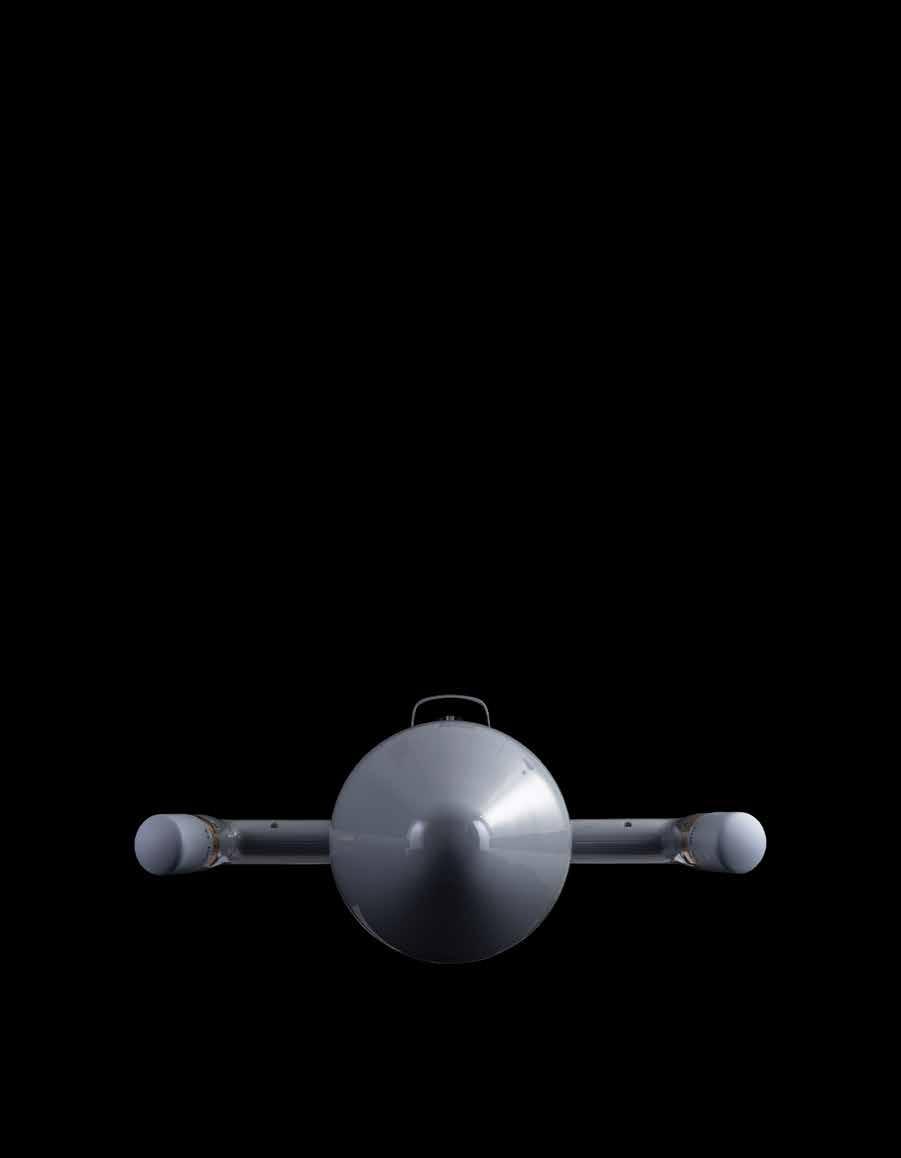
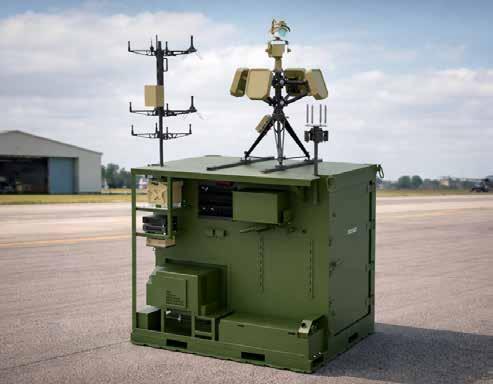
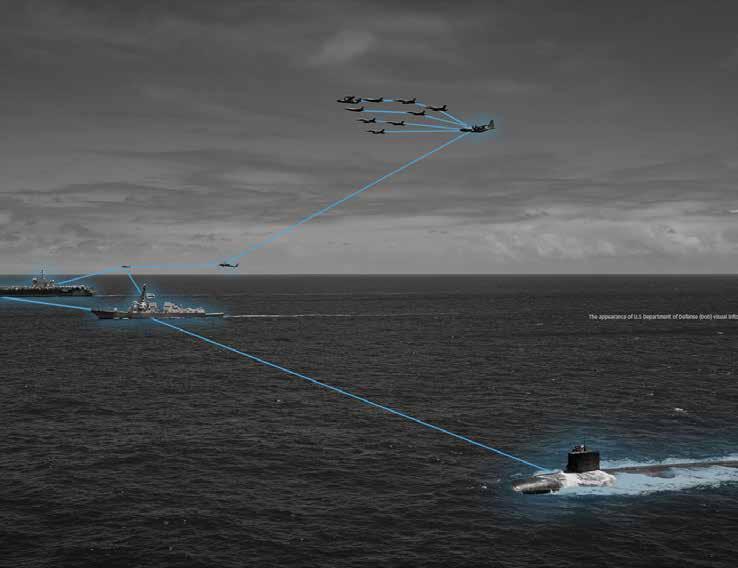
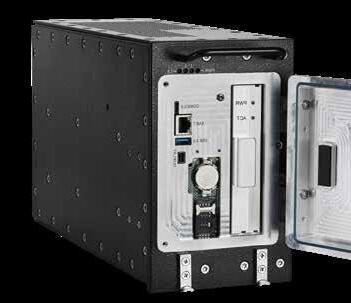
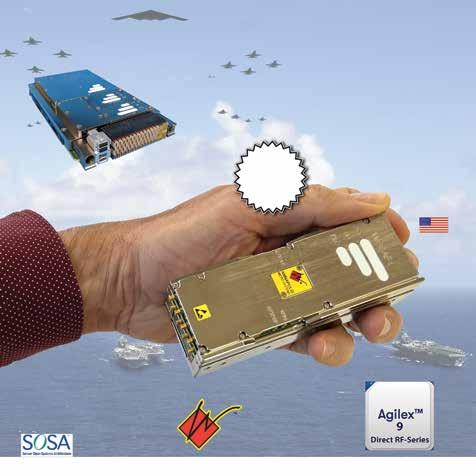
mPOD uses DRFM technology to emulate realistic combat scenarios, replicating near-peer jamming for fast, accurate electronic warefare training.
mrcy.com/mpod
COTS (kots), n. 1. Commercial off-the-shelf. Terminology popularized in 1994 within U.S. DoD by SECDEF Wm. Perry’s “Perry Memo” that changed military industry purchasing and design guidelines, making Mil-Specs acceptable only by waiver. COTS is generally defined for technology, goods and services as: a) using commercial business practices and specifications, b) not developed under government funding, c) offered for sale to the general market, d) still must meet the program ORD. 2. Commercial business practices include the accepted practice of customer-paid minor modification to standard COTS products to meet the customer’s unique requirements
—Ant. When applied to the procurement of electronics for the U.S. Military, COTS is a procurement philosophy and does not imply commercial. Office environment or any other durability grade. E.g., rad-hard components designed and offered for sale to the general market are COTS if they were developed by the company and not under government funding.
By Terry Santel & Todd Prouty, Terry Santel is the
Copyright 2025, RTC Media. Printed in the United States. All rights reserved. All related graphics are trademarks of The RTC Group. All other brand and product names are the property of their holders.
BEHLMAN LEADS THE PACK AGAIN!
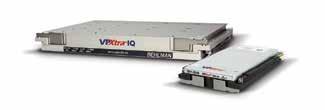
Behlman introduces the first test-proven VPX power supplies developed in alignment with the SOSA Technical Standard. Like all Behlman VPXtra® power supplies, these 3U and 6U COTS DC-to-DC high-power dual output units feature Xtra-reliable design and Xtra-rugged construction to stand up to the rigors of all mission-critical airborne, shipboard, ground and mobile applications.
VPXtra® 1000CD5-IQI
> 6U power module developed in alignment with the SOSA Technical Standard
> Delivers 1050W DC power via two outputs
> VITA 46.11 IPMC for integration with system management
VPXtra® 800D-IQI
> 3U power module developed in alignment with the SOSA Technical Standard
> Delivers 800W DC power via two outputs
> VITA 46.11 IPMC for integration with system management
PUBLISHER’S NOTE
By John Reardon, Publisher & CEO of COTS Journal
The Silicon Shield: AI and the New Architecture of Attrition
The headlines coming out of the Middle East this month aren’t just about geopolitics; they are a klaxon call for the embedded systems industry. As Operation Epic Fury unfolds, we are witnessing the first true “Algorithmic War.” For years, we’ve discussed the theoretical merger of AI and the tactical edge in the pages of COTS Journal. Today, that theory is being flight-proven in the most contested airspace on the planet.
The value of these advanced systems—specifically the integration of AI-driven targeting and hypersonic glide vehicles—lies in a single word: Latency. In modern combat, the OODA loop (Observe, Orient, Decide, Act) has been compressed from minutes to milliseconds. If you aren’t processing at the edge, you aren’t surviving.
The AI Payload: Processing the “Firehose”
The sheer volume of data being generated by drone swarms and persistent ISR is overwhelming human analysts. This is where the computer payload becomes the most lethal component of the weapon system. We are seeing the Maven Smart System utilize Anthropic’s Claude AI to sift through sensor data that would typically take a room full of intel officers days to parse.
For the engineers reading this, the real story is the hardware making this possible. To run these neural networks in a thermally constrained, high-vibration environment, the military is leaning on ruggedized GPGPU blades and high-density FPGA modules. We see the DNA of industry titans like NVIDIA and AMD (Xilinx) throughout these signal processing chains. Companies like Mercury Systems and Curtiss-Wright—long-time stalwarts and support-
ers of the COTS Journal community—are the ones packaging this “server-room power” into 3U and 6U VPX form factors that can survive the belly of a drone or the nose of a missile.
Hypersonics and the Need for Rugged Speed
Iran’s deployment of the Fattah-2 hypersonic glide vehicle has changed the calculus of missile defense. Maneuvering at Mach 15 requires flight control computers that can handle extreme heat and rapid-fire sensor inputs without a hiccup.
On the intercept side, the U.S. and its allies are countering with “sensor fusion” platforms that require massive I/O bandwidth. This is where the backplane matters. We’ve seen incredible innovations from companies like Elma Electronic and Annapolis Micro Systems, providing the high-speed interconnects and chassis that allow these payloads to communicate at the speeds required to intercept a hypersonic threat. When you’re tracking a target moving at five miles per second, there is zero margin for data bottlenecks.
The Rise of the “Attritable” COTS Drone
Perhaps the most significant shift is the “LUCAS” program—the low-cost, expendable attack systems that mirror the Iranian Shahed architecture. These aren’t $100 million stealth jets; they are “attritable” assets. The value here is economic. By using COTS (Commercial Off-The-Shelf) components, the Department of Defense can flood the zone.
This shift to quantity-over-exquisiteness is a win for the embedded ecosystem. It means a high-volume demand for reliable,
low-power SoCs and COM Express modules. Partners like Intel and Advantech are instrumental here, providing the silicon backbone that allows these swarms to think collectively using mesh networking.
The Power Behind the Punch
We cannot discuss these advanced payloads without mentioning the power requirements. AI-at-the-edge is power-hungry. The sophisticated power management systems from companies like Vicor and Milpower Source are what keep these AI processors from melting down or draining batteries in mid-flight. Their ability to deliver high-density power in a tiny footprint is, quite literally, what enables the “smart” in smart weapons.
The Bottom Line
The war in 2026 has proven that the “Computer Payload” is the new high ground. Whether it’s the Iron Beam laser’s targeting system or the cyber-resilient PLCs defending our own infrastructure, the mission success of the modern warfighter is directly tethered to the quality of the embedded hardware provided by our advertisers and partners.
As we look toward the next generation of MOSA (Modular Open Systems Approach) compliance, let’s remember that the goal isn’t just to build a faster computer—it’s to ensure that the brave men and women in harm’s way have the decisive information advantage. At COTS Journal, we remain committed to highlighting the vendors who turn these silicon dreams into battlefield reality.
Inside Track
Boeing Delivers ViaSat-3 Flight 3 Spacecraft to Viasat
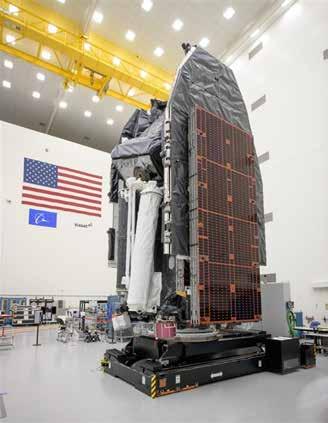
Boeing announced the delivery of the ViaSat-3 Flight 3 (VS-3 F3) spacecraft to Viasat. Built on Boeing’s high-power 702MP+ platform and integrated at Boeing’s El Segundo facility in California, VS-3 F3 will provide the Asia-Pacific region with state-of-the-art technology to maximize efficient, flexible bandwidth deployment and enhanced performance for commercial mobility and defense customers, among others, in high-density markets across the region.
“ViaSat-3 F3 reflects the strength of Boeing’s 702 family and our long-standing partnership with Viasat,” said Ryan Reid, president of Boeing Satellite Systems International. “With this delivery, we’re providing a high-power, flexible platform designed to support Viasat’s next-generation connectivity mission, which is proving more valuable every single day. We are thankful for their partnership and trust.”
Following final spacecraft integration, testing, and verification at Boeing’s El Segundo, California factory, Boeing officially delivered the satellite to Cape Canaveral Space Force Station, Florida, where Boeing and Viasat teams will support pre-launch processing and mission preparations ahead of a SpaceX Falcon Heavy launch. The delivery marks Boeing’s latest major milestone
Northrop Grumman Delivers Resilient Airborne Navigation System Resistant to GPS Jamming
Northrop Grumman delivered the first production unit of the EGI-M. This resilient airborne navigation system provides trusted positioning, navigation, and timing (PNT) data resistant to GPS jamming, enhancing military mission effectiveness globally.
Key Takeaways
EGI-M provides secure, flexible, and precise navigation in contested environments, advancing military PNT capabilities with software adaptability for future threats.
on the ViaSat-3 program and the completion of Boeing’s spacecraft production and integration work for VS-3 F3.
“The delivery of ViaSat-3 F3 marks an important milestone for the program and for the customers who will rely on it for resilient, secure, flexible, and high-performance connectivity across the APAC region,” said Dave Abrahamian, vice president of Space Systems, Viasat. “Throughout the ViaSat-3 program, Boeing’s platform performance and mission operations have been essential to achieving these goals for our business and our customers.”
Built on Boeing’s flight-proven 702 fam ily, the 702MP+ platform was developed to support larger, more power-intensive payloads while preserving the reliability and flexibility customers expect from Boe ing spacecraft. For ViaSat-3, Boeing scaled the platform to accommodate larger solar arrays, higher-capacity batteries, upgraded supporting electronics, and large deploy able radiators to manage the thermal de mands of a high-power mission.
The platform also incorporates all-elec tric propulsion, building on Boeing’s ear lier 702SP heritage while extending that efficiency into the larger 702MP class. To support ViaSat-3’s payload and reflector configuration, Boeing enhanced the space craft’s structural elements and attitude-con trol performance to maintain precise point ing despite the system’s size and flexibility.
With VS-3 F1 already providing com
mercial airline connectivity and VS-3 F2 currently advancing towards entering service over the Americas, VS-3 F3 will extend the constellation’s coverage to the Asia-Pacific, enabling expanded connectivity options for customers across the region.
Northrop Grumman delivered the first production unit of the EGI-M navigation system, designed to provide military users with accurate positioning, navigation, and timing (PNT) data. The system is now modernized to support successful missions in high-conflict areas across the globe.
Upon full production, military customers will benefit from a unified hardware-and-software navigation solution that can be seamlessly integrated into platforms.
Key features include:
Resilient and Trusted Navigation: The military-code PNT system, known as EGI-M, marks a significant advancement in airborne navigation technology by ensuring the reliability of navigation data in conflict zones. Further advancements include Blended Navigation Assurance, a
capability that ensures GPS data is accurate and secure, even when it’s under threat.
Flexible Software: EGI-M was designed with future growth in mind. Operators can host third-party PNT apps without Northrop Grumman involvement to tailor navigation functions. This allows EGI-M to integrate other complementary sensors and track various non-GPS satellites.
Path to Production: The design has undergone rigorous hardware and software testing to meet military specifications and performance standards, preparing it for full-scale manufacturing.
Experts:
Ryan Arrington, vice president, navigation and cockpit systems, Northrop Grumman: “Northrop Grumman has a strong legacy of delivering reliable and innovative navigation solutions to the U.S. military and
The
Inside Track
our allies. Our latest modernized PNT system, EGI-M, enhances operational effectiveness and is built with the flexibility to defeat today’s threats and adapt to future mission demands.”
Lt. Col. Chris Grover, U.S. Air Force: “This advanced, resilient PNT receiver allows our U.S. military assets the ability to go where we want to, with the capability we need, at the time of our choosing.”
Details on Program:
Northrop Grumman is an industry leader of positioning, navigation, and timing solutions for any mission, from underwater to outer space. Through advanced technology backed by precision manufacturing, our systems ensure that customers are equipped to navigate even under threat.
Northrop Grumman is a leading global aerospace and defense technology company. Our pioneering solutions equip our customers with the capabilities they need to connect and protect
DroneShield Expands C2 Interoperability Through Integration with OpenWorks Engineering Optical Sensors
DroneShield, a global leader in counterunmanned systems (C-UxS) solutions, announced interoperability between DroneSentry-C2 command-and-control software and optical sensing technologies from OpenWorks Engineering.
The partnership strengthens DroneShield’s ability to unify multi-domain sensor inputs within a single operational C2 environment, delivering enhanced detection, tracking, and decision superiority for end users.
the world and push the boundaries of human exploration across the universe. Driven by a shared purpose to solve our customers’ toughest prob-
for defense, security, and industrial applications. With a heritage rooted in delivering modular, high-resolution optical sensing for challenging environments, OpenWorks remains focused on precision detection, identification, and continuous tracking of airborne objects.
DroneSentry-C2 as the Operational Anchor
While additional sensors enhance coverage, operational advantage is achieved at the command-and-control layer. DroneSentry-C2 serves as the authoritative decision engine, combining and prioritizing inputs from RF, optical, and other supported modalities.
Within the DroneSentry-C2 platform, powered by its SensorFusion engine, sits DroneShield’s proprietary DroneOptID, an AIdriven machine vision capability that delivers autonomous visual detection, validation, and tracking of drone threats using optical sensors such as OpenWorks. DroneOptID enhances
the common operating picture by providing real-time visual confirmation once a drone is detected and cued by the broader sensor network. DroneOptID automatically slews the camera to the target, validates the threat, and maintains persistent tracking using advanced machine learning, without requiring manual or continuous operator input.
“Operators need clarity, not complexity,” said Angus Bean, DroneShield’s Chief Product Officer. “Expanding our ecosystem with additional optical sensing technologies from OpenWorks Engineering gives customers more options to tailor their deployments, while SensorFusionAI ensures all inputs are combined into a clear, operational picture.”
A Growing Marketplace for Airspace Security
DroneShield’s expanding ecosystem reflects a broader vision: creating a marketplace of interoperable technologies that empowers operators to configure, evolve, and scale their C-UxS capabilities over time.
By prioritizing open architecture, interoperability, and AI-driven intelligence, DroneShield is positioning its platform as the foundation for layered, multi-sensor airspace security strategies, without constraining customers to a single hardware pathway.
This ecosystem model supports procurement flexibility, accelerates deployment timelines, and aligns with the realities faced by defense, security, and public safety organizations operating in rapidly changing threat environments.
lems, our employees define possible every day.
The
Inside Track
SpaceLocker Becomes a Satellite Operator and Launches Its First Shared Mission
A French startup is redefining space infrastructure by turning satellites into shared platforms—enabling faster, more cost-efficient, and more sustainable missions.
SpaceLocker is entering a new phase. Just one year after its first in-orbit mission, the French pioneer in orbital hosting announces the launch of Out of the Box, its first fully owned and operated satellite. This milestone marks its transition into the ranks of satellite operators - a domain historically dominated by legacy players such as Airbus, Thales, and Eutelsat. At the core of this breakthrough is a patented “universal space port” technology, comparable to a USB port for satellites. Plugand-play and payload-agnostic, it transforms satellites into shared infrastructures capable of hosting multiple payloads simultaneously. With Out of the Box, SpaceLocker is deploying a 16U CubeSat (~20 kg) carrying five European customers - making access to space possible without building a dedicated satellite.
Théophile Lagraulet, CEO and co-founder of SpaceLocker, comments: “We want to do for space what cloud computing did for IT: shift from ownership to shared infrastructure. In the future, sending an instrument to orbit won’t require building a satellite. Access to space can become a standardized service.”
From Dedicated Satellites to a “Space
Cloud”. Until now, sending technology to orbit required designing or procuring an entire satellite - a long, costly, and inflexible process that has remained largely unchanged for decades. SpaceLocker introduces a platform-based approach.
Customers develop their payloads independently and integrate them into a standardized “container” using the company’s universal space port. SpaceLocker then manages the full orbital stack, from integration to operations. This model dramatically reduces costs - up to three times cheaper than traditional missions - while cutting time-to-orbit in half. It also significantly lowers environmental impact through resource sharing.
A Flagship Mission for the European New Space Ecosystem
The Out of the Box mission carries five payloads from across the European ecosystem, showcasing the diversity of next-generation space applications. Among the customers onboard, the Out of the Box mission brings together four European players, illustrating the diversity of next-generation space applications. EDGX will demonstrate edge computing capabilities, enabling satellites to process data onboard and reduce reliance on ground infrastructure. Fédération Open Space Makers will fly FOSM-1, a payload dedicated to amateur radio and open communication experiments, supported by CNES. Solar MEMS will operate a high-precision star tracker for satellite orientation, while Arcsec will test two advanced star trackers to demonstrate
high-performance attitude determination for small satellites.
To build its missions, SpaceLocker leverages the rich ecosystem of French and European players, working with partners such as Thales Alenia Space for testing and Skynopy for communications.
Today, nearly one in five space missions is dedicated to technology demonstration, yet these opportunities remain complex and expensive to execute. By simplifying access to orbit, SpaceLocker positions itself as a key enabler of space innovation.
As Earth’s orbit becomes increasingly congested, the shared satellite model offers a direct response to both economic and environmental challenges.
Rather than multiplying dedicated satellites, SpaceLocker maximizes existing capacity by hosting multiple missions on a single platform. This approach not only reduces costs but also helps limit space debris and decrease total mass launched into orbit.
It also contributes to Europe’s strategic autonomy by enabling the emergence of a new French operator in a critical segment of the space value chain.
Rapid Execution
Founded in 2022, SpaceLocker represents the new generation of French New Space companies. In under two years, the startup has completed its first orbital mission, secured around 15 commercial contracts, signed multiple institutional agreements in France and internationally, and generated over €4 million in total contract value.
With Out of the Box, SpaceLocker reaches a key inflection point—becoming a satellite operator and building its own mission portfolio, demonstrating rapid execution in a sector known for long development cycles. The company already plans six additional missions over the next 24 months.
Towards a New Gateway to Space
SpaceLocker’s ambition is clear: to become the leading platform for accessing orbit. In the long term, the company aims to operate across multiple orbital regimes, scale its mission cadence, and open space to a new generation of users—far beyond the traditional space industry.
Inside Track The
The World Is Not Enough –Duagon On ISS
When the transport spaceship takes off for the International Space Station (ISS) in April 2026, Duagon’s computing hardware will also be on board. The embedded specialist for railway and medical technology is currently developing a “Conduction Cooled Assembly.”(CCA) for the Belgian aerospace company “Space Applications Services nv/sa”. The CCAhas significant internal data storage capabilities and will
collect scientific data from various sources. systems on the Columbus module of ISS and send it to ground-based data centers for further the processing.
The CCAs developed are essentially based on CompactPCI Serial systems: They consist of cards with various functions (CPU, memory, Ethernet switch, etc.) that can be assembled into customized computing systems according to customer specifications. In this specific
In this case, Duagon uses the G028 CPU card, SSD storage with the G504 card, and high-speed industrial Ethernet switch, among
General Dynamics Land Systems Awarded Agreement for Next Phase in Advanced Reconnaissance Vehicle Competition
General Dynamics Land Systems announced that it has been awarded a $450-million agreement from the U.S. Marine Corps for the Pre-Production Development (PPD) phase of the Advanced Reconnaissance Vehicle (ARV) competition.
The PPD phase will include validating the final design and build of multiple vehicles across a subsection of the expected family of ARV variants, followed by a series of U.S. Government test and evaluation activities.
“Our ARV prototype has been thoroughly tested
throughout the previous phases, and we are confident in its ability to meet and exceed the requirements of the Marine Corps,” said Keith Barclay, Vice President and General Manager of U.S. Operations
other components.
What makes this offer special is that each CompactPCI Serial card is encased in its own metal housing. Packaged in this way, they are plugged together in a metal rack to form the overall system. The card housings press against the wall of the rack via the so-called “wedge locks” and transfer their waste heat to the large housing via the contact surfaces.
Thanks to its large surface area, it can dissipate the heat very quickly into the fluid cooling plate system – without the need for fans and without heating the cabin air.
For use on the ISS, all CCA systems and components must be highly available, robust, and in-flight replaceable. At the same time, they must withstand the extreme environmental conditions during flight and at the point of use. The nearly hermetically sealed system has venting holes to limit overpressure that occurs during external depressurization.
The closed CCAs are therefore perfectly suited for space travel as well as other extreme environments applications such as mining or oil drilling rigs.
Duagon will supply a small number of these specialized systems to Belgium. One of these will be used 400 km above the Earth in the ISS, while the others will remain on the ground for intensive testing.
at General Dynamics Land Systems. “We are proud to continue working side-by-side with the Marines through this next phase to deliver a transformational capability ultimately.”
The
Inside Track
NP Aerospace’s production line kicks into gear to deliver the remaining Light Tactical Transport Vehicles to BeMOD.
NP Aerospace has announced that the production line to deliver the remaining 87 Light Tactical Transport Vehicles (LTTV) to the Belgian MOD (BeMOD) is now fully operational and accelerating. Following the pre-production proof-of-process and quality deliveries, the customer accepted the first significant full-production batch in February, and all 87 vehicles will now be delivered by the end of 2026.
The original LTTV program was to deliver 199 Mercedes-Benz UNIMOG-based vehicles to the BeMOD. In September 2024, NP announced the receipt of a contract to deliver the remaining 87 vehicles, which had been novated following NP Aerospace’s acquisition of certain assets of Jankel Armoring Limited, announced on June 10 2024. As well as the production of new LTTV vehicles, contractual discussions also included lifetime in-service support to the LTTV vehicle fleet, for which NP Aerospace will use its proven Vehicle Systems, Services, and Spares business unit to deliver.
In establishing full production capability, NP Aerospace has adopted a fresh approach, with operations centered in its Coventry facilities. As agreed with the customer, particular emphasis has been placed on working to the required quality standards and timescales. Using NP Aerospace’s fully established vehicle-related, UK-based supply chain, the team has employed proven best practices to develop a production program that meets and, where possible, exceeds customer expectations. Having taken time to get
Echodyne Named as Radar System for Trust Automation’s
$490M Air Force Counter-UAS
Engineering Contract
EchoShield® radar integrated into Small-Unmanned Air Defense System (SUADS) to deliver on $490M Air Force IDIQ.
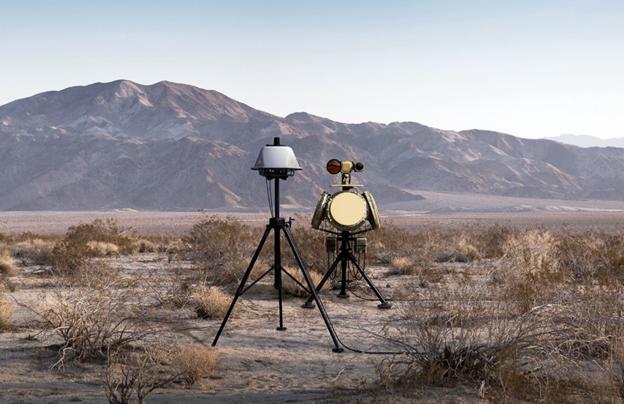
Echodyne, the radar platform company, announces its inclusion as a primary radar system within Trust Automation’s Small-Unmanned Air Defense System (SUADS) Counter-UAS
this right, NP Aerospace is now confident that all inherited program challenges have been addressed, and the pace of production can now be accelerated to deliver the remaining vehicles to BeMOD successfully.
The LTTV vehicle was designed to provide a modular, configurable tactical support vehicle that benefits from unique, removable mission modules, enabling rapid reconfiguration for operational platform versatility. With a payload of over 3 tonnes, dependent on the final vehicle specification, the LTTV has 3 core variants for Special Operations support, including an ambulance variant. Alongside a user-configurable, fully integrated suite of military subsystems that includes a removable ballistic protection kit, a
Roll-Over-Protection-System (ROPS), weapon mounts, and a communications fit.
David Petheram, NP Aerospace VSSS Managing Director commented: “Following on from the receipt of the LTTV contract from BeMOD in 2024, we’re pleased to be able to announce that we’ve successfully worked through all of the challenges of restarting this disrupted program, in close collaboration with our customer. Our production line is established and is now kicking into gear, upon strong foundations, to enable the rate to be accelerated from this point forward.” He added: “Now we’re fully up and running and delivering vehicles, this is great news for NP Aerospace and our customer, also for our UK supply chain and for Coventry as we continue to create and/or sustain high-skilled jobs in the region and across our supplier partnerships.”
platform, to be delivered to the U.S. Air Force under a $490M IDIQ contract announced in August 2025.
Rapidly Deployable Small-Unmanned Air Defense System (RD-SUADS), Fixed Site Small-Unmanned Air Defense System (FSSUADS), and Expeditionary Small-Unmanned Air Defense System (EX-SUADS) platforms adhere to the Sensor Open Systems Architecture (SOSA) standard, with EchoShield radars being the first fully integrated SOSA solution on the platforms. The RD-SUADS platform is a self-contained, self-powered C-UAS system fitted to standard pallet sizes for easy trans-
port via military aircraft, while the FS-SUADS is for deployment at permanent military installations and can be integrated as a group or standalone for diverse redundant base protection and 360-degree security. The EX-SUADS detection-only system is designed for checked baggage transportation and sized to fit cases in larger SUVs.
EchoShield is the market-leading medium-range radar that reliably and consistently generates precise location data for all drone types and configurations. A commercial-offthe-shelf (COTS) radar system, EchoShield’s industry-standard interfaces and rich data options
The
Inside Track
create a baseline data set that more accurately slews optical sensors, cues effector options, and accelerates reaction time. Boasting advanced classification capabilities built on recursive neural network (RvNN) machine learning models, EchoShield tracks all movement and pinpoints system and operator attention where and when it matters.
“It is becoming more and more evident that the fidelity of radar data, its accuracy in all data dimensions, is a critical attribute of any radar system,” said Eben Frankenberg, CEO at Echodyne. “The new table stakes for every defensive system is actionable data at the range of reaction and with the precision to consistently direct kinetic effectors onto fast, nimble, UAS threats.”
“Integrating Echodyne’s advanced radar into our RDSUADS, FS-SUADS, and EX-SUADS systems enhances both detection range and accuracy, enabling operators to identify threats sooner and respond with greater confidence,” said Ty Safreno, CEO at Trust Automation, Inc. “These systems provide agile, comprehensive C-sUAS capability that helps protect warfighters and critical facilities through elevated situational awareness.”
Bell selects five RTX systems for the U.S. Army’s Future Long Range Assault Aircraft.
Collins Aerospace, an RTX business, has been awarded multiple contracts from Bell Textron Inc., a Textron Inc. company, to deliver five critical systems for the U.S. Army’s MV-75 Future Long Range Assault Aircraft (FLRAA).
“The Army’s new generation of rotorcraft needs to fly farther and faster, and we’re committed to helping Bell accelerate delivery of that advanced performance with Collins’ military-grade commercial technology,” said Troy Brunk, president of Collins Aerospace. “We have ready-now manufacturing and service capabilities around the globe to ensure the Army can urgently deliver, modernize, and sustain the MV-75 FLRAA for the next 50 years.”
Collins Aerospace will provide several of these systems via commercial acquisition authorities. The five systems include:
• Main power generation
• Interconnect drive system
• SmartProbe® air data system
• Cockpit seating
• Ice protection system
“We are happy to work with Collins Aerospace and add their expertise to Team FLRAA,” said Ryan Ehinger, senior vice president and program director, Bell. “Together, we are committed to delivering a high-performing, reliable aircraft that will provide the U.S. Army with the critical capability it needs for the future fight.”
The U.S. Army’s first clean sheet rotorcraft in a generation, the MV-75 FLRAA delivers twice the speed and range of the current fleet – transforming the Army’s operational capability. The program uses digital engineering and a modular, open-systems approach to ensure maximum efficiency and flexibility throughout the aircraft lifecycle.
The
Inside Track
EIZO Rugged Solutions Awarded U.S. Navy Contract to Supply Rugged 2K x 2K Monitors for AN/SYY-1
Shipboard ATC Systems
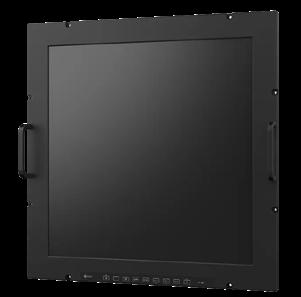
The Talon RGD2802 monitor passed intensive DoD qualification tests, including the MIL-DTL901E high-impact shock and the MIL-STD-461G EMC test.
Orlando, Florida, January 13, 2026– EIZO Rugged Solutions Inc., a leader in high-performance, mission-critical graphics processing and video solutions, has been awarded a contract by the United States Navy to provide its Talon RGD2802 2K x 2K rugged LCD monitors for integration into the AN/SYY-1 air traffic control (ATC) processing and display systems deployed aboard aircraft carrier ships. The AN/SYY-1 Shipboard ATC system is a next-generation upgrade that enhances radar data processing, Identification Friend or Foe (IFF) extraction, and multi-sensor composite tracking to improve situational awareness during air operations.
EIZO’s Talon RGD2802, a 28-inch rugged LCD monitor with native 2K x 2K (2048 x 2048) resolution, was selected for its exceptional image clarity and reliability in onboard air traffic control systems. The 2K x 2K square resolution is a critical
standard for naval ATC and Precision Approach Landing Systems (PALS) operations, enabling controllers to view complete radar sweeps and high-density target data with unmatched precision.
The Talon RGD2802 was selected for its proven durability and mission-critical reliability, having successfully passed multiple defense-regulated MIL-STD qualifications. These include the MILDTL-901E high-impact shock test for shipboard resilience and the MIL-STD-461G electromagnetic compatibility test, validating the display’s ability to operate without error in demanding naval environments where shock, vibration, and electromagnetic interference are constant factors.
“The selection of our Talon RGD2802 monitor for the AN/SYY-1 systems underscores EIZO’s commitment to supporting the U.S. Navy with highly reliable, mission-ready technology,” said Ron Farine, VP of Sales & Business Development, EIZO. “Our rugged 2K x 2K monitors are engineered to meet the demanding operational environments of naval platforms, ensuring operators have the situational awareness and precision required for critical air traffic and landing control missions.”
This contract strengthens EIZO Rugged Solutions’ position as a trusted provider to the U.S. Navy, building on prior deployments of EIZO’s Condor series graphics cards and radar software from its partner Cambridge Pixel in mission-critical systems. These proven technologies have supported C5ISR, aviation, and naval applications.
The installation of RGD2802 rugged LCD monitors reflects the continued confidence in EIZO’s ability to deliver reliable, end-to-end solutions that support real-time decision-making across carrier-based operations.
Together, these capabilities establish EIZO as a trusted provider of end-to-end solutions, from graphics and radar processing to visualization, enabling reliable, real-time decision support across carrier-based operations.
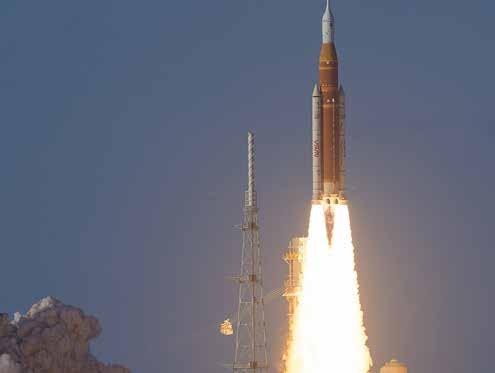
Aptiv Celebrates NASA’s Successful Artemis II Mission
Aptiv, a global industrial technology company, congratulates NASA on the successful completion of the Artemis II mission and the safe return of four astronauts from the first crewed lunar mission in more than 50 years.
VxWorks provides the software platform that enables deterministic performance for critical functions on the Space Launch System’s (SLS) first stage and within the Orion crew vehicle. VxWorks is the Industry’s most trusted and widely deployed real-time operating system (RTOS) for mission-critical applications where safety and security are essential. It has powered dozens of NASA missions, from the Mars rovers to the James Webb Space Telescope. It serves as a key OS layer for multiple NASA core Flight System elements, implemented across the Artemis missions.
“Artemis II is a reminder of what is possible when
Inside Track
the right software underpins the right mission,” said Jay Bellissimo, Senior Vice President and President, Intelligent Systems, Software and Services, Aptiv. “Our teams have spent decades building software that people trust with their lives. Seeing that software on a mission to bring four astronauts around the Moon and back is something for which we’re truly proud.”
For 10 days, the Artemis II crew aboard Orion, NASA’s deep space crew vehicle, ventured around the Moon and back, confirming that the spacecraft’s systems performed as designed in deep space, validating the critical life support systems needed for longer duration missions, and allowing the crew to practice operations essential to Artemis III and beyond.
“Artemis II is one of the most significant human spaceflight missions in a generation, and it was an honor to be a part of it,” said Paul Miller, Chief Technology Officer, Software and Services, Aptiv. “For nearly 30 years, our teams have worked to make software that performs without fail when it matters most. This mission is proof of what that commitment looks like in practice. We congratulate NASA and the entire Artemis team on bringing their crew home.”
Across numerous critical phases and components, VxWorks enabled reliable, real-time performance for the Artemis II mission, including the SLS. This rocket carried the crew out of Earth’s orbit, to the systems that sustained the astronauts through deep space and brought them safely home.
A critical layer of crew safety throughout the
mission was the Orion Backup Flight System (BFS). Class A-certified and fully independent of the primary flight system, the BFS was built with a deliberately different architecture, with no shared failure modes or common vulnerabilities.
Beyond the flight software, Aptiv’s digital twin simulation ensured that every line of code was fully validated before running on physical hardware. Teams tested unmodified target software on a virtual platform that behaved exactly as the real system would, decoupling software development from hardware availability. Up to 80-90% of simulation models can be reused for future missions.
The
Inside Track
AMD and the French Government Announce Plans to Advance AI Innovation, Research, and Open Ecosystem Development in France
Collaboration to strengthen the French digital future through expanded access to AMD AI compute resources and training for French researchers, educators, developers, and AI startups.
AMD to unlock the potential of the Alice Recoque, France’s planned first Exascale supercomputer, to advance France’s AI and research capabilities.
PARIS, France – April 16, 2026 –
AMD (NASDAQ: AMD) and representatives of the French government announced plans to deepen collaboration in support of France’s National Strategy for AI, aimed at accelerating local AI innovation, expanding access to open and advanced compute resources for the local AI ecosystem, and strengthening France’s position in the global AI landscape.
The Letter of Intent (LOI) was signed in Paris at the French Ministry of the Economy, Finance, and Industrial, Energy, and Digital Sovereignty. AMD senior vice president, Global AI Markets, Keith Strier, joined Philippe Baptiste, Minister of High -
er Education, Research and Space, Sébastien Martin, Minister Delegate in charge of Industry, and Anne Le Hénanff, Minister Delegate in charge of Artificial Intelligence and Digital, for the formal signing.
The multi-year collaboration aims to strengthen France’s AI ecosystem through infrastructure, research, and education. To help expand AI expertise and enable diversity and resilience across the French AI ecosystem, AMD plans to provide researchers, developers, and startups with hardware, software, and training through its AMD University Program, AMD AI Developer Program, and AMD AI
The
Inside Track
Academy.
In addition, AMD will continue to deepen its collaboration with GENCI, the Jules Verne Consortium and CEA in connection with Alice Recoque, expected to be France’s first exascale supercomputer powered by AMD technology, through a planned Center of Excellence designed to provide expertise, training and ecosystem support to help fully harness the power of the Alice Recoque AI supercomputer and advance the broader AI Factory France ecosystem.
Philippe Baptiste, Minister of Higher Education, Research, and Space, stated:
“France has all the assets needed to assert its central role in the development of artificial intelligence: world-class fundamental and applied research, globally renowned engineers, and unique infrastructures in Europe. Through this partnership with AMD, we are strengthening our scientific and academic ecosystem by providing high-quality support to our researchers, teachers, and students and granting them unprecedented access to cutting-edge infrastructure. The Alice Recoque supercomputer, operated by GENCI and the CEA, marks a decisive step toward enhancing our research and innovation capabilities across the public and private sectors. I am convinced that this will enable us to meet the scientific challenges of our time better.”
Sébastien Martin, Minister Delegate for Industry, stated:
“AMD not only brings the technology and expertise to power Alice Recoque but also commits to working with the French Government on the local economic and social benefits of the research undertaken. This letter of intent paves the way for a fruitful public-private collaboration. It
will contribute to France’s ambitious strategy for technological sovereignty. France must become a global leader in AI, not only in research, but also in the AI value chain, from electronics to software, focusing on value creation.”
Anne Le Hénanff, Minister Delegate for Artificial Intelligence and Digital Affairs, stated:
“There is no AI without infrastructure. Building a strong and sustainable digital future requires working across the entire value chain and diversifying our partnerships. I welcome AMD’s strong commitment to engaging with our startup ecosystem and contributing to a more resilient and innovative landscape.”
Keith Strier, senior vice president,
Global AI Markets, AMD, said:
“France has implemented one of the most ambitious national AI programs in Europe, capitalizing on its robust AI ecosystem, world-class academic programs, and an advanced energy and data infrastructure. AMD looks forward to providing the workbench to expand the frontiers of industrial and scientific innovation in France, and maximize the upside of sovereign AI investments, by enabling France’s AI community to harness AMD’s broad portfolio of high-performance computing platforms and open software ecosystem.”
Dreams Can Come True
Pixus can make your ruggedization aspirations come to life. This includes outdoor IP67 styles that are fanless, full MIL rugged, or versions with superior forced air cooling. Whether it’s an NI/ Ettus SDR or your customized SFF solution, Pixus has a solution for you.
BIOMETRICS: THE FOUNDATION OF ZERO TRUST
By Joe Ferrigno, Director of Global Safety & Security at Identy.io
The National Security Agency’s Zero Trust Implementation Guidelines (ZIGs) mark a clear shift in how federal agencies operationalize cybersecurity practices. The ZIGs provide next steps for cybersecurity maturity and directly support mission assurance in defense environments. From deployed units to defense industrial base partners, identity compromise disrupts operations and, at its worst, exposes critical intelligence.
Even with these operational guidelines, a significant gap in zero trust architectures persists: high-confidence identity verification. For every defense agency, zero trust is only as strong as its
ability to continuously authenticate and verify who someone claims to be.
Phase 1 of the ZIGs focuses on building a secure foundation and understanding of the landscape to enable reliable access decisions down the line. These early stages are critical for implementing identity assurance capabilities that don’t rely on legacy systems like passwords, tokens or access cards, which have become increasingly vulnerable to modern threats and fraud.
Nation-state adversaries and advanced persistent threat groups use stolen credentials, automated phishing campaigns and AI-enabled imperson-
ation techniques to bypass traditional authentication methods and infiltrate defense systems. These tactics increasingly aim to exploit inconsistent authentication across networks to create opportunities for lateral movement. If defense agencies continue to rely on legacy identification methods, their zero trust architecture will remain vulnerable to spoofing and fraud.
Biometrics strengthen identity protocols by linking access decisions to verified faces, fingerprints or irises rather than reusable or easily forged credentials. This verification extends beyond enterprise IT environments to support secure access in disconnected military
operations, equipping warfighters with trusted access at the tactical edge without disrupting workflows.
Implementing identity
For many agencies, the real challenge is implementing zero trust across distributed environments without disrupting mission delivery. Especially in fast-moving defense operations, where even minor issues with authentication or access directly affect personnel safety on the front lines.
The ZIGs provide a broad strategy for zero trust implementation, but success will depend on targeted deployments where identity assurance has the greatest impact. Agencies should start with high-impact areas such as privileged access, sensitive datasets or remote workforce authentication. From there,
continuous verification capabilities can be expanded to lower-priority operational workflows.
With technologies such as multimodal biometric platforms, agencies can perform both one-to-one verification and large-scale identification using facial and fingerprint data, reducing manual processes and improving accuracy. Some systems also process data directly on device, reducing dependency on external servers, limiting data exposure and supporting strict zero trust requirements.
A modular, decoupled architecture centralizes access control, equipping agencies with interoperable, high-confidence identity verification across joint environments, where identity extends beyond a single agency or mission part-
ner. Taking a modular approach to zero trust aligns with the ZIGs guidance for agencies to implement capabilities based on current maturity levels and operational constraints, allowing architectures to evolve alongside the threat landscape.
AI-driven biometrics
With the rapid evolution of AI-driven threats, deepfakes, video spoofing and synthetic identities are increasingly being used to bypass traditional verification systems. Modern biometric systems address these threats with active and passive liveness detection and anti-spoofing technologies designed specifically to identify manipulated or fraudulent inputs.
Active liveness tests require users to interact with the system by blinking,
smiling or turning their head, adding a challenge-response layer to prove the face is alive. Other systems rely on passive liveness tests that analyze the person’s image for signs of life without requiring any user action. Both capabilities are trained to detect patterns that identify whether a biometric capture is real, preventing adversaries from using synthetic media to impersonate personnel.
The federal government has also recognized the critical need for improved AI threat detection through initiatives such as the Department of Homeland Security’s Remote Identity Verification Rally (DHS RIVR). This program evaluates presentation attack detection
against physical attack classes, such as printed images, screen replays, silicone masks and 3D-printed facial replicas, in an independent, controlled environment.
These tests validate the capabilities of biometric tools and provide agencies with the information they need to address security challenges and make more informed, risk-based decisions when selecting solutions for zero-trust frameworks. Identity is the new perimeter, and biometrics, combined with AI-driven liveness detection, play a critical role in continuously validating that a user is who they claim to be.
The federal government has made
significant progress in defining what zero trust should look like through initiatives such as the ZIGs and broader defense cybersecurity strategies, including the National Cybersecurity Strategy and DOD Zero Trust Strategy. The next step must prioritize advancing and implementing secure, reliable identity management capabilities.
By focusing efforts on a strong, continuously validated identity, agencies gain an operational advantage in protecting sensitive intelligence and achieving mission success. Biometrics help ensure that every access decision is grounded in accurate identity verification, strengthening zero trust architectures at the point of mission execution.
WHAT WILL IT TAKE FOR THE GOLDEN DOME TO SUCCEED?
By Terry Santel & Todd Prouty, Terry Santel is the marketing manager and Todd Prouty is the strategic partnerships director at Crystal Group.
The United States faces an increasingly complex landscape of global threats from hypersonic missiles to space-based systems. Against this backdrop, the Golden Dome initiative seeks to create a defensive shield capable of protecting the U.S. from a broad spectrum of threats. It employs a multilayered, multi-domain approach that extends from under the sea to outer space. Ruggedized edge
computing is a cornerstone technology that will help make this initiative possible.
Announced January 27, 2025, by President Trump, the Golden Dome initiative calls for the U.S. military to build the system (then called the Iron Dome for America) in stages within the next three years.
Unlike Israel’s Iron Dome, which intercepts short-range rockets primarily during their terminal phase, Golden Dome is designed to detect and neutralize threats at every stage of flight. It’s not simply about shooting down missiles as they approach the United States; it’s about monitoring and having options for acting on the entire trajectory from left of launch to impact. The Golden Dome will
identify threats early and execute defensive measures with millisecond precision. The system aims to cover the full spectrum of threats, which includes intercontinental ballistic missiles, hypersonic missiles, cruise missiles, unmanned swarms, and even potentially hostile satellites or other non-kinetic space-based systems.
Taking defense to a new level
The key tenet of the Golden Dome is that it’s a defensive system, not an offensive one. The
objective is to protect the homeland, not project force. The system needs to monitor, detect, identify, and neutralize threats from China, North Korea, Iran, or any actor that might seek to challenge our security. These threats can come from virtually anywhere in the world.
The breadth of these threats is what makes Golden Dome so technically challenging. Historically, U.S. missile defense pro-
grams focused on specific threats from defined locations. Now, the system must be prepared to respond to emerging technologies, improvised tactics, and unpredictable vectors — from submarines lurking near the coastline to swarms of unmanned aerial systems entering U.S. airspace. The pace of technological change means defenses must be able to respond to today’s threats and adapt quickly to those of tomorrow.
When every millisecond matters
One of the most pressing challenges of the Golden Dome is computing. The system will rely heavily on artificial intelligence to process vast quantities of sensor data and make rapid recommendations. At hypersonic speeds, every millisecond counts. The initiative must integrate high-resolution radar, electro-optical/infrared sensors, acoustic sensors, and other intelligence platforms, then incorporate their outputs into actionable insights. Processing this massive data influx in real time is impossible with traditional centralized computing infrastructures.
The amount of data coming in from all the sensors is more than a single data center can ingest. The solution is computing at the edge. Ruggedized edge computing enables processing to occur locally, near the source of the data. This approach reduces latency, mitigates bandwidth constraints, and ensures that critical decisions can be made even when communications links are limited or contested. Edge systems perform real-time sensor fusion, AI-driven inference, and local decision support, while still feeding high-value intelligence back to central command nodes for coordination and broader situational awareness.
Mobile solutions demand ruggedized computing
Golden Dome’s compute platforms are expected to operate in some of the most extreme conditions imaginable. These include arctic cold, desert heat, high humidity, and intense vibration on vehicles and airborne platforms.
These systems must also be resistant to electromagnetic interference and be able to maintain operation in contested electronic environments.
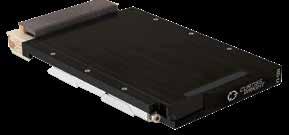
Ruggedized products are essential. Crystal Group’s offerings employ conduction-cooled designs, sealed electronics, and tamper-resistant housings to ensure their systems function reliably in these extreme conditions.
Distributed processing reduces latency
Rugged edge computing does more than provide environmental robustness. It also enables distributed processing. Golden Dome must distribute computations across a network of nodes, each capable of performing independent analysis while sharing critical intelligence across the system. This approach supports real-time AI applications, a critical component of modern missile defense.
By running inference locally rather than relying on a remote cloud server, systems can identify threats, calculate trajectories, and provide response recommendations within milliseconds. AI tools can significantly compress the time between threat detection and response helping decisions be made in seconds rather than minutes. This is a crucial capability against hypersonic and other high-speed threats.
As computer capabilities move closer to the point of action, cybersecurity and data protection become essential. Systems must feature secure boot protocols,
pre-boot authentication, and encryption aligned with security standards. Selection of Department of War (DoW)-approved Type 1 or Commercial Solutions for Classified (CSfC) alternatives are major trades that must be decided upon early in the program.
Constant evolution prevents obsolescence
Edge computing supports robust data management. Golden Dome’s architecture must prioritize and synchronize data effectively to ensure that mission-critical information reaches decision-makers without delay. Less urgent data is stored and transmitted opportunistically. High-speed NVMe storage, intelligent caching, and secure tiered data synchronization are key to enabling swift, reliable dissemination of intelligence across the system.
Partnerships with commercial technology providers are critical to sustaining the initiative. GPUs, AI accelerators, and high-performance processors continue to evolve rapidly in the commercial sector. Leveraging these advancements is vital to keeping Golden Dome ahead of emerging threats.
Systems must be designed to allow for modular upgrades. The latest processors or AI accelerators need to be swapped in without redesigning the entire system. This plays into Crystal Group’s strength of designing robust systems at the forefront of technology that can handle processing, power, and cooling upgrades necessary to prevent obsolescence. The hardware may be ruggedized to last 15 years,
but the technology inside needs to be refreshed in a timely manner to keep pace with adversaries.
The Golden Dome initiative is unique in its approach to multi-domain integration. Systems must operate across space, air, land, and maritime domains, coordinating multiple military branches and sensors. This presents both technical and organizational challenges. Space sensors, ground-based radars, airborne platforms, and naval assets all need to communicate and share data seamlessly. They must maintain this interoperability while ensuring security across multiple classifications.
Ruggedized edge platforms are crucial in enabling this multi-domain coordination. By providing localized processing and intelligence fusion, edge nodes can generate actionable insights for each domain while contributing to a shared, distributed picture of the battlespace. Edge computing transforms raw sensor streams into a coherent, real-time operational picture that can drive both automated responses and human decision-making.
A phased approach to completion
Development and deployment of Golden Dome is expected to unfold in phases over the next decade. When it was first announced, the ambitious goal was to have the Golden Dome running by the end of 2029. Some estimates suggest it may extend beyond that goal before the entire network is fully operational. Initial efforts will focus
on critical regions and high-priority threats, gradually expanding to achieve full coverage.
This phased approach allows for technology insertions, iterative improvements, and adaptation of emerging commercial and defense innovations. For companies involved in the initiative, staying ahead of the technology curve is paramount. The companies providing compute solutions need to be in lockstep with AI and processor technology development. If a company falls behind, there is a risk that the entire system becomes obsolete before it’s even fully deployed.
The initiative represents a convergence of defense engineering, high-performance computing, and systems integration at a scale never attempted. While many challenges remain, the potential payoff is substantial. Golden Dome promises to provide the United States with a resilient, adaptive, and rapid-response defensive shield capable of countering the full spectrum of modern threats. Ruggedized edge computing is not simply a supporting element; it is the backbone that enables this ambitious vision.
The Golden Dome demonstrates how advanced computing, intelligent automation, and ruggedized engineering can be harnessed to protect not just territory, but the future of national security.
COT’S PICKS April 2026
Cincoze Launches DX-1300 High-Performance Compact Industrial Computer: The Essential Edge Computing Core for Space-Constrained Environments
Rugged edge computing brand—Cincoze has announced the latest addition to its Rugged Computing - DIAMOND product line: the DX-1300 high-performance compact industrial computer. The DX series, already used for numerous large-scale projects, has garnered a strong reputation for its high performance, compact design, and comprehensive functionality. The newly released DX-1300 builds on this legacy, featuring the latest Intel® Core™ Ultra 200S processor, a compact footprint of 242 × 173 × 75 mm, rich I/O, and versatile expansion options to meet a wide range of application needs. The DX-1300 serves as the ideal edge computing platform for high-end image processing, AI inference, and multitasking data integration applications in space-constrained environments.
Heterogeneous Computing in an Ultra-Compact
Chassis
The DX-1300 is powered by the Intel Arrow Lake-S platform Core Ultra 200S processor, featuring a hybrid CPU, GPU, and NPU architecture that delivers up to 36 TOPS of AI computing power. Compared to the previous generation, AI inference performance has increased by up to 3.5 times, supporting demanding edge AI applications such as real-time video analysis, smart inspection, and data analytics. Furthermore,
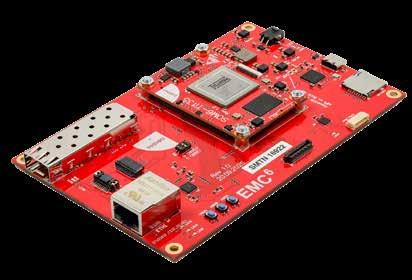
Thermal-Efficient Efinix Titanium Ti135 Eval Board for next-level Edge Computing
Sundance Multiprocessor Technology Ltd (Sundance) presents the SMT135-C, an Efi-
it supports up to 96GB of 6400 MHz DDR5 CSODIMM memory, significantly enhancing data transfer efficiency and reducing latency. This bolstered performance still fits in a chassis measuring only 242 x 173 x 75 mm—a footprint comparable to an 11-inch iPad—making it perfect for integration into equipment control cabinets, production line machinery, and in-vehicle systems where space is at a premium.
Versatile Expansion and High-Speed Data Transmission
The DX-1300 meets the needs of diverse application scenarios:
• Wireless connectivity: Multiple M.2 Key B and M.2 Key E slots, enabling the integration of 5G, Wi-Fi, and GNSS wireless modules for flexible mobile and remote deployment.
• Storage: Supports NVMe SSDs for speed and SATA SSDs for capacity, balancing rapid system boot times with extensive data retention requirements.
• Diverse I/O: High-speed 10, 2.5, and 1 GbE LAN alongside USB 3.2, to meet data transfer needs.
• Secure connectors: M12 A-Coded and
X-Coded LAN options to ensure stable connections in high-vibration or outdoor environments.
• Industrial cameras: Up to 12 LAN ports or 8 PoE ports via modular expansion, satisfying the requirements of machine vision and multi-camera system deployments.
Rugged Reliability and Market Certification
Upholding Cincoze’s consistent rugged design philosophy, the DX-1300 features a wide operating temperature range (-40°C to 60°C) and a wide-range DC power input (9 to 48VDC), ensuring stable operation in harsh industrial environments. To meet the demands of various vertical markets, the DX-1300 has passed MIL-STD-810H military standards and UL safety certifications. It also complies with railway EMC standard EN 50121-3-2 and fire protection standard EN 45545-2. These certifications make it particularly suited to manufacturing and railway applications where stability is critical, and installation space is limited. As the key edge computing core, the DX-1300 enables long-term, stable system operation and minimizes downtime risk.
nix Titanium Ti135 evaluation board designed for edge computing, real-time control, and vision-centric workloads.
The SMT135-C Evaluation Board is based on the SoM6 Ti135 system-on-module (SoM), which is built around the Efinix Titanium Ti135 FPGA in a high-density N676 package. The
board comes with enhanced I/O options, including Gigabit Ethernet, Small Form-factor Pluggable (SFP) connectivity, Samtec Firefly mid-board optical transceiver, SD card interface, and optional 8-lane MIPI TX/RX operation.
“Sundance has been an excellent design services and evaluation board partner, and the SMT135-C showcases
COT’S PICKS April 2026
what’s possible when you combine their engineering expertise with Efinix’s disruptive FPGA architecture,” said Bob Beachler, Corporate Vice President, Marketing and Corporate Development at Efinix.
“This board gives developers immediate access to the low-power performance and flexibility of our Ti135 FPGA in a compact, ready-to-deploy SOM form factor that’s ideal for edge AI, machine vision, and real-time control applications.”
“Today’s embedded systems require platforms that combine performance, flexibility, low power, and effi-
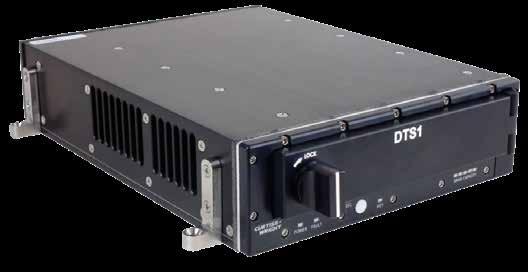
DTS1X storage solution gains NSA Commercial Solutions for Classified approval
Curtiss-Wright’s turnkey data-at-rest storage with CSfC full-drive encryption provides end-to-end data protection, global compliance, and speeds deployment.
Curtiss-Wright announced that its DTS1X 10 gigabit Ethernet (GbE) network attached storage (NAS) device’s hardware and software encryption layers for data-at-rest (DAR) are National Security Agency (NSA) Commercial Solutions for Classified (CSfC)-approved. This milestone provides system designers with a cost-effective, proven commercial-off-the-shelf (COTS) solution for high-speed, high-capacity DAR storage and protection of up to top secret/sensitive compartmented information (TS/SCI), reducing program and schedule risk. Also, because the DTS1X is ITAR-free, it is readily available for use in Five Eyes and NATO member countries.
cient integration,” said Flemming Christensen, Managing Director, Sundance. ular embedded computing platform that meets the performance demands of computationally intensive applications — such as Edge AI, multi-camera and industrial vision systems, and robotics — in a small, power-efficient board, the SMT135-C exceeds these expectations.”
The DTS1X, Curtiss-Wright’s smallest 10 GbE NAS device with removable memory, protects sensitive data with two layers of CSfC-approved software and hardware full-drive encryption, delivered in a single turnkey solution. This compact device is designed to store and protect large amounts of sensitive DAR on a wide range of deployed aerospace and defense platforms, including helicopters, fighters, uncrewed platforms, and ISR aircraft, that require protection in accordance with international standards. Its removable memory cartridge also means faster mission turnarounds and seamless data transfer across operational environments.
“Our goal is to ensure our customers are equipped with the best possible technologies that meet a vast range of operational requirements,” said Lee Brown, vice president and general manager of C5ISR, Curtiss-Wright Defense Solutions. “As a now-approved CSfC off-the-shelf solution for protecting data-at-rest, the DTS1X provides system designers with a turnkey, cost-effective option for quickly securing up to top secret/sensitive compartmented information.”
With high-performance data capture and retrieval capabilities, the DTS1X meets the stringent data requirements of a wide variety of defense and aerospace applications, while safeguarding program schedules and budgets.
The DTS1X easily integrates into deployed network-centric systems. It houses one removable XRM memory cartridge, which is based on widely available and cost-effective industry-standard 2.5” SATA SSDs. The high-speed recorder captures data at rates up to 400 MB/s (write) via its 10 GbE and 1 GbE interfaces. The high-speed data throughput ensures the capture of all ISR data during missions. The XRM memory cartridge, which stores up to 8 TB of data to extend mission durations, can be easily removed from one DTS1X device and installed into another to enable seamless data transfer between one or more networks at separate locations (e.g., ground-to-vehicle-to-ground) while also supporting rapid post-mission data offloading.
The SWaP-optimized DTS1X (52.5 cubic inches; 3.55 lb) enables system integrators to significantly extend mission duration and provides more space for additional payload items on the platform. The DTS1X supports industry-standard NAS protocols, including NFS, CIFS, FTP, TFTP, and HTTP. To maximize system design flexibility, the device enables clients to use various operating systems (Linux, VxWorks, Windows, etc.) and CPUs (Power Architecture, Intel, ARM, etc.).
COT’S PICKS April 2026
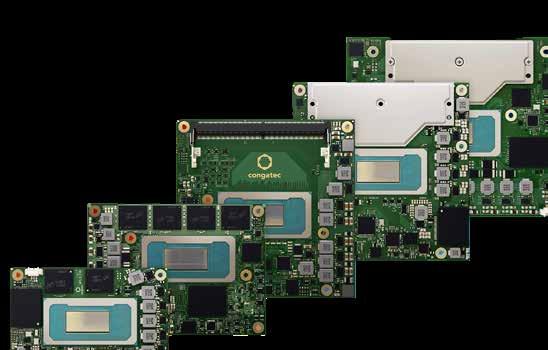
Extraordinary AI performance from -40 to +85 °C for rugged applications
Congatec is expanding its portfolio of Computer-on-Modules (COMs) with Intel Core Ultra Series 3 processors to include variants for the extended industrial temperature range of -40 °C to +85 °C. With up to 180 TOPS of energy-efficient embedded computing performance, this high-performance module family is now also available for use in particularly demanding environments in AI-intensive markets, including industrial automation, robotics, medical, and retail pointof-sales.
With the support for the industrial temperature range, the COMs – offered as application-ready aReady.COMs –can be deployed in environments characterized by extreme temperature fluctuations, weather exposure, vibrations, or continuously demanding operating conditions. For extended ruggedness, congatec offers a Ready.YOURS customization services for value-adds, including conformal coating,special component selection, or burn-in tests. Like the con -
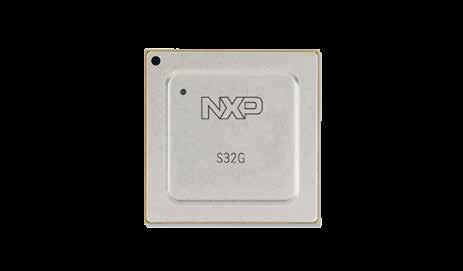
Deos RTOS running on S32G provides for the orchestration of high-speed multi-core application processing and coordination of data from multiple I/O interfaces used in safety-critical systems.
DDC-I announced the availability of its Deos™ multi-core real-time operating system for the NXP S32G family of network application processors with verification evidence to DO-178C Design Assurance Level A (DAL A). Deos support extends and strengthens the
ventional variants, the rugged derivatives also offer up to 16 CPU cores, up to 10 TOPS, and an integrated NPU5 for low-power AI inference, with up to 50 TOPS. Additionally, they feature up to 4 Xe3 cores for optimized GPGPU AI performance. Developers thus receive a scalable platform for high-performance embedded and edge systems that combines local AI processing, sensor fusion,
smart cities, the energy and renewable sectors, wayside infrastructure, and railway applications.
With a comprehensive portfolio of module variants across different form factors, both new designs and upgrades of existing systems can be realized – from compact, energy-optimized platforms to high-performance solutions with high I/O bandwidth.
S32G’s applicability in safety and mission-critical military and aerospace markets. Use cases include control nodes, data transfer devices, and intelligent sensors.
“The functionality, I/O, and safety-critical require ments of automotive and industrial are aligning with military and aerospace. The S32G family is a good example, where Deos customers have selected it for applications such as safety-crit ical flight controls,” Gilliland, vice president of marketing at DDC-I. “ is especially well-suited for S32G family use cases, as so many of them involve highly deterministic
real-time control and
I/O processing.”
Deos uniquely offers both high-performance single or multi-core processing with low jitter and deterministic system behavior.
Additionally, the RTOS is loaded with features including time/space partitioning, cache partitioning, safe scheduling, networking, security, and data distribution that, when combined with S32G hardware functions, enable developers to create a safe and secure networking and control
COT’S PICKS April 2026
Teledyne FLIR OEM Announces Upgraded Prism SKR Software, Boosting Automatic Target Recognition Capabilities for the Defense Industry
A software update unifies mission execution and intelligent supervision into a single, closed-loop autonomy platform for guided weapon systems.
Teledyne FLIR OEM, part of Teledyne Technologies Incorporated (NYSE:TDY), announced an upgrade to Prism™ SKR (pronounced “seeker”), evolving the software from automated targeting into a unified, closedloop autonomy platform. The milestone update sets a new defense industry standard by unifying mission execution and intelligent
supervision into a single platform for guided weapon systems, including smart, loitering munitions, air-launched effects (ALE), counter-UAS platforms, attritables, interceptors, and first-person view (FPV) drones. Teledyne FLIR OEM’s upgraded Prism SKR software manages the entire mission lifecycle, from tasking through execution by delivering perception-based automatic target recognition (ATR) and autonomy with advanced features designed for precision in contested environments. Prism SKR’s pixel-lock targeting also addresses the critical final meters of FPV drone missions, ensuring precision autonomy in the terminal phase where manual control often fails due to signal interference.
“The upgraded Prism SKR represents a significant leap forward by unifying execution and intelligent supervision to provide operators with greater mission confidence,” said Jared Faraudo, vice president of product management, Teledyne FLIR OEM. “By integrating advanced mission scripting with support for AI-accelerated development and execution compatible with large language model (LLM) tools like GitHub Copilot, we are enabling developers to plan and task systems at the speed of intent, while the QgroundControl plugin ensures these capabilities fit naturally into existing operator workflows.”
Key enhancements include 3D interactive aimpoint selection, terrain-aware operations, and pixel-lock targeting, which ensures precise, persistent re-identification (ReID) tracking through signal degradation or loss, scaling from assisted AI during FPV handoff to fully autonomous mission execution. These capabilities support a wide range of mission scenarios, including air-to-ground, ground-to-air, air-to-air,
and ground-to-ground operations.
Built for rapid OEM deployment, Prism SKR operates at the edge on lowpower embedded platforms, including NVIDIA® Orin™ and Teledyne FLIR OEM’s AVP systemonmodule (SOM) based on the Qualcomm Dragonwing™ QCS8550. The Weapon Open Systems Architecture (WOSA) compliant software integrates seamlessly with Boson® and Neutrino® IR cameras, as well as integratorselected visible sensors, delivering realtime target tracking and system state. A comprehensive application programming interface (API) and software development kit (SDK) accelerate deployment speed, reduce development risk, and enable performance optimization and customization.
COT’S PICKS April 2026
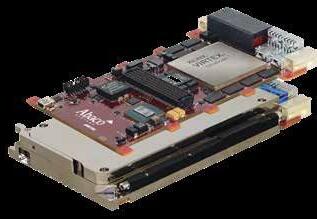
Abaco Systems Boosts Real-Time Data Processing Speeds with VP892
Rugged, SOSA-aligned 3U VPX FPGA card, powered by AMD’s VU13P
Abaco Systems announced the VP892, a rugged, SOSA-aligned 3U VPX FPGA processing engine powered by AMD’s Virtex UltraScale+ VU13P, one of the highest-density devices in the family. The VP892 keeps programs viable for the long term by enhancing performance in harsh defense, telecom, and industrial environments.
“Abaco continues to lead the way in delivering SOSA-aligned solutions that meet the evolving needs of our customers,” said Simon Collins, Director of Product Management at Abaco Systems. “The VP892 offers a powerful upgrade path ideal for applications where performance and reliability cannot be
compromised.”
The VP892 enables higher compute density and design continuity for applications such as
• Electronic Warfare (EW): Real-time signal acquisition for jammer detection and countermeasures
• Radar Imaging: Low-latency processing for high-resolution Synthetic Aperture Radar (SAR) and phased-array systems
• Semiconductor Manufacturing: Accelerated metrology and inspection systems for defect detection
• Communications & Networking: High-capacity DSP engines for secure data links and 5G/6G infrastructure
• Sensor Fusion & Autonomy: Aggrega tion and processing of multi-sensor data for ISR and autonomous vehicles
Built for real-time workloads, the VP892 offers 45% more programmable logic and
mance in Extreme Environments
up to 80% more signal-processing engines than the VP891. With AMD committed to supporting the UltraScale+ FPGA family through 2045, system designers can reuse and build on trusted design blocks for new or upgraded systems.
The VP892 supports high-bandwidth sensing and communications with an FMC+ expansion connector for wideband RF and waveform processing. Its 100Gb Ethernet and dual 100Gb optical interfaces enable fast data movement between system cards, deliv- er-
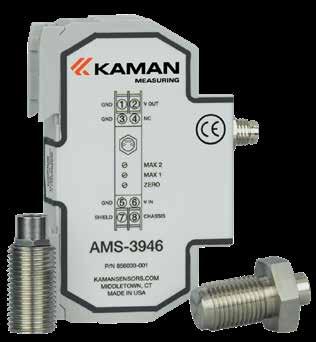
The Measuring Division of Kaman Precision Products, Inc., highlights its Advanced Magnetic Sensing (AMS) family of high-precision non-contact measuring systems, specifically designed for the aerospace and military markets. These sensors are engineered to operate reliably in high-pressure environments ranging from 500 psi to 40,000 psi, making them ideal for critical applications in aerospace propulsion and military systems.
Kaman’s AMS sensors enhance the capabilities of condition monitoring systems by accurately measuring and monitoring runout, speed, and changes in machine vibration profiles. This capability is crucial for reducing risk, minimizing damage, and preventing unplanned downtime due to unexpected failures in aerospace and military operations. The sensors are also well-suited for non-contact speed sensing, shaft runout, gear tooth condition monitoring, surface finish thickness inspection, and crack and defect detection.
sensors is their ability to operate without special magnets. They work with any ferromagnetic target and can detect target positions through non-magnetic, conductive, and non-conductive barriers. This feature enables leak-proof, penetrator-free equipment instrumentation installations that are both practical and economical in aerospace and military applications. The sensors offer root-meansquare (RMS) resolution down to 1 micron and a standard measuring range of up to 7 millimeters.
Designed to withstand harsh conditions, the AMS sensors are IP-67 rated and available with a variety of hermetic options. They come in standard configurations, including threaded, flanged, AS4320 pressure port-compatible, and bolt-head styles, and can be easily customized to meet specific OEM integration requirements. With an operating temperature range from -320°F to +1000°F (and up to +1200°F for short-term use), these sensors are versatile enough to withstand the extreme environments encountered in aerospace and military applications.
COT’S PICKS April 2026
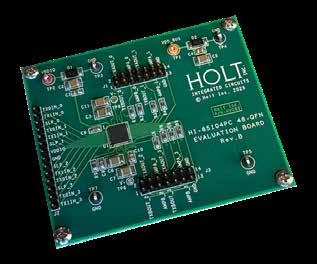
ARINC 429 Quad Line Driver Evaluation
Board
Holt Integrated Circuits today announced the release of the ADK85104 Evaluation Board, a compact, readytouse platform designed to help engineers rapidly evaluate and characterize Holt’s HI85104, the world’s first faultisolated quad ARINC 429 line driver. In addition to short-circuit protection, the HI-85104 provides integrated 37.5 Ohm impedancematched outputs with onchip fuses, output tristate capability when powered on or off, and optional zero-Ohm AMP outputs for external lightning protection networks.
Curtiss-Wright and Green Hills Software Introduce
High-Performance
COTS Solution for Safety-Critical Avionics Systems
Curtiss-Wright and Green Hills Software announced the availability of a new high-performance, commercial-off-the-shelf (COTS) solution that delivers safety-certifiable computing across a broader range of aerospace applications. The integrated platform combines Curtiss-Wright’s SOSA®-aligned V3-1222 3U VPX processing module with Green Hills Software’s FACE®-certified INTEGRITY®-178 tuMP™ real-time operating system (RTOS). The combined solution delivers an efficient, proven path to deploy open-standard, advanced multicore systems in environments that demand the highest levels of functional safety assurance, including airworthiness certification.
“This solution delivers a modular and safety-certifiable computing foundation that reduces integration risk and helps customers bring critical capabilities to market faster,” said Lee Brown, general manager of C5ISR,
The evaluation board is powered by a 3.3 V VDD supply and supports a digital input range of 1.8 V to 5.0 V, enabling direct inter facing with a wide variety of FPGAs and mi crocontrollers without additional level shift ing.
The board demonstrates the HI85104’s advanced protection architecture. Each transmit channel includes internal shortcircuit protection, ensuring other channels continue operating normally even if an individual output is shorted to ground or another line. The device resumes normal transmission automatically when the fault is removed.
All logic inputs on the board support 4 kV ESD protection, and its convenient header
Curtiss-Wright Defense Solutions. “As technology cycles accelerate, it’s essential that we support our customers with proven tools to meet safety requirements while keeping pace with mission needs. This collaboration helps accomplish both.”
The Curtiss-Wright V3-1222 features the 13th Gen Intel® Core™ i7 processor, which combines six performance cores and eight efficient cores, along with integrated Intel® Iris® Xe graphics—all in a single-slot 3U VPX footprint. Green Hills Software’s INTEGRITY-178 tuMP RTOS supports both bound multi-processing (BMP) and symmetric multi-processing (SMP), allowing developers to assign specific workloads to optimal core types to maximize throughput and determinism. In addition to running multiple workloads in parallel, INTEGRITY-178 tuMP uniquely enables a multi-threaded, safety-critical workload to execute across multiple cores. Together, these technologies support system developers targeting the highest Design Assurance Level (DAL A) certification objectives, including compliance with A(M)C 20-193/DO-178C and A(M)C 20-152A/DO-254 guidance.
“The combination of the INTEGRITY-178 tuMP RTOS running on the V3-1222 presents unique opportunities to take advantage of the hybrid architecture of the 13th Gen Intel® Core™ i7 processor,” said Renu Navale, VP and general manager, Critical Infrastructure, Federal & Aerospace Division, Intel Corporation. “Avionics systems can benefit from optimizing power efficiency and determinism by assigning tasks that are high-priority but lower in processing requirements to the more efficient E-cores.”
tion at both highspeed and lowspeed ARINC data rates. Output tri-state capability when powered off is also demonstrated.
“The ADK85104 provides engineers with a fast, intuitive way to evaluate all four channels of the HI85104 with minimal setup. It’s an ideal companion to our ARINC 429 product family, whether customers are designing embedded LRUs, ATE systems, or highchannelcount avionics architectures,” said Anthony Murray, Director of Marketing Communications at Holt.
This solution is engineered to meet the demanding needs of programs requiring certifiable multicore computing, including:
• Defense applications: tactical radar systems, flight control computers, and sensor fusion
• Commercial aviation: digital cockpit systems, primary and multifunction displays, enhanced flight vision systems
• Industrial and air mobility: autonomous flight control, safety-critical robotics, and electric vertical takeoff and landing (eVTOL) platforms
Curtiss-Wright and Green Hills Software have a long history of collaboration on Intel processor-based safety-certifiable platforms. The new V3-1222 solution builds on prior joint efforts, adding significantly more processing power and graphics capability while maintaining support for rigorous safety and airworthiness requirements.
The V3-1222 also includes unique board-level features such as a CardFail signal tied to onboard Built-In Test capabilities, and support for high-bandwidth PCIe Gen 3 lanes, enabling advanced data throughput in system architectures.
The V3-1222 processing module includes trusted computing features to protect against physical and remote attacks. The INTEGRITY-178 tuMP RTOS provides a Multiple Independent Levels of Security (MILS) operating environment capable of hosting Multi-Level Security (MLS) applications and has been used to meet the National Security Agency’s “Raise the Bar” security standard for cross-domain solutions (CDS).
COT’S PICKS April 2026
Kontron Launches New-Generation Ace Flight™ 4609 Avionics Server Now in Production
Kontron announced the launch of the Ace Flight™ 4609, a new high-performance avionics server designed to power next-generation in-flight entertainment and connectivity (IFE&C) systems.
Kontron, a global leader in IoT/ Embedded Computing Technology (ECT) and avionics solutions, today announced the launch of the Ace Flight™ 4609, a new high-performance avionics server designed to power next-genera-
tion in-flight entertainment and connectivity (IFE&C) systems.
The Ace Flight™ 4609 combines powerful onboard computing with a rugged avionics design to support the growing demand for bandwidth-intensive passenger services and airline digital applications. Built on the latest Intel® processor technology, the platform delivers the performance required for onboard content distribution, connectivity management, and operational airline services.
Designed for flexibility and scalability, the system integrates high-speed networking, extensive avionics interfaces, and large removable storage ca-
pacity. This architecture enables airlines and connectivity providers to deploy a wide range of applications while simplifying integration and supporting future upgrades.
Engineered specifically for aviation environments, the Ace Flight™ 4609 meets stringent environmental and reliability standards while delivering data-center-class computing performance within a compact avionics platform. Unlike the previous Ace Flight™ 4608, which used an 8core Intel® Xeon® processor and DDR4 architecture, the Ace Flight™ 4609 integrates a 14core Intel® i7 Raptor Lake processor with 64GB of DDR5 memory and advanced 5G/ LTE connectivity, providing significantly greater processing power, higher throughput, and expanded storage capacity for demanding connected aircraft applications.
“With airlines continuing to expand digital services onboard, computing performance in the aircraft is more important than ever,” said Yves Beaumont, Product Manager, Avionics at Kontron. “The Ace Flight™ 4609 provides a powerful and scalable platform to support the next generation of connected aircraft applications.”
Annapolis Micro Systems.
Behlman Electronics.
Dolphin.
Mercury Systems.
MPL.
nVent.
PICO Electronics, Inc.
Pixus Technologies.
Tekdense.
.www.dolphinics.com/COTS
.www.mrcy.com
.www.mpl.ch
www.nVent.com/schroff/varistar-cp-mil
www.odu-aerospace.com
.www.picoelectronics.com
www.pixustechnologies.com
www.tekdense.com
COTS Journal (ISSN#1526-4653) is published monthly at; 110 S Rancho Santa Fe, Virgin UT 84779. Periodicals Class postage paid at San Clemente and additional mailing offices. POSTMASTER: Send address changes to COTS Journal, 110 S Rancho Santa Fe PO 790039, Virgin UT 84779.
SUPERIOR RELIABILITY AT UP TO 50% LESS
Behlman has provided reliable power to mission-critical military airborne, shipboard, ground and mobile applications for over 50 years. Behlman offers the widest array of COTS AC to DC and DC to DC power supplies that meet military requirements at industrial pricing.
> Proven military reliability without the high cost of full mil-spec
> Built to perform to full power at rated temperatures
> Modified COTS solutions that offer faster delivery, higher reliability and lower cost than custom designs
> Hundreds of designs to meet a wide range of applications